Article

Monitoring Crop Structure and Moisture Using GNSS Interferometric Reflectometry Based on SNR Modeling

by
Samuele De Petris
and
Enrico Borgogno-Mondino
*
Department of Agriculture, Forestry and Food Science, University of Turin, L.go Braccini 2, 10095 Grugliasco, Italy
*
Author to whom correspondence should be addressed.
Agronomy 2026, 16(9), 922; https://doi.org/10.3390/agronomy16090922
Submission received: 25 March 2026 / Revised: 27 April 2026 / Accepted: 29 April 2026 / Published: 1 May 2026
(This article belongs to the Special Issue Smart Farming Technologies for Sustainable Agriculture—2nd Edition)

Abstract

This study aims to evaluate the potential of Global Navigation Satellite System Interferometric Reflectometry (GNSS-IR) based on signal-to-noise ratio (SNR) analysis for monitoring crop structure and moisture. Data were collected using a GNSS antenna placed within an experimental meadow located in NW Italy. GNSS-IR exploits the interference between direct and ground-reflected signals to derive physical parameters such as the vegetation phase center height and soil moisture. In this work, by analyzing and modeling the oscillations in SNR time series, the sensitivity to crop growth dynamics was assessed. Vegetation height and dielectric parameters were compared against corresponding ground-surveyed values collected using a ruler and buried soil moisture sensors. Results suggest that GNSS-IR can detect canopy height with a high degree of consistency (Pearson’s r = 0.89, MAPE = 18%). Results also show that changes in the amplitude and phase of the interference pattern are sensitive to biomass density and dielectric properties of the reflecting surface (r = −0.81 and r = 0.86 respectively). GNSS-IR observables were analyzed across four representative measurement campaigns capturing distinct seasonal stages of meadow development. Despite the limited temporal sampling (n = 4), the selected observations correspond to contrasting vegetation and soil moisture conditions, allowing the identification of systematic variations in crop biophysical properties. These findings open promising perspectives for the development of innovative monitoring strategies in precision agriculture, leveraging existing GNSS infrastructure to obtain key biophysical parameters with minimal additional equipment and operational complexity.

1. Introduction

In modern agriculture, precise and timely data on soil moisture and crop structural parameters are essential. Important physiological functions like light interception, transpiration and carbon assimilation are directly impacted by crop structure, which includes factors like height, biomass and canopy geometry. Additionally, these structural features control how vegetation reacts to environmental stressors and crop–atmosphere interactions [1]. Thus, precise structural data is essential for crop modeling, scheduling irrigation and assessing management techniques [2]. Soil moisture plays an equally important role in agricultural monitoring. It has a major impact on microbial activity, germination, nutrient uptake and plant water stress [3]. Crop productivity is adversely affected by both excessive/insufficient soil moisture, so timely data on soil water status is essential for efficient field management. In this context, farmers and agronomists depend more than ever on quantitative geographically dispersed and frequent observations of soil moisture dynamics due to growing climate variability, extreme weather events and the need for resource optimization. Conventional techniques for monitoring these variables include in situ sensors like weather stations, tensiometers, soil moisture probes and ground-based biomass measurements. These techniques offer high-quality reference data, but their spatial sparsity and high operating costs are intrinsic limitations. Installing dense sensor networks is frequently impractical, and a single sensor may only represent a small portion (often a point) of a heterogeneous field. Moreover, field measurements are often inconsistent over time and challenging to maintain over wide regions. Conventional ground measurement approaches need significant deployment and maintenance work, even though they are precise and physically interpretable. Thus, they have serious drawbacks that limit their ability to monitor operational agricultural parameters. Particularly in diverse landscapes or agricultural holdings, their spatial coverage is constrained and inadequate to capture field-scale variability.
In this framework, satellite remote sensing provides an attractive solution for regional to global crop monitoring through fixed and repeatable observations. Optical sensors offer valuable spectral information but are limited by cloud cover, aerosols, illumination conditions, and their inability to directly characterize three-dimensional crop structure [4]. LiDAR systems can retrieve canopy geometry with high accuracy but are not currently available as operational high-temporal-frequency satellite missions. Microwave sensors, including SAR and passive radiometers, provide information related to vegetation water content, soil moisture, and surface roughness but still face limitations in revisit frequency, spatial resolution, and sensitivity to specific biophysical parameters. These constraints reduce their capability to capture rapid phenological changes and short-lived hydrological events at the field scale.
These limitations reveal a key observational gap: no widely available remote sensing system currently provides continuous field-scale measurements simultaneously sensitive to vegetation structure and the dielectric properties of soil and vegetation water content. This study addresses this gap by investigating the potential of GNSS Interferometric Reflectometry (GNSS-IR) observables to jointly capture crop structural dynamics and moisture-related variations under real field conditions [5]. In theory, GNSS-IR holds significant promise for agricultural applications because its measurement principle is inherently sensitive to both the geometric and dielectric properties of the surface. In fact, GNSS-IR exploits the interference between the direct GNSS signal (at L-band) received by the ground antenna and the same signal after reflection from the Earth’s surface. The superposition of these two signals generates characteristic oscillations in the signal-to-noise ratio (SNR), whose frequency and amplitude depend on the geometry of the reflecting surface and on its dielectric properties [6,7]. By analyzing these oscillations as satellites change elevation, GNSS-IR can retrieve parameters such as effective reflector height, surface roughness, and variations in soil and vegetation water content [8,9]. This passive and continuous measurement principle makes GNSS-IR particularly suitable for environmental and surface monitoring. Since GNSS satellites transmit signals continuously and globally, GNSS-IR provides uninterrupted, passive, and all-weather observations without requiring active sensing or costly instrumentation [10]. Importantly, the technique is inherently sensitive to both the geometric structure of a surface (through scattering geometry and reflector height) and to dielectric variations associated with soil and vegetation water content. This combination of structural and moisture sensitivity, along with crop-consistent geometric resolution, is unique among remote sensing techniques. Moreover, GNSS-IR systems are low-cost, energy-efficient, and suitable for installation on existing GNSS infrastructure such as ground reference networks, agricultural machinery, or fixed monitoring stations [11,12]. These attributes make GNSS-IR particularly attractive for providing dense temporal observations at the field scale, thus complementing existing remote sensing capabilities and contributing to more effective agricultural monitoring.
Inspired by these characteristics, in this work, GNSS-IR sensitivity to crop growth was explored. In fact, variations in crop height, biomass, and canopy structure affect the scattering geometry, altering the interference pattern and thus the derived reflector height. At the same time, changes in soil and vegetation water content modify the dielectric constant of the surface, influencing the amplitude and frequency of the oscillations in the signal-to-noise ratio [13]. Moreover, GNSS-IR provides continuous observations at high temporal resolution, typically from minutes to hours, enabling the monitoring of rapid hydrological and phenological changes that conventional satellite systems often miss. Its passive nature eliminates the need for active transmissions, reducing energy requirements and allowing permanent deployment in the field, on existing GNSS reference stations, or even on agricultural machinery. These characteristics make GNSS-IR particularly appealing for precision agriculture, where the ability to observe dynamic processes at fine spatial and temporal scales is essential for optimizing irrigation, fertilization, and crop management strategies.
Despite this strong theoretical potential, GNSS-IR has been relatively underexplored in agricultural research. Several factors have contributed to this limited adoption. First, the technique has historically emerged within the geodetic community, primarily for snow depth [14], sea level [15,16], and soil moisture retrieval [13], and only recently have researchers begun to consider its applicability in vegetated environments [17,18]. Second, agricultural canopies present complex scattering conditions, with multiple interactions between soil, stems, leaves, and moisture dynamics, making retrieval algorithms more challenging than in homogeneous surfaces such as snow or water bodies. The lack of consolidated forward models and inversion frameworks tailored to agricultural targets has slowed progress. Additionally, most existing GNSS reference stations were designed for positioning rather than environmental monitoring, and their antenna configurations, heights, and surrounding infrastructures are not always optimal for vegetation studies. Only in recent years has the availability of low-cost and easily deployable GNSS receivers made field experimentation more accessible [11,12]. Finally, the interdisciplinary nature of GNSS-IR (requiring expertise in GNSS signal processing, microwave scattering, and crop biophysics) has limited its uptake within the agricultural remote sensing community, where optical techniques dominate established workflows. As a result, despite its promising theoretical capabilities, GNSS-IR remains an emerging and insufficiently exploited technique for agricultural monitoring. There is therefore a clear opportunity to advance the state of the art by developing tailored processing methods, evaluating performance across growth stages, and integrating GNSS-IR with existing remote sensing approaches to provide richer and more continuous information on crop structure and moisture conditions.
Motivated by these gaps and potentialities, this study advances previous GNSS-IR agricultural applications by jointly evaluating multiple observables related to crop structural development and moisture-driven dielectric variations across different phenological stages. We therefore investigate the potential of GNSS-IR for retrieving crop structural and moisture-related parameters, focusing on its sensitivity to variations in canopy height, biomass, and soil water content. We present a dedicated processing framework and validate its performance using ground reference data over a meadow test site located in NW Italy, discussing its implications for the integration of GNSS-IR into operational agricultural monitoring systems.
The novelty of this contribution is the integrated assessment of multiple GNSS-IR observables as indicators of canopy development and dielectric changes across phenological stages, validated using independent ground and satellite observations.

2. Materials and Methods

2.1. Study Site

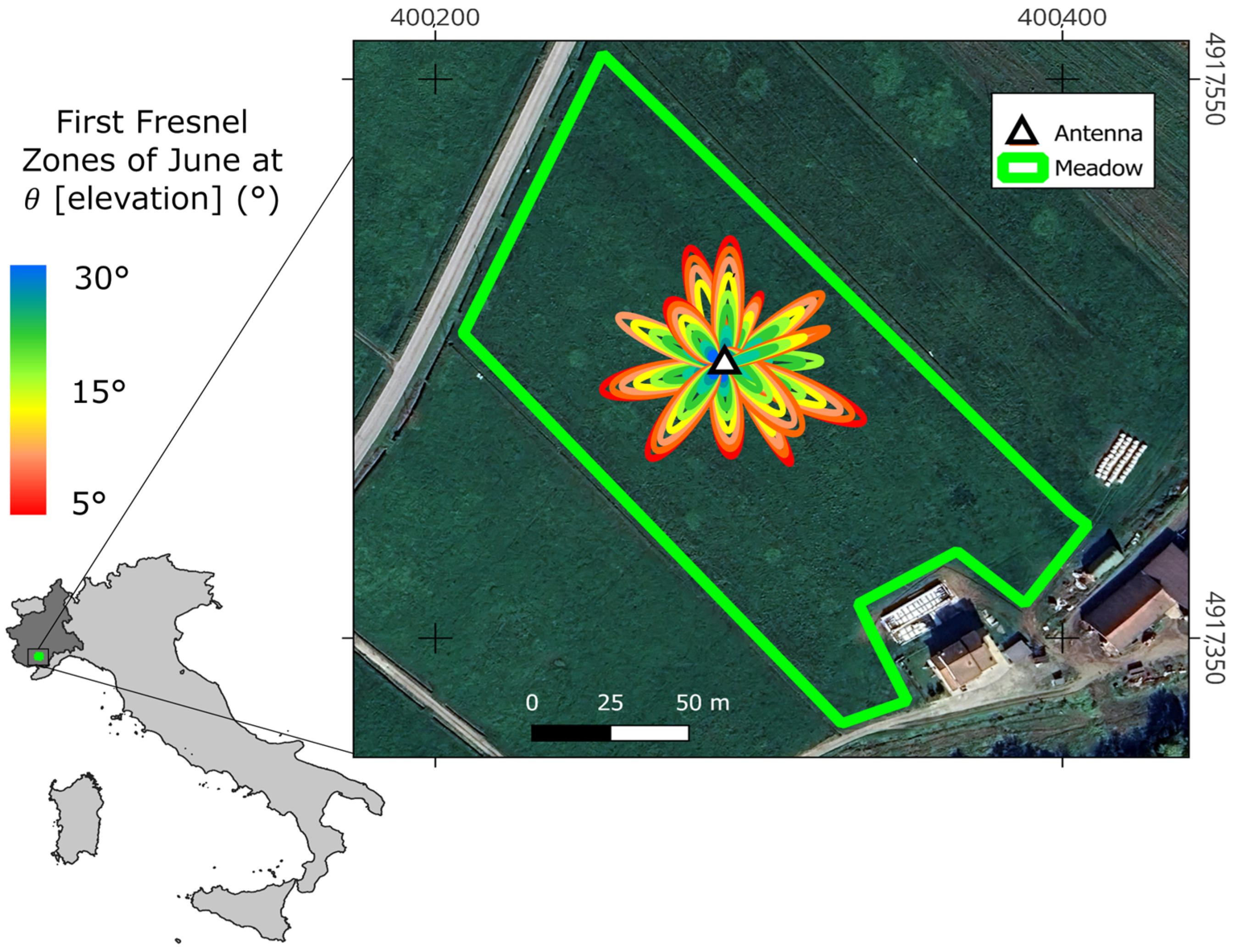
The area of interest (AOI) is located in Pogliola (Piedmont region, NW Italy) within the municipality of Mondovi (Figure 1). The test site from 2010 is a permanent polyphyte meadow (mainly dominated by Gramineae and Leguminosae) covering 2 ha. In 2025, it was mowed 3 times (20 May, 8 July and 13 August) and grazed 1 time (15 September). A permanent point was materialized in the middle of the AOI (Latitude: 44.4034221°, Longitude: 7.7477633°—CRS: WGS84) to properly place a GNSS receiver and a soil moisture sensor.

2.2. Collected Data

2.2.1. GNSS Surveys

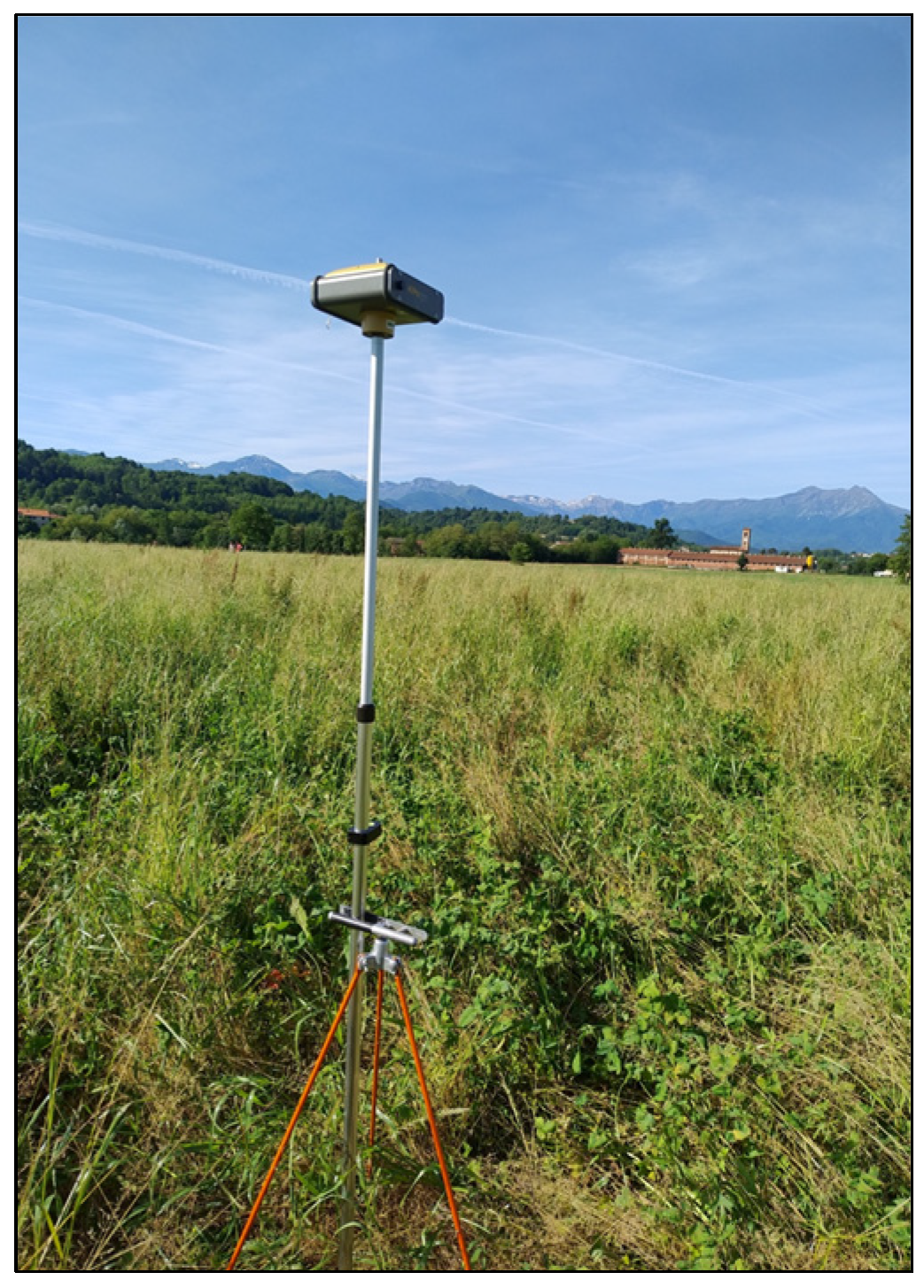
Ground GNSS surveys were performed during the 2025 phenological season, specifically on 1 June, 4 July, 2 August and 7 September. For each survey, a Topcon HiPer Pro multi-frequency (L1 and L2) and multi-constellation (GPS and GLONASS) geodetic-grade receiver [19] was adopted, and the antenna was placed at 2 m above the ground level (Figure 2). The receiver was allowed to acquire raw data in static mode without interruption from 8 a.m. to 2 p.m., setting a sampling rate of 1 Hz and recording C/A signals from the following frequencies: GPS-L1 = 1575.42 MHz, GPS-L2 = 1227.60 MHz, GLONASS-L1 = 1598.06 MHz, and GLONASS-L2 = 1242.93 MHz. From raw data, for each pseudo-random noise code (PRN) tracking the same satellite, the SNR value was measured assuming a 1 Hz bandwidth. Along with SNR values, the satellite azimuth and elevation angles were also recorded. SNR observations from GPS and GLONASS satellites at L1 and L2 frequencies were processed as independent time series and were not combined within the same analysis track. Each satellite–receiver geometry, identified by a specific PRN and carrier frequency, was treated separately. Accordingly, the corresponding carrier wavelength was assigned to each track (GPS-L1, GPS-L2, GLONASS-L1, and GLONASS-L2) and used in the subsequent SNR modeling.
All individual time series were independently processed in the R environment. This approach avoids mixing observations characterized by different carrier wavelengths and preserves the physical consistency of the GNSS-IR retrieval framework.

2.2.2. Multispectral Data

To monitor biomass temporal variability within the AOI, Copernicus Sentinel-2 Level-2A Harmonized multispectral imagery was acquired and processed in Google Earth Engine (GEE) [20]. A total of 90 Sentinel-2 images were collected between 1 April and 1 October, corresponding to an average revisit interval of approximately 2 days.
Cloud masking was performed using the Scene Classification Layer (SCL), excluding pixels classified as cloud, cirrus, or cloud shadow. Only images with valid observations over the study field after filtering were retained for analysis. No temporal smoothing was applied to the resulting time series.
For each valid acquisition date, the normalized difference vegetation index (NDVI) was computed [21] using the 10 m near-infrared and red bands, and the field median NDVI was then calculated over the AOI for each corresponding GNSS surveying date (n = 4). NDVI was used as an external proxy of canopy density and seasonal biomass dynamics, rather than as a direct quantitative estimate of biomass or LAI [22]. This assumption is commonly adopted in vegetation monitoring studies, as NDVI is sensitive to changes in green vegetation cover and canopy development [23]. However, NDVI is subject to known limitations, including saturation under dense vegetation conditions, reduced sensitivity at high LAI values, and possible influence of soil background and illumination effects [24]. Therefore, in this study, NDVI is interpreted as a relative indicator of crop canopy density, suitable for comparison with GNSS-IR signal attenuation patterns. Although the spatial support of Sentinel-2 observations differs from the GNSS-IR footprint, the relatively homogeneous nature of the experimental meadow allows field-scale NDVI to be considered a representative indicator of vegetation conditions. NDVI is used in this study only for interpretation purposes and not as an input to GNSS-IR modeling or inversion.

2.2.3. Reference Data

In order to properly validate GNSS-based deductions, ground reference data was collected. In particular, the soil probe sensor was buried at a depth of 10 cm during the 2025 spring. The sensor used in this study is a capacitive soil moisture probe, Drill & Drop™ Bluetooth® (Sentek Technologies, Adelaide, Australia), which provides continuous measurements of volumetric water content at hourly intervals. For consistency with GNSS-IR acquisitions, soil moisture content (SMC) was averaged over the period 8 a.m. to 2 p.m. local time and acquired on the same date as the corresponding GNSS ground survey.
SMC was measured using a single probe, assumed to be representative of the GNSS-IR footprint due to the homogeneous conditions of the experimental meadow. This assumption is supported by the uniform distribution of natural rainfall inputs and by consistent irrigation and management practices applied across the entire field, which are expected to limit spatial variability at the field scale.
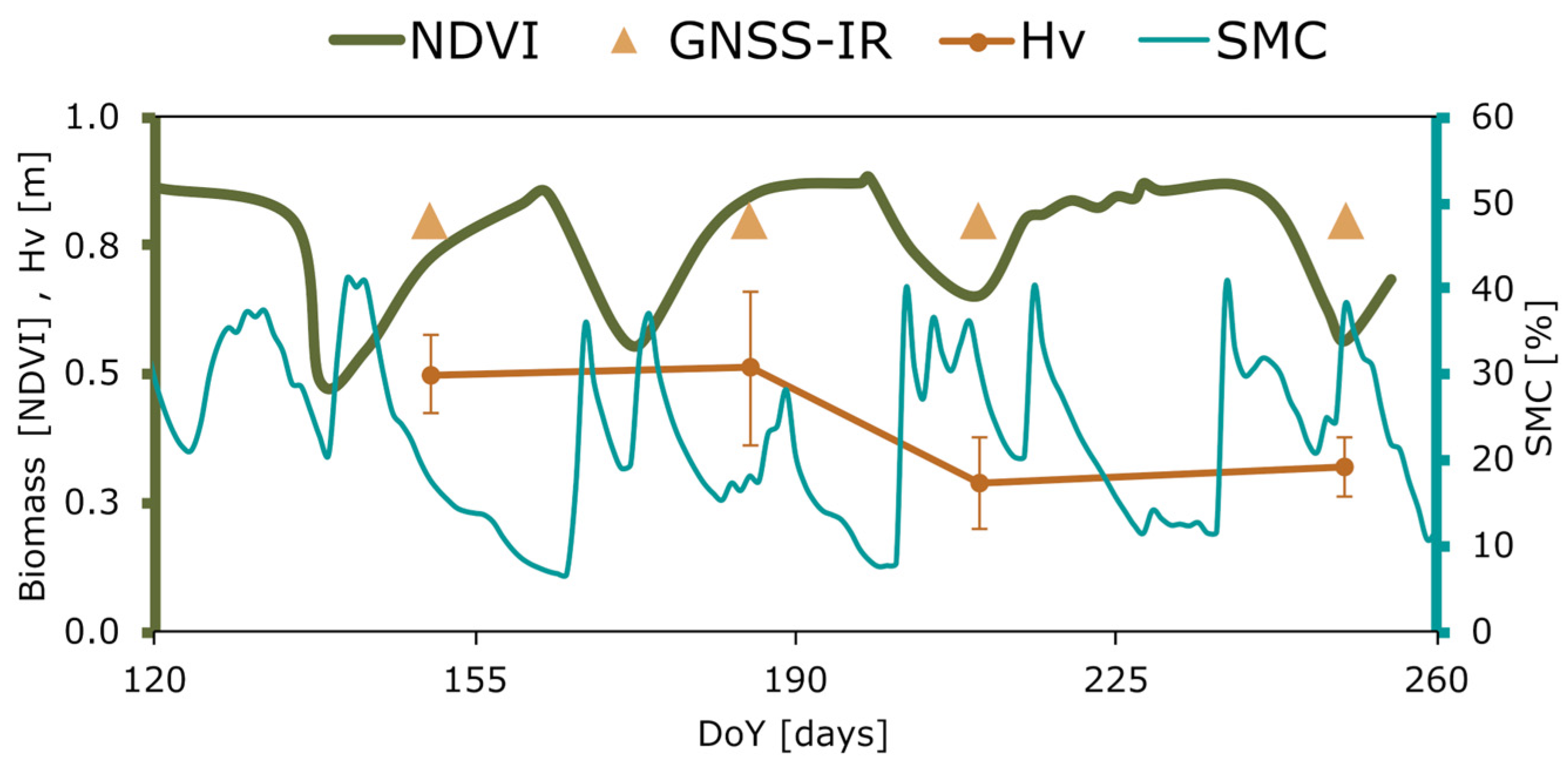
Moreover, during GNSS ground surveys, crop height (hv) was manually measured using a ruler perpendicular to the ground and sampling 7 points at about 3–5 and 12 m distances around the antenna location. Finally, the average and standard deviation values were computed. A summary of the data collected is provided in Figure 3.

2.3. Data Processing

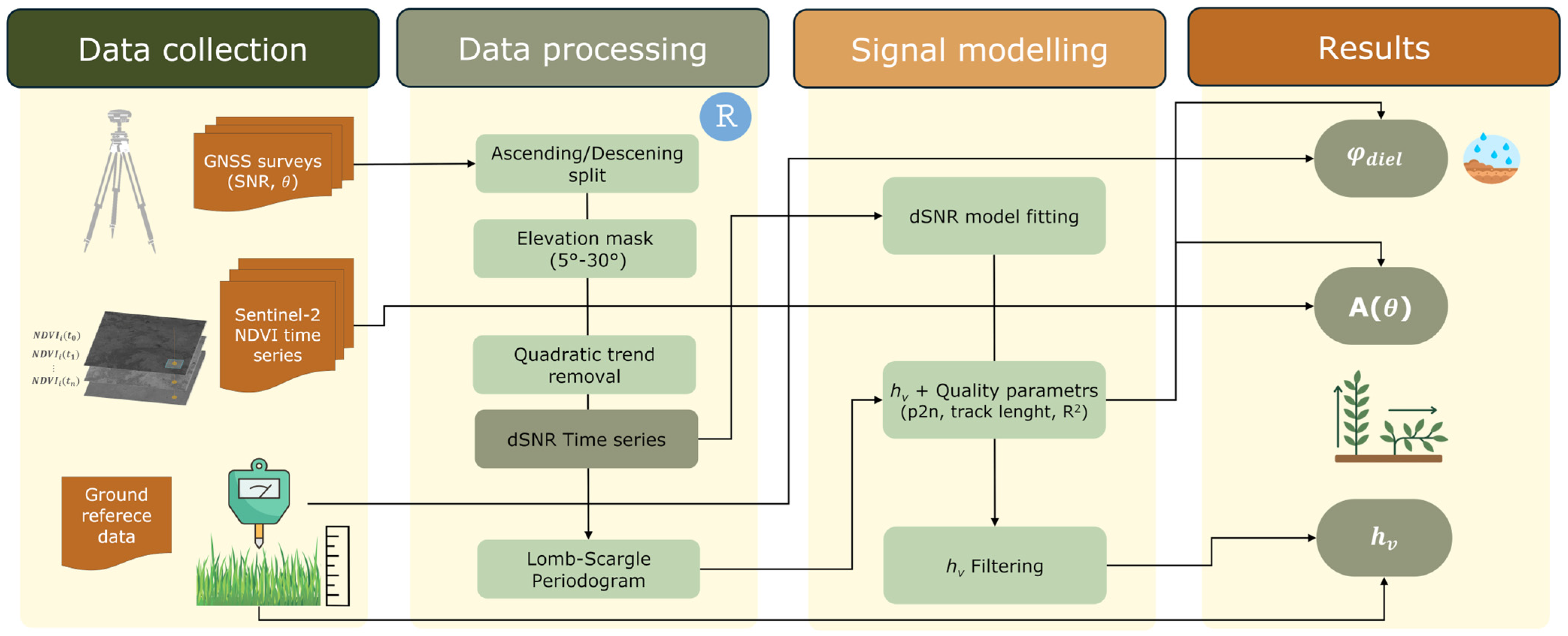
The workflow developed in this work is summarized in Figure 4. The workflow shows the major steps in the proposed experimental design. (1) The data collection step involved collecting and preparing the raw GNSS, multispectral, and reference data samples required for the experiment. Sample values were then stored as time series data in text files. (2) The data processing step focused on pre-processing and analyzing the raw data by filtering, masking, and detrending procedures using self-developed routines implemented in the R vs 4.1.1 environment [25]. (3) StepSignal modeling and (4) the results steps were aimed at statistically modeling the GNSS-IR data and exploring the sensitivity of model parameters to crop structure and moisture. Methodological details are described in the next sections.

2.3.1. SNR Time Series Pre-Processing

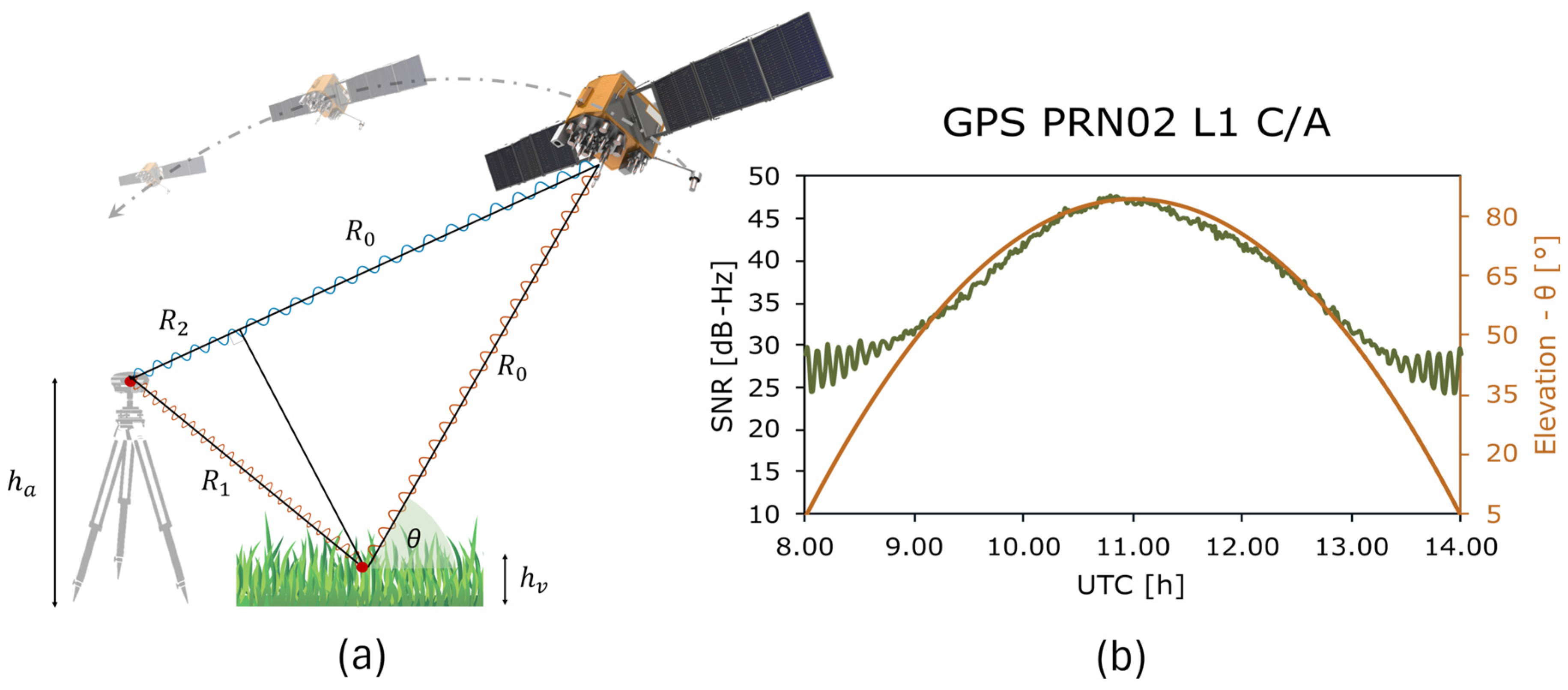
Traditionally, GNSS receivers have been adopted for positioning and navigation applications [26] and strictly use the direct signal from GNSS satellites while attempting to mask out reflected signals that introduce additional signal paths (multipath), thereby causing errors in the final position solution. Conversely, GNSS-IR uses this multipath [27,28]. In fact, GNSS-IR is a bistatic radar technique that analyzes the scattered signal from Earth’s surfaces. It uses two separate antennas: the one on-board the satellite transmits a microwave signal at the L-band with right-hand circular polarization (RHCP), while the second antenna is a GNSS receiver (geodetic or low-cost instrument) that is ordinarily placed close to the surface of interest to record the reflected signal (multipath) (Figure 5a). The superimposition of direct and reflected signals generates an interference term in the recorded power (SNR) due to the different path ranges (Equations (1a)–(1c)).
S N R θ = S t o t ~ ( θ ) 2 N ~ ( θ ) 2
S t o t ~ ( θ ) 2 = S d ~ θ + S r ~ θ 2 = A d 2 ( θ ) + A r 2 ( θ ) + 2 A d ( θ ) A r ( θ ) · cos ( φ )
φ = 2 π λ ( R 1 R 2 ) = 2 π λ 2 ( h a h v ) · sin θ
where S N R θ is the signal-to-noise ratio acquired at the time when the satellite elevation is θ , and S t o t ~ and N ~ are the complex values of the total signal received and the noise component respectively. A complex signal is reported in polar form as S ~ = A e j φ , where j = 1 and A and φ are the amplitude and phase terms. The subscripts d and r denote the direct and reflected signals; R is the path range (Figure 5), and h a and h v are the antenna and vegetation phase center heights respectively.
This interference pattern can be clearly observed in the acquired SNR time series, especially between 5° and 30° of satellite elevation (Figure 5b), where the oscillations are much more noticeable. Conversely, at higher satellite elevation angles, the direct and reflected signal paths converge geometrically, resulting in a greatly reduced path-length difference. This reduction diminishes the amplitude and frequency of the associated SNR oscillations, making the interference signature difficult to isolate from background noise [29]. Moreover, due to the incoherent scattering (volume or rough surfaces), part of the signal is left-hand circular polarized (LHCP). Higher elevation satellites typically exhibit LHCP reflections, and lower elevation satellites typically exhibit RHCP reflections [30]. This means that it is advantageous to examine low-elevation angles to look for multipath while using a geodetic or commercial receiver because the antenna gain pattern primarily follows RHCP. Because the same RHCP predominates, this component will provide unambiguous interferograms, which is why low-elevation angles between 5° and 30° are favored for GNSS-IR.
For this reason, for each tracked satellite, we split ascending from descending orbits using satellite elevation angle and universal time coordinates (UTC) time information. Then, we masked out all SNR observations outside the range of 5° < θ < 30°. Within such an elevation range, GNSS-IR can detect an area of more than 1000 m2 surrounding the antenna, which is larger than common in situ observations [31]. This detectable area is defined by the first Fresnel zones (FFZs). FFZs are ellipses with a semi-major axis (a) aligned with the azimuthal direction of the satellite track and a semi-minor axis (b) orthogonal to the semi-major one. These approximate dimensions can be related to antenna height and satellite elevation angle by Equations (2a) and (2b). The reflection point distance from the antenna can be computed using 2c.
a = λ h a sin θ sin θ 2
b = λ h a sin θ sin θ
d = h a tan θ
where h a is the above-ground antenna height, and λ is the carrier wavelength. In this work, the FFZ parameters were computed for all available satellite tracks (Figure 1) covering about 5000 m2 for each surveying date (a: mean = 5 m and standard deviation = 4 m; b: mean = 2 m and sd = 1 m; d: mean = 5 m and sd = 3 m).
The recorded SNR contains both direct and reflected signal components (Equation (1b)). The direct GNSS signal varies with the elevation angle because the antenna gain pattern and atmospheric attenuation both increase smoothly as the satellite rises. Since A r A d , the direct signal creates a strong deterministic trend in the SNR that contains no useful multipath information. Therefore, such an underlying trend was removed from the masked SNR time series by fitting a quadratic model using sin θ as an independent variable, creating a zero-mean detrended (dSNR) time series where the reflected component dominates.
The oscillations of the dSNR are therefore the result of reflector height (RH) and the dielectric features of the reflecting media (i.e., crop canopy and soil). To analyze such an interferometric pattern (oscillations), the Lomb–Scargle periodogram (LSP) [32] was computed in the R environment using sin θ as the independent variable, where θ is the satellite elevation angle. Therefore, LSP was implemented using Equations (3a)–(3c) and the dSNR spectrum was explored. In this formulation, the spectral variable does not represent temporal frequency (Hz) but the oscillation frequency with respect to sin θ (cycles per unit of sin θ ).
P ω = 0.5 β ω t β ω
β ω = X ω t X ω 1 X ω t y
X ω = cos ( ω   s i n θ 1 ) sin ( ω   s i n θ 1 ) cos ( ω   s i n θ n ) sin ( ω   s i n θ n )
where n is the number of dSNR values within the time series, ω = 2 π f , and f varies between 0.1 and 50 cycles per unit of sin θ , stepping by 0.01. P ω is the power corresponding to a given ω . The dominant frequency (f—Equation (4a)) of oscillation of dSNR, corresponding to the max { P ω } , can be modeled and physically related to RH by Equation (4b). Therefore, once f was retrieved, h v was computed for each available dSNR time series by Equation (4c).
f = φ t 2 π 1 2 R H λ
R H = f λ 2
h v = h a R H
Along with h v estimates, two quality parameters were computed: peak-to-noise ratio (P2N) and the satellite track arc length ( θ ). The former was computed as the difference between the peak of the periodogram, i.e., max { P ω } , and the mean of all P ω values outside the peak. The latter was computed as the difference between the maximum and minimum elevation angles of the satellite track. According to previous works [33,34,35], we removed from the analysis all dSNR time series with P2N < 3 dB-Hz and θ < 15°. These thresholds were adopted to ensure the analysis only focused on reliable time series. In fact, P2N is used to evaluate the quality of the detrended SNR oscillations. A high P2N indicates that the multipath signature dominates over background noise and that the corresponding RH estimate is likely to be reliable [36], while θ represents the minimum satellite-arc length required to ensure that the detrended SNR contains a sufficient number of multipath oscillations for a stable spectral estimate. Arcs shorter than ~15° of elevation change typically do not include enough cycles of the interference pattern, especially when the RH is small or the carrier wavelength is long. For this reason, arcs with an elevation span > 15° are commonly retained [6,37]. A final filter was applied to exclude all dSNR time series that provide an hv solution outside the range of 0.05 m < hv < 2 m [38].

2.3.2. Modeling dSNR Time Series on Crops

After filtering for reliable satellite tracks, the dSNR time series contains a sinusoidal component (interference pattern) generated by crop features. Because this multipath term is theoretically harmonic with respect to the elevation angle, it can be naturally modeled using a cosine/sine basis. Harmonic regression, therefore, provides a physically grounded and statistically robust method to estimate the multipath frequency and possibly derive crop parameters. The model proposed in Equations (5a) and (5b) was fitted to the filtered dSNR data.
For each retained dSNR time series, the LSP was first used to identify f , which was then converted into RH and subsequently into h v using Equation (4c). Therefore, the periodogram provided the geometric frequency component, while h v was derived from the corresponding peak frequency rather than directly estimated by the spectral method itself. In the subsequent nonlinear modeling step (Equation (5b)), the RH term obtained from the spectral analysis was kept fixed, and only the remaining parameters related to attenuation and phase were optimized. The nonlinear fit was performed in the R environment using the nlsLM function (package minpack.lm), based on a bounded least-squares Levenberg–Marquardt algorithm. Initial parameter values were set as follows: amplitude equal to the maximum observed dSNR value, the attenuation coefficient initialized to 0.1 , and phase offset initialized to 0. Bounds were imposed to retain physically meaningful solutions: A > 0 , m 0 , and ϕ [ π , π ] . This two-step strategy separates the retrieval of the geometric component (frequency/crop height) from the estimation of attenuation and phase behavior, improving parameter stability and interpretability.
d S N R θ = A θ · c o s φ g e o m ( θ ) + φ d i e ( θ )
d S N R θ = A 0 e ( m 0 · sin θ ) · cos 4 π λ h a h v sin θ + φ 0
where A θ is the amplitude term; φ g e o m = φ = 4 π λ ( h a h v ) · sin θ is the phase term corresponding to the geometric feature of the surface (i.e., crop height); and φ d i e is the phase term related to the dielectric features of the crop. A θ is explicitly dependent on elevation angle since vegetation generates an attenuation of amplitude [39]. We expanded Equation (5a) into Equation (5b) by modeling this attenuation as an exponential decay function, where A 0 is the base term and m 0 is the decay component. Both terms account for sensor-surface features (canopy-specific density and complex permittivity) and acquisition geometry ( θ ). The detrended SNR modeled by Equation (5a) represents the interference term generated when the direct GNSS signal combines with the coherent component of the reflected field. The reflected wave is defined in Equation (5c).
S ~ r θ = Γ θ , ε ~ e j · Γ θ , ε ~ + S ~ i n c o h
where the Fresnel coefficient, Γ , depends on the effective complex permittivity ( ε ~ ) of the vegetation/soil layer, which controls both the magnitude and phase of the Fresnel reflection coefficient. The incoherent term S ~ i n c o h arises from randomly oriented volume scatterers, and it is modeled as the (zero-mean) sum of many random-phased scatterers whose power elevates the noise floor and, statistically, does not produce deterministic phase oscillations in dSNR. Although the receiver does not measure S ~ r directly, it measures S d ~ θ + S r ~ θ 2 , and detrending time series isolates only the elevation-dependent oscillatory term, which depends on the amplitude and phase of S ~ r . Thus, dSNR is linked to the reflected field. Importantly, vegetation introduces both coherent and incoherent scattering [40]. The incoherent component ( S ~ i n c o h ) arises from randomly oriented leaves, stems, gaps, and moisture heterogeneities; this part contributes only noise and reduces the coherence of the reflection. The coherent fraction, however, still undergoes a deterministic interaction with the vegetation/soil interface and is therefore well described by the Fresnel coefficient of an effective medium. Because the effective permittivity is complex, the Fresnel coefficient acquires a non-zero argument, producing a dielectric phase term ( φ d i e ) that acts as a slowly varying or nearly constant offset (modeled in 5b as φ 0 ) over a single satellite arc, reflecting the electromagnetic properties like moisture, density, and composition of the vegetated surface. Although Γ depends on θ , its phase is only weakly dependent on satellite elevation for the following physics-based reasons: the permittivity is a material property and remains constant over the satellite arc. Given the short elevation angle range, any elevation dependence must come only from the Fresnel angular dependence, and it is assumed to be negligible where multipath is observed. In fact, the ε ~ of the soil/vegetation medium dominates Γ , causing Γ θ , ε ~ to vary only by a few degrees across an entire satellite arc. By comparison, the φ g e o m changes by several hundred degrees, so the dielectric contribution appears practically constant, i.e., Γ θ , ε ~ Γ ε ~ . Therefore, φ d i e acts as an almost fixed phase offset determined by vegetation water content and soil moisture.
Finally, the parameters A 0 , m 0 , and φ 0 and the resulting determination coefficient (R2) were estimated using the nonlinear-least-squares method for each filtered dSNR time series per acquisition date. All modeled time series with an R2 lower than 0.6 were filtered out to focus the sensitivity analysis on ground data using statistical models.

2.4. Validation and Ground Data Comparison

The fitted parameters A 0 , m 0 , φ 0 along with h v can completely describe the deterministic component of the dSNR time series. In this work, we explore the sensitivity of these parameters with respect to crop structure and moisture. To achieve this task, we compared the median value for each date to the ground reference data. In particular, crop vertical structure, as synthesized by h v , was retrieved by frequency analysis (Equation (4b)).
To ensure a robust comparison between GNSS-IR-derived estimates and ground reference data, h v retrieved from GNSS-IR frequency analysis (Equation (4c)) was compared with in situ measurements collected during each field campaign. For h v , both mean error (ME) and mean absolute percentage error (MAPE) were computed, as GNSS-IR provides a direct quantitative estimate of canopy height suitable for explicit error characterization.
ME is defined as the average signed difference between GNSS-derived and reference values (GNSS vs reference) and retains the physical unit of meters. MAPE provides a scale-independent measure of relative error expressed as a percentage.
In contrast, NDVI and soil moisture were not considered direct retrieval targets but rather independent biophysical proxies used for sensitivity analysis. Therefore, their relationship with GNSS-IR observables was assessed exclusively through Pearson’s correlation coefficient (r).
All statistical analyses were based on temporally aggregated values (n = 4), corresponding to the four field campaigns.
Concerning the crop horizontal structure, i.e., canopy density, we used the NDVI value as a proxy for biomass density and leaf area index (LAI) [23]. We compared the median NDVI value within the field to the median A θ considering all filtered satellite tracks for each date and assuming θ = 15°. This angle was selected as a representative mid-range value within the 5–30° GNSS-IR effective angular interval, where stable multipath interference patterns are typically observed. To evaluate the sensitivity of Equation (5b) to moisture changes, we compared ground-retrieved SMC to φ 0 .

3. Results

3.1. SNR Time Series Pre-Processing

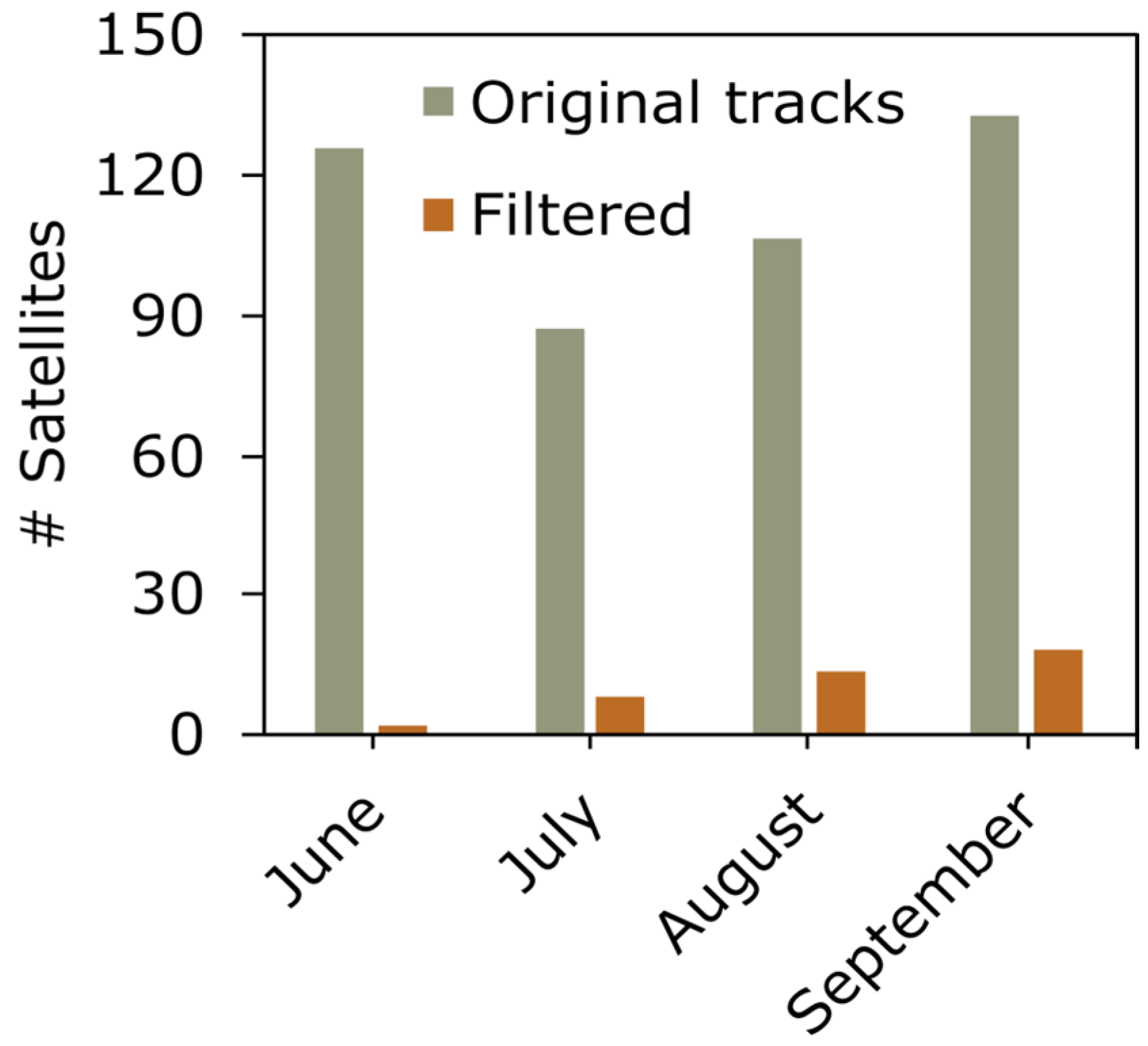
Figure 6 shows the number of SNR time series recorded during GNSS ground surveys, specifically comparing the number of available satellite tracks before and after application of the filtering criteria. While the unfiltered dataset contains a large number of satellite tracks per date (about 100), only a subset (less than 8% of total tracks) meets the quality thresholds required for reliable modeling of dSNR time series.
It is worth stressing that although the total number of satellite tracks decreases after filtering, this ensures that the subsequent analyses are based on consistent and reliable input data, eliminating tracks affected by unfavorable geometry, signal noise, or other quality issues. Seperating the data into ascending and descending orbits ensures that only geometrically consistent time series are analyzed, while restricting SNR values to the 5–30° elevation range focuses the analysis on the portion of the signal most sensitive to surface reflections.
To provide a more detailed overview of the data selection process, the number of satellite tracks retained after each filtering step is reported in Table S1 (Supplementary Material). The strong reduction in the dataset is mainly associated with short satellite arcs, which limit the number of observable multipath oscillations, and with low P2N values, indicating poorly resolved spectral peaks in the dSNR periodograms. The hv range and R2 criteria act as final consistency checks, removing only a small number of additional cases. dSNR time series having a P2N < 3 dB-Hz and with θ < 15° were removed because they do not contain a clear, well-defined interference pattern, making them unsuitable for robust multipath analysis. Similarly, unrealistic crop height values outside the 0.05–2 m range were also excluded to avoid artifacts caused by noise, model instability, or reflections from the surrounding non-vegetated landscape (e.g., buildings or electric poles). Finally, only time series for which the harmonic regression model achieved an R 2 > 0.6 were retained, ensuring that the temporal signal contained a meaningful seasonal pattern rather than random fluctuations. As a result, the remaining tracks constitute a high-quality, physically consistent dataset from which reliable crop height estimates can be derived.

3.2. Estimating Crop Height

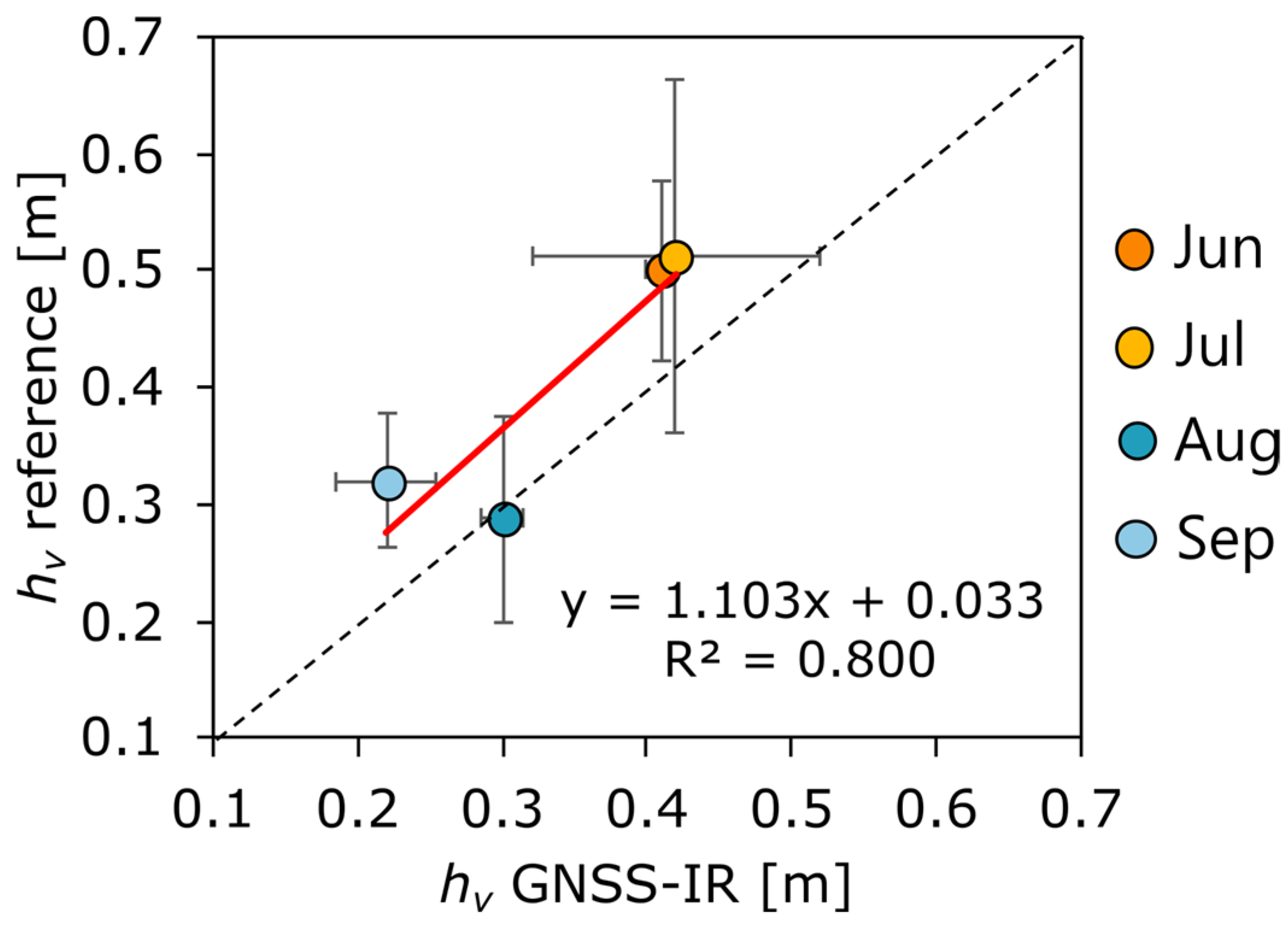
Regarding GNSS-IR sensitivity to crop vertical structure, the proposed approach based on Equation (4c) using LSP frequency analyses (Equations (3a)–(3c)) allows for the estimation of h v for each filtered dSNR time series and date. Figure 7 shows that a positive correlation exists between the reference and GNSS-IR-retrieved h v values, with Pearson’s r = 0.89, ME = −0.067 m and MAPE = 18%. The results show a consistent estimation of h v despite a systematic error. As shown by Figure 7, the GNSS-IR h v always underestimates the actual h v . The lower crop height values are found in the last part of the phenological season. In fact, during August–September, due to frequent mowing events, as clearly shown in Figure 3, the NDVI values drop, the h v values are lower than the June–July ones, and the spatial variability is lower (bars in Figure 7).

3.3. Modeling dSNR Time Series on Crops

To quantify the vegetation-induced modulation of the dSNR oscillations, we fitted a three-parameter nonlinear model proposed in Equation (5b) to each satellite arc. These parameters summarize the effective reflectivity, dielectric phase, and interferometric path geometry of the vegetation/soil system. After estimating the parameters for all filtered time series, we compared them directly with ground-based crop observations. This allowed us to evaluate how the GNSS-derived harmonic parameters are sensitive to the temporal evolution of the crop and to assess their capability to track vegetation structural and dielectric changes.
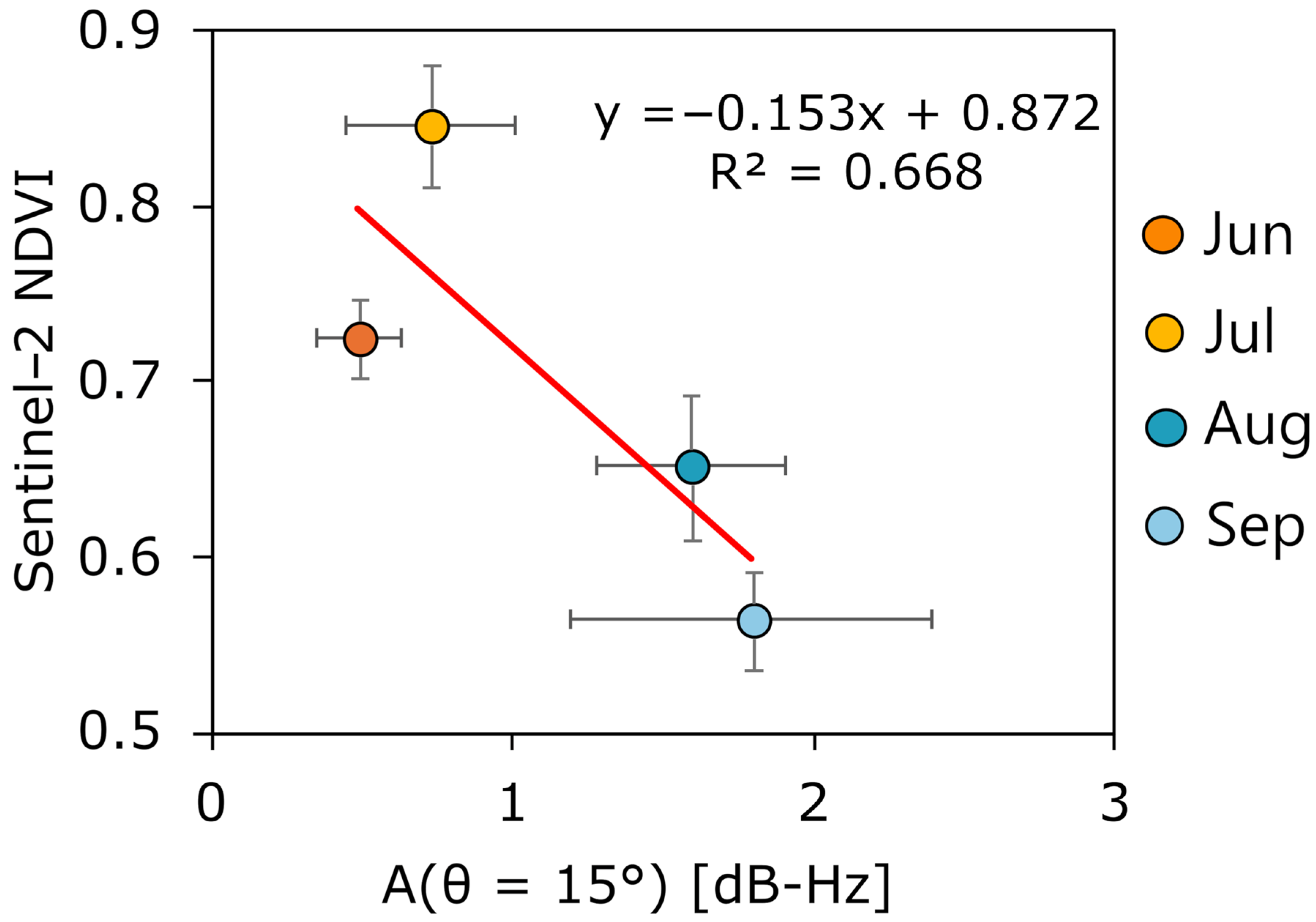
Figure 8 shows the comparison between the biomass density proxy, i.e., NDVI, and the attenuation of the dSNR harmonic model. It is noteworthy that across the growing season, a clear negative correlation (r = −0.81) exists between the Sentinel-2 NDVI (field median) and the amplitude/attenuation of the modeled dSNR oscillation. As NDVI increases, the canopy becomes denser and more water-rich, which enhances vegetation attenuation and reduces the fraction of the reflected field that remains phase-coherent. This progressively lowers the dSNR oscillation amplitude, consistent with the expected decrease in coherent reflectivity in vegetated conditions. Conversely, lower NDVI values correspond to sparse vegetation, where attenuation is weak and the coherent reflection is stronger, yielding higher dSNR amplitudes. The comparison between NDVI and dSNR amplitude was performed using a reference elevation angle of θ = 15°. This value was selected as a representative mid-range angle within the 5–30° interval, where GNSS-IR multipath oscillations are typically most stable and physically meaningful. A sensitivity analysis on the effect of the elevation angle θ used for the computation of dSNR amplitude confirms the robustness of the results. Although variations within the 5–30° range lead to changes in the absolute magnitude of the estimated amplitude, these variations act as a consistent scaling factor across all observations and do not modify the relative temporal patterns or statistical relationships. This behavior is consistent with Equation (5b), which shows a smooth dependence on θ and results in systematic rather than differential changes among acquisition dates. Consequently, the observed correlations between dSNR-derived amplitude and NDVI remain stable with respect to the choice of θ. Therefore, θ should be interpreted as a normalization parameter used to extract a representative amplitude value within the physically meaningful GNSS-IR angular range, rather than as a controlling factor of the observed relationships. This confirms that the detected signal variability is primarily driven by vegetation dynamics rather than geometric configuration.
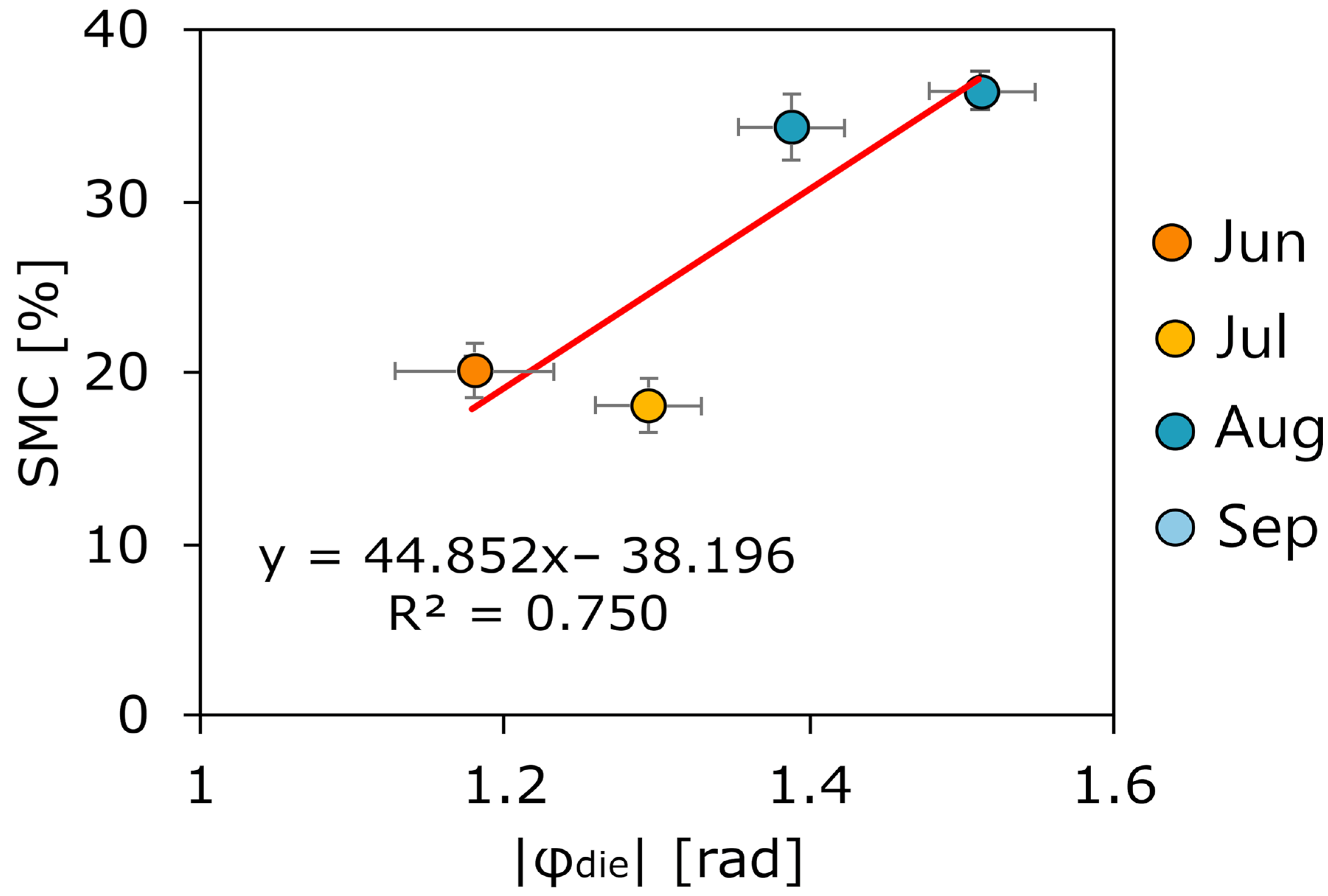
Figure 9 shows the comparison between in situ soil moisture measurements and the absolute magnitude of the dielectric phase term. Results show a positive correlation (r = 0.86, ME = −5.3 of SMC and MAPE = 21%), meaning that higher SMC corresponds to larger φ d i e . Overall, the observed alignment between soil moisture and φ d i e supports the sensitivity of the GNSS-IR φ 0 parameter to the water content of the soil/vegetation layer. This behavior directly follows from the model in 5b, in which the dielectric contribution acts as an additive phase offset to the geometric oscillation.

4. Discussions

The interpretation of the GNSS-IR results presented in this study requires combining signal-processing aspects, electromagnetic scattering theory, and vegetation biophysics. Before extracting physically meaningful parameters from the dSNR oscillations, we applied a set of pre-processing filters designed to remove arcs that do not carry a sufficiently coherent multipath signature. Three criteria were used: (i) a P2N > 3 dB-Hz, (ii) a minimum elevation span Δθ > 15°, and (iii) a goodness-of-fit threshold of R 2 > 0.6 for the nonlinear harmonic regression. Each of these filters targets a different source of unreliability. The P2N criterion ensures that the oscillatory component in the detrended SNR dominates over thermal and quantization noise; arcs with a P2N below this threshold have too weak a multipath term to allow stable parameter estimation. The Δθ > 15° requirement guarantees sufficient angular sampling of the oscillation, as very short arcs do not contain enough phase evolution to meaningfully constrain the amplitude, frequency, or phase-offset parameters [6,7]. The R 2 > 0.6 threshold plays a central role in selecting only those dSNR time series that are compatible with the three-parameter cosine model [17,18]. This quality filter was applied to retain only dSNR time series exhibiting sufficiently coherent oscillatory behavior for robust parameter estimation. While this filtering strategy substantially improves the robustness and physical interpretability of the retrieved parameters, it may also introduce a degree of selection bias by preferentially retaining satellite arcs that better satisfy the assumptions of the adopted harmonic model. As a consequence, observations affected by heterogeneous canopy structure, rapidly changing moisture conditions, or more complex scattering mechanisms may be less represented in the final dataset. Therefore, the retained subset should be interpreted as the portion of observations exhibiting the clearest and most coherent GNSS-IR response, rather than as a fully unbiased sample of all possible field conditions. Future work should investigate more flexible retrieval approaches, such as multi-frequency or time-varying harmonic models, robust regression schemes, and physically based scattering formulations that explicitly account for canopy heterogeneity, changing soil moisture, and multiple reflection sources. These developments could improve parameter retrieval under non-ideal vegetation and surface conditions while preserving a larger fraction of the available observations.
This behavior is directly supported by the dataset, where higher R2 values correspond to more stable spectral fits and well-defined oscillatory signatures.
Conversely, observations associated with low R2 values are excluded by this criterion; however, the dataset itself does not allow a direct attribution of the underlying causes. The reduced model performance is therefore interpreted as being potentially associated with multiple factors, including heterogeneous canopy structure, rapidly changing moisture conditions, and more complex scattering configurations. These explanations should be regarded as physically plausible hypotheses rather than directly observed mechanisms within the present study.
Moreover, a low R 2 generally indicates that the time series does not behave as a stable, single-frequency sinusoid. This situation often occurs during GNSS surveys and can arise when the satellite geometry provides irregular elevation sampling or insufficient angular coverage, when antenna gain variations distort the SNR response, or when additional reflections from nearby structures introduce multiple interfering frequencies. Under such conditions, the dSNR time series departs from the ideal harmonic shape, and the nonlinear fit cannot retrieve physically meaningful parameters. Removing these arcs prevents the estimation of unstable phase shifts or artificially low frequencies, ensuring that only arcs carrying a coherent and interpretable multipath signature are retained in the analysis. A low R 2 can also arise when the harmonic model does not fully capture the actual behavior of the dSNR amplitude or phase across the satellite arc. In the nonlinear fit, we assume that the amplitude A ( θ ) varies smoothly with elevation and the phase offset φ 0 remains approximately constant. These assumptions are reasonable when the analyzed elevation range is limited, the antenna gain varies smoothly, and dense vegetation is observed, but they are not universally valid. In practice, the amplitude can exhibit stronger elevation dependence than the model allows, due to variations in antenna gain, changes in coherence linked to canopy heterogeneity, or a gradual reduction in reflectivity as the incidence angle increases. When this elevation-dependent amplitude is forced into a model with a simpler functional form, the residuals increase, and the regression no longer produces a high R 2 . A similar issue occurs when the phase offset is not truly constant along the arc. Although φ 0 is theoretically only weakly dependent on elevation, strong attenuation or complex vertical scattering structures may introduce slight departures from this assumption. Even small but systematic deviations from a constant phase offset can reduce the ability of the cosine model to follow the observed oscillation, producing a phase mismatch that propagates along the entire arc. When the model cannot accommodate these fine phase distortions, the result is a lower R 2 even if the oscillation is physically present. Thus, some low- R 2 time series do not indicate an absence of coherent multipath but rather a mismatch between the simplified harmonic model and the real dSNR behavior, especially in canopies where both amplitude evolution and phase structure can deviate from the ideal assumptions. Filtering out these satellite arcs ensures that only those time series consistent with the assumed model geometry and parameterization contribute to the physical interpretation.
Concerning the comparison between GNSS-IR-derived estimates and in situ reference measurements, both exhibit a degree of variability, which is explicitly represented in Figure 6, Figure 7 and Figure 8 through error bars. Rather than representing random noise, this variability reflects the spatial heterogeneity within the GNSS-IR footprint (about between 2 and 20 m around the antenna) and the spatial/temporal variability in ground measurements and GNSS-derived parameters.
Therefore, both datasets inherently include uncertainty associated with the distributed nature of the observed system. The inclusion of error bars provides additional insight into the intra-date variability and allows for a more robust interpretation of seasonal dynamics. When this variability is explicitly considered, a clear separation between phenological stages emerges. In particular, the pre-mowing period (June/July) is characterized by comparable mean values and overlapping variability ranges, indicating similar canopy structure conditions, with vegetation heights around 50 cm. In contrast, the post-mowing period (August/September) shows systematically lower vegetation height, biomass-related proxies, and GNSS-IR attenuation, with distinct variability ranges that do not overlap with those of early-season conditions. This separation indicates that the variability captured in both GNSS-IR and in situ measurements is not purely stochastic but reflects meaningful differences in biophysical conditions across the growing season. In this sense, error bars contribute to identifying two distinct phenological regimes (June/July pre-mowing and August/September near post-mowing dates), reinforcing the physical interpretability of the observed signal. Although the statistical analysis is based on a limited number of temporal observations (n = 4), these measurements are representative of well-defined and contrasting crop conditions in the meadow. When grouped by seasonal phase, the data reveal consistent differences in vegetation structure and soil moisture conditions. This suggests that GNSS-IR observables are sensitive to systematic changes in crop biophysical properties rather than to individual measurement noise.
In this context, the reported correlations should be interpreted as indicative of underlying physical relationships rather than strict statistical generalizations. Nevertheless, the consistent agreement between GNSS-IR-derived parameters and ground measurements across distinct phenological conditions supports the ability of the method to capture meaningful variations in crop structure and surface properties.
Concerning the RH estimates, they were first obtained using the LSP, which has become standard in GNSS-IR due to its ability to detect the dominant oscillation frequency in unevenly sampled SNR data [34]. While the LSP provides a robust first-order estimate of the oscillation frequency, its limitations must be acknowledged. The finite angular window (truncated time series) of each arc inherently produces spectral leakage, causing energy from nearby frequencies to smear into the main lobe of the periodogram [28]. In addition, secondary reflection paths (e.g., from vegetation layers, rough soil patches, or structural elements) may introduce weak oscillatory components that the LSP algorithm cannot separate from the primary frequency. All these effects tend to shift the dominant peak toward slightly lower frequencies, which directly translates into a bias in the estimated RH. This behavior is particularly pronounced when the SNR oscillations have low contrast or when the effective bandwidth of the arc is small. These effects can explain the variability and occasional instability observed in LSP-based height retrievals, especially during periods of dense canopy growth (during June, many observations were removed). The nonlinear regression approach used in this work partially mitigates these issues by explicitly modeling the amplitude and the additional phase simultaneously. Nevertheless, the LSP results remain useful for identifying the main oscillation band, validating the frequency range used in the parametric fit, and characterizing the temporal evolution of the reflector height at the seasonal scale.
An important outcome of this study concerns the negative bias in crop height estimates occurring during periods of significant vegetation development. This bias arises naturally from the vertical distribution of scattering elements within the canopy (Equation (6)).
S ~ r ( θ ) = z 0 z 0 + h t o p F v ( z , θ ) e j k z d z
where h t o p is the actual top of the canopy; F v ( z , θ ) is the vertical reflectivity function (generic shape of vertical profile); z 0 is the ground height; z is the generic height within the volume; and k = 4 π λ is the wave number. In vegetated environments, the microwave reflection originates from a distributed scattering medium rather than a sharp surface. Thus, the reflected field originates from the integral of the vertical reflectivity profile [41], F v ( z , θ ) , and its phase center height (PCH) corresponds to the reflectivity mean-weighted centroid (Equation (7)).
P C H θ = z 0 z 0 + h t o p z · F v z , ϑ d z z 0 z 0 + h t o p F v z , θ d z
Because attenuation and scattering increase with depth, the strongest coherent contribution rarely originates from the canopy top (the one manually surveyed by ruler); rather, it arises from a lower region where scattering strength and penetration depth jointly maximize. Consequently, h v is always biased downward relative to the physical canopy height (i.e., P C H h v < h t o p ) . This phenomenon parallels the well-known phase-center displacement in Pol-InSAR vegetation remote sensing, where the coherent return typically lies below the canopy top due to a combination of volumetric scattering and signal extinction [42,43]. In this context, the negative bias is not an error but a physical property of the scattering medium that must be properly interpreted when relating GNSS-IR reflector heights to vegetation structure.
Beyond RH, the A ( θ ) (modeled by A 0 and m 0 ) retrieved from the nonlinear GNSS-IR model also exhibits a distinct, physically interpretable pattern when compared with optical vegetation indices. The strong negative correlation between dSNR amplitude and the Sentinel-2 NDVI reflects the attenuation characteristics of the canopy. NDVI increases with leaf area, chlorophyll concentration, and biomass density, all of which contribute to a thicker, more water-laden canopy. From the electromagnetic scattering point of view, this corresponds to a higher extinction coefficient, causing the coherent component of the reflected signal to diminish as vegetation develops. The attenuation pattern observed in Figure 8 is fully consistent with theoretical and empirical evidence from microwave remote sensing of vegetation. This behavior agrees with radiative-transfer studies showing that canopy optical thickness and vegetation water content increase with leaf area and biomass, thereby enhancing microwave extinction and reducing coherent reflectivity [44,45,46]. Similarly, our results are consistent with findings from active microwave investigations, where backscatter decreases or saturates with increasing biomass due to multiple scattering and higher canopy opacity [47,48,49]. The decrease in dSNR amplitude therefore reflects the same physical mechanisms, i.e., increasing vegetation optical depth and absorption, that govern attenuation in L-band SAR. Thus, amplitude behaves as a proxy for attenuation and overall canopy density (and above-ground biomass), complementing the structural interpretation provided by the h v . The dielectric phase term provides a different layer of information, connected not to geometry or attenuation but to the complex permittivity of the vegetation/soil medium. The observed positive relationship between φ d i e and in situ SMC indicates that GNSS-IR is sensitive to variations in water content through the dielectric properties of the medium. As soil moisture increases, both the real and imaginary parts of ε ~ increase substantially, modifying the reflection coefficient and introducing a measurable phase shift in the coherent reflection. Because the sign of φ d i e may depend on scattering asymmetry or arc geometry, its absolute value is physically more meaningful as a measure of dielectric strength. It is worth stressing that φ d i e reflects the combined dielectric behavior of the soil and the vegetation canopy. In principle, separating these contributions would require independent knowledge of vegetation water content [50,51]. However, in typical agricultural conditions, the volumetric water content of plants varies much less dramatically than soil moisture over daily to weekly timescales [52,53]. Plant moisture content tends to remain within a relatively narrow physiological range except during senescence or extreme stress [54]. Experimental characterizations show that its temporal dynamic range is relatively limited under normal physiological conditions [54,55,56].
In contrast, soil moisture can change abruptly due to rainfall, irrigation, or surface evaporation, and these changes produce much larger variations in complex permittivity, as established by classical dielectric mixing models for wet soils [57] and confirmed by more recent soil-permittivity retrievals using GNSS-IR [5,58]. Under these conditions, most of the temporal variability in φ d i e can be attributed to soil moisture, with vegetation moisture acting as a slowly varying background. This assumption is consistent with radiative-transfer studies showing that vegetation optical depth increases gradually with biomass and water content. Meanwhile, the soil layer beneath the canopy provides the dominant contribution to the rapidly varying dielectric contrast that modulates the phase of the coherent reflected field. This assumption is consistent with electromagnetic models showing that soil permittivity has a much stronger dynamic range than vegetation permittivity at GNSS frequencies [44,46].Therefore, while the dielectric phase reflects a composite medium, the signal observed in this study is dominated by soil-moisture-driven changes, providing a physically interpretable link between φ d i e and the hydrological state of the field. Furthermore, the sensitivity of the dielectric phase term to soil moisture observed in our dataset agrees with dielectric mixing models [59], which predict strong increases in complex permittivity as soil water content rises.
However, when all observables are considered together (crop height, amplitude attenuation, and dielectric phase), it becomes evident that the reflected GNSS signal cannot be interpreted as being controlled by a single component. Rather, the observations indicate that different metrics respond to different contributions within the soil/vegetation system. In particular, when examined in isolation, φ d i e retains sensitivity to moisture-driven dielectric variations in the reflecting surface, which are largely associated with soil conditions. In contrast, amplitude attenuation and the estimated phase center height indicate a clear influence of the vegetation layer.
Under the relatively low and homogeneous canopy conditions of this experiment, the reflected signal still preserves a measurable vegetation imprint. Even short grass forms an electromagnetically active layer that attenuates and phase-delays the coherent reflected component. This behavior is consistent with controlled dielectric characterizations showing that low-stature vegetation exhibits non-negligible complex permittivity at L-band and with radiative-transfer modeling demonstrating that even thin canopies introduce measurable extinction and scattering effects [56]. Similar conclusions have been reported in microwave studies, where grassland canopies significantly modify L-band emissivity and phase response despite their low biomass [45,46]. As a result, the GNSS-IR phase center does not necessarily coincide with the soil surface, but rather corresponds to an effective scattering height determined by the combined vertical reflectivity profile of the soil and vegetation. This behavior is analogous to L-band SAR observations over herbaceous canopies, where the phase center may lie above the soil even for grasslands [5,49,60]. Consequently, the phase center remains systematically elevated above the ground, confirming that even low vegetation can significantly modulate coherent GNSS reflections.
Overall, the correspondence between our field-scale GNSS-IR results and well-established microwave scattering theory supports the physical interpretability of the nonlinear dSNR model and confirms that GNSS-IR is sensitive to the structural and dielectric properties of agricultural canopies, in line with previous findings from both the radar and radiometer literature. Our results can be interpreted in the context of previous GNSS-IR studies that have explored the interaction between reflected GNSS signals, soil moisture, and vegetation. Early work by Rodríguez-Álvarez et al. [61] highlighted that GNSS-IR observations are sensitive to crop development and can capture vegetation-induced variations in the interference pattern. Rodriguez-Alvarez [62] further demonstrated that changes in vegetation water content influence GNSS signal attenuation, revealing a clear link between biomass dynamics and signal strength. Wan et al. [63] showed that the vegetation water content retrieved from GNSS measurements responds to crop growth cycles, emphasizing the potential of GNSS-IR as a proxy for canopy evolution. More recently, Zribi et al. [64] confirmed that parameters such as SNR attenuation and reflector height are affected by vegetation structure, indicating that plant development contributes measurably to GNSS-IR observables.
The results provide an indication that vegetation dynamics exert a strong and coherent influence on GNSS-IR observables across the observed phenological stages. While this behavior is consistent within the analyzed dataset, it should be interpreted as initial evidence derived from a single-site, temporally limited experiment, rather than as a generalized conclusion. Nevertheless, the observed consistency across variables and acquisition dates supports the sensitivity of GNSS-IR measurements to vegetation-driven changes in canopy structure and surface conditions. This suggests that rather than being treated as a secondary disturbance to soil moisture retrievals [5], vegetation emerges here as a primary driver of the temporal dynamics observed in our GNSS-IR dataset, even under relatively low and homogeneous canopy conditions. This broader perspective advances the existing understanding of GNSS-IR scattering mechanisms and underscores the importance of jointly evaluating multiple observables when interpreting signals over agricultural surfaces.
Several limitations of this study should be explicitly acknowledged to properly contextualize the results. First, the experimental design is based on a single-site field campaign conducted over an agricultural meadow in NW Italy. While this site provides controlled and homogeneous conditions, it does not capture the full variability of crop types, management practices, and environmental conditions that may influence GNSS-IR responses at larger spatial scales.
Moreover, it is based on a perennial meadow ecosystem (grasses and legumes), which may limit the direct transferability of the results to other crop types with different structural and dielectric characteristics. Future studies should therefore extend the analysis to a wider range of crops to assess the generality of the approach.
Second, the temporal sampling is limited to four acquisition dates, which represent key phenological stages of the crop cycle. Although these dates were intentionally selected to span the full active growing season, the limited number of observations constrains the statistical robustness of the analysis and restricts the possibility of deriving more generalized relationships.
Third, ground reference measurements exhibit a certain degree of spatial sparsity. Vegetation height was collected at a limited number of points around the GNSS antenna, and soil moisture was measured using a single probe. While these measurements were designed to be representative of field-scale conditions, they cannot fully capture small-scale spatial heterogeneity within the GNSS-IR footprint.
Finally, the GNSS-IR processing chain involves a filtering strategy based on quality criteria (e.g., P2N threshold, angular range, and goodness-of-fit requirements). Although this step ensures physically consistent retrievals, it may also exclude observations under more complex canopy or scattering conditions, potentially introducing a selection effect.
Despite these limitations, the dataset provides consistent and physically meaningful evidence of GNSS-IR sensitivity to vegetation structural and dielectric changes across phenological stages. Future work should address these constraints by increasing the temporal sampling density, extending the analysis to multiple sites and crop types, and exploring more flexible retrieval strategies that retain a larger fraction of GNSS observations under heterogeneous conditions.
Future developments will focus on testing the proposed modeling framework on additional crop types such as maize, wheat, and soybean, thereby assessing its robustness across contrasting canopy architectures and phenological stages. An important direction will also be the application of this method to low-cost receivers, particularly modern smartphones equipped with dual-frequency GNSS chipsets. Recent studies have demonstrated that meaningful GNSS-IR observables can be extracted from smartphone sensors when appropriate signal conditioning and calibration methods are applied [65]. Furthermore, exploiting signal polarization represents a promising avenue for increasing sensitivity to the dielectric properties of vegetation and soil. Vertically polarized components—those mainly provided by smartphone receivers [66]—are theoretically expected to enhance the response to permittivity contrasts, as predicted by Brewster-angle behavior [67], suggesting significant potential for smartphone-based GNSS-IR applications in precision agriculture. These combined developments could enable scalable, low-cost, and vegetation-sensitive monitoring solutions for agricultural environments. A practical limitation for the large-scale adoption of GNSS-IR in agriculture is that many existing GNSS reference stations were designed for geodetic positioning rather than environmental monitoring. Consequently, the antenna configuration, installation height, surrounding obstacles, and field representativeness may not always be suitable for crop sensing. However, the increasing availability of low-cost GNSS receivers and flexible deployment strategies offers new opportunities for dedicated agricultural installations. Existing GNSS infrastructures could be screened to identify stations with suitable surrounding agricultural footprints, enabling the partial reuse of current networks. For example, they could also be integrated into existing agricultural infrastructures such as weather stations, irrigation systems, or farm machinery. A further practical limitation is the interdisciplinary nature of GNSS-IR applications in agriculture. At present, effective implementation may require combined expertise in GNSS signal processing, remote sensing, and crop/soil biophysics. However, this barrier is expected to decrease as the field matures through the development of standardized workflows, automated processing chains, and collaborative multidisciplinary applications.


5. Conclusions

This study suggests that nonlinear modeling of dSNR observations provides a physically meaningful framework to quantify vegetation structure and surface dielectric properties using GNSS-IR. The combined interpretation of A ( θ ) , h v and φ d i e indicates the capability of GNSS-IR to provide multidimensional information about vegetation and soil dynamics. After rigorous pre-processing and arc-quality filtering, the LSP-derived RH (thus h v ) showed strong agreement with in-field crop measurements, despite the expected negative bias introduced by the distributed vertical reflectivity profile of the vegetation. The dSNR amplitude exhibited a consistent and interpretable attenuation trend that correlated negatively with Sentinel-2 NDVI, confirming that the closure of the canopy’s horizontal structure progressively suppresses the coherent component of the reflected GNSS signal. Likewise, the dielectric phase magnitude displayed clear sensitivity to temporal variations in soil moisture, in line with theoretical expectations based on complex permittivity models of soil–vegetation media.
These results collectively indicate that GNSS-IR exhibits distinct sensitivities to both structural (height and canopy density) and dielectric (moisture-dependent) properties, suggesting that these components influence the measured signal in complementary ways. However, a full and rigorous separation of structural and dielectric contributions is not achieved in this study and would require more detailed modeling and a larger experimental dataset. Therefore, the observed behavior should be interpreted in terms of sensitivity patterns rather than complete separation of signal components.
Overall, our findings highlight the potential of GNSS-IR as a low-cost, field-scale remote sensing technique capable of monitoring crop growth and moisture conditions through a single observation method based on dSNR time series analysis. However, such applications remain prospective at this stage and will require further validation across multiple sites, crop types, and longer temporal datasets to support operational implementation. These results may open the way for operational GNSS-based agricultural sensing systems, particularly when combined with low-cost or smartphone receivers, offering a practical path toward accessible precision agriculture.

Supplementary Materials

The following supporting information can be downloaded at https://www.mdpi.com/article/10.3390/agronomy16090922/s1, Table S1: Number of satellite tracks retained after each quality control step defined in Section 2.3.1.

Author Contributions

Conceptualization, S.D.P.; methodology, S.D.P.; software, S.D.P.; validation, S.D.P.; formal analysis, S.D.P.; investigation, S.D.P. and E.B.-M.; resources, S.D.P. and E.B.-M.; data curation, S.D.P.; writing—original draft preparation, S.D.P.; writing—review and editing, S.D.P. and E.B.-M.; visualization, S.D.P.; supervision, E.B.-M.; project administration, E.B.-M.; funding acquisition, E.B.-M. All authors have read and agreed to the published version of the manuscript.

Funding

This research received no external funding.

Data Availability Statement

Data will be made available on request.

Acknowledgments

We would like to thank Luigi Perotti, Enrico Chiesa, Beatrice D’Agostino, and Edoardo Ronco for their help with ground surveys. We also thank Carlo Grigniani for providing soil moisture data.

Conflicts of Interest

The authors declare no conflicts of interest.

References

  1. Norman, J.M.; Campbell, G.S. Canopy Structure. In Plant Physiological Ecology: Field Methods and Instrumentation; Pearcy, R.W., Ehleringer, J.R., Mooney, H.A., Rundel, P.W., Eds.; Springer: Dordrecht, The Netherlands, 1989; pp. 301–325. ISBN 978-94-009-2221-1. [Google Scholar]
  2. Gao, F.; Wang, L.; Xie, Y.; Sun, J.; Ning, H.; Han, Q.; Kanneh, J.E.; Liu, H. Optimizing Canopy Structure through Equal Row Spacing and Appropriate Irrigation Enhances Machine-Harvested Seed Cotton Yield and Quality. Ind. Crop. Prod. 2024, 216, 118799. [Google Scholar] [CrossRef]
  3. Kramer, P.J. Soil Moisture in Relation to Plant Growth. Bot. Rev. 1944, 10, 525–559. [Google Scholar] [CrossRef]
  4. Zhang, S.; Roussel, N.; Boniface, K.; Ha, M.C.; Frappart, F.; Darrozes, J.; Baup, F.; Calvet, J.-C. Use of Reflected GNSS SNR Data to Retrieve Either Soil Moisture or Vegetation Height from a Wheat Crop. Hydrol. Earth Syst. Sci. 2017, 21, 4767–4784. [Google Scholar] [CrossRef]
  5. Zhang, S.; Calvet, J.-C.; Darrozes, J.; Roussel, N.; Frappart, F.; Bouhours, G. Deriving Surface Soil Moisture from Reflected GNSS Signal Observations from a Grassland Site in Southwestern France. Hydrol. Earth Syst. Sci. 2018, 22, 1931–1946. [Google Scholar] [CrossRef]
  6. Larson, K.M. Gnssrefl: An Open Source Software Package in Python for GNSS Interferometric Reflectometry Applications. GPS Solut. 2024, 28, 165. [Google Scholar] [CrossRef]
  7. Roesler, C.; Larson, K.M. Software Tools for GNSS Interferometric Reflectometry (GNSS-IR). GPS Solut. 2018, 22, 80. [Google Scholar] [CrossRef]
  8. Mironov, V.L.; Muzalevskiy, K.V. The New Algorithm for Retrieval of Soil Moisture and Surface Roughness from GNSS Reflectometry. In Proceedings of the 2012 IEEE International Geoscience and Remote Sensing Symposium; IEEE: Piscataway, NJ, USA, 2012; pp. 7530–7532. [Google Scholar]
  9. Munoz-Martin, J.F.; Rodriguez-Alvarez, N.; Bosch-Lluis, X.; Oudrhiri, K. Effective Surface Roughness Impact in Polarimetric GNSS-R Soil Moisture Retrievals. Remote Sens. 2023, 15, 2013. [Google Scholar] [CrossRef]
  10. Abdelhamid, M. GNSS Interferometric Reflectometry as a Passive Remote Sensing Method for Studying Environmental Phenomena. J. Appl. Geod. 2025, 20, 1–11. [Google Scholar] [CrossRef]
  11. Chen, L.; Chai, H.; Zheng, N.; Wang, M.; Xiang, M. Feasibility and Performance Evaluation of Low-Cost GNSS Devices for Sea Level Measurement Based on GNSS-IR. Adv. Space Res. 2023, 72, 4651–4662. [Google Scholar] [CrossRef]
  12. Kurum, M.; Gurbuz, A.C.; Nelson, C.; Orsini, L.; Scheider, M. On the Feasibility of Smartphone-Based Interferometric GNSS Reflectometry. In Proceedings of the ION 2019 Pacific PNT Meeting, Honolulu, HI, USA, 8–11 April 2019; pp. 635–640. [Google Scholar]
  13. Chew, C.; Small, E.E.; Larson, K.M. An Algorithm for Soil Moisture Estimation Using GPS-Interferometric Reflectometry for Bare and Vegetated Soil. GPS Solut. 2016, 20, 525–537. [Google Scholar] [CrossRef]
  14. Li, Z.; Chen, P.; Zheng, N.; Liu, H. Accuracy Analysis of GNSS-IR Snow Depth Inversion Algorithms. Adv. Space Res. 2021, 67, 1317–1332. [Google Scholar] [CrossRef]
  15. Xu, T.; Wang, N.; He, Y.; Li, Y.; Meng, X.; Gao, F.; Lopez-Baeza, E. GNSS Reflectometry-Based Ocean Altimetry: State of the Art and Future Trends. Remote Sens. 2024, 16, 1754. [Google Scholar] [CrossRef]
  16. Zulkifli, H.; Pratomo, D.G. Application of GNSS Interferometric Reflectometry (GNSS-IR) for Monitoring Tidal Variations in Coastal Zones. J. Penelit. Pendidik. IPA 2025, 11, 258–267. [Google Scholar] [CrossRef]
  17. Abdelhamid, M.; Maciuk, K. The Applications of GNSS-IR (Global Navigation Satellite System Interferometric Reflectometry): A Comprehensive Review. Adv. Space Res. 2025, 76, 1262–1280. [Google Scholar] [CrossRef]
  18. Yao, Y.; Yan, J.; Li, G.; Ma, W.; Yao, X.; Song, M.; Li, Q.; Li, J. A GNSS-IR Soil Moisture Inversion Method Considering Multi-Factor Influences Under Different Vegetation Covers. Agriculture 2025, 15, 837. [Google Scholar] [CrossRef]
  19. Cahyadi, M.N.; Handoko, E.Y. Comparison Analysis of Accuracy and Precision on GNSS K706 Oem Board and GPS Topcon HiperPro. In Proceedings of the IOP Conference Series: Earth and Environmental Science; IOP Publishing: Bristol, UK, 2019; Volume 389, p. 012049. [Google Scholar]
  20. Gorelick, N.; Hancher, M.; Dixon, M.; Ilyushchenko, S.; Thau, D.; Moore, R. Google Earth Engine: Planetary-Scale Geospatial Analysis for Everyone. Remote Sens. Environ. 2017, 202, 18–27. [Google Scholar] [CrossRef]
  21. Rouse, J.W., Jr.; Haas, R.H.; Deering, D.W.; Schell, J.A.; Harlan, J.C. Monitoring the Vernal Advancement and Retrogradation (Green Wave Effect) of Natural Vegetation; NASA Technical Reports Server: Hampton, VA, USA, 1974. [Google Scholar]
  22. Wall, L.; Larocque, D.; Léger, P. The Early Explanatory Power of NDVI in Crop Yield Modelling. Int. J. Remote Sens. 2008, 29, 2211–2225. [Google Scholar] [CrossRef]
  23. Bajocco, S.; Ginaldi, F.; Savian, F.; Morelli, D.; Scaglione, M.; Fanchini, D.; Raparelli, E.; Bregaglio, S.U.M. On the Use of NDVI to Estimate LAI in Field Crops: Implementing a Conversion Equation Library. Remote Sens. 2022, 14, 3554. [Google Scholar] [CrossRef]
  24. Tenreiro, T.R.; García-Vila, M.; Gómez, J.A.; Jiménez-Berni, J.A.; Fereres, E. Using NDVI for the Assessment of Canopy Cover in Agricultural Crops within Modelling Research. Comput. Electron. Agric. 2021, 182, 106038. [Google Scholar] [CrossRef]
  25. Team, R.C. R: A Language and Environment for Statistical Computing; R Foundation for Statistical Computing: Vienna, Austria, 2016; Available online: http://www.R-project.org/ (accessed on 11 November 2025).
  26. Gebre-Egziabher, D.; Gleason, S. GNSS Applications and Methods; Artech House: New York, NY, USA, 2009. [Google Scholar]
  27. Jin, S.; Wu, X.; Qiu, H. GNSS-Reflectometry: Fundamentals, Methods and Applications. In Satellite Navigation Technology; Springer: Singapore, 2025; ISBN 978-981-96-4803-0. [Google Scholar]
  28. Yu, K. Theory and Practice of GNSS Reflectometry; Navigation: Science and Technology; Springer: Singapore, 2021; Volume 9, ISBN 978-981-16-0410-2. [Google Scholar]
  29. Nievinski, F.G.; Larson, K.M. Forward Modeling of GPS Multipath for Near-Surface Reflectometry and Positioning Applications. GPS Solut. 2014, 18, 309–322. [Google Scholar] [CrossRef]
  30. Euriques, J.F.; Krueger, C.P.; Machado, W.C.; Sapucci, L.F.; Geremia-Nievinski, F. Soil Moisture Estimation with GNSS Reflectometry: A Conceptual Review. Rev. Bras. Cartogr. Rio Jan. 2021, 73, 413–434. [Google Scholar]
  31. Zhang, Z.; Guo, F.; Zhang, X. Triple-Frequency Multi-GNSS Reflectometry Snow Depth Retrieval by Using Clustering and Normalization Algorithm to Compensate Terrain Variation. GPS Solut. 2020, 24, 52. [Google Scholar] [CrossRef]
  32. VanderPlas, J.T. Understanding the Lomb–Scargle Periodogram. Astrophys. J. Suppl. Ser. 2018, 236, 16. [Google Scholar] [CrossRef]
  33. Farzaneh, S.; Parvazi, K.; Shali, H.H. GNSS-IR-UT: A MATLAB-Based Software for SNR-Based GNSS Interferometric Reflectometry (GNSS-IR) Analysis. Earth Sci. Inf. 2021, 14, 1633–1645. [Google Scholar] [CrossRef]
  34. Song, M.; He, X.; Wang, X.; Zhou, Y.; Xu, X. Study on the Quality Control for Periodogram in the Determination of Water Level Using the GNSS-IR Technique. Sensors 2019, 19, 4524. [Google Scholar] [CrossRef] [PubMed]
  35. Syetiawan, A.; Wijaya, D.D.; Meilano, I. Quality Control in GNSS Reflectometry Method for Tide Observations. Telkomnika 2021, 19, 1935–1947. [Google Scholar] [CrossRef]
  36. Zhu, Y.; Shen, F.; Sui, M.; Cao, X. Effects of Parameter Selections on Soil Moisture Retrieval Using GNSS-IR. IEEE Access 2020, 8, 211784–211793. [Google Scholar] [CrossRef]
  37. Larson, K.M.; Small, E.E.; Gutmann, E.D.; Bilich, A.L.; Braun, J.J.; Zavorotny, V.U. Use of GPS Receivers as a Soil Moisture Network for Water Cycle Studies. Geophys. Res. Lett. 2008, 35, 2008GL036013. [Google Scholar] [CrossRef]
  38. Altuntas, C.; Erdogan, B.; Tunalioglu, N. Implementing Robust Outlier Detection to Enhance Estimation Accuracy of GNSS-IR Based Seasonal Snow Depth Retrievals. Int. J. Remote Sens. 2024, 45, 3648–3663. [Google Scholar] [CrossRef]
  39. Li, J.; Yang, D.; Wang, F.; Hong, X. A New Algorithm for Measuring Vegetation Growth Using GNSS Interferometric Reflectometry. IEEE J. Sel. Top. Appl. Earth Obs. Remote Sens. 2022, 16, 1033–1041. [Google Scholar] [CrossRef]
  40. Au, W.; Tsang, L.; Shin, R.; Kong, J. Collective Scattering and Absorption Effects in Microwave Interaction with Vegetation Canopies. Prog. Electromagn. Res. 1996, 14, 181–231. [Google Scholar] [CrossRef]
  41. Chen, K.; Tan, S. A Multiple-Scattering Microwave Radiative Transfer Model for Land Emission with Vertically Heterogeneous Vegetation Coverage. IEEE Trans. Geosci. Remote Sens. 2024, 62, 4408714. [Google Scholar] [CrossRef]
  42. Alonso-González, A.; López-Martínez, C.; Papathanassiou, K.P. Polinsar Ground and Volume Separation for Polarimetric Change Analysis in Agricultural Monitoring. In Proceedings of the IGARSS 2024-2024 IEEE International Geoscience and Remote Sensing Symposium; IEEE: Piscataway, NJ, USA, 2024; pp. 10768–10771. [Google Scholar]
  43. Papathanassiou, K.P.; Cloude, S.R. Single-Baseline Polarimetric SAR Interferometry. IEEE Trans. Geosci. Remote Sens. 2002, 39, 2352–2363. [Google Scholar] [CrossRef]
  44. Ulaby, F.T.; Moore, R.K.; Fung, A.K. Microwave Remote Sensing: Active and Passive. Volume 1-Microwave Remote Sensing Fundamentals and Radiometry; Artech House: New York, MA, USA, 1981; Volume 1. [Google Scholar]
  45. Vereecken, H.; Weihermüller, L.; Jonard, F.; Montzka, C. Characterization of Crop Canopies and Water Stress Related Phenomena Using Microwave Remote Sensing Methods: A Review. Vadose Zone J. 2012, 11, vzj2011-0138ra. [Google Scholar] [CrossRef]
  46. Wigneron, J.-P.; Chanzy, A.; Calvet, J.-C.; Bruguier, N. A Simple Algorithm to Retrieve Soil Moisture and Vegetation Biomass Using Passive Microwave Measurements over Crop Fields. Remote Sens. Environ. 1995, 51, 331–341. [Google Scholar] [CrossRef]
  47. Ferrazzoli, P.; Guerriero, L. Radar Sensitivity to Tree Geometry and Woody Volume: A Model Analysis. IEEE Trans. Geosci. Remote Sens. 1995, 33, 360–371. [Google Scholar] [CrossRef]
  48. Ranson, K.J.; Sun, G.; Weishampel, J.F.; Knox, R.G. Forest Biomass from Combined Ecosystem and Radar Backscatter Modeling. Remote Sens. Environ. 1997, 59, 118–133. [Google Scholar] [CrossRef]
  49. Santoro, M.; Cartus, O. Research Pathways of Forest Above-Ground Biomass Estimation Based on SAR Backscatter and Interferometric SAR Observations. Remote Sens. 2018, 10, 608. [Google Scholar] [CrossRef]
  50. Abdulraheem, M.I.; Chen, H.; Li, L.; Moshood, A.Y.; Zhang, W.; Xiong, Y.; Zhang, Y.; Taiwo, L.B.; Farooque, A.A.; Hu, J. Recent Advances in Dielectric Properties-Based Soil Water Content Measurements. Remote Sens. 2024, 16, 1328. [Google Scholar] [CrossRef]
  51. Shekhar, S.; Prakash, R.; Pandey, D.K.; Vidyarthi, A.; Srivastava, P.K.; Putrevu, D.; Desai, N.M. Multipath Phase Based Vegetation Correction Scheme for Improved Field-Scale Soil Moisture Retrieval over Agricultural Cropland Using GNSS-IR Technique. Adv. Space Res. 2024, 73, 4143–4157. [Google Scholar] [CrossRef]
  52. Jones, H.G. Irrigation Scheduling: Advantages and Pitfalls of Plant-Based Methods. J. Exp. Bot. 2004, 55, 2427–2436. [Google Scholar] [CrossRef]
  53. Tardieu, F. Plant Tolerance to Water Deficit: Physical Limits and Possibilities for Progress. Comptes Rendus. Géoscience 2005, 337, 57–67. [Google Scholar] [CrossRef]
  54. Gu, Z.; Qi, Z.; Burghate, R.; Yuan, S.; Jiao, X.; Xu, J. Irrigation Scheduling Approaches and Applications: A Review. J. Irrig. Drain. Eng. 2020, 146, 04020007. [Google Scholar] [CrossRef]
  55. Baldoncini, M.; Albéri, M.; Bottardi, C.; Chiarelli, E.; Raptis, K.G.C.; Strati, V.; Mantovani, F. Biomass Water Content Effect on Soil Moisture Assessment via Proximal Gamma-Ray Spectroscopy. Geoderma 2019, 335, 69–77. [Google Scholar] [CrossRef]
  56. Mavrovic, A.; Roy, A.; Royer, A.; Filali, B.; Boone, F.; Pappas, C.; Sonnentag, O. Dielectric Characterization of Vegetation at L Band Using an Open-Ended Coaxial Probe. Geosci. Instrum. Methods Data Syst. 2018, 7, 195–208. [Google Scholar] [CrossRef]
  57. Behari, J. (Ed.) Microwave Remote Sensing Techniques in Soil Moisture Estimation. In Microwave Dielectric Behavior of Wet Soils; Springer: Dordrecht, The Netherlands, 2005; pp. 66–91. ISBN 978-1-4020-3288-2. [Google Scholar]
  58. Kobayashi, D.; Aoki, S.; Sato, N.; Maruo, Y.; Kodaira, S.; Noborio, K. Estimation of Relative Permittivity for Measuring Soil Texture-Dependent Water Content by GNSS-IR. GPS Solut. 2024, 28, 210. [Google Scholar] [CrossRef]
  59. Dobson, M.C.; Ulaby, F.T.; Hallikainen, M.T.; El-Rayes, M.A. Microwave Dielectric Behavior of Wet Soil-Part II: Dielectric Mixing Models. IEEE Trans. Geosci. Remote Sens. 2007, GE-23, 35–46. [Google Scholar] [CrossRef]
  60. Romero-Puig, N.; Lopez-Sanchez, J.M. A Review of Crop Height Retrieval Using InSAR Strategies: Techniques and Challenges. IEEE J. Sel. Top. Appl. Earth Obs. Remote Sens. 2021, 14, 7911–7930. [Google Scholar] [CrossRef]
  61. Rodriguez-Alvarez, N.; Bosch-Lluis, X.; Camps, A.; Aguasca, A.; Vall-Llossera, M.; Valencia, E.; Ramos-Perez, I.; Park, H. Review of Crop Growth and Soil Moisture Monitoring from a Ground-Based Instrument Implementing the Interference Pattern GNSS-R Technique. Radio Sci. 2011, 46, 1–11. [Google Scholar] [CrossRef]
  62. Rodriguez-Alvarez, N.; Bosch-Lluis, X.; Camps, A.; Ramos-Perez, I.; Valencia, E.; Park, H.; Vall-llossera, M. Vegetation Water Content Estimation Using GNSS Measurements. IEEE Geosci. Remote Sens. Lett. 2012, 9, 282–286. [Google Scholar] [CrossRef]
  63. Wan, W.; Larson, K.M.; Small, E.E.; Chew, C.C.; Braun, J.J. Using Geodetic GPS Receivers to Measure Vegetation Water Content. GPS Solut. 2015, 19, 237–248. [Google Scholar] [CrossRef]
  64. Zribi, M.; Motte, E.; Baghdadi, N.; Baup, F.; Dayau, S.; Fanise, P.; Guyon, D.; Huc, M.; Wigneron, J.P. Potential Applications of GNSS-R Observations over Agricultural Areas: Results from the GLORI Airborne Campaign. Remote Sens. 2018, 10, 1245. [Google Scholar] [CrossRef]
  65. Altuntas, C.; Tunalioglu, N. Feasibility of Retrieving Effective Reflector Height Using GNSS-IR from a Single-Frequency Android Smartphone SNR Data. Digit. Signal Process. 2021, 112, 103011. [Google Scholar] [CrossRef]
  66. Liang, Z.; Li, Y.; Long, Y. Multiband Monopole Mobile Phone Antenna With Circular Polarization for GNSS Application. IEEE Trans. Antennas Propag. 2014, 62, 1910–1917. [Google Scholar] [CrossRef]
  67. Savi, P.; Bertoldo, S.; Milani, A. GNSS Reflectometry Systems for Soil Permittivity Determination. In Proceedings of the 2019 13th European Conference on Antennas and Propagation (EuCAP), Krakow, Poland, 31 March–5 April 2019; pp. 1–4. [Google Scholar]
Figure 1. AOI location. Light gray is the Italian limit, and dark gray is the Piedmont region. GNSS receiver position and approximate detected areas by GNSS-IR surveys (first Fresnel zones, see Section 2.3.1). The coordinate reference system is WGS84/UTM32N.
Agronomy 16 00922 g001
Figure 2. Topcon HiPer Pro antenna setup.
Agronomy 16 00922 g002
Figure 3. GNSS and reference data collected in the AOI during the phenological season. Error bars are ± one standard deviation. SMC is the mean value between 8 a.m. and 2 p.m.
Agronomy 16 00922 g003
Figure 4. Workflow adopted. Arrows indicate the directional flow of material (data sheets in orange) in the processing steps (light green rectangle). Rounded rectangles (dark green) are the results.
Agronomy 16 00922 g004
Figure 5. (a) GNSS-IR framework relating to receiver and crop heights. (b) Examples of SNR time series acquired during June.
Agronomy 16 00922 g005
Figure 6. Numbers of satellite tracks used in this work before and after the filtering steps.
Agronomy 16 00922 g006
Figure 7. Comparison between reference and GNSS-IR retrieved crop height values. Points are the median values, and bars are the IQR values of the analyzed time series. The dotted line is the y = x line. The red line is the linear regression.
Agronomy 16 00922 g007
Figure 8. Comparison between biomass density proxy, i.e., NDVI, and attenuation of the dSNR harmonic model. Points are the median values, and bars are the IQR values of the analyzed time series. The red line is the linear regression.
Agronomy 16 00922 g008
Figure 9. Comparison between SMC and the dielectric phase of the dSNR harmonic model. Points are the median values, and bars are the IQR values of the analyzed time series. The red line is the linear regression.
Agronomy 16 00922 g009
Disclaimer/Publisher’s Note: The statements, opinions and data contained in all publications are solely those of the individual author(s) and contributor(s) and not of MDPI and/or the editor(s). MDPI and/or the editor(s) disclaim responsibility for any injury to people or property resulting from any ideas, methods, instructions or products referred to in the content.