Article

Early Detection of Herbicide Resistance Evolution in Rigid Ryegrass (Lolium rigidum) Using Sensor-Based Smart Farming for Sustainable Weed Management


by
Aikaterini Kasimati
1,*,
Ioannis Gazoulis
2,3,
Dimitra Petraki
2,
Panagiotis Kanatas
3,
Metaxia Kokkini
2,
Aggeliki Petraki
4,
Kyriaki Maria Papapostolou
5,
John Vontas
2,5 and
Ilias Travlos
2,*
1
Department of Natural Resources Management & Agricultural Engineering, Agricultural University of Athens, 75, Iera Odos Str., 11855 Athens, Greece
2
Department of Crop Science, Agricultural University of Athens, 75, Iera Odos Str., 11855 Athens, Greece
3
Department of Crop Science, University of Patras, 30200 Mesolonghi, Greece
4
Laboratory of Weed Science, Benaki Phytopathological Institute, 14561 Kifisia, Greece
5
Institute of Molecular Biology and Biotechnology, Foundation for Research and Technology-Hellas, 70013 Heraklion, Greece
*
Authors to whom correspondence should be addressed.
Agronomy 2026, 16(9), 869; https://doi.org/10.3390/agronomy16090869
Submission received: 25 March 2026 / Revised: 16 April 2026 / Accepted: 23 April 2026 / Published: 25 April 2026
(This article belongs to the Special Issue Smart Farming Technologies for Sustainable Agriculture—2nd Edition)

Abstract

Lolium rigidum is among the most prevalent and noxious weeds in cereal and perennial cropping systems worldwide and has developed resistance to several herbicide modes of action. This study employed a sensor-based smart farming method for the early screening of herbicide resistance across three L. rigidum accessions in Greece, followed by dose–response experiments with clodinafop-propargyl, glyphosate, and mesosulfuron-methyl + iodosulfuron-methyl. In the preliminary screening, herbicides were applied at their highest recommended rates, whereas the dose–response experiments included five application rates (0, 1/4X, X, 2X, and 4X). The EM2 accession exhibited confirmed resistance to mesosulfuron-methyl + iodosulfuron-methyl, with a resistance index of 5.31 and a five-fold increase in the herbicide rate required compared to the susceptible EM1 accession. For clodinafop-propargyl, the GR50 value of the resistant EM3 accession (147.97 g a.i. ha−1) was approximately 2.5-fold higher than that of the susceptible EM2 accession (60.28 g a.i. ha−1). Glyphosate application provided only partial biomass reduction in resistant accessions, indicating reduced susceptibility. In parallel, TaqMan assays were developed and validated to detect target-site mutations linked to resistance against EPSPS-, ACCase-, and ALS-inhibiting herbicides, supporting the molecular interpretation of the observed resistance patterns. Overall, the results demonstrate that sensor-based smart farming approaches can provide a rapid and reliable tool for the early screening of herbicide resistance, enabling more informed crop protection strategies and supporting sustainable weed management. Further research across diverse soil types and climatic conditions is warranted to validate and extend the applicability of these approaches.

1. Introduction

Rigid ryegrass (Lolium rigidum Gaud.), a C3 member of the Poaceae family, is a native weed species of the Mediterranean-climate region [1]. L. rigidum is able to survive in diverse environments due to its high seed viability, abundant seed production, efficient pollen dispersal, and considerable genetic and phenotypic variability [2]. These biological factors have contributed to widespread weed infestations by major grass species in numerous agricultural fields (including small grains, orchards, and vineyards) and non-agricultural areas [3,4].
Weed species such as L. rigidum pose a significant threat to the economic sustainability of crops. At high densities, L. rigidum can reduce yield by up to 85% in barley [5] and by more than 30% in wheat [6]. To mitigate the negative impact of rigid ryegrass on crop yields, its management has mainly relied on PRE- and POST-emergence herbicides over the past 35 years [7]. Among herbicides, 5-enolpyruvylshikimate-3-phosphate synthase (EPSPS), acetyl CoA carboxylase (ACCase), and acetolactate synthase (ALS) inhibitors have been primarily used. The EPSPS inhibitor herbicides, the target of the widely used glyphosate, were selected to catalyze the synthesis of aromatic amino acids via the shikimate pathway responsible for plant metabolism [8]. On the other hand, ACCase herbicides act selectively on certain crops and effectively disrupt the biosynthesis of fatty acids in grass species [9,10]. ALS inhibitors, one of the most widely used classes of herbicides, function by inhibiting the first enzyme in the biosynthetic pathway responsible for producing the essential branched-chain amino acids leucine, isoleucine, and valine [11].
However, overreliance on herbicides and the resulting intense selection pressure have led to resistance in L. rigidum at 13 different herbicide action sites, making it among the most herbicide resistance-prone weed species [3]. Chemical control of rigid ryegrass is further complicated by the diploid nature of Lolium weed species [12]. This characteristic enables hybridization, resulting in populations with both homozygous and heterozygous individuals that can carry multiple resistance alleles [13]. Over time, this phenomenon restricts the potential for diversifying alternative herbicides in the integrated management of these weeds [14]. Therefore, different combinations of resistance alleles can give rise to complex herbicide profiles [15].
Numerous studies have reported the occurrence of herbicide resistance in rigid ryegrass populations [4,7,14]. The biochemical and genetic analysis revealed the presence of one or multiple coexisting resistance mechanisms. Two principal types of herbicide resistance are recognized: target-site resistance (TSR) and non-target-site resistance (NTSR) [16]. More specifically, TSR arises from mutations in a single gene encoding a herbicide target-site enzyme or from overexpression of the target enzyme [17]. Target-site resistance (TSR) mutations conferring resistance to ALS- and ACCase-inhibiting herbicides have been widely reported in weed species. At least 13 different amino acid substitutions at several positions (Asp-2078, Cys-2088, Gly-2096, Ile-1781, Trp-1999, Trp-2027) within the conserved region of ACCase have been recognized as contributing to resistance to ACCase inhibitors [18]. Likewise, numerous amino acid (AA) substitutions in ALS at several conserved positions (e.g., Ala-122, Ala-205, Arg-377, Asp-376, Gly-654, Phe-206, Pro-197, Ser-653, and Trp-574) have been identified as conferring resistance to ALS inhibitors [19,20]. In contrast, non-target-site resistance (NTSR) includes processes that restrict a herbicide’s movement to its target site [21,22]. It encompasses a wider array of resistance mechanisms, including decreased translocation [23], herbicide degradation [24], and reduced leaf uptake [25]. Glyphosate resistance is most associated with NTSR mechanisms [21]. Target-site mutations in the EPSPS gene have also been associated with resistance to glyphosate, involving a proline to serine, alanine, or threonine substitution at position 106 of the EPSPS in Lolium species [17,26,27].
In Greece, Lolium rigidum is considered one of the most destructive weeds in crops, especially in winter cereals but also in perennial crops as well. Control of rigid ryegrass has historically depended heavily on herbicides targeting ACCase, ALS, and EPSPS enzymes [4]. Resistance of L. rigidum to both diclofop-methyl (ACCase inhibitor) and chlorsulfuron (ALS inhibitor) was first reported in 2000 [28]. Since then, several studies have confirmed the presence of resistance to ALS and ACCase inhibitors in L. rigidum populations in Greece [29,30,31]. Additionally, cases of resistance to glyphosate have also been documented by Travlos et al. [32] and Gerakari et al. [33]. Similar patterns have been reported across the Mediterranean region, where Lolium rigidum has developed resistance to multiple herbicide modes of action, particularly ALS, ACCase, and EPSPS inhibitors, due to comparable climatic conditions and long-term reliance on chemical control. Cases of multiple resistance and the coexistence of TSR and NTSR mechanisms have been widely reported in countries such as Spain, Italy, and France, highlighting the regional scale and complexity of the problem [14,34].
Herbicide resistance is traditionally identified through whole-plant bioassays conducted under greenhouse or controlled laboratory conditions, as well as through biochemical and molecular techniques targeting specific resistance mechanisms [35]. While these approaches are widely used and provide reliable results, they have several limitations. Bioassays are time-consuming and labor intensive, often requiring several weeks to obtain conclusive results, and are not well suited to large-scale screening of field populations. This delay is particularly problematic in practical settings, where farmers and agronomic advisors require rapid decision-making and cannot wait for extended diagnostic procedures before implementing control measures. In recent years, sensor-based approaches, such as vegetation indices like the Normalized Difference Vegetation Index (NDVI), have gained attention as practical tools for quickly and non-destructively assessing plant responses after herbicide application. Unlike conventional bioassays, these methods allow rapid monitoring and can detect potential herbicide-resistant weed biotypes [36]. However, examples of their combined use with other techniques to confirm the underlying resistance mechanisms are still relatively limited.
The increasing incidence of resistance in L. rigidum underscores the importance of integrated weed management strategies aimed at delaying further resistance evolution. Real-time monitoring of the distribution, spread, and development of resistant weed populations will be essential for designing effective management approaches. Therefore, the primary objective of this study is, based on a first screening by means of smart farming, to investigate whether the reduced control of the studied L. rigidum populations is attributable to the evolution of resistance to glyphosate, clodinafop, and mesosulfuron-methyl + iodosulfuron-methyl through screening tests. Additionally, the study aims to investigate potential point mutations in the EPSPS, ALS, or/and ACCase genes with the application of TaqMan qPCR assays, targeting target-site mutations in the aforementioned genes associated with resistance to EPSPS, ACCase and ALS inhibitors.

2. Materials and Methods

2.1. Novel Method for the First Screening, Plant Material Collection and Seed Pretreatment

A field experiment was established in the winter season of 2023–2024 in the prefectures of Etoloakarnania, Viotia, Fthiotida, and Achaia; 20 orchards and vineyards were selected based on farmers’ reports registered at the local cooperatives regarding the insufficient efficacy of control measures against rigid ryegrass and other weeds. In each field, representative 4 m2 plots were established for the field trials, with three replications per treatment, and additional plots were maintained without herbicide application as untreated controls. Several herbicides were applied using a custom-built, compressed-air, low-pressure flat-fan nozzle sprayer, calibrated to deliver 300 L ha−1 at 250 kPa. Herbicides were applied when the majority of L. rigidum plants reached the 2–3 leaf stage, corresponding to the early vegetative stage suitable for herbicide action. At 2 weeks after treatment, NDVI was measured with a Trimble® GreenSeeker® handheld sensor (Trimble Agriculture Division, Westminster, CO, USA), following the methodology developed by Travlos et al. [36], calibrated according to the manufacturer’s instructions, and NDVI measurements were performed around midday (12:00–14:00) on a sunny day to ensure consistent light conditions. The sensor was positioned 40 cm above the weed canopy in the middle of each plot to scan the vegetation accurately. The sensor has self-contained illumination in both the red and near-infrared (NIR) regions and measures reflectance in the red and NIR regions of the electromagnetic spectrum according to Equation (1):
NDVI = (NIR − RED)/(NIR + RED)
The green area in the treated plot is measured by the sensor, which produces lower readings as chlorosis develops in weeds exposed to herbicide [36]. This approach enabled rapid identification of areas with reduced herbicide performance, offering an early indication of potential resistance within the same growing season. However, as NDVI reflects plant physiological response rather than confirmed resistance status, these observations were used as a preliminary screening step. Based on these findings, three fields (EM1, EM2, and EM3), where NDVI values after herbicide application were not significantly different from those of the untreated control, were identified as potentially resistant. Consequently, L. rigidum seeds were collected from these fields for further evaluation under controlled conditions.
Each studied field was walked through along two diagonal transects to select 20 mature plants across a wider area to ensure representative samples from each location. Weed species located along the field margins were excluded from seed sampling. Panicles and seeds were collected by hand, transferred to the laboratory, air-dried, threshed, and then stored at 3–5 °C for subsequent use.
To break dormancy, seeds of the collected populations were vernalized in a refrigerator at 4 °C in Petri dishes on wet filter paper under dark conditions for 4 days. This duration follows standard protocols for Lolium rigidum and has been shown to be sufficient for uniform germination across Mediterranean-type environments. Afterward, seeds were incubated in a germination chamber for 7 days at 25/15 °C (day/night), under a 12 h photoperiod of artificial light and 80% relative humidity, to assess germination. After confirming high seed germination (>90%) for all accessions, seeds were sown in pots to achieve five seedlings per pot. Pots (12 × 13 × 5 cm) were filled with a 1:1 (v/v) ratio of peat and herbicide-free soil collected from the experimental field of the Agricultural University of Athens. The soil had a clay loam texture, with a particle size distribution of 24.2% sand, 30.0% clay and 45.8% silt, a pH value of 7.8 and an organic matter content of 4.6%. Water was applied to the pots on demand over the duration of the experiment. In addition, a standardized irrigation was carried out at 10-day intervals, together with 50 mL of modified Hoagland’s solution [37].

2.2. Preliminary Screening for L. rigidum Resistance

A preliminary screening experiment was carried out in March 2024. The pots were kept in an outdoors net-protected area at the Agricultural University of Athens and maintained under natural conditions, with air temperatures ranging from 13 to 25 °C, a natural photoperiod (~12 h light), and typical relative humidity for the season. At the 2- to 3-leaf stage, L. rigidum seedlings of three accessions (EM1, EM2, and EM3) were treated with clodinafop-propargyl, glyphosate, and mesosulfuron + iodosulfuron at the maximum recommended dose (X) for each herbicide (Table 1). Applications were performed using a custom-built compressed-air sprayer equipped with a low-pressure flat-fan nozzle, calibrated for a spray volume of 300 L ha−1 at 250 kPa. The maximum recommended rates were chosen to ensure that any surviving plants could be identified as potentially resistant under conditions comparable to field applications. Each accession consisted of 20 plants, with 10 subjected to herbicide treatment and 10 maintained as untreated controls. All surviving weeds in each plot were harvested 14 days after treatment (DAT) and then dried at 60 °C for 48 h. Dry weight was measured with a precision of 0.01 g (PEB 200-3, KERN), and values were expressed as a percentage of the untreated control for each accession. The experiment followed a randomized complete block design (RCBD) with two replications per treatment.

2.3. Dose–Response Experiment

Based on the results of the preliminary screening trial described above, the three accessions were further studied in dose–response experiments with three selected herbicides. According to the Urbano et al. [38] classification, accessions with a biomass reduction higher than 70% after each herbicide application were considered potentially susceptible, while those with a decrease lower than 30% were considered potentially resistant.
The aim of this experiment was to estimate the herbicide rate causing a 50% reduction in biomass (GR50). The trial was carried out in April 2024, using pots positioned in the field of the Agricultural University of Athens. To minimize positional effects, pot locations were rotated every three days to ensure randomization. Plants were maintained under natural sunlight with a day/night temperature regime of 25/13 °C. At the two- to three-leaf stage, the plants of each accession were sprayed with zero, one-quarter, one, two, and four times (0, 1/4X, X, 2X, and 4X) the maximum recommended rate (X) of each herbicide for rigid ryegrass (Table 2). Pots (12 × 13 × 5 cm) were arranged in a completely randomized design, and herbicide treatments were applied according to previously described procedures. Fourteen days after treatment (DAT), surviving plants were harvested by cutting them just above the soil surface, and the above-ground biomass was dried at 60 °C for 48 h before being weighed. The results were expressed as a percentage of the untreated control for each accession.

2.4. DNA Extraction of Lolium rigidum Accessions

For DNA analysis, leaves from three individual plants per accession were collected. The leaf samples were immediately immersed in liquid nitrogen to prevent potential changes in DNA methylation status and subsequently stored at −80 °C until DNA extraction. Genomic DNA was extracted according to the classical CTAB protocol [39] using the NucleoSpin® Plant II kit (Macherey-Nagel, Düren, Germany) according to the manufacturer’s instructions with minor technical modifications. DNA extracts were adjusted to 50 ng/µL with molecular-grade water and kept at −20 °C prior to PCR analysis. Concentration and purity were evaluated using a NanoDrop spectrophotometer (NanoDrop Technologies, Inc., Wilmington, DE, USA).

2.5. Molecular Characterization of Lolium rigidum Accessions with TaqMan qPCR Assays

A set of eight TaqMan assays were designed for Lolium rigidum and optimized for the purposes of this study (Table 3). Wild-type (WT) probes were labeled with HEX fluorescent dyes. Mutant (mut) probes were labeled with FAM, TexasRed and Atto647N fluorescent dyes. All probes had a 3′ nonfluorescent quencher and a minor groove binder (MGB) at the 5′ end. Probe concentrations were optimized (Table 3) using standard probe matrix approaches, testing different primer and probe concentration combinations to achieve optimal amplification efficiency, specificity, and clear discrimination between wild-type and mutant alleles. Assay performance was verified based on amplification consistency and signal separation across samples. Quantitative (q)PCR reactions were performed as described previously [39,40], following established protocols for resistance diagnostics using TaqMan-based assays. Sample calling was performed using the CFX MAESTRO 2.3 software (v5.3.022.1030; Bio-Rad, Hercules, CA, USA).

2.6. Statistical Analysis

The data obtained from pot experiments were subjected to analysis of variance (ANOVA). Differences among treatments were assessed using Fisher’s least significant difference (LSD) test (p ≤ 0.05). Biomass was expressed as a percentage of the untreated control. GR50 values were determined using nonlinear regression with the following log-logistic equation [38]:
y = c + (d − c)/[1 + exp {b [log (x) − log (GR50)]}]
In this equation, y denotes biomass at herbicide dose x, while c and d correspond to the lower and upper asymptotes, respectively. The GR50 represents the dose causing 50% biomass reduction, and b describes the slope of the curve around the inflection point. The resistance index (RI) was used to quantify the resistance, calculated as GR50(R)/GR50(S) where R denotes each potentially resistant accession and S the most susceptible biotype [41,42].
ANOVA and LSD analyses were carried out using Statgraphics Centurion XVII (Statpoint Technologies, Warrenton, VA, USA). Nonlinear regression for GR50 estimation was performed using MyCurveFit (MyAssays Ltd, UK, 2025) a web-based curve-fitting tool.

3. Results

3.1. Preliminary Screening for L. rigidum Resistance

The application of the method proposed by Travlos et al. [36] revealed significant differences in the NDVI values between the biotypes of the several fields (Table 4). In particular, for all the selected biotypes and at least for one herbicide, the NDVI values of the treated ryegrass plants had no significant difference compared to the untreated ones (p > 0.05).
These indications were further tested by means of a single-dose trial which was carried out to assess the susceptibility of different L. rigidum accessions to clodinafop-propargyl, glyphosate, and mesosulfuron + iodosulfuron. Of the accessions tested, one had evolved resistance to clodinafop, two to glyphosate, and one to mesosulfuron + iodosulfuron (Table 5). In the meantime, one of the resistant accessions (EM3) seems to present multiple resistance to both clodinafop-proprgyl and glyphosate (Table 5). The screening confirmed significant variations in biomass reduction across the applied herbicides on the three accessions, collected from various locations in Greece, indicating the presence of clodinafop-propargyl-, glyphosate-, and mesosulfuron + iodosulfuron-resistant rigid ryegrass in the country (p-value < 0.001).
Clodinafop-propargyl reduced the dry weight of EM3 by 12% compared to the control. Similar results were observed for the dry biomass of EM1, whereas the biomass of EM2 was decreased by 70% compared to the control, reflecting the lower survival value. Data revealed that glyphosate was effective against EM2 since the reduction in dry biomass exceeded 67%. Conversely, the dry weight of EM1 and EM3 was significantly higher (p-value < 0.001) in comparison with untreated control plant biomass, indicating them as the most resistant accessions to glyphosate. The low efficacy of mesosulfuron + iodosulfuron was obvious in EM2, resulting in a relatively small (27%) reduction in biomass compared with the untreated control. In contrast, the high efficacy of mesosulfuron + iodosulfuron against two out of the three accessions tested was notable, as their biomass reduction was recorded at 51–79% of the control (Table 5).

3.2. Dose–Response Experiments

Following the preliminary screening results, dose–response experiments were conducted to further quantify the level of resistance of the selected L. rigidum accessions to the tested herbicides.

3.2.1. Clodinafop-Propargyl Dose–Response Experiment

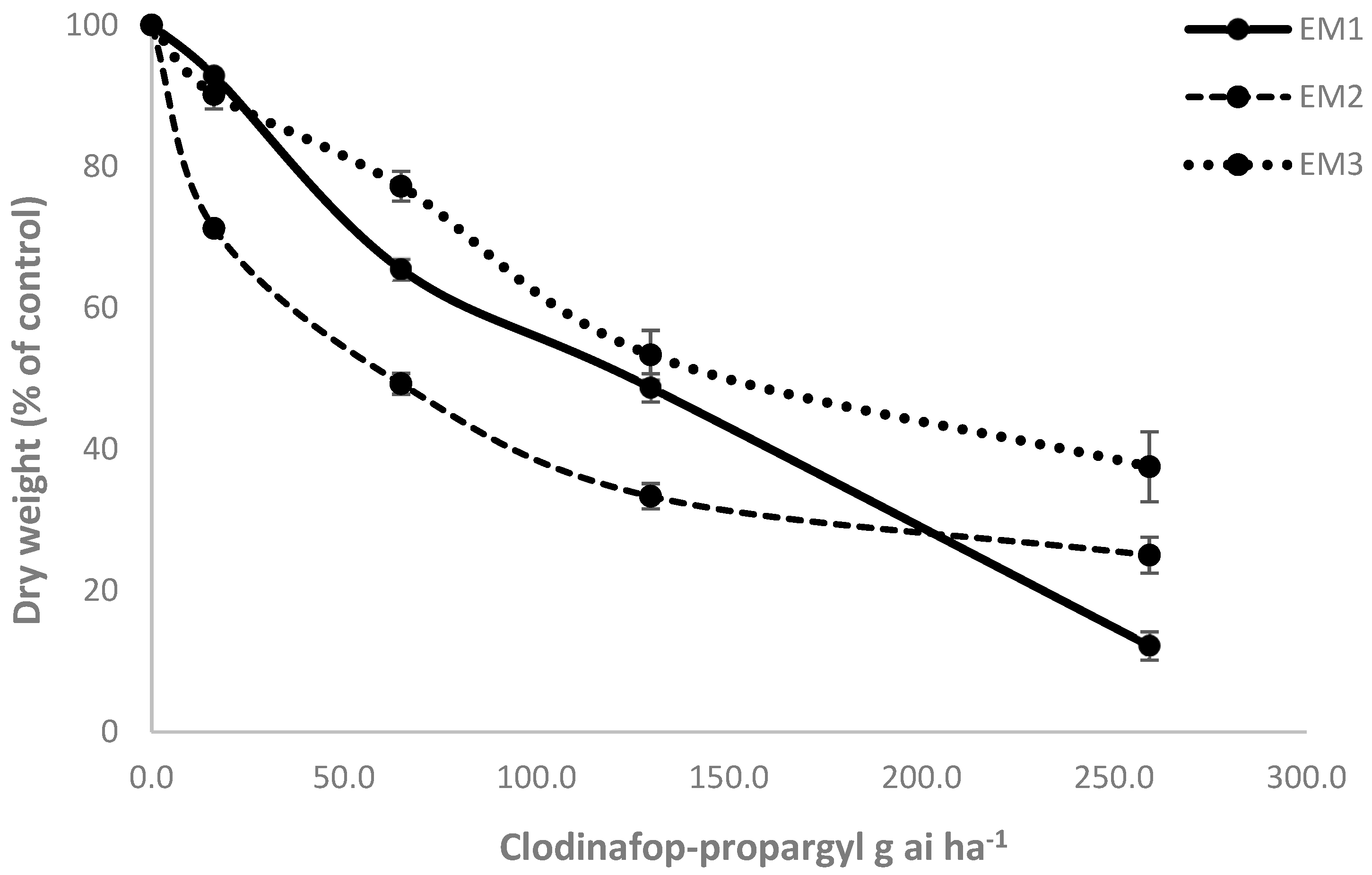
L. rigidum treated with clodinafop-propargyl at 1/4 of the recommended rate showed slight effects of the herbicide on the EM2 accession, since the application caused lower survival values. A more distinct pattern was recorded at double the recommended rate, wherein dry weight was reduced by 51% and 67% for EM1 and EM2, respectively, in comparison to the control. Even at the four-fold rate of clodinafop-propargyl, the EM3 dry biomass reduction remained below 65% relative to the untreated control.
Dose–response curves revealed the differences in the response of the most susceptible accession, EM2, to clodinafop rates, compared with the most resistant, EM3 (Figure 1). A clodinafop-propargyl rate of 60.28 g a.i. ha−1 resulted in s 50% biomass reduction in EM2, while EM3 required 147.97 g a.i. ha−1 to reach an equivalent reduction (Table 6). These findings were also well depicted by the resistance index, where EM3, as the most resistant L. rigidum accession, recorded the highest value, 3.93. This value was 60% higher than the resistance index estimated for EM2 (Table 6).

3.2.2. Glyphosate Dose–Response Experiment

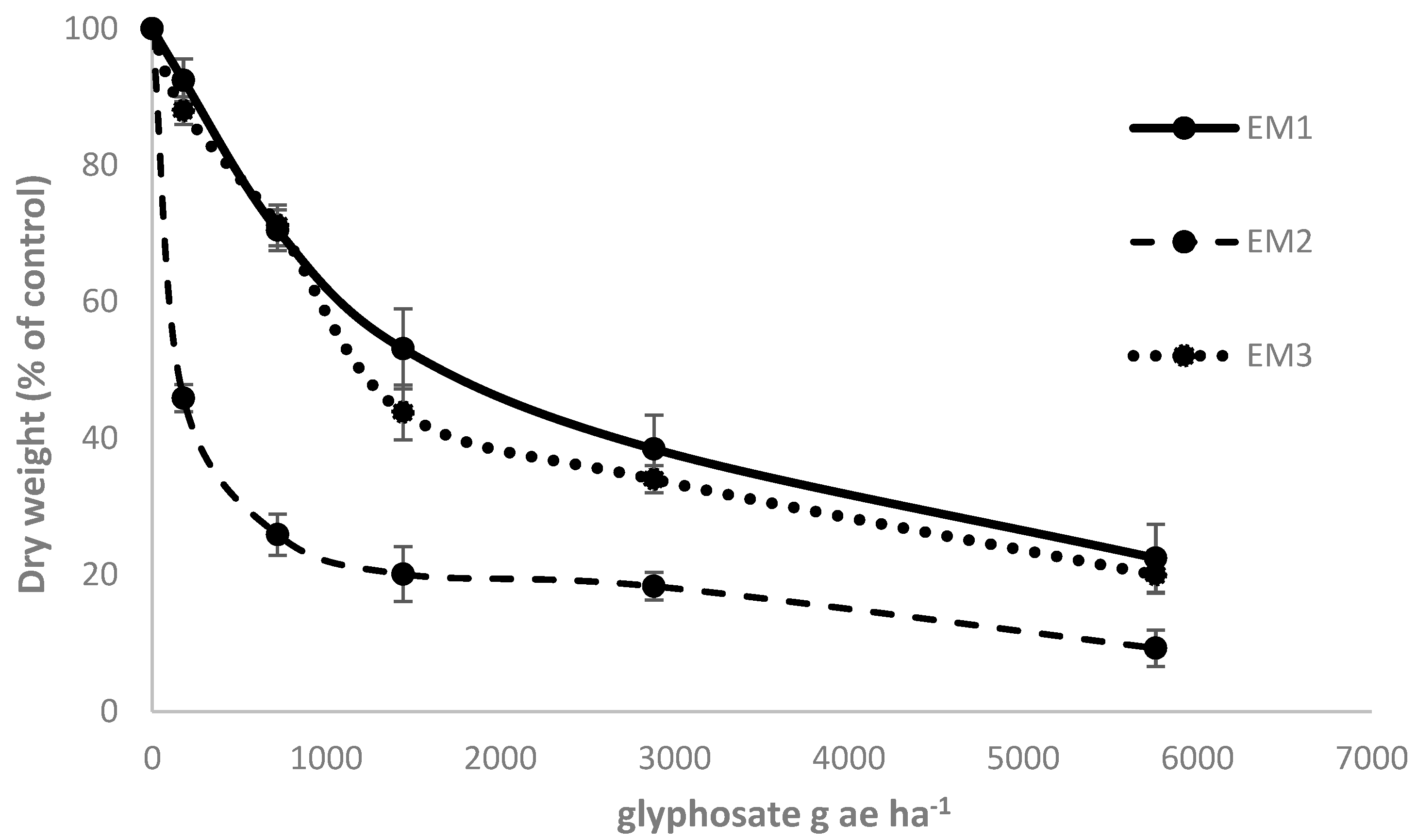
The dose–response experiment results showed that glyphosate, even at the 1/4 of the recommended rate, caused the highest reduction in dry weight in the susceptible accession EM2. The EM1 and EM3 controls were almost unaffected since their dry biomass was reduced by 8% and 12%, respectively. EM1 and EM3 exhibited the highest resistance at the four-fold glyphosate rate, as their dry biomass reduction remained below 66% relative to the untreated control. Dose–response regression curves indicated marked differences between the susceptible accession EM2 and the most resistant accession EM1 (Figure 2).
According to the estimated GR50 values, a glyphosate rate of 120.56 g a. e. ha−1 reduced the biomass by 50% in accession EM2, whereas EM1 required 1547.73 g a. e. ha−1 to achieve the same effect (Table 7). It is also evident that the recommended rate of glyphosate achieved 26% and 71% control for the EM1 and EM2 accessions, respectively. Resistant accessions required approximately four times the glyphosate rate to control resistant accessions. Glyphosate resistance indices ranged from 1.00 to 13.91 (Table 7). EM1 was by far the most resistant L. rigidum accession, since it recorded the highest RI value of 13.91. Glyphosate resistance in EM3 ranked second among the accessions, with an index value of 9.19 (Table 7).

3.2.3. Mesosulfuron-Methyl + Iodosulfuron-Methyl Dose–Response Experiment

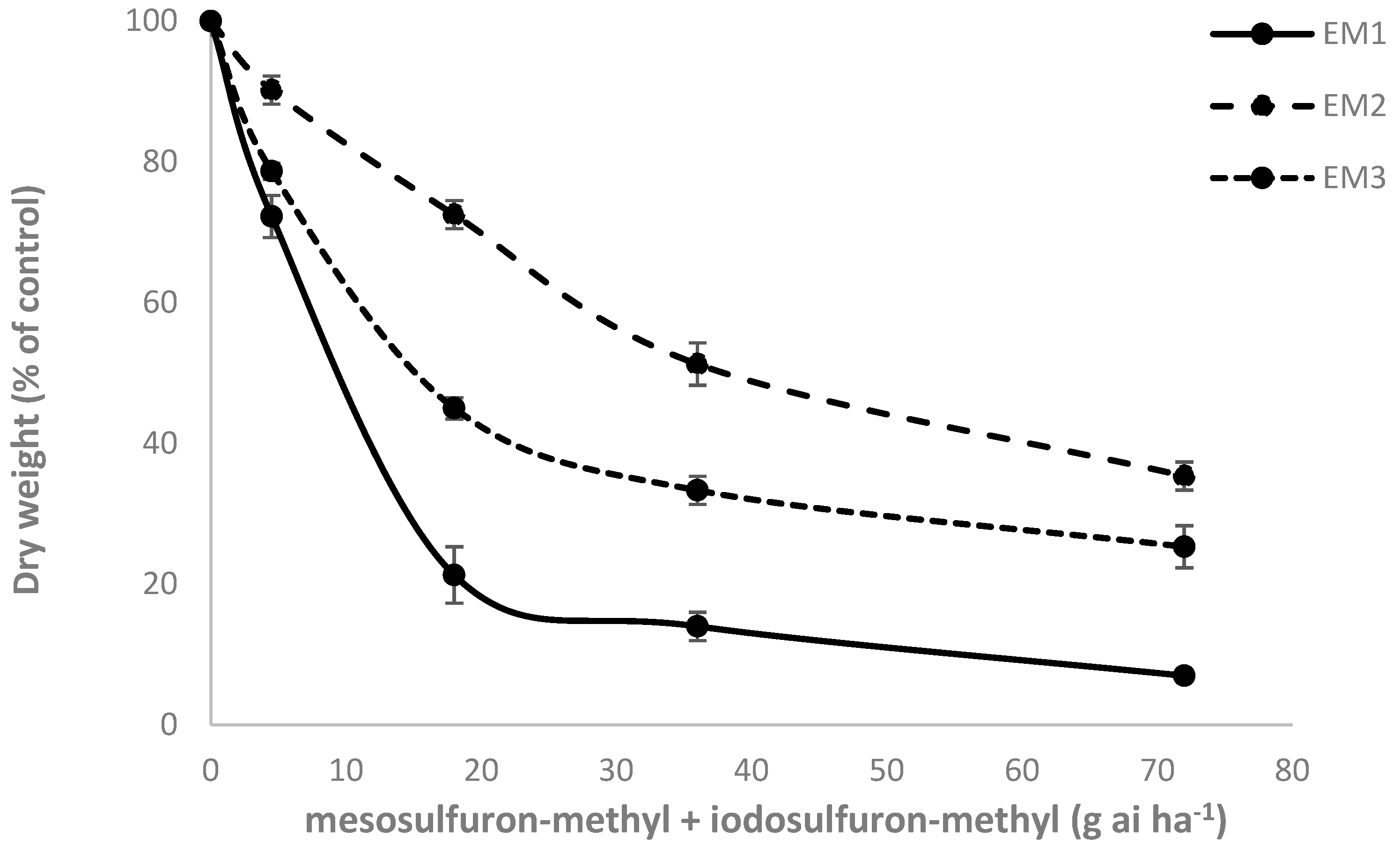
The dose–response experiment results at the 14 DAT showed that the mesosulfuron-methyl + iodosulfuron-methyl application, even at 1/4 of the recommended rate, was efficient for the EM1 control, reducing the dry biomass by half. EM2 was almost unaffected, whereas the dry weight of EM3 was reduced by 21%. At double the recommended rate, mesosulfuron-methyl + iodosulfuron-methyl reduced the dry weight of the susceptible accession EM1 by 86% relative to the untreated control. At the four-fold rate, EM1 plants were nearly completely controlled, whereas the dry biomass reduction in the resistant accession EM2 reached 65%. These results were well depicted by the dose–response curves, where differences in the response of the susceptible accession EM1 compared to the most resistant EM2 were evident (Figure 3).
The resistance of the EM2 accession to mesosulfuron-methyl + iodosulfuron-methyl application was also confirmed by the estimated GR50 values. Mesosulfuron-methyl + iodosulfuron-methyl applied at 32.03 + 6.40 g a.i. ha−1 reduced EM2 biomass by 50%, while only 6.03 + 1.20 g a.i. ha−1 was needed for the same reduction in the susceptible accession EM1 (Table 8). Similarly, EM2 showed approximately five times higher resistance to mesosulfuron-methyl + iodosulfuron-methyl than EM3, with a resistance index 74% higher than that of EM3.

3.3. Development of TaqMan qPCR Assays for Detecting Lolium rigidum Target-Site Mutations

TaqMan qPCR assays were developed and optimized in terms of primer and probe concentrations (Table 9), using gBlocks™ gene fragments, for the following mutations: P106S/T/A (EPSPS), I1781L, T2027C, I2041A, A2078G, C2088A (Acc) and P197G/S, T574L (ALS). The optimized TaqMan assays were applied in individual samples of Lolium rigidum and the results are shown in Table 9. All accessions were wild-type for all mutations in ALS and EPSPS genes. In addition, accessions EM1 and EM2 carried wild-type alleles for all mutations in the ACCase gene. In contrast, EM3 was heterozygous for the mutation in the position 1781 with a substitution of Isoleucine to Leucine.
The survival of certain accessions in the absence of detectable target-site mutations suggests the presence of non-target-site resistance (NTSR) mechanisms. For instance, EM1 displayed high resistance to glyphosate, yet no EPSPS mutations were detected, while EM2 showed resistance to mesosulfuron without ALS mutations. These observations indicate that resistance is likely conferred by enhanced herbicide metabolism, reduced uptake, or altered translocation, mechanisms commonly associated with NTSR in Lolium rigidum. The integration of NDVI measurements and biomass reduction data supports this inference, as resistant accessions maintained high NDVI values and growth despite herbicide application, suggesting an ability to withstand herbicide stress without target-site alterations.

4. Discussion

Lolium rigidum is among the most widespread and problematic weed species affecting a variety of annual and perennial crops in Greece. The management of the rigid ryegrass accessions usually relied on the intensive use of ACCase inhibitors, ALS inhibitors, and EPSPS inhibitors [4]. Thus, repeated use has imposed strong selective pressure, leading to herbicide resistance in several L. rigidum accessions [4,28,31]. This study verified the presence of L. rigidum accessions in Greece that are resistant to ACCase, EPSPS, and ALS inhibitors. Also, it revealed variations in the pattern and level of resistance among these accessions. It must be noted that smart farming approaches and novel methods like the one suggested by Travlos et al. [36] can be used for the first screening and early identification of weed biotypes showing low susceptibility to different herbicides that can be potentially attributed to herbicide-resistance development. This is the case in the present study as well since the findings of our single-dose and dose–response trials partially agree with the NDVI values and indications. Similar studies support our findings that sensor-based approaches can identify herbicide-resistant weeds shortly after treatment [43,44]. According to Wang et al. [43], a mobile chlorophyll fluorescence imaging sensor identified herbicide-resistant Alopecurus myosuroides populations within five days after treatment, enabling timely management decisions. In another study, NDVI and UAV-assisted thermal and multispectral sensing were compared and found to improve discrimination between glyphosate-susceptible and glyphosate-resistant weed populations based on canopy temperature. The results showed that NDVI managed to provide better classification results than thermal data provided [44]. Although sensor-based approaches showed strong potential for early detection of herbicide resistance, their performance depends on environmental conditions. Differences between resistant and susceptible biotypes are often not detectable at very early stages after herbicide application, as resistant plants may respond more slowly under stress [45]. However, sensor measurements can be influenced by environmental factors such as temperature, humidity, and light conditions, which may affect their reliability [45]. Therefore, while NDVI provides a valuable rapid screening tool, its reliability may vary under different field conditions and should be complemented with confirmatory bioassays.
Concerning the ACCase inhibitors, the results of the clodinafop dose–response experiment revealed its low efficacy against one accession of L. rigidum. The GR50 value of the resistant accession EM3 was estimated at 147.97 g a.i. ha−1, whereas the GR50 value of the most susceptible accession was 60.28 g a.i. ha−1. The low efficacy of clodinafop-propargyl against one L. rigidum accession collected from orchards and vegetable crops could be attributed to its prolonged use in these agricultural regions. In addition, the accession EM3 was heterozygous for the mutation Ile1781Leu that has been linked with resistance to ACCase inhibitors [46] which is in line with the low efficacy of clodinafop on EM3, compared to the other accessions. No other target-site mutations associated with resistance to ACCase-inhibiting herbicides were identified in either EM1 or EM2 accessions [46,47]. These results were also confirmed by reports from local Greek farmers who have experienced difficulties in controlling Lolium species by applying clodinafop-propargyl in their fields. In a current study, several Greek accessions were highly resistant to clodinafop-propargyl, with RI values around 17, recording even greater values than the present study [22]. Our findings are in agreement with recent studies reporting reduced efficacy and widespread resistance to herbicides inhibiting ACCase, including clodinafop, in Lolium rigidum populations from cereal-growing regions of North Africa (Morocco, Algeria, and Tunisia) [48]. Additionally, reduced efficacy of clodinafop-propargyl has been reported in rigid ryegrass accessions from Tunisia and Morocco and Iran [49,50,51]. Lolium sp. accessions resistant to clodinafop-propargyl were also found in the study of Papapanagiotou et al. [52] in wheat fields.
Glyphosate is among the most extensively used herbicide applied in perennial crops for weed control [53] and has been characterized as the once-in-a-century herbicide due to its high efficacy [8]. As a result, many weed accessions evolved glyphosate resistance, especially within fruit orchards and vineyards across the Mediterranean region [54,55,56]. L. rigidum accessions also presented resistance to glyphosate, as revealed by the present study. More specifically, the estimated RI values confirmed the extremely low efficacy of glyphosate against the EM1 and EM3 accessions, recording the values 13.91 and 9.19 respectively. EM3 accession proved to be resistant not only to clodinafol-propagyl but also to glyphosate applications. The detection of multiple resistance in accession EM3, including resistance to both ACCase- and EPSPS-inhibiting herbicides, raises significant agronomic concerns. Such multi-resistant populations can severely limit available chemical control options, increase selection pressure on remaining herbicides, and accelerate the spread of resistance. This highlights the urgent need for integrated weed management strategies to prevent further resistance evolution and field-level dissemination. Resistant accessions required approximately four times the recommended glyphosate rate for effective control. This finding agrees with previous reporting of poor control of resistant accessions even at the highest dose of 5760 g a.e. ha−1 [32,33]. Similar findings were reported for L. rigidum in Spain, France [14] and Australia [57,58]. No target-site mutations associated with resistance to EPSPS inhibitors were identified by qPCR in any of the three accessions. In the present study, the absence of EPSPS and ALS target-site mutations in resistant accessions (EM1 and EM2), combined with their sustained biomass and NDVI responses following herbicide application, strongly suggests the involvement of non-target-site resistance (NTSR) mechanisms. These may include reduced herbicide translocation, vacuolar sequestration, or enhanced metabolic detoxification processes, which are widely reported in Lolium rigidum [59]. Such mechanisms can reduce herbicide efficacy without detectable alterations at the target site, explaining the observed resistance patterns in these accessions.
Regarding the ALS inhibitors, the efficacy of mesosulfuron-methyl + iodosulfuron-methyl application against Lolium rigidum provided sufficient control, as one accession was resistant and two were susceptible to this herbicide. From the TaqMan assays, no mutations were identified in either of the accessions that have been associated with target-site resistance to ALS inhibitors. Mesosulfuron-methyl + iodosulfuron-methyl applied at 31.73 g a.i. ha−1 provided a 50% reduction in EM2 biomass, while only 3.88 g a.i. ha−1 was required to achieve an equivalent reduction in the susceptible accession EM1. Our findings were consistent with Anthimidou et al. [30], wherein the recommended rate of mesosulfuron-methyl + iodosulfuron-methyl reduced weed biomass by less than 23%, confirming herbicide resistance in Greek accessions. Similarly, Scarabel et al. [22] found that mesosulfuron-methyl + iodosulfuron-methyl was generally effective in controlling Lolium rigidum, with only one out of five accessions showing resistance. Mahajan and Chauhan [58] reported multiple herbicide resistance in rigid ryegrass populations, while Chauhan and Walsh [60] identified resistant accessions under different emergence conditions. In addition, Galvan et al. [61] documented three ryegrass biotypes with cross-resistance to iodosulfuron (ALS inhibitor) and glyphosate (EPSPS inhibitor), confirming multiple herbicide resistance. The integration of sensor-based smart farming tools with conventional bioassays and molecular diagnostics provides a robust framework for the early detection and characterization of herbicide resistance, supporting more timely and targeted weed management decisions.

5. Conclusions

This study highlights the utility of smart farming approaches and novel sensor-based methods towards the early in situ identification of potentially resistant weed biotypes and the subsequent validation of the method through dose–response experiments and molecular analyses. Glyphosate showed low efficacy against two accessions (EM1 and EM3), confirming resistance with indices above 9, while clodinafop-propargyl and mesosulfuron-methyl + iodosulfuron-methyl remained effective in most cases. One accession (EM3) carried the ACCase Ile1781Leu mutation, indicating emerging resistance to ACCase inhibitors. Sensor-based tools provide efficient, field-level screening to support sustainable herbicide management. The application of sensor-based smart farming tools enables rapid, field-level screening of herbicide efficacy, reducing reliance on time-consuming laboratory assays and supporting more efficient and sustainable crop protection strategies. Further research is needed to assess the effectiveness of various herbicides across different soil types and climatic conditions and to monitor the development of herbicide resistance in Lolium rigidum.

Author Contributions

Conceptualization, A.K. and I.T.; methodology, I.G. and P.K.; software, I.G. and K.M.P.; validation, A.K., D.P. and K.M.P.; formal analysis, D.P. and M.K.; investigation, D.P., M.K., A.P. and K.M.P.; resources, J.V., I.T. and A.P.; data curation, D.P.; writing—original draft preparation, A.K., I.G., P.K. and A.P.; writing—review and editing, A.K. and I.T.; visualization, I.G., D.P. and M.K.; supervision, I.T.; project administration, J.V. and I.T.; funding acquisition, J.V. All authors have read and agreed to the published version of the manuscript.

Funding

This research was funded by the European Union—NextGenerationEU through the Greece 2.0 National Recovery and Resilience Plan, under the National Flagship Initiative “Agriculture and Food Industry” (project InnoPP, grant number TAEDR-0535675).

Data Availability Statement

The data presented in this study are available on request from the corresponding author due to ongoing research activities.

Conflicts of Interest

The authors declare no conflicts of interest.

References

  1. Recasens, J.; Riba, F.; Izquierdo, J.; Forn, R.; Taberner, A. Gramíneas infestantes de los cereales de invierno de Cataluña. ITEA 1996, 92, 116–130. [Google Scholar]
  2. Manalil, S. Evolution of herbicide resistance in Lolium rigidum under low herbicide rates: An Australian experience. Crop Sci. 2014, 54, 461–474. [Google Scholar] [CrossRef]
  3. Heap, I. The International Survey of Herbicide Resistant Weeds. 2025. Available online: https://www.weedscience.org/Pages/Species.aspx (accessed on 14 January 2026).
  4. Travlos, I.S.; Cheimona, N.; De Prado, R.; Jhala, A.J.; Chachalis, D.; Tani, E. First Case of Glufosinate-Resistant Rigid Ryegrass (Lolium rigidum Gaud.) in Greece. Agronomy 2018, 8, 35. [Google Scholar] [CrossRef]
  5. Izquierdo, J.; Recasens, J.; Fernández-Quintanilla, C.; Gill, G. Effects of crop and weed densities on the interactions between barley and Lolium rigidum in several Mediterranean locations. Agronomie 2003, 23, 529–536. [Google Scholar] [CrossRef]
  6. Lemerle, D.; Verbeek, B.; Coombes, N. Losses in Grain Yield of Winter Crops from Lolium rigidum Competition Depend on Crop Species, Cultivar and Season. Weed Res. 1995, 35, 503–509. [Google Scholar] [CrossRef]
  7. Tehranchian, P.; Nandula, V.; Jugulam, M.; Putta, K.; Jasieniuk, M. Multiple resistance to glyphosate, paraquat and ACCase-inhibiting herbicides in Italian ryegrass populations from California: Confirmation and mechanisms of resistance. Pest Manag. Sci. 2018, 74, 868–877. [Google Scholar] [CrossRef]
  8. Duke, S.O.; Powles, S.B. Glyphosate-Resistant weeds and crops. Pest Manag. Sci. 2008, 64, 317–496. [Google Scholar] [CrossRef]
  9. Khammassi, M.; Hajri, H.; Menchari, Y.; Chaabane, H.; Souissi, T. Current status in resistance to ACCase and ALS-inhibiting herbicides in rigid ryegrass populations from cereal crops in North of Tunisia. J. Agric. Sci. 2019, 157, 676–683. [Google Scholar] [CrossRef]
  10. Jursík, M.; Hamouzová, K.; Hajšlová, J. Dynamics of the Degradation of Acetyl-CoA Carboxylase Herbicides in Vegetables. Foods 2021, 10, 405. [Google Scholar] [CrossRef]
  11. Green, J.M. Current state of herbicides in herbicide-resistant crops. Pest Manag. Sci. 2014, 70, 1351–1357. [Google Scholar] [CrossRef]
  12. Busi, R.; Neve, P.; Powles, S. Evolved polygenic herbicide resistance in Lolium rigidum by low-dose herbicide selection within standing genetic variation. Evol. Appl. 2013, 6, 231–242. [Google Scholar] [CrossRef] [PubMed]
  13. Menegat, A.; Bailly, G.C.; Aponte, R.; Heinrich, G.M.T.; Sievernich, B.; Gerhards, R. Acetohydroxyacid synthase (AHAS) amino acid substitution Asp376Glu in Lolium perenne: Effect on herbicide efficacy and plant growth. J. Plant Dis. Prot. 2016, 123, 145–153. [Google Scholar] [CrossRef]
  14. Fernández-Moreno, P.T.; Travlos, I.; Brants, I.; De Prado, R. Different levels of glyphosate-resistant Lolium rigidum L. among major crops in southern Spain and France. Sci. Rep. 2017, 7, 13116. [Google Scholar] [CrossRef]
  15. Martins, B.A.B.; Sánchez-Olguín, E.; Perez-Jones, A.; Hulting, A.G.; Mallory-Smith, C. Alleles contributing to ACCase-resistance in an Italian ryegrass (Lolium perenne ssp. multiflorum) population from Oregon. Weed Sci. 2014, 62, 468–473. [Google Scholar] [CrossRef]
  16. Perotti, V.E.; Larran, A.S.; Palmieri, V.E.; Martinatto, A.K.; Permingeat, H.R. Herbicide resistant weeds: A call to integrate conventional agricultural practices, molecular biology knowledge and new technologies. Plant Sci. 2020, 290, 110255. [Google Scholar] [CrossRef]
  17. Wakelin, A.M.; Preston, C. A target-site mutation is present in a glyphosate-resistant Lolium rigidum population. Weed Res. 2006, 46, 432–440. [Google Scholar] [CrossRef]
  18. Kaundun, S.S. Resistance to acetyl-CoA carboxylase-inhibiting herbicides. Pest. Manag. Sci. 2014, 70, 1405–1417. [Google Scholar] [CrossRef]
  19. Fang, J.; Yang, D.; Zhao, Z.; Chen, J.; Dong, L. A novel Phe-206-Leu mutation in acetolactate synthase confers resistance to penoxsulam in barnyardgrass (Echinochloa crusgalli (L.) P. Beauv). Pest Manag. Sci. 2022, 78, 2560–2570. [Google Scholar] [CrossRef]
  20. Tranel, P.J.; Wright, T.R. Resistance of weeds to ALS-inhibiting herbicides: What have we learned? Weed Sci. 2002, 50, 700–712. [Google Scholar] [CrossRef]
  21. Délye, C. Unravelling the genetic bases of non-target-site-based resistance (NTSR) to herbicides: A major challenge for weed science in the forthcoming decade. Pest Manag. Sci. 2013, 69, 176–187. [Google Scholar] [CrossRef] [PubMed]
  22. Scarabel, L.; Pernin, F.; Délye, C. Occurrence, genetic control and evolution of non-target-site based resistance to herbicides inhibiting acetolactate synthase (ALS) in the dicot weed Papaver rhoeas. Plant Sci. 2015, 238, 158–169. [Google Scholar] [CrossRef]
  23. Yu, Q.; Abdallah, I.; Han, H.; Owen, M.; Powles, S. Distinct non-target site mechanisms endow resistance to glyphosate, ACCase and ALS-inhibiting herbicides in multiple herbicide-resistant Lolium rigidum. Planta 2009, 230, 713–723. [Google Scholar] [CrossRef] [PubMed]
  24. Yuan, J.S.; Tranel, P.J.; Stewart, C.N., Jr. Non-target-site herbicide resistance: A family business. Trends Plant Sci. 2007, 12, 6–13. [Google Scholar] [CrossRef]
  25. Vila-Aiub, M.M.; Balbil, M.C.; Distéfano, A.J. Glyphosate resistance in perennial Sorghum halepense (Johnsongrass), endowed by reduced glyphosate translocation and leaf uptake. Pest Manag. Sci. 2012, 68, 430–436. [Google Scholar] [CrossRef] [PubMed]
  26. Jasieniuk, M.; Ahmad, R.; Sherwood, A.M.; Firestone, J.L.; Perez-Jones, A.; Lanini, W.T.; Mallory-Smith, C.; Stednick, Z. Glyphosate-resistant Italian ryegrass (Lolium multiflorum) in California: Distribution, response to glyphosate, and molecular evidence for an altered target enzyme. Weed Sci. 2008, 56, 496–502. [Google Scholar] [CrossRef]
  27. Simarmata, M.; Penner, D. The basis for glyphosate resistance in rigid Ryegrass (Lolium rigidum) from California. Weed Sci. 2008, 56, 181–188. [Google Scholar] [CrossRef]
  28. Kotoula-Syka, E.; Tal, A.; Rubin, B. Diclofop-resistant Lolium rigidum from northern Greece with cross-resistance to ACCase inhibitors and multiple resistance to chlorsulfuron. Pest Manag. Sci. 2000, 56, 1054–1058. [Google Scholar] [CrossRef]
  29. Kaloumenos, N.S.; Tsioni, V.C.; Daliani, E.G.; Papavassileiou, S.E.; Vassileiou, A.G.; Laoutidou, P.N.; Eleftherohorinos, I.G. Multiple Pro-197 substitutions in the acetolactate synthase of rigid ryegrass (Lolium rigidum) and their impact on chlorsulfuron activity and plant growth. Crop Prot. 2012, 38, 35–43. [Google Scholar] [CrossRef]
  30. Anthimidou, E.; Ntoanidou, S.; Madesis, P.; Eleftherohorinos, I. Mechanisms of Lolium rigidum multiple resistance to ALS- and ACCase-inhibiting herbicides and their impact on plant fitness. Pestic. Biochem. Physiol. 2020, 164, 65–72. [Google Scholar] [CrossRef]
  31. Gitsopoulos, T.; Georgoulas, I.; Vazanelli, E.; Botsoglou, D. Selectivity of the Premixtures Flufenacet, Diflufenican and Flufenacet, Diflufenican, Metribuzin on Bread Wheat (Triticum aestivum L.) and Barley (Hordeum vulgare L.) and Efficacy on ALS/ACCase-Resistant Populations of Lolium rigidum Gaudin. Agronomy 2024, 14, 949. [Google Scholar] [CrossRef]
  32. Travlos, I.; Tabaxi, E.; Papadimitriou, D.; Bilalis, D.; Chachalis, D. Lolium rigidum Gaud. biotypes from Greece with Resistance to Glyphosate and other Herbicides. Bull. Univ. Agric. Sci. Vet. Med. Cluj-Napoca. Hortic. 2016, 73, 1–2. [Google Scholar] [CrossRef]
  33. Gerakari, M.; Cheimona, N.; Tani, E.; Travlos, I.; Chachalis, D.; Loddo, D.; Mathiassen, S.K.; Gitsopoulos, T.K.; Scarabel, L.; Panozzo, S.; et al. Biochemical and Rapid Molecular Analyses to Identify Glyphosate Resistance in Lolium spp. Agronomy 2022, 12, 40. [Google Scholar] [CrossRef]
  34. Scarabel, L.; Panozzo, S.; Loddo, D.; Mathiassen, S.K.; Kristensen, M.; Kudsk, P.; Gitsopoulos, T.; Travlos, I.; Tani, E.; Chachalis, D.; et al. Diversified Resistance Mechanisms in Multi-Resistant Lolium spp. in Three European Countries. Front. Plant Sci. 2020, 11, 608845. [Google Scholar] [CrossRef] [PubMed]
  35. Beffa, R.; Figge, A.; Lorentz, L.; Hess, M.; Laber, B.; Ruiz-Santaella, J.P.; Strek, H. Weed resistance diagnostic technologies to detect herbicide resistance in cereal growing areas. A review. Julius-Kühn-Archiv 2012, 75, 75–80. [Google Scholar] [CrossRef]
  36. Travlos, I.; Tsekoura, A.; Antonopoulos, N.; Kanatas, P.; Gazoulis, I. Novel sensor-based method (quick test) for the in-season rapid evaluation of herbicide efficacy under real field conditions in durum wheat. Weed Sci. 2021, 69, 147–160. [Google Scholar] [CrossRef]
  37. Hoagland, H. Stress and the adrenal cortex with special reference to potassium metabolism. Psychosom. Med. 1950, 12, 142–148. [Google Scholar] [CrossRef] [PubMed]
  38. Urbano, J.M.; Borrego, A.; Torres, V.; León, J.; Jimenez, C.; Dinelli, G.; Barnes, J. Glyphosate-resistant hairy fleabane (Conyza bonariensis) in Spain. Weed Technol. 2007, 21, 396–401. [Google Scholar] [CrossRef]
  39. Doyle, J.J.; Doyle, J.L. A rapid DNA isolation procedure for small quantities of fresh leaf tissue. Phytochem. Bull. 1987, 19, 11–15. [Google Scholar]
  40. Mavridis, K.; Papapostolou, K.M.; Riga, M.; Ilias, A.; Michaelidou, K.; Bass, C.; Van Leeuwen, T.; Tsagkarakou, A.; Vontas, J. Multiple TaqMan QPCR and Droplet Digital PCR (DdPCR) Diagnostics for Pesticide Resistance Monitoring and Management, in the Major Agricultural Pest Tetranychus urticae. Pest Manag. Sci. 2022, 78, 263–273. [Google Scholar] [CrossRef]
  41. Seefeldt, S.S.; Jensen, J.E.; Fuerst, E.P. Log-logistic analysis of herbicide dose-response relationships. Weed Technol. 1995, 9, 218–227. [Google Scholar] [CrossRef]
  42. Travlos, I.S.; Chachalis, D. Glyphosate-resistant hairy fleabane (Conyza bonariensis) is reported in Greece. Weed Technol. 2010, 24, 569–573. [Google Scholar] [CrossRef]
  43. Wang, P.; Peteinatos, G.; Li, H.; Gerhards, R. Rapid in-season detection of herbicide resistant Alopecurus myosuroides using a mobile fluorescence imaging sensor. Crop Prot. 2016, 89, 170–177. [Google Scholar] [CrossRef]
  44. Eide, A.; Koparan, C.; Zhang, Y.; Ostlie, M.; Howatt, K.; Sun, X. UAV-Assisted Thermal Infrared and Multispectral Imaging of Weed Canopies for Glyphosate Resistance Detection. Remote Sens. 2021, 13, 4606. [Google Scholar] [CrossRef]
  45. Xia, F.; Quan, L.; Lou, Z.; Sun, D.; Li, H.; Lv, X. Identification and comprehensive evaluation of resistant weeds using unmanned aerial vehicle-based multispectral imagery. Front. Plant Sci. 2022, 13, 938604. [Google Scholar] [CrossRef]
  46. Bi, Y.; Liu, W.; Guo, W.; Li, L.; Yuan, G.; Du, L.; Wang, J. Molecular basis of multiple resistance to ACCase- and ALS-inhibiting herbicides in Alopecurus japonicus from China. Pestic. Biochem. Physiol. 2016, 126, 22–27. [Google Scholar] [CrossRef]
  47. Travlos, I.S.; Giannopolitis, C.N.; Economou, G. Diclofop resistance in sterile wild oat (Avena sterilis L.) in wheat fields in Greece and its management by other post–emergence herbicides. Crop. Prot. 2011, 30, 1449–1454. [Google Scholar] [CrossRef]
  48. El-Mastouri, Z.; Hamouzová, K.; Trifan, T.; Košnarová, P.; Alimi, E.; Soukup, J. Resistance to ACCase and ALS-Inhibiting Herbicides Detected in Targeted Sampling of Lolium rigidum (Rigid Ryegrass) Populations from Cereal Crops in Morocco, Algeria, and Tunisia. Crop Prot. 2024, 178, 106902. [Google Scholar] [CrossRef]
  49. Tavasoli, A.; Gherekhloo, J.; Ghaderi-Far, F.; Zand, E.; Osuna, M.D.; de Prado, R. Identification of Lolium rigidum Gaud. biotypes resistant to the clodinafop-propargyl herbicide in wheat fields of Golestan province. J. Crop Prod. 2023, 15, fa1–fa18. [Google Scholar] [CrossRef]
  50. El-Mastouri, Z.; Košnarová, P.; Hamouzova, K.; Alimi, E.; Soukup, J. Insight into the herbicide resistance patterns in Lolium rigidum populations in Tunisian and Moroccan wheat regions. Front. Plant Sci. 2024, 15, 1331725. [Google Scholar] [CrossRef]
  51. Sabet Zangeneh, H.; Mohammaddust Chamanabad, H.R.; Zand, E.; Asghari, A.; Alamisaeid, K.; Travlos, I.S.; Alebrahim, M.T. Cross-and multiple herbicide resistant Lolium rigidum Gaud. (rigid ryegrass) biotypes in Iran. J. Agric. Sci. Technol. 2018, 20, 1187–1200. [Google Scholar]
  52. Papapanagiotou, A.P.; Loukovitis, D.; Anthimidou, E.; Eleftherohorinos, I.G. Impact of ALS Herbicide-Resistant Perennial Ryegrass (Lolium perenne) Population on Growth Rate and Competitive Ability against Wheat. Agronomy 2023, 13, 1641. [Google Scholar] [CrossRef]
  53. Kanatas, P.; Antonopoulos, N.; Gazoulis, I.; Travlos, I.S. Screening glyphosate-alternative weed control options in important perennial crops. Weed Sci. 2021, 69, 704–718. [Google Scholar] [CrossRef]
  54. Tahmasebi, B.K.; Alebrahim, M.T.; Roldán-Gómez, R.A.; da Silveira, H.M.; de Carvalho, L.B.; Alcántara-de la Cruz, R.; De Prado, R. Effectiveness of alternative herbicides on three Conyza species from Europe with and without glyphosate resistance. Crop Prot. 2018, 112, 350–355. [Google Scholar] [CrossRef]
  55. Travlos, I.; Kanatas, P.; Tsekoura, A.; Gazoulis, I.; Papastylianou, P.; Kakabouki, I.; Antonopoulos, N. Efficacy of Different Herbicides on Echinochloa colona (L.) Link Control and the First Case of Its Glyphosate Resistance in Greece. Agronomy 2020, 10, 1056. [Google Scholar] [CrossRef]
  56. Vazquez-Garcia, J.G.; Palma-Bautista, C.; Rojano-Delgado, A.M.; De Prado, R.; Menendez, J. The First Case of Glyphosate Resistance in Johnsongrass (Sorghum halepense (L.) Pers.) in Europe. Plants 2020, 9, 313. [Google Scholar] [CrossRef]
  57. Bostamam, Y.; Malone, J.M.; Dolman, F.C.; Boutsalis, P.; Preston, C. Rigid ryegrass (Lolium rigidum) populations containing a target site mutation in EPSPS and reduced glyphosate translocation are more resistant to glyphosate. Weed Sci. 2012, 60, 474–479. [Google Scholar] [CrossRef]
  58. Mahajan, G.; Chauhan, B.S. Multiple Herbicide Resistance in Annual Ryegrass (Lolium rigidum Gaudin) in the Southeastern Cropping Region of Australia. Agronomy 2024, 14, 2206. [Google Scholar] [CrossRef]
  59. Suzukawa, A.; Bobadilla, L.K.; Mallory-Smith, C.; Brunharo, C. Non-target-Site Resistance in Lolium spp. Globally: A Review. Front. Plant Sci. 2021, 11, 609209. [Google Scholar] [CrossRef] [PubMed]
  60. Chauhan, B.S.; Walsh, M. Differential response of winter- and summer-emerging accessions of rigid ryegrass (Lolium rigidum Gaudin) to postemergence herbicides in Australia. Weed Technol. 2022, 36, 663–670. [Google Scholar] [CrossRef]
  61. Galvan, J.; da Costa, L.O.; Rizzardi, M.A.; Peruzzo, S.T. Ryegrass biotypes sensitivity to glyphosate, iodosulfuron-methyl and clethodim. Rev. Bras. Herbic. 2015, 14, 47–53. [Google Scholar] [CrossRef]
Figure 1. Rigid ryegrass biomass of three accessions (EM1, EM2, and EM3) in response to increasing clodinafop-propargyl rates.
Agronomy 16 00869 g001
Figure 2. Rigid ryegrass biomass of three accessions (EM1, EM2, and EM3) in response to increasing glyphosate rates.
Agronomy 16 00869 g002
Figure 3. Rigid ryegrass biomass of three accessions (EM1, EM2, and EM3) in response to increasing mesosulfuron-methyl + iodosulfuron-methyl rates.
Agronomy 16 00869 g003
Table 1. Application rates for herbicides applied in dose–response experiments.
Chemical ClassMechanism of ActionActive IngredientRecommended Rates
AryloxyphenoxypropionateAcetyl-CoA Carboxylase (ACCase)clodinafop-propargyl64.8 g a. i. ha−1
Phosphanoglycine5-enolpyruvylshikimate-3-phosphate synthase (EPSPS)glyphosate720 g a. e. ha−1
SulfonylureasAcetolactate synthase (ALS)mesosulfuron-methyl + iodosulfuron-methyl15 g + 3 g a. i. ha−1
Table 2. List of primers and probes used in the study for Lolium rigidum. All sequences are presented in the 5′→3′ direction. Oligo types are indicated as follows: F: Forward primer; R: Reverse primer; P: Probe; WT: wild-type; Mut: mutant; MGB: minor groove binder.
Gene (Mutation)Oligo Name/TypeSequence 5′→3′ (Including Dyes)
EPSPS gene (P106S/T/A)Lr_106FCAAGGAGGAAGTMAAGCTCTT
Lr_106RCATTTCCACCRGCAGCTACTA
Lr_106PwtHEX-TGCGGCCATTGAC-MGB
Lr_106Pmut1SFAM- ATGCGGTCATTGAC -MGB
Lr_106Pmut2TTexasRed-TGCGGACATTGAC-MGB
Lr_106Pmut3A Atto647N-TGCGGGCATTGAC-MGB
ACCase gene (I1781L)Lr_1781FGTGGGCAAGGAGGATGGACTA
Lr_1781RTAGAATACGCACTGGCAATAGCA
Lr_1781PwtHEX-TGTGGAGAAYATACATG-MGB
Lr_1781PmutFAM-CTTCCATGTARRTTCTC-MGB
ACCase gene (T2027C)Lr_2027FCGTGAAGGGTTACCTCTGTTCAT
Lr_2027RGCCTGCAGADYTCCTTCAAAA
Lr_2027PwtHEX-CTTGCTAACTGGAGAGG-MGB
Lr_2027PmutFAM-TTGCTAACTGYAGAGGC-MGB
ACCase gene (I2041A)Lr_2041FTGGTGGGCAAAGAGACCTTT
Lr_2041RTRTATRTCCTAAGGTTCTCAACAATTG
Lr_2041PwtHEX-AAGGAATTCTGCAGGCT-MGB
Lr_2041PmutFAM-AAGGAAATCTGCAGGCT-MGB
ACCase gene (A2078G)Lr_2078FCCAAGGCTGCAGAGCTWCGT
Lr_2078RGCRCTCAATGCGATCTGGATT
Lr_2078PwtHEX-TCGTGATTGATAGCAAGA-MGB
Lr_2078PmutFAM-TCGTGATTGGTAGCAAG-MGB
ACCase gene (C2088A)Lr_2088FGGGTCGTGATTGRTAGCAAGATAA
Lr_2088RGGCTCAAGAACATTCSCTTTTG
Lr_2088PwtHEX-ATCGCATTGAGTGCT-MGB
Lr_2088PmutFAM-AGATCGCATTGAGCGC-MGB
ALS gene (P197G/S)Lr_197F GCCACCAACCTCGTCTCC
Lr_197RGATGGGCGTCTCCTGGAAG
Lr_197PwtHEX-TCCCGCGCCGCAT-MGB
Lr_197Pmut1QFAM-TCCAGCGCCGCATG-MGB
Lr_197Pmut2SAtto647N-TCTCGCGCCGCATG-MGB
ALS gene
(T574L)
Lr_574FGATATTGAACAACCAACATCTTGGAA
Lr_574RCCGATTGGCCTTGTAAAACC
Lr_574PwtHEX-TGGTGCAGTGGGAG-MGB
Lr_574PmutFAM-TGGTGCAGTTGGAG-MGB
F: Forward; R: reverse; P: probe; Wt: wild-type; Mut: mutant; MGB: minor groove binder.
Table 3. Final concentrations of primers and probes and annealing temperature, referring to the qPCR assays of Lolium rigidum.
AssayF/R (nM)HEX (nM)FAM (nM)Tx Red (nM)ATTO647N (nM)Tm °C
Pro197/Gln/Ser400/400300250 -10062
Trp574/Leu400/400250250--60
Ile1781/Leu400/400250200--62
Trp2027/Cys400/400250250--60
Ile2041/Cys400/400250250--60
Asp2078/Gly400/400250200--63.4
Cys2088/Arg400/400250250--60
Pro106/Ser/Thr/Ala400/40030010025010063.4
F: Forward; R: reverse; HEX: wild-type probe, FAM/TxRed/Atto647N: mutant probes, Tm: annealing temperature in qPCR.
Table 4. Normalized Difference Vegetation Index (NDVI) values recorded at 14 DAT (days after treatment) in the three selected fields after the application of several herbicides. Efficacy of several herbicides on L. rigidum accessions at 14 days after treatment (14 DAT).
AccessionUNTCLOGLYMES + IOD
EM10.75 a0.67 ab0.68 ab0.34 c
EM20.71 a0.42 b0.32 c0.63 ab
EM30.73 a0.71 a0.65 ab0.41 c
LSD0.030.090.060.08
p-Valuens*********
Means followed by different letters within each column differ significantly among accessions for each herbicide at a = 5% significance level. UNT: untreated, CLO: clodinafop-propargyl, GLY: glyphosate, MES + IOD: mesosulfuron + iodosulfuron. *** significant at 0.001 and ns: not significant (p > 0.05).
Table 5. Efficacy of several herbicides on L. rigidum accessions at 14 days after treatment (14 DAT). Dry weight was expressed as % of the control.
AccessionCLOGLYMES + IOD
EM165 a71 a21 a
EM229 b21 b73 b
EM388 c71 a49 c
LSD474
p-Value*********
Means followed by different letters within each column differ significantly among accessions for each herbicide at a = 5% significance level. CLO: clodinafop-propargyl, GLY: glyphosate, MES + IOD: mesosulfuron + iodosulfuron. *** significant at 0.001.
Table 6. Clodinafop-propargyl dose resulting in a 50% reduction in weed biomass (GR50) and resistance index (RI) (GR50 of each accession/GR50 of EM2) for the three accessions.
AccessionGR50 (g a.i. ha−1)Slope bRI
EM187.44 ± 36.220.88 ± 0.442.32
EM2 160.28 ± 40.450.73 ± 0.201.60
EM3147.97 ± 16.291.28 ± 0.753.93
1 The most susceptible accession to clodinafop-propargyl.
Table 7. Glyphosate dose resulting in a 50% reduction in weed biomass (GR50) and resistance index (RI) (GR50 of each accession/GR50 of EM2) for the three accessions.
AccessionGR50 (g a.e. ha−1)Slope bRI
EM11547.73 ± 260.301.06 ± 0.1213.91
EM2 1120.56 ± 34.410.604 ± 0.231.00
EM31023.70 ± 752.601.36 ± 0.929.19
1 The most susceptible accession to glyphosate.
Table 8. Mesosulfuron-methyl + iodosulfuron-methyl dose resulting in a 50% reduction in weed biomass (GR50) and resistance index (RI) (GR50 of each accession/GR50 of EM1) for the three accessions.
AccessionGR50 (g a.i. ha−1)Slope bRI
EM1 16.03 + 1.20
(±0.60 ± 0.12)
1.78 ± 0.241.00
EM232.03 + 6.40
(±19.92 ± 3.98)
1.12 ± 0.355.31
EM38.30 + 1.66
(±0.42 ± 0.08)
1.27 ± 0.061.37
1 The most susceptible accession to mesosulfuron-methyl + iodosulfuron-methyl.
Table 9. Results of the qPCR assays developed for Lolium rigidum.
GeneALSACCEPSPS
AccessionTrp574LeuPro197/SerIle1781/LeuTrp2027CysIle2041AsnAsp2078/GlyCys2088ArgPro106/Ser/Thr/Ala
EM1 Trp/Trp [wild type]Pro/Pro [wild type]Ile/Ile [wild type]Trp/Trp [wild type]Ile/Ile [wild type]Asp/Asp [wild type]Cys/Cys [wild type]Pro/Pro [wild type]
EM2 Trp/Trp [wild type]Pro/Pro [wild type]Ile/Ile [wild type]Trp/Trp [wild type]Ile/Ile [wild type]Asp/Asp [wild type]Cys/Cys [wild type]Pro/Pro [wild type]
EM3Trp/Trp [wild type]Pro/Pro [wild type]Ile/Leu [het]Trp/Trp [wild type]Ile/Ile [wild type]Asp/Asp [wild type]Cys/Cys [wild type]Pro/Pro [wild type]
Disclaimer/Publisher’s Note: The statements, opinions and data contained in all publications are solely those of the individual author(s) and contributor(s) and not of MDPI and/or the editor(s). MDPI and/or the editor(s) disclaim responsibility for any injury to people or property resulting from any ideas, methods, instructions or products referred to in the content.