Article

Fast-Tracking Trait Combination in Triticale Through Doubled Haploid Technology

Department of Primary Industries and Regional Development, 3 Baron-Hay Court, South Perth, WA 6151, Australia
*
Author to whom correspondence should be addressed.
Retired.
Agronomy 2026, 16(9), 923; https://doi.org/10.3390/agronomy16090923
Submission received: 31 March 2026 / Revised: 24 April 2026 / Accepted: 28 April 2026 / Published: 1 May 2026
(This article belongs to the Section Crop Breeding and Genetics)

Abstract

This study aimed to develop an anther culture protocol for triticale (×Triticosecale Wittmack) and generate a doubled haploid (DH) population combining awnlessness and stripe rust resistance. A wheat anther culture protocol was evaluated on nine triticale varieties, with and without Trichostatin A (TSA), and tested on parental genotypes—an awned, stripe rust–resistant breeding line (AT-45) and an awnless variety (‘1143’)—as well as on ten F1 plants derived from crosses between AT-45 and ‘1143’. Plant regeneration varied widely among varieties, ranging from 0.8 to 39.7 green plants per 30 anthers (1.6–80 per spike), with an overall mean of 9.9 (20 per spike). TSA did not significantly improve green plant production in this study, though further optimisation of the application method may be warranted. An average of 17.4 green plants per spike was obtained from the F1 plants, and 1130 regenerant plants were grown to maturity, with a mean spontaneous chromosome doubling rate of 42.5%. A total of 480 DH lines were harvested, comprising 250 awned, 60 reduced awn, and 170 awnless lines. Awned and reduced awn lines were discarded, and 114 awnless lines were advanced for field evaluation of stripe rust resistance and agronomic traits. These results establish an effective anther culture system for DH production in triticale and demonstrate the potential of DH technology to accelerate the development of resilient, high-performing varieties.

1. Introduction

Triticale (×Triticosecale Wittmack) is a synthetic cereal derived from crosses between wheat (Triticum turgidum L. (AABB) or Triticum aestivum L. (AABBDD) and rye (Secale cereale L.; RR; [1]). Hexaploid triticale (2n = 6x = 42, AABBRR) is generally preferred due to its superior vigor and reproductive stability compared with octoploid forms [2]. Combining the grain quality of wheat with the hardiness of rye, triticale is used for human food, livestock feed, forage (grazed, silage, hay), and bioethanol production [1]. Globally, production exceeds 15 million tons annually from nearly 4 million hectares [3]. Although Australian production is relatively small (75–80,000 tons per year; [3]), triticale is an important feed grain for intensive livestock systems, with increasing demand for awnless varieties suitable for grazing and fodder conservation. Awnlessness is desirable as awns can injure livestock and cause infections [4,5].
Triticale is well adapted to marginal soils across southern Australia, including acidic, sodic, and nutrient-poor environments, and is widely used as a lower-input cereal option [6]. However, disease resistance remains an important breeding priority. Foliar diseases such as stripe rust (Puccinia striiformis f. sp. tritici), leaf rust (Puccinia triticina), stem rust (Puccinia graminis f. sp. tritici), Septoria tritici blotch (Zymoseptoria tritici), Septoria nodorum blotch (Parastagonospora nodorum), yellow spot (Pyrenophora tritici-repentis), and powdery mildew (Blumeria graminis f. sp. tritici) are key constraints in Australian cereal production systems, particularly in higher rainfall zones of southern Australia [7,8,9,10,11]. These diseases can cause substantial yield losses in wheat; for example, stripe rust may reduce yields by up to ~50% under favourable conditions, while stem rust can cause severe epidemics in conducive environments [8,12]. Although quantitative estimates in triticale are limited, it is susceptible to several of these pathogens under conducive conditions, and shared host–pathogen interactions in cereal systems may contribute to inoculum carryover between crops [13,14]. Improving multi-disease resistance is therefore critical for maintaining yield stability in triticale-based production systems.
As a predominantly self-pollinating crop, triticale can be improved using breeding methods commonly applied to other self-pollinated cereals. Doubled haploid (DH) technology enables the rapid development of fully homozygous (true-breeding) lines from heterozygous parents within a single generation, thereby accelerating variety development. The ability to fix complex traits such as awnlessness and stripe rust resistance using DHs is particularly advantageous in triticale [15,16].
The genetic control of awn development in triticale is considered similar to wheat, where awn elongation is primarily suppressed by three dominant genes: Tipped1 (B1) on chromosome 5A, Tipped2 (B2) on chromosome 6B, and Hooded (Hd) on chromosome 4A [17,18]. However, breeders have been unable to achieve the same degree of awn inhibition in triticale as in wheat, possibly due to the influence of the rye genome, which is characteristically awned [17]. Even in awnless triticale varieties, such as ‘1143’, up to 1% of plants may develop awns [19]. In the context of breeding for stripe rust resistance, DH technology facilitates rapid fixation of resistance alleles and enables more accurate field evaluation, as observed phenotypic differences reflect genetic variation rather than segregation or residual heterozygosity.
Triticale DH plants, like wheat, can be produced via androgenesis or wide crossing with embryo rescue [20]. Androgenesis may involve anther culture or microspore culture. While microspore culture can release microspores from anther-mediated competition, anther culture remains highly effective in cereals [21] and, in some cases, has outperformed microspore culture in triticale [22].
Androgenic efficiency depends on genotype, donor plant growth, microspore developmental stage, stress pretreatment, medium composition, and culture conditions [20,23]. Stress pretreatment is critical for redirecting microspores to an embryogenic pathway, with cold pretreatment commonly used in triticale [24,25], sometimes in combination with heat [26]. Additional pretreatments for microspore embryogenesis include starvation (e.g., carbohydrate or nitrogen), osmotic shock, and chemical disruptors such as colchicine and n-butanol [27,28]. The Department of Primary Industries and Regional Development (DPIRD) wheat anther culture protocol incorporates a five-day mannitol pretreatment followed by a 5 h n-butanol treatment [21], based on evidence of improved green plant production in barley [29] and wheat [27].
Epigenetic modifiers, such as the histone deacetylase inhibitor (HDACi) Trichostatin-A (TSA), have also enhanced embryogenesis in Brassica napus, barley, and wheat [30,31,32], and have been incorporated into triticale protocols [25]. In these studies, TSA was applied to isolated microspores; however, it has also been successfully incorporated into mannitol medium for wheat anther culture [33], suggesting a role for histone acetylation pathways in microspore reprogramming.
Despite progress, triticale DH production remains constrained by genotype dependency, high albinism, and low spontaneous chromosome doubling rates [20,26,34]. This study, therefore, aimed to (1) assess varietal responses to the DPIRD wheat anther culture protocol [21], (2) determine the effect of TSA on green plant production, and (3) develop a DH population combining awnlessness and stripe rust resistance for deployment in DPIRD’s triticale breeding program.

2. Materials and Methods

2.1. Germplasm and Donor Plant Growth

Hexaploid spring triticale varieties and the breeding line AT-45 were used in this study (Table 1). Reciprocal crosses between AT-45 and ‘1143’ were made to combine awnlessness from ‘1143’ with stripe rust resistance from AT-45. Most germplasm originated from Australian breeding programs, except for AT-45, ‘342’, and ‘1143’, which were obtained from the University of Florida (Gainesville, FL, USA).
Donor plants were grown in a controlled-environment room (CER; 18/13 °C day/night, 12 h photoperiod) and fertilized weekly as described in the DPIRD wheat anther culture protocol [21]. Two seeds per pot were sown for varieties and breeding lines, thinned to one plant after 2–3 weeks, whereas one seed per pot was sown for F1 plants.

2.2. Experimental Design

Three experiments were conducted in Perth, Western Australia, to evaluate anther culture response in hexaploid spring triticale.
Experiment 1 assessed the anther culture response of the parental lines AT-45 and ‘1143’ using three concentrations of solid mannitol pretreatment medium (0.4, 0.7, and 1.0 M). A total of 600 anthers were cultured, with 100 anthers per variety × treatment combination.
Experiment 2 evaluated nine triticale varieties using a 1.0 M solid mannitol pretreatment medium, with or without 0.4 µM Trichostatin A (TSA, Sigma-Aldrich, St. Louis, MO, USA; T8552). A total of 8100 anthers were cultured, with 450 anthers per variety × treatment combination.
Experiment 3 involved the development of a DH population from F1 plants derived from reciprocal crosses between AT-45 and ‘1143’. Anther culture was applied to generate DH plants for subsequent phenotypic evaluation. A total of 7560 anthers were cultured.

2.3. Anther Culture and Plant Regeneration

Anther culture steps included spike harvest and microspore staging, anther pretreatment, embryo induction with ovary co-culture, and plant regeneration.
Preparation of the solid mannitol pretreatment medium, liquid induction medium (LIM), and solid regeneration medium followed the DPIRD wheat anther culture protocol described by Broughton et al. [21]. The only modification was the use of smaller Petri dishes (55 × 14 mm) for the solid mannitol pretreatment medium in Experiments 1 and 2.

2.3.1. Spike Harvest, Microspore Staging, and Sterilization

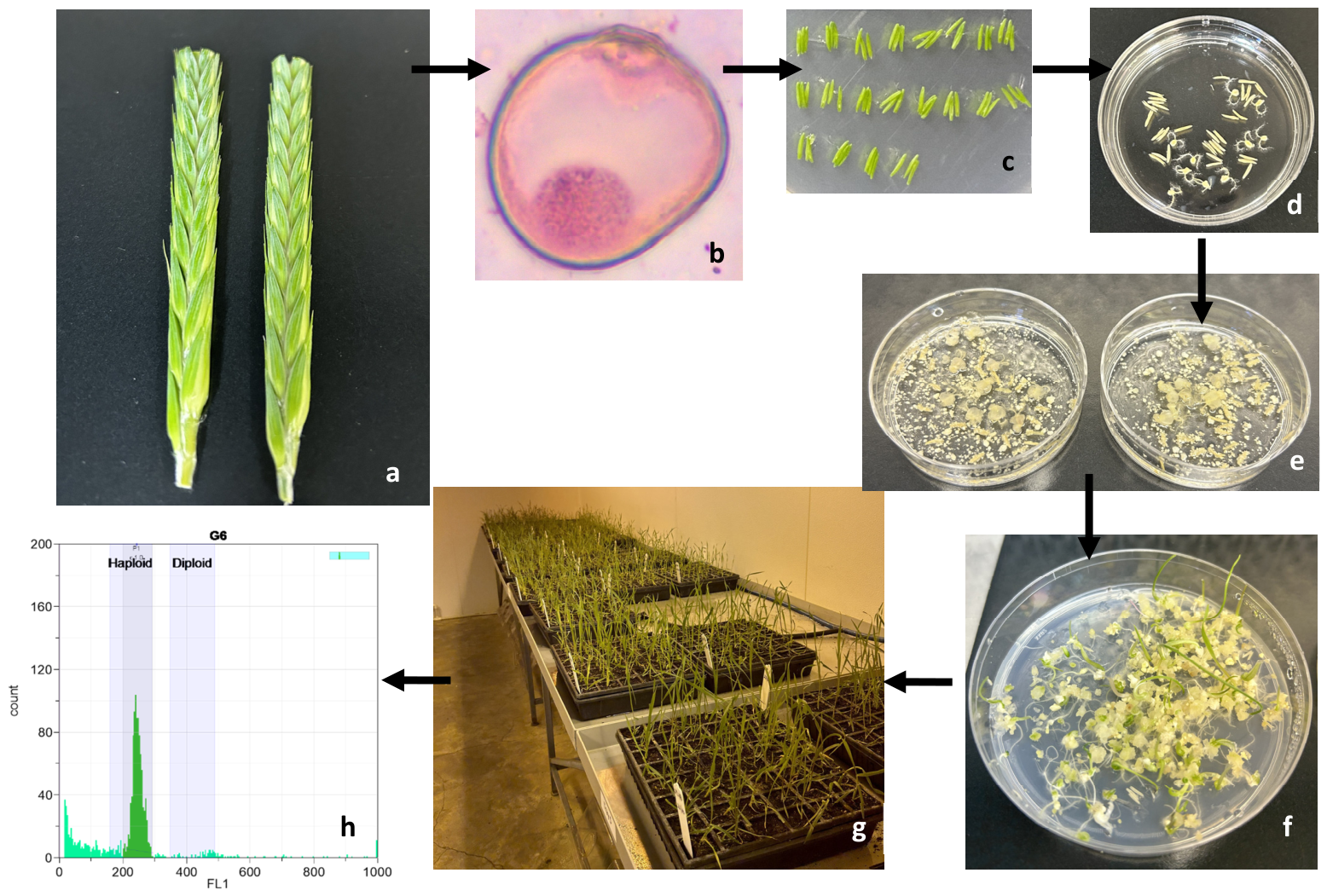
Tillers were harvested when spikes were 1.5–3.0 cm above the boot and stored in water at 4–6 °C for 1–5 days until sufficient spikes were ready for processing. Prior to sterilization, a subset of 5–10 spikes was assessed for microspore developmental stage. Three anthers from a central floret of each spike were squashed in 1% (w/v) acetocarmine and examined at 400× magnification. Spikes containing mid- to late-uninucleate microspores, or those with visible mitosis, were selected for culture (Figure 1b). Spikes with trimmed awns were surface-sterilized in commercial bleach (10.5 g L−1 sodium hypochlorite) for 15 min, then rinsed twice for 5 min in sterile deionized water. Four spikes were placed per Petri dish and stored at 4–6 °C until anther and ovary isolation.

2.3.2. Anther Pretreatment (Mannitol, n-Butanol, and DMSO)

Spikes were harvested, assessed for microspore developmental stage, and surface sterilized as described above. Table 1 shows the number of spikes processed in each experiment. In all experiments, 60 anthers were excised from each spike (3 anthers × 20 florets) and placed on solid mannitol pretreatment medium for five days (Figure 1c).
In Experiment 1, a solid pretreatment medium was evaluated at three mannitol concentrations (0.4, 0.7, and 1.0 M). In Experiment 2, a solid 1.0 M mannitol pretreatment medium was tested with or without 0.4 µM TSA. Anthers from each spike were evenly distributed across the three treatments in Experiment 1 and the two treatments in Experiment 2.
Following the 5-day mannitol pretreatment, anthers from each dish were transferred to fresh 55 × 14 mm Petri dishes containing 4 mL of 0.7 M liquid mannitol. After all anthers had been transferred, 8 µL n-butanol (0.2%, v/v) was added to each dish. The dishes were left unsealed, covered with aluminum foil, and incubated in the dark at 22–25 °C for 5 h in a fume cabinet. After incubation, the mannitol–n-butanol solution was removed using a sterile pipette.
In Experiment 2, an additional 48 h of DMSO treatment was applied. After the mannitol– n-butanol solution was removed from the anthers, 4 mL LIM containing 0.6% (v/v) DMSO was added. The dishes were left unsealed and incubated in the dark at 25 °C for 48 h. The DMSO treatment is routinely included in DPIRD wheat DH production [21].
In Experiment 3 (DH population development), F1 plants were screened using simple sequence repeat (SSR) markers to confirm hybridity prior to spike harvest (see Supplementary Materials). Spikes were harvested and processed as described above, and 60 anthers and 10 ovaries were excised from each spike. Anthers were placed on 90 × 14 mm Petri dishes containing 1.0 M solid mannitol pretreatment medium. Each dish was divided into quarters, with anthers from each spike placed in a separate quarter. After five days on the pretreatment medium, anthers were treated with 0.2% (v/v) n-butanol for 5 h, followed by a 48 h DMSO treatment, as described above.

2.3.3. Embryo Induction with Ovary Co-Culture

Ovary co-culture was used in all experiments. At the time of anther excision, ovaries were also removed from each spike and placed in 55 × 14 mm Petri dishes containing 4 mL of LIM (10 ovaries per dish). One dish of ovaries was prepared for each dish of anthers.
Following pretreatment (mannitol followed by n-butanol in Experiment 1, and mannitol, n-butanol, and DMSO in Experiments 2 and 3), anthers were transferred to ovary-conditioned LIM (conditioned with ovaries for 5–7 days) and co-incubated with the ovaries in the dark at 25 °C for 4–5 weeks to induce embryogenesis (Figure 1d).

2.3.4. Plant Regeneration

After 4–5 weeks, embryos were visible in most dishes (Figure 1e). Each 55 × 14 mm dish containing embryos was transferred by tipping onto a 90 × 20 mm Petri dish containing solid regeneration medium. Excess LIM was removed using a pipette, and the ovaries were discarded. Dishes were sealed with Parafilm™ and incubated in the dark at 25 °C for 7 days, then transferred to a controlled-temperature room (25 °C, 12 h photoperiod) for a further 7–14 days under Gro-Lux and cool-white fluorescent lamps providing 50–100 µmol m−2 s−1 photosynthetically active radiation (PAR) (Figure 1f).
Green plants were then individually subcultured onto fresh regeneration medium (5–10 plants per 90 × 20 mm Petri dish). The number of green and albino plants per spike–treatment combination was recorded at this stage, and albino plants were discarded. In Experiment 3, only green plants were counted for DH population development. Subcultured green plants were maintained under the same conditions for 2–3 weeks until roots were sufficiently developed for transplanting. In Experiment 2, plants were not transplanted, and ploidy analysis was performed on in vitro plantlets.

2.4. Regenerant Plant Grow-Out

Regenerant plants were transplanted into 30-cell trays (Experiment 1) or 48-cell trays (Experiment 3) containing commercial potting mix supplemented with Osmocote Exact Standard controlled-release fertiliser (elemental composition: 15-3.9-9.1 + 1.2Mg + TE; ICL Specialty Fertilizers, Heerlen, The Netherlands). Plants were grown in a CER (18/13 °C day/night, 12 h photoperiod) and covered with transparent plastic lids for the first 7 days to facilitate hardening.
Regenerant plants of AT-45 and ‘1143’ (Experiment 1) were sampled for ploidy approximately 4–5 weeks after transplanting and then discarded. Regenerant plants (<1000) derived from F1 plants of AT-45 × ‘1143’ and ‘1143’ × AT-45 (Experiment 3) were maintained in the CER for 4–5 weeks (Figure 1g) before being transferred to 1–1.5 L pots containing commercial potting mix supplemented with Osmocote Exact Standard and grown to maturity in three environments: (1) a shadehouse without cooling (‘Shadehouse’), (2) a plastic greenhouse with evaporative cooling (‘Plastic-house’), and (3) a greenhouse with refrigerative cooling (‘Greenhouse’). All environments were naturally lit. Automatic irrigation was provided via overhead sprinklers in the Shadehouse and Plastic-house, and via capillary matting in the Greenhouse.

2.5. Ploidy Evaluation and Awn Measurements at Harvest

Ploidy was assessed in all regenerant plants from Experiment 1 (8 AT-45 plants and 57 ‘1143’ plants) and in 90 randomly selected in vitro regenerant plants from each of three varieties—Berkshire, Joey, and Tuckerbox—in Experiment 2. Flow cytometry was performed using a Sysmex CyFlow® Space flow cytometer (Sysmex, Macquarie Park, Australia) according to the manufacturer’s instructions. Approximately 1 cm2 of leaf tissue was chopped with a razor blade in 500 µL Cystain Ox Protect buffer, incubated for 1 min, filtered through a 40 µm mesh, and stained with 1500 µL Cystain Ox Protect solution containing 4′,6-diamidino-2-phenylindole (DAPI).
Ploidy levels were determined by comparing the G1 fluorescence peaks of test samples (Figure 1h) with those of reference controls: a hexaploid wheat variety (2n = 6x = 42), a hexaploid triticale breeding line AT-45 (2n = 6x = 42), and a haploid wheat regenerant (n = 3x = 21) obtained from post-anther culture plants grown in the greenhouse. For Experiment 2, a haploid triticale control (n = 3x = 21) derived from AT-45 was also included.
For Experiment 3, the ploidy of regenerant plants derived from F1 plants was assessed at maturity based on morphological observations. Plants that set seed were classified as doubled haploids (DHs), sterile plants were classified as haploids, and plants producing fewer than five seeds per head were classified as partially sterile and may have been aneuploid lines [35].
The presence or absence of awns was recorded at harvest. Awn description in triticale is based on both awn distribution (tip awned, half awned, or fully awned) and awn length (very short, short, medium, long, or very long) [36].
In our material, all lines exhibited a fully awned distribution and were categorized based on awn length as awned (long or very long), reduced awn (medium length), or awnless (very short or short, <10 mm, fine, and soft) (Figure 1a). Only seed from awnless DH lines was harvested for subsequent pathology and agronomic evaluation, whereas awned and reduced awn lines were discarded.

2.6. Statistical Analysis

Plant count data (green and albino plants) from Experiments 1 and 2 were analysed using hierarchical generalised linear models (HGLMs) in Genstat Edition 24 (VSN International, Hemel Hempstead, UK). In Experiment 1, treatment (mannitol concentration) was fitted as a fixed effect, and genotype/spike as a random effect. In Experiment 2, treatment (TSA), genotype, and the genotype × treatment interaction were fitted as fixed effects, with spike as the random effect. A Poisson distribution was assumed for all plant count models.
Where valid, an identity link function was used to allow interpretation of effects on the original scale. When the identity link produced invalid fitted values, a log link was applied. Back-transformed predicted means (on the response scale) are presented where log links were used. p-values for fixed effects were obtained using Wald tests, and means were compared using approximate 5% least significant differences (LSDs), calculated as the average standard error of difference (SED) × 2.
To account for over-dispersion in the Poisson models, models were fitted with both fixed and estimated dispersion parameters. In all cases, the estimated dispersion parameter was greater than 1, and results from models using the estimated parameter are reported.
Green plant production (green plants per spike) in Experiment 3 was analysed using residual maximum likelihood (REML) in Genstat Edition 24, fitting a linear mixed model with genotype (AT-45 × ‘1143’ and ‘1143’ × AT-45) as the fixed effect and donor plant as the random effect. Significance of the fixed effect was assessed using an approximate F-test, and predicted means and standard errors were obtained from the fitted model.
Chromosome doubling rates in Experiments 2 and 3 were analysed using binomial HGLMs, with the number of DH lines as the response variate and the number of plants screened (Experiment 2) or number of live transplants (Experiment 3) as the binomial total. In Experiment 2, genotype (Berkshire, Joey, and Tuckerbox) was fitted as the sole fixed effect. In Experiment 3, genotype (AT-45 × ‘1143’ and ‘1143’ × AT-45), grow-out location (Shadehouse, Plastic-house, and Greenhouse), and the genotype × location interaction were fitted as fixed effects. An identity link function was used for both analyses, and means were compared using approximate 5% LSDs, calculated as the average SED × 2. Predicted means and standard errors were obtained directly from the fitted model. The dispersion parameter was fixed at 1 for all binomial models, as the limited residual degrees of freedom precluded reliable estimation. Mortality during the CER phase of Experiment 3 was low (≤1.5%) and was not formally analysed.

3. Results

3.1. Experiment 1: Response of AT-45 and ‘1143’ to the DPIRD Wheat Anther Culture Protocol and the Effect of Mannitol Concentration in Pretreatment Medium (0.4, 0.7, 1.0 M)

Both parental lines produced green and albino plants using the DPIRD wheat anther culture protocol. The variety ‘1143’ was markedly more responsive, generating 57 green plants from five spikes (~11.4 plants/spike), compared with eight green plants from the breeding line AT-45 (~1.6 plants/spike). Albino numbers exceeded green plants in both lines, totaling 106 in ‘1143’ and 98 in AT-45.
Mannitol concentration significantly affected green (p = 0.023) and albino (p = 0.011) plant production. Green plants per 20 anthers increased from 0.8 at 0.4 M to 1.0 at 0.7 M and 2.0 at 1.0 M, while albino plants decreased from 6.9 to 5.3 and 3.4, respectively (Table 2). The only significant pairwise difference for both traits was between 0.4 M and 1.0 M. Based on these results, 1.0 M mannitol was adopted for Experiments 2 and 3.
Flow cytometry indicated spontaneous chromosome doubling rates of 53% for ‘1143’ and 59% for AT-45, although sample sizes were limited, particularly for AT-45 (n = 8).

3.2. Experiment 2: Genotypic Response of Nine Triticale Varieties and the Effect of TSA in Mannitol Pretreatment Medium

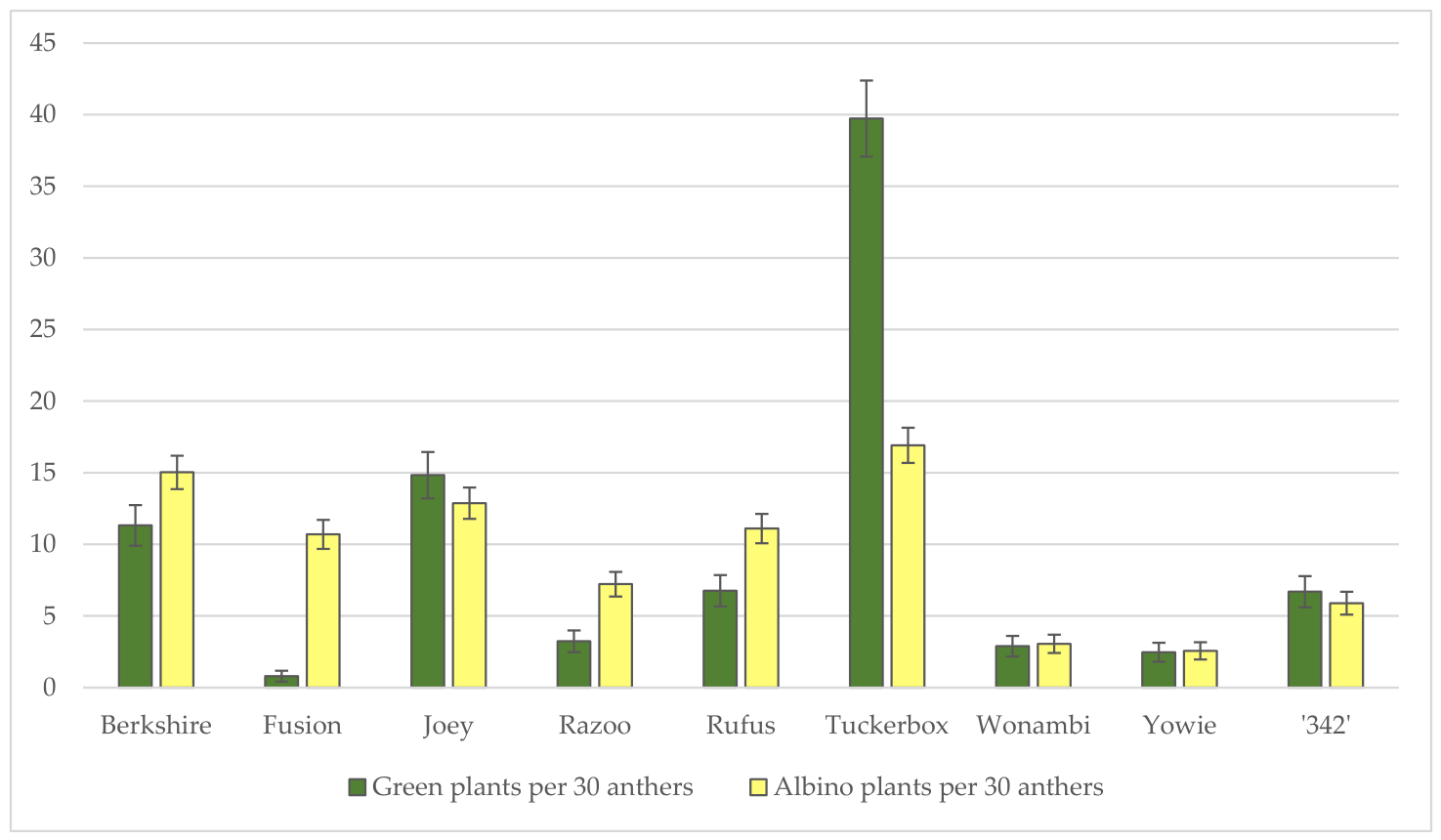
Green and albino plants were produced from all nine varieties. Green plant numbers differed significantly between genotypes (p < 0.001), but neither the TSA treatment (p = 0.938) nor the genotype x treatment interaction (p = 0.821) was significant. The variety Tuckerbox produced the most green plants, averaging 39.7 per 30 anthers (~80 plants/spike), while Fusion produced fewer than one green plant per 30 anthers (~1.6 plants/spike) (Table 3). The overall mean was 9.9 green plants per 30 anthers (~20 plants/spike). Green plant production per spike across all nine varieties ranged from 1.6 (Fusion) to 80 (Tuckerbox), with intermediate values for Berkshire (~23/spike), Joey (~30/spike), Razoo (~6/spike), Rufus (~14/spike), Wonambi (~6/spike), Yowie (~5/spike) and ‘342’ (~13/spike).
Albino plants also varied significantly between genotypes (p < 0.001). Unlike green plants, the TSA treatment had a small but significant effect (p = 0.019), whereas the genotype × treatment interaction was not significant (p = 0.078). Albino plant numbers ranged from 2.6 per 30 anthers in Yowie to 16.9 per 30 anthers in Tuckerbox (~5–34 per spike), with a mean of 9.5 (~19 per spike) (Table 3). The TSA treatment was predicted to reduce albino numbers by 1.1 plants per 30 anthers compared to the control mean of 9.1, representing a reduction of approximately 12%. Although statistically significant, this effect was modest and genotype was the main driver of variation in albino plant production. The variation in green and albino plant production across the nine varieties is illustrated in Figure 2.
The proportion of albino plants varied considerably among varieties (Table 3). For most varieties, albinos comprised 46–69% of all regenerants; however, Fusion was a notable outlier, with 93% of regenerants being albino and fewer than one green plant produced per 30 anthers on average, making it a poor candidate for DH production. In contrast, Tuckerbox had the lowest proportion of albinos (30%) and the highest green plant yield, making it the most responsive variety overall.
Chromosome doubling varied significantly between the three varieties (p < 0.001; Table 4). Tuckerbox had the highest doubling rate (72.2%), followed by Joey (57.8%) and Berkshire (35.6%); all three varieties differed significantly from each other (LSD = 14.2%), with an overall mean of 55.2%. Notably, Tuckerbox combined the highest green plant yield (~80 plants/spike) with the highest spontaneous chromosome doubling rate (72.2%), making it the most productive variety for DH generation. In practical terms, this means that from a given number of spikes, substantially more DH lines can be expected from Tuckerbox than from any other variety tested.

3.3. Experiment 3: Development of a DH Population from AT-45 × ‘1143’ and ‘1143’ × AT-45

Ten F1 plants were confirmed as true hybrids using the polymorphic marker Xbarc077 (Supplementary Materials; Figure S1). All F1 plants were awnless with fine awns less than 10 mm in length (Figure 1a). Spikes were processed following the DPIRD protocol to generate DH lines combining awnlessness and stripe rust resistance. From 66 spikes of AT-45 × ‘1143’ and 60 spikes of the reciprocal cross, the mean green plant production was 17.7 and 17.1 plants per spike, respectively, with no significant differences between the reciprocal crosses (p = 0.869; Table 5). More than 2000 green plants were identified, of which 1311 with well-developed roots were subcultured (Table 5), and 1147 plants were transplanted for grow-out (Table 6).
Plants were initially established in 48-cell trays in a CER before potting up and transfer to the three grow-out locations. Mortality during the CER phase was low, with 9 deaths recorded in AT-45 × ‘1143’ and 8 in ‘1143’ × AT-45 (1.5% overall), and 1130 regenerant plants were grown to maturity. At harvest, 480 DH (42.5%), 537 haploid (47.5%), and 113 partially sterile (10%) lines were identified (Table 6). Chromosome doubling rates did not differ between reciprocal crosses (p = 0.242; Table 7), with rates of 40.9% for AT-45 × ‘1143’ and 44.3% for ‘1143’ × AT-45. Grow-out location had a significant effect on doubling rate (p = 0.038; Table 7) with the Plastic-house and Greenhouse producing comparable rates (46.5% and 43.9%, respectively), while the Shadehouse was slightly lower (37.3%). However, only the difference between the Plastic-house and Shadehouse exceeded the LSD of 7.3%. There was no significant genotype × location interaction (p = 0.772).
Segregation for awn type in harvested lines was observed as awned (51.6%), reduced awn (20.0%), and awnless (28.4%) (Table 8). All three awn phenotypes were observed in haploid and DH lines, as well as in partially sterile lines. Formal statistical testing of awn phenotype ratios was not performed, as the genetic control of awn development in triticale has not been fully characterised and no expected segregation ratios can be justified. Of the awnless DH lines, 114 plants were advanced to a field nursery at the DPIRD’s Manjimup Horticultural Research Institute (Western Australia) for stripe rust screening and agronomic evaluation.

4. Discussion

This study demonstrates that the DPIRD wheat anther culture protocol [21] can be successfully applied to triticale for efficient DH production. Screening varieties and breeding lines revealed substantial genotypic variation in green and albino plant production, consistent with the genotype dependence commonly reported for androgenesis in triticale and other cereals.
In Experiment 1, the variety ‘1143’ was more responsive than the breeding line AT-45, generating approximately 11.4 green plants per spike compared with 1.6 for AT-45. In Experiment 3, reciprocal crosses AT-45 × ‘1143’ and ‘1143’ × AT-45 exhibited heterosis for green plant regeneration, averaging 17.4 green plants per spike and exceeding the performance of either parent. Reciprocal differences, however, were not significant for either green plant numbers or chromosome doubling. Heterosis in androgenetic capacity has been reported in triticale and wheat [37,38] and can be influenced by genotype and maternal cytoplasm. The contribution of maternal cytoplasm may also vary, resulting in either detectable or negligible reciprocal effects [38,39].
Regenerant plants were microspore-derived rather than originating from anther wall tissue, as indicated by the segregation of awned, awnless, and reduced awn phenotypes from awnless F1 plants and by direct embryo formation observed in culture (Figure 1e), neither of which would be expected if plants were derived from somatic anther wall tissue. Large numbers of wheat and barley DH populations have been developed for breeding and research using DPIRD anther culture protocols, with over 1300 populations developed to date and published results confirming their gametophytic origin [40,41,42].
In Experiment 2, green plant production varied significantly among the nine triticale varieties, ranging from 0.8 to 39.7 green plants per 30 anthers in Fusion and Tuckerbox, respectively, equivalent to 1.6 and 80 green plants per spike. The overall mean was 9.9 green plants per 30 anthers, equivalent to 20 green plants per spike. These rates are comparable to, or higher than, those reported in previous triticale anther culture studies, where green plant production ranged from 0–67.3 green plants per 100 anthers, with mean regeneration ranging from 1.45 green plants per 100 anthers (five genotypes [5]) to 18.4 green plants per 100 anthers (eleven genotypes [26]), with intermediate values of 4.6 (one genotype [15]) and 6.1 (ten genotypes [34]). Genotype-dependent responses are consistently reported in triticale anther culture studies evaluating multiple genotypes [5,26,34], in agreement with the genetic variation observed in Experiment 2 of the present study. Triticale microspore culture also yields variable results, ranging from 0–10 green plants per dish (nine genotypes [43]) to 55 green plants per spike in the responsive cultivar ‘Bogo’ [44], with recent summaries reporting 5–12 green plants per spike [45]. Comparisons of anther and microspore culture in triticale have shown that anther culture can produce nearly three times as many green plants as microspore culture [22], supporting its greater efficiency. Results from the present study further support anther culture as an effective method for generating triticale DHs.
Albino plant production also differed significantly among the nine varieties, ranging from 2.6 to 16.9 albino plants per 30 anthers (~5–34 albino plants per spike), with proportions ranging from 30% in Tuckerbox to 93% in Fusion, and a mean of 56% across all genotypes. These values exceed those in some recent studies, in which albino plants accounted for approximately 20–30% of regenerants [5,26], are comparable to others (~53% [46]), and are lower than older studies (~70% [47]). This variation likely reflects differences in genotype and culture protocols.
The TSA treatment did not significantly affect green plant regeneration but modestly reduced albino numbers, contrasting with studies in Brassica napus, barley, and wheat, where TSA enhanced embryogenesis and green plant production [30,31,32,48]. In these studies, TSA, with DMSO as a solvent, was applied to isolated microspores following cold, starvation or heat pretreatment, using short pulses prior to the induction phase (10 min), longer treatments (20–24 h, 0.1–10 µM), or continuous exposure during the induction phase (28 days) at lower concentrations (0.01–0.1 µM). In triticale microspore culture, a 10 min 1 µM pulse following cold pretreatment has been reported [25]. In wheat anther culture, TSA was applied during or after cold and mannitol pretreatments [33]. The most effective treatment (0.4 µM TSA + 1% DMSO for 5 days with 0.7 M mannitol) yielded up to four times as many green DH plants as mannitol alone. Ultrastructural studies indicated that both mannitol and mannitol plus TSA induced similar morphological changes, but TSA increased the proportion of microspores with ‘star-like’ morphology and symmetrical divisions [33]. In the present study, TSA was applied in a mannitol pretreatment medium for 5 days, but without DMSO, which may have reduced its effectiveness. Additionally, storage of the pretreatment medium with TSA at room temperature prior to use could have further diminished efficacy. Further testing with TSA combined with DMSO may improve outcomes in future triticale and wheat anther culture studies.
Several aspects of the DPIRD wheat anther culture protocol differ from conventional triticale protocols, including the mannitol and n-butanol pretreatments, DMSO application, ovary co-culture, and induction medium composition. In triticale, cold pretreatment of whole tillers at 4 °C for 2–3 weeks is standard in both anther and microspore culture [15,24,25,45,47], sometimes complemented by a subsequent heat treatment at 32 °C for 3 days [22,26]. In microspore culture, however, cold pretreatment of tillers outperformed heat stress for two of the three genotypes tested [49]. In contrast, the DPIRD wheat protocol uses mannitol and n-butanol pretreatments to stimulate embryogenesis, and the present study is the first report of its successful application in triticale. Mannitol pretreatment, generally considered a carbohydrate starvation and osmotic shock, also depolymerizes wheat microspore microtubules [50], while n-butanol has been shown to disrupt microtubules in BY-2 tobacco cells, Arabidopsis, and wheat microspores [50,51,52], and significantly improved embryo and green plant formation in wheat [27,53]. Dubas et al. [50] propose that the fragmentation, stabilization, and resulting configurations of microtubules induced by the combination of mannitol and n-butanol may play a significant role in microspore embryogenesis in bread wheat, and this pretreatment combination was also effective in triticale in the present study.
The 0.6% DMSO treatment applied after pretreatment represents another point of difference from other triticale protocols. DMSO enhances membrane permeability [54,55] and has been reported to increase green plant production in barley and wheat [56], while also promoting cell reprogramming through epigenetic modifications or increased Ca2+ permeability [33]. Studies in human and fish cell lines have demonstrated that even low concentrations of DMSO can cause significant alterations in microRNA expression, the epigenetic landscape, and cellular metabolism [57,58], supporting a role for epigenetic modification in its mode of action. In the DPIRD wheat DH program, significant improvements in green plant regeneration were obtained when DMSO was applied at the start of the induction phase (unpublished data), and it is now routinely included in the protocol [21].
Ovaries are routinely included during the induction phase of the DPIRD wheat anther culture protocol, where both ovaries and ovary-conditioned medium enhance embryogenesis [48,59,60,61]. In triticale, ovaries are typically added to microspore cultures [25,45,62,63] but are rarely included in anther culture protocols. Ovaries may release growth regulators, nurse factors, and arabinogalactan proteins [59,64], with fasciclin-like arabinogalactan protein FLA26 and the ovary signaling gene FERONIA identified as important contributors to inductive effects in wheat [61]. In triticale, trans-cytokinin isoforms produced by the ovaries may contribute to hormonal homeostasis conducive to microspore embryogenesis [45].
Induction media for triticale androgenesis have largely been adapted from wheat protocols, with commonly used recipes including 190-2 [47,63,65], mC17 [24,34], NPB99 [43,62,66], and W14mf [22,26]. Wheat LIM, based on MMS4 [67] and Medium C [68], also performed well in this study. LIM includes casein hydrolysate (300 mg L−1), elevated glutamine (750 mg L−1), and two arabinogalactan proteins [64,67]. Like many wheat and triticale induction media, LIM contains maltose as the carbohydrate source and is supplemented with 2,4-D and kinetin [23]. The regeneration medium was modified from LIM by omitting growth regulators and arabinogalactan proteins, reducing maltose, and increasing CuSO4 from 0.025 to 2.5 mg L−1 (after [67]). Increasing copper in the pretreatment and/or induction medium may be more important, as higher copper levels have improved green plant regeneration in barley and triticale [65,69,70], potentially by affecting microspore redox balance, DNA methylation, and metabolic activity [65,71]. Additional components such as glutathione and phytosulfokine-α (PSK) further promote embryogenesis by protecting microspores from oxidative stress [63,72] and stimulating cell proliferation [62], and PSK is routinely used in triticale microspore culture protocols [25]. Increasing copper in LIM, together with the addition of components such as glutathione and PSK, may therefore further improve green plant regeneration in this protocol.
Spontaneous chromosome doubling rates in this study were relatively high. Flow cytometry of the parental lines (Experiment 1) indicated rates of 53–59%, although the sample size was limited for AT-45 (n = 8). In Experiment 2, doubling in Berkshire, Joey, and Tuckerbox varied significantly between genotypes, ranging from 35.6% to 72.2%, with a mean of 55.2%. In regenerant plants derived from crosses between AT-45 and ‘1143’ (Experiment 3), the mean doubling rate was 42.5%. There were no significant differences in chromosome doubling between the reciprocal crosses, with 40.9% and 44.3% for AT-45 × ‘1143’ and ‘1143’ × AT-45, respectively. Grow-out location, however, did have a significant effect on doubling, with the non-cooled Shadehouse having significantly lower doubling (37.3%) than the Plastic-house (46.5%). This is consistent with the general observation that suboptimal grow-out conditions can reduce spontaneous chromosome doubling rates.
Spontaneous chromosome doubling in triticale is considered low and is often cited as a bottleneck [20,34]. Reported rates following anther culture vary widely, ranging from 0–26.3% (mean 13.5% [22]), 30% [34], and 19.4–67.4% (mean 29.3% [26]). Rates from microspore culture typically range from 10–38% [43,44,66,73]. Consequently, colchicine treatment is commonly incorporated into or recommended for anther and microspore culture protocols to enhance chromosome doubling rates [5,22,34,66]. However, colchicine treatment—particularly traditional root-dipping techniques—can result in plant mortality, ploidy chimeras, and reduced seed set [74]. Colchicine was not used in this study, avoiding the need to screen regenerants for ploidy or to treat haploid plants with this toxic chemical.
Aneuploidy can also be problematic in triticale due to its meiotic instability, particularly in hybrids [35]. Lines classified as partially sterile with reduced seed set in Experiment 3 may have been aneuploid. Although flow cytometry (Experiments 1 and 2) did not detect aneuploids, their presence cannot be ruled out due to detection limitations. Oleszczuk et al. [35] reported that plant morphology, seed set, and seed quality are more reliable indicators of aneuploidy than flow cytometry.
The relatively high rates of spontaneous chromosome doubling observed here may reflect both genotypic effects and protocol differences, including pretreatment stress with mannitol. Mannitol can act as an antimicrotubular agent and has been shown to promote embryogenesis, nuclear fusion, and chromosome doubling in barley [75]. These results indicate that the DPIRD protocol can achieve relatively high levels of spontaneous chromosome doubling in triticale.
Overall, the study demonstrates that the DPIRD wheat anther culture protocol is easily transferable to triticale, producing favorable results across a range of varieties and breeding lines. To our knowledge, this is the first study to apply anther culture with the specific aim of combining awnlessness with disease resistance in triticale. While several recent anther culture studies have been conducted on awnless triticale [5,15], they have primarily focused on optimizing protocol parameters and selecting superior awnless DH lines from awnless parents, rather than generating targeted breeding populations. The protocol used in this study differs from other triticale protocols in several ways, and this is the first report of using mannitol and n-butanol pretreatment to stimulate embryogenesis in triticale. The results compare favorably with previously published triticale studies in terms of green plant production and spontaneous chromosome doubling. In this study, TSA did not significantly enhance green plant numbers; however, combining TSA with DMSO in the mannitol pretreatment medium may improve outcomes in future work.
Importantly, the study enabled the rapid production of a targeted population of awnless DH lines, which are currently being evaluated in the field for stripe rust resistance with promising results. Awnless DH lines with improved stripe rust resistance are highly suitable as a forage source under Australian conditions, demonstrating the efficiency and effectiveness of DH technology in a focused breeding program.


Supplementary Materials

The following supporting information can be downloaded at: https://www.mdpi.com/article/10.3390/agronomy16090923/s1, Figure S1: Hybridity testing of triticale F1 plants from AT-45 × ‘1143’ and ‘1143’ × AT-45 crosses using the polymorphic marker Xbarc07 [76,77,78].

Author Contributions

Conceptualization, S.B. and D.R.; methodology, S.B., M.C., Y.H., R.B., M.S. and D.R.; validation, S.B., Y.H., M.S. and D.R.; formal analysis, S.B. and R.B.; investigation, S.B., M.C., Y.H., R.B., M.S. and R.V.; resources, M.C., R.B. and R.V.; data curation, S.B., M.C., R.B. and D.R.; writing—original draft preparation, S.B., M.C., Y.H., R.B. and M.S.; writing—review and editing, S.B., Y.H., R.B. and D.R.; visualization, S.B. and Y.H.; supervision, S.B. and D.R.; project administration, S.B. and D.R.; funding acquisition, D.R. All authors have read and agreed to the published version of the manuscript.

Funding

This research was funded by the Western Australian Department of Primary Industries and Regional Development (DPIRD).

Data Availability Statement

The original contributions presented in this study are included in the article/Supplementary Material. Further inquiries can be directed to the corresponding author.

Acknowledgments

We thank DPIRD staff Christopher McMullan, Li Liu, Julie Killen, and Simone Wells for tissue culture support, and Esther Walker and Daniel Renshaw for assistance with DNA extraction and marker analysis. We also gratefully acknowledge editorial support from Roopali Bhoite and Clinton Revell, and biometrics support from Ana Hepworth.

Conflicts of Interest

The authors declare no conflicts of interest.

Abbreviations

The following abbreviations are used in this manuscript:
DMSODimethyl sulfoxide
TSATrichostatin A
2,4-D2,4-dichlorophenoxyacetic acid

References

  1. Randhawa, H.S.; Bona, L.; Graf, R.J. Triticale breeding—Progress and prospect. In Triticale; Eudes, F., Ed.; Springer: Cham, Switzerland, 2015; pp. 15–32. [Google Scholar] [CrossRef]
  2. Arseniuk, E. Recent developments in triticale breeding research and production—An overview. Ekin J. Crop Breed. Genet. 2019, 5, 68–73. [Google Scholar]
  3. FAO. Triticale Production in Food and Agriculture Organization of the United Nations (2020) Stats. Available online: https://data.un.org/Data.aspx?d=FAO&f=itemCode:97 (accessed on 20 April 2026).
  4. Ntakirutimana, F.; Xie, W. Unveiling the actual functions of awns in grasses: From yield potential to quality traits. Int. J. Mol. Sci. 2020, 21, 7593. [Google Scholar] [CrossRef]
  5. Ma, J.; Zhao, F.; Zhang, Y.; Tian, X.; Du, W. Effects of hormone concentrations on anther cultures and the acquisition of regenerated plants of five awnless triticale genotypes. Plant Methods 2025, 21, 2. [Google Scholar] [CrossRef]
  6. GRDC. Grow Notes—Triticale. March 2018. Available online: https://grdc.com.au/__data/assets/pdf_file/0013/315310/GRDC-GrowNotes-Triticale-Northern.pdf (accessed on 20 April 2026).
  7. Chen, X.M. Epidemiology and control of stripe rust [Puccinia striiformis f. sp. tritici] on wheat. Can. J. Plant Pathol. 2005, 27, 314–337. [Google Scholar] [CrossRef]
  8. Chen, X.M. Integration of cultivar resistance and fungicide application for control of wheat stripe rust. Can. J. Plant Pathol. 2014, 36, 311–326. [Google Scholar] [CrossRef]
  9. Wellings, C.R. Global status of stripe rust: A review of historical and current threats. Euphytica 2011, 179, 129–141. [Google Scholar] [CrossRef]
  10. NSW Department of Primary Industries. Wheat Stem Rust; New South Wales Government: Orange, Australia, 2023. Available online: https://www.dpi.nsw.gov.au/dpi/climate/climate-vulnerability-assessment/biosecurity-risks2/wheat-stem-rust (accessed on 20 April 2026).
  11. NSW Department of Primary Industries. Wheat Stripe Rust; New South Wales Government: Orange, Australia, 2023. Available online: https://www.dpi.nsw.gov.au/dpi/climate/climate-vulnerability-assessment/biosecurity-risks2/wheat-stripe-rust (accessed on 20 April 2026).
  12. Murray, G.M.; Brennan, J.P. The Current and Potential Costs from Diseases of Wheat in Australia; Grains Research and Development Corporation: Canberra, Australia, 2009; Available online: https://grdc.com.au/__data/assets/pdf_file/0026/203957/disease-loss-wheat.pdf.pdf (accessed on 20 April 2026).
  13. Department of Primary Industries and Regional Development (DPIRD). Leaf Rust and Stripe Rust and Their Management in Wheat; Government of Western Australia: Perth, Australia, 2024. Available online: https://library.dpird.wa.gov.au/fc_factsheets/54/ (accessed on 20 April 2026).
  14. Department of Primary Industries and Regional Development (DPIRD). Stem Rust and Its Management in Wheat; Government of Western Australia: Perth, Australia, 2024. Available online: https://library.dpird.wa.gov.au/fc_factsheets/75 (accessed on 20 April 2026).
  15. Ma, J.; Zhao, F.; Tian, X.; Du, W. Optimization of anther culture of awnless triticale. PeerJ 2025, 13, e19951. [Google Scholar] [CrossRef]
  16. Zustovi, R.; Schurack, S.; Valárik, M.; Rueda, J.G.; Mirosavljević, M.; Zupunski, V.; Buerstmayr, H.; Niewińska, M.; Juracka, J.; Landshoot, S.; et al. Genetic and phenotypic diversity of European triticale: GWAS of yellow rust resistance and agronomic traits. Plant Breed. 2025, 1–17. [Google Scholar] [CrossRef]
  17. Nalepa, S.; Fohner, G. Awn Inhibitor Genes of Triticale and Their Use. U.S. Patent US5969219A, 30 October 1999. Available online: https://patents.google.com/patent/US5969219A (accessed on 20 April 2026).
  18. Yoshioka, M.; Iehisa, J.C.M.; Ohno, R.; Kimura, T.; Enoki, H.; Nishimura, S.; Nasuda, S.; Takumi, S. Three dominant awnless genes in common wheat: Fine mapping, interaction and contribution to diversity in awn shape and length. PLoS ONE 2017, 12, e0176148. [Google Scholar] [CrossRef]
  19. Florida Foundation Seed Producers, Inc.; Northern Agri Brands, LLC. ‘1143’ Triticale; U.S. Plant Variety Protection Certificate No. 201700035; United States Department of Agriculture, Plant Variety Protection Office: Beltsville, MD, USA, 2019. [Google Scholar]
  20. Wędzony, M.; Żur, I.; Krzewska, M.; Dubas, E.; Szechyńska-Hebda, M.; Wąsek, I. Doubled haploids in triticale. In Triticale; Eudes, F., Ed.; Springer: Cham, Switzerland, 2015; pp. 111–128. [Google Scholar] [CrossRef]
  21. Broughton, S.; Castello, M.; Liu, L.; Killen, J.; McMullan, C. Anther culture protocols for barley and wheat. In Plant Cell Culture Protocols. Methods in Molecular Biology; Loyola-Vargas, V., Ochoa-Alejo, N., Eds.; Humana Press: New York, NY, USA, 2024; Volume 2827, pp. 243–266. [Google Scholar] [CrossRef]
  22. Lantos, C.; Bóna, L.; Boda, K.; Pauk, J. Comparative analysis of in vitro anther and isolated microspore culture in hexaploid triticale (× Triticosecale Wittmack) for androgenic parameters. Euphytica 2014, 197, 27–37. [Google Scholar] [CrossRef]
  23. Eudes, F.; Chugh, A. An overview of triticale doubled haploids. In Advances in Haploid Production in Higher Plants; Touraev, A., Foster, B.P., Jain, S.M., Eds.; Springer: Dordrecht, The Netherlands, 2009; pp. 87–96. [Google Scholar] [CrossRef]
  24. Żur, I.; Dubas, E.; Krzewska, M.; Janowiak, F.; Hura, K.; Pociecha, E.; Bączek Kwinta, R.; Płażek, A. Antioxidant activity and ROS tolerance in triticale (× Triticosecale Wittm.) anthers affect the efficiency of microspore embryogenesis. Plant Cell Tissue Organ Cult. 2014, 119, 79–94. [Google Scholar] [CrossRef]
  25. Maheshwari, P.; Laurie, J.D. Triticale isolated microspore culture for doubled haploid production. In Doubled Haploid Technology: Vol 1: General Topics, Alliaceae, Cereals; Seguí-Simarro, J.M., Ed.; Methods in Molecular Biology, vol. 2287; Humana Press: New York, NY, USA, 2021; pp. 295–312. [Google Scholar] [CrossRef]
  26. Kruppa, J.; Kanbar, O.Z.; Tóth-Lencsés, K.A.; Kiss, E.; Bóna, L.; Lantos, C.; Pauk, J. Induction of triticale (× Triticosecale Wittmack) In Vitro androgenesis in anther cultures of F1 hybrid combinations, varieties and homogeneity testing of offspring generation. Life 2023, 13, 1970. [Google Scholar] [CrossRef] [PubMed]
  27. Soriano, M.; Cistué, L.; Castillo, A.M. Enhanced induction of microspore embryogenesis after n-butanol treatment in wheat (Triticum aestivum L.). Plant Cell Rep. 2008, 27, 805–811. [Google Scholar] [CrossRef] [PubMed]
  28. Niazian, M.; Shariatpanahi, M.E. In vitro-based doubled haploid production: Recent improvements. Euphytica 2020, 216, 69. [Google Scholar] [CrossRef]
  29. Cistué, L.; Ramos, A.; Castillo, A.M.; Romagosa, I. Production of large number of doubled haploid plants from barley anthers pretreated with high concentrations of mannitol. Plant Cell Rep. 1994, 13, 709–712. [Google Scholar] [CrossRef]
  30. Li, H.; Soriano, M.; Cordewener, J.; Muiño, J.M.; Riksen, T.; Fukuoka, H.; Angenent, G.C.; Boutilier, K. The histone deacetylase inhibitor trichostatin A promotes totipotency in the male gametophyte. Plant Cell 2014, 26, 195–209. [Google Scholar] [CrossRef]
  31. Jiang, F.; Ryabova, D.; Diedhiou, J.; Hucl, P.; Randhawa, H.; Marillia, E.F.; Foroud, N.A.; Eudes, F.; Kathiria, P. Trichostatin A increases embryo and green plant regeneration in wheat. Plant Cell Rep. 2017, 36, 1701–1706. [Google Scholar] [CrossRef] [PubMed]
  32. Pandey, P.; Daghma, D.S.; Houben, A.; Kumlehn, J.; Melzer, M.; Rutten, T. Dynamics of post-translationally modified histones during barley pollen embryogenesis in the presence or absence of the epi-drug trichostatin A. Plant Reprod. 2017, 30, 95–105. [Google Scholar] [CrossRef]
  33. Castillo, A.M.; Valero-Rubira, I.; Burrell, M.Á.; Allué, S.; Costar, M.A.; Vallés, M.P. Trichostatin A affects developmental reprogramming of bread wheat microspores towards an embryogenic route. Plants 2020, 9, 1442. [Google Scholar] [CrossRef]
  34. Ślusarkiewicz-Jarzina, A.; Pudelska, H.; Woźna, J.; Pniewski, T. Improved production of doubled haploids of winter and spring triticale hybrids via combination of colchicine treatments on anthers and regenerated plants. J. Appl. Genet. 2017, 58, 287–295. [Google Scholar] [CrossRef]
  35. Oleszczuk, S.; Rabiza-Swider, J.; Zimny, J.; Lukaszewski, A.J. Aneuploidy among androgenic progeny of hexaploid triticale (× Triticosecale Wittmack). Plant Cell Rep. 2011, 30, 575–586. [Google Scholar] [CrossRef]
  36. International Union for the Protection of New Varieties of Plants (UPOV). Triticale: Guidelines for the Conduct of Tests for Distinctness, Uniformity and Stability (TG/121/4); UPOV: Geneva, Switzerland, 2020; Available online: https://www.upov.int/edocs/tgdocs/en/tg121.pdf (accessed on 20 April 2026).
  37. González, M.; Hernádez, I.; Jouve, N. Analysis of anther culture response in hexaploid triticale. Plant Breed. 1997, 116, 302–304. [Google Scholar] [CrossRef]
  38. Al-Ashkar, I.M. Genetic contribution of parental genotypes on anther culture response of bread wheat F1 hybrids. Middle East J. Agric. Res. 2014, 3, 472–478. [Google Scholar]
  39. Charmet, G.; Bernard, S. Diallel analysis of androgenetic plant production in hexaploid triticale (× Triticosecale Wittmack). Theor. Appl. Genet. 1984, 69, 55–61. [Google Scholar] [CrossRef] [PubMed]
  40. Choudhury, S.; Hu, H.; Fan, Y.; Larkin, P.; Hayden, M.; Forrest, K.; Birchall, C.; Meinke, H.; Xu, R.; Zhu, J.; et al. Identification of new QTL contributing to barley yellow dwarf virus-PAV (BYDV-PAV) resistance in wheat. Plant Dis. 2019, 103, 2798–2803. [Google Scholar] [CrossRef]
  41. Bhoite, R.; Smith, R.; Bansal, U.; Dowla, M.; Bariana, H.; Sharma, D. Exome-based new allele-specific PCR markers and transferability for sodicity tolerance in bread wheat (Triticum aestivum L.). Plant Direct 2023, 7, e520. [Google Scholar] [CrossRef]
  42. D’Souza, N.K.; Dinh, H.; Lawrence, J.A.; Palmiero, E.; Muria-Gonzalez, M.J.; Gupta, S.; Forrest, K.; Ellwood, S.R. Exploiting barley landraces to reintroduce lost genetic diversity: Resistance to net form net blotch. Crop Sci. 2025, 65, e70088. [Google Scholar] [CrossRef]
  43. Eudes, F.; Amundsen, E. Isolated microspore culture of Canadian 6× triticale cultivars. Plant Cell Tissue Organ Cult. 2005, 82, 233–241. [Google Scholar] [CrossRef]
  44. Oleszczuk, S.; Sowa, S.; Zimny, J. Direct embryogenesis and green plant regeneration from isolated microspores of hexaploid triticale (× Triticosecale Wittmack) cv. Bogo. Plant Cell Rep. 2004, 22, 885–893. [Google Scholar] [CrossRef] [PubMed]
  45. Juzoń Sikora, K.; Nowicka, A.; Plačková, L.; Doležal, K.; Żur, I. Hormonal homeostasis associated with effective induction of triticale microspore embryogenesis. Plant Cell Tissue Organ Cult. 2023, 152, 583–604. [Google Scholar] [CrossRef]
  46. Krzewska, M.; Czyczyło Mysza, I.; Dubas, E.; Gołębiowska Pikania, G.; Żur, I. Identification of QTLs associated with albino plant formation and some new facts concerning green versus albino ratio determinants in triticale (× Triticosecale Wittm.) anther culture. Euphytica 2015, 206, 263–278. [Google Scholar] [CrossRef]
  47. Tuvesson, S.; von Post, R.; Ljungberg, A. Triticale anther culture. In Doubled Haploid Production in Crop Plants: A Manual; Maluszynski, M., Kasha, K.J., Forster, B.P., Szarejko, I., Eds.; Kluwer Academic Publishers: Dordrecht, The Netherlands, 2003; pp. 117–121. [Google Scholar] [CrossRef]
  48. Wang, H.M.; Enns, J.L.; Nelson, K.L.; Brost, J.M.; Orr, T.D.; Ferrie, A.M.R. Improving the efficiency of wheat microspore culture methodology: Evaluation of pretreatments, gradients, and epigenetic chemicals. Plant Cell Tissue Organ Cult. 2019, 139, 589–599. [Google Scholar] [CrossRef]
  49. Würschum, T.; Tucker, M.R.; Maurer, H.P. Stress treatments influence efficiency of microspore embryogenesis and green plant regeneration in hexaploid triticale (× Triticosecale Wittmack L.). In Vitro Cell. Dev. Biol. Plant 2014, 50, 143–148. [Google Scholar] [CrossRef]
  50. Dubas, E.; Castillo, A.M.; Żur, I.; Krzewska, M.; Vallés, M.P. Microtubule organization changes severely after mannitol and n-butanol treatments inducing microspore embryogenesis in bread wheat. BMC Plant Biol. 2021, 21, 586. [Google Scholar] [CrossRef] [PubMed]
  51. Gardiner, J.; Collings, D.A.; Harper, J.D.; Marc, J. The effects of the phospholipase D-antagonist 1-butanol on seedling development and microtubule organisation in Arabidopsis. Plant Cell Physiol. 2003, 44, 687–696. [Google Scholar] [CrossRef] [PubMed]
  52. Dhonukshe, P.; Laxalt, A.M.; Goedhart, J.; Gadella, T.W.; Munnik, T. Phospholipase D activation correlates with microtubule reorganization in living plant cells. Plant Cell 2003, 15, 2666–2679. [Google Scholar] [CrossRef] [PubMed]
  53. Broughton, S. The application of n-butanol improves embryo and green plant production in anther culture of Australian wheat (Triticum aestivum L.) genotypes. Crop Pasture Sci. 2011, 62, 813–822. [Google Scholar] [CrossRef]
  54. Yu, Z.W.; Quinn, P.J. Dimethyl sulphoxide: A review of its applications in cell biology. Biosci. Rep. 1994, 14, 259–281. [Google Scholar] [CrossRef]
  55. de Ménorval, M.; Mir, L.M.; Fernández, M.L.; Reigada, R. Effects of dimethyl sulfoxide in cholesterol-containing lipid membranes: A comparative study of experiments in silico and with cells. PLoS ONE 2012, 7, e41733. [Google Scholar] [CrossRef]
  56. Echávarri, B.; Cistué, L. Enhancement in androgenesis efficiency in barley (Hordeum vulgare L.) and bread wheat (Triticum aestivum L.) by the addition of dimethyl sulfoxide to the mannitol pretreatment medium. Plant Cell Tissue Organ Cult. 2016, 125, 11–22. [Google Scholar] [CrossRef]
  57. Verheijen, M.; Lienhard, M.; Schrooders, Y.; Clayton, O.; Nudischer, R.; Boerno, S.; Timmermann, B.; Selevsek, N.; Schlapbach, R.; Gmuender, H.; et al. DMSO induces drastic changes in human cellular processes and epigenetic landscape in vitro. Sci. Rep. 2019, 9, 4641. [Google Scholar] [CrossRef]
  58. Nguyen, T.V.; Alfarsi, A.; Nguyen, H.T.; Davidson, G.; Lloyd, N.D.R.; Kumar, A. Metabolic disruptions induced by low concentrations of DMSO in RTgill-W1 fish cells: The importance of solvent controls in in vitro studies. Aquat. Toxicol. 2025, 283, 107354. [Google Scholar] [CrossRef] [PubMed]
  59. Zheng, M.Y.; Weng, Y.; Liu, W.; Konzak, C.F. The effect of ovary-conditioned medium on microspore embryogenesis in common wheat (Triticum aestivum L.). Plant Cell Rep. 2002, 20, 802–807. [Google Scholar] [CrossRef]
  60. Broughton, S. Ovary co-culture improves embryo and green plant production in anther culture of Australian spring wheat (Triticum aestivum L.). Plant Cell Tissue Organ Cult. 2008, 95, 185–195. [Google Scholar] [CrossRef]
  61. Castillo, A.M.; Sánchez-Díaz, R.A.; Vallés, M.P. Effect of ovary induction on bread wheat anther culture: Ovary genotype and developmental stage, and candidate gene association. Front. Plant Sci. 2015, 6, 402. [Google Scholar] [CrossRef]
  62. Asif, M.; Eudes, F.; Randhawa, H.; Amundsen, E.; Spaner, D. Phytosulfokine alpha enhances microspore embryogenesis in both triticale and wheat. Plant Cell Tissue Organ Cult. 2014, 116, 125–130. [Google Scholar] [CrossRef]
  63. Żur, I.; Dubas, E.; Krzewska, M.; Kopeć, P.; Nowicka, A.; Surówka, E.; Gawrońska, K.; Gołębiowska, G.; Juzoń, K.; Malaga, S. Glutathione provides antioxidative defence and promotes microspore-derived embryo development in isolated microspore cultures of triticale (× Triticosecale Wittm.). Plant Cell Rep. 2019, 38, 195–209. [Google Scholar] [CrossRef]
  64. Letarte, J.; Simion, E.; Miner, M.; Kasha, K.J. Arabinogalactans and arabinogalactan-proteins induce embryogenesis in wheat (Triticum aestivum L.) microspore culture. Plant Cell Rep. 2006, 24, 691–698. [Google Scholar] [CrossRef]
  65. Bednarek, P.T.; Orłowska, R.; Mańkowski, D.R.; Zimny, J.; Kowalczyk, K.; Nowak, M.; Żebrowski, J. Glutathione and copper ions as critical factors of green plant regeneration efficiency of triticale in vitro anther culture. Front. Plant Sci. 2022, 13, 926305. [Google Scholar] [CrossRef]
  66. Würschum, T.; Tucker, M.R.; Reif, J.C.; Maurer, H.P. Improved efficiency of doubled haploid generation in hexaploid triticale by in vitro chromosome doubling. BMC Plant Biol. 2012, 12, 109. [Google Scholar] [CrossRef]
  67. Kasha, K.J.; Simion, E.; Miner, M.; Letarte, J.; Hu, T.C. Haploid wheat isolated microspore culture protocol. In Doubled Haploid Production in Crop Plants: A Manual; Maluszynski, M., Kasha, K.J., Forster, B.P., Szarejko, I., Eds.; Kluwer Academic Publishers: Dordrecht, The Netherlands, 2003; pp. 77–81. [Google Scholar] [CrossRef]
  68. Kuhlmann, U.; Foroughi-Wehr, B. Production of doubled haploid lines in frequencies sufficient for barley breeding programs. Plant Cell Rep. 1989, 8, 78–81. [Google Scholar] [CrossRef] [PubMed]
  69. Wojnarowiez, G.; Jacquard, C.; Devaux, P. Influence of copper sulfate on anther culture in barley (Hordeum vulgare L.). Plant Sci. 2002, 162, 843–847. [Google Scholar] [CrossRef]
  70. Orłowska, R.; Pachota, K.A.; Machczyńska, J.; Niedziela, A.; Makowska, K.; Zimny, J.; Bednarek, P.T. Improvement of anther culture conditions using the Taguchi method in three cereal crops. Electron. J. Biotechnol. 2020, 43, 8–15. [Google Scholar] [CrossRef]
  71. Orłowska, R.; Pachota, K.A.; Androsiuk, P.; Bednarek, P.T. Triticale green plant regeneration is due to DNA methylation and sequence changes affecting distinct sequence contexts in the presence of copper ions in induction medium. Cells 2022, 11, 84. [Google Scholar] [CrossRef]
  72. Żur, I.; Dubas, E.; Krzewska, M.; Kopeć, P.; Nowicka, A.; Surówka, E.; Gawrońska, K.; Gołębiowska, G.; Juzoń, K.; Malaga, S. Triticale and barley microspore embryogenesis induction requires both reactive oxygen species generation and efficient system of antioxidative defence. Plant Cell Tissue Organ Cult. 2021, 145, 347–366. [Google Scholar] [CrossRef]
  73. Pauk, J.; Mihály, R.; Monostori, T.; Puolimatka, M. Protocol of triticale (× Triticosecale Wittmack) microspore culture. In Doubled Haploid Production in Crop Plants: A Manual; Maluszynski, M., Kasha, K.J., Forster, B.P., Szarejko, I., Eds.; Kluwer Academic Publishers: Dordrecht, The Netherlands, 2003; pp. 129–134. [Google Scholar] [CrossRef]
  74. Soriano, M.; Cistué, L.; Vallés, M.P.; Castillo, A.M. Effects of colchicine on anther and microspore culture of bread wheat (Triticum aestivum L.). Plant Cell Tissue Organ Cult. 2007, 91, 225–234. [Google Scholar] [CrossRef]
  75. Kasha, K.J.; Hu, T.C.; Oro, R.; Simion, E.; Shim, Y.S. Nuclear fusion leads to chromosome doubling during mannitol pretreatment of barley (Hordeum vulgare L.) microspores. J. Exp. Bot. 2001, 52, 1227–1238. [Google Scholar] [CrossRef] [PubMed]
  76. Röder, M.S.; Korzun, V.; Wendehake, K.; Plaschke, J.; Tixier, M.H.; Leroy, P.; Ganal, M.W. A microsatellite map of wheat. Genetics 1998, 149, 2007–2023. [Google Scholar] [CrossRef]
  77. Song, Q.J.; Fickus, E.W.; Cregan, P.B. Characterization of trinucleotide SSR motifs in wheat. Theor. Appl. Genet. 2002, 104, 286–293. [Google Scholar] [CrossRef]
  78. Song, Q.J.; Shi, J.R.; Singh, S.; Fickus, E.W.; Costa, J.M.; Lewis, J.; Gill, B.S.; Ward, R.; Cregan, P.B. Development and mapping of microsatellite (SSR) markers in wheat. Theor. Appl. Genet. 2005, 110, 550–560. [Google Scholar] [CrossRef] [PubMed]
Figure 1. Triticale anther culture steps. (a) Awnless F1 spikes, ready for sterilization; (b) Late uninucleate microspore; (c) Anthers on solid mannitol pretreatment medium; (d) Anthers and ovaries combined in ovary-conditioned liquid induction medium (LIM) following anther pretreatments; (e) Visible embryos after 4–5 weeks culture (swollen ovaries also visible); (f) Embryos on regeneration medium develop into plants; (g) Triticale regenerant plants from AT-45 × ‘1143’ and ‘1143’ × AT-45 crosses transferred to 48-cell trays; (h) Flow cytometry used to detect haploid and doubled haploid (DH) lines (Experiments 1 and 2).
Agronomy 16 00923 g001
Figure 2. Predicted mean numbers of green and albino plants per 30 anthers from nine triticale varieties. Error bars show ±SE (model-predicted means from an HGLM with Poisson distribution and identity link). Data are presented collapsed across TSA and control treatments as neither the TSA treatment nor the genotype × TSA interaction was significant for green plant production (TSA: p = 0.938; interaction: p = 0.821). TSA modestly reduced albino plant numbers (p = 0.019) but the genotype × TSA interaction was not significant (p = 0.078). LSDs for mean comparisons within plant type only: green plants = 3.49; albino plants = 2.69.
Agronomy 16 00923 g002
Table 1. Hexaploid spring triticale varieties, breeding lines, and F1 crosses used in this study.
ExperimentGenotypeNo. Donor PlantsNo. Spikes Processed/Genotype
Experiment 1: Screen AT-45 and ‘1143’ at three concentrations of solid mannitol pretreatment medium (0.4, 0.7, and 1.0 M)AT-45, ‘1143’3 each5
Experiment 2: Screen nine triticale varieties with or without 0.4 µM Trichostatin A (TSA)Berkshire, Fusion, Joey, Razoo, Rufus, Tuckerbox, Wonambi, Yowie, ‘342’2 each15
Experiment 3: Develop a DH population from F1 plants derived from reciprocal crosses between AT-45 and ‘1143’AT-45 × ‘1143’, ‘1143’ × AT-455 each66 (AT-45 × ‘1143’)
60 (‘1143’ × AT-45)
Table 2. Predicted mean numbers of green and albino plants per 20 anthers for AT-45 and ‘1143’ at different mannitol pretreatment concentrations.
TreatmentGreen Plants per 20 AnthersAlbino Plants per 20 Anthers
0.4 M mannitol0.8 a6.9 b
0.7 M mannitol1.0 ab5.3 ab
1.0 M mannitol2.0 b3.4 a
Values are back-transformed predicted means from an HGLM with Poisson distribution and log link. Means within a column followed by different letters differ significantly (p < 0.05, LSD).
Table 3. Predicted mean numbers of green and albino plants per 30 anthers from nine triticale varieties.
GenotypeGreen Plants per 30 Anthers (±SE)Albino Plants per 30 Anthers (±SE)
Berkshire11.3 (±1.42)15.0 (±1.17)
Fusion0.8 (±0.38)10.7 (±1.01)
Joey14.8 (±1.62)12.9 (±1.09)
Razoo3.2 (±0.76)7.2 (±0.86)
Rufus6.8 (±1.10)11.1 (±1.03)
Tuckerbox39.7 (±2.65)16.9 (±1.23)
Wonambi2.9 (±0.72)3.1 (±0.64)
Yowie2.5 (±0.66)2.6 (±0.61)
‘342’6.7 (±1.09)5.9 (±0.80)
Mean9.99.5
5% LSD3.492.69
Values are model-predicted means (±SE) from an HGLM with Poisson distribution and identity link. LSDs apply to comparisons between genotype means within each plant type only.
Table 4. Predicted chromosome doubling rates in regenerant plants from Berkshire, Joey, and Tuckerbox, as determined by flow cytometry.
GenotypeNo. Plants ScreenedNo. Haploid LinesNo. DH Lines% DH (±SE)
Berkshire90583235.6 (±5.03)
Joey90385257.8 (±5.22)
Tuckerbox90256572.2 (±4.76)
Total/Mean27012114955.2
5% LSD 14.2
Percentage DH values are model-predicted means (±SE) from a binomial HGLM with identity link. The LSD applies to comparisons between genotype means.
Table 5. Predicted green plant production per spike from F1 plants of AT-45 × ‘1143’ and ‘1143’ × AT-45 triticale crosses.
GenotypeNo. Donor PlantsNo. Spikes ProcessedTotal Green PlantletsNo. Green Plants SubculturedGreen Plants per Spike (±SE)
AT-45 × ‘1143’566114467017.7 (±2.83)
‘1143’ × AT-45560104364117.1 (±2.83)
Total/Mean101262187131117.4
5% LSD 8.0
Green plants per spike are model-predicted means (±SE) from a linear mixed model (REML). The LSD applies to comparisons between genotype means.
Table 6. Chromosome doubling in regenerant plants derived from AT-45 × ‘1143’ and ‘1143’ × AT-45 triticale crosses grown across three locations, as determined by morphological assessment.
GenotypeNo. Transplanted (CER)No. Deaths (CER)Grow-Out LocationNo. Live TransplantsNo. Haploid LinesNo. Partially Sterile LinesNo. DH LinesDH Lines (%)
AT-45 × ‘1143’6189Shadehouse203102287336.0
Plastic-house16877137846.4
Greenhouse238122189841.2
Sub-total/Mean 6189 6093015924940.9
‘1143’ × AT-455298Shadehouse15978196239.0
Plastic-house13554186346.7
Greenhouse2271041710646.7
Sub-total/Mean 5298 5212365423144.3
Total/Mean114717 113053711348042.5
Table 7. Predicted chromosome doubling rates in regenerant plants derived from AT-45 × ‘1143’ and ‘1143’ × AT-45 triticale crosses grown out in three locations.
Chromosome Doubling Rate (% DH)Predicted Mean (±SE)
Grow-out location
Shadehouse37.3 (±2.54)
Plastic-house46.5 (±2.87)
Greenhouse43.9 (±2.30)
5% LSD7.3
Genotype
AT-45 × ‘1143’40.9 (±2.18)
‘1143’ × AT-4544.3 (±1.99)
5% LSD5.9
Percentage DH values are model-predicted means (±SE) from a binomial HGLM with identity link. The genotype × location interaction was not significant (p = 0.772); main effects only are presented. LSDs apply to comparisons within each factor.
Table 8. Distribution of haploid, partially sterile, and doubled haploid (DH) lines with awned, reduced awn, or awnless phenotypes derived from AT-45 × ‘1143’ and ‘1143’ × AT-45 triticale crosses.
No. Awned LinesNo. Reduced Awn LinesNo. Awnless Lines
GenotypeHaploidPartially SterileDHHaploidPartially SterileDHHaploidPartially SterileDHTotal
AT-45 × ‘1143’16622122722037631790609
‘1143’ × AT-4512124128591523561580521
Sub-total287462501313560119321701130
Total583 awned lines226 reduced awn lines321 awnless lines
Disclaimer/Publisher’s Note: The statements, opinions and data contained in all publications are solely those of the individual author(s) and contributor(s) and not of MDPI and/or the editor(s). MDPI and/or the editor(s) disclaim responsibility for any injury to people or property resulting from any ideas, methods, instructions or products referred to in the content.