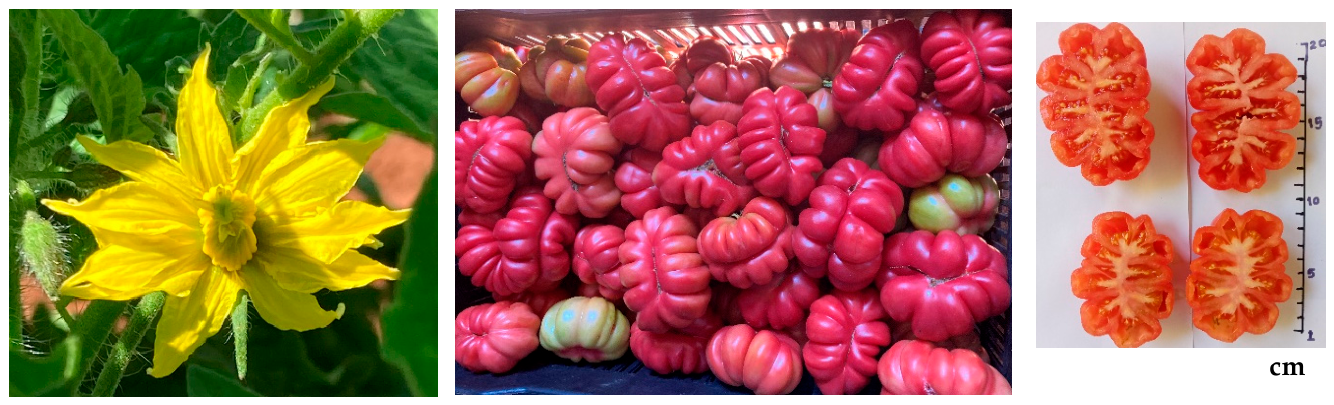
Effect of Crop Cycles on the Antioxidant Compound Contents in Tomato Landraces Undergoing Phenotypic Selection
 , , and
Abstract
1. Introduction
2. Materials and Methods
2.1. Origin and Multiplication of Genetic Material
2.2. Experimental Design and Management
2.3. Collection and Preparation of Fruit Samples for Analysis
2.4. Evaluation of the Soluble Solids, Reducing Sugars, and Acidity and Calculation of Flavor and Maturity Indices
2.5. Determination of Lycopene and Vitamin C Contents
2.6. Determination of the Total Phenolic Compounds, Total Flavonoids and Antioxidant Activity
2.7. Statistical Analysis and Genotypic Parameters
3. Results
4. Discussion
5. Conclusions
Author Contributions
Funding
Data Availability Statement
Conflicts of Interest
References
- FAOSTAT. Crops and Livestock Products 2023; Food and Agriculture Organization of the United Nations (FAO): Rome, Italy, 2025; Available online: https://www.fao.org/faostat/en/#data/QCL (accessed on 25 November 2025).
- Vera-Guzmán, A.M.; Pérez-Ochoa, M.L.; Carrillo-Rodríguez, J.C.; Chávez-Servia, J.L. Variation in agromorphological traits and phenolic compounds, vitamin C contents, and antioxidant activity in the fruits of Mexican tomato landraces. In Solanum lycopersicum L. Research Methods, Approaches, and Perspectives; Rekoslavskaya, N., Ed.; IntechOpen: Rijeka, Croatia, 2026; pp. 61–80. [Google Scholar] [CrossRef]
- Pons, C.; Casals, J.; Palombieri, S.; Fontanet, L.; Riccini, A.; Rambla, J.L.; Rugiero, A.; Granell, A. Atlas of phenotypic, genotypic and geographical diversity present in the European traditional tomato. Hortic. Res. 2022, 9, uhac112. [Google Scholar] [CrossRef] [PubMed]
- Rocchi, L.; Paolotti, L.; Cortina, C.; Boggia, A. Conservation of landraces: The key role of the value for agrobiodiversity conservation. An application on ancient tomatoes varieties. Agric. Agric. Sci. Procedia 2016, 8, 307–316. [Google Scholar] [CrossRef]
- Casals, J.; Pascual, L.; Cañizares, J.; Cebolla-Cornejo, J.; Casañas, F.; Nuez, F. The risks of success in quality vegetable markets: Possible genetic erosion in Marmande tomatoes (Solanum lycopersicum L.) and consumer dissatisfaction. Sci. Hortic. 2011, 130, 78–84. [Google Scholar] [CrossRef]
- Parisi, M.; Aversano, R.; Grazini, G.; Ruggieri, V.; Senape, V.; Sigillo, L.; Barone, A. Phenotypic and molecular diversity in a collection of ‘Pomodoro di Sorrento’ Italian tomato landraces. Sci. Hortic. 2016, 203, 143–151. [Google Scholar] [CrossRef]
- Carli, P.; Barone, A.; Fogliano, V.; Frusciante, L.; Ercolano, M.R. Dissection of genetic and environmental factors involved in tomato organoleptic quality. BMC Plant Biol. 2011, 11, 58. [Google Scholar] [CrossRef]
- Ortiz, R.; Dwivedi, S.L. Profiling heirloom tomato germplasm: Metabolites, textural traits, and consumer preferences. In Next-Generation Food Crops for Human Health; Dwivedi, S.L., Ortiz, R., Kole, C., Eds.; CRC Press: Boca Ratón, Puerto Rico, 2025; pp. 213–222. [Google Scholar]
- Razifard, H.; Ramos, A.; Della-Valle, A.L.; Bodary, C.; Goetz, E.; Manser, E.J.; Li, X.; Zhang, L.; Visa, S.; Tieman, D.; et al. Genomic evidence for complex domestication history of the cultivated tomato in Latin America. Mol. Biol. Evol. 2020, 37, 1118–1132. [Google Scholar] [CrossRef]
- Ramírez-Ojeda, G.; Peralta, I.E.; Rodríguez-Guzmán, E.; Chávez-Servia, J.L.; Sahagún-Castellanos, J.; Rodríguez-Pérez, J.E. Climatic diversity and ecological descriptors of wild tomato species (Solanum sect. Lycopersicum) and close related species (Solanum sect. Juglandifolia and sect. Lycopersicoides) in Latin America. Plants 2021, 10, 855. [Google Scholar] [CrossRef]
- Ramírez-Ojeda, G.; Rodríguez-Pérez, J.E.; Rodríguez-Guzmán, E.; Sahagún-Castellanos, J.; Chávez-Servia, J.L.; Peralta, I.E.; Barrera-Guzmán, L.Á. Distribution and climatic adaptation of wild tomato (Solanum lycopersicum L.) populations in Mexico. Plants 2022, 11, 2007. [Google Scholar] [CrossRef] [PubMed]
- Donoso, A.; Carrasco, D.; Araya, C.; Salazar, E. Genetic diversity and distinctiveness of Chilean Limachino tomato (Solanum lycopersicum L.) reveal an in situ conservation during the 20th century. Front. Conserv. Sci. 2023, 4, 1156786. [Google Scholar] [CrossRef]
- Ruggieri, V.; Francese, G.; Sacco, A.; D’Alessandro, A.; Rigano, M.M.; Parisi, M.; Milore, M.; Cardi, T.; Mennella, G.; Barone, A. An association mapping approach to identify favorable alleles for tomato fruit quality breeding. BMC-Plant Biol. 2014, 14, 337. [Google Scholar] [CrossRef] [PubMed]
- Klee, H.J.; Tieman, D.M. The genetics of fruit flavour preferences. Nat. Rev. Genet. 2018, 19, 347–356. [Google Scholar] [CrossRef] [PubMed]
- Sinesio, F.; Cammareri, M.; Cottet, V.; Fontanet, L.; Jost, M.; Moneta, E.; Palombieri, S.; Peparaio, M.; Romero-del Castillo, R.; Civitelli, E.S.; et al. Sensory traits and consumer’s perceived quality of traditional and modern fresh market tomato varieties: A study in three European countries. Foods 2021, 10, 2521. [Google Scholar] [CrossRef]
- Causse, M.; Buret, M.; Robini, K.; Verschave, P. Inheritance of nutritional and sensory quality traits in fresh maker tomato and relation to consumer preferences. J. Food Sci. 2003, 68, 2342–2350. [Google Scholar] [CrossRef]
- Hellín, P.; Hernández, V.; Sánchez, E.; Garrido, I.; Cava, J.; Pérez, A.; Gomariz, J.; Molina, M.V.; Fernández, I.; Molina, E.; et al. Evaluation of genotype, environment, and genotype-by-environment interaction for phenolic compounds in tomato landraces. Acta Hortic. 2023, 1384, 497–504. [Google Scholar] [CrossRef]
- Burato, A.; Tava, A.; Biazzi, E.; Parisi, M.; Tripodi, P.; Lo Scalzo, R.; Bianchi, G.; Picchi, V.; Ronga, D. Changes in processing tomato fruit quality in heirloom and modern varieties developed over the past decades. J. Food Compos. Anal. 2025, 146, 107956. [Google Scholar] [CrossRef]
- Casals, J.; Martí, M.; Rull, A.; Pons, C. Sustainable transfer to tomato landraces to moder cropping system: The effects of environmental conditions and management practices on long-shelf-life tomatoes. Agronomy 2021, 11, 533. [Google Scholar] [CrossRef]
- Mohammed Ali, U.; Soresa, D.N.; Fufa, T.W. Tailoring tomato (Solanum lycopersicum L.) traits to microclimates: A multilocation evaluation of yield and quality responses in Western Ethiopia. Scientifica 2025, 2025, 6345142. [Google Scholar] [CrossRef]
- Fibiani, M.; Paolo, D.; Leteo, F.; Campanelli, G.; Picchi, V.; Bianchi, G.; Lo Scalzo, R. Influence of year, genotype and cultivation system on nutritional values and bioactive compounds in tomato (Solanum lycopersicum L.). Food Chem. 2022, 389, 133090. [Google Scholar] [CrossRef] [PubMed]
- Tripodi, P.; Plazas, M.; Francese, G.; Raigón, M.D.; D’Alessandro, A.; Adalid-Martínez, A.M.; Cardi, T.; Figàs, M.R.; Leteo, F.; García-Martínez, M.D.; et al. Impact of water regime, nitrogen supply and location on quality and nutritional composition in a tomato diversity panel in organic cultivation. Sci. Hortic. 2025, 347, 114187. [Google Scholar] [CrossRef]
- Roselló, S.; Adalid, A.M.; Cebolla-Cornejo, J.; Nuez, F. Evaluation of the genotype, environment and their interaction on carotenoid and ascorbic acid accumulation in tomato germplasm. J. Sci. Food Agric. 2011, 91, 1014–1021. [Google Scholar] [CrossRef] [PubMed]
- Panthee, D.R.; Cao, C.; Debenport, S.J.; Rodríguez, G.R.; Labate, J.A.; Robertson, L.D.; Breksa, A.P.; Van der Knaap, E.; Gardener, B.B.M. Magnitude of Genotype × Environment Interactions Affecting Tomato Fruit Quality. HortScience 2012, 47, 721–726. [Google Scholar] [CrossRef]
- Dumas, Y.; Dadomo, M.; Di Lucca, G.; Grolier, P. Effects of environmental factoirs and agricultural techniques on antioxidants content of tomatoes. J. Sci. Food Agric. 2003, 83, 369–382. [Google Scholar] [CrossRef]
- Scarano, A.; Olivieri, F.; Gerardi, C.; Liso, M.; Chiesa, M.; Chieppa, M.; Frusciante, L.; Barone, A.; Santino, A.; Rigano, M.M. Selection of tomato landraces with high fruit yield and nutritional quality under elevated temperatures. J. Sci. Food Agric. 2020, 100, 2791–2799. [Google Scholar] [CrossRef]
- AOAC. Official Methods of Analysis, 15th ed.; Association of Official Analytical Chemists inch: Washington, DC, USA, 1990; Volume 2, pp. 910–928. [Google Scholar]
- Navez, B.; Letard, M.; Grasselly, D.; Jost, M. Les criteres de qualite de la tomate. Infos-Ctifl 1999, 155, 41–47. [Google Scholar]
- Méndez-Infante, I.; Vera-Guzmán, A.M.; Chávez-Servia, J.L.; Carrillo-Rodríguez, J.C. Quality of fruits in Mexican tomato (Lycopersicon esculentum Mill.) landraces. Vitae-Sch. Pharm. Food Sci. 2011, 18, 26–32. [Google Scholar]
- Davis, A.R.; Fish, W.W.; Perkins-Veazie, P. A rapid spectrophotometric method for analyzing lycopene content in tomato and tomato products. Postharvest Biol. Technol. 2003, 28, 425–430. [Google Scholar] [CrossRef]
- Crisanto-Juárez, A.U.; Vera-Guzmán, A.M.; Chávez-Servia, J.L.; Carrillo-Rodríguez, J.C. Calidad de frutos de tomates silvestres (Lycopersicon esculentum var. cerasiforme Dunal) de Oaxaca, México. Rev. Fitotec. Mex. 2010, 33, 7–13. [Google Scholar] [CrossRef] [PubMed]
- Dürüst, N.; Sümengen, D.; Dürüst, Y. Ascorbic acid and element contents of foods of Trabzon (Turkey). J. Agric. Food Chem. 1997, 45, 2085–2087. [Google Scholar] [CrossRef]
- Singleton, V.L.; Rossi, J.A. Colorimetry of total phenolics with phosphomolybdic-phosphotungstic acid reagents. Am. J. Enol. Vitic. 1965, 16, 144–158. [Google Scholar] [CrossRef]
- Jia, Z.; Tang, M.; Wu, J. The determination of flavonoid contents in mulberry and their scavenging effects on superoxide radicals. Food Chem. 1999, 64, 5. [Google Scholar] [CrossRef]
- Lin, J.; Tang, C.Y. Determination of total phenolic and flavonoid contents in selected fruits and vegetables, as well as their stimulatory effects on mouse splenocyte proliferation. Food Chem. 2007, 101, 140–147. [Google Scholar] [CrossRef]
- Brand-Williams, W.; Cuvelier, M.E.; Berset, C. Use of a free radical method to evaluate antioxidant activity. LWT-Food Sci. Technol. 1995, 28, 25–30. [Google Scholar] [CrossRef]
- Benzie, I.F.; Y Strain, J.J. Ferric reducing/antioxidant power assay: Direct measure of total antioxidant activity of biological fluids and modified version for simultaneous measurement of total antioxidant power and ascorbic acid concentration. Methods Enzymol. 1999, 299, 15–27. [Google Scholar]
- SAS Institute Inc. (SAS). Base SAS® 9.1.3 Procedures Guide, 2nd ed.; SAS Institute Inc.: Cary, NC, USA, 2006; Volume 1–4. [Google Scholar]
- Comstock, R.E.; Robinson, H.F. Genetic parameters, their estimation and significance. In Proceedings of the 6th International Grassland Congress Proceedings, State College, PA, USA, 17–23 August 1952; National Publication Company: Washington, DC, USA, 1952. [Google Scholar]
- Falconer, D.S.; Mackay, T.F.C. An Introduction to Quantitative Genetics, 4th ed.; Longman Group Limited: London, UK, 1996. [Google Scholar]
- Tessema, G.L.; Mohammed, A.W.; Abebe, D.T. Genetic variability studies for tuber yield and yield attributes in Ethiopian released potato (Solanum tuberosum L.) varieties. PeerJ 2022, 10, e12860. [Google Scholar] [CrossRef] [PubMed]
- Divéky-Ertsey, A.; Ladányi, M.; Biró, B.; Máté, M.; Drexler, D.; Tóth, F.; Boziné-Pullai, K.; Gere, A.; Pusztai, P.; Csambalik, L. Tomato landraces may benefit from protected production-evaluation on phytochemicals. Horticulturae 2022, 8, 937. [Google Scholar] [CrossRef]
- Cebolla-Cornejo, J.; Roselló, S.; Valcárcel, M.; Serrano, E.; Beltrán, J.; Nuez, F. Evaluation of genotype and environment effects on taste and aroma flavor components of Spanish fresh tomato varieties. J. Agric. Food Chem. 2011, 59, 2440–2450. [Google Scholar] [CrossRef]
- Cammareri, M.; Sinesio, F.; Peparaio, M.; Pons, C.; Romero-del Castillo, R.; Saggia Civitelli, E.; Vitiello, A.; Granell, A.; Casals, J.; Grandillo, S. Local agro-environmental conditions impact fruit quality, sensory properties and consumer acceptance of long shelf-life tomatoes. Agronomy 2023, 13, 1265. [Google Scholar] [CrossRef]
- Carrillo-Rodríguez, J.C.; Sosa-Hernández, N.; Vera-Guzmán, A.M.; Chávez-Servia, J.L. Diversidad biocultural de tomate nativo en Oaxaca, México. Herb. CICY 2023, 15, 18–23. [Google Scholar]
- Bovy, A.; Schijlen, E.; Hall, R.D. Metabolic engineering in tomato (Solanum lycopersicum): The potential for metabolomics. Metabolomics 2007, 3, 399–412. [Google Scholar] [CrossRef] [PubMed]
- Marti, R.; Leiva-Brondo, M.; Lahoz, I.; Campillo, C.; Cebolla-Cornejo, J.; Rosello, S. Polyphenolic and L-ascorbic acid in tomato as influenced by high lycopene genotypes and organic farming at different environments. Food Chem. 2018, 239, 148–156. [Google Scholar] [CrossRef]
- Bhandari, H.R.; Srivastava, K.; Tripathi, M.K.; Chaudhary, B.; Biswas, S. Genotype-environment interaction for quality traits in tomato hybrids. Agric. Res. 2022, 11, 382–389. [Google Scholar] [CrossRef]
- Tagiakas, R.I.; Avdikos, I.D.; Goula, A.; Koutis, K.; Nianiou-Obeidat, I.; Mavromatis, A.G. Characterization and evaluation of Greek tomato landraces for productivity and fruit quality traits related to sustainable low-input farming systems. Front. Plant Sci. 2022, 13, 994530. [Google Scholar] [CrossRef]
- Ladewig, P.; Trejo-Téllez, L.I.; Servín-Juárez, R.; Contreras-Oliva, A.; Gómez-Merino, F.C. Growth, yield and fruit quality on Mexican tomato landraces in response to salt stress. Not. Bot. Horti Agrobot. Cluj-Napoca 2021, 49, 12005. [Google Scholar] [CrossRef]
- Anyaoha, C.O.; Adetula, O.A.; Aderibigbe, O.R.; Orkpeh, U.; Akinyode, E.T.; Ikoro, J.I.; Okoyo, M.E.; Oguntolu, O.O.; Ajayi, E.O. Genetic variability in nutritional quality, yield and yiel attributes of tomato (Solanum lycopersicum L.). Acta Univeritatis Agric. Silvic. Mendel. Brun. 2023, 71, 97–110. [Google Scholar] [CrossRef]
- Zörb, C.; Piepho, H.-P.; Zikeli, S.; Horneburg, B. Heritability and variability of quality parameters of tomatoes in outdoor production. Research 2020, 2020, 6707529. [Google Scholar] [CrossRef]
- Sacco, A.; Raiola, A.; Calafiore, R.; Barone, A.; Rigano, M.M. New insights in the control of antioxidants accumulation in tomato by transcriptomic analyses of genotypes exhibiting contrasting levels of fruit metabolites. BMC Genom. 2019, 20, 43. [Google Scholar] [CrossRef]



| Traits Evaluated | Mean Squares (MS) | PCV (%) | GCV (%) | H2 | |||||
|---|---|---|---|---|---|---|---|---|---|
| Crop Cycles (C) | Genotypes (G) | G × C | Repetitions/C 1 | Replicates/Rep. 1 | Error | ||||
| Soluble solids: | |||||||||
| Juice | 17.05 ** | 2.56 ** | 2.11 ** | 9.54 ** | <0.001 ns | 0.451 | 17.2 | 4.3 | 6.1 |
| Pulp | 3.63 ** | 3.25 ** | 2.77 ** | 14.38 ** | 0.003 ns | 0.517 | 19.0 | 4.4 | 5.3 |
| pH | 0.185 ** | 0.103 ** | 0.016 ** | 0.05 ** | <0.001 ns | 0.003 | 4.3 | 3.4 | 63.5 |
| Titratable acidity | 0.005 ns | 0.049 ** | 0.045 ** | 0.094 ** | <0.001 ns | 0.005 | 30.2 | 5.4 | 3.2 |
| Maturity index | 73.73 ** | 39.76 ** | 28.30 ** | 1.76 ns | 0.05 ns | 3.63 | 24.0 | 8.6 | 12.8 |
| Flavor index | 0.135 ** | 0.032 ** | 0.028 ** | 0.056 ** | <0.001 ns | 0.005 | 9.5 | 2.0 | 4.4 |
| Reducing sugars | 0.01 ns | 0.95 ** | 1.07 ** | 2.29 ** | 0.008 ns | 0.159 | 22.4 | 4.3 | 3.7 |
| Lycopene | 5129.6 ns | 18,205.2 ** | 11,841.2 ** | 5861.6 ** | 15.8 ns | 1499 | 33.7 | 13.6 | 16.3 |
| Vitamin C | 0.055 ns | 3.315 ** | 1.074 ** | 0.785 * | <0.001 ns | 0.231 | 30.5 | 19.0 | 38.8 |
| Total polyphenols | 21,328 ** | 25,004 ** | 10,285 ** | 1010 ns | 30 ns | 918.3 | 17.8 | 10.7 | 36.1 |
| Flavonoid equivalents: | |||||||||
| Quercetin | 86,970 ** | 1908 ** | 574 ** | 827 ** | 3.1 ns | 173.6 | 18.3 | 11.3 | 37.9 |
| Catechin | 8671.6 ** | 1450.0 ** | 691.0 ** | 623.5 ** | 2.5 * | 92.2 | 16.8 | 8.9 | 28.2 |
| Antioxidant activity: | |||||||||
| DPPH | 1,470,793 ** | 763,850 ** | 189,332 ** | 43,018 ns | 561.9 ns | 27,708 | 26.1 | 18.7 | 51.3 |
| FRAP | 2,035,743 ** | 804,157 ** | 321,362 ** | 52,785 ns | 721.9 ns | 45,939 | 20.7 | 12.2 | 34.5 |
| Crop Cycles/Genotypes | Soluble Solids (°Brix) | pH | Titratable Acidity (% Citric Acid) | Index | Reducing Sugars (%) | ||
|---|---|---|---|---|---|---|---|
| Juice | Pulp | Maturity | Flavor | ||||
| Crop cycles: | |||||||
| 2023–2024 | 5.37 b 1 | 5.53 b | 4.14 a | 0.42 a | 13.5 b | 1.09 b | 2.83 a |
| 2024–2025 | 5.77 a | 5.70 a | 4.10 b | 0.41 a | 14.4 a | 1.13 a | 2.82 a |
| Genotypes of farmers’ varieties: | |||||||
| Goyo-01 | 5.61 b–d 1 | 5.67 b–e | 4.11 e–h | 0.42 bc | 14.2 b–e | 1.13 a–d | 2.62 c |
| Goyo-02 | 5.67 b–d | 5.96 a–c | 4.08 f–h | 0.43 b | 13.8 c–e | 1.12 b–d | 2.95 bc |
| Goyo-03 | 5.17 d | 5.00 e | 4.20 a | 0.33 d | 15.6 a–c | 1.11 c–e | 2.86 bc |
| Goyo-04 | 5.37 cd | 5.26 c–e | 4.17 a–d | 0.41 bc | 13.5 de | 1.08 c–e | 2.79 bc |
| Goyo-05 | 6.38 a | 6.39 a | 4.09 e–h | 0.45 b | 14.4 a–e | 1.17 ab | 3.37 a |
| Average 2 | 5.6 ± 0.4 2 | 5.6 ± 0.5 | 4.1 ± 0.05 | 0.4 ± 0.04 | 14.3 ± 0.7 | 1.1 ± 0.03 | 2.9 ± 0.2 |
| Max-02 | 5.29 cd | 5.18 de | 4.19 ab | 0.39 b–d | 13.7 c–e | 1.07 c–e | 2.63 c |
| Max-03 | 5.75 a–d | 5.92 a–c | 4.08 gh | 0.44 b | 13.5 de | 1.12 b–d | 2.98 a–c |
| Max-04 | 5.41 cd | 5.60 b–e | 4.14 b–e | 0.39 b–d | 14.8 a–d | 1.13 a–d | 2.66 c |
| Average | 5.5 ± 0.2 | 5.6 ± 0.3 | 4.1 ± 0.04 | 0.4 ± 0.02 | 14 ± 0.6 | 1.1 ± 0.03 | 2.8 ± 0.2 |
| Ray-02 | 5.36 cd | 5.37 c–e | 4.06 h | 0.43 b | 12.7 e | 1.06 de | 2.78 bc |
| Ray-03 | 5.44 cd | 5.39 c–e | 4.21 a | 0.35 cd | 15.8 ab | 1.14 a–c | 2.68 bc |
| Average | 5.4 ± 0.04 | 5.4 ± 0.01 | 4.1 ± 0.1 | 0.4 ± 0.04 | 14.2 ± 1.5 | 1.1 ± 0.04 | 2.7 ± 0.05 |
| Trini-01 | 5.96 a–c | 5.89 a–d | 4.14 c–f | 0.43 b | 13.8 c–e | 1.12 b–d | 2.93 bc |
| Trini-02 | 6.13 ab | 6.15 ab | 4.18 a–c | 0.38 b–d | 16.2 a | 1.20 a | 3.07 ab |
| Trini-03 | 5.43 cd | 5.66 b–e | 4.12 d–g | 0.42 bc | 13.7 c–e | 1.10 c–e | 2.90 bc |
| Trini-04 | 5.36 cd | 5.43 c–e | 4.12 d–g | 0.40 b–d | 13.5 de | 1.08 c–e | 2.64 c |
| Trini-05 | 5.46 b–d | 5.50 b–e | 4.08 gh | 0.43 b | 12.9 de | 1.08 c–e | 2.71 bc |
| Average | 5.7 ± 0.3 | 5.7 ± 0.3 | 4.1 ± 0.03 | 0.4 ± 0.020 | 14 ± 1.13 | 1.1 ± 0.04 | 2.8 ± 0.2 |
| Control | 5.27 d | 5.41 c–e | 3.95 i | 0.52 a | 10.5 f | 1.05 e | 2.63 c |
| Crop Cycles/ Genotypes | Lycopene (mg 100 g−1 dw) | Vitamin C (mg 100 g−1 dw) | Total Phenolic Compounds (mg GAE 100 g−1 dw) 1 | Total Flavonoids (mg QE/CE 100 g−1 dw) 1 | Antioxidant Activity (µmol TE 100 g−1 dw) 1 | ||
|---|---|---|---|---|---|---|---|
| Quercetin | Catechin | DPPH 1 | FRAP 1 | ||||
| Crop cycles: | |||||||
| 2023–2024 | 210.6 a 2 | 79.8 a | 394.1 b | 99.7 b | 104.7 b | 1375.9 b | 1952.2 b |
| 2024–2025 | 204.4 a | 76.7 a | 407.1 a | 129.6 a | 114.0 a | 1489.0 a | 2086.6 a |
| Genotypes of Farmers’ varieties: | |||||||
| Goyo-01 | 249.3 ab 2 | 27.9 g | 423.7 bc | 112.6 b–e | 120.9 ab | 1485.6 b–d | 2084.4 b–d |
| Goyo-02 | 199.5 d–f | 89.9 cd | 371.9 gh | 105.9 d–f | 109.3 c–e | 1399.5 c–f | 2071.0 b–e |
| Goyo-03 | 177.0 ef | 65.1 d–g | 354.6 h | 93.8 f | 98.8 fg | 1268.4 f | 1852.6 f–h |
| Goyo-04 | 262.1 a | 36.4 fg | 448.6 ab | 117.1 a–d | 126.2 a | 1420.3 c–f | 2258.2 b |
| Goyo-05 | 197.4 d–f | 92.9 cd | 382.3 f–h | 102.2 ef | 99.9 e–g | 1333.5 d–f | 1938.9 d–h |
| Average 3 | 217 ± 33 3 | 62 ± 27 | 396 ± 35 | 106 ± 8 | 111 ± 11 | 1381 ± 74 | 2041 ± 138 |
| Max-02 | 206.3 c–e | 121.1 bc | 429.0 bc | 125.5 ab | 107.5 c–f | 1539.7 bc | 2106.3 b–d |
| Max-03 | 220.3 b–d | 76.1 d–f | 392.6 d–g | 119.4 a–c | 102.6 d–g | 1357.5 d–f | 1860.6 e–h |
| Max-04 | 194.5 d–f | 68.5 d–g | 382.8 e–h | 110.3 c–e | 111.7 b–d | 1406.3 c–f | 1829.2 gh |
| Average | 207 ± 10 | 89 ± 23 | 401 ± 20 | 118 ± 6 | 107 ± 4 | 1434 ± 77 | 1932 ± 124 |
| Ray-02 | 202.6 c–f | 139.3 ab | 412.4 c–f | 114.3 a–e | 105.7 c–g | 1646.2 b | 2193.3 bc |
| Ray-03 | 169.9 ef | 74.1 d–f | 368.1 gh | 116.3 a–d | 97.8 g | 1306.8 ef | 1785.3 h |
| Average | 186 ± 16 | 107 ± 33 | 390 ± 22 | 115 ± 1 | 102 ± 4 | 1476 ± 170 | 1989 ± 204 |
| Trini-01 | 196.2 d–f | 65.3 d–g | 391.1 d–g | 113.5 b–e | 111.8 b–d | 1290.1 ef | 1961.4 d–h |
| Trini-02 | 217.8 b–d | 46.7 e–g | 387.1 e–g | 117.0 a–d | 110.3 cd | 1296.6 ef | 1923.4 d–h |
| Trini-03 | 238.2 a–c | 84.6 c–e | 413.0 c–e | 115.1 a–e | 114.3 bc | 1373.0 d–f | 2045.0 b–f |
| Trini-04 | 190.2 d–f | 53.9 d–g | 368.6 gh | 119.4 a–c | 106.0 c–g | 1402.1 c–f | 1948.8 d–h |
| Trini-05 | 228.7 a–d | 54.6 d–g | 419.2 b–d | 124.6 ab | 113.4 bc | 1444.1 c–e | 2006.9 c–g |
| Average | 214 ± 18 | 61 ± 13 | 396 ± 18 | 118 ± 4 | 111 ± 3 | 1361 ± 60 | 1977 ± 43 |
| Control | 165.4 f | 167.0 a | 472.8 a | 127.3 a | 112.6 bc | 2015.4 a | 2497.2 a |
| Genotypes of Farmers’ Varieties | Soluble Solid Content (°Brix) | pH | Titratable Acidity (% Citric Acid) | Index | Reducing Sugar Content (%) | |||||||||
|---|---|---|---|---|---|---|---|---|---|---|---|---|---|---|
| Juice | Pulp | Flavor | Maturity | |||||||||||
| C1 1 | C2 1 | C1 | C2 | C1 | C2 | C1 | C2 | C1 | C2 | C1 | C2 | C1 | C2 | |
| Goyo-01 | 5.49 | 5.73 | 5.79 | 5.55 | 4.12 | 4.11 | 0.47 | 0.37 | 1.10 | 1.16 | 12.5 | 15.9 | 2.66 | 2.58 |
| Goyo-02 | 5.59 | 5.76 | 6.14 | 5.78 | 4.10 | 4.07 | 0.45 | 0.41 | 1.13 | 1.11 | 13.6 | 14.0 | 2.96 | 2.95 |
| Goyo-03 | 5.34 | 4.99 | 5.47 | 4.54 | 4.18 | 4.23 | 0.39 | 0.28 | 1.12 | 1.11 | 14.5 | 16.6 | 3.22 | 2.50 |
| Goyo-04 | 5.63 | 5.12 | 5.56 | 4.97 | 4.22 | 4.13 | 0.37 | 0.45 | 1.13 | 1.04 | 15.2 | 11.8 | 3.03 | 2.56 |
| Goyo-05 | 6.23 | 6.53 | 6.32 | 6.47 | 4.11 | 4.07 | 0.45 | 0.44 | 1.16 | 1.18 | 14.2 | 14.7 | 3.30 | 3.43 |
| Max-02 | 4.88 | 5.71 | 4.79 | 5.58 | 4.21 | 4.17 | 0.39 | 0.38 | 1.02 | 1.13 | 12.5 | 14.9 | 2.44 | 2.83 |
| Max-03 | 5.78 | 5.73 | 5.91 | 5.94 | 4.07 | 4.09 | 0.49 | 0.40 | 1.10 | 1.14 | 12.2 | 14.8 | 3.08 | 2.88 |
| Max-04 | 5.04 | 5.78 | 5.38 | 5.83 | 4.18 | 4.11 | 0.43 | 0.35 | 1.07 | 1.19 | 12.6 | 16.9 | 2.44 | 2.88 |
| Ray-02 | 5.27 | 5.45 | 5.40 | 5.35 | 4.08 | 4.05 | 0.46 | 0.39 | 1.05 | 1.08 | 11.6 | 13.9 | 2.82 | 2.74 |
| Ray-03 | 5.19 | 5.70 | 5.27 | 5.52 | 4.25 | 4.16 | 0.32 | 0.38 | 1.16 | 1.12 | 16.8 | 14.8 | 2.75 | 2.61 |
| Trini-01 | 5.35 | 6.58 | 5.22 | 6.56 | 4.14 | 4.14 | 0.41 | 0.44 | 1.05 | 1.19 | 12.8 | 14.8 | 2.74 | 3.11 |
| Trini-02 | 5.79 | 6.47 | 5.94 | 6.37 | 4.25 | 4.12 | 0.34 | 0.43 | 1.21 | 1.18 | 17.4 | 15.0 | 3.00 | 3.14 |
| Trini-03 | 5.36 | 5.51 | 5.64 | 5.68 | 4.12 | 4.12 | 0.44 | 0.40 | 1.08 | 1.12 | 12.9 | 14.6 | 2.92 | 2.88 |
| Trini-04 | 5.32 | 5.41 | 5.63 | 5.23 | 4.13 | 4.11 | 0.44 | 0.36 | 1.08 | 1.08 | 12.8 | 14.3 | 2.84 | 2.43 |
| Trini-05 | 5.18 | 5.73 | 5.31 | 5.70 | 4.14 | 4.02 | 0.40 | 0.46 | 1.07 | 1.09 | 13.4 | 12.5 | 2.84 | 2.57 |
| Control | 4.53 | 6.27 | 4.78 | 6.27 | 3.99 | 3.90 | 0.45 | 0.62 | 0.99 | 1.13 | 10.8 | 10.2 | 2.21 | 3.19 |
| HSD-Tukey 2 | 1.05 | 1.13 | 0.08 | 0.11 | 0.11 | 3.00 | 0.62 | |||||||
| Genotypes | Total Flavonoid Equivalents (mg 100 g−1 dw) | Antioxidant Activity (µmol TE 100 g−1 dw) | ||||||
|---|---|---|---|---|---|---|---|---|
| Quercetin | Catechin | DPPH 1 | FRAP 1 | |||||
| C1 1 | C2 1 | C1 | C2 | C1 | C2 | C1 | C2 | |
| Goyo-01 | 98.5 | 126.8 | 113.7 | 128.1 | 1301.0 | 1670.3 | 2001.5 | 2167.2 |
| Goyo-02 | 95.9 | 115.9 | 98.1 | 120.5 | 1217.1 | 1582.0 | 1744.3 | 2397.7 |
| Goyo-03 | 83.6 | 104.1 | 92.2 | 105.4 | 1278.0 | 1259.0 | 1809.4 | 1895.8 |
| Goyo-04 | 101.3 | 132.8 | 114.3 | 138.2 | 1369.0 | 1471.7 | 2020.0 | 2496.5 |
| Goyo-05 | 94.0 | 110.4 | 103.8 | 96.1 | 1322.4 | 1344.7 | 1878.3 | 1999.4 |
| Max-02 | 109.0 | 142.0 | 100.3 | 114.6 | 1449.9 | 1629.5 | 2021.7 | 2190.9 |
| Max-03 | 105.9 | 132.9 | 99.8 | 105.4 | 1373.0 | 1342.0 | 1924.8 | 1796.5 |
| Max-04 | 98.8 | 121.9 | 105.2 | 118.3 | 1288.0 | 1524.6 | 1826.5 | 1831.9 |
| Ray-02 | 98.6 | 130.0 | 103.8 | 107.6 | 1470.8 | 1821.5 | 2129.9 | 2256.7 |
| Ray-03 | 101.1 | 131.6 | 94.4 | 101.3 | 1334.8 | 1278.9 | 1900.2 | 1670.5 |
| Trini-01 | 98.9 | 128.2 | 119.2 | 104.4 | 1406.5 | 1173.7 | 1995.4 | 1927.3 |
| Trini-02 | 103.8 | 130.2 | 106.6 | 114.1 | 1321.8 | 1271.4 | 1933.3 | 1913.4 |
| Trini-03 | 101.2 | 129.1 | 111.7 | 117.0 | 1328.3 | 1417.7 | 1954.0 | 2135.9 |
| Trini-04 | 101.8 | 136.9 | 101.3 | 110.8 | 1325.7 | 1478.5 | 1894.4 | 2003.1 |
| Trini-05 | 96.6 | 152.6 | 110.0 | 116.7 | 1355.6 | 1532.6 | 1919.9 | 2093.9 |
| Control | 107.2 | 154.0 | 100.7 | 128.6 | 1873.1 | 2205.1 | 2282.4 | 2783.7 |
| HSD-Tukey 2 | 20.6 | 15.0 | 260.6 | 335.5 | ||||
Disclaimer/Publisher’s Note: The statements, opinions and data contained in all publications are solely those of the individual author(s) and contributor(s) and not of MDPI and/or the editor(s). MDPI and/or the editor(s) disclaim responsibility for any injury to people or property resulting from any ideas, methods, instructions or products referred to in the content. |
© 2026 by the authors. Licensee MDPI, Basel, Switzerland. This article is an open access article distributed under the terms and conditions of the Creative Commons Attribution (CC BY) license.
Share and Cite
Montesinos-Cortes, S.B.; Pérez-Ochoa, M.L.; Vera-Guzmán, A.M.; Carrillo-Rodríguez, J.C.; Benito-Bautista, P.; Chávez-Servia, J.L. Effect of Crop Cycles on the Antioxidant Compound Contents in Tomato Landraces Undergoing Phenotypic Selection. Agronomy 2026, 16, 868. https://doi.org/10.3390/agronomy16090868
Montesinos-Cortes SB, Pérez-Ochoa ML, Vera-Guzmán AM, Carrillo-Rodríguez JC, Benito-Bautista P, Chávez-Servia JL. Effect of Crop Cycles on the Antioxidant Compound Contents in Tomato Landraces Undergoing Phenotypic Selection. Agronomy. 2026; 16(9):868. https://doi.org/10.3390/agronomy16090868
Chicago/Turabian StyleMontesinos-Cortes, Selene Betsabe, Mónica Lilian Pérez-Ochoa, Araceli Minerva Vera-Guzmán, José Cruz Carrillo-Rodríguez, Pedro Benito-Bautista, and José Luis Chávez-Servia. 2026. "Effect of Crop Cycles on the Antioxidant Compound Contents in Tomato Landraces Undergoing Phenotypic Selection" Agronomy 16, no. 9: 868. https://doi.org/10.3390/agronomy16090868
APA StyleMontesinos-Cortes, S. B., Pérez-Ochoa, M. L., Vera-Guzmán, A. M., Carrillo-Rodríguez, J. C., Benito-Bautista, P., & Chávez-Servia, J. L. (2026). Effect of Crop Cycles on the Antioxidant Compound Contents in Tomato Landraces Undergoing Phenotypic Selection. Agronomy, 16(9), 868. https://doi.org/10.3390/agronomy16090868