Article

Effect of Crop Cycles on the Antioxidant Compound Contents in Tomato Landraces Undergoing Phenotypic Selection

by
Selene Betsabe Montesinos-Cortes
1,
Mónica Lilian Pérez-Ochoa
1,*,
Araceli Minerva Vera-Guzmán
1,
José Cruz Carrillo-Rodríguez
2,
Pedro Benito-Bautista
1 and
José Luis Chávez-Servia
1,*
1
CIIDIR-Oaxaca, Instituto Politécnico Nacional, Santa Cruz Xoxocotlán 71230, Oaxaca, Mexico
2
Instituto Tecnológico del Valle de Oaxaca, Tecnológico Nacional de México, Ex Hacienda Nazareno, Santa Cruz Xoxocotlán 71230, Oaxaca, Mexico
*
Authors to whom correspondence should be addressed.
Agronomy 2026, 16(9), 868; https://doi.org/10.3390/agronomy16090868
Submission received: 17 March 2026 / Revised: 18 April 2026 / Accepted: 22 April 2026 / Published: 25 April 2026

Abstract

Tomato landraces possess distinct flavors, colors, textures and aromas, making them suitable for traditional cuisine. Tomato landraces contain a wide range of genes, including those involved in fruit quality, that can be isolated and used in local breeding programs. In regions recognized as centers of origin, domestication and diversification, traditional farmers play an important role in the preservation of tomato landraces adapted to local conditions and agricultural practices, on the whole maintaining high genetic diversity. This work aimed to evaluate the effects of the crop cycle (C), genotype (G) and C × G interactions on the contents of soluble solids, reducing sugars, lycopene, total polyphenols, flavonoids, and vitamin C, as well as the pH and antioxidant activity, in fifteen tomato landraces (genotypes) undergoing phenotypic selection and a commercial tomato variety (control). All the varieties were grown in two crop cycles under uniform greenhouse management using a randomized block design with four repetitions. Fruit composition was analyzed with AOAC and spectrophotometric methods. Significant differences (p ≤ 0.01) were detected in the soluble solid content, pH, flavor and maturity indices, polyphenol and flavonoid contents, and antioxidant activity between C, G and C × G interactions. In contrast, titratable acidity, reducing sugars, lycopene and vitamin C did not differ between cycles. Coefficients of phenotypic and genotypic variation and broad-sense heritability (H2) ranged from 4.3 to 33.7, 2.0 to 19.0, and 3.2 to 63.5%, respectively. H2 for bioactive compounds ranged from moderate to slightly high (16.3–38.8%). These findings, supported by laboratory analyses, suggest that genotypes under agronomic selection have potential as parents to enhance fruit quality in current and future breeding programs.

1. Introduction

Tomatoes are economically important horticultural crops worldwide with high production, consumption, and market value. In 2024, global tomato production covered approximately 5.12 million hectares (ha), with yields of approximately 188.5 million tons (t). The main producers are China, India, Turkey, the United States, Egypt, Italy, Spain, Mexico, Brazil, and Nigeria, whose production ranges from 61.6 to 3.7 million tons [1]. Most available data on harvested area and production focus on improved varieties and hybrids that have been cultivated for fresh consumption and processing, long shelf life, and high market value. In contrast, the data generally exclude native, local, or traditional varieties known as landraces, as well as old commercial varieties or heirlooms. Landraces are linked to specific territories and sociocultural groups in regions recognized as centers of origin, domestication, or diversification. Traditional farmers have selected and preserved these varieties, which are adapted to the local environment and agricultural practices [2].
Tomato landraces remain prevalent in Europe, although the introgression by modern varieties should not be overlooked. In Mediterranean countries, consumers often pay premium prices for traditional varieties despite their limited shelf life. These traditional varieties are produced in specific regions, sold only in local markets, and are widely accepted for their characteristic taste, aroma, color, and texture in dishes [3]. For example, “Pomodoro di Mercatello”, characterized by its round-flattened shape with shoulders, is cultivated in Marsciano, Perugia, Italy. This variety is well established within the local community and has grown for more than 60 years, even as improved varieties have been introduced [4]. However, the diversity of traditional varieties is declining as modern cultivars increasingly replace them, despite their appreciation by consumers and their limited production, as they are sold only in local or regional markets. Examples include Muchamiel, Moruno, Monserrat, and Pera de Girona in Spain [5] and Pera d’Abruzzo, San Marzano, Scatolone di Bolsena, and Pomodoro di Sorrento in Italy [6]. Similar trends have also been reported in France, Greece, and other European countries [3].
The promotion of landraces and heirlooms with high organoleptic quality is a strategy to create and consolidate market niches, allowing farmers to charge premium prices. These varieties also serve as a foundation for conventional or genetic improvement programs as they possess high levels of bioactive compounds [7,8]. In particular, from South America to Mexico, a wide range of traditional or native tomato varieties are distributed and cultivated and coexist geographically with wild or ruderal species [9,10,11,12]. To date, wild tomato species (e.g., Solanum pimpinellifolium L., S. lycopersicum L. var. cerasiforme) and landraces have been used primarily as genetic sources to enhance both external (appearance) and internal (texture, flavor, and functional nutritional composition) tomato fruit quality in genetic improvement programs. These efforts reveal that internal quality traits are polygenic and that environmental factors strongly influence the secondary metabolite profile, with significant genetic–environmental interactions [7,13,14,15].
The nutraceutical and antioxidant potential of tomato fruits is determined mainly by the concentrations of bioactive compounds such as carotenoids, vitamins, and phenolic compounds. However, factors such as environmental conditions, genotype–environment interactions, management practices, the growing season, and the selection of landraces by farmers influence the concentrations of lycopene, flavonoids, and polyphenols, as well as their antioxidant activity and sensory characteristics [15,16,17,18]. Agroecological cultivation conditions, such as open fields, low-tech greenhouses, macro- or microtunnels and high-tech greenhouses, also influence fruit composition [19,20]. Interannual and seasonal climatic variations influence quality parameters such as the sugar, organic acid, polyphenol, and flavonoid contents [21,22]. In contrast, while the contents of lycopene and β-carotene typically vary among genotypes, they are highly sensitive to extreme temperatures and radiation, reflecting a substantial G × E interaction [23,24]. Therefore, the contents of vitamin C and phytochemicals such as polyphenols are determined not only by genotype but also by the specific agroecological conditions of each growing season [22].
Macro- and microenvironmental conditions can change drastically or slightly throughout crop cycles or years, and these changes can significantly affect the bioactive compound contents in tomato fruits, mainly as a result of alterations in secondary metabolism. For example, Dumas et al. [25] reported that temperature changes from 20 to 30 °C and temperature differentials (night/day) from 7.8 to 11.2 °C induced decreases in the contents of β-carotene, lycopene, phytoene, phytofluene and vitamin C, and the limited sunlight exposure affected the β-carotene levels and phenolic compound contents for modern varieties as well as hybrids of tomato. Fibiani et al. [21] reported that the number of years of cultivation significantly affected the contents of ascorbic acid, vitamin C, polyphenols, single and total amino acids, and single and total carotenoids. While the effects of environment–genotypic interactions are well known for modern varieties and hybrids, this information remains limited for landraces [26]. In this context, the objective of this study was to evaluate the effects of the crop cycle, genotype and cycle–genotype interactions on the contents of soluble solids, reducing sugars, lycopene, total polyphenols, flavonoids, and vitamin C, as well as acidity and antioxidant activity, in the fruits of 15 tomato genotypes that continue to undergo phenotypic selection and are cultivated under greenhouse conditions.

2. Materials and Methods

2.1. Origin and Multiplication of Genetic Material

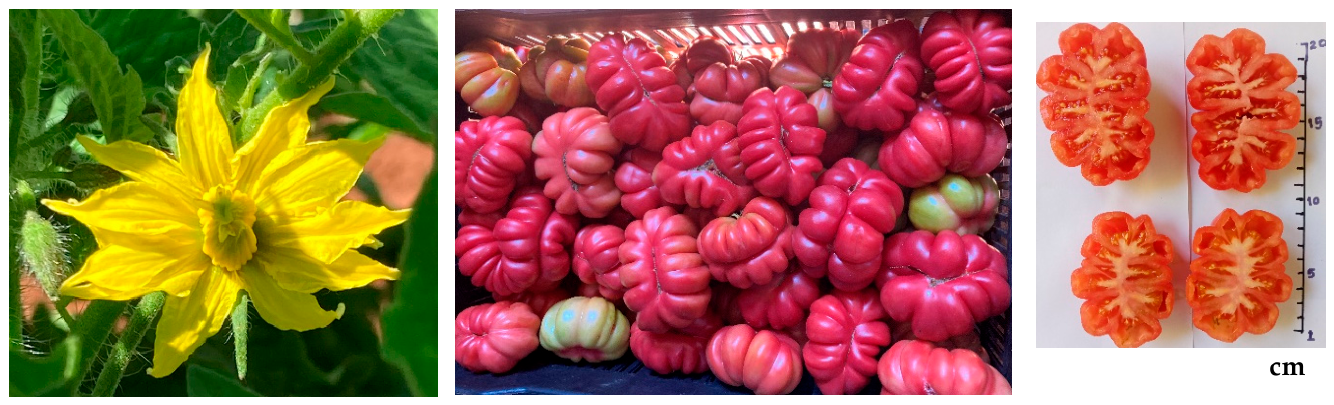
The evaluated tomato genotypes have fruits that are flat, round, and have shoulders (kidney-type) and are characteristic of tomato landraces in Oaxaca, Mexico. The fruits of these plants have various shapes and sizes, coloration ranging from pink to red, and indeterminate growth depending on the cultivation region and farmers’ selection, and their production is limited to self-consumption and sale in local and regional markets (Figure 1). The original source of genetic material was individual plants that were selected by their agronomic traits in plots managed by four traditional farmers from Santa Cruz Xitla, Miahuatlan, Oaxaca, Mexico (16°19′ N, 96° 40′ W; semidry to semiwarm climate; mean annual temperature 14 to 22 °C; 1813 m altitude). Harvested fruits from each selected plant were labeled individually to preserve the farmer’s identity using a prefix (acronym) and a consecutive plant number, after which the seeds were extracted. For example, Maximino Martínez (Max-02, Max-03, Max-04), Raymundo Juárez (Ray-02, Ray-03), Trinidad López (Trini-01 to Trini-05) and Gregorio López (Goyo-01 to Goyo-05) all participated during the 2022 agricultural year. Seeds from each selected individual (maternal half-sib’s families) were subsequently planted in a randomized block design, cultivated and agronomically evaluated under greenhouse conditions during 2023 (21.2–28.1 °C; relative humidity 21.9–80.3%). At the end of the cycle, agronomically outstanding plants were selected to reintegrate each genotype, following agronomic criteria such as fruits per plant, fruit size and plant health. In the present study, seeds of each genotype selected in 2023 were used to evaluate fruit composition during the 2023–2024 cycle, and the process of plant selection and seed collection was repeated for the 2024–2025 cycle.

2.2. Experimental Design and Management

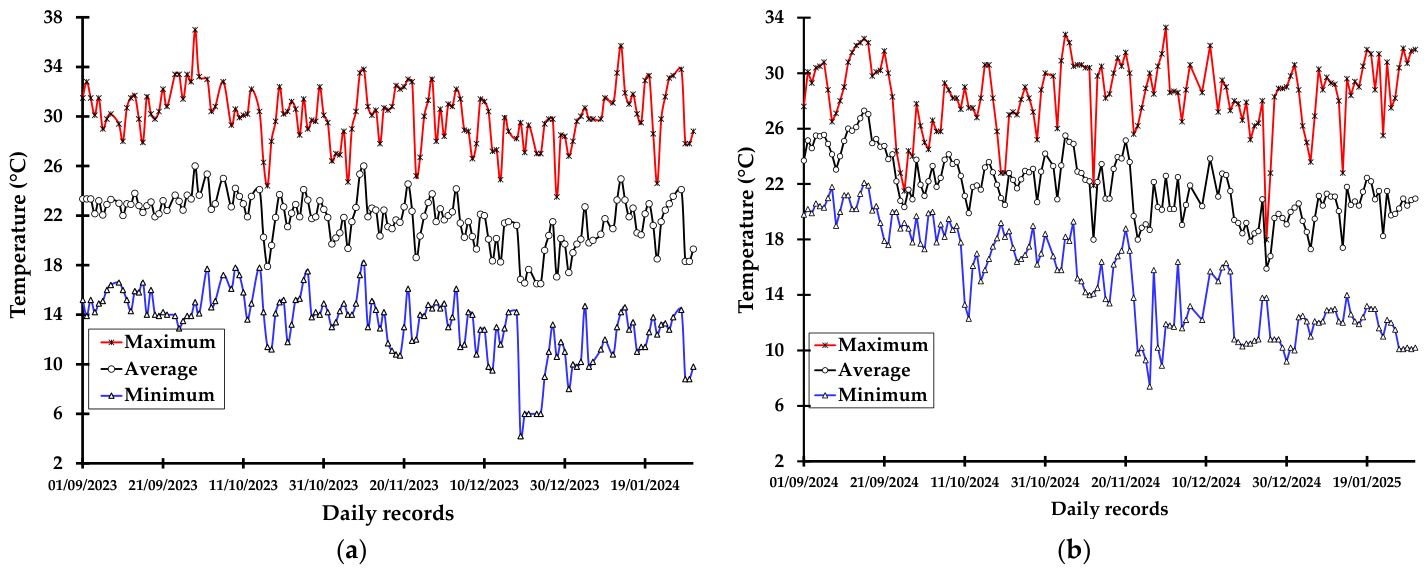
A factorial experiment was conducted with Factor A representing the crop cycles (2023–2024 and 2024–2025) and Factor B representing 15 selected genotypes that originally came from farmers’ plots in Santa Cruz Xitla, Oaxaca (Max, Ray, Trini, and Goyo), as described previously, along with a control (H732, a commercial ball-type variety). In each crop cycle, all 16 genotypes (selections and control) were planted using a randomized block design with four replicates. The first crop cycle was conducted from August 2023 to January 2024, and the second was conducted from August 2024 to January 2025 under greenhouse conditions in Santa Cruz Xoxocotlan, Oaxaca, Mexico (17°04′ N, 96°43′ W; 1519 m altitude). Monthly average maximum temperatures of 32.2 °C and 33 °C were recorded in September, whereas average minimum temperatures of 11.9 °C and 10.4 °C were recorded in January for the first and second cycles, respectively. The daily temperature records for both crop cycles are shown in Figure 2.
In each experiment, the seeds were sown in commercial substrate (Peat moss), and the seedlings were transplanted when they developed four to five true leaves. Transplant beds were prepared by applying fungicides such as propamocarb to the soil following standard commercial practices. During cultivation, chemicals and other substances, such as imidacloprid, cupric hydroxide, lambda-cyhalothrin, captan, neem oil (Azadirachta indica A. Juss), potassium soap and calcium sulfur broth, were applied to prevent pests and diseases. Ferti-irrigation was performed using conventional formulations: 15N-30P-15K, sulfuric acid, 18N-18P-18K, calcium nitrate, potassium nitrate and sulfate, and magnesium nitrate and sulfate. The same greenhouse conditions and genotypes were used to evaluate the effects of genotype without the influences of environmental conditions and management practices.

2.3. Collection and Preparation of Fruit Samples for Analysis

During each experimental cycle, four to six ripe fruits (approximately 300 g) of each genotype and control were harvested from the fourth to sixth clusters. The selected fruits were uniformly red, turgid, and free of physical damage. After being washed with distilled water and after seed removal, the fruits (excluding the seed and calyx) were ground in a Nutribullet® grinder (Capital brands, LLC, los Angeles, CA, USA) to obtain a homogeneous puree. The resulting puree was divided into three fractions for further analyses. Lycopene and vitamin C contents were determined immediately in one fraction to prevent degradation. The remaining fractions were stored at −20 °C for subsequent analysis. All measurements were performed in triplicate and labeled as laboratory replicates.

2.4. Evaluation of the Soluble Solids, Reducing Sugars, and Acidity and Calculation of Flavor and Maturity Indices

The soluble solids content (°Brix) in the juice and pulp was determined using the Association of Official Analytical Chemists (AOAC) method 934.14 [27] with a manual refractometer (Atago Co., Ltd., Model PAL-1, Tokio, Japan). In the pulp, the pH was measured using a digital potentiometer (model pH 10; Conductronic, Puebla, Mexico) according to the AOAC method 981.12 [27]. Titratable acidity was determined using the volumetric acid-based AOAC method 942.15 [27], with titration performed using 0.1 N sodium hydroxide (Meyer, Mexico City, Mexico, Lot: L1016508), and the results are expressed as a percentage of citric acid. The °Brix and titratable acidity values were used to calculate the flavor index (FI) and maturity index (MI) according to Navez et al. [28]: FI = [°Brix of pulp/20 x titratable acid] + titratable acidity; MI = [°Brix of pulp/titratable acidity]. The total reducing sugar content was determined using the Lane–Eynon AOAC 923.09 method [27], with modifications as described by Méndez-Infante et al. [29]. In this procedure, the ground sample, previously diluted in distilled water, was titrated with Fehling’s solutions A and B (Hycel, Zapopan, Jalisco, Mexico) using methylene blue as an indicator, and the results are expressed as a percentage. The percentage of moisture was estimated gravimetrically using the AOAC method 934.06 [27] and used to convert the samples’ fresh weights to dry weights.

2.5. Determination of Lycopene and Vitamin C Contents

The lycopene content was determined according to the method of Davis et al. [30], as modified by Crisanto-Juárez et al. [31]. Briefly, 0.6 g of ground sample was homogenized with ethanol, acetone and hexane and then stirred in an ice bath for 15 min with an orbital shaker (Model E-15; SOLBAT, Puebla, Mexico). Deionized water was added, followed by stirring for 5 min and standing at room temperature. The absorbance was measured at 503 nm with a UV–Vis spectrophotometer (model VE-5600UV PC, VELAB, Pharr, TX, USA). The lycopene concentration was calculated by referring to a calibration curve prepared with a lycopene standard (≥98% purity from Sigma–Aldrich, Co., St. Louis, MO, USA) at concentrations ranging from 0.00056 to 0.0056 mg mL−1 (r2 = 0.9999), and the results are expressed as mg 100 g−1 dry weight (dw). The vitamin C content was determined using the method of Dürüst et al. [32], with modifications by Méndez-Infante et al. [29]. Three grams of ground sample was mixed with 0.4% oxalic acid (Sigma–Aldrich, Darmstadt, Germany; lot: SHBF0750V), homogenized (Model IKA-T25 Digital, Ultra Turrax, Staufen, Germany) and centrifuged for 15 min at 4 °C (Model 5811F; Eppendorf AG, Hamburg, Germany). The supernatant was mixed with acetate buffer and 2,6-dichloroindophenol sodium salt hydrate (DCPI) solution (Sigma–Aldrich, Germany; lot: BCBM9230V). The absorbance was measured at 520 nm with a UV–Vis spectrophotometer, and the concentration was determined using a calibration curve of L-ascorbic acid (Sigma–Aldrich, Germany) with concentrations ranging from 10 to 50 ppm (r2 = 0.9999). The results are reported as mg of ascorbic acid (AA) per 100 g−1 of dry weight (dw).

2.6. Determination of the Total Phenolic Compounds, Total Flavonoids and Antioxidant Activity

Extracts were prepared to measure the total phenolic compounds, flavonoid contents, and antioxidant activity. Three grams of ground sample was mixed with 80% ethanol in a homogenizer (Model IKA-T25 Digital; Ultra Turrax, Germany). The homogenate was centrifuged at 11,000 rpm for 15 min at 4 °C, and the supernatant was used for subsequent analyses. The total phenolic content was determined using the method of Singleton and Rossi [33], where a sample of 400 µL of the extract was mixed with deionized water and Folin–Ciocalteu phenol reagent (Sigma–Aldrich, Germany; batch: SHBH4781V) and incubated for 5 min. Next, 7% Na2CO3 (Sigma–Aldrich, Germany; lot: MKCG2153) was added and incubated for 1 h at room temperature. The absorbance was measured at 750 nm using a UV–Vis spectrophotometer (model VE-5600UV PC, VELAB, Pharr, TX, USA), and the concentration was quantified on the basis of a standard curve of gallic acid (GA; Sigma–Aldrich, Germany; lot: 128K0092), with concentrations ranging from 0.021 to 0.165 mg mL−1 (r2 = 0.9992). The results are expressed as mg of gallic acid equivalents per 100 g of dry weight (mg GAE 100 g−1 dw).
The total flavonoid content was evaluated using two colorimetric methods. First, the catechin-equivalent flavonoid (CE) content was estimated using the method reported by Zhishen et al. [34]. For this, 250 µL of the sample extract was mixed with 5% sodium nitrite (NaNO2), 10% aluminum chloride (AlCl3), 1 M sodium hydroxide (NaOH) and deionized water and stirred with a vortex mixer (Model SI-236; Genie 2T, Bohemia, NY, USA) for 15 s. The absorbance was subsequently measured at 510 nm using a UV–Vis spectrophotometer. The flavonoid content was calculated from a standard curve of (+)-catechin hydrate (Sigma–Aldrich, Germany; lot: WXBC3261V) with concentrations ranging from 0.008 to 0.5 mg mL−1 (r2 = 0.9995), and the results are reported as mg of catechin equivalents on the basis of dry weight (mg CE 100 g−1 dw). Second, the content of quercetin-equivalent flavonoids (QE) was determined using the method described by Lin and Tang [35]. A 500 µL fraction of the extract was mixed with 95% ethanol, 10% AlCl3, potassium acetate (CH3CO2K) and deionized water, vortexed and incubated for 40 min. The absorbance was measured at 415 nm, and the concentration was estimated from a standard curve of quercetin (Sigma–Aldrich, Germany) with concentrations ranging from 0.01 to 0.17 mg mL−1 (r2 = 0.9985); the results are reported as mg equivalents of quercetin per 100 g based on the dry weight (mg QE 100 g−1 dw).
The antioxidant activity was evaluated using two methods. The first method followed that of Brand-Williams et al. [36] and involved the use of the radical 2,2-diphenyl-1-picrylhydrazyl (DPPH) (Sigma–Aldrich, Germany; lot: STBD2362V). In this assay, 100 µL of the extract was mixed with DPPH solution and incubated at room temperature for 30 min. The absorbance was measured at 517 nm using a UV–Vis spectrophotometer. Antioxidant activity was quantified using a Trolox ((±)-6-hydroxy-2,5,7,8-tetramethylchromane-2-carboxylic acid) calibration curve (Sigma–Aldrich, Germany; lot: BCBL7783V) at concentrations of 0.13 to 1.33 µmol mL−1 (r 2 = 0.9987). The second method was based on iron reduction [Ferric-Reducing Antioxidant Power (FRAP)] using the method of Benzie and Strain [37]. For this assay, 100 µL of extract was mixed with 3 mL of the FRAP reagent and incubated at 37 °C in a water bath for 30 min in the dark. The absorbance was measured at 593 nm and quantified using a Trolox standard curve at concentrations of 0.1 to 1.0 µmol m−1 (r2 = 0.9980). The results from both assays are expressed as micromoles of Trolox equivalents per 100 g of dry weight (µmol TE 100 g−1 dw).

2.7. Statistical Analysis and Genotypic Parameters

Once the compositions were determined by plot and experiment, a database integrating the results was constructed, and a combined analysis of variance was performed using the linear model of the proposed experimental design, where the repetitions were nested in evaluation cycles and replicates or laboratory readings were nested in greenhouse replicates. Comparisons of the mean values between crop cycles, genotypes and cycle–genotype interactions were subsequently performed using the Tukey method (p ≤ 0.05). All the statistical analyses were performed using the statistical package SAS (version 9.0, SAS Institute Inc., Cary, NC, USA) [38].
The mean squares of genotype (MSG), error (MSE) and genotype–crop cycle interactions (MSI) were used to estimate the genotypic variance ( σ g 2 ), phenotypic variance ( σ p 2 ), and broad-sense heritability (H2), according to the procedures suggested by Comstock and Robinson [39], Falconer and Mackay [40] and Tessema et al. [41]:
σ g 2 = M S G M S I r c σ p 2 = M S E + M S G + M S I H 2 = σ g 2 σ p 2
where r is the number of repetitions (4) and c is the number of crop cycles (2). These equations were used to estimate the coefficients of phenotypic (PCV) and genotypic (GCV) variation:
G C V   % = σ g 2 X ̿ × 100 P C V   % = σ p 2 X ̿ × 100 ,
where X ̿   = the overall mean.

3. Results

Analysis of variance revealed that the crop cycle, genotype, and genotype–crop cycle interactions significantly affected (p ≤ 0.01) all of the variables and compounds, except for the titratable acidity and the contents of reducing sugars, lycopene and vitamin C. With respect to these exceptions, significant differences were observed only between plants in the two crop cycles. The environmental variance associated with the crop cycle was greater than the genotypic variance for the soluble solid content, pH, maturity and flavor indices, flavonoid content and antioxidant activity, as measured by DPPH and FRAP assays. In contrast, the genotypic variance was greater than both the crop cycle and the genotype–crop cycle interaction variance for the titratable acidity and lycopene, vitamin C, and total phenolic compound contents. Thus, environmental variance (=cycles) was predominant in the first group, whereas genotypic variance was predominant in the second group. The broad-sense heritability (H2) was high (H2 > 60%) for pH and moderate (30 > H2 > 60%) for the contents of vitamin C, total phenolic compounds, and flavonoid equivalents of quercetin and antioxidant activity, as determined by DPPH and FRAP assays (Table 1).
The crop cycle significantly influenced the concentrations of soluble solids in the pulp and juice, as well as the pH and the maturity and flavor indices. During the second cycle (August 2024 to January 2025), higher concentrations of soluble solids and higher maturity and flavor indices were observed than during the first cycle (August 2023 to January 2024), whereas the pH tended to decrease. Two distinct patterns were identified among the evaluated genotypes. First, low soluble solid content and titratable acidity corresponded with high pH and maturity indices. Second, certain genotypes presented high soluble solid content, maturity and flavor indices, and reducing sugar content. Notably, Goyo-05, Max-03, Trini-01, and Trini-02 demonstrated outstanding performance in the latter group, whereas Goyo-03, Goyo-04, Max-02, Ray-03, and Trini-02 were distinguished by elevated pH in the former group (Table 2).
The crop cycle significantly influenced the total flavonoid equivalents of catechin and quercetin, as well as the antioxidant activity, as measured by the DPPH and FRAP methods. However, the crop cycle did not affect lycopene and vitamin C contents. Notably, compared with tomatoes grown in the August 2023 to January 2024 cycle, tomatoes grown in the August 2024 to January 2025 cycle had higher total flavonoid content and antioxidant activity. Regarding genotypic effects, substantial variability was observed in lycopene (135.4 to 262.1 mg 100 g−1), vitamin C (27.9 to 167.0 mg 100 g−1), total polyphenols (354.6 to 472.8 mg GAE 100 g−1), total flavonoids (93.8 to 125.5 mg QE 100 g−1 and 97.8 to 126.2 mg CE 100 g−1), and antioxidant activity (1268.4 to 2258.2 μmol TE 100 g−1) as assessed by DPPH and FRAP assays. Compared with the genotypes selected, the control, a ball-type variety, presented the lowest lycopene content, which ranged from 2.72% to 58.56%, with Goyo-01, Goyo-04, Trini-03 and Trini-05 being particularly notable. In contrast, the control variety presented higher levels of vitamin C, total polyphenols, and quercetin-equivalent flavonoids and antioxidant activity. The genotypes with compound values equivalent to those of the control variety included Ray-02, Goyo-04, Max-02, Max-03, Trini-02, Trini-03, Trini-04 and Trini-05 (Table 3). Overall, the evaluation revealed genotypes whose performance was similar or superior to that of the control variety for one or more compounds.
The genotype–crop cycle interactions were used to estimate the magnitude of variance in the effects of the genotypes because of the influence of the growth environment and experimental management in the greenhouse. All the physicochemical traits were influenced by the cultivation and agroecological conditions, but individually, the genotypes responded differently. For example, the control (commercial variety) was the most affected by the crop cycle and exhibited instability in terms of soluble solid content, pH, titratable acidity and flavor index, and some genotypes, such as Goyo-01, Goyo-02, Goyo-04, Max-02, Max-04, Ray-03, Trini-01, Trini-02 and Trini-05, were also affected. In contrast, more stable genotypes were recorded between the two cycles for one or more parameters evaluated, with high or low values (Table 4).
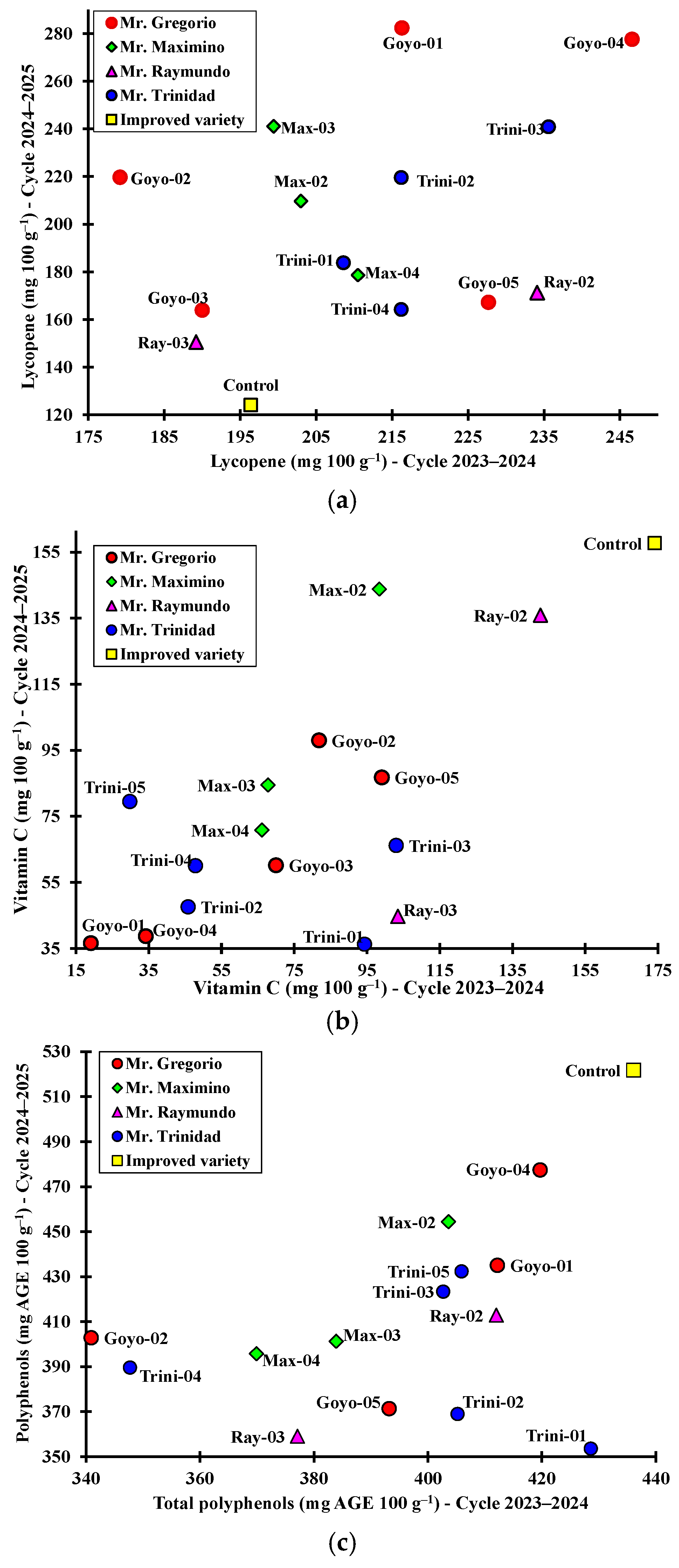
Depending on the phenotypic response of the genotypes to the evaluation cycles, different behavioral patterns were determined, for example, constant behavior from one cycle to another with either high or low values and inconsistent responses with high values in one cycle and low values in the other cycle. For example, the lycopene, vitamin C and total polyphenol contents of Goyo-01, Goyo-04, Trini-02, Trini-03 and Trini-05 were consistently high. The control had high levels of vitamin C and polyphenols. In contrast to this stable pattern, low values were observed for Goyo-02, Goyo-03, Trini-01, Trini-04 and Ray-03 (Figure 3). These responses indicate that the native tomato genotypes contain one or more compounds at the desired concentration or at levels similar to those in the control.
Significant interactions between the genotypes and crop cycles were observed for the total flavonoid content and antioxidant activity. First, compared with the plants grown in the 2023–2024 cycle, most of those grown in the 2024–2025 cycle had a higher concentration of the flavonoid equivalents of quercetin or catechin, with significant differences between groups, indicating greater sensitivity of the total flavonoid content to growth conditions. In terms of antioxidant activity, greater stability was observed in the responses of Goyo-04, Max-02, Ray-02, Trini-04, Trini-05 and the control variety in both crop cycles (Table 5).

4. Discussion

Native, local or traditional varieties of tomato that are agronomically selected and cultivated by farmers are recognized by consumers and sellers because they usually have greater organoleptic and nutritional qualities than recently developed commercial varieties [42]. Genotypes with greater productivity, shelf life, appearance and yield per plant are selected in improvement programs, but organoleptic traits and the nutritional–nutraceutical quality of fruits are not included as the selection criteria. In this study, 15 genotypes were selected from the plots of four traditional farmers who cultivate their own varieties and evaluated using a commercial variety as a reference. Consequently, the expected phenotypic and genetic variability in fruit composition can be limited by the genotypic characteristics of the source genetic material.
Two experiments conducted in the same greenhouse and under similar agronomic practices were planned to estimate mainly genotypic effects (G) rather than environmental effects (i.e., crop cycles, C) and environmental–genotypic interaction effects (C × G). However, the temperature regimens (Figure 2) increased the crop cycle (environmental variance) effects on soluble solid content, pH, and maturity and flavor indices (C > G > C × G) compared with those of G and C × G. Similar patterns were reported by Casals et al. [19] in commercial varieties for soluble solid content in the first year of evaluation, but in the second year, the estimated contributions were similar to those reported here. With respect to the contents of reducing sugars and titratable acids, greater genotypic effects and cycle–genotype interactions were recorded, which is consistent with the patterns described by Cebolla-Cornejo et al. [43], who reported significant effects of genotype and genotype–environment interactions on the contents of the main sugars (fructose and glucose) and organic acids (citric, malic and glutamic acid) in native varieties grown in Spain.
The crop cycles had different temperature regimens (minimum, average and maximum, Figure 2). These variable temperatures had a significant effect on the contents of soluble solids, maturity and flavor indices, total polyphenols, total flavonoids and antioxidant activity in 2024–2025 compared with those in 2023–2024, which indicates that the temperature difference and variability in the second crop cycle influenced the ability of stress to increase the biosynthesis and concentrations of these compounds in the fruits. Similar patterns were reported by Dumas et al. [25], who reported decreases in the contents of carotenoids, including lycopene, in fresh market tomatoes when the night/day temperature difference increased (7.8 to 11.2 °C).
The soluble solid and sugar contents, acidity and pH were used to calculate the flavor and maturity indices, as these parameters contribute to the flavor, acidity and sweetness of the fruit and are considered general organoleptic characteristics that are preferred by consumers [28]. Commercial tomato varieties cultivated for fresh consumption or agroindustrial processing typically have a 3.2 to 5.6 °Brix (total soluble solid content) and a pH of 4.0 to 4.6 [21,24]; similar values were recorded in this work, and consequently, the evaluated genotypes met the market standards for tomatoes. For example, the Goyo-05 and Trini-02 genotypes, which have a high regional demand in their area of distribution, presented high contents of soluble solids and sugars and high values of flavor and maturity indices, and these findings were similar to those reported by Cammareri et al. [44] for native varieties from Italy and Spain. The soluble solids content is an indicator of high concentrations of sugars, organic acids, carbohydrates and minerals; however, these parameters are strongly affected by greenhouse cultivation conditions and open field planting, as documented by Casals et al. [19], who compared planting in plastic tunnels versus open fields and modern varieties versus traditional varieties.
In genetic improvement programs or strategies for tomato, where traits associated with organoleptic properties and nutritional and functional compounds are selected for, the stability of environmental conditions or crop cycles is important to maintain characteristics such as the sugar content and acidity (organoleptic properties). This was the case with the different genotypes evaluated in this study in terms of the titratable acidity and reducing sugar content, with the exception of Goyo-03; in the flavor index, the exception was Max-02; in the flavor and maturity indices, the exception was Max-04; and in pH, the exceptions were Goyo-04, Ray-03, Trini-02 and Trini-05. So, the soluble solid content, titratable acidity and reducing sugar content were largely constant from one cycle to another between genotypes, indicating that the concentrations of organic acids and sugars in fruits influence the organoleptic perceptions of consumers and help to promote the in situ conservation of local germplasm resources [45].
The genotypic variance in lycopene, vitamin C, and total polyphenols was significantly greater than the variance due to the crop cycle and genotype–crop cycle interactions. In contrast, the environmental variance (crop cycle) in total flavonoid content and antioxidant activity was greater than the genotypic variance. These findings suggest that the first group of compounds is less sensitive to environmental changes in the crop cycle (e.g., temperature) than the second group or that crop cycles have a limited influence on the levels of certain bioactive compounds, such as vitamin C and lycopene. These trends are similar to those reported by Divéky-Ertsey et al. [42], who reported significant differences in the lycopene content, polyphenol content and antioxidant activity evaluated using the FRAP and DPPH methods mainly between genotypes (seven traditional tomato varieties), years of cultivation and genotype–years interactions in Hungary under open-air (field) and polytunnel cultivation systems.
The biosynthesis and accumulation of flavonoids in tomato occur mainly in the peel, and other parts comprise > 95% of total fruit weight, where only flavonoid traces can be found [46]. In this study, complete fruits without seeds were analyzed, which influenced the estimation of the genotypic variance in favor of major environmental effects (crop cycle variance) or underestimated the genotypic value, and consequently, the antioxidant activity was also affected. Based on this experience, we suggest evaluating the flavonoids only in fruit skin (exocarp) for purposes of genetic improvement or genotypic estimators, including a broad genetic base or more genotypes, because in this work, the genetic and genotypic diversity was limited.
Crop cycle–genotype interactions (C × G) significantly affected all the evaluated compounds, but every genotype evaluated interacted differently with the crop cycle (Table 4 and Table 5 and Figure 3). This means that a genotype tends toward stability or instability when the composition changes significantly from one cycle to another. For example, the contents of total flavonoids significantly changed in Goyo-04, Max-04, Trini-01, Trini-05 and the control. This type of trend was also reported by Rosello et al. [23] in terms of the contents of lycopene, β-carotene and ascorbic acid in the fruits of Solanum lycopersicum and S. pimpinellifolium accessions and modern cultivars. Martí et al. [47] also reported significant interactions between environments and genotypes for polyphenolic compounds and L-ascorbic acid. Therefore, environmental effects modify fruit composition, especially compounds that are more sensitive to climate elements such as temperature, light, water availability and agricultural practices [25,48].
Tagiakas et al. [49] used the pure line selection method for native tomato varieties in Greece and reported significant differences in the levels of bioactive compounds present in the fruit from one cycle to another. In this study, a similar methodology for the selection of individual plants was used, and significant differences in the effects of interactions between genotypes and crop cycles were identified, but not for all parameters. For example, the lycopene contents for Trini-02, Trini-03 and Goyo-04 remained consistently high, but vitamin C, total polyphenols, total flavonoids and antioxidant activity did not differ. The crop cycle effects include crop management practices (e.g., fertilizers, pest or disease management) and uncontrolled agroecological conditions (e.g., relative humidity, temperature, and solar irradiation) inherent to the seasonality of the cycle, which promote interactions with the genotypes and modify the secondary metabolism and concentration of bioactive compounds in the fruit, as determined by Ladewig et al. [50], who reported the effects of salinity on the ferti-irrigation or stress conditions produced by high temperatures during cultivation [26].
The pH, maturity index, lycopene content, vitamin C content, total polyphenols, total flavonoids and antioxidant activity exhibited broad-sense heritabilities (H2) from 12.8 to 51.3, indicating high genotypic effects, where the coefficients of genetic variation ranged from medium to low (<20%). These values were recorded by Anyaoha et al. [51], who evaluated different hybrids and commercial varieties in Nigeria with variations of H2 > 95% in the total soluble solid content (°Brix), lycopene content and vitamin C content, as well as the values estimated by Zörb et al. [52] in German varieties for soluble solids content (97.0%) and lycopene content (78.8%). Despite the differences between studies in terms of protocols, laboratory equipment, genotypes evaluated and culture conditions, the observed patterns indicate that the genotypes or genotypic effects determine the contents of these bioactive compounds.
As part of the evaluation of bioactive compounds (15 genotypes under selection and a control) during two crop cycles under greenhouse conditions, which were uniformly managed in agronomic terms, the composition of the fruits evaluated (from the fourth to sixth cluster) seemed to be insufficient for reflecting purer genotypic effects with less environmental influence or environment–genotypic interaction effects. Thus, we suggest performing two or three evaluations of fruit composition per crop cycle and including interactions with growing systems, cultivation seasons and/or years to incorporate all possible environmental variables in the evaluation of genotypes from tomato landraces, as well as in other studies [21,23,47,48].
In addition to their value as sources of genetic material, the evaluated germplasms play an essential role in the food security of the communities of origin, such as Santa Cruz Xitla and Oaxaca, and to date, farmers have preserved in situ this genotypic diversity in traits, organoleptic compounds (e.g., soluble solids, sugars or organic acids), bioactive compounds (e.g., lycopene, vitamin C, total polyphenols and flavonoids) and antioxidant activity (Table 2 and Table 3), which also affects the health of consumers. In this case, the use of genomic association studies based on molecular markers [13], including transcriptomic analyses [53], may support more efficient genomic selection.

5. Conclusions

The evaluation of 15 tomato genotypes obtained originally from the individual selection of plants grown in plots by traditional farmers revealed that the genotype, crop cycle and genotype–crop cycle interactions significantly affected the soluble solid content, pH, total polyphenol content, flavonoid content and antioxidant activity. Titratable acidity and the contents of reducing sugars, lycopene and vitamin C were not influenced by the crop cycle or agroecological conditions. In general, genotypes interacted significantly with crop cycles, but exceptions were observed between genotypes, with some parameters being consistently high or low during both crop cycles. The pH, maturity index, lycopene content, vitamin C content, total polyphenol content, flavonoid content and antioxidant activity exhibited broad-sense heritability values (H2) of 12.8 to 63.5% in relation to the total phenotypic variance, indicating the possibility of selecting genotypes on the basis of the fruit composition. The variability in fruit composition between the native genotypes helped differentiate genotypes with higher contents of lycopene, soluble solids, and reducing sugars and higher pH than the control (improved variety) or genotypes with equivalent polyphenol and total flavonoid contents. The uniformity of cultivation conditions in greenhouses helps to improve the estimators of the phenotypic and genotypic variance, even with limited genetic diversity (15 genotypes), but evaluating fruit composition using two or three subsamples at different harvest times and in different cultivation years is not ruled out.

Author Contributions

Conceptualization and methodology, A.M.V.-G., M.L.P.-O., J.C.C.-R. and J.L.C.-S.; investigation S.B.M.-C.; writing—original draft preparation, A.M.V.-G., M.L.P.-O. and P.B.-B.; data analysis, writing—review and editing, J.C.C.-R. and J.L.C.-S. All authors have read and agreed to the published version of the manuscript.

Funding

This research was funded by Instituto Politécnico Nacional, grant numbers SIP-20250559 and 20252367.

Data Availability Statement

The original contributions presented in the study are included in the article, and further inquiries can be directed to the corresponding author.

Conflicts of Interest

The authors declare no conflicts of interest.

References

  1. FAOSTAT. Crops and Livestock Products 2023; Food and Agriculture Organization of the United Nations (FAO): Rome, Italy, 2025; Available online: https://www.fao.org/faostat/en/#data/QCL (accessed on 25 November 2025).
  2. Vera-Guzmán, A.M.; Pérez-Ochoa, M.L.; Carrillo-Rodríguez, J.C.; Chávez-Servia, J.L. Variation in agromorphological traits and phenolic compounds, vitamin C contents, and antioxidant activity in the fruits of Mexican tomato landraces. In Solanum lycopersicum L. Research Methods, Approaches, and Perspectives; Rekoslavskaya, N., Ed.; IntechOpen: Rijeka, Croatia, 2026; pp. 61–80. [Google Scholar] [CrossRef]
  3. Pons, C.; Casals, J.; Palombieri, S.; Fontanet, L.; Riccini, A.; Rambla, J.L.; Rugiero, A.; Granell, A. Atlas of phenotypic, genotypic and geographical diversity present in the European traditional tomato. Hortic. Res. 2022, 9, uhac112. [Google Scholar] [CrossRef] [PubMed]
  4. Rocchi, L.; Paolotti, L.; Cortina, C.; Boggia, A. Conservation of landraces: The key role of the value for agrobiodiversity conservation. An application on ancient tomatoes varieties. Agric. Agric. Sci. Procedia 2016, 8, 307–316. [Google Scholar] [CrossRef]
  5. Casals, J.; Pascual, L.; Cañizares, J.; Cebolla-Cornejo, J.; Casañas, F.; Nuez, F. The risks of success in quality vegetable markets: Possible genetic erosion in Marmande tomatoes (Solanum lycopersicum L.) and consumer dissatisfaction. Sci. Hortic. 2011, 130, 78–84. [Google Scholar] [CrossRef]
  6. Parisi, M.; Aversano, R.; Grazini, G.; Ruggieri, V.; Senape, V.; Sigillo, L.; Barone, A. Phenotypic and molecular diversity in a collection of ‘Pomodoro di Sorrento’ Italian tomato landraces. Sci. Hortic. 2016, 203, 143–151. [Google Scholar] [CrossRef]
  7. Carli, P.; Barone, A.; Fogliano, V.; Frusciante, L.; Ercolano, M.R. Dissection of genetic and environmental factors involved in tomato organoleptic quality. BMC Plant Biol. 2011, 11, 58. [Google Scholar] [CrossRef]
  8. Ortiz, R.; Dwivedi, S.L. Profiling heirloom tomato germplasm: Metabolites, textural traits, and consumer preferences. In Next-Generation Food Crops for Human Health; Dwivedi, S.L., Ortiz, R., Kole, C., Eds.; CRC Press: Boca Ratón, Puerto Rico, 2025; pp. 213–222. [Google Scholar]
  9. Razifard, H.; Ramos, A.; Della-Valle, A.L.; Bodary, C.; Goetz, E.; Manser, E.J.; Li, X.; Zhang, L.; Visa, S.; Tieman, D.; et al. Genomic evidence for complex domestication history of the cultivated tomato in Latin America. Mol. Biol. Evol. 2020, 37, 1118–1132. [Google Scholar] [CrossRef]
  10. Ramírez-Ojeda, G.; Peralta, I.E.; Rodríguez-Guzmán, E.; Chávez-Servia, J.L.; Sahagún-Castellanos, J.; Rodríguez-Pérez, J.E. Climatic diversity and ecological descriptors of wild tomato species (Solanum sect. Lycopersicum) and close related species (Solanum sect. Juglandifolia and sect. Lycopersicoides) in Latin America. Plants 2021, 10, 855. [Google Scholar] [CrossRef]
  11. Ramírez-Ojeda, G.; Rodríguez-Pérez, J.E.; Rodríguez-Guzmán, E.; Sahagún-Castellanos, J.; Chávez-Servia, J.L.; Peralta, I.E.; Barrera-Guzmán, L.Á. Distribution and climatic adaptation of wild tomato (Solanum lycopersicum L.) populations in Mexico. Plants 2022, 11, 2007. [Google Scholar] [CrossRef] [PubMed]
  12. Donoso, A.; Carrasco, D.; Araya, C.; Salazar, E. Genetic diversity and distinctiveness of Chilean Limachino tomato (Solanum lycopersicum L.) reveal an in situ conservation during the 20th century. Front. Conserv. Sci. 2023, 4, 1156786. [Google Scholar] [CrossRef]
  13. Ruggieri, V.; Francese, G.; Sacco, A.; D’Alessandro, A.; Rigano, M.M.; Parisi, M.; Milore, M.; Cardi, T.; Mennella, G.; Barone, A. An association mapping approach to identify favorable alleles for tomato fruit quality breeding. BMC-Plant Biol. 2014, 14, 337. [Google Scholar] [CrossRef] [PubMed]
  14. Klee, H.J.; Tieman, D.M. The genetics of fruit flavour preferences. Nat. Rev. Genet. 2018, 19, 347–356. [Google Scholar] [CrossRef] [PubMed]
  15. Sinesio, F.; Cammareri, M.; Cottet, V.; Fontanet, L.; Jost, M.; Moneta, E.; Palombieri, S.; Peparaio, M.; Romero-del Castillo, R.; Civitelli, E.S.; et al. Sensory traits and consumer’s perceived quality of traditional and modern fresh market tomato varieties: A study in three European countries. Foods 2021, 10, 2521. [Google Scholar] [CrossRef]
  16. Causse, M.; Buret, M.; Robini, K.; Verschave, P. Inheritance of nutritional and sensory quality traits in fresh maker tomato and relation to consumer preferences. J. Food Sci. 2003, 68, 2342–2350. [Google Scholar] [CrossRef]
  17. Hellín, P.; Hernández, V.; Sánchez, E.; Garrido, I.; Cava, J.; Pérez, A.; Gomariz, J.; Molina, M.V.; Fernández, I.; Molina, E.; et al. Evaluation of genotype, environment, and genotype-by-environment interaction for phenolic compounds in tomato landraces. Acta Hortic. 2023, 1384, 497–504. [Google Scholar] [CrossRef]
  18. Burato, A.; Tava, A.; Biazzi, E.; Parisi, M.; Tripodi, P.; Lo Scalzo, R.; Bianchi, G.; Picchi, V.; Ronga, D. Changes in processing tomato fruit quality in heirloom and modern varieties developed over the past decades. J. Food Compos. Anal. 2025, 146, 107956. [Google Scholar] [CrossRef]
  19. Casals, J.; Martí, M.; Rull, A.; Pons, C. Sustainable transfer to tomato landraces to moder cropping system: The effects of environmental conditions and management practices on long-shelf-life tomatoes. Agronomy 2021, 11, 533. [Google Scholar] [CrossRef]
  20. Mohammed Ali, U.; Soresa, D.N.; Fufa, T.W. Tailoring tomato (Solanum lycopersicum L.) traits to microclimates: A multilocation evaluation of yield and quality responses in Western Ethiopia. Scientifica 2025, 2025, 6345142. [Google Scholar] [CrossRef]
  21. Fibiani, M.; Paolo, D.; Leteo, F.; Campanelli, G.; Picchi, V.; Bianchi, G.; Lo Scalzo, R. Influence of year, genotype and cultivation system on nutritional values and bioactive compounds in tomato (Solanum lycopersicum L.). Food Chem. 2022, 389, 133090. [Google Scholar] [CrossRef] [PubMed]
  22. Tripodi, P.; Plazas, M.; Francese, G.; Raigón, M.D.; D’Alessandro, A.; Adalid-Martínez, A.M.; Cardi, T.; Figàs, M.R.; Leteo, F.; García-Martínez, M.D.; et al. Impact of water regime, nitrogen supply and location on quality and nutritional composition in a tomato diversity panel in organic cultivation. Sci. Hortic. 2025, 347, 114187. [Google Scholar] [CrossRef]
  23. Roselló, S.; Adalid, A.M.; Cebolla-Cornejo, J.; Nuez, F. Evaluation of the genotype, environment and their interaction on carotenoid and ascorbic acid accumulation in tomato germplasm. J. Sci. Food Agric. 2011, 91, 1014–1021. [Google Scholar] [CrossRef] [PubMed]
  24. Panthee, D.R.; Cao, C.; Debenport, S.J.; Rodríguez, G.R.; Labate, J.A.; Robertson, L.D.; Breksa, A.P.; Van der Knaap, E.; Gardener, B.B.M. Magnitude of Genotype × Environment Interactions Affecting Tomato Fruit Quality. HortScience 2012, 47, 721–726. [Google Scholar] [CrossRef]
  25. Dumas, Y.; Dadomo, M.; Di Lucca, G.; Grolier, P. Effects of environmental factoirs and agricultural techniques on antioxidants content of tomatoes. J. Sci. Food Agric. 2003, 83, 369–382. [Google Scholar] [CrossRef]
  26. Scarano, A.; Olivieri, F.; Gerardi, C.; Liso, M.; Chiesa, M.; Chieppa, M.; Frusciante, L.; Barone, A.; Santino, A.; Rigano, M.M. Selection of tomato landraces with high fruit yield and nutritional quality under elevated temperatures. J. Sci. Food Agric. 2020, 100, 2791–2799. [Google Scholar] [CrossRef]
  27. AOAC. Official Methods of Analysis, 15th ed.; Association of Official Analytical Chemists inch: Washington, DC, USA, 1990; Volume 2, pp. 910–928. [Google Scholar]
  28. Navez, B.; Letard, M.; Grasselly, D.; Jost, M. Les criteres de qualite de la tomate. Infos-Ctifl 1999, 155, 41–47. [Google Scholar]
  29. Méndez-Infante, I.; Vera-Guzmán, A.M.; Chávez-Servia, J.L.; Carrillo-Rodríguez, J.C. Quality of fruits in Mexican tomato (Lycopersicon esculentum Mill.) landraces. Vitae-Sch. Pharm. Food Sci. 2011, 18, 26–32. [Google Scholar]
  30. Davis, A.R.; Fish, W.W.; Perkins-Veazie, P. A rapid spectrophotometric method for analyzing lycopene content in tomato and tomato products. Postharvest Biol. Technol. 2003, 28, 425–430. [Google Scholar] [CrossRef]
  31. Crisanto-Juárez, A.U.; Vera-Guzmán, A.M.; Chávez-Servia, J.L.; Carrillo-Rodríguez, J.C. Calidad de frutos de tomates silvestres (Lycopersicon esculentum var. cerasiforme Dunal) de Oaxaca, México. Rev. Fitotec. Mex. 2010, 33, 7–13. [Google Scholar] [CrossRef] [PubMed]
  32. Dürüst, N.; Sümengen, D.; Dürüst, Y. Ascorbic acid and element contents of foods of Trabzon (Turkey). J. Agric. Food Chem. 1997, 45, 2085–2087. [Google Scholar] [CrossRef]
  33. Singleton, V.L.; Rossi, J.A. Colorimetry of total phenolics with phosphomolybdic-phosphotungstic acid reagents. Am. J. Enol. Vitic. 1965, 16, 144–158. [Google Scholar] [CrossRef]
  34. Jia, Z.; Tang, M.; Wu, J. The determination of flavonoid contents in mulberry and their scavenging effects on superoxide radicals. Food Chem. 1999, 64, 5. [Google Scholar] [CrossRef]
  35. Lin, J.; Tang, C.Y. Determination of total phenolic and flavonoid contents in selected fruits and vegetables, as well as their stimulatory effects on mouse splenocyte proliferation. Food Chem. 2007, 101, 140–147. [Google Scholar] [CrossRef]
  36. Brand-Williams, W.; Cuvelier, M.E.; Berset, C. Use of a free radical method to evaluate antioxidant activity. LWT-Food Sci. Technol. 1995, 28, 25–30. [Google Scholar] [CrossRef]
  37. Benzie, I.F.; Y Strain, J.J. Ferric reducing/antioxidant power assay: Direct measure of total antioxidant activity of biological fluids and modified version for simultaneous measurement of total antioxidant power and ascorbic acid concentration. Methods Enzymol. 1999, 299, 15–27. [Google Scholar]
  38. SAS Institute Inc. (SAS). Base SAS® 9.1.3 Procedures Guide, 2nd ed.; SAS Institute Inc.: Cary, NC, USA, 2006; Volume 1–4. [Google Scholar]
  39. Comstock, R.E.; Robinson, H.F. Genetic parameters, their estimation and significance. In Proceedings of the 6th International Grassland Congress Proceedings, State College, PA, USA, 17–23 August 1952; National Publication Company: Washington, DC, USA, 1952. [Google Scholar]
  40. Falconer, D.S.; Mackay, T.F.C. An Introduction to Quantitative Genetics, 4th ed.; Longman Group Limited: London, UK, 1996. [Google Scholar]
  41. Tessema, G.L.; Mohammed, A.W.; Abebe, D.T. Genetic variability studies for tuber yield and yield attributes in Ethiopian released potato (Solanum tuberosum L.) varieties. PeerJ 2022, 10, e12860. [Google Scholar] [CrossRef] [PubMed]
  42. Divéky-Ertsey, A.; Ladányi, M.; Biró, B.; Máté, M.; Drexler, D.; Tóth, F.; Boziné-Pullai, K.; Gere, A.; Pusztai, P.; Csambalik, L. Tomato landraces may benefit from protected production-evaluation on phytochemicals. Horticulturae 2022, 8, 937. [Google Scholar] [CrossRef]
  43. Cebolla-Cornejo, J.; Roselló, S.; Valcárcel, M.; Serrano, E.; Beltrán, J.; Nuez, F. Evaluation of genotype and environment effects on taste and aroma flavor components of Spanish fresh tomato varieties. J. Agric. Food Chem. 2011, 59, 2440–2450. [Google Scholar] [CrossRef]
  44. Cammareri, M.; Sinesio, F.; Peparaio, M.; Pons, C.; Romero-del Castillo, R.; Saggia Civitelli, E.; Vitiello, A.; Granell, A.; Casals, J.; Grandillo, S. Local agro-environmental conditions impact fruit quality, sensory properties and consumer acceptance of long shelf-life tomatoes. Agronomy 2023, 13, 1265. [Google Scholar] [CrossRef]
  45. Carrillo-Rodríguez, J.C.; Sosa-Hernández, N.; Vera-Guzmán, A.M.; Chávez-Servia, J.L. Diversidad biocultural de tomate nativo en Oaxaca, México. Herb. CICY 2023, 15, 18–23. [Google Scholar]
  46. Bovy, A.; Schijlen, E.; Hall, R.D. Metabolic engineering in tomato (Solanum lycopersicum): The potential for metabolomics. Metabolomics 2007, 3, 399–412. [Google Scholar] [CrossRef] [PubMed]
  47. Marti, R.; Leiva-Brondo, M.; Lahoz, I.; Campillo, C.; Cebolla-Cornejo, J.; Rosello, S. Polyphenolic and L-ascorbic acid in tomato as influenced by high lycopene genotypes and organic farming at different environments. Food Chem. 2018, 239, 148–156. [Google Scholar] [CrossRef]
  48. Bhandari, H.R.; Srivastava, K.; Tripathi, M.K.; Chaudhary, B.; Biswas, S. Genotype-environment interaction for quality traits in tomato hybrids. Agric. Res. 2022, 11, 382–389. [Google Scholar] [CrossRef]
  49. Tagiakas, R.I.; Avdikos, I.D.; Goula, A.; Koutis, K.; Nianiou-Obeidat, I.; Mavromatis, A.G. Characterization and evaluation of Greek tomato landraces for productivity and fruit quality traits related to sustainable low-input farming systems. Front. Plant Sci. 2022, 13, 994530. [Google Scholar] [CrossRef]
  50. Ladewig, P.; Trejo-Téllez, L.I.; Servín-Juárez, R.; Contreras-Oliva, A.; Gómez-Merino, F.C. Growth, yield and fruit quality on Mexican tomato landraces in response to salt stress. Not. Bot. Horti Agrobot. Cluj-Napoca 2021, 49, 12005. [Google Scholar] [CrossRef]
  51. Anyaoha, C.O.; Adetula, O.A.; Aderibigbe, O.R.; Orkpeh, U.; Akinyode, E.T.; Ikoro, J.I.; Okoyo, M.E.; Oguntolu, O.O.; Ajayi, E.O. Genetic variability in nutritional quality, yield and yiel attributes of tomato (Solanum lycopersicum L.). Acta Univeritatis Agric. Silvic. Mendel. Brun. 2023, 71, 97–110. [Google Scholar] [CrossRef]
  52. Zörb, C.; Piepho, H.-P.; Zikeli, S.; Horneburg, B. Heritability and variability of quality parameters of tomatoes in outdoor production. Research 2020, 2020, 6707529. [Google Scholar] [CrossRef]
  53. Sacco, A.; Raiola, A.; Calafiore, R.; Barone, A.; Rigano, M.M. New insights in the control of antioxidants accumulation in tomato by transcriptomic analyses of genotypes exhibiting contrasting levels of fruit metabolites. BMC Genom. 2019, 20, 43. [Google Scholar] [CrossRef]
Figure 1. Flowers joined (two or more welded flowers and two pistils) with a high number of petals and multiloculated fruits as identity traits of the traditional landraces of tomato from Oaxaca, Mexico.
Agronomy 16 00868 g001
Figure 2. Daily temperature records during the tomato cultivation crop cycles in 2023–2024 (a) and 2024–2025 (b).
Agronomy 16 00868 g002
Figure 3. Distributions of the genotypes as a function of the phenotypic responses observed in the two crop cycles based on the lycopene (a), vitamin C (b) and total polyphenol (c) contents on a dry-weight basis in plants grown under greenhouse conditions.
Agronomy 16 00868 g003
Table 1. Significance of mean squares from the analysis of variance of fruit composition in genotypes of farmers’ varieties cultivated under greenhouse conditions.
Traits EvaluatedMean Squares (MS)PCV (%)GCV (%)H2
Crop Cycles (C)Genotypes (G)G × CRepetitions/C 1Replicates/Rep. 1Error
Soluble solids:
   Juice17.05 **2.56 **2.11 **9.54 **<0.001 ns0.45117.24.36.1
   Pulp3.63 **3.25 **2.77 **14.38 **0.003 ns0.51719.04.45.3
pH0.185 **0.103 **0.016 **0.05 **<0.001 ns0.0034.33.463.5
Titratable acidity0.005 ns0.049 **0.045 **0.094 **<0.001 ns0.00530.25.43.2
Maturity index73.73 **39.76 **28.30 **1.76 ns0.05 ns3.6324.08.612.8
Flavor index0.135 **0.032 **0.028 **0.056 **<0.001 ns0.0059.52.04.4
Reducing sugars0.01 ns0.95 **1.07 **2.29 **0.008 ns0.15922.44.33.7
Lycopene5129.6 ns18,205.2 **11,841.2 **5861.6 **15.8 ns149933.713.616.3
Vitamin C0.055 ns3.315 **1.074 **0.785 *<0.001 ns0.23130.519.038.8
Total polyphenols21,328 **25,004 **10,285 **1010 ns30 ns918.317.810.736.1
Flavonoid equivalents:
    Quercetin86,970 **1908 **574 **827 **3.1 ns173.618.311.337.9
    Catechin8671.6 **1450.0 **691.0 **623.5 **2.5 *92.216.88.928.2
Antioxidant activity:
    DPPH1,470,793 **763,850 **189,332 **43,018 ns561.9 ns27,70826.118.751.3
    FRAP2,035,743 **804,157 **321,362 **52,785 ns721.9 ns45,93920.712.234.5
1 Indicates the nesting of repetitions in crop cycles and nesting of laboratory replicates in repetitions; ns not significant (p > 0.05); * significant at p ≤ 0.05; ** significant at p ≤ 0.01; PCV, phenotypic coefficient of variation; GCV, genotypic coefficient of variation; H2, broad-sense heritability.
Table 2. Effects of crop cycles and genotypes on the physicochemical parameters of fruits from genotypes of farmers’ varieties cultivated under greenhouse conditions.
Crop Cycles/GenotypesSoluble Solids (°Brix)pHTitratable Acidity (% Citric Acid)IndexReducing
Sugars (%)
JuicePulpMaturityFlavor
Crop cycles:
2023–20245.37 b 15.53 b4.14 a0.42 a13.5 b1.09 b2.83 a
2024–20255.77 a5.70 a4.10 b0.41 a14.4 a1.13 a2.82 a
Genotypes of farmers’ varieties:
Goyo-015.61 b–d 15.67 b–e4.11 e–h0.42 bc14.2 b–e1.13 a–d2.62 c
Goyo-025.67 b–d5.96 a–c4.08 f–h0.43 b13.8 c–e1.12 b–d2.95 bc
Goyo-035.17 d5.00 e4.20 a0.33 d15.6 a–c1.11 c–e2.86 bc
Goyo-045.37 cd5.26 c–e4.17 a–d0.41 bc13.5 de1.08 c–e2.79 bc
Goyo-056.38 a6.39 a4.09 e–h0.45 b14.4 a–e1.17 ab3.37 a
Average 25.6 ± 0.4 25.6 ± 0.54.1 ± 0.050.4 ± 0.0414.3 ± 0.71.1 ± 0.032.9 ± 0.2
Max-025.29 cd5.18 de4.19 ab0.39 b–d13.7 c–e1.07 c–e2.63 c
Max-035.75 a–d5.92 a–c4.08 gh0.44 b13.5 de1.12 b–d2.98 a–c
Max-045.41 cd5.60 b–e4.14 b–e0.39 b–d14.8 a–d1.13 a–d2.66 c
Average5.5 ± 0.25.6 ± 0.34.1 ± 0.040.4 ± 0.0214 ± 0.61.1 ± 0.032.8 ± 0.2
Ray-025.36 cd5.37 c–e4.06 h0.43 b12.7 e1.06 de2.78 bc
Ray-035.44 cd5.39 c–e4.21 a0.35 cd15.8 ab1.14 a–c2.68 bc
Average5.4 ± 0.045.4 ± 0.014.1 ± 0.10.4 ± 0.0414.2 ± 1.51.1 ± 0.042.7 ± 0.05
Trini-015.96 a–c5.89 a–d4.14 c–f0.43 b13.8 c–e1.12 b–d2.93 bc
Trini-026.13 ab6.15 ab4.18 a–c0.38 b–d16.2 a1.20 a3.07 ab
Trini-035.43 cd5.66 b–e4.12 d–g0.42 bc13.7 c–e1.10 c–e2.90 bc
Trini-045.36 cd5.43 c–e4.12 d–g0.40 b–d13.5 de1.08 c–e2.64 c
Trini-055.46 b–d5.50 b–e4.08 gh0.43 b12.9 de1.08 c–e2.71 bc
Average5.7 ± 0.35.7 ± 0.34.1 ± 0.030.4 ± 0.02014 ± 1.131.1 ± 0.042.8 ± 0.2
Control5.27 d5.41 c–e3.95 i0.52 a10.5 f1.05 e2.63 c
1 In columns, mean values of crop cycles or genotypes with the same letter are not significantly different (Tukey’s test, p ≤ 0.05); 2 averages and standard deviations of farmers’ varieties; high values are shown in bold, and low values are underlined.
Table 3. Effects of crop cycles and genotypes on the contents of bioactive compounds and antioxidant activity of fruits from genotypes of farmers’ varieties cultivated under greenhouse conditions.
Crop
Cycles/
Genotypes
Lycopene (mg 100 g−1 dw)Vitamin C (mg 100 g−1 dw)Total Phenolic Compounds
(mg GAE 100 g−1 dw) 1
Total Flavonoids
(mg QE/CE 100 g−1 dw) 1
Antioxidant Activity
(µmol TE 100 g−1 dw) 1
QuercetinCatechinDPPH 1FRAP 1
Crop cycles:
2023–2024210.6 a 279.8 a394.1 b99.7 b104.7 b1375.9 b1952.2 b
2024–2025204.4 a76.7 a407.1 a129.6 a114.0 a1489.0 a2086.6 a
Genotypes of Farmers’ varieties:
Goyo-01249.3 ab 227.9 g423.7 bc112.6 b–e120.9 ab1485.6 b–d2084.4 b–d
Goyo-02199.5 d–f89.9 cd371.9 gh105.9 d–f109.3 c–e1399.5 c–f2071.0 b–e
Goyo-03177.0 ef65.1 d–g354.6 h93.8 f98.8 fg1268.4 f1852.6 f–h
Goyo-04262.1 a36.4 fg448.6 ab117.1 a–d126.2 a1420.3 c–f2258.2 b
Goyo-05197.4 d–f92.9 cd382.3 f–h102.2 ef99.9 e–g1333.5 d–f1938.9 d–h
Average 3217 ± 33 362 ± 27396 ± 35106 ± 8111 ± 111381 ± 742041 ± 138
Max-02206.3 c–e121.1 bc429.0 bc125.5 ab107.5 c–f1539.7 bc2106.3 b–d
Max-03220.3 b–d76.1 d–f392.6 d–g119.4 a–c102.6 d–g1357.5 d–f1860.6 e–h
Max-04194.5 d–f68.5 d–g382.8 e–h110.3 c–e111.7 b–d1406.3 c–f1829.2 gh
Average207 ± 1089 ± 23401 ± 20118 ± 6107 ± 41434 ± 771932 ± 124
Ray-02202.6 c–f139.3 ab412.4 c–f114.3 a–e105.7 c–g1646.2 b2193.3 bc
Ray-03169.9 ef74.1 d–f368.1 gh116.3 a–d97.8 g1306.8 ef1785.3 h
Average186 ± 16107 ± 33390 ± 22115 ± 1102 ± 41476 ± 1701989 ± 204
Trini-01196.2 d–f65.3 d–g391.1 d–g113.5 b–e111.8 b–d1290.1 ef1961.4 d–h
Trini-02217.8 b–d46.7 e–g387.1 e–g117.0 a–d110.3 cd1296.6 ef1923.4 d–h
Trini-03238.2 a–c84.6 c–e413.0 c–e115.1 a–e114.3 bc1373.0 d–f2045.0 b–f
Trini-04190.2 d–f53.9 d–g368.6 gh119.4 a–c106.0 c–g1402.1 c–f1948.8 d–h
Trini-05228.7 a–d54.6 d–g419.2 b–d124.6 ab113.4 bc1444.1 c–e2006.9 c–g
Average214 ± 1861 ± 13396 ± 18118 ± 4111 ± 31361 ± 601977 ± 43
Control165.4 f167.0 a472.8 a127.3 a112.6 bc2015.4 a2497.2 a
1 GAE, QE, CE, TE, gallic acid, quercetin, catechin and Trolox equivalents, respectively; DPPH and FRAP refer to 2,2-diphenyl-1-picrylhydrazyl and ferric-reducing antioxidant power, respectively. 2 In columns, the mean values of crop cycles or genotypes of farmers’ varieties with the same letter are not significantly different (Tukey’s test, p ≤ 0.05); 3 averages and standard deviations for farmers’ varieties. High values are shown in bold, and low values are underlined.
Table 4. Effects of genotype–crop cycle interactions on the physicochemical traits of fruits from genotypes of farmers’ varieties cultivated under greenhouse conditions.
Genotypes of Farmers’ VarietiesSoluble Solid Content (°Brix)pHTitratable Acidity (% Citric Acid)IndexReducing Sugar
Content (%)
JuicePulpFlavorMaturity
C1 1C2 1C1C2C1C2C1C2C1C2C1C2C1C2
Goyo-015.495.735.795.554.124.110.470.371.101.1612.515.92.662.58
Goyo-025.595.766.145.784.104.070.450.411.131.1113.614.02.962.95
Goyo-035.344.995.474.544.184.230.390.281.121.1114.516.63.222.50
Goyo-045.635.125.564.974.224.130.370.451.131.0415.211.83.032.56
Goyo-056.236.536.326.474.114.070.450.441.161.1814.214.73.303.43
Max-024.885.714.795.584.214.170.390.381.021.1312.514.92.442.83
Max-035.785.735.915.944.074.090.490.401.101.1412.214.83.082.88
Max-045.045.785.385.834.184.110.430.351.071.1912.616.92.442.88
Ray-025.275.455.405.354.084.050.460.391.051.0811.613.92.822.74
Ray-035.195.705.275.524.254.160.320.381.161.1216.814.82.752.61
Trini-015.356.585.226.564.144.140.410.441.051.1912.814.82.743.11
Trini-025.796.475.946.374.254.120.340.431.211.1817.415.03.003.14
Trini-035.365.515.645.684.124.120.440.401.081.1212.914.62.922.88
Trini-045.325.415.635.234.134.110.440.361.081.0812.814.32.842.43
Trini-055.185.735.315.704.144.020.400.461.071.0913.412.52.842.57
Control4.536.274.786.273.993.900.450.620.991.1310.810.22.213.19
HSD-Tukey 21.051.130.080.110.113.000.62
1 C1 and C2 indicate the 2023–2024 and 2024–2025 crop cycles, respectively. 2 HSD-Tukey = honestly significant difference (Tukey’s test, p ≤ 0.05), where the difference between mean values with a greater than or equal value to the HSD indicates a significant difference. Underlined values indicate significant differences between cycles for the same genotype.
Table 5. Effects of genotype–crop cycle interactions on the flavonoid content and antioxidant activity of fruits from genotypes of farmers’ varieties cultivated under greenhouse conditions.
GenotypesTotal Flavonoid Equivalents
(mg 100 g−1 dw)
Antioxidant Activity
(µmol TE 100 g−1 dw)
QuercetinCatechinDPPH 1FRAP 1
C1 1C2 1C1C2C1C2C1C2
Goyo-0198.5126.8113.7128.11301.01670.32001.52167.2
Goyo-0295.9115.998.1120.51217.11582.01744.32397.7
Goyo-0383.6104.192.2105.41278.01259.01809.41895.8
Goyo-04101.3132.8114.3138.21369.01471.72020.02496.5
Goyo-0594.0110.4103.896.11322.41344.71878.31999.4
Max-02109.0142.0100.3114.61449.91629.52021.72190.9
Max-03105.9132.999.8105.41373.01342.01924.81796.5
Max-0498.8121.9105.2118.31288.01524.61826.51831.9
Ray-0298.6130.0103.8107.61470.81821.52129.92256.7
Ray-03101.1131.694.4101.31334.81278.91900.21670.5
Trini-0198.9128.2119.2104.41406.51173.71995.41927.3
Trini-02103.8130.2106.6114.11321.81271.41933.31913.4
Trini-03101.2129.1111.7117.01328.31417.71954.02135.9
Trini-04101.8136.9101.3110.81325.71478.51894.42003.1
Trini-0596.6152.6110.0116.71355.61532.61919.92093.9
Control107.2154.0100.7128.61873.12205.12282.42783.7
HSD-Tukey 220.615.0260.6335.5
1 C1 and C2 indicate the 2023–2024 and 2024–2025 crop cycles, respectively; DPPH and FRAP refer to 2,2-diphenyl-1-picrylhydrazyl and ferric-reducing antioxidant power, respectively. 2 HSD-Tukey = honestly significant difference (Tukey’s test, p ≤ 0.05), where the difference between mean values with greater or equal values compared to HSD indicates significant differences. Underlined values indicate significant differences between cycles for the same genotype.
Disclaimer/Publisher’s Note: The statements, opinions and data contained in all publications are solely those of the individual author(s) and contributor(s) and not of MDPI and/or the editor(s). MDPI and/or the editor(s) disclaim responsibility for any injury to people or property resulting from any ideas, methods, instructions or products referred to in the content.