Article

Combined Effect of Extract Containing Rhizobial Nod Factors and Mineral Fertilization on Growth and Yield of Barley and Triticale


1
Department of Genetics and Microbiology, Maria Curie-Sklodowska University, 5 Maria Curie-Sklodowska Sq., 20-031 Lublin, Poland
2
Institute of Soil Science and Plant Cultivation—State Research Institute, Czartoryskich 8 St., 24-100 Puławy, Poland
3
Department of Biopharmacy, Medical University of Lublin, Chodzki St. 4a, 20-093 Lublin, Poland
4
Department of Economics and Agribusiness, Faculty of Agrobioengineering, University of Life Sciences in Lublin, Akademicka 13 St., 20-950 Lublin, Poland
*
Author to whom correspondence should be addressed.
Agronomy 2026, 16(7), 723; https://doi.org/10.3390/agronomy16070723

Submission received: 3 March 2026 / Revised: 24 March 2026 / Accepted: 29 March 2026 / Published: 30 March 2026

Abstract

The development of new methods enhancing the growth and yield of cereals is still needed in crop production due to their great importance in human diet and as livestock fodder. In our study, new fertilizer-biostimulators with micro- and macroelements and extract containing lipochitooligosaccharides (LCOs) produced by Rhizobium leguminosarum bv. trifolii were used for stimulation of growth of barley and triticale in greenhouse conditions. The preparations were applied at the tillering and shooting stages, whereas plant traits were studied at flowering and at full maturity. The best results were recorded after the joint treatment of the plants with LCOs and mineral fertilization. The application of such a mixture significantly increased the length and mass of roots at flowering in both studied species. A beneficial effect of the treatment was also observed in barley and triticale yields. At full maturity, the grain mass per plant was significantly enhanced, which was the effect of an increased number of grains per ear and increased mass of 1000 grains.

1. Introduction

Cereals are the most important crops globally due to their nutritive aspect in the human diet [1,2] and their role as fodder for livestock [3]. The growing demand for cereals necessitates a continuous search for opportunities to increase the size and quality of their yields. In the temperate climatic zone cultivation of wheat dominates in the cropping system; however, barley and triticale also play a significant role. The popularity of cultivation of these plants results from their lower soil and fertilizing requirements than in the case of wheat as well as the considerable breeding progress and development of varieties with great yielding potential [4,5].
As a result of intensive crop production, the environmental load with fertilizers is still increasing. This may exert a harmful effect on various ecosystems, e.g., a decrease in the number and biodiversity of soil microorganisms [6], disruption of aquatic systems [7], and even an adverse effect on animal and human health [8]. Therefore, numerous studies focusing on unconventional biofertilizers and plant growth stimulators are being conducted. Their main goal is to develop new products based on microbes or their metabolites which respect the needs of sustainable agriculture and can enhance plant growth and crop yield [9]. Thanks to the use of increasingly better research tools and techniques, the range of these products will probably grow rapidly [10,11].
One of such agriculturally useful microbes are rhizobia, which have therefore been used as biofertilizers for decades [12,13] because they can support legume plant host with nitrogen derived from the biological nitrogen fixation process. Moreover, these bacteria produce special molecules known as lipochitooligosaccharides (LCOs) or Nod factors, which have great morphogenetic potential. The most well-known effect of LCOs is the induction of the formation of root nodule meristems in legumes [14,15,16]. However, LCOs can stimulate also other types of plant secondary meristems, which results in promotion of germination and early growth of seedlings [17,18,19,20], enhancement of root growth, or an increase in the number of flowers, pods, seeds, and fruits [21,22] of leguminous and non-leguminous plants.
Non-leguminous plants, with the exception of Parasponia [23], are not able to enter into symbiosis with rhizobia; however, most of them can establish symbiotic interactions with arbuscular mycorrhizal and/or ectomycorrhizal fungi [24,25]. These fungi produce numerous molecules called Myc factors, structurally similar to rhizobial LCOs [26,27], which function as signals regulating fungal growth and development [28]. Plant genes required for symbiosis with rhizobia and for symbiosis with AM fungi are orthologs [29], and plant proteins functioning as receptors for Nod factors and Myc factors show mutual similarities [30]. Taken together, symbiosis-specific signaling associated with rhizobial LCOs seems to be part of a large network of different signals, receptors, and responses, in which “cross-signaling” between different pathways may occur; thus, rhizobial Nod factors may affect some processes different than nodulation also in non-legume plants.
Therefore, it is not surprising that rhizobial Nod factors can stimulate various processes in non-legume plants. For example, LCO treatment stimulated growth of roots and alleviated drought stress in Arabidopsis [31]. It also enhanced growth of canola roots [32] or flowering in tomato [21]. In monocots, the application of rhizobial LCOs resulted in promotion of lateral root formation in Brachypodium distachyon [33], enhanced germination [34], increased photosynthesis [35], and mitigated salt stress [36] in maize, and these findings open the way for application of rhizobial LCOs in cereal production.
Unfortunately, the results on the effect of LCOs on cereals are limited to the early stages of plant growth due to the lack of research on the effect of such substances on cereal yields. We hypothesized that the application of rhizobial LCOs, particularly when combined with mineral fertilization, could enhance root development and yield formation in cereal crops. Therefore the objective of this study was to evaluate the effects of two concentrations of rhizobial LCOs, applied alone or in combination with mineral fertilization, on the growth and yield components of barley and triticale under greenhouse conditions.

2. Materials and Methods

2.1. Plant Growth Conditions

The experiment was carried out in a greenhouse of the Institute of Soil Science and Plant Cultivation, State Research Institute, in Puławy, Poland (51.414282 N, 21.963259 E). Fifteen seeds of cereals (spring barley cv. Rubaszek or spring triticale cv. Puzon) were sown per one Mitscherlich pot (pot surface area = 314 cm2) filled with a mixture of 5 kg of hortisol and 2 kg of sand. The N, P, and K contents of this hortisol were as follows: N-NO3—8.4 mg/kg; N-NH4—2.8 mg/kg; P2O5—14.4 mg/100 g; and K2O—12.9 mg/100 g. Seedlings were thinned after emergence, and ten plants were left per pot. The following fertilizer rates were applied (g per pot): N—2.4, P—0.8, and K—1.6. The liquid fertilizer was diluted in water and applied to the emerged seedlings. Pots were watered automatically (SL 800 Weathermatic, Garland, TX, USA) with demineralized water to maintain the soil moisture at 60% field water capacity throughout the growing season. At the tillering stage, the insecticide Decis 2.5 EC EC (active substance—deltamethrin from the pyrethroid group, 2.8% w/v) was applied to eliminate aphids.

2.2. Experimental Factors

The first-order factor was the cereal species: (1) spring barley cv. Rubaszek, (2) spring triticale cv. Puzon, and the second-order factor was the composition of preparations used for crop spraying: (1) distilled water (further called “H2O” group), (2) a preparation of rhizobial Nod factors diluted in water 1:9 v/v (“LCO 10-1” group), (3) a preparation of rhizobial Nod factors diluted in water 1:99 v/v (“LCO 10-2” group), (4) a water solution containing macro- and microelements: N—25.00%, Mg—3.00%, B—0.42%, Cu—0.60%, Fe—1.30%, Mn—1.80%, Mo—0.01%, and Zn—1.40% (“MF” group = mineral fertilizer group), (5) a preparation of rhizobial Nod factors diluted in water 1:9 v/v together with the mineral fertilizer (“LCO 10-1 + MF” group), and (6) a preparation of rhizobial Nod factors diluted in water 1:99 v/v together with the mineral fertilizer (“LCO 10-2 + MF” group). In each experimental group, two pots were used and the experiment repeated four times. The preparations were applied at a rate of 10 mL per pot twice during the vegetation period: at tillering (BBCH 24) and at shooting (BBCH 34) to ensure that the plants had access to nitrogen at the time when they absorbed the greatest amounts of the nutrient. The plants were harvested at flowering (BBCH 65) and at full maturity (BBCH 89). The experiment had a completely randomized design.

2.3. Isolation of LCOs from Bacterial Cultures

Rhizobial LCOs were isolated from liquid cultures of Rhizobium leguminosarum bv. trifolii strain KO17 [37]. Briefly, liquid cultures of Rlt KO17 (100 mL aliquots of TY medium in 250 mL flasks) were prepared and, after 24 h of growth, logarithmic-phase cultures of bacteria were induced with a sterile clover seed flavonoid extract at a final concentration of 10 µM [38] and incubated at 28 °C for 48 h. To isolate rhizobial LCOs, one liter of the flavonoid-induced rhizobial culture was extracted twice with a 0.2 volume of n-butanol 15. The organic fraction was separated and dried in a rotary evaporator (Rotavapor–R, Bűchi, Flawil, Switzerland). The amount of Nod factors was determined by conversion of the amino sugars to methyl glycosides and gas chromatography/mass spectrometry (GC/MS) analysis. [39]. LCO concentration was approximated based on the assumption that a single molecule of a Nod factor contains on average four residues of GlcNAc. The calculated content of GlcNAc in the LCO preparation was 350 nM.

2.4. Plant Biometrical Parameters and SPAD Index

At flowering, plant height; ear length; root length; number of leaves, shoots, and ears; and dry mass of leaves, shoots, ears, and roots were determined. Leaf area was measured using an Epson Perfection V850 Pro scanner (Seiko Epson Co., Suwa, Japan) and WinDIAS 3 v.3-3 software (Delta-T Devices Ltd., Cambridge, UK). The SPAD index was measured using a chlorophyll meter SPAD-502 (Minolta Co., Ltd., Osaka, Japan). Each value of the SPAD index was the mean of 30 measurements performed on the last well-developed leaf of plant from the same experimental object. At full maturity, plant height, ear length, root length, number of shoots and ears, as well as dry mass of shoots, ears, and roots were determined.

2.5. Determination of Seed Yield and Yield Components

The weight of seeds per plant, the number of ears per plant, the number of seeds per ear, and the number of seeds per plant were determined upon harvest at the fully ripe stage. Thousand seed weight was determined as an indicator of seed size and plumpness. The moisture content was measured using Seed Moisture Meters—SM10 (Foss, Hillerød, Denmark). Seed yield at the fully ripe stage was calculated for 14% moisture content and expressed per pot.

2.6. Statistical Analysis

The results of the experiments were expressed as mean values per eight pots. Variance and regression analyses were performed using Statistica v.13.1 software and Tukey’s test at a significance level of p ≤ 0.05.

3. Results

The effect of the MF or/and LCO treatments on selected biometrical traits of barley and triticale plants was examined at flowering (BBCH 65) and full maturity (BBCH 89) (Table 1).
The MF and LCO treatments had no effect on plant height at both the flowering and full maturity stages. Barley ear length increased significantly at BBCH 65 and BBCH 89 after the application of LCO combined with MF, whereas this treatment in triticale resulted in an ear length increase only at full maturity. The MF or/and LCO treatments strongly influenced root length at flowering, which significantly increased in all barley experimental objects (up to 24% at the higher LCO concentration combined with MF) and in almost all triticale experimental objects (up to 29% at the lower LCO concentration and at the 30% LCO concentration combined with MF).
The application of LCO or/and MF did not significantly affect some morphological traits, such as the number of shoots, the number of leaves, or the number of ears at flowering. However, barley leaf area increased significantly by 11% after the application of MF and the higher dose of LCO and by 7% after the application of MF and the lower dose of LCO, compared to plants from the control group (289 cm2/plant, 280 cm2/plant, and 261 cm2/plant, respectively). This effect was not observed in triticale. The SPAD values measured at BBCH 65 revealed a slight but significant beneficial effect of the LCO treatment and LCO combined with MF: in these experimental objects, the SPAD values increased from 5.1% to 6.7% in barley and from 6.4% to 8.3% in triticale, respectively. The SPAD values were also elevated by 2.7% in barley supplemented with MF and by 2.5% in triticale supplemented with MF, but this effect was insignificant.
The application of the LCO preparations and/or MF often had a beneficial effect on the dry mass of different parts of barley and triticale at the flowering stage (Table 2).
None of the factors affected the dry mass of barley shoots. In contrast, LCO and LCO + MF significantly increased the dry mass of triticale shoots, with the best effect (+31%) observed following the application of the LCO preparation alone at the higher dose (LCO 10−1). Most of the factors significantly elevated the dry mass of leaves: the best effect on barley (a 24% increase) was recorded for LCO combined with MF, whereas the highest (+18%) score in triticale was achieved upon the use of the MF solution alone. The response of ear dry mass differed markedly between the two cereals. In the case of barley, only the combined LCO and MF application was able to cause a slight but significant increase (9%), whereas most of the treatments applied in triticale resulted in a significant increase, reaching up to 65%, after the sole MF application. The dry mass of roots was significantly increased in most cases, and the best result for barley and triticale was obtained after the joint application of LCO and MF (increases by 26% and 46%, respectively) (Table 2).
The application of the LCO preparation and/or the MF solution also affected the yield components of cereals at the full maturity stage (Table 3).
None of the factors significantly affected the number of ears in barley and triticale. In both cereal species, the number of grains per plant was significantly elevated after the use of LCO and LCO combined with MF. The best results (i.e., an increase of 17% and 9% for barley and triticale, respectively) were obtained after the application of MF and LCO at the lower dose. Barley responded positively to the LCO treatment as well as LCO combined with MF in the case of the number of grains per ear, and in all these cases, the significant increase amounted to approximately 10%. The number of grains per ear in triticale was higher than in barley and increased (by 21%) only after the joint application of MF and LCO. The mass of grain per plant was elevated upon all treatments in barley and triticale cultivation, but the best results were found in objects treated with mixtures containing LCO and MF. More evident effect was recorded for barley, where the grain mass per plant increased by 73%, whereas the same parameter for triticale was elevated by 25%. The mass of 1000 grains was also changed: significant effects were recorded for barley after the joint LCO and MF treatment, and the beneficial effect for triticale was shown after the use of LCO + MF and LCO alone. The greatest recorded increase in 1000-seed mass amounted to 13% for both cereals (Table 3).

4. Discussion

Previously, we reported that application of Nod factor preparations isolated from different strains of rhizobia resulted in an increase in the pea nodule number and the dry mass of nodules, roots, shoots, and seeds [22], and promoted germination, growth, and nodulation of clover [40]. The use of barley and triticale instead of pea in the present experiments excluded the assessment of symbiotic parameters; however, similar effects on plant growth and yielding were observed.
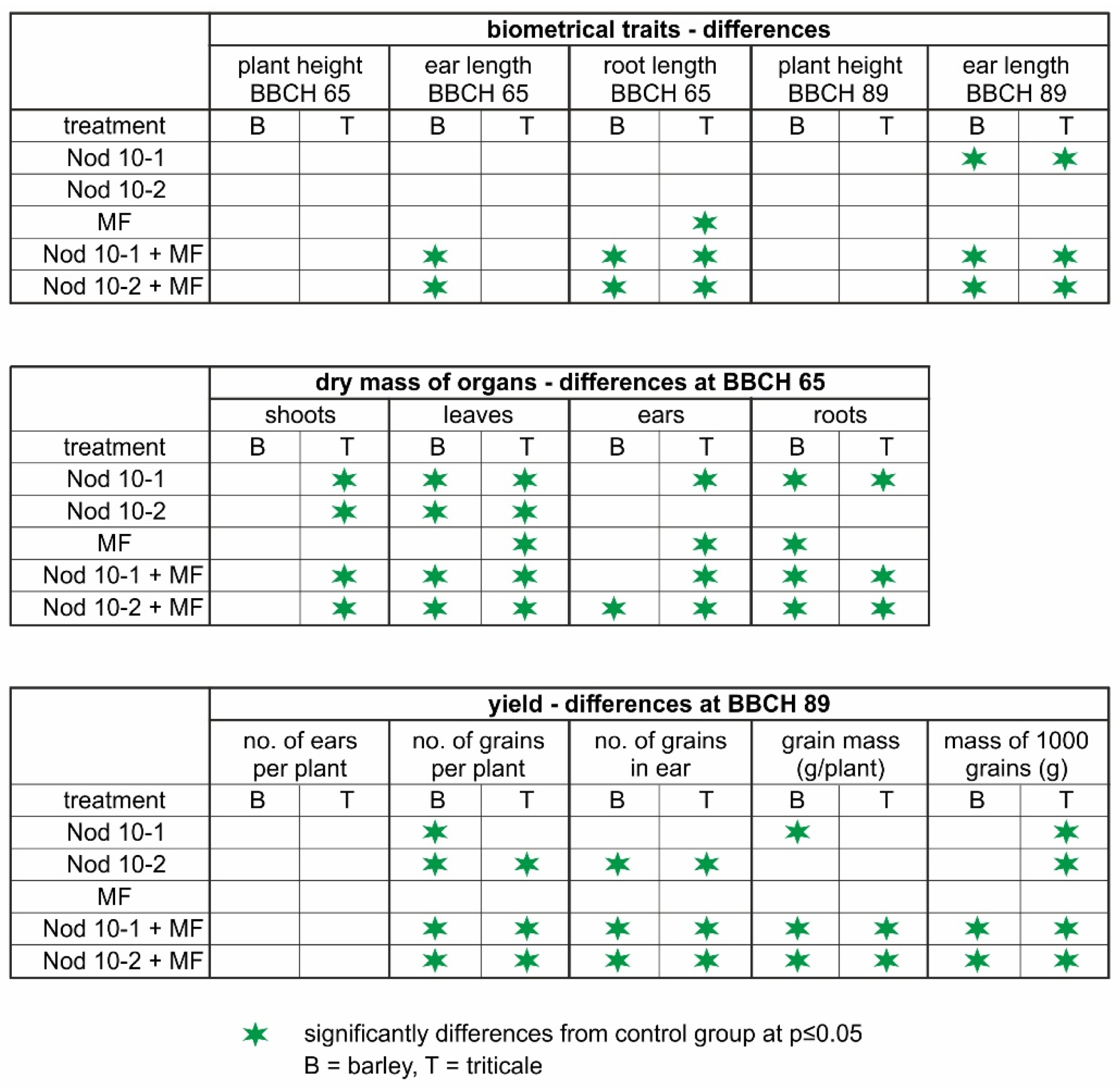
As shown in Table 1, Table 2 and Table 3, different concentrations of LCO applied alone or in combination with MF had different effects on the growth of individual parts of barley and triticale as well as on their yield. Despite many differences in the values of the measured parameters, a common pattern can be observed (Figure 1).
Root dry mass increased significantly both after the application of LCO alone at the higher dose and after the application of both doses of LCO in combination with MF. This effect was observed in both barley and triticale, and our results showing the stimulation of root growth by LCOs are in agreement with other research indicating that the application of rhizobial LCOs can enhance growth of legume and non-legume root systems [35,40,41]. Better root growth may be the result of two effects that have been described after the use of LCOs in various plant species. In the case of Arabidopsis, a faster elongation of existing roots was observed [40], while in Brachypodium the promotion of lateral root formation was observed [33] after LCO treatment. At the same time, no significant increase in plant height was recorded in any of these cereals—neither at BBCH—65, nor at BBCH—89. This allows us to assume that the use of such preparations in field conditions may not result in an increased risk of lodging, which reduces the yield and increases the costs of harvesting [42].
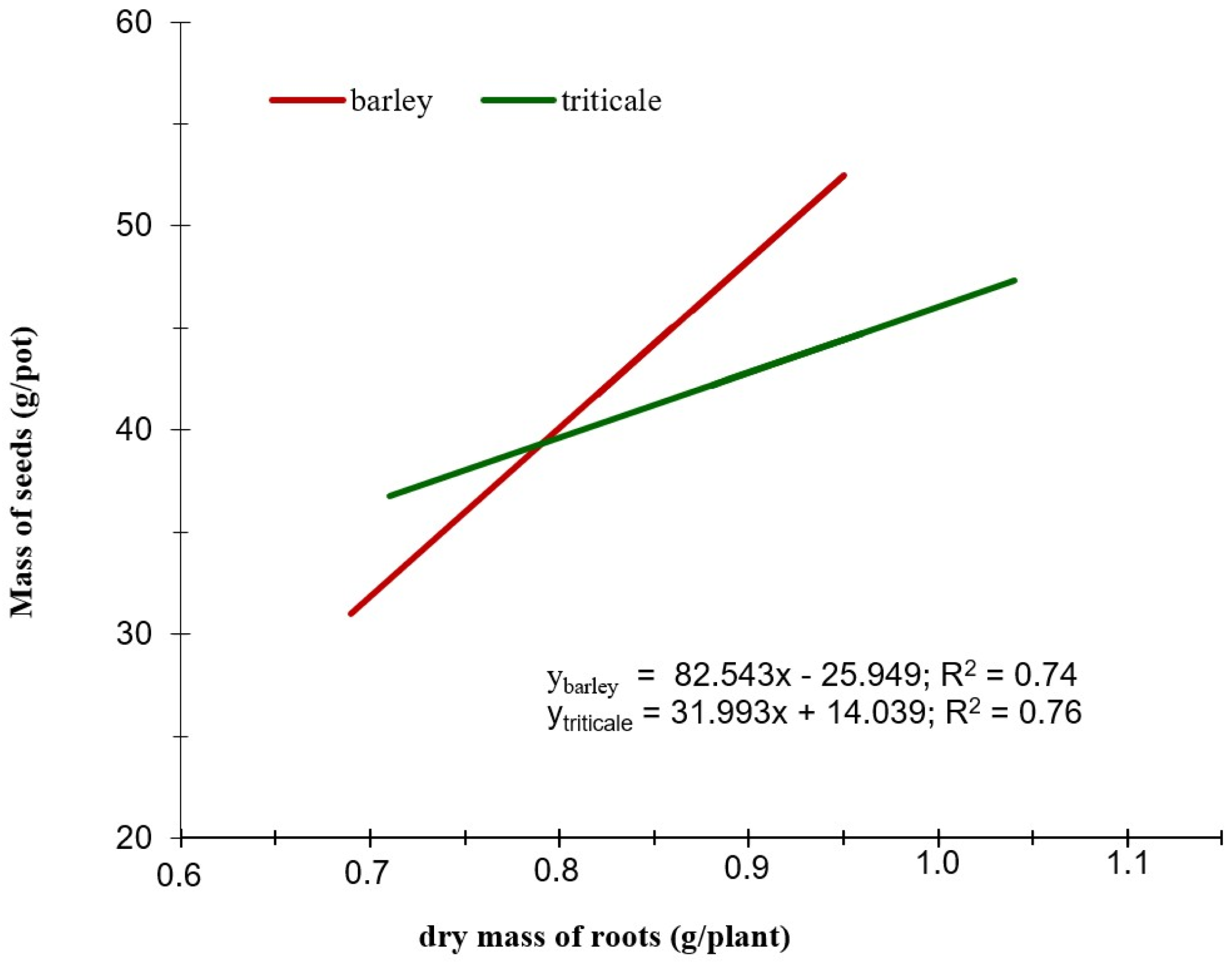
The investigations of the relationships between plant growth and yield parameters revealed a positive correlation between the dry mass of roots and the mass of seeds per pot in both barley and triticale (Figure 2). It can be speculated that an increase in yield may be a result of better growth of roots, which could provide more water and nutrients for plants.
Taking into account the yield-enhancing effect of the preparations used, two different phenomena can be distinguished. The combined use of LCO + MF preparations significantly increased 1000-seed weight, which can be considered a positive qualitative effect. At the same time, this treatment significantly increased the number of grains per ear, which can be considered a positive quantitative effect (Table 3, Figure 2). The observed increase in the number of grains per spike is very interesting because the number of grains per spike is a complex trait controlled by many genes, and the final effect is the result of a complicated developmental process involving the activity of numerous meristems [43]. The change in this trait in the tested cereals after the LCO treatment is analogous to the situation observed in other plants—for example in pea [22] and in tomato [21], where pod number per plant or fruit number per plant, respectively, increased after the application of LCOs. Taking into consideration that roots of monocotyledonous and non-legume dicotyledonous plants can respond to LCO treatment in a similar manner [33,41], it can be speculated that the crop yield increase observed in barley and triticale in the present experiments may be a result of morphogenetic effects of LCOs on secondary meristems of roots (resulting in enhanced root formation) and shoots (resulting in stimulation of floral meristems).

5. Conclusions

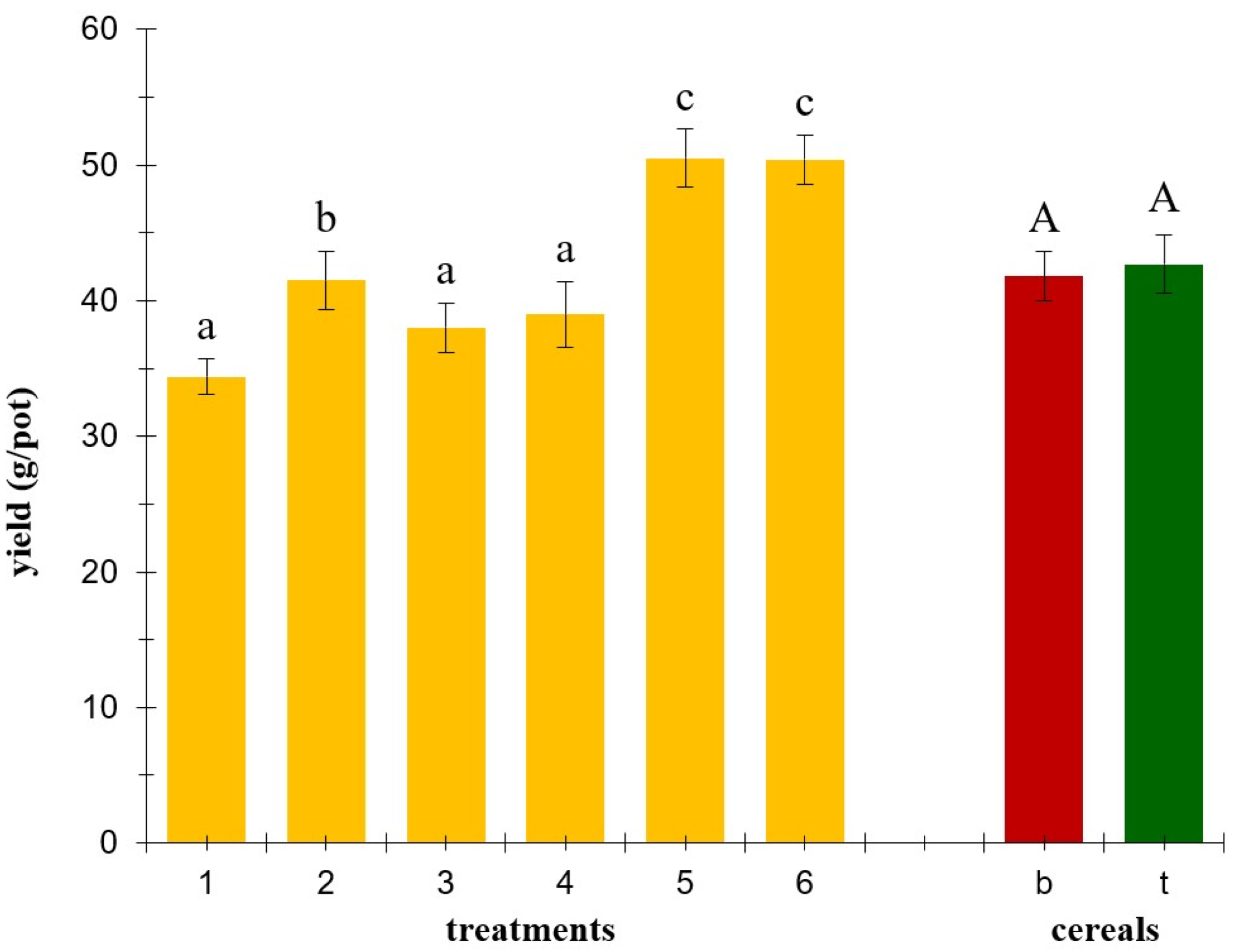
The application of new formulations containing rhizobial LCOs and/or MF to barley and triticale grown in a greenhouse resulted in improvement of various plant traits. The application of MF alone significantly increased the dry mass of plant organs; however, it did not affect the yield in the same manner (Table 2, Figure 1). In contrast, the application of LCO or LCO + MF significantly increased the yield of grain per pot. The best results were achieved in the LCO + ME treatment, where, regardless of the LCO concentration used, an increase of approximately 40% was noted compared to the control group (Figure 3). This increase was attributable to a significant increase in both the number of grains per spike and the 1000-seed weight (Table 3).
The LCO treatment was not a universal factor stimulating the yield of the tested cereals. In the case of the LCO 10−2 group, no significant yield-enhancing effect was observed, probably due to the use of the insufficient dose of bacterial metabolites. However, it seems that the use of the combined LCO + MF preparation eliminates the risk associated with using an insufficient amount of LCO and results in the highest yields. Further field experiments are necessary to confirm the effectiveness of LCO-based formulations under agronomic conditions, however, presented results suggest that such biopreparations can be successfully used not only in the cultivation of legumes, but also in the case of cereals.

Author Contributions

Conceptualization, J.P., A.P. and J.W.; methodology, J.P. and A.P.; validation, J.P., A.P. and H.K.; formal analysis,. J.P., A.P. and H.K.; investigation, J.P., A.P. and D.K.; resources, J.P., A.P. and A.S.-B.; data curation, J.P., A.P., J.W. and H.K.; writing—original draft preparation, J.P., A.P., D.K. and J.W.; writing—review and editing, J.W. and D.K.; visualization, J.P., A.P. and J.W.; supervision, A.P.; project administration, J.P. All authors have read and agreed to the published version of the manuscript.

Funding

This research received no external funding.

Data Availability Statement

The original contributions presented in this study are included in the article. Further inquiries can be directed to the corresponding author.

Conflicts of Interest

The authors declare no conflicts of interest.

References

  1. McKevith, B. Nutritional aspects of cereals. Br. Nutr. Found. Nutr. Bull. 2004, 29, 111–142. [Google Scholar] [CrossRef]
  2. Sawar, M.H.; Sawar, M.F.; Sawar, M.; Qadri, N.A.; Moghal, S. The importance of cereals (Poaceae: Gramineae) nutrition in human health: A review. J. Cereals Oilseeds 2013, 4, 32–33. [Google Scholar] [CrossRef]
  3. Kowieska, A.; Lubowicki, R.; Jaskowska, I. Chemical composition and nutritional characteristics of several cereal grain. Acta Sci. Pol. Zootech. 2011, 10, 37–50. [Google Scholar]
  4. Wicki, L. Influence of biological improvements gained in new varieties on yields and production of cereals in Poland. Annals of Agricultural Science. Ser. G Econ. 2008, 94, 136–146. [Google Scholar] [CrossRef]
  5. Fischer, R.A.; Edmeades, G.O. Breeding and Cereal Yield Progress. Crop Sci. 2010, 50, 85–98. [Google Scholar] [CrossRef]
  6. Geisseler, D.; Scow, K.M. Long-term effects of mineral fertilizers on soil microorganisms—A review. Soil Biol. Biochem. 2014, 75, 54–63. [Google Scholar] [CrossRef]
  7. Sabry, A.K. Synthetic fertilizers; role and hazards. Fertil. Technol. 2015, 1, 110–133. [Google Scholar] [CrossRef]
  8. Chandini, R.K.; Kumar, R.; Om, P. The impact of chemical fertilizers on our environment and ecosystem. In Research Trends in Environmental Sciences, 2nd ed.; Scientific Research Publishing: Chengdu, China, 2019; pp. 69–86. Available online: https://www.researchgate.net/publication/331132826 (accessed on 30 January 2026).
  9. Rouphael, Y.; Colla, G. Synergistic biostimulatory action: Designing the next generation of plant biostimulants for sustainable agriculture. Front. Plant Sci. 2018, 9, 1655. [Google Scholar] [CrossRef]
  10. Sudheer, S.; Bai, R.G.; Usmani, Z.; Sharma, M. Insights on engineered microbes in sustainable agriculture: Biotechnological developments and future prospects. Curr. Genom. 2020, 21, 321–333. [Google Scholar] [CrossRef]
  11. Garg, S.; Nain, P.; Kumar, A.; Joshi, S.; Punetha, H.; Sharma, P.K.; Siddiqui, S.; Alshaharni, M.O.; Algopishi, U.B.; Mittal, A. Next generation plant biostimulants & genome sequencing strategies for sustainable agriculture development. Front. Microbiol. 2024, 15, 1439561. [Google Scholar] [CrossRef]
  12. Herridge, D.F.; Peoples, M.B.; Boddey, R.M. Global inputs of biological nitrogen fixation in agricultural systems. Plant Soil 2008, 311, 1–18. [Google Scholar] [CrossRef]
  13. Peoples, M.B.; Brockwell, J.; Herridge, D.F.; Rochester, I.J.; Alves, B.J.R.; Urquiaga, S.; Boddey, R.M.; Dakora, F.D.; Bhattarai, S.; Maskey, S.L.; et al. The contribution of nitrogen-fixing crop legumes to the productivity of agricultural systems. Symbiosis 2009, 48, 1–17. [Google Scholar] [CrossRef]
  14. D’Haeze, W.; Holsters, M. Nod factor structures, responses, and perception during initiation of nodule development. Glycobiology 2002, 12, 79R–105R. [Google Scholar] [CrossRef] [PubMed]
  15. Lee, A.; Hirsch, A.M. Choreographing the complex interaction between legumes and α- and β-rhizobia. Plant Signal. Behav. 2006, 4, 161–168. [Google Scholar] [CrossRef]
  16. Jones, K.M.; Kobayashi, H.; Davies, B.W.; Taga, M.E.; Walker, G.C. How rhizobial symbionts invade plants: The Sinorhizobium-Medicago model. Nat. Rev. Microbiol. 2007, 5, 619–633. [Google Scholar] [CrossRef]
  17. Souleimanov, A.; Prithiviraj, B.; Smith, D.L. The major Nod factor of Bradyrhizobium japonicum promotes early growth of soybean and corn. J. Exp. Bot. 2002, 53, 1929–1934. [Google Scholar] [CrossRef]
  18. Prithiviraj, B.; Zhou, X.; Souleimanov, A.; Khan, W.M.; Smith, D.L. A host-specific bacteria-to-plant signal molecule (Nod factor) enhances germination and early growth of diverse crop plants. Planta 2003, 216, 437–445. [Google Scholar] [CrossRef]
  19. Nandhini, D.U.; Somasundaram, E.; Amanullah, M.M. Effect of Rhizobial Nod Factors (Lipo-chitooligosaccharide) on Seedling Growth of Blackgram under Salt Stress. Legume Res.-Int. J. 2017, 41, 159–162. [Google Scholar] [CrossRef]
  20. Miransari, M.; Smith, D. Rhizobial Lipo-Chitooligosaccharides and Gibberellins Enhance Barley (Hordeum vulgare L.) Seed Germination. Biotechnology 2009, 8, 270–275. [Google Scholar] [CrossRef]
  21. Chen, C.; McIver, J.; Yang, Y.; Bai, Y.; Schultz, B.; McIver, A. Foliar application of lipo-oligosachcarides (Nod factors) to tomato (Lycopersicon esculentum) enhances flowering and fruit production. Can. J. Plant Sci. 2007, 87, 365–372. [Google Scholar] [CrossRef]
  22. Podleśny, J.; Wielbo, J.; Podleśna, A.; Kidaj, D. The pleiotropic effects of extract containing rhizobial Nod factors on pea growth and yield. Cent. Eur. J. Biol. 2014, 9, 396–409. [Google Scholar] [CrossRef]
  23. Van Velzen, R.; Holmer, R.; Bu, F.; Rutten, L.; van Zeijl, A.; Liu, W.; Santuari, L.; Cao, Q.; Sharma, T.; Shen, D.; et al. Comparative genomics of the nonlegume Parasponia reveals insights into evolution of nitrogen-fixing rhizobium symbioses. Proc. Natl. Acad. Sci. USA 2018, 115, 4700–4709. [Google Scholar] [CrossRef]
  24. Mello, A.; Balestrini, R. Recent insights on biological and ecological aspects of ectomycorrhizal fungi and their interactions. Front. Microbiol. 2018, 9, 216. [Google Scholar] [CrossRef]
  25. Sherpa, P.; Acharya, K.; Sarkar, A. Arbuscular mycorrhizal fungi and sustainable agriculture: A review. Indian Phytopathol. 2025, 78, 775–787. [Google Scholar] [CrossRef]
  26. Cope, K.R.; Bascaules, A.; Irving, T.B.; Venkateshwaran, M.; Maeda, J.; Garcia, K.; Rush, T.A.; Ma, C.; Labbé, J.; Jawdy, S.; et al. The Ectomycorrhizal Fungus Laccaria bicolor Produces Lipochitooligosaccharides and Uses the Common Symbiosis Pathway to Colonize Populus Roots. Plant Cell 2019, 31, 2386–2410. [Google Scholar] [CrossRef] [PubMed]
  27. Maillet, F.; Poinsot, V.; André, O.; Puech-Pagès, V.; Haouy, A.; Gueunier, M.; Cromer, L.; Giraudet, D.; Formey, D.; Niebel, A.; et al. Fungal Lipochitooligosaccharide Symbiotic Signals in Arbuscular Mycorrhiza. Nature 2011, 469, 58–63. [Google Scholar] [CrossRef]
  28. Rush, T.A.; Puech-Pagès, V.; Bascaules, A.; Jargeat, P.; Maillet, F.; Haouy, A.; Maës, A.Q.; Carriel, C.C.; Khokhani, D.; Keller-Pearson, M.; et al. Lipo-chitooligosaccharides as regulatory signals of fungal growth and development. Nat. Commun. 2020, 11, 3897. [Google Scholar] [CrossRef] [PubMed]
  29. Zhu, H.; Riely, B.K.; Burns, N.J.; Ané, J.-M. Tracing nonlegume orthologs of legume genes required for nodulation and arbuscular mycorrhizal symbioses. Genetics 2006, 17, 2491–2499. [Google Scholar] [CrossRef]
  30. Krönauer, C.; Radutoiu, S. Understanding Nod Factor Signalling Paves the Way for Targeted Engineering in Legumes and Non-Legumes. Curr. Opin. Plant Biol. 2021, 62, 102026. [Google Scholar] [CrossRef]
  31. Subramanian, S.; Mitkus, E.; Souleimanov, A.; Smith, D.L. Lipo-Chitooligosaccharide and Thuricin 17 Act as Plant Growth Promoters and Alleviate Drought Stress in Arabidopsis thaliana. Front. Microbiol. 2023, 14, 1184158. [Google Scholar] [CrossRef]
  32. Schwinghamer, T.; Souleimanov, A.; Dutilleul, P.; Smith, D. Supplementation with Solutions of Lipo-Chitooligosacharide Nod Bj V (C18:1, MeFuc) and Thuricin 17 Regulates Leaf Arrangement, Biomass, and Root Development of Canola (Brassica napus [L.]). Plant Growth Regul. 2016, 78, 31–41. [Google Scholar] [CrossRef]
  33. Buendia, L.; Maillet, F.; O′Connor, D.; van de-Kerhove, Q.; Danoun, S.; Gough, C.; Lefebvre, B.; Bensmihen, S. Lipo-oligosaccharide promote lateral root formation and modify auxin homeostasis in Brachypodium distachyn. New Phytol. 2018, 221, 2190–2202. [Google Scholar] [CrossRef] [PubMed]
  34. Tanaka, K.; Cho, S.-H.; Lee, H.; Pham, A.Q.; Batek, J.M.; Cui, S.; Qiu, J.; Khan, S.M.; Joshi, T.; Zhang, Z.J.; et al. Effect of Lipo-Chitooligosaccharide on Early Growth of C4 Grass Seedlings. J. Exp. Bot. 2015, 66, 5727–5738. [Google Scholar] [CrossRef] [PubMed]
  35. Khan, W.; Prithiviraj, B.; Smith, D.L. Nod Factor [Nod Bj V (C(18:1), MeFuc)] and Lumichrome Enhance Photosynthesis and Growth of Corn and Soybean. J. Plant Physiol. 2008, 165, 1342–1351. [Google Scholar] [CrossRef]
  36. Nandhini, D.U.; Somasundaram, E. Effects of Rhizobial Nod Factors (Lipo chitooligosaccharide) on Seedling Growth of Maize (Zea mays L.) under Salt Stress. Bangladesh J. Bot. 2018, 47, 831–837. [Google Scholar] [CrossRef]
  37. Wielbo, J.; Marek-Kozaczuk, M.; Kubik-Komar, A.; Skorupska, A. Increased metabolic potential of Rhizobium spp. is associated with bacterial competitiveness. Can. J. Microbiol. 2007, 53, 957–967. [Google Scholar] [CrossRef]
  38. Maj, D.; Wielbo, J.; Marek-Kozaczuk, M.; Skorupska, A. Response to flavonoids as a factor influencing competitiveness and symbiotic activity of Rhizobium leguminosarum. Microbiol. Res. 2010, 165, 50–60. [Google Scholar] [CrossRef]
  39. Maj, D.; Wielbo, J.; Marek-Kozaczuk, M.; Martyniuk, S.; Skorupska, A. Pretreatment of clover seeds with Nod factors improves growth and nodulation of Trifolium pratense. J. Chem. Ecol. 2009, 35, 479–487. [Google Scholar] [CrossRef]
  40. Khan, W.; Costa, C.; Souleimanov, A.; Prithviraj, B.; Smith, D.L. Response of Arabidopsis thaliana roots to lipo-oligosaccharide from Bradyrhizobium japonicum and other chitin-like compounds. Plant Growth Regul. 2011, 63, 243–249. [Google Scholar] [CrossRef]
  41. Siczek, A.; Lipiec, J.; Wielbo, J.; Szarlip, P.; Kidaj, D. Pea growth and symbiotic activity response to Nod factors (lipo-chitooligosaccharides) and soil compaction. Appl. Soil Ecol. 2013, 72, 181–186. [Google Scholar] [CrossRef]
  42. Telkar, S.G.; Solanki, S.P.S.; Chouhan, S.; Kumar, R.; Nikas, S.B. Crop lodging on cereals: Causes, effect and control. Biomol. Rep. 2017. Available online: https://www.researchgate.net/publication/321034837_Crop_Lodging_on_Cereals_Causes_Effect_and_Control_Introduction (accessed on 30 January 2026).
  43. Mizuno, N.; Ishikawa, G.; Kojima, H.; Tougou, M.; Kiribuchi-Otobe, C.; Fujita, M.; Nakamura, K. Genetic mechanisms determining grain number distribution along the spike and their effect on yield components in wheat. Mol. Breed. 2021, 41, 62. [Google Scholar] [CrossRef]
Figure 1. Statistically significant differences between the control group (H2O treatment) and the experimental groups (LCO and/or MF treatment)—only cases in which the values for the experimental groups were higher than for the control group are marked.
Agronomy 16 00723 g001
Figure 2. Relationships between mass of roots and grain yield in barley and triticale.
Agronomy 16 00723 g002
Figure 3. Mean yield of grain per pot. Group description: 1 = deionized water (control group); 2 = LCO 10−1 (preparation of LCO:water 1:9 v/v); 3 = LCO 10−2 (preparation of LCO:water 1:99 v/v); 4—MF (mineral fertilization); 5 = LCO 10−1 + MF; 6 = LCO 10−2 + MF; b = barley (mean for all experimental groups); t = triticale (mean for all experimental groups). Means ± SE. Values with the same letter did not differ at p < 0.05.
Agronomy 16 00723 g003
Table 1. Biometrical traits of barley and triticale plants at flowering (BBCH 65) and full maturity (BBCH 89).
TraitTreatment *Flowering
(BBCH 65)
Full Maturity (BBCH 89)
BarleyTriticaleBarleyTriticale
Plant height (cm)H2O67.198.567.099.7
LCO 10−167.7102.170.1101.9
LCO 10−268.5102.167.9101.6
MF67.099.866.8100.5
LCO 10−1 + MF67.7103.767.5101.6
LCO 10−2 + MF68.7102.969.5104.1
LSD (p ≤ 0.05)n.s.n.s.n.s.n.s.
Ear length (cm)H2O7.839.507.159.31
LCO 10−18.4010.007.569.17
LCO 10−28.4010.007.339.44
MF8.209.607.169.57
LCO 10−1 + MF8.739.977.6310.48
LCO 10−2 + MF8.649.907.8610.43
LSD (p ≤ 0.05)0.661n.s.0.4480.634
Root length (cm)H2O18.719.5n.d.n.d.
LCO 10−121.925.1n.d.n.d.
LCO 10−220.723.8n.d.n.d.
MF20.222.4n.d.n.d.
LCO 10−1 + MF23.225.3n.d.n.d.
LCO 10−2 + MF21.424.3n.d.n.d.
LSD (p ≤ 0.05)1.444.93--
* H2O = deionized water (control group); LCO 10−1 = preparation of LCO factors:water 1:9 v/v; LCO 10−2 = preparation of LCO:water 1:99 v/v; MF = macro- and microelement composition; LCO 10−1 + MF = preparation of LCO:water 1:9 v/v together with macro- and microelement composition; LCO 10−2 + MF = preparation of LCO:water 1:99 v/v together with macro- and microelement composition. n.s. = differences not significant at p < 0.05. n.d = not determined.
Table 2. Dry mass of the main organs of barley and triticale plants at flowering (BBCH 65) (g per plant).
Plant OrgansTreatment *BarleyTriticale
ShootsH2O2.142.41
LCO 10−12.243.50
LCO 10−22.183.32
MF2.172.46
LCO 10−1 + MF2.183.02
LCO 10−2 + MF2.233.41
LSD (p ≤ 0.05)n.s.0.524
LeavesH2O1.151.26
LCO 10−11.391.48
LCO 10−21.391.38
MF1.281.49
LCO 10−1 + MF1.431.44
LCO 10−2 + MF1.351.43
LSD (p ≤ 0.05)0.1440.128
EarsH2O2.681.13
LCO 10−12.701.74
LCO 10−22.701.48
MF2.731.86
LCO 10−1 + MF2.761.80
LCO 10−2 + MF2.921.78
LSD (p ≤ 0.05)0.2140.446
RootsH2O0.690.71
LCO 10−10.860.96
LCO 10−20.820.89
MF0.880.88
LCO 10−1 + MF0.950.92
LCO 10−2 + MF0.871.04
LSD (p ≤ 0.05)0.1650.182
* H2O = deionized water (control group); LCO 10−1 = preparation of LCO factors:water 1:9 v/v; LCO 10−2 = preparation of LCO:water 1:99 v/v; MF = mineral fertilization; LCO 10−1 + MF = preparation of LCO:water 1:9 v/v together with mineral fertilization; LCO 10−2 + MF = preparation of LCO:water 1:99 v/v together with mineral fertilization. n.s. = differences not significant at p < 0.05.
Table 3. Yield and its components at full maturity stage (BBCH 89).
Yield ElementTreatment *BarleyTriticale
Number of ears per plantH2O5.262.83
LCO 10−15.542.83
LCO 10−25.372.79
MF5.522.88
LCO 10−1 + MF5.602.91
LCO 10−2 + MF5.812.76
LSD (p ≤ 0.05)n.s. n.s.
Number of grains per plantH2O110.7146.9
LCO 10−1123.0150.2
LCO 10−2121.0153.2
MF117.6141.4
LCO 10−1 + MF121.4155.2
LCO 10−2 + MF129.8160.0
LSD (p ≤ 0.05)9.245.68
Number of grains per earH2O20.748.9
LCO 10−122.456.5
LCO 10−222.855.7
MF21.450.5
LCO 10−1 + MF22.757.0
LCO 10−2 + MF22.759.3
LSD (p ≤ 0.05)1.747.64
Grain mass (g/plant)H2O3.163.72
LCO 10−14.164.13
LCO 10−23.354.24
MF3.534.26
LCO 10−1 + MF5.474.59
LCO 10−2 + MF5.414.66
LSD (p ≤ 0.05)0.3840.558
Mass of 1000 grains (g)H2O40.025.4
LCO 10−144.430.9
LCO 10−244.433.0
MF43.626.2
LCO 10−1 + MF44.928.3
LCO 10−2 + MF45.229.0
LSD (p ≤ 0.05)4.672.46
* H2O = deionized water (control group); LCO 10−1 = preparation of LCO factors:water 1:9 v/v; LCO 10−2 = preparation of LCO:water 1:99 v/v; MF = mineral fertilization; LCO 10−1 + MF = preparation of LCO:water 1:9 v/v together with mineral fertilization; LCO 10−2 + MF = preparation of LCO:water 1:99 v/v together mineral fertilization. n.s. = differences not significant at p < 0.05.
Disclaimer/Publisher’s Note: The statements, opinions and data contained in all publications are solely those of the individual author(s) and contributor(s) and not of MDPI and/or the editor(s). MDPI and/or the editor(s) disclaim responsibility for any injury to people or property resulting from any ideas, methods, instructions or products referred to in the content.