Review

Flowering, Dormancy, Yield Formation and Food Quality in Yam (Dioscorea spp.): Implications for Crop Improvement and Sustainability


by
Joy Geraldine Emerald
1,
Paul Ifeanyi Ekeledo
1,
Jude Ejikeme Obidiegwu
1,2 and
Cynthia Adaku Chilaka
3,*
1
National Root Crops Research Institute, Umudike, Km 8 Ikot Ekpene Road, PMB 7006, Umuahia 440101, Nigeria
2
Federal Cooperative College, PMB 017, Oji River 401120, Nigeria
3
Institute for Global Food Security, School of Biological Sciences, Queen’s University Belfast, 19 Chlorine Gardens, Belfast BT9 5DL, UK
*
Author to whom correspondence should be addressed.
Agronomy 2026, 16(7), 724; https://doi.org/10.3390/agronomy16070724

Submission received: 3 January 2026 / Revised: 10 February 2026 / Accepted: 19 February 2026 / Published: 30 March 2026
(This article belongs to the Section Plant-Crop Biology and Biochemistry)

Abstract

Yam is a tuberous crop with great potential for enhancing food security and rural development thus contributing significantly to the lives of people in production areas. Despite its importance, productivity is low, with poor adoption rates of released commercial varieties. Yam exhibits complex growth patterns, including tuberization and dormancy. The yield, food quality and consumer preferences differ by variety. Understanding the dynamics of yam production system and best practices is critical for its improvement. Our review delved into the flowering dynamics as well as yield determinants. We dissected the phenomena of dormancy, photosynthesis, photoperiodism and food quality with a view to adding values on crop improvement efforts. Yam production systems can be repositioned to play a greater role in sustainable food security and poverty alleviation through the development and deployment of more productive, profitable and resilient yam varieties and sustainable technologies that will improve the current yam cropping system and value chain. Future research perspectives focusing on yield improvement, climate-smart adaptations/cultivation practices, and value chain development to ensure sustainable yam production and utilization are thus highlighted.

1. Introduction

The family Dioscoreaceae is probably one of the oldest groups among the angiosperms and appears to have originated in Southeast Asia [1]. Yam is a multi-species tuber crop grown as food in the tropics. West Africa produces about 95.6% (85.4 million tons) of yam in the world [2,3], mostly cultivated in the forest and derived forest–savannah transition agroecological zones. The major sites of domestication of food yams include tropical regions of Africa, Southeast Asia, and South America. The greater yam (D. alata) appears to have originated in the northcentral parts of the southeast Asian peninsula [4]. Scarcelli et al. [5] reported that cultivated Africa white yam (D. rotundata) was domesticated from forest species D. praehensilis, while Sugihara et al. [6] holds the view that Africa white yam is most likely a homoploid hybrid between D. abyssinica and D. praehensilis. This postulation had been proposed earlier [7]. The Asiatic and African yams were transported significantly within the post-Columbian era. Further transportation of these yams was observed during the slave trade with the African movement of D. alata and D. rotundata to the Caribbean [4]. There has been virtually no movement of American food yams to the Old World, or of African species to Asia, until modern transfers of experimental materials [8].
Dioscorea rotundata (white yam) and D. alata (water yam) dominate the production landscape in West Africa. About 60 million smallholder farmers and their households depend on it as food and a source of income. Yams contain about 21% dietary fiber and are rich in carbohydrates, vitamin C, potassium, manganese and other essential minerals [9,10]. Yam tubers may be eaten boiled, fried, or roasted with sauce. Yams can also be cooked into pottage with added protein and oils [11]. In West Africa, a popular preparation method involves boiling the tubers and pounding them into a thick, elastic dough called pounded yam or fufu, typically served with soup. Another common dish, made from dried yam flour, is known as amala in Nigeria and konkonte in Ghana, and is prepared by stirring the flour into hot water to form a smooth paste [11,12]. It is in the pounded form that yam takes its spiritual, social, and festive connotation. Pounded yam is the food given to highly regarded guests in traditional yam-consuming areas. To people who traditionally eat yam, the tuber is not mere food, it is venerated as the very staff of life [13]. Yam flour is also used in the preparation of composite flour involving cereals or legumes [14,15]. It is noteworthy to highlight that, due to exports and urban market drive, the market for dry flakes and flour products processed from raw tubers in Nigeria, Ghana, and Côte d’Ivoire is on the rise [11]. The yam growth cycle can extend up to 12 months, from germination, shoot emergence to senescence, depending on many factors like variety and growing condition. Conventionally, yams are cultivated on mounds after slashing and burn using seed tubers that contain a part of the epidermis. However, improved cultivation methods like planting on ridges has proven to be a better cultivation method [16,17]. Yam has evolved from a food security crop to a cash crop enabling smallholder farmers to generate income from its production. The ware and seed yam is a major source of income within the value chain [18]. This economic potential is significantly impaired with production decline with most farmers recording less than 10 t ha−1 as compared to potential yield of 60 t ha−1 [19]. Achieving optimum yam yields requires the use of high-quality planting materials and proper crop management, with effective weed control being essential for early development of an adequate leaf canopy. Suitable temperatures, ranging from 25 to 30 °C during peak canopy growth, are also important. Nonetheless, the primary limitations to yam production are poor-quality planting materials, traditional cultivation methods, and the crop’s high labor demands. Nitrogen (N), phosphorus (P), and potassium (K) are required significantly in production fields [2]. Within the cultural production systems in West Africa, tradition and myths have hindered its cultivation with inputs such as fertilizers [13].
Dormancy, flowering behavior, photosynthetic efficiency, yield determinants, and food quality traits are key drivers shaping the productivity, adoption, and sustainability of yam (Dioscorea spp.) production systems in West Africa, where the crop is vital for food security and rural livelihoods. Dormancy influences sprouting and planting synchronization under variable climatic conditions, while environment-sensitive flowering patterns affect breeding efficiency and genetic improvement. Photosynthesis underpins biomass accumulation and tuber development and interacts with major yield determinants such as soil fertility, water availability, and source–sink relationships, which are often constrained by declining soil quality and suboptimal management. Food quality attributes, including cooking quality and storability, strongly influence varietal acceptance and market value. Despite their importance, these factors are frequently studied in isolation. This review synthesizes current knowledge on these interconnected drivers and examines how their integration with sustainable management practices can enhance yam productivity, resilience, and long-term food security.
This review seeks to elucidate yam in terms of (i) growth cycle and development (ii) floral dynamics towards crop improvement and (iii) agronomic practices cum physiological mechanisms associated with sustainable growth and yield, dormancy and photosynthetic process.

2. Yam Botany

Yams are herbaceous climbers considered as annuals in cultivation. Yams produce tubers or rhizomes from which the stem and roots emerge [20]. The roots and tubers grow from a massive corm-like structure at the base of the stem [21,22]. The size of the corm is usually massive in wild species, relatively large in D. cayenensis and much smaller in D. alata and D. rotundata [21]. Yams possess a fibrous root system. Most of the roots lie close to the surface of the soil, within 30 cm of soil and only a few of them penetrate deeper [21]. The roots of many species bear spines, which is generally more in wild species than their cultivated relatives [22]. The stem of yam is weak, rope-like in structure and climbs by twining [20]. The direction of twining is peculiar to each section in the genus Dioscorea [22]. The stems of many species are armed to a greater or lesser degree with spines. Some species like D. alata and D. colocasifolia have winged stems [20]. There is considerable variation in the shape, size and color of yam leaves. The laminar is simple except in D. hispida and D. dumetorum which have trifoliate compound leaves [21]. The shape of the yam tuber is highly variable depending on the species. The shape and size are determined by genetic factors and soil conditions [21]. The edible yams belonging to the section Enantiophylum produce between one and three tubers. Members in the section Lasiophyton are often found with several medium sized tubers that are fused together into an irregular cluster. Dioscorea esculenta and D. trifida produce a larger number of small and spindled-shaped tubers [20]. Some yam species have the ability to produce aerial tubers (bulbils). Bulbils usually develop in axils of young leaves on mature plants [22]. In D. alata, the bulbil represents a minor storage structure compared with the underground tuber, while in many D. bulbifera clones, the bulbil is the main storage organ, with minimal or no underground tuber development [20].

2.1. Yam Taxonomy

Yams, Dioscorea spp., are members of the genus Dioscorea. The genus, by far the largest of the family Dioscoreaceae, was reported as comprising 600 species [1]. It was first placed under the aerial yam in the order Hexandria. Later, the genus was placed under the order Liliiflorae and sub-order Liliineae [23]. Other classifications by Burkill [1], and Ayensu [24] placed the genus under the order Dioscoreales. This order is generally classified under the monocotyledons. Most of the Dioscorea species are twining climbers and are tuberous, though primitive species produce rhizomes. The stems climb by twining and produce moderate to profuse branches in many species [23]. Based on morphological characters, Burkill [1] further divided the genus into a number of sections. The five most important sections are Enantiophyllum, Lasiophyton, Combilium, Opsophyton and Macrogynodium. Yams vary a great deal, and the direction of twining is specific to species of different sections. The major edible yams—D. rotundata, D. alata, and D. cayenensis—and minor species D. opposita and D. japonica are placed in the section Enantiophylum, characterized by clockwise-twining (dextrorse) vines. Other species are classified as follows: D. dumetorum and D. hispida in Lasiophyton, D. bulbifera in Opsophyton, D. esculenta in Combilium, and D. trifida in Macrogynodium. All species in the latter four sections are characterized by vines, which twine to the left, that is, in a senistrose or anticlockwise direction [23].

2.2. Flowering Dynamics and Sex Expression Patterns in Yam

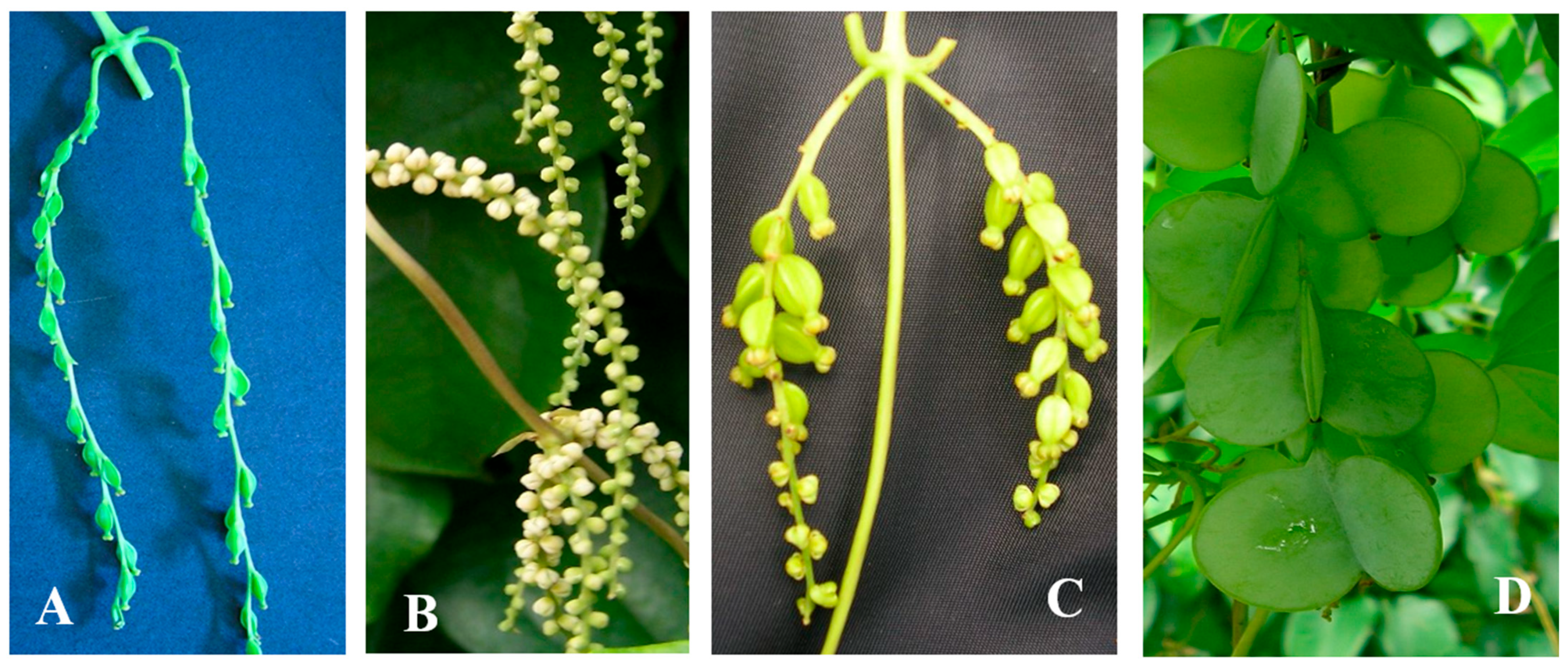
They are vegetatively propagated dioecious species with distinctly different male and female flowers borne on separate plants [25,26,27]. Occasionally, some monoecious plants which mostly bear male flowers in addition to bisexual and female flowers occur [28,29,30]. Yam flowers are small and are borne on spikes from leaf axils, with 1–2 female spikes per axil and 2–12 in males [23,28,31] (Figure 1). Male flowers are borne on spikes that are attached to terminal or axillary panicles while female flowers are produced on hanging axillary spikes [30]. Flower production is generally higher on sexual progenies than on clonal materials. Sexually propagated male and female plants usually produce between 500 and 90,000 and 500–11,000 flowers respectively, whereas 185 flowers are the common maximum on vegetatively propagated female plants [32].
Maturation of male flowers occurs in 4 weeks, whereas female flowers mature 3 weeks after the visible initiation of the floral primordium in the leaf axils [30]. The spikes of the male flowers are relatively shorter as compared to the female/hermaphrodites. It is interesting to note that the male spikes produce more flowers when compared to female/hermaphrodite spikes [33]. The flowers on both male and female spikes adopt acropetal succession in opening [28] thus resulting in a 100–200 µm three-way slit [34,35]. Staminate flowers are 2.5 mm long and 1–3 mm in diameter [27,34,35]. They are sessile, globular and are closely arranged on spikes [26,30]. The sepals and petals are typically alike in size and color. The androecium is made up of two whorls of three stamens each, with anthers attached at their base to short, partially fused filaments. The small and sticky pollen grains are highly vacuolated thus impairing wind pollination. The staminate flowers encourage afternoon pollination when they are usually open [35]. Two ovules are seen in each locule with significant axial placentation. At maturity, whether fertilization occurs or not, the perianth dries up, while the ovary develops into a capsule that opens vertically to release seeds, which are encased in a leathery coat that facilitates dispersal [35].
Flowering in yams is irregular and erratic. Generally, flowering starts about three months after planting of setts, with male plants flowering earlier than females [26,28,35]. However, some female flowers of D. alata have been reported to flower earlier than the males [27]. In monoecious plants, completely female spikes appear later than completely male spikes, while spikes with male and female flowers appear only after male spikes have flowered [28]. To enhance flowering and improve seed yields in the course of artificial pollination, whole tuber setts (above 500 g) should be planted early enough and widely spaced. The plants should be trained adequately on tall and branching stakes. Periods of drought spells should be cushioned with irrigation [28]. To overcome the difficulties related to the differences in the period of flower initiation between the sexes, staggered planting of male and female plants [26,35] has been recommended. In addition, large numbers of plants from selected genotypes should be established in order to obtain sufficient flowering for an effective hybridization program [35]. Breeders should make efforts to select genotypes with reliable flowering while managing the microenvironment with optimal irrigation, staking and spacing.
Non-synchronization of flowering between male and female plants is prevalent among clonal materials, while there is a high tendency for the synchronous flowering between sexes of the sexual progenies [36]. The blooming duration is genotype-dependent and is much longer for female than male flowers [30]. The percentage of flowering plants appears lower with lesser intensity of flowering in vegetatively propagated clones than among sexually derived plants [28,32]. However, very sparse flowering has been observed on sexually derived plants of D. alata compared to clonal materials [36]. Flowering intensity of plants differs drastically between the sexes. Flowering intensity is more on male plants because they produce more spikes with smaller flowers than female plants [27,36]. Male plants produce large quantities of flowers and pollen because their reproductive effort is lower than that of females required to produce fruits and seeds [27]. It thus suggests that pollens are generally not limiting with female flowers being the major bottleneck in hybridization programs. Breeding programs should focus on increasing female flowering while selecting female parents with longer blooming periods. This will surely improve chances of successful fertilization. There is evidence of climatic influence on frequency of male and female flowering on plants [27] thus suggesting the non-uniformity of male and female flowering requirement. A cloudy or rainy weather has the potential of delaying opening and closing of D. alata male flowers [26]. Some monoecious plants produce only male and hermaphrodite flowers while others produce male, female and hermaphrodite flowers [25,29]. In addition, all such deviant plants invariably produce a number of abnormal flowers, which express the various intermediate and transitional stages between normal maleness and pure hermaphroditism [33]. The time of flowering in yams appears to be a response to a combination of factors including day length and rainfall but may also be initiated by plant growth regulators [37,38,39,40]. Natural and long days (14 h) treatments accelerated inflorescence emergence and increased the number of flowering plants as well as the flowering intensity in white yams [39]. White yams (D. rotundata) are quantitative long-day plants, flowering earlier under extended day lengths than under short days [40]. Conversely, D. alata exhibits quantitative short-day behavior, initiating flowering sooner when day length is shorter rather than longer [37]. A strategic approach of choosing breeding sites suited for specific species will be quite helpful.
Dioecious species are believed to have originated independently through one of a number of sex states or breeding systems [41]. The evolution of a gynodioecious or an androdioecious population to a dioecious one probably requires two independent mutations. Within androdioecy scenario, the initial mutation leads to female sterility producing males while the later mutation leads to male sterility in hermaphrodites thus generating females. This differs in gynodioecy as the mutations occur in a reverse sequence resulting first in the establishment of females followed by males [41]. Another probable evolutionary route to dioecy is through monoecy in which a population evolves into a dioecious one through a series of mutations with significant alterations in the ratio of male to female flowering [42]. Sex expression in yams is highly variable, indicating that the environmental requirements for male and female flowering are not uniform [27,29]. The bisexual potentialities of yams are more pronounced in sexually generated populations, and their degree of expression seems to be affected by some environmental factors [27,33]. Some plant species have labile sex systems, which may be a result of an inability to control sex precisely in a complex environment [43,44]. In yams, sex reversal is of frequent occurrence in clonal populations of sexually generated plants [25,29,34]. Shift in the sex of yam plants is believed to occur when the expression and suppression of sexes are alternated on monoecious plants, with maleness shifting to femaleness or vice versa in the same genotype [29]. Genes implicated in floral development and sex determination have been reported for manipulation in white Guinea yam [45]. XX/XY sex-determination system located on chromosome 6 in D. alata was further buttressed by Cormier et al. [46]. These candidate genes have been transcribed to markers and potentially used for sex determination in yam breeding programs [47]. Many of the important yam species cultivated for their edible tubers do not flower, and among plants that flower, there is a predominance of male over female plants [28,32]. Female plants have a much longer vegetative phase [48]. It is important to highlight that in the course of yam domestication and evolution selective signals favored early bounty harvest consumption, rituals and social events. This selection obviously must have reduced the female population significantly [49]. Pollen and ovule production under hermaphroditic scenario may limit each other’s production. In this context, sex separation can enhance efficient allocation of resources [41]. From an evolutionary perspective, a high male-to-female plant ratio among yam populations is necessary for an abundant supply of pollen, which is needed to produce more seeds per fruit [50].
The sex ratio is influenced by various factors. Unisexuality in most plant species is usually caused by the reduction or abortion of sex organ primordia [51]. Unisexuality in flowering commences through a bisexual stage in which floral organs are thus initiated. It is believed that the major drivers of this process are the sex determining genes [51]. Under certain conditions, this trend can be reversed by hormonal application [51,52]. The physiological connectedness of hormone signaling and sexuality in Dioscorea species is not well understood [23].
Some attempts have been made to elucidate the genetic mechanism of sex determination in Dioscorea. In controlled intraspecific crosses of a tetraploid species, D. floribunda (2n = 4x = 36) there is evidence that in some family’s male and female progeny segregated in a 1:1 ratio, while in others the ratio was 3:1 [53]. When a single female was crossed with different male parents, the segregation of progeny sex varied between 1:1 and 3:1 depending on the male parent. Conversely, when a single male was crossed with different females, the sex ratio in the progeny remained consistent across families. These findings led Martin [53] to propose that sex in yam is determined by the male, which acts as the heterogametic sex (XXYY or XXXY) with the female (XXXX) as the homogametic sex. Genetic analysis of sex determination in D. tokoro (2n = 2x = 20) showed that 10 AFLP markers heterozygous in the male parent were tightly linked to the sex of the progeny individuals. In contrast, no AFLP heterozygous in the female parent were linked with sex of the progeny [7]. Terauchi and Kahl [7] thus postulated that in D. tokoro, the male is the heterogametic sex (XY) thus determining the sex of the progeny while the female is the homogametic sex (XX). Recent research indicates that sex in the commonly cultivated African yam, Dioscorea rotundata, is determined by a ZW system, where males are ZZ and females are ZW. The authors linked chromosome X1 as the target region hosting the sex genes [54].

3. Developmental Physiology

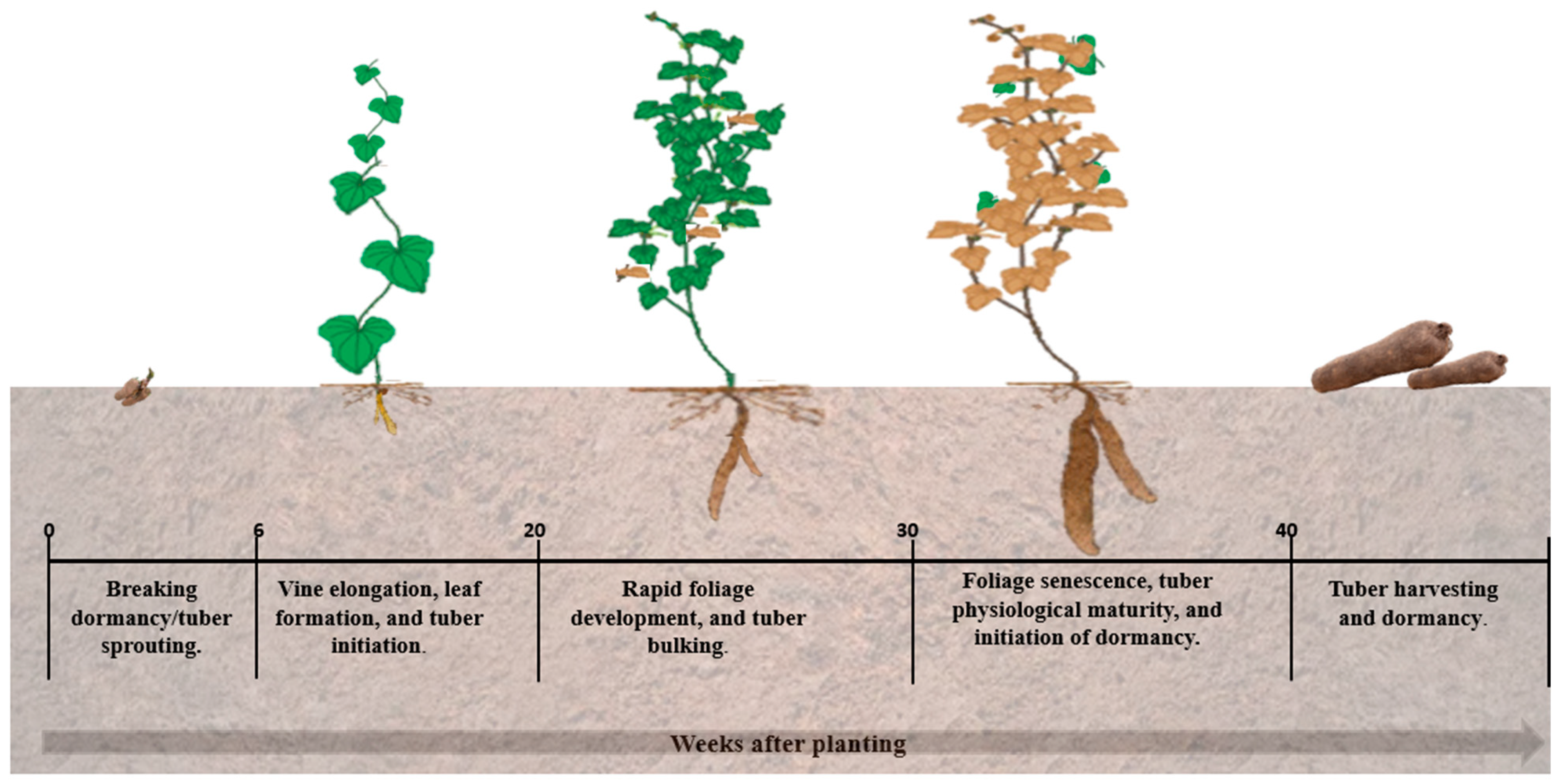
The growth cycle of widely cultivated yam species starts with a dormancy period in the tubers following harvest. At the onset of growth, nutrients stored in the tuber are mobilized to support the development of vines and leaves. Later, the plant takes up water and nutrients from the soil to sustain its growth until it reaches the tuberization phase when assimilates are translocated from the above-ground biomass to tubers. Lebot [55] highlighted distinct growth phases including tuber germination, foliage development, tuber bulking, foliage senescence and dormancy. This trend varies according to growing conditions, species and genotype.
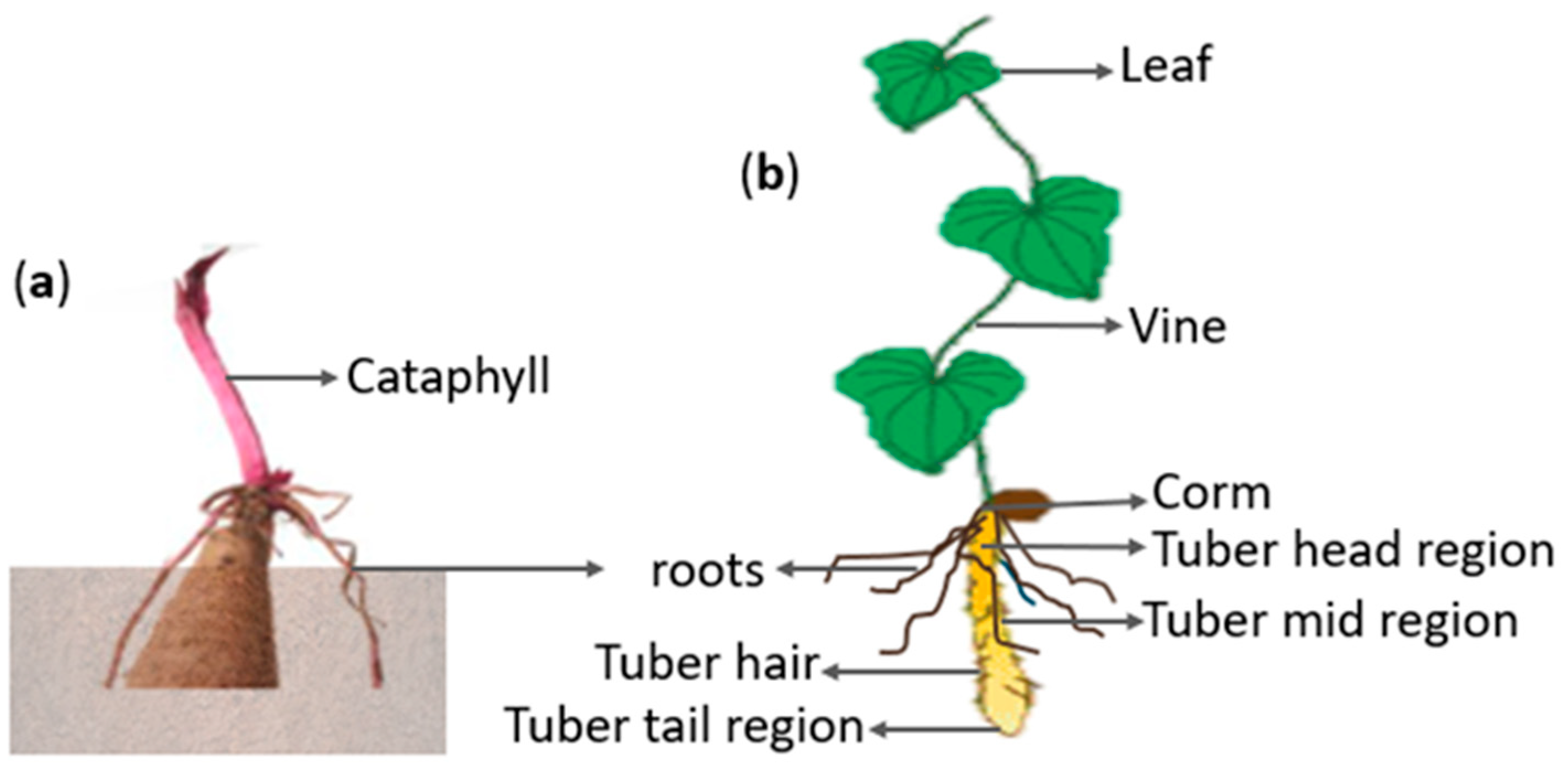
Tuber germination arises from a bud or from differentiated cell masses within the cambium. These buds form the primary nodal complex (PNC), from which root primordia develop. The PNC is a corm-like structure, featuring a thick, corky bark and a periderm approximately 1 mm thick [55,56,57]. The initial vine emerging from the corm or PNC produces one or two cataphylls rather than true leaves at its nodes (Figure 2a). The lack of expanded leaves minimizes the transpiring surface, resulting in little to no photosynthesis. During this stage, which lasts about 4–6 weeks, plant growth relies entirely on the tuber’s stored nutrients and moisture [55,58,59]. Figure 2b is a typical description of a growing yam with the vine and tuber.
The development of foliage marks the end of the yam plant’s dependence on the planted tuber and is characterized by a rapid expansion of leaf area. Leaf growth typically begins around six weeks after emergence and continues until approximately the 14th week, particularly in D. alata (Figure 3). This phase is accompanied by vine elongation, increased branching, enhanced leaf growth, and, in some genotypes, the production of bulbils. During this phase, the root development continues but lessens after the 12–14th week. As the phase approaches its end, the plant accumulates excess carbohydrates in the shoot, and this triggers tuber initiation. Also, flowering of the plants is initiated within this phase or a little later.
The tuber bulking phase is majorly characterized by the translocation of assimilates or photosynthates from the shoot to the tuber (Figure 3). The rate and speed of tuber development and final size are determined by the leaf area. Therefore, early canopy development is very important. The tuber initiation begins at about 20 weeks after planting (WAP), the number increases and attains its maximum between 37 and 41 WAP. Tuber enlargement results from the proliferation of new cells followed by their subsequent expansion. It is observed that the growth rate of the tuber is slow at early-stage tuber initiation, but very rapid for several weeks following full canopy development. This trend slows down towards the end of the phase as the plant begins to senesce [58]. During this stage, plant growth is highly plastic and responds to both positive and negative factors, including input management, weed pressure, and pest incidence. Biotic or abiotic stresses at this phase can significantly impact growth and development, leading to corresponding increases or reductions in tuber yield [55,57,59]. This scenario differs in indeterminate crops like cassava where storage roots have the potential to continuously grow once the plant remains healthy, and conditions are favorable [60]. Efforts to maximize the photosynthetic capacity is crucial for accelerating early tuber bulking in yams. This will ensure the production of adequate carbohydrates and energy balance. In addition to the aforementioned, plant nutrition like nitrogen (N), phosphorus (P), and potassium (K), is important for tuber initiation and growth [55,57]. The photoperiod, temperature and plant growth regulators (PGRs) can influence the timing and rate of tuber initiation [55,61]. Exogenous application of PGRs such as auxins, cytokinins, and gibberellins can stimulate hormonal signaling pathways associated with tuber initiation and growth. Proper cultural practices, including optimal planting density, spacing, and soil management ensure efficient resource utilization, promoting early tuber development [2].
Foliage senescence in early-maturing yam varieties begins around 20–24 WAP. The process starts with the shedding of older basal leaves and the drying of vine apices. Typically, the senescence of the foliage occurs in synchrony with the suberization of the tuber surface [56]. The senescing of the foliage is sometimes accelerated by foliar diseases. In most cultivated varieties, foliar senescence starts from 28 WAP and concludes at the 40 or 44th month. At completion, the vines and the leaves are completely dry, and this corresponds to the end of the photosynthate translocation from the shoot (Figure 3).
The fifth and final phase, known as the dormancy period, is marked by changes in the distal meristematic region of the tuber, which darkens and develops a cork layer and suberized bark, indicating maturity. Freshly harvested tubers are unable to sprout as they enter dormancy, which can last up to five months. The duration of dormancy is influenced by storage temperature, with sprouting occurring between 25 and 30 °C, while it is delayed at temperatures below 15 °C or above 35 °C [55,56].

3.1. Dormancy in Yam

Dormancy in yam is a state of inability for growth in spite of suitable growing conditions. Tuber dormancy in yam can be classified into three types: endo-dormancy, controlled by internal conditions within the organ; para-dormancy, regulated by factors outside the affected organ but within the parent plant; and eco-dormancy, influenced by environmental conditions [58]. Dormancy often arises from different combinations of these types in varying degrees. Manipulating tuber dormancy duration has important implications for yam production, enabling out-of-season cultivation. Conversely, prolonging dormancy during storage is critical for maintaining yam food quality, as breaking dormancy triggers physiological and biochemical changes that progressively impair texture, taste, and flavor [62]. During the dormant period, endogenous metabolic activity is minimal, resulting in very little depletion of stored reserves. Respiration rates, though high at harvest, reduce during curing and stay low at dormancy. It is higher in the distal end of the tuber than the proximal end since the former is the most recently formed tissue [58,62].
The duration of dormant period in yam varies widely and is taken to be under strong genetic and location control [58,63]. Other factors include storage treatments, planting date and harvesting time. Studies have shown that duration of sprouting is under endogenous control [40]. In the Caribbean, D. alata planted in June and harvested in November were stored and then re-planted on four different dates. The result showed that planting date, and differences in factors associated with storage and planting (such as moisture, light and temperature), had no effect on sprouting. A study in Guadaloupe by Lacointe and Zinsou [64], where D. alata was planted on six different dates between September 1982 and April 1983 showed that with the exception of December planting, the tubers all sprouted between late March and April irrespective of planting date. The results buttress the point that the duration of the dormant period is under strong endogenous control and is hardly affected by either growth or storage environment. Dormancy is widely assumed to start at or shortly after tuber maturity, though most studies begin measuring `dormancy time’ from harvest [58]. Tubers of four D. rotundata cultivars were harvested every seven days between 98 and 252 days after planting (DAP) and time of sprouting in a common storage environment was observed. Tubers harvested after 98 DAP sprouted about 175 days after harvesting, whereas those harvested 252 DAP sprouted within 14 days of harvest [65]. Rao and George [66] investigated dormancy in different D. alata cultivars, considering harvest dates, storage temperatures, and the presence or absence of the tuber “head.” Tubers harvested early exhibited the longest dormancy period, exceeding seven months, which decreased progressively with later harvests. Storage at 20 ± 2 °C extended dormancy by over five months compared with storage at 30 ± 2 °C, while the presence or absence of the tuber “head” had no effect. Interestingly, treating harvested tubers with gibberellic acid (GA) at 1000 ppm for two hours prolonged dormancy by more than four months compared with water-treated controls [66]. However, this option is rarely feasible for smallholder farmers due to constraints in resources and limited access to quality GA formulations.
A negative linear relationship was observed between harvest time and sprouting, with the earliest harvested, presumably less mature tubers exhibiting the longest dormancy period. Dormancy in yam plays a crucial role in storage and production. However, both may come at the expense of the other. While extended dormancy improves storability by delaying sprouting and maintaining food quality, long dormancy may hinder timely sprouting, hence delayed growth in the following planting season.

3.2. Photosynthetic Efficiency

The growth rate of yam reflects its photosynthetic capacity which follows a similar pattern as the dry matter accumulation, declining rapidly during the senescence period [67]. Most cultivated Dioscorea species exhibit the C3 photosynthetic pathway. An analysis of 23 genotypes, representing seven species and two wild relatives from two locations—Benin (West Africa) and Guadeloupe—confirmed that all species possess a C3 photosynthetic type [68]. The C3 and C4 photosynthetic pathways in plants differ in terms of radiation, water, and nitrogen use efficiency [55]. In yams, leaf photosynthesis can be influenced by many factors such as leaf position and age, sink effects, mutual shading, as well as environmental factors such as light, temperature, nutrition and water availability [69]. A study by Cornet et al. [68] showed that the photosynthetic efficiency of the leaf depends on leaf position and age. The youngest leaves from positions 1 to 4 on the vine had lower specific leaf nitrogen (SLN), leaf net carbon content and stomatal conductance. The young expanding leaves are characterized by low photochemistry efficiency and photosynthesis. The second section consists of mature leaves between 5 and 10th and 5–20th positions, during the vegetative growth and at tuber bulking phases, respectively. The high stable stomatal conductance and carbon content indicates higher photosynthetic capacity. The leaves of yams are photosynthetically active between 10 and 30 days after appearance and thus remain active for approximately two to three months [68]. The third and last section consists of older leaves at positions greater than 10 during the vegetative growth stage or greater than 20 at tuber bulking stage. They had lower photosynthetic capacity due to low SLN, with leaf net carbon content and stomatal conductance declining towards the base of the vine as the plant aged. The results suggest that tuber bulking phase is a critical yield formation period in which changes in photosynthetic capacity of leaves can compromise the yield. In a separate study, wild Dioscorea species—such as D. oppositifolia, D. hamiltonii, and D. pubera—demonstrated higher photosynthetic efficiency than the cultivated D. alata. These wild species may serve as valuable models for yam crop improvement programs [70].

3.3. Photoperiodism and Temperature

Assimilate partitioning in yams are modulated by environmental variables such as temperature and photoperiod. Long days promote growth of foliage and vines, while short days trigger senescence and tuber bulking. The development of yam tubers is usually induced under 12 h photoperiod. In West Africa, day length is approximately between 11.5 and 12.5 h throughout the year. The difference between the shortest and longest day length is one hour (1 h). Nevertheless, farmers consistently plant yam with the first rains of the growing season which varies across the different agroecological zones. For instance, in Nigeria, yams are planted by April-May for optimum growth and tuber yield. Late planting of yam often results in excessive vegetative growth and reduced tuber yield, with planting date significantly affecting final yield [55]. D. alata plantlets produced in vitro and established in the field through successive plantings initially showed no differences in morphological traits. However, after a few months, notable architectural changes were observed, and the durations of the vegetative growth phase and tuber dormancy varied with planting date. Challenges in out-of-season cultivation of D. alata are largely attributed to its sensitivity to photoperiod [55]. Additionally, yam is not shade-tolerant; although normal foliage may develop under shaded conditions, tuber yield is significantly reduced [18,71,72]. Unstaked yam plants produce lower yields compared to staked plants, primarily due to mutual leaf shading, which reduces light interception. Field experiments in Guadeloupe demonstrated that the leaf canopy of yam has a relatively high light interception coefficient (k = 0.64), but radiation use efficiency (RUE) is low and highly variable among different genotypes [68].
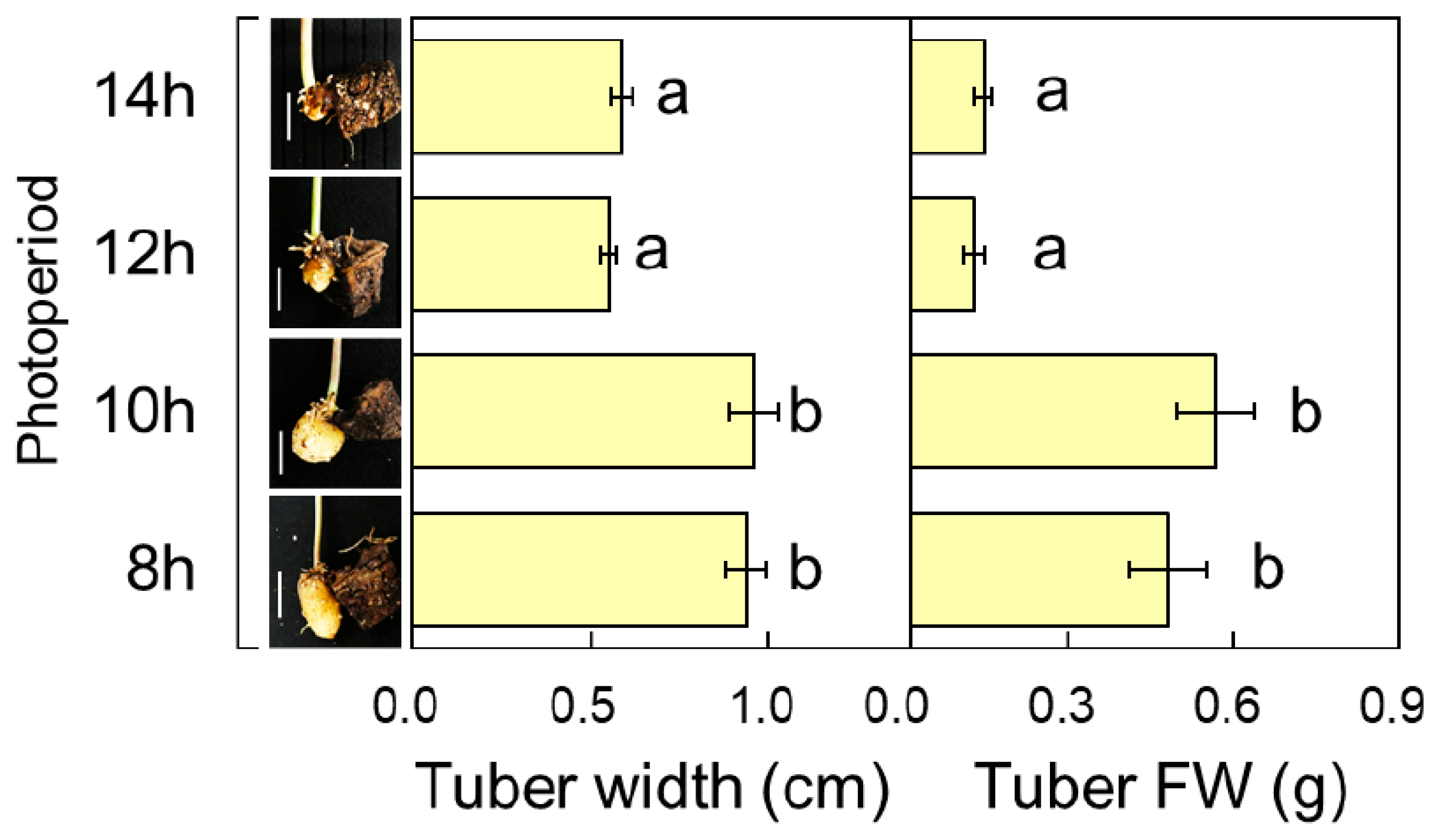
Early tuber enlargement would shorten the cultivation period, avoid drought in some parts of the tropics, and reduce cost of production in the aspect of weed management. The initiation of tuber enlargement varies among species and cultivars owing to different photo-sensitivities [73]. Hamaoka et al. [74] examined the effect of photoperiodic regulation on tuber enlargement in water yam (D. alata) in a 2-month experiment. Tuber width and fresh weight (FW) at 40 days after the onset of treatment (DAT) were significantly higher in the plants grown under 8 and 10 h photoperiods than in those under 12 and 14 h photoperiods, which resulted in the formation of enlarged tubers (Figure 4). These observations tend to buttress that the photoperiod of 10 h enhances the enlargement of tubers. This finding was supported by Vaillant et al. [75] who used invitro plantlets. They also showed that the cultivar has a photoperiodic response program that starts to enlarge tuber about 20 days after sensing short day length.
In yam, the effects of short-day (SD) conditions can be reversed by long-day (LD) conditions, which halt tuber growth while promoting shoot and root development [75]. This demonstrates that SD-induced tuberization can be interrupted at any stage and replaced by LD responses. The reduction in starch accumulation under LD indicates that carbon sinks shift from tubers under SD to shoots and roots under LD, highlighting the importance of understanding assimilate partitioning in tuber development. Marcos et al. [76] examined the combined effects of photoperiod and temperature on yam development, focusing on two phases: emergence (EM) to tuber initiation (TI), and TI to harvest (HA). The EM–TI phase, representing one-third of the EM–HA period, was primarily influenced by photoperiod and secondarily by temperature, while both factors had less impact on the TI–HA phase. Similar trends were observed in other yam species, including D. rotundata, D. opposita, D. bulbifera, and D. cayenensis [77]. Late planting (after July) can reduce yield because early tuber initiation under short-day conditions limits vegetative growth, resulting in poor tuber enlargement. Vegetative growth is also severely restricted at temperatures below 20 °C, while optimal growth occurs between 25 and 30 °C. Reduced growth under suboptimal temperatures is reflected in smaller leaf area, fewer leaves, and thinner, shorter vines. Although warm temperatures enhance vegetative growth, a subsequent reduction in mean temperature is necessary to trigger tuber bulking [55].

4. Yield-Determining Factors in Yam

Physiological and environmental factors exert remarkable influence on the growth, development and final yield of yam. However, the interactions of these factors are not well documented, and their relative contributions are difficult to understand. The size of the initial tuber sett has a great influence on the final yield, as the heavier it is, the higher the yield. Optimum plant density in yam production increases yield per unit land area, also depending on species and varieties. In Vanuatu, fresh tuber yields exceeding 51 t ha−1 for D. rotundata, 82 t ha−1 for D. alata, and up to 128 t ha−1 for D. esculenta were achieved without fertilizer application [55]. Numerous studies on the agronomic determinants of yield indicate a positive correlation between leaf area duration and tuber yield in D. alata and D. esculenta. The leaf area index (LAI) is a key parameter for estimating crop yield, although it varies widely among genotypes within a species. This variation presents an opportunity to select germplasm with earlier canopy development and larger total leaf area, thereby increasing yield potential. Enhancing resource use efficiency throughout the growing season is a critical strategy for realizing a crop’s yield potential. In cassava, LAI and leaf retention are strongly positively correlated with storage root yield [60], suggesting that understanding the physiology of yam and the relationships among growth parameters can inform optimized crop management and improve yields.

4.1. Yam Agronomy

Attaining high crop yields depends on good agronomic practices. This is essential for a sustainable yam production system. The time of planting depends on the cultivar and agroecological conditions. Planting of yam in most areas occurs during the ending phase of dry season, and immediately after the first rains. The moisture content of the planted seed tubers is generally sufficient to initiate and sustain root growth, and young yam plants exhibit relative drought tolerance. This tolerance is further enhanced by the absence of leaves on the young vine, which substantially reduces transpiration. Yams can survive in regions receiving as little as 500–700 mm of rainfall, although yields under such conditions are low. Moisture stress during the first two phases of the growth cycle delays tuber initiation and decreases final yield. For optimal growth and yield, well-distributed rainfall of approximately 1500 mm, or its equivalent through irrigation throughout the growth cycle is required [55].
The seed yam: in the traditional yam cultivation system, farmers select and separate best planting material from their harvest and preserve them for the following cropping season. For seed setts weighing between 100 and 500 g, approximately 1–5 t of planting material per hectare is required, based on the recommended plant density of 10,000 plants per hectare. The plant density could be lower or higher, depending on certain factors including, size of the seed yam, climatic condition, soil fertility status, cropping system and purpose of production. In practice, small tubers are kept as planting material while larger ones are used as food or sold at the markets. As an alternative, 200–500 g pieces from a large tuber (sett) can be used as planting material. Also, smaller setts or mini setts can be gotten from the larger tubers and used as planting materials [78]. In determining the possibility of using smaller setts in food yam production system, a study by Iseki and Matsumoto [79] compared different sett sizes of 50 g, 100 g, and 200 g, with respect to sprouting, shoot growth, and tuber yield. The results indicated that 50 g setts exhibited slower sprouting and shoot growth during the early growth stages, leading to lower maximum shoot biomass. However, this had only a minor impact on tuber yield, with average yields exceeding 1 kg per plant, including those from the 50 g setts. Moreover, the tuber multiplication rate was considerably higher in the 50 g setts compared to larger setts, which can facilitate higher planting densities due to their moderate shoot biomass and high tuber productivity. The effect of mini-sett weight and time of planting on crop development, fresh tuber yield and other growth parameters are shown in Table 1.
Studies have shown that the proximal part of the tuber, or “head,” sprouts faster and more uniformly across yam species [55]. Despite this, the mini-sett technique is increasingly adopted by commercial farmers in West Africa [80]. In Nigeria, seed tuber production of D. rotundata and D. alata using mini-setts has been evaluated both on-farm and on-station across different agroecological zones. Sprouting rates of mini-setts are generally lower in the southern Guinea savanna compared to the rainforest zone, likely due to faster water loss and drying under warmer, drier conditions. With direct field planting of mini-setts, sprouting and tuber yield are strongly influenced by the cultivar in D. rotundata, whereas D. alata is less affected [81]. Increasing mini-sett size in some D. rotundata cultivars can improve sprouting potential [79], but agroecological factors, temperature, and relative humidity also play a significant role [81]. The quality of planting material is affected by handling during the dormancy period. Farmers sometimes remove sprouts manually to prolong dormancy when planting is delayed. Postharvest treatments, such as gibberellic acid (GA) application or manual de-sprouting of D. cayenensis-rotundata setts, were found to have no effect on subsequent tuber yield [55]. However, crop growth and yield are significantly influenced by the sprouting state at planting and the sett’s position on the mother tuber (proximal, central, or distal), leading to substantial variability in individual plant yields [68,82]. Bulbils are also effective planting materials for D. alata; although their low weight (30–100 g) can affect final yield, they provide a valuable source of seed setts. Researchers are exploring the use of leaf-bud cutting for rapid yam propagation. This technology when proven will improve yam production and subsequently, livelihoods.
Crop establishment and management: staking is done after emergence. It involves the lifting of the creeping vines above the ground for more uniform light interception. D. alata has shown potential of significant yield without staking. This trend is not obtainable in D. rotundata which loses about 25–30% yield when not staked [18]. In the savanna production regions, yams are often planted unstaked or supported on fast-growing cereals such as maize or sorghum due to scarcity of wooden stakes. Since cereals grow faster than yams, they are intercropped at the time of planting and harvested before the yam canopy reaches full development. Later in the growing season when the dried stalks collapse, the vines grow on each other. This is becoming a popular and efficient cropping system in the region. When the shrubs or grown plants providing the stakes are not cultivated, as in most cases, stakes are used. The use of stakes poses environmental hazards because of deforestation. Staking yams is labor-intensive, costly, and cumbersome. Efforts to identify genotypes tolerant of non-staked cultivation have shown that, for most cultivars, yields remain significantly higher in staked plants. However, the trellis staking method, which uses only 30–50% of the stakes required in conventional staking, offers a more cost-effective alternative. Promisingly, ongoing breeding efforts in Nigeria aim to develop shrub-like cultivars with a compact growth habit that require minimal or zero staking. These advanced breeding programs are expected to reduce production costs and contribute to a more sustainable yam cultivation system. Manual weeding with a hoe is typically performed two to three times during the yam growth cycle. Unstaked plants planted at high density tend to be less weedy, as their vines and leaves rapidly cover the soil and suppress weed growth. In contrast, staked plants grown on ridges or mounds require weeding both between rows and around the planting hills. The growth habit of Dioscorea species, combined with their limited ability to provide full ground cover when staked, makes them particularly vulnerable to weed competition.
The critical period (8 to 16 WAP) for weed interference in yam is the period where the yam crop is most sensitive to weed. Farms left weedy during this period produce lower yields. Intercropping yam with creeping legumes such as melon, common beans, etc., minimizes weed competition [55]. The application of pre-emergence herbicides (ametryne, atrazine and diuron) with optimum plant spacing on a fertile soil can control weeds during the first 3 months of growth due to vigorous growth and rapid ground cover. For improved weed control, it is recommended to apply a contact herbicide (e.g., paraquat) in combination with a pre-emergence herbicide shortly before emergence. After the critical period of first 3–4 months after planting, reduction in tuber yield due to uncontrolled weeds becomes negligible [83].

4.2. Soil Fertility in Yam-Based System

Yam is highly demanding on soil fertility; hence it is always planted first in the cropping cycle, just after the fallow, especially in traditional cropping systems. In a greenhouse study, young yam plants were grown in nutrient-deficient solutions, and changes in leaf nutrient concentrations at different leaf ages were measured. The dry matter (DM) yield for each treatment was measured at harvest [57]. Most nutrient deficiencies caused chlorosis in young leaves. Deficiencies of nitrogen (N), sulfur (S), and calcium (Ca) produced visible symptoms in the shoots, with young leaves turning pale green to light cream. While adequate nitrogen nutrition promotes vegetative growth, it can reduce tuber yield. Phosphorus-deficient plants have young leaves that are necrotic with reduced size, while older leaves are stiff and thickened. On the other hand, K deficiency results in overall growth reduction [55,57].
Most nutrients absorbed by yam are removed from the field at harvest, as the tubers are taken away. While a substantial portion of nutrients in the vines is recycled into the tubers during senescence, little is returned to the soil from the shoot. Nutrient removal from the field depends largely on yield; Table 2 shows the range of nutrients removed in 15 t of harvested fresh yam tubers. To achieve a yield potential of 60 t ha−1 or more, nutrient requirements may exceed four times the values in Table 2. Crop nutrient uptake is often used as a first estimate for fertilizer requirements, particularly for N, P, and K, but losses through denitrification, leaching, erosion, or soil fixation must also be considered. Most soils have sufficient reserves of secondary and micronutrients, making routine application unnecessary [57]. Yam’s response to fertilizers is influenced by several factors; therefore, fertilizer recommendations should be based on regional trials and the crop’s nutrient requirements for a targeted yield. Studies indicate minimal response to fertilizers on well-fallowed land, and while N, P, and K may enhance yields on previously cropped soils, fertilizer rarely increases yields to the levels obtained on newly cleared or well-fallowed fields. Since information contained in most reports from yam fertilizer trials is inadequate in the aspect of soil or plant nutrient levels, it is difficult to draw conclusions from them.
These values represent average nutrient removal per hectare for yam crops yielding 15 t ha−1, based on tuber composition data from D. alata, D. esculenta, and D. rotundata originally collated by O’SullivanBradbury and Holloway [84]. The quantities shown reflect nutrients removed in the harvested tubers only, not total crop uptake. It is assumed that the vines remain in the field and return their nutrients to the soil.
The yam planting system affects fertilizer placement. When fertilizers are applied after crop establishment, they are typically placed in shallow furrows or grooves around the base of mounds or ridges, covered with 3–4 cm of soil. This method reduces nitrogen losses and improves root access but carries the risk of damaging yam roots. As illustrated in Figure 2 and Figure 3, yam roots radiate from the crown and remain near the soil surface before descending deeper [84,85]. Opening the soil around the mound can sever a significant proportion of these roots. Applying fertilizer higher on the mound or ridge reduces the risk of root damage but may limit root access to nutrients. An alternative method involves placing fertilizer into stake holes along the side of the ridge or mound [57]. More research is needed on fertilizer application techniques across different climates and soil types. Optimal results are achieved when nutrients are applied separately, but farmers are often advised to use compound fertilizers containing N, P, K, and sometimes Mg and micronutrients. Nitrogen application should be timed optimally, split into two or three doses applied 2–4 months after planting [57].
Soil fertility is a major constraint affecting yam yield and profitability, yet farmers often lack practical solutions to address it. Critical nutrient requirements for yam cultivation in tropical West Africa are not fully established. Generally, soils with <0.1% N, <10 mg/kg available P, and <0.15 Cmol/kg exchangeable K require fertilizer supplementation. A ton of yam is reported to remove approximately 3.8–4.0 kg N, 0.39–1.1 kg P2O5, and 4.2–5.9 kg K2O per hectare [2]. Yield responses to fertilizer are less well-documented than effects of sett size or staking, and significant responses in D. alata are generally observed only on low-fertility soils. Yam relies heavily on effective mycorrhizal associations to satisfy its phosphorus requirements, while responses to N and K fertilizers are more pronounced on nutrient-poor soils; responses to applied P are generally modest [55]. Some studies show completely no yield response to applied fertilizers N, P and K [86]. A study assessed the relationship between soil fertility and yam tuber production of D. alata and D. rotundata on two contrasting soils in the forest and savanna agroecology in central Côte d’Ivoire, where two fertilizer treatments comprising no fertilization, as control and application of 240-11-269-8.5-11-66 kg/ha of N-P-K-Ca-Mg-S were applied, with the aim to attain a potential yield of 60 t ha−1 fresh tuber. The fresh tuber yield was significantly higher in the forest than in the savannah region at each season, but no fertilizer effect was observed in all the treatments across the seasons [87]. In a similar study, D. alata recorded a lower number of leaves per vine. In addition, the leaves had a longer retention time phase than in D. rotundata. This results in significant higher yields of D. alata, especially in the low fertile savanna soil [86]. In another study, a fertilizer dose of 160-10-180-110 kg/ha of N-P-K-Ca was compared with a control (no fertilizer). While the treatment increased aboveground biomass dry matter, it did not lead to a corresponding increase in tuber dry matter [88]. Further studies are needed to better understand the source–sink relationship in yam, particularly to clarify the role and implications of mineral fertilizers in assimilate partitioning to the tubers.
Ennin et al. [71] reported significant (p < 0.05) increases in soil organic carbon and phosphorus following fertilizer application, although yam yield did not show a corresponding significant increase. The highest benefit–cost ratio (BCR) of 2.7:1 was achieved with 45-45-60 kg/ha N-P2O5-K2O applied on ridges, leading to this recommendation for continuously cropped fields in the forest–savanna transition zones of Ghana. Similarly, Kaissi et al. [89] showed that soil organic carbon stocks contributed to increased tuber yield of D. rotundata following Chromolaena odorata (green fertilizer) fallows. The rise in soil organic carbon on fertilized plots was attributed to larger vegetative growth, followed by litter fall and decomposition, which returned nutrients to the soil.
A study by Owusu Danquah et al. [90] demonstrated that yam yields were higher on fields previously planted with pigeon pea compared to fields previously planted with yam, likely due to residual nitrogen from biological nitrogen fixation by the legume. On continuously cropped fields, the application of poultry manure at 3 t/ha combined with 15-15-20 kg/ha N-P2O5-K2O significantly increased yields compared to unfertilized plots. Doubling the rates of poultry manure (to 6 t/ha) and inorganic fertilizer (to 30-30-60 kg/ha) did not result in further significant increases in soil organic matter or tuber yield [90]. Given yam’s high nutrient demands, integrating legume rotations (e.g., cowpea, soya, pigeon pea, beans, groundnuts) with manure and/or inorganic fertilizer represents a sustainable strategy for improving soil fertility and maximizing yield.
In a series of experiments conducted by Melteras [67] to assess soil fertility constraints on different Dioscorea species in Vanuatu, results showed no significant yield responses to fertilizer application, despite well-characterized nutrient deficiencies in the soils. These findings are notable, as all efforts were made to minimize variation in the planting material. Even with uniform seed setts, there was considerable variation in sprouting time, as well as in the number and vigor of emerging shoots. It is rather reasonable to admit that optimum fertilizer rates and yield responses to applied fertilizers have not yet been established for yam and there is need for advanced scientific research on the required rate, application methods and time of application [55,57].

4.3. Physiological Maturity and Harvesting

Beyond the popular leaf senescence indication, the most common measures adopted in checking maturity of the crop before harvest include observing the tuber development based on percentage of the tuber length that is whitish at harvest. This leads to the concept of “maturity of convenience”, rather than “harvest maturity” [91]. A decline in tuber dry matter during the final month before shoot senescence, along with a peak in tuber dry matter accumulation followed by a reduction at complete vine senescence, may serve as key indicators of tuber maturation in yam species [55,92]. Sensory evaluations are optimized when yellowing of the lower leaves was observed (approximately one month before final foliage senescence). This coincides with the time of the highest tuber yield [91]. Tuber maturity in various yam accessions can be assessed by monitoring leaf starch content until it reaches a minimum before any subsequent increase. This assessment is typically possible between four and six months after vine emergence (MAVE). For farmers, a practical indicator of maturity in white yam species is the onset of yellowing in the lower leaves of the plant [91,92]. Harvesting yams at this point would have three major benefits including better food and storage quality of the yam, provision of litter that will enhance the organic matter content and improve soil quality.
For proper yam harvesting, soil around the tubers is carefully removed so the farmer can assess tuber size and avoid damage during excavation. Irregularly shaped tubers require more time to harvest, as extra care is taken to prevent cracking. Harvesting tools are generally the same as those used for mound preparation, including hand diggers. Dried vines and foliage are cleared with machetes, while a fork with flat blades or a shovel is used to loosen soil around the tubers for lifting. This method is effective for species producing compact tubers. For larger tubers, soil is gently removed from the base of the vine toward the distal end, allowing the tuber to be lifted when freed. Mechanized harvesting requires small setts so that tubers are also small and easier to lift. Mechanization of yam and other root/tuber crops, such as cassava, remains challenging. In Nigeria, the first harvest, known as “milking,” involves carefully harvesting the largest tuber from a live plant, cutting just below the corm using a machete or bush knife. Care is taken not to cut off the roots after which the plant is carefully placed back in the soil. A new tuber subsequently emerges, while the other tubers left will enlarge more to be harvested at full maturity [55]. This age long practice provides tubers that cushion hunger and creates more revenue source for the farmer.

4.4. Postharvest Indicators Towards Crop Improvement

Food quality traits in yam have a positive correlation with acceptability, consumption and adoption. Annotation reveals that putative genes involved in glucose export, hydrolysis and glycerol metabolism are associated with boiling and pounded yam food qualities [93]. Within this context, allele segregation analysis at the significantly associated loci highlighted the favorable alleles for tuber flesh color and zero oxidative browning. Twenty-four putative candidate genes were implicated with significant signals [94]. Marker development along this genetic and physiological pathway will aid selection within breeding cycles. The intrinsic relationships and characteristics of food products alongside sensory attributes can be predicted as a function of biochemical/biophysical characteristics [95,96]. The extent of cellular disintegration [97] and dry matter of raw and boiled yams are positively linked to quality [98]. Most importantly, users’ varietal selections are influenced by preferences for qualities associated with specific traits [99]. This buttresses that boiled yam preference encompasses acceptable crumbliness, easy to break, sweetness and white or yellowish color [100].
Consumer evaluations and quantitative sensory analysis have identified key quality traits preferred in pounded yam, including texture characteristics—smooth, stretchable, moldable, slightly sticky, and moderately firm—as well as color attributes such as white, cream, or light yellow [101]. These traits provide important benchmarks for breeding programs aiming to develop yam varieties that meet consumer expectations for superior pounding quality. It is noteworthy to highlight that there exist significant correlations between sensory textural quality attributes cohesiveness/moldability, hardness, and adhesiveness/stickiness, with textural quality measurements from instrumental texture profile analysis [101]. A major limitation in yam food quality improvement is long evaluation process with high associated costs. Near-infrared spectroscopy (NIRS) has been employed to complement complex laboratory procedures for evaluating yam quality [102]. As a high-precision, low-cost, rapid, and high-throughput technique, NIRS predicts the content of organic constituents by integrating laboratory data with spectral information [103]. It also allows simultaneous prediction of multiple quality traits through a single in situ spectral analysis of fresh root and tuber crops, facilitating the identification of varieties most likely to be adopted by end users [104]. Rheography of yam tubers indicates structural differences in yam species. In practical terms, high initial storage modulus of yam parenchyma implies tubers with strong and rigid structure and thus translates to non-losing of their structural integrity easily upon heating. Rheological characteristics including loss modulus (G″), swelling capacity and T-gel have proved to be suitable quality indicators for yam products [105]. In situ rheological profiling of yam tubers presents a platform for instrumental phenotyping and screening. An understanding of the nature of sensory attributes via instrumentation parameters with clearly defined thresholds will surely aid rapid and early screening of yam germplasm to ensure the adoption of new varieties [93].
It is important to highlight that postharvest physiological disorders in yam (Dioscorea spp.) initiate a cascade of biochemical and cellular disruptions that undermine tuber quality. Immediately after harvest, increased respiration and metabolic imbalance can weaken cell membranes and accelerate oxidative processes, making tubers more prone to internal browning and structural collapse during storage (e.g., through enhanced enzymatic activity such as polyphenol oxidase acting on phenolic compounds)—changes that are widely recognized as contributing to unacceptable flesh discoloration and textural decline in yam cultivars [106]. These physiological perturbations compromise structural integrity and promote conditions favorable to microbial colonization, allowing a diversity of fungal and bacterial pathogens (including Aspergillus, Botryodiplodia and others) to invade and cause extensive rot in stored tubers [107]. The combined action of endogenous oxidative browning reactions and exogenous microbial degradation accelerates the breakdown of nutrients, increases weight loss, alters organoleptic properties, and reduces both market value and edible quality of yam tubers during storage [108].

5. Future Perspective

Despite the essential roles of yam in food security and economic development, it is yet to receive adequate research attention. Its farming system is still rudimentary, characterized by low yields. Shifting cultivation is hardly practiced in recent times due to limited availability of arable farmlands. Yam has a high demand for soil nutrients and continued cropping on the same piece of land without appropriate fallow and soil fertility management is contributing to the decrease in productivity. Recent research and discoveries of improved technologies demonstrating good agronomic practices for sustainable yam production are hardly adopted by farmers in the region due to certain unfounded beliefs and myths [10,18,55]. Impact of climate change on food production calls for immediate and sustainable mitigation and adaptation strategies. Rainfed crop production is a common practice. Projections on future climate scenarios in West Africa are indicating unstable climatic conditions with detrimental effects on yam productivity [18]. Increases in temperature above the required temperature (25 and 30 °C) for yam growth and development will decrease productivity. Also, the long duration of yam (8–12 months depending on variety) on the field, makes it vulnerable to erratic rainfall patterns and drought. Therefore, climate-smart technologies are required to sustain production. For instance, breeding of early maturing varieties with compact growth habits, hence, requiring no staking, and promotion of drought tolerant landraces.
The dearth of knowledge on nutrient uptake dynamics and use efficiency in yam production has posed a lot of challenges in developing nutrient management technologies that will improve the production system. Yield responses to fertilizers are unreliable and this has hampered the development of reliable and improved nutrient management technologies that could improve farmers’ yields sustainably. Farmers hardly break even when they apply recommended fertilizer rates on yam compared to other crops [55,57,87,88]. The higher yields obtained on naturally fertile soils may be explained by the relatively high organic matter content of the topsoil, when packed together as mounds and planted upon, allows for a high nutrient release to the plant, with optimum water retention capacity. While there is evidence of beneficial soil microorganisms such as Arbuscular mycorrhizal populations in yam growth in naturally fertile fallowed soils [55], there is limited knowledge on their relationship under fertilizer application. Therefore, in-depth study on practicable soil fertility management technologies including required rates of fertilizers, application methods and time of application will encourage farmers to adopt sustainable agronomic practices that will improve yield, income, and their livelihood on limited land resources. Understanding the factors that control assimilate partitioning to yam tubers is increasingly important. Further research is needed on the source–sink relationship between leaves and tubers, particularly to clarify the role and implications of mineral fertilizers in this critical process.
There are limited studies focusing on developing a protocol suitable for breaking dormancy. The mechanisms underlying dormancy in yam tubers remain poorly understood, making the physiological dormancy period difficult to predict or manipulate. Various chemical (hormonal) and physical treatments have been explored, primarily to prolong storage life. Hormones and chemicals such as gibberellic acid (GA) and anti-auxins like 2,4-D and CPA have been shown to extend dormancy. Soaking tubers in GA solutions, in particular, is an effective, economical, and practical method for prolonging storage life [109]. Only a few studies have focused on developing protocols to break dormancy in tubers and bulbils of certain yam species [110,111], likely because research has primarily aimed at extending dormancy rather than reducing it. A sustainable breakthrough in this regard would have obvious impact and introduce flexibility in yam production. Furthermore, the lack of mechanization of the cropping system makes it unappealing to youths and women, it is labor intensive, and time consuming. Therefore, research and policy interventions that will reduce drudgery, improve the identified constraints and create markets for yam will encourage farmers and investors to embark on yam cultivation for food production and business purposes.
Knowledge of the socio-cultural dynamics encompassing farmers, middlemen, processors and consumers in the yam value chain is not well documented. The preferences and needs of men and women involved in yam value chains have not yet been fully characterized or documented. Within this context, yam food quality characteristics that determine user preferences and adoption of improved cultivars by stakeholders has a low knowledge base. Consequently, many yam varieties developed by the few yam crop improvement programs globally meet with significant problems of acceptability thus hindering adoption and diffusion. The identification of physico-chemical, sensorial and textural traits that define the characteristics required for variety (V), user (U), and socio-economic environment (E), as well as evolving changes in the environment including the development of high-throughput measurements that will facilitate food quality screening, needs to be prioritized.
The close association between physiological disorders such as browning and rot with quality deterioration highlights the need to integrate postharvest quality traits into yam breeding programs, rather than focusing solely on yield and agronomic performance. Future research should prioritize the identification of genetic variability for resistance to enzymatic browning, oxidative stress, and storage pathogens among yam germplasms. Breeding efforts can target traits such as lower polyphenol oxidase activity, improved cell membrane stability, enhanced antioxidant capacity, and natural resistance to postharvest pathogens. Advances in molecular breeding and genomics offer opportunities to identify quantitative trait loci (QTLs) and candidate genes associated with postharvest durability, stress tolerance, and disease resistance. Marker-assisted selection and genomic selection could accelerate the development of yam varieties with improved shelf life and reduced susceptibility to physiological breakdown. Furthermore, integrating phenotyping platforms that evaluate storage performance and biochemical indicators of deterioration will strengthen selection efficiency.
Future research in yam crop improvement should embrace climate-smart agricultural approaches, including the development of climate-resilient varieties, sustainable soil and water management practices, agroforestry-based systems, and climate-adaptive pest and postharvest management strategies. Integrating modern breeding tools with precision agriculture and low-carbon production practices will enhance productivity, resilience, and environmental sustainability of yam-based farming systems under changing climatic conditions. Genotype × environment (G × E) interactions emerge as a critical consideration for sustainable yam (Dioscorea spp.) crop improvement, as they strongly influence yield stability, tuber quality, stress tolerance, and postharvest performance across diverse agroecological zones. Effective breeding strategies must balance broad and specific adaptation through multi-location and multi-season evaluations that capture climatic variability, soil heterogeneity, and management practices. The integration of advanced statistical models such as AMMI and GGE biplots with genomic tools enhances the identification of resilient genotypes and environment-responsive traits. Moreover, incorporating quality attributes, postharvest resilience, and resource-use efficiency into G × E analyses ensures the development of varieties suited to both high- and low-input systems. Participatory approaches further align breeding outputs with farmer preferences and local conditions. Collectively, a systems-based understanding of G × E interactions provides a robust pathway for developing climate-resilient, high-performing yam cultivars that support long-term productivity, sustainability, and food security under changing environmental conditions.
In addition, CRISPR/Cas9 technology platform (gene editing) can enhance tolerance biotic and abiotic challenges thus enhancing adaptability. With the aid of this technology, breeding time is significantly reduced with precise, site-specific, and stable genetic alterations to traits relating to yield, flowering, developmental processes, thus leading to yield and quality optimization [112].

6. Conclusions

Yam is a high value crop in West Africa especially Nigeria, but the persistent low yield, high cost of production and drudgery in the cropping system discourages youths, women, and investors from harnessing its potentials. Understanding how the crop grows, develops, and responds to various environmental factors will inform improved agronomic practices that aim to improve yield, quality, and resilience to environmental stresses. Crop improvement trait priorities should focus on ideotypes with strong shoot emergence and early vigor, high yielding under zero or minimal staking: high photosynthetic efficiency; shrub-like/dwarf plant type with stiff/stout vine base and early branching; heavy canopy limiting light transmission to the ground; efficient in uptake and utilization of soil nutrients; early tuber initiation; and fast bulking rate (fast accumulation of dry matter and early suitability to food use). This calls for serious research in physiology and agronomy, but complementary research in genetic improvement is essential for improved nutrient use efficiency, good response to fertilizer application with no depression in tuber quality), earliness in maturity, drought and heat tolerance, high seed multiplication and quality. The costs of seed tubers and labor are very high in yam cultivation systems. Efforts need to be intensified in the breeding and selection for plant characteristics that lower these costs.

Author Contributions

J.G.E.: Conceptualization, methodology, writing—original draft, writing—review and editing; P.I.E.: writing—original draft and& editing; J.E.O.: conceptualization, methodology, supervision, project administration, writing—original draft, writing—review and editing; C.A.C.: conceptualization, resources, writing—review and editing. All authors have read and agreed to the published version of the manuscript.

Funding

No funding was received for this research. The APC was funded by Queen’s University Belfast, United Kingdom.

Data Availability Statement

No new data were created or analyzed in this study; Therefore data sharing is not applicable.

Acknowledgments

The authors would like to thank the technical assistant of Charles C. Nwokoro. We are also grateful for the technical support of the National Root Crops Research Institute Umudike, Nigeria yam program staff.

Conflicts of Interest

The authors declare that the research was conducted in the absence of any commercial or financial relationships that could be construed as a potential conflict of interest.

References

  1. Burkill, H.M. Organography and the evolution of Dioscoreaceae the family of yams. Bot. J. Linn. Soc. 1960, 56, 319–412. [Google Scholar] [CrossRef]
  2. Matsumoto, R.; Asfaw, A.; Ishikawa, H.; Takada, K.; Shiwachi, H.; Asiedu, R. Biomass production and nutrient use efficiency in white Guinea yam (Dioscorea rotundata Poir.) genotypes grown under contrasting soil mineral nutrient availability. Front. Plant Sci. 2022, 13, 973388. [Google Scholar] [CrossRef]
  3. FAOSTAT. Yam Production and Yield. 2022. Available online: https://www.fao.org/faostat/en/#data/QA (accessed on 9 December 2023).
  4. Coursey, D.G. The origins and domestication of yams in Africa. In Origins of African Plant Domestication; Harlan, J.R., De Wet, J.M.J., Stemler, A.B.L., Eds.; Mouton and Co.: The Hague, The Netherlands, 1976; pp. 383–408. [Google Scholar]
  5. Scarcelli, N.; Cubry, P.; Akakpo, R.; Thuillet, A.C.; Obidiegwu, J.E.; Baco, M.N.; Otoo, E.; Sonké, B.; Dansi, A.; Djedatin, G.; et al. Yam genomics supports West Africa as a major cradle of crop domestication. Sci. Adv. 2019, 5, eaaw1947. [Google Scholar] [CrossRef]
  6. Sugihara, Y.; Darkwa, K.; Yaegashi, H.; Natsume, S.; Shimizu, M.; Abe, A.; Hirabuchi, A.; Ito, K.; Oikawa, K.; Tamiru-Oli, M.; et al. Genome analyses reveal the hybrid origin of the staple crop white Guinea yam (Dioscorea rotundata). Proc. Natl. Acad. Sci. USA 2020, 117, 31987–31992. [Google Scholar] [CrossRef] [PubMed]
  7. Terauchi, R.; Chikaleke, V.A.; Thottappilly, G.; Hahn, S.K. Origin and phylogeny of guinea yams as revealed by RFLP analysis of chloroplast DNA and nuclear ribosomal DNA. Theor. Appl. Genet. 1992, 83, 743–751. [Google Scholar] [CrossRef]
  8. Nair, S.G.; Abraham, K.; Nayar, G.G. Two high yielding selections of white yam (Dioscorea rotundata Poir.). J. Root Crops 1987, 13, 103–109. [Google Scholar]
  9. Padhan, B.; Panda, D. Potential of neglected and underutilized yams (Dioscorea spp.) for improving nutritional security and health benefits. Front. Pharmacol. 2020, 11, 496. [Google Scholar] [CrossRef]
  10. Obidiegwu, J.E.; Lyons, J.B.; Chilaka, C.A. The Dioscorea Genus (Yam)—An appraisal of nutritional and therapeutic potentials. Foods 2020, 9, 1304. [Google Scholar] [CrossRef] [PubMed]
  11. Asiedu, R.; Mignouna, H.; Odu, B.; Hughes, J.d’A. Yam breeding. In Plant Virology in Sub-Saharan Africa: Proceedings of a Conference Organized by the International Institute of Tropical Agriculture (IITA), Ibadan, Nigeria, 4–8 June 2001; Hughes, J.d’A., Odu, B.O., Eds.; International Institute of Tropical Agriculture (IITA): Ibadan, Nigeria, 2003; pp. 466–475. [Google Scholar]
  12. Onwueme, I.C.; Sinha, T.D. Field Crop Production in Tropical Africa: Principles and Practice; CTA: Ede, The Netherlands, 1991; 480p. [Google Scholar]
  13. Obidiegwu, J.E.; Akpabio, E.M. The geography of yam cultivation in southern Nigeria: Exploring its social meanings and cultural functions. J. Ethn. Foods 2017, 4, 28–35. [Google Scholar] [CrossRef]
  14. Eka, O.U. Roots and tubers. In Nutritional Quality of Plant Foods; Osagie, A.U., Eka, O.U., Eds.; Post-Harvest Research Unit, Department of Biochemistry, University of Benin: Benin City, Nigeria, 1998; pp. 1–31. [Google Scholar]
  15. Ashay, O.A.; Fasoyiro, S.B.; Lawal, R.O. Effect of fortification on the compositional and sensory attributes of cowpea-amala. Food Sci. Nutr. 2001, 31, 88–91. [Google Scholar] [CrossRef]
  16. Owusu Danquah, E.; Ennin, S.A.; Frimpong, S.; Akom, M.; Acheampong, P.P. Improved practices for sustainable yam production: The farmer’s experience. Agric. Food Sci. J. Ghana 2018, 11, 904–908. [Google Scholar]
  17. Kiba, K.B.; Hgaza, V.H.; Aighewi, B.; Aké, S.; Barjolle, D.; Bernet, T.; Diby, L.N.; Ilboudo, L.J.; Nicolay, G.; Oka, E.; et al. A transdisciplinary approach for the development of sustainable yam (Dioscorea sp.) production in West Africa. Sustainability 2020, 12, 4016. [Google Scholar] [CrossRef]
  18. Owusu Danquah, E.O.; Frimpong, F.; Dankwa, K.O.; Weebadde, C.K.; Ennin, S.A.; Asante, M.O.O.; Brempong, M.B.; Dwamena, H.A.; Addo-Danso, A.; Nyamekye, D.R. Sustainable intensification and climate-smart yam production for improved food security in West Africa: A Review. Front. Agron. 2022, 4, 858114. [Google Scholar] [CrossRef]
  19. Neina, D. Ecological and edaphic drivers of yam production in West Africa. Appl. Environ. Soil Sci. 2021, 2021, 5019481. [Google Scholar] [CrossRef]
  20. Sadik, S.; Okereke, O.U. Flowering, pollen grain germination, fruiting, seed germination and seedling development of white yam, Dioscorea rotundata Poir. Ann. Bot. 1975, 39, 597–604. [Google Scholar] [CrossRef]
  21. Bai, K.V.; Jos, J.S. Female fertility and seed set in Dioscorea alata L. Trop. Agric. 1986, 63, 7–10. [Google Scholar]
  22. Abraham, K. Flowering deficiencies and sterility preventing natural seed set in Dioscorea alata cultivars. Trop. Agric. 1997, 74, 272–276. [Google Scholar]
  23. Akoroda, M.O. Floral biology in relation to hand pollination of white yam. Euphytica 1983, 32, 831–838. [Google Scholar] [CrossRef]
  24. Abraham, K.; Nair, S.G. Anomalies in sex expression of Dioscorea rotundata Poir. J. Root Crops 1979, 5, 19–24. [Google Scholar]
  25. Abraham, K.; Nair, P.G. Floral biology and artificial pollination in Dioscorea alata L. Euphytica 1990, 48, 45–51. [Google Scholar] [CrossRef]
  26. Ghosh, S.P.; Ramanujam, T.; Jos, J.S.; Moorthy, S.N.; Nair, R.G. Tuber Crops; Oxford & IBH Publishing Co. Pvt. Ltd.: New Delhi, India, 1988. [Google Scholar]
  27. Mandal, R.C. Tropical Root and Tuber Crops: Cassava (Tapioca), Sweetpotato, Aroids, Yams, Yam Bean, Coleus; Agro Botanical Publishers: Bikaner, India, 1993; ix + 396p. [Google Scholar]
  28. Onwueme, I.C.; Charles, W.B. Tropical Root and Tuber Crops: Production, Perspectives and Prospects; FAO Plant Production and Protection Paper, No. 126; FAO: Rome, Italy, 1994; xii + 228p. [Google Scholar]
  29. Ayensu, E.S. Dioscoreales. In Anatomy of the Monocotyledons. VI. Dioscoreales; Metcalfe, C.R., Ed.; Clarendon Press: Oxford, UK, 1972; 182p. [Google Scholar]
  30. Bai, K.V.; Ekanayake, J.J. Taxonomy, morphology and floral biology. In Food Yams: Advances in Research; Orkwor, G.C., Asiedu, R., Ekanayake, I.J., Eds.; International Institute of Tropical Agriculture (IITA) and National Root Crops Research Institute (NRCRI): Ibadan, Nigeria, 1998; pp. 13–37. [Google Scholar]
  31. Zoundjihekpon, J.; Hamon, P.; Noirot, M.; Tio-Toure, B.; Hamon, S. Flowering synchronisation between male and female West African cultivated yams (Dioscorea cayenensis-rotundata complex). Euphytica 1997, 95, 371–375. [Google Scholar] [CrossRef]
  32. Sadik, S. A review of sexual propagation for yam improvement. In Proceedings of the 4th Symposium of the International Society for Tropical Root Crops, CIAT, Cali, Colombia, 1–7 August 1976; Cock, J., MacIntyre, R., Graham, M., Eds.; International Development Research Centre (IDRC): Ottawa, ON, Canada, 1977; pp. 40–44. [Google Scholar]
  33. Abraham, K.A.; Nair, S.G. Floral abnormalities in Dioscorea rotundata Poir. J. Root Crops 1979, 5, 74–76. [Google Scholar]
  34. Sadik, S.; Okereke, O.U. A new approach to improvement of yam Dioscorea rotundata. Nature 1975, 254, 134–135. [Google Scholar] [CrossRef]
  35. Segnou, A.; Fatokun, C.A.; Akoroda, M.O.; Hahn, S.K. Studies on the reproductive biology of white yam (Dioscorea rotundata Poir.). Euphytica 1992, 64, 197–203. [Google Scholar] [CrossRef]
  36. Abraham, K.; Nair, S.G.; Sreekumari, M.T.; Unnikrishnan, M. Seed set and seedling variation in greater yam (Dioscorea alata L.). Euphytica 1986, 35, 337–343. [Google Scholar] [CrossRef]
  37. Egesi, C.N. Influence of Planting Date, Location, Tuber Milking and Ploidy Level on Flowering in Dioscorea alata L. Ph.D. Thesis, University of Ibadan, Ibadan, Nigeria, 2001; 183p. [Google Scholar]
  38. Yoshida, Y.; Takahashi, H.; Kanda, H.; Kanahama, K. Interactive effects of photoperiods and plant growth regulators on the development of flowering spikes and tubers in Chinese yams (Dioscorea opposita) cv. Hortic. J. 2001, 70, 304–309. [Google Scholar] [CrossRef]
  39. Shiwachi, H.; Ayankanmi, T.; Asiedu, R. Effect of photoperiod on the development of inflorescences in white Guinea yam (Dioscorea rotundata). Trop. Sci. 2005, 45, 115–119. [Google Scholar] [CrossRef]
  40. Ile, E.I.; Craufurd, P.Q.; Asiedu, R.; Battey, N.H. Duration from vine emergence to flowering suggests a long-day or rate of change of photoperiod response in white yam (Dioscorea rotundata Poir.). Environ. Exp. Bot. 2007, 60, 86–94. [Google Scholar] [CrossRef]
  41. Ainsworth, C. Boys and girls come out to play: The molecular biology of dioecious plants. Ann. Bot. 2000, 86, 211–221. [Google Scholar] [CrossRef]
  42. Charlesworth, B.; Charlesworth, D. Population genetics of partial male sterility and the evolution of monoecy and dioecy. Heredity 1979, 41, 137–154. [Google Scholar] [CrossRef]
  43. Koelewijn, H.P.; van Damme, J.M.M. Gender variation, partial male sterility and labile sex expression in gynodioecious Plantago coronopus. New Phytol. 1996, 132, 67–76. [Google Scholar] [CrossRef]
  44. Renner, S.S.; Beenken, L.; Grimm, G.W.; Kocyan, A.; Ricklefs, R.E. The evolution of dioecy, heterodichogamy, and labile sex expression in Acer. Evolution 2007, 61, 2701–2719. [Google Scholar] [CrossRef]
  45. Girma, G.; Natsume, S.; Carluccio, A.V.; Takagi, H.; Matsumura, H.; Uemura, A.; Muranaka, S.; Takagi, H.; Stavolone, L.; Gedil, M.; et al. Identification of candidate flowering and sex genes in white Guinea yam (D. rotundata Poir.) by SuperSAGE transcriptome profiling. PLoS ONE 2019, 14, 9. [Google Scholar] [CrossRef]
  46. Cormier, F.; Martin, G.; Vignes, H.; Lachman, L.; Cornet, D.; Faure, Y.; Maledon, E.; Mournet, P.; Arnau, G.; Chaïr, H. Genetic control of flowering in greater yam (Dioscorea alata L.). BMC Plant Biol. 2021, 21, 163. [Google Scholar] [CrossRef]
  47. Agre, P.; Nwachukwu, C.; Olasanmi, B.; Obidiegwu, J.E.; Nwachukwu, E.; Adebola, P.; Dekoeyer, D.; Asrat, A. Sample preservation and plant sex prediction in white Guinea yam (Dioscorea rotundata Poir.) Seedlings. J. Appl. Biotechnol. Rep. 2020, 7, 145–151. [Google Scholar]
  48. Degras, L. Vegetative and sexual management in food yam improvement. In Proceedings of the 4th Symposium of the International Society for Tropical Root Crops, CIAT, Cali, Colombia, 1–7 August 1976; Cock, J., MacIntyre, R., Graham, M., Eds.; International Development Research Centre (IDRC): Ottawa, ON, Canada, 1977; pp. 58–62. [Google Scholar]
  49. Ngeve, J.M. Opportunities and uses of genetic diversity of root and tuber crops in Cameroon. Afr. J. Root Tuber Crops 2000, 4, 47–51. [Google Scholar]
  50. Akoroda, M.O. Sexual seed production in white yam. Seed Sci. Technol. 1985, 13, 571–581. [Google Scholar]
  51. Dellaporta, S.L.; Calderon-Urrea, A. Sex determination in flowering plants. Plant Cell 1993, 5, 1241–1251. [Google Scholar]
  52. Dauphin-Guerin, B.; Teller, G.; Durand, B. Different endogenous cytokinins between male and female Mercurialis annua L. Planta 1980, 148, 124–129. [Google Scholar] [CrossRef] [PubMed]
  53. Martin, F.W. Sex ratio and sex determination in Dioscorea. J. Hered. 1966, 57, 95–99. [Google Scholar] [CrossRef]
  54. Tamiru, M.; Natsume, S.; Takagi, H.; White, B.; Yaegashi, H.; Shimizu, M.; Yoshida, K.; Uemura, A.; Oikawa, K.; Abe, A.; et al. Genome sequencing of the staple food crop white guinea yam enables the development of a molecular marker for sex determination. BMC Biol. 2017, 15, 86. [Google Scholar] [CrossRef]
  55. Lebot, V. Tropical root and tuber crops cassava, sweet potato, yams and aroids. In Crop Production Science in Horticulture Series; Atherton, J., Rees, A., Eds.; CAB International: Oxfordshire, UK, 2009; pp. 3–85. [Google Scholar]
  56. Otálora, A.; García-Quintero, A.; Valencia-Agresoth, R.; Lerma, T.A.; Palencia, M. Yam, inhame or ñame (Dioscorea spp.): An overview about its crop, economic aspects, nutritional relevance and agronomic aspects. J. Sci. Technol. Appl. 2024, 17, 103. [Google Scholar] [CrossRef]
  57. O’Sullivan, J.N.; Jenner, J. Nutrient deficiencies in greater yam and their effects on leaf nutrient concentration. J. Plant Nutr. 2006, 29, 1663–1674. [Google Scholar] [CrossRef]
  58. Craufurd, P.Q.; Summerfield, R.J.; Asiedu, R.; Vara-Prasad, P.V. Dormancy in yams. Exp. Agric. 2001, 37, 147–181. [Google Scholar] [CrossRef]
  59. IITA. Yam Physiology. 2016. Available online: https://www.slideshare.net/IITA-CO/yam-physiology (accessed on 1 January 2024).
  60. Adiele, J.G. Growing Out of Hunger: Towards an Improved Understanding of the Water and Nutrient Limited Yield of Cassava. Ph.D. Thesis, Wageningen University, Wageningen, The Netherlands, 2020; p. 146. [Google Scholar] [CrossRef]
  61. Asiedu, R.; Sartie, A. Crops that feed the World 1. Yams. Yams for income and food security. Food Secur. 2010, 2, 305–315. [Google Scholar] [CrossRef]
  62. Wireko-Manu, M.; Oduro, I.I.; Ellis, W.O.; Asiedu, R.; Maziya-Dixon, B. Food quality changes in water yam (Dioscorea Alata) during growth and storage. Asian J. Agric. Food Sci. 2013, 1, 66–72. [Google Scholar]
  63. Nwogha, J.S.; Abtew, W.G.; Raveendran, M.; Oselebe, H.O.; Obidiegwu, J.E.; Chilaka, C.A.; Amirtham, D.D. Role of non-structural sugar metabolism in regulating tuber dormancy in white yam (Dioscorea rotundata). Agriculture 2023, 13, 343. [Google Scholar] [CrossRef]
  64. Lacointe, A.; Zinsou, C. Effet de la date de plantation sur la croissance et le developpement de plantules d’igname (Dioscorea alata L.) produits par culture in vitro. Agronomie 1987, 7, 475–481. [Google Scholar] [CrossRef]
  65. Okoli, O.O. Dry matter accumulation and tuber sprouting in yams (Dioscorea spp). Exp. Agric. 1980, 16, 161–167. [Google Scholar] [CrossRef]
  66. Rao, M.M.; George, C. Studies to extend the dormancy of white yam (Dioscorea alata L.). J. Agric. Univ. P. R. 1990, 74, 213–219. [Google Scholar] [CrossRef]
  67. Melteras, M.V. Soil Fertility as a Factor Affecting the Production of Yams (Dioscorea spp.) in Vanuatu. M.Phil. Thesis, University of Queensland, Brisbane, Australia, 2005. [Google Scholar]
  68. Cornet, D.; Sierra, J.; Bonhomme, R. Characterization of the photosynthetic pathway of some tropical food yams (Dioscorea spp.) using leaf natural 13C abundance. Photosynthetica 2007, 45, 303–305. [Google Scholar] [CrossRef]
  69. Hgaza, V.K.; Diby, L.N.; Aké, S.; Frossard, E. Leaf growth and photosynthetic capacity as affected by leaf position, plant nutritional status and growth stage in Dioscorea alata L. J. Anim. Plant Sci. 2009, 5, 483–493. [Google Scholar]
  70. Padhan, B.; Panda, D. Variation of photosynthetic characteristics and yield in wild and cultivated species of yams (Dioscorea spp.) from Koraput, India. Photosynthetica 2018, 56, 1010–1018. [Google Scholar] [CrossRef]
  71. Ennin, S.A.; Otoo, E.; Isaaka, R.N.; Acheampong, P.P.; Numafo, M.; Danquah, E.O. Mechanization, fertilization and staking options for environmentally sound yam production. Afr. J. Agric. Res. 2014, 9, 2222–2230. [Google Scholar] [CrossRef]
  72. Frimpong, F.; Danquah, E.O.; Aidoo, A.K.; Ennin, S.A.; Asumadu, H.; Maroya, N. Demonstrating the efficacy of existing yam technologies in the Forest-Savannah transition zone of Ghana. J. Agric. Sci. Pract. 2020, 5, 107–118. [Google Scholar] [CrossRef]
  73. Shiwachi, H.; Ayankanmi, T.; Asiedu, R. Effect of daylength on the development of tubers in yams Dioscorea spp. Trop. Sci. 2002, 42, 162–170. [Google Scholar]
  74. Hamaoka, N.; Nabeshima, M.; Moriyama, T.; Kozawa, Y.; Ishibashi, Y. Photoperiodic regulation of tuber enlargement in water yam. Agronomy 2022, 12, 2939. [Google Scholar] [CrossRef]
  75. Vaillant, V.; Bade, P.; Constant, C. Photoperiod affects the growth and development of yam plantlets obtained by in vitro propagation. Biol. Plant. 2005, 49, 355–359. [Google Scholar] [CrossRef]
  76. Marcos, J.; Lacointe, A.; Tournebize, R.; Bonhommea, R.; Sierra, J. Water yam (Dioscorea alata L.) development as affected by photoperiod and temperature: Experiment and modelling. Field Crops Res. 2009, 111, 262–268. [Google Scholar] [CrossRef]
  77. Rodriguez-Montero, W. Crop Physiology of the Greater Yam (Dioscorea alata); Ulrich E. Grauer: Stuttgart, Germany, 1997. [Google Scholar]
  78. Aighewi, B.; Maroya, N.; Kumar, P.L.; Balogun, M.; Aihebhoria, D.; Mignouna, D.; Asiedu, R. Seed yam production using high-quality minitubers derived from plants established with vine cuttings. Agronomy 2021, 11, 978. [Google Scholar] [CrossRef]
  79. Iseki, K.; Matsumoto, R. Effect of seed sett size on sprouting, shoot growth, and tuber yield of white guinea yam (Dioscorea rotundata). Plant Prod. Sci. 2020, 23, 75–80. [Google Scholar] [CrossRef]
  80. Frimpong, F.; Danquah, O.E. Advances in yam improvement: Relevance, approaches and strategies. In Proceedings of the Conference: WAAPP-Ghana NCoS Regional, CSIR-Crops Research Institute, Kumasi, Ghana, 1–7 May 2016. [Google Scholar] [CrossRef]
  81. Ayankanmi, T.; Shiwachi, H.; Asiedu, R. Sprouting and yield of yam (Dioscorea spp.) minisetts in relation to sett size, soil moisture and agro-ecology. Trop. Sci. 2005, 45, 23–27. [Google Scholar] [CrossRef]
  82. Tschannen, A.B.; Escher, F.; Stamp, P. Postharvest treatment of seed tubers with gibberellic acid and field performance of yam (Dioscorea cayenensis-rotundata) in Ivory Coast. Exp. Agric. 2005, 41, 175–186. [Google Scholar] [CrossRef]
  83. Akoroda, M.O. Yam Research at IITA: 1971–1993; IITA: Ibadan, Nigeria, 1995. [Google Scholar]
  84. Bradbury, J.Y.; Holloway, W.D. Chemistry of Tropical Root Crops: Significance for nutrition and agriculture in the pacific; ACIAR Monograph No. 6; Australian Centre for International Agricultural Research: Canberra, Australia, 1988. [Google Scholar]
  85. Melteras, M.; Lebot, V.; Asher, C.J.; O’Sullivan, J.N. Crop development and root distribution in lesser yam (Dioscorea esculenta): Implications for fertilization. Exp. Agric. 2008, 44, 209–221. [Google Scholar] [CrossRef]
  86. Diby, L.G.; Tie, B.T.; Girardin, O.; Sangakkara, R.; Frossard, E. Growth and nutrient use efficiencies of yams (Dioscorea spp.) grown in two contrasting soils of West Africa. Int. J. Agron. 2011, 1, 175958. [Google Scholar] [CrossRef]
  87. Diby, L.G.; Hgaza, V.K.; Tie, T.B.; Assa, A.; Carsky, R.; Girardina, O.; Frossard, E. Productivity of yams (Dioscorea spp.) as affected by soil fertility. J. Anim. Plant Sci. 2009, 5, 494–506. [Google Scholar]
  88. Hgaza, V.K.; Diby, L.N.; Assa, A.; Ake, S. How fertilization affects yam (Dioscorea alata L.) growth and tuber yield across the years. Afr. J. Plant Sci. 2020, 4, 053–060. [Google Scholar]
  89. Kaizzi, K.C.; Mohammed, M.B.; Nouri, M. Fertilizer Use Optimization: Principles and Approach in Fertilizer Use Optimization in Sub-Saharan Africa; Wortmann, C.S., Sones, K., Eds.; CAB International: Nairobi, Kenya, 2017; pp. 9–19. [Google Scholar]
  90. Owusu Danquah, E.O.; Ennin, S.A.; Acheampong, P.P. Integrated soil nutrient management options for sustainable yam production. Agron. Afr. 2017, 29, 69–81. [Google Scholar]
  91. Akinwande, B. The Best Time to Harvest Yams? Science Says When the Lower Leaves Turn Yellow. 2020. Available online: https://theconversation.com/the-best-time-to-harvest-yams-science-says-when-the-lower-leaves-turn-yellow-131790 (accessed on 30 April 2024).
  92. Akinwande, B.A.; Asiedu, R.; Maziya-Dixon, B.; Adeyemi, I.A. Determination of an effective maturity index for white yam (Dioscorea rotundata). J. Food Agric. Environ. 2008, 6, 192–196. [Google Scholar]
  93. Asfaw, A.; Agre, P.; Matsumoto, R.; Olatunji, A.A.; Edemodu, A.; Olusola, T.; Odom-Kolombia, O.L.; Adesokan, M.; Alamu, O.E.; Adebola, P.; et al. Genome-wide dissection of the genetic factors underlying food quality in boiled and pounded white Guinea yam. J. Sci. Food Agric. 2024, 104, 4880–4894. [Google Scholar] [CrossRef]
  94. Dossa, K.; Morel, A.; Houngbo, M.E.; Mota, A.Z.; Malédon, E.; Irep, J.-L.; Diman, J.; Mournet, P.; Causse, S.; Van, K.N.; et al. Genome-wide association studies reveal novel loci controlling tuber flesh color and oxidative browning in Dioscorea alata. J. Sci. Food Agric. 2024, 104, 4895–4906. [Google Scholar] [CrossRef]
  95. Adinsi, L.; Akissoé, N.; Escobar, A.; Prin, L.; Kougblenou, N.; Dufour, D.; Hounhouigan, D.J.; Fliedel, G. Sensory and physicochemical profiling of traditional and enriched gari in Benin. Food Sci. Nutr. 2019, 7, 3338–3348. [Google Scholar] [CrossRef] [PubMed]
  96. Kouassi, H.A.; Assemand, E.F.; Gibert, O.; Maraval, I.; Ricci, J.; Thiemele, D.E.F.; Bugaud, C. Textural and physicochemical predictors of sensory texture and sweetness of boiled plantain. Int. J. Food Sci. Technol. 2021, 56, 1160–1170. [Google Scholar] [CrossRef]
  97. Brunnschweiler, J.; Mang, D.; Farah, Z.; Escher, F.; Conde-Petit, B. Structure–texture relationships of fresh pastes prepared from different yam (Dioscorea spp.) varieties. LWT—Food Sci. Technol. 2006, 39, 762–769. [Google Scholar] [CrossRef]
  98. Akissoé, N.; Mestres, C.; Handschin, S.; Gibert, O.; Hounhouigan, J.; Nago, M. Microstructure and physico-chemical bases of textural quality of yam products. LWT—Food Sci. Technol. 2011, 44, 321–329. [Google Scholar] [CrossRef]
  99. Forsythe, L.; Tufan, H.; Bouniol, A.; Kleih, U.; Fliedel, G. An interdisciplinary and participatory methodology to improve user acceptability of root, tuber and banana varieties. Int. J. Food Sci. Technol. 2021, 56, 1115–1123. [Google Scholar] [CrossRef]
  100. Honfozo, L.; Adinsi, L.; Bouniol, A.; Adetonah, S.; Forsythe, L.; Kleih, U.; Hounhouigan, J.D.; Fliedel, G.; Akissoe, N.H. Boiled yam end-user preferences and implications for trait evaluation. Int. J. Food Sci. Technol. 2021, 56, 1447–1457. [Google Scholar] [CrossRef]
  101. Otegbayo, B.; Oroniran, O.; Tanimola, A.; Fawehinmi, B.; Alamu, T.; Bolaji, T.; Madu, T.; Okoye, B.; Chijioke, U.; Ofoeze, M.; et al. Food quality profile of pounded yam and implications for yam breeding. J. Sci. Food Agric. 2023, 104, 4635–4651. [Google Scholar] [CrossRef]
  102. Alamu, E.O.; Nuwamanya, E.; Cornet, D.; Meghar, K.; Adesokan, M.; Tran, T.; Belalcazar, J.; Desfontaines, L.; Davrieux, F. Near-infrared spectroscopy applications for high-throughput phenotyping for cassava and yam: A review. Int. J. Food Sci. Technol. 2021, 56, 1491–1501. [Google Scholar] [CrossRef]
  103. Ramirez, J.A.; Posada, J.M.; Handa, I.T.; Hoch, G.; Vohland, M.; Messier, C.; Reu, B. Near infrared spectroscopy (NIRS) predicts non-structural carbohydrate concentrations in different tissue types of a broad range of tree species. Methods Ecol. Evol. 2015, 6, 1018–1025. [Google Scholar] [CrossRef]
  104. Alamu, E.O.; Adesokan, M.; Maziya-Dixon, B. Calibration development for nutritional evaluation of Yam (Dioscorea sp.) using Near-Infrared Reflectance Spectrophotometry (NIRS). Cogent Chem. 2019, 5, 1565623. [Google Scholar] [CrossRef]
  105. Otegbayo, B.O.; Trans, T.; Ricci, J.; Gibert, O. In situ dynamic rheological analysis of raw yam tubers: A potential phenotyping tool for quality evaluation. J. Sci. Food Agric. 2024, 104, 4746–4757. [Google Scholar] [CrossRef]
  106. Ile, E.I.; Craufurd, P.Q.; Battey, N.H.; Asiedu, R. Phases of dormancy in yam tubers (Dioscorea rotundata). Ann. Bot. 2006, 97, 497–504. [Google Scholar] [CrossRef]
  107. Hamadina, E.I.; Craufurd, P.Q. Duration of tuber dormancy in yam Dioscorea rotundata: Effect of plant growth regulators and its relationship with tuber age. J. Adv. Biol. 2015, 7, 1229–1237. [Google Scholar]
  108. Braide, S.; Hamadina, E.I. A Role of abscisic acid in the induction of tuber dormancy in yam (Dioscorea alata L.). Adv. Life Sci. 2018, 8, 32–38. [Google Scholar] [CrossRef]
  109. Adewumi, A.S.; Asare, P.A.; Akintayo, O.T.; Adejumobi, I.I.; Adu, M.O.; Taah, K.J.; Afutu, E.; Opoku, V.A.; Stanley, A.E.; Akaba, S.; et al. Genetic architecture of post-harvest tuber quality traits in bush yam (Dioscorea praehensilis Benth.) Germplasm through association mapping. Front. Hortic. 2024, 3, 1373327. [Google Scholar] [CrossRef]
  110. Anwadike, B.C. Fungal Rot of Yam (Dioscorea alata Lin.) Sold At Nsukka Markets in Nigeria. Annu. Res. Rev. Biol. 2018, 28, 1–9. [Google Scholar] [CrossRef]
  111. Datir, S.; Kumbhar, R.; Kumatkar, P. Understanding physiological and biochemical mechanisms associated with post-harvest storage of Yam tuber (Dioscorea sp.). Technol. Hortic. 2024, 4, e004. [Google Scholar] [CrossRef]
  112. Sohail, H.; Noor, I.; Hussain, H.; Zhang, L.; Xu, X.; Chen, X.; Yang, X. Genome editing in horticultural crops: Augmenting trait development and stress resilience. Hortic. Plant J. 2026, 12, 1–18. [Google Scholar] [CrossRef]
Figure 1. Flowers of yam: (A) female, (B) male, (C) monoecious, and (D) fruits (picture taken by JE Obidiegwu).
Agronomy 16 00724 g001
Figure 2. (a) initial vine emergence (cataphyll) from the planted seed yam and (b) a graphical representation of a growing yam plant with true leaves.
Agronomy 16 00724 g002
Figure 3. A hypothetical description of tuber initiation and bulking. Tuberization begins at about 20 WAP and attains its maximum between 37 and 40 WAP.
Agronomy 16 00724 g003
Figure 4. Response of tuber width and fresh wight (FW) to photoperiod. Plants were grown at 16, 12, 10 and 8 h photoperiod in a biotron at 30 °C for 40 days. Means with same alphabet are not significantly different at p < 0.05. Source from Hamaoka et al. [74].
Agronomy 16 00724 g004
Table 1. The effects of different mini-sett sizes and period of planting of D. rotundata variety, Meccakusa, in Abuja, Nigeria between 2017 and 2019 [78].
FactorDays to 50% EmergenceCrop Establishment
(%)
Vine Length
(m)
Number of
Vines
Number of
Leaves
Yield
(t ha−1)
Sett
Multiplication Ratio
Minisett size (n)30 g 47.6 a89.1 a1.5 a4.8 a49.0 a9.0 a12.4 b
60 g 45.1 a88.9 a2.0 b6.1 a61.5 b14.5 b9.8 a
90 g 45.0 a91.9 a2.2 b9.1 b75.1 c18.3 c8.1 a
LSD (5%) 2.763.030.441.456.182.402.45
Planting periodEarly40.4 a93.9 c2.3 b8.4 c69.0 c18.7 c13.8 c
Mid 47.2 b90.2 b1.9 ab6.7 b62.4 b15.2 b10.7 b
Late 50.0 c85.7 a1.5 a4.9 a54.1 a7.9 a5.8 a
LSD (5%) 2.763.040.441.456.182.402.45
Means with the same alphabet along columns are not significantly different at p < 0.05, n = number 30 minitubers per plot.
Table 2. Quantities of nutrients removed from the field, in 15 t of harvested fresh yam tubers.
MacronutrientsWeight (Kg)MicronutrientsWeight (g)
Calcium0.5–3.3Boron10–14
Magnesium1.0–4.5Copper7.5–57.0
Nitrogen30–76Iron21–270
Phosphorus0.7–8.7Manganese2.9–115.0
Potassium26–78Zinc36–95
Sodium0.2–21.0
Sulfur1.5–2.7
Disclaimer/Publisher’s Note: The statements, opinions and data contained in all publications are solely those of the individual author(s) and contributor(s) and not of MDPI and/or the editor(s). MDPI and/or the editor(s) disclaim responsibility for any injury to people or property resulting from any ideas, methods, instructions or products referred to in the content.