High-Throughput Evaluation of Cotton Drought Tolerance Using UAV Multispectral Imagery and XGBoost-Based Machine Learning

 , and
, and
Abstract
1. Introduction
2. Materials and Methods
2.1. Materials and Experimental Design
2.2. High-Throughput Data Acquisition
2.3. Cotton Phenotypic Trait Measurements
2.4. Image Processing
2.5. Selection of Vegetation Indices
2.6. Drought Tolerance Evaluation in Cotton
2.7. Analytical Methods
- -
- LR: fit_intercept = True, normalize = False;
- -
- KNN: n_neighbors = 7, metric = ‘manhattan’;
- -
- LGBM: learning_rate = 0.08, max_depth = 5, n_estimators = 500, subsample = 0.8;
- -
- XGBoost: learning_rate = 0.1, max_depth = 6, n_estimators = 600, colsample_bytree = 0.7, reg_alpha = 0.1, reg_lambda = 0.2.
2.8. Model Evaluation Metrics
3. Results
3.1. Comprehensive Evaluation of Drought Resistance in Cotton
3.2. Cluster Evaluation of Drought Resistance in Cotton
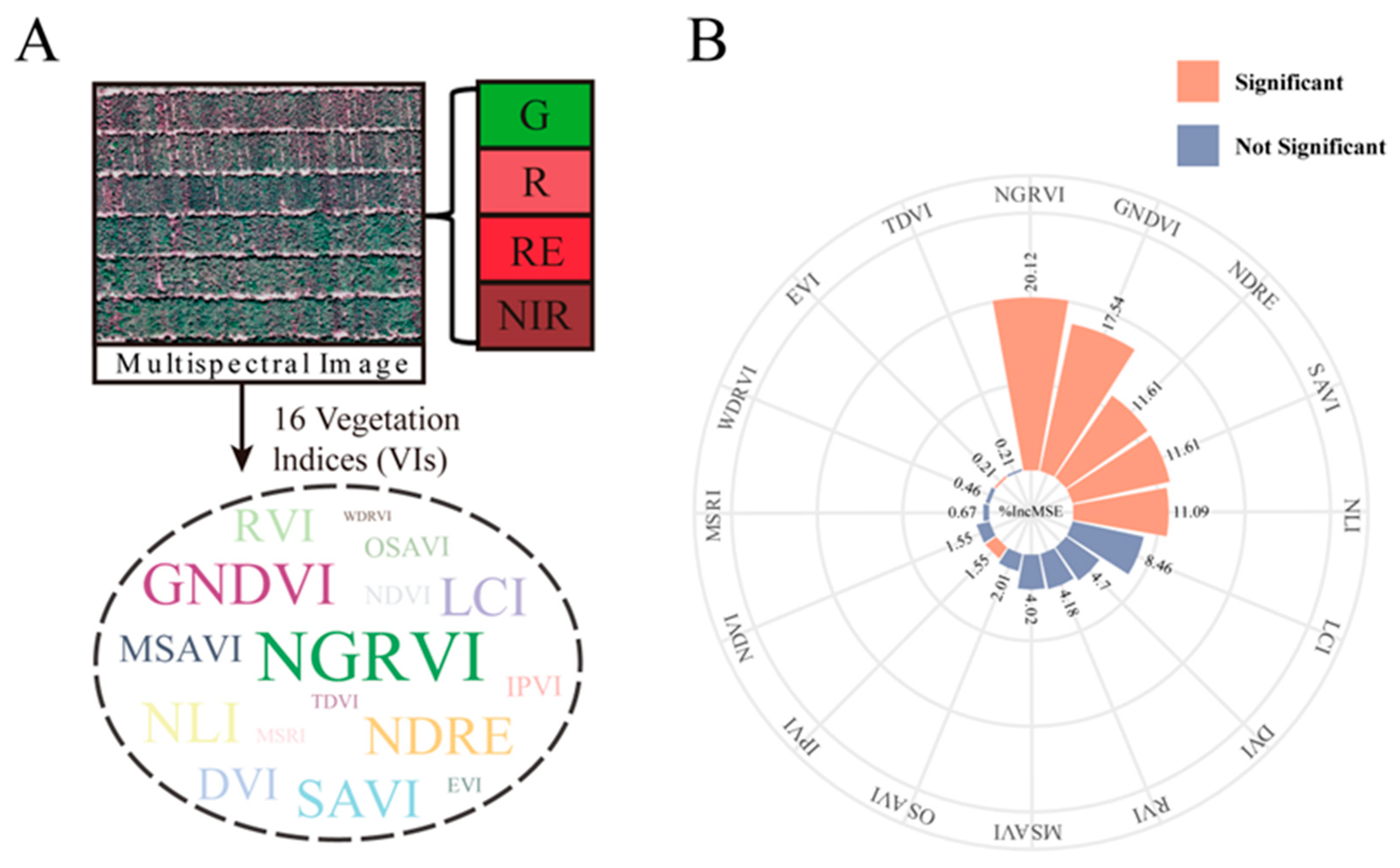
3.3. Feature Selection of Vegetation Indices for Drought Resistance in Cotton
3.4. Accuracy Evaluation of Prediction Models
3.5. Evaluation of Cluster Prediction Performance
4. Discussion
4.1. Coupled Effects of Drought Stress on Cotton Phenotypic Traits and Canopy Spectral Characteristics
4.2. Generality of the Drought Resistance Evaluation Model
5. Conclusions
Supplementary Materials
Author Contributions
Funding
Data Availability Statement
Conflicts of Interest
References
- Zhang, W.; Xu, H.; Duan, X.; Hu, J.; Li, J.; Zhao, L.; Ma, Y.P. Characterizing the Leaf Transcriptome of Chrysanthemum rhombifolium (Ling et C. Shih), a Drought Resistant, Endemic Plant from China. Front. Genet. 2021, 12, 625985. [Google Scholar] [CrossRef]
- Hao, P.; Lin, B.; Ren, Y. How Antioxidants, Osmoregulation, Genes and Metabolites Regulate the Late Seeding Tolerance of Rapeseeds under Low-Temperature Stress. Antioxidants 2023, 12, 1915. [Google Scholar] [CrossRef] [PubMed]
- Maimaitijiang, M.; Ghulam, A.; Sidike, P.; Hartling, S.; Maimaitiyiming, M.; Peterson, K.; Shavers, E.; Fishman, J.; Peterson, J.; Kadam, S.; et al. Unmanned Aerial System (UAS)-based phenotyping of soybean using multi-sensor data fusion and extreme learning machine. ISPRS J. Photogramm. Remote Sens. 2017, 134, 43–58. [Google Scholar] [CrossRef]
- Zonta, J.H.; Brandão, Z.N.; Rodrigues, J.I.D.S.; Sofiatti, V. Cotton response to water deficits at deficits at different growth stages. Rev. Caatinga 2017, 30, 980–990. [Google Scholar] [CrossRef]
- Zafar, S.; Afzal, H.; Ijaz, A.; Mahmood, A.; Ayub, A.; Nayab, A.; Hussain, S.; UL-Hussan, M.; Sabir, M.A.; Zulfiqar, U.; et al. Cotton and drought stress: An updated overview for improving stress tolerance. S. Afr. J. Bot. 2023, 161, 258–268. [Google Scholar] [CrossRef]
- Zhang, H.; Ni, Z.; Chen, Q. Proteomic responses of drought-tolerant and drought-sensitive cotton varieties to drought stress. Mol. Genet. Genom. 2016, 291, 1293–1303. [Google Scholar] [CrossRef]
- Hasan, M.M.; Ma, F.; Prodhan, Z.H. Molecular and Physio-Biochemical Characterization of Cotton Species for Assessing Drought Stress Tolerance. Int. J. Mol. Sci. 2018, 19, 2636. [Google Scholar] [CrossRef]
- White, J.W.; Andrade-Sanchez, P.; Gore, M.A. Field-based phenomics for plant genetics research. Field Crop. Res. 2012, 133, 101–112. [Google Scholar] [CrossRef]
- Niaz, N.; Tang, C. Effect of surface water and underground water drip irrigation on cotton growth and yield under two different irrigation schemes. PLoS ONE 2022, 17, e0274574. [Google Scholar] [CrossRef]
- Maes, W.H.; Steppe, K. Perspectives for Remote Sensing with Unmanned Aerial Vehicles in Precision Agriculture. Comput. Electron. Agric. 2018, 24, 152–164. [Google Scholar] [CrossRef]
- Zhao, J.Q.; Yan, J.W.; Xue, T.J.; Wang, S.W.; Qiu, X.L.; Yao, X.; Tian, Y.C.; Zhu, Y.; Cao, W.X.; Zhang, X.H. A deep learning method for oriented and small wheat spike detection (OSWSDet) in UAV images. Comput. Electron. Agric. 2022, 198, 107087. [Google Scholar] [CrossRef]
- Zhao, L.C.; Guo, W.; Wang, J.; Wang, H.Z.; Duan, Y.L.; Wang, C.; Wu, W.B.; Shi, Y. An Efficient Method for Estimating Wheat Heading Dates Using UAV Images. Remote Sens. 2021, 13, 3067. [Google Scholar] [CrossRef]
- Zhu, W.J.; Feng, Z.K.; Dai, S.Y.; Zhang, P.P.; Wei, X.H. Using UAV Multispectral Remote Sensing with Appropriate Spatial Resolution and Machine Learning to Monitor Wheat Scab. Agriculture 2022, 12, 1785. [Google Scholar] [CrossRef]
- Thompson, A.L.; Thorp, K.R.; Matthew, C.; Pedro, A.S.; Heun, J.T.; Dyer, J.M.; White, J.W. Deploying a Proximal Sensing Cart to Identify Drought-Adaptive Traits in Upland Cotton for High-Throughput Phenotyping. Front. Plant Sci. 2018, 9, 507. [Google Scholar] [CrossRef]
- Ravichandran, P.; Singh, K.D.; Randhawa, H.S.; Dhariwal, R.; Sangha, J.S.; Ellert, B.; Wang, H.; Chegoonian, A.; Natarajan, M. High-Throughput Screening of Wheat Genotypes for Drought Tolerance Using Aerial Thermal Imagery. In Proceedings of the 2025 13th International Conference on Agro-Geoinformatics (Agro-Geoinformatics), Boulder, CO, USA, 7–10 July 2025. [Google Scholar]
- Ludovisi, R.; Tauro, F.; Salvati, R.; Khoury, S.; Scarascia, G.M.; Harfouche, A. UAV-Based Thermal Imaging for High-Throughput Field Phenotyping of Black Poplar Response to Drought. Front. Plant Sci. 2017, 8, 1681. [Google Scholar] [CrossRef]
- Zhang, Z.; Bian, J.; Han, W.; Fu, Q.; Chen, S.; Cui, T. Diagnosis of cotton water stress using canopy temperature characteristic parameters calculated from UAV thermal infrared images. Trans. Chin. Soc. Agric. Eng. 2018, 34, 77–83. [Google Scholar] [CrossRef]
- Yan, C.C.; Qu, Y.Y.; Chen, Q.J.; Wu, H.Q.; Zhang, B.; Peng, H.L.; Chen, Q. Estimation of cotton SPAD value and leaf water content based on UAV multispectral imagery. Trans. Chin. Soc. Agric. Eng. 2023, 39, 61–67. [Google Scholar] [CrossRef]
- Zhang, X.; Zhang, F.; Qi, Y.; Deng, L.; Wang, X.; Yang, S. New research methods for vegetation information extraction based on visible light remote sensing images from an unmanned aerial vehicle (UAV). Int. J. Appl. Earth Obs. Geoinf. 2019, 78, 215–226. [Google Scholar] [CrossRef]
- Rouse, J.W.; Haas, R.H.; Schell, J.A.; Deering, D.W. Monitoring Vegetation Systems in the Great Plains with ERTS; NASA: Washington, DC, USA, 1974.
- Gitelson, A.A.; Merzlyak, M.N. Remote estimation of chlorophyll content in higher plant leaves. Int. J. Remote Sens. 1997, 18, 2691–2697. [Google Scholar] [CrossRef]
- Gitelson, A.A. Wide Dynamic Range Vegetation Index for Remote Quantification of Biophysical Characteristics of Vegetation. J. Plant Physiol. 2004, 161, 165–173. [Google Scholar] [CrossRef]
- Gitelson, A.A.; Gritz, Y.; Merzlyak, M.N. Relationships between leaf chlorophyll content and spectral reflectance and algorithms for non-destructive chlorophyll assessment in higher plant leaves. J. Plant Physiol. 2003, 160, 271–282. [Google Scholar] [CrossRef] [PubMed]
- Qi, J.G.; Chehbouni, A.R.; Huete, A.R.; Kerr, Y.H.; Sorooshian, S. A Modified Soil Adjusted Vegetation Index. Remote Sens. Environ. 1994, 48, 119–126. [Google Scholar] [CrossRef]
- Crippen, R.E. Calculating the vegetation index faster. Remote Sens. Environ. 1990, 34, 71–73. [Google Scholar] [CrossRef]
- Leblanc, S.G.; Chen, J.M.; Fernandes, R.; Deering, D.W.; Conley, A. Methodology comparison for canopy structure parameters extraction from digital hemispherical photography in boreal forests. Agric. For. Meteorol. 2005, 129, 187–207. [Google Scholar] [CrossRef]
- Haboudane, D.; Miller, J.R.; Tremblay, N.; Zarco-Tejada, P.J.; Dextraze, L. Integrated narrow-band vegetation indices for prediction of crop chlorophyll content for application to precision agriculture. Remote Sens. Environ. 2002, 81, 416–426. [Google Scholar] [CrossRef]
- Miller, J.R.; Hare, E.W.; Wu, J. Quantitative characterization of the vegetation red edge reflectance 1. An inverted-Gaussian reflectance model. Int. J. Remote Sens. 1990, 11, 1755–1773. [Google Scholar] [CrossRef]
- Brando, V.E.; Dekker, A.G. Satellite Hyperspectral Remote Sensing for Estimating Estuarine and Coastal Water Quality. IEEE Trans. Geosci. Remote Sens. 2003, 41, 1378–1387. [Google Scholar] [CrossRef]
- Xue, J.R.; Su, B.F. Significant Remote Sensing Vegetation Indices: A Review of Developments and Applications. J. Sens. 2017, 2017, 1353691. [Google Scholar] [CrossRef]
- Huete, A.R. A soil-adjusted vegetation index (SAVI). Remote Sens. Environ. 1988, 25, 295–309. [Google Scholar] [CrossRef]
- Rondeaux, G.; Steven, M.; Baret, F. Optimization of soil-adjusted vegetation indices. Remote Sens. Environ. 1996, 55, 95–107. [Google Scholar] [CrossRef]
- Wang, J.; Xu, R.; Ma, Y.; Miao, L.; Cai, R.; Chen, Y. The research of air pollution based on spectral features in leaf surface of Ficus microcarpa in Guangzhou, China. Environ. Monit. Assess. 2007, 142, 73–83. [Google Scholar] [CrossRef]
- Tucker, C.J. Red and Photographic Infrared Linear Combinations for Monitoring Vegetation. Remote Sens. Environ. 1979, 8, 127–150. [Google Scholar] [CrossRef]
- Yuan, Y.; Xing, H.; Zeng, W.; Xu, J.; Sun, X.Z. Genome-wide association and differential expression analysis of salt tolerance in Gossypium hirsutum L at the germination stage. BMC Plant Biol. 2019, 19, 394. [Google Scholar] [CrossRef] [PubMed]
- Yang, T.; Li, S.M.; Huang, Y.J.; Ren, D.; Cui, J.X.; Pang, B.; Gao, W.W. Comprehensive Evaluation of Natural Compound Salt Stress of Sea-Island Cotton Resources. J. Nucl. Agric. Sci. 2021, 35, 1507–1521. [Google Scholar] [CrossRef]
- Jiang, M.H.; Sun, F.L.; Yang, Y.; Wang, Y.Y.; Qu, Y.Y.; Chen, Q.J. Identification and evaluation of drought resistance of upland-island recombination inbred line population at blossoming and boll-forming stages. Arid Zone Res. 2020, 37, 1635–1643. [Google Scholar] [CrossRef]
- Liu, Z.W.; Zhang, P.; Wang, R. Effects of soil progressive drought during the flowering and boll-forming stage on gas exchange parameters and chlorophyll fluorescence characteristics of the subtending leaf to cotton boll. Ying Yong Sheng Tai Xue Bao 2014, 25, 3533–3539. [Google Scholar] [CrossRef]
- Sun, F.; Chen, Q.; Chen, Q. Screening of Key Drought Tolerance Indices for Cotton at the Flowering and Boll Setting Stage Using the Dimension Reduction Method. Front. Plant Sci. 2021, 12, 619926. [Google Scholar] [CrossRef]
- Sun, F.; Chen, Q.; Chen, Q. Yield-based drought tolerance index evaluates the drought tolerance of cotton germplasm lines under field conditions. PeerJ 2023, 11, e14367. [Google Scholar] [CrossRef]
- Wang, W.; Sun, N.; Zhao, K.; Song, J.K.; Fang, H.; Fan, G.Q.; Gao, Y.H.; Huang, T.R.; Ding, Y.D. Genome-wide association analysis of wheat stem traits using 55K microarrays. Front. Plant Sci. 2025, 16, 1635721. [Google Scholar] [CrossRef]
- Xie, M.; Wang, Z.; Huete, A.; Brown, L.A.; Wang, H.; Xie, Q.; Xu, X.; Ding, Y. Estimating Peanut Leaf Chlorophyll Content with Dorsiventral Leaf Adjusted Indices: Minimizing the Impact of Spectral Differences between Adaxial and Abaxial Leaf Surfaces. Remote Sens. 2019, 11, 2148. [Google Scholar] [CrossRef]
- Wang, W.; Sun, N.; Bai, B.; Wu, H.; Cheng, Y.K.; Geng, H.W.; Song, J.K.; Zhou, J.P.; Pang, Z.Y.; Qian, S.T.; et al. Prediction of wheat SPAD using integrated multispectral and support vector machines. Front. Plant Sci. 2024, 15, 1405068. [Google Scholar] [CrossRef]
- Wang, W.; Gao, X.; Cheng, Y.K.; Ren, Y.; Zhang, Z.H.; Wang, R.; Cao, J.M.; Geng, H.W. QTL Mapping of Leaf Area Index and Chlorophyll Content Based on UAV Remote Sensing in Wheat. Agriculture 2022, 12, 595. [Google Scholar] [CrossRef]
- Wang, W.; Cheng, Y.K.; Ren, Y.; Zhang, Z.H.; Geng, H.W. Prediction of Chlorophyll Content in Multi-Temporal Winter Wheat Based on Multispectral and Machine Learning. Front. Plant Sci. 2022, 13, 896408. [Google Scholar] [CrossRef]
- Liu, K.; Harrison, M.T.; Yan, H.L.; Liu, D.L.; Meinke, H.; Hoogenboom, G.; Wang, B.; Peng, B.; Guan, K.Y.; Jaegermeyr, J.; et al. Silver lining to a climate crisis in multiple prospects for alleviating crop waterlogging under future climates. Nat. Commun. 2023, 14, 765. [Google Scholar] [CrossRef]





| Parameter | Parameter Values |
|---|---|
| Flight altitude | 30 m |
| Flight Speed | 5.4 km/h |
| Course overlap ratio | 80% |
| Lateral overlap rate | 70% |
| Spectral type | Green, Red, Red_edge, and Nir |
| Vegetation Index | Formula to Calculate | Reference |
|---|---|---|
| NGRVI | NGRVI = (RGreen − RRed)/(RGreen + RRed) | [19] |
| NDVI | [20] | |
| GNDVI | [21] | |
| WDRVI | [22] | |
| LCI | [23] | |
| MSAVI | [24] | |
| IPVI | [25] | |
| NLI | [26] | |
| TDVI | [27] | |
| MSRI | [28] | |
| NDRE | [29] | |
| RERDVI | [30] | |
| SAVI | [31] | |
| OSAVI | [32] | |
| RVI | [33] | |
| DVI | [34] |
| Traits | Env | Min | Max | Mean | CV (%) | Sig |
|---|---|---|---|---|---|---|
| PH (cm) | CK | 41.20 | 80.50 | 57.16 | 11.95 | *** |
| DS | 36.90 | 72.20 | 50.71 | 13.13 | ||
| FBN | CK | 4.40 | 10.30 | 7.19 | 11.18 | *** |
| DS | 2.50 | 8.70 | 5.98 | 15.65 | ||
| Non-FBN | CK | 0.20 | 5.90 | 1.85 | 36.47 | *** |
| DS | 0.80 | 4.00 | 2.23 | 26.13 | ||
| BN | CK | 3.10 | 9.00 | 5.52 | 17.57 | *** |
| DS | 1.80 | 8.70 | 3.73 | 23.28 | ||
| SY (Kg) | CK | 0.80 | 3.00 | 1.70 | 20.27 | *** |
| DS | 0.50 | 1.80 | 1.16 | 19.28 | ||
| BW (g) | CK | 3.10 | 7.60 | 5.44 | 10.46 | *** |
| DS | 3.80 | 6.60 | 5.19 | 9.43 | ||
| LP (%) | CK | 26.50 | 50.40 | 41.84 | 9.11 | *** |
| DS | 22.30 | 48.10 | 40.39 | 9.47 | ||
| SI (g) | CK | 7.00 | 15.20 | 10.42 | 11.58 | * |
| DS | 7.90 | 14.60 | 10.29 | 10.29 | ||
| HFNFB (cm) | CK | 13.40 | 30.80 | 20.22 | 13.60 | *** |
| DS | 13.50 | 33.90 | 21.60 | 14.87 | ||
| FNFB | CK | 2.00 | 6.70 | 4.76 | 12.27 | *** |
| DS | 2.50 | 8.90 | 4.93 | 15.05 | ||
| FL (mm) | CK | 24.00 | 31.40 | 27.70 | 5.17 | *** |
| DS | 23.30 | 29.90 | 26.58 | 4.56 | ||
| FU (%) | CK | 80.40 | 87.60 | 84.21 | 1.56 | *** |
| DS | 79.60 | 86.40 | 83.07 | 1.52 | ||
| FM | CK | 2.70 | 5.50 | 4.53 | 9.56 | *** |
| DS | 3.00 | 6.20 | 5.07 | 8.00 | ||
| FS (cN/tex) | CK | 24.30 | 41.60 | 31.06 | 8.70 | *** |
| DS | 24.40 | 37.50 | 30.00 | 9.10 | ||
| FE (%) | CK | 6.30 | 6.90 | 6.62 | 1.82 | *** |
| DS | 6.20 | 6.80 | 6.52 | 1.81 |
Disclaimer/Publisher’s Note: The statements, opinions and data contained in all publications are solely those of the individual author(s) and contributor(s) and not of MDPI and/or the editor(s). MDPI and/or the editor(s) disclaim responsibility for any injury to people or property resulting from any ideas, methods, instructions or products referred to in the content. |
© 2026 by the authors. Licensee MDPI, Basel, Switzerland. This article is an open access article distributed under the terms and conditions of the Creative Commons Attribution (CC BY) license.
Share and Cite
Zhao, F.; Yang, T.; Wang, W.; Han, W.; Wang, G.; Qiao, J.; Kong, X.; Liu, L.; Si, A.; Wang, F.; et al. High-Throughput Evaluation of Cotton Drought Tolerance Using UAV Multispectral Imagery and XGBoost-Based Machine Learning. Agronomy 2026, 16, 526. https://doi.org/10.3390/agronomy16050526
Zhao F, Yang T, Wang W, Han W, Wang G, Qiao J, Kong X, Liu L, Si A, Wang F, et al. High-Throughput Evaluation of Cotton Drought Tolerance Using UAV Multispectral Imagery and XGBoost-Based Machine Learning. Agronomy. 2026; 16(5):526. https://doi.org/10.3390/agronomy16050526
Chicago/Turabian StyleZhao, Fuxiang, Tao Yang, Wei Wang, Wanli Han, Gang Wang, Jinxin Qiao, Xianhui Kong, Li Liu, Aijun Si, Fanlin Wang, and et al. 2026. "High-Throughput Evaluation of Cotton Drought Tolerance Using UAV Multispectral Imagery and XGBoost-Based Machine Learning" Agronomy 16, no. 5: 526. https://doi.org/10.3390/agronomy16050526
APA StyleZhao, F., Yang, T., Wang, W., Han, W., Wang, G., Qiao, J., Kong, X., Liu, L., Si, A., Wang, F., Wang, X., Yang, X., & Yu, Y. (2026). High-Throughput Evaluation of Cotton Drought Tolerance Using UAV Multispectral Imagery and XGBoost-Based Machine Learning. Agronomy, 16(5), 526. https://doi.org/10.3390/agronomy16050526