Article

Effect of Nitrogen, Phosphorus and Potassium Fertilization Management on Plant and Soil Properties in Grasslands with Varying Salinity–Alkalinity


1
Shanxi Agricultural University, Taiyuan 030031, China
2
Soil Health Laboratory in Shanxi Province, Taiyuan 030031, China
*
Author to whom correspondence should be addressed.
Agronomy 2026, 16(5), 524; https://doi.org/10.3390/agronomy16050524
Submission received: 20 January 2026 / Revised: 23 February 2026 / Accepted: 26 February 2026 / Published: 28 February 2026
(This article belongs to the Section Grassland and Pasture Science)

Abstract

Rational fertilization is a key measure for improving grassland productivity; however, the optimal effects of nitrogen (N), phosphorus (P) and potassium (K) rationing vary across grasslands with different salinity–alkalinity conditions. To determine the optimum fertilization ratio for typical saline–alkaline degraded grasslands in the agro-pastoral transition zone of northern China, we carried out an experiment with different ratios of N, P and K to investigate the effects of fertilization on biomass, plant diversity, plant nutrient uptake and soil nutrient contents. The results showed that fertilization increased biomass, plant diversity, nutrient uptake and soil nutrient contents in all levels of saline–alkaline grasslands. Compared with the control, N2P2K2 treatment resulted in the significantly highest biomass, with an increase of 4.52 and 2.39 t ha−1 in slightly and moderately saline–alkaline grasslands; N2P2K1 resulted in the significantly highest biomass, with an increase of 1.14 t ha−1 in severely saline–alkaline grasslands. We integrated plant and soil properties to construct a second-order response surface model (RSM), and our recommended optimum N–P–K fertilization ratios for slightly, moderately and severely saline–alkali grasslands are 103.7–88.1–78.0, 125.5–91.5–74.1 and 85.2–68.1–58.2 kg ha−1, respectively. Reasonable fertilization can improve soil fertility, biomass yield and plant diversity, while excessive fertilization has negative effects on soil and plant traits. Our results provide theoretical support and practical guidance for the scientific fertilization of grasslands with varying salinity and alkalinity.

1. Introduction

Grasslands constitute an important component of terrestrial ecosystems and play a critical role in maintaining ecological security [1]. They provide essential ecosystem services, including regulating global climate change, conserving soil and water, nurturing water sources, providing forage, sequestering carbon, and sustaining biodiversity and gene pools [2]. However, under the combined pressures of climate change and anthropogenic disturbance, grassland salinization has become increasingly severe. It is estimated that approximately 1.381 billion ha of land worldwide are affected by salinization, and this is expanding at an unprecedented rate and scale [3,4]. Salinization alters the physicochemical properties of soil, significantly reducing the bioavailability of key nutrients such as nitrogen, phosphorus and potassium [5]. This directly leads to diminished soil fertility and reduced grassland productivity [6], thereby restricting the ecosystem functioning of grasslands [7]. Consequently, restoring and sustainably maintaining grassland productivity and ecological service functions have emerged as critical ecological challenges.
Grassland degradation under saline–alkaline conditions typically involves multiple stresses, including nutrient deficiency, soil compaction, and salinity ion toxicity, which slow natural vegetation recovery and lead to a tendency toward simplification of community structure [8]. In the ecological restoration of saline–alkaline grasslands, fertilization is often regarded as an effective supplementary measure due to its ability to rapidly improve soil nutrient status [9,10]. Research has demonstrated that N and P are the primary limiting nutrients for plant growth in saline–alkaline grasslands [11]. Their scarcity severely restricts the establishment and development of plant communities [12]. Studies have reported that N application significantly enhances grassland biomass recovery [13,14]. N input not only promotes the growth of key species but also helps optimize community structure, facilitating succession from low-growing salt-tolerant weeds-dominated communities to perennial herb-dominated communities, thereby improving ecosystem stability and productivity [15]. Although P is essential for plant growth, its availability in saline–alkaline soils is often low. P addition can promote root development, increase P uptake efficiency, and improve overall plant growth [16]. Furthermore, combined N and P application generally produces more pronounced growth responses, indicating a synergistic interaction between these nutrients [17]. K plays a crucial role in the transport of plant organic matter, N metabolism and storage processes, and is essential for plant yield and quality. Research has found that plant response to K uptake and K requirements largely depends on N nutrition levels [18]. An increased N supply promotes growth, thereby increasing the demand for K and other nutrients. Consequently, the combined application of N, P and K is a key measure for promoting grassland biomass accumulation and optimizing community structure.
However, the synergistic effects of combined NPK fertilization are often overlooked during the restoration of saline–alkaline lands. This implies that it is essential to take nutrient interactions and their effects on plants and soils into consideration. In heavily salinized soils, the bioavailability of key nutrients (such as N, P and K) is significantly reduced, and nutrient imbalance becomes prominent, severely limiting vegetation reestablishment and recovery. Among these, K deficiency is particularly critical, as it directly affects plant osmotic regulation and salt stress resistance mechanisms [19]. Studies have shown that K supplementation can effectively mitigate sodium ion toxicity, and improve water uptake and photosynthetic efficiency, thereby offsetting the limitations of single N or P fertilization [20,21]. Balanced NPK fertilization can not only alleviate single-nutrient limitations but also improve the soil microenvironment, promote nutrient cycling and consequently enhance grassland productivity and ecosystem stability. Furthermore, studies have demonstrated that excessive fertilization leads to reduced plant productivity and decreased plant diversity [22,23]. Accordingly, appropriate fertilization rates are crucial for the ecological restoration of saline–alkaline grasslands.
Nevertheless, the effectiveness of fertilization is often constrained by salinity levels. Improper fertilization can not only result in nutrient loss but also induce risks of secondary salinization. Therefore, developing scientifically sound NPK application strategies tailored to different salinity gradients remains a critical challenge in the restoration of saline–alkaline grasslands. For this, we selected grasslands with varying degrees of salinity in the agro-pastoral transition zone of northern China. Using four NPK fertilizer gradient treatments, we investigated the effects of two consecutive years of fertilization on plant and soil properties. This study aims to systematically identify optimal fertilization strategies across different saline–alkaline habitats through controlled field experiments, thereby providing both theoretical insights and practical guidance for the sustainable management of saline–alkaline grasslands. The specific objectives were to (1) elucidate the effects of different NPK fertilization ratios on the productivity and plant diversity of saline–alkaline grasslands, (2) reveal how varying NPK ratios affect soil nutrient contents and (3) determine optimal NPK application rates that achieve the best overall performance across grasslands with different degrees of salinization.

2. Materials and Methods

2.1. Site Description

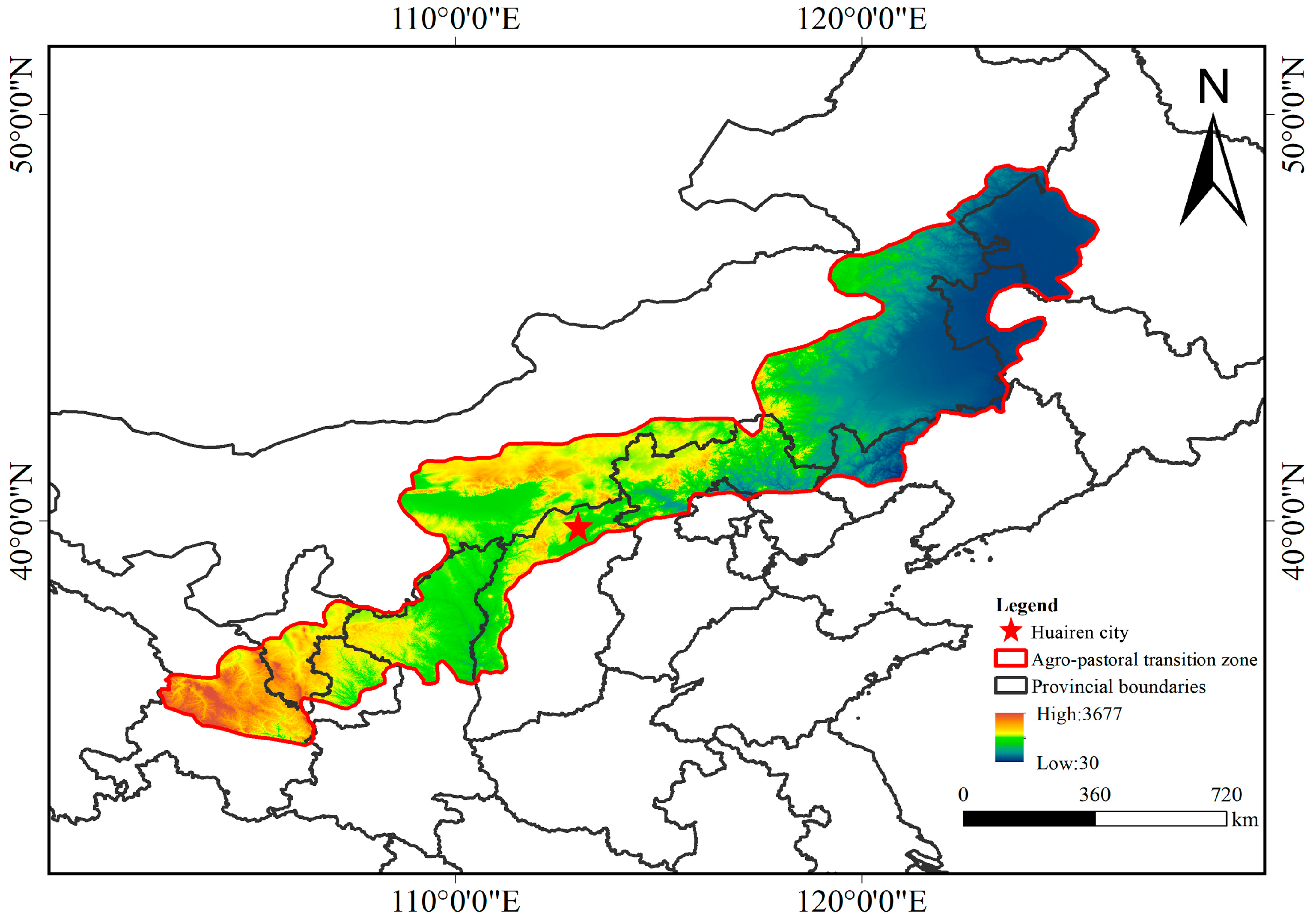
The study was conducted from 2023 to 2024 in Huairen city, Shuozhou city, Shanxi Province (113°15′26″ E, 39°55′29″ N, 1050 m elevation) (Figure 1). The site is characterized by a temperate continental climate, with an average annual temperature of 7.3 °C and a mean precipitation (which mainly falls from July to August) of 367 mm. The soil type is classified as soda saline–alkaline soil with a sandy loam texture. The study area was previously cultivated land used for corn production. After years of abandonment due to severe salinization, it transformed into secondary saline–alkali grassland. The dominant species in slightly, moderately and severely saline–alkali grasslands are Echinochloa crus-galli, Phragmites australis and Puccinellia distans.

2.2. Experiment Design and Sampling

Following the national standard for rangeland degradation, sandification and salinization (GB 19377–2003) [24], the sampling sites were divided into three salinity–alkalinity levels: slight (SL), moderate (MO) and severe (SE). All three sampling sites are located within the administrative boundaries of Maozao Town Huairen City and share the same climatic conditions and soil type, ensuring that the observed differences are primarily attributable to the gradient of salinity–alkalinity levels. Three replicates were established at each sampling site, and the soil chemical properties are presented in Table 1. The experiment employed a fertilization gradient design with three nutrients, nitrogen (urea, 46% N), phosphorus (superphosphate, 16% P) and potassium (potassium sulfate, 52% K), each applied at four levels (0, 1, 2 and 3), resulting in a total of 14 fertilization treatments. Level 0 represented the unfertilized control, while Level 2 corresponded to the locally recommended optimal fertilization rate of 100 kg ha−1 for N, 80 kg ha−1 for P and 75 kg ha−1 for K. Level 1 and 3 were set at 0.5 and 1.5 times the Level 2 rates, respectively. All the treatments were carried out at three salinity levels. The exact fertilization treatments are presented in Table 2. The P and K fertilizers were applied once as basal fertilizers on 15 May. N fertilizer was applied in split applications, with 25% applied as a basal fertilizer on 15 May and the remaining 75% top-dressed in three equal applications at 30-day intervals. The experiment followed a randomized complete block design, and each plot measured 16 m2 (4 m × 4 m).

2.3. Sampling and Measurements

2.3.1. Vegetation Surveys

In early August of each year, three 0.5 m× 0.5 m quadrats were randomly established in each replicated plot for vegetation investigation. All plant species were identified to the species level, and the total number of each species in the quadrats was recorded. In this study, the Shannon–Wiener index (H), Simpson index (D) and Pielou evenness index (E) were used to describe species diversity using the following formulas:
H = −∑PilnPi
D = 1 − ∑Pi2
E = H/lnS
where Pi is the proportion of individuals belonging to species i, and S is the total species number in the sample.

2.3.2. Plant Sampling and Analysis

Biomass sampling was conducted in the same plots as the vegetation survey, with three 0.5 m × 0.5 m per plot. The plants within the survey plots were cut as close to soil surface, dried at 105 °C for 30 min and then dried at 65 °C until a constant weight, and the dry weight was determined. The total biomass was calculated as the sum of the dry weights of all species. The resulting values were standardized by area and expressed in tons per hectare. The dried plant samples were ground and passed through a sieve for nutrient analysis. The total N, P and K contents were analyzed by the Kjeldahl method [25], the molybdenum blue colorimetric method [26] and the vanadate–molybdate yellow colorimetric method [27], respectively. Plant N, P and K uptake was calculated by multiplying plant aboveground biomass by their corresponding total N, P and K contents.

2.3.3. Soil Sampling and Analysis

Soil samples were collected from the 0–20 cm layer of each plot using a 3 cm diameter auger (LQ, Yangling Xingxing Water and Soil Conservation Equipment Factory, Yangling, China). Each sample was a composite of three randomly selected cores, with three replicate plots per treatment. After air drying, samples were sieved through 1 mm mesh for subsequent analyses. Soil pH and electrical conductivity (EC) were measured using a pH meter (PHS–3C, INESA Scientific Instrument, Shanghai, China) and a conductivity meter (DDS–307A, INESA Scientific Instrument, Shanghai, China), respectively. Available N was extracted with KCl and quantified by ultraviolet spectrophotometry using a continuous flow analyzer (AA3, SEAL Analytical, Norderstedt, Germany) [28]. Available P was extracted with NaHCO3 and measured by the molybdenum–antimony anti-colorimetric method with a spectrophotometer (UV2700i, Shimadzu, Kyoto, Japan) [29]. Available K was extracted with ammonium acetate and measured using a flame photometer (FP6640, Shanghai Yidian Analytical Instrument, Shanghai, China) [30].

2.4. Statistical Analysis

All statistical analyses were performed using SPSS 26. One-way analysis of variance (ANOVA) and Tukey’s test were used to analyze the effects of different fertilization treatments on plant biomass, plant nutrient uptake, plant diversity, and soil nutrient contents. Two-way ANOVA was conducted to examine the effects of fertilizer, year and their interaction on plant and soil variables. Beta regression and generalized linear model were conducted to examine the effects of fertilizer, year and their interaction on diversity index. Redundancy analysis (RDA) was performed in R 4.3.3 using the vegan package to assess the responses of ecosystem function indicators to NPK addition. A composite score derived from 10 key indicators was calculated using principal component analysis (PCA), a second-order response surface model (RSM) was subsequently fitted using the rsm package in R 4.3.3, with coded N, P and K application rates as predictors and the composite score as the response variable to identify optimal fertilization levels [31].

3. Results

3.1. Effect of Different Fertilization Treatments on Plant Biomass of Saline–Alkaline Grasslands

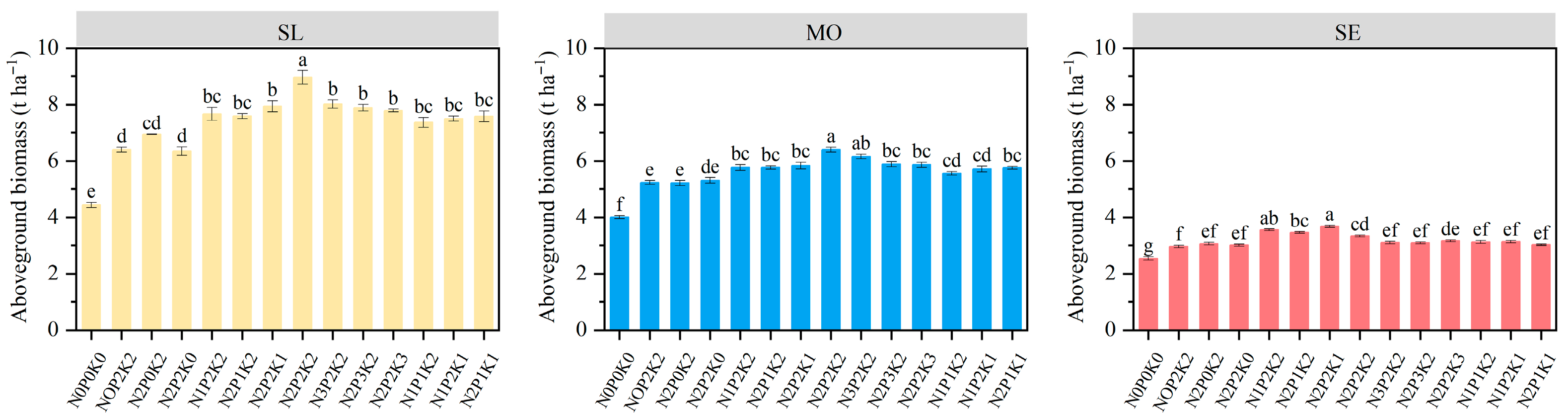
Aboveground biomass of SL, MO and SE was significantly affected by NPK fertilization treatments (p < 0.001 Table S1). Fertilization significantly increased plant biomass relative to the control (Figure 2), whereas the response magnitude to different NPK ratios depended on the level of soil salinization. The highest biomass was achieved with the N2P2K2 treatment for SL and MO sites, which increased by 4.52 t ha−1 and 2.39 t ha−1 compared with the control, respectively. Compared with the N2P2K2 treatment, an excess or deficiency of any nutrient led to a reduction in biomass. As soil salinization intensified, the promoting effect of fertilization on biomass exhibited a gradual attenuation trend. On SE sites, the N2P2K1 treatment had the highest biomass, increasing by 1.14 t ha−1 compared with the control.

3.2. Effects of Different Fertilization Treatments on Plant Diversity of Saline–Alkaline Grasslands

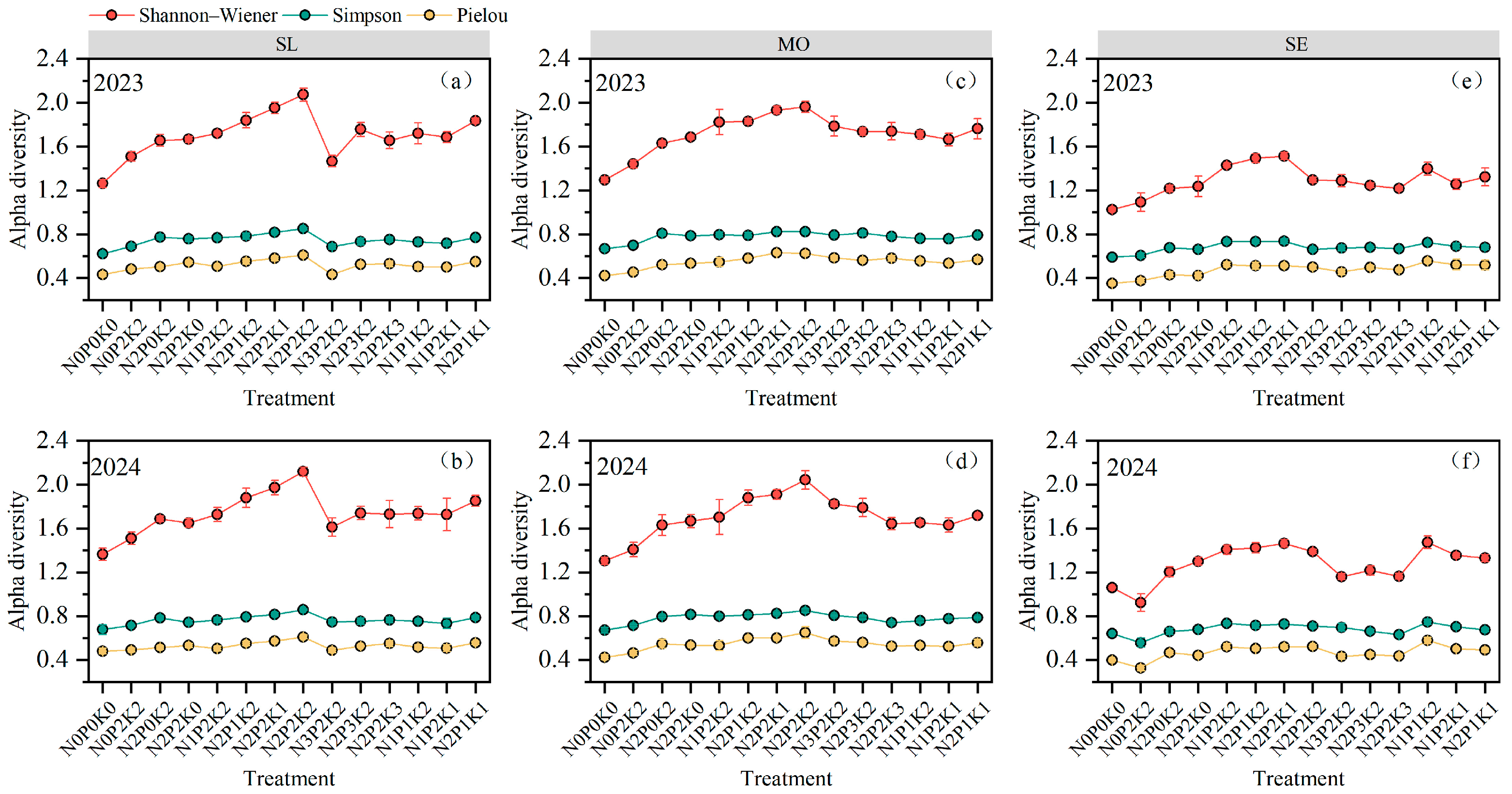
Plant diversity was significantly affected by fertilization (Figure 3, Table S1). Compared with the control, N2P2K2 treatment significantly increased plant diversity in SL and MO sites. The Shannon–Wiener, Simpson and Pielou indices increased by 55.26–64.12% and 51.41–56.78%, 26.60–37.10% and 21.18–23.50%, and 27.08–40.77% and 47.24–53.54%, respectively (p < 0.05). In SE sites, the highest Shannon–Wiener and Simpson indices were observed under the N2P2K1 treatment in 2023, increasing by 47.40% and 24.86% compared with the control (p < 0.05). In 2024, the Shannon–Wiener, Simpson and Pielou indices reached their highest values under N1P1K2 treatment, representing increases of 38.99%, 16.67% and 45.38% relative to the control, respectively (p < 0.05).

3.3. Effects of Different Fertilizing Treatments on Plant Nutrient Uptake of Saline–Alkaline Grasslands

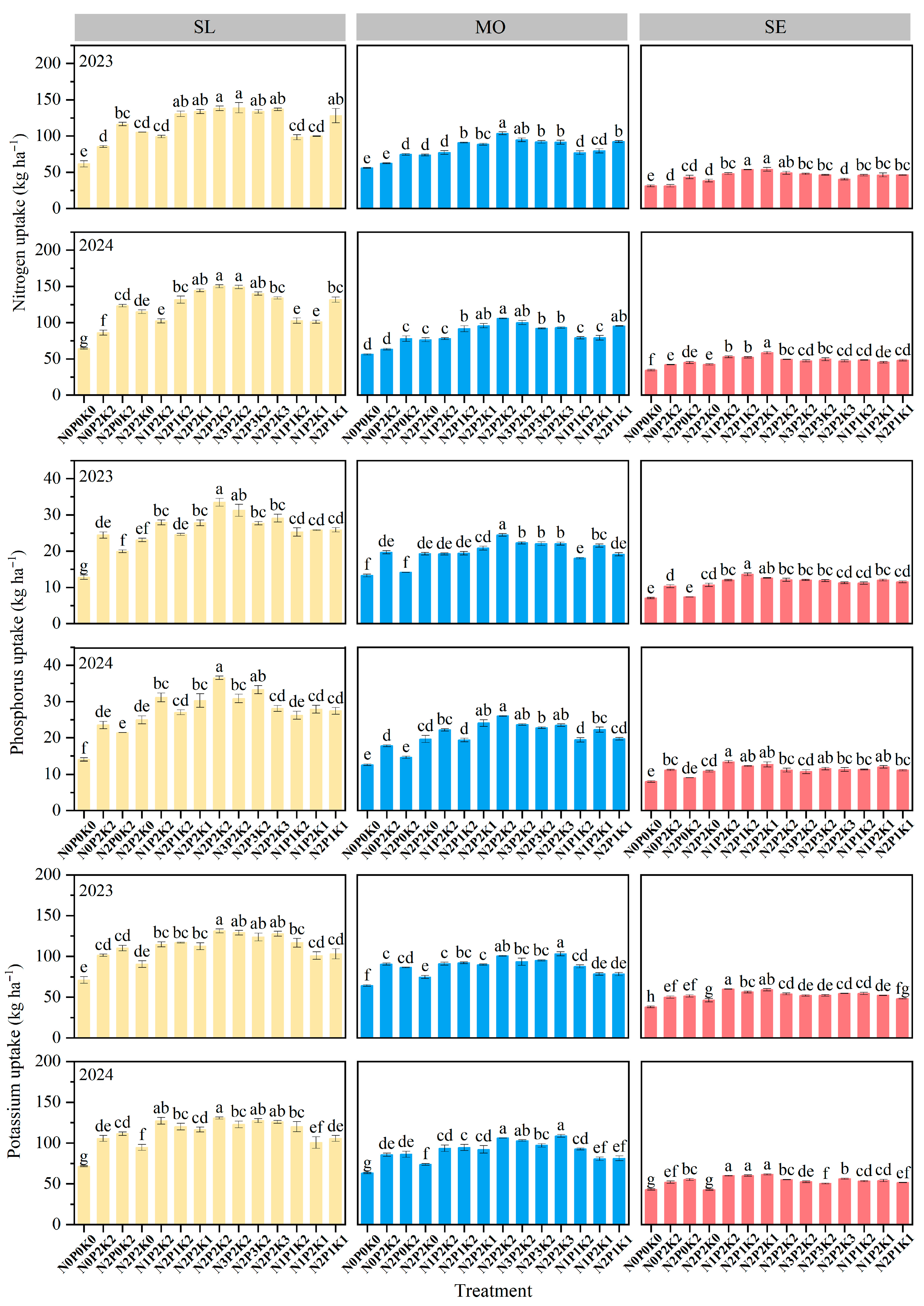
Fertilization significantly increased plant nutrient uptake (Table S3), whereas N, P and K uptake gradually declined with increasing salinization across all treatments (Figure 4). In SL and MO sites, the N2P2K2 treatment exhibited the highest N and P uptake compared with the control, with N uptake increasing by 102.51–103.40% and 85.27–88.25%, respectively, and P uptake increasing by 160.42–161.60% and 83.93–106.42%, respectively (p < 0.05). Plant K uptake was highest under N2P2K2 in SL sites and under N2P2K3 in MO sites, with increases of 82.63–84.69% and 60.60–71.87% (p < 0.05). N uptake was not affected by P or K deficiency at the N1 level on SL and MO sites. However, on SL sites, K deficiency significantly reduced P and K uptake. With N2K2, as P deficiency increased (from P2 to P0), the N, P and K gradually decreased. Compared with P2, P1 on SL sites decreased N, P and K uptake by 5.49–12.27%, 26.04–26.49% and 8.06–10.88%, respectively, while on MO sites, it led to decreases of 9.61–12.31%, 20.67–25.51% and 8.58–10.93%, respectively. Compared with P2, P0 on SL sites decreased N, P and K uptake by 15.90–17.78%, 40.40–41.34% and 14.67–19.03%, respectively (p < 0.05), while on MO sites it led to decreases of 27.88–28.87%, 42.16–43.83% and 14.27–18.77%, respectively (p < 0.05). Similarly, with N2P2, as K deficiency increased (from K2 to K0), the N, P and K uptake gradually decreased. Compared with K2, K1 on SL sites decreased N, P and K uptake by 3.29–3.69%, 16.96–17.23% and 10.87–14.30%, respectively, while on MO sites, it led to decreases of 9.61–14.49%, 7.53–14.99% and 10.85–13.04%, respectively. Compared with K2, K0 on SL sites decreased N, P and K uptake by 23.39–23.86%, 31.73–32.99% and 27.38–31.02%, respectively (p < 0.05), while on MO sites, it led to decreases in uptake by 27.88–28.87%, 21.23–24.43% and 25.82–30.39%, respectively (p < 0.05). In SE sites, the N2P2K1 treatment resulted in the highest N uptake, increasing by 69.61–73.31% compared with the control. Moreover, further increases in N input did not significantly enhance nutrient uptake. Under N1, additional P and K fertilization significantly increased K uptake, whereas under N2, nutrient uptake remained limited despite increased P and K application.

3.4. Effects of Different Fertilizing Treatments on Soil Nutrient Contents of Saline–Alkaline Grasslands

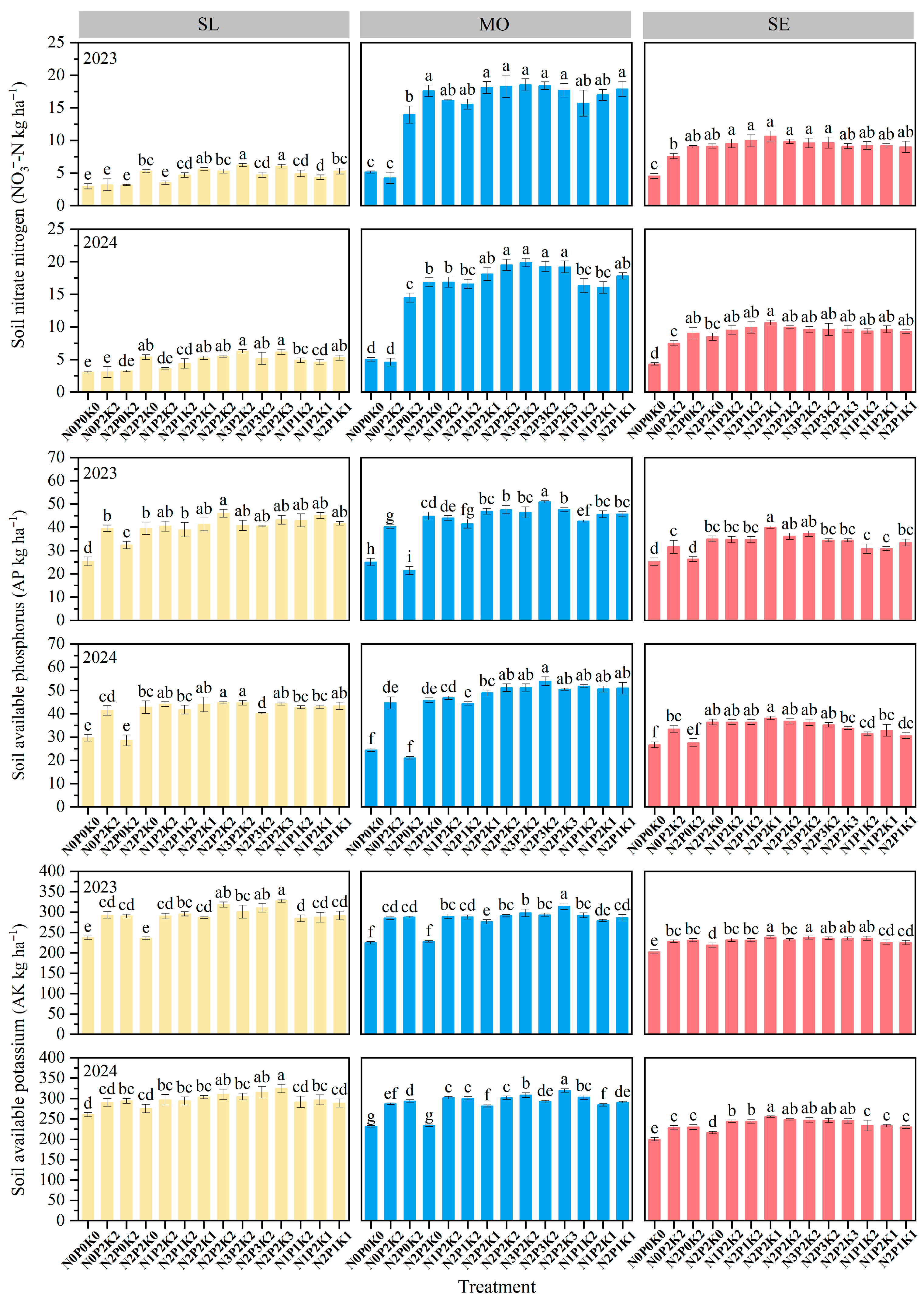
Fertilization significantly affected soil available nutrient contents (Table S4). At the same fertilization level, NO3–N content was highest in MO sites, whereas AP and AK contents were generally lowest in SE sites (Figure 5). Compared with the control, the N2P2K2 treatment significantly increased NO3–N contents by 79.93–80.59%, 255.53–289.62% and 117.22–121.99% in SL, MO and SE sites, respectively (p < 0.05). Increasing N application from N2 to N3 further enhanced NO3–N contents in SL and MO sites, but resulted in a decrease in SE sites. In SL sites, P deficiency (N2P0K2) reduced NO3–N contents 40.26–41.17% compared with N2P2K2 (p < 0.05). Deficiencies of N, P and K (N0P2K2, N2P0K2 and N2P2K0) significant decreased AP contents by 7.63–14.07%, 29.73–36.27% and 4.33–14.13%, respectively (p < 0.05), and decreased AK contents by 6.64–8.02%, 5.14–8.86% and 11.14–26.04%. In MO sites, reducing N (N1P2K2) significantly decreased NO3–N contents by 11.69–13.63%, while P deficiency (N2P0K2) led to a reduction of 23.81–25.72% (p < 0.05). Deficiencies of N, P, and K significantly reduced AP contents by 14.64–15.51%, 54.95–58.98% and 5.90–10.68%, respectively (p < 0.05), whereas K deficiency (N2P2K0) reduced AK contents by 22.46–23.96% (p < 0.05). In SE sites, P deficiency (N0P2K2) significantly reduced NO3–N contents by 21.79–22.96% (p < 0.05). Deficiencies of N and P decreased AP contents by 8.98–12.61% and 25.09–27.30%, respectively, while K deficiency reduced AK contents by 5.68–12.81% (p < 0.05). In contrast, K reduction (N2P2K1) increased NO3–N, AP and AK contents by 8.43–11.16%, 3.86–10.59% and 2.90–2.94%, respectively. Notably, both increasing and decreasing P application resulted in lower AP contents compared with N2P2K2.

3.5. Optimization of Fertilizer Application Rates Based on Integrated NPK Effect Analysis

3.5.1. Effects of Fertilizer Application Rates on Multiple Indicators in Plant–Soil Systems

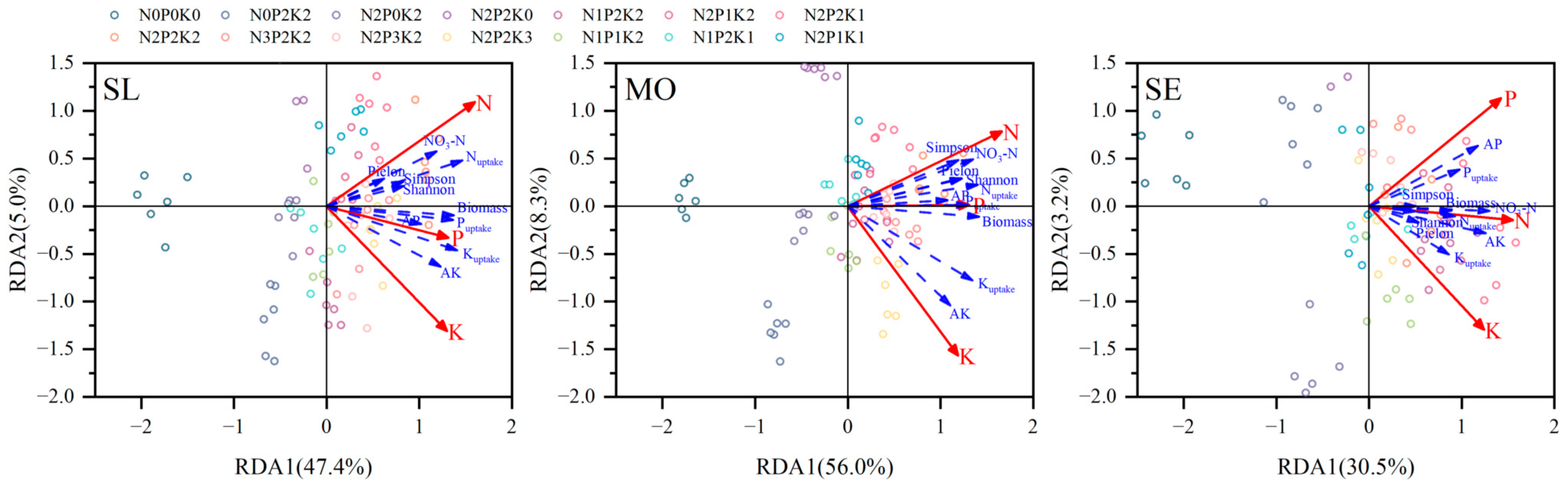
The first two axes (Figure 6) explained 52.4%, 64.3% and 33.7% of the total variance in plant and soil properties in SL, MO and SE sites, respectively. Loadings and contribution rates of individual indicators to the first canonical axis (PC1) were provided in Table S5. The variance decomposition results indicated that biomass, nutrient uptake, and soil nutrient content collectively explained 50.9%, 72.5%, and 51.2% of diversity in SL, MO, and SE sites, respectively (Figure S1). Across all salinization levels, plant and soil nutrient contents were significantly positively correlated with corresponding N, P and K fertilizers. In SL sites, plant biomass showed the strongest positively associated with P fertilization, followed by K and N. P fertilization was also positively associated with plant K uptake and soil AK content. The response intensity of plant diversity to nutrient addition followed the order N > P > K, with the Shannon and Simpson indices showing the strongest responses. In MO sites, plant biomass and diversity responded similarly to nutrient additions as in SL sites. In MO sites, controlling biomass resulted in the highest variance explained for plant nutrient uptake and soil nutrients (Table S6), and the contribution of the synergistic effect reached 62.5% (Figure S4). In contrast, under severe salinization, plant biomass was most strongly correlated with N fertilization, followed by P and K. Moreover, plant diversity exhibited markedly weaker responses to fertilization under SE sites compared with SL and MO sites. Specifically, the Simpson and Pielou indices responded to nutrient addition in the order N > K > P, whereas the Shannon index followed N > P > K. In summary, although fertilization effects on different indicators varied with salinization intensity, N addition consistently played a dominant role across grassland ecosystems.

3.5.2. Response Surface Analysis of Comprehensive Effects of N, P and K Fertilizer

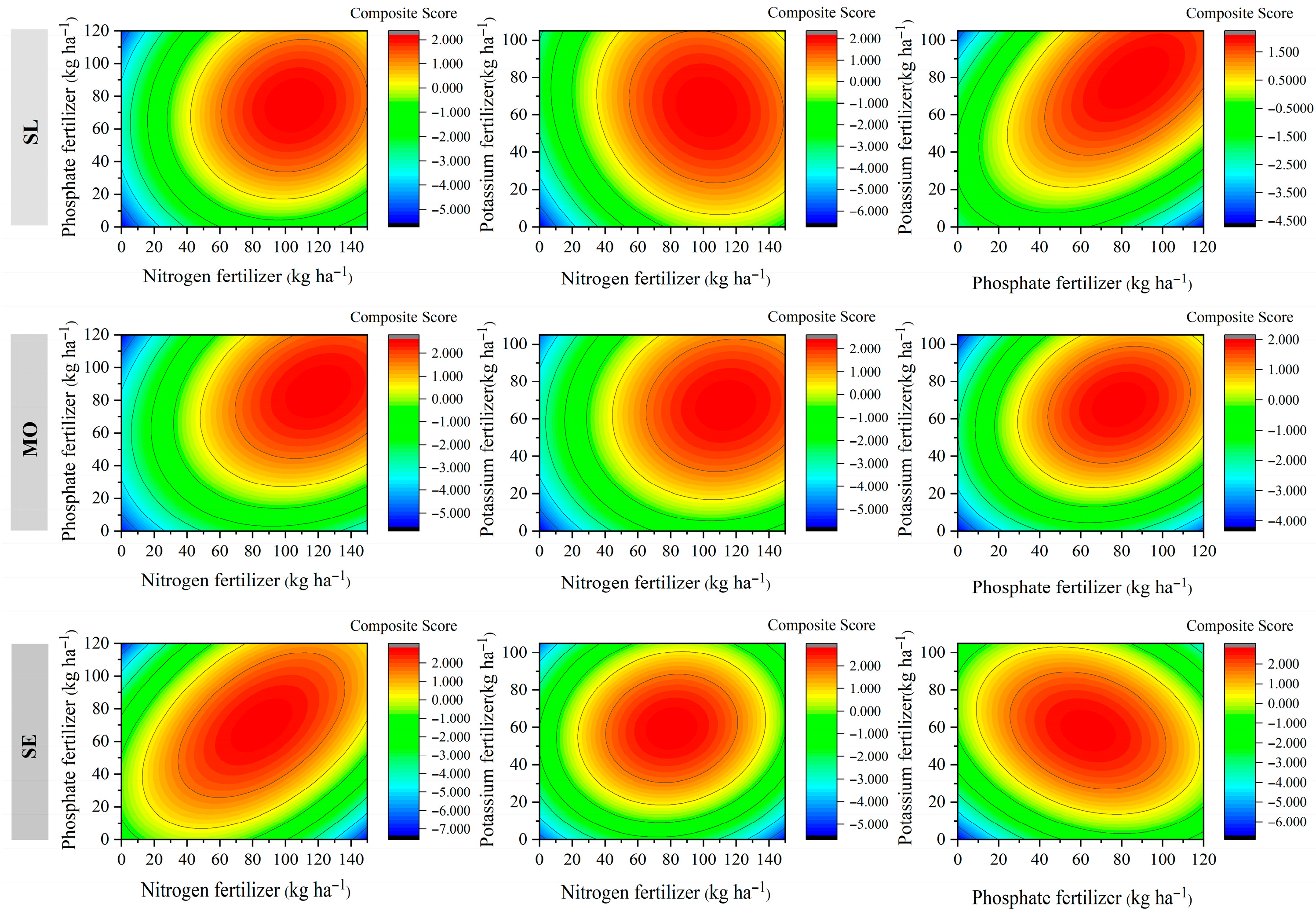
We constructed a second-order response surface model (RSM; Figure 7, Table S7) using N, P and K fertilization rates as independent variables and a composite score as the response variable. The composite score integrated ten indicators, including biomass, plant nutrient contents, plant diversity and soil nutrient contents in the 0–20 cm layer. In SL sites, the N–P interaction contours were nearly circular, indicating predominantly additive effects (p > 0.05), while the N–K interaction was not significant (p > 0.05). In contrast, the P–K interaction exhibited a pronounced elliptical pattern, suggesting a significant synergistic effect (p < 0.05). In MO sites, N–P contours were sharply elliptical, demonstrating synergistic interaction (p < 0.05), whereas N–K interactions remained largely additive and non–significant (p > 0.05). Although the P–K interaction were elliptical, the interaction was not statistically significant (p > 0.05). In SE sites, N–P interactions retained a highly elliptical pattern, indicating strong synergy (p < 0.05), while N–K interactions remained primarily additive (p > 0.05). Conversely, the P–K interaction displayed an oppositely oriented elliptical shape, suggesting an antagonistic relationship, in contrast to the synergistic effects observed under lower salinity conditions (p > 0.05).

3.5.3. Prediction of Optimal Fertilizer Application Rates

The optimal fertilization schemes were determined for different levels of salinity based on the RSM and optimization of the objective function (Table 3). The highest comprehensive scores were achieved at N–P–K application rates of 103.7–88.1–78.0 kg ha−1 in SL sites, 125.5–91.5–74.1 kg ha−1 in MO sites and 85.2–68.1–58.2 kg ha−1 in SE sites, corresponding to scores of 2.512, 2.98 and 2.845, respectively. The regression coefficients for the RSM were provided in Table S8.

4. Discussion

4.1. Effects of Different NPK Application Combinations on Productivity and Diversity of Salinized Grasslands

Consistent with previous research findings, N, P and K are key elements for vegetation regeneration and productivity in degraded grasslands, and their appropriate application can effectively enhance biomass yield and plant diversity [32,33,34,35]. In this study, different N–P–K combinations significantly increased biomass in saline–alkaline grasslands, with the N2P2K2 treatment yielding the highest biomass at both SL and MO sites (Figure 2). N addition increased soil nutrient availability (Figure 5), thereby alleviating the direct inhibitory effects of salinity on plant growth [36]. Meanwhile, nutrient supplementation improved soil microenvironment and promoted the coexistence of salt-tolerant species, preventing the excessive expansion of dominant species [37] and maintaining high species diversity and evenness (Figure 3). However, excessive N input (i.e., N3P2K2) reduced both plant diversity and biomass (Figure 2 and Figure 3). This reduction is likely attributable to enhanced N acquisition by fast-growing dominant species, which intensifies interspecific competition [38]. Under elevated N conditions, fast-growing dominant species (e.g., Poaceae) can preferentially acquire N resources and develop dense canopy structures, significantly reducing light availability for subordinate plants [39]. Consequently, light competition replaces N limitation as the primary constraint on community structure [40], leading to competitive exclusion of slower- or shorter-growing species and a shift in biomass allocation toward a few dominant species [41]. Notably, the stimulatory effect of N–P–K fertilization on biomass exhibited a decreasing trend with increasing salinization. (Figure 2). As salt stress intensifies, the adverse effects of soil salinization, ion toxicity and physicochemical constraints may outweigh nutrient deficiencies [42]. Our results further indicate that reducing K (N2P2K1) significantly increased plant biomass in SE sites but decreased it in SL and MO sites, compared with N2P2K2. Excessive K input may increase soil salinity through additional K+ accumulation and disrupt ionic balance via antagonistic interactions, ultimately leading to physiological stress and reduced productivity [43]. In addition, the effects of fertilization on plant diversity in SE sites exhibited clear interannual variation. In 2023, N2P2K1 resulted in the highest diversity, whereas in 2024, diversity peaked under N1P1K2 (Figure 3). This shift suggests a change in community nutrient demand, characterized by reduced N and P requirements and increased dependence on K. Such changes may reflect an increased proportion of stress-tolerant species following fertilization, resulting in lower sensitivity to N and P inputs [44]. Concurrently, higher K availability may be required to enhance stress resistance and maintain plant diversity under severe saline–alkaline conditions [45]. In severely saline–alkaline environments, elevated N levels further promoted the rapid growth of N-loving species (e.g., Phragmites australis), increasing biomass but reducing species diversity [46]. Therefore, balanced fertilization strategies are essential for restoring severely saline–alkaline grasslands to avoid adverse effects on biodiversity recovery.

4.2. Effects of Different NPK Fertilizers on the Plant–Soil System of Salinized Grasslands

The intensification of salinity and alkalinity often reduces the availability of soil nutrients [47]. In this study, fertilization significantly increased NO3–N, AP and AK contents in saline–alkaline grassland soils (Figure 5). However, the response to nutrient addition varied across different salinity–alkalinity levels. In SL sites, high plant biomass and correspondingly high nutrient uptake resulted in low NO3–N contents [6]. Similarly, in SE sites, nitrification was inhibited, also leading to low NO3–N levels [48]. NO3–N contents were readily accumulated in MO sites. In saline–alkaline environments, soil P readily binds with abundant Ca2+ and Mg2+ to form insoluble precipitates, such as calcium phosphate and magnesium phosphate [49], resulting in low AP contents. Our results show that fertilization alleviated P limitation induced by saline–alkaline stress (Figure 5). P deficiency directly suppresses enzymatic activity and the abundance of functional genes involved in nitrification and denitrification [50], thereby reducing soil NO3–N contents (Figure 5). Salinity stress generally inhibits plant growth and reduces root nutrient uptake [51]. With the progressive intensification of salinity stress, plant uptake of N, P, and K exhibited a consistent downward trend (Figure 4), likely due to impaired root absorption under elevated ionic stress. The N2P2K2 significantly enhanced plant nutrient uptake by maintaining higher soil N, P and K availability in both slight and moderate sites (Figure 6). Since deficiency in any essential macronutrient can limit overall nutrient acquisition [52], productivity in saline–alkaline grasslands is likely co-limited by N, P, and K. Our results demonstrate that N2P2K2 most effectively alleviates nutrient limitation and enhances productivity through synergistic interactions among N, P, and K. This finding is consistent with Vázquez et al. [53], who reported that combined N and P additions enhanced nutrient uptake and biomass yield more effectively than single-nutrient applications. In contrast, under more severe stress, excessive P and K inputs inhibited plant nutrient uptake. We found that in SE sites, peak nutrient uptake and soil available nutrients occurred at lower K application rates than in SL and MO sites. Under severe saline–alkaline stress, plants reduce nutrient demand thresholds to maintain essential physiological functions [54], while excessive P and K inputs may decrease nutrient availability through ion competition and antagonism [55]. Therefore, fertilizer management in saline–alkaline grasslands should adopt salinity-specific nutrient regulation strategies. In SL and MO sites, moderately increasing the synergistic application of N and P can optimize nutrient interactions and promoting biomass accumulation. In contrast, in SE sites, strict control of P and K inputs is essential to avoid ion imbalance and fertilizer inefficiency caused by excessive nutrient application.

4.3. Optimal N, P and K Application Rates for Salinized Grasslands with Different Degrees

Fertilization effects were strongly dependent on soil salinity–alkalinity intensity (Figure 7). In SL and MO sites, significant synergistic effects between N–P or P–K (p < 0.05) indicated that balanced fertilization alleviated multiple nutrient limitations. By contrast, in SE sites, an emerging antagonistic trend between P and K suggested potential competition in plant ion–uptake pathways under extreme stress [56]. Therefore, inappropriate nutrient combinations may be mutually inhibitory, which helps explain the markedly reduced fertilizer efficacy in these conditions [57]. Notably, the explanatory power of fertilization for plant and soil indicators exhibited a nonlinear relationship with saline–alkaline stress intensity, implying that fertilization is not the primary means to improve productivity and ecological function under either slight or severe sites. Instead, fertilization was most effective as a core management strategy for restoration and productivity enhancement in moderately saline–alkaline grasslands, consistent with the moderate-disturbance hypothesis that intermediate stress promotes species diversity and functional stability [58]. Under slight saline–alkaline stress, grasslands experience low disturbance and relatively balanced plant–soil nutrient cycling, adding external nutrients can thus disrupt equilibrium and favor dominant species. Under severe stress, ecosystem structure and function are highly disrupted and nutrient availability ceases to be the limiting factor, so fertilization alone is unlikely to produce the expected ecological benefits. Integrating RDA with RSM, we therefore derived optimized fertilizer rates for different salinization levels (Table 3). Compared with N2P2K2, the optimal rate increased for moderately saline–alkaline grasslands but was substantially reduced for severely saline–alkaline grasslands. Short-term fertilization can rapidly promote vegetation recovery in mildly saline–alkaline sites, enabling restored communities to reestablish soil–plant nutrient cycles and to mobilize latent soil nutrients. Severely saline–alkaline sites require prior amelioration measures, followed by lower, targeted fertilizer inputs. Overall, our differentiated fertilization strategy provides quantitative support for the precise ecological management of saline–alkaline grasslands.

5. Conclusions

We demonstrated that the ratio of N, P and K fertilization significantly influenced both soil properties and plant traits across grasslands with varying salinity levels. Fertilization effects were strongly modulated by soil salinity, with excessive nutrient inputs negatively impacting soil and plant characteristics. Considering biomass production, plant diversity and soil nutrient content, the optimal fertilization rates for the agro-pastoral transition zone of northern China were as follows: for slightly saline–alkaline grasslands, N 103.7 kg ha−1, P 88.1 kg ha−1 and K 78.0 kg ha−1; for moderately saline–alkaline grasslands, N 125.5 kg ha−1, P 91.5 kg ha−1 and K 74.1 kg ha−1; and for severely saline–alkaline grasslands, N 85.2 kg ha−1, P 68.1 kg ha−1 and K 58.2 kg ha−1. Soil nitrate N was identified as the primary driver of plant biomass and diversity. Collectively, these results highlight that site-specific, balanced N–P–K fertilization is an effective strategy for enhancing soil fertility and grassland productivity while minimizing environmental risks.

Supplementary Materials

The following supporting information can be downloaded at: https://www.mdpi.com/article/10.3390/agronomy16050524/s1, Table S1. The Aboveground biomass in different saline–alkaline grasslands; Table S2. The Alpha diversity of saline-alkaline grassland from 2023 to 2024; Table S3. The plant nutrient uptake in different saline–alkaline grasslands from 2023 to 2024; Table S4. The soil nutrient contents in different saline–alkaline grasslands from 2023 to 2024; Table S5. The loadings and contribution rates of each indicator to the first principal component (PC1); Table S6. Direct effects of plant nutrient uptake, soil nutrients, and biomass on plant diversity assessed by partial redundancy analysis (pRDA); Table S7. Key Results of Response Surface Analysis; Table S8. Regression Coefficients of the Response Surface Model; Figure S1: Effects of N, P and K fertilization rates on the alpha diversity of saline–alkaline grassland; Figure S2: Effects of N, P and K application on plant nutrient uptake in saline–alkaline grasslands; Figure S3: Effects of N, P and K application on soil nutrient contents in saline–alkaline grasslands; Figure S4: Partitioning of plant diversity variation and contribution patterns of drivers across a salinity-alkalinity gradient.

Author Contributions

Conceptualization, L.L.; methodology, L.L. and Y.W.; software, L.L.; validation, L.L., formal analysis, L.L.; investigation, L.L., Y.L., Z.Q. and Z.L.; writing—original draft preparation, L.L.; writing—review and editing, Y.W.; supervision. All authors have read and agreed to the published version of the manuscript.

Funding

This research was funded by “Research Project on Green Farming and Livestock Cycle Organic-Inorganic Combined Application Technology Mode (2023HX243)” and “The Merit-Based Open Competition Project of Shanxi Major Science and Technology Special Program (202201140601028-3)”.

Data Availability Statement

The original contributions presented in this study are included in this article/Supplementary Materials. Further inquiries can be directed to the corresponding author.

Conflicts of Interest

The authors declare no conflicts of interest.

References

  1. Petermann, J.S.; Buzhdygan, O.Y. Grassland biodiversity. Curr. Biol. 2021, 31, R1195–R1201. [Google Scholar] [CrossRef]
  2. Zhao, Y.; Liu, Z.; Wu, J. Grassland ecosystem services: A systematic review of research advances and future directions. Landsc. Ecol. 2020, 35, 793–814. [Google Scholar] [CrossRef]
  3. Zhao, Y.; Wang, G.; Zhao, M.; Wang, M.; Liu, B.; Jiang, M. How soil salinization and alkalinization drive vegetation change in salt-affected inland wetlands. Plant Soil 2022, 480, 571–581. [Google Scholar] [CrossRef]
  4. Cao, C.; Tao, S.; Cui, Z.; Zhang, Y. Response of Soil Properties and Microbial Communities to Increasing Salinization in the Meadow Grassland of Northeast China. Microb. Ecol. 2021, 82, 722–735. [Google Scholar] [CrossRef]
  5. Wang, C.; Zhu, F.; Zhao, X.; Dong, K. The effects of N and P additions on microbial N transformations and biomass on saline-alkaline grassland of Loess Plateau of Northern China. Geoderma 2014, 213, 419–425. [Google Scholar] [CrossRef]
  6. Gong, H.; Li, Y.; Li, S. Effects of the interaction between biochar and nutrients on soil organic carbon sequestration in soda saline-alkali grassland: A review. Glob. Ecol. Conserv. 2021, 26, e01449. [Google Scholar] [CrossRef]
  7. Chen, Q.; Xie, H.; Wei, G.; Guo, X.; Zhang, J.; Lu, X.; Tang, Z. Metabolic differences of two constructive species in saline-alkali grassland in China. BMC Plant Biol. 2022, 22, 53. [Google Scholar] [CrossRef]
  8. Xu, X.; Guo, L.; Wang, S.; Wang, X.; Ren, M.; Zhao, P.; Huang, Z.; Jia, H.; Wang, J.; Lin, A. Effective strategies for reclamation of saline-alkali soil and response mechanisms of the soil-plant system. Sci. Total Environ. 2023, 905, 167179. [Google Scholar] [CrossRef] [PubMed]
  9. Lü, Y.; An, B.; Pan, Q.; Liu, W.; Sun, J.; Wang, J.; Qi, Z.; Li, C.; Dou, S.; Han, X. Nutrient amendment promotes vegetation restoration and improves ecosystem carbon uptake capacity in a degraded grassland. Agric. Ecosyst. Environ. 2025, 388, 109666. [Google Scholar] [CrossRef]
  10. Tong, Z.; Quan, G.; Wan, L.; He, F.; Li, X. The Effect of Fertilizers on Biomass and Biodiversity on a Semi-Arid Grassland of Northern China. Sustainability 2019, 11, 2854. [Google Scholar] [CrossRef]
  11. Fan, L.-L.; Mekrovar, O.; Li, Y.-M.; Li, K.-H.; Ma, X.-X.; Mao, J.-F. Effect of nutrient addition on the productivity and species richness of grassland along with an elevational gradient in Tajikistan. Front. Plant Sci. 2021, 12, 765077. [Google Scholar] [CrossRef]
  12. Storkey, J.; Macdonald, A.; Poulton, P.; Scott, T.; Köhler, I.; Schnyder, H.; Goulding, K.; Crawley, M. Grassland biodiversity bounces back from long-term nitrogen addition. Nature 2015, 528, 401–404. [Google Scholar] [CrossRef]
  13. Xu, Z.; Liu, H.; Meng, Y.; Yin, J.; Ren, H.; Li, M.-H.; Yang, S.; Tang, S.; Jiang, Y.; Jiang, L. Nitrogen addition and mowing alter drought resistance and recovery of grassland communities. Sci. China Life Sci. 2023, 66, 1682–1692. [Google Scholar] [CrossRef]
  14. Gang, N.; Gu, F.; Burrill, H.M.; Jianfang, L. Saline-alkali soil reclamation and utilization in China: Progress and prospects. Front. Agric. Sci. Eng. 2024, 11, 216–228. [Google Scholar] [CrossRef]
  15. Bai, Y.; Wu, J.; Clark, C.M.; Naeem, S.; Pan, Q.; Huang, J.; Zhang, L.; Han, X. Tradeoffs and thresholds in the effects of nitrogen addition on biodiversity and ecosystem functioning: Evidence from inner Mongolia Grasslands. Glob. Change Biol. 2010, 16, 358–372. [Google Scholar] [CrossRef]
  16. Zhang, T.; Wan, W.; Sun, Z.; Li, H. Phosphorus uptake and rhizosphere properties of alfalfa in response to phosphorus fertilizer types in sandy soil and saline-alkali soil. Front. Plant Sci. 2024, 15, 1377626. [Google Scholar] [CrossRef] [PubMed]
  17. Widdig, M.; Heintz-Buschart, A.; Schleuss, P.-M.; Guhr, A.; Borer, E.T.; Seabloom, E.W.; Spohn, M. Effects of nitrogen and phosphorus addition on microbial community composition and element cycling in a grassland soil. Soil Biol. Biochem. 2020, 151, 108041. [Google Scholar] [CrossRef]
  18. Rawat, J.; Sanwal, P.; Saxena, J. Potassium and its role in sustainable agriculture. In Potassium Solubilizing Microorganisms for Sustainable Agriculture; Springer: Berlin/Heidelberg, Germany, 2016; pp. 235–253. [Google Scholar]
  19. Wang, Y.; Cui, L.; Liu, S.; Li, W.; Li, Z.; Ye, W.; Yu, L. Productivity and Forage Quality of Alfalfa Response to Potassium Fertilizer: A Field Study in Inner Mongolian Plateau. Agronomy 2025, 15, 2328. [Google Scholar] [CrossRef]
  20. Isayenkov, S.V.; Maathuis, F.J. Plant salinity stress: Many unanswered questions remain. Front. Plant Sci. 2019, 10, 80. [Google Scholar] [CrossRef]
  21. Din, M.; Anwar-Ul-Haq, M.; Li, D.; Aamer, M.; Al-Khayri, J.; Al-Dossary, O.; Alsubaie, B.; Aldaej, M.; Almaghasla, M. Exogenous application of potassium mitigates salt stress and enhances soybean growth through improved photosynthetic efficiency, antioxidant activities, and ionic homeostasis. Appl. Ecol. Environ. Res. 2025, 23, 6359–6372. [Google Scholar] [CrossRef]
  22. Fay, P.A.; Prober, S.M.; Harpole, W.S.; Knops, J.M.; Bakker, J.D.; Borer, E.T.; Lind, E.M.; MacDougall, A.S.; Seabloom, E.W.; Wragg, P.D. Grassland productivity limited by multiple nutrients. Nat. Plants 2015, 1, 15080. [Google Scholar] [CrossRef]
  23. Muehleisen, A.J.; Watkins, C.R.; Altmire, G.R.; Shaw, E.A.; Case, M.F.; Aoyama, L.; Brambila, A.; Reed, P.B.; LaForgia, M.; Borer, E.T. Nutrient addition drives declines in grassland species richness primarily via enhanced species loss. J. Ecol. 2023, 111, 552–563. [Google Scholar] [CrossRef]
  24. GB 19377—2003; Parameters for Degradation, Sandification and Salification of Rangelands. Standards Press of China: Beijing, China, 2004.
  25. Nelson, D.W.; Sommers, L.E. Total Nitrogen Analysis of Soil and Plant Tissues. J. Assoc. Off. Anal. Chem. 2020, 63, 770–778. [Google Scholar] [CrossRef]
  26. Wieczorek, D.; Żyszka-Haberecht, B.; Kafka, A.; Lipok, J. Determination of phosphorus compounds in plant tissues: From colourimetry to advanced instrumental analytical chemistry. Plant Methods 2022, 18, 22. [Google Scholar] [CrossRef]
  27. Zhao, S.; He, P.; Qiu, S.; Jia, L.; Liu, M.; Jin, J.; Johnston, A.M. Long-term effects of potassium fertilization and straw return on soil potassium levels and crop yields in north-central China. Field Crops Res. 2014, 169, 116–122. [Google Scholar] [CrossRef]
  28. Guo, X.; Ren, H.; Ren, B.; Zhang, J.; Liu, P.; Shah, S.; Zhao, B. Long-term application of controlled-release urea reduced ammonia volatilization, raising the risk of N2O emissions and improved summer maize yield. Field Crops Res. 2024, 306, 109227. [Google Scholar] [CrossRef]
  29. BRAY, R.H.; KURTZ, L.T. Determination of total, organic, and available forms of phosphorus in soils. Soil Sci. 1945, 59, 39–46. [Google Scholar] [CrossRef]
  30. Zebec, V.; Rastija, D.; Lončarić, Z.; Bensa, A.; Popović, B.; Ivezić, V. Comparison of Chemical Extraction Methods for Determination of Soil Potassium in Different Soil Types. Eurasian Soil Sci. 2017, 50, 1420–1427. [Google Scholar] [CrossRef]
  31. Lenth, R.V. Response-surface methods in R, using rsm. J. Stat. Softw. 2010, 32, 1–17. [Google Scholar]
  32. Liu, M.; Liu, S.; Xu, X.; Soromotin, A.V.; Kuzyakov, Y. Does restoration of degraded grasslands follow the theory of multiple stable states? Agric. Ecosyst. Environ. 2025, 383, 109508. [Google Scholar] [CrossRef]
  33. Yu, C.; Liu, M.; Song, M.; Xu, X.; Zong, N.; Zhu, J.; Shi, P. Nitrogen enrichment enhances the competition for nitrogen uptake between Stipa purpurea and microorganisms in a tibetan alpine steppe. Plant Soil 2023, 488, 503–516. [Google Scholar] [CrossRef]
  34. Bondaruk, V.F.; Xu, C.; Wilfahrt, P.; Yahdjian, L.; Yu, Q.; Borer, E.T.; Jentsch, A.; Seabloom, E.W.; Smith, M.D.; Alberti, J. Aridity modulates grassland biomass responses to combined drought and nutrient addition. Nat. Ecol. Evol. 2025, 9, 937–946. [Google Scholar] [CrossRef]
  35. Wang, D.; Zhou, H.; Yao, B.; Wang, W.; Dong, S.; Shang, Z.; She, Y.; Ma, L.; Huang, X.; Zhang, Z. Effects of nutrient addition on degraded alpine grasslands of the Qinghai-Tibetan Plateau: A meta-analysis. Agric. Ecosyst. Environ. 2020, 301, 106970. [Google Scholar] [CrossRef]
  36. Zhao, X.; Zhong, Y.; Pan, C. Changes in soil nutrients and carbon properties in relation to grassland salinization. In IOP Conference Series: Earth and Environmental Science; IOP Publishing: Bristol, UK, 2018; Volume 186, p. 012050. [Google Scholar]
  37. Liu, C.; Liu, Y.; Guo, K.; Qiao, X.; Zhao, H.; Wang, S.; Zhang, L.; Cai, X. Effects of nitrogen, phosphorus and potassium addition on the productivity of a karst grassland: Plant functional group and community perspectives. Ecol. Eng. 2018, 117, 84–95. [Google Scholar] [CrossRef]
  38. Namuhan; Wang, J.; Yang, G.; Song, Y.; Yu, Y.; Wang, J.; Wang, X.; Shi, Y.; Shen, Y.; Han, X.; et al. Mechanisms of biodiversity loss under nitrogen enrichment: Unveiling a shift from light competition to cation toxicity. New Phytol. 2024, 243, 1966–1979. [Google Scholar] [CrossRef] [PubMed]
  39. Xiang, X.; De, K.J.; Lin, W.; Feng, T.; Li, F.; Wei, X. The ecological niche characteristics and interspecific associations of plant species in the alpine meadow of the Tibetan Plateau affected plant species diversity under nitrogen addition. PeerJ 2024, 12, e18526. [Google Scholar] [CrossRef]
  40. Humbert, J.Y.; Dwyer, J.M.; Andrey, A.; Arlettaz, R. Impacts of nitrogen addition on plant biodiversity in mountain grasslands depend on dose, application duration and climate: A systematic review. Glob. Change Biol. 2016, 22, 110–120. [Google Scholar] [CrossRef]
  41. Liu, W.; Jiang, L.; Hu, S.; Li, L.; Liu, L.; Wan, S. Decoupling of soil microbes and plants with increasing anthropogenic nitrogen inputs in a temperate steppe. Soil Biol. Biochem. 2014, 72, 116–122. [Google Scholar] [CrossRef]
  42. Li, Y.; Li, Q.; Liu, H.; Li, S.; Wang, Y.; Liu, Y. Ecological stoichiometry-based study of the influence of soil saline-alkali stress on nutrient homeostasis in L. chinensis. Ecotoxicol. Environ. Saf. 2018, 165, 243–249. [Google Scholar] [CrossRef] [PubMed]
  43. Praveen, A.; Singh, S. The role of potassium under salinity stress in crop plants. Cereal Res. Commun. 2024, 52, 315–322. [Google Scholar] [CrossRef]
  44. Wang, R.; Lü, L.; Cao, Y.; Sardans, J.; Liu, H.; Li, B.; Zhang, Y.; Peñuelas, J.; Dijkstra, F.A.; Jiang, Y. Stability of elemental content correlates with plant resistance to soil impoverishment. Plant Soil 2021, 467, 213–226. [Google Scholar] [CrossRef]
  45. Tanveer, M.; Wang, L.; Huang, L.; Zhou, M.; Chen, Z.-H.; Shabala, S. Understanding mechanisms for differential salinity tissue tolerance between quinoa and spinach: Zooming on ROS-inducible ion channels. Crop J. 2024, 12, 1357–1368. [Google Scholar] [CrossRef]
  46. Zhang, Y.; Loreau, M.; Lü, X.; He, N.; Zhang, G.; Han, X. Nitrogen enrichment weakens ecosystem stability through decreased species asynchrony and population stability in a temperate grassland. Glob. Change Biol. 2016, 22, 1445–1455. [Google Scholar] [CrossRef]
  47. Fu, C.; Fan, J.; Fan, G.; Wang, H.; Wang, C.; Qiang, W.; Yu, D.; Huang, Y. Soil and plant communities co-regulating plant biomass allocation patterns along a saline-alkali gradient, case study of Allium ramosum in Songnen Grassland, Northeast China. Front. Plant Sci. 2025, 16, 1627304. [Google Scholar] [CrossRef] [PubMed]
  48. Tao, Y.; Xie, W.; Xu, L.; Zhang, L.; Wang, G.; Wang, X.; Shi, C. The characteristics of soil salinization effects on nitrogen mineralization and nitrification in upland fields. Front. Environ. Sci. 2024, 12, 1369554. [Google Scholar] [CrossRef]
  49. Xu, N.; Yin, H.; Chen, Z.; Liu, S.; Chen, M.; Zhang, J. Mechanisms of phosphate retention by calcite: Effects of magnesium and pH. J. Soils Sediments 2014, 14, 495–503. [Google Scholar] [CrossRef]
  50. Cui, Y.; Zhang, Y.; Duan, C.; Wang, X.; Zhang, X.; Ju, W.; Chen, H.; Yue, S.; Wang, Y.; Li, S. Ecoenzymatic stoichiometry reveals microbial phosphorus limitation decreases the nitrogen cycling potential of soils in semi-arid agricultural ecosystems. Soil Tillage Res. 2020, 197, 104463. [Google Scholar] [CrossRef]
  51. Cui, B.; Xu, Y.; Li, Y.; Song, J.; Ritonga, F.N.; Gao, J.; Li, J. The integrated function of roots in plant salt tolerance. J. Plant Physiol. 2025, 315, 154638. [Google Scholar] [CrossRef] [PubMed]
  52. Schleuss, P.M.; Widdig, M.; Heintz-Buschart, A.; Kirkman, K.; Spohn, M. Interactions of nitrogen and phosphorus cycling promote P acquisition and explain synergistic plant-growth responses. Ecology 2020, 101, e03003. [Google Scholar] [CrossRef]
  53. Vázquez, E.; Borer, E.T.; Bugalho, M.N.; Caldeira, M.C.; McCulley, R.L.; Risch, A.C.; Seabloom, E.W.; Wheeler, G.R.; Spohn, M. The synergistic response of primary production in grasslands to combined nitrogen and phosphorus addition is caused by increased nutrient uptake and retention. Plant Soil 2023, 490, 371–385. [Google Scholar] [CrossRef]
  54. Fei, Y.; Jiao, K.; Liu, X.; Wang, B.; Song, R.; Meng, Z.; Liu, B.; Wu, J.; Qi, C.; Zhou, W.; et al. A sulfate-palygorskite composite amendment for saline-alkali soil: Simultaneous alkalinity reduction, nutrient enrichment, and crop growth promotion. Soil Tillage Res. 2026, 256, 106872. [Google Scholar] [CrossRef]
  55. Bechtaoui, N.; Rabiu, M.K.; Raklami, A.; Oufdou, K.; Hafidi, M.; Jemo, M. Phosphate-Dependent Regulation of Growth and Stresses Management in Plants. Front. Plant Sci. 2021, 12, 679916. [Google Scholar] [CrossRef] [PubMed]
  56. Bhuiyan, M.S.I.; Raman, A.; Hodgkins, D.S.; Mitchell, D.; Nicol, H.I. Salt Accumulation and Physiology of Naturally Occurring Grasses in Saline Soils in Australia. Pedosphere 2015, 25, 501–511. [Google Scholar] [CrossRef]
  57. Liang, X.; Li, J.; Yang, Y.; Jiang, C.; Guo, Y. Designing salt stress-resilient crops: Current progress and future challenges. J. Integr. Plant Biol. 2024, 66, 303–329. [Google Scholar] [CrossRef]
  58. Gao, J.; Carmel, Y. Can the intermediate disturbance hypothesis explain grazing–diversity relations at a global scale? Oikos 2020, 129, 493–502. [Google Scholar] [CrossRef]
Figure 1. Location of the study region.
Agronomy 16 00524 g001
Figure 2. Effects of different N, P and K fertilizers on grasslands biomass with different saline–alkaline levels from 2023 to 2024. Different lowercase letters indicate significant differences between treatments (p < 0.05).
Agronomy 16 00524 g002
Figure 3. Effects of N, P and K fertilization rates on the alpha diversity of saline–alkaline grassland from 2023 to 2024. (a,b) dynamics in slightly saline-alkaline grassland; (c,d) dynamics in moderately saline–alkaline grassland; (e,f) dynamics in severely saline–alkaline grassland. A simplified figure is provided in Figure S1.
Agronomy 16 00524 g003
Figure 4. Effects of N, P and K application on plant nutrient uptake in saline–alkaline grasslands from 2023 to 2024. Different lowercase letters indicate significant differences between treatments (p < 0.05). A simplified figures is provided in Figure S2.
Agronomy 16 00524 g004
Figure 5. Effects of N, P and K application on soil nutrient contents in saline–alkaline grasslands from 2023 to 2024. Different lowercase letters indicate significant differences between treatments (p < 0.05). A simplified figure is provided in Figure S3.
Agronomy 16 00524 g005
Figure 6. Redundancy analysis of the effects of N, P and K application on multiple indicators of the plant–soil system in saline–alkaline grasslands. Solid arrows represent N, P, and K fertilization factors (explanatory variables for environmental interpretation), while dashed arrows represent various soil and plant factors (response variables). The angles and lengths of the arrows reflect the correlations and explanatory power between variables.
Agronomy 16 00524 g006
Figure 7. Interaction effects of N, P and K fertilizers on different saline–alkaline grasslands: analysis based on response surface models.
Agronomy 16 00524 g007
Table 1. Soil properties in grasslands with varying salinity–alkalinity.
CategorySoil Depth
(cm)
pHEC
(mS cm−1)
ESP
%
TDS
%
TN
(g kg−1)
AP
(mg kg−1)
AK
(g kg−1)
SL0–208.220.527.700.161.1045.85320.73
20–408.480.648.240.190.5225.83180.15
MO0–208.730.858.780.351.1143.15290.57
20–409.050.989.410.390.4423.17165.73
SE0–209.821.5410.370.571.0237.15240.39
20–4010.101.2111.560.520.4220.33157.38
Note: SL: slightly saline–alkaline grassland, MO: moderately saline–alkaline grassland, SE: severely saline–alkaline grassland, EC: electrical conductivity, ESP: exchangeable sodium percentage, TDS: total salinity content, TN: total nitrogen, AP: available phosphorus, AK: available potassium.
Table 2. N, P, K ratio treatment and fertilizer application amount.
TreatmentN (kg ha−1)P2O5 (kg ha−1)K2O (kg ha−1)
N0P0K0000
N0P2K208070
N2P0K2100070
N2P2K0100800
N1P2K2508070
N2P1K21004070
N2P2K11008035
N2P2K21008070
N3P2K21508070
N2P3K210012070
N2P2K310080105
N1P1K2504070
N1P2K1508035
N2P1K11004035
Table 3. Recommended fertilizer application rates for different salinized grasslands.
Salinization DegreeR2p-ValueOptima Fertilizer (kg ha−1)Composite Score
NPK
SL0.877***103.788.178.02.512
MO0.943***125.591.574.12.98
SE0.829***85.268.158.22.845
Note: SL: slightly saline–alkaline grassland, MO: moderately saline–alkaline grassland, SE: severely saline–alkaline grassland, *** indicate significant differences at p < 0.05
Disclaimer/Publisher’s Note: The statements, opinions and data contained in all publications are solely those of the individual author(s) and contributor(s) and not of MDPI and/or the editor(s). MDPI and/or the editor(s) disclaim responsibility for any injury to people or property resulting from any ideas, methods, instructions or products referred to in the content.