


Abstract
Reconciling high crop productivity with reduced resource inputs is a primary challenge for sustainable agriculture in water-scarce regions. This study evaluated the feasibility of reducing nitrogen (N) fertilizer application for winter wheat under limited micro-sprinkler irrigation in the Huang-Huai-Hai Plain, China. A field experiment compared five treatments: a non-fertilized and non-irrigated control (CK), conventional flood irrigation with standard N (FI), and limited micro-sprinkler irrigation (80 mm) with standard N (MI), a 20% N reduction (MI1), and a 40% N reduction (MI2). We analyzed grain yield, water and N use efficiency (WUE and NUE) and the apparent soil N balance. WUE in this study was expressed as grain yield per seasonal evapotranspiration (ET), and NUE was evaluated using agronomic indices. The results showed that the MI1 treatment maintained a high grain yield that was not significantly different from the high-input FI and MI treatments. This high yield was sustained by a compensatory mechanism involving enhanced post-anthesis N assimilation and increased extraction of deep soil water, which offset the reduced inputs. Consequently, MI1 significantly improved WUE, irrigation water use efficiency (IWUE), and NUE, while reducing the apparent soil N surplus by 74.5% compared to FI. In contrast, the greater N reduction (MI2) led to a significant yield penalty. In conclusion, a moderate (20%) reduction in N top-dressing under limited micro-sprinkler irrigation presents a viable strategy to maintain high wheat yield, simultaneously enhance resource-use efficiency, and markedly reduce environmental N losses.
1. Introduction
Situated in the southern Huang-Huai-Hai Plain, Henan Province is a principal wheat-producing area and a vital core for grain production in China. However, winter wheat yields in this region are frequently constrained by water stress, as seasonal rainfall is substantially lower than the crop’s water requirements [1,2,3]. Furthermore, sustained, high-intensity groundwater extraction to meet escalating agricultural water demands has led to severe over-exploitation [4]. Consequently, developing strategies to stabilize crop productivity while limiting irrigation inputs is crucial for mitigating the regional agricultural water crisis. Limited irrigation refers to reducing the irrigation amount during specific crop growth periods to achieve water savings and enhance efficiency, on the premise of no or minimal yield reduction [5]. Furthermore, advanced and high-efficiency water-saving irrigation technologies are a key means of lowering irrigation volumes while ensuring crop yields [6,7,8]. Micro-sprinkler irrigation allows for the precise control of the irrigation quota and can achieve frequent, low-volume, and uniform application [9]. Consequently, effectively combining limited irrigation with micro-sprinkler technology is of great significance for alleviating groundwater over-exploitation and ensuring food security.
N fertilizer is a key determinant of crop growth and yield formation. In agricultural production, however, irrational application methods and the unilateral pursuit of maximum yield have led to persistently high N inputs. Statistical data indicate that the annual N input in farmland across Henan Province exceeds 500 kg·ha−1 [10]. Excessive N application not only fails to ensure sustained high yield and efficiency in crops but also increases production costs, reduces N use efficiency (NUE), and leads to N surplus, thereby contributing to severe resource waste and environmental degradation [11]. Although split application of N can reduce total inputs and improve N-use efficiency, the increased labor requirements and reduced production efficiency associated with multiple applications hinder its large-scale adoption [12]. Fertigation, which combines irrigation with fertilization and delivers them in a timely and precise manner to the crop root zone according to soil properties and crop demand, can enhance root uptake and improve water and nutrient use efficiency [7,13]. Therefore, adopting fertigation to moderately reduce conventional irrigation and N inputs is crucial for enhancing water and N use efficiency and achieving sustainable agricultural intensification.
The spatiotemporal distribution of water and N in the soil profile, governed by their management practices, regulates crop growth, N partitioning and translocation, and ultimately determines grain yield and water and N use efficiency [7,14]. Fertigation can restrict the peak concentration of soil NO3−–N to upper soil layers, thereby reducing the risk of deep leaching. Moreover, compared to conventional surface irrigation with broadcast fertilization, micro-sprinkler fertigation promotes a more uniform distribution of soil NO3−–N, which enhances plant N accumulation [14]. This integrated approach allows for simultaneous irrigation and fertilization, facilitates split and delayed N applications, and maximizes the water–fertilizer synergy [7].
Under consistent N application rates or irrigation quotas, multiple applications (3 or 4 times) of micro-sprinkler fertigation significantly increase winter wheat yield [15]. Compared to traditional practices, micro-sprinkler fertigation reduces N input by 20–40% while increasing the partial factor productivity of applied N (PFPN) by 29.2–70.3% and agronomic efficiency of nitrogen (AEN) by 57.5% [16]. Consistent with these findings, Yu et al. [17] reported that a 10% reduction in topdressing N under micro-sprinkler fertigation had no significant effect on grain N accumulation or yield in winter wheat compared to conventional farmer practice, demonstrating its significant fertilizer-saving effect. A significant water–N interaction was also confirmed by Yang et al. [13] using drip fertigation: under severe drought, increasing the N application rate reduced summer maize yield and grain N accumulation, whereas under full irrigation, both parameters increased with N rates up to 330 kg·ha−1. Therefore, N application rates must be synchronized with micro-sprinkler irrigation strategies to maximize water and NUE.
The soil N balance—defined as the difference between N inputs to and outputs from the soil–crop system—serves as a key indicator for assessing the productivity of N inputs and changes in soil fertility [18]. Zhang et al. [19] revealed that only a small fraction of surplus soil N is absorbed by subsequent crops, with the majority lost via nitrate leaching, underscoring that the soil N budget is a critical criterion for evaluating N management. However, few studies in the wheat-producing regions of Henan have examined the effects of N reduction under limited irrigation with micro-sprinklers on soil N distribution, plant N utilization, and the farmland N balance, hindering the development of optimal water and N management practices for micro-sprinkler irrigated wheat fields. Therefore, this study hypothesizes that under the micro-sprinkler irrigation and fertilization integrated system, nitrogen fertilizer application can be appropriately reduced, and there exists an optimal nitrogen reduction threshold that can coordinate the water and nitrogen utilization, yield, and apparent nitrogen balance of winter wheat, and achieve water-saving and nitrogen-reducing production of winter wheat in this region.
2. Materials and Methods
2.1. Experimental Site
A field experiment was conducted from October 2023 to June 2024 at the Shangqiu Agro-ecosystem National Observation and Research Station (34°34′ N, 115°33′ E), Henan Province, China. The site is located at an elevation of 55.6 m. The long-term (30-year average) mean annual temperature is 13.9 °C, with a frost-free period of 180–230 days and mean annual evaporation of 1735 mm. The average precipitation during the winter wheat growing season is approximately 233 mm, accounting for about 33% of the mean annual precipitation (708 mm).
The soil at the experimental site is classified as a Fluvo-aquic soil, derived from alluvial deposits of the Yellow River. The initial soil properties in the 0–30 cm layer were as follows: soil bulk density, 1.4 g·cm−3; gravimetric field capacity, 25.4%; total N, 1.0 g·kg−1; organic matter, 13.7 g·kg−1; available N, 67.1 mg·kg−1; available P, 15.3 mg·kg−1; and available K, 128.4 mg·kg−1.
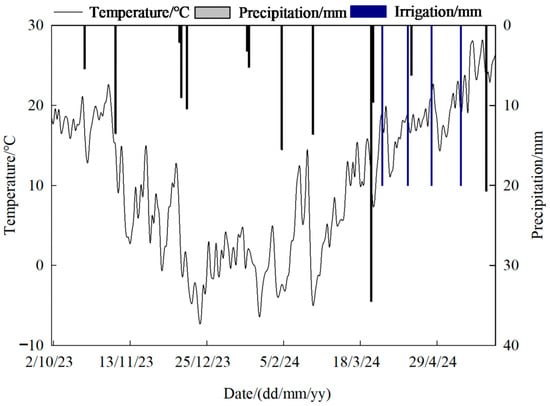
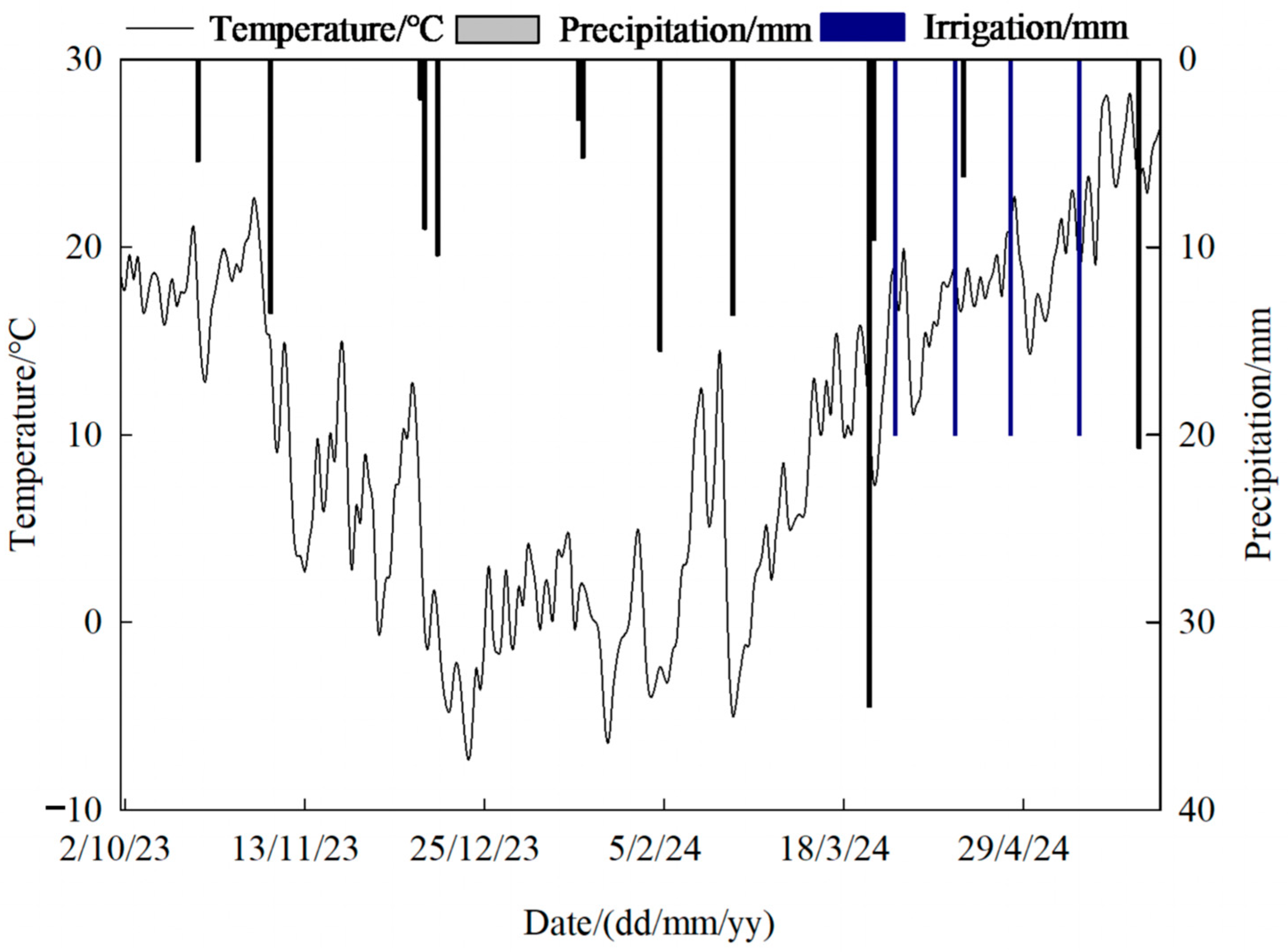
Meteorological data for the experimental growing season are presented in Figure 1. The cumulative precipitation was 148.9 mm, with an uneven distribution across growth stages. Precipitation was relatively sufficient from sowing to the regreening stage (October to February), totaling 77.9 mm. This included two significant snowfall events during overwintering, which contributed 15.5 mm and 13.6 mm of precipitation, respectively. As a result, soil moisture conditions were favorable during the early growth stages. However, precipitation became scarce during the middle and late growth stages, with only 6.2 mm and 20.7 mm recorded in April and May, respectively. Furthermore, the rainfall in May occurred primarily during the late grain-filling stage.
Figure 1.
The daily average temperature and precipitation at the experiment site during the winter wheat growing season.
2.2. Experimental Design
The experiment was conducted using a randomized complete block design. Two irrigation methods were employed: conventional flood irrigation and micro-sprinkler fertigation. Conventional flood irrigation was applied using surface flooding, whereas micro-sprinkler irrigation was implemented using a fertigation system. Treatments were established based on a gradient of reduced top-dressed N, with a 1:1 ratio of basal N to the full top-dressed N rate (120 kg·ha−1). Urea (46% N) was the source for top-dressed N.
The five treatments, each replicated three times, were as follows:
- CK: No irrigation or fertilization;
- FI: Conventional irrigation (70 mm at both jointing and anthesis stages; total: 140 mm) with conventional fertilization (basal and topdressed N each at 120 kg·ha−1);
- MI: Limited irrigation with micro-sprinklers (20 mm at jointing, heading, anthesis, and grain-filling stages; total: 80 mm) with conventional fertilization;
- MI1: Limited micro-sprinkler irrigation with a 20% reduction in top-dressed N (96 kg N·ha−1);
- MI2: Limited micro-sprinkler irrigation with a 40% reduction in top-dressed N (72 kg N·ha−1).
For all treatments except CK, a compound fertilizer (N–P2O5–K2O = 20:17:17) was applied at 600 kg·ha−1 during land preparation. This application supplied all phosphorus (P) and potassium (K) fertilizer, along with the basal N dose of 120 kg N·ha−1 (i.e., 50% of the total N for the normal fertilization treatments). Irrigation for FI was applied in two 70 mm splits at the jointing and anthesis stages. For the limited micro-sprinkler treatments, irrigation was applied in four 20 mm splits at the jointing, heading, anthesis, and grain-filling stages. The top-dressed N for the FI treatment was broadcast in a single dose at the jointing stage. For the micro-sprinkler fertigation treatments (MI, MI1, and MI2), the respective amounts of top-dressed N were applied in three equal splits via fertigation at the jointing, anthesis, and grain-filling stages.
Each experimental plot was 90 m2 (6 m × 15 m) and was separated by a 1.5 m wide buffer zone. In this experiment, 7-hole micro-spray tapes with an inner diameter of 48.3 mm were used. The spraying radius of the micro-spray tapes was 1.0 to 1.2 m, and three micro-spray tapes were placed in each cell. The winter wheat cultivar ‘Shangmai 167’ was sown on 20 October 2023, using a mechanical seeder with a uniform row spacing of 20 cm and a seeding rate of 225 kg·ha−1. The crop was harvested on 31 May 2024. All other agronomic practices followed the standard protocols for high-yielding wheat production in the region.
2.3. Sample Collection and Measurement
2.3.1. Soil NO3−–N Content
At the grain-filling and maturity stages, soil samples were collected from depths of 0–20, 20–40, 40–60, 60–80, and 80–100 cm. To ensure sample representativeness and minimize the effects of soil spatial heterogeneity, five soil cores were collected from each plot using a soil auger following a five-point sampling method. The five cores were thoroughly mixed to form one composite sample for each soil layer in each plot. Gravimetric soil water content was determined using the oven-drying method. For the determination of NO3−-N, a 10.0 g fresh soil sample was extracted with 50 mL of a 2 mol L−1 potassium chloride (KCl) solution by shaking for 30 min. After filtration, the NO3−-N concentration in the filtrate was measured via UV spectrophotometry, applying a correction factor.
2.3.2. Plant Nitrogen Accumulation and Translocation
At anthesis and maturity, randomly select plant samples from a 50 cm single row with three replicates. Steam at 75 °C to deactivate enzymes, then dry at 105 °C to constant weight. N concentration of different plant organs (leaf, stem, spike, and grain) was determined using the semi-micro Kjeldahl method. N accumulation and translocation indices were calculated with Equations (1)–(5).
where Na is the N accumulation in each organ, calculated as the product of N concentration Nc and organ dry matter (DM); Nt is the N translocated from vegetative organs between anthesis and maturity; NTE is the N translocation efficiency, expressed as the proportion of translocated N to the N accumulated in vegetative organs at anthesis; Cg is the contribution of N translocation to grain N at maturity; and Naa is the post-anthesis N assimilation, defined as the difference between grain N accumulation at maturity and N translocation from vegetative organs.
2.3.3. Yield and Yield Component Analysis
At maturity, a 1 m2 (1 m × 1 m) quadrat was harvested from an undisturbed area in each plot with five replicates. The number of effective spikes was counted, and biomass and the plants were then threshed to determine grain yield (The grain moisture content was adjusted to a standard value of 13%). Separately, 30 stems were sampled near the quadrat in each plot for the analysis of yield components (grains per spike and thousand-grain weight).
2.3.4. Crop Evapotranspiration (ET) and Soil Water Extraction (SWE)
Crop evapotranspiration (ET, mm) for the entire growing season was calculated using the soil water balance equation (Equation (6)):
where P (mm) is the total precipitation, I (mm) is the total irrigation amount, and soil water depletion (ΔS) (mm) is the change in soil water storage from sowing to harvest. ΔS was calculated using Equation (7):
where Ssowing and Sharvest are the soil water storage (mm) in the profile at sowing and harvest, respectively.
SWE, representing the water consumed from the soil between two measurement dates, was calculated using Equation (8):
where Si and Sj are the soil water storage (mm) at measurement dates i and j, respectively.
2.3.5. WUE and IWUE
In this study, WUE was calculated as grain yield per seasonal ET, representing an agronomic water productivity index at the field scale. Because transpiration was not directly measured, physiological (transpiration-based) WUE was not quantified. IWUE was calculated to reflect the yield gain attributable to irrigation water input. WUE (kg·ha−1·mm−1) and IWUE (kg·ha−1·mm−1) were calculated using Equations (9) and (10).
where Y is the grain yield, ET (mm) is the seasonal crop evapotranspiration, YI is the grain yield under irrigation, YR is the grain yield under rainfed conditions, and I (mm) is the irrigation water applied.
2.3.6. Calculation of N-Related Indices
NUE in this study was evaluated using agronomic indices (e.g., PFPN and AEN), which are widely applied to assess field-scale nitrogen management outcomes. N harvest index (NHI) (%), PFPN (kg·kg−1), AEN (%), NUE (kg·kg−1), and N surplus (kg·ha−1) were calculated using Equations (11)–(15).
where NHI (%) is the N harvest index; Ng (kg·ha−1) is the grain N accumulation at maturity; Nag (kg·ha−1) is the aboveground N accumulation at maturity; PFPN (kg·ha−1) is the partial factor productivity of N fertilizer; Y (kg·ha−1) is the grain yield; N (kg·ha−1) is the N application rate; AEN (%) is the agronomic N use efficiency, calculated as the yield increment in N-fertilized plots (YN) compared with unfertilized plots (Y0), relative to N input; NUE (kg·ha−1) is the N utilization efficiency; and N surplus (kg·ha−1) is the Nsurplus, estimated as the difference between N inputs (fertilizer N, atmospheric deposition N, and non-symbiotic fixation N: Nf, Nd, and Nns, respectively) and N removal with harvested grain (Ng). The crop studied in this research is winter wheat, which does not exhibit symbiotic nitrogen fixation (Nns) [20].
2.4. Data Analysis
Data were processed using Microsoft Excel 2010. Graphs were generated using SigmaPlot 14.0 (Systat Software Inc., San Jose, CA, USA). Statistical analyses were performed with SPSS 24.0 (IBM Corp., Armonk, NY, USA). Analysis of variance (ANOVA) was conducted, and significant differences between treatment means were assessed using the Least Significant Difference (LSD) test at the 5% probability level.
3. Results
3.1. Effects of Irrigation and Fertilization Treatments on the Distribution and Storage of NO3−-N in the Soil Profile
3.1.1. Distribution of NO3−-N in the Soil Profile
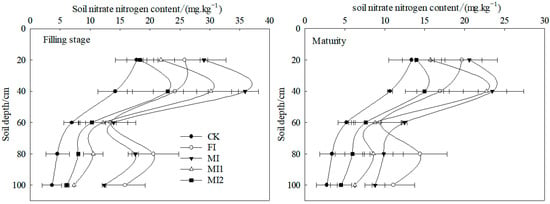
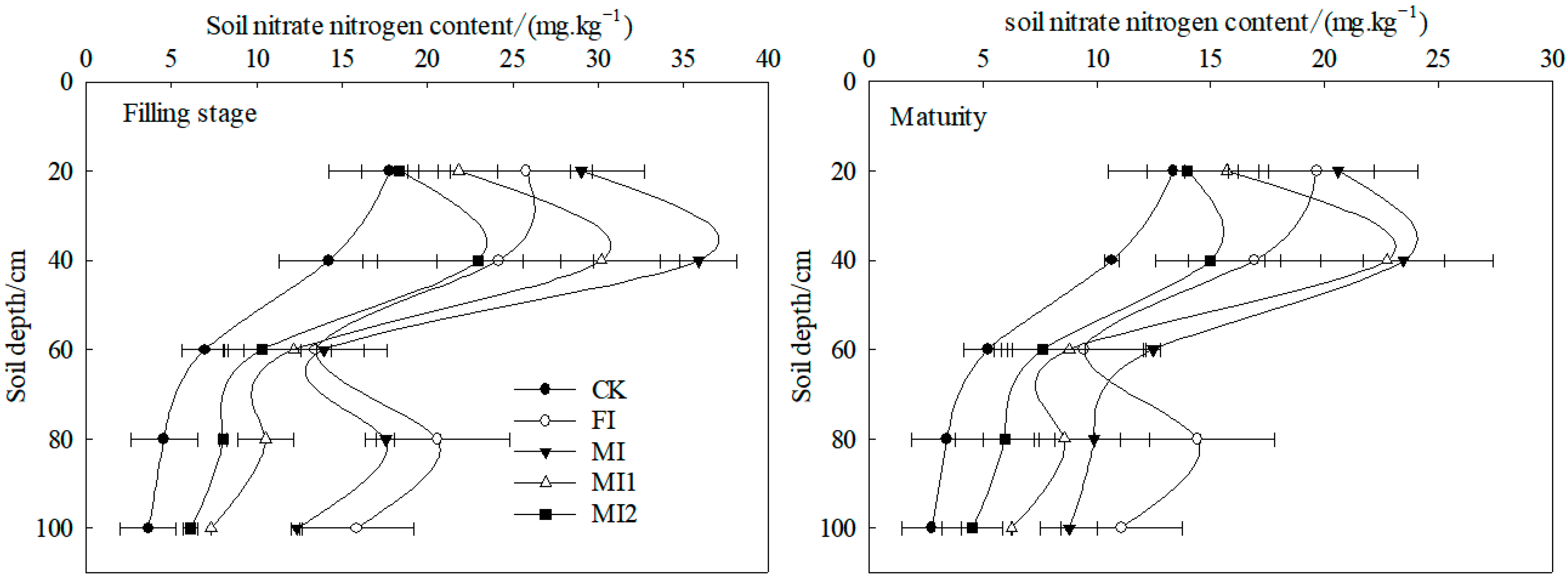
The vertical distribution of soil NO3−-N showed similar trends at the grain-filling and maturity stages; thus, the following analysis focuses on the data from the grain-filling stage for clarity (Figure 2).
Figure 2.
The effects of different irrigation and fertilization treatments on soil NO3−–N content of winter wheat.
Distinct vertical patterns were observed among the treatments. The NO3−-N content in the CK treatment was the lowest across all depths and decreased with increasing soil depth. A generally decreasing trend with depth was also observed for the FI treatment. In contrast, all limited micro-sprinkler fertigation treatments (MI, MI1, and MI2) showed an initial increase, with NO3−-N content peaking in the 20–40 cm layer before decreasing at greater depths. A sharp decline in NO3−-N content from the 20–40 cm to the 40–60 cm layer was evident in all treatments except CK, suggesting that the 40–60 cm depth was a primary zone of N uptake. In the deeper soil profile (60–100 cm), where root density is lower, NO3−-N content remained relatively stable.
In the upper soil profile (0–60 cm), significant differences were found between treatments. The MI and MI1 treatments exhibited the highest NO3−-N content in the active root zone of 20–40 cm. Specifically, the NO3−-N content in the MI treatment was 152.8%, 56.4%, and 48.5% higher than in the CK, MI2, and FI treatments, respectively. Similarly, the MI1 treatment increased NO3−-N content in this layer by 112.6%, 31.6%, and 25.0% compared to CK, MI2, and FI, respectively. Consequently, the average NO3−-N content in the 0–60 cm profile was highest for MI (26.3 mg·kg−1), followed by MI1 (21.4 mg·kg−1) and FI (21.1 mg·kg−1), all of which were substantially higher than CK (13.0 mg·kg−1).
In the deeper soil profile (60–100 cm), the FI treatment consistently maintained the highest NO3−-N content, followed by MI, with CK being the lowest. Within the micro-sprinkler fertigation treatments, NO3−-N content in this deep layer increased with the N application rate. These results indicate that an appropriate reduction in top-dressed N (the MI1 treatment) can maintain a high NO3−-N content in the primary root zone (20–60 cm) while effectively lowering its accumulation in the deeper soil profile, thereby reducing the risk of nitrate leaching.
3.1.2. NO3−-N Storage in the Soil Profile
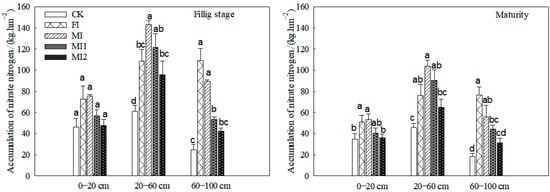
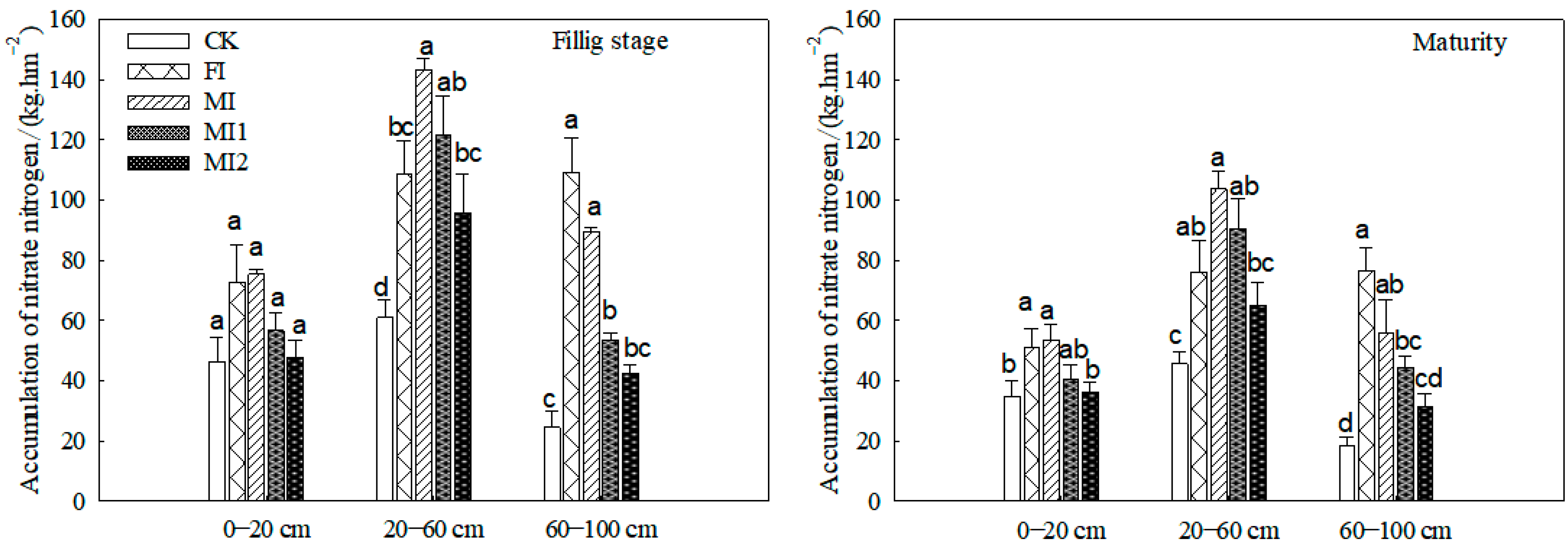
The irrigation and fertilization treatments had distinct effects on NO3−-N storage in different soil layers, with patterns varying between growth stages (Figure 3).
Figure 3.
The effects of different irrigation and fertilization treatments on the accumulation of soil NO3−–N in winter wheat. (Note: the lowercase letters indicate the differences between treatments at the 0.05 level).
At the grain-filling stage, no significant differences in NO3−-N storage were observed among treatments in the 0–20 cm layer. In the 20–60 cm layer, the MI treatment showed the highest storage, which was not significantly different from the MI1 and FI treatments but was significantly higher than that in the MI2 and CK treatments. In the deeper 60–100 cm layer, the FI treatment accumulated the most NO3−-N, which was significantly greater than in the MI1, MI2, and CK treatments. Notably, the MI1 treatment significantly reduced deep-soil NO3−-N storage by 51.1% and 40.3% compared to the FI and MI treatments, respectively.
At the maturity stage, similar trends were observed. NO3−-N storage was highest under the FI and MI treatments in the 0–20 cm layer. In the 20–60 cm layer, a clear ranking emerged: MI had the highest storage, followed by MI1, with CK having the lowest. In the 60–100 cm layer, the FI treatment again exhibited the highest NO3−-N storage, significantly greater than that of the MI1, MI2, and CK treatments, and 58.9% higher than MI1.
Collectively, these results indicate that under limited micro-sprinkler irrigation, an appropriate reduction in top-dressed N (the MI1 treatment) offers a dual benefit: it maintains a high level of NO3−-N storage in the main root zone (20–60 cm) while simultaneously reducing N accumulation in the deeper layers (60–100 cm), thereby mitigating the risk of nitrate leaching.
3.2. Effects of Irrigation and Fertilization Practices on Winter Wheat Yield
The CK treatment significantly decreased spike number, grain number per spike, and thousand-kernel weight, leading to the lowest grain yield and biomass (Table 1). No significant differences in spike number or thousand-kernel weight were found between the FI treatment and the limited irrigation with micro-sprinkler fertigation treatments (MI, MI1, and MI2). Grain yield was highest in the MI treatment, which showed no significant difference compared to FI and MI1 but 8.6% higher than MI2. The yield of MI1 showed no significant difference from FI or MI2 but was 21.0% greater than CK. FI produced the highest biomass, significantly exceeding all treatments except MI. While biomass did not differ significantly among the limited irrigation fertigation treatments, all values were significantly higher than CK. The MI and MI1 treatments resulted in higher harvest indices than FI and MI2. Collectively, these results demonstrate that the MI1 strategy achieved yields similar to FI and MI with reduced irrigation and N inputs, while maintaining a higher harvest index.
Table 1.
The effects of different irrigation and fertilization treatments on yield and biomass of winter wheat.
3.3. Effects of Irrigation and Fertilization Regimes on Water Use in Winter Wheat
3.3.1. Soil Water Extraction (SWE) During the Grain-Filling Stage
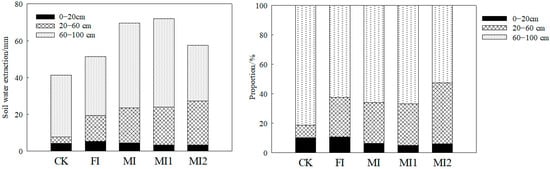
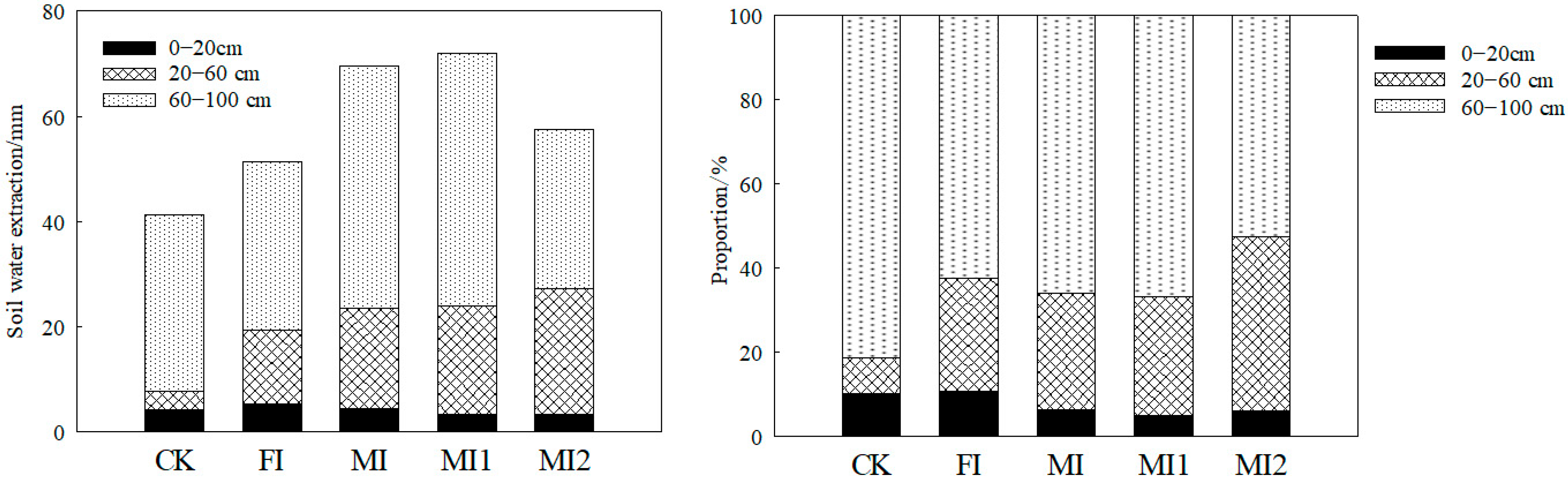
The MI1 treatment resulted in the highest total soil water extraction (SWE) across the profile, followed by MI, with CK being the lowest (Figure 4). Compared to MI2, FI, and CK, MI1 increased total SWE by 25.5%, 40.6%, and 75.1%, respectively.
Figure 4.
The effects of different irrigation and fertilization treatments on soil water extraction amounts and extraction ratios at different soil layers during the filling stage of winter wheat.
Soil water extraction generally increased with soil depth. In the 0–20 cm layer, FI showed relatively high SWE, while differences among other treatments were minor. Within the 20–60 cm layer, the limited micro-sprinkler fertigation treatments (MI, MI1, MI2) exhibited higher SWE than CK. The most pronounced treatment effects occurred in the 60–100 cm layer, where SWE under MI1 was significantly higher than in MI2, FI, and CK by 59.6%, 50.8%, and 43.9%, respectively, but did not differ significantly from MI.
The proportional contribution of each layer to total SWE followed a trend similar to the absolute values. In the 0–20 cm layer, CK and FI had the highest proportions, and MI1 the lowest. The MI2 treatment contributed the largest proportion from the 20–60 cm layer, followed by MI1, with CK being the lowest. Conversely, in the 60–100 cm layer, CK made the highest proportional contribution, followed by MI1, with MI2 being the lowest.
In summary, the MI1 treatment enhanced both the absolute amount and the proportional contribution of water extracted from the 20–100 cm depth, demonstrating a superior capacity to utilize deep soil water reserves.
3.3.2. WUE
The MI1 treatment resulted in the highest soil water depletion, which was statistically similar to MI but significantly greater than CK, MI2, and FI by 10.7%, 12.3%, and 38.1%, respectively (Table 2). The FI treatment, receiving the highest irrigation input, consequently showed the greatest total water consumption, significantly exceeding MI2 and CK.
Table 2.
The effects of different irrigation and fertilization treatments on WUE and IWUE of winter wheat.
While the non-irrigated CK treatment achieved the highest WUE, no significant differences in WUE were detected among the fertilized and irrigated treatments. For IWUE, MI1 performed comparably to MI but outperformed CK and MI2 by 55.4% and 22.0%, respectively.
In summary, the MI1 treatment enhanced soil water depletion and achieved high irrigation water productivity without compromising overall water use efficiency.
3.4. Effects of Irrigation and Fertilization Treatments on N Utilization in Winter Wheat and the Apparent Soil N Balance
3.4.1. Post-Anthesis N Remobilization from Vegetative Organs
Compared to the FI treatment, limited micro-sprinkler fertigation significantly reduced both the amount of pre-anthesis stored N translocated to grains and its contribution to grain N content, while enhancing the translocation efficiency of pre-anthesis stored N and increasing both the amount and contribution of post-anthesis assimilated N to grains (Table 3). Specifically, the MI, MI1, and MI2 treatments increased post-anthesis N assimilation allocated to grains by 18.2%, 26.8%, and 22.2%, respectively, compared to FI. Among the micro-sprinkler fertigation treatments, MI1 showed no significant differences from MI in any N metrics, whereas MI2 significantly reduced the amount of pre-anthesis N remobilized to grains by 9.7% relative to MI. Grain N accumulation at maturity followed the order: MI ≈ FI ≈ MI1 > MI2 > CK, with no significant differences observed among MI, FI, and MI1.
Table 3.
The effects of different irrigation and fertilization treatments on storage N redistribution in vegetative organs after anthesis of winter wheat.
These results demonstrate that moderate N reduction under limited micro-sprinkler fertigation (MI1) enhances both pre-anthesis N translocation efficiency and post-anthesis N assimilation, ultimately achieving grain N accumulation comparable to conventional irrigation and fertilization (FI).
3.4.2. NUE
Compared to the CK and FI treatments, the MI1 and MI2 treatments significantly improved the NHI and PFPN (Table 4). The NHI values in the MI, MI1, and MI2 treatments were 7.5%, 9.4%, and 9.7% higher, respectively, than that in FI. No significant differences in agronomic N use efficiency (ANUE) were observed among the MI, MI1, and FI treatments, although all three significantly outperformed MI2. N utilization efficiency (NUtE) was highest under MI, followed by MI1, with FI showing the lowest value. Specifically, NUtE increased significantly by 6.4% and 7.6% in MI1 and MI, respectively, relative to FI. No significant differences in any N-related parameters were detected between MI and MI1.
Table 4.
The effects of different irrigation and fertilization treatments on NUE of winter wheat.
In summary, a moderate reduction in topdressing N (as in MI and MI1) enhanced NHI, PFPN, and NUtE, whereas an excessive reduction (MI2) significantly compromised aNUE.
3.4.3. Apparent N Balance in Winter Wheat
Irrigation and fertilization practices significantly influenced soil N removal and the soil N surplus (Table 5). N removal was highest under the MI treatment and showed no significant difference from the FI and MI1 treatments; however, all three were significantly greater than the CK and MI2 treatments. In contrast, the apparent N surplus was significantly lower in the MI1 and MI2 treatments than in FI and MI. Specifically, compared to FI, the N surplus decreased by 74.5% under MI1 and 72.6% under MI2. Relative to MI, the reductions were 98.8% and 98.7% for MI1 and MI2, respectively.
Table 5.
The effects of different irrigation and fertilization treatments on apparent N balance of winter wheat.
In summary, the MI1 treatment effectively enhanced N removal while substantially reducing the N surplus, thereby contributing to a more balanced soil N budget.
4. Discussion
4.1. Effects of Different Irrigation and Fertilization Strategies on the Distribution and Storage of NO3−-N in the Soil Profile
Both irrigation methods and N application rates influence the distribution of NO3−–N within the soil profile [21,22]. Single applications of large irrigation volumes can reduce NO3−–N content in the surface layer, increase the depth of nitrate leaching, and decrease the uniformity of its distribution [23,24]. In this study, compared with the FI treatment, the MI treatment increased the content and accumulation of NO3−-N in the 0–60 cm soil layer but reduced them in the 60–100 cm layer. This is because, on one hand, the small and frequent water applications characteristic of micro-sprinkler irrigation reduce the leaching of nitrate to deep soil. On the other hand, the split and delayed application of N fertilizer, also a feature of this method, increases the nitrate content in the upper soil layers. Elrick et al. [25] demonstrated that when the water application intensity (<30 mm) is lower than the soil infiltration rate, the risk of NO3−-N leaching to deeper layers is significantly reduced. The use of frequent, small-volume irrigation facilitates the accumulation of NO3−–N that has migrated from the surface in the 30–60 cm soil layer, promoting reabsorption and utilization by crop roots [21]. Since winter wheat primarily absorbs water and nutrients from the 0–60 cm soil layer [26], the higher NO3−–N content in this layer can provide more abundant nutrients for crop root systems, thereby benefiting plant growth. Consistent with previous findings, this study showed that reducing the top-dressed N rate led to a decrease in soil profile NO3−-N content, a trend that was especially pronounced in the deeper soil layers (60–100 cm) [7,21]. Compared to the FI treatment, although the MI1 treatment reduced NO3−–N content in the 0–20 cm soil layer, it substantially increased the NO3−–N content in the 20–40 cm layer, thereby maintaining a relatively high average NO3−–N level in the 0–60 cm profile. In contrast, the MI2 treatment resulted in a considerable decrease in both NO3−–N content and accumulation throughout the soil profile compared to the MI and FI treatments, which may limit nutrient uptake by roots and negatively affect plant growth.
Therefore, a moderate reduction in topdressing N (as in the MI1 treatment) not only helps maintain relatively high NO3−–N content and accumulation in the upper soil layers, thereby supporting plant growth, but also reduces nitrate accumulation in deeper layers and mitigates the risk of leaching, ultimately minimizing N losses.
4.2. Effects of Different Irrigation and Fertilization Strategies on Winter Wheat Yield and WUE
A suitable supply of soil N during the key growth stages from regreening to grain filling is essential for sustaining high post-anthesis N assimilation and improving the yield of winter wheat [27]. Although the jointing stage is a critical period for wheat growth, applying the entire amount of top-dressed N in a single application at this stage cannot satisfy the plant’s N requirements in later periods, which in turn affects N accumulation and translocation [28]. In this study, compared with the FI treatment, the MI and MI1 treatments elevated the average NO3−–N content in the 0–60 cm soil layer at the grain-filling stage, and significantly increased post-anthesis N accumulation and its contribution to grain N. This is primarily because the micro-sprinkler fertigation method, which combines split and delayed N application, can improve the distribution of soil N in the upper soil profile. This increases N uptake during the grain-filling process and is beneficial for ensuring photosynthetic production after anthesis [6]. Compared to the FI treatment, the higher post-anthesis N accumulation and its contribution to grain in the MI and MI1 treatments made up for the decrease in N translocation from vegetative organs, which was caused by the lower water application of micro-sprinkler irrigation. As a result, they ultimately achieved similar grain N accumulation and yield. In addition, appropriate water control in the later growth stages of winter wheat can optimize the crop canopy structure, reduce canopy temperature, and increase humidity, which is beneficial for dry matter accumulation [29]. This may also be one of the important reasons why the limited micro-sprinkler treatments (MI and MI1) obtained yields similar to the FI treatment despite a significant reduction in irrigation. Research by Wang et al. [30] on micro-sprinkler fertigation technology indicated that it can not only increase post-anthesis N accumulation in wheat but also promote the translocation of stored N from vegetative organs to the grain before anthesis. This result is different from ours, mainly because our study adopted limited micro-sprinkler irrigation. The lower pre-anthesis irrigation amount (40 mm) and N application may have had a negative impact on plant growth, thereby reducing the translocation of stored N from vegetative organs to the grain. The MI2 treatment reduced the NO3−-N content in the 0–60 cm soil layer during the grain-filling stage. While it did increase post-anthesis grain N accumulation, it also caused a more substantial reduction in the translocation of pre-anthesis stored N to the grain. This larger decrease ultimately led to a significant reduction in the final yield.
Improving the extraction and utilization of soil water by wheat, especially from deep soil layers, is of great importance for enhancing WUE and IWUE [8,31]. Suitable limited irrigation can maintain a moderate soil water deficit, thereby promoting the utilization of deep soil water by the plant’s root system [20]. In this study, compared to the FI treatment, the MI and MI1 treatments increased the soil water extraction from the middle-to-deep layers, particularly the deep layer (60–100 cm), during the grain-filling stage, and significantly increased the total soil water extraction throughout the growing season. Under moderate drought conditions, increasing the utilization of deep soil water is beneficial for plants to maintain their physiological activity, ultimately having little or no effect on yield [8]. The limited micro-sprinkler treatments MI and MI1 reduced crop water consumption due to their lower total irrigation amount. Additionally, the smaller volume of each single irrigation promoted root penetration into deeper soil, improving the absorption and utilization of deep water and nutrients. This maintained normal plant growth and resulted in yields similar to the FI treatment, ultimately leading to higher WUE and IWUE. This result is similar to the findings of Li et al. [32] in their study on micro-irrigated winter wheat. Compared to the FI treatment, the MI2 treatment with its greater reduction in top-dressed N did not increase WUE. A possible reason is that the lower N rate decreased the soil nitrate content in the profile during the grain-filling stage, which negatively affected root growth in the lower soil layers. This was unfavorable for the absorption and use of deep soil water, which in turn impacted crop yield. The lower soil water extraction from the 60–100 cm layer for the MI2 treatment compared to other fertilized treatments during the grain-filling stage also provides indirect support for the aforementioned viewpoint.
Thus, an excessive reduction in top-dressed N is unfavorable for the utilization of deep soil water by roots and is not beneficial for enhancing WUE.
It should be noted that transpiration was not directly measured in this field experiment; therefore, physiological WUE could not be calculated. The WUE discussed here reflects agronomic water productivity based on seasonal ET, which is more relevant for evaluating irrigation and fertilization strategies at the field scale.
4.3. Effects of Different Irrigation and Fertilization Strategies on NUE and the Apparent N Balance in Winter Wheat
Irrigation and fertilization both influence the utilization of N by plants. High irrigation amounts can delay plant senescence and increase the amount of residual N in vegetative organs at maturity, which is unfavorable for its translocation to the grain and thus reduces the harvest index [33]. Applying fertilizer with irrigation water can increase the NHI by enhancing the contribution of post-anthesis assimilated N to the grain [30]. These findings are consistent with the results of the present study. In our research, limited irrigation with micro-sprinkler fertigation improved NUE compared to the FI treatment, which can be attributed to the enhanced post-anthesis N accumulation and increased translocation efficiency of pre-anthesis stored N from vegetative organs under this management practice. The study by Wu et al. [34] further supported that enhancing N uptake and promoting N translocation and accumulation in wheat grains are critical pathways to improve NUE. In alignment with this, the MI1 treatment in our study achieved yields comparable to those of the FI and MI treatments despite a 10% reduction in total N application, which ultimately increased the partial factor PFPN. Furthermore, the results of this study indicate that, within the micro-sprinkler fertigation treatments, the partial factor PFPN increased as the N rate was reduced, while the AEN decreased. This conclusion is not entirely consistent with that of Wen et al. [35], who found that both N agronomic efficiency and PFPN significantly decrease with increasing N application. This may be related to the relatively low gradient of N reduction used in our study (a 10–20% reduction in total N) and the fact that no excessively high N treatment was included. A suitable reduction in top-dressed N (the MI1 treatment) did not significantly affect the N agronomic efficiency or N utilization efficiency (NUtE) when compared to the MI treatment, while it did improve the NHI and PFPN to different extents.
An imbalance between N input and output can lead to either a surplus or deficit of N in farmland soils [36]. Studies have shown that most surplus soil N is leached in the form of NO3−–N [19]. Therefore, an excessive soil N surplus significantly increases N losses, while a severe N deficit reduces soil fertility, both of which are detrimental to crop production [37]. In agricultural production, it is nearly impossible to achieve a complete balance between N inputs and outputs. Therefore, the practical approach is to control the soil N surplus or deficit at a relatively low level, while not negatively affecting crop growth [38]. In our study, the CK treatment was in a state of severe soil N deficit and had significantly lower N offtake and yield. Under limited micro-sprinkler irrigation, reducing the top-dressed N (in both MI1 and MI2 treatments) kept the soil N surplus low (0.8–8.3 kg·ha−1). However, the greater N reduction in the MI2 treatment significantly affected the growth of winter wheat, leading to a significant decrease in its yield and N offtake compared to the FI and MI treatments. Therefore, based on a comprehensive assessment of grain yield, water and NUE, and the soil N surplus, the MI1 treatment emerged as the optimal and most sustainable irrigation and fertilization strategy.
5. Conclusions
This study demonstrates that a 20% reduction in N top-dressing under limited micro-sprinkler irrigation (the MI1 treatment) constitutes a highly effective and sustainable strategy for winter wheat production in the water-scarce Huang-Huai-Hai Plain. The MI1 treatment maintained grain yields statistically comparable to conventional flood irrigation (FI) and full micro-sprinkler irrigation (MI). This yield stability was achieved through compensatory physiological mechanisms, including enhanced post-anthesis N assimilation and improved water extraction from deeper soil layers, which collectively boosted water and N use efficiencies. Critically, this high-productivity and high-efficiency regime was accompanied by a reduction of over 70% in the apparent soil N surplus compared to conventional practices, thereby significantly mitigating environmental risks. In contrast, a 40% N reduction (MI2) incurred significant yield penalties. In conclusion, the MI1 strategy successfully decouples high grain production from high resource inputs, offering a viable pathway to simultaneously achieve productivity, resource-use efficiency, and environmental sustainability in regional wheat farming.
This study also has some limitations that should be acknowledged. First, physiological water use efficiency could not be quantified because transpiration was not directly measured; therefore, the WUE indicators used in this study reflect agronomic water productivity at the field scale. Second, the experiment was conducted at a single site and during one growing season, and caution should be exercised when extrapolating the results to other environments. In addition, the micro-sprinkler irrigation system was evaluated under a fixed configuration, and the effects of different installation densities were not examined. Future studies incorporating multi-year experiments and broader irrigation system configurations would further strengthen these findings.
Author Contributions
Conceptualization, S.M. and Y.W.; Data curation, M.Y., S.Z. and J.C.; Formal analysis, Y.C. and J.C.; Funding acquisition, S.M.; Investigation, S.Z. and Y.C.; Project administration, M.Y.; Supervision, S.M.; Methodology, S.L.; Visualization, J.D.; Writing—original draft, M.Y. and J.D.; Writing—review and editing, S.L., S.Y., Y.W. and S.M. All authors have read and agreed to the published version of the manuscript.
Funding
This research was supported by the China Agriculture Research System (CARS-03-20), the Agricultural Science and Technology Innovation Program of the Chinese Academy of Agricultural Sciences (ASTIP).
Data Availability Statement
Data will be made available on request.
Conflicts of Interest
The authors declare that the research was conducted without any commercial or financial relationships that could be construed as a potential conflict of interest.
References
- Ma, S.; Wang, T.; Guan, X.; Zhang, X. Effect of sowing time and seeding rate on yield components and water use efficiency of winter wheat by regulating the growth redundancy and physiological traits of root and shoot. Field Crops Res. 2018, 221, 166–174. [Google Scholar] [CrossRef] [Scilit]
- Cao, H.; Wang, X.; Liu, J.; Li, S.; Abubakar, S.A.; Gao, Y.; Ma, S. Soil organic carbon enhancement via small macroaggregate stabilization under long-term nitrogen and short-term organic amendments. Farming Syst. 2025, 4, 100182. [Google Scholar] [CrossRef] [Scilit]
- Liu, J.; Si, Z.; Li, S.; Hamani, M.K.A.; Zhang, Y.; Wu, L.; Gao, Y.; Duan, A. Variations of water sources used by winter wheat across distinct rainfall years in the North China Plain. J. Hydrol. 2023, 618, 129186. [Google Scholar] [CrossRef] [Scilit]
- Cao, G.; Zheng, C.; Scanlon, B.R.; Liu, J.; Li, W. Use of flow modeling to assess sustainability of groundwater resources in the North China Plain. Water Resour. Res. 2013, 49, 159–175. [Google Scholar] [CrossRef] [Scilit]
- Chen, Y.X.; Kang, S.Z. Insufficient Irrigation Principle; Water Resources and Electric Power Press: Beijing, China, 1995. [Google Scholar]
- Li, J.P.; Zhang, Z.; Liu, Y.; Yao, C.; Song, W.; Xu, X.; Zhang, M.; Zhou, X.; Gao, Y.; Wang, Z.; et al. Effects of micro-sprinkling with different irrigation amount on grain yield and water use efficiency of winter wheat in the North China Plain. Agric. Water Manag. 2019, 224, 105736. [Google Scholar] [CrossRef] [Scilit]
- Li, J.; Zhang, Z.; Yao, C.; Liu, Y.; Wang, Z.; Fang, B.; Zhang, Y. Improving winter wheat grain yield and water-/nitrogen-use efficiency by optimizing the micro-sprinkling irrigation amount and nitrogen application rate. J. Integr. Agric. 2021, 20, 606–621. [Google Scholar] [CrossRef] [Scilit]
- Yang, M.; Leghari, S.; Guan, X.; Ma, S.; Ding, C. Deficit subsurface drip irrigation improves water use efficiency and stabilizes yield by enhancing subsoil water extraction in winter wheat. Front. Plant Sci. 2020, 11, 508. [Google Scholar] [CrossRef] [Scilit]
- Burt, C.M.; Clemmens, A.J.; Strelkoff, T.S.; Solomon, K.H.; Bliesner, R.D.; Hardy, L.A.; Howell, T.A.; Eisenhauer, D.E. Irrigation Performance Measures: Efficiency and Uniformity. J. Irrig. Drain. Eng. 1997, 125, 423–442. [Google Scholar] [CrossRef] [Scilit]
- Ju, X.; Xing, G.; Chen, X.; Zhang, S.; Zhang, L.; Liu, X.; Cui, Z.; Yin, B.; Christie, P.; Zhu, Z. Reducing environmental risk by improving N management in intensive Chinese agricultural systems. Proc. Natl. Acad. Sci. USA 2009, 106, 3041–3046. [Google Scholar] [CrossRef] [Scilit]
- Liu, H.; Wang, Z.; Yu, R.; Li, F.; Li, K.; Cao, H.; Yang, N.; Li, M.; Dai, J.; Zan, Y.; et al. Optimal nitrogen input for higher efficiency and lower environmental impacts of winter wheat production in China. Agric. Ecosyst. Environ. 2016, 224, 1–11. [Google Scholar] [CrossRef] [Scilit]
- Zhang, X.; Davidson, E.A.; Mauzerall, D.L.; Searchinger, T.D.; Dumas, P.; Shen, Y. Managing nitrogen for sustainable development. Nature 2015, 528, 51. [Google Scholar] [CrossRef] [Scilit] [PubMed]
- Yang, M.; Ma, S.; Mei, F.; Li, W.; Wang, T.; Guan, X. Adjusting nitrogen application in accordance with soil water availability enhances yield and water use by regulating physiological traits of maize under drip fertigation. Phyton-Int. J. Exp. Bot. 2021, 90, 417–435. [Google Scholar] [CrossRef] [Scilit]
- Lin, X. Physiological and Ecological Mechanism of High Water and Nitrogen Use Efficiency in Integrated Management of Supplemental Irrigation and Fertilization with Micro-Sprinkling House of Winter Wheat; Shangdong Agricultural University: Taian, China, 2020. [Google Scholar]
- Zhang, Z.; Zhang, Y.; Shi, Y.; Yu, Z. Optimized split nitrogen fertilizer increase photosynthesis, grain yield, nitrogen use efficiency and water use efficiency under water-saving irrigation. Sci. Rep. 2020, 10, 20310. [Google Scholar] [CrossRef] [Scilit] [PubMed]
- Wu, X.Y. Effects of Irrigation and Nitrogen Management on Summer Maize Growth and Water-Nitrogen Use Efficiency Under Micro-sprinkling Irrigation; Shangdong Agricultural University: Taian, China, 2021. [Google Scholar]
- Yu, S.; Zhu, G.; Dong, H.; Zhang, X.; Mou, X.; Shi, G.; Tan, D. Effects of micro-sprinkling irrigation integrated with topdressing reduction on wheat yield and water use efficiency. Shandong Agric. Sci. 2020, 52, 46–50. [Google Scholar]
- Zhang, C.; Ju, X.; Powlson, D.; Oenema, O.; Smith, P. Nitrogen surplus benchmarks for controlling N pollution in the main cropping systems of China. Environ. Sci. Technol. 2019, 53, 6678–6687. [Google Scholar] [CrossRef] [Scilit]
- Zhang, J.; Zhou, S.; Wang, Z.; Jia, X. Application of 15N isotope for the identification of nitrogen nutrition sources of winter wheat and summer maize in North China Plain. J. Isot. 2019, 32, 299–307. [Google Scholar]
- Guo, Z.H.; Liu, P.Z.; Luo, W.H. Effects of water limiting and nitrogen reduction on nitrogen use and apparent balance of winer wheat in the Guangzhong Plain, Northwest China. Chin. J. Appl. Ecol. 2021, 32, 4359–4369. [Google Scholar]
- Li, H.; Wang, H.; Fang, Q.; Jia, B.; Li, D.; He, J.; Li, R. Effects of irrigation and nitrogen application on NO3−-N distribution in soil, nitrogen absorption, utilization and translocation by winter wheat. Agric. Water Manag. 2023, 276, 108058. [Google Scholar] [CrossRef] [Scilit]
- Khan, S.; Abbas, K.S.; Irshad, S.; Mazhar, S.A.; Batool, S. Impact of various irrigation practices on nitrate movement in soil profile and wheat productivity. Appl. Water Sci. 2020, 10, 363–375. [Google Scholar] [CrossRef] [Scilit]
- Hanson, B.; Hopmans, J.W.; Imnek, J. Leaching with Subsurface Drip Irrigation under Saline, Shallow Groundwater Conditions. Vadose Zone J. 2008, 7, 786–799. [Google Scholar] [CrossRef] [Scilit]
- Chen, S.; Zhang, S.; Li, H.; Hu, T.; Sun, G.; Cui, X.; Chang, Z.; Liu, J. Optimizing irrigation and nitrogen management improves soil soluble nitrogen pools and reduces nitrate residues in a drip-fertigated apple orchard on the Loess Plateau. Agric. Water Manag. 2024, 295, 108770. [Google Scholar] [CrossRef] [Scilit]
- Elrick, D.E.; French, L.K. Miscible displacement patterns on disturbed and undisturbed soil cores. Soil Sci. Soc. Am. Proc. 1966, 30, 153–156. [Google Scholar] [CrossRef] [Scilit]
- Jha, S.K.; Gao, Y.; Liu, H.; Huang, Z.; Wang, G.; Liang, Y.; Duan, A. Root development and water uptake in winter wheat under different irrigation methods and scheduling for North China. Agric. Water Manag. 2017, 182, 139–150. [Google Scholar] [CrossRef] [Scilit]
- Wang, J.; Sun, X.; Hussain, S.; Yang, L.; Gao, S.; Zhang, P.; Chen, X.; Ren, X. Reduced nitrogen rate improves post-anthesis assimilates to grain and ameliorates grain-filling characteristics of winter wheat in dry land. Plant Soil 2024, 499, 91–112. [Google Scholar] [CrossRef] [Scilit]
- Hu, C.; Sadras, V.O.; Lu, G.; Zhang, P.; Han, Y.; Liu, L.; Xie, J.; Yang, X.; Zhang, S. A global meta-analysis of split nitrogen application for improved wheat yield and grain protein content. Soil Tillage Res. 2021, 213, 105111. [Google Scholar] [CrossRef] [Scilit]
- Zhang, X.; Chen, S.; Sun, H.; Wang, Y.; Shao, L. Water use efficiency and associated traits in winter wheat cultivars in the North China Plain. Agric. Water Manag. 2009, 97, 1117–1125. [Google Scholar] [CrossRef] [Scilit]
- Wang, X.; Gu, S.; Lin, X.; Wang, W.; Zhang, B.; Zhu, J.; Wang, D. Effects of supplemental irrigation with micro-sprinkling hoses and water and fertilizer integration on yield and water and nitrogen use efficiency in winter wheat. Acta Agron. Sin. 2023, 49, 784–794. [Google Scholar] [CrossRef] [Scilit]
- Kang, S.; Zhang, L.; Liang, Y.; Hu, X.; Cai, H.; Gu, B. Effects of limited irrigation on yield and water use efficiency of winter wheat in the Loess Plateau of China. Agric. Water Manag. 2002, 55, 203–216. [Google Scholar] [CrossRef] [Scilit]
- Li, J.; Xu, X.; Lin, G.; Wang, Y.; Liu, Y.; Zhang, M.; Zhou, J.; Wang, Z.; Zhang, Y. Micro-irrigation improves grain yield and resource use efficiency by co-locating the roots and N-fertilizer distribution of winter wheat in the North China Plain. Sci. Total Environ. 2018, 643, 367–377. [Google Scholar] [CrossRef] [Scilit]
- Yang, J.; Zhang, J. Grain filling of cereals under soil drying. New Phytol. 2006, 169, 223–236. [Google Scholar] [CrossRef] [Scilit]
- Wu, X.; Li, C.; Tang, Y.; Liu, Y.; Li, B.; Fan, G.; Xiong, T. Effect of nitrogen management modes on grain yield, nitrogen use efficiency and light use efficiency of wheat. Chin. J. Appl. Ecol. 2017, 28, 1889–1898. [Google Scholar]
- Wen, T.; Jia, Y.; Gu, D.; Yang, W.; Shi, H.; Gao, H.; Zhu, J.; Du, X. Effect of nitrogen and water management on dry matter accumulation, yield and nitrogen utilization of wheat following rice in northern Jiangsu Plain. J. Triticeae Crops 2023, 43, 321–331. [Google Scholar]
- Zhang, X.; Xiao, G.; Bol, R.; Wang, L.; Zhuge, Y.; Wu, W.; Li, H.; Meng, F. Influences of irrigation and fertilization on soil N cycle and losses from wheat-maize cropping system in northern China. Environ. Pollut. 2021, 278, 116852. [Google Scholar] [CrossRef] [Scilit]
- Liu, X.; Ju, X.; Zhang, F.; Zhang, F.; Pan, J.; Christie, P. Nitrogen dynamics and budgets in a winter wheat–maize cropping system in the North China Plain. Field Crops Res. 2003, 83, 111–124. [Google Scholar] [CrossRef] [Scilit]
- Cassman, K.G.; Dobermann, A.; Walters, D.T. Agroecosystems, nitrogen-use efficiency, and nitrogen management. Ambio 2002, 31, 132–140. [Google Scholar] [CrossRef]

Disclaimer/Publisher’s Note: The statements, opinions and data contained in all publications are solely those of the individual author(s) and contributor(s) and not of MDPI and/or the editor(s). MDPI and/or the editor(s) disclaim responsibility for any injury to people or property resulting from any ideas, methods, instructions or products referred to in the content. |
© 2026 by the authors. Licensee MDPI, Basel, Switzerland. This article is an open access article distributed under the terms and conditions of the Creative Commons Attribution (CC BY) license.