Article

Spatiotemporal Dynamics of Carbon Emission Intensity from Cultivated Land in Arid Xinjiang, China (2000–2020)

1
College of Water Conservancy & Architectural Engineering, Shihezi University, Shihezi 832000, China
2
Key Laboratory of Modern Water-Saving Irrigation, Xinjiang Production & Construction Group, Shihezi 832000, China
*
Author to whom correspondence should be addressed.
Agronomy 2026, 16(4), 451; https://doi.org/10.3390/agronomy16040451
Submission received: 6 January 2026 / Revised: 26 January 2026 / Accepted: 12 February 2026 / Published: 14 February 2026

Abstract

Against the global push for “carbon peak and carbon neutrality” and Xinjiang’s role as a major arid-region agricultural base in China, balancing agricultural development with low-carbon transitions remains challenging due to its fragile ecology and resource-intensive farming. However, county-scale dynamics of cultivated land carbon emission intensity (CEI) and its drivers in Xinjiang are understudied, limiting targeted mitigation. This study analyzed Xinjiang’s cultivated land CEI (2000–2020) using the Geographically and Temporally Weighted Regression and Stochastic Impacts by Regression on Population, Affluence and Technology (GTWR-STIRPAT) model, geodetector, and spatiotemporal analysis, with counties as units. Data included 30 m-resolution land use data and socioeconomic statistics. Results showed CEI rose from 0.270 to 0.377 t/hm2, with marked spatial differences: northern Xinjiang saw fluctuating growth and a 58.65 km northeastward shift of emission gravity, while southern Xinjiang had lower western CEI (ecological constraints) and higher eastern CEI (agricultural expansion). Key drivers were total sown area (TSAC), agricultural film usage (UAPF), and rural agricultural population (RAP). Factor interactions (machinery power × sown area, q = 0.844) non-linearly amplified CEI. The GTWR-STIRPAT model (R2 = 0.97) outperformed OLS and captured heterogeneity—mechanization/area expansion dominated northern CEI, while film use/population mattered more in the south. Region-specific strategies are needed: northern Xinjiang should optimize machinery energy and control area expansion; southern Xinjiang, strengthen ecology and promote low-carbon inputs; eastern Xinjiang, leverage efficient oasis agriculture. This study supports precise carbon management in Xinjiang and similar arid regions globally.

1. Introduction

The issue of agricultural carbon emissions has drawn considerable attention from scholars and policymakers, particularly during this pivotal era marked by the intensifying effects of worldwide climatic shifts and the global push toward achieving “carbon peak and carbon neutrality” goals. Agriculture is a significant global contributor to greenhouse gas emissions [1]. The Food and Agriculture Organization of the United Nations (FAO) reports that agricultural activities contribute to over 25% of global greenhouse gas emissions [2,3]. These emissions not only accelerate global warming but also directly jeopardize the stability of local ecosystems, biodiversity, and food security [4].
A comprehensive review of the literature concerning carbon emissions resulting from cultivated land utilization indicates that most studies are conducted at the provincial level [5] and at the national level [6,7] and other macro-level analyses. However, these studies frequently overlook nuanced variations and micro-dynamic shifts in carbon emissions at the county level, limiting their applicability to localized policy interventions. Given that counties serve as the fundamental units for agricultural production and policy implementation, significant variations exist in arable land utilization, industrial structure, and resource endowment. Yet, existing large-scale studies often overlook these localized nuances, particularly micro-dynamic changes in carbon emissions at the county level. This gap limits the precision of policy interventions tailored to regional disparities in agricultural practices and environmental impacts. Consequently, macro-scale studies are insufficient for offering targeted guidance on precise emission reduction strategies at the county level. While these studies rely on carbon emission accounting to map the spatial and temporal evolution of emission intensity, their broad scope often masks critical local disparities in agricultural practices, land use, and socio-economic factors [8]. Among the various carbon emission accounting methods, the carbon emission factor method has emerged as the most prevalent owing to its operational simplicity and ease of data acquisition [9].
In the domain of spatiotemporal distribution research, the integration of geographic information systems (GIS) with spatial statistical approaches is prevalent. Commonly employed methods include Theil’s index [10], the Gini coefficient [11], spatial analysis conducted by the National Center for Spatial Analysis (NCSA) [12], kernel density estimation [13], and Markov chains [14]. The spatial pattern of carbon emissions can be visualized using spatial autocorrelation analysis. Although this visualization allows for the identification of carbon emission hotspots and the use of spatial interpolation to address data gaps, most current research relies on static methodologies analysis. The changing processes of emissions of carbon overtime and the mechanisms driving the emergence of regional patterns have been minimally investigated. Furthermore, for small-scale regions, such as counties, existing studies require enhanced precision and depth in their portrayal of spatial heterogeneity characteristics. The STIRPAT model is utilized to analyze the factors influencing carbon emissions and to investigate the spatial heterogeneity of these emissions [1]. The logarithmic mean Divisia index (LMDI) decomposition method has been utilized in diverse applications [15] in conjunction with spatial econometric modeling [16]. These methods discern principal macro-level determinants of carbon emissions, including economic activity, population, and technological advancement. Nonetheless, they frequently presuppose spatial uniformity in the impact of each factor, neglecting the spatial heterogeneity resulting from variations in natural conditions and socioeconomic development across regions. The geodetector, an advanced spatial analytical method, elucidates the methods of influencing variables spatially, identifies diverse combinations of factors affecting carbon emissions, and examines the potential for carbon reduction in specific regions [17]. The GTWR model integrates geographic coordinates and temporal dynamics to clarify the spatial variability of the factors influencing carbon emissions across different contexts. It improves temporal flexibility relative to the GWR model and addresses the intrinsic nonstationarity of temporal and spatial variables [18].
Research has inadequately addressed carbon emissions from cultivated land use in arid and semi-arid regions [19], which have distinct ecological environments and agricultural practices. Xinjiang, a representative arid region, shows unique carbon emission characteristics due to its oasis agriculture, irrigation dependence, and water constraints. There is a paucity of studies regarding spatial and temporal variations in cultivated land carbon emission intensity and its determinants at the county level in Xinjiang, which impedes the formulation of emission-reduction strategies. Although the majority of studies emphasizes provincial or regional levels, comprehending county-level spatiotemporal dynamics and its driving factors can more accurately represent agricultural conditions and facilitate targeted mitigation initiatives. This study examined Xinjiang at regional and county levels, addressing research limitations through methods like standard deviation ellipse, geodetector, exploratory spatial data analysis, and GTWR-STIRPAT model. This framework analyzes spatial distribution and evolution of carbon emission intensity, assesses influencing factors, examines spatial correlation patterns, and quantifies nonlinear influence mechanisms, advancing carbon emission research methodologies.

2. Data and Methodology

2.1. Study Area

The Xinjiang Uygur Autonomous Region (XUAR), including an area of 1.66 × 10⁶ km2, is situated in the arid northwest of China (Figure 1). The typical temperate continental climate of this area is typified by little precipitation, scarce water supplies, and an extremely unequal distribution of those supplies [20]. The majority of Xinjiang’s arable land is found in oasis regions, and the most common crops grown there are cotton, maize, and wheat. Despite the notable expansion of agricultural land in Xinjiang in recent years, ecological and environmental issues including as water scarcity, land desertification, and soil salinization have emerged as consequences of this development. These issues significantly affect the carbon emission intensity associated with agricultural land use, while also hindering the sustainable utilization of cultivated lands. The influence of agricultural output on carbon emission intensity is chiefly evident through fertilizer usage, irrigation methods, and mechanized processes. Several variables, including the energy necessary for agricultural production, fertilizer application, and irrigation methods, influence the carbon emission intensity of cultivated land utilization.
Xinjiang is a major production base for important agricultural commodities in China, including cotton, grain, and specialized fruits. Since 2000, it has become the world’s largest cotton-producing region and the core supply source of high-quality cotton in China [21]. In recent years, while ensuring national food security and stable agricultural product supply, the ecological fragility caused by the arid and semi-arid climate in this region has become increasingly prominent, with severe issues such as water scarcity and land desertification. Historically, in pursuit of high yields, agricultural production in Xinjiang has relied heavily on irrigation, chemical fertilizer and pesticide inputs, and mechanization, leading to a continuous increase in carbon emission intensity of cultivated land use [22]. These characteristics provide a typical research scenario for this study to analyze the spatiotemporal dynamics and driving mechanisms of carbon emission intensity.

2.2. Sources of Data

The data required for this investigation included land-use and socioeconomic statistics. Land use data were obtained from the Resource and Environment Science Data Center of the Chinese Academy of Sciences, encompassing the years 2000 to 2020 at a spatial resolution of 30 m. Socioeconomic statistics were sourced from the “Statistical Yearbook of Xinjiang Uygur Autonomous Region (2001–2021)” and the “Statistical Yearbook of Xinjiang Production and Construction Corps (2001–2021).” This research utilized Xinjiang counties (including cities and districts) as the analytical unit.

2.3. Research Methodology

2.3.1. Carbon Intensity

This paper employs the IPCC carbon coefficient technique [23]. The precise formulas are as follows:
E = E i = T i × ε i
E represents carbon emissions resulting from plantation production activities. Ei represents the carbon emissions from each carbon source in this study, specifically referring to the six carbon sources associated with cultivated land use: fertilizer, pesticide, agricultural film, diesel, tillage, and irrigation(Table 1). Ti represents the input derived from each carbon source. εi represents the carbon emission factor of the i-th carbon source.
The three primary approaches for assessing carbon intensity are calculations based on GDP, area, and per capita metrics. The ratio of agricultural carbon emissions to total agricultural output underpins the carbon emissions per unit of GDP methodology, which is extensively employed in contemporary research [24]. Contemporary research frequently uses the carbon emissions per unit of GDP methodology, which relies on the ratio of agricultural carbon emissions to total agricultural output. Therefore, this study has selected the unit area computation approach.
E I i = E i A i
EIi represents the carbon emission intensity of cultivated land use in country yi, Ei denotes the carbon emissions from cultivated land utilization in country yi, and Ai indicates the area of cultivated land in country yi.

2.3.2. Standard Deviation Ellipse

For displaying the central tendency, orientation, and dispersion of carbon intensity across time, the standard deviation ellipse is a useful tool [25]. It makes it easier to create policies that lower carbon emissions and accomplish low-carbon goals [26].
The computation procedure is as follows.
Center of gravity (X, Y).
X ¯ = i = 1 m   q i x i i = 1 m   q i , Y ¯ = i = 1 m   q i y i i = 1 m   q i ,
Azimuth angle θ:
t a n   θ = i = 1 m   q i 2 x ~ i 2 i = 1 m   q i 2 y ~ i 2 + i = 1 m   q i 2 x ~ i 2 i = 1 m   q i 2 y ~ i 2 2 + 4 i = 1 m   q i 2 x ~ i y ~ i i = 1 m   2 q i 2 x ~ i y ~ i
where x ~ i , y ~ i represent the coordinate deviations from the center of gravity for each county region, respectively:
x ~ i = x i X ¯ ,   y ~ i = y i Y ¯ ,
The standard deviations of the X and Y axes are denoted as σx and σy, respectively:
σ x = 2 i = 1 m   q i x ~ i c o s   θ q i y ~ i s i n   θ 2 / i = 1 m   q i 2 ,
σ y = 2 i = 1 m   q i x ~ i s i n   θ + q i y ~ i c o s   θ 2 / i = 1 m   q i 2 ,
Elliptical area S:
S = π σ x σ y ,
Formula for spatial intensity I:
I = W / S ,
(X, Y) represents the latitude and longitude coordinates of each county, qi indicates the index value of each county related to the research subject, and W symbolizes the aggregate index value of the study subject within the study region.

2.3.3. Exploratory Spatial Data Analysis

Specific indices facilitate the evaluation of dependency among observations in geographic contexts and aid in identifying clustering patterns within geospatial data, especially with the aggregation of high or low values. Both the local and global Moran’s I indexes are included. The global Moran’s I index assesses the spatial connection of items over the entire study area [27]. A scale from −1 to 1 is employed to measure spatial correlation. Positive spatial correlation indicates that similar values are concentrated spatially; negative correlation signifies that similar values are dispersed; and zero correlation denotes a generally random distribution [28,29]. The Getis-Ord Gi* method is a statistical approach used to identify statistically significant spatial clusters of high and low values. A new output feature class is generated subsequent to the calculation of the z-score and p-value for each input feature [30].
The calculations are as follows:
Moran’s I = i = 1 n   j = 1 n   W i j Y i Y ¯ Y j Y ¯ S 2 i = 1 n   j = 1 n   W i j
G i = j = 1 n   w i , j x j X ¯ j = 1 n   w i , j S n j = 1 n   w i , j 2 j = 1 n   w i , j 2 n 1
The variable n represents the quantity of counties, whereas Yi and Yj reflect the sample values of carbon emissions for counties i and j, respectively. The spatial weight matrix is denoted by Wij, Y signifies the sample mean, and S2 represents the sample variance.

2.3.4. Geo-Detectors

Geoprobes are now widely used in various fields to determine spatially stratified heterogeneity by detecting the degree of discretization of spatial data, revealing the driving forces behind spatial differentiation, and suggesting causal relationships between variables more strongly than general statistics [31].
(1) Factor Detection: The identification of spatial variability in carbon emissions and the degree to which each factor contributes to this variability is addressed in Equations (12) and (13).
q = 1 h = 1 L   N h σ h 2 N σ 2 = 1 W T
W = h = 1 L   N h σ h 2 , T = N σ 2
In this context, q represents the detection coefficient of the factor detector, with its value domain spanning [0, 1]. A greater value of q denotes a more robust explanatory capacity of the driver x on the y of carbon emissions, whereas a lesser value represents a diminished explanatory capacity. The variable h denotes the classification or segmentation of the carbon emissions driver. The symbol σ 2 represents the variance. σ h 2 and σ 2 represent the quantity of cells in the h-th partition and the total region, respectively. The variances of the y-values in the h-th partition and the entire region are denoted as σ 2 , respectively. W’ is the sum of squares within groups (SSW), quantifying the squared deviations of data points from their respective group means, therefore assessing the within-group variation or the extent of dispersion of data within each group. T is the total sum of squares (SST), which quantifies the sum of the squared deviations of all data points from the general mean, so assessing the total variation within the entire data set, encompassing both between-group and between-group variation.
(2) The interaction detector identifies interactions between different drivers, specifically to determine if the explanatory power of carbon emissions is increased or decreased when drivers X1 and X2 function simultaneously. The differences in interactions among various elements essentially result in five outcomes: q (X1 ∩ X2) min [q (X1), (X2)] denotes a nonlinear amplification of interaction; min [q (X1), q (X2)] < q (X1 ∩ X2) < max [q (X1), q (X2)] implies unifactorial nonlinear amplification; q (X1 ∩ X2) > max [q (X1), q (X2)] signifies two-factor enhancements. (X1 ∩ X2) = q (X1)q (X2) signifies independent interactions, while q (X1 ∩ X2) > q (X1)q (X2) indicates nonlinear enhancement [32].

2.3.5. GTWR-STIRPAT Model

Geographically weighted regression (GWR) is a local regression model that enhances standard multiple linear regression by addressing the problem of spatial data non-stationarity [33]. The GTWR model is derived from the GWR model, in which the regression parameters of the independent variables fluctuate based on spatial geographic location [34]. In contrast, the GTWR model allows the spatial dimensions of the independent variables to fluctuate with spatio-temporal position [35,36].
The STIRPAT model has been widely utilized in environmental impact studies, chiefly for examining the relationship between economic expansion and environmental concerns [28,29]. The STIRPAT model is formulated as I = aPbAcTde, in this equation, I represents the environmental influence of multiple elements, whereas P, A, and T define demographic, economic, and technological aspects, respectively. The variable a is the model coefficient, b, c, and d are indices, and e signifies the random error term. In this study, I denotes carbon emission intensity, whereas P, A, and T represent the rural agricultural population, value added in agriculture, and total power of agricultural machinery, respectively. Expanding upon this foundation, the model was enhanced by integrating the per capita income of rural inhabitants, the utilization of agricultural plastic films, total grain output, and the overall sown area of crops, in light of existing research.
The STIRPAT model provides a solid theoretical framework for thoroughly explaining the determinants of carbon intensity. However, it inadequately addresses the spatio-temporal heterogeneity of influencing factors in a scientifically rigorous way. In contrast, the GTWR model considers this spatio-temporal heterogeneity but lacks a theoretical foundation. To rectify these shortcomings, this study integrates the GTWR model within the STIRPAT framework, resulting in the creation of the GTWR-STIRPAT model. This innovative model is utilized to examine the spatio-temporal heterogeneity of factors affecting the carbon emission intensity of arable land use in Xinjiang, effectively mitigating the limitations associated with the separate application of either the GTWR or STIRPAT models [13].
Taking into account the influence of dimensionality, the STIRPAT model is articulated in logarithmic form using the subsequent equation:
l n Y i t = l n a + β k l n X i t + l n e
In this instance, Y signifies the total carbon emissions, where a is a constant, e is a stochastic perturbation term, and symbolizes the elasticity coefficient of the independent variable’s influence on the environment. The subscript denotes the data corresponding to a certain i in time t. X consists of a collection of determinants affecting overall carbon emissions, such as the rural agricultural populace, agricultural value added, per capita income of rural inhabitants, total agricultural machinery power, total grain output, utilization of agricultural plastic film, and total sown crop area.
The fundamental representation of the GTWR model is illustrated below:
Y i = β 0 u i , ν i , t i + k = 1 p β k u i , ν i , t i X i k + ε i
where (ui,vi,ti) represents the spatio-temporal coordinates of i at a specific spatial location; β 0 (ui,vi,ti) signifies the intercept, and β k (ui,vi,ti) symbolizes the regression coefficients; Xik represents the value of the independent variable, k = 1 p β k u i , v i , t i signifies the regression coefficient of the k explanatory variables for the i sample areas; εi denotes the residual.
The GTWR-STIRPAT model is as follows:
l n Y i = β 0 ( u i , ν i , t i ) + k = 1 p   l n ( X i k ) β k ( u i , ν i , t i ) + ε
The essential component of the GTWR model is the calculation of regression coefficients. Due to significant geographical disparities among the counties and regions in Xinjiang, it is essential to create the GTWR model to analyze the factors affecting carbon emissions arising from alterations in cultivated land usage throughout various years in Xinjiang. The regression coefficients for each sample point in the region are established by evaluating the distance between each sample point and the regression point, utilizing the spatio-temporal weight matrix to estimate their weights. The precise formula is as follows: hence, the estimates of (ui,vi,ti) can be articulated as follows:
β ^ ( u i , ν i , t i ) = l n ( X ) T W ( u i , ν i , t i ) l n ( X ) 1 l n ( X ) T W ( u i , ν i , t i ) l n ( Y )
In this case, β denotes the vector of estimated regression coefficients, which includes all regression coefficients, such as intercepts and coefficients for each explanatory variable. This vector signifies the extent of influence that the corresponding variable has on the dependent variable. X represents the design matrix encompassing all independent variables. W denotes the spatio-temporal weight matrix, with diagonal members closely aligned to the calibrated observations i near the weighted regression, serving as an indicator of the spatio-temporal distance of the associated weights. Y denotes the vector of observations for the dependent variable.
Carbon emissions from farmland use are affected by a blend of natural geography and socio-economic factors. Drawing on previous research, this paper examines the determinants of carbon emission intensity resulting from changes in cultivated land use, focusing on three dimensions: socio-economic factors, production input factors, and production output factors, As shown in Table 2. In the socio-economic dimension, the rural agricultural population, agricultural added value, and rural residents’ per capita income are selected as representative indicators to illustrate the influence of human activities on arable land utilization. Regarding production inputs, the total power of agricultural machinery and the quantity of agricultural film used are chosen as representative indicators to reflect resource consumption and technological application in the agricultural production process. Concerning production outputs, total grain output and the total sown area of crops are selected as representative indicators to demonstrate the resource use efficiency of arable land utilization.
Table 1. Carbon source and carbon emission factor.
Carbon Emission SourceEmission CoefficientsReference
Diesel0.5927 kg/kgIPCC2013
Fertilizer0.8956 kg/kgOak Ridge National Laboratory, Oak Ridge, TN, USA
Pesticides4.9341 kg/kgOak Ridge National Laboratory, Oak Ridge, TN, USA
Agricultural film5.180 kg/kgInstitute of Agricultural Resources and Ecological Environment, Nanjing, China
Tillage312.60 kg/km2Dong et al., 2020 [37]
Irrigation266.48 kg/hm2Bai et al., 2019 [38]
Table 2. Factors Affecting Carbon Emissions from Changes in Arable Land Use.
DimensionsDriversUnitSymbolReference
Social economyRural agricultural populationPersonsRAPHuan et al., 2025 [39]
Agricultural added valueTen thousand Chinese yuanAAVJi et al., 2024 [40]
Per capita income of rural residentsChinese yuanPCIRRYao et al., 2024 [12]
Production inputTotal power of agricultural machineryKilowattTPAMYang et al., 2024 [5]
Usage amount of agricultural plastic filmTen thousand metric tonsUAPFFu et al., 2025 [41]
Production outputTotal grain outputTen thousand metric tonsTGOYao et al., 2024 [12]
Total sown area of cropsThousand hectaresTSACSun et al., 2024 [42]
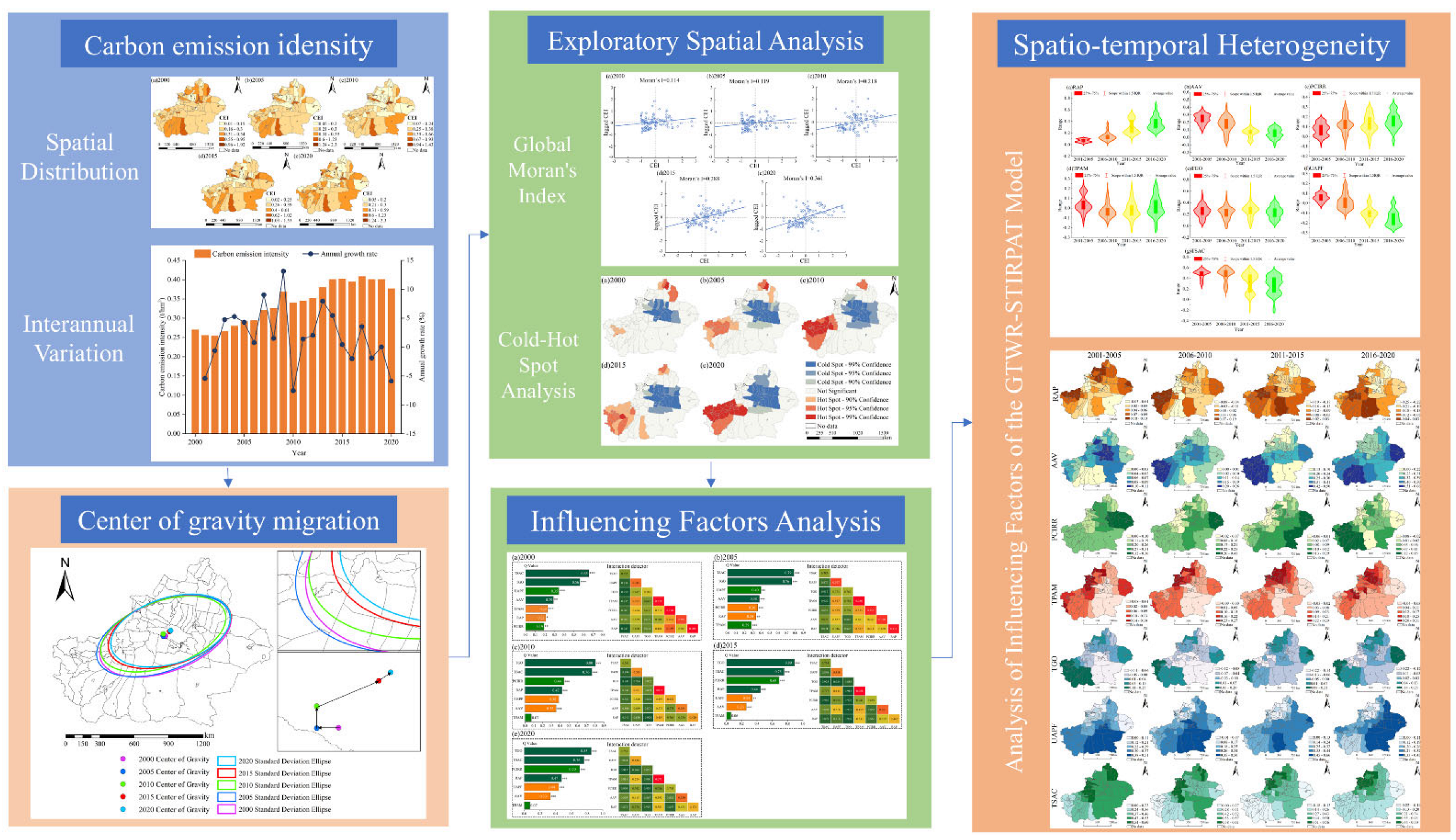
Figure 2 illustrates the overall technical framework of this study, which consists of four interrelated modules: ① Spatiotemporal evolution analysis; ② Spatial correlation analysis; ③ Influencing factor detection; ④ Spatiotemporal heterogeneity analysis. These modules proceed from ‘pattern description’ to ‘mechanism analysis’, forming a complete research logic chain.

3. Results and Analyses

3.1. Characteristics of the Spatial and Temporal Evolution of Carbon Intensity

3.1.1. Spatial and Temporal Distribution of Carbon Intensity

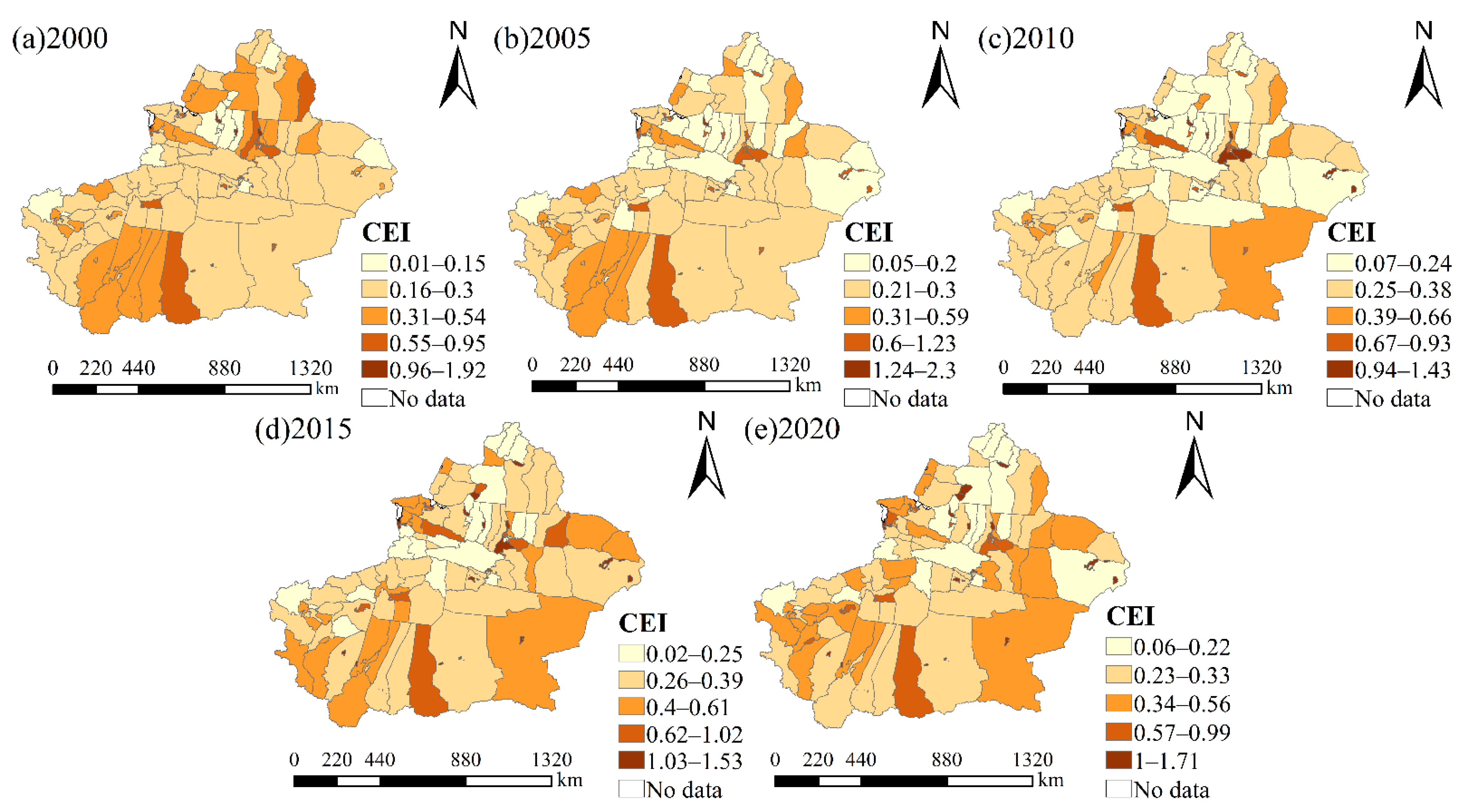
Figure 3 illustrates the carbon emission intensity of arable land use in Xinjiang from 2000 to 2020, demonstrating considerable geographical variation. Regions with significant industrialization and developing agricultural reclamation areas constitute the primary sources of emissions. Notably, Huyanghe City consistently records the highest carbon emission intensity in the entire Xinjiang region, reaching 1.555 t/hm2 in 2020, which represents an 18.8% increase compared to 2000. In contrast, eco-protected areas demonstrate markedly different performance, with regions such as Bohu County and Hejing County maintaining emission levels steadily below 0.2 t/hm2 over an extended period. Specifically, Bohu County recorded an emission intensity of only 0.183 t/hm2 in 2020, underscoring the effectiveness of the eco-priority strategy. Regarding temporal evolution, the period from 2005 to 2015 emerges as a critical growth phase, with approximately 40% of counties experiencing an increase in emission intensity exceeding 20%. For instance, Aral City saw an increase from 0.823 t/hm2 in 2010 to 0.958 t/hm2 in 2015. However, the impact of policy regulation becomes evident post-2015, as demonstrated by Korla City, which achieved a reduction in emission intensity from 0.342 t/hm2 in 2015 to 0.293 t/hm2 in 2020, marking a decrease of 14.3%.
Regional development patterns significantly influence carbon emission intensity, with notable local variations. In the northern frontier, energy development zones exhibit high fluctuation characteristics, indicative of the intricate coupling between energy development and agricultural activities. In contrast, in the southern frontier’s corps cities, the expansion of large-scale agriculture has led to an increase in emission intensity. Specifically, Tumxuk city’s emission intensity rose from 0.631 t/hm2 in 2010 to 0.877 t/hm2 in 2020, marking a 39.1% increase, while Aral city experienced a 29.2% increase over the same period. Conversely, traditional agricultural areas along the eastern border have achieved significant emission reductions through the optimization of planting structures. For instance, Yizhou District’s carbon emission intensity decreased by 35.2% to 0.213 t/hm2 from 2015 to 2020. The ecological agricultural areas in the Ili River Valley have demonstrated even greater success, with Zhaosu County maintaining an emission intensity range of 0.129 to 0.192 t/hm2 from 2000 to 2020, and Tekes County achieving a 56.8% reduction in emission intensity by 2020 compared to 2015 through ecological cultivation practices. This divergence between the northern and southern frontiers suggests that industrialization and intensive agriculture contribute to increased carbon emissions, whereas eco-friendly agricultural models can effectively facilitate emission reductions.
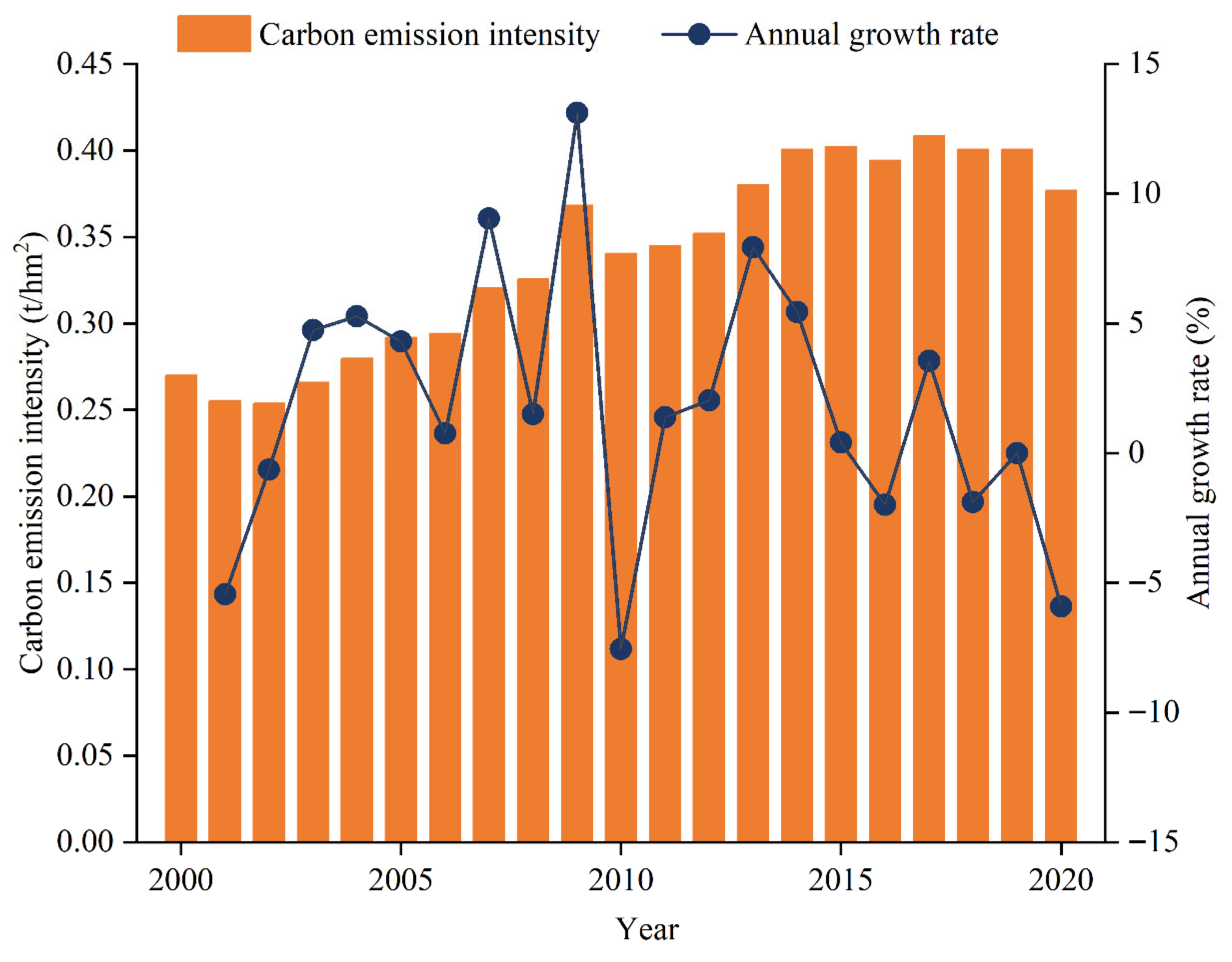
From 2000 to 2020, the carbon emission intensity of cultivated land in Xinjiang showed an overall upward trend but with significant phased fluctuations (Figure 4): From 2000 to 2003, it first decreased and then increased, with the decline rate narrowing from −5.44% to −0.64% followed by a 4.75% rebound, which was related to the unstable input during the initial stage of agricultural mechanization. From 2004 to 2007, it continued to rise but at a slowing pace, reflecting the diminishing marginal effects of chemical fertilizer, pesticide, and other inputs. The growth rate reached 13.11% from 2008 to 2009, a direct result of large-scale agricultural machinery promotion and cultivated land expansion in northern Xinjiang, which led to a surge in fossil energy consumption and a rapid increase in carbon emission intensity. It decreased by 7.55% from 2009 to 2010, associated with the ‘water-saving agriculture promotion policy’ implemented in Xinjiang that year, where reduced irrigation energy consumption partially offset emissions from other carbon sources. After 2015, the growth rate slowed down and even showed a downward trend, reflecting the effects of low-carbon agricultural policies under the ‘dual carbon’ goal. Meanwhile, the restrictive role of ecological protection zones in southern Xinjiang also inhibited emission growth. These fluctuations fully reflect the synergistic impacts of agricultural production methods, policy regulation, and ecological constraints.

3.1.2. Trends in the Spatial Development of Carbon Intensity

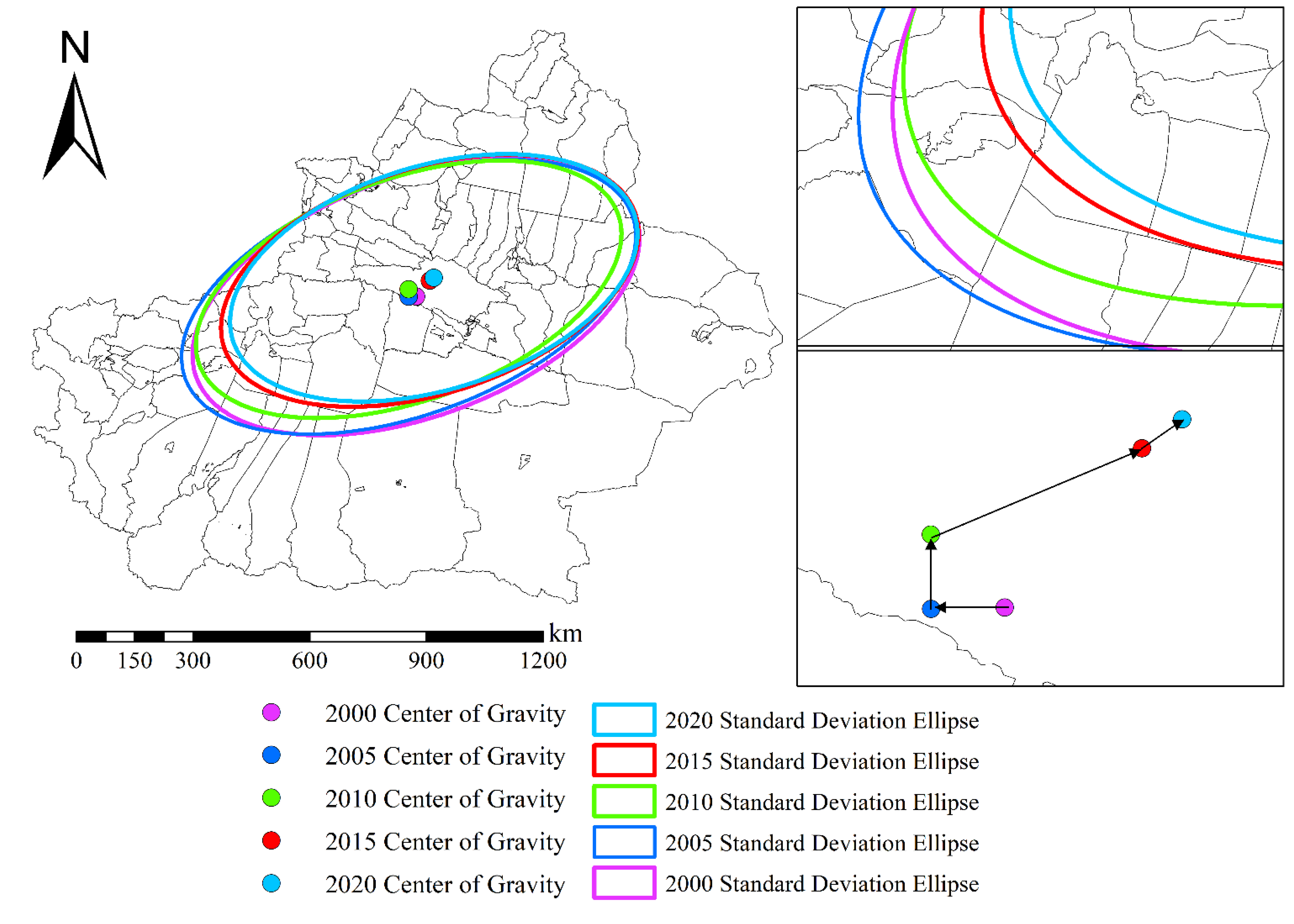
The research utilized the global analysis program ArcGIS 10.8 to create a standard deviation ellipse for the carbon emission intensity linked to agricultural use change in Xinjiang from 2000 to 2020. This analysis sought to investigate trends in spatial and temporal distribution (Figure 5). The results demonstrate a northeastern displacement in the mean center of gravity of the ellipse, signifying a geographic alteration in the core distribution of the dataset. According to Table 3, throughout the study period, the center displaced 18.98 km east and 90.6 km north, yielding an average annual displacement of 0.949 km east and 4.53 km north.
From 2000 to 2020, the spatial distribution of carbon emission intensity from farmland utilization in Xinjiang shown a significant tendency of directional migration and clustering. The centroid of carbon emission intensity relocated 58.65 km northeast, transitioning from coordinates 84.67° E, 42.52° N in 2000 to 85.10° E, 43.03° N in 2020. Between 2000 and 2005, the center of gravity migrated southward by 18.98 km at an angle of 178.8°; from 2005 to 2010, it advanced eastward by 19.18 km at an angle of 90.18°; from 2010 to 2015, it progressed eastward by 58.65 km at an angle of 87.42°; and from 2015 to 2020, it further shifted eastward by 12.77 km at an angle of 88.41°. The dimensions of the standard deviation ellipse demonstrate an escalation in spatial agglomeration: the ellipse area diminished from 583,223 km2 in 2000 to 489,241.3 km2 in 2020, signifying a loss of 16.1 percent. The oblateness stabilized between 0.49 and 0.53, exhibiting no notable morphological alterations, whereas the rotation angle of the long axis shifted somewhat counterclockwise from 200.25° to 197.24°, causing a westward divergence of the major axis direction by 2.3°.

3.2. Spatial Correlation Analysis

3.2.1. Global Spatial Autocorrelation

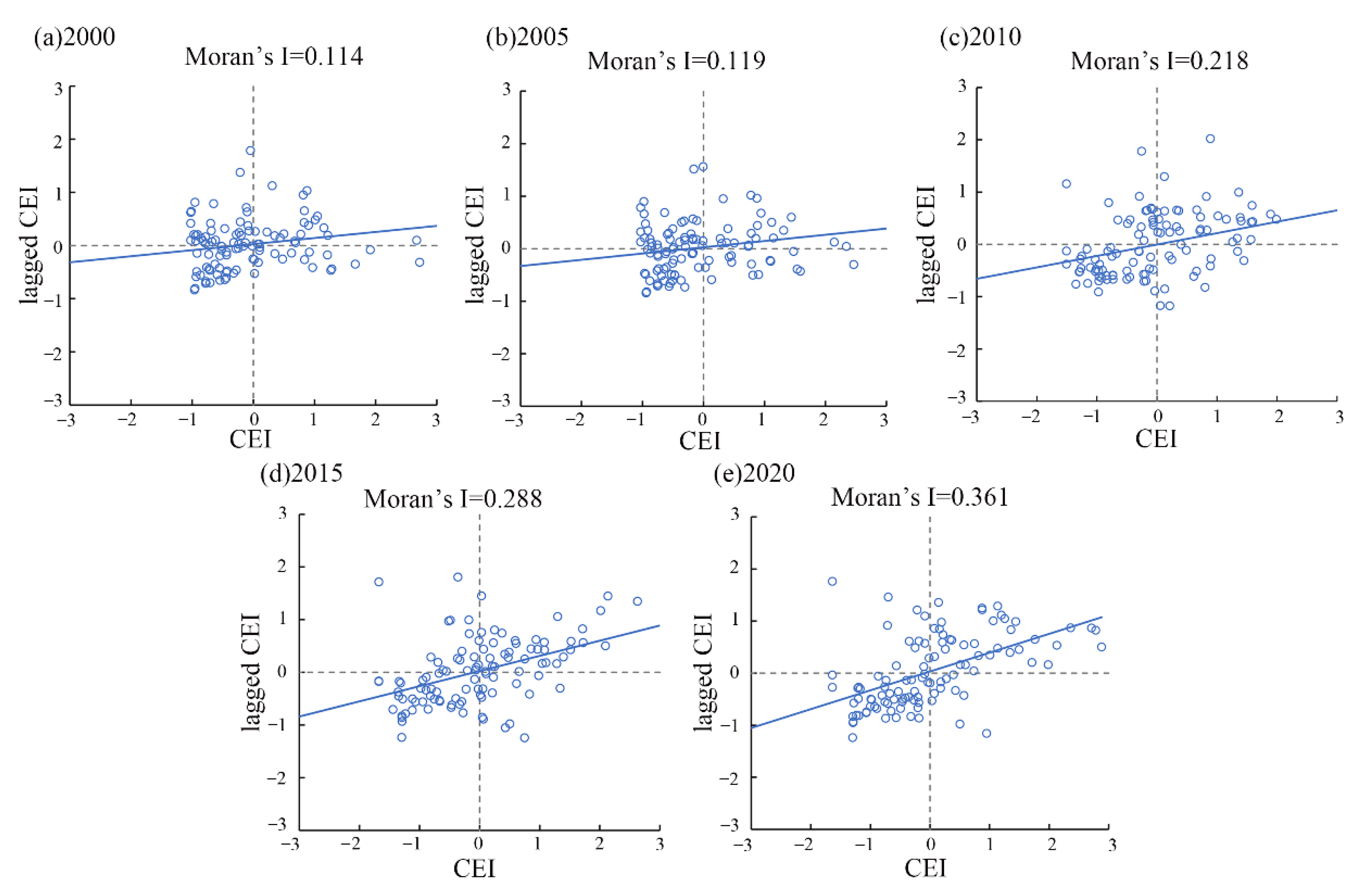
The research utilized the global Moran’s I model to analyze the geographical connection of carbon emissions due to alterations in agricultural practices (Figure 6). The results reveal a substantial degree of carbon emissions attributable to changes in agricultural practices in Xinjiang, with Moran’s I demonstrating a steady increase from 2000 to 2020, as illustrated in Table 4. The significance of spatial aggregation phenomena related to carbon emissions is highlighted by a p value below 0.05 and an increase in the Z value from 2.056 to 6.265, signifying statistical relevance. The analysis reveals a consistent pattern of aggregation in the regional distribution and trend of carbon emissions resulting from changes in agricultural practices.
The geographical clustering of carbon emission intensity shown a significant rise from 2000 to 2020, as evidenced by the global Moran’s I analysis of agricultural carbon emissions in Xinjiang. In 2000, a z-value of 2.056 and Moran’s I of 0.114 indicated a moderate positive spatial correlation. By 2005, Moran’s I rose to 0.119 with a z-value of 2.157, signifying an escalating disparity in carbon emissions between the traditional oasis of the southern border and the agricultural areas of the northern border. The increase in mechanization led to heightened spatial divergence in the Tianshan Mountains, culminating in Moran’s I value of 0.218 in 2010 (z-value: 3.892). The z-value of 4.848 and Moran’s I of 0.288 in 2015 indicate the influence of ecological initiatives along the southern border. The northern Tianshan Mountain economic zone and western Tarim Basin become high-emission areas due to their scale, technology, and economic reasons, with Moran’s I reaching 0.361 in 2020 (z-value: 6.265). Immediate oversight is necessary as the territory’s distribution transitions from a scattered northern area to a heavily inhabited southern region, a congested western sector, and a sparsely populated eastern zone.

3.2.2. Local Spatial Autocorrelation

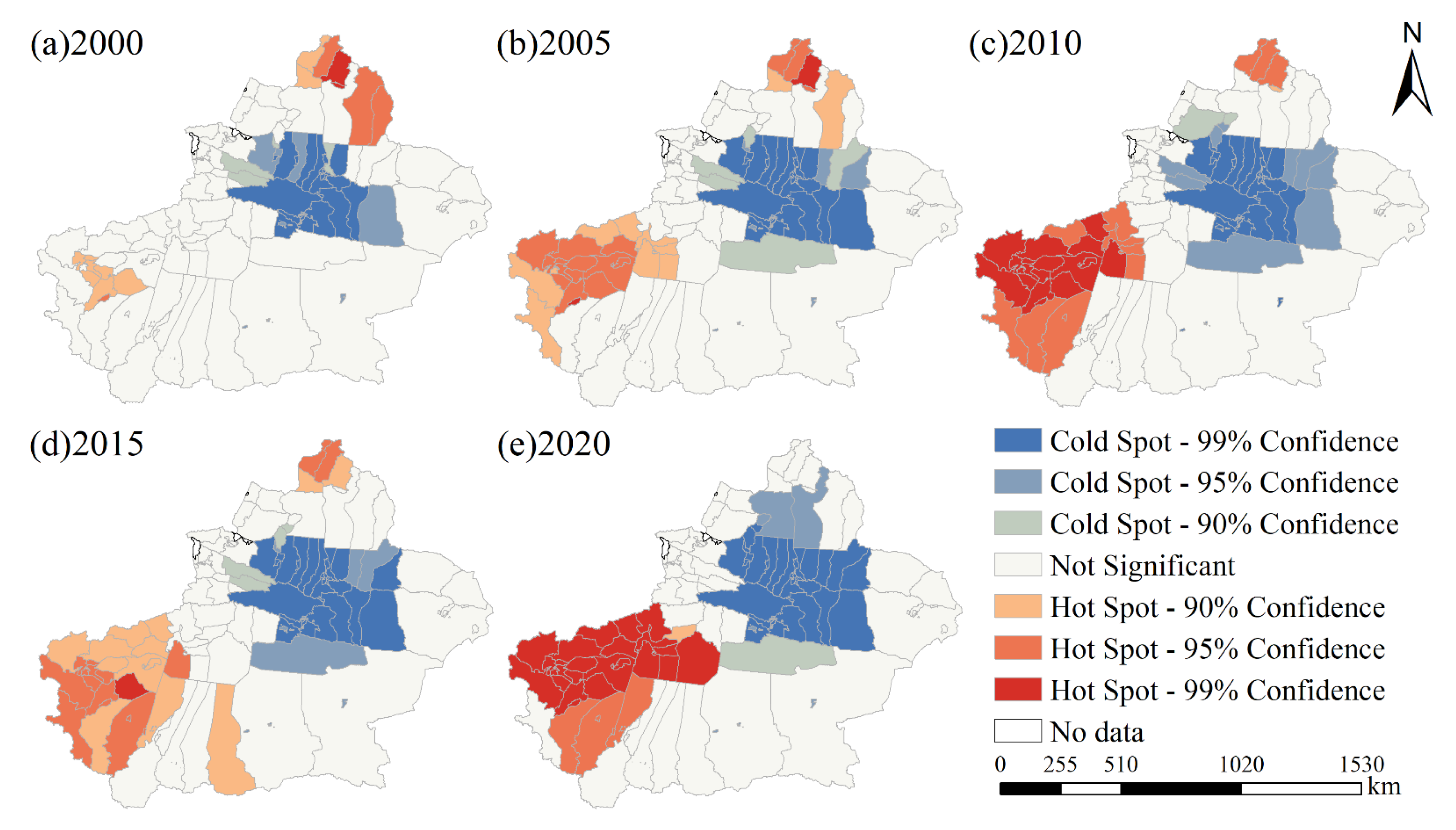
The local autocorrelation analysis of the cold hotspot pattern of carbon emissions from agricultural land use in Xinjiang from 2000 to 2020 demonstrates notable spatial agglomeration and dynamic evolution characteristics, utilizing the Getis-Ord G*i statistical approach (Figure 7). The cold spot in Keramay District and Kuitun City has expanded due to advancements in mechanization technology, demonstrating a substantial impact on technological emission reduction. Simultaneously, the formerly high-value hotspot region surrounding Altay City and Fuyun County has progressively transitioned towards the economic corridor on the northern slope of Tianshan Mountain, with the newly developed urban areas of Urumqi City and Changji City emerging as the new high-value agglomeration centers in northern Xinjiang. Ecologically sensitive regions such as Tashkurgan County and Minfeng County exhibit stable low-value cold spot characteristics, whereas the hotspot region in Southern Xinjiang stretches eastward from Kashgar City and Shushi County to Aketao County and Shache County, forming a continuous high-value agglomeration belt. This highlights the restrictive impact of ecological policies. The Yizhou District in Hami City exhibited a non-significant random distribution due to differences in agricultural land use, however a cold spot pattern persisted in Torkun County, East Xinjiang. Over time, the spatial connection of hot and cold areas over the entire region increased. The extension of continuous arable land and agricultural intensification were closely linked to high-value agglomerations, whereas the policy of converting farmland to forests and ecological conservation was directly related to low-value cold spot zones. The evolution of spatial patterns indicates that the technology-driven emission reductions at the northern border and the ecological limits at the southern frontier together influence the unique distribution of carbon emissions. Future regional governance must be enhanced to achieve a balance between low-carbon goals and agricultural advancement.

3.3. Analysis of Factors Influencing Carbon Emissions

3.3.1. Analysis of Major Factors

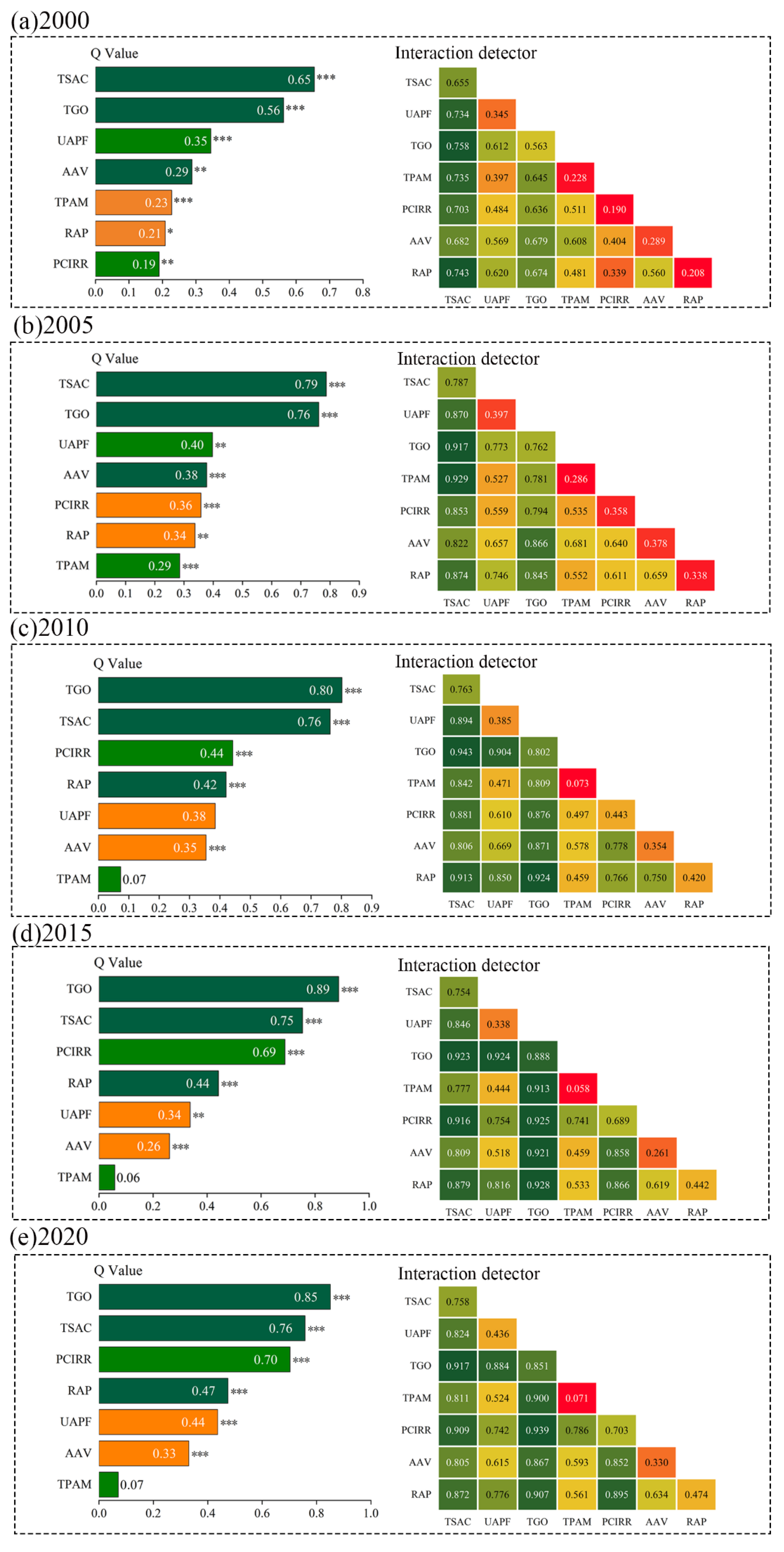
A geodetector was employed to conduct a correspondence analysis, assessing the extent to which various parameters affect carbon emission intensity and their interactions, as illustrated in Figure 8. Most factors exhibit a co-promotional relationship with carbon emissions, since the majority of factor interactions initially demonstrate bidirectional enhancement, subsequently followed by non-linear enhancement. The single-factor explanatory power of total grain output (TGO) increased from 0.56 to over 0.85 between 2000 and 2020, peaking at 0.89 in 2015, thereby establishing itself as the most influential factor. This pattern indicates that grain production capacity is increasingly influential in the geographical diversification of agriculture. The explanatory capacity of the total sown area of crops (TSAC) was substantial in the initial era, attaining 0.65 in 2000, and stabilizing at approximately 0.75 post-2010. This pattern indicates that grain production capacity is increasingly significant in agricultural geographical variation. The per capita income of rural residents (PCIRR) had the most significant increase in explanatory power, ascending from 0.19 in 2000 to 0.70 in 2020, from the lowest to the third position in the ranking. This illustrates that income growth exerts a far greater impact on the trajectory of agricultural modernization.
The explanatory capacity of the total power of agricultural equipment (TPAM) diminished from 0.23 to 0.07, making it the least significant factor after 2010. This decrease indicates a movement towards regional balance subsequent to the extensive implementation of automation. The utilization of agricultural plastic film (UAPF) demonstrates variable characteristics, rebounding to 0.44 in 2020, signifying region-specific disparities in the progression of facility-based agricultural technology. The explanatory capacity of the Rural Agricultural Population (RAP) has consistently risen to 0.47; however, its growth rate is inferior to that of economic indicators. This suggests that optimizing the labor force structure significantly influences spatial differentiation more than mere changes in population size. The consistently low and fluctuating impact of agricultural added value (AAV) indicates that economic scale alone has restricted explanatory capacity for the spatial distribution of agriculture.

3.3.2. Synergistic Effects Between Factors

A geodetector was employed to conduct a correspondence analysis, assessing the extent to which various parameters affect the intensity of carbon emissions and their interactions, as illustrated in Figure 8. Most factors exhibit a co-promotional relationship with carbon emissions, since interactions among these factors initially demonstrate bidirectional enhancement, succeeded by non-linear enhancement.
From 2000 to 2020, the relationship between total grain output (TGO) and the total sown area of crops (TSAC) demonstrated the highest explanatory power, rising from 0.7575 in 2000 to a maximum of 0.9434 in 2010. This tendency suggests that the synergistic relationship between grain production capability and arable land area is the principal catalyst for geographical difference in agriculture. The correlation between per capita income of rural residents (PCIRR) and TSAC shown notable strengthening, increasing from 0.7030 in 2000 to 0.9157 in 2020, indicating an enhanced relationship between income growth and cultivated land resource distribution. The interaction value between TGO and PCIRR rose from 0.6365 in 2000 to 0.9246 in 2020, indicating the progressive development of a synergistic driving mechanism between food production with the enhancement of farmers’ income.

3.4. Examination of Regional and Temporal Variability of Determinants Affecting Carbon Emissions

3.4.1. Data Checking and Model Selection

Before model estimation, variance inflation factor (VIF) analysis was conducted to test for multicollinearity. All VIF values were below 10, indicating no significant multicollinearity. The fitting performance of the GTWR-STIRPAT model was compared with the OLS, GWR, and GTWR models (Table 5). The GTWR-STIRPAT model had the lowest AICc value (−2137.31) and the highest R2 (0.97) and adjusted R2 (0.97), significantly outperforming the other models. This confirmed that the GTWR-STIRPAT model effectively captured the spatiotemporal heterogeneity of driver impacts and provided a reliable basis for analyzing CEI driving mechanisms.

3.4.2. Time Evolution of Drivers

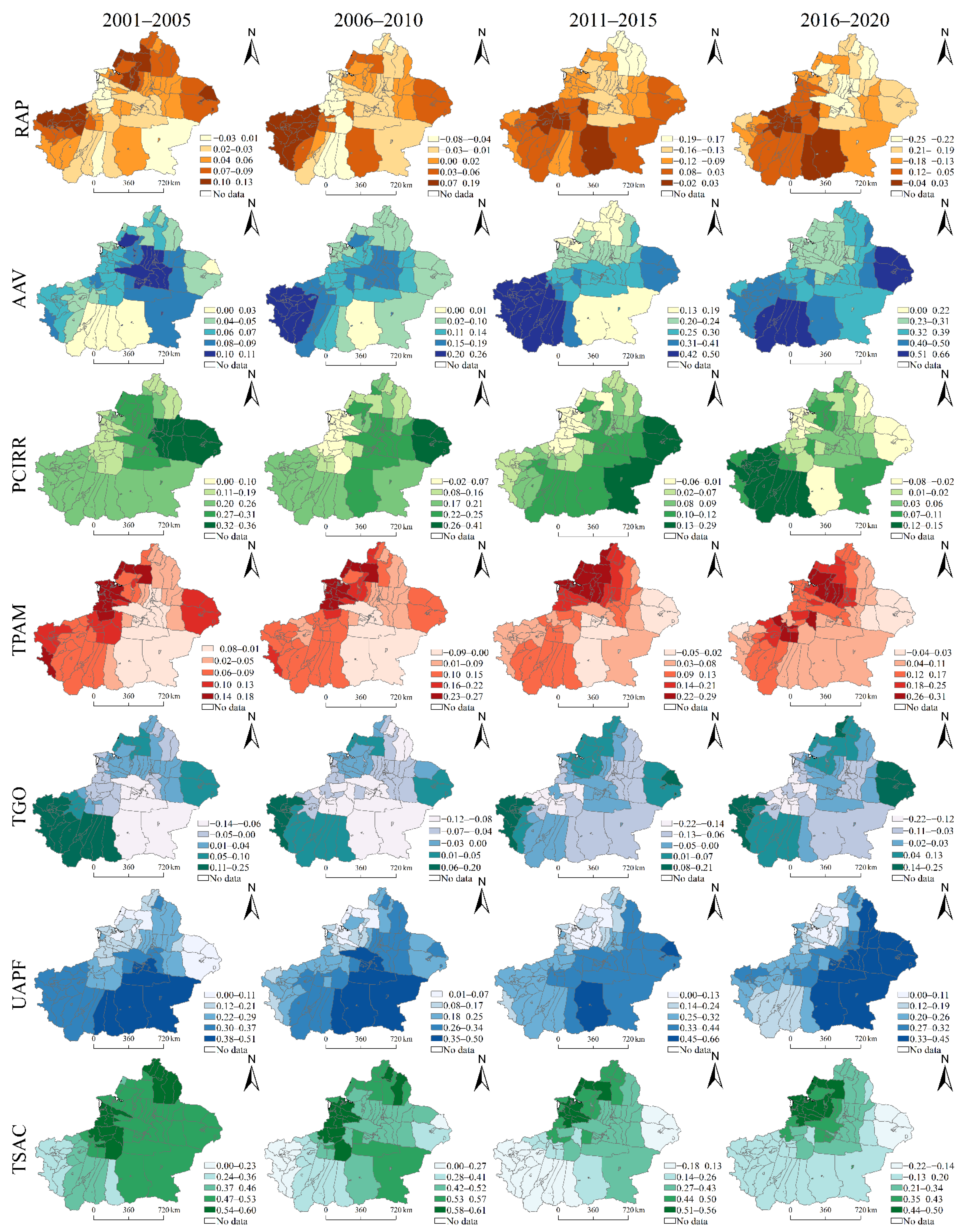
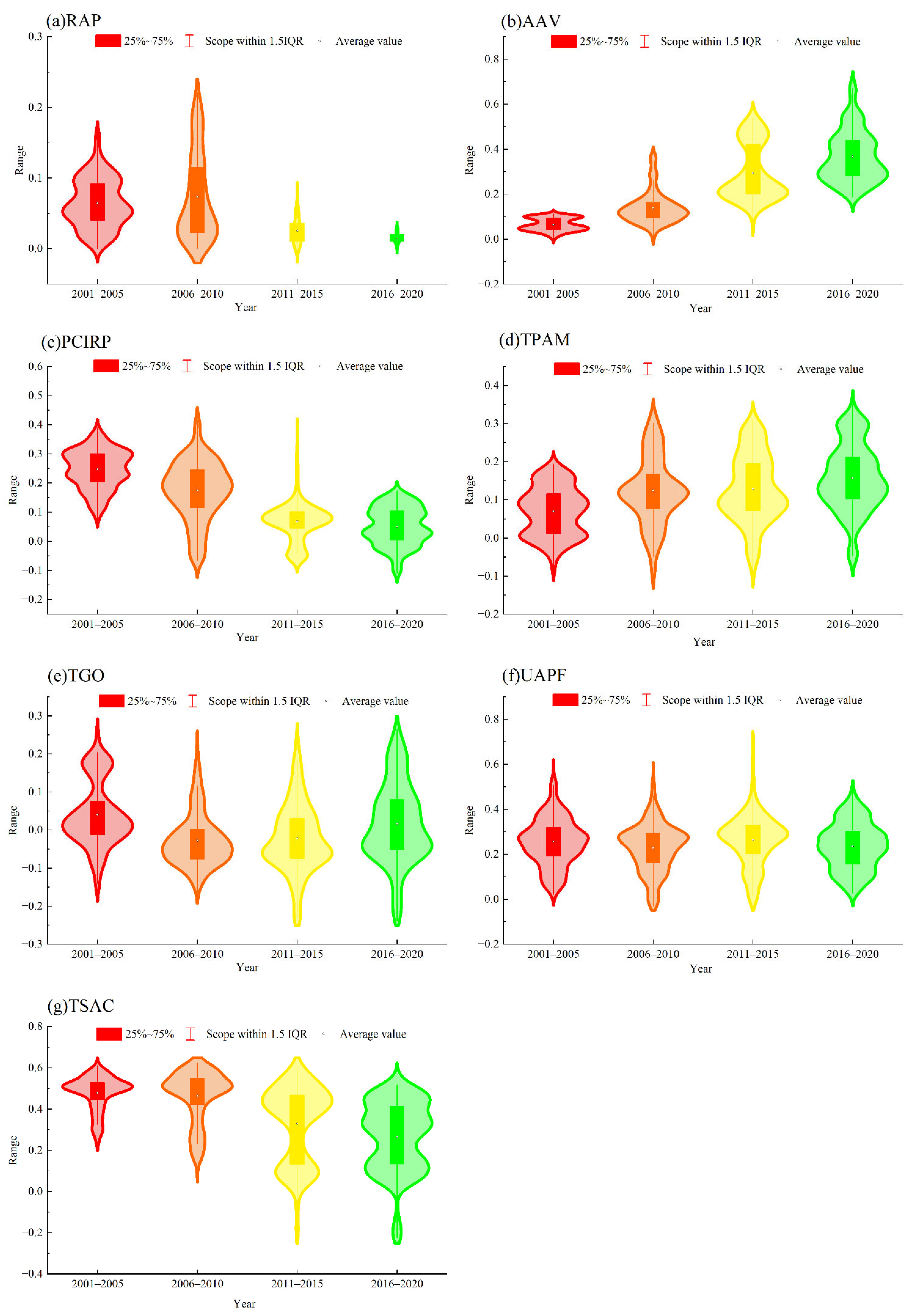
This research employed the GTWR-STIRPAT model to conduct regression analysis over four distinct intervals: 2001–2005, 2006–2010, 2011–2015, and 2016–2020. The objective was to ascertain the impact of various influencing factors on carbon emission intensity. A violin plot was created to demonstrate the temporal variations, as seen in Figure 9. A spatial distribution plot for the regression coefficients of each influencing factor was created utilizing the natural breakpoint approach, as illustrated in Figure 10.
(1) Rural agricultural population
This indicates a significant degree of regional variation. A distinct geographical disparity exists: the average value for the Tarim Basin is −0.032, while the average for the counties in the Jungar Basin is 0.027, representing a 218 percent increase. Conversely, the coefficient in Moyu County, situated in the southern border and Hotan Area, displayed minimal fluctuation, remaining at 0.023 from 2001 to 2005. Spatial analysis indicates that the absolute value of the coefficient along the northern border is often 2–3 times higher than that of the southern border, exhibiting a disparity of 4.4 times between −0.195 in Yizhou District and 0.044 in Pishan County. This underscores substantial regional disparities in the suppressive impact of population urbanization on carbon emission intensity.
(2) Agricultural value added
The eastern border has consistent growth, as evidenced by Yigu County’s coefficient rising from 0.025 in 2001–2005 to 0.665 in 2016–2020, indicating an average yearly growth rate of 23.8%. Likewise, Gaochang District in the Turpan Basin had a rise from 0.043 to 0.366 during the same timeframe. Conversely, Gashi County, situated in the Kashgar District on the southern border, experienced a more progressive growth, rising from 0.048 to 0.442. The spatial distribution indicates a gradient characteristic: the coefficients in the eastern border counties are often greater than those in the southern border. The coefficient in Shanshan County is 0.416, which is 15% lower than the 0.491 recorded in Zephyr County. The rate of decrease in carbon emissions per unit of agricultural output shows an accelerating trend to the east and a decelerating trend to the west.
(3) Per capita income of rural residents
The northern border displays a trend of initial positivity followed by negative reversal, as indicated by Karamay’s coefficient, which decreased from 0.293 in 2001–2005 to 0.088 in 2016–2020, and further to 0.028 in the Urumqi city district. In contrast, the southern boundary of Gashi County exhibits a constant positive correlation, with a minor reduction from 0.256 to 0.127. The spatial polarization is significant: the average value for the northern border declines by 85%, from 0.312 to 0.046, whilst the southern border reduces from 0.245 to 0.143. This reveals a pronounced north-south disparity in the effects of income growth on technology substitution, with a 1.7% decrease in emissions intensity per 10% increase in income in the northern border, juxtaposed with a 0.9% rise in the southern border.
(4) Total power of agricultural machinery
Northern Xinjiang exhibits a significantly greater marginal contribution to carbon emissions from elevated yields (0.07) compared to Southern Xinjiang (0.02). Similarly, the coefficient rose from 0.105 to 0.303 in the Kelamayi district. Ruoqiang County, located near the southern border, experienced a moderate improvement, rising from −0.047 to 0.080. An analogous rise in the coefficient from 0.105 to 0.303 was noted in the Kelamayi district. Conversely, Ruoqiang County, located near the southern border, experienced a more mild increase from −0.047 to 0.080. The northern border exhibits a carbon emission intensity that is 2.4 times greater (0.12) per unit increase in machinery density of 1 kW/hm2 compared to the southern border (0.05). This mismatch underscores the differences in efficiency between the energy architectures of the two locations.
(5) Total food production
The coefficient in Qitai County, Changji Prefecture, has changed from −0.096 between 2006 and 2010 to 0.044 from 2016 to 2020, indicating a notable trend reversal on the northern slopes of the Tianshan Mountains. The coefficient in Qitai County, Changji Prefecture, rose from −0.096 between 2006 and 2010 to 0.044 from 2016 to 2020, indicating a notable trend reversal on the northern slopes of the Tianshan Mountains. The average value in the Tarim Basin is −0.032, whereas the average value in the Jungar Basin is 0.027, indicating a 218 percent rise. This signifies a considerable degree of geographical inequality. A notable geographical differential is evident: the average value for the Tarim Basin is −0.032, but the average value for the counties in the Jungar Basin is 0.027, indicating a 218 percent rise.
(6) Agricultural Plastic Film Use
The consistently high results at the southern border demonstrate that Celle County’s coefficient in the Hotan region declined from 0.355 between 2001–2005 to 0.155 in 2016–2020, which is 118% greater than the northern border average of 0.071. In the counties along the western edge of the Tarim Basin, coefficients increased by 34%, from 0.285 to 0.320, whereas in the northern slopes of the Tianshan Mountains, coefficients varied between 0.173 and 0.215. In the Kashgar region, the coefficient for Shache County decreased from 0.328 to 0.179. At 0.18 on the southern border, the marginal effect of film input per unit area on carbon emission intensity is twice that of 0.09 on the northern border. This indicates a notable discrepancy in regulation measures, with heightened white pollution levels in the south relative to the north.
(7) Area sown under crops
The southern region has heightened levels of white pollution relative to the northern region, underscoring a substantial disparity in mitigation measures. In Yumin County, Tacheng Prefecture, the coefficient decreased from 0.483 to 0.487, whilst in Shache County, situated on the southern border, it fell from 0.355 to 0.086, indicating a 76 percent decline. Northern Xinjiang demonstrates a significantly higher influence of area expansion on carbon emission intensity (0.12) than Southern Xinjiang (0.04). Northern Xinjiang demonstrates a 200% higher rise in carbon emissions (1.2%) from a 10% expansion in cultivated land area compared to Southern Xinjiang (0.4%), underscoring regional inequalities in intensification levels.

4. Discussion

4.1. Key Findings and Mechanism Analysis

4.1.1. Attributes of Spatial and Temporal Development

This study clarifies the notable spatiotemporal differential characteristics of carbon emission intensity linked to agricultural production in Xinjiang from 2000 to 2020. The carbon emission intensity of this region exhibited a significant rise, increasing from 0.270 t/hm2 in 2000 to 0.377 t/hm2 in 2020. In northern Xinjiang, the carbon emission intensity has a generally fluctuating increasing trajectory, whereas southern Xinjiang reveals a geographical distribution characterized by higher values in the east and lower values in the west, consistent with prior research [43]. The natural environment and human activity in Xinjiang are closely connected to this spatiotemporal variation. The principal reasons driving the rise in carbon emission intensity in northern Xinjiang are the proliferation of mechanized agriculture and the heightened consumption of fossil fuels. In southern Xinjiang, natural constraints restrain the rise in carbon emission intensity, rendering it less substantial [44]. The center of gravity of carbon emission intensity has shifted 58.65 km to the northeast, reflecting the impact of agricultural modernization in the northern frontier and the development policy of the Corps Reclamation. The findings suggest that regional development policies and advancements in agricultural technology significantly influence the trajectory of carbon emission intensity.

4.1.2. Driver Analysis

The primary determinants of carbon emission intensity are the quantity of agricultural plastic film utilized, the total area seeded with crops, and the rural agricultural population [45]. The total sown area of crops constantly demonstrates the greatest explanatory power, signifying that the development of arable land is a primary factor influencing carbon emission intensity. The substantial influence of agricultural inputs on carbon emissions is shown in the strong explanatory capacity of agricultural film utilization. The explanatory capacity of value addition in agriculture and the overall efficacy of agricultural technology has significantly grown, indicating that economic intensification and mechanization processes have a compounding influence on carbon emissions [22]. Regulatory regulations profoundly influence carbon emission intensity. In the southern border region, ecological policy constraints have mitigated the rise in carbon emission intensity, whereas the northern border region has experienced a significant escalation in carbon emission intensity due to agricultural modernization and mechanization. The explanatory capacity of multi-factor interactions on carbon emission intensity much surpasses that of individual components, demonstrating non-linear enhancing properties. In 2020, the correlation between the total power of agricultural machinery and the sown area of crops achieved an explanatory power of 0.844, exceeding the cumulative explanatory power of the two separate elements. This suggests that the combined impact of mechanization and land expansion intensifies carbon emission intensity.

4.1.3. Examination of Spatial and Temporal Variability

The investigation employing the GTWR-STIRPAT model demonstrates significant regional and temporal variability in the influence of driving parameters on carbon emission intensity. The spatial and temporal development of carbon emission intensity related to agricultural use in Xinjiang is affected by the spatial heterogeneity of various causes, each demonstrating considerable regional variation. The northern Xinjiang region has a prominent synergistic effect between the total power of agricultural machines and the urbanization of the rural people. The rise in machinery density and the decrease in the labor force constitute a technological substitution trajectory [46], with the coefficient of the total power of machinery in Toli County increasing from 0.052 to 0.307. Conversely, in the southern Xinjiang region, the dual effect of agricultural plastic film usage and arable land fragmentation is evident. Although the film coefficient in Celle County decreases from 0.355 to 0.155, it still significantly exceeds the average value of the northern border, indicating a reliance on high-carbon pathways [47]. In contrast, East Xinjiang transcends the traditional pattern through a leap in agricultural value added, with the coefficient of agricultural value added in Yiguo County rising from 0.025 to 0.665, and the carbon intensity per unit of output value decreasing by 89%, underscoring the innovative potential of efficient oasis agriculture. The profound contradiction of regional differences is manifested in the spatial and temporal mismatch of resource endowment and technology diffusion: the northern border benefits from a high degree of arable land contiguity, supporting the scale effect of mechanization; the southern border is constrained by topographic isolation and film dependence, with a technology penetration rate 53% lower than that of the northern border; and the eastern border is optimizing the energy structure through photovoltaic agriculture to transcend the limitations of traditional inputs. This spatial heterogeneity necessitates the implementation of differentiated control strategies: the northern border should promote the upgrading of intelligent agricultural machinery, focusing on increasing the proportion of hybrid power; the southern border urgently needs to advance thin-film substitution technology and establish a comprehensive life-cycle management system; and the eastern border can promote the low-carbon oasis model, enhance the efficiency of technology diffusion, and ultimately achieve the synergistic optimization of carbon intensity across the entire region.

4.2. Research Limitations and Future Prospects

This study offers a comprehensive analysis of the geographical and temporal progression of carbon emission intensity associated with agricultural land use and its influencing factors in Xinjiang; nonetheless, certain limitations persist. The choice of influencing elements primarily highlights socio-economic parameters, inadequately considering the effects of natural factors like vegetation index and total primary productivity on carbon emission intensity. The study’s temporal scope is limited to the years 2000 to 2020. Future research should prolong the study duration to obtain a more thorough long-term trend of carbon emission intensity. Furthermore, integrating a wider array of ecological variables would improve the comprehension of alterations in carbon emission intensity associated with cultivated land use in Xinjiang, thus offering stronger support for the development of scientifically grounded and rational agricultural carbon emission reduction policies.

5. Conclusions

This study examined the geographical and temporal dynamics of cultivated land utilization changes and their effects on carbon emission intensity in Xinjiang’s arid region from 2000 to 2020 employing diverse analytical techniques. The findings indicated that carbon emission intensity from agricultural utilization has risen overall, with notable regional disparities. The northern border region witnessed an increase and a northeastward shift in emission intensity attributable to mechanized agriculture and fossil fuel usage. The eastern segment of the southern border region had elevated emissions, whereas the western segment demonstrated reduced emissions, shaped by ecological policy. Principal driving variables encompassed crop area, utilization of agricultural film, and agricultural value added. The GTWR-STIRPAT model demonstrated regional and temporal variability in these effects. Policy proposals highlighted the necessity for regional differentiation, with the northern border required to enhance energy efficiency and the southern border concentrating on ecological policies and water resource management to promote sustainable agricultural development.

Author Contributions

Y.G.: Writing—review & editing, Writing—original draft, Validation, Methodology, Formal analysis, Conceptualization. H.L.: Writing—review & editing, Project administration, Funding acquisition, Conceptualization. P.G.: Writing—review & editing, Validation, Methodology, Data curation, Conceptualization. P.L.: Supervision, Project administration, Conceptualization. Y.L.: Methodology, Formal analysis, Conceptualization. Y.D.: Project administration, Conceptualization. M.S.: Software, Supervision. Y.X.: Validation. J.W.: Data curation. Q.M.: Supervision, Formal analysis. All authors have read and agreed to the published version of the manuscript.

Funding

This research has been supported by the National Natural Science Foundation of China, grant number 52479043 and Corps International Science and Technology Cooperation Program, grant number 2024BA004 and Tianshan Excellence Project, grant number 2023TSYCCX0115 and National Key Research and Development Program of China, grant number 2025YFE0104900 and Second Division Municipal Science and Technology Tackling Project, grant number 2024GG2301.

Data Availability Statement

The original contributions presented in this study are included in the article. Further inquiries can be directed to the corresponding author.

Acknowledgments

We sincerely appreciate the reviewers for their valuable comments and constructive suggestions, which greatly helped to improve the quality of this manuscript.

Conflicts of Interest

The authors declare no conflict of interest.

References

  1. Li, Z.; Murshed, M.; Yan, P. Driving Force Analysis and Prediction of Ecological Footprint in Urban Agglomeration Based on Extended STIRPAT Model and Shared Socioeconomic Pathways (SSPs). J. Clean. Prod. 2023, 383, 135424. [Google Scholar] [CrossRef]
  2. Chang, M.-Y.; Lai, K.-L.; Lin, I.-K.; Chao, C.-T.; Chen, H.-S. Exploring the Sustainability of Upcycled Foods: An Analysis of Consumer Behavior in Taiwan. Nutrients 2024, 16, 2501. [Google Scholar] [CrossRef] [PubMed]
  3. Ma, J.; Feng, X.; Wang, S.; Liu, F.; Li, Y. Drivers and Reduction Potential of Carbon Emissions from Cultivated Land Use. CATENA 2024, 247, 108508. [Google Scholar] [CrossRef]
  4. Feng, L.; Yang, W.; Hu, J.; Wu, K.; Li, H. Exploring the Nexus between Rural Economic Digitalization and Agricultural Carbon Emissions: A Multi-Scale Analysis across 1607 Counties in China. J. Environ. Manag. 2025, 373, 123497. [Google Scholar] [CrossRef]
  5. Yang, X.; Liu, Y.; Bezama, A.; Thrän, D. Agricultural Carbon Emission Efficiency and Agricultural Practices: Implications for Balancing Carbon Emissions Reduction and Agricultural Productivity Increment. Environ. Dev. 2024, 50, 101004. [Google Scholar] [CrossRef]
  6. Rong, T.; Zhang, P.; Zhu, H.; Jiang, L.; Li, Y.; Liu, Z. Spatial Correlation Evolution and Prediction Scenario of Land Use Carbon Emissions in China. Ecol. Inf. 2022, 71, 101802. [Google Scholar] [CrossRef]
  7. Li, S.; Liu, Y.; Wei, G.; Bi, M.; He, B.-J. Carbon Surplus or Carbon Deficit under Land Use Transformation in China? Land Use Policy 2024, 143, 107218. [Google Scholar] [CrossRef]
  8. Wang, Y.; Lei, T. Influencing Mechanisms of Renewable Energy Development on Carbon Emission Intensity in China. J. Environ. Manag. 2024, 372, 123402. [Google Scholar] [CrossRef]
  9. Zhou, X.; Wu, D.; Li, J.; Liang, J.; Zhang, D.; Chen, W. Cultivated Land Use Efficiency and Its Driving Factors in the Yellow River Basin, China. Ecol. Indic. 2022, 144, 109411. [Google Scholar] [CrossRef]
  10. Xu, F.; Zheng, X.; Zheng, M.; Liu, D.; Ma, Y.; Peng, J.; Shen, Y.; Han, X.; Zhang, M. Exploring Inequality: A Multi-Scale Analysis of China’s Consumption Carbon Footprint. ISPRS Int. J. Geo-Inf. 2025, 14, 49. [Google Scholar] [CrossRef]
  11. Xue, H.; Ma, Q.; Ge, X. Spatiotemporal Dynamics and Driving Factors of Energy-Related Carbon Emissions in the Yangtze River Delta Region Based on Nighttime Light Data. Sci. Rep. 2025, 15, 3384. [Google Scholar] [CrossRef]
  12. Yao, Y.; Bi, X.; Li, C.; Xu, X.; Jing, L.; Chen, J. A United Framework Modeling of Spatial-Temporal Characteristics for County-Level Agricultural Carbon Emission with an Application to Hunan in China. J. Environ. Manag. 2024, 364, 121321. [Google Scholar] [CrossRef]
  13. Wang, N.; Qu, Z.; Li, J.; Zhang, Y.; Wang, H.; Xi, H.; Gu, Z. Spatial-Temporal Patterns and Influencing Factors of Carbon Emissions in Different Regions of China. Environ. Res. 2025, 276, 121447. [Google Scholar] [CrossRef] [PubMed]
  14. Sun, N.; Xue, X. Space and Temporal Evolution and Driving Force Analysis of Ecological Compensation Efficiency in Cultivated Land--Take the Nine Provinces in the Yellow River Basin as an Example. Environ. Monit. Assess. 2025, 197, 389. [Google Scholar] [CrossRef] [PubMed]
  15. Zheng, S.; Chen, C.; Xie, S. An LMDI-Based Analysis of Carbon Emission Changes in China’s Waterway Transportation Sector. Sustainability 2025, 17, 325. [Google Scholar] [CrossRef]
  16. Hou, J.; Yang, S.; Fan, G.; Xu, H. The Impact of Energy Consumption on Carbon Emissions Intensity in China: Evidence from a Dynamic Panel Quantile Regression Model. Int. J. Low-Carbon Technol. 2024, 19, 268–288. [Google Scholar] [CrossRef]
  17. Mu, J.; Wang, J.; Liu, B.; Yang, M. Spatiotemporal Dynamics and Influencing Factors of CO2 Emissions under Regional Collaboration: Evidence from the Beijing-Tianjin-Hebei Region in China. Environ. Pollut. 2024, 357, 124403. [Google Scholar] [CrossRef]
  18. Bai, J.; Chen, H.; Xiang, G.; Ji, Y.; Zhu, X. Temporal and Spatial Characteristics of Carbon Emissions from Cultivated Land Use and Their Influencing Factors: A Case Study of the Yangtze River Delta Region. Int. Rev. Econ. Financ. 2024, 96, 103501. [Google Scholar] [CrossRef]
  19. Penuelas, J. The Challenges of Sequestering Terrestrial Carbon. Natl. Sci. Rev. 2022, 9, nwac085. [Google Scholar] [CrossRef]
  20. Ding, Y.; Ding, J.; Wang, J.; Han, L.; Wang, J.; Chen, X.; Ge, X. Spatiotemporal Dynamics and Driving Mechanisms of Wetlands in Arid Regions of Xinjiang. Ecol. Indic. 2025, 174, 113485. [Google Scholar] [CrossRef]
  21. Zhang, H.; Zhu, Y.; Ma, Z.; He, J.; Guo, C.; Zhou, Q.; Song, L. Simulating the Impact of Climate Change on the Suitable Area for Cotton in Xinjiang Based on SDMs Model. Ind. Crops Prod. 2025, 227, 120750. [Google Scholar] [CrossRef]
  22. Zhou, Y.; Zhang, E.; He, L.; Ke, X.; Lu, D.; Lin, A.; Lai, X. The Carbon Emission Reduction Benefits of the Transformation of the Intensive Use of Cultivated Land in China. J. Environ. Manag. 2024, 370, 122978. [Google Scholar] [CrossRef] [PubMed]
  23. Qiao, F.; Yang, Q.; Shi, W.; Yang, X.; Ouyang, G.; Zhao, L. Research on Driving Mechanism and Prediction of Electric Power Carbon Emission in Gansu Province under Dual-Carbon Target. Sci. Rep. 2024, 14, 6103. [Google Scholar] [CrossRef] [PubMed]
  24. Wang, S.; Huang, Y.; Zhou, Y. Spatial Spillover Effect and Driving Forces of Carbon Emission Intensity at the City Level in China. J. Geogr. Sci. 2019, 29, 231–252. [Google Scholar] [CrossRef]
  25. Wang, C.; Ibrahim, H.; Wu, F.; Chang, W. Spatial and Temporal Evolution Patterns and Spatial Spillover Effects of Carbon Emissions in China in the Context of Digital Economy. J. Environ. Manag. 2025, 373, 123811. [Google Scholar] [CrossRef]
  26. Duman, Z.; Mao, X.; Cai, B.; Zhang, Q.; Chen, Y.; Gao, Y.; Guo, Z. Exploring the Spatiotemporal Pattern Evolution of Carbon Emissions and Air Pollution in Chinese Cities. J. Environ. Manag. 2023, 345, 118870. [Google Scholar] [CrossRef]
  27. Wang, W.; Yin, X.; Wang, C.; Zhuo, M. Urban Expansion and Agricultural Carbon Emission Efficiency: The Moderating Role of Land Property Rights Stability. J. Clean. Prod. 2025, 486, 144488. [Google Scholar] [CrossRef]
  28. Rong, T.; Qin, M.; Zhang, P.; Chang, Y.; Liu, Z.; Zhang, Z. Spatiotemporal Evolution of Land Use Carbon Emissions and Multi Scenario Simulation in the Future—Based on Carbon Emission Fair Model and PLUS Model. Environ. Technol. Innov. 2025, 38, 104087. [Google Scholar] [CrossRef]
  29. Quan, Z.; Xu, X.; Jiang, J.; Wang, W.; Gao, S. Uncovering the Drivers of Ecological Footprints: A STIRPAT Analysis of Urbanization, Economic Growth, and Energy Sustainability in OECD Countries. J. Clean. Prod. 2024, 475, 143686. [Google Scholar] [CrossRef]
  30. You, J.; Dong, Z.; Jiang, H. Research on the Spatiotemporal Evolution and Non-Stationarity Effect of Urban Carbon Balance: Evidence from Representative Cities in China. Environ. Res. 2024, 252, 118802. [Google Scholar] [CrossRef]
  31. Xu, W.; Jin, J.; Zhang, J.; Yuan, S.; Liu, Y.; Guan, T.; He, R.; Zhu, L. Coupling Coordination Degree, Interaction Relationship and Driving Mechanism of Water Resources Carrying Capacity of Beijing-Tianjin-Hebei Urban Agglomeration in China. J. Clean. Prod. 2025, 504, 145433. [Google Scholar] [CrossRef]
  32. Liao, J.; Yu, C.; Feng, Z.; Zhao, H.; Wu, K.; Ma, X. Spatial Differentiation Characteristics and Driving Factors of Agricultural Eco-Efficiency in Chinese Provinces from the Perspective of Ecosystem Services. J. Clean. Prod. 2021, 288, 125466. [Google Scholar] [CrossRef]
  33. Xiang, W.; Lan, Y.; Gan, L. Exploring the Spatio-Temporal Driving Mechanism of Multi-Dimensional Urbanization on Urban Residential Buildings Based on GTWR: A Case Study of China. Int. J. Urban Sci. 2024, 29, 665–692. [Google Scholar] [CrossRef]
  34. Hasanah, A.; Jia, B.; Wu, J. Spatial Heterogeneity in the Impact of Urban Spatial Structure on Carbon Emissions and Storage in Coastal Region: A Case Study of Samarinda Metropolitan Area, Indonesia. Environ. Dev. Sustain. 2025, 1–33. [Google Scholar] [CrossRef]
  35. Xu, Q.; Yao, L.; Shi, K.; Zhou, W.; Tang, X. Spatiotemporal Analysis of the Impact of Green Finance on Carbon Dioxide Emissions Based on Panel Data of Cities in China. Int. J. Digit. Earth 2025, 18, 2457969. [Google Scholar] [CrossRef]
  36. Zhang, J.; Zhang, P.; Liu, Y.; Lu, S.; Wu, G. An Analysis of the Spatiotemporal Evolution and Driving Force of Cultivated Land Green Utilization in Karst Region of Southwest China. J. Clean. Prod. 2024, 434, 140002. [Google Scholar] [CrossRef]
  37. Dong, B.; Ma, X.; Zhang, Z.; Zhang, H.; Chen, R.; Song, Y.; Shen, M.; Xiang, R. Carbon Emissions, the Industrial Structure and Economic Growth: Evidence from Heterogeneous Industries in China. Environ. Pollut. 2020, 262, 114322. [Google Scholar] [CrossRef]
  38. Bai, Y.; Deng, X.; Jiang, S.; Zhao, Z.; Miao, Y. Relationship between Climate Change and Low-Carbon Agricultural Production: A Case Study in Hebei Province, China. Ecol. Indic. 2019, 105, 438–447. [Google Scholar] [CrossRef]
  39. Huan, H.; Wang, L.; Zhang, Y. Regional Differences, Convergence Characteristics, and Carbon Peaking Prediction of Agricultural Carbon Emissions in China. Environ. Pollut. 2025, 366, 125477. [Google Scholar] [CrossRef]
  40. Ji, M.; Li, J.; Zhang, M. What Drives the Agricultural Carbon Emissions for Low-Carbon Transition? Evidence from China. Environ. Impact Assess. Rev. 2024, 105, 107440. [Google Scholar] [CrossRef]
  41. Fu, S.; Lv, T.; Wu, G.; Li, H.; Zhu, L.; Zhang, X. Discerning Changes in Carbon Emission Intensity of Cultivated Land Utilization since Agricultural Green Transformation: Based on the Motivation-Opportunity-Ability (MOA) Framework. Environ. Impact Assess. Rev. 2025, 114, 107946. [Google Scholar] [CrossRef]
  42. Sun, C.; Xia, E.; Huang, J.; Tong, H. Coupling and Coordination of Food Security and Agricultural Carbon Emission Efficiency: Changing Trends, Influencing Factors, and Different Government Priority Scenarios. J. Environ. Manag. 2024, 370, 122533. [Google Scholar] [CrossRef]
  43. Yu, X.; Xu, C.; An, J.; Biao, C.; Ze, Q.; Yuan, F.; Ling, W.; Qi, W. The Coupling Coordination Characteristics and Graded Control Measures of Cultivated Land Quality and Economic Development in the Northern Slope Economic Belt of the Tianshan Mountains Based on Future Scenarios. Sustainability 2025, 17, 2668. [Google Scholar] [CrossRef]
  44. Han, F.; Kasimu, A.; Wei, B.; Zhang, X.; Aizizi, Y.; Chen, J. Spatial and Temporal Patterns and Risk Assessment of Carbon Source and Sink Balance of Land Use in Watersheds of Arid Zones in China-A Case Study of Bosten Lake Basin. Ecol. Indic. 2023, 157, 111308. [Google Scholar] [CrossRef]
  45. Xiao, P.; Zhang, Y.; Qian, P.; Lu, M.; Yu, Z.; Xu, J.; Zhao, C.; Qian, H. Spatiotemporal Characteristics, Decoupling Effect and Driving Factors of Carbon Emission from Cultivated Land Utilization in Hubei Province. Int. J. Environ. Res. Public Health 2022, 19, 9326. [Google Scholar] [CrossRef]
  46. Zhang, W.; Ma, L.; Wang, X.; Chang, X.; Zhu, Z. The Impact of Non-Grain Conversion of Cultivated Land on the Relationship between Agricultural Carbon Supply and Demand. Appl. Geogr. 2024, 162, 103166. [Google Scholar] [CrossRef]
  47. Li, X.; Chen, B.; Liu, H.; Xu, M.; Yang, H. Characteristics of Agricultural Carbon Emissions in Arid Zones, Drivers and Decoupling Effects: Evidence from Xinjiang, China. Energy 2025, 328, 136373. [Google Scholar] [CrossRef]
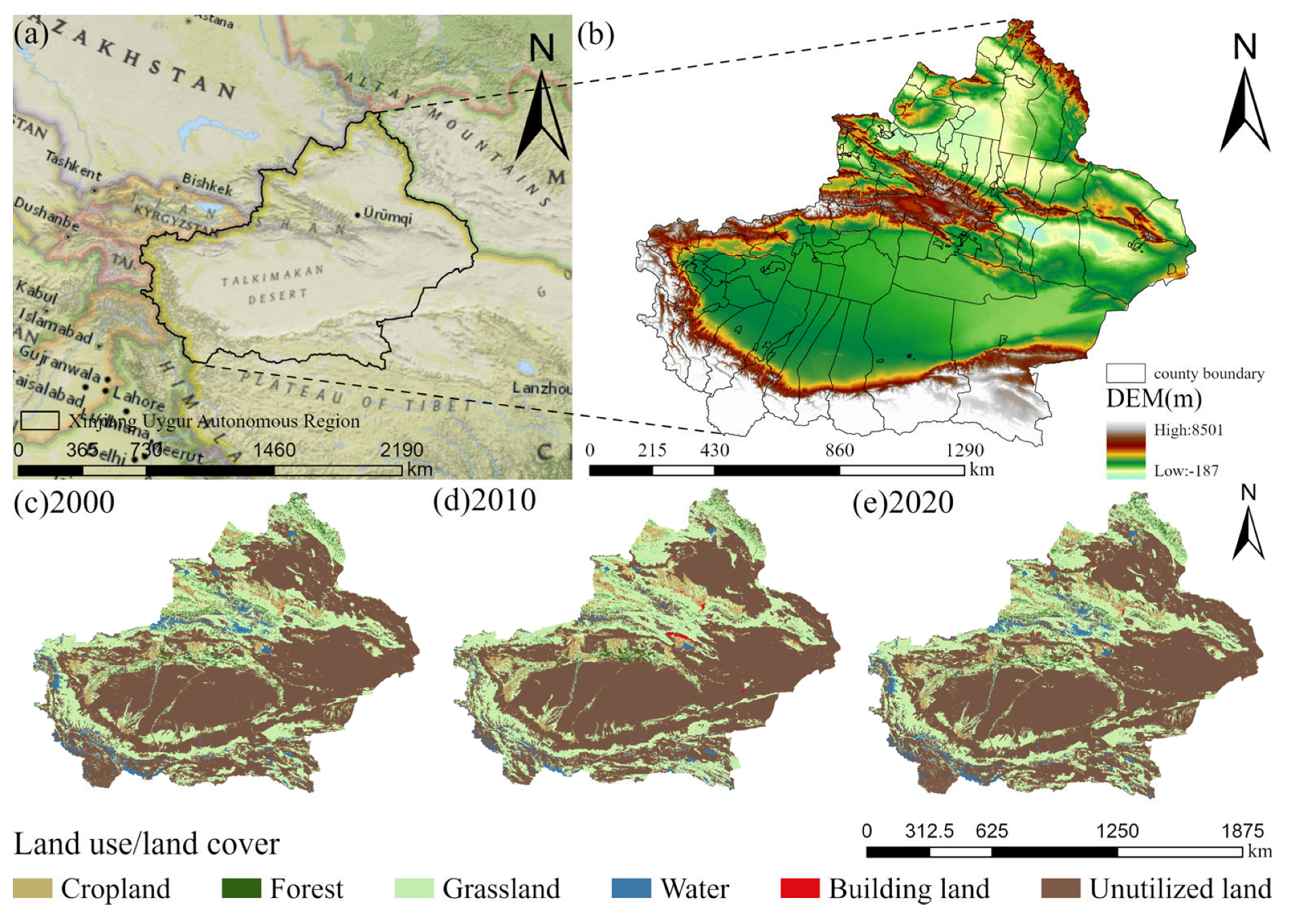
Figure 1. Overview of the research area, (a) Location of Xinjiang, (b) County-level administrative, boundaries of Xinjiang, (ce) 30 m × 30 m land use change in Xinjiang.
Agronomy 16 00451 g001
Figure 2. Research Framework.
Agronomy 16 00451 g002
Figure 3. Distribution of carbon emission intensity from changes in arable land use.
Agronomy 16 00451 g003
Figure 4. Carbon Emission Intensity of Cultivated Land Use and Its Annual Growth Rate from 2000 to 2020.
Agronomy 16 00451 g004
Figure 5. 2000–2020 Carbon Emission Standard Deviation Ellipses and Center of Mass Migration.
Agronomy 16 00451 g005
Figure 6. Moran Scatter Plot of Carbon Emission Intensity.
Agronomy 16 00451 g006
Figure 7. Cold-Hot Spot Map from 2000 to 2020.
Agronomy 16 00451 g007
Figure 8. Results of Factor Detection and Interaction Detection (* p < 0.05, ** p < 0.01, *** p < 0.001).
Agronomy 16 00451 g008
Figure 9. Time Series Trends of Driving Factors from 2001 to 2020.
Agronomy 16 00451 g009
Figure 10. Spatial distribution of regression coefficients for the influencing factors of carbon emissions from cultivated land use change.
Agronomy 16 00451 g010
Table 3. Statistical table of standard deviation ellipse and barycenter for variations in carbon emission intensity in agricultural land use in Xinjiang from 2000 to 2020.
YearCentroidEllipse
Centroid Longitude/°Centroid Latitude/°Migration Distance (km)Migration Direction/°Area/km2FlatteningLong-Axis Rotation Angle/°
200084.6742.5219179583,2230.51200.25
200584.4542.48581,678.90.49200
19.290.2
201084.442.65513,636.10.5200
58.787.4
20158542.95506,718.90.52198
12.888.4
202085.143.03489,241.30.53197.24
Table 4. Global Relevance Results.
YearIZ-Valuep-Value
20000.1142.0560.028
20050.1192.1570.027
20100.2183.8920.001
20150.2884.8480.001
20200.3616.2650.001
Table 5. Descriptive Statistics of the Regression Results of OLS, GWR, GTWR and GTWR-STIRPAT.
ModelBandwidthAICcR2R2-Adjusted
OLS-2427.310.84-
GWR0.121617.620.90.9
GTWR0.121481.130.910.91
GTWR-STIRPAT0.12−2137.310.970.97
Disclaimer/Publisher’s Note: The statements, opinions and data contained in all publications are solely those of the individual author(s) and contributor(s) and not of MDPI and/or the editor(s). MDPI and/or the editor(s) disclaim responsibility for any injury to people or property resulting from any ideas, methods, instructions or products referred to in the content.