Article

Potassium Fertilization Partially Mitigates Elevated N2O Emissions Under Alternate Wetting and Drying in Paddy Fields


1
Postdoctoral Station of Agricultural Resources and Environment, Land and Environment College, Shenyang Agricultural University, Shenyang 110866, China
2
College of Water Conservancy, Shenyang Agricultural University, Shenyang 110866, China
3
College of Land and Environment, Shenyang Agricultural University, Shenyang 110866, China
*
Author to whom correspondence should be addressed.
Agronomy 2026, 16(6), 661; https://doi.org/10.3390/agronomy16060661
Submission received: 11 February 2026 / Revised: 15 March 2026 / Accepted: 20 March 2026 / Published: 20 March 2026

Abstract

Nitrous oxide (N2O) is recognized as a potent greenhouse gas, and 60% of atmospheric N2O emissions come from cropland soils. Potassium (K) is an important fertilizer for rice paddy fields. K fertilizer decreased the abundance of functional genes mediating nitrification and denitrification processes, thereby mitigating N2O emissions. However, few studies have explored the effect of K fertilization rates on N2O emissions and grain yields, as well as the associated soil properties and aboveground N accumulation in paddy fields under different irrigation regimes. This study aimed to propose an optimum combination of K fertilization rate and irrigation regime to increase grain yield while reducing N2O emissions. Here, a 2-year field experiment using a split-plot design with three replicates was conducted to assess the effect of three K fertilization rates (K0: 0 kg ha−1, K75: 75 kg ha−1, K150: 150 kg ha−1) on N2O emissions, grain yield, aboveground N accumulation, and soil properties, including soil redox potential (Eh), NH4+, NO3, soil gene abundance of AOA, AOB, nirK, nirS, nirK/nirS, and nosZ, under continuous flooding irrigation (ICF) and alternate wetting and drying irrigation (IAWD). The soil physicochemical properties, the gene abundance and the aboveground N accumulation were evaluated and used to explain how irrigation and K fertilization affect grain yield and N2O emissions. We found that IAWD significantly increased N2O emissions by 38% compared to ICF, and K fertilizer significantly reduced N2O emissions by 15% relative to K0. The effects of IAWD and K fertilizer on N2O emissions can be attributed to the combined impact of soil physicochemical properties and the abundance of functional genes governing N2O emissions. Both irrigation regimes produced equivalent grain yield and aboveground N accumulation. Shifting from ICF to IAWD, the increase in N2O emissions can be mitigated by K fertilization. Moreover, K75 and K150 had similar effects in reducing N2O emissions and yield-scaled N2O emissions, while K75 had a lower K fertilizer cost and higher K partial factor productivity. Therefore, applying K fertilizer at 75 kg ha−1 under IAWD is identified as a potentially suitable rate to secure grain yield while effectively mitigating N2O emissions.

1. Introduction

Nitrous oxide (N2O) is recognized as a potent greenhouse gas, with a global warming potential 273 times larger than carbon dioxide over a 100-year period [1]. Cropland soils account for over 60% of atmospheric N2O emissions, and N2O emissions from agricultural sources are projected to double by 2050 [2]. Rice paddies are widely recognized as significant sources of N2O emissions, contributing around 11% of agricultural N2O emissions [3]. Consequently, the N2O emissions from rice paddies play a critical role in global climate change.
Irrigation and potassium (K) fertilizer are important inputs for rice production. Alternate wetting and drying irrigation (IAWD) is becoming increasingly popular in paddy fields due to the growing scarcity of irrigation water [4]. IAWD regulates water supply to meet crop physiological demands, thereby saving water while maintaining acceptable rice yields [5]. Nitrification and denitrification are the main processes affecting N2O production, and are associated with the abundance of AOA, AOB, nirK, nirS and nosZ genes [6]. IAWD induces frequent alternations between oxidized and reduced states in paddy soil. This dynamic shift transforms the soil environment, altering soil aeration, redox potential, and the availability of inorganic nitrogen (NH4+ and NO3) [7]. These alterations in soil properties subsequently influence microbial gene abundance [8], thereby modifying microbial processes that ultimately promote N2O production and emissions [9]. Although not directly involved in N2O production, K fertilization exerts an indirect regulatory effect by enhancing nitrogen (N) conservation, boosting plant N assimilation, and regulating the microbial processes of nitrification and denitrification [10,11,12]. Recent studies on K fertilizer have shifted their focus from solely enhancing crop production to also assessing its environmental impacts (i.e., N2O emissions) [13,14]. K fertilizer is a fundamental component of agricultural management. Therefore, clarifying its dual role in food security and mitigating climate change is critically important for agroecosystems. In particular, the potential mechanisms by which K fertilization affects N2O emissions under IAWD require further investigation.
Therefore, we conducted a 2-year field experiment to test two hypotheses. First, K fertilizer can be used as a tool to mitigate N2O emissions by altering soil physicochemical traits, soil microbial gene abundances, and rice aboveground N accumulation. Second, the effect of K fertilizer on N2O emissions and grain yields varied under different irrigation regimes. To address the potential mechanisms by which K fertilization affects N2O emissions under ICF and IAWD, we determined soil physicochemical traits (i.e., Eh, NH4+, and NO3), functional gene abundance (i.e., AOA, AOB, nirK, nirS, and nosZ), aboveground N accumulation, grain yield, and yield-scaled N2O emissions.

2. Materials and Methods

2.1. Study Site

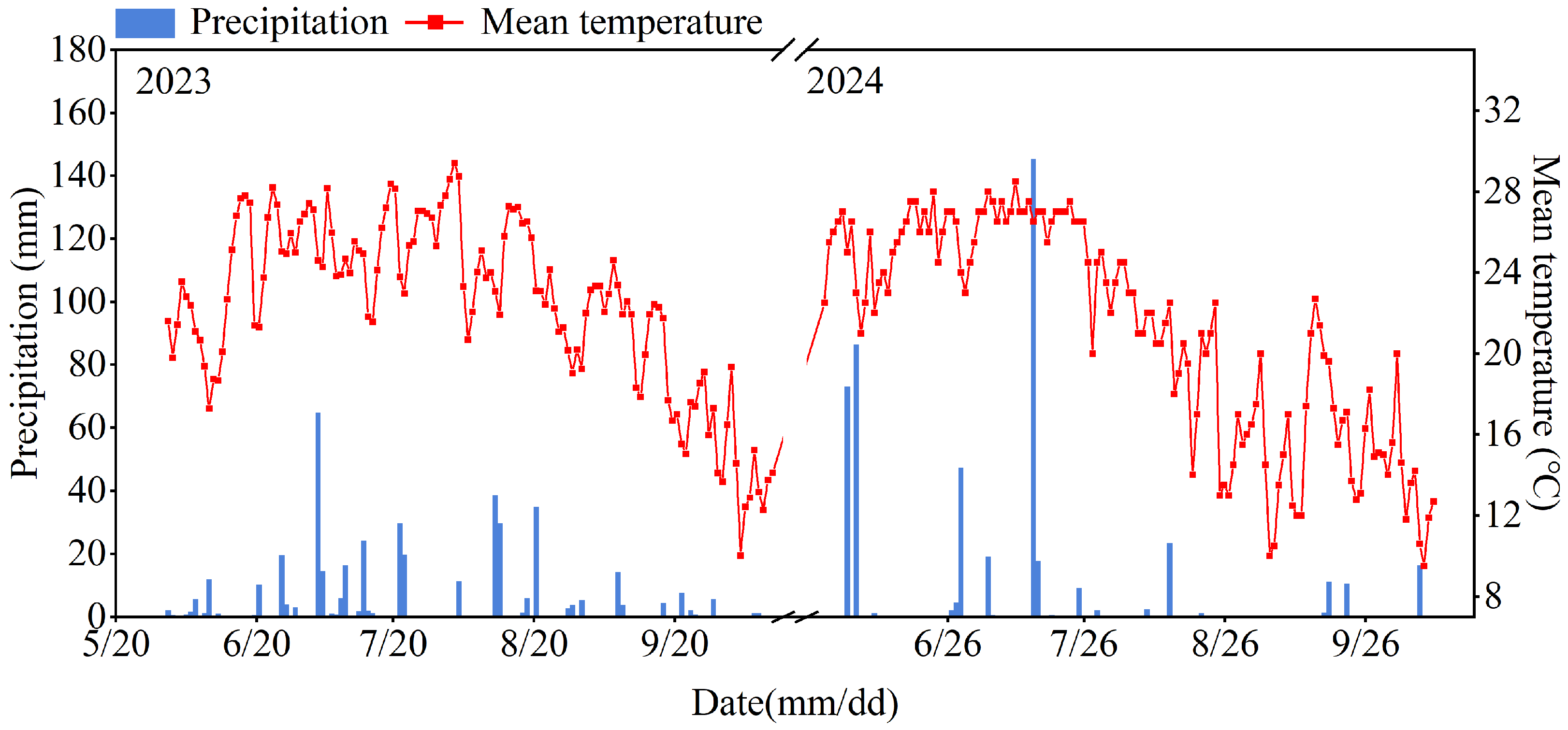
The field experiment was performed in the Comprehensive Experimental Base of Water Conservancy of Shenyang Agricultural University, Shenyang, China (41°49′ N, 123°33′ E). This region has a temperate continental monsoon climate, with a mean temperature of 8.0 °C, and an annual precipitation of 716 mm. The daily precipitation and mean air temperature during the rice growing seasons are represented in Figure 1. The soil was silty clay loam (24% sand, 58% silt, and 18% clay). The soil characteristics in the 0–20 cm layer were: pH 6.58, bulk density 1.50 g cm−3, organic matter 23.17 g kg−1, total nitrogen (N) 0.91 g kg−1, NH4+–N 10.49 mg kg−1, NO3–N 1.89 mg kg−1, exchangeable potassium (K) 144.6 mg kg−1, and available phosphorus 24.27 mg kg−1.

2.2. Experimental Design and Management

The experimental design was a split-plot design with six treatments based on irrigation regimes (continuously flooding irrigation—ICF; alternate wetting and drying irrigation—IAWD) as the main plots, and potassium (K) fertilizer application rates (no K addition—K0, 75 kg ha−1 K fertilizer—K75, 150 kg ha−1 K fertilizer—K150) as the subplots, each treatment with 3 replicates. The main plots were randomly assigned within each block. Subsequently, the subplots were randomly assigned within each main plot. Each plot size was 12 m2 (3 m × 4 m) and was isolated with a 40 cm polyvinyl chloride (PVC) barrier inserted 30 cm into the soil to prevent horizontal nutrient flow.
Each plot had a level meter, an individual water supply line and a water meter to control soil moisture. A soil tension meter provided by China (Nanjing) was used in each IAWD plot to measure the soil water potential (SWP) at 15 cm in the soil profile twice daily (8:00 am and 18:00 pm). The irrigation management for IAWD and ICF is described in Table S1 and Figure S1 in the Supplementary Material, consistent with our previous research [15].
Fertilizers were annually used at 180 kg ha−1 N of urea and 52 kg ha−1 P2O5 of calcium superphosphate. The urea was split amongst three time trials, with 60% as basal fertilizer (BF) on 1 June (2023) and 30 May (2024), 30% as tiller fertilizer (TF) on 15 June (2023) and 20 June (2024), and 10% as panicle fertilizer (PF) on 15 June (2023) and 20 June (2024). All phosphate fertilizer was used as BF. Potassium (50% K2O) fertilizer was divided into two time trials: 60% was used as BF and 40% as PF. Rice was transplanted on 1 June (2023) and 30 May (2024), and harvested on 12 October (2023) and 11 October (2024). Disease, insect, and weed management followed local farmers’ practices.

2.3. Field Sampling and Measurement

2.3.1. N2O Flux Measurement

N2O fluxes were measured with the closed static chamber method during the rice growth period. The static chamber consisted of two parts, a base and an upper box, with the box made of transparent acrylic material. The upper chamber was 0.6 m high at the early growth stages (before heading stage) and extended to 1.1 m high at the late growth stages (after flowering stage), covering an area of 0.49 m2 (0.7 m × 0.7 m). The installation and inner device follow our previous studies [16,17]. Three gas samples were collected at 9:00 am–11:00 am at 0, 15, and 30 min after the chamber was installed into the base on each sampling day. Gas samples were collected at 1, 3, 5 days after each fertilization, and every 7–10 days during the rest of the growing stages. N2O concentrations were determined using a gas chromatograph (Agilent 7890 B, Agilent Technologies, Santa Clara, CA, USA). The fluxes were calculated via linear regression analysis between N2O concentration and time, with R2 larger than 0.9. The daily N2O fluxes were calculated with the following equation:
F = [ 273 / ( 273 + T ) ] × ρ × H × ( d c / d t ) × p / p 0
where F (μg m−2 h−1) is N2O fluxes, T (°C) is the air temperature in the chamber, ρ (1.964 kg m−3) is N2O density, H (m) is the chamber height, dc/dt is the rate of change of N2O (μL m−2 h−1), p and p0 are air pressure in the chamber and standard atmospheric pressure (hPa). Cumulative N2O emissions were estimated by summing the daily fluxes with the following equation.
f = i = 1 n ( F i + F i 1 ) / 2 × d × 24 × 10 −5
where f (kg ha−1) is the cumulative N2O emissions; n is the total number of samples, Fi and Fi+1 (μg m−2 h−1) are the adjacent N2O fluxes; d is the sampling interval between Fi and Fi+1.

2.3.2. Soil Properties Measurement

Soil redox potential (Eh) was measured in situ by inserting the electrode consistency at 5 cm soil depth using an automatic analyzer (CN61M/FJA3, Nanjing Soil Instrument Factory Co., Ltd., Nanjing, China) during N2O sampling with three replications for each plot. Simultaneously, three fresh soil samples of 0–20 cm soil layers were collected, passed through a 2 mm mesh immediately and extracted with 2 mol L−1 KCL solution. The filtered extracts were used to analyze the NH4+ and NO3 contents by an AA3 analyzer (Auto-analyzer 3, BRAN+LUEBBE, Norderstedt, Germany).
At the peak of N2O flux in 2023–2024, soil samples in the 0–20 cm layer from each plot were sieved through a 2 mm mesh. The sample was stored at −80 °C for determination. The abundances of the functional genes (AOA, AOB, nirK, nirS, and nosZ) were analyzed by quantitative PCR (Light Cycler 480II, Roche Molecular Systems, Inc., Pleasanton, CA, USA). The primers used for the qPCR of the AOA, AOB, nirK, nirS, and nosZ genes were Arch-amoA26F/Arch-amoA417R [18], amoA1F/amoA2R [19], nirKF1aCuF/nirKR3aCuR [20], cd3aF/R3cd [20], and nosZ-1126F/nosZ-1381R [21], respectively.

2.3.3. Aboveground N Accumulation, Grain Yield and Yield-Scaled N2O Emissions

At each rice growing stage (tillering, jointing–booting, heading–flowering, milky ripening, and yellow ripening), the aboveground plants were cut along the soil surface, and separated into stems, leaves, and panicles (from flowering stage). All plant samples were oven-dried at 105 °C for 30 min for enzyme deactivation and subsequently at 70 °C to constant weight, grinded and passed through a 0.15 mm mesh for measuring N concentration using the Kjeldahl method. Aboveground N accumulation was calculated as the sum of the product of N concentration and dry weight for each plant part.
At physiological maturity, six randomly selected hills were chosen from each plot to determine the spikelets per panicle and 1000-grain weight. Additionally, three 1 m2 areas were selected from the center of each plot to determine the grain yield. Grains were air-dried until 14% moisture content, followed by manually threshing to measure the grain yield. Yield-scaled N2O emissions (kg t−1) were calculated as follows:
Y i e l d - s c a l e d   N 2 O   e m i s s i o n s = f / Y
where f (kg ha−1) is the total cumulative N2O emissions during rice growing stages, and Y (t ha−1) is the grain yield.
The potassium partial factor productivity was calculated using the following equation.
K P F P = 1000 × Y / F K
where KPFP (kg kg−1) is the potassium partial factor productivity, FK (kg ha−1) is the K input through K fertilization.
The economic cost–benefit (ECB) was calculated based on resource costs and grain benefits using the following equation.
E C B = B g r a i n C f e r t i l i z e r C w a t e r
where ECB (US$ ha−1) is the economic cost benefit, Bgrain is the benefit of rice grain (US$0.5 kg−1), Cfertilizer is the cost of fertilizer (US$0.26 kg−1 urea, US$0.3 kg−1 superphosphate, US$0.93 kg−1 K2SO4), Cwater is the cost of irrigation water (US$0.023 m−1).

2.4. Statistical Analysis

Prior to analysis of variance (ANOVA), the datasets were checked by the Shapiro–Wilk normality test. All data followed a normal distribution and were analyzed as a split-plot design using the R (version 4.4.1) package agricolae (version 1.3-7). During ANOVA, the error of the whole plot was applied for the main effect of irrigation regime, while the error of the subplot was applied for the main effect of K fertilization and the I × K interaction effect. Each soil/plant sample was collected in each treatment at three randomly selected points and mixed together in a plastic bag at each sampling date and determined once. The replication was set as the random effect, and the irrigation regime, K fertilization, and I × K interaction were set as fixed effects. Multiple comparisons were carried out using Tukey’s HSD test when p < 0.05. Data visualization was performed using Origin 2024. The R package corrplot (version 0.95) was employed to perform a correlation analysis to evaluate the impacts of soil Eh, NH4+, NO3, AOA, AOB, nirK, nosZ, nirK/nirS, and aboveground N accumulation on N2O emissions. The R package rfPermute (version 2.5-5) and randomForest (version 4.7-1.2) were employed for the Random Forest (RF) model to assess the relative importance of soil physicochemical properties, functional genes, and aboveground N accumulation, with respect to N2O emissions. The R package vegan (version 2.7-2) was used for variance partitioning analysis (VPA) to quantify the proportion of variance in N2O emissions explained by solely and combined effect of soil physicochemical properties, functional genes, and aboveground N accumulation. Prior to RF model and VPA, the Variance Inflation Factor (VIF) was used to test multicollinearity and avoid overfitting. The variable with a VIF value > 10 was regarded as multicollinearity and should be removed. The soil Eh, NO3, NH4+, AOB, AOA, nosz, and nirS were retained for subsequent analysis. When using the RF model, Leave-One-Out Cross-Validation (LOOCV) was applied to validate the performance of the model. The significance of the full model was tested using the A3 package (version 1.0.0) in R, and the relative importance of each predictor was quantified by the percentage increase in mean squared error.

3. Results

3.1. Soil Eh, NH4+-N, and NO3-N

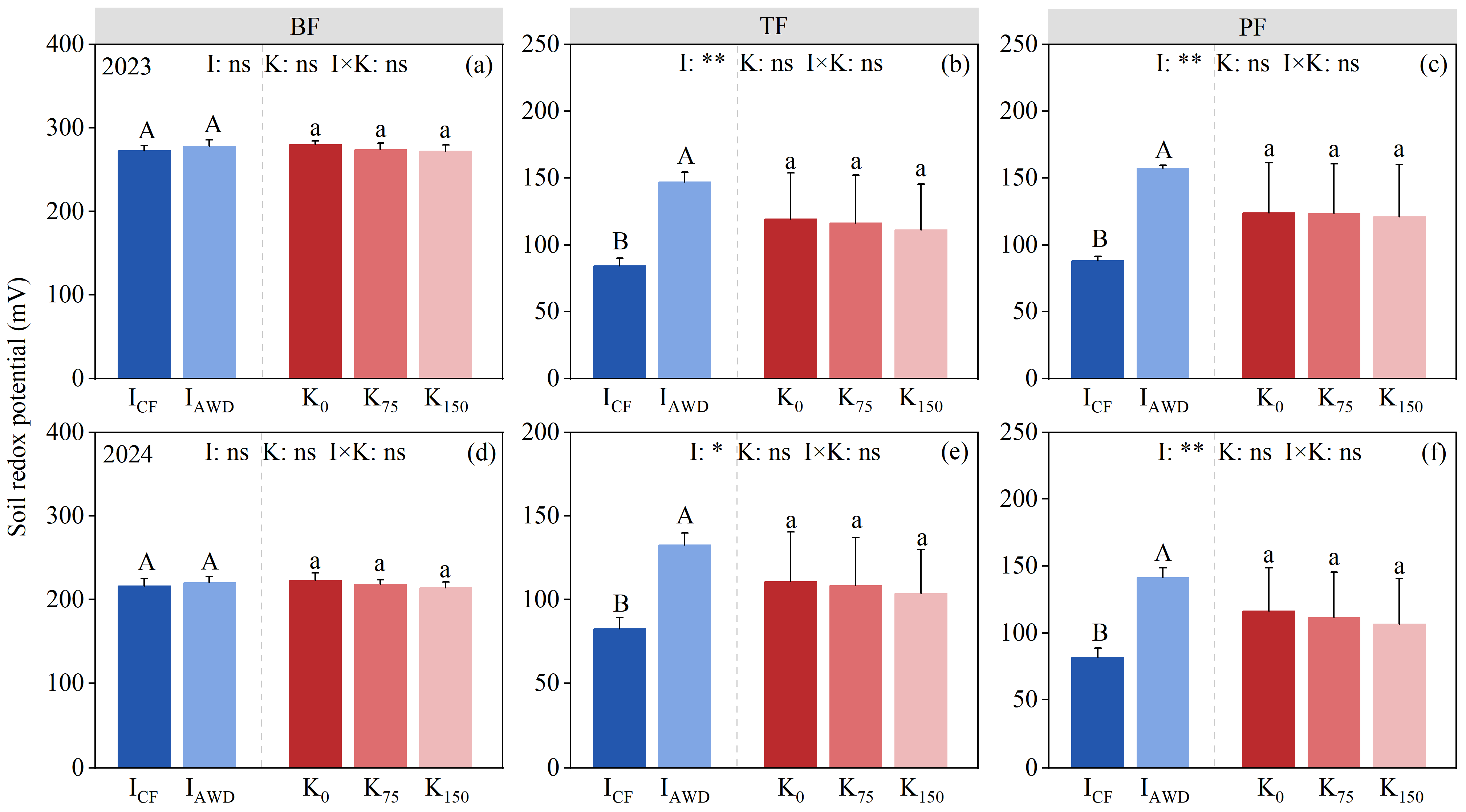
The irrigation regime significantly affected soil redox potential (Eh) at tillering fertilizer (TF) and panicle fertilizer (PF) periods in 2023 and 2024 (Figure 2a–f). Across potassium (K) fertilization rates, IAWD significantly increased Eh by 74% and 78% in 2023, and by 61% and 73% in 2024, respectively, compared to ICF. K fertilization did not significantly affect soil Eh in all fertilizer stages over two years. In addition, the interactions between irrigation regime and K fertilization on soil Eh were not significant in all fertilizer periods in both years.
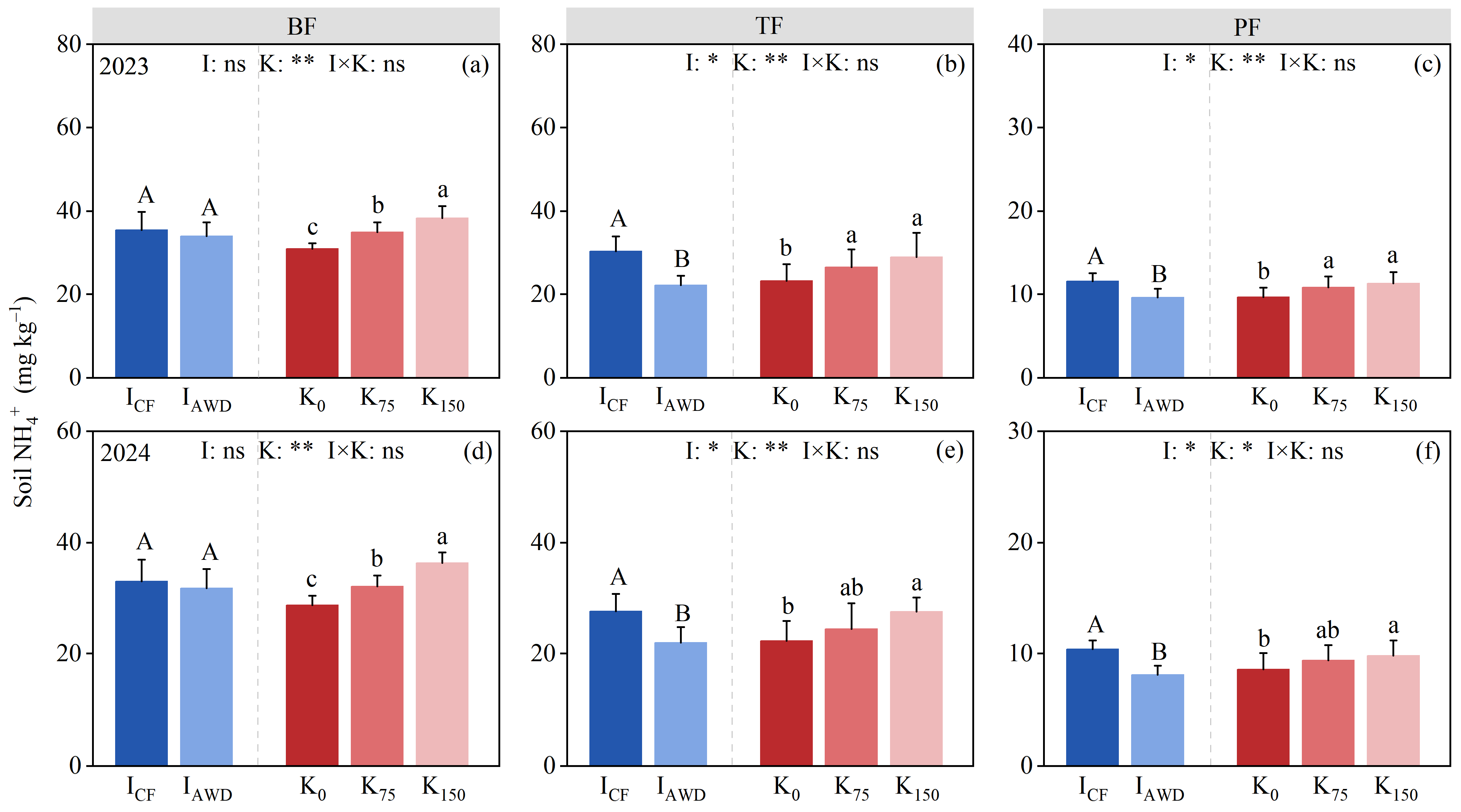
Across K fertilization rates, IAWD significantly decreased the soil NH4+ concentrations at TF and PF periods by 27% and 17% in 2023, and 20% and 22% in 2024, respectively, compared to ICF (Figure 3a–f). K fertilization significantly affected the soil NH4+ concentration throughout the three fertilizer periods. Across irrigation regimes, K75 and K150 significantly increased soil NH4+ concentration at the BF period by 13% and 24% in 2023, and 12% and 26% in 2024, respectively, relative to the no K addition. Compared to the no K addition, K75 and K150 significantly increased the soil NH4+ concentration at the TF period by 14–25%, and PF by 12–17% in 2023, respectively (Figure 3a–c). There was no significant difference between K75 and K150 at the TF and PF periods in 2023. K150 significantly increased soil NH4+ concentration at the TF and PF periods by 24% and 15% in 2024, respectively, relative to the no K addition (Figure 3d–f). The interactions of the irrigation regime and K fertilization on soil NH4+ were not significant in all fertilizer periods over both years (Figure 3a–f).
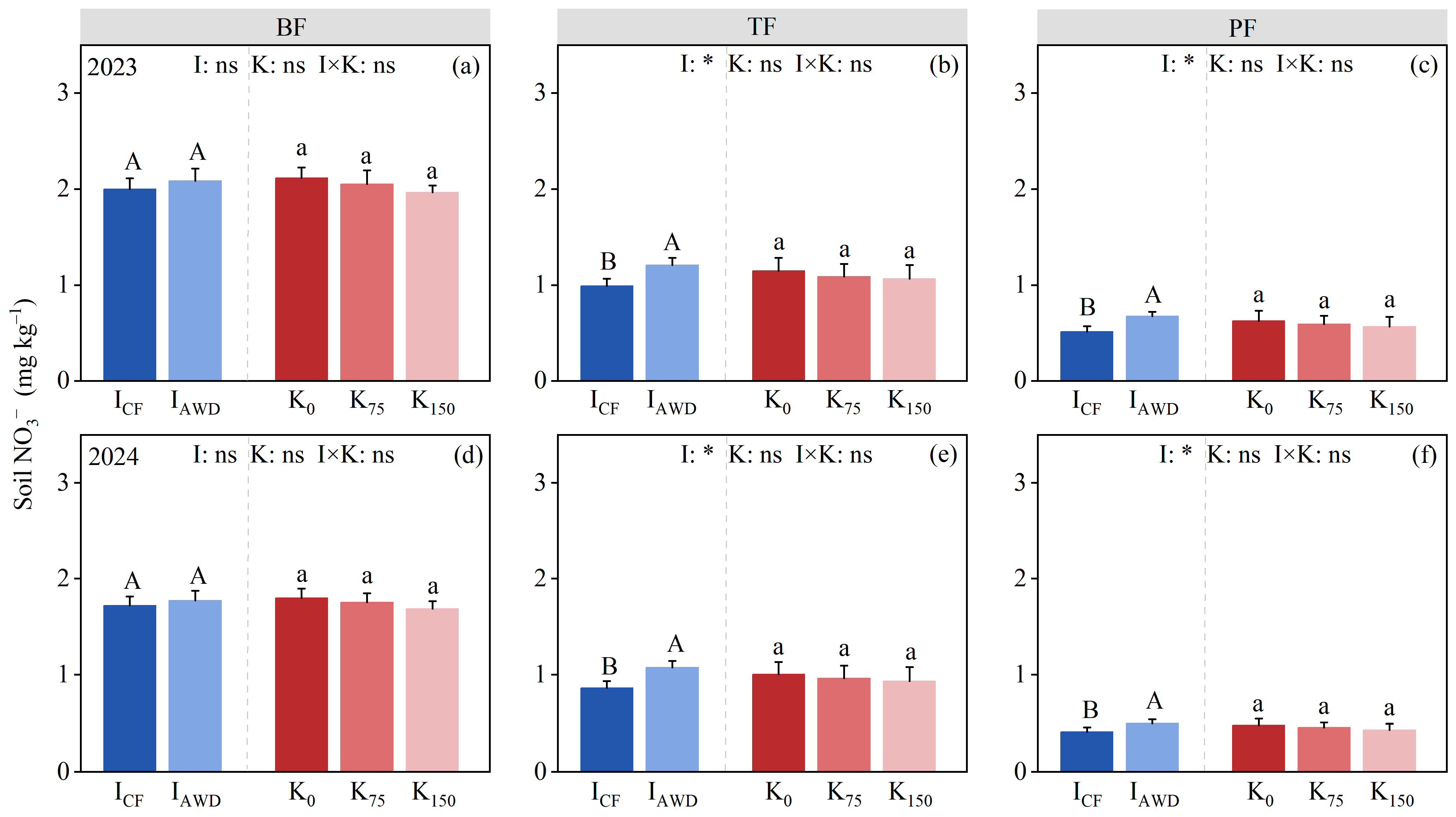
Compared with ICF, IAWD significantly increased soil NO3 concentrations during the TF and PF periods by 23% and 31% in 2023, and 25% and 22% in 2024, but had no significant effect during the BF period over both years (Figure 4a–f). K fertilization and the I × K interaction on the soil NO3 concentrations were not significant in all fertilizer periods over two years.

3.2. Abundances of Nitrifying and Denitrifying Functional Genes

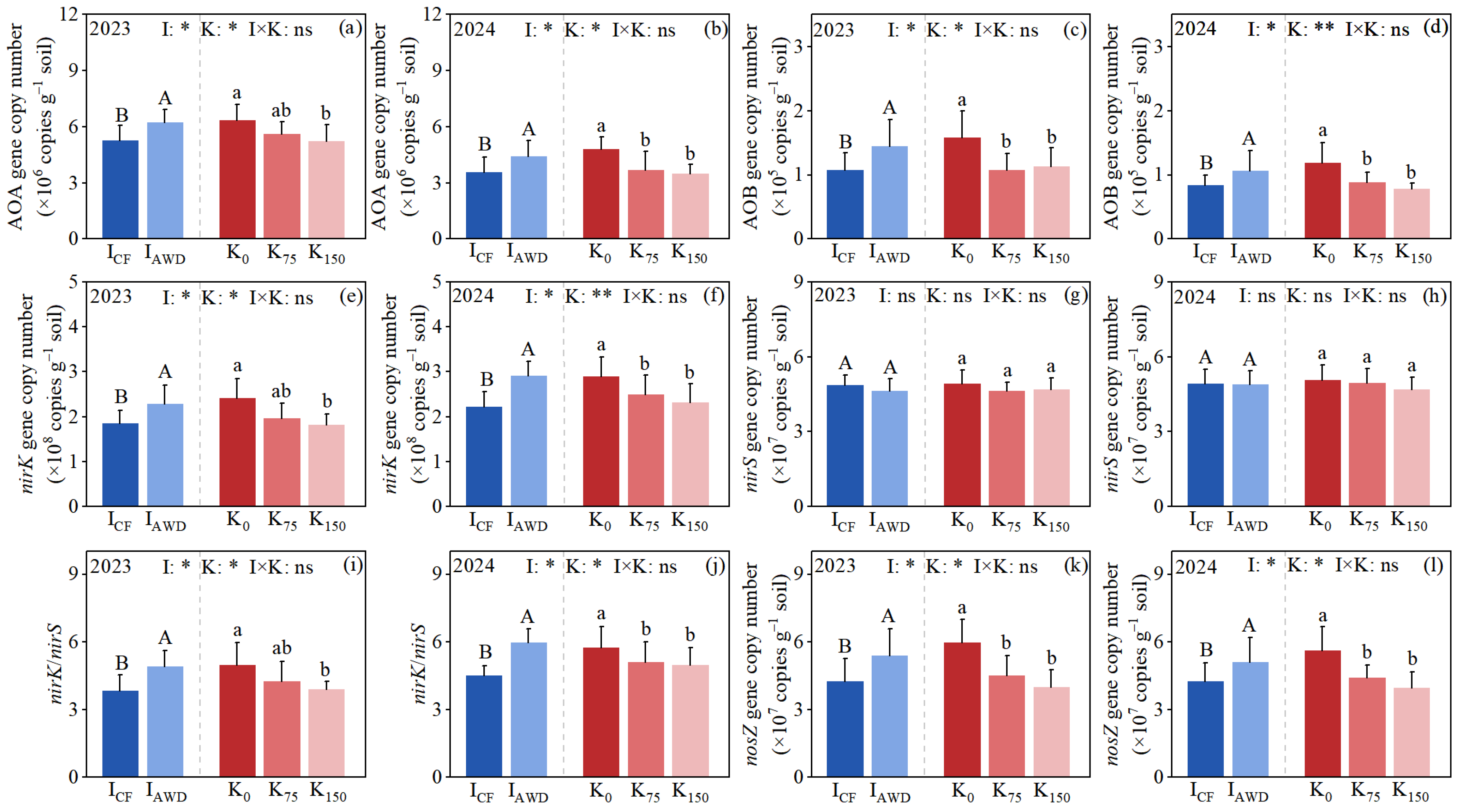
Irrigation regime and K fertilization alone significantly affect the abundances of AOA, AOB, nirK, nirK/nirS and nosZ genes, but their interactive effects were not significant in both years (Figure 5a–f,i–l). Across K fertilization rates, IAWD significantly increased the abundances of AOA, AOB, nirK, nirK/nirS and nosZ genes by 18%, 35%, 23%, 28%, and 26% in 2023, and by 24%, 26%, 31%, 32%, and 20% in 2024, respectively, when compared with ICF. Across irrigation regimes, K150 had significantly lower abundances of AOA (18%), nirK (24%) and nirK/nirS (22%) genes than K0, whereas no significant difference was observed between K75 and K0 in 2023 (Figure 5a,e,i). K75 and K150 significantly decreased the abundances of AOB (32% and 28%) and nosZ (24% and 33%) genes in 2023, and the abundances of AOA (23% and 28%), AOB (26% and 34%), nirK (14% and 20%), nirK/nirS (11% and 14%) and nosZ (21% and 29%) genes in 2024, respectively, relative to K0 (Figure 5a–f,i–l). Irrigation regime and K fertilization had no significant effect on nirS gene abundances in both years (Figure 5g,h).

3.3. Dynamics of N2O Fluxes

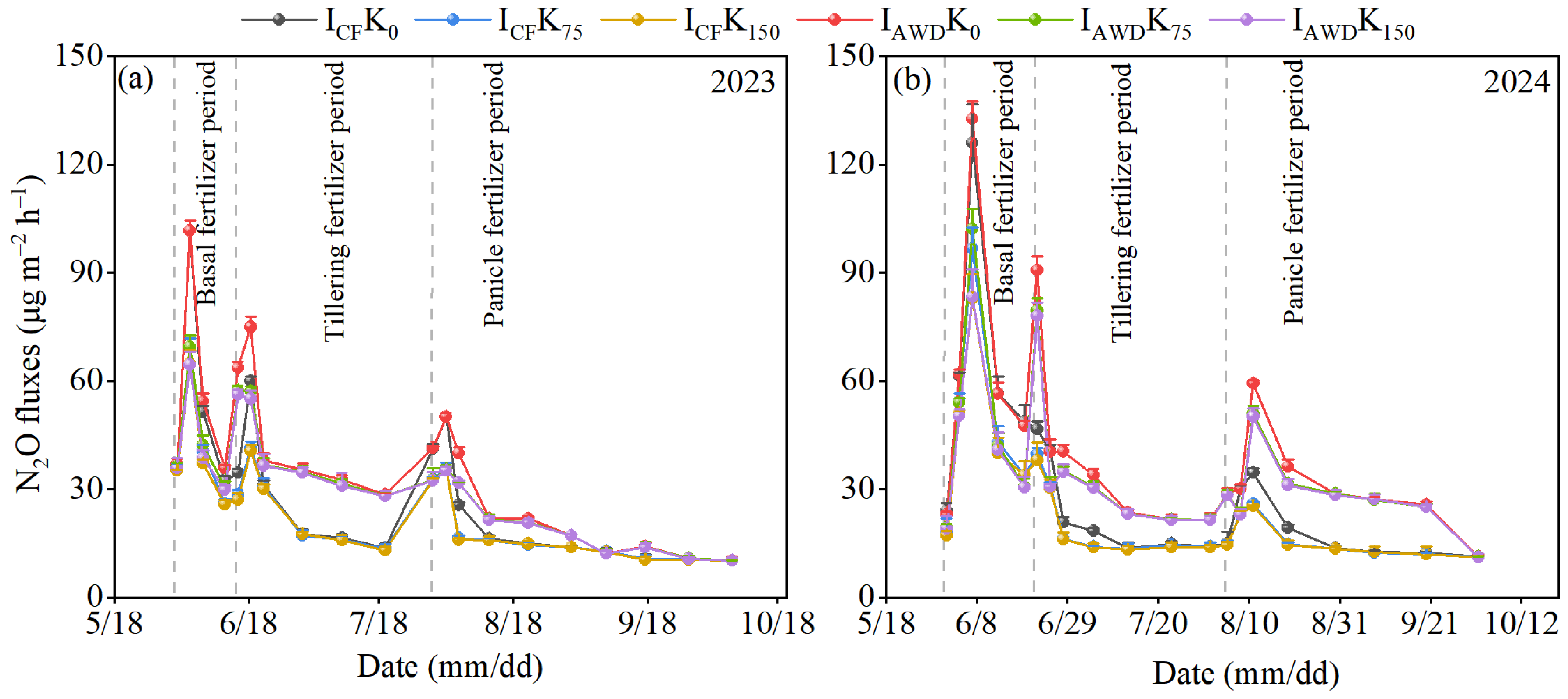
N2O fluxes peaked 3–8 d following K application and then declined. The highest N2O flux peak was observed during the BF period in all treatments. During rice-growing seasons, the N2O flux peaks of IAWD were higher than those of ICF at the TF period in 2023 and the TF and PF periods in 2024 (Figure 6). A similar temporal pattern in N2O flux was observed among three K fertilization rates, but the rate of the N2O flux differed between them. K0 had higher N2O flux peaks at BF, TF, and PF periods than K75 and K150 in both years. There is no significant difference between K75 and K150 during the TF and PF periods over two years.

3.4. Cumulative N2O Emissions

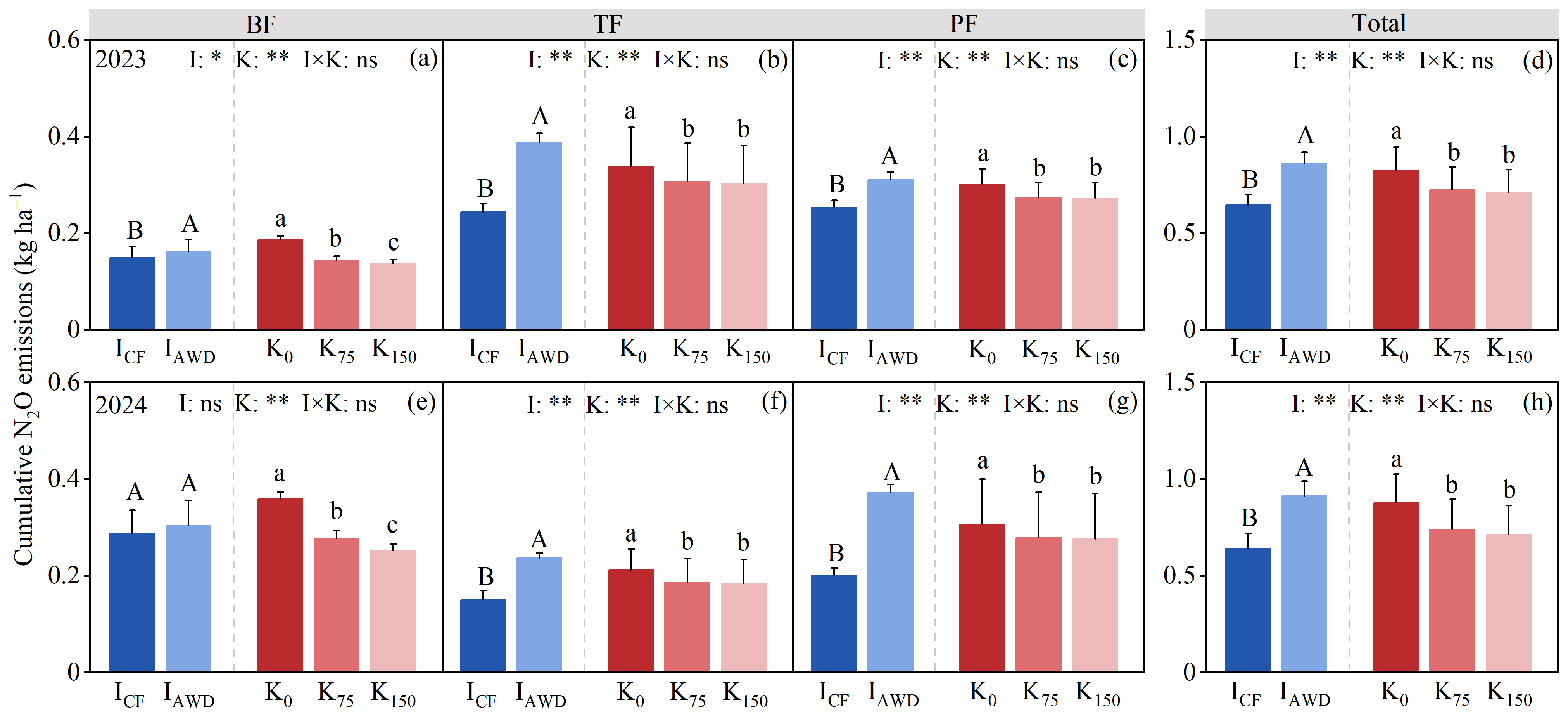
Irrigation regime significantly affected cumulative N2O emissions in the BF, TF, and PF periods in 2023 and the TF and PF periods in 2024 (Figure 7a–c,e–g). Across K fertilization rates, IAWD significantly increased cumulative N2O emissions in the BF (9%), TF (59%), and PF (23%) periods in 2023, and TF (57%) and PF (85%) periods in 2024, respectively, relative to ICF. K fertilization significantly affected cumulative N2O emissions in the BF, TF and PF periods over two years. Across irrigation regimes, K75 and K150 significantly reduced cumulative N2O emissions in the BF period by 22% and 26% in 2023, and by 23% and 30% in 2024, respectively, relative to K0 (Figure 7a,e). Significant differences were observed among the three K fertilization rates during the BF period. Compared to K0, K75 and K150 significantly reduced cumulative N2O emissions, whereas there was no significant difference between K75 and K150 in either year (Figure 7b,c,f,g). The I × K interactions on cumulative N2O emissions were not significant in all fertilizer periods over both years (Figure 7a–c,e–g).
Irrigation regime and K fertilization significantly affected total cumulative N2O emissions, but their interactive effects were not significant over two years (Figure 7d,h). Across K fertilization rates, IAWD significantly increased total cumulative N2O emissions by 33% in 2023 and 43% in 2024, respectively, relative to ICF. Across irrigation regimes, K75 and K150 significantly reduced total cumulative N2O emissions by 12% and 14% in 2023, and 15% and 19% in 2024, respectively, relative to K0. No significant difference occurred between K75 and K150 over two years.

3.5. Aboveground N Accumulation

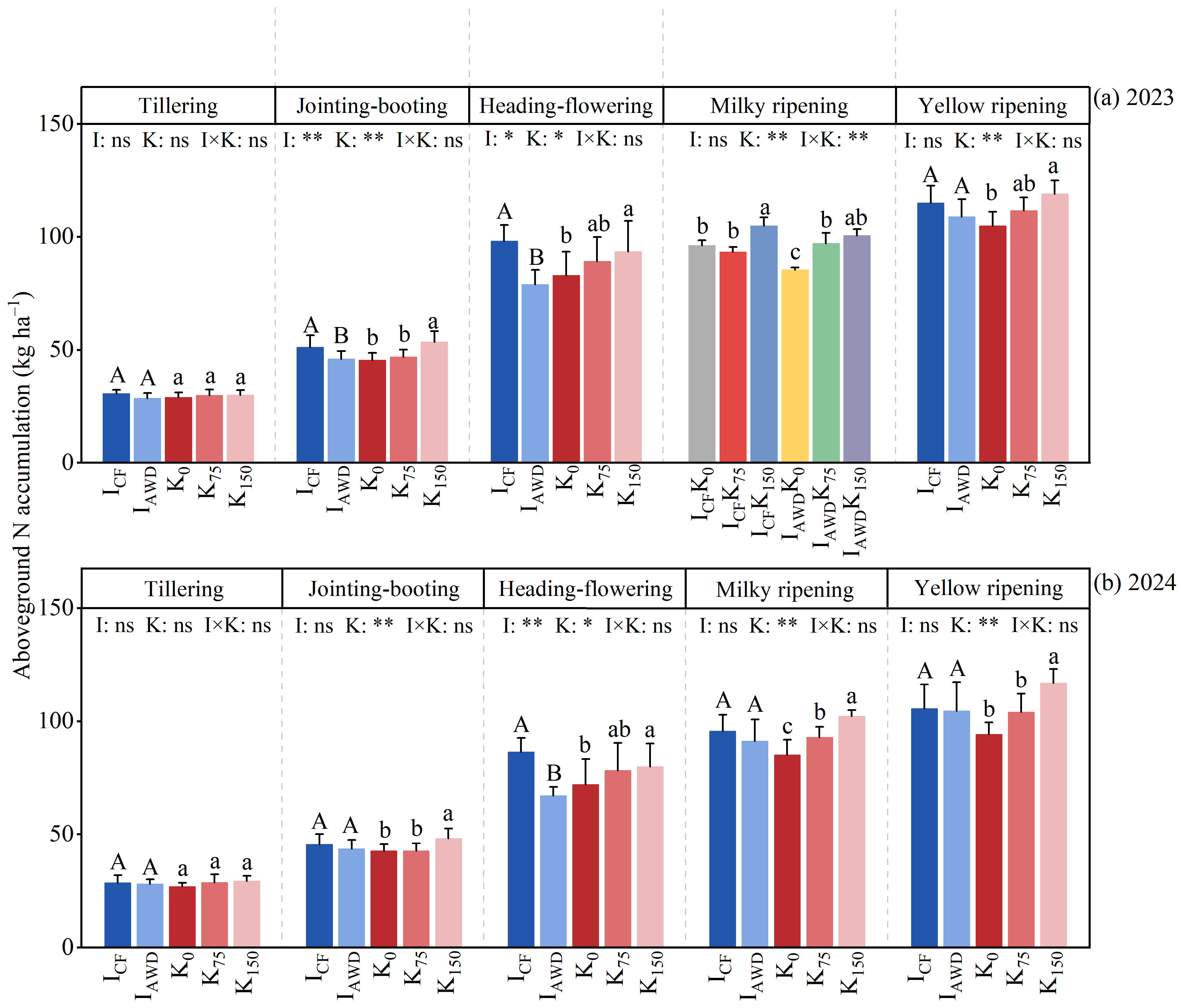
Across K fertilization rates, IAWD significantly decreased aboveground nitrogen (N) accumulation at jointing–booting and heading–flowering stages by 10% and 20% in 2023, and at heading–flowering by 22% in 2024, respectively, relative to ICF (Figure 8a,b). Compared to K0, K150 significantly increased aboveground N accumulation at jointing–booting, heading–flowering, milky ripening and yellow ripening by 18%, 13%, 13%, and 14% in 2023, and by 13%, 11%, 20%, and 24% in 2024, respectively. A significant I × K interaction occurred during milky ripening in 2023, which was due to K0 having 11% lower aboveground N accumulation under IAWD than that under ICF; in contrast, K75 (also K150) had similar aboveground N accumulations under both irrigation regimes (Figure 8a). At milky ripening, K150 significantly increased aboveground N accumulation in the ICF by 9% in 2023, relative to K0. Whereas, K75 and K150 significantly increased aboveground N accumulation in the IAWD by 14% and 18% in 2023, respectively, relative to K0.

3.6. Grain Yield, Yield Components, Yield-Scaled N2O Emissions, Potassium Partial Factor Productivity and Economic Cost Benefit

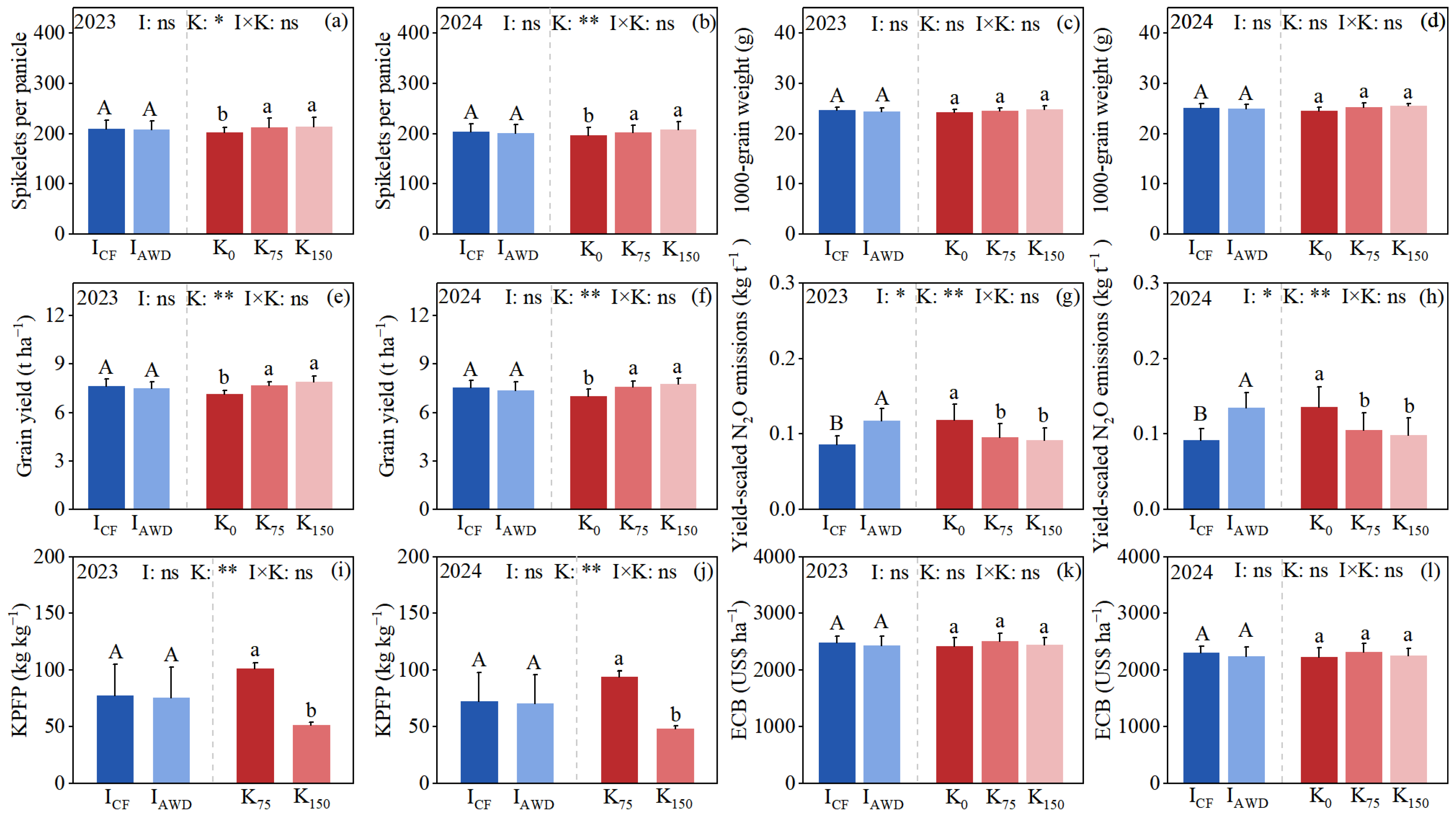
K fertilization significantly affected spikelets per panicle, grain yield, and yield-scaled N2O emissions over two years (Figure 9a,b,e–h). Across irrigation regimes, K75 and K150 significantly increased spikelets per panicle by 12% and 14% in 2023, and 8.6% and 11% in 2024, respectively, relative to K0 (Figure 9a,b). Across irrigation regimes, K75 and K150 significantly increased grain yield by 7.6% and 11% in 2023, and 8.0% and 11% in 2024, respectively, relative to K0 (Figure 9e,f). Irrigation regime and K fertilization alone significantly affected yield-scaled N2O emissions over two years (Figure 9g,h). Across K fertilization rates, IAWD significantly increased yield-scaled N2O emissions by 47% in 2023, and 37% in 2024, respectively, relative to ICF. Across irrigation regimes, compared to K0, K75 and K150 significantly decreased yield-scaled N2O emissions by 15% and 19% in 2023, and 22% and 27% in 2024, respectively. The I × K interaction on spikelets per panicle, 1000-grain weight, rice grain yield, and yield-scaled N2O emissions were not significant over two years (Figure 9a–h).
K fertilization significantly affected potassium partial factor productivity (KPFP) in both years. Compared to K150, K75 significantly increased KPFP by 15% and 19% in 2023 and 2024, respectively (Figure 9i,j). Irrigation and its interaction with K fertilization had no significant effect on KPFP in both years. Irrigation regime, K fertilization, alone and in combination, had no significant effect on economic cost–benefit (ECB) in either year (Figure 9k,l).

3.7. Impact of Soil Properties and Aboveground N Accumulation on N2O Emissions

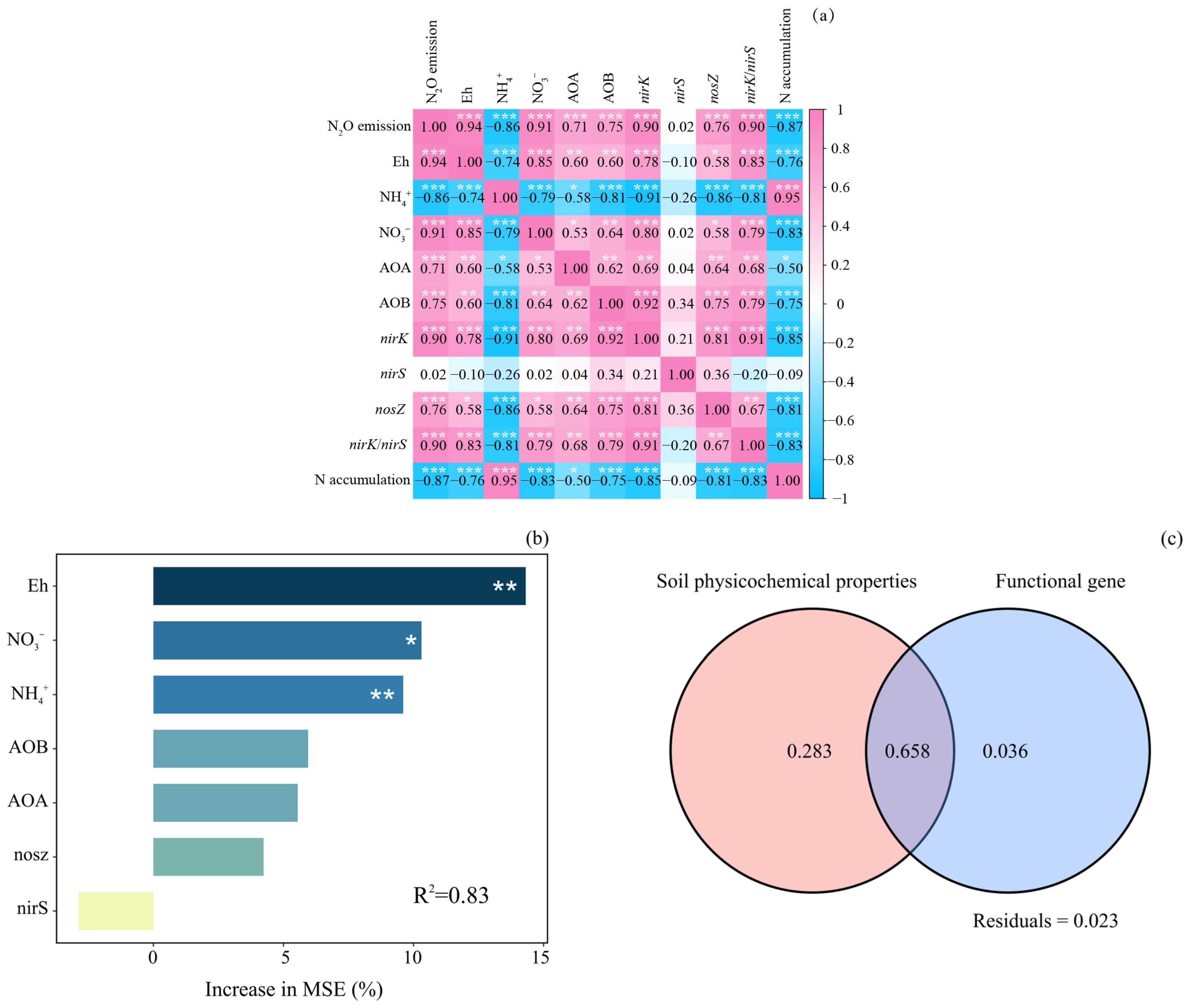
Correlation analysis revealed that N2O emissions were significantly and positively correlated with Eh, NO3, AOA, AOB, nirK, nosZ, and nirK/nirS (p < 0.01), and in contrast, were significantly and negatively correlated with NH4+ and aboveground N accumulation (p < 0.01) and non-significantly correlated with nirS (p > 0.05) (Figure 10a). Soil Eh and NO3 were significantly and positively correlated with AOA, AOB, nirK, nosZ, and nirK/nirS (p < 0.05), and significantly and negatively correlated with NH4+ and aboveground N accumulation (p < 0.01). Soil NH4+ was significantly and positively correlated with aboveground N accumulation (p < 0.01), whereas it had significant and negative correlations with AOA, AOB, nirK, nosZ, nirK/nirS (p < 0.05). Soil AOB, nirK, nosZ, and nirK/nirS were significantly and negatively correlated with aboveground N accumulation (p < 0.05).
Correlation analysis can not account for the interactions among predictors and their relative importance in a multivariate context. A random forest (RF) model was performed to identify the primary factors influencing N2O emissions (Figure 10b). The RF model results highlighted that soil Eh, NO3, and NH4+, in order of importance, are critical factors significantly influencing N2O emissions (p < 0.05). The model achieved an R2 of 0.83, indicating that the selected predictors collectively explained 83% of the variance in N2O emissions.
Variance partitioning analysis (VPA) was further performed to assess the sole and combined contributions of soil physicochemical properties and functional genes to N2O emissions (Figure 10c). VPA accounted for 98% of the variance in N2O emissions. Most variance in N2O emissions can be explained by the combined effects of soil physicochemical properties and functional genes, with 66% explanatory proportions. The soil physicochemical properties and functional genes solely explained 28% and 4.0% of the N2O emission variations, respectively.

4. Discussion

4.1. Response of Soil Properties and N Accumulation to Irrigation Regime and K Fertilization

In the present study, IAWD significantly improved soil redox potential (Eh) at tillering fertilizer (TF) and panicle fertilizer (PF) periods, compared with ICF (Figure 2). IAWD induced frequent fluctuations in soil Eh through alternate wetting and drying cycles. During the drying phase, soil aeration improved, facilitating oxygen diffusion into the soil, which led to an Eh increase and shifted the soil from a reduced state towards an oxidized state [22]. Conversely, the soil became re-flooded in the wetting phase, causing rapid oxygen depletion, soil Eh decrease, and a shift of the soil from an oxidized state towards a reduced state [23]. Changes in soil Eh were consistent with other reports [24,25,26]. For instance, Xiao et al. [27] emphasized that the soil Eh during the drying period and the watering period in IAWD was significantly increased, compared with ICF. The frequent alternations of redox environment caused by IAWD could disrupt soil aggregates, exposing physically protected organic nitrogen (N) to microbial decomposition, and thereby accelerating the conversion of NH4+ to NO3 [28]. Results showed that IAWD significantly decreased soil NH4+ and increased NO3 at TF and PF periods, relative to ICF (Figure 3 and Figure 4), which coincided with previous studies [17,29]. A possible explanation being that ICF suppresses the activity of AOA and AOB, inhibiting the conversion of NH4+ to NO3. Simultaneously, any NO3 present is rapidly lost via denitrification, leading to NH4+ accumulation and NO3 depletion. In contrast, IAWD stimulates nitrification, converting NH4+ to NO3. In addition, the decrease in NH4+ under IAWD was related to the increase in nitrification potential and higher root NH4+ uptake, as rice had a higher uptake affinity for NH4+ than NO3 [30]. This was also verified in the correlation analysis, as the soil NH4+ was significantly and positively correlated with the aboveground N accumulation (Figure 10a). In the present study, IAWD significantly reduced N accumulation at heading–flowering but had no significant effect at yellow ripening (Figure 7), which aligned with a previous study indicating that IAWD made the biomass distribution more reasonable and promoted the absorption of N, thereby not decreasing N accumulation and rice grain yield [31]. IAWD increased the dissolved oxygen concentration, which promoted nitrification and increased the abundance of nitrifying and denitrifying genes. Thus, IAWD increased the abundances of AOA, AOB, nirK, nirK/nirS, and nosZ genes (Figure 5), which aligned with the findings of previous studies [9,32].
K fertilizer promoted root growth through its roles in osmotic regulation and carbohydrate translocation [33]. The expanded root system, characterized by more metabolically active root tips, enhanced the root exudate release into the rhizosphere [34]. This increased root activity likely consumed more oxygen in the rhizosphere, indirectly leading to a slight decrease in soil Eh [35]. Compared with K0, K fertilization slightly decreased the soil Eh, whereas its effect was not significant in our study (Figure 2). This study indicated that K fertilization increased soil NH4+ concentration at basal fertilizer (BF), TF, and PF periods, relative to K0 (Figure 3). Several mechanisms might explain the increased NH4+ concentration under K fertilization. Firstly, K fertilizer could increase the proportion of soil particles > 0.053 mm, increase aggregate mean weight diameter and the geometric mean diameter, which likely enhanced the physical protection and retention of NH4+ within soil aggregates [36]. Secondly, K+ competed with NH4+ for adsorption sites on soil colloids. This competition probably increased the proportion of NH4+ remaining in the soil solution, thereby decreasing NH4+ adsorption by soil colloids and promoting N absorption by plants [10,37]. Thirdly, K fertilizer might stimulate root growth and enhance the secretion of organic compounds, which elevated the content of dissolved organic matter in the rhizosphere and consequently promoted NH4+ accumulation in the soil [38]. More NH4+ in the soil solution could lead to more exposure to nitrifiers such as AOA and AOB, potentially stimulating nitrification and subsequent N2O production. However, our data revealed that K fertilizer significantly decreased the abundances of AOA and AOB genes (Figure 5). This contradictory finding suggested that the stimulatory effect of increased NH4+ availability on nitrifiers was outweighed by other K-induced factors, which deserved further study. K fertilization stimulated the release of root exudates, which served as substrates that shaped microbial community assembly in the rhizosphere. These K-induced shifts in microbial community composition directly influenced the abundance of functional genes carried by specific microbial taxa, including AOA, AOB, nirS, nosZ [12]. Consequently, K fertilization regulated the genetic potential for soil N transformations [39]. For example, in a previous study, compared with K-free treatment, K fertilization significantly reduced the abundance of the genes involved in nitrification (e.g., amoA/B/C and hao) and denitrification (e.g., nirK/S, norB, and nosZ) [14]. Our results also indicated that K75 and K150 reduced the abundances of nirK, and nosZ genes, compared to K0 (Figure 5). Moreover, K fertilizer could promote plant N accumulation, especially under water stress [5]. In the present study, the aboveground N accumulation increased with the increase in K fertilization rates. Notably, there were significant differences in the aboveground N accumulation between IAWDK0 and ICFK0 at milky ripening in 2023, while there were no significant differences between IAWDK75 and ICFK75 (also between IAWDK150 and ICFK150) (Figure 8), indicating an interesting phenomenon that K fertilizer could compensate for the aboveground N accumulation decline caused by water stress in the IAWD.

4.2. Mechanism of Irrigation Regime and K Fertilization Affecting N2O Emissions

The results showed that IAWD had significantly higher N2O emissions than ICF (Figure 6). Our findings aligned with those of Zhao et al. [5], which highlighted that the repeated drying events under IAWD increased oxygen availability. This enhanced aeration promoted coupled nitrification–denitrification processes and enhanced redox oscillations, thereby enhancing N2O emissions. Our study identified three primary pathways through which IAWD regulates N2O emissions: by affecting soil physicochemical properties, modulating the abundance of functional genes governing N2O production and consumption, and influencing aboveground N accumulation. Firstly, from the point of soil physicochemical properties, the aerobic environment created by IAWD increased soil Eh. Thereby, it promoted nitrification while inhibiting denitrification, which in turn lowered soil NH4+ and raised NO3 concentrations, ultimately increasing N2O emissions [29]. This was consistent with our findings that N2O emissions significantly and positively correlated with soil Eh (0.94) and NO3 (0.91), and significantly and negatively correlated with soil NH4+ (−0.86) (Figure 10a). Secondly, from the perspective of gene abundance, IAWD increased the abundance of AOA and AOB genes by promoting nitrification, and reduced the abundance of nirK and nirS genes by inhibiting denitrification, thereby increasing N2O emissions [9,40], which was confirmed by the significantly positive correlation between N2O emissions and the abundances of AOA, AOB, nirK, and nirK/nirS, and nosZ genes in our study (Figure 10a). Thirdly, regarding aboveground N accumulation, elevated N2O emissions were associated with substantial N transformation and loss in the soil. This might result in decreased availability of soil N for plant uptake, thereby potentially limiting aboveground N accumulation [41,42]. Consistently, our study showed that N2O emissions were significantly and negatively correlated with aboveground N accumulation (Figure 10a). Compared with ICF, IAWD slightly reduced aboveground N accumulation at yellow ripening, but the effect was not significant (Figure 8). This indicated that IAWD increased N2O emissions but still maintained stable N accumulation [43]. Additionally, rice was a NH4+-preferring crop [44], and we confirmed that soil NH4+ had a significantly positive correlation with aboveground N accumulation in the present study (Figure 10a).
In our study, K fertilizer (average of K75 and K150) significantly reduced N2O emissions by 13% and 17% in 2023 and 2024, respectively, compared to K0 (Figure 7). This might be attributed to the fact that K fertilizer increased soil available N retention [45], reduced the abundance of functional genes governing nitrification and denitrification [46,47], and promoted the plant N uptake [48], thereby mitigating N2O emissions. Similarly, in a previous pot cotton experiment, the combined application of ammonia-source N fertilizer and K fertilizer significantly increased NH4+ and reduced N2O emissions by 28%, as compared with the K-free treatment [12]. The abundances of nitrification and denitrification genes were closely related to N2O emissions [49]. K fertilization significantly reduced abundances of nitrification genes (amoA/B/C, hao) and denitrification (nirK/nirS, norB, and nosZ) genes in a decade-long field experiment [14]. This may have suppressed nitrification and denitrification, which was beneficial for reducing N2O production. This study clarified that K fertilizer significantly increased aboveground N accumulation under IAWD at milky-ripening in 2023 (Figure 8). Previous research also highlighted the importance of K fertilizer on plant N accumulation [50,51]. K fertilizer promoted higher root growth and activated plant enzymes related to ammonium assimilation and amino acid transport, thereby increasing N accumulation [52]. We obtained a significantly positive correlation between N2O emissions and NO3, AOA, AOB, nirK, nirK/nirS, and nosZ by a correlation analysis (Figure 10a). Furthermore, we clarified that Eh, NO3, NH4+, AOB, AOA, nosz and nirS were the key factors influencing N2O emissions by an RF modeling (Figure 10b). In sum, the effects of IAWD and K fertilizer on N2O emissions through the integrated effects of soil physicochemical properties and functional gene abundance were determined by a VPA (Figure 10c).

4.3. Response of Grain Yield, Potassium Partial Factor Productivity to Irrigation Regime and K Fertilization

IAWD generally produced a lower grain yield than ICF, while applying an appropriate IAWD regime to control soil moisture could prevent the yield reduction caused by IAWD. For instance, Zhang et al. [53] found that mild to moderate IAWD regimes maintained rice grain yield, whereas more severe IAWD led to yield reductions. Similarly, in this study, IAWD did not significantly affect rice yield (Figure 9). One possible reason might be that IAWD effectively enhanced rice photosynthetic products accumulation, promoted the redistribution of carbohydrates to sink organs, and achieved a stable rice grain yield [54]. Proper K fertilization could help reverse soil degradation induced by nutrient deficiency to ensure a sustainable increase in rice yield. Compared with K-free treatment, K fertilization increased rice and sweet potato yields by 10% and 70%, respectively [55]. Our study proved similar results that K fertilizer increased 8%~11% grain yield (Figure 9). The rice yield did not significantly increase with the increase in K fertilizer rate, being consistent with our previous finding [15]. K application increased rice yield mainly by increasing spikelets per panicle by 12%~14% in two experiment years, which is consistent with a previous finding [51]. K fertilizer likely regulated N to increase cytokinin biosynthesis in rice plants, activating more flowers and branches, which eventually developed into spikelets in the panicles [56]. In the present study, K75 and K150 had similar grain yields (Figure 9e,f) and yield-scaled N2O emissions (Figure 9g,h); however, K75 had significantly higher K partial factor productivity than K150 (Figure 9i,j). Although not significant (p > 0.05), K75 had a statistically higher economic cost benefit than K150 (Figure 9k,l). In other words, K75 saved K fertilizer resource and fertilization costs, compared with K150. Such that, from the perspective of resource-efficient utilization and cost–benefit, K75 was more optimal.
The present study had some limitations that deserved further exploration. Firstly, the present study focused on N2O emissions caused by IAWD and K fertilization, without considering methane emissions, which were largely affected by IAWD. Future studies can evaluate the combined effect of IAWD and K fertilization on global warming potential (GWP). Secondly, the present work measured soil N-related variables (NH4+ and NO3), N-related functional gene abundance (e.g., AOA, AOB), and plant N accumulation, without measuring the K directly affected variables (e.g., soil exchangeable K dynamics, root biomass and oxygen diffusion) and N2O emission process-level variables (e.g., potential nitrification/denitrification rates, potential denitrification enzyme activity). Future work should evaluate the K directly affected variables and establish the process-level variables with N2O emissions. Thirdly, the present experiment design had three replications. Future experiment designs should increase the number of replications to validate the results.

5. Conclusions

Our results showed that alternate wetting and drying irrigation significantly increased nitrous oxide emissions compared to continuous flooding irrigation but had no significant effect on grain yield. Potassium fertilizer significantly reduced nitrous oxide emissions and increased grain yield compared to the non-potassium control. Alternate wetting and drying irrigation significantly increased yield-scaled nitrous oxide emissions, while potassium fertilizer significantly decreased yield-scaled nitrous oxide emissions. In addition, alternate wetting and drying irrigation enhanced soil redox potential, decreased ammonium, and increased the abundance of functional genes governing nitrification and denitrification, eventually promoting nitrous oxide production. Potassium fertilizer enhanced ammonium retention, decreased the abundance of nitrification and denitrification genes, which may have mitigated nitrous oxide emissions. This study revealed the mechanisms linking soil physicochemical properties to nitrous oxide emissions across various potassium fertilization rates, thereby contributing to the scientific basis for potassium fertilizer management in paddy fields with minimized environmental impact. In conclusion, 75 kg ha−1 potassium fertilizer application under alternate wetting and drying irrigation is a potential and resource-efficient management strategy for paddy fields.

Supplementary Materials

The following supporting information can be downloaded at https://www.mdpi.com/article/10.3390/agronomy16060661/s1: Table S1. Irrigation implementation at different growth stages for continuous flooding, and alternate wetting and drying irrigation regimes in 2023 and 2024. Figure S1. Water depth under different irrigation regimes during rice growth period in 2023 and 2024. For ICF (continuous flooding irrigation), the data represent water depth; for IAWD (alternate wetting and drying irrigation), the positive data represent water depth, and the negative data represent soil water potential.

Author Contributions

Conceptualization, Y.L.; methodology, S.W.; software, T.C.; validation, Y.L. and Z.M.; formal analysis, D.W.; investigation, Y.L., D.W. and Z.M.; resources, T.C. and D.C.; data curation, D.W.; writing—original draft preparation, Y.L.; writing—review and editing, H.Z. and D.C.; visualization, S.W.; supervision, H.Z. and D.C.; project administration, Y.L.; funding acquisition, H.Z. and D.C. All authors have read and agreed to the published version of the manuscript.

Funding

This research was funded by the Doctoral Start-up Foundation of Liaoning Province (grant number 2023-BSBA-287), the National Natural Science Foundation of China (grant numbers 52279039, 52379043), the National Key R&D Program of China (grant number 2024YFD15015024), Liaoning Revitalization Talents Program (XLYC2403124).

Data Availability Statement

The original contributions presented in this study are included in the article/Supplementary Material. Further inquiries can be directed to the corresponding author.

Acknowledgments

The authors would like to thank their schools and colleges, as well as the funding providers of the project. During the preparation of this manuscript, the first author used Deepseek (V4 Lite) for the purposes of grammar and punctuation. The authors have reviewed and edited the output and take full responsibility for the content of this publication.

Conflicts of Interest

The authors declare no conflicts of interest.

Abbreviations

The following abbreviations are used in this manuscript:
EhSoil redox potential
IAWDAlternate wetting and drying irrigation
ICFContinuous flooding irrigation
BFBasal fertilizer period
TFTillering fertilizer period
PFPanicle fertilizer period
ANOVAAnalysis of variance
RFRandom forest
VPAVariance partitioning analysis
VIFVariance inflation factor
LOOCVLeave-one-out cross-validation
KPFPRandom forest
GWPGlobal warming potential

References

  1. IPCC. Climate Change 2021: The Physical Science Basis; Working Group 1 Contribution to the Sixth Assessment Report of the Intergovernmental Panel on Climate Change; Cambridge University Press: Cambridge, MA, USA, 2021. [Google Scholar]
  2. Hou, P.; Gao, L.J.; Jiang, P.Q.; Yu, J.H.; Liu, X.X.; Jiang, D.; Cao, W.X.; Dai, T.B.; Tian, Z.W. Straw return amplifies the stimulated impact of night-warming on N2O emissions from wheat fields in a rice-wheat rotation system. Field Crop. Res. 2025, 281, 109652. [Google Scholar] [CrossRef]
  3. Bao, T.; Zhang, N.; Mo, D.M.; Liu, Z.S.; Yang, T.T.; Zhang, B.; Wang, L.; Qian, H.Y.; Ding, Y.F.; Jiang, Y. Higher N2O emissions and lower rice yield within double-cropped rice systems of South China under warming. Field Crop. Res. 2025, 281, 109709. [Google Scholar] [CrossRef]
  4. Islam, S.M.M.; Gaihre, Y.K.; Islam, M.R.; Ahmed, M.N.; Akter, M.; Singh, U.; Sander, B.O. Mitigating greenhouse gas emissions from irrigated rice cultivation through improved fertilizer and water management. J. Environ. Manag. 2022, 307, 114520. [Google Scholar] [CrossRef]
  5. Zhao, C.X.; Qiu, R.J.; Zhang, T.; Luo, Y.F.; Agathokleous, E. Effects of alternate wetting and drying irrigation on methane and nitrous oxide emissions from rice fields: A meta-analysis. Glob. Change Biol. 2024, 30, e17581. [Google Scholar] [CrossRef]
  6. Hui, D.; Ray, A.; Kasrija, L.; Christian, J. Impacts of Climate Change and Agricultural Practices on Nitrogen Processes, Genes, and Soil Nitrous Oxide Emissions: A Quantitative Review of Meta-Analyses. Agriculture 2024, 14, 240. [Google Scholar] [CrossRef]
  7. Liu, G.Y.; Zheng, J.L.; Chen, T.T.; Chen, X.D.; Chen, W.; Sun, Y.D.; Lærke, P.E.; Chen, Y.L.; Siddique, K.H.M.; Chi, D.C.; et al. Zeolite mitigates N2O emissions in paddy fields under alternate wetting and drying irrigation. Agric. Ecosyst. Environ. 2022, 339, 108145. [Google Scholar] [CrossRef]
  8. Chaves, B.; Redin, M.; Giacomini, S.J.; Schmatz, R.; L’eonard, J.; Ferchaud, F.; Recous, S. The combination of residue quality, residue placement and soil mineral N content drives C and N dynamics by modifying N availability to microbial decomposers. Soil Biol. Biochem. 2021, 163, 108434. [Google Scholar] [CrossRef]
  9. Yang, W.; Miao, T.T.; Liu, H.; Nie, J.W.; Zhu, B.; Liu, Z.Y.; Li, Y.; Yuan, S.; Huang, Y.; Qin, X.B.; et al. Rice and Azolla co-cultivation: An ancient nature-based solution for mitigating greenhouse gas emissions and increasing rice yield. Agric. Water Manag. 2025, 321, 109915. [Google Scholar] [CrossRef]
  10. Ai, C.; Liang, G.Q.; Sun, J.W.; Wang, X.B.; Zhou, W. Responses of extracellular enzyme activities and microbial community in both the rhizosphere and bulk soil to long-term fertilization practices in a fluvo-aquic soil. Geoderma 2012, 173–174, 330–338. [Google Scholar] [CrossRef]
  11. Daba, N.A.; Li, D.C.; Huang, J.; Han, T.F.; Zhang, L.; Ali, S.; Khan, M.N.; Du, J.X.; Liu, S.J.; Legesse, T.G.; et al. Long-term fertilization and lime-induced soil pH changes affect nitrogen use efficiency and grain yields in acidic soil under wheat-maize rotation. Agronomy 2021, 11, 2069. [Google Scholar] [CrossRef]
  12. Li, Z.G.; Li, L.Y.; Xia, S.J.; Zhang, R.H.; Zhang, R.Q.; Chen, P.; Pan, J.F.; Liu, Y. K fertilizer alleviates N2O emissions by regulating the abundance of nitrifying and denitrifying microbial communities in the soil-plant system. J. Environ. Manag. 2021, 291, 112579. [Google Scholar] [CrossRef]
  13. Li, J.W.; Han, T.F.; Liu, K.L.; Shen, Z.; Daba, N.A.; Tadesse, K.A.; Khan, M.N.; Shah, A.; Wang, Z.F.; Zhang, H.M. Optimizing potassium and nitrogen fertilizer strategies to mitigate greenhouse gas emissions in global agroecosystems. Sci. Total Environ. 2024, 916, 170270. [Google Scholar] [CrossRef]
  14. Ning, L.Y.R.; Xu, X.P.; Ma, L.; Wang, X.Y.; Yin, M.; He, P.; Zhou, W. Sustainable potassium management with green manure reshapes microbial nitrogen cycling to enhance potato yield. Agric. Ecosyst. Environ. 2026, 398, 110124. [Google Scholar] [CrossRef]
  15. Li, Y.H.; Zheng, J.L.; Wu, Q.; Gong, X.M.; Zhang, Z.X.; Chen, Y.L.; Chen, T.T.; Siddique, K.H.M.; Chi, D.C. Zeolite increases paddy soil potassium fixation, partial factor productivity, and potassium balance under alternate wetting and drying irrigation. Agric. Water Manag. 2022, 260, 107294. [Google Scholar] [CrossRef]
  16. Chen, T.T.; Liu, C.; Zhang, F.; Han, H.W.; Wang, Z.; Yi, B.J.; Tang, L.; Meng, J.; Chi, D.C.; Wilson, L.T.; et al. Acid-modified biochar increases grain yield and reduces reactive gaseous N losses and N-related global warming potential in alternate wetting and drying paddy production system. J. Clean. Prod. 2022, 377, 134451. [Google Scholar] [CrossRef]
  17. Liu, C.; Chen, T.T.; Zhang, F.; Han, H.W.; Yi, B.J.; Chi, D.C. Soil carbon sequestration increment and carbon-negative emissions in alternate wetting and drying paddy ecosystems through biochar incorporation. Agric. Water Manag. 2024, 300, 108908. [Google Scholar] [CrossRef]
  18. Park, S.J.; Park, B.J.; Rhee, S.K. Comparative analysis of archaeal 16s rRNA and amoA genes to estimate the abundance and diversity of ammonia-oxidizing archaea in marine sediments. Extremophiles 2008, 12, 605–615. [Google Scholar] [CrossRef] [PubMed]
  19. Rotthauwe, J.H.; Witzel, K.P.; Liesack, W. The ammonia monooxygenase structural gene amoA as a functional marker: Molecular fine-scale analysis of natural ammonia-oxidizing populations. Appl. Environ. Microbiol. 1997, 63, 4704–4712. [Google Scholar] [CrossRef] [PubMed]
  20. Throbäck, I.N.; Enwall, K.; Jarvis, Å.; Hallin, S. Reassessing PCR primers targeting nirS, nirK and nosZ genes for community surveys of denitrifying bacteria with DGGE. FEMS Microbiol. Ecol. 2004, 49, 401–417. [Google Scholar] [CrossRef] [PubMed]
  21. Chen, Z.; Liu, J.B.; Wu, M.N.; Xie, X.L.; Wu, J.S.; Wei, W.X. Differentiated response of denitrifying communities to fertilization regime in paddy soil. Microb. Ecol. 2012, 63, 446–459. [Google Scholar] [CrossRef]
  22. Phungern, S.; Azizan, S.N.F.; Yusof, N.B. Effects of water management and rice varieties on greenhouse gas emissions in central Japan. Soil Syst. 2023, 7, 89. [Google Scholar] [CrossRef]
  23. Mei, X.Q.; Li, Q.S.; Wang, H.L.; Fang, H.; Chen, H.J.; Chen, X.; Yang, Y.S.; Rizwan, M.; Ye, Z.H. Effects of cultivars, water regimes, and growth stages on cadmium accumulation in rice with different radial oxygen loss. Plant Soil 2020, 453, 529–543. [Google Scholar] [CrossRef]
  24. Xu, Y.; Zhan, M.; Cao, C.G.; Ge, J.Z.; Ye, R.Z.; Tian, S.Y.; Cai, M.L. Effects of irrigation management during the rice growing season on soil organic carbon pools. Plant Soil 2017, 421, 337–351. [Google Scholar] [CrossRef]
  25. Xiao, D.H.; Tang, X.X.; Chen, S.; Chu, G.; Liu, Y.H.; Wang, D.Y.; Xu, C.M. Aeration treatment promotes transformation of soil phosphorus fractions to plant-available phosphorus by modulating rice rhizosphere microbiota. Soil Tillage Res. 2025, 245, 106318. [Google Scholar] [CrossRef]
  26. Rohila, J.S.; Pinson, S.R.M.; Moser, J.G.; Jackson, A.K.; Moore, P.A., Jr.; Smith, B.; Baba, K.; Yamaguchi, N.; Jia, Y.L. Comparative study of different water management practices on element content in rice grain, yield, and yield components. Crop Sci. 2025, 65, e70048. [Google Scholar] [CrossRef]
  27. Xiao, Z.L.; Zhang, N.; Zhang, Y.; Zhu, K.Y.; Wang, W.L.; Zhang, W.Y.; Gu, J.F.; Zhang, G.B.; Liu, L.J.; Zhang, J.H.; et al. Synergistic mechanism of moderate wetting drying irrigation improving rice productivity and environmental sustainability. Field Crop. Res. 2025, 332, 110035. [Google Scholar] [CrossRef]
  28. Zhang, J.; Zhou, Y.; Li, W.; Nadeem, M.Y.; Ding, Y.; Jiang, Y.; Chen, L.; Li, G. Increasing Effective Use of Straw-Derived Nitrogen by Alternate Wetting/Drying Irrigation Combined with N Fertilization Addition in a Soil–Rice System. Agronomy 2021, 11, 750. [Google Scholar] [CrossRef]
  29. Chen, X.D.; Liu, G.Y.; Liu, B.Y.; Chen, T.T.; Li, Y.H.; Chen, W.; Pang, J.Y.; Siddique, K.H.M.; Chi, D. Zeolite amendment enhances grain yield and mitigates greenhouse gas emissions in an intensive aerobic rice system. Field Crop. Res. 2025, 327, 109884. [Google Scholar] [CrossRef]
  30. Cao, X.C.; Zhang, J.H.; Yu, Y.J.; Ma, Q.X.; Kong, Y.L.; Pan, W.K.; Wu, L.H.; Jin, Q.Y. Alternate wetting–drying enhances soil nitrogen availability by altering organic nitrogen partitioning in rice-microbe system. Geoderma 2022, 424, 115993. [Google Scholar] [CrossRef]
  31. Xu, C.M.; Chen, L.P.; Chen, S.; Chu, G.; Wang, D.Y.; Zhang, X.F. Rhizosphere aeration improves nitrogen transformation in soil, and nitrogen absorption and accumulation in rice plants. Rice Sci. 2020, 27, 162–174. [Google Scholar] [CrossRef]
  32. Wu, J.F.; Wu, S.; Xiao, W.; Long, H.; Wu, Y.; Li, F.S. N2O concentration and nitrogen-cycling functional genes as affected by alternate wetting and drying irrigation. J. Soil Sci. Plant Nutr. 2025, 25, 8026–8043. [Google Scholar] [CrossRef]
  33. Xu, Q.; Fu, H.; Zhu, B.; Hussain, H.A.; Zhang, K.; Tian, X.; Duan, M.; Xie, X.; Wang, L. Potassium improves drought stress tolerance in plants by affecting root morphology, root exudates, and microbial diversity. Metabolites 2021, 11, 131. [Google Scholar] [CrossRef] [PubMed]
  34. Pausch, J.; Kuzyakov, Y. Photoassimilate allocation and dynamics of hotspots in roots visualized by 14C phosphor imaging. J. Plant Nutr. Soil Sci. 2011, 174, 12–19. [Google Scholar] [CrossRef]
  35. Han, G.Z.; Fan, H.Z.; Han, B.S.; Huang, L.M.; Cao, X.M.; Yang, F. Paddy management controls potassium release from minerals in purple soils after 40 years of cultivation. Eur. J. Soil Sci. 2024, 75, e13492. [Google Scholar] [CrossRef]
  36. Wang, N.; Ai, Z.P.; Zhang, Q.Y.; Leng, P.F.; Qiao, Y.F.; Li, Z.; Tain, C.; Cheng, H.F.; Chen, G.; Li, F.D. Influence of long-term inorganic fertilization and straw incorporation on soil organic carbon: Roles of enzyme activity, labile organic carbon fractions, soil aggregates, and microbial traits. Agric. Ecosyst. Environ. 2025, 392, 109758. [Google Scholar] [CrossRef]
  37. Han, G.Z.; Huang, L.M.; Zhang, G.L.; Yang, F. A chronosequence study of purple paddy soils with respect to improving ammonium and potassium fertilization management. J. Soils Sediments 2020, 20, 2031–2042. [Google Scholar] [CrossRef]
  38. Xia, F.; Fu, M.; Liu, C.; Li, Y.L.; Qiang, Y.; He, D.; Zhang, G.Y.; Cui, L.J. Dissolved organic matters, an intermediary of the microbial community and potassium fertilizers in A. carmichaeli rhizosphere soil. J. Soil Sci. Plant Nutr. 2024, 24, 5472–5486. [Google Scholar] [CrossRef]
  39. Zhang, Y.; Wang, X.; He, G.X.; Geng, Y.Q.; Chen, C.X.; Zhou, J.J.; Li, Z.H.; Feng, J.Q.; Diao, Y.Y.; Yang, L.L.; et al. Rhizosphere bacterial community structure and nutrient cycling genes jointly drive the soil multifunctionality of Phoebe bournei young plantations under potassium fertilizer. Glob. Ecol. Conserv. 2025, 58, e03473. [Google Scholar] [CrossRef]
  40. Xu, C.M.; Xiao, D.S.; Song, C.; Guang, C.; Liu, Y.H.; Zhang, X.F.; Wang, D.Y. Changes in the activities of key enzymes and the abundance of functional genes involved in nitrogen transformation in rice rhizosphere soil under different aerated conditions. J. Integr. Agric. 2023, 22, 923–934. [Google Scholar] [CrossRef]
  41. Abalos, D.; van Groenigen, J.W.; De Deyn, G.B. What plant functional traits can reduce nitrous oxide emissions from intensively managed grasslands? Glob. Change Biol. 2018, 24, e248–e258. [Google Scholar] [CrossRef]
  42. Yang, Z.C.; Ferron, L.M.; Koopmans, G.F.; Sievernich, A.; van Groenigen, J.W. Nitrous oxide emissions after struvite application in relation to soil P status. Plant Soil 2023, 489, 523–537. [Google Scholar] [CrossRef]
  43. Huda, A.; Gaihre, Y.K.; Islam, M.R.; Singh, U.; Islam, M.R.; Sanabria, J.; Satter, M.A.; Afroz, H.; Halder, A.; Jahiruddin, M. Floodwater ammonium, nitrogen use efficiency and rice yields with fertilizer deep placement and alternate wetting and drying under triple rice cropping systems. Nutr. Cycl. Agroecosystems 2016, 104, 53–66. [Google Scholar] [CrossRef]
  44. Chen, S.D.; Elrys, A.S.; Du, S.W.; Yang, W.Y.; Cai, Z.C.; Zhang, J.B.; Meng, L.; Müller, C. Soil nitrogen dynamics regulate differential nitrogen uptake between rice and upland crops. J. Integr. Agric. 2026, 25, 302–312. [Google Scholar] [CrossRef]
  45. Dhawan, G.; Dheri, G.S.; Gill, A.A.S. Nitrogen budgeting of rice-wheat cropping system under long-term nutrient management in an Inceptisol of north India. Eur. J. Agron. 2021, 130, 126376. [Google Scholar] [CrossRef]
  46. Chen, X.; Zhang, L.M.; Shen, J.P.; Wei, W.X.; He, J.Z. Abundance and community structure of ammonia-oxidizing archaea and bacteria in an acid paddy soil. Biol. Fertil. Soils 2011, 47, 323–331. [Google Scholar] [CrossRef]
  47. Kielak, A.M.; Barreto, C.C.; Kowalchuk, G.A.; Van Veen, J.A.; Kuramae, E.E. The ecology of Acidobacteria: Moving beyond genes and genomes. Front. Microbiol. 2016, 7, 744. [Google Scholar] [CrossRef]
  48. Singh, P.; Benbi, D.K.; Verma, G. Nutrient management impacts on nutrient use efficiency and energy, carbon, and net ecosystem economic budget of a rice–wheat cropping system in Northwestern India. J. Soil Sci. Plant Nutr. 2020, 21, 559–577. [Google Scholar] [CrossRef]
  49. Zhang, Y.; Chen, J.; Cheng, X.L. Revisiting the relationships between soil nitrous oxide emissions and microbial functional gene abundances. Glob. Change Biol. 2023, 29, 4697–4699. [Google Scholar] [CrossRef] [PubMed]
  50. Shukla, S.K.; Yadav, R.L.; Singh, P.N.; Singh, I. Potassium nutrition for improving stubble bud sprouting, dry matter partitioning, nutrient uptake and winter initiated sugarcane (Saccharum spp. hybrid complex) ratoon yield. Eur. J. Agron. 2009, 30, 27–33. [Google Scholar] [CrossRef]
  51. Hou, W.F.; Xue, X.X.; Li, X.K.; Khan, M.R.; Yan, J.Y.; Ren, T.; Cong, R.H.; Lu, J.W. Interactive effects of nitrogen and potassium on: Grain yield, nitrogen uptake and nitrogen use efficiency of rice in low potassium fertility soil in China. Field Crop. Res. 2019, 236, 14–23. [Google Scholar] [CrossRef]
  52. Ali, S.; Hafeez, A.; Ma, X.L.; Tung, S.A.; Chattha, M.S.; Shah, A.N.; Luo, D.; Ahmad, S.; Liu, J.H.; Yang, G.Z. Equal potassium-nitrogen ratio regulated the nitrogen metabolism and yield of high-density late-planted cotton (Gossypium hirsutum L.) in Yangtze River valley of China. Ind. Crop. Prod. 2019, 129, 231–241. [Google Scholar] [CrossRef]
  53. Zhang, W.; Du, B.; Duan, X.; Liang, Z.; Tang, Y.; Li, J.; Yao, X. Effects of different rice varieties and water management practices on greenhouse gas (CH4 and N2O) emissions in the ratoon Rice system in the upper Yangtze River region, China. Agriculture 2024, 14, 2251. [Google Scholar] [CrossRef]
  54. Cai, W.; Jia, M.J.; Liu, Y.; Chen, H.T.; Ma, Y.; Zhu, K.Y.; Zhang, H.; Gu, J.F.; Wang, Z.Q.; Zhang, Z.J.; et al. Achieving synergistic high yield and methane mitigation in rice under co-application of biochar and mild alternate wetting and drying via enhancing root-produced brassinosteroids. Agric. Ecosyst. Environ. 2026, 395, 109940. [Google Scholar] [CrossRef]
  55. Huang, J.W.; Wang, Q.; Qiu, Q.C.; Zou, L.; Shen, X.S.; Wan, Y.; Qu, H.J. Physiological studies on anthocyanin accumulation, quality and yield of purple sweet potato tubers with different forms of potassium fertilizer. Sci. Hortic. 2025, 343, 114094. [Google Scholar] [CrossRef]
  56. Ding, C.; You, J.; Chen, L.; Wang, S.; Ding, Y. Nitrogen fertilizer increases spikelet number per panicle by enhancing cytokinin synthesis in rice. Plant Cell Rep. 2014, 33, 363–371. [Google Scholar] [CrossRef] [PubMed]
Figure 1. The daily precipitation and mean air temperature during the two rice growing seasons.
Agronomy 16 00661 g001
Figure 2. Effects of irrigation regime (I) and potassium fertilization (K) on soil Eh during BF (basal fertilizer), TF (tillering fertilizer), and PF (panicle fertilizer) periods in 2023 (ac) and 2024 (df). ns indicates non-significant difference. * and ** indicate significant differences at p < 0.05 and p < 0.01, respectively. Vertical bars are mean + standard deviations (n = 9) for ICF and IAWD, while vertical bars are mean + standard deviations (n = 6) for K0, K75 and K150. Above bars, different uppercase letters indicate significant differences between irrigation regimes, different lowercase letters indicate significant differences among K fertilizer managements (p < 0.05). Continuous flooding irrigation (ICF), alternate wetting and drying irrigation (IAWD), no K addition (K0), 75 kg ha−1 K fertilizer (K75), 150 kg ha−1 K fertilizer (K150).
Agronomy 16 00661 g002
Figure 3. Effects of irrigation regime (I) and potassium fertilization (K) on soil NH4+ during BF (basal fertilizer), TF (tillering fertilizer), and PF (panicle fertilizer) periods in 2023 (ac) and 2024 (df). ns indicates non-significant difference. * and ** indicate significant differences at p < 0.05 and p < 0.01, respectively. Vertical bars are mean + standard deviations (n = 9) for ICF and IAWD, while vertical bars are mean + standard deviations (n = 6) for K0, K75 and K150. Above bars, different uppercase letters indicate significant differences between irrigation regimes, different lowercase letters indicate significant differences among K fertilizer managements (p < 0.05). Continuous flooding irrigation (ICF), alternate wetting and drying irrigation (IAWD), no K addition (K0), 75 kg ha−1 K fertilizer (K75), 150 kg ha−1 K fertilizer (K150).
Agronomy 16 00661 g003
Figure 4. Effects of irrigation regime (I) and potassium fertilization (K) on soil NO3 during BF (basal fertilizer), TF (tillering fertilizer), and PF (panicle fertilizer) periods in 2023 (ac) and 2024 (df). ns indicates non-significant difference. * indicates a significant differences at p < 0.05. Vertical bars are mean + standard deviations (n = 9) for ICF and IAWD, while vertical bars are mean + standard deviations (n = 6) for K0, K75 and K150. Above bars, different uppercase letters indicate significant differences between irrigation regimes, different lowercase letters indicate significant differences among K fertilizer managements (p < 0.05). Continuous flooding irrigation (ICF), alternate wetting and drying irrigation (IAWD), no K addition (K0), 75 kg ha−1 K fertilizer (K75), 150 kg ha−1 K fertilizer (K150).
Agronomy 16 00661 g004
Figure 5. Effects of irrigation regime (I) and potassium fertilization (K) on the abundances of AOA (a,b), AOB (c,d), nirK (e,f), nirS (g,h), nirK/nirS (i,j), and nosZ (k,l) genes in 2023 and 2024. ns indicates a non-significant difference. * and ** indicate significant differences at p < 0.05 and p < 0.01, respectively. Vertical bars are mean + standard deviations (n = 9) for ICF and IAWD, while vertical bars are mean + standard deviations (n = 6) for K0, K75 and K150. Above bars, different uppercase letters indicate significant differences between irrigation regimes, different lowercase letters indicate significant differences among K fertilizer managements (p < 0.05). Continuous flooding irrigation (ICF), alternate wetting and drying irrigation (IAWD), no K addition (K0), 75 kg ha−1 K fertilizer (K75), 150 kg ha−1 K fertilizer (K150).
Agronomy 16 00661 g005
Figure 6. Effects of irrigation regime (I) and potassium fertilization (K) on N2O fluxes in 2023 (a) and 2024 (b) during rice-growing seasons. Vertical bars are mean + standard deviations (n = 3) for each treatment. Continuous flooding irrigation (ICF), alternate wetting and drying irrigation (IAWD), no K addition (K0), 75 kg ha−1 K fertilizer (K75), 150 kg ha−1 K fertilizer (K150).
Agronomy 16 00661 g006
Figure 7. Effects of irrigation regime (I) and potassium fertilization (K) on cumulative N2O emissions during BF (basal fertilizer), TF (tillering fertilizer), PF (panicle fertilizer), and entire growth periods (Total) in 2023 (ad) and 2024 (eh). ns indicates a non-significant difference. * and ** indicate significant differences at p < 0.05 and p < 0.01, respectively. Vertical bars are mean + standard deviations (n = 9) for ICF and IAWD, while vertical bars are mean + standard deviations (n = 6) for K0, K75 and K150. Above bars, different uppercase letters indicate significant differences between irrigation regimes, different lowercase letters indicate significant differences among K fertilizer managements (p < 0.05). Continuous flooding irrigation (ICF), alternate wetting and drying irrigation (IAWD), no K addition (K0), 75 kg ha−1 K fertilizer (K75), 150 kg ha−1 K fertilizer (K150).
Agronomy 16 00661 g007
Figure 8. Effects of irrigation regime (I) and potassium fertilizer management (K) on aboveground N accumulation at different rice growth stages over two years. ns indicates non-significant difference. * and ** indicate significant differences at p < 0.05 and p < 0.01, respectively. In milky ripening stage in 2023, vertical bars represent mean + standard deviations (n = 3) for each treatment; different letters above bars indicate significant differences (p < 0.05) among treatments. In tillering, jointing–booting, heading–flowering, and yellow ripening in both years and milky ripening in 2024, vertical bars are mean + standard deviations (n = 9) for ICF and IAWD, while vertical bars are mean + standard deviations (n = 6) for K0, K75 and K150; above bars, different uppercase letters indicate significant differences between irrigation regimes, different lowercase letters indicate significant differences among K fertilizer managements (p < 0.05). Continuous flooding irrigation (ICF), alternate wetting and drying irrigation (IAWD), no K addition (K0), 75 kg ha−1 K fertilizer (K75), 150 kg ha−1 K fertilizer (K150).
Agronomy 16 00661 g008
Figure 9. Effects of irrigation regime (I) and potassium fertilizer management (K) on grain yield (e,f), yield components (ad), yield-scaled N2O emissions (g,h), potassium partial factor productivity (i,j), and economic cost–benefit (k,l). ns indicates non-significant difference. * and ** indicate significant differences at p < 0.05 and p < 0.01, respectively. In figure (ah,k,l), vertical bars are mean + standard deviations (n = 9) for ICF and IAWD, while vertical bars are mean + standard deviations (n = 6) for K0, K75 and K150. In figure (i,j), vertical bars are mean + standard deviations (n = 6) for ICF and IAWD, while vertical bars are mean + standard deviations (n = 6) for K75 and K150. Above bars, different uppercase letters indicate significant differences between irrigation regimes, different lowercase letters indicate significant differences among K fertilizer managements (p < 0.05). Continuous flooding irrigation (ICF), alternate wetting and drying irrigation (IAWD), no K addition (K0), 75 kg ha−1 K fertilizer (K75), 150 kg ha−1 K fertilizer (K150).
Agronomy 16 00661 g009
Figure 10. Correlation analysis of N2O emissions with soil environmental factors (a). Soil environmental factors’ relative importance in predicting N2O emissions by random forest modeling (b). Variation partitioning analysis to assess the contributions of soil physicochemical, functional genes, and aboveground N accumulation to the changes observed in N2O emissions (c). *, ** and *** indicate significant differences at p < 0.05, p < 0.01 and p < 0.001, respectively. In the bar plot (b), the color intensity of each bar represents the magnitude of variable importance, as measured by the percentage increase in mean squared error (%IncMSE).
Agronomy 16 00661 g010
Disclaimer/Publisher’s Note: The statements, opinions and data contained in all publications are solely those of the individual author(s) and contributor(s) and not of MDPI and/or the editor(s). MDPI and/or the editor(s) disclaim responsibility for any injury to people or property resulting from any ideas, methods, instructions or products referred to in the content.