Review

Synergy Between Agroecological Practices and Arbuscular Mycorrhizal Fungi

by
Ana Aguilar-Paredes
1,*,
Gabriela Valdés
2,
Andrea Aguilar-Paredes
3,
María Muñoz-Arbelaez
1,
Margarita Carrillo-Saucedo
4 and
Marco Nuti
1,*
1
Institute of Crop Sciences, Scuola Superiore Sant’Anna, Piazza Martiri della Libertà 33, 56127 Pisa, Italy
2
Departamento de Ingeniería y Ciencias, Universidad Diego Portales, Santiago 8370191, Chile
3
Doctorado en Sociología, Facultad de Ciencias Sociales, Universidad Alberto Hurtado, Santiago 8320000, Chile
4
Escuela Nacional de Estudios Superiores—UNAM (Unidad Morelia), Antigua Carretera a Pátzcuaro No. 8701, Col. Ex-Hacienda de San José de La Huerta, Morelia 58190, Mexico
*
Authors to whom correspondence should be addressed.
Agronomy 2026, 16(1), 103; https://doi.org/10.3390/agronomy16010103
Submission received: 28 November 2025 / Revised: 22 December 2025 / Accepted: 24 December 2025 / Published: 30 December 2025
(This article belongs to the Topic Biostimulants in Agriculture—2nd Edition)

Abstract

Agroecology is increasingly shaped by the convergence of traditional knowledge, farmers’ lived experiences, and scientific research, fostering a plural dialog that embraces the ecological and socio-political complexity of agricultural systems. Within this framework, soil biodiversity is essential for maintaining ecosystem functions, with soil microbiology, and particularly arbuscular mycorrhizal fungi (AMF), playing a pivotal role in enhancing soil fertility, plant health, and agroecosystem resilience. This review explores the synergy between agroecological practices and AMF by examining their ecological, economic, epistemic, and territorial contributions to sustainable agriculture. Drawing on recent scientific findings and Latin American case studies, it highlights how practices such as reduced tillage, crop diversification, and organic matter inputs foster diverse and functional AMF communities and differentially affect their composition and ecological roles. Beyond their biological efficacy, AMF are framed as relational and socio-ecological agents—integral to networks that connect soil regeneration, food quality, local autonomy, and multi-species care. By bridging ecological science with political ecology and justice in science-based knowledge, this review offers a transdisciplinary lens on AMF and proposes pathways for agroecological transitions rooted in biodiversity, cognitive justice, and territorial sustainability.

1. Introduction

Soil microbiota are fundamental in the agricultural ecosystem as it regulates the soil biogeochemical processes, maintaining soil fertility and health and ensuring key ecosystem functions such as decomposition and the stabilization of organic matter, nutrient cycling, plant pathogen control, pollutant degradation, and greenhouse gas reduction. These functions sustain soil productivity and environmental protection, with a direct impact on food systems and human health [1,2,3].
In the context of the Anthropocene—a geological epoch marked by human-driven ecological transformation—understanding and preserving the soil microbial communities has become an urgent scientific and ethical priority.
Of all the microorganisms present in the soil, arbuscular mycorrhizal fungi (AMF) play a relevant role in soil ecology and agriculture [4]. These fungi form an obligate symbiotic association with approximately 93% of terrestrial plant families, including multiple agricultural crops, representing the oldest and most widespread symbiosis in nature [5,6]. AMF belong to the subphylum Glomeromycotina and receive carbohydrates and lipids from their plant hosts in exchange for nutrients and water. They develop specific structures such as arbuscules and vesicles that allow nutrient exchange at the intracellular level in the root cortex [7,8].
Through this symbiosis, AMF perform key functions in plants and soils, such as the absorption of phosphorus and nitrogen, directly influencing growth, yield, and reproductive success [9,10,11]. Additionally, they enhance soil physicochemical properties, improving water retention and resilience to hydric stress [12]. They also induce systemic resistance in plants, protecting them from pathogens and pests [13], and help to mitigate abiotic stress such as drought, salinity, and pollutants, positively impacting crop performance [14,15]. Importantly, multiple AMF species can coexist in a single root system—up to 15 at once—forming synergistic consortia that promote plant health and ecological stability [16]. To analyze this complex web of interactions, the network theory is increasingly used to conceptualize AMF–plant symbiosis as a dynamic underground multi-species network [17].
AMF can be effectively integrated into sustainable agriculture to reduce environmental impact and produce food of higher nutraceutical quality [18,19,20]. Their value as biofertilizers has been demonstrated in both field and laboratory studies [4,21,22]. In degraded soils, external inoculation may be beneficial depending on species selection, geographic context, and farm management [23,24]. However, native consortia are often more effective and ecologically sound than commercial strains, which may displace local biodiversity [25,26,27].
Conventional agriculture—characterized by intensive tillage and agrochemical use—undermines soil biodiversity, leading to microbiome degradation and negative consequences for food quality and human health [28,29,30]. AMF diversity declines in eroded soils, impairing their functions and the ecosystem processes they support [18,23,31,32,33]. For this reason, AMF are increasingly proposed as ecological bioindicators of soil health and resilience [34].
In contrast, organic and agroecological farming—marked by reduced tillage, the use of mulches, cover crops, crop rotation, and polycultures—promotes more diverse and stable AMF communities [35,36,37,38,39]. These practices contribute to food quality and broader environmental, economic, and social benefits [40,41,42]. Greater biodiversity also enhances the resilience of agroecosystems to climate change [43].
The enhancement of biodiversity has profound implications for soil microbiomes and the nutritional quality of food. Soil microbes determine nutrient availability and influence food metabolite profiles, such as antioxidants and minerals, thereby affecting human health [44]. The ecological role of AMF thus intersects directly with food sovereignty and public health.
By building on this connection, AMF emerge as microbial allies not only for improving soil and food systems but also for reducing synthetic inputs and enhancing farm sustainability [39]. Their application can cut agrochemical use by 25–90% and increase yields by 16–78% [40,45], leading to substantial cost reductions and increased autonomy for farmers [46,47].
However, these biological contributions cannot be understood in isolation from the socio-political and epistemic frameworks that regulate their use and circulation. While AMF have been extensively studied from a biotechnological perspective [5,17], recent research from science and technology studies and environmental humanities has questioned the reduction of soil microorganisms to technical resources. Relational ethics invites us to move beyond an instrumental view of microorganisms—as resources to exploit or enemies to eradicate—toward an approach that recognizes their agency, interdependence, and co-constitution with human and more-than-human worlds.
From this perspective, AMF are not only functional agents of fertility, but also members of complex relational webs that link peasant knowledge, soil regulation, and ecological justice [48,49,50].
This review explores the synergy between agroecological practices and AMF through an interdisciplinary and relational lens. It synthesizes recent research on their ecological, economic, and socio-political roles, aiming to foster more resilient agricultural systems grounded in biodiversity, territorial knowledge, and epistemic justice. By bridging mycorrhizal science with agroecological practice, this review not only informs sustainable transitions but also reimagines our relationship with the often invisible actors that sustain life belowground. Overall, it provides an integrative perspective on arbuscular mycorrhizal fungi as biological and socio-ecological agents, linking agroecological practices, territorial sustainability, and local food systems, with a particular focus on Latin American contexts.

2. Materials and Methods

A focused literature review was conducted using Scopus and Google Scholar to identify recent studies examining the interactions between agroecological practices and AMF. In particular, the review focuses on five field-based agroecological practices—cover cropping, crop rotation, reduced tillage, organic matter management, and crop diversity—chosen for their documented benefits to soil health and their known influences on AMF communities. The scope was limited to research published in approximately the last ten years (2014–2024) to capture the most up-to-date findings. Both natural science and socio-economic studies were included to reflect the interdisciplinary nature of the topic, encompassing agronomy, soil ecology, rural sociology, and related fields.
Using targeted keywords (e.g., “arbuscular mycorrhizal fungi” combined with “cover crops”, “crop rotation”, “no-till”, “organic amendments”, and “crop diversity”), iterative searches were performed in the databases. Relevant peer-reviewed articles, reviews, and case studies were selected based on relevance (directly addressing how these practices affect AMF or vice versa), recency, and quality of evidence. The review emphasizes studies that provided robust experimental data or insightful theoretical frameworks, including both ecological outcomes and socio-economic and policy analyses. The approach of the review was systematic: search results were screened at the title/abstract level, and reference lists of key papers were scanned to uncover additional sources. This process resulted in a pool of literature that was then synthesized thematically. Emerging trends and patterns were identified in how each practice supports or inhibits AMF, and knowledge gaps or contrasting findings were noted. This structured method allowed for the integration of findings across disciplines and scales, ensuring a comprehensive understanding of how agroecological management and AMF jointly contribute to sustainable agriculture. The methodology thereby provides a transparent foundation for an interdisciplinary synthesis, bridging biophysical evidence with socio-economic context to inform the subsequent discussion.

3. Results

3.1. Agroecological Practices Benefits

The review focuses on five key agroecological practices—cover crops, crop rotation, reduced tillage, organic matter management, and crop diversity—due to their well-documented benefits for soil health and AMF. While other factors, such as nutrient management or microbial inoculants, also influence AMF, the emphasis here is on field-level practices grounded in agroecological principles. Key quantitative ranges of AMF responses include 20–45% increases under cover crops; 25% to >50% increases under crop rotation; diversity losses of up to 40% under conventional tillage; and approximately 30–50% increases following organic amendments (Table 1). These strategies are particularly effective in enhancing soil structure, minimizing disturbance, and strengthening plant–soil interactions, thereby supporting AMF diversity and functionality.

3.1.1. Cover Crops

The use of cover crops has been incorporated into cropping systems on a global scale, to improve physicochemical attributes of the soil and reduce soil erosion, as well as to increase the retention of water, nutrients and organic matter, and carbon sequestration. In addition, cover crops increase soil microbial diversity and activity, enhancing ecosystem services, such as pest biocontrol and the suppression of invasive plants through allelopathy [51,52,53,54]. Farmers also use cover crops to reduce vegetative growth in situations of high vigor, which limits canopy density and improves the microclimate for fruit ripening [53]. The cover crops are a sustainable agricultural practice that generates multiple ecosystem services, both environmental and cultural, strengthening biodiversity conservation, climate change mitigation, and the landscape aesthetics [53,55]. Recent studies indicated that cover crops do not necessarily compete for water, nor negatively affect yields [56]. Field studies summarized in Table 1 show that the inclusion of cover crops in agroecological systems increases AMF root colonization by approximately 20–45% and enhances spore density and soil aggregate stability, particularly in low-input systems across Latin America.

3.1.2. Crop Rotation

Crop rotation is a fundamental agricultural practice that significantly influences soil mycorrhizal communities and their biodiversity. The identity of the crops involved in the rotation plays a crucial role in shaping mycorrhizal community composition and function. For instance, rotations involving maize, legumes, and wheat have been shown to affect root colonization rates and AMF spore abundance. This influence is largely driven by the distinct root exudates released by different crop species, which selectively recruit specific microbial communities [56]. Additionally, crop rotations—especially those including cover crops—enhance soil quality and productivity by increasing soil carbon and nitrogen pools, leading to a significant rise in microbial biomass. This increase is crucial, as a higher microbial biomass supports nutrient cycling, soil structure, and overall ecosystem resilience [57,58,59]. As reported in Table 1, diversified crop rotations—especially those combining cereals and legumes—are associated with increases in AMF diversity and colonization ranging from 25% to over 50%, alongside improvements in soil carbon pools and microbial biomass.

3.1.3. Tillage

Tillage practices substantially influence soil mycorrhizal communities through direct physical disruption of fungal networks and alterations in soil properties. Conventional tillage has been consistently shown to negatively impact soil biota, particularly filamentous organisms like fungi and AMF [60,61]. This disruption is particularly detrimental to the extraradical mycelium network of AMF, which is physically fragmented by tillage operations [62]. Multiple studies have quantified this impact, with some research indicating that conventional tillage can decrease AMF diversity by approximately 40% compared to non-till systems. In fungal communities, conventional tillage has been found to reduce the number of non-Glomus AMF species compared to non-tilled soil [63,64,65].
No-till and conservation tillage systems strongly benefit AMF by preserving hyphal networks, which enhances the colonization of subsequent crops [61,62]. These practices also improve soil health by reducing erosion, conserving moisture, and increasing organic matter [66]. The benefits for mycorrhizal communities increase with time under reduced tillage management, with the greatest diversity often observed in systems that have been under no-till for extended periods [67]. While tillage is a dominant factor affecting mycorrhizal communities, it interacts with other management practices. Increased crop diversity through rotation provides more heterogeneous substrate resources and niches [63]. In contrast, high-input management practices such as the application of inorganic fertilizers, particularly phosphorus, can suppress AMF colonization and diversity [66]. Evidence compiled in Table 1 indicates that reduced and no-tillage systems consistently maintain higher AMF richness and hyphal integrity, with reported diversity losses of up to 40% under conventional tillage compared to conservation practices.

3.1.4. Organic Matter Management

Organic matter management represents a critical factor in developing and maintaining diverse soil mycorrhizal communities. The addition of organic inputs—including manure, compost, and crop residues—creates more niches within the soil ecosystem, supporting greater functional diversity of belowground communities [68]. Organic matter influences mycorrhizal communities depending on its form and quality. Organic materials such as compost release water-soluble carbon compounds which stimulate AMF growth in the soil, and the retention of organic matter also enhances the survival of AMF propagules and colonized roots [36,66].
Organic management also influences the persistence of mycorrhizal communities over time. Studies have shown that organic farming practices increase AMF diversity compared to conventional management, with richness increasing significantly with the time since conversion to organic agriculture [35,66]. AMF communities under organic management tend to be more similar to those found in natural grasslands, displaying higher beta-diversity (between-site diversity) compared to conventional counterparts [36]. By increasing the quantity, quality, and chemical diversity of organic inputs, well-managed systems can sustain soil biological communities with positive effects on soil organic matter and fertility [69]. Furthermore, reducing soil disturbance while maintaining organic matter inputs creates a more consistent soil environment for microbial activity, favoring fungi over bacteria and increasing soil carbon sequestration [70]. Table 1 highlights that organic amendments such as compost and manure can increase AMF colonization and persistence by approximately 30% and up to 50% in some systems, while simultaneously enhancing soil organic carbon and nutrient availability under agroecological management.

3.1.5. Crop Diversity

Diversifying agricultural systems through increased crop diversity represents a powerful approach for enhancing soil’s mycorrhizal communities. The mechanisms through which crop diversity enhances mycorrhizal communities are multifaceted. Different plant species recruit specific microbial communities through their unique root exudates and signaling molecules, which can create legacy effects that influence subsequent crops [57]. Additionally, increasing crop diversity enhances the diversity of crop residues with different biochemical properties (e.g., carbon-to-nitrogen ratios and lignin content), creating a more heterogeneous resource base that supports greater niche diversity for soil microbes [57,68]. Studies summarized in Table 1 show that increased crop diversity, including polycultures and multi-species systems, promotes higher AMF functional diversity and more complex soil microbial networks, contributing to greater system resilience.

3.2. Impact of Agroecological Practices on Crop Resilience

Agroecological practices play a crucial role in strengthening crop resilience against pests and diseases by enhancing natural defense mechanisms and reducing dependence on synthetic pesticides. Among these practices, the symbiosis between plants and AMF has received growing attention due to its multifaceted protective effects. AMF not only improve nutrient acquisition and plant growth but also act as biological allies that prime immune responses, reinforce structural barriers, and foster beneficial microbial interactions in the rhizosphere. Through these combined physiological, biochemical, and ecological pathways, AMF mitigate pathogen pressure and enhance plant tolerance under both biotic and abiotic stresses. Understanding the role of AMF in disease suppression and resilience is therefore essential for designing sustainable agricultural strategies that integrate soil biodiversity as a cornerstone of crop protection.

3.2.1. Resilience to Pests and Diseases

AMF enhance plant resistance to pests and diseases through a combination of physiological, biochemical, and ecological mechanisms that activate defensive responses, extensively documented in both agricultural and experimental contexts [39].
One of their main physiological effects is the activation of systemic defense mechanisms, such as systemic acquired resistance and induced systemic resistance, which stimulate the expression of genes involved in the production of key immune enzymes such as chitinases, peroxidases, polyphenol oxidases, and β-1,3-glucanases. These enzymes are effective against pathogens such as Fusarium oxysporum, Verticillium dahliae, Phytophthora, and Rhizoctonia [9,13].
Species such as Funneliformis mosseae, Rhizophagus irregularis, Rhizophagus intraradices, and Claroideoglomus etunicatum effectively induce these responses [14,46]. Several studies on crops such as tomato (Solanum lycopersicum), cucumber (Cucumis sativus), soybean (Glycine max), and common bean (Phaseolus vulgaris) have demonstrated that the arbuscular mycorrhizal fungus Funneliformis mosseae can significantly enhance plant defenses against soil-borne pathogens. F. mosseae has been shown to increase the accumulation of salicylic acid (SA), lignin deposition, phenolic compound production, and the expression of defense-related genes such as PR-1, PR-2, and PR-5, all of which contribute to the establishment of systemic resistance [71,72]. In tomato and cucumber, F. mosseae has been reported to activate SA-mediated defense pathways, in addition to strengthening structural defenses of the cell wall through enhanced phenolic metabolism and PR protein induction [73,74]. Complementarily, R. irregularis activated defense genes such as WRKY, NPR1, and PR-1 in wheat infected by Bipolaris sorokiniana, while increasing antioxidant enzymes (SOD, POD, APX) and reducing oxidative damage (MDA) [75]. Likewise, several AMF species have demonstrated protective effects against soil-borne pathogens in solanaceous crops. For instance, Glomus mosseae has been shown to mitigate vascular wilt in tomato caused by Fusarium oxysporum through both local and systemic activation of plant defense responses, including increased production of pathogenesis-related proteins and enhanced cell wall reinforcement [73,76,77]. Although quantitative reductions vary across studies, recent evidence suggests that AMF can significantly lower disease severity. In pepper, combinations of AMF and salicylic acid have reduced wilt symptoms caused by Verticillium dahliae by up to 42.5%, highlighting the potential of AMF-based strategies in integrated disease management [78]. While Claroideoglomus etunicatum has been less studied in this context, other species such as R. irregularis and F. mosseae have consistently exhibited bioprotective functions across diverse host–pathogen systems [77,79].
Ecologically, AMF enrich the rhizosphere by fostering beneficial microbial communities that compete with, inhibit, or parasitize pathogens through antibiosis [39]. This effect is enhanced by “priming”, which prepares plants to respond more rapidly to attacks with lower energy cost [77], and by the production of antimicrobial compounds such as fengycin and iturin in consortia with Bacillus and Trichoderma, which inhibit pathogens such as Pectobacterium carotovorum, Xanthomonas campestris, and Botrytis cinerea [71].
In response to environmental stress, AMF also provide substantial benefits. Under severe drought, inoculation with F. mosseae and R. intraradices in Festuca elata increased the activity of antioxidant enzymes such as SOD and catalase, reducing MDA accumulation by 55% and indicating protection against water stress-induced cellular damage [80,81]. In addition to triggering immune responses, AMF also modulate key hormonal pathways under stress conditions, particularly the biosynthesis of abscisic acid (ABA) and strigolactones (SLs). In drought-stressed tomato and lettuce plants, symbiosis with Rhizophagus irregularis significantly increased ABA and SLs’ accumulation in roots, which correlated with enhanced photosynthetic efficiency and improved drought tolerance. The expression of key genes such as LeNCED1 (ABA biosynthesis) and SlCCD7 (SL biosynthesis) was up-regulated in mycorrhizal plants under water deficit, suggesting a synergistic effect between the two hormones that optimizes plant physiological responses and reinforces the mycorrhizal association [79]. At the soil level, F. mosseae and R. irregularis also restructure microbial networks, enhancing complexity, modularity, and resilience to drought, reducing niches available to pathogens and favoring a stable, competitive ecosystem [82].
Collectively, these findings show that AMF act as biological plant protectants, promoting immune and ecological defenses that reduce the need for synthetic pesticides and support the transition toward more resilient, healthy, and sustainable agricultural systems [14,20].

3.2.2. Enhancing Plant Nutrition

AMF significantly improve plant nutrition by extending the plants’ absorption capacity through extraradical hyphae that explore soil volumes beyond root reach, enhancing the uptake of poorly mobile nutrients such as phosphorus (P), nitrogen (N), zinc (Zn), iron (Fe), and copper (Cu), which are essential for plant growth and metabolism [10,39,83]. Species such as Funneliformis mosseae, Rhizophagus irregularis, Rhizophagus intraradices, and Claroideoglomus etunicatum, have consistently demonstrated their ability to enhance nutrient uptake under abiotic stress and in degraded soils [46].
Under drought stress, F. mosseae increased total biomass in maize by 42.7% and organic matter content by up to 71.8%, improving N and K uptake [46,81,82]. In wheat, R. irregularis elevated foliar levels of N, K, Mg, and Ca, along with higher photosynthetic rate and chlorophyll content [75]. In Festuca elata, F. mosseae and R. intraradices improved net photosynthesis (Pn), stomatal conductance (Gs), and transpiration (Tr), and they increased soluble proteins and sugars [80]. F. mosseae also stimulated key enzymes such as acid phosphatase and nitrate reductase, enhancing the use efficiency of P and N [84]. Additionally, various AMF species induce genes for nutrient transporters—such as phosphate transporters and ATPases—improving nutrient uptake even in saline or acidic soils [65]. These effects are bolstered by the induction of a denser and more branched root architecture [83,85], improving soil exploration in constrained environments.
From an ecosystem perspective, the extraradical mycelial networks of R. irregularis and G. intraradices enable effective nutrient uptake in compacted or polluted soils, extending the usability of artificial or eroded substrates [77]. Furthermore, AMF stimulate the synthesis of secondary metabolites such as phenols, flavonoids, and lignin, which serve antioxidant, structural, and nutritional roles [84,86]. These effects are enhanced by interactions with beneficial microbes such as Bacillus and Trichoderma spp., which improve ionic homeostasis and nutrient transport under saline conditions [71]. In Cajanus cajan, G. mosseae promoted greater accumulation of Ca2+, Mg2+, K+, and P, along with lower concentrations of Na+ and Cd2+ and higher antioxidant enzyme activity. Altogether, AMF provide a comprehensive solution to enhance plant nutrition by optimizing resource use, boosting photosynthetic efficiency, and strengthening plant physiology. Their role as nutrient facilitators and soil–plant system modulators makes them strategic allies for developing sustainable agricultural systems, even in degraded or stressful environments [20,39,46].

3.2.3. Long-Term Sustainability

AMF are key pillars of the ecological, economic, and social sustainability of agricultural systems, enhancing plant productivity, soil health, and climate resilience and reducing dependence on external inputs.
Ecologically, species such as Funneliformis mosseae and Rhizophagus intraradices significantly improve soil physical properties in highly degraded environments, including compacted or low-organic-matter soils [39,80,83]. They promote stable aggregate formation, increasing porosity, water retention, and aeration, thereby enhancing crop tolerance to extreme events like drought and flooding. AMF also actively participate in biogeochemical cycles of carbon, nitrogen, and phosphorus, supporting soil functional regeneration. R. irregularis enhances the complexity and resilience of microbial networks, fostering a diverse microbiome that acts as a barrier against pathogens and abiotic stress [46,75].
In highly limiting contexts, such as artificial or eroded substrates, inoculation with F. mosseae and R. intraradices restored plant productivity, increasing net photosynthesis by up to 210% and reducing oxidative cellular damage (MDA) by 55% [80]. Additionally, the accumulation of functional metabolites such as phytochelatins in Cajanus cajan under salinity and cadmium stress supports the use of AMF in phytoremediation [71].
Economically, AMF reduce the need for fertilizers and pesticides, lowering production costs and environmental impact. This is particularly advantageous for small-scale and low-input farmers, aligning with market demands for traceable, sustainable, and nutritionally rich food [20,39,84]. Socially, AMF strengthen the productive autonomy of rural communities by reducing dependence on external inputs and promoting local agroecological practices. Their integration with regenerative strategies—such as crop rotation, composting, and polycultures—creates more diverse, stable, and functional agroecosystems [65,77,85].
In the context of climate change, AMF emerge as strategic allies by enhancing crop tolerance to water, heat, and salt stress, while acting as bioindicators of soil health. Their ecological stabilization role is evolutionarily grounded: R. irregularis have coevolved with plants for over 450 million years, playing essential roles in land colonization and agricultural sustainability [77,82,83]. Additionally, AMF-mediated hormonal modulation represents a strategic pathway to cope with water stress under climate change scenarios. The R. irregularis–plant interaction under drought conditions activates genes associated with ABA and SL biosynthesis, enhancing mycorrhizal colonization, photosynthesis, and plant biomass. This hormonal regulation reflects an adaptive evolutionary role of the mycorrhizal symbiosis, reinforcing its value in sustainable agricultural systems [79].
In summary, scientific evidence supports that strategic use of specific AMF species enhances agricultural performance and enables the shift toward regenerative, resilient, and low-impact farming. Their deliberate incorporation into modern agroecological systems is a crucial tool for addressing the 21st-century agricultural challenges [14,46,47].

3.3. Beyond Functionality: AMF as a Sociocultural Web for Rethinking Living Soils

Up to this point, the multiple ecosystemic benefits of AMF have been reviewed, including their role in soil fertility, plant nutrition, agroecological practices that support them, and agroecosystem resilience. However, to understand their role in agroecology in a more comprehensive way, it is necessary to broaden the perspective and incorporate socio-political, economic, epistemic, and ethical dimensions. This section therefore proposes a broader interdisciplinary reading that complements the ecological perspective by drawing on critical tools from the social sciences, science and technology studies (STS), and the environmental humanities.
The concept of “living soil” has a long-standing tradition within sustainable agriculture. Yet, several authors have sought to deepen this notion, arguing that it is not only about recognizing the soil’s biological vitality, but also about understanding its relational and affective character. For these authors, connecting with the soil and caring for it involves recognizing the interdependence between humans and soil to build new forms of coexistence that are not exclusively based on agricultural or industrial value. In this sense, AMF emerges not only as efficient biological components, but as active participants in a broader community that sustains shared life [50,87].

3.3.1. Soil as a Political Territory: Regulation, Power, and Epistemic Exclusion

Regulations on bio-inputs in Latin America reveal deep tensions between agroecology as a territorialized approach—rooted in situated practices and community ties to the land—and regulatory frameworks inherited from the Green Revolution, which continue to operate under centralized and technoscientific logics. Soil policies tend to be organized around sociotechnical infrastructures that obscure territorial complexity by translating living entities into standardized technical categories [88]. In this sense, many public policies operate as “black boxes”: opaque devices that naturalize power relations and exclude the disputes that shape them from public debate [89].
Two cases illustrate this tension. In Mexico, steps are being taken toward the creation of a specific legal framework for bio-inputs (Proposed Federal Law for the Promotion and Regulation of Bioinputs), aiming to recognize the role of microorganisms in sustainable agricultural management. However, this process still faces significant implementation challenges, particularly regarding the inclusion of farmers actors and equitable access to the production and use of these inputs [90].
In Chile, the regulation of bio-inputs is still under development, the Law No. 21.349 establishes norms for the composition and commercialization of fertilizers and bio stimulants, including microbiological products such as AMF [91]. However, its effective implementation has been hampered by a lack of clear technical definitions and procedures [92]. Although the corresponding regulation was published in 2023, it is expected to come fully into force by 2026.
To date, these regulations reinforce a certification regime that privileges standardized scientific knowledge and delegitimizes empirical and place-based forms of knowledge. These frameworks operate as epistemic filters that determine which forms of knowledge are considered valid and which actors are allowed to participate, reproducing hierarchies between formal science and peasant farming practices [93]. Far from being neutral, these policies perpetuate a productivist vision of soil, in which symbiosis is regulated, technologized, and decoupled from its territorial context [94].
Nevertheless, other countries have developed institutional frameworks that invite alternative imaginaries. In Ecuador, the 2008 Constitution recognizes the rights of nature, establishing a legal framework that opens the possibility of protecting soil life from a bio-centric perspective (Constitution of the Republic of Ecuador, 2008, Art. 71). In Uruguay, the National Agroecology Plan, approved in 2018, promotes soil conservation by integrating sustainable practices and local knowledge [95]. In New Zealand, recent policies have begun to value the ecosystem services of soil and promote regenerative agricultural practices [96].
These examples show that it is possible to design legal frameworks that are more sensitive to the ecological, cultural, and epistemic specificities of different territories. Recognizing AMF as part of a living web—rather than as standardized technical inputs—makes it possible to rethink policies so that they not only regulate productivity but also foster spaces of coexistence. The case of the Atrato River in Colombia, where the river was granted legal personhood [97], illustrates the potential of an ecopolitical imagination that seeks to repair the continuity of collective life—both human and more-than-human [98]. This proposal goes beyond legal recognition and involves concrete practices of translation, representation, and care, where local communities take on the challenge of promoting new ways of living with the territories they inhabit. From this perspective, institutional frameworks should not merely manage microbial life in the soil, but be open to relationships of reciprocity, affect, and responsibility toward the beings that compose it.

3.3.2. Life-Based Economies and Microbial Capitalization: Economics Disputes Around the Soil

Agroecology is not only about the technical transformation of agricultural practices; it also seeks to reconfigure rural economies, strengthen peasant autonomy, and foster ecological care [99]. In this sense, AMF emerge as key allies in experiences that weave together local knowledge and the community-based production of microbial consortia [100].
However, these practices coexist with an ongoing process of microbial commodification. National and international biotechnology companies have begun patenting mycorrhizal strains and developing standardized products, marketed as “technological solutions”, often circulating in contexts disconnected from their ecological and cultural origins [21]. A report from the Spanish Patent and Trademark Office [101] shows that many of these microbial technologies are patented by corporations based in industrialized countries, while the local contexts from which these microorganisms originate—often in the Global South—remain excluded from the benefits, recognition, and decision-making processes. This reproduces dynamics of unequal knowledge appropriation and the displacement of agricultural practices that have historically cared for and cultivated this diversity.
As Nuti [102] notes, this type of technoscientific intervention often ignores the adaptive complexity of the soil microbiome. Instead, it promotes a logic of replacement through artificial inoculants that can alter local ecological balances and weaken agricultural autonomy.
Along these lines, several authors have shown how plant and microbial lifeforms retain their own agency, resisting total control and reminding us that life in the soil cannot be entirely domesticated or standardized [103].
In this context, the increasing visibility of microorganisms as key agents of soil fertility entails specific risks [87]. When microorganisms are highlighted primarily for their functional efficiency, they may be appropriated, standardized, and repackaged as biological resources, becoming disconnected from the ecological, cultural, and territorial relations that sustain them [49].
Amidst these risks of commodification, spaces are also emerging that seek to reclaim the relational and communal value of microbial life. They highlight the development of community microbial banks, seed exchange fairs, and participatory certifications, arguing that these practices strengthen the ties between farmer knowledge, soil biodiversity, and collective management. They promote modes of production based on collaboration, reciprocity, and care for the territory [104].

3.3.3. Situated Agroecology: Structural Conditions and Epistemic Disputes

The use of commercial AMF bioinoculants has become a topic of debate within academic circles. A meta-analysis of 250 trials evaluating commercial mycorrhizal inoculants found that 84% lacked fungal viability, measured in terms of low mycorrhizal colonization and limited effectiveness in promoting crop growth [105]. Of the products that proved effective (16%), 63% originated from research laboratories. A recurrent issue is the reliance on a narrow range of AMF species: in a European analyzing 68 commercial products, 100% 488 were based on a small group of species from the Glomeraceae family [106]. Although there is no conclusive evidence regarding the nutrient transfer efficiency of different AMF taxonomic groups, some studies suggest that certain groups perform better under low-stress conditions (Diversisporales), while others are more effective under stress (Glomerales) [107]. Other findings challenge these patterns and show that AMF inoculation can improve plant growth as well as nitrogen and phosphorus uptake [108]. These complexities and contradictions highlight the need to re-evaluate how inoculants are produced and used.
Across these studies, the success or failure of inoculation depends on multiple variables, including crop type, growth stage, application dose, and combinations with other products.
The fact that only certain products are effective opens broader questions: is it truly necessary to continue producing inoculants? Or should we rather promote integrated soil management approaches that treats soil as a living ecosystem, value peasant knowledge, and make visible what is often rendered invisible?
In this light, despite their potential, the adoption of AMF in agroecological systems still faces significant structural barriers. As Shiva [109] argues, unequal access to land, water, financing, and technical support continues to limit the implementation of regenerative practices, particularly in peasant and Indigenous territories. She further contends that these inequalities are not accidental but rather the outcome of a global model that concentrates resources in the hands of a minority, deepening the structural exclusion of those who sustain biodiversity and food sovereignty through territorial practices, community knowledge, and lifeways rooted in care for the land.
It is important to emphasize that agroecology is not merely a set of technical practices—it is also a social movement that challenges structures of land ownership, modes of production, and power relations in the countryside [110]. One of its foundational pillars is the struggle for land access and territorial sovereignty, deeply intertwined with the invisible labor historically carried out by rural women. From ecofeminist perspectives, it is underscored that the tasks of caring for soil, seeds, and food have been fundamental to sustaining farmers’ lives, yet are systematically devalued by technical and productivism frameworks. Incorporating this dimension means recognizing not only technical knowledge, but also embodied and affective forms of knowing transmitted through everyday practices [109,111].
To this, a significant epistemic barrier must be added: the persistent invisibilisation of peasant knowledge. As De Sousa Santos [112] argues, we live under a “monoculture of scientific knowledge” that discredits other ways of knowing and making truth. As Nuti [102] points out, many communities have long practiced sustainable forms of symbiotic agriculture without articulating microbiology in technical terms. This is the case of the Kihamba gardens maintained by the Wachagga people in Tanzania, who compost without pesticides and foster a rich symbiotic web beneath their soils. Yet, these practices are often labeled as rudimentary, anecdotal, or “unverified,” and are excluded from scientific validation frameworks—even though these communities sustain living agroecological systems [50]. These exclusions are not only epistemic, but ontological: they deny other ways of inhabiting the world and relating to the life of the soil that do not rely on objectification or the separation between nature and culture, but are grounded in continuity and reciprocity [113].
An agroecology truly committed to epistemic justice must go beyond technical training and actively redistribute epistemic power. This involves co-research, cross-validation processes, and collective experimentation networks as possible paths for democratizing agroecological knowledge and restoring dignity to the knowledge embedded in territories. As she argues, it is about opening a dialog among diverse ways of knowing that acknowledges their ontological and epistemic plurality, rather than forcing them to conform to the dominant scientific canon [114].

3.3.4. Co-Habiting with the “Invisible Society”: Towards Relational Ethics with AMF

Thinking about agroecology through a lens of relational ethics means recognizing that cultivation has never been an individual practice; it always involves relationship with others. Mycorrhizas show us that all life is interdependent and that there is no autonomy without symbiosis. From a more-than-human perspective, authors such a Haraway [115] have proposed the concept of symbiosis, making-with others, composing relational worlds that cannot sustain themselves alone. Mycorrhizas embody this literally: they cannot exist without a host plant, and yet they are essential for plants to thrive. This interaction also expresses what Haraway has called becoming-with—a mutual transformation in which humans, soils, and microorganisms co-evolve by inhabiting and caring for the same ecosystem.
However, our relationship with the soil has historically been marked by disdain: soil is often perceived as dirty, repulsive, and inert. Unlike charismatic animals, soil microorganisms have no face, no voice. Their invisibility has often been interpreted as insignificant. This perception not only marginalizes their ecological role, but also interferes with the possibility of effective, ethical, and situated care [87,116].
This devaluation also shapes the ways we design knowledge and action strategies. A central ethical question emerges: is making mycorrhizas visible—through microscopes, images, or commercial bio-inputs—necessarily a form of care, or might it reproduce extractive modes of control over living beings? As it suggests, “animating the soil” does not only mean making it visible; it also means recognizing its agency and building relationships that go beyond technical manipulation [87]. Visibility has not always cared; at times it has enabled domestication, control, or extraction. In this line, an ethics of care can be co-opted by technocratic discourses if it is not accompanied by a structural critique of power relations. Caring, then, cannot be equated with managing life, but must involve opening spaces of reciprocity, listening, and holding—toward lifeforms that do not need to be dominated to be recognized [111].
In the face of these technoscientific logics, there are experiences that propose other ways of relating to beings of the soil. One example is the initiative “Among Roots, Beings, and Mycelia: Weaving, We Come to Know Each Other” developed at the Agro-forestry Garden of UNAM-ENES Morelia [117]. In this workshop, students from different disciplines collected mycorrhizas and root samples from the garden, took microscope photographs, and then embroidered them collectively. Through embroidery, a connection emerged between scientific knowledge, experiential learning, personal emotions, and territorial memory. This methodology centers affect and encounter as ways of inhabiting spaces that are invisible to the human eye. Along these lines, it proposes that microorganisms should no longer be treated merely as inputs, but as ecological actors deserving of ethical and legal recognition. Recognizing their rights means acknowledging that every action upon soil carries responsibilities toward the many beings that compose it [102].
Ecological ethics must let go of dualist rationality and open itself to connection, to shared vulnerability [118]. Relationships with soil beings must be careful, contextual, and attentive to their temporalities and ecologies. Rather than visualizing control, the challenge is to learn how to live with the invisible—to weave relationships with real and imagined mycelia that allow us to resist cognitive extractivism and cultivate a truly ethical agroecology [49,50].

4. Discussion

The synergy between agroecological practices and AMF reflects a multidimensional dynamic that transcends soil biology to encompass ecological resilience, local knowledge systems, social equity, and epistemic justice. This broader perspective highlights that mycorrhizal symbiosis is not determined solely by biophysical conditions, but is also shaped by the social, institutional, and epistemic contexts in which agroecological practices are embedded. While the ecological benefits of AMF—such as enhanced nutrient uptake, improved soil structure, disease resistance, and stress tolerance—are well documented, their integration into agroecological systems also offers a deeper lens through which to rethink our relationship with soil, food production, and knowledge.
To fully grasp this potential, it is essential to draw on findings such as those presented in Table 1, which illustrates cases across Latin America where agroecological practices have demonstrably enhanced AMF richness, colonization, and ecological performance. These results affirm that AMF not only reflect but actively shape the sustainability of agroecosystems. At the same time, their expression and effectiveness depend on how agroecological practices are socially organized, regulated, and sustained within specific territorial contexts.
A cross-analysis of the studies compiled in Table 1 reveals consistent patterns across Latin American agroecosystems: agroecological practices, that minimize soil disturbance and increase plant and organic matter diversity and are associated with AMF colonization, increase with a typical range between 20% and 60%, alongside measurable gains in crop yield, nutrient uptake, and soil structural stability. These quantitative trends support the findings discussed in Section 3, indicating that AMF effectiveness is not driven by inoculation alone, but by the agroecological context that sustains fungal networks. Practices such as reduced tillage, crop rotation, and organic matter inputs create the ecological conditions necessary for AMF to function as key agents of resilience, particularly in low-input and smallholder systems.
The synergy between AMF and agroecological practices reveals a powerful biological tool for climate adaptation that operates at the intersection of soil ecology, crop resilience, and socio-economic equity. Across diverse agroecosystems, the consistent thread is this: AMF deliver the greatest benefits where farming practices first create the conditions for fungal networks to thrive. Reduced tillage preserves hyphal integrity [60,61,62], crop diversification provides a steady supply of root exudates [57,68], and organic amendments sustain the habitat complexity AMF require [36,66,69].
The positive effects of AMF on soil health and crop resilience depend strongly on the management practices that sustain their diversity and functional capacity. Agroecological strategies such as reduced tillage, crop rotation, and organic amendments not only minimize disturbance but also create favorable conditions for AMF colonization and sporulation. Figure 1 summarizes the direct and indirect effects of different agroecological practices on AMF responses, highlighting their role as key allies in building resilient agroecosystems.
The multifunctional roles of AMF extend beyond nutrient cycling to include pest and disease resistance and climate resilience, achieved through microbial network modulation (e.g., fostering beneficial rhizobacteria), plant immune priming (e.g., systemic acquired resistance), and carbon sequestration via glomalin production [39,71]. These are not only technical adjustments but also paradigm shifts—recognizing soils as living systems rather than inert growing media.
Table 1. Experimental evidence of AMF effects on crop performance under different environmental conditions. Summary of representative studies showing the impact of AMF inoculation on crop growth, nutrient uptake, stress tolerance, and soil–plant interactions. The table reports crop species, AMF taxa, experimental design and soil conditions, observed results, main agronomic benefits, and corresponding references.
AMF 7 SpeciesCropsExperimental Design and Soil ConditionsResultsReported BenefitsReference
Glomus intraradices 2Triticum aestivumField experiment evaluating the potential application of PGPR 1 (Biotol); no specific soil characteristics were reported.Grain yield increased by 41% (Sakha 93) and 29% (Gemmeza 9); proline increased by 38.6%, salicylic acid by 192.6% (Sakha 93); proline by 37.5%, salicylic acid by 135.4% (Gemmeza 9); improvements in NPK, chlorophyll, and grain proteinImproved growth, yield, and salt stress tolerance.[119]
Glomus clarum, Gigaspora margarita, Acaulospora sp. (mixed inoculum)Coffea arabica cv. ObatãGreenhouse pot experiment with AMF 7 inoculation and increasing Cu or Zn concentrations over 30 weeks. Sterilized Typic Hapludox soil (pH 5.5, P 28 mg/kg) was used, with Cu/Zn applied as sulfates and AMF 7 inoculum from the IAC collection.Shoot biomass increased up to 20-fold; root colonization up to 44%; shoot phosphorus increased threefold; copper in leaves decreased by 70%.Increased P and K uptake; decreased Cu in leaves; reduced oxidative stress; roots retained more metals; modified amino acid profiles.[120]
Glomus intraradices 2Lactuca sativaGreenhouse pot experiment under well-watered conditions without exogenous ABA 3 application; no specific soil characteristics reported.Root colonization under drought increased to 70%; shoot biomass increased by 34%; root hydraulic conductivity improved by 520%; full recovery after drought.Increased root hydraulic conductivity.[121]
Glomus intraradices 2 (Ri), Gigaspora margarita (Gm)Phaseolus vulgarisGreenhouse cultivation using fine sandy loam soil, comparing wild-type mycorrhizal (myc+) plants with non-mycorrhizal mutants (myc−).About 50% of the increase in stomatal conductance was due to mycorrhizal colonization.Improved plant and soil water relations; root and soil colonization.[12]
Rhizophagus intraradices, Glomus aggregatum, Glomus viscosum, Claroideoglomus etunicatum, Claroideoglomus claroideum (mixed inoculum)Solanum lycopersicumField trial in an industrial tomato farm in Italy, testing seven treatments with AMF 7 and PGPR 1 strains (Pseudomonas sp. 19Fv1T and P. fluorescens C7), applied alone or in combination under reduced fertilization. The soil was clay loam (40% silt, 28% clay, 32% sand), with pH 8.2 and 1.5% organic matter, managed under drip irrigation.Fruit weight increased by 35%, marketable fruits by 160%, dry matter by 100%, citric acid by 17.7%; nitrate decreased by 50%.Enhanced root colonization, flowering, fruit size and quality; PGPR 1 increased sugars, reduced nitrate; synergistic effect on flavor balance.[122]
Glomus irregulareOlea europaea var. HaouziaGreenhouse experiment with AMF 7 inoculation followed by inoculation with Verticillium dahliae to simulate biotic stress. Experimental conditions were not fully detailed.Disease symptoms decreased compared to non-inoculated controls.Likely induction of plant defense pathways; priming effect.[123]
Rhizophagus aggregatus, R. intraradices, Claroideoglomus etunicatum, Endogone mosseae, Funneliformis caledonium, Gigaspora margarita (commercial mix–
Mycoflor)
Capsicum annuum
var. Roberta F1
Three-year organic field trial (2016–2018) in southeastern Poland using a factorial design with and without AMF 7 and drip irrigation, applied at the transplant stage. Conducted on organic soil (pH 6.4–6.7) with moderate P, K, and Ca levels; rainfall ranged from 290 to 385 mm (May–September) and summer temperatures were 1.7–3.1 °C above the 1951–2010 average.Marketable yield increased by 33.7%, total fruits by 16.8%; BER 4 incidence decreased; earliness and vegetative growth increased.Improved water and nutrient uptake; earlier flowering and fruiting; decreased blossom-end rot.[124]
Funneliformis mosseaZea maysGreenhouse root-bag experiment in a lead–zinc mining area in Yunnan, China, comparing AMF 7-inoculated and control plants grown for 60 days in three soil types: wasteland, farmland, and slopeland. Soils were autoclaved, with Cd concentrations of 25.3, 6.7, and 4.3 mg/kg, respectively, pH 6.2–6.8, and organic matter ranging from 3.1 to 34.0 g/kg.Biomass increased by 1313% (farmland), 320% (slopeland), 10% (wasteland); cadmium uptake in shoots increased by 1250% and 170%.Improved root architecture; increased organic acid exudation; decreased Cd trans-location; Cd speciation shifted toward oxidized forms.[125]
Acaulospora mellea ZZSorghum bicolorGreenhouse experiment using acidic paddy soil contaminated with Cd, Pb, and Zn, applying a factorial design with or without AMF 7 and with or without bio-or sulfidized nano-zero valent iron (B-nZVI 6 or S-nZVI 6) at 50–1000 mg/kg. The soil had pH 5.0, contained 2.6 mg/kg Cd, 1796 mg/kg Pb, 1603 mg/kg Zn, and 25.8 g/kg organic matter; no fertilizers were added. Plants were grown in pots for 60 days.Cadmium, lead, and zinc in roots decreased by 52%, 55%, and 33%; available Cd decreased by 40%; Zn uptake in roots increased.Decreased heavy metal bio-availability; synergy with nZVI 6; reduced phytotoxicity and oxidative stress.[126]
Rhizophagus fascic-ulatus, Rhizophagus aggregatumCasuarina obesaGreenhouse pot experiment over four months evaluating the effects of AMF 7 alone or co-inoculated with PGPR 1 (Pan-toea agglomerans, Bacillus sp.) under three NaCl salinity levels (0, 150, 300 mM). Plants were grown in sterilized sandy soil from Senegal with pH 7.78, 1.09% organic matter, 3.9 mg/kg total phosphorus, and electrical conductivity of 218.4 µS/cm, maintained at 30 °C.Survival reached 100% with co-inoculation; biomass increased by 76.6%; chlorophyll increased by 51.6%.Increased mycorrhization, nutrient uptake, salt exclusion, chlorophyll and proline levels; potential antioxidant and gene induction.[127]
Rhizoglomus intraradices, Funneliformis mosseae, Claroideoglomus claroideumCicer arietinumGreenhouse pot experiment using two chickpea genotypes (HC 3: tolerant, C 235: sensitive) exposed to 25 mg/kg of either As(V) or As(III), with or without AMF 7 inoculation. Plants were grown in a sterile 1:1 sand/loam mix with pH ~7.4, without fertilizer, and harvested 50–60 days after sowing.Biomass increased by 48%; relative water content, chlorophyll, and NPK uptake increased; arsenic uptake decreased by 40%; root colonization increased by 50%.Increased chlorophyll, relative water content, antioxidant activity and nutrient uptake; decreased arsenic and membrane damage.[128]
Glomus intraradices 2 (BEG141), now Rhizophagus intraradicesVitis berlandieri × Vitis ripariaSplit-root greenhouse experiment using SO4 grapevine cuttings, inoculated with AMF 7 alone or co-/post-inoculated with the nematode Xiphinema index under controlled conditions. Plants were grown in a sterilized substrate composed of ter-ragreen® and clay–loam soil with defined physicochemical properties.Gall number and nematode population decreased by 64% and 50%.Activation of local and systemic defense genes in grapevine; AMF 7-induced priming.[129]
Glomus mosseaeGlycine max, Lens culinarisGreenhouse pot trial conducted over 12 weeks with five replicates, comparing AMF 7-inoculated plants to sievate controls under Zn and Ni applications at 0, 1, 3, and 5 g/kg. Plants were grown in sterile sand at 70% field capacity using quarter-strength Hoagland’s solution minus Zn and KH2SO4, under 25–29 °C and a 16 h photoperiod, without drainage.Zinc and nickel uptake increased significantly; shoot biomass increased; deficiency symptoms decreased.Increased Zn and Ni uptake; higher shoot biomass; reduced root biomass; AMF 7 remained effective under metal stress.[130]
Glomus versiforme, Rhizophagus intraradicesLonicera japonicaGreenhouse pot experiment with a randomized block design comparing AMF 7-inoculated and control plants under three cadmium treatments (0, 10, 20 μg/g) over four months. The substrate was autoclaved loamy soil with pH 6.85, 1.65% organic matter, and 52 μg/g available phosphorus. Cadmium was applied as CdCl2, and plants were grown at 28/22 °C (day/night) with 60% water holding capacity across five replicates.Biomass increased by 625% (Ri) and 444% (Gv); shoot Cd decreased by 69% and 76%; phosphorus increased by 15%; antioxidant enzyme activities increased.Increased biomass and P uptake; reduced Cd in shoots; enhanced antioxidant activity phytochelatin synthesis.[131]
Glomus sp.Lycopersicon escu-lentum var. PKM-1Greenhouse pot experiment testing AMF 7 and Fusarium oxysporum f.sp. lycopersici applied individually or in combination (pre-, post-, or simultaneous inoculation). Plants were grown in sterilized soil placed in 30 cm earthen pots, with the pathogen introduced using a 5% maize–sand medium. The experiment was conducted under greenhouse conditions at 25–30 °C.Yield increased by 106%; disease incidence decreased by 75%; dry weight increased by 94%; NPK and chlorophyll increased.Suppressed F. oxysporum; improved nutrient uptake, chlorophyll, biomass; defense induced by AMF 7.[132]
Glomus sp.Capsicum annuumGreenhouse experiment assessing the effects of AMF 7 inoculation on plants challenged with Pythium aphanidermatum (damping-off pathogen), with GC-MS analysis of root and leaf tissues. Plants were grown in pots filled with sterile soil; no specific soil physicochemical properties were reported. GC-MS was performed after 72 h of methanol extraction.Pathogen impact reduced and defense-related metabolites increased.Biosynthesis of antifungal metabolites in leaves and roots; systemic resistance induced by AMF 7.[133]
Glomus intraradices 2Lycopersicon escu-lentum cv. PlatenseGreenhouse experiment with six treatments combining presence or absence of AMF 7 and Nacobbus aberrans, applied either at transplanting or later. Plants were grown in sterile sandy loam soil with pH 5.2, 2.58% organic matter, and 16.08 mg/kg phosphorus, under controlled conditions (24 °C, 10 h photoperiod) without fertilization.Nematode population decreased by 58.3% with simultaneous inoculation and 63% with pre-inoculation.Decreased gall formation and nematode reproduction; increased colonization under infestation.[134]
Rhizophagus intraradices (BGC-BG09)Lycium barbarumGreenhouse pot experiment evaluating four treatments: control, AMF 7 only, Fusarium solani only, and AMF 7 + F. solani co-inoculation. Seedlings were grown in sterilized soil under controlled greenhouse conditions; specific soil properties were not reported.Plant height increased by 24.8%; lignin by 141.6%, flavonoids by 44.6%; chitinase by 36%, glucanase by 58%; salicylic acid by 17.7%, jasmonic acid by 31.6%.Activation of phenylpropanoid pathway; increased lignin, flavonoids, SA, JA, and defense proteins.[86]
Funneliformis mosseaeZea mays L.Greenhouse pot experiment with four treatments, where drought stress was imposed after 7 days of growth. Plants were grown in 0.3 kg of sterilized soil per pot at 20–26 °C and 65–90% relative humidity. AMF 7 was applied at 10% of the substrate weight, and drought conditions were maintained at 35% field water capacity.Biomass increased by 42.7%; chlorophyll by 13.4%, sugars by 56.2%, microbial biomass carbon by 71.8%, soil organic matter by 85.8%.Increased root length and antioxidants; improved osmotic adjustment, soil nutrients, microbial biomass, and drought resilience.[82]
Glomus intraradices 2 (BEG 141)Zea mays (cv. Hongdan No. 897)Greenhouse mesocosm experiment with a factorial design testing control, biochar (B), AMF 7 (M), and combined treatments (BM) under three cadmium levels (0, 3, 6 mg/kg) over 100 days. The substrate was loamy soil with pH 7.6, 1.26% organic matter, and 0.072 mg/kg Cd, placed in 5 kg pots without added fertilizers. Plants were maintained at 60–70% water holding capacity under natural light conditions.Biomass increased by 79.1%; antioxidant enzyme activities increased; Cd in plant tissues decreased by up to 76%.Decreased oxidative damage; improved root health and Cd stabilization; AMF 7 and biochar had additive effects.[135]
Claroideoglomus etunicatum, Glomus versiforme, Funneliformis mosseae (alone and in combinations)Astragalus adsur-gensGreenhouse pot experiment with plants naturally infected by Erysiphe pisi (powdery mildew), assessing the effects of single, dual, and triple AMF 7 inoculations over a 12-week period. The substrate was a sterilized mix of 10% soil and 90% sand with pH 6.2, containing 6.6 mg/kg phosphorus, 120 mg/kg nitrogen, and 40 mg/kg potassium, supplemented with a modified Long Ashton solution lacking phosphorus.Biomass increased by 55–125%; peroxidase activity increased; mildew severity increased.Improved growth despite increased mildew severity; increased POD 10 activity; oxidative stress indicators elevated.[136]
Acaulospora maa-rowe, Glomus lep-totichum (UAS-DAMF5, UAS-
DAMF9), native and standard AMF 7 consortia
Saccharum offici-narum var.
CO86032
Field experiment in a Striga-infested sugarcane field in Karnataka, India, using a factorial design to evaluate AMF 7 inoculation combined with 0–100% of the recommended herbicide dose (RDH). Conducted on loamy soil with a high native Striga seedbank; atrazine was applied pre-emergence and 2,4-D post-emergence. No detailed soil physicochemical data were reported.Striga emergence decreased by 96%; shoot height increased by 77%, tillers by 80%, cane girth by 123%.Decreased Striga via strigolactone suppression; enhanced growth and nutrient uptake; native AMF 7 more effective.[137]
Fourteen indigenous AMF 7 species (e.g., Glomus, Septoglomus, Funneliformis, Rhizophagus, Claroideoglomus)Hordeum vulgare cvs. Atlante, Atomo and Con-certoTwo-year field cultivation study under Mediterranean climate conditions, with AMF 7 inoculation and no application of organic or chemical fertilizers, nor weed, pest, or pathogen control. Conducted on low-phosphorus soils: clay loam in 2020 and silty clay loam in 2021, within a rotation system that included clover and faba bean.Grain yield increased by 64–134%; phosphorus in grain increased by 24–42%.Increased colonization and arbuscules; activation of P and N pathways; stable genotype response.[20]
Rhizophagus intraradices, Funneliformis mosseae (individual and combined)Solanum lycopersicum cv. PlatenseGreenhouse pot trial with tomato seedlings pre-inoculated with AMF 7 for 45 days, then challenged with 300 s-stage juveniles (J2) of Nacobbus aberrans. Plants were analyzed at 4, 8, and 12 days post-inoculation; soil was a sterile 3:1 mix of soil and sand, with pH 6.6, 4.06% organic matter, 0.22% nitrogen, and 116.7 ppm phosphorus.Nematode penetration decreased by 20–27%.Reduced nematode penetration; induced resistance and altered root exudates.[107]
Funneliformis mosseae, Gigaspora gi-gantea, Septoglomus constrictum, Scutellospora pellucidaSolanum tuberosum cvs. Agria and InnovatorField trial conducted in the Netherlands using sandy soil to evaluate four AMF 7 strains versus a control across four replicates, with NPK fertilization. Assessment included litterbag, NIRS, and SIR techniques. The soil had 39% sand, 1% organic matter, pH 7.2, and CEC of 154 cmolc/kg; 200 kg/ha nitrogen was applied, no phosphorus was added, and plant density was 5555 plants/ha during the 2019 season.Agria yield increased by 5.6–8%; Innovator yield decreased by 5.6%, tubers by 11.8%.Increased soil respiration, AMF 7-specific activity and tuber production in cultivar Agria.[138]
Glomus mosseae, Glomus intraradices 2; Native mix (Glomus, Acaulospora, Scutellospora, etc.)Trifolium alexandrinum cv. Tigri; Zea mays cv. Eleo-noraField trials conducted under Mediterranean low-input rotation (from Trifolium alexandrinum to Zea mays), testing single, mixed exotic, and native AMF 7 inoculations. The soil was sandy loam with pH 8.4 and 1.5% organic matter, under a Mediterranean climate, with no fertilizer applied and low native mycorrhizal potential.Shoot biomass increased by 49–99%; seed yield by 100–134%; shoot phosphorus by 78–129%; maize grain yield by 70%.Enhanced N and P uptake; synergy with rhizobia; long-term persistence of AMF 7 strains.[22]
Glomus mosseae and Glomus intraradices 2 (Rhizophagus intraradices)Lycopersicon escu-lentum cv. Ear-lymechSplit-root greenhouse experiment using a sterilized 9:1 sand–soil mix, where one half of the root system was inoculated with AMF 7 and the other with Phytophthora parasitica, under controlled environmental conditions. Plants were grown in a growth chamber with a low-phosphorus nutrient regime based on one-quarter strength Hoagland’s solution.Strong disease reduction with G. mosseae; partial protection with G. intraradices 2.Local and systemic resistance induced; lytic enzymes active in non-colonized roots.[76]
Multiple genera: Acaulospora, Glomus, Ambispora, Archaeospora, Den-tiscutata, Gigaspora, Paraglomus, Rhizophagus, ScutellosporaCoffea arabicaField study in Minas Gerais, Brazil, comparing agroecological and conventional coffee systems with native forest, with seasonal sampling during flowering, grain filling, and harvest. Conducted on acidic oxisols (pH ~4.3–5.2), low fertility, ~1040 m altitude; agroecological farms incorporated leguminous cover crops and low-input fertilization.Shannon diversity index was 11% higher under agroecological management; 96.3% of agroecological samples clustered with forest vs. 44.4% of conventional samples.Increased AMF 7 diversity and OTU 9 richness; greater similarity to forest; agroecological practices promoted diverse AMF 7 communities.[139]
Rhizophagus irregularis (EEZ 58)Lactuca sativa, Solanum lycopersicumGreenhouse pot experiment using a 2:2:1 mix of loamy soil, sand, and vermiculite to evaluate plant responses to three irrigation regimes: well-watered (100% field capacity), moderate drought (75%), and severe drought (55%) over 8 weeks. The loamy soil, sourced from Dúrcal, Spain, had pH 8.2, 1.8% organic matter, 2.5 g/kg nitrogen, 6.2 mg/kg phosphorus, and 13.2 g/kg potassium. The substrate was sterilized by steaming, and plants were grown at 19–25 °C with a 16/8 h photoperiod and 50–60% relative humidity.Lettuce biomass increased by 60% (well-watered), 39% (moderate drought), 26% (severe drought); photosystem II efficiency increased by 16%; ABA 3 and SL 8 increased.Increased ABA 3, SL 8s, and related gene expression; improved growth and photosynthesis under drought.[79]
Glomus mosseae, Glomus intraradices 2Helianthus annuusGreenhouse pot trial using chrome mine tailing soil to assess the effects of AMF 7 inoculation and sewage sludge application (20 or 30 g/kg) over a 3-month period. The soil had pH 7.9–8.5, bulk density of 1.7 g/cm3, and high levels of Cr, Fe, and Al. Sewage sludge, sourced from a wastewater treatment plant, was rich in nitrogen, phosphorus, and zinc. Plants were grown under greenhouse conditions at 23–30 °C.Chromium uptake increased by 225%, copper by 270%, zinc by 260%, manganese by 108%; shoot biomass increased by 124%.Enhanced metal uptake and biomass; sludge improved growth but reduced colonization at high doses.[140]
Rhizophagus intraradicesGlycine maxGreenhouse pot experiment with a factorial design testing the effects of AMF 7 inoculation, Macrophomina phaseolina infection, and nitrogen fertilization (0 and 92 kg/ha urea). The substrate was a sterilized mix of soil, sand, and perlite (7:3:2) based on a Typic Argiudoll with pH 6.9, 17.4 g/kg organic matter, and 34.7 mg/kg available phosphorus. Plants were grown under temperatures ranging from 25 to 37 °C.Disease severity decreased by 49% with AMF 7 + nitrogen; shoot biomass increased by ~40%; pod number and chlorophyll increased.Decreased pathogen load and root rot severity; increased biomass, chlorophyll and pod number.[141]
Funneliformis mosseaeSorghum bicolor cv. HunnigreenGreenhouse microcosm experiment using a dual-compartment design to study AMF 7 inoculation versus control under progressive drought stress starting at week 10, focusing on common mycorrhizal network (CMN 5) dynamics. The substrate was sterilized loessial sandy soil with pH 7.7, 7.9 g/kg organic matter, 0.97 g/kg nitrogen, 3.05 mg/kg available phosphorus, and 62.7 mg/kg potassium, with 2.5 L of soil per compartment.Biomass increased by 70%; specific leaf area by 47%; lifespan increased by up to 70%; arbuscule integrity maintained longer.Increased shoot/root biomass and lifespan; better survival linked to early AMF 7 connection.[142]
Glomus microaggregatum, Funneliformis geosporum, Claroideoglomus etunicatum, Funneliformis mosseae, Rhizophagus intraradices, Glomus claroideum (commercial mix)Zea mays, Triticum aestivumField trials conducted over two seasons in Peshawar, Pakistan, testing 10 treatment combinations of AMF 7, Bacillus sp. PIS7, and rock phosphate (RP). The soil was calcareous silty clay with pH 7.83, 0.9% organic matter, low available phosphorus (2.8 mg/kg), 15.3% lime, and electrical conductivity of 0.18 dS/m, under a semi-arid climate with temperatures ranging from 30 to 37 °C.Maize yield increased by 103%, phosphorus uptake by 6×; wheat yield increased by 80%, phosphorus by 12×.Higher colonization, AMF 7 spores, P solubilization, organic matter; long-term soil improvement.[143]
Funneliformis mosseae (isolate BGC YN05)Zelkova serrataGreenhouse pot experiment exposing 96 seedlings to four NaCl concentrations (0, 50, 100, 150 mM) with or without AMF 7 inoculation over 12 weeks. The substrate was an autoclaved 1:1:1 mix of soil, sand, and vermiculite (pH 7.15), containing 0.03% nitrogen, 570 mg/kg phosphorus, and 15.18 g/kg potassium. Plants were grown at 18–35 °C with 40–80% relative humidityLeaf biomass increased by 20%, root biomass by 14%; photosynthesis, chlorophyll, and nutrient content increased; oxidative stress reduced.Alleviated osmotic stress, reduced oxidative stress, improved ion balance and nutrient uptake.[144]
Funneliformis mosseaePhragmites austra-lisGreenhouse pot experiment evaluating plant response to three water regimes (50%, 70%, and 100% field capacity) and four levels of TiO2 nanoparticles (0, 100, 200, 500 mg/kg) over a 60-day period. The substrate was a sterilized 1:1 vermiculite/sand mix, pH ~7, with no added fertilizers. TiO2NPs (60 nm anatase) were applied, and plants were grown at 25 °C under a controlled light/dark cycle.Biomass increased by 65%; relative water content by 8%; nitrogen by 1.3×, phosphorus by 1.1×; titanium uptake and root retention increased.Increased nutrient uptake, chlorophyll, antioxidants, and stress resilience; Ti retained in roots.[145]
Glomus aggregatum, G. intraradices 2, G. elunicatum,
G. versiforme
(1:1:1:1 mix)
Medicago sativaGreenhouse pot experiment with a factorial design testing the effects of AMF 7, biochar (3%), and cadmium (20 mg/kg) over a 60-day period. The substrate was a sand/soil mix (1:2) with pH 4.38, Cd added as CdCl2, and rice straw-derived biochar (450–550 °C). Plants were grown under 20–35 °C and maintained at 60% water holding capacity.Shoot biomass increased with AMF 7 and biochar; shoot cadmium decreased by up to 80%; nitrogen and phosphorus uptake increased with AMF 7; potassium and calcium increased with biochar.Increased N, P, K, Ca uptake; decreased Cd in shoots through hyphal retention and pH shift; biochar more effective on Cd.[146]
Claroideoglomus etunicatum and Rhizophagus intraradicesZea maysGreenhouse pot experiment using sterilized soil obtained from an agricultural field; no additional soil properties reported.Biomass increased by 222%; molybdenum in roots increased by 80%; trans-location factor reduced to 0.09; net photosynthesis, chlorophyll a, carotenoids, proline, salicylic acid, and nutrient uptake increased significantly.Decreased trans-location of heavy metals such as arsenic and molybdenum to shoots.[147]
1 PGPR: Plant Growth-Promoting Rhizobacteria. 2 Glomus intraradices = Rhizophagus irregularis. 3 ABA: Abscisic acid. 4 BER: Blossom-end rot. 5 CMN: Common mycorrhizal network. 6 nZVI: Nano zero-valent iron. 7 AMF: Arbuscular mycorrhizal fungi. 8 SL: Strigolactones. 9 OTU: Operational Taxonomic Units. 10 POD: Peroxidase.
Table 1 presents representative studies that demonstrate how AMF inoculation enhances plant growth, nutrient uptake, and stress resilience under contrasting soil and climatic contexts, providing a solid empirical basis for their integration into agroecological systems.
Beyond their ecological functions, AMF offer tangible economic advantages for smallholders. Several field studies report input cost reductions between 28 and 35% and yield increases up to 78% when AMF are integrated into agroecological systems [45,46]. These outcomes demonstrate that mycorrhizal symbiosis is not only biologically effective but economically viable, especially in low-input contexts where farmers seek independence from external inputs and price-volatile markets. However, these economic benefits are not distributed homogeneously, as they depend on access to locally adapted inoculants, institutional support, and regulatory frameworks that often privilege standardized inputs over territorially grounded forms of microbial management.
However, the potential of AMF remains constrained by the agricultural models it could help transform. Smallholders, who could gain the most from input cost reductions and yield stability, often face the hardest barriers to adoption: limited access to native inoculants, extension services biased toward chemical solutions, and policies that under-value microbial ecosystem services [10,148]. The Mexican and Chilean cases in this review demonstrate that overcoming these barriers requires more than just the scientific evidence of AMF efficacy; it requires institutional innovations that align with local knowledge systems and agricultural realities. Additionally, the lack of regulatory frameworks for symbiotic bio-inputs—such as the absence of standards or incentives for AMF inoculants—further limits their widespread use and validation in national agricultural programs.
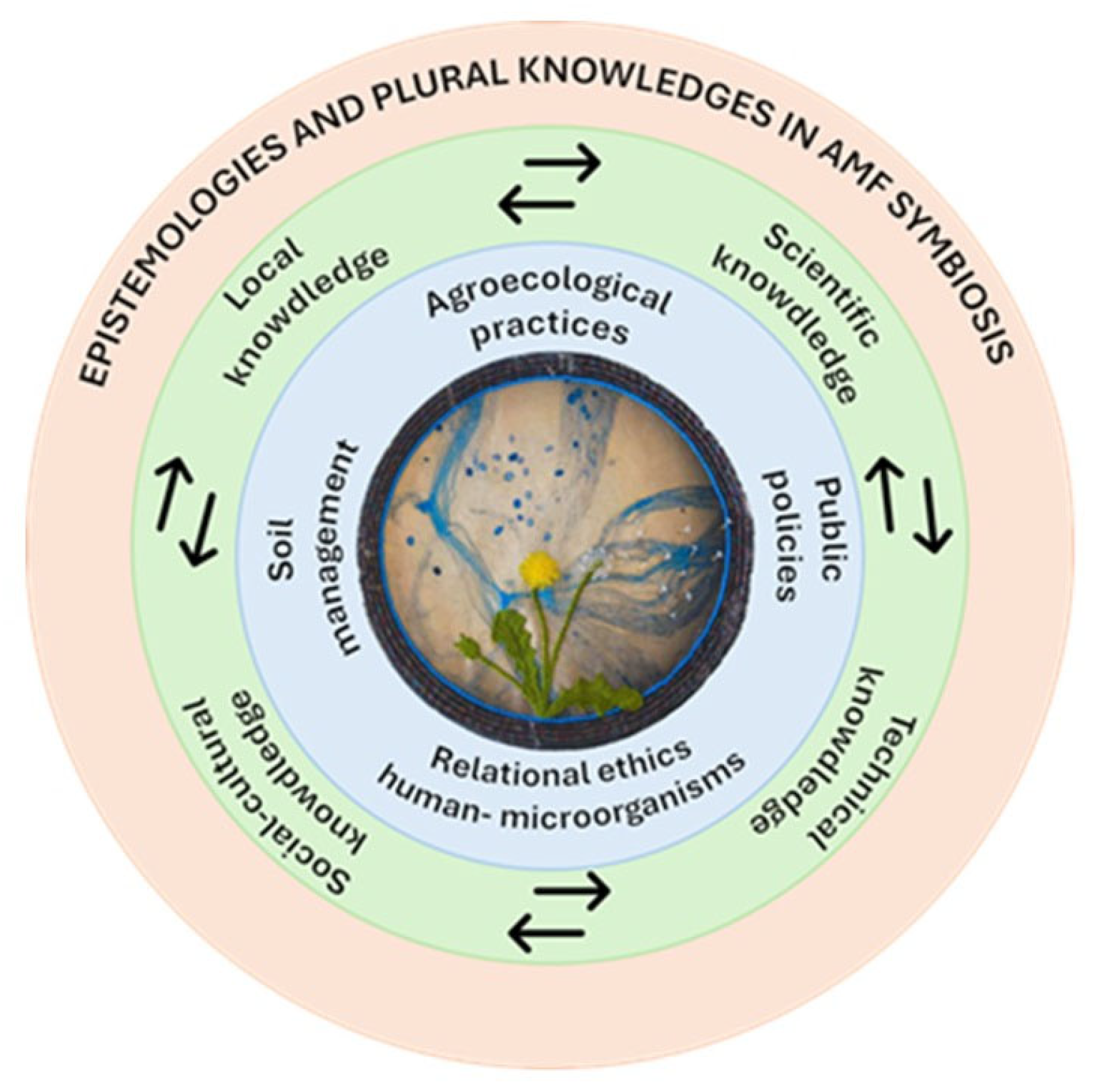
This multidimensional perspective can be better understood through a framework that integrates agroecological practices, scientific and local knowledge, and socio-political conditions shaping AMF symbiosis. Figure 2 illustrates this concentric model, where AMF are positioned as ecological agents embedded in broader networks of practices, policies, and plural epistemologies.
This gap between AMF’s biological promise and the socio-economic systems that limits its reach points to a critical insight: the success of fungal partnerships depends on the agroecological principles that make them effective. Farmer–researcher collaborations must codesign inoculant production to bypass corporate supply chains, and agricultural policies must transition from subsidizing synthetic inputs to investing in soil microbiomes. The science so far is clear, but the challenge now is to build the social and institutional bridge that allow AMF to fulfill their role as allies in just agroecological transitions. Recognizing AMF as part of living soil communities invites not only a shift in agronomic practices, but also a rethinking of how we value and relate to the invisible microbiomes that sustain food systems, biodiversity, and rural livelihoods.
Beyond their contributions to managed agroecosystems, AMF can serve as sensitive bioindicators of soil health and ecological integrity. Because AMF are highly responsive to soil disturbance and chemical inputs, their presence, abundance, and diversity often reflect the sustainability of land management practices [36,37]. A thriving and diverse AMF community generally signals minimal soil disturbance and a reliance on organic inputs, whereas a depleted AMF community may indicate intensive tillage, heavy agrochemical use, or degraded soil conditions [29,31,32]. This diagnostic capacity not only reflects ecosystem conditions but also helps guide site-specific restoration interventions.
In degraded or marginal agroecosystems—for example, impoverished soils in tropical regions or in the Andes—the use of native AMF inoculum or tailored fungal consortia adapted to local conditions offers a promising strategy for ecological restoration [21,23,149]. Reintroducing or amplifying AMF in such contexts has been shown to improve soil structure, aggregate stability, and porosity, enhance nutrient cycling efficiency, and increase plant establishment and survival [46,80,83].
Crucially, any AMF-based restoration approach should be implemented in a context-specific and culturally grounded manner. This means working with indigenous and local communities to use locally sourced mycorrhizal strains and integrating traditional knowledge of the land [150,151]. When deployed with a territorial (place-based) perspective, AMF inoculation and management can rehabilitate degraded soils while empowering communities that manage those lands. This approach contributes to local agroecological sovereignty, enabling farmers to reclaim soil health through biocultural strategies rather than imported technological packages.
In addition to their ecological and restorative roles, AMF foster economic resilience by enhancing nutrient access and reducing input dependency. By reducing the need for synthetic fertilizers and pesticides, they lower production costs and promote food sovereignty. These benefits are especially important in Latin America, where smallholders face high agrochemical prices and volatile markets. Mycorrhizal associations not only stabilize yields but also enhance the nutritional quality of crops. Thus, AMF symbiosis becomes a linchpin in the strategy for sustainable, autonomous, and nutritionally sufficient agriculture. Yet, despite growing scientific recognition, AMF research remains largely published in English, limiting accessibility in Latin America. From an epistemic perspective, this linguistic concentration constrains the circulation of knowledge, reinforces asymmetries in who produces and accesses scientific information, and limits the integration of local and indigenous perspectives into mycorrhizal research and practice. Overcoming epistemic extractives—where knowledge is extracted without acknowledging local context—requires inclusive research platforms, microbial banks rooted in local territories, and multilingual dissemination. AMF thus become both actors and indicators of a more just agriculture—ecologically sound, socially rooted, and epistemically diverse.
AMF thrive under agroecological practices, which reduce agrochemical use and create conditions favorable for their development. Practices that increase soil organic matter also enhance mycorrhizal sporulation and establishment, supporting ecosystem stability. Furthermore, diversified planting approaches, such as polycultures, floral strips, and multi-species cover crops, foster higher mycorrhizal diversity. The growing body of research on AMF in agroecological contexts suggests increasing recognition of their relevance.
Overall, Table 1 synthesizes experimental evidence from Latin America demonstrating that agroecological practices consistently enhance AMF abundance, functionality, and ecosystem services, providing quantitative support for their role in improving crop performance, soil health, and long-term sustainability.

5. Conclusions

Agroecological practices play a critical role in maintaining and restoring essential soil microbiota, particularly AMF, through both direct interventions—such as reduced tillage, organic amendments, and plant diversification—and indirect effects on soil health and microbial habitat. AMF emerge as multifunctional symbionts that enhance soil structure, improve nutrient availability, promote plant vigor, and support ecosystem resilience, thereby offering an ecological foundation for the regeneration of degraded agricultural landscapes and the stabilization of crop productivity.
The integration of AMF into agroecological systems is not merely a technical solution but a strategic axis of transformation for food systems—linking biological fertility, economic autonomy, and knowledge sovereignty. As demonstrated in this review, these fungi not only amplify agroecological benefits but also serve as bioindicators of sustainability and as catalysts for more just and place-based agricultural transitions.
At the same time, the integration of AMF into agroecological systems is mediated by regulatory frameworks, market structures, and dominant knowledge systems that shape how microbial life is managed, valued, and governed. Recognizing these mediations is essential to avoid reducing AMF to standardized technical inputs and to promote agroecological transitions that are more inclusive, context-specific, and socially robust.
Future research should deepen the understanding of AMF functional diversity across agroecological contexts, particularly their long-term interactions with cover crop diversity, soil carbon dynamics, and resilience to climate variability [10,152]. Moreover, greater emphasis should be placed on participatory strategies for local inoculant development and to integrating peasant and indigenous knowledge systems into microbial management frameworks—ensuring that AMF-based innovations are accessible, culturally grounded, and ecologically appropriate.
In a complementary manner, public policy efforts could be oriented toward the development of regulatory frameworks that are sensitive to territorial specificities, promote participatory approaches to inoculant development, and recognize peasant and indigenous knowledge as a central component of microbial management strategies.
Overall, the synergy between agroecological practices and AMF offers a compelling pathway toward sustainable and equitable agriculture. By fostering healthy soils and strong mycorrhizal networks, these practices contribute not only to improved yields and environmental performance, but also to a more democratic, sovereign, and multi-species approach to agricultural sustainability. By integrating ecological, agronomic, and socio-political dimensions, this review advances current understanding of AMF beyond functional roles, highlighting their relevance for agroecological transitions and territorial resilience.

Author Contributions

All authors contributed to the conceptualization, preparation, and revision of the manuscript, and approved the final version for publication. All authors have read and agreed to the published version of the manuscript.

Funding

This research was funded by the National Agency for Research and Development ANID CHILE, grant number Postdoctorado en el extranjero 74220080 (AA) and Doctorado Nacional 21220401 (AA)” and “The APC was funded by institutional or project-based funds from Scuola Superiore Sant’Anna”.

Data Availability Statement

Not applicable.

Acknowledgments

The authors gratefully acknowledge Elisa Pellegrino and Laura Ercoli for their institutional support and for allowing the development of this review within the framework of the postdoctoral research activities at the Scuola Superiore Sant’Anna. The authors also acknowledges the Scuola Superiore Sant’Anna for providing institutional support that facilitated the completion of this manuscript.

Conflicts of Interest

The authors declare no conflicts of interest.

Abbreviations

The following abbreviations are used in this manuscript:
ABAAbscisic Acid
AMFArbuscular Mycorrhizal Fungi
APXAscorbate Peroxidase
CaCalcium
Cd2+Cadmium
CuCopper
FeIron
GsStomatal Conductance
KPotassium
LeNCED19-cis-epoxycarotenoid dioxygenase 1
MDAMalondialdehyde
MgMagnesium
NNitrogen
Na+Sodium
NPR1Nonexpressor of Pathogenesis-Related Genes 1
PPhosphorus
PODPeroxidase
PnNet Photosynthesis
PRPathogenesis-Related Proteins
PR-1Pathogenesis-Related Protein 1
PR-2Pathogenesis-Related Protein 2
PR-5Pathogenesis-Related Protein 5
SODSuperoxide Dismutase
SASalicylic Acid
SLsStrigolactones
SlCCD7Carotenoid Cleavage Dioxygenase 7
STSScience and Technology Studies
UNAM-ENESUniversidad Nacional Autónoma de México–Escuela Nacional de Estudios Superiores
TrTranspiration
ZnZinc
WRKYWRKY Transcription Factors

References

  1. Philippot, L.; Raaijmakers, J.M.; Lemanceau, P.; Van Der Putten, W.H. Going back to the roots: The microbial ecology of the rhizosphere. Nat. Rev. Microbiol. 2013, 11, 789–799. [Google Scholar] [CrossRef] [PubMed]
  2. Mendes, R.; Garbeva, P.; Raaijmakers, J.M. The rhizosphere microbiome: Significance of plant-beneficial, plant-pathogenic, and human-pathogenic microorganisms. FEMS Microbiol. Rev. 2013, 37, 634–663. [Google Scholar] [CrossRef] [PubMed]
  3. Bardgett, R.D.; Van Der Putten, W.H. Belowground biodiversity and ecosystem functioning. Nature 2014, 515, 505–511. [Google Scholar] [CrossRef] [PubMed]
  4. Thirkell, T.; Charters, M.; Elliott, A.; Sait, S.; Field, K. Are mycorrhizal fungi our sustainable saviours? Considerations for achieving food security. J. Ecol. 2017, 105, 921–929. [Google Scholar] [CrossRef]
  5. Smith, S.E.; Read, D.J. Mycorrhizal Symbiosis, 3rd ed.; Academic Press: London, UK, 2008. [Google Scholar]
  6. Brundrett, M.; Tedersoo, L. Evolutionary history of mycorrhizal symbioses and global host plant diversity. New Phytol. 2018, 220, 1108–1115. [Google Scholar] [CrossRef]
  7. Parniske, M. Arbuscular mycorrhiza: The mother of plant root endosymbioses. Nat. Rev. Microbiol. 2008, 6, 763–775. [Google Scholar] [CrossRef]
  8. Rich, M.K.; Nouri, E.; Courty, P.E.; Reinhardt, D. Diet of arbuscular mycorrhizal fungi: Bread and butter? Trends Plant Sci. 2017, 22, 652–660. [Google Scholar] [CrossRef]
  9. Azcón-Aguilar, C.; Barea, J. Arbuscular mycorrhizas and biological control of soil-borne plant pathogens: An overview of the mechanisms involved. Mycorrhiza 1997, 6, 457–464. [Google Scholar] [CrossRef]
  10. Smith, S.E.; Smith, F.A. Fresh perspectives on the roles of arbuscular mycorrhizal fungi in plant nutrition and growth. Mycologia 2012, 104, 1–13. [Google Scholar] [CrossRef]
  11. Cavagnaro, T.; Bender, S.; Asghari, H.; Van Der Heijden, M. The role of arbuscular mycorrhizas in reducing soil nutrient loss. Trends Plant Sci. 2015, 20, 283–290. [Google Scholar] [CrossRef]
  12. Augé, R.M. Arbuscular mycorrhizae and soil/plant water relations. Can. J. Soil Sci. 2004, 84, 373–381. [Google Scholar] [CrossRef]
  13. Cameron, D.D.; Neal, A.L.; Van Wees, S.C.M.; Ton, J. Mycorrhiza-induced resistance: More than the sum of its parts? Trends Plant Sci. 2013, 18, 539–545. [Google Scholar] [CrossRef] [PubMed]
  14. Aguilera, P.; Ortiz, N.; Becerra, N.; Turrini, A.; Gaínza-Cortés, F.; Silva-Flores, P.; Aguilar-Paredes, A.; Romero, J.K.; Jorquera-Fontena, E.; Mora, M.L.; et al. Application of arbuscular mycorrhizal fungi in vineyards: Water and biotic stress under a climate change scenario—A new challenge for Chilean grapevine crops. Front. Microbiol. 2022, 13, 826571. [Google Scholar] [CrossRef] [PubMed]
  15. Chen, M.; Arato, M.; Borghi, L.; Nouri, E.; Reinhardt, D. Beneficial services of arbuscular mycorrhizal fungi—From ecology to application. Front. Plant Sci. 2018, 9, 1–14. [Google Scholar] [CrossRef]
  16. Genre, A.; Lanfranco, L.; Perotto, S.; Bonfante, P. Unique and common traits in mycorrhizal symbioses. Nat. Rev. Microbiol. 2020, 18, 649–660. [Google Scholar] [CrossRef]
  17. van Der Heijden, M.G.A.; Martin, F.M.; Selosse, M.A.; Sanders, I.R. Mycorrhizal ecology and evolution: The past, the present, and the future. New Phytol. 2015, 205, 1406–1423. [Google Scholar] [CrossRef]
  18. Gianinazzi, S.; Gollotte, A.; Binet, M.N.; Van Tuinen, D.; Redecker, D.; Wipf, D. Agroecology: The key role of arbuscular mycorrhizas in ecosystem services. Mycorrhiza 2010, 20, 519–530. [Google Scholar] [CrossRef]
  19. Turrini, A.; Avio, L.; Giovannetti, M.; Agnolucci, M. Functional complementarity of arbuscular mycorrhizal fungi and associated microbiota: The challenge of translational research. Front. Plant Sci. 2018, 9, 10–13. [Google Scholar] [CrossRef]
  20. Marrassini, V.; Ercoli, L.; Aguilar-Paredes, A.V.; Pellegrino, E. Positive response to inoculation with indigenous arbuscular mycorrhizal fungi as modulated by barley genotype. Agron. Sustain. Dev. 2025, 45, 21. [Google Scholar] [CrossRef]
  21. Berruti, A.; Lumini, E.; Balestrini, R.; Bianciotto, V. Arbuscular mycorrhizal fungi as natural biominiers: Learning from past successes. Front. Microbiol. 2016, 6, 1559. [Google Scholar] [CrossRef]
  22. Pellegrino, E.; Bedini, S.; Avio, L.; Bonari, E.; Giovannetti, M. Field inoculation effectiveness of native and exotic arbuscular mycorrhizal fungi in a Mediterranean agricultural soil. Soil Biol. Biochem. 2011, 43, 367–376. [Google Scholar] [CrossRef]
  23. Rouphael, Y.; Franken, P.; Schneider, C.; Schwarz, D.; Giovannetti, M.; Agnolucci, M.; Di Pascale, S.; Bonini, P.; Colla, G. Arbuscular mycorrhizal fungi act as biostimulants in horticultural crops. Sci. Hortic. 2015, 196, 91–108. [Google Scholar] [CrossRef]
  24. Verbruggen, E.; Toby Kiers, E.; Bakelaar, P.N.; Röling, W.F. Mycorrhizal fungal establishment in agricultural soils: Factors determining inoculation success. New Phytol. 2012, 196, 1070–1079. [Google Scholar] [CrossRef] [PubMed]
  25. Balestrini, R.; Salvioli, A.; Dal Molin, A.; Novero, M.; Gabelli, G.; Paparelli, E.; Marroni, F.; Bonfante, P. Impact of an arbuscular mycorrhizal fungus versus a mixed microbial inoculum on transcriptome reprogramming of grapevine roots. Mycorrhiza 2017, 27, 417–430. [Google Scholar] [CrossRef]
  26. Hart, M.M.; Antunes, P.M.; Chaudhary, V.B.; Abbott, L.K. Fungal inoculants in the field: Is the reward greater than the risk? Funct. Ecol. 2018, 32, 126–135. [Google Scholar] [CrossRef]
  27. Crossay, T.; Majorel, C.; Redecker, D.; Gensous, S.; Medevielle, V.; Durrieu, G.; Cavaloc, Y.; Amir, H. Is a mixture of arbuscular mycorrhizal fungi better for plant growth than single-species inoculants? Mycorrhiza 2019, 29, 325–339. [Google Scholar] [CrossRef]
  28. Stavi, I.; Lal, R. Achieving zero net land degradation: Challenges and opportunities. J. Arid Environ. 2015, 112, 44–51. [Google Scholar] [CrossRef]
  29. Hartman, K.; Van Der Heijden, M.G.A.; Wittwer, R.A.; Banerjee, S.; Walser, J.C.; Schlaeppi, K. Cropping practices manipulate abundance patterns of root and soil microbiome members paving the way to smart farming. Microbiome 2018, 6, 14. [Google Scholar] [CrossRef]
  30. Springmann, M.; Clark, M.; Mason-D’Croz, D.; Wiebe, K.; Bodirsky, B.L.; Lassaletta, L.; De Vries, W.; Vermeulen, S.J.; Herrero, M.; Carlson, K.M.; et al. Options for keeping the food system within environmental limits. Nature 2018, 562, 519–525. [Google Scholar] [CrossRef]
  31. Ciccolini, V.; Ercoli, L.; Davison, J.; Vasar, M.; Öpik, M.; Pellegrino, E. Land-use intensity and host plant simultaneously shape arbuscular mycorrhizal fungal communities in a Mediterranean drained peatland. FEMS Microbiol. Ecol. 2016, 92, fiw186. [Google Scholar] [CrossRef]
  32. Giovannini, L.; Palla, M.; Agnolucci, M.; Avio, L.; Sbrana, C.; Turrini, A.; Giovannetti, M. Arbuscular mycorrhizal fungi and associated microbiota as plant biostimulants: Research strategies for selecting the best-performing inocula. Agronomy 2020, 10, 1. [Google Scholar] [CrossRef]
  33. Delgado-Baquerizo, M.; Reich, P.B.; Trivedi, C.; Eldridge, D.J.; Abades, S.; Alfaro, F.D.; Singh, B.K. Multiple elements of soil biodiversity drive ecosystem functions across biomes. Nat. Ecol. Evol. 2020, 4, 210–220. [Google Scholar] [CrossRef] [PubMed]
  34. Oehl, F.; Laczko, E.; Oberholzer, H.; Jansa, J.; Egli, S. Diversity and biogeography of arbuscular mycorrhizal fungi in agricultural soils. Biol. Fertil. Soils 2017, 53, 777–797. [Google Scholar] [CrossRef]
  35. Verbruggen, E.; Kiers, E.T. Evolutionary ecology of mycorrhizal functional diversity in agricultural systems. Evol. Appl. 2010, 3, 547–560. [Google Scholar] [CrossRef] [PubMed]
  36. Verbruggen, E.; Röling, W.F.M.; Gamper, H.A.; Kowalchuk, G.A.; Verhoef, H.A.; Van Der Heijden, M.G.A. Positive effects of organic farming on below-ground mutualists: Large-scale comparison of mycorrhizal fungal communities in agricultural soils. New Phytol. 2010, 186, 968–979. [Google Scholar] [CrossRef]
  37. Bedini, S.; Avio, L.; Sbrana, C.; Turrini, A.; Migliorini, P.; Vazzana, C.; Giovannetti, M. Mycorrhizal activity and diversity in a long-term organic Mediterranean agroecosystem. Biol. Fertil. Soils 2013, 49, 781–790. [Google Scholar] [CrossRef]
  38. Säle, V.; Aguilera, P.; Laczko, E.; Mäder, P.; Berner, A.; Zihlmann, U.; Van Der Heijden, M.; Oehl, F. Impact of conservation tillage and organic farming on the diversity of arbuscular mycorrhizal fungi. Soil Biol. Biochem. 2015, 84, 38–52. [Google Scholar] [CrossRef]
  39. Aguilar-Paredes, A.; Valdés, G.; Nuti, M. Ecosystem functions of microbial consortia in sustainable agriculture. Agronomy 2020, 10, 1902. [Google Scholar] [CrossRef]
  40. Altieri, M.; Farrell, J.; Hecht, S.; Liebman, M.; Magdoff, F.; Murphy, B.; Norgaard, R.; Sikor, T. Agroecology; CRC Press: Boca Raton, FL, USA, 2018. [Google Scholar]
  41. Bender, S.F.; Wagg, C.; Van Der Heijden, M.G. An underground revolution: Biodiversity and soil ecological engineering for agricultural sustainability. Trends Ecol. Evol. 2016, 29, 600–607. [Google Scholar] [CrossRef]
  42. Eyhorn, F.; Muller, A.; Reganold, J.P.; Frison, E.; Herren, H.R.; Seufert, V.; Smith, P. Sustainability in global agriculture driven by organic farming. Nat. Sustain. 2019, 2, 253–255. [Google Scholar] [CrossRef]
  43. Isbell, F.; Craven, D.; Connolly, J.; Loreau, M.; Schmid, B.; Beierkuhnlein, C.; Bezemer, T.; Kreyling, J.; Lanta, V.; Manning, P.; et al. Biodiversity increases the resistance of ecosystem productivity to climate extremes. Nature 2015, 526, 574–577. [Google Scholar] [CrossRef]
  44. Wall, D.H.; Nielsen, U.N.; Six, J. Soil biodiversity and human health. Nature 2015, 528, 69–76. [Google Scholar] [CrossRef] [PubMed]
  45. Ebbisa, A. Arbuscular mycorrhizal fungi in optimizing nutrient bioavailability and reducing agrochemicals for maintaining sustainable agroecosystems. In Arbuscular Mycorrhizal Fungi in Agriculture—New Insights; IntechOpen: London, UK, 2022. [Google Scholar]
  46. Aguilar-Paredes, A.; Turrini, A.; Avio, L.; Stuardo, C.; Velásquez, A.; Becerra, J.; Giovannetti, M.; Seeger, M. Agricultural management influences the diversity of arbuscular mycorrhizal fungi in vineyards from Chilean Mediterranean ecosystems. J. Soil Sci. Plant Nutr. 2024, 24, 6099–6112. [Google Scholar] [CrossRef]
  47. Silva-Flores, P.; Argüelles-Moyao, A.; Aguilar-Paredes, A.; Simões-Calaça, F.J.; Duchicela, J.; Fernández, N.; Furtado, A.N.M.; Guerra-Sierra, B.; Lovera, M.; Marín, C.; et al. Mycorrhizal science outreach: Scope of action and available resources in the face of global change. Plants People Planet 2021, 3, 506–522. [Google Scholar] [CrossRef]
  48. Puig De La Bellacasa, M. The Spirit of Soil: For a More-Than-Human Community; Tercero Incluido Publishing: Madrid, Spain, 2023; p. 169. [Google Scholar]
  49. Tsing, A.L. The Mushroom at the End of the World: On the Possibility of Life in Capitalist Ruins; Caja Negra: Buenos Aires, Argentina, 2015; p. 448. [Google Scholar]
  50. Lyons, K. Vital Decomposition: Soils, Forests, and Life Proposals; Universidad del Rosario Press: Bogotá, Colombia, 2021; p. 247. [Google Scholar]
  51. Blanco-Canqui, H.; Shaver, T.; Lindquist, J.; Shapiro, C.; Elmore, R.; Francis, C.; Hergert, G. Cover crops and ecosystem services: Insights from studies in temperate soils. Agron. J. 2015, 107, 2449–2474. [Google Scholar] [CrossRef]
  52. Winter, S.; Bauer, T.; Strauss, P.; Kratschmer, S.; Zaller, J.G.; Batáry, P. Effects of vegetation management intensity on biodiversity and ecosystem services in vineyards: A meta-analysis. J. Appl. Ecol. 2018, 55, 2484–2495. [Google Scholar] [CrossRef]
  53. García, L.; Celette, F.; Gary, C.; Ripoche, A.; Valdés-Gómez, H.; Metay, A. Management of service crops for the provision of ecosystem services in vineyards: A review. Agric. Ecosyst. Environ. 2018, 251, 158–170. [Google Scholar] [CrossRef]
  54. Capó-Bauçà, S.; Marqués, A.; Llopis-Vidal, N.; Bota, J.; Baraza, E. Long-term establishment of natural green cover provides agroecosystem services by improving soil quality in a Mediterranean vineyard. Ecol. Eng. 2019, 127, 285–291. [Google Scholar] [CrossRef]
  55. Vukicevich, E.; Lowery, T.; Bowen, P.; Úrbez-Torres, J.R.; Hart, M.M. Cover crops to increase soil microbial diversity and mitigate decline in perennial agriculture: A review. Agron. Sustain. Dev. 2016, 36, 287–299. [Google Scholar] [CrossRef]
  56. Quintarelli, V.; Radicetti, E.; Allevato, E.; Stazi, S.R.; Haider, G.; Abideen, Z.; Bibi, S.; Jamal, A.; Mancinelli, R. Cover Crops for Sustainable Cropping Systems: A Review. Agriculture 2022, 12, 2076. [Google Scholar] [CrossRef]
  57. Williams, A.; Birt, H.W.G.; Raghavendra, A.; Dennis, P.G. Cropping system diversification influences soil microbial diversity in subtropical dryland farming systems. Microb. Ecol. 2023, 85, 1473–1484. [Google Scholar] [CrossRef] [PubMed]
  58. Fall, A.F.; Nakabonge, G.; Ssekandi, J.; Founoune-Mboup, H.; Apori, S.O.; Ndiaye, A.; Badji, A.; Ngom, K. Roles of arbuscular mycorrhizal fungi on soil fertility: Contribution to the improvement of physical, chemical, and biological properties of the soil. Front. Fungal Biol. 2022, 3, 723892. [Google Scholar] [CrossRef] [PubMed]
  59. McDaniel, M.D.; Tiemann, L.K.; Grandy, A.S. Does agricultural crop diversity enhance soil microbial biomass and organic matter dynamics? A meta-analysis. Ecol. Appl. 2014, 24, 560–570. [Google Scholar] [CrossRef] [PubMed]
  60. Köhl, L.; Oehl, F.; Van Der Heijden, M.G.A. Agricultural practices indirectly influence plant productivity and ecosystem services through effects on soil biota. Ecol. Appl. 2014, 24, 1842–1853. [Google Scholar] [CrossRef]
  61. Lehman, R.M.; Cambardella, C.A.; Stott, D.E.; Acosta-Martinez, V.; Manter, D.K.; Buyer, J.S.; Maul, J.E.; Smith, J.L.; Collins, H.P.; Halvorson, J.J.; et al. Understanding and enhancing soil biological health: The solution for reversing soil degradation. Sustainability 2015, 7, 988–1027. [Google Scholar] [CrossRef]
  62. Patanita, M.; Campos, M.D.; Félix, M.D.R.; Carvalho, M.; Brito, I. Effect of tillage system and cover crop on maize mycorrhization and presence of Magnaporthiopsis maydis. Biology 2020, 9, 46. [Google Scholar] [CrossRef]
  63. Orrù, L.; Canfora, L.; Trinchera, A.; Migliore, M.; Pennelli, B.; Marcucci, A.; Farina, R.; Pinzari, F. How tillage and crop rotation change the distribution pattern of fungi. Front. Microbiol. 2021, 12, 634325. [Google Scholar] [CrossRef]
  64. Rebouh, N.Y.; Khugaev, C.V.; Utkina, A.O.; Isaev, K.V.; Mohamed, E.S.; Kucher, D.E. Contribution of eco-friendly agricultural practices in improving and stabilizing wheat crop yield: A review. Agronomy 2023, 13, 2400. [Google Scholar] [CrossRef]
  65. Chaudhary, A.; Poudyal, S.; Kaundal, A. Role of arbuscular mycorrhizal fungi in maintaining sustainable agroecosystems. Appl. Microbiol. 2025, 5, 6. [Google Scholar] [CrossRef]
  66. Nyamwange, M.M.; Njeru, E.M.; Mucheru-Muna, M.; Ngetich, F. Soil management practices affect arbuscular mycorrhizal fungi propagules, root colonization, and growth of rainfed maize. AIMS Agric. Food 2018, 3, 120–133. [Google Scholar] [CrossRef]
  67. Tian, L.; Wang, T.; Cui, S.; Li, Y.; Gui, W.; Yang, F.; Chen, J.; Dong, R.; Gu, X.; Zhao, X.; et al. Diversified cover crops and no-till enhanced soil total nitrogen and arbuscular mycorrhizal fungi diversity: A case study from the karst area of southwest China. Agriculture 2024, 14, 1103. [Google Scholar] [CrossRef]
  68. Tamburini, G.; Bommarco, R.; Wanger, T.C.; Kremen, C.; Van Der Heijden, M.G.A.; Liebman, M.; Hallin, S. Agricultural diversification promotes multiple ecosystem services without compromising yield. Sci. Adv. 2020, 6, eaba1715. [Google Scholar] [CrossRef] [PubMed]
  69. Tiemann, L.K.; Grandy, A.S.; Atkinson, E.E.; Marin-Spiotta, E.; McDaniel, M.D. Crop rotational diversity enhances belowground communities and functions in an agroecosystem. Ecol. Lett. 2015, 18, 761–771. [Google Scholar] [CrossRef] [PubMed]
  70. Ghimire, R.; Norton, J.B.; Stahl, P.D.; Norton, U. Soil microbial substrate properties and microbial community responses under irrigated organic and reduced tillage crop and forage systems. PLoS ONE 2014, 9, e103901. [Google Scholar] [CrossRef]
  71. Kaur, M.; Faizan, M.; Alam, P. Farmers’ suicide and stress resilience in agriculture through microbial interactions: A perspective analysis. Discov. Plants 2025, 2, 42. [Google Scholar] [CrossRef]
  72. Kumawat, K.C.; Sharma, B.; Nagpal, S.; Kumar, A.; Tiwari, S.; Nair, R.M. Plant growth-promoting rhizobacteria: Salt stress alleviators to improve crop productivity for sustainable agriculture development. Front. Plant Sci. 2023, 13, 1101862. [Google Scholar] [CrossRef]
  73. Pozo, M.J.; Azcón-Aguilar, C. Unraveling mycorrhiza-induced resistance. Curr. Opin. Plant Biol. 2007, 10, 393–398. [Google Scholar] [CrossRef]
  74. Medina, A.; Azcón, R. Effectiveness of arbuscular mycorrhizal fungi and organic amendments to improve soil quality and plant performance under stress conditions. J. Soil Sci. Plant Nutr. 2010, 10, 354–372. [Google Scholar] [CrossRef]
  75. Gebremeskel, K.; Birhane, E.; Habtu, S.; Haile, M.; Chanyalew, S.; Tadele, Z.; Assefa, K. Arbuscular mycorrhizal fungi improve morphological and yield performance of Eragrostis tef genotypes in Tigray, Ethiopia. Sci. Rep. 2024, 14, 29716. [Google Scholar] [CrossRef]
  76. Pozo, M.J.; Cordier, C.; Dumas-Gaudot, E.; Gianinazzi, S.; Barea, J.M.; Azcón-Aguilar, C. Localized versus systemic effect of arbuscular mycorrhizal fungi on defense responses to Phytophthora infection in tomato plants. J. Exp. Bot. 2002, 53, 525–534. [Google Scholar] [CrossRef]
  77. Pozo, M.J.; Jung, S.C.; Martínez-Medina, A.; López-Ráez, J.A.; Azcón-Aguilar, C.; Barea, J.M. Root allies: Arbuscular mycorrhizal fungi help plants to cope with biotic stresses. In Symbiotic Endophytes; Aroca, R., Ed.; Springer: Berlin/Heidelberg, Germany, 2013; pp. 289–306. [Google Scholar]
  78. Coşkun, F.; Alptekin, Y.; Demir, S. Effects of arbuscular mycorrhizal fungi and salicylic acid on plant growth and antioxidative enzyme activity against wilt disease in pepper. Eur. J. Plant Pathol. 2023, 165, 163–177. [Google Scholar] [CrossRef]
  79. Ruiz-Lozano, J.M.; Aroca, R.; Zamarreño, Á.M.; Molina, S.; Andreo-Jiménez, B.; Porcel, R.; García-Mina, J.M.; Ruyter-Spira, C.; López-Ráez, J.A. Arbuscular mycorrhizal symbiosis induces strigolactone biosynthesis under drought and improves drought tolerance in lettuce and tomato. Plant Cell Environ. 2016, 39, 441–452. [Google Scholar] [CrossRef] [PubMed]
  80. Guo, S.; Xia, L.; Xia, D.; Li, M.; Xu, W.; Liu, L. Enhancing plant resilience: Arbuscular mycorrhizal fungi’s role in alleviating drought stress in vegetation concrete. Front. Plant Sci. 2024, 15, 1401050. [Google Scholar] [CrossRef] [PubMed]
  81. Camuy-Velez, L.; Chakraborty, D.; Young, A.; Paudel, S.; Elvers, R.; Vanderhyde, M.; Walter, K.; Herzog, C.; Banerjee, S. Context-dependent contributions of arbuscular mycorrhizal fungi to host performance under global change factors. Soil Biol. Biochem. 2025, 204, 109707. [Google Scholar] [CrossRef]
  82. Li, J.; Zhou, L.; Chen, G.; Yao, M.; Liu, Z.; Li, X.; Yang, X.; Yang, Y.; Cai, D.; Tuerxun, Z.; et al. Arbuscular mycorrhizal fungi enhance drought resistance and alter microbial communities in maize rhizosphere soil. Environ. Technol. Innov. 2025, 37, 103947. [Google Scholar] [CrossRef]
  83. Nie, W.; He, Q.; Guo, H.; Zhang, W.; Ma, L.; Li, J.; Wen, D. Arbuscular mycorrhizal fungi boost crop resilience to environmental stresses. Microorganisms 2024, 12, 2448. [Google Scholar] [CrossRef]
  84. Ahmed, N.; Li, J.; Li, Y.; Deng, L.; Chachar, M.; Hayat, F.; Raza, A.; Umrani, J.H.; Gong, L.; Tu, P. Symbiotic synergy: How arbuscular mycorrhizal fungi enhance nutrient uptake, stress tolerance, and soil health through molecular mechanisms and hormonal regulation. IMA Fungus 2025, 16, e144989. [Google Scholar] [CrossRef]
  85. Wahab, A.; Muhammad, M.; Munir, A.; Abdi, G.; Zaman, W.; Ayaz, A.; Khizar, C.; Reddy, S.P.P. Role of arbuscular mycorrhizal fungi in regulating growth, enhancing productivity, and potentially influencing ecosystems under abiotic and biotic stresses. Plants 2023, 12, 3102. [Google Scholar] [CrossRef]
  86. Li, N.; Chen, W.; Wang, B.; Zhang, C.; Wang, Y.; Li, R.; Yan, Y.; He, J. Arbuscular mycorrhizal fungi improve the disease resistance of Lycium barbarum to root rot by activating phenylpropanoid metabolism. Front. Plant Sci. 2024, 15, 1459651. [Google Scholar]
  87. Puig De La Bellacasa, M.P. Matters of Care: Speculative Ethics in More-than-Human Worlds; University of Minnesota Press: Minneapolis, MN, USA, 2017; p. 280. [Google Scholar]
  88. Ureta, S.; Oteagui, Á.; Llona, M. The SIRSD-S or the risks of a productivist problematization of degraded soils. Rev. Geogr. Norte Gd. 2024, 88, 1–23. [Google Scholar] [CrossRef]
  89. Auyero, J. The Gray Zone: Collective Violence and Party Politics in Contemporary Argentina; Siglo XXI Publishers: Buenos Aires, Argentina, 2007; p. 234. [Google Scholar]
  90. Naciones Unidas México. Mexico Advances in Building a Regulatory Framework for Bioinputs; United Nations Mexico Office: Mexico City, Mexico, 2024. [Google Scholar]
  91. Biblioteca del Congreso Nacional de Chile. Law No. 21.349: Establishes Regulations on the Composition, Labeling, and Marketing of Fertilizers and Biostimulants; Biblioteca del Congreso Nacional de Chile: Santiago, Chile, 2021. [Google Scholar]
  92. Instituto Interamericano de Cooperación para la Agricultura (IICA); Instituto Nacional de Tecnología Agropecuaria (INTA); Empresa Brasileira de Pesquisa Agropecuaria (EMBRAPA); Instituto de Investigaciones Agropecuarias (INIA); Instituto Paraguayo de Tecnología Agraria (IPTA); Programa Cooperativo para el Desarrollo Tecnológico Agroalimentario y Agroindustrial del Cono Sur (PROCISUR). Bioinputs in the Southern Cone: Innovation from the INIAs of PROCISUR Toward Sustainable Agriculture; PROCISUR: Montevideo, Uruguay, 2022. [Google Scholar]
  93. Van Der Ploeg, J.D. The New Peasantries: Struggles for Autonomy and Sustainability in an Era of Empire and Globalization; Earthscan: London, UK, 2008; p. 356. [Google Scholar]
  94. Engel-Di Mauro, S. Ecology, Soils, and the Left: An Eco-Social Approach; Palgrave Macmillan: New York, NY, USA, 2014; p. 226. [Google Scholar]
  95. Gómez-Perazzoli, A.; Gazzano, M.I.; Dieguez-Cameroni, F. Agroecological family farming in Uruguay: Innovative and counter-hegemonic contributions to sustainability. Agrociencia Urug. 2024, 28, e1140. [Google Scholar]
  96. Norton, D.A. Native Biodiversity and Regenerative Agriculture in New Zealand; Manaaki Whenua Press: Lincoln, New Zealand, 2021; p. 84. [Google Scholar]
  97. García, A.; Varón, D. The Atrato River ruling: A step beyond the Green Constitution. In The Environmental Court: Environmental Justice in the Jurisprudence of the Constitutional Court of Colombia; Heinrich Böll Foundation: Bogotá, Colombia, 2019; pp. 297–318. [Google Scholar]
  98. Cagüeñas, D.; Galindo Orrego, M.I.; Rasmussen, S. The Atrato River and its guardians: Ecopolitical imagination to weave new rights. Rev. Colomb. Antropol. 2020, 56, 169–196. [Google Scholar] [CrossRef]
  99. Altieri, M.A.; Rosset, P.M. Agroecology: Science and Politics; Icaria Publishing: Barcelona, Spain, 2018; p. 208. [Google Scholar]
  100. Aguilar, E. Agroecology and Social Organization; Ítaca Publishing House: Mexico City, Mexico, 2022; p. 250. [Google Scholar]
  101. Oficina Española de Patentes y Marcas (OEPM). Biodiversity in Biotechnological Inventions: Patent Analysis and Its Relation to Genetic Resources and Traditional Knowledge; FAO Working Document; OEPM: Madrid, Spain, 2012. [Google Scholar]
  102. Nuti, M. The Invisibles in Agriculture; Piedra Molle Editions: Limache, Chile, 2021; p. 97. [Google Scholar]
  103. Kazic, D. When Plants Do What They Want; Cactus Publishing: Buenos Aires, Argentina, 2024; p. 414. [Google Scholar]
  104. Clavijo Ponce, N.; Pérez Martínez, M. Andean tubers and local agricultural knowledge in rural communities of Ecuador and Colombia. Cuad. Desarro. Rural. 2014, 11, 149–166. [Google Scholar]
  105. Koziol, L.; McKenna, T.P.; Bever, J.D. Meta-analysis reveals globally sourced commercial mycorrhizal inoculants fall short. New Phytol. 2025, 246, 821–827. [Google Scholar] [CrossRef] [PubMed]
  106. Basiru, S.; Mwanza, H.P.; Hijri, M. Analysis of arbuscular mycorrhizal fungal inoculant benchmarks. Microorganisms 2020, 9, 81. [Google Scholar] [CrossRef]
  107. Marro, N.; Lax, P.; Doucet, M.E.; Cabello, M.; Becerra, A. Mycorrhizas reduce tomato root penetration by the false root-knot nematode Nacobbus aberrans. Appl. Soil Ecol. 2017, 124, 90–96. [Google Scholar] [CrossRef]
  108. Wu, Y.; Chen, C.; Wang, G. Inoculation with arbuscular mycorrhizal fungi improves plant biomass and nitrogen and phosphorus nutrients: A meta-analysis. BMC Plant Biol. 2024, 24, 960. [Google Scholar] [CrossRef]
  109. Shiva, V.; Shiva, K. Unity Versus the 1%: Breaking Illusions, Sowing Freedom; LOM Ediciones: Santiago, Chile, 2020; p. 169. [Google Scholar]
  110. Altieri, M.A.; Toledo, V.M. The agroecological revolution in Latin America: Rescuing nature, ensuring food sovereignty and empowering peasants. J. Peasant Stud. 2011, 38, 587–612. [Google Scholar] [CrossRef]
  111. Puleo, A. Ecofeminist Keys: For Rebels Who Love the Earth and Animals; Plaza y Valdés Publishers: Madrid, Spain, 2021; p. 163. [Google Scholar]
  112. De Sousa Santos, B. Justice Between Knowledges: Southern Epistemologies Against Epistemicide; Morata Publishing: Madrid, Spain, 2018; p. 345. [Google Scholar]
  113. Viveiros De Castro, E. The Jaguar’s Gaze: Introduction to Amerindian Perspectivism; Tinta Limón Ediciones: Buenos Aires, Argentina, 2013; p. 287. [Google Scholar]
  114. Eschenhagen, M.L. Three axes of epistemological dialogue to approach an interpretation of the human–nature relationship. Rev. Austral Cienc. Soc. 2017, 32, 185–205. [Google Scholar] [CrossRef]
  115. Haraway, D.J. Staying with the Trouble: Making Kin in the Chthulucene; Consonni Publishing: Buenos Aires, Argentina, 2022; p. 365. [Google Scholar]
  116. Salazar, J.; Granjou, C.; Kearnes, M.; Krzywoszynska, A.; Tironi, M. Thinking with Soils: Material Politics and Social Theory; Bloomsbury Academic: London, UK, 2020; p. 217. [Google Scholar]
  117. Carrillo-Saucedo, S.; Gutiérrez-Castañeda, D.; Basurto-Lucio, I.; Jiménez, K.; Castro, C. Between Roots, Beings, and Mycelia: Weaving, We Know Ourselves; Agroforestry University Garden Project, UNAM-ENES Morelia: Mexico City, Mexico, 2023. [Google Scholar]
  118. Plumwood, V. Environmental Culture: The Ecological Crisis of Reason; Routledge: London, UK, 2002; p. 291. [Google Scholar]
  119. Aboul-Nasr, A.; Al-Fayoumy, M.E.; Aboul-Magd, M.; Elhabbab, A. Potential application of Glomus intraradices (AMF) and different isolates of PGPR (Biotol) to enhance yield and quality of wheat grown in calcareous soil under different salinity levels. J. Adv. Agric. Res. 2016, 21, 150–177. [Google Scholar] [CrossRef]
  120. Andrade, S.A.L.; Silveira, A.P.D.; Mazzafera, P. Arbuscular mycorrhiza alters metal uptake and physiological response of Coffea arabica seedlings to increasing Zn and Cu concentrations in soil. Sci. Total Environ. 2010, 408, 5381–5391. [Google Scholar] [CrossRef]
  121. Aroca, R.; Vernieri, P.; Ruiz-Lozano, J.M. Mycorrhizal and non-mycorrhizal tomato plants show different responses to exogenous ABA during drought stress. J. Plant Growth Regul. 2008, 27, 131–137. [Google Scholar]
  122. Bona, E.; Cantamessa, S.; Massa, N.; Manassero, P.; Marsano, F.; Copetta, A.; Lingua, G.; D’Agostino, G.; Gamalero, E.; Berta, G. Arbuscular mycorrhizal fungi and plant growth-promoting pseudomonads improve yield, quality, and nutritional value of tomato: A field study. Mycorrhiza 2016, 26, 1–17. [Google Scholar] [CrossRef] [PubMed]
  123. Boutaj, H.; Meddich, A.; Wahbi, S.; Moukhli, A.; El Alaoui-Talibi, Z.; Douira, A.; Filali-Maltouf, A.; El Modafar, C. Effect of arbuscular mycorrhizal fungi on Verticillium wilt development in olive trees caused by Verticillium dahliae. Res. J. Biotechnol. 2019, 14, 79–88. [Google Scholar]
  124. Buczkowska, H.; Sałata, A. Inoculation with arbuscular mycorrhizal fungi (AMF) and plant irrigation as yield-forming factors in organic sweet pepper (Capsicum annuum L.) cultivation. Acta Sci. Pol. Hortorum Cultus 2020, 19, 125–138. [Google Scholar] [CrossRef]
  125. Chen, J.; Guo, J.; Li, Z.; Liang, X.; You, Y.; Li, M.; He, Y.; Zhan, F. Effects of an arbuscular mycorrhizal fungus on growth and cadmium uptake in maize grown on polluted soils in a lead–zinc mining area. Toxics 2022, 10, 359. [Google Scholar] [CrossRef]
  126. Cheng, P.; Zhang, S.; Wang, Q.; Feng, X.; Zhang, S.; Sun, Y.; Wang, F. Contribution of nano zero-valent iron and arbuscular mycorrhizal fungi to phytoremediation of heavy metal-contaminated soil. Nanomaterials 2021, 11, 1264. [Google Scholar] [CrossRef]
  127. Diagne, N.; Ndour, M.; Djighaly, P.I.; Ngom, D.; Ndong, G.; Svistoonoff, S.; Cherif-Silini, H. Effect of plant growth-promoting rhizobacteria and arbuscular mycorrhizal fungi on salt stress tolerance of Casuarina obesa. Front. Sustain. Food Syst. 2020, 4, 601004. [Google Scholar] [CrossRef]
  128. Garg, N.; Cheema, D.S. Comparative effectiveness of arbuscular mycorrhizal fungi in alleviating arsenic stress in chickpea (Cicer arietinum L.): Role in growth, productivity, nutrient acquisition, and soil biological functioning. Environ. Pollut. 2021, 287, 117338. [Google Scholar]
  129. Hao, Z.; Fayolle, L.; Van Tuinen, D.; Chatagnier, O.; Li, X.; Gianinazzi, S.; Gianinazzi-Pearson, V. Local and systemic mycorrhiza-induced protection against the ectoparasitic nematode Xiphinema index involves priming of defense gene responses in grapevine. J. Exp. Bot. 2012, 63, 3657–3672. [Google Scholar] [CrossRef]
  130. Jamal, A.; Ayub, N.; Usman, M.; Khan, A.G. Arbuscular mycorrhizal fungi enhance zinc and nickel uptake from contaminated soil by soybean and lentil. Int. J. Phytoremediation 2002, 4, 205–221. [Google Scholar] [CrossRef]
  131. Jiang, Q.Y.; Zhuo, F.; Long, S.H.; Zhao, H.D.; Yang, D.J.; Ye, Z.H.; Li, S.S.; Jing, Y.X. Can arbuscular mycorrhizal fungi reduce cadmium uptake and alleviate Cd toxicity of Lonicera japonica grown in Cd-added soils? Sci. Rep. 2016, 6, 21805. [Google Scholar] [CrossRef] [PubMed]
  132. Kumari, S.M.P.; Prabina, J. Protection of tomato (Lycopersicon esculentum) from wilt pathogen Fusarium oxysporum f. sp. lycopersici by arbuscular mycorrhizal fungi Glomus sp. Int. J. Curr. Microbiol. Appl. Sci. 2019, 8, 1368–1378. [Google Scholar] [CrossRef]
  133. Kumari, S.M.P.; Srimeena, N. Arbuscular mycorrhizal fungi-induced defense factors against damping-off disease pathogen Pythium aphanidermatum in chili (Capsicum annuum). Int. J. Curr. Microbiol. Appl. Sci. 2019, 8, 2243–2248. [Google Scholar] [CrossRef]
  134. Lax, P.; Becerra, A.G.; Soteras, F.; Cabello, M.; Doucet, M.E. Effect of the arbuscular mycorrhizal fungus Glomus intraradices on the false root-knot nematode Nacobbus aberrans in tomato plants. Biol. Fertil. Soils 2011, 47, 591–597. [Google Scholar] [CrossRef]
  135. Liu, L.; Li, J.; Yue, F.; Yan, X.; Wang, F.; Bloszies, S.; Wang, Y. Effects of arbuscular mycorrhizal inoculation and biochar amendment on maize growth, cadmium uptake, and soil cadmium speciation in Cd-contaminated soil. Chemosphere 2018, 194, 495–503. [Google Scholar] [CrossRef]
  136. Liu, Y.; Feng, X.; Gao, P.; Li, Y.; Christensen, M.J.; Duan, T. Arbuscular mycorrhizal fungi increased the susceptibility of Astragalus adsurgens to powdery mildew caused by Erysiphe pisi. Mycology 2018, 9, 223–232. [Google Scholar] [CrossRef]
  137. Manjunatha, H.P.; Nirmalnath, P.J.; Chandranath, H.T.; Ammanna, S.; Jagadeesh, K.S. Field evaluation of native arbuscular mycorrhizal fungi in the management of Striga in sugarcane (Saccharum officinarum L.). J. Pharmacogn. Phytochem. 2018, 7, 2496–2500. [Google Scholar]
  138. Masoero, G.; Volpato, S.; Giovannetti, G.; Nuti, M. Arbuscular mycorrhizal biofertilizer sources in the potato (Solanum tuberosum) plant show cultivar interactions on yield and litter-bag spectral features. J. Agron. Res. 2020, 2, 9–17. [Google Scholar]
  139. Prates Júnior, P.; Moreira, B.C.; Da Silva, M.C.S.; Veloso, T.G.R.; Stürmer, S.L.; Fernandes, R.B.A.; Mendonça, E.S.; Kasuya, M.C.M. Agroecological coffee management increases arbuscular mycorrhizal fungi diversity. PLoS ONE 2019, 14, e0209093. [Google Scholar] [CrossRef]
  140. Sayın, F.E.; Khalvati, M.A.; Erdinçler, A. Effects of Sewage Sludge Application and Arbuscular Mycorrhizal Fungi (G. mosseae and G. intraradices) Interactions on the Heavy Metal Phytoremediation in Chrome Mine Tailings. 2019. Available online: https://www.researchgate.net/profile/F-Ece-Sayin/publication/370265221_Effects_of_Sewage_Sludge_Application_and_Arbuscular_Mycorrhizal_Fungi_G_mosseae_and_G_intraradices_Interactions_on_the_Heavy_Metal_Phytoremediation_in_Chrome_Mine_Tailings/links/6448d (accessed on 21 November 2025).
  141. Spagnoletti, F.N.; Cornero, M.; Chiocchio, V.; Lavado, R.S.; Roberts, I.N. Arbuscular mycorrhiza protects soybean plants against Macrophomina phaseolina even under nitrogen fertilization. Eur. J. Plant Pathol. 2020, 156, 1097–1113. [Google Scholar] [CrossRef]
  142. Sun, X.; Shi, J.; Ding, G. Combined effects of arbuscular mycorrhiza and drought stress on plant growth and mortality of forage sorghum. Appl. Soil Ecol. 2017, 119, 384–391. [Google Scholar] [CrossRef]
  143. Wahid, F.; Fahad, S.; Danish, S.; Adnan, M.; Yue, Z.; Saud, S.; Siddiqui, M.H.; Brtnicky, M.; Hammerschmiedt, T.; Datta, R. Sustainable management with mycorrhizae and phosphate-solubilizing bacteria for enhanced phosphorus uptake in calcareous soils. Agriculture 2020, 10, 334. [Google Scholar] [CrossRef]
  144. Wang, J.; Zhai, L.; Ma, J.; Zhang, J.; Wang, G.G.; Liu, X.; Zhang, S.; Song, J.; Wu, Y. Comparative physiological mechanisms of arbuscular mycorrhizal fungi in mitigating salt-induced adverse effects on leaves and roots of Zelkova serrata. Mycorrhiza 2020, 30, 583–597. [Google Scholar] [CrossRef]
  145. Xu, Z.; Wu, Y.; Xiao, Z.; Ban, Y.; Belvett, N. Positive effects of Funneliformis mosseae inoculation on reed seedlings under water and TiO2 nanoparticle stresses. World J. Microbiol. Biotechnol. 2019, 35, 81. [Google Scholar] [CrossRef]
  146. Zhang, F.; Liu, M.; Li, Y.; Che, Y.; Xiao, Y. Effects of arbuscular mycorrhizal fungi, biochar, and cadmium on the yield and element uptake of Medicago sativa. Sci. Total Environ. 2019, 655, 1150–1158. [Google Scholar] [CrossRef]
  147. Zhang, M.; Shi, Z.; Lu, S.; Wang, F. AMF inoculation alleviates molybdenum toxicity to maize by protecting leaf performance. J. Fungi 2023, 9, 479. [Google Scholar] [CrossRef]
  148. Rodríguez, A.; Sanders, I.R. The role of community and population ecology in applying mycorrhizal fungi for improved food security. ISME J. 2015, 9, 1053–1061. [Google Scholar] [CrossRef]
  149. Sánchez De Prager, M.; Posada, R.; Velásquez, D.; Narváez, M. Basic Methodologies for Working with Arbuscular Mycorrhiza and Arbuscular Mycorrhizal Fungi; National University of Colombia Press: Palmira, Colombia, 2010. [Google Scholar]
  150. Cué, J.L.; Torres, A. Arbuscular mycorrhizae: Their value in the framework of agroecology. Rev. Alfa 2019, 3, 143–150. [Google Scholar]
  151. Castillo, C.G.; Rubio, R.; Rouanet, L.; Borie, F. Early effects of tillage and crop rotation on arbuscular mycorrhizal fungal propagules in an Ultisol. Biol. Fertil. Soils 2006, 43, 83–92. [Google Scholar] [CrossRef]
  152. García De León, D.; Moora, M.; Öpik, M.; Neuenkamp, L.; Gerz, M.; Jairus, T.; Vasar, M. Long-term cover cropping with clover increases arbuscular mycorrhizal fungal richness and diversity. Agric. Ecosyst. Environ. 2020, 290, 106765. [Google Scholar]
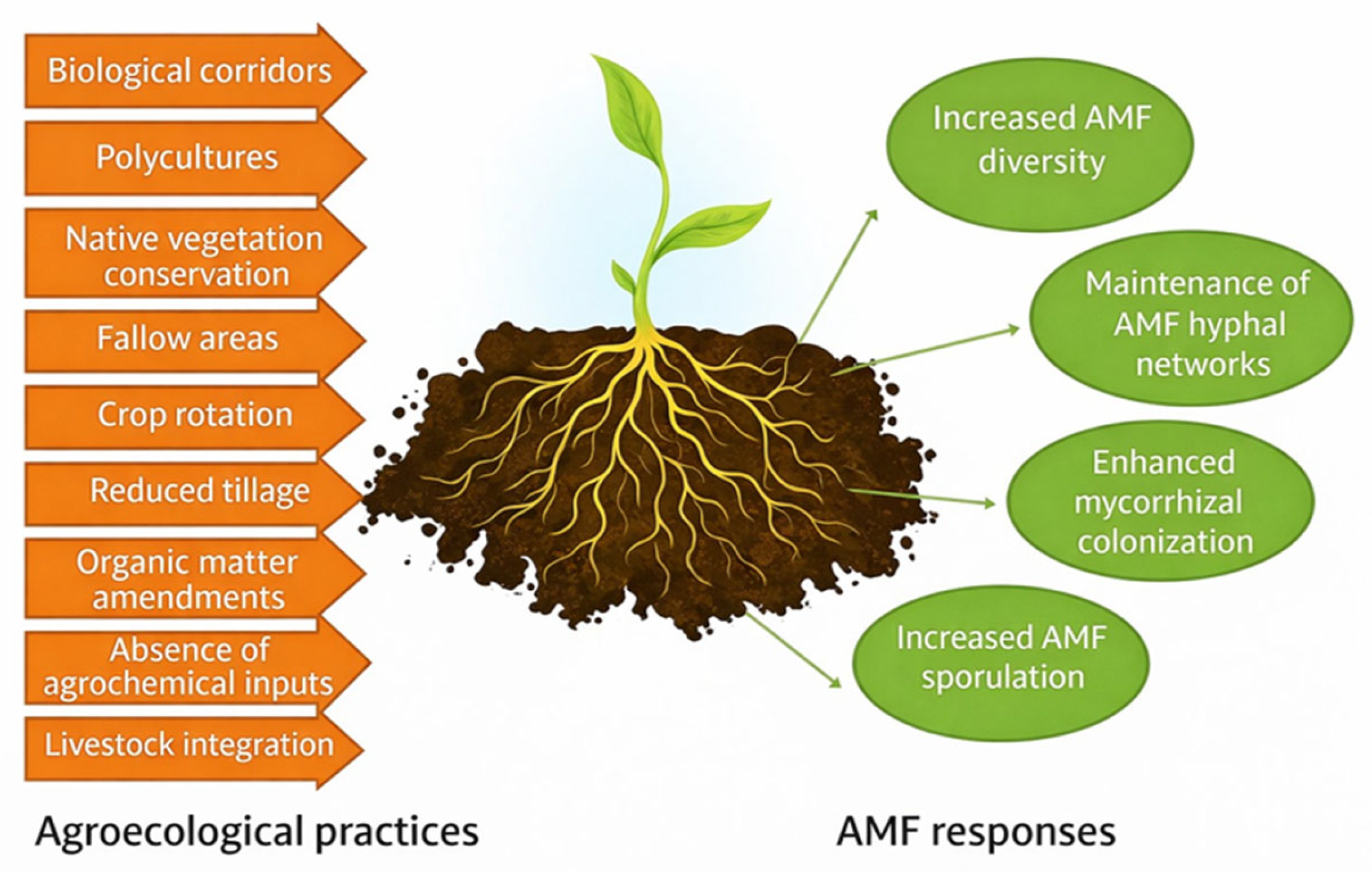
Figure 1. Direct and indirect effects of agroecological practices on arbuscular mycorrhizal fungi (AMF). Agroecological practices such as crop rotation, reduced tillage, organic amendments, and maintenance of native vegetation enhance AMF responses by increasing biodiversity, maintaining hyphal networks, promoting root colonization, and stimulating sporulation. These interactions illustrate how management decisions directly shape the functionality of AMF in agricultural soils, reinforcing their ecological role in sustainable farming systems.
Agronomy 16 00103 g001
Figure 2. Cohabitation Networks: Agroecology, Mycorrhizae, and Plural Knowledges. Concentric-layer model showing the interconnections between arbuscular mycorrhizal fungi (AMF), agroecological practices, and the socio-political and epistemic dimensions that frame their role in sustainable agriculture. The inner circle emphasizes AMF as ecological agents enhancing plant nutrition, stress resilience, and soil health. The second layer highlights agroecological practices (e.g., cover crops, reduced tillage, organic matter management) that sustain AMF diversity and agroecosystem resilience. The outer layers integrate socio-political conditions (land access, public policies, agricultural models) and plural knowledges (scientific, technical, local, and Indigenous), underscoring the need for cognitive justice and transdisciplinary approaches. Bidirectional arrows indicate mutual feedback and interdependence across layers.
Agronomy 16 00103 g002
Disclaimer/Publisher’s Note: The statements, opinions and data contained in all publications are solely those of the individual author(s) and contributor(s) and not of MDPI and/or the editor(s). MDPI and/or the editor(s) disclaim responsibility for any injury to people or property resulting from any ideas, methods, instructions or products referred to in the content.