1. Introduction
Soybean (
Glycine max (L.) Merrill) is one of the most important legumes in the world, valued for its high protein and fat content and its ability to affect crop yield biological nitrogen fixation (BNF) in symbiosis with
Bradyrhizobium japonicum [
1]. Due to its versatile use, soybean is a leader in the global agricultural economy as a major oilseed and important protein crop. Soybean has high thermal requirements, which is why it is not easy to obtain a satisfactory yield in temperate climates [
2]. However, recent years have seen an increase in interest in soybean cultivation in Central and Eastern Europe, including Poland, due to the need to increase domestic sources of plant protein, but also due to intensive breeding progress and progressive climate warming [
3].
The average soybean seed yield worldwide in 2023 was 2.7 t ha
−1. In countries with more favorable climatic conditions, such as the USA and Brazil, which are also the largest soybean producers, it reached 3.4 t ha
−1. In Poland, the average yield in 2023 was similar to the global value and amounted to 2.6 t·ha
−1 [
4]. Soybean productivity is highly dependent on weather conditions, especially temperature and precipitation during the growing season. The increase in average air temperature at this latitude is beneficial for thermophilic soybeans, but precipitation patterns are becoming increasingly unfavorable. As a result of climate change, many European countries, including Poland, are experiencing increasingly frequent periodic droughts, which cover large areas and cause significant losses in agricultural production [
5]. Soil water deficiency disrupts physiological and metabolic processes, leading to reduced plant growth, decreased stomatal conductance, inhibited photosynthesis, and accelerated leaf aging, and, consequently, it affects crop yield and quality [
6,
7].
The reduction in soybean productivity under drought conditions depends on the duration and intensity of stress and the phenological stage of the plants. Soybeans are particularly sensitive to water deficit during the generative phase, i.e., during flowering, pod setting, and seed filling. This is a critical period associated with increased water demand by plants; therefore, water shortage during this period can cause a significant reduction in seed yield [
8,
9]. Limited soil moisture also reduces the activity of
B. japonicum symbiotic bacteria and the efficiency of biological nitrogen fixation, leading to physiological disturbances and deterioration in the efficiency of assimilate utilization, and, consequently, a reduction in seed yield [
8,
10,
11,
12].
Nitrogen fertilization is one of the most important agrotechnical factors determining plant growth and yield. Nitrogen plays a key role in growth processes and in protein, chlorophyll, and enzyme synthesis, and its availability determines the efficiency of photosynthesis and biomass production. Thus, it has a decisive impact on both yield and quality [
13,
14,
15]. Soybeans assimilate large amounts of nitrogen, both in the vegetative and generative phases, and the total amount of N taken up is closely correlated with seed yield. Soybeans require approximately 70–90 kg of N per ton of seed [
16]. It meets its nitrogen requirements using biologically fixed nitrogen as well as nitrogen originating from the soil and from mineral fertilizers. With abundant nodulation, symbiotic bacteria can fix up to 100 kg N ha
−1, which can cover up to 60% of the plants’ demand for this element [
17]. The remainder should be supplemented with mineral nitrogen, whereby the application of an appropriate rate is crucial to maintain a balance between growth and the efficiency of BNF. Optimal rates of mineral nitrogen can stimulate early soybean development and increase leaf area, chlorophyll content, and photosynthetic activity. However, excessive nitrogen fertilization can lead to reduced nodule activity, decreased symbiosis efficiency, and disturbances in assimilate metabolism and accelerated leaf aging [
18].
An important factor in production that improves the technological and utility value of plants is breeding progress. New cultivars are generally characterized by higher yields, better quality traits, and greater resistance to environmental stresses [
19]. Genetic diversity between cultivars determines their ability to adapt to specific environmental conditions, their efficiency of water and nutrient use including nitrogen, and their resistance to abiotic stresses [
20]. Cultivars also differ in growth dynamics, length of growing season, plant architecture, and photosynthesis intensity, which can affect plant productivity and morphological and physiological parameters such as plant height, LAI, chlorophyll content in leaves, and PSII efficiency [
21].
Although soybean cultivation is increasing in temperate regions, there is limited knowledge on how cultivar-specific physiological responses and nitrogen fertilization jointly determine yield under variable water availability. Understanding the interaction between genetic factors, nitrogen fertilization, and weather conditions is crucial for optimizing the yield and physiological efficiency of soybeans in temperate climates. The aim of the study was to determine the effect of cultivar and nitrogen fertilization rate on selected morphological and physiological traits and the seed yield of soybeans grown under field conditions in central-eastern Poland. We hypothesized that (i) differences between cultivars would determine yield level and yield stability, and (ii) an additional nitrogen dose would significantly improve plant photosynthetic efficiency and positively affect plant productivity. This study provides new insights into optimizing soybean production in temperate climates by identifying cultivar–nitrogen combinations that maintain high physiological efficiency and stable yield under drought-prone conditions.
2. Materials and Methods
2.1. Experimental Site and Treatment Specifications
A strict two-year field experiment was conducted at the Experimental and Implementation Field of the Lublin Agricultural Advisory Center in Końskowola (Lubelskie voivodeship, 51°24′33″ N 22°03′06″ E). The experiment was established on loamy soil formed from loess, with a soil pHKCl ranging from 6.9 to 7.4. The content of available macronutrients ranged from (mg 100g−1 of soil) as fallows: P—9.0–19.2; K—8.6–18.7; Mg—10.3–11.5. The organic carbon content was 0.96–0.97%. The soil has loess origin and is classified in local soil maps as lessive soil. Available phosphorus (P2O5) was measured spectrophotometrically, and available potassium (K2O) was determined using flame atomic emission spectrometry, while magnesium (Mg) was analyzed by flame atomic absorption spectrometry. Organic carbon content was determined by titration (Tiurin method).
A two-factor experiment was set up in a split-plot design with four replicates, on plots with an area of 30 m2. The research factors were as follows. Nitrogen rate: 0 (control treatment, N0), 30 kg ha−1 (moderate rate, N30), 60 kg ha−1 (high rate, N60), and common soybean (Glycine max (L.) Merrill) cultivars: ‘Abelina’ (medium-early, MG 000), ‘Coraline’ (very late, MG 00), ‘Malaga’ (very late), and ‘Petrina’ (very late). The experiment was conducted under rainfed conditions, with no irrigation applied.
Pre-sowing phosphorus and potassium fertilization was carried out using the compound fertilizer YaraMila® Corn (7% N, 20% P2O5, 28% K2O) at a dose of 200 kg ha−1, which corresponded to the following amounts of pure nutrients (kg ha−1): N—14.0, P—17.4, K—46.5. Nitrogen fertilization corresponded to rates of 30 and 60 kg ha−1, with the 30 kg ha−1 rate applied pre-sowing, and the 60 kg ha−1 rate divided into two parts, with 50% applied pre-sowing and 50% top-dressing at BBCH 61 (beginning of flowering). No nitrogen was sown to the control treatment. Before sowing, the soybean seeds were treated with a seed dressing and inoculated with Nitragina containing B. japonicum bacteria, and sown at a rate of 70 seeds per 1 m2. Soybean was sown in early May. Weeds were controlled with a pre-emergence soil herbicide followed by a foliar herbicide application after emergence. Harvesting was performed when plants reached full maturity (BBCH 89), between mid- and late September in 2018 and between late September and early October in 2019, depending on cultivar maturity.
2.2. Agronomic and Physiological Traits
During the growing season, four developmental stages of soybean (BBCH 61: beginning of flowering, 65: full flowering, 70: beginning of pod setting, and 77: end of pod setting, beginning of seed filling) were assessed for chlorophyll fluorescence indices (Fv/Fm, PI), leaf area index (LAI), and leaf greenness index (SPAD). The Fv/Fm index, which determines the maximum quantum efficiency of photosystem II (PSII), and the PI, which describes the PSII performance index, were evaluated. Chlorophyll fluorescence indices are used to determine the efficiency of the photosynthetic apparatus and to assess the physiological condition of plants. Direct chlorophyll fluorescence measurements were performed using a PocketPEA fluorometer (Hansatech Instruments—WB, King’s Lynn, Norfolk, UK). The measurements were taken after 20 min of leaf adaptation in the dark, and the result from each plot was the average of 10 measurements.
LAI (leaf area index) measurements were performed using the LAI-2000 Plant Canopy Analyser (LI-COR Biosciences, Lincoln, NE, USA). This device determines the ratio of the total one-sided area of all leaves to the area of the ground surface they cover. The result from each plot was the average of 3 measurements.
Leaf greenness index (SPAD) measurements were performed using a SPAD-502 chlorophyll meter (Minolta Co., Osaka, Japan). The device measures the transmission of light passing through the leaf, where red light is absorbed by the chlorophyll. It records the differences in absorption at wavelengths of 650 and 950 nm, and the resulting ratio provides the SPAD value. The reading is proportional to the chlorophyll content in the measured 6 mm2 area of the leaf. The result from each plot was the average of 30 measurements.
Before harvesting, 10 plants were randomly selected from each plot to determine the biometric characteristics: plant height (cm), number of pods per plant, number of seeds per plant, and seed weight per plant (g). At full maturity, seed yield (t ha−1) at 14% moisture content and thousand-seed weight (TSW) (g) were determined.
2.3. Statistical Analysis
The collected research results were statistically analyzed using analysis of variance (ANOVA) for a three-factor system, in which the factors were soybean cultivar, nitrogen fertilization rate, and year of research. To compare the differences between means for the main factors and interactions, Tukey’s multiple range test (HSD) was used at a significance level of p ≤ 0.05. The assumptions of ANOVA (normality and homoscedasticity of residuals) were evaluated prior to the analyses and were met. The calculations were performed using Statgraphics Centurion XVI (version 16.1.11). In addition, Pearson’s correlation coefficients (r) were calculated between selected morphological, yield-related, and physiological traits to determine the relationships among the analyzed parameters.
2.4. Weather Conditions
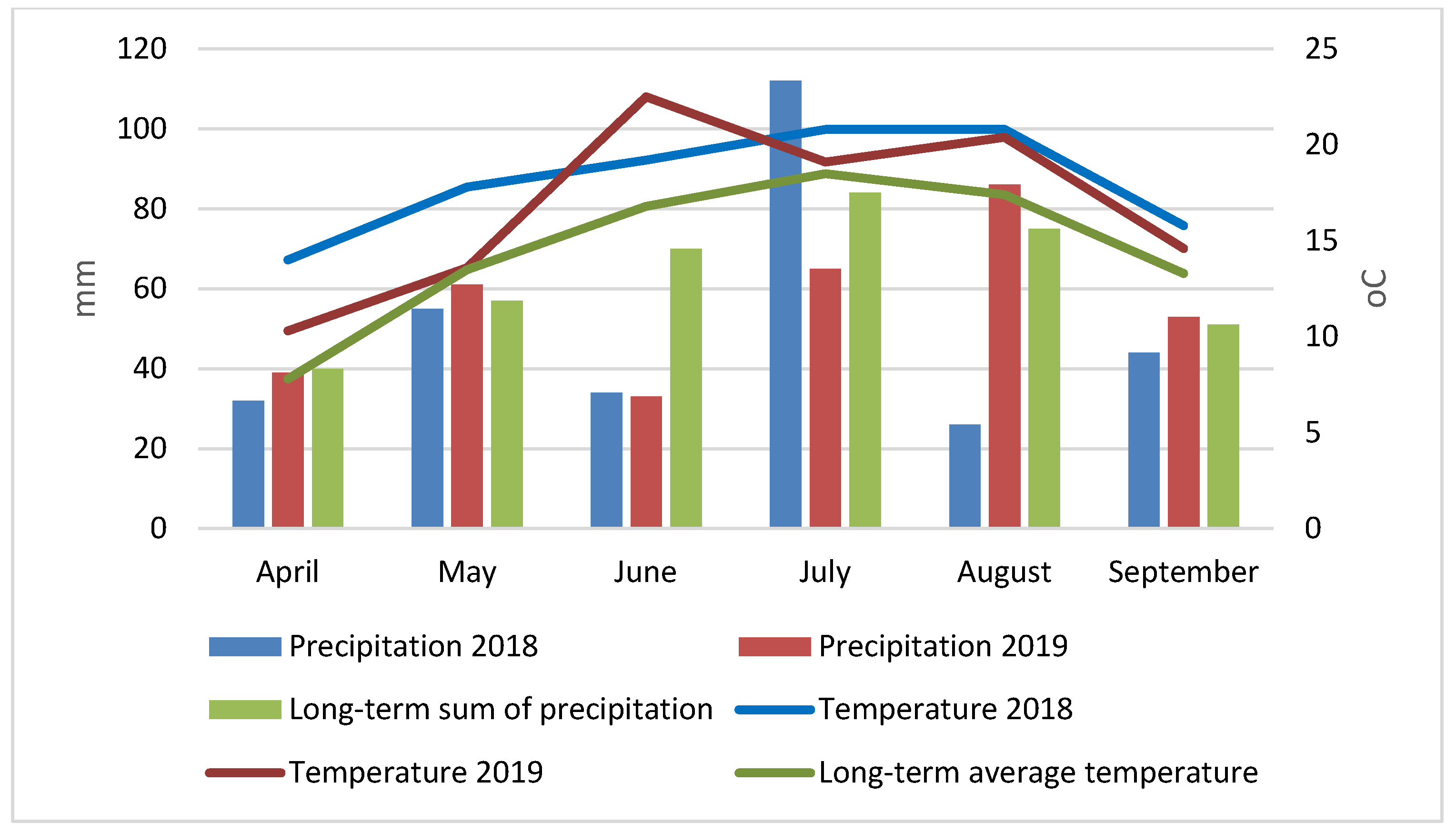
Weather conditions in two growing seasons are shown in
Figure 1. Meteorological data were obtained from the Końskowola meteorological station operated by the Institute of Meteorology and Water Management (IMGW-PIB).
Hydrothermal conditions were described using the Sielianinov hydrothermal index (k) [
22], calculated using the following formula:
where
P-monthly sum of precipitation (mm),
Ʃ t-sum of average daily temperatures in a given month >0 °C.
Sielianinov hydrothermal index for individual months of the two growing seasons are presented in
Table 1.
3. Results
3.1. Morphological and Physiological Characteristics of Soybean Plants
Weather conditions varied between the two growing seasons (
Figure 1). Analysis of thermal conditions showed that these years were exceptionally warm, with the average monthly air temperature in all months and both years being higher than the long-term average. In the first growing season (2018), April, May, and August were particularly warm, with temperatures 6.2, 4.3, and 3.4 °C higher than the long-term average, respectively. In the second season (2019), June and August were the warmest months, with temperatures 5.7 and 3.0 °C higher than the long-term averages, respectively).
The precipitation for the entire growing season (April–September) was lower in both years of the study, by 20% and 11%, respectively, compared to the long-term average. In the first growing season, substantial rainfall deficits were recorded in April, June, and August, with precipitation 20%, 51%, and 65% lower than the long-term average, respectively. In July, however, rainfall exceeded the long-term average by 33%. In the second season, the greatest precipitation deficits occurred in June and July (53% and 23% below the long-term average, respectively), while August received 15% more rainfall than usual.
The results of statistical analysis (ANOVA) indicate that both the genetic factor (cultivar) and nitrogen rate significantly affected plant height, canopy structure (LAI), relative chlorophyll content (SPAD index) and chlorophyll fluorescence indices: Fv/Fm—maximum quantum efficiency of PSII, and PI—the PSII performance index (
Table 2). A significant effect of year on all analyzed parameters was also demonstrated. The interaction between cultivar and fertilization was significant for all parameters except PI, and the interaction between cultivar and year was significant for all traits except LAI. The interaction between fertilization and years significantly affected the SPAD index and chlorophyll fluorescence parameters. A significant three-way interaction (cultivar × fertilization × year) was observed for the SPAD index and the maximum quantum efficiency of PSII (Fv/Fm).
Considering the average values, the tallest plants were observed in the ‘Caroline’ cultivar, while ‘Malaga’ showed the highest values of the SPAD index as well as the Fv/Fm and PI indices. Nitrogen-fertilized soybeans were significantly taller, and had higher SPAD values and lower chlorophyll fluorescence indices, compared with unfertilized plants. In addition, all parameters showed significantly higher values in the second year of the study than in the first.
In both years of the study, the tallest plants were recorded in the ‘Coraline’ cultivar, although in the second year their height did not differ significantly from that of ‘Malaga’ and ‘Petrina’ (
Table 3). In turn, the shortest plants in both years were recorded in ‘Abelina’, although its height did not differ significantly from that of ‘Petrina’ in the first year. The tested soybean cultivars differed significantly in terms of relative chlorophyll content in leaves in individual years of the study (
Table 4). All cultivars had significantly higher SPAD index values in the second year compared with the first. The highest SPAD index was noted for ‘Petrina’, although this value did not differ significantly from that of the SPAD index for ‘Malaga’ and ‘Abelina’. The lowest SPAD index was recorded for ‘Abelina’ and ‘Petrina’ in the first year of the study.
The nitrogen rate significantly affected the SPAD index only in the first year of the study, while in the second year, this index was significantly higher than in the first and did not depend on the nitrogen rate. Chlorophyll fluorescence indices depended significantly on both cultivar and nitrogen rate, but regardless of cultivar, their values were significantly higher in the second year compared with the first. The maximum quantum efficiency of PSII (Fv/Fm) had the lowest values in ‘Petrina’ and ‘Coraline’, while the PSII performance index (PI) showed the lowest values in ‘Petrina’ and ‘Abelina’. In the first year of the study, both chlorophyll fluorescence indices showed significantly higher values in treatment N0 compared with N30 and N60, while in the second year, the chlorophyll fluorescence indices did not differ significantly between treatments N0 and N30.
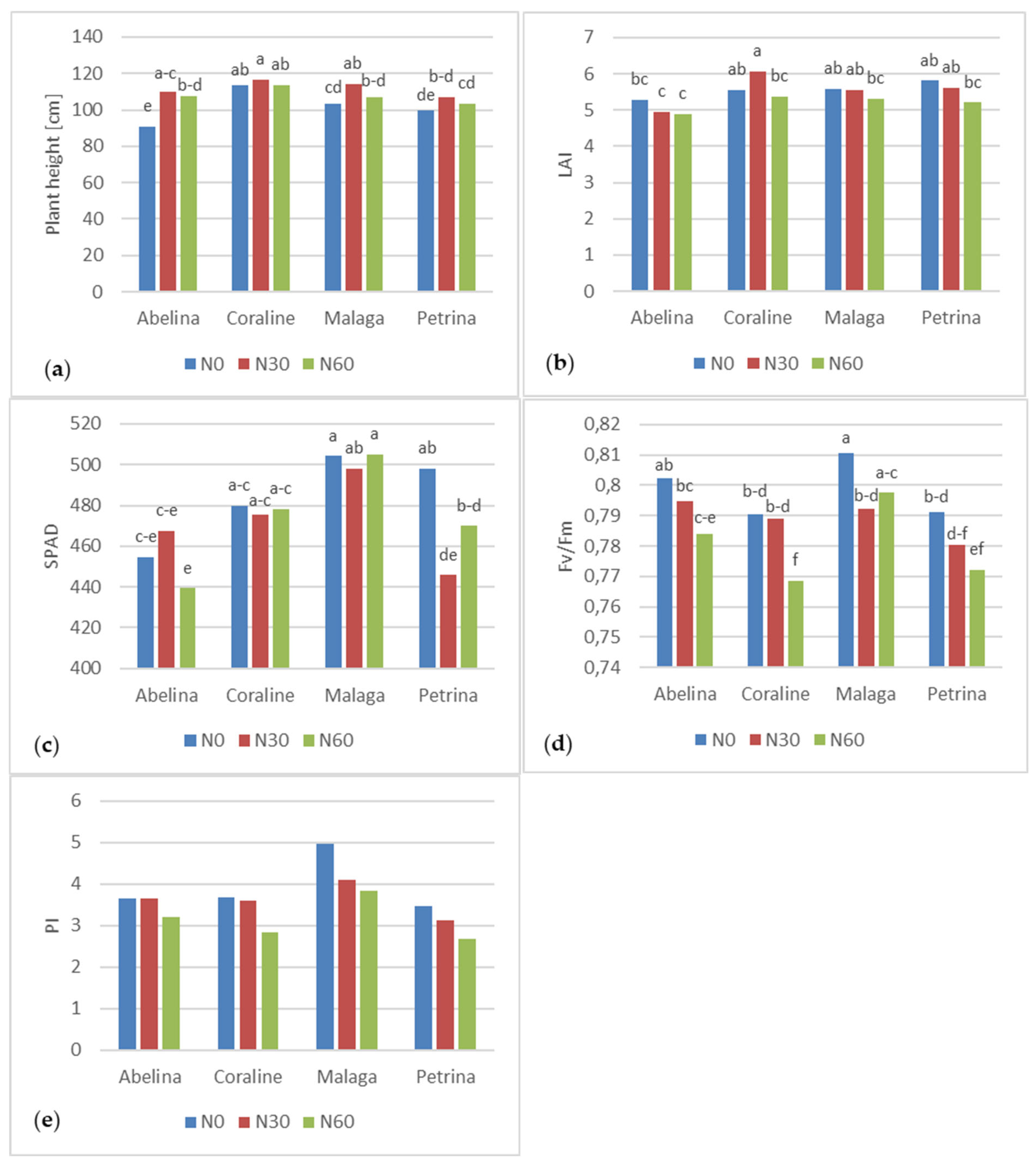
Analyzing the interaction of experimental factors, it was found that among the cultivars tested, ‘Abelina’ was significantly taller under nitrogen fertilization (N30 and N60), while ‘Malaga’ was taller after the application of a moderate N30 rate compared with the control N0 (
Figure 2a). The highest LAI values were observed in the ‘Coraline’ cultivar fertilized with nitrogen only before sowing (N30), while the lowest values of this index were recorded in ‘Abelina’, regardless of the N rate (
Figure 2b). In the case of the ‘Malaga’ and ‘Petrina’ cultivars, the nitrogen rate had no significant effect on LAI. Regardless of the N rate, the relative chlorophyll content in the leaves was highest in ‘Malaga’, while significantly lower SPAD values were recorded in ‘Abelina’ and in nitrogen-fertilized ‘Petrina’ (
Figure 2c). The maximum quantum efficiency of PSII (Fv/Fm) in all cultivars reached the highest values in the N0 treatment, but significant differences in ‘Abelina’, ‘Coraline’, and ‘Petrina’ were only observed in comparison with N60, and in ‘Malaga’ in comparison with N30 (
Figure 2d). The highest values of the PSII performance index (PI) were recorded in ‘Malaga’, and the lowest in ‘Petrina’, although the differences were not statistically significant (
Figure 2e).
3.2. Yield Performance and Yield Structure of Soybean
The results of statistical analysis (ANOVA) indicate that both the genetic factor and the nitrogen rate significantly affected soybean yield and thousand-seed weight (TSW), as well as yield structure elements such as number of pods, number of seeds, and seed weight per plant (
Table 5). A significant effect of year on the parameters studied was also demonstrated, with the exception of seed weight per plant. The interaction between cultivar and year was significant for all parameters, while the interaction between cultivar and fertilization, and between fertilization and year, was significant for all parameters except TSW. A significant three-way interaction (cultivar × fertilization × year) was found for all parameters except seed weight per plant. Taking into account the average values, the best-yielding cultivar was ‘Malaga’ (5.06 t ha
−1), which also had the highest TSW (230 g), while the lowest yield (4.25 t ha
−1) and lowest TSW (170 g) was observed in ‘Abelina’, which also produced the lowest number of pods and seeds and the lowest seed weight per plant. A significantly higher yield was obtained in nitrogen-fertilized treatment compared to the control, although the N rate did not significantly affect the seed yield of the cultivars. In addition, in the first year of the study, a significantly higher yield was obtained, which was associated with a significantly higher number of pods and seeds per plant, while the TSW was significantly lower.
In both years of the study, ‘Malaga’ was the best-yielding cultivar, while ‘Abelina’ was the weakest, although in the second year, its yield did not differ significantly from that of ‘Malaga’ (
Table 6). In the first year of the study, the yield of nitrogen-fertilized soybeans (N30, N60) was significantly higher than in the control (N0), with no significant difference between N30 and N60, and only a tendency for higher yield at higher N rates. In the second year, soybean yield was similar across all treatments. In both years, ‘Malaga’ had the highest TSW, which was significantly higher than in the other cultivars. The lowest TSW was recorded for ‘Abelina’ in the second year. The N rate did not significantly differentiate this parameter in either year of the study.
‘Coraline’ produced the highest number of pods and seeds per plant in the first year, with no significant difference compared with ‘Petrina’ in the second year (
Table 7). In both years, seed weight per plant was significantly lower in ‘Abelina’ than in the other cultivars. Furthermore, in the first year of the study, soybean fertilized with the higher rate of nitrogen (N60) had a significantly higher number of pods and seeds per plant compared with N0 and N30, as well as the highest seed weight per plant, while in the second year, the values of these parameters did not differ significantly among treatments.
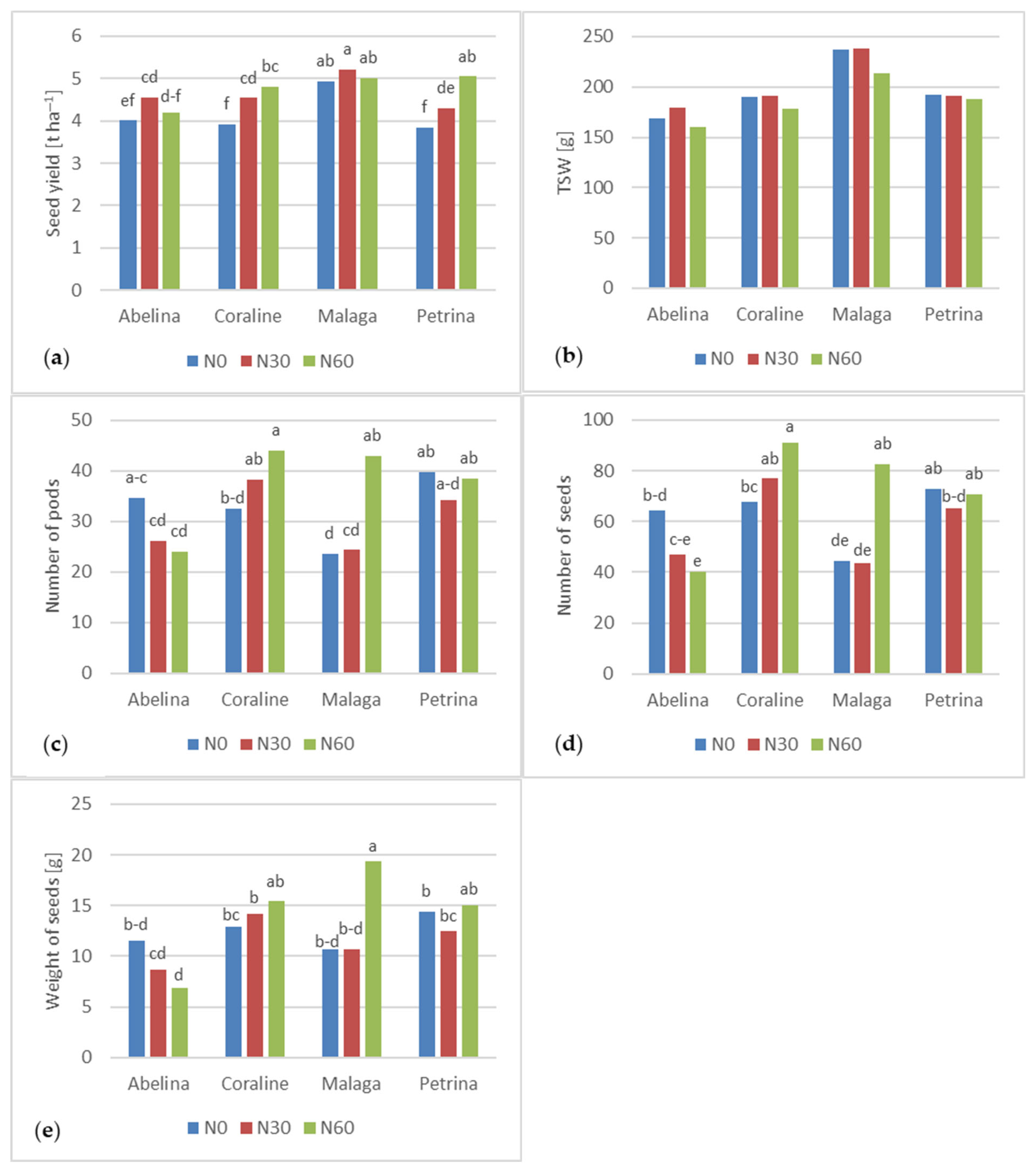
The interaction between fertilization and cultivar significantly influenced soybean seed yield and yield components, i.e., the number of pods and seeds per plant and seed weight per plant (
Figure 3). Regardless of the fertilization rate, ‘Malaga’ was the highest-yielding cultivar (
Figure 3a). On the N0 and N30 treatments, ‘Malaga’ yielded significantly higher than all other cultivars, while on the N60 treatment, its yield was significantly higher only compared with ‘Abelina’. Regardless of nitrogen rate, ‘Malaga’ developed the highest TSW, although the interaction between fertilization and cultivar for this trait was not statistically significant (
Figure 3b). ‘Coraline’ produced the highest number of pods and seeds per plant under the N60 treatment, although this value was significantly higher only compared with ‘Abelina’ (
Figure 3c,d). Under the moderate nitrogen rate (N30), ‘Coraline’ and ‘Petrina’ produced significantly more pods and seeds compared with ‘Abelina’ and ‘Malaga’, while under N0, ‘Malaga’ produced significantly fewer pods and seeds than other cultivars. The weight of seeds per plant was highest in ‘Malaga’ fertilized with the higher nitrogen rate (N60), and this value was significantly higher compared with ‘Abelina’ at the same rate (
Figure 3e). Under the moderate nitrogen rate (N30), significantly lower seed weight was recorded in ‘Abelina’ compared with the other cultivars, while under the control treatment (N0), no statistically significant differences were observed.
3.3. Correlation Analysis Among the Analyzed Traits
The analysis of the interdependence between the studied plant traits is presented in
Table 8. A varied direction and strength of correlation between yield, yield parameters, and physiological indicators was observed. Soybean seed yield was positively and significantly correlated with the thousand-seed weight (r = 0.31;
p < 0.05) and with the weight of seed per plant (r = 0.31;
p < 0.05). A positive, although statistically insignificant, correlation was also found between yield and plant height, as well as the number of pods and seeds per plant. A negative, statistically significant correlation was found between yield and LAI (r = −0.30;
p < 0.05). Strong positive correlations were also observed between LAI and Fv/Fm, and PI and SPAD indices, as well as between TSW and Fv/Fm, and PI and SPAD indices. In turn, correlations between yield and chlorophyll fluorescence indices (Fv/Fm, PI) were negative but weak and statistically insignificant.
4. Discussion
The success of soybean cultivation in Poland depends on many factors, but one of the most important is the weather conditions during the growing season [
9,
23]. During the years of research, plant growth and development were shaped by variable temperature and humidity conditions, which was reflected in the diversity of morphological and physiological traits and the level of soybean yield. The first year of the study was characterized by a high average air temperature during the growing season (18.1 °C) and low total precipitation (303 mm), which indicates water stress during the vegetative phase and the beginning of soybean flowering (May–June) and pod filling (August–September). In the second year of the study, the average air temperature during the growing season (16.8 °C) was higher than the long-term average (14.6 °C), and the total precipitation (337 mm) was below the long-term average (377 mm), but the distribution of precipitation was more even. The greatest water shortages occurred during the critical phase of soybean flowering and pod setting (June–July).
Soybean yields were significantly higher in the first year (by an average of 12.7%) compared to the second year. Soybeans have moderate water requirements and tolerate short periods of drought relatively well, as they are genetically adapted to such conditions. They develop a strong root system and pubescence on leaves and stems, which reduces transpiration, and they also exhibit heliotropism, which involves the vertical positioning of leaves in conditions of high temperatures and water shortages, limiting leaf heating and excessive transpiration. This is confirmed by the research of Tabrizi et al. [
24], which showed that reducing soybean irrigation by 25% compared with optimally irrigated controls allowed yields to be maintained at a stable level of around 90%.
The reduction in soybean productivity due to soil water deficiency depends on the duration and severity of drought and the phenological stage of the plants [
7,
25,
26]. Soybeans do not tolerate prolonged water shortages during critical periods, especially during flowering and pod set [
8]. The lack of moisture during this period causes the rejection of flowers and young pods, resulting in a reduced number of pods and seeds set [
27,
28]. This is confirmed by the studies of Eck et al. [
29] which showed that prolonged stress imposed on plants from the beginning of flowering to the end of pod development reduced soybean seed yield more markedly (by 45%) compared with stress occurring in earlier stages of development. A smaller reduction in yield was recorded when the stress was short-term and occurred between the beginning and full flowering and the beginning of pod development (by 9–13%). In addition, drought during the summer months, combined with high temperatures, leads to faster soybean maturation and a shorter flowering and pod filling phase [
30].
In our own studies, the first growing season was more deficient in rainfall, but the dry periods occurred mainly at the beginning (June) and at the end of the growing season (August–September), while the critical period, which falls during flowering and pod setting (July), was moderately humid. This allowed the formation of a larger number of pods and a significantly higher seed yield compared with the yield in the second season. In contrast, water shortages during the vegetative phases of soybean contributed to a significant reduction in plant height (by 5.3% on average), leaf area index (by 29.1% on average), and relative chlorophyll content in leaves (by 24.7% on average), and a decrease in photosynthetic activity expressed by chlorophyll fluorescence indices Fv/Fm and PI (by 9.5 and 58.2%, respectively). Low rainfall at the end of the growing season also resulted in a significantly lower TSW (by 5.3% on average). Higher values of these parameters were obtained in the second year of the study, when air temperatures were lower and rainfall distribution during the growing season was more even. The PI proved highly sensitive to water stress. In 2018, lower and less regular rainfall caused a more than 50% decrease in PI compared with 2019, indicating a disruption in PSII. This resulted in reduced CO
2 assimilation and decreased assimilate production for pod and seed development. This explains why in 2018, despite favorable conditions during flowering, reduced rainfall in June and August likely contributed to lower TSW and lower overall photochemical efficiency. The reduction in morphological and physiological parameters under drought conditions is associated with a decrease in the intensity and disruption of the photosynthesis process, which weakens biomass accumulation and its translocation to seeds. This is confirmed by the results of studies by various authors [
7,
8,
28,
30].
One of the main factors determining the growth, development, and yield of soybeans is the genotype [
31,
32]. The results of our research showed that the soybean cultivars studied differed significantly in terms of the analyzed traits. The very late cultivar ‘Coraline’ stood out with the greatest plant height, while the highest physiological parameters (SPAD index, Fv/Fm, and PI) were found in the very late cultivar ‘Malaga’, which may indicate its greater adaptability to stressful conditions associated with soil water deficiencies. The high values of physiological parameters translated into good productivity of the ‘Malaga’ cultivar, whose average seed yield was significantly higher than that of the other cultivars, by 14.5–19.0% depending on the cultivar. In addition, ‘Malaga’ was characterized by seeds with the highest TSW. Among the cultivars tested, the medium-early ‘Abelina’ had the lowest yield, and was also the shortest in height, showing the lowest SPAD and LAI values. Leaf area index (LAI) was one of the most important indicators characterizing yield structure. In our study, LAI was positively correlated with Fv/Fm, PI, and SPAD, but negatively correlated with seed yield, suggesting that excessive vegetative development may compete with reproductive growth (pod and seed number). This is consistent with [
33], where researchers showed that maximum soybean seed yield is achieved with a LAI of 3.5–4.0 from full flowering to the onset of pod formation. When LAI exceeds the optimum, assimilate partitioning shifts toward vegetative organs at the expense of pod formation. In our study, although LAI was higher in 2019 than in 2018, the number of pods and seeds per plant was lower in 2019, indicating that greater leaf area did not translate into better productivity. Therefore, differences in yield between cultivars appear to be more strongly related to photosynthetic efficiency (SPAD, Fv/Fm, PI) than to the aboveground biomass itself.
The genetic potential of soybean cultivars largely depends on their earliness class. Cultivars with a long growing season generally yield better than earlier cultivars because they have more time to grow, develop assimilation organs, and produce yield. This contributes to the development of a larger leaf area and longer photosynthetic activity, which affects biomass growth and seed yield. This is confirmed by the results of our study. Among the cultivars tested, the late-season ‘Malaga’ demonstrated the highest physiological resilience. It maintained the highest SPAD, Fv/Fm, and PI values in both years, indicating better PSII protection and greater nitrogen-use efficiency under stress conditions. These mechanisms likely supported stable assimilate production and contributed to its highest number of seeds per plant and the highest thousand-seed weight (TSW). In contrast, the medium-season cultivar ‘Abelina’ showed the lowest SPAD values and the strongest decline in PI, which corresponded to its lowest yield. In previous studies, Staniak et al. [
34] showed that among the 15 genotypes studied, late and very late cultivars yielded on average 22.5% more, and medium-early cultivars 20.0% more, than early and very early cultivars. Significant differences were also found within individual groups. This is confirmed by the research of Prusiński et al. [
35], which showed that the very early cultivar ‘Annushka’ had a significantly higher seed yield, plant height, lowest pod height, and thousand-seed weight compared with the early cultivar ‘Aldana’.
Nitrogen fertilization had a significant effect on plant growth, physiological parameters, and, consequently, seed yield and its structural elements. Soybeans fertilized with rates of 30 and 60 kg N ha
−1 were significantly taller and had a higher SPAD index compared with the control treatment, which confirms the positive effect of nitrogen on chlorophyll synthesis and photosynthetic activity. At the same time, a decrease in chlorophyll fluorescence indices (Fv/Fm and PI) was observed after the application of higher N rates (N60), which may indicate a reduction in PSII efficiency with greater availability of mineral nitrogen. For most plants, the Fv/Fm parameter is considered the most sensitive indicator for determining the efficiency of the photosynthetic apparatus, although it is highly dependent on environmental factors [
36]. The limited effect of nitrogen fertilization observed in our study can be explained by weather conditions and physiological factors. Periodic droughts in both study years likely limited mineral nitrogen uptake from the soil, resulting in plants relying to a greater extent on biologically fixed nitrogen (BNF). Favorable soil conditions, including optimal soil pH and seed inoculation prior to sowing, favorably influenced soybean nodulation and BNF levels. This may partially explain why additional N did not increase yields. Recent studies conducted in temperate regions indicate that soybean exhibits a weak response to mineral N when symbiosis with
B. japonicum is effective and soil N content is adequate [
37,
38]. According to Kaschuk et al. [
18], soybeans relying on BNF athrough symbiosis with
B. japonicum show higher photosynthetic activity and slower leaf aging compared with plants fertilized exclusively with mineral nitrogen. The use of the higher nitrogen rates (N60) in our study may therefore indicate a reduction in PSII activity due to a decreased contribution of BNF. These results confirm that excessive mineral nitrogen fertilization, despite its positive effect on plant growth and leaf greenness index (SPAD), may not be conducive to maintaining high photosynthetic activity, especially in the later stages of development. In contrast, moderate fertilization (N30) improved the physiological condition of plants (high SPAD values) without a significant decrease in PSII efficiency, indicating a more balanced use of mineral and symbiotic nitrogen.
The effect of nitrogen was also evident in the formation of yield components. The application of a higher rate of nitrogen (N60) significantly increased the number of pods per plant and the number and weight of seeds, but did not result in a proportional increase in yield. This was probably due to a reduction in the TSW, which was significantly higher in the control treatment (N0) and under moderate fertilization (N30). This phenomenon may indicate compensation among yield components, as the increase in the number of seeds occurred at the expense of their individual weight. Similar relationships were observed by other authors [
37,
38,
39], who found that moderate nitrogen fertilizations (30 kg N ha
−1) improved the vegetative parameters of soybeans without significantly increasing seed yield. The results obtained indicate that moderate nitrogen fertilization (N30) is more beneficial for maintaining the balance between vegetative growth and soybean productivity.
5. Conclusions
Soybean growth, physiological activity, and yield varied significantly depending on the cultivar, nitrogen rate, and weather conditions. The late-season cultivar ‘Malaga’ exhibited the highest physiological efficiency, as reflected by the consistently elevated SPAD, Fv/Fm, and PI values, and achieved the highest seed yield and TSW, while the medium-season ‘Abelina’ proved most sensitive to water stress, showing the lowest SPAD values and the strongest decline in PI, which corresponded with its lowest yield. Nitrogen fertilization increased plant height and the relative chlorophyll content in leaves, but a higher rate (60 kg N ha−1) reduced the chlorophyll fluorescence parameters, indicating lower photosynthetic efficiency. A moderate rate (30 kg N ha−1) proved most beneficial, improving physiological traits without impairing PSII activity, and did not reduce yield. Overall, the selection of a suitable cultivar, in combination with moderate nitrogen fertilization, can increase physiological efficiency and promote soybean yield stability under variable environmental conditions. Further research should focus on better understanding the mechanisms responsible for the physiological efficiency and productivity of soybeans under different habitat conditions.