Article

Phenotypic Evaluation and Genome-Wide Association Analysis of Cold Tolerance at Seedling Stage in Maize

1
College of Biosciences and Biotechnology, Shenyang Agricultural University, Shenyang 110161, China
2
Department of Superior School Engineering, University of Almería, 04120 Almería, Spain
3
Jilin Academy of Agricultural Sciences (Northeast Agricultural Research Center of China), Changchun 130033, China
4
Hulunbuir Institute of Agriculture and Animal Husbandry, Hulunbuir 021008, China
5
College of Life Sciences, Tianjin Normal University, Tianjin 300387, China
*
Authors to whom correspondence should be addressed.
These authors contributed equally to this work.
Agronomy 2025, 15(12), 2842; https://doi.org/10.3390/agronomy15122842
Submission received: 31 October 2025 / Revised: 26 November 2025 / Accepted: 1 December 2025 / Published: 11 December 2025
(This article belongs to the Special Issue Cold Stress Physiology and Adaptation Strategies in Crop Species)

Abstract

Low temperature exerts severe adverse effects on maize growth, particularly during the seedling stage. Screening for cold-tolerant maize genotypes is highly significant for identifying genes associated with cold tolerance and enhancing maize performance under low, suboptimal temperature conditions. The identification of representative cold tolerance-related genes is of great significance for the breeding of cold-resistant maize varieties. In this study, a diversity panel of 205 materials was evaluated and classified for cold tolerance at the seedling stage. The coefficients of variation of all materials ranged from 14.53% to 35.71%, reflecting considerable genetic diversity within the panel. The correlation coefficients for each phenotypic trait between the cold-treated (CT) and control (CK) maize materials ranged from 0.60 to 0.90, further indicating that all traits displayed varying degrees of sensitivity to cold stress. A comprehensive evaluation of cold tolerance using the D value was conducted. The D values of all materials ranged from 0.355 to 0.863, with a mean value of 0.64. A hierarchical clustering analysis was performed to classify all materials into five categories based on their cold tolerance. Further, 17 SNPs were identified using GWAS analysis, and 12 candidate genes were located within the regions related to the SNPs. Some candidate genes were closely associated with cold tolerance, such as genes encoding MYB and GRAS transcription factors, leucine-rich repeat (LRR) proteins, and protein kinases. Validation by qRT-PCR confirmed that the expression of some genes was induced under cold stress conditions. These findings lay a crucial foundation for breeding cold-tolerant maize varieties and for further exploration of genes associated with cold tolerance.

1. Introduction

Maize (Zea mays L.) is one of the most significant C4 crop species globally and serves as an economically vital food crop. As a thermophilic, short-day plant, maize is particularly susceptible to cold stress, especially during the early seedling stage [1,2]. The optimal temperature range for maize growth is between 22 °C and 28 °C. However, when temperatures drop below 15 °C, the growth rate of maize begins to decelerate, and at temperatures between 6 °C and 8 °C, maize seed germination is substantially inhibited [3]. The adverse effects directly restrict the growth and development of maize, thereby significantly reducing crop yield. In agricultural production, enhancing the cold tolerance of maize and breeding varieties with strong chilling resistance represents the most effective strategy to mitigate cold-induced damage and minimize yield losses [4].
Cold tolerance is a highly complex quantitative trait, controlled by multiple genes and closely associated with various environmental factors [5]. It is challenging to accurately evaluate cold tolerance using a single index. Employing multiple evaluation metrics enables a more accurate assessment of cold tolerance [6]. Evaluating cold tolerance in maize necessitates a comprehensive approach that integrates phenotypic screening with physiological and biochemical analyses to capture the complexity of this polygenic trait. Phenotypic indicators, including germination rate, seedling survival rate, and growth parameters, such as plant height, root length, and biomass accumulation under low-temperature stress, are widely employed as primary indicators. These agronomic traits provide direct insight into a plant’s performance in suboptimal temperatures [4,7]. At the physiological level, measurements such as relative electrical conductivity and photosynthetic efficiency are frequently utilized to assess membrane integrity and photoinhibition under cold stress. Biochemically, the accumulation of reactive oxygen species (ROS), alongside the activity of antioxidant enzymes including superoxide dismutase (SOD), peroxidase (POD), and catalase (CAT), serves as a critical marker of oxidative stress response [8]. Integrating these multi-dimensional metrics not only improves the accuracy of cold tolerance evaluation but also enhances the selection of resilient genotypes in breeding programs. The ratio of stress-to-control condition values for each indicator is commonly adopted to standardize comparisons across studies and environments.
In modern agricultural research, genome-wide association studies (GWASs) have been extensively utilized in research experiments on plant genetic control and breeding traits [9,10]. Maize is considered an ideal species for conducting GWASs due to its genetic variability, distinct subpopulations, availability of SNP information, and rapid linkage disequilibrium decay [11,12,13,14]. GWASs have emerged as a pivotal tool, leveraging natural genetic diversity in association panels to identify quantitative trait nucleotides (QTNs) linked to complex traits such as cold tolerance. Recent advances highlight the power of GWASs in uncovering key loci and mechanistic pathways. For instance, 10 cold tolerance indexes were examined to evaluate the cold tolerance of maize inbred lines, resulting in the detection of 43 SNPs and the prediction of 40 candidate genes by GWAS analysis [15]. Using a population of 50 maize inbred lines, the number of grains per row was analyzed, ultimately identifying four SNP loci significantly associated with this yield trait [16]. More recently, a GWAS was performed on 205 maize inbred lines, evaluating cold-induced leaf damage, identifying COOL1 (3q22.1) as a negative regulator of cold tolerance [17]. A natural promoter variant in COOL1 alters HY5 transcription factor binding affinity, suppressing its expression. The cold-tolerant COOL1-HapA allele predominates in high-latitude germplasms, enabling adaptation via the attenuated repression of downstream genes like DREB1 and TPS. Similarly, a GWAS of 304 inbred lines at the germination stage pinpointed ZmBARK1 (Chr4 bin 4.09) as a negative regulator of low-temperature germination. EMS mutants (zmbark1) exhibited enhanced low-temperature germination, implicating brassinosteroid signaling in cold response [18]. Although GWAS technology has been widely applied to maize cold-tolerance gene mining, for complex quantitative traits, more phenotypic assessments of association panels and continued efforts to uncover cold resistance loci remain imperative.
In the present study, a total of 205 inbred lines collected from diverse geographical regions worldwide were utilized to establish a maize association panel that exhibited diverse genetic backgrounds, including NSS (Non-Stiff Stalk), SS (Stiff Stalk), TST (Tropical/Subtropical), and Mixed subgroups. The study aimed to statistically analyze data on cold tolerance traits at the seedling stage in the maize association panel, thereby elucidating the complex relationships among various phenotypic characteristics. Furthermore, GWASs were conducted on five cold tolerance-related traits at the seedling stage using the maize association panel. This analysis enabled the identification of significant single-nucleotide polymorphisms (SNPs) associated with seedling cold tolerance and the selection of candidate genes. Preliminary functional characterization was further carried out to validate the roles of several candidate genes under cold stress. This study not only enhances our understanding of the genetic architecture underlying cold tolerance but also provides valuable molecular markers and candidate genes for breeding cold-resilient maize varieties.

2. Materials and Methods

2.1. Plant Materials

The diverse association panel consisted of 3 subgroups and 1 MIXED group, comprising a total of 205 accessions. The three subgroups were designated as Stiff Stalk (SS), Non-Stiff Stalk (NSS), and Tropical/Subtropical (TST). The SS subgroup comprised 15 maize inbred lines, the Non-Stiff Stalk (NSS) subgroup contained 58, and the Tropical/Subtropical (TST) subgroup consisted of 86. Materials not classified into these three subgroups were designated as the MIXED subgroup, totaling 46 accessions. Among the 205 maize inbred lines, 88 comprised a core set of Chinese origin, 86 were derived from the International Maize and Wheat Improvement Center (CIMMYT), and the remaining 31 were contributed by the Germplasm Enhancement of Maize (GEM) project, a U.S.-based germplasm innovation initiative. A portion of these lines, introduced from the International Maize and Wheat Improvement Center (CIMMYT), primarily represent subtropical or tropical adaptations, whereas those of China (CHN) and America (U.S.) origin largely represent temperate germplasm. This diverse composition reflects substantial ancestral connections and considerable genetic variability within the population. The population genetic structure was analyzed by STRUCTURE 2.3.4 software.

2.2. Evaluation of Cold Tolerance

Leaf relative electrical conductivity (REC), seedling plant height (PH), root length (RL), shoot fresh weight (FW), and shoot dry weight (DW) were used as indicators for assessing cold tolerance at the seedling stage. The maize genotypes were grown in pots (diameter 10 cm, height 10.8 cm) containing substrate soil and maintained in a greenhouse for two weeks under controlled conditions: a temperature of 28 °C, photosynthetic photon flux density of 300–320 μmol·m−2·s−1, 16/8 h light/dark cycle, and 60% relative humidity. All pots were irrigated equally after every two or four days during the experiment. Upon reaching the three-leaf stage, half of the seedlings were subjected to cold conditions (CT) at 4 °C under identical light and photoperiod conditions, while the other half remained at 28 °C as the control group (CK). After four days of treatment, five plants were randomly selected from each pot and pooled to constitute a single biological replicate. Each treatment comprised three biological replicates (5 plants × 3 reps = 15 seedlings per genotype per treatment) for phenotypic evaluation. The relative electrical conductivity (REC) was determined following the procedure described by [18]. Plant height (PH) and root length (RL) were measured directly using a ruler and recorded in centimeters. Shoots were rinsed with distilled water, gently blotted dry with absorbent paper to remove surface moisture, and then weighed to obtain fresh weight (FW). For shoot dry weight (DW) measurement, shoots were first heated at 105 °C for 15 min and then dried at 60 °C until a constant weight was achieved. Leaf samples were collected, flash-frozen in liquid nitrogen, and stored at −80 °C for subsequent analysis.
A paired treatment t-test was employed to determine the significance of mean differences between each index under the cold treatment (CT) and control (CK) conditions. Considering the biological differences among the different maize genotypes, the cold tolerance coefficient (CC) was used. The CC for each individual index was calculated as CC   =   LT   CK   ×   100 % . The membership function value was calculated as μ ( CC i )   =   CC i     min ( CC ) max CC     min ( CC ) . μ CC i indicates the membership function value of each index of each genotype; CC i , max (CC), and min (CC) represent the cold tolerance coefficient of the i -th index and the maximum and minimum cold tolerance coefficient of the i -th index, respectively. Principal component analysis was performed on each individual index, and a principal component ( PC j ,   j = 1, 2 … n) with eigenvalue ( λ j , j = 1, 2 … n) > 1 was selected as the new index. PC j   is the   j -th principal component. The weight coefficient was calculated as   ω j   =   PCj j = 1 n PCj ( j = 1, 2 … n). Pj represents the proportion of variance explained by the j -th principal component. The D value was calculated as D   =   i = 1 n [ μ ( CC i )   ×   ω j ] ( i = 1, 2 … n; j = 1, 2 … n).
After data processing, parameters such as the standard deviation and peak values of each trait were calculated using SPSS 22.0 software to assess the conformity of the traits to a continuous normal distribution. Additionally, SPSS was used to analyze the phenotypic differences among the subgroups under cold stress.
A variance analysis and the best unbiased linear predictive (BLUP) value calculation of cold tolerance-related properties were performed using the following linear mixed model in the lme4 package of META-R (multi-environment trial analysis in R) software [19]: Y i j k = μ + E n v i + R e p j E n v i + G e n l + E n v i × G e n l + ε i j k l , where Yijk is the cold tolerance-related properties of interest, µ is the mean effect, Envi is the effect of the ith environment, Repj (Envi) is the effect of the jth replicate within the ith environment, Genl is the effect of the lth genotype, Envi × Genl is the environment × genotype interaction, and εijk is the error. In the above equation, there was no Envi × Genl term in individual environment analysis [20,21].

2.3. Genotype Data and GWAS Analysis

The BLUP values were used for the GWAS analysis in combination with a published maize genotype with 513,641 SNP markers. The genotype can be downloaded from http://www.maizego.org/Resources.html (accessed on 30 November 2025), and it was combined with the 50 K SNP array, 600 K SNP array, RNA-Seq, and genotyping by sequencing into a whole genetic map [12].
The high-quality SNPs obtained from GWASs were further screened based on the quality control (QC) (minor allelic frequencies (MAFs) less than 0.05 and missing data more than 20%), resulting in a final selection of 95,742 SNPs. Linkage disequilibrium (LD) analysis confirmed that R2 < 0.2 to ensure independence among SNP loci for subsequent analysis of the genetic basis of all traits. GWAS analysis was performed using the mixed linear model in the Tassel 5.0 software, with an empirical threshold of p = 10−5 [22].
The contribution of SNPs to the phenotypic variance was estimated using anova function in the R software package. After adjustment for population structure effects, the R2 of each significant SNP was calculated using two linear models: Y = X i α i + P β + ε , which was used to estimate the total variance of all significant SNPs, and Y = X α + P β + ε , which was used to estimate the variance of individual significant SNPs (Table S3). In these equations, Y and X represent phenotype and SNP genotype vectors, respectively; P is the matrix of four subpopulations; α is the SNP effect; β is the subpopulation effects; and ε is the random effects.

2.4. Candidate Gene Prediction

Based on the GWAS results, we identified the physical positions of single-nucleotide polymorphisms (SNPs) significantly associated with the phenotypic traits of interest. Using the B73 maize reference genome version 2 (maizegdb.org), we mapped the trait-associated SNPs to their genomic locations. Based on linkage disequilibrium (LD) analysis, SNP sites on the same chromosome exhibited linkage disequilibrium (LD) values in the range of 0.5 < R2 < 1. Using these results, candidate regions for gene identification were defined by extending 50 kb upstream and downstream from each significantly associated SNP site, providing the basis for further functional analysis of trait-associated genes.

2.5. Qrt-Pcr Verification

B73 genotypes were planted in pots containing substrate soil and maintained in a greenhouse for two weeks until the three leaf stage. Growth conditions were set at 28 °C, with a 16 h light/8 h dark photoperiod and 60% relative humidity. Then, seedlings were subjected to cold treatment (CT) at 4 °C for 0, 2, 6, 12, 24, 48, and 72 h. Subsequently, The leaves of corn seedlings after cold treatment were sampled with liquid nitrogen and stored at −80 °C for subsequent RNA extraction. The experiments were carried out in a completely random design with three replicates.
Total RNA was extracted from all samples using an RN52-EASY spin Plus RNA extraction kit (Aidlab Biotechnologies Co., Ltd., Beijing, China). The cDNAs were synthesized from 1 μg of total RNA as a template with MonScript RTIII All-in-one Mix with dsDNase (Monad Biotech Co., Ltd., Suzhou, China) for molecular cloning and qRT-PCR. The qRT-PCR was carried out with MonAMP™ ChemoHS qPCR Mix (Monad Biotech Co., Ltd., Suzhou, China) with a Monad Selected q225 RealTime PCR System (Monad Biotech Co., Ltd., Suzhou, China). Each sample was prepared with three biological and three technical replicates, and the relative expression was calculated via the relative quantification method (2−ΔΔCT) [18]. Five representative candidate genes were selected to validate their expression levels under cold stress using quantitative real-time PCR (qRT-PCR). Details of the selected genes and their corresponding primer sequences are provided in Supplementary Table S1.

3. Results

3.1. Evaluation of Cold Resistance at Seedling Stage Across All Maize Materials

Cold stress exerted a significant impact on the phenotypic traits of maize. The coefficients of variation ranged from 14.53% to 35.71%, reflecting considerable genetic diversity among the tested maize materials. This variability also underscores their sensitivity to cold stress and indicates a positive effect of the cold stress treatment. Furthermore, the correlation coefficients for each phenotypic trait between the cold-treated (CT) and control (CK) maize materials ranged from 0.60 to 0.90, further indicating that all traits displayed varying degrees of sensitivity to cold stress (Table 1).
Cold tolerance coefficients (CC), defined as the ratio of the value under cold treatment (CT) to that under control conditions (CK), serve as a specific indicator of cold tolerance. A CC value closer to 1 indicates stronger cold tolerance. Following cold stress treatment, the CC values of all measured indices exhibited statistically significant or highly significant differences among the tested materials. The coefficients of variation for CCs ranged from 14.29% to 45.10%, with the highest variation for relative electrical conductivity (REC) and the lowest for plant height (PH) (Table 2).
The distribution frequencies of plant height (PH), root length (RL), fresh weight (FW), and shoot dry weight (DW) with CC values greater than 0.8 were 19.14%, 75.60%, 35.89%, and 42.11%, respectively, indicating that the sensitivity of these indices to cold stress followed the order: plant height (PH) > fresh weight (FW) > shoot dry weight (DW) > root length (RL). In contrast, the distribution frequency of relative electrical conductivity (REC) with a cold tolerance coefficient (CC) value below 1.5 reached 66.89%, suggesting that relative electrical conductivity (REC) was highly responsive to cold stress (Table 3).

3.2. Cold Tolerance Classification and Cluster Analysis of Materials

To comprehensively evaluate the cold tolerance across all maize materials, the D value was used. A higher D value indicates greater cold resistance. The D values of all tested maize materials ranged from 0.355 to 0.863, with a mean value of 0.64 (Table S2). Based on the comprehensive D value for cold tolerance of the maize materials, a hierarchical clustering analysis was performed to classify the materials into different cold tolerance grades. At a λ value of 0.75, the 205 maize materials were divided into five categories. Among them, Category I consisted of 12 highly cold-tolerant materials, accounting for 5.85% of the total; Category II included 59 cold-tolerant materials, representing 28.78%; Category III comprised 71 moderately cold-tolerant materials, making up 34.63%; Category IV contained 52 cold-sensitive materials, accounting for 25.37%; and Category V consisted of 11 highly cold-sensitive materials, representing 5.37% of the total (Figure 1).
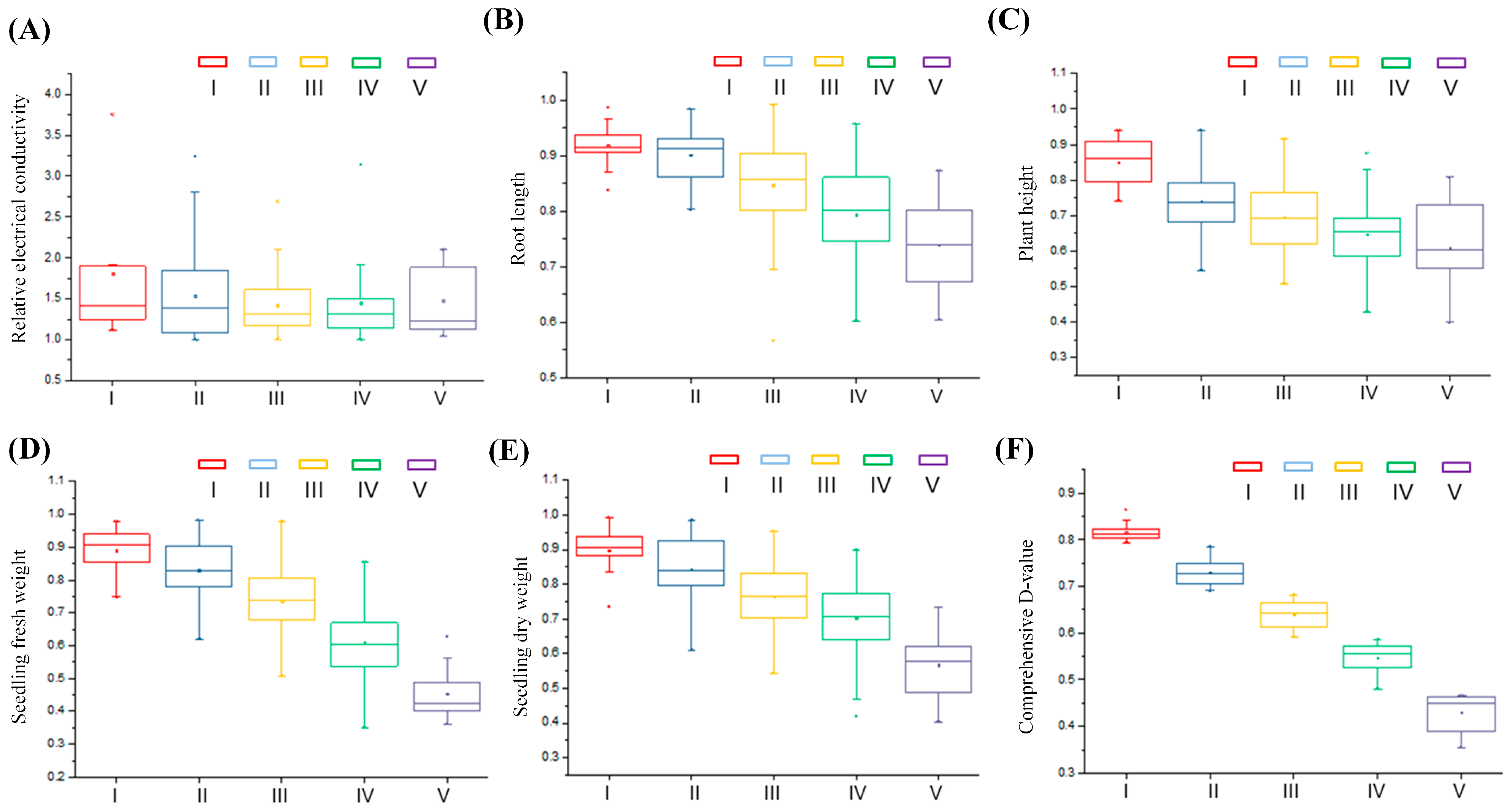
Based on the five clusters classified by the system clustering, the analysis of the cold tolerance coefficient (CC) of each trait and the comprehensive D value of the five categories revealed that low-temperature stress had a significant impact on plant height (PH), root length (RL), fresh weight (FW), and aboveground dry weight (DW). These traits exhibited a marked increasing trend as cold sensitivity decreased. In contrast, relative electrical conductivity (REC) showed minimal variation among the different cold tolerance categories (Figure 2).

3.3. Correlation Analysis of All Traits

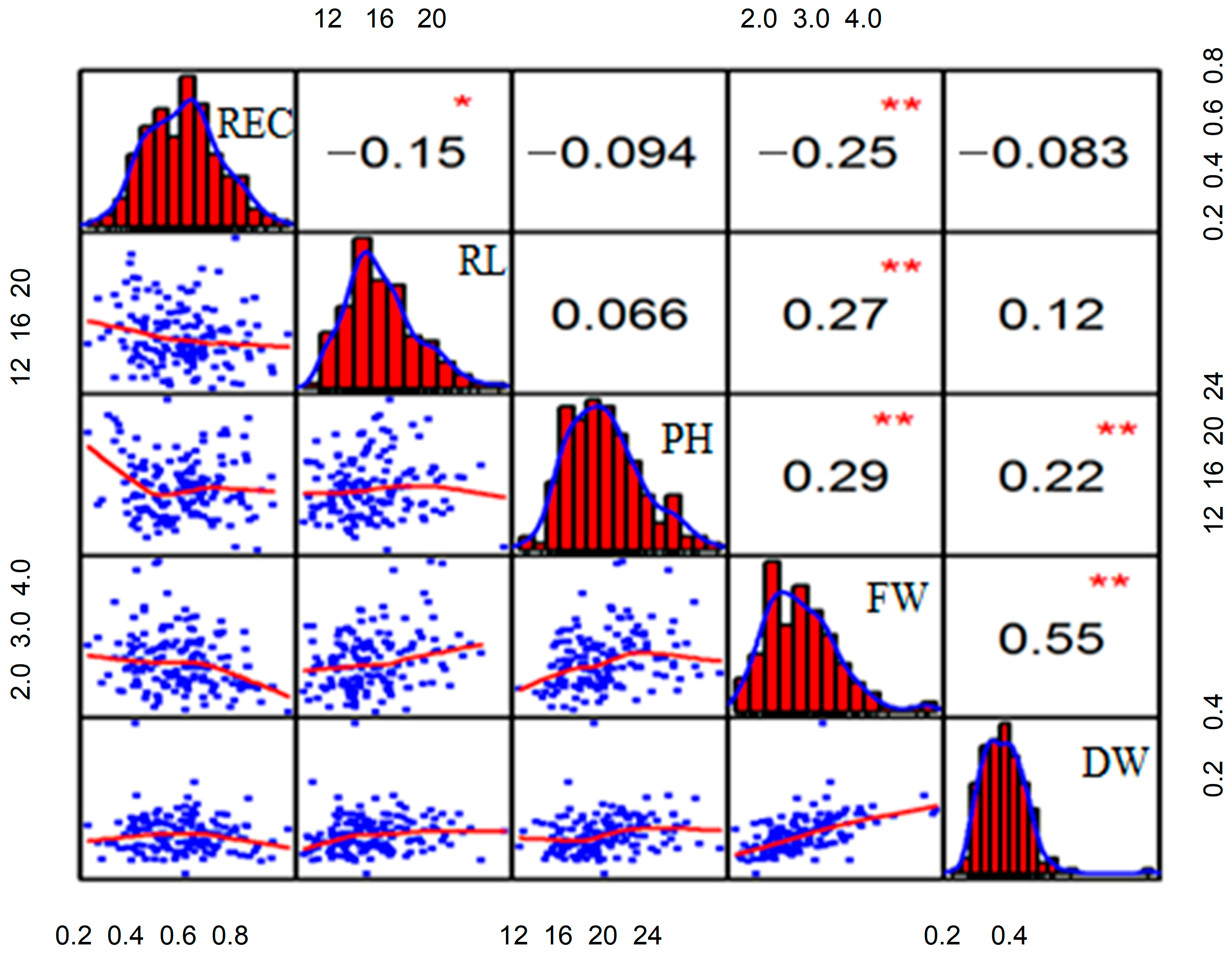
A correlation analysis of all measured traits revealed that the five traits exhibited continuous distributions. A significant negative correlation was observed between relative electrical conductivity (REC) and root length (RL), with a Pearson correlation coefficient of −0.15 (p ≤ 0.05). Furthermore, a highly significant negative correlation was identified between relative electrical conductivity (REC) and fresh weight (FW), with a Pearson correlation coefficient of −0.25 (p ≤ 0.01). In contrast, a highly significant positive correlation was found between fresh weight (FW) and root length (RL) (r = 0.27, p ≤ 0.01). Similarly, plant height (PH) showed a highly significant positive correlation with fresh weight (FW) (r = 0.29, p ≤ 0.01), and fresh weight (FW) was also highly positively correlated with shoot dry weight (DW) (r = 0.55, p ≤ 0.01), indicating a direct relationship between fresh weight (FW) and traits such as root length (RL), plant height (PH), and shoot dry weight (DW). Additionally, a highly significant positive correlation was observed between plant height (PH) and shoot dry weight (DW) (r = 0.22, p ≤ 0.01). However, no significant correlations were detected between plant height (PH) and root length (RL) or relative electrical conductivity (REC), nor between shoot dry weight (DW) and relative electrical conductivity (REC) or root length (RL) (Figure 3).

3.4. Analysis of Phenotypic Variation Among Different Subpopulations

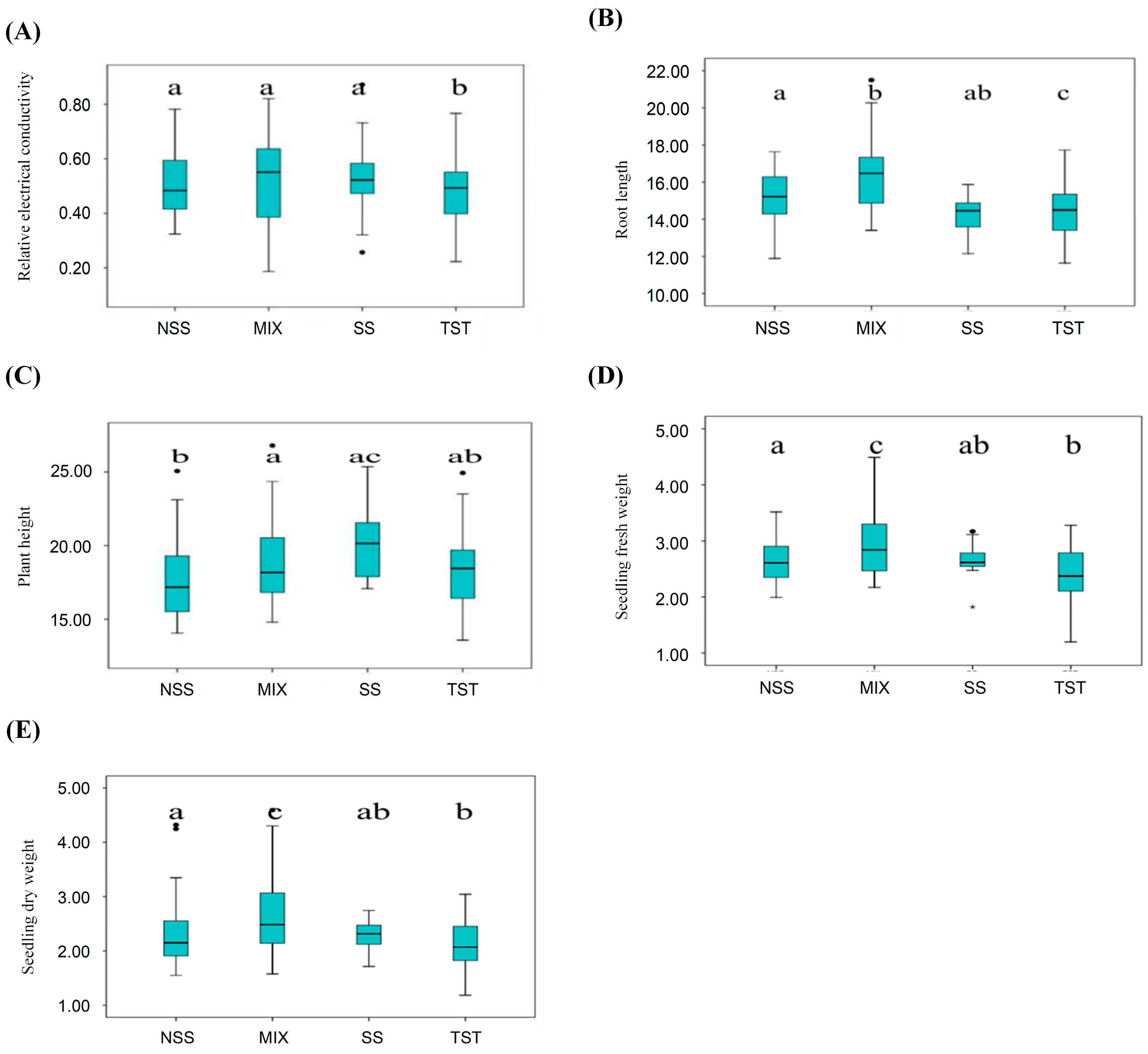
The association panel used in this study was classified into three subpopulations and one mixed group, which were termed the Stiff Stalk subpopulation (SS), Non-Stiff Stalk subpopulation (NSS), Tropical or Subtropical subpopulation (TST), and MIXED, respectively. To investigate the effect of population structure on cold tolerance phenotypes, the phenotypic variations in all traits were compared among different subpopulations. Among all traits, the Tropical or Subtropical subpopulation (TST) exhibited lower cold tolerance phenotypic values compared to the other three subpopulations, indicating that maize materials from tropical or subtropical regions were more sensitive to low temperatures. For the Stiff Stalk subpopulation (SS), Non-Stiff Stalk subpopulation (NSS), and MIXED subpopulations, significant differences were observed for plant height (PH), root length (RL), fresh weight (FW), and shoot dry weight (DW), whereas no significant difference was detected for relative electrical conductivity (REC) (Figure 4). In summary, all traits exhibit substantial variation, which is governed by genetic regulation, and display distinct characteristics depending on the genetic background.

3.5. Genome-Wide Association Analysis

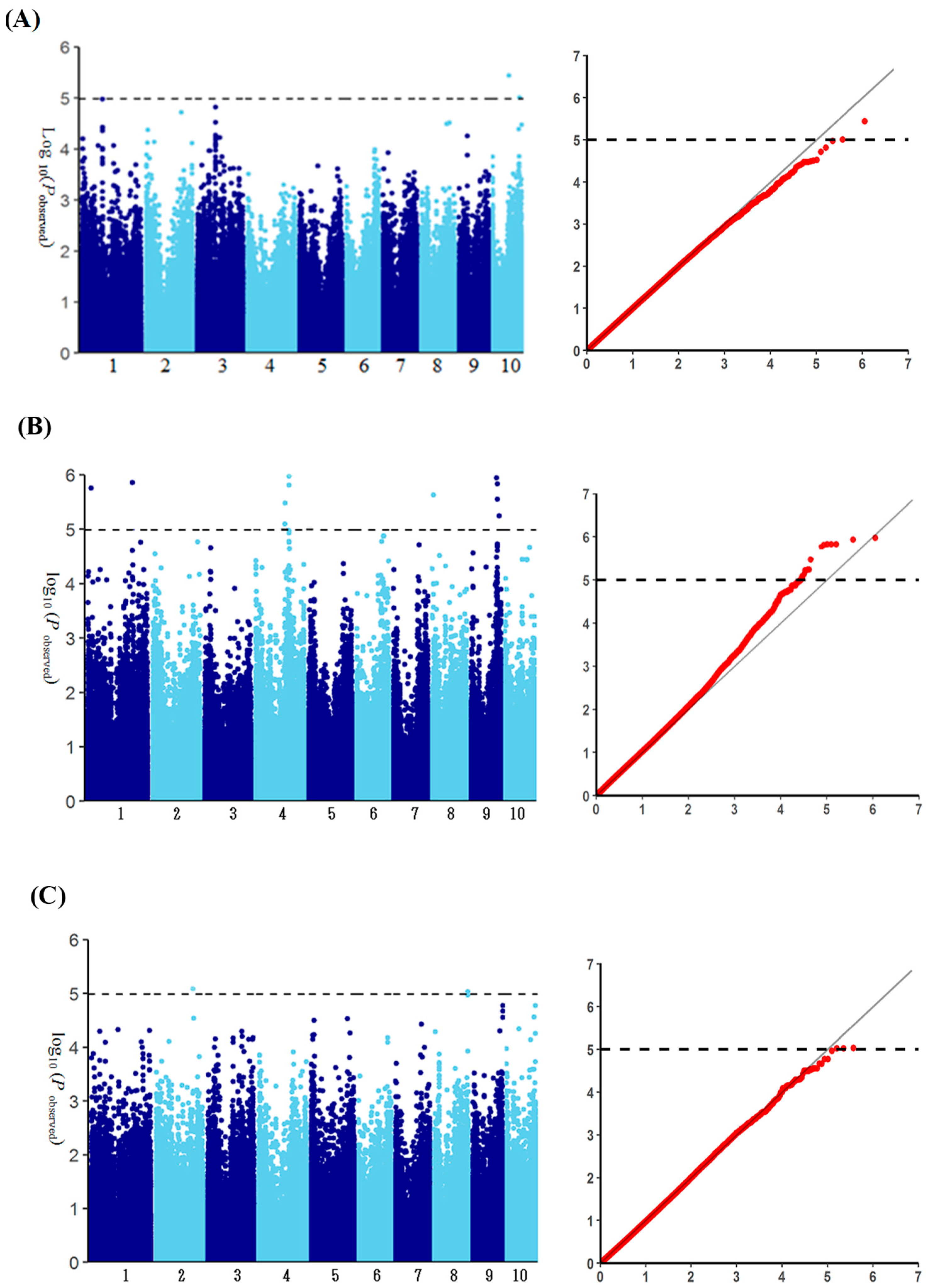
The GWAS was performed using a mixed linear model (MLM) that accounted for both kinship relationship (K matrix) and principal component relationship (PCA) to minimize spurious associations. Linkage disequilibrium (LD) analysis confirmed that R2 < 0.2 to ensure independence among SNP loci. In total, setting the threshold at p < 10−5, we identified eleven, three, and three SNPs significantly associated with plant height (PH), root length (RL), and shoot dry weight (DW), respectively. For plant height (PH), 11 SNPs were distributed across chromosomes 1, 4, 8, and 9. The most significantly associated SNP was mapped to chromosome 4, with a p-value of 1.06 × 10⁻⁶. For root length (RL), three SNPs were located on chromosomes 1 and 10, with the most strongly associated SNP on chromosome 10, exhibiting a p-value of 3.60 × 10⁻⁶. For shoot dry weight (DW), three SNPs were identified on chromosomes 2 and 8. The SNP with the highest association was located on chromosome 2, showing a p-value of 1.68 × 10⁻⁵. No SNPs were detected to be significantly associated with relative electrical conductivity (REC) and fresh weight (FW) (Figure 5).

3.6. Screening and Characterization of Candidate Genes

Using the B73 maize genome as a reference, candidate genes within a ~50 kb region flanking the significantly associated SNPs were identified based on linkage disequilibrium (LD). A total of 12 genes were located in the regions mentioned above.
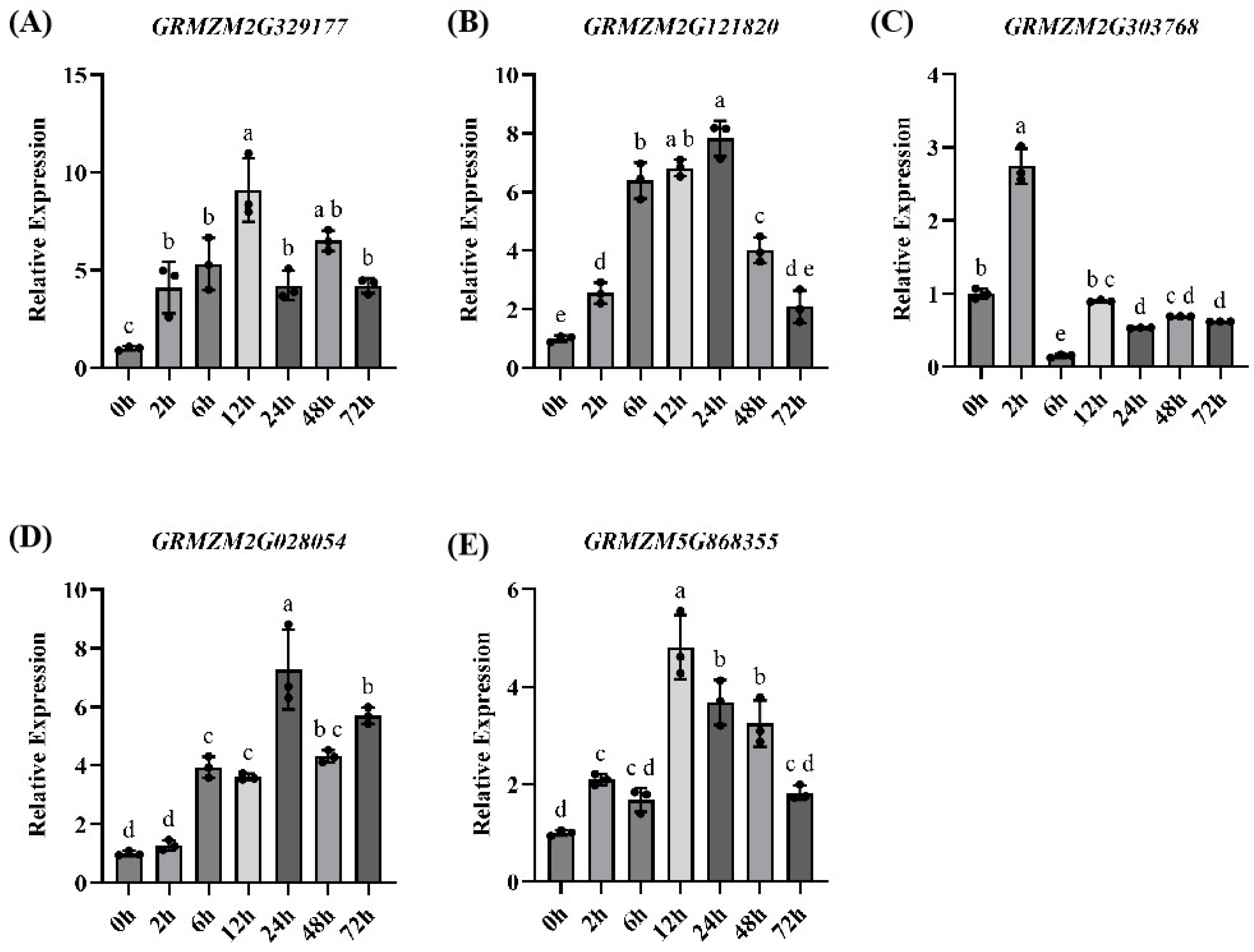
Among these genes, two encode leucine-rich repeat (LRR) proteins linked to root length (RL) and shoot dry weight (DW) (GRMZM2G329177, GRMZM2G121820), respectively. Three genes corresponding to protein kinases were implicated in root length (RL) and plant height (PH) (GRMZM2G303768, GRMZM2G093858, GRMZM2G478876), respectively. One gene is a member of the R2R3-MYB gene family and was related to shoot dry weight (DW) (GRMZM2G028054). Additionally, three genes encoding a heat shock protein (GRMZM2G031637), a GRAS family transcription factor (GRMZM5G868355), and a zinc-binding dehydrogenase (GRMZM2G149272), respectively, were all associated with plant height (PH). Each of these functional categories has been documented in the context of plant abiotic stress responses. In contrast, the remaining three candidate genes exhibited little or no established connection to stress tolerance (Table S3). Further, we validated the expression levels of nine candidate genes under cold stress using qRT-PCR. The results showed that the transcript levels of GRMZM2G329177, GRMZM2G121820, GRMZM2G303768, GRMZM2G028054, and GRMZM5G868355 were significantly higher under cold stress than under normal temperature conditions at the seedling stage (Figure 6).

4. Discussion

Cold tolerance in maize is a complex quantitative trait, and its evaluation based on a single indicator may compromise both accuracy and comprehensiveness. To minimize the influence of environmental factors, a comprehensive multi-index evaluation approach is generally adopted [23]. Germplasm resources form the foundation for identifying superior resistant varieties. Screening cold-tolerant germplasm materials is of great significance for both breeding superior varieties and identifying cold resistance genes [24]. In this study, 205 maize accessions with diverse genetic backgrounds were selected to systematically evaluate cold tolerance at the seedling stage using multiple physiological and morphological indicators. The materials used in this study exhibited rich genetic diversity, encompassing various maize subpopulations, including the NSS, SS, TST, and Mixed subpopulations. Among them, 86 materials belong to the TST subpopulation, 58 to the NSS subpopulation, 15 to the SS subpopulation, and 46 to the Mixed subpopulation.
Four morphological indicators (plant height, root length, fresh weight, and shoot dry weight) and a physiological indicator, relative electrical conductivity (REC), collectively reflect multiple aspects of maize growth and development. Rather than relying on a single metric for assessment, this study integrated these five indicators into a comprehensive relative phenotypic value (D values). This comprehensive approach was used to evaluate all materials, ensuring a scientifically robust and reliable method that fully captures the cold tolerance of maize. Analysis of variance among subpopulations based on five phenotypic traits revealed significant differences in the measured values of all five traits across the four subpopulations. Notably, the phenotypic values in the Tropical or Subtropical subpopulation (TST) were the lowest, indicating that maize materials in this subpopulation were more sensitive to low temperatures. This further suggests that, compared to other regions, accessions with tropical and subtropical ancestry generally exhibit weaker cold tolerance. Cluster analysis based on the comprehensive D value categorized the 205 maize accessions into five groups. Statistical analysis of the cold tolerance coefficients and comprehensive D values for each trait across these four groups revealed that cold stress had a significant impact on plant height (PH), root length (RL), fresh weight (FW), and shoot dry weight (DW). These traits showed a clear increasing trend as cold sensitivity decreased. In contrast, relative electrical conductivity (REC) exhibited minimal variation among the different cold tolerance groups. In conclusion, morphological indicators, particularly fresh weight (FW) and shoot dry weight (DW), are more effective in evaluating cold tolerance at the maize seedling stage. The reason for the existence of certain differences in these traits may be that the cold tolerance demonstrated by different traits is not necessarily the same, and is related to complex physiological, biochemical, and even developmental aspects. At the molecular level, it may be determined by different genes. Therefore, it is necessary to further identify cold tolerance genes for each trait to clarify the cold tolerance function of the genes. Evaluating and classifying the cold tolerance of these maize materials provides valuable references for the targeted selection of breeding materials in cold-tolerant breeding programs in maize.
The physiological and genetic mechanisms underlying cold tolerance in maize are highly complex, involving multiple metabolic pathways such as photosynthesis, respiration, and antioxidant activity. Different genotypes may employ distinct cold adaptation strategies, and cold tolerance can vary even within the same genotype across developmental stages [17]. Consequently, the genetic basis of cold tolerance in maize remains poorly understood, particularly regarding mechanisms of cold acclimation, signal transduction under cold stress, and associated gene expression changes. It is therefore essential to identify cold tolerance-related QTLs and genes using diverse genetic or association mapping populations [24,25,26,27]. In this study, all five measured traits exhibited significant variation within the population and followed a normal distribution, fulfilling the prerequisites for conducting GWAS analysis to identify SNPs and annotate genes related to cold tolerance. Setting the threshold at p < 10−5, we identified 17 SNPs significantly associated with plant height (PH), root length (RL), and shoot dry weight (DW). Based on these SNPs, 12 candidate genes were identified, some of which are closely associated with cold tolerance, such as genes encoding abiotic stress transcription factors, LRR proteins, and protein kinases, among others. The abiotic stress transcription factors in plants, such as those in the MYB, CBF, and GRAS families of transcription factors, play central roles in cold response by regulating the expression of stress-related genes. They enhance cold tolerance through activating pathways involved in osmoprotectant synthesis, antioxidant defense, and membrane stabilization, making them key targets for improving cold adaptation in plants [28,29]. In this study, we identified two transcription factor genes, an R2R3-MYB gene (GRMZM2G028054) and a GRAS family gene (GRMZM5G868355). In the context of cold tolerance, leucine-rich repeat (LRR) proteins are structurally versatile and may mediate stress perception and signal transduction under cold stress. Their structural versatility enables participation in abiotic stress responses, potentially including cold sensing through protein–protein interactions and receptor kinase activation [30]. In this study, two genes encoding leucine-rich repeat (LRR) proteins (GRMZM2G329177, GRMZM2G121820) and three genes encoding protein kinases (GRMZM2G303768, GRMZM2G093858, GRMZM2G478876) were identified. Further validation by qRT-PCR confirmed that the expression of these genes was induced under cold stress. Additionally, a heat shock protein gene (GRMZM2G031637) and a zinc-binding dehydrogenase gene (GRMZM2G149272) were annotated. Both types of genes have also been previously reported to be associated with abiotic stress responses [31,32]. The specific functions and regulatory mechanisms of these genes in response to cold stress remain to be further elucidated. Furthermore, apart from the stress resistance-related genes mentioned above, three other genes have not been previously reported to be associated with stress responses. Nevertheless, this does not justify overlooking them, and future studies may focus on exploring their potential novel functions in stress adaptation. In conclusion, these candidate genes provide an important basis for further mining the genes related to cold tolerance and studying the molecular mechanisms regulating cold tolerance in maize.

5. Conclusions

In this study, 205 maize accessions representing diverse genetic backgrounds—including SS, NSS, TST, and MIXED subpopulations—were systematically evaluated for cold tolerance at the seedling stage based on five key traits: relative electrical conductivity (REC), plant height (PH), root length (RL), fresh weight (FW), and dry weight (DW). Substantial genetic variation in cold tolerance was observed across the tested materials, with the Tropical/Subtropical (TST) subpopulation exhibiting the lowest level of cold tolerance, thereby confirming the significant influence of genetic background on low-temperature adaptation. Morphological traits, particularly FW and DW, proved more effective than the physiological trait REC in assessing seedling cold tolerance, as demonstrated by their strong correlation with cold sensitivity gradients. Hierarchical clustering analysis using comprehensive D-values classified the accessions into five distinct cold tolerance grades, offering valuable germplasm resources for targeted breeding programs. Genome-wide association study (GWAS) identified 17 significant single nucleotide polymorphisms (SNPs) associated with PH, RL, and DW, leading to the annotation of 12 candidate genes. These include genes encoding leucine-rich repeat (LRR) proteins, protein kinases, R2R3-MYB, and GRAS family transcription factors—all of which are functionally implicated in abiotic stress responses. Quantitative real-time PCR (qRT-PCR) validation confirmed that GRMZM2G329177, GRMZM2G121820, GRMZM2G303768, GRMZM2G028054, and GRMZM5G868355 were significantly upregulated under cold stress conditions, supporting their potential regulatory roles in cold tolerance. Collectively, this study enhances understanding of the genetic architecture underlying maize seedling cold tolerance, provides elite germplasm for breeding applications, and identifies promising candidate genes for further investigation into the molecular mechanisms of cold adaptation in maize.

Supplementary Materials

The following supporting information can be downloaded at: https://www.mdpi.com/article/10.3390/agronomy15122842/s1. Table S1: Real-time fluorescent quantitative PCR primers. Table S2: The D values and comprehensive scores of cold tolerance in maize materials (Total). Table S3: Significantly SNPs and candidate genes.

Author Contributions

Y.C.: Writing—original draft, Formal analysis. X.Y.: Methodology, Data curation. P.G.-C.: Methodology, Data curation. H.S. and Y.S.: Data curation. Y.R. and D.S.: Methodology, Formal analysis. S.C.: Formal analysis. J.L.: Methodology. Z.G.: Writing—review and editing, Supervision. All authors have read and agreed to the published version of the manuscript.

Funding

This work was supported by the Jilin Agricultural Science and Technology Innovation Project (CXGC2024ZD006) and the Hulunbuir City Science and Technology Plan Project (Grant No. 2023HZZX001).

Data Availability Statement

The original contributions presented in this study are included in the article. Further inquiries can be directed to the corresponding authors.

Acknowledgments

We would like to express our sincere gratitude to Wanyi Liu and Meiling Liu from Shenyang Agricultural University and Jianbo Li from Inner Mongolia Minzu University for their assistance with handling the data.

Conflicts of Interest

The authors declare that they have no known competing financial interests or personal relationships that could have appeared to influence the work reported in this paper.

References

  1. Zhao, X.; Zhao, C.; Niu, Y.; Chao, W.; He, W.; Wang, Y.; Mao, T.; Bai, X. Understanding and Comprehensive Evaluation of Cold Resistance in the Seedlings of Multiple Maize Genotypes. Plants 2022, 11, 1881. [Google Scholar] [CrossRef]
  2. Sobkowiak, A.; Jończyk, M.; Jarochowska, E.; Biecek, P.; Trzcinska-Danielewicz, J.; Leipner, J.; Fronk, J.; Sowiński, P. Genome-wide transcriptomic analysis of response to low temperature reveals candidate genes determining divergent cold-sensitivity of maize inbred lines. Plant Mol. Biol. 2014, 85, 317–331. [Google Scholar] [CrossRef]
  3. Meng, A.; Wen, D.; Zhang, C. Maize seed germination under low-temperature stress impacts seedling growth under normal temperature by modulating photosynthesis and antioxidant metabolism. Front. Plant Sci. 2022, 13, 843033. [Google Scholar] [CrossRef] [PubMed]
  4. Zhang, H.; Zhang, J.; Xu, Q.; Wang, D.; Di, H.; Huang, J.; Yang, X.; Wang, Z.; Zhang, L.; Dong, L.; et al. Identification of candidate tolerance genes to low-temperature during maize germination by GWAS and RNA-seqapproaches. BMC Plant Biol. 2020, 20, 333. [Google Scholar] [CrossRef]
  5. Ma, Y.; Dai, X.; Xu, Y.; Luo, W.; Zheng, X.; Zeng, D.; Pan, Y.; Lin, X.; Liu, H.; Zhang, D.; et al. COLD1 confers chilling tolerance in rice. Cell 2015, 160, 1209–1221. [Google Scholar] [CrossRef]
  6. Sun, W.; Huang, Y. Global warming over the period 1961–2008 did not increase high-temperature stress but did reduce low-temperature stress in irrigated rice across China. Agric. For. Meteorol. 2011, 151, 1193–1201. [Google Scholar] [CrossRef]
  7. Peng, M.; Yaling, C.; Chu, G.; Wang, M. Low-temperature tolerance and transcriptome analyses during seed germination of Anabasis aphylla. J. Plant Interact. 2019, 14, 254–264. [Google Scholar] [CrossRef]
  8. Jiang, F.; Lv, S.; Zhang, Z.; Chen, Q.; Mai, J.; Wan, X.; Liu, P. Integrated metabolomics and transcriptomics analysis during seed germination of waxy corn under low temperature stress. BMC Plant Biol. 2023, 23, 190. [Google Scholar] [CrossRef]
  9. Hu, G.; Li, Z.; Lu, Y.; Li, C.; Gong, S.; Yan, S.; Li, G.; Wang, M.; Ren, H.; Guan, H.; et al. Genome-wide association study identified multiple genetic loci on chilling resistance during germination in maize. Sci. Rep. 2017, 7, 10840. [Google Scholar] [CrossRef] [PubMed]
  10. Xing, J.; Tan, J.; Feng, H.; Zhou, Z.; Deng, M.; Luo, H.; Deng, Z. Integrative proteome and phosphoproteome profiling of early cold response in maize seedlings. Int. J. Mol. Sci. 2022, 23, 6493. [Google Scholar] [CrossRef] [PubMed]
  11. Cooper, J.S.; Rice, B.R.; Shenstone, E.M.; Lipka, A.E.; Jamann, T.M. Genome-wide analysis and prediction of resistance to goss’s wilt in maize. Plant Genome 2019, 12, 180045. [Google Scholar] [CrossRef]
  12. Shikha, K.; Shahi, J.P.; Vinayan, M.T.; Zaidi, P.H.; Singh, A.K.; Sinha, B. Genome-wide association mapping in maize: Status and prospects. 3 Biotech 2021, 11, 244. [Google Scholar] [CrossRef]
  13. Li, H.; Peng, Z.; Yang, X.; Wang, W.; Fu, J.; Wang, J.; Han, Y.; Chai, Y.; Guo, T.; Yang, N.; et al. Genome-wide association study dissects the genetic architecture of oil biosynthesis in maize kernels. Nat. Genet. 2013, 45, 43–50. [Google Scholar] [CrossRef]
  14. Huang, J.; Zhang, J.; Li, W.; Hu, W.; Duan, L.; Feng, Y.; Qiu, F.; Yue, B. Genome-wide association analysis of ten chilling tolerance indices at the germination and seedling stages in maize: Genome-wide association analysis of chilling tolerance. J. Integr. Plant Biol. 2013, 55, 735–744. [Google Scholar] [CrossRef] [PubMed]
  15. Zeng, T.; Meng, Z.; Yue, R.; Lu, S.; Li, W.; Li, W.; Meng, H.; Sun, Q. Genome wide association analysis for yield related traits in maize. BMC Plant Biol. 2022, 22, 449. [Google Scholar] [CrossRef]
  16. Zeng, R.; Shi, Y.; Guo, L.; Fu, D.; Li, M.; Zhang, X.; Li, Z.; Zhuang, J.; Yang, X.; Zuo, J.; et al. A natural variant of COOL1 gene enhances cold tolerance for high-latitude adaptation in maize. Cell 2025, 188, 1315–1329. [Google Scholar] [CrossRef]
  17. Xu, Q.Y.; Song, Y.Y.; Bao, D.; Meng, L.Z.; Di, H.; Zhang, L.; Dong, L.; Zeng, X.; Zhang, J.Y.; Li, C.X.; et al. ZmBARK1 as a low-temperature tolerance gene in maize germination. Crop J. 2025, 13, 1197–1209. [Google Scholar] [CrossRef]
  18. Cheng, Y.S.; Sun, Y.D.; Xing, J.Y.; Zhan, L.; Li, X.J.; Huang, J.; Zhao, M.H.; Guo, Z.F. Transcriptomic and functional analyzes reveal that the brassinosteroid insensitive 1 receptor (OsBRI1) regulates cold tolerance in rice. Plant Physiol. Biochem. 2024, 208, 108472. [Google Scholar] [CrossRef] [PubMed]
  19. Alvarado, G.; Rodríguez, F.M.; Pacheco, A.; Burgueño, J.; Crossa, J.; Vargas, M.; Pérez-Rodríguez, P.; Lopez-Cruz, M.A. META-R: A software to analyze data from multi-environment plant breeding trials. Crop J. 2020, 5, 745–756. [Google Scholar] [CrossRef]
  20. Yang, X.H.; Gao, S.B.; Xu, S.T.; Zhang, Z.X.; Prasanna, B.M.; Li, L.; Li, J.S.; Yan, J.B. Characterization of a global germplasm collection and its potential utilization for analysis of complex quantitative traits in maize. Mol. Breed. 2020, 28, 511–526. [Google Scholar] [CrossRef]
  21. Liu, M.; Zhang, M.; Yu, S.; Li, X.; Zhang, A.; Cui, Z.; Dong, X.; Fan, J.; Zhang, L.; Li, C.; et al. A genome-wide association study dissects the genetic architecture of the metaxylem vessel number in maize brace roots. Front. Plant Sci. 2022, 13, 847234. [Google Scholar] [CrossRef]
  22. Li, X.; Guo, D.; Xue, M.; Li, G.; Yan, Q.; Jiang, H.; Liu, H.; Chen, J.; Gao, Y.; Duan, L.; et al. Genome-wide association study of salt tolerance at the seed germination stage in flax (Linum usitatissimum L.). Genes 2022, 13, 486. [Google Scholar] [CrossRef]
  23. Yuan, Y.; Xing, H.; Zeng, W.; Xu, J.; Mao, L.; Wang, L.; Feng, W.; Tao, J.; Wang, H.; Zhang, H.; et al. Genome-wide association and differential expression analysis of salt tolerance in Gossypium hirsutum L. at the germination stage. BMC Plant Biol. 2019, 19, 394. [Google Scholar] [CrossRef]
  24. Wang, Z.; Zhang, Y.; Hu, H.; Chen, L.; Zhang, H.; Chen, R. CabHLH79 Acts Upstream of CaNAC035 to Regulate Cold Stress in Pepper. Int. J. Mol. Sci. 2022, 23, 2537. [Google Scholar] [CrossRef] [PubMed]
  25. Fracheboud, Y.; Jompuk, C.; Ribaut, J.M.; Stamp, P.; Leipner, J. Genetic analysis of cold-tolerance of photosynthesis in maize. Plant Mol. Biol. 2004, 56, 241–253. [Google Scholar] [CrossRef]
  26. Goering, R.; Larsen, S.; Tan, J.; Whelan, J.; Makarevitch, I. QTL mapping of seedling tolerance to exposure to low temperature in the maize IBM RIL population. PLoS ONE 2021, 16, e0254437. [Google Scholar] [CrossRef]
  27. Agarwal, M.; Hao, Y.; Kapoor, A.; Dong, C.H.; Fujii, H.; Zheng, X.; Zhu, J.K. A R2R3 type MYB transcription factor is involved in the cold regulation of CBF genes and in acquired freezing tolerance. J. Biol. Chem. 2006, 281, 37636–37645. [Google Scholar] [CrossRef] [PubMed]
  28. Hirsch, S.; Oldroyd, G.E. GRAS-domain transcription factors that regulate plant development. Plant Signal. Behav. 2009, 4, 698–700. [Google Scholar] [CrossRef] [PubMed]
  29. Li, Q.; Yang, X.; Xu, S.; Cai, Y.; Zhang, D.; Han, Y.; Li, L.; Zhang, Z.; Gao, S.; Li, J.; et al. Genome-wide association studies identified three independent polymorphisms associated with α-tocopherol content in maize kernels. PLoS ONE 2012, 7, e36807. [Google Scholar] [CrossRef]
  30. Xu, M.; Liu, C.L.; Fu, Y.; Liao, Z.W.; Guo, P.Y.; Xiong, R.; Cheng, Y.; Wei, S.S.; Huang, J.Q.; Tang, H. Molecular characterization and expression analysis of pitaya (Hylocereus polyrhizus) HpLRR genes in response to Neoscytalidium dimidiatum infection. BMC Plant Biol. 2020, 20, 160. [Google Scholar] [CrossRef]
  31. Xu, G.; Zhong, X.; Shi, Y.; Liu, Z.; Jiang, N.; Liu, J.; Ding, B.; Li, Z.; Kang, H.; Ning, Y.; et al. A fungal effector targets a heat shock-dynamin protein complex to modulate mitochondrial dynamics and reduce plant immunity. Sci. Adv. 2020, 6, eabb7719. [Google Scholar] [CrossRef] [PubMed]
  32. Zang, D.; Wang, C.; Ji, X.; Wang, Y. Tamarix hispida zinc finger protein ThZFP1 participates in salt and osmotic stress tolerance by increasing proline content and SOD and POD activities. Plant Sci. 2015, 235, 111–121. [Google Scholar] [CrossRef] [PubMed]
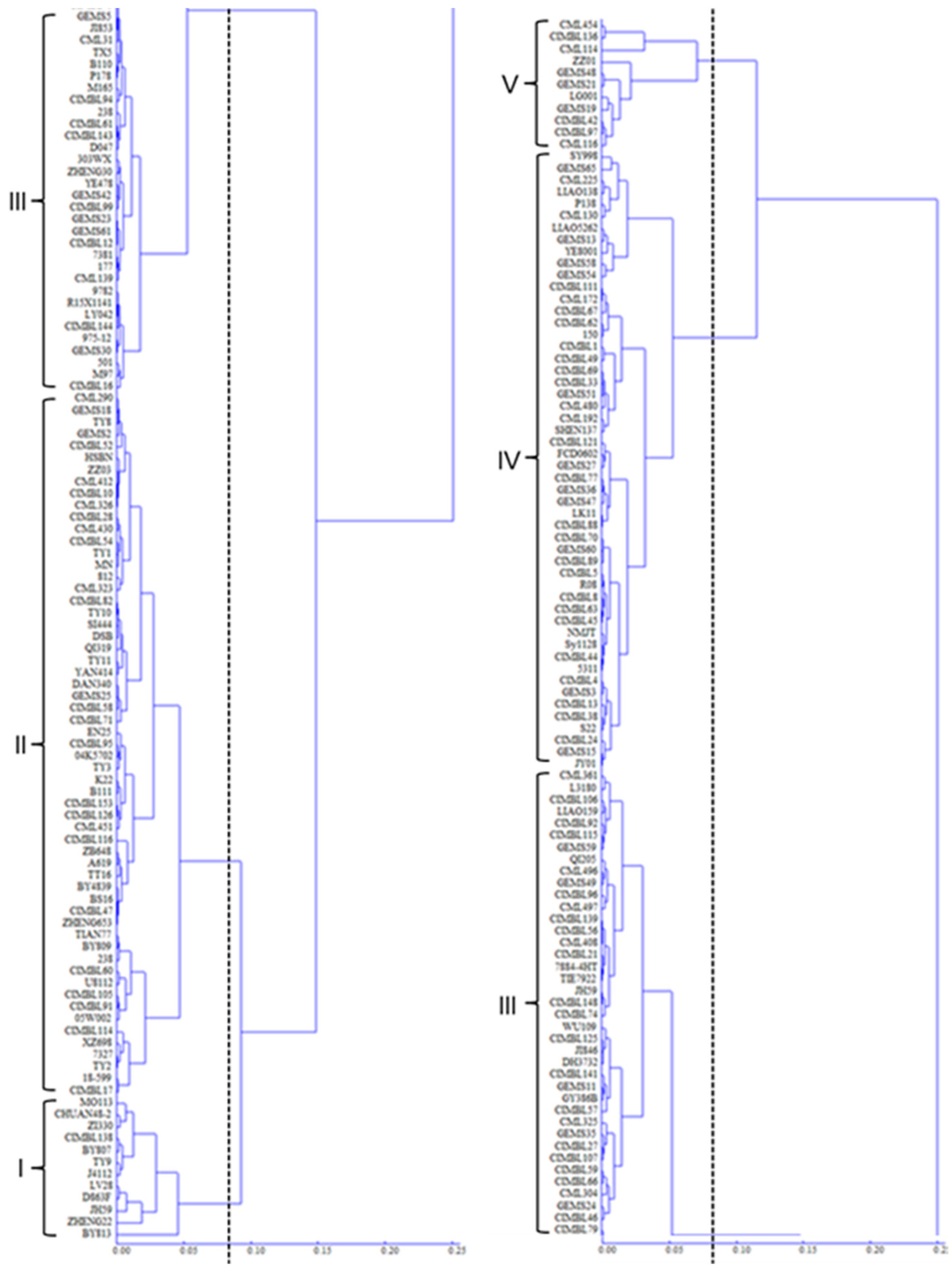
Figure 1. Systematic clustering analysis based on comprehensive D value of cold resistance of 205 maize materials. The blue lines re the branches of the dendrogram; Dotted vertical line is a cluster cutoff/threshold line (The threshold is 0.8).
Agronomy 15 02842 g001
Figure 2. Comprehensive comparison of cold tolerance coefficients (CCs) and D values. (A) Box graph of relative electrical conductivity at seedling stage in different subgroups; (B) box graph of root length at seedling stage in different subgroups; (C) b ox graph of plant height at seedling stage in different subgroups; (D) box graph of fresh weight at seedling stage in different subgroups; (E) box graph of dry weight at seedling stage in different subgroups; (F) box graph of comprehensive D value at seedling stage in different subgroups. The values represent the means ± SDs of three replicates. Significant differences were detected by Tukey test (p < 0.05).
Agronomy 15 02842 g002
Figure 3. A correlation analysis of the five traits at the seedling stage. The red bar chart expresses each phenotypic distribution of traits as indicated, the blue curve expresses density estimate (a smoothed, continuous representation of the variable’s distribution), the blue points expresses individual data observations (each point represents one sample’s values for the two variables), the red line expresses a linear regression line, the numerical values in the squares above the catercorner line are Pearson coefficients of the correlation between traits, and the numerical values in the squares below the catercorner line are the overlay scatter pictures. REC, relative electrical conductivity; RL, root length; PH, plant height; FW, fresh weight; DW, dry weight. * p ≤ 0.05, ** p ≤ 0.01.
Agronomy 15 02842 g003
Figure 4. Box plot of the distribution of the relative electrical conductivity (REC), RL, plant height (PH), fresh weight (FW), and shoot dry weight (DW) in different subpopulations. (A) Box graph of relative electrical conductivity at seedling stage in different subgroups; (B) box graph of root length at seedling stage in different subgroups; (C) box graph of plant height at seedling stage in different subgroups; (D) box graph of fresh weight at seedling stage in different subgroups; (E) box graph of dry weight at seedling stage in different subgroups. SS (the Stiff Stalk subpopulation), NSS (the Non-Stiff Stalk subpopulation), TST (the Tropical or Subtropical subpopulation), and MIXED subpopulation. MIXED—205 plants; NSS—66 plants; SS—27 plants; TST—193 plants. The different letters in the figure represent statistically outstanding levels of 0.05. The values represent the means ± SDs of three replicates. * Significant differences were detected by Tukey test (p < 0.05).
Agronomy 15 02842 g004
Figure 5. Overview of association mapping results for five traits. (A) RL, root length; (B) PH, plant height; (C) DW, dry weight.
Agronomy 15 02842 g005
Figure 6. Expression analysis of five genes in maize B73 leaves under cold stress. (A) Expression analysis of GRMZM2G329177; (B) expression analysis of GRMZM2G121820; (C) expression analysis of GRMZM2G303768; (D) expression analysis of GRMZM2G028054; (E) expression analysis of GRMZM5G868355. The different letters in the figure represent statistically outstanding levels of 0.05. The values represent the means ± SDs of three replicates. Significant differences were detected by Tukey test (p < 0.05).
Agronomy 15 02842 g006
Table 1. Phenotypic values and significance of differences before and after cold treatment.
TraitProcess ModeMean ± SDCoefficient of Variation (%)t-ValueCoefficient of Association
RECCT0.59 ± 0.1830.51−16.57 **0.60
CK0.42 ± 0.1535.71
PH (cm)CT15.30 ± 3.1020.2632.85 **0.75
CK22.38 ± 7.1131.77
RL (cm)CT14.35 ± 2.3616.4522.39 **0.67
CK17.02 ± 2.5014.53
FW (g)CT2.36 ± 0.9439.8321.38 **0.72
CK3.25 ± 0.9027.69
DW (g)CT0.22 ± 0.0940.9022.34 **0.90
CK0.28 ± 0.09634.29
Note: Relative electrical conductivity (REC), plant height (PH), root length (RL), seedling fresh weight (FW), and seedling dry weight (DW). ** Significant at p ≤ 0.01.
Table 2. Variation analysis of cold resistance coefficient (CC) for different characteristics.
TraitAverage NumberAmplitude of VariationCoefficient of VariationF-Value
REC1.53 ± 0.690.47–3.7545.1046.23 **
PH (cm)0.70 ± 0.100.40–0.9414.293.58 **
RL (cm)0.85 ± 0.090.57–0.9910.5997.05 **
FW (g)0.72 ± 0.150.35–0.9820.831.61 *
DW (g)0.77 ± 0.130.34–0.9916.8870.75 **
Note: Relative electrical conductivity (REC), plant height (PH), root length (RL), seedling fresh weight (FW), and seedling dry weight (DW). * Significant at p ≤ 0.05, ** Significant at p ≤ 0.01.
Table 3. Distribution of CCs for different characteristics.
Index0 < CC < 0.20.2 < CC < 0.40.4 < CC < 0.60.6 < CC < 0.80.8 < CC < 1
TimesFreq. (%)TimesFreq. (%)TimesFreq. (%)TimesFreq. (%)TimesFreq. (%)
RL000020.964923.4415875.60
PH0010.483315.7913564.594019.14
FW0031.444220.108942.587535.89
DW0010.48199.0910148.338842.11
Index1 < CC < 1.51.5 < CC < 22 < CC < 2.52.5 < CC < 33 < CC < 4
TimesFreq. (%)TimesFreq. (%)TimesFreq. (%)TimesFreq. (%)TimesFreq. (%)
REC14066.984119.62157.1852.3983.83
Note: Relative electrical conductivity (REC), plant height (PH), root length (RL), seedling fresh weight (FW), and seedling dry weight (DW).
Disclaimer/Publisher’s Note: The statements, opinions and data contained in all publications are solely those of the individual author(s) and contributor(s) and not of MDPI and/or the editor(s). MDPI and/or the editor(s) disclaim responsibility for any injury to people or property resulting from any ideas, methods, instructions or products referred to in the content.