Review

Water Management in Chile Peppers and Plant Susceptibility to Phytophthora capsici and Development of Phytophthora Blight: A Review


1
Department of Plant and Environmental Sciences, New Mexico State University, Las Cruces, NM 88003, USA
2
Department of Entomology, Plant Pathology and Weed Science, New Mexico State University, Las Cruces, NM 88003, USA
3
Department of Plant and Environmental Sciences, Agricultural Science Center at Farmington, New Mexico State University, Farmington, NM 87499, USA
*
Author to whom correspondence should be addressed.
Agronomy 2025, 15(12), 2819; https://doi.org/10.3390/agronomy15122819
Submission received: 28 October 2025 / Revised: 28 November 2025 / Accepted: 3 December 2025 / Published: 8 December 2025

Abstract

The response of chile peppers (Capsicum spp.) to different irrigation systems is an important factor affecting crop yield, quality parameters, and resistance to soil-borne diseases. The choice of irrigation method significantly impacts fruit size development, water-use efficiency, and overall crop production. Research shows that proper irrigation management can increase yields, improve physiological response, and reduce the incidence of Phytophthora blight, a major disease caused by Phytophthora capsici. However, over-irrigation directly harms chile peppers, causing waterlogging, which, together with increasing weed spreads, creates favorable conditions for P. capsici to grow and increase disease susceptibility. Conversely, under-irrigation can induce drought stress that weakens chile peppers and increases their vulnerability to P. capsici. Although the pathogen cannot thrive or spread in dry soils, severely stressed plants become highly susceptible when even brief periods of moisture occur—such as from dew, light rainfall, or a short irrigation event—creating favorable conditions for infection. In addition, lack of proper timing and insufficient irrigation frequency adversely affect fruit quality characteristics, including capsaicin content (spiciness), color, and nutrient composition. Water stress is extremely damaging because it can reduce the biomass of plants, delay flowering, reduce fruit size, or cause significant yield loss. Considering the importance of water management in chile pepper cultivation and optimizing irrigation systems is important to ensure high-quality crops. Disease susceptibility and effects of different irrigation systems, including inadequate irrigation and excessive irrigation, have been reviewed, with an emphasis on the impact of these irrigation methods on plant growth and yield quality, and on Phytophthora blight. This review aims to provide insights into the importance of irrigation management for sustainable and effective chile pepper production and disease control.

1. Introduction

Pepper belongs to the Solanaceae family and is considered one of the oldest food additives in human nutrition. It is also the most produced and consumed vegetable in the world [1]. C. annuum, the most commercially important chile species, contributes to a global annual yield of approximately 24 million tons [2]. In Mexico, chile pepper cultivation covers 6000 hectares, with an average yield of 21.8 t ha−1, highlighting its socio-economic importance [3]. In West Sumatra, chile pepper cultivation is widespread, achieving an average productivity of around 6 t ha−1 over the past five years [4], with the region producing 39,731 tons in 2003 [5]. Chile pepper is a valuable agricultural commodity, with global production estimates ranging from 14 to 15 million tons annually [6].
Chile peppers (Capsicum spp.) are a vital agricultural product worldwide, renowned for their diverse culinary, industrial, and medicinal uses. However, their cultivation is significantly affected by environmental factors. As a crop that is sensitive to drought, optimal growth conditions for chile peppers include temperatures between 20 and 26 °C, along with a consistent water supply [7,8,9]. The need for consistent soil moisture presents a considerable management challenge. While water is essential for growth, excessive moisture creates an environment conducive to soilborne diseases. Among these diseases, the oomycete Phytophthora capsici is particularly harmful, causing severe root, crown, and fruit rot, and it often serves as the primary limiting factor in commercial pepper farming. P. capsici thrives in anaerobic or waterlogged soils, directly linking poor irrigation practices and soil saturation near the plant crown to exacerbated disease incidence even in otherwise fertile, well-drained soils. This vulnerability transforms water management into a complex and challenging issue, posing a serious threat to market viability and farmer income, especially in arid regions facing water shortages [10].
This paper explores the crucial relationship between the water needs of chile peppers and their disease susceptibility. Specifically, we examine how precision irrigation techniques affect the plant’s physiological responses to water scarcity and the dynamics of P. capsici infection. We aim to develop a clearer framework for sustainable agricultural practices that enhance water efficiency for plant health while also reducing economic losses associated with this widespread pathogen. The high-water consumption associated with chile pepper production complicates irrigation management in northern Mexico, underscoring the need for customized strategies to optimize water use [11,12]. Additionally, selecting suitable varieties for specific agroclimatic conditions can improve both productivity and sustainability [13]. In Ethiopia, pepper (C. annuum L.) serves as a crucial vegetable crop, primarily cultivated under rainfed conditions. Erratic rainfall patterns limit production potential, and the lack of reliable irrigation infrastructure further constrains productivity [14,15].
Research has demonstrated that mild drought stress can markedly diminish the root dry weight and shoot growth of pepper transplants [16,17]. P. capsici, responsible for Phytophthora root rot, is the most harmful soilborne pathogen affecting bell pepper (Capsicum annuum L.) cultivation in Georgia, USA. Its broad host range, the ability to persist in the soil, and the absence of effective chemical management strategies make controlling this disease notably challenging [18].
The incidence of P. capsici has intensified in recent years. For example, in Turkey, it can cause yield losses of up to 40% [19], while in Korea, it significantly impacted yield and quality in 2003 [20]. The pathogen survives in soil and contaminated seeds, and no resistant cultivars are currently available [21]. Its life cycle includes both asexual reproduction via sporangia and zoospores and sexual reproduction through oospores formed by A1 and A2 mating types, enabling rapid waterborne spread and infection [22,23].
The zoospores of Phytophthora spp. are crucial for survival, dispersal, and infection as they possess the ability to actively locate hosts [24]. The challenges presented by this pathogen include the durability of its spores, a wide host range, and rapid waterborne dissemination [25]. Crucially, excessive soil moisture from over-irrigation or heavy rainfall exacerbates disease development, as the free water pools and films facilitate the rapid release and movement of motile zoospores, allowing them to swim to the root zone and infect the plant crown. The organism responsible for the disease, P. capsici, is also named Phytophthora capsica. As a soil-borne pathogen, it can disperse through various means, including soil, air, irrigation, wind, rain, and decaying plant material, leading to rapid outbreaks [26]. The cultivation and productivity of black pepper are significantly hindered by the harmful pathogen P. capsici, leading to what is known as black pepper blight. Investigating the genetic sources of resistance to this pathogen in black pepper is crucial for enhancing its global production [27].
Current management strategies for Phytophthora blight involve labor-intensive practices such as crop rotation, biofumigation, and fungicide application. While effective, these methods are labor-intensive, environmentally risky, and time-consuming [25,28]. Breeding resistant cultivars is promising but requires substantial investment and may reduce crop yields. Alternative biological control methods, including plant extracts, compost water extracts, and microbial fungicides, offer potential for sustainable disease management [29,30]. Although chemical fungicides are commonly employed for pathogen control, their frequent application raises concerns regarding the development of pathogen resistance to fungicides [31]. Management typically relies on cultural practices and the application of pesticides; however, over-reliance on these methods raises concerns regarding environmental sustainability and pathogen resistance [32,33].
Irrigation water use efficiency (IWUE, defined as the weight of marketable crop yield produced per unit volume of irrigation water applied) and water use efficiency (WUE), defined as the weight of marketable crop yield produced per unit volume of water applied. They are critical indicators of the effectiveness of irrigation practices [34]. Pepper plants are susceptible to water stress, which can markedly reduce yield [35]. However, several authors have demonstrated that precision and deficit irrigation (DI) strategies can be dually beneficial, improving water productivity and fruit quality while simultaneously mitigating disease risk by reducing soil saturation periods. For example, Yang et al. [36] reported that DI enhances water productivity, while Saleh [37] and Topcu et al. [38] emphasized its value as a long-term conservation strategy. Likewise, Scholberg et al. [39] and Igbadun et al. [40] highlighted the need to understand DI’s extended effects on chile pepper performance. Earlier studies further showed that moderate water deficits could improve WUE in vegetables such as sweet pepper, tomato, eggplant, and cucumber [8,38,41,42]. With water scarcity intensifying globally, Amarasinghe and Smakhtin [43] stressed the urgency of adopting efficient irrigation practices.
Across experiments, irrigation frequencies varied widely, though most systems applied water at fixed intervals or once soil moisture fell below set thresholds. Yang et al. [44] found that during early growth, irrigation every 4–7 days ensured adequate seedling establishment, and they monitored soil moisture every 10–15 days to calculate water balance and ETc. They also reported that lower irrigation depths resulted in higher soil water extraction. Saleh [37] applied 1-, 3-, and 5-day irrigation intervals and found that longer intervals led to higher soil water content and less negative xylem water potential, indicating greater stress tolerance. Leaf area index (LAI), measured every two days, also differed significantly among irrigation intervals. The practice of shorter, more frequent irrigation cycles (e.g., daily drip) is critical for managing P. capsici, as it prevents the prolonged soil saturation (the ‘waterlogged’ condition) that is necessary for sporangia formation and zoospore release and mobility. Conversely, longer intervals (e.g., 5-day) apply a greater volume of water per event, increasing the duration of high saturation near the crown, thus boosting the risk of P. capsici infection and spread.
Kang et al. [8] evaluated alternate and partial-root irrigation methods and observed that ADIP increased the root/shoot ratio when irrigation was triggered at 65% field capacity, while restricting stomatal opening without reducing photosynthesis. These targeted irrigation methods are particularly relevant for P. capsici management because they can maintain sub-saturating conditions in the root zone (reducing free water for zoospore movement) while still providing sufficient water for plant physiological needs. Mackic et al. [45] scheduled irrigation based on a full water-balance equation and reported irrigation applications of 20–30 mm depending on crop stage. Walters and Jha [46] found that seasonal irrigation events ranged from 10 to 15, depending on system type and rainfall pattern. Maraña-Santacruz et al. [47] reported no significant differences in soil chemical properties under drip and furrow irrigation scheduled by pan evaporation. However, a crucial distinction exists in P. capsici epidemiology: drip irrigation delivers water directly to the root zone with high precision, minimizing the free water volume across the soil surface and near the plant crown. In contrast, furrow irrigation, like flood irrigation, can lead to extensive periods of soil saturation and water flow, which is the primary mechanism for zoospore dissemination across a field. Gireesh et al. [48] observed higher moisture retention at the 20 cm depth under higher irrigation rates. Abdelkhalik et al. [49] found reductions in relative water content (RWC) and membrane stability index (MSI) under severe moisture restriction, while Aurelio [50] reported cultivar differences in RWC under severe optimal water restriction (SOWR).
In water-limited environments, Mohammed and Hussen [51] applied irrigation every four days, noting that moisture deficits reduced flowering, photosynthetic efficiency, and nutrient translocation. Polat et al. [52] reported that wastewater irrigation applied over 14 events increased phenolic content, soluble solids, and pH in pepper fruits, while heavy-metal concentrations remained within safe limits.
Recent investigations have focused on the application of innovative irrigation techniques in vegetable crops, such as tomatoes and hot peppers [53]. A predominant objective for researchers and policymakers worldwide is to enhance WUE in response to the challenges posed by water scarcity and the escalating demand for agricultural irrigation. Currently, agriculture accounts for more than 70% of the world’s clean water consumption, within controlled environments [54]. Projections suggest that by 2025, an additional 308,928 million cubic meters of water will be required to meet crop demands, as the global population is anticipated to reach eight billion [55].
Despite having substantial water resources, Ethiopia grapples with severe water scarcity, with per capita availability expected to decline to below one thousand cubic meters by 2025 [56]. The nation has experienced an uptick in drought occurrences, leading to frequent crop failures [57]. Hood [58] defines WUE in irrigated agriculture as the maximization of economic returns and minimization of environmental impacts per megaliter of water utilized. Research efforts should prioritize augmenting agricultural productivity through the volume of water consumed, land area utilized, and time invested [59].
In comparison to traditional flood and furrow irrigation systems, micro irrigation and low-pressure spray systems generally provide enhanced application efficiency (Table 1 and Table 2). This efficiency is a key disease control mechanism. Drip irrigation, for instance, optimizes water utilization for crop production, resulting in superior yield ratios compared to conventional methods [60,61]. More importantly, it reduces the duration and extent of soil saturation, thus limiting the lifecycle and spread of P. capsici. Furthermore, deficit irrigation can bolster WUE by applying targeted water stress during critical growth stages without compromising yields [62]. This approach effectively balances the plant’s need for water with the pathogen’s need for excessive free water, acting as a cultural control measure. Nadiya et al. [63] reported that supplying 85% of daily irrigation requirements with a single lateral positioned between two rows on raised beds yielded the highest benefit–cost (B:C) ratio of 3.8, along with maximum yields of 1.832 kg m−2. Abdul Hakkim [64] found that daily drip fertigation in low fertility regions resulted in a B: C ratio of 2.42, compared to 2.25 with irrigation applied on alternate days. The use of daily, low-volume irrigation (drip irrigation) is a prime example of a strategy that enhances WUE and simultaneously provides P. capsici control by preventing the soil from reaching the high-saturation threshold needed for zoospore motility. Hartz [65] recommended initiating irrigation with a full soil profile to encourage deep rooting, whereas light and frequent irrigation leads to shallow root systems that increase susceptibility to water stress [66]. Wright [67] indicated that dry soil layers could inhibit rooting depth, and Leskovar [68] highlighted that the choice of irrigation methods significantly influences root development and overall plant growth. Optimizing irrigation schedules and delivery systems is thus revealed as a multi-objective strategy, simultaneously addressing the global imperative of water scarcity and the pervasive threat of P. capsici by modifying the soil moisture conditions that drive the pathogen’s life cycle and waterborne spread.
Despite the recognized importance of irrigation management, few studies have examined its combined effects on chile pepper productivity and susceptibility to P. capsici. This review investigates how different irrigation strategies influence chile pepper growth, yield, and vulnerability to Phytophthora blight. The findings aim to inform sustainable management practices, integrating water management with disease mitigation. By understanding these relationships, we can enhance integrated disease management approaches, promoting high yields and greater resilience against P. capsici. This article provides an opportune and comprehensive evaluation of research published since 2013, specifically focused on critical advances in understanding the interaction between water management strategies and peak chile pepper’s susceptibility to P. capsici. This review synthesizes current knowledge of how various types and irrigation regimes, including deficit irrigation, influence water use efficiency and disease development, thus identifying the main knowledge gaps and providing prospects for future research relevant to sustainable pepper production.

2. Sustainable Chile Pepper Production: Balancing Irrigation, Disease Suppression, and Resource Efficiency

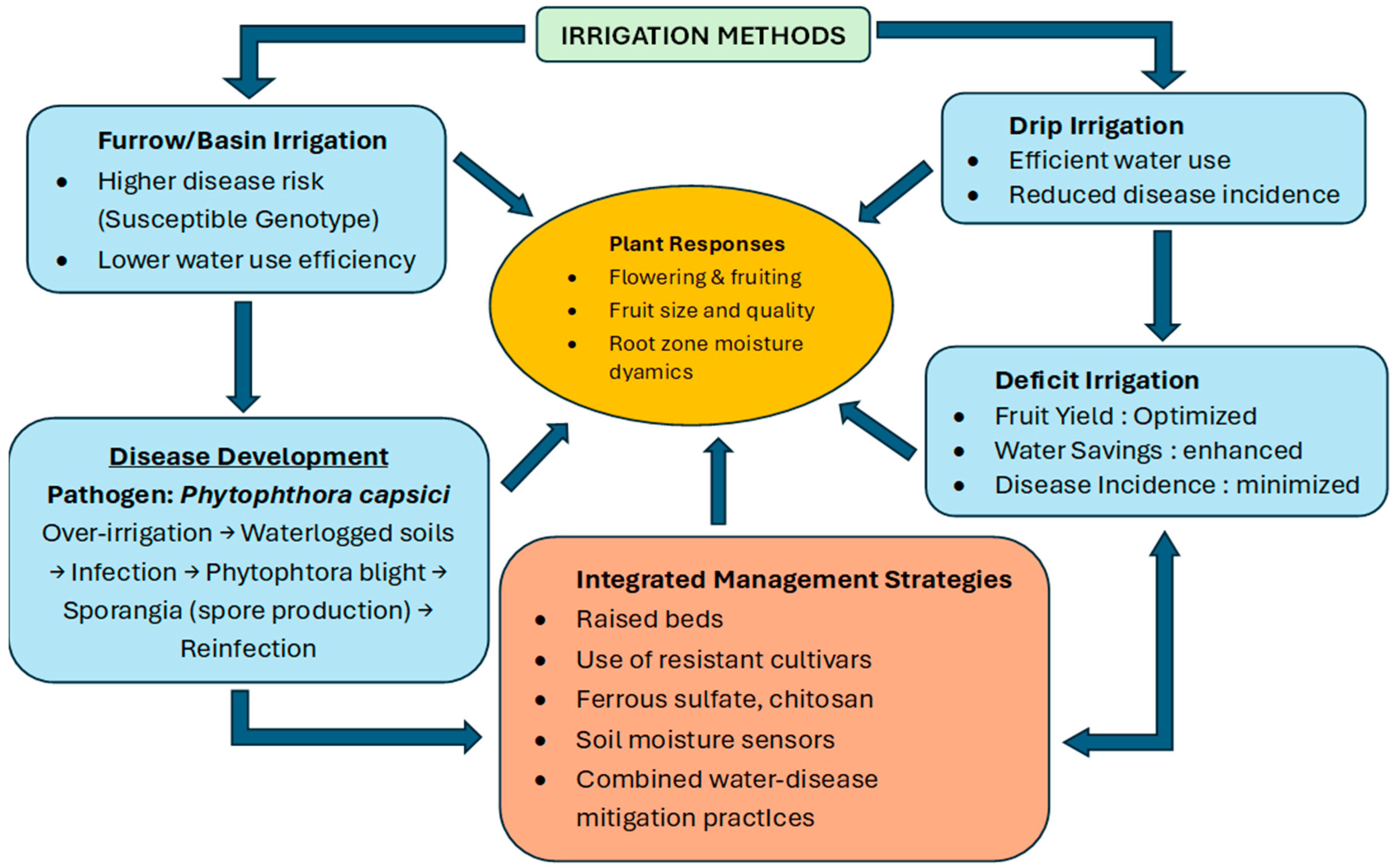
The interconnected relationship between water management, plant health, and pathogen development emphasizes the importance of adopting integrated approaches in Chile pepper cultivation, especially in a water-limited environment. Figure 1 encapsulates the central message of the review: Sustainable Chile Pepper Production requires a balanced and integrated strategy that combines intelligent irrigation management with effective disease suppression for high performance, fruit improvement, resource efficiency, and reduced pathogen pressure in water-scarce and disease-prone agricultural systems.
This conceptual diagram accurately models the relationship between irrigation strategy, disease, and yield, strongly supported by empirical data demonstrating the superiority of precision irrigation and integrated management strategies (IMS) over traditional methods.

2.1. Irrigation Method and Disease Risk

Traditional irrigation methods, such as basin and flood irrigation, are highly inefficient and significantly contribute to the spread of P. capsici disease. These techniques lead to over-irrigation, resulting in waterlogged soils that promote zoospore infection and proliferation. A key study by Walters and Jha [46] highlights the stark difference in disease incidence among various irrigation methods. Basin irrigation resulted in a considerable 69% incidence of Phytophthora blight, while drip irrigation and furrow irrigation showed much lower incidence rates of only 4% and 7% of plants, respectively (Table 2).

2.2. Water Use Efficiency and Yield

Drip irrigation and Regulated Deficit Irrigation (RDI) provide optimal control over soil moisture, which directly enhances yield and water-use efficiency (WUE). According to Walters and Jha [46] drip irrigation demonstrated the highest overall WUE (p ≤ 0.05) while requiring the least amount of water and maximizing chile pepper yields. Although furrow irrigation had a lower WUE, it still significantly outperformed basin irrigation [46] (Table 1).
RDI conserves water, maintains optimal soil moisture, and improves WUE, leading to better physiological responses such as enhanced root development, nutrient uptake, flowering, and fruit set [47]. Moderate water stress, defined as a 20% to 30% deficit during less sensitive growth stages, can encourage flowering and inhibit disease progression. An analysis of variance revealed significant effects of irrigation technologies (p ≤ 0.01) on the total number of fruits per plant across various deficit irrigation levels [51].

2.3. Management Strategies

Complementary practices are essential for improving crop protection against plant diseases, focusing on drainage, genetics, and targeted applications. Planting raised seedbeds is crucial for effective drainage. Research indicated that a local pepper variety planted on a flat seedbed had the highest root rot incidence at 56.71%. In contrast, a resistant variety (Melka Oli) grown on a raised seedbed exhibited a significantly lower incidence of 32.70% (p < 0.01) [86]. Other effective strategies include varietal selection (e.g., Jalapeño, Chilaca) and the use of soil moisture sensors for precise irrigation scheduling. Additionally, the application of ferrous sulfate (FeSO4) has proven beneficial. A study demonstrated that higher concentrations of FeSO4 significantly reduced the size of P. capsici lesions and their pathogenicity (p < 0.05) by inhibiting mycelial growth [77] (Table 2). Integrating precision irrigation with these practices provides a robust and sustainable defense against Phytophthora blight.

3. The Global Importance and Vulnerability of Chile Pepper to Phytophthora Blight

Chile pepper (Capsicum annuum) is a crucial crop globally, valued for its use in cuisine, food coloring, and medicinal applications, with annual production reaching around 38 million tons [94]. Known for its flavor and nutritional benefits, chile peppers are widely cultivated, especially in New Mexico, where they generated about $44.9 million in 2021 [95]. Intensified technological advancements have led to China becoming the leading producer and consumer of chile peppers, with cultivation spanning approximately 21,474 km2 as of 2019 [96]. Additionally, sweet peppers are highly favored for their quality and are increasingly grown in greenhouses across Europe, particularly in countries like Spain, Italy, and Poland [97]. In Georgia, bell pepper production is concentrated in the southern counties, with major contributions from Lake Park, Colquitt, and Lowndes [98].
Capsicum is an important genus due to its nutritional, economic, and cultural significance. Its production is jeopardized by P. capsici, which plays a major role in reducing chile pepper yields [99]. Its impact extends beyond field losses, disrupting market supply chains and affecting farmer livelihoods across the vegetable industry [77,88]. Both open-field and greenhouse productions are at risk, with bell pepper industries reporting high vulnerability [78]. Chile pepper plants are frequently affected by Phytophthora blight, which damages leaves, fruits, stem bifurcations, stem bases, and roots [100]. This condition is caused by the pathogen P. capsici, resulting in a genuine issue, known as root rot. Improving resistance to such diseases involves activating various natural defense mechanisms in the plants, and understanding these mechanisms can help develop new strategies for disease control [101].

4. The Pathogen’s Resilience and Dissemination

The success of P. Capsici as a pathogen is attributed to its remarkable biological resilience, adaptability, and aggressive life cycle. This oomycete produces both sexual (thick-walled oospores), which enable long-term survival in soil for up to 10 years, and asexual spores (sporangia and motile zoospores), which facilitate rapid spread during wet and warm conditions [102]. Its high genetic variability allows rapid evolution, making control via breeding or chemical methods more challenging [103]. Additionally, diversity in mating types among isolates (e.g., PPC1 vs. PPC6) contributes to variations in its pathogenicity and chemical sensitivity [78]. Its capacity for rapid movement through water and soil, along with the production of resilient spores, enhances field-to-field and seasonal dissemination.

5. Integrated Management Strategies

Management of P. capsici is complex and necessitates integrated strategies that account for both environmental conditions and the biology of the pathogen. Chile pepper productivity is strongly influenced by environmental factors and water availability, with optimal growth temperatures between 20 and 26 °C and a need for fertile and well-drained soils [9]. Water scarcity represents a significant threat to crop production, especially in drought-prone regions [7,8,10].
Chemical control options include Ridomil Gold 480 EC, which has shown strong efficacy against many isolates, particularly when combined with phosphorous acid products like Nutri-Phite. Although Nutri-Phite alone is less potent, it can stimulate plant defense mechanisms and reduce disease incidence [78] (Table 2). Resistance to commonly used fungicides has emerged, complicating control efforts further [104]. Ferrous sulfate (FeSO4) has emerged as a cost-effective and promising alternative, significantly reducing disease severity and lesion size while improving plant biomass and resilience by damaging P. capsici cell membranes and enhancing plant immunity [77] (Table 2). Chitosan (CHI) is another novel control agent that disrupts pathogen growth and spore development, showing performance comparable to standard fungicides like azoxystrobin and metalaxyl [79] (Table 2). Additionally, natural substances such as oxalic acid and waste from Lentinula edodes (WESMS) have demonstrated antifungal properties, inhibiting mycelial growth and zoospore germination [80] (Table 2).
Biological control approaches include the use of the Pa608 strain of Pseudomonas aeruginosa, which reduces P. capsici infection through the production of antifungal compounds like α-pinene, proving effective in both laboratory and field trials [81,82] (Table 2).
On the breeding front, recent molecular techniques like multi-locus genome-wide association studies (GWAS) have identified promising resistant chile pepper accessions such as ‘Chilhuacle Orange’, ‘Tipo Ancho’, and ‘NMCA10237’ [105]. These varieties harbor resistance loci, particularly on chromosome 5, and demonstrate potential for long-term resistance development [105]. In summary, integrating chemical, biological, genetic, and water and sanitation approaches is essential to mitigate the persistent threat of Phytophthora blight in chile pepper cultivation.

6. Susceptibility of Chile Pepper to P. capsici: Genotype Variability

Chile peppers are a popular and widely cultivated crop valued for their vibrant flavors and culinary significance worldwide. Their susceptibility to P. capsici, a soilborne oomycete pathogen, presents a major challenge, as it can cause severe root and crown rot, foliar wilt, and substantial yield losses. Understanding the complex interaction between chile pepper genotypes and this pathogen is essential for devising effective disease management strategies that ensure long-term sustainability of chile pepper production.
The pathogen’s impact is heavily influenced by host genotype, environmental conditions, and the virulence of the P. capsici isolates. Kaur et al. [105] highlighted that overwatering and flat-bed planting can exacerbate root rot in pepper genotypes, with most accessions displaying disease symptoms under such conditions. Notably, five Capsicum annuum lines exhibited complete resistance to all tested isolates, providing valuable sources of resistance for breeding. Susceptible control varieties such as ‘Camelot’ and ‘NMCA 10399’ showed early symptom expression, with rapid decline and plant death observed within days of inoculation with virulent isolates like ‘PWB-185’. Similar patterns were noted with isolate ‘6347’, where ‘Ninja’ and ‘NMCA 10399’ exhibited delayed but fatal symptoms. With ‘PWB-186’, susceptible genotypes began showing symptoms by 7 days post-inoculation, although complete wilting was not observed by the bioassay’s end.
Disease progression was tracked using a 0–6 scale and calculated as the area under the disease progress curve (AUDPC), revealing high disease severity—exceeding 90% DSI in some genotypes—especially for ‘PWB-185’. Conversely, ‘PWB-186’ led to comparatively lower disease severity. Genetic markers, including SNPs S10_197712360 and S12_209274913, were associated with resistance traits, while other loci were linked to susceptibility, indicating the genetic basis of host–pathogen interactions [105].
Molecular insights into host response were further explored by G. Lei et al. [106], who observed that in susceptible lines, visible symptoms were absent at 12 h post-inoculation (hpi) but progressed to brown lesions and vascular constrictions by 60–72 hpi. These observations defined critical sampling windows—24 hpi for the biotrophic phase and 48 hpi for the necrotrophic phase—for transcriptomic and metabolomic analyses. Gene silencing studies confirmed the role of specific calcium channel-related genes in disease susceptibility. Silencing CaCNGC6 had no measurable impact on disease progression, whereas silencing CaCNGC9 significantly increased lesion development, confirming its involvement in mediating resistance to P. capsici [79].
Field and greenhouse screening studies also confirmed wide variation in susceptibility among chile pepper cultivars. Reyes-Tena et al. [107] assessed pasilla chile pepper cultivars against multiple virulence phenotypes of P. capsici, revealing that while all susceptible control plants developed symptoms such as stem necrosis, chlorosis, and wilting within 3 days after inoculation, only 11 of the tested phenotypes exhibited resistance. Most cultivars displayed less than 33% resistance, and the pathogen could still be re-isolated from mildly affected plants, indicating partial or incomplete resistance. These findings illustrate the pathogen’s ability to overcome host defenses in most commercial cultivars and highlight the urgency of identifying more robust sources of resistance.
Ro et al. [88] corroborated these results in their screening of various chile pepper accessions, where susceptible plants displayed severe wilting within one week of inoculation with the aggressive KCP-7 isolate, while resistant accessions remained symptom-free for over four weeks. The health and productivity of these resistant lines were maintained after being transplanted to pots, where they continued to grow, flower, and set fruit normally, validating their potential for future breeding efforts. Similarly, previous reports by Kim et al. [108] and Reyes-Tena et al. [107] confirmed that some cultivars show tolerance to specific isolates, although this resistance is often isolate-specific and incomplete, emphasizing the complexity of resistance mechanisms in chile pepper.
Overall, the susceptibility of chile pepper to P. capsici varies among cultivars and is influenced by both host genetics and pathogen variability. While certain Capsicum annuum genotypes exhibit promising resistance, the widespread susceptibility of commercial varieties highlights the need for ongoing research in molecular resistance, precise phenotyping, and marker-assisted breeding to achieve durable and broad-spectrum resistance against this highly adaptive pathogen.

7. Irrigation Water Management and Phytophthora Blight

Phytophthora blight, caused by the pathogenic oomycete Phytophthora spp., poses a major threat to a wide range of crops, resulting in significant economic losses in agriculture. A key factor influencing the development and spread of this disease is irrigation water management. Irrigation regimes can directly impact the incidence and severity of Phytophthora blight, as waterlogged conditions and excess soil moisture create a favorable environment for the pathogen’s survival, multiplication, and infection.

7.1. The Critical Role of Soil Moisture in Disease Expression

The management of soil moisture is a pivotal factor in controlling outbreaks of P. capsici. Recent studies have strongly emphasized the relationship between irrigation practices and disease severity [79]. Suboptimal water application, encompassing both under- and over-irrigation, significantly increases plant susceptibility and pathogen proliferation.

7.2. Over-Irrigation: Hypoxia and Pathogen Proliferation

Excessive irrigation and flat planting conditions directly exacerbate root rot development [105]. These practices encourage water accumulation around the root zone, creating an ideal setting for zoospore motility and infection by P. capsici, a classic water mold [109]. The underlying mechanism is primarily physiological: root hypoxia (oxygen deprivation). When soil pores are saturated, atmospheric oxygen diffusion is severely restricted. Root cells, deprived of oxygen for aerobic respiration, shift to anaerobic respiration (fermentation), which yields less energy (ATP) and produces toxic metabolites like ethanol. This metabolic stress and subsequent root damage compromise the plant’s ability to absorb water and nutrients [110], creating easy entry points for the pathogen. Critically, this stress diverts energy resources away from the synthesis of host defense compounds, thereby impairing the host immune response and increasing susceptibility. Empirical evidence supports this link, showing a quadratic increase in disease incidence with increasing irrigation rates (R2 = 0.76, p = 0.0013) [73]. This finding suggests that excessive water applications not only elevate disease risk but may also mask the actual impact on yield by inflating water benefit estimates.

7.3. Water Stress: Hormonal Suppression of Plant Defense

While P. capsici requires water for dispersal, severe water stress (under-irrigation) can also increase susceptibility by triggering changes in plant metabolism and immunity. Water stress elevates levels of the plant hormone Abscisic Acid (ABA), which is essential for stomatal closure and water conservation. However, this survival mechanism often occurs at the expense of defense readiness. Water stress can lead to cross-talk inhibition by suppressing key defense signaling pathways, such as those governed by Salicylic Acid (SA) and Jasmonic Acid (JA) [111]. The reduced CO2 uptake from stomatal closure limits photosynthesis, resulting in fewer carbon resources and less ATP energy available for synthesizing defense compounds [112]. Consequently, the plant’s ability to mount a robust and timely immune response against P. capsici is diminished, even if conditions are not ideal for zoospore spread.

7.4. Management Practices

Effective irrigation management is essential for controlling Phytophthora blight in crop production, particularly for chile peppers. It is important to maintain proper soil moisture while simultaneously preventing conditions that can encourage the spread of pathogens. Strategies such as careful field layout, irrigation scheduling, and the use of raised beds can significantly reduce disease pressure. Optimizing irrigation practices is crucial; both under- and over-irrigation can lead to increased disease development and reduced fruit yield. Drip irrigation is particularly beneficial, as it delivers water directly to the root zone, minimizing soil saturation and the conditions that favor P. capsici outbreaks. Additionally, combining efficient water management with genetic resistance offers a robust approach to disease control. Recent findings highlight accessions with complete resistance to tested isolates [105], underscoring the potential for integrating genetic solutions with improved moisture management for sustainable crop protection and enhanced stability in chile pepper production systems.

8. Irrigation Type and Regime (Including Deficit Irrigation)

The optimization of water supply is critically important for successful chile pepper cultivation, particularly in regions where rainfall alone cannot satisfy crop water requirements. As climate change exacerbates the frequency and severity of drought events globally, there is an intensified need for agricultural systems that integrate physiological, genetic, and agronomic approaches to water scarcity [113]. Effective irrigation practices not only enhance agricultural productivity but also contribute to sustainable water resource management, especially in areas facing water scarcity. Among various irrigation methods, innovative systems such as drip and sprinkler irrigation have demonstrated significant potential to improve water use efficiency and reduce losses. These methods fall under the broader umbrella of “precision irrigation,” a comprehensive approach that incorporates efficient techniques and advanced monitoring tools to mitigate drought effects by delivering water precisely where and when it is needed [113]. Drip irrigation has emerged as the most efficient method, providing precise water delivery directly to the root zone while minimizing evaporation and runoff. This efficiency is largely driven by the agronomic design of the system; specifically, the volume of wetted soil significantly affects crop response. Even when water supply is theoretically sufficient, optimizing the number of emitters per plant to expand the wetted soil surface can improve the physiological status of the crop [113]. Walters and Jha [46] observed that drip irrigation achieved the highest WUE (p ≤ 0.05), outperforming traditional irrigation techniques in maximizing chile pepper yields while conserving water (Table 1). Devika et al. [72] further reported that red chile pepper cultivated using drip irrigation showed remarkable water savings of about 43% compared to flood irrigation. Although drip systems required more frequent watering, approximately 120 applications versus 48 for flood irrigation, the overall water usage per acre was significantly lower.
Drip irrigation, while noted for its ability to enhance WUE, may not always be economically feasible, especially for smallholder farmers [46]. Their analysis showed that water use varied significantly between irrigation types: basin irrigation had the highest consumption at 2.36 mm, furrow irrigation followed with 1.84 mm, and drip irrigation used the least at 1.30 mm (Table 1). Furrow irrigation reduced water use by 22% compared to basin irrigation, but consumed 29% more water than drip systems, which ultimately achieved a 45% water savings compared to basin methods.
Despite its many benefits, the adoption of drip irrigation faces several practical and economic challenges. In regions like Afghanistan, farmers often encounter obstacles such as high material costs, the need for adequate water pressure, emitter clogging, and the issue of plastic waste disposal [46]. These barriers lead many smallholder and resource-limited farmers to prefer furrow irrigation, which, though less efficient, is more affordable and easier to manage. Nevertheless, drip irrigation proves particularly advantageous when integrated with on-farm water storage systems, offering superior control and reduced water wastage compared to furrow systems, which become harder to manage when soil moisture levels drop. Furthermore, recent advancements such as Sub-Surface Drip Irrigation (SDI), where driplines are buried to keep the soil surface dry, offer a promising strategy for semiarid regions by further minimizing evaporation and preventing weed growth [113].
Supporting its efficiency, drip irrigation systems commonly include a single lateral line per planting bed and utilize turbulent flow driplines, enabling precision agriculture and enhanced crop performance [49]. Research by Maraña-Santacruz et al. [47] revealed that drip irrigation leads to higher fruit production relative to surface irrigation, while Lodhi et al. [74] demonstrated that combining drip irrigation with low tunnels enhances phenological development and early yield in sweet pepper cultivation (Table 1).
Government agencies have shown increasing interest in promoting drip irrigation due to its ability to deliver water directly to the plant roots, reducing conveyance losses and ensuring efficient distribution [114]. Despite its capital-intensive nature, which can deter widespread adoption, especially due to high initial investment costs [72], drip irrigation remains a valuable solution for regions grappling with limited water availability and irregular electricity supply.
In these contexts, the system’s efficiency and adaptability offer compelling reasons for adoption, particularly for smallholder farmers cultivating vegetable crops. The integration of drip irrigation not only improves productivity and reduces disease pressure but also contributes to resolving broader water scarcity challenges. Additionally, Christensen’s coefficient of uniformity (CU) serves as a key indicator for evaluating water and nutrient distribution in irrigation systems, offering insights into irrigation efficiency and uniform application [115,116]. A systematic approach to implementing drip irrigation can thus support both improved chile pepper production and sustainable water management.

9. Deficit Irrigation Strategies in Chile Pepper Cultivation

Deficit irrigation strategies in chile pepper cultivation play a critical role in optimizing water use while maintaining crop yield and quality, particularly in regions with limited water resources. Effective water management is essential, as both water deficits and over-irrigation can adversely affect the growth and productivity of chile pepper crops. While Mackic et al. [45] did not specifically examine deficit irrigation in chile peppers, their emphasis on maintaining optimal water supply supports the need for precise irrigation to achieve high yields. Hot peppers, a critical economic crop primarily cultivated in warm and semiarid regions including China, Korea, and the United States, have shallow root systems and high stomatal conductance, making them particularly sensitive to deficit irrigation [7,117]. Walters and Jha [46] noted that in Afghanistan, a lack of farmer knowledge and challenges like both under- and over-irrigation resulted in low water use efficiency in chile peppers. Improved irrigation practices that enhance root zone moisture are associated with better growth rates, as reported by Maida et al. [69]. Expanding on the importance of the root zone, Macias-Bobadilla et al. [118] highlighted that soil type is a critical environmental component in the plant’s response to water stress. In their study of Capsicum annuum, plants grown in sandy soil consistently exhibited superior morphological performance, including greater plant height, stem diameter, and fruit number—compared to those grown in clay soil under identical irrigation regimes. The study attributed the lower performance in clay soil to higher sodium content, which forced the plants to prioritize osmoregulation via proline accumulation as a defense mechanism rather than biomass production. Gireesh et al. [48] demonstrated that applying water and fertilizers beyond threshold levels did not result in improved yields. Instead, over-irrigation prolonged the vegetative stage and delayed reproduction, leading to economic losses. Lodhi et al. [74] and Khan et al. [119] found that drip irrigation at 0.60 irrigation water to crop pan evaporation (IW/CPE ratio led to flowering earlier under stress conditions. In the broader literature on crop adaptation, DI is categorized into distinct strategies. Champaneri et al. [120] provide a comprehensive framework classifying these methods into Classical Deficit Irrigation (CDI), where water is reduced throughout the cycle; Regulated Deficit Irrigation (RDI), which targets specific phenophases; and Partial Rootzone Drying (PRD), which involves alternate wetting and drying of the root zone. While CDI often risks yield loss by inducing stress during sensitive stages, RDI and PRD are generally considered superior strategies because they leverage the plant’s physiological mechanisms—such as abscisic acid (ABA) signaling from dry roots—to close stomata and reduce transpiration without severely impacting fruit development. However, the specific profile of the water deficit—whether gradual or sudden—also dictates the plant’s coping mechanism. Macias-Bobadilla et al. [118] found that C. annuum reacts differentially depending on how the deficit is experienced; plants subjected to a “gradual water deficit” (GWD) primarily activated oxidative regulation, evidenced by significantly higher expression of peroxidase (POD) and superoxide dismutase (SOD) genes. Conversely, plants facing “sudden water deficit with gradual recovery” (SWDR) relied more heavily on osmotic regulation, accumulating significantly higher levels of proline to manage the stress.
Mohammed and Hussen [51] stressed the benefits of efficient irrigation systems, such as drip irrigation, for maximizing pepper yield, particularly under well-watered conditions. Their research showed that a net irrigation requirement of 521.8 mm supported optimum growth, with seasonal irrigation depths ranging from 172 to 221 mm [44,52]. Severe drought conditions cause a drastic reduction in chile pepper productivity. Mohammed and Hussen [51] observed that increasing water deficits significantly lowered both fresh and dry marketable yields; while full irrigation achieved the highest outputs (13,600 kg ha−1 fresh and 6430 kg ha−1 dry), a 60% water deficit plummeted yields to their lowest levels of 3530 kg ha−1 and 1920 kg ha−1, respectively. These findings demonstrate that adequate soil moisture enhances photosynthesis and assimilate production, whereas water stress throughout the growing season significantly reduces yield. High water deficit levels led to smaller, shriveled, and discolored fruits, resulting in higher unmarketable yields. At 60% deficit irrigation (DI), unmarketable dry yield reached 350 kg ha−1 compared to 3600 kg ha−1 under full irrigation. The study showed that a 30% DI reduced yield by 26.52% but saved 33.4% of irrigation water, suggesting that moderate stress can be a practical compromise in water-limited environments. The crop yield response factor (Ky) varied between 0.86 and 1.24, with higher values indicating greater susceptibility to yield loss under water stress. At 50% DI, a Ky of 1.24 suggested that yield reductions exceeded crop evapotranspiration reductions, whereas lower Ky values under 20% DI indicated better water use without a major yield penalty.
Yang et al. [44] recommended full irrigation to achieve maximum yield and marketable output, especially during critical stages. Yield losses under 25% and 50% deficits were statistically significant, though reductions during late stages were minimal due to decreased water demands as fruits matured. Seasonal comparisons showed minor yield declines in 2015 compared to 2014, with total yield reductions of around 7%. Kabir et al. [73] also found that increased irrigation improved vegetative traits, while fruit weight and dry matter content responded variably to water availability. Mohammed and Hussen [51] found that the number of fruits per plant peaked (85.4) under 20% DI, while the lowest number (20.93) occurred at 60% DI. Similarly, flower production peaked under moderate water stress (20% DI), indicating that controlled water deficit enhances flowering and fruit set. Severe deficits reduced flower and pod development due to reduced chlorophyll, photosynthesis, and nutrient uptake. This reduction in physiological performance is closely tied to the plant’s biochemical limits; Macias-Bobadilla et al. [118] noted that while moderate stress induces secondary metabolism—such as increased phenylalanine ammonia-lyase (PAL) expression for phenol synthesis—severe or long-term stress forces the plant to rely on antioxidant enzymes to detoxify reactive oxygen species (ROS). Fruit size metrics such as length and diameter were also affected: the longest fruits (11.53 cm) and largest diameters (2.14 cm) were recorded under full irrigation, while the shortest (5.51 cm) and narrowest (1.23 cm) were seen at 60% DI. Fruit weight per plant followed a similar trend, the highest under full irrigation (745.8 g) and the lowest under 60% DI (106.5 g). These findings emphasize that water demand increases significantly during fruiting, and water deficits during this stage drastically affect yield. This aligns with the principles of Regulated Deficit Irrigation (RDI), which posits that reducing irrigation during less critical periods can improve water productivity, but requires detailed knowledge of crop phenology to avoid compromising yield during critical stages like flowering and fruiting [113]. Champaneri et al. [120] further support RDI in peppers, noting that specific regimes (e.g., RDI at 60% ET0) can result in significantly lower soil electrical conductivity (EC) compared to farmer management practices, thereby mitigating soil salinity issues while minimizing yield losses. Regulated Deficit Irrigation (RDI) can improve certain fruit quality parameters like soluble solids content while conserving water. During mid-growth stages, when canopy development and fruit expansion are rapid, water demand is the highest. Yang et al. [44] noted that while deficit irrigation during vegetative stages may allow for plant recovery, water shortages during flowering and fruiting stages result in significant yield reductions. Notably, peppers under 0% DI took the longest to flower (92.6 days) and mature (117.4 days), while 60% DI accelerated both timelines, potentially reducing quality and market readiness. Marketable yield varied significantly across treatments, with a 26.52% reduction under 30% DI. Though the highest yield was achieved under full irrigation (6.54 t ha−1), a 60% DI reduced yield to 2.27 t ha−1, saving 66.6% of water but sacrificing 65.32% of the yield. Lower water deficit levels, like 10% and 20% DI, led to small yield reductions (9.81% and 15.7%, respectively) while conserving 11.1% and 21.7% water. These results highlight the potential of mild to moderate deficit irrigation for improving water productivity without major yield penalties.
Abdel Khalik et al. [49] noted that in sweet Italian peppers, a crop with indeterminate growth, any water shortage during development can affect crop performance. Their study showed that increasing water stress intensity reduced dry fruit weight and increased blossom-end rot (BER), aligning with earlier work by Fernández et al. [121]. Though higher quality yields in the “Extra class” category declined with stress (65.6% to 59.7%), these differences were not statistically significant. Yang et al. [36] confirmed that vegetative stages were less sensitive to water stress, offering a window for safe irrigation reduction.
Kabir et al. [73] demonstrated that 33% DI in bell peppers maintained yield and quality, even though plant growth and gas exchange decreased. Over-irrigation at 133% ETc enhanced plant growth but did not improve fruit yield over 100% ETc. Mohammed and Hussen [51] reported a net water requirement of 485 mm for full irrigation (Table 1), with reductions to 425 mm at 90% ETc and 194 mm at 40% ETc. Plant height, leaf count, and stem girth declined under higher deficit levels. Macias-Bobadilla et al. [118] corroborated these morphological impacts, reporting that under field capacity conditions (No Deficit), plants achieved a height of ~21.9 cm and leaf count of ~44, whereas stress treatments significantly reduced these metrics across different soil types. At 0% DI, plant height reached 50.47 cm and leaf count peaked at 228.3, while at 60% DI, values dropped to 30.67 cm and 104.7 leaves, respectively. Stem girth decreased significantly beyond 40% DI. Primary branches per plant and pod size increased with water availability, enhancing overall productivity.
Deficit levels also influenced reproductive development. At 20% DI, flowering peaked at 96.07 flowers per plant, while 60% DI reduced this to 33.17 flowers. Days to 50% flowering and maturity were longest under full irrigation and shortest at 60% DI. Marketable yield declined significantly with higher deficits, reaffirming 30% DI as a threshold for balancing water savings and acceptable yield. A 50% water deficit during mid-growth stages caused greater yield loss than a 25% deficit. However, late-stage deficits of 25–50% were effective in saving water while preserving fruit quality [44].
Water deficits during 2014 and 2015 reduced irrigation depths by 6–42 mm, and crop evapotranspiration (ETc) dropped by 26.7% to 36.4% in the late season compared to mid-season. ETc reductions at 50% DI were more pronounced, with plants compensating by expanding root systems to access deeper moisture [122,123]. Mean seasonal ETc ranged from 2.7 to 3.4 mm day−1 [124]. High soil moisture for prolonged periods can also reduce water and nitrogen uptake in shallow-rooted peppers, emphasizing the need for balanced irrigation [44]. Additionally, understanding the interplay between irrigation regimes and soil biochemistry is essential for future strategies. Macias-Bobadilla et al. [118] suggest that designing irrigation strategies to induce specific defense mechanisms—such as antioxidant capacity or phenol synthesis—could not only save water but also potentially enhance the nutraceutical content of the fruit for pharmaceutical applications. These findings collectively highlight that strategic deficit irrigation, especially at light to moderate levels, can help save water by minimizing adverse effects on yield and pepper quality.

10. Physiological Responses, Fruit Quality, and Yield of Chile Pepper Under Different Irrigation Management Practices

Chile pepper is cultivated in arid and semi-arid regions, making the management of water resources essential for optimizing growth, physiological health, and yield outcomes. Numerous studies have demonstrated the significant impact of irrigation strategies on chile pepper productivity, with particular attention to how different irrigation methods and schedules influence growth parameters, fruit development, and overall quality.
Sezen et al. [71] recorded high yields of 33.14 Mg ha−1 and 35.298 Mg ha−1 in consecutive years, attributing the improved fruit counts and efficient soil moisture retention to the application of Kcp2 and Kcp3 coefficients. Similarly, Mackic et al. reported yields ranging from 32.48 to 42.94 Mg ha−1 (Table 1), with drip and furrow irrigation outperforming basin irrigation by approximately 40%. These methods effectively promote plant height and branching, as demonstrated in irrigation schedules with a 0.8 IW/CPE ratio, contributing to improved vegetative and reproductive development [69]. Gireesh et al. [48] highlighted the combined effects of fertilization and irrigation, noting a maximum yield of 24.8 Mg ha−1 (Table 1) under optimized treatment combinations. The advantages of drip irrigation were further supported by Maraña-Santacruz et al. [47], who observed that despite lower total water application, fruit yield increased under drip irrigation due to enhanced water and nutrient efficiency (Table 1).
The economic and agronomic viability of drip irrigation for smallholder farmers has been emphasized by Devika et al. [72], who reported higher yields and better resource conservation compared to traditional furrow irrigation. Abdelkhalik et al. [49] evaluated yields based on European market standards, separating marketable and non-marketable fruits, and found that full irrigation provided satisfactory yields aligned with commercial benchmarks. Water restrictions applied during the vegetative and fruit development stages did not significantly affect yields; however, severe limitations during the harvesting phase led to notable declines.
Aurelio [50] further examined varietal differences under water stress, finding that Jalapeño chile peppers maintained greater yield stability under suboptimal irrigation compared to Chilaca, though Chilaca produced heavier fruits per plant. This underscores the importance of genotype selection when implementing water management strategies in resource-limited regions.
Kabir et al. [73] noted that while environmental conditions in 2017 contributed positively to bell pepper yields, variations in irrigation levels did not significantly affect total or marketable yield, a finding that deviated from initial expectations. Early yield, which is critical for farmers targeting early market entry, was consistently highest with drip irrigation across a range of IW/CPE ratios [74]. Walters and Jha [46] supported these findings, noting that drip and furrow irrigation produced 55% and 50% greater fruit weights per hectare, respectively, than basin irrigation (Table 1).
The relationship between irrigation levels and fruit dimensions was also evident in Gireesh et al. [48], who reported maximum fruit lengths of 89.4 mm under the I3F3 treatment and the lowest lengths (55.2 mm) under minimal water and fertilizer conditions. Fruit diameter was also influenced by irrigation and nutrient availability, with the widest diameter (12.0 mm) occurring in I2F3 and I3F2 treatments, and the narrowest (10.9 mm) in I1F1. These results highlight the integral role of nutrient and water management in optimizing fruit morphology.
Additional physical and physiological measures provided insights into seasonal effects and morphological development. Abdel Khalik et al. [49] measured fruit firmness using digital penetrometers and assessed biomass partitioning, revealing that although plants in 2018 were shorter, they developed larger stem diameters and greater shoot dry weight than those in 2017. These inter-annual differences also influenced the proportion of marketable fruits, with a higher percentage of non-marketable fruits in 2017 due to defects and smaller sizes.
Fruit diameter and color indices remained consistent across irrigation strategies and seasons, with an average diameter of 39.3 mm. Moreover, while Jalapeño peppers exhibited a higher fruit count under optimal water conditions, Chilaca peppers demonstrated superior fruit weight per plant [50], reinforcing the importance of understanding varietal responses when evaluating irrigation strategies.
Collectively, this body of evidence emphasizes the critical role of effective management of irrigation in improving physiological traits, performance, and the quality of peppers, especially in water-limited environments.

11. Soil Water Content Dynamics in Chile Pepper Cultivation

Efficient management of water and monitoring of soil moisture are essential for maximizing chile pepper productivity. These strategies promote plant growth, enhance physiological function, increase yields, and improve resource use efficiency and fruit quality. Capsicum pepper plants have shallow root systems and have high sensitivity to water fluctuations [125]. They require a consistent water supply, particularly during flowering and fruiting. While optimal growth occurs between 20–26 °C, maintaining soil moisture is challenging in arid environments.
Abdelkhalik et al. [49] employed ECH2O EC-5 capacitance sensors with Em50 data loggers to monitor volumetric soil water content (VSWC) and determine in situ field capacity (FC) across various irrigation strategies, recording VSWC every 15 min and initiating irrigation when values dropped to 80% of FC. Their findings showed average available water capacity (AWC) before irrigation events ranged from 38.9% to 57.7% in 2017 and from 32.8% to 48.1% in 2018. Lower AWC under severe water deficits was associated with reduced yields. Optimal soil moisture content, between 55% and 70% of FC, promoted healthier plant growth [125]. In physiological comparisons between “Chilaca” and “Jalapeño” chile pepper types under optimal (OWR) and suboptimal water regimes (SOWR), “Jalapeño” exhibited higher photosynthetic activity and achieved a greater fruit productivity of 3.94 kg m−2 in OWR versus 2.99 kg m−2 in SOWR [50]. The field capacity (FC) was established at 26.1%, and the permanent wilting point (PWP) at 13.1%, with soil moisture maintained at 25% ± 2 under OWR and 20% ± 2 under SOWR. Irrigation restored soil moisture from as low as 23% and 18% to 27% and 22% under OWR and SOWR, respectively, with relative water content (RWC) dropping from ~60% in optimal conditions to 56.6% for Chilaca and 53.9% for Jalapeño under water stress. Jalapeño had higher sensitivity to soil moisture fluctuations. Moisture stress and over-wetting during the cropping negatively affect red chile pepper growth [72], with drip irrigation shown to effectively alleviate moisture stress and conserve water by ensuring a timely water supply. A positive correlation was observed between leaf water potential (LWP) and irrigation levels, with reduced irrigation resulting in lower LWP due to decreased soil moisture [73]. Among the tested accessions, C-0271 showed tolerance to water stress, while C-0277 was sensitive [126].
At the experimental site, the infiltration rate was measured at 5.1 cm h−1. with a cumulative infiltration of 22.46 cm h−1, consistent with typical sandy loam properties [51,127]. Soil moisture deficits delayed 50% maturity, while stress-adapted plants sometimes accelerated development as a survival response [51]. Water stress also impaired assimilate transfer to pods, reducing endosperm cell numbers and leading to lower fruit weight and yield, which improved under adequate irrigation. Soil characterization revealed clayey, slightly alkaline soil with moderate organic matter and high lime content [52], while soil composition varied by depth—sandy loam in the top 0–30 cm and silt loam from 30–60 cm [44]. Soil water content was monitored at 10–15-day intervals using the thermal-gravimetric method, allowing for the estimation of crop evapotranspiration (ETc) at different growth stages. Seasonal variation in precipitation significantly affected soil water content between 2014 and 2015, with normalized soil water use indicating that higher irrigation depth was associated with lower relative soil water extraction, while plots with less irrigation exhibited greater water extraction. The CK (control) treatment maintained the lowest soil water matric potential, equivalent to 76% of FC, illustrating the relationship between irrigation levels and soil moisture retention [44].

12. Crop Evapotranspiration and Water Use Efficiency in Chile Pepper Cultivation

As global population growth continues to escalate, the rising demand for water resources emphasizes the importance of improving water use efficiency (WUE) in chile pepper cultivation. The concept of WUE is multifaceted; while intrinsic WUE (WUE_i) measures the ratio of CO2 assimilation to stomatal conductance at the leaf level, “Yield WUE” (Y. ET−1) is often the standard in agriculture, as it balances productivity with total water resources consumed [113]. WUE, typically defined as the yield produced per unit of water utilized, is a key performance metric for sustainable agriculture, particularly in arid and semi-arid regions. Research by Sezen et al. [71] highlights the influence of irrigation strategies on WUE, with reported values ranging from 4.7 kg m−3 in 2022 to 7.9 kg m−3 in 2023, illustrating that water stress reduces fruit size and diminishes efficiency. However, contrasting findings by Mackic et al. [45] suggest no significant differences in WUE across various irrigation methods and evapotranspiration (ET) calculations, consistent with prior observations from Mediterranean horticultural systems.
Sezen et al. [71] also reported that irrigation volumes differed considerably depending on crop coefficient (Kcp) values, ranging from 296 mm to 570 mm (Table 1).
Prolonged intervals between irrigations reduced water use efficiency (IWUE), while more frequent irrigation, especially with higher Kcp values, improved soil water conditions and supported higher yields. Gireesh et al. [48] further demonstrated that the lowest irrigation treatment (I1) yielded water productivity (WP) values between 4.43 and 4.77 kg m−3, whereas the highest irrigation treatment (T3) resulted in WP values as low as 2.84 to 3.04 kg m−3, indicating that excessive water input does not guarantee increased yield and may, in fact, reduce efficiency. This aligns with the broader understanding that determining crop water status is essential not only to prevent water stress but also to avoid overwatering, which can negatively impact fruit quality and yield [113].
Abdel Khalik et al. [49] observed the highest WUE and IWUE in 2018 due to increased marketable yield and reduced irrigation water requirements compared to 2017. However, controlled deficit irrigation (CDI), while saving water, may compromise yields, resulting in lower WUE values and suggesting diminishing returns from water conservation under certain conditions.
Evapotranspiration (ET), a key component in irrigation planning, also plays a vital role in chile pepper productivity. Sezen et al. [71] documented ET values for bell peppers ranging from 365 mm to 528 mm in 2002 and from 309 mm to 511 mm in 2003 (Table 1), with IWUE declining as irrigation intervals lengthened. Mackic et al. [45] reported average IWUE values between 21.65 and 26.41 kg m−3 (Table 1) with no significant correlation to ET calculations or irrigation methods. Gireesh et al. [48] estimated average ET values of 409.4 mm using reference evapotranspiration (ETo) and 400.6 mm from open pan evaporation, with daily ET fluctuating between 2.4 mm and 8.0 mm, depending on solar exposure, which ranged from 3.2 to 10.1 sunshine hours per day. While standard ET calculations provide a baseline, modern precision irrigation increasingly utilizes canopy temperature (Tc) and crop water stress indices (CWSI) to indirectly measure stomatal aperture and refine these estimates in real-time [113].
Abdel Khalik et al. estimated seasonal ET at approximately 660 mm in 2017 and 455 mm in 2018, with respective ETo values of 956 mm and 905 mm (Table 1). Applying the method of Allen et al. [128], crop evapotranspiration (ETc) was calculated using crop coefficients (Kc) of 0.3 (initial stage), 0.95 (mid-season), and 0.8 (late stage). IWUE and WUE were calculated as ratios of market yield (kg m−2) to irrigation water applied (m3 m−2), and as a ratio of market yield to the combined input of precipitation and irrigation water, respectively [49].
Rainfall also contributed significantly to overall water inputs. Aurelio [50] recorded total July rainfall at 105.4 mm (Table 1) with the highest daily amount reaching 54.4 mm. In addition, physiological responses to water stress varied among chile pepper types. The Jalapeño pepper maintained higher transpiration rates under optimal water regimes (OWR), whereas the Chilaca variety exhibited notable reductions in transpiration due to stomatal closure under stress, signaling a reduction in productivity under suboptimal water regimes (SOWR). This stomatal closure is a fundamental drought avoidance mechanism mediated by chemical signals such as abscisic acid (ABA), which triggers ion efflux from guard cells to reduce turgor, thereby limiting water loss at the expense of carbon assimilation [113].
Kabir et al. [73] found that irrigation was managed based on cumulative ETc, approximately 1.27 cm, supplemented by an additional 10% to account for irrigation inefficiencies. Compared to 2018, the year 2017 experienced lower rainfall and shorter irrigation periods. The observed reduction in fruit transpiration and fruit water loss with increasing irrigation levels correlated with the lowest leaf water potential (LWP) being recorded at 33% ETc. Additionally, slightly higher mean temperatures and lower evaporative demand in 2017 contributed to differences in LWP between years. The findings suggest that irrigation levels between 67% and 100% ETc are sufficient to sustain acceptable yields without compromising fruit quality. Such strategies rely on the plant’s ability to regulate stomatal conductance (gS) to balance water loss with photosynthetic need, ensuring survival and productivity even when water availability is below optimal levels [113].
In Mareko Fana’s chile pepper cultivation, deficit irrigation also influenced ET and WUE. Mohammed and Hussen [51] observed long-term reference ETo values ranging from 3.6 mm day−1 in July to 4 mm day−1 in March, with the fruit formation stage reaching the peak ET at 5.4 mm day−1. WUE and IWUE increased significantly under higher deficit irrigation levels. The highest crop WUE (14.22 kg m−3) and IWUE (12.75 kg m−3) were recorded under 60% deficit irrigation, while the lowest values were observed under full irrigation, suggesting that although yield may be reduced, the efficiency of water usage is highest under limited water conditions.
No significant differences in WUE were found between the 30%, 40%, and 50% deficit levels, although statistical differences were evident at the extremes. Seasonal ETc also fluctuated between years, with 2014 demonstrating higher productivity and water efficiency due to lower ETc and higher yields compared to 2015, which saw more rainfall. Yang et al. [44] reported that irrigation treatments T5 and T6 exhibited the highest irrigation water productivity and water productivity values, whereas treatments T3 and T4 recorded the lowest. These findings further affirm the importance of matching irrigation practices to crop growth stages and environmental conditions to maximize water productivity in chile pepper farming systems. This supports the concept that deficit irrigation strategies, such as Regulated Deficit Irrigation (RDI), can successfully improve water productivity by controlling vegetative vigor and directing resources toward fruit quality rather than biomass accumulation [113].

13. Integrated Irrigation Management Strategies and Other Control Strategies for Phytophthora Blight

Integrated water and disease management strategies are essential for optimizing agricultural productivity while minimizing the impact of water-related plant diseases. By combining efficient irrigation practices with disease control measures, farmers can address challenges such as water scarcity and pathogen proliferation, which are often interconnected. This approach enhances crop health and yield and supports sustainable farming practices that conserve water resources and reduce environmental risks.
A major challenge in managing Phytophthora blight is the lack of widely resistant cultivars, which has driven research into alternative strategies such as plant-derived secondary metabolites [87]. The unpredictability of disease outbreaks between years and across fields complicates research, as heavy rainfall can enhance infection and reduce fungicide efficacy, whereas limited rainfall may suppress disease even with high irrigation levels. Phytophthora thrives under excessive soil moisture and poor drainage conditions, making water management a critical component of integrated disease control. Irrigation methods that avoid prolonged soil saturation, such as drip irrigation, help reduce disease while aligning with disease management objectives. In the pursuit of integrated control, various chemical and biological agents have been evaluated. Ferrous sulfate has shown dose-dependent inhibition of P. capsici, particularly at 112 mg L−1, by disrupting mycelial growth and structure [77] (Table 2). Similarly, biochar amendments combined with Trichoderma spp. demonstrated disease suppression, with moderate success attributed to hardwood-derived biochar replacing up to 50% of peat moss in production media [83] (Table 2). Trichoderma alone significantly inhibited P. capsici growth in bioassays, whereas biochar alone showed limited benefit. In greenhouse trials, Pa608 achieved 88% control efficiency against Phytophthora blight, surpassing the performance of Streptomyces olivaceus (73.1%) and P. lini (77%) [84,85] (Table 2). Additionally, the type of seedbed has a strong influence on root rot incidence, with raised beds reducing disease levels and increasing harvestable plants compared to flat beds. For example, the Melka Oli variety had a 27.56% disease incidence on raised beds, compared to 45.34% in local varieties on flat beds [86] (Table 2). A consortium of practices, including raised bed planting, silver/black mulch, and NAA application, showed minimal leaf blight severity and good yield metrics.
Research on Phytophthora blight in peppers indicates varying responses between resistant and susceptible varieties, particularly concerning salicylic acid (SA) levels during the initial stages of infection. In resistant varieties, key proteins related to plant-pathogen interactions, such as NHO1, Rd19, WRKY1, and WRKY2, are notably upregulated [129]. A study examined the efficacy of intercropping dandelion with pepper plants to manage blight caused by *Phytophthora infestans*. It found that a plant spacing of 20 cm (P20) maximized control effectiveness at 43.31% [130]. This method not only helped control blight but also positively influenced the growth conditions of pepper plants.
Chemical control methods have proven effective against pepper blight; however, pathogen resistance poses challenges over time, leading to reduced effectiveness [131]. Chemical phosphorus acid-based treatments such as Agri-Fos, K-Phite, and Lexx-A-Phos yielded mixed results. While ProPhyt and Nutri-Phite significantly reduced disease incidence to below 38.9%, Lexx-A-Phos had a negligible effect. Application concentration was critical: 0.10% was non-phytotoxic, while 0.25% led to decreased fresh weights in bell peppers. These compounds stimulate plant defense responses and represent viable components in large-scale integrated disease management [78]. Potassium phosphite and biocontrol agents have shown potential in managing crown, stem, and root rot issues in soilless systems [132]. Regarding nutrient management, the levels of nitrate (NO3) in resistant versus susceptible pepper genotypes suggest a role for NO3 in plant defense against P. capsici-22 [101]. Additional strategies have explored natural metabolites and byproducts such as pecan shell extracts, which act as plant defense elicitors against soilborne pathogens [87] (Table 2).
Chitosan (CHI), a naturally occurring compound, disrupted P. capsici mycelial morphology and activated the CaCNGC9-mediated salicylic acid (SA) pathway. CHI increased expression of the SA-related gene CaPR1 over time, outperforming traditional fungicides like azoxystrobin and metalaxyl in antifungal efficacy [79]. Microscopic observations confirmed CHI-induced branching and deformation, while metalaxyl caused thickening and swelling, and azoxystrobin led to minor thickening. All three fungicides suppressed sporangia formation, zoospore release, and germination in a concentration-dependent manner, confirming their usefulness in limiting pathogen propagation [79].
Other effective treatments include crop rotation and biostimulant applications. For instance, Lentinula edodes extracts such as WESMS and BABA conferred 64% and 62% protection, respectively, possibly due to antifungal compounds like oxalic acid [80]. In vitro assays suggested WESMS may also contain unidentified compounds with disease-suppressive properties. Resistance breeding remains central to long-term Phytophthora blight control. Studies by Kaur et al. [105] and Lei et al. [106] identified genotypes comparable in resistance to the standard cultivar ‘Criollo de Morelos 334’, with some varieties exhibiting no symptoms after 96 h of inoculation. In field trials, strain Pa608 helped reduce disease incidence from complete wilting in the T2 group to only 12% in the T3 group [81]. The Melka Oli variety, grown on raised beds, not only reduced disease but also improved yield, while other varieties like Melka Zala showed moderate tolerance. Genetic screening has revealed that Capsicum annuum accessions possess greater resistance compared to C. baccatum, C. chinense, C. frutescens, and C. chacoense, which displayed no resistance [88]. Some newer pepper cultivars, like Tarpon and Nitro, demonstrate improved disease resistance, although trade-offs in fruit size and total yield have been noted [18] (Table 2). GWAS analyses have helped identify single-nucleotide polymorphisms (SNPs) linked to resistance traits, enabling marker-assisted breeding. This genetic diversity is crucial for developing robust cultivars capable of withstanding multiple pathogen strains.
In evaluating commercial products, economic considerations must also be factored into control strategies. Integrated approaches—combining improved irrigation practices, resistant cultivars, and targeted treatments—can lower input costs, reduce chemical dependency, and improve yields. Saltos et al. [133] emphasized the need to factor economic losses from P. capsici into production planning and reported that effective disease management strategies not only enhanced crop health but also reduced overall management costs. Recent metabolomic research supports this, showing that ferrous sulfate induced oxidative stress and compromised membrane integrity in P. capsici, while CHI and other treatments altered fungal morphology and inhibited growth [77,79] (Table 2).
Resistance screening across multiple isolates revealed differential sensitivity to fungicides like phosphorous acid, based on mating type e.g., PPC1 (A1) versus PPC6 (A2)—highlighting the importance of tailoring fungicide applications to specific pathogen populations [78]. Screening of diversity panels confirmed that resistant checks like CM-334 remained symptom-free, underscoring the potential of combining host resistance with precision disease management strategies for long-term control of Phytophthora blight in chile pepper systems.
Identifying chile pepper Phytophthora blight through traditional manual methods is often difficult and requires considerable time and human resources. However, advancements in computer vision and image processing technologies have made it possible to use deep learning-based object detection for more accurate real-time identification of this blight. This innovation can significantly reduce the time and labor involved, enhancing the efficiency of smart farms [100].

14. Conclusions

Deficit irrigation has been identified as a viable approach to enhance water use efficiency (WUE) while maintaining fruit quality in chile peppers. Research indicates that moderate water stress, characterized by a 20–30% deficit, can stimulate flowering and yield without significantly compromising fruit quality. In contrast, more severe water shortages adversely affect both yield and quality. Drip irrigation has emerged as an effective irrigation technique, demonstrating superior water conservation and productivity benefits compared to flood or basin irrigation. The prevalence of soil-borne diseases, particularly those caused by P. capsici, can be exacerbated by water management practices such as over-irrigation and the maintenance of saturated soil conditions. This underscores the necessity for optimal irrigation strategies to mitigate disease incidence and promote plant health. The management of this resilient pathogen is complicated by its broad host range; however, emerging strategies such as ferrous sulfate applications and improved irrigation methodologies show promise in reducing disease severity. Furthermore, the provision of an adequate water supply is critical for facilitating photosynthetic activity, nutrient absorption, and overall plant growth. Water deficits during crucial phenological stages such as flowering and fruit development can lead to pronounced negative effects, whereas stress imposed at later growth stages typically results in less severe consequences. While full irrigation regimes optimize yields, they are resource intensive. Alternatively, strategies such as regulated deficit irrigation provide a more sustainable balance between water conservation and acceptable levels of productivity. The integration of modern irrigation technologies, including soil moisture sensors, as well as crop-specific practices tailored to various varieties, such as Jalapeño and Chilaca, is essential for optimizing irrigation water use efficiency and crop performance. In conclusion, effective irrigation management is paramount for maximizing chile pepper yields and minimizing water waste, particularly in water-scarce regions. Advanced irrigation systems, such as drip irrigation in conjunction with regulated water stress, have the potential to enhance yields and improve water use efficiency. Additionally, integrated approaches that combine irrigation management with disease control strategies—such as the application of ferrous sulfate—are essential for promoting sustainable agricultural production and effectively suppressing plant pathogens. Future studies could explore the long-term impacts of different irrigation practices on soil microbial health, with particular attention to how these practices influence pathogen dynamics and overall soil ecosystem functioning.

Author Contributions

Conceptualization, Y.O.A., K.D., D.L. and S.S.; methodology, K.D., Y.O.A., D.L. and S.S., validation, D.L., K.D. and S.S., data curation, K.D., Y.O.A., S.S. and D.L.; writing—original draft preparation, Y.O.A., K.D., S.S. and D.L.; writing—review and editing, Y.O.A., K.D., D.L. and S.S.; supervision, K.D., S.S. and D.L.; project administration, S.S.; funding acquisition, K.D., D.L. and S.S. All authors have read and agreed to the published version of the manuscript.

Funding

This research was funded by UADA-NIFA, grant number “GRANT: GR0007800”.

Data Availability Statement

Not applicable.

Acknowledgments

The authors acknowledged the support of the New Mexico State University.

Conflicts of Interest

The authors declare no conflicts of interest.

References

  1. Kelebek, H.; Sevindik, O.; Uzlasir, T.; Selli, S. LC-DAD/ESI MS/MS characterization of fresh and cooked Capia and Aleppo red peppers (Capsicum annuum L.) phenolic profiles. Eur. Food Res. Technol. 2020, 246, 1971–1980. [Google Scholar] [CrossRef]
  2. Latournerie-Moreno, L.; Lopez-Vázquez, J.S.; Castañón-Nájera, G.; Mijangos-Cortes, J.O.; Espadas-Villamil, G.; Pérez-Gutiérrez, A.; Ruiz-Sánchez, E. Evaluación agronómica de germoplasma de chile habanero (Capsicum chinense Jacq). Agroproductividad 2015, 1, 24–29. [Google Scholar]
  3. Servicio de Información Agroalimentaria y Pesquera (SIAP). Panorama Agroalimentario 2019. 2019. Available online: https://www.gob.mx/agricultura/dgsiap/acciones-y-programas/panorama-agroalimentario-258035 (accessed on 22 April 2024).
  4. Biro Pusat Statistik. Produktifitas Pertanian Indonesia Jakarta: Indonesia Dalam Angka; Biro Pusat Statistik: Padang, Indonesia, 2015. [Google Scholar]
  5. Biro Pusat Statistik Propinsi Sumatera Barat. Sumbar Dalam Angka; Biro Pusat Statistik Propinsi Sumatera Barat: Padang, Indonesia, 2004. [Google Scholar]
  6. Weiss, E.A. World Production and Trade; CABI Publishing: Wallingford, UK, 2002. [Google Scholar]
  7. Dimitrov, Z.; Ovtcharrova, A. The productivity of peppers and tomatoes in case of insufficient water supply. In Proceedings of the ICID Special Technical Session on the Role of Advanced Technologies in Irrigation and Drainage System, Rome, Italy, 13 September 1995; Volume 1, pp. ft9.1–ft9.5. [Google Scholar]
  8. Kang, S.; Zhang, L.; Hu, X.; Li, Z.; Jerie, P. An improved water use efficiency for hot pepper grown under controlled alternate drip irrigation on partial roots. Sci. Hortic. 2001, 89, 257–267. [Google Scholar] [CrossRef]
  9. Dhaliwal, M.S.; Sharma, S.P.S.; Jindal, S.K.; Dhaliwal, L.K.; Gaikwad, A.K. Growth and yield of bell pepper as influenced by growing environment, much, and planting date. J. Crop Improv. 2017, 31, 830–846. [Google Scholar] [CrossRef]
  10. Apurv, T.; Cai, X. Impact of droughts on water supply in U.S. watersheds: The role of renewable surface and groundwater resources. Earth’s Future 2020, 8, e2020EF001648. [Google Scholar] [CrossRef]
  11. Ezquivel Valenzuela, B.; Cueto Wong, J.A.; Valdez Cepeda, R.D.; Pedroza-Sandoval, A.; Trejo-Calzada, R.; Pérez-Veyna, Ó. Prácticas de manejo y análisis de riesgo por el uso de plaguicidas en la Comarca Lagunera, México. Rev. Int. Contam. Ambient. 2019, 35, 25–33. [Google Scholar] [CrossRef]
  12. Aguirre Mancilla, C.L.; Iturriaga de la Fuente, G.; Ramírez Pimentel, J.G.; Covarrubias-Prieto, J.; Chablé-Moreno, F.; Raya-Pérez, J.C. El Chile (C. annuum L.). cultivo y producción de semilla. Cienc. Tecnol. Agropecu. Méx. 2017, 5, 19–27. [Google Scholar]
  13. Hernández Pérez, T.; Gómez García Ma Del, R.; Valverde, M.E.; Paredes-López, O. Capsicum annuum (hot pepper): An ancient LatinAmerican crop with outstanding bioactive compounds and nutraceutical potential. A review. Compr. Rev. Food Sci. Food Saf. 2020, 19, 2972–2993. [Google Scholar] [CrossRef] [PubMed]
  14. George, R.A. Vegetable Seed Production, 2nd ed.; CABI Publishing: Wallingford, UK, 1999. [Google Scholar]
  15. Haile, Y.; Zewudie, Y. Hot Pepper and Tomato Production and Research in Ethiopia. In Tomato and Pepper Production in Tropics; Green, S.K., Griggs, T.D., Mclean, B.T., Eds.; AVRDC: Tainan, Taiwan, 1989; pp. 442–451. [Google Scholar]
  16. Leskovar, D.I.; Cantliffe, D.J. Pepper seedling growth response to drought stress and exogenous abscisic acid. J. Am. Soc. Hortic. Sci. 1992, 117, 389–393. [Google Scholar] [CrossRef]
  17. Snyman, H.A. Effect of water stress on root growth of Opuntia ficus-indica. S. Afr. J. Plant Soil 2004, 21, 71–78. [Google Scholar]
  18. Kumari, M.; Dutta, B.; Coolong, T.; Diaz-Perez, J.C.; Torrance, T.; Shealey, J.; Dawson, J.; McAvoy, T. Adaptability of Phytophthora capsici Resistant Bell Pepper Cultivars in Southern Georgia. HortTechnology 2024, 34, 513–520. [Google Scholar] [CrossRef]
  19. Yıldız, M.; Delen, N. Studies on the wilt problem of pepper in Turkey. In Proceedings of the 5th Congress of the Mediterranean Phytopathological Union, Patras, Greece, 21–27 September 1980; pp. 172–173. [Google Scholar]
  20. Kim, C.H. Review of disease incidence of major crops in 2003. Res. Plant Dis. 2004, 10, 1–7. [Google Scholar] [CrossRef][Green Version]
  21. Bosland, P.W.; Lindsey, D.L. A Seedling screen for Phytophthora root rot of pepper, Capsicum annum. Plant Dis. 1991, 75, 1048–1050. [Google Scholar] [CrossRef]
  22. Parada-Rojas, C.H.; Granke, L.L.; Naegele, R.P.; Hansen, Z.; Hausbeck, M.K.; Kousik, C.S.; McGrath, M.T.D.; Smart, C.; Quesada-Ocampo, L.M. A Diagnostic Guide for Phytophthora capsici Infecting Vegetable Crops. Plant Health Prog. 2021, 22, 404–414. [Google Scholar] [CrossRef]
  23. Alzohairy, S.A.; Hammerschmidt, R.; Hausbeck, M.K. Changes in Winter Squash Fruit Exocarp Structure Associated with Age-Related Resistance to Phytophthora capsici. Phytopathology 2019, 110, 447–455. [Google Scholar] [CrossRef]
  24. Judelson, H.S.; Blanco, F.A. The spores of Phytophthora: Weapons of the plant destroyer. Nat. Rev. Microbiol. 2005, 3, 47–58. [Google Scholar] [CrossRef] [PubMed]
  25. Barchenger, D.W.; Lamour, K.H.; Bosland, P.W. Challenges and strategies for breeding resistance in Capsicum annuum to the multifarious pathogen, Phytophthora capsici. Front. Plant Sci. 2018, 9, 628. [Google Scholar] [CrossRef]
  26. Lamour, K.H.; Stam, R.; Jupe, J.; Huitema, E. The oomycete broad-host-range pathogen Phytophthora capsici. Mol. Plant Pathol. 2012, 13, 329–337. [Google Scholar] [CrossRef]
  27. Hao, Y.; Fan, R.; Zhao, Y.; Nie, K.; Wang, L.; Zhao, T.; Zhang, Z.; Tao, X.; Wu, H.; Pan, J.; et al. Intra species dissection of phytophthora capsici resistance in black pepper. J. Adv. Res. 2025, 74, 121–136. [Google Scholar] [CrossRef] [PubMed]
  28. Bhusal, B.; Mmbaga, M.T. Biological control of Phytophthora blight and growth promotion in sweet pepper by Bacillus species. Biol. Control 2020, 150, 104373. [Google Scholar] [CrossRef]
  29. Sang, M.K.; Kim, J.G.; Kim, K.D. Biocontrol activity and induction of systemic resistance in pepper by compost water extracts against Phytophthora capsici. Phytopathology 2010, 100, 774–783. [Google Scholar] [CrossRef]
  30. Stephan, D.; Schmitt, A.; Martins Cavalho, S.; Seddon, B.; Koch, E. Evaluation of biocontrol preparations and plant extracts for the control of Phytophthora infestans on potato leaves. Eur. J. Plant Pathol. 2005, 112, 235–246. [Google Scholar] [CrossRef]
  31. Wu, J.; Xue, Z.; Miao, J.; Zhang, F.; Gao, X.; Liu, X. Sensitivity of different developmental stages and resistance risk assessment of Phytophthora capsici to fluopicolide in China. Front. Microbiol. 2020, 11, 185. [Google Scholar] [CrossRef]
  32. Hwang, B.K.; Kim, C.H. Phytophthora blight of pepper and its control in Korea. Plant Dis. 1995, 79, 221–227. [Google Scholar] [CrossRef]
  33. Parra, G.; Ristaino, J.B. Resistance to mefenoxam and metalaxyl among field isolates of Phytophthora capsici causing Phytophthora blight of bell pepper. Plant Dis. 2001, 85, 1069–1075. [Google Scholar] [CrossRef] [PubMed]
  34. Tolk, J.A.; Howell, T.A. Water use efficiencies of grain sorghum grown in three USA southern Great Plains soils. Agric. Water Manag. 2003, 59, 97–111. [Google Scholar] [CrossRef]
  35. Steduto, P.; Hsiao, T.C.; Fereres, E.; Raes, D. Crop Yield Response to Water; FAO Irrigation and Drainage Paper No. 66; Food and Agriculture Organization of the United Nations: Rome, Italy, 2012. [Google Scholar]
  36. Yang, H.; Du, T.; Qiu, R.; Chen, J.; Wang, F.; Li, Y.; Wang, C.; Gao, L.; Kang, S. Improved water use efficiency and fruit quality of greenhouse crops under regulated deficit irrigation in northwest China. Agric. Water Manag. 2017, 179, 193–204. [Google Scholar] [CrossRef]
  37. Saleh, I.M. Influence of deficit irrigation on water use efficiency and bird pepper production (Capsicum annuum L.). JKAU Meteorol. Environ. Arid. Land Agric. Sci. J. 2010, 21, 29–43. [Google Scholar]
  38. Topcu, S.; Kirda, C.; Dasgan, Y.; Kaman, H.; Cetin, M.; Yazici, A.; Bacon, M.A. Yield response and N-fertiliser recovery of tomato grown under deficit irrigation. Eur. J. Agron. 2007, 26, 64–70. [Google Scholar] [CrossRef]
  39. Scholberg, J.; McNeal, B.L.; Jones, J.W.; Boote, K.J.; Stanley, C.D.; Obreza, T.A. Growth and canopy characteristics of field-grown tomato. Agron. J. 2000, 92, 152–159. [Google Scholar]
  40. Igbadun, H.E.; Salim, B.A.; Tarimo, A.K.P.R.; Mahoo, H.F. Effects of deficit irrigation scheduling on yields and soil water balance of irrigated maize. Irrig. Sci. 2008, 27, 11–23. [Google Scholar] [CrossRef]
  41. Kirnak, H.; Demirtas, M.N. Effects of different irrigation regimes and mulches on yield and macronutrient levels of drip-irrigated cucumber under open field conditions. J. Plant Nutr. 2006, 29, 1675–1690. [Google Scholar] [CrossRef]
  42. Mao, X.; Liu, M.; Wang, X.; Liu, C.; Hou, Z.; Shi, J. Effects of deficit irrigation on yield and water use of greenhouse-grown cucumber in the North China Plain. Agric. Water Manag. 2003, 61, 219–228. [Google Scholar] [CrossRef]
  43. Amarasinghe, U.A.; Smakhtin, V. Global Water Demand Projections: Past, Present and Future; Research Report 156; International Water Management Institute: Colombo, Sri Lanka, 2014. [Google Scholar]
  44. Yang, H.; Liu, H.; Zheng, J.; Huang, Q. Effects of regulated deficit irrigation on yield and water productivity of chili pepper (Capsicum annuum L.) in the arid environment of Northwest China. Irrig. Sci. 2018, 36, 61–74. [Google Scholar] [CrossRef]
  45. Mačkić, K.; Bajić, I.; Pejic, B.; Vlajić, S.; Boris, A.; Popov, O.; Simić, D. Yield and Water Use Efficiency of Drip Irrigation of Pepper. Water 2023, 15, 2891. [Google Scholar] [CrossRef]
  46. Walters, S.A.; Jha, A.K. Sustaining chili pepper production in Afghanistan through better irrigation practices and management. Agriculture 2016, 6, 62. [Google Scholar] [CrossRef]
  47. Maraña-Santacruz, J.Á.; Castellanos-Pérez, E.; Vázquez-Vázquez, C.; Martínez-Ríos, J.J.; Trejo-Escareño, H.I.; Gallegos-Robles, M.Á. Solarized manure and two irrigation methods on fruit yield of jalapeno chili (Capsicum annuum L. var. Annuum). Rev. Fac. Cienc. Agrar. UNCuyo 2018, 50, 105–117. [Google Scholar]
  48. Gireesh, B.; Agrwal, N.; Tamrakar, S.; Sinha, J. Irrigation and fertigation management for chilli (Capsicum annuum) under drip irrigation system. J. Agric. Eng. 2020, 57, 182–194. [Google Scholar] [CrossRef]
  49. AbdelKhalik, A.; Pascual, B.; Nájera, I.; Domene, M.A.; Baixa Uli, C.; Pascual-Seva, N. Effects of deficit irrigation on the yield and irrigation water use efficiency of drip-irrigated sweet pepper (Capsicum annuum L.) under Mediterranean conditions. Irrig. Sci. 2020, 38, 89–104. [Google Scholar] [CrossRef]
  50. Aurelio, P.S. Some physiological and productivity indicators in two chili pepper types (Capsicum annuum L.) under different water regimes. Horticulture 2023, 1, 1–8. [Google Scholar]
  51. Mohammed, S.; Hussen, A. Influence of deficit irrigation levels on agronomic performance of pepper (Capsicum annuum L.) under drip at alage, central rift valley of Ethiopia. PLoS ONE 2023, 18, e0280639. [Google Scholar] [CrossRef]
  52. Polat, H.E.; Zambi, O.; Güçer, Y.; Anli, A.S. Impact of Drip Irrigation with Recycled Wastewater on Aromatic Compound Composition in Capia Pepper (Capsicum annum L.). Sustainability 2024, 16, 4992. [Google Scholar] [CrossRef]
  53. Zegbe-Dominguez, J.A.; Behboudian, M.H.; Lang, A.; Clothier, B.E. Water relations growth and yield of processing tomatoes under partial root-zone drying. J. Veg. Crop Prod. 2003, 9, 31–40. [Google Scholar] [CrossRef]
  54. Ismail, I.; Razi, M.I. Response of watering regimes on growth and physiological process of lowland tomatoes grown in coconut coir dust culture system. In Proceedings of the Workshop on Environmental Stress Impact on Tropical Crops, Serdang, Malaysia, 1 February 2002. [Google Scholar]
  55. Sandra, P. Growing more food with less water. Sci. Am. 2001, 284, 46–49. [Google Scholar] [CrossRef]
  56. UNEP. Facing the Facts: Assessing the Vulnerability of Africa’s Water Resources to Environmental Change; UNEP/DEWA/RS.05-2; UNEP: Cambridge, UK, 2000. [Google Scholar]
  57. Awulachew, S.B.; Merry, D.J.; Kamara, A.B.; Koppen, B.; Penning de Vries, F.; Boelee, E.; Makombe, G. Experiences and Opportunities for Promoting Small-Scale/Micro Irrigation and Rainwater Harvesting for Food Security in Ethiopia; IWMI: Colombo, Sri Lanka, 2005; p. 98. [Google Scholar]
  58. Hood, S. Rural water use efficiency-real water use efficiency and the opportunities. In Proceedings of the 11th Australian Cotton Conference, Brisbane, Queensland, Australia, 13–15 August 2002; pp. 285–295. [Google Scholar]
  59. Michael, A.M. Irrigation Theory and Practice (Revised); Vikas Publishing House Pvt. Ltd.: New Delhi, India, 1997. [Google Scholar]
  60. Bosland, P.W.; Votava, E.J. Peppers: Vegetable Spice Capsicum; CABI Publishing: New York, NY, USA, 2000. [Google Scholar]
  61. Cuenca, R.H. Irrigation System Design: An Engineering Approach; Prentice Hall: Englewood Cliffs, NJ, USA, 1989. [Google Scholar]
  62. FAO. Deficit Irrigation Practices; Water Reports No. 22; FAO: Rome, Italy, 2002. [Google Scholar]
  63. Nadiya, N.; Kurien, E.K.; Mathew, E.K.; Varughese, A. Impact of fertigation and drip system layout in performance of chilli (Capsicum annum). Int. J. Eng. Res. Dev. 2013, 7, 85–88. [Google Scholar]
  64. Abdul Hakkim, V.M. Effect of site-specific drip fertigation on yield of Chilli. IOSR J. Eng. 2014, 4, 33–44. [Google Scholar]
  65. Hartz, T.K. Water management in drip-irrigated vegetable production. HortTechnology 1996, 6, 165–167. [Google Scholar] [CrossRef]
  66. Sanders, D.C. Vegetable Crop Irrigation; North Carolina Cooperative Extension Service: Raleigh, NC, USA, 1997. [Google Scholar]
  67. Wright, J. (Ed.) Irrigation Scheduling Checkbook Method; Communication and Educational Technology Services; University of Minnesota: Minneapolis, MN, USA, 2002. [Google Scholar]
  68. Leskovar, D.I. Root and shoot modification by irrigation. HortTechnology 1998, 8, 510–514. [Google Scholar] [CrossRef]
  69. Maida, P.; Bisen, B.P.; Dhakad, U. Effect of different irrigation levels on growth and yield of chilli (Capsicum annuum L). Bull. Environ. Pharmacol. Life Sci. 2020, 9, 18–22. [Google Scholar]
  70. Gadissa, T.; Chemeda, D. Effects of drip irrigation levels and planting methods on yield and yield components of green pepper (Capsicum annuum, L.) in Bako, Ethiopia. Agric. Water Manag. 2009, 96, 1673–1678. [Google Scholar] [CrossRef]
  71. Sezen, S.M.; Yazar, A.; Eker, S. Effect of drip irrigation regimes on yield and quality of field grown bell pepper. Agric. Water Manag. 2006, 81, 115–131. [Google Scholar] [CrossRef]
  72. Devika, N.; Narayanamoorthy, A.; Jothi, P. Economics of drip method of irrigation in red chilli crop cultivation: An empirical study from Tamil Nadu. J. Rural Dev. 2017, 36, 293–310. [Google Scholar] [CrossRef][Green Version]
  73. Kabir, M.Y.; Nambeesan, S.U.; Bautista, J.; Díaz-Pérez, J.C. Effect of irrigation level on plant growth, physiology and fruit yield and quality in bell pepper (Capsicum annuum L.). Sci. Hortic. 2021, 281, 109902. [Google Scholar] [CrossRef]
  74. Lodhi, A.; Chouhan, S.; Sharma, S.K. Responses of phenology, yield attributes and early yield of drip irrigated sweet pepper under low tunnels. Int. J. Res. Agron. 2024, 7, 160–165. [Google Scholar] [CrossRef]
  75. Trinidad-Cruz, J.R.; Rincón-Enríquez, G.; Evangelista-Martínez, Z.; Quiñones-Aguilar, E.E. Control biorracional de Phytophthora capsici en plantas de chile mediante Streptomyces spp. Rev. Chapingo Ser. Hortic. 2021, 27, 85–99. [Google Scholar] [CrossRef]
  76. Demerci, F.; Dolar, F.S. Effects of Some Plant Materials on Phytophthora Blight (Phytophthora capsici Leon.) of Pepper. Turk. J. Agric. For. 2006, 30, 247–252. [Google Scholar]
  77. Du, G.; He, H.; Peng, J.; Li, X.; Liu, Z.; Liu, W.; Yang, Y.; Qi, Z. Ferrous Sulfate-Mediated Control of Phytophthora capsici Pathogenesis and Its Impact on Pepper Plant. Plants 2023, 12, 4168. [Google Scholar] [CrossRef]
  78. Hua, G.K.H.; Ji, P.; Culbreath, A.K.; Ali, E. Comparative Study of Phosphorous-Acid-Containing Products for Managing Phytophthora Blight of Bell Pepper. Agronomy 2022, 12, 1293. [Google Scholar] [CrossRef]
  79. Zhu, X.; Zou, A.; Liao, R.; Zhang, J.; Liu, C.; Wang, C.; Hao, C.; Cheng, D.; Chen, L.; Sun, X. Dual actions of chloroinconazide on pepper blight in Capsicum annuum: Disruption of Phythophthora capsici mycelium and activation of CACNGC9-mediated SA signaling. Pest Manag. Sci. 2024, 80, 6483–6492. [Google Scholar] [CrossRef]
  80. Kang, D.-S.; Min, K.-J.; Kwak, A.-M.; Lee, S.-Y.; Kang, H.-W. Defense Response and Suppression of Phytophthora Blight Disease of Pepper by Water Extract from Spent Mushroom Substrate of Lentinula edodes. Plant Pathol. J. 2017, 33, 264–275. [Google Scholar] [CrossRef]
  81. Li, C.; Gao, X.; Huo, Y.; Asseri, T.A.Y.; Tian, X.; Luo, K. Evaluation of biocontrol efficacy of rhizosphere Pseudomonas aeruginosa for management of Phytophthora capsici of pepper. PLoS ONE 2024, 19, e0309705. [Google Scholar] [CrossRef]
  82. Kumar, A.; Munder, A.; Aravind, R.; Eapen, S.J.; Tümmler, B.; Raaijmakers, J.M. Friend or foe: Genetic and functional characterization of plant endophytic Pseudomonas aeruginosa. Environ. Microbiol. 2013, 15, 764–779. [Google Scholar] [CrossRef]
  83. Yu, P.; Qin, K.; Crosby, K.; Ong, K.; Gentry, T.; Gu, M. Biochar reduces containerized pepper blight caused by Phytophthora capsici. Sci. Rep. 2024, 14, 30664. [Google Scholar] [CrossRef] [PubMed]
  84. Zheng, D.W.; Zhou, Y.; Xie, Z.B.; Liu, F.; Zhu, H.J. Screening and identification of antagonistic strain against Phytophthora capsici and the biocontrol potential. J. Hunan Agric. Univ. (Nat. Sci.) 2023, 49, 442–447. [Google Scholar]
  85. Ozyilmaz, U. Evaluation of the effectiveness of antagonistic bacteria against Phytophthora blight disease in pepper with artificial intelligence. Biol. Control 2020, 151, 104379. [Google Scholar] [CrossRef]
  86. Mengist, Y.; Birara, A. Performance Evaluation of Red Pepper Varieties and Types of Seed Bed for The Management of Root Rot (Phytophthora capsici) Disease at Central Gondar, Northwest, Ethiopia. J. Adv. Agric. 2019, 10, 1740–1751. [Google Scholar]
  87. Lujan, P.; Dura, S.; Guzman, I.; Grace, M.; Lila, M.A.; Steiner, R.; Sanogo, S. Efficacy of Pecan Husk and Shell Phenolic Extracts Against Phytophthora Blight in Chile Pepper. Plant Health Prog. 2021, 22, 342–347. [Google Scholar] [CrossRef]
  88. Ro, N.; Haile, M.; Hur, O.; Geum, B.; Rhee, J.; Hwang, A.; Kim, B.; Lee, J.; Hahn, B.-S.; Lee, J.; et al. Genome-Wide Association Study of Resistance to Phytophthora capsici in the Pepper (Capsicum spp.) Collection. Front. Plant Sci. 2022, 13, 902464. [Google Scholar] [CrossRef]
  89. Lewis Ivey, L.M.; Miller, S.A. Assessing the efficacy of pre-harvest, chlorine-based sanitizers against human pathogen indicator microorganisms and Phytophthora capsici in non-recycled surface irrigation water. Water Res. 2013, 47, 4639–4651. [Google Scholar] [CrossRef] [PubMed]
  90. Wan, J.S.H.; Liew, E.C. Efficacy of chemical and biological agents against pepper blight (Phytophthora capsici Leonian) in East Asia: A metaanalysis of laboratory and field trial data. J. Plant Pathol. 2020, 102, 835–842. [Google Scholar] [CrossRef]
  91. French-Monar, R.D.; Rodrigues, F.A.; Korndörfer, G.H.; Datnoff, L.E. Silicon suppresses Phytophthora blight development on bell pepper. J. Phytopathol. 2010, 158, 554–560. [Google Scholar] [CrossRef]
  92. Granke, L.L.; Quesada-Ocampo, L.; Lamour, K.; Hausbeck, M.K. Advances in research on Phytophthora capsici on vegetable crops inStates. Plant Dis. 2012, 96, 1588–1600. [Google Scholar] [CrossRef]
  93. Marín, F.; Diánez, F.; Santos, M.; Carretero, F.; Gea, F.J.; Castañeda, C.; Yau, J. Control of Phytophthora capsici and Phytophthora parasitica on pepper (Capsicum annuum L.) with compost teas from different sources, and their effects on plant growth. Phytopathol. Mediterr. 2014, 53, 216–228. [Google Scholar]
  94. FAO. FAOSTAT: Crops and Livestock Products; Food and Agriculture Organization of the United Nations: New York, NY, USA, 2023; Available online: https://www.fao.org/faostat/en/data/QCL (accessed on 1 June 2025).
  95. New Mexico Department of Agriculture. New Mexico Agricultural Statistics 2021 Annual Bulletin. Available online: https://nmdeptag.nmsu.edu/media/pdf/2021-NM-Ag-Statistics.pdf (accessed on 7 September 2023).
  96. Zou, Z.; Zou, X. Geographical and Ecological Differences in Pepper Cultivation and Consumption in China. Front. Nutr. 2021, 8, 718517. [Google Scholar] [CrossRef]
  97. FAOSTAT. Crop Production Data; Food and Agriculture Organization of the United Nations: Rome, Italy, 2019; Available online: http://www.fao.org/faostat/en/#data (accessed on 13 March 2019).
  98. Kane, S.P. Ag Snapshots 2024. A Brief Focus on Georgia’s Agricultural Industry; Center for Agribusiness and Economic Development, University of Georgia: Athens, GA, USA, 2024; Available online: https://caed.uga.edu/content/dam/caes-subsite/ag-econ/documents/agribusiness/2024-CAED-AgSnapshots.pdf (accessed on 1 June 2025).
  99. Bijalwan, P. Effect of Soil Improvement Practices and NAA Application on Yield and Phytophthora Diseases of Sweet Pepper (Capsicum annuum L.). AATCC Rev. 2023, 11, 111–122. [Google Scholar]
  100. Duan, Y.; Han, W.; Guo, P.; Wei, X. YOLOv8-GDCI: Research on the Phytophthora Blight Detection Method of Different Parts of Chili Based on Improved YOLOv8 Model. Agronomy 2024, 14, 2734. [Google Scholar] [CrossRef]
  101. Koç, E.; Karayiğit, B. Nitrate content in roots of pepper seedlings exposed to Phytophthora capsici. Anatol. J. Bot. 2023, 7, 122–127. [Google Scholar] [CrossRef]
  102. Charles, K.; Mary, H. Phytophthora Can Blight Your Peppers and Your Profits. Michigan State University, Department of Plant, Soil and Microbial Sciences. 2017. Available online: https://www.canr.msu.edu/news/phytophthora_can_blight_your_peppers_and_your_profits (accessed on 27 May 2024).
  103. Kumar, R.; Srivastava, S.; Rana, M.; Shameem, N.; Parray, J.A.; Negi, R.; Yadav, A.N. First Report of Phytophthora capsici Causing Phytophthora Blight on Bell Pepper (Capsicum annuum L.) from Haryana, India. Natl. Acad. Sci. Lett. 2024, 48, 153–156. [Google Scholar] [CrossRef]
  104. Shoaf, N.; Hoagland, L.; Egel, D.S. Suppression of Phytophthora Blight in Sweet Pepper Depends on Biochar Amendment and Soil Type. HortScience 2016, 51, 518–524. [Google Scholar] [CrossRef]
  105. Kaur, N.; Lozada, D.N.; Bhatta, M.; Barchenger, D.W.; Khokhar, E.S.; Nourbakhsh, S.S.; Sanogo, S. Insights into the genetic architecture of Phytophthora capsici root rot resistance in chile pepper (Capsicum spp.) from multi-locus genome-wide association study. BMC Plant Biol. 2024, 24, 416. [Google Scholar] [CrossRef]
  106. Lei, G.; Zhou, K.-H.; Chen, X.-J.; Huang, Y.-Q.; Yuan, X.-J.; Li, G.-G.; Xie, Y.-Y.; Fang, R. Transcriptome and metabolome analyses revealed the response mechanism of pepper roots to Phytophthora capsici infection. BMC Genom. 2023, 24, 626. [Google Scholar] [CrossRef]
  107. Reyes-Tena, A.; Rodríguez-Alvarado, G.; De Jesús Luna-Ruíz, J.; Arreola-Romero, V.; Arriaga-Solorio, K.L.; Gómez-Dorantes, N.; Fernández-Pavía, S.P. Tolerance to Virulence Phenotypes of Phytophthora capsici in Pasilla Pepper Cultivars. HortScience 2021, 56, 1239–1243. [Google Scholar] [CrossRef]
  108. Kim, B.-S.; Kwon, T.-R.; Hwang, J.-E.; Lee, J.-M.; Park, D.-G.; Ahn, J.H.; Kim, H.-Y. Resistant to Phytophthora blight of commercial pepper cultivars in Korea. Res. Plant Dis. 2010, 16, 141–147. [Google Scholar] [CrossRef]
  109. Erwin, D.C.; Ribeiro, O.K. Phytophthora Diseases Worldwide; APS Press: St Paul, MN, USA, 1996. [Google Scholar]
  110. Sauter, M. Molecular mechanisms of root aeration in plants. Ann. Bot. 2013, 111, 237–243. [Google Scholar]
  111. Choudhary, D.K.; Varma, A. Molecular Stress Physiology of Plants; Springer: Berlin/Heidelberg, Germany, 2016. [Google Scholar]
  112. Taiz, L.; Zeiger, E. Plant Physiology, 5th ed.; Sinauer Associates: Sunderland, MA, USA, 2010. [Google Scholar]
  113. Franco-Navarro, J.D.; Padilla, Y.G.; Álvarez, S.; Calatayud, Á.; Colmenero-Flores, J.M.; Gómez-Bellot, M.J.; Hernández, J.A.; Martínez-Alcalá, I.; Penella, C.; Pérez-Pérez, J.G.; et al. Advancements in Water-Saving Strategies and Crop Adaptation to Drought: A Comprehensive Review. Physiol. Plant. 2025, 177, e70332. [Google Scholar] [CrossRef]
  114. Dhawan, B.D. Technological Change in Indian Irrigated Agriculture: A Study of Water Saving Methods; Commonwealth Publishers: New Delhi, India, 2002. [Google Scholar]
  115. Allaire-Leung, S.; Wu, L.; Mitchell, J.; Sanden, B. Nitrate leaching and soil nitrate content as affected by irrigation uniformity in a carrot field. Agric. Water Manag. 2001, 48, 37–50. [Google Scholar] [CrossRef]
  116. Lei, H.; Xia, J.; Xiao, Z.; Chen, Y.; Jin, C.; Pan, H.; Pang, Z. Effects of Aerated Drip Irrigation on the Soil Nitrogen Distribution, Crop Growth, and Yield of Chili Peppers. Plants 2024, 13, 642. [Google Scholar] [CrossRef]
  117. Alvino, A.; Centritto, M.; De Lorenzi, F. Photosynthesis response of sunlit and shade pepper leaves at different positions in the canopy under two water regimes. Aust. J. Plant Physiol. 1994, 21, 377–391. [Google Scholar] [CrossRef]
  118. Macias-Bobadilla, I.; Vargas-Hernandez, M.; Guevara-Gonzalez, R.G.; Rico-Garcia, E.; Ocampo-Velazquez, R.V.; Torres-Pacheco, I. Differential Response to Water Deficit in Chili Pepper (Capsicum annuum L.) Growing in Two Types of Soil Under Different Irrigation Regimes. Agriculture 2020, 10, 381. [Google Scholar] [CrossRef]
  119. Khan, M.H.; Chattha, T.H.; Saleem, N. Influence of different irrigation intervals on growth and yield of bell pepper (Capsicum annuum grossum group). Res. J. Agric. Biol. Sci. 2005, 1, 125–128. [Google Scholar]
  120. Champaneri, D.D.; Desai, K.D.; Sharma, V.; Madane, D.A.; More, S.J. A synoptic review of deficit irrigation methods: Sustainable water-saving strategies in vegetable cultivation. Water Supply 2024, 24, 3132–3147. [Google Scholar] [CrossRef]
  121. Fernández, M.D.; Gallardo, M.; Bonachela, S.; Orgaz, F.; Thompson, R.B.; Fereres, E. Water use and production of a greenhouse pepper crop under optimum and limited water supply. J. Hortic. Sci. Biotechnol. 2005, 80, 87–96. [Google Scholar] [CrossRef]
  122. Ahmadi, S.H.; Andersen, M.N.; Plauborg, F.; Poulsenb, R.T.; Jensen, C.R.; Sepaskhah, A.R.; Hansen, H. Effects of irrigation strategies and soils on field-grown potatoes: Yield and water productivity. Agric. Water Manag. 2010, 97, 1923–1930. [Google Scholar] [CrossRef]
  123. Sharma, H.; Shukla, M.K.; Bosland, P.W.; Steiner, R.L. Physiological responses of greenhouse-grown drip-irrigated chile pepper under partial root zone drying. Hortscience 2015, 50, 1224–1229. [Google Scholar] [CrossRef]
  124. Liu, H.J.; Yang, H.Y.; Zheng, J.H.; Jia, D.D.; Wang, J.; Li, Y.; Huang, G.H. Irrigation scheduling strategies based on soil matric potential on yield and fruit quality of mulched-drip irrigated chili pepper in Northwest China. Agric. Water Manag. 2012, 115, 232–241. [Google Scholar] [CrossRef]
  125. Asmuti, A.; Awalina, R. Design of Drip Irrigation for Cayenne Pepper. In IOP Conference Series: Earth and Environmental Science; IOP Publishing: Bristol, UK, 2021; Volume 757, p. 012039. [Google Scholar]
  126. Khan, M.A.I.; Farooque, A.M.; Hoque, M.A.; Rahim, M.A.; Haque, M.A. Effect of irrigation levels at different growth stages on growth parameters and yield of four selected chilli accessions. Bangladesh J. Agric. Res. 2009, 34, 143–155. [Google Scholar] [CrossRef]
  127. Herrero, J.; Robinson, D.; Nogués, J. A regional soil survey approach for upgrading from flood to sprinkler irrigation in a semi-arid environment. Agric. Water Manag. 2007, 93, 145–152. [Google Scholar] [CrossRef]
  128. Allen, R.G.; Pereirax, L.S.; Raes, D.; Smith, M. Crop Evapotranspiration: Guidelines for Computing Crop Requirements; FAO Irrigation and Drainage Paper No. 56; FAO: Rome, Italy, 1998. [Google Scholar]
  129. Heng, Z.; Xu, X.; Li, T.; Xu, X. Comparative proteomic and metabolomic analyses reveal resistance mechanisms in Chilli pepper roots of resistant and susceptible varieties to Phytophthora capsici infection. Front. Plant Sci. 2025, 16, 1638114. [Google Scholar] [CrossRef]
  130. Li, P.; Liu, H.; Chen, Y.; Zhang, X.; Cao, N.; Sun, Y.; Jia, M.; Wu, M.; Tong, X.; Jiang, X.; et al. Effect of Dandelion (Taraxacum mongolicum Hand-Mazz.) Intercropping with Different Plant Spacing on Blight and Growth of Pepper (Capsicum annuum L.). Phyton 2023, 92, 2227–2244. [Google Scholar] [CrossRef]
  131. Bellini, A.; Pugliese, M.; Guarnaccia, V.; Meloni, G.R.; Gullino, L.M. Calcium oxide, potassium phosphite, and a Trichoderma enriched compost water suspension protect Capsicum annuum against Phytophthora capsici by priming the immune system. Pest Manag. Sci. 2021, 77, 3484–3490. [Google Scholar] [CrossRef] [PubMed]
  132. Gilardi, G.; Vasileiadou, A.; Garibaldi, A.; Gullino, M.L. Biocontrol agents and resistance inducers reduce Phytophthora crown rot (Phytophthora capsici) of sweet pepper in closed soilless culture. Phytopathol. Mediterr. 2021, 60, 149–163. [Google Scholar] [CrossRef]
  133. Saltos, L.A.; Monteros-Altamirano, Á.; Reis, A.; Garcés-Fiallos, F.R. Phytophthora capsici: The diseases it causes and management strategies to produce healthier vegetable crops. Hortic. Bras. 2022, 40, 5–17. [Google Scholar] [CrossRef]
Figure 1. Integrated effects of irrigation strategies on chile pepper physiology, yield, and phytophthora blight development.
Agronomy 15 02819 g001
Table 1. Comparative analysis of irrigation practices, evapotranspiration, and crop yield performance.
LocationYearRainfallIrrigationIrrigation MethodVarietyYieldWUEIWUEETcReferences
(mm)(mm)(Mg ha−1)(kg m−3)(kg m−3)(mm)
Madhya Pradesh (India)2017–2018 DripArkaLohit24.040.45 [69]
Rabi (India)2016–2017 592.8Surface dripShilpa VNR-435/7 Hybrid24.8 [48]
Afghanistan2009–201010313DripLocal chili pepper landrace110.65 [46]
18.4Furrow100.30
23.6Basin50.09
Durango (Mexico)201379.9600DripJalapeno56.61 [47]
780Furrow43.67
2014153.4510Drip41.41
630Furrow34.84
Bako (Ethiopia)2007–2008 360.2DripBako local variety17.08 [70]
Tarsus (Turkey)202269489DripBell pepper33.146.35.9528[71]
20234757035.2986.95.7511
Serbia2023377150Surface dripKapia pepper (Amfora)32.48 21.65409.4[45]
Valencia (Spain)2017 751DripEstrada F1118.99.5911.39956[49]
2018 515 119.811.7719.29905
Durango (Mexico)2021105.4 DripJalapeno39.4 [50]
Chilaca49.5
Tamil nadu (India)2013–2014 DripRed Chile4.49 [72]
Georgia (USA)201719183.3DripBell pepper25.6 205[73]
2018421141.7 22 371
Ludhiana (India) Drip 13.736 [74]
Furrow8.718
Alage (Ethiopia)2019 485DripMareko fana13.810.49.36 [51]
Ankara (Turkey)2023 521.84DripCapia pepper [52]
China201473.5190.8DripMeigohong29.6 247.3[44]
2015219.4197.127.5 255.1
WUE: Water Use Efficiency, IWUE: Irrigation Water Use Efficiency, ETc: Crop Evapotranspiration.
Table 2. Summary of on study on the management approaches used to control Phytophthora blight in chile peppers.
LocationVarietyIrrigation MethodPhytophthora EffectMitigation MethodMitigation EffectReferences
MexicoSerranoIn vivo and in vitroPepper wiltBiorational control94% Survival[75]
Turkey--Phytophthora blightUse of plant materialsDisease reduction by 89.5%[76]
China-Pot experimentMycelial developmentFerrous SulfateMycelial inhibition of 47.5%[77]
USABell pepper-Phytophthora blightPhosphorous-acid productsZoospore germination reduction[78]
ChinaZunla-1In vitroSpore developmentChitosan (CHI)Reduce spore formation[79]
KoreaPepper “Bugwang”Potted experimentZoospore germinationOxalic acid and waste from Lentinula edodes (WESMS)Inhibiting mycelial growth[80]
China-Potted and field experimentPepper blightPa608 strain of Pseudomonas aeruginosaReduces P. capsici infection[81,82]
Kabul, AfghanistanA local chile pepper landraceDrip, furrow, and basin irrigationPhytophthora blightDrip irrigation4% of the drip-irrigated chile peppers were affected[46]
USACapsicum annuum cv. CapperinoContainer-grownPepper blightBiochar amendments combined with Trichoderma spp.Inhibited P. capsici growth in bioassays[83]
China-In vivoPhytophthora blightUse of Pa60888% control efficiency against Phytophthora blight[84,85]
EthiopiaMarko Fana, Melka Zala, Melka Dera, Melka Oli, and one localSurfaceRoot rotRaised bedsThe Melka Oli variety had a 27.56% disease incidence on raised beds, compared to 45.34% in local varieties on flat beds[86]
New Mexico, USANM 6-4Pot experimentPhytophthora blightPecan shell extractsPlant defense elicitors against soilborne pathogens[87]
KoreaManitta, Dokyachungchung, Bigstar, CM334, and twenty breeding linesGreenhousePhytophthora blightRaised bedsReduced disease but also improved yield[88]
USA-In vitro-Chlorine dioxide is injected into irrigation waterReduced zoospore populations by less than 50%[89]
East Asia (Korea and China)Cultivars and variants of
J Plant Pathol
C. annuum
-Pepper blightMicrobial biopesticides, when used in conjunction with chemical fungicideshampering the development of P. capsici strains resistant to chemical fungicides[90]
USABell pepper (Sakata Hybrid × pp6115)Pot experimentPhytophthora blightInorganic substances such as siliconReduce disease severity and enhance plant growth[91]
Review Drip irrigationRoot and crownDrip irrigation by spraying the aerial organs with equipment such as hydraulic function, centrifuge, etc. [92]
SpainSweet pepperIn vitro, greenhouse Growth promotionNon-aerated compost tea extract was appliedPositive effect on the development of chile pepper plants infected by P. capsici and P. parasitica[93]
Georgia, USAGalileo, Mercer, Nitro, Paladin, Playmaker, PS 0994-1819, Revolution, Tarpon, Turnpike, Antebellum, AristotleDrip IrrigationPhytophthora root rotUse of resistant CultivarsNewer cultivars, Tarpon and Nitro, have a more desirable disease-resistance package; however, Nitro’ had small-sized fruit, and Tarpon’ tended to have lower total yields than current commercial standards[18]
Disclaimer/Publisher’s Note: The statements, opinions and data contained in all publications are solely those of the individual author(s) and contributor(s) and not of MDPI and/or the editor(s). MDPI and/or the editor(s) disclaim responsibility for any injury to people or property resulting from any ideas, methods, instructions or products referred to in the content.