Article

Optimizing Nitrogen Source Management to Improve Millet Yield and Nitrogen Accumulation: A Field Experiment on the North China Plain

1
National Foxtail Millet Improvement Center, Key Laboratory of Characteristic Grain Genetics and Utilization, Ministry of Agriculture and Rural Affairs, Hebei Coarse Cereal Research Laboratory, Institute of Millet Crops, Hebei Academy of Agriculture and Forestry Sciences, Shijiazhuang 050035, China
2
Institute of Agricultural Mechanization, Hebei Academy of Agricultural and Forestry Sciences, Shijiazhuang 050050, China
3
Hebei Academy of Coarse Cereal Industry Technology, Handan 056000, China
4
Hebei Academy of Agriculture and Forestry, Shijiazhuang 050000, China
*
Author to whom correspondence should be addressed.
These authors contributed equally to this work.
Agronomy 2025, 15(12), 2818; https://doi.org/10.3390/agronomy15122818
Submission received: 25 October 2025 / Revised: 26 November 2025 / Accepted: 5 December 2025 / Published: 8 December 2025
(This article belongs to the Section Farming Sustainability)

Abstract

Foxtail millet (Setaria italica (L.) P. Beauv.) exhibits varying efficiency in utilizing different nitrogen (N) forms. While selecting the appropriate N form is a recognized strategy for enhancing yield and reducing N losses, the integrated responses of millet productivity and soil N dynamics to specific N forms remain poorly understood. To address this, a three-year field experiment integrated with 15N isotopic tracing was conducted on the North China Plain. We systematically evaluated six fertilization treatments: control (CK), organic fertilizer (M), ammonium sulfate (AF), potassium nitrate (NF), ammonium nitrate (ANF), and urea (UR). The results demonstrated that M showed the greatest yield stability but a lower mean grain yield. In contrast, AF treatment achieved the highest grain yield (increasing by 0.90–27.68%) and N accumulation (increasing by 1.65–41.45%), along with the second-highest yield stability. During the growing season, the composition of soil inorganic nitrogen changed significantly. Across all treatments, the dominant form shifted from NH4+-N at the heading stage to NO3-N at the flowering and maturation stages. As demonstrated by the 15N-labeling experiments, foxtail millet presented a stage-dependent shift in nitrogen uptake preference from NO3 to NH4+. An in-depth analysis identified that sustaining soil inorganic N within 30–38 kg·ha−1 and optimizing the NO3:NH4+ ratio (4.5–5.3 at flowering; 1.5–1.8 at maturity) were critical for achieving high productivity. In conclusion, AF enhances yield by synchronizing N availability with crop demand, thereby optimizing N accumulation and reducing losses. These findings provide critical insights for designing sustainable millet production systems through tailored N source selection.

1. Introduction

Foxtail millet (Setaria italica (L.) Beauv.), a traditional crop in China, plays a significant role in agricultural production, particularly in arid and semiarid regions, due to its exceptional drought tolerance and adaptability to poor soils [1,2]. The total planting area of millet in China is approximately 800,000 hectares, with an average yield of 4095 kg·ha−1, which contrasts sharply with yields of up to 12,000 kg·ha−1 reported in demonstration fields.
This yield gap is primarily attributed to various environmental constraints, including soil acidification, potential aluminum toxicity, and deficiencies in essential mineral nutrients such as phosphorus and potassium. These factors limit nitrogen (N) transformation in the soil, as well as its uptake and utilization by the crop, thereby reducing the efficiency of nitrogen fertilizers. Moreover, extensive agricultural practices, particularly the overuse of nitrogen fertilizers, exacerbate soil degradation and nutrient imbalances, further compounding the issue. In light of nitrogen overuse-driven soil degradation, merely adjusting fertilizer application rates is insufficient to address the problem. The key to improving productivity lies in selecting appropriate nitrogen fertilizer types tailored to the specific environmental conditions. Thus, research on precision nitrogen management in foxtail millet is of significant practical importance.
The form of nitrogen applied to the soil plays a crucial role in crop growth, as nitrogen uptake, transport, and distribution dynamics differ substantially between ammonium (NH4+) and nitrate (NO3), directly affecting plant development and nutrient use efficiency [3,4,5]. Research on other cereals, such as wheat and maize, has demonstrated that the nitrogen form—whether NO3, NH4+, or urea—can profoundly influence grain yield, quality, and N remobilization [6,7]. A balanced supply of both NH4+ and NO3 is often more effective than either form alone, promoting superior growth, enhancing root assimilation, and improving stem transport efficiency [8,9]. This synergy also affects the uptake and translocation of other nutrients, such as phosphorus and potassium, contributing to higher yields and improved nitrogen use efficiency [10].
Crop preference for specific soil nitrogen forms is a key strategy for optimizing nitrogen acquisition, driven by both environmental factors and the plant’s growth and developmental requirements [11,12]. It is widely recognized that cereals tend to prefer NH4+ during early growth stages [13]. Ammonium is readily adsorbed onto the negatively charged surfaces of soil clay particles, making it less susceptible to leaching. In contrast, nitrate, being negatively charged, is more prone to leaching due to repulsion by the soil’s negative charge [14,15]. Understanding nitrogen absorption preferences in cereals under various nitrogen fertilization regimes is critical for optimizing nitrogen uptake in millet. However, prolonged use of ammonium-based fertilizers may lead to soil acidification and ammonium toxicity, which can inhibit root growth and disrupt the uptake of other essential cations, such as potassium, calcium, and magnesium, ultimately harming crop development. Furthermore, the nitrogen absorption patterns of crops are influenced by physiological stage and the NH4+:NO3 ratio in the soil [16,17]. Studies have shown that the application of different nitrogen fertilizer forms, coupled with changes in soil profile conditions, can alter the total amount of effective nitrogen and the NH4+:NO3 ratio, enhancing wheat yield and nutrient absorption [18,19].
Despite these advancements in understanding the effects of nitrogen forms in cereals, significant knowledge gaps remain with respect to foxtail millet. First, much of the existing research has been based on short-term pot experiments without field validation. Second, field studies on nitrogen efficiency typically focus only on the relationship between yield and effective nitrogen in the soil, without investigating the underlying physiological mechanisms that contribute to high yield and nitrogen use efficiency in millet. To address these gaps, we conducted a three-year field experiment in the North China Plain, with the following objectives: (a) to identify the nitrogen forms that optimize millet growth and production; (b) to explore how ammonium-based nitrogen sources can better synchronize nitrogen supply with nitrogen uptake in foxtail millet; and (c) to determine the soil inorganic nitrogen conditions that support high yield and nitrogen absorption in millet. Through this study, we aim to elucidate the mechanisms underlying nitrogen fertilizer optimization and its role in enhancing millet yield and nitrogen use efficiency.

2. Materials and Methods

2.1. Description of the Study Site

The field experiment was conducted from 2019 to 2021 at the experimental base in Gaocheng, located at the Institute of Millet Crops, Hebei Academy of Agriculture and Forestry Sciences (114°46′56.129″ E, 37°55′28.199″ N). The study area is characterized by a warm temperate semihumid continental monsoon climate, with an elevation of 50 m, an average annual temperature of 12.9 °C, annual sunshine duration of 2140 h, and an average annual precipitation of 569.8 mm. The frost-free period lasts for 197 days.
The physico-chemical properties of the topsoil (0–20 cm plow layer) at sowing were as follows: total nitrogen 16.58 g·kg−1, alkaline nitrogen 104.62 mg·kg−1, organic matter 20.36 g·kg−1, available potassium 98 mg·kg−1, available phosphorus 22.91 mg·kg−1, and pH 7.91. The soil parent material consists of deep Quaternary sediments, with a thickness ranging from 700 to over 1000 m [20]. Based on the World Reference Base (WRB) system, the soil is classified as Calcic Fluvisol. The soil texture is sandy loam, with a particle size distribution of 63.67% sand, 18.83% silt, and 17.5% clay [21].
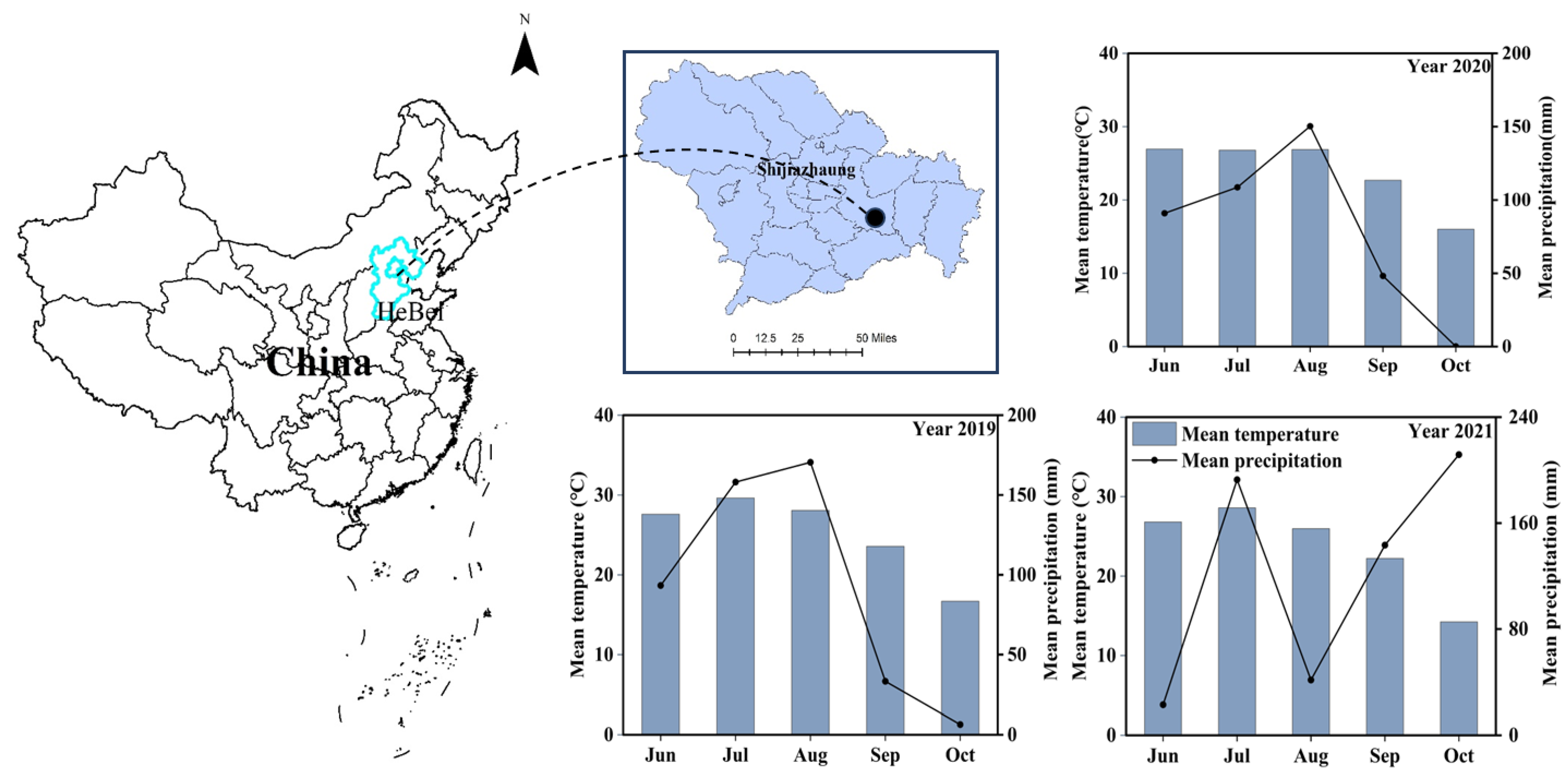
Month temperature and precipitation data from continuous microclimatic monitoring were visually summarized in Figure 1.

2.2. Experiment I: Field Nonisotope-Labeled Fertilization Experiment

The experiment followed a randomized block design with three replications. The experimental material used was Jigu 39, a commonly grown foxtail millet variety. The cropping pattern employed was a wheat-foxtail millet rotation. The growing seasons for millet were from 20 June–20 September 2019, 23 June–27 September 2020, and 21 June–25 September 2021 Millet was planted in rows with a plot area of 40 m2, a row spacing of 0.4 m, and a seedling density of 600,000 plants·ha−1. Protective rows were established around each treatment to prevent cross-treatment contamination. Field management practices were consistent with conventional production techniques.
Five nitrogen fertilizer treatments with different nitrogen forms and a control treatment (CK) were used in the experiment. Fertilizer application rates were based on the local recommended fertilizer application rate (see Table 1). All fertilizers were applied as a single basal application at the time of sowing.
Plant samples were collected during the millet maturation period from 2019–2021 (20 September 2019; 27 September 2020; and 25 September 2021). Four plants were randomly selected per sample, with three repetitions. All the plants were divided into roots, stems, leaves, and ears. The samples were heated in an oven at 105 °C for 0.5 h and then dried at 80 °C until a constant weight was reached. The biomass of each plant tissue sample was recorded. The stems, leaves, and ears were chopped into small pieces approximately 1 cm in length, ground via a ball mill (RETSCH MM400, Haan, Germany, RETSCH GmbH), and sieved through a 40-mesh screen, and the total nitrogen content of the plants was determined via the Kjeldahl method. Additionally, two uniform, well-distributed rows of millet ears were randomly sampled from each plot, excluding the border rows, to determine the yield.
Soil samples were collected during the millet maturation period from 2019–2021, which coincided with the timing of plant sample collection. For each sampling, soil was taken from the 0–120 cm depth profile using a soil auger, divided into successive 20 cm intervals (i.e., 0–20, 20–40, …, 100–120 cm), and composited according to layer. Additionally, in 2021, supplementary soil samples (0–20 cm) were collected at two key growth stages—heading (August 3) and flowering (August 11). The concentrations of NO3-N and NH4+-N were determined via a continuous flow analyzer (AA3, AMS Alliance, Fréjus, France).

2.3. Experiment II: Field Isotope Labeling Fertilization Experiment

To investigate the mechanism by which different nitrogen forms influence nitrogen uptake in foxtail millet, a 15N isotope labeling experiment was conducted in 2021 on plots without N fertilizer application. The labeling was carried out during the jointing (17 July), flowering (11 August), and grain-filling stages of millet (26 August), with 9 microplots set for each stage. For each labeling treatment, the 9 microplots were randomly divided into 3 groups. On the basis of prior observations of millet root distribution, each group corresponded to a different soil depth: 0–5 cm, 5–15 cm, and 15–30 cm (the actual labeling depths were the centers of these layers, i.e., 2.5 cm, 10 cm, and 22.5 cm, respectively). The primary nitrogen forms used for labeling were K15NO3 (98 atom% 15N) and (15NH4)2SO4 (98 atom% 15N) (Shanghai Engineering Research Center for Stable Isotopes), and setting a blank control group. All the labeling solutions were mixed (NO3-N:NH4+-N = 1:1, 25 mg N L−1 in total), but only one form of nitrogen was labeled in each treatment, with the blank control group receiving deionized water. The labeling solutions were injected at depths of 2.5 cm, 10 cm, and 22.5 cm in the microplots. To ensure uniform labeling within each 15 cm × 15 cm microplot, each microplot was evenly divided into 9 small blocks (5 cm × 5 cm), with 2 mL of the mixed labeling solution injected into each block, resulting in a total labeled nitrogen amount of 20 mg N m−2. The labeling was conducted 2 h before sunrise, and after 24 h, whole millet plants and soil samples were collected. The methods for root and soil processing followed those as described by Cui et al. [22].

2.4. Data Analysis

The calculation of plant nitrogen accumulation followed the following formula:
N accumulation = Nitrogen content × DM
where DM, plant dry matter accumulation (kg·ha−1).
The formula for calculating production stability is as follows:
CV (%) = (SD/Mean) × 100%
where SD, standard deviation.
The formula for calculating the total soil inorganic nitrogen content is as follows:
Ri = Hi × Di × Ci × 0.1
where Ri, the total inorganic nitrogen in each soil layer (kg·ha−1); Hi, the soil layer depth (cm); Di, the soil bulk density of the layer (g·cm−3) (Given that the measured volumetric content of gravel (>2 mm) in the soil of the study area is less than 5%, the bulk density of the undisturbed soil was directly used to calculate the soil nutrient storage. Soil bulk density in the 0–120 cm profile was determined using the core method. Specifically, a pit with a depth of 1.4 m was excavated with a shovel. Soil cores were collected from the midpoint of each soil layer using a cutting ring. The rings were then sealed with lids and transported to the laboratory. The samples were oven-dried at 105 °C for 72 h and weighed. The bulk density for each soil layer was calculated by dividing the dry weight of the soil by the volume of the cutting ring); Ci, the inorganic nitrogen content in the soil layer (mg·kg−1) (the sum of the NO3-N and NH4+-N concentrations); and 0.1, the conversion factor [23].
The formula for calculating the actual nitrogen uptake rate of the roots was obtained from Cui et al. [22].
Data processing and analysis were performed via Excel 2013 and DPS 9.01. The significance between the independent and dependent variables was evaluated via the least significant difference (LSD) test at probability levels of 0.05 and 0.01. Graphs were generated via Excel 2013, Origin 2022, and ArcGIS software (ArcMap 10.8.1).

3. Results

3.1. Millet Grain Yield and Stability Under Different Forms of N

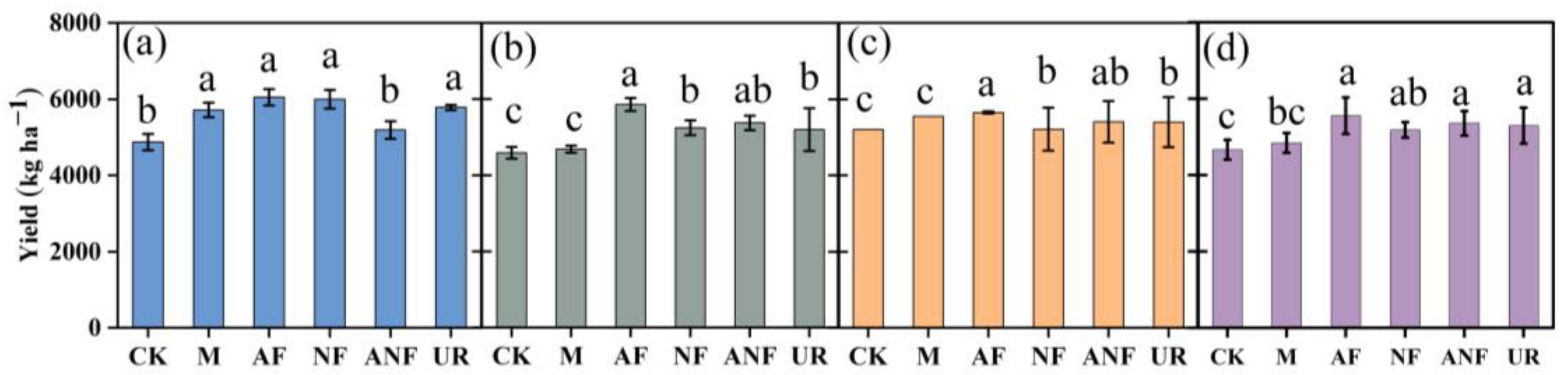
The trends in grain yield for various nitrogen (N) fertilizer types across different growing seasons were largely consistent (Figure 2). The three-year average yield ranking was as follows: AF > ANF > UR > NF > M > CK. Specifically, compared to other treatments, the grain yield in the AF treatment increased by 0.90–24.18%, 8.97–27.68%, and 1.82–8.53% in the 2019, 2020, and 2021 growing seasons, respectively, with significant differences observed in the 2020 growing season (p < 0.05).
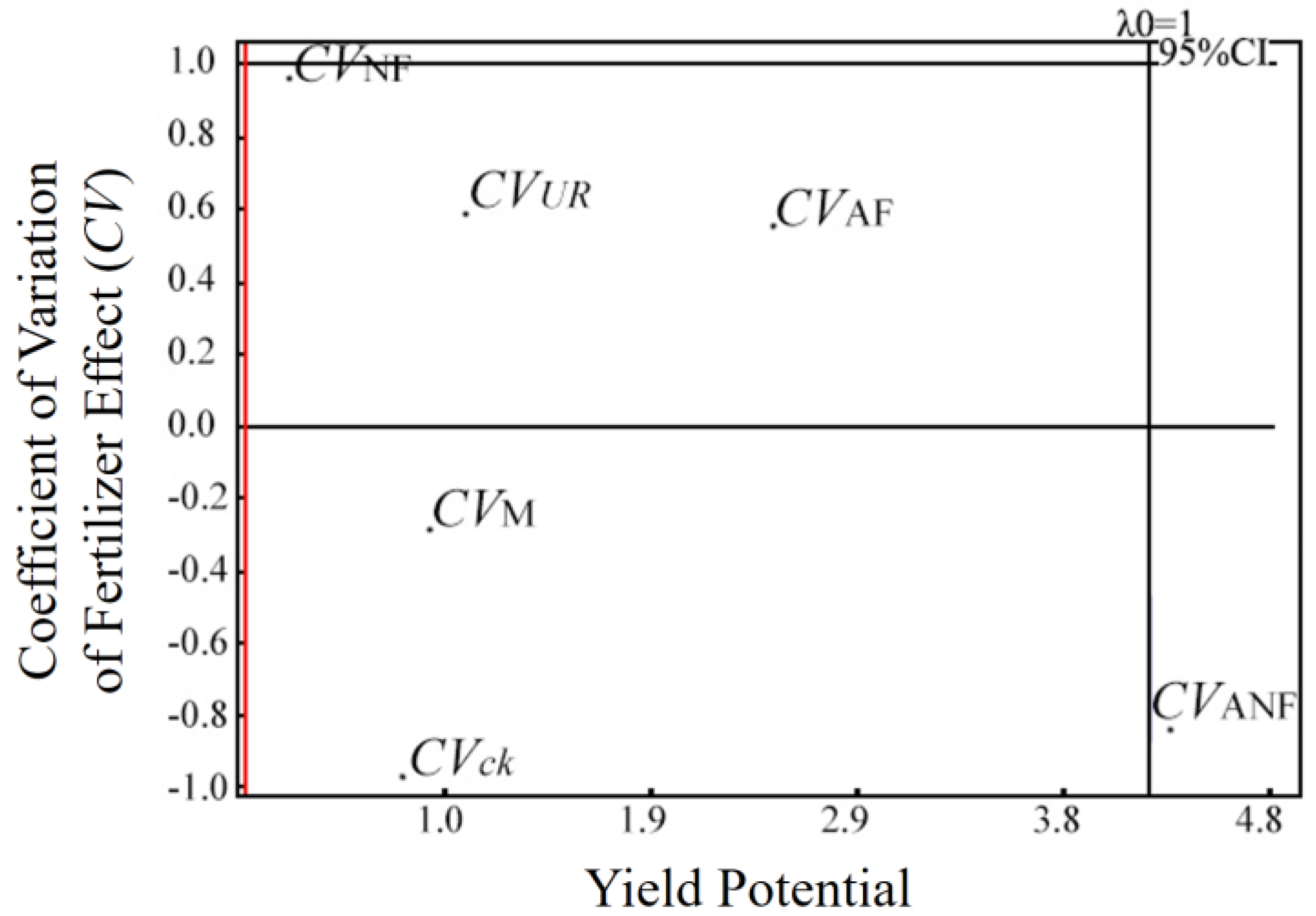
The fertilizer stability index, represented by points closer to the X-axis, indicates minimal variation and greater stability (Figure 3). The M treatment exhibited the closest proximity to the X-axis, followed by AF, UR, ANF, NF, and CK, suggesting that M demonstrated the highest yield stability across the three growing seasons, with AF and UR following in stability.

3.2. Cumulative Nitrogen Content in Millet in Response to Different N Forms

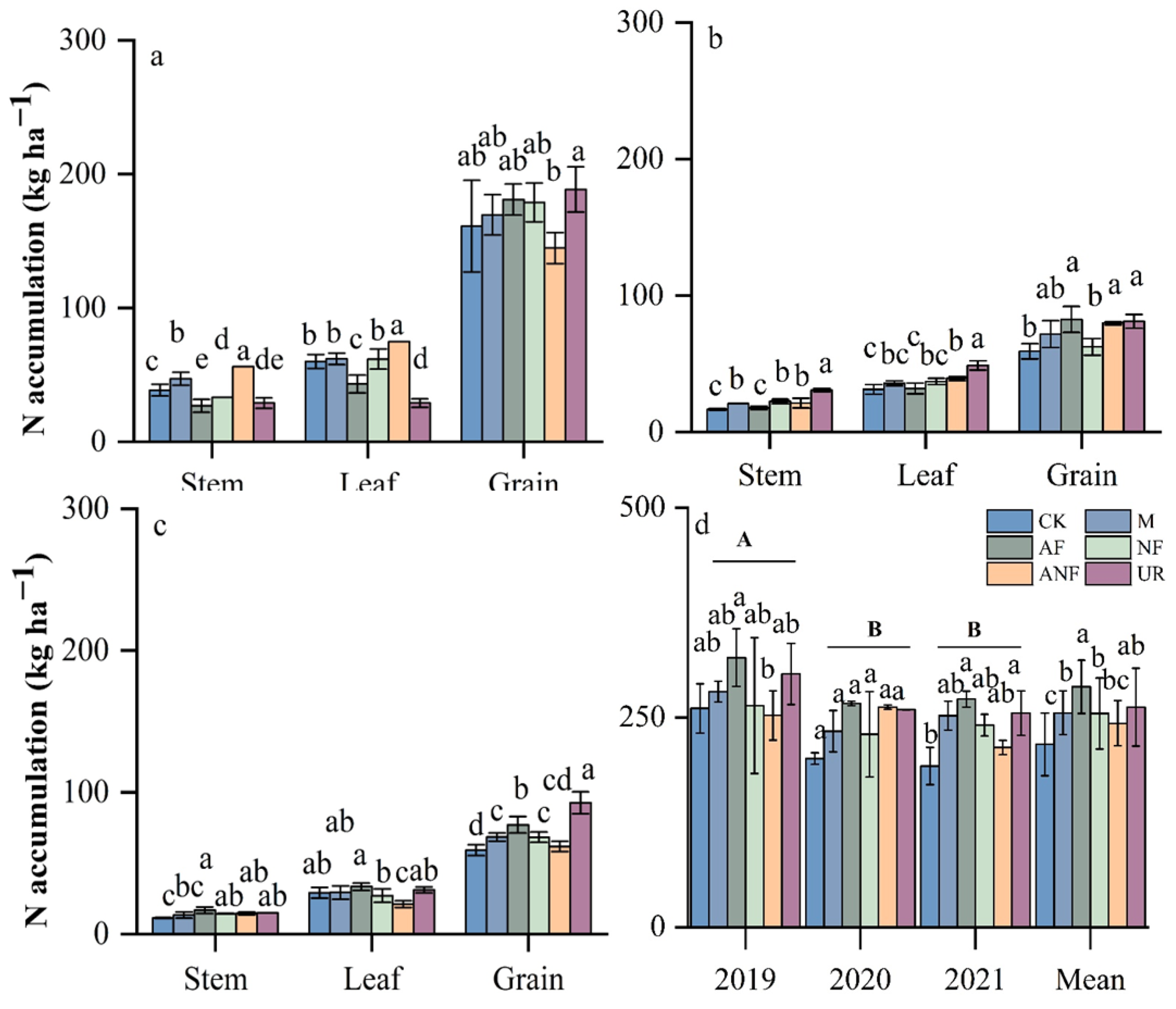
The pattern of nitrogen (N) accumulation in millet plants across the three growing seasons exhibited similar trends under different nitrogen (N) fertilizer treatments. The three-year average N accumulation ranking for the various treatments was as follows: AF > UR > M > NF > ANF > CK (Figure 4d). Specifically, compared to the other treatments, nitrogen accumulation in the AF treatment increased by 14.45–23.14%, 1.65–32.62%, and 6.51–41.45% during the 2019, 2020, and 2021 growing seasons, respectively.
Moreover, across all three growing seasons, N accumulation in the different plant organs followed the same ranking: grain > leaf > stem. In particular, nitrogen accumulation in the grain under the AF and UR treatments was significantly greater than that in the other treatments. In the 2020 and 2021 growing seasons, the differences in N accumulation in the grain were statistically significant (p < 0.05) (Figure 4a–c).

3.3. Soil Inorganic Nitrogen Content (SIN) and Nitrate–Ammonium Ratio for Different N Forms

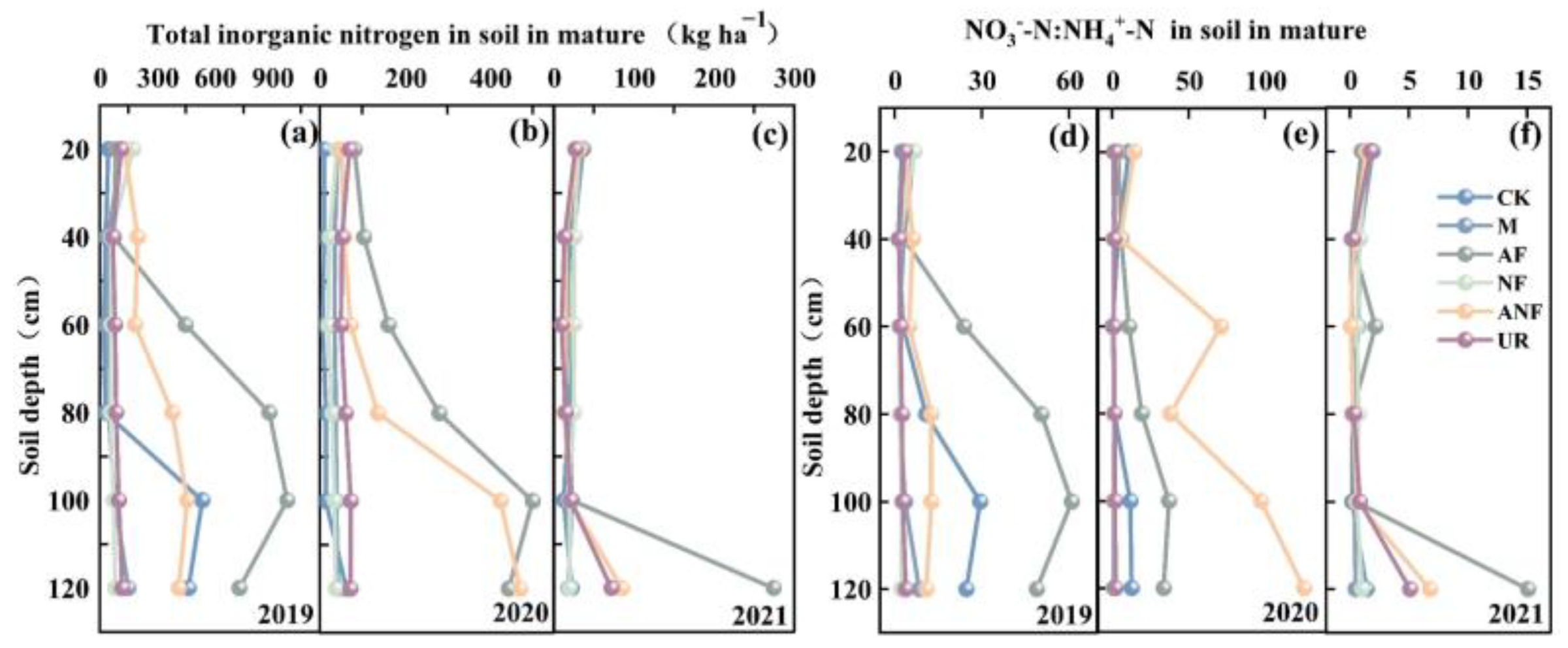
Consistent trends in SIN were observed across all the N treatments during the 2019–2021 growing seasons (Figure 5a–c). Progressive vertical migration of SIN to deeper soil horizons was evident with successive cultivation years. The AF exhibited characteristic depth stratification: from 2019–2021, SIN accumulation began at depths of 40 cm, 60 cm, and 100 cm, respectively. Additionally, AF resulted in superior SIN retention, and the average inorganic N content over the three growing seasons was significantly greater, by 29.48%-12.33 times, than that of the other treatments.
Compared with the other treatments, both AF and ANF increased the soil NO3:NH4+ ratio across all growing seasons. In 2019 and 2021, AF exhibited particularly strong effects (Figure 5d,f). In 2020, the nitrate–ammonium ratio in ANF increased by 2.17–69.56 times (Figure 5e), indicating that AF and ANF promoted the accumulation of NO3-N (relative to NH4+-N).

3.4. Temporal Dynamics of Soil Available Nitrogen Under Different Nitrogen Forms

Based on the above results, the grain yield of millet in different growing seasons exhibited good production stability. This stability confirmed that it was reasonable to analyze the temporal relationships of soil available nitrogen with a focus on 2021 data (Figure 2).
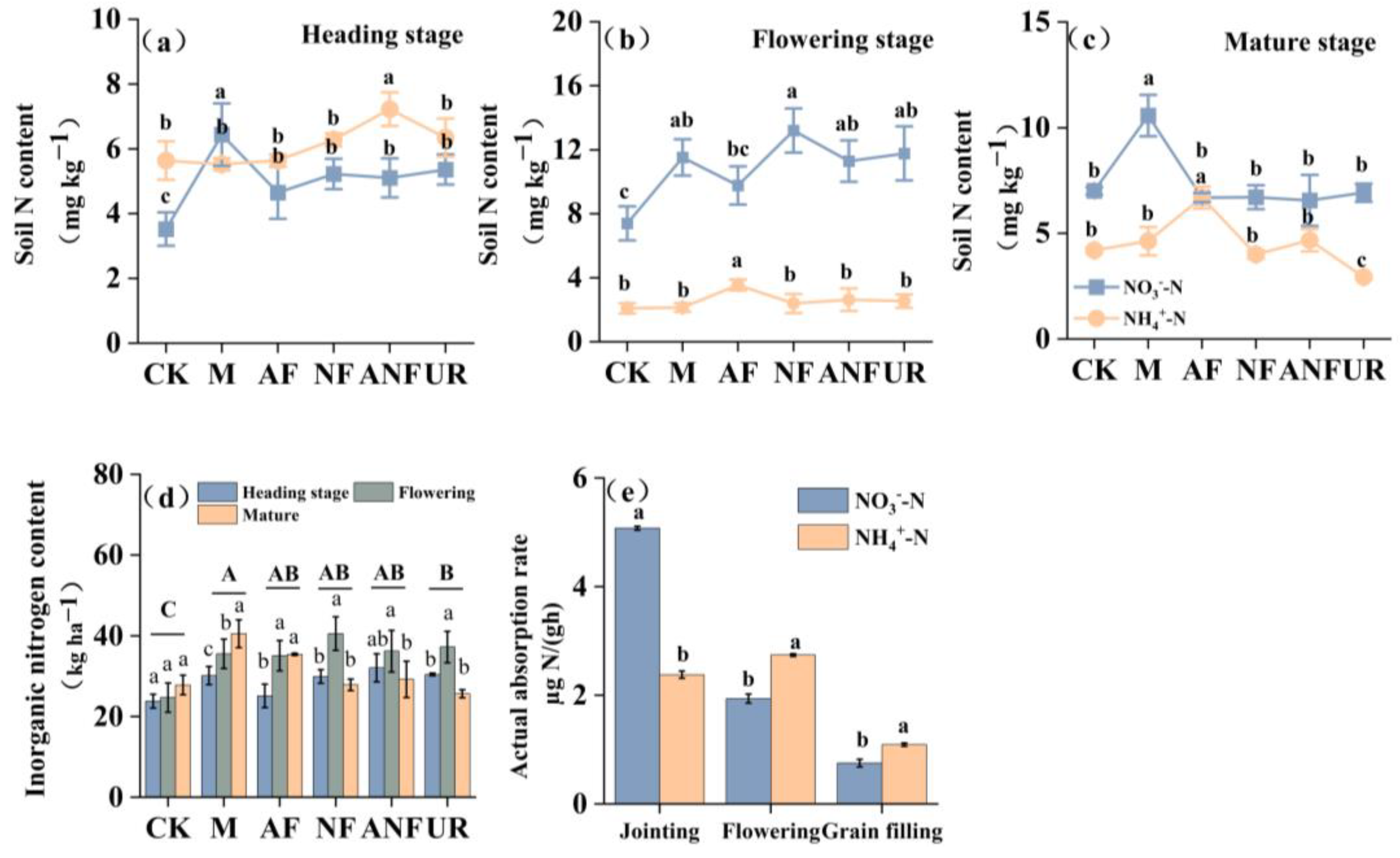
During the growing season, a distinct shift in inorganic nitrogen composition was observed. At the heading stage, soil NO3-N content was lower than soil NH4+-N content in all treatments except for the organic fertilizer. Thereafter, at the flowering and maturation stages, the NO3-N content increased and remained higher than the NH4+-N content across all treatments (Figure 6a–c). The total inorganic N content in the M and AF treatments tended to gradually increase, whereas in the ANF, NF, and UR treatments, the total inorganic N content first increased but then decreased, reaching the highest point during the flowering stage (Figure 6d).
We observed from the 15N isotope labeling experiment that the millet root system presented varying N absorption capacities at different growth stages. Peak nitrogen uptake occurred at the jointing stage (2.38–5.08 µg·N/(gh)), whereas minimal absorption was observed during grain filling (0.74–1.09 µg·N/(gh)). The ratios of NO3/NH4+ absorption rates at the three stages (jointing stage, flowering stage, and grain filling stage) were 2.13, 1.11, and 0.68, respectively (Figure 6e).

3.5. The Total SIN and NO3:NH4+ Ratio in the Dimensions of Time and Space

This study implemented a dual-dimensional analytical approach to identify optimal soil N conditions (SIN and the NO3:NH4+ ratio) for achieving both high yield and efficient N uptake. The spatial dimension included SIN and the NO3:NH4+ ratio at different soil depths, whereas the temporal dimension primarily considered SIN and the NO3:NH4+ ratio at different growth stages (Figure 7 and Figure 8).
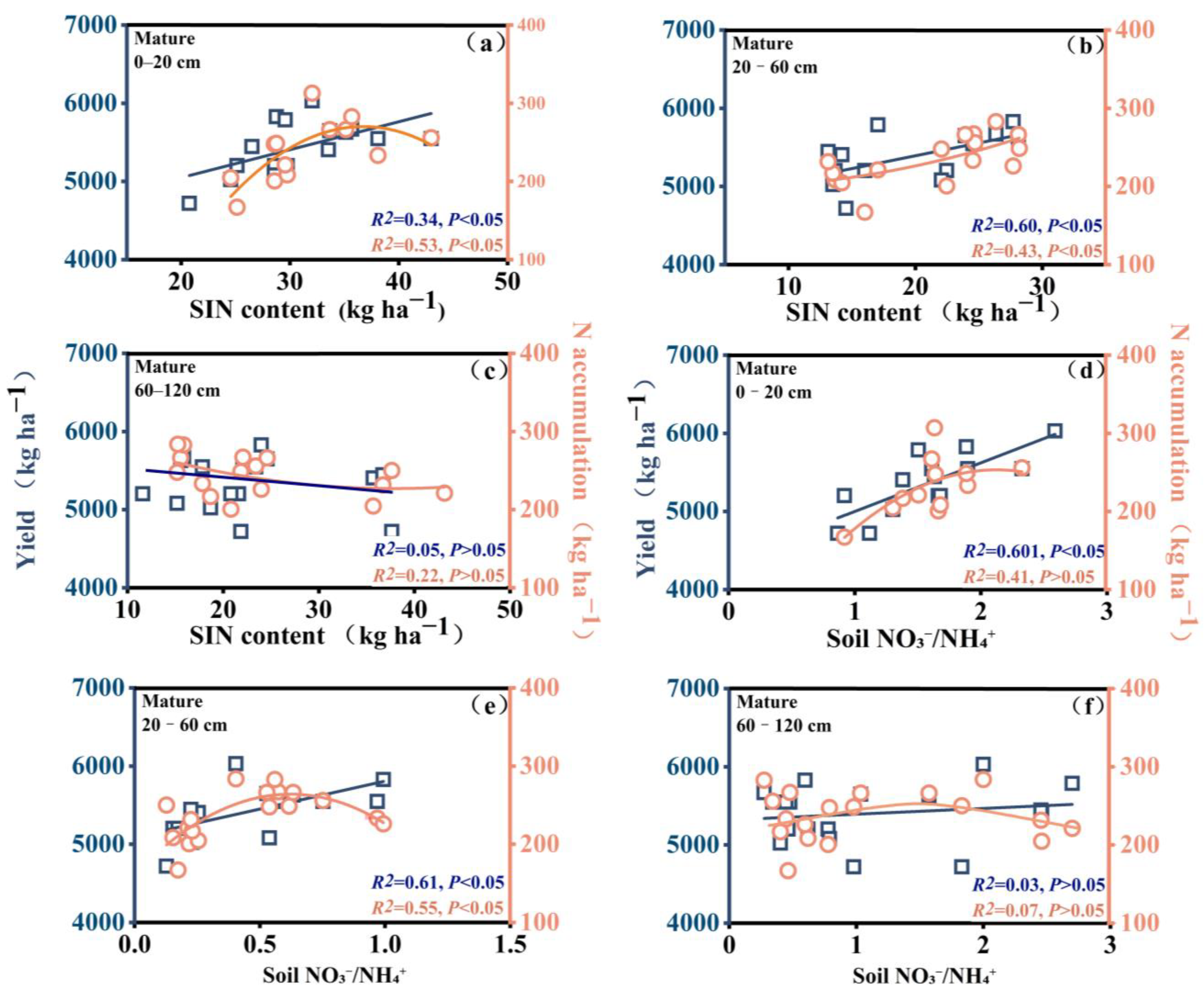
The vertical stratification of SIN and the NO3:NH4+ ratio significantly influenced grain yield and N accumulation (Figure 7). The surface soil (0–20 cm) SIN presented the strongest correlation with both grain yield (p < 0.05) and N accumulation (p < 0.05), whereas the NO3:NH4+ ratio in the 0–60 cm soil profile significantly influenced these agronomic parameters (p < 0.05). However, the SIN and NO3:NH4+ ratio in the deepest soil layers (60–120 cm) had no significant effect on yield or N accumulation. With respect to the NO3:NH4+ ratio, as the soil depth increased, the optimal NO3:NH4+ ratio for maintaining high yield and high N absorption in millet gradually decreased (from 1.5–1.8 at 0–20 cm to 0.25–0.75 at 20–40 cm) (Figure 7d,e).
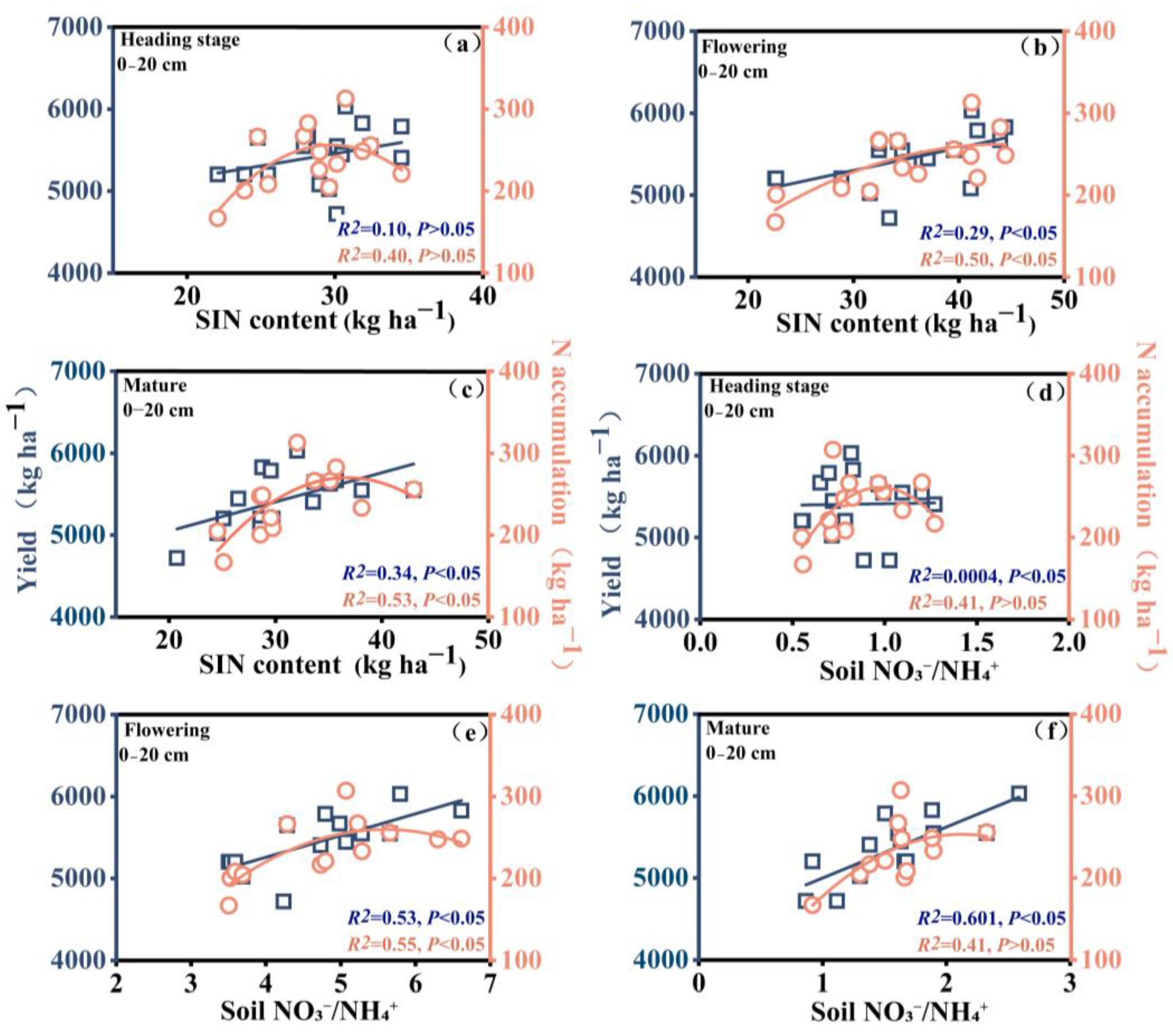
SIN in the shallow soil layer (0–20 cm) significantly influenced (p < 0.05) both plant N accumulation and grain yield throughout all critical growth stages (Figure 8). When SIN in the shallow soil was maintained at 26–48, 32–40, and 30–38 kg·ha−1 during the heading, flowering, and mature stages, respectively (Figure 8a–c), millet yield and N accumulation remained high. In addition, in shallow soil (0–20 cm), the NO3:NH4+ ratio exhibited differential impacts across growth stages. During the flowering and mature stages, the NO3:NH4+ ratio was significantly correlated with millet grain yield and N accumulation, whereas its effect was not significant during the heading stage (R2 = 0.53, R2 = 0.601; R2 = 0.55, R2 = 0.41, respectively). The optimal NO3:NH4+ ratios were 4.5–5.2 at the flowering stage and 1.5–1.8 at mature (Figure 8e,f).

4. Discussion

4.1. Dynamic Shift in Nitrogen Acquisition Strategy of Foxtail Millet Roots: From Nitrate-Dominant to Ammonium-Dominant Uptake

Foxtail millet exhibited distinct stage-specific N uptake, which was closely related to the soil environment, climatic conditions, and its own growth and development requirements. Unlike most graminaceous crops [22], this study revealed that millet roots predominantly absorbed NO3 in the early growth stages and NH4+ in the later stages in the experimental field (Figure 6e). This adaptability reflects the crop’s N demand characteristics at different growth stages. The vegetative growth phase (germination to flowering) is characterized by elevated nitrogen demand. NO3 could serve as an important osmotic regulator within the cells, helping maintain cell turgor pressure, promoting the rapid expansion of roots and leaves [24,25,26], increasing the light interception area and leaf area expansion, and increasing photosynthetic product accumulation, thus ensuring better growth momentum in the early stages. In the later growth stage (from flowering to maturity), the crop primarily focuses on reproductive growth, and the role of N gradually shifts to the synthesis of amino acids, proteins, and other metabolic substances. In particular, NH4+, as a direct material for amino acid and protein synthesis, increased N utilization via ammonium assimilation during reproductive growth, thus increasing biomass accumulation during the reproductive growth stage [27].

4.2. Dynamic Synchronization of N Supply and the N Absorption Strategy of Foxtail Millet Roots to Improve N Accumulation

Urea is one of the most widely used N sources [28], and its N transformation process is relatively complex. Compared with other N sources, urea first undergoes hydrolysis by urease in the soil to convert it into NH4+-N, and then, through the action of nitrifying bacteria, it is further oxidized into NO3-N. In contrast, ammonium nitrate contains both NH4+-N and NO3-N, which can be directly absorbed by plants, thus offering greater agronomic utilization efficiency. Numerous studies have demonstrated that a 1:1 application ratio of ammonium to nitrate nitrogen significantly enhances rice yield and nitrogen use efficiency [29]. Similarly, the combined application of urea and nitrate nitrogen effectively increases spike number and nitrogen accumulation in wheat [30]. Our findings indicate no significant differences in grain yield and N accumulation between AF and UR in foxtail millet (Figure 2 and Figure 4d). However, compared to other N sources, these two forms increased grain yield and N accumulation by 0.90–27.68% and 1.65–41.45%, respectively. In contrast, NF, ANF, and M showed lower effectiveness. This disparity can likely be attributed to the temporal dynamics of SIN availability (i.e., varying levels of NO3-N and NH4+-N across growth stages) aligning with the N uptake strategy of foxtail millet roots—primarily absorbing NO3-N during early growth stages and shifting to NH4+-N in later stages—thereby meeting its nutritional demands throughout growth [30,31,32] (Figure 6). Nitrate nitrogen is prone to leaching, while the mineralization release of organic fertilizer may lag behind the rapid nitrogen demand periods of foxtail millet.
Furthermore, the synergistic effects of cations and anions (NH4+ and SO42−) in ammonium sulfate fertilizer on crop growth should not be overlooked. Although sufficient potassium sulfate was applied in the experimental field to eliminate the influence of sulfur, the ammonium sulfate treatment still demonstrated significantly superior nitrogen uptake and yield performance across multiple growth stages compared to other nitrogen sources. This suggests that its synergistic mechanism may extend beyond sulfur supply and could be closely associated with the advantages of ammonium uptake and related biochemical processes in the rhizosphere.

4.3. SIN and Its Form Ratio Collectively Influence Crop N Uptake

Crop nitrogen uptake is closely linked to the soil environment and is regulated by two key dimensions: the total available soil nitrogen and the ratio of nitrogen forms (NO3:NH4+) (Figure 6). SIN can reflect the supply status of different nitrogen forms in the soil [33] and indirectly indicate the residual status of fertilizers after application. Previous studies have shown that long-term application of nitrate-based fertilizers leads to significant accumulation of inorganic nitrogen in deeper soil layers, whereas ammonium-based fertilizers result in a slower accumulation rate [34]. However, with increasing cultivation years, nitrification can cause an increase in NO3-N content. Due to their slow-release characteristics, organic fertilizers effectively reduce the migration of nitrogen to deeper layers. The results of this study demonstrated that both M and AF were capable of effectively retaining and stabilizing inorganic nitrogen within the topsoil (0–20 cm) during the growing season (Figure 6d). In contrast, under the ANF, NF, and UR treatments, SIN gradually decreased after the flowering stage, failing to meet the nutrient demands of millet during the reproductive growth phase. This phenomenon may be attributed to the slower migration rate of ammonium nitrogen in the soil—particularly when the soil has relatively high clay or organic matter content, ammonium ions are readily adsorbed onto soil particles, thereby retarding their mobility [35,36]. This indicates that ammonium-based fertilizers exhibit a short-term retention effect on inorganic nitrogen in the topsoil (0–20 cm) during the current season.
However, the form of nitrogen fertilizer significantly influenced the residual inorganic nitrogen in the soil (Figure 4d). From 2019 to 2021, as the planting seasons progressed, SIN accumulation began to increase rapidly at soil depths of 40 cm, 60 cm, and 100 cm under the AF and ANF treatments. This occurred because, over time, NH4+-N in the surface layer is progressively converted by microbial nitrification into mobile NO3-N, which subsequently migrates downward with soil water, ultimately leading to significant nitrogen accumulation in deeper soil layers (>60 cm). In contrast, under the same nitrogen application rate, the SIN content in the soil under other fertilizer treatments was lower, which may indicate that nitrogen had “escaped” from the root zone, thereby increasing the risk of leaching.
Furthermore, an appropriate soil NO3:NH4+ ratio helps reduce nitrogen loss and promotes plant vegetative growth and flower tiller numbers [37]. In this study, the soil NO3:NH4+ ratio progressively increased with the number of cultivation years, which is primarily attributed to the ease with which NH4+ is converted to NO3 by microorganisms [38]. In addition, previous studies have indicated that the effectiveness of plant growth and nutrient uptake depends on the soil NO3:NH4+ ratio [39,40,41,42]. Our experiment revealed that the soil NO3:NH4+ ratios were 4.5–5.3 during the flowering stage and 1.5–1.8 at maturity, respectively (Figure 8e,f). However, the ratio observed during the flowering stage in our study was higher than that reported in previous studies [43]; this discrepancy may be related to the varying nitrogen requirements of crops at different growth stages. During the growth stages from flowering to maturity in corn, maintaining SIN in the 0–30 cm soil layer within the range of 8–22 mg·kg−1 (20–60 kg·ha−1) resulted in low nitrogen loss and supported high crop yield demands [44]. The findings of this study suggest that SIN in the shallow soil layer during the crop growth period should be maintained at 30–38 kg·ha−1 (Figure 8a–c), a value influenced by various factors such as crop species, soil type, and fertilization methods.

4.4. Limit

While this study revealed the effects of different N forms on SIN dynamics and millet N accumulation, their practical implications need to be interpreted with caution because of their soil-specific responses. The N dynamics in this study were based on results obtained under brown soil conditions, without systematically evaluating the influence of different soil characteristics (such as pH, organic matter content, and clay proportion) on the effects of N fertilizer. The N retention capacity and nutrient migration properties may vary significantly across different soil types, which could affect the generalizability of our findings to other soil environments. Future research should further explore multienvironment trials across major soil zones, as these efforts could help optimize region-specific N fertilizer management strategies.

5. Conclusions

The three-year field experiment and short-term 15N-tracing study revealed differential responses of foxtail millet to nitrogen forms in terms of both yield and nitrogen uptake. The yield performance followed the order of AF > ANF ≈ UR > NF > M > CK, while the nitrogen uptake order was AF ≈ UR > M > NF > ANF > CK. No significant differences were observed in yield among the AF, ANF, and UR treatments, nor in nitrogen accumulation between the AF and UR treatments. Foxtail millet exhibited stage-dependent nitrogen uptake patterns, transitioning from predominant nitrate-N absorption to predominant ammonium-N uptake. The application of ammonium-based fertilizers resulted in short-term retention effects in the topsoil (0–20 cm) during the growing season, thereby providing sustained nutrient supply for crop growth. Precise nitrogen management was achieved by establishing an optimal SIN threshold of 30–38 kg·ha−1 in the 0–20 cm soil layer, coupled with stage-specific NO3-N/NH4+-N ratios (flowering stage: 4.5–5.3; maturity stage: 1.5–1.8) tailored to different growth periods. In summary, the findings of this study offer valuable empirical evidence and insights for the development of optimized nitrogen management strategies in foxtail millet production systems on similar soil types.

Author Contributions

Y.L.: writing (original draft), investigation, and data curation. Y.Z.: funding acquisition and data curation. X.X.: supervision, methodology, and conceptualization. M.L.: project administration. Z.W.: investigation. J.W.: project administration. H.J.: investigation. H.L.: investigation. X.F.: investigation. J.L.: investigation. S.L.: writing (review & editing), funding acquisition, and conceptualization. J.C.: writing (review & editing), methodology, and conceptualization. All authors have read and agreed to the published version of the manuscript.

Funding

This work was supported by the National Agricultural Industry Technology System (CARS-06-14.5-A23); the Hebei Modern Agricultural Industrial Technology System (HBCT2024080203, HBCT2024070202); and the Hebei Academy of Agricultural and Forestry Sciences, Hebei Province Basic Research Business Fee Lump-sum Project (HBNKY-BGZ-02).

Data Availability Statement

The data supporting the findings of this study are available within the article. The raw data will be made available upon request.

Acknowledgments

We thank Institute of Agricultural Mechanization, Hebei Academy of Agricultural and Forestry Sciences for donating the seeds used in this study. We also acknowledge SuXia Gao for helping with this study.

Conflicts of Interest

The authors declare that they have no conflicts of interest.

References

  1. Lu, Y.W.; Zhao, Y.; Xia, X.Y.; Liu, M.; Wei, Z.M.; Wang, J.X.; Liu, J.J.; Cui, J.H.; Li, S.G. Evaluation of nitrogen fertilizer supply and soil nitrate thresholds for high yields of foxtail millet. Agriculture 2024, 14, 1711. [Google Scholar] [CrossRef]
  2. Zhang, H.; Liang, H.K.; Zhi, H.; Yuan, D.; Yao, Q.; Zhang, R.L.; Xing, L.H.; Yang, B.L.; Sang, L.M.; Zhao, L.R.; et al. An efficient target-mutant screening platform of model variety Ci846 facilitates genetic studies of Setaria. Plant Biotechnol. J. 2025, 21, 789–801. [Google Scholar] [CrossRef] [PubMed]
  3. Aanderud, Z.T.; Bledsoe, C.S. Preferences for 15N-ammonium, 15N-nitrate, and 15N-glycine differ among dominant exotic and subordinate native grasses from a California oak woodland. Environ. Exp. Bot. 2009, 65, 205–209. [Google Scholar] [CrossRef]
  4. Arunothai, J.; Dennis, K.; Narumol, P.; Hans, B. Interactive effects of nitrogen form and pH on growth morphology N uptake and mineral contents of Coix lacryma-jobi L. Aquat. Bot. 2013, 111, 144–149. [Google Scholar] [CrossRef]
  5. Zhang, Q.; Wu, S.; Chen, C.; Shu, L.Z.; Zhou, X.J.; Zhu, S.N. Regulation of nitrogen forms on growth of eggplant under partial root-zone irrigation. Agric. Water Manag. 2014, 142, 56–65. [Google Scholar] [CrossRef]
  6. Isaiah, O.O.; Harun, I.G.; Benson, M.; Esmaeil, R.C.; Joseph, P.; Gweyi, O. Optimizing Maize Yield Nitrogen Efficacy and Grain Protein Content under Different N Forms and Rates. J. Soil Sci. Plant Nutr. 2021, 21, 1867–1880. [Google Scholar] [CrossRef]
  7. Lyu, X.K.; Liu, Y.; Li, N.; Ku, L.B.; Hou, Y.T.; Wen, X.X. Foliar applications of various nitrogen (N) forms to winter wheat affect grain protein accumulation and quality via N metabolism and remobilization. Crop J. 2022, 10, 1165–1177. [Google Scholar] [CrossRef]
  8. Chen, J.T.; Li, J.H.; Li, W.F.; Li, P.; Zhu, R.; Zhong, Y.X.; Zhang, W.F.; Li, T.Y. The optimal ammonium-nitrate ratio for various crops: A Meta-analysis. Field Crops Res. 2024, 307, 109240. [Google Scholar] [CrossRef]
  9. Li, S.X.; Wang, Z.H.; Stewart, B.A. Responses of crop plants to ammonium and nitrate N. Adv. Agron. 2013, 118, 205–397. [Google Scholar] [CrossRef]
  10. Fu, Y.; Zhong, X.; Lu, C.; Liang, K.; Pan, J.; Hu, X.; Hu, R.; Li, M.; Ye, Q.; Liu, Y. Growth, nutrient uptake and transcriptome profiling of rice seedlings in response to mixed provision of ammonium- and nitrate-nitrogen. J. Plant Physiol. 2023, 284, 153976. [Google Scholar] [CrossRef]
  11. Mao, J.H.; Wang, J.S.; Liao, J.Q.; Xu, X.L.; Tian, D.S.; Zhang, R.Y.; Peng, J.L.; Niu, S.L. Plant nitrogen uptake preference and drivers in natural ecosystems at the global scale. New Phytol. 2025, 246, 972–983. [Google Scholar] [CrossRef] [PubMed]
  12. McKane, R.B.; Johnson, L.C.; Shaver, G.R.; Nadelhoffer, K.J.; Rastetter, E.B.; Fry, B.; Giblin, A.E.; Kielland, K.; Kwiatkowski, B.L.; Laundre, J.A.; et al. Resource-based niches provide a basis for plant species diversity and dominance in arctic tundra. Nature 2002, 415, 68–71. [Google Scholar] [CrossRef] [PubMed]
  13. Spratt, E.D. Effect of ammonium and nitrate forms of fertilizer-N and their time of application on the utilization of N by wheat. Agron J. 1974, 66, 57–61. [Google Scholar] [CrossRef]
  14. Britto, D.T.; Kronzucker, H.J. Ecological significance and complexity of N-source preference in plants. Ann. Bot. 2013, 112, 957–963. [Google Scholar] [CrossRef]
  15. Owen, A.G.; Jones, D.L. Competition for amino acids between wheat roots and rhizosphere microorganisms and the role of amino acids in plant N acquisition. Soil Biol. Biochem. 2001, 33, 651–657. [Google Scholar] [CrossRef]
  16. Boatwright, G.O.; Haas, H.J. Development and composition of spring wheat as influenced by nitrogen and phosphorus fertilization. Agron J. 1961, 53, 33–36. [Google Scholar] [CrossRef]
  17. Mills, H.A. Horticultural Crops. Hortic. Rev. 2011, 2, 395. [Google Scholar]
  18. Guo, J.; Jia, Y.; Chen, H.; Zhang, L.; Yang, J.; Zhang, J.; Hu, X.; Ye, X.; Li, Y.; Zhou, Y. Growth photosynthesis and nutrient uptake in wheat are affected by differences in nitrogen levels and forms and potassium supply. Sci. Rep. 2019, 9, 1248. [Google Scholar] [CrossRef]
  19. Shaviv, A.; Hagin, J. Interaction of salinity and enhanced ammonium and potassium nutrition in wheat. Plant Soil 1993, 154, 133–137. [Google Scholar] [CrossRef]
  20. Song, Z.F.; Duan, Y.M.; Luan, W.L.; Bi, P. Spatial distribution of organic and inorganic carbon and estimation of soil carbon storage in surface soil of Hebei Plain, China. J. Arid. Land Resour. Environ. 2014, 5, 97–102. [Google Scholar] [CrossRef]
  21. Peng, Y.J.; Wang, X.Y.; Zhang, L.J.; Hao, X.R.; Qiao, J.J.; Wang, W.; Ji, Y.Z. Effects of Root Layer Regulation on Nitrogen Utilization and Soil NO3—-N Residue of Wheat-Maize System. Sci. Agric. Sin. 2015, 48, 2187–2198. [Google Scholar] [CrossRef]
  22. Cui, J.H.; Yu, C.Q.; Qiao, N.; Xu, X.L.; Tian, Y.Q.; Hua, O.Y. Plant preference for NH4+ versus NO3- at different growth stages in an alpine agroecosystem. Field Crops Res. 2017, 201, 192–199. [Google Scholar] [CrossRef]
  23. Zhang, F.; Chen, M.R.; Xing, Y.Y.; Han, J.; Wang, X.K. Reduction of nitrogen fertilizer and simultaneously application of organic fertilizer optimizes yield water productivity and nitrogen metabolism of spring maize by improving soil properties in the Loess Plateau of China. J. Agric. Food Res. 2025, 19, 101634. [Google Scholar] [CrossRef]
  24. Rahayu, Y.S.; Walch-Liu, P.; Neumann, G.; Römheld, V.; WirénN, V.; Bangerth, F. Root-derived cytokinins as long-distance signals for NO3-induced stimulation of leaf growth. J. Exp. Bot. 2005, 56, 1143–1152. [Google Scholar] [CrossRef]
  25. Remans, T.; Nacry, P.; Pervent, M.; Filleur, S.; Diatloff, E.; Mounier, E.; Tillard, P.; Forde, B.G.; Gojon, A. The Arabidopsis NRT11 transporter participates in the signaling pathway triggering root colonization of nitrate rich patches. Proc. Natl. Acad. Sci. USA 2006, 103, 19206–19211. [Google Scholar] [CrossRef]
  26. Walch-Liu, P.; Neumann, G.; Bangerth, F.; Engels, C. Rapid effects of nitrogen form on leaf morphogenesis in tobacco. J. Exp. Bot. 2000, 51, 227–237. [Google Scholar] [CrossRef]
  27. Williams, L.; Miller, A. Transporters responsible for the uptake and partitioning of nitrogenous solutes. Annu. Rev. Plant Physiol. Plant Mol Biol. 2001, 52, 659–688. [Google Scholar] [CrossRef]
  28. Hessini, K.; Issaoui, K.; Ferchichi, S.; Saif, T.; Abdelly, C.; Siddique, K.H.M.; Cruz, C. Interactive effects of salinity and nitrogen forms on plant growth photosynthesis and osmotic adjustment in maize. Plant Physiol. Biochem. 2019, 139, 171–178. [Google Scholar] [CrossRef]
  29. Xu, G.W.; Jiang, M.M.; Lu, D.K.; Wang, H.Z.; Chen, M.C. Nitrogen forms affect the root characteristic photosynthesis grain yield and nitrogen use efficiency of rice under different irrigation regimes. Crop Sci. 2020, 60, 2594–2610. [Google Scholar] [CrossRef]
  30. Cui, H.X.; Luo, Y.L.; Li, C.H.; Chang, Y.L.; Lin, M.; Li, Y.; Wang, Z.L. Effects of nitrogen forms on nitrogen utilization, yield, and quality of two wheat varieties with different gluten characteristics. Eur. J. Agron. 2023, 149, 126919. [Google Scholar] [CrossRef]
  31. Andrews, M.; Raven, J.A.; Lea, P.J. Do plants need nitrate? the mechanisms by which nitrogen form affects plants. Ann. Appl. Biol. 2013, 163, 174–199. [Google Scholar] [CrossRef]
  32. Zhang, J.B.; Wang, J.; Müller, C.; Cai, Z.C. Ecological and practical significances of crop species preferential N uptake matching with soil N dynamics. Soil Biol. Biochem. 2016, 103, 3–70. [Google Scholar] [CrossRef]
  33. Chen, B.Q.; Liu, E.K.; Tian, Q.Z.; Yan, C.R.; Zhang, Y.Q. Soil nitrogen dynamics and crop residues A review. Agron. Sustain. Dev. 2014, 34, 429–442. [Google Scholar] [CrossRef]
  34. Mason, M.G. Effect of nitrogen source and soil type on inorganic nitrogen concentrations and availability in field trials with wheat. Aust. J. Exp. Agric. 1992, 32, 2. [Google Scholar] [CrossRef]
  35. Giehl, R.F.; von Wirén, N. Root nutrient foraging. Plant Physiol. 2014, 166, 509–517. [Google Scholar] [CrossRef]
  36. Wang, L.; Ma, L.; Li, Y.; Geilfus, C.M.; Wei, J.; Zheng, F.; Liu, Z.; Tan, D. Managing nitrogen for sustainable crop production with reduced hydrological nitrogen losses under a winter wheat-summer maize rotation system: An eight-season field study. Front. Plant Sci. 2023, 14, 1274943. [Google Scholar] [CrossRef]
  37. Griffith, S.M.; Streeter, D.J. Nitrate and ammonium nutrition in ryegrass: Changes in growth and chemical composition under hydroponic conditions. J. Plant Nutr. 1994, 17, 71–81. [Google Scholar] [CrossRef]
  38. Griffith, S.M.; Alderman, S.C.; Streeter, D.J. Italian ryegrass and nitrogen source fertilization in western Oregon in two contrasting climatic years II Plant nitrogen accumulation and soil nitrogen status. J. Plant Nutr. 1997, 20, 429–439. [Google Scholar] [CrossRef]
  39. Chaillou, S.; Vessey, J.K.; Morot-Gaudry, J.F.; Raper, C.D.; Henry, L.T.; Boutin, J.P. Expression of characteristics of ammonium nutrition as affected by pH and of the root medium. J. Exp. Bot. 1991, 235, 189–196. [Google Scholar] [CrossRef]
  40. Claussen, W. Growth water use efficiency and praline content of hydroponically grown tomato plants as affected by nitrogen source and nutrient concentration. Plant Soil 2002, 247, 199–209. [Google Scholar] [CrossRef]
  41. Errebhi, M.; Wilcox, G.E. Plant species response to ammo niumnitrate concentration ratios. J. Plant Nutr. 1990, 13, 1017–1029. [Google Scholar] [CrossRef]
  42. Lu, Y.L.; Xu, Y.C.; Shen, Q.R.; Dong, C.X. Effects of different nitrogen forms on the growth and cytokinin content in xylem sap of tomato (Lycopersicon esculentum Mill) seedlings. Plant Soil. 2009, 315, 67–77. [Google Scholar] [CrossRef]
  43. Tong, X.; He, X.Q.; Duan, H.W.; Han, L.J.; Huang, G.Q. Evaluation of Controlled Release Urea on the Dynamics of Nitrate Ammonium and Its Nitrogen Release in Black Soils of Northeast China International. J. Environ. Res. Public Health. 2018, 15, 119. [Google Scholar] [CrossRef]
  44. Hou, Y.P.; Li, Q.; Kong, L.L.; Qin, Y.B.; Wang, M.; Yu, L.; Wang, L.C.; Yin, C.X. Effects of different slow/controlled release nitrogen fertilizers on spring maize nitrogen uptake and utilization, soil inorganic nitrogen and nitrogen balance. Sci. Agric. Sin. 2018, 51, 13. (In Chinese) [Google Scholar]
Figure 1. Mean temperature (°C) and precipitation (mm) for the 2019 and 2021 growing seasons at the experimental sites.
Agronomy 15 02818 g001
Figure 2. Millet grain yield under different N fertilizer types. The data are presented as the means ± SD (n = 3), the same as below. (ac) represent yield variations in different nitrogen fertilizer types in 2019, 2020, and 2021, respectively, while (d) shows their 3-year mean yield changes (CK: control; M: organic fertilizer; AF: ammonium sulfate; NF: potassium nitrate; ANF: ammonium nitrate (NH4NO3); UR: urea).
Agronomy 15 02818 g002
Figure 3. Variation in different N fertilizer types based on the yield scale. CVCK, CVM, CVAF, CVANF, CVNF, CVUR, represent the stability on the yield scale for CK, M, AF, ANF, NF, and UR, respectively. The vertical axis represents the coefficient of variation in the fertilizer effect on the basis of the yield scale. The closer the value is to 0, the greater the stability of the fertilizer. The horizontal axis represents the yield potential. The higher the absolute value of the vertical axis is, the greater the fertilizer’s potential yield. λ = 0 represents the average yield level (neutral baseline).
Agronomy 15 02818 g003
Figure 4. N accumulation under different N fertilizer forms. (a) showed N accumulation in different organs under different N fertilizer forms in 2019; (b) showed the equivalent data for 2020; (c) for 2021; (d) presented the total plant N accumulation from 2019 to 2021 and the three-year average plant N accumulation across the different N fertilizer forms (d). The lowercase letters (a, b, c, …) above the bars denoted significant differences among different N fertilizer forms within the same year at the p < 0.05 level, while the uppercase letters (A, B) denoted significant differences across the different years (2019, 2020, 2021) for the plant N accumulation, also at p < 0.05. The colors (treatments) are explained in the key.
Agronomy 15 02818 g004
Figure 5. Dynamic changes in SIN and the NO3:NH4+ ratio under different N forms and across different years. Figure (ac) represented soil inorganic nitrogen content at maturity in 2019, 2020, and 2021, respectively. Figure (df) represented the soil NO3:NH4+ ratio at maturity in 2019, 2020, and 2021, respectively.
Agronomy 15 02818 g005
Figure 6. Temporal dynamics of 0–20 cm soil nitrogen in different forms and N absorption by the root system. (a), Soil NO3-N and NH4+-N contents at the heading stage (3 August). (b), Soil NO3-N and NH4+-N contents at the flowering stage (11 August). (c), Soil NO3-N and NH4+-N contents at the mature stage (25 September). (d), SIN at the heading (17 July), flowering (11 August) and mature stages (26 August). (e), Root absorption rate ratio of NO3-N to NH4+-N at the jointing, flowering and mature stages.
Agronomy 15 02818 g006
Figure 7. Fitting equations of the soil profiles at different soil depths at maturity. (ac), Fitted relationships between SIN and yield and N accumulation in the surface, middle, and deep soil layers. (df), Fitted relationships between the soil NO3:NH4+ ratio and yield and N accumulation in the surface, middle, and deep soil layers.
Agronomy 15 02818 g007
Figure 8. Fitting equations of surface soil at different growth stages. (ac), Fitted relationships between the SIN of the surface soil layer and yield and N accumulation at the heading, flowering, and mature stages. (df), Fitted relationships between the soil NO3:NH4+ ratio of the surface soil layer and yield and N accumulation at the heading, flowering, and mature stages.
Agronomy 15 02818 g008
Table 1. Characteristics of the different treatments.
N
Fertilizer
Treatments
Nitrogen
Content
(%)
SourceN
Application
(kg·ha−1)
P2O5 (16% P)
Application
(kg·ha−1)
K2SO4 (52% K)
Application
(kg·ha−1)
control (CK)0none010575
organic fertilizer (M)1.85Shandong Liehua Cheng Nutrient Crop Co., Ltd. (LinYi, China)22510575
ammonium sulfate (AF)21.19Shandong Dongju Chemical Co., Ltd.
(LinYi, China)
22510575
potassium nitrate (NF)13.80Shanghai Jiaotong Chemical Co., Ltd.
(Shanghai, China)
22510575
ammonium nitrate (NH4NO3) (ANF)35.00mixing ammonium sulfate and potassium nitrate at a 1:1 nitrogen content ratio22510575
urea (CO(NH2)2) (UR)46.40Shaanxi Aowei Qianyuan Chemical Co., Ltd.
(YuLin, China)
22510575
Disclaimer/Publisher’s Note: The statements, opinions and data contained in all publications are solely those of the individual author(s) and contributor(s) and not of MDPI and/or the editor(s). MDPI and/or the editor(s) disclaim responsibility for any injury to people or property resulting from any ideas, methods, instructions or products referred to in the content.