1. Introduction
Grape growers are confronted with many challenges related to climate change and global economic and health crises. One of the additional important challenges is a request from the European community to significantly reduce the amount of applied synthetic chemical pesticides to address the issues of environmental and human health protection. Overall, the amount of pesticides used in the EU is related to grape growing, which is why changes in grape-growing systems significantly impact the overall EU pesticide usage statistics. The request to reduce chemical and hazardous pesticide use by 50% was presented in the Farm to Fork strategy. To achieve these ambitious goals, growers will need to utilize a comprehensive toolbox of integrated pest management solutions (IPM).
In Central Europe, weed management in the inter-row area usually consists of mowing or sowing cover crops, which can then be managed as green manure. However, the presence of weeds under the vines is an important cause of production losses [
1], as they compete with crops, attract pests, increase canopy humidity (promoting fungal diseases) [
2], and hinder harvesting [
3].
Nowadays, the control of weeds in vineyards in the area under the vines is based on pre-emergence and post-emergence chemical herbicides, which are relatively easy, efficient, and cost-effective. Chemical agents for controlling weeds include various herbicides adapted to specific types of weeds and environmental conditions. The application of glyphosate-based herbicides once or twice a year is the most frequent weed control practice in the European Union (EU) and has been in use for several decades, on the one hand, while slowly being withdrawn from viticultural practice, on the other [
4]. PPPs based on glyphosate can be replaced with other herbicides (e.g., flumioxazin, flazasulfuron, MCPA, etc.), which are often less effective than glyphosate, so more applications are required annually, thus increasing the total annual input of herbicides into the vineyard ecosystem per year, along with the toxicological impact on the environment.
Modern winegrowers employ various ecologically friendly methods to control weeds. The various alternative methods of weed control under the vines, where preventive systemic herbicides are not used, include mechanical methods (use of mechanical tools such as undercutters, weeders, stringers, plows, mechanical rotating wheels with rotary action [
5,
6] and thermal control of weeds under vines (e.g., fire, hot water and foam) [
7].
In recent decades, many researchers and farmers have been looking for alternative weed control, including “organic” herbicides and mechanical control, which need to be applied more frequently than the glyphosate-based herbicides. The term “organic” herbicides in our text designates products suitable for organic farming production systems from an ecotoxicological point of view (less harmful to the environment and based on organic molecules). The broader group includes several “organic” molecules, from the simplest vinegar, to more complex derivatives using extracts from different exotic plants, which are still in the experimental phase. Usually, these are less effective, so 3 to 5 applications per season are required [
8].
The use of natural products as new strategies is becoming one of the more available weed control methods with good efficacy and reduction in crop pesticide residues. Bioherbicides are less persistent than synthetic herbicides, and plant or microbial secondary metabolites can be natural sources of new products with phytotoxic effects on weeds and with a new multi-site mode of action [
9]. Recently, there has been serious interest in using alternatives to chemical-synthesis herbicides in the form of various “organic” herbicides, such as nonanoic acid (also called pelargonic acid), especially in organic winegrowing, which is a contact, non-selective, non-translocating, post-emergence herbicide; however, it was found to be ineffective at controlling some weed species such as the fully developed plants of
Cyperus esculentus (L.),
Convolvulus arvensis (L.), and
Poa annua (L.) when used in a dose of 11 kg ha
−1 [
10]. In contrast, [
11] reported pelargonic acid to be a viable post-emergence herbicide with an efficacy of 40.79–80.90% in the control of many weed species under laboratory conditions, depending on the applied dose (higher doses were the most effective), whereby a broader herbicidal activity (20% higher or more) was obtained against dicotyledonous weeds compared with monocotyledonous.
The second group represents mechanical methods based on mowing and soil tillage, whereby the machines need to be equipped with a vine-skipping mechanism including a feeler that enables the implement to operate under the row and re-enter when it detects trunks or poles, preventing damage to vine plants [
12]. Contrary to mowing, horizontal disks with blades showed lower weed control efficacy compared to tillage [
13]; when applied in a timely manner, they enable efficient weed control [
14]. Nowadays, rotary hoes and harrows, motorized disks, plow shares, blade weeders, rotary star tillers, and finger weeders are among the most important machines, which differ according to the depth of soil they till and the intensity of mixing soil layers. Using a combination of two tools is advantageous, as the amount of soil loosened under the row by a rotary star tiller facilitates the insertion of the blade, allowing it to remove weeds that have developed above more easily [
15]. By mechanical weed control [
16], a 71% reduction in weed biomass under the vines was achieved when using the tools mentioned above in the Tuscany region of Italy. Additionally, mechanical treatment with the combination of a rotary star tiller and a finger weeder showed a high level of reduction in coverage by
Cyperus esculentus (L.) and
Convolvulus arvensis (L.) [
17]. However, when choosing the right technique in steep vineyards, it is essential to consider not only its weed control effectiveness but also the risk of soil erosion, which arises in conjunction with the increased energy consumption and farmer workload that accompany intensified mechanical weed control [
18]. Mechanical cultivation of vineyard soil has many side effects. Two rarely mentioned are the impact on solubility, leachability, and availability of heavy metals (e.g., Cu) and the impact on soil contamination with micro-plastics [
19,
20,
21]. Mechanical weed control activities can influence the mobility of heavy metals in the vineyard soil, and mechanical weeding can increase contamination of vineyard soil with microplastic particles, which originate from the plastic tools used (e.g., finger weeder and flail weeders, brush weeders). When intensifying mechanical control and reducing chemical control, we usually increase the weed flora biodiversity [
22], which is a positive side effect.
However, there is an absence of reliable references concerning the environmental footprint of different weed control methods, since researchers usually present data addressing the total footprint, which is assessed in terms of the use of pesticides, fuel, and fertilizer during all grape production stages [
23]. Given that, [
24] reported a total footprint of 2.990 kg CO
2eq ha
−1 on steep slopes and 4.046 kg CO
2eq ha
−1 for flat terrain. This relevant difference results from the fact that the use of farm vehicles is limited on steep slopes; therefore, manual labor is preferentially used, which further highlights the variability of the impact of fossil fuels on the total carbon footprint of viticulture operations.
Like any grapevine protection system, the alternative weeding system has both advantages and disadvantages, as well as side effects on grape yield and wine quality. However, there is a lack of reliable literature sources. Research work by [
25] reported only decreases of 32% and 25% in yield between the control parcels (unweeded) and glyphosate application, on the one hand, and increases of 37% and 51% when using mulches, in contrast [
26].
Since there are currently a very limited number of equivalent studies related to LCA analysis of “organic” herbicides or suitable mechanical control methods that would effectively suppress weeds under vines in vineyards as an alternative to herbicide glyphosate, the aim of our research was to investigate (i) the possibility of replacing glyphosate-based herbicide weed control under the vines in vineyards with specific mechanical weed control or application of organic molecules with herbicidal action, (ii) grape yield and quality, and (iii) the environmental footprint of alternative methods.
2. Materials and Methods
2.1. Location and Characteristics of the Experimental Vineyard and Experimental Design
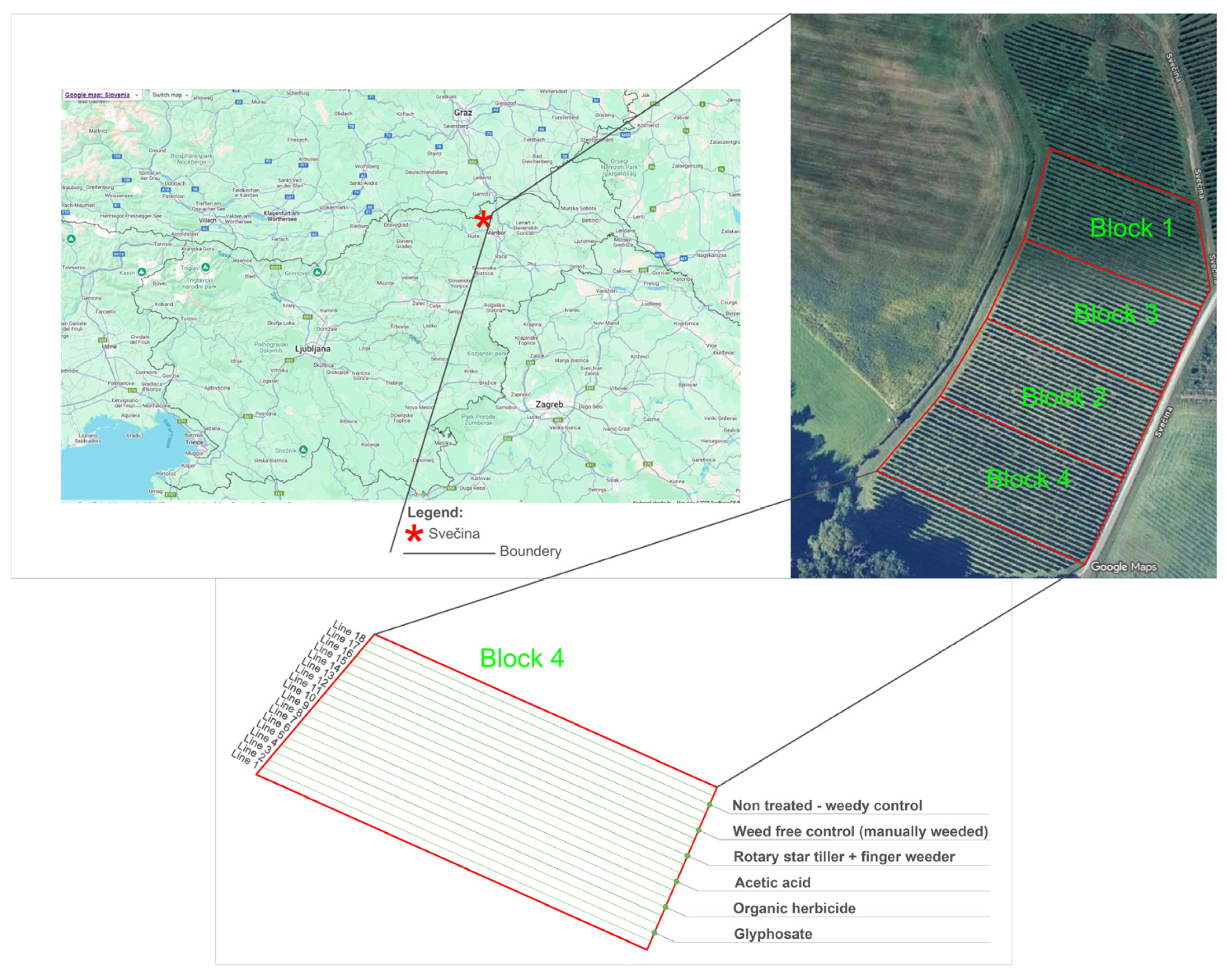
For experimental purposes during the 2021 and 2022 vegetation periods, we used a vineyard located in Plač, northeastern Slovenia (46°40′10.2″ N, 15°35′57.7″ E) (
Figure 1). The soil of the vineyard has medium quantities of nutrients (organic matter 1.7%, pH (KCl) 6.5, P
2O
5 13.5 mg/100 g, K
2O 18.8 mg/100 g (AL-method). Vines of the cultivar “Sauvignon Blanc” grafted on Kober 5BB rootstock were grown in an intensive 16-year-old vineyard plantation with 2.5 m × 0.85 m spacing.
A randomized block design with four replicates was employed, with each plot consisting of three rows, each approximately 85 m long and containing approximately 100 grapevines. Each plot comprised three adjacent rows.
All evaluations were performed only in the middle row. The height of the vine stock stems was 0.7 m, and the plants were fixed in a vertical trellis and trained according to the standard unilateral Guyot system with single-spawning (spurs with up to ten buds) and a plug (one or two buds on the plug).
2.2. Information on the Implementation of Weed Control Measures
Weeds were controlled in a 0.5 m wide strip under the vines in successive years (2021 and 2022). We compared glyphosate-based treatment with four other weed control methods (one mechanical and three chemical), hand-weeded control, and non-treated weedy control, to analyze the effect of the control measures on the population of weeds and the quality and quantity of grape yield.
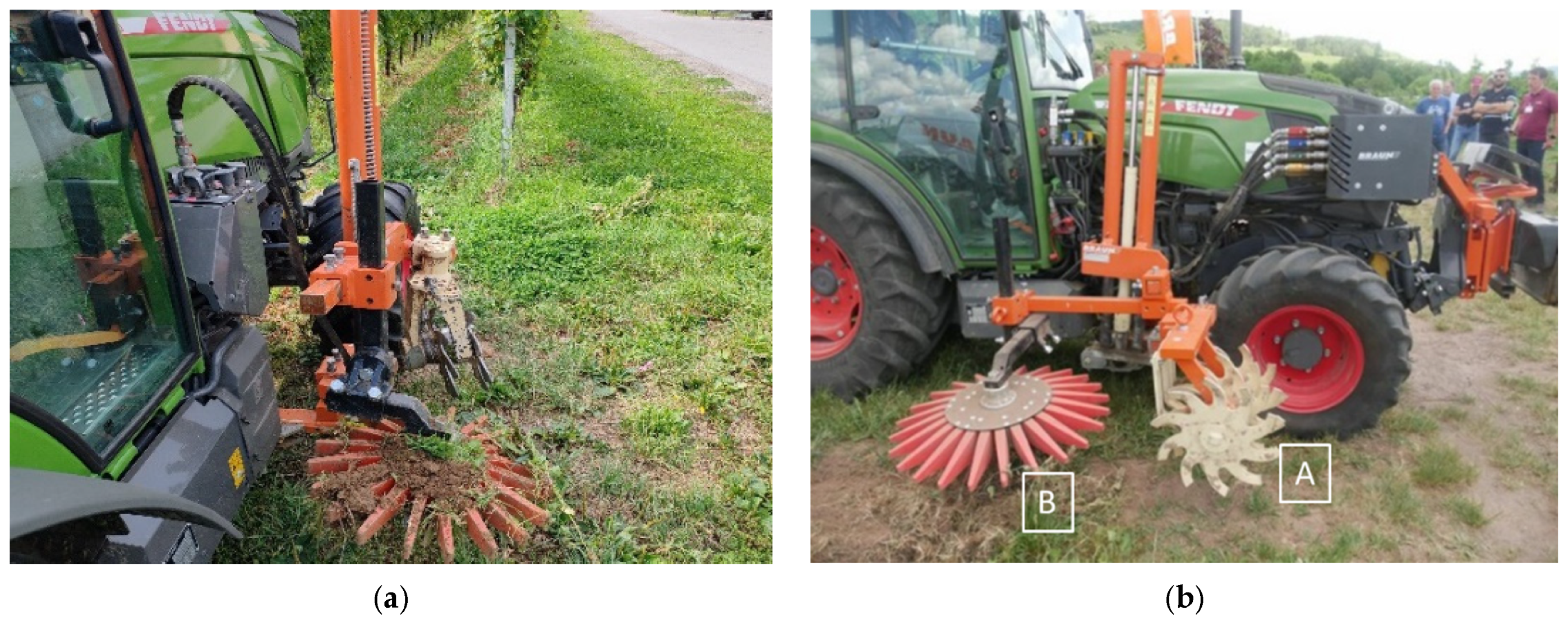
For mechanical weeding under the vines, we employed a modular system comprising a rotary star tiller, a finger weeder [
27] (
Figure 2), and a Fendt 211 F tractor. The Fendt 211 F Vario narrow track tractor (rated power of the tractor engine 111 KM/82 KW) was equipped with the intuitive FendtONE control concept. The 10-inch digital instrument panel behind the steering wheel is also clearly visible, which, among other things, shows the driving speed (km h
−1) and fuel consumption (Lh
−1).
The mechanical tools were installed on both lateral sides, between the tractor axles. One of the characteristics of the tested mechanical tool is that, in addition to surface vegetation cutting and pulling out (weed control), it also cultivates soil to a certain depth. A mechanical tool rotates because of the movement of the tractor and because of ground resistance. The working efficiency of the tool depends on the appropriate driving speed of the tractor. Optimum performance of the rotary star tiller and finger weeder occurs at higher driving speeds between 7 and 12 km h−1. At higher speeds, the tool pulls weeds out of the soil more intensively and replaces them on the surface of the inter-row space. We used a finger weeder with a diameter of 540 mm. The shape and position of the teeth allow the finger weeder to work more externally than the fixed rotary star tiller, guaranteeing better towing in all types of soils and more effective grubbing.
In the 2021 season, the systemic glyphosate-based herbicide Tajfun
® (ADAMA, Agriculture B.V., Ljubljana, Slovenia; 48.54% of glyphosate in the form of isopropyl amine salt) was used twice at a rate 6.0 Lha
−1, Beloukha
® (Certis Belchim B.V., Trzin, Slovenia) pelargonic acid 68% at the rates of 18 Lha
−1, 40 Lha
−1 and 60 L ha
−1, respectively, and common vinegar (Talis, Ljubljana, Slovenia; 9% acetic acid 80 Lha
−1) (
Table 1).
In the 2022 season, the systemic glyphosate-based herbicide in the commercial formulation called Boom efekt (Albaugh TKI, Rače, Slovenia; 48.3% glyphosate in the form of isopropyl amine salt was used twice at a rate of 4 Lha
−1. Instead of pelargonic acid, the “organic” herbicide Stopeco
® at a rate of 5 Lha
−1 of sprayed area was used three times as an alternative to glyphosate. Stopeco
® is a natural liquid organic-mineral N-P-Fe fertilizer made from plant extracts of ginger, soya, and other plants with added iron oxide (Hortis Eu, Moga, Maribor, Slovenia). Substances in this fertilizer disturb several enzyme and metabolic systems of nutrients in weeds, which seriously retards weed growth. Common vinegar (Talis, 9% acetic acid, 80 Lha
−1) was used in the same concentration as in the previous year (
Table 2). Herbicides were applied using nozzles mounted on both sides of the mulcher, connected to a sprayer powered by an electric pump (Zupan Herbi 100, Malečnik, Slovenia). Albuz 80-04 AVI-OC nozzles (Albuz, Evreux, France) were used at an operating pressure of 5 bar, delivering a spray volume of 410 Lha
−1.
For mechanical weed control, the working speed of the tractor with cruise control was fixed at 9 kmh−1, and for chemical weed control at 6 kmh−1. In the field trial, the inter-row distance was 2.50 m, so the herbicide strip was 0.50 m wide, meaning that we sprayed 20% of the vineyard area. So, for example, the actual amount of the herbicide Boom efekt was 1.20 Lha−1 of vineyard at a rate of 6.0 Lha−1 calculated on the area of the sprayed ground.
2.3. Analysis of the Effectiveness of Weed Control and the Botanical Composition of Weed Flora
After each weed control was completed, we performed a visual assessment of the level of effectiveness expressed as a% of under-vine area coverage within 4–5 weeks after treatment. The degree of weed control efficiency was determined using the direct visual scoring method with scores from 1 to 100% (score 1, no effect; score 100, complete destruction of weed plant tissue) [
28]. Data on efficacy scores are presented in which are shown in the manuscript text in the results section. We also visually assessed the coverage rate of weeds. Coverage rate is the under-vine soil surface area treated by herbicide or cultivated by mechanical tools covered by weed biomass expressed as a percentage (%). Before executing the weed control operations, we recorded the composition of the weed community in the plots and entered this into a list for tables. Then, for each treatment, we visually assessed the percentage of effectiveness for controlling an individual weed species. In this paper, we provide an assessment of the effectiveness rank for controlling weeds that occupy the largest mass in the plant community.
The vineyard at the experimental site was moderately infested with weeds. For the past ten years, glyphosate-based herbicides have been applied once or twice annually at registered doses to control weeds growing beneath the vines. The weed population under the vines was predominantly composed of the following species:
(a) Dominant species: Lolium perenne, Elymus repens, Poa annua, Cirsium arvense, Taraxacum officionale, Urtica dioica, Glechoma hederacea,
(b) Species with medium abundance: Setaria glauca, Digitaria sanguinalis, Aegopodium podagraria, Convolvolus arvensis, Daucus carota, Polygonum aviculare, Potentilla reptans, Senecio vulgaris, Ajuga reptans, Veronica persica, Sonchus asper, Ranunculus repens, Conyza canadensis, Achilea millefolium, Agrosits alba,
(c) Species with low abundance: Bromus sp., Medicago lupolina, Cerastium sp., Stenactis annua, Trifolium repens, Galium verum, Galium aparine, Plantago sp., Stellaria media, Prunella vulgaris, Lisimachia nommularia.
2.4. Procedure for Crop Quantity and Quality Survey and Simple Cost–Benefit Analysis of Weed Control
At the end of each growing season, the yield was determined by randomly selecting 50 grapevines in the middle of the plots (a total of 200 grapevines for one trial treatment). Before weighing all picked grape clusters from the chosen grapevines, we checked for the presence of diseased berries and removed these before weighing the cluster mass. Only a very small proportion of berries were diseased because we had a very intensive spray program with excellent disease and pest control.
In each treatment, 150 berries were collected from different parts of the vine crown, and juice was extracted from these to obtain a homogeneous sample for laboratory analysis. The content of total soluble solids (TSS) and the sum of titratable acids (TA) was then measured using a digital refractometer (DUR-W2, Schmidt-Haensch, Berlin, Germany). Juice pH was determined with a pH meter (model AR15; Fisher Scientific, Pittsburgh, PA, USA), and the titratable acidity of each sample was determined by titrating to pH 8.2 with 0.1 M sodium hydroxide and expressed as grams per liter.
In the evaluation of the quality and quantity of yield, we also did a simple cost–benefit analysis for the studied weed control methods. The following prices were considered when calculating the cost of weed control. Year 2021; 1 kg of grapes 0.75 €, 1 L of Tajfun 7 €, 1 L of Beloukha 17 €, 1 L of vinegar 0.75 €, 1 h of weeding with a tractor-driven rotary star tiller 32 €, 1 h of spraying with a sprayer mounted on a mulcher driven by a tractor 12 €. Year 2022; 1 kg of grapes 0.85 €, 1 L of Boom efekt 9 €, 1 L of Stopeco 12 €, 1 L of vinegar 0.80 €, 1 h of weeding with a tractor-driven rotary star tiller 37 €, 1 h of spraying with a sprayer mounted on a mulcher driven by a tractor 14 €.
2.5. Evaluation of the Environmental Footprint
The fuel and time consumption for mechanical and chemical weed control operations were measured by monitoring each mechanical and chemical weed control pass under the vine separately. In total, during the grape growing season, several mechanical weed control operations (passes with the Braun modular rotary star tiller and the finger weeder) and chemical control were completed in the vineyard. The environmental footprint calculation was performed using the SPI (Sustainable Process Index), abbreviated as SPIonWeb [
29], in accordance with the guidelines provided by [
30]. The SPIonWeb program assessed the life cycle of individual process chains (the machines and chemicals used), which resulted in the calculation of the environmental impact of weed control technical processes on the environment throughout the life cycle.
2.6. Statistical Methods
For data analysis, standard analysis of variance (one-way ANOVA, general linear model, and F-test) was used. The significance of differences among treatment means was tested via the Tukey HSD significance post hoc test (
p < 0.05). SPSS Statistics software [
31] (IBM SPSS Statistics V20, Chicago, IL, USA) was used to perform the analysis.
3. Results
3.1. Weather Conditions
According to Koppen’s climate classification, the climate features at the trial location belong to the climate type Dfb: a warm-summer humid continental climate characterized by cold, no dry season, and a warm summer. It is also characterized as a warm temperate climate in some climate classifications.
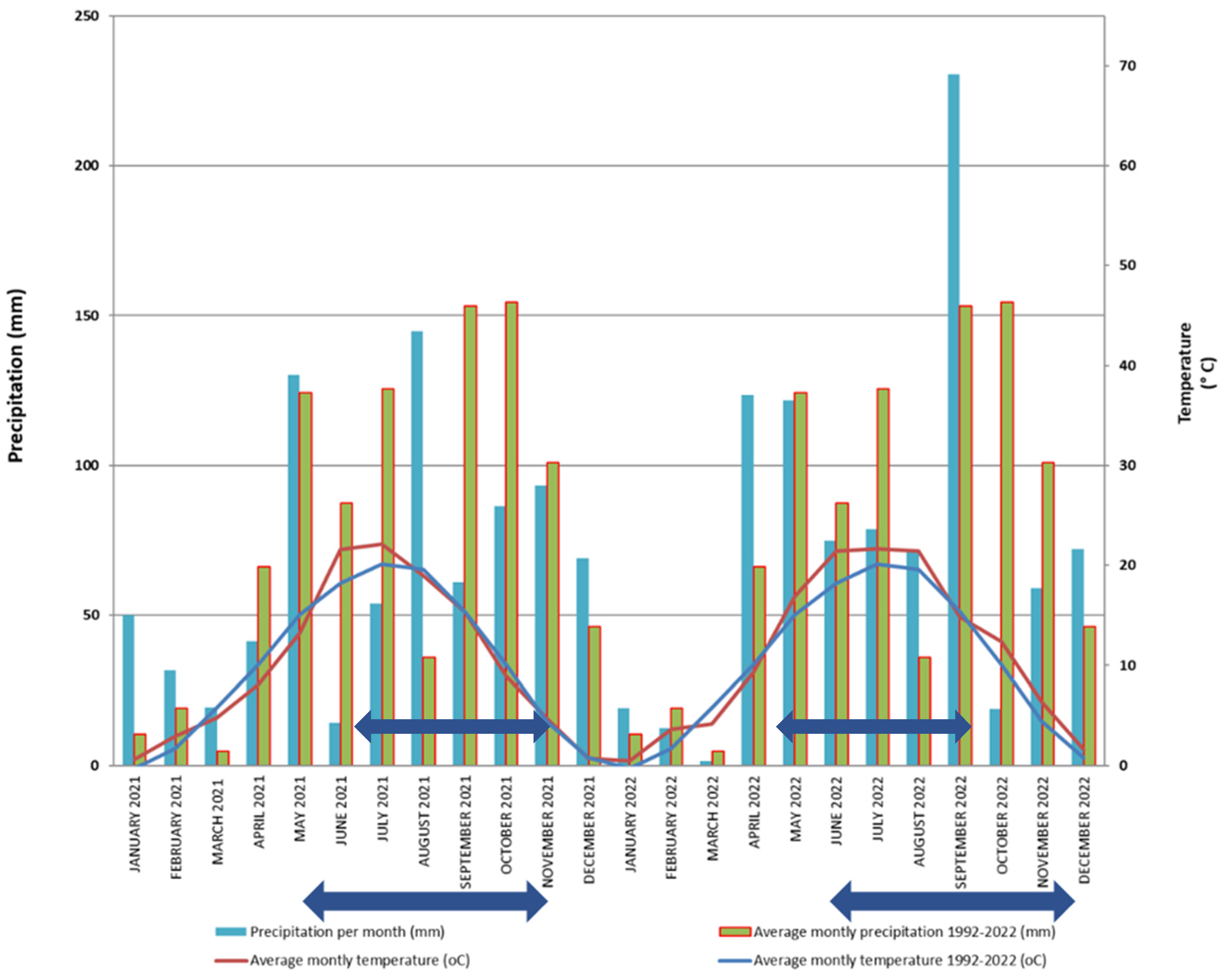
Figure 3 shows the climatic charts obtained from the meteorological station in Šentilj, which is located close to the experimental vineyard.
As seen from
Figure 3, the first months and spring of 2021 were remarkably wet, with a low-temperature period from the end of February to the beginning of March to the beginning of May, while the second part of May was moderately dry. These conditions caused a delayed flowering period and perfect conditions for early weed development. The highest average temperature was during July 2021 (22.1 °C) (blue arrow in
Figure 3). The drought in 2021 started in the third week of June and lasted almost until the end of August. Rains in mid-August and September created optimal conditions for the development of weeds, so the total precipitation amounted to 384 mm, which was 55 mm less than the long-term average.
At the beginning of the growing period in 2022, the weather conditions were less suitable for grape and disease development. There were periods of lower temperatures at the end of April and the beginning of May. The first part of May was cold and moderately dry. The grapevines developed slowly, and flowering started with a slight delay. The temperatures in the first two-thirds of June were suitable for grape and weed development. The rainfall enabled the supply of water until the last week of June, after which a long drought period started with the warm July (monthly average 21.7 °C). Later in the summer, the plants were exposed to drought until the harvest. During the second part of the summer, there was plenty of rain, but it came too late to completely balance the physiological conditions in the grape plants. The rain that occurred at the end of August enabled the development of weeds. Contrary to the previous growing season, the total precipitation in 2022 amounted to 470 mm, which was 30 mm above the long-term average.
3.2. Weed Coverage and Efficcay of Control Methods
Data from
Table 3 shows that the weed control efficacy of alternative methods, expressed as weed coverage, was significantly lower than that of glyphosate-based herbicides in both growing seasons. Generally, the effect of all treatments was influenced by the growing season. In 2021, the weed population was larger than in 2022, owing to the different weather conditions and a change in weed management strategy, which was based predominantly on glyphosate prior to the experiment.
In the first year, the efficacy of both alternative “organic” herbicides, pelargonic acid and acetic acid, was the greatest after the first implementation on 3 May (coverage of 31.75% and 43.75%, respectively) and was slowly lowered after each successive treatment till the very last on 10 September (coverage 61.0% and 68.00%, respectively). We have noticed that acids have lower efficacy when applied to well-developed weeds compared to when applied to earlier growth stages of weeds. Although the application of both acids resulted in lowered soil coverage in contrast to control plots, their efficacy was more apparent when considering weed biomass. The weeds were visibly damaged, showed reduced vigor, and exhibited stunted growth. This suggests that high soil coverage does not necessarily indicate a high level of competition between weeds and the grapevine if the weeds have low biomass and are under high physiological stress due to exposure to acid-based products.
Pelargonic acid showed slightly better effectiveness compared to acetic acid; however, the difference was not statistically significant. In contrast to these herbicides, the combination of a rotary star tiller and finger weeder provided more consistent and sustained weed suppression over time. Specifically, weed coverage was reduced to 48.70% by 3 July and further to 59.0% by 10 September. Therefore, mechanical weed control was slightly more effective in the long term when compared to both the pelargonic and acetic acid treatments.
As in 2021, in 2022, the utility of both alternative “organic” herbicides Stopeco® and acetic acid was again the highest after the first implementation evaluated on 13 June (coverage 23.25% and 29.75%, respectively). Like pelargonic acid in 2021, Stopeco® and acetic acid efficacy was lowered after each successive treatment till the very last on 26 September, when weeds reached a coverage 42.25% and 65.75%, respectively. Stopeco® displayed significantly higher effectiveness only after the first treatment, while there was no difference after successive treatments. Again, the effectiveness of the combination of mechanical treatment with rotary star tiller and finger weeder was higher even from 14 July to 26 September, since coverage varied between 35.75% and 32.25%. Thus, the mechanical weed treatment was again slightly more effective than Stopeco® or acetic acid.
In
Table 4 and
Table 5, we present data on the effectiveness of controlling individual weed species, as obtained in the fall (end of September), two months after the last weed control operation. In 2021, we were surprised because for most weed species, the differences between the treatments were not statistically significant. In terms of effectiveness on individual weeds, the variants were almost equivalent. This result is a consequence of the composition of the weed species and of the history of glyphosate applications. Even with a glyphosate-based herbicide, the effectiveness did not exceed 50–60% for many species. More than two months passed from the application of the herbicide to the day of evaluation, during which time perennial weeds had already regenerated considerably, and summer annual weeds (e.g.,
Setaria,
Digitaria,
Stellaria) had also developed, because glyphosate has no soil residual activity. We expected the herbicide glyphosate to have higher efficacy. We must take into account that the herbicide glyphosate has been used in the experimental vineyard for 20 years and that many weeds are already quite tolerant to this herbicide. The situation is similar in many vineyards throughout Europe. These species include, for example,
Aegopodium podagraria,
Convolvulus arvensis,
Lysimachia nummularia,
Epilobium parviflorum,
Urtica dioica,
Potentilla reptans, and
Erigeron canadensis. Owing to a certain level of tolerance to moderate doses of the herbicide glyphosate in many weeds, the effectiveness of this herbicide was not significantly better than the level of effectiveness of alternative control methods. In the summer of 2021, there were no prolonged dry periods, which slightly increased the regeneration of weeds after damage from chemical substances and mechanical control. In 2022, the achieved effectiveness of the herbicide glyphosate was, on average, higher than in 2021. We did not increase the dose of active substance per hectare, but we applied the herbicide earlier at slightly lower stages of the weeds (1 July). Additionally, the weeds affected by the herbicide were slightly weakened by the drought. Statistically significant differences appeared between the treatments. For example, in weeds such as
Elymus repens,
Lolium perenne,
Urtica dioica,
Achillea millefolium, and
Galium verum, glyphosate achieved significantly higher efficiency than we achieved with alternative treatments. In glyphosate-tolerant weeds, however, the differences were small (e.g.,
Aegopodium podagraria,
Lysimachia nummularia,
Epilobium parviflorum). Acetic acid performed slightly better in 2022 than in 2021 on average. The performance of the organic herbicide Stopeco
® in 2022 was better than that of the pelargonic acid-based herbicide Beloukha in 2021.
3.3. Grape Yield Quantity and Cost–Benefit Analysis for Tested Weed Control Methods
During the 2021 growing season, the conditions for yield formation were relatively good. In the weed-free treatment, the yield amounted to 13,733 kg ha
−1, which was 29.70% more than in the weedy control, owing to the high presence of perennial weeds. For this reason, some loss of yield, but a statistically insignificant one, also occurred when using the herbicide glyphosate despite the highest efficacy (compare 13,733 kg ha
−1 with 13,153 kg ha
−1 in 2021 and 13,798 to 12,980 kg ha
−1 in 2022 in
Table 6). The results for 2021 show no statistically significant differences in grape yield between alternative treatments and glyphosate, likely the result of a weed population already quite tolerant of glyphosate in the experimental vineyard, which has a long history of glyphosate applications. There was no statistically significant difference when applying pelargonic or acetic acid (12,063 vs. 11,168 kg ha
−1). Also, the use of mechanical treatments gave practically the same yield as the two applications of the herbicide glyphosate (12,764 vs. 13,153 kg ha
−1). This was an unexpected result, as visually, a significant amount of greenery remained under the vines after the mechanical treatment. However, these weeds were apparently also sufficiently affected by the drought to lower their competitiveness.
In the 2022 season, the conditions for crop formation were better than in the previous season, but in the weed-free treatment, the yield of grapes was almost the same as for the previous year (13,733 vs. 13,798 kg ha−1). At the same time, the weed-free treatment yielded 37.1% more than the weedy control. Thus, the loss of yield was about 10% greater than the previous year. So, in total, the use of mechanical treatments gave a yield just slightly lower than the “organic” herbicide Stopeco® and a little higher than the herbicide based on acetic acid. The difference between the glyphosate-treated plots and mechanically managed plots was not statistically significant (12,980 vs. 12,401 kg ha−1). Statistically, there were again no significant differences between the use of chemical and mechanical methods, as was the case in 2021.
The analysis of yield showed (
Table 6) a 7.5% decrease in yield for mechanical weed control vs. weed free control in the first year and a 10.1% in the second year, and 12.1% (for pelargonic acid in 2021) and 9.6% for alternative chemical protection with Stopeco
® fertilizer in 2022, which is a significant positive difference compared to the yield loss reported by [
21,
22], who showed 32% and 25% reduction in yield between the control parcels (unweeded) and glyphosate application, on the one hand, and an increase of 37% and 51% when using different mulches.
On the other hand, there was no statistically significant effect of different weed control treatments on TSS and STA content (
Table 4), nor was there a substantial difference between treatments in each particular year, nor a difference between the 2021 and 2022 growing seasons. In 2021, the TTS values expressed in °Brix amounted on average to 22.91, varying from the lowest in the weedy control (20.90) to the highest in the glyphosate treatment (22.70). A year later, the TTS values amounted on average to 21.72 °Brix, with the lowest value of 20.67 °Brix under the non-treated control, and the highest value (22.55 °Brix) under the combination of rotary star tiller and finger weeder.
In 2021, the STA content in gL−1 averaged 6.96, with the lowest value observed under the combination of rotary star tiller and finger weeder and weed-free control (6.25). The highest level of STA (7.77) was measured under the acetic acid treatment. In the 2022 growing season, the STA values amounted on average to 8.83, where the lowest values (8.41) were measured under weed-free control, and the highest (8.83) under the organic herbicide Stopeco®.
In
Table 7 and
Table 8, we present the results of a simple cost–benefit analysis. In 2021, the economic analysis showed that we obtained the best financial result when using an herbicide based on glyphosate. We obtained the second-best result when using mechanical tools three times a season, whereas the organic herbicides yielded a significantly poorer economic outcome. Yield was lower and the cost of products was higher when compared to the glyphosate variant. The results in 2022 were similar to those in 2021. Again, the best financial result was achieved when using a herbicide based on glyphosate. When using the Stopeco
® preparation, we achieved a slightly better result than when using mechanical tools. The price of the preparations and the amount used per hectare have a great influence on the financial result. Herbicides based on glyphosate are inexpensive, and the application rate per hectare is low, resulting in a low cost for weed control (in 2021, only 86.04 euros per hectare). On the contrary, we can see that the preparation based on pelargonic acid (Beloukha) is expensive (17–19 euros per liter) and the dose applied per hectare is high (18–60 L per hectare). The cost in 2021 was 334.2 euros per hectare, which is more than three times higher than the cost of applying glyphosate-based herbicides.
3.4. Evaluation of Environmental Footprint
The calculation of environmental footprints is based on three main inputs: working time consumption, fuel consumption, and the quantity of products applied in the specific treatment. As seen from
Table 9, the total time for each treatment depends on the number of passes needed to control the weeds during the whole growing season, which was multiplied by the time needed for each pass, so in each year, the most time was spent on mechanical weeding (532 min ha
−1 in 2021 and 541 min ha
−1 in 2022). In the case of chemical treatments, the time needed for one pass ranged from 171 to 175 min ha
−1, so the average sum amounts to 346 min ha
−1.
Therefore, glyphosate application required the least time in both years, i.e., 347 min ha−1 in 2021, and 348 min ha−1 in 2022, while on the other hand, the triple application of acetic acid and pelargonic acid treatments required between 518 and 580 min ha−1. Time consumption correlates well with fuel consumption, meaning that for mechanical tillage, more diesel fuel was spent than in the case of herbicide application, i.e., 15.06 Lha−1 of fuel in 2021 and 16.15 Lha−1 in 2022. On the other hand, only 4.34 Lha−1 and 4.40 Lha−1 of diesel fuel were used when glyphosate was applied twice per season.
The results in global hectares per year (gha anno
−1) represent the annual amount of biologically productive land that is necessary to assimilate the emissions produced in all processes needed for weed control on 1 ha of vineyard area (
Table 5). The most important parameter influencing the size of the environmental footprint is the quantity of active molecules in different herbicides applied during the season; accordingly, the highest environmental footprint is produced by glyphosate, followed by pelargonic acid, Stopeco
® and acetic acid. Given that basis, the largest footprint is related to the double glyphosate application in 2021, which amounted to 11.21 gha anno
−1, i.e., 5.60 gha anno
−1, i.e., per one pass in 2021, and 10.55 gha anno
−1, i.e., 5.27 gha anno
−1, i.e., per one pass in 2022. In the second year, the footprint is insignificantly smaller on account of the lower content of isopropyl amine salt in the Boom efekt herbicide. Concerning other treatments, there were no statistical differences between “organic” herbicides and mechanical weeding, as they varied from 7.77 gha anno
−1 (rotary star tiller and finger weeder), to 7.48 gha anno
−1 (acetic acid) in 2021, and from 8.08 gha anno
−1 (rotary star tiller + finger weeder) to 7.36 gha anno
−1 (acetic acid) in 2022. The statistically significant differences among glyphosate and other treatments for 2022 remained despite the lower total amount of isopropyl amine salt used in this growing season.
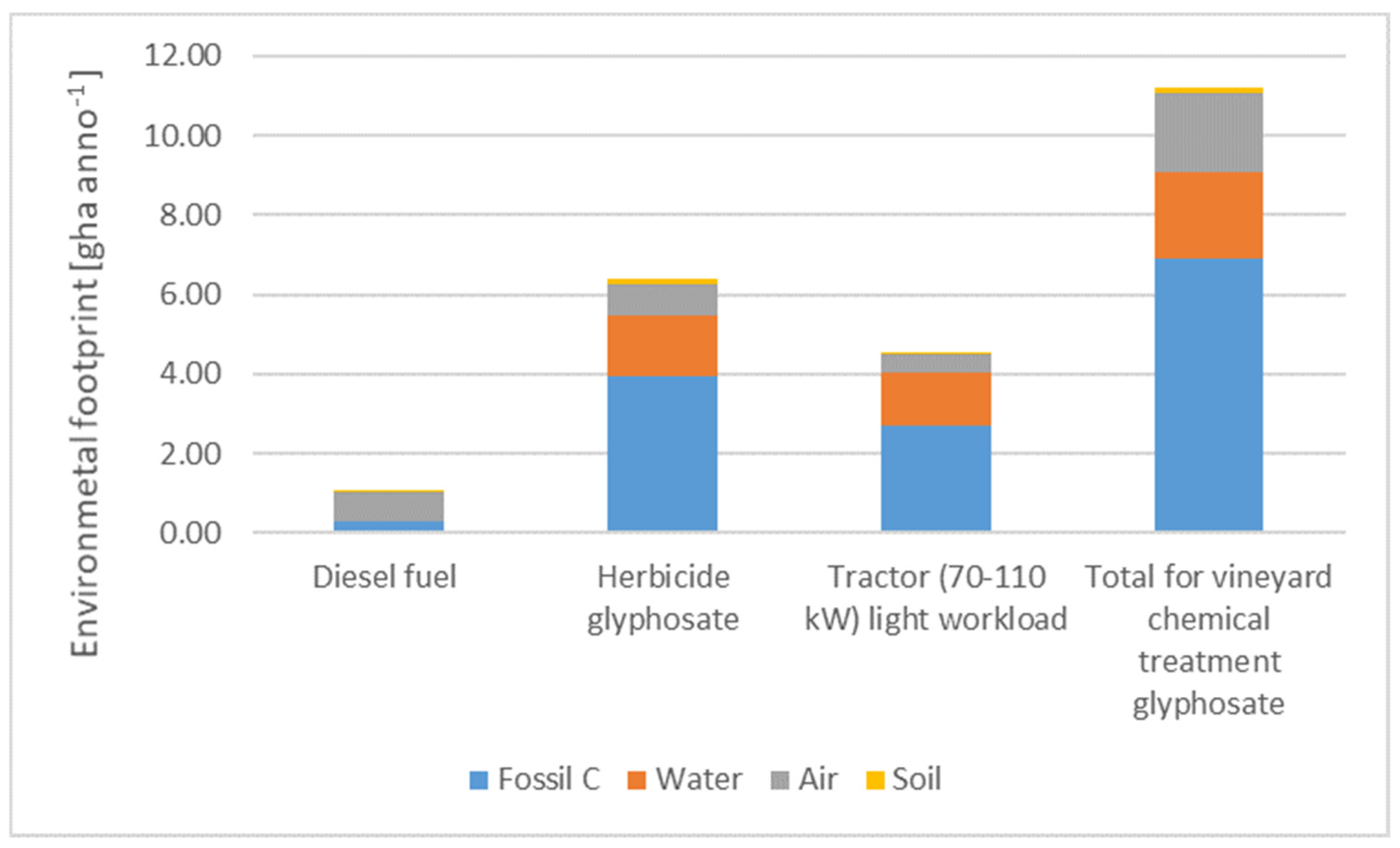
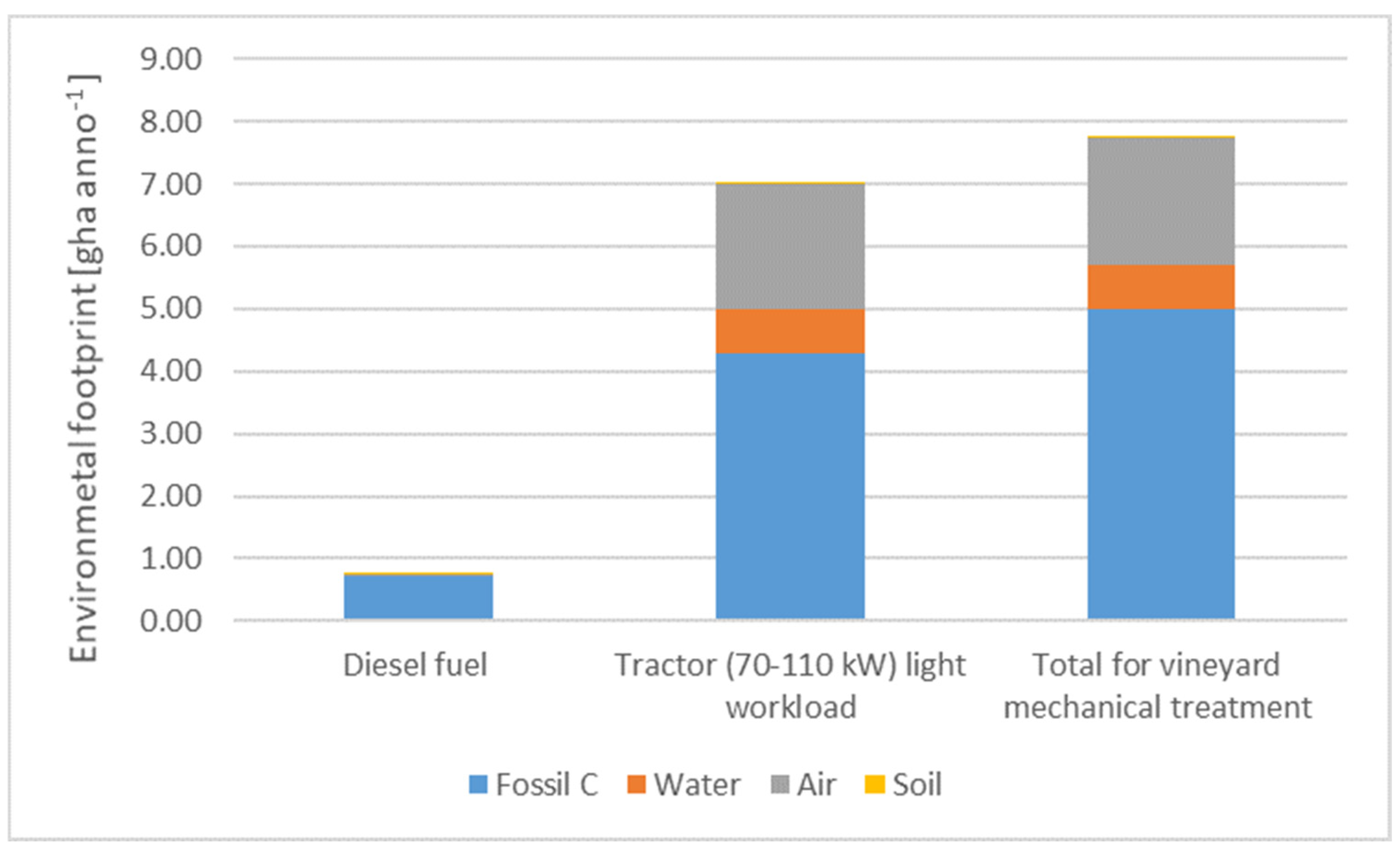
Figure 4 depicts a sample of the environmental footprint (10.55 gha anno
−1) estimated for the double application of systemic glyphosate-based herbicide in 2021. Besides tractor workload, the main footprint share belongs to the life cycle of 4.32 Lha
−1 of glyphosate, which amounts to 6.49 gha anno
−1. In contrast,
Figure 5 illustrates the environmental impact of the footprint for three applications of the rotary star tiller and finger weeder in 2021, showing that the primary contribution to the footprint came from the tractor workload. From each column, it can also be seen that the largest environmental footprint comes from fossil fuels, which are integrated into different production processes, i.e., weed control products. The significant effect of glyphosate on the environmental footprint was also estimated by [
32] for arable land production, indicating that synthetic products have the greatest impact on the world’s natural resources. On the other hand,
Figure 5 illustrates the environmental footprint (8.08 g ha
−1 yr
−1) for the triple application of the rotary star tiller and finger weeder in 2022, where the main relevant effects are attributed to the tractor workload and diesel fuel consumption.
The other two environmental parameters (CO2 and GWP emissions) generally follow the same patterns as the footprints in both years. Thus, in 2021, the highest amount of CO2 (507.82 kg CO2, 909.92 kg CO2-eq) was released for two passes of the glyphosate treatment; by contrast, in 2022 the highest amount of CO2eq (990.90 kg) was released for four passes of mechanical weed control with rotary star tiller and finger weeder, and 477.93 kg of CO2 was again released for two passes of the glyphosate treatment.
However, detailed analysis has shown no differences in CO2 release between pelargonic acid (321.32 kg CO2) and acetic acid (301.42 kg CO2) in 2021, but a bigger difference in GWP (904.22 kg CO2-eq vs. 808.06 kg CO2-eq) than might have been expected.
4. Discussion
4.1. Efficacy of Alternative Weed Control
Concerning the level of weed infestation before the first under-row weed control intervention, the weed biomass was diverse, lush, and well-developed, as also proven later with reference to the non-treated-weedy treatment, which showed high coverage (94.44 to 100%) during both experimental years. It is important to point out that we have results only from a short-term trial. Usually, it takes a longer time to see the effects of alternative weed control measures clearly [
22]. It is also important to note that when switching to alternative methods, we must start with treatments early in the season, when weeds are at earlier developmental stages and not fully developed. This fact significantly influences the achieved efficacy of alternative herbicides and mechanical treatments. In our trial, we may have started too late, resulting in high weed coverage values and lower efficacy.
Generally, the efficacy of alternative weed control was lower in 2021 (25%) than in 2022, when the overall efficacy of a combination of rotary star tiller and finger weeder was around 65%. Remarkably, all treatments had lost their effectiveness on weed biomass by the third sampling date in 2021 and the fourth sampling date in 2022.
These results are very close to reports by [
16], who showed a 71% reduction in weed biomass under the vines when using the same tools in the Tuscany region of Italy. In contrast to [
17], our mechanical treatment with a combination of rotary star tiller and finger weeder also showed a relatively good effect on hard-to-control weeds such as
Elymus repens,
Convolvolus arvensis, and
Urtica dioica (
Table 4 and
Table 5 about the efficacy of control in individual weed species). However, the same authors measured 55% coverage at the end of the season when using a disk cultivator twice and a blade-weeder undercutter once a year.
The alternative herbicides, pelargonic acid and Stopeco
®, as well as acetic acid, were, on average, not much less efficient than mechanical treatment in both years. However, after detailed analysis, we found that the rotary star tiller with a finger weeder resulted in significantly lower weed coverage at the end of the season compared to acetic acid in 2011 and Stopeco
® in 2022 (
Table 3). According to the reports of [
9], we expected in our experiment greater weed control efficiency when using pelargonic acid in much higher doses of 18–60 kg ha
−1, but evidently, these treatments were quite ineffective against the grass weeds that came to dominate because of their resistance to acid-based products (see
Table 4 and
Table 5), so there was no significant effect in the first year. It appeared that the effect of Stopeco
® was more pronounced during the summer period, also because of its interactive effect with the drought period.
Weather conditions can significantly influence the efficacy of weed control measures. Dry, hot weather intensifies the burning effect of alternative organic herbicides and accelerates the drying out of weeds pulled from the soil by mechanical tools. For this reason, the highest control efficiency is achieved if control is carried out just before a period of high temperatures and without precipitation. In rainy weather, weed regeneration is enhanced, both after mechanical control and when using organic herbicides, which have a limited effect on the underground organs of weeds. The rotary hoe tool works best when the weather is dry, and the soil is only slightly moist. At that time, the tool pulls out weeds best and does not clog. If the soil is wet, the soil and weeds adhere to the rotating element of the tool, and the working element fails to pull out weeds as intended. The tested alternative control methods give the best results in dry weather without precipitation for at least a week after the control. In 2021, we experienced more precipitation and a less dry summer than in 2022; therefore, the effectiveness of control in 2021 was somewhat lower than in 2022.
4.2. Effect on Grape Yield and Quality and Financial Result
The comparison between mechanical and chemical weed control treatments showed no statistical differences in grape yields in either of the growing seasons (
Table 6). Likewise, berry total soluble solids and titratable acids were almost unaffected by the main treatments. These results are consistent with the findings of [
8], who reported that increased weed biomass in some treatment plots compared with plots treated with glyphosate had no effect on crop yield in a drip-irrigated wine grape vineyard. The increased weed population did not cause water stress because sufficient water was available to the grapevine through the irrigation system. In contrast, in a study comparing five vineyard floor weed management strategies in Catalonia, Spain [
14], researchers reported lower weed cover across three seasons in mulched treatments, as well as higher yield, better vine water status, and greater vegetative development than in plots with mechanical treatment. In a meta-analysis of vineyard vegetation management systems [
32], it was shown that comprehensive conclusions about the most suitable management system cannot be drawn. Major differences exist between winegrowing sites and vegetation types. From the point of view of vineyard ecosystem services, we know we do not want to have bare soil and that we must manage vegetation so as to tolerate a certain level of weed coverage. We must balance the energy used for control, the desired weed biomass, and the weed population species composition. Certain weeds are not accepted because they can increase the population of insect pests or the populations of fungi and bacteria, causing diseases in grapevines. From this point of view, the partial efficacy of alternative methods may even be acceptable. The frequency of interventions should be adjusted to an acceptable level of weed competitiveness, soil water status, and risk of erosion processes. Alternative control methods are more costly; therefore, we need to have some kind of compensation, such as a higher price for wine or subsidies for an environmentally more sustainable production system. The last one is a matter for the common European agricultural policy.
4.3. Efficacy in Terms of Environmental Footprint
Regarding operational performance, using a rotary star tiller with a finger weeder resulted in the greatest time consumption (532 min ha−1), owing to the four passes, whereas, in contrast to the other treatments, the time needed for one pass was the shortest (133 min ha−1). This happens because the tractor had a lower working speed during spraying (6.0 kmh−1) in comparison with mechanical weed control (9.0 kmh−1). The time for applying “organic” herbicides and glyphosate was the same for one pass; however, given the three passes with “organic” herbicides, the total time was 49.56% higher than for glyphosate application.
Using the tool-holder equipped with a rotary star tiller and finger weeder resulted in greater fuel consumption (3.01 L ha−1) compared to applying herbicide by a boom sprayer (2.21 Lha−1) mounted on a mulcher. Thus, the greatest consumption was recorded for the four deployments of mechanical weed control (12.04 Lha−1), which was 272.39% higher compared to glyphosate and 181.59% higher compared to the “organic” herbicide treatment.
It is challenging to compare the results of our study with those of others, which typically provide a comprehensive analysis of all grape production steps. For instance, ref. [
23] reported only the total footprint of vine production from grape to winery and bottling expressed in kg CO
2 per bottle without any detailed breakdown into particular inputs, and ref. [
20] presented the effect of different grapevine cultivation methods on steep slopes on CO
2 emissions. Researchers in such comprehensive impact studies typically conclude that weed control represents a moderately important or less significant contribution to total grape production footprint indicators.
When analyzing the sustainability of weed control methods in vineyards and their environmental footprint, we need to consider the mass balance, i.e., how much carbon (C), nitrogen (N), and phosphorus (P) are released and how much can be bound back from the atmosphere and environment [
33]. Researchers from South Africa [
33] conducted a detailed comparison of several grape production systems and weed control methods in vineyards, finding that it was not possible to identify a single best approach. In the long term, only balanced, integrated approaches are sustainable. We need to consider the sequestration potential of the vineyard’s vegetation. The greater the area covered by active vegetation, the greater the sequestration potential of the vineyard [
34]. In connection with the sequestration potential of a vineyard, we know that optimal sequestration occurs when the entire vineyard is permanently covered with vegetation, and vegetation management is carried out as infrequently as possible, typically by mowing or mulching. With such a concept, sequestration is greatest. In connection with our experiment, we can say that increasing the soil coverage under the vines, owing to the lower efficiency of alternative preparations, slightly increases the sequestration potential of the vineyard. This is the positive side of using alternative preparations that are not highly effective. In mechanical measures, we typically increase microbial decomposition of organic matter through soil aeration, which can reduce the sequestration potential of the vineyard or increase CO
2 emissions (“so-called organic matter burning”). This can be a negative side effect of implementing mechanical methods of weed control. Italian scientists [
35] have analyzed the carbon footprint parameter for organic and integrated vineyards and found that there were no significant differences in terms of weed control. In organic production, high energy consumption and CO
2 release occur because of frequent soil cultivation, whereas in integrated cultivation, significant CO
2 release is associated with the production of herbicides. Their conclusions were quite similar to ours.
Still, it is well known that the environmental impact of food production is very important, and the environmental footprint serves as an indicator to guide farmland management. In this respect, integrated farming practices are the key to reducing the environmental footprint of grape production, which includes using the lowest possible amount of chemical products. However, farmers play a key role in ensuring the provision of low-emission inputs to the food chain, since there are significant gaps between the development of new technologies and their implementation in farming operations. We believe that with relevant agro-environmental policies in place, along with the adoption of improved agronomic tactics, increasing food production with minimal or, more realistically, low environmental cost can be achieved.
Overall, it can be stated that none of the tested treatments alone proved to be the best compromise in terms of weed control effectiveness, grape yield, grape quality, fuel consumption, and CO2 emissions. The results obtained for alternative weed control are encouraging, and generally, the performance is not too far from that obtained with chemical control and reported by other researchers. This indicates that mechanical under-row weed control, combined with tillage, can be a reliable alternative to chemical control. However, in the transition period from conventional to organic or low-input farming, the most sustainable weed control strategy for one growing season would be one application of glyphosate at the beginning of the season, and two passes with a rotary star tiller and finger weeder later in the summer. Eco-toxicological impacts were not considered when giving this opinion. A good alternative would also involve combining less intensive mechanical weeding with one or two applications of alternative “organic” herbicides, similar to those we tested. Significantly retarded weeds, but still alive, can provide many ecosystem services, without compromising grape production economics.
These tactics are compatible with the concept of regenerative vine growing [
36], a modern, integrated production system that combines good economic performance with high levels of natural resource preservation. According to [
36], regenerative vine growing offers viticulture the potential for soil and biodiversity regeneration, carbon sequestration, land cooling, various ecological enhancements, and improvements in soil water holding capacity. All these ecosystem services are enhanced if we achieve a balanced relationship between grapevines and the many other plants that form the complex vineyard vegetation, which should not be overly regulated by frequent human intervention.
The less bare soil surface there is in a vineyard and the less frequently the vegetation cover of the area under the vines is disturbed, the greater the scope of ecosystem services a vineyard can provide [
37,
38]. In the case of increased vegetation cover, erosion is reduced, water losses due to surface runoff are decreased, pesticide leaching from the vineyard into surface water sources is reduced, the sequestration potential of the vineyard is increased, and plant biodiversity, as well as the biodiversity of beneficial insects, is typically enhanced. The energy balance of the vineyard is improved, as more solar energy is captured and less energy is used to produce one kg of grapes. It is also important to note that vineyards are often situated on terrain that is unsuitable for other crops. By properly regulating the weed population, we preserve the land’s production potential for the future, which is a valuable form of ecosystem service [
39,
40]. Different methods should be alternated within a season to balance the strengths and weaknesses of each method. This is a common recommendation for achieving sustainability using integrated concepts.
5. Conclusions
Using these alternative chemical and mechanical methods three times during two growing seasons (2021–2022) in a vineyard did not achieve the weed control efficiency level obtained by two annual applications of glyphosate. Comparable efficiency could probably be achieved only by five applications of alternative “organic” herbicides or by using mechanical treatment 4–5 times a season. In that case, we would not achieve a relevant reduction in environmental footprint parameters (e.g., GWP), and alternative methods cannot be considered more environmentally sustainable than glyphosate application.
It is very difficult to compare the effectiveness of chemical and mechanical methods, because the damage to the weed root system and aboveground organs varies greatly. The type of tool and the type of herbicide determine which organs will be affected, whether only part of the roots or also the growth part, and whether plants with shallow roots will only be raised during the pass of the mechanical tool. If the latter happens, it is crucial that the soil be very dry; otherwise, the weeds will survive the control treatment. Grasses tolerate root cutting quite well, but some perennial herbs are seriously affected by cutting. If the weather is dry, the rotary hoe severely affects both annual and perennial weeds. It uproots perennial weeds from the ground, and in dry weather, there is a high chance that the uprooted plants will desiccate and die. In wet conditions, the rotary hoe is ineffective because the tool becomes muddy and cannot cut weed tissue effectively. With all the tested alternative herbicides, weeds regenerate quickly. Perennial weeds that can reproduce vegetatively from underground organs regenerate especially quickly. For this reason, it is necessary to repeat the control several times and to start early in the spring while the weeds are still small and not completely developed.
The field experiment showed that the tested alternative methods of weed control are only partly comparable to control with the herbicide glyphosate in terms of the effectiveness of weed suppression and are more comparable in the amount of grape yield. We believe that alternative mechanical and chemical methods tested under Slovenian climate conditions are not competitive in terms of control effectiveness with the use of the herbicide glyphosate, even when applied three times a year. We have seen that in the weedy treatment (control), up to 32% crop loss was caused by weeds. This means that weeds must be controlled for a long part of the season and that extensive vegetation development under the vines can be risky if the stand consists of perennially competitive weeds. However, in our case, we estimate that a 60% threshold of weed infestation, or coverage by moderately retarded weeds, still has positive effects in terms of ecosystem services (biotic diversity, preservation of soil fertility, reduction in erosion processes, etc.), on the one hand, and provides acceptable economic results, on the other. We need models that can provide data on acceptable weed coverage according to weather, soil properties, and grape growing concepts. Bare soil for long periods of time is no longer an acceptable under-vine management option.
Analysis of environmental efficacy via the GWP parameter (
Table 9) reveals no statistically significant difference between mechanical control and chemical control, whether using the herbicide glyphosate or “organic” products with herbicidal action. The most sustainable approach would be one application of “organic” herbicide and two passes with a rotary star tiller, a finger weeder tool per season, or vice versa, considering the composition of the weed flora. The maximum amount of CO
2 and GWP is released while using the organic herbicide Stopeco
®. The environmental impact of food production is very important, and the environmental footprint should also serve as a respected indicator to guide new directions in farmland management.
Banning glyphosate or rigorously limiting its application may cause systemic and agroecosystem-level impacts, resulting in trade-offs in weed management efficacy, crop yield and profitability, soil health, and biodiversity. Therefore, it is crucial to optimize the cost, efficacy, and environmental benefits of alternatives. Thus, further studies are needed to evaluate new strategies for weed control under different meteorological and pedoclimatic conditions, whereby positive environmental effects of the acceptable residual weed flora need to be considered in the evaluation of environmental footprints (less leaching of nutrients, less erosion, less contamination of water, etc.). In the evaluation of environmental footprints, we must also calculate the energy and materials used for the restoration of ecosystems and agricultural land fertility. If we consider this evaluation concept, we believe that a certain increase in the level of coverage of the soil surface under vines by weeds should be tolerated, and alternative methods should also be accepted as economically sustainable.