Article

Seed Dormancy and Germination Characteristics in Six Solanum Species Distributed on the Korean Peninsula

1
Wild Plant Seed Division, Baekdudaegan National Arboretum, Bonghwa 36209, Republic of Korea
2
Department of Horticulture and Breeding, Graduate School of Gyeongkuk National University, Andong 36792, Republic of Korea
3
Department of Forest Science, Graduate School of Gyeongkuk National University, Andong 36729, Republic of Korea
4
Major of Smart Horticultural Science, Gyeongkuk National University, Andong 36792, Republic of Korea
*
Authors to whom correspondence should be addressed.
Agronomy 2025, 15(11), 2652; https://doi.org/10.3390/agronomy15112652
Submission received: 22 October 2025 / Revised: 14 November 2025 / Accepted: 17 November 2025 / Published: 19 November 2025

Abstract

Crop wild relatives (CWRs) are critical resources for crop improvement and addressing food security. The genus Solanum includes many wild species genetically related to major crops. However, seed propagation methods for Solanum taxa distributed on the Korean Peninsula are not well-established. In this study, seed morphology and effects of incubation conditions on germination and dormancy were evaluated in 6 Solanum species classified as CWRs in Korea: Solanum lyratum, S. japonense, S. nigrum, S. sarrachoides, S. americanum, and S. viarum. The seeds possessed fully developed embryos at the time of dispersal and the seed coats readily absorbed water. We investigated germination characteristics under various temperatures, cold stratification periods, and gibberellic acid (GA3) concentrations. Germination percentage of S. lyratum and S. japonense was significantly higher under cold stratification (≥62.0% after 12 weeks at 5 °C) or GA3 treatment (≥77.0% at 1000 mg·L−1) than for temperature treatment alone (≤3.0% at 25/15 °C), indicating non-deep physiological dormancy (PD). Seeds of S. nigrum, S. americanum, and S. viarum exhibited non-deep PD with conditional dormancy and higher germination efficiencies through GA3 1000 mg·L−1 than under temperature treatment alone (25/15 °C). Seeds of S. sarrachoides were classified as non-dormant. These findings may contribute to the practical mass propagation of Solanum.

1. Introduction

Interest in wild plants has increased, and the utilization and conservation of crop wild relatives (CWRs) are active areas of research [1,2,3,4,5,6]. CWRs are wild plants that are closely related to crops and regarded as the wild ancestors of modern crops. Crop plants show a substantial loss of genetic diversity during domestication. CWRs have the ability to tolerate biotic and abiotic stresses [2,7,8] and can be easily introgressed into related cultivated plants [5,7,9], providing important genetic resources for plant breeding. Moreover, their functional substances have industrial applications [3].
The genus Solanum of the family Solanaceae contains approximately 1400 species, most of which are distributed in tropical and subtropical regions [10,11]. Twenty-one species of Solanum are distributed in Korea, including three natives (e.g., S. lyratum Thunb. and S. japonense Nakai), nine aliens (e.g., S. nigrum L., S. sarrachoides Sendtn., S. americanum Mill., and S. viarum Dunal), and nine cultivated species (e.g., S. melongena L., S. tuberosum L., and S. lycopersicum L.). Solanum species are important resources for food and medicinal purposes [12,13,14]. In particular, S. tuberosum (potato) and S. melongena (eggplant) are among the most important crops worldwide and have been studied extensively [15,16,17]. Wild Solanum species, as relatives of cultivated plants, contain numerous bioactive compounds, such as steroidal alkaloids and saponins, and have antioxidant properties [11,18,19]. These species possess both agronomic and pharmacological value and are important genetic resources for future breeding and industrial applications. Most studies on species of Solanum distributed in Korea have focused on their pharmacological properties [20,21,22]. Therefore, studies focused on practical mass propagation using in situ conservation and ex situ conservation strategies are critical. However, little is known about the germination characteristics of Korean Solanum species under in vitro conditions and dormancy classes, despite implications for the conservation of genetic resources for breeding and industrial applications.
Seed germination is an essential process by which a seed develops into a new plant [23], and it is necessary for the effective conservation of species, the maintenance of genetic diversity, and practical mass propagation [24]. Seed germination is affected by various factors, such as temperature, moisture, humidity, and light, with seed dormancy being the most significant factor [25]. Seed dormancy is a state in which a seed fails to germinate, even under favorable conditions, and it contributes to survival under unfavorable environmental conditions [23,25,26,27,28]. Globally, 50–90% of wild species produce dormant seeds depending on their geographic location and exhibit various classes, levels and types of dormancy [29,30]. Seed dormancy is classified based on the developmental status of the embryo, water absorption capacity, and hormonal interactions between internal and external phytohormones in the seeds [23,25,26,31,32]. Baskin and Baskin classified seed dormancy into five classes considering morphological and physiological factors: physical dormancy (PY) caused by the impermeability of covering layers of seeds, morphological dormancy (MD) caused by an immature embryo, physiological dormancy (PD) caused by a physiological inhibitory mechanism in the embryo, morphophysiological dormancy (MPD) resulting from interactions between morphological and physiological dormancy, and combinational dormancy (PY + PD) caused by combined effect of physical and physiological dormancy. In addition, PD, MD and combinational dormancy classes are further divided into levels and then into types: levels include nondeep, intermediate, deep, nondeep epicotyl, deep epicotyl, and deep simple double; types range from Type 1 to Type 6 [26,32,33].
Due to global warming, climate change, and urbanization, forests are being destroyed, threatening the natural habitats of wild species with rich genetic diversity [6,9,24]. As wild plants serve as crucial resources of valuable traits, their conservation is becoming increasingly important [34]. In particular, ex situ conservation, defined as the conservation of biodiversity components outside of their natural habitats, typically via seed banks, requires both basic data on seed germination characteristics and efficient seed propagation methods [35,36,37]. The genus Solanum contains numerous wild species that are genetically related to important cultivated crops, such as tomato, potato, and eggplant [38]. In particular, S. lyratum Thunb., S. japonense Nakai, S. nigrum L., S. sarrachoides Sendtn., S. americanum Mill., and S. viarum Dunal are CWRs found in Korean forests. However, basic research on their seed germination characteristics and dormancy class, important for ex situ conservation, is lacking.
The aim of this study was to investigate germination characteristics and dormancy class in 6 Solanum species distributed in Korea. We assessed (1) the external and internal morphological characteristics of seeds, (2) effects of temperature treatments on seed germination characteristics, and (3) effects of cold stratification and gibberellic acid (GA3) on dormancy release. Our findings provide a reference for the utilization of seed genetic resources, the development of effective mass propagation protocols, and seed-based ex situ conservation.

2. Materials and Methods

2.1. Seed Material

To investigate seed dormancy and germination characteristics, 6 Solanum species were evaluated. In particular, Solanum lyratum Thunb., S. japonense Nakai, S. nigrum L., S. sarrachoides Sendtn., S. americanum Mill., and S. viarum Dunal. were obtained from the seed bank (−20 °C, relative humidity 40%) at Baekdudaegan National Arboretum, Bonghwa, Gyeongsangbuk-do, Korea (Table 1). The seeds packed in aluminum envelopes were stored at 4 °C until the start of the experiment in January 2024. Before being deposited in the seed bank, all seeds used in the experiments were carefully cleaned through washing, sieving, and hand selection to ensure quality, and no disinfection process was applied in order to avoid chemical influence and to objectively assess seed dormancy.

2.2. Analysis of Internal and External Seed Morphoanatomy

To evaluate the internal morphology, seeds were cut along their major axes using a stainless-steel razor blade (ST-300, DORCO, Seoul, Republic of Korea) in the initial stage and after germination. The surface and cross-section of the seeds were photographed using a digital microscope (DMV6a, Leica Microsystems, Wetzlar, Germany). The length and width of 100 seeds were determined using a seed scanner (VideometerLab4, VideometerLab, Copenhagen, Denmark). The weight of 1000 seeds was measured using an electronic balance.

2.3. Water Imbibition Test

To evaluate seed permeability under laboratory conditions (approximately 25 ± 2 °C), a water imbibition test was conducted. Four replicates of 25 seeds each were used. The dry matter of the seeds was measured using an electronic balance. Subsequently, the seeds were placed on two layers of filter paper (Qualitative Filter Papers No. 1, TOYO ROSHI KAISHA, Tokyo, Japan) moistened with distilled water in 90 mm × 15 mm plastic Petri dishes (SPL Life Sciences, Pocheon, Republic of Korea). Water on seed surfaces was removed using paper towels, and the increase in mass due to water absorption was determined by weighing the seeds after 2, 4, 6, 8, 12, and 24 h of incubation. The water absorption rate of seeds was calculated using the following formula:
Ws [%] = [(WiWa)/Wa] × 100
where Ws is the percent increase in seed mass, Wi is the mass of the seeds after imbibition for a given interval, and Wa is the initial seed mass before water absorption.

2.4. Effect of Incubation Temperature on Seed Germination

To investigate the optimum temperatures for seed germination, a germination test was performed under various temperature conditions (5 °C, 15/6 °C, 20/10 °C or 25/15 °C) for 60 days in multi-room chambers. Temperature and light-controlled multi-room chambers (SJ-404ML, SEJONG SCIENTIFIC, Bucheon, Republic of Korea) set to 5 °C and 12 h/12 h (light/dark) with fluorescent lamps at 50 ± 3 μmol∙m−2∙s−1 PPFD as well as multi-room chambers (TGC-130H Espec Mic Corp, Osaka, Japan) set to 15/6 °C, 20/10 °C, 25/15 °C and 12 h/12 h (light/dark) with fluorescent lamps at 59.6 ± 6 μmol∙m−2∙s−1 PPFD. Germination experiments were performed by incubating 4 replicates of 20–25 seeds each in plastic Petri dishes, with some seeds unintentionally lost during the sowing process. These dishes were half-filled with 1% agar (Sigma-Aldrich, St. Louis, MO, USA) and sealed with sealing tape (KS-S3166, Kisanbio, Seoul, Republic of Korea) during the incubation period.

2.5. Effect of Cold Stratification on Seed Germination

To evaluate the impact of cold stratification on dormancy release seeds were stratified for 0, 4, 8, or 12 weeks at 5 °C and 24 h (dark). For each duration of cold stratification, 4 replicates of 25 seeds were placed in plastic Petri dishes (90 × 15 mm) filled with 1% agar medium. The plastic Petri dishes were sealed with sealing tape during incubation. After each cold stratification period, the seeds were transferred to multi-room chambers set to 25/15 °C and 12 h/12 h (light/dark) and incubated for 60 days.

2.6. Effect of GA3 on Seed Germination

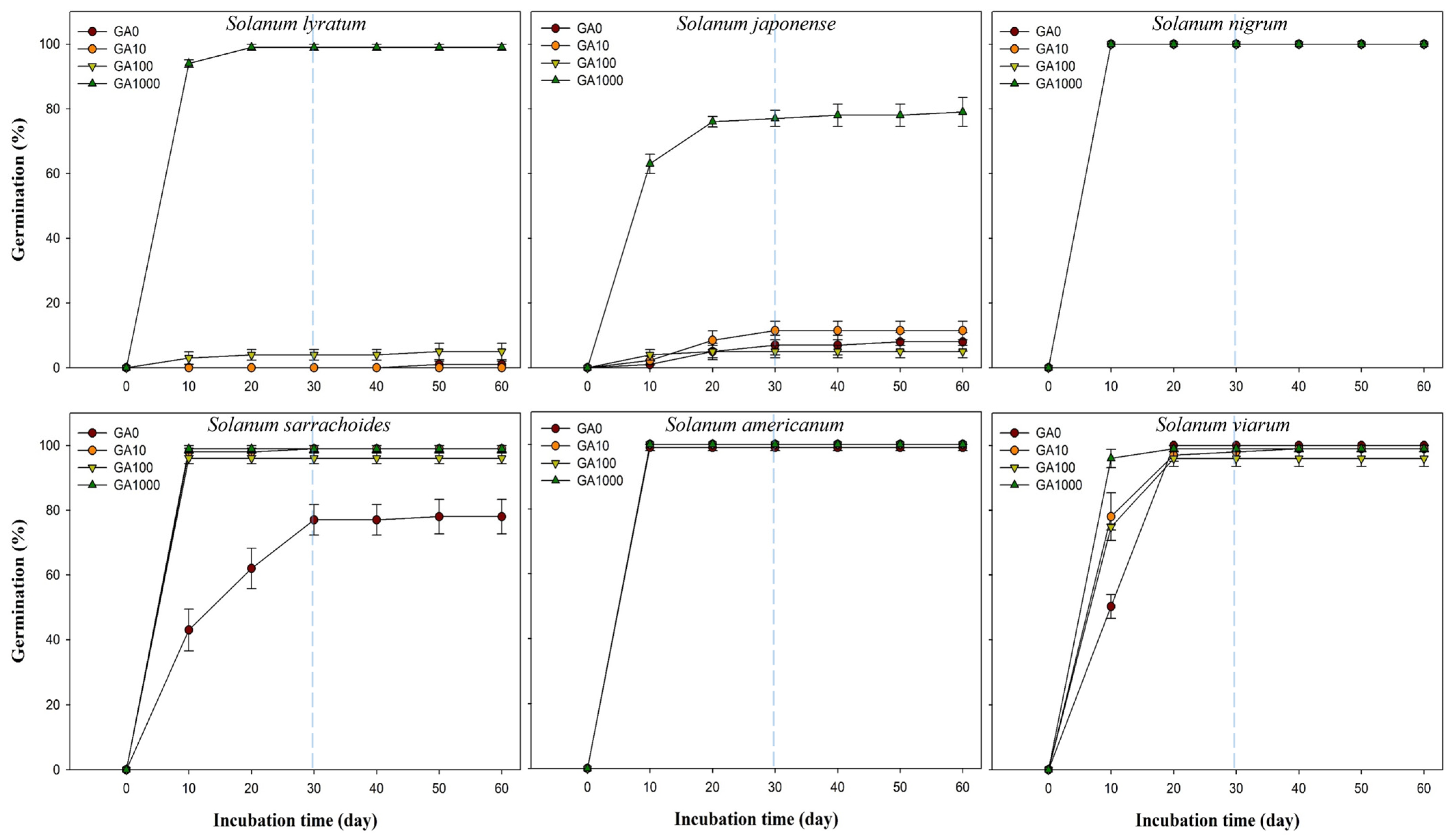
To identify the impact of GA3 on dormancy release and germination, GA3 (G4880, Sigma-Aldrich) solutions were prepared at four concentrations (0, 10, 100, or 1000 mg·L−1). The seeds were soaked in each GA3 solution for 24 h under laboratory conditions (approximately 25 ± 2 °C) and then rinsed with distilled water. Then, 4 replicates of 25 seeds were placed in plastic Petri dishes (90 × 15 mm) filled with 1% agar medium and the Petri dishes were sealed with sealing tape. The seeds were transferred to multi-room chambers set to 25/15 °C and 12 h/12 h (light/dark) and incubated for 60 days.

2.7. Data Collection and Germination Assay

The percentage of germination (radicle protrusion from seeds) was measured every 24 h for 60 days. Each seed was considered to have germinated when the protruding radicle reached a minimum size of 1 mm. To assay germination, biological parameters, such as the germination percentage (GP), mean germination time (MGT), and germination speed (GS), were calculated using the following formulas:
GP (%) = (N/S) × 100
MGT (days) = Σ (Tx·Nx)/N
GS = Σ (Nx/Tx)
where N is the total number of seeds that germinated 60 days after sowing, S is the total number of seeds, Tx is the time in days from day one to the final day of the germination test, and Nx is the total number of germinated seeds on day Tx.

2.8. Statistical Analysis

All data were analyzed using Statistical Package for the Social Sciences (SPSS) version 23 software (IBM Corporation, Armonk, NY, USA). A one-way analysis of variance (ANOVA) was used to test the effect of various factors on the GP, MGR, and GS, followed by Duncan’s multiple range tests (p ≤ 0.05) for post hoc analyses. Graphs were generated using SigmaPlot 10.0 (SPSS Inc., Chicago, IL, USA).

3. Results

3.1. Internal and External Seed Morphoanatomy

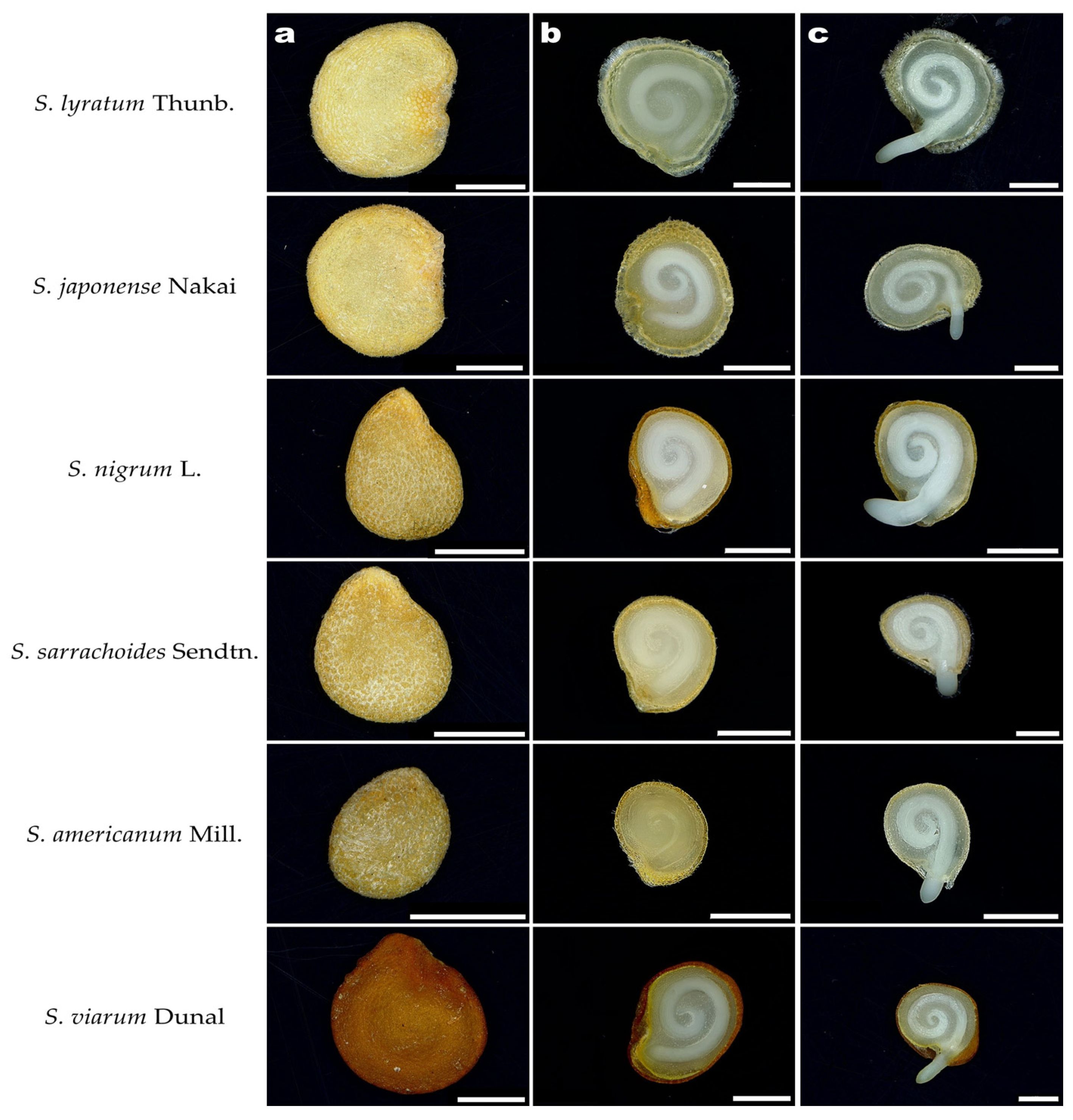
The seeds of all 6 Solanum species had a reniform shape and an axial-linear-coiled embryo, which was curved or coiled inward. The seed coat was yellow in S. lyratum, S. japonense, S. nigrum, S. sarrachoides, and S. americanum and brown in S. viarum. The morphology and elongation of the embryo remained unchanged from dispersal to the immediate post-germination stage (Figure 1). Seeds of Solanum species ranged from 1.44 to 2.48 mm in length (Table 2) and 1.12 to 2.13 mm in width, with a weight of 0.63 to 1.93 g per 1000 seeds.

3.2. Water Imbibition Test

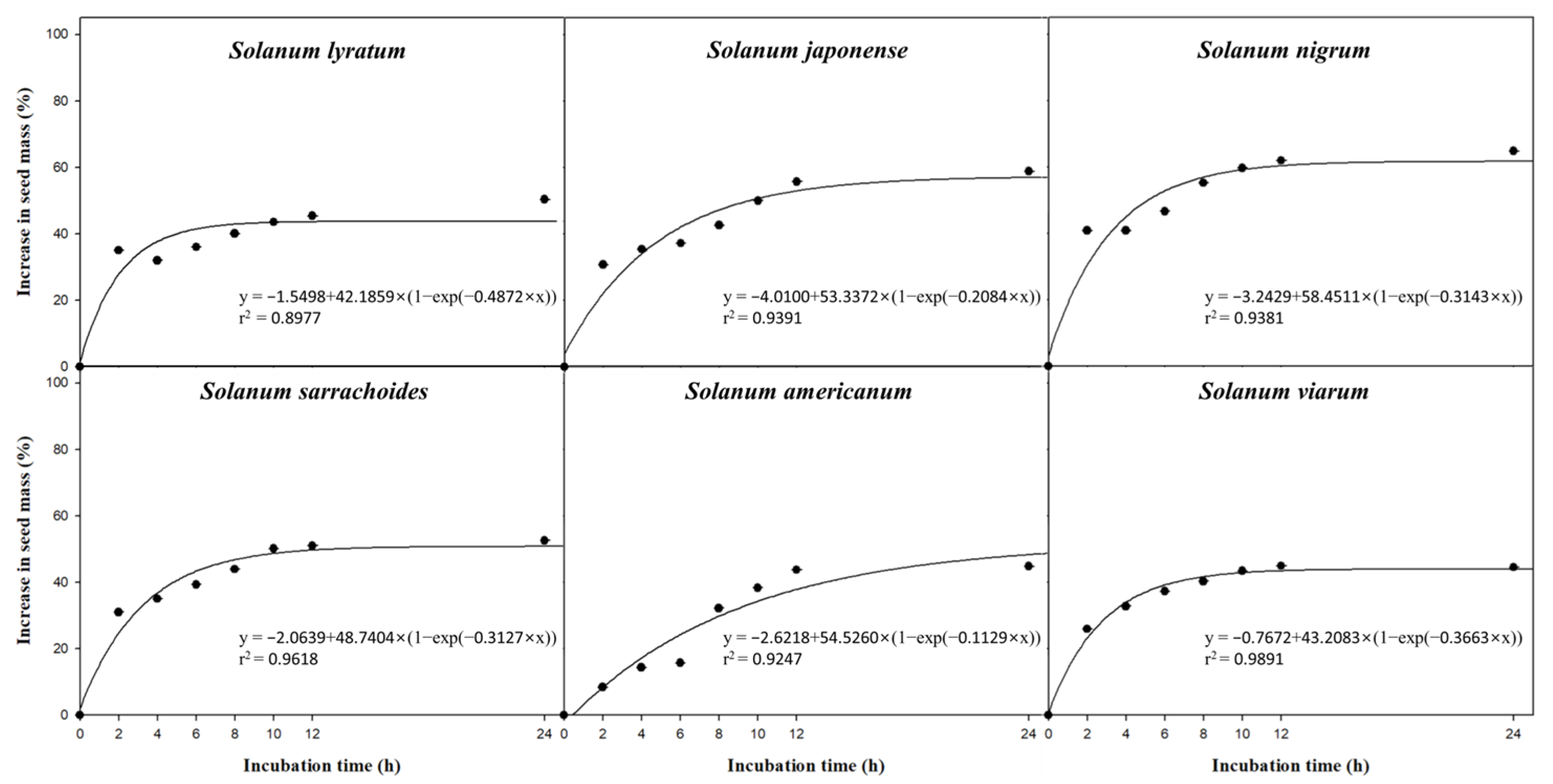
After 2 h, seeds of all Solanum species had absorbed a significant amount of water (Figure 2). The masses of S. lyratum, S. japonense, S. nigrum, S. sarrachoides, S. americanum, and S. viarum seeds increased by 35.0%, 30.7%, 40.8%, 31.0%, 8.4%, and 25.9% after 2 h and by 50.3%, 58.8%, 64.8%, 52.6%, 44.8%, and 44.5% within 24 h, respectively.

3.3. Effect of Incubation Temperature on Seed Germination

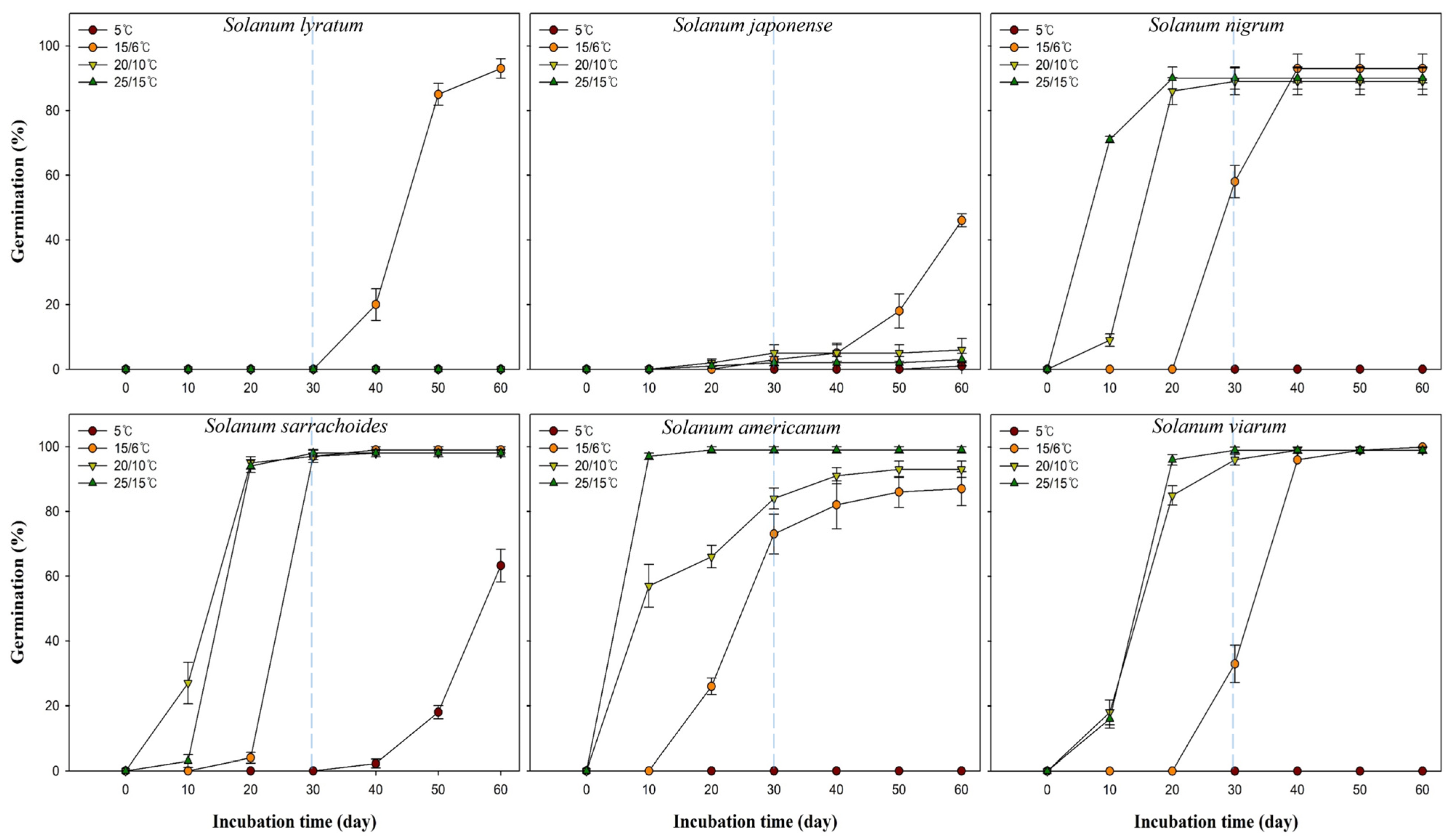
Germination characteristics under four temperatures (5 °C, 15/6 °C, 20/10 °C, or 25/15° C) differed among the 6 Solanum species (Figure 3, Table 3). Seeds did not germinate at 5 °C within 30 days and showed germination of less than 1% after 60 days in all species except for S. sarrachoides (63.3% at 5 °C after 60 days). The seeds of S. lyratum germinated only at 15/6 °C after 30 days. The final germination of S. japonense seeds was highest at 15/6 °C, reaching 46.0%. S. nigrum, S. americanum, and S. viarum seeds started to germinate within 30 days and showed a greater tendency to germinate at higher temperatures (20/10 °C and 25/15 °C) than at 15/6 °C. The final germination of S. sarrachoides seeds was over 98% at 15/6 °C, 20/10 °C, and 25/15 °C. The MGT and GS values for S. lyratum and S. japonense were calculated only at 15/6 °C, as germination at other temperatures was insufficient for analyses. Thus, germination in these species was not dependent on temperature and occurred only within a narrow optimal range. By contrast, the MGT of S. nigrum, S. sarrachoides, S. americanum, and S. viarum decreased and the GS increased with increasing incubation temperatures. In particular, S. sarrachoides showed sufficient germination even at 5 °C. The results indicate that high temperatures promoted dormancy release and increased germination efficiency.

3.4. Effect of Cold Stratification on Seed Germination

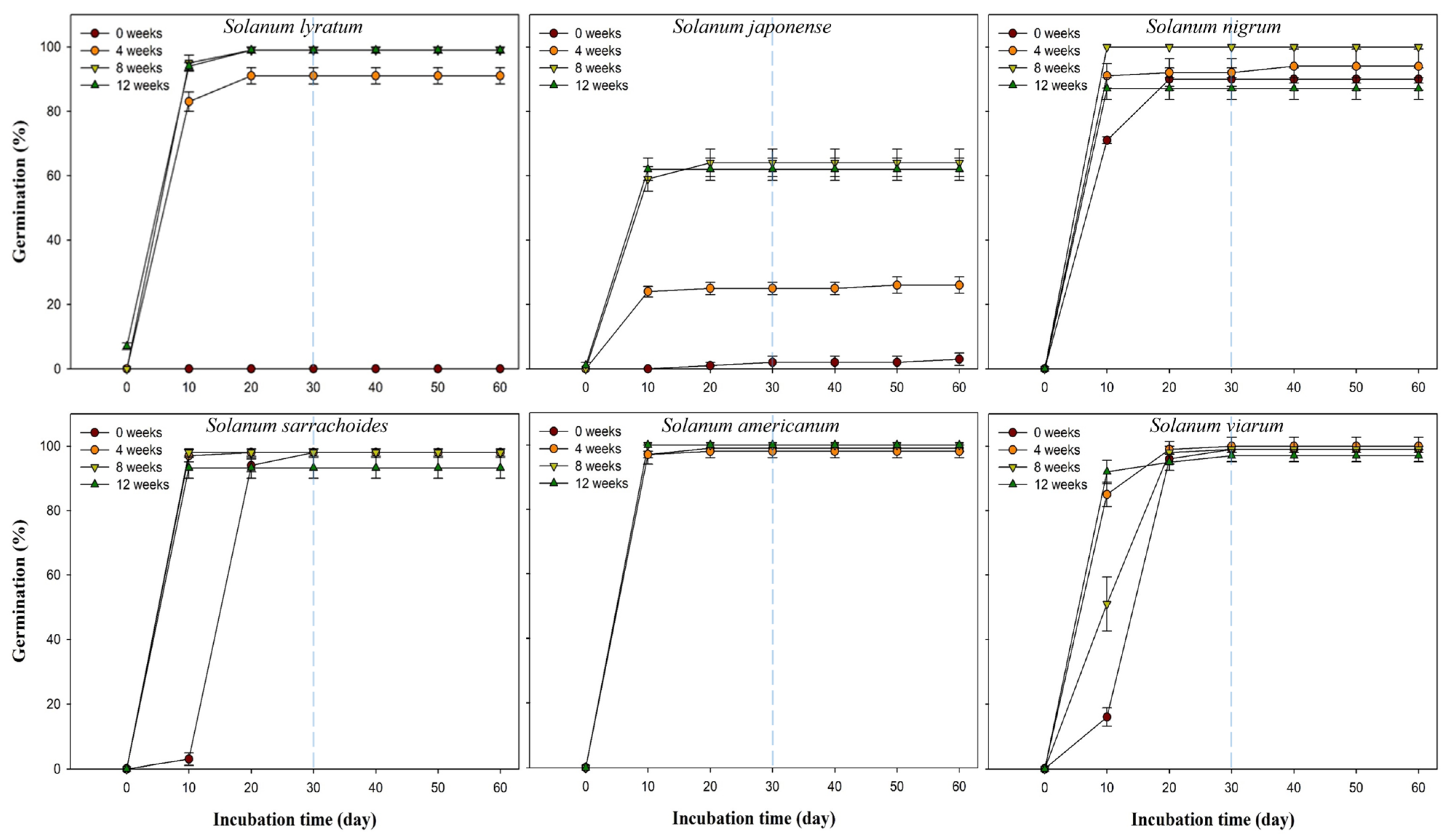
The germination characteristics under four cold stratification treatments (0, 4, 8, or 12 weeks at 5 °C) differed among the 6 Solanum species (Figure 4, Table 4). The seeds of all Solanum species germinated within 30 days after cold stratification treatments (≥4 weeks). The germination in S. lyratum and S. japonense increased significantly after at least 4 weeks of cold stratification. The final germination for S. lyratum and S. japonense without cold stratification (0 weeks) were 0% and 3%, respectively, while those for seeds incubated at 25/15 °C after cold stratification ranged from 91% to 99% for S. lyratum and 26% to 62% for S. japonense within 30 days. The final germination for S. nigrum, S. americanum, S. sarrachoides, and S. viarum seeds incubated at 25/15 °C after cold stratification ranged from 87% to 100%, regardless of the cold stratification period. Without cold stratification, the MGT and GS values for S. lyratum and S. japonense could not be calculated owing to insufficient germination. However, after cold stratification for more than 4 weeks, these values became measurable. In particular, seeds with 12 weeks of cold stratification exhibited the shortest MGT and highest GS, indicating that cold stratification promoted dormancy release and improved germination efficiency. By contrast, cold stratification did not influence germination in S. nigrum, S. sarrachoides, S. americanum, or S. viarum. However, seeds with 12 weeks of stratification exhibited the shortest MGT values, indicating that cold stratification increased germination efficiency even if it did not play a major role in dormancy release.

3.5. Effect of GA3 on Seed Germination

The germination characteristics under four GA3 concentrations (0, 10, 100, or 1000 mg∙L−1) differed among the 6 Solanum species (Figure 5, Table 5). Seeds of S. lyratum and S. japonense showed significantly higher germination than those in the control (0 mg∙L−1) only at the highest GA3 concentration (1000 mg·L−1). The final germination of S. lyratum and S. japonense seeds treated with 1000 mg·L−1 GA3 reached 99% and 79%, respectively, while that of seeds treated with lower concentrations (0, 10, and 100 mg·L−1) showed germination of less than 5% for S. lyratum and 12% for S. japonense. The final germination of S. nigrum, S. americanum, S. sarrachoides, and S. viarum seeds ranged from 77% to 100%, regardless of GA3 concentrations. The MGT and GS values for S. lyratum and S. japonense were calculated only at 1000 mg·L−1, as germination at other concentrations was insufficient for analyses. These results suggest that high concentration of GA3 not only promoted dormancy release but also improved germination efficiency. By contrast, the GA3 concentration did not affect germination in S. nigrum, S. sarrachoides, S. americanum, or S. viarum. However, seeds treated with 1000 mg·L−1 GA3 exhibited the shortest MGT values and highest GS, indicating that GA3 treatment increased germination efficiency even if it did not play a major role in dormancy release.

4. Discussion

The seed morphology of Solanum species in Korea matched that in previous reports, with a reniform or obovoid shape and yellow or brown color [10,39]. According to Martin, S. verbascifolium, S. nigrum, and S. dulcamara possess curved linear-type embryos [40]. The embryos of S. japonense and S. lyratum have been described as axial-linear-coiled [39]. The 6 Solanum species evaluated in this study exhibited axial-linear-coiled embryos, characterized by more than one full turn of coiling.
Seed dormancy refers to the inability to germinate in a specified period of time under environmental conditions (temperature, water, etc.) that otherwise are favorable for germination [23,25,41]. Baskin and Baskin classified seed dormancy into five types: MD, PY, PD, MPD, and PY + PD [26,33,42,43,44]. Since the seeds of the six species had a fully developed embryo, they do not have MD or MPD. Also, since seeds imbibed water, they do not have PY or PY + PD.
PD is reported to be caused by a physiological inhibitory mechanism in the embryo. Seeds with PD are water-permeable, have a mature embryo, and require more than 30 days for germination [33,45]. Solanum species with PD and non-deep PD have been reported [20,46,47]. In this study, the germination of S. lyratum and S. japonense seeds was delayed for more than 30 days under all temperature treatments. Relatively large portions of S. nigrum, S. americanum, and S. viarum seeds germinated within 30 days, and the germination percentage and speed increased as the temperature increased from 15/6 °C to 25/15 °C. The seeds of S. sarrachoides germinated to over 90% under all temperature conditions except 5 °C within 30 days. These results indicate that the seeds of S. sarrachoides are non-dormant, and the seeds of the other five species have PD (Table 6).
PD can be broken through cold or warm stratification, after ripening, or by phytohormone treatment, such as GA3, GA4+7, or fluridone [23,25,26,29,31,32,43,48]. Seeds dispersed in autumn can usually break dormancy through cold stratification during winter [26]. Gibberellic acids not only counteract the effect of ABA but also stimulate the synthesis of enzymes responsible for cell wall hydrolysis after seed maturation [23]. This process can break down the endosperm barriers and break seed dormancy by promoting radicle emergence. PD can be classified into three levels: deep, intermediate, and non-deep. Deep PD can be broken after a period of 12–24 weeks of cold stratification and cannot be broken by GA3 treatment. Intermediate PD can be broken after period of moist-cold stratification (12–16 weeks) and is often responsive GA3. In some species, germination of seeds with intermediate PD can be further promoted by a period of high-temperature (warm) stratification before cold stratification [33,45]. Non-deep PD can be broken by a relatively short period of warm and/or cold stratification. Depending on the species, non-deep PD can be broken by cold stratification, warm stratification and dry after ripening or GA3 treatment [26,33,45]. In this study, a cold stratification period of 8 weeks or longer was effective in breaking dormancy and promoting germination in seeds of S. lyratum and S. japonense. It remains unclear whether this approach promotes the germination of S. nigrum, S. sarrachoides, S. americanum, or S. viarum seeds at 15 °C, as the cold-stratified seeds in this study were incubated only at 25/15 °C. However, a cold stratification period of 12 weeks increased the germination efficiency of these species. In the GA3 experiment, GA3 1000 mg∙L−1 effectively broke dormancy in S. lyratum and S. japonense by promoting radicle emergence, and increased the germination efficiency in S. nigrum, S. sarrachoides, S. americanum, and S. viarum. Based on these results, the seeds of S. lyratum and S. japonense were classified as having non-deep PD, which can be broken by short periods of cold stratification and GA3 treatment. By contrast, at 15/6 °C within 30 days, a portion of the seeds of S. nigrum, S. americanum, and S. viarum germinated. The results indicate that a fraction of the seed population is nondormant, whereas the ungerminated fraction exhibits PD.
Non-deep PD can be classified into 6 types (Type 1–6) based on temperature requirements for germination during the dormancy-breaking process. Seeds of Type 1 germinate only at low temperatures initially, with the maximum germination temperature increasing as the dormancy break progresses. Seeds of Type 2 germinate only at high temperatures initially, with the minimum germination temperature decreasing as the dormancy break progresses [29,45]. In this study, seeds of S. lyratum and S. japonense germinated at relatively low temperatures (15/6 °C), and germination was delayed at higher temperatures (20/10 °C and 25/15 °C). However, after dormancy was broken by CS or GA3 treatment, germination occurred at 25/15 °C. These findings suggest that these species exhibit Type 1 non-deep PD.
Conditional dormancy (CD) is an intermediate state between dormancy and non-dormancy. Seeds with CD can germinate within a narrow range of environmental conditions. Once CD is broken, the seeds can germinate over the full range of conditions experienced by the species [29]. The base temperature for germination within 30 days for S. nigrum, S. americanum, and S. viarum is 15/6 °C, and seeds did not germinate below this temperature. Their optimum temperature was 25/15 °C, at which the maximum germination rate was observed. Our results generally matched the previously reported germination characteristics of S. nigrum and S. sarrachoides [49,50]. These results suggest that the three species have non-deep PD with CD. According to Roberts and Lockett [49] and Roberts and Boddrell [50], seeds of these species exhibit physiological dormancy cycling. However, further research is needed to clarify this topic.
Spicer and Dionne [46] reported that the seeds of Solanum species germinated more effectively after GA3 1000 mg∙L−1 treatment than after GA3 100 mg∙L−1 treatment using filter paper, not agar. Lee et al. [20] reported that seed germination in S. lyratum decreased as the GA3 treatment concentration increased when sown in soil. However, our results showed that the seed germination in S. lyratum and S. japonense is highest after GA3 1000 mg∙L−1 treatment when agar is used. These results indicate that germination parameters differ depending on the incubation method. In this study, the germination rate of Solanum seeds treated with GA3 1000 mg∙L−1 was similar to that of seeds subjected to 12 weeks of cold stratification, suggesting that GA3 treatment can be a substitute for prolonged cold stratification. These findings provide useful insights for developing efficient seed germination protocols for the conservation and propagation of Solanum species.

5. Conclusions

Overall, the seeds of S. lyratum and S. japonense exhibited non-deep PD, and their germination increased significantly under cold stratification or treatment with GA3 1000 mg·L−1. Additionally, the seeds of S. nigrum, S. americanum, and S. viarum exhibited non-deep PD with CD, and their germination efficiency was higher using cold stratification or GA3 1000 mg·L−1 than under temperature treatment alone (at 25/15 °C) in terms of MGT and GS. By contrast, the seeds of S. sarrachoides were classified as non-dormant as they germinated under a wide range of temperature conditions. These findings provide a valuable basis for overcoming seed dormancy and establishing effective propagation strategies. Moreover, the insights gained from this study could contribute to the conservation and utilization of wild Solanum genetic resources.

Author Contributions

Conceptualization, J.-Y.P., S.Y.L. and C.-S.N.; methodology, J.-Y.P., D.-H.K., H.-M.K. and G.-Y.C.; investigation, J.-Y.P. and H.-J.L.; data analysis, J.-Y.P., J.-H.K. and D.-H.K.; resources, G.-Y.C. and H.-J.L.; writing—original draft, J.-Y.P.; writing—review and editing, J.-Y.P., H.-M.K., S.Y.L. and C.-S.N.; supervision, S.Y.L. and C.-S.N. All authors have read and agreed to the published version of the manuscript.

Funding

This research was funded by the “R&D Program for Forest Science Technology (Project No. RS-2021-KF001796)” supported by the Korea Forest Service (Korea Forestry Promotion Institute).

Data Availability Statement

All data generated or analyzed during this study are included in this article.

Acknowledgments

The authors would like to thank the Wild Plant Seed Division, Baekdudaegan National Arboretum, for providing materials and technical support during this study. We also sincerely thank Seung Youn Lee for her valuable guidance throughout this study.

Conflicts of Interest

The authors declare no conflict of interest.

Abbreviations

The following abbreviations are used in this manuscript:
CDconditional dormancy
CWRcrop wild relatives
GA3gibberellic acid
GPgermination percentage
GSgermination speed
MDmorphological dormancy
MGTmean germination time
MPDmorphophysiological dormancy
PDphysiological dormancy
PYphysical dormancy

References

  1. Khoury, C.K.; Carver, D.; Greene, S.L.; Williams, K.A.; Achicanoy, H.A.; Schori, M.; León, B.; Wiersema, J.H.; Frances, A. Crop wild relatives of the United States require urgent conservation action. Proc. Natl. Acad. Sci. USA 2020, 117, 33351–33357. [Google Scholar] [CrossRef]
  2. Dempewolf, H.; Baute, G.; Anderson, J.; Kilian, B.; Smith, C.; Guarino, L. Past and future use of wild relatives in crop breeding. Crop Sci. 2017, 57, 1070–1082. [Google Scholar] [CrossRef]
  3. Na, C.S.; Kim, Y.S. Study on the physiological activities of extracts from Vitis amurensis seeds. J. Beauty Art Manag. 2024, 18, 17–29. [Google Scholar] [CrossRef]
  4. De Boef, W.S.; Kpaka, C.L.; Williams, D.E.; Guimarães, E.P. Adapting agriculture to climate change: Collecting, protecting and preparing crop wild relatives. In Consultancy Report for the Global Crop Diversity Trust; Annexes: Arnhem, The Netherlands, 2019. [Google Scholar]
  5. Kim, J.E.; Kim, K.M.; Kim, Y.S.; Chung, G.Y.; Che, S.H.; Na, C.S. Chloroplast genomes of Vitis flexuosa and Vitis amurensis: Molecular structure, phylogenetic, and comparative analyses for wild plant conservation. Genes 2024, 15, 761. [Google Scholar] [CrossRef]
  6. Heywood, V.; Casas, A.; Ford-Lloyd, B.; Kell, S.; Maxted, N. Conservation and sustainable use of crop wild relatives. Agric. Ecosyst. Environ. 2007, 121, 245–255. [Google Scholar] [CrossRef]
  7. Bohra, A.; Kilian, B.; Sivasankar, S.; Caccamo, M.; Mba, C.; McCouch, S.R.; Varshney, R.K. Reap the crop wild relatives for breeding future crops. Trends Biotechnol. 2022, 40, 412–431. [Google Scholar] [CrossRef]
  8. Kapazoglou, A.; Gerakari, M.; Lazaridi, E.; Kleftogianni, K.; Sarri, E.; Tani, E.; Bebeli, P.J. Crop wild relatives: A valuable source of tolerance to various abiotic stresses. Plants 2023, 12, 328. [Google Scholar] [CrossRef] [PubMed]
  9. Jarvis, A.; Lane, A.; Hijmans, R.J. The effect of climate change on crop wild relatives. Agric. Ecosyst. Environ. 2008, 126, 13–23. [Google Scholar] [CrossRef]
  10. Kong, M.J.; Lee, J.S.; Hong, S.P. Comparative seed morphology of Solanaceae in Korea. Korean J. Plant Taxon. 2011, 41, 35–46. [Google Scholar] [CrossRef]
  11. Chidambaram, K.; Alqahtani, T.; Alghazwani, Y.; Aldahish, A.; Annadurai, S.; Venkatesan, K.; Dhandapani, K.; Thilagam, E.; Venkatesan, K.; Paulsamy, P.; et al. Medicinal plants of Solanum species: The promising sources of phyto-insecticidal compounds. J. Trop. Med. 2022, 2022, 4952221. [Google Scholar] [CrossRef]
  12. Korea National Arboretum (KNA). Standard Checklist of Cultivated Plants in Korea; Korea National Arboretum: Pocheon, Republic of Korea, 2016; pp. 1–509. [Google Scholar]
  13. Korea National Arboretum (KNA). Checklist of Alien Plants in Korea; Korea National Arboretum: Pocheon, Republic of Korea, 2019; pp. 1–225. [Google Scholar]
  14. Korea National Arboretum (KNA). Checklist of Vascular Plants in Korea (Alien Plants); Korea National Arboretum: Pocheon, Republic of Korea, 2021; pp. 1–305. [Google Scholar]
  15. Coelho, A.R.F.; Simões, M.; Almeida, J.; Reboredo, F.H.; Cawina, J.; Lidon, F. Uptake, Translocation, and Yield Assessment of Ca, K, S, and Fe in Three Potato (Solanum tuberosum L.) Cultivars (Agria, Désirée, and Red Lady) Grown Under Varying Soil Types. Plants 2025, 14, 1351. [Google Scholar] [CrossRef] [PubMed]
  16. Filyushin, M.; Dzhos, E.; Shchennikova, A.; Kochieva, E. Metabolite concentrations and the expression profiles of the corresponding metabolic pathway genes in eggplant (Solanum melongena L.) fruits of contrasting colors. Vavilov J. Genet. Breed. 2024, 28, 619–627. [Google Scholar] [CrossRef]
  17. Shin, M.O. The effects on antimicrobial and cytotoxicity of Solanum lyratum fractions. J. Life Sci. 2005, 15, 948–954. [Google Scholar]
  18. Robin, E.; Daniel, M. Pharmacognostic and Phytochemical Studies on Various Parts of Solanum americanum Mill. Gradiva Rev. J. 2023, 7, 14–23. [Google Scholar]
  19. Shim, K.H.; Young, H.S.; Lee, T.W.; Choi, J.S. Studies on the chemical components and antioxidative effects of Solanum lyratum Thunb. Korean J. Pharmacogn. 1995, 26, 130–138. [Google Scholar]
  20. Lee, S.G.; Kim, H.Y.; Ku, J.J. Effects of seed storage methods and GA3 application on seed germination and seedling growth of Solanum lyratum Thunb. Korean J. Plant Resour. 2014, 27, 365–370. [Google Scholar] [CrossRef][Green Version]
  21. Kang, S.Y.; Sung, S.H.; Park, J.H.; Cho, J.H.; Kim, Y.C. A phenolic glucoside and steroidal sapogenins of Solanum lyratum. Yakhak Hoeji 2000, 44, 534–538. [Google Scholar]
  22. Park, J.H.; Park, S.S.; Bae, J.Y. Pharmacognostical studies on the folk medicine ‘Bae Pung Dung’. Korean J. Pharmacogn. 2009, 40, 25–31. [Google Scholar]
  23. Bewley, J.D. Seed germination and dormancy. Plant Cell 1997, 9, 1055–1066. [Google Scholar] [CrossRef]
  24. Kim, H.M.; Kim, J.H.; Lee, J.H.; Kim, G.M.; Lee, M.H.; Park, C.Y.; Kim, D.H.; Lee, D.H.; Kim, K.M.; Na, C.S. Dormancy-release and germination improvement of Korean bellflower (Campanula takesimana Nakai), a rare and endemic plant native to the Korean peninsula. PLoS ONE 2023, 18, e0292280. [Google Scholar] [CrossRef] [PubMed]
  25. Abubakar, M.S.A.; Attanda, M.L. Factors that cause seed dormancy. In Seed Biology Updates; IntechOpen: London, UK, 2022. [Google Scholar] [CrossRef]
  26. Baskin, J.M.; Baskin, C.C. A classification system for seed dormancy. Seed Sci. Res. 2003, 14, 1–16. [Google Scholar] [CrossRef]
  27. Song, S.J.; Shin, U.S.; Oh, H.J.; Kim, S.Y.; Lee, S.Y. Seed germination responses and interspecific variations to different incubation temperatures in eight Veronica species native to Korea. HortScience Technol. 2018, 37, 20–31. [Google Scholar] [CrossRef]
  28. Kim, H.M.; Kim, J.H.; Lee, M.H.; Kim, G.M.; Park, C.Y.; Lee, D.H.; Na, C.S. Methods for improving the germination of Rhodotypos scandens (Thunb.) Makino seeds through endocarp removal. Plants 2024, 13, 648. [Google Scholar] [CrossRef]
  29. Soltani, E.; Baskin, C.C.; Baskin, J.M. A graphical method for identifying the six types of non-deep physiological dormancy in seeds. Plant Biol. 2017, 19, 673–682. [Google Scholar] [CrossRef] [PubMed]
  30. Kildisheva, O.A.; Dixon, K.W.; Silveira, F.A.O.; Chapman, T.; Di Sacco, A.; Mondoni, A.; Turner, S.R.; Cross, A.T. Dormancy and germination: Making every seed count in restoration. Restor. Ecol. 2020, 28, S256–S265. [Google Scholar] [CrossRef]
  31. Koornneef, M.; Bentsink, L.; Hilhorst, H. Seed dormancy and germination. Curr. Opin. Plant Biol. 2002, 5, 33–36. [Google Scholar] [CrossRef]
  32. Finch-Savage, W.E.; Leubner-Metzger, G. Seed dormancy and the control of germination. New Phytol. 2006, 171, 501–523. [Google Scholar] [CrossRef]
  33. Baskin, C.C.; Baskin, J.M. Seeds: Ecology, Biogeography, and Evolution of Dormancy and Germination; Academic Press: San Diego, CA, USA, 1998. [Google Scholar]
  34. Perrino, E.V.; Wagensommer, R.P. Crop wild relatives (CWR) priority in Italy: Distribution, ecology, in situ and ex situ conservation and expected actions. Sustainability 2021, 13, 1682. [Google Scholar] [CrossRef]
  35. Breman, E.; Ballesteros, D.; Castillo-Lorenzo, E.; Cockel, C.; Dickie, J.; Faruk, A.; O’donnell, K.; Offord, C.A.; Pironon, S.; Sharrock, S.; et al. Plant diversity conservation challenges and prospects—The perspective of botanic gardens and the Millennium Seed Bank. Plants 2021, 10, 2371. [Google Scholar] [CrossRef]
  36. Walters, C.; Pence, V.C. The unique role of seed banking and cryobiotechnologies in plant conservation. Plants People Planet 2020, 3, 83. [Google Scholar] [CrossRef]
  37. Wambugu, P.W.; Nyamongo, D.O.; Kirwa, E.C. Role of seed banks in supporting ecosystem and biodiversity conservation and restoration. Diversity 2023, 15, 809. [Google Scholar] [CrossRef]
  38. Oladosu, Y.; Rafii, M.Y.; Arolu, F.; Chukwu, S.C.; Salisu, M.A.; Olaniyan, B.A.; Fagbohun, I.K.; Muftaudeen, T.K. Genetic diversity and utilization of cultivated eggplant germplasm in varietal improvement. Plants 2021, 10, 1714. [Google Scholar] [CrossRef]
  39. Korea National Arboretum (KNA). Seed Atlas of Korea; Korea National Arboretum: Pocheon, Republic of Korea, 2017; pp. 1–844. [Google Scholar]
  40. Martin, A.C. The comparative internal morphology of seeds. Am. Midl. Nat. 1946, 36, 513–660. [Google Scholar] [CrossRef]
  41. Nasreen, S.; Yousaf, M.; Mohmand, A.S.; Mailk, M.A. Study of seed dormancy mechanisms; causes and control. Pak. J. Seed Technol. 2002, 1, 210–212. [Google Scholar]
  42. Nikolaeva, M.G. Fiziologiya Glubokogo Pokoya Semyan (Physiology of Deep Dormancy in Seeds); Nauka: Leningrad, Russia, 1969. [Google Scholar]
  43. Baskin, C.C.; Baskin, J.M. Germinating seeds of wildflowers, an ecological perspective. HortTechnology 2004, 14, 467–473. [Google Scholar] [CrossRef]
  44. Baskin, J.M.; Baskin, C.C.; Li, X. Taxonomy, anatomy and evolution of physical dormancy in seeds. Plant Species Biol. 2000, 15, 139–152. [Google Scholar] [CrossRef]
  45. Baskin, C.C.; Baskin, J.M. Mimicking the natural thermal environments experienced by seeds to break physiological dormancy to enhance seed testing and seedling production. Seed Sci. Technol. 2022, 50, 21. [Google Scholar] [CrossRef]
  46. Spicer, P.B.; Dionne, L.A. Use of gibberellin to hasten germination of Solanum seed. Nature 1961, 189, 327–328. [Google Scholar] [CrossRef]
  47. Forte, C.T.; Nunes, U.R.; Cargnelutti Filho, A.; Galon, L.; Chechi, L.; Roso, R.; Menegat, A.D.; Rossetto, E.O.; Franceschetti, M.B. Chemical and environmental factors driving germination of Solanum americanum seeds. Weed Biol. Manag. 2019, 19, 113–120. [Google Scholar] [CrossRef]
  48. Nur, M.; Baskin, C.C.; Lu, J.J.; Tan, D.Y.; Baskin, J.M. A new type of non-deep physiological dormancy: Evidence from three annual Asteraceae species in the cold deserts of Central Asia. Seed Sci. Res. 2014, 24, 301–314. [Google Scholar] [CrossRef]
  49. Roberts, H.A.; Lockett, P.M. Seed dormancy and field emergence in Solanum nigrum. Weed Res. 1978, 18, 231–241. [Google Scholar] [CrossRef]
  50. Roberts, H.A.; Boddrell, J.E. Field emergence and temperature requirements for germination in Solanum sarrachoides Sendt. Weed Res. 1983, 23, 247–252. [Google Scholar] [CrossRef]
Figure 1. Seed morphology of 6 Solanum species. External structure of seeds at dispersal (a), internal structure of seeds at dispersal (b), internal structure after germination (c). Scale bars represent 1 mm.
Agronomy 15 02652 g001
Figure 2. Imbibition curves for seeds of 6 Solanum species. The seeds were placed at room temperature (approximately 22–25 °C) on filter paper with distilled water for 24 h. The vertical error bars represent standard errors (n = 4).
Agronomy 15 02652 g002
Figure 3. Effect of incubation at 5 °C, 15/6 °C, 20/10 °C, or 25/15 °C on seed germination in 6 Solanum species. Error bars indicate means ± S.E (n = 4). Dotted lines indicate 30 days after incubation.
Agronomy 15 02652 g003
Figure 4. Effect of cold stratification (0, 4, 8, or 12 weeks at 5 °C) on seed germination in 6 Solanum species. Seeds were incubated for 60 days at 25/15 °C (light/dark, 12 h/12 h). Error bars indicate mean ± S.E (n = 4). Dotted lines indicate 30 days after incubation.
Agronomy 15 02652 g004
Figure 5. Effect of GA3 (0, 10, 100, or 1000 mg∙L−1) on seed germination in 6 Solanum species. Seeds were soaked in a GA3 solution for 24 h and then incubated for 60 days at 25/15 °C. Error bars indicate means ± S.E (n = 4). Dotted lines indicate 30 days after incubation.
Agronomy 15 02652 g005
Table 1. Seed collection information on the 6 Solanum species.
AccessionScientific NameCommon Name
(Korean Name)
Collection DateSite of Collection
1498Solanum lyratum Thunb.Lyre-leaf nightshade
(배풍등)
28 October 2022Uijeongbu-si
1492Solanum japonense NakaiNarrow-leaf nightshade
(좁은잎배풍등)
24 November 2022Yangsan-si
1551Solanum nigrum L.Poisonberry
(까마중)
17 October 2022Gongju-si
1587Solanum sarrachoides Sendtn.Hairy nightshade
(털까마중)
14 September 2022Dongducheon-si
1440Solanum americanum Mill.American black
(미국까마중)
8 October 2022Jincheon-gun
1593Solanum viarum DunalTropical soda apple
(왕도깨비가지)
1 December 2022Jeju-do
Table 2. Seed characteristics for 6 Solanum species.
Scientific NameCommon Name
(Korean Name)
Length
(mm)
Width
(mm)
1000 Seed Weight
(g)
Solanum lyratumLyre-leaf nightshade
(배풍등)
2.46 ± 0.02 z2.13 ± 0.02 z1.68 ± 0.01 y
Solanum japonenseNarrow-leaf nightshade
(좁은잎배풍등)
2.37 ± 0.022.01 ± 0.021.39 ± 0.01
Solanum nigrumPoisonberry
(까마중)
1.83 ± 0.011.38 ± 0.010.77 ± 0.01
Solanum sarrachoidesHairy nightshade
(털까마중)
1.91 ± 0.011.49 ± 0.010.69 ± 0.00
Solanum americanumAmerican black
(미국까마중)
1.44 ± 0.011.12 ± 0.010.63 ± 0.00
Solanum viarumTropical soda apple
(왕도깨비가지)
2.48 ± 0.012.09 ± 0.011.93 ± 0.01
z Values are expressed as the mean ± standard error (n = 10). y Values are expressed as the mean ± standard error (n = 4).
Table 3. Effect of incubation temperature on seed germination parameters in Solanum species.
SpeciesTemperature
(°C)
GP z at 30 Days
(%)
GP at 60 Days
(%)
MGT y
(Days)
GS x
Solanum lyratum50.0 ± 0.000.0 ± 0.00 b--
15/60.0 ± 0.0093.0 ± 3.00 a44.0 ± 0.720.5 ± 0.02
20/100.0 ± 0.000.0 ± 0.00 b--
25/150.0 ± 0.000.0 ± 0.00 b--
Solanum japonense50.0 ± 0.00 a w1.0 ± 1.00 b--
15/63.0 ± 1.91 a46.0 ± 2.00 a50.9 ± 1.900.2 ± 0.01
20/105.0 ± 2.52 a6.0 ± 3.46 b--
25/152.0 ± 2.00 a3.0 ± 1.91 b--
Solanum nigrum50.0 ± 0.00 c0.0 ± 0.00 b--
15/658.0 ± 5.03 b93.0 ± 4.43 a30.3 ± 0.66 a0.8 ± 0.03 c
20/1089.0 ± 4.12 a89.0 ± 4.12 a13.9 ± 0.08 b1.7 ± 0.07 b
25/1590.0 ± 3.46 a90.0 ± 3.46 a9.3 ± 0.11 c2.5 ± 0.10 a
Solanum sarrachoides50.0 ± 0.00 b63.3 ± 5.02 b52.6 ± 0.37 a0.3 ± 0.02 d
15/697.0 ± 1.00 a99.0 ± 1.00 a22.3 ± 0.20 b1.1 ± 0.02 c
20/1097.0 ± 1.91 a98.0 ± 1.15 a12.9 ± 0.50 d2.0 ± 0.10 a
25/1598.0 ± 1.15 a98.0 ± 1.15 a15.7 ± 0.22 c1.6 ± 0.05 b
Solanum americanum50.0 ± 0.00 d0.0 ± 0.00 c--
15/673.0 ± 6.19 c87.0 ± 5.26 b23.7 ± 0.90 a1.0 ± 0.07 c
20/1084.0 ± 3.27 b93.0 ± 2.52 ab14.9 ± 1.23 b2.1 ± 0.11 b
25/1599.0 ± 1.00 a99.0 ± 1.00 a7.1 ± 0.10 c3.6 ± 0.06 a
Solanum viarum50.0 ± 0.00 c0.0 ± 0.00 b--
15/633.0 ± 5.74 b100.0 ± 0.00 a33.5 ± 0.37 a0.8 ± 0.01 c
20/1096.0 ± 1.63 a99.0 ± 1.00 a15.3 ± 0.58 b1.8 ± 0.05 b
25/1599.0 ± 1.00 a99.0 ± 1.00 a13.6 ± 0.11 c1.9 ± 0.04 a
z GP, Germination percentage. y MGT, Mean germination time. Values at which germination was extremely low or did not occur were not included in the calculation and are indicated by “-”. x GS, Germination speed. Values at which germination was extremely low or did not occur were not included in the calculation and are indicated by “-”. w Means within each column followed by the different letters are significantly different according to Duncan’s multiple range test at p < 0.05.
Table 4. Effect of cold stratification on seed germination parameters of Solanum species.
SpeciesDuration of Cold Stratification (Weeks) at 5 °CGP z at 30 Days (%)GP at 60 Days (%)MGT y
(Days)
GS x
Solanum lyratum00.0 ± 0.00 c0.0 ± 0.00 c--
491.0 ± 2.52 b91.0 ± 2.52 b8.1 ± 0.14 a3.0 ± 0.12 b
899.0 ± 1.00 a w99.0 ± 1.00 a7.3 ± 0.07 b3.6 ± 0.05 b
1299.0 ± 1.00 a99.0 ± 1.00 a3.4 ± 0.05 c11.7 ± 0.44 a
Solanum japonense02.0 ± 2.00 c3.0 ± 1.91 c--
425.0 ± 1.91 b26.0 ± 2.58 b8.5 ± 1.77 a0.9 ± 0.11 c
864.0 ± 4.32 a64.0 ± 4.32 a6.4 ± 0.08 a2.8 ± 0.19 b
1262.0 ± 3.46 a62.0 ± 3.46 a4.3 ± 0.18 a5.0 ± 0.51 a
Solanum nigrum090.0 ± 3.46 ab90.0 ± 3.46 ab9.3 ± 0.11 a2.5 ± 0.10 c
492.0 ± 4.32 ab94.0 ± 5.29 ab5.0 ± 0.59 b5.8 ± 0.22 b
8100.0 ± 0.00 a100.0 ± 0.00 a3.4 ± 0.07 c7.7 ± 0.18 a
1287.0 ± 3.42 b87.0 ± 3.42 b4.0 ± 0.23 c6.2 ± 0.27 b
Solanum
sarrachoides
098.0 ± 1.15 a98.0 ± 1.15 a15.7 ± 0.22 a1.6 ± 0.05 c
498.0 ± 1.15 a98.0 ± 1.15 a3.0 ± 0.07 b9.0 ± 0.17 b
898.0 ± 1.15 a98.0 ± 1.15 a2.8 ± 0.04 b9.0 ± 0.21 b
1293.3 ± 3.20 a93.3 ± 3.20 a1.1 ± 0.05 c21.1 ± 1.82 a
Solanum
americanum
099.0 ± 1.00 a99.0 ± 1.00 a7.1 ± 0.10 a3.6 ± 0.06 c
498.0 ± 2.00 a98.0 ± 2.00 a3.2 ± 0.07 c7.8 ± 0.19 b
8100.0 ± 0.00 a100.0 ± 0.00 a3.6 ± 0.04 b7.2 ± 0.03 b
12100.0 ± 0.00 a100.0 ± 0.00 a2.8 ± 0.06 d9.5 ± 0.32 a
Solanum viarum099.0 ± 1.00 a99.0 ± 1.00 a13.6 ± 0.11 a1.9 ± 0.04 d
4100.0 ± 0.00 a100.0 ± 0.00 a9.0 ± 0.22 c2.9 ± 0.06 b
899.0 ± 3.79 a99.0 ± 3.79 a11.3 ± 0.21 b2.3 ± 0.13 c
1297.0 ± 1.91 a97.0 ± 1.91 a7.2 ± 0.28 d3.7 ± 0.13 a
z GP, Germination percentage. y MGT, Mean germination time. Values at which germination was extremely low or did not occur were not included in the calculation and are indicated by “-”. x GS, Germination speed. Values at which germination was extremely low or did not occur were not included in the calculation and are indicated by “-”. w Means within each column followed by the different letters are significantly different according to Duncan’s multiple range test at p < 0.05.
Table 5. Effect of GA3 on seed germination parameters in Solanum species. Seeds were soaked in a GA3 (0, 10, 100, or 1000 mg∙L−1) solution for 24 h at room temperature and then incubated for 60 days at 25/15 °C (light/dark, 12 h/12 h).
SpeciesGA3 Concentration
(mg∙L−1)
GP z at 30 Days (%)GP at 60 Days (%)MGT y
(Days)
GS x
Solanum lyratum00.0 ± 0.00 c1.0 ± 1.00 bc--
100.0 ± 0.00 c0.0 ± 0.00 c--
1004.0 ± 1.63 b5.0 ± 2.52 b--
100099.0 ± 1.00 a w99.0 ± 1.00 a7.3 ± 0.233.5 ± 0.09
Solanum japonense07.0 ± 3.00 b8.0 ± 2.83 b--
1011.5 ± 2.87 b11.5 ± 2.87 b--
1005.0 ± 1.91 b5.0 ± 1.91 b--
100077.0 ± 2.52 a79.0 ± 4.43 a8.7 ± 0.942.7 ± 0.09
Solanum nigrum0100.0 ± 0.00100.0 ± 0.006.9 ± 0.16 b3.7 ± 0.09 b
10100.0 ± 0.00100.0 ± 0.007.5 ± 0.10 a3.4 ± 0.03 b
100100.0 ± 0.00100.0 ± 0.007.0 ± 0.07 b3.5 ± 0.22 b
1000100.0 ± 0.00100.0 ± 0.005.3 ± 0.06 c4.9 ± 0.09 a
Solanum
sarrachoides
077.0 ± 4.73 b78.0 ± 5.29 b14.9 ± 0.74 a1.7 ± 0.15 c
1099.0 ± 1.00 a99.0 ± 1.00 a7.4 ± 0.07 b3.5 ± 0.10 b
10096.0 ± 1.63 a96.0 ± 1.63 a7.0 ± 0.08 b3.7 ± 0.10 b
100099.0 ± 1.04 a99.0 ± 1.04 a3.9 ± 0.03 c6.3 ± 0.12 a
Solanum
americanum
099.0 ± 1.00 a99.0 ± 1.00 a5.2 ± 0.07 b4.8 ± 0.05 b
10100.0 ± 0.00 a100.0 ± 0.00 a5.6 ± 0.09 a4.6 ± 0.06 c
100100.0 ± 0.00 a100.0 ± 0.00 a5.1 ± 0.07 b5.0 ± 0.07 b
1000100.0 ± 0.00 a100.0 ± 0.00 a3.9 ± 0.02 c6.5 ± 0.04 a
Solanum viarum0100.0 ± 0.00 a100.0 ± 0.00 a10.7 ± 0.38 a2.4 ± 0.20 c
1098.0 ± 2.00 a99.0 ± 1.00 a9.8 ± 0.59 ab2.7 ± 0.13 bc
10095.9 ± 2.36 a95.9 ± 2.36 a8.8 ± 0.21 b2.9 ± 0.09 b
100099.0 ± 1.00 a99.0 ± 1.00 a6.1 ± 0.21 c4.5 ± 0.15 a
z GP, Germination percentage. y MGT, Mean germination time. Values at which germination was extremely low or did not occur were not included in the calculation and are indicated by “-”. x GS, Germination speed. Values at which germination was extremely low or did not occur were not included in the calculation and are indicated by “-”. w Means within each column followed by the different letters are significantly different according to Duncan’s multiple range test at p < 0.05.
Table 6. Summary of seed dormancy and germination traits in 6 Solanum taxa based on Baskin & Baskin’s criteria [33] for non-deep PD.
Seed TraitsS. lyratumS. japonenseS. nigrumS. sarrachoidesS. americanumS. viarum
Embryo
development
Embryos were axial-linear-coiled and fully developed
Water absorption≥30% absorbed water within 24 h
Germination in 30 days
(15/6 °C to 25/15 °C)
0%2–5%58–90%97–98%73–99%30–99%
Effect of cold stratification on germination
at 25/15 °C
4 °C, ≥4 weeks →
≥90% germination
4 °C, ≥8 weeks →
≥60% germination
≥80% germination
(negatively correlated with MGT, positively correlated with GS)
Effect of GA3 treatment
on germination
at 25/15 °C
GA3 1000 mg∙L−1 → ≥90% germinationGA3 1000 mg∙L−1 → ≥70% germination≥70% germination
(negatively correlated with MGT, positively correlated with GS)
Dormancy typeType 1 non-deep PDNon-deep
PD with CD
Non-dormantNon-deep
PD with CD
Disclaimer/Publisher’s Note: The statements, opinions and data contained in all publications are solely those of the individual author(s) and contributor(s) and not of MDPI and/or the editor(s). MDPI and/or the editor(s) disclaim responsibility for any injury to people or property resulting from any ideas, methods, instructions or products referred to in the content.