


Abstract
Litchi chinensis is the “queen of fruits”, and pollination is an essential requirement for fruit set and production. The present study was conducted in litchi orchards to study the diversity/abundance of insect visitors, the impact of pollination on quantitative parameters, and different modes of pollination. The results showed that 75 insect species during flowering were reported including Hymenoptera, Lepidoptera, Diptera, and Coleoptera. In natural pollination, the abundance of insect visitors of Hymenoptera was more during morning and evening (50.25% and 44.89%, respectively) compared to Lepidoptera (21.83 and 26.67%) and Diptera (24.37 and 23.33%). Similarly, natural pollination with one Apis mellifera colony also showed higher abundance of insect visitors of Hymenoptera during morning and evening (50.15 and 57.31%, respectively) as compared to Lepidoptera and Diptera. The Dipteran insect visitors under natural pollination showed significant positive correlation with temperature, wind speed and UV. The fruit/seed size, peel weight, juice pH, pulp weight, moisture, and total soluble solids were higher in natural pollination with A. mellifera. The percentage of fruit set and fruit weight (g) was significantly higher in natural pollination with A. mellifera (23.24 ± 1.40% and 1.60 ± 0.11 g, respectively). There was no fruit set observed in bagged panicles with nylon mesh.
1. Introduction
Litchi, Litchi chinensis Sonn., (Sapindaceae) is known as the “queen of fruits”. It is a tropical fruit native to Southeast Asia [1,2]. It has a sweet flavour and a white translucent aril, eaten in raw/processed form and added to ice-cream [3,4]. China is the biggest producer of litchi in the world followed by India, Vietnam, and Thailand [5]. In India, litchi is cultivated in Bihar, West Bengal, Assam, Jharkhand, Uttrakhand, and Odisha in an area of 92,100 hectares with an output of 583,400 t annually. In Himachal Pradesh, litchi is grown over an area of 5673 hectares with an annual production of 5469 t covering Kangra, Sirmour, Bilaspur, and Una [2,6]. The litchi is highly self-sterile and cross-pollinated, so its flowers require sufficient pollinators for pollination and fruit set.
Litchi panicles are rich in nectar that attracts insects. Various insect orders, such as Hymenoptera, Diptera, Lepidoptera, and Coleoptera, visit litchi flowers, but honey bees, flies, and wasps play a significant role in pollination [7]. The low fruit set observed in self-sterile cultivars is due to the litchi’s lack of sufficient pollinators leading to low production [8] and failure to bear fruits [9]. Apis and Melipona species are prominent visitors (98–99%) of litchi flowers. However, A. mellifera is the primary pollinator. The productivity of fruits was significantly increased by pollinators [10,11,12]. Cross-pollination enhances fruit set, yield, and quality in litchi compared to no pollination [13,14,15,16,17]. Most bee keepers move honey bee colonies to litchi plantations for nectar for honey bees from March to April and harvest mono floral honey with good color and flavour. The pollination research is more important to validate the effect of pollinators on percentage pollination, fruit set, productivity, and yield of litchi. In India, Apis mellifera and Apis cerana are predominant pollinators, but A. cerana dominates in South India, whereas A. mellifera in Northern India contributes more than 80% of pollination in litchi and other fruit crops. As per the literature, few scientific reports are available in India for pollination studies on litchi and their impact on yield. Therefore, the current investigation planned (a) to study diversity, abundance and impact of insect visitors in litchi; (b) to study the comparison of natural pollination, fruit set, and yield of litchi with that of A. mellifera under caged trees and excluding insect pollinators; and (c) to study the effect of weather parameters on the abundance of insect visitors in litchi.
2. Materials and Methods
2.1. Study Area
The studies on the diversity and abundance of insect visitors and their impact on pollination, fruit set, yield, and quality characters of L. chinensis cv Shahi were carried out in litchi fields (0.5 ha) from April–May 2022 in three different locations. The GPS coordinates are: experimental field 1 (Bhadwar) is latitude 32°17′25.52784″ N and longitude 75°57′43.6806″ E (altitude 2054 ft.), field 2 (Kalara) is latitude 32°17′27.81924″ N and longitude 75°58′1.93908″ E (altitude 1991 ft.), and field 3 (Samma) is latitude 32°17′19.7808″ N, and longitude 75°58′52.27212″ E (altitude 2077 ft.), respectively, of Kangra district, Himachal Pradesh. The selected litchi trees/fields are similar in age (8–10 years), flowering without any other inter/mixed crops. The farmers have not used pesticides to control pests and diseases during the initiation of flowering and until the completion of the fruit set. The apiary (one bee colony with eight frames) was kept in the litchi field (natural pollination with A. mellifera). However, the treatment (T3) natural pollination alone was three kilometers away from the natural pollination with A. mellifera (T4) to avoid the visiting of A. mellifera in the natural pollination (T3) without influencing the data on quantitative parameters.
2.1.1. Diversity of Insect Visitors in L. chinensis Ecosystem
The present study was carried out as per the previous reports [18]. The experiment was carried out in a randomized block design (RBD) with four treatments and five replications. The treatments included: (T1) Caged tree with nylon mesh; (T2) Excluding insect pollination (bagging with nylon mesh); (T3) Natural pollination alone; (T4) Natural pollination with one A. mellifera colony. There were five trees/replications. The 20 trees were randomly assigned in different treatments. Five panicles of uniform size (15 cm)/tree/direction were tagged with ribbon in four directions (North, South, East, and West). Observations on insect visitors in litchi flowers were recorded by visual counting for 5–10 min/direction/tree during the morning (9–11 a.m.) and evening (3 to 6 p.m.) continuously for 10 days. Sampling of the visiting insects was done with two trapping methods, viz., sweeping net and yellow pane traps (traps with salt and detergent powder dissolved in water). Sweeping was done manually during morning and evening time, whereas pane traps were installed near the trees for collection. Collected specimens were shade dried, pinned, and sorted based on the order. Furthermore, the specimens were identified based on general characters and images available in the databases of ICAR-NBAIR [19]. Some of the species belonging to family Coccinellidae were identified from the database of ‘Biosystematics of the Coccinellidae of India and neighboring countries’ [20].
The diversity of different orders was measured by using Shannon-Wiener Diversity Index:
where H represents the genus/species diversity index in a given locality, and Pi is the proportion of the total sample belonging to the ith species [21].
H = −Σ Pi (lnPi),
2.1.2. Abundance of Insect Visitors in Natural Pollination (Field 1) and Natural Pollination with one Apis mellifera Colony (Field 2)
The abundance of insect visitors in L. chinensis was recorded in two treatments, i.e., natural pollination (under open field conditions without using a bee colony) and natural pollination with one A. mellifera colony. There were five trees or replicates in each treatment as mentioned in Section 2.1.1 [18]. The treatment with natural pollination was three kilometres away from the natural pollination with one A. mellifera colony. The observed insect visitors on flowers were sampled, identified and grouped into different orders, viz., Hymenoptera, Diptera, Lepidoptera, and Coleoptera. The percentage abundance was calculated by using the following formula:
Abundance (%) = [Number of insect visitors/Total number of all insect visitors] × 100
The weather data were recorded with an environment meter at different intervals during the morning/evening. The correlation analysis was performed between insect abundance and various weather parameters. The data on insect visitors were analyzed by using SPSS software version 26. The data on percentage abundance of insect visitors in field 1 (natural pollination) and field 2 (natural pollination with A. mellifera colony) were compared by t-test.
2.2. Effect of Insect Visitors on the Quantitative Parameters of L. chinensis
The effect of insect visitors on the quantitative parameters of L. chinensis fruit production was studied as per earlier reports [18]. The experiment was carried out in a randomized block design (RBD) with four treatments and five replications. The treatments include caged tree with nylon mesh (10 feet height) with one A. mellifera colony (T1), excluding insect pollination (bagging with the nylon mesh size of 40 cm × 40 cm) (T2); natural pollination alone (under open field conditions without using bee colony (T3); and natural pollination with one A. mellifera colony (T4). The 20 trees were randomly assigned in different treatments. Five panicles of uniform size (15 cm)/tree/direction were tagged with ribbon in four directions (North, South, East, and West). The quantitative parameters, namely, the size of the fruit (length, breadth, and weight) and size of the seed (length, breadth, and weight) were recorded on 200 randomly selected fruits/tree/treatment. The size of the fruit/seed was measured using a Vernier caliper, and weight was taken using a digital weighing balance. The parameters, namely, total soluble sugars (TSS), pH, dry weight, and moisture were calculated by using the formula [22]:
Moisture content (% wet basis) = Quantity of initial weight − dry weight over initial weight
TSS was measured with a digital refractometer, a pH using a pH meter, dry weight of fresh pulp with weighing balance, and moisture content by hot air oven method at 50-degree temperature for 24 h.
The data on different quantitative parameters were analyzed using OPSTAT software, version 26 and means were compared for interpretation.
3. Results
3.1. Diversity of Insect Visitors in L. chinensis
Many insects visited the litchi inflorescence during the flowering stage in natural pollination and natural pollination with one A. mellifera colony. A total of 75 insect species visited the litchi flowers. Of these, 14 insect species belong to Hymenoptera, 33 to Lepidoptera, 19 to Diptera and 9 to Coleoptera (Table 1). Based on the Shannon-Wiener diversity index (scale-low diversity (<1.5), medium diversity (>1.5) and high diversity (>2.5)). The results showed that the total diversity index value of insect pollinators is 1.15, which indicates low diversity in the present study (Table S1).

Table 1.
List of insect pollinators/visitors in L. chinenesis.
3.2. Relative Abundance of Insect Visitors in L. chinensis
In natural pollination (Field 1), the percentage abundance of insect visitors of Hymenoptera was more during the morning and evening (50.25 and 44.89%, respectively) as compared to Lepidoptera, Diptera, and Coleoptera (Figure 1a). Similarly, natural pollination with one A. mellifera colony (Field 2), the percentage abundance of insect visitors of Hymenoptera was more during the morning and evening (50.15 and 57.31%, respectively) as compared to Lepidoptera, Diptera, and Coleoptera (Figure 1b). The means of two samples with equal variances from field 1 and field 2 were analyzed by t-test, which showed that there was no significant difference in the relative abundances between the fields (Table S2).
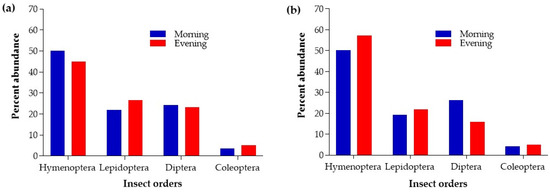
Figure 1.
Relative abundance of insect pollinators: (a) Field 1 (Natural pollination); (b) Field 2 (Natural pollination with one A. mellifera colony).
3.3. Correlation between the Abundance of Insect Pollinators with Weather Parameters
An attempt was made to establish the relationship between the mean abundance of insect visitors with weather parameters of three and seven days before observations in field 1 (Natural pollination) and field 2 (Natural pollination with one A. mellifera colony). In field 1, among the weekly weather variables, Diptera showed a significant positive correlation with temperature, wind speed and UV in morning. The Dipteran population showed a significantly negative correlation with humidity in the morning, whereas the population of Coleoptera also showed a significantly negative correlation with U.V radiation in the evening (Table 2). Alternatively, in field 2, all the weather parameters showed a non-significant correlation with insect orders (Table 2). Similarly, the pollinator abundance recorded at three-day intervals was correlated with the previous three-day weather variables. Results showed that the Diptera population showed a significant positive correlation with wind speed and U.V during the morning in field 1. On the other hand, in field 2, Diptera showed a significant negative correlation with humidity in the evening, and Coleoptera showed a significant negative correlation with temperature and wind speed during evening (Table 3 and Table 4).
Table 2.
Correlation coefficient (r) between insect pollinators/visitors and weekly weather parameters in Field 1 (Natural pollination) and Field 2 (Natural pollination with A. mellifera colony).
Table 3.
Correlation coefficient (r) between insect pollinators/visitors and three-day weather parameters in Field 1 (Natural pollination) Field 2 (Natural pollination with A. mellifera colony).
Table 4.
Impact of insect-pollination on the quantitative parameters (Mean ± SE) of L. chinensis.
3.3.1. Impact of Pollination Treatments on Quantitative Parameters of L. chinenesis
Among treatments, the size of the fruit (length, breadth, and weight) was significantly larger in natural pollination with A. mellifera colony (3.50 cm, 3.16 cm, and 19.49 g, respectively) and was followed by a caged tree with A. mellifera as compared to natural pollination. The length of the fruit in natural pollination with A. mellifera is at par with a caged tree with A. mellifera. Similarly, the weight of the fruit in natural pollination with A. mellifera was also at par with natural pollination alone. Among treatments, the seed size (length and breadth) was significantly greater in a caged tree with A. mellifera colony (2.67 and 1.54 cm, respectively) and followed by natural pollination with A. mellifera colony as compared to natural pollination alone. However, the weight of the fruit was significantly more in natural pollination with A. mellifera and was at par with natural pollination alone as compared to caged tree with A. mellifera. The length of the seed in natural pollination with A. mellifera colony is at par with natural pollination alone. The breadth of the seed in natural pollination with A. mellifera colony is at par with a caged tree with A. mellifera colony. The peel weight and TSS (2.82 g and 22.23 °Bx, respectively) were significantly higher in natural pollination with A. mellifera and were at par with a caged tree with one A. mellifera colony as compared to natural pollination alone. The pH of the juice and moisture content of pulp (5.06 and 92.32%, respectively) was significantly higher in natural pollination with A. mellifera colony followed by natural pollination as compared to a caged tree with one A. mellifera colony. The fresh pulp weight was significantly higher in natural pollination with A. mellifera colony (13.64 g) and was at par with natural pollination as compared to a caged tree with A. mellifera colony. Similarly, the dry weight of pulp was significantly higher in natural pollination (1.40 g) and was followed by natural pollination with A. mellifera colony as compared to a caged tree with one A. mellifera colony. The treatment excluding insect pollinators (panicles covered with nylon mesh bags) reported no fruit set compared to other treatments.
3.3.2. Effect of Different Mode of Pollination on Yield of L. chinensis
Among different treatments evaluated in the field, the percentage fruit set and fruit weights (g) were significantly higher in natural pollination with A. mellifera (23.24 ± 1.40% and 1.60 ± 0.11 g, respectively). They were at par with natural pollination (22.01 ± 2.27% and 1.34 ± 0.31 g, respectively), and caged tree with one A. mellifera colony (21.01 ± 1.24% and 1.42 ± 0.13 g, respectively). The fruit set and no fruits were seen in the treatment, excluding insect pollinators, where the panicles were covered with nylon mesh bags (Table S3).
4. Discussion
The present study revealed that honeybees are the most predominant visitors of litchi flowers. Among them, Apis spp., have previously been documented as efficient pollinators of litchi [23,24]. In this study, hymenopterans insects are dominant visitors of litchi flowers, including A. mellifera, A. cerana, A. florea, A. dorsata, Mellipona sp., as compared to Lepidoptera and Diptera.
In the current studies, the abundance of insect visitors (Hymenoptera) are the same in natural pollination and natural pollination with the release of the A. mellifera colony (with 10 frames of bees) as compared to Lepidoptera and Diptera. The predominant pollinator species observed in the present study were A. mellifera, A. cerana and Mellipona sp. Current results agree with previous studies in which Hymenoptera reported higher abundance and foraging activity [25,26]. In the present study, the foraging activity of Hymenopterans was higher during the morning in natural pollination and natural pollination with A. mellifera colony, and these results conformed with previous studies [25,26,27]. In the present study, the A. mellifera colony was released under the caged tree to compare its impact/efficiency on pollination and fruit set/yield with that of natural pollination. No significant differences were observed in the yield and quantitative parameters.
Climatic factors during flowering and fruit development may play an important role in the pollination and yield of litchi. The current results show no variation in the abundance of insect visitors (Hymenoptera, Lepidoptera and Diptera) in litchi flowers during morning and evening. However, the abundance of Hymenoptera flower visitors was greater than Lepidoptera or Diptera to litchi flowers. Studies clearly showed that proper management of A. mellifera and insect pollinators increased the fruit set and encouraged fruit quality. In the present study, the size of the fruit (length, breadth, and weight) was significantly greater from natural pollination with the A. mellifera colony than in a caged tree with A. mellifera and natural pollination. The length and weight of the fruit in natural pollination with one A. mellifera colony and a caged tree with one A. mellifera colony were almost the same. The current results also conform with the findings of previous reports, where maximum fruit length, breadth, and weight were observed in open pollination and caged with A. mellifera [17,18]. TSS in this study was higher in natural pollination with A. mellifera and caged trees with A. mellifera. These results are superior to previous studies, had comparatively fewer soluble sugars in total (of 20.1 to 20.8 °Bx) in the insect-proof nylon net cage, having only one colony of A. mellifera [28] and 18.32 to 19.33 °Bx in completely open pollination and caged tree with one colony of A. mellifera [18]. As per reports, TSS in litchi fruits increases as the storage period increases [29].
The honey bee species plays a significant role in the pollination of litchi flowers. In the absence of pollinators, there was no fruit set as evidenced by the present study in which the panicles were bagged with nylon mesh. In the current study, the percentage fruit set/fruit weight was higher in natural pollination with A. mellifera and other pollination modes than without pollination by insect pollinators (bagged panicles). The present results confirm the earlier findings that no fruit set was observed when the panicles were bagged with nylon mesh [7,30,31]. Based on the current results in the absence of A. mellifera in the litchi field, the other pollinators (A. cerana, A. dorsata, Mellipona sp., and others) play a significant role in the pollination of litchi flowers, fruit set, and yield.
5. Conclusions
Based on present findings, 75 insect visitors, including Hymenoptera, Lepidoptera, Diptera and Coleopteran, were reported in the litchi ecosystem during the study. In natural pollination, the abundance of potential insect visitors of Hymenoptera was more during the morning and evening (50.25 and 44.89%, respectively) as compared to Lepidoptera (21.83 and 26.67%) and Diptera (24.37 and 23.33%). The percentage fruit set and fruit weights (g) were significantly higher in natural pollination with A. mellifera (23.24 and 1.60 g, respectively), but no fruit set was observed in bagged panicles with nylon mesh.
Supplementary Materials
The following supporting information can be downloaded at: https://www.mdpi.com/article/10.3390/agronomy13020298/s1. Table S1: Shannon-Wiener diversity index of insect visitors of litchi flowers; Table S2: t-test: Two-Sample Assuming Equal Variances; Table S3: Effect of varied mode of pollination on litchi yield.
Author Contributions
Methodology, validation, investigation, data curation, and writing original draft preparation P.K.; investigation and data curation, S.R.; Conceptualization and writing original draft preparation, B.B.; Conceptualization, methodology, validation, writing review and editing, S.G.E.R. All authors have read and agreed to the published version of the manuscript.
Funding
This work was supported by the Council of Scientific and Industrial Research (CSIR), New Delhi, India for funding the project entitled “CSIR Floriculture Mission” [HCP-0037].
Institutional Review Board Statement
Not applicable.
Informed Consent Statement
Not applicable.
Data Availability Statement
Not applicable.
Acknowledgments
The authors are grateful to the Council of Scientific and Industrial Research, New Delhi (India) for the grant of the CSIR Floriculture Mission (HCP-0037). The authors also acknowledge the Director, CSIR-IHBT, Palampur for infrastructure and encouragement. The IHBT communication number for this article is 5156. Authors thankful to C. S. Jayaram, Entomologist, Gaigen Technologies Pvt. Limited, Bengaluru, Karnataka, India, for the identification of insects collected in litchi during the study.
Conflicts of Interest
All the authors of this manuscript declare no conflict of interest. The funders had no role in the design of the study, in the collection, analysis, or interpretation of data, or the writing of the manuscript.
References
- Nakasone, H.Y.; Paull, R.E. Tropical fruits. CAB Int. 1998, 16, 445. [Google Scholar]
- Priyadarshi, V.; Hota, D.; Karna, A.K. Effect of growth regulators and micronutrients spray on chemical parameter of litchi (Litchi chinensis Sonn.) cv. Calcuttia. Int. J. Econ. Plants 2018, 5, 99–103. [Google Scholar] [CrossRef]
- Hui, Y.H. Handbook of Fruits and Fruit Processing, Wiley-India ed.; John Wiley & Sons: Hoboken, NJ, USA, 2006. [Google Scholar]
- Salunkhe, D.K.; Desai, B.B. Postharvest Biotechnology of Fruits; CRC Press: Boca Raton, FL, USA, 1984; pp. 1–2. [Google Scholar]
- Kumari, S.; Rani, R.; Chandola, J.C.; Mir, H.; Ahmad, M.F.; Bharti, A. Effect of pollination method on fruit set in commercial cultivars of Litchi. Int. J. Curr. Microbiol. 2018, 7, 603–606. [Google Scholar] [CrossRef]
- Lal, N.; Gupta, A.K.; Marboh, E.S.; Kumar, A.; Nath, V. Effect of mode of pollination on fruit set and fruit characteristics in litchi. Erwerbs-Obstbau 2021, 63, 227–232. [Google Scholar] [CrossRef]
- Chaturvedi, R.B. Preliminary studies in the sex distribution, pollination and fruit development in litchi (Litchi chinensis Sonn.). Allahabad Farmer 1965, 39, 49–51. [Google Scholar]
- Free, J.B. Insect Pollination of Crops; Academic Press: Cambridge, MA, USA, 1993; Volume 2, p. 684. [Google Scholar]
- UJI, T. Pollination in Nephelium lappaceium var lappaceum. Ber. Biol. 1989, 3, 31–34. [Google Scholar]
- Pandey, R.S.; Yadava, R.P.S. Pollination of litchi (Litchi chinensis) by insects with special reference to honeybees. J. Apic. Res. 1970, 9, 103–105. [Google Scholar] [CrossRef]
- McGregor, S.E. Insect Pollination of Cultivated Crop Plants; The Carl Hayden Bee Research Centre, USDA, ARS: Tucson, AZ, USA, 1976; Volume 23, p. 104. [Google Scholar]
- Vithanage, V.; Ironside, D.A. The insect pollinators of macadamia and their relative importance. Aust. J. Agric. Res. 1986, 52, 155–160. [Google Scholar]
- Butcher, F.G. Bees pollinate litchi blooms. Proc. Fla Lychee Growers Assoc. 1956, 3, 59–60. [Google Scholar]
- King, J.; Exley, E.M.; Vithanage, V. Insect Pollination for Yield Increases in Lychee. In Proceedings of the Fourth Australian Conference on Tree and Nut Crops, Lismore, Australia, 14–20 August 1988; Batten, D.J., Ed.; Exotic Fruit Growers’ Association: Lismore, Australia, 1989; pp. 142–145. [Google Scholar]
- Badiyala, S.D.; Awasthi, R.P. Physico-chemical characteristics of some litchi (Litchi chinensis Sonn.) cultivars grown in Kangra valley. Indian Food Pack. 1991, 45, 42–45. [Google Scholar]
- Mahanta, M.; Rahman, A. Studies on pollination of litchi (Litchi chinensis Sonn.) by honeybees (Apis cerana F.). Indian Bee J. 1997, 59, 74–75. [Google Scholar]
- Rai, V.L.; Srivastav, P. Studies on the impact of bee pollination on yield and quality of litchi (Litchi chinensis Sonn.). Progress. Hortic. 2012, 44, 262–264. [Google Scholar]
- Srivastava, K.; Sharma, D.; Pandey, S.D.; Anal, A.K.D.; Nath, V. Dynamics of climate and pollinator species influencing litchi (Litchi chinensis) in India. Indian J. Agric. Sci. 2017, 87, 266–269. [Google Scholar]
- Anonymous. Agriculturally Important Insects ICAR-NBAIR. 2022. Available online: https://databases.nbair.res.in/insectpests/index.php (accessed on 9 September 2022).
- Anonymous. Biosystematics of the Coccinellidae of India and Neighboring Countries. 2022. Available online: https://www.angelfire.com/bug2/j_poorani/ladybirds.htm (accessed on 9 September 2022).
- Shannon, C.E. A mathematical theory of communication. Bell Syst. Tech. J. 1948, 27, 379–423. [Google Scholar] [CrossRef]
- Jalgaonkar, K.; Mahawar, M.K.; Bibwe, B.; Dukare, A.; Kannaujia, P.; Bhushan, B. Moisture dependent physical properties of litchi seeds (Litchi chinensis). Food Nutr. J. 2017, 2, 148. [Google Scholar] [CrossRef]
- Kakutani, T.; Inoue, T.; Kato, M.; Tchihihashi, H. Insect Flower Relationship in the Campus of Kyoto University, Kyoto: An Overview of the Flowering Phenology and the Seasonal Pattern of Insect Visits; Biological Laboratory, Kyoto University: Kyoto, Japan, 1990; Volume 27, pp. 465–521. [Google Scholar]
- Stern, R.A.; Gazit, S. Lychee pollination by the honeybee. J. Am. Soc. Hortic. Sci. 1996, 121, 152–157. [Google Scholar] [CrossRef]
- Dubey, D.; Thapa, R.B.; Tiwari, S.; Gautam, B.; Sapkota, P. Diversity, relative abundance, and diurnal variation of insect visitors of Litchi chinensis Sonn. at Rampur, Chitwan, Nepal. Entomol. Ornithol. Herpetol. 2020, 9, 226. [Google Scholar]
- Das, R.; Jha, S.; Halder, A. Insect pollinators of litchi with special reference to foraging behaviour of honey bees. J. Pharmacogn. Phytochem. 2019, 8, 396–401. [Google Scholar]
- Kumar, N.; Rawat, D.S.; Tiwari, P. Abundance and visitation rate of apis pollinators on flowers of some multipurpose tree species grown in Muzaffarpur, Bihar, India. Indian J. Sci. Res. 2018, 8, 29–34. [Google Scholar]
- Kumar, R.; Kumar, V. Impact of pollination by European honey bee, Apis mellifera L. on the yield and quality of litchi (Litchi chinensis Sonn.) fruits in India. Pest Manag. Hortic. Ecsyst. 2014, 20, 127–132. [Google Scholar]
- Dinesh, R.; Sharma, P.D.; Kumar, S. Effect of total soluble solid during storage of litchi fruits under different temperatures. Adv. Nat. Appl. Sci. 2014, 5, 117–121. [Google Scholar]
- Butcher, F.G. Pollinating insects on lychee blossoms. Proc. Fla. State Hortic. Soc. 1957, 70, 326–328. [Google Scholar]
- Das, C.S.; Chowdhary, K.R. Floral biology of litchi (Litchi chinensis Sonn.). South Indian Hort 1958, 6, 17–22. [Google Scholar]
Disclaimer/Publisher’s Note: The statements, opinions and data contained in all publications are solely those of the individual author(s) and contributor(s) and not of MDPI and/or the editor(s). MDPI and/or the editor(s) disclaim responsibility for any injury to people or property resulting from any ideas, methods, instructions or products referred to in the content. |
© 2023 by the authors. Licensee MDPI, Basel, Switzerland. This article is an open access article distributed under the terms and conditions of the Creative Commons Attribution (CC BY) license (https://creativecommons.org/licenses/by/4.0/).