Article

Tunable Band Alignment in the Arsenene/WS2 Heterostructure by Applying Electric Field and Strain


1
School of Electrical and Mechanical Engineering, Pingdingshan University, Pingdingshan 467000, China
2
School of Physics, Henan Normal University, Xinxiang 453007, China
3
School of Mathematics and Physics, Henan University of Urban Construction, Pingdingshan 467036, China
*
Author to whom correspondence should be addressed.
Crystals 2022, 12(10), 1390; https://doi.org/10.3390/cryst12101390
Submission received: 28 August 2022 / Revised: 24 September 2022 / Accepted: 27 September 2022 / Published: 30 September 2022
(This article belongs to the Special Issue Novel Semiconductor Materials for Optoelectronic Applications)

Abstract

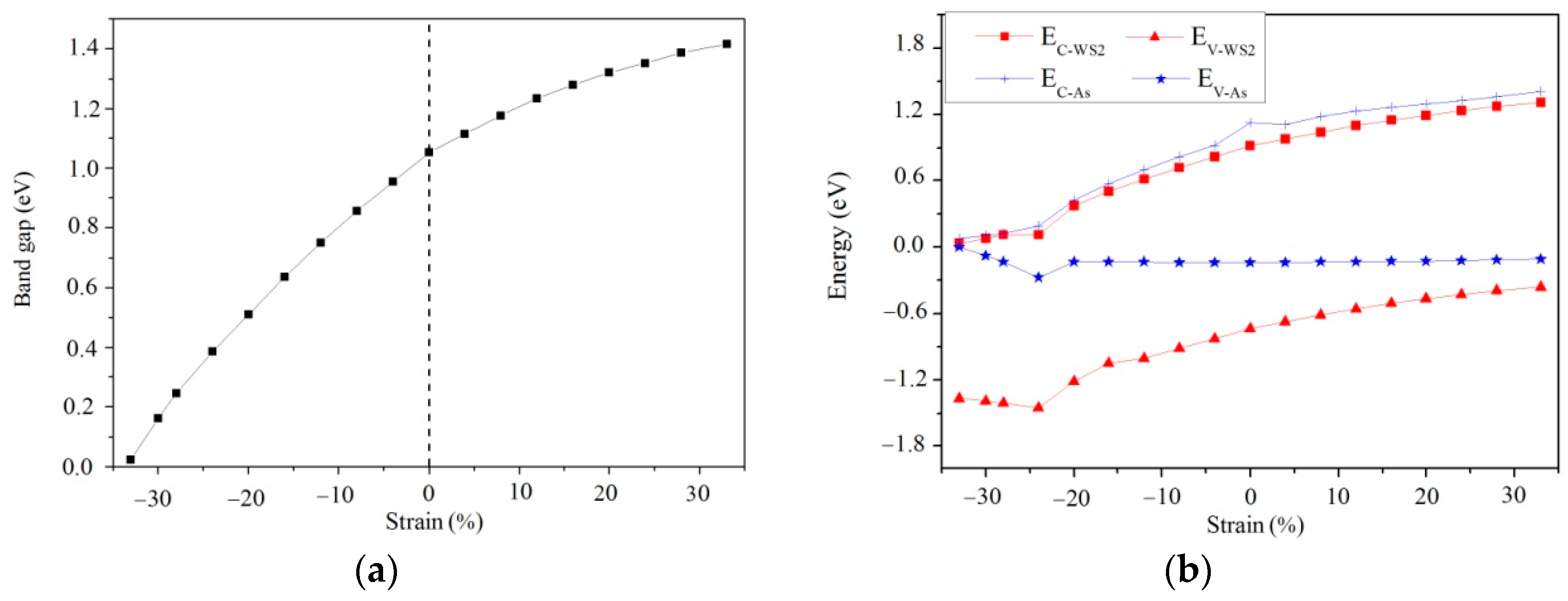
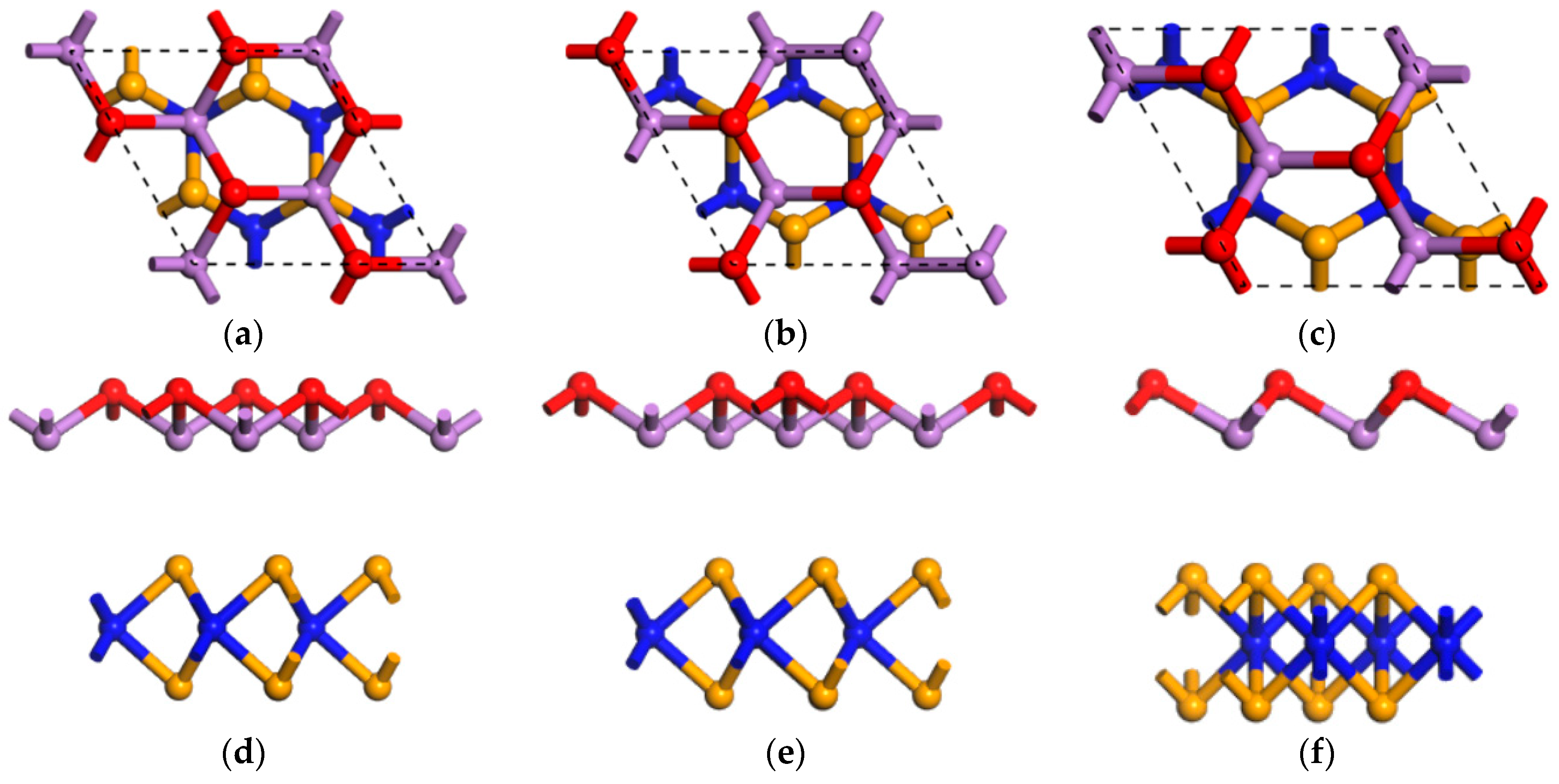
Arsenene has received considerable attention because of its unique optoelectronic and nanoelectronic properties. Nevertheless, the research on van der Waals (vdW) heterojunctions based on arsenene has just begun, which hinders the application of arsenene in the optoelectronic and nanoelectronic fields. Here, we systemically predict the stability and electronic structures of the arsenene/WS2 vdW heterojunction based on first-principles calculations, considering the stacking pattern, electric field, and strain effects. We found that the arsenene/WS2 heterostructure possesses a type-II band alignment. Moreover, the electric field can effectively tune both the band gap and the band alignment type. Additionally, the band gap could be tuned effectively by strain, while the band alignment type is robust under strain. Our study opens up a new avenue for the application of ultrathin arsenene-based vdW heterostructures in future nano- and optoelectronics applications. Our study demonstrates that the arsenene/WS2 heterostructure offers a candidate material for optoelectronic and nanoelectronic devices.
Keywords: electric field; band alignment; strain; arsenene/WS2 heterostructure electric field; band alignment; strain; arsenene/WS2 heterostructure