Machine Learning-Guided Enzyme Engineering Approaches for Enhanced Biocatalytic Efficiency: Concepts, Mechanisms, and Future Directions


Abstract
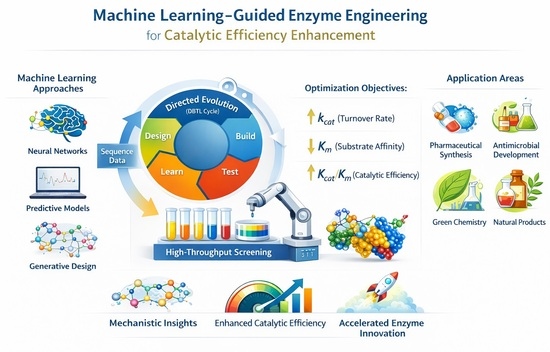
1. Introduction
2. Fundamentals of Enzyme Efficiency
2.1. Kinetic Parameters
2.2. Mechanistic Determinants of Enzyme Efficiency
2.2.1. Active Site Structure and Transition State Stabilization
2.2.2. Protein Dynamics and Conformational Flexibility
2.2.3. Substrate Binding and Specificity
2.2.4. Stability–Activity Trade-Off
2.3. Limitations of Conventional Optimization Approaches
2.4. Implications of ML-Guided Enzyme Engineering
3. ML-Based Approaches in Enzyme Optimization
3.1. Data Representation and Feature Engineering
3.2. Predictive Modeling of Enzyme Properties
3.3. Prediction of Mutation Effects and Sequence Optimization
3.4. ML-Guided Library Design
3.5. Integration with Multimodal Data and Hybrid Modeling
4. Advanced ML Frameworks, Benchmarking, and Model Selection
4.1. Classical ML Approaches
4.2. Deep Learning (DL) Architectures
4.3. Zero-Shot and Transfer Learning Approaches
4.4. Generative Models and De Novo Enzyme Design
4.5. Benchmarking and Validation Strategies
4.6. Model Selection Criteria
5. ML-Driven Catalytic Performance Enhancement
5.1. Enhancement of Turnover Number (kcat)
5.2. Optimization of Substrate Affinity (Km) and Binding Interactions
5.3. Enhancement of Catalytic Efficiency (kcat/Km)
5.4. Epistasis Modeling in ML-Guided Enzyme Engineering
5.5. Mechanistic Insights from ML-Guided Mutations
6. Integration of ML with Directed Evolution
6.1. The Design Phase (Generation of a Hypothesis)
6.2. The Build Phase (Construction of the Library)
6.3. The Test Phase (High-Throughput Screening and Kinetic Evaluation)
6.4. The Learning Phase (Model Refinement and Feedback Integration)
6.5. Closed-Loop Optimization and Autonomous Systems
6.6. Advantages of ML-Integrated Directed Evolution over Traditional Approaches
6.7. Challenges in the Integration of ML into the DBTL Workflow
7. Case Studies Concerning ML-Guided Enzyme Engineering
8. Applications of ML-Guided Enzyme Engineering
8.1. Pharmaceutical Biocatalysis and Chiral Synthesis
8.2. Antimicrobial Enzyme Engineering and Biotherapeutics
8.3. Green Chemistry and Sustainable Chemical Synthesis
8.4. Biocatalysts for the Synthesis and Modification of Natural Products
8.5. Emerging Applications
9. Critical Limitations of ML-Guided Enzyme Engineering
9.1. Limited Availability and Quality of Kinetic Data
9.2. Poor Generalization Across Enzyme Classes
9.3. Inadequate Representation of Protein Dynamics
9.4. Challenges in Modeling Epistasis and Multi-Mutation Effects
9.5. Lack of Mechanistic Interpretability
9.6. Mismatch Between Predictions and Experimental Outcomes
9.7. Data Bias and Overfitting
9.8. Computational and Infrastructure Constraints
9.9. Lack of Standardization and Benchmarking
10. Future Perspectives
10.1. Mechanism-Aware and Physics-Informed ML
10.2. Generative AI for De Novo Enzyme Design
10.3. Autonomous and Self-Driving Laboratories
10.4. Explainable Artificial Intelligence (XAI)
10.5. Integration with Systems Biology and Metabolic Engineering
10.6. Data Standardization and Collaborative Platforms
10.7. Toward Precision and Personalized Biocatalysis
11. Conclusions
Funding
Data Availability Statement
Acknowledgments
Conflicts of Interest
References
- Sheldon, R.A.; Woodley, J.M. Role of biocatalysis in sustainable chemistry. Chem. Rev. 2018, 118, 801–838. [Google Scholar] [PubMed]
- Bornscheuer, U.T.; Hauer, B.; Jaeger, K.-E.; Schwaneberg, U. Directed evolution empowered redesign of natural proteins for the sustainable production of chemicals and pharmaceuticals. Angew. Chem. Int. Ed. 2019, 58, 36–40. [Google Scholar]
- Arnold, F.H. Directed evolution: Bringing new chemistry to life. Angew. Chem. Int. Ed. 2018, 57, 4143–4148. [Google Scholar] [CrossRef]
- Wu, S.; Snajdrova, R.; Moore, J.C.; Baldenius, K.; Bornscheuer, U.T. Biocatalysis: Enzymatic synthesis for industrial applications. Angew. Chem. Int. Ed. 2021, 60, 88–119. [Google Scholar]
- Bayer, T.; Wu, S.; Snajdrova, R.; Baldenius, K.; Bornscheuer, U.T. An update: Enzymatic synthesis for industrial applications. Angew. Chem. Int. Ed. 2025, 64, e202505976. [Google Scholar] [CrossRef]
- Romero, P.A.; Arnold, F.H. Exploring protein fitness landscapes by directed evolution. Nat. Rev. Mol. Cell Biol. 2009, 10, 866–876. [Google Scholar] [CrossRef] [PubMed]
- Yang, K.K.; Wu, Z.; Arnold, F.H. Machine-learning-guided directed evolution for protein engineering. Nat. Methods 2019, 16, 687–694. [Google Scholar] [PubMed]
- Patsch, D.; Buller, R. Improving enzyme fitness with machine learning. Chimia 2023, 77, 116–121. [Google Scholar] [CrossRef] [PubMed]
- Li, Z.L.; Pei, S.; Chen, Z.; Huang, T.Y.; Wang, X.D.; Shen, L.; Chen, X.; Wang, Q.Q.; Wang, D.X.; Ao, Y.F. Machine learning-assisted amidase-catalytic enantioselectivity prediction and rational design of variants for improving enantioselectivity. Nat. Commun. 2024, 15, 8778. [Google Scholar] [PubMed]
- Cadet, X.F.; Gelly, J.C.; van Noord, A.; Cadet, F.; Acevedo-Rocha, C.G. Learning strategies in protein directed evolution. Methods Mol. Biol. 2022, 2461, 225–275. [Google Scholar] [CrossRef] [PubMed]
- Siedhoff, N.E.; Schwaneberg, U.; Davari, M.D. Machine learning-assisted enzyme engineering. Methods Enzymol. 2020, 643, 281–315. [Google Scholar] [CrossRef] [PubMed]
- Mazurenko, S.; Prokop, Z.; Damborsky, J. Machine learning in enzyme engineering. ACS Catal. 2020, 10, 1210–1223. [Google Scholar]
- Wittmann, B.J.; Johnston, K.E.; Wu, Z.; Arnold, F.H. Advances in machine learning for directed evolution. Curr. Opin. Struct. Biol. 2021, 69, 11–18. [Google Scholar] [CrossRef] [PubMed]
- Fox, R. Directed molecular evolution by machine learning and the influence of nonlinear interactions. J. Theor. Biol. 2005, 234, 187–199. [Google Scholar] [CrossRef] [PubMed]
- Huang, C.; Zhang, L.; Tang, T.; Wang, H.; Jiang, Y.; Ren, H.; Zhang, Y.; Fang, J.; Zhang, W.; Jia, X.; et al. Application of directed evolution and machine learning to enhance the diastereoselectivity of ketoreductase for dihydrotetrabenazine synthesis. JACS Au 2024, 4, 2547–2556. [Google Scholar] [CrossRef] [PubMed]
- Ao, Y.F.; Dörr, M.; Menke, M.J.; Born, S.; Heuson, E.; Bornscheuer, U.T. Data-driven protein engineering for improving catalytic activity and selectivity. ChemBioChem 2024, 25, e202300754. [Google Scholar] [PubMed]
- Strokach, A.; Becerra, D.; Corbi-Verge, C.; Perez-Riba, A.; Kim, P.M. Fast and flexible protein design using deep graph neural networks. Cell Syst. 2020, 11, 402–411. [Google Scholar] [CrossRef] [PubMed]
- Zhang, Y.; Chen, Y.; Wang, C.; Lo, C.C.; Liu, X.; Wu, W.; Zhang, J. ProDCoNN: Protein design using a convolutional neural network. Proteins 2020, 88, 819–829. [Google Scholar] [PubMed]
- Segel, I.H. Enzyme Kinetics: Behavior and Analysis of Rapid Equilibrium and Steady-State Enzyme Systems; Wiley: New York, NY, USA, 1993. [Google Scholar]
- Seibert, E.; Tracy, T.S. Fundamentals of enzyme kinetics. Methods Mol. Biol. 2014, 1113, 9–22. [Google Scholar] [CrossRef] [PubMed]
- Bar-Even, A.; Noor, E.; Savir, Y.; Liebermeister, W.; Davidi, D.; Tawfik, D.S.; Milo, R. The moderately efficient enzyme: Evolutionary and physicochemical trends shaping enzyme parameters. Biochemistry 2011, 50, 4402–4410. [Google Scholar] [CrossRef] [PubMed]
- Labourel, F.; Rajon, E. Resource uptake and the evolution of moderately efficient enzymes. Mol. Biol. Evol. 2021, 38, 3938–3952. [Google Scholar] [CrossRef] [PubMed]
- Warshel, A.; Sharma, P.K.; Kato, M.; Parson, W.W. Modeling electrostatic effects in proteins. Biochim. Biophys. Acta 2006, 1764, 1647–1676. [Google Scholar] [CrossRef] [PubMed]
- Henzler-Wildman, K.; Kern, D. Dynamic personalities of proteins. Nature 2007, 450, 964–972. [Google Scholar] [CrossRef] [PubMed]
- Li, H.; Xie, Y.; Liu, C.; Liu, S. Physicochemical bases for protein folding, dynamics, and protein–ligand binding. Sci. China Life Sci. 2014, 57, 287–302. [Google Scholar] [PubMed]
- Fersht, A. Structure and Mechanism in Protein Science: A Guide to Enzyme Catalysis and Protein Folding; World Scientific: Cambridge, UK, 2017. [Google Scholar]
- Tokuriki, N.; Tawfik, D.S. Stability effects of mutations and protein evolvability. Curr. Opin. Struct. Biol. 2009, 19, 596–604. [Google Scholar] [CrossRef] [PubMed]
- Tokuriki, N.; Stricher, F.; Schymkowitz, J.; Serrano, L.; Tawfik, D.S. The stability effects of protein mutations appear to be universally distributed. J. Mol. Biol. 2007, 369, 1318–1332. [Google Scholar] [CrossRef] [PubMed]
- Gargiulo, S.; Soumillion, P. Directed evolution for enzyme development in biocatalysis. Curr. Opin. Chem. Biol. 2021, 61, 107–113. [Google Scholar] [CrossRef] [PubMed]
- Goldsmith, M.; Tawfik, D.S. Enzyme engineering: Reaching the maximal catalytic efficiency peak. Curr. Opin. Struct. Biol. 2017, 47, 140–150. [Google Scholar] [CrossRef] [PubMed]
- Malli, A.; Vasyutyn, D.; Kim, J.R. Advances in machine learning models for predicting enzyme kinetic parameters. J. Chem. Inf. Model. 2026, 66, 42–60. [Google Scholar] [PubMed]
- Wang, J.; Zhao, Y.; Yang, Z.; Yao, G.; Han, P.; Liu, J.; Chen, C.; Zan, P.; Wan, X.; Bo, X.; et al. IECata: Interpretable bilinear attention network and evidential deep learning improve catalytic efficiency prediction of enzymes. Brief. Bioinform. 2025, 26, bbaf283. [Google Scholar] [CrossRef] [PubMed]
- Rives, A.; Meier, J.; Sercu, T.; Goyal, S.; Lin, Z.; Liu, J.; Guo, D.; Ott, M.; Zitnick, C.L.; Ma, J.; et al. Biological structure and function emerge from scaling unsupervised learning to 250 million protein sequences. Proc. Natl. Acad. Sci. USA 2021, 118, e2016239118. [Google Scholar] [CrossRef] [PubMed]
- Kim, P.T.; Winter, R.; Clevert, D.A. Unsupervised representation learning for proteochemometric modeling. Int. J. Mol. Sci. 2021, 22, 12882. [Google Scholar] [CrossRef] [PubMed]
- Lin, Z.; Akin, H.; Rao, R.; Hie, B.; Zhu, Z.; Lu, W.; Smetanin, N.; Verkuil, R.; Kabeli, O.; Shmueli, Y.; et al. Evolutionary-scale prediction of atomic-level protein structure with a language model. Science 2023, 379, 1123–1130. [Google Scholar] [CrossRef] [PubMed]
- Elnaggar, A.; Heinzinger, M.; Dallago, C.; Rehawi, G.; Wang, Y.; Jones, L.; Gibbs, T.; Feher, T.; Angerer, C.; Steinegger, M.; et al. ProtTrans: Toward understanding the language of life through self-supervised learning. IEEE Trans. Pattern Anal. Mach. Intell. 2022, 44, 7112–7127. [Google Scholar] [PubMed]
- Kouba, P.; Kohout, P.; Haddadi, F.; Bushuiev, A.; Samusevich, R.; Sedlar, J.; Damborsky, J.; Pluskal, T.; Sivic, J.; Mazurenko, S. Machine learning-guided protein engineering. ACS Catal. 2023, 13, 13863–13895. [Google Scholar] [CrossRef] [PubMed]
- Ali, R.; Zhang, Y. Machine learning meets enzyme engineering: Examples in the design of polyethylene terephthalate hydrolases. Front. Chem. Sci. Eng. 2024, 18, 149. [Google Scholar] [CrossRef]
- Yang, J.; Li, F.Z.; Arnold, F.H. Opportunities and challenges for machine learning-assisted enzyme engineering. ACS Cent. Sci. 2024, 10, 226–241. [Google Scholar] [CrossRef] [PubMed]
- Freschlin, C.R.; Fahlberg, S.A.; Romero, P.A. Machine learning to navigate fitness landscapes for protein engineering. Curr. Opin. Biotechnol. 2022, 75, 102713. [Google Scholar] [CrossRef] [PubMed]
- Repecka, D.; Jauniskis, V.; Karpus, L.; Rembeza, E.; Rokaitis, I.; Zrimec, J.; Poviloniene, S.; Laurynenas, A.; Viknander, S.; Abuajwa, W.; et al. Expanding functional protein sequence spaces using generative adversarial networks. Nat. Mach. Intell. 2021, 3, 324–333. [Google Scholar] [CrossRef]
- Lindley, S.E.; Lu, Y.; Shukla, D. The experimentalist’s guide to machine learning for small molecule design. ACS Appl. Bio Mater. 2024, 7, 657–684. [Google Scholar] [PubMed]
- Moreno, M.; Cuesta, S.A.; Mora, J.R.; Márquez Brazon, E.A.; Paz, J.L.; Agüero-Chapin, G.; Pérez-Pérez, N.; García-Jacas, C.R. Hybrid computational framework integrating ensemble learning, molecular docking, and dynamics for predicting antimalarial efficacy. Int. J. Mol. Sci. 2026, 27, 1875. [Google Scholar] [CrossRef] [PubMed]
- Kumar, C.; Choudhary, A. A top-down approach to classify enzyme functional classes and sub-classes using random forest. J. Bioinform. Sys. Biol. 2012, 1, 2012. [Google Scholar]
- Shi, Z.; Xu, S.; Xue, S.; Chen, K.; Lu, Y.; Wang, F.; Long, S.; Tian, Y.; Zhang, P.; Wang, J.; et al. From machine learning to multimodal models: The AI revolution in enzyme engineering. Biodes. Res. 2025, 8, 100044. [Google Scholar] [CrossRef] [PubMed]
- Salas-Nuñez, L.F.; Barrera-Ocampo, A.; Caicedo, P.A.; Cortes, N.; Osorio, E.H.; Villegas-Torres, M.F.; González Barrios, A.F. Machine learning to predict enzyme–substrate interactions in elucidation of synthesis pathways: A review. Metabolites 2024, 14, 154. [Google Scholar] [CrossRef] [PubMed]
- Vornholt, T.; Stockinger, P.; Mutný, M.; Jeschek, M.; Nestl, B.; Oberdorfer, G.; Osuna, S.; Pleiss, J.; Welner, D.H.; Krause, A.; et al. Of revolutions and roadblocks: The emerging role of machine learning in biocatalysis. ACS Cent. Sci. 2025, 11, 1828–1838. [Google Scholar] [CrossRef] [PubMed]
- Moorhoff, F.; Zhang, Y.; Qiu, W.; Dong, W.; Medina-Ortiz, D.; Davari, M.D. Machine learning-driven enzyme mining: Opportunities, challenges, and future perspectives. ACS Catal. 2026, 16, 12–30. [Google Scholar]
- Kroll, A.; Ranjan, S.; Engqvist, M.K.M.; Lercher, M.J. A general model to predict small molecule substrates of enzymes based on machine and deep learning. Nat. Commun. 2023, 14, 2787. [Google Scholar] [CrossRef] [PubMed]
- Yang, Q.; Yu, J.; Zheng, J. A survey of downstream applications of evolutionary scale modeling protein language models. Quant. Biol. 2025, 14, e70013. [Google Scholar] [CrossRef] [PubMed]
- Leclercq, M.; Droit, A. Protein language models: Applications and perspectives. J. Proteome Res. 2026, 25, 507–524. [Google Scholar] [PubMed]
- Rajagopal, N.; Choudhary, U.; Tsang, K.; Martin, K.P.; Karadag, M.; Chen, H.T.; Kwon, N.Y.; Mozdzierz, J.; Horspool, A.M.; Li, L.; et al. Deep learning-based design and experimental validation of a medicine-like human antibody library. Brief. Bioinform. 2024, 26, bbaf023. [Google Scholar]
- Jiang, Y.; Ran, X.; Yang, Z.J. Data-driven enzyme engineering to identify function-enhancing enzymes. Protein Eng. Des. Sel. 2023, 36, gzac009. [Google Scholar] [PubMed]
- Tang, M.; Ge, F.; Li, A.; Hu, L.; Wang, C.; Tang, J.; Song, X.; Liu, X.; Shi, H.; Tan, Z. Artificial intelligence-driven de novo design of robust enzymes to enhance their performance. ACS Synth. Biol. 2025, 14, 4178–4201. [Google Scholar] [CrossRef] [PubMed]
- Ahern, W.; Yim, J.; Tischer, D.; Salike, S.; Woodbury, S.M.; Kim, D.; Kalvet, I.; Kipnis, Y.; Coventry, B.; Altae-Tran, H.R.; et al. Atom-level enzyme active site scaffolding using RFdiffusion2. Nat. Methods 2026, 23, 96–105. [Google Scholar] [PubMed]
- Sumida, K.H.; Núñez-Franco, R.; Kalvet, I.; Pellock, S.J.; Wicky, B.I.M.; Milles, L.F.; Dauparas, J.; Wang, J.; Kipnis, Y.; Jameson, N.; et al. Improving protein expression, stability, and function with ProteinMPNN. J. Am. Chem. Soc. 2024, 146, 2054–2061. [Google Scholar] [CrossRef] [PubMed]
- Chen, A.; Peng, X.; Shen, T.; Zheng, L.; Wu, D.; Wang, S. Discovery, design, and engineering of enzymes based on molecular retrobiosynthesis. mLife 2025, 4, 107–125. [Google Scholar] [CrossRef] [PubMed]
- Rao, R.; Bhattacharya, N.; Thomas, N.; Duan, Y.; Chen, X.; Canny, J.; Abbeel, P.; Song, Y.S. Evaluating protein transfer learning with TAPE. Adv. Neural Inf. Process. Syst. 2019, 32, 9689–9701. [Google Scholar] [PubMed]
- Dallago, C.; Mou, J.; Johnston, K.E.; Wittmann, B.J.; Bhattacharya, N.; Goldman, S.; Madani, A.; Yang, K.K. FLIP: Benchmark tasks in fitness landscape inference for proteins. bioRxiv 2021, preprint. [Google Scholar]
- Notin, P.; Kollasch, A.W.; Ritter, D.; van Niekerk, L.; Paul, S.; Spinner, H.; Rollins, N.; Shaw, A.; Weitzman, R.; Frazer, J.; et al. ProteinGym: Large-scale benchmarks for protein design and fitness prediction. bioRxiv 2023, 36, 64331–64379. [Google Scholar]
- Venanzi, N.A.E.; Basciu, A.; Vargiu, A.V.; Kiparissides, A.; Dalby, P.A.; Dikicioglu, D. Machine learning integrating protein structure, sequence, and dynamics to predict enzyme activity. J. Chem. Inf. Model. 2024, 64, 2681–2694. [Google Scholar] [CrossRef]
- Dolinska, M.B.; Sergeev, Y.V. Insights from computational dynamic active site mapping into substrate recognition. Int. J. Mol. Sci. 2026, 27, 1937. [Google Scholar] [CrossRef] [PubMed]
- Khan, M.F.; Khan, M.T. AI-driven enzyme engineering: Emerging models and next-generation biotechnological applications. Molecules 2025, 31, 45. [Google Scholar] [PubMed]
- Vajanapanich, P.; Nearmnala, P.; Parkbhorn, J.; Nutho, B.; Rungrotmongkol, T.; Hongdilokkul, N. Catalytic residue reprogramming enhances enzyme activity at alkaline pH. ACS Synth. Biol. 2025, 14, 3612–3623. [Google Scholar] [CrossRef] [PubMed]
- Leidner, F.; Kurt Yilmaz, N.; Schiffer, C.A. Target-specific prediction of ligand affinity with structure-based interaction fingerprints. J. Chem. Inf. Model. 2019, 59, 3679–3691. [Google Scholar] [PubMed]
- Xu, W.; Li, A.; Zhao, Y.; Peng, Y. Decoding the effects of mutation on protein interactions using machine learning. Biophys. Rev. 2025, 6, 011307. [Google Scholar] [CrossRef]
- Deshpande, A.; Ouldridge, T.E. Optimizing enzymatic catalysts for rapid turnover of substrates with low enzyme sequestration. Biol. Cybern. 2020, 114, 653–668. [Google Scholar] [CrossRef] [PubMed]
- Li, F.Z.; Yang, J.; Johnston, K.E.; Gürsoy, E.; Yue, Y.; Arnold, F.H. Evaluation of machine learning-assisted directed evolution across diverse combinatorial landscapes. Cell Syst. 2025, 16, 101387. [Google Scholar] [CrossRef] [PubMed]
- Thomas, N.; Belanger, D.; Xu, C.; Lee, H.; Hirano, K.; Iwai, K.; Polic, V.; Nyberg, K.D.; Hoff, K.G.; Frenz, L.; et al. Engineering highly active nuclease enzymes with machine learning and high-throughput screening. Cell Syst. 2025, 16, 101236. [Google Scholar] [CrossRef] [PubMed]
- Poelwijk, F.J.; Krishna, V.; Ranganathan, R. The context-dependence of mutations: A linkage of formalisms. PLoS Comput. Biol. 2016, 12, e1004771. [Google Scholar] [CrossRef] [PubMed]
- Starr, T.N.; Thornton, J.W. Epistasis in protein evolution. Protein Sci. 2016, 25, 1204–1218. [Google Scholar] [CrossRef] [PubMed]
- Rao, R.; Meier, J.; Sercu, T.; Ovchinnikov, S.; Rives, A. Transformer protein language models are unsupervised structure learners. bioRxiv 2020. preprint. [Google Scholar] [CrossRef]
- Russ, W.P.; Figliuzzi, M.; Stocker, C.; Barrat-Charlaix, P.; Socolich, M.; Kast, P.; Hilvert, D.; Monasson, R.; Cocco, S.; Weigt, M.; et al. An evolution-based model for designing chorismate mutase enzymes. Science 2020, 369, 440–445. [Google Scholar] [CrossRef] [PubMed]
- Wittmann, B.J.; Yue, Y.; Arnold, F.H. Informed training set design enables efficient machine learning-assisted directed protein evolution. Cell Syst. 2021, 12, 1026–1045.e7. [Google Scholar] [CrossRef] [PubMed]
- Hsu, C.; Nisonoff, H.; Fannjiang, C.; Listgarten, J. Learning protein fitness models from evolutionary and assay-labeled data. Nat. Biotechnol. 2022, 40, 1114–1122. [Google Scholar] [CrossRef] [PubMed]
- Riesselman, A.J.; Ingraham, J.B.; Marks, D.S. Deep generative models of genetic variation capture the effects of mutations. Nat. Methods 2018, 15, 816–822. [Google Scholar] [CrossRef] [PubMed]
- Song, Z.; Trozzi, F.; Tian, H.; Yin, C.; Tao, P. Mechanistic insights into enzyme catalysis from explaining machine-learned quantum mechanical and molecular mechanical minimum energy pathways. ACS Phys. Chem. Au 2022, 2, 316–330. [Google Scholar] [CrossRef] [PubMed]
- Leander, M.; Liu, Z.; Cui, Q.; Raman, S. Deep mutational scanning and machine learning reveal structural and molecular rules governing allosteric hotspots. eLife 2022, 11, e79932. [Google Scholar] [CrossRef] [PubMed]
- Petrović, D.; Risso, V.A.; Kamerlin, S.C.L.; Sanchez-Ruiz, J.M. Conformational dynamics and enzyme evolution. J. R. Soc. Interface 2018, 15, 20180330. [Google Scholar] [CrossRef] [PubMed]
- Gradisteanu, V.; Chan, E.W.; Hedges, L.; Malagarriga, M.; David, R.; de la Puente, M.; Laage, D.; Tuñón, I.; van der Kamp, M.W.; Zinovjev, K. Simulating enzyme catalysis with electrostatically embedded machine learning potentials. Chem. Sci. 2026, in press. [Google Scholar] [CrossRef] [PubMed]
- Li, G.C.; Srivastava, A.K.; Kim, J.; Taylor, S.S.; Veglia, G. Mapping the hydrogen bond networks in the catalytic subunit of protein kinase A. Biochemistry 2015, 54, 4042–4049. [Google Scholar] [CrossRef] [PubMed]
- Heckmann, D.; Lloyd, C.J.; Mih, N.; Ha, Y.; Zielinski, D.C.; Haiman, Z.B.; Desouki, A.A.; Lercher, M.J.; Palsson, B.O. Machine learning applied to enzyme turnover numbers reveals protein structural correlates. Nat. Commun. 2018, 9, 5252. [Google Scholar] [CrossRef] [PubMed]
- Xia, W.; Bai, Y.; Shi, P. Improving substrate affinity and catalytic efficiency of β-glucosidase by rational design. Biomolecules 2021, 11, 1882. [Google Scholar] [PubMed]
- Li, F.; Yuan, L.; Lu, H.; Li, G.; Chen, Y.; Engqvist, M.K.M.; Kerkhoven, E.J.; Nielsen, J. Deep learning-based kcat prediction enables improved enzyme-constrained model reconstruction. Nat. Catal. 2022, 5, 662–672. [Google Scholar]
- Tripathi, N.; Herisson, J.; Faulon, J.-L. Machine learning in predictive biocatalysis: A comparative review. Biotechnol. Adv. 2025, 84, 108698. [Google Scholar] [CrossRef] [PubMed]
- Li, Y.; Song, K.; Zhang, J.; Lu, S. A computational method to predict effects of residue mutations on catalytic efficiency. Catalysts 2021, 11, 286. [Google Scholar] [CrossRef]
- Landwehr, G.M.; Bogart, J.W.; Magalhaes, C.; Hammarlund, E.G.; Karim, A.S.; Jewett, M.C. Accelerated enzyme engineering by machine-learning-guided cell-free expression. Nat. Commun. 2025, 16, 865. [Google Scholar] [PubMed]
- Wu, Z.; Kan, S.B.J.; Lewis, R.D.; Wittmann, B.J.; Arnold, F.H. Machine learning-assisted directed protein evolution with combinatorial libraries. Proc. Natl. Acad. Sci. USA 2019, 116, 8852–8858. [Google Scholar] [CrossRef] [PubMed]
- Menke, M.J.; Ao, Y.-F.; Bornscheuer, U.T. Practical machine learning-assisted design protocol for protein engineering: Transaminase engineering for the conversion of bulky substrates. ACS Catal. 2024, 14, 6462–6469. [Google Scholar] [CrossRef]
- Ding, K.; Chin, M.; Zhao, Y.; Huang, W.; Mai, B.K.; Wang, H.; Liu, P.; Yang, Y.; Luo, Y. Machine learning-guided co-optimization of fitness and diversity facilitates combinatorial library design in enzyme engineering. Nat. Commun. 2024, 15, 6392. [Google Scholar] [PubMed]
- Saito, Y.; Oikawa, M.; Sato, T.; Nakazawa, H.; Ito, T.; Kameda, T.; Tsuda, K.; Umetsu, M. Machine-learning-guided library design cycle for directed evolution of enzymes: The effects of training data composition on sequence space exploration. ACS Catal. 2021, 11, 14615–14624. [Google Scholar]
- Trivedi, V.D.; Chappell, T.C.; Krishna, N.B.; Shetty, A.; Sigamani, G.G.; Mohan, K.; Ramesh, A.; Pravin, K.R.; Nair, N.U. In-depth sequence-function characterization reveals multiple pathways to enhance enzymatic activity. ACS Catal. 2022, 12, 2381–2396. [Google Scholar] [PubMed]
- Marchal, D.G.; Schulz, L.; Schuster, I.; Ivanovska, J.; Paczia, N.; Prinz, S.; Zarzycki, J.; Erb, T.J. Machine learning-supported enzyme engineering toward improved CO2-fixation of glycolyl-CoA carboxylase. ACS Synth. Biol. 2023, 12, 3521–3530. [Google Scholar] [PubMed]
- Thornton, E.L.; Boyle, J.T.; Laohakunakorn, N.; Regan, L. Cell-free protein synthesis as a method to rapidly screen machine learning-generated protease variants. ACS Synth. Biol. 2025, 14, 1710–1718. [Google Scholar] [PubMed]
- Erkanli, M.E.; Jang, Y.; Malli, A.; El-Halabi, K.; Ryu, C.; Kim, J.R. Machine learning framework for kcat/Km prediction in β-glucosidases. ACS Synth. Biol. 2025, 14, 3927–3939. [Google Scholar] [CrossRef] [PubMed]
- Jurich, C.; Shao, Q.; Ran, X.; Yang, Z.J. Physics-based modeling in the new era of enzyme engineering. Nat. Comput. Sci. 2025, 5, 279–291. [Google Scholar] [CrossRef] [PubMed]
- Manan, A.; Qayyum, N.; Ramachandran, R.; Qayyum, N.; Ilyas, S. Digital to biological translation: Algorithmic data-driven design in synthetic biology. SynBio 2025, 3, 17. [Google Scholar]
- Lu, X.; Cao, M.; Ma, M.; Wu, Y.; Qu, M.; Du, F.; Ji, R.; Duan, M.; Dong, L.; Liu, K.; et al. Accelerating enzyme engineering with artificial intelligence in biocatalysis. Food Bioeng. 2025, 4, 589–611. [Google Scholar] [CrossRef]
- Kitano, S.; Lin, C.; Foo, J.L.; Chang, M.W. Synthetic biology: Learning toward high-precision biological design. PLoS Biol. 2023, 21, e3002116. [Google Scholar] [PubMed]
- Vanella, R.; Kovacevic, G.; Doffini, V.; Fernández de Santaella, J.; Nash, M.A. High-throughput screening and machine learning in enzyme engineering. Chem. Commun. 2022, 58, 2455–2467. [Google Scholar]
- Callaway, E. Will self-driving robot labs replace biologists? Nature 2026, 650, 809–810. [Google Scholar] [CrossRef] [PubMed]
- Clark-ElSayed, A.; Harrison, I.M.; Olsen, M.L.; Lazar, J.T.; Jewett, M.C.; Ellington, A.D. LDBT instead of DBTL: Combining machine learning and cell-free testing. Nat. Commun. 2025, 16, 9782. [Google Scholar] [PubMed]
- Zhang, Q.; Chen, W.; Qin, M.; Wang, Y.; Pu, Z.; Ding, K.; Liu, Y.; Zhang, Q.; Li, D.; Li, X.; et al. Integrating protein language models and biofoundry for enhanced protein evolution. Nat. Commun. 2025, 16, 1553. [Google Scholar] [CrossRef] [PubMed]
- Hägele, L.; Trachtmann, N.; Takors, R. Knowledge-driven DBTL cycle provides mechanistic insights. Microb. Cell Factories 2025, 24, 111. [Google Scholar] [PubMed]
- Jones, B.S.; Soler, J.; Sharratt, J.W.; Hogg, B.N.; Tavanti, M.; Schnepel, C.; Kress, N.; Seibt, L.S.; Osuna, S.; Garcia-Borràs, M.; et al. Mechanistic insight-guided engineering of cytochrome P450 regioselectivity. ACS Catal. 2026, 16, 6673–6684. [Google Scholar]
- Zhai, J.; Qi, X.; Cai, L.; Liu, Y.; Tang, H.; Xie, L.; Wang, J. NNKcat: Deep neural network to predict catalytic constants. Brief. Bioinform. 2025, 26, bbaf212. [Google Scholar] [CrossRef] [PubMed]
- Markus, B.; Christian, C.G.; Andreas, K.; Arkadij, K.; Stefan, L.; Gustav, O.; Elina, S.; Radka, S. Accelerating biocatalysis discovery with machine learning: A paradigm shift in enzyme engineering, discovery, and design. ACS Catal. 2023, 13, 14454–14469. [Google Scholar] [CrossRef] [PubMed]
- Al-Madboly, L.A.; Aboulmagd, A.; El-Salam, M.A.; Kushkevych, I.; El-Morsi, R.M. Microbial enzymes as natural anti-biofilm candidates. Microb. Cell Factories 2024, 23, 343. [Google Scholar] [PubMed]
- Efremenko, E.; Stepanov, N.; Aslanli, A.; Lyagin, I.; Senko, O.; Maslova, O. Enzyme-based antimicrobial materials: Trends and perspectives. J. Funct. Biomater. 2023, 14, 64. [Google Scholar] [PubMed]
- de Regil, R.; Sandoval, G. Biocatalysis for biobased chemicals. Biomolecules 2013, 3, 812–847. [Google Scholar] [CrossRef] [PubMed]
- Mao, S.; Jiang, J.; Xiong, K.; Chen, Y.; Yao, Y.; Liu, L.; Liu, H.; Li, X. Enzyme engineering for food industry applications. Foods 2024, 13, 3846. [Google Scholar] [PubMed]
- Farhan, M.; Hasani, I.W.; Khafaga, D.S.R.; Ragab, W.M.; Ahmed Kazi, R.N.; Aatif, M.; Muteeb, G.; Fahim, Y.A. Enzymes as catalysts in industrial biocatalysis. Catalysts 2025, 15, 891. [Google Scholar] [CrossRef]
- Ndochinwa, O.G.; Wang, Q.Y.; Amadi, O.C.; Nwagu, T.N.; Nnamchi, C.I.; Okeke, E.S.; Moneke, A.N. Current status in enzyme engineering: Industrial perspective. Heliyon 2024, 10, e32673. [Google Scholar] [CrossRef] [PubMed]
- Deivayanai, V.C.; Karishma, S.; Thamarai, P.; Kamalesh, R.; Saravanan, A.; Yaashikaa, P.R.; Vickram, A.S. Plastic remediation using catalytic and ML approaches. J. Contam. Hydrol. 2024, 267, 104449. [Google Scholar] [PubMed]
- Gupta, G.K.; Dixit, M.; Chot, E.; Shukla, P. Microbial enzymatic biodegradation of plastics. ACS Environ. Au 2025, 5, 520–542. [Google Scholar] [CrossRef] [PubMed]
- Sonowal, K.; Borthakur, P.P.; Pathak, K. Advances in enzyme-based biosensors. Eng. Proc. 2025, 106, 5. [Google Scholar] [CrossRef]
- Ji, Z.L.; Chen, X.; Zhen, C.J.; Yao, L.X.; Han, L.Y.; Yeo, W.K.; Chung, P.C.; Puy, H.S.; Tay, Y.T.; Muhammad, A.; et al. KDBI: Kinetic data of biomolecular interactions database. Nucleic Acids Res. 2003, 31, 255–257. [Google Scholar] [CrossRef] [PubMed]
- Shah, A.; Bi, F.; Yang, J. Machine learning in drug–food interaction prediction. J. Cheminform. 2025, 18, 8. [Google Scholar] [PubMed]
- Doshi, U.; McGowan, L.C.; Ladani, S.T.; Hamelberg, D. Role of enzyme conformational dynamics in catalysis. Proc. Natl. Acad. Sci. USA 2012, 109, 5699–5704. [Google Scholar] [PubMed]
- Cui, X.; Ge, L.; Chen, X.; Lv, Z.; Wang, S.; Zhou, X.; Zhang, G. Protein dynamics modeling in the post-AlphaFold era. Brief. Bioinform. 2025, 26, bbaf340. [Google Scholar] [PubMed]
- Niazi, S.K. Protein catalysis through structural dynamics. Pharmaceuticals 2025, 18, 951. [Google Scholar] [CrossRef] [PubMed]
- Dieckhaus, H.; Kuhlman, B. Protein stability models fail to capture epistatic interactions. Protein Sci. 2025, 34, e70003. [Google Scholar] [PubMed]
- Taylor, M.B.; Ehrenreich, I.M. Higher-order genetic interactions in complex traits. Trends Genet. 2015, 31, 34–40. [Google Scholar] [PubMed]
- Sidak, D.; Schwarzerová, J.; Weckwerth, W.; Waldherr, S. Interpretable machine learning in systems biology. Front. Mol. Biosci. 2022, 9, 926623. [Google Scholar] [PubMed]
- Shi, H.; Bai, X.; Tian, F.; Li, Y.; Li, D.; Yao, L.; Xue, C.; Tang, C. AI-driven enzyme engineering from structure prediction to de novo design. J. Agric. Food Chem. 2026, 74, 9975–9990. [Google Scholar] [PubMed]
- Yu, H.; Deng, H.; He, J.; Keasling, J.D.; Luo, X. UniKP: Prediction of enzyme kinetic parameters. Nat. Commun. 2023, 14, 8211. [Google Scholar] [PubMed]
- Medina-Ortiz, D.; Khalifeh, A.; Anvari-Kazemabad, H.; Davari, M.D. Explainable ML models for protein engineering. Biotechnol. Adv. 2025, 79, 108495. [Google Scholar] [PubMed]
- Dritsas, E.; Trigka, M. Machine learning and big data: A survey. Mach. Learn. Knowl. Extr. 2025, 7, 13. [Google Scholar] [CrossRef]
- Le Piane, F.; Vozza, M.; Baldoni, M.; Mercuri, F. ML and HPC integration for nanomaterials. Beilstein J. Nanotechnol. 2024, 15, 1498–1521. [Google Scholar] [PubMed]
- Davoudi, S.; Henry, C.S.; Miller, C.S.; Banaei-Kashani, F. EC-Bench: Enzyme classification benchmark. Bioinform. Adv. 2026, 6, vbag004. [Google Scholar] [PubMed]
- Nair, M.; Svedberg, P.; Larsson, I.; Nygren, J.M. Barriers to AI implementation in healthcare. PLoS ONE 2024, 19, e0305949. [Google Scholar] [PubMed]
- Shao, Q.; Hollenbeak, A.C.; Jiang, Y.; Ran, X.; Bachmann, B.O.; Yang, Z.J. SubTuner leverages physics-based modeling to complement AI in enzyme engineering toward nan-native substrates. Chem. Catal. 2025, 5, 101334. [Google Scholar] [PubMed]
- Wen, S.; Zheng, W.; Bornscheuer, U.T.; Wu, S. Generative AI for enzyme design. Curr. Opin. Green Sustain. Chem. 2025, 52, 101010. [Google Scholar]
- Xie, W.J.; Warshel, A. Generative AI for enzyme catalysis and evolution. Natl. Sci. Rev. 2023, 10, nwad331. [Google Scholar] [CrossRef] [PubMed]
- Sommer, L.M.; Groves, T.; Santos, A. Data infrastructure for autonomous laboratories. Curr. Opin. Biotechnol. 2026, 97, 103434. [Google Scholar] [PubMed]
- Singh, N.; Lane, S.; Yu, T.; Lu, J.; Ramos, A.; Cui, H.; Zhao, H. AI-powered autonomous enzyme engineering. Nat. Commun. 2025, 16, 5648. [Google Scholar] [PubMed]
- Agrawal, R.; Gupta, T.; Gupta, S.; Chauhan, S.; Patel, P.; Hamdare, S. Explainable AI for decision transparency. Diagn. Pathol. 2025, 20, 105. [Google Scholar] [PubMed]
- Feehan, R.; Montezano, D.; Slusky, J.S.G. Machine learning for enzyme engineering, selection and design. Protein Eng. Des. Sel. 2021, 34, gzab019. [Google Scholar] [PubMed]
- Helmy, M.; Smith, D.; Selvarajoo, K. Systems biology and AI in metabolic engineering. Metab. Eng. Commun. 2020, 11, e00149. [Google Scholar] [PubMed]
- Lawson, C.E.; Martí, J.M.; Radivojevic, T.; Jonnalagadda, S.V.R.; Gentz, R.; Hillson, N.J.; Peisert, S.; Kim, J.; Simmons, B.A.; Petzold, C.J.; et al. Machine learning for metabolic engineering. Metab. Eng. 2021, 63, 34–60. [Google Scholar] [CrossRef] [PubMed]
- Cheng, Y.; Bi, X.; Xu, Y.; Liu, Y.; Li, J.; Du, G.; Lv, X.; Liu, L. ML for metabolic pathway optimization. Comput. Struct. Biotechnol. J. 2023, 21, 2381–2393. [Google Scholar] [PubMed]
- Ho, D.; Quake, S.R.; McCabe, E.R.B.; Chng, W.J.; Chow, E.K.; Ding, X.; Gelb, B.D.; Ginsburg, G.S.; Hassenstab, J.; Ho, C.M.; et al. Enabling technologies for personalized medicine. Trends Biotechnol. 2020, 38, 497–518. [Google Scholar] [PubMed]


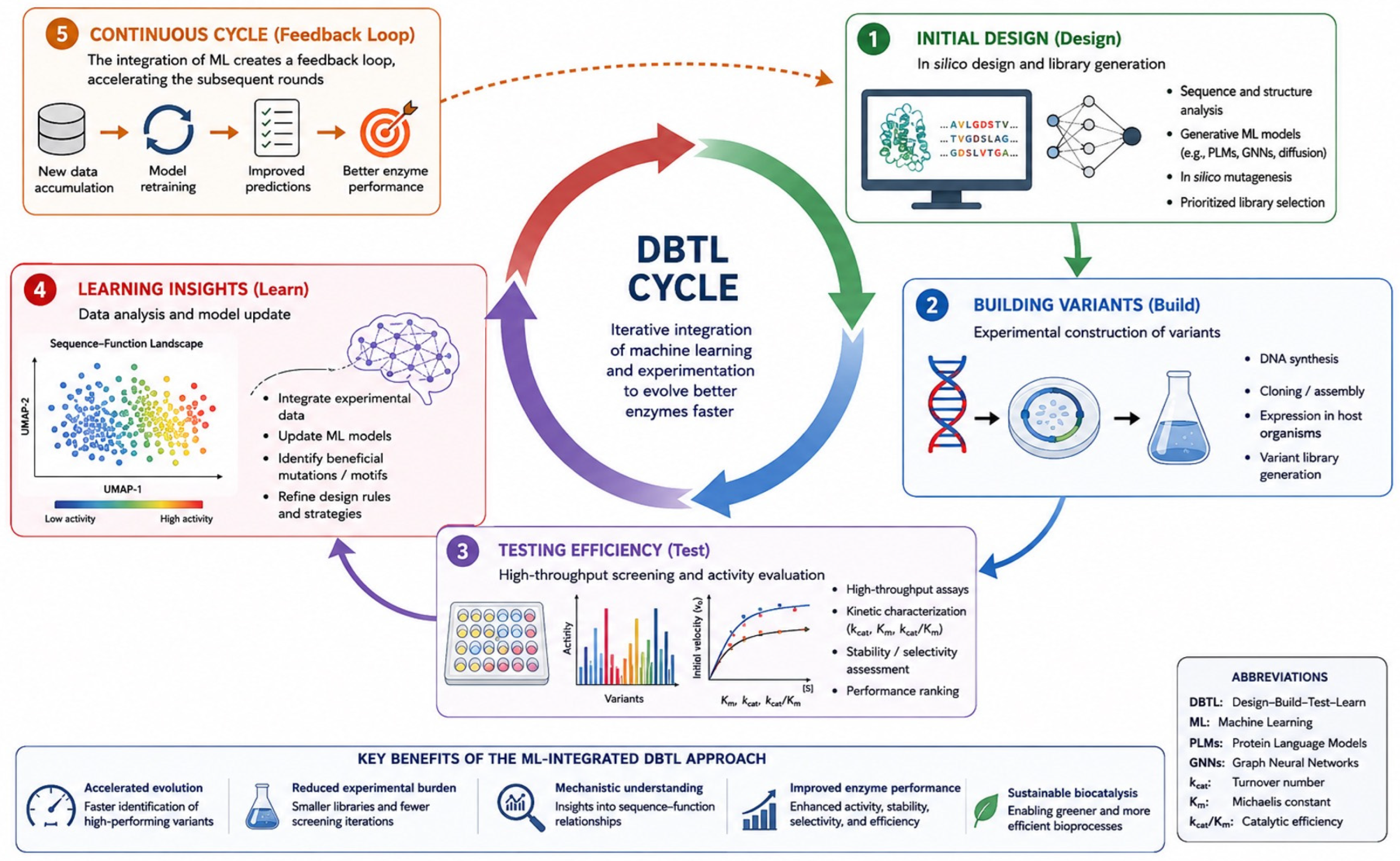



| ML Model | Data Source | Dataset Required | Strengths | Limitations | Applications in Enzyme Engineering | References |
|---|---|---|---|---|---|---|
| RF | Sequence features; physicochemical descriptors | Small-medium | Low computational cost; interpretable; robust | Unable to capture non-linear interactions | Enzyme activity prediction; stability screening | [31,44] |
| SVM | Engineered features | Small-medium | Effective for classification tasks | Sensitive to feature selection only | Substrate specificity prediction | [45,46] |
| GBM | Structured features | Medium | High predictive accuracy | Requires feature engineering | Prediction of kinetic parameters | [31,47] |
| CNN | Sequence/structure grids | Medium-large | Captures local motifs | Limited long-range interactions | Motif detection; enzyme activity prediction | [47] |
| GNN | Protein structure graphs | Medium-large | Models spatial relationships | Requires structural data | Structure–function mapping | [48] |
| PLMs | Protein sequences | Large | Captures long-range dependencies | High computational cost | Mutation effect prediction; embedding generation | [49] |
| EVE/ESM-1v | Sequence + Evolutionary data | No labeled data required | Useful for low-data availability | Dependent on sequence homology | Mutation prioritization | [50,51] |
| VAE/GAN | Sequence Data | Large | Generates novel sequences | Experimental validation is required | Sequence exploration; diversity generation | [52,53] |
| Diffusion | Structural data | Large | Generates high-quality structure-guided design | Computationally intensive | De novo enzyme design | [54,55] |
| ProteinMPNN/ESM-IF | Protein structure | Medium-large | Generates structure-based sequence design | Requires accurate structure | Structure-guided enzyme engineering | [56,57] |
| Enzyme System/Study | Enzyme Class/Protein Type | ML Model/Strategy | Dataset Size/Training Data | Baseline Comparator | Parameter Affected | Reported Improvement | References |
|---|---|---|---|---|---|---|---|
| Amide synthetase | Ligase | Augmented ridge regression | HT screening data across multiple substrates (~103 variants) | Parent enzyme | Enzymatic activity/Substrate preference | 1.6- to 42-fold improvement in activity | [87] |
| Cytochrome P450 for carbene Si-H insertion | Oxidoreductase/P450 | ML-assisted directed evolution using combinatorial libraries | Combinatorial library data (~104 variants) | Conventional directed evolution/previous variants | Enantioselectivity (ee) | Variants with 93% and 79% enantiomeric excess (ee) for stereodivergent catalysis | [88] |
| Transaminase for bulky substrates | Transferase/transaminase | Practical ML-assisted variant design protocol | Sequence/structure-guided dataset (~103 variants) | Starting transaminase variant | Enzymatic activity/Substrate conversion | Up to 3-fold improved conversion of bulky substrates and up to > 99% improved ee. | [89] |
| Combinatorial enzyme libraries | Multiple | ML-assisted optimization of fitness and diversity | Combinatorial fitness/diversity datasets (~103 variants) | Fitness-only or diversity-free selection | Fitness/Diversity | Improved library enrichment and diversity | [90] |
| Sortase A | Transpeptidase | ML-guided iterative library design | Training datasets with different compositions (~103–104 variants) | Non-ML library design | Enzymatic activity | 2.2- to 2.5-fold improved enzyme activity; Improved sequence space exploration | [91] |
| Phenylalanine ammonia-lyase (PAL) | Lyase | Sequence–function modeling; Deep mutational scanning (DMS) | Deep mutational scanning datasets (~105 variants) | Parent/lower-activity variants | Enzymatic activity | 112 mutations at 79 functionally relevant sites were revealed | [92] |
| Glycolyl-CoA carboxylase (GCC) | Carboxylase/CO2-fixation enzyme | ML-supported enzyme engineering | Mutational and activity data (~103 variants) | Wild-type/starting enzyme | CO2-fixation efficiency | ~2-fold increased CO2-fixation performance | [93] |
| Ketoreductases | Oxidoreductase/ketoreductase | Directed evolution + ML | Directed evolution activity/selectivity data (~105 variants) | Parent ketoreductase | Diastereoselectivity/Yield | Isolated yield of 40.7% and an enhanced diastereoselectivity of 91.3% | [94] |
| Nuclease enzymes | Nuclease | ML + high-throughput screening (HTS) TeleProt | HTS dataset (~104 variants) | Starting nuclease/screening baseline | Specific activity | Highly active nuclease variants identified with 11-fold improved specific activity | [95] |
| Protease variants | Proteases | ML-generated variants + cell-free screening | ML-generated library (~103 sequences) | Parent/baseline protease | Kinetic properties/Activity | Rapid identification of functional variants; 4-fold improvement in kinetic properties | [96] |
| Enzyme/System | Objective | Experimental Approach | Library/Variant Strategy | Variants Screened/Tested | Validation Method | Key Workflow Contribution | References |
|---|---|---|---|---|---|---|---|
| Amide synthetase | To improve the catalytic activity and substrate scope | Focused mutant library + HT screening | Computational prioritization of sequence variants | ~103 experimentally screened variants across multiple substrates | HT activity assays followed by kinetic characterization | Efficient navigation of sequence space | [87] |
| Transaminase | To enhance catalytic efficiency under neutral conditions | Targeted mutagenesis + kinetic evaluation | Focused combinatorial mutagenesis | Focused library (~102 variants) | Enzyme kinetics and substrate conversion assays | Combined sequence and structural descriptors for mutation prioritization | [89] |
| Cytochrome P450 | To improve activity and regioselectivity | Iterative mutation + feedback learning | Iteratively refined focused libraries | Multiple iterative focused libraries (~102–103 variants per cycle | Regioselectivity and catalytic activity assays | Accelerated convergence toward optimized variants | [9,105,106] |
| CO2 fixation enzyme | To improve pathway-related catalytic performance | Rational mutagenesis guided by computational prediction | Prioritized mutation combinations | Targeted variant subsets (~102 variants) | Enzymatic pathway assays | Application of ML in metabolic pathway optimization | [93] |
| Nuclease enzyme | To identify high-activity variants | Parallelized experimental testing with iterative model refinement | Computationally prioritized screening sets | Large HTS datasets (~104 variants) | Activity-based screening assays | Coupling with automated HT workflows | [69] |
| PET hydrolase | To enhance plastic degradation capability | Structure-guided engineering workflow | Rationally prioritized mutation sets | Targeted variant libraries (~102–103 variants) | PET degradation assays | Integration of ML with sustainability-focused enzyme engineering | [38] |
Disclaimer/Publisher’s Note: The statements, opinions and data contained in all publications are solely those of the individual author(s) and contributor(s) and not of MDPI and/or the editor(s). MDPI and/or the editor(s) disclaim responsibility for any injury to people or property resulting from any ideas, methods, instructions or products referred to in the content. |
© 2026 by the author. Licensee MDPI, Basel, Switzerland. This article is an open access article distributed under the terms and conditions of the Creative Commons Attribution (CC BY) license.
Share and Cite
Ahsan, W. Machine Learning-Guided Enzyme Engineering Approaches for Enhanced Biocatalytic Efficiency: Concepts, Mechanisms, and Future Directions. Catalysts 2026, 16, 598. https://doi.org/10.3390/catal16070598
Ahsan W. Machine Learning-Guided Enzyme Engineering Approaches for Enhanced Biocatalytic Efficiency: Concepts, Mechanisms, and Future Directions. Catalysts. 2026; 16(7):598. https://doi.org/10.3390/catal16070598
Chicago/Turabian StyleAhsan, Waquar. 2026. "Machine Learning-Guided Enzyme Engineering Approaches for Enhanced Biocatalytic Efficiency: Concepts, Mechanisms, and Future Directions" Catalysts 16, no. 7: 598. https://doi.org/10.3390/catal16070598
APA StyleAhsan, W. (2026). Machine Learning-Guided Enzyme Engineering Approaches for Enhanced Biocatalytic Efficiency: Concepts, Mechanisms, and Future Directions. Catalysts, 16(7), 598. https://doi.org/10.3390/catal16070598