
Article

A Multifunctional Nickel-Based Metal–Organic Framework (MOF) for Hydrogen Production, Supercapacitors, and Electrocatalysis

by
Zeinab Hussein Hashem
1,
Laila H. Abdel-Rahman
1,*,
Santiago Gómez-Ruiz
2,3 and
Hani Nasser Abdelhamid
4,*
1
Chemistry Department, Faculty of Science, Sohag University, Sohag 82534, Egypt
2
COMET-NANO Group, Departamento de Biología y Geología, Física y Química Inorgánica, ESCET, Universidad Rey Juan Carlos, C/Tulipán s/n, 28933 Móstoles, Spain
3
Instituto de Investigación de Tecnologías para la Sostenibilidad, Universidad Rey Juan Carlos, C/Tulipán s/n, 28933 Móstoles, Spain
4
Department of Chemistry, College of Science, Imam Mohammad Ibn Saud Islamic University (IMSIU), Riyadh 11623, Saudi Arabia
*
Authors to whom correspondence should be addressed.
Catalysts 2026, 16(3), 283; https://doi.org/10.3390/catal16030283
Submission received: 11 February 2026 / Revised: 14 March 2026 / Accepted: 19 March 2026 / Published: 22 March 2026

Abstract

The nickel-derived metal–organic framework (MOF), Ni-BTB, synthesized from 4,4′,4″-benzene-1,3,5-tribenzoic acid (H3BTB), was investigated as a multifunctional platform for enhanced energy applications including production and storage. In catalytic hydrogen generation by NaBH4 hydrolysis, Ni-BTB attained a hydrogen generation rate (HGR) of 4640 mL H2/g•min with 1 mg of catalyst, with an activation energy of 76.44 kJ/mol. Under optimized reaction conditions (60 °C, 20 mg catalyst, and 1 g NaBH4), the HGR increased to 9542 mL H2/g•min, while exhibiting high recyclability throughout four successive cycles. As a supercapacitor electrode, Ni-BTB achieved a specific capacitance of 156 F/g at 1 A/g and showed remarkable cycling stability, maintaining its capacitance after 10,000 charge–discharge cycles. Furthermore, Ni-BTB exhibited exceptional electrocatalytic activity for oxygen evolution reaction (OER), requiring only 106 mV overpotential to achieve 10 mA/cm2, offering a time-of-flight (TOF) of 0.0585 s−1 and demonstrating significant operational longevity of at least 12 h. These findings underscore Ni-BTB as a durable, reusable, and adaptable material for hydrogen production, energy storage, and electrocatalytic applications.

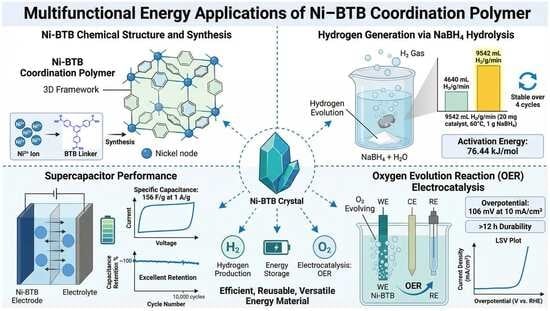
Graphical Abstract

1. Introduction

The high global energy consumption, coupled with intensifying environmental and climate concerns, push the society toward the development of sustainable, low-carbon energy conversion technologies [1,2,3,4]. Among the proposed solutions, clean hydrogen production stands out for its high energy density and potential as an environmentally benign energy carrier [5,6,7]. Among several methods for hydrogen production, water electrolysis represents a cornerstone technology, enabling the efficient electrochemical generation of hydrogen and oxygen [8,9]. In parallel, high-performance energy storage systems are required for mitigating the intermittency of renewable energy generation while maintaining a stable, efficient energy supply. Consequently, integrating hydrogen production, oxygen evolution, and energy storage offers a holistic strategy for realizing scalable, sustainable clean energy infrastructure [10,11].
Hydrogen has been recognized as a clean, sustainable energy vector capable of replacing conventional fossil-based energy sources and facilitating the shift toward carbon-neutral energy technologies [12,13,14,15]. Hydride-based materials play a crucial role in hydrogen storage and production by enabling safe, efficient solid-state hydrogen storage [16,17,18]. Notably, sodium borohydride (NaBH4) is a promising material for hydrogen storage and release, attributed to its substantial hydrogen storage capacity (10.6 wt.%) and environmental compatibility. Its hydrolysis in water releases four moles of hydrogen per mole of NaBH4. The hydrogen release requires a catalyst that exhibits high activity, durability, and structural robustness to ensure controlled and efficient hydrogen generation [19,20]. Accordingly, extensive efforts have been focused on designing advanced catalytic systems to enhance hydrogen release performance [21,22,23].
Hydrogen production via water electrolysis remains a fundamental process for converting renewable electricity into chemical energy, producing hydrogen and oxygen through two coupled half-reactions: hydrogen is generated at the cathode via the hydrogen evolution reaction (HER), while oxygen is produced at the anode through the oxygen evolution reaction (OER) [24,25,26]. Although HER generally proceeds efficiently, the OER is hindered by slower kinetics, which make it the rate-limiting step of the reaction and the primary bottleneck in overall water-splitting efficiency. While RuO2 and IrO2 offer excellent catalytic activity for the OER, the high expense of these metals limits large-scale implementation. Hence, the development of earth-abundant, economically viable, and durable electrocatalysts is critical to improving OER efficiency and advancing water electrolysis technologies [27,28,29].
Supercapacitors (SCs) have gained increasing attention as next-generation energy storage systems due to their high power output, fast charge–discharge rates, and prolonged cycle stability [30,31,32,33,34,35,36,37]. These properties make SCs suitable for applications in electric mobility solutions, portable electronic devices, and intelligent power grid applications [38,39]. However, traditional electrode materials like activated carbon, graphene, and oxides of transition metals often suffer from limited energy density, restricted tunability, and scalability issues [40,41]. These limitations highlight the urgent need for new electrode materials that combine high capacitance, excellent stability, and structural versatility [30,31,32,33,34,35,36,37].
Metal–organic frameworks (MOFs), distinguished by their high porosity, extensive surface areas, and tunable chemical compositions, have emerged as highly promising materials for several applications [42,43,44]. They, including their derived material, have demonstrated excellent performance in hydrogen generation [14], supercapacitor energy storage [45,46,47,48,49,50], and OER electrocatalysis [51], owing to their accessible active sites and structural flexibility. These features suggest MOFs as ideal candidates for multifunctional energy applications, offering a unified platform for clean hydrogen production, advanced energy storage, and sustainable electrochemical processes [52].
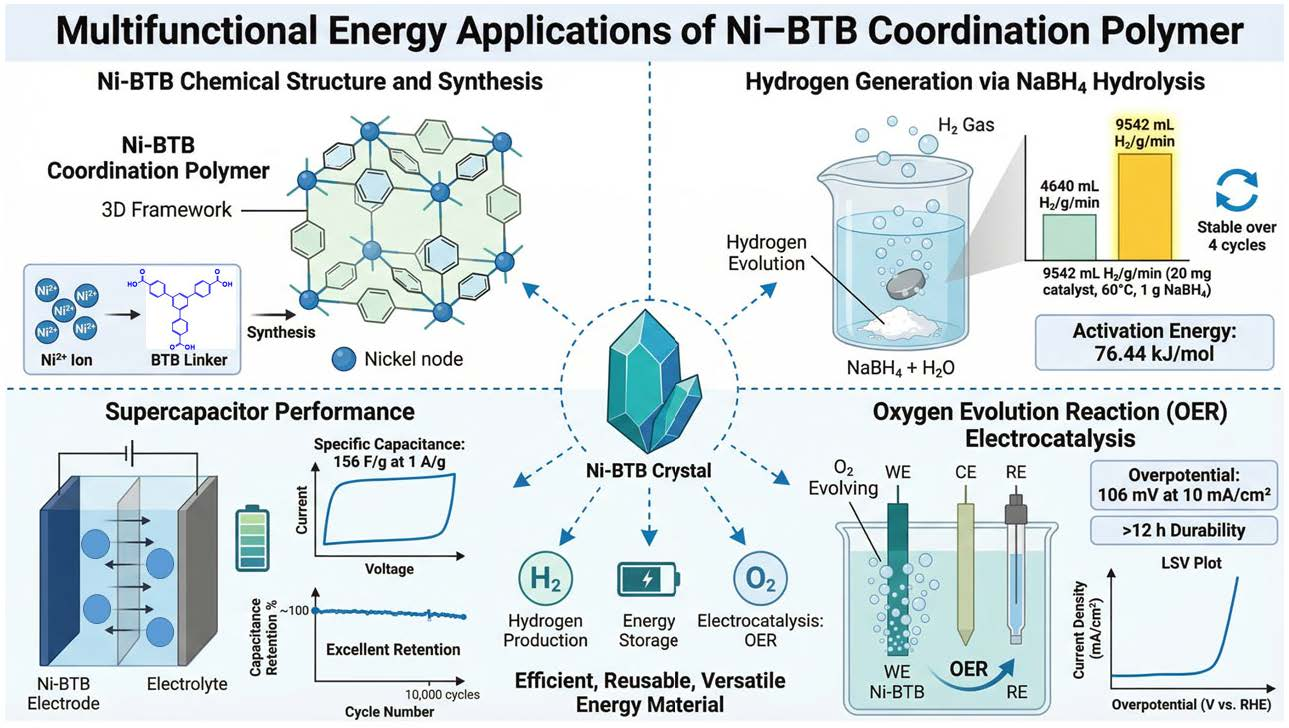
Herein, we synthesized and tested a nickel-based MOF constructed from 4,4′,4″-benzene-1,3,5-tribenzoic acid (Ni-BTB) as a multifunctional material for advanced energy applications. Tritopic carboxylic linker, i.e., H3BTB, was used to ensure high stability. It was characterized using X-ray diffraction (XRD), X-ray photoelectron spectroscopy (XPS), Fourier-transform infrared (FT-IR), and transmission electron microscopy (TEM). The Ni-BTB catalyst exhibited high performance in catalyzing hydrogen release from NaBH4, reaching a generation rate of 4640 mL H2/g•min, which increased to 9542 mL H2/g•min at 60 °C under optimized conditions, while maintaining excellent stability over four consecutive cycles. As a supercapacitor electrode, Ni-BTB delivered an initial capacitance of 156 F/g at 1 A/g and maintained full capacitance over 10,000 charge–discharge cycles, indicating outstanding durability and reusability. Furthermore, Ni-BTB exhibited remarkable OER activity, achieving a current density of 10 mA/cm2 at a low overpotential of 106 mV. Collectively, these results highlight Ni-BTB as a versatile and multifunctional MOF for integrated hydrogen production, oxygen evolution, and high-performance energy storage, offering significant promises for next-generation energy conversion systems.

2. Results and Discussion

2.1. Materials Synthesis and Characterization

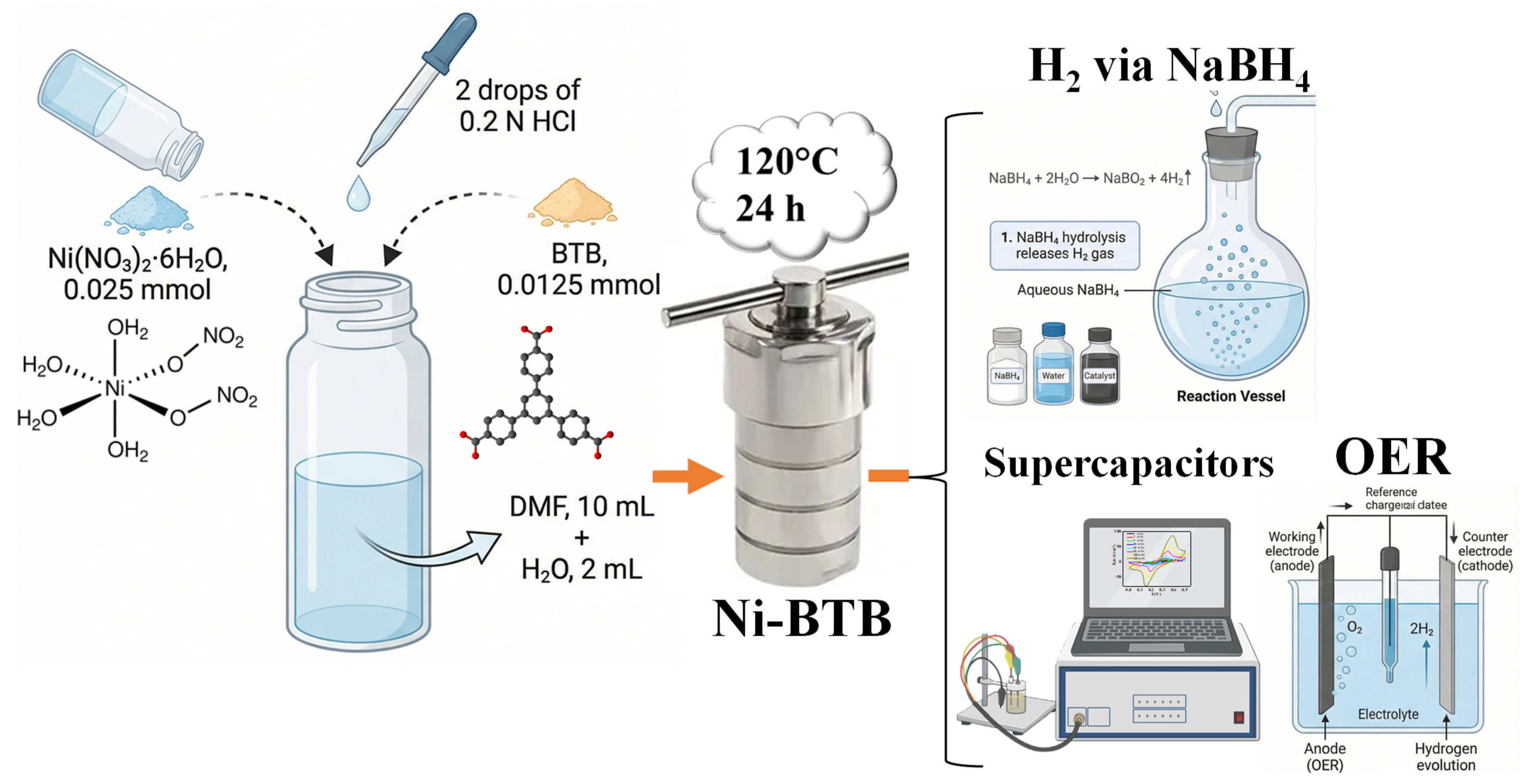
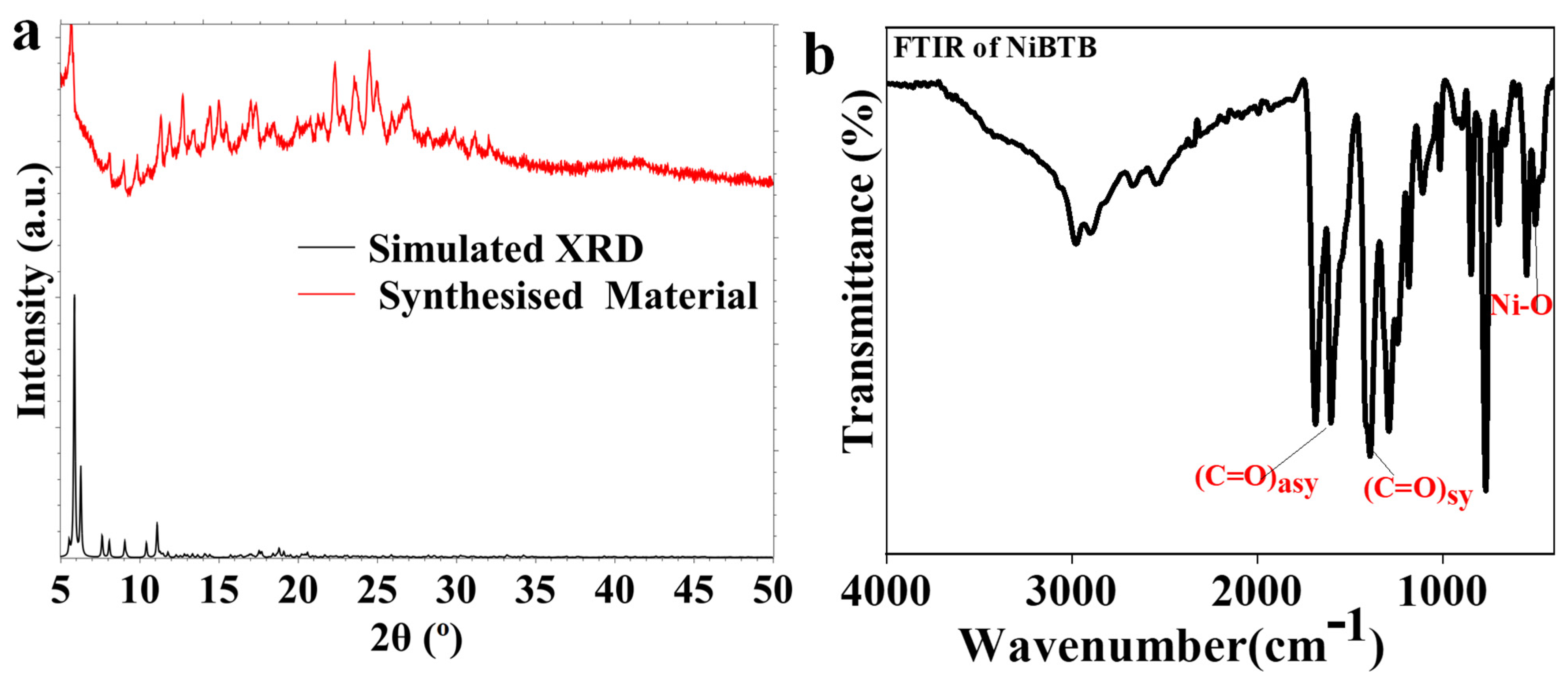
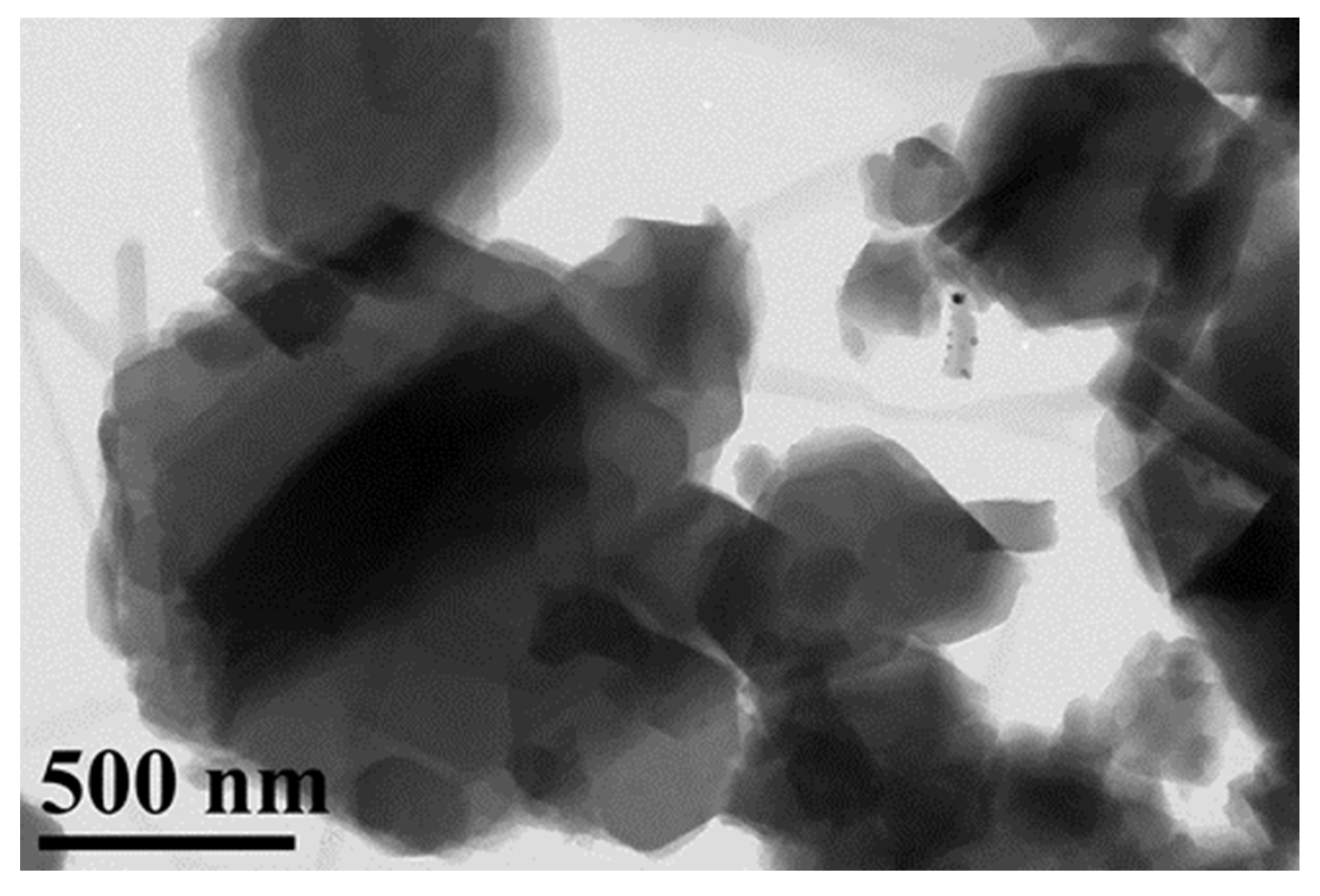
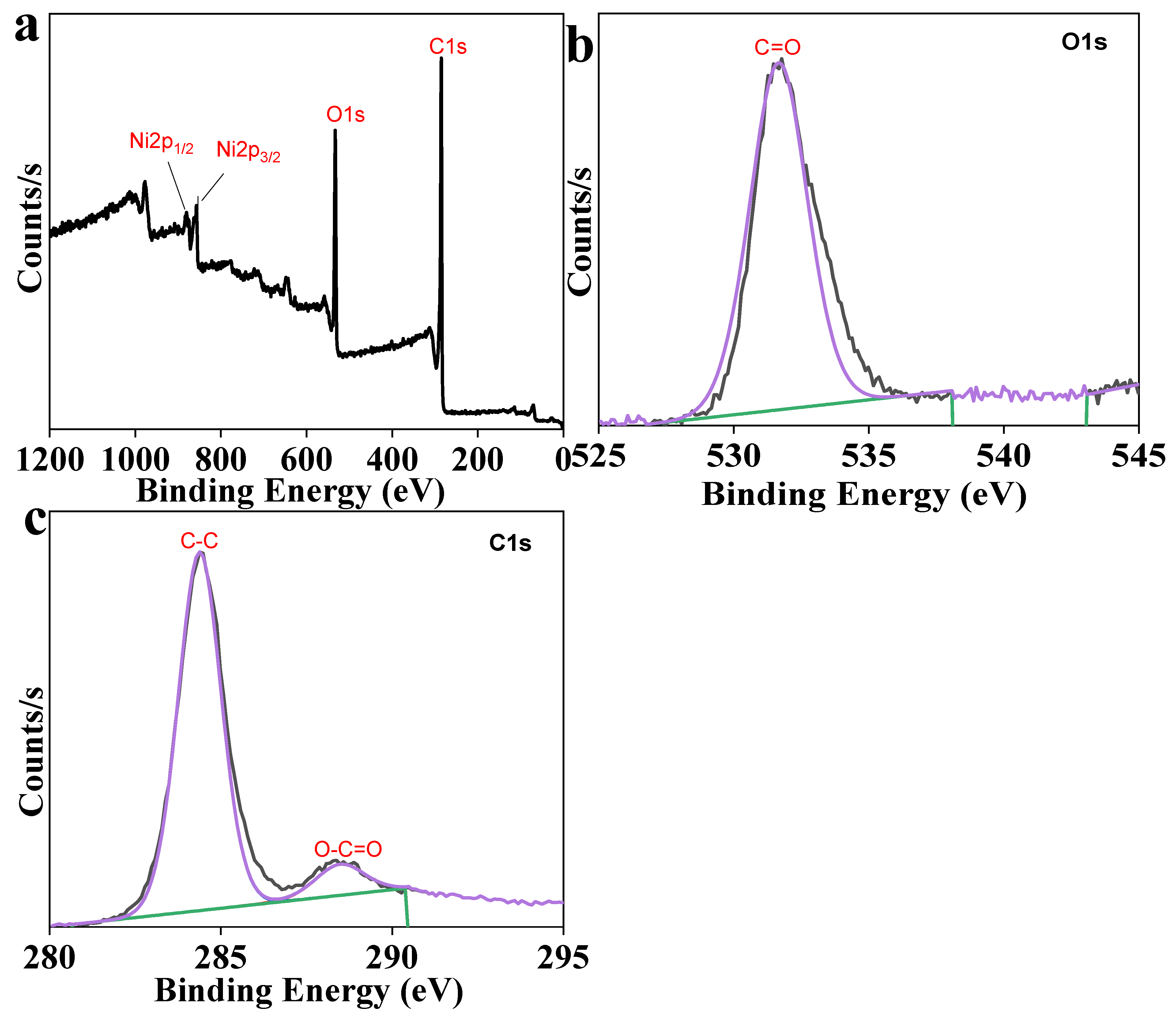
The Ni-BTB synthesis procedure is illustrated schematically in Figure 1. Ni is coordinated to BTB, forming an innovative 3D nickel-based hybrid framework with high ferromagnetism and semiconductor properties [53]. The synthesis of the Ni-BTB framework was confirmed by XRD (Figure 2a), FT-IR (Figure 2b), TEM (Figure 3), and XPS (Figure 4), providing comprehensive insights into its structural, morphological, and chemical features.
The XRD profile of Ni-BTB shows well-defined diffraction peaks, validating the establishment of a highly crystalline MOF (Figure 2a). No diffraction signals from metallic nickel or nickel oxide phases are observed, indicating that Ni species are uniformly coordinated within the BTB framework (Figure 2a). The experimental XRD pattern closely aligns with the structure of an isostructure BTB framework published under CCDC Deposition Number 2160411 for catena-[bis(μ-1,3,5-tris(4-carboxylatophenyl)benzene)-bis(DMF)-tri-iron(II)] (DMF), known as BTB-MOF-24 [54,55]. The comparatively sharp diffraction peaks indicate nanoscale crystallite sizes, which are beneficial for catalytic applications owing to the enhanced availability of accessible active sites.
The FT-IR spectroscopy further confirms the coordination between Ni2+ ions and the BTB ligand (Figure 2b). Distinct vibrational bands are observed in the 1600–1650 cm−1 region, reflecting the asymmetric stretching of C=O bonds in the coordinated carboxylate groups. The lack of bands linked to free –COOH groups, coupled with the appearance of symmetric C–O stretching bands near 1400 cm−1, validates the deprotonation and bidentate coordination of the carboxylate groups to the nickel centers. The extra vibrational bands observed in the 500–600 cm−1 range are attributed to Ni–O stretching modes, providing further confirmation of the MOF’s development.
A TEM image of the Ni-BTB is presented as shown in Figure 3. The material consists of quasi-hexagonal nanoparticles. The precisely delineated nanoscale architecture indicates a high level of structural uniformity, which is advantageous for maintaining consistent surface chemistry and readily available active sites. Moreover, the quasi-hexagonal morphology and homogeneous dispersion facilitate efficient mass transport and enhance the exposure of catalytically active nickel centers, which is expected to contribute positively to the observed catalytic and electrochemical performance of Ni-BTB.
XPS analysis was employed to further the surface composition and electronic states of Ni-BTB (Figure 4). The survey spectrum confirms the presence of Ni, C, and O, indicating elevated sample purity. High-resolution Ni 2p spectra exhibit peaks at 855.6 eV (Ni 2p3/2) and 873.2 eV (Ni 2p1/2) along with satellite features, confirming the presence of Ni2+ species (Figure 4a). The O 1s spectra can be deconvoluted at 31.2 eV, 532.6 eV, and 533.8 eV, corresponding to Ni–O, C=O, and C–O bonds, respectively, indicating robust metal–ligand interactions (Figure 4b). The C 1s spectra exhibit peaks at around 284.8 eV (C–C/C=C), 286.1 eV (C–O), and 288.7 eV (O–C=O), thereby affirming the structural integrity of the BTB linker (Figure 4c).

2.2. Hydrogen Generation Using Ni-BTB

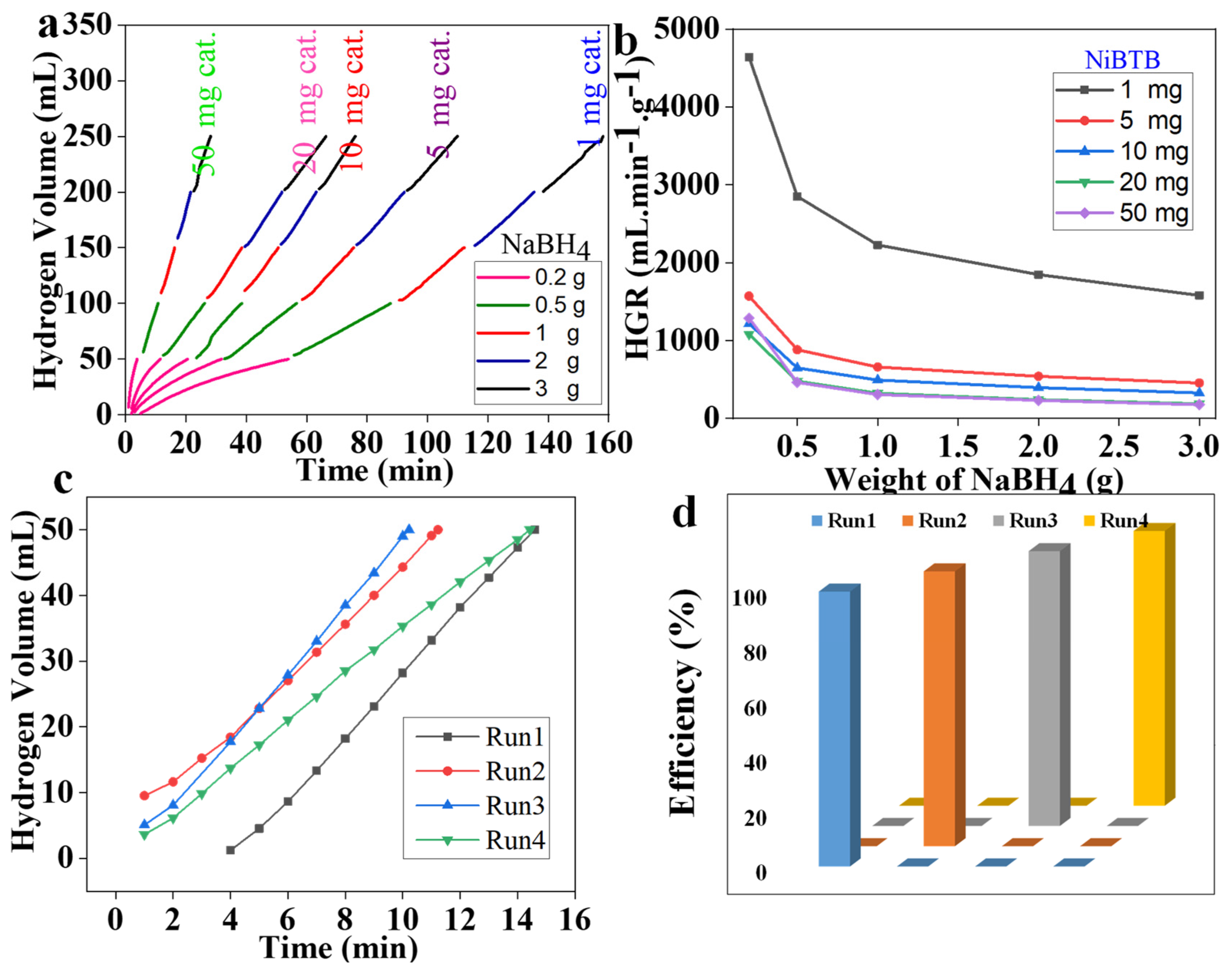
The hydrogen production efficacy of Ni-BTB was examined by the hydrolysis of NaBH4, as depicted in Figure 5a. With a catalyst loading of 50 mg, the time required to achieve the maximum hydrogen volume was reduced to approximately 28 min across a NaBH4 concentration range of 0.2–3.0 wt.%. The HGR attained under these conditions was 4640 mL H2/g•min (Figure 5b). Significantly, Ni-BTB demonstrated exceptional durability and reusability, maintaining practically constant catalytic activity across at least four successive cycles, underscoring its substantial stability and resilience under operating conditions (Figure 5c,d). These findings illustrate the adaptability and efficacy of Ni-BTB for hydrogen production across a broad spectrum of NaBH4 concentrations.
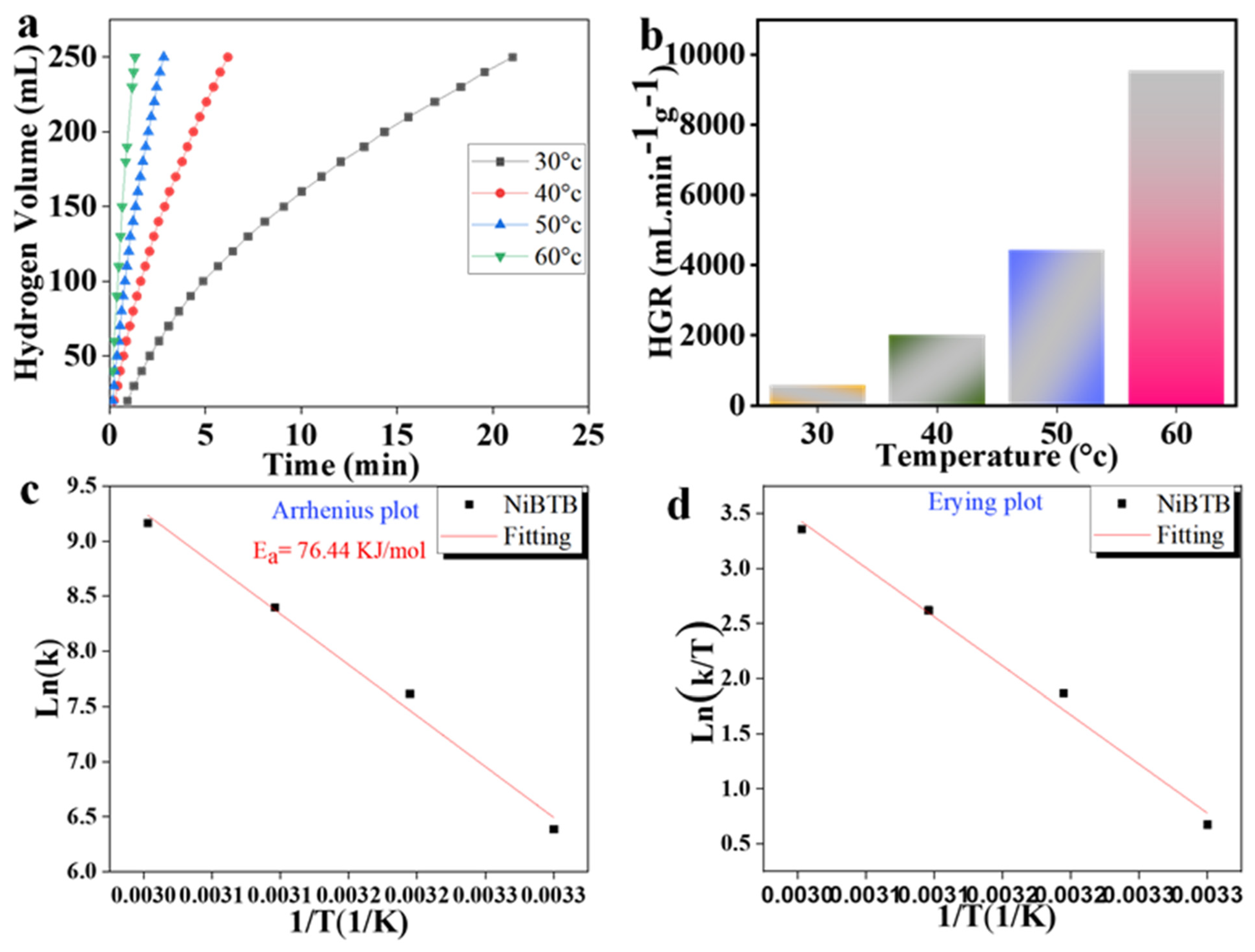
Temperature is important in the hydrolysis of NaBH4, as illustrated in Figure 6a,b. High temperature significantly improves the hydrogen evolution rate by accelerating reaction kinetics and increasing the frequency of molecular collisions. At 60 °C, using 20 mg of Ni-BTB and 1.0 wt.% NaBH4, the time for hydrogen evolution to reach its maximum decreased substantially to 1.31 min, yielding an HGR of 9542 mL H2/g•min. This exceptional result highlights the significant catalytic efficiency of Ni-BTB, even under comparatively mild reaction conditions.
The kinetic and thermodynamic properties of the Ni-BTB-catalyzed NaBH4 hydrolysis were evaluated using Arrhenius and Eyring analyses (Figure 6c,d). The calculated apparent activation energy was 76.44 kJ/mol, with a strong linear correlation coefficient (R2 = 0.99), indicating reliable kinetic behavior. The activation parameters, ΔH* and ΔS*, were determined to be 73.9 kJ/mol and 0.25 kJ/mol•K, respectively, thereby substantiating the temperature-dependent enhancement of the reaction rate. NaBH4 dissociates in aqueous solution into BH4 and Na+ ions, which readily adsorb onto the surface of the Ni-BTB catalyst. The BH4 species hydrolyzes at the exposed Ni active sites, generating hydrogen gas that promptly desorbs from the surface, while sodium metaborate (NaBO2) is produced as a byproduct. The coordination environment and porous structure of Ni-BTB facilitate the effective adsorption, activation, and turnover of BH4 ions, enabling the complete release of 4 equivalents of H2 per NaBH4 molecule under mild circumstances.
A comparative examination of hydrogen generation performance for several nickel-based and MOF-derived catalysts documented in the literature is presented in Table 1. The literature data indicate that both catalyst composition and operational parameters, e.g., catalyst mass, temperature, and NaBH4 concentration, are pivotal in influencing hydrogen evolution efficiency. The Cu–Ni–PET MOF exhibits a notable HGR of 2650 mL H2/g•min at 50 °C; however, it requires a substantial catalyst loading of 100 mg and elevated temperature [56]. The carbonized counterpart, Cu–Ni–C MOF, exhibited HGR of 2150 mL H2/g•min, suggesting that carbonization may partially hinder active sites, albeit with enhanced conductivity [56].
Conversely, Ni-BTB achieves a high HGR of 4640 mL H2/g•min at ambient temperature with only 1 mg of catalyst, underscoring its remarkable intrinsic catalytic efficacy. Oxide-based catalysts, such as Ni–Co3O4 [57], and noble-metal-containing systems, such as Ni1Pt3/KnbO3 [58], exhibit reduced HGR values and necessitate elevated catalyst loadings, robust alkaline conditions, or expensive noble metals. Coordination polymers such as Ni(1,4-NDC) [55] and Ni-POM [56] exhibit constrained hydrogen production efficiency, primarily due to limited surface accessibility and suboptimal electronic configurations. The exceptional efficiency of Ni-BTB is attributable to the abundant, dispersed Ni active sites and robust metal–ligand coordination, which together facilitate efficient mass transfer and fast catalytic turnover. The significant rise in HGR to 9542 mL H2/g•min at 60 °C further substantiates the system’s advantageous kinetic characteristics. Significantly, even with minimal catalyst loading and reduced NaBH4 concentration, Ni-BTB surpasses previously reported catalysts, demonstrating its durability and scalability. These findings demonstrate that Ni-BTB serves as a remarkably effective catalyst for hydrolyzing NaBH4 without requiring noble-metal catalysts. The combination of remarkably high hydrogen generation rates, minimal catalyst dosage, outstanding recyclability, and robust performance under mild conditions underscores the efficacy of MOF-based coordination engineering, establishing Ni-BTB as a viable candidate for hydrogen generation applications.

2.3. The Electrochemical Performance

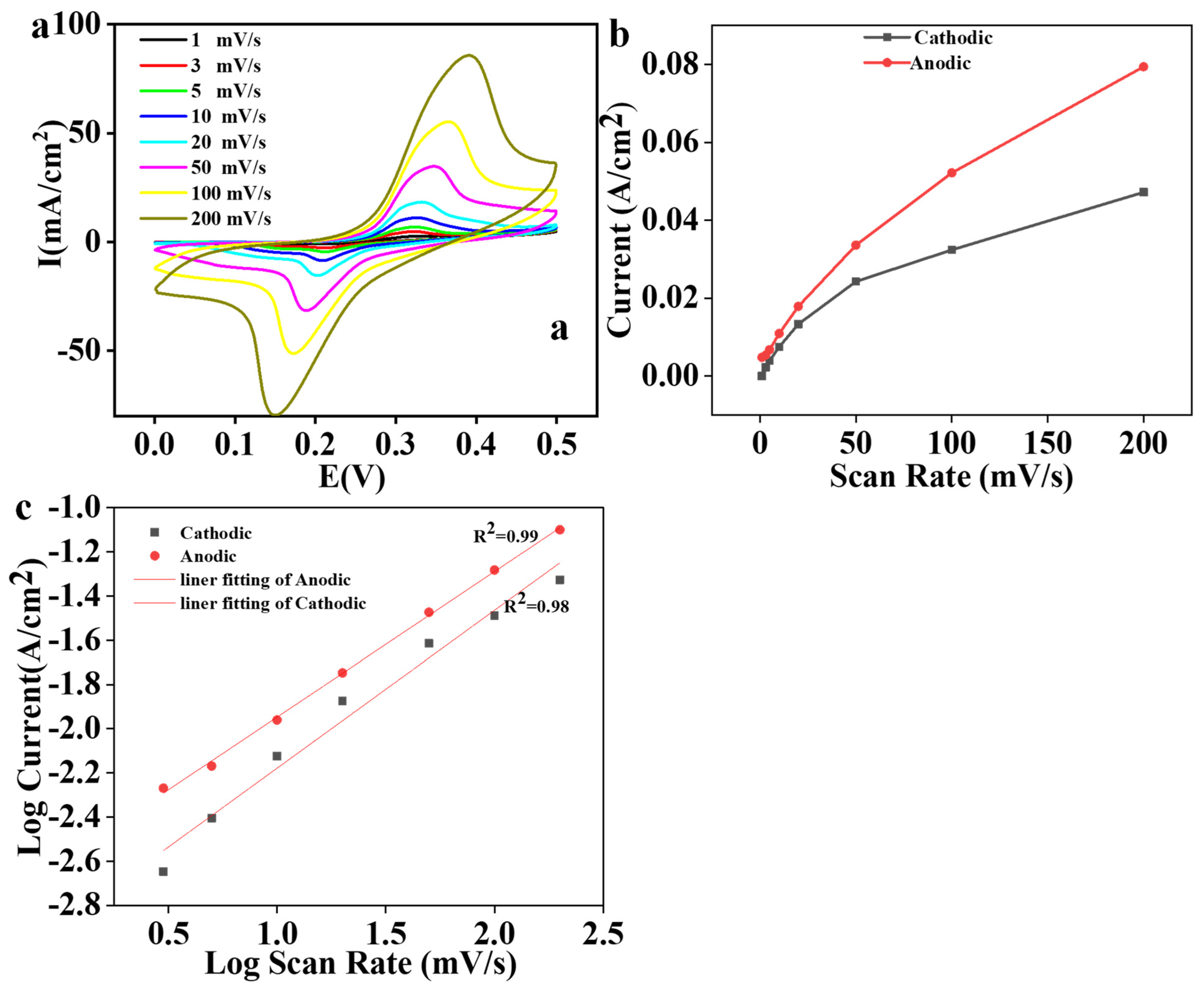
CV analysis was conducted to assess the electrochemical performance of the Ni-BTB electrode at scan speeds of 1–200 mV/s (Figure 7). Figure 7a shows that the CV curves deviate from an ideal rectangular shape, with distinct anodic and cathodic redox peaks. It indicates that Faradaic redox reactions predominantly drive charge storage via a pseudocapacitive, i.e., battery-type, mechanism. As the scan rate increases, the current values rise correspondingly while maintaining the overall curve shape, indicating rapid charge-transfer kinetics and robust electrochemical stability of the Ni-BTB electrode (Figure 7a).
Both anodic and cathodic peak currents show an increase consistently with the scan rate, indicating the effective use of electroactive Ni sites and rapid ion/electron movement within the electrode matrix (Figure 7b). The logarithmic plots of peak current versus scan rate show remarkable linearity, with high correlation coefficients (R2 = 0.98–0.99), indicating that the primary mechanism for charge storage is controlled by surface processes and exhibits a notable pseudocapacitive component (Figure 7c).
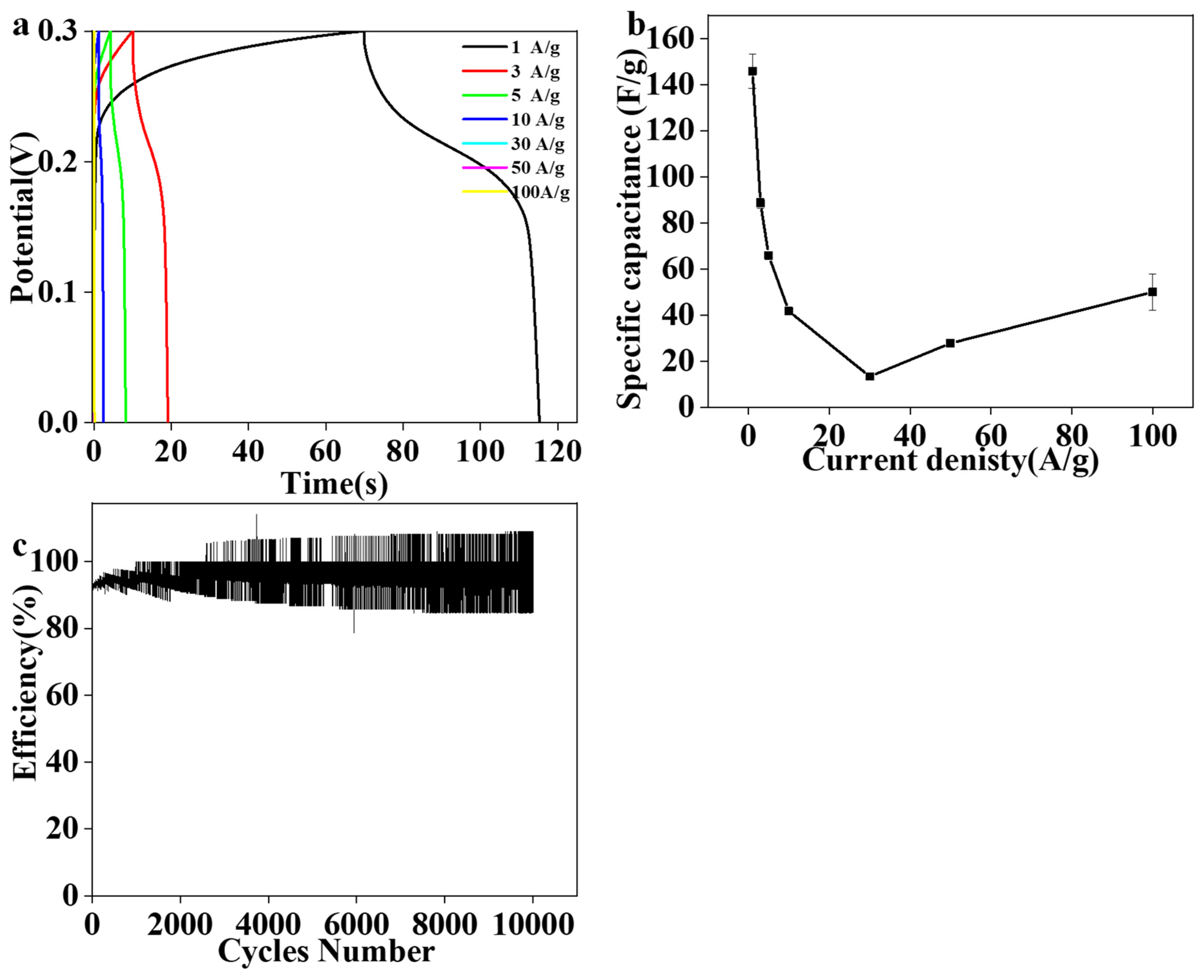
GCD curves were measured at current densities ranging from 1 to 100 A/g to further assess the energy-storage properties of the Ni-BTB electrode (Figure 8). The GCD curves display nearly symmetric charge–discharge behavior with small voltage plateaus, signifying reversible Faradaic reactions and hybrid supercapacitor functionality (Figure 8a). Although specific capacitance decreases gradually at high current densities due to kinetic constraints, the electrode retains substantial capacitance, indicating high-rate performance (Figure 8b).
The stability of the Ni-BTB electrode was examined over 10,000 charge–discharge cycles (Figure 8c). Figure 8c shows that the electrode maintains an efficiency near 100%, underscoring its superior electrochemical reversibility, structural stability, and long-term cycling stability.
A comparative overview of Ni-BTB is provided in Table 2 relative to previously published electrode materials. Ni-BTB exhibits the best electrochemical performance among the tested materials, a capacitance of 156 F/g at 1 A/g, and remarkable cycling durability up to 10,000 cycles. This superior behavior is attributed to its structure, which promotes rapid ion transport, and to its high concentration of active nickel sites, which enhance charge storage. Moreover, robust metal–ligand coordination ensures superior mechanical and chemical stability. While a straightforward electrochemical system using nickel foam as the current collector in a 6 M KOH electrolyte enhances practical utility, conversely, Ni3(BHT)2, a benzenehexathiolate compound, exhibits a much lower capacitance of 29 F/g but maintains considerable cycling stability for up to 8000 cycles [61]. The constrained electrochemical performance of Ni3(BHT)2 can be attributed to the scarcity of active sites and its compact crystal structure, which impede ion diffusion. Consequently, this restricts its potential for high-performance energy storage applications. Conventional oxides such as NiO/CuO exhibit suboptimal capacitance (35.63 F/g) and low stability (5000 cycles) due to their limited surface area and impeded ion transport, highlighting the intrinsic limits of nonporous, dense oxide structures [62]. CNO-ZnO attains a capacitance of 125 F/g but exhibits poor cycling stability, lasting only 2000 cycles, indicating rapid deterioration during successive charge/discharge processes [63]. Co3O4 exhibits modest capacitance (111 F/g); however, it suffers from poor cycling stability (1000 cycles), indicating that the interplay between low active-site density and insufficient structural integrity limits long-term performance [64]. ZnO/CdS provides satisfactory capacitance (139 μF/cm2) with enhanced stability for up to 5000 cycles; yet, the multi-component composition of this system engenders chemical heterogeneities that undermine long-term durability [65]. Ni3(HITP)2, where HITP refers to 2,3,6,7,10,11-hexaiminotriphenylene, is an MOF that exhibited low capacitance (84 F/g) and inadequate cycling stability (2000 cycles), attributable to limited accessibility of active sites, underscoring the essential importance of porosity and framework design in the attainment of high-performance supercapacitors [66]. Collectively, Table 2 highlights the exceptional performance of Ni-BTB, which exceeds that of all other materials in terms of capacitance, long-term stability, and high potential for practical electrochemical applications. The distinctive combination of a hybrid structure, a concentrated distribution of active sites, and robust metal–ligand interactions facilitate rapid ion transport, substantial charge storage, and remarkable cycling longevity. In contrast, most alternative materials exhibit one or more deficiencies, such as reduced charge storage capacity, compromised cycling stability, or structural and chemical limitations, underscoring the importance of framework design and active-site engineering in advancing high-performance supercapacitor materials.

2.4. Electrocatalysis: Oxygen Evolution Reaction (OER)

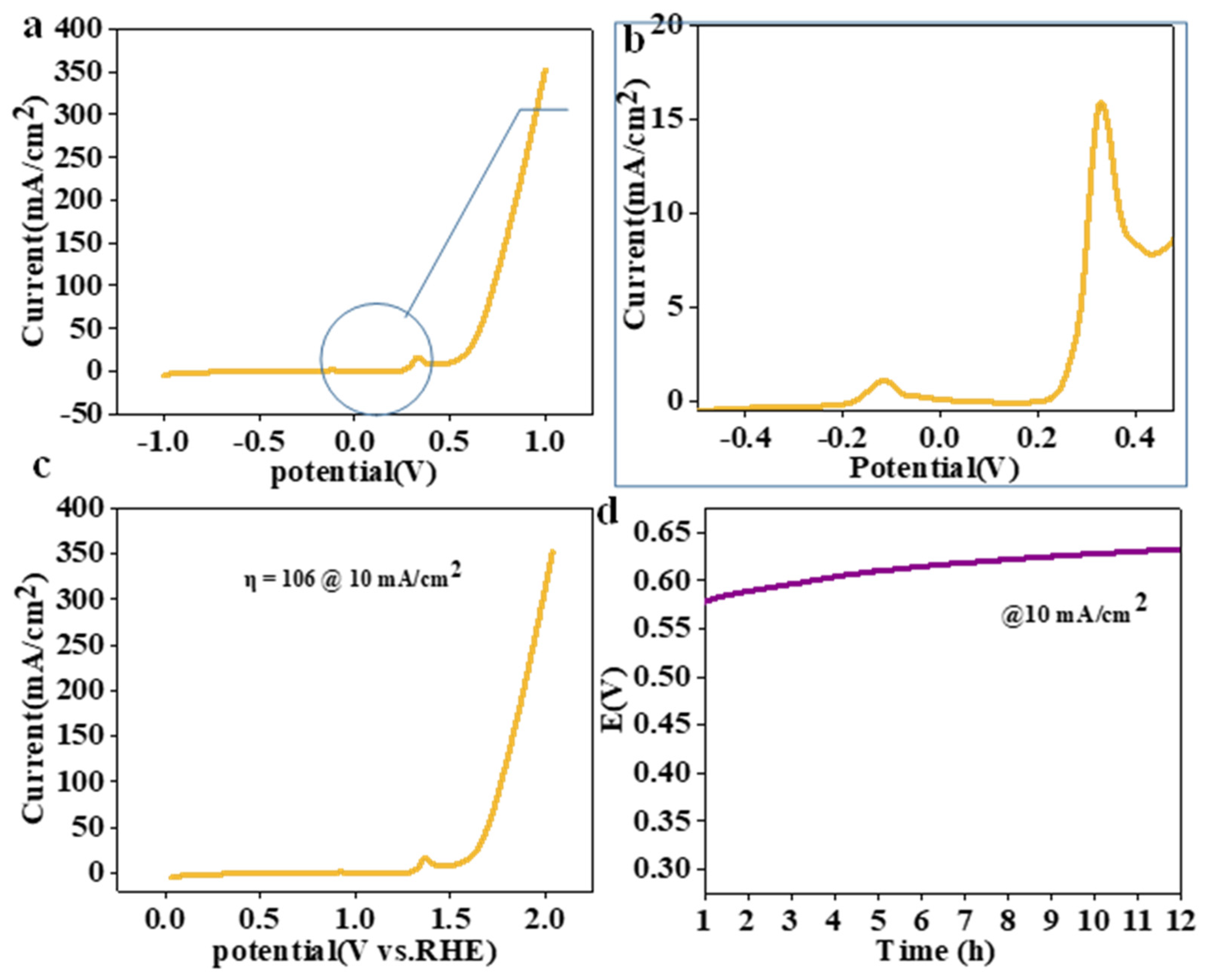
The OER activity of the Ni-BTB framework was systematically evaluated in an alkaline electrolyte using LSV within a standard three-electrode system (Figure 9a–c). All recorded potentials were calculated to RHE scale to ensure reliable comparison (Figure 9c). The LSV curve exhibits an anodic peak at around 0.33 V (vs. Ag/AgCl) for the Ni-BTB electrode (Figure 9a–c). This property concerns the oxidation of Ni species to electrochemically active Ni oxyhydroxide nodes in the Ni-BTB MOF, which serve as the actual catalytic sites for water oxidation. Following this activation phase, a rapid and substantial increase in current density is observed, demonstrating the superior catalytic activity and high OER efficiency of the Ni-BTB framework.
At a current density of 10 mA/cm2, the Ni-BTB catalyst delivers a low overpotential (η) of 106 mV, highlighting its outstanding intrinsic OER activity (Figure 9c). This exceptional performance is primarily attributed to the unique structural features of the Ni-BTB framework, characterized by abundant, readily accessible Ni active centers and π-conjugated aromatic linkers that facilitate effective electron delocalization.
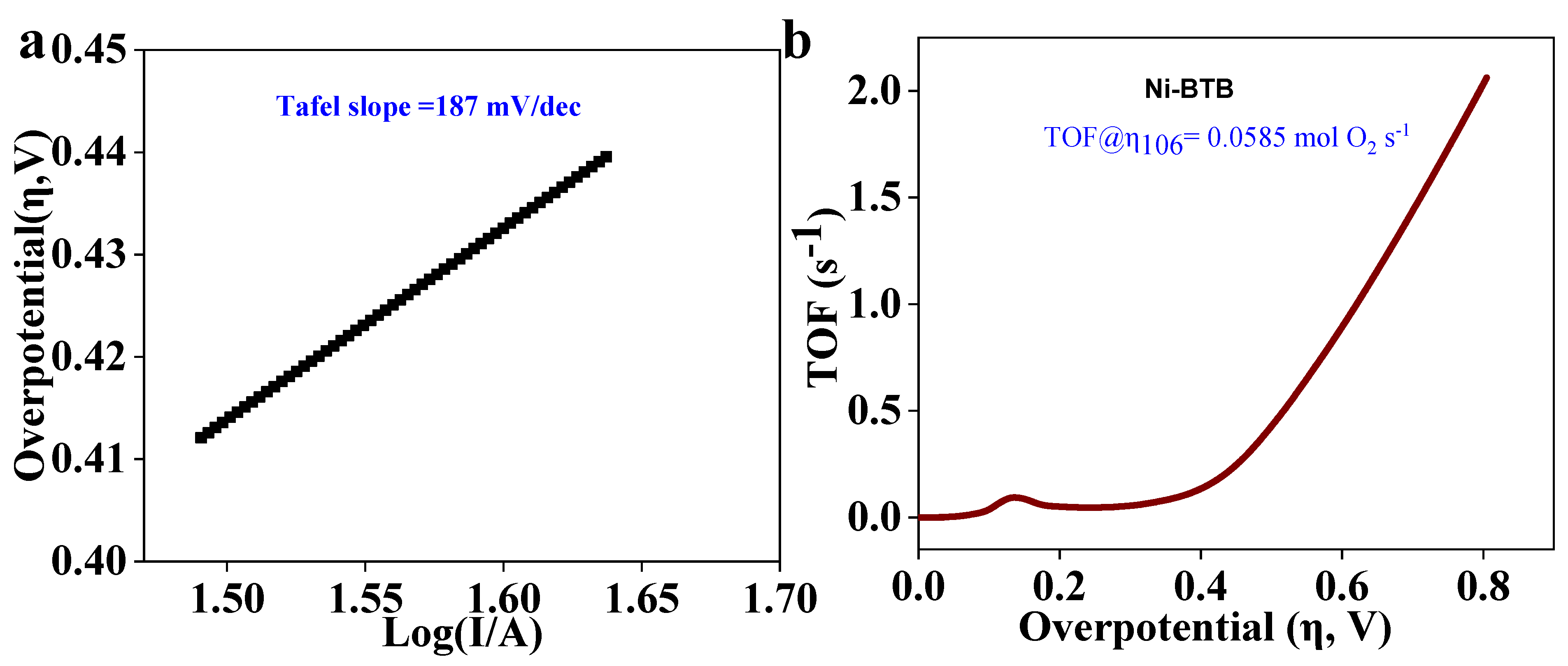
The stability of the Ni-BTB electrode was assessed via continuous electrolysis for 12 h, during which minimal decline was noted, thereby affirming its exceptional longevity and structural integrity under extended OER conditions (Figure 9d). The vigorous and continuous oxygen evolution at the electrode surface further confirms the system’s realistic catalytic efficacy. Ni-BTB demonstrates its viability as a cost-effective and scalable electrocatalyst for industrial water-splitting applications. The Tafel analysis reveals a slope of 187 mV/dec, indicating modest OER kinetics under alkaline conditions (Figure 10a). This value indicates that electron-transfer mechanisms significantly influence the overall reaction rate, consistent with findings on nickel-based OER catalysts, where the generation of high-valence Ni intermediates is often the rate-limiting step.
Additional insight into the inherent catalytic activity was obtained by assessing turnover frequency (TOF) at overpotential, as shown in Figure 10b. The TOF increases significantly with increasing overpotential, indicating enhanced oxygen evolution kinetics under greater driving forces. Significantly, Ni-BTB exhibits a TOF of 0.0585 s−1.
Table 3 summarizes electrocatalysts used for the OER process compared to the Ni-BTB system, highlighting the superior catalytic efficiency of the latter. For instance, Ni/C composites comprising metallic Ni, NiO, and Ni3C encased in a graphitic shell necessitate approximately 170 mV to achieve 10 mA/cm2 [68], whereas ternary NiFeCoOx oxides require around 228 mV at the identical current density [69]. MOF-derived catalysts, such as Ni10Fe-BTC and Ni10Co-BTC, exhibit high overpotentials of 337–378 mV at 10 mA/m2 [70]. Likewise, carbonized NiCuBDC at 800 °C displays an overpotential near 300 mV at 10 mA/cm2, underscoring the constraints of MOF-derived composites in preserving accessible nickel active sites [35]. In contrast, Ni-BTB demonstrates an overpotential of only 106 mV at 10 mA/cm2, surpassing nickel-based electrocatalysts by more than double (Table 3). This exceptional activity stems from the inherent structural and electrical benefits of the Ni-BTB architecture. The nickel MOF was also used without carbonization at 800 °C (Table 3). The inflexible, π-conjugated BTB linker establishes a robust structure that optimizes the accessibility of Ni active sites and promotes swift electron transport via prolonged conjugation pathways. Collectively, these attributes yield enhanced OER kinetics, high catalytic turnover, and remarkable operational stability, establishing Ni-BTB as a reference electrocatalyst for alkaline water oxidation. In comparison, nickel-based hybrid MOF, [Ni3(BPE)4(BTB)2(H2O)2]·2DMF·2H2O (Ni-BTB-BPE; BPE = 1,2-bis(4-pyridyl)ethane), was reported as a bifunctional electrocatalyst for the oxygen reduction reaction (ORR) and OER (Table 3) [71]. BTB ligands form two-dimensional Kagome-type layers with Ni centers, which are further connected by BPE linkers to form a three-dimensional framework. The surface concentration of electrochemically active Ni2+/Ni3+ was determined to be 5.49 nM/cm2. When supported on carbon, Ni-BTB-BPE/C demonstrated a significant ORR mass activity of 108.95 A/gNi at 0.75 V vs. RHE. The catalyst promoted a four-electron ORR pathway, with a turnover frequency of 2.24 electrons [Ni]−1 s−1 at 0.70 V versus RHE, 2.67 times superior to the two-electron pathway, and exhibited proficient bifunctional ORR/OER performance with a bifunctionality index of 0.9 at 1 mA/cm2 [71].

3. Materials and Methods

H3BTB, Ni(NO3)2•6H2O, N, N-dimethylformamide (DMF), poly(vinylidene fluoride) (PVDF), and NaBH4 were purchased from Sigma-Aldrich (Hamburg, Germany).

3.1. Synthesis of Ni-BTB

A mixture of Ni(NO3)2·6H2O (0.025 mmol) and H3BTB (0.0125 mmol) was dissolved in a solvent combination of DMF (10 mL) and distilled water (2 mL) in a vial. Subsequently, two drops of 0.2 N diluted hydrochloric acid were added. The vial was thereafter placed within a Teflon-lined stainless-steel container and heated to 120 °C at a rate of 10 °C/min for 24 h.

3.2. Characterizations

The XRD pattern of Ni-BTB was obtained utilizing a Phillips (Amsterdam, The Netherlands) 1700 X’Pert diffractometer employing Cu Kα radiation. XPS measurements were conducted, using the C 1s peak at 284.4 eV as a calibration reference. A TEM image was captured with a JEOL TEM-2100 instrument from Tokyo, Japan. FT-IR spectrum of NiBTB was collected on a Nicolet (Mountain, WI, USA) spectrophotometer (Model 6700).

3.3. The Production of Hydrogen from NaBH4

Hydrogen production from NaBH4 was assessed utilizing a water displacement technique. Hydrogen displaced water in a 50 mL burette, allowing accurate determination of gas volume over time. The effect of NaBH4 concentration was investigated using the same catalyst without separation between runs. Experiments were conducted using various catalyst loadings (1, 5, 10, 20, and 50 mg) and NaBH4 concentrations (0.2, 0.5, 1.0, 2.0, and 3.0 wt.%). The influence of reaction temperature on hydrogen evolution was examined in a 250 mL conical flask containing 20 mg of Ni-BTB and 1 g of NaBH4, with temperatures varied between 30 and 60 °C. The hydrogen generation rate (HGR, mL H2/g•min) was determined using Equation (1):
HGR   =       V H 2 t × m c a t    
where V H 2 represents the generated hydrogen volume (mL), t corresponds to the reaction duration (min), and mcat denotes the catalyst weight (g).
Arrhenius and Eyring analyses were employed to determine the thermodynamic parameters of the Ni-BTB-catalyzed hydrolysis reaction (Equation (2)) [72]:
L n k = E a R 1 T + L n A
Here, k is the kinetic rate constant, A is the frequency factor, Ea signifies the activation energy, R stands for the gas constant, and T is the absolute temperature (Equation (3)):
L n K T = L n K B h + H R T + S R
Here, KB is a constant, h corresponds to Planck’s constant, and the quantities ΔH and ΔS describe the activation enthalpy and activation entropy.
Calculations were performed to obtain the Gibbs free energy (ΔG) using Equation (4):
G = H S
Catalyst recyclability was assessed by performing four consecutive hydrogen generation reactions using 5 mg of Ni-BTB, with 3 g of NaBH4 added fresh in each run.

3.4. Electrochemical Analyses

For the electrochemical experiments, the working electrode was prepared by mixing the active material (Ni-BTB, 1 mg) with conductive carbon black, and PVDF was mixed with the other components in an 80:10:10 weight ratio using a mortar and pestle. The resulting powder was dispersed in DMF to form a uniform slurry, which was subsequently applied onto a nickel foam substrate (1 × 1.5 cm2). The coated electrodes were then dried in an oven at 80 °C overnight to ensure complete removal of any remaining solvent.
Electrochemical studies were conducted in a three-electrode configuration, with Ni-BTB/Ni foam as the working electrode, Ag/AgCl as the reference electrode, and a platinum plate as the counter electrode. Cyclic voltammetry (CV) and galvanostatic charge–discharge (GCD) measurements were performed with a Corrtest® CS150M electrochemical workstation (Wuhan, China). The CV and GCD experiments were conducted over a potential window of 0–0.5 V (vs. Ag/AgCl) at varying scan rates and current densities. The specific capacitance was calculated from the GCD data according to Equation (5):
Capacitance   =   I × t m × V
where I denotes the discharge current, m represents the total mass of active material loaded on the electrode, V denotes the potential window, and t denotes the discharge time.
The electrode’s long-term stability was tested through 10,000 continuous charge–discharge cycles at a current density of 10 A/g utilizing a Corrtest® CS150M workstation (China).
The linear sweep voltammetry (LSV) measurements were carried out at a scan rate of 5 mV/s, and the obtained potentials were converted to the reversible hydrogen electrode (RHE) scale using Equation (6):
ERHE = Emeasured + Eref + 0.059 × pH
The ηOER for the oxygen evolution reaction was determined according to Equation (7):
ηOER = ERHE − 1.23 V
The turnover frequency (TOF) was determined by estimating the density of active catalytic sites from CV experiments performed in 6 M KOH over a 0–0.5 V potential range (vs. Ag/AgCl) at scan rates ranging from 1 to 200 mV/s. The peak current for the anodic redox reaction showed a linear correlation with the scan rate, confirming a surface-governed electrochemical process. The slope obtained from the linear regression was subsequently evaluated using the following Equation (8):
Slope   =   n 2 F 2 A Γ 0 4 R T
Here, n denotes the number of electrons involved in oxidation, which is 1 for the Ni2+/Ni3+ redox pair in Ni-BTB. F stands for the Faraday constant (96,485 C/mol), A indicates the electrode’s surface area, and Γ0 defines the coverage of active sites on the electrode surface (mol/cm2). R denotes the ideal gas constant, while T corresponds to the absolute temperature.
Subsequently, TOF values were evaluated using the formula presented in Equation (9):
TOF   =   J A 4 F m
Here, J represents the current density, and A corresponds to the geometric area of the working electrode; the factor 4 accounts for the four-electron transfer required for the evolution of one mole of O2, while m represents the total amount of electrochemically active sites in moles.
To assess the catalyst’s durability, chronopotentiometric measurements were performed at a steady current density of 10 mA/cm2 for 12 h of continuous operation.

4. Conclusions

In this study, Ni-BTB was successfully prepared and demonstrated multifunctionality for advanced energy applications, exhibiting excellent catalytic activity for hydrogen production via NaBH4 hydrolysis, achieving a peak rate of 9542 mL H2/g•min under optimal conditions, and showing remarkable stability and reusability across multiple cycles. In addition to hydrogen production, Ni-BTB functioned as an effective supercapacitor electrode, achieving a specific capacitance of 156 F/g at a current density of 1 A/g, while retaining nearly all its initial capacitance after 10,000 cycles, indicating excellent cycling stability, exceptional electrochemical stability, and longevity. Furthermore, Ni-BTB exhibited enhanced electrocatalytic performance for OER, achieving an overpotential of 106 mV at 10 mA/cm2 while maintaining stable operation for 12 h. These results demonstrate that Ni-BTB is a resilient, efficient, and adaptable platform that can integrate hydrogen release from hydride hydrolysis, oxygen evolution, and electrochemical energy storage within a single material. Its multifunctional capabilities underscore its significant promise for next-generation integrated renewable energy conversion and storage systems.

Author Contributions

Z.H.H.: Methodology, Investigation, Formal analysis, Data curation, Writing—review & editing, and Writing—original draft; L.H.A.-R.: Visualization, Validation, Supervision, and Writing—review & editing; S.G.-R.: Supervision and Writing—review & editing; H.N.A.: Visualization, Validation, Supervision, Software, Resources, Project administration, Methodology, Funding acquisition, Investigation, Formal analysis, Data curation, Conceptualization, Writing—review & editing, and Writing—original draft. All authors have read and agreed to the published version of the manuscript.

Funding

This work was supported and funded by the Deanship of Scientific Research at Imam Mohammad Ibn Saud Islamic University (IMSIU) (grant number IMSIU-DDRSP2603).

Data Availability Statement

All data are presented in the manuscript.

Conflicts of Interest

The authors declare no competing interests.

References

  1. Zhu, Y.; Raimi, D.; Joiner, E.; Holmes, B.; Prest, B.C. Global Energy Outlook 2025: Headwinds and Tailwinds in the Energy Transition; Resources for the Future: Washington, DC, USA, 2025. [Google Scholar]
  2. Ozdemir, R.; Unlu, D. Investigation of the efficiency of hydrogen production from sodium borohydride hydrolysis with a novel biobased catalyst “Bio-MOF”. Int. J. Hydrogen Energy 2025, 142, 875–885. [Google Scholar] [CrossRef]
  3. Zhang, L.; Hu, X.; Wang, Z.; Sun, F.; Dorrell, D.G. A review of supercapacitor modeling, estimation, and applications: A control/management perspective. Renew. Sustain. Energy Rev. 2018, 81, 1868–1878. [Google Scholar] [CrossRef]
  4. Rehman, A.U.; Sanjari, M.J.; Elavarasan, R.M.; Jamal, T. Sustainability-aligned pathways for energy transition: A review of low-carbon energy network solutions. Renew. Sustain. Energy Rev. 2026, 226, 116428. [Google Scholar] [CrossRef]
  5. Konovalov, D.; Adams, T.A. Hydrogen power development: A comparative review of national strategies and the role of energy in scaling green hydrogen. Renew. Sustain. Energy Rev. 2026, 226, 116378. [Google Scholar] [CrossRef]
  6. Chen, K.; Lau, M.Y.; Luo, X.; Huang, J.; Ouyang, L.; Yang, X.-S. Research progress in solid-state hydrogen storage alloys: A review. J. Mater. Sci. Technol. 2026, 246, 256–289. [Google Scholar] [CrossRef]
  7. Serik, A.; Kuspanov, Z.; Daulbayev, C. Cost-effective strategies and technologies for green hydrogen production. Renew. Sustain. Energy Rev. 2026, 226, 116242. [Google Scholar] [CrossRef]
  8. Oussmou, B.; Sigue, S.; Abderafi, S. Review of green hydrogen production technologies, to choose the optimal process of electrolysis-renewable energy. Renew. Sustain. Energy Rev. 2026, 225, 116205. [Google Scholar] [CrossRef]
  9. Wu, X.; Chen, Y.; Ma, Y. Research progress of solid oxide electrolysis cell system: Dynamic modeling and control. Renew. Sustain. Energy Rev. 2026, 225, 116166. [Google Scholar] [CrossRef]
  10. Barba, J.; Cañas-Carretón, M.; Carrión, M.; Hernández-Labrado, G.R.; Merino, C.; Muñoz, J.I.; Zárate-Miñano, R. Integrating Hydrogen into Power Systems: A Comprehensive Review. Sustainability 2025, 17, 6117. [Google Scholar] [CrossRef]
  11. Zhang, J.; Gu, M.; Chen, X. Supercapacitors for renewable energy applications: A review. Micro Nano Eng. 2023, 21, 100229. [Google Scholar] [CrossRef]
  12. Reda, B.; Elzamar, A.A.; AlFazzani, S.; Ezzat, S.M. Green hydrogen as a source of renewable energy: A step towards sustainability, an overview. Environ. Dev. Sustain. 2024, 27, 29213–29233. [Google Scholar] [CrossRef]
  13. Guan, S.; Shen, S.; Dou, Y.; Chen, W.; Shen, J.; Ye, B.; Cui, W.-G.; Zhong, W.; Li, Z.; Pan, H.; et al. Progress and perspectives on hydrogen storage and release in the negative hydrogen medium. Energy Environ. Sci. 2025, 18, 9324–9372. [Google Scholar] [CrossRef]
  14. Hashem, Z.H.; Abdel-Rahman, L.H.; Gómez-Ruiz, S.; Abdelhamid, H.N. Cerium-Organic Framework (CeOF) for hydrogen generation via the hydrolysis of NaBH4. Results Chem. 2024, 7, 101412. [Google Scholar] [CrossRef]
  15. Hashem, Z.H.; Abdel-Rahman, L.H.; Gómez-Ruiz, S.; Abdelhamid, H.N. NaBH4 Hydrolysis for Hydrogen Generation over Metal-Organic Frameworks (Cu-BTC). Sohag J. Sci. 2023, 8, 377–383. [Google Scholar] [CrossRef]
  16. Liu, B.; Li, Z. A review: Hydrogen generation from borohydride hydrolysis reaction. J. Power Sources 2009, 187, 527–534. [Google Scholar] [CrossRef]
  17. Dragan, M. Hydrogen Storage in Complex Metal Hydrides NaBH4: Hydrolysis Reaction and Experimental Strategies. Catalysts 2022, 12, 356. [Google Scholar] [CrossRef]
  18. Abdelhamid, H.N. A review on hydrogen generation from the hydrolysis of sodium borohydride. Int. J. Hydrogen Energy 2021, 46, 726–765. [Google Scholar] [CrossRef]
  19. Long, B.; Chen, J.; Sharshir, S.W.; Ibrahim, L.; Zhou, W.; Wang, C.; Wang, L.; Yuan, Z. The mechanism and challenges of cobalt-boron-based catalysts in the hydrolysis of sodium borohydride. J. Mater. Chem. A 2024, 12, 5606–5625. [Google Scholar] [CrossRef]
  20. Xu, D.; Zhang, H.; Ye, W. Hydrogen production from sodium borohydride. Prog. Chem. 2007, 19, 1598–1605. [Google Scholar]
  21. Abdelhamid, H.N. Dehydrogenation of sodium borohydride using cobalt embedded zeolitic imidazolate frameworks. J. Solid State Chem. 2021, 297, 122034. [Google Scholar] [CrossRef]
  22. Abdelhamid, H.N. Zeolitic imidazolate frameworks (ZIF-8, ZIF-67, and ZIF-L) for hydrogen production. Appl. Organomet. Chem. 2021, 35, e6319. [Google Scholar] [CrossRef]
  23. Abdelhamid, H.N. Hierarchical porous ZIF-8 for hydrogen production via the hydrolysis of sodium borohydride. Dalton Trans. 2020, 49, 4416–4424. [Google Scholar] [CrossRef]
  24. Liu, Y.; Wang, X.; Deng, S.; Liu, G. Ce-doping modulates the electronic structure of Co-based metal-organic frameworks for oxygen evolution reaction. Inorg. Chem. Commun. 2025, 178, 114628. [Google Scholar] [CrossRef]
  25. Khandekar, R.V.; Patil, S.S.; Sutar, R.B.; Jamadar, A.S.; Dongale, T.D.; Deshpande, N.G.; Yadav, J.B. Scalable Co-MOF thin films for OER: Achieving low overpotential and enhanced catalytic activity via surface reconstruction. Int. J. Hydrogen Energy 2025, 111, 123–133. [Google Scholar] [CrossRef]
  26. Yu, X.; Li, C.; Zheng, L.; Zhou, B.; Li, R.; Liu, R. Multi-heterojunction engineering in FeCoW–S/NF for ultra-low-overpotential hydrogen and oxygen evolution reactions. Int. J. Hydrogen Energy 2025, 197, 152665. [Google Scholar] [CrossRef]
  27. Mohammed-Ibrahim, J. A review on NiFe-based electrocatalysts for efficient alkaline oxygen evolution reaction. J. Power Sources 2020, 448, 227375. [Google Scholar] [CrossRef]
  28. Ghosh, S.K.; Rahaman, H. Noble Metal–Manganese Oxide Hybrid Nanocatalysts. In Noble Metal-Metal Oxide Hybrid Nanoparticles: Fundamentals and Applications; Woodhead Publishing: Cambridge, UK, 2019; pp. 313–340. [Google Scholar] [CrossRef]
  29. Li, Q.; Mahmood, N.; Zhu, J.; Hou, Y.; Sun, S. Graphene and its composites with nanoparticles for electrochemical energy applications. Nano Today 2014, 9, 668–683. [Google Scholar] [CrossRef]
  30. Borenstein, A.; Hanna, O.; Attias, R.; Luski, S.; Brousse, T.; Aurbach, D. Carbon-based composite materials for supercapacitor electrodes: A review. J. Mater. Chem. A 2017, 5, 12653–12672. [Google Scholar] [CrossRef]
  31. Winter, M.; Barnett, B.; Xu, K. Before Li Ion Batteries. Chem. Rev. 2018, 118, 11433–11456. [Google Scholar] [CrossRef] [PubMed]
  32. Al Kiey, S.A.; Algethami, F.K.; Abdelhamid, H.N. Ferric Oxide@Carbon-Derived from Fe-MOF for Supercapacitor. Arab. J. Sci. Eng. 2025, 1–12. [Google Scholar] [CrossRef]
  33. Hassan, Z.M.; Elantabli, F.M.; Mohamed, S.G.; Abdelhamid, H.N. Metal-organic frameworks (MOFs)-derived zinc selenide and cobalt selenide for asymmetric supercapacitors. J. Energy Storage 2026, 141, 119311. [Google Scholar] [CrossRef]
  34. Abdelhamid, H.N.; Ibrahim, M.; Yahia, M. Supercapacitor Performance Using ZIF-L@PIM-1-Derived ZnO@N-Doped Carbon Electrodes. J. Appl. Polym. Sci. 2025, 142, e57702. [Google Scholar] [CrossRef]
  35. Abdelhamid, H.N. Ni/Cu metal-organic frameworks (MOFs)-derived NiO/CuO@C for supercapacitors and oxygen evolution reaction. Surfaces Interfaces 2025, 76, 107923. [Google Scholar] [CrossRef]
  36. Alsaiari, R.A.; Gomaa, I.; Abdelhamid, H.N. Eco-Engineered Co3O4/CoO/C Nanohybrid for Supercapacitors and Efficient Water Splitting. Arab. J. Sci. Eng. 2025, 1–14. [Google Scholar] [CrossRef]
  37. Algethami, F.K.; Al Kiey, S.A.; Abdelhamid, H.N. CuO Nanoparticles on Carbon from Copper-Based Metal–Organic Frameworks (MOF) for Energy Storage. J. Inorg. Organomet. Polym. Mater. 2025, 1–13. [Google Scholar] [CrossRef]
  38. Anjana, P.; Aminabhavi, T.M. Supercapattery: Energy storage devices combining functionalities of battery electrodes and supercapacitor electrodes. J. Energy Storage 2025, 134, 118265. [Google Scholar] [CrossRef]
  39. Xiong, C.; Su, Y. Recent Progress of Transition Metal-Based Oxide Composite Electrode Materials in Supercapacitor. Adv. Sustain. Syst. 2025, 9, 2400578. [Google Scholar] [CrossRef]
  40. Wang, L.; Gao, X.; Wang, D.; Shang, H.; Zhao, Y.; Zhang, B. Nickel-carbon composites toward supercapacitor and self-charging systems: A review. Fuel 2025, 381, 133639. [Google Scholar] [CrossRef]
  41. Seenivasan, S.; Adhikari, S.; Sivagurunathan, A.T.; Kim, D.-H. Supercapatteries: Unlocking the potential of battery-supercapacitor fusion. Energy Environ. Sci. 2025, 18, 1054–1095. [Google Scholar] [CrossRef]
  42. Gedrich, K.; Senkovska, I.; Klein, N.; Stoeck, U.; Henschel, A.; Lohe, M.R.; Baburin, I.A.; Mueller, U.; Kaskel, S. A Highly Porous Metal–Organic Framework with Open Nickel Sites. Angew. Chem. Int. Ed. Engl. 2010, 49, 8489–8492. [Google Scholar] [CrossRef]
  43. Yaghi, O.M.; Kalmutzki, M.J.; Diercks, C.S. Introduction to Reticular Chemistry: Metal-Organic Frameworks and Covalent Organic Frameworks; Wiley: Hoboken, NJ, USA, 2019. [Google Scholar] [CrossRef]
  44. Zhou, H.-C.; Kitagawa, S. Metal–Organic Frameworks (MOFs). Chem. Soc. Rev. 2014, 43, 5415–5418. [Google Scholar] [CrossRef]
  45. Xu, Y.; Li, Q.; Guo, X.; Zhang, S.; Li, W.; Pang, H. Metal organic frameworks and their composites for supercapacitor application. J. Energy Storage 2022, 56, 105819. [Google Scholar] [CrossRef]
  46. Wu, S.; Cai, D.; Tian, Z.; Guo, L.; Wang, Y. One-step synthesis of NiCo-MOF@LDH hybrid nanosheets for high-performance supercapacitor. J. Energy Storage 2024, 89, 111670. [Google Scholar] [CrossRef]
  47. Siwach, P.; Gaba, L.; Dahiya, S.; Punia, R.; Maan, A.; Singh, K.; Ohlan, A. Recent progress in conjugated polymers composites with metal-organic frameworks as electrode materials for supercapacitors. Appl. Surf. Sci. Adv. 2023, 19, 100555. [Google Scholar] [CrossRef]
  48. Pan, Y.; Zhou, L.; Liu, J. MOFs-carbon nanocomposites for supercapacitors. In Metal-Organic Framework-Based Nanomaterials for Energy Conversion and Storage; Elsevier: Amsterdam, The Netherlands, 2022; pp. 413–437. [Google Scholar] [CrossRef]
  49. Wang, K.B.; Xun, Q.; Zhang, Q. Recent progress in metal-organic frameworks as active materials for supercapacitors. Energy Chem. 2020, 2, 100025. [Google Scholar] [CrossRef]
  50. Yan, Y.; Huang, M.; Wang, Y.; He, D.; He, J. M-Ni-Co MOF (M=Zn, Fe, Mn) for high-performance supercapacitors by adjusting its morphology. Heliyon 2024, 10, e25586. [Google Scholar] [CrossRef] [PubMed]
  51. Tiwari, A.P.; Chandra, P.; Rahman, M.S.; Mirica, K.A.; Scheideler, W.J. Optimizing active sites via chemical bonding of 2D metal–organic frameworks and MXenes for efficient hydrogen evolution reaction activity. Nanoscale 2025, 17, 11028–11036. [Google Scholar] [CrossRef] [PubMed]
  52. Sailaja, B.B.V.; Veluru, S.; Voosala, C.; Sirisha, D.; Hamzah, H.T.; Abdulla, T. Metal-Organic Frameworks (MOFS): Fundamental, Properties, and Applications. In Futuristic Trends in Chemical Material Sciences & Nano Technology; IIP Proceedings: Chikmagalur, India, 2024. [Google Scholar]
  53. Mani, P.; Bandyopadhyay, A.; Mukharjee, P.K.; Nath, R.C.; Pati, S.K.; Mandal, S. Long-range ferromagnetism in nickel-based hybrid structure with semiconductor behavior. Chem. Commun. 2019, 55, 5211–5214. [Google Scholar] [CrossRef]
  54. Tu, T.N.; Scheer, M. A novel crystalline template for the structural determination of flexible chain compounds of nanoscale length. Chem 2023, 9, 227–241. [Google Scholar] [CrossRef]
  55. Tu, T.N.; Scheer, M. CCDC 2160411: Experimental Crystal Structure Determination; CCDC: Cambridge, UK, 2023. [Google Scholar] [CrossRef]
  56. Agarwal, M.; Pal, N.; Kushwaha, P.; Dohare, R.K. Waste to value added: Cu–Ni MOF catalyst synthesized from waste plastic for enhanced hydrogen generation and electrochemical energy storage. Chem. Pap. 2025, 79, 4943–4961. [Google Scholar] [CrossRef]
  57. Bozkurt, G.; Özer, A.; Yurtcan, A.B. Hydrogen generation from sodium borohydride with Ni and Co based catalysts supported on Co3O4. Int. J. Hydrogen Energy 2018, 43, 22205–22214. [Google Scholar] [CrossRef]
  58. Dos Reis, T.M.; Alves, A.C.D.C.; da Silva, V.N.; Siqueira, G.O.; de Andrade, F.V.; de Lima, G.M.; Moreira, R.P.L. Synthesis of Ecofriendly Bimetallic Pt/Ni Nanoparticles on Evolution from NaBH4. Processes 2024, 12, 2340. [Google Scholar] [CrossRef]
  59. Farrag, M. Synthesis and characterization of Co, Ni, Zr and Cu MOFs based on 1,4-naphthalenedicarboxylic acid linker for hydrogen generation. Sci. Rep. 2025, 15, 13–15. [Google Scholar] [CrossRef]
  60. Torlak, Y.; Halvacı, E.; Akkoyun, B.; Aygün, A.; Sen, F. Hydrogen generation from NaBH4 solutions using a molecular mixed-valence nickel-substituted K7[NiIIINiII(H2O)W11O39]·15H2O catalyst. RSC Adv. 2025, 15, 34510–34523. [Google Scholar] [CrossRef]
  61. Banda, H.; Dou, J.-H.; Chen, T.; Libretto, N.J.; Chaudhary, M.; Bernard, G.M.; Miller, J.T.; Michaelis, V.K.; Dincă, M. High-Capacitance Pseudocapacitors from Li+ Ion Intercalation in Nonporous, Electrically Conductive 2D Coordination Polymers. J. Am. Chem. Soc. 2021, 143, 2285–2292. [Google Scholar] [CrossRef]
  62. Chatterjee, S.; Ray, A.; Mandal, M.; Das, S.; Bhattacharya, S.K. Synthesis and Characterization of CuO-NiO Nanocomposites for Electrochemical Supercapacitors. J. Mater. Eng. Perform. 2020, 29, 8036–8048. [Google Scholar] [CrossRef]
  63. Mohapatra, D.; Parida, S.; Badrayyana, S.; Singh, B.K. High performance flexible asymmetric CNO-ZnO//ZnO supercapacitor with an operating voltage of 1.8 V in aqueous medium. Appl. Mater. Today 2017, 7, 212–221. [Google Scholar] [CrossRef]
  64. Zhu, T.; Chen, J.S.; Lou, X.W. Shape-controlled synthesis of porous Co3O4 nanostructures for application in supercapacitors. J. Mater. Chem. 2010, 20, 7015–7020. [Google Scholar] [CrossRef]
  65. Raza, A.; Sayeed, K.; Naaz, A.; Muaz, M.; Islam, S.N.; Rahaman, S.; Sama, F.; Pandey, K.; Ahmad, A. Green Synthesis of ZnO Nanoparticles and Ag-Doped ZnO Nanocomposite Utilizing Sansevieria trifasciata for High-Performance Asymmetric Supercapacitors. ACS Omega 2024, 9, 32444–32454. [Google Scholar] [CrossRef] [PubMed]
  66. Bi, S.; Banda, H.; Chen, M.; Niu, L.; Chen, M.; Wu, T.; Wang, J.; Wang, R.; Feng, J.; Chen, T.; et al. Molecular understanding of charge storage and charging dynamics in supercapacitors with MOF electrodes and ionic liquid electrolytes. Nat. Mater. 2020, 19, 552–558. [Google Scholar] [CrossRef]
  67. Eswaramoorthy, N.; Rajendran, S.; Kumar, B.A.; Nallusamy, S.; Rengasamy, M.; Selvaraj, Y.; Sangaraju, S.; Krishnan, T.; Kumaresan, G.; Rajaram, K. Influence of ZnO/MWCNTs based hybrid electrodes for boosting the performance of photovoltaic and supercapacitor devices. Mater. Chem. Phys. 2024, 316, 129049. [Google Scholar] [CrossRef]
  68. Mijowska, E.; Dymerska, A.; Leniec, G.; Maślana, K.; Aleksandrzak, M.; Zairov, R.; Nazmutdinov, R.; Chen, X. Ni-based compounds in multiwalled graphitic shell for electrocatalytic oxygen evolution reactions. Adv. Compos. Hybrid Mater. 2024, 7, 172. [Google Scholar] [CrossRef]
  69. Ahmed, K.W.; Fowler, M. Performance Evaluation and Durability Analysis of NiFeCoOx Catalysts for Alkaline Water Electrolysis in Anion Exchange Membrane Electrolyzers. Catalysts 2024, 14, 322. [Google Scholar] [CrossRef]
  70. Sondermann, L.; Jiang, W.; Shviro, M.; Spieß, A.; Woschko, D.; Rademacher, L.; Janiak, C. Nickel-Based Metal-Organic Frameworks as Electrocatalysts for the Oxygen Evolution Reaction (OER). Molecules 2022, 27, 1241. [Google Scholar] [CrossRef] [PubMed]
  71. Mani, P.; Sheelam, A.; Karthik, P.E.; Sankar, R.; Ramanujam, K.; Mandal, S. Nickel-Based Hybrid Material for Electrochemical Oxygen Redox Reactions in an Alkaline Medium. ACS Appl. Energy Mater. 2020, 3, 6408–6415. [Google Scholar] [CrossRef]
  72. Arrhenius equation. In IUPAC Compendium of Chemical Terminology; International Union of Pure and Applied Chemistry (IUPAC): Research Triangle Park, NC, USA, 2008. [CrossRef]
Figure 1. A schematic representation of the hydrothermal synthesis process for Ni-BTB and its multifunctional applications in energy storage and catalysis.
Catalysts 16 00283 g001
Figure 2. Characterization of Ni-BTB using (a) XRD and (b) FT-IR.
Catalysts 16 00283 g002
Figure 3. TEM image of Ni-BTB.
Catalysts 16 00283 g003
Figure 4. XPS pattern of Ni-BTB, (a) survey, (b) O1s, and (c) C1s.
Catalysts 16 00283 g004
Figure 5. Hydrogen production via (a) NaBH4 hydrolysis, (b) HGR measurements, and (c,d) assessment of Ni-BTB recyclability.
Catalysts 16 00283 g005
Figure 6. (a) Hydrogen generation at different temperatures (30–60 °C), (b) HGR vs. temperature, (c) Arrhenius diagram, and (d) Eyring diagram.
Catalysts 16 00283 g006
Figure 7. (a) CV measurements of Ni-BTB at varying scan rates alongside (b,c) graphs of current as a function of scan rate.
Catalysts 16 00283 g007
Figure 8. (a) GCD curves of Ni-BTB recorded at various current densities, (b) corresponding specific capacity values at different current densities, and (c) the cycling stability of the three-electrode system at 10 A/g.
Catalysts 16 00283 g008
Figure 9. LSV analysis for (a,b) potential vs. Ag/AgCl, (c) vs. RHE, and (d) Durability for OER using chronopotentiometry.
Catalysts 16 00283 g009
Figure 10. (a) Tafel slope, and (b) TOF versus overpotential.
Catalysts 16 00283 g010
Table 1. Catalyst performance comparison in NaBH4 hydrolysis.
CatalystsCat. (mg)Temperature
(°C)
Reaction ConditionsHGR (mL H2/g•min)Ref.
Cu–Ni–PET MOF 10050 °C0.25 g NaBH4
(ethanol)
2650[56]
Cu–Ni–C MOF10050 °C2150[56]
Ni-Co3O45025 °C10 wt% NaBH4
10 wt% NaOH
1925[57]
Ni1Pt3/KNbO32541.9 °C0.5 mmol NaBH42068[58]
Ni(1,4-NDC)5060 °C50 mM NaBH41333[59]
Ni-POM2.525 °C300 mM NaBH4610.2[60]
Ni-BTB125 °C3 wt% NaBH44640This work
2060 °C1 wt% NaBH49542
Note: NDC: Naphthalenedicarboxylate; POM: Polyoxometalate.
Table 2. Electrochemical performance comparison of Ni-BTB and other reported electrode materials.
MaterialsElectron CollectorElectrolyteCapacitance (F/g)Recyclability (Cycles)Ref.
CNO-ZnOCotton clothes3 M KOH125 at 1 A/g2000 [63]
Co3O4Glassy carbon2MKOH111 at 0–0.5 mV/s1000 [64]
NiO/CuOCarbon support 1M Na2SO435.63 at 0.3 A/g1000 [62]
ZnO/3 wt.% MWCNTsCarbon cloth1M Na2SO4115.72 at 5 mV/s [67]
ZnO/CdSfluorine-doped tin oxideIonic liquid139 μF/g5000[65]
Ni3 (HITP)2 MOFNickle foam[EMIM][BF4] ionic liquid84 at 5 mV/s2000 [66]
Ni3 (BHT)2Nickel foam1 M NEt4BF4 in acetonitrile29 at 5 mV/s8000 [61]
Ni-BTBNickel foam6 M KOH156 at 1 A/g 10,000This work
Notes: HITP, 2,3,6,7,10,11-hexaiminotriphenylene; BHT: benzenehexathiolate.
Table 3. Summary for electrocatalysts used for OER.
MaterialsCompositionsSynthesis MethodConditionElectrolyteOverpotential (mV) at 10 mA/cm2Tafel Slope
(mV·dec−1)
TOF (s−1)Ref.
NiO/CuO@CSolvothermal
Carbonization
Solvothermal
Carbonization
100 °C for 5 h
800 °C for 3h
6 M KOH300600.21[35]
Ni/NiO/Ni3C_graphitic shellNi
NiO,
Ni3C
Graphitic shell
Heating heating at 4 °C/min under nitrogen flow to 600 °C1.0 M KOH170 49 52.8 [68]
NiFeCoOxNi
Fe
Co
Precipitation
Calcination
Room temperature, alkaline, 2h
300 °C for 5 h
1 M KOH228511 [69]
Ni10Co-BTC Ni
Co
BTC
Solvothermal170 °C for 48 h1 M KOH34647 [70]
[Ni3(BPE)4(BTB)2(H2O)2]·2DMF·2H2O BTB
BPE, 1,2-bis(4-pyridyl) ethane]
Solvothermal100 °C for 3 days0.1
M KOH
700 198 0.84 [71]
NiBTBNi
BTB
SolvothermalHeating at 120 °C for 24 h6 M KOH106 1870.0585This study
Notes: BTC, 1,3,5-benzenetricarboxylate.
Disclaimer/Publisher’s Note: The statements, opinions and data contained in all publications are solely those of the individual author(s) and contributor(s) and not of MDPI and/or the editor(s). MDPI and/or the editor(s) disclaim responsibility for any injury to people or property resulting from any ideas, methods, instructions or products referred to in the content.