
Article

Eco-Friendly Synthesis of Zn-Doped CuO Nanoparticles Using Aloysia citrodora Extract for Highly Efficient Fenton-like Dye Degradation

1
Laboratory for Research in Medicine and Sustainable Development ReMeDD, Faculty of Process Engineering, University of Salah Boubnider, Constantine 25000, Algeria
2
Department of Industrial Chemistry, University of Biskra, Biskra 07000, Algeria
3
Physics Departement, Faculty of Science King Abdulaziz, University Jeddah, Jeddah 21589, Saudi Arabia
4
College of Engineering, Imam Mohammad Ibn Saud Islamic University (IMSIU), Riyadh 11432, Saudi Arabia
5
Ecole Nationale Supérieure de Chimie de Rennes, CNRS, ISCR, University Rennes, F-35000 Rennes, France
6
School of Engineering, Merz Court, Newcastle University, Newcastle upon Tyne NE1 7RU, UK
7
Laboratory of Biomaterials and Transport Phenomena (LBMTP), University Yahia Fares, Medea 26000, Algeria
*
Authors to whom correspondence should be addressed.
Catalysts 2026, 16(4), 352; https://doi.org/10.3390/catal16040352
Submission received: 10 March 2026 / Revised: 29 March 2026 / Accepted: 6 April 2026 / Published: 14 April 2026

Abstract

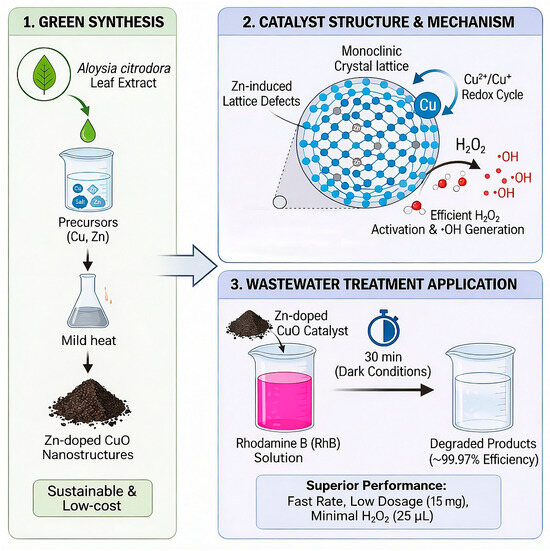
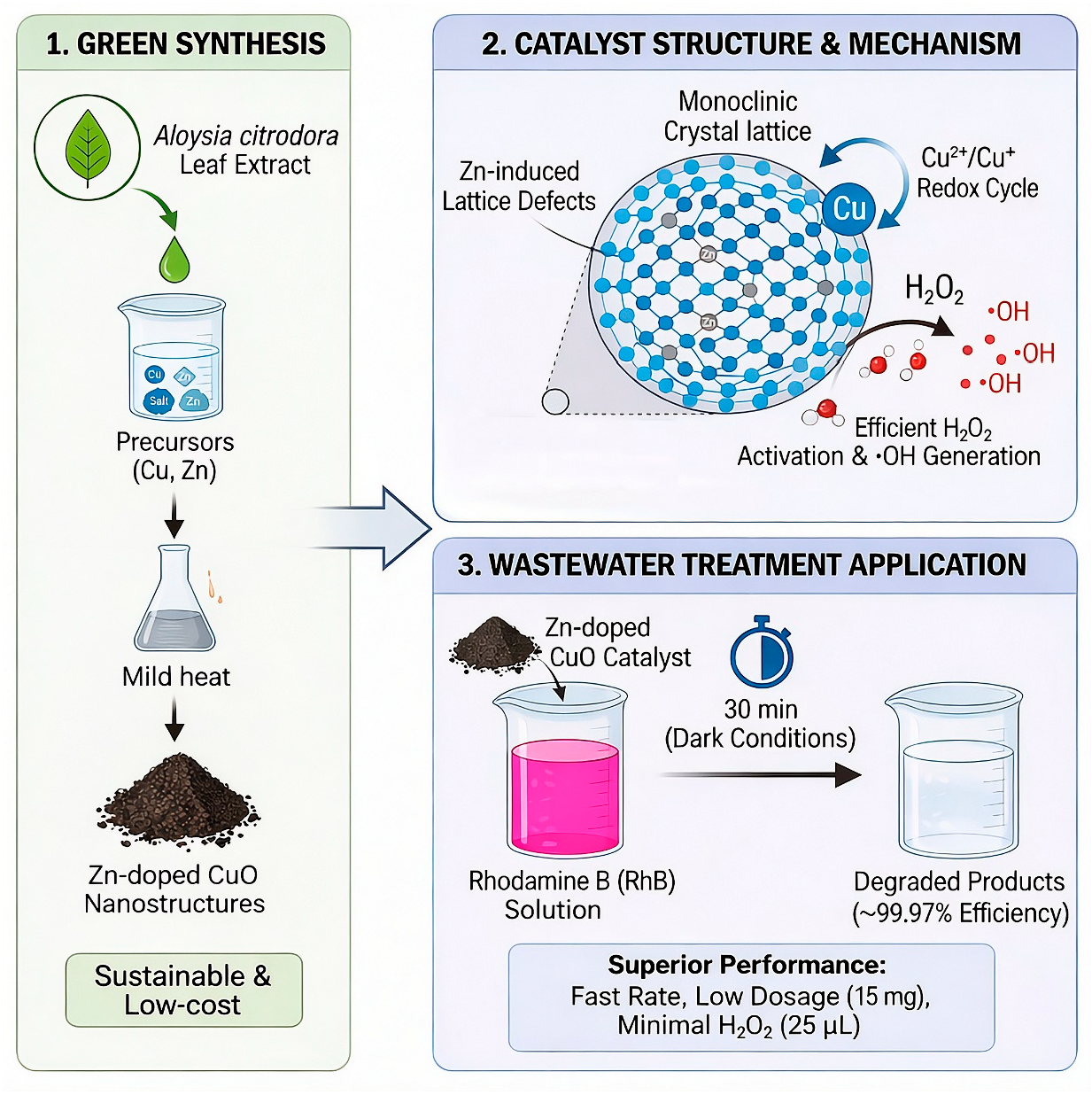
The development of efficient, sustainable, and low-cost catalysts for wastewater treatment remains a major environmental challenge. In this work, Zn-doped CuO nanostructures were successfully synthesized via a green route using Aloysia citrodora leaf extract as a natural reducing and stabilizing agent. The structural and morphological properties of the prepared catalysts were systematically characterized by XRD, Raman spectroscopy, FTIR, SEM, and EDX analyses. The results revealed the formation of highly crystalline monoclinic CuO nanoparticles, whose defect density and surface properties were significantly modified by Zn incorporation. The catalytic performance of the synthesized materials was evaluated through the heterogeneous Fenton-like degradation of Rhodamine B in aqueous solution under dark conditions. The Zn-doped CuO catalyst exhibited outstanding degradation efficiency (~99.97%) within only 30 min, using a low catalyst dosage of 15 mg and a minimal H2O2 amount of 25 μL. The enhanced catalytic activity is attributed to the synergistic interaction between Zn-induced lattice defects and the Cu2+/Cu+ redox cycle, which promotes efficient H2O2 activation and •OH radical generation. Radical scavenging experiments confirmed the dominant role of hydroxyl radicals in the degradation process. Compared with previously reported CuO-based catalysts, the present system demonstrates superior performance in terms of reaction rate, oxidant consumption, and energy efficiency. These findings highlight the potential of Zn-doped CuO synthesized via green chemistry as a promising and sustainable catalyst for advanced wastewater treatment applications.

Graphical Abstract

1. Introduction

Copper is a vital element for humans, animals, and plants in various oxidation states (Cu+ and Cu2+). Researchers are interested in materials made of copper because they are used in a wide range of technologies [1], including the creation of supercapacitors, near-infrared filters, magnetic storage media, sensors, catalysis, semiconductors, and more [2,3,4]. These materials have attracted increasing attention due to their low cost, natural abundance, and favorable physicochemical properties [5,6]. Rapid advancements in nanotechnology have produced a variety of nanoparticles (NPs) [7]. These nanomaterials can be classified into several categories based on their size, shape, and chemical composition, including carbon-based nanomaterials, metal and metal oxide nanoparticles, polymeric nanoparticles, metal–organic framework (MOFs), and fullerenes [8,9,10]. In particular, hybrid and supported nanostructures [11] have attracted increasing attention due to their enhanced stability and catalytic performance [12]. Among them, metal oxides are crucial, drawing the attention of researchers from a wide range of disciplines, including energy storage, drug delivery [13], sensing [14,15], environmental applications such as bee-safe nano insecticides [16], biomedical applications, electronics, catalysis, and others [17,18,19,20,21]. Cupric oxide (CuO) is an inorganic transition metal oxide semiconductor with a low band gap (1.2–1.5 eV) which makes it considerably more stable than organic nanoparticles [22]. CuO NPs have been produced using a variety of chemical and physical methods. In the case of chemical routes, the sol–gel method [23], chemical reduction [24], precipitation [25], and polyol synthesis [26] are the most studied [27]. In contrast, physical synthesis approaches include laser ablation [28], pulsed laser deposition [29], microwave-assisted synthesis [30], etc. The rapid recombination of photogenerated electrons (e) and holes (h+) limits its practical utilization. Therefore, efficiently separating photogenerated electrons and holes is essential to improving CuO’s efficiency [31,32,33,34,35]. This can be achieved by lowering their recombination via techniques including doping, composite modification, or the creation of heterogeneous junctions [36]. Additionally, elemental doping is believed to influence the shape of nanoparticles as well as their optical, physical, and chemical properties [5]. Several studies have focused on doping CuO with various metals, including Ni, Mn, Ag, Zn, Pd, and Fe [36]. Zn is a better doping material because the ionic radius of Zn2+ (0.74 Å) is closer to that of Cu2+ (0.72 Å) [37]. Although Zn2+ and Cu2+ have the same charge, the slightly larger Zn2+ can distort the lattice, promote oxygen vacancy formation and improve catalytic activity [38]. Therefore, it was suggested that Zn might be incorporated into CuO using a preparation procedure that does not require calcination [39].
Recent studies have demonstrated the effectiveness of Advanced Oxidation Processes (AOPs), such as photo-Fenton, ozonation, sonolysis, and ionizing radiation, for the removal of recalcitrant water pollutants. Among these approaches, metal oxide-based catalysts have gained increasing attention due to their ability to generate highly reactive oxygen species (ROS), including superoxide (•O2) and hydroxyl (•OH) radicals during oxidant activation [40]. Among AOPs, the Fenton reaction has attracted considerable attention due to its high efficiency, simple operation, and low cost [41]. In this context, copper has emerged as a promising alternative to iron for Fenton-like catalysis, owing to its abundance, low toxicity, and high redox activity. The reversible Cu+/Cu2+ redox cycle enables efficient hydroxyl radical generation from H2O2, with faster kinetics than the conventional Fe2+/Fe3+ system [42]. Heterogeneous Fenton-like oxidation has emerged as an efficient and sustainable approach for organic pollutant removal [43]. In such systems, charge transfer properties play a crucial role in oxidant activation. Therefore, strategies such as elemental doping, defect engineering, and heterojunction construction are widely employed to enhance charge separation efficiency and improve H2O2 activation, leading to improved degradation performance [44]. In this context, Rhodamine B (RhB) is frequently used as a model organic pollutant. As a synthetic xanthene dye, it is utilized in the dying of cotton, weed, and leather, as well as in the preparation of ball pen and stamp pad inks. RhB is highly stable and resistant to conventional biological treatments [45], making it an ideal candidate for evaluating the performance of new Fenton-like catalysts. In parallel, a biological approach to material synthesis has emerged, utilizing renewable resources and non-toxic phytochemicals as reducing and stabilizing agents [46]. Environmentally friendly, plant-mediated techniques have already been used to produce Zn-doped CuO for various therapeutic applications [47,48].
In this study, pure and Zn-doped CuO nanoparticles were synthesized via a simple and cost-effective co-precipitation route using Aloysia citrodora leaf extract. This medicinal plant, rich in polyphenols and other bioactive molecules, has not yet been reported for the synthesis of these materials. It was selected due to its abundant phytochemical content, rapid growth, and high productivity, making it a sustainable and renewable resource [49]. The extract contains diverse phenolic constituents, including phenylpropanoids and glycosylated flavones, which can act as efficient reducing and stabilizing agents during the synthesis process [50]. The present work further examines Zn incorporation and its influence on structural defects and surface reactivity, which may promote H2O2 activation into hydroxyl radicals (•OH). Although Zn doping has been widely reported to enhance photocatalytic performance, its contribution to heterogeneous Fenton-like systems remains insufficiently explored. Notably, heterogeneous Fenton-like processes can operate efficiently under dark conditions, thereby lowering energy demand and offering a sustainable pathway for wastewater treatment.
The novelty of this study resides in the development of a sustainable plant-mediated route for the synthesis of Zn-doped CuO nanoparticles using Aloysia citrodora extract as a reducing and stabilizing agent, which has not previously been reported for this material. This work further provides a comprehensive correlation between Zn-induced structural defects, morphological evolution, and the enhancement in heterogeneous Fenton-like catalytic activity toward Rhodamine B degradation under dark conditions.

2. Results and Discussion

2.1. XRD Pattern Interpretation

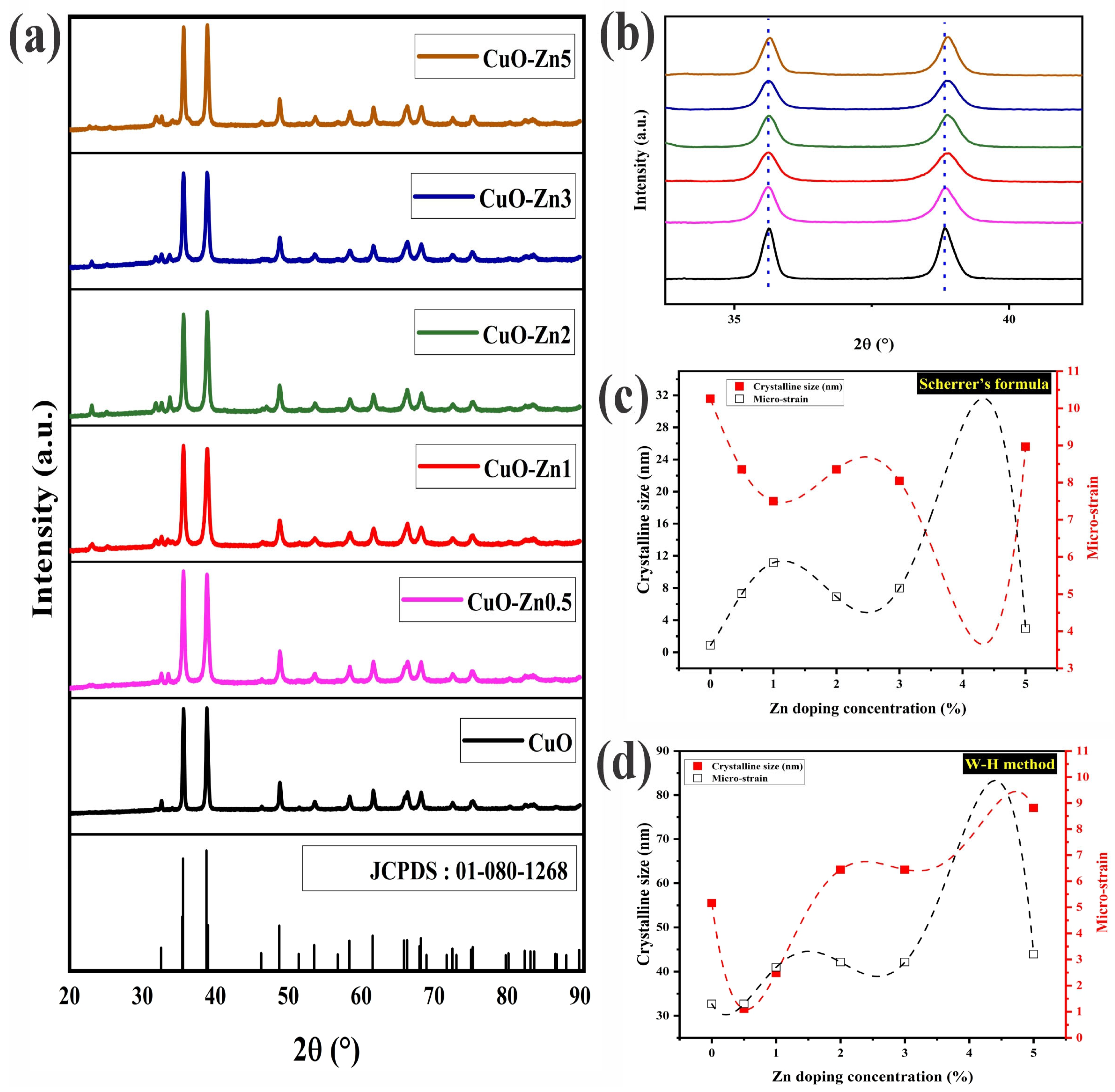
X-ray diffraction patterns of pure CuO and Zn-doped CuO samples (CuO-Zn0.5, CuO-Zn1, CuO-Zn2, CuO-Zn3, and CuO-Zn5) were recorded in the 2θ range of 20–90° (Figure 1a). All samples exhibited the characteristic monoclinic CuO structure in agreement with JCPDS card No. 01-080-1268, with well-defined diffraction peaks at 32.5°, 35.6°, 38.9°, 46.3°, 48.8°, 51.5°, 53.6°, 58.4°, 61.8°, 65.9°, 66.3°, 68.0°, 72.5°, 75.0°, and 75.3° corresponding to the crystallographic planes (110), (−111), (111), (−112), (−202), (112), (020), (202), (−113), (−311), (310), (220), (311), (004), (−222), (−114), (−313), (312), (400), and (−402), respectively. The preservation of the monoclinic CuO structure across all doping concentrations indicates successful incorporation of Zn2+ ions without phase transformation or secondary phase formation related to copper.
Minor additional peaks were observed in Zn-doped samples at approximately 22–25°, 31.8°, and 33.6°. The peak at 31.8° may correspond to the (100) plane of ZnO, though the absence of other characteristic ZnO reflections suggests either phase segregation below the detection threshold or trace impurities rather than significant ZnO formation. The peaks observed in the 22–25° region may be attributed to residual organic compounds originating from the plant extract used during the synthesis. The CuO diffraction peaks exhibited no significant 2θ shifts upon doping, consistent with previous studies that reported minimal peak displacement for Zn-doped CuO systems [51,52]. However, pronounced changes in peak broadening and intensities were observed, particularly for the (−111) and (111) reflections, indicating altered crystallographic texture or preferential orientation effects induced by doping (Figure 1b).
The absence of significant peak shifts coupled with changes in peak broadening and intensities strongly suggests iso valent substitution of Cu2+ by Zn2+, which have the same charge and similar ionic radii (Cu2+: 0.73 Å, Zn2+: 0.74 Å), without significantly altering the overall charge balance or crystal structure [53]. This behavior contrasts with studies involving dopant ions with substantially different ionic sizes, such as Ni2+ (r = 0.95 Å) or Mn2+ (r = 0.69 Å) in CuO, where higher peak shifts were reported due to more significant lattice expansion or contraction [54]. This comparison underscores the critical role of ionic size matching in determining doping mechanisms in metal oxide systems.
The lattice parameters for the monoclinic structure were calculated using standard indexing methods [55]. The results in Table 1 show irregular variations, with Zn concentration deviating from Vegard’s law, which typically predicts linear relationships between lattice parameters and dopant concentration. a ranged from 4.6810 to 4.6852 Å, b from 3.4139 to 3.4192 Å, and c from 5.1238 to 5.1272 Å. These values are in agreement with values reported in the literature [56] and the earlier-mentioned JCPDS card. The monoclinic angle β remained relatively constant (~99.5°), and unit cell volume fluctuated between 80.82 and 80.94 Å3 without monotonic correlation with Zn concentration. This deviation from Vegard’s law suggests that the doping mechanism is more complex than simple substitutional incorporation, potentially arising from preferential occupation of specific Cu2+ sites by Zn2+, compensation effects involving point defects such as oxygen or vacancies, local distortions around Zn2+ dopants, or the clustering of dopant atoms at higher concentrations [57].
Crystallite size analysis using both Scherrer’s equation (Equation (1)) [58] and the Williamson–Hall (W-H) (Equation (2)) method [37] revealed intriguing non-monotonic trends with doping concentration. Scherrer analysis involved only the (−111) and (111) peaks. The results showed that crystallite sizes decreased from 31.6 nm for pure CuO to 18.8 nm for CuO-Zn1, and then increased to 25.6 nm for CuO-Zn5, as shown in Figure 1c,d. The W-H method, which accounts for strain effects, yielded different absolute values but similar trends, with sizes ranging from 55.5 nm for pure CuO to 63.1 nm for CuO-Zn2. The consistently larger crystallite sizes obtained from the W-H method compared to Scherrer’s equation highlight the importance of strain considerations in nanocrystalline materials, as Scherrer’s equation assumes strain-free conditions while the W-H method separates size and strain contributions to peak broadening.
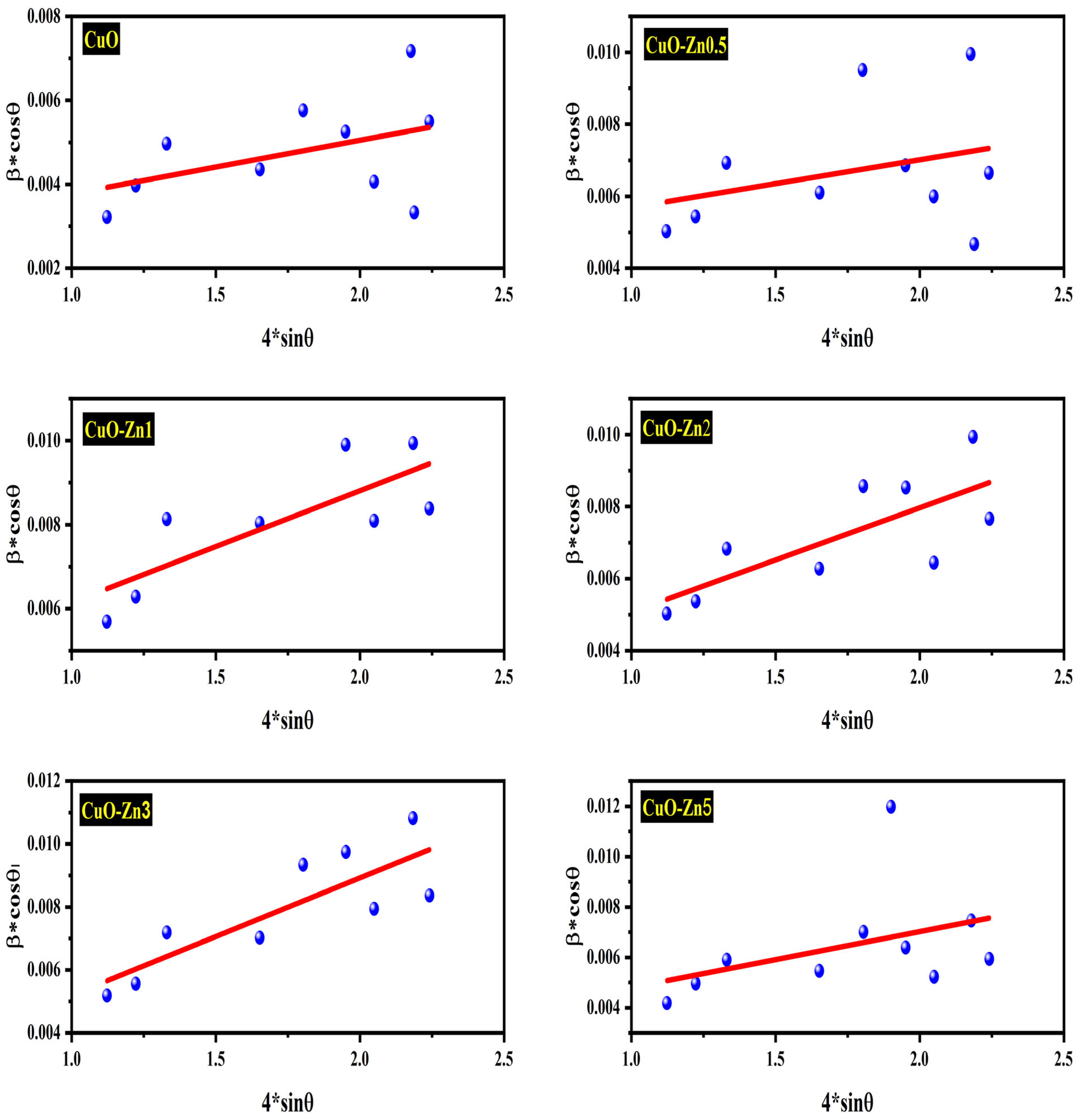
Micro-strain analysis revealed a systematic increase from 1.30 × 10⁻³ for pure CuO to 3.2 × 10⁻³ for CuO-Zn5 using the W-H method (Figure 2), corroborated by rising dislocation density (Equation (4)) from 0.75 × 10¹⁴ m−2 for pure CuO to 2.47 × 10¹⁴ m−2 for CuO-Zn1. The full width at half maximum (FWHM) of the (−111) and (111) peaks broadened significantly from 0.239° to 0.378°, further evidencing enhanced structural disorder.
A v e r a g e   c r y s t a l l i t e   s i z e   ( D ) = K × λ β × C o s θ
β × C o s ( θ ) = k λ D + 4 ε × s i n θ
M i r o s t r a i n ( ε ) = β 4 t a n θ
D i s l o c a t i o n   d e n s i t y   ( δ ) = 1 D 2
where K is the Scherrer constant or shape factor = 0.9, θ is the diffraction angle in radians, λ signifies the X-ray wavelength (1.5406 Å for Cu Kα radiation), and β indicates line broadening at half the maximum intensity (FWHM), expressed in radians.

2.2. Raman Spectroscopy Analysis

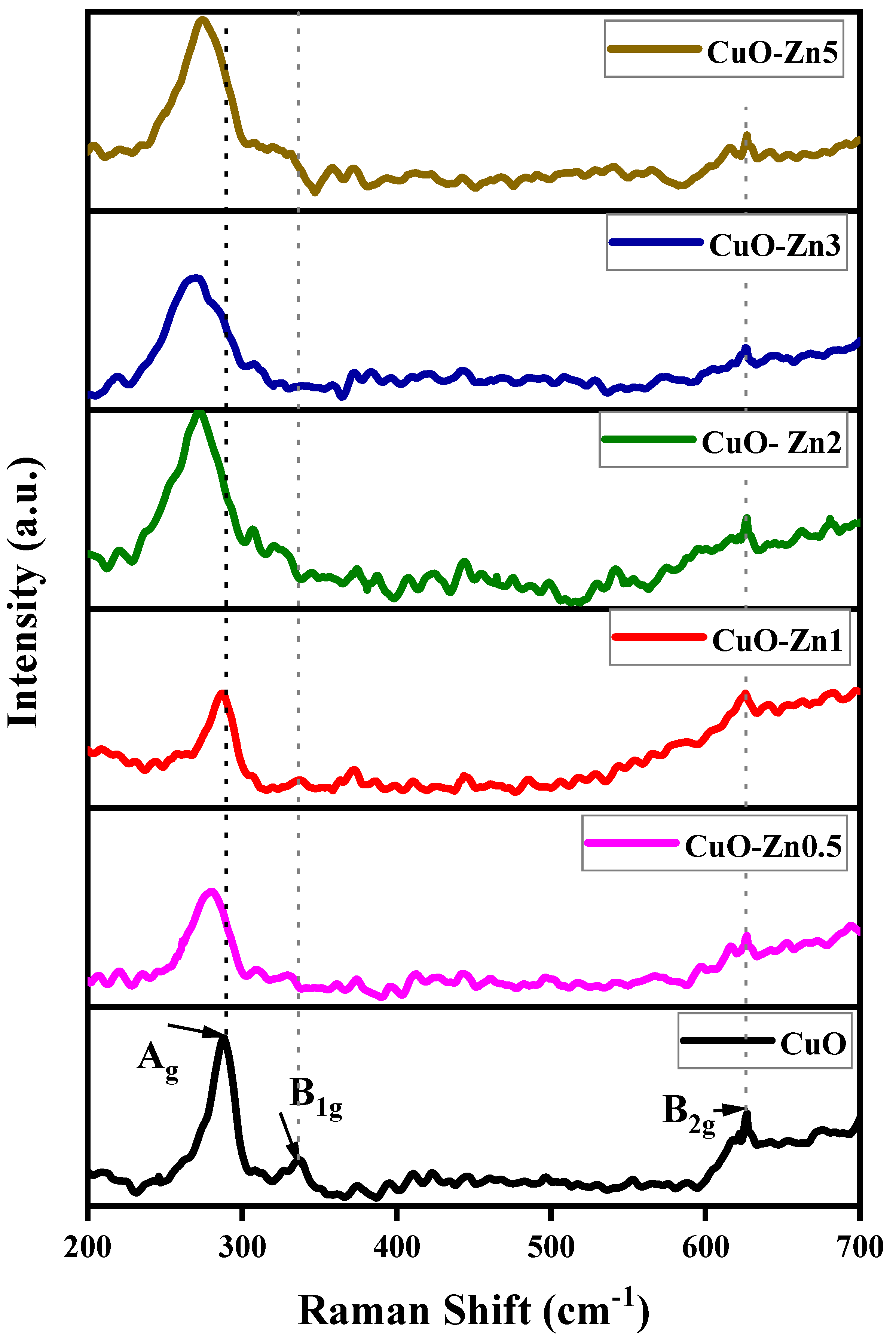
Structural confirmation of both pure and doped samples was performed using Raman spectroscopy. Cupric oxide (CuO) has a monoclinic structure and belongs to the C62h (C2/c) space group. It exhibits three Raman-active modes: one Ag and two Bg modes [59]. Figure 3 presents the Raman spectra of the pure and doped samples, recorded using a 532 nm laser at 10 mW power. Three characteristic peaks are observed at 288 cm−1 (Ag mode), 337.15 cm−1 (B1g mode), and 626.54 cm−1 (B2g mode) [60]. No peaks associated with impurities or the substrate are detected, consistent with the XRD results, confirming the high purity of the samples. After Zn incorporation, the B1g mode disappears, indicating a reduction in phonon coherence due to lattice disorder and strain induced by Zn2+ incorporation in the fabricated CuO nanoparticles.
Additionally, the Ag mode exhibits a noticeable shift toward lower wavenumbers (≈270–287 cm−1), suggesting lattice distortion and phonon confinement effects associated with crystallite size reduction. The B2g mode remains nearly constant around ~626 cm−1 for low Zn contents (0.5–3%), while a significant shift to 616.46 cm−1 is observed at 5% Zn, reflecting stronger defect formation and lattice distortion at high doping. These Raman observations are consistent with XRD peak broadening and Williamson–Hall analysis, which evidence the evolution of crystallite size and micro-strain with Zn concentration (Table 2).

2.3. Fourier Transform Infrared (FTIR) Spectroscopy Analysis

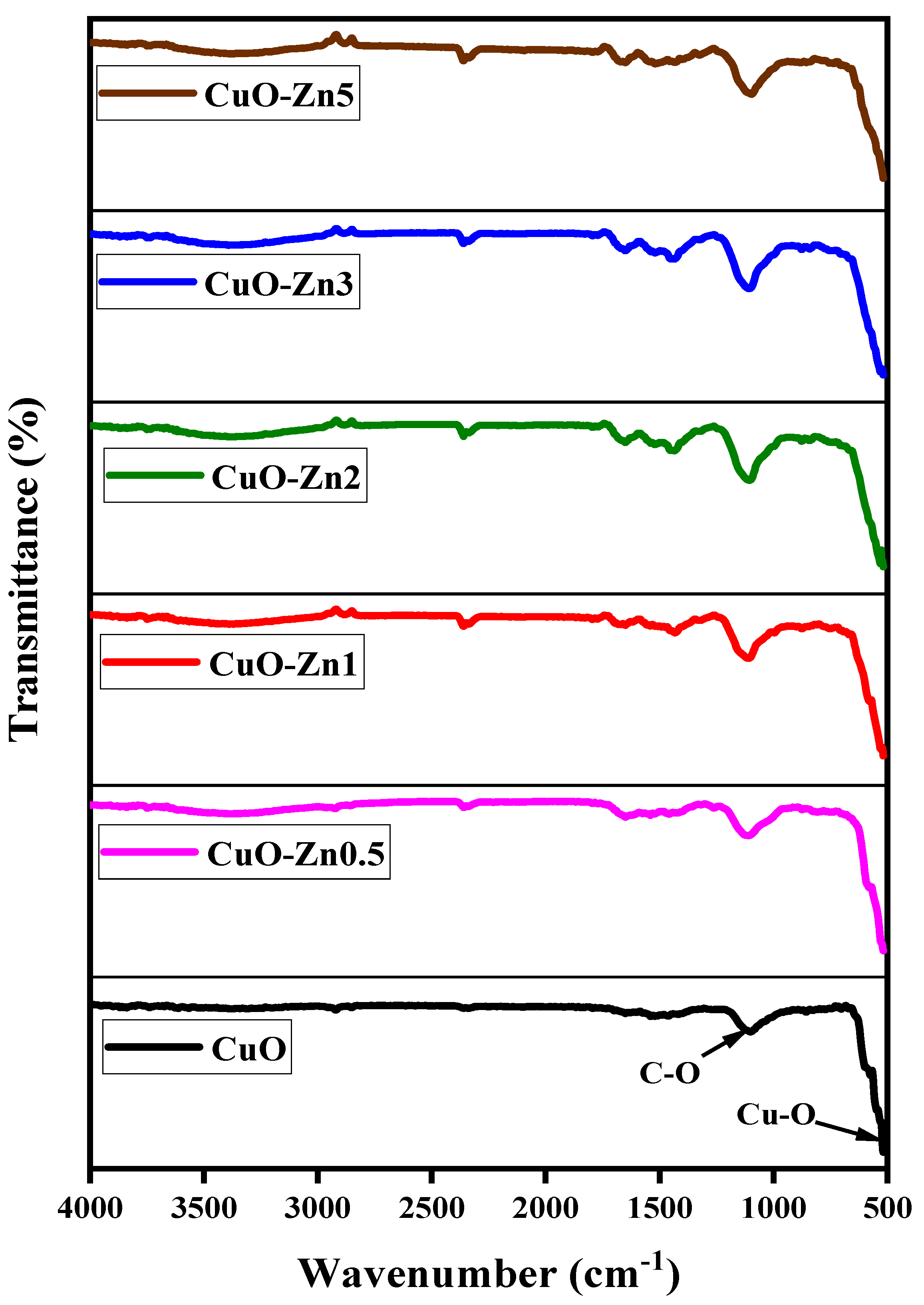
FTIR spectroscopy is essential for identifying functional groups and chemical bonds in nanomaterials. Figure 4 illustrates the FTIR spectra of pure and Zn-doped CuO NPs at various concentrations. In the low-frequency region, the absorption bands observed between 522 cm−1 and 580 cm−1 are assigned to the metal–oxygen (Cu–O) stretching modes, confirming the formation of the CuO monoclinic structure [61]. For the pure sample, the primary Cu–O peak appears at 526 cm−1, while for Zn-doped samples (notably CuO-Zn0.5 and CuO-Zn3), this band shifts to approximately 528–530 cm−1. This shift toward higher wavenumbers suggests lattice distortion and micro-strain resulting from the substitution of Cu2+ ions by Zn2+ ions, which have slightly different ionic radii.
A prominent band at 1093–1112 cm−1 is observed across all samples. This corresponds to the C–O stretching vibrations of alcohols, esters, and ethers [62]. These functional groups are indicative of flavonoid glycosides and phenolic acids from the Aloysia citrodora extract used during synthesis, consistent with previous studies [49]. FTIR spectral shifts indicate that these molecules may be either physically adsorbed or chemically coordinated to surface Cu2+/Zn2+ sites [63]. The band appearing near 1436 cm−1 in the Zn-doped samples is attributed to the symmetric and asymmetric stretching of carboxylate groups, likely arising from residual acetate species from the chemical precursors [64,65]. Overall, these results confirm that Zn doping modifies both the Cu–O vibrations and the surface chemistry. These FTIR trends correlate with XRD observations: the shift and broadening of the Cu–O modes are explained by the increased dislocation density and lattice defects induced by the dopant. The stabilization of the Cu–O bond around 530 cm−1 in doped samples supports the successful incorporation of Zn into the CuO framework, which is expected to enhance the material’s catalytic performance.

2.4. Morphological and Compositional Analysis (SEM-EDX)

2.4.1. SEM Results

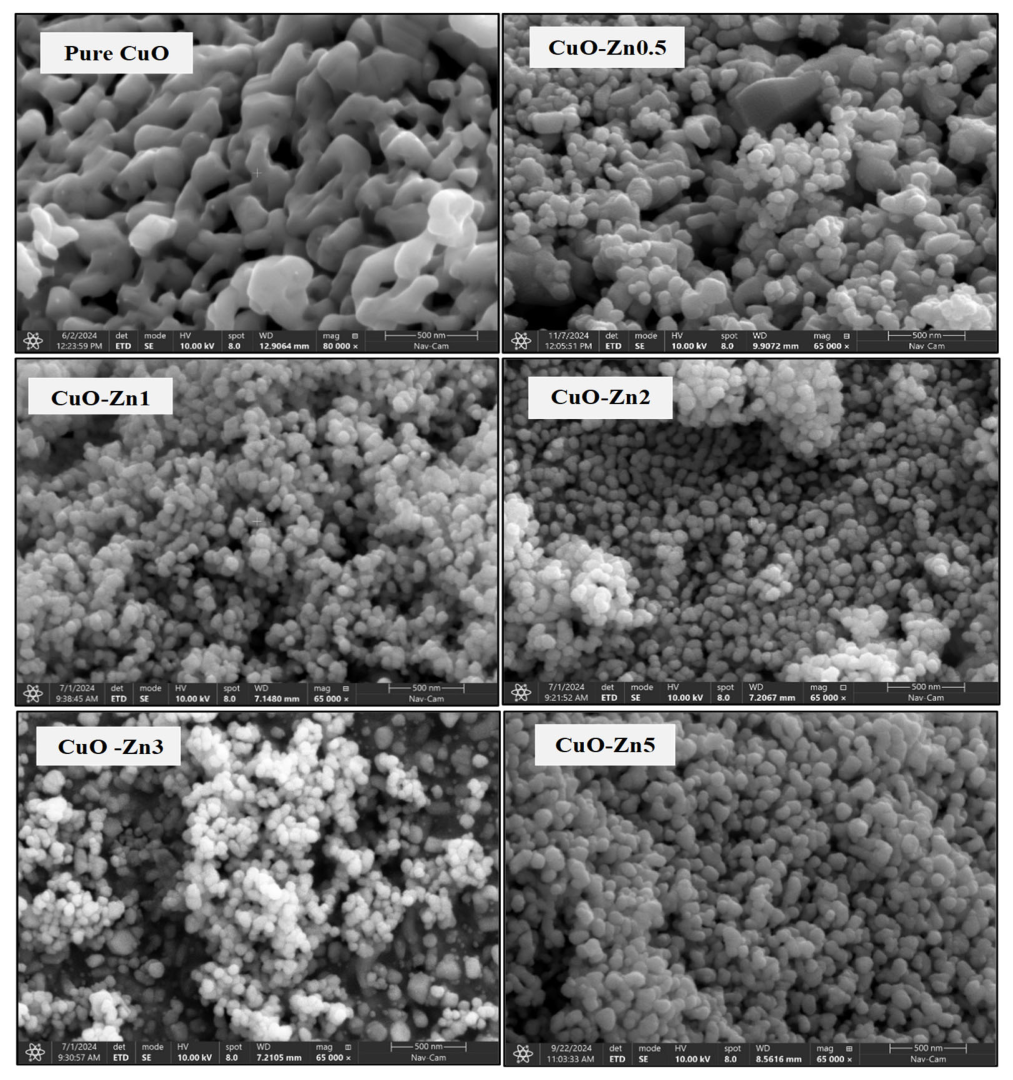
SEM analysis was performed to examine the surface morphology and particle size distribution of pure CuO and Zn-doped CuO nanoparticles. The SEM images of the undoped CuO sample are shown in Figure 5, revealing agglomerated nanostructures made up of irregularly shaped grains with sizes ranging from roughly 50 nm to 160 nm; porous aggregates are also formed, a typical characteristic of CuO synthesized via a green route, typically arising from the high surface energy of the nanocrystals and the dual reducing–stabilizing role of plant biomolecules [66]. In contrast, Zn doping induces a clear modification in the morphology. At very low doping (0.5%), the particles remain agglomerated but tend to be smaller and more spherical, with an estimated size range of 30–80 nm. With further increases in Zn content (≥1%), the morphological modification becomes more pronounced and consistent across all compositions (1–5%), leading to nearly spherical to sub-spherical nanoparticles with a narrower size distribution of approximately 20–50 nm; this morphological refinement can be attributed to the incorporation of Zn2+ ions, which influence nucleation and growth processes during the formation of CuO crystallites. Several studies have reported that Zn incorporation significantly affects the morphology of CuO. It can induce a transformation from irregular structures to spherical shapes [67], convert initially octahedral particles into more diffuse spherical morphologies [52], and promote the transition from irregular plates to well-defined nanoparticles [39].

2.4.2. EDX Results

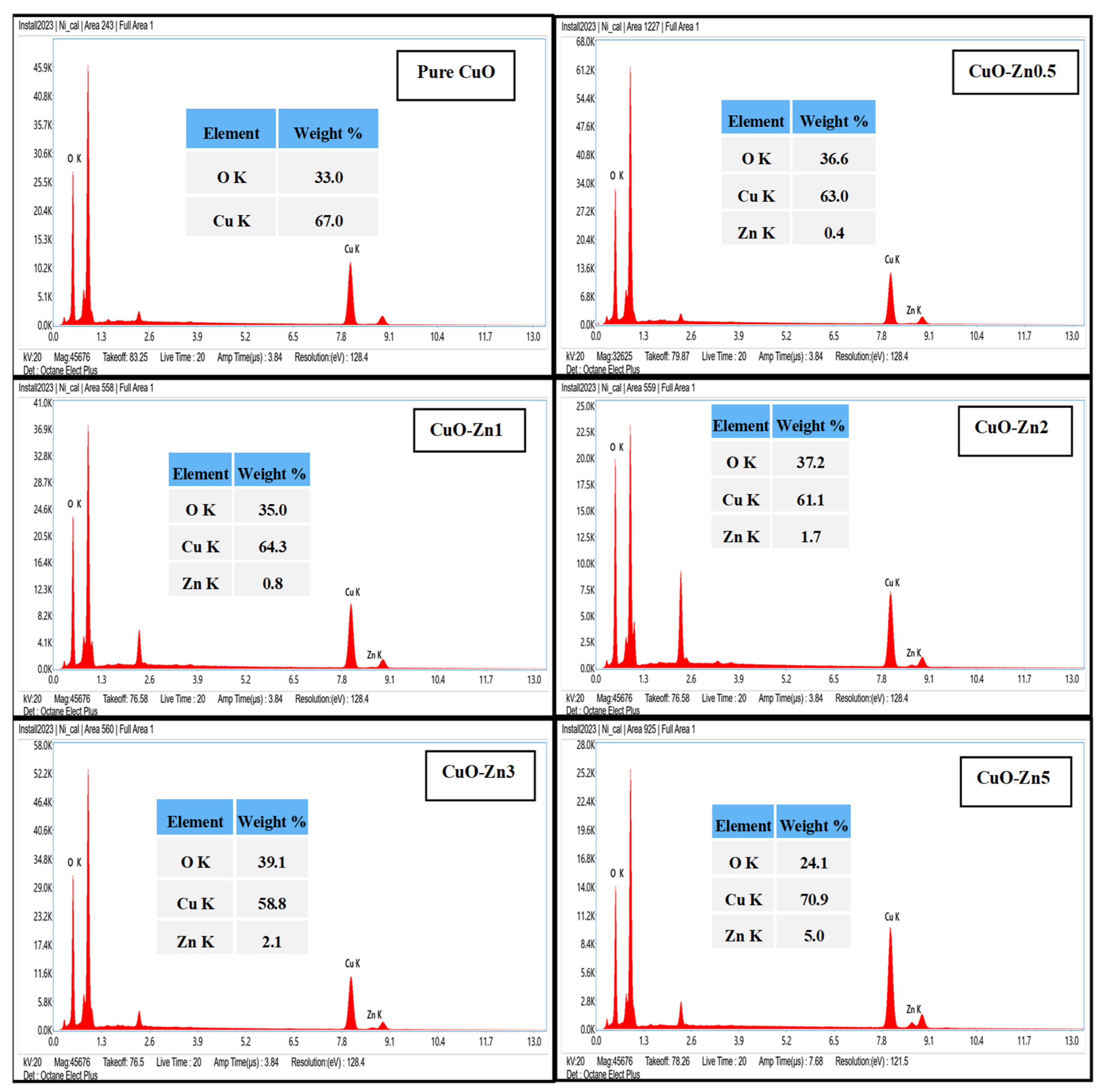
The EDX analysis (Figure 6) confirms the elemental composition of pure CuO and Zn-doped CuO. For the undoped sample, only copper and oxygen signals are detected, indicating the successful formation of CuO. Upon Zn doping, characteristic Zn peaks appear, and their intensity gradually increases with dopant concentration, demonstrating the effective incorporation of Zn into the CuO matrix. Additionally, slight variations in the atomic percentages of Cu and O are observed as the Zn content increases, reflecting compositional adjustments during doping. Overall, the results confirm the successful synthesis of Zn-doped CuO without the presence of undesirable impurities.

2.5. Catalytic Degradation of Rhodamine B

2.5.1. Effect of Zn Doping Amount on Rhodamine B Removal

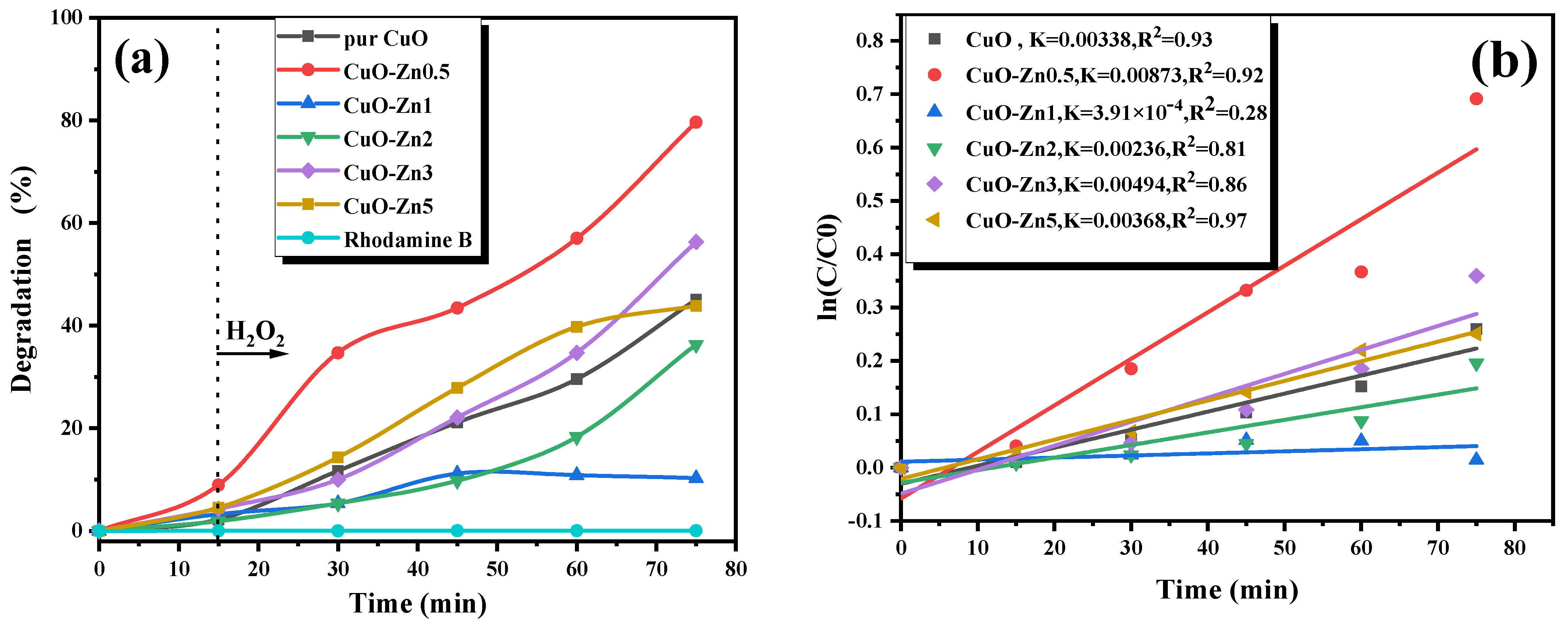
The degradation efficiency of Rhodamine B using pure CuO and Zn-doped CuO was first evaluated under identical experimental conditions (RhB = 5 ppm, Vsolution = 25 mL; natural pH, catalyst mass = 25 mg, H2O2 = 100 μL, ambient temperature). As shown in Figure 7a, the 0.5% Zn-doped CuO sample exhibits the highest catalytic performance, achieving approximately 80% degradation over a total reaction time of 60 min in the presence of H2O2. This peak efficiency is directly correlated with a sharp reduction in crystallite size (~23 nm via Scherrer and ~31 nm via W-H), which maximizes the active surface area. At this low doping level, the micro-strain remains minimal, ensuring efficient charge transfer, and may reduce the recombination of electron–hole pairs. Beyond 0.5%, a significant drop in activity is observed, with the 1% Zn sample even falling below the performance of pure CuO. This decline coincides with an increase in structural disorder (micro-strain) and the recovery of crystallite size, as shown by the W-H method. In this range, excessive doping likely creates structural defects that may act as deep traps for charge carriers, hindering the activation of H2O2. Interestingly, partial recovery of the degradation efficiency is observed for Zn contents ≥ 3%. This trend coincides with changes in the structural parameters derived from the W–H analysis, suggesting a modification of lattice distortion at higher doping levels. In particular, after reaching a maximum micro-strain, relative relaxation of the crystal lattice is observed at higher Zn contents. Such structural evolution may favor the formation of additional surface defects or catalytically active sites, which can enhance the interaction between the catalyst surface and H2O2, leading to increased generation of reactive oxygen species (ROS). Nevertheless, this recovered activity remains lower than the optimum performance obtained for the 0.5% Zn-doped CuO sample.
To further quantify these observations, a kinetic study (Figure 7b) was performed using the pseudo-first-order model. The calculated rate constant k and correlation coefficient R2 provide clear numerical validation of the catalytic trends. The standard deviation of the rate constant was calculated for pure CuO and CuO-Zn0.5 and found to be very low (±0.0004 min−1) and (±0.0002 min−1), respectively, confirming excellent reproducibility for the undoped sample. However, the pseudo-first-order model does not fully describe all samples: CuO-Zn1 shows a low R2 (0.28), suggesting contributions from adsorption or changes in the reaction mechanism. In contrast, CuO-Zn0.5 (R2 = 0.92) shows a reasonably good fit; alternative models, such as intraparticle diffusion, could better describe these kinetics. The 0.5% Zn-doped CuO sample exhibited the highest rate constant k = 0.00873 min−1, which is approximately 2.6 times higher than that of pure CuO, which has k = 0.00338 min−1. This significant enhancement confirms that the reduction in crystallite size and the minimization of micro-strain at this specific doping level drastically accelerate the reaction kinetics. For the 1% Zn sample, the sharp decline in activity is reflected by a substantial drop in the rate constant, reinforcing the hypothesis that excessive structural defects hinder the activation of H2O2. Interestingly, the partial recovery observed for higher Zn contents (5% Zn) is characterized by a stabilized rate constant k = 0.00368 min−1 with an excellent fit R2 = 0.971. This suggests that while lattice relaxation at higher concentrations creates new active sites, the overall catalytic efficiency remains limited compared to the 0.5% Zn optimum, where the synergy between surface area and charge transfer is most favorable.

2.5.2. Effect of pH

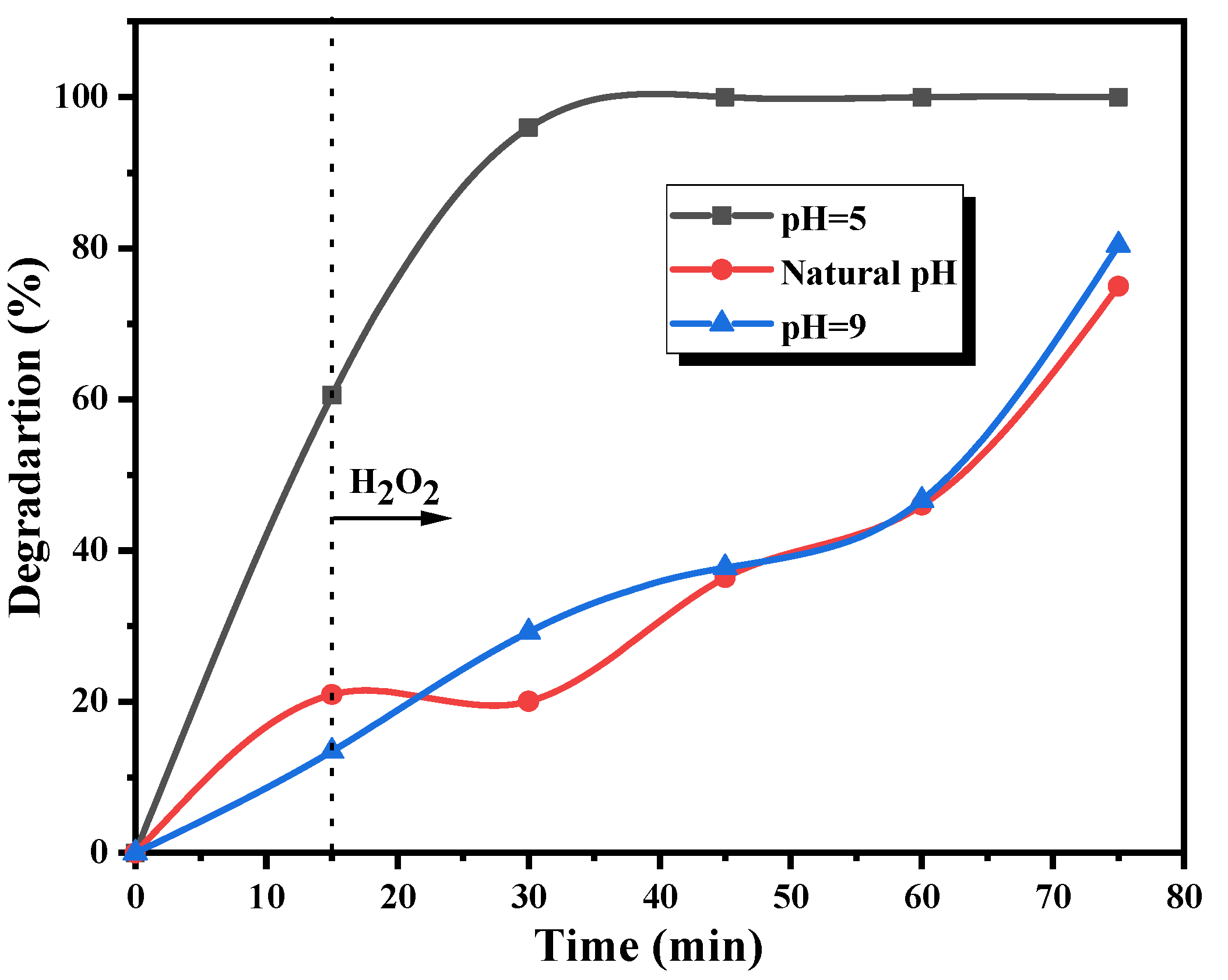
The influence of pH on RhB degradation was investigated at pH 5, natural pH, and pH 9 using the optimal catalyst (0.5% Zn-doped CuO). The results indicate that the degradation efficiency is strongly pH-dependent (Figure 8). At acidic pH, complete degradation (nearly 100%) was achieved within only 30 min, followed by a plateau signifying the total removal of the dye. In contrast, at natural pH and basic pH, the process was significantly slower, reaching approximately 80% and 74%, respectively, after 60 min. The enhanced performance at acidic pH can be attributed to the superior activation of H2O2 and the accelerated generation of hydroxyl radicals (•OH), which are the primary oxidants in heterogeneous Fenton-like systems [68]. Under acidic pH~5, the scavenging of radicals is minimized, and the stability of H2O2 favors the catalytic cycle. These findings confirm a heterogeneous Fenton-like mechanism, where the Zn-doped CuO surface effectively mediates the decomposition of H2O2 into highly reactive species, and the rapid kinetics at slightly acidic pH, compared to the slower degradation at higher pH [69]. These findings confirm that the process remains effective within the pH range of 5–9.

2.5.3. Effect of Catalyst Dosage

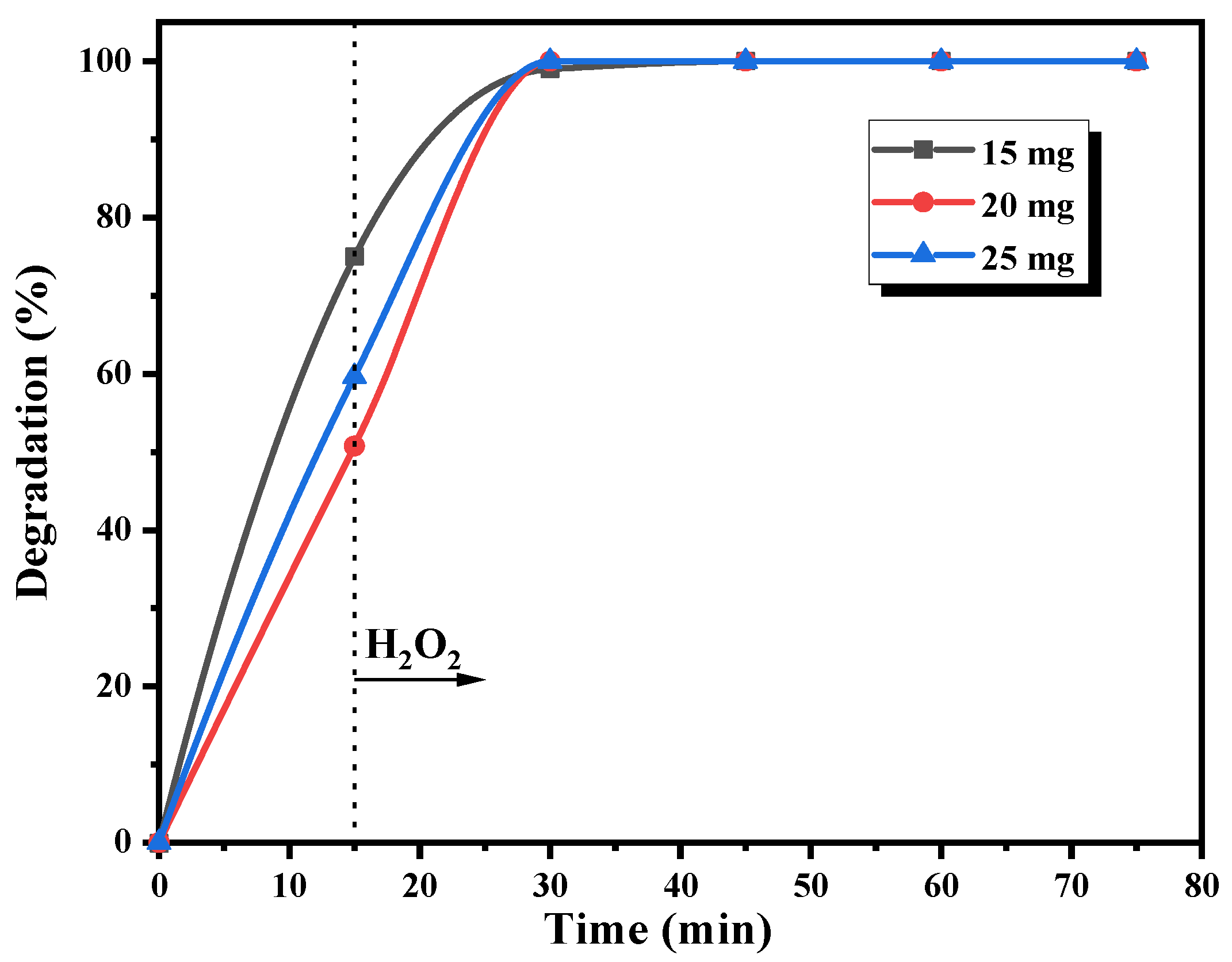
The influence of catalyst dosage on the degradation of Rhodamine B was investigated by varying the amount of 0.5% Zn-doped CuO from 15 mg to 25 mg. As shown in Figure 9, a dosage of 15 mg was sufficient to achieve nearly complete degradation within 30 min. Interestingly, increasing the catalyst mass to 20 mg or 25 mg did not yield any significant improvement in the degradation rate or final efficiency, as all tested dosages reached the 99.95% threshold at the same 30-min mark. This behavior suggests that at 15 mg, the system already possesses a sufficient number of active sites to fully activate the H2O2 and generate the required reactive oxygen species (ROS) for the concentration of RhB present. The lack of enhancement at higher dosages (20–25 mg) can be attributed to several factors. Higher catalyst concentrations can lead to the formation of clusters, reducing the effective surface area that was previously gained through Zn doping (as seen in the reduced crystallite size). An excess of catalyst may increase the turbidity of the solution or lead to the scavenging of hydroxyl radicals •OH by the catalyst surface itself, preventing further kinetic gains. Consequently, 15 mg was selected as the optimal catalyst dosage for subsequent parametric studies to ensure both high efficiency and economic feasibility.

2.5.4. Effect of H2O2 Amount

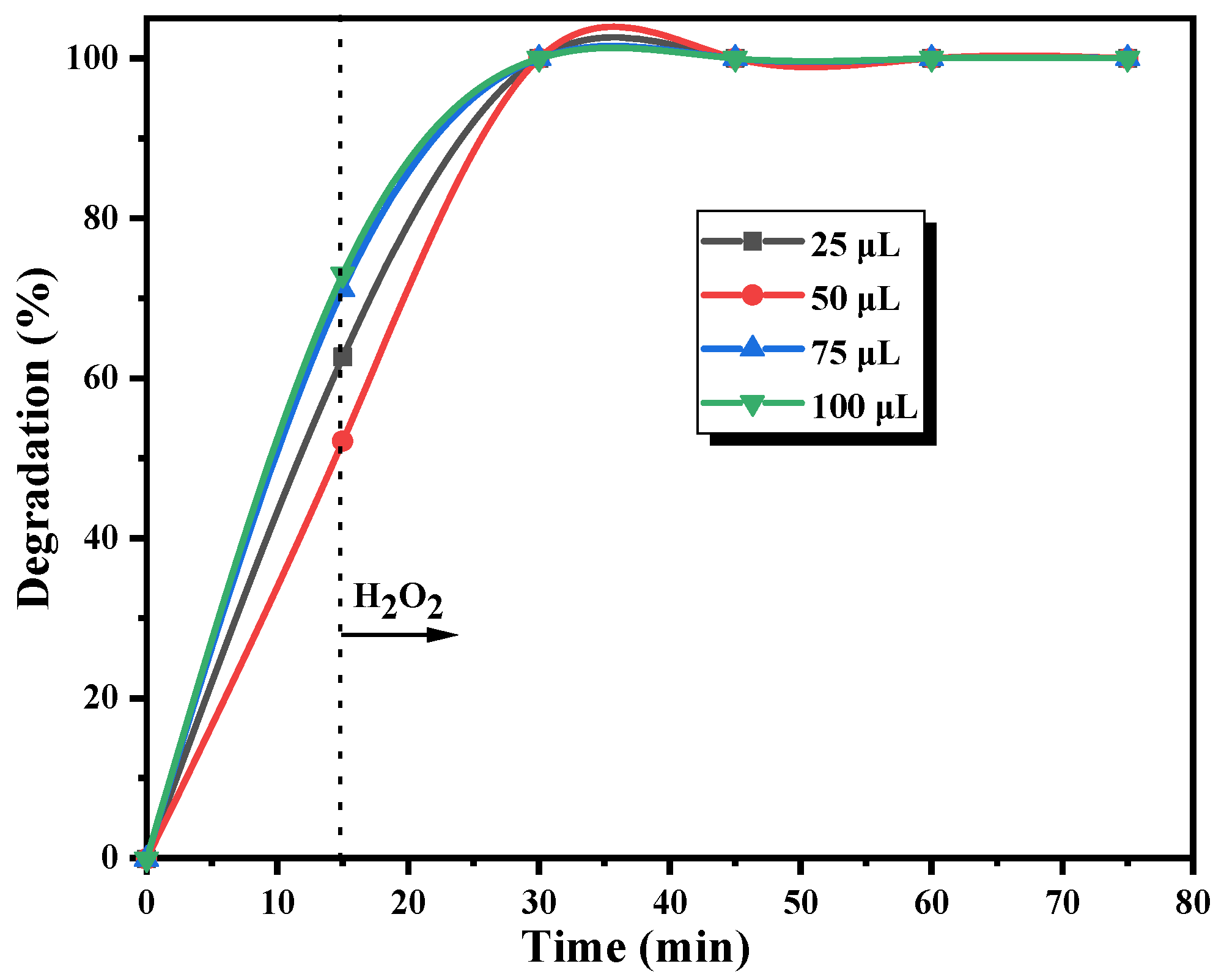
The effect of H2O2 dosage on Rhodamine B degradation was evaluated by varying the volume from 25 to 100 μL. The experimental results, illustrated in Figure 10, indicate that nearly complete degradation was successfully achieved within 30 min for all investigated dosages. This behavior suggests that even the minimum dosage of 25 μL provides a sufficient quantity of H2O2 molecules to be activated by the 0.5% Zn-doped CuO surface for total dye removal. A total of 25 μL was identified as the optimal dosage, demonstrating a high catalytic efficiency of the Zn-doped CuO system and its ability to achieve total degradation with minimal oxidant consumption, which is a significant advantage for cost-effective wastewater treatment.

2.5.5. Effect of Initial Rhodamine B Concentration

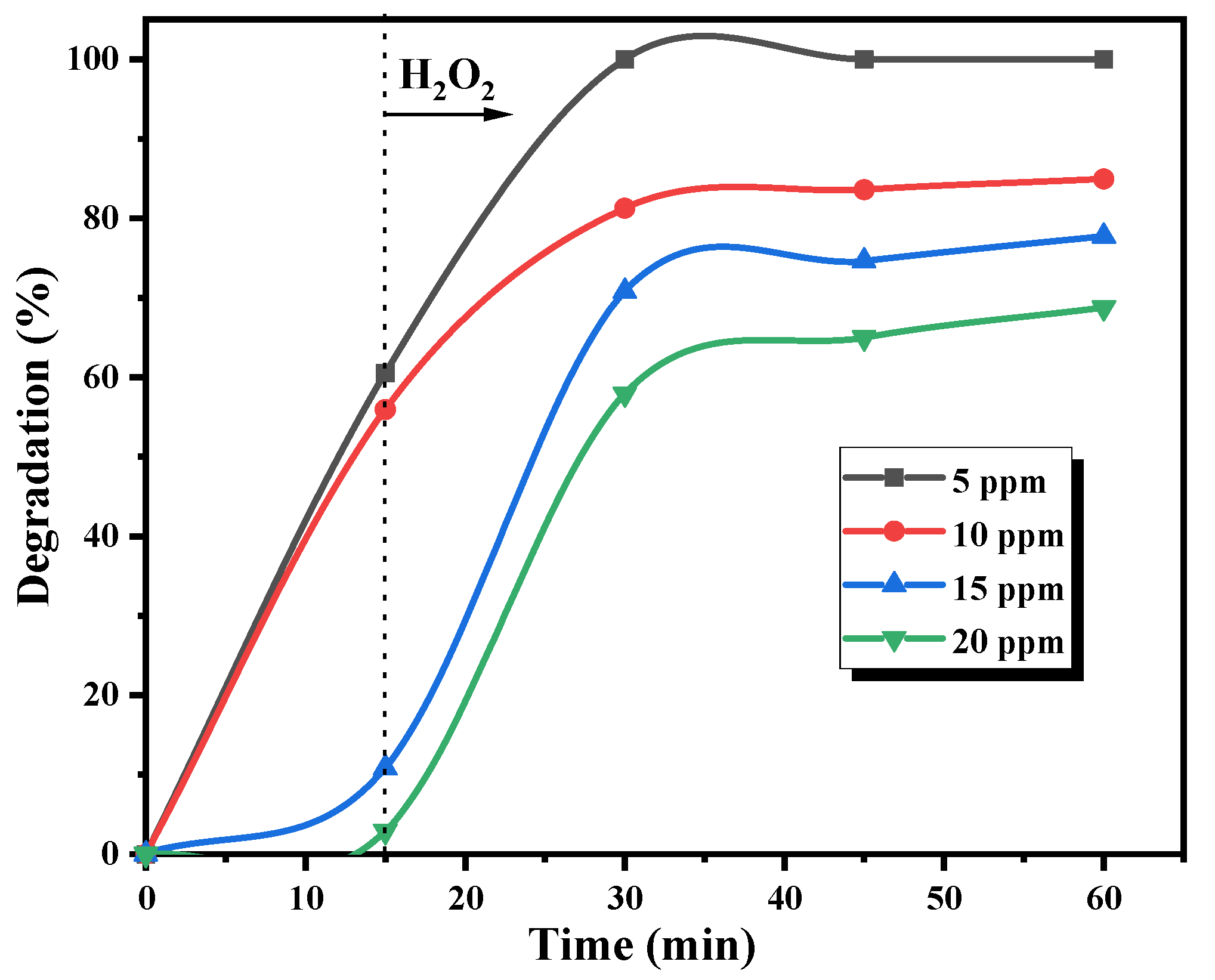
The effect of the initial Rhodamine B (RhB) concentration on the degradation efficiency was investigated by varying the dye concentration from 5 to 20 ppm under dark conditions using the CuO-Zn0.5/H2O2 heterogeneous Fenton-like system. As shown in Figure 11, the degradation efficiency strongly depends on the initial pollutant concentration. At 5 ppm, complete degradation (~100%) was rapidly achieved within 30 min. However, increasing the initial RhB concentration to 10, 15, and 20 ppm resulted in a progressive decrease in degradation efficiency, reaching approximately 97%, 85%, and 68% after 60 min, respectively.
This inverse relationship is mainly attributed to the limited production of reactive oxygen species, particularly hydroxyl radicals (•OH), which remains constant at fixed catalyst loading (15 mg) and oxidant dosage (25 μL of H2O2). At higher RhB concentrations, the ratio of generated •OH radicals to dye molecules decreases, leading to insufficient oxidative species to mineralize the pollutant completely. Moreover, higher dye concentrations promote competition for the active catalytic sites on the Zn-doped CuO surface, resulting in partial surface saturation and reduced degradation kinetics [70].

2.5.6. Effect of Scavengers

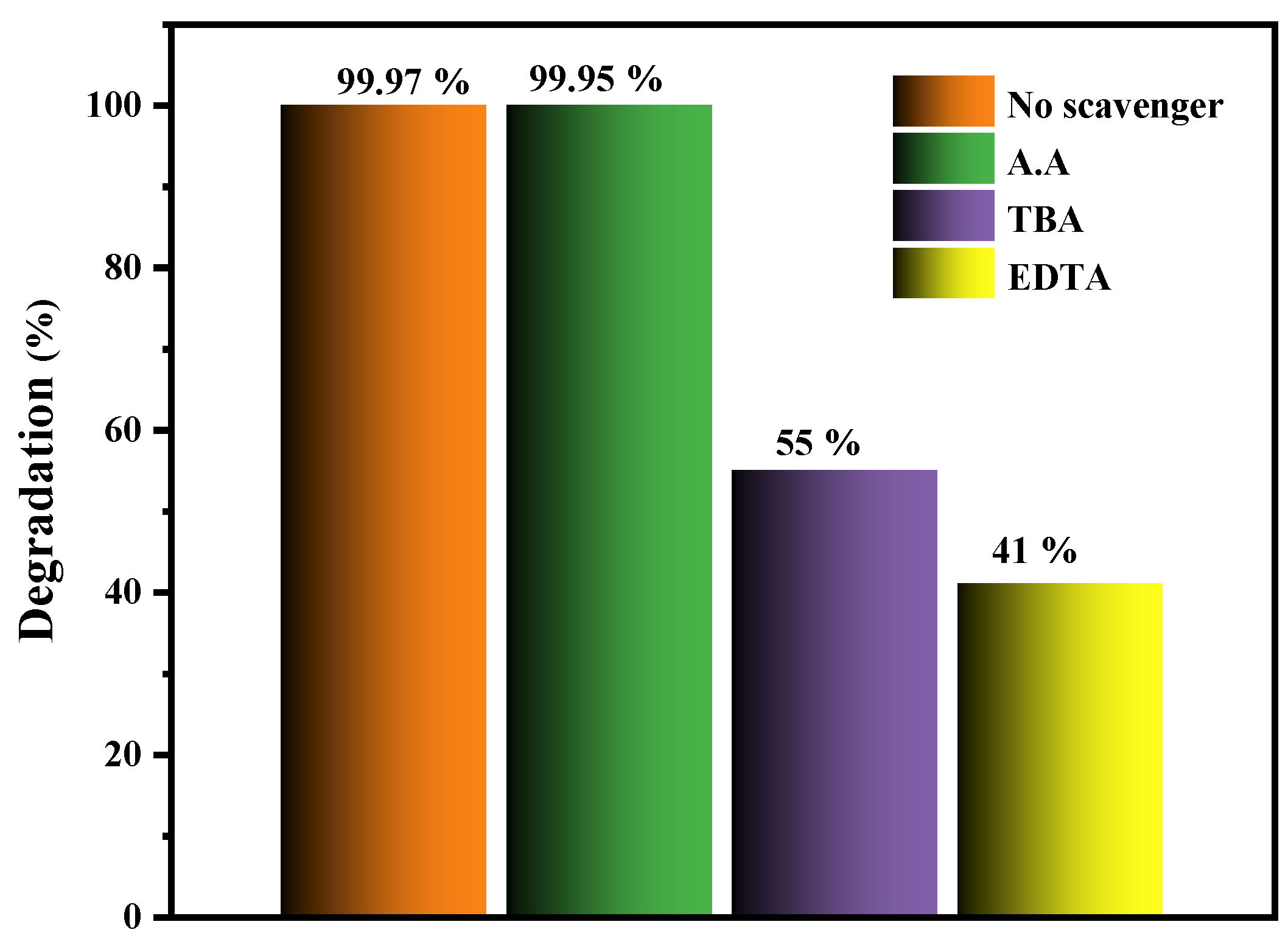
To elucidate the degradation mechanism of Rhodamine B and identify the main reactive species involved in the Zn-doped CuO/H2O2 system, scavenger experiments were carried out under the optimized conditions as shown in Figure 12. Tert-butanol (TBA), EDTA, and ascorbic acid were used as a hydroxyl radical (•OH) scavenger, a metal ion chelating agent, and a non-selective reducing agent/ROS scavenger, respectively. The addition of TBA resulted in a significant decrease in degradation efficiency to approximately 55%, indicating that hydroxyl radicals (•OH) play a major role in the degradation process. However, since the reaction was not completely suppressed, other reactive species may also contribute to RhB degradation [71]. Upon the addition of EDTA, the degradation efficiency further decreased to about 41%. This strong inhibition highlights the crucial role of metal active sites in activating H2O2 and generating reactive species through a heterogeneous Fenton-like process.
In contrast, the presence of ascorbic acid did not inhibit degradation, and near-complete removal (~100%) was still achieved. This behavior can be attributed to the dual role of ascorbic acid, which may act as a reducing agent promoting the Cu2+/Cu+ redox cycle, thereby enhancing the generation of reactive species rather than suppressing them.
Overall, these results demonstrate that the degradation of Rhodamine B is mainly governed by a heterogeneous Fenton-like mechanism, where hydroxyl radicals generated via metal-assisted H2O2 activation are the dominant oxidizing species.

2.5.7. Suggested Heterogeneous Fenton-like Reaction Mechanism

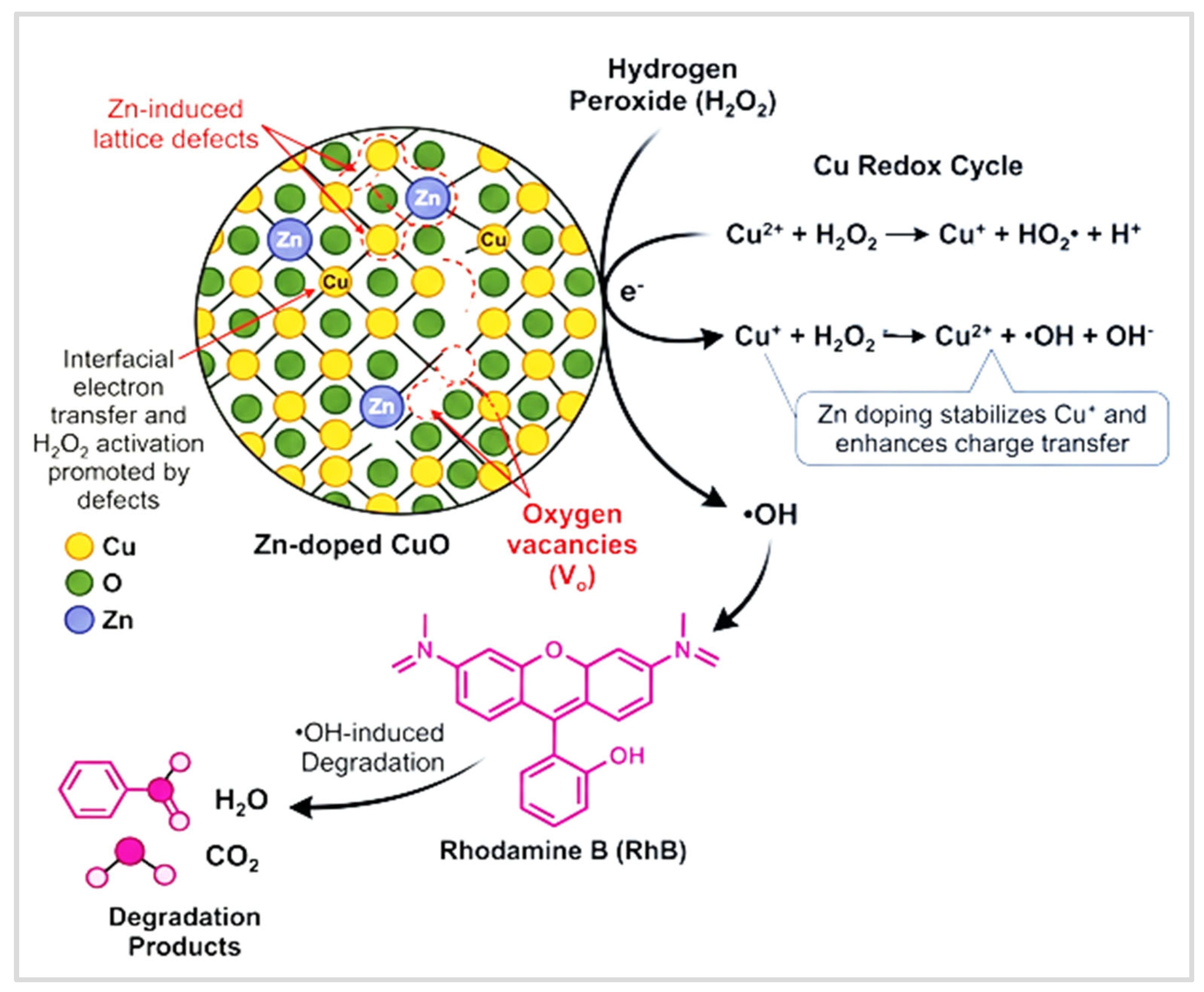
The enhanced heterogeneous Fenton-like performance of Zn-doped CuO can be explained by the synergistic interplay between Cu redox cycling and Zn-induced lattice defects, as illustrated in Figure 13. The incorporation of Zn2+ into the CuO lattice generates oxygen vacancies and structural distortions, as confirmed in [52], which facilitate interfacial electron transfer and promote the activation of H2O2 molecules. These oxygen-deficient sites act as catalytic hotspots, accelerating interfacial electron transfer and radical generation. Similar improvements in electron transfer efficiency have been reported in biohybrid catalytic systems, where conductive nanomaterials facilitate charge transport between active sites and pollutants [72]. The catalytic cycle proceeds through the reversible Cu2+/Cu+ redox coupling. Similar strategies aimed at enhancing redox cycling have been reported in Fenton-based systems, where the Fe3+/Fe2+ cycle is promoted by suitable additives to improve catalytic efficiency and pollutant degradation [73]. This redox process leads to the generation of highly reactive species such as •OH radicals [74], according to the following reactions:
C u 2 + + H 2 O 2 C u + + H O 2 + H + C u + + H 2 O 2 C u 2 + + O H + O H 2 H O 2 H 2 O 2 + O 2
•OH radicals then participate in the degradation of Rhodamine B:
O H + R h B d e g r a d e d   p r o d u c t s
The dominant role of •OH radicals was confirmed by scavenger experiments using tert-butanol, which significantly suppressed RhB degradation. Meanwhile, Zn doping can enhance charge transfer kinetics and stabilize surface Cu+ species, leading to faster H2O2 activation and improved catalytic efficiency.

2.5.8. Reusability of Catalyst

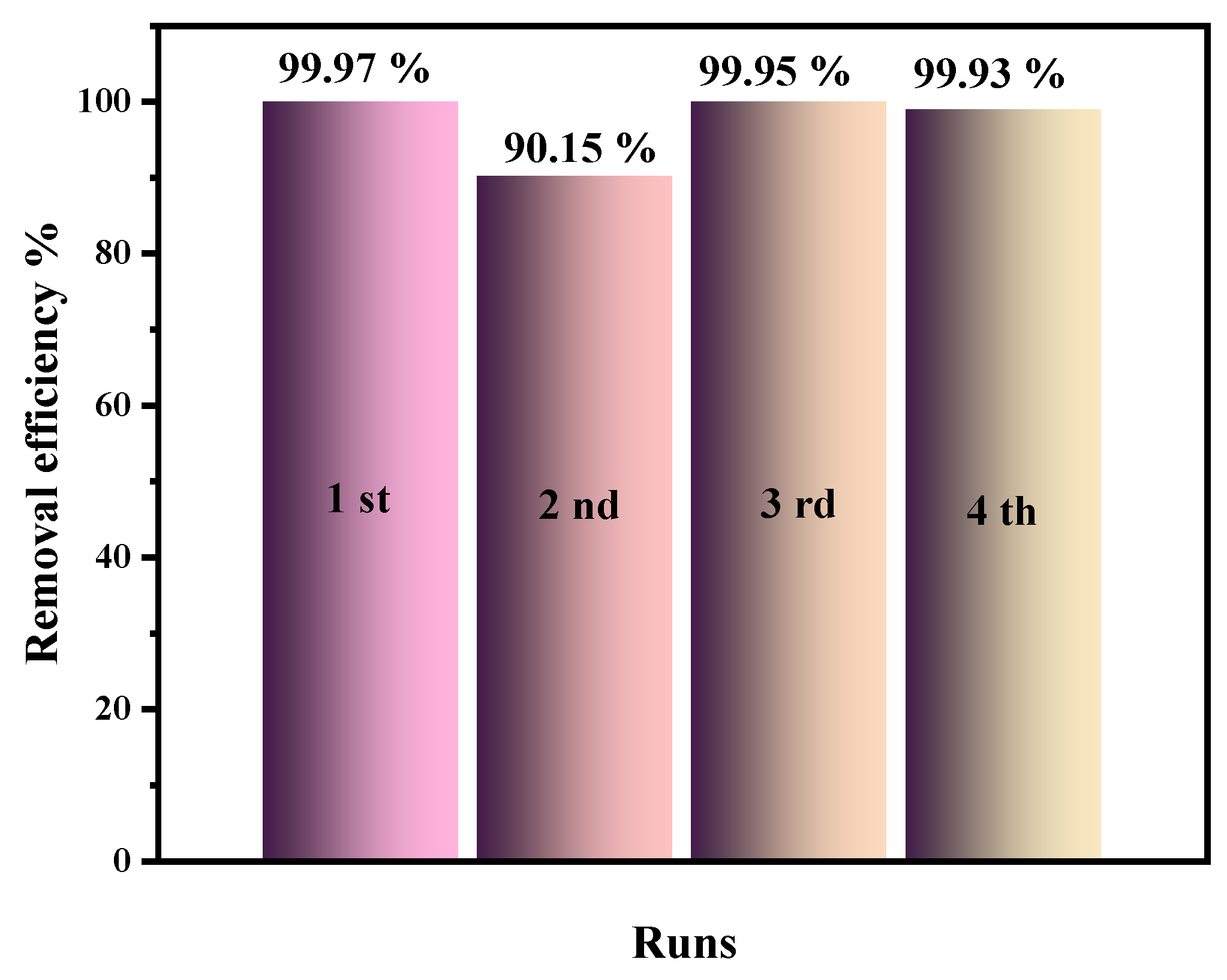
The reusability of the optimal CuO-Zn0.5 catalyst was evaluated using 15 mg of catalyst, 25 µL of H2O2, at slightly acidic pH, and 5 ppm of Rhodamine B solution. After each degradation cycle, the catalyst was recovered by washing and then dried at 150 °C before reuse. As shown in Figure 14, the catalyst exhibited excellent stability and reusability. In the first cycle, near-complete degradation of Rhodamine B was achieved, with a removal efficiency of 99.97%; in the second cycle, a slight drop in efficiency to 90% was observed, which may be due to temporary surface fouling by adsorbed intermediates, minor rearrangements of active sites, or small experimental variations. The subsequent drying at 150 °C restored the activity, leading to near-complete degradation in the following cycles, demonstrating the robustness and recyclability of the catalyst. These results indicate that the 0.5% Zn-doped CuO nanoparticles maintain high catalytic performance over multiple cycles, making them promising for practical applications in dye degradation.

2.5.9. Comparative Study

Table 3 presents a comparative analysis between the present work and previously reported CuO-based catalysts employed for heterogeneous Fenton-like degradation of organic dyes. The comparison clearly demonstrates that the Zn-doped CuO synthesized via a green route using Aloysia citrodora exhibits superior catalytic efficiency, achieving almost complete degradation (~99.97%) of Rhodamine B within only 30 min, under mild conditions, low catalyst dosage, and minimal H2O2 consumption.
In contrast, most reported CuO-based systems require longer reaction times (60–120 min), higher catalyst loading, and significantly larger amounts of oxidant. Notably, the present catalyst operates efficiently under dark conditions, which highlights its energy-saving advantage and practical applicability. These results confirm the synergistic effect of Zn doping and green synthesis in enhancing the heterogeneous Fenton-like catalytic performance of CuO, making the present material a promising candidate for wastewater remediation. These findings are consistent with previous studies on functional materials for water treatment, where structural characteristics and surface properties play a crucial role in determining removal efficiency [75].
Table 3. Comparison of previously reported CuO-based catalysts for heterogeneous Fenton-like degradation of organic dyes.
CatalystSynthesis MethodDegradation ProcessTime (min)Catalyst LoadingH2O2 ConcentrationDegradation Efficiency (%)Ref.
CuO NPsGreen synthesis
(S. Tenacissima L.)
Heterogeneous
Fenton-like
600.2 g/LNR99.88% (Tartrazine)
99.97% (Nile Blue)
[42]
CuO NPsGreen synthesis
(Cimin grape)
Heterogeneous
Fenton-like
12025 mg/mL 0.8 µg/mL97.8%
(Methylene Blue)
[76]
ZnO–Co3O4–CuOMechano-chemical (grinding)Fenton-like60 5 g/L175 µL/50 mLMO, MB, RhB 100%[77]
Mn-doped CuOCo-precipitationHeterogeneous
Fenton-like
901 g/L60 mmol/L81% (Ciprofloxacin)[41]
Zn-doped CuOGreen synthesis
(Aloysia citrodora)
Heterogeneous
Fenton-like (dark)
300.6 g/L25 µL~99.97%
Rhodamine B
This work
Note: NR: not reported.

3. Materials and Method

3.1. Chemicals and Reagents

Copper Sulfate pentahydrate (CuSO4·5H2O, ≥99%, BIOCHEM, Chemopharma, Cosne-Cours-sur-Loire, France, M.W. = 249.68 g/mol) and zinc acetate dihydrate (Zn(CH3COO)2·2H2O, ≥99%, Analar Normapur, Prolabo, Paris, France, M.W. = 219.50 g/mol) were used as precursors for the preparation of pure and Zn-doped CuO nanostructures with 0.5, 1, 2, 3, 5% weight of Zn. Sodium hydroxide (NaOH, pellets, ≥99%, Merck, Darmstadt, Germany, M.W. = 40.00 g/mol), Rhodamine B (BIOCHEM, M.W. = 479.02 g/mol) and distillated water are the products and reagents utilized in this work. All of the chemical reagents used were of analytical quality and did not need to be further purified.

3.2. Synthesis of Pure CuO and Zn-Doped CuO

A 1% (w/v) aqueous extract of Aloysia citrodora “Lemon verbena” was prepared by treating dried leaf powder with boiling distilled water, following established green synthesis protocols mediated by plant extracts, as demonstrated in [78].
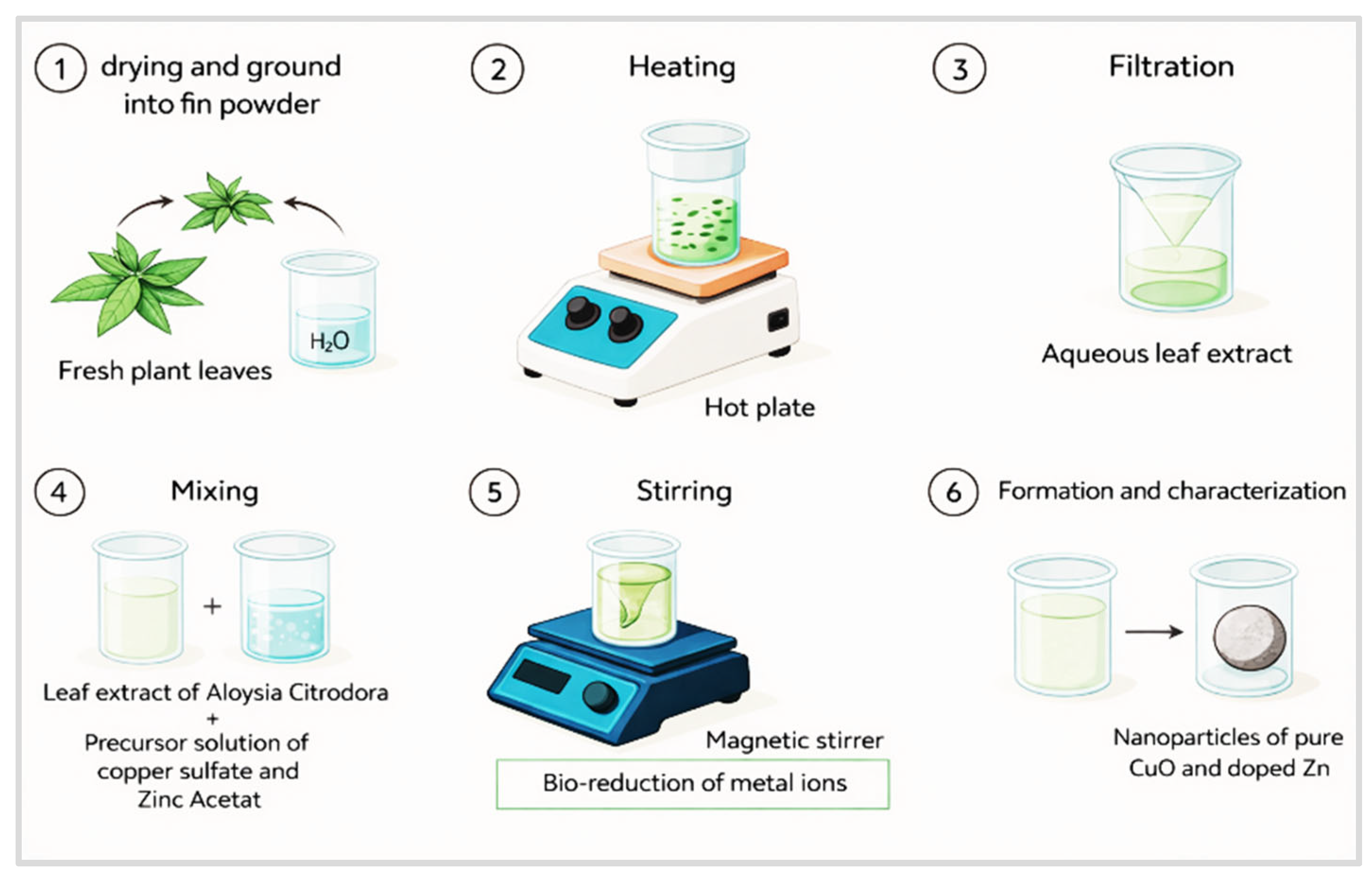
Aloysia citrodora leaf extract was used as a reducing agent in a green co-precipitation process to create both pure CuO and Zn-doped CuO nanoparticles, as shown in Figure 15. To manufacture pure CuO, 50 mL of lemon verbena leaf extract was added to 100 mL of 0.1 M copper sulfate solution. The same process was used to create Zn-doped CuO nanoparticles, using zinc acetate (Zn[OOCCH3]2·2H2O) as the doping precursor. The Zn-doped CuO nanoparticles were named CuO-Zn0.5, CuO-Zn1, CuO-Zn2, CuO-Zn3, and CuO-Zn5. The necessary stoichiometric amounts of zinc acetate were added to the copper sulfate solution to produce Zn doping concentrations of 0.5%, 1%, 2%, 3%, and 5%. The mixture was heated with magnetic stirring for 1 h at around 100 °C, and the pH of the mixture was adjusted by dropwise addition of NaOH solution (0.1 M) to reach and maintain a pH of 11 for all the samples. The resulting solution had yet to produce a black precipitate of all synthesized, and the obtained precipitate was dried in a hot air oven at 120 °C for 24 h. Subsequently, it was calcined at 600 °C as reported in [79] for 2 h. XRD, RAMAN, FTIR, and SEM/EDX analyses were used to characterize the final black fine powder of pure and Zn-doped CuO.

3.3. Characterization

Room-temperature optical absorption spectra of the pure CuO and Zn-doped CuO samples were recorded over a wavelength range of 200–800 nm in the absorption mode using the UV-Vis Spectrophotometer (SHIMADZU 1900i, Kyoto, Japan); phase analysis was carried out using X-ray diffraction with a Bruker model D8 ADVANCE (Billerica, MA, USA), operating with Cu-Kα = 1.54184 Å radiation and Bragg–Brentano configuration, a scanning rate of 0.01 °/s, and a 2θ scanning range of 20° to 90°. Raman spectra were acquired using a Thermo Scientific DXR (Waltham, MA, USA) equipped with a 532 nm excitation and 10 mW laser power. At the same time, the materials’ functional group was verified using a Fourier Transformation Infrared Spectrometer (Bruker-INVENIO-R, Billerica, MA, USA), and the shape and elemental composition of the as-prepared content were measured using a Thermo Fisher Apreo 2 C (Waltham, MA, USA) with a FEG-Schottky-type electrical source.

3.4. Degradation of Rhodamine B by Pure and Zn-Doped CuO

The degradation of Rhodamine B (RhB) was investigated under laboratory conditions at ambient temperature using pure CuO and Zn-doped CuO as catalysts. An aqueous RhB solution with an initial concentration of 5 ppm and a total volume of 25 mL was prepared at natural pH. A catalyst mass of 25 mg was added to the solution, and the suspension was magnetically stirred in the dark for 15 min to establish adsorption–desorption equilibrium, while preliminary adsorption experiments confirmed that adsorption–desorption equilibrium was reached after 15 min in the dark. After this equilibration step, 100 μL of H2O2 was added to initiate the heterogeneous Fenton-like reaction. At given time intervals, 3 mL aliquots were withdrawn, centrifuged to remove the catalyst particles, and the residual RhB concentration was determined using a UV–Vis spectrophotometer by measuring the absorbance at 554 nm and 557 nm at acidic pH.
D e g r a d a t i o n   e f f i c i e n c y   ( D ) = [ ( C 0 C ) / C 0 ] × 100 %
where C0 represents the initial concentration of dye and C is the residual concentration of dye.
Initially, the degradation efficiencies of pure CuO and Zn-doped CuO were compared in order to select the most effective catalyst based on degradation yield. Subsequently, a series of parametric studies were carried out using the selected catalyst to evaluate the influence of different operational parameters, including solution pH (5, natural pH, and 9), catalyst dosage (15, 20, and 25 mg), H2O2 amount (25, 50, 75, and 100 μL), and initial RhB concentration (5, 10, 15, and 20 ppm). These investigations were performed to determine the optimal conditions for Rhodamine B degradation by the CuO/H2O2 and Zn-CuO/H2O2 heterogeneous Fenton-like system.

4. Conclusions

In this study, pure and Zn-doped CuO nanoparticles were successfully synthesized via a sustainable, low-cost, and environmentally friendly co-precipitation method using Aloysia citrodora leaf extract as a green reducing and stabilizing agent. Structural and morphological characterizations confirmed the effective incorporation of Zn into the CuO lattice and revealed a clear evolution of the crystallite size and surface morphology as a function of Zn content. The introduction of Zn at low concentration (0.5%) resulted in a pronounced reduction in crystallite size and a transition toward finer, more granular and quasi-spherical nanoparticles, leading to an increased density of accessible surface-active sites. As a consequence, the 0.5% Zn-doped CuO sample exhibited the highest catalytic performance in the heterogeneous Fenton-like degradation of Rhodamine B under dark conditions. Under optimized reaction parameters (mildly acidic pH, low catalyst dosage, and moderate H2O2 concentration), rapid and efficient dye degradation was achieved within a short reaction time. At higher Zn contents, although further morphological refinement was observed, the catalytic activity did not surpass that of the optimal composition, indicating the existence of a balance between structural modification and catalytic efficiency. Overall, this work demonstrates that green-synthesized Zn-doped CuO nanoparticles represent an efficient and sustainable catalyst for heterogeneous Fenton-like wastewater treatment. The proposed strategy offers a promising approach for the removal of organic pollutants under mild conditions while minimizing chemical consumption and environmental impact.

Author Contributions

A.H.: Conceptualization, methodology, formal analysis, data curation, and writing—original draft preparation; C.B.: methodology, validation, and supervision; M.S.F.A.-H.: writing—original draft preparation; M.S.A.: writing—review and editing; F.F.: validation, review, project administration, and funding acquisition; A.A.A.: validation, supervision; A.A.: validation, investigation and visualization; F.A.A.: validation and investigation; J.Z.: validation, methodology; H.T.: supervision, writing—review and editing. All authors have read and agreed to the published version of the manuscript.

Funding

This work was supported and funded by the Deanship of Scientific Research at Imam Mohammad Ibn Saud Islamic University (IMSIU) (grant number IMSIU-DDRSP2602).

Data Availability Statement

The original contributions presented in this study are included in the article. Further inquiries can be directed to the corresponding authors.

Conflicts of Interest

The authors declare no conflicts of interest.

References

  1. Jebali, M.; Gómez-Merino, A.I.; Colangelo, G. Influence of the Lemon (Citrus limon L.) Juice Amount on the Green Synthesis of CuO Nanoparticles: Characterization, Stability and Thermal Conductivity. Ceram. Int. 2025, 51, 72–84. [Google Scholar] [CrossRef]
  2. Redjili, S.; Ghodbane, H.; Tahraoui, H.; Abdelouahed, L.; Chebli, D.; Ola, M.S.; Assadi, A.A.; Kebir, M.; Zhang, J.; Amrane, A.; et al. Green Innovation: Multifunctional Zinc Oxide Nanoparticles Synthesized Using Quercus Robur for Photocatalytic Performance, Environmental, and Antimicrobial Applications. Catalysts 2025, 15, 256. [Google Scholar] [CrossRef]
  3. Chelghoum, H.; Nasrallah, N.; Tahraoui, H.; Seleiman, M.F.; Bouhenna, M.M.; Belmeskine, H.; Zamouche, M.; Djema, S.; Zhang, J.; Mendil, A.; et al. Eco-Friendly Synthesis of ZnO Nanoparticles for Quinoline Dye Photodegradation and Antibacterial Applications Using Advanced Machine Learning Models. Catalysts 2024, 14, 831. [Google Scholar] [CrossRef]
  4. Grigore, M.E.; Biscu, E.R.; Holban, A.M.; Gestal, M.C.; Grumezescu, A.M. Methods of Synthesis, Properties and Biomedical Applications of CuO Nanoparticles. Pharmaceuticals 2016, 9, 75. [Google Scholar] [CrossRef]
  5. Ogwuegbu, M.C.; Olatunde, O.C.; Pfukwa, T.M.; Mthiyane, D.M.N.; Fawole, O.A.; Onwudiwe, D.C. Green-Synthesis of CuO and Ce-Doped CuO Nanoparticles Using Aqueous Extract of Yam Peel and Their Antimicrobial Properties. Hybrid Adv. 2024, 7, 100335. [Google Scholar] [CrossRef]
  6. El-Trass, A.; ElShamy, H.; El-Mehasseb, I.; El-Kemary, M. CuO Nanoparticles: Synthesis, Characterization, Optical Properties and Interaction with Amino Acids. Appl. Surf. Sci. 2012, 258, 2997–3001. [Google Scholar] [CrossRef]
  7. Hendraningrat, L.; Torsæter, O. Metal Oxide-Based Nanoparticles: Revealing Their Potential to Enhance Oil Recovery in Different Wettability Systems. Appl. Nanosci. 2015, 5, 181–199. [Google Scholar] [CrossRef]
  8. Ren, H.; Miao, Z.; Wang, J.; Jin, L.; Li, F.; Wu, P. Lignin Carbon Dots: Synthesis from Alkali Lignin, Sensing Mechanism for Fe3+, Performance Evaluation, and Azo Dye Composite Test Paper for Dual-Mode Detection. Biomass Bioenergy 2026, 212, 109293. [Google Scholar] [CrossRef]
  9. Haseki, S.; Kucukcobanoglu, Y.; Ayisigi, M.; Oztekin, T.; Aktas, L.Y. Influence of Synthesis Method on Physiochemical Properties and Antibacterial Activity of Green Synthesized CuO Nanoparticles from Laurus nobilis L. Leaf Extracts. Plant Nano Biol. 2025, 11, 100128. [Google Scholar] [CrossRef]
  10. Nie, Y.; Li, D.; Peng, Y.; Wang, S.; Hu, S.; Liu, M.; Ding, J.; Zhou, W. Metal Organic Framework Coated MnO2 Nanosheets Delivering Doxorubicin and Self-Activated DNAzyme for Chemo-Gene Combinatorial Treatment of Cancer. Int. J. Pharm. 2020, 585, 119513. [Google Scholar] [CrossRef]
  11. Duan, X.; Yan, S.; Li, Y.; Fang, S.; Tie, X.; Wang, H.; Liu, J.; Zou, C.; Wang, T.; Feng, W. Preparation of Chromium-Doped ZIFs-8/ZnCo-LDH Composite as a Acid-Base Bifunctional Catalyst for Biodiesel Production. Renew. Energy 2025, 238, 121940. [Google Scholar] [CrossRef]
  12. Guo, Y.; Wu, S.; La, P.; Zhou, D.; Ji, Z.; Wang, X. 3D-Printing Advanced ZIF-67@aluminum Phosphate/Al2O3 Ceramic Catalyst by Aluminum Phosphate-Assisted Surface Bonding. Mater. Sci. Addit. Manuf. 2025, 4, 025220037. [Google Scholar] [CrossRef]
  13. Annu; Ali, A.; Ahmed, S. Green Synthesis of Metal, Metal Oxide Nanoparticles, and Their Various Applications. In Handbook of Ecomaterials; Martínez, L.M.T., Kharissova, O.V., Kharisov, B.I., Eds.; Springer International Publishing: Cham, Switzerland, 2018; pp. 1–45. [Google Scholar]
  14. Wu, J.; Yue, X.; Wang, T.; Zhang, Y.; Jin, Y.; Li, G. A Cost-Effective and Sensitive Voltammetric Sensor for Determination of Baicalein in Herbal Medicine Based on Shuttle-Shape α-Fe2O3 Nanoparticle Decorated Multi-Walled Carbon Nanotubes. Colloids Surf. A Physicochem. Eng. Asp. 2025, 717, 136850. [Google Scholar] [CrossRef]
  15. Li, T.; Xiao, L.; Ling, H.; Yang, Y.; Zhong, S. Preparation of Artificial Substrate Binding Sites of Nanozyme with “Modular Structure” Strategy Used for the Construction of Visual Sensing Analysis Platform for Levodopa. Microchem. J. 2025, 212, 113292. [Google Scholar] [CrossRef]
  16. Yan, H.; Tian, B.; Liao, A.; Sun, W.; Tu, H.; Tian, Y.; Yang, Z.; Kandegama, W.M.W.W.; Guo, S.; Wu, J. Breaking the Selectivity Dilemma: A 114-Fold Bee-Safe AIE Nanoinsecticide via Spontaneous Non-Covalent Orchestration. Chem. Eng. J. 2026, 529, 172939. [Google Scholar] [CrossRef]
  17. Harizi, I.; Aldahri, T.; Chebli, D.; Tahraoui, H.; Bouguettoucha, A.; Rohani, S.; Zhang, J.; Amrane, A. Gaussian Process Regression with Levy Flight Optimization: Advanced AR66 Adsorption Studies. Chem. Eng. Res. Des. 2024, 207, 192–208. [Google Scholar] [CrossRef]
  18. Tahraoui, H.; Belhadj, A.-E.; Amrane, A.; Toumi, S.; Jaouadi, B.; Zhang, J. Maximizing Diclofenac Bioremoval Efficiency Using Chlorella Vulgaris Strain H1 and Chlorella Sorokiniana Strain H2: Unveiling the Impact of Acetic Acid on Microalgae. J. Taiwan. Inst. Chem. Eng. 2024, 165, 105783. [Google Scholar] [CrossRef]
  19. Kebir, M.; Bouallouche, R.; Nasrallah, N.; Tahraoui, H.; Elboughdiri, N.; Ait Merzeg, F.; Dergal, F.; Amirouche, S.; Assadi, A.A.; Amrane, A. Sustainable Photodegradation of Amoxicillin in Wastewater with a Nickel Aluminate and ZnO Heterosystem Oxides: Experimental and Gaussian Process Regression Modeling Studies. Catalysts 2024, 14, 875. [Google Scholar] [CrossRef]
  20. Toumi, S.; Lekmine, S.; Touzout, N.; Moussa, H.; Elboughdiri, N.; Boudraa, R.; Benslama, O.; Kebir, M.; Danish, S.; Zhang, J. Harnessing Deep Learning for Real-Time Water Quality Assessment: A Sustainable Solution. Water 2024, 16, 3380. [Google Scholar] [CrossRef]
  21. Chavali, M.S.; Nikolova, M.P. Metal Oxide Nanoparticles and Their Applications in Nanotechnology. SN Appl. Sci. 2019, 1, 607. [Google Scholar] [CrossRef]
  22. Oruç, Ç.; Altındal, A. Structural and Dielectric Properties of CuO Nanoparticles. Ceram. Int. 2017, 43, 10708–10714. [Google Scholar] [CrossRef]
  23. Mai, X.T.; Duong, T.M.; Nguyen, D.N.; To, T.H.; Luc, H.H.; Tran, P.D.; Le, L.T. Sol–Gel Synthesis of CuO Nanoparticles and Its Use as Catalyst for Electrochemical CO2 Reduction. Energy Technol. 2025, 13, 2401486. [Google Scholar] [CrossRef]
  24. Rehman, H.; Ali, Z.; Qadir, A.; H. Farooq, M.; Shuaib, A.; Zahra, A.; Shahzady, T.; Hussain, H. Synthesis of CuO-NPS by Simple Wet Chemical Method Using Various Dicarboxylic Acid Salts as Precursors: Spectral Characterization and in-Vitro Biological Evaluation. Bull. Chem. Soc. Ethiop. 2020, 34, 323–334. [Google Scholar] [CrossRef]
  25. Nahar, B.; Chaity, S.B.; Gafur, M.A.; Hossain, M.Z. Synthesis of Spherical Copper Oxide Nanoparticles by Chemical Precipitation Method and Investigation of Their Photocatalytic and Antibacterial Activities. J. Nanomater. 2023, 2023, 2892081. [Google Scholar] [CrossRef]
  26. Dahonog, L.A.; Vega, M.S.D.D.; Balela, M.D.L. pH-Dependent Synthesis of Copper Oxide Phases by Polyol Method. J. Phys.: Conf. Ser. 2019, 1191, 012043. [Google Scholar] [CrossRef]
  27. Radulescu, D.-M.; Surdu, V.-A.; Ficai, A.; Ficai, D.; Grumezescu, A.-M.; Andronescu, E. Green Synthesis of Metal and Metal Oxide Nanoparticles: A Review of the Principles and Biomedical Applications. Int. J. Mol. Sci. 2023, 24, 15397. [Google Scholar] [CrossRef]
  28. Jawad, K.H.; Hasoon, B.A.; Ismail, R.A.; Shaker, S.S. Preparation of Copper Oxide Nanosheets by Pulsed Laser Ablation in Liquid for Anticancer, Antioxidant, and Antibacterial Activities. J. Indian Chem. Soc. 2022, 99, 100773. [Google Scholar] [CrossRef]
  29. Enad, A.M.; Rzaij, J.M. Investigate the Structural, Morphological, and Topographical Characteristics of CuO Thin Films Utilizing a Pulsed Laser Deposition Method. J. Theor. Appl. Phys. 2024, 18, si-AICIS23.03. [Google Scholar] [CrossRef]
  30. Rajamohan, R.; Lee, Y.R. Microwave-Assisted Synthesis of Copper Oxide Nanoparticles by Apple Peel Extract and Efficient Catalytic Reduction on Methylene Blue and Crystal Violet. J. Mol. Struct. 2023, 1276, 134803. [Google Scholar] [CrossRef]
  31. Boudraa, R.; Djermoune, A.; Touati-Talantikite, D.; Blkacemi, H.; Madi, K.; Bouallouche, R.; Ait Merzeg, F.; Kebir, M.; Fadhillah, F.; Ali, F.A.A.; et al. Green-Synthesized Ag/Ag3O4/CuO from Inula Viscosa Coupled with Peroxydisulfate for Safranin O Degradation: Modeling and Optimization Using DT_LSBOOST and Dragonfly Algorithm. Appl. Water Sci. 2025, 15, 318. [Google Scholar] [CrossRef]
  32. Boudraa, R.; Djermoune, A.; Balit, S.; Madi, K.; Touati-Talantikite, D.; Bouallouche, R.; Bachari, K.; Bellardita, M.; Kebir, M.; Ait Merzeg, F.; et al. Towards Sustainable Water Treatment: Green Fabrication of Core–Shell Photocatalysts Supported on Fiberglass Textiles. J. Water Process Eng. 2026, 81, 109199. [Google Scholar] [CrossRef]
  33. Abidi, M.; Assadi, A.A.; Aouida, S.; Tahraoui, H.; Khezami, L.; Zhang, J.; Amrane, A.; Hajjaji, A. Photocatalytic Activity of Cu2O-Loaded TiO2 Heterojunction Composites for the Simultaneous Removal of Organic Pollutants and Bacteria in Indoor Air. Catalysts 2025, 15, 360. [Google Scholar] [CrossRef]
  34. Madi, K.; Agueniou, F.; Chebli, D.; Tahraoui, H.; Bouguettoucha, A.; Zhang, J.; Amrane, A. Polyaniline-Modified Iron and Copper Co-Doped Cerium Oxide Nanocomposites for Enhanced Photocatalytic Degradation of Methylene Blue: Synthesis, and Characterization. Colloids Surf. A Physicochem. Eng. Asp. 2025, 712, 136469. [Google Scholar] [CrossRef]
  35. Madi, K.; Chebli, D.; Benkouachi, O.R.; Boudra, R.; Bouallouche, R.; Tahraoui, H.; Kebir, M.; Gil, A.; Zhang, J.; Amrane, A. Design and Optimization of Phosphorus-and Titanium-Doped Graphitic Carbon Nitride Photocatalysts for the Degradation of Beibrich Scarlet Dye under Visible Light Irradiation Using Machine Learning. J. Water Process Eng. 2025, 77, 108571. [Google Scholar] [CrossRef]
  36. Masekela, D.; Kganyakgo, L.K.; Modibane, K.D.; Yusuf, T.L.; Balogun, S.A.; Seleka, W.M.; Makhado, E. Green Synthesis and Enhanced Photocatalytic Performance of Co-Doped CuO Nanoparticles for Efficient Degradation of Synthetic Dyes and Water Splitting. Results Chem. 2025, 13, 101971. [Google Scholar] [CrossRef]
  37. Khalid, A.; Ahmad, P.; Alharthi, A.I.; Muhammad, S.; Khandaker, M.U.; Rehman, M.; Faruque, M.R.I.; Din, I.U.; Alotaibi, M.A.; Alzimami, K.; et al. Structural, Optical, and Antibacterial Efficacy of Pure and Zinc-Doped Copper Oxide Against Pathogenic Bacteria. Nanomaterials 2021, 11, 451. [Google Scholar] [CrossRef]
  38. Barbosa, R.; Trigueiro, P.; Albuquerque, W.A.; Almeida, L.; Peña-Garcia, R.R. Enhanced Photocatalytic Degradation of Furosemide Using Gd3+/Cu2+co-Doped ZnO Synthesized via Sonochemical-Assisted Coprecipitation. Discov. Mater. 2025, 5, 278. [Google Scholar] [CrossRef]
  39. Sirirak, R.; Chaopanich, P.; Prasatkhetragarn, A.; Chailuecha, C.; Kuimalee, S.; Klinbumrung, A. Doping Effect of Zn on Structural and Optical Properties of CuO Nanostructures Prepared by Wet Chemical Precipitation Process. Radiat. Phys. Chem. 2022, 190, 109788. [Google Scholar] [CrossRef]
  40. Jeevarathinam, M.; Asharani, I.V. Synthesis of CuO, ZnO Nanoparticles, and CuO-ZnO Nanocomposite for Enhanced Photocatalytic Degradation of Rhodamine B: A Comparative Study. Sci. Rep. 2024, 14, 9718. [Google Scholar] [CrossRef]
  41. Yang, X.; Lai, C.; Li, L.; Cheng, M.; Liu, S.; Yi, H.; Zhang, M.; Fu, Y.; Xu, F.; Yan, H.; et al. Oxygen Vacancy Assisted Mn-CuO Fenton-like Oxidation of Ciprofloxacin: Performance, Effects of pH and Mechanism. Sep. Purif. Technol. 2022, 287, 120517. [Google Scholar] [CrossRef]
  42. Ghanjaoui, M.E.; Soufi, A.; Kadmi, Y.; Barka, N.; Tounsadi, H. Efficient Green Synthesis of Copper Oxide Nanoparticles Using Stipa tenacissima L. Extract: Optimization and Heterogeneous Fenton- like Degradation of Textile Dyes. Surf. Interfaces 2025, 73, 107519. [Google Scholar] [CrossRef]
  43. Han, X.; Gou, L.; Tang, S.; Cheng, F.; Zhang, M.; Guo, M. Enhanced Heterogeneous Fenton-like Degradation of Refractory Organic Contaminants over Cu Doped (Mg,Ni)(Fe,Al)2O4 Synthesized from Laterite Nickel Ore. J. Environ. Manag. 2021, 283, 111941. [Google Scholar] [CrossRef]
  44. Chang, Y.; Liao, L.; Wang, X.; Wang, B.; Li, Z.; Zhang, W.; Zhou, W. Synergistic Activation of Peroxymonosulfate by Defective CuBi2O4 with Oxygen Vacancies and Cu+ towards Efficient Photocatalytic Antibiotics Degradation. Environ. Funct. Mater. 2025, 4, 11–20. [Google Scholar] [CrossRef]
  45. Mohod, A.V.; Momotko, M.; Shah, N.S.; Marchel, M.; Imran, M.; Kong, L.; Boczkaj, G. Degradation of Rhodamine Dyes by Advanced Oxidation Processes (AOPs)—Focus on Cavitation and Photocatalysis—A Critical Review. Water Resour. Ind. 2023, 30, 100220. [Google Scholar] [CrossRef]
  46. Naz, S.; Gul, A.; Zia, M.; Javed, R. Synthesis, Biomedical Applications, and Toxicity of CuO Nanoparticles. Appl. Microbiol. Biotechnol. 2023, 107, 1039–1061. [Google Scholar] [CrossRef]
  47. Xue, Y.; Yu, G.; Shan, Z.; Li, Z. Phyto-Mediated Synthesized Multifunctional Zn/CuO NPs Hybrid Nanoparticles for Enhanced Activity for Kidney Cancer Therapy: A Complete Physical and Biological Analysis. J. Photochem. Photobiol. B Biol. 2018, 186, 131–136. [Google Scholar] [CrossRef]
  48. Hadkar, V.M.; Selvaraj, C.I. Characterization and Investigating the Potential Therapeutic Effects of Phyto-Assisted CuO and Zn-Doped CuO Nanoparticles from Calophyllum Apetalum (Willd.) Leaf Extract. J. Drug Deliv. Sci. Technol. 2025, 104, 106530. [Google Scholar] [CrossRef]
  49. Bahramsoltani, R.; Rostamiasrabadi, P.; Shahpiri, Z.; Marques, A.M.; Rahimi, R.; Farzaei, M.H. Aloysia citrodora Paláu (Lemon verbena): A Review of Phytochemistry and Pharmacology. J. Ethnopharmacol. 2018, 222, 34–51. [Google Scholar] [CrossRef]
  50. Hassanisaadi, M.; Bonjar, A.H.S.; Rahdar, A.; Varma, R.S.; Ajalli, N.; Pandey, S. Eco-Friendly Biosynthesis of Silver Nanoparticles Using Aloysia Citrodora Leaf Extract and Evaluations of Their Bioactivities. Mater. Today Commun. 2022, 33, 104183. [Google Scholar] [CrossRef]
  51. Bhise, S.L.; Kathwate, L.H.; Umadevi, G.; Krishna, K.G.; Mote, V.D.; Dole, B.N. Structural, Optical and Gas Sensing Properties of Zn-Doped CuO Nanostructure Thin Films for Benzene Gas Sensing Applications. J. Mater. Sci. Mater. Electron. 2024, 35, 66. [Google Scholar] [CrossRef]
  52. Goyal, C.P.; Goyal, D.; K. Rajan, S.; Ramgir, N.S.; Shimura, Y.; Navaneethan, M.; Hayakawa, Y.; Muthamizhchelvan, C.; Ikeda, H.; Ponnusamy, S. Effect of Zn Doping in CuO Octahedral Crystals towards Structural, Optical, and Gas Sensing Properties. Crystals 2020, 10, 188. [Google Scholar] [CrossRef]
  53. Zhang, S.; Zhang, H.B.; Zhao, F.A.; Jiang, M.; Xiao, H.Y.; Liu, Z.J.; Zu, X.T. Impact of Isovalent and Aliovalent Substitution on the Mechanical and Thermal Properties of Gd2Zr2O7. Sci. Rep. 2017, 7, 6399. [Google Scholar] [CrossRef]
  54. Maqbool, M.H.; Iqbal, Z.; Zawar, S.; Khalid, A.; Ramay, S.M.; Atiq, S. Analysis of Interphase Magnetoelectric Coupling in Bi0.9La0.1FeO3–MgFe2O4 Composites. Appl. Phys. A 2023, 129, 779. [Google Scholar] [CrossRef]
  55. Holland, T.J.B.; Redfern, S.a.T. Unit Cell Refinement from Powder Diffraction Data: The Use of Regression Diagnostics. Mineral. Mag. 1997, 61, 65–77. [Google Scholar] [CrossRef]
  56. Yathisha, R.O.; Arthoba Nayaka, Y. Structural, Optical and Electrical Properties of Zinc Incorporated Copper Oxide Nanoparticles: Doping Effect of Zn. J. Mater. Sci. 2018, 53, 678–691. [Google Scholar] [CrossRef]
  57. Kumar, P.; Inwati, G.K.; Mathpal, M.C.; Ghosh, S.; Roos, W.D.; Swart, H.C. Defects Induced Enhancement of Antifungal Activities of Zn Doped CuO Nanostructures. Appl. Surf. Sci. 2021, 560, 150026. [Google Scholar] [CrossRef]
  58. Al-Hazeef, M.S.F.; Aidi, A.; Hecini, L.; Hasan, G.G.; Hu, J.; Althamthami, M. Unveiling the Efficiency of Peanut Shell-Derived Porous Composite for Water Denitrification: Characterization, Kinetic, Isotherm and Thermodynamic Studies. J. Mol. Liq. 2024, 410, 125668. [Google Scholar] [CrossRef]
  59. Corda, N.; Thundiyil, R.; Ani, A.; Anusha; P, P.; Rao, A.; Manjunatha, K. Electrical, Optical and Nonlinear Optical Process in Spray Pyrolyzed Zn:CuO Nanostructures for Optoelectronic Device Applications. Mater. Res. Express 2024, 11, 056203. [Google Scholar] [CrossRef]
  60. Phang, Y.-K.; Aminuzzaman, M.; Akhtaruzzaman, M.; Muhammad, G.; Ogawa, S.; Watanabe, A.; Tey, L.-H. Green Synthesis and Characterization of CuO Nanoparticles Derived from Papaya Peel Extract for the Photocatalytic Degradation of Palm Oil Mill Effluent (POME). Sustainability 2021, 13, 796. [Google Scholar] [CrossRef]
  61. Varughese, A.; Kaur, R.; Singh, P. Green Synthesis and Characterization of Copper Oxide Nanoparticles Using Psidium Guajava Leaf Extract. IOP Conf. Ser. Mater. Sci. Eng. 2020, 961, 012011. [Google Scholar] [CrossRef]
  62. Iskakova, Z.; Kozhantayeva, A.; Temirbekova, A.; Mukhtubayeva, S.; Bissenova, G.; Tekebayeva, Z.; Almagambetov, K.; Tashenov, Y.; Sarmurzina, Z. Green Synthesis of Silver Nanoparticles Using Circaea Lutetiana Ethanolic Extract: Phytochemical Profiling, Characterization, and Antimicrobial Evaluation. Int. J. Mol. Sci. 2025, 26, 5505. [Google Scholar] [CrossRef]
  63. Walencik, P.K.; Choińska, R.; Gołębiewska, E.; Kalinowska, M. Metal–Flavonoid Interactions—From Simple Complexes to Advanced Systems. Molecules 2024, 29, 2573. [Google Scholar] [CrossRef]
  64. Luo, Z.; Cheng, W.; Chen, H.; Fu, X.; Peng, X.; Luo, F.; Nie, L. Preparation and Properties of Enzyme-Modified Cassava Starch-Zinc Complexes. J. Agric. Food Chem. 2013, 61, 4631–4638. [Google Scholar] [CrossRef]
  65. Abinaya, C.; Marikkannan, M.; Manikandan, M.; Mayandi, J.; Suresh, P.; Shanmugaiah, V.; Ekstrum, C.; Pearce, J.M. Structural and Optical Characterization and Efficacy of Hydrothermal Synthesized Cu and Ag Doped Zinc Oxide Nanoplate Bactericides. Mater. Chem. Phys. 2016, 184, 172–182. [Google Scholar] [CrossRef]
  66. Neiva, J.; Benzarti, Z.; Carvalho, S.; Devesa, S. Green Synthesis of CuO Nanoparticles—Structural, Morphological, and Dielectric Characterization. Materials 2024, 17, 5709. [Google Scholar] [CrossRef]
  67. Kaushal, S.; Thakur, N.; Kumar, K. Investigation of the Efficacy of Zn/Ce–CuO Nanoparticles for Enhanced Photocatalytic, Antibacterial, and Antioxidant Activities. Environ. Sci. Pollut. Res. 2024, 1–19. [Google Scholar] [CrossRef]
  68. Nzilu, D.M.; Madivoli, E.S.; Makhanu, D.S.; Wanakai, S.I.; Kiprono, G.K.; Kareru, P.G. Green Synthesis of Copper Oxide Nanoparticles and Its Efficiency in Degradation of Rifampicin Antibiotic. Sci. Rep. 2023, 13, 14030. [Google Scholar] [CrossRef]
  69. Ahmed, N.; Vione, D.; Rivoira, L.; Carena, L.; Castiglioni, M.; Bruzzoniti, M.C.; Ahmed, N.; Vione, D.; Rivoira, L.; Carena, L.; et al. A Review on the Degradation of Pollutants by Fenton-Like Systems Based on Zero-Valent Iron and Persulfate: Effects of Reduction Potentials, pH, and Anions Occurring in Waste Waters. Molecules 2021, 26, 4584. [Google Scholar] [CrossRef]
  70. Langa, C.; Mabuba, N.; Mahlaule-Glory, L.M.; Motaung, D.E.; Tetana, Z.; Hintsho-Mbita, N.C. Enhanced Photocatalytic Degradation of Dyes and Pharmaceutical Pollutants Using Fe/TiO2-Carbon Nanospheres from Sutherlandia Frutescence. Int. J. Environ. Anal. Chem. 2025, 106, 790–820. [Google Scholar] [CrossRef]
  71. Chu, Y.; Miao, B.; Zhang, X.; Lv, R. Heterogeneous Electro-Fenton-like Oxidation for the Degradation of 4-Nitrophenol Characterized by Immobilized Fe(III): Performance, Mechanism and Chlorinated Organic Compounds Formation. J. Water Process Eng. 2020, 38, 101662. [Google Scholar] [CrossRef]
  72. Chen, Z.; Li, J.; Zhang, J.; Wang, H.; Zeng, Y.; Wang, F.; Huang, P.; Chen, X.; Ge, L.; Dahlgren, R.A.; et al. A Highly Efficient and Recyclable Living Biocatalyst Using Shewanella@polydopamine@NH2-Doped Carbon Dot Biohybrids and Polypyrrole Immobilized Melamine Foam for Microbial-Photoreduction of Cr(VI). J. Clean. Prod. 2024, 435, 140497. [Google Scholar] [CrossRef]
  73. Jiang, F.; Zhang, Y.; Xu, X.; Mao, Y.; Wang, M.; Yang, B.; Zhang, C.; Feng, X.; Meng, H.; Guo, F.; et al. Application of Cysteine with Cu2+ to Strengthen Fenton-Based Treatment of Coking Wastewater Used Ferric Sludge as a Source of Iron Catalyst: Cl Removal and Fe3+/Fe2+ Cycling. J. Environ. Chem. Eng. 2025, 13, 117556. [Google Scholar] [CrossRef]
  74. Su, Z.; Li, J.; Zhang, D.; Ye, P.; Li, H.; Yan, Y. Novel Flexible Fenton-like Catalyst: Unique CuO Nanowires Arrays on Copper Mesh with High Efficiency across a Wide pH Range. Sci. Total Environ. 2019, 647, 587–596. [Google Scholar] [CrossRef]
  75. Zhou, A.; Wu, Q.; Zhang, H.; Liu, J.; Wang, C.; Chi, D.; Zhou, H. RSM-Optimized Mg/Al-LDH Biochar Composite for Enhanced Phosphorus Removal: Insights into Interlayer Structure Evolution and Adsorption Mechanism. J. Environ. Manag. 2026, 401, 128837. [Google Scholar] [CrossRef]
  76. Gültekin, D.D.; Alaylı, A.; Nadaroglu, H. Eco-Friendly Synthesis of Nano Copper and Its Use in Fenton-like Reactions for Methylene Blue Degradation. Int. J. Chem. Technol. 2020, 4, 71–78. [Google Scholar] [CrossRef]
  77. Li, X.; Miao, K.; Guo, S.; Wang, N.; Zhuang, Q.; Qian, H.; Luo, X.; Feng, G. Enhanced Catalytic Activity of ZnO–CuO–Co3O4 Composites Achieved Using a Mechanochemical Method for Effective Fenton-like Dye Removal: The Generation and Catalytic Mechanism of Various Superficial Active Sites. Mater. Adv. 2023, 4, 4943–4953. [Google Scholar] [CrossRef]
  78. Hazmoune, A.; Boukaous, C.; Iaiche, S.; Benhaoua, B.; Fadhillah, F.; Assadi, A.A.; Amrane, A.; Ali, F.A.A.; Zhang, J.; Kebir, M.; et al. H2O2-Assisted Sunlight Photocatalytic Degradation of Basic Fuchsin Using Green-Synthesized ZnO Nanowires. Catalysts 2026, 16, 193. [Google Scholar] [CrossRef]
  79. Sihag, S.; Dahiya, R.; Rani, S.; Anushree; Kumar, A.; Kumar, V. Investigation of Structural and Optical Characteristics of CuO Nanoparticles Calcinated at Various Temperatures. Indian J. Chem. Technol. (IJCT) 2022, 29, 578–582. [Google Scholar] [CrossRef]
Figure 1. (a) XRD pattern of pure CuO and Zn-doped CuO with different Zn concentrations; (b) peak shift for main peak; (c) estimation of change in crystalline size and micro-strain vs. dopant concentration using Scherer’s formula and (d) W-H method.
Catalysts 16 00352 g001
Figure 2. W-H plots for pure CuO and Zn-doped CuO samples.
Catalysts 16 00352 g002
Figure 3. Raman spectra of CuO and Zn-doped CuO (0.5–5%) samples.
Catalysts 16 00352 g003
Figure 4. FTIR spectra of pure CuO and Zn-doped CuO NPs (0.5–5%).
Catalysts 16 00352 g004
Figure 5. SEM images of pure CuO and Zn-doped CuO (0.5–5%) samples.
Catalysts 16 00352 g005
Figure 6. EDS analysis of pure CuO and Zn-doped CuO (0.5–5%) samples.
Catalysts 16 00352 g006
Figure 7. (a) Degradation of Rhodamine B over pure CuO and Zn-doped CuO. (b) Pseudo-first-order kinetic plots for degradation of Rhodamine B over pure CuO and Zn-doped CuO catalysts under identical conditions. Experimental conditions: pH = 7; [RhB] = 5 mg/L; catalyst mass = 25 mg; [H2O2] = 100 μL.
Catalysts 16 00352 g007
Figure 8. Effects of pH on Rhodamine B degradation using CuO-Zn0.5/H2O2. Experimental conditions: [RhB] = 5 ppm; catalyst mass = 25 mg; [H2O2] = 100 μL.
Catalysts 16 00352 g008
Figure 9. Effect of catalyst dosage on Rhodamine B degradation using CuO-Zn0.5/H2O2. Experimental conditions: pH~5; [RhB] = 5 ppm; [H2O2] = 100 μL.
Catalysts 16 00352 g009
Figure 10. Effect of H2O2 amount on Rhodamine B degradation using CuO-Zn0.5/H2O. Experimental conditions: pH~5; [RhB] = 5 ppm; catalyst mass = 15 mg.
Catalysts 16 00352 g010
Figure 11. Effect of initial Rhodamine B concentration on degradation efficiency using CuO-Zn0.5/H2O2. Experimental conditions: pH~5; [H2O2] = 25 μL; catalyst mass = 15 mg.
Catalysts 16 00352 g011
Figure 12. Effect of different scavengers on Rhodamine B degradation. Experimental conditions: pH~5; [RhB] = 5 ppm; [H2O2] = 25 μL; catalyst mass = 15 mg.
Catalysts 16 00352 g012
Figure 13. Proposed mechanism for enhanced heterogeneous Fenton-like degradation of Rhodamine B over Zn-doped CuO catalyst.
Catalysts 16 00352 g013
Figure 14. Reusability and stability of Zn-doped CuO catalyst for Rhodamine B degradation over four consecutive cycles. Experimental conditions: pH~5; [RhB] = 5 ppm; [H2O2] = 25 μL; catalyst mass = 15 mg.
Catalysts 16 00352 g014
Figure 15. Synthesis of pure CuO and Zn-doped CuO nanoparticles using Aloysia citrodora leaf extract.
Catalysts 16 00352 g015
Table 1. Variation in lattice constants, cell volume, dislocation density, and full width at half maxima (FWHM) with dopant concentration.
PropertyCuOCuO-Zn0.5CuO-Zn1CuO-Zn2CuO-Zn3CuO-Zn5
x (Å)4.68234.68444.68104.68124.68524.6838
y (Å)3.41743.41923.41833.41573.41753.4139
z (Å)5.12685.12425.12725.12625.12385.1251
b (°)99.47599.53899.51799.56099.54299.530
Cell volume (Å)80.91780.94180.91280.82580.90680.820
Dislocation density (nm−2) 10−30.7501.1472.4732.0611.2981.808
FWHM (hlk = −111) (°)0.2390.3270.3780.3230.3350.299
FWHM (hlk = 111) (°)0.3020.4210.4940.4150.4370.359
Table 2. Raman peak shifts induced by Zn doping.
SampleAg (cm−1)ΔAg (cm−1)B2g (cm−1)ΔB2g (cm−1)
CuO288.000.00626.540.00
CuO-Zn0.5280.00−8.00626.00−0.54
CuO-Zn1287.19−0.81625.92−0.62
CuO-Zn2272.22−15.78626.56+0.02
CuO-Zn3270.58−17.42626.25−0.29
CuO-Zn5274.22−13.78616.46−10.08
Disclaimer/Publisher’s Note: The statements, opinions and data contained in all publications are solely those of the individual author(s) and contributor(s) and not of MDPI and/or the editor(s). MDPI and/or the editor(s) disclaim responsibility for any injury to people or property resulting from any ideas, methods, instructions or products referred to in the content.