Exploring the Priorities of Patients with Early Breast Cancer in the United States: A Qualitative Interview Study and Patient-Informed Conceptual Disease Model
 ,
,  , , and
Simple Summary
Abstract
1. Introduction
2. Materials and Methods
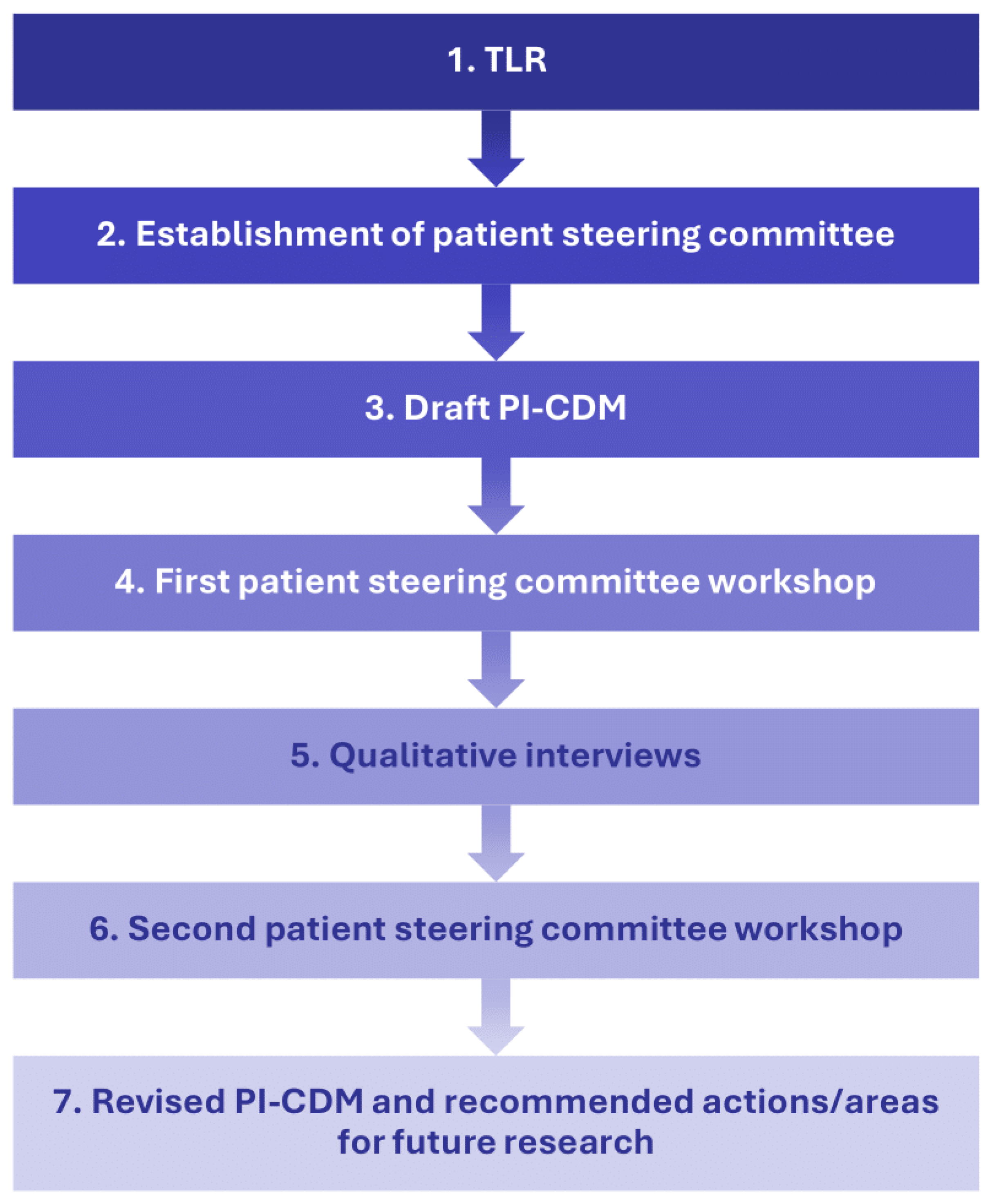
2.1. Study Design
2.2. Targeted Literature Review
2.3. Patient Steering Committee
2.4. Qualitative Interviews
2.4.1. Ethics
2.4.2. Participant Recruitment
2.4.3. Eligibility Criteria
2.4.4. Pre-Interview Procedures
2.4.5. Interview Procedures
2.5. Data Analysis
2.5.1. Pre-Interview Survey Sample Characteristics
2.5.2. Qualitative Data
2.5.3. Saturation of Concepts
3. Results
3.1. Participant Characteristics
3.2. Qualitative Interview Findings
3.2.1. Experiences with eBC Diagnosis and Genetic Testing
3.2.2. Signs and Symptoms of eBC
“Okay. So, the early onset breast cancer, I had a strange itching in my breast and that was the pressure of the lump. I was exhausted all the time. I didn’t know why. I had pain; it felt like my underarm was on fire all the time, like shooting pain.”(P12_Stage III_HER2+)
3.2.3. Treatment Experiences for eBC
“The first medication that I was on, it was a lotta days I couldn’t really get out the bed because it was causing my bones and joints to hurt extremely bad. So, she switched it and I’m on a new one, and now I just take it ‘cause I see that, no matter what, my body is still gonna ache. I still don’t sleep. So, I feel like it’s just something that I have to accept now.”(P8_Stage I_HR+/HER2-)
“When I noticed during the radiation you really don’t have that much of an appetite. I mean, there was a little bit of weight loss there, and it was frustrating ‘cause you wanna take care of everything but, at some point, it was depressing and didn’t really wanna do anything except for watch TV or something.”(P14_Stage I_HER2+)
3.2.4. Impacts of eBC
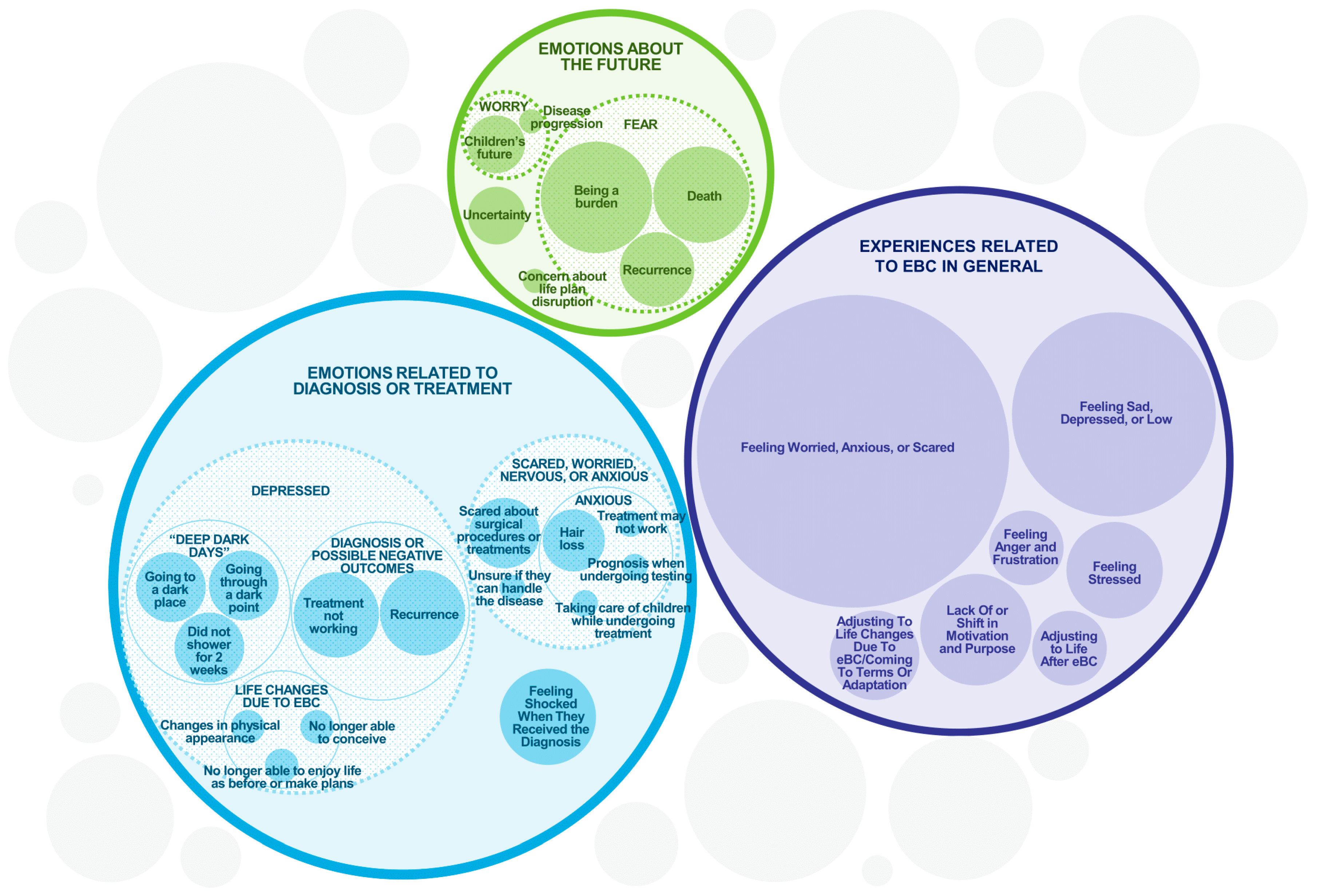
“…I felt like I was less than a woman, you know, losing my hair and losing my breast, getting everything taken out. All that is what makes you a woman, and I no longer had that. It made me… I don’t know. I was really depressed and I had anxiety. It still makes me emotional thinking about it. It just altered my life.”(P8_Stage I_HR+/HER2-)
3.2.5. Unmet Needs Associated with eBC
“The radiologist, they didn’t tell me about the burning that might occur… a lack of letting me know why and what for, and they didn’t explain anything. It was just like, do this or do that, and I didn’t… I had asked all the questions; no one would take the time to say, ‘This is why we’re doing this’.”(P14_Stage I_HER2+)
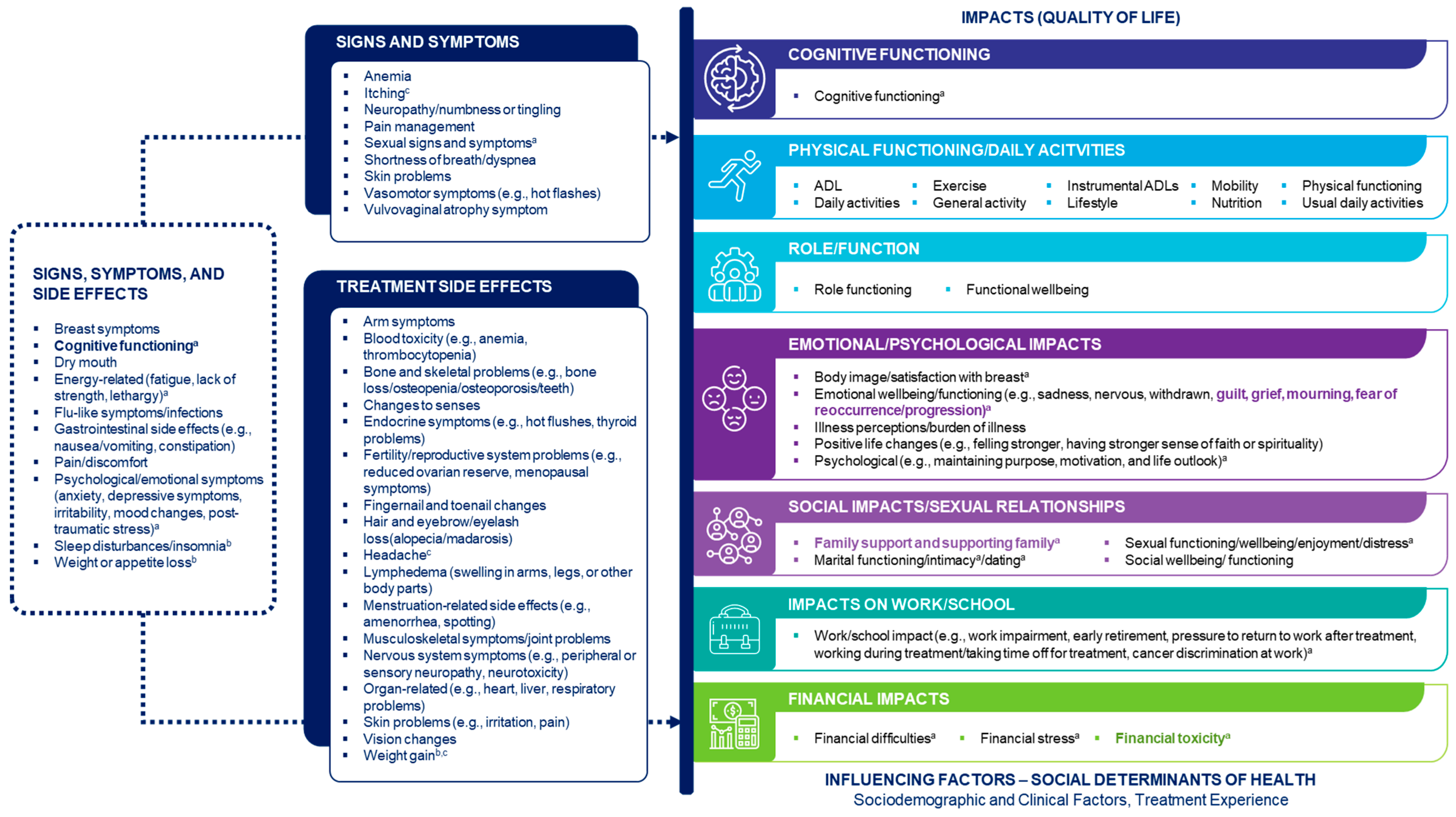
3.2.6. Final PI-CDM for eBC
4. Discussion
5. Conclusions
Supplementary Materials
Author Contributions
Funding
Institutional Review Board Statement
Informed Consent Statement
Data Availability Statement
Acknowledgments
Conflicts of Interest
References
- Cancer Statistics at a Glance. Available online: https://gis.cdc.gov/Cancer/USCS/#/AtAGlance/ (accessed on 30 January 2025).
- Cancer Facts & Figures 2025. Available online: https://www.cancer.org/content/dam/cancer-org/research/cancer-facts-and-statistics/annual-cancer-facts-and-figures/2025/2025-cancer-facts-and-figures-acs.pdf (accessed on 17 March 2025).
- Łukasiewicz, S.; Czeczelewski, M.; Forma, A.; Baj, J.; Sitarz, R.; Stanisławek, A. Breast cancer—Epidemiology, risk factors, classification, prognostic markers, and current treatment strategies—An updated review. Cancers 2021, 13, 4287. [Google Scholar] [CrossRef] [PubMed]
- U.S. Cancer Statistics Breast Cancer Stat Bite. Available online: https://www.cdc.gov/united-states-cancer-statistics/publications/breast-cancer-stat-bite.html#:~:text=About%201%20in%204%20female%20breast%20cancers%20were,had%20spread%20to%20distant%20parts%20of%20the%20body%29 (accessed on 20 January 2025).
- Breast Cancer Facts & Figures 2024–2025. Available online: https://www.cancer.org/content/dam/cancer-org/research/cancer-facts-and-statistics/breast-cancer-facts-and-figures/2024/breast-cancer-facts-and-figures-2024.pdf (accessed on 17 March 2025).
- Mahtani, R.; Collin, S.M.; Tan, Z.; Shah, C.H.; Adeyemi, B.; Davies, S.; John, E.; Vidal, G. Human epidermal growth factor receptor 2-positive (HER2+) early breast cancer treatment and outcomes by risk of recurrence: A retrospective US electronic health records study. Cancers 2025, 17, 1848. [Google Scholar] [CrossRef] [PubMed]
- Agostinetto, E.; Gligorov, J.; Piccart, M. Systemic therapy for early-stage breast cancer: Learning from the past to build the future. Nat. Rev. Clin. Oncol. 2022, 19, 763–774. [Google Scholar] [CrossRef]
- Hensing, W.; Santa-Maria, C.A.; Peterson, L.L.; Sheng, J.Y. Landmark trials in the medical oncology management of early stage breast cancer. Semin. Oncol. 2020, 47, 278–292. [Google Scholar] [CrossRef]
- Rodin, D.; Glicksman, R.M.; Hepel, J.T.; Huber, K.; Kirova, Y.; Loap, P.; Rakovitch, E. Early-Stage Breast Cancer: A Critical Review of Current and Emerging Practice. Int. J. Radiat. Oncol. Biol. Phys. 2024, 120, 1260–1272. [Google Scholar] [CrossRef] [PubMed]
- Ho, M.Y.; Mackey, J.R. Presentation and management of docetaxel-related adverse effects in patients with breast cancer. Cancer Manag. Res. 2014, 6, 253–259. [Google Scholar] [CrossRef]
- Tao, J.J.; Visvanathan, K.; Wolff, A.C. Long term side effects of adjuvant chemotherapy in patients with early breast cancer. Breast 2015, 24 (Suppl. S2), S149–S153. [Google Scholar] [CrossRef]
- Battisti, N.M.L.; Reed, M.W.R.; Herbert, E.; Morgan, J.L.; Collins, K.A.; Ward, S.E.; Holmes, G.R.; Bradburn, M.; Walters, S.J.; Burton, M.; et al. Bridging the Age Gap in breast cancer: Impact of chemotherapy on quality of life in older women with early breast cancer. Eur. J. Cancer 2021, 144, 269–280. [Google Scholar] [CrossRef]
- Ring, A.; Battisti, N.M.L.; Reed, M.W.R.; Herbert, E.; Morgan, J.L.; Bradburn, M.; Walters, S.J.; Collins, K.A.; Ward, S.E.; Holmes, G.R.; et al. Bridging The Age Gap: Observational cohort study of effects of chemotherapy and trastuzumab on recurrence, survival and quality of life in older women with early breast cancer. Br. J. Cancer 2021, 125, 209–219. [Google Scholar] [CrossRef]
- Ruddy, K.J.; Greaney, M.L.; Sprunck-Harrild, K.; Meyer, M.E.; Emmons, K.M.; Partridge, A.H. A qualitative exploration of supports and unmet needs of diverse young women with breast cancer. J. Community Support. Oncol. 2015, 13, 323–329. [Google Scholar] [CrossRef]
- Duenas, A.; Segunmaru, Z.; Clucas, C.; Kornalska, K.; Xu, X.; Swinburn, P.; Duenas, A.; Segunmaru, Z.; Clucas, C.; Kornalska, K.; et al. Understanding the Patient Experience in Early Breast Cancer: A Review of Patient-reported Outcome Measures used in Real-world Evidence [poster]. In Proceedings of the ISPOR Europe, Barcelona, Spain, 17–20 November 2024; Available online: https://www.ispor.org/docs/default-source/euro2024/isporeurope24duenaspcr144poster145213-pdf.pdf?sfvrsn=911f4b2d_0 (accessed on 24 January 2025).
- Duenas, A.; Segunmaru, Z.; Collyar, D.; Denardi, D.; Clucas, C.; Kornalska, K.; Li, Q.; Shah, C.H.; Swinburn, P.; Xu, X. What to Measure in Real-world Evidence Studies: A Patient-informed Conceptual Disease Model in Early Stage Breast Cancer [poster]. In Proceedings of the San Antonio Breast Cancer Symposium, San Antonio, TX, USA, 10–13 December 2024. [Google Scholar]
- Wilson, I.B.; Cleary, P.D. Linking clinical variables with health-related quality of life. A conceptual model of patient outcomes. JAMA 1995, 273, 59–65. [Google Scholar] [CrossRef]
- Fergusson, D.; Monfaredi, Z.; Pussegoda, K.; Garritty, C.; Lyddiatt, A.; Shea, B.; Duffett, L.; Ghannad, M.; Montroy, J.; Murad, M.H.; et al. The prevalence of patient engagement in published trials: A systematic review. Res. Involv. Engag. Engagem. 2018, 4, 17. [Google Scholar] [CrossRef]
- Forsythe, L.P.; Carman, K.L.; Szydlowski, V.; Fayish, L.; Davidson, L.; Hickam, D.H.; Hall, C.; Bhat, G.; Neu, D.; Stewart, L.; et al. Patient Engagement In Research: Early Findings From The Patient-Centered Outcomes Research Institute. Health Aff. 2019, 38, 359–367. [Google Scholar] [CrossRef]
- Porter, L.D. The Importance of Patient Engagement to Improve Healthcare Research and Safety. Glob. J. Qual. Saf. Healthc. 2022, 5, 27–30. [Google Scholar] [CrossRef]
- FORCE—Facing Our Risk of Cancer Empowered. Available online: https://www.facingourrisk.org/ (accessed on 20 March 2025).
- EQ-5D-5L User Guide, Version 3.0. Available online: https://euroqol.org/wp-content/uploads/2023/11/EQ-5D-5LUserguide-23-07.pdf (accessed on 28 April 2025).
- Clarke, V.; Braun, V.; Hayfield, N. Thematic analysis. In Qualitative Psychology: A Practical Guide to Research Methods, 3rd ed.; Smith, J.A., Ed.; SAGE Publications: Los Angeles, CA, USA; London, UK; New Delhi, India; Singapore; Washington, DC, USA; Boston, MA, USA, 2015; pp. 222–248. [Google Scholar]
- Vaismoradi, M.; Turunen, H.; Bondas, T. Content analysis and thematic analysis: Implications for conducting a qualitative descriptive study. Nurs. Health Sci. 2013, 15, 398–405. [Google Scholar] [CrossRef] [PubMed]
- The Interview Analysis Tool That Helps You Leverage Every Piece of Data. Available online: https://atlasti.com/interview-analysis-tools (accessed on 20 January 2025).
- Leidy, N.K.; Vernon, M. Perspectives on patient-reported outcomes: Content validity and qualitative research in a changing clinical trial environment. Pharmacoeconomics 2008, 26, 363–370. [Google Scholar] [CrossRef]
- Magasi, S.; Ryan, G.; Revicki, D.; Lenderking, W.; Hays, R.D.; Brod, M.; Snyder, C.; Boers, M.; Cella, D. Content validity of patient-reported outcome measures: Perspectives from a PROMIS meeting. Qual. Life Res. 2012, 21, 739–746. [Google Scholar] [CrossRef]
- Guidance for Industry. Patient-Reported Outcome Measures: Use in Medical Product Development to Support Labeling Claims. Available online: https://www.fda.gov/media/77832/download (accessed on 20 January 2025).
- Tong, A.; Sainsbury, P.; Craig, J. Consolidated criteria for reporting qualitative research (COREQ): A 32-item checklist for interviews and focus groups. Int. J. Qual. Health Care 2007, 19, 349–357. [Google Scholar] [CrossRef]
- Deane, K.; Delbecque, L.; Gorbenko, O.; Hamoir, A.M.; Hoos, A.; Nafria, B.; Pakarinen, C.; Sargeant, I.; Richards, D.P.; Skovlund, S.E.; et al. Co-creation of patient engagement quality guidance for medicines development: An international multistakeholder initiative. BMJ Innov. 2019, 5, 43–55. [Google Scholar] [CrossRef] [PubMed]
- PC-CIS Blueprint. Background. Available online: https://nationalhealthcouncil.org/background/ (accessed on 23 January 2025).
- Patient-Centered Core Impact Sets Blueprint. Available online: https://nationalhealthcouncil.org/a-blueprint-for-developing-patient-centered-core-impact-sets-pc-cis/ (accessed on 20 January 2025).
- Greenhalgh, T.; Misak, C.; Payne, R.; Swann, N. Patient involvement in developing clinical guidelines. BMJ 2024, 387, q2433. [Google Scholar] [CrossRef] [PubMed]
- Bergerot, C.D.; Philip, E.J.; Bergerot, P.G.; Siddiq, N.; Tinianov, S.; Lustberg, M. Fear of Cancer Recurrence or Progression: What Is It and What Can We Do About It? Am. Soc. Clin. Oncol. Educ. Book. 2022, 42, 18–27. [Google Scholar] [CrossRef]
- Tan, C.J.; Yip, S.Y.C.; Chan, R.J.; Chew, L.; Chan, A. Investigating how cancer-related symptoms influence work outcomes among cancer survivors: A systematic review. J. Cancer Surviv. 2022, 16, 1065–1078. [Google Scholar] [CrossRef]
- Ho, P.J.; Hartman, M.; Gernaat, S.A.M.; Cook, A.R.; Lee, S.C.; Hupkens, L.; Verkooijen, H.M. Associations between workability and patient-reported physical, psychological and social outcomes in breast cancer survivors: A cross-sectional study. Support. Care Cancer 2018, 26, 2815–2824. [Google Scholar] [CrossRef]
- Von Ah, D.; Storey, S.; Crouch, A. Relationship between self-reported cognitive function and work-related outcomes in breast cancer survivors. J. Cancer Surviv. 2018, 12, 246–255. [Google Scholar] [CrossRef]
- Capelan, M.; Battisti, N.M.L.; McLoughlin, A.; Maidens, V.; Snuggs, N.; Slyk, P.; Peckitt, C.; Ring, A. The prevalence of unmet needs in 625 women living beyond a diagnosis of early breast cancer. Br. J. Cancer 2017, 117, 1113–1120. [Google Scholar] [CrossRef]
- Mills, J.; Haviland, J.S.; Moynihan, C.; Bliss, J.M.; Hopwood, P.; Group, S.T.M. Women’s Free-text Comments on their Quality of Life: An Exploratory Analysis from the UK Standardisation of Breast Radiotherapy (START) Trials for Early Breast Cancer. Clin. Oncol. 2018, 30, 433–441. [Google Scholar] [CrossRef] [PubMed]
- Springer, F.; Mehnert-Theuerkauf, A.; Gebhardt, C.; Stolzenburg, J.U.; Briest, S. Unmet supportive care needs among cancer patients: Exploring cancer entity-specific needs and associated factors. J. Cancer Res. Clin. Oncol. 2024, 150, 190. [Google Scholar] [CrossRef] [PubMed]
- McDowell, M.E.; Occhipinti, S.; Ferguson, M.; Dunn, J.; Chambers, S.K. Predictors of change in unmet supportive care needs in cancer. Psychooncology 2010, 19, 508–516. [Google Scholar] [CrossRef]
- Henry, M.; Alias, A.; Cherba, M.; Woronko, C.; Rosberger, Z.; Hier, M.; Zeitouni, A.; Kost, K.; Mlynarek, A.; Richardson, K.; et al. Immediate post-treatment supportive care needs of patients newly diagnosed with head and neck cancer. Support. Care Cancer 2020, 28, 5557–5567. [Google Scholar] [CrossRef]
- Penedo, F.J.; Natori, A.; Fleszar-Pavlovic, S.E.; Sookdeo, V.D.; MacIntyre, J.; Medina, H.; Moreno, P.I.; Crane, T.E.; Moskowitz, C.; Calfa, C.L.; et al. Factors Associated with Unmet Supportive Care Needs and Emergency Department Visits and Hospitalizations in Ambulatory Oncology. JAMA Netw. Open 2023, 6, e2319352. [Google Scholar] [CrossRef] [PubMed]
- Majercak, K.R.; Gorman, E.F.; Robert, N.J.; Palmer, B.; Antwi, H.A.; Mullins, C.D. Which social determinants of health have the highest impact in community oncology to advance patient care equity and improve health outcomes? A scoping review. Cancer Med. 2024, 13, e70160. [Google Scholar] [CrossRef] [PubMed]



| Characteristic | Total (n = 36) | Disease Stage | ||
|---|---|---|---|---|
| I (n = 18) | II (n = 11) | III (n = 7) | ||
| Age | n = 36 | n = 18 | n = 11 | n = 7 |
| Mean (SD) | 49.9 (9.49) | 50.6 (11.03) | 51.0 (7.72) | 46.3 (7.93) |
| Median | 50.5 | 51.0 | 52.0 | 45.0 |
| IQR | 42.8–56.0 | 43.0–56.8 | 44.0–56.5 | 42.5–52.0 |
| Min, max | 28, 66 | 28, 66 | 41, 62 | 34, 56 |
| BRCA mutations, n (%) | n = 36 | n = 18 | n = 11 | n = 7 |
| Yes | 5 (14) | 0 | 3 (27) | 2 (29) |
| No | 21 (58) | 13 (72) | 5 (45) | 3 (43) |
| Do not know | 10 (28) | 5 (28) | 3 (27) | 2 (29) |
| Racial background, n (%) | n = 35 | n = 18 | n = 10 | n = 7 |
| White | 22 (63) | 12 (67) | 5 (50) | 5 (71) |
| Black or African American | 8 (23) | 3 (17) | 3 (30) | 2 (29) |
| Asian | 1 (3) | 0 | 1 (10) | 0 |
| Native Hawaiian or other | 2 (6) | 2 (11) | 0 | 0 |
| Prefer not to respond | 2 (6) | 1 (6) | 1 (10) | 0 |
| Ethnicity, n (%) | n = 35 | n = 18 | n = 10 | n = 7 |
| Hispanic or Latino | 6 (17) | 1 (6) | 1 (10) | 4 (57) |
| Not Hispanic or Latino | 28 (80.0) | 16 (89) | 9 (90) | 3 (43) |
| Prefer not to respond | 1 (3) | 1 (6) | 0 | 0 |
| Education, n (%) | n = 35 | n = 18 | n = 10 | n = 7 |
| Primary school | 0 | 0 | 0 | 0 |
| Secondary school | 7 (20) | 1 (6) | 5 (50) | 1 (14) |
| Associate degree | 1 (3) | 1 (6) | 0 | 0 |
| Some college | 12 (34) | 9 (50) | 0 | 3 (43) |
| College/university | 9 (26) | 5 (28) | 2 (20) | 2 (29) |
| Postgraduate degree | 6 (17) | 2 (11) | 3 (30) | 1 (14) |
| Other | 0 | 0 | 0 | 0 |
| Frequency of needing help with medical information, n (%) a | n = 35 | n = 18 | n = 10 | n = 7 |
| Never | 18 (51) | 8 (44) | 7 (70) | 3 (43) |
| Rarely | 11 (31) | 8 (44) | 1 (10) | 2 (29) |
| Sometimes | 6 (17) | 2 (11) | 2 (20) | 2 (29) |
| Often | 0 | 0 | 0 | 0 |
| Always | 0 | 0 | 0 | 0 |
| Breast cancer subtype, n (%) | n = 36 | n = 18 | n = 11 | n = 7 |
| HR+/HER2- | 10 (28) | 5 (28) | 5 (45) | 0 |
| HER2+ | 14 (39) b | 6 (33) | 4 (36) | 4 (57) |
| TNBC | 12 (33) | 7 (39) | 2 (18) | 3 (43) |
Disclaimer/Publisher’s Note: The statements, opinions and data contained in all publications are solely those of the individual author(s) and contributor(s) and not of MDPI and/or the editor(s). MDPI and/or the editor(s) disclaim responsibility for any injury to people or property resulting from any ideas, methods, instructions or products referred to in the content. |
© 2025 by the authors. Licensee MDPI, Basel, Switzerland. This article is an open access article distributed under the terms and conditions of the Creative Commons Attribution (CC BY) license (https://creativecommons.org/licenses/by/4.0/).
Share and Cite
Duenas, A.; Segunmaru, Z.; Collyar, D.; Denardi, D.; Clucas, C.; Kornalska, K.; Li, Q.; Shah, C.H.; Swinburn, P.; Chavez-MacGregor, M.; et al. Exploring the Priorities of Patients with Early Breast Cancer in the United States: A Qualitative Interview Study and Patient-Informed Conceptual Disease Model. Cancers 2025, 17, 3514. https://doi.org/10.3390/cancers17213514
Duenas A, Segunmaru Z, Collyar D, Denardi D, Clucas C, Kornalska K, Li Q, Shah CH, Swinburn P, Chavez-MacGregor M, et al. Exploring the Priorities of Patients with Early Breast Cancer in the United States: A Qualitative Interview Study and Patient-Informed Conceptual Disease Model. Cancers. 2025; 17(21):3514. https://doi.org/10.3390/cancers17213514
Chicago/Turabian StyleDuenas, Ashley, Zulikhat Segunmaru, Deborah Collyar, Debora Denardi, Claudine Clucas, Klaudia Kornalska, Qixin Li, Chintal H. Shah, Paul Swinburn, Mariana Chavez-MacGregor, and et al. 2025. "Exploring the Priorities of Patients with Early Breast Cancer in the United States: A Qualitative Interview Study and Patient-Informed Conceptual Disease Model" Cancers 17, no. 21: 3514. https://doi.org/10.3390/cancers17213514
APA StyleDuenas, A., Segunmaru, Z., Collyar, D., Denardi, D., Clucas, C., Kornalska, K., Li, Q., Shah, C. H., Swinburn, P., Chavez-MacGregor, M., & Xu, X. (2025). Exploring the Priorities of Patients with Early Breast Cancer in the United States: A Qualitative Interview Study and Patient-Informed Conceptual Disease Model. Cancers, 17(21), 3514. https://doi.org/10.3390/cancers17213514