


Three-Month Outcomes in Cancer Patients with Superficial or Deep Vein Thrombosis in the Lower Limbs: Results from the RIETE Registry
 ,
,  , , ,
, , ,
Simple Summary
Abstract
1. Introduction
2. Methods
2.1. Data Source
2.2. Inclusion Criteria
2.3. Study Design
2.4. Statistical Analysis
3. Results
3.1. Cancer Patients with SVT vs. Cancer Patients with DVT
3.2. Cancer Patients with SVT vs. Non-Cancer Patients with SVT
3.3. VTE Recurrence among the Whole Population
4. Discussion
5. Conclusions
Supplementary Materials
Author Contributions
Funding
Institutional Review Board Statement
Informed Consent Statement
Data Availability Statement
Conflicts of Interest
References
- Trousseau, A. Phlegmasia alba dolens. In Clinique Medicale de L’Hotel-Dieu de Paris; New Sydenham Society: London, UK, 1865; pp. 282–332. [Google Scholar]
- Evans, N.S.; Ratchford, E.V. Superficial vein thrombosis. Vasc. Med. 2018, 23, 187–189. [Google Scholar] [CrossRef] [Scilit] [PubMed]
- Timp, J.F.; Braekkan, S.K.; Versteeg, H.H.; Cannegieter, S.C. Epidemiology of cancer-associated venous thrombosis. Blood 2013, 122, 1712–1723. [Google Scholar] [CrossRef] [Scilit] [PubMed]
- Barco, S.; Pomero, F.; Di Minno, M.N.D.; Permunian, E.T.; Malato, A.; Pasca, S.; Barillari, G.; Fenoglio, L.; Siragusa, S.; Di Minno, G.; et al. Clinical course of patients with symptomatic isolated superficial vein thrombosis: The ICARO follow-up study. J. Thromb. Haemost. 2017, 15, 2176–2183. [Google Scholar] [CrossRef] [Scilit] [PubMed]
- Galanaud, J.P.; Sevestre, M.A.; Pernod, G.; Kahn, S.R.; Genty, C.; Terrisse, H.; Brisot, D.; Gillet, J.L.; Quéré, I.; Bosson, J.L. Long-term risk of venous thromboembolism recurrence after isolated superficial vein thrombosis. J. Thromb. Haemost. 2017, 15, 1123–1131. [Google Scholar] [CrossRef] [Scilit] [PubMed]
- Galanaud, J.P.; Blaise, S.; Sevestre, M.A.; Terrisse, H.; Pernod, G.; Gaillard, C.; Genty, C.; Monreal, M.; Rabah, Y.; Kahn, S.R.; et al. Long-term outcomes of isolated superficial vein thrombosis in patients with active cancer. Thromb. Res. 2018, 171, 179–186. [Google Scholar] [CrossRef] [Scilit] [PubMed]
- Ghenassia-Fouillet, L.; Morel, A.; Frappé, P.; Le Hello, C.; Lerche, V.; Sevestre, M.A.; Bertoletti, L. Management of superficial venous thrombosis in unevaluated situations: Cancer, severe renal impairment, pregnancy and post-partum. Phlebology 2021, 36, 464–472. [Google Scholar] [CrossRef] [Scilit] [PubMed]
- Bikdeli, B.; Jimenez, D.; Hawkins, M.; Ortíz, S.; Prandoni, P.; Brenner, B.; Decousus, H.; Masoudi, F.A.; Trujillo-Santos, J.; Krumholz, H.M.; et al. Rationale, Design and Methodology of the Computerized Registry of Patients with Venous Thromboembolism (RIETE). Thromb. Haemost. 2018, 118, 214–224. [Google Scholar] [CrossRef] [Scilit] [PubMed]
- NICE Guidance. Quality Statement 7: Treatment of People with Active Cancer. Available online: https://www.nice.org.uk/guidance/qs29/chapter/Quality-statement-7-Treatment-of-people-with-active-cancer (accessed on 25 November 2022).
- Decousus, H.; Prandoni, P.; Mismetti, P.; Bauersachs, R.M.; Boda, Z.; Brenner, B.; Laporte, S.; Matyas, L.; Middeldorp, S.; Sokurenko, G.; et al. Fondaparinux for the treatment of superficial-vein thrombosis in the legs. N. Engl. J. Med. 2010, 363, 1222–1232. [Google Scholar] [CrossRef] [Scilit] [PubMed]
- Cosmi, B.; Filippini, M.; Tonti, D.; Avruscio, G.; Ghirarduzzi, A.; Bucherini, E.; Camporese, G.; Imberti, D.; Palareti, G.; STEFLUX Investigators. A randomized double-blind study of low-molecular-weight heparin (parnaparin) for superficial vein thrombosis: STEFLUX (Superficial ThromboEmbolism and Fluxum). J. Thromb. Haemost. 2012, 10, 1026–1035. [Google Scholar] [CrossRef] [Scilit] [PubMed]
- Belcaro, G.; Nicolaides, A.N.; Errichi, B.M.; Cesarone, M.R.; De Sanctis, M.T.; Incandela, L.; Venniker, R. Superficial thrombophlebitis of the legs: A randomized, controlled, follow-up study. Angiology 1999, 50, 523–529. [Google Scholar] [CrossRef] [Scilit] [PubMed]
- Marchiori, A.; Verlato, F.; Sabbion, P.; Camporese, G.; Rosso, F.; Mosena, L.; Andreozzi, G.M.; Prandoni, P. High versus low doses of unfractionated heparin for the treatment of superficial throm- bophlebitis of the leg. A prospective, controlled, randomized study. Haematologica 2002, 87, 523–527. [Google Scholar] [PubMed]
- Rathbun, S.W.; Aston, C.E.; Whitsett, T.L. A randomized trial of dalteparin compared with ibuprofen for the treatment of super- ficial thrombophlebitis. J. Thromb. Haemost. 2012, 10, 833–839. [Google Scholar] [CrossRef] [Scilit] [PubMed]
- Lozano, F.S.; Almazan, A. Low-molecular-weight heparin versus saphenofemoral disconnection for the treatment of above-knee greater saphenous thrombophlebitis: A prospective study. Vasc. Endovascular. Surg. 2003, 37, 415–420. [Google Scholar] [CrossRef] [Scilit] [PubMed]
- Spirkoska, A.; Jezovnik, M.K.; Poredos, P. Time course and the recanalization rate of superficial vein thrombosis treated with low- molecular-weight heparin. Angiology 2015, 66, 381–386. [Google Scholar] [CrossRef] [Scilit] [PubMed]
- Superficial Thrombophlebitis Treated by Enoxaparin Study Group. A pilot randomized double-blind comparison of a low-molecular-weight heparin, a nonsteroidal anti-inflammatory agent, and placebo in the treatment of superficial vein thrombosis. Arch. Intern. Med. 2003, 163, 1657–1663. [Google Scholar] [CrossRef] [Scilit] [PubMed]
- Beyer-Westendorf, J.; Schellong, S.M.; Gerlach, H.; Rabe, E.; Weitz, J.I.; Jersemann, K.; Sahin, K.; Bauersachs, R.; SURPRISE Investigators. Prevention of thromboembolic complications in patients with superficial-vein thrombosis given rivaroxaban or fondaparinux: The open-label, randomised, non-inferiority SURPRISE phase 3b trial. Lancet Haematol. 2017, 4, e105–e113. [Google Scholar] [CrossRef] [Scilit] [PubMed]
- The Vesalio Investigators Group. High vs. low doses of low-molecular-weight heparin for the treatment of superficial vein thrombosis of the legs: A double-blind, randomized trial. J. Thromb. Haemost. 2005, 3, 1152–1157. [Google Scholar] [CrossRef] [Scilit] [PubMed]
- NCCN. Available online: https://www.nccn.org/professionals/physician_gls/pdf/vte.pdf (accessed on 18 November 2022).
- Mahé, I.; Meyer, G.; Girard, P.; Bertoletti, L.; Laporte, S.; Couturaud, F.; Mismetti, P.; Sanchez, O.; Pour le Groupe de Travail Recommandations de Bonne Pratique Pour Prise en Charge de la MVTE. Recommandations de bonne pratique pour la prise en charge de la MVTE. Traitement de la maladie veineuse thromboembolique au cours du cancer. Mise à jour mars 2021. Rev. Mal. Respir. 2021, 38, 427–437. [Google Scholar] [CrossRef] [Scilit] [PubMed]
- Hirmerová, J.; Seidlerová, J.; Šubrt, I.; Hajšmanová, Z. The prevalence of cancer in patients with superficial vein thrombosis and its clinical importance. J. Vasc. Surg. Venous Lymphat. Disord. 2022, 10, 26–32. [Google Scholar] [CrossRef] [Scilit] [PubMed]
- Decousus, H.; Quéré, I.; Presles, E.; Becker, F.; Barrellier, M.T.; Chanut, M.; Gillet, J.L.; Guenneguez, H.; Leandri, C.; Mismetti, P.; et al. Superficial venous thrombosis and venous thromboembolism: A large, prospective epidemiologic study. Ann. Intern. Med. 2010, 152, 218–224. [Google Scholar] [CrossRef] [Scilit] [PubMed]

| Cancer and Lower-Limb SVT | Cancer and Lower-Limb DVT | Lower-Limb SVT, No Cancer | |
|---|---|---|---|
| Patients, N | 110 | 1695 | 1030 |
| Clinical characteristics, | |||
| Male sex | 45 (41%) | 860 (51%) * | 412 (40%) |
| Age (mean years ± SD) | 67 ± 13 | 68 ± 13 | 59 ± 16 ‡ |
| Body weight (mean kg ± SD) | 76 ± 18 | 73 ± 15 * | 81 ± 17 † |
| Inpatients | 10 (9.3%) | 431 (26%) ‡ | 51 (5.1%) |
| Initial presentation, | |||
| DVT characteristics, | |||
| Proximal involvement | 65 (59%) | 1405 (83%) ‡ | 618 (60%) |
| SVT characteristics, | |||
| Length of SVT < 5 cm | 19 (24%) | - | 179 (22%) |
| Length of SVT 5–10 cm | 30 (38%) | - | 311 (39%) |
| Length of SVT > 10 cm | 29 (37%) | - | 311 (39%) |
| Distance from SF junction < 3 cm | 34 (36%) | - | 291 (33%) |
| Distance from SF junction > 3 cm | 60 (64%) | - | 578 (67%) |
| SVT on a varicose vein | 45 (43%) | - | 587 (60%) † |
| Additional risk factors for VTE, | |||
| Recent surgery | 5 (4.5%) | 226 (13%) † | 66 (6.4%) |
| Recent immobility ≥ 4 days | 11 (10%) | 302 (18%) * | 59 (5.7%) |
| Estrogen use | 11 (10%) | 133 (7.8%) | 49 (4.8%) * |
| Pregnancy or postpartum | 0 | 2 (0.1%) | 40 (3.9%) * |
| None of the above | 83 (75%) | 1074 (63%) * | 820 (80%) |
| Prior VTE | 11 (10%) | 192 (11%) | 142 (14%) |
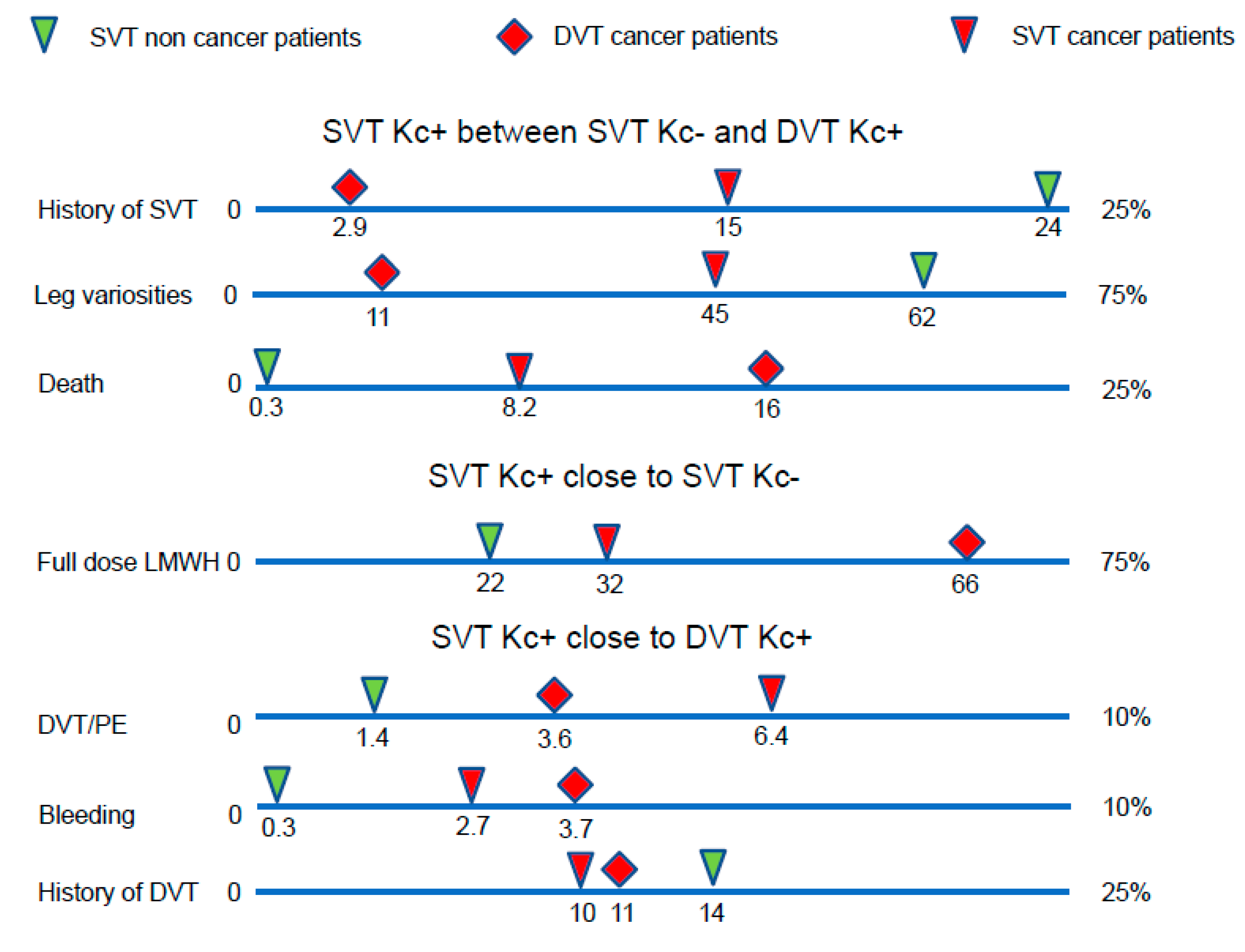
| Prior SVT | 16 (15%) | 50 (2.9%) ‡ | 244 (24%) * |
| Leg varicosities | 49 (45%) | 185 (11%) ‡ | 643 (62%) ‡ |
| Underlying conditions, | |||
| Chronic heart failure | 5 (4.5%) | 55 (3.2%) | 14 (1.4%) * |
| Chronic lung disease | 8 (7.3%) | 133 (7.8%) | 59 (5.7%) |
| Recent major bleeding | 1 (0.9%) | 43 (2.5%) | 4 (0.4%) |
| Anemia | 46 (42%) | 1072 (63%) ‡ | 137 (13%) ‡ |
| Leukocyte count > 11,000/µL | 17 (17%) | 368 (22%) | 87 (9.3%) * |
| Platelet count < 100,000/µL | 3 (2.9%) | 101 (6.0%) | 11 (1.2%) |
| CrCl levels < 60 mL/min | 30 (27%) | 523 (31%) | 114 (11%) ‡ |
| Concomitant drugs, | |||
| Corticosteroids | 15 (14%) | 281 (17%) | 44 (4.3%) ‡ |
| Antiplatelets | 14 (13%) | 213 (13%) | 111 (11%) |
| Cancer and Lower-Limb SVT | Cancer and Lower-Limb DVT | |
|---|---|---|
| Patients, N | 110 | 1695 |
| Time from cancer diagnosis | ||
| Mean months (±SD) | 32 ± 62 | 23 ± 44 |
| Median months (IQR) | 6 (0–280) | 4 (0–26) |
| Metastases | ||
| Yes | 48 (44%) | 944 (56%) * |
| Sites of cancer, | ||
| Breast | 26 (24%) | 202 (12%) ‡ |
| Colorectal | 16 (15%) | 229 (14%) |
| Lung | 11 (10%) | 224 (13%) |
| Hematologic | 18 (16%) | 141 (8.3%) † |
| Prostate | 6 (5.5%) | 127 (7.5%) |
| Uterine | 5 (4.5%) | 100 (5.9%) |
| Stomach | 6 (5.5%) | 60 (3.5%) |
| Pancreas | 4 (3.6%) | 107 (6.3%) |
| Ovary | 3 (2.7%) | 85 (5.0%) |
| Carcinoma of unknown origin | 3 (2.7%) | 21 (1.2%) |
| Bladder | 2 (1.8%) | 117 (6.9%) * |
| Cerebral | 1 (0.9%) | 65 (3.8%) |
| Biliary tract | 2 (1.8%) | 16 (0.9%) |
| Melanoma | 2 (1.8%) | 22 (1.3%) |
| Other | 2 (1.8%) | 140 (8.6%) |
| Therapy for cancer, | ||
| Chemotherapy | 53 (50%) | 805 (52%) |
| Radiotherapy | 15 (14%) | 229 (15%) |
| Immunotherapy | 4 (5.3%) | 58 (6.7%) |
| Hormonal therapy | 20 (19%) | 193 (13%) |
| None of the above | 34 (31%) | 635 (37%) |
| Cancer and Lower-Limb SVT | Cancer and Lower-Limb DVT | Lower-Limb SVT, No Cancer | |
|---|---|---|---|
| Patients, N | 110 | 1695 | 1030 |
| Duration of anticoagulant therapy, | |||
| Mean days (±SD) | 125 ± 155 | 201 ± 213 ‡ | 125 ± 171 |
| Median days (IQR) | 95 (48–145) | 128 (86–240) | 89 (47–124) |
| Initial therapy, N | |||
| Low-molecular-weight heparin | 97 (88%) | 1532 (90%) | 721 (70%) ‡ |
| Mean daily doses (IU/kg/day) | 114 ± 58 | 163 ± 44 ‡ | 106 ± 50 559 (78%) * |
| LMWH doses < 150 IU/kg/day | 66 (68%) | 519 (34%) ‡ | |
| Fondaparinux | 5 (4.5%) | 33 (1.9%) | 203 (20%) ‡ |
| Daily doses < 7.5 mg/daily | 4 (3.6%) | 1 (0.1%) ‡ | 144 (14%) ‡ |
| Rivaroxaban | 3 (2.7%) | 28 (1.7%) | 41 (4.0%) |
| Apixaban | 1 (0.9%) | 9 (0.5%) | 22 (2.2%) |
| DOACs at lower-than recommended doses | 2 (1.8%) | 4 (0.2%) * | 12 (1.2%) |
| Thrombolytic drugs | 0 | 0 | 1 (0.10%) |
| Inferior vena cava filter | 5 (4.5%) | 115 (6.8%) | 0 |
| Mechanical thrombolysis | 0 | 9 (0.6%) | 3 (0.4%) |
| No initial therapy | 0 | 12 (0.7%) | 15 (1.5%) |
| Long-term therapy, N | |||
| Low-molecular-weight heparin | 80 (73%) | 1213 (72%) | 441 (43%) ‡ |
| Mean daily doses (IU/kg/day) | 118 ± 60 | 152 ± 41 ‡ | 97 ± 41 † 384 (87%) ‡ |
| LMWH doses < 150 IU/kg/day | 52 (65%) | 549 (45%) ‡ | |
| Fondaparinux | 6 (5.5%) | 27 (1.6%) * | 175 (17%) ‡ |
| Daily doses < 7.5 mg/daily | 3 (2.7%) | 1 (0.1%) ‡ | 132 (13%) ‡ |
| Vitamin K antagonists | 6 (5.5%) | 177 (10%) | 138 (13%) * |
| DOACs | 5 (5%) | 159 (9.4%) | 145 (14%) |
| DOACs at lower-than recommended doses | 2 (1.8%) | 15 (0.9%) ‡ | 14 (1.4%) |
| No long-term therapy | 8 (7.3%) | 20 (1.2%) ‡ | 95 (9.2%) |
| SVT with Cancer | DVT with Cancer | SVT without Cancer | ||||
|---|---|---|---|---|---|---|
| Day 1–90 N110 | Day 1–180 N 110 | Day 1–90 N 1695 | Day 1–180 N 1695 | Day 1–90 N 1030 | Day 1–180 N 1030 | |
| SVT recurrences | 1 (0.9%) | 2 (1.8%) | 1 (0.1%) | 2 (0.1%) * | 11 (1.1%) | 14 (1.4%) |
| DVT recurrences | 4 (3.6%) | 4 (3.6%) | 29 (1.7%) | 43 (2.5%) | 8 (0.8%) * | 9 (0.9%) * |
| PE recurrences | 3 (2.7%) | 3 (2.7%) | 38 (2.2%) | 43 (2.5%) | 6 (0.6%) * | 6 (0.6%) * |
| VTE recurrences | 7 (6.4%) | 7 (6.4%) | 61 (3.6%) | 76 (4.5%) | 14 (1.4%)† | 15 (1.5%)† |
| Major bleeding | 3 (2.7%) | 3 (2.7%) | 66 (3.9%) | 81 (4.8%) | 3 (0.3%) * | 3 (0.3%) * |
| Overall death | 9 (8.2%) | 10 (9.1%) | 270 (16%) * | 359 (21%) † | 3 (0.3%) ‡ | 3 (0.3%) ‡ |
| Fatal PE | 1 (0.9%) | 1 (0.9%) | 3 (0.2%) | 3 (0.2%) | 2 (0.2%) | 2 (0.2%) |
| Fatal bleeding | 0 | 0 | 13 (0.8%) | 14 (0.8%) | 0 | 0 |
| Univariable Analysis | Logistic Regression | Competing Risk Analysis | |
|---|---|---|---|
| Clinical characteristics, | |||
| Age < 65 years | 2.27 (1.45–3.45) † | 2.08 (1.28–3.33) † | 2.04 (1.27–3.33) † |
| Male sex | 1.35 (0.90–2.03) | - | - |
| Proximal DVT | 0.79 (0.51–1.21) | - | - |
| Risk factors, | |||
| Unprovoked VTE | Ref. | Ref. | Ref. |
| Cancer | 1.80 (1.06–3.04) * | 2.30 (1.29–4.10) † | 2.04 (1.15–3.62) * |
| Transient risk factors | 1.54 (0.63–3.73) | - | - |
| Prior VTE, | |||
| Prior DVT or PE | 1.05 (0.56–1.94) | - | - |
| Prior SVT | 1.07 (0.56–2.03) | - | - |
| Leg varicosities | 0.66 (0.41–1.08) | - | - |
| Underlying conditions, | |||
| Chronic heart failure | 1.68 (0.60–4.69) | - | - |
| Chronic lung disease | 1.58 (0.81–3.09) | - | - |
| Recent major bleeding | 0.61 (0.08–4.47) | - | - |
| Anemia | 0.87 (0.58–1.32) | - | - |
| WBC > 11,000/µL | 1.93 (1.21–3.07) † | 1.73 (1.07–2.78) * | 1.75 (1.10–2.77) * |
| PlC < 100,000/µL | 1.04 (0.38–2.89) | - | - |
| CrCl levels ≥ 60 mL/min | 2.70 (1.39–5.26) † | 2.33 (1.16–4.76) * | 2.27 (1.10–4.55) * |
| Concomitant drugs, | |||
| Corticosteroids | 0.96 (0.51–1.82) | - | - |
| Antiplatelets | 1.07 (0.58–1.98) | - | - |
| Full-dose anticoagulation | 1.14 (0.75–1.72) | - | - |
Disclaimer/Publisher’s Note: The statements, opinions and data contained in all publications are solely those of the individual author(s) and contributor(s) and not of MDPI and/or the editor(s). MDPI and/or the editor(s) disclaim responsibility for any injury to people or property resulting from any ideas, methods, instructions or products referred to in the content. |
© 2023 by the authors. Licensee MDPI, Basel, Switzerland. This article is an open access article distributed under the terms and conditions of the Creative Commons Attribution (CC BY) license (https://creativecommons.org/licenses/by/4.0/).
Share and Cite
Debourdeau, P.; Bertoletti, L.; Font, C.; López-Núñez, J.J.; Gómez-Cuervo, C.; Mahe, I.; Otero-Candelera, R.; Adarraga, M.D.; López-Miguel, P.; Monreal, M.; et al. Three-Month Outcomes in Cancer Patients with Superficial or Deep Vein Thrombosis in the Lower Limbs: Results from the RIETE Registry. Cancers 2023, 15, 2034. https://doi.org/10.3390/cancers15072034
Debourdeau P, Bertoletti L, Font C, López-Núñez JJ, Gómez-Cuervo C, Mahe I, Otero-Candelera R, Adarraga MD, López-Miguel P, Monreal M, et al. Three-Month Outcomes in Cancer Patients with Superficial or Deep Vein Thrombosis in the Lower Limbs: Results from the RIETE Registry. Cancers. 2023; 15(7):2034. https://doi.org/10.3390/cancers15072034
Chicago/Turabian StyleDebourdeau, Philippe, Laurent Bertoletti, Carme Font, Juan José López-Núñez, Covadonga Gómez-Cuervo, Isabelle Mahe, Remedios Otero-Candelera, Maria Dolores Adarraga, Patricia López-Miguel, Manuel Monreal, and et al. 2023. "Three-Month Outcomes in Cancer Patients with Superficial or Deep Vein Thrombosis in the Lower Limbs: Results from the RIETE Registry" Cancers 15, no. 7: 2034. https://doi.org/10.3390/cancers15072034
APA StyleDebourdeau, P., Bertoletti, L., Font, C., López-Núñez, J. J., Gómez-Cuervo, C., Mahe, I., Otero-Candelera, R., Adarraga, M. D., López-Miguel, P., Monreal, M., & RIETE Investigators. (2023). Three-Month Outcomes in Cancer Patients with Superficial or Deep Vein Thrombosis in the Lower Limbs: Results from the RIETE Registry. Cancers, 15(7), 2034. https://doi.org/10.3390/cancers15072034

