Heteroepitaxial 3C-SiC for MEMS Applications
 , , , and
Abstract
1. Introduction
2. Advantages of SiC for MEMS
2.1. High Frequency and Stiffness
2.2. High-Temperature and Harsh-Environment Operation
2.3. Exceptional Quality Factor (Q-Factor)
2.4. Comparative Overview of SiC Polytypes for MEMS Applications
3. Disadvantages of SiC for MEMS
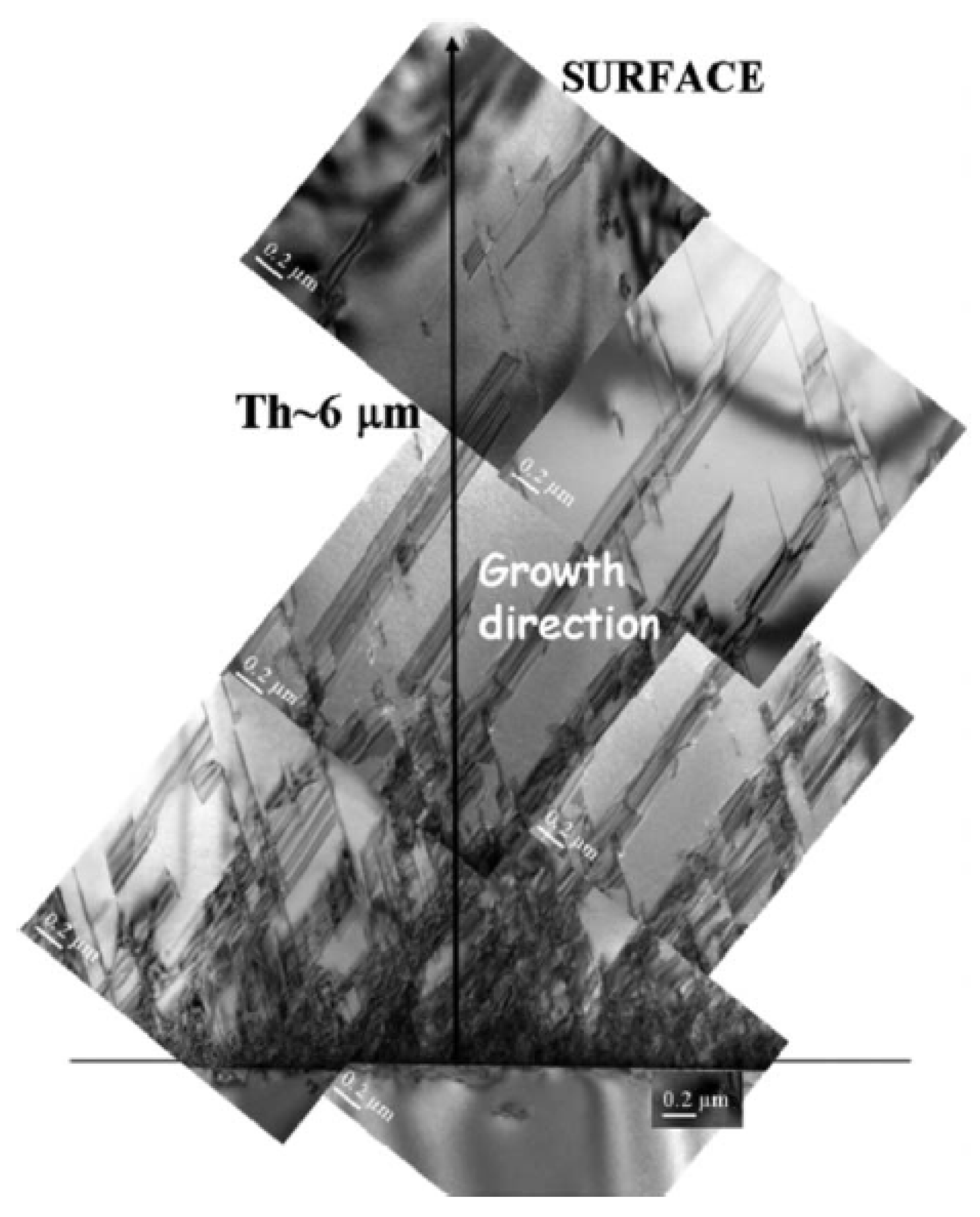
3.1. High Density of Extended Defects
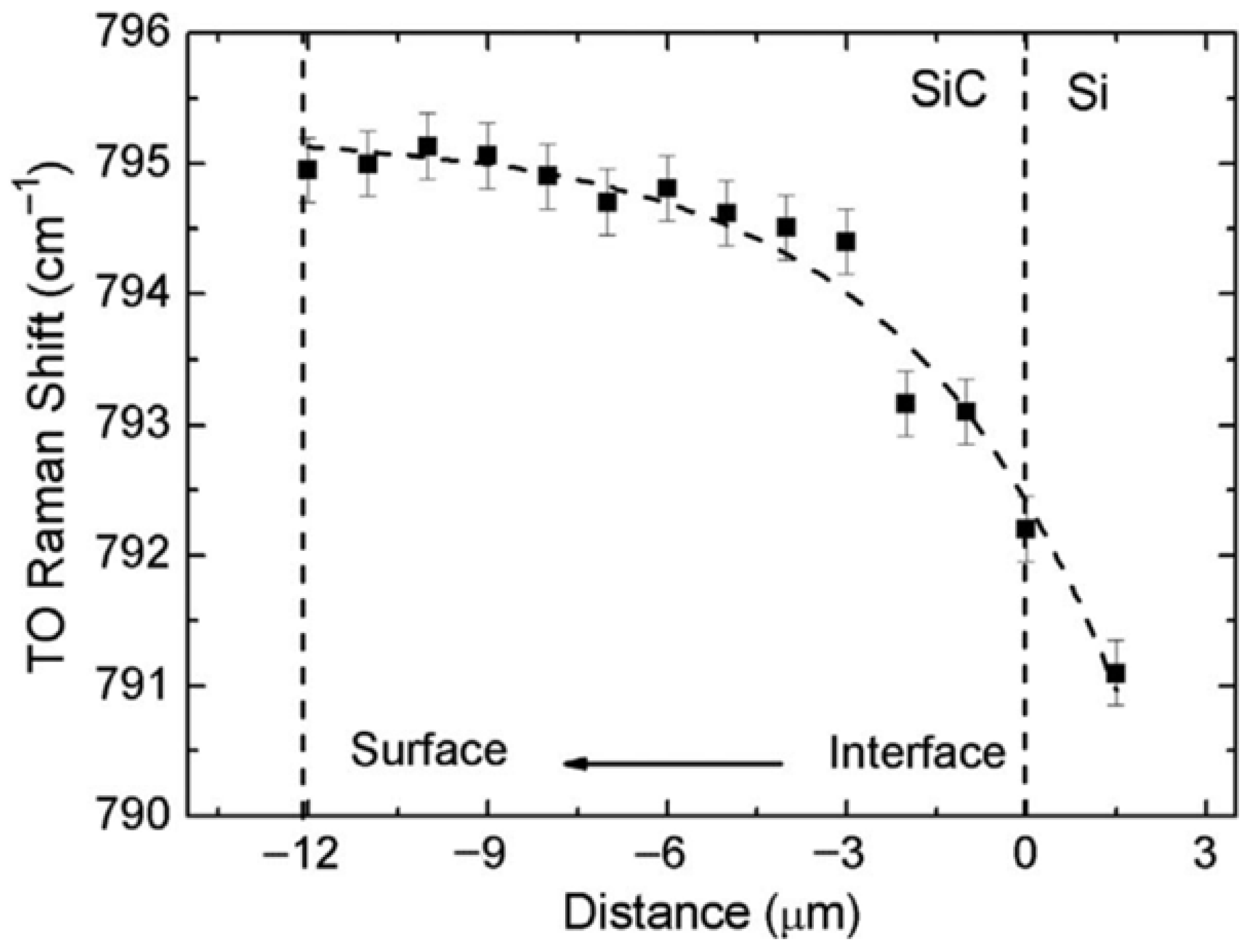
3.2. High and Inherent Residual Stress
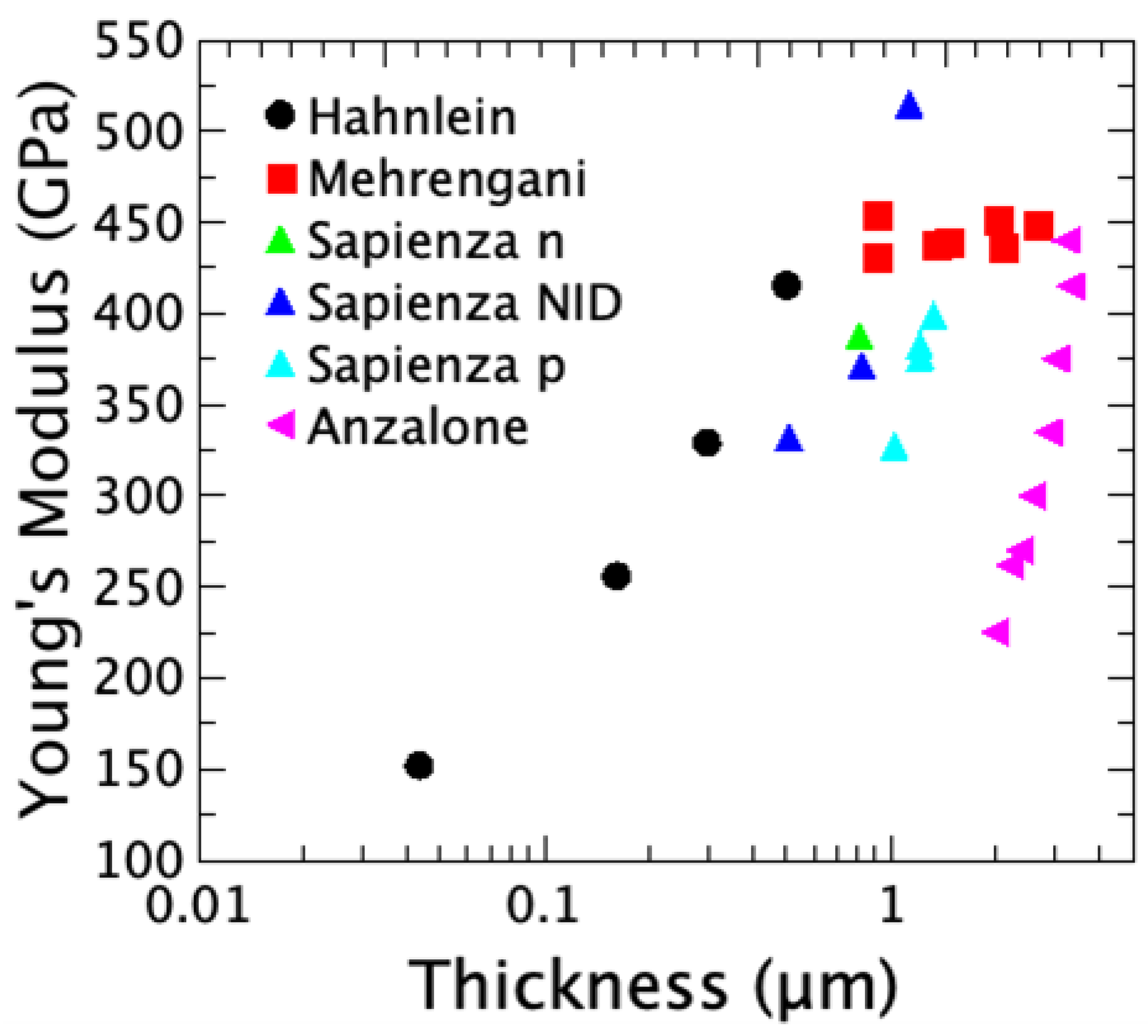
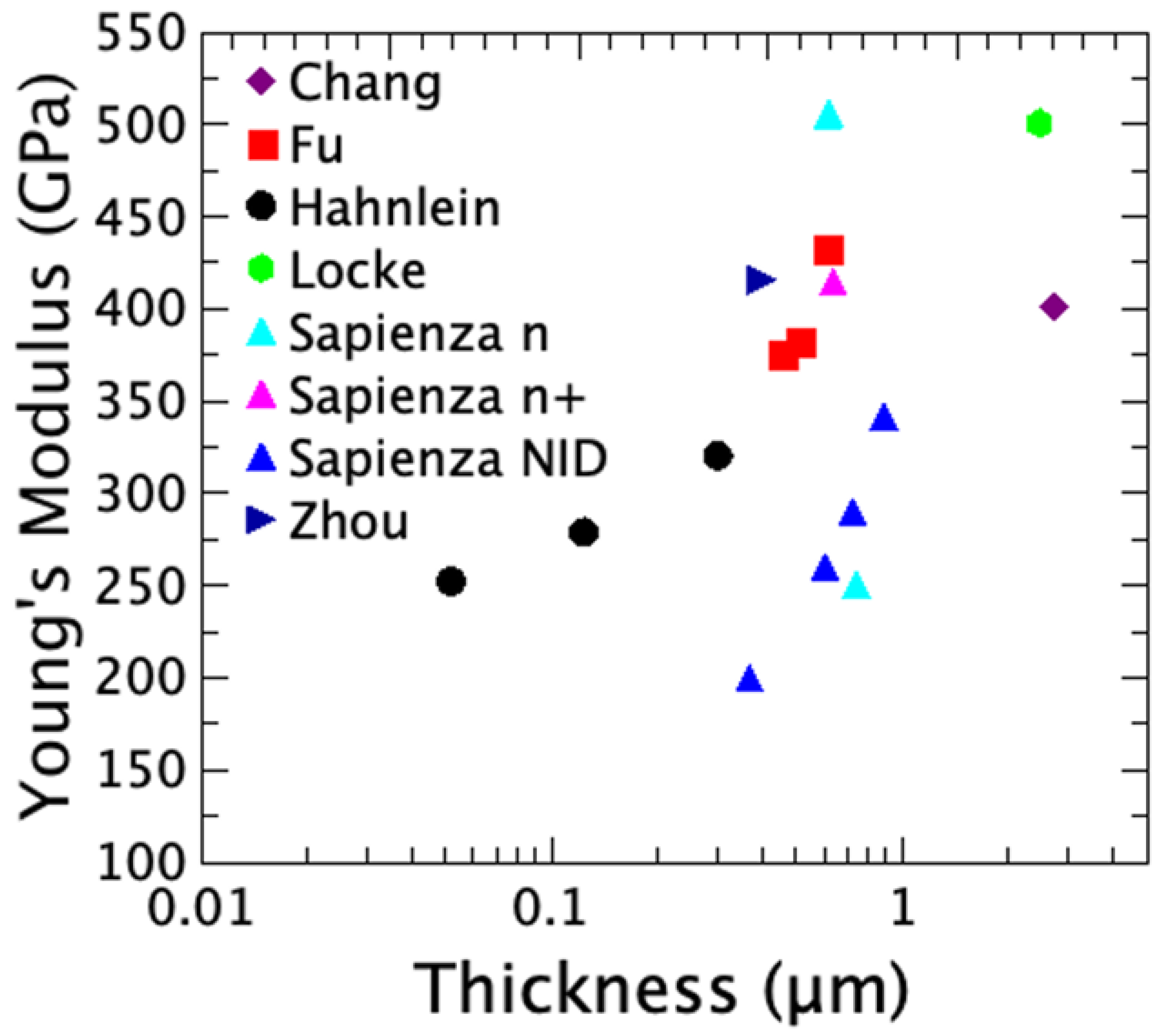
3.3. Defect-Dependent Reduction in Young’s Modulus
3.4. High Thermal Stress Component
3.5. Material Trade-Offs for MEMS Design
4. Different Mechanical Properties Depending on Material Structure
4.1. Crystalline Orientation Dependence (Anisotropy)
4.2. Material Phase (Single-Crystal, Polycrystalline, Amorphous)
- Monocrystalline SiC (e.g., epitaxial 3C-SiC) is preferred for ultra-high Q-factor resonators due to its superior elastic properties.
- Polycrystalline (Poly-SiC) and Amorphous SiC offer more flexible fabrication routes but generally exhibit lower Young’s modulus values and higher intrinsic mechanical losses.
- Composite structures, such as Polysilicon/3C-SiC beam resonators, have been investigated to manipulate the overall residual stress and achieve enhanced strain sensitivity [66].
4.3. Impact of Defect Evolution
5. Different Stress Components
- Uniform Stress (): This represents the constant stress component across the film thickness. It is related to the substrate, as well as the lattice and thermal mismatch. This component is essential for defining the pre-tension (stiffening) in tensile-stressed resonant structures, which determines their fundamental resonant frequency.
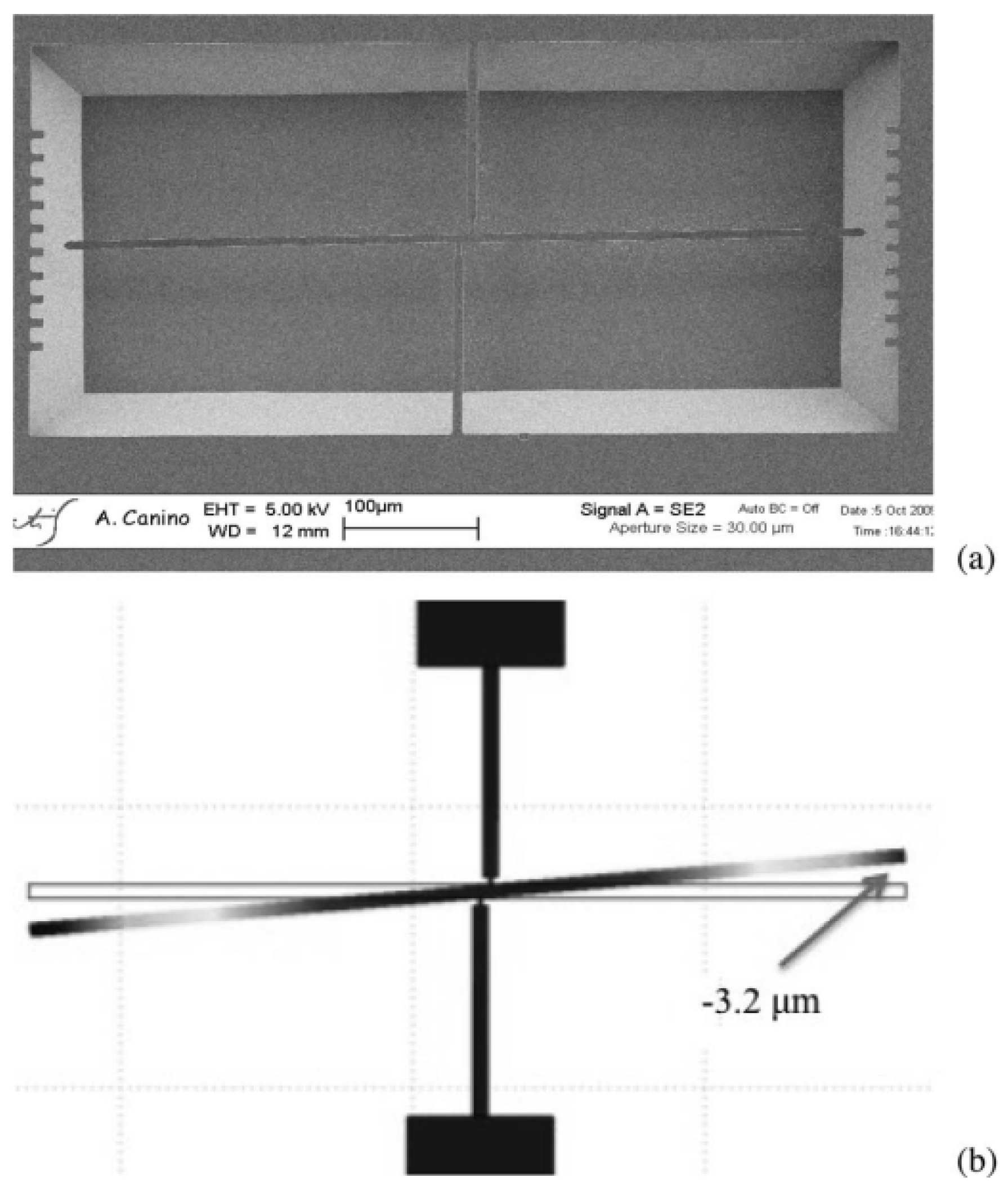
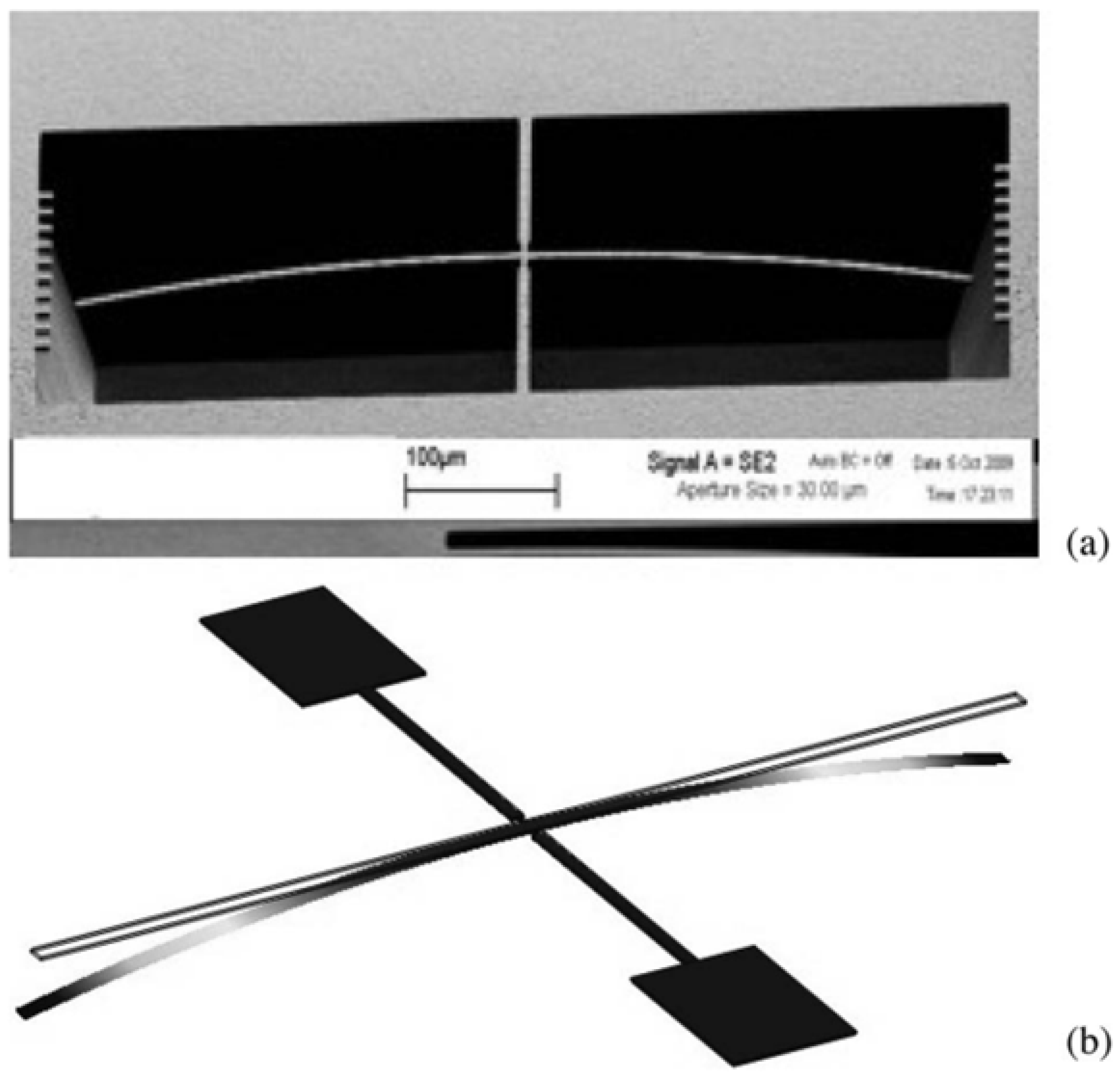
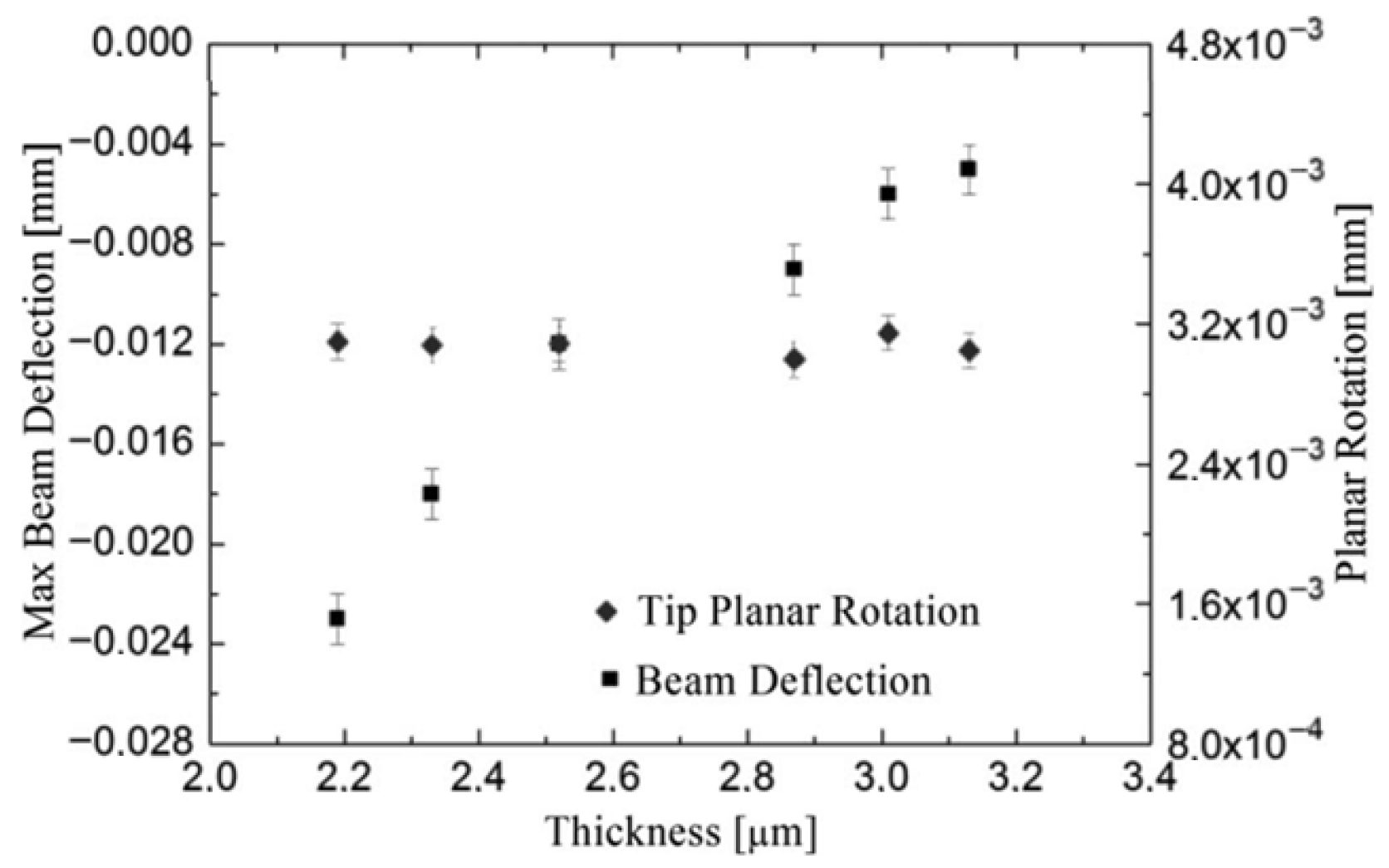
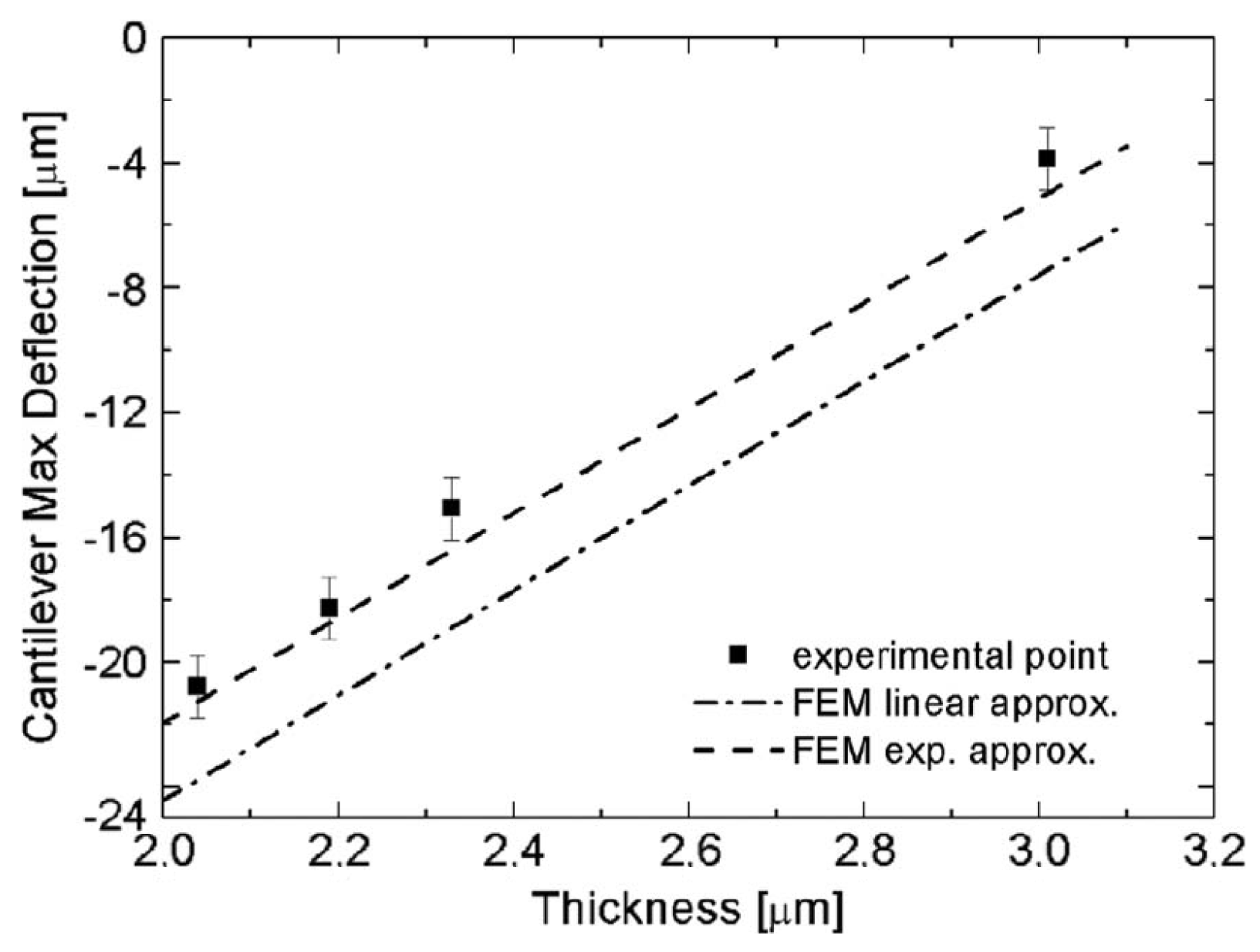
- Gradient Stress (): This component describes the variation in stress through the film thickness. It is directly correlated with the evolving defect density (which is maximal at the Si/SiC interface and decreases). The stress gradient is responsible for the bending moment and the resulting out-of-plane deflection (warpage) of suspended microstructures like cantilevers.
Exponential Approximation
6. Quality Factor
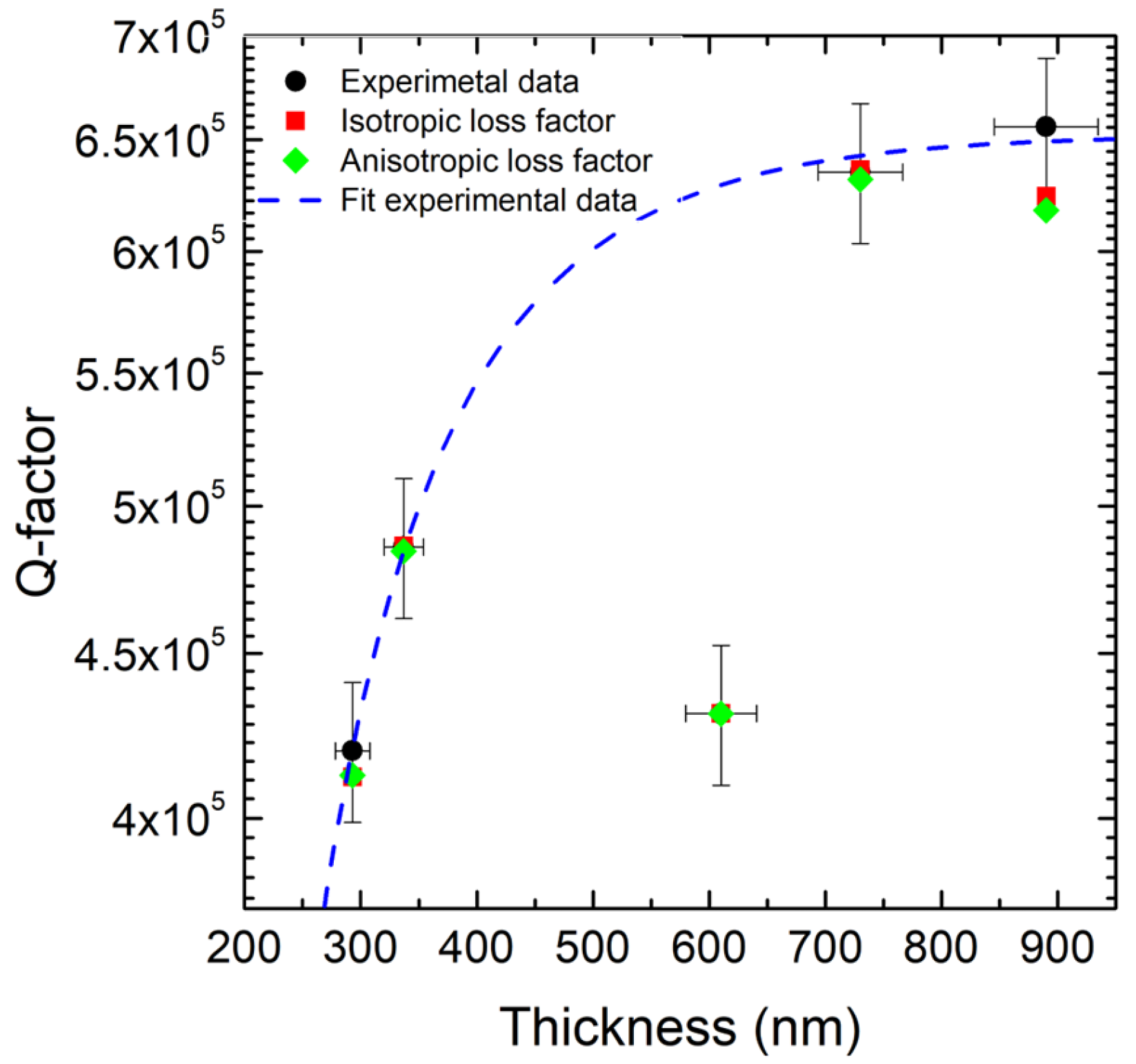
6.1. Thickness Dependence of the Quality Factor in 3C-SiC MEMS Resonators
6.2. Additional Models of Quality Factor in SiC Resonators
7. Strain Sensitivity
7.1. Anisotropic Damping
- Elastic properties and nominal frequency: The high Young’s modulus of 3C-SiC enables larger resonance frequencies for a given geometry, increasing the information content of the measurement (both in terms of f and the product) [24].
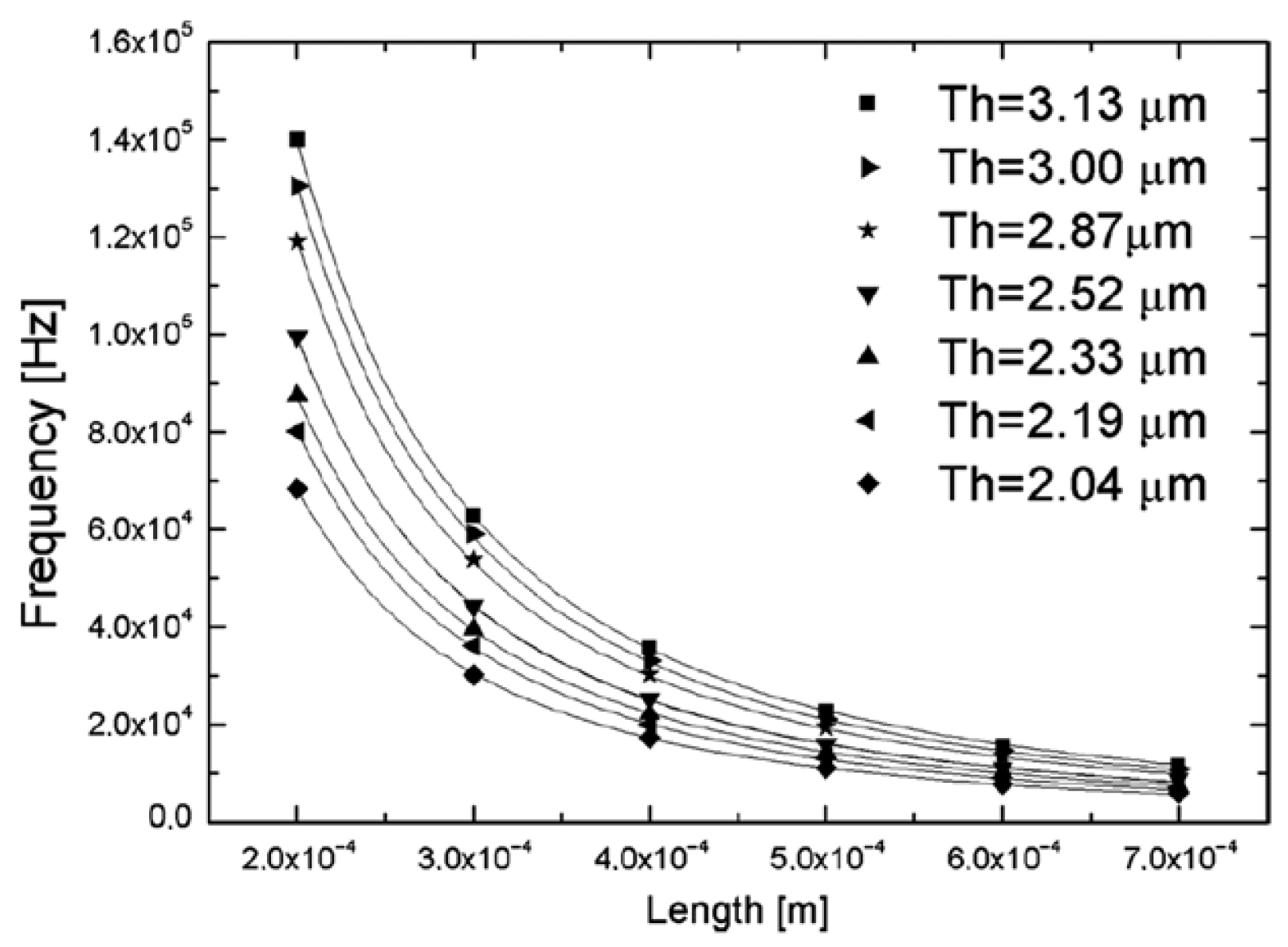
- Defects and thickness dependence: The density of extended defects (SF/TD) and their evolution during growth affect the effective elastic modulus, residual stress, and internal losses; thickness thus becomes a true design parameter rather than a purely technological constraint [43].
- Stress components: Decomposing the residual stress into a uniform stress (a mean tensile prestress that stiffens the structure and sets f) and a stress gradient (responsible for curvature/warpage and local stress variations) clarifies why nominally identical devices can exhibit different responses [20].
- Dissipation mechanisms and Q-factor: Expressing Q as the combination of multiple loss channels (fluid damping, thermoelastic damping, anchor losses, surface/material losses, etc.) provides the framework to interpret measurements and identify which mechanism limits the resolution [67].
- Mode- and thickness-dependent Q: Different modes and geometries partition elastic energy differently between shear and normal components, leading to systematic variations in Q;
7.2. Hysteretic Viscoelastic Model and Voigt Notation
- Isotropic: (a scalar);
- Anisotropic: is a symmetric matrix, with entries weighting specific stress–strain couplings [45].
7.3. FEM Case Study: Double-Clamped Beams in (111) 3C-SiC
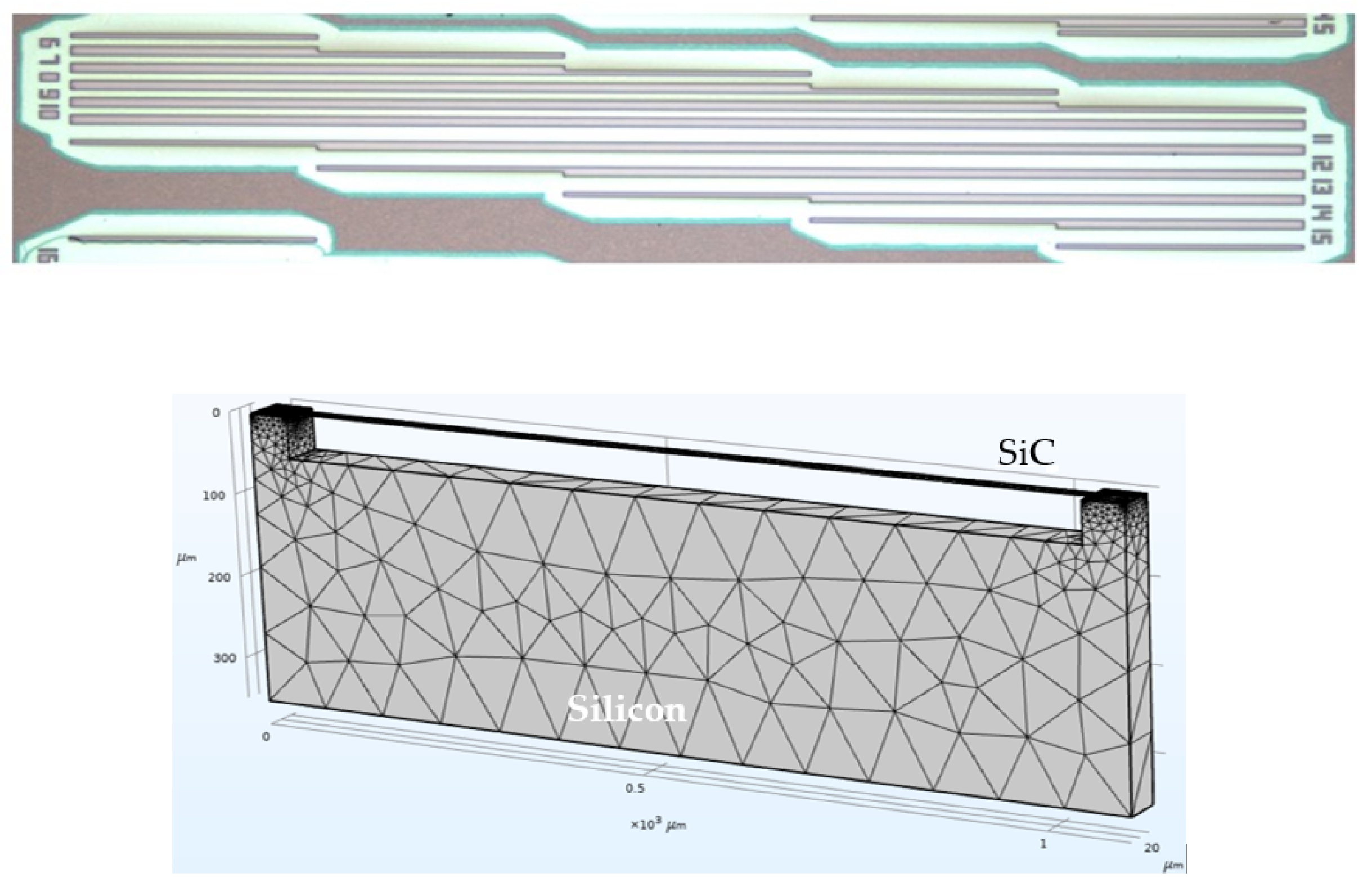
- Geometry and boundary conditions: A 3D beam with a rectangular cross-section, clamped at both ends, and free surfaces in the released region; when needed, inclusion of anchor regions and portions of the substrate to capture stress transfer.
- Material: 3C-SiC modeled as a cubic crystal rotated along (111); effective parameters (elastic modulus, residual stress) assigned on a wafer-by-wafer basis [28].
7.4. Limitations of the Anisotropic Damping Model
7.5. Loss-Tensor Calibration and Isotropic vs. Anisotropic Comparison
- 1.
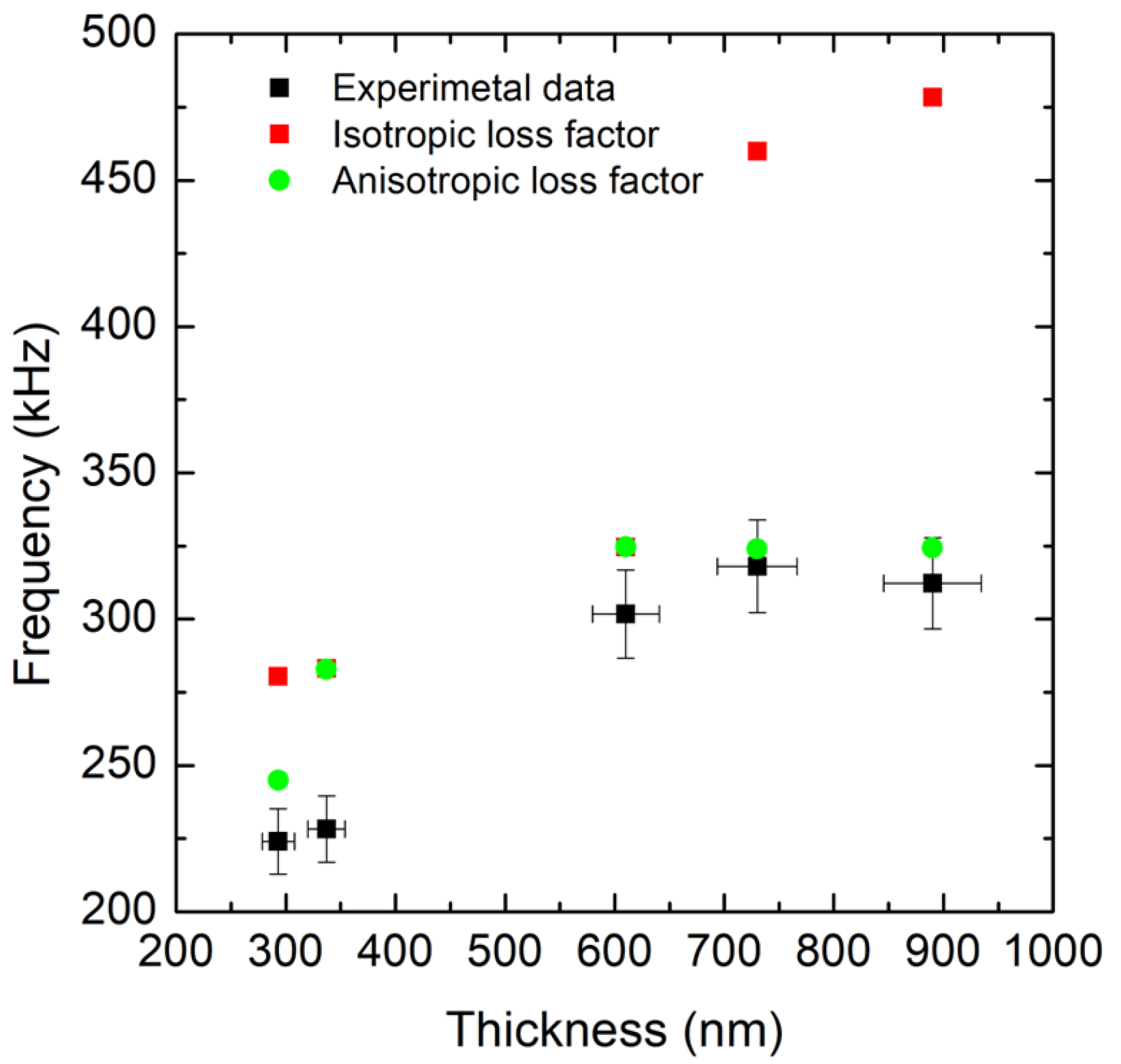
- Systematically improves Q prediction compared with the isotropic model, with a more pronounced advantage for thicker films (in the analyzed dataset, above a few hundred nm) (Figure 13);
- 2.
- Reproduces frequency trends, whereas a scalar isotropic may overestimate the frequency under certain conditions;
- 3.
- Enables a compact quantification of the overall damping magnitude (e.g., via the Frobenius norm of ), which shows a negative correlation with frequency: higher overall dissipation ⇒ lower frequencies.
- Thick films: Normal components (associated with ) become more prominent, with a redistribution of losses and a different modal “signature” in terms of Q and frequency [43].
- 1.
- Sensitivity depends on the effective-stiffness change induced by the load (stress engineering and modal distribution);
- 2.
- Resolution depends on Q and thus on the activated dissipation mechanisms (shear vs. tension, anchor losses, TED, etc.);
- 3.
- Microstructure (defects and their thickness evolution) simultaneously affects E, , , and internal losses, producing trends that cannot be captured by a single isotropic model.
8. Applications of SiC MEMS Technology
8.1. Pressure Sensors
8.2. Micromechanical Resonators
8.3. Accelerometers
8.4. MEMS Devices for Other Applications
9. Conclusions
Author Contributions
Funding
Institutional Review Board Statement
Informed Consent Statement
Data Availability Statement
Conflicts of Interest
References
- Varadan, V.K. Nanotechnology, MEMS and NEMS and their Application to Smart Systems and Devices. In Proceedings of SPIE; SPIE: Bellingham, WA, USA, 2003; Volume 5062. [Google Scholar]
- Cimalla, V.; Pezoldt, J.; Ambacher, O. Group III nitride and SiC based MEMS and NEMS: Material properties, technology and applications. J. Phys. D Appl. Phys. 2007, 40, 6386–6434. [Google Scholar] [CrossRef]
- Lyons, C.; Friedberger, A.; Welser, W.; Muller, G.; Krotz, G.; Kassing, R. A high-speed mass flow sensor with heated silicon carbide bridges. In Proceedings of the MEMS 98; IEEE: Piscataway, NJ, USA, 1998; pp. 356–360. [Google Scholar]
- Nagai, T.; Itoh, M. SiC thin-film thermistors. IEEE Trans. Ind. Appl. 1990, 26, 1139–1143. [Google Scholar] [CrossRef]
- Zhang, Y.; However, R.; Gogoi, B.; Yazdi, N. A High-Sensitive Ultra-thin MEMS capacitive pressure sensor. In Proceedings of the 2011 16th International Solid-State Sensors, Actuators and Microsystems Conference; IEEE: Beijing, China, 2011; pp. 112–115. [Google Scholar]
- Asri, M.I.A.; Hasan, M.N.; Fuaad, M.R.A.; Yunos, Y.M.; Ali, M.S.M. MEMS Gas sensor: A Review. IEEE Sens. J. 2021, 21, 18381–18397. [Google Scholar] [CrossRef]
- Connolly, E.J.; Pham, H.T.M.; Groeneweg, J.; Sarro, P.M.; French, P.J. Silicon carbide membrane relative humidity sensor with aluminium electrodes. In Proceedings of the 17th IEEE International Conference on Micro Electro Mechanical Systems; IEEE: Maastricht, The Netherlands, 2004; pp. 193–196. [Google Scholar]
- Azevedo, R.G.; Jones, D.G.; Jog, A.V.; Jamshidi, B.; Myers, D.R.; Chen, L.; Fu, X.; Mehregany, M.; Wijesundara, M.B.J.; Pisano, A.P. A SiC MEMS Resonant Strain Sensor for Harsh Environment Applications. IEEE Sens. J. 2007, 17, 568–576. [Google Scholar] [CrossRef]
- Mishra, M.K.; Dubey, V.; Mishra, P.M.; Khan, I. MEMS Technology: A Review. J. Eng. Rep. 2019, 4, 1–24. [Google Scholar] [CrossRef]
- Cascone, V.; Boaga, J.; Cassiani, G. Small local earthquake detection using Low-Cost MEMS Accelerometers: Examples in Northern and Central Italy. Seism. World 2021, 1, 20–26. [Google Scholar] [CrossRef]
- D’Alessandro, A.; D’Anna, R.; Greco, L.; Passafiume, G.; Scudero, S.; Speciale, S.; Vitale, G. Monitoring Earthquake through MEMS sensors (MEMS project) in the town of Acireale (Italy). In Proceedings of the 2018 IEEE International Symposium on Inertial Sensors and Systems (INERTIAL); IEEE: Lake Como, Italy, 2018; pp. 1–4. [Google Scholar]
- Hsu, T.Y.; Yin, R.C.; Wu, Y.M. Evaluating Post-Earthquake Building Safety Using Economical MEMS Seismometers. Sensors 2018, 18, 1437. [Google Scholar] [CrossRef]
- Calabretta, C.; Scuderi, V.; Bongiorno, C.; Anzalone, R.; Reitano, R.; Cannizzaro, A.; Mauceri, M.; Crippa, D.; Boninelli, S.; La Via, F. Advanced approach of bulk (111) 3C-SiC epitaxial growth. Microelectron. Eng. 2024, 283, 112116. [Google Scholar] [CrossRef]
- La Via, F.; Alquier, D.; Giannazzo, F.; Kimoto, T.; Neudeck, P.; Ou, H.; Roncaglia, A.; Saddow, S.E.; Tudisco, S. Emerging SiC Applications beyond Power Electronic Devices. Micromachines 2023, 14, 1200. [Google Scholar] [CrossRef]
- Scuderi, V.; Zielinski, M.; La Via, F. Impact of Doping on Cross-Sectional Stress Assessment of 3C-SiC/Si Heteroepitaxy. Materials 2023, 16, 3824. [Google Scholar] [CrossRef]
- Bosi, M.; Ferrari, C.; Nilsson, D.; Ward, P.J. 3C-SiC carbonization optimization and void reduction on misoriented Si substrates: From a research reactor to a production scale reactor. CrystEngComm 2016, 18, 7478–7486. [Google Scholar] [CrossRef]
- Iacopi, F.; Walker, G.; Wang, L.; Malesys, L.; Ma, S.; Cunning, B.V. Orientation-dependent stress relaxation in hetero-epitaxial 3C-SiC films. Appl. Phys. Lett. 2013, 102, 011908. [Google Scholar] [CrossRef]
- Zielinski, M.; Portail, M.; Chassagne, T.; Juillaguet, S.; Peyre, H. Nitrogen doping of 3C-SiC thin films grown by CVD in a resistively heated horizontal hot-wall reactor. J. Cryst. Growth 2008, 310, 3174–3182. [Google Scholar] [CrossRef]
- Michaud, J.-F.; Zielinski, M.; Messaoud, J.B.; Chassagne, T.; Portail, M.; Alquier, D. Influence of Aluminum Incorporation on Mechanical Properties of 3C-SiC Epilayers. Mater. Sci. Forum 2018, 924, 318–321. [Google Scholar] [CrossRef]
- Anzalone, R.; D’Arrigo, G.; Camarda, M.; Locke, C.; Saddow, S.E.; la Via, F. Advanced Residual Stress Analysis and FEM Simulation on Heteroepitaxial 3C–SiC for MEMS Application. J. Microelectromech. Syst. 2011, 20, 745–752. [Google Scholar] [CrossRef]
- Sun, Y.; Izumi, S.; Sakai, S.; Yagi, K.; Nagasawa, H. Saddle-shape warpage of thick 3C-SiC wafer: Effect of nonuniform intrinsic stress and stacking faults. Phys. Status Solidi B 2012, 249, 555–559. [Google Scholar] [CrossRef]
- Sheng, X.; Zhu, Z.; Liu, C. A Review of the Machining Mechanisms in Field-Assisted Cutting of Brittle Materials. Micromachines 2026, 17, 361. [Google Scholar] [CrossRef]
- Fang, F.; Lai, M.; Wang, J.; Luo, X.; Yan, J.; Yan, Y. Nanometric cutting: Mechanisms, practices and future perspectives. Int. J. Mach. Tools Manuf. 2022, 178, 103905. [Google Scholar] [CrossRef]
- Tong, L.; Mehregany, M. Mechanical properties of 3C silicon carbide. Appl. Phys. Lett. 1992, 60, 2992–2994. [Google Scholar] [CrossRef]
- Locke, C.; Kravchenko, G.; Waters, P.; Reddy, J.D.; Du, K.; Volinsky, A.A.; Frewin, C.L.; Saddow, S.E. 3C-SiC Films on Si for MEMS Applications: Mechanical Properties. Mater. Sci. Forum 2009, 615–617, 633–636. [Google Scholar] [CrossRef]
- Tolpygo, K.B. Optical, elastic and piezoelectric properties of ionic and valence crystals with ZnS-type lattice. Sov. Phys. Solid State 1961, 2, 2367. [Google Scholar]
- Feldman, D.W.; Parker, J.H., Jr.; Choyke, J.W. Phonon Dispersion Curves by Raman Scattering in SiC, Polytypes 3C, 4H, 6H, 15R, and 21R. Phys. Rev. 1968, 173, 787–795. [Google Scholar] [CrossRef]
- Karch, K.P.; Pavone, W.; Windl, O.; Schutt, D.; Strauch, A. Ab initio calculation of structural and lattice-dynamical properties of silicon carbide. Phys. Rev. B 1994, 50, 17054–17063. [Google Scholar] [CrossRef] [PubMed]
- Petersen, K.E. Silicon as a Mechanical Material. Proc. IEEE 1981, 70, 420–457. [Google Scholar] [CrossRef]
- Su, C.M.; Wuttig, M.; Fekade, A.; Spencer, M. Elastic Properties of Single-Crystal Silicon Carbide. J. Appl. Phys. 1995, 77, 5611–5617. [Google Scholar] [CrossRef]
- Mehregany, M.; Matus, L.G.; Larkin, D.J. Piezoelectric and Mechanical Properties of Single-Crystal 3C-SiC. IEEE Trans. Electron Devices 1997, 44, 74–82. [Google Scholar] [CrossRef]
- Espinosa, H.D.; Peng, V.; Moldovan, N.; Friedmann, T.A.; Xiao, X.; Mancini, D.C.; Auciello, O.; Carlisle, J.; Zorman, C.A.; Mehregany, M. Mechanical Properties of Ultrananocrystalline Diamond and 3C-SiC Films. Appl. Phys. Lett. 2006, 89, 073111. [Google Scholar] [CrossRef]
- Watkins, T.R.; Green, D.J.; Ryba, E.R. Elastic Constants of Single-Crystal 3C-SiC. J. Am. Ceram. Soc. 1993, 76, 1965–1971. [Google Scholar] [CrossRef]
- Gao, D.; Wijesundara, M.B.J.; Carraro, C.; Low, C.W.; Howe, R.T.; Maboudian, R. Characterization of MEMS Devices. In Proceedings of the 12th International Conference on Transducers, Solid-State Sensors, Actuators and Microsystems, Boston, MA, USA, 8–12 June 2003. [Google Scholar]
- Carbahan, R.D. Elastic Properties of Silicon Carbide. J. Am. Ceram. Soc. 1968, 51, 223–226. [Google Scholar] [CrossRef]
- Werner, M.; Krötz, G.; Möller, H.; Eickhoff, M.; Gluche, P.; Adamschik, M.; Johnston, C.; Chalker, P.R. Advances in MEMS Sensors. Sens. Update 1999, 5, 141–160. [Google Scholar] [CrossRef]
- Li, Z.; Bradt, R.C. Mechanical Properties of Cubic (3C) SiC. J. Eur. Ceram. Soc. High Technol. Ceram. 1988, 4, 1–10. [Google Scholar] [CrossRef]
- Wolfenden, A. Elastic Constants of Cubic Silicon Carbide. J. Mater. Sci. 1997, 32, 2275–2280. [Google Scholar] [CrossRef]
- Hossain, T.K.; MacLaren, S.; Engel, J.M.; Liu, C.; Adesida, I.; Okojie, R.S. Mechanical Properties of 3C-SiC Films for MEMS Applications. J. Micromechanics Microengineering 2006, 16, 751–757. [Google Scholar] [CrossRef]
- Fukuhara, M.; Abe, Y. Elastic Properties of Cubic Silicon Carbide Single Crystals. J. Mater. Sci. Lett. 1993, 12, 681–683. [Google Scholar] [CrossRef]
- Romero, E.; Valenzuela, V.M.; Kermany, A.R.; Sementilli, L.; Iacopi, F.; Bowen, W.P. Engineering the Dissipation of Crystalline Micromechanical Resonators. Phys. Rev. Appl. 2020, 13, 044007. [Google Scholar] [CrossRef]
- Garofalo, A.; Muoio, A.; Sapienza, S.; Ferri, M.; Belsito, L.; La Via, F. Model of Quality Factor for (111) 3C-SiC Double-Clamped Beams. Micromachines 2025, 16, 148. [Google Scholar] [CrossRef]
- Zimbone, M.; Sarikov, A.; Bongiorno, C.; Marzegalli, A.; Scuderi, V.; Calabretta, C.; Miglio, L.; La Via, F. Extended defects in 3C-SiC: Stacking faults, threading partial dislocations, and inverted domain boundaries. Acta Mater. 2021, 213, 116915. [Google Scholar] [CrossRef]
- Zimbone, M.; Barbagiovanni, E.G.; Bongiorno, C.; Calabretta, C.; Calcagno, L.; Fisicaro, G.; La Magna, A.; La Via, F. Generation and Termination of Stacking Faults by Inverted Domain Boundaries in 3C-SiC. Cryst. Growth Des. 2020, 20, 3104–3111. [Google Scholar] [CrossRef]
- Fisicaro, G.; Bongiorno, C.; Deretzis, I.; Giannazzo, F.; La Via, F.; Roccaforte, F.; Zielinski, M.; Zimbone, M.; La Magna, A. Genesis and evolution of extended defects: The role of evolving interface instabilities in cubic SiC. Appl. Phys. Rev. 2020, 7, 021402. [Google Scholar] [CrossRef]
- La Via, F.; Severino, A.; Anzalone, R.; Bongiorno, C.; Litrico, G.; Mauceri, M.; Schoeler, M.; Schuh, P.; Wellmann, P. From thin film to bulk 3C-SiC growth: Understanding the mechanism of defects reduction. Mater. Sci. Semicond. Process. 2018, 78, 57–68. [Google Scholar] [CrossRef]
- Anzalone, R.; Camarda, M.; Canino, A.; Piluso, N.; La Via, F.; D’Arrigo, G. Defect Influence on Heteroepitaxial 3C-SiC Young Modulus. Electrochem. Solid-State Lett. 2011, 14, H161–H162. [Google Scholar] [CrossRef]
- Michaud, J.F.; Jiao, S.; Bazin, A.E.; Portail, M.; Chassagne, T.; Zielinski, M.; Alquier, D. Micromachining of Thin 3C-SiC Films for Mechanical Properties Investigation; MRS Online Proceedings Library (OPL): Cambridge, UK, 2010; Volume 1246. [Google Scholar]
- Calabretta, C.; Scuderi, V.; Bongiorno, C.; Cannizzaro, A.; Anzalone, R.; Calcagno, L.; Mauceri, M.; Crippa, D.; Boninelli, S.; La Via, F. Impact of Nitrogen on the Selective Closure of Stacking Faults in 3C-SiC. Cryst. Growth Des. 2022, 22, 4996–5003. [Google Scholar] [CrossRef] [PubMed]
- Calabretta, C.; Scuderi, V.; Anzalone, R.; Mauceri, M.; Crippa, D.; Cannizzaro, A.; Boninelli, S.; La Via, F. Effect of Nitrogen and Aluminum Doping on 3C-SiC Heteroepitaxial Layers Grown on 4° Off-Axis Si (100). Materials 2021, 14, 4400. [Google Scholar] [CrossRef] [PubMed]
- Yang, Y.T.; Ekinci, K.L.; Huang, X.M.H.; Schiavone, L.M.; Roukes, M.L.; Zorman, C.A.; Mehregany, M. Monocrystalline silicon carbide nanoelectromechanical systems. Appl. Phys. Lett. 2001, 78, 162–164. [Google Scholar] [CrossRef]
- Sillero, E.; Williams, O.A.; Lebedev, V.; Cimalla, V.; Rohlig, C.-C.; Nebel, C.E.; Calle, F. Static and dynamic determination of the mechanical properties of nanocrystalline diamond micromachined structures. J. Micromech. Microeng. 2009, 19, 115016. [Google Scholar] [CrossRef]
- Hähnlein, B.; Stubenrauch, M.; Pezoldt, J. Mechanical Properties and Residual Stress of Thin 3C-SiC (100) Films Determined Using MEMS Structures. Mater. Sci. Forum 2015, 821–823, 281–284. [Google Scholar] [CrossRef]
- Mehregany, M.; Tong, L.; Matus, L.G.; Larkin, D.J. Internal Stress and Elastic Modulus Measurements on Micromachined 3C-SiC Thin Films. IEEE Trans. Electron Devices 1997, 44, 74–82. [Google Scholar] [CrossRef]
- Sapienza, S.; Ferri, M.; Belsito, L.; Marini, D.; Zielinski, M.; La Via, F.; Roncaglia, A. Measurement of Residual Stress and Young’s Modulus on Micromachined Monocrystalline 3C-SiC Layers Grown on 〈111〉 and 〈100〉 Silicon. Micromachines 2021, 12, 1072. [Google Scholar] [CrossRef]
- Chang, W.; Zorman, C.A. Determination of Young’s Moduli of 3C (110) Single-Crystal and (111) Polycrystalline Silicon Carbide from Operating Frequencies. J. Mater. Sci. 2008, 43, 4512–4517. [Google Scholar] [CrossRef]
- Fu, X.; Dunning, J.L.; Zorman, C.A.; Mehregany, M. Measurement of Residual Stress and Elastic Modulus of Polycrystalline 3C-SiC Films Deposited by Low-Pressure Chemical Vapor Deposition. Thin Solid Film. 2005, 492, 195–202. [Google Scholar] [CrossRef]
- Hähnlein, B.; Kovac, J., Jr.; Pezoldt, J. Size Effect of the Silicon Carbide Young’s Modulus. Phys. Status Solidi A Appl. Mater. Sci. 2017, 214, 1600390. [Google Scholar] [CrossRef]
- Zhou, W.; Yang, J.; Sun, G.; Liu, X.; Yang, F.; Li, J. Fracture Properties of Silicon Carbide Thin Films by Bulge Test of Long Rectangular Membrane. J. Microelectromechanical Syst. 2008, 17, 453–461. [Google Scholar] [CrossRef]
- Pozzi, M.; Hassan, M.; Harris, A.J.; Burdess, J.S.; Jiang, L.; Lee, K.K.; Cheung, R.; Phelps, G.J.; Wright, N.G.; Zorman, C.A.; et al. Mechanical properties of a 3C-SiC film between room temperature and 600 °C. J. Phys. D Appl. Phys. 2007, 40, 3335–3342. [Google Scholar] [CrossRef]
- Boyd, E.J.; Li, L.; Blue, R.; Uttamchandani, D. Measurement of the temperature coefficient of Young’s modulus of single crystal silicon and 3C silicon carbide below 273 K. Sens. Actuators A Phys. 2013, 198, 75–80. [Google Scholar] [CrossRef]
- Roy, S.; Zorman, C.A.; Mehregany, M.; DeAnna, R.; Deeb, C. Mechanical properties of polycrystalline 3C-SiC films grown on polysilicon substrates by atmospheric pressure chemical-vapor deposition. J. Appl. Phys. 2006, 99, 044108. [Google Scholar] [CrossRef]
- Kermany, A.R.; Brawley, G.; Mishra, N.; Sheridan, E.; Bowen, W.P.; Iacopi, F. Microresonators with Q-factors over a million from highly stressed epitaxial silicon carbide on silicon. Appl. Phys. Lett. 2014, 104, 081901. [Google Scholar] [CrossRef]
- Severino, A. 3C-SiC epitaxial growth on large area Silicon: Thin Films. In Silicon Carbide Epitaxy; Research Signpost: Kochi, India, 2012; Chapter 3; p. 47. [Google Scholar]
- Gupta, A.; Jacob, C. Selective epitaxy and lateral overgrowth of 3C-SiC on Si—A review. Prog. Cryst. Growth Charact. Mater. 2005, 51, 43–69. [Google Scholar] [CrossRef]
- Sapienza, S.; Belsito, L.; Ferri, M.; Elmi, I.; Zielinski, M.; Roncaglia, A. Fabrication of wafer-level vacuum packaged Poly-Si/SiC beam resonators with strain sensitivity larger than 1 kHz/μϵ. In Proceedings of the 2025 23rd International Conference on Solid-State Sensors, Actuators and Microsystems (Transducers); IEEE: Orlando, Florida, USA, 2025; pp. 1572–1575. [Google Scholar]
- Boisen, A.; Dohn, S.; Keller, S.S.; Schmid, S.; Tenje, M. Cantilever-like micromechanical sensors. Rep. Prog. Phys. 2011, 3, 74. [Google Scholar] [CrossRef]
- Schmid, S.; Villanueva, L.G.; Roukes, M.L. Fundamentals of Nanomechanical Resonators; Springer International Publishing: Berlin/Heidelberg, Germany, 2016. [Google Scholar]
- Cole, G.D.; Wilson-Rae, I.; Werbach, K.; Vanner, M.R.; Aspelmeyer, M. Phonon-Tunnelling Dissipation in Mechanical Resonators. Nat. Commun. 2011, 2, 231. [Google Scholar] [CrossRef]
- Villanueva, L.G.; Schmid, S. Evidence of Surface Loss as a Ubiquitous Limiting Damping Mechanism in SiN Micro- and Nanomechanical Resonators. Phys. Rev. Lett. 2014, 113, 227201. [Google Scholar] [CrossRef]
- Cleland, A.N.; Roukes, M.L. Noise Processes in Nanomechanical Resonators. J. Appl. Phys. 2002, 92, 2758–2769. [Google Scholar] [CrossRef]
- Naeli, K.; Brand, O. Dimensional Considerations in Achieving Large Quality Factors for Resonant Silicon Cantilevers in Air. J. Appl. Phys. 2009, 105, 014908. [Google Scholar] [CrossRef]
- Zener, C. Internal Friction in Solids II. General Theory of Thermoelastic Internal Friction. Phys. Rev. 1938, 53, 90–99. [Google Scholar] [CrossRef]
- Lifshitz, R.; Roukes, M.L. Thermoelastic Damping in Micro- and Nanomechanical Systems. Phys. Rev. B 2000, 61, 5600–5609. [Google Scholar] [CrossRef]
- Yang, J.; Ono, T.; Esashi, M. Energy Dissipation in Submicrometer-Thick Single-Crystal Silicon Cantilevers. J. Microelectromechanical Syst. 2002, 11, 775–783. [Google Scholar] [CrossRef]
- Chang, C.-Y.; Zorman, C.A. Electrical Characterization of Microelectromechanical Silicon Carbide Resonators. Sensors 2008, 8, 5759–5774. [Google Scholar] [CrossRef]
- Mastropaolo, E.; Wood, G.S.; Gual, I.; Parmiter, P.; Cheung, R. Electrothermally Actuated Silicon Carbide Tunable MEMS Resonators. J. Microelectromechanical Syst. 2012, 21, 811–821. [Google Scholar] [CrossRef]
- Akhiezer, A.I. On the Absorption of Sound in Solids. J. Phys. 1939, 1, 277–287. [Google Scholar]
- Woodruff, T.O.; Ehrenreich, H. Absorption of Sound in Insulators. Phys. Rev. 1961, 123, 1553–1558. [Google Scholar] [CrossRef]
- Hao, Z.; Erbil, A.; Ayazi, F. An analytical model for support loss in micromachined beam resonators with in-plane flexural vibrations. Sens. Actuators A 2003, 109, 156–164. [Google Scholar] [CrossRef]
- Mohammadi, S.; Eftekhar, A.A.; Hunt, W.D.; Adibi, A. High-Q Micromechanical Resonators in a Two-Dimensional Phononic Crystal Slab. Appl. Phys. Lett. 2008, 92, 221905. [Google Scholar] [CrossRef]
- Lin, B.; Zheng, Y.; Li, H.; Ren, Y.; Yang, T.; Wang, Z.; Cai, Y.; Xu, Q.; Sun, C. Enhancement of Quality Factors in a 6.5 GHz Resonator Using Mo/SiC Composite Microstructures. Micromachines 2025, 16, 529. [Google Scholar] [CrossRef] [PubMed]
- Unterreithmeier, Q.P.; Faust, T.; Kotthaus, J.P. Damping of Nanomechanical Resonators. Phys. Rev. Lett. 2010, 105, 027205. [Google Scholar] [CrossRef] [PubMed]
- Lu, X.; Lee, J.Y.; Feng, P.X.; Lin, Q. Silicon carbide microdisk resonator. Opt. Lett. 2013, 38, 1304–1306. [Google Scholar] [CrossRef]
- Eichenfield, M.; Chan, J.; Camacho, R.M.; Vahala, K.J.; Painter, O. Optomechanical Crystals. Nature 2009, 462, 78–82. [Google Scholar] [CrossRef]
- Muoio, A.; Garofalo, A.; Sapienza, S.; La Via, F. Numerical Simulations of 3C-SiC High-Sensitivity Strain Meters. Micromachines 2025, 16, 989. [Google Scholar] [CrossRef]
- Okojie, R.S.; Lukco, D.; Nguyen, V.; Savrun, E. 4H-SiC piezoresistive pressure sensors at 800 °C with observed sensitivity recovery. IEEE Electron Device Lett. 2015, 36, 174–176. [Google Scholar] [CrossRef]
- Wang, L.; Yang, Y.; Wang, Y.; Huo, J.; Wan, N.; Zhao, Y.; Lyu, Y.; Zhao, Y.; Liu, M. High-sensitivity 4H-silicon carbide MEMS pressure sensors for extreme temperature ranges of −75 °C to 600 °C. IEEE Trans. Instrum. Meas. 2025, 74, 9522010. [Google Scholar] [CrossRef]
- Phan, H.-P.; Nguyen, T.-K.; Dinh, T.; Iacopi, A.; Hold, H.; Shiddiky, M.J.A.; Dao, D.V.; Nguyen, N.-T. Robust free-standing nano-thin SiC membranes enable direct photolithography for MEMS sensing applications. Adv. Eng. Mater. 2018, 20, 1700858. [Google Scholar] [CrossRef]
- Middelburg, L.M.; van Zeijl, H.W.; Vollebregt, S.; Morana, B.; Zhang, G. Toward a self-sensing piezoresistive pressure sensor for all-SiC monolithic integration. IEEE Sens. J. 2020, 20, 11265–11274. [Google Scholar] [CrossRef]
- Tong, B.; Nguyen, H.-Q.; Nguyen, T.-H.; Nguyen, T.-K.; Nguyen, V.T.; Dinh, T.; Vu, T.-H.; Dau, V.T.; Dao, D.V. Free standing stress amplification structure for ultrasensitive 3C-SiC/Si pressure sensor. In Proceedings of IEEE Sensors; IEEE: Piscataway, NJ, USA, 2022. [Google Scholar]
- Nguyen, T.; Dinh, T.; Phan, H.-P.; Nguyen, T.-K.; Foisal, A.R.M.; Nguyen, N.-T.; Dao, D.V. Optoelectronic enhancement for piezoresistive pressure sensor. In Proceedings of the IEEE International Conference on Micro Electro Mechanical Systems (MEMS); IEEE: Vancouver, BC, Canada, 2020; pp. 681–684. [Google Scholar]
- Beker, L.; Maralani, A.; Lin, L.; Pisano, A.P. Modeling, fabrication, and characterization of SiC concentrically matched differential capacitance output pressure sensors. Sens. Actuators A Phys. 2018, 273, 293–302. [Google Scholar] [CrossRef]
- Li, H.; Liu, J.; Sheng, T.; Li, J.; Zhang, D.; Jiang, Y. All-SiC fiber-optic sensor for pressure and temperature dual-mode sensing in harsh environments. Sens. Actuators A Phys. 2024, 373, 115388. [Google Scholar] [CrossRef]
- Sapienza, S.; Ferri, M.; Belsito, L.; Marini, D.; Zielinski, M.; La Via, F.; Roncaglia, A. Correlation between Q-Factor and Residual Stress in Epitaxial 3C-SiC Double-Clamped Beam Resonators. Mater. Sci. Forum 2023, 1089, 57–61. [Google Scholar] [CrossRef]
- Belsito, L.; Bosi, M.; Mancarella, F.; Ferri, M.; Roncaglia, A. Nanostrain resolution strain sensing by monocrystalline 3C-SiC on SOI electrostatic MEMS resonators. J. Microelectromechanical Syst. 2020, 29, 117–128. [Google Scholar] [CrossRef]
- Brueckner, K.; Cimalla, V.; Niebelschütz, F.; Stephan, R.; Tonisch, K.; Ambacher, O.; Hein, M.A. Strain- and pressure-dependent RF response of microelectromechanical resonators for sensing applications. J. Micromechanics Microengineering 2007, 17, 2016–2023. [Google Scholar] [CrossRef]
- Lim, A.V.; Karacolak, T.; Jiang, J.-Y.; Huang, C.-F.; Zhao, F. Electrostatically-actuated 4H-SiC in-plane and out-of-plane high frequency MEMS resonator. IEEE Microw. Wirel. Components Lett. 2016, 26, 28–30. [Google Scholar] [CrossRef]
- Kermany, A.R.; Bennett, J.S.; Valenzuela, V.M.; Bowen, W.P.; Iacopi, F. Potential of epitaxial silicon carbide microbeam resonators for chemical sensing. Phys. Status Solidi A 2017, 214, 1600437. [Google Scholar] [CrossRef]
- Lohrmann, A.; Johnson, B.C.; McCallum, J.C.; Castelletto, S. A review on single photon sources in silicon carbide. Rep. Prog. Phys. 2017, 80, 034502. [Google Scholar] [CrossRef]
- Atwell, A.R.; Okojie, R.S.; Kornegay, K.T.; Roberson, S.L.; Beliveau, A. Simulation, fabrication and testing of bulk micromachined 6H-SiC high-g piezoresistive accelerometers. Sens. Actuators A Phys. 2003, 104, 11–18. [Google Scholar] [CrossRef]
- Zhai, Y.; Li, H.; Tao, Z.; Cao, X.; Yang, C.; Che, Z.; Xu, T. Design, fabrication and test of a bulk SiC MEMS accelerometer. Microelectron. Eng. 2022, 260, 111793. [Google Scholar] [CrossRef]
- Yang, Y.; Zhao, Y.; Wang, L.; Zhao, Y. Application of femtosecond laser etching in the fabrication of bulk SiC accelerometer. J. Mater. Res. Technol. 2022, 17, 2577–2586. [Google Scholar] [CrossRef]
- Rajgopal, S.; Zula, D.; Garverick, S.; Mehregany, M. A silicon carbide accelerometer for extreme environment applications. Mater. Sci. Forum 2009, 600–603, 859–862. [Google Scholar] [CrossRef]
- Wolffenbuttel, R.; Bilby, D.; Visser, J. Setting the emissivity of an imaging bolometer in the surface temperature profile measurement of SiC-based MEMS heaters. Metrology 2025, 5, 36. [Google Scholar] [CrossRef]
- Michaud, J.-F.; Portail, M.; Alquier, D.; Certon, D.; Dufour, I. Silicon-carbide-based MEMS for gas detection applications. Mater. Sci. Semicond. Process. 2024, 171, 107986. [Google Scholar] [CrossRef]
- Long, Y.; Liu, Z.; Ayazi, F. 4H-silicon carbide as an acoustic material for MEMS. IEEE Trans. Ultrason. Ferroelectr. Freq. Control 2023, 70, 1189–1200. [Google Scholar] [CrossRef]
- Nguyen, T.K.; Barton, M.; Ashok, A.; Truong, T.-A.; Yadav, S.; Leitch, M.; Nguyen, T.-V.; Kashaninejad, N.; Dinh, T.; Hold, L.; et al. Wide bandgap semiconductor nanomembranes as a long-term biointerface for flexible, implanted neuromodulator. Proc. Natl. Acad. Sci. USA 2022, 119, e2203287119. [Google Scholar] [CrossRef]



| Material Type | Hardness (GPa) | Young’s Modulus (GPa) | References |
|---|---|---|---|
| (100) Si | [25] | ||
| Lely platelet 15R-SiC | [25] | ||
| 3C-SiC on (100) Si | [25] | ||
| 3C-SiC on (111) Si | >50 | >500 | [25] |
| Poly-3C-SiC on (100) Si | [25] | ||
| 3C | 496 | 223 | [26] |
| 3C | 401 | 211 | [27] |
| 3C | 221.9 | [28] | |
| 3C | 700 | [29] | |
| 3C epi, undoped | 694 | [30] | |
| 3C epi, p-type | 474 | [30] | |
| 3C epi | 330 | [31] | |
| 3C epi | 394 | [24] | |
| 3C epi | 422/435 | [32] | |
| 3C poly | 446 | [33] | |
| 3C poly | 710 | [34] | |
| 3C poly, <100> | 384 | [35] | |
| 3C poly, random | 382 | [36] | |
| -SiC | 420 | [37] | |
| -SiC poly | 448 | 225 | [35] |
| -SiC poly (NC203) | 450 | [38] | |
| 4H | 225.9 | [28] | |
| 6H | 441 | [39] | |
| 6H poly | 500 | [40] |
| Deposition | Sample | Thickness (m) | E (GPa) | (MPa) |
|---|---|---|---|---|
| 1 | 1 | 2.75 | 381 | 188 |
| 1 | 2 | 2.50 | 459 | 149 |
| 1 | 3 | 2.20 | 456 | 223 |
| 1 | 4 | 1.60 | 292 | 227 |
| 2 | 1 | 3.50 | 377 | 308 |
| 2 | 2 | 3.25 | 398 | 286 |
| 2 | 3 | 3.10 | 403 | 269 |
| 2 | 4 | 2.10 | 385 | 541 |
| Typology of 3C-SiC | E at RT | TCYM (ppm/K) | Range of T (°C) | Note |
|---|---|---|---|---|
| Epitaxial (SC) | Film on Si [60] | |||
| Epitaxial (SC) | 430 | Undoped film [30] | ||
| Epitaxial (SC) | 390 | to 20 | Low temperature [61] | |
| Polycrystalline (SiC) | 452–494 | Undoped film [62] |
| Material | P (mbar) | Length (m) | Width (m) | Thickness (nm) | Residual Stress (MPa) | Q |
|---|---|---|---|---|---|---|
| SiC(111) | 220 | 50 | 255 | 750 | ||
| SiC(111) | 1000 | 4 | 255 | 750 | ||
| SiC(111) | 930 | 4 | 255 | 1500 |
| Design Parameter | Effect of ↑ Thickness | Effect of ↓ Thickness | Key Trade-Off |
|---|---|---|---|
| Defect density | ↑ (interface proximity) | Thick → better crystal quality | |
| Effective Young’s modulus | ↑ (approaches bulk) | ↓ (defect softening) | Increasing ∼30–60% from 300 nm to 900 nm |
| Q-factor (total) | Peaks ∼600–1000 nm | Low (surface + defect loss) | Optimum at intermediate thickness |
| Stress gradient | ↓ (more uniform) | ↑ (large gradient) | Thicker beams, flatter but less strain-sensitive |
| Strain sensitivity | ↓ (stiffer, less stress change) | ↑ large | Thin beams, more sensitive but noisier |
| Material Type | Resonator Configuration | Quality Factor Q | Reference |
|---|---|---|---|
| 3C-SiC (111) | DC beam (flexural) | – | [41,42] |
| SiN/crystalline systems | Micro- and nanomechanical beams | ∼ (surface-loss limited) | [70] |
| Single-crystal Si | Cantilever, CC beam | (air) to (vacuum) | [72] |
| Single-crystal Si | Cantilever, CC beam | TED-limited (∼–) | [73,74,75] |
| 3C-SiC (single- and polycrystal) | Lateral-mode resonator | ∼ (air), >104 (vacuum) | [76] |
| Epitaxial 3C-SiC | Beam, disk resonator | Up to ∼ | [77] |
| Single-crystal Si | Phononic crystal slab resonator | >106 | [81] |
| Mo/SiC composite | Bulk acoustic resonator | > | [82] |
| Single-crystal Si | Nanobeam resonator | – (surface-loss limited) | [83] |
| Single-crystal 4H-SiC | Microdisk | > | [84] |
| Single-crystal Si | Optomechanical crystal | , Hz | [85] |
Disclaimer/Publisher’s Note: The statements, opinions and data contained in all publications are solely those of the individual author(s) and contributor(s) and not of MDPI and/or the editor(s). MDPI and/or the editor(s) disclaim responsibility for any injury to people or property resulting from any ideas, methods, instructions or products referred to in the content. |
© 2026 by the authors. Licensee MDPI, Basel, Switzerland. This article is an open access article distributed under the terms and conditions of the Creative Commons Attribution (CC BY) license.
Share and Cite
Garofalo, A.; Muoio, A.; Belsito, L.; Sapienza, S.; Ferri, M.; Roncaglia, A.; La Via, F. Heteroepitaxial 3C-SiC for MEMS Applications. Micromachines 2026, 17, 502. https://doi.org/10.3390/mi17040502
Garofalo A, Muoio A, Belsito L, Sapienza S, Ferri M, Roncaglia A, La Via F. Heteroepitaxial 3C-SiC for MEMS Applications. Micromachines. 2026; 17(4):502. https://doi.org/10.3390/mi17040502
Chicago/Turabian StyleGarofalo, Angela, Annamaria Muoio, Luca Belsito, Sergio Sapienza, Matteo Ferri, Alberto Roncaglia, and Francesco La Via. 2026. "Heteroepitaxial 3C-SiC for MEMS Applications" Micromachines 17, no. 4: 502. https://doi.org/10.3390/mi17040502
APA StyleGarofalo, A., Muoio, A., Belsito, L., Sapienza, S., Ferri, M., Roncaglia, A., & La Via, F. (2026). Heteroepitaxial 3C-SiC for MEMS Applications. Micromachines, 17(4), 502. https://doi.org/10.3390/mi17040502