


Abstract
In this work, a CdTe quantum dot-based fluorescent probe was synthesized to determine felodipine (FEL). The synthesis conditions, structure, and interaction conditions with FEL of CdTe quantum dots were analysed by fluorescence spectrophotometry, Fourier transform infrared spectroscopy (FT-IR), X-ray diffraction (XRD), UV–visible spectroscopy, and TEM. The CdTe QD concentration was 2.0 × 10⁻⁴ mol/L. The amount of quantum dots controlled in the experiment was 0.8 mL. The controlled feeding ratio of N (Cd2+):N (Te2−):N (TGA) was 2:1:4, the heating temperature was 140 °C, the heating time was 60 min, and the pH of the QD precursor was adjusted to 11 for subsequent experiments. The UV–visible spectrum showed that the emission wavelength of CdTe quantum dots at 545 nm was the strongest and symmetric. The particle size of the synthesized quantum dots was approximately 5 nm. In the interaction of CdTe quantum dots with FEL, the FEL dosage was 1.0 mL, the optimal pH value of Tris-HCl buffer was 8.2, the amount of buffer was 1.5 mL, and the reaction time was 20 min. The standard curve of FEL was determined under the optimal synthesis conditions of CdTe quantum dots and reaction of CdTe quantum dots with FEL. The linear equation was Y = 3.9448x + 50.068, the correlation coefficient R2 was 0.9986, and the linear range was 5 × 10⁻⁶–1.1 × 10⁻⁴ mol/L. A CdTe quantum dot-based fluorescent probe was successfully constructed and could be used to determine the FEL tablet content.
1. Introduction
Hypertension is universally recognized as one of the significant reasons for cardiovascular illnesses, and may prompt unpredictable changes in fat and sugar digestion, actuate the distress of significant objective organs and, in any event, jeopardize the survival of patients [1,2]. There are many types of commonly used drugs for hypertension. Among the various drugs, calcium channel antagonists mainly fall into three categories [3], among which dihydropyridine drugs with the strongest cardiovascular selectivity are used the most [4]. Compared with other types of blood pressure-lowering drugs, calcium channel antagonists do not impact the regular blood glucose and lipid metabolism of patients and do not have particularly visible side effects [5]. In conclusion, calcium channel antagonists are very suitable for the treatment of hypertension with metabolic syndrome, especially for patients with ACEI intolerance. These antagonists are also suitable for the treatment of diabetes, angina pectoris and other diseases [6].
FEL tablets are highly active and can selectively stretch and dilate peripheral arterioles, which can significantly reduce peripheral vascular resistance and blood pressure of the entire body [7]. The selectivity of drugs for blood vessels is very high. In general, normal doses of the drug lower blood pressure well and have no significant effect on all aspects of cardiac function [8]. FEL can simultaneously reduce the blood pressure of patients and significantly increase the plasma auxin concentrations [9]. The elimination effect of FEL on the liver head is very obvious. To control the blood pressure of patients within the range of normal human blood pressure within 24 h after medication to better and more safely defend target organs and avoid sudden death due to a rapid increase in blood pressure [10,11], it is best to take medication only once a day.
Quantum dots (QDs) are semiconductor nanocrystals. To obtain QDs of different sizes, only the synthesis conditions need to be changed. If the particle size changes, the photoelectric performance of QDs will also change [12,13]. In recent years, due to the small size, high fluorescence intensity, good light stability and other characteristics of QDs, research on the combination of quantum dots with biometric molecules has become mainstream. However, quantum dots also have strong biological toxicity, which greatly affects their application [14]. CdTe QDs have excellent fluorescence performance, and they have a wide and continuous excitation spectrum, a narrow and symmetrical emission spectrum, high quantum yield and strong fluorescence performance, which makes them suitable for fluorescence sensors and biological imaging [15,16]. Various studies have shown that QDs with functional modification can be used for immunofluorescence detection and labelling of living samples, especially in the field of drug analysis [17]. In this paper, QDs were used as a fluorescence probe to determine the content of FEL tablets in vitro.
At present, few studies have been reported on the use of RP-HPLC [18], UV–VIS [19], and HPTLC [20] for the determination of FEL in bulk drugs or pharmaceutical preparations. Although UV–visible spectrophotometry has the advantages of simple operation, the accuracy cannot satisfy the requirements of experiments, and the sample concentration has high requirements, which are relatively difficult to attain, and the volumetric analysis is poor in sensitivity. HPLC has high stability and specificity, low detection and quantification limits, and is suitable for the quantitative determination of trace lodipine and its related substances [21,22]. Emam Aml A et al. [23] used HPLC to determine the content of FEL in human plasma. HPLC has the advantages of high detection efficiency, but it cannot detect insoluble samples, and the cost of sample analysis is relatively high. Currently, the fluorescence probe method has attracted the attention of researchers with a wide range of normally involved techniques to examine the effectiveness, responsiveness, and repeatability, but there are few reports on the determination of FEL tablets by the fluorescence probe method. The detection method needs to be improved from the aspects of analysis efficiency, sensitivity and repeatability to expand the analysis range, improve the analysis efficiency and reduce sample consumption [24].
The main objective of this experiment is to study FEL by CdTe quantum spot fluorescence spectrometry and to provide a new idea and method for the simple and accurate determination of FEL in tablets.
2. Materials and Methods
2.1. Synthesis of CdTe Quantum Dots
First, 0.120 g of CdCl2·2.5 H2O and 72.7 μL of thioglycolic acid (TGA) (in 200 mL of high-purity water) were added to a round-bottom flask, the pH value was adjusted to approximately 11.0 with 1.00 mol/L NaOH solution, and high-purity nitrogen was passed through the solution for 30 min. Then, 210 μL of a newly prepared sodium telluride solution was added under nitrogen protection. The colour of the solution immediately turned yellow, and the CdTe quantum dot precursor was obtained. The original solution was transferred to a hydrothermal synthesis reactor lined with Teflon and heated in an oven at 140 °C for different times to obtain transparent CdTe quantum dot solutions of different colours [25,26].
2.2. Influence of Synthesis Conditions on CdTe Quantum Dots
Different concentrations of CdTe QD solutions (5 × 10⁻⁵ mol/L, 1.0 × 10⁻⁴ mol/L, 1.5 × 10⁻⁴ mol/L, 2.0 × 10⁻⁴ mol/L, 2.5 × 10⁻⁴ mol/L, 3.0 × 10⁻⁴ mol/L, and 3.5 × 10⁻⁴ mol/L) were screened to explore the fluorescence intensity of the system (F2500, Hitachi Manufacturing Co., Ltd.,Schaumburg, IL, USA).
We selected dosages of 0.2 mL, 0.4 mL, 0.6 mL, 0.8 mL, 1.0 mL, 1.2 mL, and 1.4 mL of CdTe QDs at the same concentration, which influenced the fluorescence intensity of the system, and the best dosage of CdTe QDs was determined. When heated at 100 °C, 120 °C, 140 °C, and 160 °C for the same duration, the fluorescence intensity of CdTe QDs was determined from the fluorescence emission spectra. The best heating time was determined from the fluorescence emission spectra of CdTe quantum dots at different reaction times (30 min, 60 min, 90 min, and 120 min). The controlled feeding ratio of N (Cd2+):N (Te2−):N (TGA) was 2:1:4, the heating temperature was 140 °C, the heating time was 60 min, and the effect of pH values (8, 9, 10, 11, and 12) of the reaction precursor solution on the fluorescence properties of CdTe quantum dots was analysed.
2.3. Structural Characterization of CdTe Quantum Dots
The UV–visible spectrum (UV/Vis-265) was obtained for CdTe QDs by regulating the concentration of quantum dots at 1.0 × 10⁻⁴ mol/L, in the wavelength range of 800–200 nm, and the absorption spectrum was determined by quartz cuvette absorbance.
The concentration of the quantum dot solution was adjusted to 1.0 × 10⁻⁴ mol/L, and the fluorescence spectrum was detected by a fluorescence spectrophotometer (970 CRT).
The appropriate amount of methanol was added to the CdTe solution, and fully mixed by ultrasound. The solution was centrifuged with a high-speed centrifuge and the bottom precipitate was taken, washed with methanol and centrifuged three times. The precipitate was dried in a vacuum drying oven. The prepared quantum dot solution was evaporated to 1/5 of its original volume by a rotary evaporator. After centrifugation and washing, the solution was vacuum dried at 30 °C for 6 h. The CdTe QDs were characterized by Fourier transform infrared spectroscopy (Nexus-470), and the resolution was better than 0.4 cm−1. The CdTe QD powder obtained after centrifugal drying was characterized by X-ray diffraction (BRUKER D8 ADVANCE) with a Cu target Kα-ray tube (λ = 0.1541 nm) at 40 kV and a scanning range of 10–80°. The QDs obtained after centrifugal drying were dispersed into anhydrous ethanol solution (0.001–0.01 mg/mL) by ultrasound or a cell crusher until the particles were invisible to the naked eye. A pipette gun was used to drop 40 µL of the dispersion onto the front of a TEM copper mesh in two batches, which was dried at room temperature for TEM observation (HITACHI-800).
2.4. Interaction of CdTe Quantum Dots with FEL
The fluorescence spectrum of the system with the addition of FEL was analysed by a fluorescence spectrophotometer. The effect of the FEL dosage on the fluorescence quenching degree was investigated. FEL cannot stably exist in strong acid and alkali environments, and it is easier to decompose in strong acid environments. Therefore, this experiment used the weak alkaline buffer Tris-HCl to investigate the quenching degree of the fluorescence intensity of the system when the pH value of the buffer was 7.3, 7.6, 7.9, 8.2, 8.5, 8.8 and 9.1. The effect of the amount of buffer solution on the fluorescence quenching degree of the system was investigated. The quenching of the fluorescence intensity of the system for different reaction times was detected.
3. Results and Discussion
3.1. Influence of Synthesis Conditions on CdTe Quantum Dots
For the molar ratio of Cd2+ to Te2−, Te2− is highly sensitive to O2, and Te2− is easily oxidized, which will decrease the fluorescence intensity of CdTe quantum dots. Excessive Cd2+ can inhibit the oxidation of Te2−, and n(Cd2+):n(Te2−) is controlled at 2:1. The molar ratio of NaBH4 to Te2− is important since NaBH4 is active and can react with part of the deionized water, which implies that the amount of reaction with Te will be reduced. To improve the conversion rate of Te, the amount of NaBH4 can be doubled, which requires n(NaBH4):N (Te2−) = 2:1. The molar ratio of Cd2+ to TGA and the ratio of Cd2+ to TGA greatly affect the activity of quantum dots. When the amount of TGA is low, CdTe quantum dots easily precipitate, slowly grow and have weak antioxidant ability. In this experiment, n(Cd2+):N (TGA) was controlled at 1:2.
The concentration of quantum dots greatly affects the sensitivity and linear range of the method. The fluorescence differences of quantum dot solutions with different concentrations were investigated. As shown in Figure 1A, the fluorescence quenching degree of the system increased with increasing CdTe QD concentration, and the fluorescence quenching degree (225.338 ± 0.15326, n = 3) was the most obvious at 2.0 × 10⁻⁴ mol/L. When the concentration continued to increase, a self-bursting phenomenon occurred, which weakened the fluorescence burst intensity. Therefore, 2.0 × 10⁻⁴ mol/L CdTe QDs were used for the experiments (the concentration of quantum dots was based on Cd2+).

Figure 1.
Influence of (A) the quantum dot concentration; (B) the amount of CdTe QDs; (C) different heating temperatures; and (D) different reaction times.
A single variable was controlled to explore the effect of CdTe QD dosage on the fluorescence quenching degree of the system. As shown in Figure 1B, the fluorescence quenching degree of the system increased with increasing dosage of CdTe QDs. When the dosage was 0.8–1 mL, the fluorescence quenching degree (241.406 ± 0.2267, n = 3) was strong and stable; when the dosage was more than 1.0 mL, the quenching degree was weakened. Therefore, the amount of quantum dots controlled in the experiment was 0.8 mL.
When heated at 140 °C for the same duration, the fluorescence intensity of CdTe QDs was the strongest, and the emission peak was wide and symmetrical (Figure 1C).
When heated at 140 °C for 60 min, the fluorescence intensity of CdTe QDs was the strongest, and the emission peak was wide and symmetrical. Therefore, quantum dots heated for 60 min were selected for subsequent experiments (Figure 1D).
When the controlled feeding ratio of N (Cd2+):N (Te2−):N (TGA) was 2:1:4, the heating temperature was 140 °C, the heating time was 60 min, the effect of pH values (8, 9, 10, 11, 12) of the reaction precursor solution on the fluorescence properties of CdTe quantum dots was investigate. With increasing pH, the fluorescence intensity gradually increased, and the fluorescence intensity was the strongest when pH = 11 and subsequently exhibited a decreasing trend. Therefore, the pH of the QD precursor was adjusted to 11 for subsequent experiments.
3.2. Structural Characterization of CdTe Quantum Dots
Figure 2A,B show that the UV–visible spectrum and the fluorescence spectrum obtained for CdTe quantum dots heated at 140 °C for 60 min, and the emission wavelength of CdTe quantum dots at 545 nm was the strongest and symmetric.
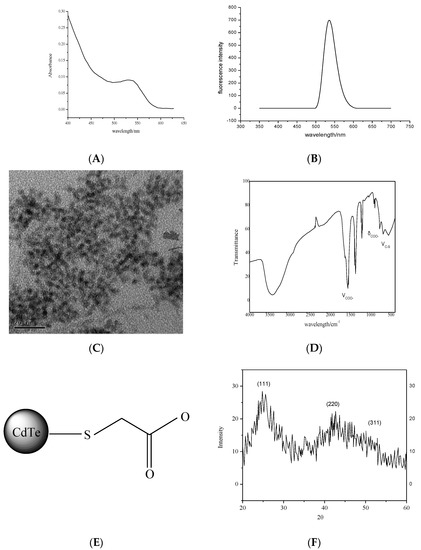
Figure 2.
Structural characterization of CdTe quantum dots. (A) Ultraviolet absorption spectra of CdTe quantum dots. (B) Fluorescence spectra of CdTe quantum dots. (C) Transmission electron microscopy of CdTe quantum dots. (D) Infrared spectra of CdTe quantum dots. (E) Schematic diagram of surface structure of quantum dots modified by thioglycolic acid. (F) XRD pattern of quantum dots.
From the transmission electron microscopy of CdTe quantum dots, the particle size of the synthesized quantum dots was approximately 5 nm, and the size was uniform (Figure 2C).
Figure 2D shows that 3989 cm−1 was the absorption peak of -OH, which might be caused by incomplete drying of methanol; 683 cm−1 was the stretching vibration of C-S; 1542 cm−1, 1403 cm−1 and 769 cm−1 correspond to the anti-symmetric stretching vibration, symmetric stretching vibration and deformation vibration of COO−, respectively. The absence of an S-H stretching vibration peak at 2558 cm−1 indicates that TGA was modified by S atoms via covalent bonds on the surface of CdTe quantum dots (Figure 2E).
Figure 2F shows that three peaks were located at 24.96°, 41.98° and 48.15°, which correspond to the (111), (220) and (311) crystal planes, respectively, of the cubic crystal system. The broadening of the peaks indicates that the size of the synthesized quantum dots was very small.
3.3. Interaction of CdTe Quantum Dots with FEL
Figure 3 shows the fluorescence spectrum of the system with the addition of FEL. The quantum dots have strong fluorescence intensity, and the fluorescence intensity decreased after FEL was added. The fluorescence intensity of the system decreased with increasing FEL concentration, which indicates that FEL produced fluorescence quenching for the CdTe quantum dots, but the position of the emission peak did not change. In addition, there was a linear relationship between the decrease in fluorescence intensity and the FEL concentration. Therefore, this experimental method can be used as the basis to determine the FEL content via fluorescence methods.
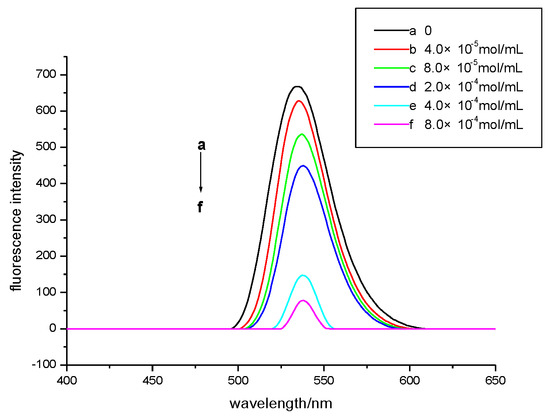
Figure 3.
Fluorescence spectra of different concentrations of FEL interacting with CdTe QDs.
The effect of the FEL dosage on the fluorescence quenching degree was investigated [27,28]. As shown in Figure 4A, the fluorescence quenching degree increased with increasing FEL dosage. The fluorescence quenching degree of the system reached the maximum (245.164 ± 0.0375, n = 3) when the dosage was 1.0 mL and tended to weaken when the dosage exceeded 1.0 mL. Therefore, the FEL dosage was controlled to be 1.0 mL in the experiment.
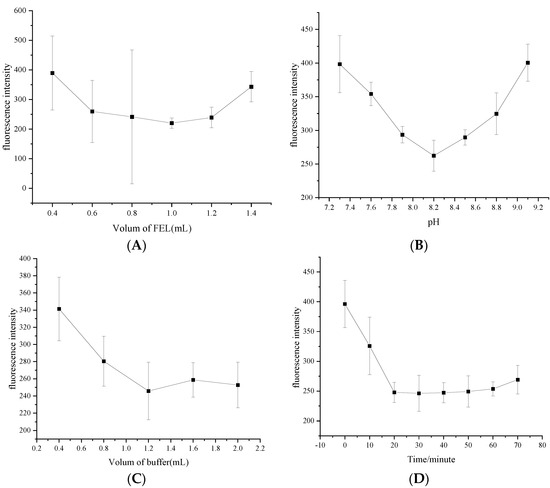
Figure 4.
Effects of (A) FEL dosage; (B) pH of the buffer solution; (C) amount of buffer solution; and (D) reaction time.
FEL cannot stably exist in strong acid and alkali environments, and it is easier to decompose in strong acid environments. Therefore, this experiment used the weakly alkaline buffer Tris-HCl to investigate the quenching degree of the fluorescence intensity of the system when the pH value of the buffer was 7.3, 7.6, 7.9, 8.2, 8.5, 8.8 and 9.1. As shown in Figure 4B, the fluorescence quenching degree (262.335 ± 0.0375, n = 3) is the strongest when the pH is 8.2, so the optimal pH value of Tris-HCl buffer is 8.2. The carboxyl oxygen atoms and Cd atoms in GA on the surface of quantum dots can cooperate twice to form a ring substance, which enhances the fluorescence performance of the system (Figure 5). In addition, pH can affect the structure of the substance.
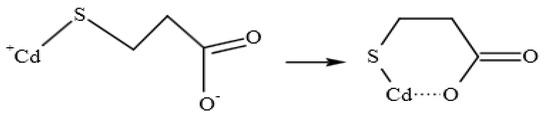
Figure 5.
The structure of the complex formed by thioglycolic acid and Cd2+.
The effect of the amount of buffer solution on the fluorescence quenching degree of the system was investigated. As shown in Figure 4C, the fluorescence quenching degree increased with the increase in the dosage of buffer solution, and the fluorescence quenching degree was strong and stable with a dosage of 1.2–2.0 mL. When 1.5 mL of buffer solution was used in the experiment, the fluorescence intensity was 258.708 ± 0.02003 (n = 3). Therefore, when the dosage continued to increase, the fluorescence quenching degree weakened.
The quenching of the fluorescence intensity of the system under different reaction times was detected. As shown in Figure 4D, the fluorescence quenching degree (247.768 ± 0.01682, n = 3) was the strongest at approximately 20 min and tended to be stable within 30 min. Therefore, the experiment started after 20 min of reaction.
The standard curve of FEL was determined under the optimal synthesis conditions of CdTe quantum dots and reaction of CdTe quantum dots with FEL. The linear equation is Y = 3.9448x + 50.068, the correlation coefficient R2 is 0.9986, and the linear range is 5 × 10⁻⁶–1.1 × 10⁻⁴ mol/L (Figure 6). In the literature, the micellar liquid chromatography-fluorescence detection method for the determination of FEL in tablets exhibited a linear range of 0.05–15 ug/mL, with a lower LOD of 0.011 ug/mL and a lower LOQ of 0.032 ug/mL [29]. FEL can interact with quantum dots, which can quench the fluorescence intensity of the system. The results show a good linear relationship between the decrease in fluorescence intensity and the concentration of FEL in a specific range, which formed the basis of fluorimetry to determine the FEL content.
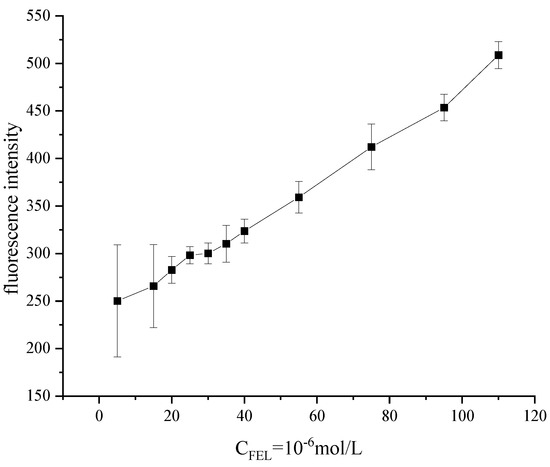
Figure 6.
Standard working curve.
3.4. Methodological Investigation
3.4.1. Precision
Table 1 shows the precision results of FEL. The RSD value of felodipine was 1.36%, which indicates that the precision performance of this method was good.

Table 1.
Precision test results of FEL detection.
3.4.2. Accuracy
The recovery results are shown in Table 2. The RSD values of three different concentrations of the FEL reserve solution were 1.9%, 1.6% and 1.4%, all of which were less than 2.00%. The accuracy of this method was good.
Table 2.
Test results of the FEL detection accuracy.
3.4.3. Influence of Coexisting Substances
According to the actual situation of possible coexistence, the influence of various interfering substances (common ions and other common antihypertensive drugs) was investigated on the determination of 2.0 × 10⁻⁵ mol/L felodipine. Na+, Cu2+, Ca2+, K+, propranolol, hydrochlorothiazide, metoprolol and valsartan were selected. As shown in Table 3, 50 times of Na+, Cu2+, Ca2+ and K+ at 50 times the FEL concentration had almost no effect on the determination results. Propranolol and valsartan at 10 times the FEL concentration had almost no effect on the results. However, hydrochlorothiazide and metoprolol at 10 times the FEL concentration had some effect on the results.
Table 3.
Influence of coexisting substances.
3.4.4. Sample Content Determination
There was no significant difference between the results of the detection method in this study and the labelled amount of FEL tablets. All relative standard deviations of the samples were within the allowable range, which indicates that the method to construct the FEL content in FEL tablets in this study was accurate and reliable. The content determination data of the samples were recorded as follows (in Table 4).
Table 4.
Determination of samples and comparison with the labelled amount.
3.4.5. Preliminary Study on the Quenching Mechanism
Fluorescence quenching occurred when the fluorescence intensity was reduced by physical and chemical interactions between fluorescent substances and quenching agents. At the binding site, hydrogen bonding, electrostatic forces and van der Waals forces impacted the fluorescence properties of QDs.
The reason for this phenomenon is the large number of carboxyl functional groups on the surface of CdTe QDs, and the strong electronegativity of O atoms can combine with H+ generated by –COOH ionization to form hydrogen bonds and complexes with phlodidine. These substances are wrapped on the surface of CdTe QDs for electron transfer, which results in fluorescence quenching. Figure 7 shows a simulation diagram of the interaction between FEL and CdTe quantum dots.
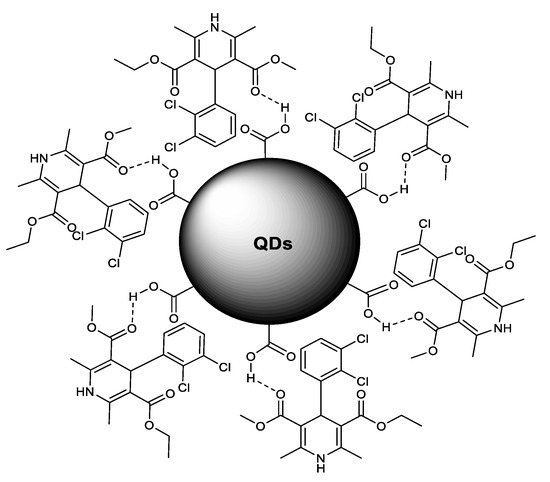
Figure 7.
Simulation diagram of the interaction between FEL and CdTe QDs.
4. Conclusions
In this study, a CdTe quantum dot-based fluorescent probe was successfully constructed, which can be used to detect the FEL content. There was no substantial difference between the results of the determination method and the labelled content of felodipine tablets. Therefore, this method can be used to determine the content of FEL in drugs and different substances. It provides an accurate and reliable method to detect felodipine. This method has the characteristics of simple reaction conditions, easy control, simple and quick operation, and high sensitivity.
Author Contributions
Conceptualization, Y.L. and J.W.; methodology, Y.C., K.L. and G.Z.; software, Y.C.; validation, K.L. and G.Z.; formal analysis, Y.L.; data curation, Y.C.; writing—original draft preparation, Y.L. and J.W.; writing—review and editing, Y.L. and J.W. All authors have read and agreed to the published version of the manuscript.
Funding
This work was financially supported by the National Natural Science Foundation of China (Grants No.52102119), the Basic Scientific Research Project of Heilongjiang Provincial Colleges and Universities (No. 2020-KYYWF-0246), the Project Doctoral Special Research Fund of Jiamusi University (JMSUBZ2020-08), and the Excellent discipline team project of Jiamusi University ((No. JDXKTD-2019007).
Conflicts of Interest
The authors declare no conflict of interest.
References
- Komers, R.; Anderson, S. Treatment of hypertension in diabetic patients with nephropathy. Curr. Diabetes Rep. 2001, 1, 251–260. [Google Scholar] [CrossRef] [PubMed]
- Li, A.-L.; Zhu, S.; Hu, Z.-H.; Peng, Q.; Fang, X.; Zhang, Y.-Y. The distribution and epidemic characteristics of cerebrovascular disease in followed-up hypertension patients. Sci. Rep. 2021, 11, 9366. [Google Scholar] [CrossRef] [PubMed]
- Zhu, J.; Chen, N.; Zhou, M.; Guo, J.; Zhu, C.; Zhou, J.; Ma, M.; He, L. Calcium channel blockers versus other classes of drugs for hypertension. Cochrane Database Syst. Rev. 2021, 10, CD003654. [Google Scholar] [CrossRef] [PubMed]
- Chaudhari, S.R.; Shirkhedkar, A.A. An Investigative Review for Pharmaceutical Analysis of 1,4-Dihydropyridine-3,5-Dicarboxylic Acid Derivative: Cilnidipine. Crit. Rev. Anal. Chem. 2020, 51, 268–277. [Google Scholar] [CrossRef]
- Takenaka, T.; Ohno, Y.; Suzuki, H. Clinical science of calcium channel blocker to inhibit hypertensive vascular injury. Curr. Hypertens. Rev. 2014, 9, 193–201. [Google Scholar] [CrossRef]
- Ishimitsu, T. Calcium antagonists: Current and future applications based on new evidence. Combination antihypertensive therapy with calcium channel blockers. Clin. Calcium 2010, 20, 52–60. [Google Scholar] [PubMed]
- Little, W.C.; Cheng, C.-P.; Elvelin, L.; Nordlander, M. Vascular selective calcium entry blockers in the treatment of cardiovascular disorders: Focus on felodipine. Cardiovasc. Drugs Ther. 1995, 9, 657–663. [Google Scholar] [CrossRef]
- Gandhi, H.; Patel, V.B.; Mistry, N.; Patni, N.; Nandania, J.; Balaraman, R. Doxorubicin mediated cardiotoxicity in rats: Protective role of felodipine on cardiac indices. Environ. Toxicol. Pharmacol. 2013, 36, 787–795. [Google Scholar] [CrossRef]
- Jalava, K.-M.; Olkkola, K.T.; Neuvonen, P.J. Itraconazole greatly increases plasma concentrations and effects of felodipine. Clin. Pharmacol. Ther. 1997, 61, 410–415. [Google Scholar] [CrossRef]
- Pan, H.; Hibino, M.; Kobeissi, E.; Aune, D. Blood pressure, hypertension and the risk of sudden cardiac death: A systematic review and meta-analysis of cohort studies. Eur. J. Epidemiol. 2020, 35, 443–454. [Google Scholar] [CrossRef] [Green Version]
- Gradman, A.H. The evolving role of calcium channel blockers in the treatment of angina pectoris: Focus on felodipine. Can. J. Cardiol. 1995, 11, 14B–21B. [Google Scholar] [PubMed]
- Mehrabian, M.H.; Feizi, S.; Dehaghi, S.M. Cadmium telluride quantum dots/graphene oxide/poly vinyl acetate (CdTe QDs/GO/PVAc) nanocomposite: A novel sensor for real time gamma radiation detection. Radiochim. Acta 2019, 108, 483–490. [Google Scholar] [CrossRef]
- Shlykov, A.I.; Baimuratov, A.S.; Baranov, A.V.; Fedorov, A.V.; Rukhlenko, I.D. Optically active quantum-dot molecules. Opt. Express 2017, 25, 3811–3825. [Google Scholar] [CrossRef] [PubMed]
- Liang, Y.; Zhang, T.; Tang, M. Toxicity of quantum dots on target organs and immune system. J. Appl. Toxicol. 2021, 42, 17–40. [Google Scholar] [CrossRef] [PubMed]
- Pan, Y.; Fang, Z.; Chen, H.; Long, Z.; Hou, X. Visual detection of S 2− with a paper-based fluorescence sensor coated with CdTe quantum dots via headspace sampling. Luminescence 2021, 36, 1525–1530. [Google Scholar] [CrossRef]
- Ananth, D.A.; Rameshkumar, A.; Jeyadevi, R.; Jagadeeswari, S.; Nagarajan, N.; Renganathan, R.; Sivasudha, T. Antibacterial potential of rutin conjugated with thioglycolic acid capped cadmium telluride quantum dots (TGA-CdTe QDs). Spectrochim. Acta Part A Mol. Biomol. Spectrosc. 2015, 138, 684–692. [Google Scholar] [CrossRef]
- Cui, J.; Zhou, M.; Li, Y.; Liang, Z.; Li, Y.; Yu, L.; Liu, Y.; Liang, Y.; Chen, L.; Yang, C. A New Optical Fiber Probe-Based Quantum Dots Immunofluorescence Biosensors in the Detection of Staphylococcus aureus. Front. Cell. Infect. Microbiol. 2021, 11, 665241. [Google Scholar] [CrossRef]
- Dhale, C.; Joshi, S.; Shete, S. Development and validation RP-HPLC method for analysis of felodipine in bulk and pharmaceutical dosage form. Int. Res. J. Pharm. 2014, 5, 770–772. [Google Scholar] [CrossRef]
- Thorat, V.M.; Pawar, S.S.; Pande, V.V.; Arote, S.R.; Musmade Deepak, S. Development and validation of UV spectrophotometric method for estimation of process related impurity in felodipine bulk and formulation. Der Pharm. Lett. 2015, 7, 284–290. [Google Scholar] [CrossRef] [Green Version]
- Swamy, G.K.; Kumar, J.M.R.; Rao, J.S. Development and validation of stability indicating RP-HPLC method for simultaneous determination of enalapril maleate and felodipine in bulk and tablet dosage form. World J. Pharm. Res. 2015, 4, 2087–2100. [Google Scholar]
- Shormanov, V.K.; Kvachakhiya, L.L. Felodipine distribution in organisms of warm-blooded animals. Sud. Ekspertiza 2020, 63, 47–52. [Google Scholar] [CrossRef] [PubMed]
- Hu, L.; Hu, Q.; Gao, N. A validated stability indicating stability HPLC method for the determination of felodipine and its related substances. Int. J. Pharm. Sci. Res. 2013, 4, 3369–3374. [Google Scholar] [CrossRef]
- Emam, A.A.; Naguib, I.A.; Hassan, E.S.; Abdelaleem, E.A. Development and Validation of RP-HPLC and an Ecofriendly HPTLC Method for Simultaneous Determination of Felodipine and Metoprolol Succinate, and their Major Metabolites in Human Spiked Plasma. J. AOAC Int. 2020, 103, 966–971. [Google Scholar] [CrossRef] [PubMed]
- Tres, F.; Hall, S.D.; Mohutsky, M.A.; Taylor, L.S. Monitoring the phase behavior of supersaturated solutions of poorly water-soluble drugs using fluorescence techniques. J. Pharm. Sci. 2018, 107, 94–102. [Google Scholar] [CrossRef] [Green Version]
- Mandal, H.; Chakali, M.; Venkatesan, M.; Bangal, P.R. Hot Electron Transfer from CdTe Quantum Dot (QD) to Porphyrin and Ultrafast Electron Transfer from Porphyrin to CdTe QD in CdTe QD–Tetrakis(4-carboxyphenyl)porphyrin Nanocomposites. J. Phys. Chem. C 2021, 125, 4750–4763. [Google Scholar] [CrossRef]
- Bao, H.; Lu, Z.; Cui, X.; Qiao, Y.; Guo, J.; Anderson, J.M.; Li, C.M. Extracellular microbial synthesis of biocompatible CdTe quantum dots. Acta Biomater. 2010, 6, 3534–3541. [Google Scholar] [CrossRef]
- Zhou, X.; Memon, A.; Sun, W.; Fang, F.; Guo, J. Fluorescent Probe for Ag+ Detection Using SYBR GREEN I and C-C Mismatch. Biosensors 2020, 11, 6. [Google Scholar] [CrossRef]
- Memon, A.G.; Zhou, X.; Liu, J.; Wang, R.; Liu, L.; Yu, B.; He, M.; Shi, H. Utilization of unmodified gold nanoparticles for label-free detection of mercury (II): Insight into rational design of mercury-specific oligonucleotides. J. Hazard. Mater. 2017, 321, 417–423. [Google Scholar] [CrossRef]
- Walash, M.; Belal, F.; El-Enany, N.; Zayed, S. Micellar liquid chromatographic determination of felodipine in tablets and human plasma with fluorescence detection: Application to stability studies and content uniformity testing. Anal. Methods 2014, 6, 3401–3409. [Google Scholar] [CrossRef]
Publisher’s Note: MDPI stays neutral with regard to jurisdictional claims in published maps and institutional affiliations. |
© 2022 by the authors. Licensee MDPI, Basel, Switzerland. This article is an open access article distributed under the terms and conditions of the Creative Commons Attribution (CC BY) license (https://creativecommons.org/licenses/by/4.0/).