

Selenium-Biofortified Probiotics: A Synergistic Microbial–Nutritional Strategy Against Exercise-Induced Stress


Abstract
1. Introduction
2. Scientific Basis: From Production to Bioactivity
2.1. The Advantage of Organic and Nano Forms
2.2. The Synergy Rationale in Exercise Physiology
3. Core Mechanisms: Constructing a Multi-Layered Synergistic Defense System
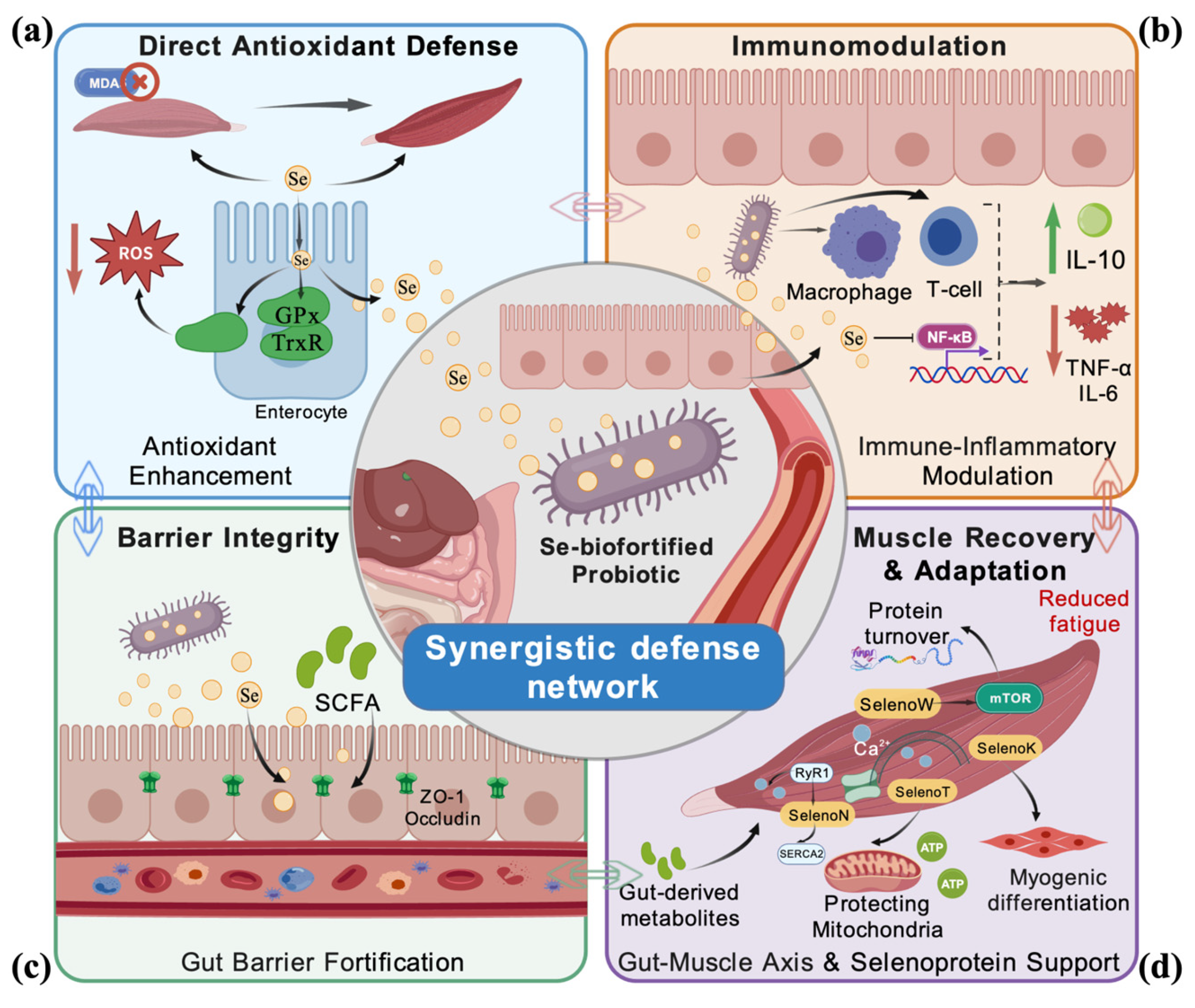
3.1. Proposed Synergistic Mechanisms of Action
3.2. Direct Enhancement of Endogenous Antioxidant Defenses
3.3. Modulation of Immune and Inflammatory Balance
3.4. Maintenance of Intestinal Barrier Integrity
3.5. Regulation of the Gut–Muscle Axis to Promote Recovery
3.6. Support of Muscle-Specific Selenoproteins
3.7. Potential for Stress Resistance: Insights from Non-Exercise Stressors
4. Critical Translational Analysis from Preclinical Models to Human Studies
4.1. Positive Evidence from Animal Model Studies
4.2. Controversies and Limitations in Human Clinical Trials

| Study (Year) | Subjects | Intervention | Exercise Protocol | Key Findings | Limitations/Implications |
|---|---|---|---|---|---|
| Fernandez-Lazaro et al. (2020) [1] | Athletes/Active Individuals | Selenomethionine (180–240 µg/day) or Sodium Selenite (200 µg/day) | Various training | Significantly increased GPx activity, decreased lipid peroxides; did not improve exercise performance, testosterone levels, or training adaptations. | Confirms antioxidant role but negates ergogenic effect in replete individuals. |
| Savory et al. (2012) [50] | Overweight & Normal-weight Adults | Sodium Selenite (200 µg/day) or placebo, 3 weeks | Cycling at 70% VO2max for 30 min | Reduced oxidative stress only in the overweight group post-exercise. | Efficacy is population-specific, dependent on baseline oxidative stress. |
| White & Warren (2017) [97] | Young Horses | Dietary Se: 0.1 vs. 0.3 mg/kg DM, 14 weeks | Submaximal exercise training | Training itself improved antioxidant defense and reduced post-exercise muscle damage; extra Se provided no further gain. | Highlights importance of meeting, but not exceeding, nutritional requirements. |
| Lehrer & Rheinstein (2022) [96] | UK Biobank Cohort | Selenium Supplement Use (Yes/No) | Habitual Physical Activity | No significant association between Se supplementation and fluid intelligence scores; effect dwarfed by age, education, vigorous activity | Questions the benefit of supplements for higher cognitive functions in nutritionally replete populations. |
| Tessier et al. (1995) [45] | Healthy Males | Organic Selenium (240 µg/day) or placebo, 10 weeks | Endurance training and acute exhaustive exercise | The Se group showed a trend (p = 0.057) for increased muscle GPx activity in response to acute exercise after training. | Suggests Se may influence the pattern of enzymatic response to acute stress following training. |
5. Discussion and Future Perspectives: Towards Precision Sports Nutrition
5.1. Deepening Mechanistic Understanding
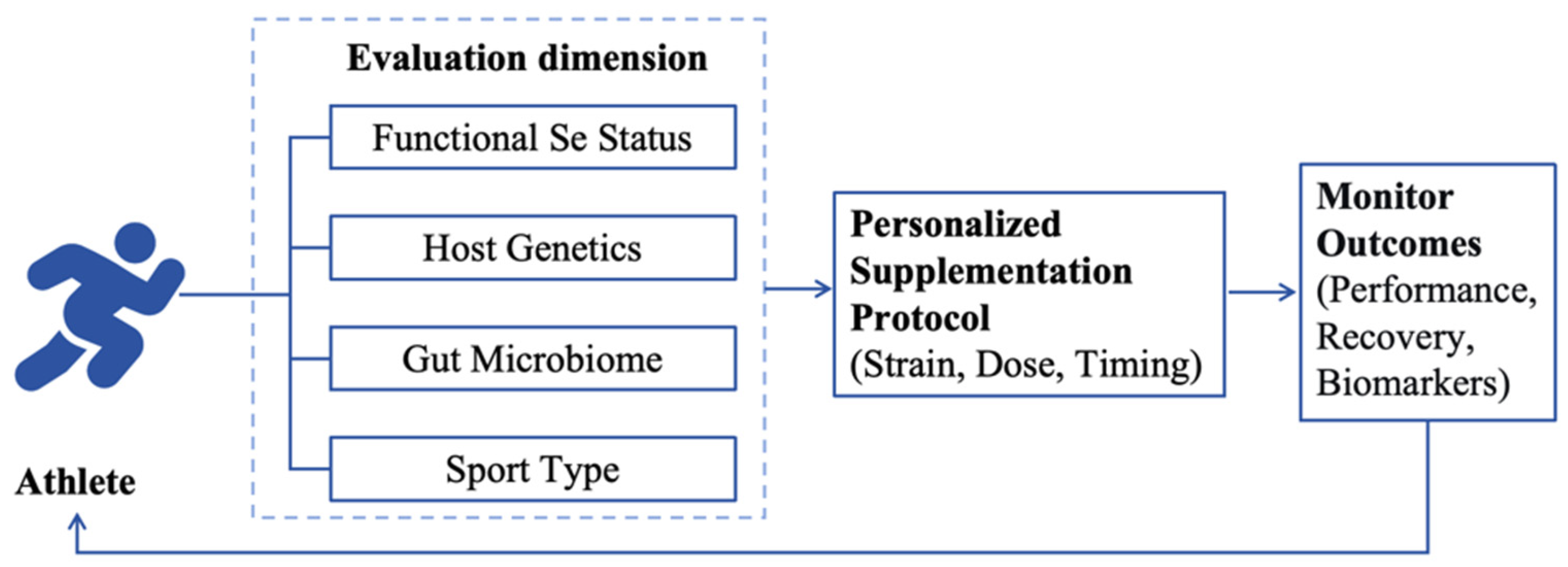
5.2. Selenoprotein-Targeted Interventions and Personalized Nutrition
5.2.1. Functional Selenium Status
5.2.2. Host Genetics and Baseline Microbiome Composition
5.2.3. Sport-Specific Demands
5.3. Advanced Delivery and Safety
6. Conclusions
Author Contributions
Funding
Data Availability Statement
Conflicts of Interest
References
- Fernández-Lázaro, D.; Fernandez-Lazaro, C.I.; Mielgo-Ayuso, J.; Navascués, L.J.; Córdova Martínez, A.; Seco-Calvo, J. The Role of Selenium Mineral Trace Element in Exercise: Antioxidant Defense System, Muscle Performance, Hormone Response, and Athletic Performance. A Systematic Review. Nutrients 2020, 12, 1790. [Google Scholar] [CrossRef] [PubMed]
- Akil, M.; Gurbuz, U.; Bicer, M.; Sivrikaya, A.; Mogulkoc, R.; Baltaci, A.K. Effect of Selenium Supplementation on Lipid Peroxidation, Antioxidant Enzymes, and Lactate Levels in Rats Immediately After Acute Swimming Exercise. Biol. Trace Elem. Res. 2011, 142, 651–659. [Google Scholar] [CrossRef] [PubMed]
- Soares, J.C.M.; Folmer, V.; Rocha, J.B.T. Influence of Dietary Selenium Supplementation and Exercise on Thiol-Containing Enzymes in Mice. Nutrition 2003, 19, 627–632. [Google Scholar] [CrossRef] [PubMed]
- Molanouri Shamsi, M.; Chekachak, S.; Soudi, S.; Gharakhanlou, R.; Quinn, L.S.; Ranjbar, K.; Rezaei, S.; Shirazi, F.J.; Allahmoradi, B.; Yazdi, M.H.; et al. Effects of Exercise Training and Supplementation with Selenium Nanoparticle on T-Helper 1 and 2 and Cytokine Levels in Tumor Tissue of Mice Bearing the 4 T1 Mammary Carcinoma. Nutrition 2019, 57, 141–147. [Google Scholar] [CrossRef]
- Maynar, M.; Muñoz, D.; Alves, J.; Barrientos, G.; Grijota, F.J.; Robles, M.C.; Llerena, F. Influence of an Acute Exercise Until Exhaustion on Serum and Urinary Concentrations of Molybdenum, Selenium, and Zinc in Athletes. Biol. Trace Elem. Res. 2018, 186, 361–369. [Google Scholar] [CrossRef]
- Rauch, C.E.; Mika, A.S.; McCubbin, A.J.; Huschtscha, Z.; Costa, R.J.S. Effect of prebiotics, probiotics, and synbiotics on gastrointestinal outcomes in healthy adults and active adults at rest and in response to exercise-A systematic literature review. Front. Nutr. 2022, 9, 1003620. [Google Scholar] [CrossRef]
- Shahidin; Wang, Y.; Wu, Y.; Chen, T.; Wu, X.; Yuan, W.; Zhu, Q.; Wang, X.; Zi, C. Selenium and Selenoproteins: Mechanisms, Health Functions, and Emerging Applications. Molecules 2025, 30, 437. [Google Scholar] [CrossRef]
- Rayman, M.P. The importance of selenium to human health. Lancet 2000, 356, 233–241. [Google Scholar] [CrossRef]
- Rayman, M.P. Selenium and human health. Lancet 2012, 379, 1256–1268. [Google Scholar] [CrossRef]
- Acosta-Alvear, D.; Harnoss, J.M.; Walter, P.; Ashkenazi, A. Homeostasis control in health and disease by the unfolded protein response. Nat. Rev. Mol. Cell Biol. 2025, 26, 193–212. [Google Scholar] [CrossRef]
- DeAngelo, S.L.; Győrffy, B.; Koutmos, M.; Shah, Y.M. Selenoproteins and tRNA-Sec: Regulators of cancer redox homeostasis. Trends Cancer 2023, 9, 1006–1018. [Google Scholar] [CrossRef] [PubMed]
- Fodor, J.; Al-Gaadi, D.; Czirják, T.; Oláh, T.; Dienes, B.; Csernoch, L.; Szentesi, P. Improved Calcium Homeostasis and Force by Selenium Treatment and Training in Aged Mouse Skeletal Muscle. Sci. Rep. 2020, 10, 1707. [Google Scholar] [CrossRef] [PubMed]
- Liu, H.; Wu, H.; Zhang, Z.; Xu, S.; Zhou, C.; Xu, T. Redox Cascade in Chicken Skeletal Muscle: SELENOT Suppression in Selenium Deficiency Triggers Disulfidptosis via mtROS-NADPH Dysregulation. Adv. Sci. 2025, 12, e07283. [Google Scholar] [CrossRef] [PubMed]
- Chariot, P.; Bignani, O. Skeletal muscle disorders associated with selenium deficiency in humans. Muscle Nerve 2003, 27, 662–668. [Google Scholar] [CrossRef]
- van Dronkelaar, C.; Fultinga, M.; Hummel, M.; Kruizenga, H.; Weijs, P.J.M.; Tieland, M. Minerals and Sarcopenia in Older Adults: An Updated Systematic Review. J. Am. Med. Dir. Assoc. 2023, 24, 1163–1172. [Google Scholar] [CrossRef]
- Zhou, Y.; Zhu, H.; Qi, Y.; Wu, C.; Zhang, J.; Shao, L.; Tan, J.; Chen, D. Absorption and Distribution of Selenium Following Oral Administration of Selenium-Enriched Bifidobacterium longum DD98, Selenized Yeast, or Sodium Selenite in Rats. Biol. Trace Elem. Res. 2020, 197, 599–605. [Google Scholar] [CrossRef]
- Xu, Z.-J.; Ren, F.-Z.; Zhang, Z.-W.; Xu, S.-W.; Huang, J.-Q. Advances of Selenium in Poultry Nutrition and Health. J. Nutr. 2025, 155, 676–689. [Google Scholar] [CrossRef]
- Li, K.; Li, J.; Zhang, S.; Zhang, J.; Xu, Q.; Xu, Z.; Guo, Y. Amorphous structure and crystal stability determine the bioavailability of selenium nanoparticles. J. Hazard. Mater. 2024, 465, 133287. [Google Scholar] [CrossRef]
- Ibrahim, S.E.; Alzawqari, M.H.; Eid, Y.Z.; Zommara, M.; Hassan, A.M.; Dawood, M.A.O. Comparing the Influences of Selenium Nanospheres, Sodium Selenite, and Biological Selenium on the Growth Performance, Blood Biochemistry, and Antioxidative Capacity of Growing Turkey Pullets. Biol. Trace Elem. Res. 2022, 200, 2915–2922. [Google Scholar] [CrossRef]
- Hosnedlova, B.; Kepinska, M.; Skalickova, S.; Fernandez, C.; Ruttkay-Nedecky, B.; Peng, Q.; Baron, M.; Melcova, M.; Opatrilova, R.; Zidkova, J.; et al. Nano-selenium and its nanomedicine applications: A critical review. Int. J. Nanomed. 2018, 13, 2107–2128. [Google Scholar] [CrossRef]
- Marttinen, M.; Ala-Jaakkola, R.; Laitila, A.; Lehtinen, M.J. Gut Microbiota, Probiotics and Physical Performance in Athletes and Physically Active Individuals. Nutrients 2020, 12, 2936. [Google Scholar] [CrossRef]
- Calomme, M.R.; Van den Branden, K.; Vanden Berghe, D.A. Selenium and Lactobacillus species. J. Appl. Bacteriol. 1995, 79, 331–340. [Google Scholar] [CrossRef]
- Shi, D.; Xu, F.; Li, Y.; Shang, X.; Liao, N.; Jin, H.; Liu, G.; Shao, D. Enhancement of exercise-induced fatigue alleviation and liver selenium regulation through in situ nanoselenium synthesis by Lactobacillus rhamnosus cells, empowered by Ganoderma lucidum spore loading. J. Food Sci. 2024, 89, 7992–8005. [Google Scholar] [CrossRef] [PubMed]
- Mrvikova, I.; Hyrslova, I.; Kana, A.; Kantorova, V.; Lampova, B.; Doskocil, I.; Krausova, G. Selenium enriched bifidobacteria and lactobacilli as potential dietary supplements. World J. Microbiol. Biotechnol. 2024, 40, 145. [Google Scholar] [CrossRef] [PubMed]
- Krittaphol, W.; Wescombe, P.A.; Thomson, C.D.; McDowell, A.; Tagg, J.R.; Fawcett, J.P. Metabolism of L-selenomethionine and selenite by probiotic bacteria: In vitro and in vivo studies. Biol. Trace Elem. Res. 2011, 144, 1358–1369. [Google Scholar] [CrossRef] [PubMed]
- Xiao, D.; Li, T.; Huang, X.; Zhu, K.; Li, Z.; Dong, Y.; Wang, L.; Huang, J. Advances in the Study of Selenium-Enriched Probiotics: From the Inorganic Se into Se Nanoparticles. Mol. Nutr. Food Res. 2023, 67, 2300432. [Google Scholar] [CrossRef]
- Li, T.; Zhu, K.; Wang, L.; Dong, Y.; Huang, J. Stabilization by Chaperone GroEL in Biogenic Selenium Nanoparticles Produced from Bifidobacterium animalis H15 for the Treatment of DSS-Induced Colitis. ACS Appl. Mater. Interfaces 2024, 16, 13439–13452. [Google Scholar] [CrossRef]
- Lee, S.-C.; Lee, N.-H.; Patel, K.D.; Jun, S.-K.; Park, J.-H.; Knowles, J.C.; Kim, H.-W.; Lee, H.-H.; Lee, J.-H. A Study on Myogenesis by Regulation of Reactive Oxygen Species and Cytotoxic Activity by Selenium Nanoparticles. Antioxidants 2021, 10, 1727. [Google Scholar] [CrossRef]
- Yang, J.; Song, Y.; Li, J.; Fan, M.; Wei, X. Selenium-Enriched Lactic Acid Bacteria and Evaluation of Their Bioactivities in Vitro. J. Chin. Inst. Food Sci. Technol. 2019, 19, 171–182. [Google Scholar] [CrossRef]
- Mester, Z.; Willie, S.; Yang, L.; Sturgeon, R.; Caruso, J.A.; Fernández, M.L.; Fodor, P.; Goldschmidt, R.J.; Goenaga-Infante, H.; Lobinski, R.; et al. Certification of a new selenized yeast reference material (SELM-1) for methionine, selenomethinone and total selenium content and its use in an intercomparison exercise for quantifying these analytes. Anal. Bioanal. Chem. 2006, 385, 168–180. [Google Scholar] [CrossRef]
- Szafrańska, J.; Ziarno, M.; Kieliszek, M. Characterization of Selenium Accumulation in Lactiplantibacillus plantarum Strains: A Biotechnological Approach. Int. J. Vitam. Nutr. Res. 2025, 95, 44231. [Google Scholar] [CrossRef] [PubMed]
- Kurek, E.; Ruszczyńska, A.; Wojciechowski, M.; Łuciuk, A.; Michalska-Kacymirow, M.; Motyl, I.; Bulska, E. Bio-transformation of selenium in Se-enriched bacterial strains of Lactobacillus casei. Rocz. Panstw. Zakl. Hig. 2016, 67, 253–262. [Google Scholar] [PubMed]
- Turck, D.; Bohn, T.; Castenmiller, J.; de Henauw, S.; Hirsch-Ernst, K.; Knutsen, H.K.; Maciuk, A.; Mangelsdorf, I.; McArdle, H.J.; Peláez, C.; et al. Scientific opinion on the tolerable upper intake level for selenium. EFSA J. 2023, 21, e07704. [Google Scholar] [CrossRef] [PubMed]
- Chen, X.; Zhang, J.; Li, H.; Liu, W.; Xi, Y.; Liu, X. A Comprehensive Comparison of Different Selenium Supplements: Mitigation of Heat Stress and Exercise Fatigue-Induced Liver Injury. Front. Nutr. 2022, 9, 917349. [Google Scholar] [CrossRef]
- Liu, Y.; Chen, N.; Liu, J.; Rensing, C.; Zheng, S. Efficiently synthetic pathways of selenium nanoparticles in a probiotic and their mixture as a new dietary antioxidant supplement. Food Biosci. 2025, 71, 107318. [Google Scholar] [CrossRef]
- Jain, R.; Jordan, N.; Weiss, S.; Foerstendorf, H.; Heim, K.; Kacker, R.; Hübner, R.; Kramer, H.; van Hullebusch, E.D.; Farges, F.; et al. Extracellular Polymeric Substances Govern the Surface Charge of Biogenic Elemental Selenium Nanoparticles. Environ. Sci. Technol. 2015, 49, 1713–1720. [Google Scholar] [CrossRef]
- Badawy, A.M.E.; Luxton, T.P.; Silva, R.G.; Scheckel, K.G.; Suidan, M.T.; Tolaymat, T.M. Impact of Environmental Conditions (pH, Ionic Strength, and Electrolyte Type) on the Surface Charge and Aggregation of Silver Nanoparticles Suspensions. Environ. Sci. Technol. 2010, 44, 1260–1266. [Google Scholar] [CrossRef]
- Yu, L.; Xu, H.; Zhai, Q.; Guo, R.; Cui, S.; Chen, W. Screening and safety evaluation of lactic acid bacteria with selenium adsorption capacity. CSB 2018, 64, 327–336. [Google Scholar] [CrossRef]
- Chen, Y.; Li, Q.; Xia, C.; Yang, F.; Xu, N.; Wu, Q.; Hu, Y.; Xia, L.; Wang, C.; Zhou, M. Effect of selenium supplements on the antioxidant activity and nitrite degradation of lactic acid bacteria. World J. Microbiol. Biotechnol. 2019, 35, 61. [Google Scholar] [CrossRef]
- Shing, C.M.; Peake, J.M.; Lim, C.L.; Briskey, D.; Walsh, N.P.; Fortes, M.B.; Ahuja, K.D.K.; Vitetta, L. Effects of probiotics supplementation on gastrointestinal permeability, inflammation and exercise performance in the heat. Eur. J. Appl. Physiol. 2014, 114, 93–103. [Google Scholar] [CrossRef]
- Chantler, S.; Griffiths, A.; Matu, J.; Davison, G.; Holliday, A.; Jones, B. A systematic review: Role of dietary supplements on markers of exercise-associated gut damage and permeability. PLoS ONE 2022, 17, e0266379. [Google Scholar] [CrossRef] [PubMed]
- Fernandez-Lazaro, D.; Sanchez-Serrano, N.; Rabail, R.; Muhammad Aadil, R.; Mielgo-Ayuso, J.; Radesca Fabiano, K.; Garrosa, E. Is Probiotics Supplementation an Appropriate Strategy to Modulate Inflammation in Physically Active Healthy Adults or Athletes? A Systematic Review. Appl. Sci. 2023, 13, 3448. [Google Scholar] [CrossRef]
- Xie, Y.; Kang, R.; Klionsky, D.J.; Tang, D. GPX4 in cell death, autophagy, and disease. Autophagy 2023, 19, 2621–2638. [Google Scholar] [CrossRef] [PubMed]
- Czyżowska, A.; Brown, J.; Xu, H.; Sataranatarajan, K.; Kinter, M.; Tyrell, V.J.; O’Donnell, V.B.; Van Remmen, H. Elevated phospholipid hydroperoxide glutathione peroxidase (GPX4) expression modulates oxylipin formation and inhibits age-related skeletal muscle atrophy and weakness. Redox Biol. 2023, 64, 102761. [Google Scholar] [CrossRef]
- Tessier, F.; Hida, H.; Favier, A.; Marconnet, P. Muscle GSH-Px activity after prolonged exercise, training, and selenium supplementation. Biol. Trace Elem. Res. 1995, 47, 279–285. [Google Scholar] [CrossRef]
- Reeves, M.A.; Hoffmann, P.R. The human selenoproteome: Recent insights into functions and regulation. Cell. Mol. Life Sci. 2009, 66, 2457–2478. [Google Scholar] [CrossRef]
- Kaya, A.; Lee, B.C.; Gladyshev, V.N. Regulation of protein function by reversible methionine oxidation and the role of selenoprotein MsrB1. Antioxid. Redox Signal. 2015, 23, 814–822. [Google Scholar] [CrossRef]
- Fomenko, D.E.; Novoselov, S.V.; Natarajan, S.K.; Lee, B.C.; Koc, A.; Carlson, B.A.; Lee, T.-H.; Kim, H.-Y.; Hatfield, D.L.; Gladyshev, V.N. MsrB1 (Methionine-R-sulfoxide Reductase 1) Knock-out Mice. J. Biol. Chem. 2009, 284, 5986–5993. [Google Scholar] [CrossRef]
- Shanliang, Z. Effects of Lactobacillus Rich in Selenium on Tissue Lipid Peroxidation Response in Mice. Anhui Nongye Kexue 2008, 36, 8621–8622. [Google Scholar]
- Savory, L.A.; Kerr, C.J.; Whiting, P.; Finer, N.; McEneny, J.; Ashton, T. Selenium Supplementation and Exercise: Effect on Oxidant Stress in Overweight Adults. Obesity 2012, 20, 794–801. [Google Scholar] [CrossRef]
- Malyar, R.M.; Naseri, E.; Li, H.; Ali, I.; Farid, R.A.; Liu, D.; Maroof, K.; Nasim, M.; Banuree, S.A.H.; Huang, K.; et al. Hepatoprotective Effects of Selenium-Enriched Probiotics Supplementation on Heat-Stressed Wistar Rat Through Anti-Inflammatory and Antioxidant Effects. Biol. Trace Elem. Res. 2021, 199, 3445–3456. [Google Scholar] [CrossRef] [PubMed]
- He, L.; Wang, B.; Yao, Y.; Su, M.; Ma, H.; Jia, N. Protective effects of the SEPS1 gene on lipopolysaccharide-induced sepsis. Mol. Med. Rep. 2014, 9, 1869–1876. [Google Scholar] [CrossRef] [PubMed]
- Wright, C.R.; Allsopp, G.L.; Addinsall, A.B.; McRae, N.L.; Andrikopoulos, S.; Stupka, N. A Reduction in Selenoprotein S Amplifies the Inflammatory Profile of Fast-Twitch Skeletal Muscle in the mdx Dystrophic Mouse. Mediat. Inflamm. 2017, 2017, 7043429. [Google Scholar] [CrossRef] [PubMed]
- Wang, J.; Lian, S.; He, X.; Yu, D.; Liang, J.; Sun, D.; Wu, R. Selenium deficiency induces splenic growth retardation by deactivating the IGF-1R/PI3K/Akt/mTOR pathway. Metallomics 2018, 10, 1570–1575. [Google Scholar] [CrossRef]
- Yiming, Z.; Qingqing, L.; Hang, Y.; Yahong, M.; Shu, L. Selenium deficiency causes immune damage by activating the DUSP1/NF-κB pathway and endoplasmic reticulum stress in chicken spleen. Food Funct. 2020, 11, 6467–6475. [Google Scholar] [CrossRef]
- Chen, H.; Li, P.; Shen, Z.; Wang, J.; Diao, L. Protective effects of selenium yeast against cadmium-induced necroptosis through miR-26a-5p/PTEN/PI3K/AKT signaling pathway in chicken kidney. Ecotoxicol. Environ. Saf. 2021, 220, 112387. [Google Scholar] [CrossRef]
- Jiayong, Z.; Shengchen, W.; Xiaofang, H.; Gang, S.; Shiwen, X. The antagonistic effect of selenium on lead-induced necroptosis via MAPK/NF-κB pathway and HSPs activation in the chicken spleen. Ecotoxicol. Environ. Saf. 2020, 204, 111049. [Google Scholar] [CrossRef]
- Ren, B.; Liu, M.; Ni, J.; Tian, J. Role of Selenoprotein F in Protein Folding and Secretion: Potential Involvement in Human Disease. Nutrients 2018, 10, 1619. [Google Scholar] [CrossRef]
- Huang, J.; Bao, D.; Lei, C.-T.; Tang, H.; Zhang, C.-Y.; Su, H.; Zhang, C. Selenoprotein T protects against cisplatin-induced acute kidney injury through suppression of oxidative stress and apoptosis. FASEB J. 2020, 34, 11983–11996. [Google Scholar] [CrossRef]
- Molanouri Shamsi, M.; Chekachak, S.; Soudi, S.; Quinn, L.S.; Ranjbar, K.; Chenari, J.; Yazdi, M.H.; Mahdavi, M. Combined effect of aerobic interval training and selenium nanoparticles on expression of IL-15 and IL-10/TNF-α ratio in skeletal muscle of 4T1 breast cancer mice with cachexia. Cytokine 2017, 90, 100–108. [Google Scholar] [CrossRef]
- Takahashi, K.; Suzuki, N.; Ogra, Y. Effect of gut microflora on nutritional availability of selenium. Food Chem. 2020, 319, 126537. [Google Scholar] [CrossRef]
- Arabzadeh, E.; Shirvani, H.; Masjedi, M.R.; Ghanei, M.; Hofmeister, M.; Rostamkhani, F. Treadmill exercise with nanoselenium supplementation affects the expression of Irisin/FNDC5 and semaphorin 3A in rats exposed to cigarette smoke extract. 3 Biotech 2024, 14, 4. [Google Scholar] [CrossRef] [PubMed]
- Cheng, Y.; Liu, X.; Hao, Y.; Wang, S.; Wu, F.; Zhao, L.; Peng, D.; Yawen, D.; Sheng, S.; Jianguo, L.; et al. Selenium-mediated alleviation of skeletal muscle atrophy through enterotype modulation in mice. Food Funct. 2024, 15, 11619–11629. [Google Scholar] [CrossRef] [PubMed]
- Wang, Q.; Huang, J.; Zhu, K.; Zuo, W. Selenium and Skeletal Muscle Health in Sports Nutrition. Nutrients 2025, 17, 1902. [Google Scholar] [CrossRef] [PubMed]
- Yang, J.-C.; Liu, M.; Huang, R.-H.; Zhao, L.; Niu, Q.-J.; Xu, Z.-J.; Wei, J.-T.; Lei, X.G.; Sun, L.-H. Loss of SELENOW aggravates muscle loss with regulation of protein synthesis and the ubiquitin-proteasome system. Sci. Adv. 2024, 10, eadj4122. [Google Scholar] [CrossRef]
- Wang, S.; Zhao, X.; Liu, Q.; Wang, Y.; Li, S.; Xu, S. Selenoprotein K protects skeletal muscle from damage and is required for satellite cells-mediated myogenic differentiation. Redox Biol. 2022, 50, 102255. [Google Scholar] [CrossRef]
- Noh, O.J.; Park, Y.H.; Chung, Y.W.; Kim, I.Y. Transcriptional regulation of selenoprotein W by MyoD during early skeletal muscle differentiation. J. Biol. Chem. 2010, 285, 40496–40507. [Google Scholar] [CrossRef]
- Jeon, Y.H.; Park, Y.H.; Lee, J.H.; Hong, J.-H.; Kim, I.Y. Selenoprotein W enhances skeletal muscle differentiation by inhibiting TAZ binding to 14-3-3 protein. Biochim. Biophys. Acta 2014, 1843, 1356–1364. [Google Scholar] [CrossRef]
- Jurynec, M.J.; Xia, R.; Mackrill, J.J.; Gunther, D.; Crawford, T.; Flanigan, K.M.; Abramson, J.J.; Howard, M.T.; Grunwald, D.J. Selenoprotein N is required for ryanodine receptor calcium release channel activity in human and zebrafish muscle. Proc. Natl. Acad. Sci. USA 2008, 105, 12485–12490. [Google Scholar] [CrossRef]
- Chernorudskiy, A.; Varone, E.; Colombo, S.F.; Fumagalli, S.; Cagnotto, A.; Cattaneo, A.; Briens, M.; Baltzinger, M.; Kuhn, L.; Bachi, A.; et al. Selenoprotein N is an endoplasmic reticulum calcium sensor that links luminal calcium levels to a redox activity. Proc. Natl. Acad. Sci. USA 2020, 117, 21288–21298. [Google Scholar] [CrossRef]
- Lescure, A.; Rederstorff, M.; Krol, A.; Guicheney, P.; Allamand, V. Selenoprotein function and muscle disease. Biochim. Biophys. Acta 2009, 1790, 1569–1574. [Google Scholar] [CrossRef] [PubMed]
- Grumolato, L.; Ghzili, H.; Montero-Hadjadje, M.; Gasman, S.; Lesage, J.; Tanguy, Y.; Galas, L.; Ait-Ali, D.; Leprince, J.; Guérineau, N.C.; et al. Selenoprotein T is a PACAP-regulated gene involved in intracellular Ca2+ mobilization and neuroendocrine secretion. FASEB J. 2008, 22, 1756–1768. [Google Scholar] [CrossRef] [PubMed]
- Wu, H.; Xu, T.; Yang, N.; Zhang, J.; Xu, S. Low-Se Diet Increased Mitochondrial ROS to Suppress Myoblasts Proliferation and Promote Apoptosis in Broilers via miR-365-3p/SelT Signaling Axis. J. Agric. Food Chem. 2024, 72, 284–299. [Google Scholar] [CrossRef] [PubMed]
- Han, S.-J.; Lee, B.C.; Yim, S.H.; Gladyshev, V.N.; Lee, S.-R. Characterization of mammalian selenoprotein o: A redox-active mitochondrial protein. PLoS ONE 2014, 9, e95518. [Google Scholar] [CrossRef]
- Barage, S.H.; Deobagkar, D.D.; Baladhye, V.B. Characterization of structural and functional role of selenocysteine in selenoprotein H and its impact on DNA binding. Amino Acids 2018, 50, 593–607. [Google Scholar] [CrossRef]
- Jing, J.; Zeng, H.; Shao, Q.; Tang, J.; Wang, L.; Jia, G.; Liu, G.; Chen, X.; Tian, G.; Cai, J.; et al. Selenomethionine alleviates environmental heat stress induced hepatic lipid accumulation and glycogen infiltration of broilers via maintaining mitochondrial and endoplasmic reticulum homeostasis. Redox Biol. 2023, 67, 102912. [Google Scholar] [CrossRef]
- Yang, Y.-Y.; An, Y.-C.; Zhang, S.-Y.; Huang, M.-Y.; Ye, X.-Q.; Zhao, Z.-H.; Liu, W.-C. Biogenic Selenium Nanoparticles Synthesized Using Alginate Oligosaccharides Attenuate Heat Stress-Induced Impairment of Breast Meat Quality via Regulating Oxidative Stress, Metabolome and Ferroptosis in Broilers. Antioxidants 2023, 12, 2032. [Google Scholar] [CrossRef]
- Zhao, L.; Feng, Y.; Xu, Z.-J.; Zhang, N.-Y.; Zhang, W.-P.; Zuo, G.; Khalil, M.M.; Sun, L.-H. Selenium mitigated aflatoxin B1-induced cardiotoxicity with potential regulation of 4 selenoproteins and ferroptosis signaling in chicks. Food Chem. Toxicol. 2021, 154, 112320. [Google Scholar] [CrossRef]
- Ge, J.; Guo, K.; Huang, Y.; Morse, P.D.; Zhang, C.; Lv, M.-W.; Li, J.-L. Comparison of antagonistic effects of nanoparticle-selenium, selenium-enriched yeast and sodium selenite against cadmium-induced cardiotoxicity via AHR/CAR/PXR/Nrf2 pathways activation. J. Nutr. Biochem. 2022, 105, 108992. [Google Scholar] [CrossRef]
- Li, Y.; Cui, H.; Li, D.; Fu, H.-Y.; Li, J.-Z.; Xu, W.-X.; Fan, R.-F. Selenium alleviates pancreatic fibrosis in chickens caused by mercuric chloride: Involvement of the MAPK signaling pathway and selenoproteins. Env. Pollut. 2024, 357, 124448. [Google Scholar] [CrossRef]
- Yeh, W.-L.; Hsu, Y.-J.; Ho, C.-S.; Ho, H.-H.; Kuo, Y.-W.; Tsai, S.-Y.; Huang, C.-C.; Lee, M.-C. Lactobacillus plantarum PL-02 Supplementation Combined with Resistance Training Improved Muscle Mass, Force, and Exercise Performance in Mice. Front. Nutr. 2022, 9, 896503. [Google Scholar] [CrossRef]
- Kayacan, Y.; Kola, A.Z.; Guandalini, S.; Yazar, H.; Söğüt, M.Ü. The Use of Probiotics Combined with Exercise Affects Thiol/Disulfide Homeostasis, an Oxidative Stress Parameter. Nutrients 2022, 14, 3555. [Google Scholar] [CrossRef] [PubMed]
- Ai-ping, C.H.I.; Hong, L.I.; Chen-zhe, K.; Huan-huan, G.U.O.; Hai-meng, Z.; Fei, G.U.O.; Yi-min, W. Extraction of Polysaccharides from Selenium-Rich Tea and Their Influence on Fatigue and Recovery after Exercise. Food Sci. 2014, 35, 240. [Google Scholar] [CrossRef]
- Zhang, M. Preparation of polysaccharide selenite ester from Moringa oleifera seeds and study of its anti-exercise fatigue effects. J. For. Eng. 2025, 10, 69–77. [Google Scholar] [CrossRef]
- Kojouri, G.A.; Sharifi, S. Preventing Effects of Nano-Selenium Particles on Serum Concentration of Blood Urea Nitrogen, Creatinine, and Total Protein During Intense Exercise in Donkey. J. Equine Vet. Sci. 2013, 33, 597–600. [Google Scholar] [CrossRef]
- Amirdizaj, V.D.; Mocheshi, S.S. Muscle injury and oxidative stress following the use of selenium supplements and exhaustive aerobic exercise in young physically-active females. J. Kermanshah Univ. Med. Sci. 2016, 20, 1–5. [Google Scholar]
- Bakhshi, M.; Banaeifar, A.; Arshadi, S.; Bazgir, B. Impact of Endurance Exercise and Nano-Selenium on Mitochondrial Gene Expression in Skeletal Muscle of Smoke-Exposed Rats with COPD. Arch. Med. Res. 2025, 56, 103223. [Google Scholar] [CrossRef]
- Romero-Herrera, I.; Nogales, F.; Gallego-López, M.D.C.; Díaz-Castro, J.; Carreras, O.; Ojeda, M.L. Selenium supplementation via modulation of selenoproteins ameliorates binge drinking-induced oxidative, energetic, metabolic, and endocrine imbalance in adolescent rats’ skeletal muscle. Food Funct. 2024, 15, 7988–8007. [Google Scholar] [CrossRef]
- Nido, S.A.; Shituleni, S.A.; Mengistu, B.M.; Liu, Y.; Khan, A.Z.; Gan, F.; Kumbhar, S.; Huang, K. Effects of Selenium-Enriched Probiotics on Lipid Metabolism, Antioxidative Status, Histopathological Lesions, and Related Gene Expression in Mice Fed a High-Fat Diet. Biol. Trace Elem. Res. 2016, 171, 399–409. [Google Scholar] [CrossRef]
- Shun-Yi, Q.; Ke-He, H.; Jian-Zhong, G. Effects of Selenium-Enriched Probiotics on Immunity and Antioxidation Function in Mice. Acta Nutr. Sin. 2006, 28, 423–426. [Google Scholar]
- Yang, Y.-K. The Effect of Dietary Vitamin E and Selenium on Endurance Exercise Performance and Cell Membrane Damage Index. Korean J. Sport Sci. 2008, 17, 1551–1560. [Google Scholar]
- Yang, Y.-K. The Influence of Simultaneous Administration of Selenium and Vitamin E on Antioxidant Enzyme Activity and Lipid Peroxidation. Phys. Act. Nutr. 2008, 12, 157–162. [Google Scholar]
- Yang, Y.-K.; Geun-chun, L.; Wook, C.S. The Effect of Selenium Administration for 3 Weeks on Cardiorespiratory function and Antioxidant Enzyme Activity. Korean J. Sport Sci. 2008, 17, 789–798. [Google Scholar]
- Se-won, J.; Choi, C.; Choi-sung, K.; Gi-seok, S.; Yang, Y.-K. The Effect of Vitamin E and Selenium Administration on Antioxidant Enzyme Activity and Blood Fatigue Factor. Korean J. Sport Sci. 2010, 19, 1127–1138. [Google Scholar]
- Heffernan, S.M.; Horner, K.; De Vito, G.; Conway, G.E. The Role of Mineral and Trace Element Supplementation in Exercise and Athletic Performance: A Systematic Review. Nutrients 2019, 11, 696. [Google Scholar] [CrossRef]
- Lehrer, S.; Rheinstein, P.H. The Association Between Selenium, Selenoprotein P (SEPP1), Fluid Intelligence, and Exercise in the UK Biobank Cohort. Cureus 2022, 14, e25353. [Google Scholar] [CrossRef]
- White, S.H.; Warren, L.K. Submaximal exercise training, more than dietary selenium supplementation, improves antioxidant status and ameliorates exercise-induced oxidative damage to skeletal muscle in young equine athletes. J. Anim. Sci. 2017, 95, 657–670. [Google Scholar] [CrossRef]
- Hofstee, P.; Perkins, A.V.; Cuffe, J.S.M. Selenium Deficiency during Pregnancy in Mice Impairs Exercise Performance and Metabolic Function in Adult Offspring. Nutrients 2022, 14, 1125. [Google Scholar] [CrossRef]
- Janghorbani, M.; Christensen, M.J.; Steinke, F.H.; Young, V.R. Feasibility of Intrinsic Labeling of Poultry Meat with Stable Isotope of Selenium (74Se) for Use in Human Metabolic Studies. J. Nutr. 1981, 111, 817–822. [Google Scholar] [CrossRef]
- Liu, H.; He, L.; Ma, N.; Tan, P.; Tang, Q.; Cai, K.; Men, Z.; Lu, Y.; Hu, D.; Zhao, J.; et al. Gut-muscle axis improves meat quality by regulating energy metabolism. Meat Sci. 2026, 235, 110050. [Google Scholar] [CrossRef]
- Hackler, J.; Demircan, K.; Chillon, T.S.; Sun, Q.; Geisler, N.; Schupp, M.; Renko, K.; Schomburg, L. High throughput drug screening identifies resveratrol as suppressor of hepatic SELENOP expression. Redox Biol. 2023, 59, 102592. [Google Scholar] [CrossRef]
- Saito, Y. Selenium Transport Mechanism via Selenoprotein P-Its Physiological Role and Related Diseases. Front. Nutr. 2021, 8, 685517. [Google Scholar] [CrossRef]
- García-Esquinas, E.; Carballo-Casla, A.; Ortolá, R.; Sotos-Prieto, M.; Olmedo, P.; Gil, F.; Plans-Beriso, E.; Fernández-Navarro, P.; Pastor-Barriuso, R.; Rodríguez-Artalejo, F. Blood Selenium Concentrations Are Inversely Associated with the Risk of Undernutrition in Older Adults. Nutrients 2023, 15, 4750. [Google Scholar] [CrossRef]
- Méplan, C. Selenium and Chronic Diseases: A Nutritional Genomics Perspective. Nutrients 2015, 7, 3621–3651. [Google Scholar] [CrossRef]
- Wu, Y.; Sun, B.; Tang, Y.; Shen, A.; Lin, Y.; Zhao, X.; Li, J.; Monteiro, M.J.; Gu, W. Bone targeted nano-drug and nano-delivery. Bone Res. 2024, 12, 51. [Google Scholar] [CrossRef]


Disclaimer/Publisher’s Note: The statements, opinions and data contained in all publications are solely those of the individual author(s) and contributor(s) and not of MDPI and/or the editor(s). MDPI and/or the editor(s) disclaim responsibility for any injury to people or property resulting from any ideas, methods, instructions or products referred to in the content. |
© 2026 by the authors. Licensee MDPI, Basel, Switzerland. This article is an open access article distributed under the terms and conditions of the Creative Commons Attribution (CC BY) license.
Share and Cite
Wang, Q.; Xing, J.; Huang, Y.; Huang, J.; Zhu, K.; Zhang, X. Selenium-Biofortified Probiotics: A Synergistic Microbial–Nutritional Strategy Against Exercise-Induced Stress. Nutrients 2026, 18, 958. https://doi.org/10.3390/nu18060958
Wang Q, Xing J, Huang Y, Huang J, Zhu K, Zhang X. Selenium-Biofortified Probiotics: A Synergistic Microbial–Nutritional Strategy Against Exercise-Induced Stress. Nutrients. 2026; 18(6):958. https://doi.org/10.3390/nu18060958
Chicago/Turabian StyleWang, Qi, Jinjin Xing, Yujing Huang, Jiaqiang Huang, Kongdi Zhu, and Xia Zhang. 2026. "Selenium-Biofortified Probiotics: A Synergistic Microbial–Nutritional Strategy Against Exercise-Induced Stress" Nutrients 18, no. 6: 958. https://doi.org/10.3390/nu18060958
APA StyleWang, Q., Xing, J., Huang, Y., Huang, J., Zhu, K., & Zhang, X. (2026). Selenium-Biofortified Probiotics: A Synergistic Microbial–Nutritional Strategy Against Exercise-Induced Stress. Nutrients, 18(6), 958. https://doi.org/10.3390/nu18060958