

Associations of Temporal Eating Patterns with Nutrient Intake Variability and Diet Quality Among Japanese Female Mobile Application Users


Abstract
1. Introduction
2. Materials and Methods
2.1. Study Population and Design
2.2. Data Collection and Processing
2.3. Evaluation of Reported EI
2.4. Statistical Analysis
3. Results
3.1. Participant Characteristics
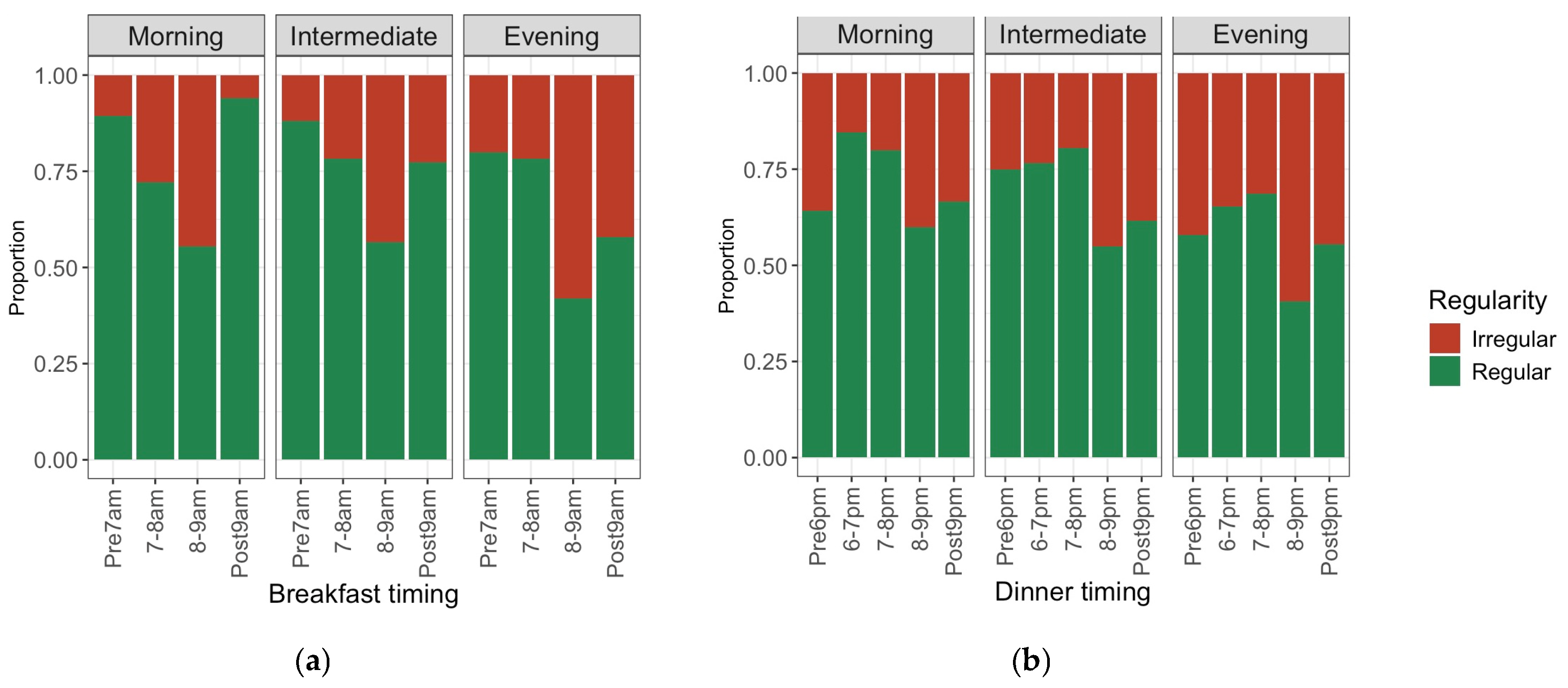
3.2. Distribution Classified by Chronotype, Meal Timing, and Mealtime Regularity
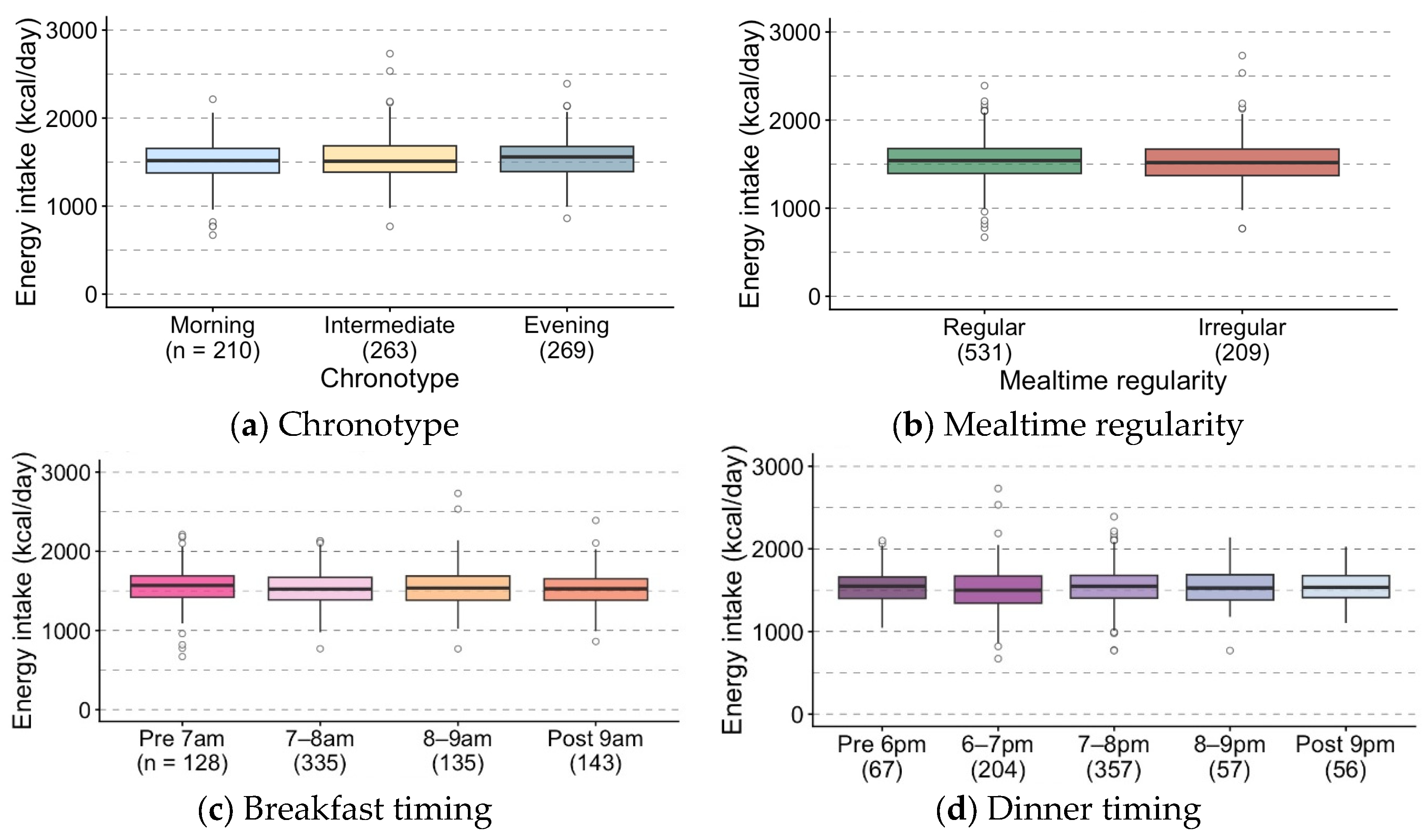
3.3. EI and Its CV by Chrononutritional Classification
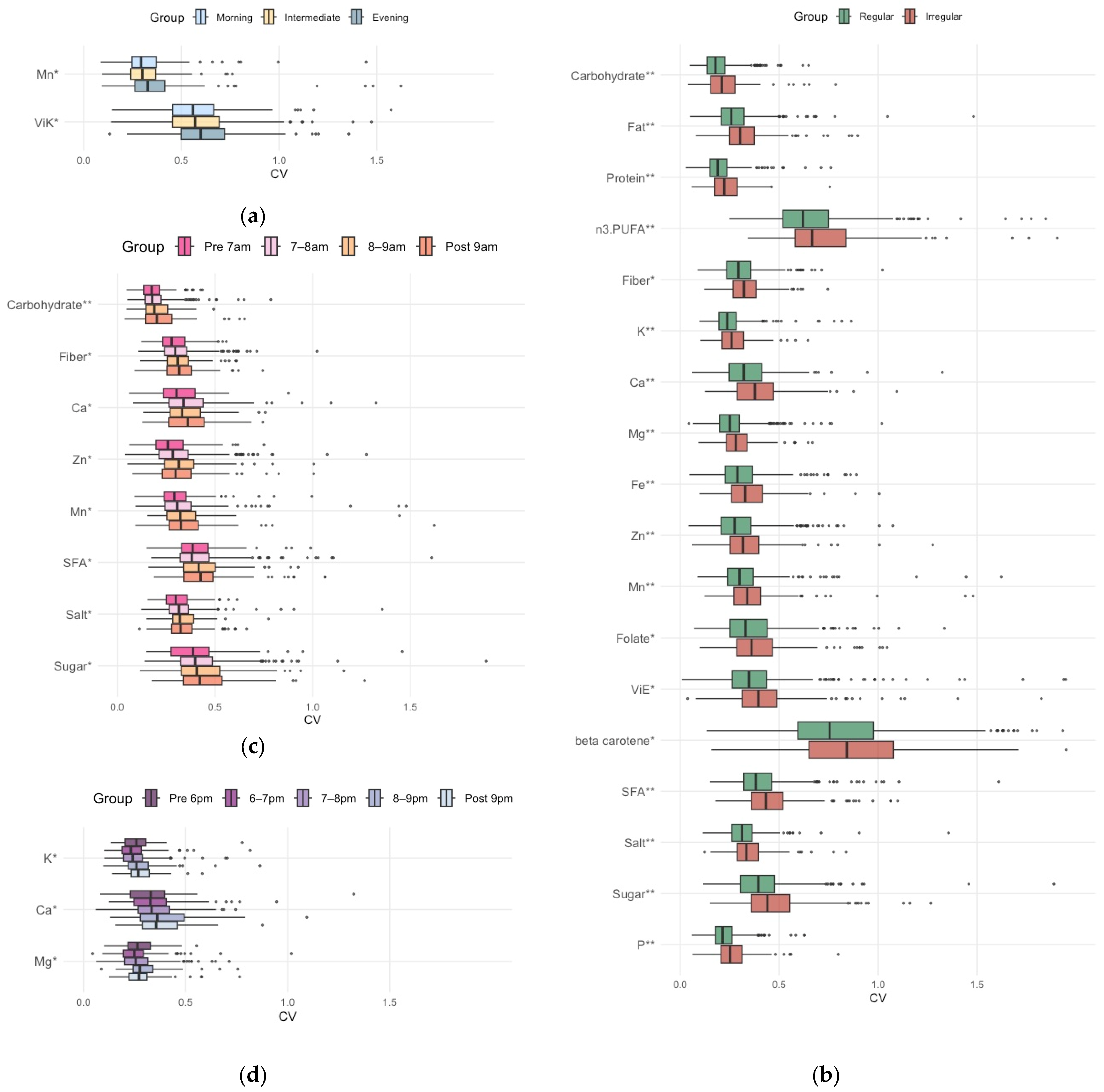
3.4. CV of Daily Nutrient Intake by Chrononutritional Classification
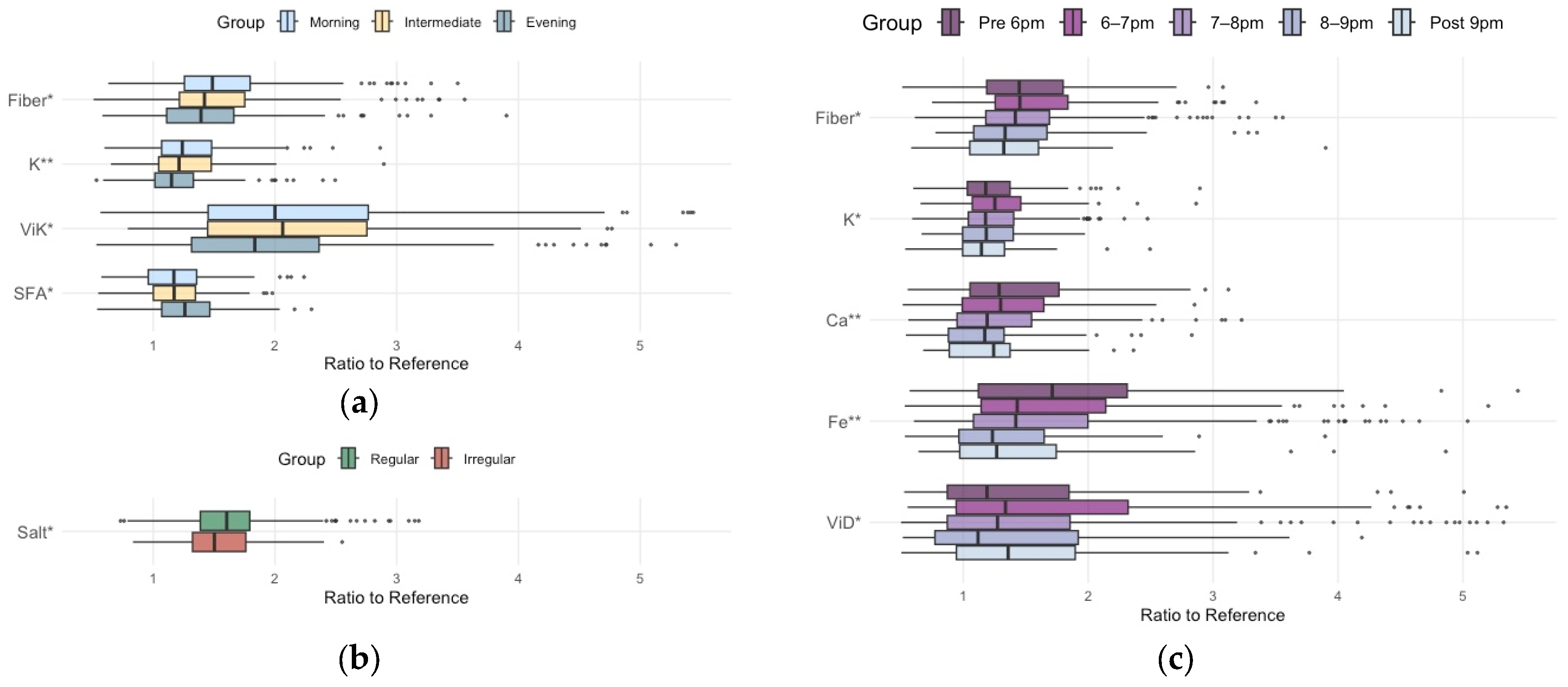
3.5. Ratio to Reference Values of Nutrient Intake by Chrononutritional Classification
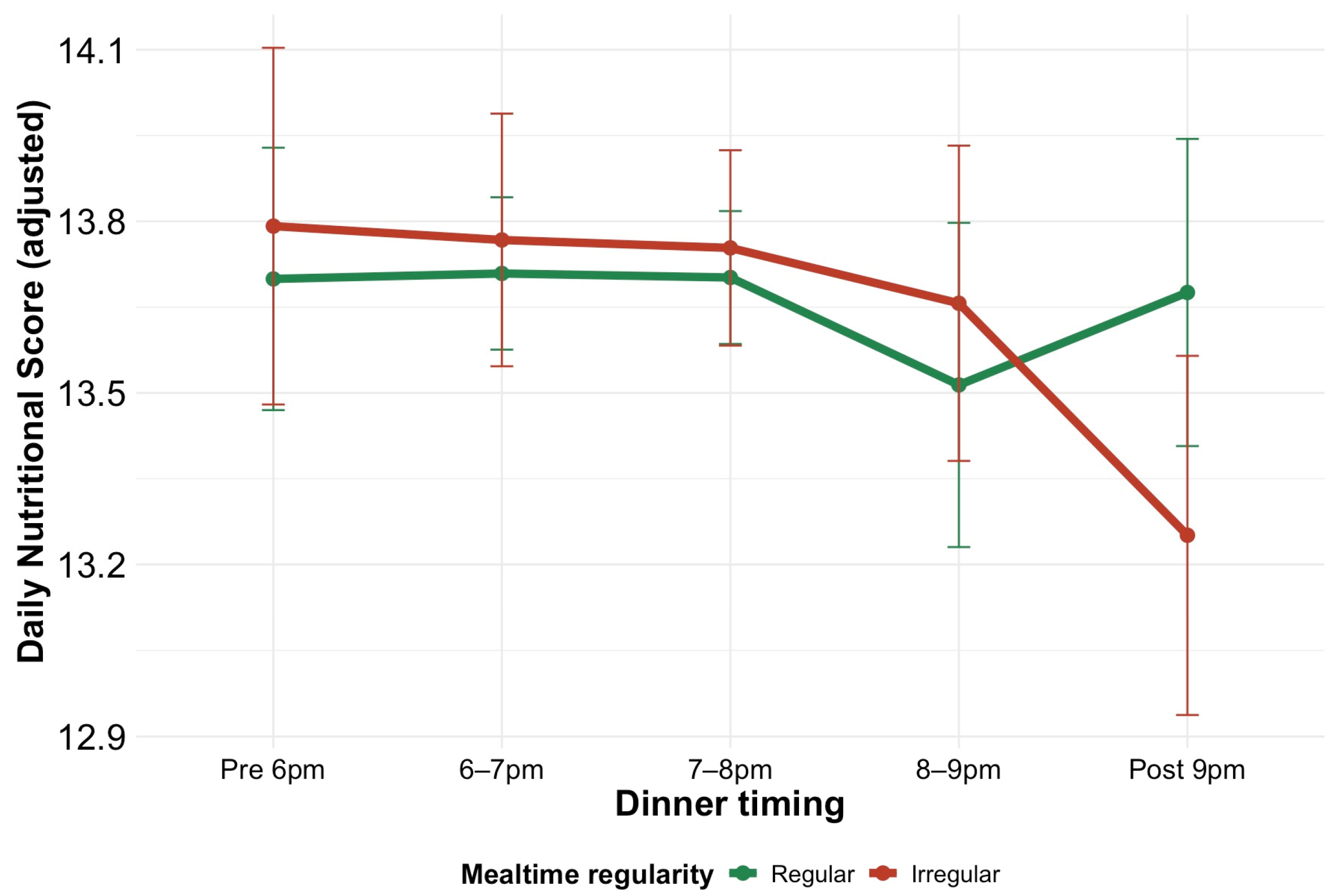
3.6. Association Between Late Dinner and Lower Diet Quality
4. Discussion
5. Conclusions
Supplementary Materials
Author Contributions
Funding
Institutional Review Board Statement
Informed Consent Statement
Data Availability Statement
Acknowledgments
Conflicts of Interest
Abbreviations
| CV | Coefficient of Variation |
| DRIs-J | Dietary Reference Intakes for Japanese |
| SFA | Saturated Fatty Acids |
| EI | Energy Intake |
| BMI | Body Mass Index |
| MSFsc | Sleep-corrected midpoint on free days |
| CPD | Composite Phase Deviation |
| STFC | Standard Tables of Food Composition |
| AI | Adequate Intake |
| DG | Dietary Goal for preventing lifestyle-related diseases |
| PUFA | Poly Unsaturated Fatty Acids |
| NRF | Nutrient-Rich Food Index |
| EE | Energy Expenditure |
| BMR | Basal Metabolic Rate |
| FAO | Food and Agriculture Organization |
| WHO | World Health Organization |
| UNU | United Nations University |
| CI | Confidence Interval |
| PAL | Physical Activity Level |
| MET | Metabolic Equivalent of Task |
References
- Leech, R.M.; Timperio, A.; Livingstone, K.M.; Worsley, A.; McNaughton, S.A. Temporal Eating Patterns: Associations with Nutrient Intakes, Diet Quality, and Measures of Adiposity. Am. J. Clin. Nutr. 2017, 106, 1121–1130. [Google Scholar] [CrossRef]
- Zuraikat, F.M.; St-Onge, M.-P.; Makarem, N.; Boege, H.L.; Xi, H.; Aggarwal, B. Evening Chronotype Is Associated with Poorer Habitual Diet in US Women, with Dietary Energy Density Mediating a Relation of Chronotype with Cardiovascular Health. J. Nutr. 2021, 151, 1150–1158. [Google Scholar] [CrossRef] [PubMed]
- Godos, J.; Castellano, S.; Ferri, R.; Caraci, F.; Lanza, G.; Scazzina, F.; Alanazi, A.M.; Marx, W.; Galvano, F.; Grosso, G. Mediterranean Diet and Chronotype: Data from Italian Adults and Systematic Review of Observational Studies. Exp. Gerontol. 2023, 181, 112284. [Google Scholar] [CrossRef] [PubMed]
- Teixeira, G.P.; da Cunha, N.B.; Azeredo, C.M.; Rinaldi, A.E.M.; Crispim, C.A. Eating Time Variation from Weekdays to Weekends and Its Association with Dietary Intake and BMI in Different Chronotypes: Findings from National Health and Nutrition Examination Survey (NHANES) 2017–2018. Br. J. Nutr. 2023, 131, 1281–1288. [Google Scholar] [CrossRef] [PubMed]
- Flanagan, A.; Bechtold, D.A.; Pot, G.K.; Johnston, J.D. Chrono-nutrition: From Molecular and Neuronal Mechanisms to Human Epidemiology and Timed Feeding Patterns. J. Neurochem. 2021, 157, 53–72. [Google Scholar] [CrossRef]
- Mistlberger, R.E. Food as Circadian Time Cue for Appetitive Behavior. F1000Research 2020, 9, 61. [Google Scholar] [CrossRef]
- Barrett, E.M.; Afrin, H.; Rayner, M.; Pettigrew, S.; Gaines, A.; Maganja, D.; Jones, A.; Mozaffarian, D.; Beck, E.J.; Neal, B.; et al. Criterion Validation of Nutrient Profiling Systems: A Systematic Review and Meta-Analysis. Am. J. Clin. Nutr. 2024, 119, 145–163. [Google Scholar] [CrossRef]
- Wirt, A.; Collins, C.E. Diet Quality—What Is It and Does It Matter? Public Health Nutr. 2009, 12, 2473–2492. [Google Scholar] [CrossRef]
- Singh, R.; McDonald, D.; Hernandez, A.R.; Song, S.J.; Bartko, A.; Knight, R.; Salathé, M. Temporal Nutrition Analysis Associates Dietary Regularity and Quality with Gut Microbiome Diversity: Insights from the Food & You Digital Cohort. Nat. Commun. 2025, 16, 8635. [Google Scholar] [CrossRef]
- Sierra-Johnson, J.; Undén, A.; Linestrand, M.; Rosell, M.; Sjogren, P.; Kolak, M.; De Faire, U.; Fisher, R.M.; Hellénius, M. Eating Meals Irregularly: A Novel Environmental Risk Factor for the Metabolic Syndrome. Obesity 2008, 16, 1302–1307. [Google Scholar] [CrossRef]
- Suyoto, P.S.; Pamungkas, N.P.; De Vries, J.H.; Feskens, E.J. Associations between Variability in Between- and Within-Day Dietary Intake with Adiposity and Glucose Homeostasis in Adults: A Systematic Review. Adv. Nutr. 2024, 15, 100310. [Google Scholar] [CrossRef] [PubMed]
- Sato, N.; Terasaki, H.; Tahara, Y.; Michie, M.; Umezawa, A.; Shibata, S. Day-to-Day Variability in Meal Timing and Its Association with Body Mass Index: A Study Using Data from a Japanese Food-Logging Mobile Application. Nutrients 2025, 17, 3504. [Google Scholar] [CrossRef] [PubMed]
- Seol, J.; Iwagami, M.; Kayamare, M.C.T.; Yanagisawa, M. Relationship Among Macronutrients, Dietary Components, and Objective Sleep Variables Measured by Smartphone Apps: Real-World Cross-Sectional Study. J. Med. Internet Res. 2025, 27, e64749. [Google Scholar] [CrossRef] [PubMed]
- Matsuzaki, E.; Michie, M.; Kawabata, T. Validity of Nutrient Intakes Derived from an Internet Website Dish-Based Dietary Record for Self-Management of Weight among Japanese Women. Nutrients 2017, 9, 1058. [Google Scholar] [CrossRef]
- Nitta, L.; Tahara, Y.; Shinto, T.; Makino, S.; Kuwahara, M.; Tada, A.; Abe, N.; Michie, M.; Shibata, S. Association of Eating Pattern, Chronotype, and Social Jetlag: A Cross-Sectional Study Using Data Accumulated in a Japanese Food-Logging Mobile Health Application. Nutrients 2023, 15, 2165. [Google Scholar] [CrossRef]
- Imamura, M.; Sasaki, H.; Shinto, T.; Tahara, Y.; Makino, S.; Kuwahara, M.; Tada, A.; Abe, N.; Michie, M.; Shibata, S. Association Between Na, K, and Lipid Intake in Each Meal and Blood Pressure. Front. Nutr. 2022, 9, 853118. [Google Scholar] [CrossRef]
- Craig, C.L.; Marshall, A.L.; Sjöström, M.; Bauman, A.E.; Booth, M.L.; Ainsworth, B.E.; Pratt, M.; Ekelund, U.; Yngve, A.; Sallis, J.F.; et al. International Physical Activity Questionnaire: 12-Country Reliability and Validity. Med. Sci. Sports Exerc. 2003, 35, 1381–1395. [Google Scholar] [CrossRef]
- Kitamura, S.; Hida, A.; Aritake, S.; Higuchi, S.; Enomoto, M.; Kato, M.; Vetter, C.; Roenneberg, T.; Mishima, K. Validity of the Japanese Version of the Munich ChronoType Questionnaire. Chronobiol. Int. 2014, 31, 845–850. [Google Scholar] [CrossRef]
- McHill, A.W.; Hilditch, C.J.; Fischer, D.; Czeisler, C.A.; Garaulet, M.; Scheer, F.A.J.L.; Klerman, E.B. Stability of the Timing of Food Intake at Daily and Monthly Timescales in Young Adults. Sci. Rep. 2020, 10, 20849. [Google Scholar] [CrossRef]
- Ministry of Education, Culture, Sports, Science and Technology-Japan (MEXT). Standard Tables of Food Composition in Japan 2020 (8th Edition). Available online: https://www.mext.go.jp/a_menu/syokuhinseibun/mext_01110.html (accessed on 7 September 2025).
- Ministry of Health, Labour and Welfare. Dietary Reference Intakes for Japanese. 2025. Available online: https://www.mhlw.go.jp/stf/newpage_44138.html (accessed on 7 October 2025).
- Drewnowski, A. The Nutrient Rich Foods Index Helps to Identify Healthy, Affordable Foods. Am. J. Clin. Nutr. 2010, 91, 1095S–1101S. [Google Scholar] [CrossRef]
- Black, A. Critical Evaluation of Energy Intake Using the Goldberg Cut-off for Energy Intake: Basal Metabolic Rate. A Practical Guide to Its Calculation, Use and Limitations. Int. J. Obes. 2000, 24, 1119–1130. [Google Scholar] [CrossRef] [PubMed]
- Ganpule, A.A.; Tanaka, S.; Ishikawa-Takata, K.; Tabata, I. Interindividual Variability in Sleeping Metabolic Rate in Japanese Subjects. Eur. J. Clin. Nutr. 2007, 61, 1256–1261. [Google Scholar] [CrossRef] [PubMed]
- Human Energy Requirements. Available online: https://www.fao.org/4/y5686e/y5686e00.htm (accessed on 21 December 2025).
- Gill, S.; Panda, S. A Smartphone App Reveals Erratic Diurnal Eating Patterns in Humans That Can Be Modulated for Health Benefits. Cell Metab. 2015, 22, 789–798. [Google Scholar] [CrossRef] [PubMed]
- Manoogian, E.N.C.; Chaix, A.; Panda, S. When to Eat: The Importance of Eating Patterns in Health and Disease. J. Biol. Rhythm. 2019, 34, 579–581. [Google Scholar] [CrossRef]
- McHill, A.W.; Phillips, A.J.; Czeisler, C.A.; Keating, L.; Yee, K.; Barger, L.K.; Garaulet, M.; Scheer, F.A.; Klerman, E.B. Later Circadian Timing of Food Intake Is Associated with Increased Body Fat. Am. J. Clin. Nutr. 2017, 106, 1213–1219. [Google Scholar] [CrossRef]
- Muscogiuri, G.; Barrea, L.; Aprano, S.; Framondi, L.; Di Matteo, R.; Laudisio, D.; Pugliese, G.; Savastano, S.; Colao, A.; On Behalf of The Opera Prevention Project. Chronotype and Adherence to the Mediterranean Diet in Obesity: Results from the Opera Prevention Project. Nutrients 2020, 12, 1354. [Google Scholar] [CrossRef]
- Ciobanu, D.; Porojan, M.; Bala, C.; Zah, A.M.; Oroian, I.; Roman, G.; Rusu, A. Lifestyle Factors, Dietary Patterns, and Social Determinants of Social and Eating Jetlag: A Cross-Sectional Survey. Chronobiol. Int. 2024, 41, 248–258. [Google Scholar] [CrossRef]
- Park, J.; Yeo, Y.; Yoo, J.H. Dietary Intake and Nutritional Status in Young and Middle-Aged Adults According to the Meal Frequency from the Korea National Health and Nutritional Survey. Korean J. Fam. Med. 2022, 43, 319–326. [Google Scholar] [CrossRef]
- Kabalı, S.; Çelik, M.N.; Öner, N. Associations of Nutrition Education with Diet Quality Indexes and Chronotype: A Cross-Sectional Study. Int. J. Environ. Health Res. 2025, 35, 2015–2027. [Google Scholar] [CrossRef]
- Hayashida, T.; Shimura, A.; Higashiyama, M.; Fujimura, Y.; Ono, K.; Inoue, T. Psychosomatic Stress Responses and Sleep Disturbance Mediate the Effects of Irregular Mealtimes on Presenteeism. Neuropsychiatr. Dis. Treat. 2021, 17, 315–321. [Google Scholar] [CrossRef]
- Huseinovic, E.; Winkvist, A.; Freisling, H.; Slimani, N.; Boeing, H.; Buckland, G.; Schwingshackl, L.; Olsen, A.; Tjønneland, A.; Stepien, M.; et al. Timing of Eating across Ten European Countries—Results from the European Prospective Investigation into Cancer and Nutrition (EPIC) Calibration Study. Public Health Nutr. 2019, 22, 324–335. [Google Scholar] [CrossRef]
- Allen, M.S.; Mishra, M.; Tashjian, S.M.; Laborde, S. Linking Big Five Personality Traits to Components of Diet: A Meta-Analytic Review. J. Personal. Soc. Psychol. 2025, 128, 905–929. [Google Scholar] [CrossRef]



| Nutrient | CV Correlates with Gut Alpha-Diversity † |
|---|---|
| Carbohydrate | |
| Fat | yes |
| Protein | |
| n-3 polyunsaturated fatty acids (PUFA) | yes |
| Dietary fiber | |
| Potassium (K) | yes |
| Calcium (Ca) | |
| Magnesium (Mg) | yes |
| Iron (Fe) | |
| Zinc (Zn) | |
| Manganese (Mn) | |
| Folate | |
| Vitamin C (ViC) | |
| Vitamin A (ViA) | |
| Vitamin D (ViD) | |
| Vitamin E (ViE) | yes (Oil nuts) |
| Vitamin K (ViK) | |
| Beta-carotene | yes |
| Saturated fatty acids (SFA) | yes |
| Sodium (Salt Equivalent) | |
| Sugar § | yes |
| Phophorus | yes |
| Nutrient | Reference Value |
|---|---|
| Adequacy components (recommended nutrients) | |
| Protein | DG † |
| n-3 polyunsaturated fatty acids (PUFA) | AI |
| Dietary fiber | DG |
| Potassium (K) | DG |
| Calcium (Ca) | RDA |
| Magnesium (Mg) | RDA |
| Iron (Fe) | RDA |
| Zinc (Zn) | RDA |
| Manganese (Mn) | AI |
| Folate | RDA |
| Vitamin C (ViC) | RDA |
| Vitamin A (ViA) | RDA |
| Vitamin D (ViD) | AI |
| Vitamin E (ViE) | AI |
| Vitamin K (ViK) | AI |
| Moderation components (nutrients to be limited) | |
| Saturated fatty acids (SFA) | DG |
| Sodium (Salt Equivalent) | DG |
| Nutrient | Regular Mealtime Group [n = 531] | Irregular Mealtime Group [n = 209] | ||
|---|---|---|---|---|
| Mean or n | SD or % | Mean or n | SD or % | |
| Age (years old) * | 42.1 | 11.2 | 40.0 | 10.8 |
| Height (cm) | 158.3 | 5.4 | 158.4 | 5.1 |
| Weight (kg) | 55.5 | 10.5 | 55.7 | 10.2 |
| BMI (kg/m2) | 22.2 | 4.0 | 22.2 | 3.8 |
| Wake time (hh:mm) on workdays ** | 6:16 | 1:09 | 6:41 | 1:25 |
| Wake time (hh:mm) on free days ** | 7:11 | 1:31 | 7:51 | 1:36 |
| Sleep onset time (hh:mm) on workdays ** | 23:34 | 1:10 | 23:58 | 1:13 |
| Sleep onset time (hh:mm) on free days ** | 23:48 | 1:13 | 24:11 | 1:19 |
| Sleep duration (hh:mm) on workdays | 6:42 | 0:58 | 6:43 | 1:10 |
| Sleep duration (hh:mm) on free days * | 7:22 | 1:10 | 7:39 | 1:17 |
| MSFsc (hh:mm) ** | 3:14 | 1:08 | 3:40 | 1:17 |
| Chronotype ** | ||||
| Morning type | 164 | 30.9 | 46 | 22.0 |
| Intermediate type | 199 | 37.5 | 63 | 30.1 |
| Evening type | 168 | 31.6 | 100 | 47.8 |
| Physical activity (MET-h/week) | 32.2 | 28.7 | 34.8 | 34.1 |
| Breakfast time (hh:mm) ** | 7:42 | 1:12 | 8:21 | 1:17 |
| Lunch time (hh:mm) ** | 12:29 | 0:49 | 13:03 | 1:04 |
| Dinner time (hh:mm) ** | 19:01 | 1:07 | 19:25 | 1:21 |
| Breakfast time CPD (h) ** | 0.13 | 0.25 | 1.20 | 0.89 |
| Lunch time CPD (h) ** | 0.12 | 0.25 | 1.14 | 0.79 |
| Dinner time CPD (h) ** | 0.10 | 0.23 | 1.07 | 0.76 |
| (a) Chronotype | |||
| Explanatory Variable | Coefficient (β) | 95% CI | p-Value |
| Chronotype (ordinal variable) | −0.035 | −0.104, 0.034 | 0.3184 |
| Age (years) | 0.008 | 0.003, 0.013 | 0.0025 |
| BMI (kg/m2) | −0.008 | −0.022, 0.005 | 0.2325 |
| PA (MET-hour/week) | 0.002 | 0.001, 0.004 | 0.0117 |
| (b) Breakfast Timing | |||
| Explanatory Variable | Coefficient (β) | 95% CI | p-Value |
| Breakfast timing (ordinal variable) | 0.026 | −0.028, 0.081 | 0.3447 |
| Age (years) | 0.008 | 0.004, 0.013 | 0.0007 |
| BMI (kg/m2) | −0.010 | −0.023, 0.004 | 0.1578 |
| PA (MET-hour/week) | 0.002 | 0.000, 0.004 | 0.0133 |
| (c) Dinner Timing | |||
| Explanatory Variable | Coefficient (β) | 95% CI | p-Value |
| Dinner timing (ordinal variable) | −0.059 | −0.113, −0.004 | 0.0351 |
| Age (years) | 0.008 | 0.003, 0.013 | 0.0009 |
| BMI (kg/m2) | −0.009 | −0.022, 0.005 | 0.2062 |
| PA (MET-hour/week) | 0.002 | 0.001, 0.004 | 0.0086 |
Disclaimer/Publisher’s Note: The statements, opinions and data contained in all publications are solely those of the individual author(s) and contributor(s) and not of MDPI and/or the editor(s). MDPI and/or the editor(s) disclaim responsibility for any injury to people or property resulting from any ideas, methods, instructions or products referred to in the content. |
© 2026 by the authors. Licensee MDPI, Basel, Switzerland. This article is an open access article distributed under the terms and conditions of the Creative Commons Attribution (CC BY) license.
Share and Cite
Umezawa, A.; Sato, N.; Terasaki, H.; Tahara, Y.; Shibata, S. Associations of Temporal Eating Patterns with Nutrient Intake Variability and Diet Quality Among Japanese Female Mobile Application Users. Nutrients 2026, 18, 957. https://doi.org/10.3390/nu18060957
Umezawa A, Sato N, Terasaki H, Tahara Y, Shibata S. Associations of Temporal Eating Patterns with Nutrient Intake Variability and Diet Quality Among Japanese Female Mobile Application Users. Nutrients. 2026; 18(6):957. https://doi.org/10.3390/nu18060957
Chicago/Turabian StyleUmezawa, Ariko, Noriko Sato, Hiiro Terasaki, Yu Tahara, and Shigenobu Shibata. 2026. "Associations of Temporal Eating Patterns with Nutrient Intake Variability and Diet Quality Among Japanese Female Mobile Application Users" Nutrients 18, no. 6: 957. https://doi.org/10.3390/nu18060957
APA StyleUmezawa, A., Sato, N., Terasaki, H., Tahara, Y., & Shibata, S. (2026). Associations of Temporal Eating Patterns with Nutrient Intake Variability and Diet Quality Among Japanese Female Mobile Application Users. Nutrients, 18(6), 957. https://doi.org/10.3390/nu18060957