Article

Diet Pattern Analysis in Alzheimer’s Disease Implicates Gender Differences in Folate–B12–Homocysteine Axis on Cognitive Outcomes

1
Department of Nursing, Kaohsiung Chang Gung Memorial Hospital, Kaohsiung 83301, Taiwan
2
School of Nursing, Meiho University, Pingtung 91202, Taiwan
3
Department of Statistics, National Cheng Kung University, Tainan 704, Taiwan
4
Department of Neurology, Cognition and Aging Center, Institute for Translational Research in Biomedicine, Kaohsiung Chang Gung Memorial Hospital, Chang Gung University College of Medicine, 123 Ta Pei Road, Kaohsiung 83301, Taiwan
5
School of Nursing, Fooyin University, Kaohsiung 83102, Taiwan
6
School of Medicine, College of Medicine, National Sun Yat-sen University, Kaohsiung 80421, Taiwan
*
Authors to whom correspondence should be addressed.
Nutrients 2024, 16(5), 733; https://doi.org/10.3390/nu16050733
Submission received: 30 January 2024 / Revised: 24 February 2024 / Accepted: 29 February 2024 / Published: 4 March 2024

Abstract

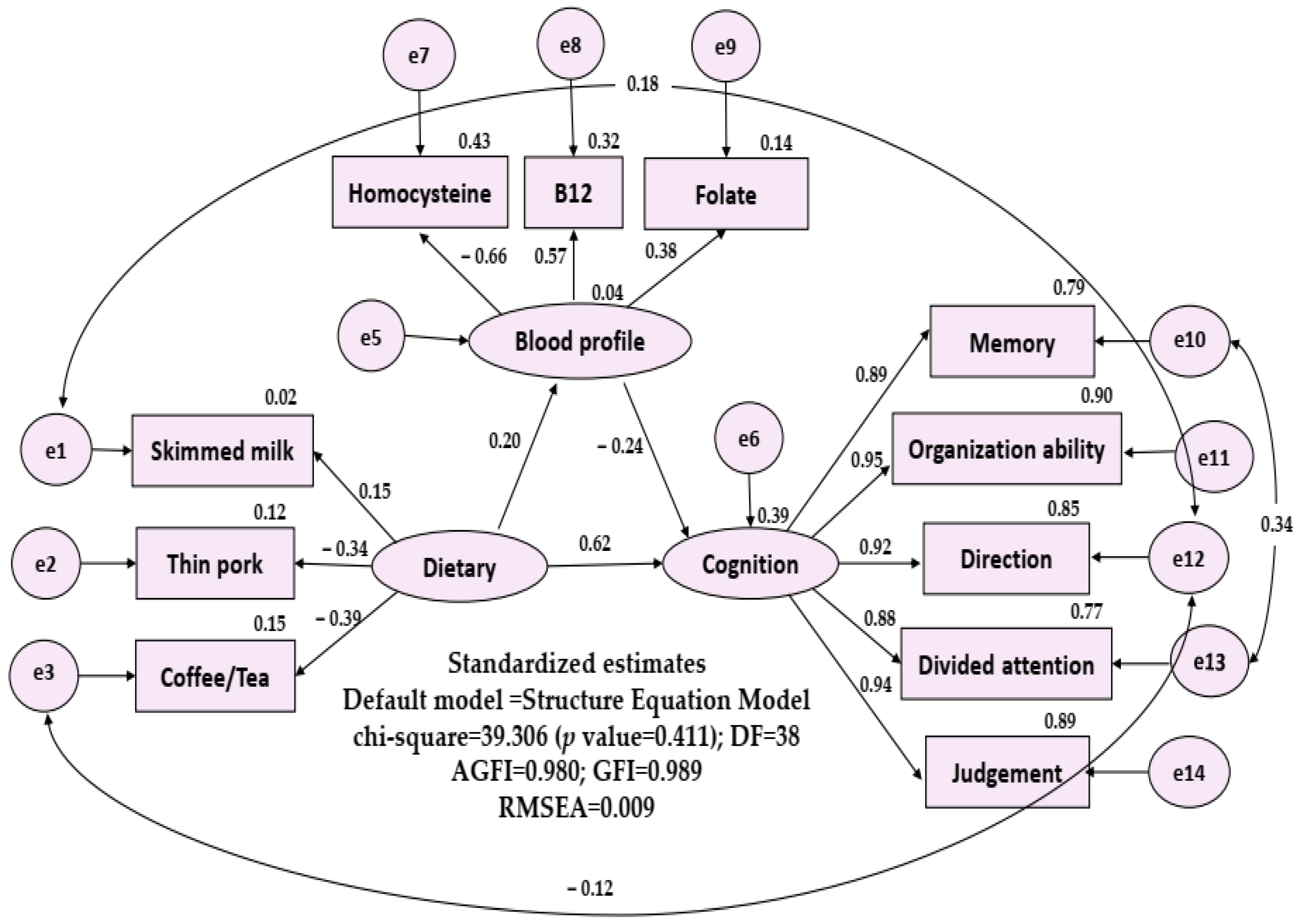
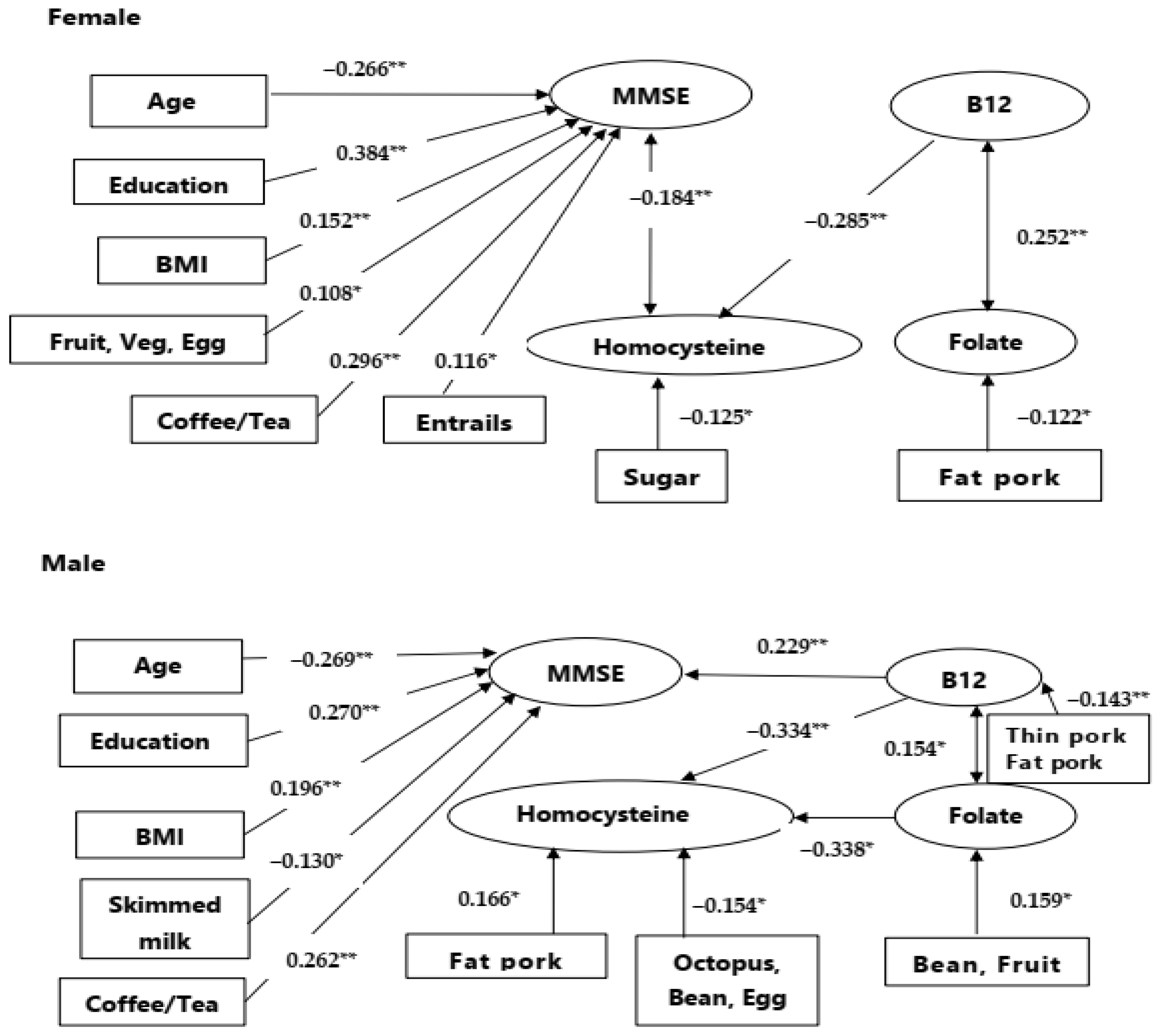
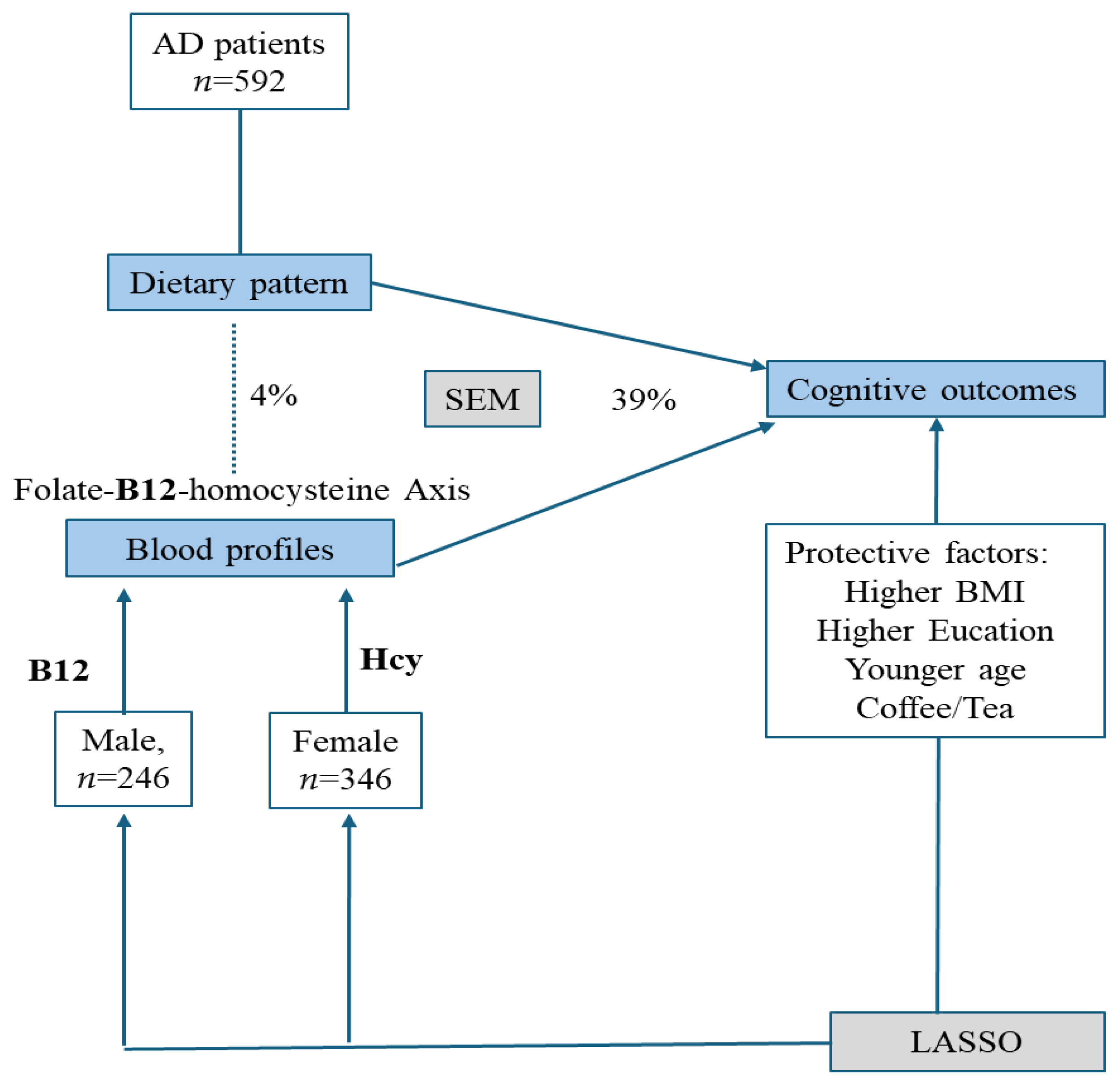
Background & Aims: Low plasma B12 and folate levels or hyperhomocysteinemia are related to cognitive impairment. This study explores the relationships among diet pattern, blood folate–B12–homocysteine levels, and cognition measurement in Alzheimer’s disease (AD) while exploring whether a gender effect may exist. Methods: This cross-sectional study enrolled 592 AD patients (246 males, 346 females) and the demographic data, blood biochemical profiles, Mini-Mental State Examination (MMSE), and a Food Frequency Questionnaire (FFQ) for quantitative assessment of dietary frequency were collected. Structural Equation Modeling (SEM) was employed to explore the associations among dietary patterns, blood profiles, and cognition. A least absolute shrinkage and selection operator regression model, stratified by gender, was constructed to analyze the weighting of possible confounders. Results: Higher MMSE scores were related to higher frequencies of coffee/tea and higher educational levels, body mass index, and younger age. The SEM model revealed a direct influence of dietary frequencies (skimmed milk, thin pork, coffee/tea) and blood profiles (homocysteine, B12, and folate) on cognitive outcomes. At the same time, the influence of dietary pattern on cognition was not mediated by folate–B12–homocysteine levels. In males, a direct influence on the MMSE is attributed to B12, while in females, homocysteine is considered a more critical factor. Conclusions: Dietary patterns and blood profiles are both associated with cognitive domains in AD, and there are gender differences in the associations of dietary patterns and the levels of B12 and homocysteine. To enhance the quality of dietary care and nutritional status for individuals with dementia, our study results still require future validations with multi-center and longitudinal studies.
Keywords: Alzheimer’s disease; dietary pattern; gender effect; homocysteine; B12 Alzheimer’s disease; dietary pattern; gender effect; homocysteine; B12