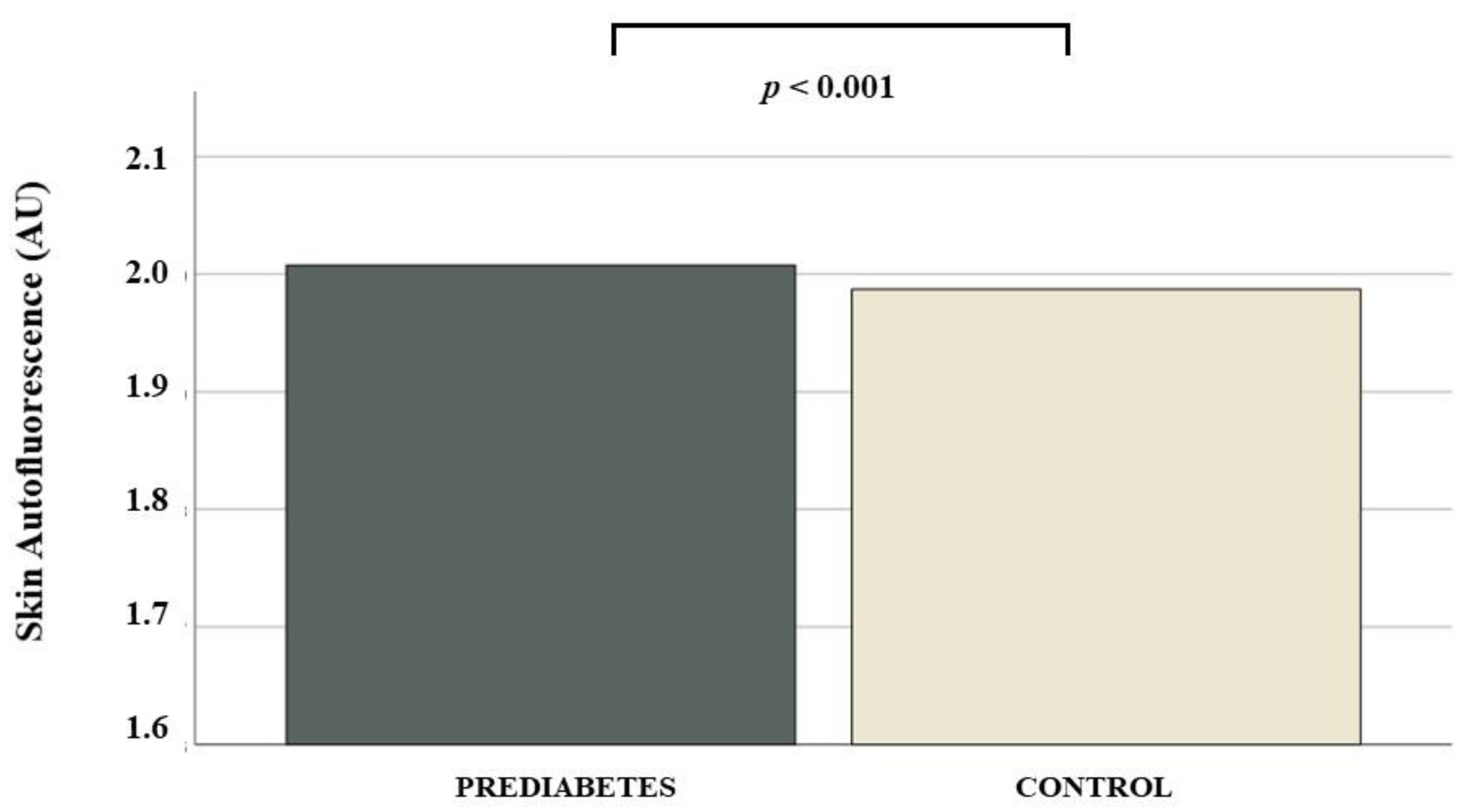
Weak Association between Skin Autofluorescence Levels and Prediabetes with an ILERVAS Cross-Sectional Study
 , ,
, , 
 , and
, and 
Abstract
1. Introduction
2. Materials and Methods
2.1. Ethical Statement
2.2. Design of the Study and Data of the Study Participants
2.3. Measurement of Skin Autofluorescence
2.4. Diagnosis of Prediabetes and Type 2 Diabetes
2.5. Statistical Analysis
3. Results
4. Discussion
5. Conclusions
Author Contributions
Funding
Institutional Review Board Statement
Informed Consent Statement
Data Availability Statement
Acknowledgments
Conflicts of Interest
References
- Ajith, T.A.; Vinodkumar, P. Advanced glycation end products: Association with the pathogenesis of diseases and the current therapeutic approaches. Curr. Clin. Pharmacol. 2016, 11, 118–127. [Google Scholar] [CrossRef] [Scilit] [PubMed]
- Bierhaus, A.; Hofmann, M.A.; Ziegler, R.; Nawroth, P.P. AGEs and their interaction with AGE-receptors in vascular disease and diabetes mellitus. I. The AGE concept. Cardiovasc. Res. 1998, 37, 586–600. [Google Scholar] [CrossRef] [Scilit]
- Goh, S.Y.; Cooper, M.E. The role of advanced glycation end products in progression and complications of diabetes. J. Clin. Endocrinol. Metab. 2008, 93, 1143–1152. [Google Scholar] [CrossRef] [Scilit] [PubMed]
- Vlassara, H.; Striker, G.E. Advanced glycation endproducts in diabetes and diabetic complications. Endocrinol. Metab. Clin. N. Am. 2013, 42, 697–719. [Google Scholar] [CrossRef] [Scilit] [PubMed]
- Uribarri, J.; Cai, W.; Peppa, M.; Goodman, S.; Ferrucci, L.; Striker, G.; Vlassara, H. Circulating glycotoxins and dietary advanced glycation endproducts: Two links to inflammatory response, oxidative stress, and aging. J. Gerontol. Ser. A Biol. Sci. Med. Sci. 2007, 62, 427–433. [Google Scholar] [CrossRef] [Scilit]
- Xia, P.F.; Tian, Y.X.; Geng, T.T.; Li, Y.; Tu, Z.Z.; Zhang, Y.B.; Guo, K.; Yang, K.; Liu, G.; Pan, A. Trends in Prevalence and Awareness of Prediabetes Among Adults in the U.S., 2005–2020. Diabetes Care 2022, 45, e21–e23. [Google Scholar] [CrossRef] [Scilit]
- Huang, Y.; Cai, X.; Mai, W.; Li, M.; Hu, Y. Association between prediabetes and risk of cardiovascular disease and all cause mortality: Systematic review and meta-analysis. BMJ 2016, 355, i5953. [Google Scholar] [CrossRef] [Scilit]
- Brunner, E.J.; Shipley, M.J.; Witte, D.R.; Fuller, J.H.; Marmot, M.G. Relation between blood glucose and coronary mortality over 33 years in the Whitehall Study. Diabetes Care 2006, 29, 26–31. [Google Scholar] [CrossRef]
- Sánchez, E.; Betriu, À.; López-Cano, C.; Hernández, M.; Fernández, E.; Purroy, F.; Bermúdez-López, M.; Farràs-Sallés, C.; Barril, S.; Pamplona, R.; et al. Characteristics of atheromatosis in the prediabetes stage: A cross-sectional investigation of the ILERVAS project. Cardiovasc. Diabetol. 2019, 18, 154. [Google Scholar] [CrossRef] [Scilit]
- Goldin, A.; Beckman, J.A.; Schmidt, A.M.; Creager, M.A. Advanced glycation end products: Sparking the development of diabetic vascular injury. Circulation 2006, 114, 597–605. [Google Scholar] [CrossRef] [Scilit]
- Kimura, H.; Tanaka, K.; Kanno, M.; Watanabe, K.; Hayashi, Y.; Asahi, K.; Suzuki, H.; Sato, K.; Sakaue, M.; Terawaki, H.; et al. Skin autofluorescence predicts cardiovascular mortality in patients on chronic hemodialysis. Ther. Apher. Dial. 2014, 18, 461–467. [Google Scholar] [CrossRef] [Scilit] [PubMed]
- Vélayoudom-Céphise, F.L.; Rajaobelina, K.; Helmer, C.; Nov, S.; Pupier, E.; Blanco, L.; Hugo, M.; Farges, B.; Astrugue, C.; Gin, H.; et al. Skin autofluorescence predicts cardio-renal outcome in type 1 diabetes: A longitudinal study. Cardiovasc. Diabetol. 2016, 15, 127. [Google Scholar] [CrossRef] [Scilit] [PubMed]
- Esquivel Zuniga, R.; DeBoer, M.D. Prediabetes in Adolescents: Prevalence, Management and Diabetes Prevention Strategies. Diabetes Metab. Syndr. Obes. Targets Ther. 2021, 14, 4609–4619. [Google Scholar] [CrossRef] [Scilit] [PubMed]
- American Diabetes Association. Classification and diagnosis of diabetes. Section 2. Diabetes Care 2017, 40, S11–S24. [Google Scholar] [CrossRef] [Scilit] [PubMed]
- Smit, A.J.; Smit, J.M.; Botterblom, G.J.; Mulder, D.J. Skin autofluorescence based decision tree in detection of impaired glucose tolerance and diabetes. PLoS ONE 2013, 8, e65592. [Google Scholar] [CrossRef] [Scilit] [PubMed]
- Maynard, J.D.; Rohrscheib, M.; Way, J.F.; Nguyen, C.M.; Ediger, M.N. Noninvasive type 2 diabetes screening, superior sensitivity to fasting plasma glucose and A1C. Diabetes Care 2007, 30, 1120–1124. [Google Scholar] [CrossRef] [Scilit]
- La Sala, L.; Tagliabue, E.; de Candia, P.; Prattichizzo, F.; Ceriello, A. One-hour plasma glucose combined with skin autofluorescence identifies subjects with pre-diabetes: The DIAPASON study. BMJ Open Diabetes Res. Care 2020, 8, e001331. [Google Scholar] [CrossRef] [Scilit]
- Hull, E.L.; Matter, N.I.; Olson, B.P.; Ediger, M.N.; Magee, A.J.; Way, J.F.; Vugrin, K.E.; Maynard, J.D. Noninvasive skin fluorescence spectroscopy for detection of abnormal glucose tolerance. J. Clin. Transl. Endocrinol. 2014, 1, 92–99. [Google Scholar] [CrossRef] [Scilit]
- Stirban, A. Noninvasive skin fluorescence spectroscopy for diabetes screening. J. Diabetes Sci. Technol. 2013, 7, 1001–1004. [Google Scholar] [CrossRef] [Scilit]
- Olson, B.P.; Matter, N.I.; Ediger, M.N.; Hull, E.L.; Maynard, J.D. Noninvasive skin fluorescence spectroscopy is comparable to hemoglobin A1c and fasting plasma glucose for detection of abnormal glucose tolerance. J. Diabetes Sci. Technol. 2013, 7, 990–1000. [Google Scholar] [CrossRef] [Scilit]
- Purroy, F.; Sánchez, E.; Lecube, A.; Arqué, G.; Vicente-Pascual, M.; Mauri-Capdevila, G.; Torreguitart, N.; Hernández, M.; Barbé, F.; Fernández, E.; et al. Prevalence and Predictors of Cerebral Microangiopathy Determined by Pulsatility Index in an Asymptomatic Population from the ILERVAS Project. Front. Neurol. 2021, 12, 785640. [Google Scholar] [PubMed]
- Meerwaldt, R.; Graaff, R.; Oomen, P.H.N.; Links, T.P.; Jager, J.J.; Alderson, N.L.; Thorpe, S.R.; Baynes, J.W.; Gans, R.O.B.; Smit, A.J. Simple non-invasive assessment of advanced glycation endproduct accumulation. Diabetologia 2004, 47, 1324–1330. [Google Scholar] [CrossRef] [Scilit] [PubMed]
- Lacolley, P.; Regnault, V.; Laurent, S. Mechanisms of arterial stiffening: From mechanotransduction to epigenetics. Arterioscler. Thromb. Vasc. Biol. 2020, 40, 1055–1062. [Google Scholar] [CrossRef] [Scilit] [PubMed]
- Perrone, A.; Giovino, A.; Benny, J.; Martinelli, F. Advanced Glycation End Products (AGEs): Biochemistry, Signaling, Analytical Methods, and Epigenetic Effects. Oxidative Med. Cell. Longev. 2020, 2020, 3818196. [Google Scholar] [CrossRef] [Scilit] [PubMed]
- Meerwaldt, R.; Lutgers, H.L.; Links, T.P.; Graaff, R.; Baynes, J.W.; Gans, R.O.; Smit, A.J. Skin autofluorescence is a strong predictor of cardiac mortality in diabetes. Diabetes Care 2007, 30, 107–112. [Google Scholar] [CrossRef] [Scilit]
- Vlassara, H.; Uribarri, J. Advanced glycation end products (AGE) and diabetes: Cause, effect, or both? Curr. Diabetes Rep. 2014, 14, 453. [Google Scholar] [CrossRef] [Scilit]
- Nowotny, K.; Jung, T.; Höhn, A.; Weber, D.; Grune, T. Advanced glycation end products and oxidative stress in type 2 diabetes mellitus. Biomolecules 2015, 16, 194–222. [Google Scholar] [CrossRef] [Scilit]
- Lutgers, H.L.; Graaff, R.; Links, T.P.; Ubink-Veltmaat, L.J.; Bilo, H.J.; Gans, R.O.; Smit, A.J. Skin autofluorescence as a noninvasive marker of vascular damage in patients with type 2 diabetes. Diabetes Care 2006, 29, 2654–2659. [Google Scholar] [CrossRef] [Scilit]
- Sánchez, E.; Betriu, À.; Yeramian, A.; Fernández, E.; Purroy, F.; Sánchez-de-la-Torre, M.; Pamplona, R.; Miquel, E.; Kerkeni, M.; Hernández, C.; et al. Skin Autofluorescence Measurement in Subclinical Atheromatous Disease: Results from the ILERVAS Project. J. Atheroscler. Thromb. 2019, 26, 879–889. [Google Scholar] [CrossRef] [Scilit]
- van Waateringe, R.P.; Fokkens, B.T.; Slagter, S.N.; van der Klauw, M.M.; van Vliet-Ostaptchouk, J.V.; Graaff, R.; Paterson, A.D.; Smit, A.J.; Lutgers, H.L.; Wolffenbuttel, B.H.R. Skin autofluorescence predicts incident type 2 diabetes, cardiovascular disease and mortality in the general population. Diabetologia 2019, 62, 269–280. [Google Scholar] [CrossRef] [Scilit]
- Rajaobelina, K.; Cougnard-Gregoire, A.; Delcourt, C.; Gin, H.; Barberger-Gateau, P.; Rigalleau, V. Autofluorescence of Skin Advanced Glycation End Products: Marker of Metabolic Memory in Elderly Population. J. Gerontol. Ser. A Biomed. Sci. Med. Sci. 2015, 70, 841–846. [Google Scholar] [CrossRef] [Scilit] [PubMed]
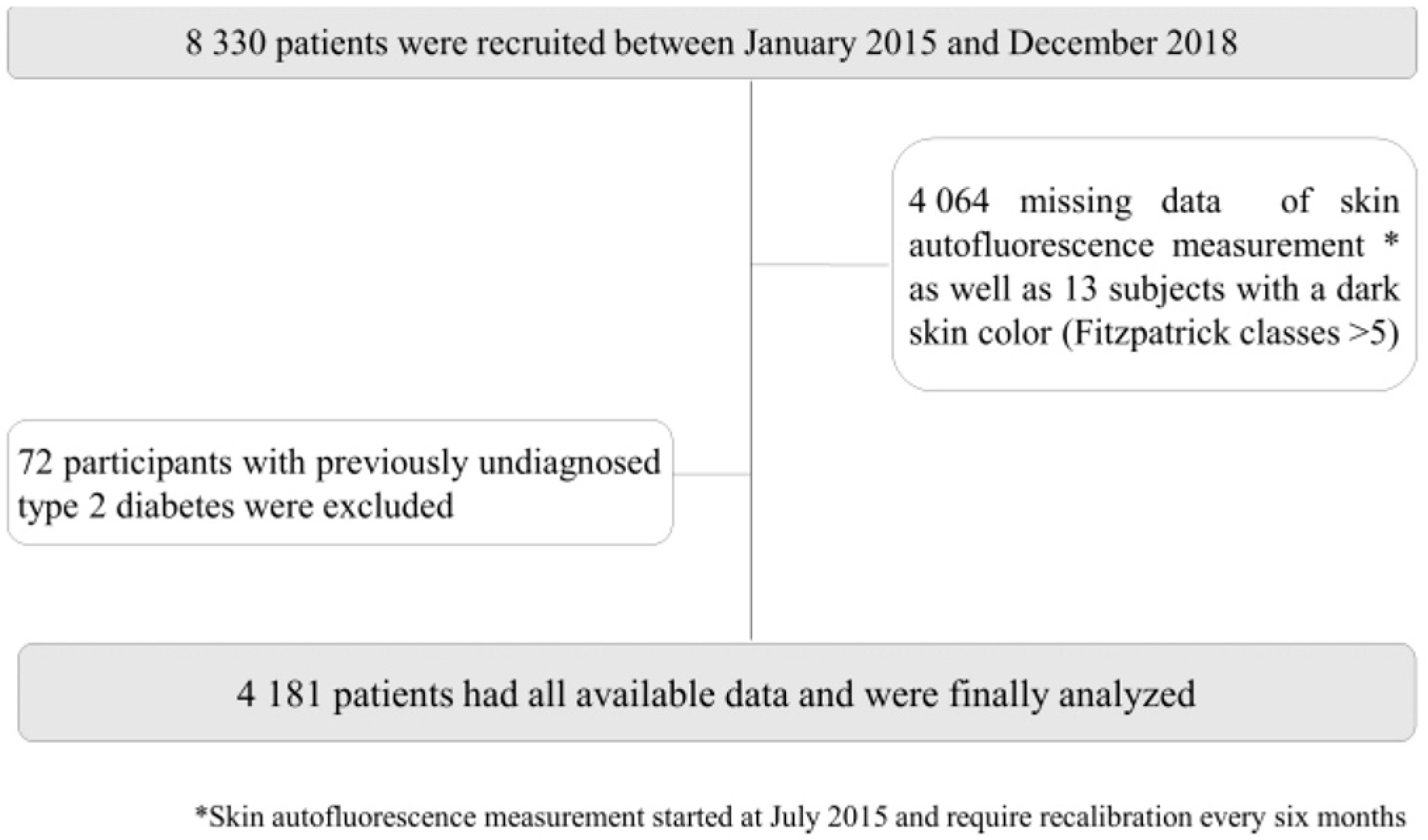


| Prediabetes (n = 1444) | Control Group (n = 2737) | |
|---|---|---|
| Age (years) | 59 [54; 64] | 56 [52; 62] |
| Women, n (%) | 827 (57.3) | 1268 (46.3) |
| BMI (kg/m2) | 29.5 [26.7; 33.1] | 27.7 [24.8; 30.8] |
| HbA1c (mmol/mol) | 40 [39; 42] | 36 [33; 37] |
| HbA1c (%) | 5.8 [5.7; 6.0] | 5.4 [5.2; 5.5] |
| Hypertension, n (%) | 684 (47.4) | 992 (36.2) |
| Dyslipidemia | 865 (59.9) | 1363 (49.8) |
| Obesity, n (%) | 581 (40.2) | 758 (27.7) |
| Current or former smoker, n (%) | 828 (57.3) | 1819 (66.5) |
| Prediabetes | OR (95% CI) | p Value | |
|---|---|---|---|
| Sex | Women | Reference | |
| Men | 1.34 (1.16 to 1.55) | <0.001 | |
| Age (years) | 1.04 (1.03 to 1.05) | <0.001 | |
| Body mass index (kg/m2) | 1.09 (1.07 to 1.10) | <0.001 | |
| Smoking status | Never | Reference | |
| Current or former | 1.08 (0.93 to 1.25) | 0.326 | |
| Skin autofluorescence (AU) | 0.97 (1.00 to 0.85) | 0.969 | |
| Hosmer–Lemeshow test of fit | 0.65 (0.64 to 0.67) | 0.002 <0.001 | |
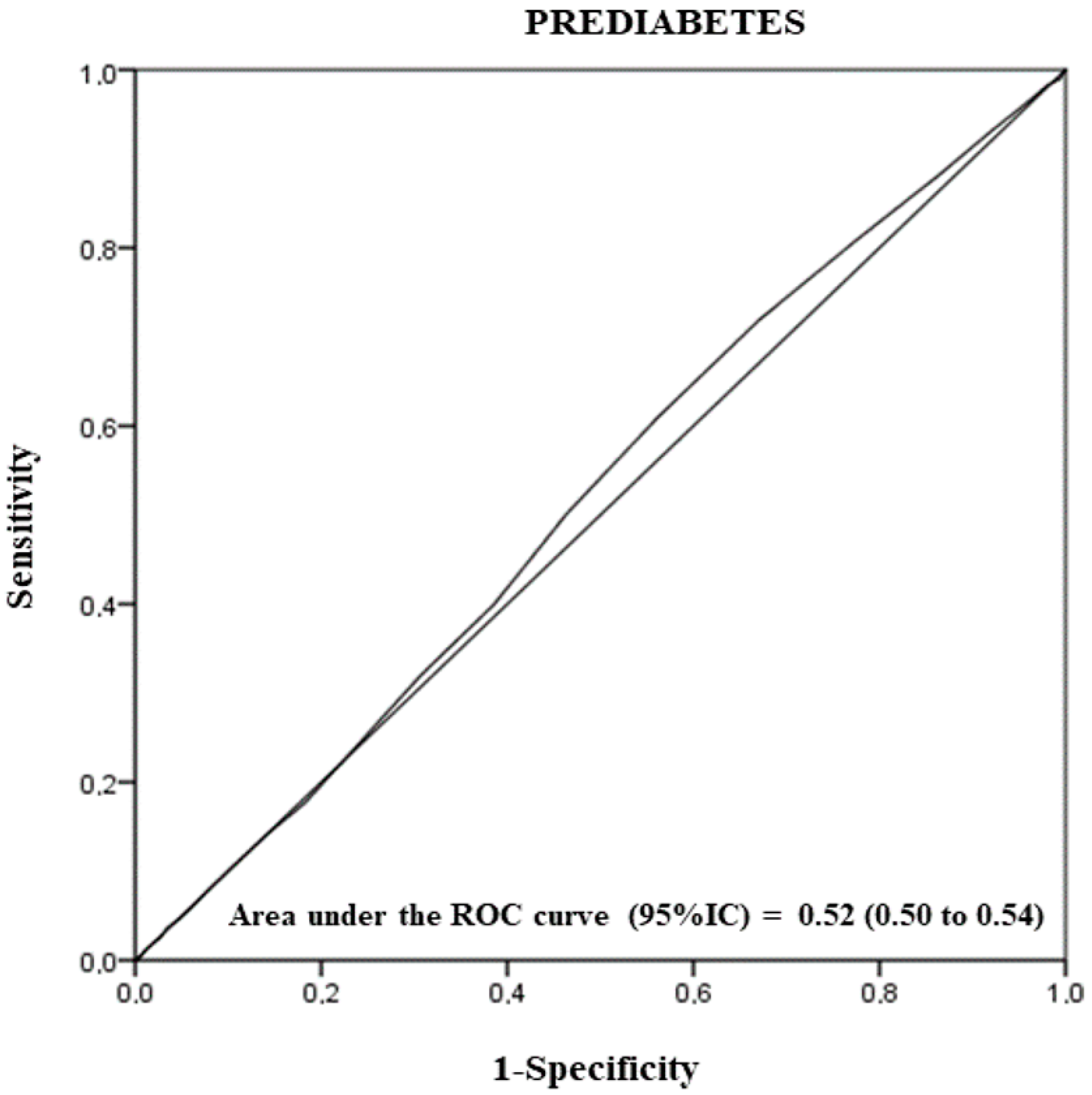
| Area under the ROC curve | |||
Publisher’s Note: MDPI stays neutral with regard to jurisdictional claims in published maps and institutional affiliations. |
© 2022 by the authors. Licensee MDPI, Basel, Switzerland. This article is an open access article distributed under the terms and conditions of the Creative Commons Attribution (CC BY) license (https://creativecommons.org/licenses/by/4.0/).
Share and Cite
Sánchez, E.; Kerkeni, M.; Hernández, M.; Gavaldà, R.; Rius, F.; Sauret, A.; Torres, G.; Bermúdez-López, M.; Fernández, E.; Castro-Boqué, E.; et al. Weak Association between Skin Autofluorescence Levels and Prediabetes with an ILERVAS Cross-Sectional Study. Nutrients 2022, 14, 1102. https://doi.org/10.3390/nu14051102
Sánchez E, Kerkeni M, Hernández M, Gavaldà R, Rius F, Sauret A, Torres G, Bermúdez-López M, Fernández E, Castro-Boqué E, et al. Weak Association between Skin Autofluorescence Levels and Prediabetes with an ILERVAS Cross-Sectional Study. Nutrients. 2022; 14(5):1102. https://doi.org/10.3390/nu14051102
Chicago/Turabian StyleSánchez, Enric, Mohsen Kerkeni, Marta Hernández, Ricard Gavaldà, Ferran Rius, Ariadna Sauret, Gerard Torres, Marcelino Bermúdez-López, Elvira Fernández, Eva Castro-Boqué, and et al. 2022. "Weak Association between Skin Autofluorescence Levels and Prediabetes with an ILERVAS Cross-Sectional Study" Nutrients 14, no. 5: 1102. https://doi.org/10.3390/nu14051102
APA StyleSánchez, E., Kerkeni, M., Hernández, M., Gavaldà, R., Rius, F., Sauret, A., Torres, G., Bermúdez-López, M., Fernández, E., Castro-Boqué, E., Purroy, F., Mauricio, D., Farràs-Sallés, C., Buti, M., Godoy, P., Pamplona, R., & Lecube, A., on behalf of the ILERVAS Project Collaborators. (2022). Weak Association between Skin Autofluorescence Levels and Prediabetes with an ILERVAS Cross-Sectional Study. Nutrients, 14(5), 1102. https://doi.org/10.3390/nu14051102