Article

Identifying Interactions between Dietary Sodium, Potassium, Sodium–Potassium Ratios, and FGF5 rs16998073 Variants and Their Associated Risk for Hypertension in Korean Adults


1
Department of Food and Nutrition, Inha University, 100 Inha-ro, Michuhol-gu, Incheon 22212, Korea
2
Department of Biomedical Laboratory Science, College of Life and Health Sciences, Hoseo University, Asan, Chungnam 31499, Korea
*
Author to whom correspondence should be addressed.
Nutrients 2020, 12(7), 2121; https://doi.org/10.3390/nu12072121
Submission received: 30 June 2020 / Revised: 12 July 2020 / Accepted: 14 July 2020 / Published: 17 July 2020
(This article belongs to the Special Issue Gene–Diet Interactions and Human Diseases)

Abstract

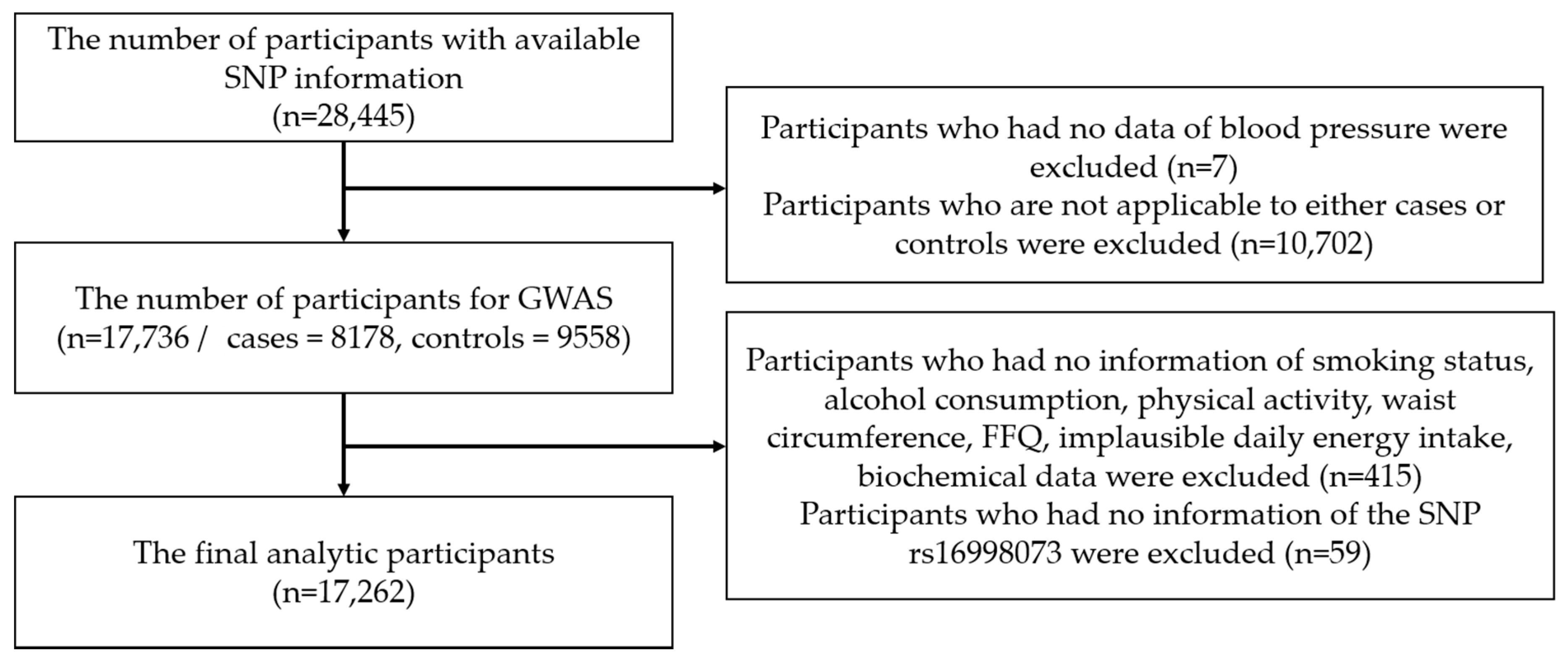
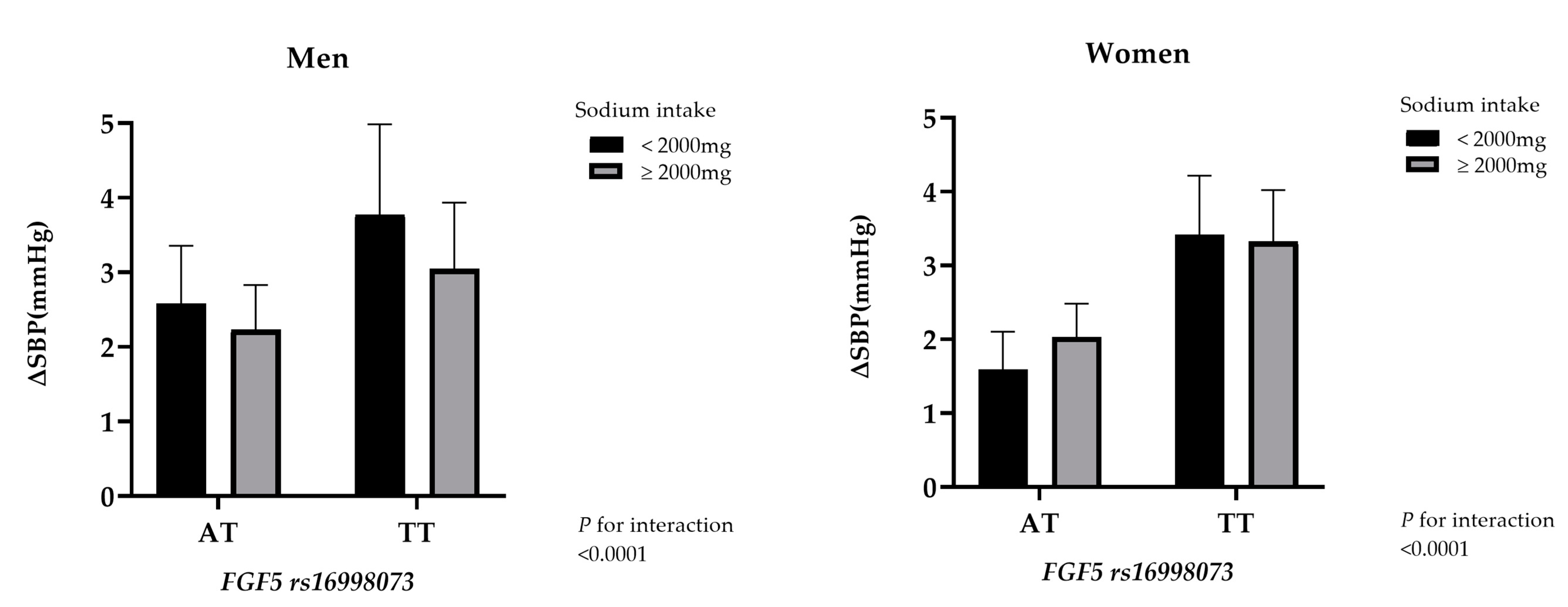
Hypertension is affected by both genetic and dietary factors. This study aimed to examine the interaction between dietary sodium/potassium intake, sodium–potassium ratios, and FGF5 rs16998073 and link these with increased risk for developing hypertension. Using data from the Health Examinee (HEXA) Study of the Korean Genome and Epidemiologic Study (KoGES), we were able to identify a total of 17,736 middle-aged Korean adults who could be included in our genome-wide association study (GWAS) to confirm any associations between hypertension and the FGF5 rs16998073 variant. GWAS analysis revealed that the FGF5 rs16698073 variant demonstrated the strongest association with hypertension in this population. Multivariable logistic regression was used to examine the relationship between dietary intake of sodium, potassium, and sodium–potassium ratios and the FGF5 rs16998073 genotypes (AA, AT, TT) and any increased risk of hypertension. Carriers with at least one minor T allele for FGF5 rs16998073 were shown to be at significantly higher risk for developing hypertension. Male TT carriers with a daily sodium intake ≥2000 mg also demonstrated an increased risk for developing hypertension compared to the male AA carriers with daily sodium intake <2000 mg (adjusted odds ratio (AOR) = 2.41, 95% confidence intervals (CIs) = 1.84–3.15, p-interaction < 0.0001). Female AA carriers with a daily potassium intake ≥3500 mg showed a reduced risk for hypertension when compared to female AA carriers with a daily potassium intake <3500 mg (AOR = 0.75. 95% CIs = 0.58–0.95, p-interaction < 0.0001). Male TT carriers in the mid-tertile for sodium–potassium ratio values showed the highest odds ratio for hypertension when compared to male AA carriers in the lowest-tertile for sodium–potassium ratio values (AOR = 3.03, 95% CIs = 2.14–4.29, p-interaction < 0.0001). This study confirmed that FGF5 rs16998073 variants do place their carriers (men and women) at increased risk for developing hypertension. In addition, we showed that high daily intake of sodium exerted a synergistic effect for hypertension when combined with FGF5 rs16998073 variants in both genders and that dietary sodium, potassium, and sodium–potassium ratios all interact with FGF5 rs16998073 and alter the risk of developing hypertension in carriers of either gender among Koreans.
Keywords: Korean Genome and Epidemiologic Study (KoGES); genetic variants; sodium; potassium; sodium-potassium ratios; hypertension Korean Genome and Epidemiologic Study (KoGES); genetic variants; sodium; potassium; sodium-potassium ratios; hypertension