Determination of Suitable Ecological Intervals for Arid Terminal Lakes via Multi-Source Remote Sensing: A “Morphometry–Security–Efficiency” Framework Applied to Ebinur Lake

 ,
,
Highlights
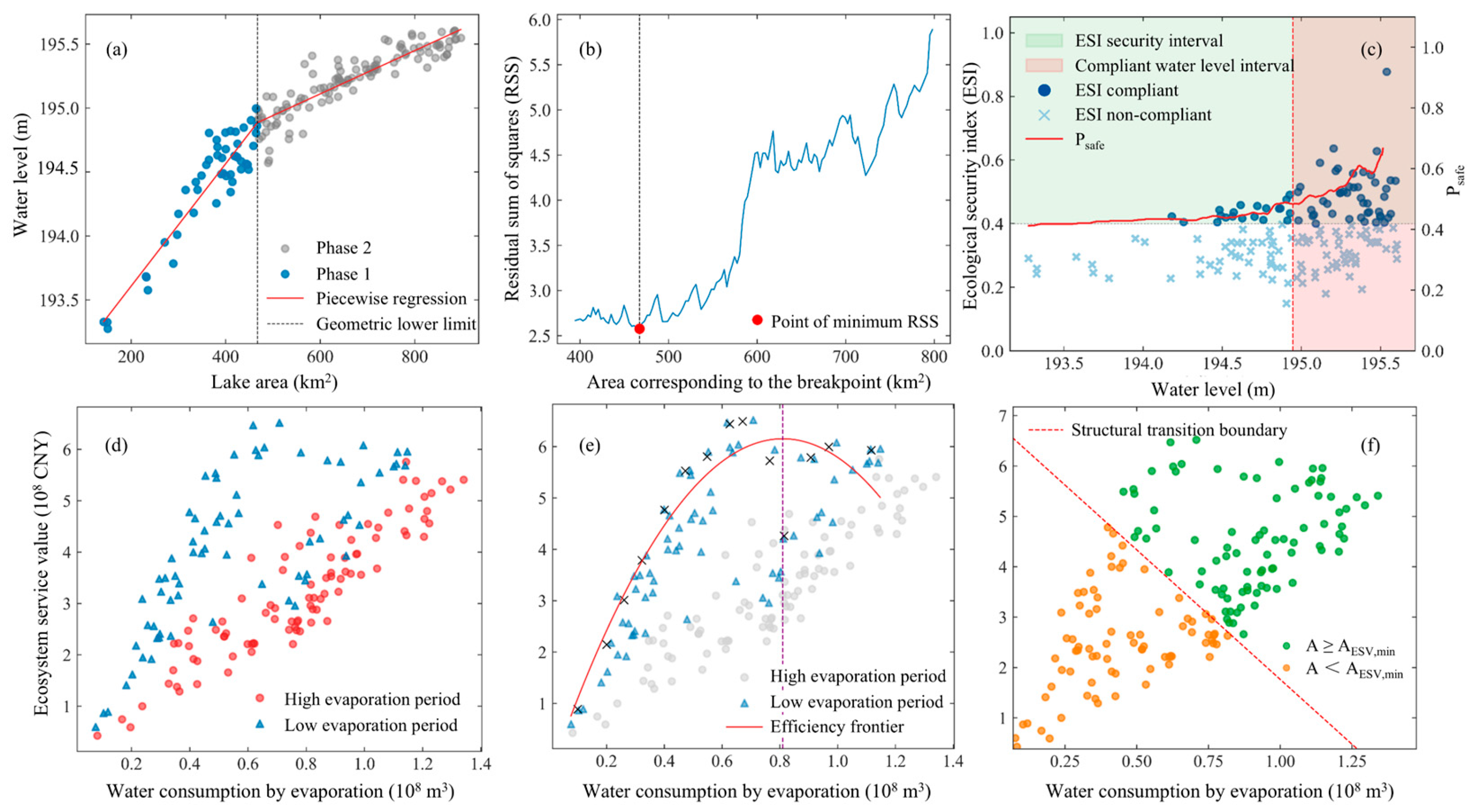
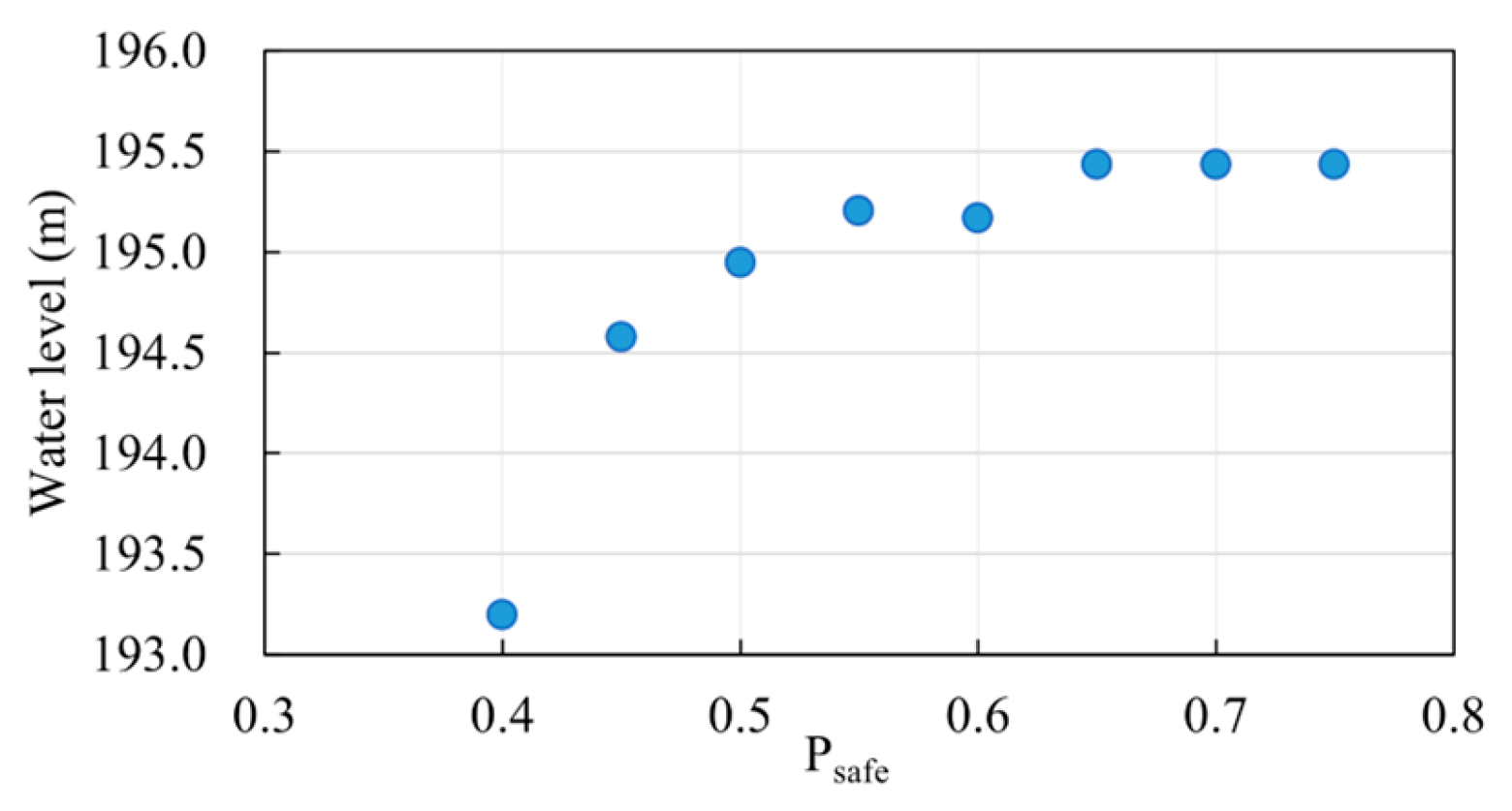
- A suitable ecological interval of 500–740 km2 for Ebinur Lake was quantitatively delineated by integrating lake basin morphometry, ecological security indices, and resource efficiency.
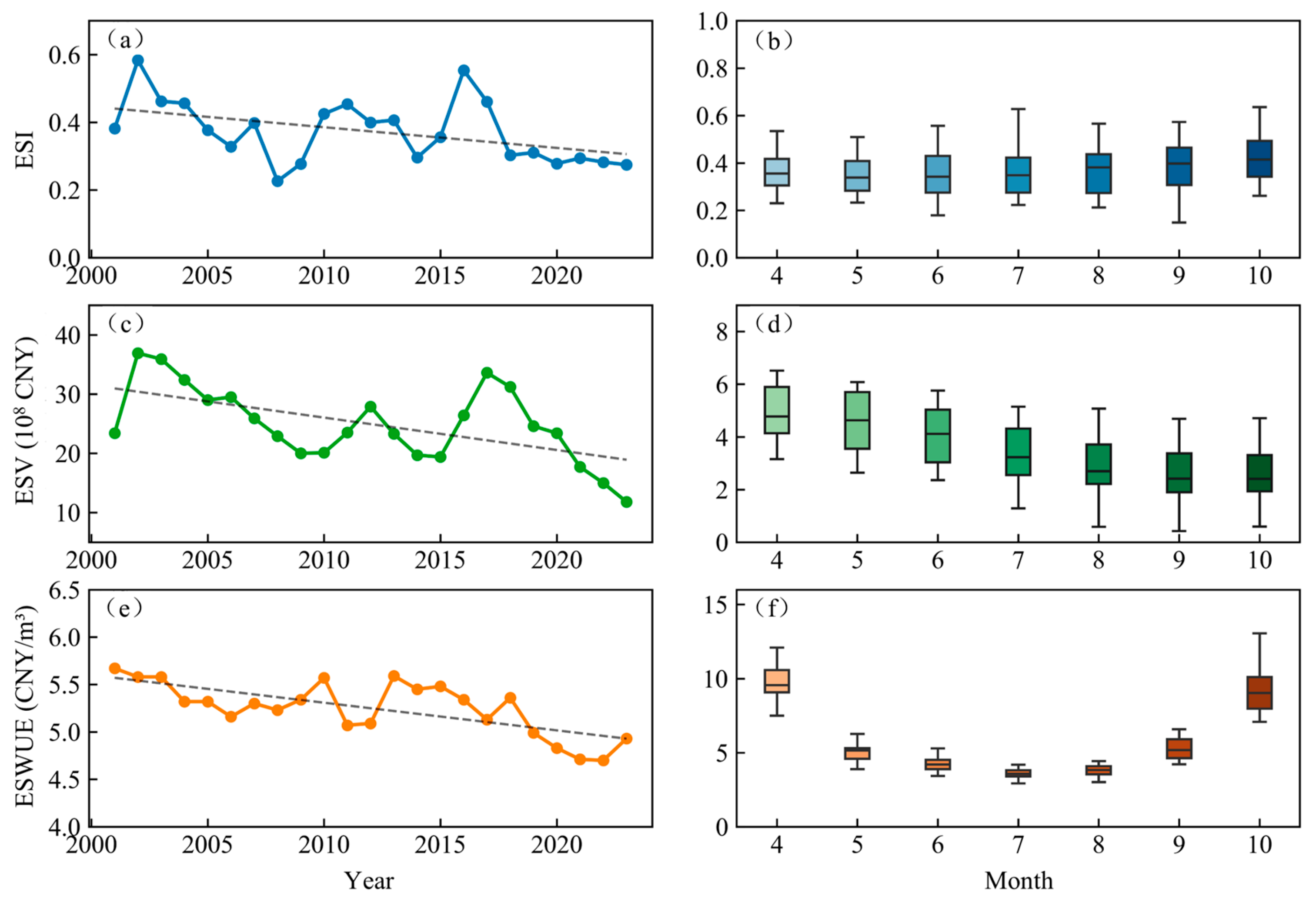
- Ecosystem service water use efficiency (ESWUE) exhibits a distinct seasonal peak in April (approx. 10 CNY/m3), significantly surpassing the summer trough.
- Implementing a “Spring Surplus and Autumn Deficit” dynamic regulation strategy allows for precise saline dust control during high-risk windy seasons while minimizing evaporation losses.
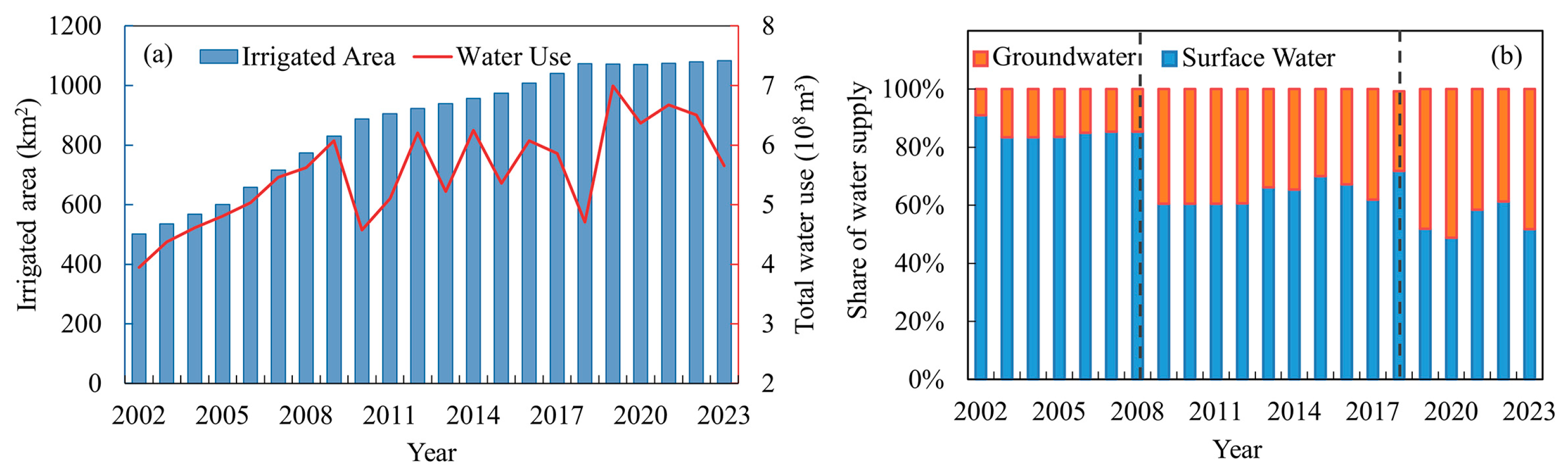
- Current water usage patterns result in a 40% failure rate against the minimum ecological baseline, necessitating the integration of local dynamic regulation with long-term cross-basin water transfer schemes.
Abstract
1. Introduction
2. Materials and Methods
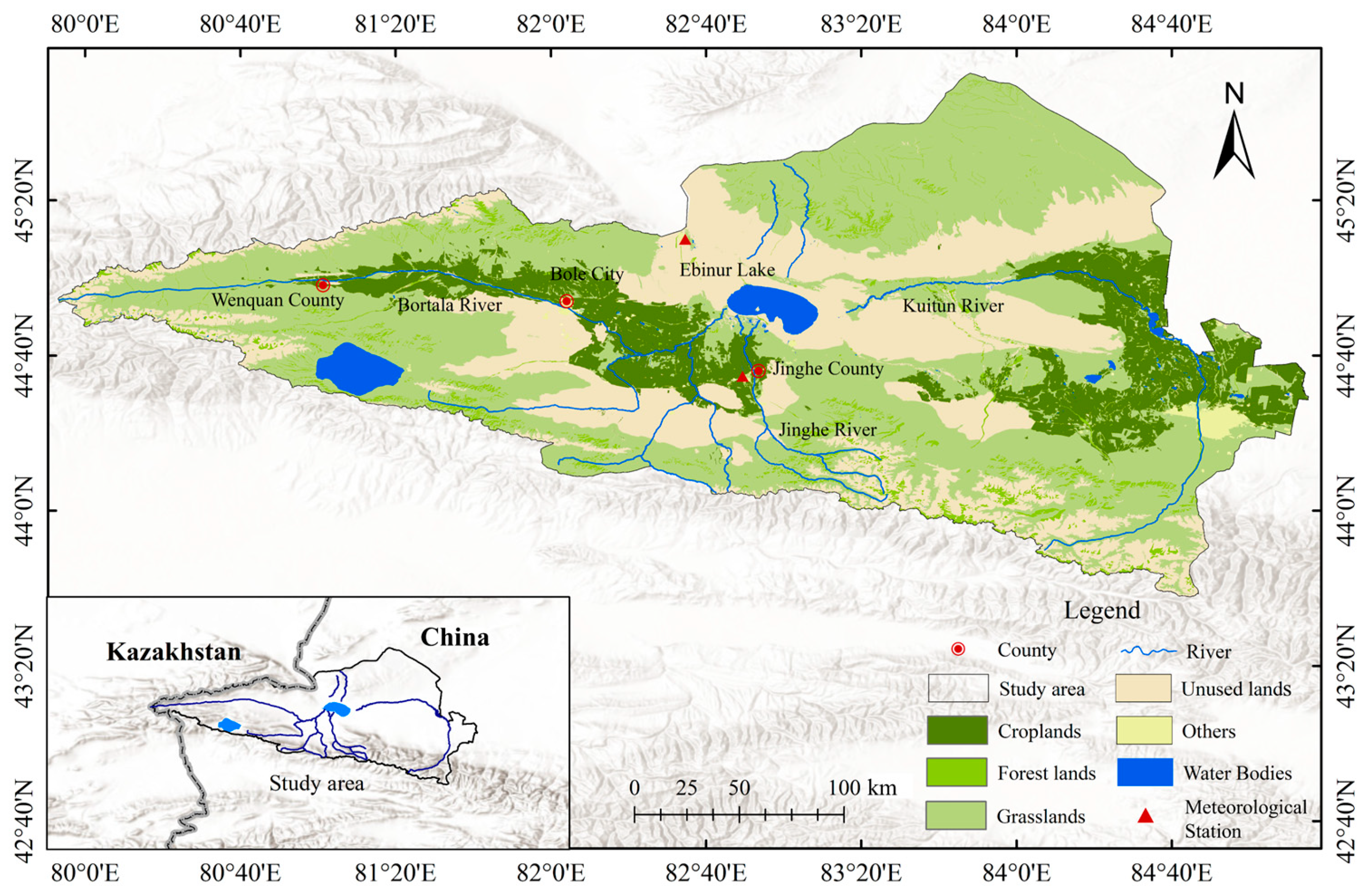
2.1. Study Area
2.2. Data
2.3. Methods
2.3.1. Remote Sensing Inversion of Lake Area and Water Level
2.3.2. Delineation of Suitable Ecological Area/Water Level Intervals
3. Results
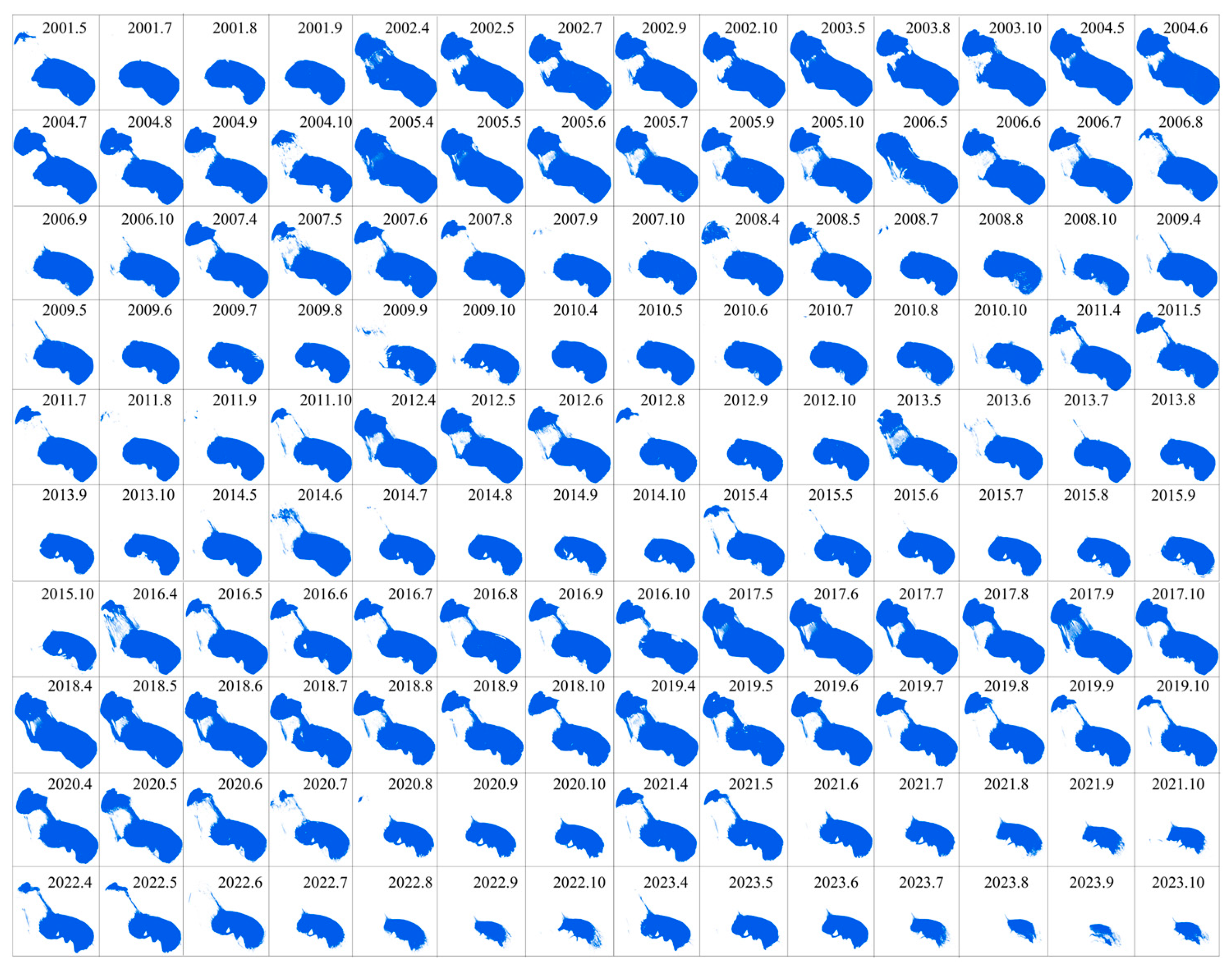
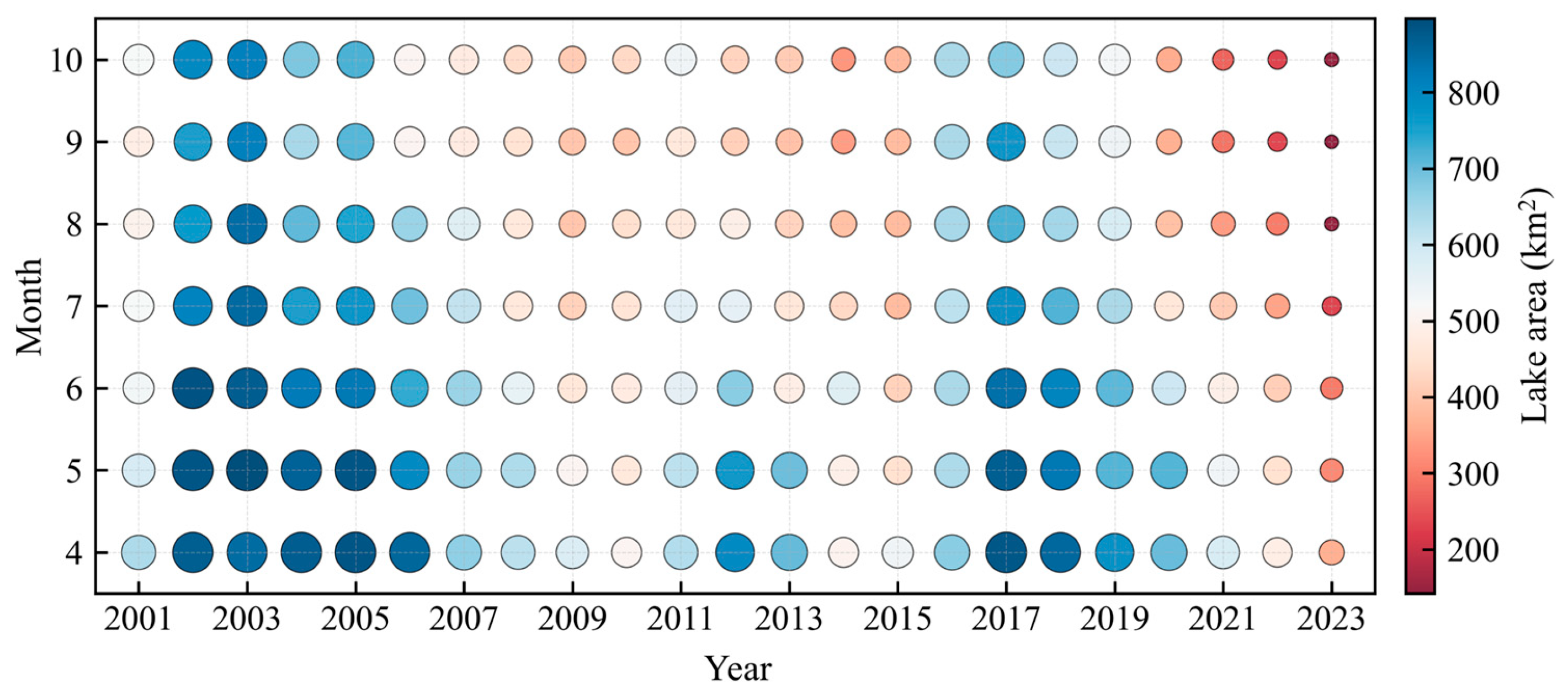
3.1. Spatiotemporal Evolutionary Characteristics of Lake Area and Water Level
3.2. Response Characteristics of Ecological Security and Service Value
3.3. Comprehensive Delineation of Multidimensional Suitable Ecological Intervals
4. Discussion
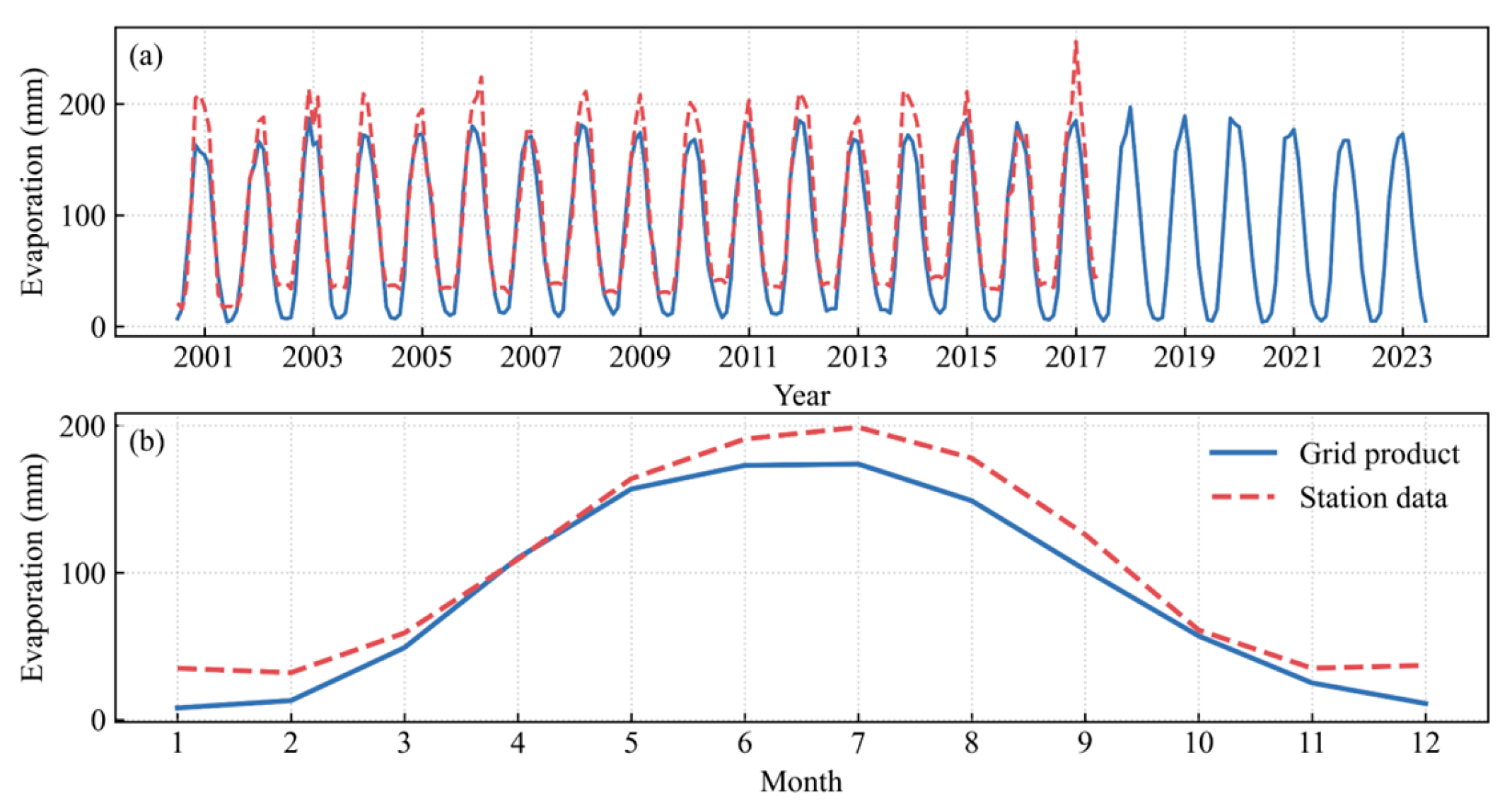
4.1. Reliability of Remote Sensing Inversion and Multidimensional Validation of Ecological Intervals
4.2. Ecological Response of the Lake Driven by Human Activities
4.3. Implications for Future Watershed Management
5. Conclusions
Author Contributions
Funding
Data Availability Statement
Conflicts of Interest
References
- Zeng, H.; Wu, B.; Zhu, W.; Zhang, N. A Trade-off Method between Environment Restoration and Human Water Consumption: A Case Study in Ebinur Lake. J. Clean. Prod. 2019, 217, 732–741. [Google Scholar] [CrossRef]
- Yang, X.; Gu, X.; Zhang, P.; Liu, J.; Zhang, W.; Long, A. Assessment of the Impacts of Climate and Land Use Changes on Water Yield in the Ebinur Lake Basin. Land 2024, 13, 1324. [Google Scholar] [CrossRef]
- Yang, X.; Lu, X. Drastic Change in China’s Lakes and Reservoirs over the Past Decades. Sci. Rep. 2014, 4, 6041. [Google Scholar] [CrossRef] [PubMed]
- Liu, H.; Yin, Y.; Piao, S.; Zhao, F.; Engels, M.; Ciais, P. Disappearing Lakes in Semiarid Northern China: Drivers and Environmental Impact. Environ. Sci. Technol. 2013, 47, 12107–12114. [Google Scholar] [CrossRef]
- Wei, Q.; Halike, A.; Yao, K.; Chen, L.; Balati, M. Construction and Optimization of Ecological Security Pattern in Ebinur Lake Basin Based on MSPA-MCR Models. Ecol. Indic. 2022, 138, 108857. [Google Scholar] [CrossRef]
- Ge, Y.; Abuduwaili, J.; Ma, L.; Wu, N.; Liu, D. Potential Transport Pathways of Dust Emanating from the Playa of Ebinur Lake, Xinjiang, in Arid Northwest China. Atmos. Res. 2016, 178–179, 196–206. [Google Scholar] [CrossRef]
- Wang, J.; Yang, S.; Lou, H.; Liu, H.; Wang, P.; Li, C.; Zhang, F. Impact of Lake Water Level Decline on River Evolution in Ebinur Lake Basin (an Ungauged Terminal Lake Basin). Int. J. Appl. Earth Obs. Geoinf. 2021, 104, 102546. [Google Scholar] [CrossRef]
- Lin, Q.; Xu, W. Analysis of the Effect of the Quantity of Inflow into Ebinur Lake on Its Ecological Security. Environ. Res. 2025, 266, 120517. [Google Scholar] [CrossRef]
- Ye, Z.; Chen, S.; Zhang, Q.; Liu, Y.; Zhou, H. Ecological Water Demand of Taitema Lake in the Lower Reaches of the Tarim River and the Cherchen River. Remote Sens. 2022, 14, 832. [Google Scholar] [CrossRef]
- Hao, X.; Zhao, Z.; Fan, X.; Zhang, J.; Zhang, S. Evaluation Method of Ecological Water Demand Threshold of Natural Vegetation in Arid-Region Inland River Basin Based on Satellite Data. Ecol. Indic. 2023, 146, 109811. [Google Scholar] [CrossRef]
- Shang, S.; Shang, S. Simplified Lake Surface Area Method for the Minimum Ecological Water Level of Lakes and Wetlands. Water 2018, 10, 1056. [Google Scholar] [CrossRef]
- Xiong, Y.; Xu, W.; Lu, N.; Huang, S.; Wu, C.; Wang, L.; Dai, F.; Kou, W. Assessment of Spatial–Temporal Changes of Ecological Environment Quality Based on RSEI and GEE: A Case Study in Erhai Lake Basin, Yunnan Province, China. Ecol. Indic. 2021, 125, 107518. [Google Scholar] [CrossRef]
- Yuan, B.; Fu, L.; Zou, Y.; Zhang, S.; Chen, X.; Li, F.; Deng, Z.; Xie, Y. Spatiotemporal Change Detection of Ecological Quality and the Associated Affecting Factors in Dongting Lake Basin, Based on RSEI. J. Clean. Prod. 2021, 302, 126995. [Google Scholar] [CrossRef]
- Xu, H.; Wang, Y.; Guan, H.; Shi, T.; Hu, X. Detecting Ecological Changes with a Remote Sensing Based Ecological Index (RSEI) Produced Time Series and Change Vector Analysis. Remote Sens. 2019, 11, 2345. [Google Scholar] [CrossRef]
- Zhao, G.; Li, Y.; Zhou, L.; Gao, H. Evaporative Water Loss of 1.42 Million Global Lakes. Nat. Commun. 2022, 13, 3686. [Google Scholar] [CrossRef]
- Zheng, Y.; Tian, Y.; Du, E.; Han, F.; Wu, Y.; Zheng, C.; Li, X. Addressing the Water Conflict between Agriculture and Ecosystems under Environmental Flow Regulation: An Integrated Modeling Study. Environ. Model. Softw. 2020, 134, 104874. [Google Scholar] [CrossRef]
- Zhang, Y.; Ling, H.; Yan, J.; Zhang, Y.; Qin, X. Determination of Water Surface Area Thresholds for Terminal Lakes in Arid Regions: Balancing Ecological Security and Water Use Efficiency. Water Resour. Manag. 2025, 39, 3801–3815. [Google Scholar] [CrossRef]
- Zhang, F.; Yushanjiang, A.; Jing, Y. Assessing and Predicting Changes of the Ecosystem Service Values Based on Land Use/Cover Change in Ebinur Lake Wetland National Nature Reserve, Xinjiang, China. Sci. Total Environ. 2019, 656, 1133–1144. [Google Scholar] [CrossRef]
- Tang, H.; Halike, A.; Yao, K.; Wei, Q.; Yao, L.; Tuheti, B.; Luo, J.; Duan, Y. Ecosystem Service Valuation and Multi-Scenario Simulation in the Ebinur Lake Basin Using a Coupled GMOP-PLUS Model. Sci. Rep. 2024, 14, 5071. [Google Scholar] [CrossRef]
- Teng, Y.; Xu, C.; Zhang, Y.; Su, M.; Zhang, Y.; Li, S.; Chen, Q.; Huang, Q. Ecosystem Service Water Use Efficiency: A New Perspective for Coordinating Ecosystem Services and Water Consumption in the Loess Plateau. J. Hydrol. Reg. Stud. 2025, 62, 102770. [Google Scholar] [CrossRef]
- Liu, Y.; Wang, Q.; Wang, D.; Si, Y.; Qi, T.; Duan, H.; Shen, M. Dynamic Changes and Driving Factors in the Surface Area of Ebinur Lake over the Past Three Decades. Remote Sens. 2024, 16, 3876. [Google Scholar] [CrossRef]
- Wang, J.; Ding, J.; Li, G.; Liang, J.; Yu, D.; Aishan, T.; Zhang, F.; Yang, J.; Abulimiti, A.; Liu, J. Dynamic Detection of Water Surface Area of Ebinur Lake Using Multi-Source Satellite Data (Landsat and Sentinel-1A) and Its Responses to Changing Environment. Catena 2019, 177, 189–201. [Google Scholar] [CrossRef]
- Miralles, D.G.; Bonte, O.; Koppa, A.; Baez-Villanueva, O.M.; Tronquo, E.; Zhong, F.; Beck, H.E.; Hulsman, P.; Dorigo, W.; Verhoest, N.E.C.; et al. GLEAM4: Global Land Evaporation and Soil Moisture Dataset at 0.1° Resolution from 1980 to near Present. Sci. Data 2025, 12, 416. [Google Scholar] [CrossRef] [PubMed]
- Zhang, Y.; Kong, D.; Gan, R.; Chiew, F.H.S.; McVicar, T.R.; Zhang, Q.; Yang, Y. Coupled Estimation of 500 m and 8-Day Resolution Global Evapotranspiration and Gross Primary Production in 2002–2017. Remote Sens. Environ. 2019, 222, 165–182. [Google Scholar] [CrossRef]
- Muñoz-Sabater, J.; Dutra, E.; Agustí-Panareda, A.; Albergel, C.; Arduini, G.; Balsamo, G.; Boussetta, S.; Choulga, M.; Harrigan, S.; Hersbach, H.; et al. ERA5-Land: A State-of-the-Art Global Reanalysis Dataset for Land Applications. Earth Syst. Sci. Data 2021, 13, 4349–4383. [Google Scholar] [CrossRef]
- Cui, L.; Xu, Z.; Chen, P.; Zhang, H.; Dong, W.; Huang, J. Analysis of Evaporation from Ebinur Lake. Water Resour. Prot. 2012, 28, 59–61+65. (In Chinese) [Google Scholar] [CrossRef]
- Li, M.; Liu, C.; Zhang, F.; Chan, N.W.; Adam, E.; Wang, W.; Wu, Y. Exploring the Causes of Severe Fluctuations in Water Surface Area Using Water Index and Structural Equation Modeling: Evidence from Ebinur Lake, China. Remote Sens. 2025, 17, 1431. [Google Scholar] [CrossRef]
- Otsu, N. A Threshold Selection Method from Gray-Level Histograms. IEEE Trans. Syst. Man Cybern. 1979, 11, 23–27. [Google Scholar] [CrossRef]
- Long, D.; Li, X.; Li, X.; Han, P.; Zhao, F.; Hong, Z.; Wang, Y.; Tian, F. Remote Sensing Retrieval of Water Storage Changes and Underlying Climatic Mechanisms over the Tibetan Plateau during 2000–2020. Adv. Water Sci. 2022, 33, 375–389. (In Chinese) [Google Scholar] [CrossRef]
- Li, X.; Long, D.; Huang, Q.; Han, P.; Zhao, F.; Wada, Y. High-Temporal-Resolution Water Level and Storage Change Data Sets for Lakes on the Tibetan Plateau during 2000–2017 Using Multiple Altimetric Missions and Landsat-Derived Lake Shoreline Positions. Earth Syst. Sci. Data 2019, 11, 1603–1627. [Google Scholar] [CrossRef]
- Sun, K.; He, W.; Shen, Y.; Yan, T.; Liu, C.; Yang, Z.; Han, J.; Xie, W. Ecological Security Evaluation and Early Warning in the Water Source Area of the Middle Route of South-to-North Water Diversion Project. Sci. Total Environ. 2023, 868, 161561. [Google Scholar] [CrossRef]
- Zhang, H.; Ling, H.; Chen, F. Determination of the Suitable Lake Surface Area of Typical Terminal Lakes in Arid Regions. Sustainability 2026, 18, 1411. [Google Scholar] [CrossRef]
- Kang, Z.; Ling, H.; Gong, Y.; Yan, J.; Han, F.; Shan, Q.; Zhang, G. The Precise Implementation of the Ecological Water Transfer Project Effectively Promotes the Enhancement of Desert Riparian Ecosystem Service Value in the Mainstream of Tarim River. Ecol. Indic. 2024, 169, 112914. [Google Scholar] [CrossRef]
- Xie, G.; Zhang, C.; Zhang, L.; Chen, W.; Li, S. Improvement of the Evaluation Method for Ecosystem Service Value Based on per Unit Area. J. Nat. Resour. 2015, 30, 1243–1254. (In Chinese) [Google Scholar] [CrossRef]
- Yueriguli, K.; Yang, S.; Zibibula, S. Impact of land use change on ecosystem service value in Ebinur Lake Basin, Xinjiang. Trans. Chin. Soc. Agric. Eng. 2019, 35, 260–269. (In Chinese) [Google Scholar] [CrossRef]
- Jiang, T.; Qu, Y.; Zhang, X.; Jing, L.; Feng, K.; Zhang, G.; Han, Y. Evaluating Ecological Drought Vulnerability from Ecosystem Service Value Perspectives in North China. Remote Sens. 2024, 16, 3733. [Google Scholar] [CrossRef]
- Xie, G.; Zhang, C.; Zhen, L.; Zhang, L. Dynamic Changes in the Value of China’s Ecosystem Services. Ecosyst. Serv. 2017, 26, 146–154. [Google Scholar] [CrossRef]
- Feyisa, G.L.; Meilby, H.; Fensholt, R.; Proud, S.R. Automated Water Extraction Index: A New Technique for Surface Water Mapping Using Landsat Imagery. Remote Sens. Environ. 2014, 140, 23–35. [Google Scholar] [CrossRef]
- Bao, A.; Mu, G.; Zhang, Y.; Feng, X.; Chang, C.; Yin, X. Estimation of the rational water area for controlling wind erosion in the dried-up basin of the Ebinur Lake and its effect detection. Chin. Sci. Bull. 2006, 51, 68–74. (In Chinese) [Google Scholar] [CrossRef]
- Jilili, A.; Mu, G. Eolian Factor in the Process of Modern Salt Accumulation in Western Dzungaria, China. Eurasian Soil Sci. 2006, 39, 367–376. [Google Scholar] [CrossRef]
- Foroumandi, E.; Nourani, V.; Kantoush, S.A. Investigating the Main Reasons for the Tragedy of Large Saline Lakes: Drought, Climate Change, or Anthropogenic Activities? A Call to Action. J. Arid Environ. 2022, 196, 104652. [Google Scholar] [CrossRef]
- Zhang, P.; Long, A.; Hai, Y.; Deng, X.; Wang, H.; Liu, J.; Li, Y. Spatiotemporal variations and driving forces of agricultural water consumption in Xinjiang during 1988–2015: Based on statistical analysis of crop water footprint. J. Glaciol. Geocryol. 2021, 43, 242–253. (In Chinese) [Google Scholar] [CrossRef]
- Deng, H.; Tang, Q.; Zhang, Z.; Liu, X.; Zhao, G.; Cui, S.; Zhang, Z.; Shao, S.; Liu, J.; Chen, F. Impact of Human Activities on the Long-Term Change and Seasonal Variability of Ebinur Lake, Northwest China. Sci. China Earth Sci. 2025, 68, 473–486. [Google Scholar] [CrossRef]
- Grafton, R.Q.; Williams, J.; Perry, C.J.; Molle, F.; Ringler, C.; Steduto, P.; Udall, B.; Wheeler, S.A.; Wang, Y.; Garrick, D.; et al. The Paradox of Irrigation Efficiency. Science 2018, 361, 748–750. [Google Scholar] [CrossRef] [PubMed]
- Xiong, R.; Zheng, Y.; Han, F.; Tian, Y. Improving the Scientific Understanding of the Paradox of Irrigation Efficiency: An Integrated Modeling Approach to Assessing Basin-Scale Irrigation Efficiency. Water Resour. Res. 2021, 57, e2020WR029397. [Google Scholar] [CrossRef]
- Mao, D.; Li, X.; Liu, W. The Research on the Impact of Cotton Support Policy on Water Saving Irrigation Development in Xinjiang. Water Sav. Irrig. 2017, 2, 85–89. (In Chinese) [Google Scholar]
- Xu, H.; Song, J. Drivers of the Irrigation Water Rebound Effect: A Case Study of Hetao Irrigation District in Yellow River Basin, China. Agric. Water Manag. 2022, 266, 107567. [Google Scholar] [CrossRef]
- Cai, W.; Jiang, X.; Sun, H.; Lei, Y.; Nie, T.; Li, L. Spatial Scale Effect of Irrigation Efficiency Paradox Based on Water Accounting Framework in Heihe River Basin, Northwest China. Agric. Water Manag. 2023, 277, 108118. [Google Scholar] [CrossRef]
- Liu, J.; Ding, J.; Bao, Q.; Zhang, Z.; Jiang, L.; Qu, Y. Characteristics of Groundwater in Ebinur Lake Basin Using Isotopes Method. Arid Land Geogr. 2023, 46, 201–210. (In Chinese). Available online: http://alg.xjegi.com/CN/10.12118/j.issn.1000-6060.2022.228.
- Li, X.; Liu, X.; Zhao, K.; Zhang, X.; Li, L. Change in the Potential Snowfall Phenology: Past, Present, and Future in the Chinese Tianshan Mountainous Region, Central Asia. Cryosphere 2023, 17, 2437–2453. [Google Scholar] [CrossRef]
- Yang, Z.; Bai, P.; Tian, Y.; Liu, X. Glacier Coverage Dominates the Response of Runoff and Its Components to Climate Change in the Tianshan Mountains. Water Resour. Res. 2025, 61, e2024WR037947. [Google Scholar] [CrossRef]





| Dataset | Temporal Resolution/ Revisit Time | Spatial Resolution/Grid Size | Temporal Coverage | Data Access |
|---|---|---|---|---|
| Landsat 5 | 16 days | 30–120 m | 1984–2013 | https://earthexplorer.usgs.gov/, accessed on 2 October 2025 |
| Landsat 7 | 16 days | 15–60 m | 1999–present | https://earthexplorer.usgs.gov/, accessed on 2 October 2025 |
| Landsat 8 | 16 days | 15–100 m | 2013–present | https://earthexplorer.usgs.gov/, accessed on 2 October 2025 |
| Sentinel-2 | 5 days | 10–60 m | 2015–present | https://dataspace.copernicus.eu/, accessed on 2 October 2025 |
| CLCD | Yearly | 30 m | 1990–2021 | https://zenodo.org/records/5816591, accessed on 5 October 2025 |
| ICESat | 91 days (repeat orbit; campaign-based) | 70 m (footprint) | 2003–2009 | https://nsidc.org/data/GLAH14, accessed on 4 October 2025 |
| ICESat-2 | 91 days | 13–17 m (footprint) | 2018–present | https://nsidc.org/data/ATL13, accessed on 4 October 2025 |
| CryoSat-2 | 369 days (repeat); 30-day sub-cycle | 0.3 km × 1.6 km (footprint, mode-dependent) | 2010–present | https://earth.esa.int/eogateway/catalog/cryosat-products, accessed on 4 October 2025 |
| GLEAM v4.2a | Daily | 0.1° | 1980–2024 | https://www.gleam.eu/, accessed on 10 October 2025 |
| PML_v2 | 8 days | 500 m | 2000–2023 | https://earthengine.openeo.org/v1.0/collections/CAS/IGSNRR/PML/V2_v018, accessed on 11 October 2025 |
| ERA5-Land | 1 h | 0.1° | 1950–present | https://doi.org/10.24381/cds.e2161bac, accessed on 14 October 2025 |
| Land Use Types | Description | ESV Coefficients |
|---|---|---|
| Water bodies | Water surfaces such as rivers and lakes (reservoirs/ponds) | 4,067,640 |
| Wetlands | Marshes, lakeshore wetlands, and hydrophytic vegetation | 3,924,831 |
| Forest lands | Natural forests, shrub forests, and open forest lands | 1,933,373 |
| Grasslands | Natural grasslands and grasslands across different vegetation cover | 640,560 |
| Unused lands | Deserts, saline–alkali lands, and bare | 37,140 |
| K | Inertia | Silhouette Score |
|---|---|---|
| 2 | 7.005 | 0.480 |
| 3 | 4.359 | 0.436 |
| 4 | 3.082 | 0.474 |
| 5 | 2.408 | 0.441 |
| 6 | 1.879 | 0.461 |
| 7 | 1.569 | 0.445 |
| 8 | 1.319 | 0.439 |
Disclaimer/Publisher’s Note: The statements, opinions and data contained in all publications are solely those of the individual author(s) and contributor(s) and not of MDPI and/or the editor(s). MDPI and/or the editor(s) disclaim responsibility for any injury to people or property resulting from any ideas, methods, instructions or products referred to in the content. |
© 2026 by the authors. Licensee MDPI, Basel, Switzerland. This article is an open access article distributed under the terms and conditions of the Creative Commons Attribution (CC BY) license.
Share and Cite
Liu, J.; Long, A.; Deng, M.; An, Q.; Zhang, J.; Luo, Q.; Sun, R. Determination of Suitable Ecological Intervals for Arid Terminal Lakes via Multi-Source Remote Sensing: A “Morphometry–Security–Efficiency” Framework Applied to Ebinur Lake. Remote Sens. 2026, 18, 771. https://doi.org/10.3390/rs18050771
Liu J, Long A, Deng M, An Q, Zhang J, Luo Q, Sun R. Determination of Suitable Ecological Intervals for Arid Terminal Lakes via Multi-Source Remote Sensing: A “Morphometry–Security–Efficiency” Framework Applied to Ebinur Lake. Remote Sensing. 2026; 18(5):771. https://doi.org/10.3390/rs18050771
Chicago/Turabian StyleLiu, Jing, Aihua Long, Mingjiang Deng, Qiang An, Ji Zhang, Qing Luo, and Rui Sun. 2026. "Determination of Suitable Ecological Intervals for Arid Terminal Lakes via Multi-Source Remote Sensing: A “Morphometry–Security–Efficiency” Framework Applied to Ebinur Lake" Remote Sensing 18, no. 5: 771. https://doi.org/10.3390/rs18050771
APA StyleLiu, J., Long, A., Deng, M., An, Q., Zhang, J., Luo, Q., & Sun, R. (2026). Determination of Suitable Ecological Intervals for Arid Terminal Lakes via Multi-Source Remote Sensing: A “Morphometry–Security–Efficiency” Framework Applied to Ebinur Lake. Remote Sensing, 18(5), 771. https://doi.org/10.3390/rs18050771