Article

Design and In-Orbit Validation of a Novel Compact Bidirectional Trapezoidal Reflector for X-Band Spaceborne SAR Absolute Radiometric Calibration


1
National Key Laboratory of Microwave Imaging, Aerospace Information Research Institute, Chinese Academy of Sciences, Beijing 100190, China
2
China Siwei Surveying and Mapping Technology Company, Ltd., Beijing 100190, China
*
Author to whom correspondence should be addressed.
Remote Sens. 2026, 18(5), 770; https://doi.org/10.3390/rs18050770
Submission received: 31 December 2025 / Revised: 19 February 2026 / Accepted: 28 February 2026 / Published: 3 March 2026
(This article belongs to the Section Satellite Missions for Earth and Planetary Exploration)

Highlights

What are the main findings?
  • A novel compact bidirectional trapezoidal CR is proposed for spaceborne SAR radiometric calibration to eliminate the need for CR alignment reorientations in the field while minimizing RCS loss as much as possible.
  • In-orbit validation demonstrates that the difference in calibration constants between the novel CR (non-aligned radiometric calibration method) and the TTCR (traditional aligned calibration method) meets the radiometric calibration accuracy requirement.
What are the implications of the main findings?
  • The novel CR significantly simplifies field operations and reduces labor dependency, making it suitable for the spaceborne SAR commissioning phase and long-term performance monitoring.
  • Its bidirectional configuration supports both ascending and descending satellite passes, effectively increasing the frequency of radiometric calibration and enhancing the data acquisition efficiency.

Abstract

Spaceborne synthetic aperture radar (SAR) absolute radiometric calibration relies on point targets with a known radar cross-section (RCS), such as triangular trihedral corner reflectors (TTCRs). Traditionally, radiometric calibration using TTCRs requires precise alignment of the corner reflector (CR) boresight to the radar line-of-sight (LOS), leading to frequent field operations and high labor dependency. In this study, a novel compact bidirectional trapezoidal CR is proposed to eliminate such alignment reorientations. The novel CR adopts three design considerations: a scalene shape to optimize the boresight elevation angle and enhance the peak RCS; a bidirectional configuration with azimuth fine-tuning to align with the radar LOS for both ascending and descending passes; and trapezoidal plate trimming to reduce the volume and weight without sacrificing RCS performance. An in-orbit validation is conducted in Xi’an, China, using the SuperView Neo 2-03 satellite. The results demonstrate that the imaging quality of the bidirectional trapezoidal CRs is comparable to that of conventional TTCRs, with all the parameters meeting system specifications. The radiometric calibration constant of the bidirectional trapezoidal CR differs from that of the conventional TTCR by no more than 0.27 dB, with a total uncertainty of ~0.33 dB (1σ)—demonstrating that it achieves equivalent radiometric calibration accuracy to TTCRs. The experiment confirms the feasibility and engineering applicability of the bidirectional trapezoidal CR for X-band SAR radiometric calibration.

1. Introduction

Spaceborne synthetic aperture radar (SAR) is an advanced active microwave imaging sensor capable of acquiring high-resolution Earth observation imagery independent of weather conditions and illumination constraints [1]. The intensity of SAR imagery directly reflects the backscattering intensity of targets, and distinct ground objects exhibit significantly different scattering characteristics, which provides a fundamental basis for quantitative remote sensing applications [2].
Absolute radiometric calibration is an essential prerequisite for the quantitative application of spaceborne SAR imagery [3], with its core objective being to establish an accurate relationship between the image digital number (DN) values and the radar cross-section (RCS) or backscattering coefficient of ground targets [4,5,6]. High-quality absolute radiometric calibration lays a reliable data foundation for quantitative applications such as surface parameter inversion and change detection [7,8].
Artificial targets with precisely known scattering properties are the most common reference targets for SAR absolute radiometric calibration [9,10]. Among these, the triangular trihedral corner reflector (TTCR) has gained extensive adoption due to its stable RCS performance, simplistic structure, low manufacturing cost, and no requirement for an external power supply (excluding remote-controlled TTCR) [11].
Traditionally, during radiometric calibration with TTCRs, precise alignment of the reflector boresight to the radar line-of-sight (LOS) is required [12]. The nominal RCS of the reflector is the theoretical maximum value derived by the Geometrical Optics (GO) method [13]. The core purpose of this boresight alignment is to ensure the reflector achieves its maximum RCS, thereby avoiding attenuation of the reflected signal strength that would degrade the Signal-to-Clutter Ratio (SCR) [14]. Consequently, operator presence and manual reorientation of the reflector are required during both the initial commissioning phase and the subsequent long-term performance monitoring phase [10,12].
In recent years, to minimize field operations, spaceborne SAR systems such as CSG (COSMO-SkyMed Second Generation) have begun adopting a fixed-pointing strategy (without TTCR pointing alignment) [15]. Concurrently, driven by the CEOS (Committee on Earth Observation Satellites) SARCalNet initiative [16,17], an increasing number of permanently deployed corner reflectors (CRs)—which will not be revisited or reoriented over the long term [12]—are being incorporated into a global shared network to support calibration and validation missions for different satellites.
The feasibility of this fixed-pointing strategy primarily relies on two factors: firstly, with the improvement in SAR spatial resolution, the required RCS for a calibration target is relaxed under a given SCR [18]; and secondly, the RCS of the CR at any observation angle can be accurately calculated through electromagnetic simulations [19,20]. However, a fixed-pointing TTCR can only effectively support either ascending or descending passes, resulting in restricted calibration frequency and reduced data acquisition efficiency.
To address the limitation of the TTCR with a single observation direction, various multi-directional CRs have been developed, typically including bidirectional CRs, quad CRs, and octahedral CRs [21,22]. Although quad CRs (four-unit azimuthally full-coverage configuration) and octahedral CRs (eight-unit spherical full-coverage configuration) offer a wider observation range [21], constrained by satellite orbital characteristics, the azimuth angles of the radar LOS for ascending and descending passes are not strictly 180° oppositely distributed [23]. Precise alignment with one orbital direction tends to result in a misalignment of tens of degrees in the other direction, leading to unacceptable RCS loss. Consequently, such reflectors are more suitable for geometric calibration or interferometric calibration and cannot meet the accuracy requirements of absolute radiometric calibration.
A bidirectional CR consists of two independent TTCR units deployed in a face-to-face or back-to-back manner at a fixed elevation angle [22,24,25]. In this design, the two units are mutually independent, resulting in insufficient overall structural compactness. Each unit possesses its own phase center, leading to additional Global Navigation Satellite System (GNSS) measurements of the CR phase center and potential geometric errors for SAR geometric and interferometric calibration. Additionally, electromagnetic interference between the two units exists in the face-to-face configuration, which may potentially affect the stability of the scattering characteristics [22].
To sum up, current reflectors struggle to fully meet three critical requirements simultaneously:
  • Minimizing or eliminating the need for CR alignment reorientations in the field
  • Supporting both ascending and descending satellite passes
  • Featuring a compact physical size and a simplified mechanical structure
To address these requirements, based on the optimization of the conventional TTCR, a novel compact bidirectional trapezoidal CR is proposed herein. Designed to simplify field operations and reduce labor dependency, this reflector conforms to the “plug-and-play” trend of calibration targets [15] while fulfilling the three requirements outlined above.
The structure of this paper is as follows. Section 2 elaborates on the design considerations and performance characteristics of the novel compact bidirectional trapezoidal CR. Section 3 and Section 4 detail the experimental setup, data processing procedures, and experimental results based on X-band SuperView Neo 2-03 (SVN2-03) satellite data [26]. Section 5 and Section 6 present the discussion and conclusions, respectively.

2. Design Considerations

2.1. Scalene Shape Design for Boresight Elevation Optimization

In this subsection, a special scalene shape design is considered first for boresight elevation optimization.
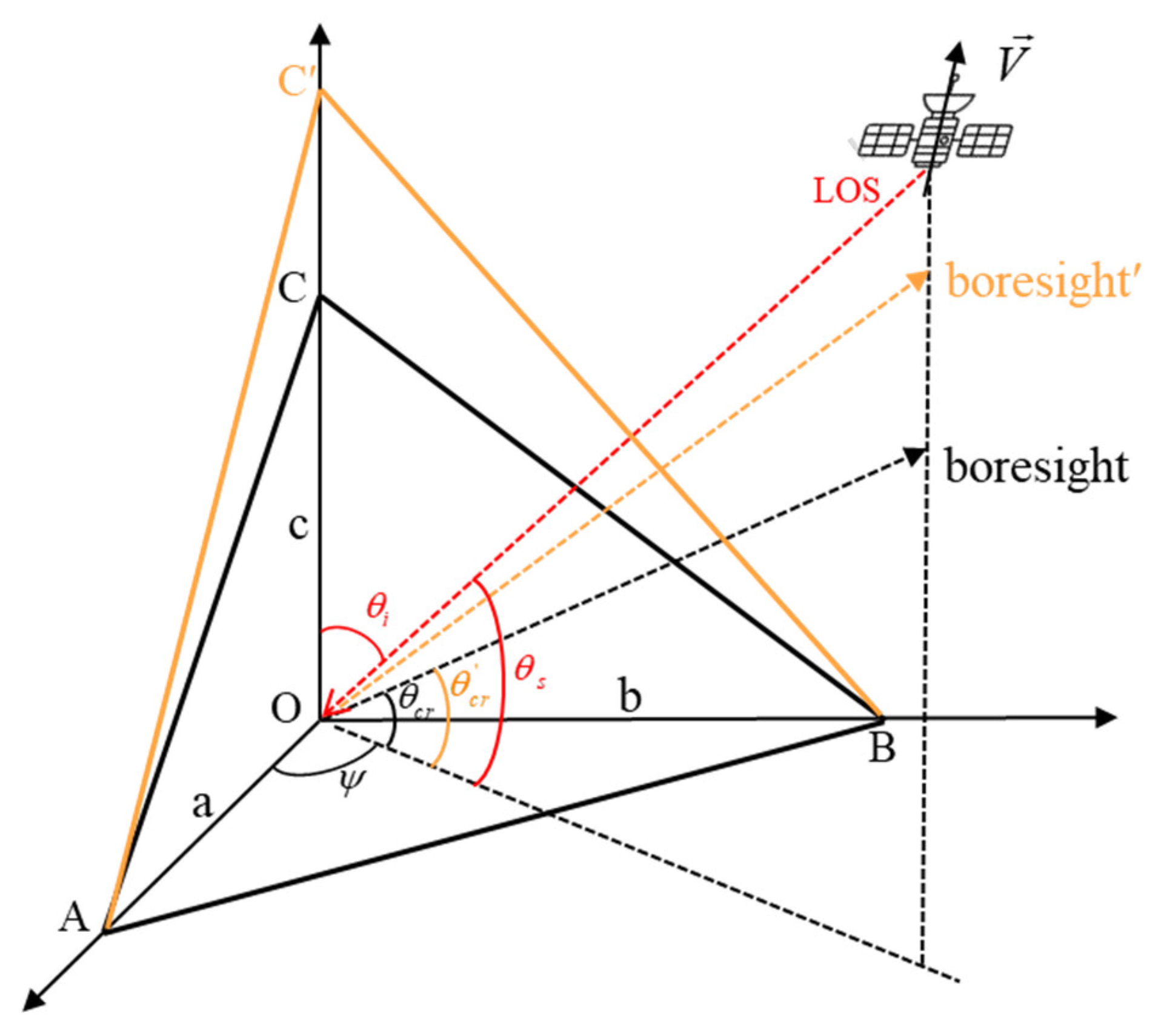
A TTCR is comprised of three orthogonal isosceles right triangular plates with three inner legs of equal dimension (black line in Figure 1), i.e., OA = OB = OC or a = b = c, where a, b, and c represent the dimensions of legs OA, OB, and OC, respectively. The boresight of a TTCR is the vector along which the maximum RCS exists [12]. It is oriented midway between the two vertical plates (defined as the boresight azimuth angle ψ = 45 ° ) and elevated 35.26° from the baseplate (defined as the boresight elevation angle θ c r ) [12]. However, the incident angle θ i of spaceborne SAR generally ranges from 20° (at the near range) to 50° (at the far range) [27]. The incident angle and the grazing angle θ s are complementary to each other, so the boresight elevation angle of the TTCR lies at the upper boundary of this incident angle range. Consequently, for most typical SAR incident angles, particularly those approaching 20°, a significant misalignment will occur between the TTCR boresight and the radar LOS in elevation, which in turn results in a non-negligible RCS loss. Therefore, in traditional calibration operations, it is usually necessary to manually adjust the mounting elevation angle of the TTCR to align its boresight with the radar LOS in elevation.
To eliminate the need for manual elevation angle adjustment, the ideal scenario is that when the CR is horizontally mounted (i.e., at a 0° mounting elevation angle), its boresight falls as close as possible to the mid-range of the typical SAR incident angle range, thus minimizing the RCS loss within the typical SAR incident angle.
It has been found that the CR boresight elevation angle varies with the ratio of its inner leg dimensions (orange line in Figure 1). According to the RCS formulation for the scalene trihedral CR [28]:
σ θ c r , ψ = 4 π λ 2 ( 2 l m + 2 m n + 2 n l l 2 m 2 n 2 l + m + n ) 2 ,   l + m n 4 π λ 2 ( 4 l m l + m + n ) 2 ,   l + m n
where
l = min ( b c cos θ c r cos ψ , a c cos θ c r sin ψ , a b sin θ c r ) m = mid ( b c cos θ c r cos ψ , a c cos θ c r sin ψ , a b sin θ c r ) n = max ( b c cos θ c r cos ψ , a c cos θ c r sin ψ , a b sin θ c r )
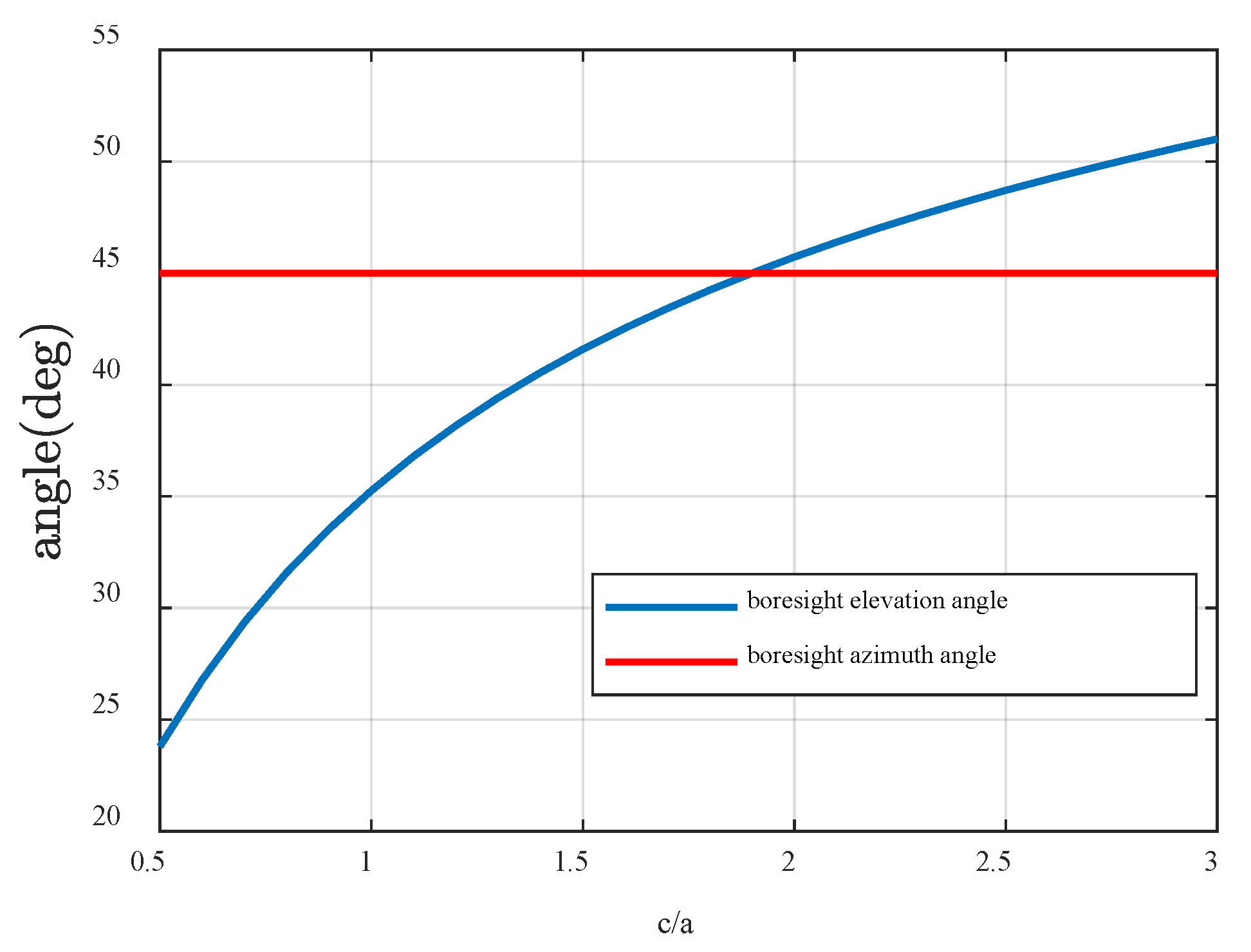
the variations of the boresight elevation angle θ c r and the boresight azimuth angle ψ with the ratio c / a (where the inner leg dimensions are defined as OA = OB = a and OC = c ) were simulated. The result, presented in Figure 2 demonstrates that θ c r increases as the c / a increases while ψ remains unchanged. Consequently, selecting an appropriate c / a can effectively increase the boresight elevation angle.

2.2. Bidirectional Configuration for Dual-Orbit Adaptation

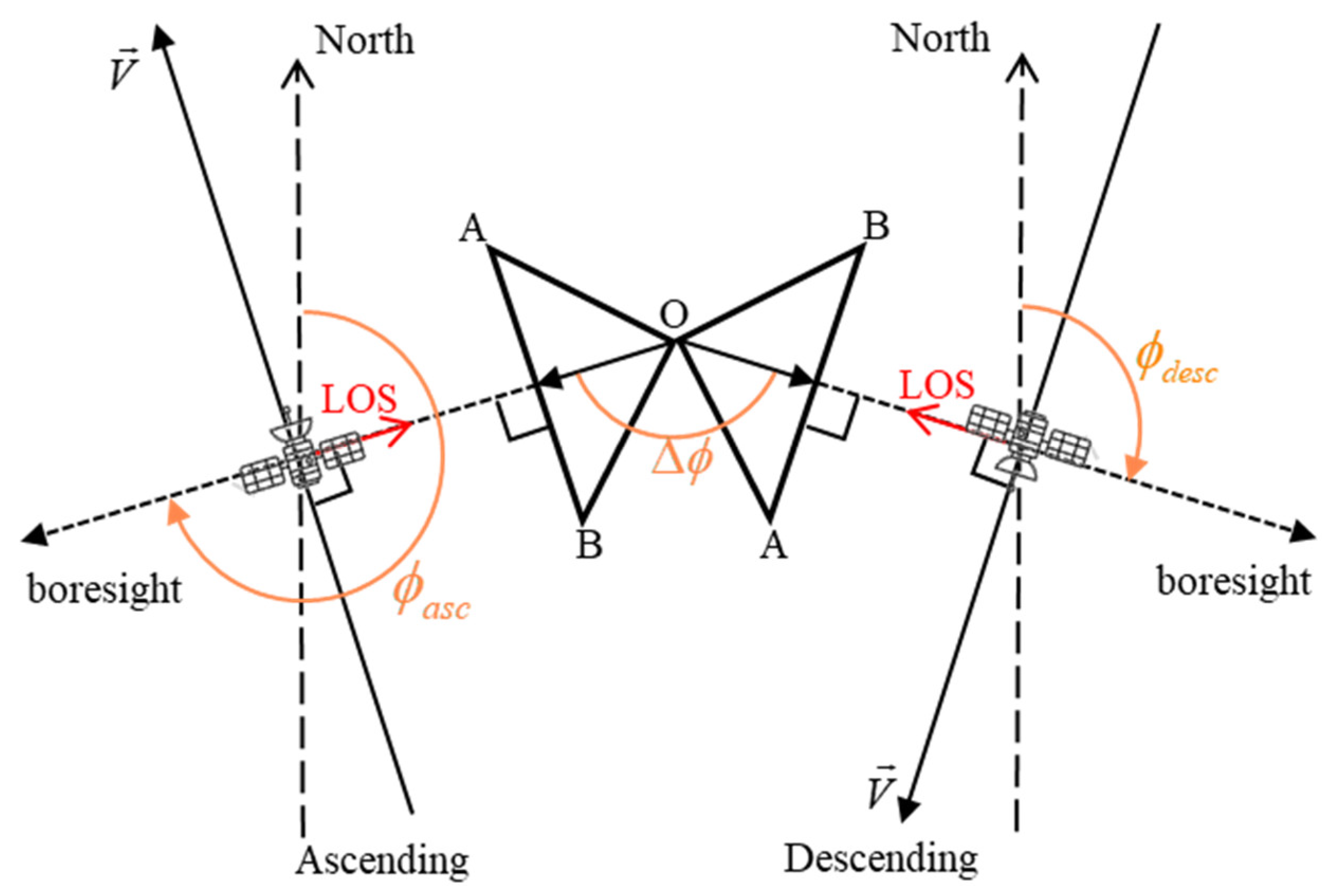
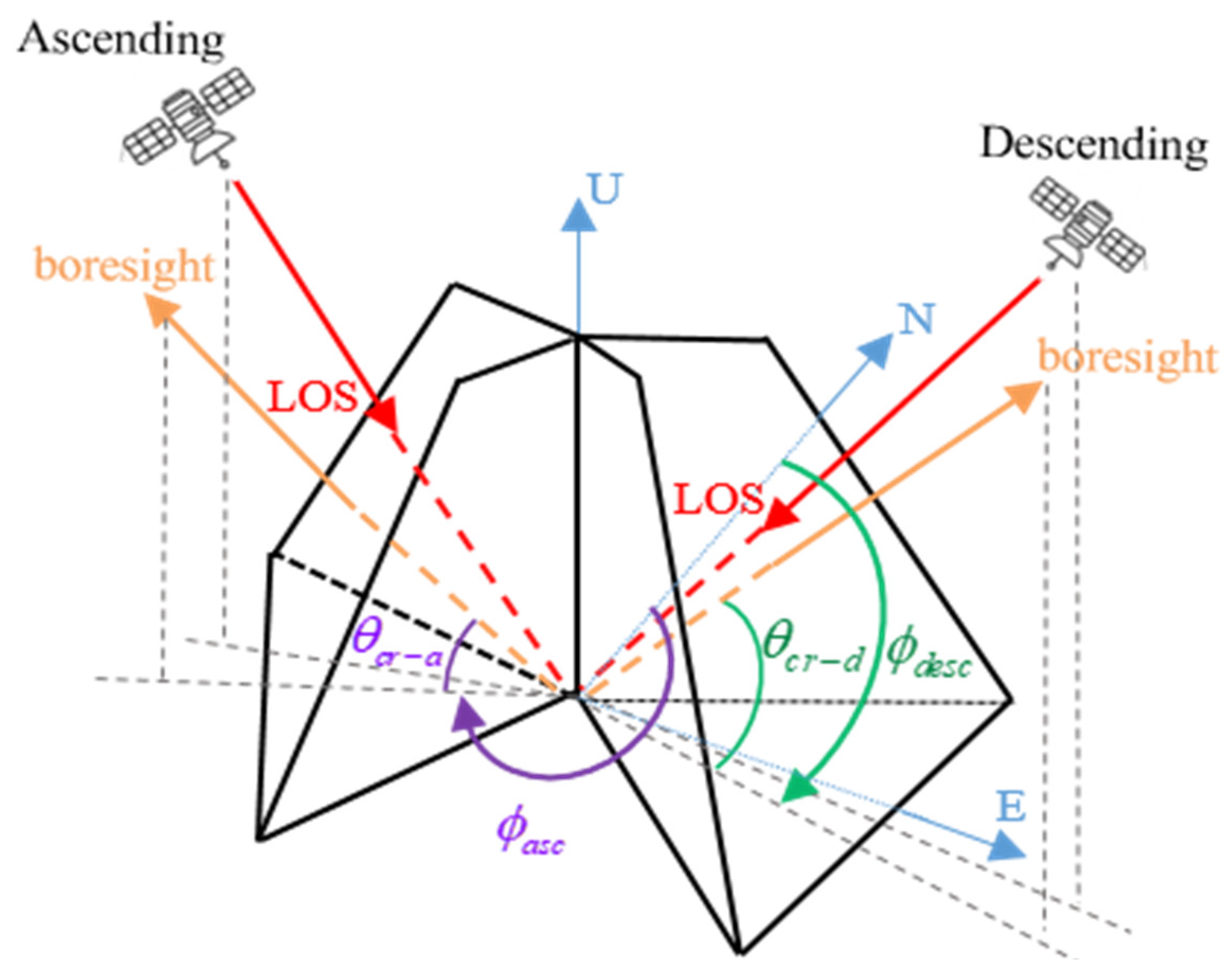
In traditional calibration operations, it is also necessary to reorient the azimuth angle of CR ϕ (defined as the angle between the horizontal projection of the boresight and the north direction) to align it with the azimuth of the radar LOS. Typically, the SAR sensor LOS on each satellite is orthogonal to and right looking with respect to the flight direction vector, though some missions have an additional left-looking capability [12]. Therefore, as illustrated in Figure 3, the CR should be oriented westward for satellite ascending passes and eastward for descending passes. Moreover, the azimuth angles of CR for the ascending and descending passes (denoted as ϕ a s c and ϕ d e s c , respectively) are mainly dependent on both the TTCR geographic latitude ξ and the satellite orbital inclination α , which can be approximated by the following simplified expression [29]:
ϕ a s c = arcsin ( cos α cos ξ ) + 270 ϕ d e s c = arcsin ( cos α cos ξ ) + 90
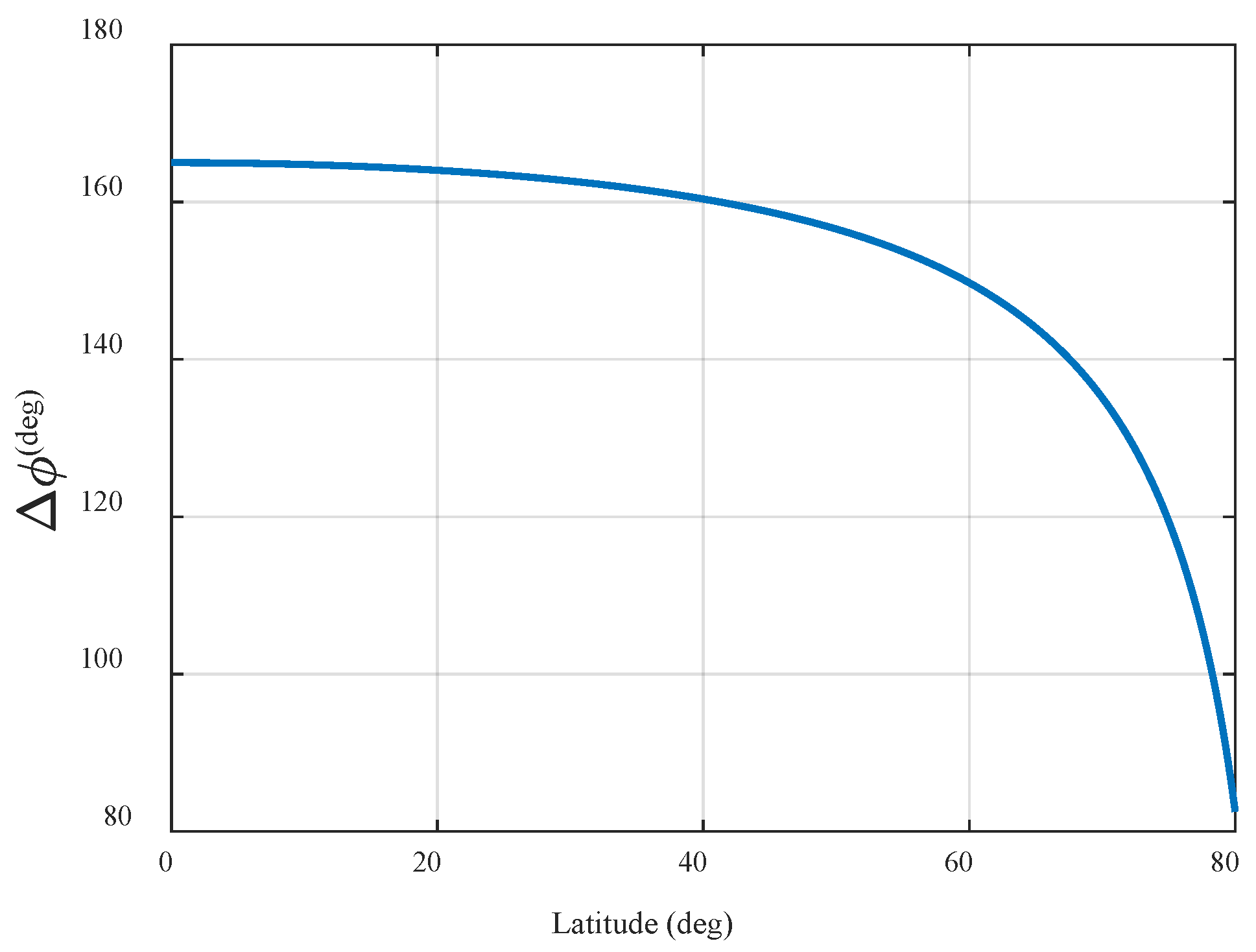
The angular separation between these two azimuth angles is denoted as Δ ϕ = ϕ a s c ϕ d e s c . For a satellite with an orbital inclination of 97.5°, the variation of Δ ϕ with geographic latitude ξ is presented in Figure 4. It can be observed that Δ ϕ is generally less than 180° and decreases with increasing ξ . For instance, at a latitude of 40°N, Δ ϕ is approximately 160°.
Based on the above analysis, to support both ascending and descending pass observations while eliminating the need for manual azimuth adjustment, it is necessary to install two reflector units with different orientations at the same calibration site. However, conventional multi-directional CRs (e.g., bidirectional CRs with 180° opposing orientations and quad CRs) are not ideal choices. Taking the aforementioned Δ ϕ = 160 ° as an example, if one reflector unit is precisely aligned with the satellite LOS for the ascending pass, the azimuth angle misalignment of the other unit for the descending pass can reach up to 20°. This 20° misalignment is half the 3 dB RCS beamwidth of TTCR, resulting in a 3 dB RCS loss.
To address this issue, a bidirectional configuration with azimuth fine-tuning capability is adopted. The two reflector units can rotate horizontally around the OC axis. During field deployment, their azimuth angles are pre-adjusted to align with the radar LOS in the azimuth plane for ascending and descending passes, respectively, thereby maximizing the utilization of the CR RCS. Furthermore, this configuration enables the two reflector units to share a common phase center, a feature crucial for geometric and interferometric calibration. It can reduce both the workload and the errors associated with GNSS measurements of the CRs.

2.3. Trapezoidal Trimming Design for Compactness Enhancement

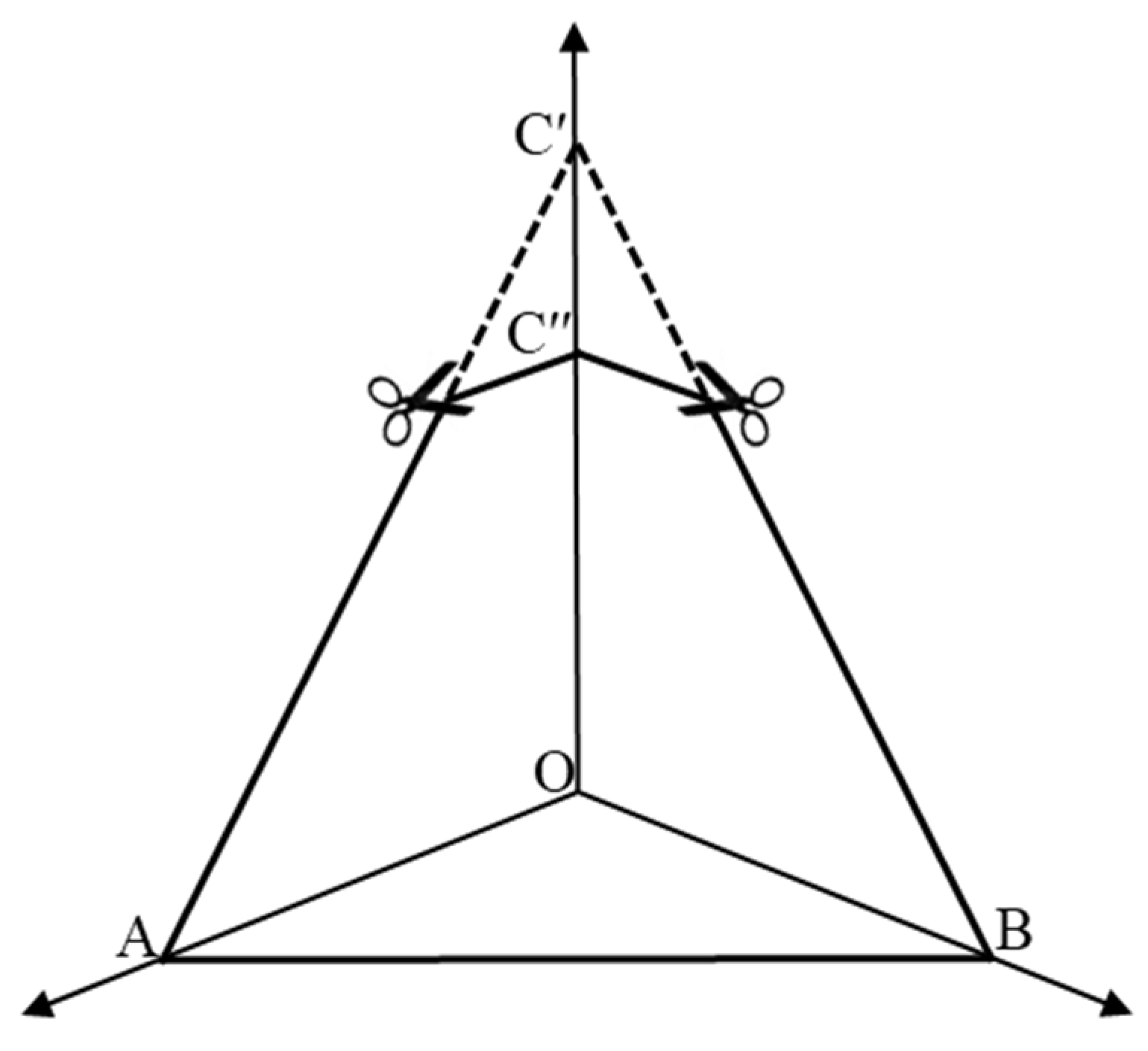
Although increasing the inner leg dimension ratio ( c / a > 1 ) of a scalene trihedral CR can increase its boresight elevation angle to adapt to the SAR incident angle range through scalene shape design instead of manual alignment, it also results in an increase in volume and weight. Considering that the region near the vertex C of the scalene CR contributes minimally to the peak RCS, as predicted and formulated by [13,22], we truncated this area along planes parallel to the baseplate, forming a trapezoidal CR, which consists of two trapezoidal plates and one isosceles right triangular baseplate, as illustrated in Figure 5.
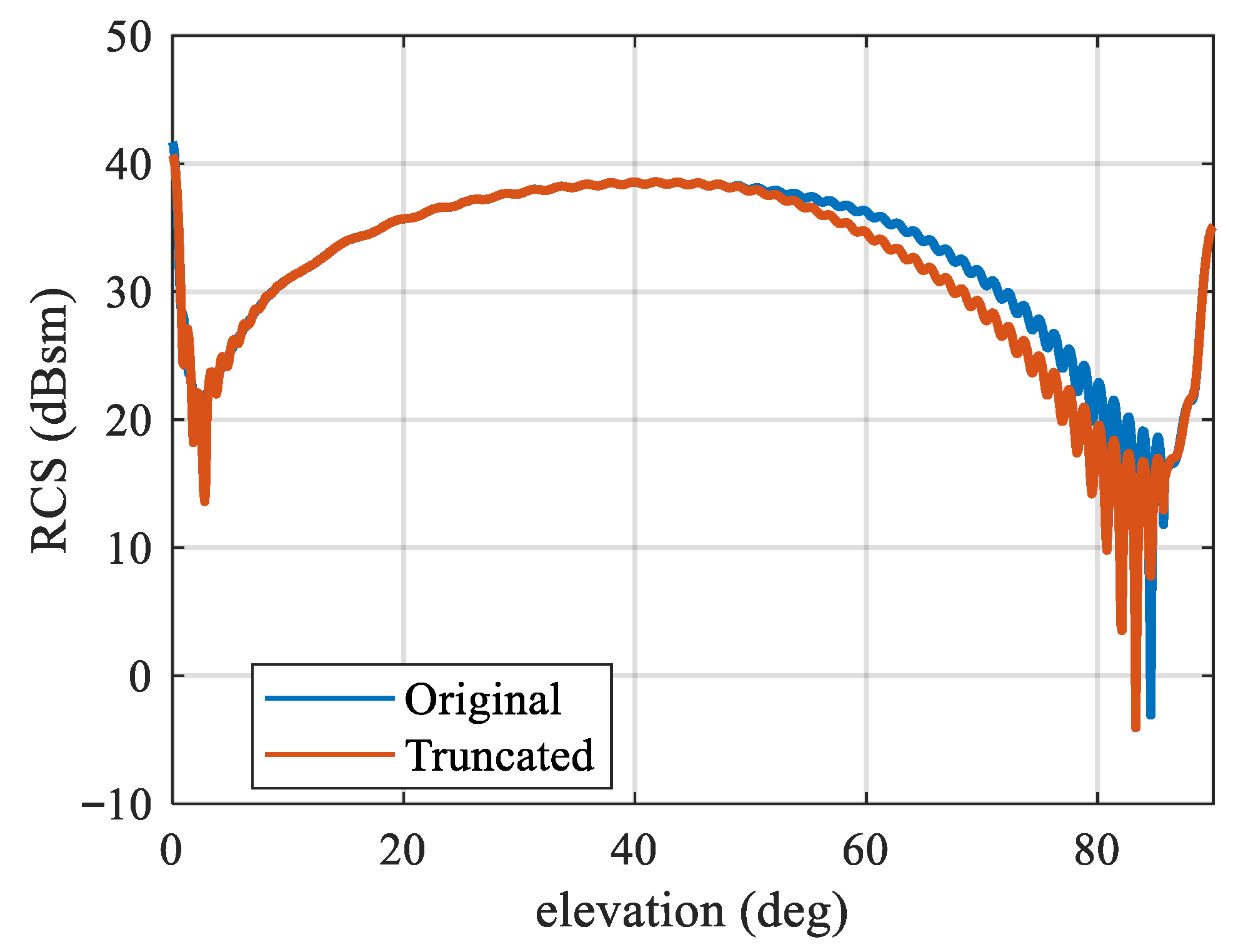
Since the RCS of the truncated CR cannot be calculated using Equation (1), we employed the electromagnetic simulation software FEKO (Version 2022) for computation [20]. Under the simulation conditions of 9.6 GHz frequency and HH polarization, we calculated the elevation-direction RCS for two reflector models, a scalene CR with OA = OB = 1 m and OC′ = 1.5 m and a truncated trapezoidal CR with OA = OB = OC″ = 1 m. The results, shown in Figure 6, indicate that the direction of the peak RCS remains unchanged after truncation, with only a negligible reduction of 0.0052 dB in the RCS value.
Therefore, appropriate truncation of the scalene trihedral CR not only maintains its peak RCS direction and value but also effectively reduces its volume and weight and eases packaging and transportation.
Based on the aforementioned design concepts, the proposed novel compact bidirectional trapezoidal CR is finally developed. As illustrated in Figure 7, the structural of this bidirectional trapezoidal CR aligns its boresight with the radar LOS as closely as possible in both the elevation and the azimuth directions, and it achieves dual-pass coverage for SAR ascending and descending passes. Although a misalignment between the radar LOS and the CR boresight is inevitably present, the RCS of the CR under the current observation conditions can be accurately determined via numerical simulation (using the electromagnetic simulation software FEKO) based on the satellite-ground geometric relationship. This enables SAR radiometric calibration and validation to be carried out using the bidirectional trapezoidal CR based on the non-aligned radiometric calibration method.

2.4. Overall Structure and Performance Simulation

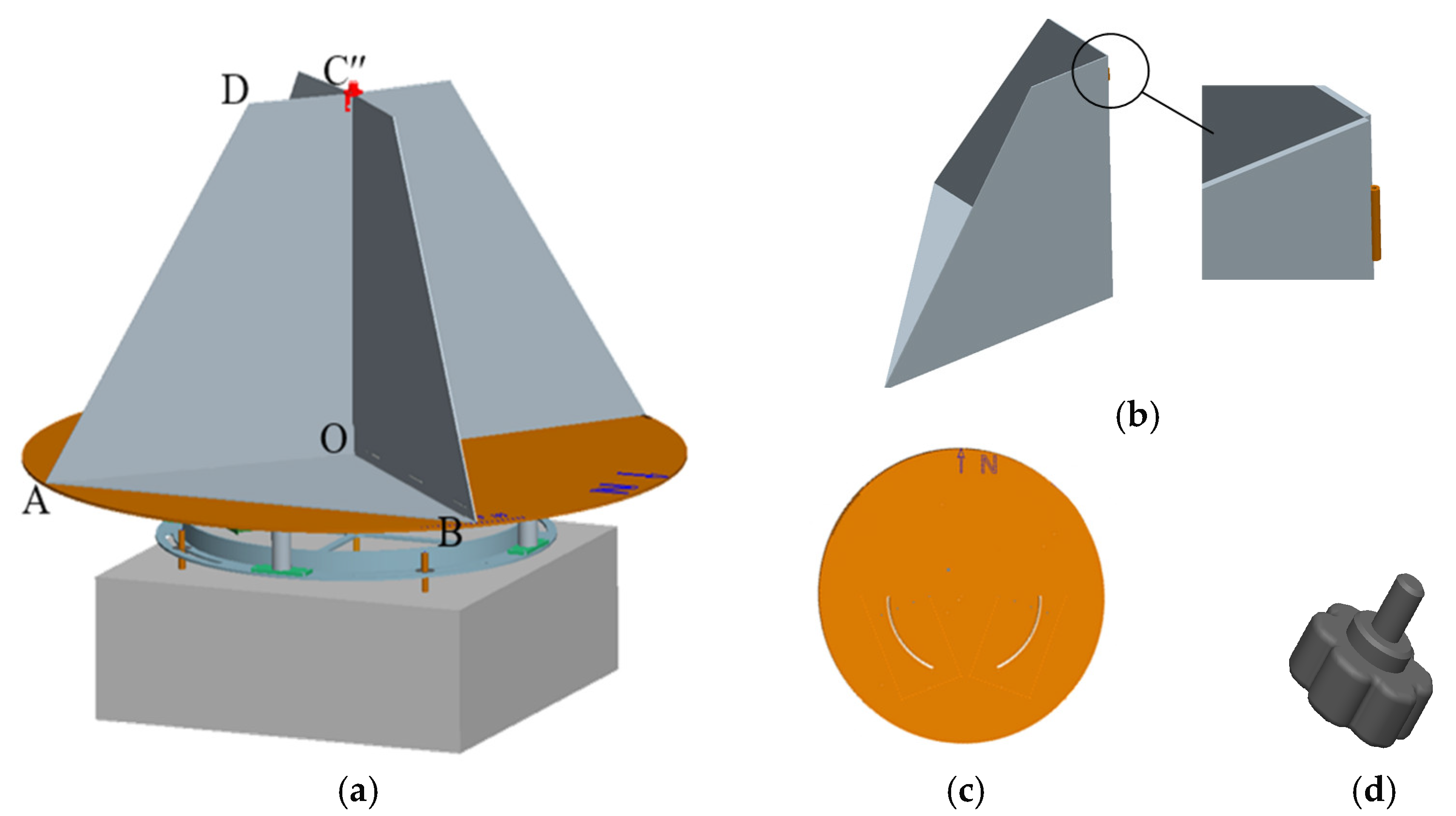
This section presents the overall structure of a bidirectional trapezoidal CR, using the X-band as an example. The overall structure, shown in Figure 8, primarily consists of two trapezoidal reflector units, a PTFE (Polytetrafluoroethylene) support plate, a mounting stand, a concrete slab and a plastic GNSS antenna connector.
Each reflector unit is composed of two right trapezoidal sideplates and one right isosceles triangular baseplate, all fabricated from 4 mm thick aluminum alloy plates. The dimensional parameters are defined as OA = OB = OC″ = 1000 mm and C″D = 333.33 mm. The dimensional accuracy of all the key edges is ≤±2 mm, the flatness of each plate is ≤±0.5 mm, and the perpendicularity between adjacent plates is within 0.2°.
The two reflector units are connected via a pinned joint, allowing azimuth rotation about the OC″ axis. A north reference mark is provided on the support plate for alignment with the due north direction during installation. Two arc-shaped guide slots are also machined into the support plate, one oriented toward the ascending orbit direction and the other toward the descending orbit direction. Locking screws pass through these slots to secure the reflector units at the desired azimuth angles. The mounting stand is designed to adjust the attitude of the CR, and the concrete slab provides a stable load-bearing foundation. The GNSS antenna connector mounted on the top of the CR is used to install the GNSS measurement antenna, which is more convenient for SAR geometric or interferometric calibration compared with conventional TTCRs.
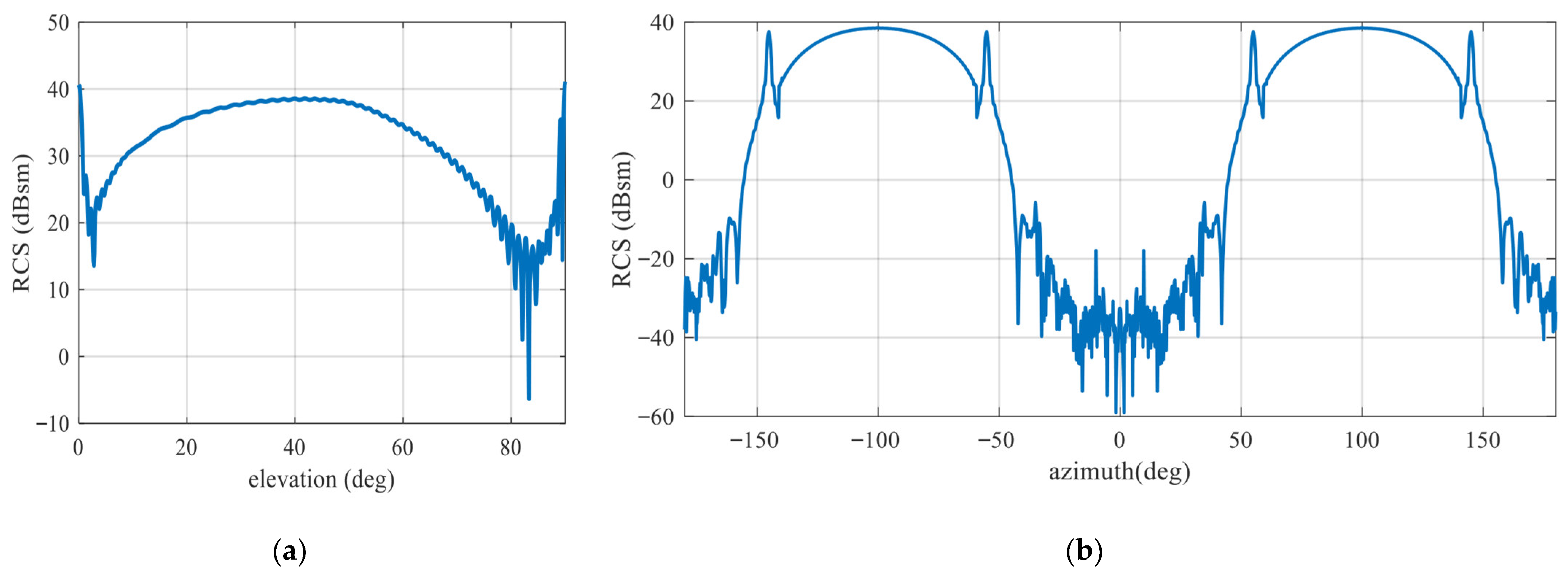
Taking the configuration with the specified angular separation Δ ϕ = 160 ° mentioned in Section 2.2 as an example, the azimuth- and elevation-cut RCS profiles of the bidirectional trapezoidal CR are simulated under a 9.6 GHz frequency and HH polarization, as illustrated in Figure 9. The azimuth-cut RCS profile exhibits a high degree of symmetry, which indicates that the electromagnetic coupling effect between the two reflector units is negligible. Focusing on a single trapezoidal CR unit within this bidirectional structure, its boresight vector is oriented halfway between the two vertical plates and elevated 41.75° from the baseplate. Its peak RCS is 38.59 dBsm, which is 2.3 dB higher than that of a TTCR with an inner leg dimension of 1 m. This provides a margin to compensate for the RCS loss induced by pointing misalignment in calibration. The elevation and azimuth beamwidths are approximately 38° and 45.5°, respectively. Compared with the TTCR, the elevation beamwidth is narrowed by about 2°, whereas the azimuth beamwidth is widened by approximately 5.5°. This satisfies the requirement that the beamwidths of the CR must be significantly broader than those of the SAR satellite.
In addition, we compared the volume and weight of the trapezoidal CR, the scalene trihedral CR before truncation, and the conventional TTCR with an inner leg dimension of 1.14 m and equivalent RCS, as presented in Table 1. In comparison with the latter two CRs, the trapezoidal CR realizes a volume reduction of 33.3% and 32.43%, as well as a weight reduction of 8.5% and 6.15%, respectively. Furthermore, compared with the conventional TTCR, the trapezoidal CR eliminates the need for elevation adjustment, and its mounting stand features a simpler structure and lower weight, which further enhances the overall weight advantage. It can be concluded that the trapezoidal CR achieves a remarkable reduction in volume and weight while ensuring equivalent electromagnetic scattering performance, fully demonstrating its compact design advantages.

3. Experimental Setup

In this study, an in-orbit validation experiment was conducted to evaluate the effectiveness of the bidirectional trapezoidal CR in spaceborne SAR radiometric calibration. This section introduces the experimental data, test site, field initial alignment, determination of the CR nominal RCS, and processing method.

3.1. Test Satellite and Experimental Data

The experiment utilized the SVN2-03, operated by China Siwei Surveying and Mapping Technology Co., Ltd., Beijing, China, under the China Aerospace Science and Technology Corporation (CASC) [26]. SVN2-03 was successfully launched on 25 November 2024 at 07:39. Its key parameters are provided in Table 2.
All data used are Level-1A Single Look Complex (SLC) images. The first scene was acquired during a descending pass on 10 January 2025, and the second scene during an ascending pass on 27 January 2025. Both scenes were obtained in Stripmap mode with HH polarization, with center incidence angles of 35.11° and 40.09°, respectively. Detailed parameters are summarized in Table 3.

3.2. Test Site

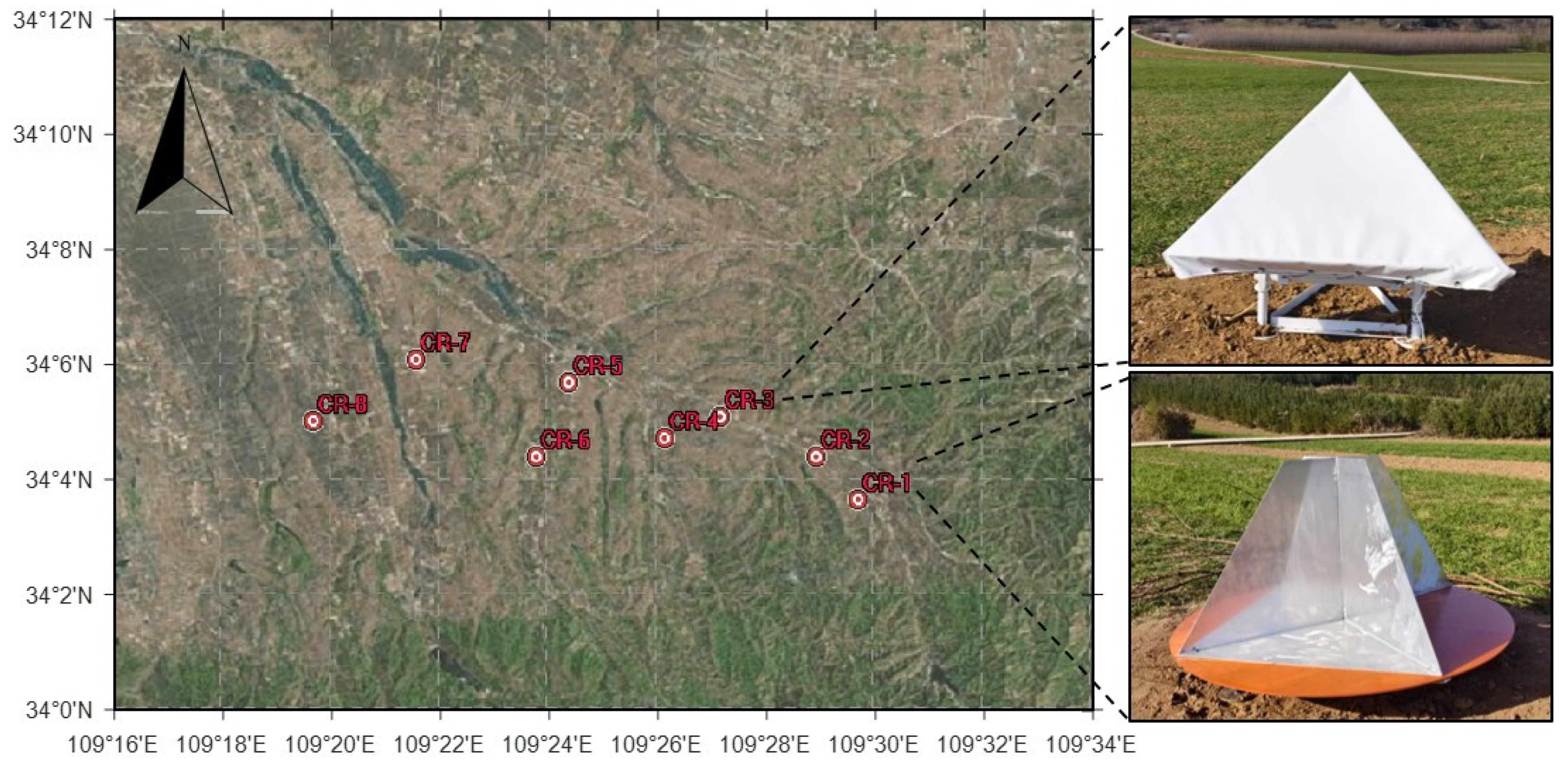
The test site is located in Lantian County, Xi’an City, China. In January 2025, two bidirectional trapezoidal CRs were deployed in farmlands, along with six conventional TTCRs (1.0 m inner leg dimension) for comparative validation. The distribution and photographs of the reflectors are shown in Figure 10, where CR-1 and CR-2 denote the bidirectional trapezoidal CRs, and CR-3 to CR-8 are the conventional TTCRs.
Site selection for the CRs was based on the following criteria: flat and open terrain, sufficient distance from strong radiation sources, adequate SCR, and ease of deployment. All eight reflectors were aligned along an east-west direction, with adjacent reflector locations spaced more than 800 m apart to avoid overlap or interference of their point target impulse responses in the SAR imagery.
GNSS equipment (Guangzhou Hi-Target Navigation Tech Co., Ltd., Guangzhou, China) was used to measure the longitude, latitude, and elevation information of each CR. After differential processing, the nominal static accuracy of this equipment was not less than 1 cm in the horizontal direction and 2 cm in the vertical direction.

3.3. Determination of CR Orientation and Field Initial Alignment

3.3.1. Calculation of CR Azimuth Angle

The bidirectional trapezoidal CRs require no elevation adjustment, so only the azimuth angles need to be calculated. Due to the bidirectional design of the trapezoidal CRs, each CR requires the determination of two azimuth angles (one for each of its reflector units). There are two calculation methods used here.
The first method is to calculate the azimuth angles by substituting the geographic latitude of the corner reflector (CR) and the satellite orbital inclination into Equation (3).
The second method is the Satellite Tool Kit (STK) simulation-aided calculation method. Based on the latest Two-Line Element (TLE) data obtained prior to CR deployment, STK (Version 11) is used to predict the satellite orbit during the commissioning phase. Integrating the CR geodetic coordinates measured in Section 3.2, the STK Analyzer module is employed to determine the time instant of minimum spatial distance between the satellite and the CR within the observation window of each overpass. At this moment, the azimuth angle of the vector pointing from the CR to the satellite is calculated in the CR-centered local horizontal coordinate system. Finally, the averages of the azimuth angles calculated from all the ascending and descending overpass observations are taken as the azimuth angles of the bidirectional trapezoidal CR.
Compared to the second method, the first method fails to consider factors such as the real-time satellite orbital position and the CR elevation information. Despite its simplicity, it introduces considerable errors, thus the second method is adopted in this experiment.

3.3.2. Field Initial Alignment

This process follows the sequential workflow below:
  • Align the north reference mark on the support plate with the due north direction.
  • Adjust the mounting stand of the CR to achieve a 0° horizontal level, then verify its horizontality using a digital level (DELIXI, Wenzhou, China).
  • Adjust the CR orientation according to the azimuth angle calculated in Section 3.3.1 and verify with a GNSS orientation instrument (Beijing Beidou Interstellar Technology Co., Ltd., Beijing, China). The instrument is placed horizontally on the base edge AB of the CR (as shown in Figure 8), and its reading is equal to the calculated azimuth angle minus 90°. Record the measured values of the CR azimuth angle.
The digital level employed in this experiment achieves a measurement precision of 0.1°, while the GNSS orientation instrument reaches a precision of 0.05°. Notably, the calculation of CR azimuth angles and the adjustment of their orientations are completed only once during the deployment period.

3.4. Determination of Nominal RCS for Bidirectional Trapezoidal CRs

Misalignments of the bidirectional trapezoidal CR from the radar LOS incident direction for different overpass events vary, leading to differing RCS values in absolute radiometric calibration. Therefore, in this study, the nominal RCS of the bidirectional trapezoidal CR with a fixed orientation is defined as a variable, in contrast to the fixed nominal RCS of the finely aligned TTCRs adopted in traditional calibration methods. To ensure the accuracy of the radiometric calibration, precise calculations are required to obtain the nominal RCS matching the current SAR observation geometry conditions.

3.4.1. Calculation of Radar LOS Angles

Once the CR orientation is fixed, its nominal RCS is determined by the radar LOS. The simulation method using STK in Section 3.3.1 is also adopted to calculate the radar LOS angles for each overpass, with two differences.
Firstly, the TLE data (or other forms of orbital data) closest to the imaging center time for each overpass are adopted, instead of the pre-deployment orbital data, to improve the calculation accuracy.
Secondly, the azimuth angle and incident angle of the radar LOS vector (pointing from the satellite to the CR) are calculated in the CR-centered local horizontal coordinate system at the moment when the satellite-CR distance is minimized.

3.4.2. Calculation of Nominal RCS of CRs

The calculation of the nominal RCS of the CR for each overpass is realized through electromagnetic simulation in the FEKO software, following the specific steps below:
  • Establish a computer-aided design (CAD) model of the CR in the FEKO software. The orientation of the model must be consistent with the data recorded in Section 3.3.2.
  • Set the angle of the far-field incident electromagnetic wave according to the radar LOS incident direction calculated in Section 3.4.1.
  • Configure key parameters such as the frequency and polarization mode in accordance with the satellite imaging conditions.
  • Select the Method of Moments (MOM) as the simulation solver and then execute the simulation to output the nominal RCS of the bidirectional trapezoidal CR under the current observation geometry.
The nominal RCS and intermediate results of the two bidirectional trapezoidal CRs in this experiment are summarized in Table 4.

3.5. Data Processing Methodology

To verify the effectiveness of the bidirectional trapezoidal CR in spaceborne SAR absolute radiometric calibration, we evaluated the imaging quality, analyzed the SCR, calculated the calibration constants, and compared them with those of conventional TTCR. The data processing methods and specific steps are as follows:
  • Read the SLC imagery (originally provided as sigma-nought) that has been corrected for the range spread loss and antenna pattern and determine the position of each CR.
  • Taking the CR position as the center, extract the data of a 64 × 64 pixel rectangular window. Within this window, the cross-shaped region formed by rows 31:34 and columns 31:34 is defined as the energy integration region, and the four 20 × 20 pixel square regions at the four corners are defined as the background clutter regions [10].
  • Perform 32-fold interpolation on the 64 × 64 pixel rectangular window image using the FFT interpolation method to obtain upsampled image data.
  • Calculate the point target energy of each CR using the integral method [12]:
    E C R = E n ( N C R N c l t ) E c l t
    where E n is the summed energy of the energy integration region, E c l t is the summed energy of the background clutter region, N C R is the number of pixels in the energy integration region, and N c l t is the number of pixels in the background clutter region.
  • Extract the impulse response function (IRF) of each CR and calculate its impulse response width (IRW), peak sidelobe ratio (PSLR), and integrated sidelobe ratio (ISLR) [10].
  • Calculate the SCR of each CR:
    S C R = E C R E c l t / N c l t
  • Eliminate CRs for which the IRW, PSLR, and ISLR fail to meet the system specifications (see Table 1) and the SCR is less than 30 dB.
  • Calculate the calibration constant K of each CR:
    K = E C R σ C R
    where σ C R is the nominal RCS of the CR.

4. Experimental Results

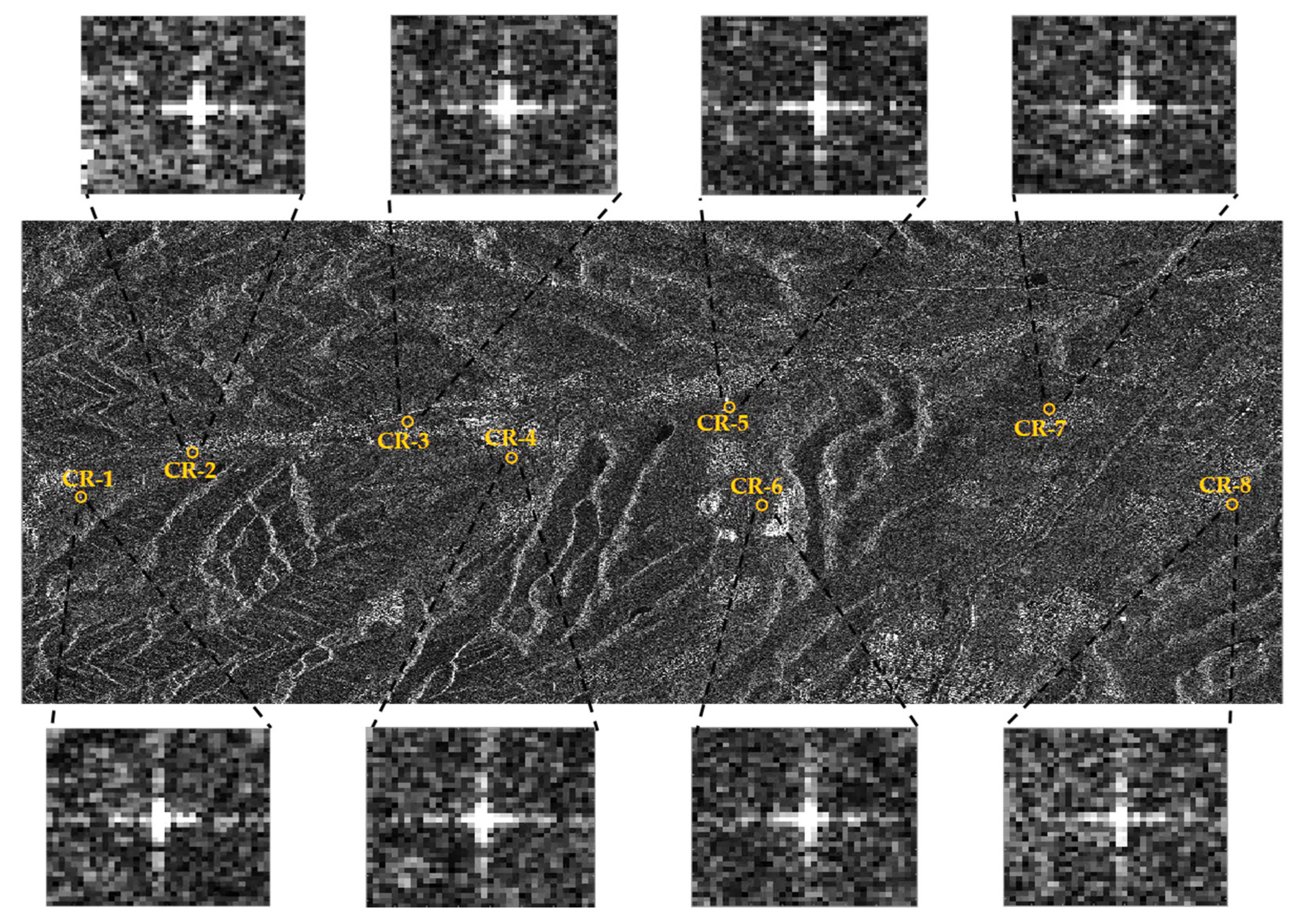
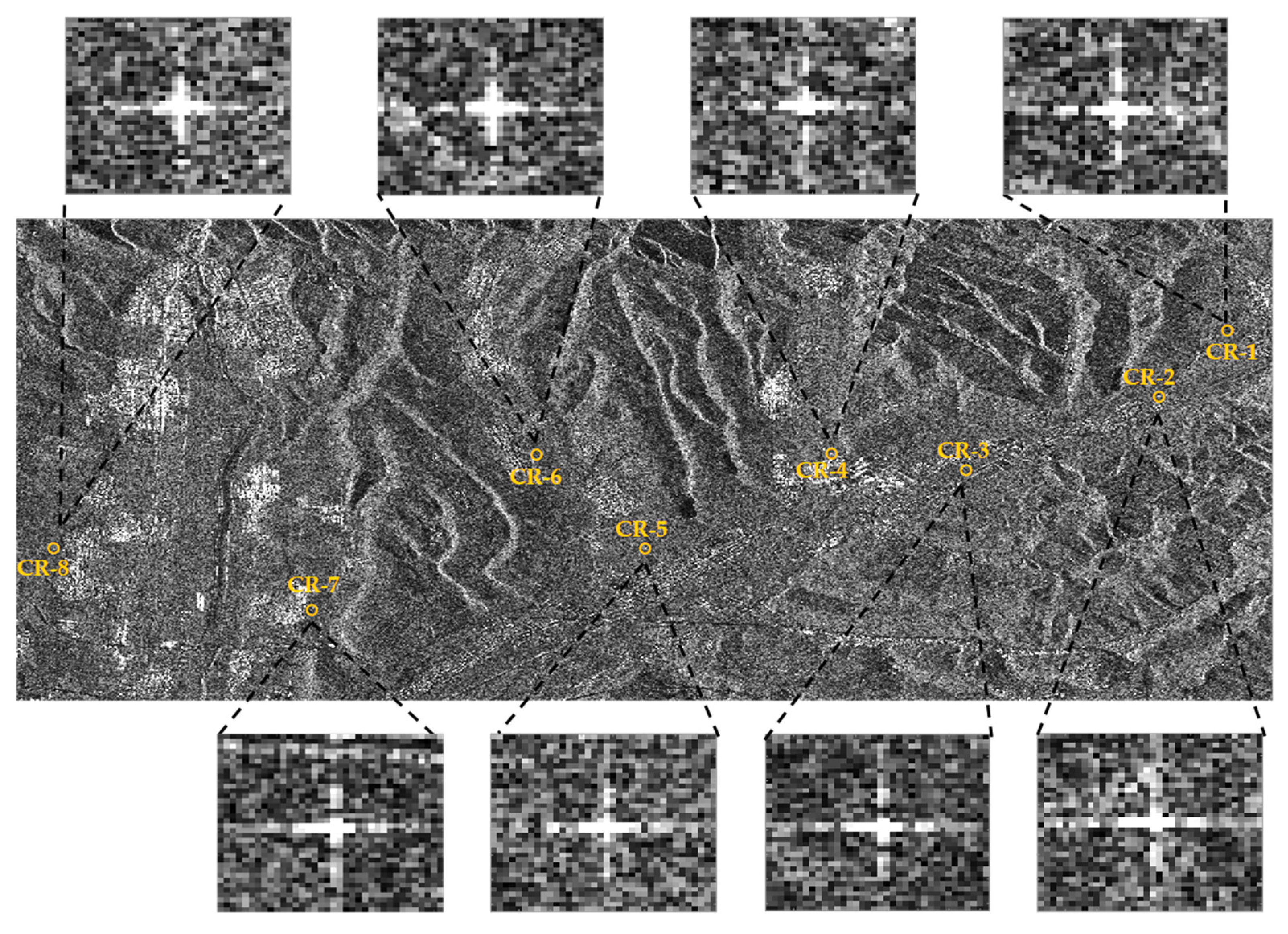
Figure 11 and Figure 12 show the test site area images acquired on 10 January 2025 and 27 January 2025, respectively. The locations of all the CRs are marked with yellow circles, with the corresponding zoomed-in views provided.

4.1. Image Quality Assessment

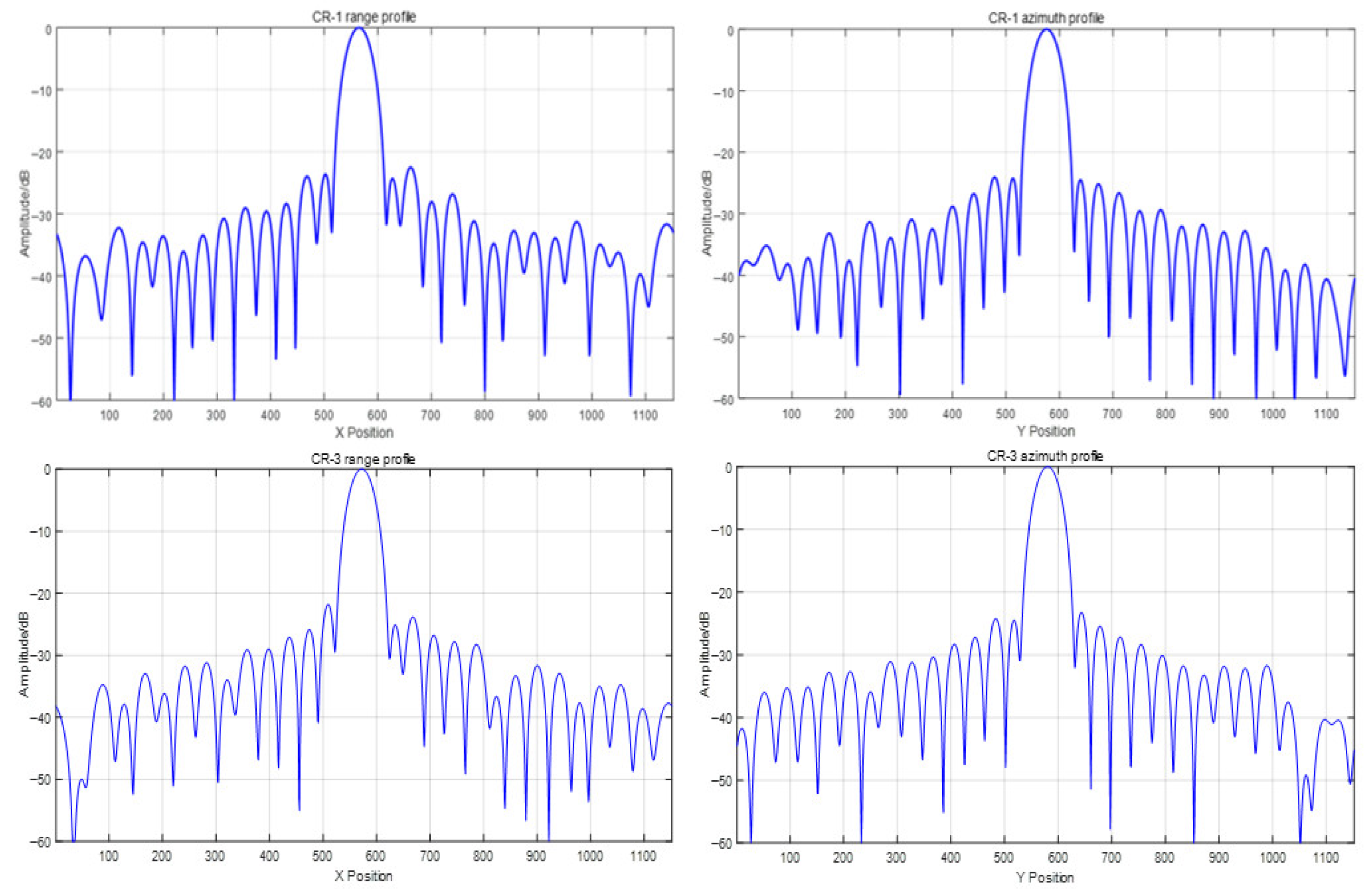
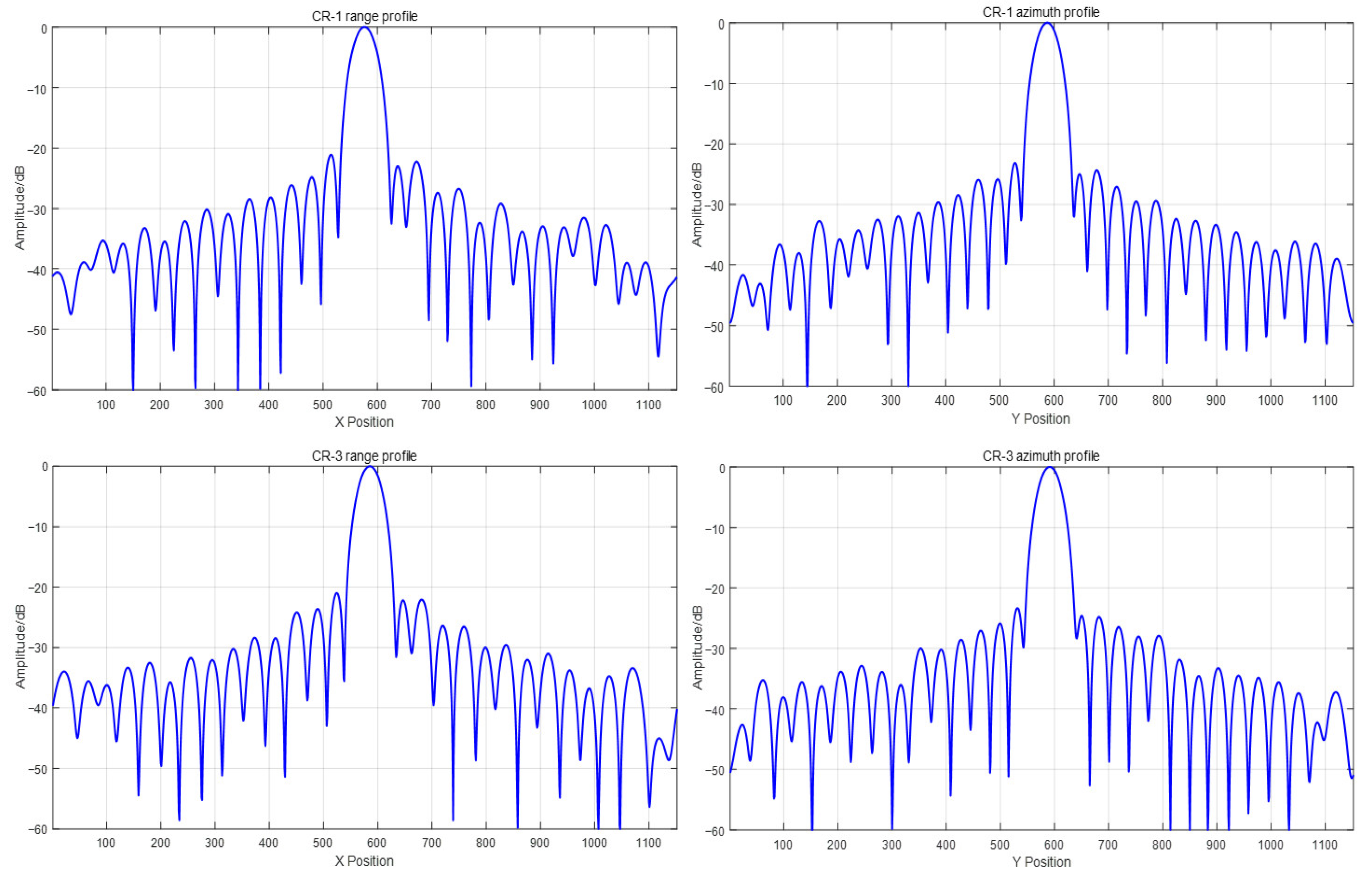
Figure 13 and Figure 14 display the one-dimensional IRF profiles in the range and azimuth directions for the bidirectional trapezoidal CR (CR-1) and the conventional TTCR (CR-3), derived from the two acquisitions. The corresponding image quality assessment parameters are summarized in Table 5.
As shown in Table 5, all the image quality parameters for the CRs exceed the system design specifications: the range (ground range) and azimuth resolutions are better than 1.64 m and 1.81 m, respectively (design specification: 2 m); the range and azimuth PSLR are better than −20.07 dB and −22.51 dB, respectively (design specification: −20 dB); and the range and azimuth ISLR are better than −16.71 dB and −18.24 dB, respectively (design specification: −13 dB). Both acquisitions meet the image quality requirements.

4.2. SCR Assessment

To extract the response energy of the point targets from the background clutter, it is necessary to assess their SCR, which is directly related to the radiometric calibration accuracy [30]. When the SCR exceeds 30 dB, the accuracy of point target energy extraction can be maintained within ±0.3 dB [30]. Therefore, in this study, a threshold of 30 dB was adopted for SCR to screen point targets eligible for radiometric calibration. The SCR of each CR in both images was calculated, with the results are summarized in Table 6. All the CRs exhibited SCR values higher than 43.71 dB, corresponding to an energy extraction accuracy better than 0.3 dB, which confirms their suitability for calibration constant calculation.

4.3. Calibration Constant Computation

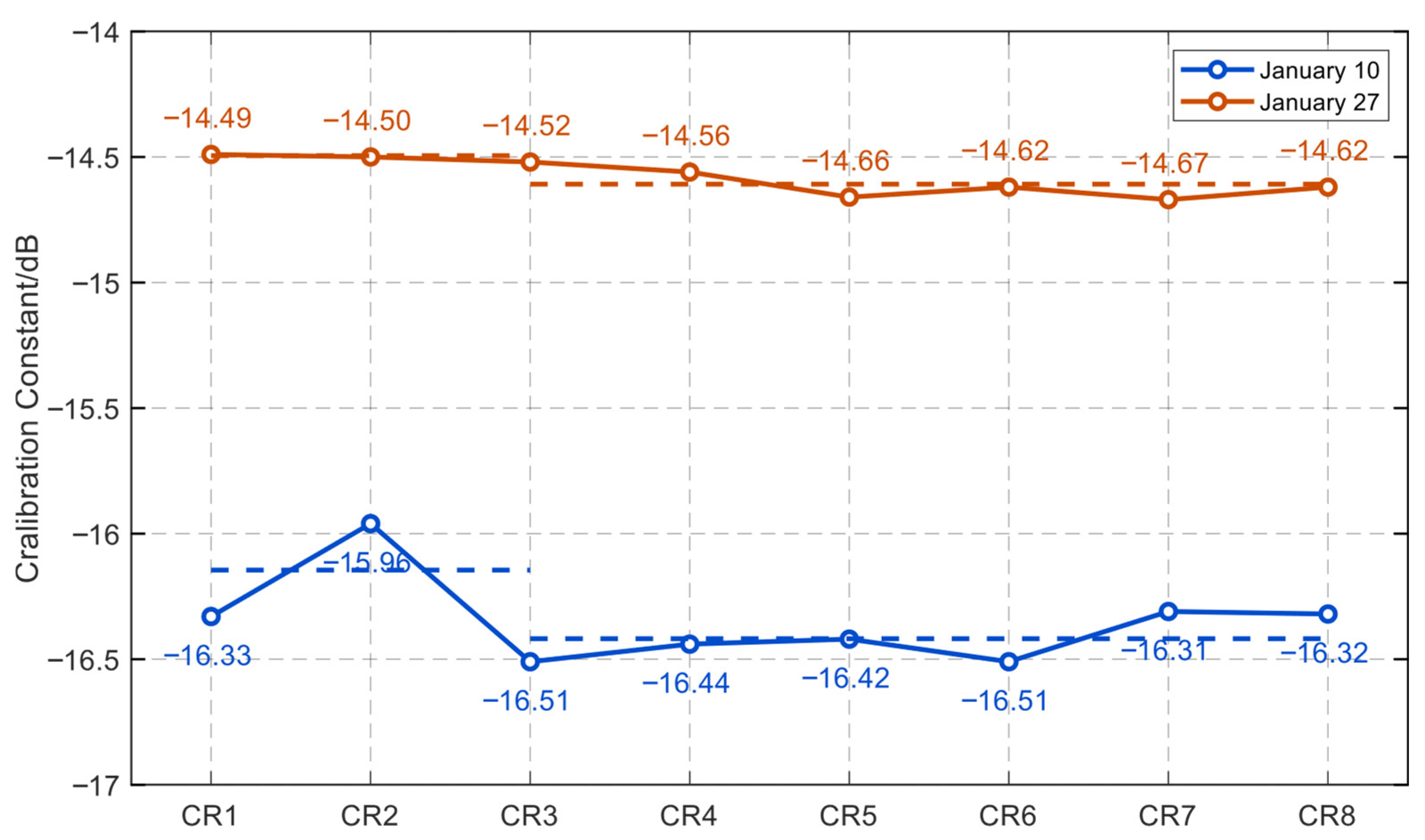
The integrated energy and calibration constants were calculated for all the CRs in both images, with the results presented in Figure 15 and Table 7.
As shown in Table 7, for the image acquired on 10 January, the mean calibration constants were −16.15 dB for the bidirectional trapezoidal CRs and −16.42 dB for the conventional TTCRs, with a difference of 0.27 dB between them. For the January 27 image, the mean calibration constants were −14.50 dB for the bidirectional trapezoidal CRs and −14.61 dB for the conventional TTCRs, with a difference of 0.11 dB between them.
To evaluate the reliability and accuracy of the obtained calibration constants for the trapezoidal CRs, a quantitative uncertainty analysis is performed. The main uncertainty sources contributing to the fluctuations of calibration constants include SAR radiometric noise, speckle, background clutter, target variability, and pointing error.
(1)
SAR radiometric noise
SAR radiometric noise is the inherent additive noise of the radar receiver system, characterized by the Noise Equivalent Sigma Zero (NESZ). Its relative standard deviation is determined by the Signal-to-Noise Ratio (SNR) and follows the statistical laws of power measurement under complex Gaussian noise, calculated as [31]:
μ n o i s e = 10 log 10 ( 1 + 1 S N R )
As shown in Table 2, the NESZ is taken as −21 dB. Calculations indicate that for both the trapezoidal CR and conventional TTCR, μ n o i s e is well below 0.01 dB and can be considered negligible.
(2)
Speckle
Speckle is an inherent phenomenon in coherent SAR imaging, causing random fluctuations in echo intensity that can be quantified by radiometric resolution R r . In the background subtraction process, increasing the number of pixels used for clutter measurement N p can significantly suppress the random fluctuation caused by speckle. The calculation formula is [3]:
μ s p e c k l e = 10 log 10 1 + R r N p
where N p is 1600 (see Section 3.5), and the theoretical radiometric resolution of a single-look SAR image is approximately 3.01 dB. Based on the calculation, μ s p e c k l e is 0.21 dB (1σ) for both the trapezoidal CR and the conventional TTCR.
(3)
Background clutter
The radar echo from background clutter superimposes with that from the CR, introducing an error in the amplitude measurement of the true RCS of the CR. The error limit can be expressed as [32]:
L c l u t t e r = 10 log 10 ( 1 ± 2 δ + δ 2 )
where δ 2 denotes the background-to-signal ratio, representing the interference intensity of background clutter.
Assuming the error follows a uniform distribution, its uncertainty can be expressed as follows:
u c l u t t e r = L c l u t t e r dB 3
Calculations show that when SCR ≥ 30 dB (see Section 3.5), L c l u t t e r is no more than 0.28 dB for both the trapezoidal CR and the conventional TTCR, and u c l u t t e r ≤ 0.16 dB (1σ).
(4)
Target variability
Inevitable minor deviations during the manufacturing process of CRs, such as dimension errors, inter-plate orthogonality errors, and plate surface irregularities, may lead to slight variations in their electromagnetic scattering characteristics.
For the trapezoidal CR, the RCS biases induced by dimension errors and inter-plate orthogonality errors (denoted as L d and L o , respectively) can be obtained via FEKO simulation. Since the plate surface irregularity (≤±0.5 mm) is smaller than the element size required for fine meshing ( 16 / λ ) in the MoM, the corresponding RCS bias L i can be neglected.
Similarly, the influence of plate surface irregularities on the RCS of conventional TTCRs can also be neglected. The RCS loss caused by a dimension error ε o can be calculated using the theoretical peak formula, while the RCS loss induced by an inter-plate orthogonality error can be expressed as [33]:
L o = 10 log 10 ( sin 2.54 ε o a λ 2.54 ε o a λ ) 4 dB
where a is the inner leg dimension of the TTCR.
Assuming each error component follows a uniform distribution and is independent, the total uncertainty can be expressed as follows:
u t a r g e t = L d 3 2 + L o 3 2 + L i 3 2
As described in Section 2.4, the trapezoidal CR has a dimension error ≤ ±2 mm, an inter-plate orthogonality error ≤ ±0.2°, and plate surface irregularity ≤ 0.5 mm. Based on the calculation, for the trapezoidal CR, L d ≤ 0.04 dB and L o ≤ 0.34 dB, giving a total uncertainty u t a r g e t ≤ 0.20 dB (1σ). For the conventional TTCR, L d ≤ 0.04 dB and L o ≤ 0.22 dB, giving a total uncertainty u t a r g e t ≤ 0.13 dB (1σ).
(5)
Pointing
For the conventional TTCR, pointing errors cause the radar LOS to deviate from the peak direction of its RCS pattern. The resulting RCS loss can be calculated using Equation (1). Compared to the azimuth, the TTCR RCS is more sensitive to variations in the elevation angle. Pointing errors primarily stem from ground alignment errors, which depend on instrument precision. As described in Section 3.3.2, using a digital level and GNSS orientation instrument ensures an accuracy within 0.1°. According to the calculation, for the conventional TTCR, L p o i n t i n g is much less than 0.01 dB and can thus be neglected.
For the trapezoidal CR, as described in Section 3.4, due to the non-aligned calibration strategy, the radar LOS direction differs for different overpasses, resulting in a non-constant nominal RCS. On this basis, additional pointing errors will cause the actual RCS to deviate from the theoretical nominal value. It is worth noting that the sensitivity of the trapezoidal CR RCS to pointing errors varies significantly with the radar LOS direction. Near the peak of the RCS pattern, the influence of pointing errors is small; in regions far from the peak, the same angular error leads to a larger variation in the RCS. Combined with Figure 9 and the possible range of the radar LOS, the RCS variation induced by pointing errors is most pronounced at small incidence angles.
Since the trapezoidal CR does not require elevation adjustment, ground alignment only introduces an azimuth pointing error of ±0.1°, corresponding to an RCS variation ≤ ±0.02 dB. In addition, for low Earth orbit satellites, the 1-day orbit prediction error based on the TLE is typically in the order of a hundred meters [34], which introduces an elevation pointing error of approximately ±0.01°, corresponding to an RCS variation ≤ ±0.03 dB. According to the calculation, for the trapezoidal CR, L p o i n t i n g is ≤±0.05 dB, and thus, u p o i n t i n g ≤ 0.03 dB (1σ).
In summary, as listed in Table 8, the total uncertainty of the calibration constant for the trapezoidal CR is approximately 0.33 dB (1σ), while for the conventional TTCR it is approximately 0.29 dB (1σ). This demonstrates that the trapezoidal CR can achieve a calibration accuracy comparable to that of typical TTCRs (approx. 0.33 dB at 1σ).

4.4. RCS Analysis

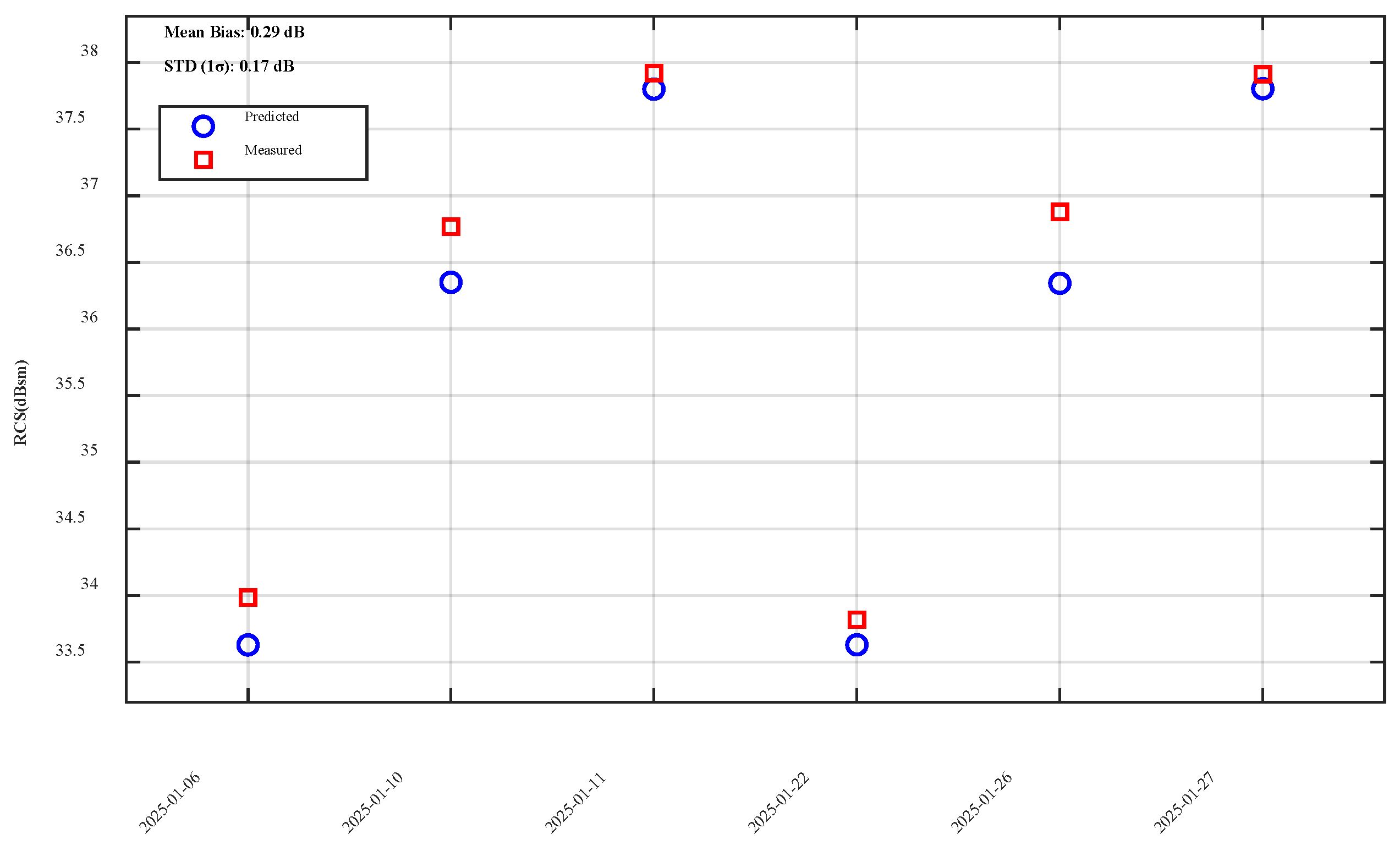
To evaluate the consistency between the theoretical predicted and measured SAR responses of the trapezoidal CRs, an analysis was carried out using 6 SVN2-03 SLC images, whose detailed information is listed in Table 9.
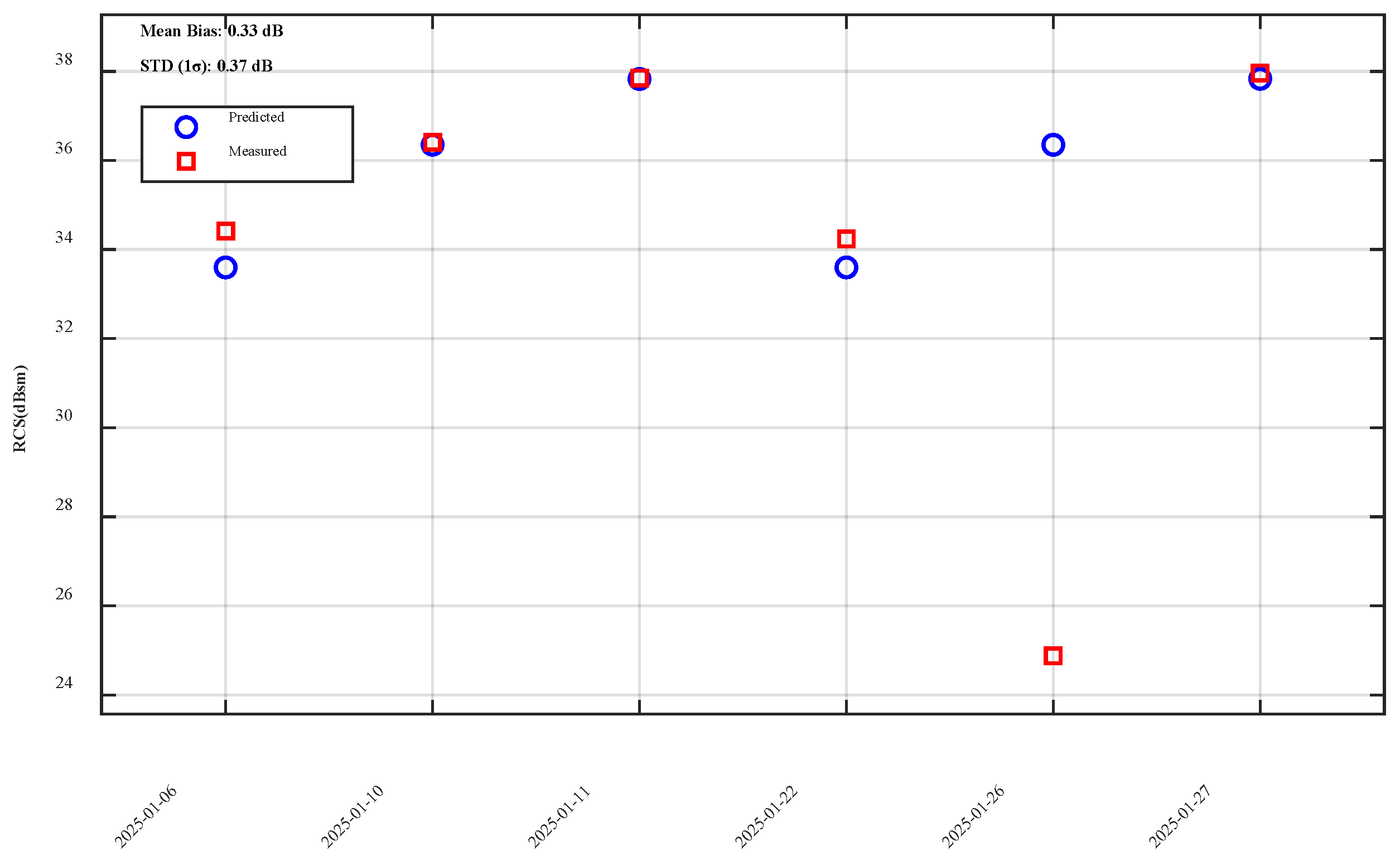
For each SAR image, the calibration constants calculated from the six conventional TTCRs are averaged to obtain a reference calibration constant for that image. This reference calibration constant is then used to retrieve the measured RCS values of the two trapezoidal CRs. The biases between the measured and the theoretical predicted RCS are compared, and their statistical characteristics are analyzed, as shown in Figure 16 and Figure 17. It should be noted that the energy of CR-1 in the image acquired on 26 January 2025 is abnormal due to untimely snow removal; therefore, this data is excluded from the subsequent analysis.
The calculation results show that the mean bias between the predicted and measured RCS of CR-1 is 0.33 dB with a standard deviation (STD) of 0.37 dB (1σ); the mean bias between the predicted and measured RCS of CR-2 is 0.29 dB with a STD of 0.17 dB (1σ). The minor biases between the theoretical predicted and measured values may be attributed to the following factors.
(1)
Manufacturing tolerances
Inevitable minor deviations in the manufacturing process of the CR may lead to slight variations in it electromagnetic scattering characteristics. Based on the manufacturing tolerances of the trapezoidal CR, FEKO simulation demonstrates that the RCS bias is approximately 0.04 dB under the dimension error of ±2 mm and about 0.34 dB under the inter-plate orthogonality error of ±0.2°. In addition, since the plate surface irregularity (≤±0.5 mm) is smaller than the element size required for fine meshing ( 16 / λ ) in the MoM, the corresponding RCS bias can be neglected.
(2)
Pointing error
Pointing errors will cause the measured RCS to deviate from the theoretical predicted value. The sensitivity of a trapezoidal CR RCS to pointing errors varies significantly with the radar LOS direction. Pointing errors induce little variation near the RCS peak but large deviations away from the peak. Specifically, the analysis mainly considers an azimuth pointing error of ±0.1° introduced by ground alignment, as determined by the measurement instrument accuracy, and an elevation pointing error of ±0.01° introduced by the 1-day orbit prediction error based on TLE. The maximum RCS bias introduced by pointing errors is approximately ±0.05 dB.
(3)
Energy extraction error
The measured RCSs of the trapezoidal CR are calculated based on the point target energy, and the accuracy of this energy extraction is directly affected by the SCR. In this study, only point targets with an SCR of no less than 30 dB are selected for energy extraction, under which condition the corresponding RCS bias can be controlled within ±0.28 dB.
(4)
Calibration constant error
The RCS measurement values of the trapezoidal CRs are retrieved based on the calibration constants, which are calculated using conventional TTCRs. Among all the results, the maximum STD of the calibration constants is 0.32 dB (1σ), which reflects the relative calibration accuracy. The error in the calibration constants is directly propagated into the RCS retrieval of CR, causing a bias between the measured and the theoretically predicted RCS. This represents an important source of RCS measurement error.

5. Discussion

Experimental results demonstrate that the bidirectional trapezoidal CR can be effectively applied to spaceborne SAR radiometric calibration. According to the image quality assessment results presented in Table 5, the two bidirectional trapezoidal CRs met the high-resolution imaging requirements in both acquisitions: the ground range and azimuth resolutions were better than 1.64 m and 1.78 m, respectively, while the PSLR and ISLR were better than −20.89 dB and −17.08 dB, respectively. These results indicate that the trapezoidal bidirectional design preserves SAR signal focusing, with performance comparable to that of conventional TTCRs. Furthermore, data from Table 6 show that two bidirectional trapezoidal CRs achieved an SCR exceeding 43.91 dB. This ensures that the point target energy extraction error remains within ±0.3 dB, thereby providing a reliable data foundation for radiometric calibration.
In terms of the calibration constant computation, results from the bidirectional trapezoidal CRs showed consistency with those from conventional TTCRs. As shown in Table 7, at the 35.11° incidence angle, the mean calibration constants were −16.15 dB for the bidirectional trapezoidal CRs and −16.42 dB for the conventional TTCRs, with a difference of 0.27 dB. At the 40.09° incidence angle, the corresponding values were −14.50 dB and −14.61 dB, respectively, with a difference of 0.11 dB. Quantitative uncertainty analysis further shows that the total calibration constant uncertainty of the trapezoidal CR is 0.33 dB (1σ), which is comparable to that of the conventional TTCR (0.29 dB, 1σ). The main uncertainty sources for the trapezoidal CR include speckle (0.21 dB, 1σ), background clutter (0.16 dB, 1σ), manufacturing tolerances (0.20 dB, 1σ) and pointing error (0.03 dB, 1σ). This result confirms that the bidirectional trapezoidal CR utilizing the non-aligned radiometric calibration method achieves a calibration accuracy equivalent to that of the conventional TTCR adopting the traditional aligned calibration method (≈0.33 dB, 1σ), and thus, the proposed trapezoidal CR meets the precision requirements for spaceborne SAR radiometric calibration.
RCS consistency analysis further validates the accuracy of the trapezoidal CR RCS simulation and the reliability of the measured RCS retrieval. The mean biases between the simulated theoretical RCS and measured RCS are 0.33 dB (STD = 0.37 dB, 1σ) for CR-1 and 0.29 dB (STD = 0.17 dB, 1σ) for CR-2, with minor deviations that can be fully explained by objective error factors including manufacturing tolerances (≤±0.38 dB), pointing error (≤±0.05 dB), energy extraction error (≤±0.28 dB), and calibration constant error (maximum STD 0.32 dB).
The bidirectional design of the trapezoidal CR was successfully validated, enabling observations from both ascending and descending passes without the need for physical reorientation. This eliminates the need for CR alignment reorientations and effectively utilizes all the available satellite passes.
Although the common phase center design was not validated in this experiment, it can theoretically reduce both the workload and errors associated with GNSS measurements of the CRs, which is beneficial for the subsequent extension to geometric and interferometric calibration.

6. Conclusions

To address the challenges of high labor dependency and frequent field operations during both the initial commissioning phase and the subsequent long-term performance monitoring phase, a novel compact bidirectional trapezoidal CR is designed and validated. The reflector features a scalene shape design to optimize the boresight elevation angle and enhance the peak RCS, a bidirectional configuration with azimuth fine-tuning observation capability for both ascending and descending satellite passes, and trapezoidal trimming to reduce the volume and weight. Based on this design, sufficient and computable RCS for radiometric calibration constant calculation can be obtained during the commissioning phase without the need for CR alignment reorientations in the field. Furthermore, this design effectively increases the frequency of radiometric calibration and improves the data acquisition efficiency.
Taking the X-band as an example, this paper presents the design of the bidirectional trapezoidal CR. Its sideplates are right trapezoids with an upper base of 0.33 m, a lower base of 1 m, and a height of 1 m, while the baseplate is a right isosceles triangle with the 1 m inner leg. Electromagnetic simulation results demonstrate that compared to a conventional TTCR of 1 m inner leg dimension, the proposed reflector achieves an enhancement of 2.27 dB in peak RCS (from 36.32 dBsm to 38.59 dBsm) and a rise of 6.49° in the boresight elevation angle (from 35.26° to 41.75°). Furthermore, based on the SVN2-03 satellite acquisitions at incidence angles of 35.11° and 40.09°, the bidirectional trapezoidal CR exhibits imaging quality (spatial resolution, PSLR, ISLR) and SCR comparable to those of the conventional TTCR, meeting the system design specifications. The radiometric calibration constant of the proposed bidirectional trapezoidal CR differs from that of the conventional TTCR by no more than 0.27 dB, with the total uncertainty of the trapezoidal CR’s calibration constant reaching approximately 0.33 dB (1σ). This demonstrates that the trapezoidal CR achieves equivalent radiometric calibration accuracy to conventional TTCRs (approx. 0.33 dB at 1σ). Collectively, these results fully validate the feasibility and engineering applicability of the bidirectional trapezoidal CR for X-band spaceborne SAR radiometric calibration.

Author Contributions

Conceptualization, Y.W.; methodology, S.S. and Y.W.; software, S.S.; validation, S.S. and X.Z.; formal analysis, S.S.; investigation, S.S., Y.W. and H.L.; resources, Y.W. and H.L.; data curation, S.S. and H.L.; writing—original draft preparation, S.S.; writing—review and editing, Y.W. and X.Z.; visualization, S.S.; supervision, Y.W.; project administration, Y.W. and H.L.; funding acquisition, Y.W. All authors have read and agreed to the published version of the manuscript.

Funding

This research was funded by the NSFC (the National Natural Science Foundation of China, No. 62471458).

Data Availability Statement

Data is contained within the article.

Conflicts of Interest

Author Huijuan Li was employed by China Siwei Surveying and Mapping Technology Co., Ltd. The remaining authors declare that the research was conducted in the absence of any commercial or financial relationships that could be construed as a potential conflict of interest.

References

  1. Shimada, M. Imaging from Spaceborne and Airborne SARs, Calibration, and Applications. J. Remote Sens. Soc. Jpn. 2019, 39, 323. [Google Scholar] [CrossRef]
  2. Ulaby, F.T.; Long, D.G.; Blackwell, W.; Elachi, C.; Zebker, H. Microwave Radar and Radiometric Remote Sensing; The University of Michigan Press: Ann Arbor, MI, USA, 2015. [Google Scholar]
  3. Freeman, A. SAR calibration: An overview. IEEE Trans. Geosci. Remote Sens. 1992, 30, 1107–1121. [Google Scholar] [CrossRef]
  4. Zhou, Y.S.; Ying, Q.; Yin, Q.; Wang, A.C.; Zhang, F. SAR Absolute Radiometric Calibration Utilizing Offshore Wind Farms With Mask-Based Response Energy Extraction Approach. IEEE J. Sel. Top. Appl. Earth Obs. Remote Sens. 2025, 18, 16816–16830. [Google Scholar] [CrossRef]
  5. Zhou, Y.S.; Yang, B.P.; Yin, Q.; Ma, F.; Zhang, F. Improved SAR Radiometric Cross-Calibration Method Based on Scene-Driven Incidence Angle Difference Correction and Weighted Regression. IEEE Trans. Geosci. Remote Sens. 2024, 62, 5224216. [Google Scholar] [CrossRef]
  6. Döring, B.J. Traceable Radiometric Calibration of Synthetic Aperture Radars. Ph.D. Thesis, Karlsruhe Institute of Technology, Karlsruhe, Germany, 2016. [Google Scholar]
  7. Yadav, V.P.; Prasad, R.; Bala, R.; Vishwakarma, A.K. Estimation of soil moisture through water cloud model using sentinel-1A SAR data. In Proceedings of the IGARSS 2019—2019 IEEE International Geoscience and Remote Sensing Symposium, Yokohama, Japan, 28 July–2 August 2019; IEEE: New York, NY, USA, 2019; pp. 6961–6964. [Google Scholar] [CrossRef]
  8. Zhang, X.F.; Zhang, H.; Wang, C. Water-change detection with Chinese Gaofen-3 simulated compact polarimetric SAR images. In Proceedings of the 2017 SAR in Big Data Era: Models, Methods and Applications (BIGSARDATA), Beijing, China, 16–18 January 2017; IEEE: New York, NY, USA, 2017; pp. 1–4. [Google Scholar] [CrossRef]
  9. Ulander, I.M.H. Accuracy of using point targets for SAR calibration. IEEE Trans. Aerosp. Electron. Syst. 1991, 27, 139–148. [Google Scholar] [CrossRef]
  10. Huang, Q.; Zhang, F.; Li, L.; Liu, X.; Jiao, Y.; Yuan, X.; Li, H. Quick Quality Assessment and Radiometric Calibration of C-SAR/01 Satellite Using Flexible Automatic Corner Reflector. Remote Sens. 2023, 15, 104. [Google Scholar] [CrossRef]
  11. Algafsh, A.; Inggs, M.; Mishra, A.K. The effect of perforating the corner reflector on maximum radar cross section. In Proceedings of the 2016 16th Mediterranean Microwave Symposium (MMS), Abu Dhabi, United Arab Emirates, 28–30 November 2016; IEEE: New York, NY, USA, 2016; pp. 1–4. [Google Scholar] [CrossRef]
  12. Garthwaite, M.; Nancarrow, S.; Hislop, A.; Thankapan, M.; Dawson, J.; Lawrie, S. The Design of Radar Corner Reflectors for the Australian Geophysical Observing System: A single design suitable for InSAR deformation monitoring and SAR calibration at multiple microwave frequency bands. Comput. Aided Chem. Eng. 2015, 18, 469–474. [Google Scholar] [CrossRef]
  13. Doerry, A.W. Reflectors for SAR Performance Testing; Sandia National Laboratories: Albuquerque, NM, USA, 2008. [Google Scholar] [CrossRef]
  14. Garthwaite, M.C. Correction: Garthwaite, M.C. on the Design of Radar Corner Reflectors for Deformation Monitoring in Multi-Frequency InSAR. Remote Sens. 2018, 10, 86. [Google Scholar] [CrossRef]
  15. Montuori, A.; Grimani, V. COSMO-SKYMED Mission CAL-VAL Status. In Proceedings of the CEOS SAR Workshop, Virtually, 2–4 November 2021; CEOS WGCV-SAR Subgroup: Vancouver, BC, Canada, 2021. [Google Scholar]
  16. Chapman, B.; Castracane, P.; Garthwaite, M.; Geudtner, D.; Klenk, P.; Pinheiro, M.; Reimann, J.; Sharma, S.; Thibeault, M.; Valentino, A. The CEOS SAR Calibration Network—SARCalNet. In Proceedings of the 15th European Conference on Synthetic Aperture Radar (EUSAR 2024), Munich, Germany, 23–26 April 2024; VDE: Berlin, Germany, 2024; pp. 587–590. [Google Scholar]
  17. The SARCalNet Initiative. Available online: https://www.sarcalnet.org/the-sarcalnet-initiative/ (accessed on 10 December 2025).
  18. Freeman, A. Radiometric Calibration of SAR Image Data; Jet Propulsion Laboratory: Pasadena, CA, USA, 2010. [Google Scholar]
  19. Grimani, V.; Salemme, P. Inter-satellites radiometric calibration status of COSMO-SkyMed constellation. In Proceedings of the CEOS SAR Workshop, Noordwijk, The Netherlands, 27–29 October 2015; CEOS WGCV-SAR Subgroup: Vancouver, BC, Canada, 2015. [Google Scholar]
  20. Zheng, Q.; Wang, Y.; Hong, J.; Wang, A.C. Feasibility, Design, and Deployment Requirements of TCR for Bistatic SAR Radiometric Calibration. Remote Sens. 2018, 10, 1610. [Google Scholar] [CrossRef]
  21. Gisinger, C.; Willberg, M.; Balss, U.; Kluegel, T.; Maehler, S.; Pail, R.; Eineder, M. Differential geodetic stereo SAR with TerraSAR-X by exploiting small multi-directional radar reflectors. J. Geod. 2017, 91, 53–67. [Google Scholar] [CrossRef]
  22. Bányai, L.; Nagy, L.; Hooper, A.; Bozsó, I.; Szűcs, E. Investigation of Integrated Twin Corner Reflectors Designed for 3-D InSAR Applications. IEEE Geosci. Remote Sens. Lett. 2020, 17, 1013–1016. [Google Scholar] [CrossRef]
  23. Parisi, A.; Nitti, D.O.; Nutricato, R.; Preziosa, G.; Loconsole, A.M.; Prudenzano, F.; Guaragnella, C. Investigating radar cross sections of passive radar reflectors for C-band and X-band SAR satellite missions. Microw. Remote Sens. Data Process. Appl. II 2023, 5, 264337621. [Google Scholar] [CrossRef]
  24. Saeed, A.; Hellwich, O. Design, deployment, and localization of bidirectional corner reflectors for TerraSAR-X. In Proceedings of the 2017 IEEE Microwaves, Radar and Remote Sensing Symposium (MRRS), Kiev, Ukraine, 29–31 August 2017; IEEE: New York, NY, USA, 2017; pp. 267–270. [Google Scholar] [CrossRef]
  25. Fuhrmann, T.; Garthwaite, M.; Brennand, S.; Brown, N. Combination of GNSS and InSAR for Future Australian Datums. In Proceedings of the International Global Navigation Satellite Systems Association (IGNSS) Symposium 2018, Sydney, Autralia, 7–9 February 2018. [Google Scholar]
  26. Chen, J.B.; Liu, Y.C.; Li, Y.D.; Tao, M.; Sun, C. Pioneering Demonstration of Large-Baseline Bistatic SAR in China: First Experiment with SuperView Neo-2 Satellites. Sci. China Inf. Sci. 2025, 68, 217301. [Google Scholar] [CrossRef]
  27. Moreira, A.; Krieger, G.; Villano, M.; Younis, M.; Prats-Iraola, P.; Zink, M. Spaceborne Synthetic Aperture Radar: Future Technologies and Mission Concepts. Proc. IEEE 2025, 1–37. [Google Scholar] [CrossRef]
  28. Zhou, Z.; Yan, H.; Yin, H.C. High Frequency RCS Representation of Trihedral Corner Reflectors with Scalene Triangle Aperture. In Proceedings of the 2015 IEEE 12th International Conference on Ubiquitous Intelligence and Computing, 12th International Conference on Autonomic Trusted Computing, 15th International Conference on Scalable Computing and Communications and Its Associated Workshops (UIC-ATC-ScalCom), Beijing, China, 10–12 August 2015; IEEE: New York, NY, USA, 2015; pp. 1621–1625. [Google Scholar] [CrossRef]
  29. Ye, X.; Kaufmann, H.; Guo, X.F. Differential SAR interferometry using corner reflectors. In Proceedings of the IEEE International Geoscience and Remote Sensing Symposium (IGARSS) 2002, Toronto, ON, Canada, 24–28 June 2002; IEEE: New York, NY, USA, 2002; Volume 2, pp. 1243–1246. [Google Scholar] [CrossRef]
  30. Blacksmith, P.; Hiatt, R.E.; Mack, R.B. Introduction to radar cross-section measurements. Proc. IEEE 1965, 53, 901–920. [Google Scholar] [CrossRef]
  31. Cumming, I.G.; Wong, F.H. Digital Processing of Synthetic Aperture Radar Data: Algorithms and Implementation; Artech House: Norwood, MA, USA, 2005. [Google Scholar]
  32. Holt, J.W.; Freeman, A. Calibration of Bonanza Creek, Alaska, SAR Imagery Using Along-Track Calibration Targets. In Proceedings of the International Geoscience and Remote Sensing Symposium (IGARSS ‘90), College Park, MD, USA, 20–24 May 1990. [Google Scholar]
  33. Craeye, C.; Sobieski, P.; Robin, E.; Guissard, A. Angular Errors in Trihedrals Used for Radar Calibrations. Int. J. Remote Sens. 1997, 18, 2683–2689. [Google Scholar] [CrossRef]
  34. Wang, B.; Peng, H.; Li, K. Precision Analysis of an Analytical Method in Space Debris Orbit Prediction. In Proceedings of the 2016 International Conference on Computer Engineering, Information Science & Application Technology (ICCIA 2016), Guilin, China, 24–25 September 2016. [Google Scholar]
Figure 1. Viewing geometry of the conventional triangular trihedral corner reflector (TTCR) (black line) versus scalene trihedral corner reflector (CR) (orange line). θ c r : the boresight elevation angle; ψ : the boresight azimuth angle; θ i : the synthetic aperture radar (SAR) incident angle; θ s : the SAR grazing angle. By adjusting the inner leg dimension ratio of the scalene trihedral CR (OC > OA = OB), the boresight elevation angle is increased to the boresight as close as possible to the mid-range of the typical SAR incident angle range.
Remotesensing 18 00770 g001
Figure 2. Simulated boresight elevation angle (blue) and azimuth angle (red) versus the inner leg dimension ratio c / a . The boresight elevation angle increases as the c / a increases while the azimuth angle remains unchanged at 45°, verifying the feasibility of boresight elevation optimization.
Remotesensing 18 00770 g002
Figure 3. Top-view geometry of the CR azimuth angles for satellite ascending and descending passes. The azimuth angles of CR ( ϕ a s c and ϕ d e s c are mainly dependent on both the CR geographic latitude and the satellite orbital inclination. Δ ϕ is the angular separation between these two azimuth angles.
Remotesensing 18 00770 g003
Figure 4. Azimuth angular separation Δ ϕ between the ascending and descending passes as a function of the geographic latitude ξ . The results are calculated for a satellite orbital inclination of 97.5°.
Remotesensing 18 00770 g004
Figure 5. Schematic of the CR before truncation (dashed line) and after truncation (solid line). Truncating the low-contribution region near the vertex C reduces the volume and weight.
Remotesensing 18 00770 g005
Figure 6. Comparison of the elevation-plane radar cross-section (RCS) for the original (blue) and truncated (red) CRs, simulated in FEKO at 9.6 GHz frequency and HH polarization. Truncation does not affect the direction of the peak RCS, with a negligible RCS reduction of 0.0052 dB.
Remotesensing 18 00770 g006
Figure 7. Schematic diagram of the bidirectional trapezoidal CR. ϕ a s c : azimuth angle of the ascending-orbit CR; θ c r a : boresight elevation angle of the ascending-orbit CR; ϕ d e s c : azimuth angle of the descending-orbit CR; and θ c r d : boresight elevation angle of the descending-orbit CR.
Remotesensing 18 00770 g007
Figure 8. (a) Bidirectional trapezoidal CR structural schematic. The structure consists of two trapezoidal reflector units, a PTFE (Polytetrafluoroethylene) support plate, a mounting stand, a concrete slab and a plastic Global Navigation Satellite System (GNSS) antenna connector. (b) The pinned joint. (c) The PTFE support plate. (d) The locking screws.
Remotesensing 18 00770 g008
Figure 9. Simulated RCS profiles of the bidirectional trapezoidal CR at 9.6 GHz and HH polarization, with a 160° azimuth angular separation between the two reflector units. The boresight elevation angle is 41.75° and peak RCS is 38.59 dBsm. (a) Elevation-cut profile. (b) Azimuth-cut profile.
Remotesensing 18 00770 g009
Figure 10. (Left) Map showing the eight CR deployment locations at the Lantian, Xi’an, test site. CR-1 and CR-2 are the bidirectional trapezoidal CRs, and CR-3 to CR-8 are the conventional TTCRs. (Top Right) Photograph of CR-3. (Bottom Right) Photograph of CR-1.
Remotesensing 18 00770 g010
Figure 11. CR impulse response functions (IRFs) in the 10 Jan 2025 SVN2-03 image (descending pass, Stripmap mode, HH polarization, 35.11° center incidence angle). Each CR response is marked by a yellow circle with a corresponding zoomed-in view provided.
Remotesensing 18 00770 g011
Figure 12. CR IRFs in the 27 Jan 2025 SVN2-03 image (ascending pass, Stripmap mode, HH polarization, 40.09° center incidence angle). Each CR response is marked by a yellow circle with a corresponding zoomed-in view provided.
Remotesensing 18 00770 g012
Figure 13. Exemplary one-dimensional IRF profiles from the 10 January 2025 image, featuring CR-1 and CR-3. (Top Left) Range IRF of CR-1. (Top Right) Azimuth IRF of CR-1. (Bottom Left) Range IRF of CR-3. (Bottom Right) Azimuth IRF of CR-3.
Remotesensing 18 00770 g013
Figure 14. Exemplary one-dimensional IRF profiles from the 27 January 2025 image, featuring CR-1 and CR-3. (Top Left) Range IRF of CR-1. (Top Right) Azimuth IRF of CR-1. (Bottom Left) Range IRF of CR-3. (Bottom Right) Azimuth IRF of CR-3.
Remotesensing 18 00770 g014
Figure 15. Results of the calibration constants for each CR from the 10 January 2025 image (blue) and the 27 January 2025 image (orange). Dashed lines: mean calibration constants, calculated separately for the bidirectional trapezoidal CRs and conventional TTCRs.
Remotesensing 18 00770 g015
Figure 16. Theoretical predicted RCS values of CR-1 obtained by FEKO simulation and measured RCS values acquired by the SVN2-03 SAR satellite. The data acquired on 26 January 2025 is excluded due to abnormal energy caused by snow cover.
Remotesensing 18 00770 g016
Figure 17. Theoretical predicted RCS values of CR-2 obtained by FEKO simulation and measured RCS values acquired by the SVN2-03 SAR satellite.
Remotesensing 18 00770 g017
Table 1. Comparative analysis of compactness among different CRs (equivalent peak RCS = 38.59 dBsm). The geometric parameters OA, OB, OC″, OC′, and C″D are defined in Figure 8.
CRDimension (m)Packaging Volume (m3) 1Weight (kg) 2
Trapezoidal CROA = OB = OC″ = 1, C″D = 0.33119.76
Scalene trihedral CR
(before truncation)
OA = OB = 1,
OC′ = 1.5
1.521.60
Conventional TTCR
(equivalent RCS)
OA = OB = OC = 1.141.4821.06
1 Packaging volume (length × width × height) reflects the actual space requirements for storage and transportation. 2 Weight is calculated as panel area × thickness × density, with a thickness of 4 mm and a density of 2.70 g/cm3.
Table 2. Orbital and payload parameters of SuperView Neo 2-03 (SVN2-03).
ParametersValue
Orbital inclination97.5°
Orbital height505 km
Frequency bandX-band
Center frequency9.6 GHz
Peak sidelobe ratio (PSLR)−20 dB
Integrated sidelobe ratio (ISLR)−13 dB
Noise equivalent sigma zero (NESZ)Better than −21 dB
Resolution/swath widthSpotlight mode: Better than 1 m/10 km × 10 km
Stripmap mode (SM): 2 m/25 km
Scan mode: 15 m/100 km
Table 3. Parameters of two SVN2-03 Single Look Complex (SLC) images used for validation.
DataOrbit
Direction
Look
Direction
Imaging ModeIncidence
Angle
PolarizationRange Sample IntervalAzimuth Sample Interval
10 January 2025DescendingRightSM33.92~36.23°HH1.99 × 10−4 s5.00 × 10−9 s
27 January 2025AscendingRightSM39.03~41.10°HH2.11 × 10−4 s5.00 × 10−9 s
Table 4. Nominal RCS of CR-1 and CR-2 for the two experimental images. The RCS values are calculated via FEKO electromagnetic simulation, matching the actual observation geometry.
TimeCRCR Descending and
Ascending Azimuth
Radar LOS Incident and Azimuth AngleNominal RCS
(dBsm)
10 January 2025CR-197.26°; 263.23°34.86°; 277.26°36.35
CR-297.26°; 263.22°34.93°; 277.26°36.35
27 January 2025CR-197.26°; 263.23°40.71°; 83.23°37.83
CR-297.26°; 263.22°40.67°; 83.23°37.80
Table 5. Image quality parameters (resolution, PSLR, ISLR) of each CR for the two experimental images.
CR10 January 202527 January 2025
Resolution (m)PSLR (dB)ISLR (dB)Resolution (m)PSLR (dB)ISLR (dB)
RangeAzimuthRangeAzimuthRangeAzimuthRangeAzimuthRangeAzimuthRangeAzimuth
CR-11.641.76−22.51−24.07−18.06−18.911.401.78−21.14−23.14−17.35−18.75
CR-21.641.76−22.81−23.74−18.49−18.591.401.78−20.89−22.51−17.08−18.70
CR-31.641.76−21.83−23.24−18.33−18.661.411.78−20.95−23.39−16.71−18.78
CR-41.631.81−22.93−24.18−18.65−18.961.371.78−21.15−22.89−16.95−18.24
CR-51.631.81−22.72−24.16−18.32−18.911.411.78−20.25−23.57−16.74−18.60
CR-61.631.81−23.11−24.20−18.40−19.121.411.78−21.16−23.59−16.74−18.49
CR-71.621.76−22.62−24.03−18.45−19.081.421.78−20.07−24.25−16.87−18.50
CR-81.611.76−22.87−23.86−18.18−18.801.421.78−21.84−22.95−17.06−18.61
Table 6. Signal-to-Clutter Ratio (SCR) values of each CR for the two experimental images.
DataCR-1CR-2CR-3CR-4CR-5CR-6CR-7CR-8
10 January 2025 46.0543.9145.6845.7447.1847.1347.0245.00
27 January 202546.1246.4146.0643.7144.0844.3644.9543.55
Table 7. Point target energy and calibration constant results of each CR for the two experimental images.
CR10 January 202527 January 2025
RCS
(dBsm)
Energy
(dB)
Calibration Constant (dB)RCS
(dBsm)
Energy
(dB)
Calibration Constant (dB)
CR-136.3520.03−16.3337.8323.34−14.49
CR-236.3520.39−15.9637.8023.30−14.50
Mean Calibration Constant−16.15 −14.50
CR-336.3219.81−16.5136.3221.80−14.52
CR-436.3219.89−16.4436.3221.76−14.56
CR-536.3219.90−16.4236.3221.66−14.66
CR-636.3219.81−16.5136.3221.71−14.62
CR-736.3220.01−16.3136.3221.65−14.67
CR-836.3220.01−16.3236.3221.70−14.62
Mean Calibration Constant−16.42 −14.61
Table 8. Radiometric uncertainty estimation (1σ) for calibration constant.
Error SourceRadiometric NoiseSpeckleClutterTarget VariabilityPointingTotal Uncertainty
CategoryRandomRandomSystematicSystematicSystematic-
Trapezoidal CRNegligible0.21 dB0.16 dB0.20 dB0.03 dB0.33 dB
TTCRNegligible0.21 dB0.16 dB0.13 dBNegligible0.29 dB
Table 9. Parameters of the SVN2-03 SLC images used for consistency analysis between theoretical and measured RCS of trapezoidal CRs.
DataOrbit
Direction
Look
Direction
Imaging ModeIncidence
Angle
Polarization
06 January 2025AscendingRightStripmap26.8°HH
10 January 2025DescendingRightStripmap32.7°HH
11 January 2025AscendingRightStripmap37.6°HH
22 January 2025AscendingRightStripmap26.8°HH
26 January 2025DescendingRightStripmap32.9°HH
27 January 2025AscendingRightStripmap37.7°HH
Disclaimer/Publisher’s Note: The statements, opinions and data contained in all publications are solely those of the individual author(s) and contributor(s) and not of MDPI and/or the editor(s). MDPI and/or the editor(s) disclaim responsibility for any injury to people or property resulting from any ideas, methods, instructions or products referred to in the content.