Article

A Density-Guided and Residual-Feedback Denoising Method for Building Height Estimation from ICESat-2/ATLAS Data


School of Geomatics and Urban Spatial Informatics, Beijing University of Civil Engineering and Architecture, Beijing 100044, China
*
Author to whom correspondence should be addressed.
Remote Sens. 2026, 18(4), 540; https://doi.org/10.3390/rs18040540
Submission received: 6 January 2026 / Revised: 31 January 2026 / Accepted: 5 February 2026 / Published: 8 February 2026

Highlights

What are the main findings?
  • This study proposes a novel Density-Guided and Residual-Feedback (DGRF) two-stage denoising framework for ICESat-2 ATL03 photon data, which integrates cross-scale density stratification with adaptive residual-driven profile refinement.
  • The proposed method effectively adapts denoising thresholds and fitting parameters to variations in background noise, illumination conditions, and beam strength, enabling robust signal preservation and accurate building-height retrieval across heterogeneous urban and rural environments.
What are the implications of the main findings?
  • By reducing reliance on fixed empirical thresholds and manual parameter tuning, the proposed framework significantly enhances the robustness, adaptability, and transferability of ICESat-2 photon denoising across diverse observational scenarios.
  • The resulting high-quality, structurally consistent photon profiles improve the practical applicability of ICESat-2 data for urban three-dimensional mapping, particularly for reliable large-scale building-height estimation and related urban morphology analyses.

Abstract

Building height is a critical parameter for urban analysis, yet accurately estimating it from ICESat-2 photon-counting LiDAR data remains challenging due to pervasive noise photons and uneven noise distribution. To address the limitations of fixed-threshold denoising methods and improve adaptability across varying density conditions, this study proposes a dual-stage denoising framework for ICESat-2 ATL03 photon data. In the first stage, local photon densities are estimated within a reliable radius, log-transformed, and stratified into multiple levels. Adaptive thresholds are then applied at each level to suppress low-density noise while minimizing over-filtering in sparse regions. In the second stage, residual feedback-driven adaptive fitting strategy is applied along the ground track, where polynomial fitting was performed in sliding windows, with the window size dynamically adjusted based on residuals to refine local structures and eliminate outliers. The experiment was conducted in South Holland and Friesland, across 84 ICESat-2 tracks, where quantitative evaluations under varying day/night and beam conditions confirmed the effectiveness of the proposed framework. For denoising, the proposed method achieved high denoising accuracy, with F1-scores exceeding 0.97 in most cases, outperforming previous methods. Furthermore, building heights derived from footprint buffering and elevation differencing are validated against airborne LiDAR, yielding coefficient of determination (R2) values of 0.7235 and 0.9487 for the two regions, with root mean square error (RMSE) values of 1.5045 m and 1.8849 m, respectively. This study confirms the effectiveness and robustness of the proposed dual-stage framework, demonstrating its strong capability for both noise suppression in ICESat-2 ATL03 photon data and the subsequent accurate estimation of building heights.

1. Introduction

Global high-precision three-dimensional observation data are indispensable for advancing Earth science and supporting a broad spectrum of applications [1,2,3,4,5]. With accelerating urbanization, the demand for precise three-dimensional (3D) data has become especially pressing in cities [6]. Among various urban parameters, building height serves as a key indicator of urban form and structure, providing essential information for population density estimation [7], energy consumption modeling [8,9], and environmental impact assessment [10]. Reliable building height estimation is also fundamental for 3D city modeling [11], urban planning [12], and disaster risk assessment [13,14], making it a cornerstone for smart city development [14] and sustainable urban design [15,16]. To meet these diverse needs across natural and urban landscapes, spaceborne laser altimetry offers a unique capability to acquire fine-resolution elevation data at the global scale [17]. In this context, the Ice, Cloud, and Land Elevation Satellite-2 (ICESat-2) delivers an open-access photon-counting LiDAR dataset that has been widely employed in diverse studies and shows strong potential for accurate building height estimation [18].
ICESat-2 is equipped with the Advanced Topographic Laser Altimeter System (ATLAS), which adopts a multi-beam, micropulse photon-counting design capable of detecting individual photons with high sensitivity [19,20]. This configuration enables global elevation measurements with fine along-track resolution and provides an open-access dataset that has been widely utilized in cryospheric, terrestrial, and urban studies [21]. Nevertheless, photon-counting observations from ICESat-2 ATLAS are inevitably contaminated by large numbers of noise photons, mainly originating from solar background radiation, atmospheric scattering, and detector dark counts [22]. This issue is particularly critical for urban applications such as building height estimation, where unremoved noise severely degrades point cloud quality and results in biased height estimation. Consequently, accurate and robust noise suppression has become an indispensable prerequisite for the effective use of photon-counting LiDAR data, and numerous denoising methods have been proposed to address this challenge [23,24]. Existing denoising approaches for photon-counting LiDAR can be broadly classified into three categories: raster image-based denoising approaches, supervised classification-based denoising methods, and photon profile-based denoising methods.
Raster image-based denoising methods begin by converting photon-counting point clouds into two-dimensional images, where pixel values represent metrics like point density or elevation, and standard image-processing operations are subsequently employed on this grid to discriminate signal from noise. The commonly used operators include Gaussian filtering [25], median filtering [26,27], Hough transform [28], and geometric active-contour (GAC) models [29,30,31], which serve to suppress random noise, enhance structural boundaries, and segment and delineate surface features, thereby enabling effective denoising of photon point clouds. A key limitation of these methods is that the fixed discretization process blends signal and background within pixels. This often leads to the misclassification and removal of genuine signal photons, resulting in a substantial loss of useful information and diminished algorithm accuracy.
Supervised classification-based denoising methods, including deep learning methods, treat noise removal as a binary classification task. These models are trained on labeled photon data to distinguish signal from noise directly during inference, enabling robust and adaptive filtering. Early studies [32,33] relied on manually engineered features (e.g., local photon density, spatial variance) processed through ensemble learning frameworks like Random Forest [34]. While demonstrating the initial promise of a learning-based paradigm, the reliance on handcrafted features ultimately limited the generalization of these models across diverse environments. Zhang et al. [35] developed a denoising model using automated machine learning. By leveraging the K-nearest neighbor (KNN) distance and photon height, their method refines the ATL08 classification labels. They demonstrated that training on just 10% of this improved data effectively enhances the final denoising results. To overcome the limitations of handcrafted features, LU Dajan et al. [36] proposed a deep learning framework that automated feature extraction. Their key innovation was to rasterize the photon point cloud, generating a 2D image where pixel values corresponded to local photon density. This representation allowed a Convolutional Neural Network (CNN) to classify photons based on learned spatial patterns, resulting in a robust denoising solution effective across the entire scene. Recently, deep learning frameworks have been increasingly adopted to enhance the accuracy and robustness of photon classification [36]. By learning complex spatial patterns and contextual photon relationships, deep learning models achieve a refined signal-to-noise discrimination. These approaches, which utilize rasterized inputs and adaptive strategies, effectively overcome the limitations of traditional methods in complex or high-noise scenarios [27]. However, the supervised approach effectively learns the complex, non-linear distinctions between surface returns and background noise, offering a powerful and adaptive denoising solution. Its performance is ultimately constrained by the scope and quality of the labeled training data. This dependency can limit the model’s generalization and robustness across the full range of global environments observed by ICESat-2.
The core of photon profile-based denoising lies in the analysis of the photons’ two-dimensional profile along the track, which includes both density-based spatial clustering and local statistical analysis-based approaches. For density-based clustering methods, we have prior knowledge that signal photons are densely distributed, whereas noise photons are relatively sparse. This density difference allows clustering algorithms to segregate the original photon points into distinct groups for effective noise removal. The main research directions of this category focus on improving DBSCAN (Density-Based Spatial Clustering of Applications with Noise) [37,38,39,40,41,42,43] and OPTICS (Ordering Points to Identify the Clustering Structure) [44,45,46]. However, the performance of these algorithms is highly sensitive to parameter settings and often deteriorates in heterogeneous environments where the densities of signal and noise overlap. In contrast, the local statistical-based denoising methods calculate statistical metrics for each photon based on different neighborhood shapes (e.g., rectangular, circular, elliptical). These calculated metrics typically include elevation [47], density [48,49,50], feature vectors [51], and spatial distribution features [52]. After calculating these statistics, thresholds are set according to the distribution characteristics of the metrics to separate signal photons from noise. Nie et al. [48] introduced a two-step method involving an initial coarse filtering stage based on elevation histograms, followed by a refined noise removal step that employed density normalization within elliptical neighborhoods in conjunction with density histograms. Zhu et al. [53] first constructed elevation-frequency histograms to exclude outliers, and subsequently employed multi-directional density estimation with dual Gaussian fitting for refined noise discrimination. Wang et al. [47] introduced the Adaptive Elevation Difference Thresholding Algorithm (AEDTA), a photon denoising method that iteratively applies elevation-difference histograms fitted with exponential or Gaussian functions. This process determines adaptive thresholds to eliminate multi-scale noise and extract signal photons from ICESat-2 data. By utilizing more sophisticated features, Lao et al. [51] integrated local density, curvature from covariance analysis, and RANSAC-based elevation modeling for noise removal, while Song et al. [49] combined elevation histograms with multi-angle elliptical neighborhoods and Poisson-based density thresholds for signal identification. Recent methods have advanced local statistical denoising by incorporating external data and refining density metrics. For instance, Kaya [54] introduced the use of building footprints to spatially constrain the analysis, applying the interquartile range method to remove outliers within predefined classes. Separately, Mazzolini et al. [50] enhanced density evaluation by adopting a YAPC-based approach with an inverse-distance-weighted KNN, retaining only the top 60% most significant photons to refine the denoising process. Despite their progress, these methods remain limited by poor scale coordination and adaptability. Their reliance on local features, without an awareness of the overall trajectory structure, often results in fragmented signal processing and a poor balance between noise removal and signal preservation. Furthermore, their accuracy is highly sensitive to key input parameters. These parameters are typically set using static formulas or empirical priors, rather than being dynamically adapted to the contextual distribution.
To address these limitations, this study proposes a novel denoising method for spaceborne photon-counting LiDAR, termed denoising based on Density-Guided and Residual-Feedback (DGRF). The key contributions are:
(1) To optimize the joint analysis of global structures and local features, we propose a two-stage, cross-scale denoising framework that integrates global trend constraints derived from density grading with locally refined fitting driven by residual feedback. This design enables local discrimination under global structural information, achieving an effective balance between noise suppression and signal preservation.
(2) To mitigate the limited adaptability of fixed and empirical thresholds, we introduce a dual adaptive mechanism. Density-stratification-based adaptation avoids the misclassification of sparse regions caused by static thresholds, while residual-feedback-based adaptation dynamically adjusts spatial window sizes and tolerance parameters. This mechanism requires no manual intervention and significantly enhances the generality and robustness of the proposed framework.
Following the introduction, the materials are listed in Section 2, and the proposed DGRF denoising approach is organized in Section 3. The results are presented in Section 4, and a discussion is provided in Section 5, followed by the conclusions.

2. Materials

2.1. Study Area

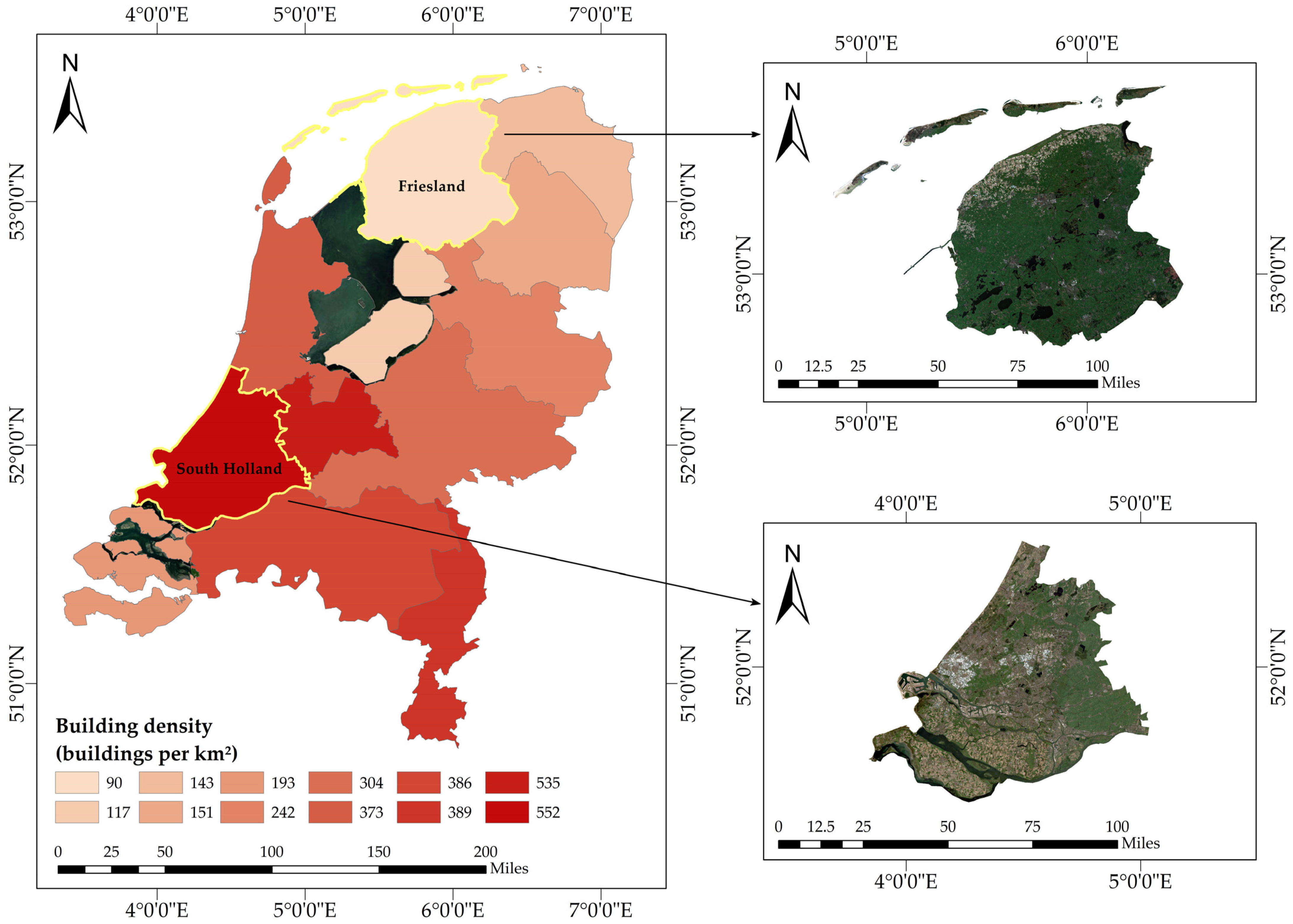
The study areas, illustrated in Figure 1, are Friesland and South Holland in the Netherlands. Friesland, in the north, is a predominantly rural province characterized by extensive lakes, waterways, and reclaimed polders, covering an area of 5753 km2. In contrast, South Holland is a highly urbanized and densely populated province in the west, home to the Randstad metropolitan region, yet it also contains significant water bodies and agrarian zones like the Groene Hart. Despite sharing a flat topography and a temperate oceanic climate, the two provinces present a stark contrast in land use and population density. This dichotomy provides an ideal testbed for evaluating the robustness of the denoising algorithm across both natural/agricultural and complex urban landscapes.

2.2. Datasets and Processing

The datasets used in this study include ICESat-2/ATLAS data, OpenStreetMap data, and Airborne LiDAR data. Details regarding the acquisition and characteristics of these datasets are presented below.

2.2.1. ICESat-2/ATLAS Data

The ICESat-2, launched by NASA in 2018, measures the height of Earth’s surface like ice, land, and forests. Its data is free to use from the National Snow and Ice Data Center (NSIDC, https://nsidc.org/data/icesat-2/data/, accessed on 18 April 2025). The main instrument on ICESat-2 is called ATLAS. It is a type of lidar that uses lasers to measure distance. It fires six laser beams at a very fast rate, which allows it to collect a dense cloud of data points. The ATL03 dataset serves as the foundational geolocated photon product derived from the ATLAS instrument. It provides high-precision latitude, longitude, and ellipsoidal height for every photon event detected, encompassing both reflected signal and ambient background returns. This raw, point-by-point granularity makes it an essential resource for researchers seeking to engineer and test bespoke denoising methods.
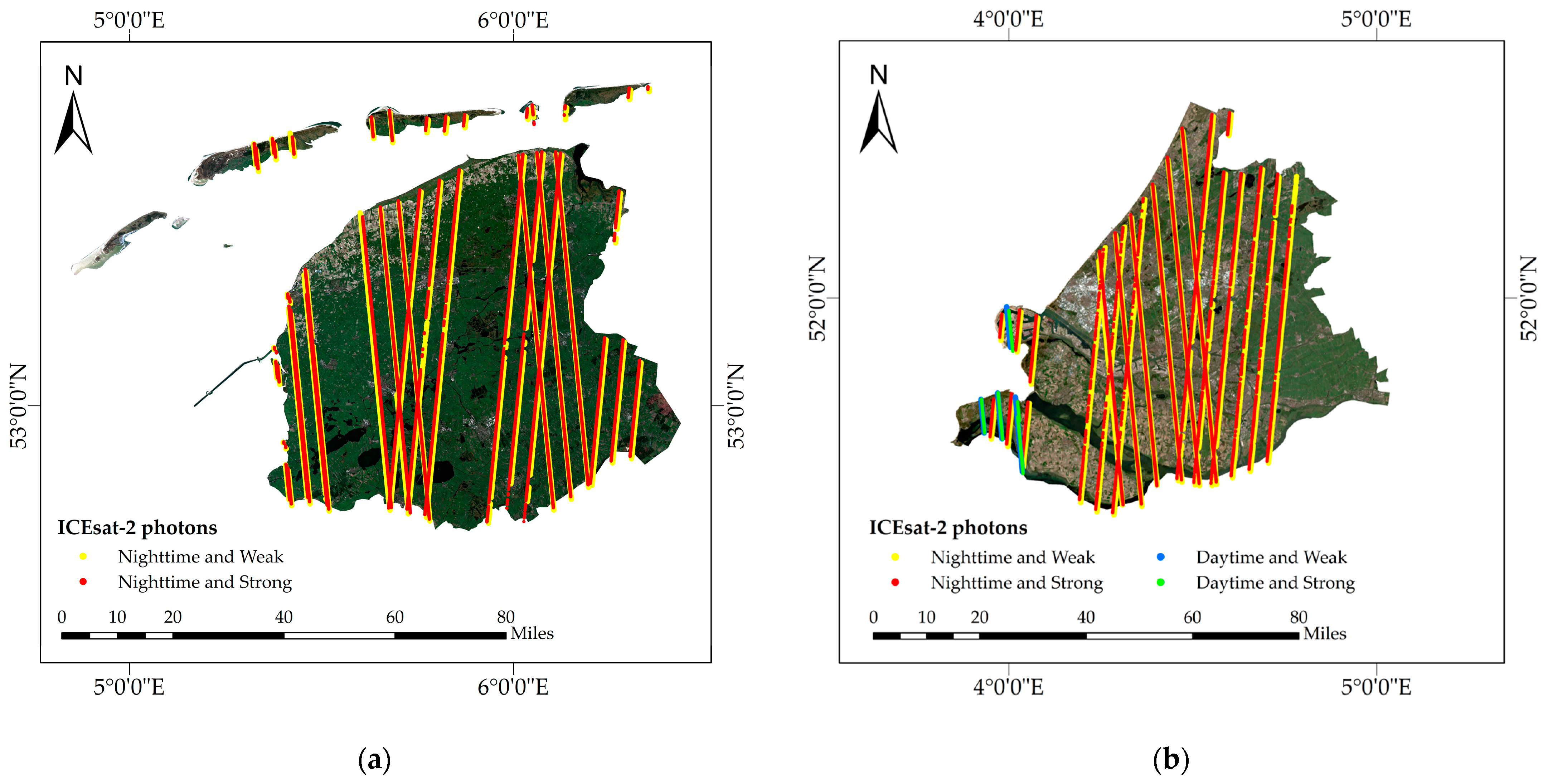
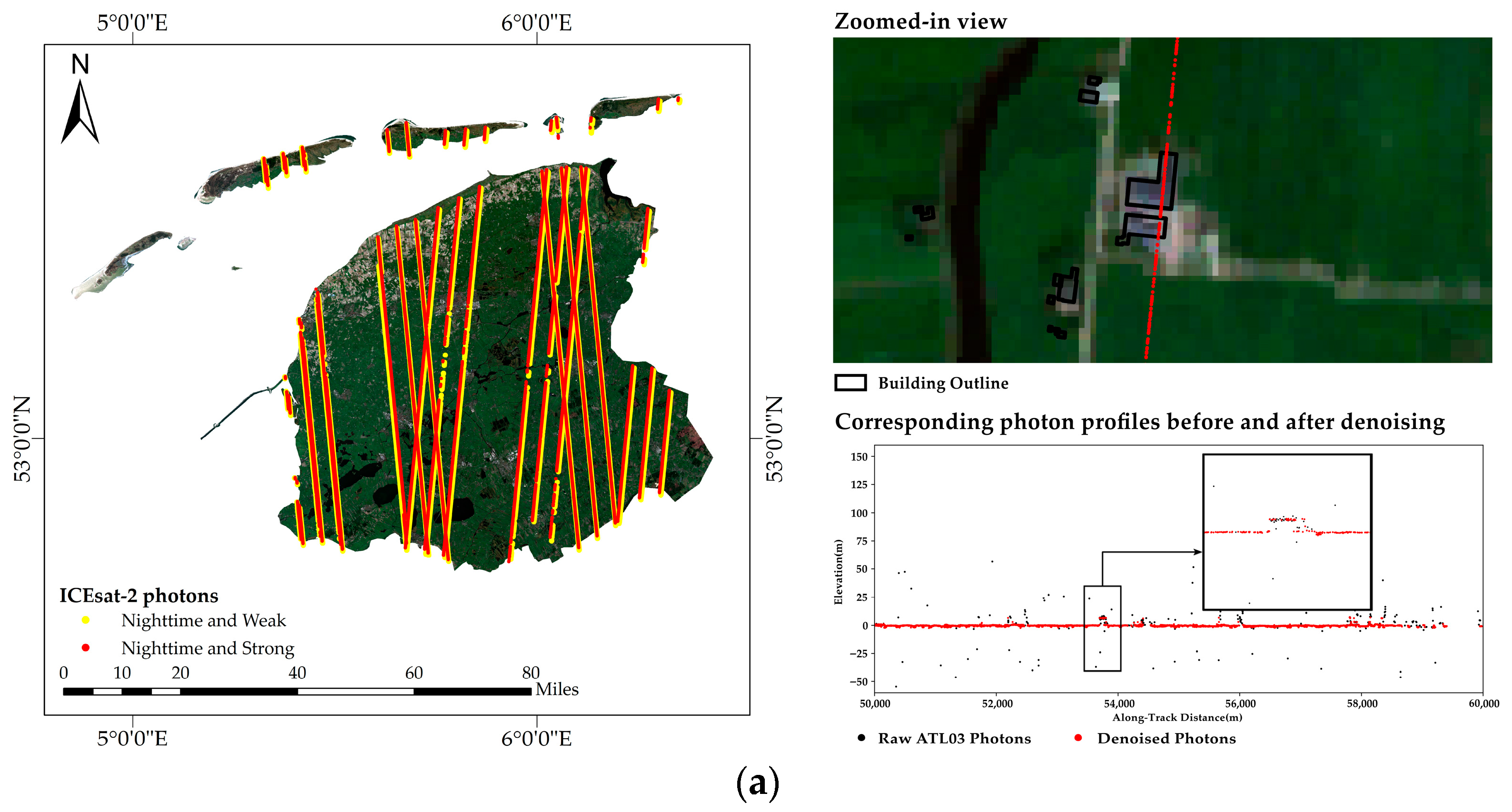
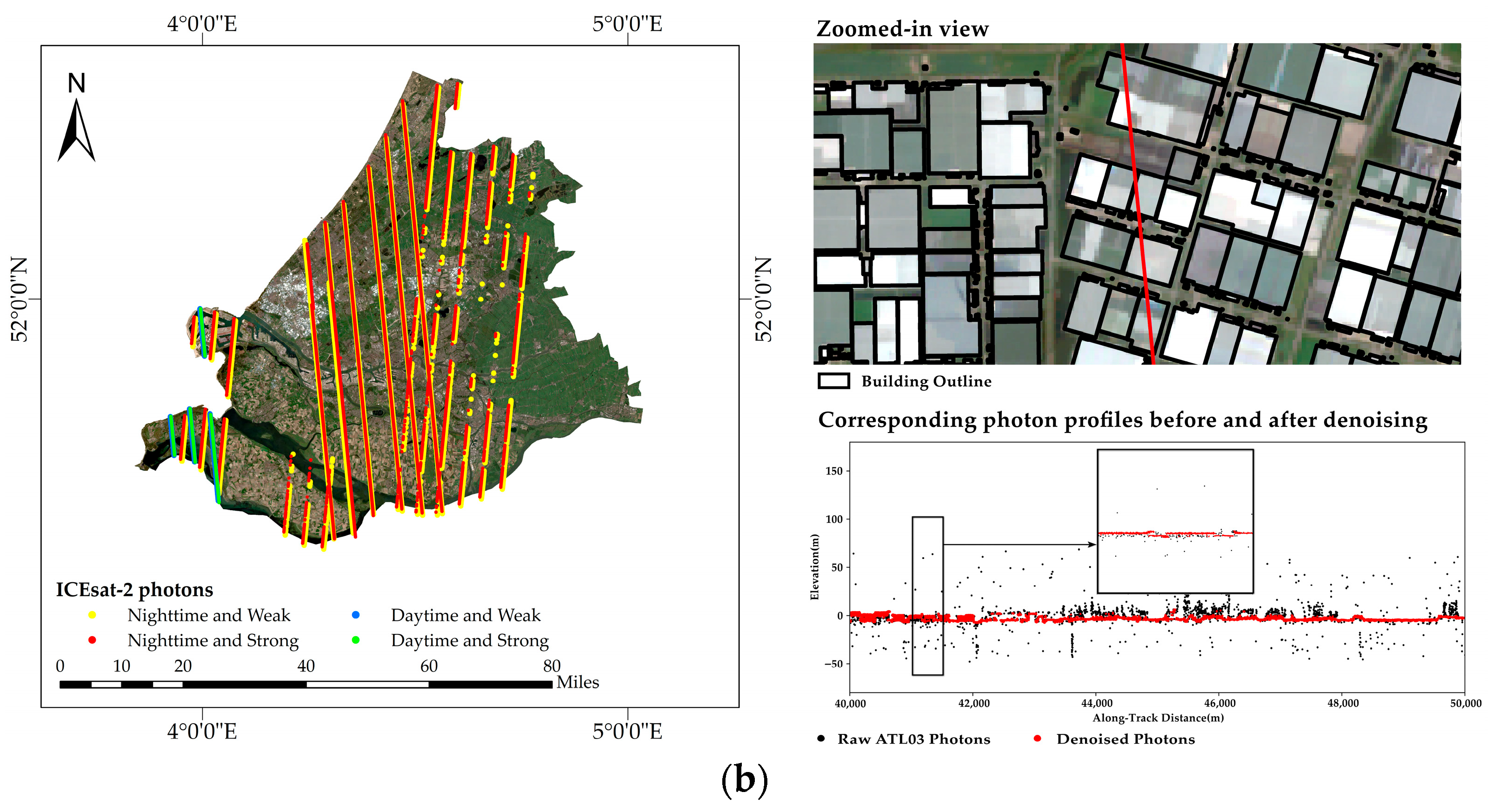
To evaluate denoising performance across different conditions, we assembled a dataset of 84 ATL03 tracks from 2021, temporally aligning them with the acquisition year of the airborne LiDAR validation data. It includes 42 tracks from low-density Friesland (all nighttime, balanced weak/strong beams) and 42 from high-density South Holland (with both daytime and nighttime acquisitions). These datasets were pre-processed in Python3.9 to spatially clip and align the data for further analysis. The geographic distribution and acquisition conditions of these tracks are illustrated in Figure 2, with detailed metadata provided in Appendix A.1.

2.2.2. OpenStreetMap for Building Footprint Vector

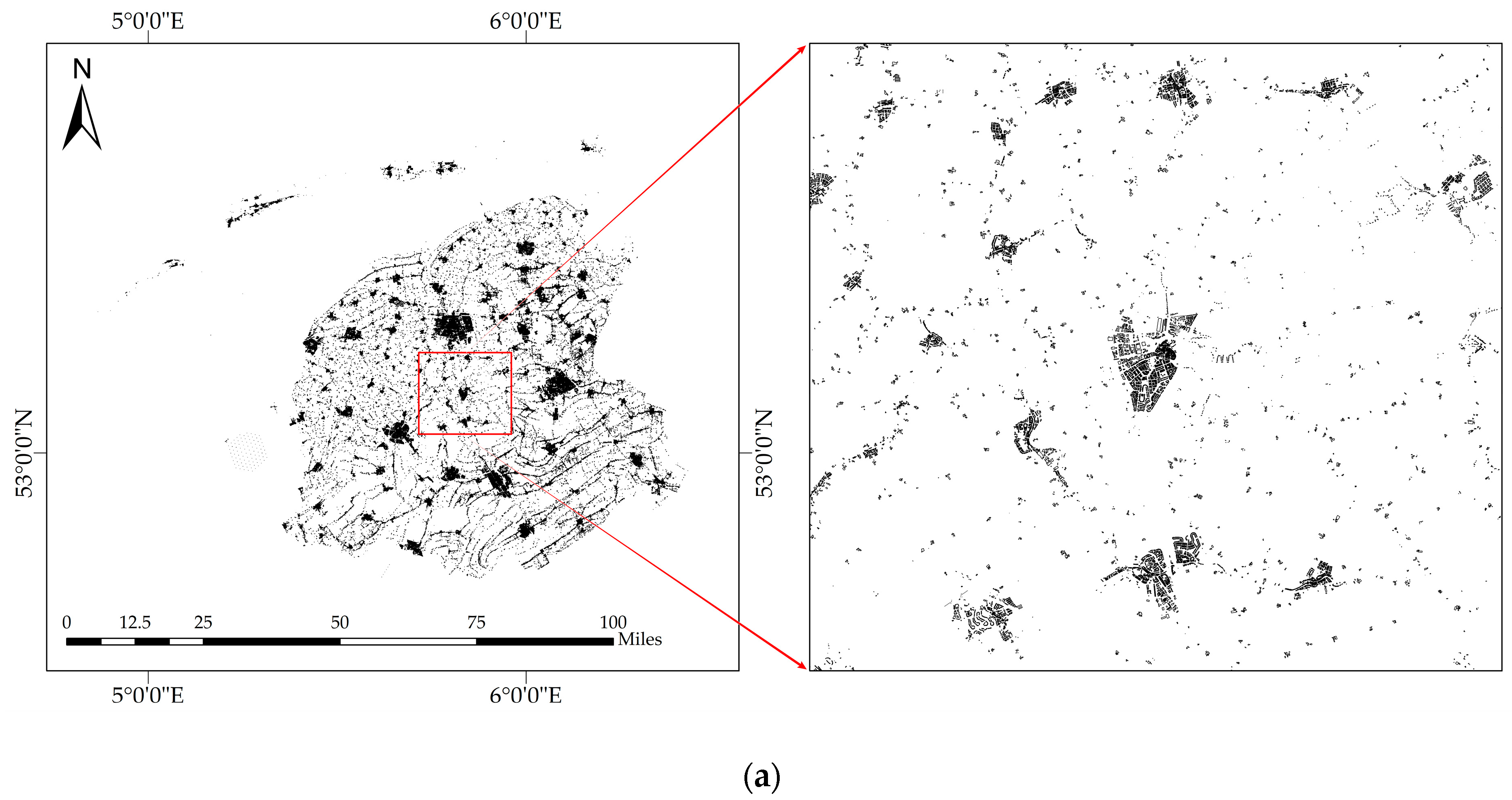
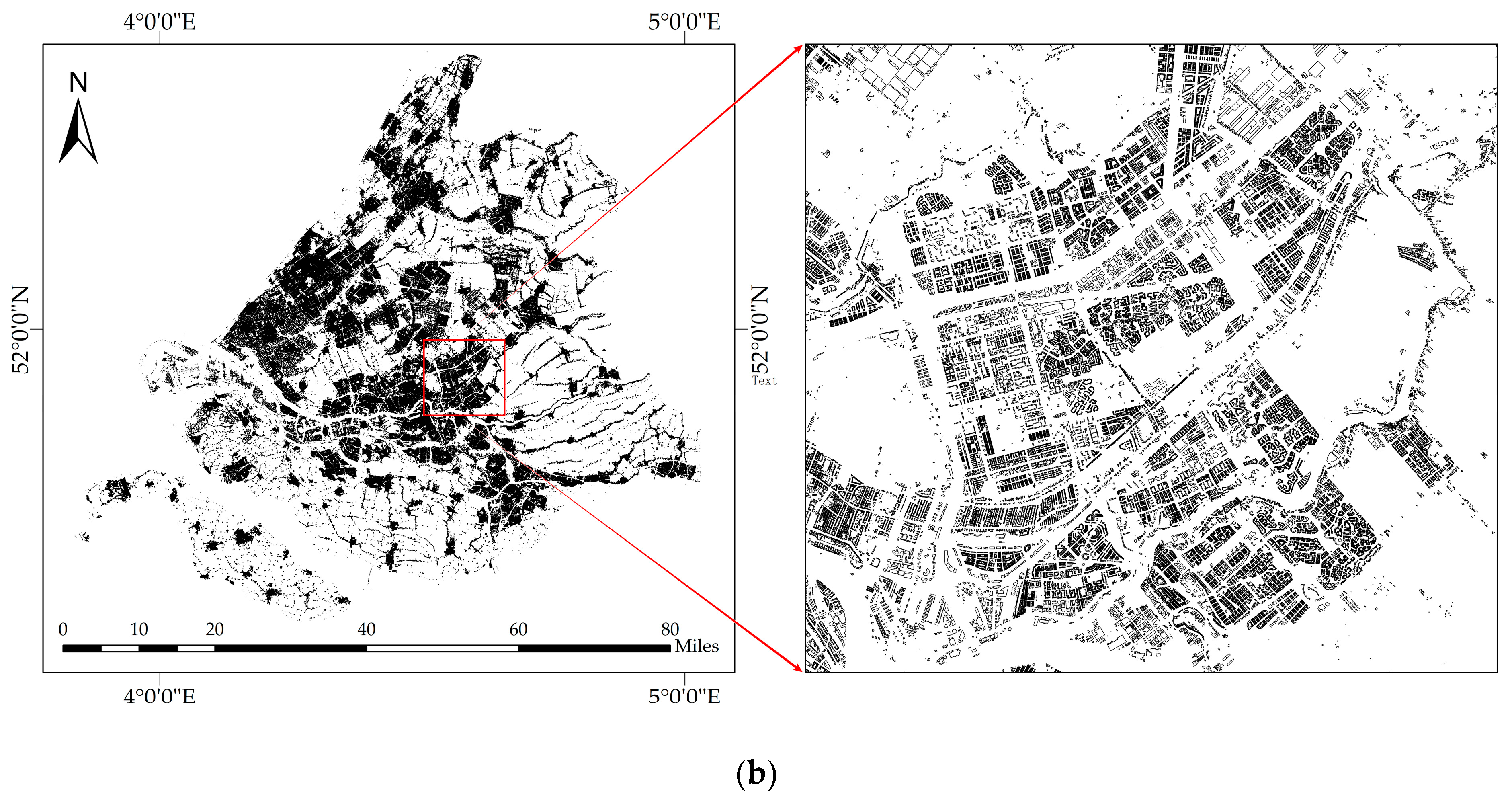
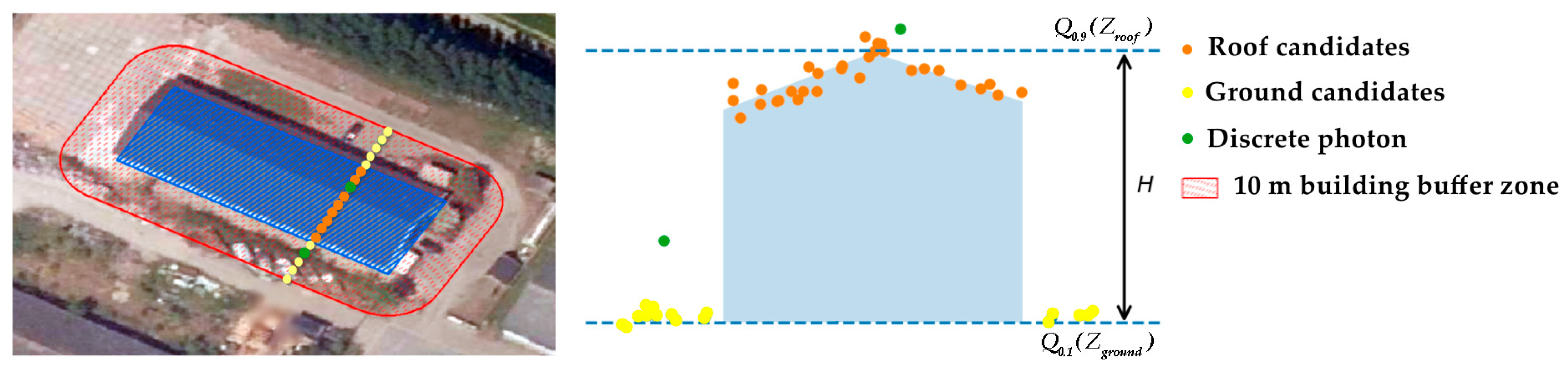
Building footprint vector data were retrieved from OpenStreetMap (OSM) via the Geofabrik platform (https://download.geofabrik.de/, accessed on 18 April 2025), providing the horizontal extents of buildings within the study areas. To facilitate the spatial association of denoised ICESat-2 photons with individual structures, a 10 m buffer was applied to each footprint, as presented in Figure 3. This buffer zone was used to capture ground photons adjacent to buildings, which are necessary for computing building height as the vertical difference between the rooftop and surrounding terrain elevations.

2.2.3. Airborne LiDAR Data

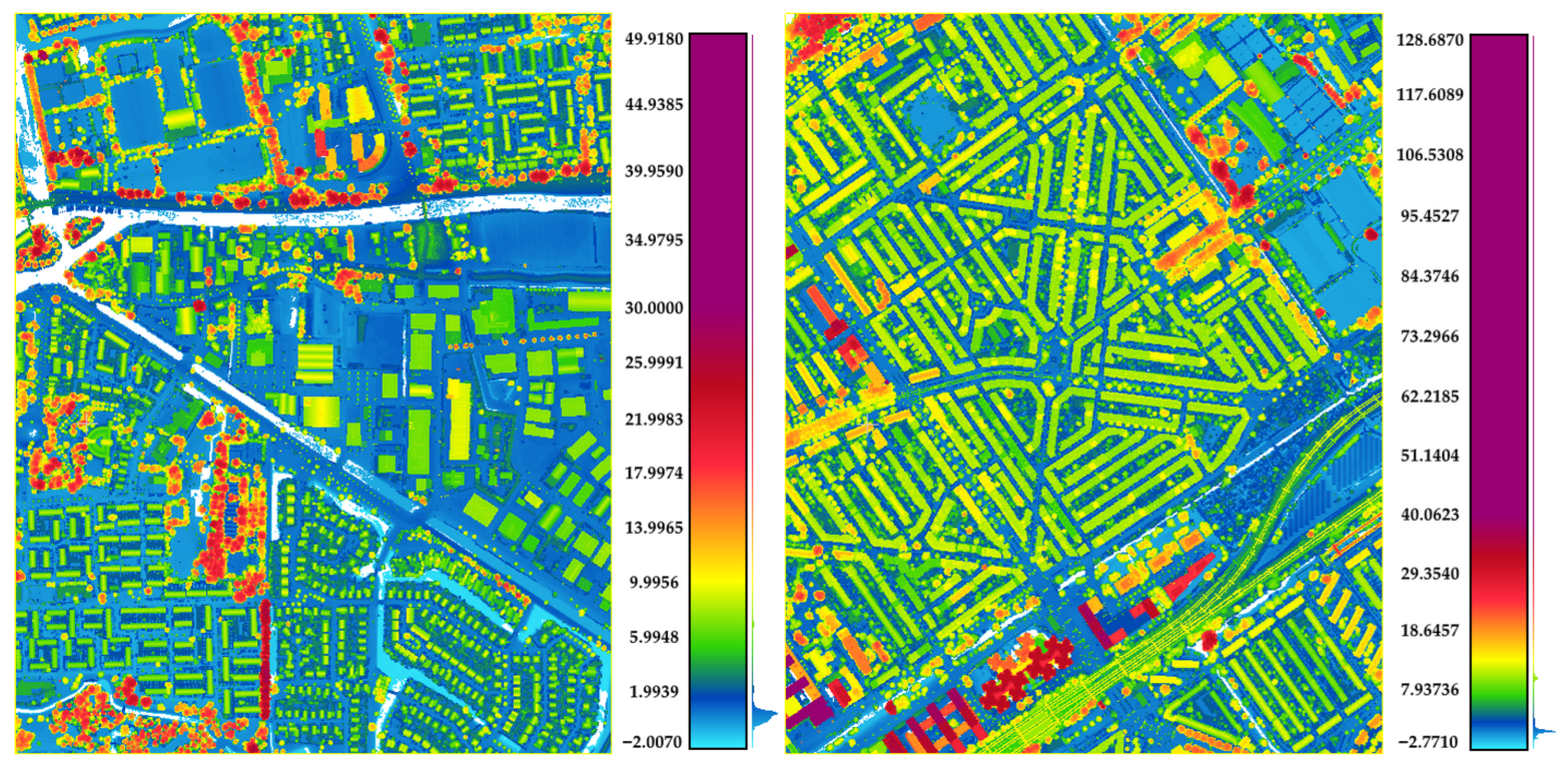
The Airborne LiDAR data (AHN4) used for building height assessment is publicly available from Delft University of Technology. AHN4 provides elevation data from 2020 to 2022, with a height precision of less than 5 cm per point cloud. The point density ranges from approximately 10 to 14 points per square meter, with high-density regions reaching 20 to 24 points per square meter, enabling detailed characterization of terrain and surface features, as illustrated in Figure 4.

3. Methods

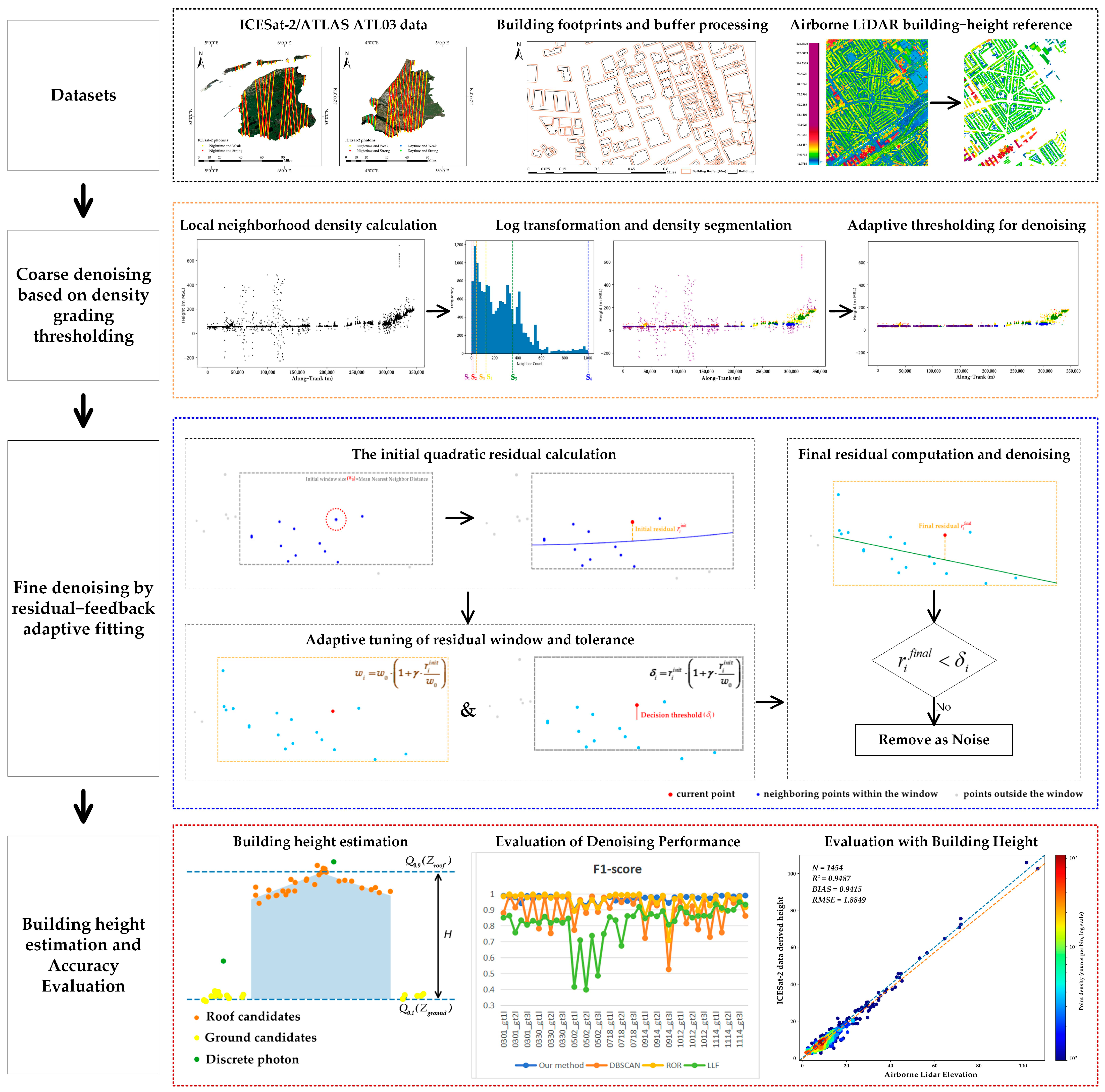
The proposed methodology, termed the Density-Guided and Residual-Feedback (DGRF) denoising method, comprises three core components, (1) coarse denoising by density-stratified adaptive filtering, (2) fine denoising by residual-feedback adaptive fitting, and (3) building height estimation, as illustrated in Figure 5.

3.1. Coarse Denoising Based on Density Grading Thresholding

The first stage of the proposed framework performs coarse denoising to remove low-density background noise. This is achieved by detecting noise photons based on their density characteristics. Specifically, a reliable global neighborhood radius is first derived from a nearest-neighbor search. A k-d tree is then employed to calculate the number of neighbors for each photon within this radius. To mitigate the influence of extreme density variations, these neighbor counts are log-transformed and stratified into multiple segments. Adaptive thresholds are constructed for each segment, allowing for the classification and removal of photons with densities below their segment-specific threshold. This procedure enables preliminary, adaptive noise suppression while preserving the global density structure and minimizing over-filtering in sparse regions.

3.1.1. Local Neighborhood Density Calculation

Individual photons lack inherent density information, which must instead be derived from their spatial distribution relative to neighbors. To enable efficient large-scale photon point cloud processing, a k-d tree spatial index was employed. For each point p i ( x i , h i ) , the distance to its k-th nearest neighbor was computed. A global, reliable neighborhood radius R was defined as the average of these neighbor distances across all points (Equation (1)). This radius serves as a consistent spatial scale for subsequent density estimation.
R = 1 N i = 1 N d i k
where d i ( k ) denotes the distance from each point to its k-th nearest neighbor, and N is the total number of points. The k is empirically set to 30, providing a good balance between local representativeness and statistical stability based on empirical testing.
Subsequently, the local spatial density ρ i is computed as the number of its neighbors within a reliable radius (Equation (2)).
ρ i = j = 1 , i j N I d i j R = j = 1 , i j N I p j p i R
where N is the total number of points, d i j denotes the Euclidean distance between photons i and j , R is the reliable radius, and I is the indicator function, which equals 1 if the condition is true and 0 otherwise.

3.1.2. Log Transformation and Density Segmentation

Directly segmenting the raw neighbor counts is problematic due to their uneven distribution, which often spans several orders of magnitude. Applying a uniform segmentation standard to such a dynamic range can lead to over-filtering in high-density regions or inadequate noise removal in sparse areas.
To mitigate this, a logarithmic transformation was applied to compress the global variation and emphasize relative local differences, as follows:
ρ i log = log 1 + ρ i
where ρ i log is the log-transformed density value for point p i . This transformation results in a smoother, more manageable distribution. The transformed density range ( ρ min , ρ max ) was then empirically and uniformly partitioned into seven intervals; thus, the boundary values s are expressed as follows:
s j = exp ρ min + j 6 ρ max ρ min 1 , j = 1 , , 6 ,
Each photon was assigned to a level based on its transformed density value, and corresponding level boundaries were then mapped back to the original density domain and used to guide subsequent density-adaptive thresholding.

3.1.3. Adaptive Thresholding for Denoising

Following density segmentation, a dynamic thresholding strategy is employed to achieve adaptive noise discrimination. Rather than relying on a fixed global criterion, the threshold is determined in a density-aware manner, such that each photon is evaluated relative to its assigned density level and the global density context. To this end, a density-dependent scaling factor ( α i ) is introduced for each segment, and the final density threshold for coarse noise removal is given by:
T i = α i T 0
where T i is the threshold for each point i , and T0 is the reference density value, typically obtained from the segment with the lowest density ( s 1 ) from the global log-density stratification. And the value of α i is not fitted per experiment but assigned deterministically according to the photon’s density level, using a predefined monotonic sequence derived from the segmented intervals, e.g., 1.0 , 1.5 , 2.5 , 5.0 , 10.0 , 20.0 , 40.0 . This density-stratified design alleviates the inherent trade-off of using a single global ROR threshold: a uniform threshold tends to over-remove photons in sparse regimes while over-retaining background-contaminated photons in dense regimes [55].

3.2. Fine Denoising by Residual-Feedback Adaptive Fitting

The coarse denoising stage effectively removes the majority of low-density background noise. However, a residual number of noise photons may persist, particularly in complex urban environments with sharp elevation changes, such as along building edges. To address these remaining outliers, a second-stage fine denoising is applied. This step leverages the sequential nature of the along-track photon data, using a residual-feedback mechanism to adaptively fit local profiles and eliminate noise photons that deviate significantly from the underlying structural trend.

3.2.1. The Initial Quadratic Residual Calculation

Due to the lack of contextual information in individual photons and the presence of terrain curvature and sharp building edges in the point cloud, a quadratic polynomial model is employed to robustly capture these local surface variations.
For a given center point p i ( x i , h i ) , an initial search window w 0 is defined as the mean nearest-neighbor distance. Based on the search window size, the neighborhood point set N i is determined by selecting all points whose horizontal and vertical coordinate differences from the center point are within w 0 / 2 . A quadratic polynomial model is fitted to all points within this neighborhood, followed by:
h j = a x j 2 + b x j + c + ε j
where h j is the observed elevation at point p j , x j is the along-track coordinate of a neighborhood point p j ( x j , h j ) , and a , b , c are the coefficients of the local quadratic model. These coefficients are determined using the least-squares method.
The fitting residual ε j represents the difference between the observed elevation h j and the value predicted by the quadratic model. The initial residual r i i n i t for any point is defined as the absolute value of this difference.
r i i n i t = ε i = h i a i x i 2 + b i x i + c i
This residual r i i n i t quantifies the deviation of the point from the fitted local surface model within its neighborhood. Larger residuals indicate significant deviations, which will guide the dynamic adjustment of the window size and discrimination threshold in the subsequent denoising steps.

3.2.2. Adaptive Tuning of Residual Window and Threshold

Given the complex local structures in ICESat-2 data, a fixed window is inadequate for calculating the final residual for precise noise removal. Therefore, an adaptive adjustment coefficient is introduced to dynamically adjust both the window size w i and predefined threshold δ i for each point. The adaptive adjustment is defined as follows:
w i = w 0 1 + γ r i i n i t w 0
δ i = r i i n i t 1 + γ r i i n i t w 0
where γ is a constant adjustment coefficient set to 3, consistent with the standard ±3σ criterion in robust statistics, which retains approximately 99.7% of observations under an (approximately) normal distribution [56,57]. This coefficient helps achieve a balance between preserving true signal points and eliminating outliers
Following the dynamic adjustment of the window size, the corresponding points are synchronously updated. The new window w i includes all points whose horizontal and vertical coordinate differences from the center point fall within w i / 2 .

3.2.3. Final Residual Computation and Denoising

The preceding quadratic initialization adapts the window to local curvature. Once this window is refined and most outliers are removed by the first stage, the remaining profile is approximately linear. A linear fit is therefore enough for the final refinement. It is less prone to overfitting residual noise in small neighborhoods and is more computationally efficient than retaining a quadratic model, ensuring both robustness and speed. The final fitting residual r i f i n a l for each point p j ( x j , h j ) is given by:
r i f i n a l = h i β i x i + θ i
where h i is the observed elevation, β i , θ i are the coefficients of the linear model, and r i f i n a l represents the final residual.
Using the adaptive adjustment coefficient, each point can be classified according to its final fitting residual r i f i n a l relative to a predefined threshold δ i , as follows:
If   r i f i n a l < δ i ,   point   i   is   retained ; otherwise ,   point   i   is   removed   as   noise .
Drawing on the principles of spatially continuous neighborhood structures, the adaptive fine-denoising technique offers key advantages including the preservation of terrain undulations and structural edges, a reduction in false removals, and enhanced robustness under complex topographic conditions, ultimately ensuring reliable inputs for subsequent building height estimation.

3.3. Building Height Estimation

To estimate building heights, the denoised ICESat-2 photons are classified into building and ground categories using a vector-based spatial analysis.
As shown in Figure 6, a 10 m buffer is first generated around each OpenStreetMap building footprint to define the immediate surrounding area, and a spatial join is then performed between the photons and the buffered vector features. Photons located within the building footprint were treated as candidate building photons (Zroof), whereas photons located only within the surrounding buffer zone were considered candidate ground photons (Zground). This footprint–buffer partitioning establishes a consistent building-level association between rooftop and local ground photon sets.
To obtain robust roof and ground elevations from photon ensembles, building-top and local ground elevations are estimated using upper- and lower-quantile statistics, respectively. Specifically, the roof elevation is defined as the 90th percentile of the candidate building-photon elevations, while the ground elevation is defined as the 10th percentile of the candidate ground-photon elevations. This 90%/10% quantile selection provides a practical balance, preserving proximity to the upper and lower envelopes of rooftop and ground returns while mitigating the influence of a small number of residual isolated photons, which is particularly important for photon-counting observations [58]. The building height is subsequently computed as the vertical difference between these two robust estimates, as follows:
H = Q 0.9 ( Z roof ) Q 0.1 ( Z ground )
To ensure the reliability of the estimated heights, a post-calculation filtering stage is applied. First, owing to the discrete along-track sampling of ICESat-2, instances where either building or ground photons are absent prevent a valid height calculation; such incomplete cases are excluded from the dataset. Second, to mitigate errors caused by non-building objects (e.g., vehicles) or boundary misclassifications, a minimum height threshold is applied. Estimated heights below 2.5 m are discarded, as this value represents the typical lower bound for valid building structures [59,60].

3.4. Accuracy Evaluation

The proposed DGRF approach was validated by evaluating its denoising performance and the accuracy of the resulting building height estimates.

3.4.1. Evaluation of Denoising Performance

The denoising performance was evaluated using both qualitative and quantitative analyses. Qualitatively, visual inspection of photon point clouds before and after denoising was conducted to examine noise suppression effectiveness and the preservation of continuous terrain and building structures.
For the quantitative analysis, the NASA ATL03 high-confidence signal classification was adopted as a proxy reference, and three standard metrics, namely Recall (R), Precision (P), and F1-measure (F1), were employed to assess the accuracy of signal photon identification. These metrics collectively characterize omission errors, commission errors, and overall denoising performance.

3.4.2. Evaluation of Building Height

The accuracy of building height estimates derived from denoised ICESat-2 photons was evaluated by comparison with high-precision airborne LiDAR data (AHN4). The evaluation employed four widely used statistical indicators: coefficient of determination (R2), root mean square error (RMSE), mean absolute error (MAE), and bias, which together quantify the consistency, accuracy, and systematic deviation of the estimated building heights.

4. Results

4.1. Results of Denoising Across Different Scenes

The proposed DGRF method was applied to ICESat-2 photon data under different observational scenarios and spatial contexts. The denoising results are listed in Table 1.
The denoising results are visualized in Figure 7, where the left panels show denoised ICESat-2 tracks color-coded by various scenarios (day/night, strong/weak beam).
As can be seen from Figure 7a, in Friesland, the ICESat-2 ground tracks are dominated by nighttime acquisitions with both strong and weak beams, traversing a largely rural, low-density landscape. The total number of photons decreases from 3,823,171 (before denoising) to 3,663,241 (after denoising), corresponding to a reduction of 159,930 photons (4.18%). The zoomed view illustrates that, after denoising, the retained photons remain continuously distributed along the ground track and exhibit a clear overlap with the building footprint polygons. This indicates that the proposed denoising method effectively suppresses background contamination while preserving along-track continuity, and preferentially retains echoes associated with structurally meaningful objects. While South Holland, as shown in Figure 7b, represents a more structurally complex and heterogeneous environment, and the dataset further includes both daytime and nighttime observations across strong/weak beams, the photon count decreases from 2,678,408 to 2,509,902, corresponding to a reduction of 168,506 photons (6.29%). This reduction is slightly larger than that observed in Friesland, which is consistent with stronger background contamination and mixed-return conditions in more complex scenes. The zoomed view reveals that denoised photon returns continue to form coherent track-aligned patterns even when intersecting dense built-up blocks and transportation corridors, supporting the method’s ability to retain structurally meaningful signals in complex scenes. Furthermore, the assessment results are presented in Figure 8, and the more detailed quantitative values are provided in Appendix A.2.
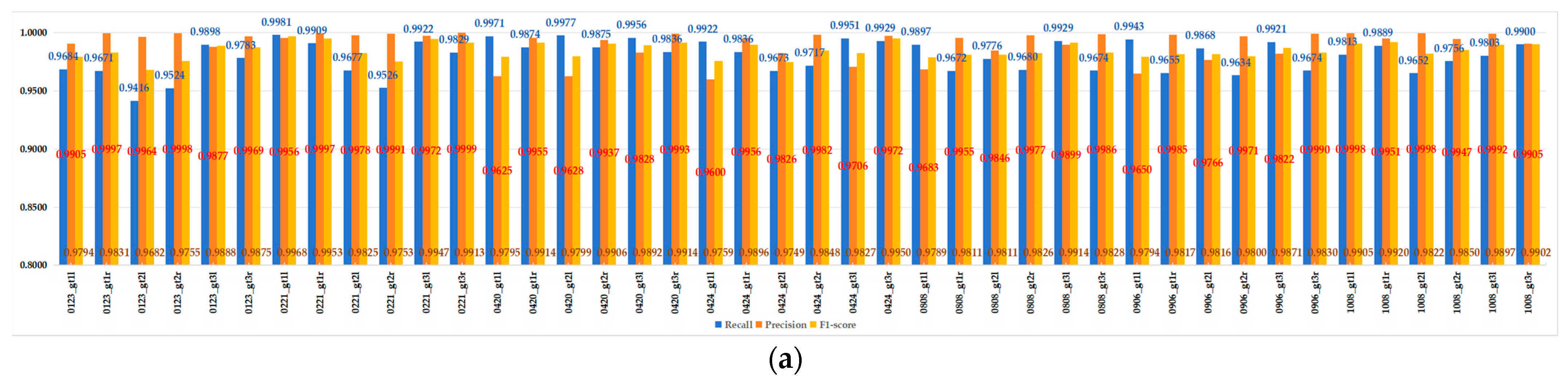
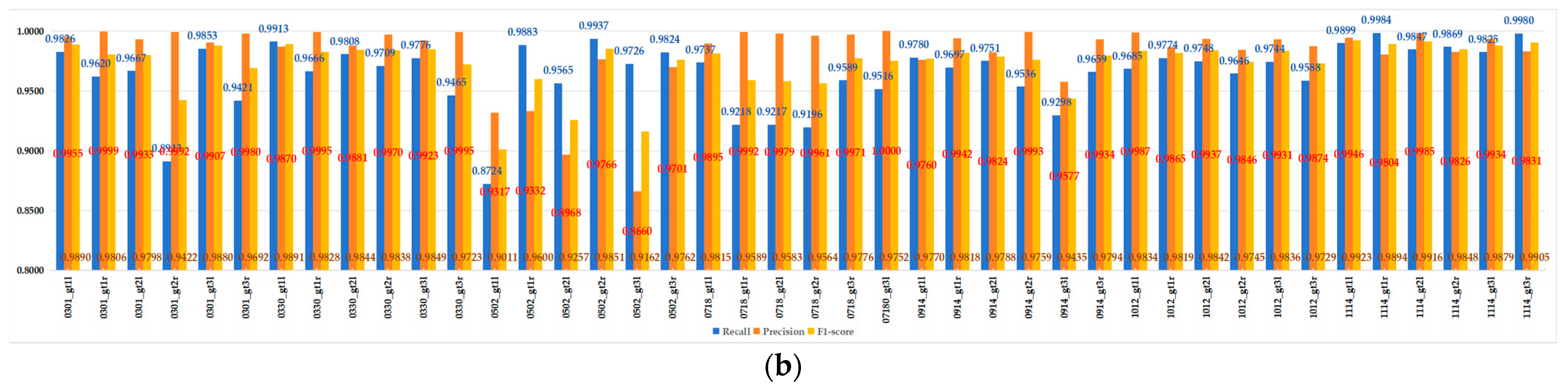
The quantitative denoising results for Friesland, shown in Figure 8a, remain consistently high, with Recall ranging from 0.9416 to 0.9981, Precision staying close to unity (0.9600–0.9999), and correspondingly high F1-scores (approximately 0.9682–0.9968). The relatively narrow spread of these metrics indicates robust performance across varying beam strengths in this rural, low-density setting. In contrast, results for South Holland, illustrated in Figure 8b, exhibit greater dispersion. Although Recall remains generally high (0.8724–0.9984), Precision varies more noticeably (0.8660–1.0000), and a small subset of challenging urban datasets shows reduced Precision, which correspondingly lowers the F1-scores (0.9011-0.9923). Outside these outliers, Precision stays close to 1.0, and most datasets retain high F1-scores, suggesting that performance degradation is localized rather than systematic. Overall, the side-by-side comparison confirms the broad robustness of the proposed denoising strategy across heterogeneous landscapes, with only minor reductions in Precision and F1-scores observed in a limited number of complex urban scenes.

4.2. Results of Denoising in Different Conditions

To evaluate the denoising performance of the proposed method under different observational scenarios, ICESat-2 data were categorized into four conditions: nighttime strong-beam, nighttime weak-beam, daytime strong-beam, and daytime weak-beam. These scenarios exhibit distinct noise characteristics due to variations in solar background illumination and laser pulse energy. For each condition, one representative track was selected for a before–after denoising comparison, and the corresponding quantitative results are summarized in Table 2.

4.2.1. Results on Nighttime Strong-Beam

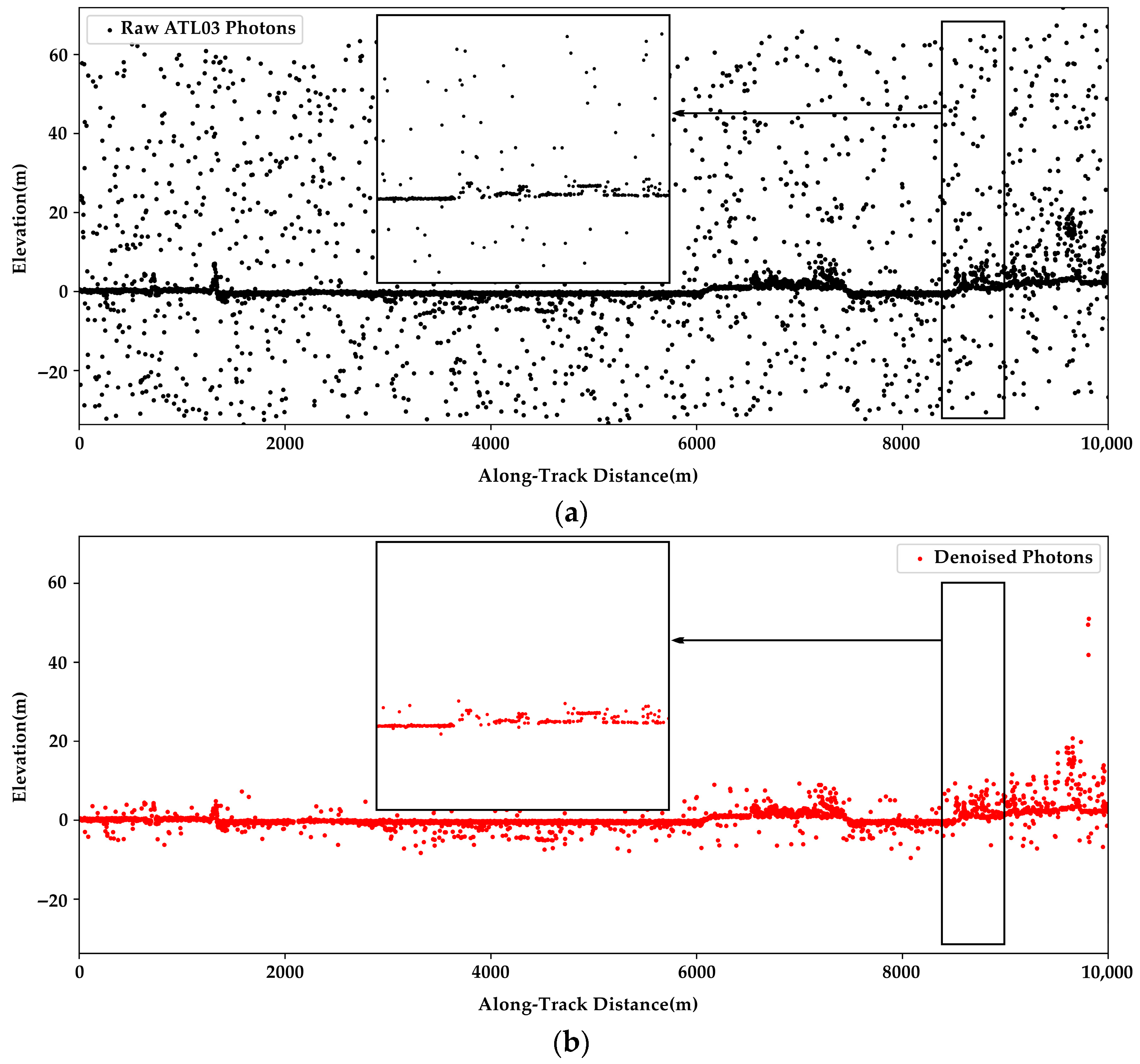
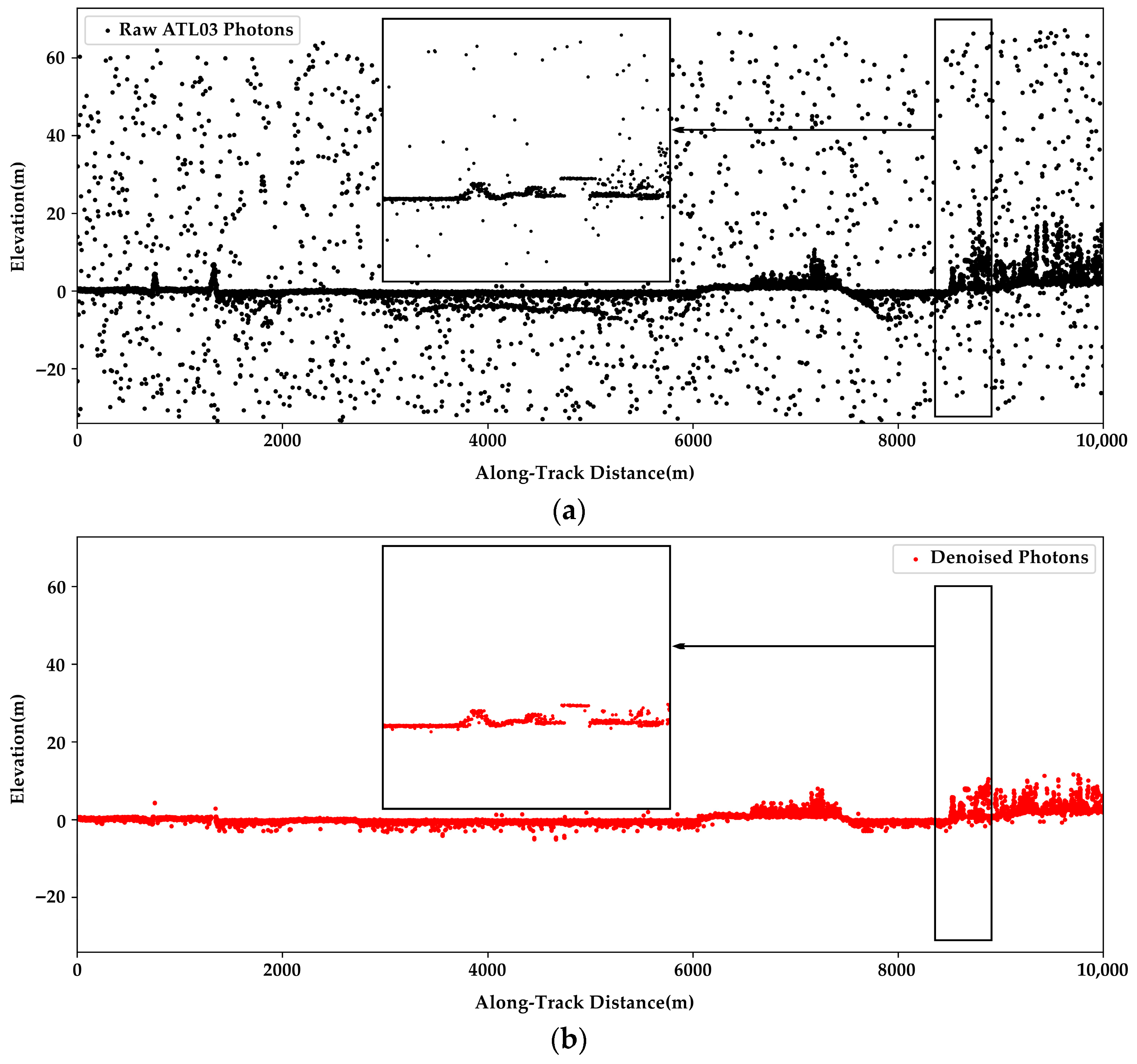
A nighttime strong-beam example from the South Holland region (ATL03_20210330200530_00921102_006_01_gt3r, hereafter abbreviated as 0330_gt3r) is shown in Figure 9.
As can be seen in Figure 9a, the raw ATL03 photons are heavily contaminated by background photons; the coexistence of scattered outliers and signal photons blurs local structural boundaries and yields a less coherent profile shape. In contrast, Figure 9b shows that the proposed method substantially suppresses background noise while preserving a more continuous photon sequence and better-preserved local profiles. In the enlarged regions, the dispersed background photons are largely removed, and the retained photons form clearer, more compact structures, making local elevation transitions and object boundaries more distinguishable. These results indicate that the proposed method retains signal photons in complex areas, thereby enhancing structural integrity and continuity.

4.2.2. Results on Nighttime Weak-Beam

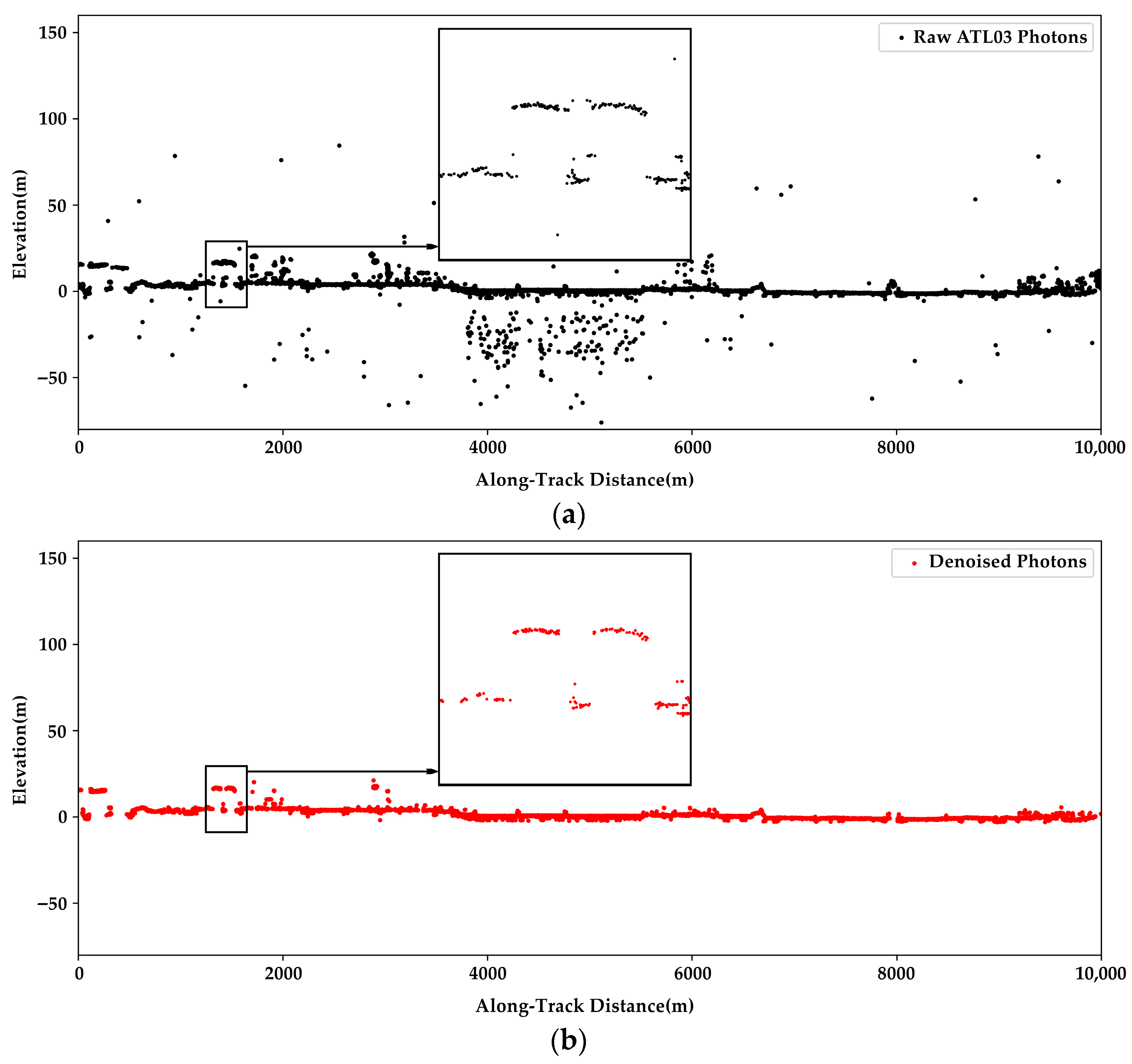
We evaluate the nighttime weak-beam case (ATL03_20210330200530_00921102_006_01_gt3l, hereafter abbreviated as 0330_gt3l; Figure 10).
It can be seen from Figure 10a that the raw ATL03 photons exhibit a noticeably lower signal-to-noise contrast, with abundant background photons scattered across a wide elevation range. Besides the dominant near-ground photon band, numerous isolated outliers appear both above and below the main surface, which obscure the local structural details of the along-track profiles, as highlighted in the enlarged region. In contrast, the denoised results in Figure 10b indicate that the proposed method substantially suppresses these dispersed background photons while retaining the main surface-related photon structure. The near-surface photon layer becomes cleaner and more continuous, and the enlarged view further indicates that elevated photon clusters (e.g., returns associated with built structures) are retained with clearer local profiles. This qualitative comparison suggests that the method remains effective under the more challenging weak-beam nighttime condition, improving profile interpretability by reducing background contamination while maintaining structurally meaningful returns.

4.2.3. Results on Daytime Strong-Beam

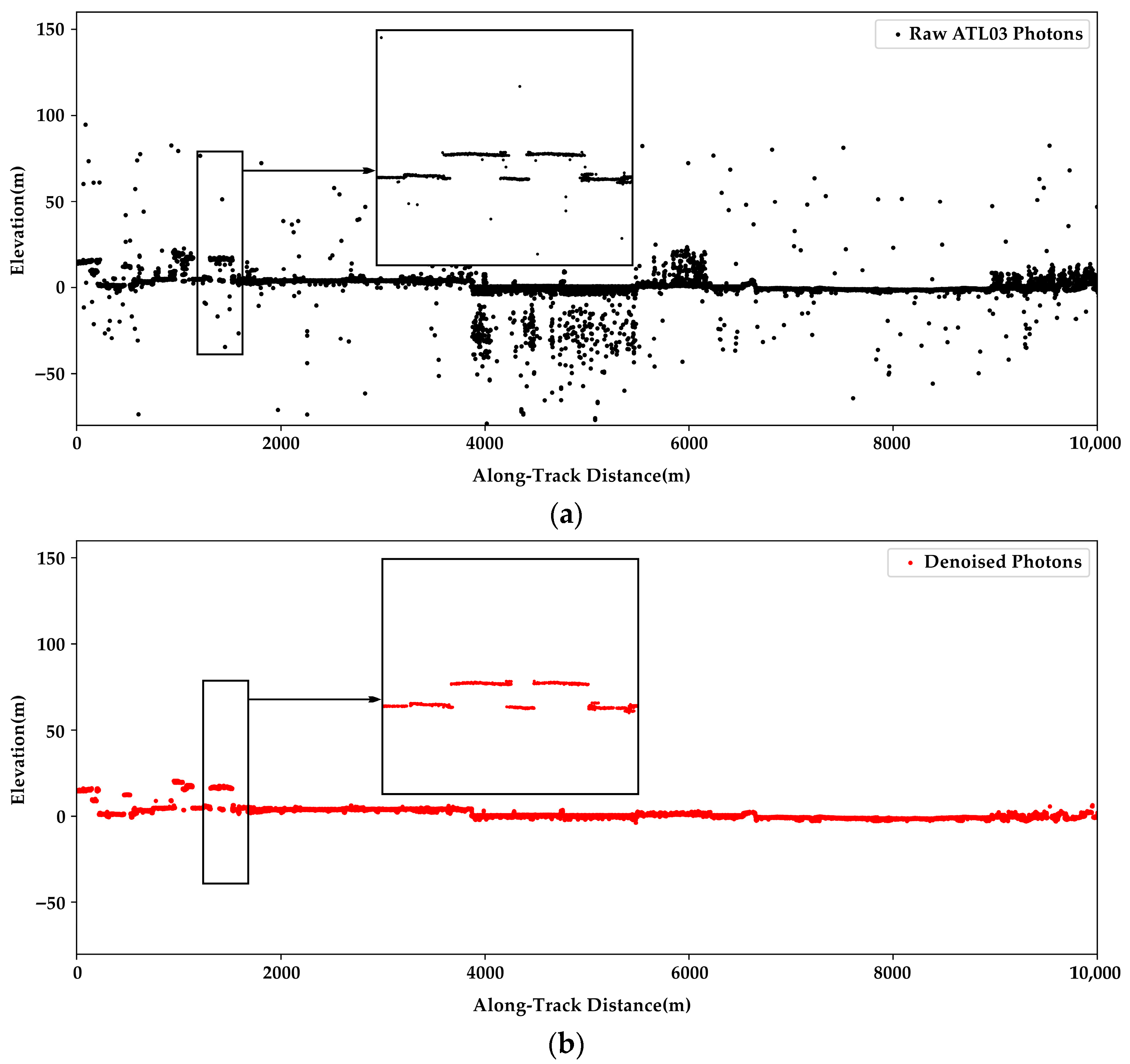
We evaluate the daytime strong-beam case (ATL03_20210502183314_05951102_006_01_gt1r, hereafter abbreviated as 0502_gt1r; Figure 11).
The raw ATL03 photons in Figure 11a show markedly heavier background contamination than the nighttime observations (including both strong- and weak-beam cases; Figure 9 and Figure 10), with widespread solar-related background photons intermingled with both surface- and structure-related returns, making local profile boundaries less distinct in the boxed regions. Nevertheless, Figure 11b shows that the proposed method remains effective under this more challenging daytime condition: most dispersed background photons are removed, while the retained photons maintain a coherent and continuous along-track structure. The structure-related elevated photon cluster in the zoomed view remains well defined after denoising, indicating that the method can preserve structurally meaningful returns even when background interference is substantially stronger in the raw observations.

4.2.4. Results on Daytime Weak-Beam

We evaluate the daytime weak-beam case (ATL03_20210502183314_05951102_006_01_gt1l, hereafter abbreviated as 0502_gt1l; Figure 12). As can be seen in Figure 12a, the raw ATL03 photons represent the most challenging condition among the four scenarios and exhibit the lowest signal-to-noise ratio: widespread solar-related background photons are densely intermingled with the surface- and structure-related returns, making the local profile boundaries in the boxed regions less distinct than those in the nighttime weak-beam case and the daytime strong-beam case. After denoising, Figure 12b shows that most dispersed background photons are removed. However, compared with the nighttime weak-beam example and the daytime strong-beam example, the retained photons in 0502_gt1l still contain a small amount of residual noise, which can be more clearly observed in the zoomed view, indicating that background suppression is more challenging under the combined daytime illumination and weak-beam condition. Nevertheless, the zoomed region still preserves identifiable structure-related elevated returns with a clearer local shape than the raw observations, demonstrating that the method can retain key signals even when residual contamination is higher in this worst-case scenario.
Overall, the qualitative comparisons across the four observational conditions show that the proposed method consistently removes widely scattered background noise photons while keeping the main along-track signal patterns clear and continuous. The denoising performance is strongest under nighttime or strong-beam observations, whereas daytime weak-beam data remain the most challenging. Nevertheless, even under this worst-case condition, key elevated returns remain identifiable, indicating that the proposed method adapts well to variations in illumination and beam strength.

4.3. Results of Building Height Estimation

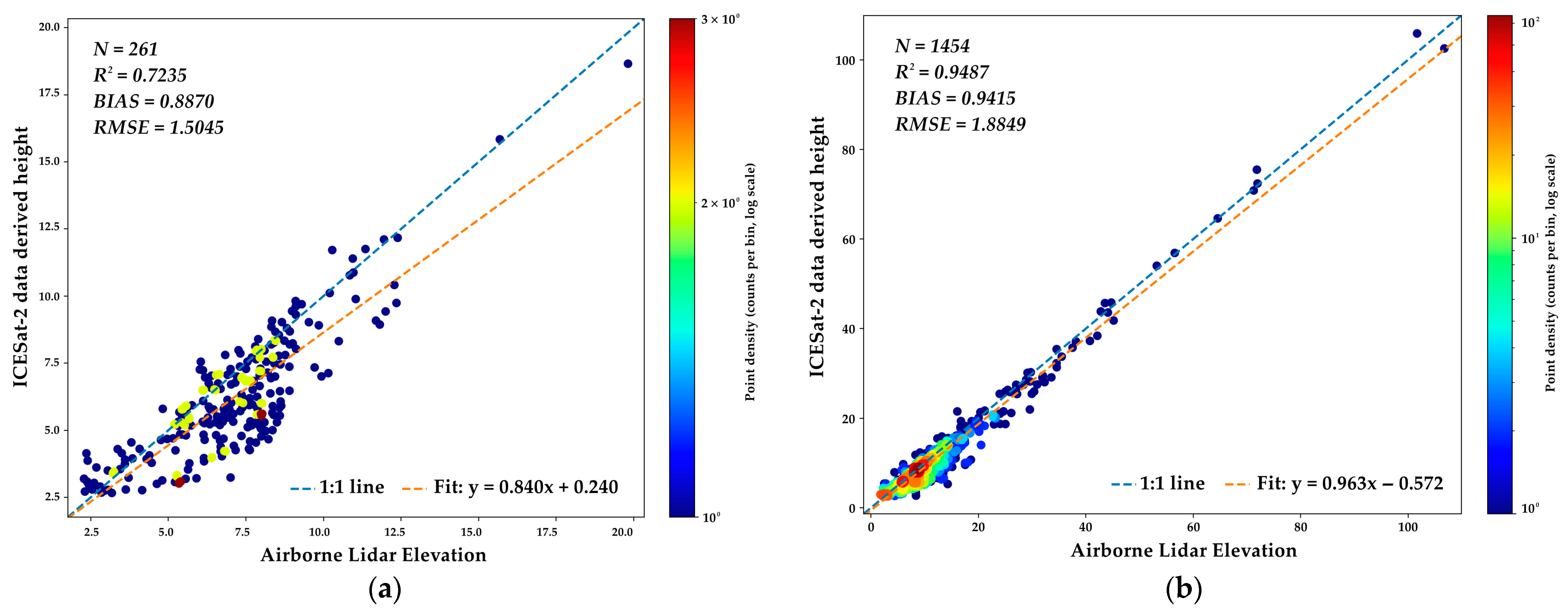
Building heights in Friesland and South Holland were estimated and validated against an airborne LiDAR reference (AHN4). Table 3 summarizes the validation results for 261 buildings in Friesland and 1454 buildings in South Holland, while Figure 13 visualizes the agreement by plotting the estimated heights against the AHN4 reference heights.
Heights were estimated for 2023 buildings in Friesland and 4672 buildings in South Holland. Due to the large volume of airborne LiDAR point-cloud data and the associated data-handling constraints, only a subset of buildings was used for validation, including 261 buildings in Friesland and 1454 buildings in South Holland. As seen in Table 3, the proposed denoising method achieved an R2 of 0.7235, an RMSE of 1.5045 m, a MAE of 1.1423 m, and shows a small positive bias (0.8870 m) for buildings in Friesland. In South Holland, the agreement is higher (R2 = 0.9487), but the absolute errors increased (RMSE = 1.8849 m, MAE = 1.2981 m), and the positive bias (0.9415 m). These results confirm the general reliability of the height estimates and indirectly validate the effectiveness of the denoising process.
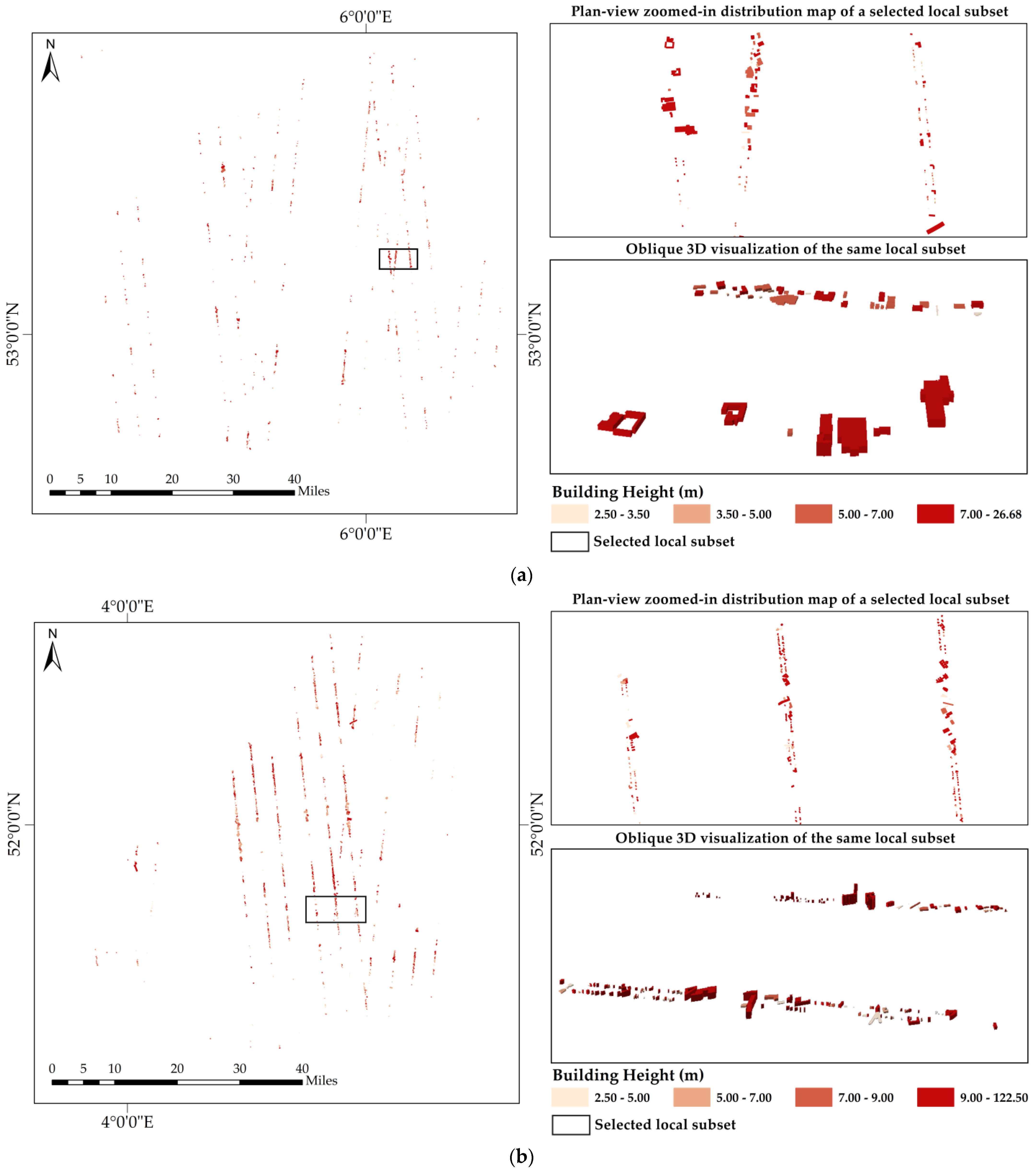
The resulting building height estimates are further visualized as a spatial distribution map in Figure 14. The left panel shows the spatial distribution of buildings, with footprints colored by height classes; the right panels provide a plan-view zoom and an oblique 3D view for local subsets to highlight fine-scale height variability and building morphology. It can be seen from Figure 14 that in Friesland, the mapped buildings form relatively sparse clusters aligned with near-parallel ground tracks, reflecting localized coverage where ATL03 tracks intersect built-up areas. The detailed plan-view highlights separated building groups along different tracks, while the 3D inset reveals a compact neighborhood with low-to-moderate buildings and a few taller structures, indicating that the estimated heights capture local heterogeneity. In South Holland, buildings are distributed across denser ground tracks, with both plan-view and 3D perspectives showing stronger height contrasts and more continuous building sequences, consistent with the higher structural complexity of the urban environment.

5. Discussion

5.1. Comparison with Different Denoising Methods

Three widely used methods, namely Radius Outlier Removal (ROR) [55], Density-Based Spatial Clustering of Applications with Noise (DBSCAN) [37], and local linear fitting (LLF) [61], are applied in Friesland to quantitatively assess the effectiveness of the proposed denoising approach. The performance was evaluated using Recall, Precision, and F1-score, as defined in Section 3.4.
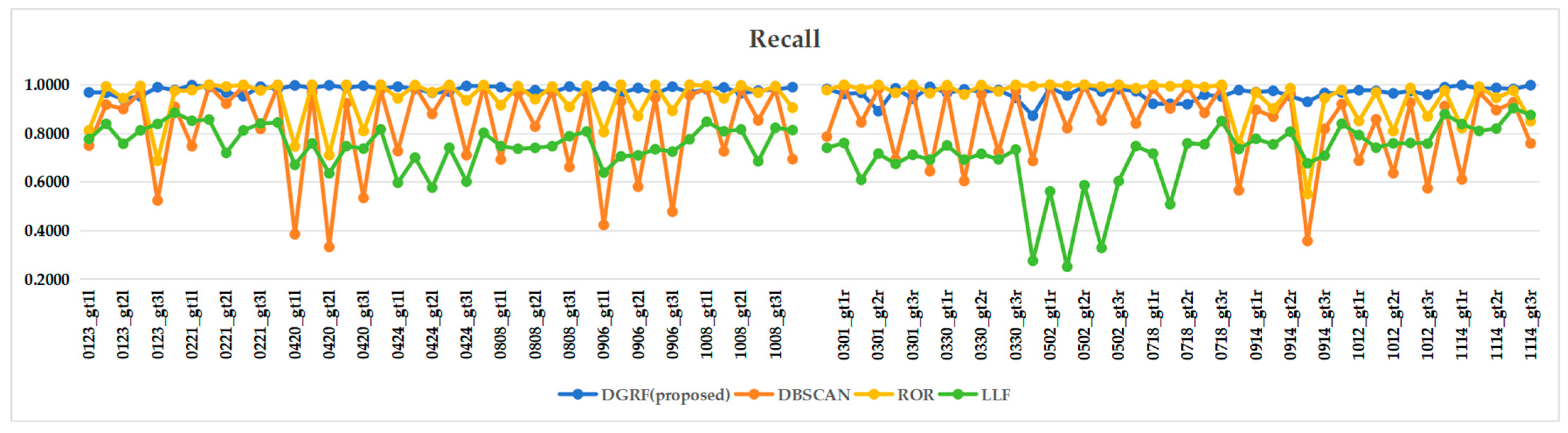
As can be seen in Figure 15, the proposed approach demonstrated superior robustness by consistently achieving high Recall values across all datasets, with a minimum value of around 0.8724 and most cases exceeding 0.95, indicating strong resistance to signal loss under varying noise conditions. In contrast, both DBSCAN and LLF exhibit substantial failures in signal preservation, with Recall values dropping drastically to 0.3329 and 0.2518, respectively, indicating significant missed detections caused by over-filtering. ROR can achieve Recall values close to 1.0, but its performance is highly unstable; under challenging conditions, Recall drops drastically to 0.5513. These results demonstrate that the proposed DGRF method more effectively preserves valid signal photons in complex noise environments, thereby substantially reducing omission errors compared with conventional denoising approaches.
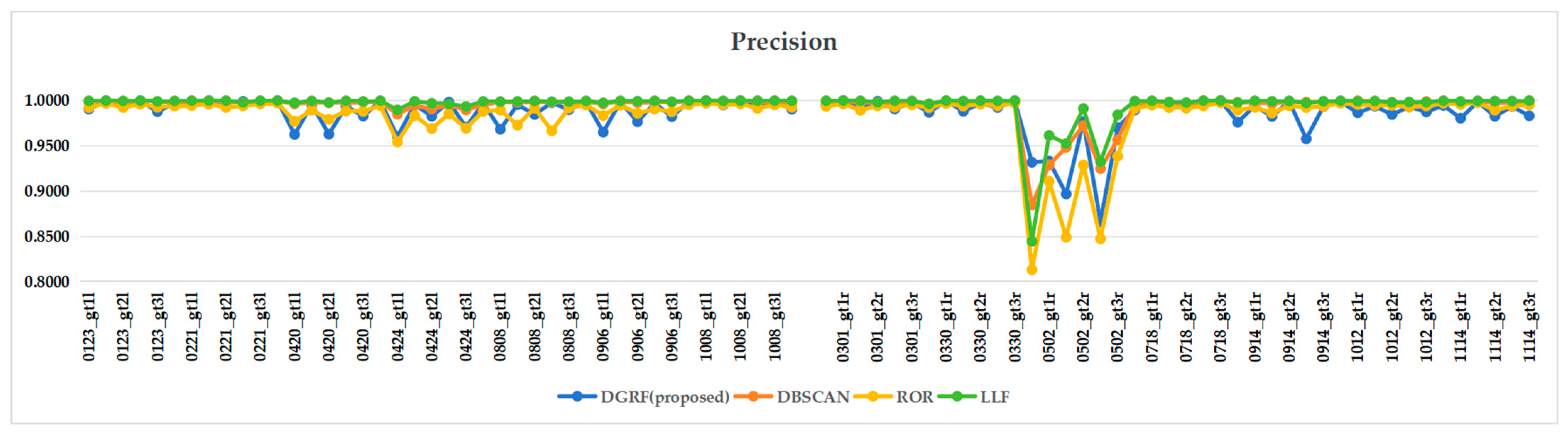
As shown in Figure 16, the proposed method maintains a consistently high Precision, with all values exceeding 0.86, although it performs slightly lower than LLF and DBSCAN. In contrast, ROR exhibits noticeably larger variability, with Precision decreasing to approximately 0.813 in certain datasets. These results indicate that, although the proposed method does not yield the highest Precision, it provides stable and well-controlled suppression of false positives and maintains reliable performance across diverse observational scenarios.
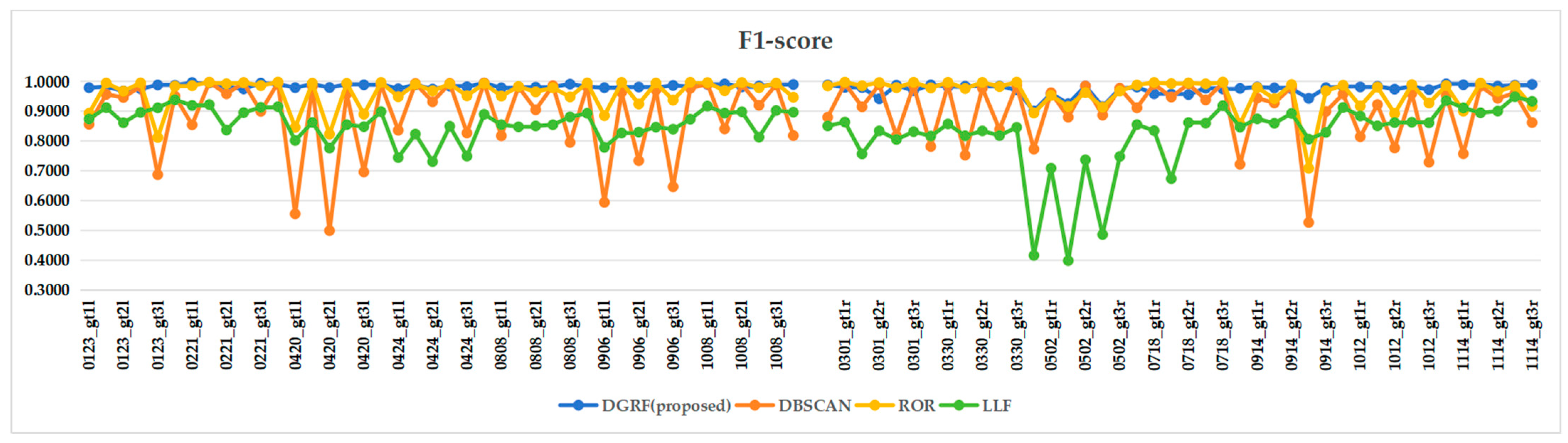
The F1-score, which jointly reflects Precision and Recall, further substantiates the overall advantage of the proposed method, as shown in Figure 17. Across all datasets, the proposed method achieves consistently high F1-score values ranging from approximately 0.9011 to 0.9968 with limited variation, indicating stable and reliable denoising performance. In contrast, these widely used methods exhibit pronounced performance degradation under certain conditions: DBSCAN records F1-scores as low as 0.4992, ROR decreases to a minimum of 0.7088, and LLF drops to 0.3983. These results demonstrate that the proposed method effectively balances robust signal preservation (high Recall) with stable noise suppression (high Precision), thereby maximizing the F1-score.

5.2. The Effectiveness of the Two-Stage Denoising

The two-stage architecture of the proposed framework functions synergistically, with each stage targeting distinct noise characteristics. To evaluate the contribution of each stage, a stepwise quantitative analysis was performed on four condition-specific datasets: 0330_gt3r, 0330_gt3l, 0502_gt1r, and 0502_gt1l. The corresponding Recall, Precision, and F1-score values after coarse and fine denoising are summarized in Table 4.
It is evident from Table 4 that the proposed method achieves a synergistic effect by maintaining consistently high F1-scores across all tested conditions. Under nighttime conditions, the first stage (Density-Guided filtering) performs robustly, producing high F1-scores (0.9925 and 0.9935) with Precision close to unity (0.9987 and 0.9882), indicating accurate signal identification when background noise is relatively limited. In contrast, under daytime conditions, the first stage performance becomes more challenging. For the daytime strong-beam case, although Recall reaches 1.0000, Precision is 0.9068, yielding an F1-score of 0.9511. For the daytime weak-beam case, the method attains a Recall of 0.9415 but a lower Precision of 0.8464, resulting in an F1-score of 0.8914. These results suggest that while the coarse stage is effective in preserving signal continuity, residual background photons under strong solar illumination can still degrade Precision, particularly for weaker beams.
The second stage, based on Residual-Feedback refinement, effectively compensates for these shortcomings by adaptively removing residual noise clusters that persist after coarse filtering. Under nighttime conditions, this refinement stage maintains extremely high Precision while introducing only minor and acceptable reductions in Recall, thereby preserving overall accuracy. More importantly, under daytime conditions, the refinement stage improves overall balance: Precision increases from 0.9068 to 0.9332 for the strong-beam case and from 0.8464 to 0.9317 for the weak-beam case, which raises the corresponding F1-scores to 0.9600 and 0.9011, respectively. These results demonstrate that the residual-feedback mechanism is crucial for suppressing residual background noise and validates the synergistic design of the proposed DGRF framework.
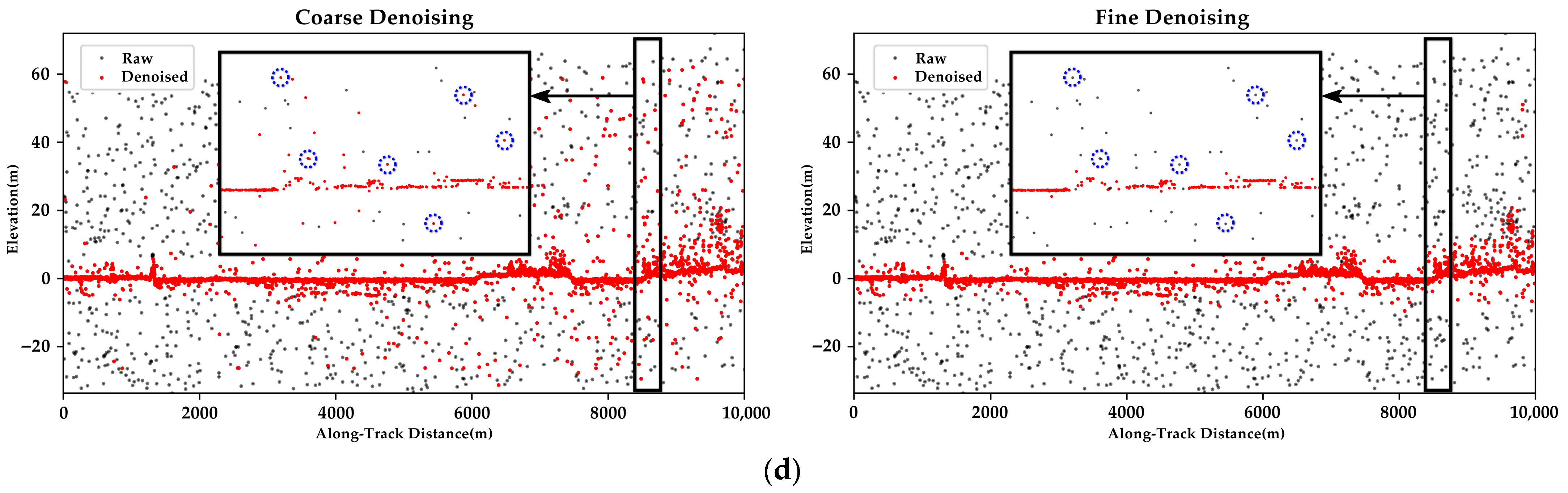
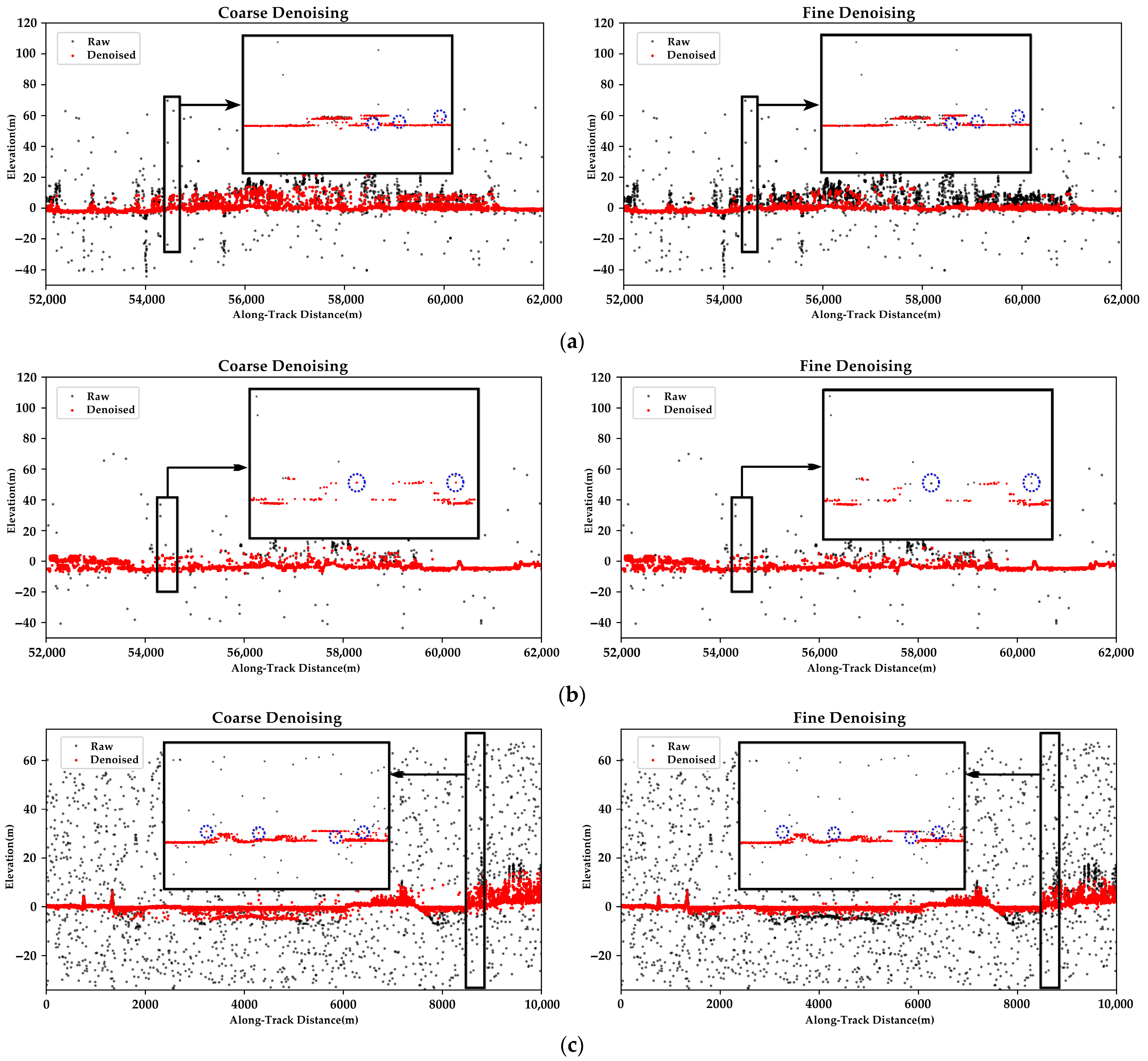
Moreover, the Density-Guided stage ensures high signal completeness through robust global filtering, whereas the Residual-Feedback stage refines local structures and suppresses residual background noise. Their integration enables the proposed DGRF framework to achieve a well-balanced trade-off between Recall and Precision, thereby validating both the effectiveness and necessity of the two-stage design. Figure 18 further illustrates the two-stage denoising process and overall workflow of the Density-Guided and Residual-Feedback (DGRF) method, visually depicting the transition from density-based coarse filtering to adaptive residual refinement.
Figure 18 provides a corresponding visualization of the stepwise improvement, consistent with the quantitative findings presented in Table 4. Specifically, the photons highlighted by blue circles represent noise clusters that were incorrectly classified as signal photons during the first-step (Density-Guided) denoising, resulting in persistent residual noise. After the second-step (Residual-Feedback) denoising, these misclassified photons were effectively removed by the adaptive linear fitting mechanism, thereby further improving the overall accuracy, particularly the Precision, of the denoising results.

5.3. The Performance in Different Conditions

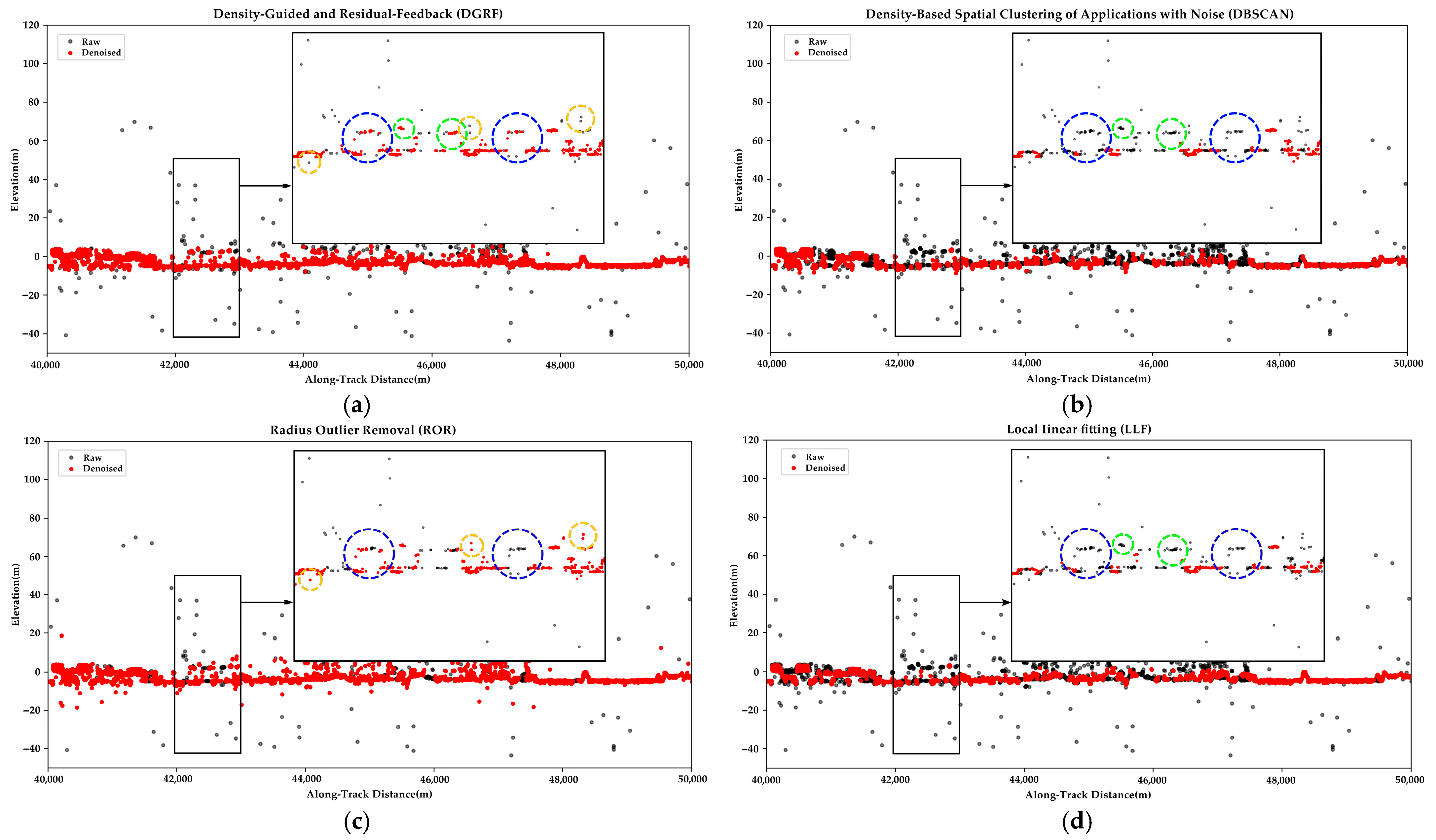
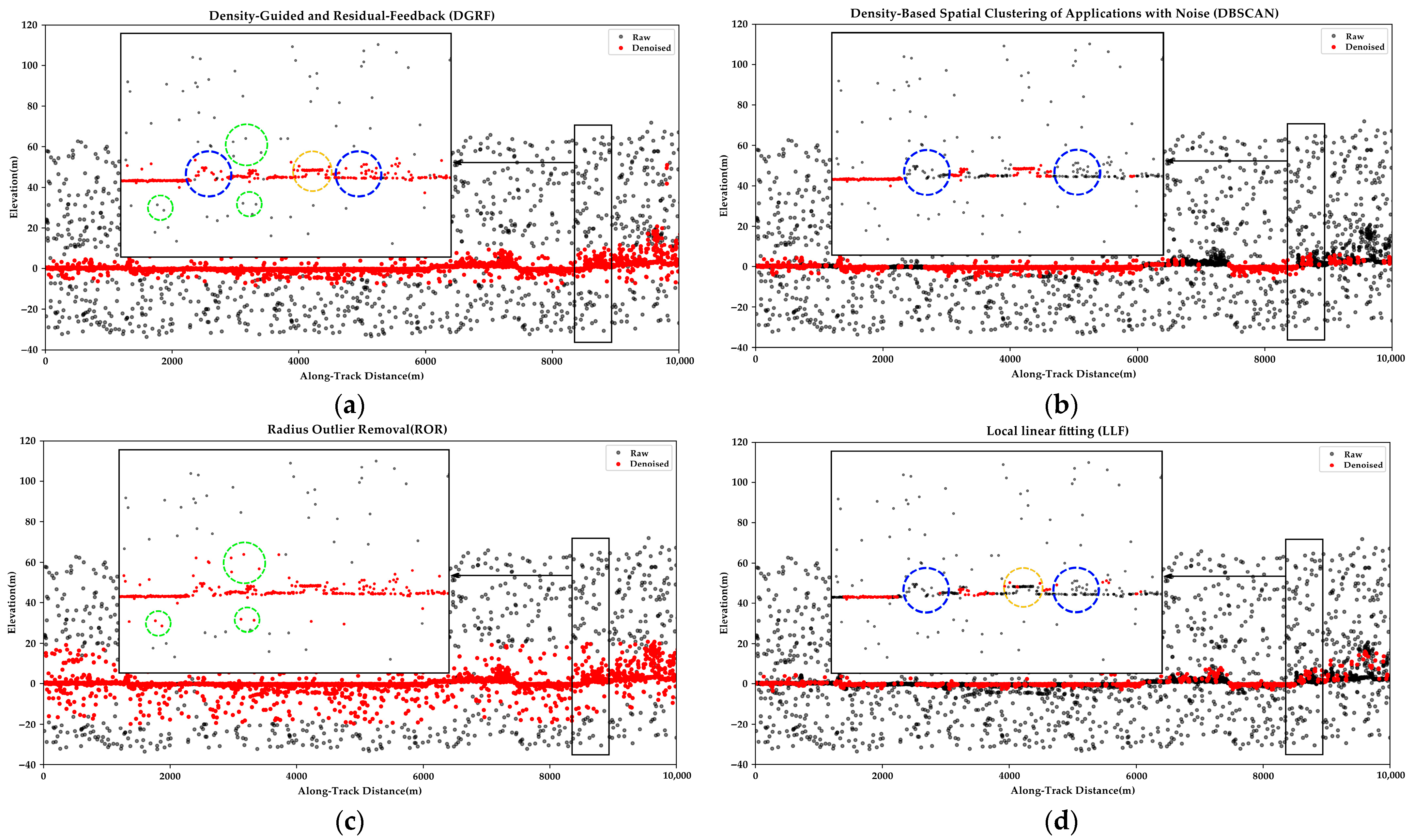
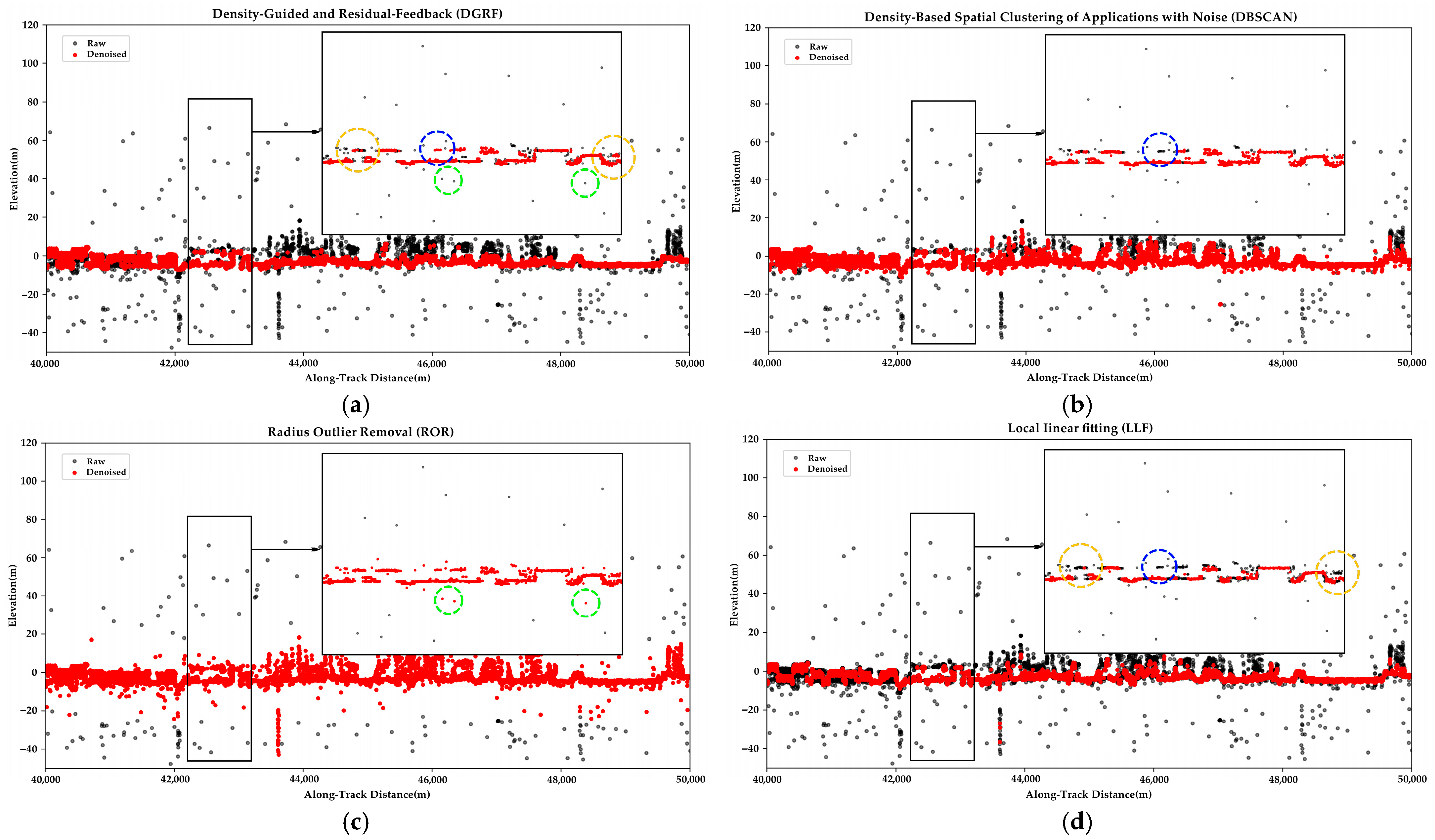
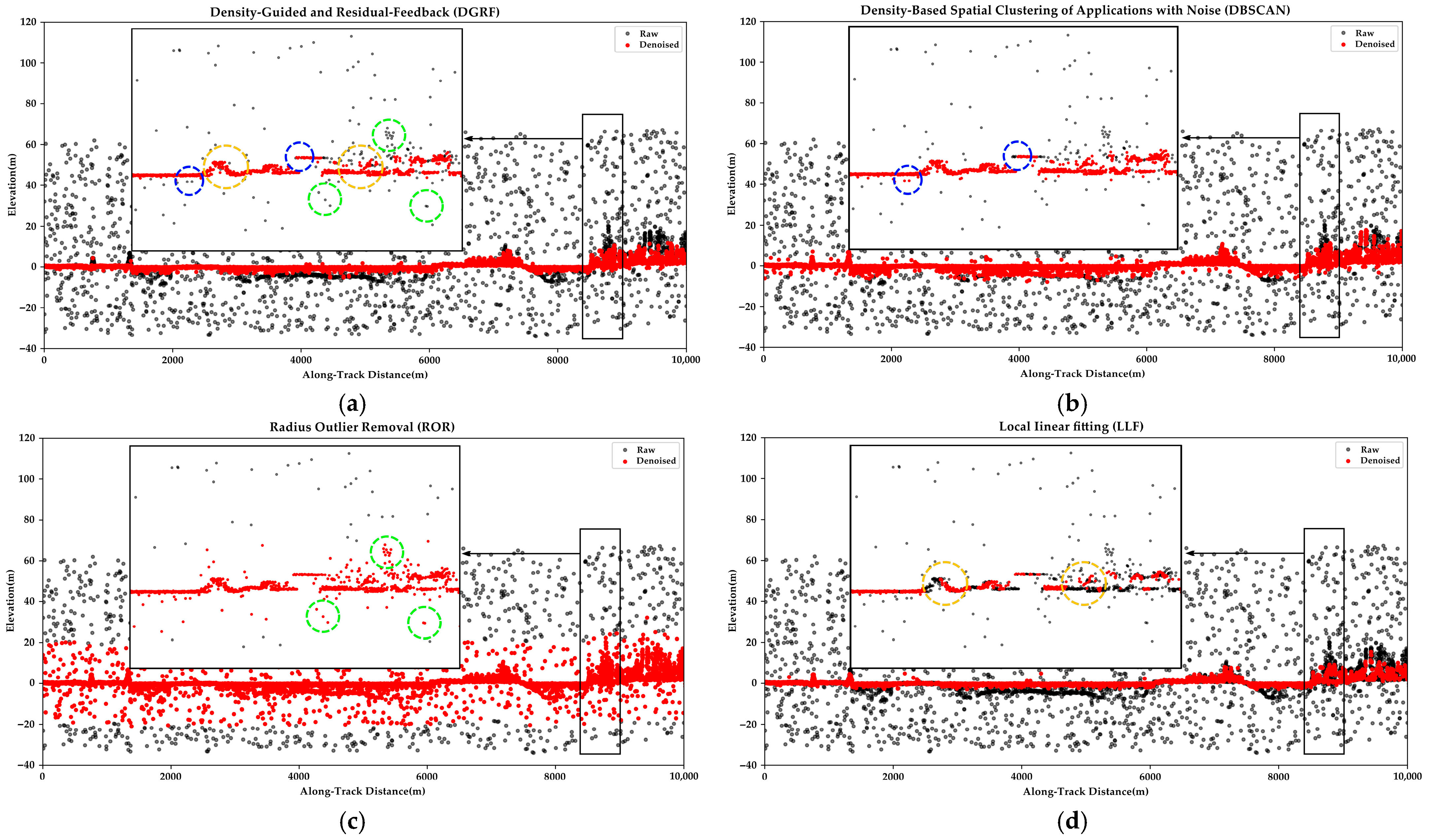
To facilitate a direct comparison of denoising performance across methods, four scenes’ datasets (namely, 0330_gt3r, 0330_gt3l, 0502_gt1r, and 0502_gt1l) were selected for qualitative analysis, as shown in Figure 19, Figure 20 and Figure 21. Raw (black) and retained (red) ATL03 photons are shown. Dashed circles indicate areas of interest discussed in the text.
As can be seen from Figure 19, the proposed method (DGRF) removes most scattered outliers, and the retained signal photons form compact and largely continuous distributions in the circled regions, particularly along the elevated, structure-related returns in the zoomed window. By comparison, DBSCAN preserves the main signal segments but incorrectly deletes a small portion of signal photons in the circled area, resulting in slightly broken elevated returns. ROR shows weaker background suppression, with more residual outliers remaining in the circled regions. LLF is comparatively aggressive and introduces clearer discontinuities in the elevated returns, indicating noticeable local signal mis-deletion.
As can be seen from Figure 20, the DGRF preserves the key signal photons in the circled regions, and the elevated, structure-related segments remain identifiable in the inset. In contrast, both DBSCAN and LLF are more prone to deleting weak, sparse signal photons, causing apparent gaps or loss of short elevated segments in the circled areas. ROR shows both signal mis-deletion and outlier retention in the circled regions, leading to noisier and less stable local profiles.
It can be seen from Figure 21 that background contamination is visibly more pronounced, DGRF maintains a better balance in the circled regions: most dispersed background photons are removed, while the surface-related profile and the elevated returns remain clearly traceable and continuous in the zoomed view. DBSCAN reduces background photons, but its local performance around structure-related boundaries in the circled regions is weaker than DGRF. ROR retains substantially more background photons, producing a thicker retained layer and more residual outliers in the circled regions. LLF removes many scattered photons but at the cost of more evident gaps and local deletions.
For the daytime weak-beam dataset, as illustrated in Figure 22, which is the most challenging scenario in this comparison, the denoising quality decreases across all methods. DGRF still suppresses a large portion of dispersed background photons and preserves the main surface-related profile; however, a small but clearly noticeable number of outliers are still retained. DBSCAN and LLF can remove background photons in a large portion of segments, but they also cause substantial signal mis-deletion. ROR retains a substantial amount of background photons and leaves obvious residual outliers.
In summary, the proposed method delivers the most consistent performance across all conditions, balancing effective outlier removal with signal structure preservation. Conversely, DBSCAN and LLF often over-filter, causing signal loss and discontinuities, while ROR retains more noise and sometimes deletes valid signals. In addition, under the most difficult daytime weak-beam scenario, where all methods decline, DGRF best preserves the essential surface profile with minimal trade-offs.

5.4. Analysis of the Effectiveness of Parameter Adaptivity

The stability and superior generalization capability of the proposed framework, demonstrated across varied observational scenes (Section 4.1) and conditions (Section 4.3 and Section 5.3), is fundamentally attributed to its parameter adaptivity strategy. The core challenge in processing ICESat-2 photon data is the high and uneven variability in local photon density; a fixed-threshold approach inevitably fails by either over-filtering signals in sparse areas or under-filtering noise in dense, contaminated areas. The proposed approach addressed this challenge by dynamically determining key processing parameters, the density-based filtering parameters ( ρ i , T i ) and the local fitting parameters ( w i , δ i ), based on local photon-density characteristics. For completeness and reproducibility, the exact numerical values of the adaptive parameters used across all experimental datasets are reported in Appendix A.3. It should be noted that the T i is designed for a point; thus, it is impractical to list the values for all ICESAT-2 points in the table. Therefore, only the adaptive parameters are listed.
For adaptivity across varying data conditions, this strategy is crucial for mitigating the effects of solar background noise and beam energy differences. In low-noise conditions (nighttime), when signal density is locally high (e.g., a strong beam over a building), the method applies a stricter density-graded threshold T i under the neighborhood scale ρ i , and the residual-feedback refinement typically yields smaller w i and tighter δ i , enabling more precise delineation of signal cluster boundaries while limiting the inclusion of scattered background photons. In high-noise conditions (daytime weak beam), where background photons are abundant and valid signal photons are relatively sparse, using a fixed, strict threshold would erroneously reject many valid photons. In the current implementation, the DGRF framework achieves adaptivity by dynamically estimating ρ i and assigning a more tolerant T i , together with adjusting w i and δ i via residual feedback when local uncertainty is higher. This combination helps capture and preserve scattered, low-density signal clusters, directly contributing to the high Recall values observed in these challenging datasets.
For adaptivity across diverse scenes, the dynamic tuning enables the proposed approach to maintain performance across heterogeneous scenes. In high-density areas (e.g., South Holland), the parameters shrink to allow the algorithm to capture the fine-scale vertical structure of buildings without smoothing out critical elevation discontinuities, ensuring high precision in rooftop and ground identification. In low-density environments (e.g., Friesland), the parameters expand, allowing the algorithm to collect enough photons to establish a robust local reference plane for filtering. This prevents the over-rejection of isolated, valid signal photons, which is a common failure mode of fixed-threshold methods in sparse regions, thus stabilizing Recall and ensuring high height estimation accuracy.
For completeness and reproducibility, the exact numerical values of the adaptive parameters used across all experimental datasets are summarized in Appendix A.3. It should be noted that the T i is designed for a point; thus, it is impractical to list the values for all ICESAT-2 points in the table. Therefore, only the adaptive parameters are listed. As summarized in the table, the adaptive strategy enables the proposed framework to balance signal preservation and noise suppression across heterogeneous scenes by coupling density-guided thresholds with residual-feedback refinement. The density-level dependent thresholds control the global filtering behavior, while the adaptive residual parameters ( ρ i , w i ) further adjust local fitting tolerance in response to noise intensity and structural complexity. This coordinated adaptation allows the proposed method to remain permissive in uncertain or sparse regions and increasingly selective in dense or contaminated neighborhoods, ensuring stable transitions across density regimes. Consequently, the parameter design supports robust denoising without introducing abrupt decision boundaries or requiring dataset-specific empirical tuning.

6. Conclusions

The Density-Guided and Residual-Feedback (DGRF) framework proposed in this study addresses key limitations in processing spaceborne photon-counting LiDAR data, particularly the difficulty of suppressing background noise while preserving structurally meaningful returns in heterogeneous urban scenes. By combining density-stratified adaptive filtering with residual-feedback adaptive refinement, the framework reduces reliance on manual, scene-specific parameter tuning and provides denoised photon profiles suitable for downstream urban analysis.
Comprehensive evaluation across 84 ATL03 tracks in both low-density Friesland and high-density South Holland, under varying beam strengths and day/night conditions, confirms the robustness and adaptability of the proposed method. The denoising performance remains consistently strong across most datasets, with high Recall/Precision and generally high F1-scores, while only a limited number of challenging urban cases show a noticeable drop. The practical utility of the denoised photons is further demonstrated through building-height estimation validated against airborne LiDAR (AHN4). Specifically, for the validated subsets, Friesland achieves an R2 of 0.7235 and an RMSE of 1.5045 m based on 261 buildings, while South Holland achieves an R2 of 0.9487 and an RMSE of 1.8849 m based on 1454 buildings. These results indicate that the proposed DGRF method represents a significant advancement toward robust and automated processing of ICESat-2 photon data in complex anthropogenic environments.
Future work will focus on extending DGRF to more challenging scenarios by introducing more flexible adaptive parameters, particularly in densely forested regions and steep mountainous terrain. In areas with steep relief and rapid elevation changes, terrain-aware refinements can be introduced by conditioning the adaptive window and decision tolerance on local slope information (e.g., estimated from a DEM or along-track gradients), ensuring compatibility with strong topographic variability. For densely forested environments, future efforts will explore vegetation-aware adjustments to better handle canopy-induced outliers and sparse signal gaps. These extensions will further enhance the generalization and applicability of DGRF across diverse landscapes.

Author Contributions

Conceptualization, P.H. and Y.W.; methodology, P.H. and Y.W.; software, Y.W.; validation, P.H. and Y.W.; investigation, Y.W.; data curation, Y.W. and X.L.; writing—original draft preparation, P.H., Y.W., H.C. and Y.L.; writing—review and editing, P.H., Y.W., H.C. and Y.L.; funding acquisition, P.H. and Y.L. All authors have read and agreed to the published version of the manuscript.

Funding

This work was supported by the National Key Research and Development Program of China (No. 2022YFB3904104, 2022YFB3904103), the R&D Program of Beijing Municipal Education Commission (No. KM202410016006), the Pyramid Talent Training Project for Beijing University of Civil Engineering and Architecture (No. JDYC20220824), the Fundamental Research Funds for Beijing University of Civil Engineering and Architecture (No. Y2207).

Data Availability Statement

The dataset will be available upon request from the authors.

Conflicts of Interest

The authors declare no conflicts of interest.

Appendix A

Appendix A.1

ATL03 tracks were filtered based on three criteria: (i) spatial coverage within the study area, (ii) enough data volume (photon count > 5000), and (iii) overall data quality, to ensure meaningful denoising and reliable building-height estimation. For quality control, only tracks in which high-confidence signal photons (Signal Confidence = 4) comprised more than 50% of the total photons were retained; the remaining tracks were excluded due to excessive background contamination. The detailed screening results for the ICESat-2 ATL03 tracks in Friesland and South Holland are summarized as follows:
Table A1. Summary of ATL03 datasets used in this study.
RegionDataset IdentifierAbbreviationTime Beam Strength
processed_ATL03_20210123231004_04731002_006_01_gt1l0123_gt1lNighttimeweak
processed_ATL03_20210123231004_04731002_006_01_gt1r0123_gt1rNighttimestrong
processed_ATL03_20210123231004_04731002_006_01_gt2l0123_gt2lNighttimeweak
processed_ATL03_20210123231004_04731002_006_01_gt2r0123_gt2rNighttimestrong
processed_ATL03_20210123231004_04731002_006_01_gt3l0123_gt3lNighttimeweak
processed_ATL03_20210123231004_04731002_006_01_gt3r0123_gt3rNighttimestrong
processed_ATL03_20210221214607_09151002_006_01_gt1l0221_gt1lNighttimeweak
processed_ATL03_20210221214607_09151002_006_01_gt1r0221_gt1rNighttimestrong
processed_ATL03_20210221214607_09151002_006_01_gt2l0221_gt2lNighttimeweak
processed_ATL03_20210221214607_09151002_006_01_gt2r0221_gt2rNighttimestrong
processed_ATL03_20210221214607_09151002_006_01_gt3l0221_gt3lNighttimeweak
processed_ATL03_20210221214607_09151002_006_01_gt3r0221_gt3rNighttimestrong
processed_ATL03_20210420185814_04121102_006_02_gt1l0420_gt1lNighttimeweak
processed_ATL03_20210420185814_04121102_006_02_gt1r0420_gt1rNighttimestrong
processed_ATL03_20210420185814_04121102_006_02_gt2l0420_gt2lNighttimeweak
processed_ATL03_20210420185814_04121102_006_02_gt2r0420_gt2rNighttimestrong
processed_ATL03_20210420185814_04121102_006_02_gt3l0420_gt3lNighttimeweak
processed_ATL03_20210420185814_04121102_006_02_gt3r0420_gt3rNighttimestrong
Frieslandprocessed_ATL03_20210424184953_04731102_006_02_gt1l0424_gt1lNighttimeweak
processed_ATL03_20210424184953_04731102_006_02_gt1r0424_gt1rNighttimestrong
processed_ATL03_20210424184953_04731102_006_02_gt2l0424_gt2lNighttimeweak
processed_ATL03_20210424184953_04731102_006_02_gt2r0424_gt2rNighttimestrong
processed_ATL03_20210424184953_04731102_006_02_gt3l0424_gt3lNighttimeweak
processed_ATL03_20210424184953_04731102_006_02_gt3r0424_gt3rNighttimestrong
processed_ATL03_20210808021216_06941206_006_01_gt1l0808_gt1lNighttimeweak
processed_ATL03_20210808021216_06941206_006_01_gt1r0808_gt1rNighttimestrong
processed_ATL03_20210808021216_06941206_006_01_gt2l0808_gt2lNighttimeweak
processed_ATL03_20210808021216_06941206_006_01_gt2r0808_gt2rNighttimestrong
processed_ATL03_20210808021216_06941206_006_01_gt3l0808_gt3lNighttimeweak
processed_ATL03_20210808021216_06941206_006_01_gt3r0808_gt3rNighttimestrong
processed_ATL03_20210906004824_11361206_006_02_gt1l0906_gt1lNighttimeweak
processed_ATL03_20210906004824_11361206_006_02_gt1r0906_gt1rNighttimestrong
processed_ATL03_20210906004824_11361206_006_02_gt2l0906_gt2lNighttimeweak
processed_ATL03_20210906004824_11361206_006_02_gt2r0906_gt2rNighttimestrong
processed_ATL03_20210906004824_11361206_006_02_gt3l0906_gt3lNighttimeweak
processed_ATL03_20210906004824_11361206_006_02_gt3r0906_gt3rNighttimestrong
processed_ATL03_20211008231612_02521306_006_01_gt1l1008_gt1lNighttimeweak
processed_ATL03_20211008231612_02521306_006_01_gt1r1008_gt1rNighttimestrong
processed_ATL03_20211008231612_02521306_006_01_gt2l1008_gt2lNighttimeweak
processed_ATL03_20211008231612_02521306_006_01_gt2r1008_gt2rNighttimestrong
processed_ATL03_20211008231612_02521306_006_01_gt3l1008_gt3lNighttimeweak
processed_ATL03_20211008231612_02521306_006_01_gt3r1008_gt3rNighttimestrong
processed_ATL03_20210301212925_10371002_006_01_gt1l0301_gt1lNighttimeweak
processed_ATL03_20210301212925_10371002_006_01_gt1r0301_gt1rNighttimestrong
processed_ATL03_20210301212925_10371002_006_01_gt2l0301_gt2lNighttimeweak
processed_ATL03_20210301212925_10371002_006_01_gt2r0301_gt2rNighttimestrong
processed_ATL03_20210301212925_10371002_006_01_gt3l0301_gt3lNighttimeweak
processed_ATL03_20210301212925_10371002_006_01_gt3r0301_gt3rNighttimestrong
processed_ATL03_20210330200530_00921102_006_01_gt1l0330_gt1lNighttimeweak
processed_ATL03_20210330200530_00921102_006_01_gt1r0330_gt1rNighttimestrong
processed_ATL03_20210330200530_00921102_006_01_gt2l0330_gt2lNighttimeweak
processed_ATL03_20210330200530_00921102_006_01_gt2r0330_gt2rNighttimestrong
processed_ATL03_20210330200530_00921102_006_01_gt3l0330_gt3lNighttimeweak
processed_ATL03_20210330200530_00921102_006_01_gt3r0330_gt3rNighttimestrong
processed_ATL03_20210502183314_05951102_006_01_gt1l0502_gt1lDaytimeweak
processed_ATL03_20210502183314_05951102_006_01_gt1r0502_gt1rDaytimestrong
processed_ATL03_20210502183314_05951102_006_01_gt2l0502_gt2lDaytimeweak
processed_ATL03_20210502183314_05951102_006_01_gt2r0502_gt2rDaytimestrong
processed_ATL03_20210502183314_05951102_006_01_gt3l0502_gt3lDaytimeweak
Southprocessed_ATL03_20210502183314_05951102_006_01_gt3r0502_gt3rDaytimestrong
Hollandprocessed_ATL03_20210718031934_03741206_006_01_gt1l0718_gt1lNighttimeweak
processed_ATL03_20210718031934_03741206_006_01_gt1r0718_gt1rNighttimestrong
processed_ATL03_20210718031934_03741206_006_01_gt2l0718_gt2lNighttimeweak
processed_ATL03_20210718031934_03741206_006_01_gt2r0718_gt2rNighttimestrong
processed_ATL03_20210718031934_03741206_006_01_gt3l07180_gt3lNighttimeweak
processed_ATL03_20210718031934_03741206_006_01_gt3r0718_gt3rNighttimestrong
processed_ATL03_20210914003144_12581206_006_02_gt1l0914_gt1lNighttimeweak
processed_ATL03_20210914003144_12581206_006_02_gt1r0914_gt1rNighttimestrong
processed_ATL03_20210914003144_12581206_006_02_gt2l0914_gt2lNighttimeweak
processed_ATL03_20210914003144_12581206_006_02_gt2r0914_gt2rNighttimestrong
processed_ATL03_20210914003144_12581206_006_02_gt3l0914_gt3lNighttimeweak
processed_ATL03_20210914003144_12581206_006_02_gt3r0914_gt3rNighttimestrong
processed_ATL03_20211012230751_03131306_006_01_gt1l1012_gt1lNighttimeweak
processed_ATL03_20211012230751_03131306_006_01_gt1r1012_gt1rNighttimestrong
processed_ATL03_20211012230751_03131306_006_01_gt2l1012_gt2lNighttimeweak
processed_ATL03_20211012230751_03131306_006_01_gt2r1012_gt2rNighttimestrong
processed_ATL03_20211012230751_03131306_006_01_gt3l1012_gt3lNighttimeweak
processed_ATL03_20211012230751_03131306_006_01_gt3r1012_gt3rNighttimestrong
processed_ATL03_20211114213541_08161306_006_01_gt1l1114_gt1lNighttimeweak
processed_ATL03_20211114213541_08161306_006_01_gt1r1114_gt1rNighttimestrong
processed_ATL03_20211114213541_08161306_006_01_gt2l1114_gt2lNighttimeweak
processed_ATL03_20211114213541_08161306_006_01_gt2r1114_gt2rNighttimestrong
processed_ATL03_20211114213541_08161306_006_01_gt3l1114_gt3lNighttimeweak
processed_ATL03_20211114213541_08161306_006_01_gt3r1114_gt3rNighttimestrong

Appendix A.2

Table A2 summarizes the denoising performance of proposed DGRF method over the Friesland and South Holland test areas. The metrics include Recall, Precision, and F1-score, which jointly characterize signal preservation, noise suppression, and their overall balance.
Table A2. Summary of denoising performance across Friesland and South Holland (Recall, Precision, and F1-score).
FrieslandSouth Holland
AbbreviationRecallPrecisionF1-ScoreAbbreviationRecallPrecisionF1-Score
0123_gt1l0.9684 0.9905 0.9794 0301_gt1l0.9826 0.9955 0.9890
0123_gt1r0.9671 0.9997 0.9831 0301_gt1r0.9620 0.9999 0.9806
0123_gt2l0.9416 0.9964 0.9682 0301_gt2l0.9667 0.9933 0.9798
0123_gt2r0.9524 0.9998 0.9755 0301_gt2r0.8913 0.9992 0.9422
0123_gt3l0.9898 0.9877 0.9888 0301_gt3l0.9853 0.9907 0.9880
0123_gt3r0.9783 0.9969 0.9875 0301_gt3r0.9421 0.9980 0.9692
0221_gt1l0.9981 0.9956 0.9968 0330_gt1l0.9913 0.9870 0.9891
0221_gt1r0.9909 0.9997 0.9953 0330_gt1r0.9666 0.9995 0.9828
0221_gt2l0.9677 0.9978 0.9825 0330_gt2l0.9808 0.9881 0.9844
0221_gt2r0.9526 0.9991 0.9753 0330_gt2r0.9709 0.9970 0.9838
0221_gt3l0.9922 0.9972 0.9947 0330_gt3l0.9776 0.9923 0.9849
0221_gt3r0.9829 0.9999 0.9913 0330_gt3r0.9465 0.9995 0.9723
0420_gt1l0.9971 0.9625 0.9795 0502_gt1l0.8724 0.9317 0.9011
0420_gt1r0.9874 0.9955 0.9914 0502_gt1r0.9883 0.9332 0.9600
0420_gt2l0.9977 0.9628 0.9799 0502_gt2l0.9565 0.8968 0.9257
0420_gt2r0.9875 0.9937 0.9906 0502_gt2r0.9937 0.9766 0.9851
0420_gt3l0.9956 0.9828 0.9892 0502_gt3l0.9726 0.8660 0.9162
0420_gt3r0.9836 0.9993 0.9914 0502_gt3r0.9824 0.9701 0.9762
0424_gt1l0.9922 0.9600 0.9759 0718_gt1l0.9737 0.9895 0.9815
0424_gt1r0.9836 0.9956 0.9896 0718_gt1r0.9218 0.9992 0.9589
0424_gt2l0.9673 0.9826 0.9749 0718_gt2l0.9217 0.9979 0.9583
0424_gt2r0.9717 0.9982 0.9848 0718_gt2r0.9196 0.9961 0.9564
0424_gt3l0.9951 0.9706 0.9827 0718_gt3r0.9589 0.9971 0.9776
0424_gt3r0.9929 0.9972 0.9950 07180_gt3l0.9516 1.0000 0.9752
0808_gt1l0.9897 0.9683 0.9789 0914_gt1l0.9780 0.9760 0.9770
0808_gt1r0.9672 0.9955 0.9811 0914_gt1r0.9697 0.9942 0.9818
0808_gt2l0.9776 0.9846 0.9811 0914_gt2l0.9751 0.9824 0.9788
0808_gt2r0.9680 0.9977 0.9826 0914_gt2r0.9536 0.9993 0.9759
0808_gt3l0.9929 0.9899 0.9914 0914_gt3l0.9298 0.9577 0.9435
0808_gt3r0.9674 0.9986 0.9828 0914_gt3r0.9659 0.9934 0.9794
0906_gt1l0.9943 0.9650 0.9794 1012_gt1l0.9685 0.9987 0.9834
0906_gt1r0.9655 0.9985 0.9817 1012_gt1r0.9774 0.9865 0.9819
0906_gt2l0.9868 0.9766 0.9816 1012_gt2l0.9748 0.9937 0.9842
0906_gt2r0.9634 0.9971 0.9800 1012_gt2r0.9646 0.9846 0.9745
0906_gt3l0.9921 0.9822 0.9871 1012_gt3l0.9744 0.9931 0.9836
0906_gt3r0.9674 0.9990 0.9830 1012_gt3r0.9588 0.9874 0.9729
1008_gt1l0.9813 0.9998 0.9905 1114_gt1l0.9899 0.9946 0.9923
1008_gt1r0.9889 0.9951 0.9920 1114_gt1r0.9984 0.9804 0.9894
1008_gt2l0.9652 0.9998 0.9822 1114_gt2l0.9847 0.9985 0.9916
1008_gt2r0.9756 0.9947 0.9850 1114_gt2r0.9869 0.9826 0.9848
1008_gt3l0.9803 0.9992 0.9897 1114_gt3l0.9825 0.9934 0.9879
1008_gt3r0.9900 0.9905 0.9902 1114_gt3r0.9980 0.9831 0.9905

Appendix A.3

Table A3 summarizes the exact numerical values of the adaptive parameters used across all experimental ATL03 subsets, including (i) the first stage neighborhood radius R, (ii) the six density boundaries ( s j ( j = 1 , , 6 ) ) that define the seven density intervals used for level assignment, and (iii) the second stage initial search window w 0 , which is defined as the mean nearest-neighbor distance computed from the photon distribution of each subset/track.
Table A3. Numerical values of the adaptive parameters used in DGRF for all ATL03 subsets in this study.
RegionAbbreviationCoarse
Denoising
Fine
Denoising
Rs1s2s3s4s5s6 w 0
0123_gt1l22.95503.6709.90324.45658.435137.76932322.2839
0123_gt1r6.78823.6729.91424.49558.557138.1263246.5047
0123_gt2l9.67873.4338.82420.77247.251105.9372368.4302
0123_gt2r3.75893.6389.75523.94056.834133.1133103.2739
0123_gt3l38.23793.6189.66223.61755.838130.23230237.6407
0123_gt3r9.88893.94211.20929.16673.533183.1544549.5494
0221_gt1l16.78573.2988.23718.84941.65790.67019616.4398
0221_gt1r4.73623.4488.89221.00047.928107.8142414.4335
0221_gt2l7.38153.4048.69820.35446.022102.5422276.7357
0221_gt2r2.70543.4078.71220.40146.159102.9212282.2639
0221_gt3l13.14223.3308.37519.29842.94694.14720512.8317
0221_gt3r3.62613.5609.39722.70753.052122.2422803.3310
0420_gt1l32.75113.4698.98721.31648.867110.43124832.2537
0420_gt1r8.49433.76810.36526.09263.583152.9553667.9578
0420_gt2l35.27033.4268.79620.67946.979105.18523434.7312
0420_gt2r11.16044.02811.64130.78078.898199.87050410.6326
0420_gt3l26.05843.5109.17021.93550.719115.62826225.6837
0420_gt3r6.45744.06911.84631.55881.514208.1235296.0598
0424_gt1l18.02763.3788.58319.97644.91599.50621915.9853
Friesland0424_gt1r7.03983.79710.50826.60465.216157.8343804.5476
0424_gt2l9.35273.5879.51923.12554.327125.8872908.1627
0424_gt2r3.57213.6659.88024.37758.190137.0553212.8837
0424_gt3l19.76683.3308.37519.29842.94694.14720518.1532
0424_gt3r5.55903.5719.44622.87553.564123.7032844.4766
0808_gt1l24.72043.6679.89124.41758.312137.41232222.1988
0808_gt1r7.48903.80610.54826.74965.678159.2223845.4671
0808_gt2l16.05453.73010.18725.45861.573146.98934913.1647
0808_gt2r6.41504.09411.97432.04583.166213.3715454.2855
0808_gt3l23.48773.5959.55523.24954.707126.97629322.9112
0808_gt3r6.17273.6289.70923.77956.337131.6743065.4067
0906_gt1l30.49603.0107.04115.12531.33263.83212929.9917
0906_gt1r8.12163.4849.05321.53949.532112.2922537.3522
0906_gt2l23.07043.77410.39626.20363.935154.00336922.5580
0906_gt2r7.00283.86810.85027.84469.211169.9034156.4293
0906_gt3l26.90093.3758.56819.92844.77699.12521826.5121
0906_gt3r7.12403.6489.80124.10057.329134.5493146.5292
1008_gt1l5.22553.82210.62727.03666.599161.9923924.8103
1008_gt1r18.97023.5019.13221.80450.325114.51825918.4574
1008_gt2l4.17983.74810.27125.75862.523149.8023573.7092
1008_gt2r11.09333.70310.05825.00060.135142.74833710.3510
1008_gt3l5.69133.6209.67423.65855.963130.5933035.2734
1008_gt3r21.22503.5249.23422.15251.372117.47226720.8636
0301_gt1l14.19913.3618.51019.73644.21797.59921413.7843
0301_gt1r4.18643.5049.14521.84750.456114.8882603.6420
0301_gt2l9.92693.5749.45922.91753.692124.0672859.0466
0301_gt2r3.52953.6209.67423.65855.963130.5933032.8276
0301_gt3l17.26413.4078.71220.40146.159102.92122816.6590
0301_gt3r4.74683.69310.01424.84659.651141.3293334.0650
0330_gt1l19.78373.3718.55419.88144.63798.74421719.3911
0330_gt1r5.21623.6629.86924.33858.067136.6973204.6357
0330_gt2l21.55973.4759.01321.40549.133111.17625021.0752
0330_gt2r7.08893.71210.10125.15360.616144.1643416.4315
0330_gt3l16.17173.3378.40519.39643.23094.91620715.7114
0330_gt3r4.57693.73010.18725.45861.573146.9893493.9758
0502_gt1l22.68362.9006.60613.83227.92555.40710919.0196
0502_gt1r6.80613.5109.17021.93550.719115.6282625.2610
0502_gt2l19.79552.9296.71914.16628.79557.53611415.5425
0502_gt2r6.56963.0467.18315.55332.48366.7291365.3093
0502_gt3l17.72613.4078.71220.40146.159102.92122814.0577
0502_gt3r5.17023.5199.20922.06551.111116.7352653.7261
0718_gt1l11.47393.1607.65317.00036.44276.88116110.9145
0718_gt1r3.11123.2027.82817.54737.96780.8681712.5780
South0718_gt2l6.78113.3378.40519.39643.23094.9162075.6135
Holland0718_gt2r2.23893.2918.20518.74841.36889.8941941.7777
0718_gt3r8.74993.2498.02918.18339.75985.6001838.2310
07180_gt3l2.56383.3278.36019.24842.80493.7622042.2707
0914_gt1l44.34234.06711.83831.52781.410207.79452840.1388
0914_gt1r12.93594.22712.65834.69392.276242.75663610.6664
0914_gt2l20.84874.19912.51434.12890.313236.36161618.6732
0914_gt2r5.36543.97411.36829.75775.486189.2054723.8887
0914_gt3l87.96493.5829.49523.04254.073125.15928874.7712
0914_gt3r21.81423.98911.44630.04876.454192.21648117.5929
1012_gt1l11.14664.10012.00632.16683.577214.6795497.9559
1012_gt1r38.44853.99611.48130.17776.881193.55248532.4314
1012_gt2l21.05924.40813.62538.547105.942288.18678117.2518
1012_gt2r55.42523.96511.32429.59474.946187.52846733.7056
1012_gt3l17.59774.24112.73735.00093.347246.25864714.6292
1012_gt3r65.74124.12212.11532.58685.006219.24456333.4093
1114_gt1l72.77054.61414.75743.227123.117347.74497753.6957
1114_gt1r293.43164.39313.54338.217104.753284.174768270.9398
1114_gt2l26.40464.62614.82643.520124.235351.2909908.0458
1114_gt2r109.96394.62914.84243.587124.488352.17899321.5159
1114_gt3l64.66464.63314.86343.677124.824353.36299714.6106
1114_gt3r241.97204.51914.22941.024114.962318.992882144.5425

References

  1. Guo, H.D.; Zhang, L.; Zhu, L.W. Earth observation big data for climate change research. Adv. Clim. Change Res. 2015, 6, 108–117. [Google Scholar] [CrossRef]
  2. Zhao, Q.; Yu, L.; Du, Z.; Peng, D.; Hao, P.; Zhang, Y.; Gong, P. An Overview of the Applications of Earth Observation Satellite Data: Impacts and Future Trends. Remote Sens. 2022, 14, 1863. [Google Scholar] [CrossRef]
  3. Sankar, R.D.; Pescott, F.; Hicks, K.; Murray, M.S. Forest canopy height mapping using ICESat-2 data to aid forest management in a Canadian Arctic community: A case study of Kluane First Nation, Yukon, Canada. Trees For. People 2025, 19, 100760. [Google Scholar] [CrossRef]
  4. Liu, W.; Tsamados, M.; Petty, A.; Jin, T.; Chen, W.; Stroeve, J. Enhanced sea ice classification for ICESat-2 using combined unsupervised and supervised machine learning. Remote Sens. Environ. 2025, 318, 114607. [Google Scholar] [CrossRef]
  5. Wu, W.; Ma, J.; Banzhaf, E.; Meadows, M.; Yu, Z.; Guo, F.; Sengupta, D.; Cai, X.; Zhao, B. A first Chinese building height estimate at 10 m resolution (CNBH-10 m) using multi-source earth observations and machine learning. Remote Sens. Environ. 2023, 291, 113578. [Google Scholar] [CrossRef]
  6. Zhao, L.; Liu, X.; Xu, X.; Liu, C.; Chen, K. Three-Dimensional Simulation Model for Synergistically Simulating Urban Horizontal Expansion and Vertical Growth. Remote Sens. 2022, 14, 1503. [Google Scholar] [CrossRef]
  7. Papini, S.; Rao, S.X.; Charyyev, S.; Jiang, M.; Egger, P.H. Urban growth unveiled: Deep learning with satellite imagery for measuring 3D building-stock evolution in Urban China. Remote Sens. Appl. Soc. Environ. 2025, 38, 101523. [Google Scholar] [CrossRef]
  8. Mussawar, O.; Mayyas, A.; Azar, E. Built form and function as determinants of urban energy performance: An integrated agent-based modeling approach and case study. Sustain. Cities Soc. 2023, 96, 104660. [Google Scholar] [CrossRef]
  9. Resch, E.; Bohne, R.A.; Kvamsdal, T.; Lohne, J. Impact of Urban Density and Building Height on Energy Use in Cities. Energy Procedia 2016, 96, 800–814. [Google Scholar] [CrossRef]
  10. Murathan, E.K.; Manioğlu, G. Impact of urban form on energy performance, outdoor thermal comfort, and urban heat island: A case study in Istanbul. Energy Build. 2025, 345, 116109. [Google Scholar] [CrossRef]
  11. Girindran, R.; Boyd, D.S.; Rosser, J.; Vijayan, D.; Long, G.; Robinson, D. On the Reliable Generation of 3D City Models from Open Data. Urban Sci. 2020, 4, 47. [Google Scholar] [CrossRef]
  12. Yadav, R.; Nascetti, A.; Ban, Y. How high are we? Large-scale building height estimation at 10 m using Sentinel-1 SAR and Sentinel-2 MSI time series. Remote Sens. Environ. 2025, 318, 114556. [Google Scholar] [CrossRef]
  13. Wang, C.; Yu, Q.; Law, K.H.; McKenna, F.; Yu, S.X.; Taciroglu, E.; Zsarnóczay, A.; Elhaddad, W.; Cetiner, B. Machine learning-based regional scale intelligent modeling of building information for natural hazard risk management. Autom. Constr. 2021, 122, 103474. [Google Scholar] [CrossRef]
  14. Rezaeian, M.; Gruen, A. Automatic 3D building extraction from aerial and space images for earthquake risk management. Georisk Assess. Manag. Risk Eng. Syst. Geohazards 2011, 5, 77–96. [Google Scholar] [CrossRef]
  15. Futcher, J.; Mills, G.; Emmanuel, R.; Korolija, I. Creating sustainable cities one building at a time: Towards an integrated urban design framework. Cities 2017, 66, 63–71. [Google Scholar] [CrossRef]
  16. Ahmadian, E.; Sodagar, B.; Mills, G.; Byrd, H.; Bingham, C.; Zolotas, A. Sustainable cities: The relationships between urban built forms and density indicators. Cities 2019, 95, 102382. [Google Scholar] [CrossRef]
  17. Bolcek, J.; Gibril, M.B.A.; Veverka, J.; Sloboda, Š.; Maršálek, R.; Götthans, T. Spaceborne LiDAR Systems: Evolution, Capabilities, and Challenges. Sensors 2025, 25, 3696. [Google Scholar] [CrossRef]
  18. Zhao, Y.; Wu, B.; Li, Q.; Yang, L.; Fan, H.; Wu, J.; Yu, B. Combining ICESat-2 photons and Google Earth Satellite images for building height extraction. Int. J. Appl. Earth Obs. Geoinf. 2023, 117, 103213. [Google Scholar] [CrossRef]
  19. Abdalati, W.; Zwally, H.J.; Bindschadler, R.; Csatho, B.; Farrell, S.L.; Fricker, H.A.; Harding, D.; Kwok, R.; Lefsky, M.; Markus, T.; et al. The ICESat-2 Laser Altimetry Mission. Proc. IEEE 2010, 98, 735–751. [Google Scholar] [CrossRef]
  20. Markus, T.; Neumann, T.; Martino, A.; Abdalati, W.; Brunt, K.; Csatho, B.; Farrell, S.; Fricker, H.; Gardner, A.; Harding, D.; et al. The Ice, Cloud, and land Elevation Satellite-2 (ICESat-2): Science requirements, concept, and implementation. Remote Sens. Environ. 2017, 190, 260–273. [Google Scholar] [CrossRef]
  21. Martino, A.J.; Neumann, T.A.; Kurtz, N.T.; McLennan, D. ICESat-2 mission overview and early performance. In Sensors, Systems, and Next-Generation Satellites XXIII; SPIE: Bellingham, WA, USA, 2019; pp. 68–77. [Google Scholar] [CrossRef]
  22. Hui, Z.; Zhang, L.; Jin, S.; Chen, W.; Cheng, P.; Ziggah, Y.Y. Progressive noise photons removal from ICESAT-2 data based on the characteristics of different types of noise. GIScience Remote Sens. 2025, 62, 2507985. [Google Scholar] [CrossRef]
  23. Park, J.I.; Jo, S.; Seo, H.T.; Park, J. LiDAR Denoising Methods in Adverse Environments: A Review. IEEE Sens. J. 2025, 25, 7916–7932. [Google Scholar] [CrossRef]
  24. Jung, J.; Parrish, C.E.; Magruder, L.A.; Herrmann, J.; Yoo, S.; Perry, J.S. ICESat-2 bathymetry algorithms: A review of the current state-of-the-art and future outlook. ISPRS J. Photogramm. Remote Sens. 2025, 223, 413–439. [Google Scholar] [CrossRef]
  25. Lori, A.M.; Michael, E.W., III; Kevin, D.S.; Amy, L.N. Noise filtering techniques for photon-counting ladar data. In Proceedings of the Laser Radar Technology and Applications XVII, Baltimore, MD, USA, 23–27 April 2012; p. 83790Q. [Google Scholar] [CrossRef]
  26. Awadallah, M.; Ghannam, S.; Abbott, L.; Ghanem, A. Active contour models for extracting ground and forest canopy curves from discrete laser altimeter data. In Proceedings of the Proceedings: 13th International Conference on LiDAR Applications for Assessing Forest Ecosystems, Beijing, China, 9–11 October 2013; pp. 129–136. [Google Scholar]
  27. Li, Y.; Shen, X.; Cao, L. An Advanced Terrain Vegetation Signal Detection Approach for Forest Structural Parameters Estimation Using ICESat-2 Data. Remote Sens. 2024, 16, 1822. [Google Scholar] [CrossRef]
  28. Ju, X.; Li, Y.; Ji, S.; Gong, D.; Liu, H.; Yan, Z.; Liu, X.; Niu, H. ICESat-2 Water Photon Denoising and Water Level Extraction Method Combining Elevation Difference Exponential Attenuation Model with Hough Transform. Remote Sens. 2025, 17, 2885. [Google Scholar] [CrossRef]
  29. Awadallah, M.; Ghannam, S.; Abbott, L.; Ghanem, A. A two-stage algorithm for extraction of ground and top of canopy in photon-counting profiling-LiDAR data in preparation for the ICESat-2 mission. In Proceedings of the 2014 IEEE Geoscience and Remote Sensing Symposium, Quebec City, QC, Canada, 13–18 July 2014; pp. 1353–1356. [Google Scholar] [CrossRef]
  30. Awadallah, M.; Abbott, L.; Ghannam, S. Segmentation of sparse noisy point clouds using active contour models. In Proceedings of the 2014 IEEE International Conference on Image Processing (ICIP), Paris, France, 27–30 October 2014; pp. 6061–6065. [Google Scholar] [CrossRef]
  31. Chen, B.; Pang, Y. A denoising approach for detection of canopy and ground from ICESat-2’s airborne simulator data in Maryland, USA. In Proceedings of the AOPC 2015: Advances in Laser Technology and Applications, Beijing, China, 5–7 May 2015; p. 96711S. [Google Scholar] [CrossRef]
  32. Kong, D.; Pang, Y. ICESat-2 data denoising and forest canopy height estimation using Machine Learning. Int. J. Appl. Earth Obs. Geoinf. 2024, 135, 104263. [Google Scholar] [CrossRef]
  33. Parrish, C.E.; Magruder, L.A.; Perry, J.; Holwill, M.; Swinski, J.P.; Kief, K.J.E.; Science, S. Analysis and Accuracy Assessment of a New Global Nearshore ICESat-2 Bathymetric Data Product. Earth Space Sci. 2025, 12, e2025EA004391. [Google Scholar] [CrossRef]
  34. Chen, B.; Pang, Y.; Li, Z.; Liang, X. Photon-Counting LiDAR Point Cloud Data Filtering based on the Random Forest Algorithm. J. Geo-Inf. Sci. 2019, 21, 898–906. [Google Scholar] [CrossRef]
  35. Zhang, B.; Zhang, L.; Pang, Y.; North, P.; Yan, M.; Ren, H.; Ruan, L.; Yang, Z.; Chen, B. Improved Forest Signal Detection for Space-Borne Photon-Counting LiDAR Using Automatic Machine Learning. IEEE J. Sel. Top. Appl. Earth Obs. Remote Sens. 2024, 17, 1–13. [Google Scholar] [CrossRef]
  36. Lu, D.; Li, D.; Zhu, X.; Nie, S.; Zhou, G.; Zhang, X.; Chao, Y. Denoising and Classification of ICESat-2 Photon Point Cloud based on Convolutional Neural Network. J. Geo-Inf. Sci. 2021, 23, 2086–2095. [Google Scholar] [CrossRef]
  37. Ester, M.; Kriegel, H.-P.; Sander, J.; Xu, X. A density-based algorithm for discovering clusters in large spatial databases with noise. In Proceedings of the Second International Conference on Knowledge Discovery and Data Mining, Oregon, Portland, 2–4 August 1996; pp. 226–231. Available online: https://dl.acm.org/doi/10.5555/3001460.3001507 (accessed on 10 June 2025).
  38. Zhang, J.; Kerekes, J. An Adaptive Density-Based Model for Extracting Surface Returns from Photon-Counting Laser Altimeter Data. IEEE Geosci. Remote Sens. Lett. 2015, 12, 726–730. [Google Scholar] [CrossRef]
  39. Huang, J.; Xing, Y.; You, H.; Qin, L.; Tian, J.; Ma, J. Particle Swarm Optimization-Based Noise Filtering Algorithm for Photon Cloud Data in Forest Area. Remote Sens. 2019, 11, 980. [Google Scholar] [CrossRef]
  40. Zheng, X.; Hou, C.; Huang, M.; Ma, D.; Li, M. A Density and Distance-Based Method for ICESat-2 Photon-Counting Data Denoising. IEEE Geosci. Remote Sens. Lett. 2023, 20, 6500405. [Google Scholar] [CrossRef]
  41. Liu, R.; Tang, X.; Xie, J.; Ma, R.; Mo, F.; Yang, X. A novel spaceborne photon-counting laser altimeter denoising method based on parameter-adaptive density clustering. GISci. Remote Sens. 2024, 61, 2326702. [Google Scholar] [CrossRef]
  42. Xie, J.; Zhong, J.; Mo, F.; Liu, R.; Li, X.; Yang, X.; Zeng, J. Denoising and Accuracy Evaluation of ICESat-2/ATLAS Photon Data for Nearshore Waters Based on Improved Local Distance Statistics. Remote Sens. 2023, 15, 2828. [Google Scholar] [CrossRef]
  43. Wang, D.; Yu, J.; Liu, F.; Li, Q. ICESat-2 single photon laser point cloud denoising algorithm based on improved DBSCAN clustering. Earth Planets Space 2024, 76, 128. [Google Scholar] [CrossRef]
  44. Ankerst, M.; Breunig, M.M.; Kriegel, H.-P.; Sander, J. OPTICS: Ordering points to identify the clustering structure. In Proceedings of the 1999 ACM SIGMOD International Conference on Management of Data, Philadelphia, PA, USA, 31 May–3 June 1999; pp. 49–60. [Google Scholar] [CrossRef]
  45. Febriana, N.L.; Sitanggang, I.S. Outlier Detection on Hotspot Data in Riau Province using OPTICS Algorithm. IOP Conf. Ser. Earth Environ. Sci. 2017, 58, 012004. [Google Scholar] [CrossRef]
  46. Yin, G.; Liu, X.; Meng, W.; Yang, Y.; Ding, Y.; Li, R.; Guo, J. Adaptive OPTICS Algorithm Denoising ICESat-2 Laser Photon Data. IEEE Geosci. Remote Sens. Lett. 2024, 21, 6502105. [Google Scholar] [CrossRef]
  47. Wang, B.; Ma, Y.; Zhang, J.; Zhang, H.; Zhu, H.; Leng, Z.; Zhang, X.; Cui, A. A noise removal algorithm based on adaptive elevation difference thresholding for ICESat-2 photon-counting data. Int. J. Appl. Earth Obs. Geoinf. 2023, 117, 103207. [Google Scholar] [CrossRef]
  48. Nie, S.; Wang, C.; Xi, X.; Luo, S.; Li, G.; Tian, J.; Wang, H. Estimating the vegetation canopy height using micro-pulse photon-counting LiDAR data. Opt. Express 2018, 26, A520–A540. [Google Scholar] [CrossRef]
  49. Song, Y.; Ma, Y.; Zhou, Z.; Yang, J.; Li, S. Signal Photon Extraction and Classification for ICESat-2 Photon-Counting Lidar in Coastal Areas. Remote Sens. 2024, 16, 1127. [Google Scholar] [CrossRef]
  50. Mazzolini, M.; Aalstad, K.; Alonso-González, E.; Westermann, S.; Treichler, D. Spatio-temporal snow data assimilation with the ICESat-2 laser altimeter. Cryosphere 2025, 19, 3831–3848. [Google Scholar] [CrossRef]
  51. Lao, J.; Wang, C.; Nie, S.; Xi, X.; Long, H.; Feng, B.; Wang, Z. A new denoising method for photon-counting LiDAR data with different surface types and observation conditions. Int. J. Digit. Earth 2023, 16, 1551–1567. [Google Scholar] [CrossRef]
  52. Huang, X.; Cheng, F.; Bao, Y.; Wang, C.; Wang, J.; Wu, J.; He, J.; Lao, J. Urban building height extraction accommodating various terrain scenes using ICESat-2/ATLAS data. Int. J. Appl. Earth Obs. Geoinf. 2024, 130, 103870. [Google Scholar] [CrossRef]
  53. Zhu, X.; Nie, S.; Wang, C.; Xi, X.; Hu, Z. A Ground Elevation and Vegetation Height Retrieval Algorithm Using Micro-Pulse Photon-Counting Lidar Data. Remote. Sens. 2018, 10, 1962. [Google Scholar] [CrossRef]
  54. Kaya, Y. Automated Estimation of Building Heights with ICESat-2 and GEDI LiDAR Altimeter and Building Footprints: The Case of New York City and Los Angeles. Buildings 2024, 14, 3571. [Google Scholar] [CrossRef]
  55. Rusu, R.B.; Cousins, S. 3D is here: Point Cloud Library (PCL). In Proceedings of the 2011 IEEE International Conference on Robotics and Automation, Shanghai, China, 9–13 May 2011; pp. 1–4. [Google Scholar] [CrossRef]
  56. Pukelsheim, F. The Three Sigma Rule. Am. Stat. 1994, 48, 88–91. [Google Scholar] [CrossRef]
  57. Wolf, P.R.; Ghilani, C.D. Adjustment Computations: Statistics and Least Squares in Surveying and GIS; John Wiley & Sons: New York, NY, USA, 1997. [Google Scholar]
  58. Wu, B.; Huang, H.; Zhao, Y. Utilizing Building Offset and Shadow to Retrieve Urban Building Heights with ICESat-2 Photons. Remote Sens. 2023, 15, 3786. [Google Scholar] [CrossRef]
  59. Lao, J.; Wang, C.; Zhu, X.; Xi, X.; Nie, S.; Wang, J.; Cheng, F.; Zhou, G. Retrieving building height in urban areas using ICESat-2 photon-counting LiDAR data. Int. J. Appl. Earth Obs. Geoinf. 2021, 104, 102596. [Google Scholar] [CrossRef]
  60. Ma, X.; Zheng, G.; Xu, C.; Moskal, L.M.; Gong, P.; Guo, Q.; Huang, H.; Li, X.; Liang, X.; Pang, Y.; et al. A global product of 150-m urban building height based on spaceborne lidar. Sci. Data 2024, 11, 1387. [Google Scholar] [CrossRef]
  61. Fan, J. Local Linear Regression Smoothers and Their Minimax Efficiencies. Ann. Stat. 1993, 21, 196–216. [Google Scholar] [CrossRef]
Figure 1. Overview of the study area.
Remotesensing 18 00540 g001
Figure 2. The visualization of the acquired ICESat-2 ATL03 datasets. (a) Friesland. (b) South Holland.
Remotesensing 18 00540 g002
Figure 3. Spatial distribution of building footprints in the study areas. (a) Friesland. (b) South Holland.
Remotesensing 18 00540 g003aRemotesensing 18 00540 g003b
Figure 4. Visualization of AHN4 data for the study areas ((left): Friesland; (right): South Holland), with points colored by elevation.
Remotesensing 18 00540 g004
Figure 5. Overview of the proposed DGRF workflow.
Remotesensing 18 00540 g005
Figure 6. Schematic of building height estimation based on ICESat-2 signal photons.
Remotesensing 18 00540 g006
Figure 7. Visualization of denoising results across study areas and observational scenarios. (a) Friesland. (b) South Holland.
Remotesensing 18 00540 g007aRemotesensing 18 00540 g007b
Figure 8. Denoising performance across different areas, reported in terms of Recall, Precision, and F1-score. (a) Friesland. (b) South Holland.
Remotesensing 18 00540 g008aRemotesensing 18 00540 g008b
Figure 9. Denoising results for a nighttime strong-beam track (0330_gt3r) in South Holland. Raw ATL03 photons (a); denoised photons by DGRF (b).
Remotesensing 18 00540 g009
Figure 10. Denoising results for a nighttime weak-beam track (0330_gt3l) in South Holland. Raw ATL03 photons (a); denoised photons by DGRF (b).
Remotesensing 18 00540 g010
Figure 11. Denoising results for a daytime strong-beam track (0502_gt1r) in South Holland. Raw ATL03 photons (a); denoised photons by DGRF (b).
Remotesensing 18 00540 g011
Figure 12. Denoising results for a daytime weak-beam track (0502_gt1l) in South Holland. Raw ATL03 photons (a); denoised photons by DGRF (b).
Remotesensing 18 00540 g012
Figure 13. Scatterplots of estimated versus airborne LiDAR reference building heights with the 1:1 line in (a) Friesland and (b) South Holland.
Remotesensing 18 00540 g013
Figure 14. Visualization of the estimated building height. (a) Friesland. (b) South Holland.
Remotesensing 18 00540 g014
Figure 15. Recall performance across denoising methods.
Remotesensing 18 00540 g015
Figure 16. Precision performance across denoising methods.
Remotesensing 18 00540 g016
Figure 17. F1-score performance across denoising methods.
Remotesensing 18 00540 g017
Figure 18. Evaluation of stepwise denoising performance on four condition-specific datasets. (a) nighttime strong beam (0330_gt3r), (b) nighttime weak beam (0330_gt3l), (c) daytime strong beam (0502_gt1r), and (d) daytime weak beam (0502_gt1l).
Remotesensing 18 00540 g018aRemotesensing 18 00540 g018b
Figure 19. Denoising performance comparison on the nighttime strong-beam dataset (0330_gt3r). (a) DGRF (proposed). (b) DBSCAN. (c) ROR. (d) LLF.
Remotesensing 18 00540 g019
Figure 20. Denoising performance comparison on the nighttime weak-beam dataset (0330_gt3l). (a) DGRF (proposed). (b) DBSCAN. (c) ROR. (d) LLF.
Remotesensing 18 00540 g020
Figure 21. Denoising performance comparison on the daytime strong-beam dataset (0502_gt1r). (a) DGRF (proposed). (b) DBSCAN. (c) ROR. (d) LLF.
Remotesensing 18 00540 g021
Figure 22. Denoising performance comparison on the daytime weak-beam dataset (0502_gt1l). (a) DGRF (proposed). (b) DBSCAN. (c) ROR. (d) LLF.
Remotesensing 18 00540 g022
Table 1. Summary of denoising performance for Friesland and South Holland.
Study AreaBefore DenoisingAfter DenoisingReduction Reduction (%)
Friesland3,823,1713,663,241159,9304.18
South Holland2,678,4082,509,902168,5066.29
Table 2. Quantitative denoising results for one selected track under each observational scenario.
Abbreviated NameTime and Beam StrengthRecallPrecisionF1-Score
0330_gt3rNighttime and Strong0.9465 0.9995 0.9723
0330_gt3lNighttime and Weak0.9776 0.9923 0.9849
0502_gt1rDaytime and Strong0.9883 0.9332 0.9600
0502_gt1lDaytime and Weak0.8724 0.9317 0.9011
Table 3. Results of the estimated building height.
AreaBuildings (Validated/Total)R2RMSEMAEBias
Friesland261/20230.72351.50451.14230.8870
South Holland1454/46720.94871.88491.29810.9415
Table 4. Stepwise quantitative evaluation under different conditions.
DatasetTime/BeamCoarse DenoisingFine Denoising
RecallPrecisionF1RecallPrecisionF1
0330_gt3rNighttime/Strong0.9863 0.9987 0.9925 0.9465 0.9995 0.9723
0330_gt3lNighttime/Weak0.9989 0.9882 0.9935 0.9776 0.9923 0.9849
0502_gt1rDaytime/Strong1.0000 0.9068 0.9511 0.9883 0.9332 0.9600
0502_gt1lDaytime/Weak0.9415 0.8464 0.8914 0.8724 0.9317 0.9011
Disclaimer/Publisher’s Note: The statements, opinions and data contained in all publications are solely those of the individual author(s) and contributor(s) and not of MDPI and/or the editor(s). MDPI and/or the editor(s) disclaim responsibility for any injury to people or property resulting from any ideas, methods, instructions or products referred to in the content.