


Highlights
What are the main findings?
- PlanetiQ GNSS-RO Ne profiles and profile-based TEC agree well with collocated ionosonde measurements and COSMIC-2 observations under a conservative, sensitivity-tested collocation strategy.
- For NmF2, foF2, hmF2, and TEC, PlanetiQ generally yields high correlations (often ≥0.9), regression slopes near unity, and modest RMSE and percentage differences, although hmF2 and a few stations such as Poker Flat exhibit larger scatter.
- PlanetiQ and COSMIC-2 maintain similarly high correlations and closely matched F-layer peak locations and vertical structure during selected geomagnetic storms.
What are the implications of the main findings?
- PlanetiQ GNSS-RO ionospheric profiles can reliably complement ionosonde and COSMIC-2 observations for monitoring key F-region parameters and TEC across quiet and disturbed conditions.
- The demonstrated accuracy and robustness of PlanetiQ support its use in ionospheric specification, space-weather analysis, and operational applications in GNSS-based communication and navigation systems.
Abstract
Radio occultation (RO) has become a key technique for monitoring the ionosphere by deriving electron density (Ne) profiles and total electron content (TEC) from GNSS signals. This study assesses the newly deployed PlanetiQ GNOMES constellation by validating its ionospheric Ne profiles and profile-based TEC against collocated measurements from ionosondes and the COSMIC-2 mission under both quiet and disturbed geomagnetic conditions. Data matching for the statistical validation uses conservative spatial thresholds of less than 1° in latitude and longitude and temporal limits of 30 min for ionosondes and 1 h for COSMIC-2, supported by a dedicated sensitivity analysis, whereas storm-time case studies apply tighter temporal collocation and explicit control of the ray path geometry. Quantitative agreement is evaluated using root mean square error (RMSE), mean and absolute mean differences, correlation coefficients, regression analysis, and normalized percentage differences for key F-layer parameters, including the maximum Ne of the F2 layer (NmF2), the peak height of the F2 layer (hmF2), and the critical frequency of the F2 layer (foF2), along with altitude-dependent Ne profiles. PlanetiQ shows strong consistency with ionosonde profiles, with RMSE ranging from 2.94 × 10⁴ to 2.76 × 10⁵ el/cm3, correlations typically exceeding 0.90, and normalized absolute mean differences often near or below about 10–20%, although lower correlations of about 0.31 and 0.69 are found at Poker Flat and Awase, respectively, reflecting complex local structures and regional variability. Comparisons with COSMIC-2 during quiet conditions yield RMSE values between 7.06 × 10⁴ and 2.16 × 10⁵ el/cm3, correlations from 0.94 to 0.99, and percentage differences that generally remain within a few tens of percent, while storm-time analyses show RMSE between 1.12 × 10⁵ and 3.70 × 10⁵ el/cm3 with correlations from 0.80 to 0.99, confirming robust agreement across a wide range of geophysical conditions. Regression results demonstrate slopes near 1.00 and correlation coefficients above 0.90 for NmF2 and foF2 between PlanetiQ and both ionosondes and COSMIC-2, whereas hmF2 exhibits larger scatter, particularly during geomagnetic disturbances; additional binning by spatial and temporal separation indicates that temporal mismatches generally have a stronger impact on discrepancies than horizontal distance. Overall, the results demonstrate that PlanetiQ ionospheric RO data provide accurate and consistent measurements of key ionospheric parameters, comparable to those from COSMIC-2 and ionosondes, and can reliably complement existing observing systems for monitoring ionospheric variability and space-weather impacts.
Keywords:
radio occultation; GNSS; electron density; ionosphere; ionosonde; COSMIC-2; PlanetiQ; geomagnetic storms; space weather 1. Introduction
Radio Occultation (RO) has emerged as a powerful remote sensing technique for studying the ionosphere and atmosphere using signals from Global Navigation Satellite Systems (GNSS). As GNSS signals traverse the ionosphere, they are refracted and delayed by free electrons, allowing the retrieval of electron density (Ne) profiles and total electron content (TEC). These parameters are crucial for characterizing ionospheric dynamics and their effects on communication, navigation, and space weather systems [1,2,3].
PlanetiQ represents a new commercial generation of RO systems, deploying the GNOMES (GNSS Navigation and Occultation Measurement Satellites) constellation. Unlike government funded missions, PlanetiQ operates on a private model, offering high-resolution atmospheric and ionospheric data at reduced costs while maintaining strong accuracy. Early validation of its neutral atmospheric profiles against COSMIC and numerical weather prediction models has shown promising agreement, highlighting its potential for both scientific and operational applications [4].
PlanetiQ operates the GNSS Navigation and Occultation Measurement Satellites (GNOMES) constellation, a commercial GNSS-RO system designed to provide high-quality atmospheric and ionospheric profiles. The full constellation is planned to comprise 20 low-Earth-orbit microsatellites, each with a mass of about 30 kg in near-polar sun-synchronous orbits at altitudes of roughly 600–650 km, an inclination of about 98°, carrying the fourth-generation Pyxis radio occultation sensor. Pyxis tracks dual-frequency signals from all four major GNSS constellations (GPS, GLONASS, Galileo, BeiDou) with a nominal 100% duty cycle on both rising and setting occultations, enabling the mature constellation to produce more than 50,000 atmospheric and ionospheric soundings per day with global coverage and low latency. By 2024, five GNOMESs (GNOMES-1 to 5) had been launched, with a full constellation of 20 spacecraft planned for completion in the coming years, so the present analysis reflects a partial-constellation phase rather than the final operational configuration [5].
The COSMIC (Constellation Observing System for Meteorology, Ionosphere, and Climate) and its successor COSMIC-2 have revolutionized ionospheric studies by providing high-resolution global datasets. COSMIC-2, launched in 2019, consists of six small satellites in low Earth orbit with an equatorial focus, enabling detailed monitoring of tropical and subtropical ionospheric regions. Its measurements of Ne, temperature, pressure, humidity, and TEC are widely used for improving weather forecasts, studying climate variability, and analyzing space weather phenomena [6].
An ionosonde is a ground-based radar system specifically designed to study the ionosphere by transmitting shortwave radio pulses vertically into the atmosphere. As these pulses travel upward, they are reflected from ionospheric layers where the plasma frequency matches the transmitted frequency. By measuring the time delay and strength of the returned signals, the ionosonde constructs ionograms that provide detailed information about the vertical distribution of Ne. From these measurements, key ionospheric parameters such as the F2 layer peak Ne (NmF2), its height (hmF2), and the critical frequencies (foF2, foE, and foF1) can be derived. Due to their high temporal resolution and accuracy, ionosondes play a vital role in monitoring ionospheric variability, validating satellite-based observations, and supporting applications in radio communication, navigation, and space weather research [7].
Ionosondes complement satellite missions by providing localized, high vertical resolution measurements of Ne profiles. They are indispensable for estimating NmF2 and hmF2, serving as ground truth references for validating RO derived profiles. Their ability to capture small scale ionospheric structures, such as plasma bubbles and traveling ionospheric disturbances, makes them essential for assessing the accuracy of satellite data [8]. In this study, we validate PlanetiQ’s ionospheric Ne profiles and TEC measurements using both ionosonde observations and COSMIC-2 data, providing a comprehensive assessment of accuracy, precision, and limitations to advance ionospheric science and space weather applications.
Several studies have evaluated Ne profiles from different radio occultation missions by directly comparing them with COSMIC or ground-based ionosonde observations. For example, CHAMP RO Ne profiles were validated against ionosonde NmF2 and hmF2 measurements, showing strong agreement during daytime and moderate deviations at night [9]. GRACE RO profiles have also been cross compared with COSMIC data, demonstrating consistent peak densities and scale heights across overlapping regions [10]. Similarly, FORMOSAT-3/COSMIC RO profiles have been extensively validated against regional ionosonde networks, with studies reporting high correlation (R > 0.9) for NmF2 and hmF2, and accurate representation of seasonal and solar cycle variability [11,12]. These comparative analyses highlight the reliability of RO derived Ne profiles and provide a benchmark for assessing newer missions, such as PlanetiQ, against both COSMIC and ionosonde reference data.
Recent studies have validated the performance of the PlanetiQ GNOMES RO constellation using complementary methods. Ahmed et al. [13] conducted a detailed comparative analysis of neutral atmosphere profiles derived from PlanetiQ RO data against COSMIC and numerical weather prediction (NWP) models. Analysis of the first 198 operational days of 2023 demonstrated excellent consistency in pressure, temperature, and refractivity. The temperature root mean square error (RMSE) was 1.24 °C, and only small differences were observed when compared with the GFS and ECMWF models, highlighting the high reliability of the PlanetiQ retrievals. Similarly, Zhran et al. [14] evaluated the PlanetiQ GNSS-RO mission performance in comparison with KOMPSAT-5 and PAZ satellites and reported higher signal-to-noise ratios, deeper tropospheric penetration, and refractivity biases of less than 1% above 800 hPa relative to ERA5 reanalysis data. Extending the validation to the ionosphere, Chang et al. [15] analyzed scintillation data from PlanetiQ and Spire Global missions using six months of RO observations. Their findings showed consistent geographic and statistical distributions of ionospheric scintillation events compared with COSMIC-2 and ground-based GNSS monitors, demonstrating the reliability of PlanetiQ ionospheric data for space weather applications. Collectively, these results verify the scientific quality of PlanetiQ RO data and its suitability for both neutral and ionospheric research.
Despite the growing availability of commercial radio occultation data from PlanetiQ’s GNOMES constellation, comprehensive validation of its ionospheric Ne profiles against established references remains limited, particularly under geomagnetically disturbed conditions. Most previous studies have focused on PlanetiQ’s neutral atmospheric performance and overall signal quality, whereas detailed evaluations of ionospheric parameters, especially Ne profiles and TEC, during both quiet and storm time periods are still scarce. In particular, the existing literature lacks systematic comparisons of PlanetiQ ionospheric retrievals with both ground-based ionosonde measurements and satellite-based COSMIC-2 observations under strict spatial and temporal collocation criteria, including targeted analyses during geomagnetic storms. This scarcity of integrated cross validation introduces uncertainty regarding the accuracy and reliability of PlanetiQ ionospheric data for space weather and ionospheric monitoring applications. Therefore, this study aims to fill this gap by providing a quantitative validation of PlanetiQ ionospheric RO profiles against dual reference datasets through rigorous statistical analyses and carefully controlled coincidence case studies, with dedicated assessment of performance during selected geomagnetic storm events.
2. Data Sources
2.1. Ionosonde Data
Ionosonde data, obtained from the Global Ionospheric Radio Observatory (GIRO) network [16], provides critical ground truth measurements for validating satellite-derived ionospheric profiles. Ionosondes transmit radio signals vertically into the ionosphere and measure the time delay and intensity of the reflected signals to determine the Ne at different altitudes. This technique allows for the direct measurement of key ionospheric parameters, such as the NmF2 and hmF2, which are essential for understanding ionospheric dynamics and radio wave propagation. The GIRO database offers manually scaled ionograms, which are particularly valuable for validation studies due to their high vertical resolution and accuracy. These measurements serve as a reliable reference for assessing the precision and limitations of RO-derived Ne profiles, such as those from PlanetiQ and COSMIC-2. By leveraging ionosonde data, this study ensures a robust validation framework, enabling the identification of potential biases and uncertainties in RO observations and contributing to a more comprehensive understanding of ionospheric variability [17]. In this work we use the full GIRO Ne profiles, which consist of a measured bottomside profile constrained by the critical frequencies (foE, foF1, foF2) and their corresponding heights, combined with a topside profile constructed from the F2 peak using a scale-height–based extrapolation rather than direct ionogram echoes. The smooth exponential decay above hmF2 seen in the ionosonde curves therefore reflects GIRO’s standard topside reconstruction and should be interpreted as model-assisted rather than fully observed Ne. When computing TEC from ionosonde data, we integrate over this complete bottomside–topside profile, but we treat the topside mainly as a convenient extension to ensure vertical consistency, not as an independent truth reference.
2.2. CDAAC Ionosphere RO Profiles and TEC
The ionospheric Ne profiles used in this study are derived from PlanetiQ and COSMIC-2 RO missions, both of which utilize the ionPrf file format. This standardized format, developed by the COSMIC Data Analysis and Archive Center (CDAAC), ensures consistency in data structure and facilitates cross comparison between different RO missions. The ionPrf file contains critical information about each occultation event, including metadata such as the occultation ID, time, location, and geometric parameters (e.g., altitude, latitude, longitude, and azimuth angle) [18].
The ionPrf files from PlanetiQ and COSMIC-2 serve as the primary datasets for this validation study. Each file contains a vertical profile of Ne, which is critical for assessing ionospheric parameters such as the NmF2 and hmF2. The metadata within the ionPrf files, including the time and location of each occultation, allows for precise colocation with ionosonde measurements. Ionosondes provide ground truth Ne profiles, which are used to validate the accuracy of RO-derived profiles. By comparing the Ne values from PlanetiQ and COSMIC-2 with ionosonde data, this study evaluates the consistency and reliability of PlanetiQ’s ionospheric observations. The standardized ionPrf format ensures that the validation process is robust and reproducible, providing a solid foundation for assessing the performance of PlanetiQ’s GNSS receivers and processing algorithms. This approach aligns with methodologies used in previous studies, such as the validation of COSMIC-2 profiles, ensuring that the results are comparable and scientifically rigorous [18].
The PlanetiQ level-2 ionospheric profiles used in this study were obtained from the UCAR CDAAC archive for all days with available ionPrf files during 2023 and 2024, while additional 2025 data were incorporated only for targeted geomagnetic storm analysis. In particular, four storm-time days of year were selected to assess PlanetiQ–COSMIC-2 performance under disturbed conditions: 24 April 2023 (DOY 114) and 5 November 2023 (DOY 309) from the 2023 archive, and 12 November 2025 (DOY 316) and 13 November 2025 (DOY 317) from the 2025 near-real-time stream, for which continuous PlanetiQ occultation coverage is provided between DOY 261 and 338. All core validation statistics and quiet-time comparisons are therefore based exclusively on the 2023–2024 datasets, whereas the 2025 profiles from DOY 316 and 317 are used solely to demonstrate the robustness of the Ne retrievals during geomagnetic storms. Storm-time validation is based on a small number of events and is therefore illustrative rather than statistically exhaustive.
TEC from PlanetiQ ionPrf is obtained with the standard gmrion inversion, where calibrated L1, L2 excess phases are converted into occultation TEC and then inverted to a Ne profile under assumptions of local spherical symmetry and an exponential topside. The TEC values in the ionPrf files, and those we compute by vertically integrating the retrieved Ne profiles, therefore represent profile-based, internally calibrated TEC rather than independently bias-corrected, absolute GNSS TEC. Consequently, they do not explicitly include all possible differential code biases or residual phase ambiguities and are used here only as a relative diagnostic for internal consistency checks between PlanetiQ, ionosonde-derived, and COSMIC-2 profiles, not as an absolute TEC reference.
3. RO Ne Retrieval and Methodology
PlanetiQ ionospheric Ne profiles are derived using the standard GNSS-RO inversion framework, but with mission-specific implementation choices. Dual-frequency carrier phase measurements are first calibrated using two TEC correction modes (mode 1 with auxiliary phase data and mode 0 quasi-calibration when auxiliary data are unavailable), and the calibrated TEC is then inverted into Ne profiles via Abel (onion-peeling) inversion. The following subsection summarizes only those elements of the retrieval that are directly relevant for interpreting the PlanetiQ level-2 ionPrf products used in this validation. This section therefore focuses on the PlanetiQ specific implementation of the standard GNSS-RO inversion, namely the retrieval steps that directly underlie the level-2 ionPrf products analyzed in the subsequent validation.
3.1. RO Ne Retrieval
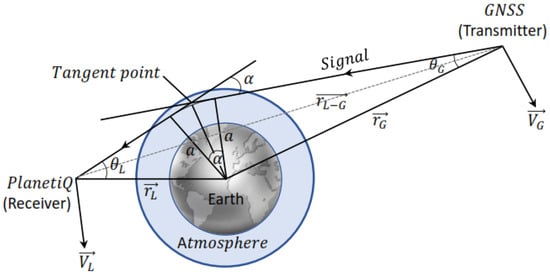
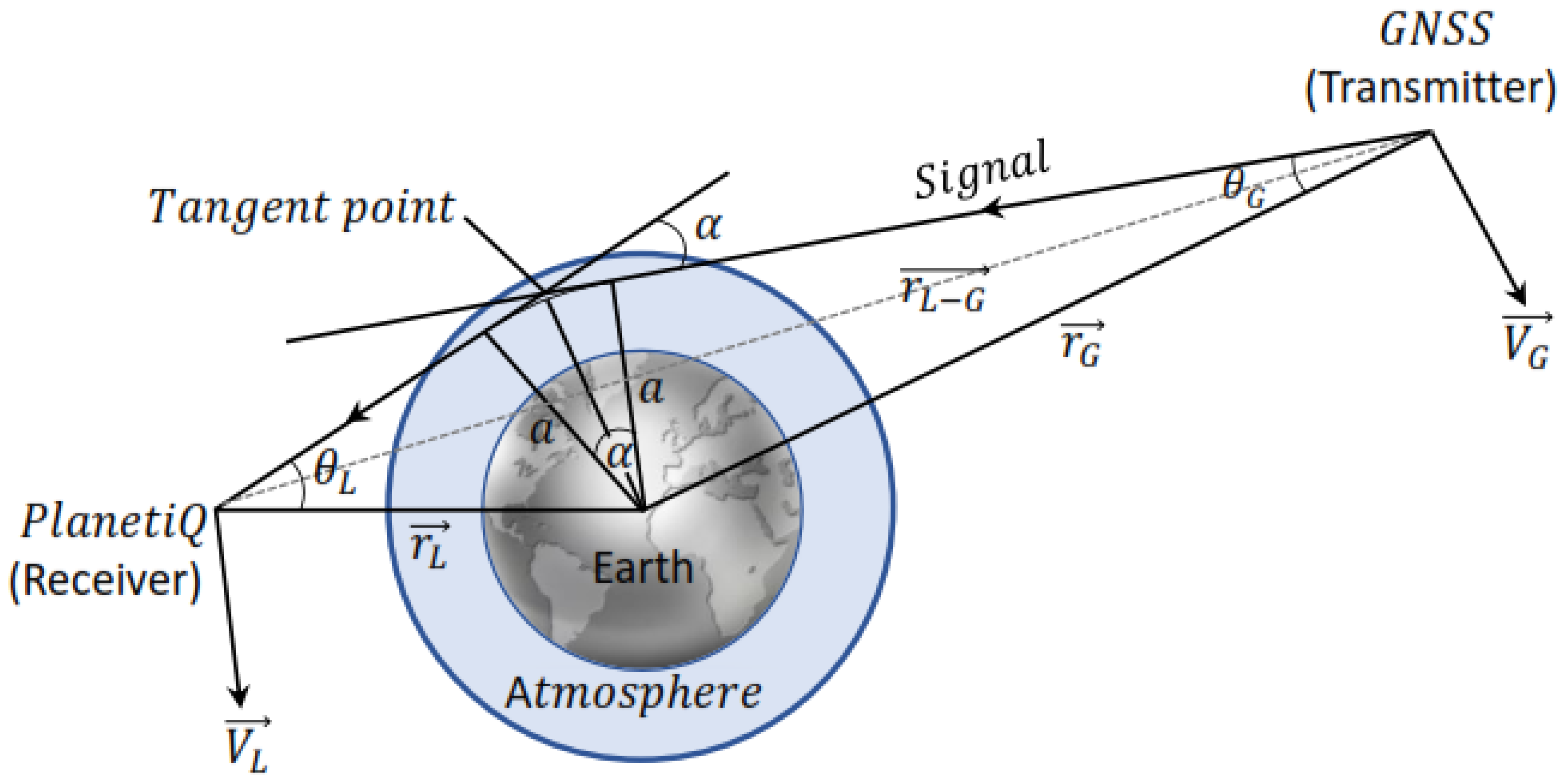
The inversion of RO signals in the ionosphere involves a sequence of steps to derive Ne profiles from dual frequency GNSS measurements. The process begins with the determination of straight-line impact parameters, which approximate the ray path under the assumption of minimal ionospheric bending. The geographic location of the tangent point defined by latitude, longitude, and height is calculated while accounting for Earth’s oblateness and rotational effects. This framework establishes the geometry of an RO event, where signals transmitted by a GNSS satellite to a low Earth orbit (LEO) receiver are refracted through the ionosphere. The tangent point, representing the closest approach of the ray path to Earth, provides the reference for retrieving Ne profiles.
Figure 1 shows the geometry of a PlanetiQ radio occultation event, with a GNSS satellite transmitting a signal to a LEO receiver through Earth’s atmosphere. The tangent point, closest to Earth, is key for probing ionospheric Ne. Important parameters include the satellites’ position and velocity vectors (rG, rL, VG, VL), the connecting vector along the signal path (rL−G), elevation angles at the transmitter and receiver (θG, θL), the total bending angle (α), and the impact parameter (a) [1,19].
Figure 1.
Occultation event geometry, defining important location and angular variables of an RO event.
PlanetiQ Ne profiles are derived by calibrating GNSS RO carrier phase delays to obtain slant TEC, using two modes: mode 1, which employs auxiliary phase data from the non-occultation side to remove the GPS–LEO contribution and isolate TEC within the LEO, and mode 0, a quasi-calibration applied when auxiliary data are unavailable, in which the phase at the maximum impact parameter is subtracted from all occultation-side samples under assumptions of local spherical symmetry and an exponential decrease in Ne above the orbit altitude [20]. The calibrated TEC is then inverted to vertical Ne profiles via Abel (onion-peeling) inversion, yielding key parameters such as NmF2, hmF2, and foF2, which are widely used in GNSS-RO ionospheric studies and form the basis for the present validation of PlanetiQ profiles against ionosonde and COSMIC-2 observations under varying ionospheric conditions [2,9,21].
The calibrated TEC is derived from the differential carrier phase using the expression given in Equation (1). In this framework, dual-frequency phase is the primary observable from which slant TEC is derived, while vertical Ne, NmF2, hmF2 and foF2 are all retrieved quantities. In forming this L1–L2 ionospheric combination, we account for the fact that the ionosphere delays the group (code) and advances the carrier phase by equal magnitude and opposite sign, so that the differential phase observable correctly isolates the ionospheric contribution.
where is the differential phase path delay between GPS L1 and L2 signals, and and are the corresponding carrier frequencies [21]. For mode-1 calibration, the TEC near the orbit altitude can be approximated using Equation (2).
where is the impact parameter, is the maximum impact parameter corresponding to the LEO orbital radius, and is the local electron density [21].
In mode-0 calibration, the initially calibrated TEC is refined by adding an analytical estimate of the TEC above the orbit altitude and subtracting the corresponding contribution for positive elevation angles. The analytical formulation is given in Equation (3).
where is the scale height representing the exponential decay of Ne above the orbit. The scale height is typically initialized to 1000 km and iteratively refined during the inversion process to ensure convergence between the estimated and retrieved parameters [21].
After calibration, the Ne profile is reconstructed using the onion peeling method, which performs an Abel type inversion on the calibrated TEC [21]. Inversion is performed as expressed in Equation (4).
where ck,i are coefficients derived for the numerical Abel inversion [9,21]. For mode 0 calibration, this procedure is repeated iteratively to refine the scale height and Ne at the orbit altitude, ensuring convergence of the quasi calibrated TEC and the retrieved Ne profile [21]. This comprehensive inversion process ensures accurate and reliable derivation of ionospheric Ne profiles from radio occultation data. For PlanetiQ, the lowest altitude of each Ne profile corresponds to the local tangent point of the occultation ray and therefore varies from event to event, reflecting differences in geometry, ray-path bending, and quality control applied in the level-2 processing. As a result, the PlanetiQ Ne profiles in the comparison figures do not all start at the same height but span a range of lower boundaries that typically lie between about 80 and 140 km. No additional “manual” truncation was applied for this study; instead, we use the native ionPrf vertical extent and then interpolate all profiles to the common 100–450 km grid used for the statistical comparisons.
3.2. Retrieval of Ionosonde-Derived Ionospheric Parameters
The retrieval of ionosonde-derived ionospheric parameters, specifically hmF2 and foF2, is performed using the GIRO database, which provides vertical Ne profiles. The hmF2 parameter, representing the altitude of the F2-layer peak Ne, and the foF2 parameter, representing the corresponding critical frequency of the F2 layer, are extracted from the ionogram traces. These parameters are validated against manually scaled ionograms to ensure accuracy. The retrieved hmF2 and foF2 values are then spatially and temporally collocated with the PlanetiQ RO profiles for comparative analysis. This collocation ensures that the ionosonde data correspond to the same ionospheric conditions as the satellite observations, enabling a robust validation of the PlanetiQ-derived Ne profiles. The use of GIRO’s comprehensive and reliable ionosonde data provides a ground-truth reference for evaluating the accuracy and consistency of the satellite-based retrievals. In this study, we distinguish between observables and derived quantities: GNSS-RO directly measures dual-frequency phase (from which slant TEC is obtained), while Ne profiles and NmF2/hmF2/foF2 are retrieved by inversion; ionosondes directly measure radio frequencies and echo times, from which foF2, hmF2, and Ne profiles are subsequently derived [20].
3.3. Data Matching and Comparison
Validation of PlanetiQ ionospheric Ne profiles against ionosonde and COSMIC-2 observations was carried out using a structured collocation and comparison framework. PlanetiQ ionPrf profiles were obtained from GNSS radio occultation observations under the assumption of local spherical symmetry, and key metadata were extracted from the NetCDF files, including time, altitude, bottom latitude and longitude, top latitude and longitude, and the location of the Ne maximum. For ionosonde observations, parameters such as foF2, foE, and foF1 were extracted from station files together with station coordinates and URSI identifiers. COSMIC-2 ionPrf files were processed in the same manner, and the relevant attributes, including timestamps, peak Ne altitude, and profile location information, were retrieved from the UCAR/CDAAC archive. To ensure consistency in the location handling, longitudes were normalized to a common range and representative profile locations were computed from the available occultation geometry parameters.
For the baseline validation, collocation between PlanetiQ and ionosonde observations was defined using spatial differences smaller than 1° in latitude and longitude and temporal differences smaller than 30 min, while PlanetiQ–COSMIC-2 matches were defined using the same spatial threshold and a temporal difference smaller than 1 h. In addition, a dedicated sensitivity analysis was performed for the PlanetiQ–COSMIC-2 comparisons in order to assess how the validation statistics depend on the strictness of the collocation criteria. For this purpose, matched pairs were grouped into three progressively relaxed windows: G1 , G2 , and G3 . This analysis was introduced to quantify the trade-off between collocation strictness and agreement quality and to justify the use of relatively tight thresholds in the main validation. Although more relaxed windows increase the number of matched pairs, the sensitivity analysis in Section 4.1 shows that they introduce noticeably larger discrepancies; we therefore adopt the strict G1-type thresholds as the baseline for all core statistics.
For the profile-based comparison, PlanetiQ, ionosonde, and COSMIC-2 Ne profiles were interpolated onto a common 100–450 km altitude grid, and collocated pairs were then compared point-by-point to compute RMSE, mean and absolute mean differences, correlation, and a normalized absolute mean difference expressed as a percentage relative to the reference mean Ne (or NmF2). In parallel, hmF2 and foF2 values derived from GIRO ionosonde profiles were compared with the corresponding PlanetiQ and COSMIC-2 peak parameters, so that both detailed vertical structure and key peak properties could be evaluated consistently. The normalized absolute mean difference percentage is defined as expressed in Equation (5).
These metrics, together with linear regression and scatter plots were applied under strict collocation criteria (G1-type) to assess the reliability of PlanetiQ profiles, while at 400 km the Ne and TEC were additionally mapped into quasi-dipole latitude MLT space to quantify PlanetiQ–COSMIC-2 agreement via daily statistics of the number of pairs, mean bias, RMSE, percentage difference, and Pearson correlation. To keep the comparison focused on the height range that is best constrained by the ionosonde measurements, all profile-based statistics between PlanetiQ and ionosondes are computed on a common 100–450 km altitude grid, which spans the F-region peak and its immediate surroundings but avoids relying heavily on the more model-dependent topside reconstruction above.
4. Results and Discussion
The Results section is centered on quantifying how well PlanetiQ reproduces key ionospheric parameters when compared with established references. It first introduces a sensitivity analysis using a large set of PlanetiQ–COSMIC-2 collocations, showing how RMSE and correlation for EDMax, hmF2, foF2, and TEC0 change as the spatial and temporal windows are relaxed; this demonstrates that tighter collocation thresholds reduce error and maintain higher correlations, justifying the strict windows used in the rest of the study. Subsequent subsections then present detailed profile-by-profile and statistical comparisons with both COSMIC-2 and ionosondes, including regression analyses, RMSE and bias metrics, and illustrative examples under quiet and disturbed geomagnetic conditions, to demonstrate that PlanetiQ provides accurate and consistent Ne and TEC measurements across a range of geophysical regimes.
4.1. Sensitivity to Collocation Criteria (PlanetiQ vs. COSMIC-2)
The validation of PlanetiQ ionospheric Ne profiles was carried out through systematic comparisons with both ground-based ionosonde measurements and COSMIC-2 RO data. As a first step, a dedicated sensitivity analysis was performed to quantify how the choice of spatiotemporal collocation window affects the statistical agreement between PlanetiQ and COSMIC-2. PlanetiQ–COSMIC-2 profile pairs were grouped into three nested categories: G1, representing a strict collocation criterion; G2, an intermediate window; and G3, a relaxed window. For each group, RMSE and correlation coefficients were computed for EDMax, EDMax altitude, foF2, and TEC0, and the resulting statistics are summarized in Table 1. This sensitivity analysis provides a quantitative basis for selecting appropriate collocation thresholds and underpins the stricter criteria adopted in the subsequent validation.
Table 1.
RMSE and correlation for key parameters under different PlanetiQ–COSMIC-2 collocation groups (bias = PlanetiQ − COSMIC-2).
Table 1 shows that relaxing the collocation window leads to a clear but moderate degradation in PlanetiQ–COSMIC-2 agreement. From G1 to G3, RMSE increases for all parameters (e.g., EDMax RMSE from ~4.7 × 10⁵ to ~5.7 × 10⁵ el/cm3 and TEC0 RMSE from ~8.9 to ~10.2 TECU), while correlations decrease (EDMax from 0.82 to 0.74 and TEC0 from 0.85 to 0.79). These trends indicate that larger temporal and spatial separations introduce additional mismatch between the profiles, supporting the use of the strict G1 window as the baseline for the main validation.
The broader validation then uses these insights to define spatiotemporal matching criteria that ensure meaningful alignment between PlanetiQ, ionosonde, and COSMIC-2 observations. Co-located pairs are defined by spatial differences below 1° in latitude and longitude and temporal differences below 30 min for ionosondes and 1 h for COSMIC-2, consistent with the strict G1 window. For each collocated event, key ionospheric parameters, including peak Ne, foF2, and altitude-dependent Ne profiles, are extracted for direct comparison. Statistical metrics such as RMSE, Mean Absolute Error (MAE), and correlation coefficients, together with linear regression analysis, are used to quantify the level of agreement, while graphical diagnostics highlight systematic biases and distribution characteristics.
4.2. Comparison with Ionosondes (Profiles and F-Layer Parameters)
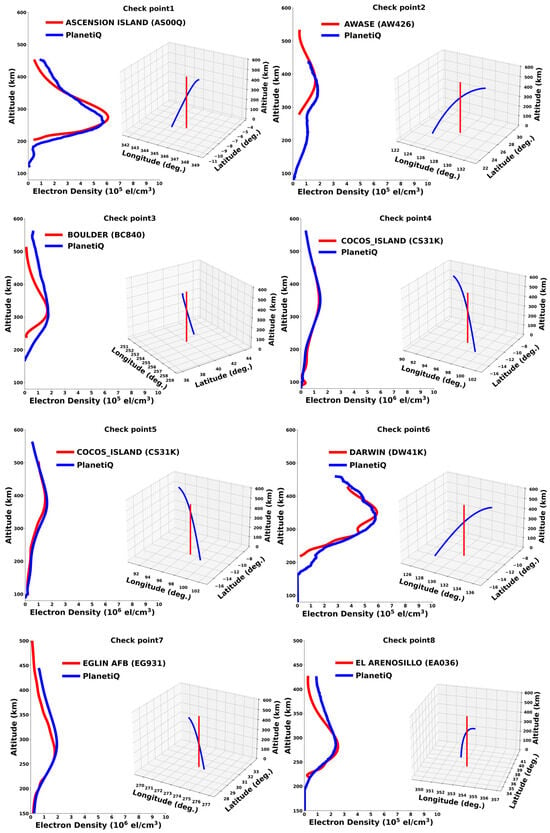
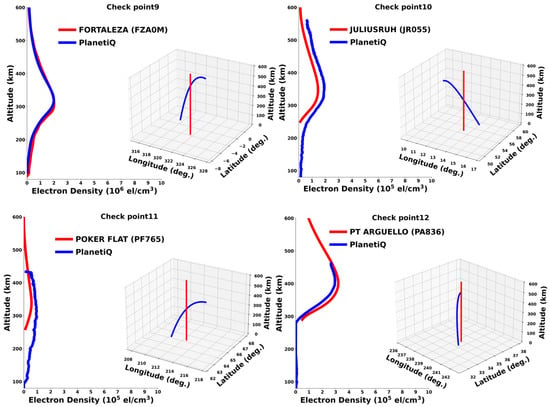
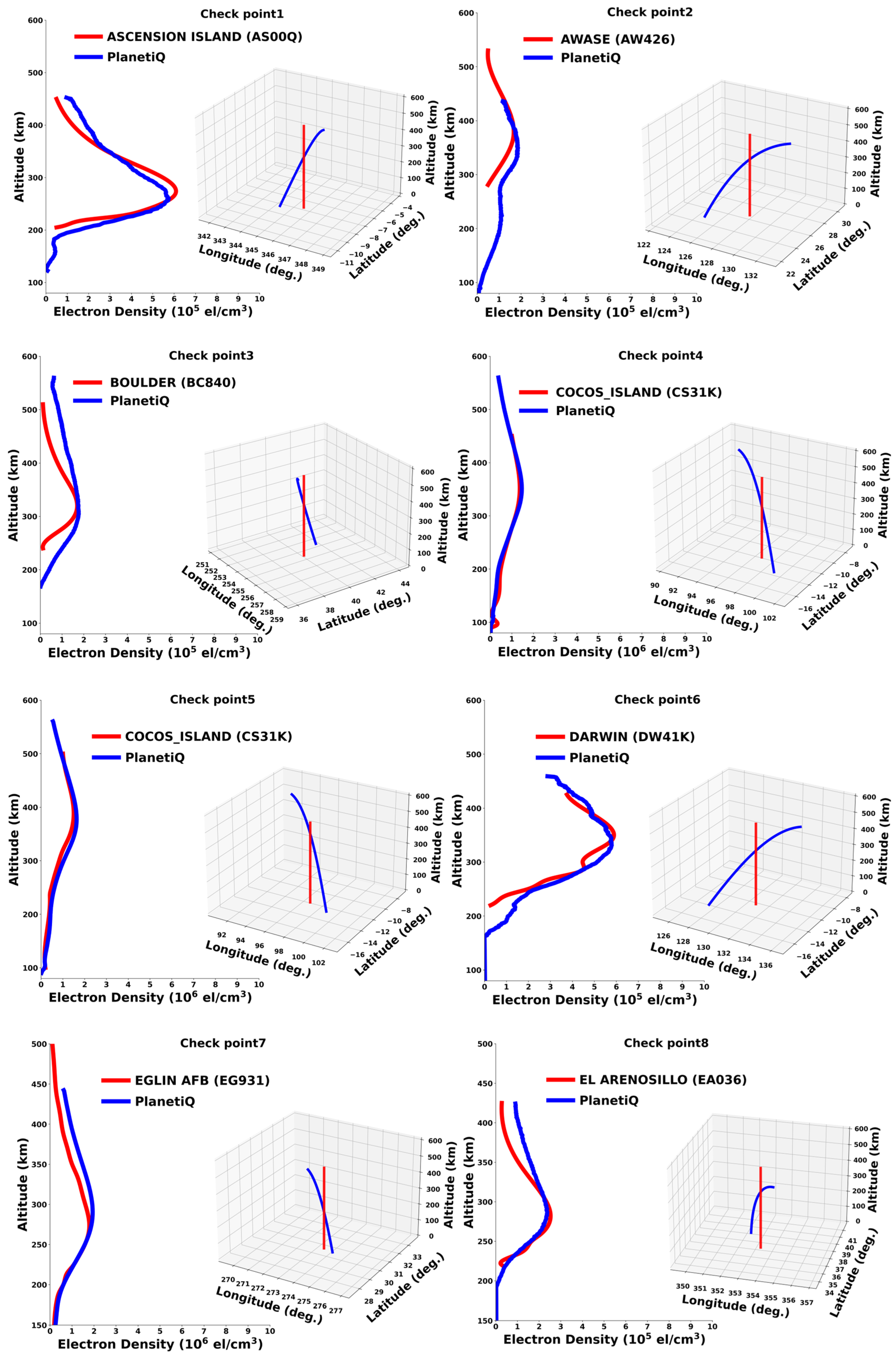
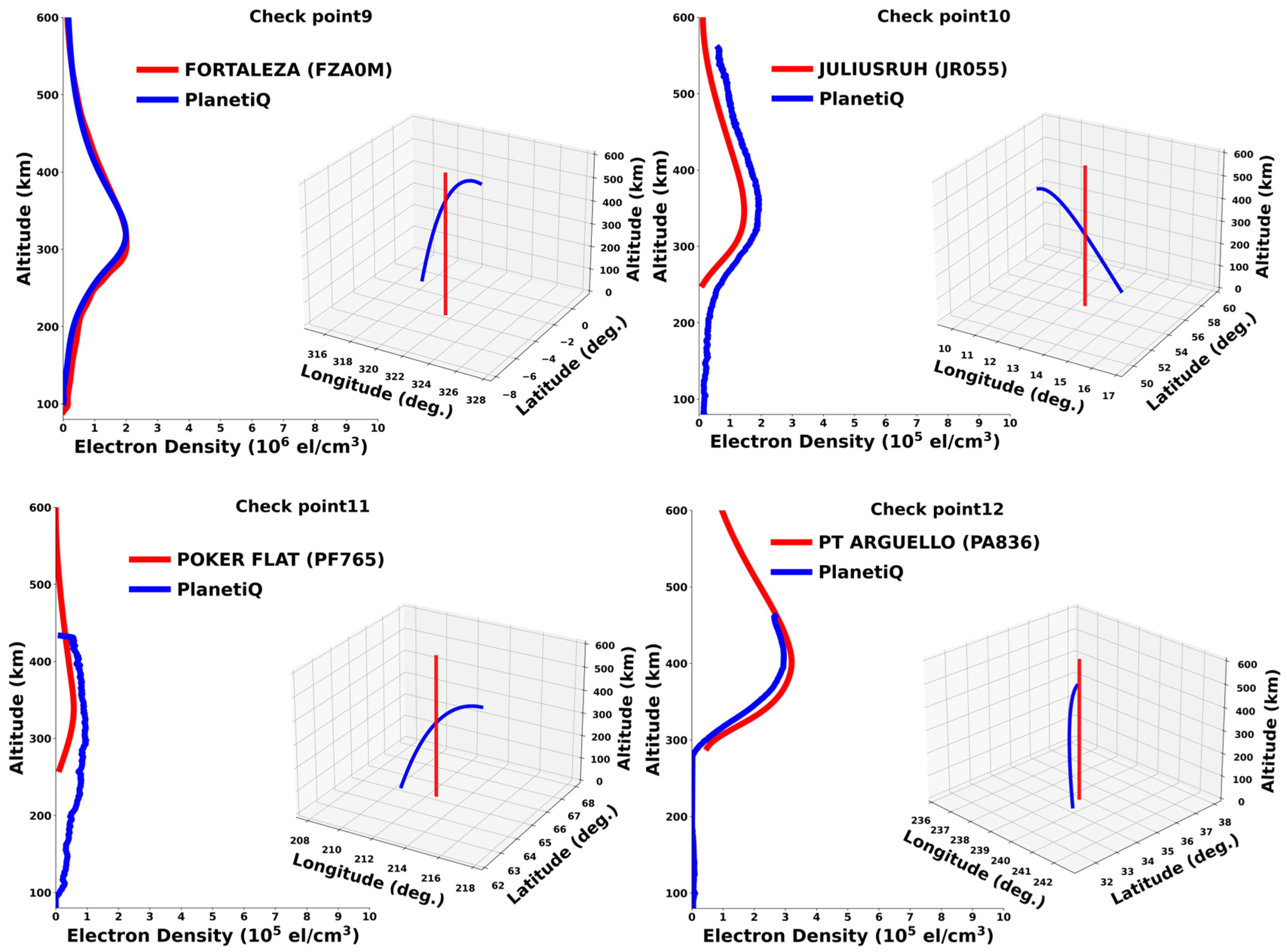
Table 2 summarizes the PlanetiQ ionosonde data pairings used for comparison at 12 checkpoints. For each case, the table lists the GNSS-RO file identifier, the corresponding ionosonde station (URSI code), and the associated spatiotemporal differences. The temporal separation (ΔT) between the two measurements ranges from 0.2 to 3.5 min, while the horizontal distance varies from 13.0 km to 248.1 km, ensuring generally close collocation conditions. These checkpoints provide a representative set of comparison profiles across different geographic regions and observing conditions, forming the basis for the Ne profile analysis presented in Figure 2.
Table 2.
PlanetiQ ionosonde comparison data profiles, ionosonde stations and spatiotemporal differences at 12 checkpoints.
Figure 2.
Ne profiles from PlanetiQ and ionosonde stations at 12 checkpoints, with the 3D position displayed for each profile.
Table 3 reports the quantitative evaluation of Ne profile (EDP) comparisons between PlanetiQ GNSS-RO data and collocated ionosonde measurements at the 12 checkpoints. Each checkpoint corresponds to a PlanetiQ occultation event paired with the nearest ionosonde station, as listed in Table 2. A successful checkpoint is defined here as a PlanetiQ ionosonde pairing where the collocation criteria were adequately met (ΔT ≤ 5 min and horizontal separation ≤ 300 km) and the resulting EDP comparison yielded statistically meaningful agreement, expressed in terms of RMSE, mean bias, and foF2 deviation.
Table 3.
Statistical results of profile comparison between PlanetiQ and ionosonde data at 12 check points.
The comparison between PlanetiQ RO profiles and ionosonde measurements shows generally strong agreement, as reflected in high correlation coefficients at nearly all stations. Ten out of twelve locations yielded correlation values above 0.9, with several sites such as COCOS ISLAND (4 January 2024 and 5 January 2024), DARWIN (7 October 2023), and JULIUSRUH (14 January 2024) exceeding 0.99. These stations also demonstrated moderate RMSE values (ranging from about 4.6 × 10⁴ to 1.4 × 10⁵ el/cm3) and consistent mean differences, supporting the reliability of PlanetiQ retrievals in capturing the vertical Ne structure. Even where mean differences were negative, as at COCOS ISLAND (4 January 2024) and PT ARGUELLO (4 October 2023), the high correlation indicates that the shape of the profiles was well preserved.
The normalized absolute mean differences show clear station-to-station variability in the relative agreement between PlanetiQ and ionosonde Ne profiles: the smallest percentages occur at COCOS ISLAND (4 January 2024, 8.4%), DARWIN (7 October 2023, 10.4%), FORTALEZA (28 August 2023, 11.6%), and PT ARGUELLO (4 October 2023, 11.8%), indicating that PlanetiQ differs from the ionosonde by only about ten percent of the background Ne on average at these sites; intermediate values are found at ASCENSION ISLAND (15.0%), COCOS ISLAND (5 January 2024, 16.9%), EL ARENOSILLO (25.9%), AWASE (25.9%), and EGLIN AFB (26.6%), implying moderate relative discrepancies even when correlations remain high; in contrast, JULIUSRUH (46.4%) and especially POKER FLAT (89.7%) exhibit much larger percentages, confirming that these stations are characterized by substantial relative mismatches and likely reflect strong local ionospheric variability or reduced retrieval performance at those locations.
Despite these encouraging results, several cases reveal significant discrepancies. POKER FLAT (25 December 2023) displayed the weakest performance, with a correlation of only 0.31, indicating poor agreement in profile structure even though RMSE values remained moderate. Large maximum differences were observed at FORTALEZA (28 August 2023) and EGLIN AFB (29 October 2023), reaching 2.36 × 10⁵ el/cm3 and 4.68 × 10⁵ el/cm3, respectively, suggesting that localized conditions may have strongly influenced the comparison. Stations such as ASCENSION ISLAND (28 October 2023) and AWASE (19 November 2023) also showed slightly lower correlations (0.97 and 0.69), with mean differences in the range of 28,700 to 31,600 el/cm3, reflecting regional variability in the quality of agreement. Overall, while most stations confirm the robustness of PlanetiQ profiles, the presence of outliers emphasizes the importance of considering local ionospheric dynamics when interpreting validation results. These patterns of overall agreement, coupled with occasional localized discrepancies, are consistent with findings from earlier validation studies of RO-derived Ne profiles, which also reported strong correlations alongside region-specific deviations [15,22].
Figure 2 illustrates the Ne profiles obtained from PlanetiQ RO measurements in comparison with coincident ionosonde observations. Twelve checkpoints were selected based on the spatial and temporal proximity of the RO events to the ionosonde stations. Additionally, a three-dimensional representation of both datasets is provided in Figure 2 to visualize their relative positions and profiles.
Although spatial and temporal discrepancies exist between the two observation sources, the resulting differences in Ne do not exhibit a direct dependence on these spatiotemporal offsets. For instance, Checkpoint 9 shows the largest spatial separation, with a location difference of approximately 248 km. Despite this considerable distance, the correlation coefficient remains remarkably high (0.99), and the observed Ne differences are moderate relative to the other checkpoints. These results emphasize the robustness and reliability of PlanetiQ measurements for characterizing ionospheric Ne, even under conditions of substantial spatial separation from ground-based observations.
The figure clearly demonstrates the overall agreement between the two datasets, with the PlanetiQ profiles closely following the ionosonde-derived Ne curves at all checkpoints. The vertical structure of the ionosphere, including the NmF2 and its corresponding altitude, is well captured by PlanetiQ, confirming its capability for monitoring ionospheric variability. The smooth nature of the RO-derived profiles, compared with the higher-resolution but more localized ionosonde measurements, highlights the complementary nature of the two techniques. Together, these results underscore the potential of integrating spaceborne RO data with ground-based ionosonde observations for comprehensive ionospheric studies.
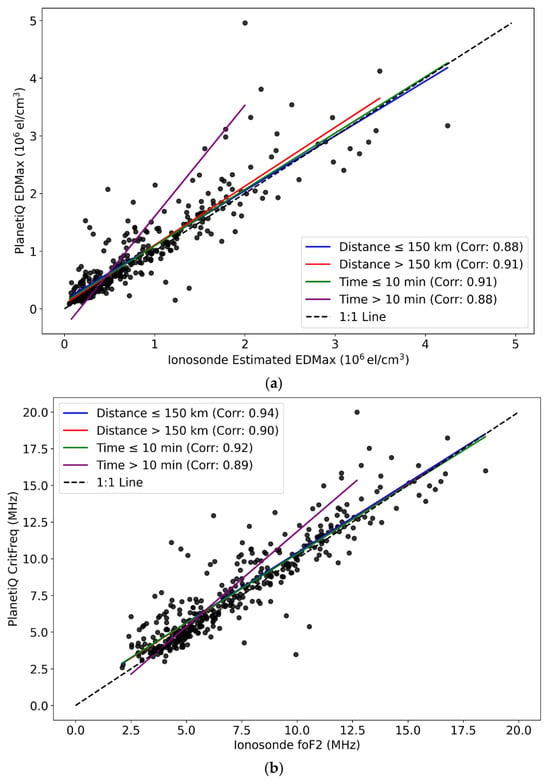
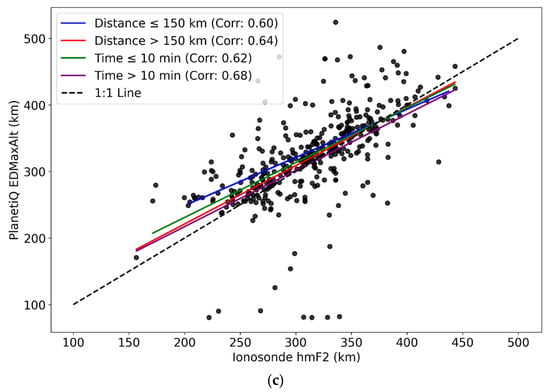
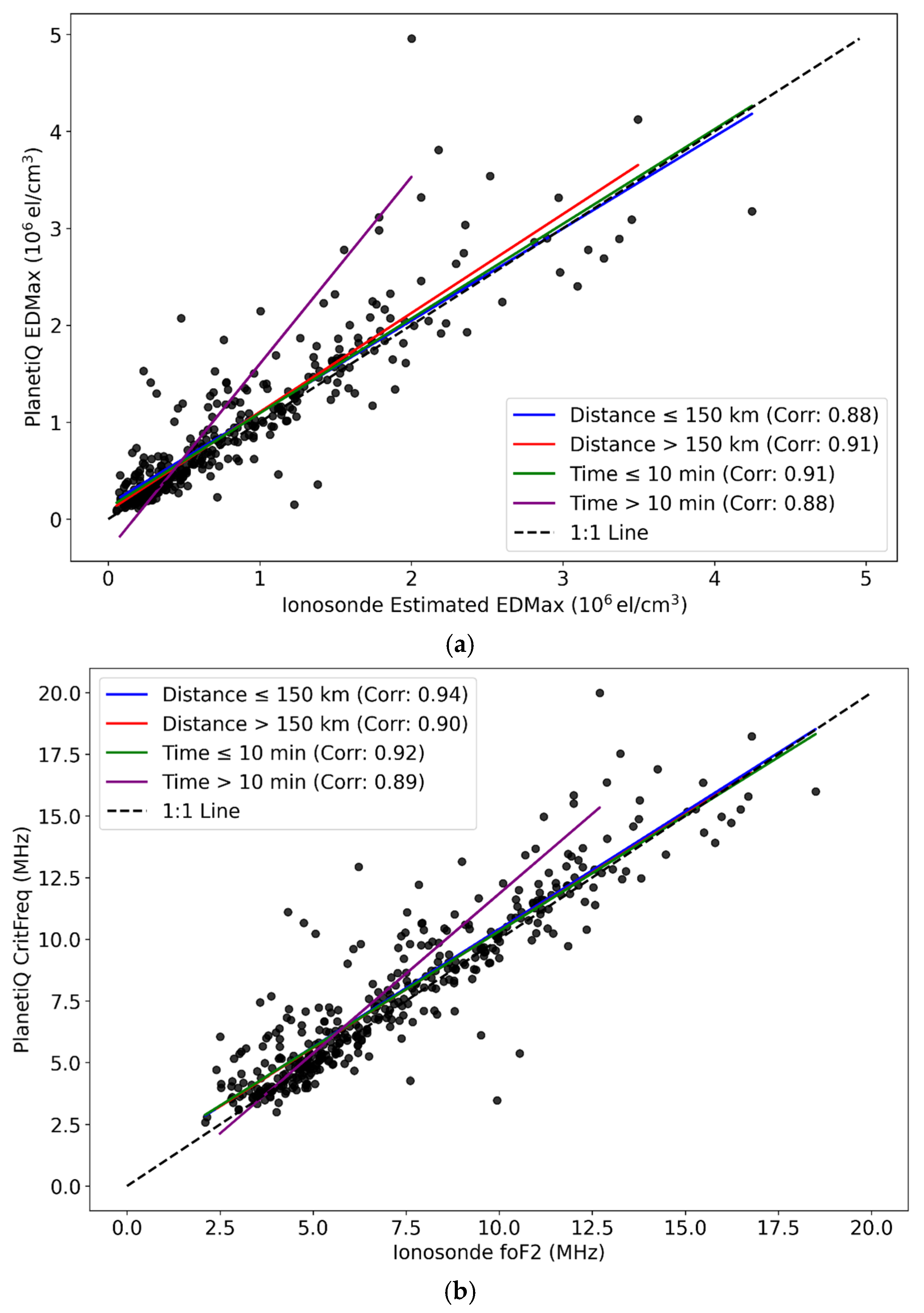
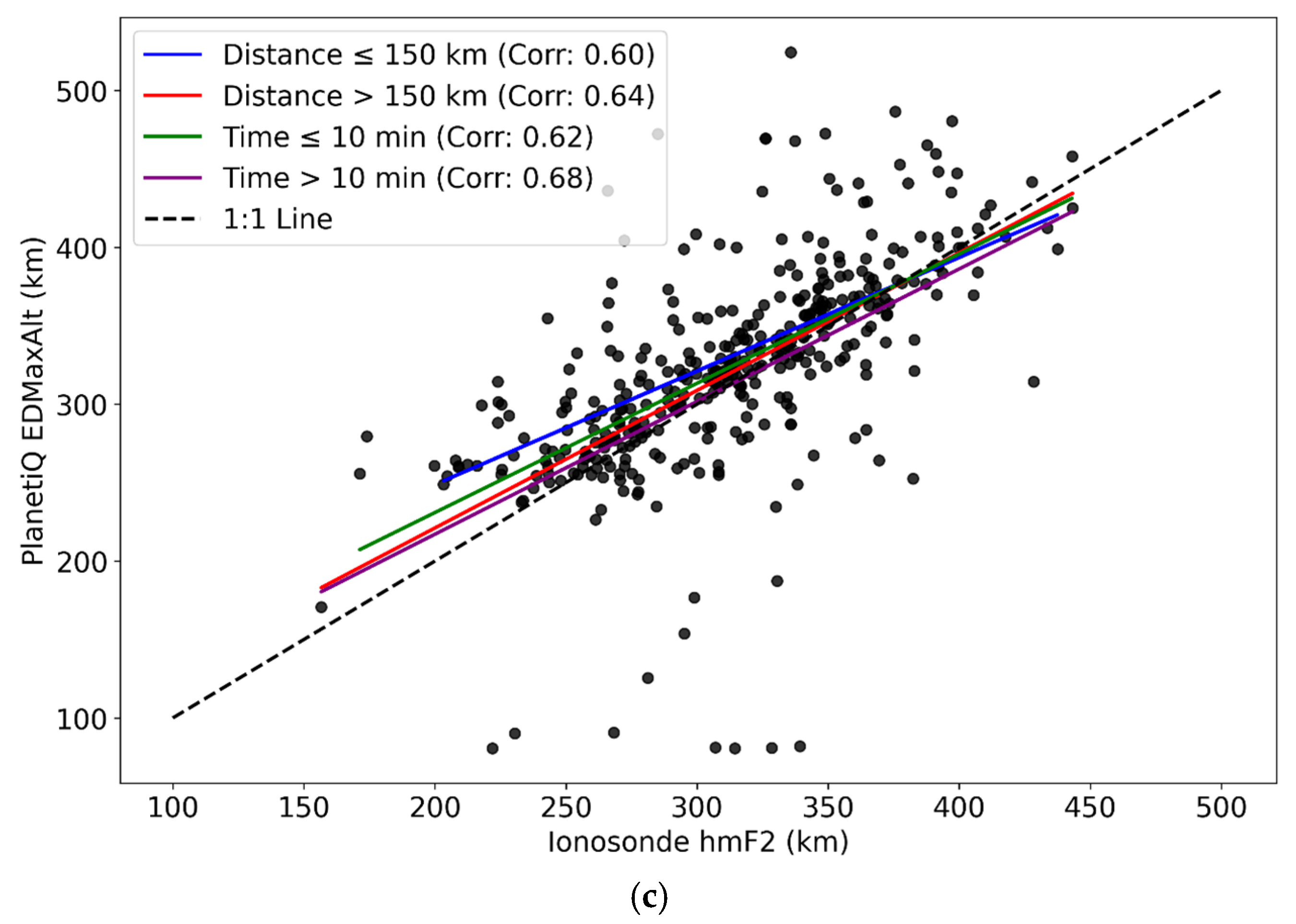
Figure 3 summarizes the regression analysis between PlanetiQ and ionosonde F-layer peak parameters. Figure 3a shows EDMax (NmF2), for which the overall regression across 396 collocated points yields a correlation of 0.90 with a slope of 0.81 and a small positive intercept (63,591 el/cm3), confirming the consistency of PlanetiQ-derived peak Ne with ionosonde estimates. When the temporal separation is within 10 min, the correlation increases to 0.91 with a slope of 0.85, whereas for separations exceeding 10 min it decreases slightly to 0.88 with a lower slope (0.41), indicating that temporal proximity exerts a stronger influence than spatial separation on the agreement between PlanetiQ and ionosonde NmF2. Figure 3b presents the foF2 regression, which exhibits similarly high agreement, with an overall correlation of 0.91, slope of 0.95, and small intercept (0.86 MHz); correlations remain ≥0.89 under both tight (≤10 min, ≤150 km) and relaxed collocation, demonstrating that PlanetiQ provides highly reliable estimates of foF2. Figure 3c shows that hmF2 retrievals are less robust: the overall correlation is 0.62 (385 pairs) with a slope of 0.82 and larger scatter, and only modest improvements are seen when restricting temporal or spatial separations, highlighting the greater difficulty in matching peak height compared with peak density and foF2. These behaviors are consistent with earlier COSMIC validation studies, which likewise reported larger discrepancies for hmF2 than for NmF2 or foF2. These results indicate that while PlanetiQ reliably reproduces Ne and foF2 values, the estimation of hmF2 is less robust, reflecting the inherent challenges of capturing peak layer height variability through RO compared to ionosonde measurements. Similar limitations in hmF2 retrieval from RO data have been reported in earlier COSMIC validation studies, which also found larger discrepancies for peak height than for NmF2 or foF2 [11,12].
Figure 3.
Regression between PlanetiQ and ionosonde F-layer peak parameters: (a) NmF2; (b) foF2; (c) hmF2.
4.3. Comparison with COSMIC-2 (Profiles and F-Layer Parameters)
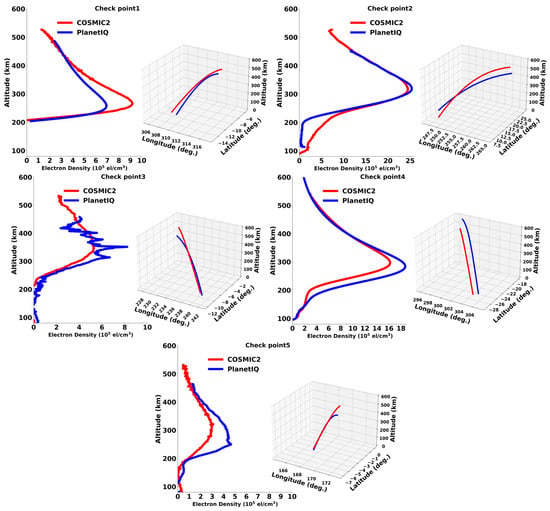
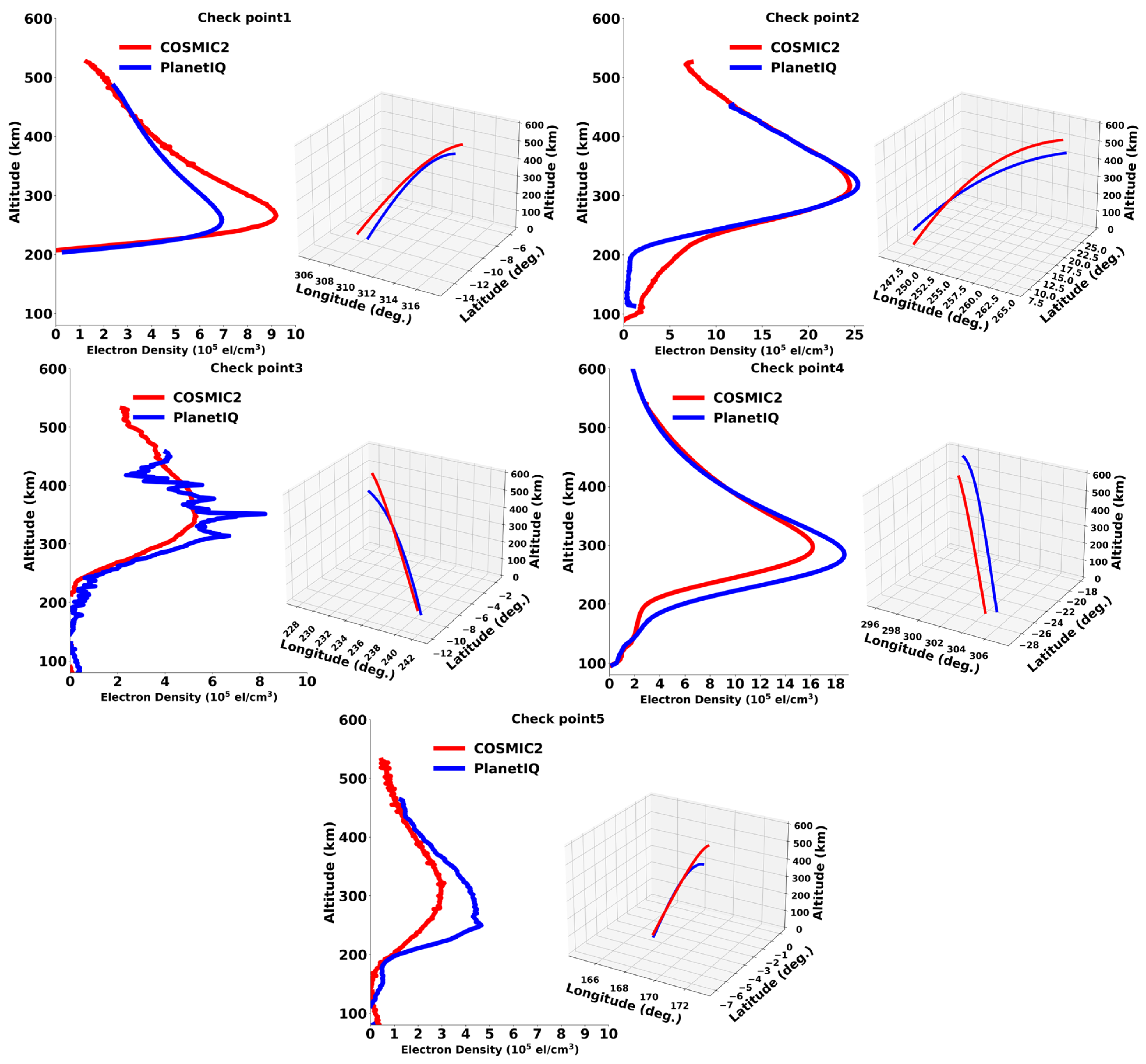
Figure 4 presents Ne profiles from PlanetiQ and COSMIC-2 for five collocated check points, together with the corresponding 3D ray-path geometry, showing consistently high correlations between 0.94 and 0.99 across all cases. Table 4 summarizes the statistical metrics for these check points, including the average spatial separation between top and bottom tangent points, temporal offsets, RMSE, mean error, and absolute mean error. The combined evidence from Figure 4 and Table 4 indicates that PlanetiQ and COSMIC-2 Ne profiles agree very well in both structure and magnitude under the applied collocation criteria.
Figure 4.
Ne profiles from PlanetiQ and COSMIC-2 for five collocated checkpoints.
Table 4.
Spatial temporal separation and Ne statistics for five PlanetiQ COSMIC-2 check points.
The normalized absolute mean differences further quantify the relative agreement between PlanetiQ and COSMIC-2 profiles at these checkpoints. At checkpoints 1, 3, and 5 the percentages remain below about 20% (10.3%, 18.4%, and 17.8%, respectively), indicating that the average Ne mismatch is relatively small compared to the background level and consistent with the high correlations. In contrast, checkpoint 2 shows a somewhat larger relative difference of 21.5%, and checkpoint 4 exhibits the largest value of 46.5%, suggesting that although the profile shapes remain correlated, the magnitude of the Ne can deviate substantially there, in line with its higher RMSE.
The comparison reveals that temporal separation tends to have a stronger impact on RMSE than the average spatial distance. At check point 1, an average distance of about 42.5 km and a time difference of 12.3 min are associated with an RMSE of 2.16 × 10⁵ el/cm3 and a correlation of 0.99. By contrast, check point 2 shows the largest average distance (~96.5 km) and a time offset of 19.9 min, yet yields the lowest RMSE of 7.06 × 10⁴ el/cm3 with a correlation of 0.96, indicating that large spatial offsets do not necessarily degrade agreement when temporal mismatch is moderate. These two cases underscore that high correlations can be maintained even when distances vary, whereas RMSE responds more sensitively to how well the profiles are synchronized in time.
The remaining check points further illustrate the joint influence of space time separation on the error statistics. Check points 3, 4, and 5 have average distances of about 78.6 km, 89.5 km, and 78.5 km with time differences of 52.7, 40.0, and 22.0 min, producing RMSE values of 1.84 × 10⁵, 9.33 × 10⁴, and 1.13 × 10⁵ el/cm3 and correlations of 0.96, 0.94, and 0.987, respectively. In particular, the larger temporal offsets at check points 3 and 4 coincide with higher RMSE despite average distances comparable to those at other locations, reinforcing that temporal mismatches tend to dominate the error magnitude while spatial offsets of order 40 to 100 km are generally tolerable when time differences remain limited. Overall, the distribution and statistical analysis confirm a high level of agreement in EDMax between PlanetiQ and COSMIC-2, demonstrating the reliability of PlanetiQ retrievals when compared with the established COSMIC-2 mission. These high correlations between PlanetiQ and COSMIC-2 are consistent with prior validation studies of COSMIC-2 RO data [23], which similarly report strong agreement in Ne peak parameters under collocated measurement conditions.
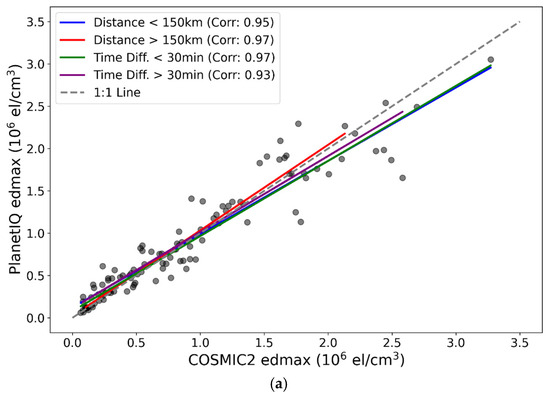
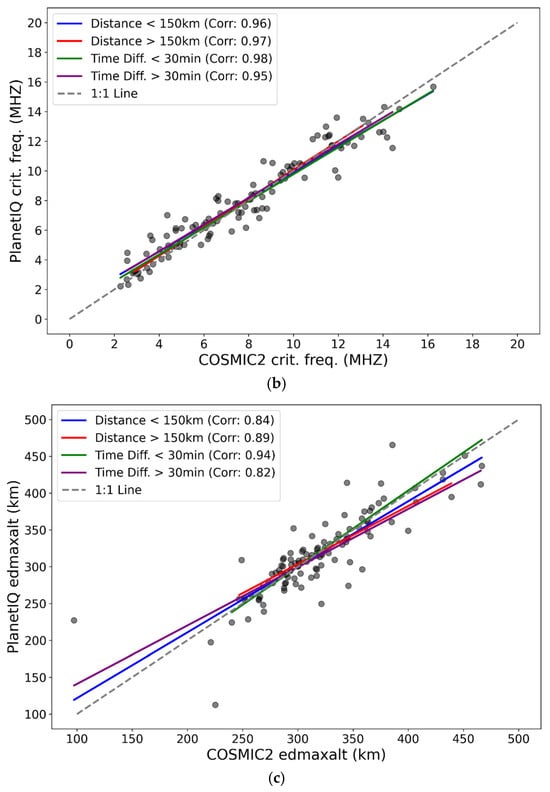
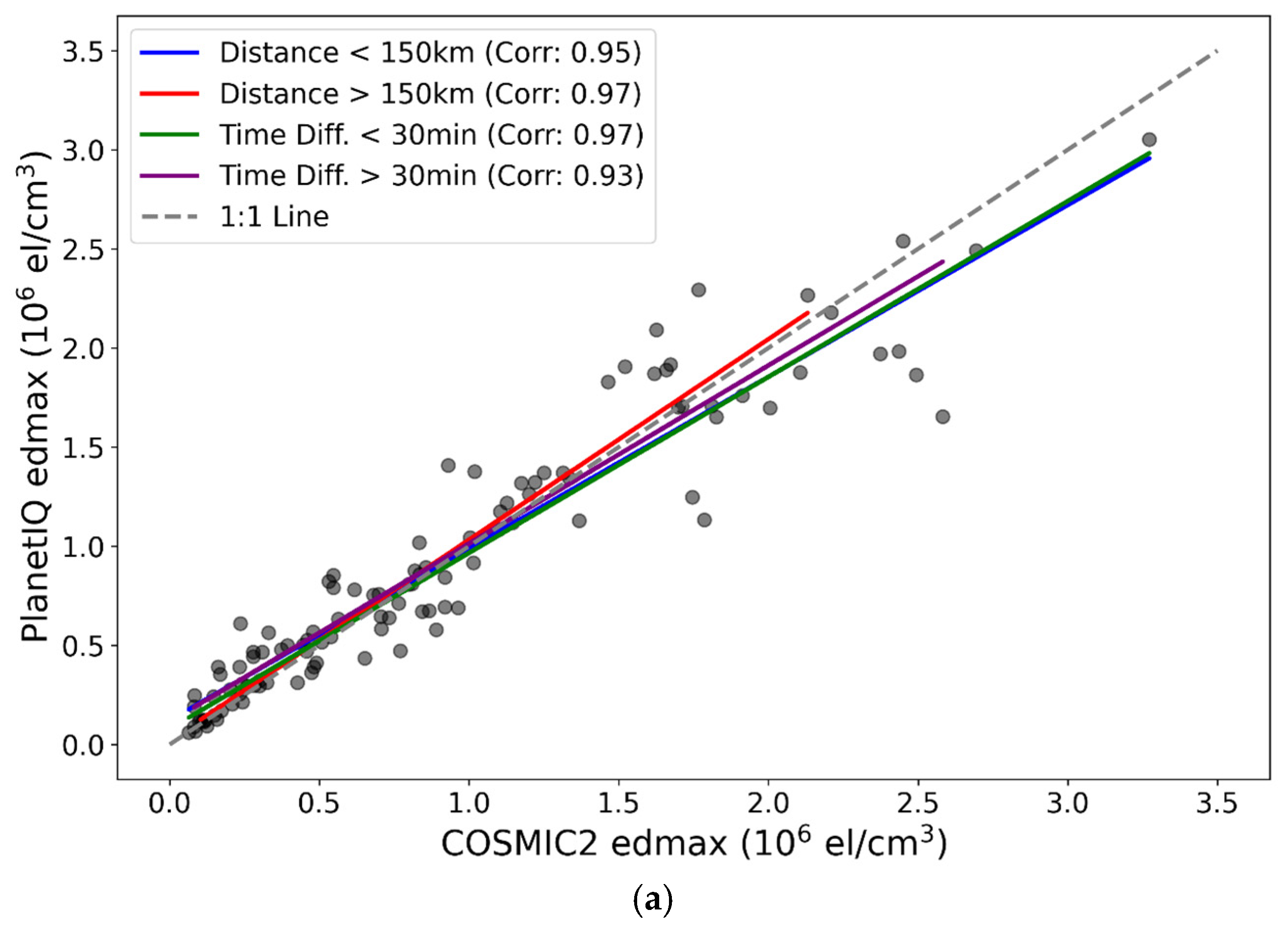
Figure 5 summarizes the regression analysis of collocated PlanetiQ and COSMIC-2 F-layer peak parameters. Figure 5a shows NmF2, where values span from 6.1 × 10⁴ to 3.05 × 10⁶ el/cm3 with a mean of about 9.0 × 10⁵ el/cm3. Across all collocations, the correlation is 0.95 and the coefficient of determination (R2) is 0.90, indicating that PlanetiQ explains about 90% of the COSMIC-2 variance and reliably reproduces NmF2. Grouping by spatial separation, pairs within 150 km yield a slope of 0.87, intercept 1.22 × 10⁵ el/cm3, and R2 = 0.90, whereas pairs at ≥150 km show an even closer relationship (slope 1.01, intercept 2.03 × 10⁴ el/cm3, R2 = 0.94); temporal grouping gives similarly high consistency, with slopes of 0.89 and 0.90 and correlations of 0.97 and 0.93 for time differences <30 min and ≥30 min, respectively, and the tightest agreement occurring under the stricter collocation.
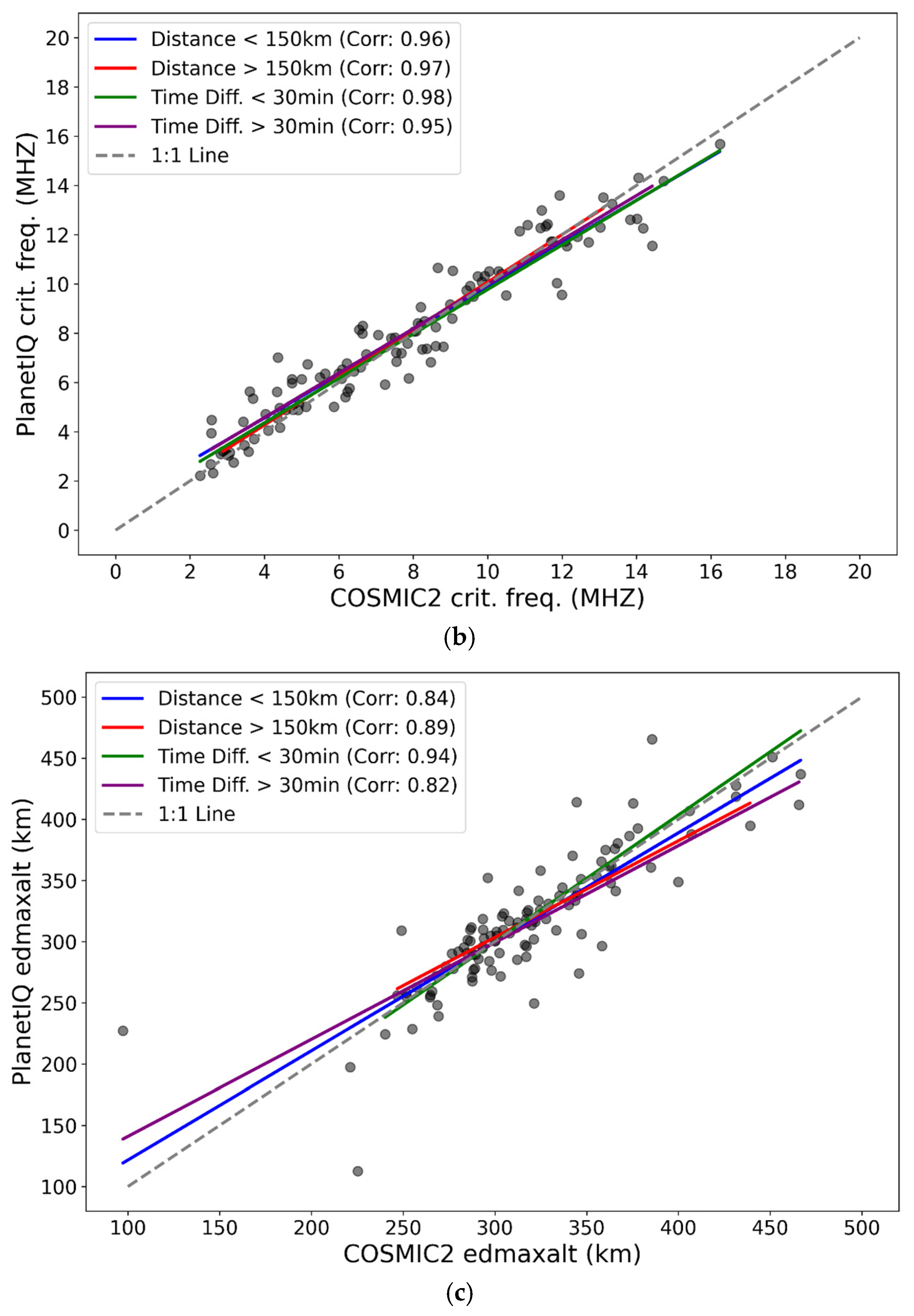
Figure 5.
Regression between PlanetiQ and COSMIC-2 F-layer peak parameters: (a) NmF2; (b) foF2; (c) hmF2.
Figure 5b presents the foF2 regression, which exhibits very strong consistency between PlanetiQ and COSMIC-2. FoF2 ranges from 2.22 to 15.68 MHz (mean ≈ 7.90 MHz), and the overall regression yields a correlation of 0.96 with R2 = 0.92, confirming that more than 90% of the COSMIC-2 variability is captured by PlanetiQ. For distances ≤150 km, the slope is 0.88 with intercept 1.02 MHz and R2 = 0.92, while at ≥150 km the slope is 0.97 with intercept 0.41 MHz and R2 = 0.93; temporal separations <30 min and ≥30 min both maintain high correlations (0.98 and 0.95) with slopes near 0.90, indicating that PlanetiQ-derived critical frequencies are highly consistent with COSMIC-2, especially under tighter collocation.
Figure 5c shows the regression for the EDMaxalt (hmF2) height, which displays moderate to strong agreement. The peak height ranges from 112.6 km to 465.4 km (mean ≈ 316 km), with an overall correlation of 0.85 and R2 = 0.72, so more than 70% of the COSMIC-2 variance is explained. Spatial grouping yields slopes of 0.89 (≤150 km) and 0.79 (≥150 km) with intercepts of 32.6 km and 66.7 km and R2 of 0.71 and 0.79, respectively. Temporal separation has a stronger impact: for time differences <30 min, the slope is 1.03 with a small negative intercept (−10.5 km) and R2 = 0.88 (correlation 0.94), whereas for ≥30 min the slope drops to 0.79 with intercept 61.8 km and R2 = 0.67 (correlation 0.82). These results indicate that PlanetiQ captures hmF2 reasonably well but with greater sensitivity to temporal mismatch than for EDMax and foF2. These results demonstrate that PlanetiQ captures the altitude of the EDMax observed by COSMIC-2 reasonably well, with the closest agreement achieved under tighter temporal collocation. Similar levels of agreement in hmF2 validation between GNSS RO missions and ionosonde data have also been reported in earlier studies [10,11].
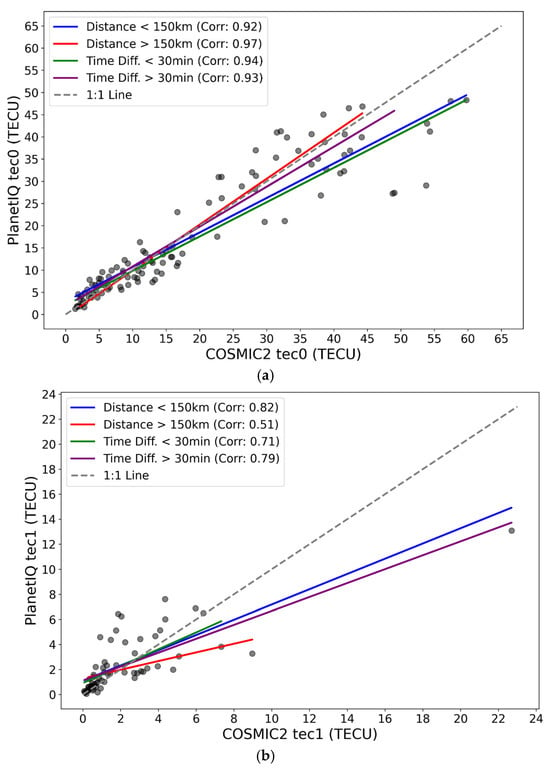
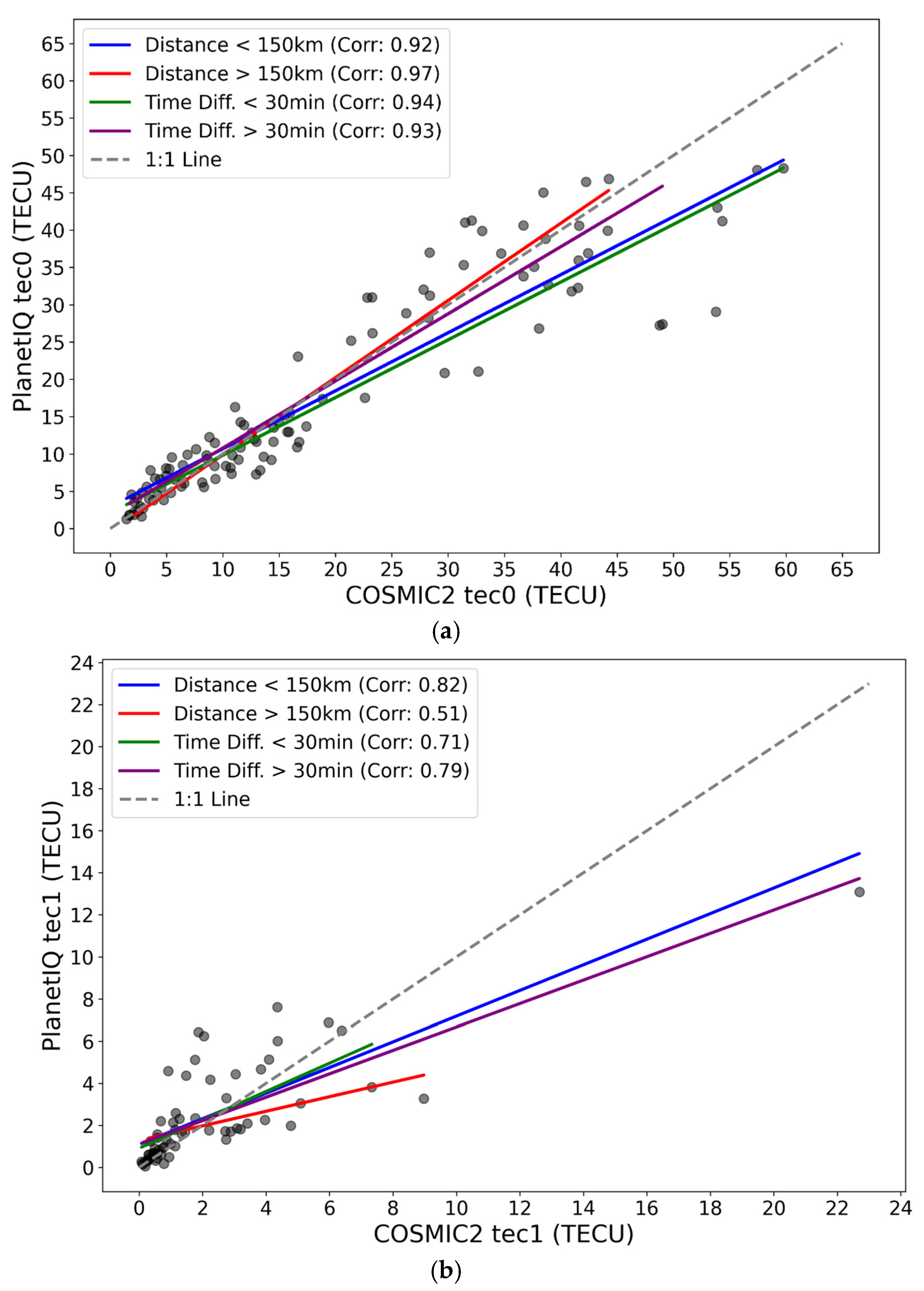
Figure 6 summarizes the regression analysis of collocated PlanetiQ and COSMIC-2 TEC parameters. Figure 6a shows the integrated TEC (TEC0), defined as the vertical integration of Ne between the lower and upper boundaries of the ionospheric profile. TEC0 values range from 1.28 to 48.30 TECU with a mean of about 17.73 TECU, and the overall regression yields a correlation coefficient of 0.93 with R2 = 0.86, indicating that more than 85% of the COSMIC-2 variance is explained by PlanetiQ. Spatial grouping shows that colocations within 150 km have a slope of 0.78, intercept of 2.91 TECU, and R2 = 0.85, while pairs at distances ≥150 km exhibit even closer agreement (slope 1.03, intercept −0.45 TECU, R2 = 0.94). Temporal separation analysis similarly indicates strong consistency, with slopes of 0.77 and 0.90 and correlations of 0.94 and 0.93 for time differences <30 min and ≥30 min, respectively, and the tightest match occurring under the stricter collocation.
Figure 6.
Regression between PlanetiQ and COSMIC-2 TEC parameters: (a) TEC0 at 400 km; (b) vertically integrated TEC1.
Figure 6b shows the regression for TEC1, with values spanning 0.05 to 13.08 TECU and a mean of 2.36 TECU. The overall correlation coefficient is 0.77, indicating moderate agreement between the datasets. For distances ≤150 km, the regression slope is 0.61 with an intercept of 1.10 TECU, R2 = 0.67, and correlation 0.82, whereas at ≥150 km the slope decreases to 0.35 with intercept 1.29 TECU, R2 = 0.26, and correlation 0.51, pointing to weaker consistency at larger separations. Temporal grouping shows slopes of 0.67 (intercept 0.91 TECU, R2 = 0.51, r = 0.71) for time differences <30 min and 0.56 (intercept 1.12 TECU, R2 = 0.63, r = 0.79) for ≥30 min, indicating that PlanetiQ provides reasonable but somewhat noisier estimates of TEC1 relative to COSMIC-2, with the best performance under tighter spatial collocation.
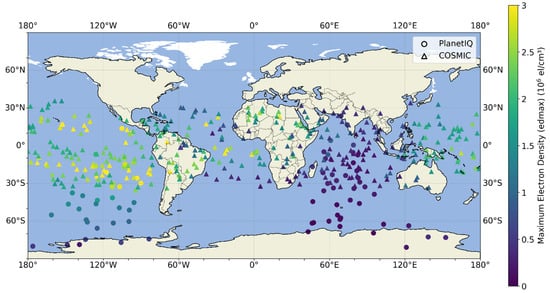
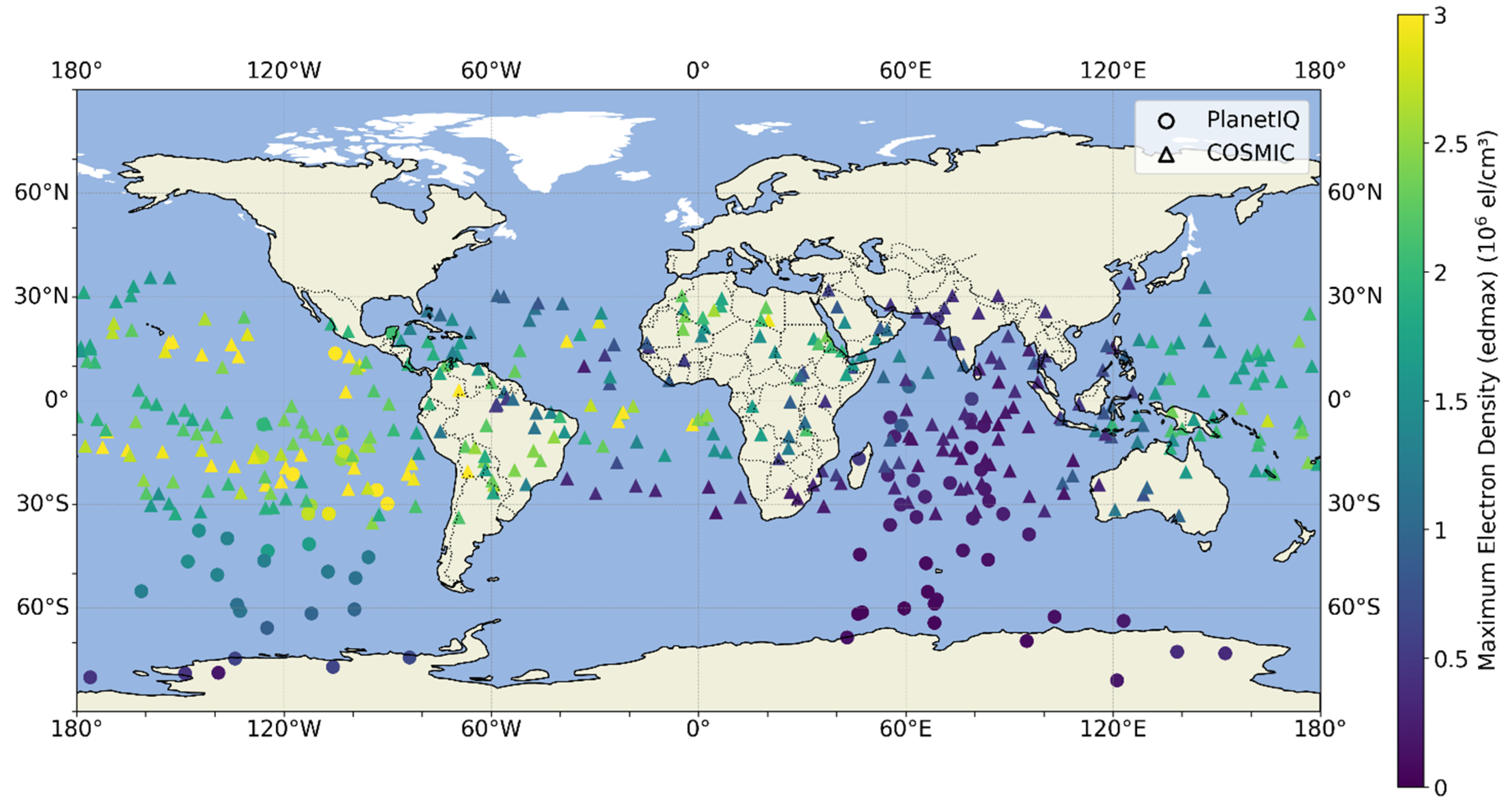
Figure 7 shows the spatial distribution of observations from PlanetiQ and COSMIC-2 on the global map which illustrates the consistency of EDMax for collocated measurements. PlanetiQ data are represented by circles and COSMIC-2 by triangles, with color scales reflecting the EDMax magnitude. The sample presented for Day of Year 100 in 2023, covering the 21 to 24 UT interval, includes 79 PlanetiQ profiles and 384 COSMIC-2 profiles, with 12 matched cases identified. The statistical comparison shows a strong correlation coefficient of 0.976 with a highly significant p-value of 0.0, indicating excellent agreement between the two missions. The RMSE of 3.01 × 10⁵ el/cm3 and MAE of 2.19 × 10⁵ el/cm3 reflect moderate differences, though the average error is of the same order as the MAE, suggesting consistency across matched points. Examination of the matched cases shows that most collocated EDMax values differ by less than 3 degrees in space and 2 h in time, with several pairs exhibiting differences below one degree and zero time offset. For example, PlanetiQ and COSMIC-2 values of 2.70 × 10⁶ el/cm3 and 2.66 × 10⁶ el/cm3 align within 2.6 degrees and no temporal gap, while lower density values such as 2.13 × 10⁵ el/cm3 and 2.04 × 10⁵ el/cm3 are similarly well matched. A few outliers appear, such as the PlanetiQ estimate of 2.51 × 10⁵ el/cm3 compared to the COSMIC-2 value of 8.12 × 10⁵ el/cm3, separated by over 2.5 degrees and 2 h, yet these remain limited in number. Overall, the distribution and statistical analysis confirm a high level of agreement in EDMax between PlanetiQ and COSMIC-2, demonstrating the reliability of PlanetiQ retrievals when compared with the established COSMIC-2 mission. These high correlations between PlanetiQ and COSMIC-2 are consistent with prior validation studies of COSMIC-2 RO data [23], which similarly report strong agreement in Ne peak parameters under collocated measurement conditions. The asymmetry in the spatial distribution of PlanetiQ occultations in Figure 7, with more events over the Southern Hemisphere during this 3 h interval (21:00–24:00 UT on DOY 100, 2023), primarily reflects the current partial GNOMES constellation and its orbit configuration rather than an inherent hemispheric bias in the ionosphere.
Figure 7.
Global distribution of PlanetiQ and COSMIC-2 EDMax observations on 2023-04-10 (DOY 100) between 21:00 and 24:00 UT.
4.4. Quiet Versus Storm-Time Behavior (PlanetiQ-COSMIC-2)
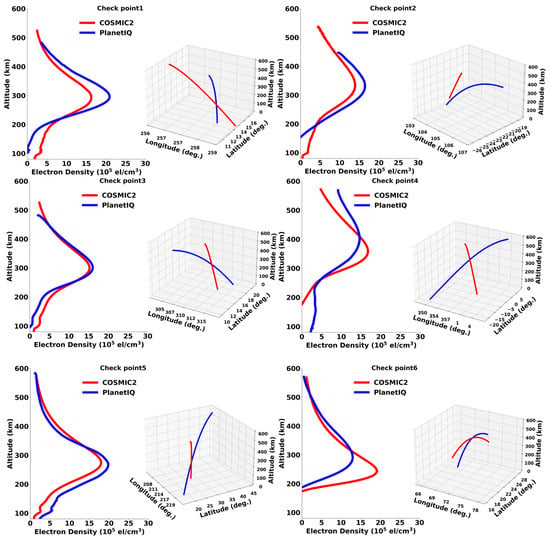
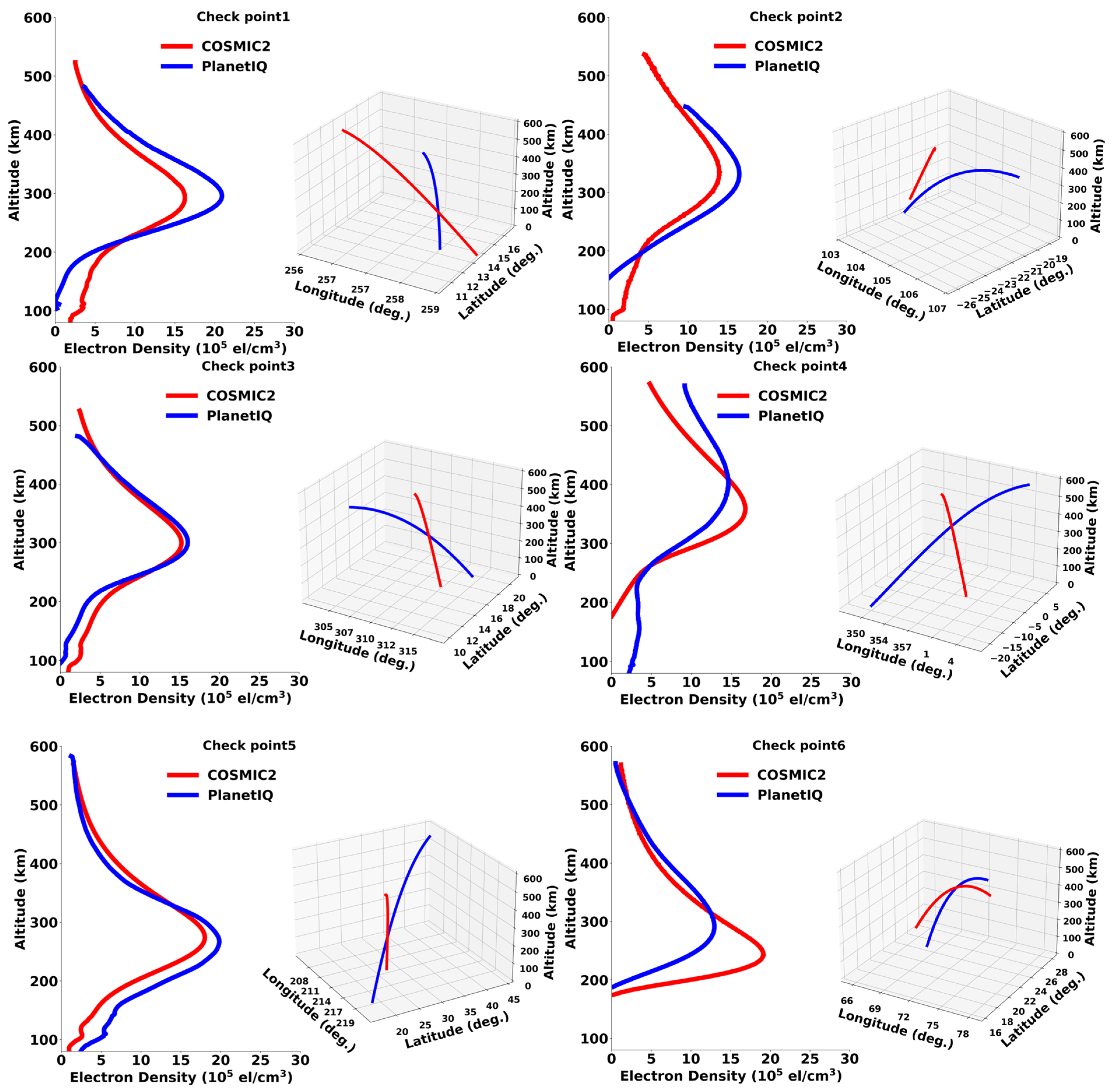
Figure 8 illustrates six PlanetiQ COSMIC-2 Ne profile pairs sampled during geomagnetic storm intervals, together with their corresponding 3D ray-path geometries, demonstrating that the main F-layer peak and overall profile shape remain closely matched despite disturbed ionospheric conditions. The 3D trajectories show that, although the occultation rays often sample different parts of the perturbed ionosphere, the Edmax locations for the two missions typically lie within a few tenths of a degree in latitude longitude space at several checkpoints. These qualitative similarities in profile morphology and peak placement support the quantitative statistics summarized in Table 5 for the six storm-time checkpoints.
Figure 8.
PlanetiQ and COSMIC-2 Ne profiles and 3D ray paths for six storm-time checkpoints.
Table 5.
Storm-time spatial temporal separation and Ne statistics for six PlanetiQ COSMIC-2 checkpoints.
Table 5 reports the time offsets, average horizontal separation, and Ne statistics (RMSE, mean error, absolute mean error, and correlation) for each of the six PlanetiQ COSMIC-2 storm-time coincidences. The average distance is taken as the mean of the top- and bottom-tangent separations, which range from about 88 to over 2200 km, while the time differences remain relatively small, between roughly 1 and 17 min. Despite these sometimes large horizontal offsets, correlations stay high (0.88 to 0.99), indicating that both systems capture similar vertical variability in Ne even when storm-time gradients are strong.
The normalized absolute mean differences in the table indicate that, even during storm-time, the relative PlanetiQ–COSMIC-2 discrepancies remain moderate for most events, with percentages generally between about 12% and 32%. The smallest value (12.4% on 2023-11-05) confirms that, for this case, the average mismatch is small compared to the background Ne and is consistent with the very high correlation. By contrast, somewhat larger percentages of 30–32% at the 2023-04-24 and 2025-11-13 coincidences suggest that, although the profile shapes remain well correlated, storm-time structuring can still introduce sizeable relative differences in amplitude.
The two storm cases on DOY 114 (2023-04-24) show particularly strong agreement, with short time separations of about 1.7 to 2.7 min and average distances of roughly 132 to 491 km. For the 18:18 to 18:20 UT pair, the RMSE is 1.12 × 10⁵ el/cm3 and the correlation reaches 0.992, while the Edmax latitude longitude differences are only about 0.03° and 0.16°, respectively, corresponding to an Edmax horizontal offset of 17.7 km. The 21:27 to 21:29 UT pair exhibits a higher RMSE of 2.83 × 10⁵ el/cm3 but still maintains a correlation of 0.977, with Edmax differences of 0.21° in latitude and 0.43° in longitude (≈51.8 km), illustrating that even under storm-time structuring, peak positions remain well aligned.
The single storm checkpoint on 2023-11-05 further confirms this behavior, with a time offset of 10.9 min and an average distance of about 198.6 km (mean of 322.2 and 73.0 km) between the tangent points. Here, the RMSE is 2.07 × 10⁵ el/cm3 and the correlation is 0.988, while the Edmax locations differ by 0.43° in latitude and 1.11° in longitude, giving a horizontal separation of 124.3 km. The profiles in Figure 8 for this case show that, although the storm introduces amplitude differences and some asymmetry, both PlanetiQ and COSMIC-2 retrieve a similar F2 peak height and shape, supporting the robustness of the retrievals during disturbed conditions.
Compared with the quiet-time results, these storm-time cases show that geomagnetic activity mainly increases the amplitude and small-scale structure of the differences, while the overall F-layer peak height and profile shape remain consistently aligned between PlanetiQ and COSMIC-2. Correlations stay high in all events, and the largest RMSE values occur when the horizontal separation between tangent points becomes large, indicating that most of the additional error under storms arises from representativeness effects rather than from a systematic degradation of the PlanetiQ retrievals. Consequently, the quiet- versus storm-time analysis supports the conclusion that PlanetiQ can be reliably used for monitoring ionospheric variability under both undisturbed and disturbed conditions, provided that spatiotemporal collocation criteria are chosen to minimize representativeness errors.
The two 2025 storm checkpoints on DOY 316 and 317 display somewhat larger spatial offsets but still maintain good statistical agreement. On DOY 316, the time difference is only 1.5 min and the Edmax positions differ by about 0.30° in latitude and 0.04° in longitude (≈33.9 km), yet the background ray paths differ strongly, with top and bottom distances of 1752 and 1877 km, yielding an RMSE of 2.60 × 10⁵ el/cm3 and correlation of 0.88. On DOY 317, two checkpoints appear: one with moderate geometry differences (average distance ≈279 km, RMSE 3.70 × 10⁵ el/cm3, correlation 0.80, Edmax separation 227.6 km) and another with very large top bottom separation but nearly coincident Edmax positions (5.6 km) and excellent correlation of 0.959. Together, these six storm-time checkpoints show that PlanetiQ and COSMIC-2 maintain high correlations and broadly consistent peak locations during geomagnetic disturbances, with error magnitudes governed by a combination of temporal mismatch and how similarly the two ray paths sample the storm-modified ionosphere.
Overall, the results demonstrate that PlanetiQ Ne profiles closely reproduce the vertical structure, F2-layer peak parameters, and TEC obtained from both ionosondes and COSMIC-2 across a range of geomagnetic conditions, including selected storm-time intervals where enhanced gradients and temporal variability are present. High correlations and regression slopes near unity for NmF2, foF2, and TEC, together with consistent F2-peak placement in both quiet and disturbed periods, indicate that PlanetiQ retrievals are sufficiently accurate for scientific and operational ionospheric monitoring, while the storm-time case studies highlight the need to carefully control spatial–temporal collocation when interpreting residual differences.
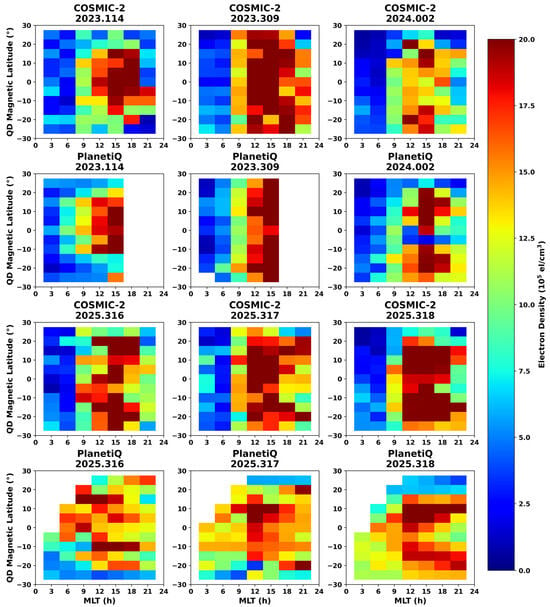
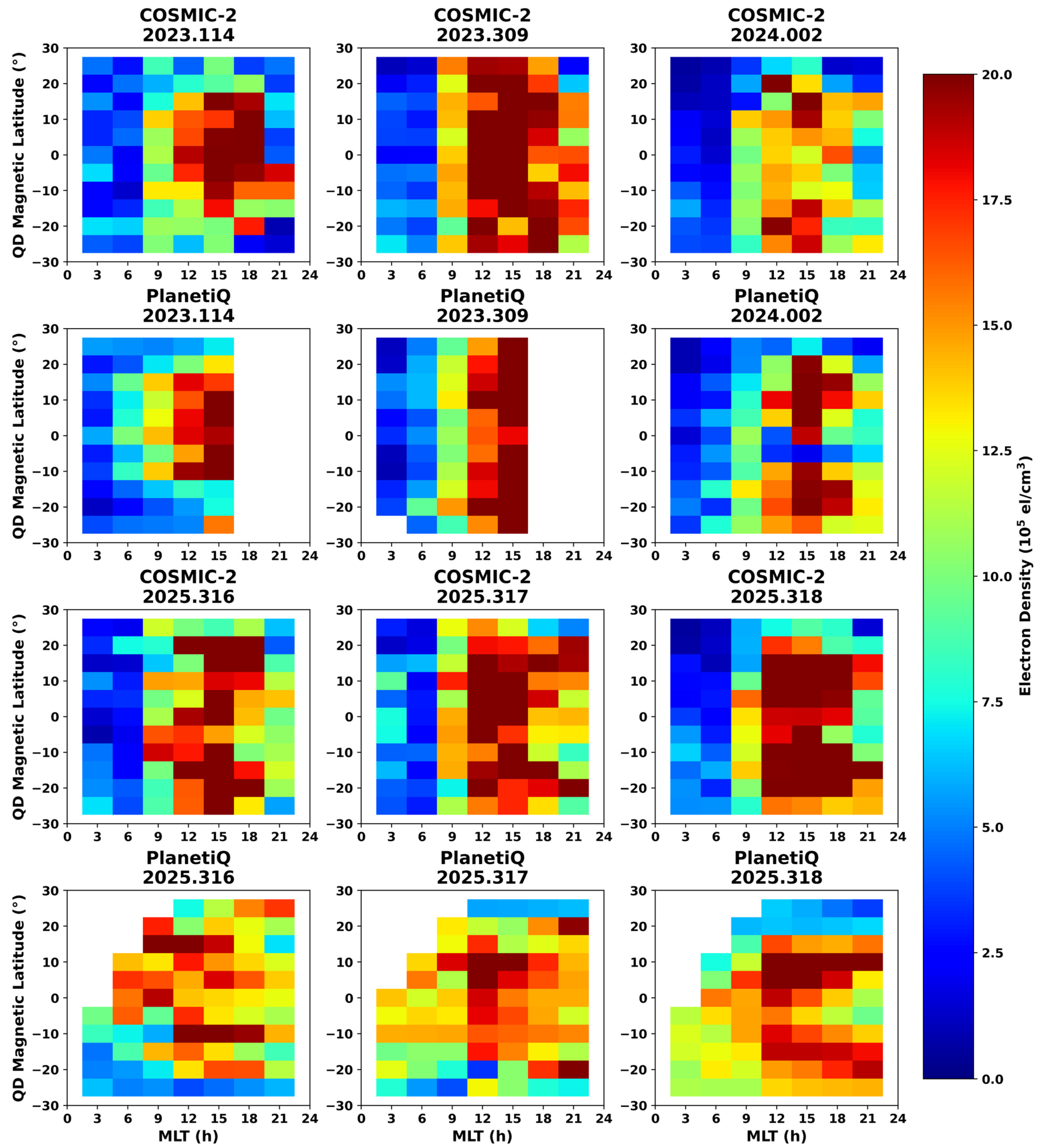
Figure 9 presents quasi-dipole latitude–magnetic local time (QD-lat–MLT) maps of Ne at 400 km, derived independently from COSMIC-2 (top panels) and PlanetiQ (bottom panels) for four storm-time days (24 April 2023, 5 November 2023, 12 November 2025, and 13 November 2025) and two quiet/average days (2 January 2024 and 14 November 2025). The figure summarizes how the low-latitude F-region Ne is organized in geomagnetic coordinates, highlighting the distribution of Ne within the ±30° QD band as a function of local time for each constellation and day.
Figure 9.
Quasi-dipole latitude–magnetic local time Ne maps at 400 km from COSMIC-2 (top) and PlanetiQ (bottom) for four storm-time and two quiet/average days.
The figure shows that, at 400 km, the QD-lat–MLT Ne maps from PlanetiQ and COSMIC-2 resolve very similar low-latitude F-region morphology across both storm-time and quiet-time intervals. For all six days (24 April 2023, 5 November 2023, 12–13 November 2025, 2 January 2024, and 14 November 2025), both constellations exhibit enhanced Ne in the ±30° QD band with pronounced local-time and longitudinal modulation, which strengthens on the storm-time days and relaxes toward smoother, less structured patterns on 2 January 2024 and 14 November 2025. This qualitative agreement is supported by the collocated statistics at 400 km: the number of COSMIC-2/PlanetiQ pairs per day ranges from 50 to 287, Pearson correlations span 0.76–0.93, and RMSE values lie between about 3.4 and 4.3 × 10⁵ el/cm3, while mean Ne biases remain within ±1 × 10⁵ el/cm3 for all days. The highest correlation (~0.93) and near-zero bias on the disturbed day 5 November 2023 indicate that both missions capture the storm-time enhancement and longitudinal structuring of the F layer in geomagnetic coordinates in a nearly identical way, whereas the somewhat lower correlations on 2 January 2024 and 14 November 2025 primarily reflect reduced dynamic range under quieter conditions rather than a change in overall morphology.
The statistical metrics in Table 6 support these visual impressions and confirm that the agreement between the two constellations is robust under both disturbed and quiet conditions. Across all six days, correlations lie between 0.87 and 0.90, RMSE values are in the range – el/cm3, and the mean errors are small compared with the corresponding absolute mean errors, indicating that systematic biases between PlanetiQ and COSMIC-2 are modest. Taken together with the reported p values, these results suggest that most residual differences in the layered Ne maps arise from natural ionospheric variability and differences in sampling geometry rather than deficiencies in either data set.
Table 6.
Summary statistics of collocated PlanetiQ COSMIC-2 Ne for selected storm-time and quiet/average days of year.
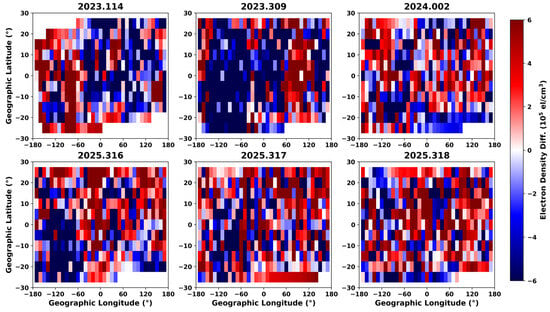
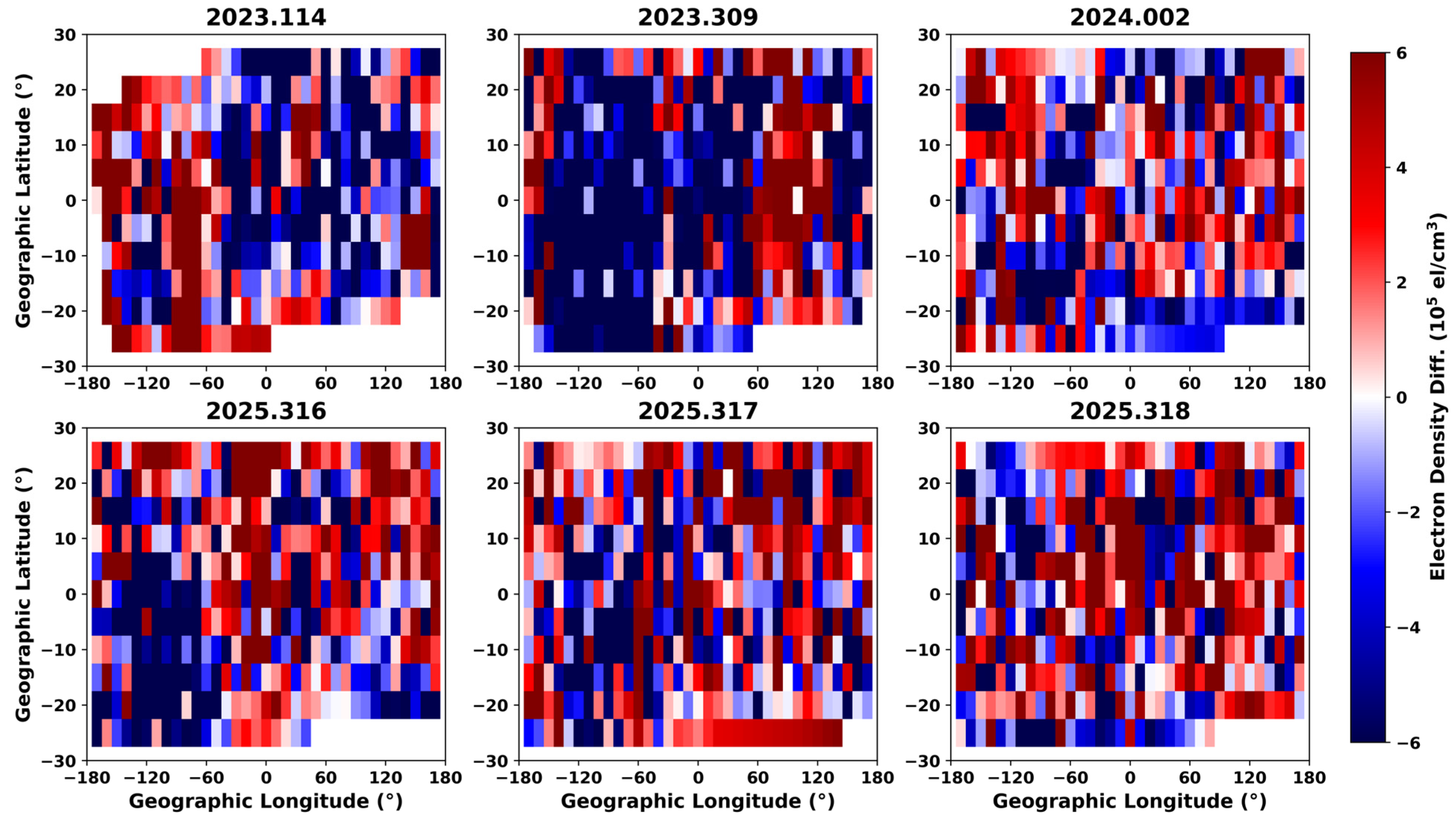
Figure 10 presents geographic maps of Ne differences at 400 km, computed as PlanetiQ minus COSMIC-2 over the ±30° latitude band for the same four storm-time and two quiet/average days. These maps show how residual Ne discrepancies between the two constellations are distributed with longitude and latitude, complementing the QD-latitude–MLT view by highlighting any systematic regional biases at fixed altitude. The figure shows that the Ne differences are generally confined to a few el/cm3 and oscillate between positive and negative values, rather than forming large regions of uniform bias. This behavior is consistent with the collocated statistics in (Table 6) all six days exhibit correlations between 0.87 and 0.90, RMSE values of about – el/cm3, and mean errors that are much smaller than the corresponding absolute mean errors. These metrics indicate that systematic offsets between PlanetiQ and COSMIC-2 are modest, and that most of the spatial structure seen in Figure 10 reflects natural ionospheric variability and differences in sampling geometry rather than large-scale, persistent biases.
Figure 10.
Geographic 400 km Ne differences (PlanetiQ − COSMIC-2) for four storm-time and two quiet days.
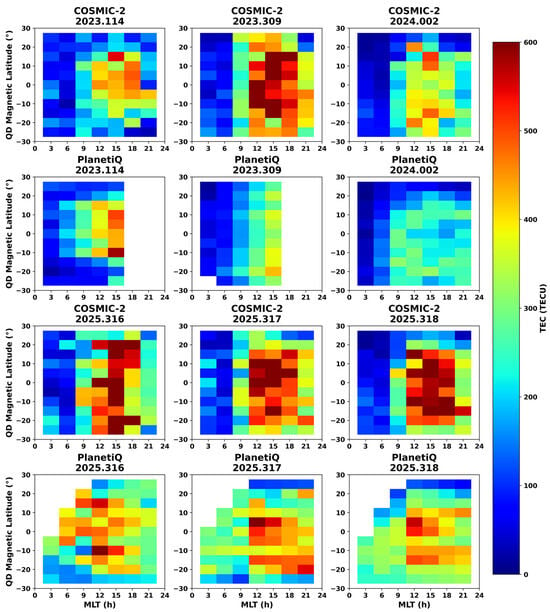
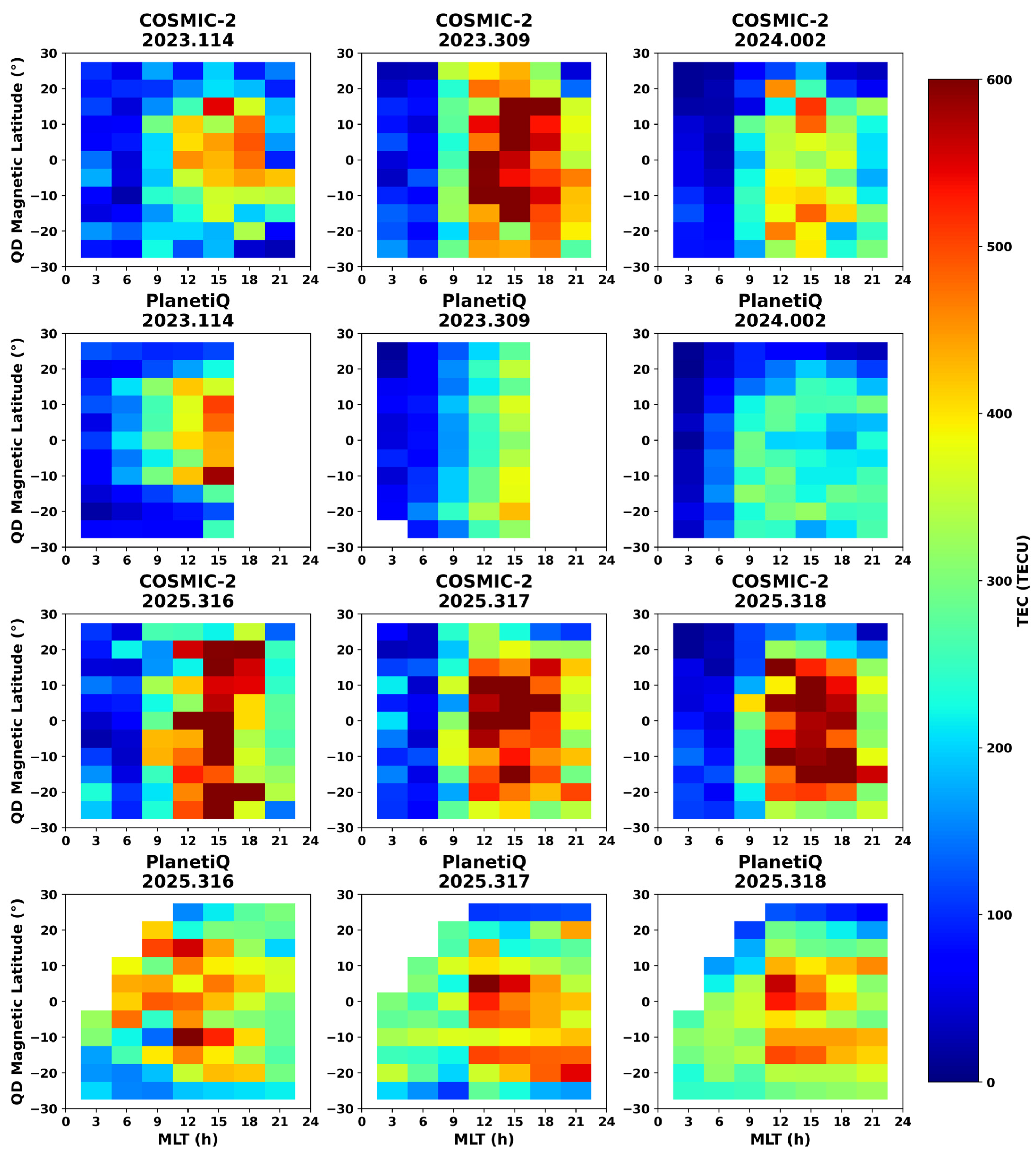
Figure 11 presents quasi-dipole latitude–magnetic local time (QD-lat–MLT) maps of TEC at 400 km from COSMIC-2 and PlanetiQ for the same four storm-time and two quiet/average days discussed above. By displaying TEC as a function of QD latitude and MLT, the figure highlights how the low-latitude F-region plasma content is organized in geomagnetic coordinates, including the location and strength of the equatorial enhancement and its longitudinal and local-time modulation for each constellation.
Figure 11.
Quasi-dipole latitude–magnetic local time TEC maps at 400 km from COSMIC-2 (top) and PlanetiQ (bottom) for four storm-time and two quiet/average days.
The figure shows that, for all six days, PlanetiQ and COSMIC-2 retrieve very similar large-scale TEC morphology in the ±30° QD band. During the storm-time days 24 April 2023 (DOY 114), 5 November 2023 (DOY 309), 12 November 2025 (DOY 316), and 13 November 2025 (DOY 317), both missions exhibit strong TEC enhancements that peak near low magnetic latitudes and extend preferentially into the afternoon–evening MLT sector, with noticeable longitudinal structuring that reflects storm-driven redistribution of F-region plasma. On the quieter or average days 2 January 2024 (DOY 2) and 14 November 2025 (DOY 318), the TEC patterns in both data sets relax toward weaker, more uniform bands with reduced longitudinal contrast, consistent with diminished storm forcing. The collocated 400 km statistics support this visual agreement: daily correlations are high, RMSE values remain moderate compared to the peak TEC levels, and the mean TEC biases are much smaller than the overall storm-time enhancements. These metrics indicate that residual PlanetiQ–COSMIC-2 differences in Figure 11 are dominated by relatively modest amplitude offsets and sampling effects, while the underlying geomagnetic-storm response and quiet-time TEC structure are captured in a consistent way by both constellations.
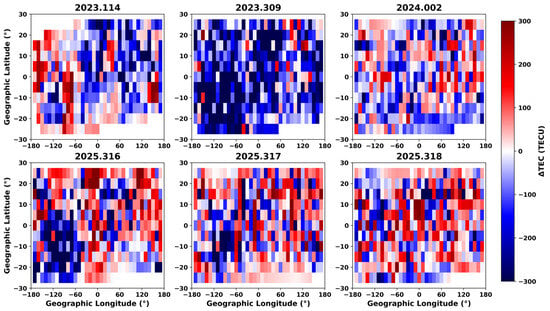
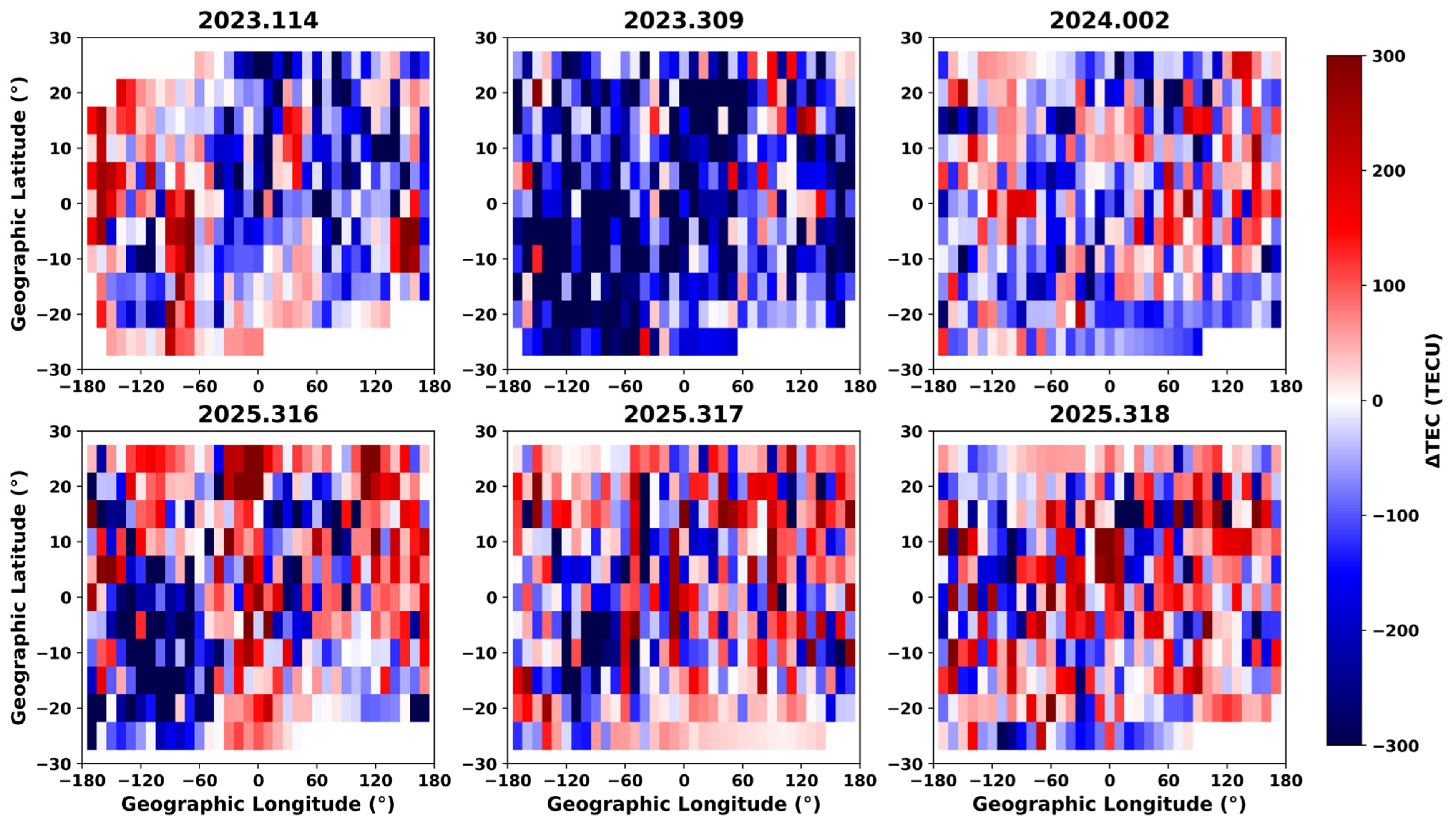
Figure 12 presents geographic maps of TEC differences at 400 km, computed as PlanetiQ minus COSMIC-2 over the ±30° latitude band for the same four storm-time and two quiet/average days. These maps provide a longitude–latitude view of residual TEC discrepancies between the two constellations, complementing the QD-lat–MLT maps by highlighting any regional biases at fixed altitude. The figure shows that TEC residuals are structured but generally modest compared with the underlying low-latitude enhancements: during the strongest storms, some longitude sectors exhibit predominantly negative differences, consistent with PlanetiQ underestimating the peak COSMIC-2 TEC, whereas on later days the pattern becomes more balanced with both positive and negative patches. This behavior is in line with the collocated 400 km statistics, which yield high correlations, RMSE values that remain moderate relative to peak TEC, and mean biases that are much smaller than the overall storm-time enhancements. Taken together, Figure 12 and the associated metrics indicate that remaining PlanetiQ–COSMIC-2 TEC differences mainly reflect amplitude offsets and sampling effects rather than large-scale structural mismatches in the low-latitude ionosphere.
Figure 12.
Geographic 400 km TEC differences (PlanetiQ − COSMIC-2) for four storm-time and two quiet days.
Table 7 quantifies these impressions and helps interpret the remaining scientific differences between the missions in the context of RO geometry and ionospheric variability. High correlations (0.86 to 0.93) across all days show that PlanetiQ and COSMIC-2 capture nearly the same spatial and temporal TEC variability, whereas the moderate RMSE values (60 to 100 TECU) and small mean errors indicate that systematic biases are limited even though individual ray paths sample different elevation angles, local times, and sub-grid structures along the line of sight. The paired t-test reveals statistically significant mean TEC differences on some days (24 April 2023, DOY 114; 5 November 2023, DOY 309; 2 January 2024, DOY 2; and 13 November 2025, DOY 317), which can be attributed to a combination of storm-time gradients, differing penetration depths of low-elevation rays, and small offsets in the vertical integration range, while other days (12 November 2025, DOY 316; and 14 November 2025, DOY 318) show no significant difference, implying that under certain geometries and background conditions the two systems become effectively interchangeable as sources of layered TEC information.
Table 7.
Summary statistics of collocated PlanetiQ COSMIC-2 TEC for selected storm-time and quiet/average days of year.
5. Conclusions
This study applied a systematic GNSS radio occultation methodology to retrieve ionospheric Ne profiles and key parameters from PlanetiQ GNOMES observations. Collocated reference data were assembled from the GIRO ionosonde network and COSMIC-2 CDAAC ionPrf products under strict spatial and temporal matching criteria, and a consistent preprocessing, quality-control, and profile-screening strategy was implemented to ensure robust cross-mission comparability. Statistical analyses, including mean differences, RMSE, correlation, and regression diagnostics, were then used to quantify PlanetiQ performance for NmF2, foF2, hmF2, and TEC, supplemented by targeted case studies during selected geomagnetic storms.
This study validated PlanetiQ RO ionospheric data using collocated ionosonde and COSMIC-2 observations under both quiet and disturbed conditions. The validation confirms that PlanetiQ provides generally accurate and reliable estimates of key ionospheric parameters when compared with ionosondes and COSMIC-2 under both quiet and disturbed conditions. For ionosonde comparisons, NmF2 and foF2 exhibit strong agreement, with correlation values frequently above 0.9 (and up to 0.99 at several stations), RMSE values on the order of 2.9 × 10⁴ to 2.8 × 10⁵ el/cm3, and mean differences typically within about ±1.1 × 10⁵ el/cm3 across diverse locations; the corresponding normalized absolute mean differences often lie near or below about 10–20%, but increase to larger percentages at stations with more complex local structure. COSMIC-2 comparisons further support these findings, with overall correlation coefficients of about 0.95 for peak Ne, 0.96 for foF2, and 0.93 for TEC, while hmF2 is reproduced with moderate accuracy (correlation around 0.85); storm-time checkpoints likewise show high correlations but elevated RMSE and percentage differences in regions with strong gradients and rapid temporal evolution.
PlanetiQ retrievals preserve the vertical ionospheric structure, reliably capturing the F2-layer peak density and frequency and providing results consistent with established datasets in both quiet and geomagnetically disturbed intervals. These findings highlight PlanetiQ as a valuable and cost-effective addition to the global ionospheric monitoring network, supporting improved space-weather analysis, ionospheric modeling, and operational applications in communication and navigation systems.
This study is limited by the relatively small number of strictly collocated PlanetiQ ionosonde and PlanetiQ COSMIC-2 events, particularly during storms, which restricts coverage across geomagnetic, seasonal, and solar conditions, and by assumptions such as local spherical symmetry and specific calibration modes that can reduce accuracy in regions with strong horizontal gradients or complex F2-layer morphology. Future work should extend validation over longer periods and wider latitude ranges (including high-latitude and equatorial-anomaly regions), investigate sporadic E (Es) layers with PlanetiQ RO profiles against ionosonde and COSMIC-2, and systematically expand storm-time assessments of NmF2, foF2, hmF2, and TEC within operational space-weather monitoring frameworks.
Author Contributions
Conceptualization, I.F.A. and M.A.; Methodology, I.F.A., M.A. and M.S.Y.; Software, I.F.A. and M.A.; Validation, I.F.A. and M.A.; Formal Analysis, I.F.A., M.A. and M.S.Y.; Investigation, I.F.A. and M.A.; Resources, M.A.; Data Curation, I.F.A. and M.S.Y.; Writing—Original Draft Preparation, I.F.A. and M.A.; Writing—Review and Editing, M.S.Y.; Visualization, M.S.Y. and M.A.; Supervision, M.S.Y.; Project Administration, M.A.; Funding Acquisition, M.A. All authors have read and agreed to the published version of the manuscript.
Funding
This research is funded by Ongoing Research Funding program (ORF-2026-902), King Saud University, Riyadh, Saudi Arabia.
Institutional Review Board Statement
This article does not contain any studies with human participants or animals performed by any of the authors.
Informed Consent Statement
Not applicable.
Data Availability Statement
PlanetiQ level-2 ionospheric profiles were obtained from the UCAR GNSS-RO data archive (Index of /gnss-ro/planetiq/), while COSMIC-2 ionospheric profiles and auxiliary products were accessed via the COSMIC Data Analysis and Archive Center (https://cdaac-www.cosmic.ucar.edu/, accessed on 5 May 2026). Ground-based ionosonde observations were provided by the Global Ionospheric Radio Observatory (GIRO, https://giro.uml.edu/, accessed on 5 May 2026). The processed datasets and scripts supporting the findings of this study are available from the corresponding author upon reasonable request.
Acknowledgments
The authors extend their appreciation to the Ongoing Research Funding program (ORF-2026-902), King Saud University, Riyadh, Saudi Arabia, for funding this work.
Conflicts of Interest
The authors declare no conflicts of interest.
References
- Kursinski, E.R.; Hajj, G.A.; Schofield, J.T.; Linfield, R.P.; Hardy, K.R. Observing Earth’s atmosphere with radio occultation measurements using the Global Positioning System. J. Geophys. Res. Atmos. 1997, 102, 23429–23465. [Google Scholar] [CrossRef] [Scilit]
- Hajj, G.A.; Romans, L.J. Ionospheric electron density profiles obtained with the Global Positioning System: Results from the GPS/MET experiment. Radio Sci. 1998, 33, 175–190. [Google Scholar] [CrossRef] [Scilit]
- Anthes, R.A. Exploring Earth’s atmosphere with radio occultation: Contributions to weather, climate, and space weather. Atmos. Meas. Tech. 2011, 4, 1077–1103. [Google Scholar] [CrossRef] [Scilit]
- PlanetiQ. PlanetiQ GNOMES-4 Satellite with the World’s Most Accurate Weather-Forecasting Sensor Launches into Orbit Aboard SpaceX Falcon 9 Rocket from Vandenberg Space Force Base in California. 2025. Available online: https://PlanetiQ.com/PlanetiQ-gnomes-4-satellite-with-the-worlds-most-accurate-weather-forecasting-sensor-launches-into-orbit-aboard-spacex-falcon-9-rocket-from-vandenberg-space-force-base-in-california/ (accessed on 25 September 2025).
- PlanetiQ. GNSS Navigation and Occultation Measurement Satellites (GNOMES) Mission Overview; PlanetiQ: Golden, CO, USA, 2025; Available online: https://www.eoportal.org/satellite-missions/gnomes (accessed on 25 September 2025).
- Schreiner, W.S.; Weiss, J.P.; Anthes, R.A.; Braun, J.; Chu, V.; Fong, C.J.; Hunt, D.; Kuo, Y.H.; Meehan, T.; Serafino, W.; et al. COSMIC-2 radio occultation constellation: First results. Geophys. Res. Lett. 2020, 47, e2019GL086841. [Google Scholar] [CrossRef] [Scilit]
- Scotto, C.; Pezzopane, M.; Zolesi, B. Estimating the vertical electron density profile from an ionogram: On the passage from true to virtual heights via the target function method. Radio Sci. 2012, 47, RS1007. [Google Scholar] [CrossRef] [Scilit]
- Jiang, C.; An, Q.; Wang, S.; Nie, W.; Zhu, H.; Liu, G. Accuracy assessment of the ionospheric TEC derived from COSMIC-2 radio occultation based on multi-source data. Adv. Space Res. 2024, 73, 5157–5170. [Google Scholar] [CrossRef] [Scilit]
- Hajj, G.A.; Ao, C.O.; Iijima, B.A.; Kuang, D.; Kursinski, E.R.; Mannucci, A.J. Initial results of GPS radio occultation from the CHAMP mission. Geophys. Res. Lett. 2002, 29, 1–4. [Google Scholar] [CrossRef] [Scilit]
- Anthes, R.A.; Bernhardt, P.A.; Chen, Y.; Cucurull, L.; Dymond, K.F.; Ector, D.; Healy, S.B.; Ho, S.; Hunt, D.C.; Kuo, Y.; et al. The COSMIC/FORMOSAT-3 mission: Early results. Bull. Am. Meteorol. Soc. 2008, 89, 313–334. [Google Scholar] [CrossRef] [Scilit]
- Hu, L.; Ning, B.; Liu, L.; Zhao, B.; Li, G.; Wu, B.; Huang, Z.; Hao, X.; Chang, S.; Wu, Z. Validation of COSMIC ionospheric peak parameters by the measurements of an ionosonde chain in China. Ann. Geophys. 2014, 32, 1311–1319. [Google Scholar] [CrossRef] [Scilit]
- Limberger, M.; Hernández-Pajares, M.; Aragón-Ángel, M.Á.; Altadill, D.; Dettmering, D. Long-term comparison of the ionospheric F2-layer electron density peak derived from ionosonde data and FORMOSAT-3/COSMIC occultations. J. Space Weather Space Clim. 2015, 5, A21. [Google Scholar] [CrossRef] [Scilit]
- Ahmed, I.F.; Alheyf, M.; Yamany, M.S. PlanetiQ radio occultation: Preliminary comparative analysis of neutral profiles vs. COSMIC and NWP models. Appl. Sci. 2024, 14, 4179. [Google Scholar] [CrossRef] [Scilit]
- Zhran, M.; Mousa, A.; Wang, Y.; Ben Hasher, F.F.; Jin, S. Assessment of commercial GNSS radio occultation performance from the PlanetiQ mission. Remote Sens. 2024, 16, 3339. [Google Scholar] [CrossRef] [Scilit]
- Chang, H.; Morton, Y.J.; Dittmann, T.; Weiss, J.-P. Assessment of scintillation data from PlanetiQ and Spire Global radio occultation missions. J. Geophys. Res. Space Phys. 2025, 130, e2024JA033543. [Google Scholar] [CrossRef] [Scilit]
- Global Ionospheric Radio Observatory. GIRO: Global Ionospheric Radio Observatory. Available online: https://giro.uml.edu/ (accessed on 25 September 2025).
- Reinisch, B.W.; Galkin, I.A. Global Ionospheric Radio Observatory (GIRO). Earth Planets Space 2011, 63, 377–381. [Google Scholar] [CrossRef] [Scilit]
- UCAR COSMIC Data Analysis and Archive Center. COSMIC Data Analysis and Archive Center. Available online: https://cdaac-www.cosmic.ucar.edu/ (accessed on 25 September 2025).
- Tulasiram, S.; Su, S.-Y.; Tsai, L.-C.; Liu, C. A self-contained GIM-aided Abel retrieval method to improve GNSS-RO retrieved electron density profiles. GPS Solut. 2016, 20, 849–856. [Google Scholar] [CrossRef] [Scilit]
- Seemala, G.K. Estimation of ionospheric TEC from GNSS observations. In Atmospheric Remote Sensing: Earth Observation; Singh, A.K., Tiwari, S., Eds.; Elsevier: Amsterdam, The Netherlands, 2023; pp. 63–84. [Google Scholar] [CrossRef] [Scilit]
- Syndergaard, S. Algorithms for Inverting Radio Occultation Signals in the Ionosphere (GMRION); UCAR/COSMIC Data Analysis and Archive Center (CDAAC): Boulder, CO, USA, 2004. [Google Scholar]
- Fatima, T.; Ameen, M.A.; Jabbar, M.A.; Baig, M.J. The variation of ionosonde-derived hmF2 and its comparisons with International Reference Ionosphere (IRI) and Empirical Orthogonal Function (EOF) over the Pakistan longitude sector during solar cycle 22. Adv. Space Res. 2021, 68, 2104–2114. [Google Scholar] [CrossRef] [Scilit]
- Lin, C.-Y.; Lin, C.C.-H.; Liu, J.-Y.; Rajesh, P.K.; Matsuo, T.; Chou, M.-Y.; Tsai, H.F.; Yeh, W.H. The early results and validation of FORMOSAT-7/COSMIC-2 space weather products: Global ionospheric specification and Ne-aided Abel electron density profile. J. Geophys. Res. Space Phys. 2020, 125, e2020JA028028. [Google Scholar] [CrossRef] [Scilit]

Disclaimer/Publisher’s Note: The statements, opinions and data contained in all publications are solely those of the individual author(s) and contributor(s) and not of MDPI and/or the editor(s). MDPI and/or the editor(s) disclaim responsibility for any injury to people or property resulting from any ideas, methods, instructions or products referred to in the content. |
© 2026 by the authors. Licensee MDPI, Basel, Switzerland. This article is an open access article distributed under the terms and conditions of the Creative Commons Attribution (CC BY) license.