Article

Land Surface Deformation of Alpine Permafrost in the Earthquake-Impacted Source Area of the Yellow River During 2017–2024

1
Northwest Institute of Plateau Biology, Chinese Academy of Sciences, Xining 810008, China
2
University of Chinese Academy of Sciences, Beijing 100049, China
3
School of Geographical Sciences, Nanjing University of Information Science & Technology, Nanjing 210044, China
4
State Key Laboratory of Cryosphere Science, Cryosphere Research Station on the Tibetan Plateau, Northwest Institute of Eco-Environment and Resources, Chinese Academy of Sciences, Lanzhou 730000, China
5
School of Civil Engineering and Water Resources, Qinghai University, Xining 810016, China
6
Key Laboratory of Water Ecology Remediation and Protection at Headwater Regions of Big Rivers, Ministry of Water Resources, Xining 810016, China
7
Key Laboratory of Eco-Hydrology of Inland River Basin, Northwest Institute of Eco-Environment and Resources, Chinese Academy of Sciences, Lanzhou 730000, China
*
Author to whom correspondence should be addressed.
Remote Sens. 2026, 18(12), 1946; https://doi.org/10.3390/rs18121946
Submission received: 27 March 2026 / Revised: 30 May 2026 / Accepted: 9 June 2026 / Published: 12 June 2026

Highlights

What are the main findings?
  • RMSE and MAE of the final vertical LSD were 3.92 mm and 3.22 mm, respectively.
  • Vertical LSD in SAYR during 2017–2024 was mostly −8–8 mm/y.
What are the implications of the main findings?
  • Removing earthquake-related LSD was necessary for permafrost LSD investigation.
  • Soil moisture determined the spatial distribution of the LSD direction in SAYR.

Abstract

Remote-sensing land surface deformation (LSD) is a powerful and effective approach for investigating regional alpine permafrost variations. However, alpine permafrost is often distributed in areas characterized by earthquakes, and the LSD of alpine permafrost is potentially contaminated or diminished by earthquake-related LSD. Therefore, this study aimed to derive the effective LSD in the alpine permafrost of the Source Area Yellow River (SAYR) by removing LSD originating from the Mw 7.4 Maduo earthquake in 2021-05-22 and analyzing the spatiotemporal variations in LSD during 2017–2024. Small Baseline Subset Interferometric Synthetic Aperture Radar (SBAS-InSAR) was used to obtain the initial LSD time series from Sentinel-1 images acquired during 2017–2024. The LSD of the Mw 7.4 Maduo earthquake, its aftershocks and the post-seismic relaxation in SAYR was simulated separately by considering its temporal process and removed from the LSD time series in SAYR. The final LSD was validated against in situ Global Navigation Satellite System (GNSS) measurements, and the spatiotemporal variations in LSD in SAYAR were subsequently analyzed. The study found the following: (1) the removal of the earthquake-related LSD was successful both spatially and temporally and the final LSD has mean absolute error (MAE) of 3.22 mm and root mean squared error (RMSE) of 3.92 mm; (2) during 2017–2024, the vertical LSD in SAYR was mostly −8–8 mm/y; (3) soil moisture determined the spatial distribution of the LSD direction in SAYR as a result of local drainage conditions, air temperature, precipitation and snow melt. This study demonstrated the necessity of removing the earthquake-related LSD when investigating the alpine permafrost LSD in tectonically active areas. The strategy adopted in this study serves as a technical reference for future investigations of this kind. The findings in this study provide insight for a thorough understanding of permafrost evolution on the Tibetan Plateau in the context of climate change.

1. Introduction

The Source Area of the Yellow River (SAYR), which is located in the northeastern Tibetan Plateau, is a key water reserve for northern China. However, continuous climate warming in recent decades has led to remarkable degradation of the vast permafrost in SAYR, which has evidently degraded the local ecosystem [1], altered regional hydrology [2] and undermined regional water sustainability [3]. Therefore, investigating the permafrost variations in SAYR is vital for understanding the sustainability of regional hydrological processes and the ecosystem in the context of climate change.
The recently increase in radar remote sensing missions (e.g., Sentinel-1) have provided enormous number of images of regular revisit for permafrost investigations at a regional scale [2]. Land surface deformation (LSD) is a major consequence and direct index of permafrost variation. The Interferometric Synthetic Aperture Radar (InSAR) technique derives the ground-satellite distance difference in the same ground object and can monitor LSD at an accuracy of several millimeters [4,5]. Small Baseline Subset Interferometric Synthetic Aperture Radar (SBAS-InSAR) constructs a network of interferograms based on the SAR images time series of the same ground object(s) and requires that the spatial and temporal baselines of these interferograms meet the user-defined thresholds [6]. This further ensures the quality of the LSD time series obtained with this variant of InSAR [7]. Therefore, SBAS-InSAR is an effective approach for monitoring long-term LSD [8], and it has been extensively used to investigate spatiotemporal variations in regional alpine permafrost [9,10].
However, alpine permafrost is often distributed in areas subject to frequent earthquakes, such as the Tibetan Plateau [11]. Earthquakes can cause significant LSD of up to several thousands of mm and can contaminate or diminish the LSD of alpine permafrost. For example, an Mw 6.0 earthquake can lead to an LSD of 10–1000 mm in an area of hundreds of square kilometers [12]. Such earthquake-related LSD can potentially diminish or vary the spatial pattern of permafrost-related LSD in the earthquake-affected area. In addition, aftershocks and post-seismic relaxation, which usually last from a few days to several months, can further complicate the LSD of alpine permafrost [13]. Failing to precisely remove earthquake-related LSD could introduce potential biases or mistakes into the LSD of alpine permafrost and undermine the reliability of the conclusions and knowledge drawn from this information. Therefore, it is critical to accurately delineate and precisely remove the earthquake-related LSD in investigations of alpine permafrost in earthquake-affected areas [14]. However, to date, investigations into the LSD of alpine permafrost using SBAS-InSAR and its variants have rarely considered removing the earthquake-related LSD.
The Tibetan Plateau is characterized by dense large faults, and the geological continuous evolution of this plateau has triggered frequent earthquakes [15]. The LSD of the alpine permafrost in SAYR in northeastern Tibetan Plateau is accompanied by frequent earthquakes. A typical Mw 7.4 Maduo earthquake occurred in SAYR on 2021-05-22. This earthquake formed remarkable LSD over a large area of SAYR [11] and potentially disturbed the LSD of alpine permafrost in this area. Therefore, this study aimed to precisely remove LSD related to this earthquake from the LSD time series in SAYR and analyze the spatiotemporal variation in LSD. The time series of LSD in SAYR was derived using SBAS-InSAR from the Sentinel-1 images acquired during 2017–2024. The earthquake-related LSD was derived according to the spatiotemporal nature of the Mw 7.4 Maduo earthquake, its aftershock and the post-seismic relaxation, and then removed. The spatiotemporal distribution of the final LSD in SAYR during 2017–2024 was depicted, and its relationship with local air temperature, precipitation, vegetation condition, and geomorphology was analyzed. This study provides a precedent for LSD investigation in alpine permafrost areas with active earthquakes, and provides a technical reference for investigations of this kind. The findings could provide insight for understanding the regional permafrost’s stability, hydrological evolution and ecological sustainability.

2. Material and Methods

2.1. Study Area

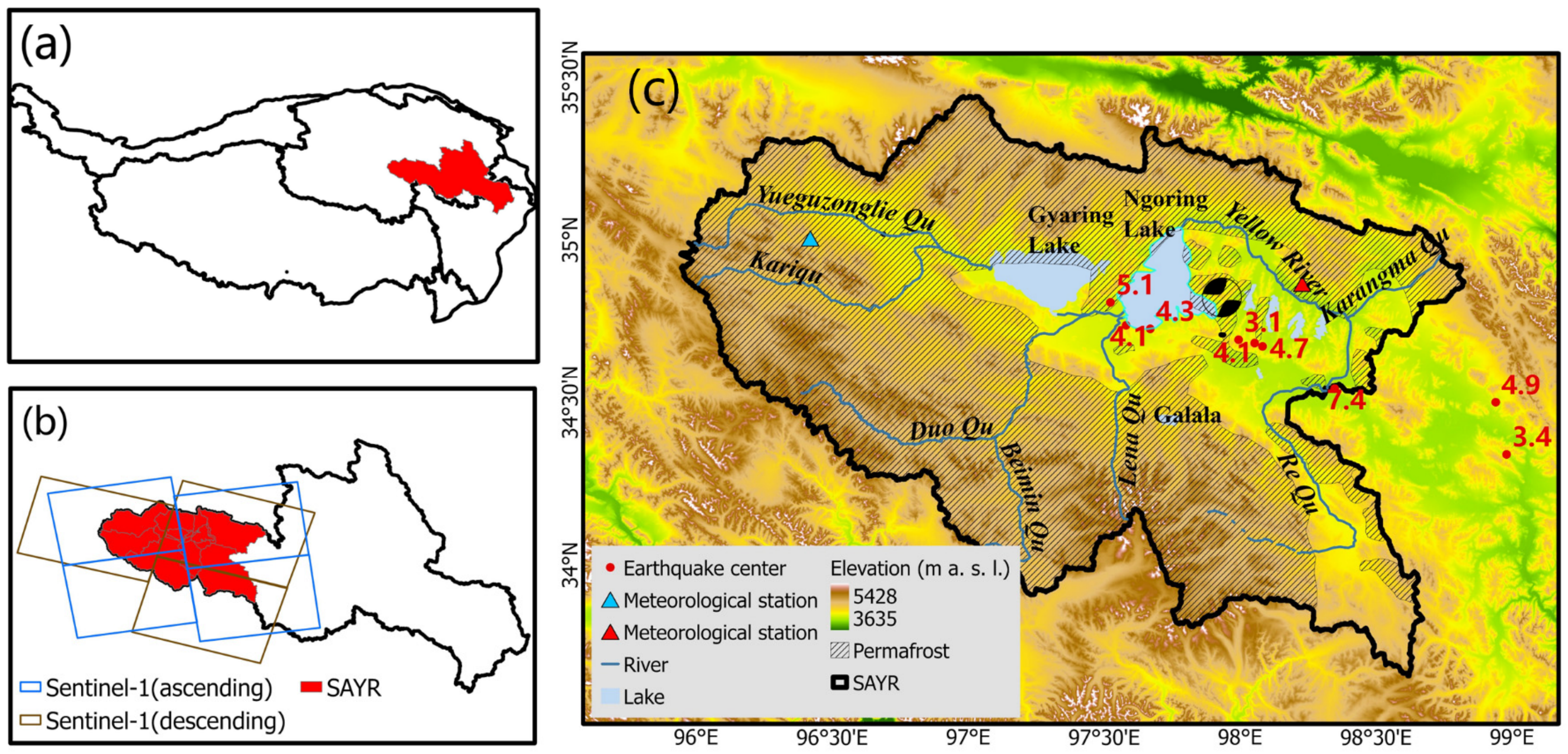
SAYR is located in the northeastern Tibetan Plateau (Figure 1a,b), elevated to 3625–5428 m a. s. l (Figure 1c). The climate in SAYR is semi-arid, with strong seasonality. The mean air temperature in SAYR reaches its maximum of 9 °C during July–August and its minimum of −15 °C in January and December, respectively. Precipitation in SAYR varies spatially, with high values in the southeast. Monthly precipitation in SAYR exhibited two peaks of 70–100 mm in June and August, and the minimum monthly precipitation of 3–5 mm was observed in January and December. The dominant land cover in SAYR is alpine meadow. Vast river plains, several fans and dense ponds are distributed along the drainage network in SAYR. A total of 43.8% of SAYR is covered by alpine permafrost (Figure 1c). In recent decades, permafrost in SAYR has degraded continuously, as indicated by the increasing ground temperature, thickening active layer [16], and shrinking extent of permafrost [17]. In addition, SAYR is bounded by two large faults (i.e., Kunlun Fault and Ganz-Yushu Fault) [11], and subject to frequent earthquakes [12]. Very recently, the Mw 7.4 Maduo earthquake (34.59°N; 98.34°E; center depth 17 km) took place on 2021-05-22 in eastern SAYR (Figure 1c). Approximately 20 aftershocks of over Mw 3.0 were recorded in the following six days (Figure 1c).

2.2. Data

2.2.1. Sentinel-1 Data

The two C-band SAR satellites of the Sentinel-1 constellation (i.e., Sentinel-1 A and Sentinel-1 B) acquire images from Interferometric Wide, covering the same area on the earth mode every 12 days. Each Sentinel-1 image covers a swath of 250 km wide with a ground spatial resolution of approximately 5 m × 20 m (range × azimuth) and contains two images, acquired with VV and VH polarization. During 2017–2024, Sentinel-1 satellites acquired a total of 1322 images covering SAYR, including 715 scenes from the ascending orbits and 607 scenes from the descending orbits (Table 1). Sentinel-1 images in the single look complex (SLC) format were used in this study.

2.2.2. In Situ Data

During 2020-07-18–2021-09-08, a GNSS receiver (96°22′49.2162″E, 35°01′53.0436″N) installed in the permafrost-covered western SAYR continuously recorded the local positions every 60 s in mixed multi-constellation observation mode (MIXED) mode (Figure 1c). The GNSS data was used to validate the LSD derived from the Sentinel-1 data. Prior to the validation, the GNSS data were processed to sub-centimeter accuracy in both horizontal and vertical directions with the open-source software PRIDE PPP-AR (v3.1.4). The final outputs of the GNSS data-processing were elevations (unit mm) based on the datum WGS84, which were further averaged daily.

2.2.3. Generic Atmospheric Correction Online Service (GACOS) Data

GACOS provides near-real-time global tropospheric delays for InSAR processing. GACOS produced the tropospheric delays by combining European Centre for Medium-Range Weather Forecasts (ECMWF) reanalysis fields with GNSS-derived Zenith Total Delay (ZTD). GACOS data has global coverage and is easy to operate, and, thus, has been widely applied to improve the InSAR-derived LSD [18,19]. In this study, tropospheric delays recorded in GACOS data were used to correct the atmospheric disturbance in LSD derived with SBAS-InSAR from the Setinel-1 data.

2.2.4. Modeled Data

The fifth-generation ECMWF atmospheric reanalysis dataset (ERA5) was generated by integrating extensive in situ and remotely sensed meteorological observations into a ECWMF weather model. Among all the of ERA5 data series, ERA5 post-processed daily statistics on single levels from 1940 to present contains daily atmospheric and land surface variables at the spatial resolution of 0.25° × 0.25°, including air temperature, precipitation, surface pressure, and wind speed and direction [20]. This dataset has been widely used to investigate regional hydrology and permafrost evolution, etc. [21,22]. In this study, daily air temperature and precipitation in ERA5 data were used to analyze their relation to LSD in SAYR.

2.2.5. MODIS Product

The monthly MODIS Normalized Difference Vegetation Index (NDVI) product (i.e., MOD13A3 and MYD13A3 in version 061) was adopted in this study to depict the vegetation conditions in SAYR during 2017–2024. This NDVI data is a gridded Level 3 product derived from the Level-2 8-day product (i.e., MOD13A2 and MYD13A1) with temporal weights [23]. The latter was generated from MODIS images acquired by the Terra and Aqua satellites. MOD13A3 and MYD13A3 expressed global NDVI at the spatial resolution of 1 km × 1 km.

2.2.6. SRTM DEM

SRTM Digital Elevation Model (DEM) 3 arc seconds was used to represent the topography of the SAYR and to remove the topographic phase during SBAS-InSAR processing. SRTM DEM was generated from the SAR image pairs acquired by two C-band SAR sensors positioned 60 m apart in the SRTM mission in February 2000 [24]. The spatial resolution of this DEM was 90 m at the equator. The absolute vertical accuracy of SRTM DEM was 20 m [25,26].

2.3. Methods

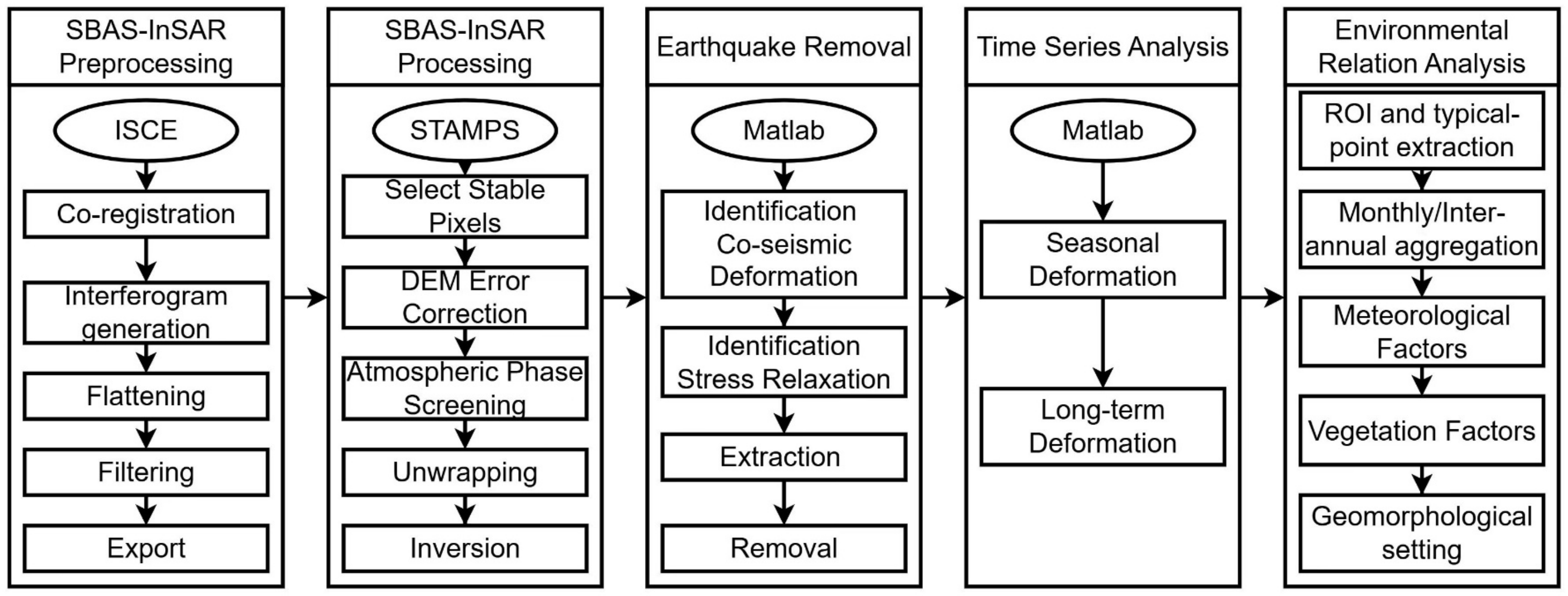
In this study, interferograms for SBAS construction were generated in the InSAR Scientific Computing Environment (ISCE2, v2.6.4). SBAS was constructed in the software package Stanford Method for Persistent Scatterers (StaMPS, v4.1-beta). Prior to phase-unwrapping, the tropospheric delays in the interferograms were corrected using GACOS data. Subsequently, the earthquake-related LSD was delineated and removed from the LSD time series. Finally, the spatiotemporal distribution of LSD in SAYR was analyzed (Figure 2).

2.3.1. SBAS-InSAR

SBAS-InSAR was employed to derive the LSD times in SAYR from the Sentinel-1 SLC data acquired during 2017–2024. The interferometric phase ( Δ ϕ ) derived from InSAR usually includes phases from LSD ( ϕ d e f ) , topographic residuals ( ϕ t o p o ), orbital errors ( ϕ o r b ) , tropospheric delays ( ϕ t r o p ) and ionospheric perturbations ( ϕ i o n ) [4,5], as shown in Equation (1).
Δ ϕ = ϕ d e f + ϕ t o p o + ϕ o r b + ϕ t r o p + ϕ i o n + ϕ n o i s e
The phase in an interferogram is essentially the phase difference between the two SAR images in this interferogram [4,5], as in Equation (2):
Φ d e f , m , n , i = ϕ n , i ϕ m , i , ( m , n ) Γ
where Φ d e f , m , n , i denotes the interferometric phase at pixel i in the interferogram formed by the two SAR images m and n ; ϕ m , i and ϕ n , i denote the interferometric phase at pixel i in the SAR images m and n , respectively; and Γ denotes the indices of the SAR images used to generate the interferograms network (i.e., SBAS).
The time series of interferometric phase at each Sentinel-1 acquisition was estimated from SBAS using a weighted least-squares inversion [7] (Equation (3)).
ϕ ^ i = a r g m ϕ i [ ( Φ i G ϕ i ) T C 1 ( Φ i G ϕ i ) ] Φ i = [ Φ m 1 n 1 , i , Φ m 2 n 2 , i , , Φ m M n M , i ] T ϕ i = [ ϕ 1 , i , ϕ 2 , i , , ϕ K , i ] T
where ϕ ^ i denotes the estimated interferometric phase time series at pixel i obtained from the SBAS network; Φ i denotes the stack of Φ m n , i for all interferograms in the SBAS. ϕ i denotes the unknown interferometric phase at pixel i ; G denotes the SBAS matrix with a row corresponding to m , n containing −1 at column m and +1 at column n; and C denotes the variance–covariance matrix of the LSD residual in the SBASs, which was estimated according to Equation (4):
C k , l = 1 N 1 p = 1 N ( ε p , k ε ¯ k ) ( ε p , l ε ¯ l )
where N is the number of pixels in an SBAS, and ε ¯ k is the mean residual phase noise of the kth interferogram, estimated according to Equation (5):
ε p , k = a r g ϕ p , k r c ϕ p , k p a t c h *
where ϕ p , k r c is the residual-corrected LSD at pixel p in the interferogram k in a SBAS; ϕ p , k p a t c h is the patch-based LSD estimate.
The time series of the cumulative LSD in line of sight (LOS) was obtained by converting the phase recorded in each interferogram in the SBAS according to Equation (6).
d L O S , i ( k ) = λ 4 π ϕ ^ k , i
where d L O S , i ( k ) denotes the cumulative LSD in LOS at pixel i by the acquisition of Sentinle-1 image k (unit: mm); λ is the wavelength of the SAR image (unit: mm), which is 56 mm for Sentinel-1 data; ϕ ^ k , i is the estimated cumulative unwrapped phase at pixel i for the k th Sentinel-1 image acquisition, referring to the reference acquisition.
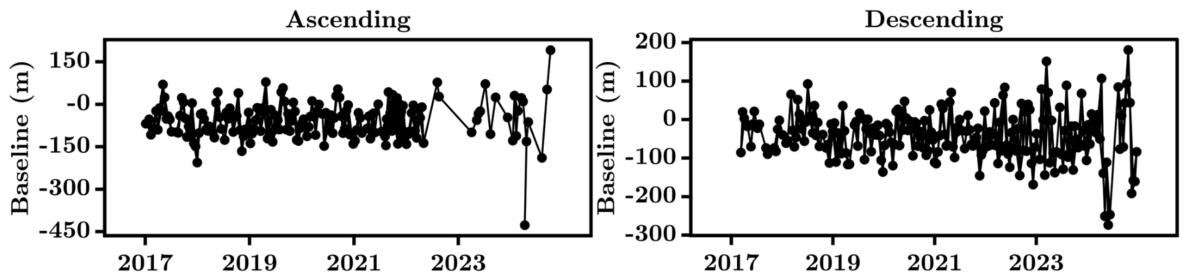
In this study, the interferograms for SBAS construction were generated using ISCE [27]. The Sentinel-1 images acquired on 2020-05-01 were selected as the main reference for the SBAS construction. Prior to the interferogram generation, all the Sentinel-1 images were respectively co-registered to the main reference of the corresponding orbits, path and slide, with an accuracy of below one pixel. The co-registration was conducted based on the geometries of the images involved. SBAS was constructed in each of the Sentinel-1 image slices in Table 1. A total of 36 days, three times the Sentinel-1 revisit, was used as the temporal baseline, and the perpendicular baseline of 400 m was used to maintain the high coherence and ensure sufficient network connectivity in the SBAS (Figure 3). During the interferogram generation, all Sentinel-1 images were multilooked by 4 × 20 in the azimuth and range directions, respectively, to reduce the local noise by averaging the 4 × 20 pixels and ensure squared-shaped pixels of the final LSD. Pixels with a coherence greater than 0.1 were regarded as valid and used for subsequent processing to include interferograms with a large spatial baseline or large temporal baseline, although they met the aforementioned criteria for the temporal and spatial baseline. The average coherence of interferograms in the SBASs was over 0.7 and the mean coherence of those used for LSD derivation was 0.915 and 0.922 for ascending and descending SBAS, respectively (Figure S4). Phase-flattening was conducted by referring to SRTM DEM 3 arc seconds. Phase -was conducted using the minimum-cost–flow algorithm implemented in SNAPHU. The unwrapped phase was subsequently converted to LSD time series according to Equation (6).

2.3.2. Removal of Tropospheric Delay

Before the phase unwrapping, ZTD in the GACOS data was used to correct the tropospheric delay in the interferometric phase. The ZTD difference between the two Sentinel-1 images in an interferogram was calculated according to Equation (7).
Δ Z T D = Z T D s l a v e Z T D m a s t e r
This ZTD difference was further projected in the LOS direction according to Equation (8).
Δ L L O S = Δ Z T D c o s θ
Subsequently, the tropospheric delay was converted to the interferometric phase according to Equation (9).
ϕ a t m = 4 π λ Δ L L O S
where λ represents the radar wavelength, whose value is 5.6 cm for Sentinel-1 images.
Finally, the tropospheric delay in phase (i.e., ϕ a t m in Equation (9)) was subtracted from the interferometric phase of each corresponding interferogram in SBAS.

2.3.3. Removal of the Earthquake-Related LSD in LOS

The removal of earthquake-related LSD was conducted based on the LSD in LOS. With the tropospheric delay removed, LSD in the LOS over SAYR during 2017–2024 consisted of the long-term LSD caused by permafrost variation, etc., the short-term LSD caused by the Mw 7.4 Maduo earthquake on 2021-05-22 and its aftershocks, and the long-term LSD caused by the post-seismic relaxation, as shown in Equations (10)–(12).
y i ( t ) = y n o n e q , i ( t ) + Δ y e q , i H i ( T ) + R i ( T ) H i ( T ) + ε i t
H i T = 0 , i f   T < 0     p r e s e i s m i c   1 , i f   T 0     ( p o s t s e i s m i c )
T = t t e
where y i ( t ) denotes the time series of the cumulative LSD in LOS at pixel i during the period from 2017-01-01 to the time of interest t ; y n o n e q , i ( t ) is the cumulative LSD caused by slow motions like permafrost degradation at pixel i by t ; Δ y e q , i is LSD caused by the Mw 7.4 earthquake on 2021-05-22 and its aftershocks at pixel i ; H i ( T ) denotes the value of Heaviside function at pixel i ; R i ( T ) denotes LSD caused by post-seismic relaxation; ε i ( t ) is the residual in y ( t ) ; t e is the time of the Mw 7.4 earthquake occurrence, i.e., 2021-05-22.
LSD in LOS formed by a strong earthquake event is essentially the exact ground-satellite distance difference between before and after the sudden event [28]. Therefore, LSD caused by the Mw 7.4 Maduo earthquake and its aftershocks in May 2021 in SAYR can be extracted from the interferogram formed by the pre-earthquake and post-seismic Sentinel-1 images, as in Equation (13).
Δ y e q , i = y i , p o s t y i , p r e
where y e q , i is LSD in LOS caused by the earthquakes in May 2021 at pixel i (unit: mm); y i , p o s t is the post-seismic cumulative LSD in LOS at pixel i (unit: mm); y i , p r e denotes the cumulative LSD in LOS at pixel i before the earthquakes (unit: mm). In this study, the cumulative LSD in LOS on 2021-05-20 was chosen as the one before the earthquakes for both time series from the ascending and descending orbits. The cumulative LSD in LOS on 2021-05-26 and 2021-06-01 was chosen as the post-seismic LSD time series from the ascending and descending orbits, respectively. The selected 12-day interval was proven to be superior to a longer interval like 24 days (Figure S1). Consequently, if there any LSD formed due to aftershock or after-slips, that within 2021-05-20–2021-05-26 for ascending (2021-05-20–2021-06-01 for descending) was attributed to Δ y e q , i and those beyond the period were attributed to Ri(T).
After a strong earthquake, the tension remaining in the earth crust decays over time [29]. This process is called post-seismic relaxation and it usually forms LSD that is distributed exponentially at a temporal scale [30]. Therefore, an exponential model was employed in this study to simulate the LSD in LOS formed by the post-seismic relaxation of the earthquakes in May 2021 in SAYR, as in Equation (14).
R i T = A i 1 e T τ + ε i T
where R i T is the LSD in LOS caused by the post-seismic relaxation at pixel i during T ; T is the time span from the Mw 7.4 Maduo earthquake t e (i.e., 2021-05-22) to the time of interest t ; A i is the overall LSD in LOS at pixel i in the post-seismic relaxation period τ, where τ is the characteristic decay time; and ε i T is the residual in R i T derivation. The decay time τ was determined as the time point from 2021-05-22, when all LSD at different points along the profile perpendicular to the fracture zone converged.
The final time series of cumulative LSD in LOS was derived by subtracting the earthquake-related LSD in LOS from the original time series of cumulative LSD in LOS, as in Equation (15).
y n o n e q , i ( t ) = y i t Δ y e q , i H i T R i ( T ) H i ( T )
where y n o n e q , i ( t ) is the time series of the cumulative LSD at pixel i at time t after the earthquake-related LSD in LOS was removed.

2.3.4. Deciphering Inter-Annual and Seasonal LSD

The LSD time series in the permafrost areas often comprise an inter-annual trend and seasonal variations [31,32]. LSD from the seasonal freeze–thaw processes of permafrost and top ground is widely expressed with sinusoidal functions [33,34,35]. Therefore, the LSD time series in SAYR was fitted using a model consisting of a linear term and combined harmonic terms, as in Equation (16). The linear term expressed the inter-annual LSD trend and the harmonic terms expressed LSD related to seasonal freeze–thaw processes. The coefficients in the model were estimated using ordinary least-squares criteria and the significance level (p) of the linear term was also derived. The fitting was performed separately on the LSD time series derived from the ascending and descending Sentinel-1 datasets.
y f , L O S , i t = V L O S , i t + A 1 , L O S , i sin ω 1 t + B 1 , L O S , i cos ω 1 t + A 2 , L O S , i sin ω 2 t + B 2 , L O S , i c o s ( ω 2 t ) + ε i ( t )
where y f , L O S , i ( t ) denotes the times series of the final LSD in LOS at pixel i during 2017–2024 (unit: mm); V L O S ,   i is the LSD in the LOS rate at pixel i during 2017–2024 (unit: mm/y); A 1 , L O S , i   B 1 , L O S , i   A 2 , L O S , i and B 2 , L O S , i are the harmonic coefficients (unit: mm); ω 1 = 2π and ω 2 = 4π are the angular frequencies; t denotes the span from 2017-01-01 to targeted time, which is expressed as a fraction referring to the total days of the corresponding year; and the harmonic terms describe the seasonal/periodical variations in LSD in LOS at pixel i during t .
LSD rates in the vertical and horizontal (i.e., west–east) directions were derived from LOS LSD rates according to Equation (17).
[ V L O S a s c V L O S d e s ] = [ c o s θ a s c c o s α a s c s i n θ a s c c o s θ d e s c o s α d s c s i n θ d e s ] [ V u V e ]
where V L O S a s c and V L O S d e s are the LSD rates in LOS obtained, respectively, from the ascending and descending LSD in LOS; V e denotes the LSD rate in the east–west direction; V u denotes the LSD rate in the vertical direction; and θ a s c and θ d e s are the incident angles of the Sentinel-1 data from the ascending and descending orbits, respectively. αasc and αdes are the azimuth angles of the Sentinel-1 data from the corresponding orbits.
Equations (7) and (17) were applied to each SBAS based on the individual sliced Sentinel-1; then, the output was mosaiced into one stack over SAYR and geocoded.

2.3.5. Relation of LSD to Air Temperature, Precipitation, and NDVI

Nine regions of interest (ROIs) were selected from the different reaches of SAYR, considering the local spatial homogeneity and significance of inter-annual LSD trends (p < 0.05). In addition, three typical points of interest (Pts) were selected from ROIs in the upper reaches of rough terrain to further investigate the temporal variations in the local LSD.
For the seasonal analysis, LSD in every year was aggregated monthly and averaged across 2017–2024. Prior to the monthly aggregation, LSD from each Sentinel-1 image was corrected by referring to the land surface in January of the corresponding years, so that the LSD in January of each year was zero mm. Considering the absence of Sentinel-1 images during January–March 2017 (Table 1), the LSD in April–December of each year was averaged for inter-annual LSD analysis.

3. Results

3.1. Removal of Earthquake-Related LSD

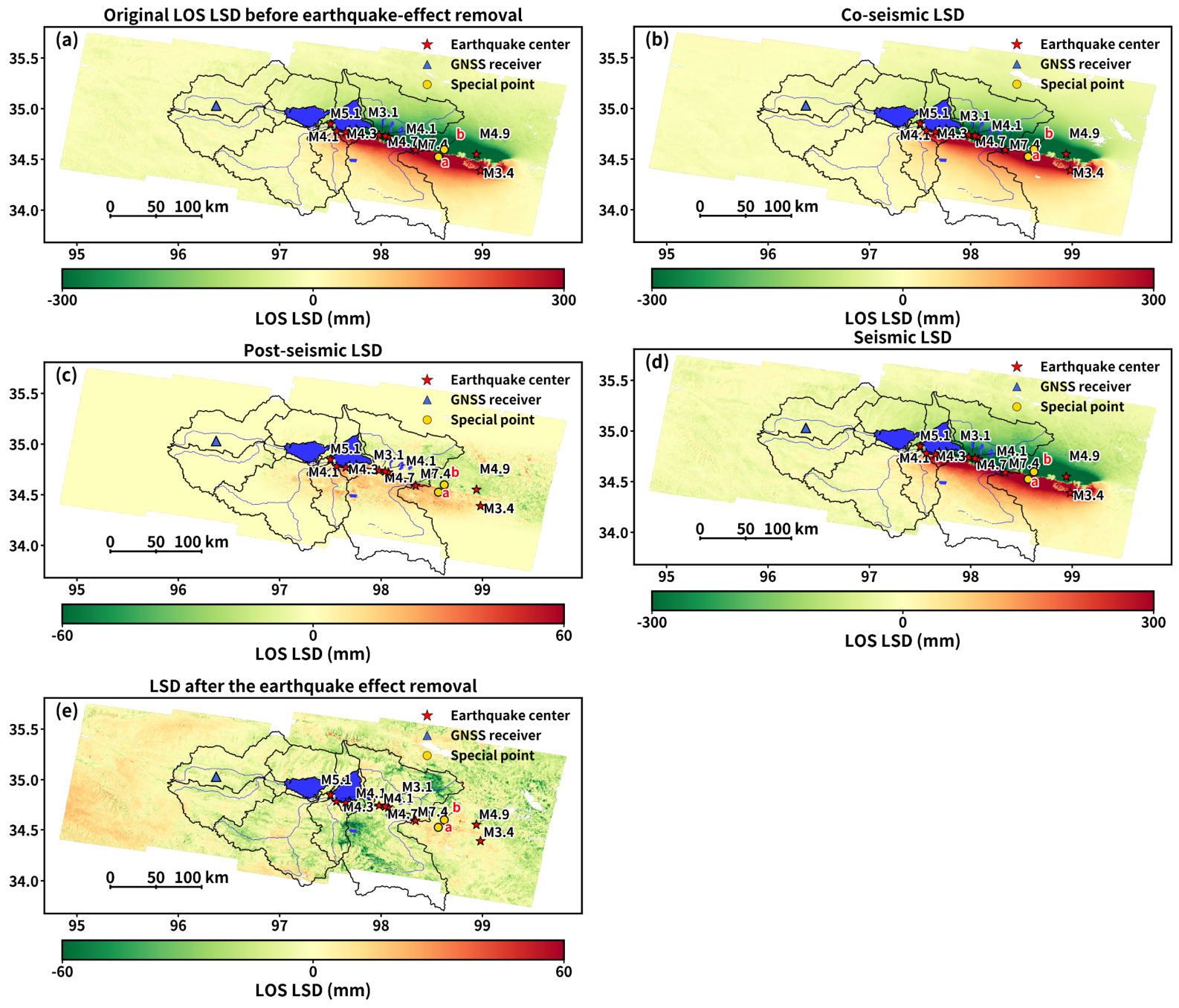
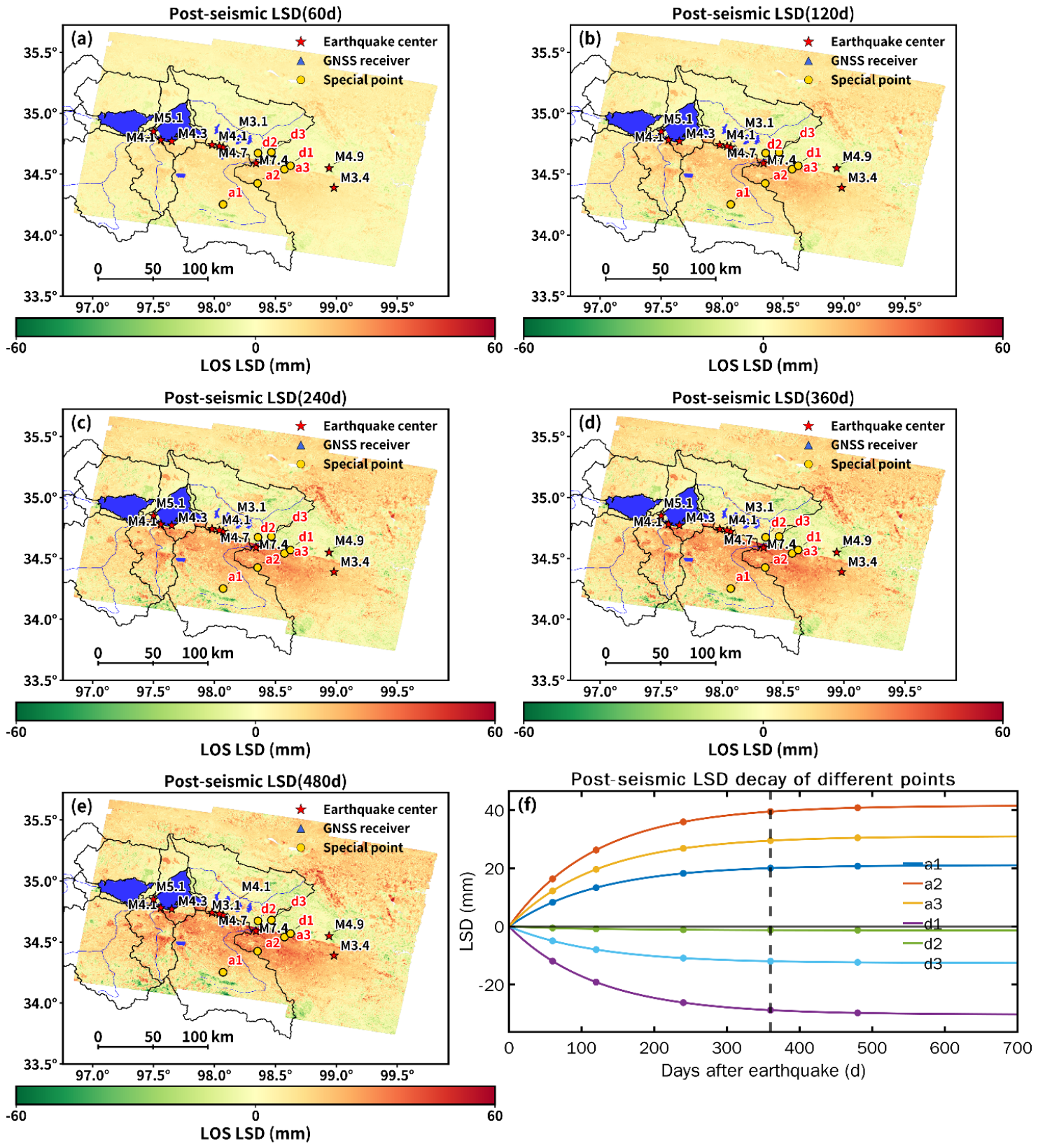
The post-seismic LSD in the south of the fracture belt was uplift and, in the north, it was subsidence LSD (Figure 4a–e). The cumulative post-seismic LSD in all areas affected by the earthquake lasted over a year and converged at 30 mm 360 days after the occurrence of the Mw 74. Maduo earthquake (Figure 4), regardless of the distance from the fracture.
LSD formed by the Mw 7.4 Maduo earthquake on 2021-05-22 and its aftershocks dominated the LSD in SAYR during 2020-05-01–2022-05-15 (Figure 5a). These earthquakes formed an east–west-oriented fracture belt of approximately 180 km long and 100 km wide in eastern SAYR (Figure 5a,b). On the southern side of the fracture belt, LSD in LOS reached approximately 300 mm, and on the northern side LSD in LOS was approximately −300 mm (Figure 5a,b). The post-seismic motion produced further LSD in LOS of approximately 30 mm near the southern side of the fracture belt (Figure 5c). The earthquake-related LOS LSD affected nearly half of SAYR (Figure 5d) and largely diminished the spatial pattern of non-earthquake-related LSD, e.g., permafrost degradation. After the earthquake-related LOS removal, LSD in SAYR during 2021-05-01–2022-05-15 exhibited a distinctly different spatial pattern, with the LSD in LOS ranging from −50 to 30 mm, which is much smaller than the earthquake-related LSD in LOS (Figure 5e). Ascending results show similarities with the descending results (Figure S3).
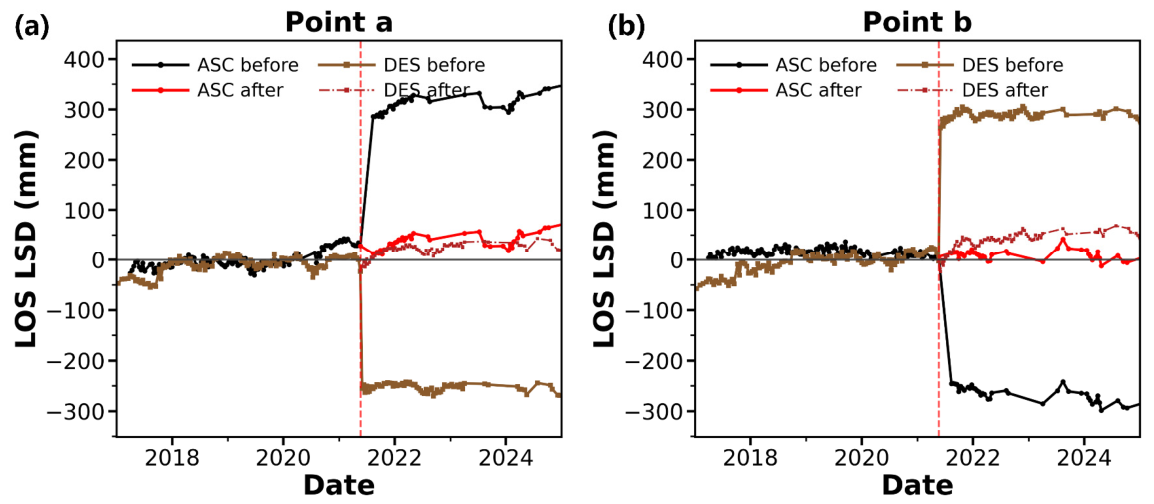
At a typical site in the south panel, the earthquakes and their post-seismic relaxation shifted LSD upwards after 2021-05-22 by approximately 300 mm (Figure 6a) and shifted the LSD of a typical site in the north downwards by −280 mm (Figure 6b). After the earthquake-related LSD was removed, LSD at the two sites exhibited continuous temporal transitions and varied in the same range as that before the earthquakes (Figure 6). The earthquake-related LSD removal from ascending and descending Sentinel-1 data yielded a similar effect.

3.2. Validation of SBAS-InSAR-Derived LSD

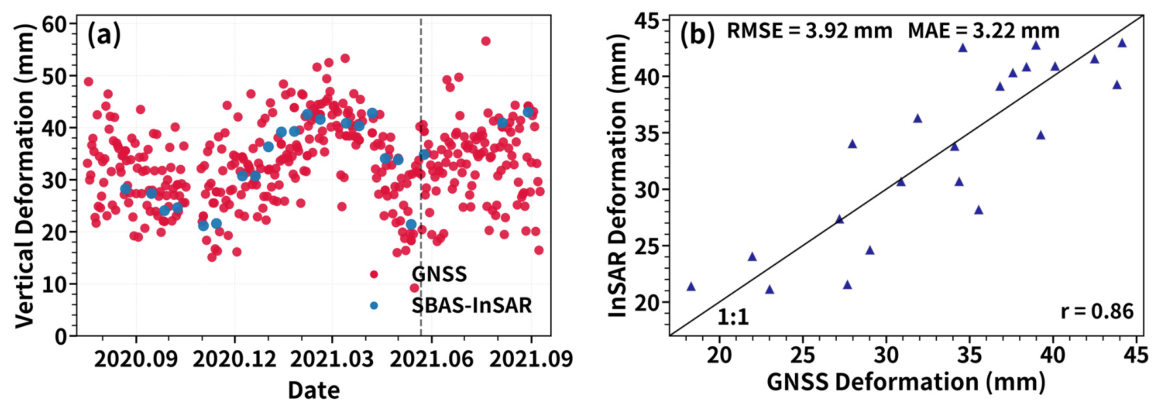
During the time period of the available GNSS observations, i.e., 2020-07-18–2021-09-08, the vertical LSD derived from SBAS-InSAR showed overall good temporal consistency with the GNSS measurements (Figure 7a). The LSD derived from the two approaches was mainly within the range of 20–45 mm and was distributed closely along the 1:1 line (Figure 7b). The RMSE and MAE of the SBAS-InSAR-derived LSD relative to the GNSS measurements were 3.92 mm and 3.22 mm, respectively. The Pearson correlation coefficient between the two datasets was 0.86.

3.3. Spatiotemporal Distribution of LSD in SAYR

3.3.1. Spatial Distribution of LSD in SAYR

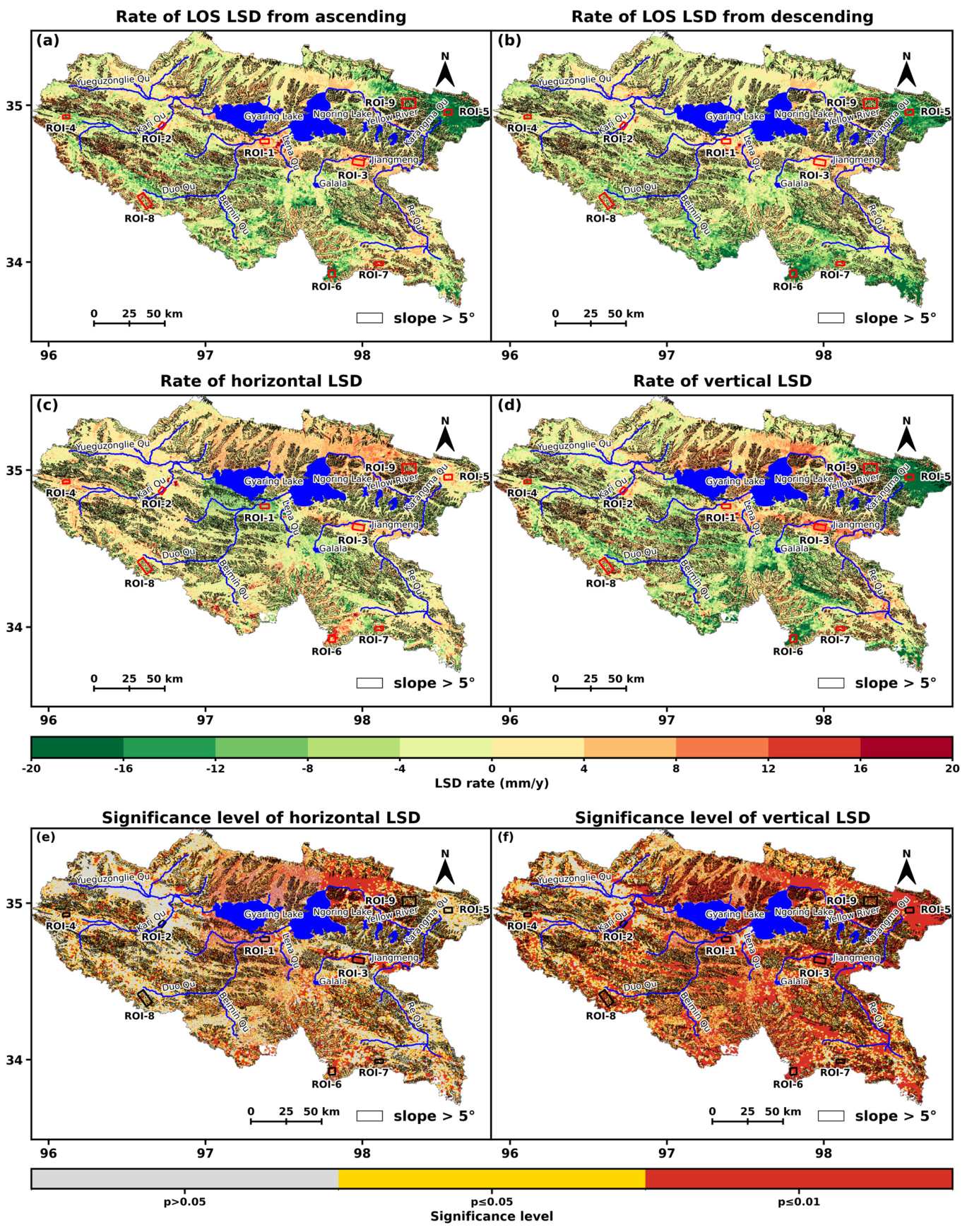
During 2017–2024, the rate of LOS LSD in SAYR observed from the descending and ascending orbits exhibited a nearly identical spatial distribution (Figure 8a,b). Specifically, many areas in the lower reaches of the rivers or near lakes exhibited land surface uplift instead of subsidence, e.g., near the inlet of the Ngoring Lake (Figure 8a,b). Meanwhile, the majority of mountainous areas in the upper reaches exhibited a land surface uplift of 0–12 mm/y, and areas in the middle reaches exhibited land surface subsidence of −20–4 mm/y. Exceptionally, the entire catchment of the Karangma Qu River showed land surface subsidence ranging from −12 to −20 mm/y, forming a distinct subsidence zone in SAYR (Figure 8c).
The horizontal LSD rate in SAYR was slower than the vertical LSD rate and showed a different spatial pattern (Figure 8c). For example, areas with a relatively large horizontal LSD rates, i.e., over 5 mm/y (eastwards), were mainly distributed as discreate spots along the mountain rims (Figure 8c). The vertical LSD in SAYR inherited nearly the exact spatial characteristics of LOS LSD but with slightly amplified values for both uplift and subsidence (Figure 8d). Nearly all the vertical and horizontal LSD rates were significant, with p < 0.05, with a higher significant trend in vertical LSD (Figure 8e,f).
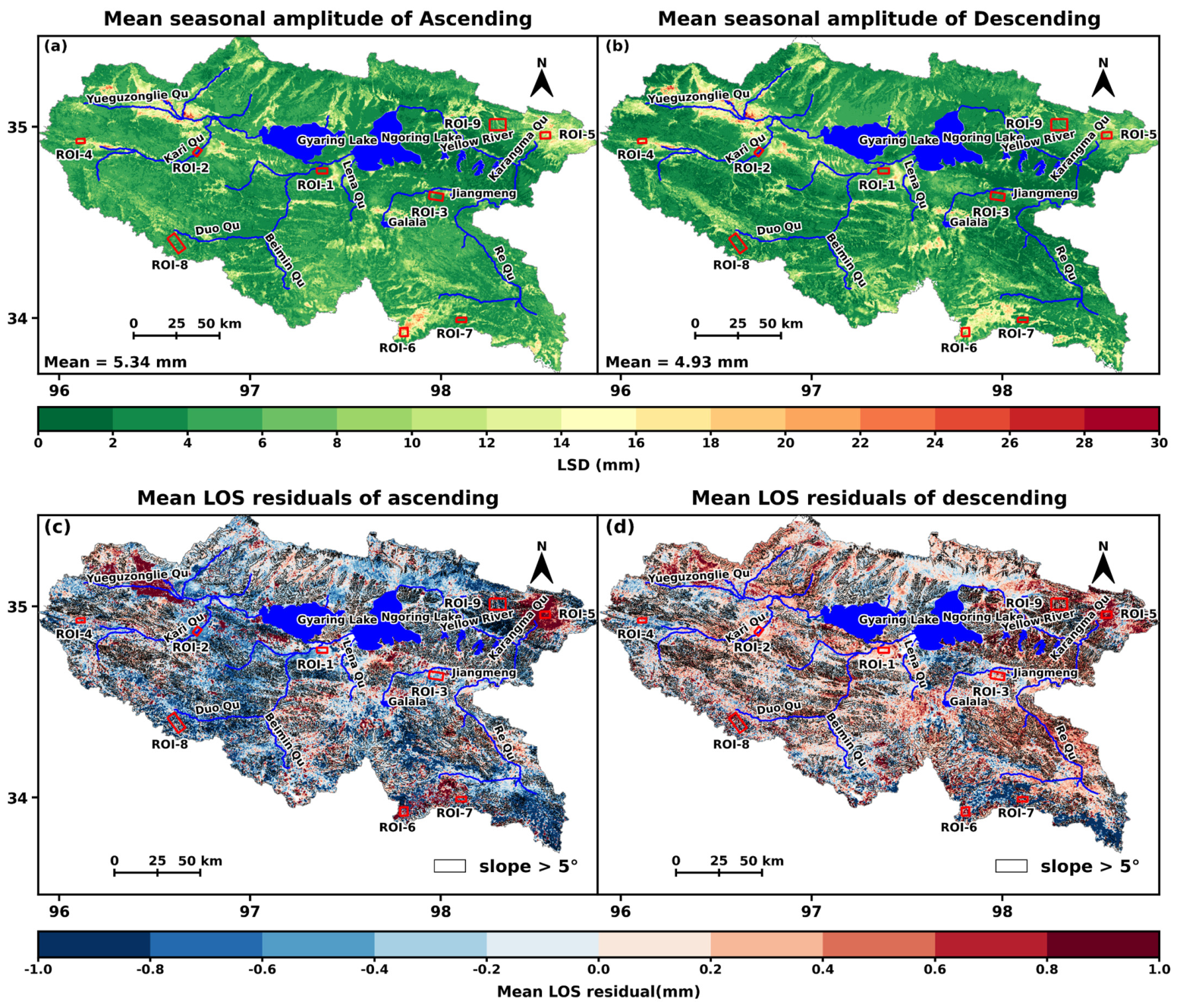
The seasonal amplitude of LSD in LOS exhibited similar spatial patterns. Specifically, areas of flood plains and mountain rims were characterized by large seasonal amplitudes over 14 mm, and the other areas showed a similar small seasonal amplitude of 0–12 mm (Figure 9a,b). The mean residue of the interannual trend and seasonality simulation was mostly in the range of −1 to 1 mm (Figure 9c,d).
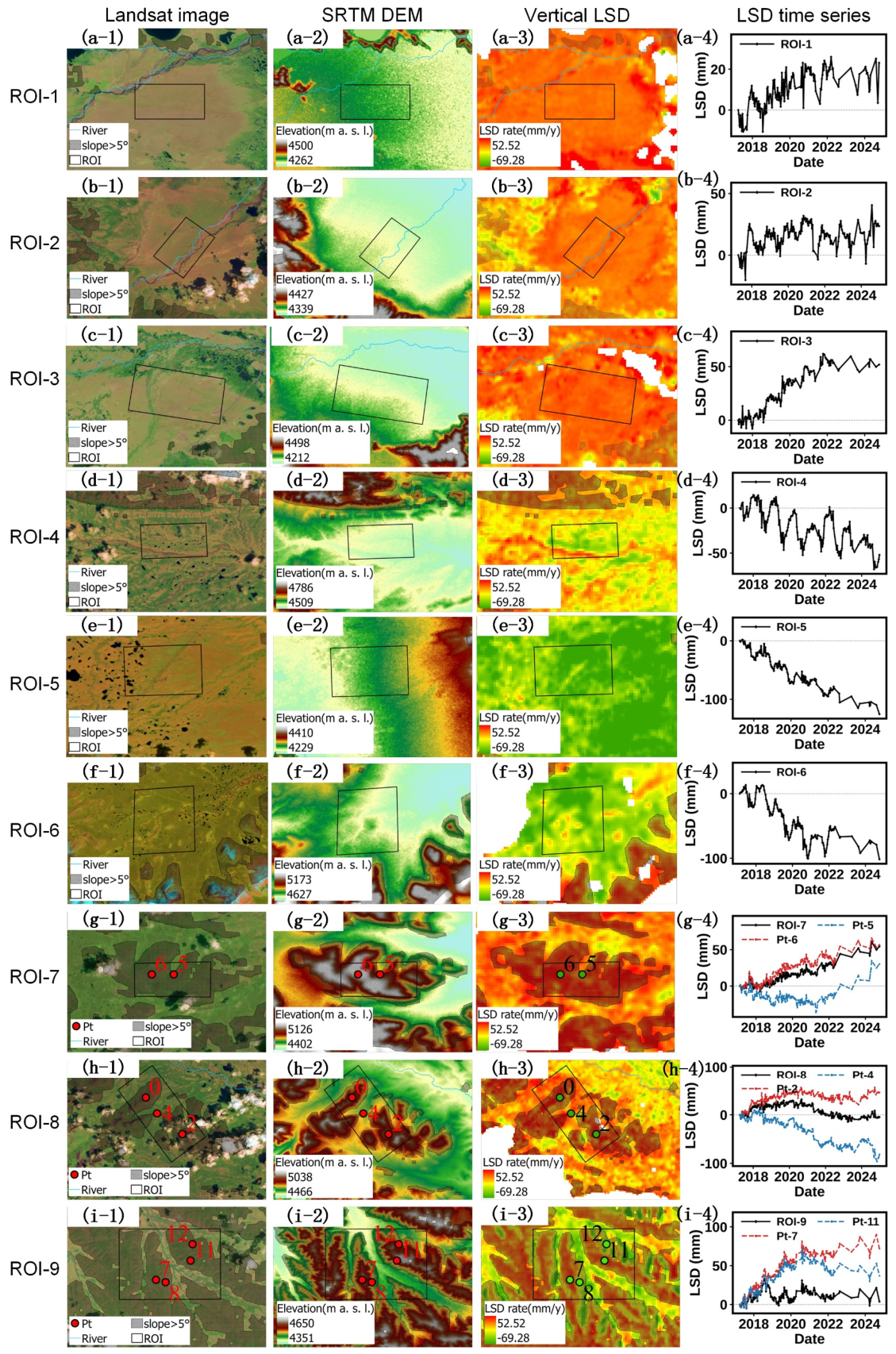
ROIs in the lower reaches (e.g., ROI-1, ROI-2 and ROI-3) were characterized with a small elevation gradient and often showed alluvial features like fans (Figure 10a–c). ROIs in the middle reaches (e.g., ROI-4 ROI-5 and ROI-6) often encompassed river valleys and were characterized by large elevation gradients and higher elevations (Figure 10d–f). ROIs in the upper reaches (e.g., ROI-7, ROI-8 and ROI-9) were characterized by high elevation, mountain peaks and a steep slope (Figure 10g–i).
The internal spatial heterogeneity of the ROIs increased with elevation (Figure 10g–i). In ROIs in the lower and middle reaches, the area of LSD in the same direction (i.e., uplift or subsidence) was extended without spatial gaps (Figure 10a–c). In ROIs in the upper reaches, especially in the ROIs with lower elevation (Figure 10g–i), prominent patterns of land surface subsidence on the sunny slope and uplift on the shady slope were present.
During 2017–2024, LSD in all these ROI was continuous, with strong seasonal variations (Figure 10). During 2017–2020/2022, land surface uplift in ROIs in the upper and lower reaches and the land surface subsidence in the middle reaches occurred rapidly, and during 2020–2024 they slowed down (Figure 10).

3.3.2. Temporal Relation of LSD to Local Climate

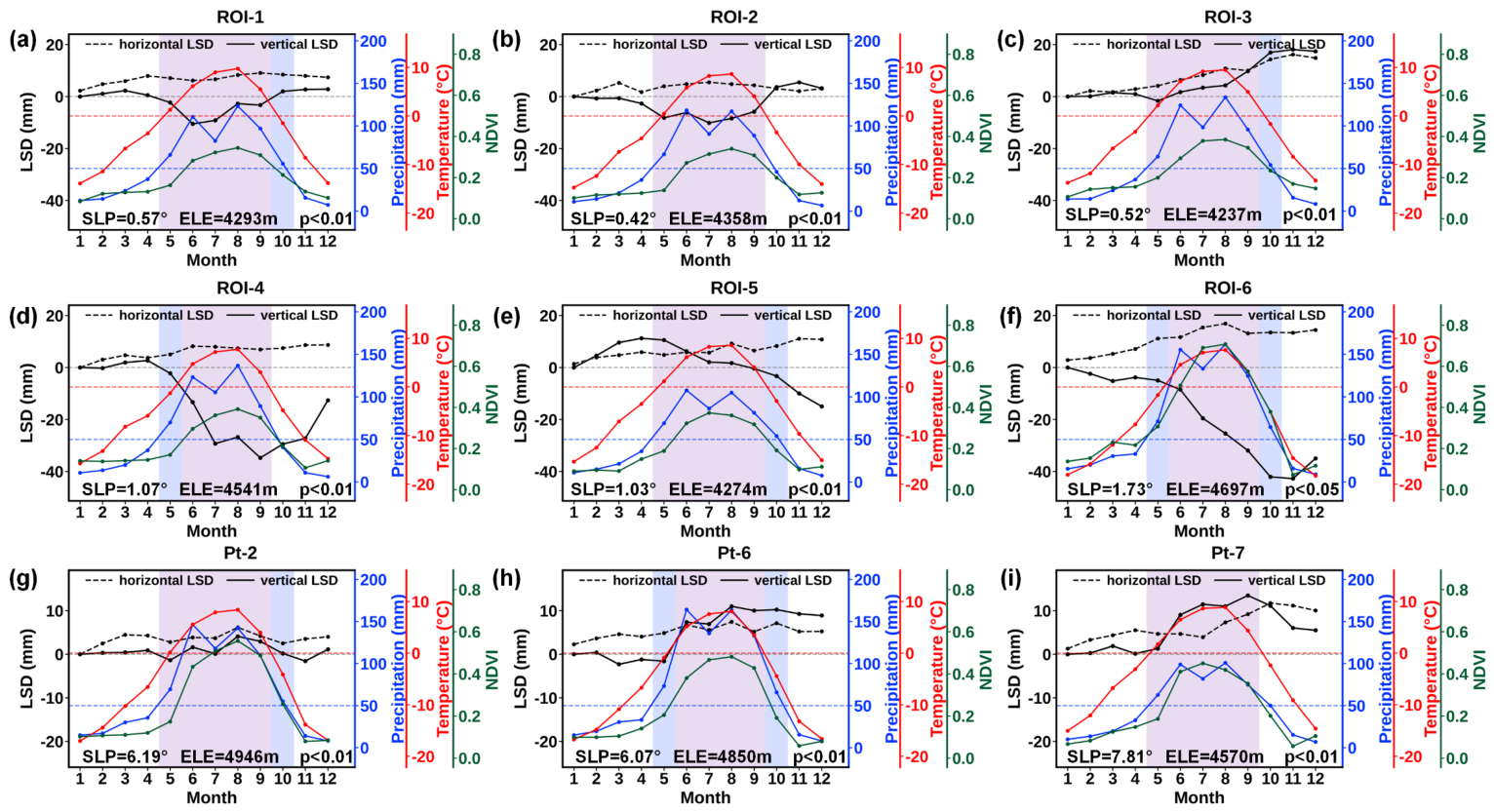
Air temperature, precipitation and NDVI ROIs and Pts in SAYR were highly synchronized and exhibited significant seasonality, i.e., they reached their maximum during July–August and showed low values in other months. Rapid land surface uplift or subsidence occurred when precipitation and air temperature increased or stayed at the higher levels.
The land surface in the lower and upper reaches exhibited net uplift. The land surface uplift in the lower and upper reaches started from June and May, respectively, when the air temperature rose above 0 °C and local precipitation approached the annual maxima. During January/March–May, large subsidence was present in the lower reaches, but LSD variation barely was present in the upper reaches. Land surface uplift in the lower reaches continued until December, while subsidence was present in September–November in the upper reaches and offset some of the earlier uplift (Figure 11g–i).
The land surface in the middle reaches exhibited net subsidence (e.g., ROI-4, ROI-6 and ROI-5). The land surface of these areas subsided rapidly during January/April–September when local precipitation and air temperature were approaching/at their corresponding maxima (Figure 11d,f). The land surface subsidence there ceased and was even followed by a slight land surface uplift during October–December when the local air temperature dropped below 0 °C and precipitation approached its seasonal minimum (Figure 11d,f). A slight uplift in LSD responded to the seasonal peaks and dips in local precipitation (Figure 11d–f).
Exceptionally, LSD in the entire catchment of the river Karangma Qu (i.e., ROI-5) exhibited a unique seasonal trajectory (Figure 11e). A gentle land surface uplift of 8 mm was present during January–May, as precipitation and air temperature increased, followed by land surface subsidence during May–December. The net annual land surface subsidence in this catchment area was 16–40 mm.
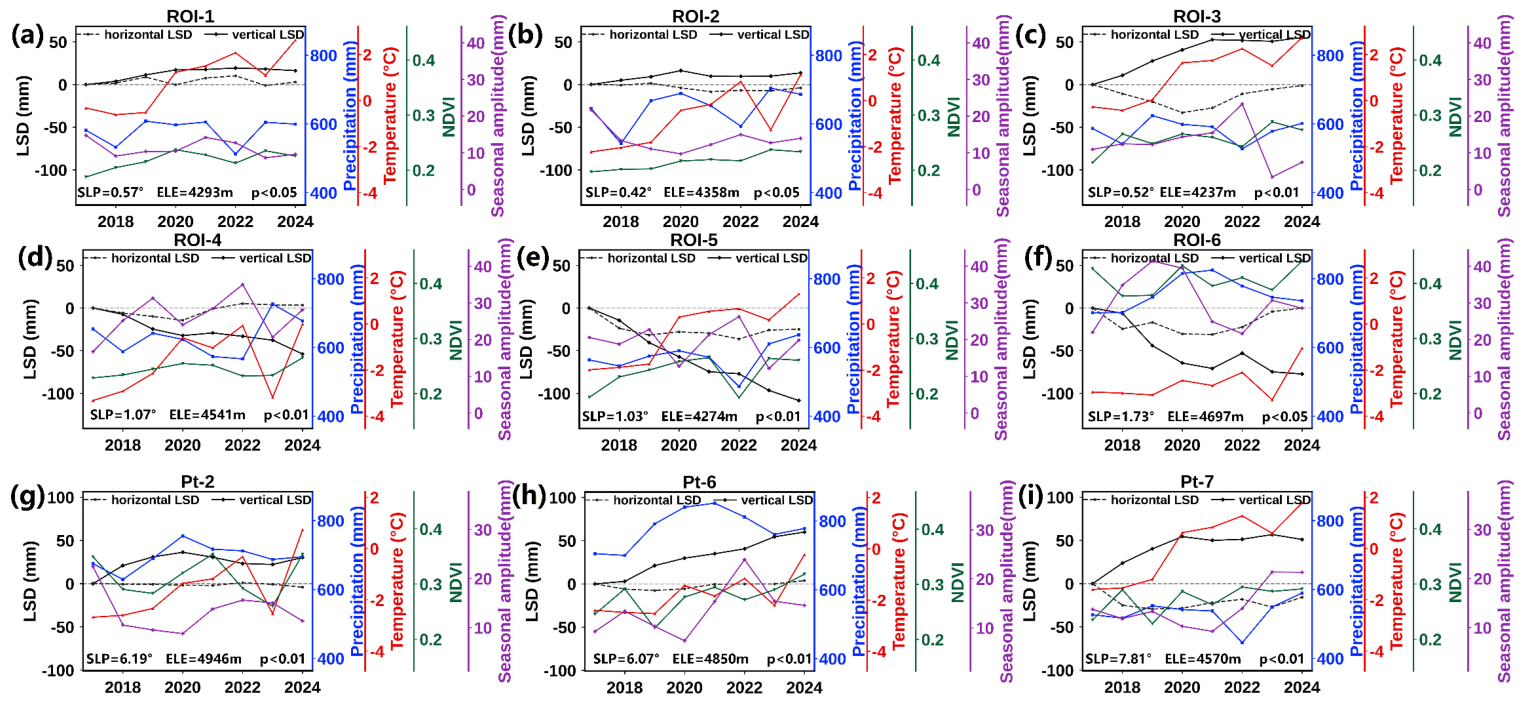
During 2017–2024, the annual mean air temperature across SAYR exhibited an overall similar trend of continuous increase with a dip of varying magnitudes in 2023 (Figure 12). A fast rise in air temperature was present during 2017–2020/2022, followed by a gentle rise during 2020/2022–2024. Precipitation in SAYR exhibited similar trends of no significant increase or decrease but showed a dip in 2022 for areas of low elevation. Annual precipitation was mostly in the range 500–700 mm/y, with different seasonality and higher values in southeastern SAYR (Figure 12f–h). Overall, inter-annual LSD in SAYR responded to the overall increase in air temperature but not to short-term variations like the dip in 2023. LSD slowed down as the increase in of air temperature slowed down. Meanwhile, LSD exhibited no significant inter-annual relationship with precipitation.
During 2017–2024, LSD in the ROIs exhibited distinct inter-annual variations (Figure 12), with air temperature and NDVI varying with elevation. Specifically, LSD in the areas of lower reaches (e.g., ROI-1, ROI-2 and ROI-3) exhibited a continuous uplift of up to 50 mm (Figure 12a–c), accompanied by fast increase in air temperature and very slight rise in the lowest NDVI in SAYR. LSD in the areas of middle reaches (e.g., ROI-4, ROI-5 and ROI-6) exhibited continuous subsidence of 70 mm, along with a fast rise in air temperature and slight increase in NDVI in areas of lower elevation (e.g., ROI-4–ROI-6) (Figure 12d–f). LSD in the upper reaches showed a continuous uplift of up to 50 mm (Figure 12g–i), similar to the flat area, accompanied by a slight increase in NDVI in areas of lower elevation (e.g., Pt-2) (Figure 12h,i). In areas with slope > 1°, the seasonal amplitude of LSD responded positively to the LSD air temperature and most increased as air temperature rose (Figure 12 d–i). In contrast, the seasonal amplitude of LSD in the flat areas, e.g., fluvial features, barely responded to air temperature or precipitation (Figure 12a–c).

4. Discussion

4.1. Effectiveness of Earthquake-Related LSD Removal

Precisely removing the earthquake-related LSD is critical for the correct understanding of permafrost variations in earthquake-affected areas. Four measures were adopted in this study: (1) The temporal baseline of 36 days and the spatial baseline of 400 m were adopted for interferograms’ generation. This ensured the quality of the interferograms (Figure 3). (2) The tropospheric delay, which was recorded as ZTD in GACOS, was eliminated to further improve the quality of the input LSD for the earthquake-related LSD delineation (Figure 2). (3) The time span of 12 days (i.e., from 2021-05-20 to 2021-06-01) was used to derive the LSD of earthquake events and the time span of 360 days, determined by decay test (Figure 4), was used to simulate the post-seismic relaxation (Section 2.3.3). This respected the temporal characteristics of the two processes. (4) During earthquake-related LSD removal, a Heaviside function (i.e., Equation (11)) was adopted to indicate the spatiotemporal appearance of the earthquake effect.
The earthquake-related LSD derived in this study agreed with previous studies [12]. Specifically, it contained an approximately 180 km long, west–east-orientated fracture belt with the land surface of its northern panel subsiding by −300 mm and its southern panel uplifted by 300 mm (Figure 5d and Figure 6). The post-seismic relaxation further uplifted the land surface of the southern panel by 20–40 mm (Figure 5c).
The effectiveness of the earthquake-related LSD removal was demonstrated in three aspects: (1) no earthquake-related features remained in the final LSD (Figure 5d and Figure 6); (2) the final LSD closely aligned with in situ measurements (Figure 7a), and the cross-validation with in situ measurements yielded an RMSE and MAE of 3.92 mm and 3.22 mm, respectively (Figure 7b), and the RMSE was less than 10% of the minimum LSD; (3) the vertical LSD in SAYR during 2017–2024 mostly ranged from −8 mm/y to 8 mm/y Figure 8d), comparable to the co-current LSD in the nearby areas like the headwater of the Yangtze River [14].

4.2. Drivers of LSD in SAYR

Soil moisture cast the spatial distribution of LSD direction as a combined result of draining condition, air temperate, precipitation and snowmelt. Often the increased soil moisture inflates the loose topsoil and the decrease in soil moisture drains this section of the ground. The LSD from soil moisture changes can be divided into horizontal and vertical directions (Figure 8c,d). The horizontal LSD direction is mainly controlled by the slope facet. In contrast, the vertical LSD is more relevant when aiming to reflect soil moisture variations and can be expressed via uplift or subsidence. Therefore, vertical LSD was used as the main index to interpret the LSD’s relation with soil moisture. Overall, annual net land surface uplift resulted from a ground moisture surplus, and the annual net land surface subsidence was due to a ground moisture deficit. Inter-annual uplift and the subsidence of the land surface indicated a sustaining annual ground moisture surplus and deficit, respectively.
Alluvial features like river plains and the slight elevation gradient in the lower reaches indicated overall thick sediments, poor drainage conditions and high saturation of ground moisture in this area (Figure 10) [36]. A net land surface uplift was observed in a year when the ground moisture retained and frozen in winter surpassed its counterpart in early spring (Figure 10a–c). The inter-annually increase in ground moisture in winter was the direct cause of the inter-annual land surface uplift. As no significant precipitation increase was observed in SAYR during 2017–2024 (Figure 12) [37], increased snowmelt due to the warming climate may have contributed runoff, increased moisture retention and caused inter-annual uplift in alluvial features in the downstream area. River valleys in the middle reaches indicated improved drainage conditions (Figure 10). The permafrost degradation, relatively strong draining and gravity-driven mass compacting together led to significant summer land surface subsidence in these areas (Figure 11d,f). The remaining moisture froze in winter and slightly uplifted the local land surface, but did not offset the large subsidence in summer (Figure 11d,f). Thus, a net annual land surface subsidence was present. The rising air temperature was likely the reason for the inter-annual subsidence in these areas (Figure 12d–f). This LSD was most common in the permafrost areas of the Tibetan Plateau [10,38].
The high elevation in the upper reaches enabled higher precipitation in these areas, especially in mountainous areas (Figure 12) [39,40]. Substantial snow melt, extra precipitation and ground thaw allowed for a local ground moisture surplus and land surface uplift occurred in summer (Figure 11g–i). Continuous draining, declining precipitation and decreasing snow melt in autumn led to land surface subsidence to varying degrees. Freezing of the retained moisture meant that the winter land surface was at a higher level than that in spring (Figure 11g–i). The increasing snow melt due to the rising air temperature was likely the reason for the long-lasting ground moisture surplus and the inter-annual uplift in these areas (Figure 12g–i) [41].
LSD in ROI-5, which was located in a small basin drained by the river Karangma Qu (Figure 1), exhibited a unique seasonal trajectory (Figure 10e and Figure 11). The weak draining capability of the flat basin in spring might be the reason for this. In spring, the flat basin floor largely slowed down the drainage of snowmelt water, and the still-frozen ground limited the downwards infiltration of the snowmelt water. Consequently, the majority of the snowmelt was retained in the thin upper ground, increasing soil moisture and causing local surface uplift. This phenomenon lasted until May, when deep ground-thaw occurred, connected the retained snow melt to subsurface runoff and drained it. Thus, the land surface subsidence in this basin only started from May (Figure 11e), as opposed to the January/February start observed at other sites with stronger draining. The surface and subsurface runoff which drained the flat basin until December led to the net annual moisture deficit in this catchment (Figure 11e). Additionally, vegetation may also contribute to permafrost thaw by enhancing the infiltration of snowmelt and precipitation and, thus, increasing heat capacity and potentially transmitting extra heat to the permafrost underneath.

4.3. Innovation and Implications

To date, the majority of LSD investigations on alpine permafrost in tectonically active areas like the Tibetan Plateau have overlooked possible disturbance from earthquake(s), leaving potential mistakes and/or bias in the understanding of LSD variations in these areas. This study derived the LSD induced by the Mw 7.4 Maduo earthquake on 2021-05-22, its aftershocks and its post-seismic relaxation according to their temporal characteristics (i.e., Section 2.3.3 and Section 3.1) (Figure 5 and Figure 6). Notably, the spatially distributed LSD of the post-seismic relaxation was innovatively derived with an exponential model, which is usually used in one-dimensional observations like GNSS measurements [30]. The effectiveness of the earthquake-related LSD removal was demonstrated in multiple ways in Section 4.1. Therefore, this study demonstrates the necessity and applicability of removing earthquake-related LSD for the effective investigation of alpine permafrost LSD in the tectonically active areas. Additionally, the effectiveness of the final LSD in SAYR implied that the strategies adopted in this study can serve as a technical reference for such investigations.
In this study, the spatial heterogeneity, seasonal freeze–thaw response and nonlinear LSD trends in SAYR were identified based on the 2017–2024 time series of LSD. However, the time series covered only 8 years, which limited the interpretation of temporal permafrost evolution to inter-annual variations or short-term response to air temperature, etc., instead of long-term evolution. LSD observations over a longer period are still suggested for a more robust attribution. However, the inter-annual land surface subsidence in the area of continuous subsidence in SAYR can still indicate the local permafrost degradation and active layer-thickening as a result of the rising air temperature and persistent drainage conditions (Figure 12), especially in the basin drained by the river Karangma Qu in the northeastern SAYR. Uplift in the lower reaches of the tributaries of the SAYR may provide no direct indication of permafrost evolution, as no permafrost was found in those areas. The LSD in the upper reaches of the permafrost remains complex and requires cautious interpretation, although this LSD is largely related to local soil moisture.
Despite the high quality of the LSD derived in this study, GACOS, was sometimes insufficient in correcting short-wavelength turbulent troposphere, which could potentially undermine the quality of the atmospheric correction by several mm. Therefore, more efficient approaches to atmospheric correction would be appreciated in future LSD derivations using the InSAR technique.

5. Conclusions

Remotely sensing LSD is an effective approach for investigating alpine permafrost variations. However, large earthquakes can cause large LSD and obstruct LSD investigations of alpine permafrost. Therefore, this study precisely delineated earthquake-related LSD due to the Mw 7.4 earthquake on 2021-05-22 in SAYR and removed it from the time series of LSD derived with SBAS-InSAR during 2017–2024. The spatiotemporal variation in LSD in SAYR during 2017–2024 was subsequently analyzed. The study found that: (1) earthquake-related LSD was effectively delineated both spatially and temporally and removed, and the final LSD had an RMSE and MAE of 3.92 mm and 3.22 mm, respectively; (2) during 2017–2024, vertical LSD rates in SAYR were mostly −8–8 mm/y; (3) the spatial distribution of LSD directions was determined by soil moisture, as the combined result of local drainage, precipitation, increasing air temperature and snow melt. This study demonstrated the necessity and applicability of removing earthquake-related LSD when investigating permafrost in tectonically active areas. The findings provide insight for the thorough understanding of alpine permafrost response to climate changes in the Tibetan Plateau.

Supplementary Materials

The following supporting information can be downloaded at: https://www.mdpi.com/article/10.3390/rs18121946/s1, Figure S1: Co-seismic LSD of the Mw7.4 Maduo earthquake from descending orbit. (a) Co-seismic LSD of the Mw7.4 Maduo earthquake during one cycle of Sentinel-1 revisit, i.e., 20210520-20210601; (b) Co-seismic LSD of the Mw7.4 Maduo earthquake during two cycle of Sentinel-1 revisit, i.e., 20210520-20210613; (c) Spatial difference between the two co-seismic LOS LSD estimates, calculated as panel (b) minus panel (a); (d) Frequency distribution of the pixel-wise LOS LSD differences between the two estimates; Figure S2: Sensitivity of extracted post-seismic transient deformation to different characteristic decay times. (a) Post-seismic LSD extracted using τ=60 days; (b) post-seismic LSD extracted using τ=120 days; (c) post-seismic LSD extracted using τ=240 days; (d) post-seismic LSD extracted using τ=360 days; (e) post-seismic LSD extracted using τ=480 days; (f) Post-seismic LSD decay curves at representative points; Figure S3: Removal of the earthquake-related LOS LSD observed from the ascending orbit. (a) Original LOS LSD during 2021-05-20 to 2022-05-15 before earthquake-effect removal; (b) co-seismic LOS LSD during 2021-05-20 to 2021-05-26; (c) LOS LSD formed by post-seismic relaxation during 2021-05-20 to 2022-05-15; (d) total earthquake-related LOS LSD, including co-seismic LSD and post-seismic relaxation; (e) LOS LSD during 2021-05-20 to 2022-05-15 after earthquake-effect removal; Figure S4: Spatial distribution of mean coherence of the interferograms from ascending and descending images. (a) Average coherence of the interferograms in the SBAS from the ascending data; (b) Average Coherence of the interferograms in the SASB from the descending data. (c) Coherence of the interferograms of the ascending images pair with temporal baseline of 84 day and spatial baseline of 111 m; (d) Coherence of the interferograms of the descending images pair with temporal baseline of 180 days and spatial baseline of 66 m; Figure S5: Inter-annual variations of LSD, precipitation, air temperature, NDVI, and surface thawing index in ROIs during 2017–2024.

Author Contributions

Conceptualization, S.Z.; Methodology, X.L. and S.Z.; Software, X.L.; Validation, X.L.; Formal analysis, X.L., S.Z. and L.Z.; Investigation, X.L., S.Z., L.Z., X.D. and L.H.; Resources, S.Z.; Data curation, Z.Q.; Writing—original draft, X.L. and S.Z.; Writing—review & editing, X.L., S.Z., L.Z., X.D., L.H., Z.Q. and Q.F.; Visualization, S.Z.; Supervision, S.Z. and Q.F.; Project administration, S.Z.; Funding acquisition, S.Z. All authors have read and agreed to the published version of the manuscript.

Funding

This study was jointly funded by the Science and Technology Department of Qinghai Province (Grant number 2024-ZJ-914), the Ministry of Science and Technology of the People’s Republic of China (Grant number 2022YFF1302602), Chinese Academy of Sciences (Grant number E2290112).

Data Availability Statement

The original contributions presented in this study are included in the article/Supplementary Material. Further inquiries can be directed to the corresponding author.

Acknowledgments

ISCE was from Github (https://github.com/isce-framework/isce2: accessed on 5 July 2025), GACOs data was from its team webpage: http://www.gacos.net: accessed on 23 October 2025), ERA5 data was from Copernicus Climate Change Service (https://cds.climate.copernicus.eu: last access 11 May 2026), SRTM DEM was from U.S. Geological Survey (https://earthexplorer.usgs.gov: last access on 11 May 2025), NDVI data was from NASA Earthdata Search Engine (https://search.earthdata.nasa.gov, last access 30 September 2024).”

Conflicts of Interest

The authors declare no conflict of interest.

References

  1. Jin, H.; He, R.; Cheng, G.; Wu, Q.; Wang, S.; Lü, L.; Chang, X. Changes in frozen ground in the Source Area of the Yellow River on the Qinghai–Tibet Plateau, China, and their eco-environmental impacts. Environ. Res. Lett. 2009, 4, 045206. [Google Scholar] [CrossRef]
  2. Chen, P.; Cao, Z.; Yang, C.; Qiu, Z.; Guo, X.; Duan, H. Satellite observations of surface water dynamics and channel migration in the Yellow River since the 1980s. J. Hydrol. Reg. Stud. 2024, 56, 102029. [Google Scholar] [CrossRef]
  3. Wang, T.; Yang, D.; Yang, Y.; Zheng, G.; Jin, H.; Li, X.; Yao, T.; Cheng, G. Unsustainable water supply from thawing permafrost on the Tibetan Plateau in a changing climate. Sci. Bull. 2023, 68, 1105–1108. [Google Scholar] [CrossRef] [PubMed]
  4. Bamler, R.; Hartl, P. Synthetic aperture radar interferometry. Inverse Probl. 1998, 14, R1. [Google Scholar] [CrossRef]
  5. Rosen, P.A.; Hensley, S.; Joughin, I.R.; Li, F.K.; Madsen, S.N.; Rodriguez, E.; Goldstein, R.M. Synthetic aperture radar interferometry. Proc. IEEE 2002, 88, 333–382. [Google Scholar] [CrossRef]
  6. Lanari, R.; Mora, O.; Manunta, M.; Mallorqui, J.; Berardino, P.; Sansosti, E. A small-baseline approach for investigating deformations on full-resolution differential SAR interferograms. IEEE Trans. Geosci. Remote Sens. 2004, 42, 1377–1386. [Google Scholar] [CrossRef]
  7. Berardino, P.; Fornaro, G.; Lanari, R.; Sansosti, E. A new algorithm for surface deformation monitoring based on small baseline differential SAR interferograms. IEEE Trans. Geosci. Remote Sens. 2002, 40, 2375–2383. [Google Scholar] [CrossRef]
  8. Rouet-Leduc, B.; Jolivet, R.; Dalaison, M.; Johnson, P.A.; Hulbert, C. Autonomous extraction of millimeter-scale deformation in InSAR time series using deep learning. Nat. Commun. 2021, 12, 6480. [Google Scholar] [CrossRef]
  9. Fu, Z.; Wu, Q.; Chen, A.; Wang, L.; Jiang, G.; Gao, S.; Yun, H.; Chen, J. Non-temperature environmental drivers modulate warming-induced 21st-century permafrost degradation on the Tibetan Plateau. Nat. Commun. 2025, 16, 7556. [Google Scholar] [CrossRef] [PubMed]
  10. Chen, J.; Wu, T.; Zou, D.; Liu, L.; Wu, X.; Gong, W.; Zhu, X.; Li, R.; Hao, J.; Hu, G.; et al. Magnitudes and patterns of large-scale permafrost ground deformation revealed by Sentinel-1 InSAR on the central Qinghai-Tibet Plateau. Remote Sens. Environ. 2022, 268, 112778. [Google Scholar] [CrossRef]
  11. Pan, J.; Li, H.; Chevalier, M.-L.; Tapponnier, P.; Bai, M.; Li, C.; Liu, F.; Liu, D.; Wu, K.; Wang, P.; et al. Co-seismic rupture of the 2021, Mw7.4 Maduo earthquake (northern Tibet): Short-cutting of the Kunlun fault big bend. Earth Planet. Sci. Lett. 2022, 594, 117703. [Google Scholar] [CrossRef]
  12. Jin, Z.; Fialko, Y. Coseismic and Early Postseismic Deformation Due to the 2021 M7.4 Maduo (China) Earthquake. Geophys. Res. Lett. 2021, 48, e2021GL095213. [Google Scholar] [CrossRef]
  13. Zhuo, Z.; Freymueller, J.T.; Xiao, Z.; Elliott, J.; Grapenthin, R. The first three months of postseismic deformation of the 29 July 2021 Mw 8.2 Chignik earthquake provides new constraints on the down-dip extent of coseismic slip. J. Geophys. Res. Solid Earth 2025, 130, e2024JB030401. [Google Scholar] [CrossRef]
  14. Li, R.; Li, Z.; Han, J.; Lu, P.; Qiao, G.; Meng, X.; Hao, T.; Zhou, F. Monitoring surface deformation of permafrost in Wudaoliang Region, Qinghai–Tibet Plateau with ENVISAT ASAR data. Int. J. Appl. Earth Obs. Geoinf. 2021, 104, 102527. [Google Scholar] [CrossRef]
  15. Royden, L.H.; Burchfiel, B.C.; van der Hilst, R.D. The geological evolution of the Tibetan Plateau. Science 2008, 321, 1054–1058. [Google Scholar] [CrossRef]
  16. Luo, D.; Liu, L.; Jin, H.; Wang, X.; Chen, F. Characteristics of ground surface temperature at Chalaping in the Source Area of the Yellow River, northeastern Tibetan Plateau. Agric. For. Meteorol. 2020, 281, 107819. [Google Scholar] [CrossRef]
  17. Song, L.; Wang, L.; Luo, D.; Chen, D.; Zhou, J. Assessing hydrothermal changes in the upper Yellow River Basin amidst permafrost degradation. npj Clim. Atmos. Sci. 2024, 7, 57. [Google Scholar] [CrossRef]
  18. Murray, K.D.; Bekaert, D.P.; Lohman, R.B. Tropospheric corrections for InSAR: Statistical assessments and applications to the Central United States and Mexico. Remote Sens. Environ. 2019, 232, 111326. [Google Scholar] [CrossRef]
  19. Xiao, R.; Yu, C.; Li, Z.; He, X. Statistical assessment metrics for InSAR atmospheric correction: Applications to generic atmospheric correction online service for InSAR (GACOS) in Eastern China. Int. J. Appl. Earth Obs. Geoinf. 2021, 96, 102289. [Google Scholar] [CrossRef]
  20. Hersbach, H.; Bell, B.; Berrisford, P.; Hirahara, S.; Horányi, A.; Muñoz-Sabater, J.; Nicolas, J.; Peubey, C.; Radu, R.; Schepers, D.; et al. The ERA5 global reanalysis. Q. J. R. Meteorol. Soc. 2020, 146, 1999–2049. [Google Scholar] [CrossRef]
  21. Li, Y.; Zhang, C.; Li, Z.; Yang, L.; Jin, X.; Gao, X. Analysis on the temporal and spatial characteristics of the shallow soil temperature of the Qinghai-Tibet Plateau. Sci. Rep. 2022, 12, 19746. [Google Scholar] [CrossRef]
  22. Tarek, M.; Brissette, F.P.; Arsenault, R. Evaluation of the ERA5 reanalysis as a potential reference dataset for hydrological modelling over North America. Hydrol. Earth Syst. Sci. 2020, 24, 2527–2544. [Google Scholar] [CrossRef]
  23. Didan, K.; Munoz, A.B.; Solano, R.; Huete, A. MODIS Vegetation Index User’s Guide (MOD13 Series); University of Arizona: Vegetation Index and Phenology Lab: Tucson, Arizona, 2015; Volume 35, pp. 2–33. [Google Scholar] [CrossRef]
  24. Werner, M. Shuttle radar topography mission (SRTM) mission overview. Frequenz 2001, 55, 75–79. [Google Scholar] [CrossRef]
  25. Bhang, K.J.; Schwartz, F.W.; Braun, A. Verification of the vertical error in C-band SRTM DEM using ICESat and Landsat-7, Otter Tail County, MN. IEEE Trans. Geosci. Remote Sens. 2006, 45, 36–44. [Google Scholar] [CrossRef]
  26. Gorokhovich, Y.; Voustianiouk, A. Accuracy assessment of the processed SRTM-based elevation data by CGIAR using field data from USA and Thailand and its relation to the terrain characteristics. Remote Sens. Environ. 2006, 104, 409–415. [Google Scholar] [CrossRef]
  27. Rosen, P.A.; Gurrola, E.M.; Agram, P.; Cohen, J.; Lavalle, M.; Riel, B.V.; Fattahi, H.; Aivazis, M.A.; Simons, M.; Buckley, S.M. The InSAR scientific computing environment 3.0: A flexible framework for NISAR operational and user-led science processing. In Proceedings of the IGARSS 2018 IEEE International Geoscience and Remote Sensing Symposium, Valencia, Spain, 22–27 July 2018; IEEE: Piscataway, NJ, USA, 2018; pp. 4897–4900. [Google Scholar] [CrossRef]
  28. Massonnet, D.; Rossi, M.; Carmona, C.; Adragna, F.; Peltzer, G.; Feigl, K.; Rabaute, T. The displacement field of the Landers earthquake mapped by radar interferometry. Nature 1993, 364, 138–142. [Google Scholar] [CrossRef]
  29. Freed, A.M.; Bürgmann, R. Evidence of power-law flow in the Mojave desert mantle. Nature 2004, 430, 548–551. [Google Scholar] [CrossRef]
  30. Rodkin, M.V.; Kaftan, V.I. Post-seismic relaxation from geodetic and seismic data. Geod. Geodyn. 2017, 8, 13–16. [Google Scholar] [CrossRef]
  31. Dong, D.; Fang, P.; Bock, Y.; Cheng, M.K.; Miyazaki, S. Anatomy of apparent seasonal variations from GPS-derived site position time series. J. Geophys. Res. 2002, 107, ETG 9-1–ETG 9-16. [Google Scholar] [CrossRef]
  32. Hetland, E.A.; Musé, P.; Simons, M.; Lin, Y.N.; Agram, P.S.; DiCaprio, C.J. Multiscale InSAR time series (MInTS) analysis of surface deformation. J. Geophys. Res. 2012, 117, B02404. [Google Scholar] [CrossRef]
  33. Liu, L.; Zhang, T.; Wahr, J. InSAR measurements of surface deformation over permafrost on the North Slope of Alaska. J. Geophys. Res. Earth Surf. 2010, 115, F03023. [Google Scholar] [CrossRef]
  34. Daout, S.; Doin, M.; Peltzer, G.; Socquet, A.; Lasserre, C. Large-scale InSAR monitoring of permafrost freeze-thaw cycles on the Tibetan Plateau. Geophys. Res. Lett. 2017, 44, 901–909. [Google Scholar] [CrossRef]
  35. Liu, S.; Zhao, L.; Wang, L.; Liu, L.; Zou, D.; Hu, G.; Sun, Z.; Zhang, Y.; Chen, W.; Wang, X.; et al. Ground surface deformation in permafrost region on the Qinghai-Tibet Plateau: A review. Earth-Sci. Rev. 2025, 265, 105109. [Google Scholar] [CrossRef]
  36. Harkins, N.; Kirby, E.; Heimsath, A.; Robinson, R.; Reiser, U. Transient fluvial incision in the headwaters of the Yellow River, northeastern Tibet, China. J. Geophys. Res. Earth Surf. 2007, 112, F03S04. [Google Scholar] [CrossRef]
  37. Iqbal, M.; Wen, J.; Wang, S.; Tian, H.; Adnan, M. Variations of precipitation characteristics during the period 1960–2014 in the Source Region of the Yellow River, China. J. Arid Land 2018, 10, 388–401. [Google Scholar] [CrossRef]
  38. Reinosch, E.; Buckel, J.; Dong, J.; Gerke, M.; Baade, J.; Riedel, B. InSAR time series analysis of seasonal surface displacement dynamics on the Tibetan Plateau. Cryosphere 2020, 14, 1633–1650. [Google Scholar] [CrossRef]
  39. van der Ent, R.J.; Savenije, H.H.G.; Schaefli, B.; Steele-Dunne, S.C. Origin and fate of atmospheric moisture over continents. Water Resour. Res. 2010, 46, W09525. [Google Scholar] [CrossRef]
  40. Gimeno, L.; Stohl, A.; Trigo, R.M.; Dominguez, F.; Yoshimura, K.; Yu, L.; Drumond, A.; Durán-Quesada, A.M.; Nieto, R. Oceanic and terrestrial sources of continental precipitation. Rev. Geophys. 2012, 50, RG4003. [Google Scholar] [CrossRef]
  41. Yao, M.; Yuan, Z.; Yin, J.; Xu, J.; Jiang, Q.; Yu, Z.; Yan, D.; Hong, X. Analysis of snowline changes during snowmelt period in the source region of the Yangtze and Yellow Rivers based on MODIS snow cover product. CATENA 2025, 252, 108861. [Google Scholar] [CrossRef]
Figure 1. Location and general information of the source area of the Yellow River (SAYR). (a) Location of the SAYR on the Tibetan Plateau. (b) Spatial coverage of the ascending and descending Sentinel-1 SAR images used in this study. (c) Topography, permafrost distribution, rivers, lakes, meteorological stations, and earthquake distribution in the SAYR. The locations and magnitudes of the earthquakes are from the China Earthquake Networks Center (https://www.cenc.ac.cn/, accessed on 18 July 2025). The beachball symbol in (c) indicates the Mw 7.4 Maduo earthquake, and its focal mechanism solution was derived from the Global CMT catalog. The permafrost distribution data in (c) were obtained from the National Tibetan Plateau Data Center dataset.
Remotesensing 18 01946 g001
Figure 2. Workflow of this study.
Remotesensing 18 01946 g002
Figure 3. Temporal and spatial baselines of SBAS constructed in this study.
Remotesensing 18 01946 g003
Figure 4. Temporal distribution of post-seismic land surface deformation (LSD). (a) Post-seismic LSD 60 days from the day after earthquake occurrence, i.e., τ = 60 days; (b) post-seismic LSD 120 days from the day after earthquake occurrence, i.e., τ = 120 days; (c) post-seismic LSD 240 days from the day after earthquake occurrence, i.e., τ = 240 days; (d) post-seismic LSD 360 days from the day after earthquake occurrence, i.e., τ = 360 days; (e) post-seismic LSD 480 days from the day after earthquake occurrence, i.e., τ = 480 days; (f) temporal distribution of post-seismic LSD at a typical site in the Mw 7.4 earthquake zone.
Remotesensing 18 01946 g004
Figure 5. Removal of the earthquake-related LOS LSD observed from the descending orbits. (a) Original LOS LSD during 2021-05-20–2022-05-15 before the earthquake-effect removal; (b) LOS LSD formed by the earthquakes during 2021-05-20–2021-06-01; (c) LOS LSD formed by the post-seismic relaxation during 2021-05-20–2022-05-15; (d) overall LOS LSD formed by the earthquakes and the post-seismic relaxation; (e) LOS LSD during 2021-05-20–2022-05-15 without earthquake effects. Note: A color scale of ±60 mm was used to highlight the smaller post-seismic LSD and the range of ±300 mm was used to fully encompass the LSD signals in SAYR.
Remotesensing 18 01946 g005
Figure 6. LOS LSD time series of typical points before and after earthquake-effect removal. (a) Point a; (b) point b. Black and brown curves denote the original ascending- and descending-orbit observations, respectively, while the red curves denote the corresponding adjusted series after removing the earthquake-related signal. The red vertical dashed line indicates the Mw 7.4 Maduo earthquake on 22 May 2021. The locations of points a and b are shown in Figure 5.
Remotesensing 18 01946 g006
Figure 7. Comparisons of the vertical LSD obtained with SBAS-InSAR from Sentinel-1 data and the GNSS measurements. The gray line in subfigure (a) indicates the time of the Mw 7.4 earthquake occurrence, i.e., 2021-05-22. Note: r in subfigure (b) denotes the Pearson correlation coefficient.
Remotesensing 18 01946 g007
Figure 8. Inter-annual LSD rates in SAYR during 2017–2024 and their significance levels. (a) Rate of LOS LSD observed from the ascending orbits; (b) LOS LSD observed from the descending orbits; (c) horizontal LSD rates; (d) vertical LSD rates; (e) significance levels of horizontal LSD; (f) significance level of vertical LSD. Note: The area of slope > 5° was shown as a reference for the mountainous area; positive values in the subfigure (c) indicate eastward LSD.
Remotesensing 18 01946 g008
Figure 9. Spatial distributions of the mean seasonal amplitude and decomposition residuals of LOS LSD. (a) Mean seasonal amplitude of LOS LSD for the ascending orbits. (b) Mean seasonal amplitude of LOS LSD for the descending orbits. (c) Mean LOS residuals after decomposition into interannual trends and seasonal components for the ascending orbits. (d) Mean LOS residuals after decomposition into interannual trends and seasonal components for the descending orbits.
Remotesensing 18 01946 g009
Figure 10. Spatiotemporal distribution of LSD and terrain conditions in the ROIs indicated in Figure 8. Sub-figure in Rows (ai) represent ROI-1 to ROI-9, respectively and in Columns (14) represent Landsat images, SRTM DEM, vertical LSD rate, and LSD time series, respectively. The band combination of the Landsat images was 7-5-2 in RGB. The black rectangles indicate ROIs, and the red dots indicate Pts. LSD in each ROI was averaged over the entire extent of the corresponding ROI.
Remotesensing 18 01946 g010
Figure 11. Seasonal variations in LSD, air temperature and precipitation in ROIs and Pts in SAYR. (a) ROI-1; (b) ROI-2; (c) ROI-3; (d) ROI-4; (e) ROI-5; (f) ROI-6; (g) Pt-2; (h) Pt-6; (i) Pt-7. Note: The red horizontal dashed lines indicate an air temperature of zero degrees Celsius; the blue horizontal dashed lines indicate monthly precipitation of 50 mm. Purple indicates a period of monthly mean air temperature > 0 ° and blue indicates a period of monthly precipitation > 50 mm. p denotes the significance level of the inter-annual LSD trend at the corresponding Pts or ROIs. The locations of Pts and ROIs are shown in Figure 10.
Remotesensing 18 01946 g011
Figure 12. Inter-annual variations in LSD, air temperature, precipitation and NDVI in ROIs in SAYR. (a) ROI-1; (b) ROI-2; (c) ROI-3; (d) ROI-4; (e) ROI-5; (f) ROI-6; (g) Pt-2; (h) Pt-6; (i) Pt-7. Note: SLP denotes slope, ELE denotes elevation and p denotes the significance level of the inter-annual LSD trend. The locations of Pts and ROIs are shown in Figure 10.
Remotesensing 18 01946 g012
Table 1. Parameters of the Sentinel-1 images used in this study.
PathFrameTemporal CoverageSlice NumberOrbit
Direction
Incidence Angle (°)Azimuth (°)Acquisition Time (UTM)
9912902017-02-10–2024-10-07168Ascending34.27−13.0411:26
12952017-03-30–2024-10-07152Ascending34.38−12.9111:25
17212922017-04-04–2024-12-23196Ascending39.57−13.0711:34
12972017-01-10–2024-12-23199Ascending34.43−12.9511:35
1064762017-01-11–2024-12-18193Descending39.72−167.0023:28
4812017-01-11–2024-12-18198Descending34.43−167.1323:28
44762017-01-16–2024-12-23216Descending39.72−167.0023:36
Disclaimer/Publisher’s Note: The statements, opinions and data contained in all publications are solely those of the individual author(s) and contributor(s) and not of MDPI and/or the editor(s). MDPI and/or the editor(s) disclaim responsibility for any injury to people or property resulting from any ideas, methods, instructions or products referred to in the content.