Article

Self-Distillation-Based Polarimetric Image Classification with Noisy and Sparse Labels

1
School of Information and Communications Engineering, Xi’an Jiaotong University, Xi’an 710049, China
2
School of Mathematics and Statistics, Xi’an Jiaotong University, Xi’an 710049, China
3
Department of Mathematics and Fundamental Research, Peng Cheng Laboratory, Shenzhen 518055, China
*
Author to whom correspondence should be addressed.
Remote Sens. 2023, 15(24), 5751; https://doi.org/10.3390/rs15245751
Submission received: 13 October 2023 / Revised: 12 December 2023 / Accepted: 12 December 2023 / Published: 15 December 2023
(This article belongs to the Special Issue Remote Sensing Image Classification and Semantic Segmentation)

Abstract

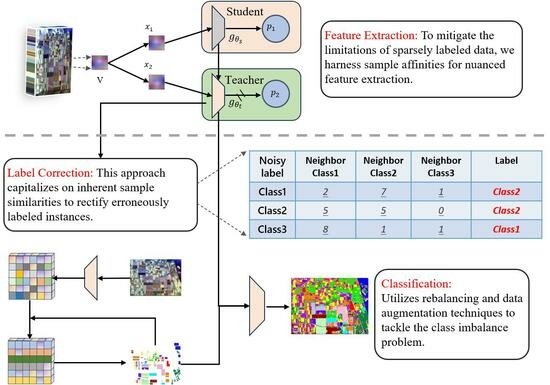
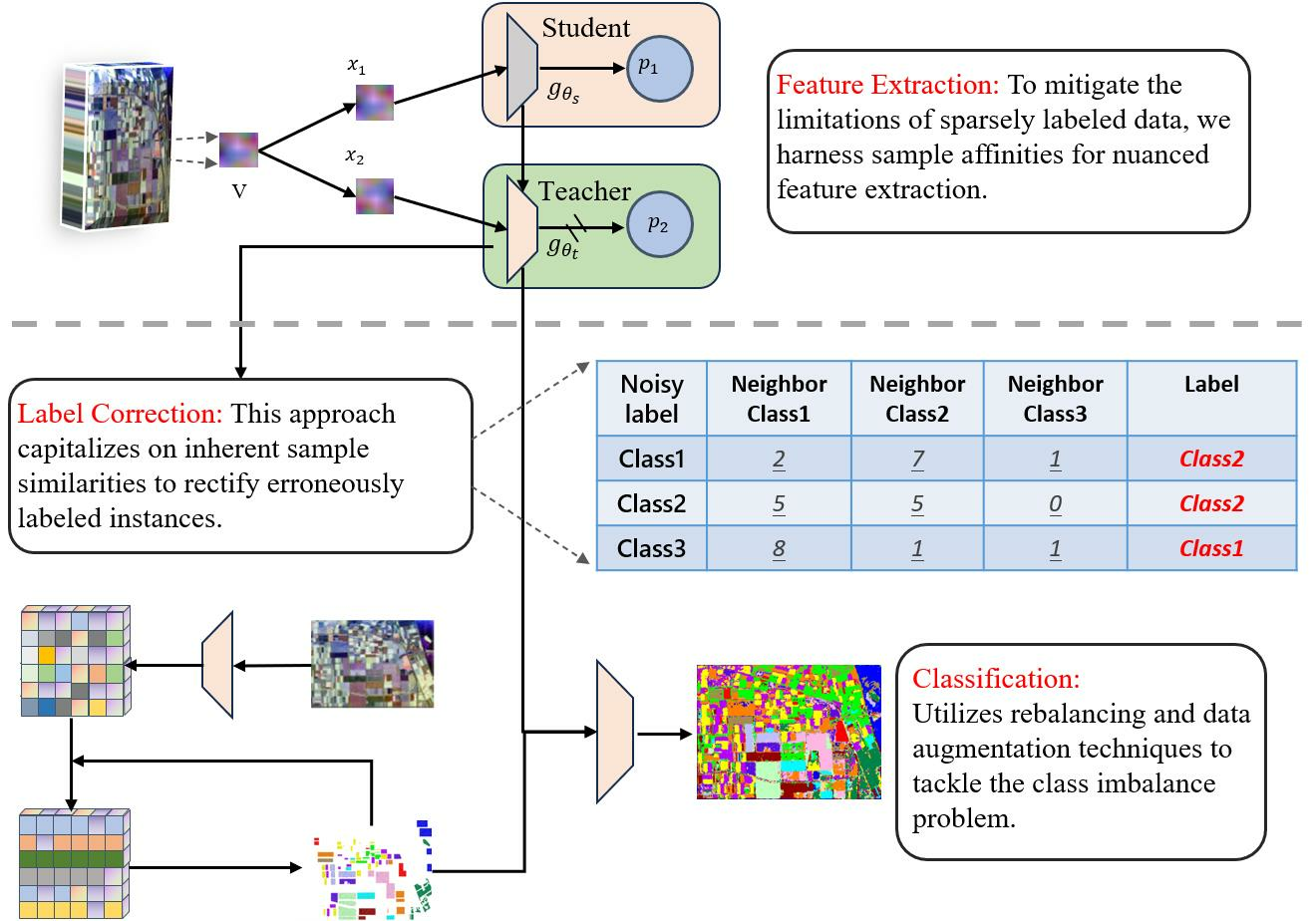
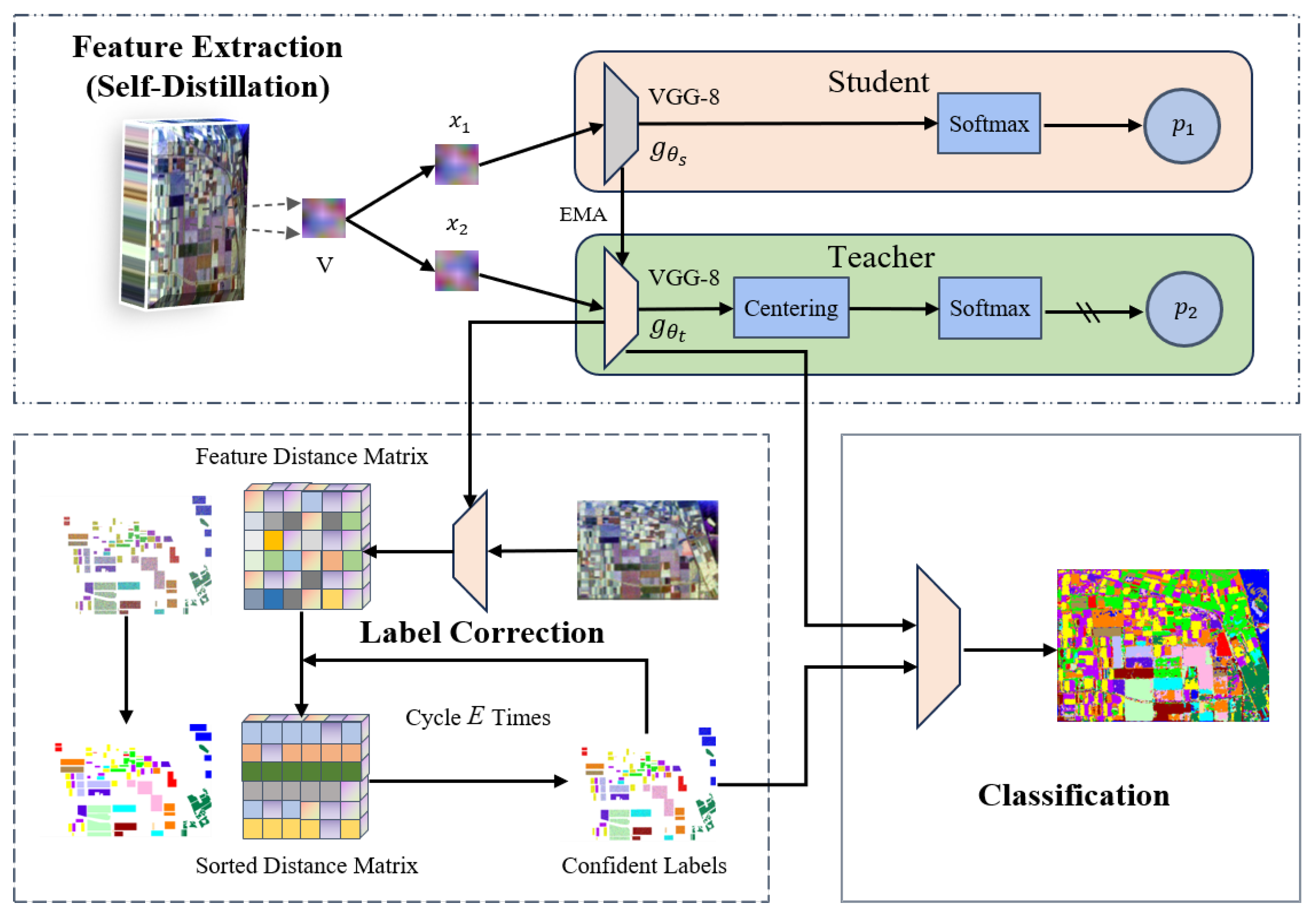
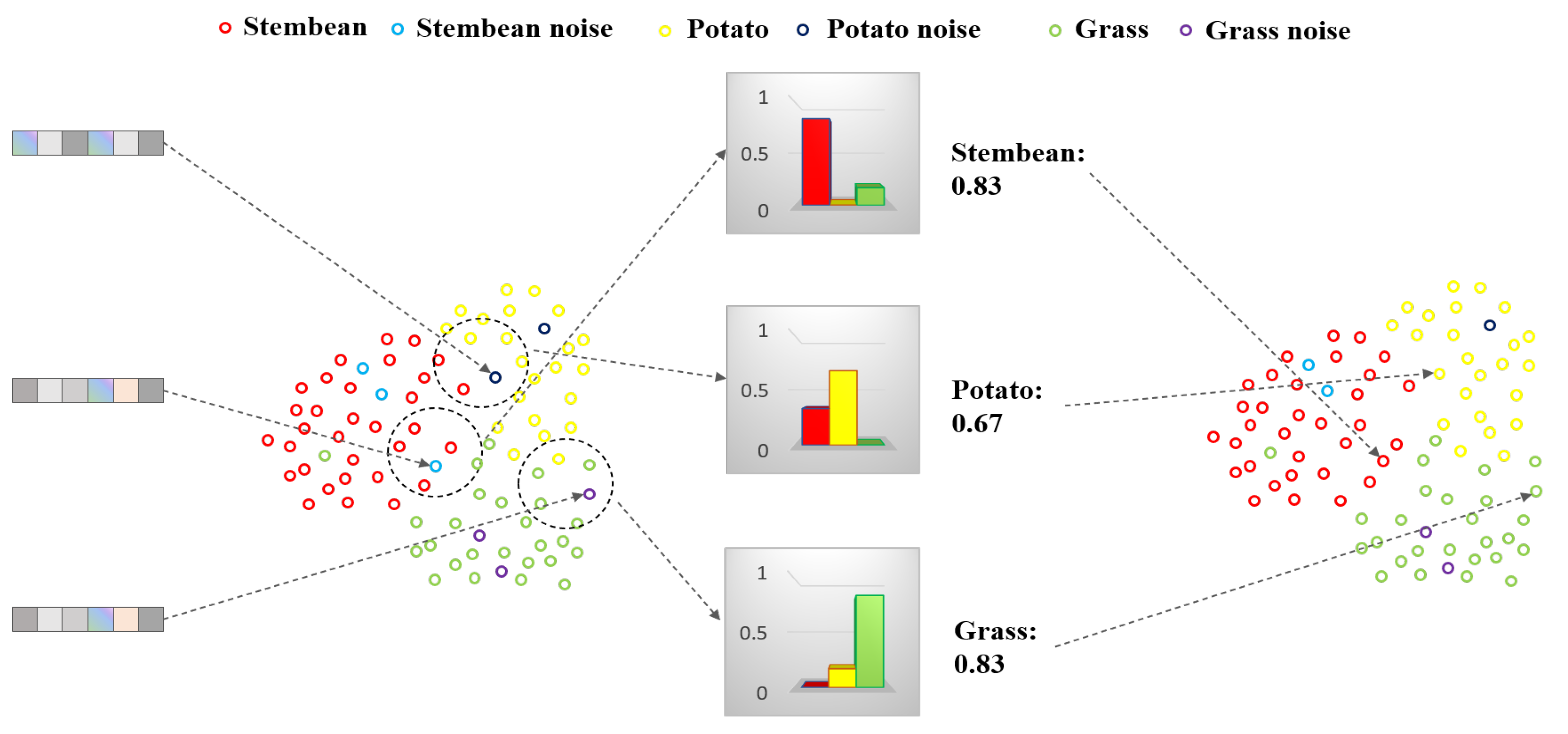
Polarimetric synthetic aperture radar (PolSAR) image classification, a field crucial in remote sensing, faces significant challenges due to the intricate expertise required for accurate annotation, leading to susceptibility to labeling inaccuracies. Compounding this challenge are the constraints posed by limited labeled samples and the perennial issue of class imbalance inherent in PolSAR image classification. Our research objectives are to address these challenges by developing a novel label correction mechanism, implementing self-distillation-based contrastive learning, and introducing a sample rebalancing loss function. To address the quandary of noisy labels, we proffer a novel label correction mechanism that capitalizes on inherent sample similarities to rectify erroneously labeled instances. In parallel, to mitigate the limitation of sparsely labeled data, this study delves into self-distillation-based contrastive learning, harnessing sample affinities for nuanced feature extraction. Moreover, we introduce a sample rebalancing loss function that adjusts class weights and augments data for small classes. Through extensive experiments on four benchmark PolSAR images, our approach demonstrates its effectiveness in addressing label inaccuracies, limited samples, and class imbalance. Through extensive experiments on four benchmark PolSAR images, our research substantiates the robustness of our proposed methodology, particularly in rectifying label discrepancies in contexts marked by sample paucity and imbalance. The empirical findings illuminate the superior efficacy of our approach, positioning it at the forefront of state-of-the-art PolSAR classification techniques.
Keywords: label correction; self-distillation contrastive learning; sample rebalancing; polarimetric synthetic aperture radar (PolSAR) image classification label correction; self-distillation contrastive learning; sample rebalancing; polarimetric synthetic aperture radar (PolSAR) image classification
Graphical Abstract