Article

Shallow-Guided Transformer for Semantic Segmentation of Hyperspectral Remote Sensing Imagery
1
School of Remote Sensing and Geomatics Engineering, Nanjing University of Information Science and Technology, Nanjing 210044, China
2
School of Geographical Sciences, Nanjing University of Information Science and Technology, Nanjing 210044, China
3
Qingdao Innovation and Development Base (Centre), Harbin Engineering University, Qingdao 266000, China
4
School of Electronic Information and Electrical Engineering, Huizhou University, Huizhou 516007, China
*
Author to whom correspondence should be addressed.
Remote Sens. 2023, 15(13), 3366; https://doi.org/10.3390/rs15133366
Submission received: 31 May 2023 / Revised: 26 June 2023 / Accepted: 28 June 2023 / Published: 30 June 2023

Abstract

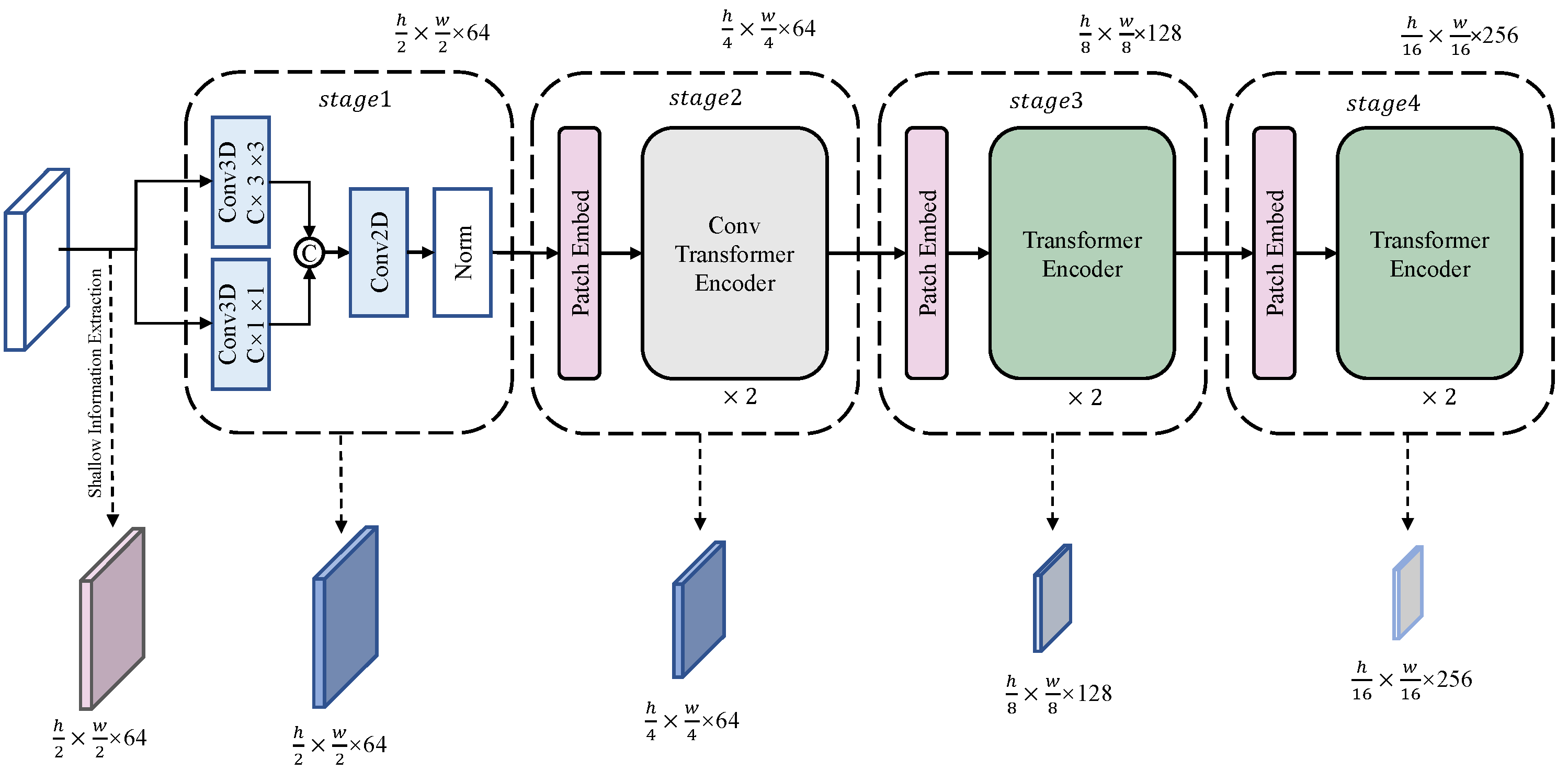
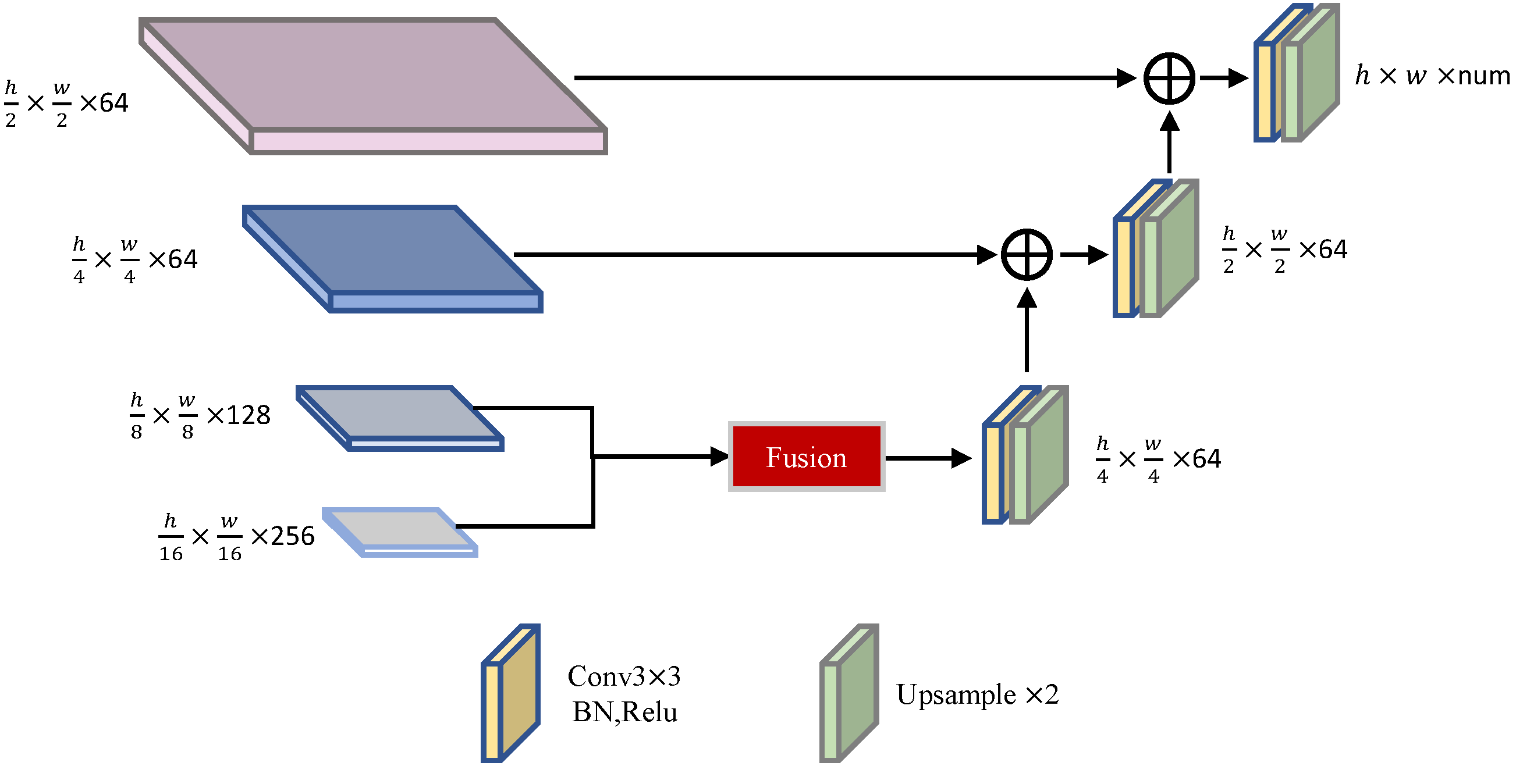
Convolutional neural networks (CNNs) have achieved great progress in the classification of surface objects with hyperspectral data, but due to the limitations of convolutional operations, CNNs cannot effectively interact with contextual information. Transformer succeeds in solving this problem, and thus has been widely used to classify hyperspectral surface objects in recent years. However, the huge computational load of Transformer poses a challenge in hyperspectral semantic segmentation tasks. In addition, the use of single Transformer discards the local correlation, making it ineffective for remote sensing tasks with small datasets. Therefore, we propose a new Transformer layered architecture that combines Transformer with CNN, adopts a feature dimensionality reduction module and a Transformer-style CNN module to extract shallow features and construct texture constraints, and employs the original Transformer Encoder to extract deep features. Furthermore, we also designed a simple Decoder to process shallow spatial detail information and deep semantic features separately. Experimental results based on three publicly available hyperspectral datasets show that our proposed method has significant advantages compared with other traditional CNN, Transformer-type models.
Keywords: vision transformer; convolutional neural networks (CNNs); feature representations; hyperspectral images (HSIs); semantic segmentation vision transformer; convolutional neural networks (CNNs); feature representations; hyperspectral images (HSIs); semantic segmentation