1. Introduction
In the atmospheric boundary layer (ABL), the wind air flow is always turbulent and can be represented as a set of random vortices of various scales, with cascade energy transfer from the largest vortices to small vortices, up to the dissipation of energy into heat. In the inertial subrange of the scales of these eddies, the local spatial structure of the wind flow depends only on the dissipation rate of the kinetic energy of turbulence. Information on the dissipation rate is important for studying the spatial structure of turbulence and the dynamics of ABL and for constructing a mathematical model of ABL designed to solve a wide range of practical problems (weather forecasting, air transport safety, diffusion of atmospheric impurities, etc.).
The advent of pulsed coherent Doppler lidars (PCDLs), providing high spatial and temporal resolution of wind velocity measurements—in particular, all-fiber PCDLs such as Stream Line (Halo Photonics, Brockamin, Worcester, United Kingdom) [
1] and WindCube 200s (Leosphere, France) [
2]—has led to great potential for the investigation of wind turbulence in the atmospheric boundary layer [
3,
4,
5,
6,
7,
8,
9,
10,
11,
12,
13,
14]. In Smalikho and Banakh’s work [
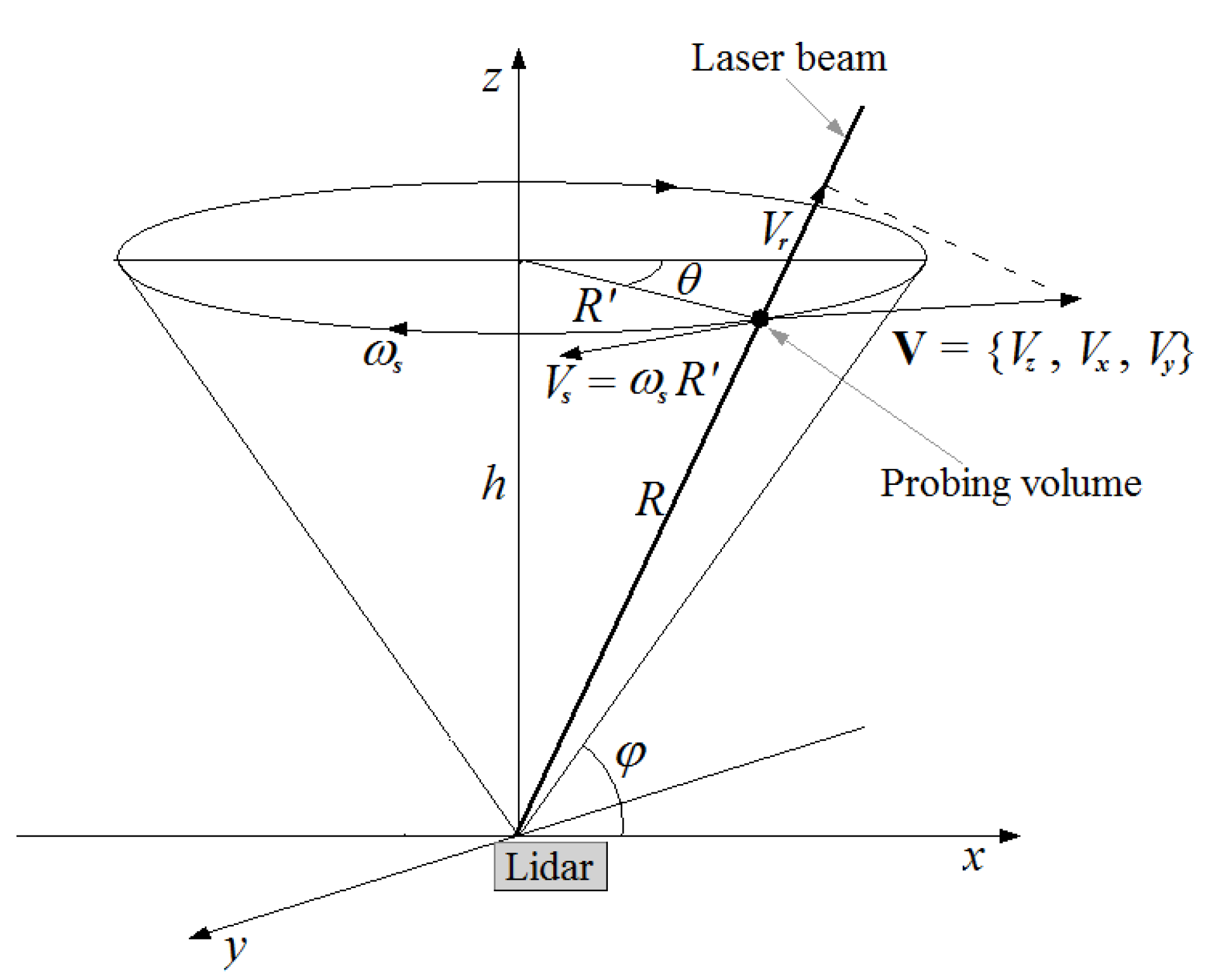
14], a method was proposed for the determination of such turbulence parameters as the turbulence kinetic energy, turbulence energy dissipation rate, integral scale of turbulence and momentum fluxes from lidar measurements with conical scanning (see
Figure 1 or the paper [
15]). In the case of conical scanning, a probing beam revolves around the vertical axis at an angle
to the horizontal, with a constant angular rate
ωs, and for every measurement height
, the probing volume moves along the circle of the radius
with a certain linear speed. It is shown in the authors’ work [
14] that estimates of the turbulence energy dissipation rate obtained from Stream Line lidar data using this method are in a good agreement with the dissipation rate estimates from the data of sonic anemometers.
An important feature of determination of the wind vector and wind turbulence parameters from lidar data is the need to consider the spatial averaging of the measured radial velocity over the probing volume. Just the consideration of spatial averaging provides for a correct estimation of the dissipation rate from lidar data [
14]. Even though the probing volume of the Stream Line lidar is small, its longitudinal dimension is
= 30 m [
16].
The method proposed in the authors’ work [
14] assumes that the mean wind velocity is much smaller than the linear speed of motion of the probing volume along the circle of the scanning cone base at the probing height
. However, at small measurement heights and in strong wind, this condition is not always fulfilled. In this paper, the method from the authors’ work [
14] is generalized to the case of an arbitrary ratio between the mean wind velocity and the linear scanning speed at the probing height. The method was tested in atmospheric experiments, and the results of these tests are presented.
2. Basic Equations for Estimation of the Turbulence Energy Dissipation Rate from Measurements by PCDL with Conical Scanning
In the case of conical scanning, after primary processing of PCDL echo signals, we obtain an array of estimates of the radial velocity
VL(
θm;
n) for different distances
from the lidar and azimuth angles
, where
, Δ
θ is the azimuth angle resolution,
= 360°, and
is the scan number. On the assumption that the wind is a stationary process (within one hour) and horizontally statistically homogeneous (within the circle of the scanning cone base), the mean wind vector
is estimated from the array
for the height
by sine-wave least-square fitting [
17]. Here,
is the vertical component of the wind velocity vector
,
,
are its horizontal components, and the angular brackets are for the ensemble averaging. Then, the array of random components of the lidar estimates of radial velocities is calculated for the same height
h as
where
is the unit vector along the optical axis of the probing beam and
is the average over
N scans. This array is used to calculate the azimuth structure function
of radial velocity fluctuations (the function averaged over all azimuth angles
) by the following equation:
where
.
During scanning, the center of the probing volume moves at a level
along the circle of the radius
and passes the distance
for one scan. The linear speed of the probing volume along this circle is
, where
is the angular scanning rate, and
is the duration of one scan. According to
Figure 1, the linear scanning speed
depends on the height
, elevation angle
, and time
as
We introduced the parameter
, where
is the mean wind speed,
. It was shown in the authors’ work [
14] that, under the condition
, when the transport of turbulent inhomogeneities by the mean wind can be neglected in comparison with the linear scanning speed, the azimuth structure function (ensemble average) of radial velocity measured by a conically scanning PCDL can be represented in the form
In Equation (4), is the transverse dimension of the probing volume (separation between the centers of neighboring probing volumes on the circle of the scanning cone base at the height ), is the transverse spatial structure function of the radial velocity averaged over the probing volume, is the turbulence energy dissipation rate, and is the instrumental error of the radial velocity estimate. Equation (4) is valid for distances within the inertial subrange , where is the integral scale of turbulence, and under the condition = 9°.
According to Equation (20) in [
14], the function
can be represented in the form
where
is the longitudinal transfer function of the low-pass filter,
is the transverse transfer function of the low-pass filter,
,
,
is the speed of light,
,
is the probing pulse duration,
is the time window width, and
[
18]. In our measurements by the Stream Line lidar,
= 15.3 m and
= 18 m.
Equation (21) in the authors’ work [
14] is used to estimate the turbulence energy dissipation rate under the condition
μ = 0 (
). Let the method for estimation of the dissipation rate by Equation (21) in [
14] be called Method 1 and the estimate of the dissipation rate by Method 1 be designated as
. The method for estimation of the dissipation rate with regard to the transport of turbulent inhomogeneities by the mean wind at
is referred to as Method 2 and the corresponding estimate of the dissipation rate by Method 2 is designated as
.
By analogy with [
14], we represent the estimate of the dissipation rate in the form
where
. The subscripts
and 2 correspond to Methods 1 and 2, respectively. The function
is calculated by Equations (5)–(8) while the function
is calculated by the following equation (the derivation can be found in
Appendix A):
where the integration is performed with respect to the azimuth angle
θ,
It follows from Equations (10)–(13) that at
,
and the ratio of lidar estimates of the dissipation rate by Methods 1 and 2,
is close to unity. The analysis of Equations (10)–(13), taking into account Equations (6)–(8), shows that at fixed
and
, the ratio
depends on the elevation angle
φ. At
μ > 1, the ratio
increases with an increase in
and can be many times larger than unity. The smaller
is, the larger ratio
, if the condition
is not fulfilled.
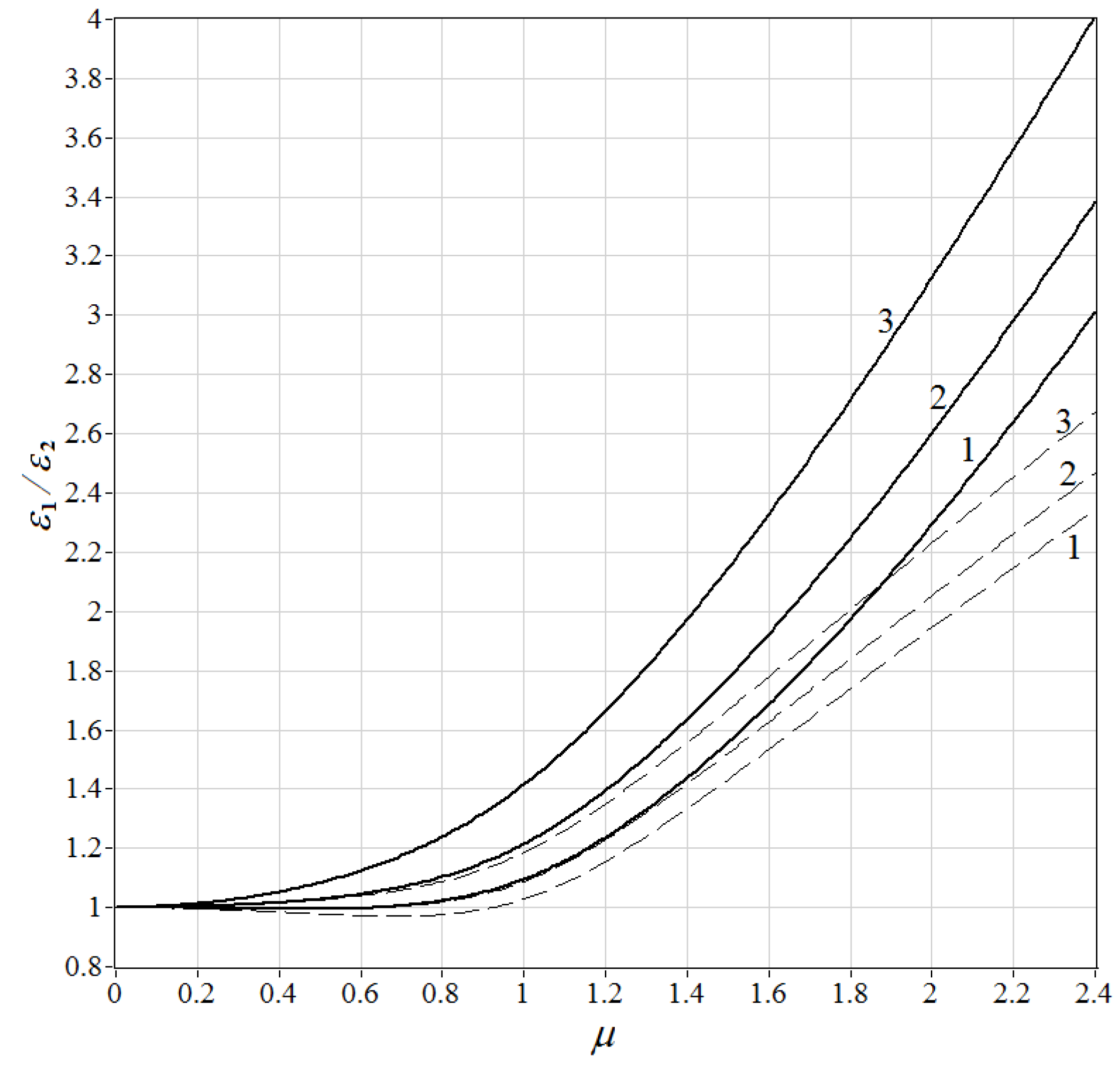
Figure 2 shows the ratio of the estimates of the dissipation rate
ε1/
ε2 as a function of the parameter
μ, as calculated by Equations (10)–(13) and Equations (6)–(8) at different elevation angles
and distances
. It follows from
Figure 2 that the ratio
ε1/
ε2 begins to exceed unity markedly at
, ranging from 0.55 (
= 60°,
= 3 m) to 1.1 (
= 16°,
= 12 m), depending on the scanning parameters. An increase in
leads to a decrease in the ratio
. The larger
is, the faster the increase of
with an increase in
μ. Thus, at
= 60°,
= 3 m and
= 2.4, the estimate of the dissipation rate by Method 1 exceeds that obtained by Method 2 by four times. Consequently, calculations by Equations (10)–(13) allow us to determine the limits of applicability of the approach proposed in the authors’ work [
14] (Method 1) at different
and
.
Equations (5)–(13) were used for analysis of the results obtained in experiments on the study of turbulence in the atmospheric boundary layer and were verified in the special experiment.
3. Experiment 2018
The experiment was conducted on 6–24 July 2018, at the Basic Experimental Observatory (BEO) of the Institute of Atmospheric Optics SB RAS in Tomsk, Russia (56°06′51.41″N, 85°06′03.22″E), with the Stream Line PCDL. In this experiment, the scanning was carried out at two alternative elevation angles:
=
= 35.3° and
=
= 60° [
19]. The turbulence energy dissipation rate was estimated in this experiment by Method 1 [
14] from the azimuth structure function, calculated for horizontal separations
not exceeding the integral scale of turbulence, which corresponds to the inertial subrange of turbulence. In this case, according to the Kolmogorov–Obukhov hypotheses, estimates of the dissipation rate calculated from lidar measurements at different elevation angles
and
for the same height should coincide. However, this turned out to not quite be the case. In the atmospheric layer at heights of 200–300 m (see Figure 5b in authors’ work [
18]), the estimates
and
differed little on average. However, at heights below 150 m,
far exceeded
.
The estimates of the dissipation rate in the authors’ work [
19] were obtained by Method 1 [
14], where the transport of turbulent inhomogeneities by the mean wind is neglected. Therefore, this neglect may be a possible reason for an excess of
over
at small heights
, where the speed of motion of the probing volume during the conical scanning at an elevation angle of 60° can be far smaller than the mean wind velocity. To check this hypothesis, we took the raw data measured by the lidar from 19:40 local time (LT) on 23 July 2018 to 08:20 LT on 24 July 2018, at elevation angles
φ1 = 35.3° and
= 60° at the height
= 70 m. In the experiment in the authors’ work [
19], the duration of one scan
was 60 s. At this scan duration, the speed of motion of the probing volume
(Equation (3)) at a height of 70 m was 10.4 m/s and 4.2 m/s at elevation angles of 35.3° and 60°, respectively.
With regard to the short time
δt ≈ 1 s needed for alternation of the elevation angle between 35.3° and 60°, the duration of one cycle
in the experiment [
19] exceeded 2 min by a little. The azimuth resolution was Δ
θ = 360°/
M = 3°, where
= 120 is the number of radial velocity estimates for one scan,
= 0.5 s is the time of measurement for estimation of the radial velocity for every azimuth angle,
= 7500 is the number of laser shots used for the raw data accumulation, and
= 15 kHz is the pulse repetition frequency for the Stream Line lidar. From the lidar measurements at these parameters, we calculated the mean wind velocity
and
by the sine-wave fitting and the dissipation rate
and
by Methods 1 and 2 using Equations (1), (2) and (5)–(13). We used
= 20 scans to estimate the mean velocity and the azimuth structure function by Equation (2). The duration of the measurements at two alternative elevation angles was a little longer than 40 min. Since Δ
θ = 3°, we took
= 3 in Equation (5). For the mean velocity, we obtained practically coinciding estimates for
U(
φ1) and
.
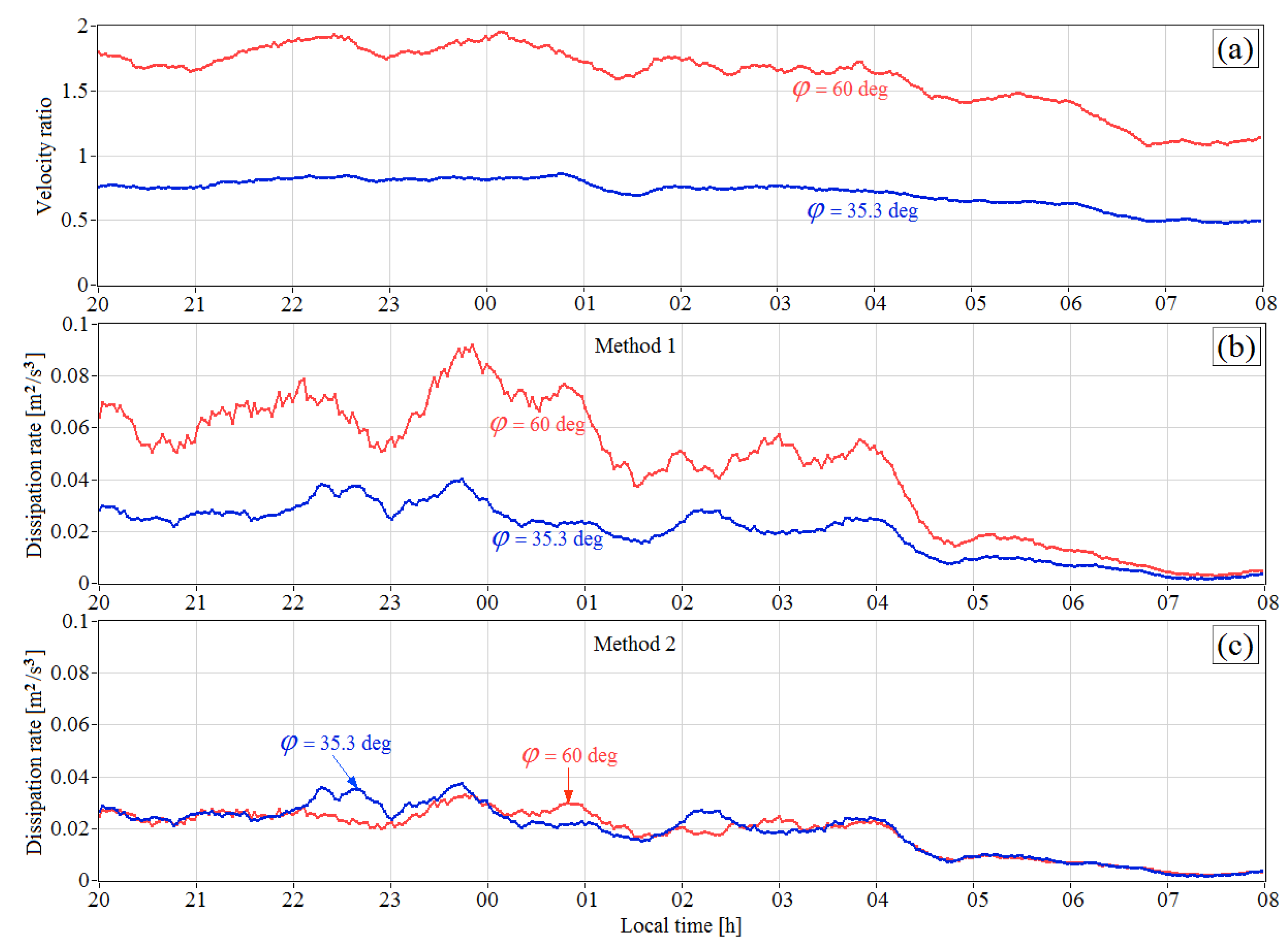
Figure 3 depicts the time series of the velocity ratio
and turbulence energy dissipation rate
calculated by Methods 1 and 2 for elevation angles of 35.3° (
= 1) and 60° (
= 2) at the height
h = 70 m. It can be seen that, at an elevation angle of 35.3°, the parameter
ranges from 0.5 to 0.8. According to curve 2 in
Figure 2, the results of estimation of the dissipation rate by Methods 1 and 2 should not differ widely in this case. At an elevation angle of 60°, the parameter
exceeds unity and can achieve 1.9. In this case, according to curve 2 in
Figure 2, Method 1 can overestimate the dissipation rate by more than double.
Figure 3b confirms this conclusion. If Method 2 is used, the estimates of the dissipation rate at elevation angles of 35.3° and 60° coincide on average (see
Figure 3c). This fact indicates indirectly the applicability of Method 2 for determination of the turbulence energy dissipation rate from measurements by a conically scanning lidar at an arbitrary ratio between the mean wind velocity and the linear speed of motion of the probing volume.
4. Experiment 2019
The lidar experiment on the study of turbulence of the statically stable boundary layer was conducted in the coastal zone at the western coast of Lake Baikal near Listvyanka (52°50′47″N, 104°53′31″E) on 7–24 August of 2019. During this experiment, the Stream Line PCDL was installed at the territory of the Baikal Astrophysical Observatory of the Institute of Solar-Terrestrial Physics SB RAS, a few tens of meters from the building of the Big Solar Vacuum Telescope at a height of 180 m above the Baikal level, with a minimal separation of 340 m from the lake (see Figure 4 in authors’ work [
15]). A sonic anemometer AMK-03 (Sibanalitpribor, Tomsk, Russia) with a sampling rate of 80 Hz was installed 50 m from the lidar at the top of a mast, at a height of 15 m above the lidar level. The lidar measurements were conducted with conical scanning at the elevation angle
= 60°. The scanning duration and the azimuth resolution were the same as in experiment 2018 and amounted to
= 1 min and
= 3°, respectively.
In the experiment, a part of the lidar data was obtained under strong wind in the lower 100 m of the atmospheric layer above the lidar level. In particular, from 20:00 LT of 19 August to 02:30 LT of 20 August, the measurements were conducted at mean wind velocity
U at a height of 55 m, ranging from 8 m/s to 12.7 m/s. The linear speed of the probing volume motion at a height of 55 m in the case of scanning at an elevation angle of 60° is
= 3.3 m/s. We used these data to check Method 2 in terms of its estimation of the turbulence energy dissipation rate. To obtain estimates of the mean velocity and the dissipation rate
and
ε2 (respectively, by Methods 1 and 2) by Equation (9), in Equations (1) and (2), we set
= 30 consecutive scans (30 min average). The same 30 min average was applied to obtain estimates of the mean wind velocity and the turbulent energy dissipation rate from measurements of the sonic anemometer. We obtained dissipation rate estimates
from temporal structure function
of the longitudinal component of the wind velocity vector measured by the sonic anemometer, where 1 s
3 s, with the use of Taylor’ hypothesis of “frozen” turbulence (see Equation (26) in authors’ work [
14]).
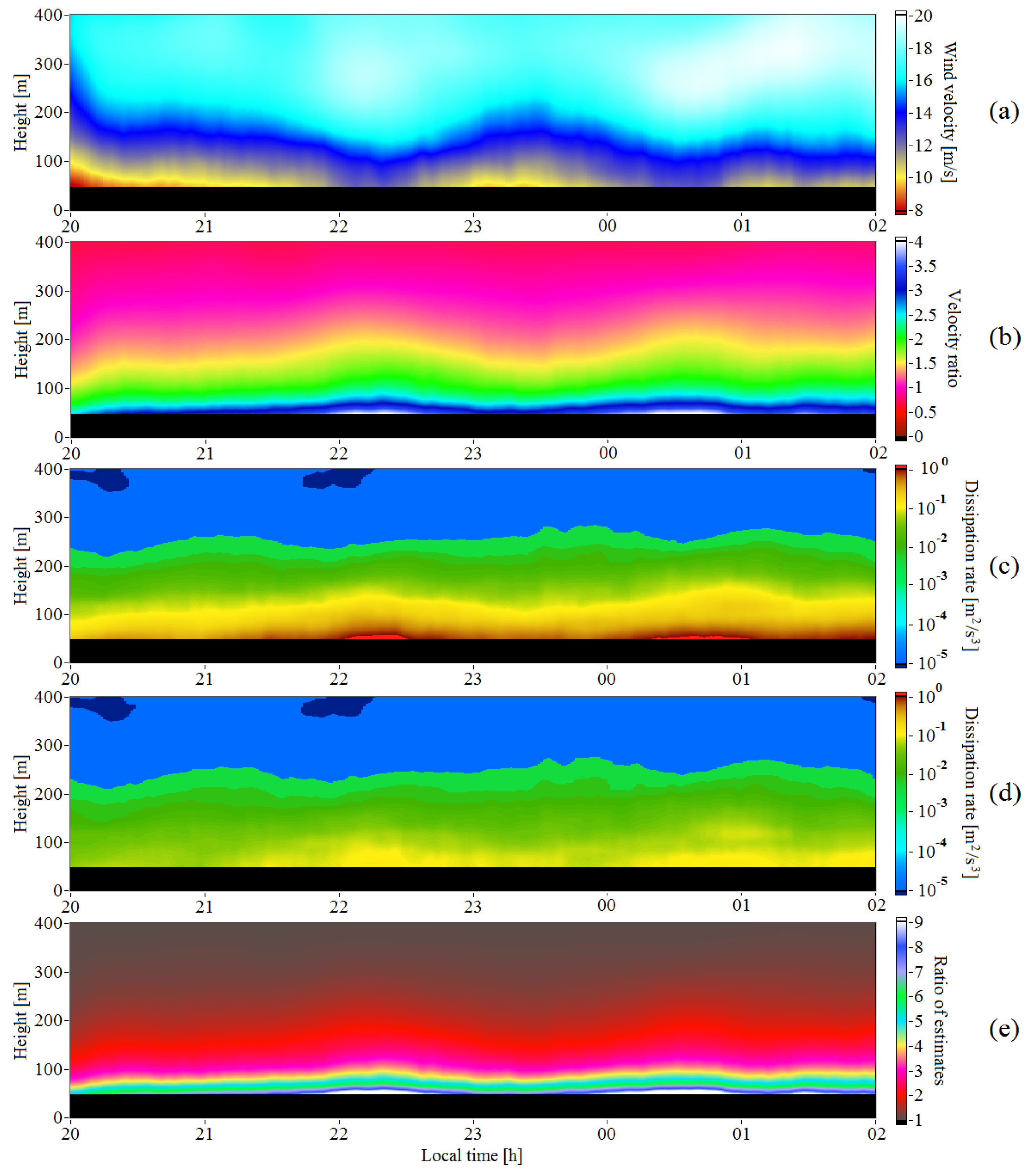
Figure 4 demonstrates the results obtained from the lidar measurements. One can see (
Figure 3e) that the estimate
can exceed the estimate
by an order of magnitude.
Using the data from
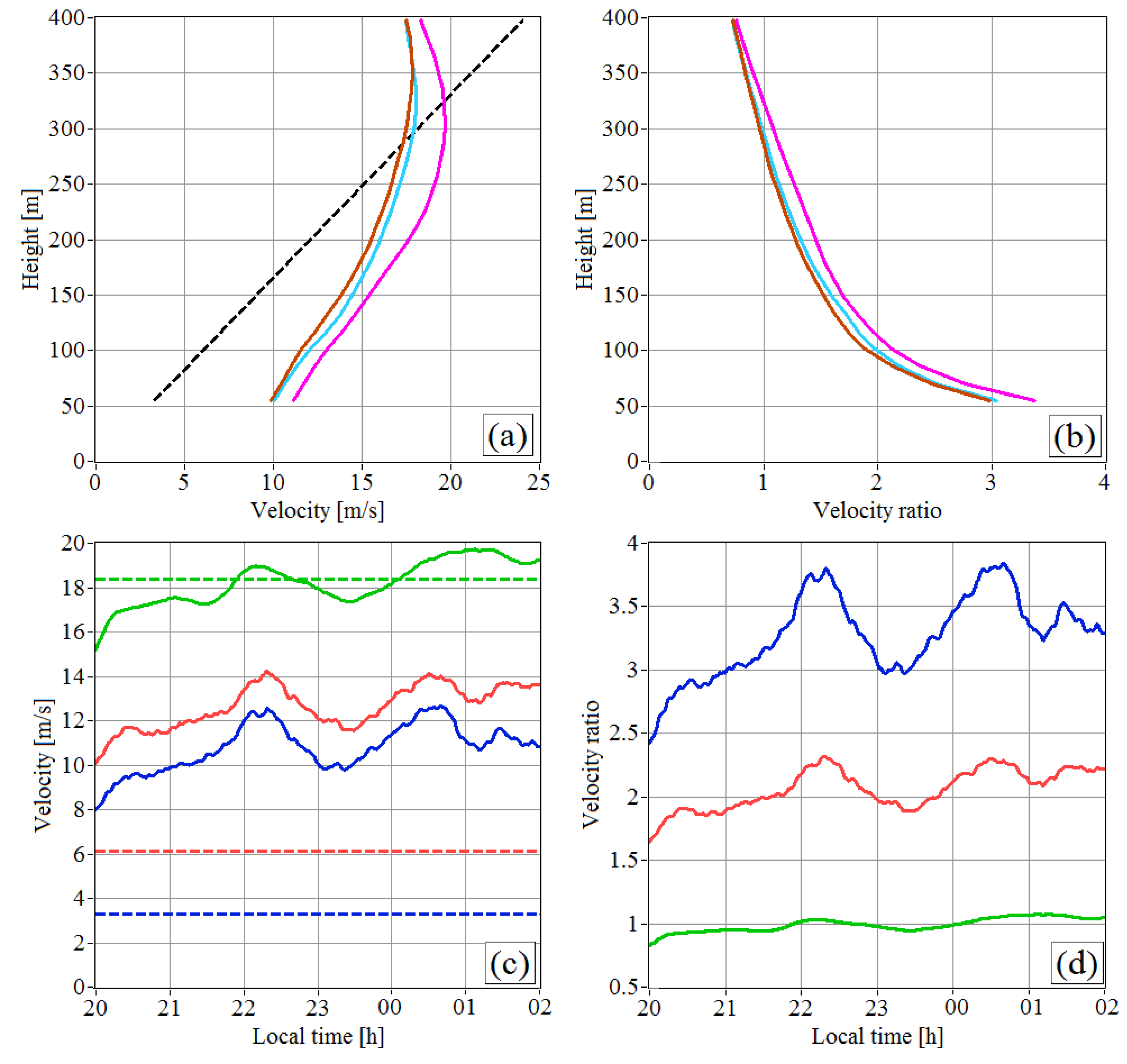
Figure 4a,b, we drew the vertical and temporal profiles of the mean wind velocity
and the velocity ratio
, which are shown as solid curves in
Figure 5. The dashed straight lines in this figure correspond to the linear scanning speed
at different heights
h. We can see that, in the 300 m layer adjacent to the ground, the parameter
decreases with height despite an increase in the velocity
. Above
= 300 m, this parameter takes on values at which the estimates of the dissipation rate
and
differ a little from each other. At the height
h = 55 m, the parameter
at its maximum approaches four (see the blue curve in
Figure 5d), while
ε1 becomes an order of magnitude larger than
.
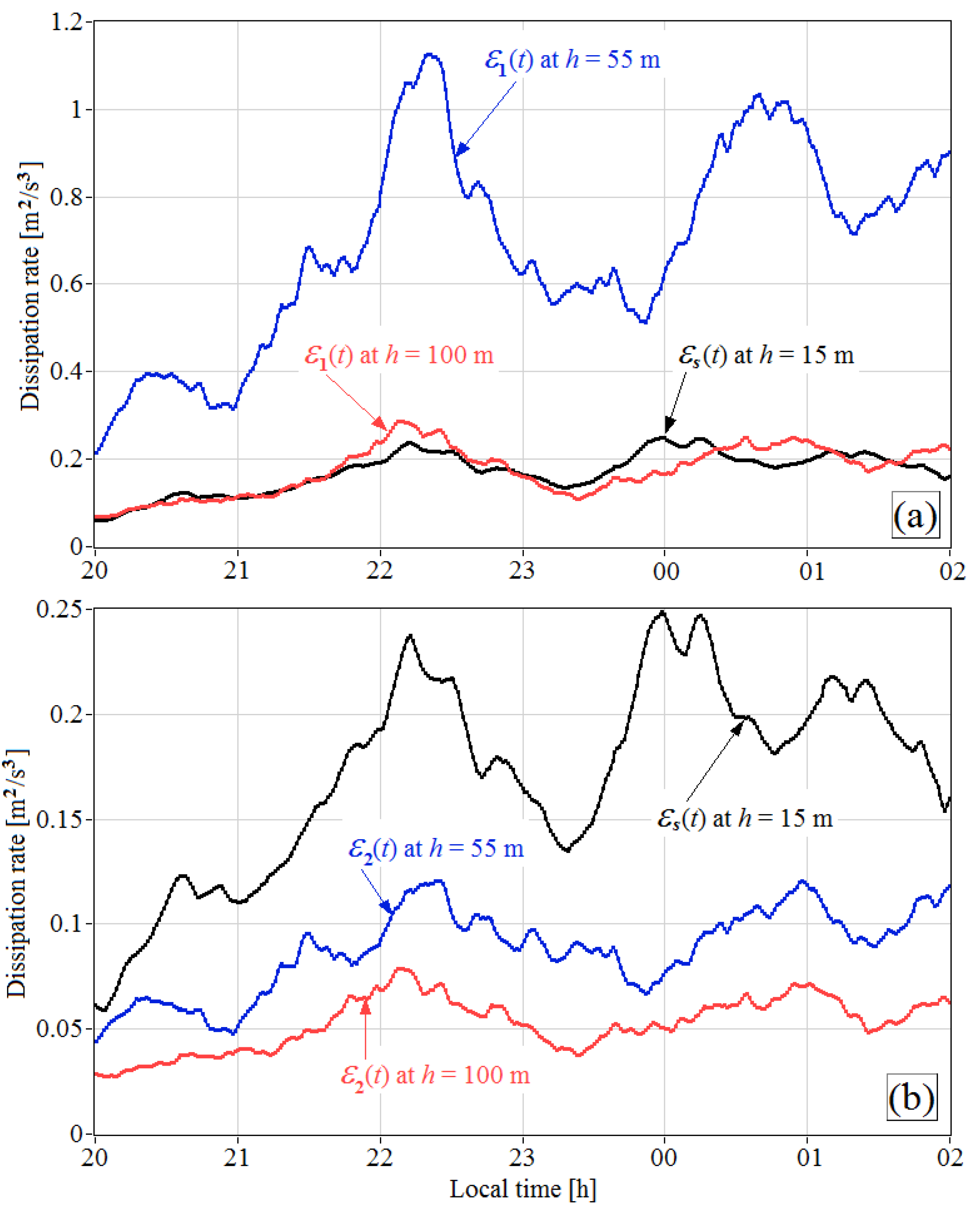
Figure 6 shows the time series of the dissipation rate estimates
and
obtained from lidar data with Methods 1 and 2, respectively, at heights of 55 m and 100 m, along with
calculated from the data measured by the sonic anemometer at a height of 15 m. One can see that if the transport of turbulent inhomogeneities by the mean wind is neglected (Method 1), then the estimates
at a height of 100 m are close to the estimates
at a height of 15 m, while those at a height of 55 m exceed by approximately five times the estimates obtained from the sonic anemometer measurements at a height of 15 m. Although the measurements were conducted under strong wind and intense turbulence, the estimates
1 m
2/s
3 obtained from the lidar data at a height of 55 m and
0.2 m
2/s
3 at a height of 100 m are obviously overestimated.
The use of Method 2 for estimation of the dissipation rate from the lidar data provides the more likely result (
Figure 6b). At heights of 55 m and 100 m, the dissipation rate takes on smaller values than those calculated for the height
h = 15 m from the sonic anemometer data. They decrease with height and are comparable in terms of the absolute value with the known experimental data (see, for example, [
20,
21]).
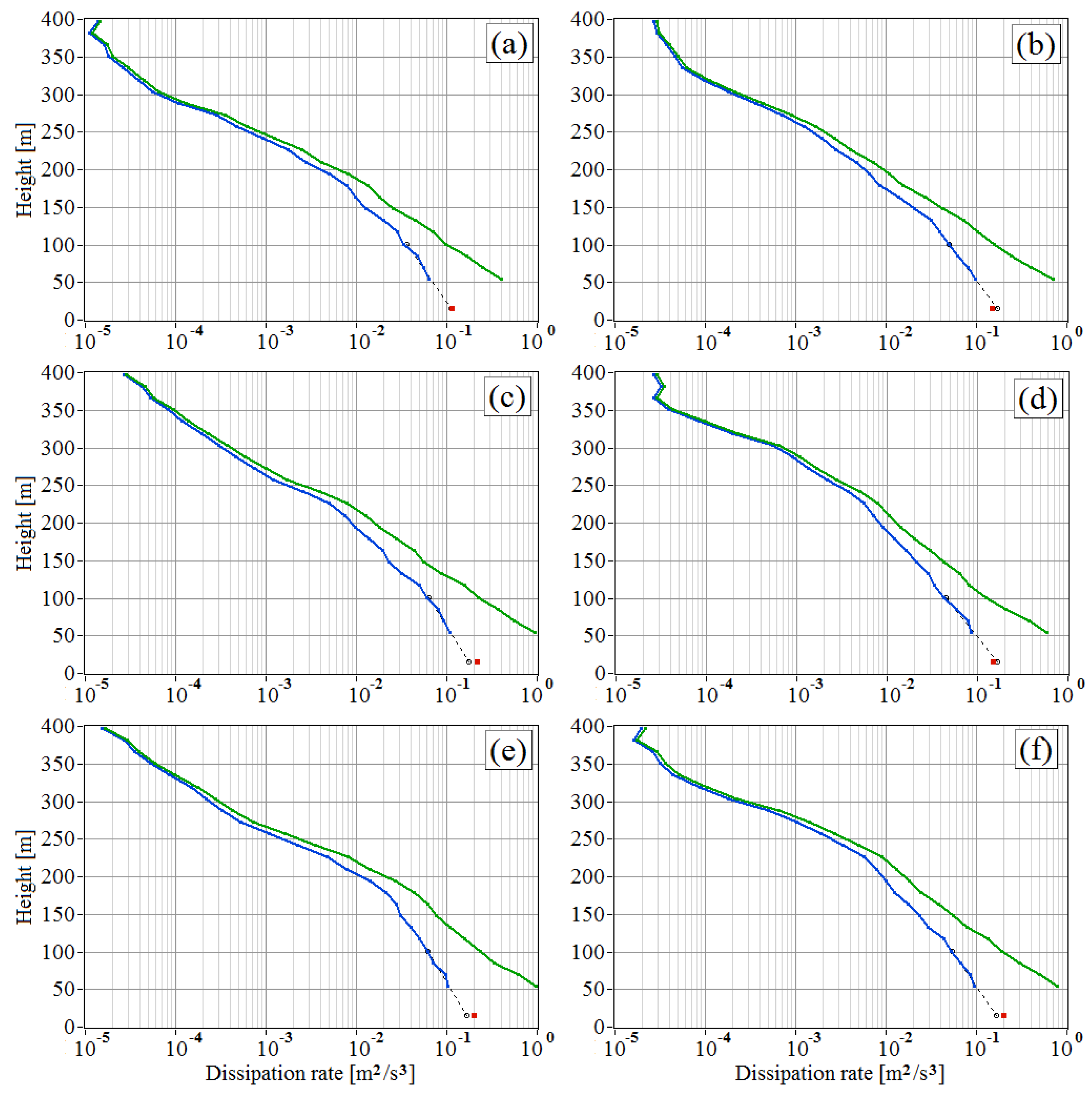
The vertical profiles of the estimates of the turbulent energy dissipation rate obtained from the lidar data with Methods 1 and 2 are shown in
Figure 7 as green and blue curves, respectively. It can be seen from
Figure 7e that, at a height of 55 m, the estimate
is ten times larger than the estimate
. Red squares indicate the estimates of the dissipation rate from measurements by the sonic anemometer at a height of 15 m. In this experiment, the minimum height of measurement by the lidar is
55 m and the height step is
15 m. To compare the estimates of the dissipation rate
(Method 2) and
obtained from measurements, respectively, with the lidar and sonic anemometer at a height of
= 15 m, we used the extrapolation of the height profile
(
;
) from the layer of 55–100 m to the height
hs as follows. First, for each vertical profile
shown in
Figure 7 within the layer 55–100 m, we used a linear fitting of
, where
is the slope and
is the intercept, to lg(
ε2(
hk)), by the least squares method. We then calculated values
for the height of the sonic anemometer position. In
Figure 7, in the 15–100 m layer, the dashed lines show the profiles
, where
. Calculations of the value
showed that it does not exceed 20%. Thus, if, in the 15–100 m layer, the vertical profile
has a height dependence which is close to linear, the lidar estimates of the dissipation rate obtained by Method 2 are in good agreement with the results of measurements with the sonic anemometer (at least, the discrepancy of the results are within the statistical error, examples of which are given below).
5. Experiment 2020
An experiment focusing on the testing of Method 2 for estimation of the turbulent energy dissipation rate from the data measured by a conically scanning PCDL was carried out in May 2020 at the territory of the BEO. Continuous lidar measurements were performed in two stages: (1) from 10 to 15 May and (2) from 19 to 26 May 2020. The results of estimation of the dissipation rate by Methods 1 and 2 in the experiment were compared with the estimates from the data of the sonic anemometer AMK-03 with sampling rate of 80 Hz (Sibanalitpribor, Tomsk, Russia), installed on a 43 m tower with boom length of 2 m at a height of 42 m. The separation between the Stream Line lidar and the tower was 160 m.
The elevation angle was set equal to 16° in the measurements, so that the center of probing pulses achieved the height = 42 m at the distance = 152 m from the lidar. At a height of 42 m, the radius and the length of the scanning circle were R′ = Rcosφ = 146 m and = 918 m, respectively. The scan duration was set to 5 min. The linear speed of motion of the probing volume along the scanning circle was 3 m/s. To estimate one value of the radial velocity, = 15,000 laser shots were used for the raw data accumulation, so that the duration of measurement for every azimuth angle was = 1 s. For one scan, we obtained = 300 estimates of the radial velocity at different azimuth angles (300 rays), with the resolution = 360°/M = 1.2° and the distance between them along the circle (between centers of probing volumes) 3 m.
To obtain estimates of the mean wind velocity and the dissipation rate ε1 and (by Methods 1 and 2, respectively) using Equation (9), for the averages in Equations (1) and (2), we used = 7 consecutive scans (approximately 35 min average). In Equation (9), we took = 3. The estimates of the dissipation rate from measurements by the sonic anemometer were determined from temporal spectra of the longitudinal (along the mean wind direction) component of the wind vector within the inertial subrange from 0.2 to 2 Hz, where the spectrum was characterized by the “-5/3” power dependence on frequency, with the use of Taylor’s “frozen” turbulence hypothesis. In addition, the dissipation rate was estimated with the use of the time series of the wind velocity measured by the sonic anemometer for 35 min.
However, we were able to use the data of the sonic anemometer measured only at a certain interval of wind direction angles, due to the distortions (shading) introduced by the mast. Therefore, in the first part of the experiment (from 10 May to 15 May), only those raw data of the sonic anemometer were suitable for further processing, and these were measured within a period of 17.5 h, starting at 07:40 local time on 13 May 2020.
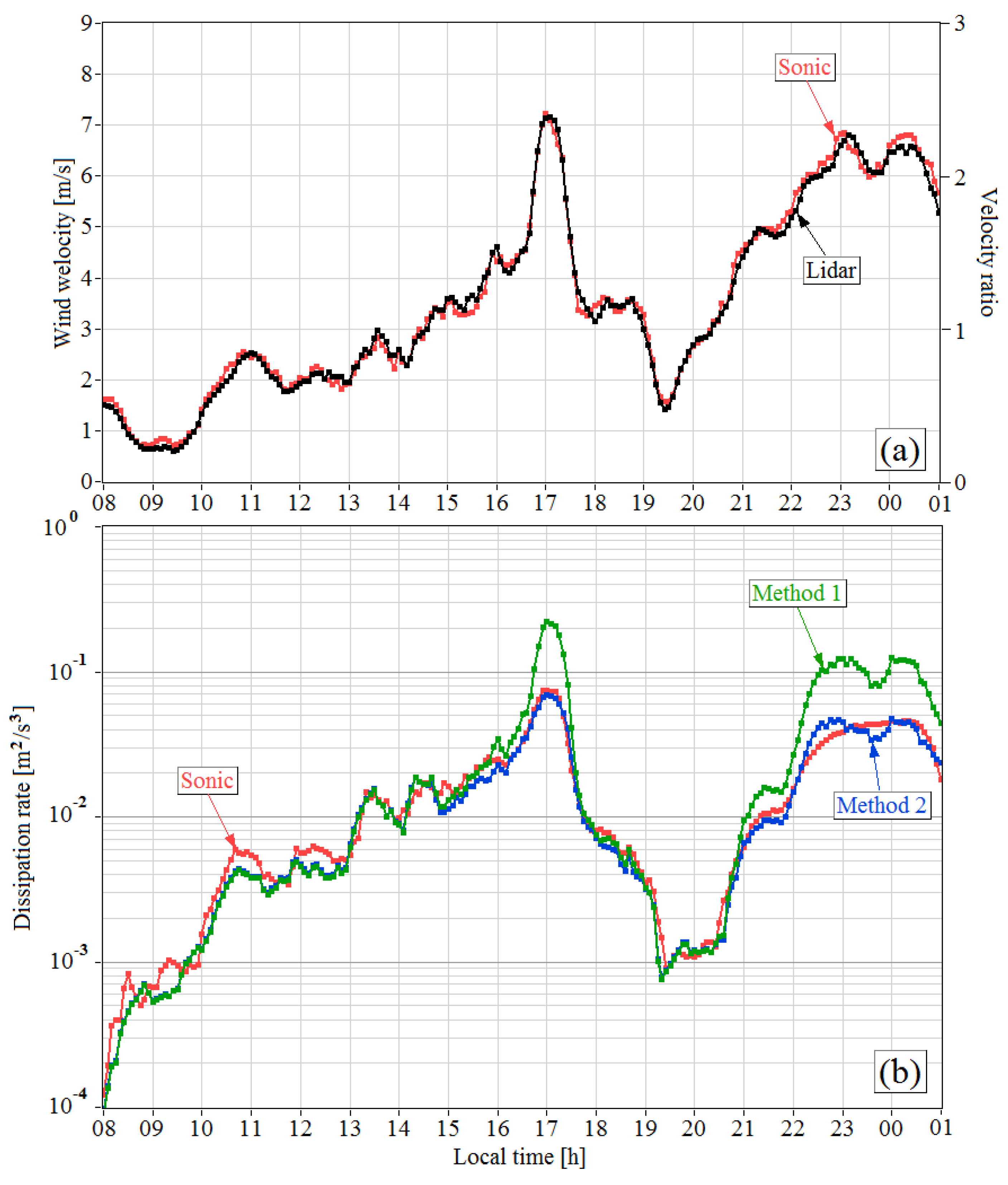
Figure 8 exemplifies the time series of the mean wind velocity obtained from measurements by the lidar
U and by the sonic anemometer
for 17.5 h starting from 07:40 LT on 13 May 2020. One can see that approximately half of the time, the mean wind velocity
(
) exceeded the linear speed of motion of the probing volume
= 3 m/s. It can be seen that the greatest difference between the estimates of the dissipation rate by Methods 1 and 2 was observed at
, which is in agreement with the calculated results shown in
Figure 2. It follows that the estimates of the dissipation rate obtained by Method 2 from the lidar data and from the sonic anemometer data are in good agreement at all values of the velocity ratio
given in
Figure 8a. The application of Method 1 would lead to a threefold overestimation of the dissipation rate at 17:00 LT.
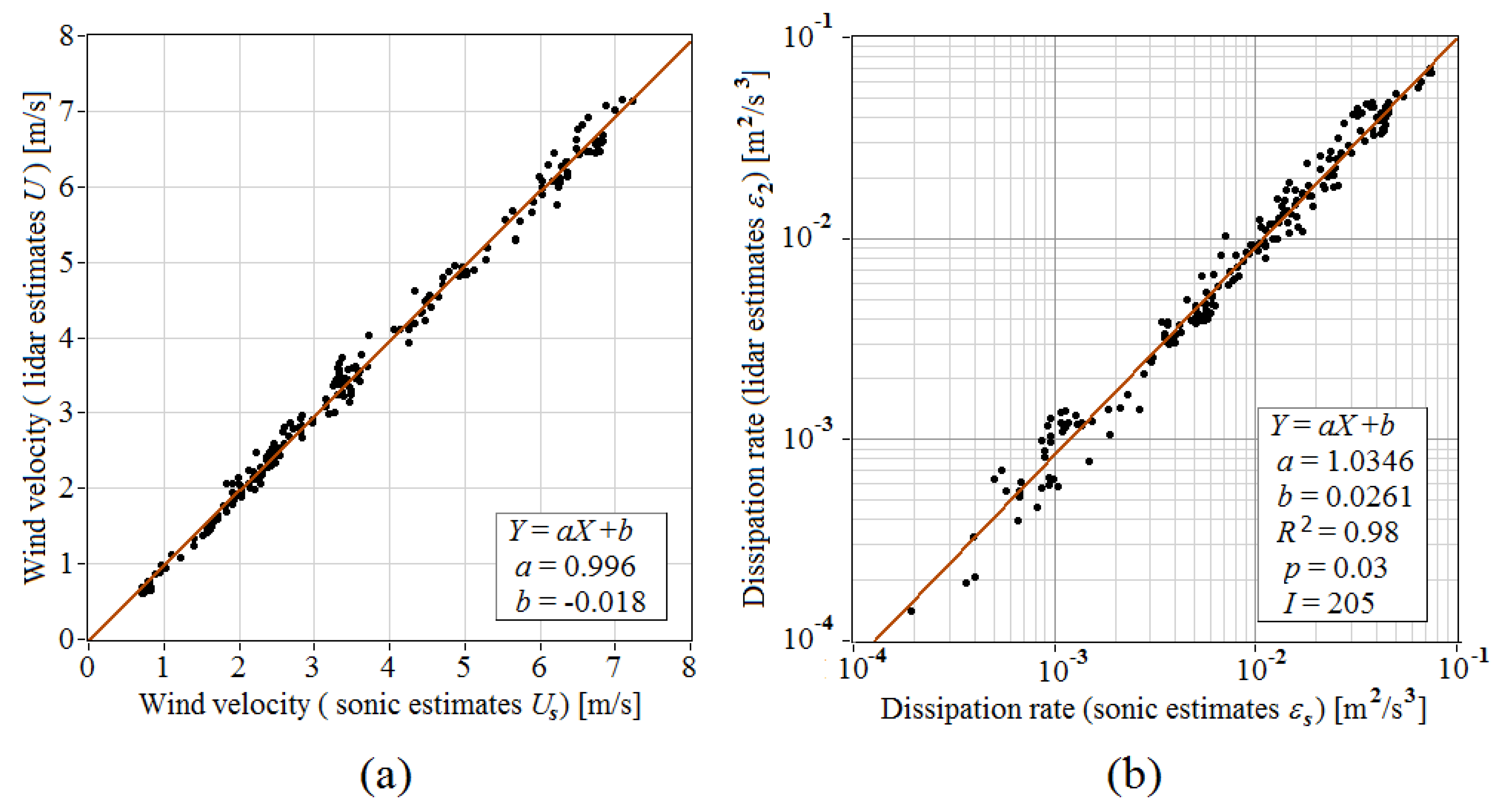
Using the data of
Figure 8, we compared the estimates of the mean wind velocity and the dissipation rate from simultaneous measurements by the sonic anemometer (
and
εs) and the lidar (
and
). The results of this comparison are shown in
Figure 9. On the assumption of statistical independence of the estimates and equal errors in estimation of the mean wind velocity from lidar data
and from sonic anemometer data
, as well as statistical independence of the estimates and equal errors in estimation of the dissipation rate
and
, we calculated the relative bias
and the relative error
of estimation of the wind velocity along with the relative bias
and the relative error
of estimation of the dissipation rate. The operator
means an average over all pairs of estimates (
,
) or (
ε2,
εs), where
is the number of such pairs. To calculate
and
ηε = (
ε2 −
εs)/[(
ε2 +
εs)/2], we used the data of
Figure 9a,b, respectively. Thereby, from the data of
Figure 9, we obtained
= −2%,
EU = 4%,
= −9%, and
Eε = 14%.
Using data from
Figure 9b, we found that the coefficient of correlation between log(
εs) and log(
ε2) equals 0.987; the results of linear regression are
= 1.0346 and
= 0.0261 (
, where
Xi = lg(
εs),
,
,
= 205,
and
b are the slope and intercept of this linear equation); the coefficient of determination
= 0.98 and
p-value as a measure of statistical significance equals 0.03.
In the second part of the experiment (measurements from 19 May to 26 May 2020), the wind direction was continuous for 62 h so that there was no distortion of the wind data due to “shading” by the mast on which the sonic anemometer was installed. Consequently, we were able to compare the results of measurements by the lidar and sonic anemometer for this period of time.
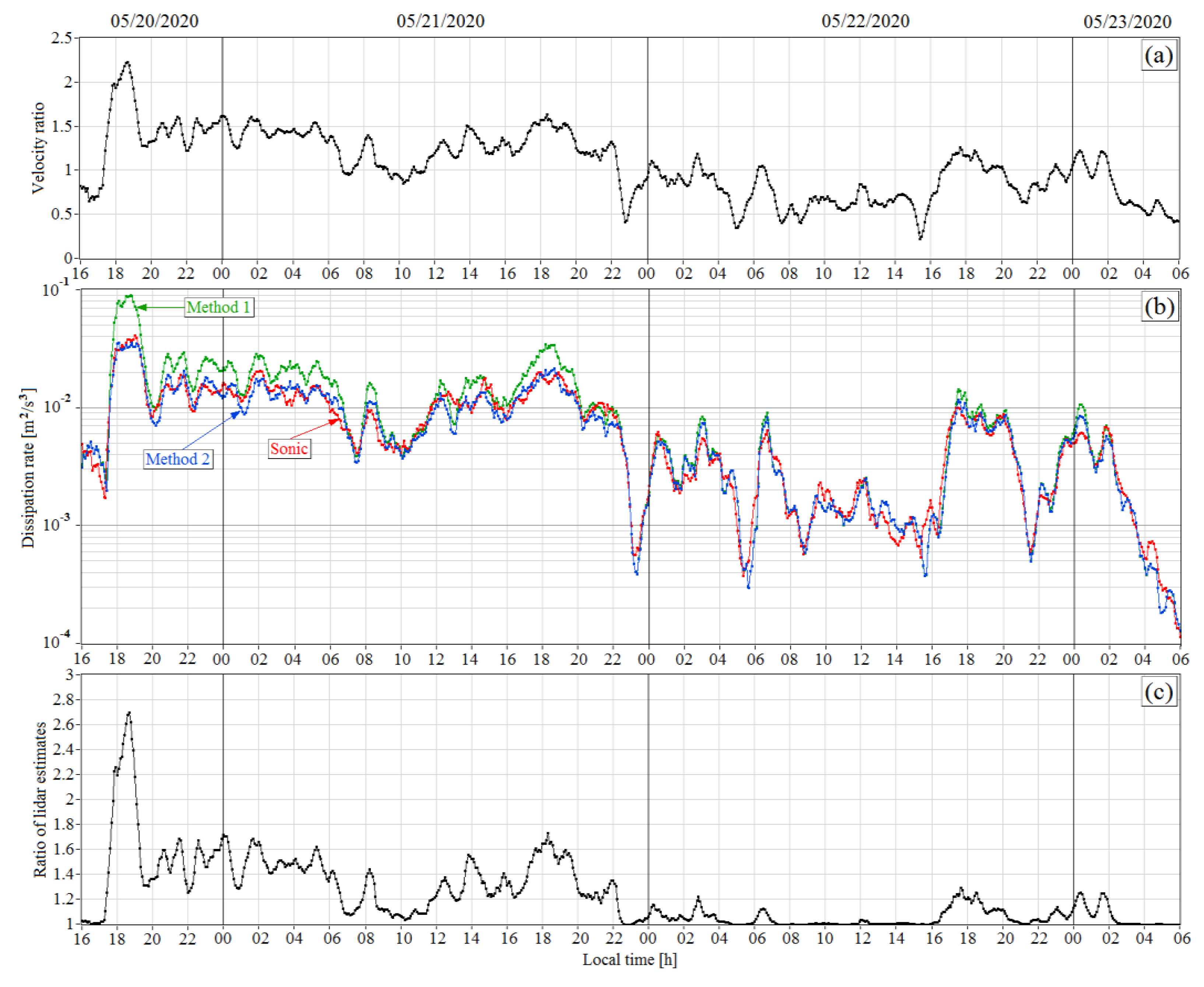
Figure 10 depicts the 62 h time series of the ratio
of the mean wind velocity to the linear speed of the probing volume and the estimates of the dissipation rate from the measurements by the sonic anemometer and the lidar starting from 16:00 LT on 20 May of 2020. It can be seen that, at
, Method 1 markedly (up to 2.7 times) overstates the dissipation rate in comparison with
and
εs.
Using the data of
Figure 10b, we compared the estimates of the dissipation rate obtained from measurements by the sonic anemometer
with the lidar estimates
and
. The results of the comparison are shown in
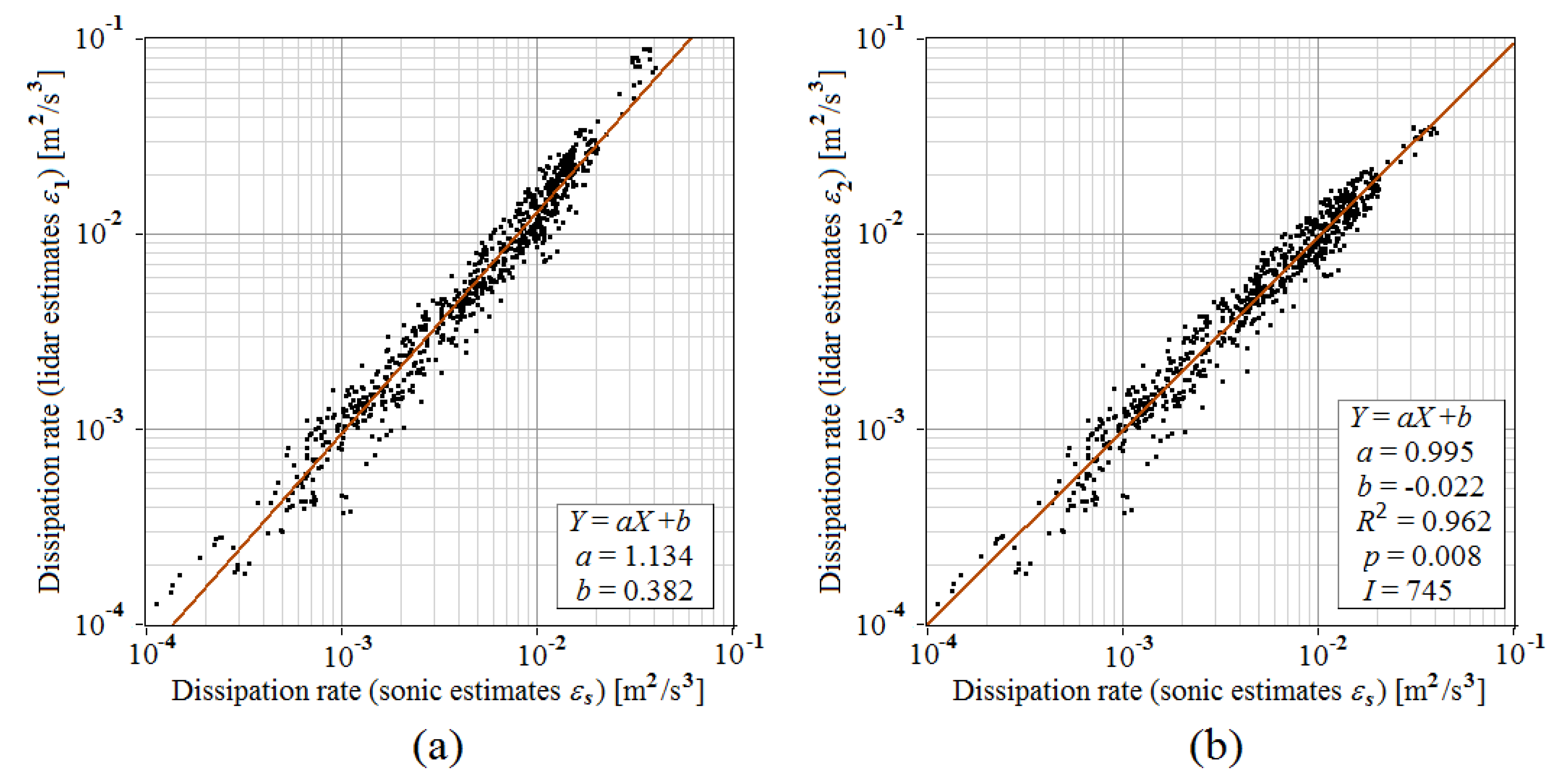
Figure 11. It can be seen from
Figure 11a that, at strong turbulence, (when
10
−2 m
2/s
3) and
, the lidar estimates of the dissipation rate
ε1, on average, exceed the estimates
obtained from measurements by the sonic anemometer. Under the same conditions, the difference between the estimates
ε2 and
(
Figure 11b) is much smaller.
The relative bias of estimates of the dissipation rate calculated by Methods 1 and 2 as judged from the data of
Figure 11 is, respectively,
= 15% and
= −2%. This result allows us to assert that Method 2 gives an unbiased estimate of the dissipation rate at an arbitrary ratio of the mean wind velocity to the linear speed of conical scanning. According to the data of
Figure 11, the relative statistical errors of the lidar estimates
and
differ less widely, at
= 20% and
= 16%, respectively. Parameters of the linear regression, including the slope
and the intercept
(equal to 1.134 and 0.382 in the case of Method 1 (
Figure 11a; in this case, for calculation of
a and
b, we used lg(
ε1) instead of
) and 0.996 and −0.026 in the case of Method 2 (
Figure 11b). The coefficient of the correlation between lg(
εs) and
equals 0.98. Using data from
Figure 11b, we determined that the coefficient of determination
= 0.962 and
p-value as a measure of statistical significance equals 0.008.
Thus, the comparative analysis of the results of measurements by a conically scanning lidar and a sonic anemometer at the same height, carried out in this section, showed that taking into account the transfer of turbulent inhomogeneities by the mean wind (Method 2) makes it possible to obtain unbiased lidar estimates of the dissipation rate at arbitrary values of parameter .
It should be noted that the results presented in
Figure 3 (experiment 2018),
Figure 4 (experiment 2019) and
Figure 8 and
Figure 10 (experiment 2020) were obtained from lidar measurements at relatively large signal-to-noise ratios
(the ratio of the mean power of the lidar echo signal to the mean power of the detector noise in the receiver passband of 50 MHz). Consequently, the instrumental error in estimating the radial velocity
, which substantially depends on
and
, should be small, and this error should insignificantly affect the accuracy of the estimate of the turbulent energy dissipation rate. Therefore, in the experiments of 2018 (
= 7500) and 2020 (
= 15,000), the signal-to-noise ratio varied from −10 dB to 0 dB and the error
did not exceed 0.1 m/s (
σe was calculated by Equation (23) in authors’ work [
14] after replacing
with
), and in the 2019 experiment (
= 7500), it varied from −13 dB to −8 dB and
0.2 m/s.
6. Discussion
Pulsed coherent Doppler lidars capable of measuring the radial velocity with high spatial and temporal resolution [
1,
2,
22] are effective technical means of obtaining information on the turbulent energy dissipation rate in the atmospheric boundary layer (in particular, the Stream Line lidar used in this work). The method developed in the authors’ work [
14] for retrieving the vertical profiles of the dissipation rate from measurements with a conically scanning PCDL has a number of advantages over the previously used approaches [
4,
5,
6,
7,
8,
9,
10,
11,
12]. In particular, it allows one to take into account the effect of averaging the radial velocity over the probing volume. However, the application of this method assumes a significant excess of the linear speed of the conical scanning
over the average wind velocity
(i.e.,
), which is not always the case in practice. Indeed, if the dissipation rate is determined from measurements at the height of the atmospheric surface layer at a relatively large elevation angle
and, moreover, with a strong wind, then parameter
can be many times greater than unity. In this case, the distribution of the radial velocity within the probing volume will change with time, mainly due to the transfer of turbulent inhomogeneities by the mean wind and not due to the movement of the probing volume around the base of the scanning cone.
To obtain an estimate of the dissipation rate (using Equation (9)) from the lidar measurements of the azimuth structure function of the radial velocity at any velocity ratio
, it is necessary to know the equation for the function
, which would take into account (1) the motion of the probing volume (on the horizontal plane) during conical scanning, (2) wind transfer of turbulent inhomogeneities and (3) averaging of the radial velocity over the probing volume. In this work, using Taylor’s hypothesis of “frozen” turbulence and a number of approximations (see the derivation of the equation in
Appendix A), we obtained an equation for the function
, taking into account all these three factors (see Equations (10)–(13)). To test this method (Method 2, in which the function
is used in Equation (9)), we used the data of lidar experiments, in which any values of the parameter
were realized, including
.
Testing of Method 2 in the 2018 experiment (see
Section 3) showed that the reason for the discrepancy in the estimates of the turbulent energy dissipation rate from the measurements by the Stream Line lidar in the atmospheric surface layer at different elevation angles (
= 35.3° and
= 60°) is that the method used in the authors’ work [
19] (Method 1) does not take into account the transfer of turbulent inhomogeneities by the mean wind. The use of Method 2 made it possible to obtain similar results from lidar measurements at angles
and
.
The use (along with the Stream Line lidar) of sonic anemometers in the 2019 (
Section 4) and 2020 (
Section 5) experiments made it possible to compare the estimates of the dissipation rate from the measurements by the lidar (estimates
and
obtained by Methods 1 and 2, respectively) and the sonic anemometer (estimate
). Since, in the 2019 experiment, the height of the sonic anemometer position was 40 m less than the minimum height of the lidar measurement, to compare the estimates of the dissipation rate, we used the extrapolation of the vertical profile
to the level of the sonic anemometer and also obtained good agreement between the results, including the case at
(see
Figure 7). The 2020 experiment, whose data we used to directly compare the dissipation rate estimates from measurements with a lidar and a sonic anemometer at the same height, convincingly proved the applicability of Method 2 for any values of parameter
.
It is worth using the generalized method at both large wind velocities and small probing heights, up to 200–300 m. At heights above the surface atmospheric layer, the method in the authors’ work [
14] usually provides quite acceptable (in accuracy) estimates of the dissipation rate. Its application does not require complicated calculations in contrast to the generalized method (compare Equation (20) in [
14] with Equations (10)–(13) of this paper).