Article

Corporate Environmental Attention and Corporate Greenwashing Behavior: Firm-Level Evidence from China

School of Management Science and Engineering, Nanjing University of Information Science and Technology, Nanjing 210044, China
*
Author to whom correspondence should be addressed.
Sustainability 2026, 18(4), 2059; https://doi.org/10.3390/su18042059
Submission received: 14 January 2026 / Revised: 11 February 2026 / Accepted: 16 February 2026 / Published: 18 February 2026

Abstract

To analyze the effect of corporate environmental attention on corporate greenwashing behavior and its underlying mechanisms, this study conducts an empirical investigation using data from Chinese A-share listed firms spanning from 2012 to 2022. The findings reveal that heightened corporate environmental attention significantly curbs corporate greenwashing behavior. Particularly, this effect is more evident in firms with violations, non-heavy pollution firms, or non-high-tech firms. Mechanistic tests highlight that, from the perspective of internal corporate channels, heightened corporate environmental attention primarily suppresses greenwashing behavior by promoting green innovation and reducing information asymmetry. From the perspective of external corporate channels, it mainly curbs greenwashing behavior by increasing scrutiny from investors and the media. Additionally, the degree of corporate violations functions as an enhancing moderator between corporate environmental attention and corporate greenwashing behavior. Based on the findings obtained, this paper makes specific recommendations for business managers and policymakers. It also provides a theoretical reference for firms aiming to achieve high-quality green transformation and enhance green governance.

1. Introduction

As the micro-level foundation of environmental pollution and economic development, firms’ efforts to transition towards innovative green products are crucial to reduce carbon emissions, mitigate climate change, and improve corporate performance and reputation. Especially with the increase in stringent environmental regulations and consumer awareness of sustainability, firms are compelled to balance economic pursuits with amplified social responsibilities. However, the investment activities of innovative green products are typically more costly, more time-consuming, and much riskier than those of primary non-green products [1,2]. Under the multiple pressures of government environmental governance, corporate profitability, and consumer preference, the low-cost greenwashing practices, emerging considering the growing awareness of environmental and social issues, are extensively motivating firms to address government environmental regulations and demonstrate credible commitments to stakeholders. Although greenwashing is a form of deception that refers to corporate activities that make “an organization look more environmentally friendly than it actually is” [3], it reduces firms’ operational risks and enhances their short-term competitiveness at the expense of the market capital misallocation and the long-run environmental deterioration. In this regard, firms probably report false or misleading disclosures of ESG (Environmental, Social, and Governance) performance to legitimize and compensate for lower ESG scores [4]. This is because stronger ESG performance can cultivate a positive brand reputation and public image and help firms gain the trust of participants and customers [5]. Furthermore, those firms with higher ESG scores usually benefit from enhanced solvency, declined financial risk, and fewer financing costs.
Corporate environmental attention (CEA), defined as the extent to which firms cognitively prioritize environmental issues and typically measured through the Management Discussion and Analysis (MD&A) section of annual reports, has emerged as a key indicator of firms’ environmental responsibility and green innovation capacity [6]. Beyond signaling social responsibility, CEA reflects managerial cognition and strategic orientation, shaping how firms respond to environmental regulation, market competition, and consumer demand. As an internal governance force, heightened environmental attention can encourage firms to actively assume socio-environmental responsibilities and invest in green innovation. While prior studies suggest that increased environmental attention is associated with more extensive ESG disclosure, it remains unclear whether such attention also constrains misleading environmental communication, viz. corporate greenwashing behavior [7]. Understanding this relationship is essential for explaining how firms balance environmental commitment with economic performance.
CEA plays a pivotal role in shaping firms’ production decisions, operational strategies, and long-term sustainability trajectories. Existing studies suggest that environmental attention reflects managerial cognition and strategic prioritization, and is closely associated with firms’ innovation capacity, market reputation, and financial performance [8,9]. Firms exhibiting higher levels of environmental attention are more likely to allocate resources toward green innovation, environmental technologies, and social responsibility initiatives, thereby cultivating sustained competitive advantages [10]. From this perspective, CEA functions as an internal governance mechanism that guides firms toward more proactive and responsible environmental behavior.
However, enhancing CEA is not without challenges. Under conditions of short-term financial pressure, technological constraints, or high environmental governance costs, firms may struggle to translate environmental attention into substantive action. When managerial attention to environmental issues outpaces firms’ implementation capacity, a divergence may emerge between environmental rhetoric and actual performance. In such contexts, some firms may resort to symbolic responses—most notably greenwashing—as a means of reconciling environmental expectations with economic constraints [11]. This tendency is particularly pronounced when regulatory enforcement is weak or external monitoring is insufficient, allowing environmental attention to be expressed primarily through communication rather than operational change. Over time, such symbolic strategies may erode stakeholder trust and undermine firms’ long-term sustainability objectives [12].
Greenwashing, defined as the exaggeration or misrepresentation of environmental performance without corresponding substantive action, represents a critical outcome of this misalignment between attention and execution. Extensive research has shown that greenwashing damages corporate credibility, distorts stakeholder perceptions, and generates negative reputational consequences [13]. As environmental awareness continues to rise globally, greenwashing has attracted increasing academic and policy attention. While prior studies have systematically examined its forms, drivers, and consequences, relatively little is known about whether and how internal managerial factors—particularly CEA—can mitigate firms’ propensity to engage in greenwashing [14]. This gap suggests that environmental attention should not be treated merely as a disclosure signal, but rather as a deeper cognitive foundation that may influence the authenticity of firms’ environmental behavior.
CEA is commonly manifested through firms’ strategic communications, including annual reports, sustainability disclosures, and public statements. By emphasizing environmental goals, achievements, and future plans, firms signal their commitment to sustainable development. Such disclosures, often accompanied by third-party audits or certifications, are intended to enhance transparency and credibility. With the growing prominence of green development principles, these communications—frequently summarized through ESG-related disclosures—have become an important indicator of firms’ environmental responsibility. Nevertheless, the presence of environmental attention in corporate communication does not necessarily guarantee substantive environmental performance.
Importantly, the behavioral implications of CEA are inherently heterogeneous. On the one hand, heightened attention can strengthen firms’ public image, attract environmentally conscious consumers, and stimulate green innovation by encouraging improvements in production processes, product design, and resource efficiency [15]. On the other hand, sustained environmental attention often entails substantial costs, particularly in capital-intensive domains such as green R&D and environmentally friendly infrastructure. When these costs exceed firms’ short-term tolerance, environmental attention may instead be channeled into symbolic actions aimed at alleviating regulatory pressure and securing market legitimacy [16]. The ultimate behavioral outcome therefore depends on firms’ governance capacity, competitive environment, and stakeholder pressures, creating a complex trade-off between genuine green transformation and economic performance. Under such conditions, greenwashing may emerge as a strategic response to reconcile environmental attention with resource constraints [17].
Although greenwashing is widespread across industries, much of the existing literature has primarily focused on external influences—such as regulatory pressure, market competition, and stakeholder scrutiny—when explaining firms’ greenwashing behavior. Comparatively less attention has been devoted to examining how firms’ own environmental attention, as an internal cognitive and strategic factor, shapes their tendency to engage in greenwashing. It remains insufficiently understood whether CEA consistently constrains greenwashing by fostering substantive environmental action, or whether, under certain resource or governance constraints, it may instead be channeled into symbolic compliance. A more nuanced examination of this internal perspective can contribute to a deeper understanding of firms’ environmental governance and offer insights into how greenwashing behavior may be mitigated through managerial and organizational mechanisms.
Against this background of intensifying environmental challenges and growing public scrutiny, whether CEA can effectively curb greenwashing and deter symbolic environmental practices remains a pressing research question. Motivated by this context, this study is committed to the investigation of the nexus between CEA and corporate greenwashing behavior, employing empirical analysis to unveil the intrinsic influencing mechanisms. Specifically, this study addresses several questions. Initially, it investigates the direct effect of CEA on corporate greenwashing behavior. Next, it explores channels through which this attention influences corporate greenwashing, from both internal and external standpoints. This includes assessing how the degree of corporate misconduct moderates the relationship between CEA and corporate greenwashing behavior. Finally, the findings reveal strategic differences among firm types in tackling greenwashing, highlighting the varied effects of CEA.
This study contributes to the literature by conceptualizing CEA as a form of managerial cognition and strategic prioritization. In doing so, it advances the attention-based view by showing that environmental attention shapes not only firms’ innovation orientation and disclosure practices, but also the authenticity of their environmental behavior. Moving beyond the dominant focus on external regulation and market forces, this study integrates information asymmetry theory, resource-based theory, and stakeholder theory to develop a unified framework explaining how environmental attention leads to either substantive environmental improvement or symbolic compliance. The analysis highlights the role of internal managerial cognition and organizational capabilities in constraining greenwashing through both internal channels, such as green innovation and information transparency, and external channels, such as media and investor scrutiny. By incorporating corporate violations as a moderating factor, the study further clarifies the boundary conditions under which environmental attention effectively curbs greenwashing. Using panel data from Chinese listed firms, this study reveals how CEA influences corporate greenwashing behavior through multiple channels. Specifically, the former, quantified by a neural network-based text analysis approach (e.g., Word2Vec), can effectively suppress the latter by promoting green innovation, reducing information asymmetry, and increasing scrutiny from investors and the media, providing robust evidence for firm-level environmentally sustainable practices. Consequently, the findings offer policymakers actionable recommendations for reducing greenwashing by enhancing CEA. More broadly, the results indicate that sustained managerial attention to environmental issues is essential for promoting substantive corporate sustainability rather than symbolic compliance, as it supports long-term environmental performance, reduces sustainability-related uncertainty, and strengthens the credibility of firms’ contributions to sustainable development.
The remainder of this study is organized as follows. In Section 2, a comprehensive review of relevant literature is provided. Section 3 formulates theoretical hypotheses. Section 4 details the data used and the methodology. The empirical analysis is conducted in Section 5. Section 6 summarizes findings and discusses practical implications.

2. Literature Review

2.1. Causes and Consequences of Greenwashing in Listed Firms

Greenwashing, characterized as the dissemination of misleading information regarding a firm’s environmental performance, poses a significant challenge to corporate sustainability, particularly for listed firms under intense scrutiny from regulators, investors, and the public. Extensive scholarly efforts have elucidated the causes and consequences of corporate greenwashing, laying a robust foundation for understanding its underlying drivers and multifaceted impacts [18].
The causes of greenwashing in listed firms are multifaceted. Primarily, external pressures for legitimacy emerge as a key driver. With rising environmental awareness, firms face mounting expectations to exhibit eco-friendly practices, rendering greenwashing a cost-effective way to secure social and regulatory legitimacy [19]. Berrone et al. [20] observed that the U.S. firms in polluting industries leverage environmental disclosures to bolster legitimacy, often in the absence of substantive action. Additionally, information asymmetry between firms and stakeholders facilitates greenwashing. As custodians of environmental data, listed firms can selectively present information via corporate social responsibility (CSR) reports, masking their true ecological footprint [21]. This behavior is frequently motivated by short-term financial considerations, given that authentic environmental initiatives elevate operational costs and strain cash flows. Zhou et al. [22] further highlighted that managerial self-interest and myopic decision-making amplify selective disclosure, especially in firms pressured to meet earnings targets.
The economic consequences of greenwashing remain contested, reflecting divergent scholarly perspectives. Some researchers posit short-term advantages. For example, Li et al. [23] suggested that greenwashing enhances public perception and reduces financing costs, and Li et al. [24] discovered that in emerging markets marked by pronounced information asymmetry, greenwashing is positively correlated with financial performance. Conversely, a predominant body of evidence underscores its adverse effects. In capital markets, greenwashing undermines corporate reputation, heightens stock mispricing risks, and diminishes company value [25]. For example, Du [26] revealed a significant negative relationship between greenwashing and cumulative abnormal returns of Chinese listed firms. In product markets, greenwashing erodes customer trust and purchase intentions [27], ultimately impairing sales and competitive standing [28]. These findings illuminate the intricate trade-offs confronting listed firms engaged in greenwashing.
Recent studies have increasingly shifted attention from traditional regulatory explanations of greenwashing toward information environments and stakeholder monitoring mechanisms. For instance, recent research highlights the role of media attention, investor scrutiny, digitalization, and ESG rating disagreement in shaping firms’ incentives to engage in greenwashing behavior. Studies show that heightened public attention and information transparency can deter symbolic environmental disclosure, while fragmented ESG evaluations may exacerbate opportunistic reporting. Despite these advances, this emerging literature largely treats firms as passive responders to external pressures, offering limited insight into how internal managerial cognition and strategic prioritization shape greenwashing decisions.

2.2. The Influence of Corporate Environmental Attention on Firm Behavior

CEA, defined as a firm’s deliberate focus and commitment to ecological issues, has emerged as a pivotal determinant of behavior among listed firms, which operate under heightened stakeholder expectations and regulatory oversight. Distinct from broader environmental attention, this concept emphasizes firm-specific awareness and resource allocation toward sustainability. Existing literature explores how CEA shapes organizational outcomes, offering insights into its potential influence on greenwashing tendencies.
From an internal perspective, CEA is closely tied to strategic and operational priorities. Firms exhibiting high levels of such attention often channel resources into green innovation and sustainable practices, fostering competitive advantages and long-term value creation [29]. Quintana-García et al. [30] contended that innovation spurred by environmental focus strengthens market positioning, while Shenkoya [31] emphasized digital transformation as a mechanism to operationalize this attention, enhancing transparency and accountability. Furthermore, managerial attitudes toward environmental stewardship play a critical role in resource allocation. Chen et al. [32] demonstrated that managers with strong environmental awareness prioritize substantive CSR initiatives, reducing dependence on superficial disclosures. In contrast, firms with limited CEA may resort to symbolic gestures, such as greenwashing, to meet external demands without incurring substantial costs [33].
From an external perspective, CEA is shaped by stakeholder dynamics and regulatory frameworks. Stringent environmental regulations, such as carbon trading schemes, compel firms to align operations with ecological objectives, potentially diminishing greenwashing incentives [34]. Lee [35] noted that firms with greater market power experience less impact from such regulations, suggesting that CEA may moderate compliance responses. Moreover, escalating demands from investors and consumers for sustainability amplify its significance. Szabo and Webster [36] argued that intensified stakeholder scrutiny incentivizes genuine environmental efforts, whereas a lack of CEA may lead firms to exploit information asymmetry through greenwashing [37].
In recent years, studies have begun to document a more direct connection between environmental attention and corporate greenwashing. Some studies treat “attention” as an attention-based governance force at the institutional level and show that stronger government environmental attention is associated with lower greenwashing among listed firms, partly through improved transparency and stronger stakeholder oversight [38]. Other work shifts attention to capital-market actors and suggests that “green attention” from institutional investors may not always discourage symbolic behavior; instead, it can intensify greenwashing under certain constraints, such as financial pressure or weak substantive capability [39]. In parallel, firm-level evidence related to corporate attention also indicates that environmental tax reform may increase greenwashing in some settings, and that lower CEA can be associated with stronger greenwashing incentives among high-polluting firms [40]. Taken together, these studies highlight that attention can operate as either a disciplining force or a channel that facilitates symbolic compliance, depending on governance capacity and resource constraints.
Despite these advancements, the existing literature reveals notable limitations in directly examining the nexus between CEA and greenwashing behavior among listed firms. While prior studies have explored the drivers and consequences of greenwashing, as well as the effects of CEA on innovation and firm performance [26,41], relatively little attention has been paid to how a firm’s environmental focus shapes the authenticity of its environmental disclosures. This gap is particularly salient in the context of listed firms, where heightened transparency requirements and stakeholder expectations coexist with short-term financial pressures that may undermine substantive environmental commitments. As a result, the mechanisms through which CEA influences firms’ propensity to engage in greenwashing remain insufficiently understood, motivating a more systematic empirical investigation.

3. Theoretical Analysis and Research Hypothesis

3.1. The Direct Impact of Corporate Environmental Attention on Greenwashing

According to the attention-based view (ABV), corporate behavior is a function of where managers focus their attention. CEA represents a critical dimension of organizational cognition that shapes corporate sustainability strategies [42]. As stakeholder pressure for environmental responsibility intensifies, firms must navigate the complex landscape of sustainability expectations while balancing economic imperatives. This tension creates the conditions under which some firms resort to greenwashing—the misleading communication of environmental performance that creates a more positive impression than reality warrants [43].
The relationship between environmental attention and greenwashing behaviors presents an intriguing theoretical puzzle. On one hand, increased attention might enhance awareness of environmental issues, leading to genuine sustainability improvements. On the other hand, heightened attention without sufficient capabilities might increase pressure to appear environmentally responsible, potentially encouraging symbolic rather than substantive actions [44].
Research by Kim and Lyon [45] demonstrated that organizations with higher environmental awareness tend to develop more comprehensive environmental management systems, which reduce the gap between sustainability claims and actual performance. This alignment between attention and action diminishes the likelihood of greenwashing as firms become more attuned to the reputational and legal risks of misleading environmental communication. Moreover, when environmental issues receive significant organizational attention, internal stakeholders are more likely to champion authentic environmental initiatives rather than superficial image management [46].
A longitudinal study by Testa et al. [47] found that firms with higher levels of environmental attention tend to allocate resources more effectively toward substantive environmental improvements rather than merely symbolic communications. This resource allocation pattern leads to improved environmental performance that can be legitimately communicated to stakeholders, reducing the need for greenwashing. Additionally, organizations with heightened environmental attention develop stronger environmental competencies and more sophisticated understanding of sustainability issues, enabling them to recognize and avoid the pitfalls of superficial green marketing [48].
Furthermore, Chen et al. [49] argue that CEA fosters organizational learning processes that help firms develop a more nuanced understanding of environmental challenges and appropriate responses. This learning reduces the disconnect between environmental goals and operational capabilities that often leads to greenwashing. As environmental issues become more central to organizational attention, firms typically develop stronger environmental governance mechanisms and verification processes that make it more difficult to engage in misleading environmental claims [50].
The present discourse posits the following conjectures:
H1. 
Corporate environmental attention suppresses greenwashing behavior.

3.2. Corporate Environmental Attention, Media Attention and Greenwashing

Stakeholder theory emphasizes that firms operate within a network of stakeholders whose evaluations and expectations influence corporate behavior. Among these stakeholders, the media plays a crucial role as an information intermediary that disseminates corporate environmental information and amplifies public scrutiny. Media coverage increases the visibility of firms’ environmental actions and exposes discrepancies between environmental claims and actual performance.
CEA reflects a firm’s focus and commitment to environmental responsibility. This serves as a key signal of ecological awareness to the public. The enhancement of CEA not only improves the transparency of corporate environmental governance but also attracts widespread media attention. The obtained findings suggest that the media, as an important information intermediary, can spread and amplify environmental behaviors related to a company through news reports, and the level of media attention directly influences the external public pressure faced by the company [51]. Firms with high environmental attention are more likely to become the focus of media coverage. This media attention amplifies the transparency of the company’s environmental information, making it easier for the company’s behavior to be externally monitored [52].
Meanwhile, media attention increases the transparency of corporate behavior, raising the risk of exposing greenwashing, thereby strengthening the external constraints on corporate management. Specifically, media attention benefits firms with high environmental focus by uncovering false environmental disclosures, while also pushing management to weigh the costs and benefits of reporting more carefully. In contrast, firms with low environmental attention may struggle to attract sustained media attention, thereby providing opportunities for them to exaggerate their environmental performance or even engage in greenwashing [51,53].
Overall, media attention acts as a key mechanism linking CEA to corporate greenwashing behavior. Such scrutiny strengthens external oversight, thereby curbing firms’ greenwashing tendencies.
The present discourse posits the following conjectures:
H2. 
Corporate environmental attention suppresses corporate greenwashing behavior by increasing media attention.

3.3. Corporate Environmental Attention, Investor Attention and Greenwashing

Capital market participants represent another critical stakeholder group influencing corporate environmental behavior. According to stakeholder theory, investors increasingly incorporate environmental performance into their evaluation of firm value, particularly in contexts where ESG considerations affect financing costs and risk assessment. Investor attention enhances the monitoring function of capital markets by increasing scrutiny of corporate disclosures and reducing managerial opportunism.
CEA reflects managerial prioritization of environmental issues and the allocation of organizational resources toward environmental governance. Firms with higher environmental attention tend to place greater emphasis on environmental responsibility in their disclosures and strategic decisions, which increases their visibility to environmentally conscious investors. Prior studies suggest that heightened investor attention enhances oversight of corporate environmental behavior and increases the salience of environmental performance in investment decisions [26,54]. As external stakeholders, investors with strong environmental preferences exert pressure on firms to improve disclosure credibility and align stated environmental commitments with actual practices.
A review of existing literature shows that the increase in investor attention can play a role in two ways: On one hand, high investor attention strengthens the supervisory role of the capital market, forcing firms to improve the authenticity of their information disclosure. Investors typically demand high transparency in corporate environmental disclosures, particularly eco-friendly investors who are more inclined to select firms with sound environmental governance. Therefore, with higher investor attention, corporate management faces greater external pressure and is more likely to enhance actual environmental performance to meet investor expectations, rather than adopting greenwashing strategies for reputational gains [52]. On the other hand, high investor attention increases the supervisory costs and reputational risks faced by management. Once greenwashing behavior is exposed in a highly scrutinized environment, the company’s market image may suffer serious damage, potentially triggering stock price declines and loss of investors. Broad investor attention also reduces information asymmetry between management and external stakeholders, enhancing the transparency of corporate behavior, thereby effectively reducing opportunistic behavior by management [55].
In contrast, firms with low environmental attention fail to attract sufficient investor attention, resulting in lower effectiveness in supervising their environmental disclosures, which increases the likelihood of adopting greenwashing strategies [53]. Investor attention, as a key mechanism through which CEA affects greenwashing behavior, can suppress greenwashing by enhancing the constraints imposed by the capital market.
The present discourse posits the following conjectures:
H3. 
Corporate environmental attention suppresses corporate greenwashing behavior by increasing investor attention.

3.4. Corporate Environmental Attention, Green Innovation and Greenwashing

The ABV posits that organizational behavior is shaped by where managerial attention is allocated, as attention determines how limited cognitive and material resources are distributed across competing strategic priorities. When environmental issues occupy a central position in managerial attention, firms are more likely to direct strategic resources toward environmental problem-solving activities. In this sense, CEA functions as a cognitive antecedent that guides firms’ investment decisions and innovation trajectories.
From a resource-based perspective, green innovation represents a valuable, rare, and difficult-to-imitate organizational capability that enhances firms’ substantive environmental performance. Firms with stronger green innovation capabilities can improve production efficiency, reduce pollutant emissions, and develop environmentally friendly products, thereby generating real environmental outcomes rather than symbolic claims. When environmental attention motivates firms to invest in green innovation, it strengthens their substantive environmental capabilities and reduces reliance on symbolic strategies such as greenwashing. Compared with rhetorical environmental disclosure, green innovation provides firms with tangible achievements that can be credibly communicated to stakeholders.
Empirical studies suggest that firms with higher environmental attention are more likely to allocate resources toward green innovation, such as low-carbon technology development and pollution control, which enhances actual environmental performance and lowers the need for greenwashing [56]. Within this framework, environmental attention fosters intrinsic motivation for green innovation, while external support mechanisms, such as green credit, further facilitate innovation investment [57,58,59]. As green innovation improves firms’ environmental outcomes, it reduces the incentives to rely on misleading disclosures to obtain reputational or market benefits [60].
Overall, CEA promotes green innovation by directing managerial focus and strategic resources toward substantive environmental improvement. By strengthening firms’ real environmental capabilities, green innovation serves as an internal mechanism through which environmental attention effectively curbs corporate greenwashing behavior.
The present discourse posits the following conjectures:
H4. 
Increased environmental attention among firms inhibits corporate greenwashing behavior by promoting green innovation.

3.5. Corporate Environmental Attention, Information Asymmetry and Greenwashing

From the perspective of information asymmetry theory, corporate opportunistic behavior is more likely to arise when external stakeholders face difficulties in accurately assessing firms’ true performance. When firms possess private information that cannot be fully observed or verified by investors, regulators, or the public, they gain greater discretion to engage in selective disclosure or misleading communication. Greenwashing can therefore be understood as a strategic response enabled by opaque information environments, in which firms exploit information asymmetries to exaggerate environmental achievements or conceal environmental shortcomings.
The level of environmental attention among listed firms reflects the extent to which firms prioritize environmental responsibility and sustainable development. This is not only demonstrated through actual investments in environmental practices but also through the quality and transparency of environmental information disclosure. An increase in environmental attention typically indicates that firms place greater emphasis on comprehensive environmental information disclosure to showcase their efforts and achievements in environmental protection. Furthermore, information asymmetry between the firm and external stakeholders is directly reduced by such actions.
Information asymmetry significantly drives corporate greenwashing behavior. When the asymmetry level is high, external investors and stakeholders struggle to access accurate environmental data, enabling firms to exaggerate or falsify disclosures [16,61]. However, increasing environmental attention encourages firms to adopt transparent disclosure practices, which ease external oversight. For example, detailed ESG reports from firms with strong environmental focus highlight genuine governance efforts, thereby building trust among investors and stakeholders.
Moreover, high environmental attention can enhance the effectiveness of external supervision. When corporate disclosures become more transparent and comprehensive, investors and the media can more easily identify false information, thereby creating stronger oversight and constraints. This external pressure significantly increases the risk cost of greenwashing behavior, prompting firms to prioritize actual improvements in environmental performance over false disclosures in response to external scrutiny [62,63].
Therefore, the increase in environmental attention among listed firms, by reducing information asymmetry, not only diminishes the motivation for greenwashing but also enhances the efficiency of external supervision, thereby effectively curbing greenwashing behavior.
The present discourse posits the following conjectures:
H5. 
Increased corporate environmental attention inhibits corporate greenwashing behavior by alleviating information asymmetry.

3.6. The Moderating Role of Corporate Violation Levels

The extent to which corporate violation levels influence the relationship between CEA and the inhibition of greenwashing can be explored from perspectives such as corporate compliance, risk aversion, social supervision, and public pressure. Specifically, firms with higher violation levels may rely more on substantive improvements to address external scrutiny when faced with heightened environmental attention, increasing the degree to which environmental attention inhibits greenwashing.
Firstly, a high level of corporate violations often reflects poor internal governance and weak compliance mechanisms. Such firms typically face significant reputational risks and regulatory pressures from society and regulatory bodies [64]. In this context, heightened environmental attention—especially media scrutiny and public scrutiny—pushes them toward transparent and authentic oversight responses. Such actions help avoid severe penalties or reputational harm from greenwashing. Thus, with elevated violation levels, firms react more proactively to environmental attention, strengthening the suppression of greenwashing behavior.
Secondly, firms with higher violation levels often have a poor track record in environmental issues, which necessitates a greater focus on genuine environmental improvements rather than relying solely on greenwashing to maintain their corporate image. Social supervision theory suggests that stronger oversight encourages proactive steps [65]. With high violation levels, firms face tougher scrutiny, especially on environmental matters, as regulators and the public expect better performance. In such cases, the inhibitory effect of environmental attention on greenwashing behavior may be amplified, as firms under external pressure are more likely to take concrete actions to improve their environmental performance rather than resorting to false or misleading disclosures.
Additionally, firms with higher violation levels typically face greater reputational risks [66]. In an environment of heightened environmental attention, the public, the media, and stakeholders are particularly sensitive to corporate environmental performance. Any false or misleading environmental disclosures by such firms can trigger significant public backlash. Therefore, firms with higher violation levels, under the influence of environmental attention, are more likely to prioritize genuine environmental improvements and transparent disclosures to avoid severe brand damage and regulatory penalties. This further amplifies the inhibitory effect of environmental attention on greenwashing behavior in such firms.
Finally, firms with higher violation levels often exhibit greater sensitivity and responsiveness to risks in their governance structures and strategies. Risk aversion theory suggests that such firms adopt compliance measures to limit uncertainty and sidestep legal or reputational risks when risks rise [67]. This risk-averse mindset makes them more proactive in implementing environmental improvements when environmental attention increases, thereby strengthening the inhibitory effect of environmental attention on greenwashing behavior. Thus, for firms with high violation levels, CEA becomes a powerful driver for improving environmental performance and curbing greenwashing behavior.
The present discourse posits the following conjectures:
H6. 
Corporate violation levels positively moderate the relationship between corporate environmental attention and the inhibition of greenwashing behavior in listed firms.
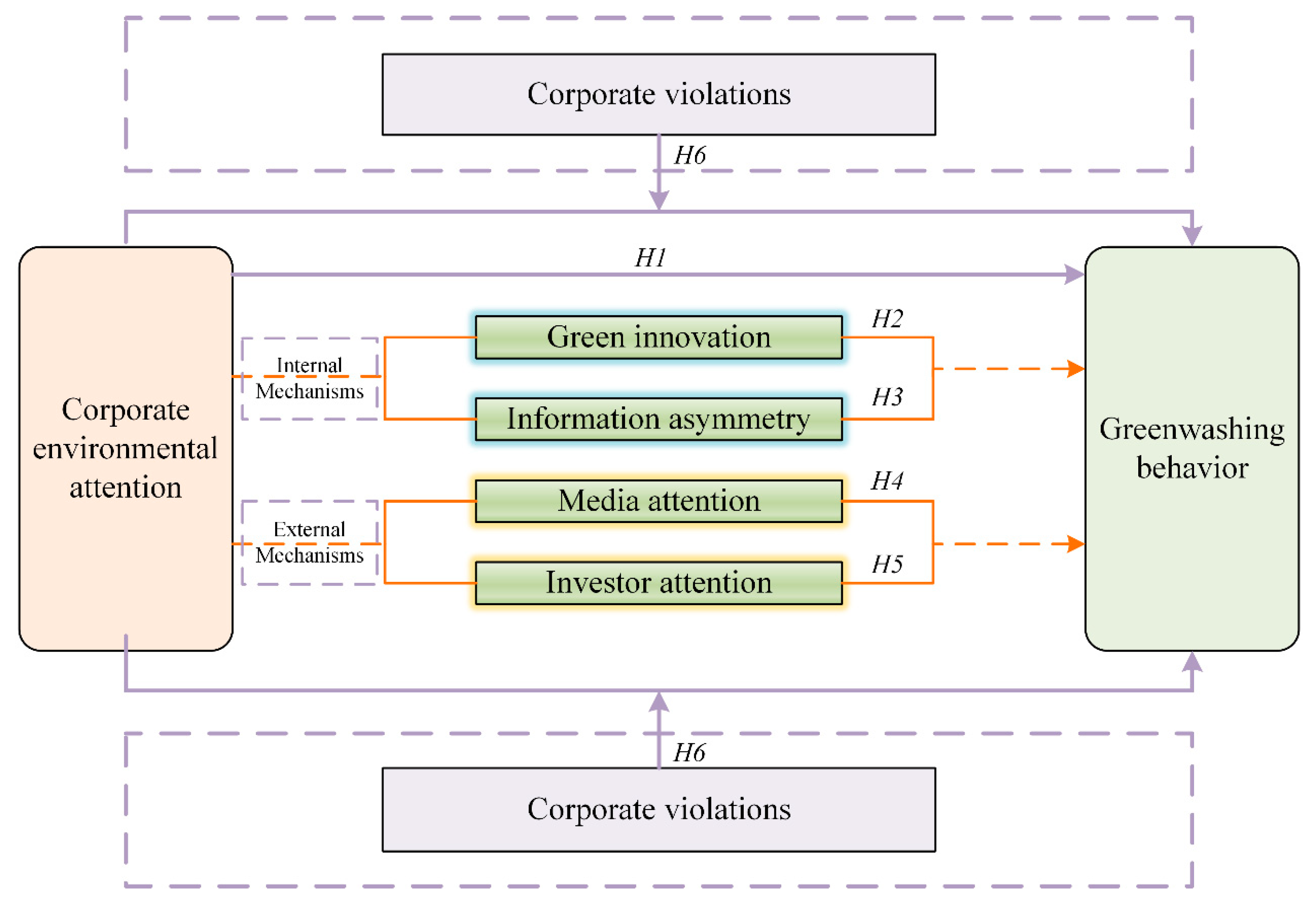
To sum up, we establish a theoretical framework in Figure 1 to investigate how CEA influences corporate greenwashing behavior through internal mechanisms and external supervision mechanisms.

4. Research Design

4.1. Date Sources and Processing

All Chinese A-share listed firms on the Shanghai and Shenzhen Stock Exchanges spanning from 2012 to 2022 are chosen as the initial sample. The beginning point is the key year when ecological civilization was formally involved in Chinese broader socio-economic agenda. The policy shift brought about new regulatory and policy frameworks that had a direct impact on corporate behavior, especially in relation to corporate environmental investments and practices [68]. In addition, considering the profound effect of the COVID-19 pandemic and the removal of the COVID-19 centralized quarantine in December 2022 in China (https://www.reuters.com/world/china/china-drop-covid-quarantine-rule-inbound-travellers-jan-8-2022-12-26/?utm_source=chatgpt.com (accessed on 15 February 2026)), the ending point of the sample period is thus selected as 2022. This most extreme combined public health and economic crisis has not only led to widespread severe social and economic disruption, but also reshaped the CSR strategy of businesses to address urgent worldwide social and environmental challenges and to meet what the public expects of them [69,70]. The sample data is pre-processed as follows: (1) observations with missing values and firms with negative total assets are removed. While these exclusions focus the analysis on operational greenwashing and enhance internal validity, they may limit the generalizability of results to financial or high-risk entities. (2) Firms with ST, *PT, and PT trading statuses during the observation period are excluded. These entities face severe financial distress or delisting risks, resulting in abnormal financial indicators that lack comparability with healthy firms. Their environmental disclosures are frequently driven by defensive motivations to regain legitimacy, which could significantly bias empirical findings. (3) Firms in the financial sector are excluded. This choice is rationalized by the unique asset structures of financial institutions and their distinct regulatory environments, which make their financial metrics incomparable to industrial firms. Furthermore, the environmental impact of financial firms is primarily indirect through credit allocation rather than direct emissions, necessitating a different evaluative logic for greenwashing behavior. The final sample includes 7988 firm-year observations. The ESG disclosure scores used to develop the corporate ESG greenwashing indicator are obtained from the Bloomberg and Hua Zheng databases. The Management Discussion and Analysis (MD&A) sections of listed companies’ annual reports are sourced from the CNRDS database (China Research Data Service Platform). Information on corporate violations, company characteristics, and financial data is sourced from the CSMAR database.

4.2. Measurement of Variables

4.2.1. Dependent Variable: Greenwashing

Existing literature primarily quantifies greenwashing through three approaches: survey-based scales, content analysis, and the discrepancy between disclosure and performance. Among survey methods, Szabo and Webster [36] utilized a five-item scale to measure greenwashing intensity; however, while this approach is efficient and highly quantified, it often struggles to ensure respondent objectivity and the authenticity of self-reported data. Other scholars define greenwashing as selective disclosure or rhetorical manipulation, employing content analysis to score environmental information disclosures [31]. Yet manual content analysis is frequently limited by coding subjectivity and reporting bias.
According to Yu et al. [15], the gap between a company’s ESG disclosure score and its actual ESG performance score is used to measure the extent of ESG greenwashing. This methodology is widely recognized as an objective proxy for “symbolic decoupling”—the discrepancy between a firm’s rhetorical commitments and its verifiable ecological achievements. First, the GW indicator is constructed using industry-year standardization, which effectively eliminates systemic biases inherent in different rating agencies’ frameworks and controls for time-variant industry heterogeneity. Second, by focusing on the deviation between disclosure and performance, we capture the relative opportunistic behavior of firms, which is less sensitive to the subjective weighting of individual ESG metrics than absolute scores. Furthermore, while “real environmental inputs” (such as environmental protection expenditures) provide a financial perspective on commitment, the comprehensive ESG performance scores utilized here encompass a broader array of verifiable outcomes-including pollution levels, compliance records, and environmental audit results-thereby offering a more holistic representation of a firm’s actual environmental integrity than financial inputs alone. Drawing on existing research [17,71,72], the company’s ESG greenwashing level can be expressed as Equation (1).
G W i , t = E S G d i s , i , t E S G d i s , t ¯ σ d i s , t E S G p e r , i , t E S G p e r , t ¯ σ p e r , t
where E S G d i s , i , t is the ESG disclosure score of firm i in year t and E S G d i s , i , t is the ESG performance score of firm i in year t ; E S G d i s , t ¯ and E S G p e r , t ¯ denote the means of the ESG disclosure and performance scores of all firms in the industry in year t , respectively. σ d i s , t and σ p e r , t are the standard deviations of the ESG disclosure and performance scores of all firms in the industry in year t . When a company’s peer-relative position in ESG disclosure is superior to its peer-relative position in ESG performance, its greenwashing score is positive, indicating the presence of greenwashing behavior.

4.2.2. Main Independent Variable: Corporate Environmental Attention

Inspired by Zor [6], this study quantifies CEA using a Word2Vec model implemented through the “jieba” and “gensim” libraries in Python3.7. Textual data extracted from MD&A sections are preprocessed to remove stop words, punctuation, and digits. We perform word segmentation using “jieba” and a specialized environmental lexicon to identify technical terms accurately. The model is trained using a Skip-gram architecture with negative sampling to capture semantic nuances effectively. We configure the model with a vector dimension of 200, a context window of 5, a minimum word frequency of 5, and 10 training iterations to ensure embedding stability. To establish the vocabulary, we define five core seed words-ecology, environment, green, low carbon, and environmental protection-and expand them using cosine similarity in the high-dimensional vector space. This process yields a final list of 23 keywords representing management’s cognitive focus on environmental issues. The CEA indicator is then calculated as the sum of occurrences of these 23 keywords normalized by the total MD&A word count. By accounting for synonyms and contextual meanings, this approach offers a more precise measurement than traditional keyword counting methods.

4.2.3. Moderate Variables: Violation Score (VS)

This study employs the corporate violations of listed firms in the CSMAR database to evaluate the degree of corporate misconduct. Following the approach of Liang et al. [73], the violation scores (VS) of firms are assigned based on the different types of penalties, which are imposed on misconduct firms as disclosed in the violation information. The higher scores correspond to more severe violations. Specifically, the penalties announced for misconduct firms include eight types: “criticism, warning, condemnation, fines, confiscation of illegal gains, revocation of business licenses, market entry bans, and others.” When the penalty is “others”, a score of 1 is assigned; for “criticism” or “warning”, a score of 2 is assigned; for “condemnation”, a score of 3 is assigned; for “fines” or “confiscation of illegal gains”, a score of 4 is assigned; and for “revocation of business licenses” or “market entry bans”, a score of 5 is assigned. For firms with no confirmed violation cases, the score is 0. When a firm engages in multiple violations within a year, the highest score among the violation cases is taken. The specific scoring details are provided in Table 1.

4.2.4. Control Variables

In accordance with the previous literature [74,75], we select eight control variables to account for firm-level characteristics that may shape the relationship between environmental attention and greenwashing behavior. Firm size (Size) is included because larger firms face higher public visibility and regulatory scrutiny, which may deter greenwashing through a “spotlight effect” or, conversely, increase the pressure to project a sustainable image. Financial leverage (Lev) represents a firm’s financing pressure; firms with high debt may engage in greenwashing to lower debt costs and signal legitimacy to creditors. Profitability (ROA) reflects internal resource slack; while profitable firms have the funds for substantive green innovation, low-profit firms might adopt low-cost symbolic disclosures to mask operational deficiencies. The definitions and measurement methods for all variables are detailed in Table 2.
These financial characteristics are particularly critical in the context of heavily polluting industries, where the trade-off between the high costs of real environmental governance and the reputational gains of greenwashing is most acute. Additionally, we control for Board size (Board) and Independence (Indep) to capture the strength of internal oversight. Book-to-market ratio (BM) and Tobin’s Q (TobinQ) account for market-based valuation and growth opportunities, while Listing age (ListAge) reflects the firm’s stage in its life cycle. Finally, the study incorporates industry (Ind FE), year (Year FE), and province (Province FE) fixed effects to control for time-invariant and regional heterogeneity.

4.3. Summary Statistics

Based on the efficacy and accessibility of the data, this analysis adheres to previous research by eliminating firms designated as ST and *ST, as well as those with significant data gaps on critical variables. Ultimately, a panel dataset with 7724 valid observations was produced by using a sample of 971 listed firms.
Table 3 provides a detailed overview of the descriptive statistics for the considered variables, offering valuable insights into their distributions and variability. CEA has a mean of 0.192, a standard deviation of 0.255, a minimum value of 0, and a maximum value of 3.915. This wide range and moderate dispersion, as reflected by the standard deviation, highlights substantial variation in the degree of environmental focus and commitment across the sampled firms. Such heterogeneity suggests that while some firms may exhibit minimal engagement with environmental initiatives, others demonstrate a strong dedication, providing a rich dataset for exploring differences in corporate environmental strategies. GW has a mean of 0.026, a standard deviation of 1.148, a minimum value of −3.925, and a maximum value of 6.129. The broad distribution of GW values reflects the complexity of corporate environmental communication, capturing a spectrum of practices that range from cautious to potentially misleading. Other variables in the table further enrich the analysis. For instance, Violation score (VS) has a mean of 0.314 and a standard deviation of 0.765, ranging from 0 to 5, indicating varying degrees of misconduct across firms. Firm size (Size) shows a mean of 23.15, with a standard deviation of 1.271 and a range from 18.43 to 28.50, reflecting diversity in organizational scale. Financial performance indicators like ROA (Return on Assets) and leverage (Lev) also exhibit meaningful variation, with ROA ranging from −0.644 to 0.969 and Lev from 0.008 to 0.997, providing a comprehensive view of the firms’ financial health and capital structure. The substantial variability across all variables, including CEA and GW, establishes a robust empirical foundation for this study. This diversity enables a robust foundation for investigating the interplay between CEA and greenwashing behaviors.

4.4. Model Specification

To investigate the impact of CEA on corporate greenwashing behavior, we employ a panel data regression with a three-way fixed effects model that accounts for industry, year, and province-specific factors. The empirical model is expressed as follows:
G W i , t = α 0 + α 1 C E A i , t + α 2 C o n t r o l s i , t + λ y e a r + μ i n d u s t r y + η p r o v i n c e + ε i , t
where i denotes the firm number and t is the year. C E A i , t indicates the degree of CEA.

5. Empirical Results and Analysis

5.1. Baseline Regression

To examine the association between CEA and corporate greenwashing behavior, we report empirical findings derived from Equation (2). Table 4 sequentially presents the regression results without control variables and with control variables, while progressively incorporating fixed effects.
In Column (1), only CEA is included in the baseline regression model. It can be observed that the coefficient of CEA is −0.111 and statistically significant at the 5% level. Including industry, year, and province fixed effects sequentially in Column (2) does not alter this negative relationship. This finding provides preliminary evidence of a negative effect of CEA on corporate greenwashing behavior. We add control variables in Column (3) and include industry, year, and province fixed effects sequentially in Column (4). The coefficient of CEA in Column (3) is −0.149 and statistically significant at the 1% level, while the coefficient in Column (4) is −0.176 and also significant at the 1% level, indicating that the control variables and fixed effects appropriately account for the impact of unobservable factors. The result in Column (4) shows that the coefficient of CEA of −0.176 is significant at the 1% level, suggesting that CEA may reduce the level of corporate greenwashing by 17.6 percentage points on average, holding other variables constant. Collectively, these findings suggest that CEA helps to suppress corporate greenwashing behavior, which validates Hypothesis 1.

5.2. Mechanism Exploration

To examine the mechanisms by which CEA affects corporate greenwashing behavior, we follow the two-step approach by Jiang et al. [76] and set up the mediating effect model as follows:
m e d i a t e i , t = β 0 + β 1 C E A i , t + β 2 C o n t r o l s i , t + λ y e a r + μ i n d u s t r y + η p r o v i n c e + ε i , t
where m e d i a t e i , t represents a set of indicators related to media attention, investor attention, green innovation, and information asymmetry. The coefficient β 1 gauges the effect of CEA on the mechanism variables. If it is statistically significant, it indicates that CEA significantly influences the mediating variables. Furthermore, this supports the ways through which CEA affects corporate greenwashing behavior.

5.2.1. External Mechanism of Media Attention

A literature review in the Sub-section of corporate environmental attention, media attention and greenwashing reveals a strong link between media attention and corporate greenwashing behavior. Media attention facilitates information dissemination and strengthens social oversight. Specifically, high media coverage accelerates information spread and intensifies scrutiny of corporate environmental commitments versus actual practices. This heightened scrutiny increases the risk of reputational damage from greenwashing. Moreover, sustained media attention encourages firms to enhance transparency in environmental disclosures to avoid negative evaluations from false claims. Thus, media attention serves as external pressure that discourages greenwashing and promotes genuine environmental performance improvements among firms. Building on this, we aim to investigate whether CEA increases media exposure, bringing firms’ environmental practices under greater public and regulatory scrutiny, thereby reducing greenwashing behavior.
Following Guitart et al. [77], media attention is measured by taking the natural logarithm of the number of news articles in which the company name appears in media reports, plus one (Media). The results are presented in Table 5. Column (1) shows that the coefficient of CEA is 0.106, significant at the 1% level, indicating that an increase in environmental attention among firms can elevate the level of media attention, thereby inhibiting corporate greenwashing behavior.

5.2.2. External Mechanism of Investor Attention

In addition, a literature review in the Sub-section of corporate environmental attention, investor attention and greenwashing documents a close relationship between investor attention and corporate greenwashing behavior. Investor attention primarily constrains corporate environmental performance through capital market feedback mechanisms. Specifically, high investor scrutiny intensifies the evaluation of corporate environmental commitments, prompting firms to exercise caution in their environmental disclosures. This reduces the risk of stock price volatility or loss of investor trust due to false or exaggerated claims. Moreover, sustained investor attention heightens the financial and reputational risks of greenwashing, pressuring firms to enhance transparency and improve long-term green practices. Thus, investor attention acts as a market-based constraint that discourages greenwashing and promotes genuine fulfillment of environmental responsibilities among firms. Building on this, we aim to investigate whether CEA increases investor sensitivity to environmental performance, thereby reducing greenwashing behavior.
The China Network Research Data Service (CNRDS) database’s Web Search Volume Index (WSVI) for Chinese listed firms is constructed on the basis of the Baidu platform. It is a comprehensive search index calculated from various online search data, integrating news sentiments and other information. It provides detailed statistics on public searches using stock codes or company names (including abbreviations and full names) as keywords. The index represents the sum of all keyword searches for each listed company, reflecting the intensity of online search activity related to the enterprise. Following Cheng and Liu [78], this study uses WSVI as the data source for public attention. Furthermore, it should be emphasized that search indices calculated using stock codes as keywords better indicate the public’s search motivations. Therefore, to distinguish investors with investment intentions from the public, this paper measures investor attention by taking the natural logarithm of search values using stock codes as keywords, plus one (Att). Table 5 presents the results of the investor attention mechanism. Column (2) shows that the coefficient of CEA is 0.168, positive and significant at the 10% level. This finding suggests that an increase in environmental attention among firms can enhance investor attention, thereby constraining corporate greenwashing behavior.

5.2.3. Internal Mechanism of Green Innovation

Green innovation plays a pivotal role in corporate environmental management. By effectively improving environmental technologies and developing green products, firms can reduce their reliance on greenwashing strategies. Specifically, a high level of green innovation capability enhances a company’s competitive advantage in environmental technologies and products, enabling it to gain market recognition through genuine green achievements rather than relying on false environmental claims. Additionally, sustained green innovation helps reduce firms’ dependence on high-pollution technologies, thereby lowering the likelihood of greenwashing behavior. Under this mechanism, green innovation serves as an internal driving force that inhibits corporate greenwashing behavior, encouraging firms to fulfill their environmental responsibilities while achieving economic benefits. The level of CEA determines where firms focus their resources and innovation. When organizations genuinely prioritize environmental concerns, they are more likely to direct resources toward developing legitimate green technologies and practices, rather than limiting themselves to superficial marketing claims. Therefore, it is essential to further explore how CEA can promote green innovation, enabling firms to replace greenwashing behavior with genuine environmental achievements and achieve more sustainable improvements in environmental performance.
Following Zhang et al. [79], green innovation level is measured by taking the natural logarithm of the sum of the number of green invention patents and green utility model patents independently applied for by the company in the current year, plus one (GI). We present the regression results in Table 5. Column (3) shows that the coefficient of CEA is 0.347, positive and significant at the 1% level. This indicates that an increase in environmental attention among firms can constrain the occurrence of greenwashing behavior by promoting their level of green innovation.

5.2.4. Internal Mechanism of Information Asymmetry

Information asymmetry occurs when firms and external stakeholders have unequal access to environmental performance data. In studying environmental regulation and corporate behavior, information asymmetry significantly influences corporate decision-making. When firms exhibit information asymmetry in their environmental responsibilities, external stakeholders struggle to assess true environmental performance, creating opportunities for greenwashing. Firms can mislead investors and consumers by exaggerating environmental efforts or making unverified claims, enhancing their market image. Conversely, under information symmetry, stakeholders can gain accurate data on corporate environmental performance, reducing greenwashing opportunities. Therefore, whether environmental attention across firms can reduce information asymmetry and, in turn, inhibit greenwashing behavior is a question worthy of in-depth exploration. Greater CEA may encourage firms to enhance transparency in environmental disclosures, narrowing the information gap with stakeholders. When firms face higher transparency requirements regarding their environmental measures and actual performance, external stakeholders can more accurately identify the true state of corporate environmental practices, effectively reducing the likelihood of greenwashing behavior. Reduced information asymmetry may also drive firms toward green innovation and genuine environmental improvements, rather than relying on false claims to boost their image. Therefore, we aim to further investigate whether CEA can reduce information asymmetry, thereby encouraging firms to replace their greenwashing behavior with genuine environmental achievements and achieve more sustainable improvements in environmental performance.
Following Bharath et al. [80], this study constructs an information asymmetry indicator by conducting principal component analysis on three stock liquidity indicators: liquidity ratio, illiquidity ratio, and return reversal (Asy). Table 5 presents the results of the information asymmetry mechanism. The regression results in Column (4) show that the coefficient of CEA is −0.062, significant at the 1% level, suggesting that heightened CEA significantly lowers information asymmetry, thus suppressing greenwashing behavior.

5.3. Moderation Analysis

To assess how corporate violation levels moderate the link between CEA and greenwashing behavior, the following model is developed:
G W i , t = σ 0 + σ 1 C E A i , t + σ 2 M o d e r a t e i , t + σ 3 ( C E A i , t × M o d e r a t e i , t ) +   σ 4 C o n t r o l s i , t + λ y e a r + μ i n d u s t r y + η p r o v i n c e + ε i , t
where M o d e r a t e represents the moderating variable, which is the level of corporate violations. This variable is assigned values based on the different types of penalties imposed on listed firms. The definitions of other variables are consistent with those in Equation (3). Table 6 lists the regression results with corporate violations as the moderating variable. For comparison, Column (1) in Table 6 repeats the results in Column (4) in Table 4. The result in Column (2) shows that the coefficient of CEA is −0.120, significant at the 10% level, which aligns with the conclusions drawn earlier. The coefficient of corporate violation levels is 0.102, significant at the 1% level, indicating that higher levels of corporate violations tend to promote greenwashing behavior. The coefficient of the interaction term between CEA and corporate violation levels is −0.124, significantly negative at the 5% level, suggesting that the level of corporate violations amplifies the inhibitory effect of CEA on greenwashing behavior. These results further support Hypothesis 6.

5.4. Robustness Test

5.4.1. Alternative Greenwashing Measurement

We further employ an alternative method for measuring the greenwashing indicator, i.e., the Min-Max normalization approach to remeasure corporate greenwashing behavior. The calculation formula is shown in Equation (5).
g r e e n w a s h i n g i , t = E S G d i s i , t min ( E S G d i s ) max ( E S G d i s ) min ( E S G d i s ) E S G p e r i , t min ( E S G p e r ) max ( E S G p e r ) min ( E S G p e r )
where max E S G d i s and min E S G d i s are the maximum and minimum values of the ESG disclosure score, respectively; max E S G p e r and min E S G p e r are the maximum and minimum values of the ESG performance score, respectively.
Then, we re-run the regression analysis according to the same steps in the Section of baseline regression. The results are listed in Table 7. The results in Column (1) show that the coefficient of CEA is −0.061, significant at the 1% level, which is consistent with the conclusions drawn earlier. This further ensures the robustness of our findings.

5.4.2. Removing the Impact of Special Events

As discussed in the previous section, the sample period used covers the year 2020, when the COVID-19 pandemic emerged worldwide. Given that the COVID-19 pandemic triggered significant economic and social upheaval, leading to global supply chain interruptions, drastic changes in market demand, and the introduction of numerous emergency policies by governments, these factors may have prompted short-term behavioral adjustments by firms to cope with the crisis. For example, to mitigate the impact of the pandemic, firms may have temporarily reduced environmental investments or adopted less transparent disclosure strategies, thereby affecting their environmental performance. As a result, corporate behavior during the pandemic may differ dramatically from that in normal years.
To ensure that our findings are not driven by these external shocks, we perform two refined robustness checks. First, we re-estimate the regression by excluding the entire pandemic phase (2020–2022) to verify whether the inhibitory effect of CEA persists under normal economic conditions. Second, we specifically exclude the year 2020, as it represented the initial and most severe external shock, potentially distorting corporate environmental commitments and disclosure transparency. The results in Column (2) and (3) in Table 7 show that the coefficient of CEA is −0.176, significant at the 5% level. Furthermore, the results obtained by excluding only the 2020 sample data also confirm a negative and significant correlation between CEA and greenwashing behavior. This demonstrates that the governance role of CEA is robust and not merely a byproduct of temporary crisis-management strategies during the pandemic.

5.4.3. Addressing Reverse Causality: Lagged Explanatory Variables

Reverse causality may occur if greenwashing firms strategically expand their environmental rhetoric in MD&A reports to regain legitimacy or mask performance gaps [81].
Such practices establish a “deceptive feedback loop” where greenwashing drives managers to use environmental attention as a symbolic shield, projecting commitment while obscuring operational inefficiencies.
To further scrutinize the causal direction and ensure that our results are not driven by reverse causality-where firms might inflate their environmental rhetoric (CEA) in response to past or current greenwashing needs-this study re-estimates the baseline model using one-period and two-period lagged CEA. The underlying econometric logic is that greenwashing behavior in period t cannot influence managerial focus in periods t-1 or t-2, as future outcomes cannot affect past managerial decisions. This lag structure helps alleviate concerns regarding reverse causality [82].
The results, as reported in Table 7, reveal that the coefficient of L.CEA is −0.136, significant at the 5% level. The coefficient of L2.CEA is −0.136, significant at the 5% level. The persistent and significant negative association across different lag structures demonstrates that CEA serves as a leading indicator that substantively predicts the reduction in future greenwashing. These findings provide robust evidence that the primary causal flow originates from managerial cognitive prioritization to behavioral integrity, rather than a mere simultaneous feedback effect.

5.5. Endogenous Analysis

5.5.1. IV Estimation

To mitigate the interference of reverse causality and endogeneity on the regression results, this study employs an external instrumental variable (IV) approach to address endogeneity. Following the approach of Walls and Hoffman [83], the proportion of executives with an environmental background is used as the instrumental variable. This choice is theoretically appropriate as executives with environmental expertise are more likely to advocate for corporate environmental actions, yet their presence is primarily determined by broader organizational governance structures rather than directly influencing environmental performance [84]. The environmental background of executives fulfills both the relevance condition by significantly correlating with corporate environmental initiatives and the exclusion restriction by affecting greenwashing behavior only through the channel of environmental policies implemented by the company [85]. A two-stage least squares (2SLS) regression method is applied to alleviate endogeneity concerns.
The results of the first stage in Table 8 show that the estimated coefficient of the instrumental variable is 0.356, significantly positive at the 1% level, indicating that the selected instrument is valid. The results of the second stage in Table 8 reveal that the regression coefficient between CEA and GW is −0.709, significantly negative at the 1% level. These results suggest that, after accounting for endogeneity and causality, the conclusions of this study remain robust. Additionally, the p-value of the LM test is 0.000, which is significant at the 1% level, and the Wald F-statistic is 511.334, exceeding the Stock-Yogo weak identification test critical value of 16.38 at the 10% level. These results reject the null hypotheses of under-identification and weak-identification, respectively, indicating that the instrumental variable has strong explanatory power for the endogenous variable.

5.5.2. PSM Analysis

Propensity score matching (PSM) is used to re-estimate the regression model and correct for potential sample selection bias. Specifically, the tertiles of greenwashing levels within the same industry and year are used as the benchmark. The treatment group includes firms with greenwashing levels higher than the upper tertile of their industry and year peers, while the remaining firms are assigned to the control group. Based on this, the control variables from the baseline regression model are used as covariates for 1:3 nearest-neighbor matching. Observations that do not satisfy the common trend assumption are excluded, and the regression is re-run. The estimation results are presented in Column (2) in Table 9. The results show that the estimated coefficient of CEA is −0.177, significantly negative at the 1% level, indicating that an increase in CEA negatively influences the occurrence of corporate greenwashing behavior.

5.6. Heterogeneity Analysis

5.6.1. Heterogenous Analysis by Corporate Misconduct

Whether a company engages in misconduct behavior may directly influence its choices between environmental information disclosure and actual environmental performance. Firms with more misconduct activities may be more inclined to use greenwashing to disguise their environmental responsibilities, thereby masking their true operational or financial issues. If a company is classified as a misconduct company, that means it has a record of violations in certain given years, as disclosed in the CSMAR database. Table 10 reports the estimation results after dividing the sample into firms with and without misconduct behavior.
As shown in Columns (1) and (2), the inhibitory effect of CEA on corporate greenwashing behavior is significantly stronger for firms with misconduct behavior. Specifically, the coefficient of CEA for misconduct firms is −0.360, significantly at the 1% level, which is in contrast to that of compliant firms, i.e., −0.100 and non-significant. These results indicate a more pronounced effect in the former group. The difference can be attributed to misconduct firms’ greater incentive to engage in greenwashing as a means to obscure operational or financial misconduct. Consequently, heightened CEA in these firms likely exerts stronger pressure to align their disclosed environmental commitments with actual performance, thereby reducing greenwashing. In contrast, misconduct firms, with less incentive to mask underlying issues, exhibit a weaker response to environmental attention in mitigating greenwashing behavior.

5.6.2. Heterogenous Analysis by Heavily Polluting Industry

Firms in heavily polluting industries, due to their high-emission characteristics and the stringent nature of environmental regulations, may exhibit significantly different behaviors in environmental information disclosure and greenwashing compared to firms in non-heavily polluting industries. Firms in heavily polluting industries typically face greater public and regulatory pressure, making them more inclined to engage in greenwashing to improve their corporate image. Therefore, categorizing firms by whether they operate in heavily polluting industries better highlights the influence of industry traits on the link between CEA and greenwashing behavior. Table 10 reports the estimation results after dividing the sample into heavily polluting and non-heavily polluting industries.
Based on the results in Columns (3) and (4), the coefficient of CEA for non-heavily polluting firms is −0.224 and is significant at the 1% level, while the coefficient of CEA for heavily polluting firms is −0.052 and non-significant. It can be observed that the inhibitory effect of CEA on corporate greenwashing behavior is more pronounced among firms in non-heavily polluting industries. This difference can be attributed to the distinct pressures faced by these industries. Heavily polluting firms, under intense public and regulatory scrutiny due to their high-emission profiles, may prioritize greenwashing to enhance their corporate image, thus weakening the impact of environmental attention on reducing such behavior. In contrast, non-heavily polluting firms face less external pressure and are more likely to align their environmental disclosures with actual performance when environmental attention increases, leading to a more pronounced reduction in greenwashing.

5.6.3. Heterogenous Analysis by High-Tech Industry

High-tech firms, driven by innovation and technology, may show distinct behaviors in environmental disclosure and greenwashing compared to non-high-tech firms. High-tech firms typically place greater emphasis on R&D investment and technological innovation, which may make them more proactive in fulfilling environmental responsibilities or improving environmental performance through technological means. Therefore, using whether a company belongs to a high-tech industry as the grouping criterion can more effectively reveal the impact of industry characteristics on the relationship between environmental attention and greenwashing behavior. Table 10 also reports the estimation results after dividing the sample into high-tech and non-high-tech industries.
Based on the results in Columns (5) and (6), the coefficient of CEA for the non-high-tech industry sample is −0.207, significant at the 1% level, while the CEA coefficient for the high-tech industry sample is −0.029 and not significant, indicating a stronger effect in the former group. This disparity can be explained by the distinct priorities of these industries. High-tech firms, driven by innovation and substantial R&D investments, are often better equipped to improve environmental performance through technological advancements, potentially reducing their reliance on greenwashing. However, their focus on innovation may divert attention from aligning environmental disclosures with actual performance, weakening the effect of CEA on curbing greenwashing. Conversely, non-high-tech firms, with fewer technological resources, may face greater pressure to align their environmental commitments with actions when CEA increases, leading to a more pronounced reduction in corporate greenwashing behavior.

6. Conclusions, Discussion, Implications, and Limitations

6.1. Conclusions

This study, through empirical analysis, finds that the environmental attention of listed firms significantly inhibits greenwashing behavior, and this effect is realized through both internal and external channels. Internally, CEA primarily promotes corporate green innovation and reduces information asymmetry, while externally, it enhances investor and media attention, thereby increasing external supervisory pressure. The results also show that the correlation between CEA and corporate greenwashing behavior is moderated by the degree of corporate violations, with higher violation degrees enhancing the inhibitory effect of CEA on greenwashing. In addition, the response to CEA varies across industries and company types, with misconduct firms, non-heavily polluting industries, and non-high-tech industries exhibiting more effective suppression of corporate greenwashing behavior under the influence of CEA. Overall, enhancing the environmental attention of listed firms, strengthening green innovation, improving information disclosure, and increasing external supervision can effectively reduce corporate greenwashing behavior and promote sustainable development.

6.2. Discussion

Building on the foundational insights of Truong et al. [86], this study deepens the understanding of corporate environmental behavior by situating it within the broader context of sustainability governance. Prior research suggests that environmental actions may function either as authentic signals of integrity or as symbolic tools for image management. By incorporating the attention-based view, this study identifies CEA as a critical internal cognitive anchor that shifts firms from symbolic environmental disclosure toward substantive and sustainable environmental action. In this sense, CEA serves not merely as a disclosure-related construct, but as a governance mechanism that aligns managerial cognition with long-term sustainability objectives.
At the level of transmission mechanisms, this study advances the sustainability literature by moving beyond regulatory-centric explanations. Unlike Wang et al. [87], who emphasize the Porter hypothesis effects of external regulation, or Xu and Liu [88], who focus on resource crowding-out in heavy-polluting sectors, this research develops a dual-channel framework that integrates internal governance mechanisms-green innovation and information transparency-with external scrutiny from media and investors. This framework clarifies how managerial attention is translated into operational environmental integrity, thereby supporting a transition from short-term compliance to sustained environmental performance. By highlighting these channels, the study demonstrates how internal attention can stabilize firms’ sustainability trajectories and reduce reliance on superficial environmental strategies.
Importantly, the findings extend Sun et al. [89] by identifying CEA as a source-level deterrent to greenwashing, rather than merely a response to external pressure. This insight contributes to sustainability research by offering a micro-level explanation for how firms can mitigate sustainability-related uncertainty and informational opacity, issues increasingly emphasized in systems-oriented sustainability studies. Moreover, the analysis of corporate violations reveals that sustainability governance is inherently conditional. Prior misconduct activates reputational repair incentives, which amplify the disciplining role of environmental attention and encourage more substantive environmental engagement. This conditional effect underscores the dynamic nature of sustainability governance and highlights the importance of aligning internal attention with accountability mechanisms.
Overall, this study contributes to sustainability literature by demonstrating that authentic corporate sustainability depends not only on external regulation or stakeholder pressure, but also on sustained managerial attention and cognitive commitment. The findings provide theoretical support for the design of ESG governance frameworks that prioritize long-term environmental integrity over symbolic compliance, thereby promoting more credible and resilient pathways toward sustainable development.

6.3. Theoretical Implications

This study provides important theoretical implications by clarifying how CEA influences greenwashing behavior through multiple internal and external channels. By shifting attention from external regulation to managerial cognition, this research deepens the understanding of corporate environmental governance and contributes to the literature on substantive versus symbolic environmental behavior.

6.3.1. Implications for Information Asymmetry Theory

Prior research on information asymmetry theory has focused mainly on financial information and disclosure opacity. This study extends the theory to the environmental domain. The findings show that information asymmetry in environmental governance also enables opportunistic behavior such as greenwashing. CEA reduces this asymmetry by improving the transparency and credibility of environmental disclosures. As a result, firms face fewer opportunities to exploit informational advantages in non-financial contexts. This extension highlights the growing importance of environmental information in constraining opportunistic corporate behavior.

6.3.2. Implications for the ABV and the Resource-Based Theory

This study advances the ABV by showing that CEA shapes not only strategic orientation but also behavioral authenticity. Managerial attention directs resources toward environmental priorities. This process encourages investment in green innovation. By integrating the attention-based view with resource-based theory, the study shows how environmental attention is translated into substantive capabilities. Green innovation emerges as a core capability rather than a symbolic outcome. These capabilities reduce firms’ reliance on greenwashing and support long-term environmental credibility.

6.3.3. Implications for Stakeholder Theory and Legitimacy Perspectives

From a stakeholder theory perspective, this study highlights the role of external scrutiny in shaping corporate environmental behavior. Media and investor attention increase the visibility of firms’ environmental actions. This visibility raises the reputational and market costs of greenwashing. The findings refine legitimacy-based perspectives by showing when legitimacy-seeking behavior leads to substantive improvement rather than symbolic compliance.

6.3.4. Boundary Conditions and Governance Contexts

This study also identifies corporate violations as an important boundary condition. Environmental attention does not always lead to better outcomes. When governance quality is weak, managerial attention may be redirected toward symbolic actions. In such contexts, greenwashing becomes more likely. This finding refines existing theories of corporate environmental responsibility by emphasizing the conditional role of managerial attention. It also highlights the importance of governance contexts in shaping environmental behavior.

6.4. Practical Implications

This study advances the literature concerning the behavioral consequences of the CEA and the governance of corporate greenwashing, yielding actionable insights for regulators, corporate managers, and external stakeholders. Specifically, Regulatory authorities should transition from traditional disclosure compliance to semantic-based monitoring by implementing advanced text-mining frameworks-such as the Word2Vec methodology utilized in this study-to evaluate the consistency between firms’ environmental rhetoric and their substantive green innovation outputs. Such technological oversight would enable regulators to issue automated “greenwashing risk alerts” for firms where stated attention fails to align with actual ecological action, particularly within high-risk sub-groups such as firms with prior violations. For firms, the strategic recruitment of board directors with specialized environmental expertise is essential to ensure that internal attention functions as a persistent cognitive anchor rather than a short-term marketing response. Moreover, management should actively improve disclosure transparency by linking executive compensation to substantive green metrics, such as green patent applications, to mitigate information asymmetry and the temptations of symbolic image management. Collectively, corporate greenwashing fundamentally undermines market stability through distorted information efficiency and heightened reputational risks. This systemic challenge demands coordinated reform among regulators, corporate boards, and external monitors to establish a transparent market ecosystem that rewards authentic environmental commitment over symbolic communication.

6.5. Limitations and Future Research

Despite the robustness of the empirical findings, several limitations warrant consideration and suggest directions for future research. Although this study explores heterogeneity across selected firm characteristics, it does not fully capture potentially nuanced differences related to firm size, ownership structure, or regional institutional environments. Prior research indicates that these factors may shape firms’ environmental strategies and disclosure incentives in distinct ways. In the present study, additional analyses along these dimensions did not yield sufficiently stable or interpretable results, likely due to data constraints and institutional complexity. Future research could benefit from richer datasets, alternative classification approaches, or quasi-natural experiments to more systematically examine how organizational and regional heterogeneity conditions the governance role of CEA. In addition, this study measures greenwashing using discrepancies between ESG disclosure and ESG performance. While this approach is widely adopted, it remains an indirect proxy and may embed rating agency bias or temporal noise. Future studies may refine the measurement of greenwashing by integrating text-based semantic analysis, machine-learning techniques, environmental enforcement records, or objective environmental outcome data to better distinguish symbolic communication from substantive environmental action. Finally, while the focus on Chinese listed firms provides a valuable institutional setting, extending the analysis to other countries or regulatory regimes would help assess the broader applicability of the findings.


Author Contributions

Conceptualization, X.L.; methodology, X.L.; software, X.L., B.S. and X.Z.; validation, X.L.; formal analysis, X.L., B.S. and X.Z.; investigation, X.L.; data curation, B.S. and X.Z.; writing—original draft preparation, X.L., B.S. and X.Z.; writing—review and editing, X.L.; supervision, X.L.; funding acquisition, X.L. All authors have read and agreed to the published version of the manuscript.

Funding

This research was funded by the National Social Science Fund of China, grant number 23BJL105.

Institutional Review Board Statement

Not applicable.

Informed Consent Statement

Not applicable.

Data Availability Statement

The raw data supporting the conclusions of this article will be made available by the authors on request.

Conflicts of Interest

The authors declare no conflicts of interest.

Abbreviations

The following abbreviations are used in this manuscript:
ESGEnvironmental, Social, and Governance
MD&AManagement Discussion and Analysis
CNRDSChina Research Data Service Platform
VSViolation score
CEACorporate environmental attention

References

  1. Wang, Z.; Sun, Y.; Kong, H.; Xia-Bauer, C. An in-depth review of key technologies and pathways to carbon neutrality: Classification and assessment of decarbonization technologies. Carbon Neutrality 2025, 4, 15. [Google Scholar] [CrossRef]
  2. Zhang, M.; He, W. Encouraging or inhibiting: Can analyst attention reduce corporate greenwashing behavior? Econ. Anal. Policy 2025, 85, 943–962. [Google Scholar] [CrossRef]
  3. Becker-Olsen, K.; Potucek, S. Greenwashing. In Encyclopedia of Corporate Social Responsibility; Idowu, S.O., Capaldi, N., Zu, L., Gupta, A.D., Eds.; Springer: Berlin/Heidelberg, Germany, 2013; pp. 1318–1323. [Google Scholar] [CrossRef]
  4. Hao, X.; Tian, T.; Dong, L.; Wong, C.W.Y.; Lai, K. Unmasking greenwashing in ESG disclosure: Insights from evolutionary game analysis. Ann. Oper. Res. 2026, 356, 667–695. [Google Scholar] [CrossRef]
  5. Wang, Y.; Cao, J.; Cai, X. The impact of environmental, social and governance performance on brand value: The role of the digitalisation level. S. Afr. J. Bus. Manag. 2024, 55, a4448. [Google Scholar] [CrossRef]
  6. Zor, S. A neural network-based measurement of corporate environmental attention and its impact on green open innovation: Evidence from heavily polluting listed companies in China. J. Clean. Prod. 2023, 432, 139815. [Google Scholar] [CrossRef]
  7. Tu, Z.; Cao, Y.; Goh, M.; Wang, Y. Executive green cognition and corporate ESG performance. Financ. Res. Lett. 2024, 69, 106271. [Google Scholar] [CrossRef]
  8. Chang, Y.Y.; Chiang, F.Y.; Hu, Q.; Hughes, M. From green HRM to SDG success: Pathways through exploratory innovation and developmental culture. Rev. Manag. Sci. 2025, 19, 1711–1741. [Google Scholar] [CrossRef]
  9. Li, F.; Goodell, J.W.; Du, A.M.; Yang, T. Ecological risk management: Effects of carbon risk on firm innovation investment. Int. Rev. Financ. Anal. 2024, 95, 103514. [Google Scholar] [CrossRef]
  10. Zor, S. Conservation or revolution? The sustainable transition of textile and apparel firms under the environmental regulation: Evidence from China. J. Clean. Prod. 2023, 382, 135339. [Google Scholar] [CrossRef]
  11. Zhang, D. The pathway to curb greenwashing in sustainable growth: The role of artificial intelligence. Energy Econ. 2024, 133, 107562. [Google Scholar] [CrossRef]
  12. Forliano, C.; Battisti, E.; de Bernardi, P.; Kliestik, T. Mapping the greenwashing research landscape: A theoretical and field analysis. Rev. Manag. Sci. 2025, 19, 3407–3456. [Google Scholar] [CrossRef]
  13. Parguel, B.; Benoît-Moreau, F.; Larceneux, F. How sustainability ratings might deter ‘greenwashing’: A closer look at ethical corporate communication. J. Bus. Ethics 2011, 102, 15–28. [Google Scholar] [CrossRef]
  14. Xu, T.; Sun, Y.; He, W. Government digitalization and corporate greenwashing. J. Clean. Prod. 2024, 452, 142015. [Google Scholar] [CrossRef]
  15. Yu, E.P.; Luu, B.V.; Chen, C.H. Greenwashing in environmental, social and governance disclosures. Res. Int. Bus. Financ. 2020, 52, 101192. [Google Scholar] [CrossRef]
  16. Hu, X.; Hua, R.; Liu, Q.; Wang, C. The green fog: Environmental rating disagreement and corporate greenwashing. Pac.-Basin Financ. J. 2023, 78, 101952. [Google Scholar] [CrossRef]
  17. Zhang, D. Environmental regulation and firm product quality improvement: How does the greenwashing response? Int. Rev. Financ. Anal. 2022, 80, 102058. [Google Scholar] [CrossRef]
  18. Yang, Z.; Nguyen, T.T.H.; Nguyen, H.N.; Nguyen, T.T.N.; Cao, T.T. Greenwashin behaviours: Causes, taxonomy and consequences based on a systematic literature review. J. Bus. Econ. Manag. 2020, 21, 1486–1507. [Google Scholar] [CrossRef]
  19. Drempetic, S.; Klein, C.; Zwergel, B. The influence of firm size on the ESG score: Corporate sustainability ratings under review. J. Bus. Ethics 2020, 167, 333–360. [Google Scholar] [CrossRef]
  20. Berrone, P.; Fosfuri, A.; Gelabert, L. Does greenwashing pay off? Understanding the relationship between environmental actions and environmental legitimacy. J. Bus. Ethics 2017, 144, 363–379. [Google Scholar] [CrossRef]
  21. Seele, P.; Gatti, L.; Rademacher, L. Grey zone in—Greenwash out. A review of greenwashing research and implications for the voluntary-mandatory transition of CSR. J. Corp. Soc. Responsib. 2019, 4, 6. [Google Scholar] [CrossRef]
  22. Zhou, Y.; Chen, L.; Zhang, Y.; Li, W. “Environmental disclosure greenwashing” and corporate value: The premium effect and premium devalue of environmental information. Corp. Soc. Responsib. Environ. Manag. 2024, 31, 2424–2438. [Google Scholar] [CrossRef]
  23. Li, T.; Shu, X.; Liao, G. Does corporate greenwashing affect investors’ decisions? Financ. Res. Lett. 2024, 67, 105877. [Google Scholar] [CrossRef]
  24. Li, W.; Zhang, Y.; Zheng, M. Effects of greenwashing on financial performance: Moderation through local environmental regulation and media coverage. Bus. Strategy Environ. 2023, 32, 820–841. [Google Scholar] [CrossRef]
  25. Santos, C.; Coelho, A.; Marques, A. The greenwashing effects on corporate reputation and brand hate, through environmental performance and green perceived risk. Asia-Pac. J. Bus. Adm. 2024, 16, 655–676. [Google Scholar] [CrossRef]
  26. Du, X. How the market values greenwashing? Evidence from China. J. Bus. Ethics 2015, 128, 547–574. [Google Scholar] [CrossRef]
  27. Chen, Y.S.; Chang, C.H. Greenwash and green trust: The mediation effects of green consumer confusion and green perceived risk. J. Bus. Ethics 2013, 114, 489–500. [Google Scholar] [CrossRef]
  28. Nyilasy, G.; Gangadharbatla, H.; Paladino, A. Perceived greenwashing: The interactive effects of green advertising and corporate environmental performance on consumer reactions. J. Bus. Ethics 2014, 125, 693–707. [Google Scholar] [CrossRef]
  29. Patwary, A.K.; Tosun, C.; Sharif, A.; Ismail, N.A.; Abuelhassan, A.E. Measuring sustainable business performance in Malaysian hotels: The roles of green information, green innovation strategic orientation, and digital technology implementation. Int. J. Hosp. Manag. 2024, 123, 103935. [Google Scholar] [CrossRef]
  30. Quintana-García, C.; Marchante-Lara, M.; Benavides-Chicón, C.G. Towards sustainable development: Environmental innovation, cleaner production performance, and reputation. Corp. Soc. Responsib. Environ. Manag. 2022, 29, 1330–1340. [Google Scholar] [CrossRef]
  31. Shenkoya, T. Can digital transformation improve transparency and accountability of public governance in Nigeria? Transform. Gov. People Process Policy 2022, 17, 54–71. [Google Scholar] [CrossRef]
  32. Chen, S.; Li, Z.; Ban, R.; Ma, H. Managerial ability, internal control and investment efficiency. J. Behav. Exp. Financ. 2021, 31, 100523. [Google Scholar] [CrossRef]
  33. Walker, K.; Wan, F. The harm of symbolic actions and greenwashing: Corporate actions and communications on environmental performance and their financial implications. J. Bus. Ethics 2012, 109, 227–242. [Google Scholar] [CrossRef]
  34. Luo, X.; Liu, Y.; Liu, J.; Liu, X. To be green or not to be: How environmental regulations shape contractor greenwashing behaviors in construction projects. Sustain. Cities Soc. 2020, 63, 102462. [Google Scholar] [CrossRef]
  35. Lee, M. Environmental regulations and market power: The case of the Korean manufacturing industries. Ecol. Econ. 2008, 68, 205–209. [Google Scholar] [CrossRef]
  36. Szabo, S.; Webster, J. Perceived greenwashing: The effects of green marketing on environmental and product perceptions. J. Bus. Ethics 2021, 171, 719–739. [Google Scholar] [CrossRef]
  37. Lai, H.; Quan, L.; Wu, F.; Tang, S.; Guo, C.; Lai, X. Corporate environmental publicity and green innovation: Are words consistent with actions? Humanit. Soc. Sci. Commun. 2025, 12, 514. [Google Scholar] [CrossRef]
  38. Zheng, X.; Li, W. Government environmental attention and enterprise greenwashing behavior: Evidence from China. J. Asian Bus. Econ. Stud. 2024, 31, 392–403. [Google Scholar] [CrossRef]
  39. Qian, S.; Yang, Z.; Yang, L.; Zhang, Y. Institutional investors’ green attention and corporate greenwashing: The effectiveness of external governance. Econ. Anal. Policy 2025, 86, 2192–2206. [Google Scholar] [CrossRef]
  40. Hu, S.; Wang, A.; Du, K. Environmental tax reform and greenwashing: Evidence from Chinese listed companies. Energy Econ. 2023, 124, 106873. [Google Scholar] [CrossRef]
  41. Chen, Z.; Xie, G. ESG disclosure and financial performance: Moderating role of ESG investors. Int. Rev. Financ. Anal. 2022, 83, 102291. [Google Scholar] [CrossRef]
  42. Testa, F.; Boiral, O.; Iraldo, F. Internalization of environmental practices and institutional complexity: Can stakeholders pressures encourage greenwashing? J. Bus. Ethics 2018, 147, 287–307. [Google Scholar] [CrossRef]
  43. Delmas, M.A.; Burbano, V.C. The drivers of greenwashing. Calif. Manag. Rev. 2011, 54, 64–87. [Google Scholar] [CrossRef]
  44. Marquis, C.; Toffel, M.W.; Zhou, Y. Scrutiny, norms, and selective disclosure: A global study of greenwashing. Organ. Sci. 2016, 27, 233–504. [Google Scholar] [CrossRef]
  45. Kim, E.H.; Lyon, T.P. Greenwash vs. brownwash: Exaggeration and undue modesty in corporate sustainability disclosure. Organ. Sci. 2015, 26, 633–940. [Google Scholar] [CrossRef]
  46. Crilly, D.; Hansen, M.; Zollo, M. The grammar of decoupling: A cognitive-linguistic perspective on firms’ sustainability claims and stakeholders’ interpretation. Acad. Manag. J. 2016, 59, 705–729. [Google Scholar] [CrossRef]
  47. Testa, F.; Miroshnychenko, I.; Barontini, R.; Frey, M. Does it pay to be a greenwasher or a brownwasher? The relationship between environmental and economic performance and the market value of environmental controversies. Corp. Soc. Responsib. Environ. Manag. 2018, 25, 1198–1211. [Google Scholar] [CrossRef]
  48. Delmas, M.A.; Montes-Sancho, M.J. Voluntary agreements to improve environmental quality: Symbolic and substantive cooperation. Strat. Manag. J. 2010, 31, 575–601. [Google Scholar] [CrossRef]
  49. Chen, Y.C.; Hung, M.; Wang, Y. The effect of mandatory CSR disclosure on firm profitability and social externalities: Evidence from China. J. Account. Econ. 2020, 65, 169–190. [Google Scholar] [CrossRef]
  50. Fan, Y.; Wang, R.; Alkaraan, F.; Wu, W. Decoding greenwashing practices toward sustainability: The synergistic influence of governance structure and policy-derived rhetorical strategies. Energy Econ. 2025, 148, 108632. [Google Scholar] [CrossRef]
  51. Lyon, T.P.; Montgomery, A.W. Tweetjacked: The Impact of social media on corporate greenwash. J. Bus. Ethics 2013, 118, 747–757. [Google Scholar] [CrossRef]
  52. Wang, W.; Sun, Z.; Zhu, W.; Ma, L.; Dong, Y.; Sun, X.; Wu, F. How does multi-agent govern corporate greenwashing? A stakeholder engagement perspective from “common” to “collaborative” governance. Corp. Soc. Responsib. Environ. Manag. 2023, 30, 291–307. [Google Scholar] [CrossRef]
  53. Lu, Z.; Lin, Y.; Li, Y. Does corporate engagement in digital transformation influence greenwashing? Evidence from China. Financ. Res. Lett. 2023, 58, 104558. [Google Scholar] [CrossRef]
  54. Elliott, W.B.; Jackson, K.E.; Peecher, M.E.; White, B.J. The unintended effect of corporate social responsibility performance on investors’ estimates of fundamental value. Account. Rev. 2014, 89, 275–302. [Google Scholar] [CrossRef]
  55. Brazel, J.F.; Jones, K.L.; Thayer, J.; Warne, R.C. Understanding investor perceptions of financial statement fraud and their use of red flags: Evidence from the field. Rev. Account. Stud. 2015, 20, 1373–1406. [Google Scholar] [CrossRef]
  56. Zhang, D. Green financial system regulation shock and greenwashing behaviors: Evidence from Chinese firms. Energy Econ. 2022, 111, 106064. [Google Scholar] [CrossRef]
  57. Lv, C.; Shao, C.; Lee, C.-C. Green technology innovation and financial development: Do environmental regulation and innovation output matter? Energy Econ. 2021, 98, 105237. [Google Scholar] [CrossRef]
  58. Ma, Y.; Feng, G.-F.; Yin, Z.-J.; Chang, C.-P. ESG disclosures, green innovation, and greenwashing: All for sustainable development? Sustain. Dev. 2024, 33, 1797–1815. [Google Scholar] [CrossRef]
  59. Song, C.; Ma, W. ESG and green innovation: Nonlinear moderation of public attention. Humanit. Soc. Sci. Commun. 2025, 12, 667. [Google Scholar] [CrossRef]
  60. Hao, X.; Chen, F.; Chen, Z. Does green innovation increase enterprise value? Bus. Strat. Environ. 2022, 31, 1232–1247. [Google Scholar] [CrossRef]
  61. Sun, J.; Zu, N.; Zhang, C. Big data and firm greenwashing: Evidence from China’s national big data comprehensive pilot zone. Humanit. Soc. Sci. Commun. 2025, 12, 768. [Google Scholar] [CrossRef]
  62. Yue, J.; Li, Y. Media attention and corporate greenwashing behavior: Evidence from China. Financ. Res. Lett. 2023, 55, 104016. [Google Scholar] [CrossRef]
  63. Zhou, Y.; Chen, L. Public attention and “Environmental Disclosure Greenwashing”: Pressure from oversight or incentive from legitimacy. China Financ. Rev. Int. 2024, in press. [Google Scholar] [CrossRef]
  64. Chu, S.; Oldford, E.; Wang, J. Corporate social responsibility and corporate fraud in China: The perspective of moderating effect of board gender diversity. Int. Rev. Econ. Financ. 2023, 88, 1582–1601. [Google Scholar] [CrossRef]
  65. Qin, Y.; Harrison, J.; Chen, L. A framework for the practice of corporate environmental responsibility in China. J. Clean. Prod. 2019, 235, 426–452. [Google Scholar] [CrossRef]
  66. Johnson, W.C.; Xie, W.; Yi, S. Corporate fraud and the value of reputations in the product market. J. Corp. Financ. 2014, 25, 16–39. [Google Scholar] [CrossRef]
  67. March, J.G.; Shapira, Z. Managerial perspectives on risk and risk taking. Manag. Sci. 1987, 33, 1404–1418. [Google Scholar] [CrossRef]
  68. Chen, J.; Yang, Y.; Liu, R.; Geng, Y.; Ren, X. Green bond issuance and corporate ESG performance: The perspective of internal attention and external supervision. Humanit. Soc. Sci. Commun. 2023, 10, 437. [Google Scholar] [CrossRef]
  69. Carroll, A.B. Corporate social responsibility (CSR) and the COVID-19 pandemic: Organizational and managerial implications. J. Strat. Manag. 2021, 14, 315–330. [Google Scholar] [CrossRef]
  70. Lu, X.; Huang, N.; Mo, J. Time-varying causalities from the COVID-19 media coverage to the dynamic spillovers among the cryptocurrency, the clean energy, and the crude oil. Energy Econ. 2024, 132, 107442. [Google Scholar] [CrossRef]
  71. Ruiz-Blanco, S.; Romero, S.; Fernandez-Feijoo, B. Green, blue or black, but washing—What company characteristics determine greenwashing? Environ. Dev. Sustain. 2022, 24, 4024–4045. [Google Scholar] [CrossRef]
  72. Zhang, D. Can environmental monitoring power transition curb corporate greenwashing behavior? J. Econ. Behav. Organ. 2023, 212, 199–218. [Google Scholar] [CrossRef]
  73. Liang, Q.; Gao, W.; Xie, H. Do foreign investors deter corporate fraud? Evidence from China. Q. Rev. Econ. Financ. 2022, 84, 92–111. [Google Scholar] [CrossRef]
  74. Bowen, F.; Aragon-Correa, J.A. Greenwashing in corporate environmentalism research and practice: The importance of what we say and do. Organ. Environ. 2014, 27, 107–112. [Google Scholar] [CrossRef]
  75. Wu, Y.; Zhang, K.; Xie, J. Bad greenwashing, good greenwashing: Corporate social responsibility and information transparency. Manag. Sci. 2020, 66, 3095–3112. [Google Scholar] [CrossRef]
  76. Jiang, L.; Li, B.; Zhang, M. The impact of digital transformation on the efficiency of corporate resource allocation: Internal mechanisms and external environment. Technol. Forecast. Soc. Change 2025, 215, 124107. [Google Scholar] [CrossRef]
  77. Guitart, F.; Schwaiger, M.; Eberhardt, J. How and why does corporate reputation moderate mass media news’ impact on market value? Schmalenbach J. Bus. Res. 2024, 76, 1–28. [Google Scholar] [CrossRef]
  78. Cheng, J.; Liu, Y. The effects of public attention on the environmental performance of high-polluting firms: Based on big data from web search in China. J. Clean. Prod. 2018, 186, 335–341. [Google Scholar] [CrossRef]
  79. Zhang, D.; Rong, Z.; Ji, Q. Green innovation and firm performance: Evidence from listed companies in China. Resour. Conserv. Recycl. 2019, 144, 48–55. [Google Scholar] [CrossRef]
  80. Bharath, S.T.; Pasquariello, P.; Wu, G. Does asymmetric information drive capital structure decisions? Rev. Financ. Stud. 2009, 22, 3211–3243. [Google Scholar] [CrossRef]
  81. Cho, C.H.; Michelon, G.; Patten, D.M.; Roberts, R.W. CSR disclosure: The more things change…? Account. Audit. Account. J. 2015, 28, 14–35. [Google Scholar] [CrossRef]
  82. Wooldridge, J.M. Econometric Analysis of Cross Section and Panel Data, 2nd ed.; MIT-Press: Cambridge, MA, USA, 2010; Available online: https://mitpress.mit.edu/9780262232586/econometric-analysis-of-cross-section-and-panel-data/ (accessed on 10 February 2026).
  83. Walls, J.L.; Hoffman, A.J. Exceptional boards: Environmental experience and positive deviance from institutional norms. J. Organ. Behav. 2013, 34, 253–271. [Google Scholar] [CrossRef]
  84. Kassinis, G.; Vafeas, N. Stakeholder pressures and environmental performance. Acad. Manag. J. 2006, 49, 145–159. [Google Scholar] [CrossRef]
  85. Flammer, C.; Hong, B.; Minor, D. Corporate governance and the rise of integrating corporate social responsibility criteria in executive compensation: Effectiveness and implications for firm outcomes. Strat. Manag. J. 2019, 40, 1097–1122. [Google Scholar] [CrossRef]
  86. Truong, Y.; Mazloomi, H.; Berrone, P. Understanding the impact of symbolic and substantive environmental actions on organizational reputation. Ind. Mark. Manag. 2021, 92, 307–320. [Google Scholar] [CrossRef]
  87. Wang, L.; Long, Y.; Li, C. Research on the impact mechanism of heterogeneous environmental regulation on enterprise green technology innovation. J. Environ. Manag. 2022, 322, 116127. [Google Scholar] [CrossRef] [PubMed]
  88. Xu, X.; Liu, Q. Transformation of innovation in heavily polluting enterprises under resource constraints: The role of green finance policy. Int. Rev. Econ. Financ. 2025, 103, 104524. [Google Scholar] [CrossRef]
  89. Sun, G.; Hu, X.; Chen, X.; Xiao, J. Sustainability uncertainty and supply chain financing: A perspective based on divergent ESG evaluations in China. Systems 2025, 13, 850. [Google Scholar] [CrossRef]
Figure 1. The theoretical framework. (The solid line and the dashed line respectively represent direct influence and indirect influence).
Sustainability 18 02059 g001
Table 1. Scores of corporate violations.
Penalty TypePenalty CodeScore
CriticismP26012
WarningP26022
CondemnationP26033
FineP26044
Confiscation of Illegal GainsP26054
Revocation of Business LicenseP26065
Market Entry BanP26075
OthersP26991
Table 2. Variable definitions.
TypeVariableDescription
Explanatory VariableGWStandardized ESG disclosure scores minus standardized ESG practice scores.
Explained VariableCEADegree of corporate concern for the environment.
Moderate variableVSScores are assigned based on the different types of penalties imposed on the company, with the specific method detailed in the Table 1.
Control VariablesSizeNatural logarithm of total assets
LevTotal debt to total assets ratio
ROAThe ratio of net profits to total assets
BoardThe logarithm of board size plus one
IndepThe number of independent directors divided by the total number of board directors
BMBook value divided by total market value
TobinQThe ratio of market value of debt and equity to total assets
ListAgeThe logarithm of current year minus IPO year plus one
Table 3. Descriptive statistics.
VariablesNMeanStd. DevMinMax
GW77240.0261.148−3.9256.129
CEA77240.1920.25503.915
VS77240.3140.76505
Size772423.151.27118.4328.50
Lev77240.4790.2020.0080.997
ROA77240.0470.075−0.6440.969
Board77242.1690.1981.0992.890
Indep772437.555.78818.1880.00
BM77240.6550.2770.0341.454
TobinQ77242.0731.8010.68829.17
ListAge77242.5310.64203.466
Table 4. Benchmark regression: The effect of CEA.
Variables(1)(2)(3)(4)
GWGWGWGW
CEA−0.111 **−0.143 **−0.149 ***−0.176 ***
(−2.17)(−2.32)(−2.94)(−2.91)
Size 0.090 ***0.103 ***
(6.30)(6.37)
Lev 0.641 ***0.845 ***
(7.57)(8.94)
ROA −0.431 **−0.255
(−2.15)(−1.22)
Board 0.1080.161 **
(1.43)(2.00)
Indep −0.011 ***−0.013 ***
(−4.26)(−4.83)
TobinQ −0.001−0.001
(−0.12)(−0.11)
ListAge −1.9 × 10−40.011
(−0.01)(0.46)
BM −0.329 ***−0.187 **
(−4.18)(−2.07)
Constant0.047 ***0.054 ***−1.917 ***−2.483 ***
(2.90)(3.05)(−5.77)(−6.69)
N7724772477247724
R20.0010.0260.0300.063
Ind FENOYESNOYES
Year FENOYESNOYES
Province FENOYESNOYES
Note: ***, **, and * indicate significance at the 1%, 5%, and 10% levels, respectively, with t-statistics in parentheses, which are identical with those in the following tables.
Table 5. Mechanism analysis: Internal and External.
VariablesInternalExternal
(1)(2)(3)(4)
MediaAttGIAsy
CEA0.106 ***0.168 *0.347 ***−0.062 ***
(2.59)(1.68)(7.73)(−3.40)
Size0.567 ***0.374 ***0.183 ***−0.417 ***
(52.08)(14.09)(15.31)(−85.58)
Lev0.073−1.348 ***0.168 **0.376 ***
(1.15)(−8.64)(2.40)(13.15)
ROA0.317 **−2.598 ***0.264 *−0.373 ***
(2.24)(−7.54)(1.70)(−5.90)
Board0.110 **0.2110.114 *−0.002
(2.03)(1.60)(1.91)(−0.08)
Indep0.007 ***0.013 ***0.001−0.003 ***
(4.11)(2.90)(0.00)(−3.72)
TobinQ0.038 ***−0.098 ***0.005−0.027 ***
(5.21)(−5.54)(0.63)(−8.24)
ListAge−0.124 ***1.235 ***−0.050 ***−0.065 ***
(−7.55)(30.77)(−2.77)(−8.88)
BM−1.205 ***−0.735 ***−0.123 *1.287 ***
(−19.67)(−4.92)(−1.83)(46.94)
Constant−7.194 ***0.291−3.973 ***8.495 ***
(−28.67)(0.48)(−14.43)(75.65)
N7724772477247724
R20.5050.2700.2750.688
Ind FEYESYESYESYES
Year FEYESYESYESYES
Province FEYESYESYESYES
Note: ***, **, and * indicate significance at the 1%, 5%, and 10% levels, respectively, with t-statistics in parentheses, which are identical with those in the following tables.
Table 6. Moderating effect of corporate violations.
Variables(1)(2)
GWGW
CEA−0.176 ***−0.120 *
(−2.91)(−1.85)
CEA × VS −0.124 **
(−2.51)
VS 0.102 ***
(4.91)
Size0.103 ***0.106 ***
(6.37)(6.57)
Lev0.845 ***0.811 ***
(8.94)(8.56)
ROA−0.255−0.177
(−1.22)(−0.84)
Board0.161 **0.181 **
(2.00)(2.25)
Indep−0.013 ***−0.012 ***
(−4.83)(−4.65)
TobinQ−0.001−0.001
(−0.11)(−0.07)
ListAge0.0110.014
(0.46)(0.58)
BM−0.187 **−0.195 **
(−2.07)(−2.16)
Constant−2.483 ***−2.641 ***
(−6.69)(−7.10)
N77247724
R20.0630.066
Ind FEYESYES
Year FEYESYES
Province FEYESYES
Note: ***, **, and * indicate significance at the 1%, 5%, and 10% levels, respectively, with t-statistics in parentheses, which are identical with those in the following tables.
Table 7. The robustness test.
Variables(1)(2)(3)(4)(5)
GreenwashingGWGWGWGW
CEA−0.061 ***−0.176 **−0.174 ***
(−3.57)(−2.42)(−2.73)
L.CEA −0.136 **
(−2.03)
L2.CEA −0.136 *
(−1.85)
Size0.021 ***0.123 ***0.094 ***0.134 ***0.139 ***
(4.74)(6.00)(5.40)(7.71)(7.52)
Lev0.231 ***0.730 ***0.840 ***0.771 ***0.787 ***
(8.66)(6.28)(8.33)(7.51)(7.09)
ROA0.089−0.296−0.153−0.348−0.742 ***
(1.51)(−1.09)(−0.68)(−1.53)(−2.95)
Board0.048 **0.211 **0.172 **0.1210.114
(2.14)(2.18)(2.01)(1.40)(1.24)
Indep−0.003 ***−0.013 ***−0.012 ***−0.016 ***−0.017 ***
(−3.54)(−4.10)(−4.38)(−5.65)(−5.46)
TobinQ0.002−0.0040.001−0.0040.001
(0.64)(−0.24)(0.10)(−0.38)(0.02)
ListAge0.003−0.0050.0180.0040.010
(0.40)(−0.16)(0.72)(0.12)(0.28)
BM−0.033−0.391 ***−0.162−0.153−0.105
(−1.31)(−3.21)(−1.63)(−1.56)(−1.01)
Constant−0.800 ***−2.813 ***−2.358 ***−2.990 ***−3.155 ***
(−7.65)(−6.09)(−5.94)(−7.39)(−7.15)
N77245643691365795655
R20.1320.0640.0610.0690.076
Ind FEYESYESYESYESYES
Year FEYESYESYESYESYES
Province FEYESYESYESYESYES
Note: ***, **, and * indicate significance at the 1%, 5%, and 10% levels, respectively, with t-statistics in parentheses, which are identical with those in the following tables.
Table 8. Instrumental variable method.
Variables(1)(2)
CEAGW
IV0.356 ***
(22.782)
CEA −0.709 ***
(−2.929)
Size−0.0040.107 ***
(−1.201)(6.532)
Lev0.0140.852 ***
(0.808)(8.859)
ROA0.013−0.287
(0.323)(−1.344)
Board0.0010.176 **
(0.096)(2.161)
Indep−0.001−0.013 ***
(−1.274)(−5.008)
TobinQ−0.001−0.003
(−0.547)(−0.296)
ListAge0.0030.010
(0.761)(0.413)
BM0.032 *−0.226 **
(1.914)(−2.456)
Constant0.233 ***−2.624 ***
(3.420)(−6.273)
Year FEYesYes
Ind FEYesYes
Province FEYesYes
N77247724
R20.3580.054
LM statistic0.000 ***
Wald F statistic511.334
Note: ***, **, and * indicate significance at the 1%, 5%, and 10% levels, respectively, with t-statistics in parentheses, which are identical with those in the following tables.
Table 9. Propensity score matching.
Variables(1)(2)
GWGW
CEA−0.176 ***−0.177 ***
(−2.91)(−2.92)
Size0.103 ***0.104 ***
(6.37)(6.43)
Lev0.845 ***0.847 ***
(8.94)(8.94)
ROA−0.255−0.256
(−1.22)(−1.22)
Board0.161 **0.162 **
(2.00)(2.02)
Indep−0.013 ***−0.013 ***
(−4.83)(−4.83)
TobinQ−0.001−0.007
(−0.11)(−0.64)
ListAge0.0110.013
(0.46)(0.54)
BM−0.187 **−0.220 **
(−2.07)(−2.36)
N77247702
R20.0630.064
Ind FEYESYES
Year FEYESYES
Province FEYESYES
Note: ***, **, and * indicate significance at the 1%, 5%, and 10% levels, respectively, with t-statistics in parentheses, which are identical with those in the following tables.
Table 10. Heterogenous analysis.
Variables(1)(2)(3)(4)(5)(6)
Misconduct = 0Misconduct = 1Pollute = 0Pollute = 1Hightech = 0Hightech = 1
CEA−0.100−0.360 ***−0.224 ***−0.052−0.207 ***−0.029
(−1.40)(−3.08)(−3.20)(−0.44)(−2.91)(−0.26)
Size0.116 ***0.0240.105 ***0.116 ***0.114 ***0.097 ***
(6.54)(0.56)(5.61)(3.47)(5.20)(4.00)
Lev0.733 ***1.211 ***0.772 ***0.939 ***0.922 ***0.823 ***
(6.81)(5.89)(6.84)(5.24)(6.54)(6.31)
ROA−0.1510.090−0.932 ***1.108 ***0.028−0.508 *
(−0.59)(0.23)(−3.63)(3.02)(0.09)(−1.82)
Board0.1010.735 ***0.184 *0.0750.1740.040
(1.16)(3.43)(1.88)(0.50)(1.50)(0.36)
Indep−0.014 ***−0.001−0.013 ***−0.014 ***−0.017 ***−0.012 ***
(−4.76)(−0.23)(−4.25)(−2.69)(−4.52)(−3.09)
TobinQ−0.0020.0100.001−0.0060.013−0.013
(−0.13)(0.39)(0.07)(−0.23)(0.78)(−0.91)
ListAge0.025−0.039−0.0110.119 **0.017−0.003
(0.92)(−0.70)(−0.38)(2.28)(0.47)(−0.08)
BM−0.143−0.230−0.150−0.315 *−0.202−0.280 **
(−1.41)(−1.10)(−1.41)(−1.77)(−1.49)(−2.21)
Constant−2.682 ***−2.227 **−2.454 ***−2.889 ***−2.741 ***−1.991 ***
(−6.55)(−2.33)(−5.69)(−3.73)(−5.22)(−3.65)
N616215595621210034904232
R20.0670.1520.0720.0950.0820.074
Ind FEYESYESYESYESYESYES
Year FEYESYESYESYESYESYES
Province FEYESYESYESYESYESYES
Note: ***, **, and * indicate significance at the 1%, 5%, and 10% levels, respectively, with t-statistics in parentheses, which are identical with those in the following tables.
Disclaimer/Publisher’s Note: The statements, opinions and data contained in all publications are solely those of the individual author(s) and contributor(s) and not of MDPI and/or the editor(s). MDPI and/or the editor(s) disclaim responsibility for any injury to people or property resulting from any ideas, methods, instructions or products referred to in the content.