Article

Temperature Anomaly and Residential Mobility: Spatial Patterns, Tipping Points, and Implications for Sustainable Adaptation

Department of Urban and Regional Planning, Florida Atlantic University, Boca Raton, FL 33431, USA
*
Author to whom correspondence should be addressed.
Sustainability 2026, 18(4), 2040; https://doi.org/10.3390/su18042040
Submission received: 10 January 2026 / Revised: 10 February 2026 / Accepted: 13 February 2026 / Published: 17 February 2026

Abstract

Few studies examine how slow-onset climate change interacts with local structural conditions to shape internal migration and long-term community sustainability. Using 2021 county-to-county migration data for the contiguous United States, this study analyzes spatial variation in in-migration, out-migration, and net migration rates in relation to temperature anomalies and place-based socioeconomic characteristics. Spatial regression results reveal no uniform relationship between recent temperature anomalies and migration outcomes. Instead, migration patterns are more strongly associated with urban status, housing market conditions, population composition, and long-run average climate. In some counties, higher temperature anomalies are associated with reduced out-migration, suggesting constrained mobility where economic and housing conditions limit relocation options. By contrast, extreme anomalies and greater environmental vulnerability are linked to lower in-migration, indicating diminished destination attractiveness. Overall, the findings suggest that internal migration responses to climate stress are mediated by local structural conditions rather than driven by temperature change alone, underscoring the importance of equitable adaption policies and place-based resilience strategies for sustainable regional development.

1. Introduction

In recent decades, climate change has led to increasingly unpredictable and extreme weather patterns, stronger El Niño and La Niña phenomena, and a rise in the frequency and severity of natural disasters [1]. Current climate change adaptation strategies and research primarily focus on large-scale macro-level public policies and local institution-level strategies. Comparably, limited attention has been paid to the day-to-day adaptation strategies, such as migration, undertaken by individuals and households in response to slow-onset climate processes, including rising temperatures, drought, increasing variability in precipitation patterns, ecosystem degradation, the spread of pests and diseases, sea-level rise, and freshwater salinization [2,3]. This gap constrains the development of effective climate adaptation policy, as migration is often treated as a crisis-driven response rather than a coping strategy shaped by local socioeconomic and institutional conditions. Unlike rapid-onset climate disasters, slow-onset temperature anomalies exert cumulative pressure on households by increasing utility costs, raising homeowners’ insurance premiums, accelerating housing deterioration, and increasing the need for costly retrofitting and preparedness investments [4,5]. Increased financial burdens and approaching thresholds for tolerating heat, cold, drought, or other types of abnormal climate may also negatively impact residents’ physical and mental health, motivating households to relocate to areas with fewer climate-related events and more affordable housing.
Factors determining households’ decisions to move are multifaceted, encompassing economic, social, environmental, and psychological dimensions [6,7]. Motivations to relocate include employment opportunities, housing quality, neighborhood satisfaction, changes in family composition, exposure to natural disasters, and shifts in social networks or commuting demands [6,7]. Three major theories traditionally explain migration decisions. The neoclassical migration theory emphasizes income differentials between origin and destination regions, suggesting individuals move to maximize earnings and utility [8,9]. The push–pull framework posits that migration occurs when disparities in opportunities and living conditions motivate individuals to leave “push” regions and relocate to more favorable “pull” areas [10]. The New Economics of Labor Migration (NELM) conceptualizes migration as a household-level strategy for managing economic risks and diversifying income, particularly in uncertain environments [11]. In the context of persistent temperature anomalies, this framework emphasizes mobility as a tool for long-term adaptive risk management rather than a response to short-term climate shocks [12]. However, not all climate migration aligns neatly with labor diversification. Some households relocate due to deteriorating environmental conditions, rising housing costs, or health risks associated with extreme temperatures and pollution [13,14].
Mobility often arises when dissatisfaction with current living conditions exceeds an individual’s or household’s threshold of tolerance [15]. Sustained temperature anomalies introduce additional complexity to household mobility decisions by gradually eroding household utility rather than triggering immediate displacement. The “trigger event” framework suggests that exogenous shocks, including extreme weather events, disturb household stability and prompt reconsideration of relocation [16,17]. However, climate vulnerability does not universally increase migration. Households with limited resources may become “trapped populations,” unable to relocate despite worsening temperature conditions [18,19]. Consequently, immobility is not a sign of resilience but of constrained adaptation [20].
Migration, socioeconomic status, and local economic development form a dynamic system of adaptation to climate vulnerability [21]. This study emphasizes micro-level (household) constraints, particularly within the U.S. context, distinguishing it from the literature focused on rural households in the Global South [22,23,24]. Research has shown that low-income and female-headed households face higher exposure to climate risks but possess fewer means to migrate [25]. Medium-income groups are often most mobile; they face sufficient environmental pressure to consider moving but possess modest resources to do so [26]. In the U.S., internal migration in response to wildfires, hurricanes, and flooding increasingly reflects these socioeconomic disparities, where lower-income communities are “left behind” in high-risk areas [27,28]. Therefore, policy frameworks must recognize the dual vulnerabilities of those compelled to move and those unable to do so. Identifying tipping points that trigger migration, alongside policies facilitating safe and equitable mobility, is essential for adaptive governance [29,30,31].
Although a growing body of empirical research has explored the relationship between temperature anomalies and population migration [31,32,33,34], relatively limited attention has been paid to the role of sustained temperature anomalies in shaping population mobility. Existing studies increasingly leverage long-run administrative data and quasi-experimental variation in weather to identify the causal effect of temperature on mobility decisions [31,32]. Across various contexts, the most consistent finding is that heat exposure increases out-migration or suppresses in-migration, with heterogeneous effects by livelihood, income, and time horizon [31,32,33]. However, much of this literature focuses on short-term temperature shocks or counts of extreme heat days rather than cumulative temperature anomalies that gradually compound relocation pressures [32,33]. In the United States, recent cross-sectional and panel analyses further suggest that Americans are increasingly avoiding destinations with growing heat and choosing destinations with climates similar to their origins, implying a role for “climate matching” alongside push–pull forces [33,34]. Nevertheless, evidence of a universal temperature threshold beyond which migration uniformly increases remains limited [35]. Additionally, due to the influence of household income on migration, net population flows can simultaneously reflect climate “push” from heat and selective “pull” toward risky, high-amenity destinations, with important distributional implications [34]. Accordingly, this study contributes to the literature by explicitly examining the effects of long-run temperature anomalies, rather than isolated extreme events, on out-migration, in-migration, and net-migration patterns in the United States. By focusing on cumulative temperature deviations and identifying potential tipping points at which persistent thermal stress translates into observable demographic change, this research addresses a critical gap in existing climate–migration scholarship and advances understanding of household-level adaptation to slow-onset climate change.

2. Materials and Methods

To contribute to the literature on how slow-onset climate change, particularly temperature anomalies, relates to residential mobility, the study compiled the 2021 out-migration data, which represents the population moving out of a county, from the 2021–2022 Internal Revenue Service (IRS) county-to-county migration data. Correspondingly, we also used the 2020–2021 data to retrieve the in-migration data in 2021. The year range in these data indicates the origin and destination years of the moves for the same county, based on the federal income-tax filing address changes. The net migration data are the difference between in-migration and out-migration. Population moving out of a county refers to the number of people who relocated from the original county in 2021. The out-migration rate is the magnitude of out-migration in volumes per 1000 residents in the county, as estimated by the American Community Survey (ACS) for the 2017–2021 5-year period. In-migration is calculated in a similar manner. We used data from 2021 because it was the most recent data available from the IRS, and it is possible that they stopped collating the data afterwards. The migration data excludes the population who did not file tax returns, such as foreign retirees whose income is not from the U.S., illegal immigrants, or foreign students who do not receive income in the U.S. We are also aware that the onset of the COVID-19 pandemic in 2020 may have profoundly impacted the migration effect. To control for the effect of COVID-19 on migration, we compared the difference in the percentage of workers working from home between 2019 and 2021, based on the commuting data from the American Community Survey. However, regardless of the limitations of the migration data, we consider it more reliable than migration data derived from the ACS and other sources, as tax filing data is generally considered legitimate and not subject to biases from self-reporting.
The climate change data is based on the average temperature anomaly data from 2017 to 2021, as reported by NOAA (National Oceanic and Atmospheric Administration) National Centers for Environmental Information. The anomaly is the difference between the average temperature during the study period and the average temperature during the base period of 1901–2000. The vulnerability indices used in this study are derived from the U.S. Climate Vulnerability Index (CVI), a nationally comprehensive framework developed by the Environmental Defense Fund and academic partners to characterize community-level susceptibility to climate impacts across all U.S. census tracts. The CVI integrates 184 indicators drawn from over 200 evaluated datasets, selected through expert consultation, community engagement, and established literature, to ensure representation of both structural inequities and climate-related risks. Indicators are organized into two overarching domains: baseline vulnerabilities and climate change risks. The baseline vulnerabilities encompass health, socioeconomic conditions, infrastructure, and environmental burdens, while climate risks capture projected impacts on health, socioeconomic systems, and extreme events. All indicators are standardized to percentiles and aggregated through a hierarchical, equally weighted adaptation of the Toxicological Prioritization Index (ToxPI) method, which combines indicators into subdomains, domains, and ultimately a unified vulnerability score for each county. The index thus reflects both long-standing structural disadvantages and emerging climate hazards, providing a robust, multi-dimensional measure of vulnerability at fine spatial scales.
In addition to NOAA temperature data, we retrieved the number of extreme heat days (90th percentile) and the percentage of weeks with moderate to severe drought from 2017 through 2021, and calculated the mean values for both variables. These data are used as control variables to measure the relationship between anomaly and migration. They are retrieved from the National Environmental Public Health Tracking Network, maintained by the Centers for Disease Control and Prevention (CDC). We then used the USDA (United States Department of Agriculture) Rural-Urban Continuum Codes to classify counties within a metropolitan area as urban and those outside a metropolitan area as rural, since urban and rural status often influence population migration outcomes.
The demographic and housing data, such as population, population density, educational attainment, racial and ethnic composition, unemployment rate, median household income, percentage of population under the poverty line, homeownership rate, housing vacancy rate, total monthly housing costs, etc., are derived from the ACS 2017–2021 5-year estimate data at the county level. We model migration outcomes in a single year as a function of cumulative temperature anomalies over the preceding five years, reflecting the time lag between climate stressors and mobility responses. This approach captures the slow-onset nature of climate change and represents a core contribution of the study. The migration data, climate data, and demographic and housing data are merged at the county level using ArcGIS Pro 3.5.2. Since the temperature anomaly data are only available for the contiguous continental U.S., the total number of counties used in this study is 3098, rather than the originally reported 3221 counties. We then conducted descriptive analyses of the selected variables, followed by spatial pattern analyses of migration and temperature anomalies. We used thematic mapping to visualize the spatial distribution of out-migration, in-migration, net-migration, and temperature anomalies, followed by hotspot/coldspot cluster analyses.
We then calculate the interaction terms to further control the relationship among the independent variables. For example, to calculate the interaction term between temperature anomaly and the percentage of the population under the poverty line, we first obtain the mean values for these two variables. Then we calculate the deviation from the mean for these two variables. The deviations from the means were multiplied to calculate the interaction term. This method greatly reduced the multicollinearity when using interaction terms. In models using population levels, temperature anomalies are statistically significant predictors of out-migration. However, once population size and density are modeled in logarithmic form, capturing proportional rather than absolute effects, the anomaly coefficient becomes statistically insignificant. This suggests that earlier significance was partly due to population-scale effects rather than an independent climate-driven migration response. In the final models, we therefore used the logarithmic form of population size and added two interaction terms. We then ran Generalized Linear Models (GLM), noticing that the Variance Inflation Factor (VIF) values for the independent variables are all under 6, indicating minimal multicollinearity. When running a Moran’s I procedure for all the dependent variables and the model residuals, we find statistically significant spatial autocorrelation, warranting the use of spatial regression models to evaluate the associations between temperature anomaly and migration, controlling for a wide range of socioeconomic, housing, and vulnerability characteristics. Because both the Lagrange Multiplier (LM) error and lag tests were statistically significant, we estimated combined spatial lag and spatial error models. Spatial dependence was specified using a distance-based k-nearest neighbors (kNN) spatial weights matrix constructed for counties in the continental United States. Each county was linked to its k nearest neighbors based on centroid-to-centroid Euclidean distance, producing a fully connected neighborhood structure without requiring polygon contiguity. The resulting weights matrix was row-standardized so that each row sums to one. As the analysis is limited to continental counties, no special treatment of noncontiguous units (e.g., Alaska, Hawaii, or U.S. territories) was necessary. References to “contiguous counties” elsewhere pertain to the availability of migration-rate data between adjacent counties, not to the spatial weights specification used in the regression models.
To allow for nonlinear responses of migration to temperature anomalies while avoiding the imposition of an arbitrary global threshold, we estimate flexible spline-based models in which temperature anomalies enter as a continuous nonlinear predictor. We first fit spline regressions controlling for socioeconomic and regional covariates, holding controls at their mean values when generating marginal predictions. To identify potential tipping points, defined as values at which the marginal response of migration to temperature anomalies changes slope, we implement a segmented spline approach in which candidate breakpoints are evaluated over a grid spanning the observed anomaly distribution. For each candidate breakpoint, we estimate a piecewise spline model and compute the Akaike Information Criterion (AIC). The breakpoint minimizing the AIC is selected as the optimal tipping point, balancing model fit and parsimony. Importantly, this tipping point is not visually imposed but is determined endogenously based on model comparison criteria. Sensitivity analyses using alternative breakpoint grids and spline specifications yield qualitatively similar results, indicating that the estimated nonlinearity is not driven by ad hoc model choices.

3. Results

3.1. Descriptive Statistics and Spatial Patterns of Temperature Anomaly and Migration

3.1.1. Descriptive Statistics

The average temperature anomaly (the difference between the average temperature between 2017 and 2021 and the baseline temperature between 1901 and 2000) across regions is 1.9 °F (1.06 °C), indicating warmer-than-normal conditions relative to the baseline (see Table 1). With a standard deviation of 0.6 °F (0.33 °C), temperatures vary moderately among regions. Anomalies range from −0.1 °F (−0.06 °C slightly cooler) to highs of over 3.7 °F (2.06 °C). About 394 counties have an average anomaly higher than 2.6 °F (1.44 °C). Regions with higher anomalies may experience distinct migration patterns or increased housing cost pressures due to climate-related impacts. Four counties with the largest anomaly (3.7 °F) are all located in Colorado: Mesa County, Ouray County, San Juan County, and Montrose County. One county, Summit County, is in Ohio. About 121 counties present an anomaly greater than 3.0 °F (1.67 °C).
Out-migration has an average rate of 12 per 1000 residents, with considerable variation up to 68 (Table 1). This suggests that certain areas experience a significant population outflow, possibly related to environmental stressors like temperature anomalies or economic factors. In-migration averages 26, notably higher than out-migration, which may be influenced by economic opportunities or attractive amenities. The net migration rate is positive, averaging 13, although it ranges from −30 to 93. This suggests that, while some areas experience a net outflow, others witness a more prominent positive net migration. Out-migration volume averages 2105 residents (with a standard deviation of 7487), with values ranging from 0 to 169,845. The in-migration volume is somewhat higher on average at 3485 residents (standard deviation: 10,271), with an upper range of 99,326. As a result, net migration averages 1380 residents, although the range from –169,845 to 51,202 demonstrates that some counties experience significant population loss, while others gain.
Average housing costs at the county level exhibit a broad range, with an average of $825, a standard deviation of $312, and a maximum of $2599, highlighting affordability differences across regions. Lower-cost areas may potentially attract inward migration, especially in regions with minimal temperature anomaly; areas with both high housing costs and notable temperature anomalies might face more outward migration pressures. However, the effect of housing costs may not influence the migration decisions of wealthier households. Population sizes vary widely, averaging around 104,338, with a high standard deviation (335,030), driven by densely populated areas or urban counties (1172 counties). Higher population regions may experience amplified migration patterns in response to temperature anomalies or rising housing costs, due to the concentration of people affected.

3.1.2. Spatial Patterns of Temperature Anomaly and Migration

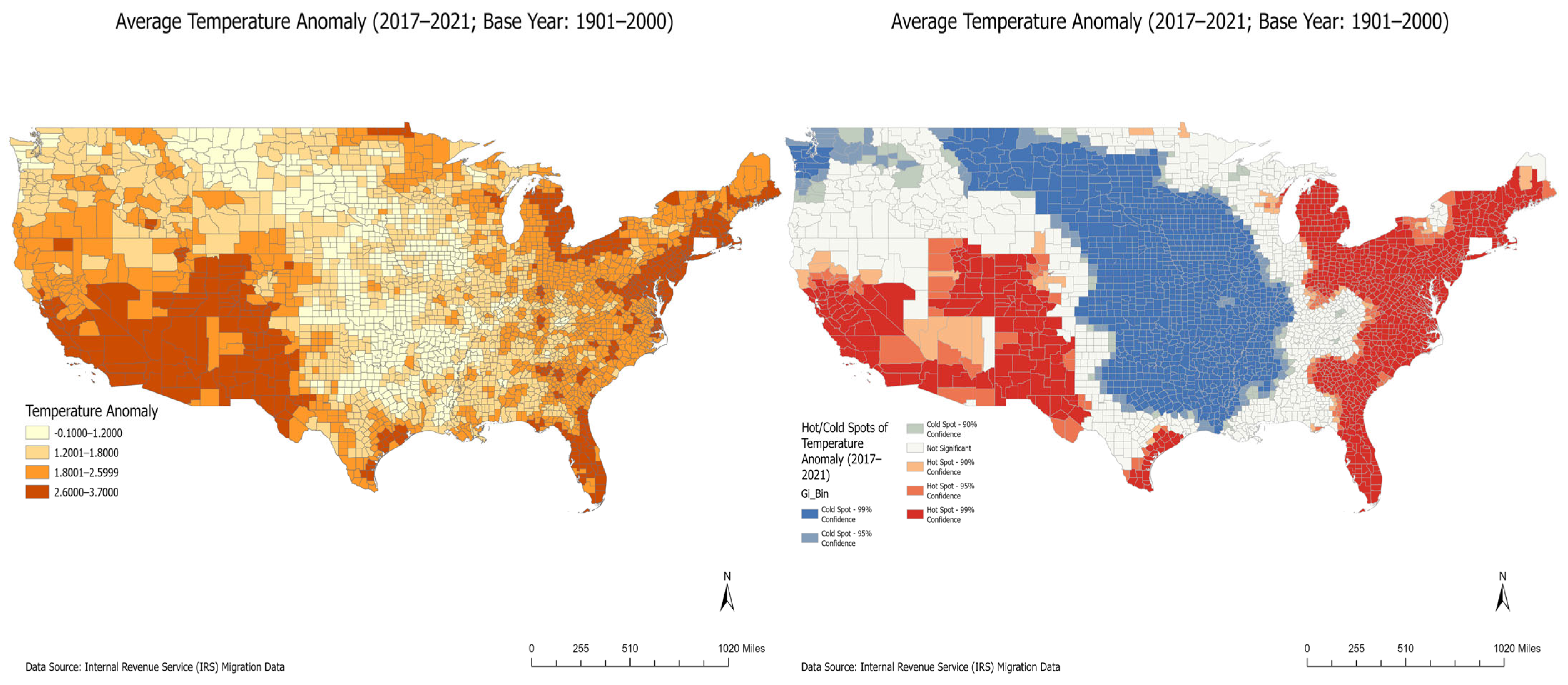
When examining the spatial patterns of temperature anomalies and migration, Figure 1 shows that the strongest warming, typically between 2.6 °F (1.44 °C) and 3.7 °F (2.06 °C), occurs across Arizona, New Mexico, southern California, southern Nevada, and portions of the Northeast corridor. Much of the interior United States exhibits only modest anomalies, generally below 1.8 °F (1.0 °C). Relatively few counties reach anomalies greater than three degrees Fahrenheit (approximately 1.7 °F (0.94 °C)), although they cluster in recognizable warming regions, including southern California, the Desert Southwest, sections of Colorado and Wyoming, and densely populated parts of the Northeast. The spatial distribution of temperature anomaly underscores how climate change manifests unevenly across space, producing concentrated pockets of warming that may have disproportionate environmental, economic, and social implications.
The second map in Figure 1 identifies hot and cold spots of temperature anomaly between 2017 and 2021 using a Getis–Ord Gi* spatial clustering approach, revealing distinct regions where warming or cooling is occurring more intensely than expected by chance. Large clusters of statistically significant cold spots (shaded in blue) appear throughout the northern and central Great Plains, indicating counties that have experienced below-average anomalies relative to long-term norms. In contrast, hot spots (shaded in orange and red) dominate the Southwest, the Southeast, and much of the coastal Northeast, reflecting concentrated areas of unusually high warming. These patterns highlight the spatially uneven character of recent climate conditions, where some parts of the country experience persistently cooling anomalies even as others warm rapidly and consistently.
When examining the spatial variability of migration, it is essential to acknowledge that employment is the primary driver of migration in the U.S. Counties with robust job markets are more likely to draw a significant amount of in-migration [36]. Prior to the COVID-19 pandemic, migrants were less likely to relocate during economic downturns to areas with differing industrial compositions, as they preferred locations with a familiar job market, which contributed to regional resilience during recessions [37]. However, due to an increase in remote working opportunities, residential preferences in where to live have fundamentally shifted for certain population segments.
Meanwhile, migration from urban centers to suburban or exurban areas continues to gain momentum, particularly among older households with families seeking cost-effective, larger spaces and more recreational and natural amenities [38,39,40]. For retirees, places with more recreational activities, lower cost of living, and warmer climate are popular destinations [41]. Non-metropolitan counties offering amenities geared toward recreational activities or retirement benefits have become popular destinations for migration, often referred to as “gray gold” counties due to their ability to attract older immigrants. These counties typically sustain in-migration as part of long-term path-dependent growth patterns developed through tourism and retirement infrastructure, while younger adults tend to move to metropolitan centers with a large number of jobs and social amenities [41]. Sometimes, migration is driven by higher earners seeking lower housing costs and more desirable amenities. Additionally, places with environmental attractions, such as favorable climates or proximity to water bodies, show high in-migration rates, as people seek regions that provide lifestyle amenities. Regions in the South and West of the U.S. are significant net gainers due to these factors, often at the expense of out-migrating places in colder or less scenic areas [42,43]. Conversely, rural counties with limited job opportunities or harsh climates face net out-migration. Counties in the Great Plains, for example, have seen persistent population losses as residents migrate to more economically stable regions or areas with better amenities [43,44]. Other factors, such as the absence of state income taxes and certain political environments, may also significantly influence migration patterns.
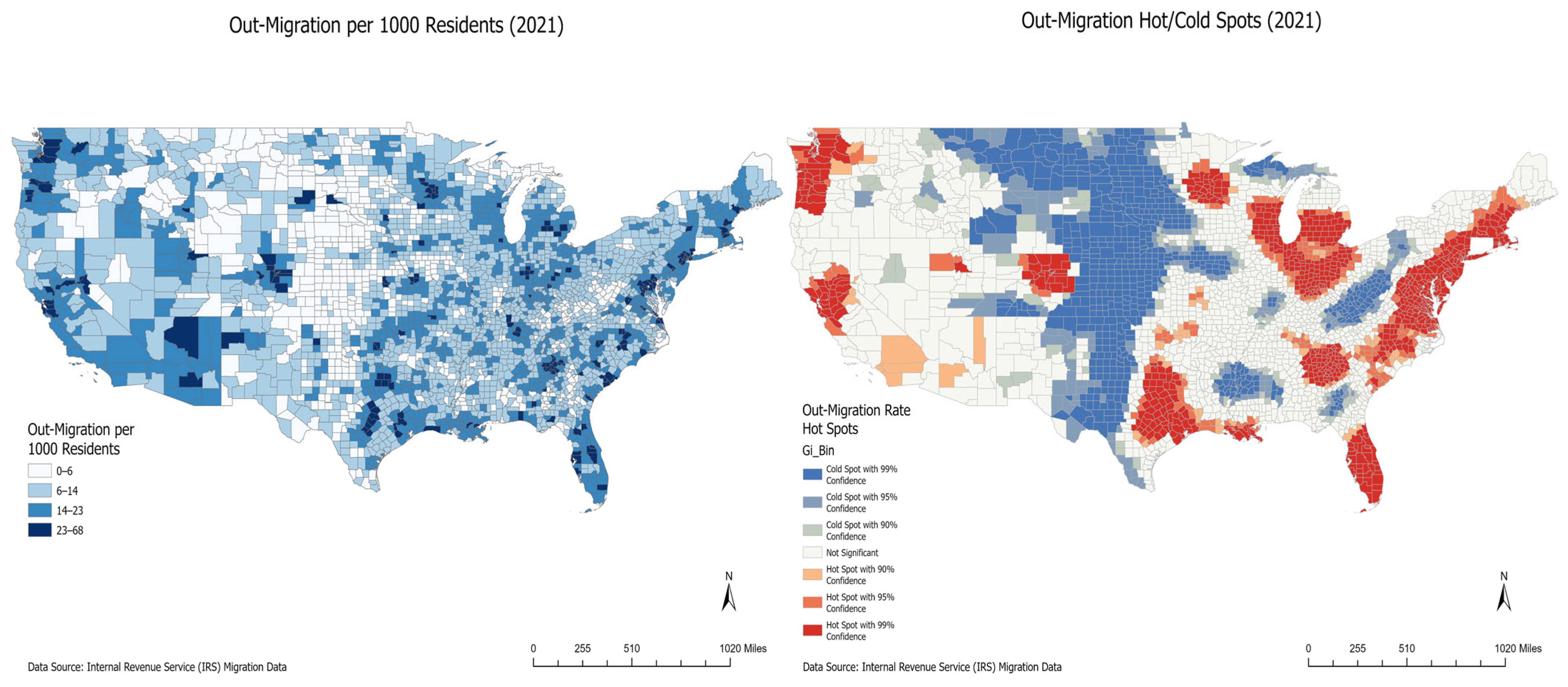
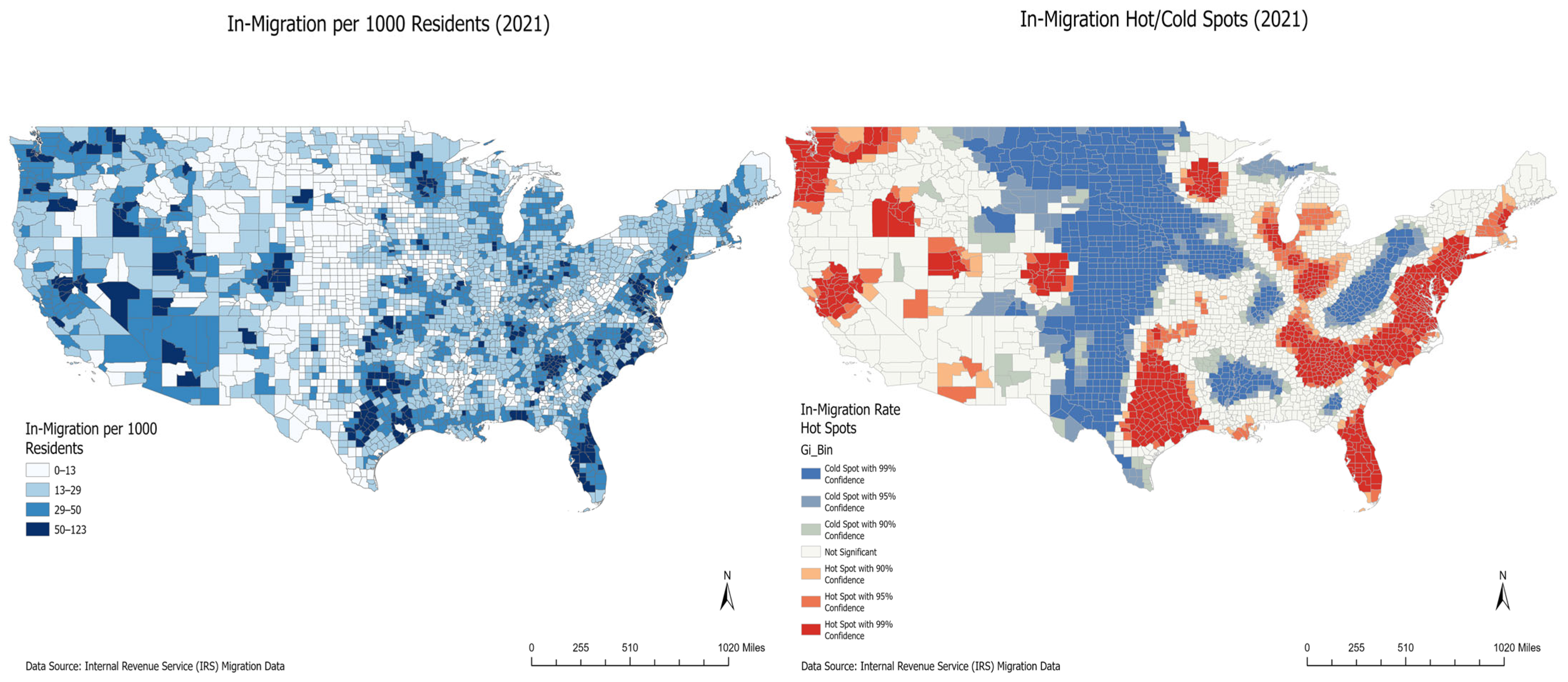
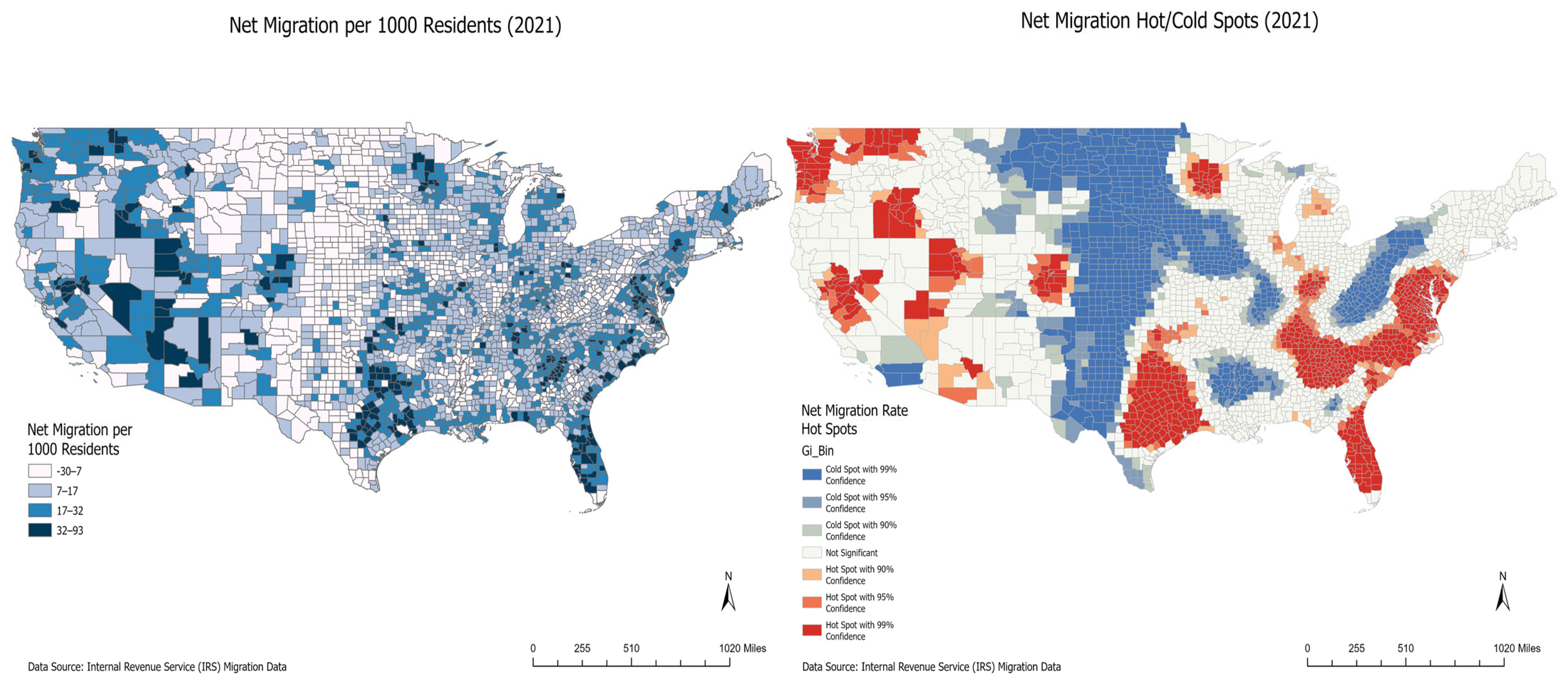
The migration patterns observed in this study are consistent with those previously reported. However, it seems more complex. Clusters of higher out-migration and in-migration rates are mostly concentrated in large metropolitan areas on the East Coast, West Coast, Midwest, and in Colorado and Texas (Figure 2 and Figure 3). However, when looking at the hotspots of net-migration, we find a few prominent clusters, such as Florida (except the a few counties in South Florida), eastern Texas, Nevada and Arizona, Colorado, Idaho-Oregon, and the cluster stretching from East Tennessee, the northeast corner of Alabama, northern Georgia, northern South Carolina, and southern North Carolina (Figure 4).
The spatial distribution of temperature anomaly suggests that recent warming in the United States has been highly uneven, with the strongest anomalies concentrated in the Southwest, the Southeast, and parts of the urbanized Northeast, while the northern Great Plains and Upper Midwest have experienced relative cooling. When these spatial patterns are compared with migration flows, we find that migration patterns are only loosely aligned with contemporary climate anomalies. Counties in the Sun Belt, particularly Arizona, Nevada, Texas, and Florida, continue to attract large numbers of in-migrants despite registering some of the highest temperature anomalies in the country. This means that growing Sun Belt metropolitan areas, such as the Austin–San Antonio corridor, the Tampa–Orlando region, and the Phoenix area, form consistent net migration hotspots. Conversely, many of the counties appear as statistically significant cold spots in the northern Plains, the Mississippi Delta, the Midwest, and parts of Appalachia continue to experience net population loss, not because temperatures are cooler, but because of long-standing structural factors such as limited economic diversification, aging populations, and shrinking labor markets.
The migration maps also show that major metropolitan regions on the coasts, such as the Boston–New York–Philadelphia corridor and parts of coastal California, exhibit strong warming anomalies but continue to show either modest in-migration or stable net flows once population size is considered. These patterns reinforce that high-warming regions are not necessarily losing people; in fact, many of the most rapidly warming counties are among the nation’s fastest-growing. Meanwhile, a small number of counties with extreme temperature anomalies, those exceeding three degrees Fahrenheit, tend not to show distinctive migration signatures, further highlighting that temperature anomalies alone are probably not currently the primary driver of U.S. population movement. Instead, the alignment between the two sets of maps (temperature anomaly and migration) suggests that climate anomalies emerging atop deeply entrenched demographic trends, and that while warming may become more consequential in the future, the present-day geography of migration is still shaped overwhelmingly by economic opportunities, housing availability, suburban expansion, lifestyle preferences, and longstanding regional development patterns rather than by short-term climate fluctuations.

3.2. Regression Analysis Results

3.2.1. The Influence of Temperature Anomaly on Population Migration

Since the residuals and the dependent variables from Generalized Linear Models (GLM) are spatially autocorrelated, and the LM Error and Lag tests are statistically significant we use Spatial Combined Models to estimate county-level migration rates per 1000 residents as a function of temperature conditions measured in degrees Fahrenheit, while controlling for socioeconomic, housing, labor-market characteristics, and climate vulnerability, and accounting for spatially correlated errors (see Table 2).
The results indicate that temperature anomalies are somewhat significantly (p < 0.10) related to out-migration rates, but in ways that diverge from the presumed “climate push” narrative since higher temperature anomaly was associated with lower out-migration. A one-degree Fahrenheit increase in the temperature anomaly is associated with a 0.34-person decrease in out-migration per 1000 residents (β ≈ −0.34, p < 0.10). This negative association suggests that, on average, anomalous temperature conditions suppress mobility rather than induce exit. This pattern emphasizes immobility and constraint under climate stress, where adverse environmental conditions increase the costs of moving or encourage households to adapt in place rather than migrate. However, this could also indicate that socioeconomic, housing, and labor market conditions are the primary factors driving migration, rather than climate-related risks. Areas with high temperature anomalies may have a strong labor market and urban amenities, leading to fewer instances of out-migration. This relationship is supported by the strong heterogeneity in the spatial error and log combined models when considering the interaction terms. The interaction between temperature anomaly and poverty is positive and statistically significant (β ≈ 8.90, p < 0.001), indicating that in counties with higher poverty rates, temperature anomalies are associated with higher out-migration rates. In contrast, the interaction between temperature anomaly and population size is negative and significant (β ≈ −0.31, p < 0.001), implying that in larger counties, anomalies conversely suppress out-migration, potentially indicating that environmental stress can both enable and constrain mobility depending on socioeconomic resources and local context. In poorer counties, anomalies may overwhelm local coping capacity and translate into outflows, whereas in larger or more resource-rich counties, households may have a greater ability to absorb shocks locally or relocate within the county rather than exit entirely, consistent with residential mobility frameworks that distinguish decisions to move from decisions to stay [6,7].
The indicator for extreme temperature anomalies is not statistically significant for out-migration (p > 0.10), implying that even extreme climate events do not universally generate immediate outflows, and that migration responses to environmental change may be nonlinear and context-dependent.
In contrast to out-migration, climate effects on in-migration rates are driven primarily by extreme temperature anomalies. Counties experiencing extreme anomalies receive approximately 1.90 fewer in-migrants per 1000 residents (β ≈ −1.90, p < 0.05). The continuous temperature anomaly measure is not statistically significant, suggesting that routine deviations from historical norms do not substantially deter inflows unless they cross into extreme territory. This pattern supports a destination deterrence interpretation that is increasingly emphasized in the U.S. climate–migration literature. Rather than pushing existing residents out, extreme temperature conditions appear to reduce the willingness of potential migrants to move in, lowering in-migration and reshaping net flows. This finding may indicate that climate risk is mediated through housing markets, insurance availability, and policy environments, which can increase perceived risk and reduce housing access in climate-exposed locations. Within this framework, extreme anomalies alter the attractiveness of destinations by interacting with housing affordability and financial constraints rather than by directly triggering outflows.
Results for net migration rates reflect the combined patterns observed for out- and in-migration. Extreme temperature anomalies are associated with a reduction in net migration of approximately 1.24 migrants per 1000 residents (β ≈ −1.24, p < 0.05), while the continuous anomaly measure is not statistically significant. These results indicate that net population losses under extreme temperature conditions are driven primarily by reduced inflows rather than increased exits, reinforcing the destination deterrence interpretation. The influence of extreme events on migration is further reflected in the negative association between extreme-event vulnerability and both in-migration and net migration. By contrast, the average number of extreme heat events during 2017–2021 shows no significant relationship with migration outcomes. This suggests that extreme heat events during this period may not have been sufficiently intense or persistent to meaningfully affect temperature anomalies or migration behavior.
At the same time, baseline average temperature is strongly and positively associated with in-migration and net migration (e.g., β ≈ 0.24 for in-migration and β ≈ 0.22 for net migration, both p < 0.001), and also positively related to out-migration at p < 0.10, indicating higher overall migration turnover in historically warmer counties. This contrast between baseline climate and anomalies highlights an important synthesis with the literature: long-run climate conditions function as amenities that attract migrants, while short-run or extreme departures from those conditions reduce attractiveness and suppress flows.
When examining other independent variables, we find that certain socioeconomic characteristics are strongly associated with migration outcomes across all three models, helping to contextualize the estimated climate effects. Urban counties experience significantly higher out-migration, in-migration, and net migration, indicating greater overall mobility rather than one-directional population loss or gain. Larger populations are also associated with higher migration flows, especially in-migration, which is consistent with agglomeration effects and broader labor-market opportunities. In contrast, counties with higher poverty rates, larger non-U.S.-born populations, higher minority shares, and higher baseline environmental and social vulnerability tend to attract fewer migrants and experience lower net migration, pointing to persistent structural disadvantages that limit their attractiveness as destinations.
Counties with a higher share of adults holding a bachelor’s degree or higher exhibit significantly higher out-migration but substantially lower in-migration, resulting in a pronounced negative effect on net migration. This pattern suggests that counties with a highly educated population are not necessarily “losing” human capital in a simple sense; rather, residents, particularly the highly educated, tend to be more mobile, moving away for reasons such as career advancement, housing affordability, or lifestyle preferences. At the same time, these counties may be less accessible or attractive to new migrants, potentially due to high living costs, competitive labor markets, or housing constraints. The negative interaction between education and unemployment (marginally significant) further indicates that in areas with higher unemployment, the presence of a highly educated population is associated with muted migration responses, reinforcing the idea that education amplifies sensitivity to local economic conditions rather than uniformly drawing in-migrants.
Housing market characteristics play a central role in shaping migration outcomes. Areas with higher homeownership rates tend to experience higher in-migration and net-migration, but conversely, lower out-migration, indicating a strong pull factor of homeownership. Higher housing vacancy rates are associated with significantly lower overall migration flows, potentially indicating that vacancy is associated with structural weakness and economic decline in areas with higher housing vacancy. Conversely, higher housing costs are associated with increased migration outflow, inflow, and net flow, suggesting a complex relationship between housing costs and migration. On one hand, higher housing costs act as a push factor; on the other hand, high housing costs may indicate stronger labor market and economic conditions, attracting population inflows. These findings highlight housing availability, affordability, and homeownership as key constraints and positive amenities on migration, supporting the possible interpretations that climate effects accentuate destination attractiveness. In particular, they align with arguments that climate risk is increasingly embedded in housing and insurance systems, shaping who can move into climate-exposed areas and under what conditions.
Overall, the results suggest that temperature effects on migration are mediated by vulnerability, housing markets, and labor market structure, rather than operating as direct environmental push factors. The findings contribute to a growing body of work cautioning against deterministic narratives of climate-induced mass migration. Moderate temperature anomalies are associated with lower out-migration on average, which may suggest constrained mobility and adaptation in place, a pattern widely discussed in the climate–migration literature [2,13]. However, this effect weakens or reverses in counties with higher poverty and environmental vulnerability, underscoring the importance of socioeconomic context and adaptive capacity in conditioning migration responses to climate stress, rather than producing uniform or deterministic population displacement. In contrast, extreme temperature anomalies are primarily associated with lower in-migration and net-migration, potentially leading to net population losses driven by suppressed inflows rather than increased exits. This potential destination deterrence pattern aligns with recent U.S. evidence showing that climate conditions and hazards shape where people choose to move, not only whether they move at all. The strong role of housing variables further suggests that climate risk affects migration indirectly, through perceived risk, insurance availability, and housing market frictions [9]. Additionally, the contrast between the baseline average temperature and temperature anomalies highlights the dual role of climate as both an amenity and a risk, influencing population redistribution while, over time, it may gradually erode the attractiveness of historically desirable locations.

3.2.2. Temperature Tipping Points for Migration

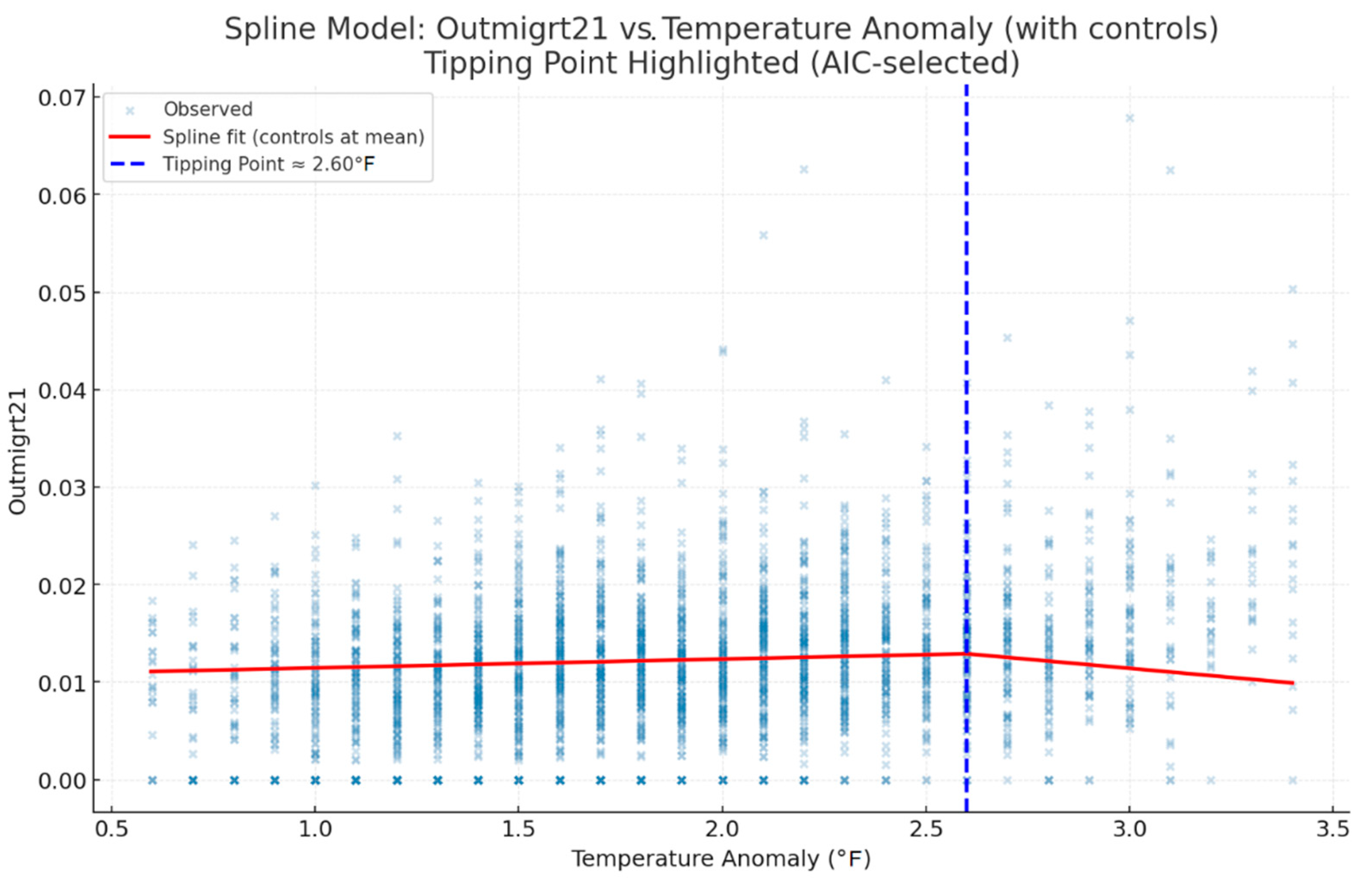
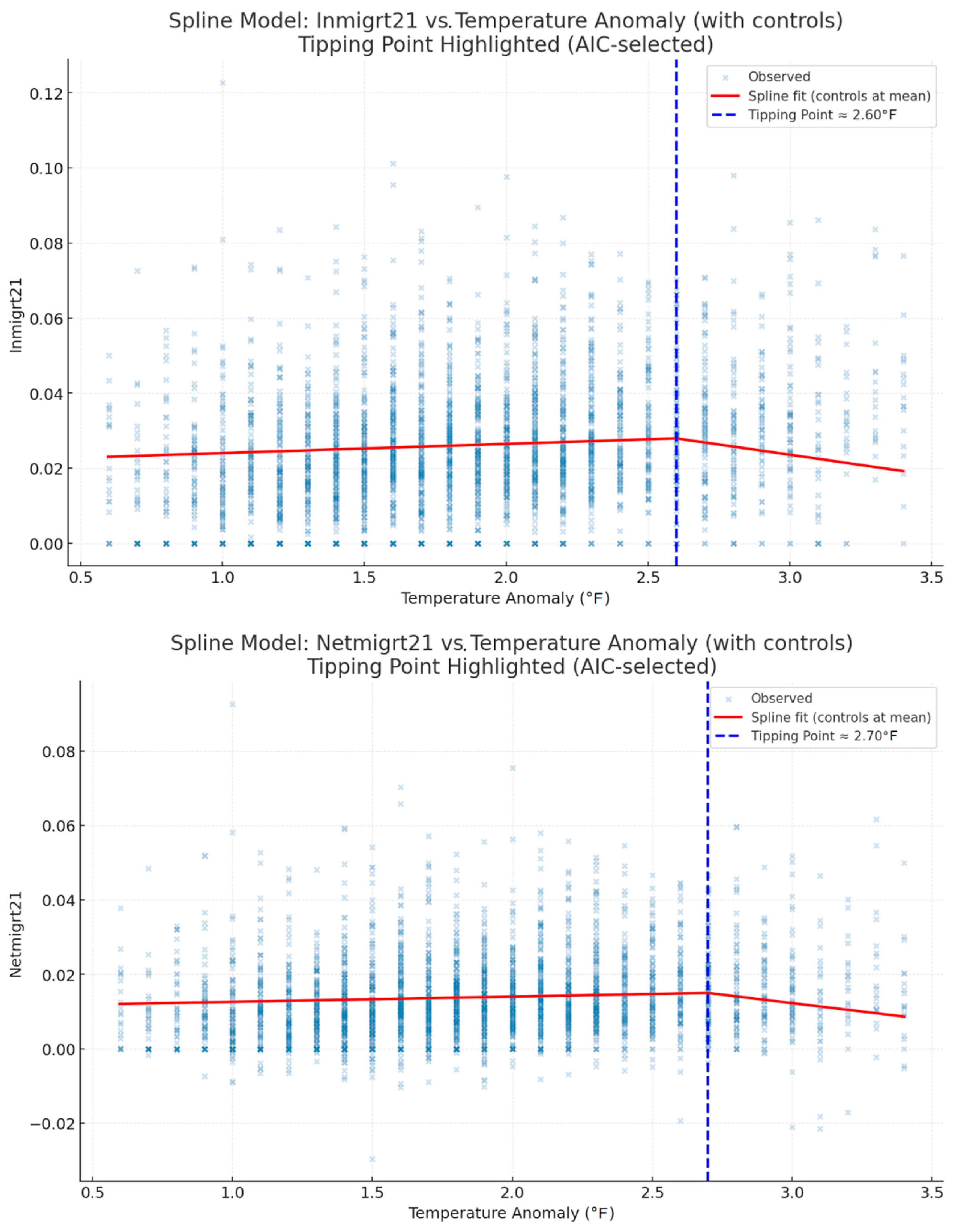
To explore how temperature anomalies influence migration patterns across U.S. counties, we estimated a series of piecewise linear spline models in which out-migration rate (Outmigrt21), in-migration rate (Inmigrt21), and net migration rate (Netmigrt21) are each regressed on temperature anomaly while controlling for a comprehensive set of socioeconomic, demographic, and infrastructural factors (see Figure 5). A key feature of this approach is its flexibility: instead of imposing a single linear relationship, the spline allows the slope to change at an interior “tipping point,” capturing potential nonlinear responses to climate variation. We identified this tipping point objectively by searching across candidate knot locations and selecting the value that minimized the Akaike Information Criterion (AIC), ensuring that the spline model balances fit and parsimony. This approach allows the slope of the temperature–migration relationship to change at a single, data-driven tipping point, rather than imposing a uniform linear effect. Predictions were generated by holding all demographic, socioeconomic, and infrastructural controls at their means, allowing only temperature anomaly to vary, so that the plotted spline curves reflect only the modeled influence of temperature anomaly, permitting clear visualization of the isolated association between climate conditions and migration behavior.
The resulting spline plots for out-migration, in-migration, and net migration rates (Figure 5) each reveal a similar pattern: relatively weak sensitivity to temperature anomaly at lower values and a potential inflection point as anomaly levels become more extreme. For both Outmigrt21 and Inmigrt21, the AIC search identified a tipping point at approximately 2.6 °F (1.44 °C), indicating that the slope of the migration–anomaly relationship shifts once anomalies exceed this moderately high threshold. Below 2.6 °F, the fitted curves remain relatively flat, suggesting minimal responsiveness of migration rates to low or moderate temperature anomalies. Above this point, the slope becomes somewhat steeper, though still small in magnitude. The model for Netmigrt21 yields a slightly higher tipping point, near 2.7 °F (1.5 °C), mirroring the threshold found in earlier net-migration models. This shift in slope reflects a subtle change in the balance of inflows and outflows as anomalies become increasingly extreme, although the effect remains weak. Across all three models, the red spline curves provide a smoothed representation of these relationships, while the observed data points exhibit wide dispersion, typical of county-level migration rates.
Despite these analytical strengths, several limitations of the approach warrant attention. Most importantly, the spline-estimated impacts of temperature anomalies on all three migration outcomes are statistically insignificant, indicating that migration rates do not shift meaningfully with temperature once other structural conditions are accounted for. This implies that the estimated tipping points should be interpreted cautiously; they may reflect statistical features of the data rather than true behavioral thresholds. Moreover, spline models remain sensitive to the choice of knot search range, potential outliers, and the distribution of the anomaly variable. They also cannot fully address deeper challenges such as unmeasured county characteristics, lagged climate–migration responses, or behavioral reactions to cumulative exposures and extreme events. Consequently, while spline methods provide a flexible exploratory tool for detecting nonlinearities, the largely insignificant effects observed here emphasize that climate anomalies alone do not appear to systematically drive migration patterns in these data.

4. Discussion

This study provides a comprehensive review of the relationship between slow-onset climate change and household migration. The study fills a gap in the existing literature on residential mobility, where the cumulated climate factor is not traditionally considered. Residential mobility has a significant impact on urban planning decisions and community stability. Identifying climate change factors will help planners and policymakers better prepare for population changes in local communities.
The spatial analysis and regression findings indicate that temperature anomaly has, at most, a weak, inconsistent, and context-dependent relationship with county-level migration patterns in the contemporary contiguous United States. In the spatial regression models, the temperature anomaly is statistically significant only for the out-migration rate, and even then, the effects are substantively small (e.g., −0.34 residents per one-degree increase). The negative direction is not as expected but might indicate the “trapped population” syndrome under environmental stress. After controlling for the interaction between anomaly and poverty, we find that temperature has a greater influence on out-migration in counties with higher poverty rates, potentially displacing residents or inducing more out-migration. In-migration and net migration do not show statistically meaningful associations with temperature anomaly in the models. These muted effects contrast with the stronger and more consistent roles played by socioeconomic, demographic, housing, and vulnerability indicators. Specifically, the analysis shows that migration responses are not uniformly elastic to local conditions: high housing vacancy is associated with lower, rather than higher, mobility; elevated housing costs do not deter in-migration in high-demand areas; and educational attainment is linked to greater out-migration but reduced in-migration, indicating selective rather than universal mobility. From a policy perspective, these findings can be interpreted through a Tiebout-style framework in which households sort across jurisdictions by responding to local economic conditions, amenities, and constraints [45]. However, the results also highlight important departures from the frictionless mobility assumed in the Tiebout framework as migration responses are not uniformly elastic to local conditions, suggesting that “voting with one’s feet” is shaped by housing market constraints and socioeconomic sorting, and that local policy competition may reinforce spatial inequality unless barriers to mobility are directly addressed.
These findings both resonate with and diverge from the existing literature. Prior research has documented robust evidence that persistent warming, extreme heat, and heat-driven declines in agricultural productivity can lead to higher out-migration or suppressed in-migration, particularly over long time horizons or in climate-exposed economies (e.g., [31,37]). Moreover, existing studies have emphasized nonlinear and context-specific responses, with stronger effects in low-income, agricultural/lower population density, or climate-vulnerable settings and weaker effects in more resilient or amenity-driven destinations. Compared to this literature, the present study’s results suggest that the temperature anomaly measure used, an aggregated county-level deviation from a historical baseline, may not capture the types of acute or cumulative thermal stresses shown elsewhere to influence mobility. Additionally, heterogeneity in adaptive capacity, such as access to air conditioning, insurance markets, or infrastructure, may buffer households from heat-related pressures, resulting in muted aggregate associations even as underlying exposure grows.
Beyond its contributions to climate–migration scholarship, this study has broader relevance for sustainable development and regional resilience planning. The findings indicate that migration responses to temperature anomalies are mediated by uneven adaptive capacity, housing market constraints, and socioeconomic inequality rather than by environmental change alone. From a sustainability perspective, this suggests that communities may experience divergent demographic and development trajectories under slow-onset climate stress: some areas may retain populations despite increasing environmental risk due to mobility constraints, while others may experience reduced in-migration and declining attractiveness. Such dynamics have implications for long-term infrastructure planning, housing systems, fiscal stability, and the equitable distribution of adaptation resources. Integrating climate adaptation strategies with housing affordability, economic development, and social equity policies may therefore be necessary to promote more balanced and sustainable regional development. By clarifying the structural conditions that shape climate-related mobility, this study highlights the importance of place-based and equity-informed sustainability approaches in responding to slow-onset climate change.
This study has several limitations that shape interpretation. First, the analysis is cross-sectional; thus, it cannot isolate long-run cumulative climate exposure effects or causal dynamics. Second, county-level data may obscure important intra-county variability in socioeconomic vulnerability, adaptive capacity, and mobility constraints, as evidenced by hyperlocal disparities highlighted in the U.S. Climate Vulnerability Index (CVI) data. Third, migration is a multifaceted process shaped by intertwined drivers, housing costs, insurance markets, job opportunities, amenities, and social networks, which may overpower or mask climate-specific effects in aggregated models. Finally, the study focuses on recent years (2017–2021), a period during which climate impacts are accelerating but may not yet have reached the thresholds necessary to produce large-scale, observable mobility responses. Despite these limitations, the study adds to the current literature by focusing on an increasingly more important topic, and the methodology used, such as spatial analysis and spline regression models, can be replicated in other climate migration studies.

5. Conclusions

This study finds limited evidence that recent temperature anomalies have independently driven large-scale internal migration across U.S. counties. Migration patterns during the study period are dominated by socioeconomic, demographic, housing, and baseline vulnerability factors, with temperature anomalies playing a secondary and highly conditional role. These findings caution against strong claims that gradual temperature deviations alone currently operate as uniform migration triggers at the aggregate level.
At the same time, the results yield several important insights. First, weak average effects are consistent with the presence of mobility constraints and adaptive buffers, suggesting that immobility may be a central outcome of slow-onset climate change. Second, the interaction between temperature anomalies and poverty highlights distributional vulnerability, indicating that climate stress may intensify inequality even in the absence of large population flows. Third, the absence of strong aggregate effects does not preclude future tipping points; rather, it suggests that such thresholds may emerge only when cumulative exposure, extreme events, or institutional constraints interact more forcefully.
From a policy perspective, these findings support cautious and targeted responses. Rather than assuming imminent climate-driven mass migration, policymakers should prioritize reducing vulnerability in place through investments in heat-resilient housing, infrastructure upgrades, energy-cost mitigation, and protections for renters and low-income households. Strengthening social protection systems can help reduce both maladaptive immobility and distress-driven migration should climate pressures intensify [46]. Future research would benefit from incorporating finer-grained climate exposure metrics, panel designs capable of estimating cumulative or lagged effects, and methods that explicitly model nonlinear tipping points. Integrating individual-level or household-level survey data could illuminate how climate concerns translate, or fail to translate, into mobility intentions and actions. Additionally, expanding the analysis to incorporate hazard-specific risks (e.g., wildfire, drought, flood insurance changes) may clarify how different climate stressors interact to shape migration trajectories.

Author Contributions

Conceptualization, Y.L. and D.M.; methodology, Y.L. and D.M.; software, Y.L.; validation, Y.L. and D.M.; formal analysis, Y.L.; investigation, Y.L.; resources, Y.L. and D.M.; data curation, Y.L.; writing—original draft preparation, Y.L. and D.M.; writing—review and editing, Y.L. and D.M.; visualization, Y.L. All authors have read and agreed to the published version of the manuscript.

Funding

This research received no external funding.

Institutional Review Board Statement

Not applicable.

Informed Consent Statement

Not applicable.

Data Availability Statement

The data supporting the conclusions of this article will be made available by the authors on request.

Acknowledgments

The authors would like to thank Dylan Delaney for compiling the temperature anomaly data for the U.S. During the preparation of this manuscript/study, the author(s) used ChatGPT 5.1 for the purpose of creating the spline tipping point plots as shown in Figure 5. The authors have reviewed and edited the output and take full responsibility for the content of this publication.

Conflicts of Interest

The authors declare no conflicts of interest.

Correction Statement

This article has been republished with a minor correction to the readability of Figure 5. This change does not affect the scientific content of the article.

References

  1. Stott, P. How climate change affects extreme weather events. Science 2016, 352, 1517–1518. [Google Scholar] [CrossRef]
  2. Castro, B.; Sen, R. Everyday adaptation: Theorizing climate change adaptation in daily life. Glob. Environ. Change 2022, 75, 102555. [Google Scholar] [CrossRef]
  3. Savelli, A.; Schapendonk, F.; Sarzana, C.; Dutta Gupta, T.D.; Caroli, G.; Duffy, M.; de Brauw, A.; Thornton, P.; Pacillo, G.; Läderach, P. The Climate Security-Mobility Nexus: Impact Pathways and Research Priorities; CGIAR FOCUS Climate Security: Montpelier, France, 2022. [Google Scholar]
  4. Martin, C. Exploring climate change in U.S. housing policy. Hous. Policy Debate 2022, 32, 1–13. [Google Scholar] [CrossRef]
  5. Perera, A.T.D.; Nik, V.M.; Chen, D.; Scarterzzini, J.-L.; Hong, Y. Quantifying the impacts of climate change and extreme climate events on energy systems. Nat. Energy 2020, 5, 150–159. [Google Scholar] [CrossRef]
  6. Coulter, R.; van Ham, M.; Findlay, A.M. Re-thinking residential mobility: Linking lives through time and space. Prog. Hum. Geogr. 2016, 40, 352–374. [Google Scholar] [CrossRef] [PubMed]
  7. Clark, W.A.V.; Lisowski, W. Decisions to move and decisions to stay: Life course events and mobility outcomes. Hous. Stud. 2016, 33, 547–565. [Google Scholar] [CrossRef]
  8. Lewis, W.A. Economic development with unlimited supplies of labour. Manch. Sch. 1954, 22, 139–191. [Google Scholar] [CrossRef]
  9. Lee, E.S. A theory of migration. Demography 1966, 3, 47–57. [Google Scholar] [CrossRef]
  10. Massey, D.S.; Arango, J.; Hugo, G.; Kouaouci, A.; Pellegrino, A.; Taylor, J.E. Theories of international migration: A review and appraisal. Popul. Dev. Rev. 1993, 19, 431–466. [Google Scholar] [CrossRef]
  11. Stark, O.; Bloom, D.E. The new economics of labor migration. Am. Econ. Rev. 1985, 75, 173–178. [Google Scholar]
  12. Black, R.; Adger, W.N.; Arnell, N.W.; Dercon, S.; Geddes, A.; Thomas, D. The effect of environmental change on human migration. Glob. Environ. Change 2011, 21, S3–S11. [Google Scholar] [CrossRef]
  13. Boustan, L.P.; Kahn, M.E.; Rhode, P.W.; Yanguas, M.L. The effect of natural disasters on economic activity in U.S. counties: A century of data. J. Urban Econ. 2020, 118, 103257. [Google Scholar] [CrossRef]
  14. Nawrotzki, R.J.; DeWaard, J. Climate shocks and the timing of migration from Mexico. Popul. Environ. 2016, 38, 72–100. [Google Scholar] [CrossRef]
  15. Brown, L.A.; Moore, E.G. The intra-urban migration process: A perspective. Geogr. Ann. Ser. B Hum. Geogr. 1970, 52, 1–13. [Google Scholar] [CrossRef]
  16. McLeman, R. Climate and Human Migration: Past Experiences, Future Challenges; Cambridge University Press: Cambridge, UK, 2019. [Google Scholar]
  17. Hunter, L.M.; Luna, J.K.; Norton, R.M. Environmental dimensions of migration. Annu. Rev. Sociol. 2015, 41, 377–397. [Google Scholar] [CrossRef] [PubMed]
  18. Cattaneo, C.; Beine, M.; Fröhlich, C.J.; Kniveton, D.; Martínez-Zarzoso, I.; Mastrorillo, M.; Millock, K.; Piguet, E.; Schraven, B. Human migration in the era of climate change. Rev. Environ. Econ. Policy 2019, 13, 189–206. [Google Scholar] [CrossRef]
  19. Black, R.; Arnell, N.W.; Adger, W.N.; Thomas, D.; Geddes, A. Migration, immobility, and displacement outcomes following extreme events. Environ. Sci. Policy 2013, 27, S32–S43. [Google Scholar] [CrossRef]
  20. Ayeb-Karlsson, S.; Smith, C.D.; Kniveton, D. A discursive review of the textual use of ‘trapped’ in environmental migration studies: The conceptual birth and troubled teenage years of trapped populations. Ambio 2018, 65, 102180. [Google Scholar] [CrossRef]
  21. Castells-Quintana, D.; Lopez-Uribe, M.D.P.; McDermott, T.K.J. Adaptation to climate change: A review through a development economics lens. World Dev. 2018, 104, 183–196. [Google Scholar] [CrossRef]
  22. Mukherjee, M.; Fransen, S. Exploring migration decision-making and agricultural adaptation in the context of climate change: A systematic review. World Dev. 2024, 179, 106600. [Google Scholar] [CrossRef]
  23. Zickgraf, C. Climate change and migration: Myths and realities. In Sustainable Human Development; The Jus Semper Global Alliance: Moorpark, CA, USA, 2022. [Google Scholar]
  24. Gray, C.; Mueller, V. Natural disasters and population mobility in Bangladesh. Proc. Natl. Acad. Sci. USA 2012, 109, 6000–6005. [Google Scholar] [CrossRef] [PubMed]
  25. Nawrotzki, R.J.; Bakhtsiyarava, M. International climate migration: Evidence for the climate inhibitor mechanism and the agricultural pathway. Popul. Space Place 2017, 23, e2033. [Google Scholar] [CrossRef] [PubMed]
  26. Bohra-Mishra, P.; Oppenheimer, M.; Hsiang, S.M. Nonlinear permanent migration response to climatic variations, but minimal response to disasters. Proc. Natl. Acad. Sci. USA 2014, 111, 9780–9785. [Google Scholar] [CrossRef] [PubMed]
  27. Marandi, E.; Main, D.S. Vulnerable City, recipient city, or climate destination? Towards a typology of domestic climate migration impacts in US cities. J. Environ. Stud. Sci. 2021, 11, 465–480. [Google Scholar] [CrossRef]
  28. Rigaud, K.K.; de Sherbinin, A.; Jones, B.; Bergmann, J.; Clement, V.; Ober, K.; Schewe, J.; Adamo, S.; McCusker, B.; Heuser, S.; et al. Groundswell: Preparing for Internal Climate Migration; World Bank: Washington, DC, USA, 2018. [Google Scholar] [CrossRef]
  29. Adger, W.N.; Quinn, T.; Lorenzoni, I.; Murphy, C.; Sweeney, J. Changing social contracts in climate-change adaptation. Nat. Clim. Change 2013, 3, 330–333. [Google Scholar] [CrossRef]
  30. Boas, I.; Farbotko, C.; Adams, H.; Sterly, H.; Bush, S.; van der Geest, K.; Wiegel, H.; Ashraf, H.; Baldwin, A.; Bettini, G.; et al. Climate migration myths. Nat. Clim. Change 2019, 9, 901–903. [Google Scholar] [CrossRef]
  31. Feng, S.; Oppenheimer, M.; Schlenker, W. Weather Anomalies, Crop Yields, and Migration in the U.S. Corn Belt; National Bureau of Economic Research (NBER): Cambridge, MA, USA, 2013. [Google Scholar]
  32. Mullins, J.T.; Bharadwaj, P. Weather, Climate, and Migration in the United States; National Bureau of Economic Research (NBER) Working Paper No. 28614; National Bureau of Economic Research (NBER): Cambridge, MA, USA, 2021. [Google Scholar] [CrossRef]
  33. Obolensky, M.; Ranson, M.; Gallen, T. Migration, Climate Similarity, and the Consequences of Climate Change; NBER Working Paper No. 32035; National Bureau of Economic Research (NBER): Cambridge, MA, USA, 2024. [Google Scholar]
  34. Clark, M.B.; Mueller, J.; Rohla, R. Flocking to fire: How climate and natural hazards shape human migration across the United States. Front. Hum. Dyn. 2022, 4, 886545. [Google Scholar] [CrossRef]
  35. Issa, R.; van Daalen, K.R.; Faddoul, A.; Collias, L.; James, R.; Chaudhry, U.A.R.; Graef, V.; Sullivan, A.; Erasmus, P.; Chesters, H.; et al. Human migration on a heating planet: A scoping review. PLoS Clim. 2023, 2, e0000214. [Google Scholar] [CrossRef]
  36. Han, Y.; Goetz, S.; Kim, T.; Lee, J. Estimating Employment-Related Migration from Overlapping Migration and Commuting Networks. Growth Change 2013, 44, 474–493. [Google Scholar] [CrossRef]
  37. Crown, D.; Jaquet, T.; Faggian, A. Interregional Migration and Implications for Regional Resilience. In New Frontiers in Interregional Migration Research; Advances in Spatial Science; Biagi, B., Faggian, A., Rajbhandari, I., Venhorst, V., Eds.; Springer: Cham, Switzerland, 2018. [Google Scholar] [CrossRef]
  38. Golding, S.A.; Winkler, R.L. Tracking Urbanization and Exurbs: Migration Across the Rural–Urban Continuum, 1990–2016. Popul. Res. Policy Rev. 2020, 39, 835–859. [Google Scholar] [CrossRef]
  39. Johnson, K.M.; Winkler, R.L. Age and lifecycle patterns driving U.S. migration shifts. Carsey Sch. Public Policy 2013, 192, 1–6. [Google Scholar] [CrossRef]
  40. Manson, G.A.; Groop, R.E. U.S. Intercounty Migration in the 1990s: People and Income Move Down the Urban Hierarchy. Prof. Geogr. 2000, 52, 493–504. [Google Scholar] [CrossRef]
  41. Brown, D.L.; Bolender, B.C.; Kulcsar, L.; Glasgow, N.; Sanders, S.R. Intercounty variability of net migration at older ages as a path-dependent process. Rural. Sociol. 2011, 76, 44–73. [Google Scholar] [CrossRef]
  42. Ambinakudige, S.; Parisi, D. A spatiotemporal analysis of inter-county migration patterns in the United States. Appl. Spat. Anal. Policy 2015, 10, 121–137. [Google Scholar] [CrossRef]
  43. Johnson, K.M.; Winkler, R.L. Migration signatures across the decades: Net migration by age in U.S. counties, 1950–2010. Demogr. Res. 2015, 32, 1065–1080. [Google Scholar] [CrossRef] [PubMed]
  44. Marre, A.W.; Rupasingha, A. School Quality and Rural In-Migration: Can Better Rural Schools Attract New Residents? J. Reg. Sci. 2020, 60, 156–173. [Google Scholar] [CrossRef]
  45. Tiebout, C.M. A pure theory of local expenditures. J. Political Econ. 1956, 64, 416–424. [Google Scholar] [CrossRef]
  46. Silchenko, D.; Murray, U. Migration and climate change—The role of social protection. Clim. Risk Manag. 2023, 39, 100472. [Google Scholar] [CrossRef]
Figure 1. Temperature anomaly in the contiguous U.S. counties (2017–2021; Base Period: 1901–2021); Data Source: NOAA National Centers for Environmental Information, 2024.
Sustainability 18 02040 g001
Figure 2. Population moving out of a county per 1000 residents (2021). Data Source: Internal Revenue Service (IRS) Migration Data.
Sustainability 18 02040 g002
Figure 3. Population moving into a county per 1000 residents (2021). Data Source: Internal Revenue Service (IRS) Migration Data.
Sustainability 18 02040 g003
Figure 4. Net migration rate (2021). Data Source: Internal Revenue Service (IRS) Migration Data.
Sustainability 18 02040 g004
Figure 5. Spline tipping points of out-migration, in-migration, and net migration.
Sustainability 18 02040 g005aSustainability 18 02040 g005b
Table 1. Descriptive statistics.
VariableMeanStd DevMinimumMaximum
Temperature and Drought Characteristics
    Temperature anomaly (°F, 2017–2021; base period: 1901–2000)1.9
(1.06 °C)
0.6
(0.33 °C)
−0.1
(−0.06 °C)
3.7 (2.06 °C)
    1901–2000 average temperature (°F)55.7 (13.17 °C)8.4 (4.67 °C)35.7 (2.06 °C)77.9 (25.5 °C)
    Average annual number of extreme heat events (90th percentile, 2017–2021)22.77.0042.8
    Average percent of weeks in moderate or greater drought (2017–2021) 14.7%15.1%081.9%
Migration Characteristics (2021)
    Out-migration population by volume2105 7487 0169,845
    In-migration population by volume3485 9382 099,326
    Net migration by volume1380 5932 −169,84551,202
    Out-migration per 1000 residents (baseline population during 2017–2021)128068
    In-migration per 1000 residents (baseline population during 2017–2021)26170123
    Net migration per 1000 residents (baseline population during 2017–2021)1312−3093
County-Level Socioeconomic Characteristics (2017–2021)
    Change in the percentage of workers working from home (from 2019 to 2021) 1.9%2.5%−20.8%15.6%
    Total population 104,338 335,030 83 10,019,635
    Population density per square mile 273 1850 073,670
    Percentage minority population 19.2%16.6%0.0%95.7%
    Percentage population with a Hispanic origin 9.8%14.1%0.0%98.2%
    Percentage population (>=25 years old) with a Bachelor’s or higher degree 22.9%9.9%0.0%78.7%
    Percentage population not born in the U.S. 4.7%5.7%0.0%54.0%
    Percentage population under the poverty line 14.4%6.1%1.2%59.0%
    Median household income $57,978$15,474$0$156,821
    Unemployment rate 5.2%2.6%0.0%32.4%
County-Level Housing Characteristics (2017–2021)
    Homeownership rate 72.6%8.4%10.4%96.5%
    Housing vacancy rate 18.1%10.7%2.2%83.1%
    Median housing value $168,053$105,224$0$1,225,900
    Median gross rent $822$253$0$2599
    Total housing costs $825$312$0$2753
    Average housing costs as a percentage of monthly median household income (2017–2021)16.9%3.2%0.0%36.6%
County-Level Baseline Vulnerability
    Health vulnerability0.490.210.001.00
    Socioeconomic vulnerability0.490.180.001.00
    Environmental vulnerability0.440.170.001.00
    Infrastructure vulnerability0.530.160.001.00
County-Level Projected Climate Vulnerability
    Health vulnerability due to climate risks0.470.160.001.00
    Socioeconomic vulnerability due to climate risks0.520.160.001.00
    Extreme events vulnerability due to climate risks0.510.170.001.00
Table 2. Results from the Spatial Error Regression models.
VariableOut-MigrationIn-MigrationNet Migration
Coefficient
(Std. Error)
Coefficient
(Std. Error)
Coefficient
(Std. Error)
Intercept0.213
(2.433)
−21.357 ***
(5.948)
−22.824 ***
(4.811)
Temperature Characteristics
    Temperature anomaly (2017–2021; base period: 1901–2000)−0.339+
(0.186)
−0.244
(0.496)
0.080
(0.390)
    Status of extreme anomaly (Yes (1), 394 counties, anomaly >2.6; Otherwise, No(0), 2704 counties)−0.409
(0.338)
−1.889 *
(0.814)
−1.242 *
(0.618)
    1901–2000 average temperature0.034+
(0.021)
0.236 ***
(0.056)
0.216 ***
(0.045)
    Average annual number of extreme heat events (90th percentile, 2017–2021)−0.018
(0.018)
−0.055
(0.044)
−0.038
(0.035)
    Average percent of weeks in moderate or greater drought (2017–2021) −0.017 *
(0.008)
0.016
(0.021)
0.032+
(0.017)
County-Level Socioeconomic Characteristics (2017–2021)
    Urban-rural status (1: urban, 1172 counties; 0: rural, 1926 counties)2.007 ***
(0.204)
6.491 ***
(0.520)
4.453 ***
(0.388)
    Change in percent of workers working from home (from 2019 to 2021) 0.035
(0.045)
−0.094
(0.114)
−0.145+
(0.081)
    Total population (log)0.795 ***
(0.143)
1.127 **
(0.378)
0.389
(0.279)
    Percentage minority population −0.038
(0.780)
−4.539 *
(1.864)
−4.781 ***
(1.432)
    Percentage population with a Hispanic origin 0.095
(1.107)
5.410 *
(2.629)
3.974+
(2.175)
    Percentage population (>=25 years old) with a Bachelor’s or higher degree 6.604 ***
(1.551)
−13.019 ***
(3.788)
−19.905 ***
(2.892)
    Percentage population not born in the U.S. −2.377
(2.952)
−44.129 ***
(7.705)
−40.564 ***
(5.986)
    Percentage population under the poverty line −2.210
(2.328)
−20.590 ***
(5.635)
−17.985 ***
(4.529)
    Unemployment rate −0.682
(4.169)
5.885
(11.830)
9.094
(10.487)
County-Level Housing Characteristics (2017–2021)
    Homeownership rate −10.439 ***
(1.906)
10.527 *
(4.327)
20.791 ***
(3.307)
    Housing vacancy rate −3.651 **
(1.128)
−11.865 ***
(2.857)
−7.884 ***
(2.195)
    Total housing costs ($)0.004 ***
(0.001)
0.019 ***
(0.002)
0.016 ***
(0.001)
County-Level Baseline Vulnerability
    Environmental vulnerability0.030
(0.799)
−7.948 ***
(2.023)
−8.046 ***
(1.506)
    Infrastructure vulnerability0.965
(0.786)
5.641 **
(2.078)
4.676 **
(1.679)
County-Level Projected Climate Vulnerability
    Health vulnerability due to climate risks−0.204
(0.629)
−2.089
(1.687)
−2.216+
(1.290)
    Socioeconomic vulnerability due to climate risks−0.645
(0.764)
−4.671 *
(1.952)
−3.822 **
(1.481)
    Extreme events vulnerability due to climate risks−0.775
(0.828)
−4.579 *
(1.904)
−3.619 *
(1.519)
Interaction Terms
    Interaction between anomaly and poverty8.895 ***
(2.325)
    Interaction between anomaly and logged population size−0.312 ***
(0.085)
    Interaction between housing vacancy and housing costs 0.010
(0.008)
    Interaction between education and unemployment −208.151+
(115.893)
    Interaction between unemployment and housing costs −0.058+
(0.032)
    Interaction between infrastructure and extreme events vulnerabilities −0.880
(5.934)
Lag Y (rho, ρ)0.530 ***
(0.032)
0.561 ***
(0.034)
0.540 ***
(0.043)
Lag residual (lambda, λ)−0.012
(0.054)
0.067
(0.064)
0.104
(0.075)
Spatial Pseudo R-Square0.650.580.48
N309830983098
Note: ***: p < 0.001; **: p < 0.01; *: p < 0.05; + p < 0.10.
Disclaimer/Publisher’s Note: The statements, opinions and data contained in all publications are solely those of the individual author(s) and contributor(s) and not of MDPI and/or the editor(s). MDPI and/or the editor(s) disclaim responsibility for any injury to people or property resulting from any ideas, methods, instructions or products referred to in the content.