1. Introduction
Environmental sustainability is increasingly recognized as an imperative issue for organizations, who are called to prioritize environmental management practices towards minimizing environmental impact (e.g., from carbon emissions reduction to proper material recycling) and improve environmental performance [
1].
A driving force for organizations to achieve environmental sustainability goals is represented by employees’ green workplace behaviours, i.e., scalable actions and behaviours engaged by employees that contribute to or detract from environmental sustainability [
2,
3]. Therefore, going beyond ordinary compliance with environmental regulations, environmental management has been integrated into human research management, and several Green Human Resource Management (GHRM) practices have been developed to foster environmentally responsible workplace culture and commit employees to behave pro-environmentally at work for improved organizational environmental performance [
1,
4,
5]. GHRM practices involve green recruitment and selection (selecting candidates who possess competencies and attitudes aligning with an organization’s environmental culture), green performance management (implementation of policies to monitor organization’s green goals and employees behaviours alignment), green compensation and rewards (providing financial and non-financial incentives to reinforce employees’ green behaviours), and green employee involvement (engaging employees to originate new environmental strategies), but the most frequently implemented GHRM practice is green training and development [
4]. This latter practice encompasses programmes aimed to enrich employees’ environmental awareness, abilities, and mindsets to attain green goals successfully [
4,
6]. Green training practices for employees have shown benefits in terms of ecological awareness, environmental commitment [
6], and the adoption of sustainable practices [
7], and are likely to be positively associated with organization’s environmental performance [
6].
It is worth mentioning, however, that most studies conducted so far examined green training, and other GHRM practices, in the hospitality, healthcare, and manufacturing sectors; therefore, little is known with respect to businesses with a more extensive environmental impact, such as oil power generation industries [
5,
7,
8]. Moreover, green training programmes mainly imply prompting employees’ competences, commitment, and awareness on how to minimize or avoid environmental pollution through discretionary “green office” behaviours (e.g., energy-efficient work practices, carbon footprint mitigation, minimizing waste, recycling, and sustainable technologies use) [
6,
7], but none of them addressed the contingent, sector-specific nature of operational functions or core tasks and the related pro-environmental aspects and practices [
9,
10]. Of more interest, concerns arise regarding the effectiveness of green training and development practices, including the need to account for contextual-level, individual/employee-level, and engagement-related determinants driving green workplace behaviours among employees [
7]. Several contextual determinants (e.g., perceived organizational support, culture, and leadership for environmental sustainability) and employees’ individual/psychological characteristics (e.g., pro-environmental attitudes, beliefs and intentions, affective and motivational states, environmental awareness and concerns, and personality traits) are, in fact, known to facilitate or constraint employees to behave pro-environmentally at work [
3]. For instance, among employees from the energy sector, personality and human-nature-connectedness dispositions, along with perceived organizational support in terms of green climate and leadership, were found to prompt employees’ attitudes and motivation toward behaving pro-environmentally and, in turn, adopting green workplace behaviours (i.e., avoiding harm, performing working duties in an environmentally sustainable way) and management of environmental anomalies (i.e., near misses, unsafe conditions, and weak signals which could enable the anticipation of events with potentially harmful environmental impacts) [
11]. Since it has been argued that interventions are more likely to encourage pro-environmental behaviours when they target key determinants [
12], such an aspect deserves to be accounted for and warrants further investigation when green training in the workplace context is concerned [
7].
The present quasi-experimental (pre-post-test) study aimed to assess the feasibility of a novel psychoeducational intervention designed to promote environmental awareness and proneness toward acting pro-environmentally during working duties among employees of the operational level from the energy sector.
Taking advantage from theoretical frameworks from cognitive psychology in the context of education and learning, we grounded the psychoeducational intervention on a metacognitive-motivational approach. Metacognition refers to the knowledge and control of one’s own processes [
13]. Within this process, the ability for self-regulation, i.e., meaning the implementation of strategies to monitor and adjust one’s own behaviour [
14], becomes fundamental. Motivational beliefs also play a key role in this process and include incremental beliefs—the belief that a specific domain can be ameliorated [
15]—and the perception of self-efficacy, or the confidence in one’s ability to successfully manage and complete a specific task [
16]. This approach aims to activate the learner’s prior knowledge, foster change, and keep the individual—with their beliefs—at the centre of the learning process. Throughout this process, actions and behaviours (oriented toward specific goals) are encouraged and continuously monitored—initially with the guidance of an instructor or facilitator, and gradually in a more autonomous way. Therefore, these interventions view individuals as proactive agents, future-oriented and capable of influencing their own development and have proven to be effective in the context of study and learning [
17].
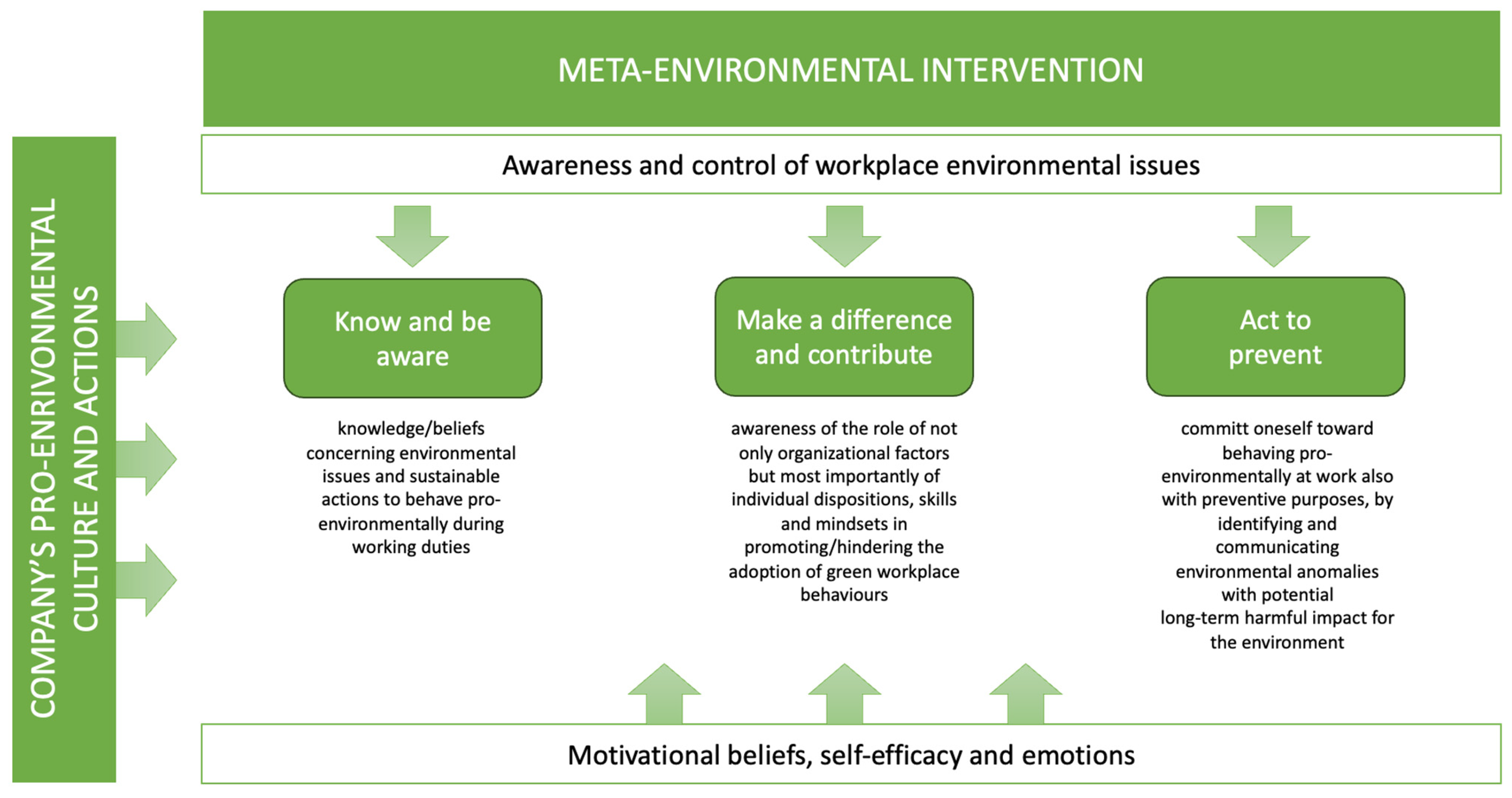
Translating these assumptions and principles into green training in the workplace, we proposed the psychoeducational Meta-Environmental (ME) intervention that, starting from employees’ existing beliefs and knowledge, promotes environmental awareness, along with commitment towards implementing specific workplace pro-environmental actions that are continuously monitored and regulated by the learner (see
Figure 1). Specifically, the psychoeducational ME intervention proposed structured activities across three in-person, group-based sessions, that: (i) provide knowledge, awareness, and skills regarding the sustainable actions promoted by the company to contribute to behaving pro-environmentally during working duties to safeguard different environmental matrices (water, air, soil), and also from preventive purposes (i.e., identifying, reporting and communicating environmental anomalies like near misses, unsafe conditions, and weak signals, as early warning indicators of events with harmful environmental impacts) (session 1; “know and be aware”
Figure 1); (ii) trigger employees’ knowledge/beliefs and mindsets concerning environmental issues and the role of not only organizational factors, but also, most importantly, of individual dispositions, and particularly pro-environmental attitudes and willingness to engage environmentally sustainable actions, that are known to encourage the adoption of green workplace behaviours and practices (session 2; “make a difference and contribute”,
Figure 1); and (iii) offer examples of real-life working scenarios to actively drive employees to put the acquired knowledge and skills for behaving pro-environmentally at work into practice (session 3, “act to prevent”,
Figure 1).
In doing so, as recommended to enhance green training efficacy [
6], emphasis was made on clearly communicating the company’s environmental mission and vision, as well as its interplay with actions undertaken globally to protect the environment, to allow employees to understand the advantages and key implications of being sustainable at work. In the workplace context, pro-environmental actions in fact require alignment between employees and company policies so that proactive individual behaviours should be syntonised with organizational goals, fostering a shared and sustainable environmental culture. Moreover, as suggested by [
7], the intervention adopted a team-based approach and was delivered in an in-person, group-based setting to emphasize vicarious experiences and collaborative efforts and encourage employees to collectively meet environmental goals, reinforcing the sustainability culture of the company.
To examine the feasibility of the intervention along with potential benefits, employees’ adoption of green workplace behaviours and their management of environmental anomalies, attitudes, and motivation toward acting pro-environmentally at work, as well as their environmental awareness and concerns, were assessed via a survey administered at pre- and post-intervention. Moreover, participants’ perceptions of the intervention as interesting, motivating, and useful, and also its perceived ability to improve awareness and competence in behaving pro-environmentally both at work (as employees) and in everyday life, were assessed using an additional ad hoc survey administered at pre- and post-intervention. At post-intervention, participants also rated their prior knowledge, the comprehensibility, adequacy, and usefulness of the proposed themes and activities, the usefulness of the group setting, and their overall satisfaction with the intervention.
Due to the metacognitive-motivational approach adopted, we expected an increased employee proneness (attitudes and motivation) to act pro-environmentally at work, as well as a greater environmental awareness at post-intervention. Since informational strategies promoting pro-environmental behaviours, as the psychosocial intervention used here, more likely promote pro-environmental awareness and mindsets than behaviour change per se [
18], we could not expect clear changes in terms of increased self-reported pro-environmental behaviours and the management of environmental anomalies at work at post-intervention compared to pre-test. We explored the extent to which the psychoeducational intervention, with its content and group setting that emphasize personal contribution as well as discussion and collaboration, was perceived as useful and satisfactory by employees.
2. Materials and Methods
2.1. Study Design
This is a quasi-experimental, pre-post-test study assessing the feasibility of implementing a novel psychoeducational intervention aimed at promoting environmental awareness and proneness toward acting pro-environmentally at work among employees from the operational level of the energy sector. Two scales consisting of items rated on a Likert-type response scale were used at pre- and post-intervention to assess employees’ adoption of green workplace behaviours and management of environmental anomalies, their attitudes and motivation toward acting pro-environmentally at work, their environmental awareness, and their expectations and satisfaction with the proposed intervention.
2.2. Participants
A convenience sample of 89 energy sector employees (87 males, 2 females) from the operational level of organization sites located in Italy from the same business (i.e., with similar working duties) was involved in this study, with no criteria for their selection. Participants were invited to participate in the psychoeducational intervention during working hours.
Out of 89 participants, 3 did not complete the pre-test and 5 did not complete the post-test assessments since they were unable to attend all of the sessions due to unforeseen working-related duties. For 3 participants, it was not possible to match the pre- and post-intervention data due to technical issues. Therefore, the data of 78 employees were considered in the analyses. The descriptive statistics of the sociodemographic characteristics of the sample are shown in
Table 1.
2.3. Materials
Environmental survey [
11]: This comprised the following sub-scales: the green workplace behaviours subscale examined employees’ green workplace behaviours toward avoiding harm and working sustainably (5 items; α = 0.90); the management of environmental anomalies subscale measured employees’ management of environmental anomalies (near misses, unsafe conditions, and weak signals) that may precede the occurrence of events with harmful environmental impacts (6 items; α = 0.91); the attitudes toward acting pro-environmentally at work (4 items; α = 0.87) and the motivation toward acting pro- environmentally at work (6 items; α = 0.82) sub-scales assessed employees’ proneness toward behaving pro-environmentally; and the environmental awareness and concerns sub-scale assessed employees’ experience of how human welfare and nature conservation are interconnected, as well as their awareness and worries about current environmental issues (6 items; α = 0.83). For each item, the employees were asked to express the level of agreement on a 6-point Likert scale (from 1 “completely disagree” to 6 “completely agree”). The environmental survey was completed at pre-test (at the beginning of the first session) and at post-test (at the end of the last session) assessment timepoints.
Expectations-Satisfaction surveys (created ad hoc): The Expectations survey proposed at pre-test (at the beginning of the first intervention’s session) assessed the employees’ expectations regarding the intervention. In particular, 3 items asked participants to rate the extent to which they expected the intervention to be interesting, motivating and useful, respectively (e.g., “Do you expect that the intervention will be useful”), on a 5-point Likert scale (from 1 “not at all” to 5 “very much”). The other 6 items asked participants to rate the extent to which they expected the intervention to improve their awareness and competence towards behaving pro-environmentally as an employee at work and as a person in everyday life (e.g., “Do you expect that the intervention will provide me greater awareness of management of environmental issues at work”) on a 5-point Likert scale (from 1 “not at all” to 5 “very much”).
The Satisfaction survey, proposed at post-test (at the end of the last intervention’s session) asked participants to re-evaluate the same items proposed in the Expectations survey after having attended the intervention (e.g., “I think that the intervention was useful”; “I think that the intervention provided me greater awareness of management of environmental issues at work”) on a 5-point Likert scale (from 1 “not at all” to 5 “very much”). In addition, it included additional items asking participants to rate the following on a 5-point Likert scale (from 1 “not at all” to 5 “very much”): (i) previous knowledge, comprehensibility, adequacy and usefulness of the proposed themes and activities, and the usefulness of the group setting (4 items); and (ii) their general satisfaction with attending the intervention (3 items).
2.4. Procedure
Data collection occurred between February 2024 and November 2024. Prior to data collection, between October 2023 and January 2024, the intervention protocol was piloted with a group of the company’s HSE employees and a group of operational workers to assess the timing, clarity of the content, and the adequacy of the operational scenarios and examples used during the sessions.
Employees were invited to attend the psychoeducational intervention in small groups (7–12 participants) during working hours in accordance with the company staff. The psychoeducational ME intervention consisted of 3 group-based sessions scheduled within two days, each lasting approximately 90 min (see
Table 2 for details).
At the very beginning of the first session, after giving their informed consent to participate in the study, employees were administered (through the Qualtrics platform) the Environmental survey and the Expectations survey (pre-intervention); at the very end of the third session, employees completed again the Environmental survey and filled in the Satisfaction survey (post-intervention) (see
Table 2).
The three sessions of the psychoeducational ME intervention were designed to cover different topics (see
Table 2 for details) and aimed, respectively, at: (i) providing knowledge of current environmental issues, the actions undertaken globally to protect the environment as well as the environmental mission and related initiatives, guidelines and actions promoted by the company to contribute, in the workplace, achieving global sustainable development goals related to environmental protection (session 1); (ii) promoting awareness of the role of not only the organizational factors, but most importantly of the individual dispositions in encouraging the adoption of green workplace behaviours (session 2); (iii) driving employees to contribute behaving pro-environmentally at work with preventive purposes by identifying, reporting, and communicating environmental anomalies (near misses, unsafe conditions, and weak signals) which could anticipate the occurrence of incidents with harmful environmental impacts (session 3).
The three sessions deepened different themes following a common structure: (i) Introduction (10 min): Summary of the previous session (for sessions 2 and 3) and introduction of the main topics of the session. (ii) Main session activities (65/70 min): The main topics of each session were presented adopting a metacognitive-motivational approach, which consisted of involving participants in practical activities (e.g., brief tasks or questionnaires) to trigger their knowledge/beliefs and attitudes towards the topic at hand, followed by theoretical explanations and concrete examples (using easily interpretable images, figures or graphs to communicate the information) to stimulate/(re)-structure correct knowledge/beliefs about the topic, as well as group discussions to provide vicarious experiences. (iii) Conclusions (10 min): Summary of the take-home messages of the session.
To supplement the in-person group sessions, between the first and the second session, as well as the second and the third session, participants were asked to complete activities (e.g., simple tasks or questionnaires) alluding to the themes covered by the following session individually in order to trigger knowledge/beliefs and promote personal reflection. The facilitator made use of such activities, providing feedback and promoting group discussions during the in-person group session.
The psychoeducational ME intervention was delivered by a lead psychologist facilitator and a co-lead facilitator (a member of the environment HSEQ section of the company).
4. Discussion
In this quasi-experimental (pre-post-test) feasibility study, we implemented a novel psychoeducational intervention aimed at promoting environmental awareness and proneness toward acting pro-environmentally at work among employees from the energy sector. The metacognitive-motivational approach was considered—frequently used in the learning domain, but here is newly implemented in the workplace/environmental sustainability domain. The psychoeducational intervention was designed according to metacognitive-motivational principles, defining the Meta-environmental (ME) model of the intervention (see
Figure 1), to activate the employer’ prior knowledge and beliefs to prompt pro-environmental awareness and behaviours in the workplace.
The results show that employees reported greater environmental awareness at post-intervention compared with pre-test. Nonetheless, in contrast with our expectations, no significant changes in terms of enhanced attitudes and motivation toward behaving pro-environmentally at work from pre-test to post-test emerged. It is worth mentioning that our employees already displayed moderately high scores on these two scales already at pre-test, which limit the “room for improvement” by participating in the intervention. Moreover, no significant changes in self-reported engagement in green workplace behaviours focused on harm avoidance and sustainable practices at post-intervention compared with pre-test were found. Interestingly, employees tended to report lower ease to identify and communicate environmental anomalies with potential harmful impacts at post-intervention compared with pre-test. Although it may seem counterintuitive, such a result could be because the intervention may have clarified and provided greater knowledge and skills toward managing such environmental anomalies, making employees aware that those actions that they assumed to perform during their working duties prior to the intervention did not align with the actions promoted by the company. Notably, this result was no longer significant after correction for multiple comparisons. Therefore, this speculation deserves to be taken cautiously, and such a result needs to be further confirmed vis-à-vis a control condition and with more robust measurements.
Overall, such a pattern of findings seems to be in line with previous studies assessing the efficacy of green training practices for employees, though grounded on a different approach as the one used here and mainly targeting discretionary “green office” behaviours. Such green training practices have indeed been usually found to benefit employees in terms of enhanced ecological awareness and environmental commitment [
4,
6]. Our findings seem to extend these assumptions to a novel psychoeducational intervention based on metacognitive-motivational principles and tailored to target contingent, sector-specific operational functions or core tasks and related pro-environmental aspects and practices. In a broader sense, our results also align with the notion that soft measures based on informational strategies to prompt pro-environmental behaviours, like the psychosocial intervention used here, more likely promote pro-environmental awareness and mindsets than behaviour change per se [
18], suggesting the proposed intervention to be preparatory and best suited to be integrated with other green practices and intervention approaches to more clearly promote behaviour change.
The results from the Expectation/Satisfaction surveys allow us to gain further understanding on the strengths of the proposed psychoeducational ME intervention. Employees’ satisfaction in terms of intervention’s usefulness, motivation and interest was greater at post-intervention than their initial expectations. Furthermore, employees rated the intervention as capable of providing a better understanding of management of environmental issues at work to a greater extent at post-intervention compared with what was expected at pre-test. Employees likely rated the intervention as also capable of increasing their awareness of managing environmental issues at work and protecting the environment in daily life more than was expected; however, these effects were no longer significant after correction for multiple comparisons, and should be taken to be taken cautiously. Positive feedback was also given to the content, activities and group setting proposed and in terms of overall satisfaction. Such results further highlight the feasibility and acceptability of the intervention. They also suggest how the psychoeducational intervention proposed, and its novel metacognitive approach leveraging and enriching employees’ personal competences, holds the potential to promote knowledge, skills and commitment towards managing environmental issues and performing working duties in an environmentally sustainable way, even in a sector with an extensive environmental impact, such as the energy industry.
Despite such promising findings, some limitations should be acknowledged. First, the lack of a control condition prevented us to clarify the effectiveness of the psychoeducational intervention developed here. Although all workers involved in the study were employed in the same business sector of the company (i.e., homogeneous in terms of job duties), another limitation lies in the convenience sample of employees involved and the fact that no criteria were adopted, for instance, to properly stratify the sample according to different sociodemographic and work-related characteristics (e.g., years of work experience). It is worth stressing that the present study was meant to clarify the feasibility of implementing the proposed intervention approach toward promoting environmental sustainability in the workplace. Future studies should therefore attempt to replicate and further ascertain the efficacy of the psychoeducational ME intervention vis-à-vis a control condition (e.g., traditional interventions or other GHRM practices). Involving a larger sample size and adopting appropriate randomization procedures would allow for the use of multilevel approaches not only to control for potential biases related to participant clustering (e.g., working site, subgroups of participants involved in the intervention), but also to examine the role that sociodemographic, psychological (e.g., baseline environmental attitudes, motivation and engagement) and work-related characteristics may play in influencing the effectiveness of the intervention. From this perspective, even though in workplace settings participants’ inability to complete the entire intervention may be mainly due to urgent work-related issues (as in our case), it would also be ideal to examine the baseline characteristics of potential dropouts in both the experimental and control groups to clarify the nature of sample selection. Moreover, the outcome measures used here were ad hoc self-constructed surveys, which are likely to be susceptible to bias, despite their widespread use in the literature [
20]. Adopting well-validated instruments could have also reduced the reliance on multiple subscales and, consequently, the number of statistical tests and the likelihood of false-positive findings. Nonetheless, this choice was driven by the need to balance research aims with the time constraints required for survey administration in the working context. Future studies should therefore replicate and expand our results by employing more comprehensive self-reported as well as objective measures of pro-environmental attitudes and behaviours to better capture potential changes promoted by the intervention. Further, future studies should also focus on understanding the long-term benefits of green training in the workplace, which was not done here and remains an unexplored issue [
6,
7], as well as the need for repeated training to foster long-term effects. Finally, a group, in-person intervention modality was chosen here, given the key role that group setting can play in fostering green intervention’s efficacy in the workplace [
7]. Although such an intervention modality overall proved to be feasible to implement without interfere with participants’ working duties, is resource- and time-consuming. It might be useful to examine whether using e-learning or other learning modalities that allow for the more easy involvement of a larger number of users could be equally effective.




 ,
,