University–Business Link for Sustainable Territorial Development Through the Principles for Responsible Investment in Agriculture and Food Systems (CSA-IRA): Working with People in the Dominican Republic

 ,
, 
Abstract
1. Introduction
2. Case Study
2.1. Country Covered by the Proposal
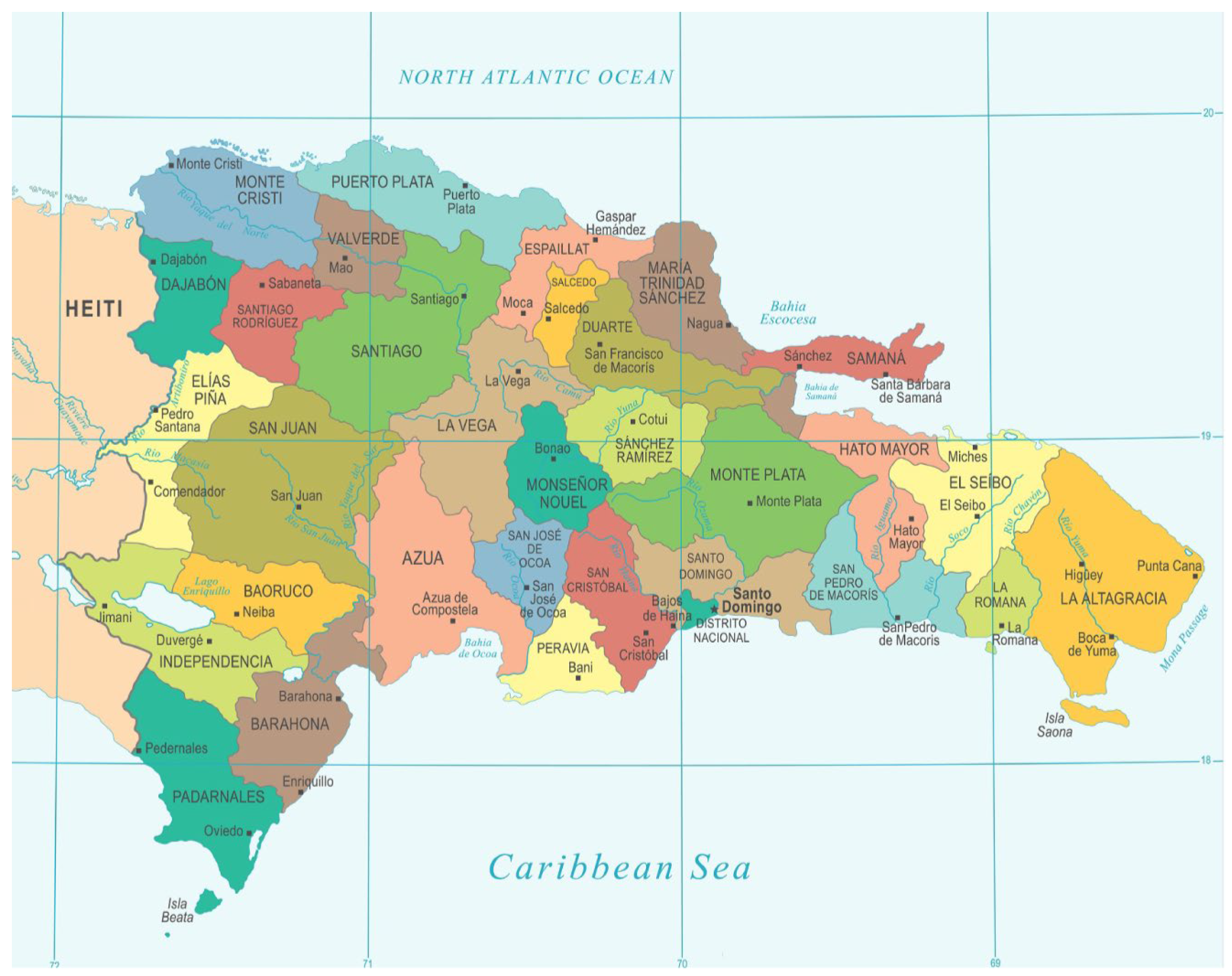
2.2. Geographic Coverage
2.2.1. Mechanisms for Participant Identification
2.2.2. Participation in the Program
2.2.3. Selection Metrics
2.2.4. Implications for Internal and External Validity
2.3. Key Actors Involved
2.3.1. San Miguel Industry
2.3.2. Organic Bananas from the Northwest Line
2.3.3. The Technological University of Santiago
2.3.4. The GESPLAN Research Group at the Polytechnic University of Madrid
3. Materials and Methods
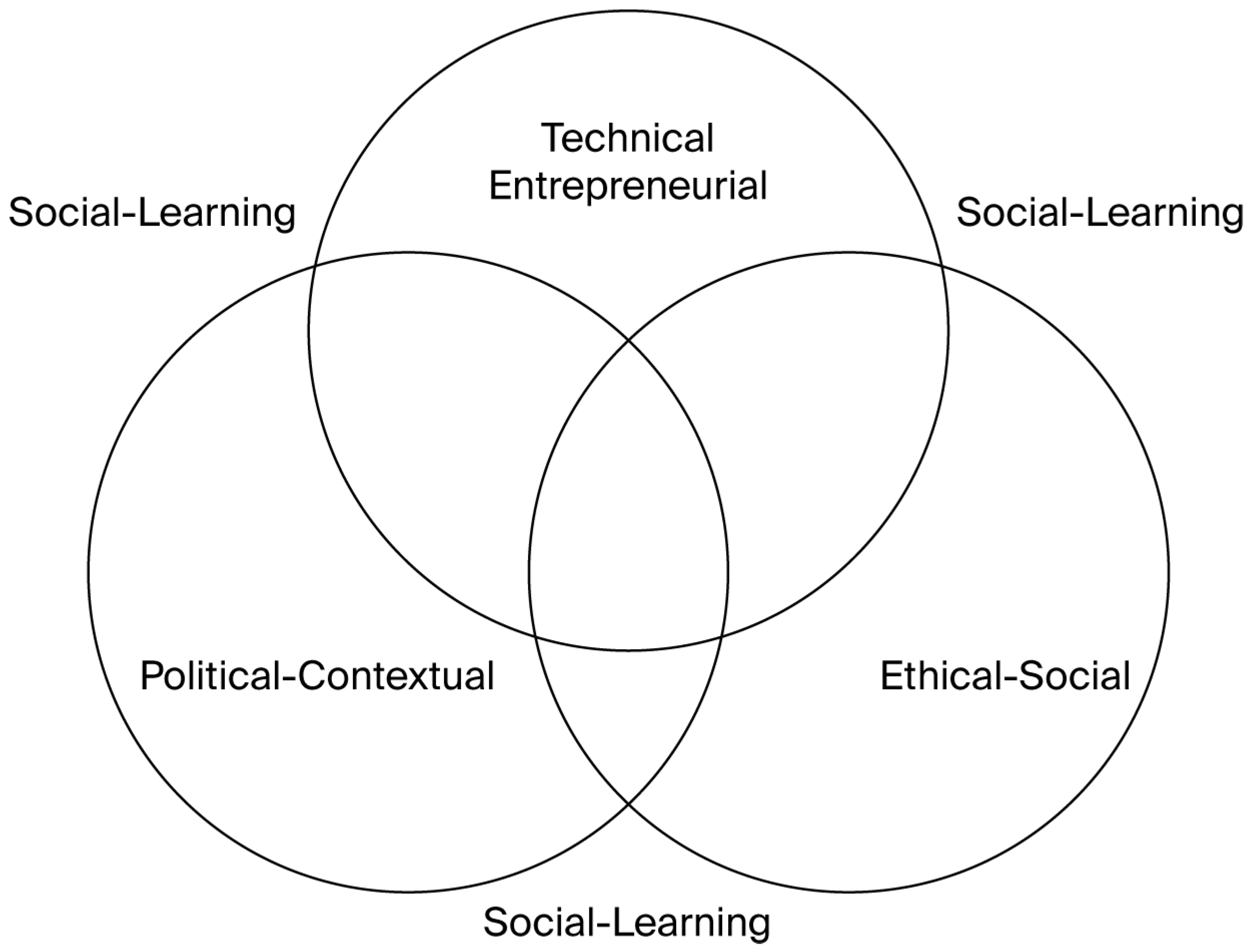
3.1. Methodological Approach
- Ethical–social;
- Technical–entrepreneurial;
- Political–contextual.
3.2. Data Collection Instruments, Analysis, and Quality Control
- Document analysis of business plans, technical reports, institutional reports, training schedules, impact assessment documents, and entrepreneurship projects developed by the participants;
- Semi-structured interviews with participating entrepreneurs and local community members, conducted by staff SMI and BANELINO;
- Participant observation of training sessions, technical support processes (in-person and online), and on-site meetings to record social learning dynamics, inter-institutional relationships, and skill acquisition;
- Evaluative follow-up sessions that validated preliminary findings, gathered feedback from those involved, and strengthened the analysis from a dialogical and inclusive perspective.
4. Results
4.1. Training Programs Aligned with the CFS-RIA Principles for Building People’s Capacities
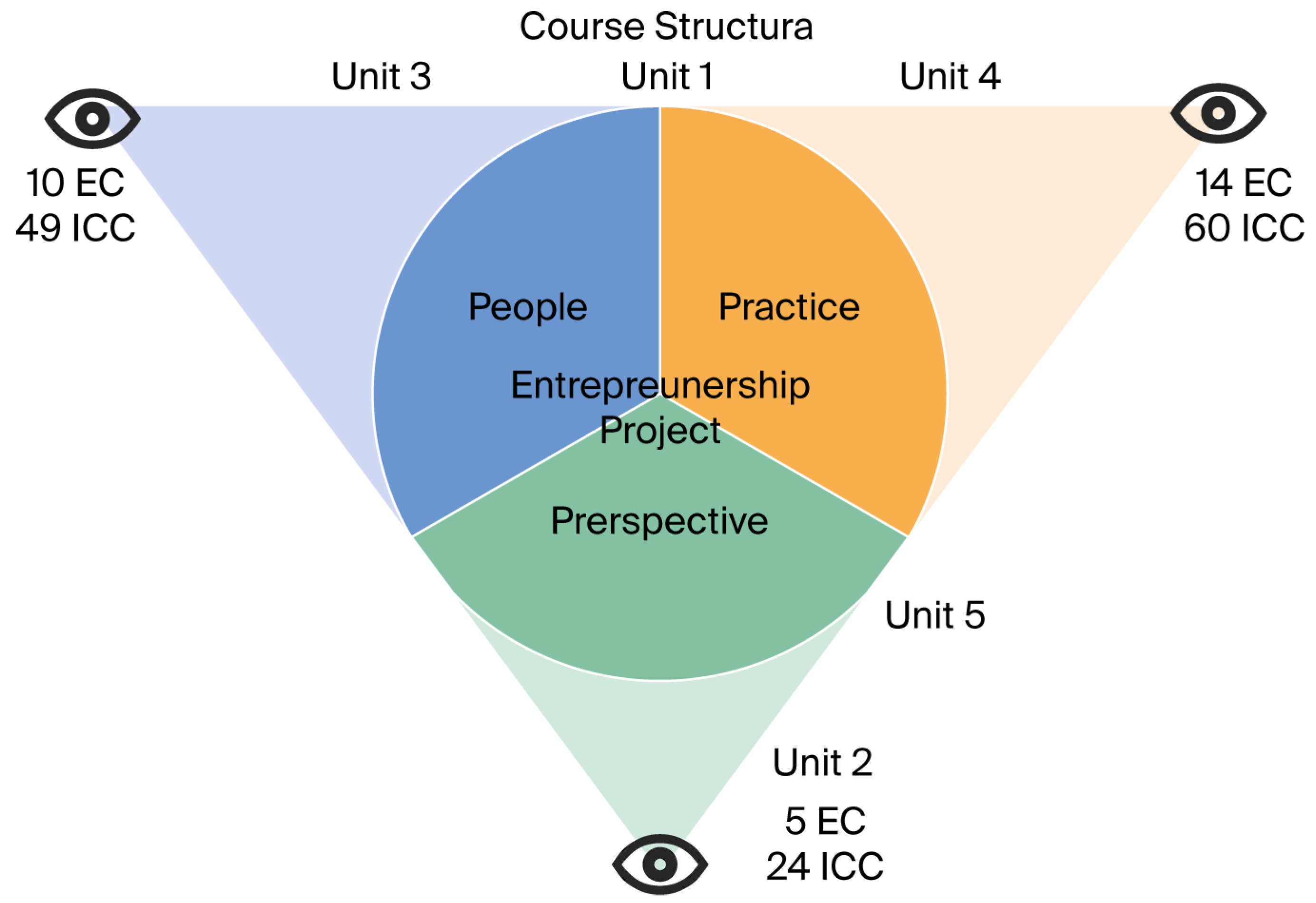
- Fifty percent of the entrepreneur’s competencies, based on three dimensions of competencies: personal, perspective, and practical.
- Fifty percent of the formulated entrepreneurial project.
- Concept evaluation questionnaires (30%);
- Participation, analysis, and discussion in forums (20%);
- Final report on the entrepreneurship project (20%);
- Presentation and final defense of the entrepreneurship project (30%).
4.2. Integration of the CFS-RIA Principles into Institutional Work to Promote Sustainable Territorial Development
4.3. Impact of CFS-RIA Principles on the Economic, Social, Environmental, and Governance Development of the Territory
4.4. Association Between Participation Intensity and Project Performance
5. Discussion
5.1. Interpretation of Key Findings
5.2. Comparative Cases and Lessons Learned
5.3. Comparisons with Other Universities and Community Initiatives
5.4. Transferability Conditions
5.5. Limitations
6. Conclusions
Supplementary Materials
Author Contributions
Funding
Institutional Review Board Statement
Informed Consent Statement
Data Availability Statement
Acknowledgments
Conflicts of Interest
Abbreviations
| WWP | Working with People |
| CFS-RAI PRINCIPLES | Principles for Responsible Investment in Agriculture and Food Security |
| SMI | San Miguel Industry |
| UPM | Polytechnic University of Madrid |
| UTESA | Technological University of Santiago |
| IPMA | International Project Management Association |
| BANELINO | Organic bananas from the northwest line |
| GESPLAN | Research group in project planning |
| FAO | Agency from the Food and Agriculture Organization |
| QSM | Quality Management System |
| PBL | Project-Based learning |
| ONE | National Statistic Office Dominican Republic |
| RNC | National Taxpayer Registry |
| MIPYMES | Micro, small and medium sized enterprises |
| LAG | Local Action Group |
| CMA | Aymara Women’s Coordinator |
References
- Cazorla, A.; De los Ríos-Carmenado, I.; Dávila, G.; Mínguez, E.; Fontana, A.; Navarro, J.A.; Galindo, R.; Montes, A.; Sommer, D.; García Fermín, F.; et al. El Papel de Los Profesores En Las Universidades de Investigación: Relevancia En Los Rankings; UNICARIBE: Santo Domingo, Dominican Republic, 2023; ISBN 978-9945-9208-3-3. [Google Scholar]
- Lavalle Iriarte, C. Las Universidades de Investigación Nuevo Paradigma Mundial: Modelo de Gobernanza y Aplicación a Cinco Universidades. Ph.D. Thesis, E.T.S. de Ingeniería Agronómica, Alimentaria y de Biosistemas (UPM), Madrid, Spain, 2017. [Google Scholar]
- Salgado Guerrero, J.P.; Herrán Gómez, J. Gobierno Para Una Universidad de Investigación: La Universidad Politécnica Salesiana. In Buen Gobierno en las Universidades de Investigación en un Entorno Digital Global; Fondo Editorial: Cuenca, Ecuador, 2021; pp. 55–68. ISBN 978-9972-46-693-9. [Google Scholar]
- Cazorla, A.; Fernández-Pello, C.; Fontana, A.; Garcia, A.; De Giusti, M.R.; Gómez, F.; Herrán, J.; Mínguez, E.; Muñoz, J.P.; Nicolas, V.; et al. La vinculación con la sociedad en las universidades de investigación. In La Universidad Motor de Trasnformación de la Sociedad; Editores Cazorla & Stratta: Madrid, Spain, 2017; Volume 1, pp. 142–161. [Google Scholar]
- Garzón Vera, B.; Cárdenas Tapia, J.; Merchán Arízaga, X.; López Villavicencio, F.; Samaniego Sagbay, V.; Pillco Guamán, E.; Gordillo Gordillo, E.; Arce Cuesta, D.; Jumbo González, W.Í.; Paucar Paucar, J.E.; et al. Incidencia de los proyectos de Vinculación con la Sociedad de la Universidad Politécnica Salesiana; Editorial Abya-Yala: Quito, Ecuador, 2022; Volume 2, ISBN 978-9978-10-707-2. [Google Scholar]
- Principles for Responsible Investment in Agriculture and Food Systems. Available online: https://openknowledge.fao.org/server/api/core/bitstreams/a5473764-5e32-4988-a6c4-4383f59a0292/content (accessed on 4 May 2025).
- Cazorla, A.; De los Ríos-Carmenado, I.; Salvo, M. Working With People (WWP) in Rural Development Projects: A Proposal from Social Learning. Cuad. De Desarro. Rural. 2013, 10, 131–157. [Google Scholar]
- Acosta Mereles, M.L.; De los Ríos Carmenado, I.; Ávila Cerón, C.A.; Castañeda Sepulveda, R. Responsible investment in the processes of substitution of illicit crops from the “working with people” model: Case study Guaviare (Colombia). In Proceedings of the 27th International Congress on Project Management and Engineering, Donostia-San Sebastian, Spain, 10–13 July 2023. [Google Scholar] [CrossRef] [Scilit]
- Sastre-Merino, S.; Negrillo, X.; Hernández-Castellano, D. Sustainability of Rural Development Projects within the Working With People Model: Application to Aymara Women Communities in the Puno Region, Peru. Cuad. Desarro. Rural. 2013, 10, 219–243. [Google Scholar]
- Cazorla, A.; Negrillo, X.; Montalvo, V.; De Nicolas, V.L. Institutional Structuralism as a Process to Achieve Social Development: Aymara Women’s Community Project Based on the Working with People Model in Peru. J. Soc. Soc. Welfare 2018, 45, 55. [Google Scholar]
- Ceron, C.A.A.; De los Rios-Carmenado, I.; Martín Fernández, S. Illicit Crops Substitution and Rural Prosperity in Armed Conflict Areas: A Conceptual Proposal Based on the Working With People Model in Colombia. Land Use Policy 2018, 72, 201–214. [Google Scholar] [CrossRef] [Scilit]
- De los Ríos-Carmenado; Rivera, M.; García, C. Redefining Rural Prosperity through Social Learning in the Cooperative Sector: 25 Years of Experience from Organic Agriculture in Spain. Land Use Policy 2016, 54, 85–94. [Google Scholar] [CrossRef] [Scilit]
- De Nicolás, V.L. Towards a Transformational Hydraulic Engineering Project for the Territory: A Focus on the Working With People (WWP) Model. Land Use Policy 2016, 54, 246–252. [Google Scholar] [CrossRef] [Scilit]
- Jiménez Aliaga, R.; De los Ríos-Carmenado, I.; San Martín Howard, F.; Calle Espinoza, S.; Huamán Cristóbal, A. Integration of the Principles of Responsible Investment in Agriculture and Food Systems CFS-RAI from the Local Action Groups: Towards a Model of Sustainable Rural Development in Jauja, Peru. Sustainability 2022, 14, 9663. [Google Scholar] [CrossRef] [Scilit]
- Jiménez Aliaga, R.; De los Ríos-Carmenado, I.; Huamán Cristóbal, A.E.; Aliaga Balbín, H.; Marroquín Heros, A.M. Competencies and Capabilities for the Management of Sustainable Rural Development Projects in the Value Chain: Perception from Small and Medium-Sized Business Agents in Jauja, Peru. Sustainability 2023, 15, 15580. [Google Scholar] [CrossRef] [Scilit]
- Castañeda, R.; Avila Cerón, C.; De los Ríos-Carmenado, I.; Domínguez, L.; Gomez, S. Implementing the Voluntary Guidelines on the Responsible Governance of Tenure of Land, Fisheries and Forests from the Working with People Model: Lessons from Colombia and Guatemala. J. Peasant. Stud. 2023, 50, 1820–1851. [Google Scholar] [CrossRef] [Scilit]
- De los Ríos-Carmenado, I.; Sastre-Merino, S.; Fernandez, C.; Nuñez, C.; Reyes, E.; Garcia-Arjona, N. Proposals for Improving Evaluation Systems in Higher Education: An Approach from the Model “Working with People”. J. Technol. Sci. Educ. 2016, 6, 104–120. [Google Scholar] [CrossRef] [Scilit]
- De los Ríos-Carmenado, I.; Mur, C. Inclusive and transparent governance structures from the IRA Principles. FESBAL Case—Food Bank. In Proceedings of the 27th International Congress on Project Management and Engineering, San Sebastian, Spain, 10 July 2023. [Google Scholar]
- López, M.; Cazorla, A.; Panta, M.d.P. Rural Entrepreneurship Strategies: Empirical Experience in the Northern Sub-Plateau of Spain. Sustainability 2019, 11, 1243. [Google Scholar] [CrossRef] [Scilit]
- De Los Ríos-Carmenado, I.; Ortuño, M.; Rivera, M. Private–Public Partnership as a Tool to Promote Entrepreneurship for Sustainable Development: WWP Torrearte Experience. Sustainability 2016, 8, 199. [Google Scholar] [CrossRef] [Scilit]
- Klarin, T. The Concept of Sustainable Development: From Its Beginning to the Contemporary Issues. Zagreb Int. Rev. Econ. Bus. 2018, 21, 67–94. [Google Scholar] [CrossRef] [Scilit]
- Cazorla, A.; De Los Rios-Carmenado, I. Hacia una Metauniversidad para un desarrollo sostenible: Inversión Responsable en agricultura y Sistemas Alimentarios. Towards a Meta-University for Sustainable Development: Responsible Investment in Agriculture and Food Systems. In Proceedings of the 28th International Congress on Project Management and Engineering, Jaén, Spain, 5–6 July 2024. [Google Scholar] [CrossRef] [Scilit]
- Law No. 12-21. Creación de la Zona Especial de Desarrollo Integral Fronterizo y un Régimen de Incentivos en la Zona de Pedernales, Independencia, Elías Piña, Dajabón, Montecristi, Santiago Rodríguez, and Bahoruco. O. G. No. 11010 del 23 de Febrero 23, 2021. Available online: https://dgii.gov.do/legislacion/leyesTributarias/Documents/Leyes%20de%20Incentivos%20y%20Fomentos/12-21.pdf (accessed on 14 May 2025).
- Torre, A. Nuevas propuestas para analizar el desarrollo territorial. Eutopía. Rev. De Desarro. Económico Territ. 2020, 17, 11–24. [Google Scholar] [CrossRef] [Scilit]
- Cazorla-Montero, A.; de los Ríos-Carmenado, I.; Pasten, J.I. Sustainable Development Planning: Master’s Based on a Project-Based Learning Approach. Sustainability 2019, 11, 6384. [Google Scholar] [CrossRef] [Scilit]
- Panta Monteza, M.d.P. Propuesta Metodológica Para el Desarrollo de Emprendimientos Productivos Promovidos Por Mujeres de Escasos Recursos: Aplicación al Valle de Cañete—Perú. Ph.D. Thesis, E.T.S. de Ingeniería Agronómica, Alimentaria y de Biosistemas (UPM), Madrid, Spain, 2019. [Google Scholar]
- Solano, D. Desarrollo, Sostenibilidad y Capacidades: Una Trilogía Indesligable. J. Econ. Financ. Adm. Sci. 2007, 12, 9–27. [Google Scholar] [CrossRef] [Scilit]
- Huerta, A.R. Capacidad institucional: Revisión del concepto y ejes de análisis. Doc. Y Aportes En Adm. Pública Y Gestión Estatal 2019, 19, 81–107. [Google Scholar] [CrossRef] [Scilit]
- Inicio. Available online: https://cursosipma.es/ (accessed on 4 May 2025).
- De los Ríos-Carmenado, I.; Rahoveanu, A.T.; Gallegos, A.A. Project Management Competencies for Regional Development in Romania: Analysis from “Working with People” Model. Procedia Econ. Financ. 2014, 8, 614–621. [Google Scholar] [CrossRef] [Scilit]
- IPMA-MEXICO. Bases Para la Competencia Individual en Dirección de Proyectos, Programas y Carteras de Proyectos. Available online: https://ipmamexico.com/wp-content/uploads/2025/02/Base-para-la-Competencia-Individual4-MX2.pdf (accessed on 24 May 2025).
- Pérez, C.; Fajardo, M.; Granja, R.Y. Solidarity territories for capacity development and collective action from the local. J. Rural. Community Dev. 2022, 17, 102–127. [Google Scholar]
- De los Ríos-Carmenado, I.; Cadena-Iñiguez, J.; Díaz-Puente, J.M. Creación de grupos de acción local para el desarrollo rural en México: Enfoque metodológico y lecciones de experiencia. Agrociencia 2011, 45, 815–829. [Google Scholar]
- Calisto Friant, M. Comercio justo, seguridad alimentaria y globalización: Construyendo sistemas alimentarios alternativos. Íconos Rev. De Cienc. Soc. 2016, 55, 215–240. [Google Scholar]
- Egas, F. Comercio justo o economía solidaria. Rev. Afese 2017, 49, 1–4. [Google Scholar]
- García Chiang, A. El comercio justo: ¿una alternativa de desarrollo local? Polis 2011, 7, 105–140. [Google Scholar]
- Coscione, M. América Latina y el sentido originario del comercio justo. Eutopía. Rev. De Desarro. Económico Territ. 2015, 7, 11–26. [Google Scholar] [CrossRef] [Scilit]
- Galán, B. Reglamentaciones jurídicas sobre el acceso a la tierra de la mujer rural en países de América Central y el Caribe. Land Reform 2000, 1, 81. [Google Scholar]
- De los Ríos-Carmenado, I.; Díaz-Puente, J.M.; Cadena-Iñiguez, J. La iniciativa LEADER como modelo de desarrollo rural: Aplicación a algunos territorios de México. Agrociencia 2011, 45, 609–624. [Google Scholar]
- Cazorla-Montero, A.; De los Ríos-Carmenado, I.; Díaz-Puente, J.M. La iniciativa comunitaria leader como modelo de desarrollo rural: Aplicación a la región capital de españa. Agrociencia 2005, 39, 697–708. [Google Scholar]
- Ortuño, M.; De los Ríos-Carmenado, I.; Sastre-Merino, S. The Development of Skills as a Key Factor of the Cooperative System: Analysis of the Cooperative of Artisan Women Tejemujeres-Gualaceo-Ecuador from the WWP Model. Sustainability 2022, 14, 16233. [Google Scholar] [CrossRef] [Scilit]
- Fontana, A.; Velasquez-Fernandez, A.; Rodriguez-Vasquez, M.I.; Cuervo-Guerrero, G. Territorial Analysis Through the Integration of CFS-RAI Principles and the Working with People Model: An Application in the Andean Highlands of Peru. Sustainability 2025, 17, 1380. [Google Scholar] [CrossRef] [Scilit]
- Ávila Cerón, C.A.; Castañeda, R.; De Los Ríos, I. Desarrollo de un Modelo de Agricultura Familiar Alineado con los Principios de Inversión Responsable: Integración Cadena Turística en República Dominicana. Development of a Family Agriculture Model Aligned with the Principles of Responsible Investment: Integration Tourism Chain in the Dominican Republic. In Proceedings of the 28th International Congress on Project Management and Engineering, Jaén, Spain, 3–4 July 2024. [Google Scholar] [CrossRef] [Scilit]
- Friedmann, J. Planning in the Public Domain: From Knowledge to Action; Princeton University Press: Princeton, NJ, USA, 1987; ISBN 978-0-691-07743-7. [Google Scholar]
- Cazorla-Montero, A.; De los Ríos-Carmenado, I. From “Putting the Last First” to “Working with People” in Rural Development Planning: A Bibliometric Analysis of 50 Years of Research. Sustainability 2023, 15, 10117. [Google Scholar] [CrossRef] [Scilit]
- UPM-SMI. Final Project Report Second Edition 2024—Unpublished Institutional Document; UPM-SMI: Selangor, Malaysia, 2024. [Google Scholar]
- Suárez, M.; Robaina, N.; Del Prado, L.; Noboa, A. Universidad y desarrollo local: Procesos innovadores en el tercer nivel de gobierno. Integr. Y Conoc. 2022, 11, 34–53. [Google Scholar] [CrossRef] [Scilit]
- Torre, A. Contribution to the Theory of Territorial Development: A Territorial Innovations Approach. Reg. Stud. 2025, 59, 2193218. [Google Scholar] [CrossRef] [Scilit]
- García Bacuilima, J.L. Modelo de Aprendizaje Basado en Proyectos Para el Desarrollo de Competencias de Contabilidad: Aplicación en la UPS. Ph.D. Thesis, E.T.S. de Ingeniería Agronómica, Alimentaria y de Biosistemas (UPM), Madrid, Spain, 2022. [Google Scholar]
- De los Ríos-Carmenado, I.; Cazorla, A.; Díaz-Puente, J.M.; Yagüe, J.L. Project–Based Learning in Engineering Higher Education: Two Decades of Teaching Competences in Real Environments. Procedia—Soc. Behav. Sci. 2010, 2, 1368–1378. [Google Scholar] [CrossRef] [Scilit]
- De los Ríos-Carmenado, I.; Rodriguez, F.; Perez, C. Promoting Professional Project Management Skills in Engineering Higher Education: Project-Based Learning (PBL) Strategy. Int. J. Eng. Educ. 2015, 31, 184–198. [Google Scholar]
- Mesa, F.A.H.; Morales, A.J.M.; Hurtado, P.D. Emprendimiento femenino en América Latina: Una aproximación teórica. Económicas CUC 2023, 44, 191–234. [Google Scholar] [CrossRef] [Scilit]
- Saavedra García, M.L.; Briseño Aguirre, N.D.L.L.; Velázquez Rojas, K.G. Análisis y Evolución del Emprendimiento Femenino en Latinoamérica. RECAI 2022, 11, 1–29. [Google Scholar] [CrossRef] [Scilit]
- Cardella, G.M.; Hernández-Sánchez, B.R.; Sánchez-García, J.C. Women Entrepreneurship: A Systematic Review to Outline the Boundaries of Scientific Literature. Front. Psychol. 2020, 11, 1557. [Google Scholar] [CrossRef] [Scilit]
- Hablich, F.; Bermúdez, C.; Espinoza, E.; Hablich, F.; Bermúdez, C.; Espinoza, E. Determinantes de La Actividad Emprendedora En La Mujer de Hispanoamérica. Rev. Univ. Y Soc. 2018, 10, 106–112. [Google Scholar]
- García Tapias, T. El papel de la mujer dentro del sector terciario en el medio rural de Castilla y León. Estudio de caso: GAL Zona Centro Valladolid. 2022. Available online: https://uvadoc.uva.es/bitstream/handle/10324/58459/TFG_F_2022_103.pdf?sequence= (accessed on 24 May 2025).
- GESPLAN—UPM. Guide for the Female Entrepreneur: IPMA International Project Management Competencies-2024; GESPLAN—UPM: Madrid, Spain, 2024. [Google Scholar]
- González Campo, C.H.; Hur tado Ayala, A. Transferencia tecnológica, capital humano y cooperación: Factores determinantes de los resultados innovadores en la industria manufacturera en Colombia 2007–2008. Inf. Técnico 2012, 76, 32–45. [Google Scholar] [CrossRef] [Scilit]
- FAO. Inversión Responsable en la Agricultura y los Sistemas Alimentarios Guía Práctica Para Parlamentarios y Asesores. Available online: https://parlatino.org/wp-content/uploads/2017/09/guia-responsable.pdf (accessed on 29 May 2025).
- Cachipuendo, C.; Sandoval, C.; Sandoval, J. Sentinel-2A imaging in mapping greenhouse rose production and rainwater harvesting for agricultural irrigation use. Environ. Res. Commun. 2024, 6, 111005. [Google Scholar] [CrossRef] [Scilit]
- Cachipuendo, C.; Requelme, N.; Sandoval, C.; Afonso, A. Sustainable Rural Development Based on CFS-RAI Principles in the Production of Healthy Food: The Case of the Kayambi People (Ecuador). Sustainability 2025, 17, 2958. [Google Scholar] [CrossRef] [Scilit]
- Fernández, R.S.; De los Ríos-Carmenado, I.; González, M.L. Developing Competencies for Rural Development Project Management through Local Action Groups: The Punta Indio (Argentina) Experience. In International Development; Appiah-Opoku, S., Ed.; InTech: Singapore, 2017; ISBN 978-953-51-3103-8. [Google Scholar]
- Sastre Merino, S. Desarrollo de Capacidades Para el Liderazgo en Proyectos de Desarrollo Rural. Aplicación a Comunidades Aymaras. Ph.D. Thesis, E.T.S.I. Agrónomos (UPM), Madrid, Spain, 2014. [Google Scholar]
- Negrillo Deza, X. Los Proyectos de Desarrollo Rural Como Proceso a Través de sus Protagonistas: El Caso de la Coordinadora de Mujeres Aymaras (Puno, Perú). Ph.D. Thesis, E.T.S. de Ingeniería Agronómica, Alimentaria y de Biosistemas (UPM), Madrid, Spain, 2018. [Google Scholar]
- Fontana, A.; Sastre-Merino, S.; Baca, M. The Territorial Dimension: The Component of Business Strategy That Prevents the Generation of Social Conflicts. J. Bus. Ethics 2017, 141, 367–380. [Google Scholar] [CrossRef] [Scilit]
- Mur, C.; De Los Ríos-Carmenado, I.; Mejía, J.; Nole, P. Buenas prácticas de gobernanza en los Bancos de Alimentos: Criterios ESG desde el modelo APS-WWP—[Good Governance Practices in Food Banks: ESG Criteria from the APS-WWPModel]. In Proceedings of the Innovación Educativa en los Tiempos de la Inteligencia Artificial, Madrid, Spain, 18–20 October 2023; Servicio de Publicaciones Universidad: Zaragoza, Spain, 2023. [Google Scholar]
- Cazorla, A.; Cáceres, A.; Lavalle, C. Toward a Metauniversity for Sustainable Development: Responsible Agriculture Investment and Food Systems. Sustainability 2025, 17, 9698. [Google Scholar] [CrossRef] [Scilit]



| Province | Area (km2) | Population (Inhab) | Density (Inhab/km2) | Number of Municipalities |
|---|---|---|---|---|
| Santiago Rodríguez | 1147.5 | 58,044.0 | 50.6 | 3 |
| Valverde | 823.4 | 183,738.0 | 263.6 | 3 |
| Dajabón | 1020.7 | 87,274.0 | 85.5 | 5 |
| Total | 2.991.6 | 362,344.0 | 121.1 | 11 |
| WWP Dimensions | CFS-RAI Principles | Observable Indicators (Quantitative) | Results | |
|---|---|---|---|---|
| Ethical–Social | P1 | Contribute to food security and nutrition | % of organic production | 100% |
| % of production sold in Fairtrade | 80% | |||
| P3 | Promote gender equality and the empowerment of women | Number of women trained in entrepreneurship programs | 41 | |
| % of women organic banana producers | 31% | |||
| P4 | Strengthen youth participation and empowerment | Number of university students trained in CFS-RAI Principles | 180 | |
| Technical–Business | P2 | Contribute to sustainable and inclusive economic development and poverty eradication | Number of women running business projects with very high and high feasibility | 28 |
| Average income increase for banana producers | 18% | |||
| % of products with Fairtrade certification | 100% | |||
| Political–Contextual | P9 | Incorporate inclusive and transparent governance structures, processes and grievance mechanisms | Numbers and actors participating in governance structures | 3 |
| Inclusion of public sector representatives | 30% | |||
| Indicator | First Edition | Second Edition | Total |
|---|---|---|---|
| Selected entrepreneurs | 28 | 51 | 79 |
| Number of entrepreneurs who completed the training and were certified | 14 | 27 | 41 |
| Percentage of entrepreneurs who were certified | 50% | 53% | |
| Gender of entrepreneurs | 14 | 27 | 41 |
| Women | 14 | 26 | 40 |
| Men | 0 | 1 | 1 |
| Average annual income (USD) | 4500–6000 | ||
| Average investment in training per participant (USD) | 400 | 400 | |
| Projects with high and very high feasibility generated | 9 | 19 | 28 |
| Projects with low viability | 5 | 8 | 13 |
| Projects launched with seed capital | 4 | 9 | 13 |
| Amount requested by the female entrepreneurs as seed capital (USD) | 49,122.81 | 55,337,223.00 | 5,386,345.81 |
| Amount delivered by IMS (USD) | 28,508.77 | 2,089,671.00 | 2,118,179.77 |
| % financing ISM | 58% | 39% | |
| % financing by women | 52% | 61% | |
| Number of tutors responsible for monitoring the entrepreneurs | 2 | 3 | 5 |
| Indicator | Notes/Assumptions | Ratio |
|---|---|---|
| Predominant economic sector | Commerce | 41.9 |
| Agriculture, livestock, forestry, and fishing | 13.9 | |
| Other service activities | 11.2 | |
| Accommodation and food services | 11.1 | |
| Manufacturing industries | 6.9 | |
| Number of employees | The entrepreneur is the sole employee | 67.2 |
| Business location | Shared with the dwelling | 46.2 |
| Located in a commercial plaza store | 15 | |
| Street vendor | 4.9 | |
| Located in a marketplace | 2 | |
| Business operation time | Between 1 and 3 years of operation | 30.5 |
| Less than 1 year of operation | 12.8 | |
| Formalization | Do not have a National Taxpayer Registry (RUC) | 90.8 |
| Owner’s age | Entrepreneurs aged 26 to 35 | 23.7 |
| Entrepreneurs aged 36 to 45 | 18.9 | |
| Entrepreneurs under 25 years old | 12.3 | |
| Number of participants (n) | Participants in both editions | 79 |
| Completion rate | Assumed completion rate | 53.0% |
| Number of graduates | Participants who completed the training | 41 |
| Number of validated projects | Projects validated across editions | 41 |
| Number of advanced/certified projects | Projects advanced to certification/incubation | 27 |
| Estimated annual income gain per participant (USD) | Baseline USD 5000; +18% increase | 900.00 |
| Cost per participant (USD) | Unit cost assumed | 400.00 |
| Cost per graduate (USD) | Total cost/number of graduates | 75238 |
| Cost per validated project (USD) | Total cost/validated projects | 770.73 |
| Cost per advanced/certified project (USD) | Total cost/advanced projects | 1170.37 |
| Individual cost/benefit ratio (cost per participant/inc) | 400/900 | 0.444 |
| Benefit–cost ratio (B/C) per participant | Inverse of cost/benefit | 225 |
| Total estimated annual benefit (USD) for graduates | n_graduates × income gain per participant | 36,900.00 |
| Aggregated B/C (total benefits/total cost) | Aggregated ratio across graduates | 1.196 |
| Cost per job (0.5 job/project) (USD) | Total cost/total jobs (20.5) | 1541.46 |
| Cost per job (1.0 job/project) (USD) | Total cost/total jobs (41) | 770.73 |
| Cost per job (1.5 jobs/project) (USD) | Total cost/total jobs (61.5) | 513.82 |
| Cost per job (3.0 jobs/project) (USD) | Total cost/total jobs (123) | 256.91 |
| Workload | N of Theory Hours | N of Hours of Practice in the Entrepreneurship Project | Entrepreneurship Project Presentation | Total Hours |
|---|---|---|---|---|
| Total | 45 | 55 | 15 | 115 |
| Units | Topics | Workload (Hours) | Duration |
|---|---|---|---|
| Unit 1: Basis for the certification of competencies in Project Management: the entrepreneurship project | IPMA—International Project Management Competencies:
| 5 | Week 1 |
| 5 | Week 2 | |
| |||
| |||
| |||
| Unit 2. Perspective skills for project management | Strategy and business: | 5 | Week 3 |
| |||
| |||
| |||
| |||
| Week 4 | ||
| Unit 3: Personal skills for project management |
| 5 | Week 5 |
| |||
| |||
| 5 | Week 6 | |
| |||
| |||
| |||
| |||
| 5 | Week 7 | |
| |||
| Unit 4. Practical skills for project management |
| 5 | Week 8 |
| |||
| |||
| 5 | Week 9 | |
| |||
| |||
| 5 | Week 10 | |
| |||
| |||
| 5 | Week 11 | |
| |||
| |||
| |||
| |||
| Unit 5: Preparation for the IPMA exam (optional) | Practical case studies for exam preparation (IPMA) | 5 | Weeks 12 |
| Entrepreneurship project preparation | |||
| Unit 6: Entrepreneurship project | Entrepreneurship project formulation | 5 | Weeks 1–12 |
| Personal Entrepreneurship project challenges | 3 h/week | ||
| Oral presentation |
| Principles | Dimension | BANELINO | SMI |
|---|---|---|---|
| P1 Contribute to food security and nutrition | Economic | Promoting sustainable organic banana production, ensuring healthy food for consumers, and improving food safety. | |
| P2 Contribute to sustainable and inclusive economic development and poverty eradication. | Economic | Representing 200 small-scale producers, each with an average of 3 hectares of land. Access to international markets, obtaining fair prices, and improving their income, contributing to local economic development and poverty reduction. | Community participation and inclusion through the family entrepreneurship program fosters community integration in the development of sustainable initiatives. |
| P3 Promoting gender equality and women’s empowerment | Social | Inclusion and empowerment of women in the agricultural sector, constituting 31% of the total membership | Promotion and economic empowerment of families through capacity building and economic autonomy through the Family Social Responsibility Program based on training in entrepreneurship and project management. |
| P4 Promoting youth participation and empowerment | Social | Establishment of agreements with UTESA and UPM, allowing for the transfer of knowledge, technical assistance, and the generation of new territorial development projects. | Facilitating the creation of new university extensions in the area in collaboration with UTESA, allowing young people to access careers aligned with the agro-industrial sector. |
| P5 Respect land tenure, fisheries and forests, and access to water | Environmental | Developing operations within the Dominican legal framework and promoting the sustainable use of natural resources. | |
| P6 Conserve and sustainably manage natural resources, increase resilience, and reduce disaster risk | Environmental | Promoting organic production; agricultural practices are implemented that conserve the soil, protect biodiversity, and promote environmental sustainability. | Implementing strategies for sustainable business production and management. |
| P7 Respect cultural heritage and traditional knowledge, and support university and innovation | Economic | Working on cultural integration programs, strengthening relationships with the local community, and promoting entrepreneurship based on traditional knowledge. | |
| P8 Promote safe and healthy agricultural and food systems | Environmental | Organic banana production ensures that food is free of chemical residues, offering healthier products to consumers | |
| P9 Incorporate inclusive and transparent governance structures, processes, and grievance mechanisms. | Governance | Operating as an association that promotes the active participation of its members in decision-making, ensuring transparency and accountability in its operations. | Signing agreements with UTESA and UPM for the development of local talent and the strengthening of corporate governance in the region. It also collaborates with the International Network of Universities and Businesses promoted by FAO and UPM. |
| P10 Assess and address impacts and promote accountability | Governance | Evaluating the impact of its programs on regional development. | |
| Impact of the CFS-RIA Principles | San Miguel Industry (SMI) | BANELINO |
|---|---|---|
| Economic impact | 41 viable family businesses in total. 13 projects benefited from seed capital (4 projects in 1st edition and 9 in (2nd Edition). Generation of direct and indirect employment for at least 50 people. Promotion of family economic autonomy. | Improved competitiveness of 200 small producers. Its focus on certified organic production and fair trade has generated economic opportunities for small producers, increasing their competitiveness in international markets. Strengthened agricultural and family businesses. Improved producer income. |
| Social impact | 41 IPMA competency certificates awarded. Training, education, and technical assistance for their businesses. Strengthening IPMA competencies in entrepreneurial project management. Improvement in project management, marketing, and digital technology skills. Increased female participation in economic and social activities. 90% of the ventures are led by women, highlighting their contribution to strengthening the social fabric. Support networks between entrepreneurs and mentors are consolidated. | Improving the quality of life of producers and their families through programs in education, health, first aid, good agricultural practices, and workplace safety. Empowering small producers, including 31% of women producers |
| Environmental impact | Implementation of sustainable good practices in production and business management. | 100% organic production; Fairtrade- and Global GAP-certified. Ecological focus has maintained continuous organic and Fairtrade certification since 2005, renewed annually under FLO-CERT registration (FLO ID 1515). Soil and water indicators: the Dominican Institute for Agricultural and Forestry Research (IDIAF) reports stable or improving soil organic carbon (2.7–3.1%) and the absence of residual synthetic fertilizers in water samples (IDIAF, 2022–2023). Each export batch is verified in compliance with the European Union organic production and certification framework, together with the USDA Organic Certification Program. These schemes include annual third-party audits covering soil fertility, agrochemical use, and waste management. The most recent verification report (2023) confirms that 100% of farms comply with the prohibition of synthetic pesticides and maintain soil organic matter levels above 2.5%. Production is currently being diversified with crops such as coconut and cacao. For the sustainable banana cycle, the carbon and water footprints are being measured. Use of alternative solar energy for irrigation systems. A factory of bio-inputs for nutrition and pest and disease control. Use of digital monitoring technologies for plantation health. Monitoring of soil microbiota. Measurement of soil organic carbon. Applications using drone technology. |
| Governance impact | Consolidation of a university–business–community cooperation model based on the CFS-RIA Principles, establishing accountability, inclusion, and transparency mechanisms that strengthen territorial sustainability. | |
| Sustainability | Training in entrepreneurship programs and projects for the economic autonomy of families. | Agro-ecological production and sustainable certifications. |
| Replicability | Possibility of expanding the model to other companies in similar sectors. | Model applicable to other agricultural and productive cooperatives |
| Variable | Attendance | Mentoring Hours | Seed-Fund (USD) | Performance Index | Interpretation |
|---|---|---|---|---|---|
| Attendance (%) | - | 0.38 ** | 0.21 ns | 0.41 ** | Moderate positive association |
| Mentoring Hours | 0.38 ** | - | 0.25 * | 0.52 *** | Strongest predictor |
| Seed-Fund (USD) | 0.21 ns | 0.25 * | - | 0.28 * | Weak–moderate positive effect |
| Performance Index | 0.41 | 0.52 *** | 0.28 * | - |
Disclaimer/Publisher’s Note: The statements, opinions and data contained in all publications are solely those of the individual author(s) and contributor(s) and not of MDPI and/or the editor(s). MDPI and/or the editor(s) disclaim responsibility for any injury to people or property resulting from any ideas, methods, instructions or products referred to in the content. |
© 2026 by the authors. Licensee MDPI, Basel, Switzerland. This article is an open access article distributed under the terms and conditions of the Creative Commons Attribution (CC BY) license.
Share and Cite
Panta Monteza, M.d.P.; Dedios Espinoza, U.E.; Gandini, G.A.; Carbajal Arroyo, J.L. University–Business Link for Sustainable Territorial Development Through the Principles for Responsible Investment in Agriculture and Food Systems (CSA-IRA): Working with People in the Dominican Republic. Sustainability 2026, 18, 1179. https://doi.org/10.3390/su18031179
Panta Monteza MdP, Dedios Espinoza UE, Gandini GA, Carbajal Arroyo JL. University–Business Link for Sustainable Territorial Development Through the Principles for Responsible Investment in Agriculture and Food Systems (CSA-IRA): Working with People in the Dominican Republic. Sustainability. 2026; 18(3):1179. https://doi.org/10.3390/su18031179
Chicago/Turabian StylePanta Monteza, Milagros del Pilar, Ubaldo Eberth Dedios Espinoza, Gustavo Armando Gandini, and Jorge Luis Carbajal Arroyo. 2026. "University–Business Link for Sustainable Territorial Development Through the Principles for Responsible Investment in Agriculture and Food Systems (CSA-IRA): Working with People in the Dominican Republic" Sustainability 18, no. 3: 1179. https://doi.org/10.3390/su18031179
APA StylePanta Monteza, M. d. P., Dedios Espinoza, U. E., Gandini, G. A., & Carbajal Arroyo, J. L. (2026). University–Business Link for Sustainable Territorial Development Through the Principles for Responsible Investment in Agriculture and Food Systems (CSA-IRA): Working with People in the Dominican Republic. Sustainability, 18(3), 1179. https://doi.org/10.3390/su18031179