1. Introduction
With the recovery of air transport demand and the prospect of sustained long-term growth, improving the efficiency of airport operational systems and enhancing accessibility have emerged as key policy priorities. The International Air Transport Association (IATA) projects that global air passenger traffic will reach approximately 10 billion by 2050, while also highlighting the potential for increased airport congestion, greater baggage handling burdens, and rising environmental externalities [
1]. Against this backdrop, the City Airport Terminal (CAT) has gained renewed attention as a potential off-airport passenger-processing infrastructure that decentralizes selected airport terminal functions and extends passenger processing beyond the airport boundary.
A City Airport Terminal is a service facility that enables passengers to complete check-in and baggage processing in urban areas outside the airport, with the objective of alleviating the physical burden on airport terminals while enhancing user convenience [
2]. In policy and planning discussions, the expected benefits of CATs have often been associated with improved airport accessibility, including reduced access burden, enhanced intermodal connectivity, and more convenient passenger movement between the city and the airport. Previous studies have consistently identified airport accessibility as a significant determinant influencing air travel choice and user satisfaction [
3,
4]. Similarly, research on airport choice behavior has confirmed that access time and transport connectivity are key explanatory variables [
5,
6].
However, the introduction and operation of CATs have not consistently produced successful outcomes, even in locations with favorable accessibility. For example, the Korea City Air Terminal in Samsung-dong, Seoul had locational advantages due to its proximity to the metropolitan transport network; nevertheless, its operation was discontinued due to a combination of factors, including changes in airline check-in policies and shifts in user behavior driven by the proliferation of mobile and online check-in services. In contrast, Hong Kong’s Airport Express In-Town Check-In service has maintained a stable pattern of use, supported not only by rail connectivity but also by seamless airline system integration, reliable baggage handling, and standardized service operations [
2]. These contrasting cases suggest that securing physical accessibility alone does not necessarily translate into stable passenger demand for CATs.
Accordingly, CAT usage intention may not be sufficiently explained by accessibility alone. Unlike conventional airport access improvements, CATs provide selected airport functions outside the airport terminal itself. Therefore, passengers’ willingness to use a CAT may also depend on how they evaluate non-accessibility factors, such as operational reliability, service quality, cost-related benefits, facility convenience, and the public value of introducing such infrastructure. In this respect, CAT usage intention should be understood not only as a response to physical accessibility but also as a perception-based evaluation of the functions and benefits provided by off-airport passenger processing.
The need to consider non-accessibility factors is also supported by previous studies on airport choice and off-site passenger service facilities. Airport choice studies have shown that airport-related decisions are influenced by multiple attributes, including access time, travel cost, flight frequency, transport connectivity, airport size, and service characteristics [
6,
7,
8]. In addition, Goswami et al. [
9] demonstrate that demand for off-site passenger service facilities is influenced not only by accessibility but also by operational context variables such as departure time windows, airport congestion levels, and access-time variability. These studies provide a useful theoretical basis for viewing airport-related behavior as a multi-attribute decision-making process.
Nevertheless, airport choice and CAT usage intention are not identical behavioral contexts. Airport choice refers to the selection of one airport among alternatives, whereas CAT usage intention concerns whether passengers are willing to use an off-airport facility that relocates selected terminal functions to an urban setting. Therefore, the multi-attribute logic developed in airport choice and off-site passenger service facility research needs to be adapted and empirically validated in the specific context of CAT usage intention.
In this context, this study uses the Ulsan City Airport Terminal as a case study and aims to analyze the structural determinants of CAT usage intention from a user-perception perspective. Using a structural equation modeling (SEM) framework, this study tests whether CAT usage intention can be sufficiently explained by accessibility alone or whether it is better explained by a broader multi-factor structure that includes non-accessibility factors. Specifically, the study examines the simultaneous effects of accessibility, economic efficiency, service quality and safety, infrastructure convenience, and public value on CAT usage intention. Although the Ulsan CAT remains at a preliminary planning stage, policy interest at the local government level has been increasing, particularly in light of the planned opening of Gadeokdo New Airport, which is expected to enhance regional accessibility and strengthen intermodal connectivity. Given Ulsan’s potential as a major demand catchment area once the airport opens, proactive policy evaluation of CAT feasibility is both timely and warranted. In particular, as Korea’s airport access system undergoes structural reconfiguration, empirically assessing how potential users perceive both accessibility and non-accessibility factors related to CAT implementation is expected to provide a meaningful basis for future infrastructure investment decisions.
CATs may also contribute to sustainable transport planning by supporting the redistribution of airport access and passenger processing functions across the urban transport system. By enabling passengers to complete check-in and baggage processing within urban areas, CATs may help reduce some airport-bound vehicle trips, ease pressure on airport terminal facilities, and facilitate integration with public transport modes such as urban rail and bus networks. However, the extent to which CATs produce measurable environmental benefits depends on actual user behavior, mode shifts, service design, and the operational context. Accordingly, understanding the determinants of CAT usage intention is not merely a question of user convenience; it is also relevant to sustainable air transport management and to the design of airport access systems that can align passenger convenience with broader urban mobility and environmental objectives.
2. Literature Review
A City Airport Terminal (CAT) is defined as an off-site passenger service facility that performs selected airport terminal functions—such as airline check-in and baggage handling—within urban areas outside the airport [
2]. Such facilities have been introduced as a means to mitigate temporal and spatial constraints associated with airport access, and policy discussions have primarily emphasized accessibility improvements, including reduced travel time and enhanced intermodal connectivity, as key expected benefits [
2,
3,
9].
Airport accessibility has been consistently identified as a significant determinant of air travel demand and airport choice in numerous empirical studies. For instance, Hess and Polak [
7] demonstrate that access time functions as a statistically significant explanatory variable in airport choice models, while de Luca [
10] finds that both access time and cost play critical roles in determining access mode choice. Loo [
8] further suggests that improvements in accessibility can expand an airport’s catchment area.
However, research on airport choice and access behavior has evolved from single-factor explanations centered on accessibility toward multi-attribute utility frameworks. Pels et al. [
11] empirically show that airport choice is determined not only by access time but also by a combination of factors, including flight frequency, airfare, airport size, and image. Goswami et al. [
9] further extend this perspective in the context of off-site passenger service facilities, showing through a two-stage demand modeling approach that demand for such facilities is not solely determined by accessibility levels, but is also influenced by operational context variables such as departure time windows, airport congestion levels, and variability in access time. These findings suggest that CAT performance may not be sufficiently interpreted solely in terms of reduced physical distance or travel time.
This multi-factor approach is further supported by behavioral intention and technology acceptance theories. The Theory of Planned Behavior (TPB) explains behavioral intention as a function of attitude toward the behavior, subjective norms, and perceived behavioral control, suggesting that intention is shaped by evaluative beliefs, social expectations, and the perceived feasibility of performing a given behavior [
12]. This framework has also been applied in transport behavior research, where travel mode choice intentions are explained not only by objective travel conditions but also by psychological and contextual factors such as attitudes, perceived control, habitual tendencies, and situational constraints [
13]. From this perspective, CAT usage intention may be associated with how potential users evaluate the expected benefits of CAT use, whether they perceive the service as feasible and convenient, and whether its use is socially or institutionally supported.
Technology acceptance theories further support the interpretation of CAT usage intention as an adoption decision for a new service system. The Technology Acceptance Model (TAM) identifies perceived usefulness and perceived ease of use as central determinants of user acceptance, indicating that users are more likely to adopt a system when they believe it improves task performance and can be used with limited effort [
14]. The Unified Theory of Acceptance and Use of Technology (UTAUT) extends this perspective by integrating performance expectancy, effort expectancy, social influence, and facilitating conditions as major determinants of behavioral intention and use behavior [
15]. In the aviation context, studies on airport self-service technologies and self-check-in systems have shown that passengers’ behavioral intentions are influenced by perceived usefulness, ease of use, perceived value, satisfaction, and technology-related characteristics [
16,
17,
18,
19]. Although CATs are not digital technologies per se, they represent a new service arrangement in which selected airport functions are relocated to an urban setting, making user acceptance an important consideration. Accordingly, this study draws on these theoretical perspectives to identify latent constructs that may shape CAT usage intention.
Research on airport service quality also indicates that user evaluations exhibit a multidimensional structure. Fodness and Murray [
20] classify airport service quality into three dimensions—functional quality, interaction quality, and physical environment quality—and show that these factors directly influence satisfaction and behavioral intentions. Yeh and Kuo [
21] identify security and procedural reliability as key components of airport service evaluation, while Eboli and Mazzulla [
22] synthesize the literature to demonstrate that multiple dimensions—including accessibility, security, facility environment, and staff behavior—jointly influence service quality perceptions.
Studies on behavioral intention formation further support a multi-factor structure. Park and Ryu [
23] verify, using structural equation modeling, that airport servicescapes have a direct effect on attitudes and reuse intentions. Kim and Park [
18] identify a pathway through which airport self-service technologies influence behavioral intention via perceived value and satisfaction. Similarly, Jeon and Kim [
24] demonstrate that airport servicescape characteristics directly influence customers’ behavioral intentions, while Antwi et al. [
25] show that the nature of terminal service activities—whether processing or non-processing—differentially affects passenger satisfaction and affective image formation. These findings indicate that airport-related facilities are perceived not merely as transport infrastructure, but as experience-based service environments.
More recent studies employing online reviews and big data analytics provide empirical evidence on the differentiated impacts of service attributes. Bakır et al. [
26] find, through both regression analysis and necessary condition analysis (NCA), that staff service is the most influential predictor of satisfaction and that certain service attributes function as essential prerequisites for achieving passenger satisfaction, while Alanazi et al. [
27] demonstrate that attributes such as cleanliness, seating availability, signage, and Wi-Fi significantly influence passengers’ recommendation intentions. Rocha et al. [
28] systematically document the evolution of airport service quality research from accessibility-centered explanations toward multidimensional quality frameworks.
The importance of psychological factors has also been increasingly emphasized. Silva et al. [
29] find that perceived security exerts an influence on access mode choice comparable in magnitude to travel time, while Bezerra and Gomes [
30] demonstrate that service quality dimensions directly affect customer loyalty.
Taken together, the evaluation of airport and related facilities is not sufficiently explained by a single factor such as accessibility; rather, it reflects a multi-factor structure in which physical environment, service quality, security perception, technology-based convenience, and operational reliability interact. Given that CATs represent a unique system in which selected airport functions are relocated to urban areas, factors beyond accessibility—such as the reliability of baggage handling, procedural safety, information provision systems, and spatial convenience—are also likely to influence usage intention. However, existing studies have largely focused on analyzing individual factors in isolation, and there remains a relative lack of empirical research that integrates and structurally evaluates these multiple determinants in the context of CATs.
Accordingly, structural validation is required to determine whether CAT usage intention is explained by accessibility alone or by a broader set of determinants. In particular, as CATs are often introduced at an early stage of transport service infrastructure development, where user experience is not yet fully established, it is necessary to analyze latent factors based on user perceptions derived from survey data. In this regard, structural equation modeling (SEM), which enables the simultaneous consideration of multiple latent constructs, is considered an appropriate methodological approach for the objectives of this study [
31,
32].
Based on this theoretical perspective and the preceding literature, this study specifies five latent constructs to explain CAT usage intention: accessibility and connectivity, economy, service quality and safety, infrastructure convenience, and public value and regional development contribution. These constructs reflect both physical accessibility and non-accessibility factors, including perceived cost and time benefits, reliability and procedural quality of off-airport services, adequacy of supporting facilities and information systems, and broader community-level benefits associated with CAT implementation.
Accordingly, this study examines whether CAT usage intention can be explained by accessibility alone or whether non-accessibility constructs provide additional explanatory value. To this end, an accessibility-only model is compared with an extended five-factor model. Because the Ulsan CAT is not yet operational, respondents’ answers reflect anticipated rather than experienced use, and this hypothetical nature is addressed in the methodology and limitations sections.
3. Methodology
Empirical studies that comprehensively examine the formation structure of usage intention for City Airport Terminals (CATs) remain limited, with prior research having primarily emphasized accessibility as a key determinant of CAT feasibility and use. Accordingly, the present study first derived a set of candidate latent constructs from the prior literature on airport choice, off-site passenger service facilities, airport service quality, behavioral intention, and technology acceptance. These constructs were then refined through expert consultation before being incorporated into the empirical model.
To assess the appropriateness of the proposed latent constructs and the practical relevance of the survey instrument, three rounds of expert consultation were conducted from August 2025. Across the three rounds, eight unique external experts participated in the consultation process, with six experts listed in the first round, six in the second round, and five in the third round; some experts provided written comments when they were unable to attend in person. The experts were selected to cover key areas relevant to CAT planning and operation, including airport operation, airline and terminal management, baggage handling systems, railway and public transport integration, ground-handling operations, terminal facility planning, and infrastructure cost estimation.
The consultations were conducted as expert advisory meetings guided by predefined discussion agendas, rather than as a Delphi survey. The main topics included site selection, transport connectivity, service operation, baggage-handling reliability, cost and pricing issues, smart and unmanned service systems, and regional development implications. Through the three consultation rounds, the proposed latent constructs and survey items were reviewed from both operational and policy perspectives.
The comments obtained from the expert consultations were reviewed and classified according to their relevance to the proposed latent constructs. Opinions related to transport access, public transport connectivity, and flight-schedule coordination were reflected in the accessibility construct. Comments on pricing, limousine competitiveness, parking policies, and operating costs were reflected in the economy construct. Suggestions regarding check-in reliability, baggage handling, service recovery, tracking systems, and safety management were reflected in the service quality and safety construct. Comments on smart check-in, unmanned systems, information provision, and user-supportive facilities were reflected in the infrastructure convenience construct. Finally, opinions concerning regional tourism linkages, congestion relief, environmental burden reduction, and regional development were reflected in the public value construct. Based on this process, several survey items were revised to improve practical relevance, and redundant or overlapping items were eliminated before finalizing the questionnaire.
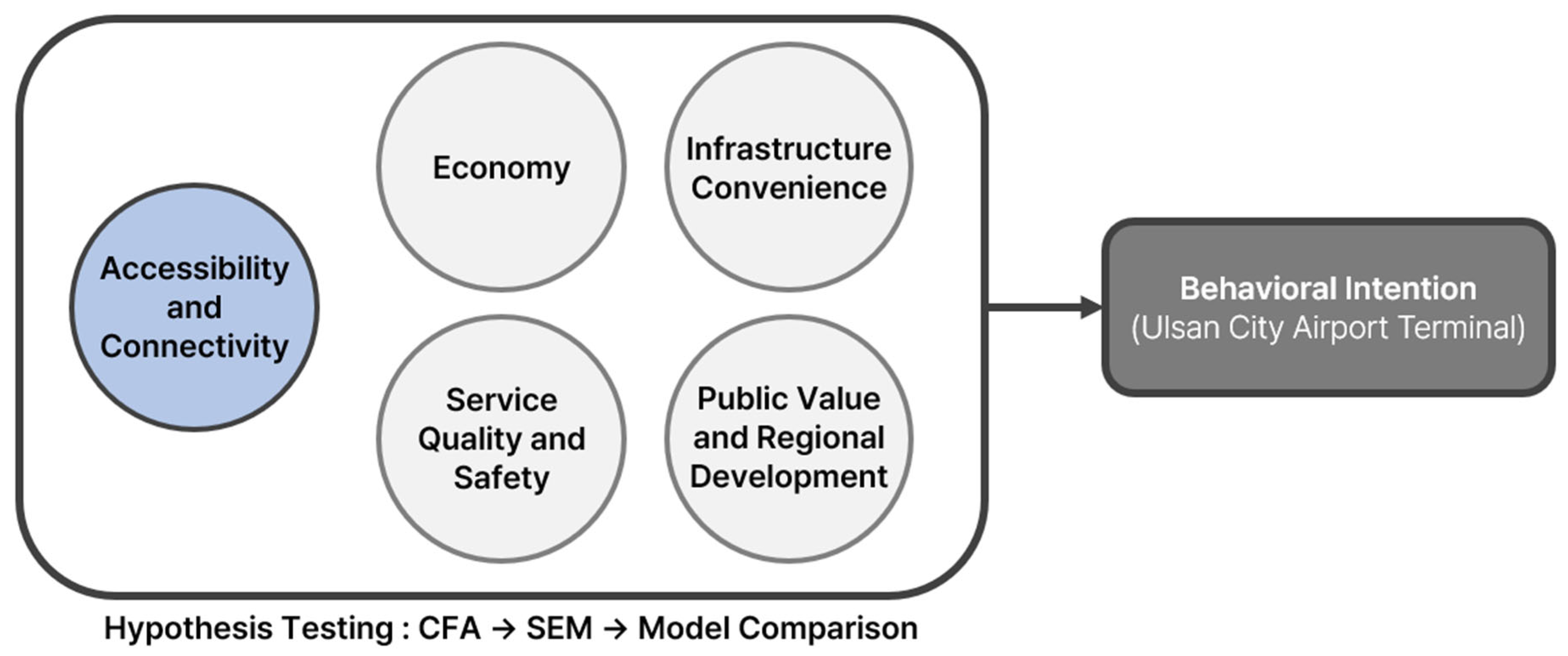
Accordingly, five latent constructs were specified: accessibility and connectivity, economy, service quality and safety, infrastructure convenience, and public value and regional development. The overall analytical framework, including the five latent constructs and their relationship with CAT usage intention, is illustrated in
Figure 1. A structural equation modeling (SEM) framework was employed to estimate the relationships between these latent constructs and CAT usage intention. The analytical design first compares an accessibility-only model, in which CAT usage intention is explained solely by accessibility and connectivity, with an extended multi-factor model that includes accessibility and connectivity together with the other four latent constructs. This comparison was designed to examine whether CAT usage intention can be sufficiently explained by accessibility alone, or whether a broader multi-factor structure provides additional explanatory value. In addition, a further comparison was conducted by a accessibility-excluded model to assess whether accessibility retains statistically distinguishable independent explanatory power after the other constructs are controlled.
3.1. Survey Data
Based on the literature review and expert consultation, this study identified five key determinants that may influence behavioral intention to use a City Airport Terminal (CAT): economy, service quality and safety, accessibility and connectivity, infrastructure convenience, and public value. These determinants were specified as latent constructs to reflect the multidimensional nature of CAT usage intention, encompassing both accessibility-related and non-accessibility-related factors. A survey was then conducted to collect user evaluation data for each construct, and the resulting responses were used to examine the structural determinants of CAT usage intention within a structural equation modeling framework.
The survey was conducted online and via mobile devices among 500 residents of Ulsan Metropolitan City aged between 19 and 69. The survey was administered over a six-day period from 23 October to 28 October 2025. The sampling frame was based on resident registration population statistics from the Ministry of the Interior and Safety as of the end of September 2025. The sample was allocated by considering the population distribution by gender, age group, and district/county. Specifically, the sample was designed using a square-root proportional allocation method reflecting the distribution of residents across the five districts/counties of Ulsan Metropolitan City by gender and age group. Respondents’ eligibility was verified at the beginning of the survey through screening questions on gender, year of birth, and residential area.
Data collection was conducted using a structured questionnaire. The questionnaire consisted of sections on airport use behavior, awareness and experience of CATs, intention to use the Ulsan CAT, perceived effects and necessity of CAT implementation, strategies for enhancing CAT competitiveness, factor-specific importance, and respondent characteristics. In addition, skip logic was applied so that follow-up questions were presented only to relevant respondents according to their previous answers. For example, questions on domestic and international air travel behavior were presented based on whether respondents had used air travel within the past three years, while questions on satisfaction or dissatisfaction with CAT use were presented according to respondents’ prior CAT use experience and satisfaction responses.
Post-stratification weights were applied to the collected responses. The weights were calculated to adjust for differences between the final sample distribution and the population distribution by gender, age group, and district/county, based on September 2025 resident registration population statistics from the Ministry of the Interior and Safety. Specifically, the weight for each stratum was calculated by dividing the population proportion of that stratum by the corresponding sample proportion. Weighted data were used for descriptive statistics and SEM estimation so that the analytical sample more closely reflected the demographic structure of Ulsan Metropolitan City.
Missing data and invalid responses were addressed through the survey design and data-screening procedures. The main analytical items were set as mandatory response fields, thereby minimizing item-level missingness. Eligibility was screened using gender, birth year, and residential area. After these screening procedures, 500 valid responses were retained for analysis.
A total of 31 survey items were constructed to measure the five latent factors: 7 items for economy, 6 for service quality and safety, 4 for accessibility and connectivity, 5 for infrastructure convenience, and 9 for public value and regional development. Detailed respondent characteristics and the full survey questionnaire are provided in
Appendix A.
The economy items were designed to capture both direct and indirect cost components associated with CAT usage, including baggage handling fees, airport limousine bus fares, exemptions from airport facility usage fees, and parking discounts. In particular, expert consultation emphasized that a key mechanism for generating demand lies in encouraging modal shift from private car users to CAT-based access. Accordingly, the incorporation of an appropriate parking discount scheme—reflecting the parking fee levels of the associated airport—was identified as an essential policy instrument and was explicitly included in the survey. In addition, region-specific benefits, such as exclusive discounts for Ulsan residents and point-based incentive schemes, were incorporated. The final set of items reflects a comprehensive assessment of cost-related decision factors, including expert feedback on bundled service packages.
The service quality and safety items were designed to evaluate the perceived level of customer service provided by CAT operations. These items capture the extent to which service quality and safety influence usage intention, considering key operational attributes such as the speed and accuracy of check-in and baggage processing, safety management systems to prevent baggage loss or delay, and compensation mechanisms in the event of service failures. Based on expert input, upscale service features—such as self-transfer services connecting domestic and international flights and dedicated check-in counters for business travelers—were also incorporated into the final questionnaire.
The accessibility and connectivity items focus on the physical accessibility of the CAT and the level of transport integration. Given the off-airport location of CAT facilities, factors such as public transport connectivity, accessibility by private car and taxi, and urban locational attributes were considered as key determinants of usage intention. Expert consultation further highlighted the importance of minimizing the inconvenience associated with transferring between public transport modes when accessing the CAT. In addition, items reflecting synchronization with flight schedules were included to better capture the practical accessibility experienced by users.
The infrastructure convenience items were developed to assess the level of facility-based convenience experienced during CAT usage. These include amenities such as lounges and rest areas, barrier-free facilities for passengers with disabilities, elderly users, and families with infants, real-time flight and transport information systems, and smart infrastructure elements such as Wi-Fi, charging stations, and business centers. Furthermore, based on expert consultation, a door-to-door home delivery service for baggage was incorporated to reflect the future evolution of air travel service systems and the potential functional expansion of CATs. This dimension captures the role of CATs as integrated transport service platforms rather than merely processing facilities.
Finally, the public value and regional development items were designed to assess users’ perceptions of the broader societal and policy impacts of CAT implementation. In the context of Ulsan, particular attention was given to the potential role of CATs in enhancing the city’s image as an international and tourism-oriented destination in conjunction with the opening of Gadeokdo New Airport. Additional considerations include reductions in airport and urban traffic congestion, promotion of public transport usage, mitigation of environmental impacts such as carbon emissions, and improvements in overall quality of life. These items reflect the broader socio-policy value associated with CAT deployment.
Survey responses were measured using a four-point Likert scale [
33]. This forced-choice format was adopted to reduce neutral responding, but it also has important trade-offs. Because all 31 items were framed as conditional intentions, such as “If X is provided, I would be willing to use the CAT,” the instrument may be vulnerable to acquiescence bias, ceiling effects, and compressed response variance. Moreover, because all constructs and the dependent variable were obtained from the same cross-sectional self-reported survey, common method bias may also be present. These design characteristics are particularly relevant because the Ulsan CAT has not yet been implemented and respondents evaluated an expected service rather than an experienced service. The interpretation of the SEM results therefore explicitly considers the possible influence of hypothetical bias, common method bias, and inflated inter-construct correlations.
3.2. Structural Equation Modeling
In this study, confirmatory factor analysis (CFA) was first conducted to evaluate whether the observed items adequately represented the proposed latent constructs. The structural model was then estimated to examine the relationships between the latent constructs and CAT usage intention.
Because the observed indicators were measured on a four-point Likert scale and the CAT usage-intention variable was recoded as a binary dependent variable, the SEM was estimated using the WLSMV estimator. The four-point observed indicators and the binary usage-intention variable were specified as ordered categorical variables, making this estimation approach appropriate for the categorical structure of the data.
Rather than treating observed survey items as simple summed indicators, SEM explicitly estimates both the measurement relationships between observed variables and latent constructs and the structural relationships among latent constructs. The general SEM framework can be expressed as follows Equation (1).
Here, x and y denote vectors of observed indicators for exogenous and endogenous latent variables, respectively; and denote vectors of exogenous and endogenous latent constructs; and are factor loading matrices; represents relationships among endogenous latent constructs; represents the effects of exogenous latent constructs on endogenous latent constructs; and , , and denote measurement and structural disturbance terms.
After estimating the measurement model, standardized factor loadings, composite reliability (CR), and average variance extracted (AVE) were calculated to assess the reliability and convergent validity of each latent construct. The square root of AVE and the latent construct correlation matrix were also reported to examine the degree of association among the constructs and to identify potential conceptual overlap between related factors. In addition, multicollinearity among the latent constructs was assessed using VIF values.
Subsequently, hypothesis testing was conducted through model comparison within the SEM framework. The analytical design first compared an accessibility-only model, in which CAT usage intention was explained solely by accessibility and connectivity, with an extended model that included accessibility and connectivity together with economy, service quality and safety, infrastructure convenience, and public value and regional development.
This comparison was designed to examine whether CAT usage intention could be sufficiently explained by accessibility alone, or whether a broader multi-factor structure provided additional explanatory value. Model fit indices, including CFI, TLI, RMSEA, and SRMR, as well as the explanatory power for CAT usage intention (), were compared across the two models.
In addition, a further comparison was conducted by removing accessibility and connectivity from the extended model. This additional comparison was used to assess whether accessibility and connectivity retained statistically distinguishable independent explanatory power after the other latent constructs were controlled. The purpose of this test was not to claim that accessibility is substantively irrelevant to CAT planning, but to evaluate its incremental statistical contribution within the multi-factor structure.
3.3. Hypothesis Testing
Hypothesis testing was conducted using a nested-model comparison and Wald constraint testing within the structural equation modeling framework. To examine whether non-accessibility constructs provide additional explanatory power beyond accessibility alone, two nested structural models were specified.
The Accessibility-only model (
) included only accessibility and connectivity as a predictor of CAT usage intention:
The extended model (
) additionally included economy, service quality and safety, infrastructure convenience, and public value and regional development:
where
denotes the latent response tendency underlying CAT usage intention,
represents the structural path coefficient, and
denotes the structural error term.
The null and alternative hypotheses were formulated as follows:
Under the accessibility-only model is sufficient to explain CAT usage intention. Under , the extended model provides additional explanatory power beyond accessibility alone.
A supplementary comparison was also conducted between the extended model and an accessibility-excluded model to evaluate the incremental contribution of accessibility after controlling for the other latent constructs. Finally, a Wald constraint test was used to examine whether the structural path coefficients were statistically distinguishable from one another. These tests were used to assess model adequacy and coefficient distinguishability, rather than to establish a substantive ranking of user priorities.
4. Results and Discussion
The overall goodness-of-fit of the proposed structural equation model is presented in
Table 1. The comparative fit index (CFI) is 0.926, exceeding the commonly accepted threshold of 0.90, indicating that the proposed model provides a meaningful improvement in fit relative to the independence model. The Tucker–Lewis index (TLI) is 0.919, suggesting that the model maintains an adequate level of fit even after accounting for model complexity.
The root mean square error of approximation (RMSEA) is 0.070, which falls within the acceptable range of 0.05 to 0.08. In particular, the 90% confidence interval for RMSEA (0.066–0.074) indicates that the model demonstrates a stable level of fit. The normed chi-square (CMIN/DF) is 3.425, slightly exceeding the conventional threshold of 3; however, given the sample size of 500, this value can be interpreted as within an acceptable range.
The definitions and coding scheme of the latent constructs specified in this study are presented in
Table 2. To explain the intention to use the City Airport Terminal (CAT), five latent constructs were defined: Economic (E), Service Quality and Safety (S), Accessibility and Connectivity (A), Infrastructure Convenience (I), and Public Value and Regional Development (P).
Each construct represents a conceptual component derived by synthesizing determinants identified in prior studies on social infrastructure siting and airport service quality. These constructs serve as the basis for systematically classifying observed indicators within the measurement model. The coding scheme functions as a structural framework to clearly distinguish the relationships between latent constructs and observed indicators during the analysis process, thereby ensuring consistency and interpretability in the results.
The standardized regression coefficients (factor loadings) between each latent construct and its observed variables are presented in
Table 3. All items exhibit loadings in the range of 0.877 to 1.000, exceeding the commonly accepted threshold of 0.70. In particular, the items associated with economy (E) show relatively high loadings ranging from 0.931 to 1.000, while service quality and safety (S) also demonstrate consistently high loadings, mostly around 0.98. Similarly, the constructs of Accessibility and Connectivity (A), infrastructure convenience (I), and Public value and Regional Development (P) all exhibit loadings above 0.87, indicating that each item appropriately represents its corresponding latent construct. These results suggest that the survey items reliably capture the five theoretically defined constructs and that the measurement model satisfies the requirement of convergent validity.
Among the reported factor loadings, the items with the highest values (E-6, S-4, A-2, I-1, and P-3) show loadings of 1.000. This indicates that these observed indicators were designated as reference indicators for their respective latent constructs, serving as scaling anchors within the measurement model. At the same time, these items can be interpreted as most directly reflecting the conceptual core of each latent construct. Notably, in the case of Economy (E), several items exhibit loadings close to 0.99, suggesting that perceptions of cost reduction and time efficiency consistently and coherently define the construct. Likewise, the high loadings observed for Service Quality and Safety (S), approximately 0.98, indicate that elements such as procedural reliability, adequacy of information provision, and safety management systems are perceived as closely interrelated components. This implies that respondents tend to interpret these attributes not as distinct elements but as an integrated concept reflecting the overall reliability and safety of service operations.
Such high factor loadings indicate that the observed indicators provide strong explanatory power for their respective latent constructs, thereby supporting the convergent validity of the measurement model. However, factor loadings approaching unity should be interpreted with caution, as they may also suggest strong overlap among observed indicators or insufficient differentiation among latent constructs. Therefore, future research may benefit from further examining discriminant validity and refining the measurement items to improve construct differentiation and item diversity.
The covariance estimates among the latent constructs are presented in
Table 4. All covariances are statistically significant at the 0.001 level, indicating meaningful associations among the constructs. The covariance between Economy and accessibility is 0.234, while that between service quality and accessibility is 0.241. These results suggest that higher perceived accessibility is associated with more favorable evaluations of Economy and service quality.
In addition, the covariance between Infrastructure Convenience and Public Value and Regional Development is 0.241, implying that positive perceptions of physical infrastructure may be linked to perceptions of regional development contribution. Overall, although individual covariances do not exceed the commonly accepted threshold of 0.80, the uniformity of their magnitudes (a narrow range of 0.219–0.243) is itself diagnostic. It suggests that respondents do not strongly differentiate among the five constructs and instead respond to them as facets of a single underlying favorability evaluation toward the CAT proposal. As an additional check, we computed composite scale scores for each construct and obtained pairwise Pearson correlations in the range of 0.71–0.83, with variance inflation factors (VIFs) in a regression of usage intention on the five composites ranging from 3.4 to 5.6. These values do not breach the standard VIF cut-off of 10 but exceed the more conservative threshold of 3 used for SEM contexts [
34]. Combined with factor loadings approaching unity, these diagnostics indicate that the structural model operates in a regime where individual path coefficients are unstable and may be unreliable indicators of unique substantive effects. We therefore interpret the structural results in this section with this caveat in mind.
A closer examination of the covariance structure shows that the highest covariance (0.243) is observed between Accessibility and Connectivity (A) and Infrastructure Convenience (I). This suggests that perceived ease of physical access and the convenience of facility use are the most closely associated dimensions in users’ perceptions. In other words, higher evaluations of accessibility tend to be accompanied by improved perceptions of Infrastructure Convenience, reflecting an interrelated evaluation structure between these two constructs.
The variance structure of each latent construct is presented in
Table 5. All latent construct variances are statistically significant (
p < 0.001), indicating that each construct possesses sufficient independent variability.
In particular, the variance of public value and regional development (P) is the highest at 0.320, suggesting that respondents exhibit relatively greater heterogeneity in their perceptions of this construct compared to others. In other words, evaluations regarding whether the City Airport Terminal contributes to regional development vary considerably across individuals. In contrast, the variance of service quality and safety (S) is relatively lower at 0.246, indicating that perceptions related to service operations and safety are formed more consistently among respondents.
The variances of accessibility (A) and economy (E) are both 0.258, reflecting similar levels of dispersion. This suggests that perceptions of physical accessibility and cost–time efficiency vary within a certain range but do not exhibit substantial extremes.
Overall, the fact that the variances of the latent constructs are neither excessively large nor indistinguishably small, while still exhibiting meaningful differences across constructs, supports the interpretation that each construct represents a distinct dimension within respondents’ perceptions. This provides a statistical foundation for subsequent comparisons of the relative effects of each construct in the structural model.
The error variances of the observed variables are presented in
Table 6. For most items, the error variances range between 0.10 and 0.20, indicating that measurement error is relatively low. However, relatively higher error variances are observed for service quality items (S-5, S-6) and the public value item (P-2). This may suggest greater heterogeneity in respondents’ perceptions or the possibility that these items capture multidimensional aspects.
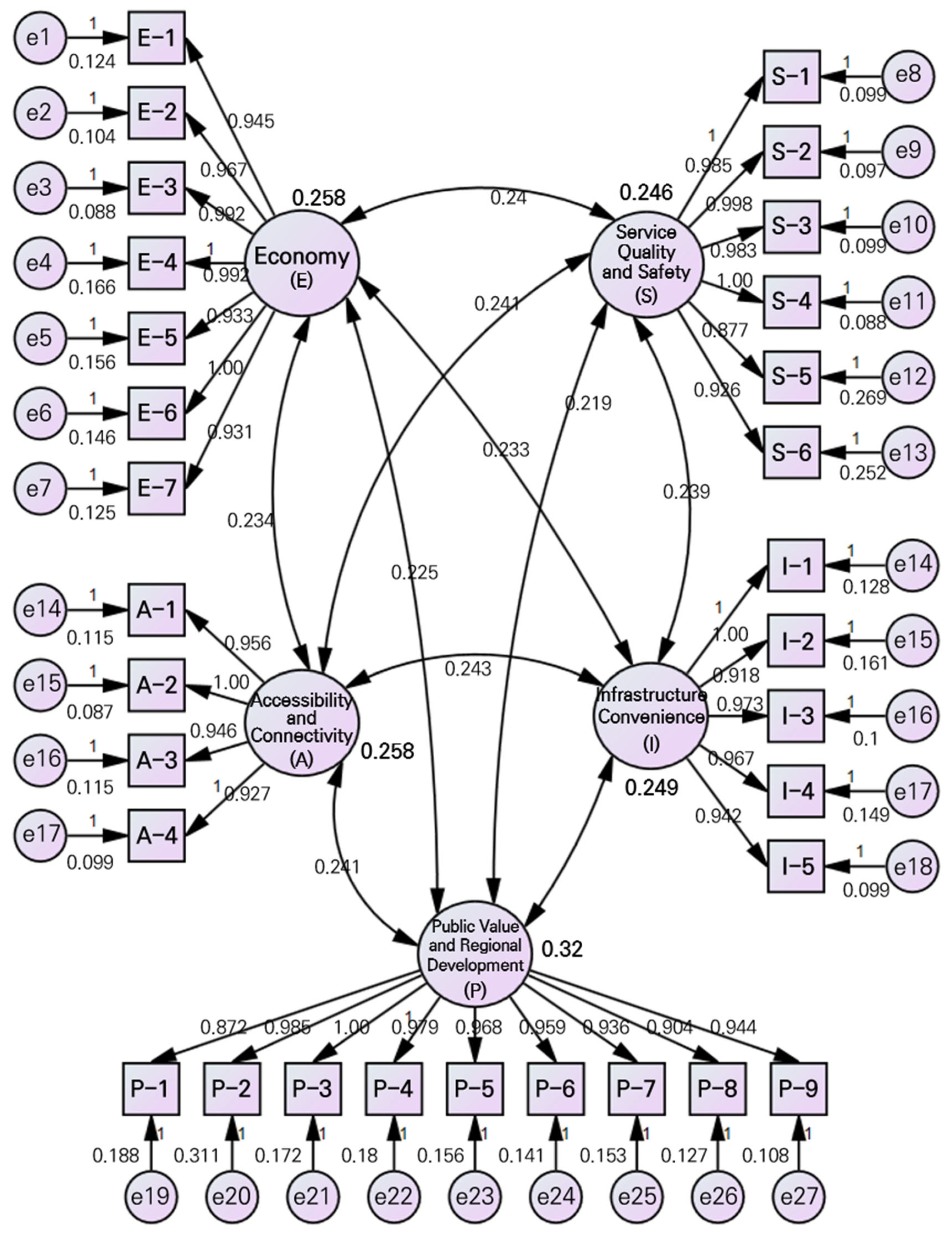
Nevertheless, the overall measurement-error level does not invalidate the measurement model, although item redundancy and discriminant-validity limitations should be considered when interpreting the structural paths. The standardized measurement model summarizing the above results of the measurement model analysis is presented in
Figure 2.
The results of the measurement model analysis indicate that the five latent constructs exhibit an overall acceptable level of model fit and satisfy the criteria for convergent validity. Although the covariances among the constructs are statistically significant, their magnitudes suggest that the constructs are related but not necessarily redundant.
These findings imply that the intention to use a City Airport Terminal (CAT) is more likely to be explained by a multidimensional structure in which economy, accessibility, service quality, infrastructure convenience, and public value interact, rather than by a single-factor model. Accordingly, it is necessary to examine the relative influence of these multiple factors on usage intention in the subsequent structural model analysis.
Beyond the previously reported statistical results, additional diagnostics were conducted to assess reliability, convergent validity, discriminant validity, and multicollinearity. These results are summarized in
Table 7 and
Table 8.
As shown in
Table 7, the composite reliability (CR) values range from 0.948 to 0.965, and the AVE values range from 0.755 to 0.834. The CR and AVE values satisfy the commonly used thresholds of 0.70 and 0.50 for internal consistency and convergent validity, respectively, indicating acceptable levels. However, the very high CR values may suggest potential redundancy among some items. In addition, the VIF values are particularly high for service quality and safety (S), accessibility and connectivity (A), and infrastructure convenience (I), indicating that multicollinearity may exist among the functional constructs. Therefore, while the measurement model shows acceptable results in terms of convergent validity, the structural paths should be interpreted with caution.
The latent construct correlation matrix indicates relatively high correlations among the constructs, ranging from 0.826 to 0.972. In particular, strong correlations are observed between service quality and safety and accessibility and connectivity (S–A = 0.972), accessibility and connectivity and infrastructure convenience (A–I = 0.967), and service quality and safety and infrastructure convenience (S–I = 0.962). These results indicate that discriminant validity among several constructs is limited and that respondents may have evaluated the proposed CAT through a broad positive perception structure rather than clearly separating each construct. Therefore, although the constructs are retained based on the theoretical framework of this study, the unique effects of individual latent constructs and the structural path estimates should be interpreted with caution. Additional details on the measurement model fit assessment, including degrees of freedom, absolute fit indices, incremental fit indices, and RMSEA, are provided in
Appendix B.
Following the measurement-model assessment, hypothesis testing was conducted through structural path estimation and model comparison. The hypothesis testing in this study was conducted using a structural equation modeling (SEM) framework through a two-step procedure. First, within the extended structural model, the effects of all latent constructs on usage intention were simultaneously estimated, and the statistical significance of individual path coefficients was evaluated. This step was designed to determine whether the five latent constructs—economy, service quality and safety, accessibility and connectivity, infrastructure convenience, and public value—each exert independent explanatory power on the dependent variable, namely CAT usage intention. The evaluation was based on standardized coefficients and corresponding p-values to assess whether each construct has a statistically significant effect on the formation of usage intention.
Second, to assess the validity of an accessibility-centered explanatory structure, a stepwise comparison was conducted between an accessibility-only model and an extended model. The accessibility-only model includes only accessibility as the independent variable explaining usage intention, whereas the extended model incorporates additional constructs, including economy, service quality and safety, infrastructure convenience, and public value. The comparison between the two models was performed based on changes in model fit indices (CFI, TLI, RMSEA), explanatory power (R2), and nested model difference tests. Through this approach, the study aims to structurally evaluate whether accessibility alone is sufficient to explain usage intention.
The estimation results of the structural model derived through this stepwise analytical procedure are presented as follows.
Table 9 presents the model fit indices for the accessibility-only model and the extended model. Both models satisfy commonly used model-fit criteria. The accessibility-only model shows acceptable fit, with CFI = 0.998, TLI = 0.998, RMSEA = 0.052, and SRMR = 0.041. The extended model shows slightly improved fit, with CFI = 0.999, TLI = 0.998, RMSEA = 0.050, and SRMR = 0.037. In addition, the R
2 value for CAT usage intention is 0.318 in the accessibility-only model and 0.382 in the extended model. This indicates that the accessibility-only model explains approximately 31.8% of the variance in CAT usage intention, whereas the extended model explains approximately 38.2%.
Therefore, the extended model, which includes non-accessibility constructs, provides additional explanatory value not only in terms of model fit but also in terms of the explanatory power for CAT usage intention. However, given the high correlations among the latent constructs and the possibility of multicollinearity, this improvement should be interpreted cautiously as additional explanatory power of the multidimensional structure rather than as evidence of the independent effects of each factor.
The structural path estimates of the extended model in
Table 10 show that public value and regional development (P) has a statistically significant positive direct path to CAT usage intention (
p < 0.001). The standardized coefficient is also 0.739, indicating that public value and regional development is the only statistically distinguishable direct path in the extended model. By contrast, accessibility and connectivity (A), economy (E), service quality and safety (S), and infrastructure convenience (I) do not show statistically significant direct paths when all constructs are included simultaneously.
However, these results should be interpreted with caution and should not be treated as a ranking of the relative importance of individual factors. As noted above, the correlations among the latent constructs and the VIF values are high. Therefore, each path coefficient should be understood as an estimate of a unique effect under conditions of substantial shared variance. Accordingly, the non-significant paths do not necessarily imply that these factors have low policy importance. Likewise, the significant path of public value and regional development should not be interpreted as a definitive priority ranking of determinants of CAT usage intention.
Nevertheless, from a sustainable mobility perspective, the statistically distinguishable association between public value and regional development and usage intention is noteworthy. This suggests that respondents may perceive CAT implementation not only in terms of operational convenience as a transport service, but also in relation to broader community-level benefits, such as regional development expectations, quality-of-life improvement, congestion relief, public transport promotion, and environmental burden reduction. Therefore, in discussions of CAT implementation, presenting broader public benefits related to urban sustainability and regional development, alongside functional advantages such as check-in convenience and accessibility improvement, may help enhance public understanding and acceptance. This perspective is also consistent with discussions in sustainable air transport management that emphasize demand-side behavioral strategies alongside supply-side technological improvements [
28].
Taken together, these results indicate that CAT usage intention is difficult to explain sufficiently by accessibility as a single determinant. In particular, the non-significant path coefficient for accessibility and connectivity suggests that its independent effect does not remain statistically distinguishable when the other latent constructs are considered simultaneously. Accordingly, to further examine the explanatory power of an accessibility-centered structure, the following section compares the accessibility-only model with the extended model.
The nested model comparison results in
Table 11 provide the main basis for hypothesis testing. First, the comparison between the accessibility-only model (
) and the extended model (
) is statistically significant (Δχ
2 = 29.068, Δdf = 4,
p < 0.001). This indicates that the extended model, which includes non-accessibility constructs, provides additional explanatory power for CAT usage intention compared with the accessibility-only model. Therefore, CAT usage intention needs to be understood within a broader multidimensional structure rather than being explained by accessibility alone.
In addition, to examine the independent contribution of accessibility and connectivity, a further comparison was conducted between the accessibility-excluded model () and the extended model (). The chi-square difference test result (p = 0.964) shows that the difference between the model including the accessibility path and the model excluding it is not statistically significant. This means that, when other factors are considered together, adding accessibility and connectivity does not significantly improve the explanatory power of the model.
These results suggest that accessibility does not show significant importance as a sole explanatory factor for CAT usage intention. In other words, CAT usage intention should be understood within a multidimensional structure in which various factors, such as economy, service quality and safety, infrastructure convenience, and public value and regional development, operate together. The effect of accessibility can also be interpreted as emerging in connection with these other constructs.
The Wald test results in
Table 12 show that the equality constraint among the structural paths is statistically rejected (χ
2 = 12.150, df = 4,
p = 0.016). This indicates that the path coefficients of the latent constructs included in the extended model cannot be regarded as equal. Considering that public value and regional development (P) is the only construct with a statistically significant direct path to CAT usage intention in
Table 10, this construct can be interpreted as a statistically distinguishable direct path in the present model.
However, this result should not be interpreted as evidence that public value and regional development is substantively more important than all other factors. As noted above, the correlations among the latent constructs and the VIF values are high. Therefore, differences among the path coefficients should be understood as results estimated under conditions of substantial shared variance. Accordingly, the Wald test result should be interpreted as supplementary evidence that the structural paths in the extended model are not identical and that the direct path of public value and regional development is statistically distinguishable, rather than as a basis for establishing a definitive priority ranking among the factors.
In summary, the factor-analysis results support the basic fit and convergent validity of the measurement model, while the additional diagnostics indicate limitations in discriminant validity and the possibility of multicollinearity among the constructs. The model comparison results show that the extended model provides greater explanatory power for CAT usage intention than the accessibility-only model. However, additionally including accessibility does not lead to a statistically significant improvement in explanatory power within the multidimensional structure. Therefore, the findings of this study should not be interpreted as evidence that accessibility is unimportant in CAT planning. Rather, they should be understood as evidence that CAT usage intention cannot be sufficiently explained by accessibility alone.
5. Conclusions
This study empirically analyzed the key determinants influencing usage intention for a City Airport Terminal (CAT) in Ulsan, employing a structural equation modeling (SEM) framework under the assumption of CAT implementation. Overall, the findings indicate that usage intention is not adequately explained by a single factor such as accessibility alone, but is better understood within a multi-factor structure in which multiple determinants are considered together.
The measurement model demonstrates an acceptable level of fit, and the five latent constructs—economy, service quality and safety, accessibility and connectivity, infrastructure convenience, and public value and regional development—are found to form statistically stable measurement structures. The additional reliability and validity diagnostics also indicate acceptable internal consistency and convergent validity. At the same time, the high correlations among the latent constructs and elevated VIF values indicate limitations in discriminant validity and the possibility of multicollinearity.
The CFA results show that the five latent constructs are interrelated, with covariances ranging narrowly between 0.219 and 0.243. In addition, the latent construct correlation matrix indicates relatively high correlations among several constructs. This suggests conceptual overlap in respondents’ perceptions rather than directional influence among constructs; for example, accessibility and connectivity, infrastructure convenience, service quality and safety, and economy may have been perceived not as completely separate dimensions but as related facets of a broader positive evaluation toward the CAT.
The SEM results indicate that the accessibility-only model is statistically insufficient compared with the extended five-factor model; that is, usage intention cannot be adequately explained by accessibility alone. The extended model provides additional explanatory value, and within this model, public value and regional development retains a statistically significant direct path to usage intention. By contrast, accessibility and connectivity, economy, service quality and safety, and infrastructure convenience do not show statistically significant individual paths when the constructs are estimated simultaneously.
These results should be interpreted with caution. The non-significant paths for accessibility and other functional attributes should not be taken as evidence that residents place little weight on these factors, because the estimates may be affected by high inter-construct correlations, multicollinearity, the hypothetical nature of the Ulsan CAT, and the conditional-item survey design. Rather, CAT activation should be planned as a multidimensional process in which accessibility and connectivity, service reliability, facility convenience, economic utility, and public-value considerations are treated as complementary elements. The relative weights of these factors, however, cannot be inferred from the present data.
From a policy perspective, the results suggest that discussions on CAT implementation should not be confined to accessibility-oriented location strategies. Rather, comprehensive planning is required, encompassing service quality management, reliability of check-in and baggage handling processes, enhancement of information systems, cost-related benefits, and integration with regional economic development strategies. In the case of Ulsan, considering its potential linkage with Gadeokdo New Airport, factors such as operational reliability and user-perceived convenience should be considered together with improvements in transport accessibility.
As the aviation sector faces mounting pressure to reduce its environmental footprint, CATs may offer a demand-side sustainable infrastructure strategy that complements supply-side decarbonization efforts, including the adoption of sustainable aviation fuels and electrification of ground support equipment. However, the present study does not directly measure actual mode shift or carbon-reduction effects. Therefore, the sustainability implications of CAT implementation should be interpreted as potential planning relevance rather than as potential planning relevance. The present findings suggest that public support for such infrastructure may be shaped by multi-dimensional perceptions—particularly public-value judgments about regional development and community well-being—rather than by accessibility considerations alone. Sustainable air transport planning for CAT implementation should therefore incorporate perception-based approaches alongside conventional engineering and emissions analyses, ensuring that the social and community dimensions of sustainable mobility are reflected in infrastructure design and policy communication.
This study has several limitations that suggest directions for future research. First, as the Ulsan CAT has not yet commenced operations, the analysis is based on stated intention data from potential users rather than revealed behavioral evidence; future research should seek to validate the identified structural relationships using post-implementation data. Second, because the study relies on a single cross-sectional self-reported survey, common method bias may be present. Third, the conditional wording of all survey items and the use of a four-point Likert scale without a neutral midpoint may have contributed to acquiescence bias, ceiling effects, compressed response variance, and inflated correlations among constructs. Fourth, the study draws on a regional sample from Ulsan Metropolitan City, and the generalizability of the findings to other CAT contexts requires further empirical investigation. Future studies would benefit from incorporating broader geographic samples, longitudinal designs, and additional sociodemographic and behavioral variables to capture potential heterogeneity in CAT adoption across different user groups and regional contexts.
In conclusion, this study provides structural evidence that an accessibility-only explanatory model of CAT usage intention is statistically inadequate, and simultaneously documents—through multicollinearity and design diagnostics—why the present perception-based data cannot identify the unique contribution of each non-accessibility construct. We view this dual finding, rather than a single-factor prioritization of public value, as the appropriate empirical basis for the next stage of CAT planning in Ulsan. Future research should incorporate post-implementation revealed-preference data to examine discrepancies between perception and actual behavior; employ vignette-based or stated-choice experimental designs to reduce the natural correlations among latent constructs and identify each construct’s unique effect; integrate demographic and behavioral segmentation variables, such as age, income, and frequency of air travel, to detect heterogeneity in the structural relationships; and link the analysis with anticipated changes in the transport system following the opening of Gadeokdo New Airport, thereby strengthening the empirical basis for policy decision-making.