Article

Sustainable Optimization in Air Transport: Hybrid Particle Swarm and Tabu Search Algorithm for the Multi-Objective Airport Gate Assignment Problem

1
School of Transportation and Civil Engineering, Nantong University, Nantong 226019, China
2
College of Information Engineering, Ningde Normal University, Ningde 352100, China
3
Intelligent Ecotourism and Leisure Agriculture Laboratory, Ningde 352100, China
4
Zhejiang Institute of Communications Co., Ltd., Hangzhou 310030, China
5
Hubei Key Laboratory of Vehicle-Infrastructure Collaboration and Traffic Control, Hubei University of Arts and Science, Xiangyang 441053, China
*
Author to whom correspondence should be addressed.
These authors contributed equally to this work.
Sustainability 2026, 18(7), 3331; https://doi.org/10.3390/su18073331
Submission received: 5 March 2026 / Revised: 17 March 2026 / Accepted: 27 March 2026 / Published: 30 March 2026
(This article belongs to the Special Issue Sustainable Air Transport Management and Sustainable Mobility)

Abstract

With the rapid growth of the civil aviation industry, airport gate resources—especially those equipped with jet bridges (more convenient than shuttles)—have become increasingly scarce, posing new challenges to the sustainable management of airport operations. In a real-world application of the airport transport optimization study field, the airport gate assignment problem (AGAP) has emerged as a critical scheduling task in airport operations with the rapid growth of passenger demand. In this study, a mixed-integer linear programming model is developed for AGAP, aiming to minimize baggage transfer vehicle usage, maximize airline satisfaction, reduce passenger boarding time, and enhance the overall sustainability of airport operations. To efficiently address the computational complexity of this integrated modeling framework, a customized multi-objective particle swarm optimization (MOPSO) algorithm is proposed, augmented by a tabu search (TS) strategy. The TS algorithm provides high-quality initial solutions for MOPSO and performs local intensification on elite particles, thereby enhancing both convergence speed and solution quality. Extensive numerical experiments demonstrate that the proposed hybrid approach significantly outperforms the standalone MOPSO algorithm, achieving a 26.37% improvement over the original gate assignment scheme and a further 1.25% improvement compared to the standalone MOPSO, confirming the effectiveness and practicality of the proposed method.

1. Introduction

1.1. Motivation

As the central hub of the modern air transportation network, an airport’s operational efficiency directly affects the overall smoothness of the aviation system and the travel experience of passengers. Within the complex system of ground operations, the AGAP is undoubtedly a critical and highly challenging task. This problem not only requires assigning appropriate stands to each arriving and departing flight to ensure safe and convenient boarding and disembarkation for passengers but also demands achieving an optimal balance among multiple and often conflicting operational objectives under various operational constraints, thereby supporting the sustainable development of airport operations.
With the continuous growth of global air traffic, airports are facing increasing pressure on stand resources. This not only intensifies the complexity of the AGAP but also imposes higher demands on aircraft scheduling optimization. How to achieve a more scientific, rational, and balanced allocation of limited gate resources while ensuring both efficiency and fairness has become a pressing issue that must be addressed.
This study develops a mixed integer linear programming (MILP) model aimed at reallocating aircraft stands to optimize passenger boarding time, minimize aircraft taxiing costs, and reduce airport resource consumption. To ensure the rationality and stability of the stand assignment scheme, the model explicitly considers the influence of each sub-objective on the overall objective. Furthermore, sensitivity analysis based on different weight coefficients is conducted to examine how variations in sub-objective weights affect the optimization outcomes.
Specifically, this study employs the particle swarm optimization (MOPSO) algorithm and the tabu search (TS) algorithm to optimize the proposed model. In traditional stand allocation schemes, the interrelationship among passengers, airports, and airlines has not been comprehensively considered, often resulting in the compromise of one party’s interests or a decline in overall operational efficiency. In contrast, the proposed model in this study seeks for an optimized trade-off between the three stakeholders, thereby enhancing airport operational efficiency while achieving more effective resource utilization and coordinated multi-party optimization.

1.2. Literature Review

This section introduces the AGAP model and the corresponding optimization algorithm. They indeed provide a solid research basis for our work.
Daş et al. [1] proposed a column-generation-based algorithm for solving the bi-objective AGAP. The algorithm aims to generate efficient gate schedules by jointly minimizing the squared gate idle time and the walking distance of passengers, thereby achieving an optimal balance between airport operational efficiency and passenger travel experience. Özlem Karsu et al. [2] proposed a new mixed-integer programming model designed to simultaneously minimize the number of aircraft assigned to remote stands and the total walking distance of passengers, thereby enhancing passenger convenience while maintaining operational efficiency. Shadman et al. [3] estimated key parameters through statistical analysis and introduced an “hourly correction factor” to develop a stand allocation scheme that accounts for taxiing delays. The proposed approach aims to minimize the total taxiing time of aircraft, thereby improving airport operational efficiency and reducing ground delay risks. She et al. [4] proposed a multi-objective integer programming model that aims to maximize the preference scores of airline operators and minimize the robustness cost arising from schedule changes. To solve the model, a two-stage NSGA-II algorithm based on the Monte Carlo method was developed, achieving a desirable balance between optimization accuracy and solution diversity. Li et al. [5] proposed a multi-objective integer programming model to maximize the number of passengers at nearby gates and minimize passenger walking distance, CO2 emissions from remote stands, and shuttle bus travel distance. The model was solved using a column generation algorithm based on set partitioning and a Pareto local search to obtain non-dominated solutions. Kim et al. [6] addressed the uncertainty in flight schedules by introducing a gate assignment model with overlapping chance constraints, which restricts the probability of flight time overlaps at each gate within a predefined threshold and aims to maximize the total gate preference value. A network-based integer programming model was proposed, where probability distributions were estimated using historical arrival and departure deviation data. The model was further strengthened by incorporating gate assignment patterns, and a branch-and-price algorithm was developed to solve the problem efficiently. Li et al. [7] treated gate assignment as a dynamic decision-making process and proposed a solution for real-time gate assignment. Zhang et al. [8] proposed a robust optimization model for the Robust Gate Assignment Problem, which considers uncertainty in aircraft idle times and includes a conservatism budget. The model comprises two decision stages: In the first stage, aircraft are assigned to contact gates or remote stands, while in the second stage, the scheduling plan is adjusted based on observed aircraft idle times. The objective is to minimize the number of aircraft assigned to remote stands while reducing the deviation between idle time and buffer time. Aktel et al. [9] proposed a tailored tabu search algorithm that uses a probabilistic approach as the aspiration criterion, aiming to minimize both the number of unassigned flights and the total walking distance of passengers. Benlic et al. [10] proposed a heuristic approach based on the Breakout Local Search framework to address the complexity of the problem. Additionally, a novel memory-based greedy constructive heuristic was used to generate the initial solution for the BLS algorithm. Yang et al. [11] proposed an integrated approach for multi-path standardized taxi route planning and validation based on system-optimal traffic assignment. Furthermore, human-in-the-loop experiments involving six operational scenarios demonstrate that the proposed method improves taxiing performance without increasing controller workload. Bi et al. [12] developed a model for the airport stand assignment problem aiming to maximize passenger service capacity, solved by a Branch-and-Price algorithm with heuristic search to enhance computational efficiency. Li et al. [13] proposed a probabilistic learning-based primal heuristic that integrates a hybrid search strategy, employing tabu search to explore both feasible and infeasible regions, while reinforcement learning guides the search toward more promising areas. Xiao et al. [14] considered multiple hub-related costs arising from passengers and aircraft, including transfer, accommodation, and gate occupancy. The study aimed to minimize the total operational cost by optimizing flight sequencing (arrivals and departures) and gate assignments, while accounting for transfer efficiency, passenger demand, flight size, gate capacity, and terminal layout. Pternea et al. [15] proposed an integrated framework for reallocating flights to airport gates under schedule disruptions. The framework relies on a binary integer programming model and represents the first multidimensional assignment approach that evaluates passenger transfer success by considering both gate locations and the resulting required connection times. Guardo-Martinez et al. [16] proposed a comprehensive airline scheduling framework that incorporates turnaround planning to improve the estimation of aircraft turnaround time, crew positioning time, and passenger transfer time under uncertainty. Yu et al. [17] developed a quadratic model aimed at enhancing passenger satisfaction, particularly that of transfer passengers, and transformed it into an equivalent mixed-integer programming (MIP) formulation. The model was then solved using diving, local branching, relaxation-induced neighborhood search (RINS), and a hybrid algorithm combining RINS and diving intensities. Chen et al. [18] proposed a locally generalizable multi-agent reinforcement learning approach for the Demand and Capacity Balancing problem, in which trained agents can be directly deployed to unseen scenarios to enable cooperative decision-making. By incorporating a cooperation coefficient into the reward function and designing a multi-iteration mechanism, the method outperforms traditional slot allocation and existing reinforcement learning approaches in large-scale real-world scenarios and exhibits strong generalization capability. Cao et al. [19] addressed flight schedule uncertainty by proposing a prediction–optimization framework for gate assignment. The approach allocates gates based on predicted flight arrival times, thereby avoiding reliance on robustness-oriented objectives. In the prediction phase, a CNN–LSTM–Attention deep learning model was developed to forecast arrival times. In the optimization phase, a bi-objective gate assignment model was formulated using the predicted rather than scheduled arrival times as inputs. A ε-constraint branch-and-price algorithm was then designed to obtain non-dominated Pareto-optimal solutions. Liu et al. [20] addressed uncontrollable factors in flight operations by incorporating uncertainty from capacity–flow analysis and developed an uncertain slot allocation model for multi-airport systems. In this model, slot execution deviations are treated as uncertain parameters, while fixed capacity constraints are formulated as chance constraints to balance robustness and optimality. An equivalent model transformation approach is employed to solve the proposed model. Yang et al. [21] developed a mesoscopic traffic model to capture traffic dynamics under coupled conditions in multi-airport regions characterized by system complexity and resource sharing, and conducted capacity decoupling analysis. Using the Shanghai multi-airport system as a case study, the model performance was validated from the perspectives of operational time and traffic throughput. The results indicate that the model can accurately reflect traffic dynamics, with delay estimation maintained within an acceptable range, and that the capacity decoupling analysis effectively reveals the interdependencies of traffic flows caused by resource sharing, both within individual airports and among different airports. Jiang et al. [22] proposed a method based on the Ant Colony Optimization algorithm. By incorporating operational risk factors, they developed an ACO-based model that simulates the foraging behavior of ant colonies to effectively identify optimal paths in complex taxiway networks. Zhao et al. [23] developed an accelerated bilevel solution approach that integrates customized heuristics to achieve practical scalability. The proposed method enables the optimization of tactical decisions under operational disruptions, thereby systematically enhancing the robustness of aircraft maintenance planning and routing decisions. Wang et al. [24] investigated the integrated optimization of airport slot allocation and gate assignment, aiming to minimize both the total displacement of requested time slots and the number of aircraft assigned to remote gates. A mixed-integer programming model was formulated, and an adaptive large neighborhood search algorithm was developed to solve the problem efficiently. Chen et al. [25]. proposed a fast hotspot-free and conflict-free trajectory planning method under uncertainty, in which a grid-based low-altitude airspace model and a demand counting model were developed, and a weighted directed graph–based planning strategy was adopted by incorporating energy consumption costs and airspace usage fees. Simulation results demonstrate that the proposed method can generate hotspot-free and conflict-free trajectories for each unmanned aerial vehicle within milliseconds, and further reveal the impact of airspace pricing on operational efficiency. Zhang et al. [26] proposed a domain-adaptive deep reinforcement learning framework that combines dual-layer heterogeneous graph attention networks, hypergraph-based constraint modeling, and hierarchical policy decomposition for efficient cross-domain resource allocation. The method achieved resource utilization rates of 87.3% for airport gate assignment and 86.3% for seaport berth allocation. Akopov et al. [27] proposed a pathogen-based epidemiological model and solved it using a hybrid multi-swarm particle swarm optimization algorithm. The algorithm incorporates real-coded genetic operators (crossover and mutation) into a parallel multi-swarm MOPSO framework. Particles are clustered into several sub-swarms, and parent solutions selected within each sub-swarm alternately apply heuristic operators, thereby enhancing population diversity and global search capability. Ma et al. [28] proposed a multi-objective particle swarm optimization algorithm based on decomposition and multiple selection strategies to improve search efficiency. The method first employs two decomposition-based update strategies to update the evolving population and the external archive, respectively. Then, a multiple selection mechanism is designed. For subspaces without nondominated solutions, the neighboring particle with the smallest penalty-based boundary intersection value is selected as the global best, while a particle far from both the current particle and the global best is chosen as the personal best to enhance global exploration. For subspaces containing nondominated solutions, two neighboring particles are randomly selected, one serving as the global best and the other as the personal best to strengthen local exploitation. In addition, discontinuities in the Pareto front are identified by counting the cumulative iterations of subspaces without nondominated solutions.
Motivated by the differing objectives of airports, airlines, and passengers in flight operations, we develop a unified model that integrates the interests of all three stakeholders. Another important aspect is that the proposed model is designed to address a tactical-level integrated routing and planning problem, which simultaneously accounts for airline satisfaction with gate assignments, airport revenue, and passenger sensitivity to time-related costs.

1.3. Contributions and Features

In existing studies, passengers are commonly treated as a homogeneous group during the modeling process, without refined classification or differentiated characterization. Although this aggregated approach helps reduce model dimensionality, alleviate computational complexity, and improve solution efficiency, it simultaneously weakens the model’s ability to accurately capture real-world operational characteristics. In reality, different passenger types exhibit substantial heterogeneity in travel purpose and behavioral preferences. For example, transfer passengers and origin/destination passengers differ structurally in terms of minimum acceptable connection time and sensitivity to walking distance. Meanwhile, most existing research adopts a single-actor perspective when constructing optimization models. Some studies focus primarily on maximizing airport operational efficiency, others emphasize minimizing airline operating costs, while still others independently develop service-level indicators from the passenger experience perspective.
In response to the aforementioned issues, this paper investigates the AGAP, with its main contributions encompassing the following three aspects:
(1) We build a MILP formulation for AGAP optimization considering three real-life objectives: to minimize baggage transfer vehicle usage, to maximize airline satisfaction, and to reduce passenger boarding time, simultaneously. In order to solve the integrated model, we develop a hybrid algorithm combining a tabu search algorithm with a particle swarm optimization algorithm to derive high-quality solutions. An elite preservation strategy is incorporated into the algorithms to enhance overall solution efficiency.
(2) To validate the effectiveness of the proposed model and the hybrid algorithm, experimental analyses are conducted using case data from Chengdu Tianfu International Airport. Specifically, the proposed methods are compared with the original gate assignment scheme and benchmark-based algorithms. The results demonstrate that the proposed approaches consistently outperform the original solution and benchmarks in terms of gate assignment quality, yielding superior allocation.
(3) Finally, a systematic sensitivity analysis is performed with respect to different weight settings of the sub-objective functions to evaluate the impact of weight variations on optimization performance. Through multiple comparative experiments with varying weight parameters, the roles of individual sub-objectives and their trade-offs within the overall objective function are examined, thereby verifying the stability of the model under different weight configurations. The results indicate that, within reasonable ranges of weight values, the model maintains optimization performance and ensures near-optimal solutions for the composite objective function.
The remainder of this paper is organized as follows. Section 2 presents the problem description, outlines the relevant assumptions, and formulates the objective functions and constraints. Section 3 introduces the designed TS and MOPSO. Section 4 validates the proposed model and algorithms through numerical experiments based on case studies. Finally, Section 5 concludes the paper and discusses potential directions for future research.

2. Problem Statement

In the context of the AGAP, this study aims to more accurately represent resource allocation requirements under varying airport operating conditions, with particular attention to non-peak operational periods. Existing research paid more attention to the perspectives of either airport authorities or airlines, or primarily focuses on passenger efficiency, while seldom balances the integrated objectives of all three stakeholders simultaneously. This limitation often leads to gate assignment solutions that compromise the interests of one party, thereby reducing practical implementability. In contrast, our model harmonizes the objectives of airports, airlines, and passengers within a unified optimization framework. It ensures operational stability for airlines, reduces airport operating costs, and shortens passenger boarding and transfer times, ultimately enhancing overall service quality and system-wide operational efficiency.

2.1. Assumptions

Based on the aforementioned problem statement, we make the following assumptions to ensure the applicability and tractability for modeling.
(i) The initial flight schedule can be predetermined prior to model formulation and solution.
(ii) All flights strictly adhere to their scheduled arrival and departure times.
(iii) This study focuses exclusively on passenger aircraft and their corresponding gates, excluding cargo aircraft and gates designated for cargo operations.

2.2. Terminologies

2.2.1. Sets

I: Set of all flights.
Imax: Set of large aircrafts, ( I m a x I ).
Imin: Set of small aircrafts, ( I m i n I ).
G: Set of all gates.
Gmax: Set of large gates, ( G m a x G ).
Gmin: Set of small gates, ( G m i n G ).
Kr: Baggage-Handling vehicle interval.

2.2.2. Parameters

Tia: Arrival time of flight i ( i I ).
Tid: Departure time of flight i ( i I ).
tjd: Walking time from alighting stop j ( j I ) to destination d.
L t a : Baggage transfer vehicle arrival time.
L t d : Baggage transfer vehicle departure time.
L t m i n : Minimum dwell time of the baggage car.
L t m a x : Maximum dwell time of the baggage car.
Tmin: Minimum time interval between flight departures.
Tmax: Maximum time interval between flight departures.
tmin: The time interval between two consecutive aircraft occupying the same gate.
Pi: Number of passengers on flight i( i I ).
Pi,j: Number of transfer passengers from flight i( i I ) to flight j( j I ).
Dg1,g2: Distance between gates g1 and g2.
Dg: Distance from airport main entrance to gate.
mg,h,t: Number of equipment moved from gate g( g G ) to gate h during time slot.
zi,g,t: Number of equipment e provided to flight i( i I ) during time slot t.
sg,t: Number of available equipment at gate g at the beginning of time slot t (inventory).
cg,t: Maximum capacity of equipment at gate g( g G ).
D: Penalty factor for aircraft docking at a gate without a jet bridge.
Q: Penalty coefficient for small aircraft assigned to large gates.
P: Penalty factor for aircraft assigned to an undesired gate by the airline.
tt: Baggage vehicle working time window.

2.2.3. Decision Variables

  • x i , g : Binary variable, 1 if flight i is assigned to gate g, 0 otherwise.
  • x g 1 , g 2 : Binary variable, 1 if there is a transfer connection between the flights assigned to gates g1 and g2, 0 otherwise.
  • 𝜕 g : Binary variable, 0 if gate g has a jet bridge, 1 otherwise.
  • l i , j : Binary variable, 1 if there are transfer passengers between flights i and j, 0 otherwise.
  • p i , g : Binary variable, 1 if flight i is assigned to an undesired gate g, 0 otherwise.
  • q i , g : Binary variable, 1 if a small aircraft flight i is assigned to a large gate g, 0 otherwise.
  • n i , t g : Binary variable, 1 if a baggage vehicle serves flight i at gate g during time slot t, 0 otherwise.

2.3. Objective Functions

A new AGAP optimization model is formulated as a mixed-integer linear programming model. The model explicitly considers three objectives: (i) Minimizing the number of movements of baggage transfer vehicles, (ii) enhancing airline satisfaction by reducing stand allocation fees and shortening aircraft taxiing distances to the runway, and (iii) minimizing passenger boarding distances. Essentially, the overall objective function is determined by the allocation of flights to gates. The motivation for introducing a multi-objective formulation stems from the diverse preferences of stakeholders.
Z 1 = i I t g G h G x i , g m g , h , t n i , t g
y i , g , h , t = x i , g m g , h , t n i , t g
Z 2 = i I g G c i , g   x i , g
c i , g = q i , g Q + p i , g P
D t = i I j I g 1 G g 2 G P i , j l i , j D g 1 , g 2 + 𝜕 g 1 D + 𝜕 g 2 D x g 1 , g 2  
D n t = i I g G x i , g P i D g + 𝜕 g D
Z 3 = D t + D n t
Z = a 1 Z 1 + a 2 Z 2 + a 3 Z 3
a 1 + a 2 + a 3 = 1
0 < a 1 , a 2 , a 3 < 1
Equations (1) and (2) represent Sub-objective 1, which aims to minimize the number of movements of baggage transfer vehicles. Equations (3) and (4) correspond to Sub-objective 2, formulated to quantify and reduce the dissatisfaction of airlines. P represents other factors contributing to airline dissatisfaction, including contract arrangements, slot allocations, historical preferences, and network connectivity. Equations (5) and (6) represent Sub-objective 3, which seeks to minimize passenger boarding time. In this objective, passengers are further classified into non-transfer and transfer passengers, allowing their boarding time to be evaluated and optimized separately. Equation (7) corresponds to sub-objective 3 and represents the total boarding time of all passengers. Equations (8)–(10) ensure the rationality of the weighting process to cope with the multiple objectives. Among them, a1, a2, and a3 denote the weighting coefficients of the three objectives, respectively and ci,g represents the airline dissatisfaction when flight i is assigned to gate g. The final objective function Z is obtained by applying weighting and normalization to the sub-objective functions Z1, Z2, and Z3. In the initial weight setting, the three sub-objective functions are assigned weights of 0.3, 0.4, and 0.3, respectively, to ensure that each sub-objective contributes relatively evenly to the optimization of the overall objective Z. Meanwhile, due to significant differences in the numerical scales of the sub-objectives, Z1, Z2, and Z3 are normalized to prevent any single sub-objective from disproportionately influencing Z and thereby suppressing the optimization of the other sub-objectives.

2.4. Constraints

Based on the aforementioned objective functions, the following constraints are established to ensure the practical operability of the AGAP model. The constraints are formulated as follows:
s g , t + 1 = s g , t i z i , g , t i m g , h , t + i m h , g , t
0 s g , t
i z i , g , t s g , t
| s g , t + 1 s g , t | B m a x
s g , t c g , t
T i a < L t a < T i d
L t a + L t m i n   < L t d L t a + L t m a x  
g G x i , g = 1
T m i n T j a T i a T m a x
0 x i , g + x j , g 1
T j a T i a t m i n
y i , g , h , t x i , g
y i , g , h , t m g , h , t
y i , g , h , t n i , t g
y i , g , h , t x i , g + m g , h , t + n i , t g 2
Equation (11) ensures inventory balance for each gate g and equipment type e in every time slot t. Constraint (12) ensures that at least one baggage transfer vehicle remains in inventory, preventing situations in which no vehicle is available for use. Constraint (13) ensures that service-related consumption does not exceed the available inventory at any given time. Constraint (14) ensures that inventory levels do not exhibit large fluctuations between consecutive time periods, where Bmax represents the maximum allowable fluctuation threshold. Constraint (15) ensures that the number of equipment units placed at each gate does not exceed its maximum capacity. Constraints (16) and (17) ensure that the baggage vehicle arrives at the gate after the aircraft’s arrival and before its departure, while also requiring that the vehicle’s dwell time at the gate does not exceed the prescribed time limit. Equation (18) ensures that each flight must be assigned to exactly one gate. Constraint (19) ensures that for any two consecutively operated flights i and j at the airport, their departure time interval must fall within the prescribed time limits. Constraint (20) ensures that no more than one aircraft can be assigned to the same gate during any given time interval. Constraint (21) ensures the minimum time interval between two consecutive flights operating at the same gate. Equations (22)–(24) represent the upper-bound constraints derived from the linearization of Equation (1), while Equation (25) provides the corresponding lower-bound constraint.

3. Solution Algorithm

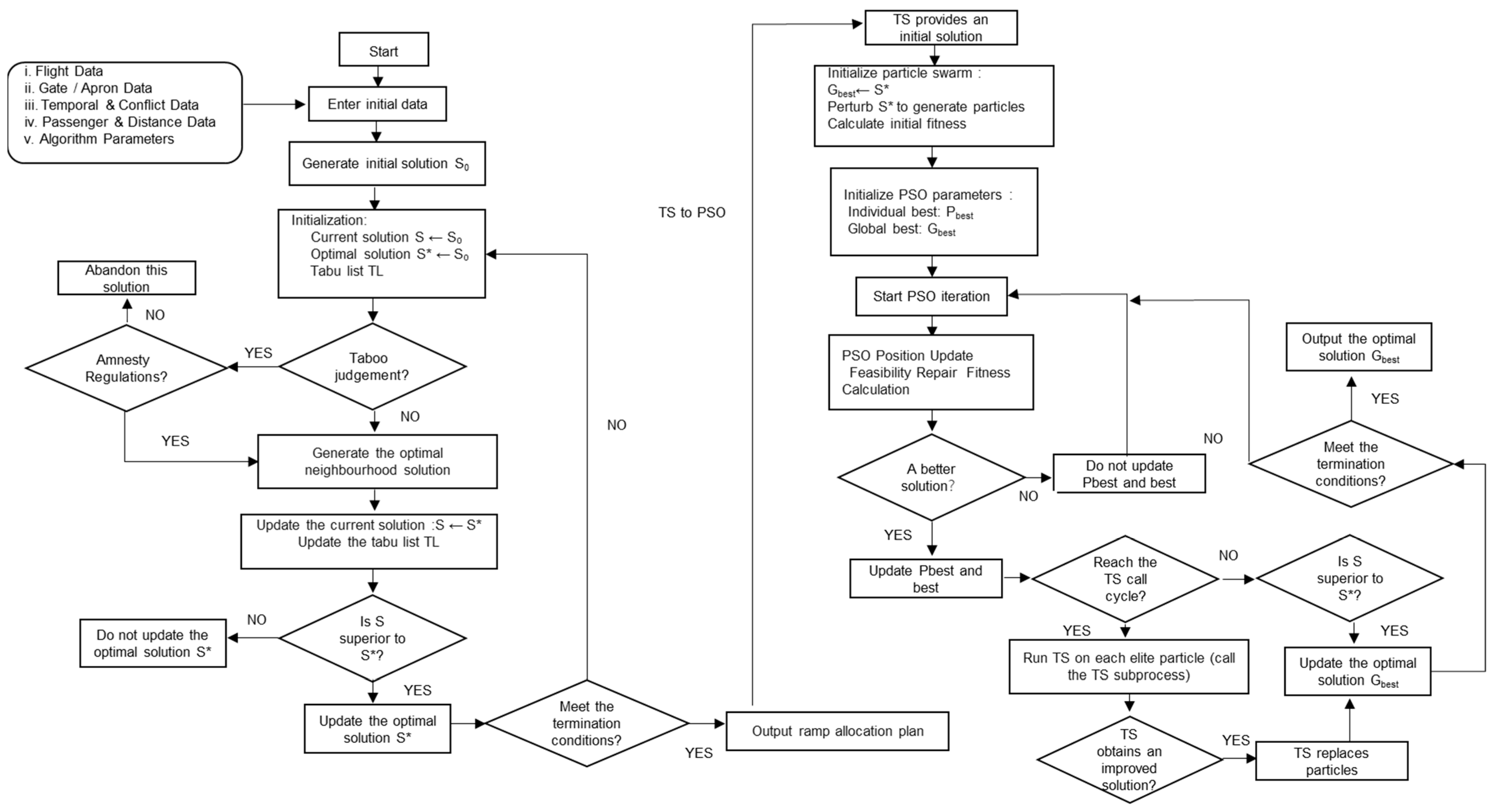
To solve the model proposed in Section 2, we develop a customized hybrid algorithm combining particle swarm optimization (MOPSO) and tabu search (TS), which is well suited for large-scale and complex AGAP scheduling problems. In this framework, the TS algorithm provides high-quality initial solutions for MOPSO and performs local intensification searches on elite particles within MOPSO, thereby effectively improving solution quality and convergence stability. Moreover, an elitist preservation strategy is incorporated into the proposed hybrid algorithm. During the initialization of the particle swarm, an elite solution set is constructed to store several high-quality solutions obtained throughout the search process. Subsequently, particle positions are iteratively updated according to the discrete MOPSO update rules, while personal best and global best solutions are continuously maintained and the elite set is dynamically updated and preserved. Finally, to prevent the premature convergence of MOPSO in the later search stages, a periodic local intensification mechanism is introduced. Specifically, after every MOPSO iteration, the global best particle and several elite particles with the best objective values are selected from the current swarm and the elite set, and a tabu search with a limited number of iterations is applied to each of them. The tabu search performs local adjustments to gate assignment solutions through a carefully designed neighborhood structure and employs a tabu list to effectively avoid cyclic backtracking during the search process. Combining TS with MOPSO can fully leverage the complementary strengths of both algorithms: TS provides robust exploratory capabilities and mechanisms to escape local optima, ensuring a comprehensive search of the global solution space, while MOPSO exhibits rapid convergence and produces concentrated, stable solutions, facilitating the refinement of preliminary optimal solutions. Moreover, by applying TS-based local intensification to the elite particles in the MOPSO population and incorporating an elite retention mechanism, high-quality solutions are preserved throughout the iterations. This approach effectively balances global exploration and local exploitation, maintaining solution diversity while enhancing the overall quality and stability of the final airport gate assignment. The detailed optimization procedure of the hybrid MOPSO-TS algorithm is illustrated in Figure 1.

3.1. Tabu Search–Based Local Intensification Strategy

Step 1: Enter initial data. In the TS algorithm, the required input data mainly include flight operation information, gate and apron resource configurations, temporal and conflict constraints, passenger volumes and related distance data, as well as the algorithm’s control and search parameters.
Step 2: Initial solution input. An initial feasible solution that satisfies all constraints is provided, representing a complete gate assignment scheme and serving as the starting solution for the tabu search.
Step 3: Neighborhood solution generation. Based on the current initial solution, a set of neighborhood solutions is generated according to predefined local adjustment rules. These neighborhood solutions are obtained by making limited modifications to the flight–stand assignment, thereby ensuring the locality and controllability of the search process.
Step 4: Tabu check and aspiration mechanism. For each generated neighboring solution, the corresponding adjustment operation is examined to determine whether it is recorded in the tabu list.
In the proposed TS algorithm, adjustments to the assignment relationship between flights and parking stands are defined as tabu moves. Specifically, once the stand assignment of a flight is changed, reassigning that flight back to its original stand is prohibited for a predefined number of subsequent iterations, thereby preventing oscillatory behavior between locally feasible solutions during the search process.
Given the complex solution space and the high density of local optima in the airport gate assignment problem, an aspiration criterion is incorporated into the tabu search. Specifically, when the adjustment operation associated with a neighborhood solution is recorded in the tabu list, but the resulting solution yields a better value of the composite objective function than the currently best-known stand allocation scheme, the aspiration criterion is activated, allowing this solution to be accepted.
Step 5: Neighborhood solution selection. Among the generated neighborhood solution set, all candidate solutions are evaluated using Objective (8), and the solution with the minimum objective function value is selected as the best solution for the current iteration.
Step 6: Update of the current solution and the tabu list. The current solution is updated to the selected neighborhood solution, and the corresponding adjustment operation is added to the tabu list, with the tabu tenure updated to prevent this operation from being repeatedly executed in subsequent iterations.
Step 7: Best solution update. If the candidate solution obtained in Step 5 is superior to the current best solution, it replaces the existing best solution, and the best gate assignment scheme identified during the search process is recorded.
Step 8: Termination condition check. Termination condition check. If the maximum number of iterations is reached, the TS process terminates. Otherwise, return to Step 3 for new iterations.
Step 9: Output results. The individual with the highest fitness is selected as the final gate assignment scheme, and the results are exported to an Excel file.
To avoid missing potentially high-quality solutions, an aspiration criterion is deliberately incorporated into the TS algorithm.
Aspiration Rule 1: When a neighborhood solution identified as tabu yields a better value of the overall objective function than the best solution recorded during the search process, and the violated constraints do not include the hard temporal constraints (18) or (20), the aspiration criterion is activated and the solution is allowed to be accepted.
Aspiration Rule 2: When a tabu neighborhood solution achieves a better objective function value than the best solution obtained in the most recent iterations, it may be accepted even if it does not outperform the historical global best solution. This rule is introduced to prevent the algorithm from stagnating due to overly restrictive tabu constraints.
Aspiration Rule 3: When a tabu neighborhood solution yields a significant improvement in transfer passenger–related objectives without causing a substantial deterioration in other objectives, the aspiration mechanism is activated, and the solution is allowed to be accepted. Specifically, a significant improvement is considered to occur when the objective function value of the current solution is 2% better than that of the previous iteration.
In Algorithm 1, we systematically describe the execution mechanism of the aspiration rules during the search process, illustrating how these rules are triggered and applied throughout the optimization procedure. Here, S 0 represents the initial feasible solution for the tabu search, S denotes the solution being explored in the current iteration, and S * refers to the best solution obtained during the search process, which records the gate assignment scheme with the optimal objective function value up to that point and is ultimately output as the result of the tabu search algorithm, k is the iteration counter, Kmax represents the maximum allowed number of iterations.
Algorithm 1. Branching strategy Framework
Input: Flight, Gate, and Data, Initial Solution n
1 Initial solution input: SS0, S*S
2 Initialize the tabu list: TabuList ← ∅, k ← 0
3      while k < Kmax do
4         Generate the neighborhood solution set N(S) of the current solution S
5         CandidateSet ←
6         for each S’N(S) do
7               if S’ violates the hard time constraints (18) or (20), then
8                      Branch Pruning
9               continue
10             end if
11                 if Move(S → S’) ∉ TabuList then
12                   CandidateSet ← CandidateSet ∪ {S’}
13                 else
14               if (Aspiration Rule 1 satisfy) or
                         (Aspiration Rule 2 atisfy) or
                       (Aspiration Rule 3 atisfy) then
15               end if
16             end if
17         k ← k + 1
18      end while
19                    TabuList ← Move(S)
20 Output: Output the optimal solution S*
The parameters of the TS are set with 10 iterations, and its neighborhood size and tabu list length are calculated according to Equation (26) and Equation (27), respectively.
Q = m i n ( 2 × N f , 300 )
L = min 0.1 × N f , 100
Here, Q denotes the neighborhood size, L denotes the tabu list length, and Nf denotes the number of flights.

3.2. Particle Swarm Optimization Algorithm Solution Procedure

The proposed MOPSO-based global optimization algorithm is described in detail as follows. This mechanism endows MOPSO with a simple structure, a limited number of parameters, and ease of implementation, making it particularly suitable for high-dimensional optimization problems in both continuous and discrete domains.
Step 1: The optimal gate assignment solution obtained by tabu search is adopted as the global initial guiding solution and is set as the initial global best of the particle swarm. Based on this solution, the initial positions of the remaining particles are generated by applying small perturbations to the gate assignments of selected flights. Specifically, a small subset of flights is randomly selected, and their assigned gates are either reassigned to other feasible gates or swapped with those of other flights while satisfying all operational constraints. This perturbation mechanism introduces diversity into the initial population while preserving the high-quality structure of the tabu search solution. Subsequently, the fitness of all particles is evaluated, and the current position of each particle is recorded as its personal best.
Step 2: MOPSO iteration starts. The algorithm then enters the main iterative phase of the particle swarm optimization process. In each iteration, particles gradually update their positions by referring to their personal best solutions and the underlying airport and flight information, thereby evolving toward higher-quality gate assignment solutions.
Step 3: Particle position update. According to the predefined AGAP particle swarm optimization update rules, the gate assignment scheme of each particle is iteratively updated, thereby guiding the particles to gradually converge toward regions of high-quality solutions. The particle update rule is as follows: A particle is updated only if its current solution is better than that of the previous iteration. Specifically, an update is performed when the objective function value computed by Equation (8) decreases.
Step 4: Feasibility repair and fitness evaluation. Since the position update process may generate gate assignment solutions that violate feasibility constraints, a systematic feasibility check is performed on the updated solutions. If any constraint violations are detected, a dedicated repair strategy is applied to adjust the assignment so that gate capacity limits, temporal conflict constraints, and aircraft–gate compatibility requirements are all satisfied. Subsequently, the fitness value of the repaired feasible solution is evaluated. Specifically, if the updated solution violates the capacity, temporal, or other constraints mentioned in Section 2.4, flights are prioritized based on their departure time or passenger volume. The higher-priority flights are kept at their assigned gates, while the remaining conflicting flights are relocated to other feasible gates.
Step 5: Elite solution identification. The solutions obtained in Step 4 are evaluated, and the high-performing elite solutions are selected and retained.
Step 6: Invoke TS. Invoke TS to perform local intensification on the elite particles of MOPSO, thereby effectively preventing the particle swarm optimization algorithm from being trapped in local optima and converging prematurely.
Step 7: Termination check. If the termination criteria are met, the optimization process is terminated and the current best particle together with its corresponding apron assignment solution is output. Otherwise, the algorithm returns to the specified Step 2 and continues the optimization process.
Step 8: Output results. Output the final gate assignment solution and compute the corresponding objective function value using Objective (7).
Algorithm 2 describes the integrated optimization procedure combining TS and MOPSO. In this framework, Gbest denotes the global best solution obtained during the search process, while Pbest represents the personal best solution of a particle. The term Particlei refers to a candidate gate assignment solution, whose position encoding specifies the mapping between flights and gates. The variable Pbesti records the best position ever reached by Particlei during the search, corresponding to its historical best gate assignment solution.
Algorithm 2. MOPSO assignment algorithm initialized based on TS
Input: Initial TS Solution
1 Initial solution input: SS0, S*S
2 Gbest ← S*TS
3      Initialize the position of Particlei with a slight perturbation around Gbest.
4                for each Particlei ≠ Gbest do
5         Pbesti ← Particlei
6         Calculate the fitness of particlei
7               t ← 0
8           while t < Tmax do
9               for each particle i do Start particle swarm iteration
10                 Start particle swarm iteration
11               end for
12             for each particlei do
13                 if Pbesti < Pbest then
14                       Pbest ← Pbesti
                           Gbest←Particlei
15                   else
16                      Gbest Pbest not update
17                    end if
18                end of
19               if TS
20                elite particle strengthen
21             end if
22                  for each particle i do
23                        if Particlei fitness > Pbesti fitness then
24                                    Pbesti ← Particlei
25                        end if
26                        if Particlei fitness > Gbest fitness then
27                                Gbest ← Particlei
28                        end if
29                      end for
30 Output: Output the optimal solution Gbest, Pbest
The number of particles in MOPSO should increase with the problem dimension to ensure adequate coverage of the search space and algorithm convergence. According to the empirical tuning rule proposed by Kennedy and Eberhart [29] in their pioneering work, the number of particles per iteration is calculated using Equation (28). Here, N denotes the number of particles per iteration, and Nf denotes the number of flights.
N = 10 + N f

4. Computational Research

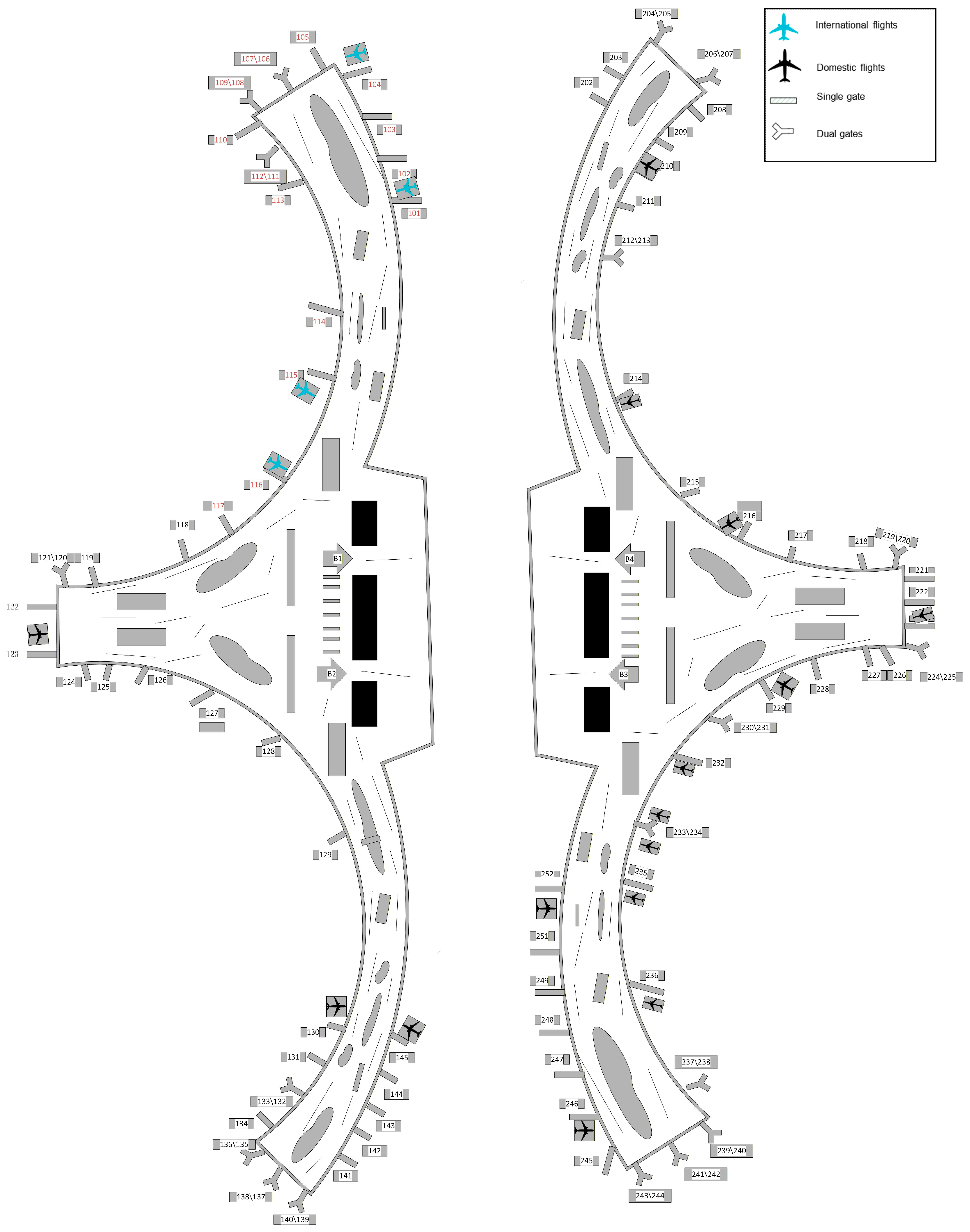
We collected initial flight data from Chengdu Tianfu International Airport, one of the largest airports in China in terms of passenger throughput. In 2024, the airport handled 54.91 million passengers and recorded 378,798 aircraft movements (Chengdu Tianfu International Airport Co., Ltd., Chengdu, China, 2025). These historical operational data are used as inputs for predicting future flight schedules and gate assignment patterns. Figure 2 illustrates the layout of departing aircraft and the corresponding gate assignments at Chengdu Tianfu International Airport. In this figure, gates labeled with red numbers are designated for Hong Kong, Macao, Taiwan, and international departures, whereas gates labeled with black numbers are allocated to domestic departures. The initial assignment scheme in this study is based on flight arrival times. Each flight, upon arrival, is assigned to an available gate that satisfies the docking requirements (e.g., aircraft type and gate compatibility). If no suitable gate is available, the flight waits on the apron until an appropriate gate becomes available.
In this section, all computations are implemented in Python 3.9 on a personal computer running Windows 11, equipped with an AMD Ryzen 5 5600 6-Core Processor @ 3.50 GHz and an NVIDIA GeForce RTX 4070 GPU. In this section, the symbol “+” denotes the concept of combination or integration between two algorithms.

4.1. Results and Analysis

The numerical experiments are conducted with two primary objectives: (i) to evaluate the feasibility of the proposed model and algorithms, and (ii) to analyze their performance in order to assess applicability in practical scenarios. To this end, a fixed number of iterations is adopted, and systematic experiments are carried out under different data scales to comprehensively examine algorithmic effectiveness under varying input conditions. The experimental settings are summarized as follows:
(i) Three flight datasets of different small-scale, moderate-scale, and large-scale are used to evaluate the solution capabilities of the TS and MOPSO algorithms;
(ii) Both TS and MOPSO are terminated after 200 iterations;
(iii) An advanced commercial solver, Gurobi, is employed as a benchmark in line with the original research intent. However, due to memory limitations, Gurobi fails to produce solutions for instances involving more than 50 flights.
A comparative study of the TS and MOPSO algorithms was conducted on small-scale instances. Although the expected performance improvements were relatively modest, both algorithms were able to produce effective solutions within relatively short computation times. The optimization rate is calculated using the following formula:
O p t i m i z a t i o n   R a t e = Z i n i t i a l Z o p t i m i z e d Z i n i t i a l × 100 %

4.2. Small-Scale Case

Table 1 presents the basic information of the small-scale instances, while Table 2 reports the optimization rates obtained by the TS and MOPSO algorithms for these instance.
For small-scale instances, both the TS and MOPSO algorithms are able to obtain high-quality feasible solutions within reasonable computational times. Moreover, in these cases, both algorithms exhibit rapid convergence and achieve significant improvements over the initial solutions. In terms of computational efficiency, TS consistently converges faster than MOPSO. For example, in instance F55g16, the convergence time of TS is 475.42 s, whereas MOPSO requires 501.25 s.

4.3. Moderate-Scale Case

Table 3 presents the basic information of the medium-scale instances, while Table 4 reports the optimization rates obtained by the TS and MOPSO algorithms for these instances. Compared with the small-scale cases, both the number of flights and the number of gates increase in medium-scale instances, leading to a significant rise in problem complexity. Consequently, the computational time of both algorithms shows a clear increasing trend. The results indicate that the TS algorithm exhibits more stable convergence behavior in most instances, whereas the MOPSO algorithm is able to achieve greater improvements in some cases. However, in instances F170g90 and F220g73, when the MOPSO algorithm becomes trapped in local optima, the TS algorithm continues to improve the solution quality, demonstrating stronger global search capability and superior optimization performance.

4.4. Large-Scale Case

In large-scale instances, the TS and MOPSO algorithms exhibit notable differences in both optimization performance and computational efficiency, shown in Table 5. However, a further decomposition of the overall objective function reveals that the two algorithms demonstrate significantly different behaviors across the individual sub-objectives, shown in Table 6. Specifically, for the sub-objectives Z 1 (the number of baggage cart movements) and Z 3 (passenger boarding time), the TS algorithm demonstrates overall greater stability, achieving positive improvements in most instances. Only in instances F520g177, F540g179, and F570g181 does TS exhibit negative optimization with respect to Objective Z 1 . In contrast, MOPSO is capable of achieving larger improvement magnitudes in certain instances, but its performance shows greater variability. For example, in instance F560g180, MOPSO attains an improvement rate of 61.08%, whereas in instance F530g178, the corresponding improvement rate is only 21.60%. From a computational efficiency perspective, MOPSO requires significantly less CPU time than TS in most instances, highlighting the advantage of its parallel update mechanism during the global search phase. For large-scale instances, MOPSO is more suitable for rapidly obtaining high-quality feasible solutions within limited computational time, whereas TS exhibits superior performance in terms of solution stability and adaptability to complex constraint structures. The complementary characteristics of these two algorithms provide strong experimental motivation and empirical support for the proposed TS–MOPSO hybrid optimization strategy.

4.5. Hybrid Algorithms Comparison Between MOPSO and TS+MOPSO

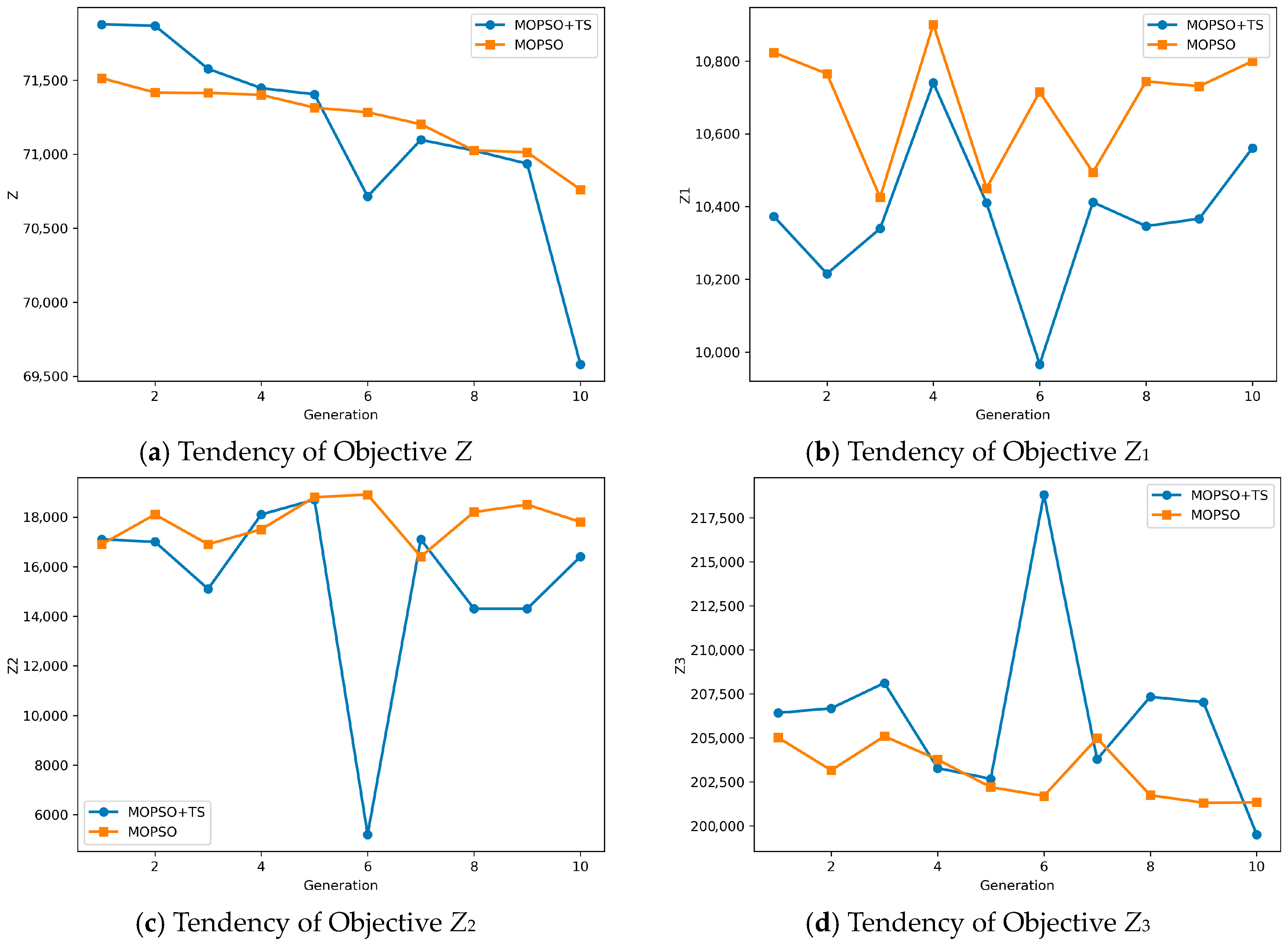
Figure 3a presents a comparative analysis of the optimization performance between the standalone MOPSO algorithm and the hybrid TS-MOPSO approach (denoted as TS+MOPSO). Overall, the objective function values of both methods decrease steadily as the number of iterations increases, indicating a continuous improvement in the quality of gate assignment solutions throughout the search process. Compared with the standalone MOPSO algorithm, the hybrid TS+MOPSO approach exhibits a faster convergence rate and a more pronounced optimization trajectory. Notably, the final performance of MOPSO alone is clearly inferior, as its achieved objective value is significantly higher than that obtained by TS+MOPSO. These results confirm that employing TS as an initialization strategy and further refining elite particles through local intensification can effectively enhance the overall optimization performance. This hybrid approach not only provides high-quality initial solutions but also efficiently guides the MOPSO algorithm toward more promising regions of the solution space, thereby improving both the convergence speed and the quality of the final solutions. Figure 3b–d present comparative results of three key sub-objectives—namely, the number of baggage cart movements, airline satisfaction, and passenger boarding time (including both transfer and non-transfer passengers)—optimized by the TS algorithm and the hybrid TS+MOPSO method. It is worth noting that at the sixth iteration, the TS+MOPSO algorithm exhibited a slight deterioration in the overall objective function value compared with the fifth iteration. Nevertheless, during this iteration, the algorithm achieved notable improvements in two sub-objectives, namely the number of baggage cart movements and airline satisfaction. Figure 3b–d do not exhibit a purely monotonic decreasing trend, indicating the presence of potential trade-offs among different objectives or conflicting constraints within the optimization model. These observations highlight the inherent complexity of the multi-objective gate assignment problem and underscore the necessity of carefully balancing competing objectives and constraints to achieve high-quality, globally satisfactory solutions.
Table 7 presents a comparative analysis of the objective function values and optimization rates obtained by the MOPSO algorithm and the hybrid TS+MOPSO approach after iterative optimization. Under the TS+MOPSO hybrid algorithm, the performance of the overall objective function Z and the sub-objectives Z1, Z2, and Z3 are improved by 1.25%, 2.29%, 7.57%, and 0.85%, respectively, compared with the standalone MOPSO algorithm. These results further confirm the advantages of the TS+MOPSO hybrid method in terms of solution quality and convergence efficiency. Therefore, it can be concluded that when TS provides high-quality initial solutions and performs local intensification on elite particles, MOPSO converges significantly faster and achieves better final solutions than when MOPSO is applied independently.

4.6. Hybrid Algorithms Comparison Between SA+MOPSO and TS+MOPSO

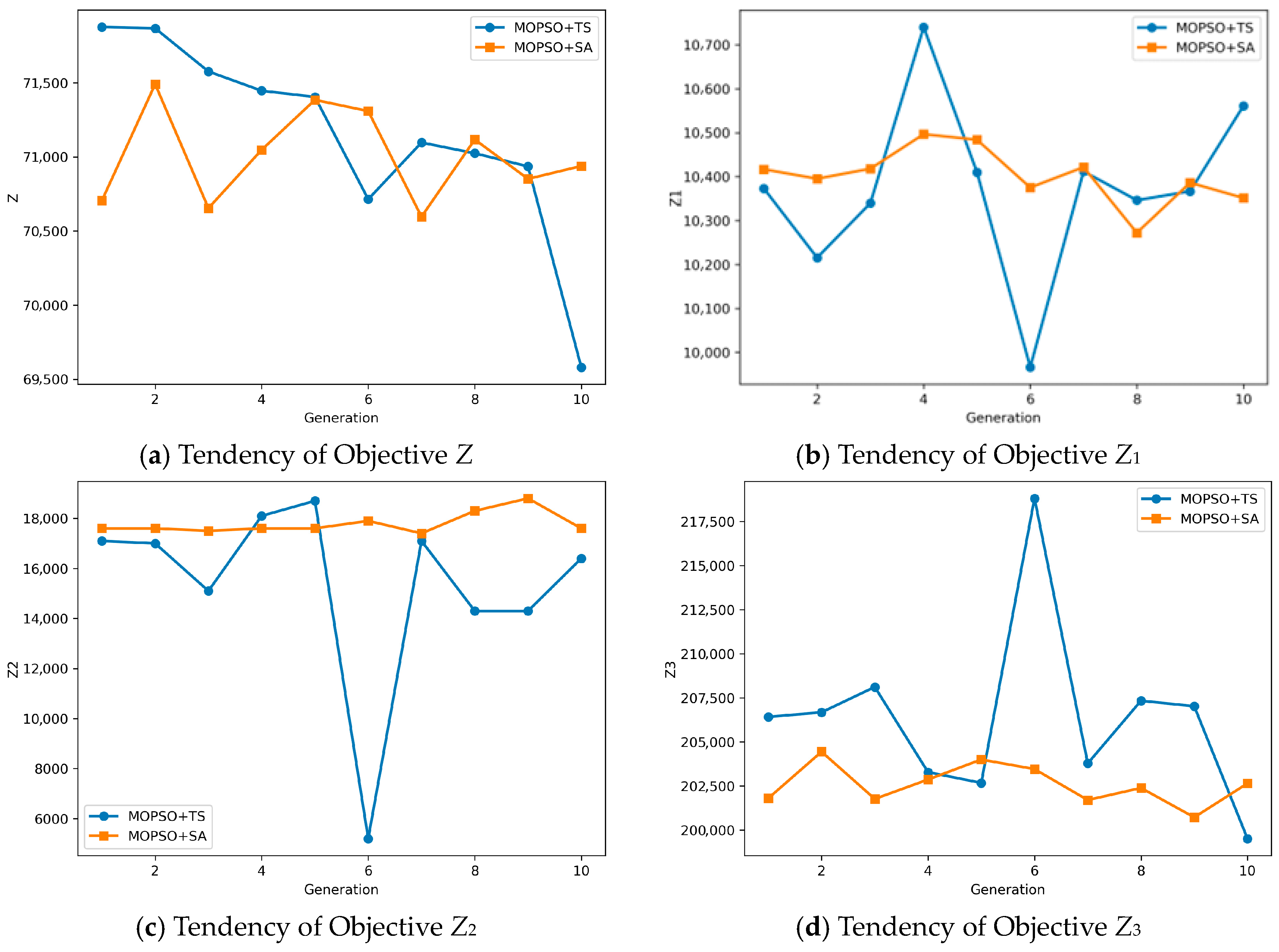
To further investigate the potential advantages of algorithmic hybridization in terms of computational efficiency and solution quality, two hybrid optimization algorithms are designed: TS+MOPSO and simulated annealing SA+MOPSO. This section presents a comparative analysis of these two hybrid strategies, focusing on their performance when TS and SA are respectively employed to generate initial solutions for the particle swarm MOPSO algorithm and to further refine high-quality particles. Figure 4a–d present the comparative optimization results of the TS+MOPSO and SA+MOPSO hybrid algorithms for the objective function Z and the sub-objective functions Z1, Z2, and Z3, respectively. The SA+MOPSO hybrid algorithm demonstrates better initial performance on the objective function Z than TS+MOPSO; however, its subsequent optimization does not exhibit the sustained, approximately linear decreasing trend observed in TS+MOPSO. Moreover, SA+MOPSO shows limited optimization capability for the sub-objective functions Z1, Z2, and Z3. This phenomenon arises because, although the initial solution provided by SA is superior to that generated by TS in terms of the objective value Z, it tends to be a local optimum, thereby constraining the global search ability of the subsequent MOPSO process and limiting further improvement.
Table 8 presents a comparison of the optimized objective function values and optimization rates achieved by the TS+MOPSO and (SA)+MOPSO hybrid algorithms. Overall, TS+MOPSO exhibits a 1.44% higher optimization efficiency for the main objective function Z compared with SA+MOPSO. For the sub-objective function Z1, SA+MOPSO achieves a 2% higher optimization rate than TS+MOPSO, and this improvement is in the positive direction. In contrast, for the sub-objective functions Z2 and Z3, TS+MOPSO outperforms SA+MOPSO, with optimization rates that are higher by 6.49% and 1.45%, respectively.

4.7. Hybrid Algorithms Comparison Between GA+MOPSO and TS+MOPSO

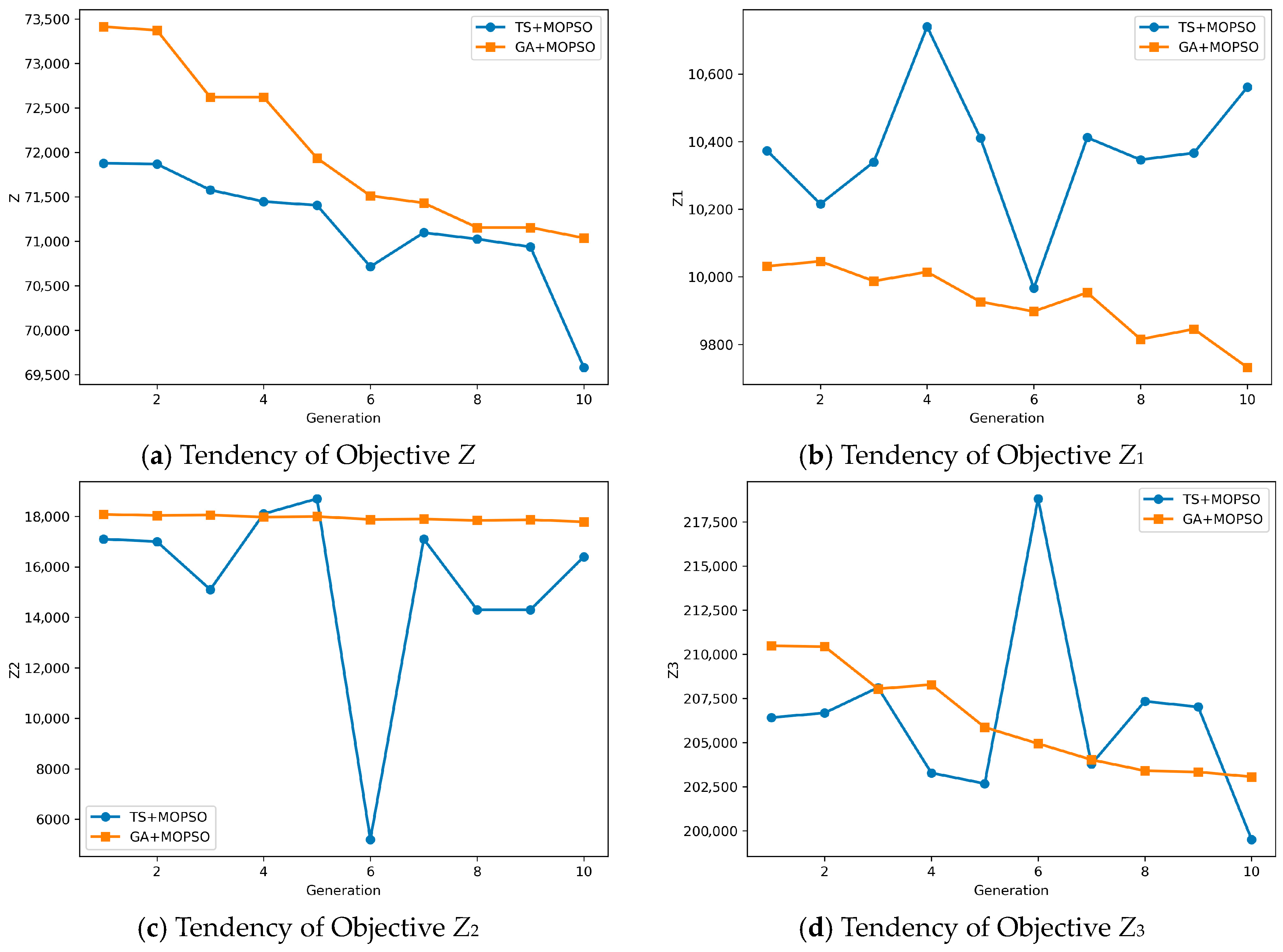
To further investigate the potential advantages of hybrid algorithms in terms of computational efficiency and solution quality, two hybrid optimization algorithms were designed: TS+MOPSO and genetic algorithm GA+MOPSO. This section presents a comparative analysis of these two hybrid strategies. Figure 5a–d respectively present the comparative optimization results of the TS+MOPSO and GA+MOPSO hybrid algorithms for the objective function Z and the sub-objective functions Z1, Z2, and Z3. Overall, GA+MOPSO underperforms TS+MOPSO in optimizing the objective function as well as the sub-objective functions Z2, and Z3, with particularly poor performance observed for Z2. This behavior indicates a tendency of the algorithm to become trapped in local optima. It is worth noting that GA+MOPSO performs exceptionally well on the sub-objective function Z1, showing a consistently decreasing trend and consistently outperforming TS+MOPSO. This observation aligns with the previous analysis regarding the tendency to become trapped in local optima. However, GA+MOPSO sacrifices the optimization of Z2, which is unacceptable in practical applications.
Table 9 compares the performance of the TS+MOPSO and GA+MOPSO hybrid algorithms in terms of optimized objective function values and optimization rates. Overall, TS+MOPSO improved the optimization efficiency of the main objective function Z by 1.53% compared with SA+MOPSO. For the sub-objective function Z1, GA+MOPSO achieved an optimization rate 7.94% higher than TS+MOPSO, representing a significant improvement and a better optimization outcome. In contrast, for the sub-objective functions Z2 and Z3, TS+MOPSO performed better, with optimization rates exceeding SA+MOPSO by 7.45% and 1.65%, respectively.

4.8. Sensitivity Analysis

In the previous experimental validation, negative optimization was observed for sub-objectives Z1 and Z2 in instances F170g70, F540g179, F570g181, and F590g183. In particular, instance F590g183 exhibited a pronounced reverse optimization in Z2, reaching −155.64%. In contrast, for instances F45g15, F220g73, and F580g182, although the improvement in sub-objective Z3 was relatively limited, it still contributed substantially to the optimization of the overall objective function Z. These results indicate the existence of clear trade-offs among different sub-objectives, where degradation in individual components does not necessarily undermine the overall optimization performance.
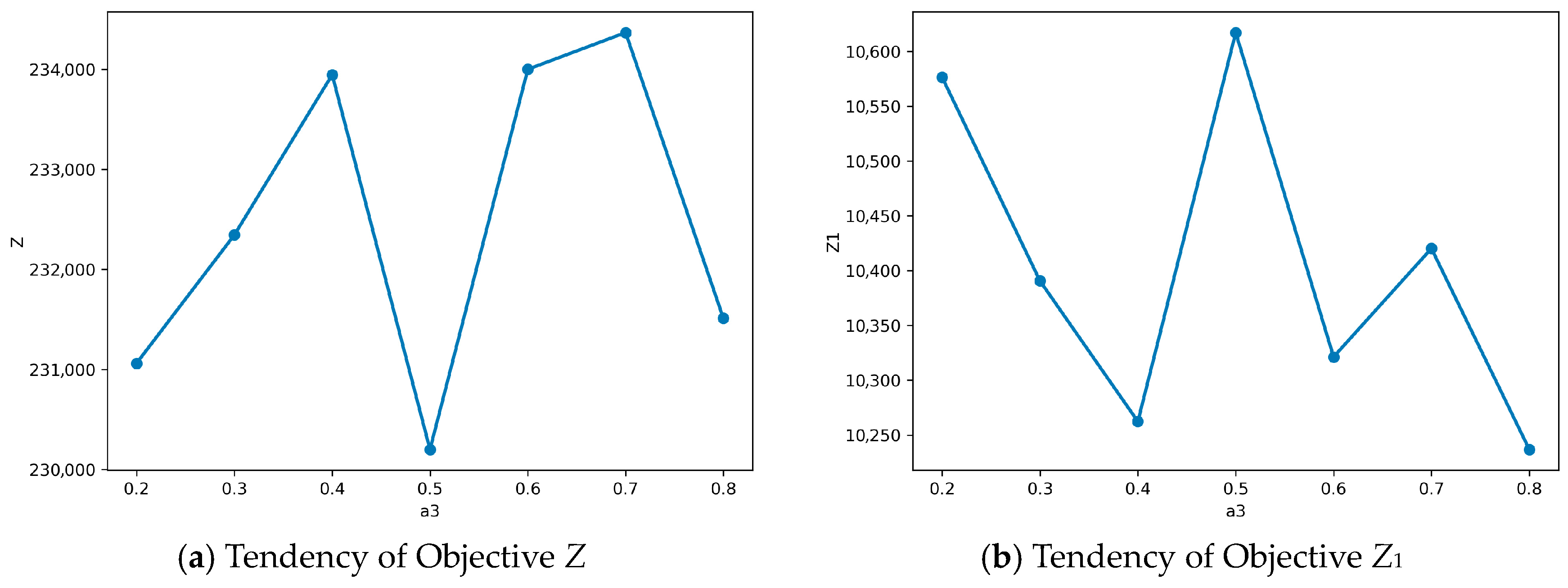
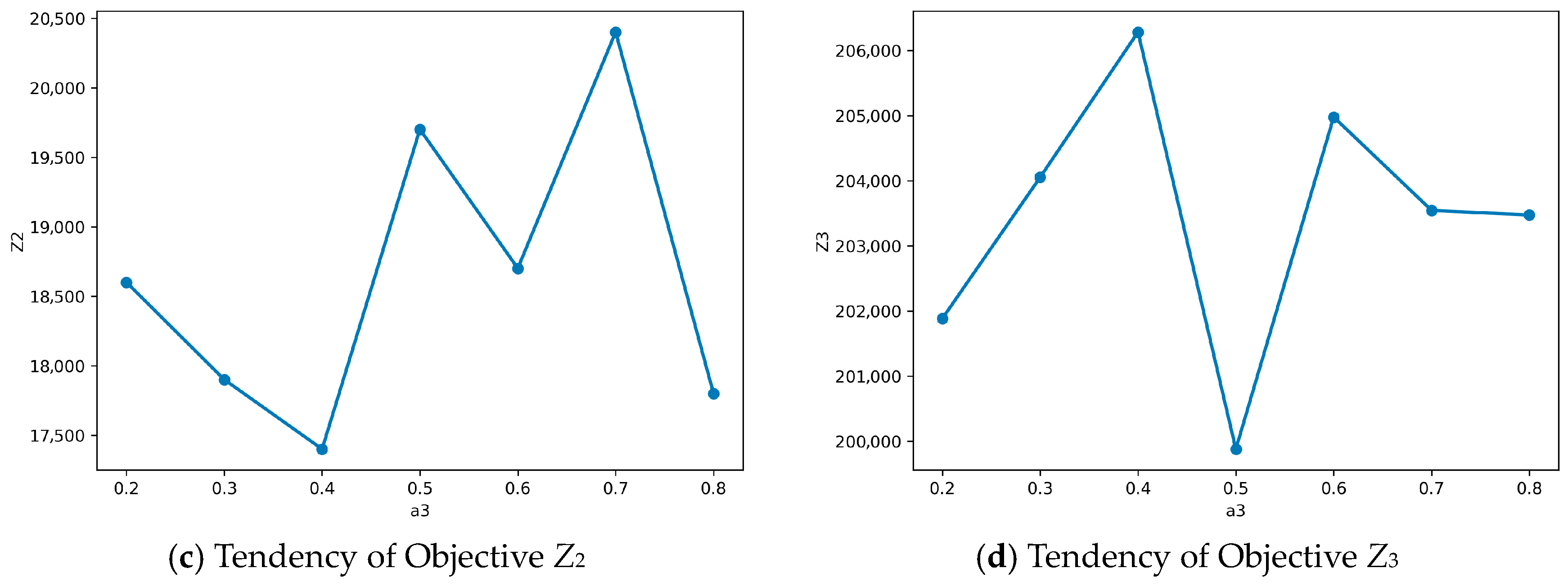
In what follows, we further investigate the impact of different weight settings of objective function Z3 on gate assignment outcomes. Specifically, the weight parameter associated with transfer passengers in the objective function is adjusted, where a3 denotes the weight coefficient for transfer passengers. As illustrated in Figure 6a, the objective function exhibits a pronounced nonlinear sensitivity to variations in parameter a3. Moreover, the results shown in Figure 6a,d indicate that the overall objective function Z and the sub-objective function Z3 exhibit highly consistent trends with respect to the weight coefficient a3. Specifically, as a3 increases from 0.2 to 0.4, both functions show an increasing tendency and reach their minimum values at a3 = 0.5; when a3 > 0.5, the objective values rise again, revealing a clear nonlinear behavior. In contrast, the sub-objective functions Z1 and Z2 exhibit decreasing trends as a 3 increases from 0.2 to 0.4. Moreover, Z1 reaches its maximum value at a3 = 0.5. This observation is consistent with our previous analysis, further confirming that the sub-objective function Z3 contributes the most to the optimization of the overall objective function.
During the optimization process, the objective function Z1 may conflict with Z2 and Z3. Since Z2 and Z3 have a larger impact on the overall objective Z, the algorithm tends to prioritize improving their performance. As a result, the optimization effect of Z1 may be limited or even negative.

4.9. Pareto Frontier Analysis

Table 10 presents the specific values of the three sub-objectives—Z1, Z2, and Z3 over 10 iterations of the MOPSO-TS algorithm. It also indicates the relationships between each pair of objectives, including small variation, trade-off, or extreme trade-off, and identifies whether each iteration corresponds to a non-dominated solution. This table allows readers to intuitively observe the interactions and trade-offs among the sub-objectives throughout the iterations, providing a clearer understanding of the distribution of Pareto frontier solutions and offering guidance for selecting practical solutions. In this study, “small variation” indicates that a target function fluctuates minimally across iterations, with relative changes typically less than 10–15% of the mean, suggesting that this objective has limited impact on trade-offs with other objectives; “trade-off” refers to situations where two objectives exhibit a clear opposite trend during iterations, such that improvement in one objective leads to deterioration in the other, with noticeable changes (typically greater than 5–10% of the mean), reflecting a typical compromise in multi-objective optimization; “extreme trade-off” refers to iterations where one objective approaches its optimal value while the other approaches its worst value, which usually occurs at the endpoints of the Pareto frontier and represents critical points for decision-makers when selecting practical solutions.

5. Conclusions and Future Work

5.1. Conclusions

In this study, an airport gate assignment problem (AGAP) model is developed to mitigate the negative impacts on airports, airlines, and passengers simultaneously while enhancing the overall sustainability of air transport operations. To this end, a MILP model is formulated and solved using a hybrid TS+MOPSO algorithm that integrates tabu search with particle swarm optimization. Based on a real-world case study at Chengdu Tianfu International Airport, the performance of the proposed AGAP model and the TS+MOPSO-based solution approach is systematically evaluated, leading to the following conclusions. (i) In terms of optimization performance, the optimized AGAP solution derived from the TS+MOPSO hybrid algorithm significantly outperforms the original gate assignment scheme, achieving a reduction of 26.37% in overall cost. (ii) Regarding the convergence behavior, TS+MOPSO exhibits a stable and nearly linear downward trend in optimizing the objective function, whereas SA+MOPSO tends to become trapped in local optima.
Finally, and equally importantly, (iii) with respect to the applicability of the proposed AGAP model, it is specifically designed to support coordinated optimization for airports, airlines, and passengers. The results from the real-world case study demonstrate substantial improvements in airline satisfaction and passenger travel time.

5.2. Future Work

In future research, additional relevant features can be incorporated into the prediction model to further enhance its generalizability and practical applicability. Moreover, it is worthwhile to conduct systematic predictive analyses of uncertainties in airport operations and to integrate robustness considerations, so as to comprehensively assess and strengthen the model’s resilience to operational disruptions.

Author Contributions

Conceptualization, K.D., H.L., J.Z., S.Z., H.S. and Z.C.; methodology, K.D., H.L., J.Z., S.Z., H.S. and Z.C.; software, K.D., H.L., J.Z., S.Z., H.S. and Z.C.; validation, K.D., H.L., J.Z., S.Z., H.S. and Z.C.; formal analysis, K.D., H.L., J.Z., S.Z., H.S. and Z.C.; investigation, K.D., H.L., J.Z., S.Z., H.S. and Z.C.; resources, K.D., H.L., J.Z., S.Z., H.S. and Z.C.; data curation, K.D., H.L., J.Z., S.Z., H.S. and Z.C.; writing—original draft preparation, K.D., H.L., J.Z., S.Z., H.S. and Z.C.; writing—review and editing, K.D., H.L., J.Z., S.Z., H.S. and Z.C.; visualization, K.D., H.L., J.Z., S.Z., H.S. and Z.C.; supervision, Z.C. and S.Z.; project administration, Z.C. and S.Z.; funding acquisition, Z.C. and S.Z. All authors have read and agreed to the published version of the manuscript.

Funding

This study is supported by Jiangsu Provincial Social Science Foundation Project (25ZHB022), by Nantong University Base of the Jiangsu Research Center for Xi Jinping Thought on Socialism with Chinese Characteristics for a New Era (25jdyb010), by Intelligent Ecotourism and Leisure Agriculture Laboratory of Fujian Open Funding (LN202501), by the 2025 Nantong Natural Science Foundation and the Social and Livelihood Science and Technology Program (MS2025007), and by the Open Fund of the Hubei Key Laboratory of Vehicle-Infrastructure Cooperation and Traffic Control (Hubei University of Arts and Science, No. VICTC202505).

Institutional Review Board Statement

Not applicable.

Informed Consent Statement

Not applicable.

Data Availability Statement

Data are contained within the article.

Conflicts of Interest

Author Huihui Lan was employed by the company Zhejiang Institute of Communications Co., Ltd. The remaining authors declare that the research was conducted in the absence of any commercial or financial relationships that could be construed as a potential conflict of interest.

References

  1. Daş, G.S.; Gzara, F. Column generation based solution for bi-objective gate assignment problems. Math. Methods Oper. Res. 2024, 100, 123–151. [Google Scholar] [CrossRef]
  2. Karsu, Ö.; Solyalı, O. A new formulation and an effective matheuristic for the airport gate assignment problem. Comput. Oper. Res. 2023, 151, 106073. [Google Scholar] [CrossRef]
  3. Shadman, M.; Kordani, A.A.; Akbaripour, H. A historical data approach to optimal gate assignment problem considering aircraft taxi delay and passenger walking time. Transp. Plan. Technol. 2024, 48, 1840–1862. [Google Scholar] [CrossRef]
  4. She, Y.; Zhao, Q.; Guo, R.; Yu, X. A robust strategy to address the airport gate assignment problem considering operators’ preferences. Comput. Ind. Eng. 2022, 168, 108100. [Google Scholar] [CrossRef]
  5. Li, J.; Li, K.; Tian, Q.; Jin, X. A column generation-based algorithm for gate assignment problem with combinational gates. Expert Syst. Appl. 2024, 238, 121792. [Google Scholar] [CrossRef]
  6. Kim, J.; Goo, B.; Roh, Y.; Lee, C.; Lee, K. A branch-and-price approach for airport gate assignment problem with chance constraints. Transp. Res. Part B Methodol. 2023, 168, 1–26. [Google Scholar] [CrossRef]
  7. Li, H.; Wu, X.; Ribeiro, M.; Santos, B.; Zheng, P. Deep reinforcement learning approach for real-time airport gate assignment. Oper. Res. Perspect. 2025, 14, 100338. [Google Scholar] [CrossRef]
  8. Zhang, C.; Ng, K.; Jin, Z.; Yao, S.; Qin, Y. Q-learning-driven exact and meta-heuristic algorithms for the robust gate assignment problem. Adv. Eng. Inform. 2025, 67, 103551. [Google Scholar] [CrossRef]
  9. Aktel, A.; Yagmahan, B.; Özcan, T.; Yenisey, M.M.; Sansarcı, E. The comparison of the metaheuristic algorithms performances on airport gate assignment problem. Transp. Res. Procedia 2017, 22, 469–478. [Google Scholar] [CrossRef]
  10. Benlic, U.; Burke, E.K.; Woodward, J.R. Breakout local search for the multi-objective gate allocation problem. Comput. Oper. Res. 2017, 78, 80–93. [Google Scholar] [CrossRef]
  11. Yang, L.; Wang, S.; Liang, F.; Zhao, Z. A holistic approach for optimal pre-planning of multi-path standardized taxiing routes. Aerospace 2021, 8, 241. [Google Scholar] [CrossRef]
  12. Bi, J.; Wang, F.; Ding, C.; Xie, D.; Zhao, X. The airport gate assignment problem: A Branch-and-Price Approach for improving utilization of jetways. Comput. Ind. Eng. 2022, 164, 107878. [Google Scholar] [CrossRef]
  13. Li, M.; Hao, J.-K.; Wu, Q. Learning-driven feasible and infeasible tabu search for airport gate assignment. Eur. J. Oper. Res. 2022, 302, 172–186. [Google Scholar] [CrossRef]
  14. Xiao, M.; Chien, S.; Schonfeld, P.; Hu, D. Optimizing flight equencing and gate assignment considering terminal configuration and walking time. J. Air Transp. Manag. 2020, 86, 101816. [Google Scholar] [CrossRef]
  15. Pternea, M.; Haghani, A. An aircraft-to-gate reassignment framework for dealing with schedule disruptions. J. Air Transp. Manag. 2019, 78, 116–132. [Google Scholar] [CrossRef]
  16. Guardo-Martinez, E.; Onggo, S.; Kunc, M.; Padrón, S.; Tomasella, M. Robust airline scheduling with turnaround under uncertainty: Towards collaborative airline scheduling. Transp. Res. Part E Logist. Transp. Rev. 2026, 205, 104440. [Google Scholar] [CrossRef]
  17. Yu, C.; Zhang, D.; Lau, H. MIP-based heuristics for solving robust gate assignment problems. Comput. Ind. Eng. 2016, 93, 171–191. [Google Scholar] [CrossRef]
  18. Chen, Y.; Hu, M.; Xu, Y.; Yang, L. Locally generalised multi-agent reinforcement learning for demand and capacity balancing with customised neural networks. Chin. J. Aeronaut. 2023, 36, 338–353. [Google Scholar] [CrossRef]
  19. Cao, F.; Tang, T.; Gao, Y.; Michler, O.; Schultz, M. Predicting flight arrival times with deep learning: A strategy for minimizing potential conflicts in gate assignment. Transp. Res. Part C Emerg. Technol. 2024, 169, 104866. [Google Scholar] [CrossRef]
  20. Liu, F.; Hu, M.; Zhang, Q.; Yang, L. Slot Allocation for a Multi-Airport System Considering Slot Execution Uncertainty. Aerospace 2025, 12, 282. [Google Scholar] [CrossRef]
  21. Yang, L.; Wang, Y.; Liu, S.; Wang, M.; Wang, S.; Ren, Y. Multi-Airport Capacity Decoupling Analysis Using Hybrid and Integrated Surface–Airspace Traffic Modeling. Aerospace 2025, 12, 237. [Google Scholar] [CrossRef]
  22. Jiang, X.; Yang, Y.; Guo, X. Ant colony optimization for selecting End-Around Taxiway of Hub airport based on delay and operational risk. Measurement 2026, 258, 119490. [Google Scholar] [CrossRef]
  23. Zhao, X.; Sun, X. Data-driven collaborative optimization between the airline and maintenance service provider: A Bi-level acceleration framework. J. Air Transp. Manag. 2026, 132, 102927. [Google Scholar] [CrossRef]
  24. Wang, N.; Li, M.; Zhao, A.; Chen, M. Integrated optimization of airport slot allocation and boarding gate assignment. J. Air Transp. Manag. 2026, 131, 102930. [Google Scholar] [CrossRef]
  25. Chen, Y.; Xu, Y.; Yang, L.; Hu, M. Pre-flight fast hotspot-free and conflict-free trajectory planning for on-demand UAV delivery logistics. Transp. Res. Part E Logist. Transp. Rev. 2026, 206, 104539. [Google Scholar] [CrossRef]
  26. Zhang, Z.; Zhong, Q.; Pan, W.; Ai, Y.; Wang, Q. Cross-Domain Deep Reinforcement Learning for Real-Time Resource Allocation in Transportation Hubs: From Airport Gates to Seaport Berths. Aerospace 2026, 13, 108. [Google Scholar] [CrossRef]
  27. Akopov, A.S. A Hybrid Multi-Swarm Particle Swarm Optimization Algorithm for Solving Agent-Based Epidemiological Model. Cybern. Inf. Technol. 2025, 25, 59–77. [Google Scholar] [CrossRef]
  28. Ma, L.; Dai, C.; Xue, X.; Peng, C. A Multi-Objective Particle Swarm Optimization Algorithm Based on Decomposition and Multi-Selection Strategy. Comput. Mater. Contin. 2025, 82, 997–1026. [Google Scholar] [CrossRef]
  29. Kennedy, J.; Eberhart, R. Particle swarm optimization. In Proceedings of the ICNN’95-International Conference on Neural Networks; IEEE: New York, NY, USA, 1995; Volume 4, pp. 1942–1948. [Google Scholar]
Figure 1. Workflow of the TS+MOPSO.
Sustainability 18 03331 g001
Figure 2. Schematic layout of the departure level at Chengdu Tianfu International Airport.
Sustainability 18 03331 g002
Figure 3. Comparison between TS and TS+MOPSO.
Sustainability 18 03331 g003
Figure 4. Comparison between SA+MOPSO and TS+MOPSO.
Sustainability 18 03331 g004
Figure 5. Comparison between GA+MOPSO and TS+MOPSO.
Sustainability 18 03331 g005
Figure 6. Sensitivity analysis of parameter a3.
Sustainability 18 03331 g006aSustainability 18 03331 g006b
Table 1. Small-scale flight date.
InstanceAircraft TypesAirport Gate Assignment
LargeSmallSumShuttleBridgeSum
F30g892130268
F35g9102535279
F40g1312284031114
F45g1514314531215
F50g1515355031215
F55g1617385531316
F60g1718426031417
F65g1820456541418
F70g1921497041519
F75g2023527541620
Table 2. Small-scale flight optimization rate.
InstanceTSMOPSO
ZZ1Z2Z3CPU(s)ZZ1Z2Z3CPU(s)
F30g861.32%15.94%100.00%29.34%103.2461.35%14.52%100.00%27.99%129.31
F35g929.62%27.49%71.43%1.01%190.0938.02%16.59%71.43%−26.22%204.74
F40g1345.13%−5.17%100.00%6.13%251.0045.16%4.63%90.00%9.56%273.55
F45g1540.36%−12.60%100.00%1.76%318.4641.11%−7.76%100.00%1.11%347.99
F50g1536.69%−15.53%88.89.%5.41%319.3447.35%−1.83%100.00%14.59%351.62
F55g1646.69%3.27%91.67%13.20%475.4247.97%8.14%91.67%14.39%501.25
F60g1732.60%34.90%30.14%48.78%473.4626.83%29.30%24.43%21.95%420.70
F65g1825.16%33.60%18.28%40.00%478.8123.68%29.61%18.92%25.00%498.67
F70g1919.08%27.36%11.19%37.50%614.6022.43%24.45%20.59%17.50%499.74
F75g2026.89%40.56%16.32%57.50%785.0921.69%26.37%18.12%25.00%500.10
Table 3. Moderate-scale flight date.
InstanceAircraft TypesAirport Gate Assignment
LargeSmallSumShuttleBridgeSum
F170g7051119170145470
F180g7254126180145675
F190g7257133190145872
F200g7360149200155873
F210g7363147210155873
F220g7366154220156873
F230g7469161230155974
F240g7572168240156075
F250g7675175250156176
F260g7778182260156077
Table 4. Moderate-scale flight optimization rate.
InstanceTSMOPSO
ZZ1Z2Z3CPU(s)ZZ1Z2Z3CPU(s)
F170g7018.90%3.50%10.00%54.33%5076.1830.07%−8.35%−8.35%43.33%4900.62
F180g7231.64%1.43%43.14%17.61%5673.3629.25%−1.72%49.02%10.55%5467.35
F190g7245.19%56.20%100.00%7.21%6276.7945.16%48.09%100.00%11.61%6086.76
F200g7377.05%37.42%100.00%70.50%6944.0178.80%38.62%100.00%73.37%6347.99
F210g7352.30%12.53%100.00%29.38%7579.4451.61%11.13%95.74%29.95%7326.67
F220g7314.10%−0.13%−16.67%5.53%8308.4216.45%−5.91%9.52%1.71%8006.14
F230g7420.95%4.95%36.36%−0.47%8955.6627.74%12.26%46.97%5.91%8754.72
F240g7521.19%−4.79%29.82%2.52%9610.4119.51%−4.63%1.47%19.51%9471.63
F250g7635.87%23.39%84.62%6.06%10,280.534.19%29.86%94.23%0.82%10,176.14
F260g7771.31%22.32%98.36%62.49%11,023.669.05%21.67%98.36%58.64%10,887.99
Table 5. Large-scale flight date.
InstanceAircraft TypesAirport Gate Assignment
LargeSmallSumShuttleBridgeSum
F500g17515035050053122175
F510g17615335751053123176
F520g17715636452053124177
F530g17815937153053125178
F540g17916237854054125179
F550g18016538555054126180
F560g18016839256054126180
F570g18117139957054127181
F580g18217440658055127182
F590g18317741359055128183
Table 6. Large -scale flight optimization rate.
InstanceTSMOPSO
ZZ1Z2Z3CPU(s)ZZ1Z2Z3CPU(s)
F500g17553.42%40.94%−39.31%56.89%63,63551.54%40.35%−36.75%55.03%55,109
F510g17624.41%5.10%−2.82%24.41%65,94728.63%14.82%89.62%−0.59%57,413
F520g17756.14%−24.98%95.33%43.06%67,75557.05%−24.07%97.19%44.10%58,842
F530g17822.12%−0.79%10.74%2.89%70,06321.60%2.30%9.91%2.34%61,031
F540g17936.49%−41.38%−36.36%34.54%71,55037.42%−42.33%−33.05%35.49%62,706
F550g18049.56%2.22%−26.15%50.67%73,72148.33%2.23%−43.84%51.72%64,583
F560g18061.34%18.66%−72.07%70.10%75,87661.08%11.31%−59.45%68.51%66,805
F570g18137.56%−27.61%−58.67%36.68%79,40234.87%−77.68%−39.31%35.22%63,635
F580g18254.71%16.39%−52.68%54.71%82,10655.19%15.42%−19.73%7.00%71,016
F590g18323.07%1.54%4.03%3.88%85,45125.02%−9.12%−155.64%28.59%73,102
Table 7. Comparison of MOPSO and TS+MOPSO.
AlgorithmsMOPSO (as Benchmark)TS+MOPSO
ZZ1 (Cart Trips)Z2 (Cost)Z3 (Meters)ZZ1 (Cart Trips)Z2 (Cost)Z3 (Meters)
Results70,761.4510,799.6817,800201,338.4769,580.7810,560.8516,400199,508.44
Optimization ration25.12%−3.47%3.78%6.16%26.37%−1.18%11.35%7.01%
Table 8. Comparison of SA+MOPSO and TS+MOPSO.
AlgorithmsSA+MOPSOTS+MOPSO
ZZ1 (Cart Trips)Z2 (Cost)Z3 (Meters)ZZ1 (Cart Trips)Z2 (Cost)Z3 (Meters)
Results70,938.56110,351.4317,600202,643.7769,580.7810,560.8516,400199,508.44
Optimization ration24.93%0.82%4.86%5.56%26.37%−1.18%11.35%7.01%
Table 9. Comparison of GA+MOPSO and TS+MOPSO.
AlgorithmsGA+MOPSOTS+MOPSO
ZZ1 (Cart Trips)Z2 (Cost)Z3 (Meters)ZZ1 (Cart Trips)Z2 (Cost)Z3 (Meters)
Results71,036.849731.9217,780203,057.6669,580.7810,560.8516,400199,508.44
Optimization ration24.84%6.76%3.90%5.36%26.37%−1.18%11.35%7.01%
Table 10. Detailed pareto frontier analysis of multi-objective iterations.
GenerationZ1 vs. Z2Z1 vs. Z3Z2 vs. Z
1Small variationSmall variationTrade-off
2Small variationSmall variationTrade-off
3Small variationSmall variationTrade-off
4Small variationSmall variationTrade-off
5Small variationSmall variationTrade-off
6Small variationSmall variationExtreme trade-off
7Small variationSmall variationTrade-off
8Small variationSmall variationTrade-off
9Small variationSmall variationTrade-off
10Small variationSmall variationTrade-off
Disclaimer/Publisher’s Note: The statements, opinions and data contained in all publications are solely those of the individual author(s) and contributor(s) and not of MDPI and/or the editor(s). MDPI and/or the editor(s) disclaim responsibility for any injury to people or property resulting from any ideas, methods, instructions or products referred to in the content.