Indicators for Assessing Sustainability in Mediterranean Tourism Destinations: A Systematic Review


Abstract
1. Introduction
- RQ1. What methodological approaches dominate the assessment of sustainability indicators in Mediterranean tourism destinations?
- RQ2. How are sustainability dimensions and indicator types represented across the reviewed literature?
- RQ3. What geographic and thematic patterns characterise the existing body of research?
- RQ4. What major gaps and limitations emerge from the literature, and how can these inform the development of more integrated assessment frameworks?
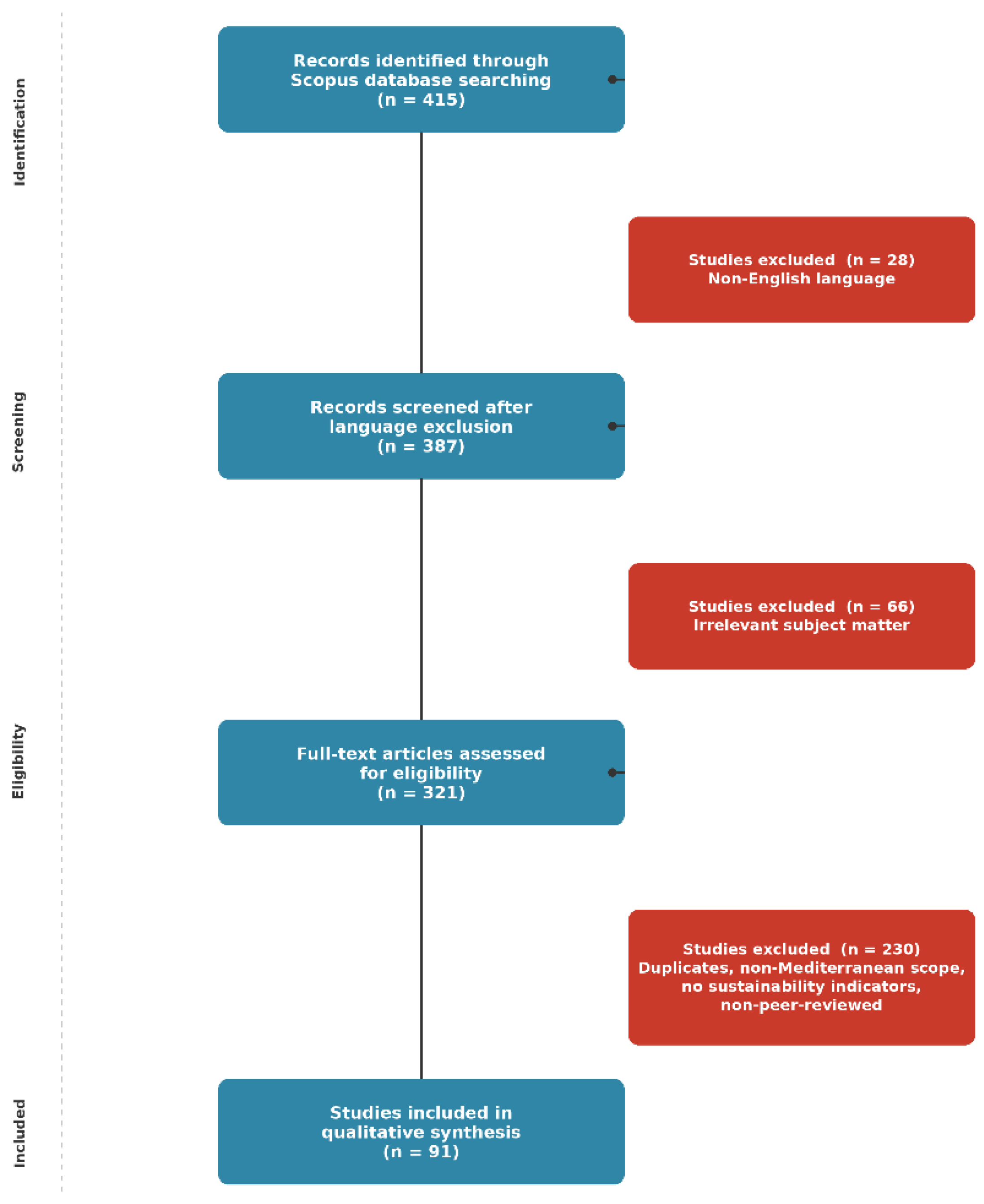
2. Materials and Methods
3. Results
3.1. Statistical Associations Across the Review Corpus
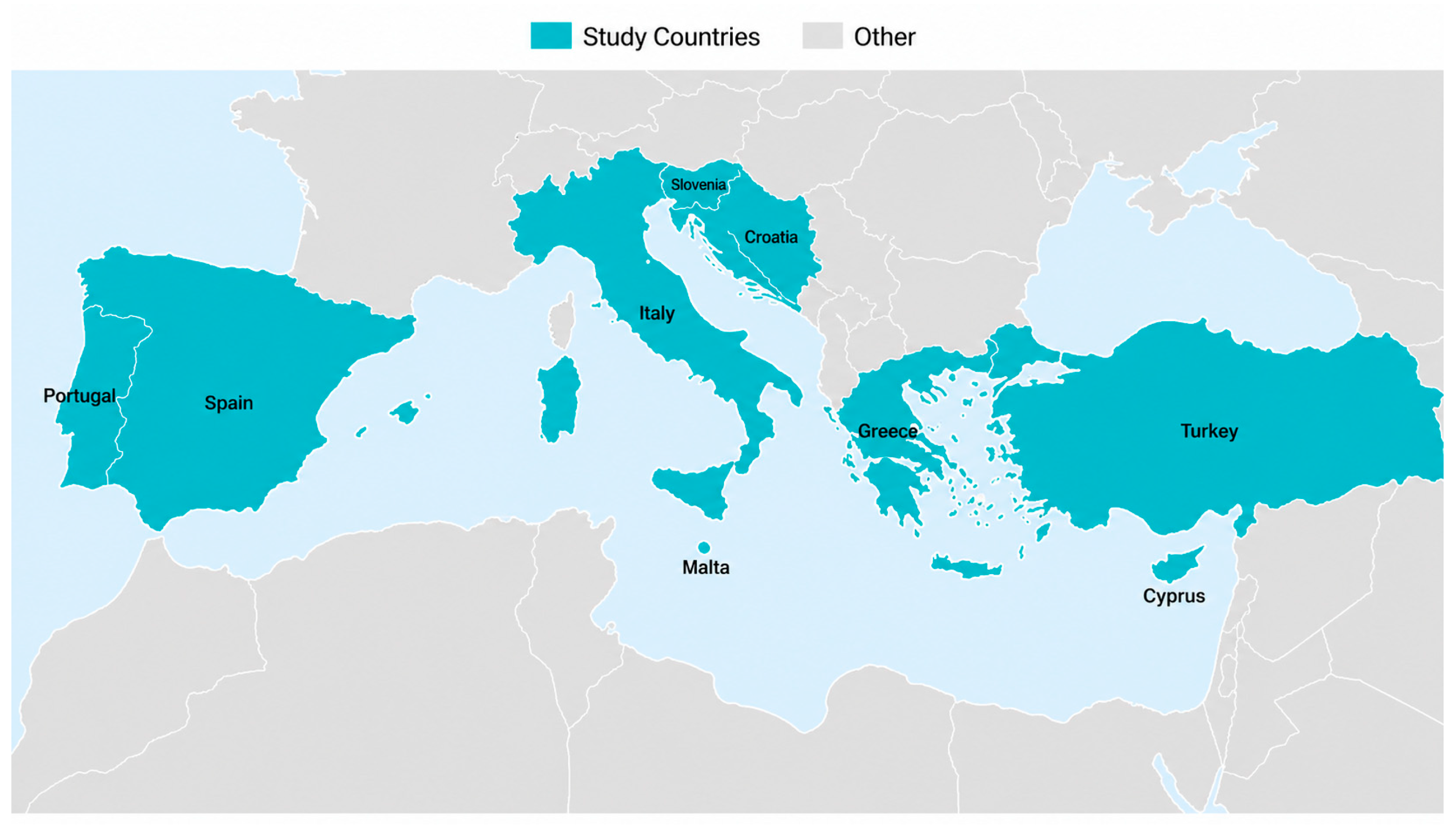
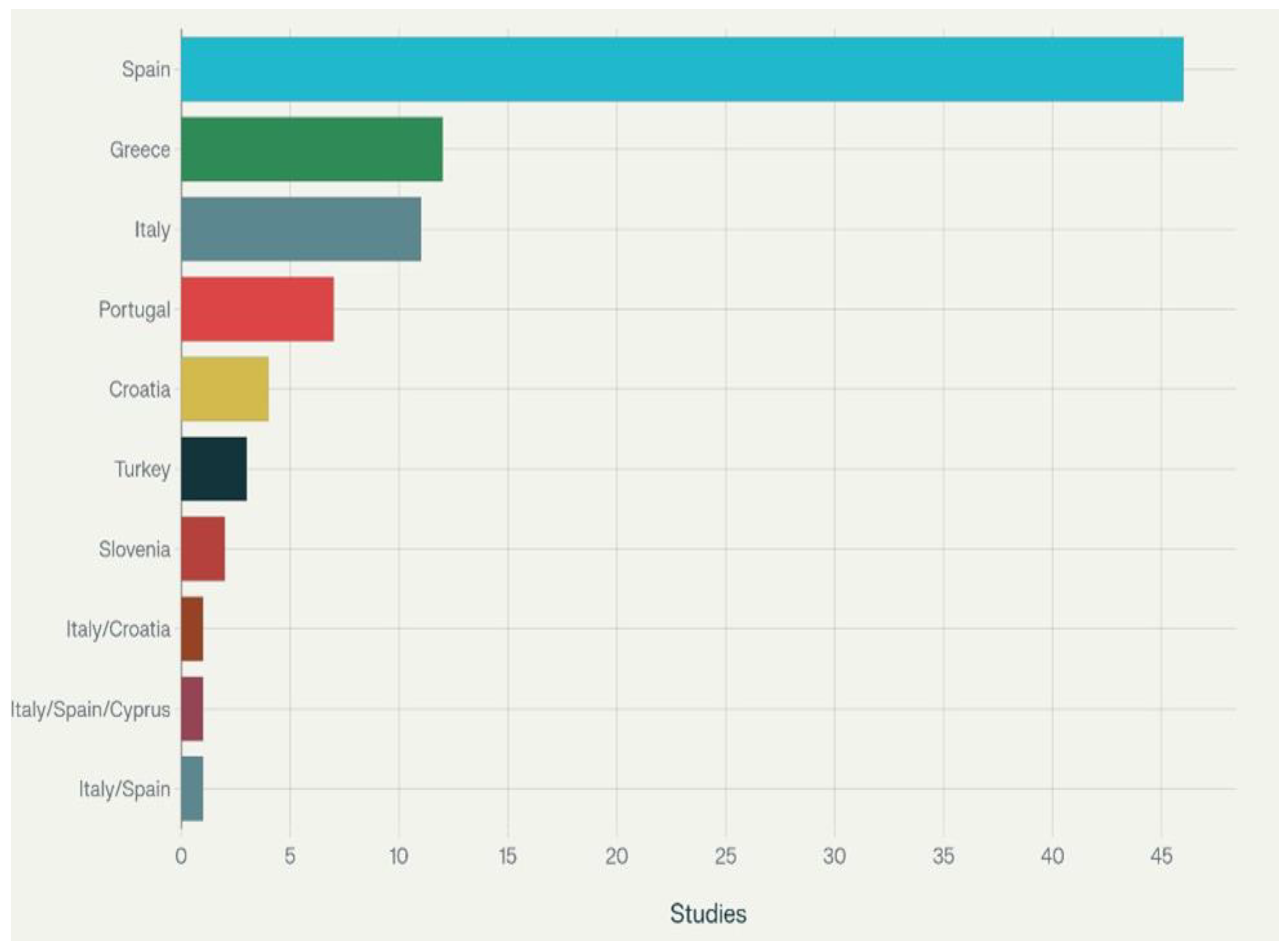
3.2. Geographic Distribution of Studies
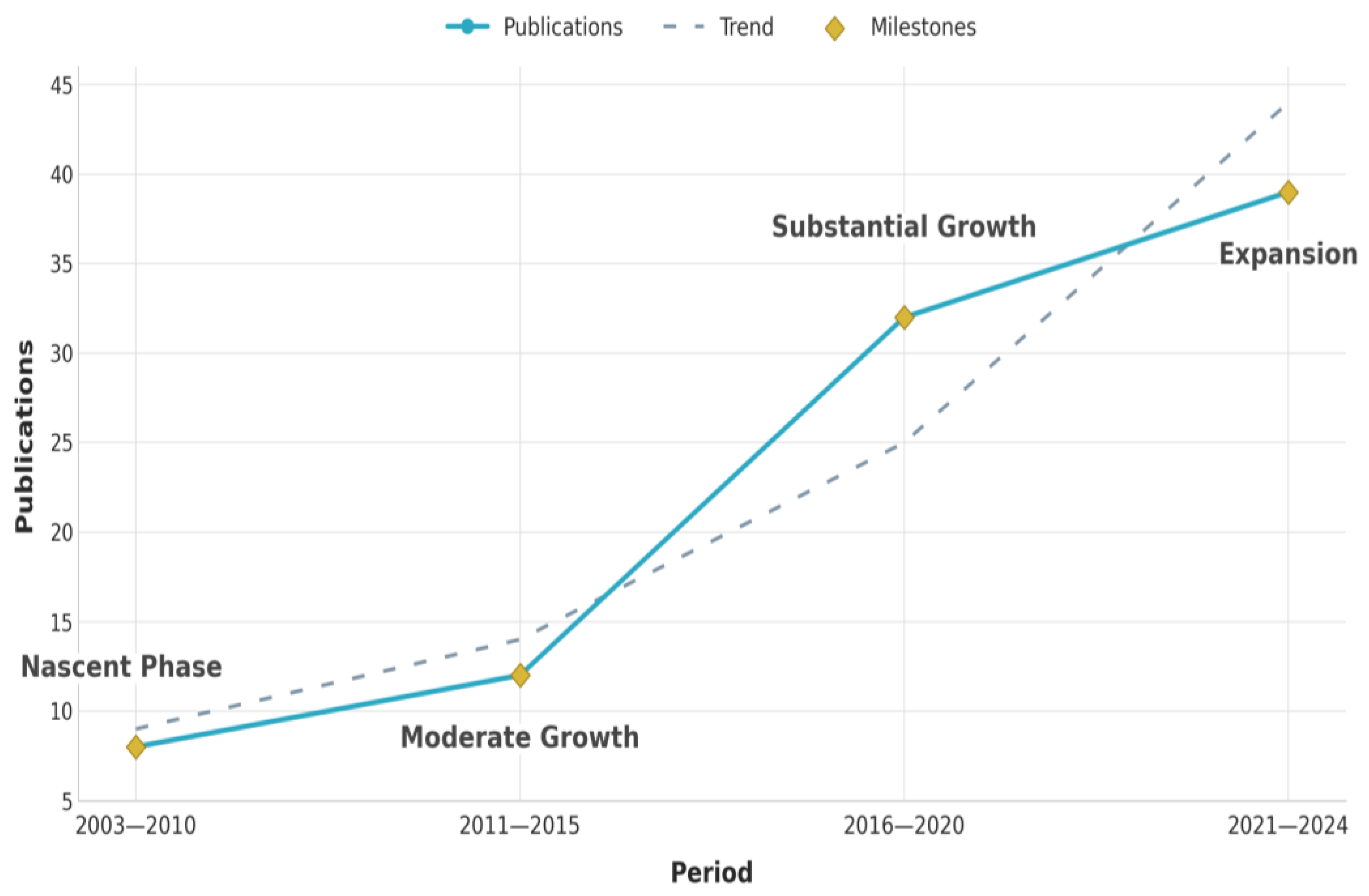
3.3. Temporal Evolution of Research
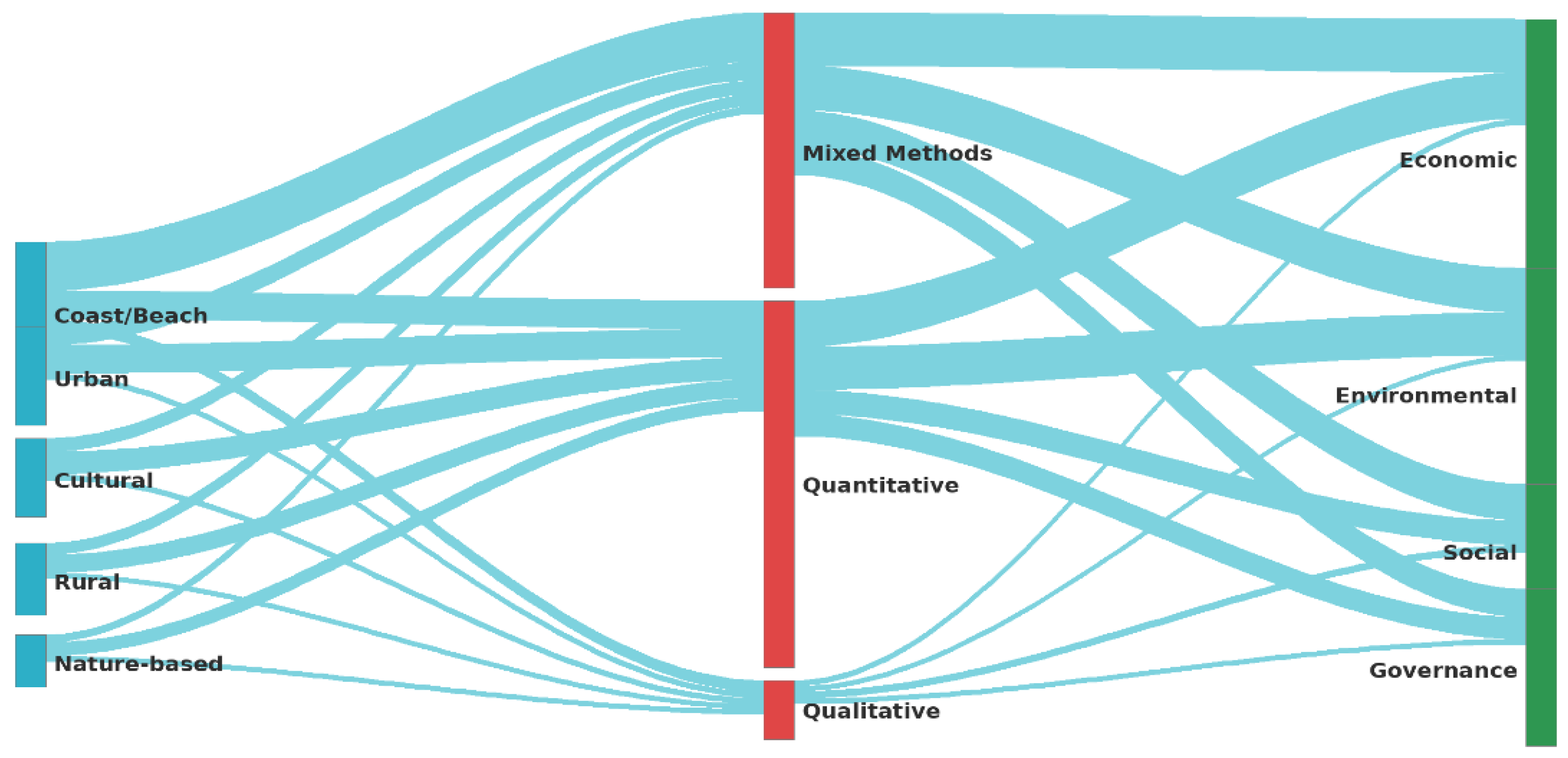
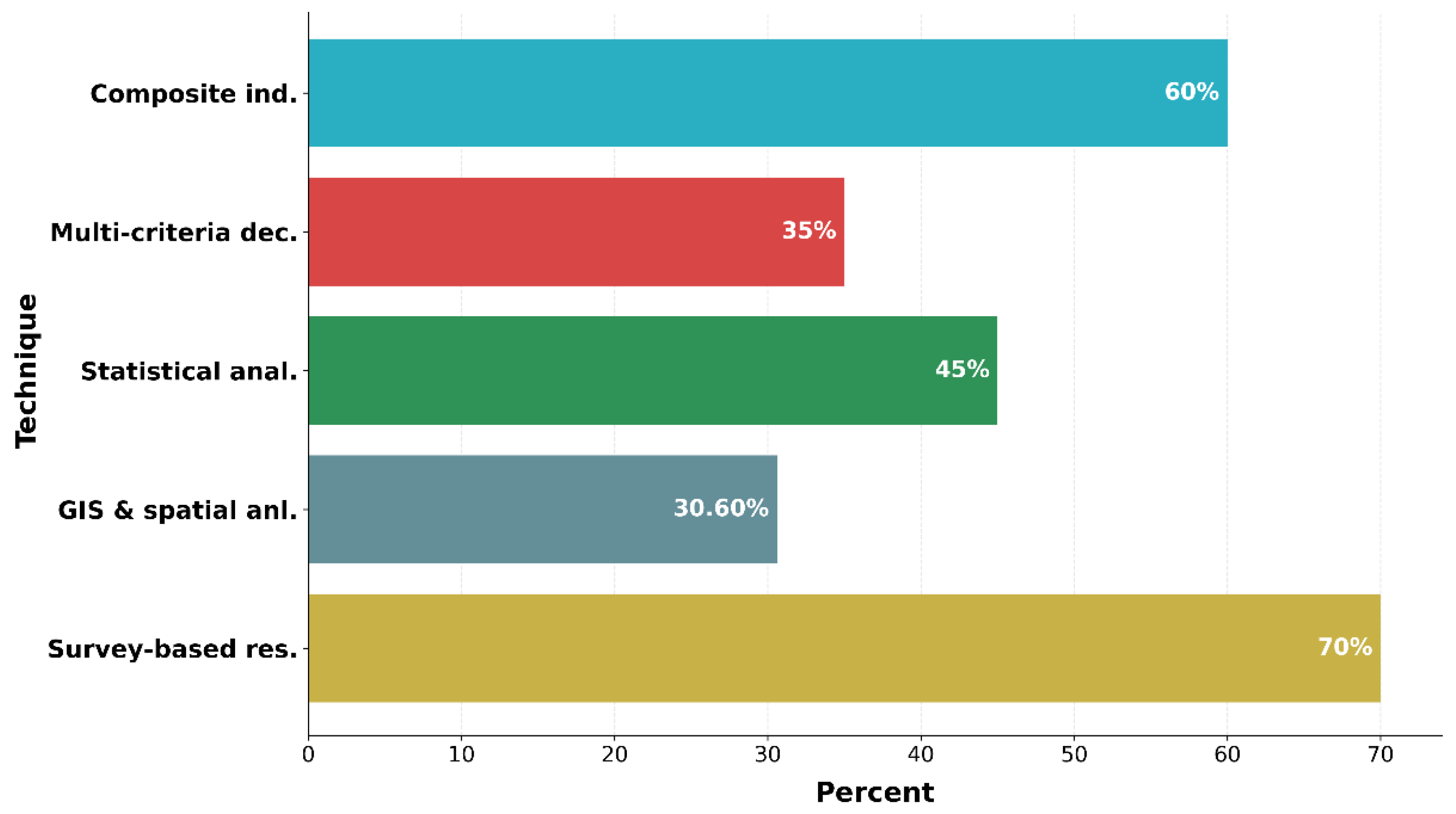
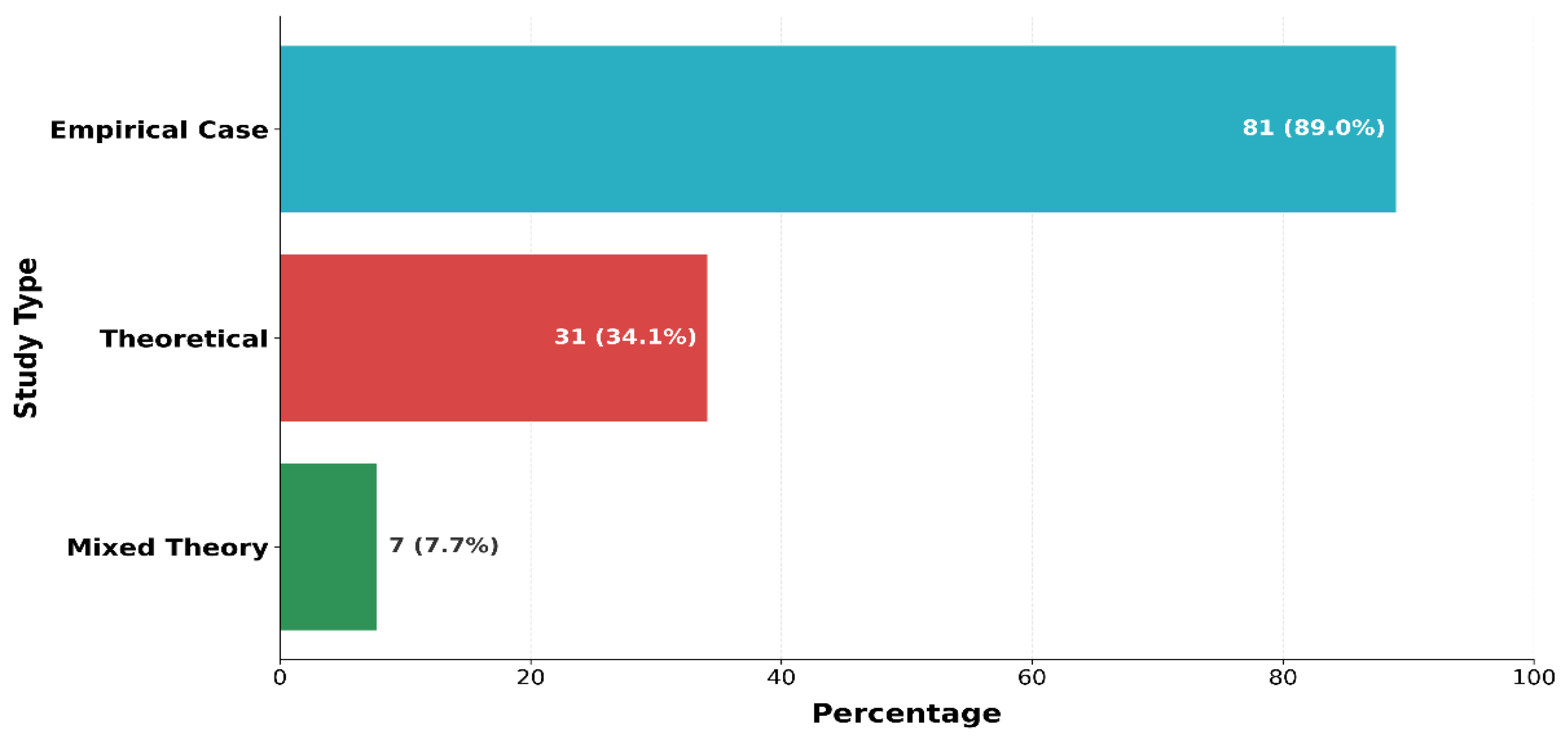
3.4. Methodological Approaches
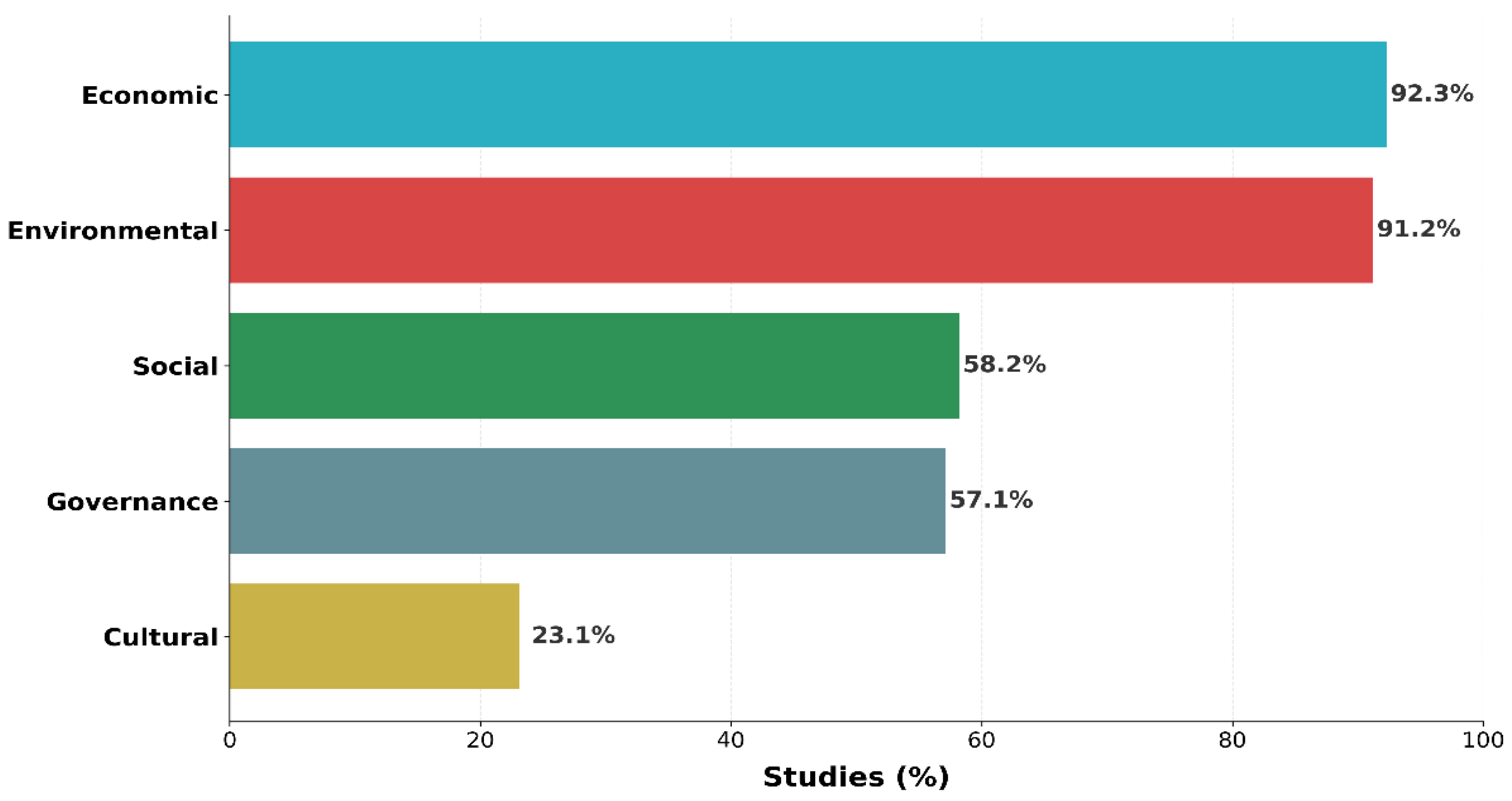
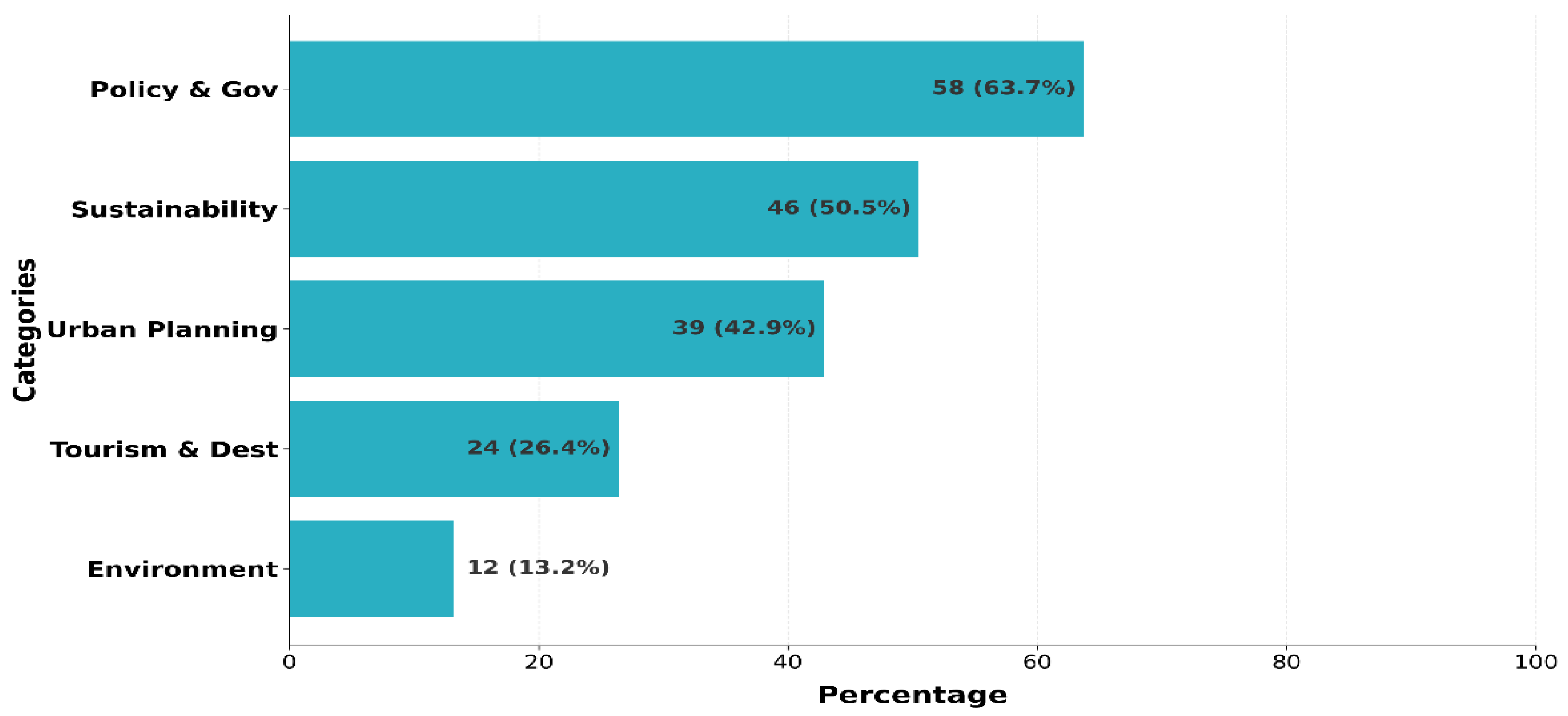
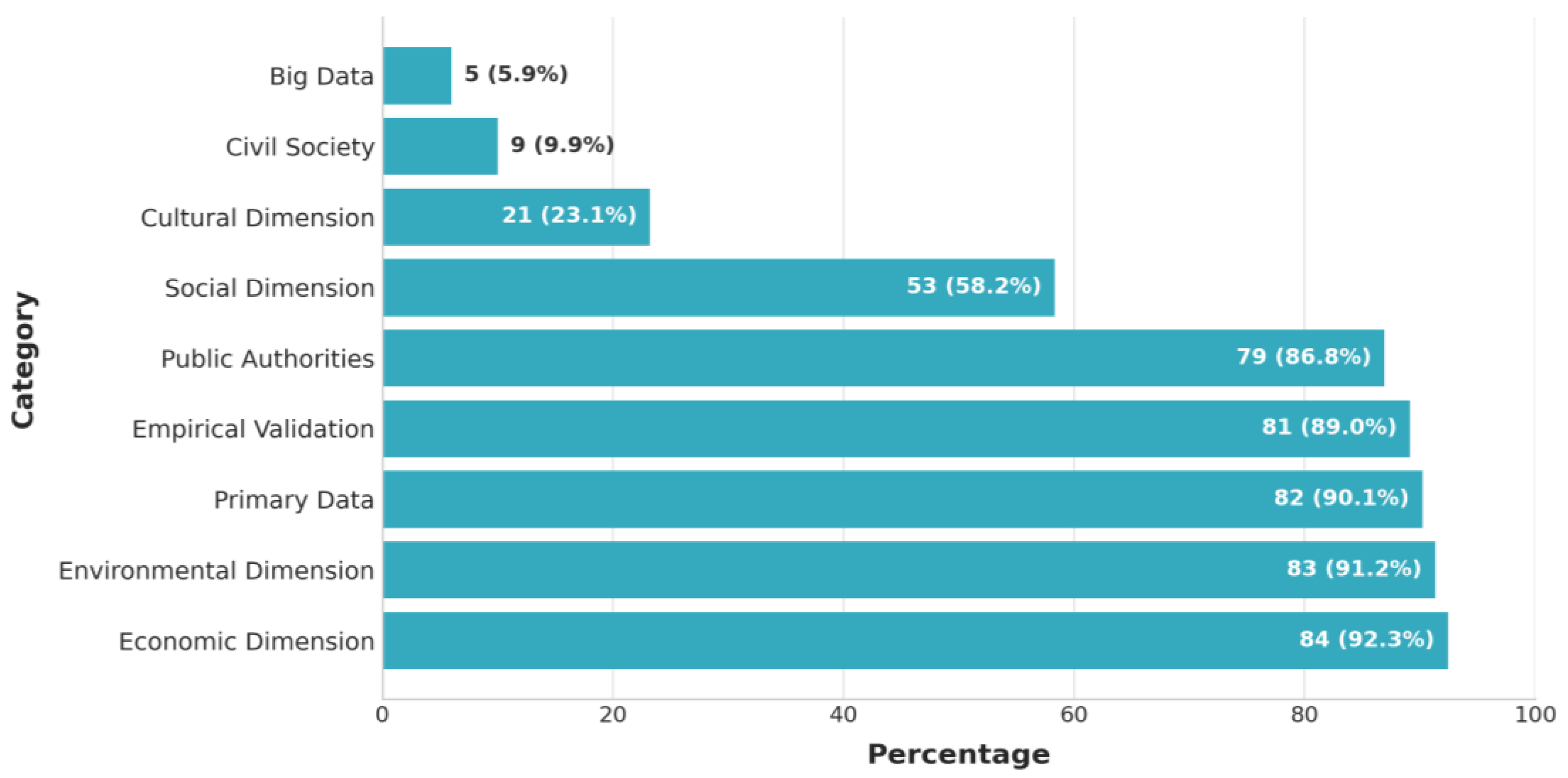
3.5. Coverage of Sustainability Dimensions
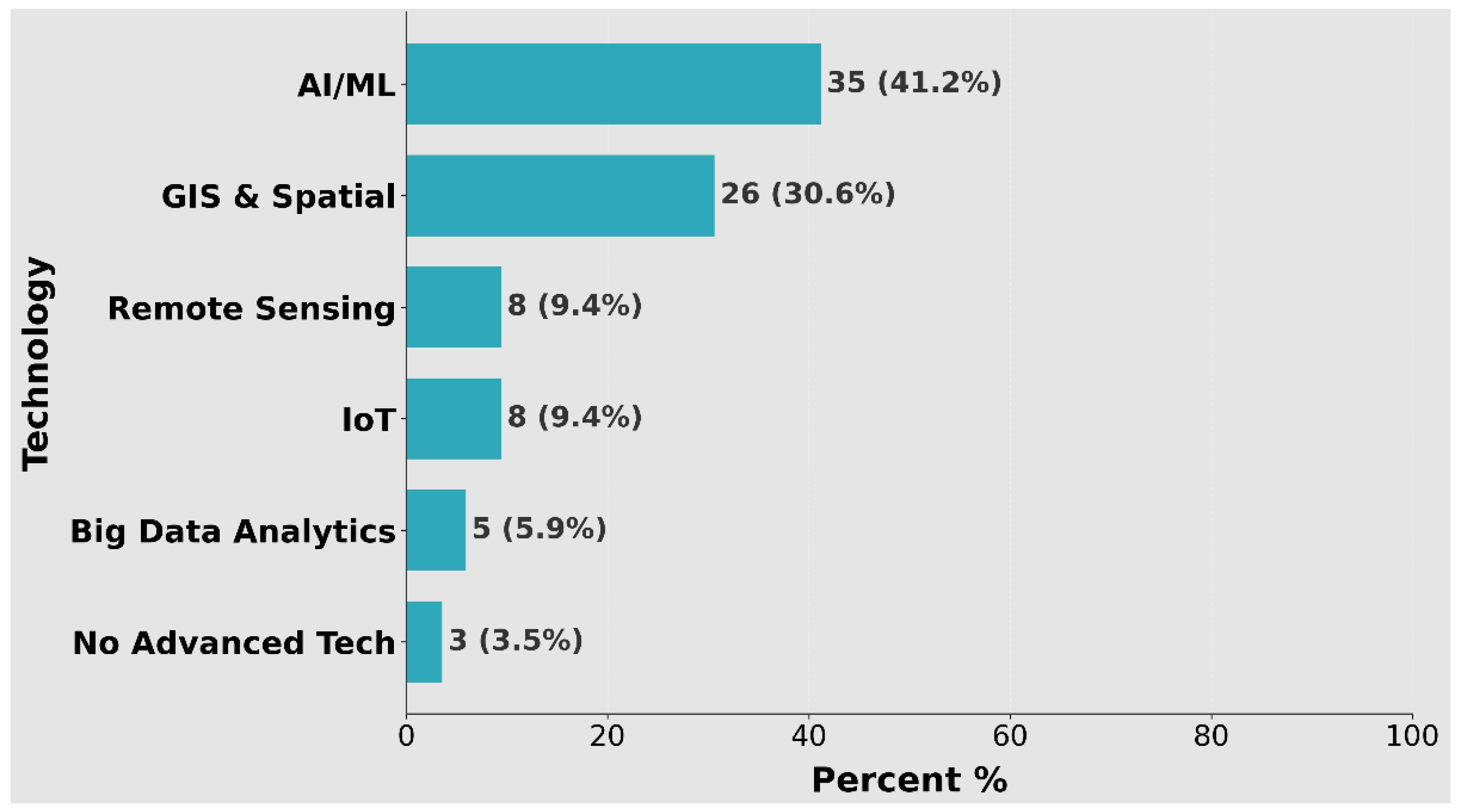
3.6. Technological Integration
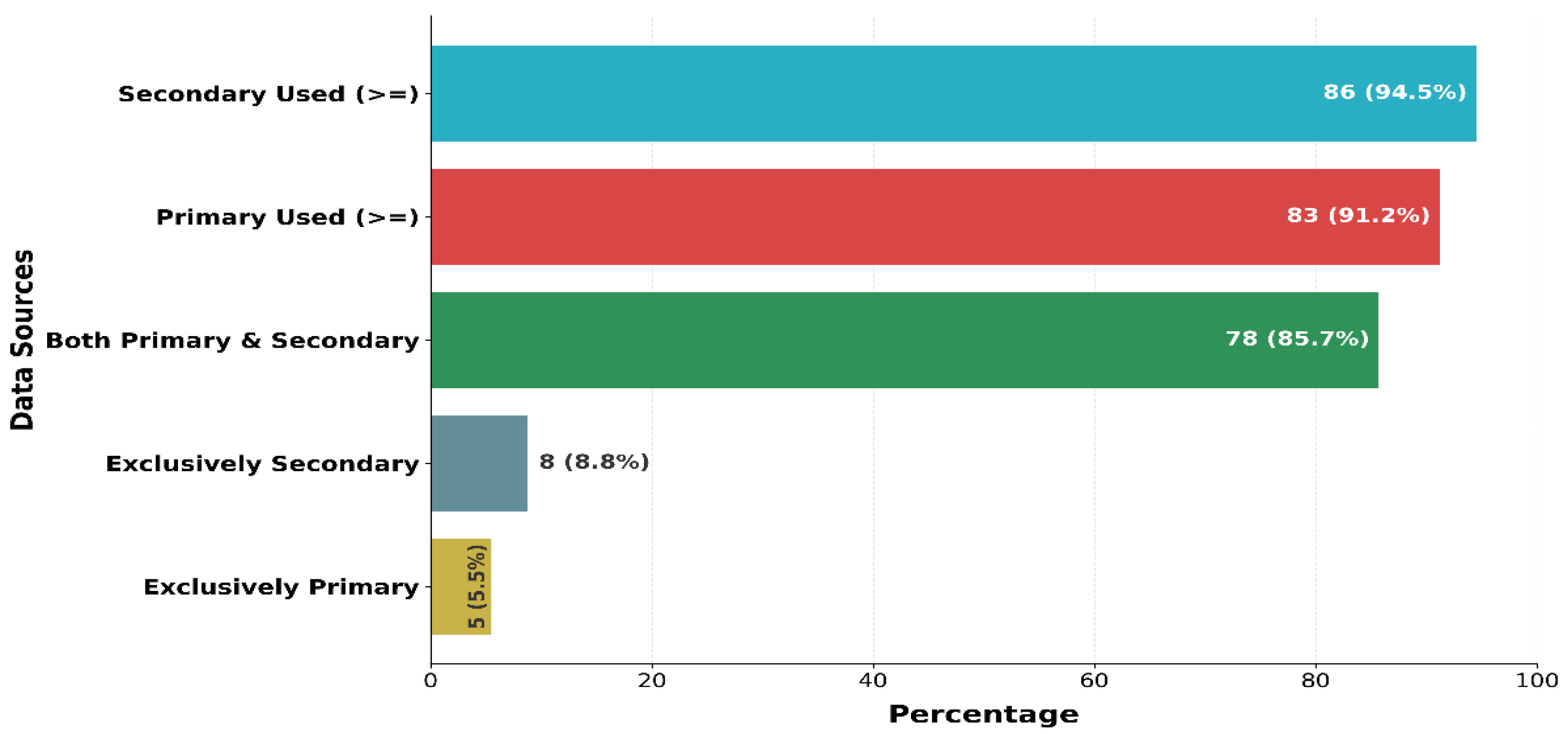
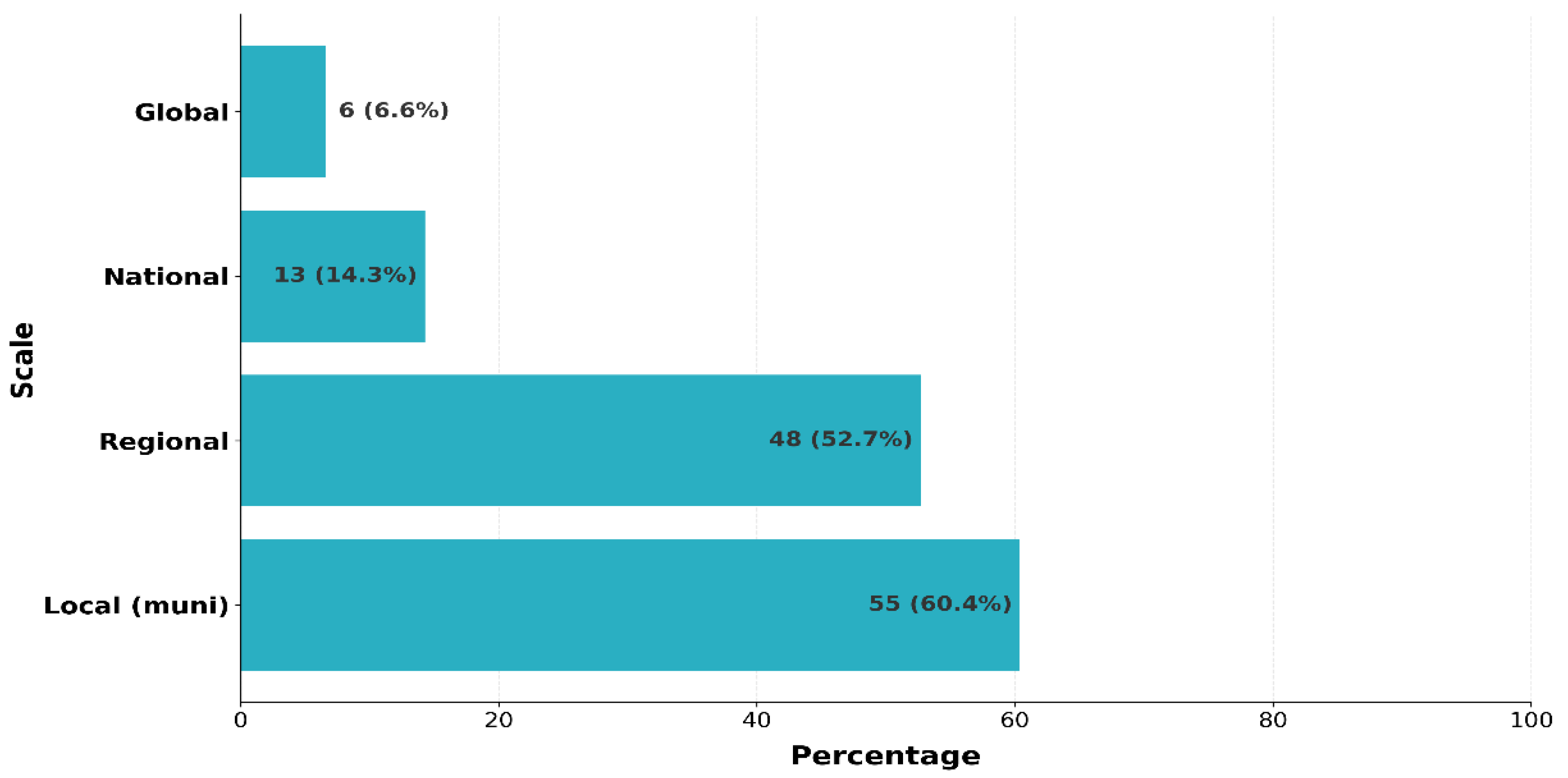
3.7. Data Sources and Scales
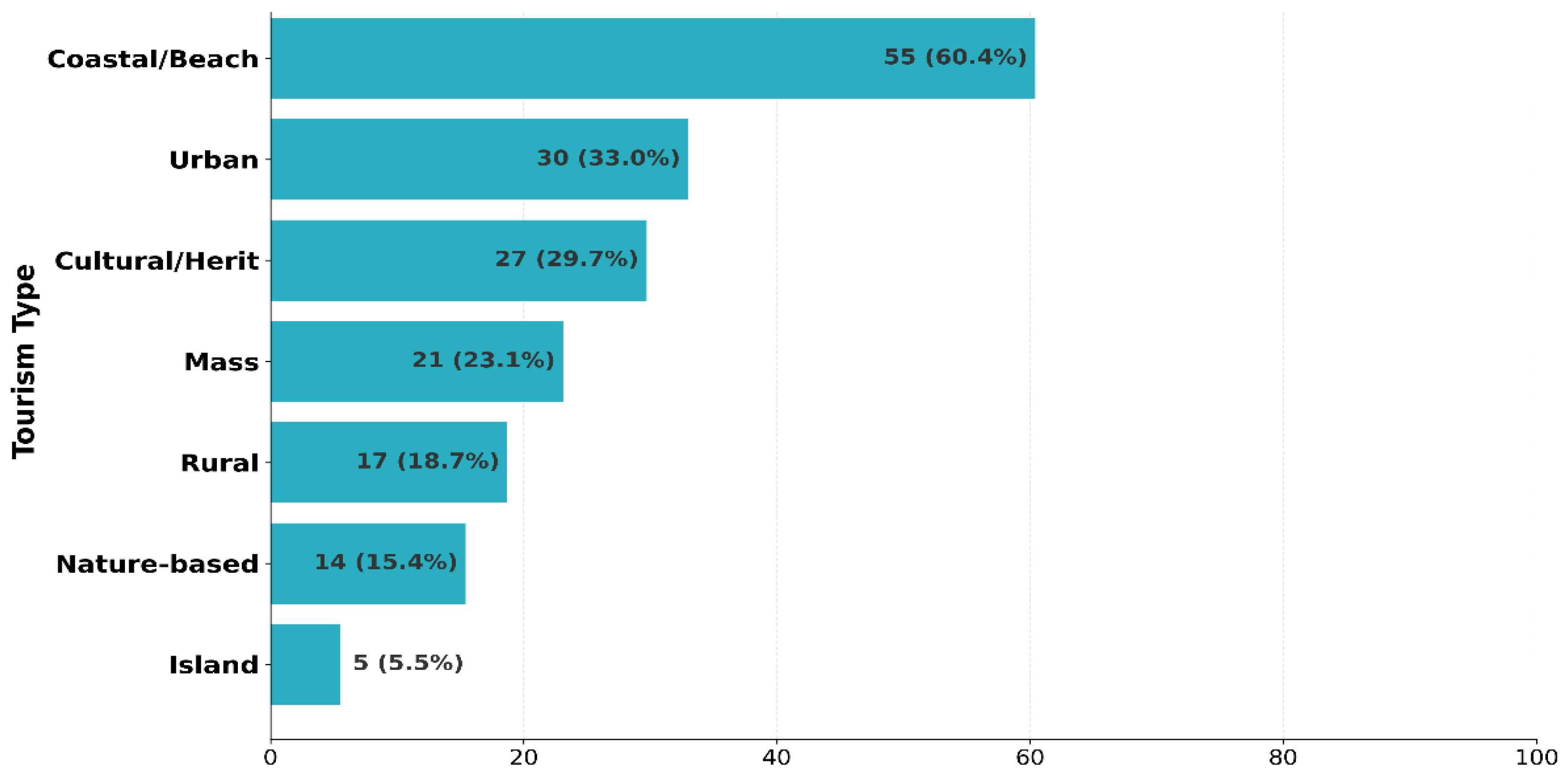
3.8. Tourism Types Addressed
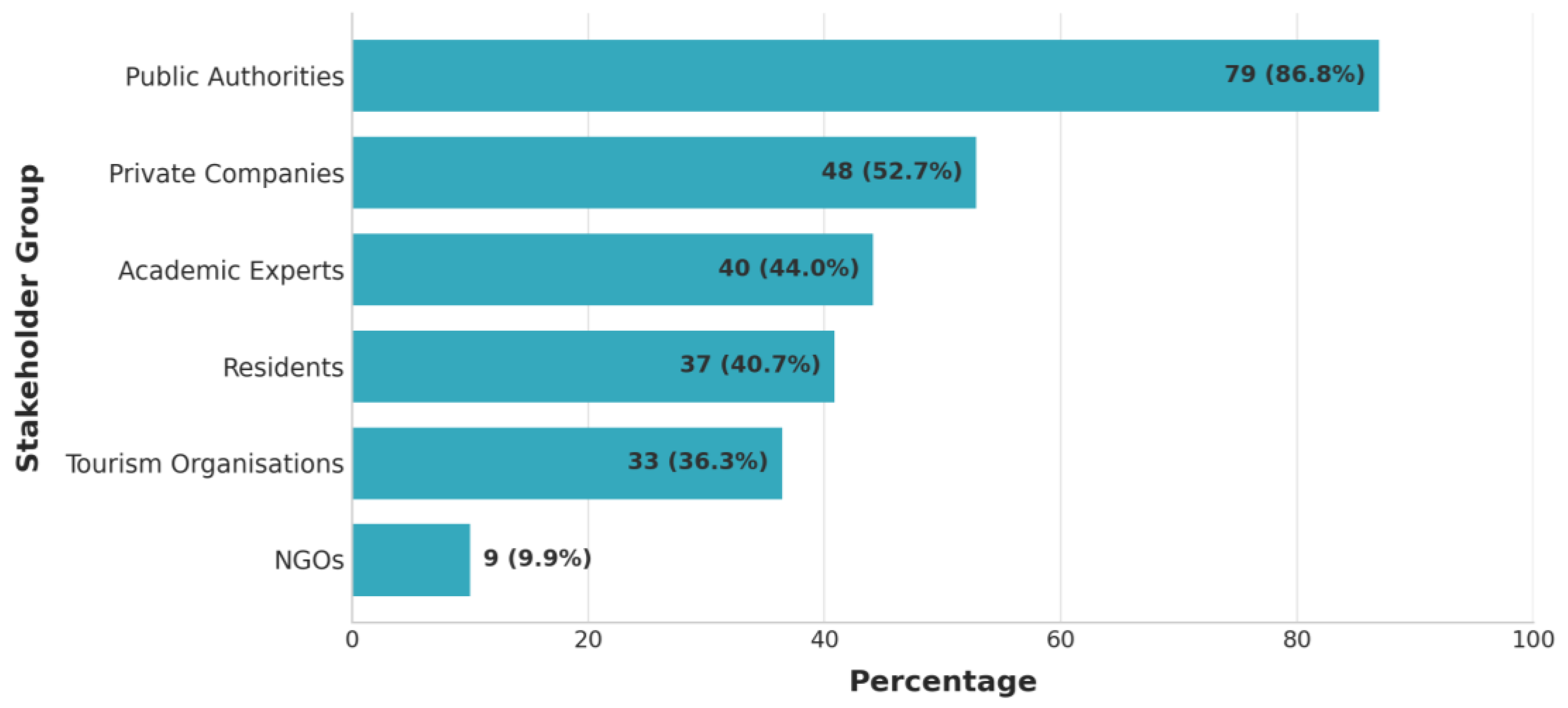
3.9. Stakeholder Engagement
3.10. Key Strengths and Limitations
4. Discussion
5. Limitations
6. Conclusions
- (i)
- identify missing sustainability dimensions;
- (ii)
- detect excessive methodological concentration;
- (iii)
- assess whether the framework is adequately adapted to destination context;
- (iv)
- prioritise revisions to the indicator system before it is used for monitoring or policy support.
Supplementary Materials
Author Contributions
Funding
Institutional Review Board Statement
Informed Consent Statement
Data Availability Statement
Conflicts of Interest
Abbreviations
| AHP | Analytic Hierarchy Process |
| AI | Artificial Intelligence |
| BOD | Biochemical Oxygen Demand |
| DMO | Destination Management Organisation |
| DPSIR | Driving Forces–Pressure–State–Impact–Response |
| ESG | Environmental, Social, and Governance |
| ETIS | European Tourism Indicator System |
| GDP | Gross Domestic Product |
| GIS | Geographic Information Systems |
| IoT | Internet of Things |
| MedECC | Mediterranean Experts on Climate and Environmental Change |
| MCDM | Multi-Criteria Decision-Making |
| MICE | Meetings, Incentives, Conferences, and Exhibitions |
| ML | Machine Learning |
| NOx | Nitrogen Oxides |
| PM | Particulate Matter |
| PRISMA | Preferred Reporting Items for Systematic Reviews and Meta-Analyses |
| PSR | Pressure–State–Response |
| SDG | Sustainable Development Goal |
| SME | Small and Medium-sized Enterprise |
| STIs | Sustainable Tourism Indicators |
| SO2 | Sulphur Dioxide |
| TBL | Triple Bottom Line |
| TOPSIS | Technique for Order Preference by Similarity to Ideal Solution |
| UNWTO | United Nations World Tourism Organization |
References
- Butler, R.W. Sustainable tourism: A state-of-the-art review. Tour. Geogr. 1999, 1, 7–25. [Google Scholar] [CrossRef] [Scilit]
- Liu, Z. Sustainable Tourism Development: A Critique. J. Sustain. Tour. 2003, 11, 459–475. [Google Scholar] [CrossRef] [Scilit]
- Correia, M.S. Sustainability: An Overview of the Triple Bottom Line and Sustainability Implementation. Int. J. Strateg. Eng. 2019, 2, 29–38. [Google Scholar] [CrossRef] [Scilit]
- Zhang, Y.; Huam, H.T.; Zhang, Z.R. Sustainable Development in the Tourism Sector: The Impact of Environmental, Social, and Governance Performance on Operational Efficiency—A Multilevel Analytical Approach. Sustain. Futures 2025, 10, 100923. [Google Scholar] [CrossRef] [Scilit]
- Crabolu, G.; Font, X.; Miller, G. The Hidden Power of Sustainable Tourism Indicator Schemes: Have We Been Measuring Their Effectiveness All Wrong? J. Travel Res. 2024, 63, 1741–1760. [Google Scholar] [CrossRef] [Scilit]
- Tomaselli, V.; Giammanco, M.D. Agenda 2030 SDGs: An Indicator-Based Toolkit to Measure Sustainability in Tourism. Qual. Quant. 2026, 1–38. [CrossRef] [Scilit]
- Torres-Delgado, A.; Saarinen, J. Using Indicators to Assess Sustainable Tourism Development: A Review. In New Research Paradigms in Tourism Geography; Routledge: Abingdon, UK, 2017; pp. 31–47. [Google Scholar]
- Miller, G.; Twining-Ward, L. Monitoring for a Sustainable Tourism Transition: The Challenge of Developing and Using Indicators; CABI Publishing: Wallingford, UK, 2005. [Google Scholar]
- Mulita, R.; Sefa, B. Agritourism Management in Sustainable Rural Development and Cultural Heritage Preservation. Econ. Ecol. Socium 2025, 9, 65–76. [Google Scholar] [CrossRef] [Scilit]
- Gkarane, S.; Vassiliadis, C.; Kotzaivazoglou, I.; Fragidis, G.; Vrana, V. Emerging Trends and Future Directions in the Mediterranean Coastal Tourism: A Selective Literature Review. In The International Conference on Strategic Innovative Marketing and Tourism; Springer Nature: Cham, Switzerland, 2024; pp. 793–802. [Google Scholar]
- Miller, G.; Torres-Delgado, A. Measuring Sustainable Tourism: A State of the Art Review of Sustainable Tourism Indicators. J. Sustain. Tour. 2023, 31, 1483–1496. [Google Scholar] [CrossRef] [Scilit]
- Rasoolimanesh, S.M.; Ramakrishna, S.; Hall, C.M.; Esfandiar, K.; Seyfi, S. A Systematic Scoping Review of Sustainable Tourism Indicators in Relation to the Sustainable Development Goals. J. Sustain. Tour. 2023, 31, 1497–1517. [Google Scholar] [CrossRef] [Scilit]
- Marinello, S.; Butturi, M.A.; Gamberini, R.; Martini, U. Indicators for Sustainable Touristic Destinations: A Critical Review. J. Environ. Plan. Manag. 2023, 66, 1–30. [Google Scholar] [CrossRef] [Scilit]
- Kristjánsdóttir, K.R.; Ólafsdóttir, R.; Ragnarsdóttir, K.V. Reviewing Integrated Sustainability Indicators for Tourism. J. Sustain. Tour. 2018, 26, 583–599. [Google Scholar] [CrossRef] [Scilit]
- Vukadin, I.M.; Zovko, M.; Krešić, D. Review and Evaluation of Existing International Systems of Tourism Sustainability Indicators. Croat. Geogr./Hrvat. Geogr. Glas. 2020, 82, 85–110. [Google Scholar] [CrossRef] [Scilit]
- Spencer, D.M.; Sargeant, E.L. The Use of Indicators to Measure the Sustainability of Tourism at Cultural Heritage Sites: A Critical Review. Tour. Recreat. Res. 2024, 49, 563–576. [Google Scholar] [CrossRef] [Scilit]
- Lange, M.A.; Llasat, M.C.; Snoussi, M.; Graves, A.; Le Tellier, J.; Queralt, A.; Vagliasindi, G.M. First Mediterranean Assessment Report—Chapter 1: Introduction. In Climate and Environmental Change in the Mediterranean Basin—Current Situation and Risks for the Future; First Mediterranean Assessment Report; MedECC: Marseille, France, 2020; pp. 41–58. [Google Scholar]
- Moher, D.; Liberati, A.; Tetzlaff, J.; Altman, D.G.; PRISMA Group. Preferred Reporting Items for Systematic Reviews and Meta-Analyses: The PRISMA Statement. BMJ 2009, 339, b2535. [Google Scholar] [CrossRef] [PubMed]
- Bossel, H. Indicators for Sustainable Development: Theory, Method, Applications; International Institute for Sustainable Development: Winnipeg, MB, Canada, 1999. [Google Scholar]
- Page, M.J.; McKenzie, J.E.; Bossuyt, P.M.; Boutron, I.; Hoffmann, T.C.; Mulrow, C.D.; Shamseer, L.; Tetzlaff, J.M.; Akl, E.A.; Brennan, S.E.; et al. The PRISMA 2020 statement: An updated guideline for reporting systematic reviews. BMJ 2021, 372, n71. [Google Scholar] [CrossRef] [Scilit] [PubMed]
- Aguirre, A.; Zayas, A.; Gómez-Carmona, D.; López Sánchez, J.A. Smart Tourism Destinations Really Make Sustainable Cities: Benidorm as a Case Study. Int. J. Tour. Cities 2023, 9, 51–69. [Google Scholar] [CrossRef] [Scilit]
- Aktsoglou, D.; Gaidajis, G. A Case Study on Environmental Sustainability Assessment of Spatial Entities with Anthropogenic Activities: The National Park of Eastern Macedonia and Thrace, Greece. Sustainability 2020, 12, 4486. [Google Scholar] [CrossRef] [Scilit]
- Alipour, H.; Safaeimanesh, F.; Soosan, A. Investigating Sustainable Practices in Hotel Industry-From Employees’ Perspective: Evidence from a Mediterranean Island. Sustainability 2019, 11, 6556. [Google Scholar] [CrossRef] [Scilit]
- Andolina, C.; Signa, G.; Tomasello, A.; Mazzola, A.; Vizzini, S. Environmental Effects of Tourism and Its Seasonality on Mediterranean Islands: The Contribution of the Interreg MED BLUEISLANDS Project to Build up an Approach towards Sustainable Tourism. Environ. Dev. Sustain. 2021, 23, 8601–8612. [Google Scholar] [CrossRef] [Scilit]
- Andria, J.; Di Tollo, G.; Pesenti, R. A Heuristic Fuzzy Algorithm for Assessing and Managing Tourism Sustainability. Soft Comput. 2020, 24, 4027–4040. [Google Scholar] [CrossRef] [Scilit]
- Avdimiotis, S.; Christou, E.; Sigala, M. From Development to Decline. Tracing the Life Circle Notifications of a Destination. J. Environ. Prot. Ecol. 2009, 10, 1205–1217. [Google Scholar]
- Aygün Oğur, A.; Baycan, T. Assessing Climate Change Impacts on Tourism Demand in Turkey. Environ. Dev. Sustain. 2023, 25, 2905–2935. [Google Scholar] [CrossRef] [Scilit]
- Baños, C.J.; Hernández, M.; Rico, A.M.; Olcina, J. The Hydrosocial Cycle in Coastal Tourist Destinations in Alicante, Spain: Increasing Resilience to Drought. Sustainability 2019, 11, 4494. [Google Scholar] [CrossRef] [Scilit]
- Barnet, A.F.; Ciurana, A.B.; Pozo, J.X.; Russo, A.; Coscarelli, R.; Antronico, L.; De Pascale, F.; Saladie, O.; Anton-Clave, S.; Aguilar, E. Climate Services for Tourism: An Applied Methodology for User Engagement and Co-Creation in European Destinations. Clim. Serv. 2021, 23, 100249. [Google Scholar] [CrossRef] [Scilit]
- Blancas, F.J.; Contreras, I.; Lozano-Oyola, M. Evaluating Destinations’ Efforts to Improve Sustainability in Tourism Using the Inter-Temporal Decomposition of a Composite Indicator. Environ. Impact Assess. Rev. 2023, 98, 106947. [Google Scholar] [CrossRef] [Scilit]
- Blancas, F.J.; González, M.; Lozano-Oyola, M.; Perez, F. The Assessment of Sustainable Tourism: Application to Spanish Coastal Destinations. Ecol. Indic. 2010, 10, 484–492. [Google Scholar] [CrossRef] [Scilit]
- Blancas, F.J.; Lozano-Oyola, M.; González, M.; Caballero, R. A Dynamic Sustainable Tourism Evaluation Using Multiple Benchmarks. J. Clean. Prod. 2018, 174, 1190–1203. [Google Scholar] [CrossRef] [Scilit]
- Blancas, F.J.; Lozano-Oyola, M.; González, M.; Caballero, R. Sustainable Tourism Composite Indicators: A Dynamic Evaluation to Manage Changes in Sustainability. J. Sustain. Tour. 2016, 24, 1403–1424. [Google Scholar] [CrossRef] [Scilit]
- Blancas, F.J.; Lozano-Oyola, M.; Gonzalez, M.; Guerrero, F.M.; Caballero, R. How to Use Sustainability Indicators for Tourism Planning: The Case of Rural Tourism in Andalusia (Spain). Sci. Total Environ. 2011, 412, 28–45. [Google Scholar] [CrossRef] [Scilit]
- Blázquez-Salom, M.; Cladera, M.; Sard, M. Identifying the Sustainability Indicators of Overtourism and Undertourism in Majorca. J. Sustain. Tour. 2023, 31, 1694–1718. [Google Scholar] [CrossRef] [Scilit]
- Boque Ciurana, A.; Menendez, M.; Suarez Bilbao, M.; Aguilar, E. Exploring the Climatic Potential of Somo’s Surf Spot for Tourist Destination Management. Sustainability 2022, 14, 8496. [Google Scholar] [CrossRef] [Scilit]
- Brščić, K.; Prats Planaguma, L.; Raschi, A.; Marchi, V.; Šugar, T.; Lovrečić, K.; Poljuha, D. Can Indicators for Sustainable Tourism Improve Tourism Planning in the Coastal Destinations? Empirical Evidence from Catalonia, Istrian Region and Tuscany Region. Tour. Int. Interdiscip. J. 2020, 68, 144–155. [Google Scholar]
- Cardia, G.; Pulido Fernández, J.I. The Model Do-Di: An Emerging Methodology for the Management of the Relation Between Tourism, Culture and Development. In Tourism, Culture and Heritage in a Smart Economy: Third International Conference IACuDiT, Athens 2016; Springer International Publishing: Cham, Switzerland, 2017; pp. 305–322. [Google Scholar]
- Čavlek, N.; Cooper, C.; Krajinović, V.; Srnec, L.; Zaninović, K. Destination Climate Adaptation. J. Hosp. Tour. Res. 2019, 43, 314–322. [Google Scholar] [CrossRef] [Scilit]
- Cobacho-Tornel, M.B. Synthetic Indicators and Sustainable Coastal Tourism in Murcia, Spain. In Tourism Research in Ibero-America; Routledge: Abingdon, UK, 2021; pp. 58–69. [Google Scholar]
- Coccossis, H.; Koutsopoulou, A. Measuring and Monitoring Sustainability of Coastal Tourism Destinations in the Mediterranean. Tour. Int. Interdiscip. J. 2020, 68, 482–498. [Google Scholar] [CrossRef] [Scilit]
- Contu, G.; Conversano, C.; Frigau, L.; Mola, F. The Impact of Airbnb on Hidden and Sustainable Tourism: The Case of Italy. Int. J. Tour. Policy 2019, 9, 99–130. [Google Scholar] [CrossRef] [Scilit]
- Costa, J.; Montenegro, M.; Gomes, J. Sustainability as a Measure of Tourism Success: The Portuguese Promotional Tourism Boards’ View. Worldw. Hosp. Tour. Themes 2022, 14, 65–71. [Google Scholar] [CrossRef] [Scilit]
- Cucculelli, M.; Goffi, G. Does Sustainability Enhance Tourism Destination Competitiveness? Evidence from Italian Destinations of Excellence. J. Clean. Prod. 2016, 111, 370–382. [Google Scholar] [CrossRef] [Scilit]
- Damian, I.M.; Navarro, E.; Ruiz, F. Stakeholders’ Perception of the Sustainability of a Tourism Destination: A Methodological Framework to Find out Relationships and Similarity of Opinions. Tour. Rev. 2022, 77, 515–531. [Google Scholar] [CrossRef] [Scilit]
- Damian, I.M.; Navarro-Jurado, E.; Ruiz, F. Involving Stakeholders in the Evaluation of the Sustainability of a Tourist Destination: A Novel Comprehensive Approach. J. Sustain. Tour. 2023, 31, 1631–1650. [Google Scholar] [CrossRef] [Scilit]
- Epifani, F.; Valente, D. Sustainable Governance of Tourism-Based Social-Ecological Landscapes. Sustainability 2023, 15, 15967. [Google Scholar] [CrossRef] [Scilit]
- Farris, G.; Pinna, A.; Baralla, G.; Tonelli, R.; Modica, P.; Marchesi, M. Design of a Blockchain-Oriented System for the Sustainable Disintermediation in Tourism. In 2021 IoT Vertical and Topical Summit for Tourism; IEEE: Piscataway, NJ, USA, 2021; pp. 1–6. [Google Scholar]
- Fernández, J.I.; Rivero, M.S. Measuring Tourism Sustainability: Proposal for a Composite Index. Tour. Econ. 2009, 15, 277–296. [Google Scholar] [CrossRef] [Scilit]
- Fernández-Tabales, A.; Foronda-Robles, C.; Galindo-Pérez-de-Azpillaga, L.; García-López, A. Developing a System of Territorial Governance Indicators for Tourism Destinations. J. Sustain. Tour. 2017, 25, 1275–1305. [Google Scholar] [CrossRef] [Scilit]
- Folgado-Fernández, J.A.; Marino-Romero, J.A.; Arenas-Escaso, J.F. Economic Results and Corporate Social Responsibility in the Tourism Sector. A Study of the World Heritage City of Cáceres. UCJC Bus. Soc. Rev. 2023, 20, 80–113. [Google Scholar]
- Foronda-Robles, C.; Galindo-Pérez-de-Azpillaga, L.; Fernández-Tabales, A. Progress and Stakes in Sustainable Tourism: Indicators for Smart Coastal Destinations. J. Sustain. Tour. 2023, 31, 1518–1537. [Google Scholar] [CrossRef] [Scilit]
- Franzoni, S. Measuring the Sustainability Performance of the Tourism Sector. Tour. Manag. Perspect. 2015, 16, 22–27. [Google Scholar] [CrossRef] [Scilit]
- Garcia-Ayllon, S. Urban Transformations as an Indicator of Unsustainability in the P2P Mass Tourism Phenomenon: The Airbnb Case in Spain through Three Case Studies. Sustainability 2018, 10, 2933. [Google Scholar] [CrossRef] [Scilit]
- Glyptou, K.; Kalogeras, N.; Skuras, D.; Spilanis, I. Clustering Sustainable Destinations: Empirical Evidence from Selected Mediterranean Countries. Sustainability 2022, 14, 5507. [Google Scholar] [CrossRef] [Scilit]
- Goffi, G.; Cucculelli, M. Components of Destination Competitiveness. The Case of Small Tourism Destinations in Italy. Int. J. Tour. Policy 2014, 5, 296–326. [Google Scholar] [CrossRef] [Scilit]
- Gómez-Bruna, D.; Martín-Duque, C.; Alzua-Sorzabal, A.; Ruiz-Rua, A. PSR_ti Model, an Adapted Pressure-State-Response (PSR) Framework for Measuring Tourism Impacts: The Case of Madrid. Int. J. Tour. Cities 2023, 9, 693–711. [Google Scholar] [CrossRef] [Scilit]
- Guerra, I.; Borges, F.; Padrão, J.; Tavares, J.; Padrão, M.H. Smart Cities, Smart Tourism? The Case of the City of Porto. Rev. Galega Econ. 2017, 26, 129–142. [Google Scholar] [CrossRef] [Scilit]
- Guidetti, G.; Pedrini, G.; Zamparini, L. Assessing Perceived Job Quality among Seasonal Tourism Workers: The Case of Rimini, Italy. Tour. Econ. 2021, 27, 1629–1649. [Google Scholar] [CrossRef] [Scilit]
- Guizzardi, A.; Stacchini, A.; Costa, M. Can Sustainability Drive Tourism Development in Small Rural Areas? Evidences from the Adriatic. J. Sustain. Tour. 2022, 30, 1280–1300. [Google Scholar] [CrossRef] [Scilit]
- Gusman, I.; Chamusca, P.; Fernandes, J.; Pinto, J. Culture and Tourism in Porto City Centre: Conflicts and (Im) Possible Solutions. Sustainability 2019, 11, 5701. [Google Scholar] [CrossRef] [Scilit]
- Ince, E.; Öztüren, A. Strengths, Weaknesses and Challenges of Municipalities in North Cyprus Aspiring to Be a Sustainable Cittaslow Tourism Destination. Worldw. Hosp. Tour. Themes 2021, 13, 528–534. [Google Scholar] [CrossRef] [Scilit]
- Italos, C.; Akylas, E.; Hadjimitsis, D.G. Effects of Tourism and Globalization on Land Cover and the Influence on the Quality of Life of Paphos Area in Cyprus. In Second International Conference on Remote Sensing And Geoinformation of The Environment (RSCY2014); SPIE: Bellingham, WA, USA, 2014; Volume 9229, pp. 191–198. [Google Scholar]
- Ivars-Baidal, J.A.; Celdrán-Bernabeu, M.A.; Femenia-Serra, F.; Perles-Ribes, J.F.; Giner-Sánchez, D. Measuring the Progress of Smart Destinations: The Use of Indicators as a Management Tool. J. Destin. Mark. Manag. 2021, 19, 100531. [Google Scholar] [CrossRef] [Scilit]
- Ivars-Baidal, J.A.; Vera-Rebollo, J.F.; Perles-Ribes, J.; Femenia-Serra, F.; Celdrán-Bernabeu, M.A. Sustainable Tourism Indicators: What’s New within the Smart City/Destination Approach? J. Sustain. Tour. 2023, 31, 1556–1582. [Google Scholar] [CrossRef] [Scilit]
- Jurado, E.N.; Tejada, M.T.; García, F.A.; González, J.C.; Macías, R.C.; Peña, J.D.; Gutiérrez, F.F.; Fernández, G.G.; Gallego, M.L.; García, G.M.; et al. Carrying Capacity Assessment for Tourist Destinations. Methodology for the Creation of Synthetic Indicators Applied in a Coastal Area. Tour. Manag. 2012, 33, 1337–1346. [Google Scholar] [CrossRef] [Scilit]
- Komis, M.; Wassler, P. Sustainability Issues on Islands: A Case of Cephalonia (Greece). J. Qual. Res. Tour. 2022, 3, 32–50. [Google Scholar] [CrossRef] [Scilit]
- Kožić, I.; Mikulić, J. Research Note: Measuring Tourism Sustainability: An Empirical Comparison of Different Weighting Procedures Used in Modelling Composite Indicators. Tour. Econ. 2014, 20, 429–437. [Google Scholar] [CrossRef] [Scilit]
- Kuščer, K. Determining Indicators of Mountain Destination Development. Tour. Anal. 2014, 19, 441–460. [Google Scholar] [CrossRef] [Scilit]
- Leka, A.; Lagarias, A.; Panagiotopoulou, M.; Stratigea, A. Development of a Tourism Carrying Capacity Index (TCCI) for Sustainable Management of Coastal Areas in Mediterranean Islands-Case Study Naxos, Greece. Ocean. Coast. Manag. 2022, 216, 105978. [Google Scholar] [CrossRef] [Scilit]
- Leka, A.; Tsigarda, N.; Stratigea, A. Assessing Tourism Environmental Sustainability in Mediterranean Insular Destinations-Case Study Zakynthos Island. In International Conference on Computational Science and Its Applications; Springer Nature: Cham, Switzerland, 2023; pp. 371–390. [Google Scholar]
- Lozano-Oyola, M.; Blancas, F.J.; González, M.; Caballero, R. Sustainable Tourism Indicators as Planning Tools in Cultural Destinations. Ecol. Indic. 2012, 18, 659–675. [Google Scholar] [CrossRef] [Scilit]
- Lozano-Oyola, M.; Blancas, F.J.; González, M.; Caballero, R. Sustainable Tourism Tags to Reward Destination Management. J. Environ. Manag. 2019, 250, 109458. [Google Scholar] [CrossRef] [Scilit]
- Machado, V.; Carrasco, P.; Contreiras, J.P.; Duarte, A.P.; Gouveia, D. Governing Locally for Sustainability: Public and Private Organizations’ Perspective in Surf Tourism at Aljezur, Costa Vicentina, Portugal. Tour. Plan. Dev. 2018, 15, 692–704. [Google Scholar] [CrossRef] [Scilit]
- Manglis, A.; Giatsiatsou, P.; Papadopoulou, D.; Drouga, V.; Fourkiotou, A. Implementing Multi-Criteria Analysis in the Selection of AUCHS for the Integration of Digital Technologies into the Tourism Offering: The Case of MeDryDive. Heritage 2021, 4, 4460–4472. [Google Scholar] [CrossRef] [Scilit]
- Martín, J.M.; Aguilera, J.D.; Moreno, V.M. Impacts of Seasonality on Environmental Sustainability in the Tourism Sector Based on Destination Type: An Application to Spain’s Andalusia Region. Tour. Econ. 2014, 20, 123–142. [Google Scholar] [CrossRef] [Scilit]
- Martín, J.M.; Fernández, J.A. The Effects of Technological Improvements in the Train Network on Tourism Sustainability. An Approach Focused on Seasonality. Sustain. Technol. Entrep. 2022, 1, 100005. [Google Scholar] [CrossRef] [Scilit]
- Martín Martín, J.M.; Salinas Fernandez, J.A.; Rodríguez Martín, J.A.; Jimenez Aguilera, J.D. Assessment of the Tourism’s Potential as a Sustainable Development Instrument in Terms of Annual Stability: Application to Spanish Rural Destinations in Process of Consolidation. Sustainability 2017, 9, 1692. [Google Scholar] [CrossRef] [Scilit]
- Martín Martín, J.M.; Salinas Fernandez, J.A.; Rodriguez Martin, J.A.; Ostos Rey, M.D. Analysis of Tourism Seasonality as a Factor Limiting the Sustainable Development of Rural Areas. J. Hosp. Tour. Res. 2020, 44, 45–75. [Google Scholar] [CrossRef] [Scilit]
- Martínez, J.M.; Martín, J.M.; Fernández, J.A.; Mogorrón-Guerrero, H. An Analysis of the Stability of Rural Tourism as a Desired Condition for Sustainable Tourism. J. Bus. Res. 2019, 100, 165–174. [Google Scholar] [CrossRef] [Scilit]
- Matarazzo, A. Environmental Indicators to Improve Sustainable Tools in Tourism Sector. In AIP Conference Proceedings; AIP Publishing LLC: Melville, NY, USA, 2022; Volume 2437, p. 020056. [Google Scholar]
- Michailidou, A.V.; Vlachokostas, C.; Moussiopoulos, N. A Methodology to Assess the Overall Environmental Pressure Attributed to Tourism Areas: A Combined Approach for Typical All-Sized Hotels in Chalkidiki, Greece. Ecol. Indic. 2015, 50, 108–119. [Google Scholar] [CrossRef] [Scilit]
- Mihalič, T.; Žabkar, V.; Cvelbar, L.K. A Hotel Sustainability Business Model: Evidence from Slovenia. J. Sustain. Tour. 2012, 20, 701–719. [Google Scholar] [CrossRef] [Scilit]
- Moniche, A.; Gallego, I. Benefits of Policy Actor Embeddedness for Sustainable Tourism Indicators’ Design: The Case of Andalusia. J. Sustain. Tour. 2023, 31, 1756–1775. [Google Scholar] [CrossRef] [Scilit]
- Moreno-Luna, L.; Robina-Ramírez, R.; Sánchez-Oro, M.; Serrano, J.C. Drivers for Sustainability Awareness Development in Tourism Curricula: The Case of Spanish Universities. Land 2021, 10, 939. [Google Scholar] [CrossRef] [Scilit]
- Niavis, S.; Papatheochari, T.; Psycharis, Y.; Rodriguez, J.; Font, X.; Martinez Codina, A. Conceptualising Tourism Sustainability and Operationalising Its Assessment: Evidence from a Mediterranean Community of Projects. Sustainability 2019, 11, 4042. [Google Scholar] [CrossRef] [Scilit]
- O’Mahony, C.; Ferreira, M.; Fernandez-Palacios, Y.; Cummins, V.; Haroun, R. Data Availability and Accessibility for Sustainable Tourism: An Assessment Involving Different European Coastal Tourism Destinations. J. Coast. Res. 2009, 56, 1135–1139. [Google Scholar]
- Pardo, M.C.; Silva, G.; Paiva, S. The Role of Big Data in Monitoring Sustainability of Tourism Destinations: The Case of North Portugal Region. In Proceedings of the ICTR 2021 4th International Conference on Tourism Research, Porto, Portugal, 20–21 May 2021; p. 442. [Google Scholar]
- Patterson, T.M.; Niccolucci, V.; Marchettini, N. Adaptive Environmental Management of Tourism in the Province of Siena, Italy Using the Ecological Footprint. J. Environ. Manag. 2008, 86, 407–418. [Google Scholar] [CrossRef] [Scilit]
- Pérez-Calderón, E.; Miguel-Barrado, V.; Sánchez-Cubo, F. Tourism Business in Spanish National Parks: A Multidimensional Perspective of Sustainable Tourism. Land 2022, 11, 190. [Google Scholar] [CrossRef] [Scilit]
- Pimentel de Oliveira, D.; Pitarch-Garrido, M.D. Measuring the Sustainability of Tourist Destinations Based on the SDGs: The Case of Algarve in Portugal: Tourism Agenda 2030. Tour. Rev. 2023, 78, 475–495. [Google Scholar] [CrossRef] [Scilit]
- Prokopiou, D.; Nikolaidou, E.; Mavridoglou, G.; Manologlou, S.; Tselentis, B. Sustainable Tourism and Destination Management: The Greek Island of Poros. WIT Trans. Ecol. Environ. 2017, 226, 505–515. [Google Scholar]
- Prokopiou, D.; Tselentis, B. Carrying Capacity Indicators in Relation to a Tourist Destination: The Case of the Island of Paros, Greece. WIT Trans. Ecol. Environ. 2025, 258, 345–354. [Google Scholar]
- Puig, R.; Kiliç, E.; Navarro, A.; Albertí, J.; Chacón, L.; Fullana-i-Palmer, P. Inventory Analysis and Carbon Footprint of Coastland-Hotel Services: A Spanish Case Study. Sci. Total Environ. 2017, 595, 244–254. [Google Scholar] [CrossRef] [Scilit]
- Pulido-Fernández, J.I.; Sánchez-Rivero, M.; López-Sánchez, Y. Comparative Analysis of the Sustainability of Tourism in Spain’s Regions. Environ. Eng. Manag. J. 2011, 10, 1845–1855. [Google Scholar] [CrossRef] [Scilit]
- Rebollo, J.F.; Baidal, J.A. Measuring Sustainability in a Mass Tourist Destination: Pressures, Perceptions and Policy Responses in Torrevieja, Spain. J. Sustain. Tour. 2003, 11, 181–203. [Google Scholar] [CrossRef] [Scilit]
- Rodríguez, R.A.; López, A.M.; Jiménez-Caballero, J.L. Has Implementing an Ecolabel Increased Sustainable Tourism in Barcelona? Cuad. Tur. 2017, 40, 93–134. [Google Scholar] [CrossRef] [Scilit]
- San Sebastián Poch, E.; Llano Castresana, U.; De la Fuente Arana, A. Traditional Cultural Heritage vs. Film Sceneries: Evaluating the Degree of Sustainability of Cultural Landscapes. Int. J. Des. Nat. Ecodynamics 2020, 15, 621–630. [Google Scholar] [CrossRef] [Scilit]
- Sánchez-Galiano, J.C.; Martí-Ciriquián, P.; Fernández-Aracil, P. Temporary Population Estimates of Mass Tourism Destinations: The Case of Benidorm. Tour. Manag. 2017, 62, 234–240. [Google Scholar] [CrossRef] [Scilit]
- Santos, E.; Lisboa, I.; Crespo, C.; Moreira, J.; Eugenio, T. Evaluating Economic Sustainability of Nautical Tourism through Brand Equity and Corporate Performance. In Transcending Borders in Tourism Through Innovation and Cultural Heritage: 8th International Conference, IACuDiT, Hydra, Greece, 2021; Springer International Publishing: Cham, Switzerland, 2022; pp. 105–118. [Google Scholar]
- Santos-Lacueva, R.; Anton Clave, S.; Saladié, Ò. The Vulnerability of Coastal Tourism Destinations to Climate Change: The Usefulness of Policy Analysis. Sustainability 2017, 9, 2062. [Google Scholar] [CrossRef] [Scilit]
- Sgroi, F. Evaluating of the Sustainability of Complex Rural Ecosystems during the Transition from Agricultural Villages to Tourist Destinations and Modern Agri-Food Systems. J. Agric. Food Res. 2022, 9, 100330. [Google Scholar] [CrossRef] [Scilit]
- Silva, G.; Pardo, M.C.; Rocha, I. Measuring Social Tourism Sustainability in Porto Municipality: The Views of Residents. In Proceedings of the ICTR 2022 5th International Conference on Tourism Research, Porto, Portugal, 19–20 May 2022. [Google Scholar]
- Simancas Cruz, M.; Peñarrubia Zaragoza, M.P. Analysis of the Accommodation Density in Coastal Tourism Areas of Insular Destinations from the Perspective of Overtourism. Sustainability 2019, 11, 3031. [Google Scholar] [CrossRef] [Scilit]
- Suárez Sánchez, M.N. Sustainable Tourism Indicators for the Coastal Places. State of Research. In Proceedings of the Portugal SB07. Sustainable Construction, Materials and Practices: Challenge of the Industry for the New Millennium, Lisbon, Portugal, 12–14 September 2007. [Google Scholar]
- Tejada, M.; Malvarez, G.C.; Navas, F. Indicators for the Assessment of Physical Carrying Capacity in Coastal Tourist Destinations. J. Coast. Res. 2009, 56, 1159–1163. [Google Scholar]
- Torres-Delgado, A.; Lopez Palomeque, F.; Elorrieta Sanz, B.; Font Urgell, X. Monitoring Sustainable Management in Local Tourist Destinations: Performance, Drivers and Barriers. J. Sustain. Tour. 2023, 31, 1672–1693. [Google Scholar] [CrossRef] [Scilit]
- Torres-Delgado, A.; Palomeque, F.L. The ISOST Index: A Tool for Studying Sustainable Tourism. J. Destin. Mark. Manag. 2018, 8, 281–289. [Google Scholar] [CrossRef] [Scilit]
- Vagiona, D.G.; Palloglou, A. An Indicator-Based System to Assess Tourism Carrying Capacity in a Greek Island. Int. J. Tour. Policy 2021, 11, 265–288. [Google Scholar] [CrossRef] [Scilit]
- Vojnović, N. Tourist Intensity in Croatia’s Leading Tourist Towns and Municipalities. Geoadria 2018, 23, 29–50. [Google Scholar] [CrossRef] [Scilit]
- Thomas, J.; Harden, A. Methods for the Thematic Synthesis of Qualitative Research in Systematic Reviews. BMC Med. Res. Methodol. 2008, 8, 45. [Google Scholar] [CrossRef] [Scilit] [PubMed]
- Corder, G.W.; Foreman, D.I. Nonparametric Statistics: A Step-by-Step Approach; John Wiley & Sons: Hoboken, NJ, USA, 2014. [Google Scholar]
- Arksey, H.; O’Malley, L. Scoping Studies: Towards a Methodological Framework. Int. J. Soc. Res. Methodol. 2005, 8, 19–32. [Google Scholar] [CrossRef] [Scilit]
- Ostrom, E. A General Framework for Analyzing Sustainability of Social-Ecological Systems. Science 2009, 325, 419–422. [Google Scholar] [CrossRef] [Scilit]





| Study | Review Type | Main Focus | Scope | Main Contribution | Limitations Relative to the Present Study |
|---|---|---|---|---|---|
| Torres-Delgado A, & Saarinen J. (2017) [7] | Literature review | Role, characteristics, and challenges of sustainability indicators in tourism development and planning | General/non-region-specific | Clarifies the conceptual role of indicators and distinguishes between indicator sets and indices | Not Mediterranean-specific; not a systematic critical mapping of destination-level studies; does not provide a region-focused empirical synthesis |
| Miller, G., & Torres-Delgado (2023) [11] | State-of-the-art review | Key tensions in measuring sustainable tourism, including measurement purpose, scale, participation, and policy relevance | General/non-region-specific | Highlights conceptual and methodological tensions in sustainable tourism measurement | Broad conceptual discussion; not Mediterranean-focused; does not systematically analyse a defined regional corpus |
| Rasoolimanesh, S. et al. (2023) [12] | Systematic scoping review | Sustainable tourism indicators in relation to the SDGs, governance, stakeholders, and subjective/objective indicators | General/international | Provides a structured review of STI research and identifies under-attention to governance and SDG alignment | Not Mediterranean-specific; emphasis is broader STI scholarship rather than a regional destination-focused corpus |
| Marinello, S., et al. (2023) [13] | Critical review | Evaluation and monitoring of sustainable tourism through indicator sets | General/destination-oriented | Reviews 104 papers and examines how indicator use varies by destination type and time period | Not Mediterranean-specific; does not focus on Mediterranean territorial patterns, regional bias, or a Mediterranean-specific assessment framework |
| Kristjánsdóttir, K. et al. (2018) [14] | Systematic literature review | Integrated sustainability indicators for tourism, with emphasis on methodological approaches | General/interdisciplinary | Highlights integrated and multi-level approaches, methodological innovation, and dynamic views of sustainability | Focuses specifically on integrated indicators rather than the broader field of indicator-based sustainability assessment in Mediterranean destinations |
| Vukadin IM et al. (2020) [15] | Review and evaluation | International systems of tourism sustainability indicators, especially UNWTO and ETIS | Framework/system level | Reviews major international indicator systems and identifies confusion caused by proliferating frameworks | Focuses on formal indicator systems rather than empirical review of destination studies; not Mediterranean-specific |
| Spencer, D. M., & Sargeant, E. L. (2024) [16] | Critical review based on systematic search | Indicators for measuring tourism sustainability at cultural heritage sites | Site-specific | Identifies methodological weaknesses in indicator reliability, validity, weighting, and long-term monitoring | Narrow thematic scope; centred on cultural heritage sites rather than Mediterranean tourism destinations more broadly |
| Gkarane, Sofia et al. (2024) [10] | Selective literature review | Emerging trends and future directions in Mediterranean coastal tourism | Mediterranean coastal tourism | Provides an overview of recent Mediterranean coastal tourism trends and future directions | Selective rather than systematic; coastal tourism focus; not specifically centred on sustainability indicator frameworks |
| Present study | Systematic critical review | Sustainability indicators in Mediterranean tourism destinations | Mediterranean region; 91 Scopus-indexed studies identified through PRISMA-based screening | Provides a region-specific critical synthesis of methodological approaches, indicator typologies, sustainability dimensions, geographic coverage, and alignment with broader sustainability frameworks, and proposes the MSAF as a diagnostic and revision-oriented framework | — |
| Test Type | Variables | Sample Size | Test Statistic | Additional Info | p-Value | Effect Size | Significance | Interpretation | Practical |
|---|---|---|---|---|---|---|---|---|---|
| Chi-square (χ2) | Method × Country | N = 91 | χ2 = 26.181 | df = 18 | 0.096 | V = 0.379 | Not sig. | No assoc. method–country | Method not geographic |
| Fisher’s Exact | Tech × Method | N = 91 | OR = 2.567 | 95% CI: 1.02–6.45 | 0.047 | Medium | Significant | Sig. assoc. tech–method | Mixed 2.6× more tech |
| Mann–Whitney U | Quant vs. Mixed | n = 40, n = 42 | U = 652.5 | Z = −1.74 | 0.083 | r = 0.182 | Not sig. | No diff. method complexity | Method not complexity |
| Kruskal–Wallis | Spain/Greece/Italy | n = 48/13/12 | H = 0.14 | df = 2 | 0.932 | η2 = 0.002 | Not sig. | No diff. across countries | Consistent across Med. |
| Spearman Corr. | Year × Complex. | N = 91 | ρ = 0.025 | 95% CI: −0.18–0.23 | 0.816 | Negligible | Not sig. | No temporal trend | Stable over time |
Disclaimer/Publisher’s Note: The statements, opinions and data contained in all publications are solely those of the individual author(s) and contributor(s) and not of MDPI and/or the editor(s). MDPI and/or the editor(s) disclaim responsibility for any injury to people or property resulting from any ideas, methods, instructions or products referred to in the content. |
© 2026 by the authors. Licensee MDPI, Basel, Switzerland. This article is an open access article distributed under the terms and conditions of the Creative Commons Attribution (CC BY) license.
Share and Cite
Nikolaou, M.; Achillas, C. Indicators for Assessing Sustainability in Mediterranean Tourism Destinations: A Systematic Review. Sustainability 2026, 18, 6155. https://doi.org/10.3390/su18126155
Nikolaou M, Achillas C. Indicators for Assessing Sustainability in Mediterranean Tourism Destinations: A Systematic Review. Sustainability. 2026; 18(12):6155. https://doi.org/10.3390/su18126155
Chicago/Turabian StyleNikolaou, Miltiadis, and Charisios Achillas. 2026. "Indicators for Assessing Sustainability in Mediterranean Tourism Destinations: A Systematic Review" Sustainability 18, no. 12: 6155. https://doi.org/10.3390/su18126155
APA StyleNikolaou, M., & Achillas, C. (2026). Indicators for Assessing Sustainability in Mediterranean Tourism Destinations: A Systematic Review. Sustainability, 18(12), 6155. https://doi.org/10.3390/su18126155