Article

From Intelligence to Creativity: Can AI Adoption Drive Sustained Corporate Innovation Investment?


1
School of Economics and Management, Southeast University, Nanjing 211189, China
2
School of Economics and Management, Nanjing Tech University, Nanjing 211816, China
*
Author to whom correspondence should be addressed.
Sustainability 2025, 17(24), 11127; https://doi.org/10.3390/su172411127
Submission received: 28 October 2025 / Revised: 6 December 2025 / Accepted: 8 December 2025 / Published: 11 December 2025
(This article belongs to the Special Issue Sustainable Entrepreneurship, Innovation, and Management)

Abstract

Artificial intelligence (AI) technology has brought unprecedented impact and opportunities for the sustainable development of family firms. This paper examines the impact of AI on innovation investment in family firms using a sample of Chinese A-share listed family firms from 2007 to 2024. The results show that AI significantly promotes innovation investment in family firms to achieve sustainable development. Mechanism analysis shows that AI enhances both the willingness and capability of family firms to invest in innovation by improving their risk-taking levels and resource allocation efficiency, thereby promoting innovation investment. Heterogeneity analysis shows that the promotion effect of AI on innovation investment of family firms is more significant in smaller family firms, those directly founded by families, those with more family involvement in management, and those prior to intergenerational succession. Furthermore, the study finds that AI significantly improves the innovation performance of family firms. Our findings provide important theoretical and practical guidance for enterprises seeking to leverage AI to catalyze innovation investment and thereby achieve long-term value growth and sustainable development.

1. Introduction

Innovation serves as the pivotal engine driving China’s transition toward high-quality economic development. Within this transformative process, private enterprises play an irreplaceable and vital role [1]. According to official Chinese statistics, over the past four decades of reform and opening up, the private sector has contributed more than 70% of technological innovation achievements. Among China’s private enterprises, family firms constitute the predominant component. However, existing research indicates that compared to non-family firms, family firms generally suffer from insufficient innovation investment [2,3,4]. Such underinvestment not only undermines the competitiveness and long-term sustainability of family firms but also hinders China’s broader economic transformation and upgrading [5]. Therefore, how to promote innovation investment in family firms and fully stimulate their innovative vitality has garnered significant attention in both scholarly and practical arenas.
The rapid evolution of the next generation of artificial intelligence (AI) technology is profoundly reshaping human production and lifestyles. The 2025 Report on the Work of the Chinese Government explicitly proposed advancing the “AI+” initiative, aiming to deepen the integration and application of AI technology with scientific innovation and manufacturing development [6]. AI technology, based on advanced algorithmic architectures and leveraging massive data and powerful computational processing capabilities, can flexibly accomplish specific tasks [7,8]. The existing literature indicates that AI is reshaping innovation paradigms by harnessing core technologies such as machine learning, natural language processing, and computer vision [7,9], effectively promoting the development of technological innovation [10,11].
Amidst the rapid advancement of digital technologies and intensifying market competition, family firms face multiple shocks and challenges to their sustained survival and prosperity, necessitating corresponding adjustments to their strategic planning and investment decisions. Sustained innovation investment serves as a fundamental safeguard for realizing this objective [5,12]. As AI technology rapidly advances and finds extensive applications, a question worthy of in-depth exploration has been raised: Does AI influence strategic planning and investment decisions in family firms? Could it emerge as a transformative engine to overcome traditional governance inertia and catalyze innovation vitality? Therefore, this paper examines the impact of AI on innovation within family firms from the perspective of innovation investment, aiming to provide effective pathways to address the challenge of insufficient innovation investment in these firms.
This paper empirically examines the impact of AI on innovation investment in family firms, and the findings make several important marginal contributions to the existing literature: First, this paper expands the literature on factors influencing innovation investment in family firms. It examines the impact of AI technology adoption on innovation investment in family firms, thereby enriching the exploration of antecedent variables for innovation investment in family firms. Existing research mostly explores the influencing factors of innovation investment in family firms from family characteristics such as family management [13], family shareholding [14], and intergenerational inheritance [15]. In addition, some studies also explore the impact of external factors such as government policies [16], factor markets [17], and industry development on innovation investment in family firms [18]. Second, this study enhances the body of literature concerning the economic impacts of AI on corporate innovation. Establishing a theoretical linkage between AI and innovation investment in family firms. The existing research on the impact of AI on enterprise innovation is mostly focused on general enterprises, and most of the literature conducts research from the perspective of enterprise innovation performance [7,19]. This paper focuses on the special organizational form of family firms, and from the perspective of innovation investment, empirically tests that AI can promote innovation investment in family firms. This provides more direct empirical evidence for examining the impact of AI on corporate innovation. Third, this paper offers empirical support for how AI affects innovation decisions in family firms. Most existing studies have examined the impact of AI on family firm innovation through pathways such as improving workforce structure [20] and promoting knowledge diversity [21]. Meanwhile, the research conclusion provides useful references for family firms to embrace the opportunities of AI technology development, promote digital transformation and sustainable development of family firms, and for the Chinese government to promote the “AI+” initiative.
The structure of the paper is outlined below. After the introduction, Section 2 presents a literature review on AI and innovation in family firms. Section 3 develops the theoretical analysis and proposes research hypotheses. Section 4 details the research design. Section 5 reports and analyzes the empirical results. Section 6 conducts further heterogeneity analysis. Section 7 concludes with major findings and offers corresponding policy implications.

2. Literature Review

2.1. Factors Influencing Innovation Investment in Family Firms

Innovation investment serves as a key indicator of family firms’ core competitiveness and capacity for sustainable development, as well as direct and compelling evidence of their strategic planning and investment decisions, influenced by a multitude of factors. The existing body of research indicates that the factors influencing innovation investment in family firms can generally be classified into two categories: internal governance mechanisms and external environmental conditions.
Regarding internal governance mechanisms, the existing literature has primarily examined the effects of family management, family ownership, and intergenerational succession on innovation investment in family firms. First, regarding family management, when family members serve as managers, they can better coordinate innovation resources and enhance the firm’s willingness to invest in innovation [14,22]. However, a greater number of family managers also implies more direct intervention by family members in the firm’s operations and strategic direction, which increases the likelihood of internal conflicts and reduces the firm’s risk-taking capacity, thereby weakening its motivation for innovation investment [23,24]. Second, concerning family ownership, a higher family ownership concentration tends to align the controlling family’s interests with the firm’s long-term performance, making them more willing to increase innovation investment to sustain long-term competitiveness [14,15]. Yet, highly concentrated ownership, coupled with strong wealth preservation and inheritance motives, often leads the controlling family to adopt a more risk-averse attitude, which may constrain R&D investment and reduce innovation investment [3]. Third, with respect to intergenerational succession, the transition process from founder to successor directly affects the continuity and stability of the firm’s innovation strategy [16]. Second generation successors often bring fresh management perspectives and innovative thinking [25], but they may also face challenges in reconciling traditional family culture with modern management practices.
Regarding the external environment, existing studies have primarily examined the impact of factors such as government policies, factor markets, and industry development on innovation investment in family firms. Policy support significantly promotes innovation investment in family firms. Government-provided policies, such as R&D subsidies and tax incentives, can alleviate financial pressure on family firms and enhance their willingness to invest in innovation [17]. Fang et al. [18] found that stronger legal protection for intellectual property and patents correlates with higher levels of corporate innovation. Industry competition intensity also influences family firms’ innovation investment decisions. In highly competitive sectors, family firms increase innovation spending to maintain competitiveness, whereas in less competitive industries, their motivation for innovation investment may be relatively weaker [19].
A review of the existing literature shows that, although research on the determinants of innovation investment in family firms is relatively abundant, few studies have explored this issue from the perspective of AI technology adoption. With the advancement and application of next-generation AI technologies, this raises the question of whether such advancements will impact strategic planning and investment decisions within family firms. Therefore, this paper seizes the opportunity to investigate the influence of AI on innovation investment in family firms.

2.2. The Impact of Artificial Intelligence on Firm Innovation

Existing research has thoroughly investigated the ways in which AI enhances firm innovation, with a majority of studies concluding that AI positively influences this process. Tekic and Füller [7] argue that AI yields substantial technological innovation effects, not only boosting the efficiency of R&D within companies but also hastening the achievement of scenario-based innovations. Khan et al. [26] found that AI can help small and medium-sized family firms enhance their competitiveness. Kakatkar et al. [10] examined the beneficial impact of AI technology throughout the entire innovation process, from problem identification to solution implementation. Haefner et al. [27] reported that the deployment of AI markedly improves enterprise innovation performance, particularly in terms of product and process innovations.
Additionally, Liu et al. [28], focusing on the application of industrial robots, highlighted the positive impact of AI on R&D investments and technology dissemination. Babina et al. [29] assessed corporate AI proficiency by examining job advertisements for AI-related skills and corresponding mentions in employee resumes, concluding that the implementation of AI enhances both product and process innovation. Rizomyliotis et al. [30] found that AI chatbots help SME family firms improve customer satisfaction. Rammer et al. [12] used surveys to measure corporate AI adoption levels, revealing that AI’s predictive capabilities accelerate R&D processes and are crucial for advancements in both product and process innovation.
Existing research predominantly investigates the influence of AI on firm innovation with a focus on innovation performance, exploring mechanisms such as reshaping workforce skill sets or enhancing knowledge absorption capabilities. However, there is limited attention given to the unique organizational structure of family firms and how AI impacts their innovation investments. Additionally, there is scant research on the specific mechanisms through which family firms’ innovation willingness and capacity are affected by AI, particularly in terms of “risk-taking levels” and “resource allocation efficiency.” Consequently, this paper seeks to address these gaps by examining the impact of AI on innovation investment within family firms.

3. Hypothesis Development

3.1. The Impact of AI on Family Firms’ Innovation Investment

Innovation serves as a vital source for enhancing the core competitiveness and sustainable development capabilities of family firms. However, compared to non-family firms, family firms suffer from a significant underinvestment in innovation [2,3,4]. The level of innovation investment in family firms depends not only on their willingness but also on their capacity to engage in innovative activities. Due to the special equity structure arrangement of family firms, they tend to pursue family interests in the operation process when they have absolute controlling rights, resulting in insufficient willingness and ability to invest in innovation activities, thereby affecting the innovation investment of family firms [5]. As a new generation of general-purpose technology, AI is profoundly reshaping the strategic decision-making and operational models of enterprises, providing strong technical support for family firms to carry out innovative activities [7,10]. Therefore, this paper argues that AI can promote innovation investment in family firms by enhancing their willingness and capability to invest in innovation activities.
On the one hand, AI can improve the risk-taking level of family firms, thereby enhancing their willingness to invest in innovation activities. Innovation activities typically involve high risks, long cycles, and significant uncertainty, presenting numerous challenges and risks for family firms pursuing innovation [22,31]. Agency theory suggests that while the high overlap of ownership and management rights in family firms reduces agency costs, the risks associated with innovation are not sufficiently dispersed [32,33]. The controlling family’s risk aversion toward innovation offsets the advantage of lower agency costs, diminishing their willingness to invest in innovation [4]. Social emotional wealth (SEW) theory posits that, compared to non-family firms, avoiding losses in SEW serves as a guiding principle for family firms’ decision-making [34]. The high uncertainty of innovation activities may damage a family’s SEW, thereby reducing its willingness to bear innovation risks [3]. Therefore, risk-taking levels are a key factor influencing family firm innovation decisions [32,35].
The application of AI technology can help family firms improve their risk-taking levels. First, with its powerful data processing ability, AI technology can analyze massive market data, industry trend information, allowing family firms to more accurately capture market demands and potential innovation opportunities while reducing information asymmetry and uncertainty in the innovation process [27]. Second, AI applications in experimental design, material screening, simulation modeling, and other innovation areas can significantly shorten R&D cycles and increase success rates [27,36]. Third, AI enhances the SEW retained by controlling families. AI-driven decision support systems significantly strengthen controlling families’ oversight of innovation processes and decision quality, preventing dilution of control stemming from excessive external capital or executive involvement [37]. This ensures innovation no longer threatens the stability of family firm control [38]. Simultaneously, AI-driven knowledge management systems can encode founders’ tacit experience into transferable organizational knowledge, mitigating the risk of capability gaps during generational transitions and safeguarding succession security [28]. Therefore, this paper argues that AI mitigates family firms’ risk aversion toward innovation, enhancing their risk-taking capacity and boosting innovation investment.
On the other hand, AI can improve the resource allocation efficiency of family firms, thereby strengthening their capacity to invest in innovation activities. Resource dependency theory posits that innovation requires sustained, stable resource commitment. However, factors such as non-economic goal orientation and excessive concentration of control may lead to inefficient resource allocation in family firms [34], constraining their ability to pursue innovation. AI can optimize resource allocation decisions and processes, improve resource utilization efficiency, and consequently enhance the practical capability of family firms to carry out innovation activities [39]. First, leveraging big data analytics, AI can more accurately identify the actual resource requirements of internal R&D departments and individual innovation projects, dynamically adjusting resource allocation strategies based on corporate needs [40]. Through algorithmic models, AI performs complex trade-offs across multiple projects, resources, and time periods, delivering data-driven resource allocation solutions [28]. Second, AI can strengthen connections between corporate departments and between the enterprise and its external environment, promoting cross-departmental collaboration and information sharing [41]. This reduces redundant work and resource waste, enabling more efficient completion of innovation tasks and thereby optimizing resource allocation efficiency. Therefore, this paper argues that AI can enhance the resource allocation efficiency of family firms, thereby boosting innovation investment.
In summary, AI can not only enhance the willingness of family firms to invest in innovation activities by improving their risk-taking level, but also enhance the capability of family firms to invest in innovation activities by improving resource allocation efficiency, thereby promoting innovation investment in family firms. Thus, we propose the following research hypothesis:
Hypothesis 1: 
AI can promote innovation investment in family firms.
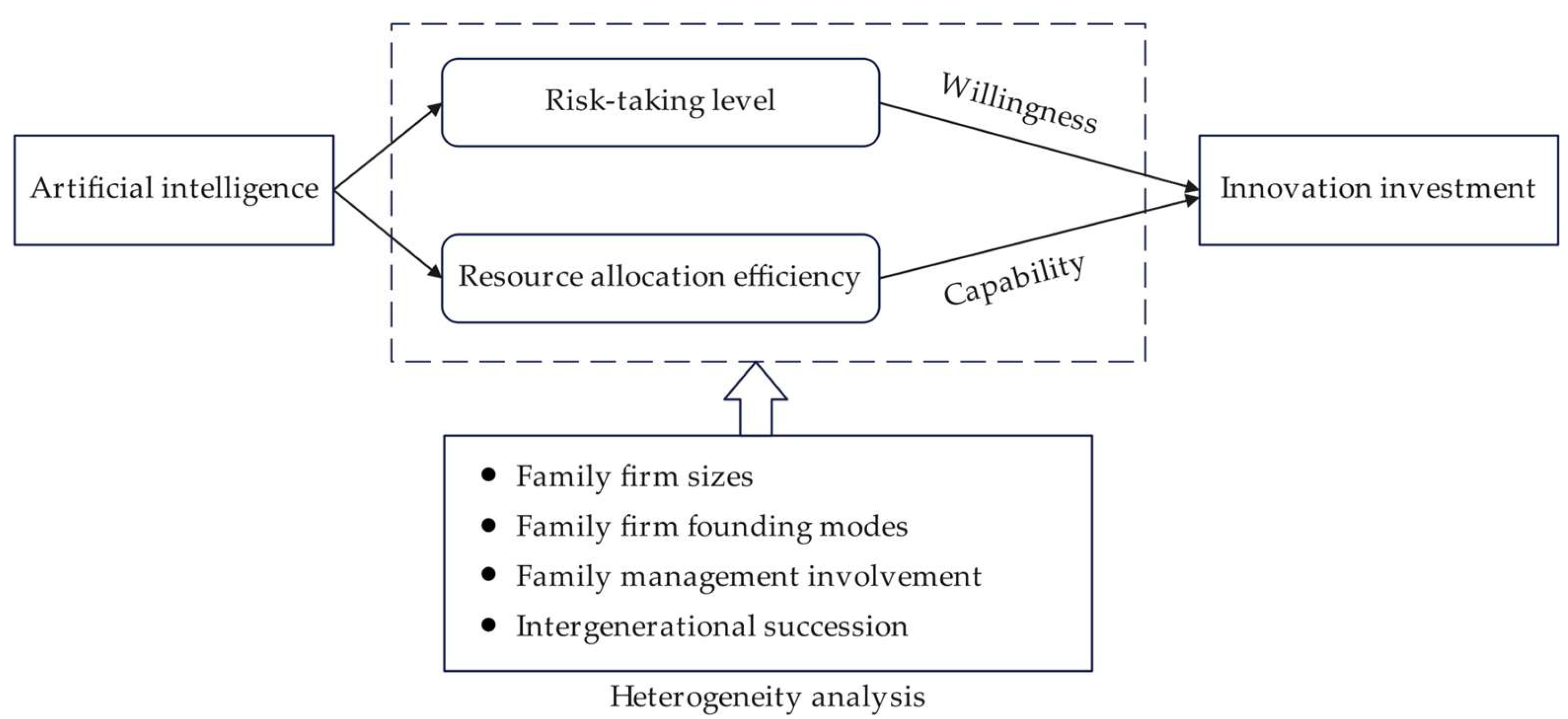
The heterogeneous characteristics of family firms provide a critical perspective for understanding AI’s impact on their innovation investments, which will help further validate our research hypotheses. We believe that different types of family firms exhibit varying risk-bearing capacities and resource allocation efficiencies, leading to differing impacts of AI on their innovation investments. Drawing on existing research, we will further analyze AI’s influence on family firm innovation investments by examining unique characteristics such as family business size, founding mode, family management involvement, and generational succession. Following the approach of de Melo et al. [42], the theoretical analysis framework for this paper is illustrated in Figure 1.

3.2. Heterogeneity Analysis Based on Different Family Firm Sizes

The differential impact of AI on innovation investment across family firm sizes reveals a nuanced reality: while AI universally enhances innovation capacity, its transformative potential is markedly amplified in small-scale family enterprises. This heterogeneity stems from the acute structural vulnerabilities inherent in smaller firms, which AI uniquely mitigates through dual mechanisms, risk recalibration and resource optimization, thereby unlocking innovation pathways previously constrained by systemic limitations. Small family firms operate within a “triple constraint” ecosystem. First, chronic capital scarcity forces severe trade-offs between operational stability and R&D expenditure. Unlike larger counterparts with access to capital markets or retained earnings buffers, small family firms face prohibitive borrowing costs due to limited collateral and perceived credit risk [15]. This financial fragility often compels them to cannibalize innovation budgets for immediate liquidity needs. Second, operational simplicity, characterized by narrow product lines and undiversified revenue streams, exacerbates innovation failure consequences. A single unsuccessful product launch can trigger disproportionate market share erosion, as these firms lack portfolio synergies to absorb shocks [43]. Third, informal governance structures prevalent in smaller family contexts, where strategic decisions hinge on patriarchal intuition rather than data-driven frameworks, impede systematic innovation pipeline management. Resource allocation often follows emotional or legacy-driven priorities rather than opportunity-scoring algorithms, leading to misaligned investments in low-impact projects [44]. Collectively, these constraints foster a risk-averse culture where survival imperatives eclipse exploratory innovation, creating what scholars term the “innovation paradox” of family firms: the entities most needing disruptive innovation to compete are structurally least equipped to pursue it.
AI directly destabilizes this paradox through context-specific interventions. For resource-constrained small firms, AI-driven predictive risk modeling transforms decision-making from intuition-based to evidence-based paradigms. By analyzing market sentiment, competitor patent filings, and consumer behavior patterns in real time, AI systems quantify innovation risks that were previously deemed “unknowable” [5]. This demystification effect reduces the psychological barrier to experimentation; for instance, a family-owned machinery manufacturer might use AI to simulate product failure scenarios before prototyping, converting abstract fears into quantifiable probabilities. Simultaneously, AI enables hyper-efficient resource orchestration. Cloud-based AI tools, like dynamic budget allocation algorithms, continuously realign human capital, finances, and time toward high-potential innovation streams. A small family firm could deploy AI to redirect field technicians from routine maintenance to prototype testing during low-season periods, effectively creating “invisible capacity” without new hires [45]. This “precision innovation” approach generates compounding returns: each successful micro-innovation (e.g., an AI-optimized irrigation component) builds managerial confidence, gradually rewiring risk perception and creating virtuous cycles of bolder experimentation.
Conversely, large family firms experience attenuated AI benefits due to institutional inertia. While they possess financial reserves to absorb innovation failures, their bureaucratic complexity often dilutes AI’s agility advantages. Multi-layered approval processes for AI implementation, requiring alignment across family councils, professional boards, and operational silos, delay deployment cycles beyond market relevance windows [46]. Moreover, their established innovation infrastructures (e.g., dedicated R&D departments) create path dependency; AI is frequently siloed as a supplementary tool rather than an innovation catalyst. A multinational family food processor might use AI only for incremental process optimization rather than disruptive product innovation, as legacy systems resist radical reconfiguration. Crucially, large firms’ diversification buffers paradoxically reduce the urgency for AI-driven innovation leaps. When a failed project impacts only 2% of total revenue, the organizational impetus to adopt transformative, but disruptive, AI solutions diminishes significantly compared to small firms where the same failure could threaten existential survival [47].
This size-based heterogeneity carries profound theoretical implications. It challenges the universalist assumption that digital tools benefit firms proportionally to their resources. Instead, AI acts as a “great equalizer” that disproportionately empowers structurally disadvantaged small family firms by compressing the experiential learning curves that larger firms accumulate over decades [39]. The technology’s real-time analytics substitute for the market intelligence networks that large firms build through scale, while its algorithmic resource allocation replicates the strategic planning capabilities embedded in mature governance systems. For small family firms, AI thus transcends its functional role to become an institutional surrogate, compensating for underdeveloped formal mechanisms while preserving the agility that defines their competitive edge. Future research should investigate how AI adoption timelines interact with family generational transitions, particularly whether next-generation leaders in small firms leverage AI to overcome conservative innovation legacies. Ultimately, policymakers must recognize that subsidizing AI access for small family enterprises is not merely technological upgrading—it’s a strategic intervention to correct systemic innovation inequalities embedded in capitalist ecosystems. Thus, we propose the following research hypothesis:
Hypothesis 2: 
Compared to larger family firms, the promotional effect of AI on innovation investment is more significant in smaller family firms.

3.3. Heterogeneity Analysis Based on Differences in Family Firm Founding Modes

The innovation-enhancing effect of AI in family enterprises is profoundly moderated by founding pathways, with directly founded family firms experiencing significantly stronger AI-driven innovation gains than those emerging from state-owned enterprise restructuring. This divergence stems from fundamental differences in institutional imprints, governance structures, and psychological orientations that shape how AI’s capabilities interact with organizational DNA [47]. While both types benefit from AI’s risk-mitigation and efficiency-enhancing properties, the technology functions as an institutional substitute in directly founded firms, compensating for deep-seated structural voids, whereas in SOE-transition firms, it serves merely as an incremental optimizer of pre-existing systems. Directly founded family firms, born from entrepreneurial kinship networks since China’s reform era, operate under a unique psychological and structural paradox. Founders typically maintain near-absolute control through concentrated equity and patriarchal authority, embedding their personal risk calculus into corporate strategy [48]. This creates what SEW theory identifies as “preservation bias”: the firm is perceived not as an economic vehicle but as an extension of familial identity and legacy [49]. Consequently, innovation decisions become emotionally charged, founders systematically overestimate failure consequences that threaten family reputation or control continuity while underestimating long-term competitive erosion from inaction. Compounding this, informal governance mechanisms dominate operational processes: resource allocation often follows relational logic (e.g., favoring kin-led projects) rather than strategic meritocracy, while critical innovation investments stall due to opaque approval hierarchies and undocumented decision protocols [29]. These firms inhabit institutional voids where market-supporting mechanisms, professional risk assessment frameworks, impartial talent evaluation systems, and dynamic capital reallocation processes, are systematically underdeveloped. Thus, their innovation deficit is not merely financial but institutional; even when capital is available, the absence of rational decision architectures stifles its effective deployment toward high-uncertainty ventures.
AI disrupts this pathological equilibrium through two pathway-specific mechanisms. First, it depersonalizes risk assessment by converting subjective uncertainty into quantifiable probabilities. For example, predictive algorithms analyzing market diffusion patterns, patent landscapes, and failure post-mortems provide objective benchmarks that override founders’ cognitive biases. A founder who historically rejected smart manufacturing investments due to visceral fear of obsolescence might accept AI-generated simulations showing 78% success probability under phased implementation, a data anchor that neutralizes emotional veto power [14]. Second, AI bypasses relational governance constraints through algorithmic resource orchestration. By embedding resource allocation in auditable, rules-based systems (e.g., AI-driven project scoring that weights technical feasibility, market potential, and strategic alignment equally), familial favoritism is circumvented. A case in point: a Zhejiang-based textile family firm replaced its founder’s ad hoc R&D budgeting with an AI optimizer that dynamically reallocated technician hours based on real-time project viability metrics, increasing innovation output by 40% without additional capital. Crucially, this institutional substitution effect is multiplicative; each successful AI-mediated innovation incrementally rebuilds founder confidence, gradually rewiring SEW preservation instincts toward exploratory orientations.
In stark contrast, SOE-transition family firms exhibit attenuated AI responsiveness due to their inherited institutional scaffolding. Emerging from 1990s-era privatization waves, these entities retain bureaucratic DNA: multi-tiered decision committees, formalized R&D budgeting protocols, and professionalized middle management layers that predate family acquisition [50]. Their innovation culture was institutionally shaped during SOE periods when state mandates prioritized technological upgrading, creating path-dependent capabilities in systematic experimentation [51]. Consequently, while AI enhances their resource allocation precision, it substitutes fewer critical functions. The same predictive analytics that revolutionize decision-making in directly founded firms merely refine existing processes in SOE-transition entities, for instance, optimizing already-robust stage-gate review systems rather than replacing intuitive judgments [52]. Moreover, residual state connections afford these firms access to government innovation subsidies and state-backed venture capital, reducing the existential pressure that makes AI adoption urgent for directly founded peers [53]. Paradoxically, their very strengths, established innovation pipelines and stakeholder legitimacy, create implementation friction: AI integration requires navigating legacy IT systems and union agreements absent in agile directly founded firms, slowing transformative impact [11].
This founding-pathway heterogeneity reveals AI’s role as an institutional equalizer. For directly founded firms trapped in emotional governance cycles, AI provides not just tools but institutional prosthetics, importing external rationality to compensate for internal voids. Its impact transcends operational efficiency to reshape organizational identity, gradually decoupling family legacy preservation from risk aversion. Future research should examine how AI adoption timelines interact with generational succession; second-generation leaders in directly founded firms may leverage AI to overcome founder conservatism while preserving emotional bonds. Policymakers, meanwhile, must recognize that digital transformation subsidies targeting family firms should prioritize directly founded entities, where AI functions as critical institutional infrastructure rather than productivity enhancement. Ultimately, this analysis challenges technological determinism by demonstrating that AI’s transformative power is not inherent in the technology itself, but in its alignment with specific institutional voids, a lesson with profound implications for emerging economy entrepreneurship. Thus, we propose the following hypothesis:
Hypothesis 3: 
Compared to indirectly founded family firms, the promotional effect of AI on innovation investment is more significant in directly founded family firms.

3.4. Heterogeneity Analysis Based on Differences in Family Management Involvement

The innovation-enhancing impact of AI in family enterprises exhibits significant heterogeneity based on the depth of family management involvement, with AI’s transformative effects intensifying in firms where family members dominate executive roles. This counterintuitive pattern arises because AI directly counteracts the very governance inefficiencies that high family involvement typically creates, transforming structural constraints into strategic advantages through institutional recalibration and cognitive reframing [54]. In firms with extensive family management involvement, innovation is systematically hindered by a dual governance paradox. On one hand, concentrated familial control generates SEW preservation imperatives that prioritize non-economic goals, such as reputation protection, intergenerational legacy continuity, and conflict avoidance, over profitability [55]. This manifests as acute risk aversion: family managers perceive innovation failures not merely as financial losses but as threats to the family’s social capital and identity, leading to systematic underinvestment in high-uncertainty R&D. On the other hand, operational decision-making suffers from cognitive entrenchment, where decades of intuitive, experience-based leadership create resistance to external data inputs. Resource allocation becomes relational rather than strategic, funds flow toward projects protecting family members’ authority domains or appeasing kinship factions rather than high-potential innovations [56]. Consequently, even when innovation intentions exist, execution falters due to biased capital distribution and misaligned talent deployment.
AI disrupts this paradox through two institutionally tailored mechanisms. First, it cognitive reframing of risk by converting abstract innovation threats into quantifiable, manageable variables. AI-powered predictive analytics, assessing market adoption curves, technology obsolescence risks, and competitive disruption probabilities, recontextualize innovation as asset preservation rather than risk-taking [57]. For instance, a third-generation family CEO previously rejecting AI integration due to job displacement fears might accept implementation when shown data indicating an 83% likelihood of business failure within five years without digital transformation. This transforms innovation from a SEW threat into a SEW safeguard, aligning emotional and economic imperatives. Second, AI institutionalizes objectivity in resource allocation through algorithmic governance [58]. By embedding investment decisions in auditable, rules-based systems, such as AI platforms that dynamically score projects using criteria like strategic alignment, failure recovery potential, and cross-generational skill development, familial favoritism is structurally circumvented. A machinery manufacturing firm in Guangdong exemplifies this: after implementing an AI resource allocator that deprioritized the patriarch’s favored but low-potential projects, R&D efficiency increased by 35% while family conflict over budgeting decreased by 60%, demonstrating how technology can depersonalize emotionally charged decisions [59].
Critically, high family involvement amplifies AI’s impact because these firms possess latent institutional advantages that facilitate adoption. Unlike professionally managed firms, family-dominated entities exhibit unified strategic intent. Once convinced of AI’s necessity, decision-making velocity accelerates due to centralized authority. Moreover, their long-term horizon (often spanning generations) aligns perfectly with AI’s compound returns, enabling patient capital allocation that public firms cannot replicate. This creates a virtuous cycle: initial AI-driven innovation successes build family confidence in data-driven governance, gradually reducing SEW-driven biases while preserving the stewardship ethos that defines family enterprise identity [28]. This heterogeneity reveals AI’s role as an institutional bridge between emotional governance and rational innovation. In highly family-involved firms, AI does not merely optimize processes; it reconstructs decision-making foundations by converting socioemotional constraints into strategic assets. Future research should investigate how AI adoption interacts with generational transitions, particularly whether technology-mediated objectivity prepares next-generation leaders for governance. For policymakers, supporting AI implementation in family-intensive firms represents not just technological upgrading but institutional modernization, a pathway to preserve family enterprise legacies while securing their competitive futures. Thus, we propose the following hypothesis:
Hypothesis 4: 
Compared to family firms with less family management involvement, the promotional effect of AI on innovation investment is more significant in family firms with greater family management involvement.

3.5. Heterogeneity Analysis Based on Intergenerational Succession in Family Firms

The innovation-enhancing effect of AI in family enterprises exhibits pronounced heterogeneity across generational transition phases, with pre-succession firms experiencing significantly stronger AI-driven innovation gains than post-succession counterparts. This divergence stems from AI’s unique capacity to resolve the acute institutional and psychological tensions inherent in founder-dominated transition periods, a capability less urgently needed in stabilized post-succession contexts where innovation barriers are structurally different [60]. During pre-succession phases, family firms operate under a dual institutional void: the absence of formal governance mechanisms to manage power transitions, coupled with the founder’s cognitive constraints shaped by decades of risk-averse stewardship [61]. Founders, often having built enterprises from scratch amid China’s volatile reform-era economy, view innovation through an SEW preservation lens. Their primary concern is not market disruption but legacy erosion: high-uncertainty R&D investments threaten both financial security and the symbolic continuity of their life’s work [62]. This psychological burden intensifies during succession limbo, where ambiguous authority boundaries between generations trigger what we term temporal myopia. Founders postpone strategic innovation to maintain operational control during transition negotiations, while potential successors withhold bold proposals to avoid destabilizing the transfer process [16]. Consequently, resource allocation freezes around “safe” legacy businesses, starving innovation pipelines despite market pressures. Crucially, this paralysis is not driven by capability gaps but by institutional fragility, the absence of neutral decision frameworks that could depersonalize high-stakes choices during emotionally charged transitions.
AI functions as an institutional prosthetic precisely calibrated to this void. Its primary value lies not in technical optimization but in cognitive bridging, translating abstract innovation risks into founder-intelligible preservation logic [63]. For instance, predictive analytics modeling industry disruption scenarios can reframe AI adoption as “legacy armor”: a Zhejiang-based appliance manufacturer’s founder rejected smart factory investments until AI simulations demonstrated a 78% probability of brand obsolescence within seven years without digital transformation, a threat framed not as financial loss but as erasure of his namesake legacy [17]. Simultaneously, AI enables control-preserving innovation by institutionalizing objectivity. Algorithmic resource allocators, scoring projects based on predefined criteria like “intergenerational skill transfer potential” or “legacy business resilience impact”, allow founders to approve high-impact innovation while retaining ultimate veto power. This satisfies their dual mandate: economic renewal occurs within SEW-protected boundaries, reducing the perceived trade-off between progress and preservation [64]. A Guangdong electronics firm exemplifies this: after implementing an AI system that deprioritized short-term R&D in favor of modular innovations protecting core manufacturing IP, the founder increased innovation budgets by 45% while retaining confidence in legacy continuity [65].
Post-succession firms, though more innovation-oriented, derive comparatively modest AI benefits due to fundamentally different constraints. Successors, often Western-educated with exposure to venture ecosystems, embrace innovation but face structural inertia from inherited organizational architectures. Their barriers are operational rather than psychological: legacy IT systems incompatible with AI integration, talent pools lacking data literacy, and stakeholder resistance from non-family executives appointed during founder eras [29]. While AI enhances its resource allocation efficiency, it cannot resolve these path-dependent institutional frictions as decisively as it neutralizes pre-succession cognitive barriers. Moreover, successors’ innovation appetite often outpaces their legitimacy; without the founder’s moral authority, they struggle to allocate resources without triggering board skepticism, a challenge AI cannot fully mitigate [27].
This succession-stage heterogeneity reveals AI’s transformative power as context-dependent institutional therapy. For pre-succession firms trapped in SEW-risk paradoxes, AI is not merely a tool but a transition catalyst that reconciles emotional governance with market imperatives. It enables founders to offload uncertainty onto algorithms while preserving symbolic control, ultimately accelerating succession by building confidence in the next generation’s ability to steward legacy through innovation [10]. Future research should examine how AI adoption timelines interact with specific succession models (e.g., merit-based vs. primogeniture), while policymakers could design “digital succession vouchers” subsidizing AI implementation for transitioning family firms. Theoretically, this reframes technology adoption not as productivity enhancement but as institutional substitution, a process where algorithms compensate for missing governance structures during critical organizational life stages. Thus, we propose the following hypothesis:
Hypothesis 5: 
Compared to family firms after generational succession, the promotional effect of AI on innovation investment is more significant in family firms before generational succession.

4. Research Design

4.1. Sample Selection and Data Sources

We first identify family firms. A firm is classified as a family firm if it satisfies both of the following criteria: (1) Its ultimate controller is either a single natural person or a group of individuals related by kinship; and (2) The ultimate controller is the largest shareholder of the listed company, either directly or indirectly. Specifically, following the Li et al. [66], we identify and cross-validate the identity of the ultimate controller and familial relationships among family members through an extensive review of publicly available company documents, including: (1) Annual reports, prospectuses, IPO announcements, interim disclosures, shareholder agreements, top-10 shareholder ownership data, and executive biographies; and (2) For potential undisclosed familial ties among board members, supervisors, and senior executives, we conduct supplementary online searches using search engines such as Google and Baidu to verify possible kinship links.
Our final sample consists of Chinese A-share listed family firms from 2007 to 2024. We begin in 2007 because the China Securities Regulatory Commission (CSRC) mandated standardized disclosure of R&D expenditures for listed firms starting that year, making R&D data widely available from then onward. All firm-level data are drawn from the China Stock Market & Accounting Research (CSMAR) database. To ensure data quality, we apply the following sample filters: (1) Financial and insurance firms are excluded due to their distinct accounting practices; (2) ST and *ST firms (i.e., financially distressed firms under special treatment) are excluded; and (3) Observations with missing or erroneous key variables are removed. After these exclusions, the final sample comprises 25,048 firm-year observations. To mitigate the influence of outliers, all continuous variables are winsorized at the 1st and 99th percentiles.

4.2. Variable Definition

The dependent variable, innovation investment (RD). Following the approach of Duran et al. [31], we measure innovation investment in family firms using the ratio of R&D expenditure to operating revenue. To ensure the reliability of the findings, robustness tests will also be conducted using the ratio of R&D expenditure to total assets and the natural logarithm of corporate R&D expenditure.
The independent variable, artificial intelligence (AI). Following the approach of Yao et al. [67] and Guo et al. [68], we construct an AI indicator using keyword frequency analysis of AI-related terms in corporate annual reports. The specific measures are as follows: (1) We scraped the annual reports of listed companies from the CNINFO website (the official information disclosure website for listed companies designated by the CSRC, https://www.cninfo.com.cn (accessed on 5 May 2025)), converted them into plain text format, and utilized the Python (version 3.13) open-source module “Jieba” for Chinese word segmentation. (2) Leveraging the Skip-Gram architecture within the Word2Vec framework, semantic similarity analysis is conducted. Seed terms such as “artificial intelligence”, “machine learning”, and “natural language processing” are used to identify semantically proximate terms. For each seed term, the 10 most contextually relevant terms are extracted based on cosine similarity between input and output word vectors. (3) We filtered out words unrelated to AI, along with repetitions and low-frequency terms, to create our AI dictionary for this paper. Finally, we counted the frequency of these AI keywords in each annual report. The firm’s AI indicator is measured as the natural logarithm of the total count of AI keywords in the firm’s annual report plus one.
Control variables. We control for several firm-level variables: firm size (Size), leverage ratio (Lev), return on assets (Roa), cash holdings (Cash), firm age (Age), board size (Board), proportion of independent directors (Indep), and CEO-chair duality (Dual). We also include a key variable capturing family firm characteristics: controlling family shareholding ratio (FShare). Detailed variable definitions are provided in Table 1.

4.3. Model

In order to examine the impact of AI on innovation investment in family firms, we establish the following regression model (1):
R D i , t = α 0 + α 1 A I i , t + α 2 S i z e i , t + α 3 L e v i , t + α 4 R o a i , t + α 5 C a s h i , t + α 6 A g e i , t   + α 7 B o a r d i , t + α 8 I n d e p i , t + α 9 D u a l i , t + α 10 F S h a r e i , t + Σ F i r m + Σ Y e a r + ε i , t
where subscripts i and t denote firm and year, respectively. RD is the dependent variable measuring family firms’ innovation investments. AI is the independent variable measuring artificial intelligence. Control variables are described in Table 1. Firm and Year are the firm-fixed effects and the year-fixed effects. ε is the random disturbance term. α0 is the intercept term, and α1 is the estimated parameter of the independent variable AI. If α1 is significantly positive, it indicates that AI can promote the innovation investment of family firms.

5. Empirical Analysis

5.1. Descriptive Statistics

Table 2 describes all the key variables in our study. The mean of RD is 0.053, indicating that the average R&D investment intensity of family firms is 5.3%, reflecting a relatively low level of innovation investment. The mean of AI is 1.044, indicating that the average frequency of AI keywords in family firms’ annual reports is 1.044. And the standard deviation is 1.281, indicating significant variation in the average level of AI among different family firms.

5.2. Regression Analysis

Table 3 reports the regression results on the impact of AI on family firms’ innovation investment. In column (1), without including control variables, the coefficient on AI is 0.0026, and AI is significantly positively correlated with RD at the 1% level. In column (2), after incorporating control variables, the AI coefficient is 0.0023, and AI is significantly positively correlated with RD at the 1% level. The economic implication of this coefficient is that a one-unit increase in AI adoption leads to a 0.23% increase in innovation investment by family businesses. These results indicate that AI positively promotes innovation investment in family firms, thereby supporting Hypothesis 1.
To examine the differential impact of AI on innovation investment across family firms of varying sizes, we divided the sample into larger and smaller firm groups based on the annual median of company asset size and conducted grouped regression analysis. The results of Hypothesis 2 are shown in columns (1) and (2) of Table 4. The regression coefficients on AI are positive and statistically significant across firm-size subsamples, indicating that AI adoption enhances innovation investment among family firms of varying scales. Notably, the coefficient is both larger in magnitude and more precisely estimated (i.e., higher significance) in the subsample of smaller family firms compared to their larger counterparts. A formal test confirms that the difference between the two coefficients is statistically significant at the 1% level. These findings suggest that the positive impact of AI on innovation investment is markedly stronger for smaller family firms than for larger ones.
To examine the differential impact of AI on innovation investment in family firms established through different founding approaches, we categorized family firms into direct-founded and indirectly founded groups based on their establishment methods, and conducted grouped regression analysis. The results of Hypothesis 3 are shown in columns (3) and (4) of Table 4, the AI coefficient is positive and statistically significant at the 1% level only for directly founded family firms, not for indirectly founded ones; the intergroup difference is also significant at the 1% level, indicating a more pronounced AI–innovation link in the former.
To examine the differential impact of AI on innovation investment in family firms with varying levels of family member involvement in management. Following the methodology of Migliori et al. [23], we measured family management involvement by the proportion of family members on the board of directors, supervisors, and senior management. Based on the annual median of this measure, we partition the sample into two subsamples, high family involvement and low family involvement, and conduct subgroup regressions accordingly. The results of Hypothesis 4 are shown in columns (5) and (6) of Table 4. The coefficient on AI is positive and statistically significant in both subsamples, indicating that AI consistently promotes innovation investment across family firms, irrespective of the degree of family managerial involvement. Notably, when family managerial involvement is high, the regression coefficient and significance level of AI are higher than the low involvement group. And the Chow Test reveals that the difference in coefficients between the two groups is statistically significant at the 1% level. These results suggest that the promotional effect of AI on innovation investment is more significant in family firms with greater family management involvement compared to those with less involvement.
To examine the differential impact of AI on innovation investment in family firms before and after intergenerational succession. We define the pre-succession group as observations in which the founder serves as either CEO or chairman, and the post-succession group as all remaining observations, and then perform subgroup regressions. The regression results of Hypothesis 5 are shown in columns (7) and (8) of Table 4. The coefficient on AI is statistically significant and positive in both groups, indicating that AI promotes innovation investment in family firms regardless of whether intergenerational succession has occurred. Moreover, both the magnitude and statistical significance of the AI coefficient are higher in the pre-succession group than in the post-succession group, and the difference between the two coefficients is statistically significant at the 1% level. These findings suggest that compared to the post-succession period, the promotional effect of AI on innovation investment is more significant in family firms prior to intergenerational succession.

5.3. Robustness Test

5.3.1. Lag the Independent Variable by One Period

To address potential reverse causality, where innovation investment may affect the adoption of AI technologies, we employ the one-period lag of the independent variable to resolve this problem. Specifically, we lag the AI variable by one period and re-estimate the regression in Equation (1), keeping all other variables constant. As shown in Column (1) of Table 5, the coefficient on L_AI remains positive and statistically significant at the 1% level, confirming the robustness of our primary findings.

5.3.2. Instrumental Variable

To further address potential reverse causality between AI and innovation investment, along with possible endogeneity issues arising from omitted key variables (e.g., digital infrastructure and managerial capabilities), we adopt an instrumental variable (IV) approach. Following the methodology of Zhou et al. [69], we adopt the mean AI of other family firms in the same industry and year as the IV (Other_AI). Family firms operating in the same industry and year are exposed to comparable external conditions and industry-specific features, which may lead to correlated AI adoption levels. However, a firm’s innovation investment should not be directly influenced by the AI adoption of other family firms, satisfying the relevance and exogeneity requirements for a valid instrumental variable. The selected IV passes both the weak instrument test and the underidentification test. We use the two-stage least squares (2SLS) method estimation, as reported in Columns (2) and (3) of Table 5. Column (2) presents the first-stage regression results, where the coefficient on Other_AI is significantly positive, confirming the instrument’s relevance. Column (3) shows the second-stage results, in which the AI coefficient stays positive and significant at the 1% level. Our main findings hold up after controlling for both omitted variable bias and reverse causality.

5.3.3. Propensity Score Matching

The adoption of AI technology by family firms is likely non-random and may be influenced by various external factors, which could lead to self-selection bias. Therefore, we use the propensity score matching (PSM) method to address this. Specifically, we use the control variables in Model (1) as covariates and apply a one-to-one with replacement nearest neighbor matching method. After sample matching, all standardized mean differences in covariates are below 5% in absolute value, and t-tests do not reject the null hypothesis of equal means across groups. This indicates that the PSM procedure achieves a satisfactory balance. Column (4) of Table 5 reports the regression estimates based on the matched sample, where the AI coefficient remains positive and statistically significant, supporting the robustness of our main findings.

5.3.4. Replacing the Indicators of Key Variables

First, replace the measurement method of AI. We remeasure AI by using the natural logarithm of the number of AI-related keywords in the MD&A section of family firms’ annual reports, adding one to the count (AI_MD&A). Moreover, considering that the AI measurement relies entirely on the frequency of AI-related keywords in annual reports, this metric may not fully capture a firm’s actual level of AI adoption. Following the approach of Li and Bai [70], we instead measure AI intensity using a firm’s investment in artificial intelligence (AI_Invest). Specifically, we calculate this indicator as the sum of the firm’s investments in AI-related intangible and tangible assets divided by its total assets for the year. We then re-estimate the regression model (1) using this alternative measure. As shown in Columns (1) and (2) of Table 6, the coefficients on AI_MD&A and AI_Invest remain significantly positive.
Second, replace the measurement method of RD. Following Duran et al. [31], we alternatively measure family firms’ innovation investment using R&D expenditure scaled by total assets (RD_Assets) and the natural logarithm of R&D expenditure plus one (LnRD), and re-estimate the regression model accordingly. Columns (3) and (4) of Table 6 show that, when using these alternative measures of innovation investment, the coefficient on AI remains significantly positive, indicating the robustness of our main findings.

5.3.5. Replacing the Regression Model

Since corporate R&D expenditure is truncated data with a lower bound of zero, some family firms reported zero R&D investment. Therefore, we re-estimate the model using the Tobit regression. As shown in Column (5) of Table 6, the AI coefficient stays positive and significant at the 1% level, indicating that our findings are robust to this alternative modeling approach.

5.3.6. Adjusting the Sample Period

The development of modern AI technology underwent a transformative shift in 2012. With major breakthroughs in deep learning, AI began demonstrating unprecedented application potential across multiple fields. This technological leap spurred intense global attention toward the socioeconomic transformations AI could bring, prompting nations worldwide to incorporate AI into their national strategic development plans to secure a competitive edge in future technologies. Therefore, we limit the sample to the period 2013–2024 and re-estimate the model (1). As shown in Column (6) of Table 6, the coefficient on AI remains significantly positive, suggesting that our main findings are robust to this revised sample period.

6. Further Analysis

6.1. Mechanism Test

6.1.1. Risk-Taking Level

Family firms’ willingness to invest in innovation is strongly influenced by their capacity for risk-taking. In the context of China, where stock market volatility is pronounced, earnings volatility is commonly employed as a proxy for corporate risk-taking behavior. To test the “risk-taking level” mechanism through which AI promotes innovation investment in family firms, following the approach of Quigley et al. [71], we use earnings volatility of family firms as a proxy for their risk-taking level (Risk).
R i s k i , t = 1 T 1 t = 1 T ( a d j _ R o a i , t 1 T t = 1 T a d j _ R o a i , t ) 2 , T = 3
where adj_Roa is the return on assets (Roa) adjusted by the industry and year-specific average. We compute the standard deviation of adj_Roa using a rolling three-year window. The larger the value of Risk, the higher the risk-taking level of the family firms.
Columns (1) and (2) of Table 7 report the test results for the risk-taking mechanism. Column (1) shows that the AI coefficient is positive and statistically significant at the 1% level, suggesting that AI adoption enhances the risk-taking level of family firms. Column (2) shows that the coefficient on Risk is also positively and statistically significant at the 1% level, suggesting that AI promotes family firms’ innovation investment by improving their risk-taking levels. In other words, risk-taking levels exert a partial mediating effect between AI and family firms’ innovation investment.

6.1.2. Resource Allocation Efficiency

Efficient resource allocation is a necessary precondition for conducting innovation activities. To test the “resource allocation efficiency” mechanism through which AI promotes family firms’ innovation investment, following Richardson [72], we use the level of inefficient investment (Inefficiency) in family firms to measure resource allocation efficiency. Inefficient investment is specifically categorized into overinvestment and underinvestment. Overinvestment causes firms to allocate excessive resources to projects with low returns, preventing resources from effectively flowing into innovation activities, resulting in resource waste and increased innovation costs. Underinvestment prevents enterprises from securing sufficient resources to carry out innovation activities, thereby limiting their capacity for innovation investment. A higher absolute value of Inefficiency indicates greater inefficient investment and lower resource allocation efficiency in family firms.
Columns (3) and (4) of Table 7 report the test results for the resource allocation efficiency mechanism. Column (3) shows that the coefficient on AI is negatively and significantly associated with inefficient investment at the 5% level. This indicates that AI reduces inefficient investment in family firms, meaning AI improves their resource allocation efficiency. Column (4) shows that the coefficient on Inefficiency is negatively and significantly associated with innovation investment at the 1% level, suggesting that AI promotes family firms’ innovation investment by improving their resource allocation efficiency. In other words, resource allocation efficiency serves as a partial mediator in the relationship between AI and innovation investment in family firms.

6.2. Innovation Performance Test

As previously discussed, AI promotes innovation investment in family firms. To further examine AI’s role in promoting sustainable innovation within family firms, we evaluate its impact on innovation performance through the lens of innovation output.
Following the approach of Brav et al. [72], we measure family firms’ innovation performance using the natural logarithm of the total number of patent applications filed in the current (Patentt) and the lagged year (Patentt+1). Additionally, to more objectively capture the quality of innovation, we also use the natural logarithm of the number of invention patent applications filed in the current (Patent_invt) and the lagged year (Patent_invt+1) as an alternative measure of innovation performance. Using Model (1), the dependent variable was replaced with innovation performance while keeping all other variables unchanged for regression analysis.
As shown in Table 8. Columns (1) and (2) examine the impact of AI on the total number of patent applications by family firms. The coefficients on AI are positively significant at least at the 5% level, indicating that AI adoption increases the number of patent applications. Columns (3) and (4) examine the impact of AI on the number of invention patent applications. The coefficients on AI are positively significant at the 1% level, suggesting that AI also enhances the number of invention patent applications. These results collectively demonstrate that AI significantly improves the innovation performance of family firms, further corroborating its positive impact on their innovation activities.

7. Conclusions

Compared with non-family firms, family firms generally suffer from insufficient innovation investment. However, the rapid development and widespread application of AI technologies have created new opportunities for innovation in family firms. Using a sample of Chinese A-share listed family firms from 2007 to 2024, this paper empirically examines the impact of AI on innovation investment in family firms. The results show that AI significantly promotes innovation investment in family firms, suggesting that AI improves their innovation decision-making and stimulates their innovative vitality, thereby enhancing their competitiveness and capacity for sustainable development. Mechanism analysis shows that AI enhances family firms’ willingness and capacity to engage in innovation by improving their risk-taking levels and resource allocation efficiency, which in turn promotes their innovation investment. Based on family business firms, heterogeneity analyses indicate that the promotion effect of AI on innovation investment is more significant among smaller family firms, those directly founded by the family, those with more family involvement in management, and those prior to intergenerational succession. Furthermore, this paper also finds that AI improves the innovation performance of family firms, indicating that AI not only stimulates innovation input but also enhances innovation output.
Based on the above conclusions, this study proposes the following policy recommendations and analytical discussions.
First, from a strategic and regulatory perspective, family firms must navigate the paradox of leveraging AI to overcome inherent conservatism while managing the unique ethical risks associated with concentrated ownership. The empirical evidence suggests that AI acts as a critical compensatory mechanism for the resource constraints and risk aversion typically found in smaller, founder-led family firms. In these entities, the traditional Confucian hierarchy often prioritizes stability and socioemotional wealth (SEW) preservation over high-risk R&D ventures. AI technologies, by providing data-driven predictive analytics, can effectively “depersonalize” risk assessment, allowing founders to make innovation decisions based on algorithmic probability rather than intuitive caution. However, this digital transformation introduces complex governance challenges within the context of China’s evolving regulatory landscape, specifically the 2023 Interim Measures for the Management of Generative Artificial Intelligence Services. As these regulations emphasize algorithmic transparency and content security, family firms, historically characterized by opacity and information asymmetry to protect family secrets, face a significant compliance burden. There is a palpable risk that in firms with highly concentrated ownership, AI deployment could be weaponized to reinforce centralized control rather than democratize innovation. If the “black box” of family decision-making is simply replaced by the “black box” of non-transparent algorithms, the firm risks exacerbating agency problems and alienating minority shareholders. Furthermore, the integration of AI must be philosophically aligned with China’s “Common Prosperity” ethos. If AI is used solely to maximize family wealth through labor substitution or aggressive market dominance, it invites regulatory backlash. Therefore, policy and strategy must pivot toward “Human-in-the-Loop” frameworks where AI augments rather than replaces the human capital that defines the family firm’s culture. This requires a shift from viewing AI merely as a technological tool to viewing it as a sociotechnical system that must safeguard data privacy and ethical standards, preventing the amplification of familial biases through algorithmic means.
Second, the modernization of governance in family firms requires a dual-track approach that integrates external technical expertise with the internal cultivation of “digital successors,” all while aligning with national strategic imperatives. The finding that AI promotes innovation more significantly in firms with high family involvement suggests that family oversight is not inherently antithetical to tech adoption, provided the right capabilities exist. To institutionalize this, governance structures must evolve beyond traditional board compositions. The establishment of specialized “Digital Transformation Committees” staffed by external AI experts and data scientists is essential to counterbalance the insular, groupthink-prone nature of family boards. However, external mechanisms are insufficient without internal transformation. The intergenerational succession period offers a unique window of opportunity; the “Next Generation” of family leaders, often educated abroad and digital natives, should be positioned as “change catalysts.” By bridging the gap between the traditional entrepreneurial spirit (the “founder’s shadow”) and modern algorithmic management, these successors can legitimize AI adoption as a tool for legacy preservation rather than legacy destruction. This internal strategy must be contextualized within China’s macro-policy environment, specifically the 15th Five-Year Plan’s focus on high-quality development and digital talent. Family firms are uniquely positioned to serve as reservoirs for this talent, but they often struggle to compete with tech giants for personnel. Consequently, policy interventions should focus on correcting these market failures. Targeted subsidies and tax incentives for digital infrastructure should not be blanket measures but should be specifically directed toward SMEs in less-developed provinces. This aligns with the national goal of rural revitalization, ensuring that the productivity gains from AI are not restricted to coastal economic zones. By supporting the digital transformation of family firms in the hinterlands, the state can prevent a “digital innovation divide”, where only resource-rich, metropolitan conglomerates can afford the AI tools necessary to compete, thereby fostering a more balanced regional economic ecosystem.
Third, future research and policy design must adopt a more granular, context-sensitive lens that examines how AI interacts with the informal institutions of Chinese business, specifically the Guanxi ecosystem and state-firm relations. While the current study establishes a positive correlation between AI and innovation, the “black box” of how AI interacts with the distinct heterogeneity of Chinese family firms remains largely unexplored. A critical area for deep analysis is the tension between AI’s data-driven logic and the relationship-driven logic of Guanxi. In the Chinese market, business transactions are often governed by interpersonal trust and reciprocal networks. As family firms adopt AI for supply chain management and customer relationship analysis, there is a theoretical risk that the depersonalization of these interactions could erode the social capital that family firms have historically relied upon. Future scholarship should investigate whether AI acts as a substitute for Guanxi (by reducing the need for personal trust through transparent data) or a complement (by optimizing network management). Furthermore, the distinction between state-connected and purely private family firms warrants longitudinal study. State-connected firms may face different coercive pressures to adopt AI to demonstrate political loyalty, potentially leading to symbolic adoption rather than substantive integration. Conversely, private firms may adopt AI purely for survival and efficiency. Policy mechanisms, therefore, cannot be one-size-fits-all. The implementation of “AI Innovation Vouchers” or regional “Sandbox Regulations” would allow family firms, which are typically risk-averse, to experiment with AI applications in a controlled environment without fear of immediate punitive regulatory consequences. Ultimately, the goal is to harmonize technological advancement with socialist core values. This necessitates interdisciplinary scholarship that looks beyond economic metrics to examine the ethical externalities of AI. By ensuring that algorithmic accountability is woven into succession planning and corporate strategy, family firms can ensure that their digital transformation reinforces sustainable development imperatives, creating value that is not only economic but also socially responsible and aligned with the long-term stability of the Chinese economy.

Author Contributions

Conceptualization, K.W. and S.Z.; methodology, C.Z.; software, K.W. and S.Z.; validation, K.W., S.Z. and C.Z.; formal analysis, K.W.; investigation, S.Z.; resources, C.Z.; data curation, K.W.; writing—original draft preparation, K.W. and S.Z.; writing—review and editing, C.Z.; visualization, K.W. and S.Z.; supervision, C.Z.; project administration, K.W. and C.Z.; funding acquisition, C.Z. All authors have read and agreed to the published version of the manuscript.

Funding

This research was funded by the National Social Science Fund of China [grant number 19AGL009]; and the Jiangsu Province Postgraduate Scientific Research Innovation Project [grant number KYCX24_1655].

Institutional Review Board Statement

Not applicable.

Informed Consent Statement

Not applicable.

Data Availability Statement

The raw data supporting the conclusions of this article will be made available by the authors on request.

Acknowledgments

The authors wish to express heartfelt gratitude to the anonymous reviewers and the editors of this article for their invaluable comments.

Conflicts of Interest

The authors declare no conflicts of interest.

References

  1. Kotlar, J.; Fang, H.; De Massis, A.; Frattini, F. Profitability goals, control goals, and the R & D investment decisions of family and nonfamily firms. J. Prod. Innov. Manag. 2014, 31, 1128–1145. [Google Scholar] [CrossRef]
  2. Naldi, L.; Nordqvist, M.; Sjöberg, K.; Wiklund, J. Entrepreneurial orientation, risk taking, and performance in family firms. Fam. Bus. Rev. 2007, 20, 33–47. [Google Scholar] [CrossRef]
  3. Chrisman, J.J.; Patel, P.C. Variations in R&D investments of family and nonfamily firms: Behavioral agency and myopic loss aversion perspectives. Acad. Manag. J. 2012, 55, 976–997. [Google Scholar] [CrossRef]
  4. Block, J.H. R&D investments in family and founder firms: An agency perspective. J. Bus. Ventur. 2012, 27, 248–265. [Google Scholar] [CrossRef]
  5. Calabrò, A.; Vecchiarini, M.; Gast, J.; Campopiano, G.; De Massis, A.; Kraus, S. Innovation in family firms: A systematic literature review and guidance for future research. Int. J. Manag. Rev. 2019, 21, 317–355. [Google Scholar] [CrossRef]
  6. Gan, J.; Liu, L.; Qiao, G.; Zhang, Q. The role of robot adoption in green innovation: Evidence from China. Econ. Model. 2023, 119, 106128. [Google Scholar] [CrossRef]
  7. Tekic, Z.; Füller, J. Managing innovation in the era of AI. Technol. Soc. 2023, 73, 102254. [Google Scholar] [CrossRef]
  8. Brynjolfsson, E.; Hui, X.; Liu, M. Does machine translation affect international trade? Evidence from a large digital platform. Manag. Sci. 2019, 65, 5449–5460. [Google Scholar] [CrossRef]
  9. Zou, W.; Xiong, Y. Does artificial intelligence promote industrial upgrading? Evidence from China. Econ. Res. Ekon. Istraž. 2023, 36, 1666–1687. [Google Scholar] [CrossRef]
  10. Kakatkar, C.; Bilgram, V.; Füller, J. Innovation analytics: Leveraging artificial intelligence in the innovation process. Bus. Horiz. 2020, 63, 171–181. [Google Scholar] [CrossRef]
  11. Zhang, S.; Chen, Z. Experts on the board: How do IT-savvy directors promote corporate digital innovation? Econ. Anal. Policy 2025, 85, 791–817. [Google Scholar] [CrossRef]
  12. Rammer, C.; Fernández, G.P.; Czarnitzki, D. Artificial intelligence and industrial innovation: Evidence from German firm-level data. Res. Policy 2022, 51, 104555. [Google Scholar] [CrossRef]
  13. Jaskiewicz, P.; Combs, J.G.; Rau, S.B. Entrepreneurial legacy: Toward a theory of how some family firms nurture transgenerational entrepreneurship. J. Bus. Ventur. 2015, 30, 29–49. [Google Scholar] [CrossRef]
  14. Ashwin, A.; Krishnan, R.T.; George, R. Family firms in India: Family involvement, innovation and agency and stewardship behaviors. Asia Pac. J. Manag. 2015, 32, 869–900. [Google Scholar] [CrossRef]
  15. Werner, A.; Schröder, C.; Chlosta, S. Driving factors of innovation in family and non-family SMEs. Small Bus. Econ. 2018, 50, 201–218. [Google Scholar] [CrossRef]
  16. Xu, N.; Yuan, Q.; Jiang, X.; Chan, K.C. Founder’s political connections, second generation involvement, and family firm performance: Evidence from China. J. Corp. Financ. 2015, 33, 243–259. [Google Scholar] [CrossRef]
  17. Xu, J.; Xiao, H. The impact of government subsidies on the persistence of firm innovation: Evidence from China. Appl. Econ. 2024, 56, 8884–8899. [Google Scholar] [CrossRef]
  18. Fang, L.H.; Lerner, J.; Wu, C. Intellectual property rights protection, ownership, and innovation: Evidence from China. Rev. Financ. Stud. 2017, 30, 2446–2477. [Google Scholar] [CrossRef]
  19. Grossman, G.M.; Helpman, E. Quality ladders in the theory of growth. Rev. Econ. Stud. 1991, 58, 43–61. [Google Scholar] [CrossRef]
  20. Autor, D.H. Why are there still so many jobs? The history and future of workplace automation. J. Econ. Perspect. 2015, 29, 3–30. [Google Scholar] [CrossRef]
  21. Raisch, S.; Fomina, K. Combining human and artificial intelligence: Hybrid problem-solving in organizations. Acad. Manag. Rev. 2025, 50, 441–464. [Google Scholar] [CrossRef]
  22. Schmid, T.; Achleitner, A.-K.; Ampenberger, M.; Kaserer, C. Family firms and R&D behavior–New evidence from a large-scale survey. Res. Policy 2014, 43, 233–244. [Google Scholar] [CrossRef]
  23. Migliori, S.; De Massis, A.; Maturo, F.; Paolone, F. How does family management affect innovation investment propensity? The key role of innovation impulses. J. Bus. Res. 2020, 113, 243–256. [Google Scholar] [CrossRef]
  24. Sun, W.; Huang, C.; Su, Z. How do non-family CEOs influence family firm innovation performance? Manag. Decis. 2023, 61, 2945–2972. [Google Scholar] [CrossRef]
  25. Anderson, R.C.; Reeb, D.M. Founding-family ownership and firm performance: Evidence from the S&P 500. J. Financ. 2003, 58, 1301–1328. [Google Scholar] [CrossRef]
  26. Khan, R.U.; Richardson, C.; Salamzadeh, Y. Spurring competitiveness, social and economic performance of family-owned SMEs through social entrepreneurship; a multi-analytical SEM & ANN perspective. Technol. Forecast. Soc. Change 2022, 184, 122047. [Google Scholar] [CrossRef]
  27. Haefner, N.; Wincent, J.; Parida, V.; Gassmann, O. Artificial intelligence and innovation management: A review, framework, and research agenda. Technol. Forecast. Soc. Change 2021, 162, 120392. [Google Scholar] [CrossRef]
  28. Liu, J.; Chang, H.; Forrest, J.Y.-L.; Yang, B. Influence of artificial intelligence on technological innovation: Evidence from the panel data of China’s manufacturing sectors. Technol. Forecast. Soc. Change 2020, 158, 120142. [Google Scholar] [CrossRef]
  29. Babina, T.; Fedyk, A.; He, A.; Hodson, J. Artificial intelligence, firm growth, and product innovation. J. Financ. Econ. 2024, 151, 103745. [Google Scholar] [CrossRef]
  30. Rizomyliotis, I.; Kastanakis, M.N.; Giovanis, A.; Konstantoulaki, K.; Kostopoulos, I. “How mAy I help you today?” The use of AI chatbots in small family businesses and the moderating role of customer affective commitment. J. Bus. Res. 2022, 153, 329–340. [Google Scholar] [CrossRef]
  31. Duran, P.; Kammerlander, N.; Van Essen, M.; Zellweger, T. Doing more with less: Innovation input and output in family firms. Acad. Manag. J. 2016, 59, 1224–1264. [Google Scholar] [CrossRef]
  32. Li, J.; Tang, Y. CEO hubris and firm risk taking in China: The moderating role of managerial discretion. Acad. Manag. J. 2010, 53, 45–68. [Google Scholar] [CrossRef]
  33. John, K.; Litov, L.; Yeung, B. Corporate governance and risk-taking. J. Financ. 2008, 63, 1679–1728. [Google Scholar] [CrossRef]
  34. Gomez-Mejia, L.R.; Cruz, C.; Berrone, P.; De Castro, J. The bind that ties: Socioemotional wealth preservation in family firms. Acad. Manag. Ann. 2011, 5, 653–707. [Google Scholar] [CrossRef]
  35. Simon, M.; Houghton, S.M. The relationship between overconfidence and the introduction of risky products: Evidence from a field study. Acad. Manag. J. 2003, 46, 139–149. [Google Scholar] [CrossRef]
  36. Davenport, T.H.; Kirby, J. Only Humans Need Apply: Winners and Losers in the Age of Smart Machines; Harper Business: New York, NY, USA, 2016; Volume 1. [Google Scholar]
  37. Zhang, Y.; Chang, Y.; Zhang, X.; Zhou, H. Artificial Intelligence and Enterprise Technological Innovation: Evidence from China. Manag. Decis. Econ. 2025, 46, 4056–4069. [Google Scholar] [CrossRef]
  38. Sun, Z.; Wu, X.; Dong, Y.; Lou, X. How Does Artificial Intelligence Application Enable Sustainable Breakthrough Innovation? Evidence from Chinese Enterprises. Sustainability 2025, 17, 7787. [Google Scholar] [CrossRef]
  39. Li, C.; Xu, Y.; Zheng, H.; Wang, Z.; Han, H.; Zeng, L. Artificial intelligence, resource reallocation, and corporate innovation efficiency: Evidence from China’s listed companies. Resour. Policy 2023, 81, 103324. [Google Scholar] [CrossRef]
  40. Lou, B.; Wu, L. AI on drugs: Can artificial intelligence accelerate drug development? Evidence from a large-scale examination of bio-pharma firms. MIS Q. 2021, 45, 1451–1482. [Google Scholar] [CrossRef]
  41. Briscoe, F.; Rogan, M. Coordinating complex work: Knowledge networks, partner departures, and client relationship performance in a law firm. Manag. Sci. 2016, 62, 2392–2411. [Google Scholar] [CrossRef]
  42. de Melo, G.A.; Peixoto, M.G.M.; Barbosa, S.B.; Mendonça, M.C.A.; Nogueira, T.H.; Guerra, J.B.S.O.d.A.; de Castro Júnior, L.G.; Serrano, A.L.M.; Ferreira, L.O.G. Fuel flow logistics: An empirical analysis of performance in a network of gas stations using principal component analysis and data envelopment analysis. J. Adv. Manag. Res. 2024, 21, 605–626. [Google Scholar] [CrossRef]
  43. Knott, A.M.; Vieregger, C. Reconciling the firm size and innovation puzzle. Organ. Sci. 2020, 31, 477–488. [Google Scholar] [CrossRef]
  44. Skorodziyevskiy, V.; Sherlock, C.; Su, E.; Chrisman, J.J.; Dibrell, C. Strategic change in family firms: A review from an institutional environment and firm size perspective. Fam. Bus. Rev. 2024, 37, 130–160. [Google Scholar] [CrossRef]
  45. Kraiczy, N.D.; Hack, A.; Kellermanns, F.W. What makes a family firm innovative? CEO risk-taking propensity and the organizational context of family firms. J. Prod. Innov. Manag. 2015, 32, 334–348. [Google Scholar] [CrossRef]
  46. Sullivan, Y.; Wamba, S.F. Artificial intelligence and adaptive response to market changes: A strategy to enhance firm performance and innovation. J. Bus. Res. 2024, 174, 114500. [Google Scholar] [CrossRef]
  47. Sciascia, S.; Nordqvist, M.; Mazzola, P.; De Massis, A. Family ownership and R&D intensity in small-and medium-sized firms. J. Prod. Innov. Manag. 2015, 32, 349–360. [Google Scholar] [CrossRef]
  48. Zulfiqar, M.; Chen, S.; Yousaf, M.U. Birth mode of family firms, family entering time and R&D investment: Evidence from China. Eur. J. Innov. Manag. 2022, 25, 1242–1265. [Google Scholar] [CrossRef]
  49. Colombo, M.G.; De Massis, A.; Piva, E.; Rossi-Lamastra, C.; Wright, M. Sales and employment changes in entrepreneurial ventures with family ownership: Empirical evidence from high-tech industries. J. Small Bus. Manag. 2014, 52, 226–245. [Google Scholar] [CrossRef]
  50. Su, S.; Zhu, F.; Zhou, H.; Zhu, Z. Family firm heterogeneity and innovation: The role of firm origin and family involvement. J. Small Bus. Manag. 2025, 1–44. [Google Scholar] [CrossRef]
  51. Gong, X.; Liu, S. Family firm ownership and corporate innovation performance. Financ. Res. Lett. 2025, 80, 107366. [Google Scholar] [CrossRef]
  52. Balsmeier, B.; Fleming, L.; Manso, G. Independent boards and innovation. J. Financ. Econ. 2017, 123, 536–557. [Google Scholar] [CrossRef]
  53. Han, F.; Mao, X. Artificial intelligence empowers enterprise innovation: Evidence from China’s industrial enterprises. Appl. Econ. 2024, 56, 7971–7986. [Google Scholar] [CrossRef]
  54. Gomez–Mejia, L.R.; Campbell, J.T.; Martin, G.; Hoskisson, R.E.; Makri, M.; Sirmon, D.G. Socioemotional wealth as a mixed gamble: Revisiting family firm R&D investments with the behavioral agency model. Entrep. Theory Pract. 2014, 38, 1351–1374. [Google Scholar] [CrossRef]
  55. Liang, Q.; Li, X.; Yang, X.; Lin, D.; Zheng, D. How does family involvement affect innovation in China? Asia Pac. J. Manag. 2013, 30, 677–695. [Google Scholar] [CrossRef]
  56. Bendig, D.; Foege, J.N.; Endriß, S.; Brettel, M. The effect of family involvement on innovation outcomes: The moderating role of board social capital. J. Prod. Innov. Manag. 2020, 37, 249–272. [Google Scholar] [CrossRef]
  57. Ma, J.; Shang, Y.; Liang, Z. Digital transformation, artificial intelligence and enterprise innovation performance. Financ. Res. Lett. 2025, 78, 107190. [Google Scholar] [CrossRef]
  58. Martínez-Alonso, R.; Martínez-Romero, M.J.; Rojo-Ramírez, A.A. The impact of technological innovation efficiency on firm growth: The moderating role of family involvement in management. Eur. J. Innov. Manag. 2020, 23, 134–155. [Google Scholar] [CrossRef]
  59. Soluk, J.; Miroshnychenko, I.; Nambisan, S. AI Adoption in Family Firms: A Mixed-Methods Study on the Paradoxical Roles of Passive and Active Family Involvement. J. Prod. Innov. Manag. 2025, 1–44. [Google Scholar] [CrossRef]
  60. Bennedsen, M.; Nielsen, K.M.; Pérez-González, F.; Wolfenzon, D. Inside the family firm: The role of families in succession decisions and performance. Q. J. Econ. 2007, 122, 647–691. [Google Scholar] [CrossRef]
  61. Baltazar, J.R.; Fernandes, C.I.; Ramadani, V.; Hughes, M. Family business succession and innovation: A systematic literature review. Rev. Manag. Sci. 2023, 17, 2897–2920. [Google Scholar] [CrossRef]
  62. Zhu, Z.; Kang, Y. A far-reaching parental love? Co-governance of intergenerational succession and innovation activities in Chinese family firms. Manag. Organ. Rev. 2022, 18, 358–394. [Google Scholar] [CrossRef]
  63. Mehrotra, V.; Morck, R.; Shim, J.; Wiwattanakantang, Y. Adoptive expectations: Rising sons in Japanese family firms. J. Financ. Econ. 2013, 108, 840–854. [Google Scholar] [CrossRef]
  64. Wu, Q.; Wang, Y.; Chu, H.; Chen, J. Innovation in Family Firms: An Intergenerational Tale of Symbol and Substance. Manag. Organ. Rev. 2025, 21, 336–367. [Google Scholar] [CrossRef]
  65. Li, W.; Bruton, G.D.; Li, X.; Wang, S. Transgenerational succession and R&D investment: A myopic loss aversion perspective. Entrep. Theory Pract. 2022, 46, 193–222. [Google Scholar] [CrossRef]
  66. Yao, J.; Zhang, K.; Guo, L.; Feng, X. How Does Artificial Intelligence Improve Firm Productivity? Based on the Perspective of Labor Skill Structure Adjustment. J. Manag. World 2024, 40, 101–116+133+117–122. [Google Scholar] [CrossRef]
  67. Guo, L.; Pei, H.; Liu, Y. Artificial Intelligence and Corporate Green Innovation: Evidence from China. Res. Int. Bus. Financ. 2025, 79, 103039. [Google Scholar] [CrossRef]
  68. Zhou, Y.; Xu, J.; Liu, Z.; Feng, J. Digital transformation and innovation strategy selection: The contingent impact of organizational and environmental factors. IEEE Trans. Eng. Manag. 2023, 71, 9744–9763. [Google Scholar] [CrossRef]
  69. Li, G.; Bai, Y. How does Application of Artificial Intelligence Affect the Innovation Performance of Manufacturing Enterprises? Collect. Essays Financ. Econ. 2024, 12, 102–112. [Google Scholar] [CrossRef]
  70. Quigley, T.J.; Hambrick, D.C.; Misangyi, V.F.; Rizzi, G.A. CEO selection as risk-taking: A new vantage on the debate about the consequences of insiders versus outsiders. Strateg. Manag. J. 2019, 40, 1453–1470. [Google Scholar] [CrossRef]
  71. Richardson, S. Over-investment of free cash flow. Rev. Account. Stud. 2006, 11, 159–189. [Google Scholar] [CrossRef]
  72. Brav, A.; Jiang, W.; Ma, S.; Tian, X. How does hedge fund activism reshape corporate innovation? J. Financ. Econ. 2018, 130, 237–264. [Google Scholar] [CrossRef]
Figure 1. Theoretical analysis framework.
Sustainability 17 11127 g001
Table 1. Variable definition.
Variable TypeVariableSymbolDefinition
Dependent
variable
Innovation
investment
RD R & D   expenditure / Operating   revenue
Independent
variable
Artificial intelligenceAI Ln ( 1 + Total   number   of   AI   keywords   in   the   firm s   annual   report )
Control
variables
Firm sizeSize Ln ( Total   assets )
Leverage ratioLev Total   liabilities / Total   assets
Return on assetsRoa Net   income / Total   assets
Cash holdingsCash ( Cash   and   cash   equivalents ) / Total   assets
Firm ageAge Ln ( Total   number   of   years   sin ce   the   firm s   IPO )
Board sizeBoard Ln ( Total   number   of   board   members )
Proportion of independent directorsIndep Independent   directors / Total   board   members
CEO-chair dualityDual Dummy = 1 ,   if   the   chairman   of   the   board   and   the   CEO     are   the   same   person ,   and   0   otherwise
Controlling family shareholding ratioFShare Shares   held   by   controlling   family / Total   share   capital
Table 2. Descriptive statistics.
VariablesObservationsMeanStd. Dev.MinMedianMax
RD25,0480.0530.0580.0000.0390.345
AI25,0481.0441.2810.0000.6934.691
Size25,04821.8511.04519.88721.71525.062
Lev25,0480.3650.1900.0460.3500.844
Roa25,0480.0420.062−0.2230.0440.203
Cash25,0480.2030.1440.0190.1620.704
Age25,0481.7050.9120.0001.7923.332
Board25,0482.0680.1901.3862.1972.773
Indep25,0480.3800.0510.3330.3640.571
Dual25,0480.4170.4930.0000.0001.000
FShare25,0480.4250.1650.1120.4110.807
Table 3. Testing the impact of AI on family firms’ innovation investment.
Variables(1)(2)
RDRD
AI0.0026 ***0.0023 ***
(5.11)(4.56)
Size 0.0023 **
(2.01)
Lev −0.0409 ***
(−9.52)
Roa −0.1377 ***
(−15.24)
Cash −0.0030
(−0.83)
Age 0.0039 ***
(4.14)
Board 0.0048
(1.22)
Indep 0.0014
(0.12)
Dual 0.0001
(0.08)
FShare 0.0160 ***
(2.83)
Constant0.0506 ***−0.0026
(94.16)(−0.10)
Firm FEYesYes
Year FEYesYes
Obs25,04825,048
Adj.R20.81310.8260
Notes: The t-statistics reported in parentheses are adjusted based on the clustering at the firm level. ***, ** denote significance at the 1%, 5% levels, respectively. Same as in the following tables.
Table 4. Heterogeneity test.
Variables(1)(2)(3)(4)(5)(6)(7)(8)
Firm SizeFounding ModeFamily InvolvementIntergenerational Succession
LargerSmallerDirectIndirectMoreLessBeforeAfter
AI0.0013 **0.0035 ***0.0020 ***0.00160.0028 ***0.0010 *0.0022 ***0.0017 **
(2.37)(3.99)(4.09)(1.21)(3.94)(1.92)(4.04)(2.38)
Size −0.00080.00210.00230.00100.00230.0022 *
(−0.67)(1.08)(0.89)(0.86)(1.35)(1.73)
Lev−0.0307 ***−0.0456 ***−0.0427 ***−0.0253 ***−0.0428 ***−0.0249 ***−0.0441 ***−0.0278 ***
(−5.82)(−6.71)(−8.31)(−3.01)(−6.67)(−5.81)(−7.60)(−5.06)
Roa−0.1251 ***−0.1491 ***−0.1629 ***−0.0793 ***−0.1800 ***−0.0944 ***−0.1586 ***−0.0989 ***
(−10.11)(−11.51)(−15.54)(−4.55)(−12.54)(−10.05)(−12.97)(−7.25)
Cash−0.0091 *−0.0032−0.0068 *−0.0018−0.0107 **0.0053−0.0051−0.0007
(−1.82)(−0.66)(−1.76)(−0.23)(−2.11)(1.08)(−1.12)(−0.12)
Age0.00160.0067 ***0.0041 ***0.01620.0062 ***0.00050.0042 ***0.0032 **
(1.09)(4.05)(3.72)(1.42)(3.91)(0.41)(3.39)(2.30)
Board0.0109 ***0.00740.0089 **−0.0027−0.00080.0103 **0.00630.0052
(2.74)(1.28)(2.02)(−0.36)(−0.14)(2.52)(1.25)(1.10)
Indep0.01520.02180.0183−0.0533 **−0.01710.00920.00470.0076
(1.27)(1.33)(1.52)(−2.58)(−1.13)(0.68)(0.36)(0.47)
Dual0.0006−0.00040.00060.00020.00000.0008−0.00040.0004
(0.48)(−0.37)(0.63)(0.10)(0.00)(0.82)(−0.28)(0.37)
FShare0.0113 *0.0314 ***0.0230 ***0.00330.0186 *0.00720.0222 **0.0111 *
(1.89)(3.15)(3.75)(0.37)(1.91)(1.34)(2.35)(1.87)
Constant0.0270 **0.0324 *0.0545 **−0.02670.02440.00500.0006−0.0200
(2.18)(1.92)(2.00)(−0.48)(0.44)(0.18)(0.02)(−0.63)
Firm FEYesYesYesYesYesYesYesYes
Year FEYesYesYesYesYesYesYesYes
Obs12,52912,51920,962408612,53712,51117,2037845
Adj.R20.84680.83030.84180.72570.83030.85380.83960.8063
Chow Test3.0123.8915.787.92
p-value0.0008 ***0.0000 ***0.0000 ***0.0000 ***
Notes: The statistical significance of the difference in coefficients between groups is estimated using the Chow Test. ***, **, and * denote significance at the 1%, 5%, and 10% levels, respectively.
Table 5. Robustness test I.
Variables(1)(2)(3)(4)
RDAIRDRD
L_AI0.0015 ***
(2.69)
Other_AI 0.9621 ***
(58.31)
AI 0.0259 ***0.0030 ***
(21.74)(4.50)
Size0.0026 **0.1351 ***0.00080.0032 **
(2.07)(8.85)(0.81)(2.26)
Lev−0.0381 ***−0.1452 *−0.0921 ***−0.0357 ***
(−8.59)(−1.87)(−17.92)(−7.44)
Roa−0.1311 ***−0.6495 ***−0.1717 ***−0.1145 ***
(−14.34)(−3.54)(−10.86)(−10.63)
Cash0.00010.3204 ***0.0168 ***−0.0041
(0.01)(3.74)(3.15)(−0.99)
Age−0.0001−0.0283 *−0.0056 ***0.0040 ***
(−0.05)(−1.68)(−6.10)(3.43)
Board0.00430.03890.00510.0082 *
(1.01)(0.45)(1.07)(1.84)
Indep−0.00360.05790.00570.0087
(−0.30)(0.19)(0.33)(0.66)
Dual−0.00020.0622 **0.0056 ***0.0016
(−0.20)(2.38)(3.97)(1.47)
FShare0.0119 **−0.1551 *−0.0217 ***0.0139 **
(2.00)(−1.83)(−4.34)(2.03)
Constant0.0019−2.9105 ***0.0507 **−0.0366
(0.07)(−7.45)(2.26)(−1.20)
Firm FEYesYesYesYes
Year FEYesYesYesYes
Obs21,55325,04825,04824,813
Adj.R2/Pseudo R20.83730.47170.24020.8523
Notes: ***, **, and * denote significance at the 1%, 5%, and 10% levels, respectively.
Table 6. Robustness test II.
Variables(1)(2)(3)(4)(5)(6)
RDRDRD_AssetsLnRDRDRD
AI_MD&A0.0023 ***
(4.62)
AI_Invest 0.6510 ***
(6.23)
AI 0.0010 ***0.3908 ***0.0023 ***0.0016 ***
(4.77)(10.55)(4.56)(3.60)
Size0.0024 **0.0028 **−0.0027 ***1.1802 ***0.0023 **0.0022 *
(2.13)(2.44)(−5.66)(16.05)(2.01)(1.66)
Lev−0.0407 ***−0.0404 ***−0.0007−1.2635 ***−0.0409 ***−0.0436 ***
(−9.45)(−9.55)(−0.43)(−3.14)(−9.52)(−9.51)
Roa−0.1376 ***−0.1354 ***0.0055 **1.3072 *−0.1374 ***−0.1477 ***
(−15.20)(−15.17)(1.97)(1.88)(−15.25)(−15.91)
Cash−0.0030−0.0025−0.0041 ***0.6770 **−0.0030−0.0054
(−0.82)(−0.67)(−3.26)(1.99)(−0.82)(−1.40)
Age0.0038 ***0.0038 ***0.0011 ***−0.6959 ***0.0039 ***0.0060 ***
(4.02)(3.98)(2.92)(−7.41)(4.14)(5.82)
Board0.00490.00500.00140.08260.00480.0025
(1.25)(1.30)(0.87)(0.26)(1.22)(0.61)
Indep0.00100.00140.00080.52670.00130.0013
(0.10)(0.13)(0.16)(0.47)(0.12)(0.11)
Dual0.0001−0.0001−0.00030.2443 ***0.0001−0.0003
(0.14)(−0.06)(−0.64)(2.90)(0.07)(−0.32)
FShare0.0157 ***0.0148 ***0.0045 **−0.7659 **0.0160 ***0.0145 **
(2.80)(2.65)(1.97)(−2.16)(2.83)(2.38)
Constant−0.0046−0.01310.0763 ***−8.5840 ***−0.0765 ***0.0083
(−0.19)(−0.53)(7.67)(−5.19)(−3.20)(0.29)
Firm FEYesYesYesYesYesYes
Year FEYesYesYesYesYesYes
Obs25,04825,04825,04825,04825,04822,101
Adj.R20.82600.82770.81380.48940.65990.8471
Notes: ***, **, and * denote significance at the 1%, 5%, and 10% levels, respectively.
Table 7. Mechanism test.
Variables(1)(2)(3)(4)
RiskRDInefficiencyRD
AI0.0011 ***0.0017 ***−0.0013 **0.0023 ***
(3.05)(3.25)(−2.32)(4.58)
Risk 0.0325 **
(2.35)
Inefficiency −0.0113 ***
(−3.80)
Size−0.0057 ***0.0027 **0.0081 ***0.0022 *
(−6.93)(2.16)(9.18)(1.91)
Lev0.0130 ***−0.0380 ***0.0238 ***−0.0411 ***
(4.17)(−8.58)(5.54)(−9.55)
Roa−0.1450 ***−0.1262 ***0.0657 ***−0.1382 ***
(−22.95)(−14.10)(7.61)(−15.24)
Cash0.0107 ***−0.0001−0.0137 ***−0.0028
(4.38)(−0.02)(−3.94)(−0.77)
Age0.0095 ***−0.0005−0.0060 ***0.0040 ***
(8.71)(−0.31)(−8.68)(4.22)
Board0.00230.0041−0.00590.0049
(0.73)(0.96)(−1.43)(1.25)
Indep0.0121−0.0043−0.0224 *0.0016
(1.27)(−0.36)(−1.67)(0.15)
Dual−0.0001−0.00030.00090.0001
(−0.08)(−0.27)(0.76)(0.06)
FShare−0.0158 ***0.0124 **0.0237 ***0.0157 ***
(−3.77)(2.12)(4.32)(2.79)
Constant0.1288 ***−0.0011−0.1641 ***−0.0004
(6.92)(−0.04)(−7.42)(−0.01)
Firm FEYesYesYesYes
Year FEYesYesYesYes
Obs25,04825,04825,04825,048
Adj.R20.42100.83800.00290.8261
Notes: ***, **, and * denote significance at the 1%, 5%, and 10% levels, respectively.
Table 8. Innovation performance test.
Variables(1)(2)(3)(4)
PatenttPatentt+1Patent_invtPatent_invt+1
AI0.0474 ***0.0334 **0.0734 ***0.0685 ***
(3.16)(2.02)(5.26)(4.45)
Size0.4877 ***0.4228 ***0.4692 ***0.4150 ***
(14.99)(13.26)(15.66)(13.81)
Lev−0.2962 ***−0.3445 ***−0.2462 ***−0.2647 ***
(−2.86)(−3.12)(−2.63)(−2.67)
Roa0.07121.1020 ***0.11470.9317 ***
(0.45)(6.50)(0.75)(5.66)
Cash−0.2484 ***−0.2056 **−0.2100 ***−0.1802 **
(−2.96)(−2.37)(−2.81)(−2.30)
Age0.0821 ***0.04590.0489 *0.0260
(2.71)(1.43)(1.78)(0.90)
Board0.10540.06670.03960.0373
(1.01)(0.59)(0.41)(0.36)
Indep0.0033−0.0161−0.0280−0.0339
(0.01)(−0.05)(−0.10)(−0.11)
Dual0.03000.03840.02590.0610 **
(1.10)(1.34)(1.00)(2.22)
FShare0.20970.2312−0.06440.0124
(1.15)(1.21)(−0.41)(0.07)
Constant−8.1545 ***−6.5121 ***−8.2966 ***−7.0458 ***
(−10.74)(−8.68)(−11.94)(−9.92)
Firm FEYesYesYesYes
Year FEYesYesYesYes
Obs25,04821,55325,04821,553
Adj.R20.75430.75580.73400.7377
Notes: ***, **, and * denote significance at the 1%, 5%, and 10% levels, respectively.
Disclaimer/Publisher’s Note: The statements, opinions and data contained in all publications are solely those of the individual author(s) and contributor(s) and not of MDPI and/or the editor(s). MDPI and/or the editor(s) disclaim responsibility for any injury to people or property resulting from any ideas, methods, instructions or products referred to in the content.