1. Introduction
It is undeniable that entrepreneurial education (EE) in high school and academic institutions has several advantages [
1,
2]. Firstly, entrepreneurial education gives high school and university students alternative career options and, ultimately, the confidence to set up their own businesses. Entrepreneurial skills are useful both for people who have a job and for people who are self-employed, such as hybrid entrepreneurs [
3,
4,
5].
According to Moberg [
6], many researchers considered entrepreneurship as divided into two dimensions: entrepreneurial science, and entrepreneurial art. Entrepreneurial science, which is characterised by “hard” and codifiable skills (such as business planning, financing and evaluating business opportunities), is considered teachable, while entrepreneurial art, which is characterised by “soft and tacit” skills (such as skills dealing with uncertainty, creativity and resource sharing) is considered a learning disability. This perception is understandable, but unfortunately it is misleading. Indeed, it is easier for the education system to focus on skills of a more codifiable nature, which can be taught with traditional educational methods. According to Moberg’s research [
6], the focus only on these types of skills does not have a very strong impact on high school and university students (participants in education).
Honig [
7] found that in the United States, of the top 100 universities, 78 offer courses related to business plan development, while 10 of the top 12 universities (including Harvard, Wharton, Stanford) hold business plan competitions (recently replaced by business model competitions). However, studies on the effects of teaching business planning on entrepreneurial learning and behaviour are scarce and inconclusive.
Certain entrepreneurial abilities, such as initiative, originality, and proactivity, are challenging to evaluate using conventional tests. These abilities were often considered to be innate rather than taught [
8,
9,
10,
11]. However, in the literature it is also generally accepted that traditional methods (e.g., writing business plans) are less effective in stimulating entrepreneurship. It seems that such methods make high school students inactive, and they may prepare a university student to work with an entrepreneur, but not to become one.
In this context, our research question is: Can EE help high school and university students develop confidence in their personal skills and the ability to take risks when involved in entrepreneurial endeavours?
According to Neck and Greene [
11], EE enables an individual to assimilate and develop knowledge, skills, values and understanding which will be useful for defining, analysing and solving a wide range of problems. According to Chang and Rieple [
12], EE aims to develop students’ mindset, behaviours, skills and capabilities, which will create the future entrepreneurs. Several studies show the positive impact of EE on the rate of entrepreneurial intention or actual business start-up [
13,
14,
15,
16]. Using a meta-analysis of 73 studies, Bae et al. [
17] report a positive relationship between EE and entrepreneurial intentions. In Canada, based on data from the General and Social Surveys (2000–2009), Masakure [
18] found that post-secondary EE had a positive impact on the rate of business creation.
Thus, among all the factors which can influence entrepreneurship and business creation, this research study focuses on risk perception and self-efficacy in the emergence of entrepreneurial intentions considered as the most important precursor factors of entrepreneurial intention [
19]. The primary role of these two factors in the emergence of entrepreneurial intentions was highlighted by several studies [
20,
21,
22,
23,
24,
25,
26,
27]. Regarding risk perception, studies show that individuals with a higher risk tolerance are open to getting involved in entrepreneurship [
25,
28,
29,
30], and also the fact that risk is thought to slow down entrepreneurial activity [
31,
32]. Barbosa et al. [
32] present the inconclusive results of an exploratory study on the analysis of risk perception and self-efficacy in the emergence of entrepreneurial intentions using a sample of 17 subjects. Moreover, in Romania, in the context where entrepreneurship is a priority for the development of the economy, no studies have been conducted considering risk perception and self-efficacy in the emergence of entrepreneurial intentions among high school and university students. Few studies concentrate on sustainability-oriented entrepreneurial goals in Romania, despite the expanding body of research on entrepreneurial education and its effects on psychological mechanisms. In this study, entrepreneurial intentions are examined within a sustainability-oriented educational and economic context, reflecting the growing relevance of sustainability considerations in contemporary entrepreneurial processes. The purpose of this study is to investigate how entrepreneurship education influences young people’s inclinations to pursue sustainable ventures. The following theories were developed in light of this goal. In this context, this study proposes a multidimensional approach from the perspective of the most important influencing factors in the emergence of entrepreneurial intentions. Using existing studies in the field of entrepreneurship [
24,
32,
33,
34,
35,
36,
37,
38], we aim to measure risk perception and self-efficacy in the emergence of entrepreneurial intentions in colleges and universities in Romania. As part of the transitions towards sustainability and the growing importance of sustainable entrepreneurship, entrepreneurship education is now expected to go beyond mere skills development, including through the integration of artificial intelligence elements [
39,
40]. This study examines how entrepreneurial education influences entrepreneurial intentions through two key psychological mechanisms: self-efficacy and risk perception.
While the structural relationships examined in this study are grounded in established entrepreneurial intention models, the novelty of this research lies in their integration within a sustainability-oriented educational framework. Specifically, the study contextualises these mechanisms in Romania and emphasises the role of entrepreneurial education in shaping sustainability-aligned entrepreneurial intentions among young people. Thus, the contribution is primarily conceptual and contextual rather than methodological.
2. Literature Review and Frame of Reference: Theoretical Background
2.1. Entrepreneurial Education
Entrepreneurial education is a relatively newly researched field, recording the fastest growth rate in terms of materialised scientific output [
41,
42]. According to studies in the field, EE has a strong impact on the future entrepreneurial intentions of its beneficiaries or subjects [
43]. Among the main determining factors of the practical manifestation of entrepreneurial intentions are included the personality traits (risk-taking, proactivity) which can be perfected in entrepreneurial courses [
44,
45]. The components of EE include entrepreneurial learning, entrepreneurial skills and entrepreneurial intentions [
46,
47]. Specialists are still debating the way entrepreneurial characteristics appear in individuals, whether they are innate or acquired through learning [
48,
49,
50,
51]. In this sense, entrepreneurial education supports both people with innate entrepreneurial skills, by fixing specific concepts and notions, and people who subsequently acquired an affinity towards the entrepreneurial field [
52]. EE is also focused on the analysis of students’ activities in terms of the effectiveness of tasks of a personal nature, which would later correspond to the possession of general entrepreneurial skills [
53].
Empirical research which dealt extensively with the concept of EE [
54,
55,
56] helped by scoring, defining and highlighting entrepreneurial concepts, facilitating further applied research.
Entrepreneurship as a management activity with perspectives of integrating its principles into the educational curriculum found its value in the works of many authors [
57,
58,
59,
60], but the current connections of entrepreneurship in the teaching system have been prominently highlighted since the beginning of the 21st century. The importance of learning entrepreneurial principles through their integration in education is obviously beneficial and important to the extent that these assimilated principles, notions and entrepreneurial foundations are integrated in the current and future activity of high school and university students, young people in general [
61,
62,
63,
64].
Tendencies towards analysing the challenges involving the implementation of entrepreneurial education programs in the current era have been manifested since 2003, when entrepreneurship was already recognised as a dynamic, visionary, challenging and change-making activity [
65,
66]. In recent years, researchers in the field have conducted extensive surveys and have applied studies which reiterated the significantly positive effects of entrepreneurial education on students’ future entrepreneurial intentions [
14,
67].
Entrepreneurial education involves a beneficial impact not only on students, who will later apply some assimilated entrepreneurial concepts and attitudes, but also on the entire society as a whole [
68].
Among the first concerns and implicitly firm and official measures regarding entrepreneurial education, we mention the activities of the European Commission, which in 2004 recommended the inclusion of entrepreneurial education in the curricula, starting from the elementary school and up to the university (included). At the European level, entrepreneurship education is explicitly honoured as a crucial policy instrument for fostering entrepreneurial mindsets, employability, and sustainable profitable development. The European Commission emphasises the part of education systems in developing entrepreneurial capabilities across all situations of education, as reflected in the Entre Comp framework and affiliated policy documents [
69,
70]. Currently, the vision of the European Commission is materialised through its projects, which aim to support the development of entrepreneurial ecosystems, to acquire and improve entrepreneurial skills, to raise awareness of the importance of EE, to facilitate the exchange of good practices, and to create support tools through their own strategy [
71].
2.2. Risk Perception
Entrepreneurship derives from people’s desire and preference to work on their own account [
72], which can generate the accumulation of social capital, increase social productivity and promote technological innovation, which are the fundamental elements underlying economic growth supported by the country [
73]. According to Elnadi and Gheith [
74], entrepreneurship can be perceived as a risk-generating process of an individual involved in entrepreneurial activities, open to taking risks, willing to change, dissatisfied with current conditions and an explorer of opportunities regarding value creation.
The literature identified that the risk ratio had a determining role in entrepreneurship. Indeed, the very first definition of the entrepreneur [
75] issued in the 18th century already established a close relationship between entrepreneurship and risk. Schumpeter [
76] mentioned that entrepreneurship was related to risk-taking, which led de Blasio et al. [
25] to observe that since then, risk-taking has been associated with starting a business. Entrepreneurs are not so different from other people, but they are better at assessing risks or estimating possible losses [
77]. The entrepreneur is a risk taker and is inclined to take the risks of their business. Kuechle [
24] postulates that risk is implicit in entrepreneurship, whether it involves identifying a need, creating a new market, or exploiting a business opportunity, as entrepreneurial behaviour involves a series of expectations regarding outcomes which cannot always be achieved, involving the possibility of failure. It is well known that entrepreneurs typically face more significant risks compared to employees [
78]. Among the risks entrepreneurs face are income risk and failure risk. In addition, there are studies showing that individuals with higher risk tolerance are open to engage in entrepreneurship [
25], even if risk is considered to slow down entrepreneurial activity, because it is associated with the perception of potential losses which can also negatively affect entrepreneurial intentions [
32]. So far, the concept of risk remains at the heart of entrepreneurship [
79,
80]. According to McCarthy [
20], the concept of risk dominates the literature, and the ability to bear risk has been identified as the main challenge faced by entrepreneurs. Therefore, we can conclude that risk taking is a major feature which made it possible to differentiate between entrepreneurs and non-entrepreneurs.
The study of decision-making behaviour classified risk into three categories: risk perception, risk appetite, and risk readiness [
21]. Risk appetite and risk perception influence risk taking [
81].
From a general perspective, risk perception was conceptualised as a risk assessment [
82,
83] which determines entrepreneurial decision-making. Sitkin and Weingart [
84] defined risk perception as a subjective interpretation of expected loss which was influenced by the individual perception of decision uncertainty and its consequences. Risk perception thus derives from the evaluation of chances and probabilities and is a critical factor between predictive or non-predictive, logic-based decision making. Non-predictive decisions emphasise process management over outcomes [
85]. Threat perception was measured as a general cognitive construct reflecting individuals’ attitudes toward entrepreneurial tasks, rather than threats related to a specific business idea. This approach is consistent with previous intention-based studies and allows meaningful comparisons across respondents with different levels of entrepreneurial experience. Still, differences between undergraduate and university students may exist and should be explored in future research through group or longitudinal analyses.
Brockhaus [
86] defined risk appetite as “the perceived probability of receiving rewards associated with success in a proposed situation, which is required by an individual before submitting to the consequences associated with failure, the other situation offering fewer rewards, as well as less serious consequences than the situation suggests” (p. 513). On the other hand, risk appetite is usually defined as a person’s general tendency to take or avoid risk in a given decision-making context [
83].
Kyro and Tapani [
87] showed that risk taking is a skill which can be taught and learned. The risk-taking is a central dimension of entrepreneurial behaviour. Hence, in this study we assess the impact of EE on risk perception by high school and university students in Romania. We want to understand the potential relationship between risk perception and entrepreneurial intention.
2.3. Self-Efficacy
The notion of self-efficacy is defined as an individual’s beliefs about their ability to mobilise the cognitive, motivational and behavioural resources necessary to perform a specific task in a given context [
88,
89]. Self-efficacy beliefs influence the choices people make. Most people engage in tasks in which they feel competent and confident and avoid those in which they are not [
90,
91,
92].
De Noble et al. [
93] mobilise the concept of self-efficacy in the field of entrepreneurship. They found that many participants in their study mentioned a “can do attitude”. This attitude may have been the most important critical issue which the study participants faced when starting and developing a new business. De Noble et al. [
93] define entrepreneurial self-efficacy as a concept which measures an individual’s confidence in their own abilities to take advantage of a new business opportunity.
Campo [
94] defined entrepreneurial self-efficacy as the extent to which a person believes they are capable of successfully starting a new venture. Segal et al. [
22] and Wilson et al. [
23] further stated that entrepreneurial self-efficacy played a key role in determining the level of interest in an entrepreneurial career. Specifically, entrepreneurial self-efficacy is seen as the extent to which a person believes they are capable of successfully starting a new business [
95,
96].
The concept of entrepreneurial self-efficacy developed by [
93] has six dimensions: developing new products and new business opportunities, creating an innovative environment, establishing relationships with investors, defining the primary objective, managing unforeseen challenges, and developing essential human resources.
Newman et al. [
97] relate self-efficacy to EE; they believe that through EE people’s self-motivation increases. Self-efficacy is believed to develop and influence entrepreneurial outcomes. Self-efficacy is a mechanism of motivation, behaviours and mental states. This strengthens an individual’s conviction about achieving goals, encourages entrepreneurial behaviour by increasing confidence in one’s own strengths, implicitly increases entrepreneurial intention [
98,
99], and it is one of the most important personality traits which has a direct impact on entrepreneurial intentions. People with a high level of entrepreneurial self-efficacy tend to successfully conduct entrepreneurial activities and cope with the challenging conditions associated with launching a new business [
74]. In this context, Ref. [
100] distinguished between two environments in which people can develop entrepreneurial activities, the imposed environment and the selected environment, where the selected environment is considered to be chosen based on the individual’s perception of their own self-efficacy.
Therefore, we can conclude that self-efficacy is a specific characteristic of entrepreneurs, generated by people’s attitudes and beliefs regarding overcoming difficult moments in order to be successful in their entrepreneurial activities [
38].
2.4. Entrepreneurial Intention
Most of the studies in which entrepreneurial intention and its determining factors are analysed considered the manifestation of this intention in the adult population after specialised studies, i.e., after graduating from the university [
54]. It is important and very relevant to observe the manifestations of entrepreneurial intention in the case of young people as well. These intentions may be determined by genetic factor or contextual elements. One of the strongly determining contextual elements of the manifestation of entrepreneurial intention is EE [
17,
101]. Entrepreneurial intention is much more likely to emerge where it is supported by training programs, at colleges (high school) or universities [
102]. Personal factors related to personality, genetic traits, inclinations, as well as external environmental factors, namely family or society, harmoniously intertwine in the determination and materialisation of entrepreneurial intention [
103].
The inspiration and determination to step into entrepreneurship is transmitted according to other research especially by parents and the community where the person spends time in the early years and is seen by high school students as a barrier to prevent unemployment [
104]. Other theoreticians believe that entrepreneurial intention also has as a determining element the gender of the people, but it is necessary to conduct a transnational study [
105], at regular time intervals, to fully support this theory [
106,
107].
In this sense, it is useful that, when manifested, students’ entrepreneurial initiatives be supported, encouraged, taking into account both the present situation and the future entrepreneurial perspectives [
54,
108]. High school and university students have the necessary entrepreneurial skills and initiatives, and entrepreneurial training programs can also strengthen the future intention of action.
The literature illustrates a direct connection between EE and the manifestation of entrepreneurial initiatives [
101,
109]. Educational programs have their own limitations and legislative constraints, but young people, high school or university students, need real entrepreneurial role models to guide and inspire them. In the formation of entrepreneurial intention and entrepreneurial behaviour, educational institutions can have an important supporting role in accurately understanding the concepts and implications of choosing this career path [
110].
Both family and education were found to play a major role in the manifestation of entrepreneurial initiatives. The study conducted by [
111] shows us that there is a strong connection between young people’s creativity and their initiatives. The creativity supported by the family has a more important role than the one offered by the school, and participation in entrepreneurial courses moderates young people’s level of creativity, but accelerates their practical spirit.
The European Union requested member states to encourage, initiate and develop entrepreneurial attitudes, intentions and manifestations throughout the educational level, starting from elementary school to university level (included) [
112].
Considered one of the newest paradigms of socio-economic sciences, entrepreneurship can be a career opportunity among young high school and university students [
113]. Even if the entrepreneurial intention is not clearly manifested or visible, it must be discovered or enhanced, and the entrepreneurial training programs conducted in educational institutions can enable young people to enter this complex territory, with multiple opportunities both for entrepreneurs and for the entire community and society.
Recent studies [
114] highlight the increasing role of digital tools and artificial intelligence in entrepreneurship education, particularly in supporting sustainability-oriented decision-making, opportunity recognition, and risk assessment. These developments reinforce the relevance of examining entrepreneurial education within a sustainability-oriented and digitally enhanced context.
Incorporating sustainability-related content and AI-based learning tools in entrepreneurial education may enhance students’ confidence in their entrepreneurial abilities and refine their risk assessment, as these tools offer realistic simulations and real-world challenges. Future research could explore how digital entrepreneurship tools and artificial intelligence, including large language models, support sustainability-oriented entrepreneurial learning, opportunity recognition, and risk assessment among students.
2.5. Sustainable Entrepreneurship Perspective
Sustainable entrepreneurship (SE) has become a crucial objective in entrepreneurial research, being catalysed by global transitions towards sustainability, the ecological crisis and the demand for new economic models that achieve a balance between economic performance and socio-ecological responsibility.
Sustainable entrepreneurs are distinguished from traditional entrepreneurs by focusing on long-term value creation, a willingness to address complex societal challenges, and increased responsibility for the environmental and social consequences of their actions [
115,
116]. In this context, Entrepreneurship Education (EE) plays a key role, as educational experiences shape the competencies, attitudes, motivations and risk management skills needed by future sustainable entrepreneurs.
The literature highlights that entrepreneurship in a sustainability context requires a combination of opportunity recognition, creativity, resilience, responsible risk-taking, and a strong sense of self-efficacy in pursuing initiatives that contribute to sustainable development goals [
117,
118,
119]. Programs that integrate sustainability principles develop these competencies by fostering reflective thinking, ethical awareness, collaborative learning, and a deep understanding of long-term societal impact [
120]. Therefore, EA not only stimulates entrepreneurial intention, but also directs it towards sustainable behaviours.
Moreover, sustainable activities (SA) are closely related to risk perception and self-efficacy. Sustainability-guided initiatives often involve a higher level of uncertainty and require the ability to manage complex socio-ecological and ethical dilemmas [
121]. Consequently, the ability to assess risks responsibly and confidence in one’s own competence to generate innovative and sustainable solutions are determining factors in the formation of sustainable entrepreneurial intentions [
122]. These psychological mechanisms make the role of EE particularly relevant, as empirical studies demonstrate that education amplifies both self-efficacy and risk management skills, thus supporting the emergence of sustainability-oriented entrepreneurial thinking.
2.6. Conceptual Model and Hypotheses Development
To clarify the specific relationships examined in this study,
Table 1 presents the hypotheses and the corresponding proposed relationships among entrepreneurial education, risk perception, self-efficacy, and entrepreneurial intention.
Based on these hypotheses, the conceptual model depicted in
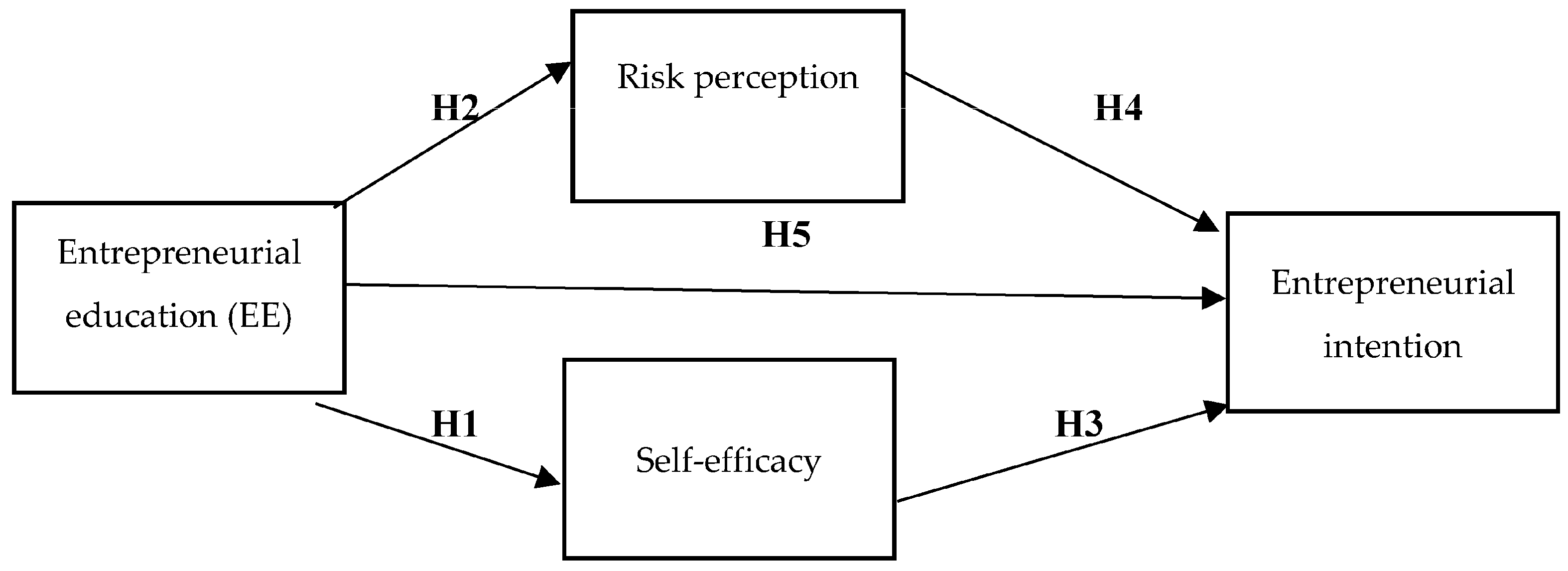
Figure 1 illustrates how entrepreneurial education is expected to influence both psychological mechanisms (self-efficacy and risk perception) and, ultimately, entrepreneurial intention.
Building on the literature reviewed above, this study proposes a conceptual model that integrates entrepreneurial education (EE), risk perception, entrepreneurial self-efficacy, and entrepreneurial intention. Prior research highlights EE as a key contextual driver of entrepreneurial mindsets and intentions, while psychological mechanisms such as self-efficacy and risk perception play a central mediating role in entrepreneurial decision-making.
Figure 1 shows the conceptual model of the present research study:
The conceptual model (
Figure 1) was developed by synthesising insights from entrepreneurship education research and entrepreneurial intention models. Empirical studies indicate that EE enhances individuals’ entrepreneurial competencies, confidence, and ability to cope with uncertainty. At the same time, entrepreneurial self-efficacy has been consistently identified as a strong predictor of entrepreneurial intention, whereas risk perception influences individuals’ willingness to engage in uncertain entrepreneurial activities.
Accordingly, the proposed model assumes that EE affects entrepreneurial intention both directly and indirectly through self-efficacy and risk perception. This multidimensional approach responds to recent calls for more integrated frameworks capable of capturing the complex mechanisms through which education shapes entrepreneurial intentions, particularly in the context of entrepreneurial intentions aligned with sustainability principles.
According to the factors analysed based on the literature, the hypotheses tested in our study are the following:
Hypothesis 1 (H1): Self-efficacy is positively influenced by the perception of entrepreneurial education.
Hypothesis 2 (H2): Risk perception is positively influenced by the perception of the effectiveness of entrepreneurial education courses.
Hypothesis 3 (H3): Self-efficacy positively influences entrepreneurial intentions.
Hypothesis 4 (H4): Entrepreneurial intention is positively influenced by risk perception.
Hypothesis 5 (H5): The perception of entrepreneurial education has a positive effect on entrepreneurial intentions.
2.7. Research Gaps
Despite the growing body of research on entrepreneurial education, self-efficacy, and risk perception, several gaps remain. First, much of the existing literature focuses on traditional educational approaches, neglecting the role of sustainability-related content in shaping students’ entrepreneurial confidence and attitudes toward risk. While studies have examined general entrepreneurship programs, there is limited evidence on how integrating environmental and social responsibility topics influences learners’ perceived capabilities and decision-making under uncertainty.
Second, the rapid emergence of digital learning tools, particularly AI-driven educational platforms, has not been fully explored in the context of entrepreneurship training. Current research often overlooks how these technologies can provide personalised feedback, simulate real-world entrepreneurial challenges, and enhance students’ practical problem-solving skills, potentially increasing their confidence and refining their risk assessment.
Finally, there is a lack of studies that simultaneously investigate the combined effect of sustainability-oriented education and AI-enhanced learning on entrepreneurial self-efficacy and risk perception. Addressing these gaps can provide a more comprehensive understanding of how modern educational approaches prepare future entrepreneurs to navigate complex, uncertain, and socially responsible business environments.
3. Methodology
3.1. Objective of the Study
The research objective of this study aims to verify whether EE programs at the level of high schools and universities in Romania stimulate risk perception and entrepreneurial self-efficacy, these two factors being found in the literature as precursors of entrepreneurial intention, closely correlated with business start-up and entrepreneurial success [
99].
Research Design Steps (ENG)
The research design followed four main steps: (1) development of the survey instrument based on validated scales from previous studies; (2) data collection from undergraduate and university students; (3) assessment of reliability and validity using exploratory and confirmatory factor analyses; and (4) testing of the hypothesised relationships through structural equation modelling.
3.2. Questionnaire-Based Survey
This study adopts a quantitative research design, using a questionnaire-based survey to examine the relationships among entrepreneurial learning programs, risk perception, self-efficacy, and entrepreneurial intention. The quantitative approach is appropriate given the study’s objective to test theoretically grounded hypotheses and estimate relationships between latent constructs using structural equation modelling, a method widely applied in entrepreneurship and education research [
123].
Survey-based designs are commonly used in entrepreneurial intention research, as they allow the systematic measurement of psychological constructs and the comparison of relationships across large student samples [
124]. The instrument was developed based on constructs identified in the entrepreneurship literature (
Table 2) and enabled the efficient collection of data from a large student sample.
3.3. Sampling
The target population for this research consisted of high school and university students in Romania with EE-based teaching and learning programs.
In Romania, EE courses begin at high school, according to the curriculum, in the first year of study in classes with an economic profile. Also, the specific requirements of the labour market eloquently indicate the need for these notions of entrepreneurship to be taught to students even before high school studies. Entrepreneurial education stimulates the entrepreneurial mindset, encourages entrepreneurial behaviour [
125], and has a significant influence on the entrepreneurial intentions of young people [
126].
Thus, in 2019, based on an agreement among the representatives of the Romanian Ministry of Education and Research (MECR), the National Confederation for Female Entrepreneurship (CONAF) and the Oil and Gas Employers’ Federation (FPPG), based on the needs identified by the European Commission to integrate learning in an entrepreneurial spirit into the activity of young people, entrepreneurial education was introduced in Romania as an optional subject in secondary school and high school, for all classes, regardless of the profile [
127]. The same agreement, called the “Entrepreneurial Education Pact”, provides for the development in the near future for education in Romania of a National Strategy for Entrepreneurship, for the training of future successful entrepreneurs as early as possible, from school, for the development of the entrepreneurial skills of young people through creative methods of study.
At academic level, EE courses are also provided in the curriculum of the first year of study for economics majors, in which the student respondents, subjects of our study, were enrolled. In Romania, EE as a study discipline is mostly found in the curriculum of faculties and specialisations with an economic profile, namely Economics, Business Administration, Management and Marketing [
128].
The period of completing the questionnaire by the respondents (high school and university students) represented the period when they were in similar stages of assimilation of entrepreneurial notions, when the entrepreneurial knowledge had the ability to be filtered and subsequently evaluated regarding its usefulness and the possibility of implementation in their future professional activity. The items studied by the respondents of our study, high school and university students, involve the assimilation and deepening of theoretical and practical elements regarding the initiation and development of a business, the entrepreneur’s profile, planning, ethics, entrepreneurial risk, resource management, entrepreneurial responsibility, economic efficiency, relationship with the economic–social environment, as well as other fundamental notions, which complete the volume of knowledge and skills associated with entrepreneurial education and future entrepreneurs.
These findings are consistent with previous studies showing that entrepreneurship education enhances entrepreneurial intentions primarily through cognitive mechanisms such as tone-efficacy and threat perception [
88,
97,
125,
126].
The questionnaire was administered online from 7 October to 21 December 2024, and completed by 922 respondents.
3.4. Ethics of Questionnaire Application
In accordance with research ethics, the authors undertake to guarantee the participants’ confidentiality. Before applying the questionnaire, a description of the research was distributed to high school students over 18 years of age and university students through the link on the very first page. This description first introduced the subject of the study and informed the participants about the aspects regarding informed, free and voluntary consent. Therefore, each high school and university student participated in this research voluntarily, and gave their consent by ticking the first question in the questionnaire (“informed, free and voluntary consent”).
3.5. Steps of the Research
In order to conduct this research, we completed the following steps:
- (a)
Exploratory factor analysis;
- (b)
Confirmatory factor analysis;
- (c)
Estimation of the relationships among the latent factors;
- (d)
Model validation.
First, exploratory factor analysis was applied to examine the underlying factor structure of the measurement items. Next, confirmatory factor analysis was employed to assess the reliability and validity of the latent constructs. Subsequently, the relationships among the latent variables were estimated using structural equation modelling, allowing for the simultaneous analysis of the measurement and structural models. Finally, model validation was performed by evaluating overall goodness-of-fit indices.
The steps in the structural equation modelling process follow the recommendations found in the article by [
129]. Also, the selection and sequencing of exploratory factor analysis, confirmatory factor analysis, and structural equation modelling follow established methodological guidelines for latent variable analysis, which recommend EFA for identifying factor structure, CFA for validating measurement models, and SEM for testing hypothesised relationships among latent constructs [
123]. We used the Stata statistical software version 13.0 in all the stages of the analysis.
4. Results and Discussion
In this research, we used frequency analysis and descriptive statistics, and we tested the hypotheses through a statistical analysis which was conducted using Stata statistical software version 13.0.
Table 3 presents the descriptive statistics of the sample. They show us that 74.62% of respondents are female and 25.38% of respondents are male. Regarding the age of the respondents, they are 18 years old (23.10%), between 19 and 21 years old (41.21%), between 22 and 25 years old (23.10%), and over 25 of years (12.59%). In terms of education, 23.75% of respondents are high school students, 50.75% are undergraduate students, and the remaining 25.50% are post-graduate students. In general, the respondents live in families with an income between 460 and 1380 USD/month (75.37%). 16.37% of the respondents declared that their family income was below 460 USD/month, and for 8.26% of the respondents the family income was over 2300 USD/month.
4.1. Exploratory Factor Analysis
According to the study conducted by [
129], we started the analysis with an exploratory factor analysis. The purpose of this technique is to identify the underlying relationships between the measured variables. The main analysis yielded 4 factors with an eigenvalue above 1 (
Table 4).
As four factors exhibited eigenvalues greater than 1, an orthogonal factor rotation using the Kaiser–Varimax method was applied. Factor rotation is used in exploratory factor analysis to simplify the factor structure and improve interpretability by making high loadings higher and low loadings lower. The Varimax procedure achieves this by maximising the variance of squared loadings within each factor, thereby facilitating clearer separation between factors and a more meaningful interpretation of the underlying constructs [
130].
Next, to calculate the reliability of a construct, we used Cronbach’s Alpha (CA). Cronbach’s Alpha is a widely used reliability coefficient that indicates the extent to which items within the same construct are consistently measuring the same underlying concept. Values above commonly accepted thresholds indicate satisfactory internal consistency [
131]. Thus, factor 1, which we called entrepreneurial education (EE) has a CA of 0.8511, factor 2 (self-efficacy) has a CA of 0.9150, factor 3 (risk perception) has a CA of 0.7983, and factor 4 (entrepreneurial intentions) has a CA of 0.8844. Thus, according to the results we found, we consider that the internal consistency of the factors analysed is met. Moreover, in this analysis we determined convergent validity and discriminant validity. Convergent validity was examined using AVE (Average Variance Extracted), which measures the proportion of variance captured by a construct relative to measurement error, with higher values indicating that the indicators adequately represent the latent construct. Maximum Shared Variance (MSV) was used to assess discriminant validity, where discriminant validity is supported when the AVE for each construct exceeds its MSV with other constructs, demonstrating that constructs are empirically distinct. In addition, Composite Reliability (CR) was calculated to evaluate the overall reliability of each construct. CR values range between 0 and 1, with higher values indicating greater construct reliability, following recommended procedures in contemporary structural equation modelling research [
132]. The CR is shown in
Appendix A (
Table A1), and its value is calculated as the squared sum of the standardised factor loadings Li for each construct and the sum of the error terms for each construct, as shown in (Equations (1) and (2)):
AVE can be calculated according to the formula in Equation (2).
where
Li is the standardised factor loadings, and
n is the number of items.
We used MSV and AVE to determine discriminant validity. Discriminant validity refers to the extent to which factors in one latent variable are uncorrelated with another variable. For discriminant validity, the MSV should be less than the AVE. In our study, the results confirm the discriminant validity.
4.2. Confirmatory Factor Analysis
Following the exploratory factor analysis, the previously defined research model was empirically tested. The validity property of the indicator items in the model was tested using a confirmatory factor analysis (CFA). CFA has wide applications, especially in the field of scale development and construct validation. Moreover, the strength of this method lies in the ability to allow the correlation of error variances to minimise the difference between the estimated and observed matrices. Next, we assessed how well the model fits the data, multicriteria indices including chi-square (χ2) and comparative fit index (CFI). We also measured Tucker–Lewis index (TLI) and root mean square error of approximation (RMSEA). Goodness of fit measures are used to evaluate the CFA model. For the model proposed, TLI is 0.977, SRMR is 0.049, RMSEE is 0.018 and CFI is 0.981.
The results of the study and general classification indices for the model proposed are presented in
Table 5.
4.3. Estimating the Relationships Among the Latent Factors and Validating the Model
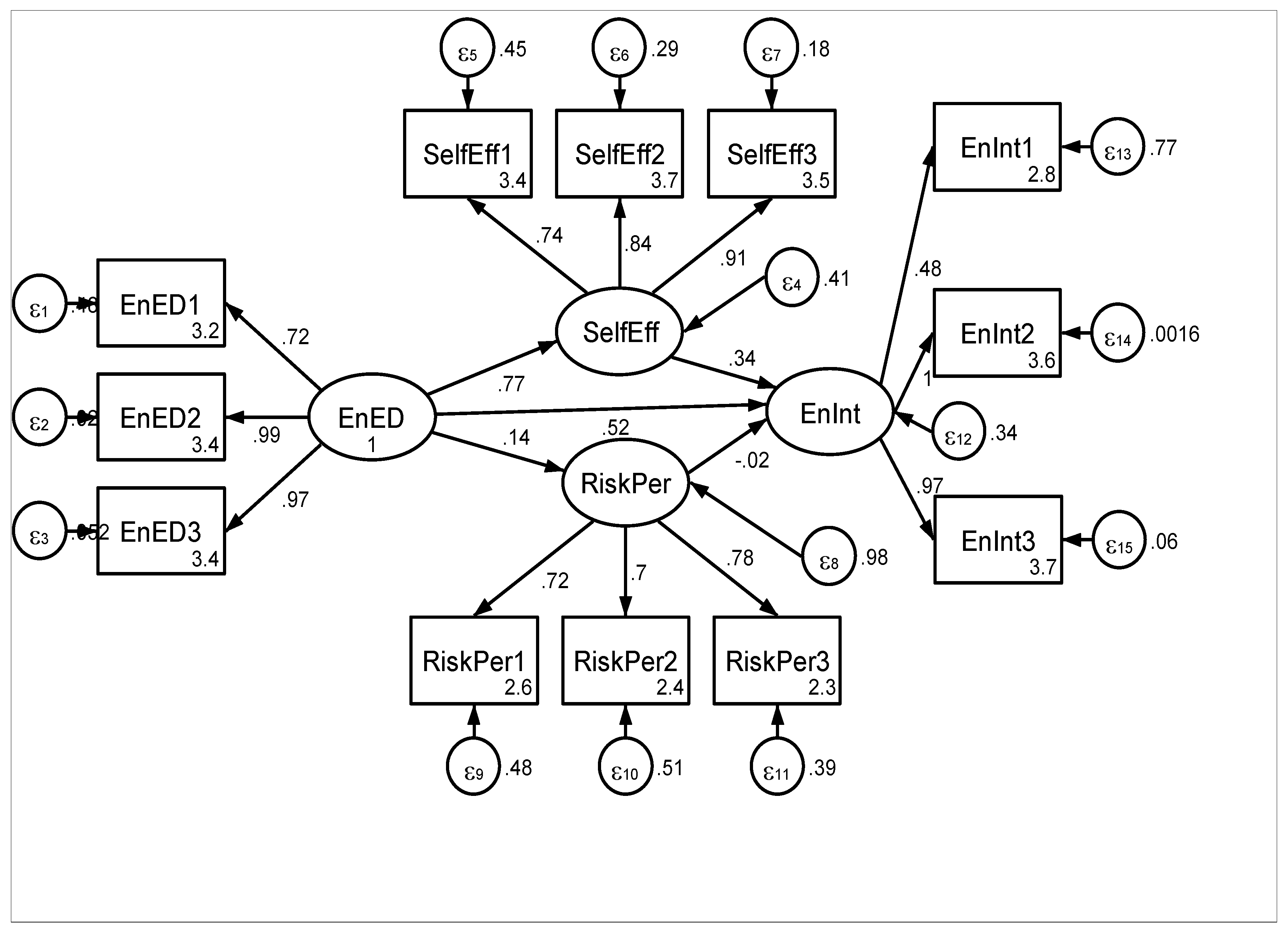
We used Goodness-of-fit measures to assess the overall structural model, where TLI is 0.977, SRMR is 0.049, RMSEA is 0.018, and CFI is 0.981. Therefore, considering the results found, we can say that the model has a good fit according to all the measures obtained. We used SEM analysis to test the 5 hypotheses proposed in this study.
Figure 2 presents the structural equation model with standardised path coefficients, representing the empirical testing of the conceptual model proposed in
Figure 1.
The standardised regression coefficients indicate that hypotheses H1, H2, H3, and H5 are supported, revealing statistically significant relationships between entrepreneurial education, self-efficacy, and entrepreneurial intention. In contrast, hypothesis H4 is not supported, as the relationship between risk perception and entrepreneurial intention is not statistically significant. The detailed parameter estimates, including standardised coefficients and significance levels, are reported in
Table 6.
5. Result Discussion
Following the analyses conducted in the previous stages, hypotheses H1, H2, H3 and H5 are validated, while H4 could not be confirmed.
Hypothesis H1: Self-efficacy is positively influenced by the perception of entrepreneurial education was validated; the results validated previous studies findings on the importance of EE perception. Thus, the study by [97] shows a relationship between self-efficacy and EE, with the authors considering that EE increases individuals’ self-motivation. Hypothesis H2: Risk perception is positively influenced by the perception of the effectiveness of entrepreneurial education courses was also validated using the structural model and the results confirmed previous studies, such as the study conducted by [87], which shows us that risk-taking is a skill which can be taught and learned. Hypothesis H3: Self-efficacy positively influences entrepreneurial intentions. Campo [94] defined entrepreneurial self-efficacy as the extent to which a person believes they are capable of successfully starting a new business. Thus, the results of our study confirm the results of the study conducted by [91], which show that entrepreneurial self-efficacy is seen as the extent to which people believe that they are capable of successfully starting a new business. Based on the structural equation, hypothesis H3 was confirmed. Hypothesis H4: Entrepreneurial intention is positively influenced by the risk perception. This hypothesis could not be confirmed as a result of the structural equation analysis. Thus, the results confirm the study presented by [32] stating that risk slows down entrepreneurial activity. The non-significant effect of risk perception on entrepreneurial intention might also reflect students’ cautious approach to ventures with social or environmental impact. Sustainable business initiatives often involve complex and uncertain outcomes, and the nuanced role of risk perception observed in our study suggests that students may require additional support or experiential learning to translate sustainability-oriented ideas into concrete entrepreneurial action.
Hypothesis H5: The perception of the entrepreneurial education has a positive effect on entrepreneurial intentions. Hypothesis H5 was validated based on the structural equation, the results confirm previous studies, such as the studies conducted by [101]. Extending the general understanding of entrepreneurial mechanisms, these findings have implications for sustainability-oriented entrepreneurship. Prior research indicates that entrepreneurial education can cultivate not only business-related skills but also values and intentions aligned with environmental and social responsibility. Our results suggest that by enhancing self-efficacy, entrepreneurial education may encourage students to pursue ventures that integrate sustainable practices, thereby contributing to broader societal goals.
Beyond hypothesis validation, the results provide broader insights into the role of entrepreneurial education and psychological mechanisms in shaping entrepreneurial intentions. The strong positive effect of entrepreneurial education on self-efficacy is consistent with prior studies emphasising education as a key driver of entrepreneurial confidence and capability development. This finding reinforces the view that educational interventions play a central role in strengthening individuals’ perceived ability to engage in entrepreneurial activity.
Similarly, the positive relationship between entrepreneurial education and risk perception aligns with research suggesting that education enhances individuals’ understanding and assessment of entrepreneurial risks, rather than merely increasing risk-taking propensity. This supports the argument that entrepreneurial education contributes to more informed and realistic evaluations of uncertainty.
The significant effect of self-efficacy on entrepreneurial intention further confirms its role as a critical psychological antecedent of entrepreneurial behaviour, as widely documented in the literature. In contrast, the non-significant relationship between risk perception and entrepreneurial intention suggests that risk considerations may play a more complex or indirect role, potentially moderated by contextual or individual factors. This result is in line with previous studies reporting mixed or negative effects of perceived risk on entrepreneurial intentions.
The absence of a statistically significant direct relationship between risk perception and entrepreneurial intention suggests that, in the context of students participating in entrepreneurial education, perceived risk alone does not play a decisive role in shaping entrepreneurial intentions. This finding is consistent with prior research indicating that individuals at early stages of their entrepreneurial trajectory may perceive entrepreneurial risks as abstract or distant, particularly in the absence of direct experience with business failure or financial responsibility. As a result, risk considerations may not translate into a clear motivational or inhibitory effect on intention formation.
Importantly, this study goes beyond merely confirming previously established relationships by demonstrating their relevance in a sustainability-oriented educational context. It provides concrete implications for entrepreneurship education by highlighting how educational interventions can foster responsible and sustainability-conscious entrepreneurial intentions, equipping students with the skills, confidence, and awareness needed to pursue ventures that integrate social and environmental objectives.
Overall, these findings highlight that entrepreneurial education primarily influences entrepreneurial intention through strengthening self-efficacy, while risk perception appears to have a more nuanced role. By jointly examining these mechanisms within a single model, this study contributes to the literature by offering a more integrated understanding of how entrepreneurial education shapes entrepreneurial intentions among students.
Collectively, the outcomes reinforce the view that entrepreneurial education does not merely foster general business capabilities, but can also shape intentions toward responsible and sustainability-conscious entrepreneurship. Integrating sustainability-focused modules or experiential projects may further enhance students’ ability to align personal entrepreneurial goals with environmental and social objectives, extending the impact of education beyond traditional profit-driven outcomes.
From a sustainability entrepreneurship perspective, this finding aligns with the idea that sustainable entrepreneurs must operate under conditions of uncertainty and complexity. Educational programs that integrate sustainability principles may therefore reduce the discouraging effect of perceived risk by strengthening confidence in problem-solving, innovation, and responsible decision-making.
6. Conclusions
This study contributes to the entrepreneurship education literature by demonstrating how entrepreneurial education fosters sustainability-oriented entrepreneurial intentions through self-efficacy and risk perception among young people in Romania, results that are in line with those obtained in the study conducted by Balgiu and Simionescu-Panait [
133]. From a practical perspective, the findings suggest that entrepreneurship education programs should integrate sustainability and digital tools to strengthen students’ confidence and responsible risk-taking capabilities.
This study offers important insights into the role of entrepreneurship education (EE) in Romanian high schools and universities, focusing on its influence on students’ risk perception, self-efficacy, and sustainability-oriented entrepreneurial intentions. The results demonstrate that EE can boost students’ confidence in their entrepreneurial abilities and promote engagement in sustainable business initiatives.
6.1. Theoretical Contribution
This study contributes to the entrepreneurship education literature by empirically demonstrating how entrepreneurial education shapes sustainable entrepreneurial intentions through self-efficacy and imminence perception among young people. Rather than developing a new dimension scale, the study integrates validated constructs into a comprehensive structural model applied to the Romanian educational environment, which remains underexplored in previous research. From a practical perspective, the findings suggest that entrepreneurship education programs should place greater emphasis on strengthening scholars’ entrepreneurial tone-efficacy and developing realistic threat assessment skills, particularly within sustainability-oriented curricula.
6.2. Practical Implications
The findings highlight the importance of designing EE programs that strengthen students’ entrepreneurial self-efficacy and improve their ability to realistically assess risks, particularly within sustainability-focused curricula. These insights can guide curriculum development, instructional strategies, and the creation of hands-on workshops, helping students enhance creativity, problem-solving skills, and confidence in their entrepreneurial abilities.
Educational programs may benefit from integrating entrepreneurship education across disciplines and educational levels, rather than offering it as isolated or optional courses. In particular, embedding sustainability challenges, social innovation, and responsible business practices into entrepreneurship training can better prepare students to pursue entrepreneurial activities aligned with sustainable development objectives. Such curriculum adaptations would enhance the practical impact of entrepreneurial education and strengthen its role in shaping responsible entrepreneurial pathways for future generations.
6.3. Further Research
Future research may extend the present study in several directions. Longitudinal research designs would be valuable for capturing how entrepreneurial education influences self-efficacy, risk-related perceptions, and entrepreneurial intentions over time, allowing for a deeper understanding of developmental and causal processes. Further studies could also examine additional psychological or contextual variables that may shape entrepreneurial intentions, such as prior entrepreneurial exposure, institutional support, or cultural factors.
Moreover, applying the proposed framework in different educational systems or national contexts would help assess the robustness and generalisability of the findings. Future research may also refine and further validate the adapted measurement instruments across diverse samples. Finally, extending the analysis toward sustainability-oriented entrepreneurial behaviours, rather than intentions alone, would provide deeper insight into the role of entrepreneurial education in supporting sustainable development.
6.4. Limitations
This study has limitations that should be considered when interpreting the results. The analysis is based on self-reported survey data, which capture students’ perceptions and entrepreneurial intentions rather than actual entrepreneurial behaviour. While this approach is common in entrepreneurship research, it does not allow verification of subsequent business creation. In addition, the study focuses on entrepreneurial education and selected other factors, without explicitly accounting for other influences such as family background (except for family income), social networks, prior work experience, or socio-economic conditions.
One limitation of this study concerns the measurement approach. The entrepreneurial education construct focuses on applied learning outcomes, such as idea and product development, which may not fully capture all dimensions of formal entrepreneurship education. In addition, entrepreneurial intention was measured using a limited number of items to balance measurement precision with survey length constraints. Although reliability and validity indicators were satisfactory, future research could employ more comprehensive measurement scales to capture these constructs in greater depth and to further validate the findings.
A further limitation relates to the composition of the sample, which includes high school, undergraduate, and postgraduate students, as well as an uneven gender distribution, with female respondents representing the majority of participants. Although all respondents were enrolled in entrepreneurship education programs and were therefore exposed to similar learning content, differences in educational level, maturity, and professional experience may influence entrepreneurial self-efficacy, risk perception, and entrepreneurial intentions. The gender imbalance reflects both the structure of economics-oriented educational programs and a higher willingness of female students to participate in survey research. Future research could employ multi-group SEM, longitudinal designs, or more balanced sampling strategies to examine potential differences across educational levels and gender.
Finally, we believe that the main research limits are determined by the dynamism over time of the influence that EE has on risk perception and self-efficacy, as well as the flexibility of trends regarding entrepreneurial intentions, which means adaptation to changes both by researchers and especially by high school and university students. Through further analysis and research, we can contribute to shaping a more realistic and up-to-date profile regarding the role that risk perception and the feeling of self-efficacy in business can have through EE acquired through specialised higher education in the emergence of entrepreneurial intentions.
In addition, EE also augments the productive potential of other students’ skills thereby fostering the general accumulation of human capital, which has been broadly shown to play a key role in modern economic growth [
134,
135].
Author Contributions
Conceptualization, G.I.B., L.-L.D., R.C.B., A.A. and G.B.; Methodology, G.I.B., L.-L.D., R.C.B., A.A. and G.B.; Software, A.A.; Validation, A.A.; Formal analysis, L.-L.D., R.C.B. and G.B.; Investigation, G.I.B. and R.C.B.; Resources, G.I.B., L.-L.D., R.C.B., A.A. and G.B.; Data curation, G.I.B., L.-L.D., A.A. and G.B.; Writing—original draft, G.I.B., L.-L.D., R.C.B., A.A. and G.B.; Writing—review and editing, G.I.B., L.-L.D., R.C.B., A.A. and G.B.; Visualisation, G.I.B., L.-L.D., R.C.B., A.A. and G.B.; Supervision, G.I.B., L.-L.D., R.C.B. and G.B.; Funding acquisition, L.-L.D. All authors have read and agreed to the published version of the manuscript.
Funding
This research received no external funding.
Institutional Review Board Statement
This study was waived for ethical review as it was conducted under the supervision of teaching staff. Participation was voluntary and anonymous, and no personal or sensitive data were collected. The study complied with Romanian national legislation (Law 190/2018 and EU Regulation 2016/679—GDPR), the school’s internal data protection policies, and relevant institutional regulations by the Institutional Committee.
Informed Consent Statement
Verbal informed consent was obtained from the participants. Verbal consent was obtained rather than written because of the minimal-risk and anonymous nature of the study.
Data Availability Statement
The original contributions presented in this study are included in the article. Further inquiries can be directed to the corresponding authors.
Acknowledgments
We thank our colleague Gabriel Mircea CHIRITA from the University of Quebec at Rimouski, Canada, for all the support given in this research.
Conflicts of Interest
The authors declare no conflicts of interest.
Appendix A
Table A1.
Factor loadings and composite reliability values.
Table A1.
Factor loadings and composite reliability values.
| Item/Latent Variable | Loading (Std.) | Composite Reliability |
|---|
| Entrepreneurial education (EnED) | 0.424 | 0.740 |
| 0.827 |
| 0.805 |
| Self-efficacy (AutoEff) | 0.854 | 0.886 |
| 0.868 |
| 0.825 |
| Risk perception (RiskPer) | 0.689 | 0.740 |
| 0.684 |
| 0.719 |
| Entrepreneurial intention (EntInt) | 0.411 | 0.786 |
| 0.873 |
| 0.887 |
References
- Motta, V.F.; Galina, S.V.R. Experiential learning in entrepreneurship education: A systematic literature review. Teach. Teach. Educ. 2023, 121, 103919. [Google Scholar] [CrossRef] [Scilit]
- Kozlinska, I.; Rebmann, A.; Mets, T. Entrepreneurial competencies and employment status of business graduates: The role of experiential entrepreneurship pedagogy. J. Small Bus. Entrep. 2020, 35, 724–761. [Google Scholar] [CrossRef] [Scilit]
- Mmbaga, N.A.; Lerman, M.P.; Munyon, T.P.; Lanivich, S.E. Juggling Act: Waged time investments and the health–wealth trade-off. J. Bus. Res. 2023, 158, 113695. [Google Scholar] [CrossRef] [Scilit]
- Luc, S.; Chirita, G.M.; Delvaux, E.; Kepnou, A.K. Hybrid Entrepreneurship: Employees Climbing the Entrepreneurial Ladder. Int. Rev. Entrep. 2018, 16, 89–114. [Google Scholar]
- Chirita, G.M. Mainstream or Incidental Phenomenon overlooked by Public Policy? The Case of Quebec. Entrep. Innover 2017, 34, 20–28. [Google Scholar] [CrossRef] [Scilit]
- Moberg, K. Two approaches to entrepreneurship education: The different effects of education for and through entrepreneurship at the lower secondary level. Int. J. Manag. Educ. 2014, 12, 512–528. [Google Scholar] [CrossRef] [Scilit]
- Honig, B. Entrepreneurship Education: Toward a Model of Contingency-Based Business Planning. Acad. Manag. Learn. Educ. 2004, 3, 258–273. [Google Scholar] [CrossRef] [Scilit]
- Shane, S.; Nicolaou, N. The genetics of entrepreneurial performance. Int. Small Bus. J. Res. Entrep. 2013, 31, 473–495. [Google Scholar] [CrossRef] [Scilit]
- Cunningham, B.J.; Lischeron, J. Defining Entrepreneurship—ProQuest. J. Small Bus. Manag. 1991, 29, 45. [Google Scholar]
- Hindle, K. Teaching Entrepreneurship at University: From the Wrong Building to the Right Philosophy, Chapters. In Handbook of Research in Entrepreneurship Education; Fayolle, A., Ed.; Edward Elgar Publishing: Cheltenham, UK, 2007; Volume 1, Available online: https://ideas.repec.org/h/elg/eechap/3640_5.html (accessed on 29 November 2024).
- Neck, H.M.; Greene, P.G. Entrepreneurship Education: Known Worlds and New Frontiers. J. Small Bus. Manag. 2010, 49, 55–70. [Google Scholar] [CrossRef] [Scilit]
- Chang, J.; Rieple, A. Assessing students’ entrepreneurial skills development in live projects. J. Small Bus. Enterp. Dev. 2013, 20, 225–241. [Google Scholar] [CrossRef] [Scilit]
- Teixeira, S.J.; Casteleiro, C.M.L.; Rodrigues, R.G.; Guerra, M.D. Entrepreneurial intentions and entrepreneurship in European countries. Int. J. Innov. Sci. 2018, 10, 22–42. [Google Scholar] [CrossRef] [Scilit]
- Liu, X.; Lin, C.; Zhao, G.; Zhao, D. Research on the Effects of Entrepreneurial Education and Entrepreneurial Self-Efficacy on College Students’ Entrepreneurial Intention. Front. Psychol. 2019, 10, 869. [Google Scholar] [CrossRef] [Scilit]
- Barba-Sánchez, V.; Mitre-Aranda, M.; del Brío-González, J. The entrepreneurial intention of university students: An environmental perspective. Eur. Res. Manag. Bus. Econ. 2022, 28, 100184. [Google Scholar] [CrossRef] [Scilit]
- Neneh, B.N. Entrepreneurial passion and entrepreneurial intention: The role of social support and entrepreneurial self-efficacy. Stud. High. Educ. 2020, 47, 587–603. [Google Scholar] [CrossRef] [Scilit]
- Bae, T.J.; Qian, S.; Miao, C.; Fiet, J.O. The Relationship Between Entrepreneurship Education and Entrepreneurial Intentions: A Meta-Analytic Review. Entrep. Theory Pract. 2014, 38, 217–254. [Google Scholar] [CrossRef] [Scilit]
- Masakure, O. Education and entrepreneurship in Canada: Evidence from (repeated) cross-sectional data. Educ. Econ. 2014, 23, 693–712. [Google Scholar] [CrossRef] [Scilit]
- Brás, G.R.; Daniel, A.; Fernandes, C.I. The effect of proximal personality traits on entrepreneurial intention among higher education students. Int. J. Innov. Sci. 2024, 16, 114–137. [Google Scholar] [CrossRef] [Scilit]
- McCarthy, B. The cult of risk taking and social learning: A study of Irish entrepreneurs. Manag. Decis. 2000, 38, 563–575. [Google Scholar] [CrossRef] [Scilit]
- Brindley, C. Barriers to women achieving their entrepreneurial potential. Int. J. Entrep. Behav. Res. 2005, 11, 144–161. [Google Scholar] [CrossRef] [Scilit]
- Segal, G.; Borgia, D.; Schoenfeld, J. The motivation to become an entrepreneur. Int. J. Entrep. Behav. Res. 2005, 11, 42–57. [Google Scholar] [CrossRef] [Scilit]
- Wilson, F.; Kickul, J.; Marlino, D. Gender, Entrepreneurial Self-Efficacy, and Entrepreneurial Career Intentions: Implications for Entrepreneurship Education. Entrep. Theory Pract. 2007, 31, 387–406. [Google Scholar] [CrossRef] [Scilit]
- Kuechle, G. The Determinants of Effective Entrepreneurial Behaviour: An Evolutionary Game Theory Critique. Int. J. Manag. 2013, 30, 507–521. [Google Scholar]
- de Blasio, G.; De Paola, M.; Poy, S.; Scoppa, V. Massive earthquakes, risk aversion, and entrepreneurship. Small Bus. Econ. 2020, 57, 295–322. [Google Scholar] [CrossRef] [Scilit]
- Adeel, S.; Daniel, A.D.; Botelho, A. The effect of entrepreneurship education on the determinants of entrepreneurial behaviour among higher education students: A multi-group analysis. J. Innov. Knowl. 2023, 8, 100324. [Google Scholar] [CrossRef] [Scilit]
- Lim, W.; Lee, Y.; Mamun, A.A. Delineating competency and opportunity recognition in the entrepreneurial intention analysis framework. J. Entrep. Emerg. Econ. 2023, 15, 212–232. [Google Scholar] [CrossRef] [Scilit]
- Caliendo, M.; Fossen, F.; Kritikos, A.S. Personality characteristics and the decisions to become and stay self-employed. Small Bus. Econ. 2014, 42, 787–814. [Google Scholar] [CrossRef] [Scilit]
- Verheul, I.; Thurik, R.; Grilo, I.; van der Zwan, P. Explaining preferences and actual involvement in self-employment: Gender and the entrepreneurial personality. J. Econ. Psychol. 2012, 33, 325–341. [Google Scholar] [CrossRef] [Scilit]
- Nicholson, N.; Soane, E.; Fenton-O’Creevy, M.; Willman, P. Personality and domain-specific risk taking. J. Risk Res. 2005, 8, 157–176. [Google Scholar] [CrossRef] [Scilit]
- Ricardianto, P.; Lembang, A.T.; Tatiana, Y.; Ruminda, M.; Kholdun, A.I.; Kusuma, I.G.N.A.G.E.T.; Sembiring, H.F.A.; Sudewo, G.C.; Suryani, D.; Endri, E. Enterprise risk management and business strategy on firm performance: The role of mediating competitive advantage. Uncertain Supply Chain Manag. 2023, 11, 249–260. [Google Scholar] [CrossRef] [Scilit]
- Barbosa, S.D.; Gerhardt, M.W.; Kickul, J.R. The Role of Cognitive Style and Risk Preference on Entrepreneurial Self-Efficacy and Entrepreneurial Intentions. J. Leadersh. Organ. Stud. 2007, 13, 86–104. [Google Scholar] [CrossRef] [Scilit]
- Hisrich, R.; Peters, M. Entrepreneurship, 4th ed.; Irwin McGraw Hill: Boston, MA, USA, 1998. [Google Scholar]
- Schaper, M.; Volery, T. Entrepreneurship and Small Business: A Pacific Rim Perspective; Wiley: Hoboken, NJ, USA, 2004. [Google Scholar]
- Fayolle, A.; Barbosa, S.D.; Kickul, J. Une nouvelle approche du risque en création d’entreprise. Rev. Fr. Gest. 2008, 185, 141–159. [Google Scholar] [CrossRef] [Scilit]
- Maheshwari, G.; Kha, K.L.; Arokiasamy, A.R.A. Factors affecting students’ entrepreneurial intentions: A systematic review (2005–2022) for future directions in theory and practice. Manag. Rev. Q. 2023, 73, 1903–1970. [Google Scholar] [CrossRef] [Scilit]
- Seo, J.; Kim, J.; Mesquita, L.F. Does vicarious entrepreneurial failure induce or discourage one’s entrepreneurial intent? A mediated model of entrepreneurial self-efficacy and identity aspiration. Int. J. Entrep. Behav. Res. 2024, 30, 52–71. [Google Scholar] [CrossRef] [Scilit]
- Otache, I.; Edopkolor, J.E.; Sani, I.A.; Umar, K. Entrepreneurship education and entrepreneurial intentions: Do entrepreneurial self-efficacy, alertness and opportunity recognition matter? Int. J. Manag. Educ. 2024, 22, 100917. [Google Scholar] [CrossRef] [Scilit]
- Asad, M.; Fryan, L.H.A.; Shomo, M.I. Sustainable entrepreneurial intention among university students: Synergetic moderation of entrepreneurial fear and use of artificial intelligence in teaching. Sustainability 2025, 17, 290. [Google Scholar] [CrossRef] [Scilit]
- Zulfiqar, S.; Al-reshidi, H.A.; Al Moteri, M.A.; Feroz, H.M.B.; Yahya, N.; Al-Rahmi, W.M. Understanding and predicting students’ entrepreneurial intention through business simulation games: A perspective of COVID-19. Sustainability 2021, 13, 1838. [Google Scholar] [CrossRef] [Scilit]
- Tiberius, V.; Weyland, M. Entrepreneurship education or entrepreneurship education? A bibliometric analysis. J. Furth. High. Educ. 2023, 47, 134–149. [Google Scholar] [CrossRef] [Scilit]
- Higgins, D.; Smith, K.; Mirza, M. Entrepreneurial Education: Reflexive Approaches to Entrepreneurial Learning in Practice. J. Entrep. 2013, 22, 135–160. [Google Scholar] [CrossRef] [Scilit]
- Kuehn, K. Entrepreneurial Intentions Research: Implications for Entrepreneurship Education. J. Entrep. Educ. 2008, 11, 87. [Google Scholar]
- Soumya Chahinez, T.; Meriem, G. The importance of entrepreneurial education in developing entrepreneurial spirit for the student. Econ. Manag. 2023, 20, 1–15. [Google Scholar]
- Remeikiene, R.; Dumciuviene, D.; Startiene, G. Explaining Entrepreneurial Intention of University Students: The Role of Entrepreneurial Education. In Active Citizenship by Knowledge Management & Innovation: Proceedings of the Management, Knowledge and Learning International Conference 2013; ToKnowPress: Bangkok, Thailand, 2013; Available online: https://ideas.repec.org/h/tkp/mklp13/299-307.html (accessed on 29 November 2024).
- Christensen, B.T.; Arendt, K.M.; McElheron, P.; Ball, L.J. The design entrepreneur: How adaptive cognition and formal design training create entrepreneurial self-efficacy and entrepreneurial intention. Des. Stud. 2023, 86, 101181. [Google Scholar] [CrossRef] [Scilit]
- Dana, L.-P.; Tajpour, M.; Salamzadeh, A.; Hosseini, E.; Zolfaghari, M. The Impact of Entrepreneurial Education on Technology-Based Enterprises Development: The Mediating Role of Motivation. Adm. Sci. 2021, 11, 105. [Google Scholar] [CrossRef] [Scilit]
- Haase, H.; Lautenschläger, A. The “Teachability Dilemma” of entrepreneurship. Int. Entrep. Manag. J. 2011, 7, 145–162. [Google Scholar] [CrossRef] [Scilit]
- Lordkipanidze, M.; Brezet, H.; Backman, M. The entrepreneurship factor in sustainable tourism development. J. Clean. Prod. 2005, 13, 787–798. [Google Scholar] [CrossRef] [Scilit]
- Shane, S.; Venkataraman, S. The Promise of Enterpreneurship as a Field of Research. Acad. Manag. Rev. 2000, 25, 217–226. [Google Scholar] [CrossRef] [Scilit]
- Garavan, T.N.; O′Cinneide, B. Entrepreneurship Education and Training Programmes. J. Eur. Ind. Train. 1994, 18, 3–12. [Google Scholar] [CrossRef] [Scilit]
- Vodă, A.I.; Haller, A.-P.; Anichiti, A.; Butnaru, G.I. Testing Entrepreneurial Intention Determinants in Post-Transition Economies. Sustainability 2020, 12, 10370. [Google Scholar] [CrossRef] [Scilit]
- Béchard, J.-P.; Grégoire, D. Entrepreneurship Education Research Revisited: The Case of Higher Education. Acad. Manag. Learn. Educ. 2005, 4, 22–43. [Google Scholar] [CrossRef] [Scilit]
- Turker, D.; Sonmez Selcuk, S. Which factors affect entrepreneurial intention of university students? J. Eur. Ind. Train. 2009, 33, 142–159. [Google Scholar] [CrossRef] [Scilit]
- Pruett, M.; Shinnar, R.; Toney, B.; Llopis, F.; Fox, J. Explaining entrepreneurial intentions of university students: A cross-cultural study. Int. J. Entrep. Behav. Res. 2009, 15, 571–594. [Google Scholar] [CrossRef] [Scilit]
- Bonnett, C.; Furnham, A. Who wants to be an entrepreneur? A study of adolescents interested in a Young Enterprise scheme. J. Econ. Psychol. 1991, 12, 465–478. [Google Scholar] [CrossRef] [Scilit]
- Stewart, W.H.; Watson, W.E.; Carland, J.C.; Carland, J.W. A proclivity for entrepreneurship. J. Bus. Ventur. 1999, 14, 189–214. [Google Scholar] [CrossRef] [Scilit]
- Vesper, K.H.; Gartner, W.B. Measuring progress in entrepreneurship education. J. Bus. Ventur. 1997, 12, 403–421. [Google Scholar] [CrossRef] [Scilit]
- Zeithaml, C.; Rice, G. Entrepreneurship-Small Business Education in American Universities. J. Small Bus. Manag. 1987, 25, 44. [Google Scholar]
- Shapero, A.; Sokol, L. The Social Dimensions of Entrepreneurship. University of Illinois at Urbana-Champaign’s Academy for Entrepreneurial Leadership Historical Research Reference in Entrepreneurship, 1982. Available online: https://ssrn.com/abstract=1497759 (accessed on 28 November 2024).
- Bachnik, K.; Misiaszek, T.; Day-Duro, E. Integrating corporate social challenge, learning and innovation in business education. J. Bus. Res. 2023, 159, 113700. [Google Scholar] [CrossRef] [Scilit]
- Cope, J. Researching Entrepreneurship through Phenomenological Inquiry. Int. Small Bus. J. Res. Entrep. 2005, 23, 163–189. [Google Scholar] [CrossRef] [Scilit]
- Rae, D. Entrepreneurial learning: A conceptual framework for technology-based enterprise. Technol. Anal. Strateg. Manag. 2006, 18, 39–56. [Google Scholar] [CrossRef] [Scilit]
- Higgins, D.; Elliott, C. Learning to make sense: What works in entrepreneurial education? J. Eur. Ind. Train. 2011, 35, 345–367. [Google Scholar] [CrossRef] [Scilit]
- Kuratko, D.F. Entrepreneurship Education in the 21 st Century: From Legitimization to Leadership; Ball State University: Muncie, IN, USA, 2004; pp. 1–16. Available online: http://faculty.bus.olemiss.edu/dhawley/PMBA622%20SP07/PMBA622/Sloan/L3_M11_Entre_Education.pdf (accessed on 7 January 2025).
- Kuratko, D.F. The Emergence of Entrepreneurship Education: Development, Trends, and Challenges. Entrep. Theory Pract. 2005, 29, 577–598. [Google Scholar] [CrossRef] [Scilit]
- Liñán, F.; Rodríguez-Cohard, J.C.; Rueda-Cantuche, J.M. Factors affecting entrepreneurial intention levels: A role for education. Int. Entrep. Manag. J. 2011, 7, 195–218. [Google Scholar] [CrossRef] [Scilit]
- Hasan, S.M.; Khan, E.A.; Nabi, M.N.U. Entrepreneurial education at university level and entrepreneurship development. Educ. Train. 2017, 59, 888–906. [Google Scholar] [CrossRef] [Scilit]
- European Commission. Entrepreneurship Education: A Road to Success; European Commission: Brussels, Belgium, 2015. Available online: https://jaeurope.org/wp-content/uploads/2024/07/Entrepreneurship-Education-A-road-to-success.pdf (accessed on 9 December 2025).
- Bacigalupo, M.; Kampylis, P.; Punie, Y.; Van den Brande, G. EntreComp: The Entrepreneurship Competence Framework. 2016. Available online: https://publications.jrc.ec.europa.eu/repository/handle/JRC101581 (accessed on 10 December 2025). [CrossRef]
- European Commission. Entrepreneurship Education. 2022. Available online: https://Single-Market-Economy.ec.europa.eu (accessed on 30 November 2024).
- Fairlie, R.W.; Holleran, W. Entrepreneurship training, risk aversion and other personality traits: Evidence from a random experiment. J. Econ. Psychol. 2012, 33, 366–378. [Google Scholar] [CrossRef] [Scilit]
- Song, C.; Nahm, A.Y.; Song, Z. Entrepreneurs’ hobbies and corporate risk taking: Evidence from China. Int. Rev. Financ. Anal. 2021, 77, 101856. [Google Scholar] [CrossRef] [Scilit]
- Elnadi, M.; Gheith, M.H. Entrepreneurial ecosystem, entrepreneurial self-efficacy, and entrepreneurial intention in higher education: Evidence from Saudi Arabia. Int. J. Manag. Educ. 2021, 19, 100458. [Google Scholar] [CrossRef] [Scilit]
- Cantillon, R. Essai sur la Nature du Commerce en Général. Traduit de l’anglois; Chez Fletcher Gyles: London, UK, 1756; Available online: https://archive.org/details/essaisurlanature00cant (accessed on 7 January 2025).
- Schumpeter, J.A. The Theory of Economic Development; An Inquiry into Profits, Capital, Credit, Interest, and the Business Cycle. 1934. Available online: https://cruel.org/books/hy/shortschumpeter/SchumpeterTheoryofEconDev.pdf (accessed on 30 November 2024).
- Busenitz, L.W. Entrepreneurial Risk and Strategic Decision Making. J. Appl. Behav. Sci. 1999, 35, 325–340. [Google Scholar] [CrossRef] [Scilit]
- Stewart, W.H.; Roth, P.L. Risk propensity differences between entrepreneurs and managers: A meta-analytic review. J. Appl. Psychol. 2001, 86, 145–153. [Google Scholar] [CrossRef] [Scilit] [PubMed]
- Gu, W. Impact of Managers’ overconfidence upon listed Firms’ entrepreneurial behavior in an emerging market. J. Bus. Res. 2023, 155, 113453. [Google Scholar] [CrossRef] [Scilit]
- Sanders, M.; Stam, E.; Thurik, R. The Entrepreneurial State Cannot Deliver Without an Entrepreneurial Society. Int. Stud. Entrep. 2024, 259–270. [Google Scholar] [CrossRef] [Scilit]
- Vodă, A.I.; Butnaru, G.I.; Butnaru, R.C. Enablers of Entrepreneurial Activity across the European Union—An Analysis Using GEM Individual Data. Sustainability 2020, 12, 1022. [Google Scholar] [CrossRef] [Scilit]
- Mullins, J.W.; Forlani, D. Missing the boat or sinking the boat: A study of new venture decision making. J. Bus. Ventur. 2005, 20, 47–69. [Google Scholar] [CrossRef] [Scilit]
- Sitkin, S.B.; Pablo, A.L. Reconceptualizing the Determinants of Risk Behavior. Acad. Manag. Rev. 1992, 17, 9–38. [Google Scholar] [CrossRef] [Scilit]
- Sitkin, S.B.; Weingart, L.R. Determinants of Risky Decision-Making Behavior: A Test of the Mediating Role of Risk Perceptions and Propensity. Acad. Manag. J. 1995, 38, 1573–1592. [Google Scholar] [CrossRef] [Scilit]
- Stroe, S.; Parida, V.; Wincent, J. Effectuation or causation: An fsQCA analysis of entrepreneurial passion, risk perception, and self-efficacy. J. Bus. Res. 2018, 89, 265–272. [Google Scholar] [CrossRef] [Scilit]
- Brockhaus, R.H. Risk Taking Propensity of Entrepreneurs. Acad. Manag. J. 1980, 23, 509–520. [Google Scholar] [CrossRef] [Scilit]
- Kyro, P.; Tapani, A. Learning Risk-Taking Competences. In Handbook of Research in Entrepreneurship Education, Volume 1; Edward Elgar Publishing: Cheltenham, UK, 2007. [Google Scholar] [CrossRef] [Scilit]
- Bandura, A. Self-efficacy: Toward a Unifying Theory of Behavioral change. Psychol. Rev. 1977, 84, 191–215. [Google Scholar] [CrossRef]
- Bandura, A. The assessment and predictive generality of self-percepts of efficacy. J. Behav. Ther. Exp. Psychiatry 1982, 13, 195–199. [Google Scholar] [CrossRef] [Scilit] [PubMed]
- Tantawy, M.; Herbert, K.; McNally, J.J.; Mengel, T.; Piperopoulos, P.; Foord, D. Bringing creativity back to entrepreneurship education: Creative self-efficacy, creative process engagement, and entrepreneurial intentions. J. Bus. Ventur. Insights 2021, 15, e00239. [Google Scholar] [CrossRef] [Scilit]
- Schunk, D.H.; Pajares, F. Self-Efficacy Theory. In Handbook of Motivation at School; Kathryn, R., Wigfield, W.A., Eds.; Routledge: Oxfordshire, UK, 2009; pp. 35–54. [Google Scholar]
- Pajares, F. Self-Efficacy Beliefs in Academic Settings. Rev. Educ. Res. 1996, 66, 543–578. [Google Scholar] [CrossRef]
- De Noble, A.F.; Jung, D.; Ehrlich, S.B. Entrepreneurial Self Efficacy: The Development of a Measure and Its Relationship to Entrepreneurial Action. Front. Entrep. Res. 1999, 1999, 73–78. [Google Scholar]
- Campo, J.L.M. Analysis of the influence of self-efficacy on entrepreneurial intentions. Prospectiva 2011, 9, 14–21. [Google Scholar]
- Ferreira-Neto, M.N.; de Carvalho Castro, J.L.; de Sousa-Filho, J.M.; de Souza Lessa, B. The role of self-efficacy, entrepreneurial passion, and creativity in developing entrepreneurial intentions. Front. Psychol. 2023, 14, 1134618. [Google Scholar] [CrossRef] [Scilit]
- Srimulyani, V.A.; Hermanto, Y.B. Impact of Entrepreneurial Self-Efficacy and Entrepreneurial Motivation on Micro and Small Business Success for Food and Beverage Sector in East Java, Indonesia. Economies 2021, 10, 10. [Google Scholar] [CrossRef] [Scilit]
- Newman, A.; Obschonka, M.; Schwarz, S.; Cohen, M.; Nielsen, I. Entrepreneurial self-efficacy: A Systematic Review of the Literature on Its Theoretical foundations, measurement, antecedents, and outcomes, and an Agenda for Future Research. J. Vocat. Behav. 2019, 110, 403–419. [Google Scholar] [CrossRef] [Scilit]
- Wei, J.; Chen, Y.; Zhang, Y.; Zhang, J. How Does Entrepreneurial Self-Efficacy Influence Innovation Behavior? Exploring the Mechanism of Job Satisfaction and Zhongyong Thinking. Front. Psychol. 2020, 11, 708. [Google Scholar] [CrossRef] [Scilit]
- Schlaegel, C.; Koenig, M. Determinants of Entrepreneurial Intent: A Meta-Analytic Test and Integration of Competing Models. Entrep. Theory Pract. 2013, 38, 291–332. [Google Scholar] [CrossRef] [Scilit]
- Mozahem, N.A.; Adlouni, R.O. Using Entrepreneurial Self-Efficacy as an Indirect Measure of Entrepreneurial Education. Int. J. Manag. Educ. 2020, 19, 100385. [Google Scholar] [CrossRef] [Scilit]
- Galloway, L.; Brown, W. Entrepreneurship education at university: A driver in the creation of high growth firms? Educ. Train. 2002, 44, 398–405. [Google Scholar] [CrossRef] [Scilit]
- António Porfírio, J.; Augusto Felício, J.; Carrilho, T.; Jardim, J. Promoting entrepreneurial intentions from adolescence: The influence of entrepreneurial culture and education. J. Bus. Res. 2023, 156, 113521. [Google Scholar] [CrossRef] [Scilit]
- Krueger, N.F. What Lies Beneath? The Experiential Essence of Entrepreneurial Thinking. Entrep. Theory Pract. 2007, 31, 123–138. [Google Scholar] [CrossRef] [Scilit]
- Patuelli, R.; Santarelli, E.; Tubadji, A. Entrepreneurial intention among high-school students: The importance of parents, peers and neighbors. Eurasian Bus. Rev. 2020, 10, 225–251. [Google Scholar] [CrossRef] [Scilit]
- Elo, M.; Dana, L.-P. Transnational Diaspora Entrepreneurship as a Sub-Field of International Entrepreneurship: Observations and Conceptual Remarks; Ebooks; Edward Elgar Publishing: Cheltenham, UK, 2023; pp. 18–36. [Google Scholar] [CrossRef] [Scilit]
- Díaz-García, M.C.; Jiménez-Moreno, J. Entrepreneurial intention: The role of gender. Int. Entrep. Manag. J. 2009, 6, 261–283. [Google Scholar] [CrossRef] [Scilit]
- Shook, C.L.; Priem, R.L.; McGee, J.E. Venture Creation and the Enterprising Individual: A Review and Synthesis. J. Manag. 2003, 29, 379–399. [Google Scholar] [CrossRef] [Scilit]
- Wihlenda, M.; Brahm, T.; Habisch, A. Responsible management education: Social entrepreneurial competences of civically-engaged students. Int. J. Manag. Educ. 2023, 21, 100756. [Google Scholar] [CrossRef] [Scilit]
- Taneja, M.; Kiran, R.; Bose, S.C. Assessing entrepreneurial intentions through experiential learning, entrepreneurial self-efficacy, and entrepreneurial attitude. Stud. High. Educ. 2024, 49, 98–118. [Google Scholar] [CrossRef] [Scilit]
- Saeed, S.; Yousafzai, S.Y.; Yani-De-Soriano, M.; Muffatto, M. The Role of Perceived University Support in the Formation of Students’ Entrepreneurial Intention. J. Small Bus. Manag. 2013, 53, 1127–1145. [Google Scholar] [CrossRef] [Scilit]
- Zampetakis, L.A.; Gotsi, M.; Andriopoulos, C.; Moustakis, V. Creativity and Entrepreneurial Intention in Young People. Int. J. Entrep. Innov. 2011, 12, 189–199. [Google Scholar] [CrossRef] [Scilit]
- Commission of the European Communities. Implementing the Community Lisbon Programme: Fostering Entrepreneurial Mindsets Through Education and Learning. Communication from the Commission to the Council, the European Parliament, the European Economic and Social Committee and the Committee of the Regions. COM (2006) 33 Final, 13 February 2006; University of Pittsburgh: Pittsburgh, PA, USA, 2006; Available online: http://aei.pitt.edu/42889/ (accessed on 8 January 2025).
- Marques, C.S.; Ferreira, J.J.; Gomes, D.N.; Gouveia Rodrigues, R. Entrepreneurship education. Educ. Train. 2012, 54, 657–672. [Google Scholar] [CrossRef] [Scilit]
- Fonseca, L.; Oliveira, E.; Pereira, T.; Sá, J.C. Leveraging ChatGPT for Sustainability: A Framework for SMEs to Align with UN Sustainable Development Goals and tackle sustainable development challenges. Manag. Mark. 2024, 19. [Google Scholar] [CrossRef] [Scilit]
- Gast, J.; Gundolf, K.; Cesinger, B. Doing business in a green way: A systematic review of the ecological sustainability entrepreneurship literature and future research directions. J. Clean. Prod. 2017, 147, 44–56. [Google Scholar] [CrossRef] [Scilit]
- Lindgreen, A.; Vallaster, C.; Maon, F.; Yousafzai, S.; Florencio, B.P. (Eds.) Sustainable Entrepreneurship: Discovering, Creating and Seizing Opportunities for Blended Value Generation; Routledge: Oxfordshire, UK, 2018. [Google Scholar]
- Biberhofer, P.; Lintner, C.; Bernhardt, J.; Rieckmann, M. Facilitating work performance of sustainability-driven entrepreneurs through higher education: The relevance of competencies, values, worldviews and opportunities. Int. J. Entrep. Innov. 2019, 20, 21–38. [Google Scholar] [CrossRef] [Scilit]
- Rosário, A.T.; Raimundo, R. Sustainable entrepreneurship education: A systematic bibliometric literature review. Sustainability 2024, 16, 784. [Google Scholar] [CrossRef] [Scilit]
- Diepolder, C.S.; Weitzel, H.; Huwer, J. Competence frameworks of sustainable entrepreneurship: A systematic review. Sustainability 2021, 13, 13734. [Google Scholar] [CrossRef] [Scilit]
- Tafese, M.B.; Kopp, E. Education for sustainable development: Analyzing research trends in higher education for sustainable development goals through bibliometric analysis. Discov. Sustain. 2025, 6, 51. [Google Scholar] [CrossRef] [Scilit]
- Ediagbonya, K.; Edokpolor, J.E.; Odibo, G.D.; Sun, J. Sustainable Entrepreneurship and Business Education Students’ Green Entrepreneurial Intention: Does Green Entrepreneurial Self-Efficacy Matters? Int. Bus. Educ. J. 2024, 17, 26–40. [Google Scholar] [CrossRef] [Scilit]
- Alshebami, A.S.; Alholiby, M.S.; Elshaer, I.A.; Sobaih, A.E.E.; Al Marri, S.H. Examining the relationship between green mindfulness, spiritual intelligence, and environmental self-identity: Unveiling the path to green entrepreneurial intention. Adm. Sci. 2023, 13, 226. [Google Scholar] [CrossRef] [Scilit]
- Hair, J.F.; Sarstedt, M.; Ringle, C.M.; Mena, J.A. An assessment of the use of structural equation modeling in marketing and behavioral research. J. Acad. Mark. Sci. 2012, 40, 414–433. [Google Scholar] [CrossRef] [Scilit]
- Liñán, F.; Fayolle, A. A systematic literature review on entrepreneurial intentions: Citation, thematic analyses, and research agenda. Int. Entrep. Manag. J. 2015, 11, 907–933. [Google Scholar] [CrossRef] [Scilit]
- Costin, Y.; O’Brien, M.P.; Hynes, B. Entrepreneurial education: Maker or breaker in developing students’ entrepreneurial confidence, aptitude and self-efficacy? Ind. High. Educ. 2021, 36, 267–278. [Google Scholar] [CrossRef] [Scilit]
- Biswas, A.; Verma, R.K. Engine of entrepreneurial intentions: Revisiting personality traits with entrepreneurial education. Benchmarking Int. J. 2022, 29, 2019–2044. [Google Scholar] [CrossRef] [Scilit]
- Peticilă, M. Educaţie Antreprenorială la Gimnaziu şi Liceu, Materie Opţională de Anul Şcolar Viitor—Anunţă Ministerul. Edupedu.ro, 2019, December 10. Available online: https://www.edupedu.ro/educatie-antreprenoriala-la-gimnaziu-si-liceu-materie-optionala-de-anul-scolar-viitor-anunta-ministerul/ (accessed on 10 December 2024).
- Bejinaru, R.; Prelipcean, G. Exploring Strategies for Developing Entrepreneurial Behavior of Students in Romanian Universities. Manag. Dyn. Knowl. Econ. 2021, 9, 460–475. [Google Scholar] [CrossRef] [Scilit]
- Dragan, D.; Topolšek, D. Introduction to Structural Equation Modeling: Review, Methodology and Practical Applications. In Proceedings of the International Conference on Logistics & Sustainable Transport, Celje, Slovenia, 19–21 June 2014. [Google Scholar]
- Kaiser, H.F. The varimax criterion for analytic rotation in factor analysis. Psychometrika 1958, 23, 187–200. [Google Scholar] [CrossRef] [Scilit]
- Cronbach, L.J. Coefficient alpha and the internal structure of tests. Psychometrika 1951, 16, 297–334. [Google Scholar] [CrossRef] [Scilit]
- Henseler, J.; Ringle, C.M.; Sarstedt, M. A new criterion for assessing discriminant validity in variance-based structural equation modeling. J. Acad. Mark. Sci. 2015, 43, 115–135. [Google Scholar] [CrossRef] [Scilit]
- Balgiu, B.A.; Simionescu-Panait, A. Intenția antreprenorială la studenții români la inginerie: Extinderea teoriei comportamentului planificat. Adm. Sci. 2024, 14, 275. [Google Scholar] [CrossRef] [Scilit]
- Azarnert, L.V. Foreign aid, fertility and human capital accumulation. Economica 2008, 75, 766–781. [Google Scholar] [CrossRef] [Scilit]
- Azarnert, L.V. Migration, child education, human capital accumulation, and a brain dilution tax. J. Demogr. Econ. 2025, 91, 683–700. [Google Scholar] [CrossRef] [Scilit]
| Disclaimer/Publisher’s Note: The statements, opinions and data contained in all publications are solely those of the individual author(s) and contributor(s) and not of MDPI and/or the editor(s). MDPI and/or the editor(s) disclaim responsibility for any injury to people or property resulting from any ideas, methods, instructions or products referred to in the content. |




 ,
,